EP1566927A2 - Appareil et procédé associé pour effectuer un service de transmission de données selon un mode de transmission de service - Google Patents
Appareil et procédé associé pour effectuer un service de transmission de données selon un mode de transmission de service Download PDFInfo
- Publication number
- EP1566927A2 EP1566927A2 EP05008765A EP05008765A EP1566927A2 EP 1566927 A2 EP1566927 A2 EP 1566927A2 EP 05008765 A EP05008765 A EP 05008765A EP 05008765 A EP05008765 A EP 05008765A EP 1566927 A2 EP1566927 A2 EP 1566927A2
- Authority
- EP
- European Patent Office
- Prior art keywords
- service
- delivery mode
- service delivery
- recited
- data service
- Prior art date
- Legal status (The legal status is an assumption and is not a legal conclusion. Google has not performed a legal analysis and makes no representation as to the accuracy of the status listed.)
- Granted
Links
Images

Classifications
-
- H—ELECTRICITY
- H04—ELECTRIC COMMUNICATION TECHNIQUE
- H04L—TRANSMISSION OF DIGITAL INFORMATION, e.g. TELEGRAPHIC COMMUNICATION
- H04L12/00—Data switching networks
- H04L12/28—Data switching networks characterised by path configuration, e.g. LAN [Local Area Networks] or WAN [Wide Area Networks]
-
- H—ELECTRICITY
- H04—ELECTRIC COMMUNICATION TECHNIQUE
- H04W—WIRELESS COMMUNICATION NETWORKS
- H04W40/00—Communication routing or communication path finding
-
- H—ELECTRICITY
- H04—ELECTRIC COMMUNICATION TECHNIQUE
- H04M—TELEPHONIC COMMUNICATION
- H04M3/00—Automatic or semi-automatic exchanges
- H04M3/42—Systems providing special services or facilities to subscribers
- H04M3/436—Arrangements for screening incoming calls, i.e. evaluating the characteristics of a call before deciding whether to answer it
-
- H—ELECTRICITY
- H04—ELECTRIC COMMUNICATION TECHNIQUE
- H04M—TELEPHONIC COMMUNICATION
- H04M3/00—Automatic or semi-automatic exchanges
- H04M3/42—Systems providing special services or facilities to subscribers
- H04M3/54—Arrangements for diverting calls for one subscriber to another predetermined subscriber
-
- H—ELECTRICITY
- H04—ELECTRIC COMMUNICATION TECHNIQUE
- H04W—WIRELESS COMMUNICATION NETWORKS
- H04W4/00—Services specially adapted for wireless communication networks; Facilities therefor
- H04W4/16—Communication-related supplementary services, e.g. call-transfer or call-hold
-
- H—ELECTRICITY
- H04—ELECTRIC COMMUNICATION TECHNIQUE
- H04W—WIRELESS COMMUNICATION NETWORKS
- H04W8/00—Network data management
- H04W8/18—Processing of user or subscriber data, e.g. subscribed services, user preferences or user profiles; Transfer of user or subscriber data
Definitions
- the present invention relates generally to a manner by which to provide data generated pursuant to a data service to a receiving station, such as a mobile station operable in a cellular, or other radio, communication system. More particularly, the present invention relates to apparatus, and an associated method, by which the data service, designated by a service delivery mode, is selectably routed to the receiving station. Routing is dependent upon the designated service delivery mode and, selectively, also upon a service interaction indicia, such as a call forwarding or do-not-disturb indicia, associated with the receiving station.
- the service delivery mode is a background mode
- the data service is selectively effectuated with the receiving station irrespective of the service interaction indicia associated with the receiving station.
- Telephonic communication is a necessary adjunct of modern society.
- the ability to effectuate telephonic communications between two, or more, communication stations by way of a telephonic network permits telephonic communications to be effectuated between the communication stations irrespective of their respective positions.
- Telephonic communication permits the effectuation of both voice services and data services.
- Telephonic networks have been installed throughout significant portions of the populated areas of the world. Communication stations connected to the telephonic network are used to effectuate the communication therethrough.
- a calling party utilizing an originating communication station initiates a communication session to be terminated with a receiving party at a receiving station.
- initiation at the originating station of the communication service is made by the originating party entering dialing digits associated with the intended receiving station pursuant to a call request.
- the telephonic network interprets the dialing digits and alerts the receiving station of the call request.
- a receiving party positioned at the receiving station accepts the call request, such as by taking the receiving station "off-hook.”
- the communication service is then effectuated between the originating station and the receiving station by way of the telephonic network.
- the cellular communication systems include network infrastructures which are connected to conventional, wire line telephonic communication systems.
- a mobile station operable in a cellular, or other radio, communication system communicates by way of radio links with the network infrastructure of the cellular communication system.
- a user of a mobile station is able to originate, or to receive, telephonic communications with another communication station.
- the other communication station can be formed of a conventional wire line station or another mobile station. Because a communication path extending to, and from, the mobile station is formed upon a radio link, wire line connections, conventionally required to connect a conventional wire line station to a telephonic network, are obviated. Increased communication mobility is, therefore, inherent in a cellular, or other radio, communication system. While a mobile station is a radio transceiver, mobile stations are generally constructed to mimic the operation of a conventional, wire line communication station. A user of a mobile station communicates telephonically in manners analogous to the manners by which a user of a conventional wire line communication station is used pursuant to a communication session.
- Telephonic switches, and other control devices are regularly constructed, for instance, to provide for specialized delivery services, such as call forwarding and do-not-disturb services. Such services are provided both in conventional wire line telephonic systems, as well as cellular, and other radio, systems.
- the additional features and services are generally provided pursuant to a service subscription in which the user, i.e., the subscriber, subscribes to the additional communication services pursuant to a subscription plan.
- a do-not-disturb service is a call control service.
- a do-not-disturb feature When a do-not-disturb feature is activated pursuant to a service subscription, a call, intended to be terminated at the communication station associated with the subscription is not delivered to the communication station.
- call forwarding services such as call forwarding-busy (CFB), call forwarding-default (CFD), call forwarding-no answer (CFNA), and call forwarding-unconditional (CFU) are call redirection services.
- CFB call forwarding-busy
- CFD call forwarding-default
- CFNA call forwarding-no answer
- CFU call forwarding-unconditional
- voice services are user-specific, data services are not necessarily so.
- Data services are, instead, sometimes communication station-specific rather than user-specific.
- the availability of the subscriber, or other user, of the communication station is not necessarily required for the effectuation of a data service which is communication station-specific.
- the present invention accordingly, advantageously provides apparatus, and an associated method, by which to provide data generated pursuant to a data service to a receiving station, such as a mobile station operable in a cellular, or other radio, communication system.
- a manner is provided by which the data service, designated by a service delivery mode, is selectably routed to the receiving station. Routing is dependent upon the designated service delivery mode and, selectably, also service interaction indicia, such as a call forwarding or do-not-disturb indicia associated with the receiving station. Selection of whether to route the data service to the receiving station or to redirect the data service to another terminating endpoint, is dependent upon the designated service delivery mode and, selectably, also service interaction indicia.
- Service interaction indicia include, for example, values of a call forwarding indicia or do-not-disturb indicia associated with the receiving station.
- An embodiment of the present invention describes a methodology which permits background delivery of services in the presence of service interaction flags which would normally prevent the receiving station from being contacted regarding the communication service. When such flags are set, conventionally, the receiving station is not contacted regarding delivery of the communication service, and the communication service is not effectuated with the receiving station.
- a service delivery mode is associated with a communication service initiated by an originating station.
- the service delivery mode is associated with a particular communication session.
- the service delivery mode is associated with the originating station, and every communication session initiated by the originating station is associated with the particular service delivery mode. Determination of the service delivery mode is made pursuant to call initiation procedures. Responsive to the determination of the service delivery mode, inquiry is selectably also made of the values of the service interaction indicia, such as values of the call forwarding and do-not-disturb service indicia.
- the service delivery mode associated with the communication service is of a selected one of at least two delivery modes, a background service delivery mode and a foreground service delivery mode.
- a background service delivery mode is associated with a communication service in which delivery of the communication service is effectuable without the attention or interaction of a receiving party located at the receiving station.
- the receiving party need not be aware of the effectuation of the communication service.
- the service interaction indicia e.g., indicia associated with call forwarding and do-not-disturb features
- the communication service need not be redirected to a terminating endpoint other than the intended receiving station. That is to say, some communication services are communication-station specific, rather than user-specific.
- a foreground delivery service mode is also defined.
- Communication services which require the acceptance of, or interaction with, the receiving party, remain constrained by the service interaction indicia values. That is to say, when a communication service is user-dependent, normal call forwarding and do-not-disturb procedures are followed. That is, when a communication service requires foreground delivery, determination is made of the service interaction indicia values to determine whether the service interaction features are activated. If so, the communication service is redirected to another terminating endpoint or the communication service is not effectuated.
- a maintenance mode is associated with certain communication services which, when effectuated, function to maintain the receiving station. Because such a communication service is communication station-specific, when the service delivery mode is identified to be a maintenance delivery mode, the communication service is effectuated with the intended receiving station irrespective of the setting of the service interaction indicia.
- a diagnostic service delivery mode is also defined.
- a diagnostic service delivery mode is also a communication station-specific mode. That is, when a communication service is designated by a diagnostic delivery mode, the communication service is effectuated with the intended receiving station irrespective of the values of the service interaction indicia. Additional service delivery modes can analogously be further defined.
- a receiving party, network operator, and a service provider are all able to discriminate which services are to be delivered to the receiving station or other terminating endpoint.
- Improved communications in a communication system in which an embodiment of the present invention is implemented are possible as communication services are selectively effectuable with an intended receiving station in a background mode without interaction with a receiving party.
- service delivery modes are defined in a cellular or PCS (personal communication service) and associated with communication services to be effectuated with a mobile station operable therein.
- a background service delivery mode is associated with the communication service
- the communication service is effectuated with the receiving station, i.e., the mobile station, irrespective of whether a receiving party is available at the mobile station to accept delivery, and effectuation, of the communication service.
- a foreground service delivery mode is also defined.
- determination is further made as to whether a service interaction indicia is activated, such as a call forwarding or a do-not-disturb feature. Responsive to the actuation of the service interaction feature, routing of the communication service is redirected or terminated, as appropriate, if the receiving party is unable to accept the communication service.
- apparatus, and an associated method for a communication system having an originating station at which a data-service call is originated.
- the data service call is to be terminated at an intended terminating station. Routing of the data service call to a terminating endpoint is selectably facilitated.
- the terminating endpoint is selected responsive to at least a delivery mode type.
- a delivery mode type determiner is operable responsive to detection of initiation of the data service call.
- the delivery mode type determiner determines, with respect to the intended terminating station, the delivery mode type associated with the data service call.
- a call delivery director is coupled to the delivery mode type determiner.
- the call delivery director directs the data service call to the terminating endpoint.
- the terminating endpoint is formed of the intended terminating station when the delivery mode type determined by the delivery mode type determiner comprises a background mode delivery type.
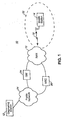
- a communication system shown generally at 10, is operable to effectuate a data service pursuant to a communication session between an originating station 12 and an intended receiving station, here a mobile station 14.
- the mobile station 14 is operable pursuant to the so-called 2G, 2.5G, and 3G (third generation) cellular communication systems which provide for the communication of data which effectuates performance of a data service.
- the mobile station is operable in other cellular, and other radio, communication systems.
- the receiving station, here formed of the mobile station 14 is, instead, formed of a wire line communication station.
- the communication system includes a network portion including a radio part, here formed of a radio access network (RAN) 16.
- RAN radio access network
- the radio access network is also generally operable pursuant to the 2G, 2.5G, and/or 3G cellular communication standard, thereby to be operable to communicate with the mobile station 14 by way of the radio link 18.
- Elements of the radio access network 16 define cells which form coverage areas within which communications with mobile stations, such as the mobile station 14, are permitted. In the figure, a single cell 22 is shown. In an actual implementation, a large number of cells are defined by the radio access network.
- the communication system further includes a public network 24, here representative of a PSTN (public-switched telephonic network) and PDN (packet data network), such as the internet backbone.
- the public network is connected to the radio access network by way of a gateway (GW) 34 and a mobile switching center (MSC) 36.
- the mobile switching center is utilized for circuit switched connections, and the gateway 34 is utilized for packet-switched connections.
- the originating station 12 is coupled to the public network 24. And, a communication path is formable between the originating station and the mobile station by way of the gateway or mobile switching center, the radio access network, and the radio link, thereby to permit a data service originated at the originating station to be delivered to the mobile station forming the receiving station. Communications originated at the mobile station to be delivered to the station 12 are also communicated upon the same communication path. And, while for some purposes of explanation, description of exemplary operation of an embodiment of the present invention shall be with respect to communications originated at the station 12, communications can analogously be originated at the mobile station 14.
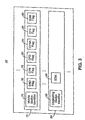
- Figure 2 illustrates portions of the communication system 10 illustrating the elements forming the apparatus 42 of an embodiment of the present invention.
- the elements are functionally represented and here are located at the mobile switching center 36. In other implementations, the elements are alternately positioned elsewhere, such as within the radio access network, or distributed at both the mobile switching center and the radio access network, as well as elsewhere.
- the mobile switching center is coupled to a home location register (HLR) 46 which includes a database 48 of an embodiment of the present invention.
- HLR home location register
- the mobile switching center is also coupled to a plurality of radio network controllers (RNC), of which a single RNC 52 is shown in the Figure, which are embodied at the radio access network 16.
- RNC radio network controller
- the radio network controller controls operation, for instance, of a plurality of base transceiver stations, also of which a single base transceiver station (BTS) 54 is shown in the figure.
- BTS base transceiver station
- the connection of the mobile station 14 to a base transceiver station upon a radio link 18 is here indicated by the commonly-referenced segment 18.
- the arrow 58 is representative of a request generated by an originating station (e.g., the originating station 12 shown in Figure 1) to initiate effectuation of a data service with the intended receiving station, here formed of the mobile station 14 as well as the data which is to be communicated to the mobile station pursuant to effectuation of the data service.
- an originating station e.g., the originating station 12 shown in Figure 1
- the intended receiving station here formed of the mobile station 14 as well as the data which is to be communicated to the mobile station pursuant to effectuation of the data service.
- the originating station provides an indication of a service delivery mode by which the data service of the request is to be delivered.
- the service delivery mode is a selected one of at least two different types of service delivery modes, a background delivery mode and a foreground delivery mode.
- a background delivery mode is a mode which permits effectuation of a data service with a receiving station irrespective of the availability of a receiving party to accept delivery of a data service.
- a foreground delivery mode is associated with a data service associated more with the receiving party than the receiving station to which the data service is initially requested to be routed. That is to say, a data service associated with a background delivery mode may be communication station-specific, while a data service associated with a foreground delivery mode is user-specific.
- a maintenance delivery mode is designated when a data service, when effectuated, performs maintenance upon a receiving station.
- a diagnostic delivery service mode is associated with a data service which, when effectuated, performs a diagnostic service at the receiving station. Both the maintenance and the diagnostic modes are similar to a background service delivery mode in that the data service is a communication station-based service. Analogous to delivery of a data service designated by a background service delivery mode, a data service designated by a maintenance service delivery mode or by a diagnostic service delivery mode is able to be delivered to the receiving station irrespective of the availability of the receiving party at the receiving station.
- the apparatus 42 of an embodiment of the present invention is positioned at a control center, here formed of the mobile switching center 36, includes a delivery mode type determiner 62 coupled to the line 58 to detect indications of the service delivery mode associated with the data service initiated by an originating station.
- the designation of the background delivery service mode is contained in the call request. That is, the designation forms part of the call request and such indication of the designation is provided by the originating station.
- the designation of the delivery service mode is associated with the identity of the originating station.
- the delivery service mode to be associated with the originating station is selected by the receiving station.
- the designation is stored at a database such as the database 48, or other internal or external database accessed by the MSC 42, and indexed together with indicia identifying the originating station. That is, the database 48 is here shown to be located at an HLR (home location register). In other implementations, the database is located elsewhere and accessible by the MSC. For instance, in another implementation, the database is positioned at an entity coupled to the public network 24.
- a database such as the database 48, or other internal or external database accessed by the MSC 42, and indexed together with indicia identifying the originating station. That is, the database 48 is here shown to be located at an HLR (home location register). In other implementations, the database is located elsewhere and accessible by the MSC. For instance, in another implementation, the database is positioned at an entity coupled to the public network 24.
- the determiner 62 determines the request for initiation of the data service to be a background service delivery mode, a maintenance service delivery mode, or a diagnostic service delivery mode, call set-up procedures continue with the intended receiving station and the data service is effectuated with the intended receiving station. If one or more service interaction flags are set, the intended receiving station is instructed, through appropriate means, not to produce an audible or other alert to the user.
- the mobile station is formed pursuant to the page message, or pursuant to a service negotiation procedure, that a background service is requested. Because a background service is requested, the user of the mobile station is not alerted, such as through generation of an audible tone, of the request. If, conversely, the determiner 62 determines the data service to be designated to be effectuated in a foreground service delivery mode, the availability of the receiving party at the receiving station to accept delivery of the data service is required.
- a page message is generated and routed to the receiving station.
- a call delivery director 63 is operable, responsive to determinations made by the determiner 62 to cause generation of the page message and other call set-up procedures. If a page response does not indicate that the receiving party is located at the intended receiving station to accept delivery of the data service, a service interaction indicia determiner 64 is operable to determine the settings of service interaction flags associated with the receiving station. Service interaction indicia is associated, for instance, with call forwarding and do-not-disturb features to which a receiving party subscribes pursuant to a service subscription plan.
- the call forwarding features include, for instance, call forwarding-busy (CFB), call forwarding-default (CFD), call forwarding-no answer (CFNA), and call forwarding-unconditional (CFU) features. Responsive to values of the service interaction indicia, the call request is selectably routed to another terminating endpoint, such as another receiving station or a store and forward location.
- CFB call forwarding-busy
- CFD call forwarding-default
- CFNA call forwarding-no answer
- CFU call forwarding-unconditional
- a service delivery mode with the data service, improved communications in the communication system are possible. Because a background service delivery mode is defined, delivery of a data service to an intended receiving station is permitted even in the event that a receiving party is unable to accept delivery of the data service and the service interaction indicia indicates that a normal call request would be rerouted to another terminating endpoint.
- FIG 3 illustrates the database 48 maintained, here, at a home location register 46 (shown in Figure 2).
- a first exemplary database entry 72 is shown.
- the database entry identifies an identity of a receiving station, here a mobile station identifier 74.
- Indexed together with the identifier are flag settings 76, 78, 82, 84, and 86.
- the flag settings correspond to do-not-disturb, CFB, CFD, CFNA, and CFU settings selected by a receiving party associated with the mobile station pursuant to a service subscription.
- values of the flag settings are determined by the service interaction indicia determiner when the call set-up can be effectuated with the intended receiving station.
- the entry 72 here further includes a service delivery mode flag 88 associated with an originating station.
- the receiving station determines the service delivery mode to be associated with an originating station
- the service delivery mode associated with the originating station is identified in the database.
- the database here includes another exemplary database entry 94, here indexing together an originating station identification 96 and a service delivery mode 98 to be associated therewith. Such a database entry is used when a service delivery mode is associated with every data service provided by an originating station.
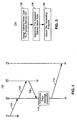
- Figure 4 illustrates a message sequence diagram, shown generally at 102, representative of signaling generated during operation of the communication system 10 shown in Figures 1 and 2.
- a request such as a call request
- the request is routed through the network of the communication system to the mobile switching center 36, or other control center.
- determination is made of the service delivery mode associated with the request.
- An indication of the service delivery mode in one implementation, is contained in the request. In other implementations, the determination of the service delivery mode requires access to a database at which such information is stored.
- Determination of values of the service interaction indicia is also made. Inquiry is made of the database 48, located at the HLR, or elsewhere to determine the values. The inquiry to the database is indicated by the segment 106. And the segment 108 indicates the response to the inquiry.
- the page message includes indication of the service delivery mode.
- the transmission of the page message is indicated in the Figure by the segment 114.
- Figure 5 illustrates a method flow diagram, shown generally at 134, of an embodiment of the present invention.
- the method 134 facilitates routing of a data service call to a terminating endpoint. And, as indicated by the block 136, a delivery mode type is assigned to the data service call. Then, and as indicated by the block 138, the delivery mode type assigned to the data service call is determined.
- a terminating endpoint to which to direct the data service call is selected.
- the terminating endpoint is formed of the intended terminating station when the delivery mode type is a background mode delivery type.
Landscapes
- Engineering & Computer Science (AREA)
- Signal Processing (AREA)
- Computer Networks & Wireless Communication (AREA)
- Mobile Radio Communication Systems (AREA)
- Telephonic Communication Services (AREA)
- Exchange Systems With Centralized Control (AREA)
- Data Exchanges In Wide-Area Networks (AREA)
- Financial Or Insurance-Related Operations Such As Payment And Settlement (AREA)
- Meter Arrangements (AREA)
- Cash Registers Or Receiving Machines (AREA)
Applications Claiming Priority (3)
| Application Number | Priority Date | Filing Date | Title |
|---|---|---|---|
| US878828 | 2001-06-11 | ||
| US09/878,828 US6697624B2 (en) | 2001-06-11 | 2001-06-11 | Apparatus, and associated method, for effectuating a data service designated by a service delivery mode |
| EP02738426A EP1360825B1 (fr) | 2001-06-11 | 2002-06-06 | Appareil et procede associe pour effectuer un service de transmission de donnees selon un mode de prestation de service |
Related Parent Applications (2)
| Application Number | Title | Priority Date | Filing Date |
|---|---|---|---|
| EP02738426.2 Division | 2002-06-06 | ||
| EP02738426A Division EP1360825B1 (fr) | 2001-06-11 | 2002-06-06 | Appareil et procede associe pour effectuer un service de transmission de donnees selon un mode de prestation de service |
Publications (3)
| Publication Number | Publication Date |
|---|---|
| EP1566927A2 true EP1566927A2 (fr) | 2005-08-24 |
| EP1566927A3 EP1566927A3 (fr) | 2005-12-14 |
| EP1566927B1 EP1566927B1 (fr) | 2009-06-03 |
Family
ID=25372932
Family Applications (2)
| Application Number | Title | Priority Date | Filing Date |
|---|---|---|---|
| EP05008765A Expired - Lifetime EP1566927B1 (fr) | 2001-06-11 | 2002-06-06 | Appareil et procédé associé pour effectuer un service de transmission de données selon un mode de transmission de service |
| EP02738426A Expired - Lifetime EP1360825B1 (fr) | 2001-06-11 | 2002-06-06 | Appareil et procede associe pour effectuer un service de transmission de donnees selon un mode de prestation de service |
Family Applications After (1)
| Application Number | Title | Priority Date | Filing Date |
|---|---|---|---|
| EP02738426A Expired - Lifetime EP1360825B1 (fr) | 2001-06-11 | 2002-06-06 | Appareil et procede associe pour effectuer un service de transmission de donnees selon un mode de prestation de service |
Country Status (15)
| Country | Link |
|---|---|
| US (2) | US6697624B2 (fr) |
| EP (2) | EP1566927B1 (fr) |
| JP (2) | JP3934606B2 (fr) |
| KR (1) | KR100500056B1 (fr) |
| CN (1) | CN1299489C (fr) |
| AT (2) | ATE294477T1 (fr) |
| AU (1) | AU2002311507B2 (fr) |
| BR (1) | BR0205605A (fr) |
| CA (1) | CA2426572C (fr) |
| DE (2) | DE60232554D1 (fr) |
| ES (1) | ES2240754T3 (fr) |
| MX (1) | MXPA03004191A (fr) |
| PT (1) | PT1566927E (fr) |
| RU (1) | RU2253190C2 (fr) |
| WO (1) | WO2002102041A1 (fr) |
Families Citing this family (8)
| Publication number | Priority date | Publication date | Assignee | Title |
|---|---|---|---|---|
| US8949452B2 (en) * | 2005-04-07 | 2015-02-03 | Opanga Networks, Inc. | System and method for progressive download with minimal play latency |
| US20070060174A1 (en) * | 2005-09-15 | 2007-03-15 | Bellsouth Intellectual Property Corporation | Methods, systems, and computer program products for updating message routing profiles |
| CA2657022A1 (fr) * | 2006-07-10 | 2008-01-17 | New I.P. Investments, Llc | Systemes et procedes de fourniture de services de reponses |
| US8718257B2 (en) * | 2006-07-10 | 2014-05-06 | Francesco Ricci | Systems and methods for providing answering services |
| JP4801203B2 (ja) * | 2006-12-14 | 2011-10-26 | テレフオンアクチーボラゲット エル エム エリクソン(パブル) | 呼を回線交換領域から統一サービス領域へルーティングする方法、装置及びコンピュータプログラム |
| RU2435327C2 (ru) * | 2006-12-14 | 2011-11-27 | Телефонактиеболагет Лм Эрикссон (Пабл) | Способы, устройства и компьютерные программные продукты для маршрутизации вызова из домена с коммутацией каналов в унифицированный служебный домен |
| US8468366B2 (en) * | 2008-03-24 | 2013-06-18 | Qualcomm Incorporated | Method for securely storing a programmable identifier in a communication station |
| KR102371811B1 (ko) | 2014-03-14 | 2022-03-07 | 아브 이니티오 테크놀로지 엘엘시 | 키드 엔티티들의 속성 매핑 |
Family Cites Families (17)
| Publication number | Priority date | Publication date | Assignee | Title |
|---|---|---|---|---|
| US5495484A (en) * | 1993-10-12 | 1996-02-27 | Dsc Communications Corporation | Distributed telecommunications switching system |
| FI97934C (fi) * | 1994-05-04 | 1997-03-10 | Nokia Telecommunications Oy | Kutsunsiirtomenetelmä ja -järjestely matkaviestimelle päättyvän puhelun yhteydessä |
| US5742905A (en) * | 1994-09-19 | 1998-04-21 | Bell Communications Research, Inc. | Personal communications internetworking |
| US5652789A (en) * | 1994-09-30 | 1997-07-29 | Wildfire Communications, Inc. | Network based knowledgeable assistant |
| AU704869B2 (en) * | 1995-03-09 | 1999-05-06 | Nokia Telecommunications Oy | Method of communication and connection control |
| FI100443B (fi) * | 1995-04-10 | 1997-11-28 | Nokia Telecommunications Oy | Liikenteen väylöitys tietoliikenneverkon solmussa |
| GB9525750D0 (en) * | 1995-12-15 | 1996-02-14 | Northern Telecom Ltd | Mobile communications system |
| US5826191A (en) * | 1996-07-03 | 1998-10-20 | Nokia Mobile Phones Limited | Dual mode network call forwarding activation and deactivation |
| CA2263264C (fr) * | 1996-08-14 | 2006-11-28 | Northern Telecom Limited | Gestionnaire d'appel telephonique base sur internet |
| JP3041244B2 (ja) * | 1996-09-26 | 2000-05-15 | 株式会社東芝 | メッセージ通信方法および装置 |
| US6134433A (en) * | 1996-12-09 | 2000-10-17 | Telefonaktiebolaget L M Ericsson (Publ) | System and method of forwarding data calls in a radio telecommunications network |
| JPH10210151A (ja) | 1997-01-20 | 1998-08-07 | Hitachi Telecom Technol Ltd | 自動交換装置 |
| KR100241783B1 (ko) * | 1997-12-19 | 2000-02-01 | 윤종용 | 복합무선단말기의 서비스 옵션에 따른 수신경고음 및 표시문구발생 방법 |
| US6577865B2 (en) * | 1998-11-05 | 2003-06-10 | Ulysses Holdings, Llc | System for intercept of wireless communications |
| US6587553B1 (en) | 1998-12-14 | 2003-07-01 | Siemens Information & Communications Networks, Inc. | Method and apparatus for protecting call privacy |
| US6687356B1 (en) * | 1999-06-18 | 2004-02-03 | Telefonaktiebolaget Lm Ericsson | System and method for providing device-aware services in an integrated telecommunications network |
| EP1139679A1 (fr) * | 2000-03-31 | 2001-10-04 | BRITISH TELECOMMUNICATIONS public limited company | Téléphone mobile avec mode de radiomessagerie |
-
2001
- 2001-06-11 US US09/878,828 patent/US6697624B2/en not_active Expired - Lifetime
-
2002
- 2002-06-06 MX MXPA03004191A patent/MXPA03004191A/es active IP Right Grant
- 2002-06-06 ES ES02738426T patent/ES2240754T3/es not_active Expired - Lifetime
- 2002-06-06 RU RU2003114737/09A patent/RU2253190C2/ru active
- 2002-06-06 DE DE60232554T patent/DE60232554D1/de not_active Expired - Lifetime
- 2002-06-06 EP EP05008765A patent/EP1566927B1/fr not_active Expired - Lifetime
- 2002-06-06 AT AT02738426T patent/ATE294477T1/de not_active IP Right Cessation
- 2002-06-06 PT PT05008765T patent/PT1566927E/pt unknown
- 2002-06-06 CN CNB028117239A patent/CN1299489C/zh not_active Expired - Lifetime
- 2002-06-06 BR BR0205605-4A patent/BR0205605A/pt not_active IP Right Cessation
- 2002-06-06 DE DE60203880T patent/DE60203880T2/de not_active Expired - Lifetime
- 2002-06-06 CA CA002426572A patent/CA2426572C/fr not_active Expired - Lifetime
- 2002-06-06 AT AT05008765T patent/ATE433255T1/de not_active IP Right Cessation
- 2002-06-06 AU AU2002311507A patent/AU2002311507B2/en not_active Expired
- 2002-06-06 WO PCT/IB2002/002068 patent/WO2002102041A1/fr not_active Ceased
- 2002-06-06 KR KR10-2003-7001913A patent/KR100500056B1/ko not_active Expired - Lifetime
- 2002-06-06 EP EP02738426A patent/EP1360825B1/fr not_active Expired - Lifetime
- 2002-06-06 JP JP2003504648A patent/JP3934606B2/ja not_active Expired - Fee Related
-
2004
- 2004-01-29 US US10/767,451 patent/US7747253B2/en not_active Expired - Lifetime
- 2004-06-10 JP JP2004172682A patent/JP4354875B2/ja not_active Expired - Lifetime
Also Published As
| Publication number | Publication date |
|---|---|
| US7747253B2 (en) | 2010-06-29 |
| CN1515109A (zh) | 2004-07-21 |
| CN1299489C (zh) | 2007-02-07 |
| ATE294477T1 (de) | 2005-05-15 |
| DE60203880T2 (de) | 2006-01-26 |
| JP3934606B2 (ja) | 2007-06-20 |
| AU2002311507B2 (en) | 2005-08-11 |
| ATE433255T1 (de) | 2009-06-15 |
| RU2253190C2 (ru) | 2005-05-27 |
| US6697624B2 (en) | 2004-02-24 |
| KR20030059097A (ko) | 2003-07-07 |
| CA2426572C (fr) | 2007-04-24 |
| EP1360825A4 (fr) | 2004-04-07 |
| EP1566927B1 (fr) | 2009-06-03 |
| JP4354875B2 (ja) | 2009-10-28 |
| JP2004521562A (ja) | 2004-07-15 |
| HK1066671A1 (en) | 2005-03-24 |
| US20050130648A1 (en) | 2005-06-16 |
| DE60203880D1 (de) | 2005-06-02 |
| EP1360825B1 (fr) | 2005-04-27 |
| ES2240754T3 (es) | 2005-10-16 |
| CA2426572A1 (fr) | 2002-12-19 |
| MXPA03004191A (es) | 2003-09-22 |
| EP1566927A3 (fr) | 2005-12-14 |
| DE60232554D1 (de) | 2009-07-16 |
| EP1360825A1 (fr) | 2003-11-12 |
| PT1566927E (pt) | 2009-07-02 |
| US20020187787A1 (en) | 2002-12-12 |
| WO2002102041A1 (fr) | 2002-12-19 |
| JP2004350302A (ja) | 2004-12-09 |
| KR100500056B1 (ko) | 2005-07-07 |
| BR0205605A (pt) | 2003-06-10 |
Similar Documents
| Publication | Publication Date | Title |
|---|---|---|
| KR100281088B1 (ko) | 이동통신지능망의서비스수행방법 | |
| EP0847174B1 (fr) | Méthode et appareil pour traitement d'appel dans un réseau de données | |
| US5797103A (en) | Method and apparatus for informing a remote unit of a feature-originated call | |
| US20080176532A1 (en) | Method and a system for minimizing roaming cost in a mobile communication network | |
| WO2002049298A1 (fr) | Reselection de telephone mobile entre un reseau cellulaire commute par circuit et internet et utilisation d'internet pour coupler des centres de commutation mobile a des antennes | |
| US7450938B2 (en) | Method for improving communication success rate in simultaneous call trial between subscribers in mobile communication systems | |
| JPH08502870A (ja) | セルラ無線電気通信システム内に増設電話機を設置するためのシステム | |
| US7747253B2 (en) | Apparatus, and associated method, for effectuating a data service designated by a service delivery mode | |
| US20050036457A1 (en) | Messaging services offered in mobile communication systems | |
| AU2002311507A1 (en) | Apparatus, and associated method, for effectuating a data service designated by a service delivery mode | |
| CA2568709A1 (fr) | Methode et systeme d'etablissement de reception d'un numero entrant a l'avance | |
| WO1999056478A1 (fr) | Systeme d'avertissement et procede utilise dans un reseau de communication pour mettre en attente les appels a commutation de circuit d'arrivee | |
| US7058389B2 (en) | Method for processing emergency calls initiated by wireless phones | |
| HK1066671B (en) | Apparatus, and associated method, for effectuating a data service designated by a service delivery mode | |
| KR101064838B1 (ko) | 중계망 통화 음원 제공 시스템, 서버 및 방법 | |
| EP1677507B1 (fr) | Système, terminal d'abonné et programme informatique pour établissement d'appel sur un réseau de données | |
| KR20050031004A (ko) | 이동통신망에서 수신제한 서비스 시스템 및 방법 | |
| KR20030063041A (ko) | 착신 통화 전환 제어 방법 |
Legal Events
| Date | Code | Title | Description |
|---|---|---|---|
| PUAI | Public reference made under article 153(3) epc to a published international application that has entered the european phase |
Free format text: ORIGINAL CODE: 0009012 |
|
| 17P | Request for examination filed |
Effective date: 20050421 |
|
| AC | Divisional application: reference to earlier application |
Ref document number: 1360825 Country of ref document: EP Kind code of ref document: P |
|
| AK | Designated contracting states |
Kind code of ref document: A2 Designated state(s): AT BE CH CY DE DK ES FI FR GB GR IE IT LI LU MC NL PT SE TR |
|
| PUAL | Search report despatched |
Free format text: ORIGINAL CODE: 0009013 |
|
| AK | Designated contracting states |
Kind code of ref document: A3 Designated state(s): AT BE CH CY DE DK ES FI FR GB GR IE IT LI LU MC NL PT SE TR |
|
| 17Q | First examination report despatched |
Effective date: 20060629 |
|
| AKX | Designation fees paid |
Designated state(s): AT BE CH CY DE DK ES FI FR GB GR IE IT LI LU MC NL PT SE TR |
|
| 17Q | First examination report despatched |
Effective date: 20060629 |
|
| GRAP | Despatch of communication of intention to grant a patent |
Free format text: ORIGINAL CODE: EPIDOSNIGR1 |
|
| GRAS | Grant fee paid |
Free format text: ORIGINAL CODE: EPIDOSNIGR3 |
|
| GRAA | (expected) grant |
Free format text: ORIGINAL CODE: 0009210 |
|
| AC | Divisional application: reference to earlier application |
Ref document number: 1360825 Country of ref document: EP Kind code of ref document: P |
|
| AK | Designated contracting states |
Kind code of ref document: B1 Designated state(s): AT BE CH CY DE DK ES FI FR GB GR IE IT LI LU MC NL PT SE TR |
|
| REG | Reference to a national code |
Ref country code: GB Ref legal event code: FG4D |
|
| REG | Reference to a national code |
Ref country code: CH Ref legal event code: EP |
|
| REG | Reference to a national code |
Ref country code: IE Ref legal event code: FG4D |
|
| REG | Reference to a national code |
Ref country code: PT Ref legal event code: SC4A Free format text: AVAILABILITY OF NATIONAL TRANSLATION Effective date: 20090625 |
|
| REF | Corresponds to: |
Ref document number: 60232554 Country of ref document: DE Date of ref document: 20090716 Kind code of ref document: P |
|
| PG25 | Lapsed in a contracting state [announced via postgrant information from national office to epo] |
Ref country code: AT Free format text: LAPSE BECAUSE OF FAILURE TO SUBMIT A TRANSLATION OF THE DESCRIPTION OR TO PAY THE FEE WITHIN THE PRESCRIBED TIME-LIMIT Effective date: 20090603 Ref country code: FI Free format text: LAPSE BECAUSE OF FAILURE TO SUBMIT A TRANSLATION OF THE DESCRIPTION OR TO PAY THE FEE WITHIN THE PRESCRIBED TIME-LIMIT Effective date: 20090603 |
|
| NLV1 | Nl: lapsed or annulled due to failure to fulfill the requirements of art. 29p and 29m of the patents act | ||
| PG25 | Lapsed in a contracting state [announced via postgrant information from national office to epo] |
Ref country code: NL Free format text: LAPSE BECAUSE OF FAILURE TO SUBMIT A TRANSLATION OF THE DESCRIPTION OR TO PAY THE FEE WITHIN THE PRESCRIBED TIME-LIMIT Effective date: 20090603 Ref country code: SE Free format text: LAPSE BECAUSE OF FAILURE TO SUBMIT A TRANSLATION OF THE DESCRIPTION OR TO PAY THE FEE WITHIN THE PRESCRIBED TIME-LIMIT Effective date: 20090903 |
|
| PG25 | Lapsed in a contracting state [announced via postgrant information from national office to epo] |
Ref country code: MC Free format text: LAPSE BECAUSE OF NON-PAYMENT OF DUE FEES Effective date: 20090630 Ref country code: ES Free format text: LAPSE BECAUSE OF FAILURE TO SUBMIT A TRANSLATION OF THE DESCRIPTION OR TO PAY THE FEE WITHIN THE PRESCRIBED TIME-LIMIT Effective date: 20090914 |
|
| REG | Reference to a national code |
Ref country code: CH Ref legal event code: PL |
|
| PG25 | Lapsed in a contracting state [announced via postgrant information from national office to epo] |
Ref country code: BE Free format text: LAPSE BECAUSE OF FAILURE TO SUBMIT A TRANSLATION OF THE DESCRIPTION OR TO PAY THE FEE WITHIN THE PRESCRIBED TIME-LIMIT Effective date: 20090603 |
|
| REG | Reference to a national code |
Ref country code: IE Ref legal event code: MM4A |
|
| PLBE | No opposition filed within time limit |
Free format text: ORIGINAL CODE: 0009261 |
|
| STAA | Information on the status of an ep patent application or granted ep patent |
Free format text: STATUS: NO OPPOSITION FILED WITHIN TIME LIMIT |
|
| PG25 | Lapsed in a contracting state [announced via postgrant information from national office to epo] |
Ref country code: IE Free format text: LAPSE BECAUSE OF NON-PAYMENT OF DUE FEES Effective date: 20090606 Ref country code: DK Free format text: LAPSE BECAUSE OF FAILURE TO SUBMIT A TRANSLATION OF THE DESCRIPTION OR TO PAY THE FEE WITHIN THE PRESCRIBED TIME-LIMIT Effective date: 20090603 Ref country code: LI Free format text: LAPSE BECAUSE OF NON-PAYMENT OF DUE FEES Effective date: 20090630 Ref country code: CH Free format text: LAPSE BECAUSE OF NON-PAYMENT OF DUE FEES Effective date: 20090630 |
|
| PGFP | Annual fee paid to national office [announced via postgrant information from national office to epo] |
Ref country code: IT Payment date: 20090626 Year of fee payment: 8 |
|
| 26N | No opposition filed |
Effective date: 20100304 |
|
| REG | Reference to a national code |
Ref country code: FR Ref legal event code: ST Effective date: 20100531 |
|
| PG25 | Lapsed in a contracting state [announced via postgrant information from national office to epo] |
Ref country code: FR Free format text: LAPSE BECAUSE OF NON-PAYMENT OF DUE FEES Effective date: 20090803 |
|
| PG25 | Lapsed in a contracting state [announced via postgrant information from national office to epo] |
Ref country code: GR Free format text: LAPSE BECAUSE OF FAILURE TO SUBMIT A TRANSLATION OF THE DESCRIPTION OR TO PAY THE FEE WITHIN THE PRESCRIBED TIME-LIMIT Effective date: 20090904 |
|
| PG25 | Lapsed in a contracting state [announced via postgrant information from national office to epo] |
Ref country code: IT Free format text: LAPSE BECAUSE OF NON-PAYMENT OF DUE FEES Effective date: 20100606 |
|
| PG25 | Lapsed in a contracting state [announced via postgrant information from national office to epo] |
Ref country code: LU Free format text: LAPSE BECAUSE OF NON-PAYMENT OF DUE FEES Effective date: 20090606 |
|
| PG25 | Lapsed in a contracting state [announced via postgrant information from national office to epo] |
Ref country code: TR Free format text: LAPSE BECAUSE OF FAILURE TO SUBMIT A TRANSLATION OF THE DESCRIPTION OR TO PAY THE FEE WITHIN THE PRESCRIBED TIME-LIMIT Effective date: 20090603 |
|
| PGFP | Annual fee paid to national office [announced via postgrant information from national office to epo] |
Ref country code: GB Payment date: 20110601 Year of fee payment: 10 |
|
| PG25 | Lapsed in a contracting state [announced via postgrant information from national office to epo] |
Ref country code: CY Free format text: LAPSE BECAUSE OF FAILURE TO SUBMIT A TRANSLATION OF THE DESCRIPTION OR TO PAY THE FEE WITHIN THE PRESCRIBED TIME-LIMIT Effective date: 20090603 |
|
| PGFP | Annual fee paid to national office [announced via postgrant information from national office to epo] |
Ref country code: PT Payment date: 20120605 Year of fee payment: 11 |
|
| GBPC | Gb: european patent ceased through non-payment of renewal fee |
Effective date: 20120606 |
|
| PG25 | Lapsed in a contracting state [announced via postgrant information from national office to epo] |
Ref country code: GB Free format text: LAPSE BECAUSE OF NON-PAYMENT OF DUE FEES Effective date: 20120606 |
|
| REG | Reference to a national code |
Ref country code: PT Ref legal event code: MM4A Free format text: LAPSE DUE TO NON-PAYMENT OF FEES Effective date: 20131206 |
|
| PG25 | Lapsed in a contracting state [announced via postgrant information from national office to epo] |
Ref country code: PT Free format text: LAPSE BECAUSE OF NON-PAYMENT OF DUE FEES Effective date: 20131206 |
|
| REG | Reference to a national code |
Ref country code: DE Ref legal event code: R081 Ref document number: 60232554 Country of ref document: DE Owner name: NOKIA TECHNOLOGIES OY, FI Free format text: FORMER OWNER: NOKIA CORP., 02610 ESPOO, FI |
|
| PGFP | Annual fee paid to national office [announced via postgrant information from national office to epo] |
Ref country code: DE Payment date: 20210511 Year of fee payment: 20 |
|
| REG | Reference to a national code |
Ref country code: DE Ref legal event code: R071 Ref document number: 60232554 Country of ref document: DE |