EP1568314B1 - Appareil et méthode de mesure de la pression sanguine - Google Patents
Appareil et méthode de mesure de la pression sanguine Download PDFInfo
- Publication number
- EP1568314B1 EP1568314B1 EP05003571.6A EP05003571A EP1568314B1 EP 1568314 B1 EP1568314 B1 EP 1568314B1 EP 05003571 A EP05003571 A EP 05003571A EP 1568314 B1 EP1568314 B1 EP 1568314B1
- Authority
- EP
- European Patent Office
- Prior art keywords
- blood pressure
- physiological information
- value
- measurement
- measured
- Prior art date
- Legal status (The legal status is an assumption and is not a legal conclusion. Google has not performed a legal analysis and makes no representation as to the accuracy of the status listed.)
- Expired - Lifetime
Links
- 238000009530 blood pressure measurement Methods 0.000 title claims description 112
- 238000000034 method Methods 0.000 title claims description 30
- 230000036772 blood pressure Effects 0.000 claims description 129
- 238000005259 measurement Methods 0.000 claims description 53
- QVGXLLKOCUKJST-UHFFFAOYSA-N atomic oxygen Chemical compound [O] QVGXLLKOCUKJST-UHFFFAOYSA-N 0.000 claims description 20
- 229910052760 oxygen Inorganic materials 0.000 claims description 20
- 239000001301 oxygen Substances 0.000 claims description 20
- 239000008280 blood Substances 0.000 claims description 16
- 210000004369 blood Anatomy 0.000 claims description 16
- 238000004364 calculation method Methods 0.000 claims description 8
- 230000002123 temporal effect Effects 0.000 claims description 7
- 230000000977 initiatory effect Effects 0.000 claims 9
- 230000000241 respiratory effect Effects 0.000 description 16
- 230000007958 sleep Effects 0.000 description 10
- 230000002526 effect on cardiovascular system Effects 0.000 description 9
- 206010020772 Hypertension Diseases 0.000 description 8
- 230000008569 process Effects 0.000 description 8
- 230000029058 respiratory gaseous exchange Effects 0.000 description 7
- 238000012544 monitoring process Methods 0.000 description 6
- 101000637031 Homo sapiens Trafficking protein particle complex subunit 9 Proteins 0.000 description 5
- 102100031926 Trafficking protein particle complex subunit 9 Human genes 0.000 description 5
- 230000000694 effects Effects 0.000 description 5
- 230000004044 response Effects 0.000 description 5
- 238000011282 treatment Methods 0.000 description 5
- 238000012935 Averaging Methods 0.000 description 4
- 210000001367 artery Anatomy 0.000 description 4
- 230000007423 decrease Effects 0.000 description 4
- 238000001514 detection method Methods 0.000 description 4
- 230000014509 gene expression Effects 0.000 description 4
- 210000000467 autonomic pathway Anatomy 0.000 description 3
- 230000008859 change Effects 0.000 description 3
- 230000002596 correlated effect Effects 0.000 description 3
- 238000013500 data storage Methods 0.000 description 3
- 238000010586 diagram Methods 0.000 description 3
- 230000008035 nerve activity Effects 0.000 description 3
- 230000002093 peripheral effect Effects 0.000 description 3
- 230000000630 rising effect Effects 0.000 description 3
- 230000002792 vascular Effects 0.000 description 3
- 230000003276 anti-hypertensive effect Effects 0.000 description 2
- 230000007211 cardiovascular event Effects 0.000 description 2
- 230000000875 corresponding effect Effects 0.000 description 2
- 230000003247 decreasing effect Effects 0.000 description 2
- 238000003745 diagnosis Methods 0.000 description 2
- 230000006870 function Effects 0.000 description 2
- 230000001631 hypertensive effect Effects 0.000 description 2
- 230000004962 physiological condition Effects 0.000 description 2
- 230000005855 radiation Effects 0.000 description 2
- 201000002859 sleep apnea Diseases 0.000 description 2
- 210000002820 sympathetic nervous system Anatomy 0.000 description 2
- 230000035488 systolic blood pressure Effects 0.000 description 2
- 206010008190 Cerebrovascular accident Diseases 0.000 description 1
- 208000035859 Drug effect increased Diseases 0.000 description 1
- 208000007530 Essential hypertension Diseases 0.000 description 1
- 102000001554 Hemoglobins Human genes 0.000 description 1
- 108010054147 Hemoglobins Proteins 0.000 description 1
- 206010021079 Hypopnoea Diseases 0.000 description 1
- 206010062519 Poor quality sleep Diseases 0.000 description 1
- 208000006011 Stroke Diseases 0.000 description 1
- 239000002220 antihypertensive agent Substances 0.000 description 1
- 229940127088 antihypertensive drug Drugs 0.000 description 1
- 238000013459 approach Methods 0.000 description 1
- 206010003119 arrhythmia Diseases 0.000 description 1
- 230000006793 arrhythmia Effects 0.000 description 1
- 230000003416 augmentation Effects 0.000 description 1
- 210000000748 cardiovascular system Anatomy 0.000 description 1
- 230000001276 controlling effect Effects 0.000 description 1
- 230000001419 dependent effect Effects 0.000 description 1
- 230000035487 diastolic blood pressure Effects 0.000 description 1
- 238000007598 dipping method Methods 0.000 description 1
- 239000003814 drug Substances 0.000 description 1
- 229940079593 drug Drugs 0.000 description 1
- 238000011156 evaluation Methods 0.000 description 1
- 230000004217 heart function Effects 0.000 description 1
- 238000009532 heart rate measurement Methods 0.000 description 1
- 239000005555 hypertensive agent Substances 0.000 description 1
- 210000003141 lower extremity Anatomy 0.000 description 1
- 230000003340 mental effect Effects 0.000 description 1
- 230000002315 pressor effect Effects 0.000 description 1
- 238000012545 processing Methods 0.000 description 1
- 230000010349 pulsation Effects 0.000 description 1
- 230000035485 pulse pressure Effects 0.000 description 1
- 238000005070 sampling Methods 0.000 description 1
- 230000001960 triggered effect Effects 0.000 description 1
- 230000003442 weekly effect Effects 0.000 description 1
Images




Classifications
-
- A—HUMAN NECESSITIES
- A61—MEDICAL OR VETERINARY SCIENCE; HYGIENE
- A61B—DIAGNOSIS; SURGERY; IDENTIFICATION
- A61B5/00—Measuring for diagnostic purposes; Identification of persons
- A61B5/02—Detecting, measuring or recording for evaluating the cardiovascular system, e.g. pulse, heart rate, blood pressure or blood flow
- A61B5/021—Measuring pressure in heart or blood vessels
- A61B5/022—Measuring pressure in heart or blood vessels by applying pressure to close blood vessels, e.g. against the skin; Ophthalmodynamometers
-
- A—HUMAN NECESSITIES
- A61—MEDICAL OR VETERINARY SCIENCE; HYGIENE
- A61B—DIAGNOSIS; SURGERY; IDENTIFICATION
- A61B5/00—Measuring for diagnostic purposes; Identification of persons
- A61B5/02—Detecting, measuring or recording for evaluating the cardiovascular system, e.g. pulse, heart rate, blood pressure or blood flow
- A61B5/024—Measuring pulse rate or heart rate
- A61B5/02416—Measuring pulse rate or heart rate using photoplethysmograph signals, e.g. generated by infrared radiation
- A61B5/02422—Measuring pulse rate or heart rate using photoplethysmograph signals, e.g. generated by infrared radiation within occluders
-
- A—HUMAN NECESSITIES
- A61—MEDICAL OR VETERINARY SCIENCE; HYGIENE
- A61B—DIAGNOSIS; SURGERY; IDENTIFICATION
- A61B5/00—Measuring for diagnostic purposes; Identification of persons
- A61B5/02—Detecting, measuring or recording for evaluating the cardiovascular system, e.g. pulse, heart rate, blood pressure or blood flow
- A61B5/026—Measuring blood flow
- A61B5/0285—Measuring or recording phase velocity of blood waves
-
- A—HUMAN NECESSITIES
- A61—MEDICAL OR VETERINARY SCIENCE; HYGIENE
- A61B—DIAGNOSIS; SURGERY; IDENTIFICATION
- A61B5/00—Measuring for diagnostic purposes; Identification of persons
- A61B5/08—Measuring devices for evaluating the respiratory organs
- A61B5/0816—Measuring devices for examining respiratory frequency
-
- A—HUMAN NECESSITIES
- A61—MEDICAL OR VETERINARY SCIENCE; HYGIENE
- A61B—DIAGNOSIS; SURGERY; IDENTIFICATION
- A61B5/00—Measuring for diagnostic purposes; Identification of persons
- A61B5/145—Measuring characteristics of blood in vivo, e.g. gas concentration or pH-value ; Measuring characteristics of body fluids or tissues, e.g. interstitial fluid or cerebral tissue
- A61B5/1455—Measuring characteristics of blood in vivo, e.g. gas concentration or pH-value ; Measuring characteristics of body fluids or tissues, e.g. interstitial fluid or cerebral tissue using optical sensors, e.g. spectral photometrical oximeters
Definitions
- the present invention relates generally to blood pressure measurement apparatuses and methods and particularly to such apparatuses and methods driven by variation in physiological information other than blood pressure to determine when blood pressure measurement should be performed.
- ABPM ambulatory blood pressure monitoring
- the ABPM is characterized in that it is capable of measuring a subject's blood pressure intermittently for example for every 15 or 30 minutes and thus monitoring variation in blood pressure, whether or not the subject is sleeping or not, to serve as one of means for obtaining the above described blood pressure information.
- the ABPM is expensive. Accordingly, it is affordable by only a limited number of medical facilities and accordingly, only a limited number of the ABPM can be used, so that in reality, it is used for only a limited number of patients.
- the measurement is repeated at intervals of a prescribed period of time. Accordingly in the measurement patients have their measurement sites, such as his/her upper arm, occluded and the apparatus also causes noise as it operates, which prevent the patients from sleeping, and they often feel uncomfortable or reject to use it.
- Japanese Patent Lay-ing-Open No. 8-131408 describes a method in which the fact is noted that when a person is sleeping his/her body movement is reduced and in response to a detection signal of a vibration sensor detecting body movement, when to start blood pressure measurement is timed. In other words, the measurement is not started as timed as based on variation in physiological information, and cannot provide a medically required blood pressure value reflecting variation in physiological information.
- Japanese Patent Laying-Open Nos. 62-155829 and 2-23940 still have the following issue to be addressed: there is no concept that specifies a subject-unique physiological information variation range and physiological information's temporal variation is simply referred to for example to start a blood pressure monitoring. As such, they cannot capture blood pressure value in maximum, center and minimum ranges of physiological information and hence medically important.
- an automated sphygmomanometer is known from EP-A-1 127 538 .
- the automated sphygmomanometer triggers a blood pressure determination upon detection of a significant change in the patient's heart rate variability (HRV).
- HRV can be measured directly from the NIBP signal or, when a multiparameter monitor is used, the HRV can be measured from the ECG signal or the NIBP signal.
- HRV is continuously monitored and the baseline HRV is correlated with baseline blood pressure values. Changes in HRV are displayed continuously on a display so that the clinician can determine whether to initiate an NIBP measurement or, on the other hand, the NIBP measurement can be triggered automatically in response to a change in HRV without any intervention by the clinician.
- the patient monitor can "learn” the correlation between HRV and blood pressure changes and only alert the clinician when a significant change in HRV has taken place.
- the technique of the invention allows the clinician to monitor NIBP at less frequent intervals without the concern of missing physiologically significant changes in blood pressure and without the requirement of "check inflates" in a guard mode.
- the present invention contemplates a blood pressure measurement apparatus and method which allows blood pressure measurement to be performed only when physiological information presents a subject unique variation to ensure necessary information in amount, quality and the like to collect blood pressure information.
- This object is achieved by a blood pressure measurement apparatus according to claims 1-3 and a corresponding method according to claim 5. Further advantageous embodiments of the invention are the subject-matter of the dependent claims.
- the present example is based on variation in pulse rate, a type of continuous physiological information other than blood pressure, to time when blood pressure measurement should be started, as medically required. While pulse rate is herein used, it may be replaced with heart rate, which corresponds to a similar physiological phenomenon. If heart rate is used, an electrocardiograph is separately required.
- Adopting a pulse rate or a heart rate as an index to time when blood pressure measurement should be started has the following significance: a pulse rate or a heart rate is an index of the sympathetic nervous system's activity level and its increase is associated with a cardiovascular event risk. When a pulse rate or a heart rate varies, the sympathetic nervous system also varies. Accordingly, the blood pressure level at the time is specified and measured to attempt to obtain a novel blood pressure index that leads to cardiovascular risk prediction.
- the present example adopts as the continuous physiological information a pulse rate based on variation in volume of a digital artery, other types of physiological information, i.e., blood oxygen saturation level, vascular elasticity level, pulse wave velocity, and the like, as will be described hereinafter, may be used.
- physiological information i.e., blood oxygen saturation level, vascular elasticity level, pulse wave velocity, and the like, as will be described hereinafter, may be used.
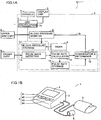
- a blood pressure measurement apparatus 1 includes: a console 4 operated to provide a variety of instructions to a blood pressure measurement system, a system detecting continuous physiological information, and blood pressure measurement apparatus 1; a display unit 3 displaying a variety of information including resultant measurement, and a central processing unit (CPU) 7 intensively controlling and monitoring them.
- a console 4 operated to provide a variety of instructions to a blood pressure measurement system, a system detecting continuous physiological information, and blood pressure measurement apparatus 1
- a display unit 3 displaying a variety of information including resultant measurement
- a central processing unit (CPU) 7 intensively controlling and monitoring them.
- the blood pressure measurement system includes a cuff 5 arranged external to a casing 2 indicated by a dotted line and wound around a subject's upper arm in blood pressure measurement, a blood pressure monitor 8 connected to cuff 5 via an air tube and operative in response to a pressure signal detected from cuff 5 to measure blood pressure and output a blood pressure value, a timer 9 counting time to output temporal information including a date and a time, and a blood pressure storage 11 receiving a blood pressure value from blood pressure monitor 8 to correlate each value with the temporal information output from timer 9 and store them.
- Blood pressure monitor 8 and cuff 5 will not be described as they are configured as well known.
- the contents of blood pressure storage 11 are read and displayed by display unit 3.
- Console 4 includes a power supply switch 41 operated to turn on/off a power supply for blood pressure measurement apparatus 1, a measurement start switch 42 operated to issue instruction to start or stop measurement, a memory call switch 43 operated to issue instruction to read from the storage to display information of the storage at display unit 3, and a mode switch 44 operated to switch a mode of operation.
- the continuous physiological information detection system includes a finger cuff 6 arranged external to casing 2 and attached to a subject's finger to continuously detect a pulse wave, a pulse wave detector 13 receiving a pulse wave signal from finger cuff 6 to recognize the pulse wave for each single beat, a pulse rate calculator 14 receiving an output from pulse wave detector 13 to calculate a pulse rate based on the received output, a pulse rate storage 12 storing the pulse rate calculated by pulse rate calculator 14, and a comparator and determiner 15 comparing the pulse rate stored in pulse rate storage 12 with the currently measured pulse rate and making a decision therefrom, and driven by the decision to output a start signal 16 instructing blood pressure monitor 8 to start blood pressure measurement.
- blood pressure storage 11 and pulse rate storage 12 which are configured of memory
- pulse wave detector 13, pulse rate calculator 14 and comparator and determiner 15, which are provided in the form of a program configure a processor 10.
- CPU 7 controls access to blood pressure storage 11 and pulse rate storage 12 and also controls execution of the program of pulse wave detector 13, pulse rate calculator 14 and comparator and determiner 15.
- CPU 7 has a calculator 71 provided in the form of a program executed by CPU 7.
- finger cuff 6 shown in Fig. 2 is for example adopted.
- Finger cuff 6 is configured to include a cylindrical cuff 67, and a light emitting element 65 and a light receiving element 66 incorporated in cuff 67.
- light emitting element 65 illuminates the finger for example with an infrared beam of light
- the finger transmits beam, which is detected by light receiving element 66.
- the finger's arterial volume repeats to increase and decrease in accordance with pulsation of blood pressure, and the amount (or intensity) of infrared radiation, which is more absorbable by blood hemoglobin, that is transmitted through the finger varies as the finger's arterial volume varies.
- Light receiving element 66 outputs to pulse wave detector 13 a variation in amount of the infrared radiation transmitted through the finger and received.
- the variation is represented for example by a signal representative for example of a variation in voltage. This signal is referred to as a pulse wave signal, such as shown for example in Fig. 3 .
- Pulse wave detector 13 receiving the pulse wave signal recognizes for each single beat the pulse wave's rising point (indicated in Fig. 3 by an arrow) represented by the pulse wave signal. Then, pulse rate calculator 14 measures a temporal interval ⁇ T between adjacent rising points of the pulse wave and calculates the number of beats per unit time, i.e., a pulse rate.
- Pulse rate storage 12 can store pulse rate for example over a plurality of days. Furthermore, comparator and determiner 15 connects pulse rate storage 12, pulse rate calculator 14 and blood pressure monitor 8 together and compares a previous pulse rate stored in pulse rate storage 12 with a current pulse rate transmitted from pulse rate calculator 14 to determine whether the subject's current pulse rate is around a specified range relative to the previous pulse rate's variation range, more specifically, whether it is around a maximum value, an average value, or a minimum value. If a decision is made that the current pulse rate is around such a specified range, start signal 16 is output to blood pressure monitor 8. Blood pressure monitor 8 receives start signal 16 and responsively starts blood pressure measurement.
- blood pressure measurement apparatus 1 is used in three stages, i.e., 1) the stage of measuring a pulse rate for a prescribed period of time to store data of a plurality of pulse rates to obtain a subject unique pulse rate variation range (the "pulse rate storage stage"), 2) the stage of measuring blood pressure, as based on the distribution of the data of the plurality of pulse rates stored, when a currently measured pulse rate approaches a specified range within the subject unique variation range (the "blood pressure measurement stage"), and 3) the stage of reading and outputting (or displaying) the stored pulse rate data and blood pressure data for study.
- the pulse rate storage stage the stage of measuring blood pressure, as based on the distribution of the data of the plurality of pulse rates stored, when a currently measured pulse rate approaches a specified range within the subject unique variation range
- the blood pressure measurement stage the stage of reading and outputting (or displaying) the stored pulse rate data and blood pressure data for study.
- One important medical object of the present invention is to measure blood pressure at an instant during sleep when a physiological variation occurs. Accordingly, in the following description, for better understanding, the pulse rate storage and blood pressure measurement stages are both performed as blood pressure measurement apparatus 1 is used during sleep. While it is noted herein that it is known that blood pressure varies with autonomic nerve activity and that autonomic nerve activity during sleep and blood pressure variation attributed thereto have a medical significance, and blood pressure measurement apparatus I is accordingly used during sleep, although it may not be used during sleep. Note herein that autonomic nerve activity is obtained from physiological information for example of a type associated with cardiovascular risk.
- FIG. 4 With reference to Fig. 4 , the pulse rate storage step's operation will be described.
- a program in accordance with the Fig. 4 flow chart is stored in a memory (not shown) associated with CPU 7, and read and executed by CPU 7.
- This stage only stores pulse rate data obtained by measuring a pulse wave. Accordingly, the user simply has finger cuff 6 attached thereon and operates mode switch 44 of console 4 to switch blood pressure measurement apparatus 1 to enter a pulse rate data storage mode and initiate blood pressure measurement apparatus 1.
- blood pressure measurement apparatus 1 may be adapted to switch to enter a storage mode automatically performing a pulse rate data storage operation when there is no pulse rate data stored.
- finger cuff 6 is attached on a subject's finger for the sake of illustration.
- step (ST) 1 CPU 7 recognizes that blood pressure measurement apparatus 1 is started in the storage mode.
- step (ST2) CPU 7 instructs pulse wave detector 13 to detect a pulse wave's rising point for each beat from a pulse wave signal obtained from a pulse wave sensor of finger cuff 6.
- step 3 CPU 7 instructs pulse rate calculator 14 to calculate a pulse rate for each beat (an amount converted to the number of beats of the pulse wave per unit time), and CPU 7 goes to ST4 to store data representing the pulse rate to pulse rate storage 12.
- subsequent ST5 CPU 7 determines whether the user operates console 4 to stop blood pressure measurement apparatus 1 as he/she has got up. If not, CPU 7 returns to ST2 and thereafter ST2-ST4 are repeated for a pulse wave signal detected. Continuously detected pulse rate data can thus be stored to pulse rate storage 12.
- CPU 7 goes to ST6 to cause calculator 71 to calculate maximum, minimum and average pulse rates from the series of pulse rate data stored in pulse rate storage 12, stores data thereof to pulse rate storage 12, and thereafter ends the pulse rate storage operation.
- a pulse rate is stored for each beat to pulse rate storage 12.
- a pulse wave has a cycle varying for each beat as the cycle is affected for example by arrhythmia, respiratory variation, and the like.
- arrhythmia a pulse wave
- respiratory variation a pulse wave
- This can be resolved simply by providing pulse rate calculator 14 with an averaging function. More specifically, it can be done simply by adapting pulse rate calculator 14 to perform a moving averaging process on pulse rate data calculated for each beat for a few beats.
- the pulse rate for a beat of interest and those for the immediately preceding two beats and the immediately following two beats for a total of five beats are averaged out and stored as an average value in pulse rate of the beat of interest to pulse rate storage 12. This is a well-known averaging process and accordingly will not be described in detail.
- pulse rate storage 12 While in the Fig. 4 procedure a pulse rate is continuously detected and its data is stored to pulse rate storage 12, the pulse rate may be detected intermittently at intervals of a prescribed period of time and stored to pulse rate storage 12.
- FIG. 5 With reference to Fig. 5 , the blood pressure measurement stage's operation will be described.
- a program in accordance with the Fig. 5 flow chart is stored to a memory (not shown) associated with CPU 7, and read and executed by CPU 7.
- blood pressure is measured around a specified relative level in a pulse rate variation range during sleep, i.e., around maximum, average and minimum pulse rate values in the range, as based on pulse rate data obtained at the pulse rate storage stage and stored to pulse rate storage 12, and resultant, measured blood pressure data is stored to blood pressure storage 11. If blood pressure data are thus accumulated in blood pressure storage 11 over one night (or while the subject sleeps once), the present stage's operation will also be performed at the subsequent night (or the next time when the subject sleeps).
- pulse rate storage 12 has pulse rate data, and maximum, minimum and average values previously stored therein for the sake of illustration.
- a subject has finger cuff 6 and upper arm cuff 5 attached thereto for pulse rate measurement and blood pressure measurement, respectively, and operates the console 4 mode switch 44 to set a mode of operation of the blood pressure measurement stage and operates measurement start switch 42 to start blood pressure measurement apparatus 1.
- CPU 7 goes to ST101 to recognize that blood pressure measurement apparatus 1 is started in the mode of operation of the blood pressure measurement stage.
- CPU 7 then goes to STs 102 and 103 to perform a pulse wave detection process and a pulse rate calculation process, respectively. These processes will not specifically be described as they are identical to an operation performed at the pulse rate storage stage including the averaging process previously described.
- CPU 7 then goes to the following steps STs 104-106 to instruct comparator and determiner 15 to operate.
- comparator and determiner 15 compares pulse rate data calculated from a currently measured pulse wave with a distribution of pulse rate data previously stored in pulse rate storage 12 to determine whether the pulse rate indicated by the pulse rate data indicates a value close to the maximum value, the minimum value or the average value:
- PR (0) If a current pulse rate is represented by PR (0), whether PR (0) indicates a value close to the maximum value is determined by whether the following expression: PR 0 > PRav + 2 ⁇ PRsd is established (ST104).
- Expression (3) means that when a current pulse rate exceeds a previous pulse rate average value plus the standard deviation multiplied by two a decision is made that the current pulse rate indicates a value close to the maximum value.
- a similar concept is applied to determine that the current pulse rate PR (0) indicates a value close to the minimum value by that the following equation: PR 0 ⁇ PRav ⁇ 2 ⁇ PRsd is established (ST105).
- a decision made at ST106 as to whether the current pulse rate PR (0) indicates a value close to the average is made by whether pulse rate PR (0) falls within a range in value having upper and lower limits with a previous pulse rate average value serving as a center.
- This decision for example follows the following expression: PRav ⁇ 0.2 ⁇ PRsd ⁇ PR 0 ⁇ PRav + 0.2 ⁇ PRsd
- CPU 7 If none of the STs 104-106 conditions are established, CPU 7 goes to a subsequent ST109. If any of the conditions is established, then CPU 7 goes to ST107. At ST107, comparator and determiner 15 outputs start signal 16 to blood pressure monitor 8, and blood pressure monitor 8 accordingly measures the subject's blood pressure. Subsequently at ST108 CPU 7 correlates with each other an obtained blood pressure measurement or systolic and diastolic blood pressure value data, a date, a time and other similar temporal information supplied from timer 9, a current pulse rate's data, and information of whether the current pulse rate is around the maximum value, the minimum value or the average value, and stores them to blood pressure storage 11.
- CPU 7 determines whether console 4 is operated to stop the measurement. This is determined for example by whether measurement start switch 42 is operated. If not then CPU 7 returns to ST102 and the subsequent process is similarly repeated. If the operation to stop the measurement is performed, the series of steps ends.
- a pulse rate may be measured during a prescribed period of time after blood pressure measurement apparatus 1 is started and before it is stopped, and for each measured pulse rate a decision as to when to measure blood pressure may be made or blood pressure may be measured.
- an operation storing to pulse rate storage 12 a pulse rate continuously measured at the blood pressure measurement stage is not included and the pulse rate is used simply to time when blood pressure monitor 8 should be started for blood pressure measurement. If the blood pressure measurement operation, and storing pulse rate data to pulse rate storage 12, as performed in the pulse rate storage stage, are simultaneously performed, however, data stored indicating the subject's pulse rate variation range can be more reliable. This can be achieved simply by further introducing a step after the Fig. 5 ST103 to perform a process to store a pulse rate.
- display unit 3 has a screen with an upper portion displaying a blood pressure value and its measurement time correlated with each other, as categorized in the form of a list by whether a pulse rate associated with the measured blood pressure falls within the maximum value's range, the average value's range, or the minimum value's range. While blood pressure is measured, more than one pulse rate may satisfy a condition corresponding to any of the ranges of the maximum, average and minimum values, respectively, and any blood pressure values measured whenever that condition is established and their measurement times are displayed.
- the horizontal axis represents pulse rate, and all data's frequency graph (a histogram) and the average, maximum and minimum values' threshold values, as indicated in the graph by vertical broken lines, and a pulse rate average and a pulse rate standard deviation by numerical representation are displayed.
- a pulse rate is continuously monitored as physiological information associated with a risk for cardiovascular system that allows a measurement which does not prevent a subject from sleeping, and when the physiological information presents a desired variation, i.e., when the pulse rate indicates a value close to the maximum, minimum or average value, the subject's blood pressure is measured and the resultant, measured blood pressure level and variation are presented via display unit 3 to help the subject to assess and control his/her blood pressure for himself/herself and doctors to select among antihypertensive treatments to allow earlier, optimal antihypertensive control and treatment.
- a resultant measurement and a treatment that is selected are for example as follows:
- the histogram indicates a distribution of a pulse rate used as information to start blood pressure measurement, and threshold value information indicating a level for which a blood pressure measurement is started as the pulse rate increases/decreases to the level. It can be understood that if threshold values are spaced closely relative to the distribution, a large amount of data exist outer than that, and blood pressure measurement has frequently been initiated, and that in contrast, if the threshold values are spaced too wide, blood pressure measurement has not been initiated as often as expected, or blood pressure value data is insufficient.
- Fig. 6 at the upper portion the list shows blood pressure values as measured by the start operation indicated by the data at the lower portion. While the pulse rate's increase/decrease only provides no more than a conjecture that blood pressure increases/decreases, the upper portion's blood pressure value records and presents an extent to which it has in effect increased/decreased. Doctors can understand from this information for example whether an antihypertensive drug effectively/ineffectively works, when blood pressure increased/decreased, and other information to more specifically understand morbidity so that they can optimally prescribe drugs in amount, type and the like.
- variation in blood oxygen saturation level a type of continuous physiological information other than blood pressure, is referred to to time when to start measurement of blood pressure, as medically required.
- Adopting blood oxygen saturation level as an index to time when blood pressure measurement should be started has the following significance: blood oxygen saturation level drops when sleep apnea syndrome or similar no- or shallow-breathing occurs. After breathing stops, a blood pressure level rapidly increases. Accordingly, the blood pressure at the time is measured to attempt to obtain a novel blood pressure index leading to cardiovascular risk prediction.
- Fig. 7 shows in a block a configuration of a blood pressure measurement apparatus 1A of the invention.
- Blood pressure measurement apparatus 1 of Fig. 1 A and blood pressure measurement apparatus 1 A differ in that blood pressure measurement apparatus 1 includes pulse rate storage 12, pulse rate calculator 14 and comparator and determiner 15, whereas blood pressure measurement apparatus 1A instead includes an oxygen saturation level storage 12A, an oxygen saturation level calculator 14A, and a comparator and determiner 15A.
- the other components are identical to those of blood pressure measurement apparatus 1.
- Blood oxygen saturation level is obtained as follows: finger cuff 6 pinches a finger tip and light emitting element 65 emits two types of light different in wavelength to expose the finger thereto.
- the finger transmits light, which is received by light receiving element 66 and its variation in amount is detected by pulse wave detector 13 as a pulse wave signal and therefrom oxygen saturation level calculator 14A following a known procedure calculates a blood oxygen saturation level.
- the calculated blood oxygen saturation level's data is sequentially stored to oxygen saturation level storage 12A and when the measurement completes, relative, maximum, average and minimum blood oxygen saturation level values' data are calculated, similarly as has been described in the first example and stored to oxygen saturation level storage 12A.
- Comparator and determiner 15A compares a currently measured blood oxygen saturation level with the maximum, average and minimum values stored in oxygen saturation level storage 12A and in accordance therewith outputs start signal 16. Thereafter, blood pressure measurement is performed in a procedure similar to that described in the first example
- arterial elasticity variation a type of continuous physiological information other than blood pressure, is referred to to time when to start measurement of blood pressure, as medically required.
- Adopting arterial elasticity as an index to time when blood pressure measurement should be started has the following significance: for people of advanced age, an increase in systolic blood pressure directly links to a risk of apoplexy and such increase in level depends on arterial elasticity. Increased vascular elasticity provides a rapidly increased blood pressure level, and the blood pressure level at the time is measured to attempt to obtain a novel blood pressure index leading to cardiovascular risk prediction.
- Fig. 8 shows in block a configuration of a blood pressure measurement apparatus 1B of the present embodiment.
- the Fig. 1A blood pressure measurement apparatus 1 and blood pressure measurement apparatus 1B differ in that the former includes pulse rate storage 12, pulse rate calculator 14 and comparator and determiner 15, whereas the latter instead includes an arterial elasticity storage 12B, an arterial elasticity calculator 14B, and a comparator and determiner 15B.
- the other components are identical to those of blood pressure measurement apparatus 1.
- Arterial elasticity indicates a level in elasticity of a peripheral arteries and can be detected from an amount of a feature of a reflected wave obtained as a wave of blood pressure delivered from a heart is reflected by the peripheral arteries.
- the amount of the feature of the reflected wave can be calculated by arterial elasticity calculator 14B in a known procedure from a waveform of a pulse wave output from pulse wave detector 13.
- the calculated amount of the feature is sequentially stored as arterial elasticity to arterial elasticity storage 12B and when the measurement completes, relative, maximum, average and minimum values' data are calculated, similarly as has been described in the first embodiment, and stored to arterial elasticity storage 12B.
- Comparator and determiner 15B compares a currently measured arterial elasticity's data with the maximum, average and minimum values' data stored in arterial elasticity storage 12B and in accordance with a result thereof outputs start signal 16. Thereafter, blood pressure measurement is performed through a procedure similar to that described in the first example
- pulse wave velocity or arterial compliance a type of continuous physiological information other than blood pressure, a variation in pulse wave velocity or arterial compliance is referred to to time when to start measurement of blood pressure, as medically required.
- Adopting pulse wave velocity, arterial compliance or the like as an index to time when blood pressure measurement should be started has the following significance; it is known that pulse wave velocity, arterial compliance and the like are associated with a cardiovascular event risk.
- pulse wave velocity, arterial compliance or the like increases in level, the current blood pressure level is measured to attempt to obtain a novel blood pressure index leading to cardiovascular risk prediction.
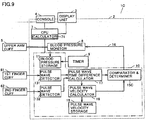
- Fig. 9 shows in a block a configuration of a blood pressure measurement apparatus 1C of the present example that utilizes pulse wave velocity.
- the Fig. 1A blood pressure measurement apparatus 1 and blood pressure measurement apparatus 1C differ in that the former includes finger cuff 6, whereas the latter instead includes first and second cuffs 61 and 62 attached to a site for measurement to output a pulse wave signal, and that processor 10 includes blood pressure storage 11, pulse wave detectors 131 and 132 receiving pulse wave signals from the first and second cuffs 61 and 62, respectively, to detect a pulse wave for each beat, a pulse wave time difference calculator 17 receiving pulse waves from pulse wave detectors 131 and 132 to calculate the pulse waves' time difference, a pulse wave velocity calculator 18 using the calculated time difference and a distance between different measurement sites to calculate a pulse wave velocity data, a pulse wave velocity storage 19 sequentially storing the calculated pulse wave velocity data, and a comparator and determiner 15C.
- the other components are identical to those of blood pressure measurement apparatus 1.
- Measuring a pulse wave velocity requires attaching the first and second cuffs 61 and 62 at sites for measurement spaced by a distance.
- the first and second cuffs 61 and 62 are attached for example to a subject's upper arm and a finger associated therewith, or his/her upper arm and lower extremity. If the first and second cuffs 61 and 62 are attached to predetermined sites, their distance can uniquely be specified as the sites have therebetween a distance which does not significantly vary between individuals. Note that a distance between sites for measurement may be designated by inputting it via a key.
- Comparator and determiner 15C compares a currently measured pulse wave velocity data with those of the maximum, average and minimum values stored in pulse wave velocity storage 19 and in accordance with a result thereof outputs start signal 16. If thereafter, blood pressure measurement is performed through a procedure similar to that described in the first example.
- Fig. 10 shows in a block a configuration of a blood pressure measurement apparatus 1D of the present example.
- the Fig. 1A blood pressure measurement apparatus 1 and blood pressure measurement apparatus 1D differ in that the former includes pulse rate storage 12, pulse rate calculator 14 and comparator and determiner 15, whereas the latter instead includes an arterial compliance storage 12D, an arterial compliance calculator 14D, and a comparator and determiner 15D.
- the other components are identical to those of blood pressure measurement apparatus 1.
- Arterial compliance can be calculated from a blood pressure waveform recorded from a finger continuously, i.e., a pulse waveform based on a pulse wave signal detected from finger cuff 6. This calculation's procedure is known and will not be described.
- Arterial compliance calculator 14D calculates arterial compliance's data, which is sequentially stored to arterial compliance storage 12D, and when the measurement completes, relative, maximum, average and minimum values' data are calculated, similarly as has been described in the first example and stored to arterial compliance storage 12D.
- Comparator and determiner 15D compares a currently measured arterial compliance's data with those of the maximum, average and minimum values stored in arterial compliance storage 12D, and in accordance with a result thereof outputs start signal 16. Thereafter, blood pressure measurement is performed through a procedure similar to that described in the first example.
- a type of continuous physiological information other than blood pressure is referred to to time when to start measurement of blood pressure, as medically required.
- Adopting respiratory cycle has an index to time when to start blood pressure measurement, has the following significance: respiratory cycle in nighttime serves as an index of sleep apnea syndrome and in wakefulness it is significantly affected by mentally stressed condition. A blood pressure level provided when a respiratory cycle varies is measured to attempt to obtain a novel blood pressure index leading to cardiovascular risk protection. While a respiratory cycle is herein employed, it may be replaced with a respiration rate of frequency. Its significance is the same as that of respiratory cycle.
- Fig. 11 shows in a block a configuration of a blood pressure measurement apparatus 1E of the present example that utilizes respiratory cycle.
- the Fig. 1A blood pressure measurement apparatus 1 and blood pressure measurement apparatus 1E differ in that the former has finger cuff 6 whereas the latter instead has a respiration sensor 21, and that processor 10 includes blood pressure storage 11, a respiration detector 22 detecting a subject's respiration, a respiratory cycle calculator 23 calculating data of the cycle of the respiration detected by respiration detector 22, a respiratory cycle storage 24 storing the calculated respiratory cycle data, and a comparator and determiner 15E.
- the other components are identical to those of blood pressure measurement apparatus 1.
- Comparator and determiner 15E compares a currently measured respiratory cycle data with those of the maximum, average and minimum values stored in respiratory cycle storage 24, and in accordance with a result thereof outputs start signal 16. Thereafter, blood pressure measurement is performed through a procedure similar to that described in the first example.
- a type of continuous physiological information other than blood pressure is referred to to time when to start measurement of blood pressure, as medically required.
- Blood pressure waveform corresponds to a waveform of a signal obtained by measuring a physical quantity derived from an arterial variation attributed to arterial, internal pressure or an amount of blood flowing through an artery.
- Adopting blood pressure waveform as an index to time when to start blood pressure measurement has the following significance: a blood pressure waveform has a large amount of biological information affected by peripheral vascular systolic level and cardiac function.
- an index an augmentation index (AI) for example, is obtained, and when the index varies, blood pressure is measured to attempt to obtain a novel blood pressure index leading to cardiovascular risk prediction.
- AI an augmentation index
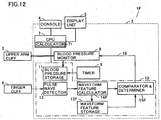
- Fig. 12 shows in a block a configuration of a blood pressure measurement apparatus 1F of the present example.
- the Fig. 1 blood pressure measurement apparatus 1 and blood pressure measurement apparatus 1F differ in that the former includes pulse rate storage 12, pulse rate calculator 14 and comparator and determiner 15, whereas the latter instead includes a waveform feature storage 12F, a waveform feature calculator 14F and a comparator and determiner 15F.
- the other components are identical to those of blood pressure measurement apparatus 1.
- the amount of a feature such as AI of a blood pressure waveform i.e., a waveform of a pulse wave detected by pulse wave detector 13 can be calculated by waveform feature calculator 14F through a known procedure from the waveform of the pulse wave output from pulse wave detector 13.
- Data of the amount of the feature calculated is sequentially stored to waveform feature storage 12F and when the measurement completes, relative, maximum, average and minimum values' data are calculated, similarly as has been described in the first example and stored to waveform feature storage 12F.
- Comparator and determiner 15F compares data of an amount of a feature of a waveform currently measured with those of the maximum, average and minimum values stored in waveform feature storage 12F, and in accordance with a result thereof outputs start signal 16. Thereafter, blood pressure measurement is performed through a procedure similar to that described in the first example.
- blood pressure is measured only at a temporal point medically required as based on physiological information of a type other than blood pressure so that if the measurement is performed for a sleeping subject, the subject can minimally be prevented from sleeping, and blood pressure information required for diagnosis can be obtained without sacrificing it in quantity, quality and the like.
Landscapes
- Health & Medical Sciences (AREA)
- Life Sciences & Earth Sciences (AREA)
- Cardiology (AREA)
- Medical Informatics (AREA)
- Surgery (AREA)
- Physics & Mathematics (AREA)
- Vascular Medicine (AREA)
- Biophysics (AREA)
- Pathology (AREA)
- Engineering & Computer Science (AREA)
- Biomedical Technology (AREA)
- Heart & Thoracic Surgery (AREA)
- Veterinary Medicine (AREA)
- Molecular Biology (AREA)
- Physiology (AREA)
- Animal Behavior & Ethology (AREA)
- General Health & Medical Sciences (AREA)
- Public Health (AREA)
- Hematology (AREA)
- Dentistry (AREA)
- Ophthalmology & Optometry (AREA)
- Measuring Pulse, Heart Rate, Blood Pressure Or Blood Flow (AREA)
- Measurement Of The Respiration, Hearing Ability, Form, And Blood Characteristics Of Living Organisms (AREA)
- Measuring And Recording Apparatus For Diagnosis (AREA)
Claims (5)
- Appareil de mesure (1 ; 1A ; 1B ; 1C, 1D ; 1E ; 1F) de la pression artérielle comprenant :des moyens de mesure (8) de la pression artérielle adaptés pour mesurer la pression artérielle d'un sujet ;des moyens de mesure (6, 13, 14) d'information physiologique adaptés pour mesurer une information physiologique qui est le niveau de saturation en oxygène du sang ;des moyens de stockage (12) d'information physiologique adapté pour stocker une série de valeurs de ladite information physiologique en niveau telle que mesurée par ledit moyen de mesure (6, 13, 14) d'information physiologique pendant une période de temps prédéterminée, lesdits moyens de stockage (12) d'information physiologique étant adaptés pour stocker de façon intermittente ou continue lesdites valeurs d'information physiologique en niveau telles que mesurées pendant ladite période de temps prédéterminée ; etdes moyens de détermination (7, 15) adaptés pour déterminer si une valeur de ladite information physiologique telle qu'actuellement mesurée par lesdits moyens de mesure (6, 13, 14) d'information physiologique pour détermination du lancement de la mesure de ladite pression artérielle du sujet dépasse une valeur seuil, dans lequel lesdits moyens de mesure (8) de pression artérielle sont adaptés pour, quand lesdits moyens de détermination (15) déterminent que la valeur de ladite information physiologique telle qu'actuellement mesurée dépasse la valeur seuil, être lancés afin de mesurer ladite pression artérielle du sujet, dans lequel :lesdits moyens de détermination (7, 15) comprennent des moyens de calcul (71) adaptés pour calculer une valeur moyenne et un écart type de valeurs mesurées de ladite série d'information physiologique préalablement stockée ; etquand ladite information physiologique actuellement mesurée pour détermination du lancement de ladite mesure de la pression artérielle fournit une valeur dépassant ladite valeur seuil obtenue à partir de ladite valeur moyenne et dudit écart type calculé par lesdits moyens de calcul (71), lesdits moyens de détermination (7, 15) sont adaptés pour déterminer que la valeur fournie dépasse la valeur seuil et lesdits moyens de mesure (8) de la pression artérielle sont lancés.
- Appareil de mesure (1 ; 1A ; 1B ; 1C, 1D ; 1E ; 1F) de la pression artérielle comprenant :des moyens de mesure (8) de la pression artérielle adaptés pour mesurer la pression artérielle d'un sujet ;des moyens de mesure (6, 13, 14) d'infirmation physiologique adaptés pour mesurer une information physiologique qui est le niveau de saturation en oxygène du sang ;des moyens de stockage (12) d'information physiologique adaptés pour stocker une série de valeurs de ladite information physiologique en niveau telle que mesurée par lesdits moyens de mesure (6, 13, 14) d'information physiologique pendant une période de temps prédéterminée, lesdits moyens de stockage (12) d'information physiologique étant adaptés pour stocker de façon intermittente ou continue lesdites valeurs d'information physiologique en niveau telles que mesurées pendant ladite période de temps prédéterminé etdes moyens de détermination (7, 15) adaptés pour déterminer si une valeur de ladite information physiologique telle qu'actuellement mesurée par ledit moyen de mesure (6, 13, 14) d'information physiologique pour détermination du lancement de la mesure de ladite pression artérielle du sujet est plus petite qu'une valeur seuil, dans lequel lesdits moyens de mesure (8) de pression artérielle sont adaptés pour, quand lesdits moyens de détermination (15) déterminent que la valeur de ladite information physiologique telle qu'actuellement mesurée est plus petite que la valeur seuil, être lancés afin de mesurer ladite pression artérielle du sujet, dans lequel :lesdits moyens de détermination (7, 15) comprennent des moyens de calcul (71) adaptés pour calculer une valeur moyenne et un écart type de valeurs mesurées de ladite série d'information physiologique préalablement stockée ; etquand ladite information physiologique actuellement mesurée pour détermination du lancement de ladite mesure de la pression artérielle fournit une valeur plus petite que ladite valeur seuil obtenue à partir de ladite valeur moyenne et dudit écart type calculé par lesdits moyens de calcul (71), lesdits moyens de détermination (7, 15) sont adaptés pour déterminer que la valeur fournie est plus petite que la valeur seuil et lesdits moyens de mesure (8) de la pression artérielle est lancé.
- Appareil de mesure (1 ; 1A ; 1B ; 1C, 1D ; 1E ; 1F) de la pression artérielle comprenant :des moyens de mesure (8) de la pression artérielle adaptés pour mesurer la pression artérielle d'un sujet ;des moyens de mesure (6, 13, 14) d'information physiologique adaptés pour mesurer une information physiologique qui est le niveau de saturation en oxygène du sang ;des moyens de stockage (12) d'information physiologique adaptés pour stocker une série de valeurs de ladite information physiologique en niveau telle que mesurée par lesdits moyens de mesure (6, 13, 14) d'information physiologique pendant une période de temps prédéterminée, lesdits moyens de stockage (12) d'information physiologique étant adaptés pour stocker de façon intermittente ou continue lesdites valeurs d'information physiologique en niveau telle que mesurées pendant ladite période de temps prédéterminé etdes moyens de détermination (7, 15) adaptés pour déterminer si une valeur de ladite information physiologique telle qu'actuellement mesurée par lesdits moyens de mesure (6, 13, 14) d'information physiologique pour détermination du lancement de la mesure de ladite pression artérielle du sujet est comprise entre des limites supérieure et inférieure déterminées, dans lequel lesdits moyens de mesure (8) de pression artérielle sont adaptés pour, quand lesdits moyens de détermination (15) déterminent que la valeur de ladite information physiologique telle qu'actuellement mesurée est comprise entre les limites supérieure et inférieure déterminées, être lancé afin de mesurer ladite pression artérielle du sujet, dans lequel :lesdits moyens de détermination (7, 15) comprennent des moyens de calcul (71) adaptés pour calculer une valeur moyenne et un écart type de valeurs mesurées de ladite série d'information physiologique préalablement stockée ; etquand ladite information physiologique mesurée pour ladite mesure de la pression artérielle fournit une valeur comprise entre les limites supérieure et inférieure déterminées obtenue à partir de ladite valeur moyenne et dudit écart type calculé par lesdites moyens de calcul (71), lesdits moyens de détermination (7, 15) sont adaptés pour déterminer que la valeur fournie est comprise entre les limites supérieure et inférieure déterminées et lesdits moyens de mesure (8) de la pression artérielle sont lancés.
- Appareil de mesure de la pression artérielle selon la revendication 1, 2 ou 3, comprenant en outre :des moyens de stockage (11) de pression artérielle corrélant et stockant une valeur de pression artérielle à chaque fois que lesdits moyens de mesure (8) de la pression artérielle fournit une mesure, une information temporelle indiquant le moment où la pression artérielle est mesurée et une information dudit niveau spécifié déterminé par lesdits moyens de détermination : etdes moyens d'affichage (3) affichant un contenu desdits moyens de stockage (11) de pression artérielle.
- Procédé de mesure de la pression artérielle comprenant les étapes consistant à :mesurer préalablement une information physiologique qui est le niveau de saturation en oxygène du sang (ST2, ST3) ;stocker de façon intermittente ou continue une série de ladite information physiologique en niveau telle que préalablement mesurée pendant une période de temps prédéterminée ;mesurer actuellement une information physiologique qui est le niveau de saturation en oxygène du sang (ST2, ST3) ; etdéterminer si une valeur de ladite information physiologique telle qu'actuellement mesurée à l'étape de mesure actuelle pour détermination du lancement de la mesure de ladite pression artérielle du sujet dépasse une valeur seuil maximale, est plus petite qu'une valeur seuil minimale, ou bien est comprise entre des limites supérieure et inférieure déterminées, dans lequel, quand une décision est prise à l'étape de détermination (ST104, ST105, ST106) que la valeur de ladite information physiologique telle qu'actuellement mesurée dépasse la valeur seuil maximale, ou est plus petite que la valeur seuil minimale, ou bien est comprise entre lesdites limites supérieure et inférieure déterminées, une mesure de ladite pression artérielle du sujet démarre, dans lequel :ladite étape de détermination comprend le calcul d'une valeur moyenne et d'un écart type de valeurs préalablement mesurées de ladite série d'information physiologique préalablement stockée ; etquand ladite information physiologique actuellement mesurée pour détermination du lancement de ladite mesure de la pression artérielle fournit une valeur dépassant ladite valeur seuil maximale obtenue à partir de ladite valeur moyenne et dudit écart type calculés à ladite étape de calcul, une décision est prise à l'étape de détermination que la valeur fournie dépasse ladite valeur seuil maximale et une mesure de ladite pression artérielle du sujet démarre, ouquand ladite information physiologique actuellement mesurée pour détermination du lancement de ladite mesure de la pression artérielle fournit une valeur plus petite que ladite valeur seuil minimale obtenue à partir de ladite valeur moyenne et dudit écart type calculés à ladite étape de calcul, une décision est prise à l'étape de détermination que la valeur fournie est plus petite que ladite valeur seuil minimale et une mesure de ladite pression artérielle du sujet démarre, ouquand ladite information physiologique actuellement mesurée pour détermination du lancement de ladite mesure de la pression artérielle fournit une valeur comprise entre lesdites limites supérieure et inférieure déterminées obtenue à partir de ladite valeur moyenne et dudit écart type calculés à ladite étape de calcul, une décision est prise à l'étape de détermination que la valeur fournie est comprise entre lesdites limites supérieure et inférieure prescrites et une mesure de ladite pression artérielle du sujet démarre.
Applications Claiming Priority (2)
| Application Number | Priority Date | Filing Date | Title |
|---|---|---|---|
| JP2004048404 | 2004-02-24 | ||
| JP2004048404A JP2005237472A (ja) | 2004-02-24 | 2004-02-24 | 血圧測定装置 |
Publications (2)
| Publication Number | Publication Date |
|---|---|
| EP1568314A1 EP1568314A1 (fr) | 2005-08-31 |
| EP1568314B1 true EP1568314B1 (fr) | 2016-07-06 |
Family
ID=34747445
Family Applications (1)
| Application Number | Title | Priority Date | Filing Date |
|---|---|---|---|
| EP05003571.6A Expired - Lifetime EP1568314B1 (fr) | 2004-02-24 | 2005-02-18 | Appareil et méthode de mesure de la pression sanguine |
Country Status (4)
| Country | Link |
|---|---|
| US (1) | US20050187480A1 (fr) |
| EP (1) | EP1568314B1 (fr) |
| JP (1) | JP2005237472A (fr) |
| CN (1) | CN100399982C (fr) |
Families Citing this family (52)
| Publication number | Priority date | Publication date | Assignee | Title |
|---|---|---|---|---|
| US7758503B2 (en) | 1997-01-27 | 2010-07-20 | Lynn Lawrence A | Microprocessor system for the analysis of physiologic and financial datasets |
| US9042952B2 (en) | 1997-01-27 | 2015-05-26 | Lawrence A. Lynn | System and method for automatic detection of a plurality of SPO2 time series pattern types |
| US20060161071A1 (en) | 1997-01-27 | 2006-07-20 | Lynn Lawrence A | Time series objectification system and method |
| US8932227B2 (en) | 2000-07-28 | 2015-01-13 | Lawrence A. Lynn | System and method for CO2 and oximetry integration |
| US20070191697A1 (en) | 2006-02-10 | 2007-08-16 | Lynn Lawrence A | System and method for SPO2 instability detection and quantification |
| US9053222B2 (en) | 2002-05-17 | 2015-06-09 | Lawrence A. Lynn | Patient safety processor |
| US20060195041A1 (en) | 2002-05-17 | 2006-08-31 | Lynn Lawrence A | Centralized hospital monitoring system for automatically detecting upper airway instability and for preventing and aborting adverse drug reactions |
| JP4754915B2 (ja) * | 2005-09-21 | 2011-08-24 | フクダ電子株式会社 | 血圧監視装置 |
| JP2007125079A (ja) * | 2005-11-01 | 2007-05-24 | Omron Healthcare Co Ltd | 電子血圧計 |
| US7668579B2 (en) | 2006-02-10 | 2010-02-23 | Lynn Lawrence A | System and method for the detection of physiologic response to stimulation |
| JP4659646B2 (ja) * | 2006-03-01 | 2011-03-30 | 学校法人自治医科大学 | 血圧測定装置 |
| JP4357503B2 (ja) * | 2006-06-28 | 2009-11-04 | 株式会社東芝 | 生体情報計測装置、生体情報計測方法および生体情報計測プログラム |
| JP4921983B2 (ja) * | 2007-01-09 | 2012-04-25 | 株式会社 サトウスポーツプラザ | トレーニング装置、トレーニングシステム、並びに制御方法 |
| US20080221461A1 (en) * | 2007-03-05 | 2008-09-11 | Triage Wireless, Inc. | Vital sign monitor for cufflessly measuring blood pressure without using an external calibration |
| JP4714194B2 (ja) * | 2007-08-09 | 2011-06-29 | オムロンヘルスケア株式会社 | 血圧測定装置 |
| US8275553B2 (en) | 2008-02-19 | 2012-09-25 | Nellcor Puritan Bennett Llc | System and method for evaluating physiological parameter data |
| AU2009244200B2 (en) | 2008-05-07 | 2012-10-18 | Lawrence A. Lynn | Medical failure pattern search engine |
| JP5192934B2 (ja) * | 2008-07-24 | 2013-05-08 | 株式会社エー・アンド・デイ | 自動血圧監視装置 |
| JP5200881B2 (ja) * | 2008-11-20 | 2013-06-05 | オムロンヘルスケア株式会社 | 血圧情報測定装置 |
| JP2010158289A (ja) * | 2009-01-06 | 2010-07-22 | Showa Denko Kk | 安静誘導付き血圧測定装置 |
| JP2010194111A (ja) | 2009-02-25 | 2010-09-09 | Omron Healthcare Co Ltd | 血圧測定装置および血圧測定プログラム |
| MY165523A (en) | 2009-08-13 | 2018-04-02 | Asanoi Hidetsugu | Device for calculating respiratory waveform information and medical instrument using respiratory waveform information |
| EP2292284B1 (fr) * | 2009-09-04 | 2014-02-26 | B. Braun Avitum AG | Machine de traitement de remplacement de rein |
| IL202172A0 (en) * | 2009-11-17 | 2010-06-16 | Elitr Advanced Systems Ltd | Correct blood pressure measurement system and method |
| JP2011115459A (ja) * | 2009-12-04 | 2011-06-16 | Nippon Soken Inc | 生体情報検出装置及び生体情報検出方法 |
| JP5467095B2 (ja) * | 2010-12-16 | 2014-04-09 | パナソニック株式会社 | 循環器機能測定装置 |
| JP5693377B2 (ja) * | 2011-05-24 | 2015-04-01 | オムロンヘルスケア株式会社 | 心血管リスク評価装置 |
| JP5738673B2 (ja) * | 2011-05-24 | 2015-06-24 | オムロンヘルスケア株式会社 | 血圧測定装置 |
| JP5613922B2 (ja) * | 2012-02-23 | 2014-10-29 | 株式会社タニタ | 血圧測定装置および血圧測定方法 |
| JP5991100B2 (ja) * | 2012-09-13 | 2016-09-14 | オムロンヘルスケア株式会社 | 脈拍測定装置、脈拍測定方法、および脈拍測定プログラム |
| CA2885617C (fr) * | 2012-09-28 | 2017-10-03 | Bp Alert Limited | Dispositif pour mesurer la pression sanguine brachiale chez un individu |
| JP6202485B2 (ja) | 2013-01-11 | 2017-09-27 | 株式会社タニタ | 生体情報管理モジュール、睡眠計、およびシステム |
| US9314211B2 (en) * | 2013-07-31 | 2016-04-19 | Omron Healthcare Co., Ltd. | Blood pressure measurement device having function of determining rest condition of patient |
| US9314171B2 (en) * | 2013-07-31 | 2016-04-19 | Omron Healthcare Co., Ltd. | Blood pressure measurement device having function of determining rest condition of patient |
| CN104434056A (zh) * | 2013-09-17 | 2015-03-25 | 吕品 | 基于脉搏波的生物反馈系统 |
| JP2016055093A (ja) * | 2014-09-12 | 2016-04-21 | セイコーエプソン株式会社 | 血圧計測装置及び血圧計測方法 |
| WO2016125214A1 (fr) | 2015-02-06 | 2016-08-11 | パナソニックIpマネジメント株式会社 | Dispositif et procédé d'acquisition de signal biologique |
| EP3785618B1 (fr) * | 2015-02-24 | 2023-09-27 | Koninklijke Philips N.V. | Appareil et procédé permettant de fournir un signal de commande pour un dispositif de mesure de la pression sanguine |
| JP2016214563A (ja) * | 2015-05-20 | 2016-12-22 | オムロンヘルスケア株式会社 | 生体情報測定装置 |
| KR101844897B1 (ko) * | 2015-11-24 | 2018-04-03 | (주)이오아시스 | 측정 조건 검사 기능이 구비된 혈압계 |
| TWI670046B (zh) * | 2016-03-29 | 2019-09-01 | 豪展醫療科技股份有限公司 | 兼具情緒壓力指數檢測與血壓檢測之量測裝置與方法 |
| CN108882869B (zh) | 2016-04-15 | 2021-03-23 | 欧姆龙株式会社 | 生物体信息分析装置、系统以及程序 |
| JP6642302B2 (ja) * | 2016-06-24 | 2020-02-05 | オムロンヘルスケア株式会社 | 生体情報測定支援装置、生体情報測定装置、生体情報測定支援方法、及び、生体情報測定支援プログラム |
| JP2018038684A (ja) * | 2016-09-08 | 2018-03-15 | 日本光電工業株式会社 | センサユニットおよび医療用測定システム |
| CN106419879B (zh) * | 2016-09-22 | 2020-10-30 | 上海潓美医疗科技有限公司 | 基于桡动脉生物传感器技术的血压动态监测系统及方法 |
| JP6861059B2 (ja) | 2017-03-15 | 2021-04-21 | オムロン株式会社 | 音検出機能付き血圧測定装置及び血圧測定方法 |
| JP6620999B2 (ja) * | 2017-11-30 | 2019-12-18 | 国立大学法人東北大学 | 生体情報計測装置、生体情報計測プログラム、及び生体情報計測方法 |
| CN110251104B (zh) * | 2018-03-12 | 2022-03-08 | 深圳市理邦精密仪器股份有限公司 | 收缩压测量方法、装置、计算机设备和存储介质 |
| CN109938705B (zh) * | 2019-03-06 | 2022-03-29 | 智美康民(珠海)健康科技有限公司 | 三维脉波的显示方法、装置、计算机设备及存储介质 |
| CN113995396B (zh) * | 2021-12-24 | 2022-04-15 | 北京乾合晶芯电子技术有限公司 | 一种应用于心血管内科的血压监测仪 |
| JPWO2024161446A1 (fr) * | 2023-01-30 | 2024-08-08 | ||
| WO2025114816A1 (fr) * | 2023-11-27 | 2025-06-05 | Covidien Lp | Commande de gonflage de brassard pneumatique automatisé pour surveillance non invasive de la pression artérielle |
Family Cites Families (31)
| Publication number | Priority date | Publication date | Assignee | Title |
|---|---|---|---|---|
| JPS59197238A (ja) * | 1983-04-25 | 1984-11-08 | 株式会社日本コ−リン | 自動血圧測定装置 |
| US4677984A (en) * | 1984-09-24 | 1987-07-07 | Bomed Medical Manufacturing, Ltd. | Calibrated arterial pressure measurement device |
| JPS62155829A (ja) * | 1985-12-27 | 1987-07-10 | コーリン電子株式会社 | 自動血圧測定装置 |
| US4776339A (en) * | 1987-03-05 | 1988-10-11 | N.A.D., Inc. | Interlock for oxygen saturation monitor anesthesia apparatus |
| US4928701A (en) * | 1988-02-23 | 1990-05-29 | Colin Electronics Co., Ltd. | Method and apparatus for monitoring blood pressure |
| JPH0223940A (ja) * | 1988-07-13 | 1990-01-26 | Koorin Denshi Kk | 脈波異常検出装置 |
| JPH02136136A (ja) * | 1988-11-18 | 1990-05-24 | Tatsuo Takeda | バイ・ディジタルo−リングテスター |
| EP0445809B1 (fr) * | 1990-03-08 | 1996-05-15 | Müller & Sebastiani Elektronik-GmbH | Dispositif de mesure de la pression sanguine |
| US5238001A (en) * | 1991-11-12 | 1993-08-24 | Stuart Medical Inc. | Ambulatory patient monitoring system having multiple monitoring units and optical communications therebetween |
| US5785659A (en) * | 1994-04-15 | 1998-07-28 | Vital Insite, Inc. | Automatically activated blood pressure measurement device |
| JPH0928685A (ja) * | 1995-07-24 | 1997-02-04 | Nec Corp | 血圧測定装置 |
| JPH09220205A (ja) * | 1996-02-20 | 1997-08-26 | Nippon Colin Co Ltd | 自動血圧測定装置 |
| JP3778655B2 (ja) * | 1996-07-01 | 2006-05-24 | コーリンメディカルテクノロジー株式会社 | 血圧監視装置 |
| JP3208066B2 (ja) * | 1996-08-01 | 2001-09-10 | 日本コーリン株式会社 | 血圧監視装置 |
| EP0875200A1 (fr) * | 1997-04-30 | 1998-11-04 | Nihon Kohden Corporation | Appareil de surveillance de la pression sanguine |
| US5876349A (en) * | 1997-08-08 | 1999-03-02 | Hewlett-Packard Company | Method and apparatus for ventricular fibrillation detection |
| JP3921775B2 (ja) * | 1998-01-27 | 2007-05-30 | オムロンヘルスケア株式会社 | 血圧監視装置 |
| JP3911843B2 (ja) * | 1998-04-28 | 2007-05-09 | オムロンヘルスケア株式会社 | 血圧監視装置 |
| US6036652A (en) * | 1998-05-12 | 2000-03-14 | Colin Corporation | Blood pressure estimating apparatus and method |
| JP2000000218A (ja) * | 1998-06-15 | 2000-01-07 | Nippon Colin Co Ltd | 血圧監視装置 |
| JP2000126142A (ja) * | 1998-10-29 | 2000-05-09 | Nippon Colin Co Ltd | 非観血連続血圧推定装置 |
| JP2000135202A (ja) * | 1998-10-30 | 2000-05-16 | Nippon Colin Co Ltd | 血圧監視装置 |
| US6120459A (en) * | 1999-06-09 | 2000-09-19 | Nitzan; Meir | Method and device for arterial blood pressure measurement |
| DE60037718D1 (de) * | 2000-02-21 | 2008-02-21 | Critikon Co | Automatische Blutdrucküberwachung |
| JP4117397B2 (ja) * | 2000-06-02 | 2008-07-16 | 株式会社アメニテックス | 無拘束生体情報検知装置 |
| JP2001346769A (ja) * | 2000-06-09 | 2001-12-18 | Nippon Colin Co Ltd | 循環状態監視装置 |
| JP2002136489A (ja) * | 2000-11-02 | 2002-05-14 | Nippon Colin Co Ltd | 血圧測定装置および脈波伝播速度情報測定装置 |
| JP4365020B2 (ja) * | 2000-12-25 | 2009-11-18 | 日本光電工業株式会社 | 血圧監視装置におけるグラフ表示方法 |
| JP2003088529A (ja) * | 2001-07-13 | 2003-03-25 | Tanita Corp | 婦人用身体測定装置 |
| JP2003284696A (ja) * | 2002-03-28 | 2003-10-07 | Omron Corp | 電子血圧計および電子血圧計の血圧測定方法 |
| JP3858812B2 (ja) * | 2002-12-03 | 2006-12-20 | オムロンヘルスケア株式会社 | 血圧測定装置 |
-
2004
- 2004-02-24 JP JP2004048404A patent/JP2005237472A/ja active Pending
-
2005
- 2005-02-18 EP EP05003571.6A patent/EP1568314B1/fr not_active Expired - Lifetime
- 2005-02-23 US US11/062,550 patent/US20050187480A1/en not_active Abandoned
- 2005-02-24 CN CNB2005100517907A patent/CN100399982C/zh not_active Expired - Lifetime
Also Published As
| Publication number | Publication date |
|---|---|
| CN100399982C (zh) | 2008-07-09 |
| CN1660008A (zh) | 2005-08-31 |
| US20050187480A1 (en) | 2005-08-25 |
| EP1568314A1 (fr) | 2005-08-31 |
| JP2005237472A (ja) | 2005-09-08 |
Similar Documents
| Publication | Publication Date | Title |
|---|---|---|
| US20050187480A1 (en) | Blood pressure measurement apparatus and method | |
| US7539537B2 (en) | Systems and methods for providing sensor fusion | |
| CN101959451B (zh) | 血液动力学监测器和警报器 | |
| US5299119A (en) | Autonomic neuropathy detection and method of analysis | |
| US6332867B1 (en) | Method and apparatus for measuring values of physiological parameters | |
| US8668649B2 (en) | System for cardiac status determination | |
| US9706952B2 (en) | System for ventricular arrhythmia detection and characterization | |
| JP6721154B2 (ja) | 生体情報分析装置、システム、及び、プログラム | |
| US20080200819A1 (en) | Orthostasis detection system and method | |
| TWI610655B (zh) | 具有心率分析模組之血壓計 | |
| US20100280396A1 (en) | System for Cardiac Pathology Detection and Characterization | |
| US20120016251A1 (en) | System for Respiration Data Processing and Characterization | |
| US10869631B2 (en) | Method and system for assessing fluid responsiveness using multimodal data | |
| EP2515751A1 (fr) | Procédé et appareil de traitement de signaux de photo-pléthysmographe | |
| US20080214941A1 (en) | Blood Pressure Measuring Device and a Method for Operating a Blood Pressure Measuring Device | |
| US20200196878A1 (en) | System and method for blood pressure monitoring with subject awareness information | |
| US9757043B2 (en) | Method and system for detection of respiratory variation in plethysmographic oximetry | |
| US20180055373A1 (en) | Monitoring device to identify candidates for autonomic neuromodulation therapy | |
| US8197415B2 (en) | Non-invasive heart monitoring apparatus and method | |
| WO2009147597A1 (fr) | Détection d’une syncope imminente chez un patient | |
| US10736521B2 (en) | Device and method for monitoring and diagnosing the autoregular mechanism of the blood pressure of a living being | |
| US20100106030A1 (en) | Method and system for automated measurement of pulsus paradoxus | |
| CN114190906A (zh) | 一种生理参数监测设备及其监测方法 | |
| JP7155041B2 (ja) | 脈波測定装置および脈波測定プログラム | |
| RU2306851C1 (ru) | Способ оценки потенциальной опасности коллапсоидных осложнений при резких физических нагрузках |
Legal Events
| Date | Code | Title | Description |
|---|---|---|---|
| PUAI | Public reference made under article 153(3) epc to a published international application that has entered the european phase |
Free format text: ORIGINAL CODE: 0009012 |
|
| AK | Designated contracting states |
Kind code of ref document: A1 Designated state(s): AT BE BG CH CY CZ DE DK EE ES FI FR GB GR HU IE IS IT LI LT LU MC NL PL PT RO SE SI SK TR |
|
| AX | Request for extension of the european patent |
Extension state: AL BA HR LV MK YU |
|
| AKX | Designation fees paid |
Designated state(s): DE ES FR GB IT |
|
| 17P | Request for examination filed |
Effective date: 20051215 |
|
| 17Q | First examination report despatched |
Effective date: 20140206 |
|
| REG | Reference to a national code |
Ref country code: DE Ref legal event code: R079 Ref document number: 602005049662 Country of ref document: DE Free format text: PREVIOUS MAIN CLASS: A61B0005022000 Ipc: A61B0005080000 |
|
| GRAP | Despatch of communication of intention to grant a patent |
Free format text: ORIGINAL CODE: EPIDOSNIGR1 |
|
| RIC1 | Information provided on ipc code assigned before grant |
Ipc: A61B 5/024 20060101ALI20151019BHEP Ipc: A61B 5/08 20060101AFI20151019BHEP Ipc: A61B 5/0285 20060101ALI20151019BHEP Ipc: A61B 5/022 20060101ALI20151019BHEP Ipc: A61B 5/1455 20060101ALI20151019BHEP |
|
| INTG | Intention to grant announced |
Effective date: 20151116 |
|
| INTG | Intention to grant announced |
Effective date: 20151214 |
|
| GRAS | Grant fee paid |
Free format text: ORIGINAL CODE: EPIDOSNIGR3 |
|
| GRAA | (expected) grant |
Free format text: ORIGINAL CODE: 0009210 |
|
| RIN1 | Information on inventor provided before grant (corrected) |
Inventor name: KARIO, KAZUOMI Inventor name: SHIRASAKI, OSAMU |
|
| RAP1 | Party data changed (applicant data changed or rights of an application transferred) |
Owner name: OMRON HEALTHCARE CO., LTD. Owner name: KARIO, KAZUOMI |
|
| AK | Designated contracting states |
Kind code of ref document: B1 Designated state(s): DE ES FR GB IT |
|
| REG | Reference to a national code |
Ref country code: GB Ref legal event code: FG4D |
|
| REG | Reference to a national code |
Ref country code: DE Ref legal event code: R096 Ref document number: 602005049662 Country of ref document: DE |
|
| PG25 | Lapsed in a contracting state [announced via postgrant information from national office to epo] |
Ref country code: IT Free format text: LAPSE BECAUSE OF FAILURE TO SUBMIT A TRANSLATION OF THE DESCRIPTION OR TO PAY THE FEE WITHIN THE PRESCRIBED TIME-LIMIT Effective date: 20160706 |
|
| PG25 | Lapsed in a contracting state [announced via postgrant information from national office to epo] |
Ref country code: ES Free format text: LAPSE BECAUSE OF FAILURE TO SUBMIT A TRANSLATION OF THE DESCRIPTION OR TO PAY THE FEE WITHIN THE PRESCRIBED TIME-LIMIT Effective date: 20160706 |
|
| REG | Reference to a national code |
Ref country code: DE Ref legal event code: R097 Ref document number: 602005049662 Country of ref document: DE |
|
| PLBE | No opposition filed within time limit |
Free format text: ORIGINAL CODE: 0009261 |
|
| STAA | Information on the status of an ep patent application or granted ep patent |
Free format text: STATUS: NO OPPOSITION FILED WITHIN TIME LIMIT |
|
| 26N | No opposition filed |
Effective date: 20170407 |
|
| GBPC | Gb: european patent ceased through non-payment of renewal fee |
Effective date: 20170218 |
|
| REG | Reference to a national code |
Ref country code: FR Ref legal event code: ST Effective date: 20171031 |
|
| PG25 | Lapsed in a contracting state [announced via postgrant information from national office to epo] |
Ref country code: FR Free format text: LAPSE BECAUSE OF NON-PAYMENT OF DUE FEES Effective date: 20170228 |
|
| PG25 | Lapsed in a contracting state [announced via postgrant information from national office to epo] |
Ref country code: GB Free format text: LAPSE BECAUSE OF NON-PAYMENT OF DUE FEES Effective date: 20170218 |
|
| PGFP | Annual fee paid to national office [announced via postgrant information from national office to epo] |
Ref country code: DE Payment date: 20240226 Year of fee payment: 20 |
|
| REG | Reference to a national code |
Ref country code: DE Ref legal event code: R071 Ref document number: 602005049662 Country of ref document: DE |