EP1568800A1 - Verfahren zum Korrosionschutz von Metallen unter Verwendung von Thiolverbindungen - Google Patents
Verfahren zum Korrosionschutz von Metallen unter Verwendung von Thiolverbindungen Download PDFInfo
- Publication number
- EP1568800A1 EP1568800A1 EP05450030A EP05450030A EP1568800A1 EP 1568800 A1 EP1568800 A1 EP 1568800A1 EP 05450030 A EP05450030 A EP 05450030A EP 05450030 A EP05450030 A EP 05450030A EP 1568800 A1 EP1568800 A1 EP 1568800A1
- Authority
- EP
- European Patent Office
- Prior art keywords
- steel
- coated
- process according
- alkanethiol
- coating
- Prior art date
- Legal status (The legal status is an assumption and is not a legal conclusion. Google has not performed a legal analysis and makes no representation as to the accuracy of the status listed.)
- Withdrawn
Links
Images

Classifications
-
- C—CHEMISTRY; METALLURGY
- C23—COATING METALLIC MATERIAL; COATING MATERIAL WITH METALLIC MATERIAL; CHEMICAL SURFACE TREATMENT; DIFFUSION TREATMENT OF METALLIC MATERIAL; COATING BY VACUUM EVAPORATION, BY SPUTTERING, BY ION IMPLANTATION OR BY CHEMICAL VAPOUR DEPOSITION, IN GENERAL; INHIBITING CORROSION OF METALLIC MATERIAL OR INCRUSTATION IN GENERAL
- C23F—NON-MECHANICAL REMOVAL OF METALLIC MATERIAL FROM SURFACE; INHIBITING CORROSION OF METALLIC MATERIAL OR INCRUSTATION IN GENERAL; MULTI-STEP PROCESSES FOR SURFACE TREATMENT OF METALLIC MATERIAL INVOLVING AT LEAST ONE PROCESS PROVIDED FOR IN CLASS C23 AND AT LEAST ONE PROCESS COVERED BY SUBCLASS C21D OR C22F OR CLASS C25
- C23F11/00—Inhibiting corrosion of metallic material by applying inhibitors to the surface in danger of corrosion or adding them to the corrosive agent
- C23F11/08—Inhibiting corrosion of metallic material by applying inhibitors to the surface in danger of corrosion or adding them to the corrosive agent in other liquids
-
- C—CHEMISTRY; METALLURGY
- C23—COATING METALLIC MATERIAL; COATING MATERIAL WITH METALLIC MATERIAL; CHEMICAL SURFACE TREATMENT; DIFFUSION TREATMENT OF METALLIC MATERIAL; COATING BY VACUUM EVAPORATION, BY SPUTTERING, BY ION IMPLANTATION OR BY CHEMICAL VAPOUR DEPOSITION, IN GENERAL; INHIBITING CORROSION OF METALLIC MATERIAL OR INCRUSTATION IN GENERAL
- C23C—COATING METALLIC MATERIAL; COATING MATERIAL WITH METALLIC MATERIAL; SURFACE TREATMENT OF METALLIC MATERIAL BY DIFFUSION INTO THE SURFACE, BY CHEMICAL CONVERSION OR SUBSTITUTION; COATING BY VACUUM EVAPORATION, BY SPUTTERING, BY ION IMPLANTATION OR BY CHEMICAL VAPOUR DEPOSITION, IN GENERAL
- C23C22/00—Chemical surface treatment of metallic material by reaction of the surface with a reactive liquid, leaving reaction products of surface material in the coating, e.g. conversion coatings, passivation of metals
- C23C22/02—Chemical surface treatment of metallic material by reaction of the surface with a reactive liquid, leaving reaction products of surface material in the coating, e.g. conversion coatings, passivation of metals using non-aqueous solutions
-
- B—PERFORMING OPERATIONS; TRANSPORTING
- B82—NANOTECHNOLOGY
- B82Y—SPECIFIC USES OR APPLICATIONS OF NANOSTRUCTURES; MEASUREMENT OR ANALYSIS OF NANOSTRUCTURES; MANUFACTURE OR TREATMENT OF NANOSTRUCTURES
- B82Y30/00—Nanotechnology for materials or surface science, e.g. nanocomposites
-
- C—CHEMISTRY; METALLURGY
- C23—COATING METALLIC MATERIAL; COATING MATERIAL WITH METALLIC MATERIAL; CHEMICAL SURFACE TREATMENT; DIFFUSION TREATMENT OF METALLIC MATERIAL; COATING BY VACUUM EVAPORATION, BY SPUTTERING, BY ION IMPLANTATION OR BY CHEMICAL VAPOUR DEPOSITION, IN GENERAL; INHIBITING CORROSION OF METALLIC MATERIAL OR INCRUSTATION IN GENERAL
- C23C—COATING METALLIC MATERIAL; COATING MATERIAL WITH METALLIC MATERIAL; SURFACE TREATMENT OF METALLIC MATERIAL BY DIFFUSION INTO THE SURFACE, BY CHEMICAL CONVERSION OR SUBSTITUTION; COATING BY VACUUM EVAPORATION, BY SPUTTERING, BY ION IMPLANTATION OR BY CHEMICAL VAPOUR DEPOSITION, IN GENERAL
- C23C22/00—Chemical surface treatment of metallic material by reaction of the surface with a reactive liquid, leaving reaction products of surface material in the coating, e.g. conversion coatings, passivation of metals
- C23C22/05—Chemical surface treatment of metallic material by reaction of the surface with a reactive liquid, leaving reaction products of surface material in the coating, e.g. conversion coatings, passivation of metals using aqueous solutions
- C23C22/68—Chemical surface treatment of metallic material by reaction of the surface with a reactive liquid, leaving reaction products of surface material in the coating, e.g. conversion coatings, passivation of metals using aqueous solutions using aqueous solutions with pH between 6 and 8
-
- C—CHEMISTRY; METALLURGY
- C23—COATING METALLIC MATERIAL; COATING MATERIAL WITH METALLIC MATERIAL; CHEMICAL SURFACE TREATMENT; DIFFUSION TREATMENT OF METALLIC MATERIAL; COATING BY VACUUM EVAPORATION, BY SPUTTERING, BY ION IMPLANTATION OR BY CHEMICAL VAPOUR DEPOSITION, IN GENERAL; INHIBITING CORROSION OF METALLIC MATERIAL OR INCRUSTATION IN GENERAL
- C23C—COATING METALLIC MATERIAL; COATING MATERIAL WITH METALLIC MATERIAL; SURFACE TREATMENT OF METALLIC MATERIAL BY DIFFUSION INTO THE SURFACE, BY CHEMICAL CONVERSION OR SUBSTITUTION; COATING BY VACUUM EVAPORATION, BY SPUTTERING, BY ION IMPLANTATION OR BY CHEMICAL VAPOUR DEPOSITION, IN GENERAL
- C23C22/00—Chemical surface treatment of metallic material by reaction of the surface with a reactive liquid, leaving reaction products of surface material in the coating, e.g. conversion coatings, passivation of metals
- C23C22/82—After-treatment
- C23C22/83—Chemical after-treatment
-
- C—CHEMISTRY; METALLURGY
- C23—COATING METALLIC MATERIAL; COATING MATERIAL WITH METALLIC MATERIAL; CHEMICAL SURFACE TREATMENT; DIFFUSION TREATMENT OF METALLIC MATERIAL; COATING BY VACUUM EVAPORATION, BY SPUTTERING, BY ION IMPLANTATION OR BY CHEMICAL VAPOUR DEPOSITION, IN GENERAL; INHIBITING CORROSION OF METALLIC MATERIAL OR INCRUSTATION IN GENERAL
- C23F—NON-MECHANICAL REMOVAL OF METALLIC MATERIAL FROM SURFACE; INHIBITING CORROSION OF METALLIC MATERIAL OR INCRUSTATION IN GENERAL; MULTI-STEP PROCESSES FOR SURFACE TREATMENT OF METALLIC MATERIAL INVOLVING AT LEAST ONE PROCESS PROVIDED FOR IN CLASS C23 AND AT LEAST ONE PROCESS COVERED BY SUBCLASS C21D OR C22F OR CLASS C25
- C23F11/00—Inhibiting corrosion of metallic material by applying inhibitors to the surface in danger of corrosion or adding them to the corrosive agent
- C23F11/08—Inhibiting corrosion of metallic material by applying inhibitors to the surface in danger of corrosion or adding them to the corrosive agent in other liquids
- C23F11/10—Inhibiting corrosion of metallic material by applying inhibitors to the surface in danger of corrosion or adding them to the corrosive agent in other liquids using organic inhibitors
- C23F11/16—Sulfur-containing compounds
- C23F11/161—Mercaptans
-
- C—CHEMISTRY; METALLURGY
- C23—COATING METALLIC MATERIAL; COATING MATERIAL WITH METALLIC MATERIAL; CHEMICAL SURFACE TREATMENT; DIFFUSION TREATMENT OF METALLIC MATERIAL; COATING BY VACUUM EVAPORATION, BY SPUTTERING, BY ION IMPLANTATION OR BY CHEMICAL VAPOUR DEPOSITION, IN GENERAL; INHIBITING CORROSION OF METALLIC MATERIAL OR INCRUSTATION IN GENERAL
- C23C—COATING METALLIC MATERIAL; COATING MATERIAL WITH METALLIC MATERIAL; SURFACE TREATMENT OF METALLIC MATERIAL BY DIFFUSION INTO THE SURFACE, BY CHEMICAL CONVERSION OR SUBSTITUTION; COATING BY VACUUM EVAPORATION, BY SPUTTERING, BY ION IMPLANTATION OR BY CHEMICAL VAPOUR DEPOSITION, IN GENERAL
- C23C2222/00—Aspects relating to chemical surface treatment of metallic material by reaction of the surface with a reactive medium
- C23C2222/20—Use of solutions containing silanes
Definitions
- This invention pertains to a method of forming an ultrathin coating on metal surface with thiol compounds for the purpose of corrosion protection.
- conversion coatings are produced by exposing CRS to phosphoric acid (phosphating) or chromic acid (chromating) or both.
- phosphating phosphoric acid
- chromic acid chromating
- the latter provides more effective corrosion protection.
- concerns for the toxicity of chromium salts have generated considerable interest in developing chrome-free conversion coatings.
- Most new developments are based on organic coatings, which also protect steel from fingerprints that act as seats for corrosion.
- silane-coupling agents have received the most attention. These reagents are designed, due to their unique molecular structure, to bond strongly to metal substrates on one side and to organic topcoats on the other. Many conversion coatings formed by silane coupling agents are comparable or better than chrome conversion coatings and provide excellent seats for paint adhesion.
- Van Ooij, et al. (U.S. patents No. 5,108,793 and No. 5,200,275) disclosed methods of rinsing a steel sheet for about 30 seconds in an alkaline solution containing 50 mM sodium silicate and 5 mM Ba(NO 3 ) 2 , or Ca(NO 3 ) 2 , or Sr(NO 3 ) 2 at an elevated temperature (>45 ⁇ ) and pH ( ⁇ 10).
- the steel sheet is then dried to form a relatively insoluble silicate coating, which is subsequently rinsed with a solution containing 0.5-5.0% silane by volume.
- Van Ooij, et al. (U.S. patents No. 5,292,549, No. 5,433,976 and No. 5,750,197) also disclosed a method of using both a crosslinking silane and a functionalized silane to treat a metallic substrate.
- the crosslinking silanes (or multifunctional silanes) are those that have silane groups at both ends of an alkyl chain.
- An example is 1,2-bis(triethoxysilyl)ethane (BTSE).
- Crosslinking silanes bond strongly to an inorganic substrate, while functionalized silanes adsorb on the top of the crosslinking silanes that have been adsorbed on the surface.
- van Ooij, et al. (U.S. Patent No. 5,759,629) disclosed a method of treating galvanized steel with vinyl silane (VS). It provides a high degree of paint adhesion and prevents delamination and underpaint corrosion.
- Silanes adsorb on a metallic substrate (M) via hydrogen bonds initially, which can subsequently be transformed to covalent bonds (M-O-Si).
- M-O-Si metallic substrate
- the adsorbed silanes undergo cross-linking polymerization via siloxane bonding (Si-O-Si) between neighboring molecules. Both these bonding mechanisms contribute to large negative free energies of adsorption, which may contribute to the formation of robust surface coatings that can provide a strong barrier effect to corrosion.
- alkanethiols are adsorbed on galvanized CRS sheets to increase their resistance to corrosion.
- the thiol group (-SH) can react strongly with a metallic substrate (M) in an aqueous medium and form strong metal-sulfur (M-S) covalent bonds, while the alkyl chains can be associated with each other to form a close-packed monolayer of hydrocarbon chains.
- M-S metal-sulfur
- the attraction between hydrocarbon chains is often referred to as hydrophobic bonding.
- a monolayer of surfactant formed by the hydrophobic bonding mechanism is known as self-assembled monolayer (SAM). Both the covalent bonding and hydrophobic bonding mechanisms contribute to the formation of robust surface coatings that can provide a barrier effect.
- methyl (CH 3 ) group is the terminal group of the hydrocarbon chain, the coated surface becomes hydrophobic, which should help prevent fingerprint formation.
- substituting the methyl group with other functional groups such as -OH, -NH 2 , -COOH, etc. one can modify the affinity of the coated surface to a top coat. By using a polymerizable terminal group, one can further increase the barrier effect.
- Zamborini and Crooks studied the ability of n-alkanethiol SAMs to protect gold from corrosion in aqueous bromide solutions. According to their voltammetry studies, corrosion resistance increased with increasing thickness for a given alkanethiol. With alkanethiols of approximately the same chain length, corrosion resistance varied with the terminal group, the corrosion resistance decreasing in the order of OH>COOH>CH 3 .
- Scherer, et al. studied the corrosion of Cu(100) surface coated with alkanethiols with carbon numbers (n) in the range of 8 to 16. The study was carried out in a 1-mM HCl solution using an in-situ scanning tunneling microscope (STM) and electrochemical techniques. They showed that the thiol coating inhibited the nucleation and growth of corrosion sites. When unprotected Cu(100) was allowed to oxidize, copper dissolved into solution layer-by-layer. When the surface was coated with a thiol, corrosion started as pits.
- STM in-situ scanning tunneling microscope
- HS(CH 2 ) n OH mercaptoalcohols
- CH 3 (CH 2 ) 17 SiCl 3 alkyltrichlorosilane
- Halko, et al. U.S. Patent No. 6,102,521
- thiol-type SAMs to control the wettability of the surface. Such treatment helped reduce the accumulation of residual ink and, thereby, inhibited corrosion and contamination of the plate.
- Enick and Beckman (U.S. Patent No. 6,183,815) disclosed a method for coating a metal surface with an amide thiol to increase corrosion resistance.
- the coating reagents with a general formula, F(CF 2 ) m CONH(CH 2 ) n SH, where n and m vary in the range of 2-20, were effective for protecting various metals such as gold, silver, nickel, copper, brass, tin, iron, etc., but not for aluminum and its alloys.
- King, et al. (U.S. Patent No. 5,487,792) used SAMs of 12-mercaptododecanoic acid to create a barrier effect and improve adhesion.
- the organized molecular assembly was impervious to water, alkali and other corrosive substances, and improved the adhesion of poly(methyl methacrylate) on silvered mirror surface.
- Crottty, et al. (PCT WO 02/072283 A1) disclosed a method of treating metals, particularly aluminum or aluminum alloys with a solution comprising a mercapto-substituted silane and then baking the metal to cure the coating.
- the instant invention discloses methods of creating corrosion-resistant coatings of a few nanometers thickness on metal surfaces.
- a metallic object is immersed in a solution containing an alkanethiol dissolved in an organic solvent for a period of time to allow for the surfactant molecules to form a close-packed SAM on the metallic substrate.
- the metallic object is then dried in air either at room or elevated temperature to drive-off the solvent and consolidate the organic coating.
- the coating method disclosed in the instant invention is particularly useful for protecting CRS sheets from corrosion.
- a CRS sheet is immersed in a solution containing an alkanethiol.
- ODT is dissolved in a short-chain alcohol such as ethanol, and used as a coating solution.
- One end of the alkanethiol molecule is composed of sulfhydryl (-SH) group, while the other end, which is referred to as terminal group, is composed of other functional groups.
- a more acidic or less basic terminal group may be chosen to promote a stronger adhesion with the topcoat.
- a more basic functional group may be chosen.
- a methyl group is chosen as the terminal group, the coated surface tends to become hydrophobic, which makes it conducive for producing a fingerprint-free coating.
- the sulfhydryl group is capable of forming strong covalent bonds with metallic substrates such as iron and zinc.
- the long hydrocarbon chains adsorbing on the surface associate with each other spontaneously via hydrophobic bonding, resulting in the formation of close-packed monolayer of hydrocarbon chains. Both the covalent and hydrophobic bonding causes the free energy of the system to decrease, resulting in the formation of SAMs.
- the close-packed monolayer of hydrocarbon chains prevents diffusion of water molecules, oxidants, and electrolytes, and thereby provides a barrier effect, which is essential for corrosion protection. In general, the longer the hydrocarbon chains, the stronger the barrier effect.
- the alkanethiols disclosed in the instant invention have advantages not only in providing robust adhesive bonding with substrate and a strong barrier effect, but also a strong affinity for topcoats. All of these contribute to achieving a stronger corrosion protection.
- Long-chain alkanethiols are insoluble in water.
- appropriate solvents may be used to carry the alkanethiols to the surface of a metal that is to be protected from corrosion, and readily form SAMs on the surface.
- water may be used as solvents.
- a blend of an organic solvent and water may be used for alkanethiols with intermediate chain lengths.
- alkanethiols for corrosion protection is that these reagents can readily form SAMs on metallic substrates without requiring a long reaction time.
- a preferred solvent is ethanol. In this case, the immersion time required for electrogalvanized steel is less than 15 seconds.
- the alkanethiols are used to increase the corrosion resistance of galvanized (or electrogalvanized) steels. They can also be used to increase the corrosion resistance of phosphated galvanized steels and the galvanized steels that have been coated with resins.
- a coating solution comprising an alkanethiol dissolved in an organic solvent is applied to a metal surface.
- This coating acts as a protective film for the metal.
- the anti-corrosive thiol coatings as disclosed in the instant invention can provide corrosion resistance for a variety of metallic substrates such as iron, steel, aluminum, copper, zinc, tin, gold and silver.
- the thiol coatings can be applied to (but not necessarily limited to) hot rolled and pickled steel sheet, CRS sheets, hot-dipped or electroplated metal-coated steel sheets, and painted steel sheets.
- the metallic coating may include one or more layers of lead, lead alloy, nickel, nickel alloy, zinc, zinc layer, tin, tin alloy, and the likes. Sheet is meant to include continuous strips or foils of the metallic substrate and those cut to lengths.
- the painted steel sheets include phosphate conversion coatings applied to steel, metal-plated steel sheet, and resin-coated steel sheets.
- the invention has particular utility for electrogalvanized (EG) CRS sheets.
- the thiol compounds that are used to form protective coatings on metal substrates comprise alkanethiols whose general formula is R(CH 2 ) n SH, where R is referred to as terminal group, which includes but not limited to methyl (-CH 3 ), amino (-NH 2 ), carboxy (-COOH), carboxylato (-COO-), hydroxy (-OH), amido (-CONH 2 ), formyl (-COH), and others.
- the subscript n represents the number of carbons in the alkane chain, which are in the range of 7 to 21, preferably in the range of 12 to 18.
- a particularly preferred embodiment of the present invention is ODT whose formula is CH 3 (CH 2 ) 17 SH. Because of the long hydrocarbon chains, the alkanethiols form SAMs, which can provide a barrier effect and, hence, a strong corrosion protection.
- Alkanethiols such as ODT with a methyl terminal group can produce a hydrophobic coating with low surface free energy, while alkanethiols terminated with amino, carboxyl and hydroxyl groups usually produce relatively high-energy surfaces, which are conducive to adhering to topcoats such as resin and paint.
- the choice of the terminal groups can be made depending on the nature of the topcoat. If the topcoat is basic, the terminal group of the alkanethiol can be chosen such that it is acidic, or vice versa.
- Solubility of alkanethiols varies depending on the molecular structure, solvents, and temperature.
- Preferred solvents are those that are nontoxic, inexpensive, and easy to handle.
- the preferred solvents include, but not necessarily limited to, alcohols, glycols, acetone, toluene, ethyl acetate, hexane, furan, tetrahydrofuran (THF), methylene chloride, ethers, formic acid, formamide, N, N-dimethyl formamide, acetonitrile, alkanes, turpentine, benzene, ethyl or butyl acetate, petroleum ester, xylene, carbon tetrachloride, mineral spirits, and water, or combinations thereof.
- Solvents containing straight hydrocarbon chains are preferred, as they are less disruptive than those with cyclic or branched hydrocarbons in creating SAMs of alkanethiols on metallic substrates.
- alkanethiol solutions of the present invention may be applied to a metallic surface by any known coating technique, including spray, painting, immersion, roll coating, or flow coating techniques. Immersion is the most preferred method because it allows the formation of SAMs without mechanical disturbance.
- a metallic surface should be clean and contamination-free. It is necessary to remove any grease, oil or dirt from the surface. Surface oxidation of metallic substrates due to prolonged exposure to air is detrimental to the formation of robust SAMs of alkanethiols. Therefore, it is desirable to coat a metallic substrate as soon as it is produced. If necessary, it is desirable to remove the superficial oxidation products from the surface before coating the surface with an alkanethiol as disclosed in the instant invention.
- An important parameter of the instant invention is the concentration of the alkanethiols in solution. It is necessary to have a high enough concentration so that a close-packed monolayer is formed on a metallic substrate with a short immersion time.
- the minimum concentration of the alkanethiols required is about 1 mM, and there are no advantages to increasing the concentration above 500 mM.
- alkanethiol solutions in the range of 20 to 50 mM are used.
- the thickness of the coatings is typically in the range of 2 to 3 ⁇ m.
- An advantage of the instant invention is that the time required to produce a closed-packed SAM of alkanethiol on metallic substrate is relatively short. Theoretically, immersion times can be anywhere between a few seconds and many hours. However, a coating time longer than 15 seconds generally does not lend itself practicable in steel mills. In most laboratory tests conducted in the instant invention, dipping times in the range of 1 to 5 minutes were used. It has been shown, however, that dipping times in the range of 3 to 11 seconds are satisfactory for the case of coating CRS sheets with ODT in ethanol solutions.
- the coated surface can be dried in air via evaporation either at room temperature or at elevated temperature, or dried with air or nitrogen stream. If the coated surface is thermally dried, the temperature should be below the melting or combustion point of the coated material. At temperatures in the range of 60 to 180 ⁇ , drying and curing process can be complete within a period of 10 seconds to a few minutes.
- an electro-galvanized (EG) cold-rolled steel (CRS) prepared by Pohang Iron and Steel Company (POSCO) was cut to a small panel with dimensions of 12 ⁇ 7.5 cm. It was coated with 1-octadecanethiol, which can readily form closed-packed SAMs on the zinc-coated steel surface due to the long hydrocarbon chains.
- the coating was done by immersing the CRS panel in a 0.05 M ODT-in-ethanol (absolute alcohol) solution for 5 minutes. The coated surface was then dried in an oven at 120 ⁇ for 5 minutes. The coating exhibited a light gray color.
- the coated surface was highly hydrophobic, indicating that the terminal CH 3 -groups were pointed away from the surface.
- the water contact angle increased from 72 to 124° due to the coating, and the surface free energy of the coated surface decreased from 45.24 to 34.63 mJ/m 2 .
- Tafel studies showed that the ODT coating decreased corrosion current substantially from 49.04 to 8.78 ⁇ A/cm 2 , which was an indication that the ODT coating greatly increased the corrosion resistance of the EG steel.
- the coated CRS panel was subjected to salt-spray tests, by following the standard procedure as prescribed in ASTM-B117.
- salt spray tests were also conducted on i) an untreated EG CRS panel and ii) a panel that had been coated with 1,2-bis(triethoxysilyl)ethane (BTSE), iii) and a panel that has been treated with triethoxyvinylsilane (VS).
- BTSE 1,2-bis(triethoxysilyl)ethane
- VS triethoxyvinylsilane
- the silane coatings were applied by following the procedures described by van Ooij (U.S. Patent Nos. 5,292,549; 5, 750,197; 5,759,629)
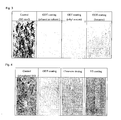
- Figure 1 shows the photographs of the panels that have been treated under different conditions after 60 hours of salt spray tests.
- the untreated panel started rusting after only 2 to 4 hours in the fog chamber, while the ODT-coated panel remained intact after 50 to 60 hours.
- the ODT-coated panel shows water droplets on the surface, indicating that the surface is hydrophobic.
- the panels coated with ODT lasted longer than those that had been coated with BTSE and VS. It is been known that both BTSE and VS coatings on galvanized steel sheets are robust and provide excellent corrosion protection (Van Ooij and Child, 1998; U.S. Patent No. 5,750,197, U.S. Patent No. 5,292,549).
- Example 1 the ODT coating was made by immersing an electrogalvanized CRS panel in a 50-mM ODT-in-ethanol solution for 5 minutes. It is difficult, however, to implement such a long immersion or dipping time in an operating plant. Therefore, it was necessary to conduct tests with much shorter dipping times.
- Example 2 EG steel panels with dimension of 12x7.5 cm were immersed in 50-mM ODT-in-ethanol solutions for 3, 7 and 11 seconds. The coated panels were dried in an oven at 100 ⁇ for 2 minutes, and subjected to salt spray tests. The untreated EG steel (control) started rusting in 2 to 4 hours, while the EG steel panels treated with ODT showed little signs of corrosion after 48 hours as shown in Figure 2. That the EG steel panels treated for such short period of time still showed excellent corrosion resistance indicates that (a) ODT reacts quickly with zinc metal and (b) 10 seconds of dipping time would suffice in a production line.
- the panel coated with the ODT dissolved in benzene corroded faster than the others.
- the ODT dissolved in ethyl acetate gave reasonable protection, but the result was not as good as those obtained with ethanol as solvent. It is possible that a ring-structured solvent such as benzene may not be conducive for creating a close-packed SAM of long-chain surfactants such as ODT.
- a straight-chain alcohol such as ethanol and 1-butanol gave the best results.
- the technique of protecting a metal from corrosion as disclosed in the instant invention was applied to EG steel.
- an elector-galvanized and phosphated CRS steel panel was coated with an alkanethiol, and subjected to salt spray tests.
- the phosphated panels of 12x7.5 mm used in this example were obtained from POSCO.
- One panel was immersed in a 20-mM ODT-in-ethanol solution for 5 minutes, and dried in an oven at 100 ⁇ for 5 minutes.
- Another panel was immersed in a 1% by volume VS solution for 1 minute, and then dried by blowing dry nitrogen gas over the coated surface.
- the phosphated panels were subjected to salt spray tests for 52 hours in a fog chamber.
- an untreated phosphated panel and a chrome-rinsed phosphated EG steel panel were also placed in the same fog chamber.
- the ODT-coated panel shows the least corrosion after 52 hours. Its performance was superior to those coated with chrome or VS.
- the technique of coating phosphated steel with an alkanethiol such as ODT can readily replace the conventional method of using chrome for corrosion protection.
- a distinct advantage of the instant invention is that neither the thiol nor the solvent used in this example is toxic.
- an alkanethiol was used to further improve the corrosion resistance of a resin coated EG steel.
- Two EG steel panels with dimensions of 12x7.5 mm were coated with a commercially used resin.
- a No. 5 bar coater was used to obtain 1-2 ⁇ m of thickness on the surface, and the coated panels were placed in an oven for 5 minutes at 150 ⁇ .
- One panel was then immersed in a 50-mM ODT-in-ethanol solution for 5 minutes and dried in air at room temperature.
- Both the resin-coated and resin/ODT-coated EG steel panels were placed in a fog chamber for salt spray tests.
- an untreated EG steel panel was also subjected to the salt spray test.
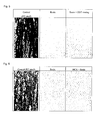
- Figure 5 shows the photographs of the panels after 240 hours in the fog chamber.
- the untreated EG steel showed red rusts.
- the EG steel panel coated with a commercial resin showed significant corrosion, while the rein followed by ODT coating showed no sign of rust.
- the results given in Figure 5 demonstrate that the performance of a resin-coated EG steel can be further improved by an alkanethiol coating.
- an EG steel panel with a dimension of 12x7.5 mm was immersed in a 20-mM 16-mercaptohexadecenoic acid (MCA) solution for 10 seconds.
- MCA 16-mercaptohexadecenoic acid
- a 4:1 ethanol-water mixture was used as the solvent for the alkanethiol.
- the coated surface was dried in a stream of dry nitrogen gas and then in an oven at 120 ⁇ for 5 minutes.
- the MCA-coated panel was coated again with a commercially used resin in the same manner as described in Example 5.
- Another EG steel panel was coated with a resin alone.
- Both the MCA/resin- and resin-coated EG steel panels were subjected to salt spray tests.
- Figure 5 shows the photographs of the panels after 144 hours of salt spray tests. Also shown in this figure was the photograph of an untreated EG steel panel. As shown, both the control and resin-coated panels showed significant corrosion, but the MCA/resin-coated panel remained intact.
- MCA was chosen because of its unique structure (HS(CH 2 ) 15 COOH).
- One end of the molecule has a sulfhydryl group that forms a covalent bond with the metallic substrate, while the carboxy group binds strongly with the resin.
- the role of the alkanethiol used in this example is one of a coupling agent.
- Another bifunctional alkanethiol was used to coat an elctrogalvanized CRS panel.
- a 5% by volume 3-mercaptopropyltrimethoxysilane (MPS) solution was prepared in a 50:50 ethanol-water mixture, and then agitated for 4 hours to allow for the reagent to be partially hydrolyzed.
- An EG steel panel with dimensions of 12 ⁇ 7.5 cm was then immersed in the solution for 10 minutes, and dried in an oven at 150 ⁇ for 10 min.
- the sulhydryl group of MPS forms covalent bonds with the zinc on the substrate, while the silyloxy group of the adsorbed MPS undergoes cross-linking polymerization by forming Si-O-Si linkages.
- the hydrocarbon chain of the MPS is short, the cross-linking polymerization between the terminal groups would provide a robust coating on the surface and provides a barrier effect.
- the EG steel panel coated with MPS was subjected to salt spray test along with an untreated panel. After 48 hours of salt spray test, the untreated panel rested, while the MPS-coated panel showed no sign of rust.
- phosphated EG steel panels were coated with ODT to render the surfaces hydrophobic, which is a desirable feature for fingerprint-free steels.
- Panels with dimensions of 12x7.5 cm were immersed in 5- to 70-mM ODT solutions for 5 minutes, dried under a gentle stream of dry nitrogen, and then cured in an oven at 120 ⁇ for 5 minutes.
- the hydrophobicity of the coated samples was determined by measuring water contact angles using the sessile drop technique. The results are given in Table 2.
- the contact angles of the ODT-coated panels were in the range of 133 to 144o over the range of concentrations investigated.
- the phosphated EG steel without ODT coating was 0°.
Landscapes
- Chemical & Material Sciences (AREA)
- Engineering & Computer Science (AREA)
- Materials Engineering (AREA)
- Mechanical Engineering (AREA)
- Metallurgy (AREA)
- Organic Chemistry (AREA)
- General Chemical & Material Sciences (AREA)
- Chemical Kinetics & Catalysis (AREA)
- Nanotechnology (AREA)
- Physics & Mathematics (AREA)
- Condensed Matter Physics & Semiconductors (AREA)
- General Physics & Mathematics (AREA)
- Crystallography & Structural Chemistry (AREA)
- Composite Materials (AREA)
- Other Surface Treatments For Metallic Materials (AREA)
- Chemical Treatment Of Metals (AREA)
- Preventing Corrosion Or Incrustation Of Metals (AREA)
- Paints Or Removers (AREA)
Applications Claiming Priority (2)
| Application Number | Priority Date | Filing Date | Title |
|---|---|---|---|
| US786379 | 2004-02-25 | ||
| US10/786,379 US7524535B2 (en) | 2004-02-25 | 2004-02-25 | Method of protecting metals from corrosion using thiol compounds |
Publications (1)
| Publication Number | Publication Date |
|---|---|
| EP1568800A1 true EP1568800A1 (de) | 2005-08-31 |
Family
ID=34750488
Family Applications (1)
| Application Number | Title | Priority Date | Filing Date |
|---|---|---|---|
| EP05450030A Withdrawn EP1568800A1 (de) | 2004-02-25 | 2005-02-15 | Verfahren zum Korrosionschutz von Metallen unter Verwendung von Thiolverbindungen |
Country Status (6)
| Country | Link |
|---|---|
| US (1) | US7524535B2 (de) |
| EP (1) | EP1568800A1 (de) |
| JP (2) | JP2005240181A (de) |
| KR (1) | KR20050086352A (de) |
| CN (1) | CN1664167A (de) |
| TW (1) | TWI290964B (de) |
Cited By (9)
| Publication number | Priority date | Publication date | Assignee | Title |
|---|---|---|---|---|
| DE102005025693A1 (de) * | 2005-06-04 | 2006-12-07 | Forschungszentrum Karlsruhe Gmbh | Verfahren zur Herstellung einer metallorganischen Schicht, mit diesem Verfahren hergestellte metallorganische Schichten und deren Verwendung |
| WO2008035045A2 (en) | 2006-09-20 | 2008-03-27 | The Queen's University Of Belfast | Method of coating a metallic article with a surface of tailored wettability |
| WO2008047375A1 (en) * | 2006-10-19 | 2008-04-24 | Ramot At Tel-Aviv University Ltd | Method for electrochemical deposition of monolayers on metallic surfaces and objects coated with an organic monolayer |
| DE102007029836A1 (de) * | 2007-06-28 | 2009-01-02 | Siemens Ag | Zusatz für Kühlwasserkreisläufe in Kraftwerken sowie Verfahren zum Korrisionsschutz in Kühlwasserkreisläufen von Kraftwerken |
| DE102007029837A1 (de) * | 2007-06-28 | 2009-01-02 | Siemens Ag | Zusatz für ein Reinigungs- und/oder Pflegemittel zur Verwendung in Haushaltsgeräten sowie derartiges Reinigungs- und/oder Pflegemittel |
| WO2010006562A1 (en) * | 2008-06-23 | 2010-01-21 | Institute Of Inorganic Chemistry As Cr, V.V.I. | Method of protection of silver and copper surfaces against corrosion |
| CN101852415A (zh) * | 2010-03-31 | 2010-10-06 | 西北有色金属研究院 | 一种大功率led灯散热器表面的处理方法 |
| EP2091727A4 (de) * | 2006-12-19 | 2012-11-21 | Nalco Co | Verfahren zur verwendung von auf schwefel basierenden korrosionshemmern für galvanisierte metallflächen |
| US8734946B2 (en) | 2008-06-03 | 2014-05-27 | The Queen's University Of Belfast | Product with tailored wettability |
Families Citing this family (42)
| Publication number | Priority date | Publication date | Assignee | Title |
|---|---|---|---|---|
| US20050183793A1 (en) * | 2004-02-25 | 2005-08-25 | Hyung-Joon Kim | Method of improving the performance of organic coatings for corrosion resistance |
| US7104850B2 (en) * | 2004-08-18 | 2006-09-12 | Yazaki Corporation | Low insertion-force connector terminal, method of producing the same and substrate for the same |
| US7354862B2 (en) * | 2005-04-18 | 2008-04-08 | Intel Corporation | Thin passivation layer on 3D devices |
| DE102005047843A1 (de) * | 2005-10-05 | 2007-04-12 | OTB Oberflächentechnik in Berlin GmbH & Co. | Passivierungs- und Schmiermittel für Gold-, Silber- und Kupferoberflächen und Verfahren zu seiner Anwendung |
| US7883738B2 (en) * | 2007-04-18 | 2011-02-08 | Enthone Inc. | Metallic surface enhancement |
| US10017863B2 (en) * | 2007-06-21 | 2018-07-10 | Joseph A. Abys | Corrosion protection of bronzes |
| CN101689720B (zh) | 2007-06-29 | 2012-12-12 | 古河电气工业株式会社 | 耐微振磨损性连接器及其制造方法 |
| JP4795466B2 (ja) * | 2007-06-29 | 2011-10-19 | 古河電気工業株式会社 | 金属材料、その製造方法、及びそれを用いた電気電子部品 |
| TWI453301B (zh) | 2007-11-08 | 2014-09-21 | Enthone | 浸鍍銀塗層上的自組分子 |
| US7972655B2 (en) * | 2007-11-21 | 2011-07-05 | Enthone Inc. | Anti-tarnish coatings |
| JP5914907B2 (ja) * | 2008-08-11 | 2016-05-11 | 株式会社オートネットワーク技術研究所 | 防錆剤および表面処理金属材 |
| US20100101840A1 (en) * | 2008-10-29 | 2010-04-29 | Raytheon Company | Application of a self-assembled monolayer as an oxide inhibitor |
| JP5649021B2 (ja) * | 2009-08-20 | 2015-01-07 | 学校法人 中央大学 | 表面処理亜鉛めっき鋼板、プレコート亜鉛めっき鋼板及びこれらの製造方法 |
| KR101143219B1 (ko) * | 2009-12-28 | 2012-05-18 | 포항공과대학교 산학협력단 | 자기 조립 분자막을 이용한 금속 표면 처리 방법, 상기 방법에 의해 표면 처리된 강판 및 상기 방법에 사용되는 금속 표면 처리용액 |
| US8386047B2 (en) | 2010-07-15 | 2013-02-26 | Advanced Bionics | Implantable hermetic feedthrough |
| US8552311B2 (en) | 2010-07-15 | 2013-10-08 | Advanced Bionics | Electrical feedthrough assembly |
| JP5888721B2 (ja) * | 2010-07-30 | 2016-03-22 | 国立研究開発法人理化学研究所 | 酸化防止膜被覆金属の製造方法 |
| US8263540B2 (en) | 2010-08-27 | 2012-09-11 | Ecolab Usa Inc. | Detergent compositions with combinations of acrylic and maleic acid homopolymers and/or salts thereof for aluminum protection |
| US8691018B2 (en) | 2010-08-27 | 2014-04-08 | Ecolab Usa Inc. | High molecular weight polyacrylates for aluminum protection in warewash applications |
| JP5358776B2 (ja) * | 2010-11-18 | 2013-12-04 | 株式会社本螺子製作所 | 金属表面保護剤、金属表面保護剤の製造方法および金属表面処理方法 |
| EP2651569B1 (de) | 2010-12-15 | 2017-03-08 | Advanced Bionics AG | Schutz für implantierte goldschichten |
| KR101320024B1 (ko) * | 2011-05-17 | 2013-10-22 | 율촌화학 주식회사 | 태양전지 모듈용 백 시트 및 이를 포함하는 태양전지 모듈 |
| CN102747350B (zh) * | 2012-07-18 | 2016-05-25 | 深圳市成功科技有限公司 | 金、银镀层表面保护剂 |
| KR101415195B1 (ko) * | 2012-08-22 | 2014-07-21 | 부산대학교 산학협력단 | Pvc 기반의 금속-고분자 나노복합체, 이를 포함하는 코팅 조성물 및 코팅막 |
| CN102808184A (zh) * | 2012-08-29 | 2012-12-05 | 上海宏泽化工有限公司 | 一种黑色金属水溶性缓蚀剂及其制备方法 |
| KR101439693B1 (ko) * | 2012-12-26 | 2014-09-24 | 주식회사 포스코 | 아연도금강판용 표면처리 조성물, 아연도금강판의 표면처리 방법 및 아연도금강판 |
| TW201509245A (zh) * | 2013-03-15 | 2015-03-01 | Omg Electronic Chemicals Llc | 用於在金屬表面上形成自組裝單層的方法及包含自組裝單層的印刷電路板 |
| US9771483B2 (en) * | 2013-04-19 | 2017-09-26 | The Boeing Company | Systems, compositions, and methods for corrosion inhibition |
| CN109690365B (zh) * | 2015-10-19 | 2022-08-23 | 美题隆公司 | 耐蚀光学装置 |
| CN106086953B (zh) * | 2016-08-10 | 2018-05-15 | 江苏鑫冶金属板业有限公司 | 一种复合电解板的制备方法 |
| JP6871574B2 (ja) * | 2017-11-01 | 2021-05-12 | 公立大学法人大阪 | 金属めっき方法 |
| US12374469B2 (en) | 2018-03-26 | 2025-07-29 | Henry Crichlow | High level nuclear waste disposal capsule |
| CN110129802A (zh) * | 2019-06-18 | 2019-08-16 | 博敏电子股份有限公司 | 一种印制板用新型抗氧化剂及其应用 |
| CN111019148B (zh) * | 2019-12-10 | 2021-10-01 | 河南科技学院 | 一种改性泡沫铜材料及其制备方法和应用 |
| FR3108179B1 (fr) * | 2020-03-12 | 2022-03-11 | Commissariat Energie Atomique | utilisation de la microscopie électrochimique à balayage comme technique prédictive d’un essai de corrosion au brouillard salin |
| CN115322644B (zh) * | 2021-05-11 | 2023-06-02 | 中国科学院宁波材料技术与工程研究所 | 一种界面原位构筑的改性炔基聚合物涂层及其制法与应用 |
| CN113410452A (zh) * | 2021-06-17 | 2021-09-17 | 中国科学技术大学 | 一种改性锌负极及其制备方法和应用 |
| EP4112772A1 (de) | 2021-06-28 | 2023-01-04 | Henkel AG & Co. KGaA | Schwefelorganische verbindung zur korrosionsschützenden beschichtung kupferhaltiger metallischer substrate |
| CN113755829B (zh) * | 2021-08-16 | 2024-05-07 | 深圳市志凌伟业技术股份有限公司 | 一种黑化处理的铜膜表面防腐保护药水 |
| CN113913816B (zh) * | 2021-10-14 | 2023-06-30 | 吉林大学 | 一种增强纯铜耐腐蚀性的方法 |
| WO2023210285A1 (ja) * | 2022-04-27 | 2023-11-02 | 株式会社ダイセル | 接合体、及び、接合体の製造方法 |
| CN118635084B (zh) * | 2024-08-15 | 2024-12-20 | 鞍钢股份有限公司 | 一种基于化学沉积的钢超疏水防冰表面的制备方法 |
Citations (12)
| Publication number | Priority date | Publication date | Assignee | Title |
|---|---|---|---|---|
| GB1602838A (en) * | 1978-05-30 | 1981-11-18 | Al Hajry M N | Treating surfaces of inorganic materials |
| EP0492487A1 (de) * | 1990-12-22 | 1992-07-01 | DODUCO GMBH + Co Dr. Eugen DÀ¼rrwächter | Mittel zum zeitweiligen Schutz von blanken Silber- und Kupferoberflächen gegen Anlaufen und Verfahren zu seiner Anwendung |
| WO1995021277A1 (en) * | 1994-02-03 | 1995-08-10 | Henkel Corporation | Surface treatment agent for zinciferous-plated steel |
| US5487792A (en) * | 1994-06-13 | 1996-01-30 | Midwest Research Institute | Molecular assemblies as protective barriers and adhesion promotion interlayer |
| JPH101784A (ja) * | 1996-06-12 | 1998-01-06 | Nkk Corp | 潤滑性と耐汚染性に優れた亜鉛系めっき鋼板 |
| JPH101786A (ja) * | 1996-06-12 | 1998-01-06 | Nkk Corp | 耐食性と潤滑性に優れた亜鉛系めっき鋼板 |
| WO1998029580A1 (de) * | 1996-12-28 | 1998-07-09 | Metallgesellschaft Aktiengesellschaft | Verfahren zur behandlung metallischer oberflächen |
| WO1999048682A1 (en) * | 1998-03-27 | 1999-09-30 | University Of Pittsburgh | Tarnish resistant article, preparation, manufacture and methods of use of same |
| US6183815B1 (en) * | 1994-04-01 | 2001-02-06 | University Of Pittsburgh | Method and composition for surface treatment of metals |
| US20020132056A1 (en) * | 2000-11-02 | 2002-09-19 | Shipley Company, L.L.C. | Process for treating adhesion promoted metal surfaces with an organo-silcon post-treatment |
| WO2002072283A1 (en) * | 2001-03-08 | 2002-09-19 | Macdermid, Incorporated | Inhibiting aluminum corrosion with mercapto-substituted silanes |
| WO2004103040A2 (de) * | 2003-05-13 | 2004-11-25 | At & S Austria Technologie & Systemtechnik Aktiengesellschaft | Verfahren zur beschichtung von rohlingen zur herstellung von gedruckten leiterplatten (pcb) |
Family Cites Families (10)
| Publication number | Priority date | Publication date | Assignee | Title |
|---|---|---|---|---|
| US3300333A (en) * | 1963-05-27 | 1967-01-24 | Minnesota Mining & Mfg | Method of and means for applying corrosion inhibiting coating |
| JPS57198269A (en) * | 1981-05-28 | 1982-12-04 | Furukawa Electric Co Ltd:The | Anticorrosive treatment of silver plated stainless steel |
| US5108793A (en) | 1990-12-24 | 1992-04-28 | Armco Steel Company, L.P. | Steel sheet with enhanced corrosion resistance having a silane treated silicate coating |
| US5200275A (en) | 1990-12-24 | 1993-04-06 | Armco Steel Company, L.P. | Steel sheet with enhanced corrosion resistance having a silane treated silicate coating |
| US5292549A (en) | 1992-10-23 | 1994-03-08 | Armco Inc. | Metallic coated steel having a siloxane film providing temporary corrosion protection and method therefor |
| US5433976A (en) | 1994-03-07 | 1995-07-18 | Armco, Inc. | Metal pretreated with an aqueous solution containing a dissolved inorganic silicate or aluminate, an organofuctional silane and a non-functional silane for enhanced corrosion resistance |
| US5598193A (en) | 1995-03-24 | 1997-01-28 | Hewlett-Packard Company | Treatment of an orifice plate with self-assembled monolayers |
| US5759629A (en) | 1996-11-05 | 1998-06-02 | University Of Cincinnati | Method of preventing corrosion of metal sheet using vinyl silanes |
| US5750197A (en) | 1997-01-09 | 1998-05-12 | The University Of Cincinnati | Method of preventing corrosion of metals using silanes |
| WO2000039368A2 (de) * | 1998-12-24 | 2000-07-06 | Bayer Aktiengesellschaft | Verfahren zur herstellung einer ultraphoben oberfläche auf basis von aluminium |
-
2004
- 2004-02-25 US US10/786,379 patent/US7524535B2/en not_active Expired - Fee Related
- 2004-10-07 KR KR1020040079844A patent/KR20050086352A/ko not_active Ceased
-
2005
- 2005-02-15 EP EP05450030A patent/EP1568800A1/de not_active Withdrawn
- 2005-02-16 JP JP2005039046A patent/JP2005240181A/ja active Pending
- 2005-02-17 TW TW094104628A patent/TWI290964B/zh not_active IP Right Cessation
- 2005-02-25 CN CN2005100542383A patent/CN1664167A/zh active Pending
-
2008
- 2008-04-24 JP JP2008113311A patent/JP2008202147A/ja not_active Withdrawn
Patent Citations (12)
| Publication number | Priority date | Publication date | Assignee | Title |
|---|---|---|---|---|
| GB1602838A (en) * | 1978-05-30 | 1981-11-18 | Al Hajry M N | Treating surfaces of inorganic materials |
| EP0492487A1 (de) * | 1990-12-22 | 1992-07-01 | DODUCO GMBH + Co Dr. Eugen DÀ¼rrwächter | Mittel zum zeitweiligen Schutz von blanken Silber- und Kupferoberflächen gegen Anlaufen und Verfahren zu seiner Anwendung |
| WO1995021277A1 (en) * | 1994-02-03 | 1995-08-10 | Henkel Corporation | Surface treatment agent for zinciferous-plated steel |
| US6183815B1 (en) * | 1994-04-01 | 2001-02-06 | University Of Pittsburgh | Method and composition for surface treatment of metals |
| US5487792A (en) * | 1994-06-13 | 1996-01-30 | Midwest Research Institute | Molecular assemblies as protective barriers and adhesion promotion interlayer |
| JPH101784A (ja) * | 1996-06-12 | 1998-01-06 | Nkk Corp | 潤滑性と耐汚染性に優れた亜鉛系めっき鋼板 |
| JPH101786A (ja) * | 1996-06-12 | 1998-01-06 | Nkk Corp | 耐食性と潤滑性に優れた亜鉛系めっき鋼板 |
| WO1998029580A1 (de) * | 1996-12-28 | 1998-07-09 | Metallgesellschaft Aktiengesellschaft | Verfahren zur behandlung metallischer oberflächen |
| WO1999048682A1 (en) * | 1998-03-27 | 1999-09-30 | University Of Pittsburgh | Tarnish resistant article, preparation, manufacture and methods of use of same |
| US20020132056A1 (en) * | 2000-11-02 | 2002-09-19 | Shipley Company, L.L.C. | Process for treating adhesion promoted metal surfaces with an organo-silcon post-treatment |
| WO2002072283A1 (en) * | 2001-03-08 | 2002-09-19 | Macdermid, Incorporated | Inhibiting aluminum corrosion with mercapto-substituted silanes |
| WO2004103040A2 (de) * | 2003-05-13 | 2004-11-25 | At & S Austria Technologie & Systemtechnik Aktiengesellschaft | Verfahren zur beschichtung von rohlingen zur herstellung von gedruckten leiterplatten (pcb) |
Non-Patent Citations (5)
| Title |
|---|
| BURLEIGH T D ET AL: "TARNISH PROTECTION OF SILVER USING A HEXADECANETHIOL SELF-ASSEMBLED MONOLAYER AND DESCRIPTIONS OF ACCELERATED TARNISH TESTS", CORROSION, NATIONAL ASSOCIATION OF CORROSION ENGINEERS, HOUSTON, US, vol. 57, no. 12, December 2001 (2001-12-01), pages 1066 - 1074, XP001133700, ISSN: 0010-9312 * |
| MEKHALIF Z. ET AL: "X-Ray photoelectron spectroscopy study of polycrystalline zinc modified by n-dodecanethiol and 3-perfluorooctyl-propanethiol", THIN SOLID FILMS, vol. 405, no. 1-2, 22 February 2002 (2002-02-22), LAUSANNE, CH, pages 486 - 193, XP004342263 * |
| SINAPI F. ET AL: "Self-assembly of (3-mercaptopropyl)trimethoxysilane on polycrystalline zinc substrates toward corrosion protection", APPLIED SURFACE SCIENCE, vol. 212-213, 15 May 2003 (2003-05-15), ELSEVIER, NETHERLANDS, pages 467 - 471 * |
| ULMAN A.: "Formation and Structure of Self-Assembled Monolayers", CHEMICAL REVIEWS, vol. 96, no. 4, 1 January 1996 (1996-01-01), ACS, Washington, DC, US, pages 1533 - 1554, XP002116022 * |
| YAMAMOTO Y.: "Self assembled Layers of Alkanethiols on Copper for Protection against Corrosion", JOURNAL OF THE ELECTROCHEMICAL SOCIETY., vol. 140, no. 2, 1 February 1993 (1993-02-01), USELECTROCHEMICAL SOCIETY. MANCHESTER, NEW HAMPSHIRE., pages 436 - 444, XP000378181 * |
Cited By (14)
| Publication number | Priority date | Publication date | Assignee | Title |
|---|---|---|---|---|
| DE102005025693A1 (de) * | 2005-06-04 | 2006-12-07 | Forschungszentrum Karlsruhe Gmbh | Verfahren zur Herstellung einer metallorganischen Schicht, mit diesem Verfahren hergestellte metallorganische Schichten und deren Verwendung |
| US8222141B2 (en) | 2005-06-04 | 2012-07-17 | Forschungzentrum Karlsruhe Gmbh | Method for producing an organometallic layer |
| DE102005025693B4 (de) * | 2005-06-04 | 2009-06-18 | Forschungszentrum Karlsruhe Gmbh | Verfahren zur Herstellung einer metallorganischen Schicht |
| WO2008035045A3 (en) * | 2006-09-20 | 2008-10-02 | Univ Belfast | Method of coating a metallic article with a surface of tailored wettability |
| AU2007298837B2 (en) * | 2006-09-20 | 2011-08-25 | The Queen's University Of Belfast | Method of coating a metallic article with a surface of tailored wettability |
| WO2008035045A2 (en) | 2006-09-20 | 2008-03-27 | The Queen's University Of Belfast | Method of coating a metallic article with a surface of tailored wettability |
| US9103034B2 (en) | 2006-09-20 | 2015-08-11 | The Queen's University Of Belfast | Method of coating a metallic article with a surface of tailored wettability |
| WO2008047375A1 (en) * | 2006-10-19 | 2008-04-24 | Ramot At Tel-Aviv University Ltd | Method for electrochemical deposition of monolayers on metallic surfaces and objects coated with an organic monolayer |
| EP2091727A4 (de) * | 2006-12-19 | 2012-11-21 | Nalco Co | Verfahren zur verwendung von auf schwefel basierenden korrosionshemmern für galvanisierte metallflächen |
| DE102007029836A1 (de) * | 2007-06-28 | 2009-01-02 | Siemens Ag | Zusatz für Kühlwasserkreisläufe in Kraftwerken sowie Verfahren zum Korrisionsschutz in Kühlwasserkreisläufen von Kraftwerken |
| DE102007029837A1 (de) * | 2007-06-28 | 2009-01-02 | Siemens Ag | Zusatz für ein Reinigungs- und/oder Pflegemittel zur Verwendung in Haushaltsgeräten sowie derartiges Reinigungs- und/oder Pflegemittel |
| US8734946B2 (en) | 2008-06-03 | 2014-05-27 | The Queen's University Of Belfast | Product with tailored wettability |
| WO2010006562A1 (en) * | 2008-06-23 | 2010-01-21 | Institute Of Inorganic Chemistry As Cr, V.V.I. | Method of protection of silver and copper surfaces against corrosion |
| CN101852415A (zh) * | 2010-03-31 | 2010-10-06 | 西北有色金属研究院 | 一种大功率led灯散热器表面的处理方法 |
Also Published As
| Publication number | Publication date |
|---|---|
| US7524535B2 (en) | 2009-04-28 |
| TWI290964B (en) | 2007-12-11 |
| JP2008202147A (ja) | 2008-09-04 |
| TW200532053A (en) | 2005-10-01 |
| CN1664167A (zh) | 2005-09-07 |
| KR20050086352A (ko) | 2005-08-30 |
| US20050186347A1 (en) | 2005-08-25 |
| JP2005240181A (ja) | 2005-09-08 |
Similar Documents
| Publication | Publication Date | Title |
|---|---|---|
| US7524535B2 (en) | Method of protecting metals from corrosion using thiol compounds | |
| Yu et al. | A review of recent developments in coating systems for hot-dip galvanized steel | |
| Parhizkar et al. | Steel surface pre-treated by an advance and eco-friendly cerium oxide nanofilm modified by graphene oxide nanosheets; electrochemical and adhesion measurements | |
| AU735281B2 (en) | Process of treating metallic surfaces | |
| US5108793A (en) | Steel sheet with enhanced corrosion resistance having a silane treated silicate coating | |
| CA2454201C (en) | Pretreatment method for coating | |
| CA2273249C (en) | Method of preventing corrosion of metals using silanes | |
| US20070054056A1 (en) | Composition for coating metals to protect against corrosion | |
| Sui et al. | Comparative anti-corrosion properties of alkylthiols SAMs and mercapto functional silica sol–gel coatings on copper surface in sodium chloride solution | |
| JP4317144B2 (ja) | 腐蝕防止のための有機被覆の性能向上方法 | |
| BinSabt et al. | Eco-friendly silane-based coating for mitigation of carbon steel corrosion in marine environments | |
| CN102070928B (zh) | 一种用于镀锌板的彩涂无铬预处理液 | |
| Sugama | Cerium acetate-modified aminopropylsilane triol: A precursor of corrosion-preventing coating for aluminum-finned condensers | |
| Deyá | Preparation of γ-mercaptopropyltrimethoxysilane’s films to protect steel against corrosion | |
| Shida et al. | Zirconium-phosphate films self-assembled on aluminum substrate toward corrosion protection | |
| JP6275975B2 (ja) | クロムフリー化成被覆 | |
| Wang et al. | Polymeric Organo‐Silane Coatings for Aluminum Alloy Corrosion Protection by Self‐Assembled Metho | |
| JP6936742B2 (ja) | クロムフリー化成被覆 | |
| Abdulrazzaq et al. | Enhancement of low carbon steel corrosion resistance in acidic and saline media using superhydrophobic nanocomposite | |
| JP3842333B2 (ja) | 耐候性鋼材の表面処理方法 | |
| Kim et al. | Characterization of the silica conversion film formed on zinc-electroplated steel | |
| JP2006316342A (ja) | 金属部材、防錆処理剤、及び防錆処理方法 | |
| Subramanian | Silane coupling agents for corrosion protection | |
| Subramanian et al. | Corrosion protection of aircraft aluminum alloys using bis-functional silanes | |
| JP4753721B2 (ja) | 塗膜の耐水密着性に優れた亜鉛系めっき鋼板 |
Legal Events
| Date | Code | Title | Description |
|---|---|---|---|
| PUAI | Public reference made under article 153(3) epc to a published international application that has entered the european phase |
Free format text: ORIGINAL CODE: 0009012 |
|
| 17P | Request for examination filed |
Effective date: 20050221 |
|
| AK | Designated contracting states |
Kind code of ref document: A1 Designated state(s): AT BE BG CH CY CZ DE DK EE ES FI FR GB GR HU IE IS IT LI LT LU MC NL PL PT RO SE SI SK TR |
|
| AX | Request for extension of the european patent |
Extension state: AL BA HR LV MK YU |
|
| AKX | Designation fees paid |
Designated state(s): DE FR |
|
| 17Q | First examination report despatched |
Effective date: 20061220 |
|
| STAA | Information on the status of an ep patent application or granted ep patent |
Free format text: STATUS: THE APPLICATION IS DEEMED TO BE WITHDRAWN |
|
| 18D | Application deemed to be withdrawn |
Effective date: 20091028 |