EP1569736B1 - Umfangsluftmesser und anwendungen - Google Patents
Umfangsluftmesser und anwendungen Download PDFInfo
- Publication number
- EP1569736B1 EP1569736B1 EP03789961A EP03789961A EP1569736B1 EP 1569736 B1 EP1569736 B1 EP 1569736B1 EP 03789961 A EP03789961 A EP 03789961A EP 03789961 A EP03789961 A EP 03789961A EP 1569736 B1 EP1569736 B1 EP 1569736B1
- Authority
- EP
- European Patent Office
- Prior art keywords
- air knife
- passage
- cyclone
- suspension vessel
- gap
- Prior art date
- Legal status (The legal status is an assumption and is not a legal conclusion. Google has not performed a legal analysis and makes no representation as to the accuracy of the status listed.)
- Expired - Lifetime
Links
Images


Classifications
-
- C—CHEMISTRY; METALLURGY
- C22—METALLURGY; FERROUS OR NON-FERROUS ALLOYS; TREATMENT OF ALLOYS OR NON-FERROUS METALS
- C22B—PRODUCTION AND REFINING OF METALS; PRETREATMENT OF RAW MATERIALS
- C22B34/00—Obtaining refractory metals
- C22B34/10—Obtaining titanium, zirconium or hafnium
- C22B34/12—Obtaining titanium or titanium compounds from ores or scrap by metallurgical processing; preparation of titanium compounds from other titanium compounds see C01G23/00 - C01G23/08
- C22B34/1218—Obtaining titanium or titanium compounds from ores or scrap by metallurgical processing; preparation of titanium compounds from other titanium compounds see C01G23/00 - C01G23/08 obtaining titanium or titanium compounds from ores or scrap by dry processes
- C22B34/1222—Obtaining titanium or titanium compounds from ores or scrap by metallurgical processing; preparation of titanium compounds from other titanium compounds see C01G23/00 - C01G23/08 obtaining titanium or titanium compounds from ores or scrap by dry processes using a halogen containing agent
-
- B—PERFORMING OPERATIONS; TRANSPORTING
- B01—PHYSICAL OR CHEMICAL PROCESSES OR APPARATUS IN GENERAL
- B01D—SEPARATION
- B01D49/00—Separating dispersed particles from gases, air or vapours by other methods
-
- B—PERFORMING OPERATIONS; TRANSPORTING
- B01—PHYSICAL OR CHEMICAL PROCESSES OR APPARATUS IN GENERAL
- B01D—SEPARATION
- B01D35/00—Filtering devices having features not specifically covered by groups B01D24/00 - B01D33/00, or for applications not specifically covered by groups B01D24/00 - B01D33/00; Auxiliary devices for filtration; Filter housing constructions
- B01D35/16—Cleaning-out devices, e.g. for removing the cake from the filter casing or for evacuating the last remnants of liquid
-
- B—PERFORMING OPERATIONS; TRANSPORTING
- B01—PHYSICAL OR CHEMICAL PROCESSES OR APPARATUS IN GENERAL
- B01D—SEPARATION
- B01D45/00—Separating dispersed particles from gases or vapours by gravity, inertia, or centrifugal forces
- B01D45/12—Separating dispersed particles from gases or vapours by gravity, inertia, or centrifugal forces by centrifugal forces
-
- B—PERFORMING OPERATIONS; TRANSPORTING
- B04—CENTRIFUGAL APPARATUS OR MACHINES FOR CARRYING-OUT PHYSICAL OR CHEMICAL PROCESSES
- B04C—APPARATUS USING FREE VORTEX FLOW, e.g. CYCLONES
- B04C5/00—Apparatus in which the axial direction of the vortex is reversed
- B04C5/14—Construction of the underflow ducting; Apex constructions; Discharge arrangements ; discharge through sidewall provided with a few slits or perforations
- B04C5/18—Construction of the underflow ducting; Apex constructions; Discharge arrangements ; discharge through sidewall provided with a few slits or perforations with auxiliary fluid assisting discharge
-
- Y—GENERAL TAGGING OF NEW TECHNOLOGICAL DEVELOPMENTS; GENERAL TAGGING OF CROSS-SECTIONAL TECHNOLOGIES SPANNING OVER SEVERAL SECTIONS OF THE IPC; TECHNICAL SUBJECTS COVERED BY FORMER USPC CROSS-REFERENCE ART COLLECTIONS [XRACs] AND DIGESTS
- Y02—TECHNOLOGIES OR APPLICATIONS FOR MITIGATION OR ADAPTATION AGAINST CLIMATE CHANGE
- Y02P—CLIMATE CHANGE MITIGATION TECHNOLOGIES IN THE PRODUCTION OR PROCESSING OF GOODS
- Y02P10/00—Technologies related to metal processing
- Y02P10/20—Recycling
Definitions
- the present invention generally relates to the use of a novel air knife to help prevent solid particulates from blocking the entrance to a vessel. More specifically, the present invention is particularly useful for reducing blockage by solid chlorides removed from a titanium tetrachloride product gas by a cyclone or by some other gas/solids separation device, in processes for producing titanium tetrachloride.
- TiCl 4 titanium tetrachloride
- TiO 2 titanium dioxide
- TiCl 4 can be produced by reacting chlorine gas with titanium-containing starting materials in a chlorinator. During this process, a solids-laden gas mixture comprised of the desired TiCl 4 gas and residual solid chlorides is removed from the chlorinator, cooled, and conventionally is then transferred to a cyclone separator to remove the solids from the solids-laden gas mixture. The solids are then dumped into a suspension vessel, frequently referred to as a chlorinator sump, where the solids are mixed with water to form a suspension.
- a chlorinator sump a suspension vessel
- the present invention addresses the issues presented above by placing a novel air knife at or near the entrance to the suspension vessel.
- the cyclone dust passes through the air knife on its way to the suspension vessel.
- the novel air knife is circumferential. That is, the novel air knife injects a gas stream along the inside walls of the air knife. The gas stream is injected at a rate sufficient to reduce the buildup of hygroscopic cyclone dust on the walls of the air knife (and thus at the entrance to the chlorinator sump), so that the chlorinator sump can continue to receive solids from the cyclone, improving time-on-line and safety.
- the present invention uses a novel air knife adapted to reduce hygroscopic solids from building up at the entrance to a suspension vessel enclosing a high-humidity environment.
- the present invention is a method for preventing hygroscopic solids from building up at the entrance to a suspension vessel enclosing ahigh-humidity environment. US 5, 042, 169 is described by the pre-characterizing portion of claim 1.
- a hot reaction solids-laden gas mixture exits 112 from the chlorinator 102 and typically may comprise CO, CO 2 , COS, HCl, N 2 , low-boiling and high-boiling chlorides such as TiCl 4 , FeCl 3 , FeCl 2 , MnCl 2 , SnCl 4 , SiCl 4 , VOCl 3 , NaAlCl 4 , and unreacted solids such as TiO 2 , SiO 2 as well as unburned coke.
- the solids-laden gas mixture is cooled in a cooling conduit 114, sometimes referred to as a chlorinator crossover, and then sent to a cyclone separator 116 where the gases and solids are separated.
- Cyclone separators comprise well known means for separating gases and solids. Cyclone separators generally are constructed of the tubular or cylindrical-shaped main body connected to a lower tapered conical portion. A tangential side inlet is provided near the top of the cylindrical main body. A gas outlet tube is provided and generally extends downwardly through the cyclone top into the main body of the cyclone. The tube usually must extend down to a level slightly below the lowest portion of the inlet to assure efficient separation of solids and gases.
- the solids-laden gases are introduced at high velocity through the tangential inlet. They follow a vortex-shaped path around the outside of the gas outlet pipe downwardly towards the bottom of the separator.
- the solids which are heavier than the gases, are thrown against the walls of the cyclone by centrifugal force. Gravity then causes the solids to fall to the bottom of the cyclone.
- the separated gas follows a vortex path upwardly and passes out of the top of the cyclone separator through the gas outlet tube.
- the separated solids flow through a solids outlet at the base of the tapered conical section.
- a two-valve dump spool leg is typically used on the bottom of the cyclone.
- the opening and closing of these valves is interlocked so only one valve can possibly be open at any given time.
- the top valve When the top valve is opened, the bottom is closed. This allows cyclone dust to fall through the top valve and fill the dump spool leg.
- the top valve closes, the bottom valve is opened to empty the dump spool leg to the suspension vessel.
- the valves continuously operate on a timer.
- the solids-laden gas mixture flows from the chlorinator crossover 114 into the cyclone 116 through a tangential inlet 118.
- the gases from the solids-laden gas mixture exit cyclone 116 through the gas outlet tube 120 at the top of the cyclone 116 and the solids exit the cyclone 116 through the dump spool leg 122 at the base of the cyclone 116.
- the section of pipe connecting the cyclone and the suspension vessel can vary in length, typically being from about 20 feet to about 50 feet in length.
- the suspension vessel is frequently referred to as a chlorinator sump.
- the cyclone dust is mixed with water to form a suspension.
- any gas in the suspension vessel is removed through a vent in the top of the vessel and the suspension is pumped out of the vessel as waste or for further processing.
- Figure 1 shows the cyclone dust 124 entering the suspension vessel 132, water 126 being added to the suspension vessel 132, gas 128 being removed from the suspension vessel 132, and suspension 130 being pumped out of the suspension vessel 132.
- the cyclone dust is typically very warm upon entering the suspension vessel.
- the mixing of these hot solids with water in the suspension vessel results in a high humidity gas phase in the space above the suspension in the vessel.
- This high-humidity environment can extend into the length of pipe that carries the cyclone dust from the cyclone to the suspension vessel.
- the cyclone dust contains metal chlorides, which are hygroscopic, and as such become sticky when entering the high humidity areas of the pipe that transfers the cyclone dust from the cyclone to the suspension vessel.
- the sticky solids gradually build up at the opening of the pipe into the suspension vessel or on the walls of the pipe until the pipe is completely plugged, stopping further discharge of solids from the cyclone.
- Clearing the blockage requires operation downtime to unclog and can be a safety hazard. Stopping the production process to clear a blockage is not only an economic disadvantage, allowing an operator access to the inside of the pipe to clear the blockage creates a risk of gas emissions.
- the blockage can also result in condensed TiCl 4 being present, which can hydrolyze explosively should an operator try clearing the line with water.
- a novel air knife is advantageously utilized to reduce or eliminate the buildup of hygroscopic materials on the inside of the pipe that transports the cyclone dust from the cyclone separator to the suspension vessel.
- the novel air knife is connected to the cyclone separator in the sense that the novel air knife is attached to the tube or pipe that transports cyclone dust from the cyclone to the suspension vessel in a manner that requires the cyclone dust to pass through the air knife either b e fore the dust enters the suspension vessel or as the dust enters the suspension vessel.
- the air knife is placed at or near the entrance to the suspension vessel.
- Air knives used according to the present invention are circumferential. By circumferential it is meant that the air knife creates a stream of gas inside the air knife along the circumference of the passage in the air knife through which the cyclone dust passes.
- the pipe carrying the cyclone dust from the cyclone to the suspension vessel is circular and the inside of the air knife will have a circular passage through which the cyclone dust passes.
- the present invention is not so limited. Other geometric shapes are within the scope of the present invention. For example, the pipe transporting the cyclone dust and the inside passage of the air knife could be oval shaped or even rectangular.
- the gas stream created by air knives of the present invention has a velocity sufficient to blow most or all hygroscopic material from the inside wall of the air knife. In this manner, the air knife reduces the amount of hygroscopic material that can accumulate, significantly reducing the chance that the entrance to the suspension vessel can be blocked by accumulated hygroscopic material.
- the gas stream When used in a TiCl 4 production process to reduce cyclone dust accumulation, the gas stream will preferably have a velocity of at least 30 meters/second (100 feet per second), and more preferably, at least 60 meters per second (200 feet per second). Still more preferably, the gas stream will have a velocity of at least 120 meters/second (400 feet per second). While some applications of the present invention may require a gas stream velocity of greater than 150 meters/second (500 feet per second), preferably the gas stream velocity is no more than 150 meters/second (500 feet per second).
- the gas stream created by the air knife generally travels in the same direction as the direction in which the hygroscopic material moves through the air knife. In one embodiment, the gas stream travels parallel to the direction of the hygroscopic material. However, it is within the scope of the present invention to adapt the air knife to create a gas stream that travels at an angle to the direction of the hygroscopic material, causing the gas stream to travel in a spiral motion when the air knife passage is circular.
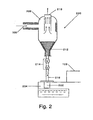
- FIG. 2 illustrates a process 200 utilizing an air knife 202 according to the present invention in conjunction with a cyclone separator 206 and a suspension vessel 204.
- the solids-laden gases are introduced into the cyclone separator 206 at the tan g ential inlet 208. Inside the cyclone separator 206 the solids and gases are separated. The gases exit the cyclone separator through a gas outlet tube 210 and gravity causes the solids to collect at the bottom 212 of the cyclone separator 206.
- a two-valve dump spool leg 214 minimizes the amount of gas that is dumped along with the cyclone dust.
- a pipe 216 connects the dump spool leg 214 with the air knife 202. Cyclone dust that is dumped from the two-valve dump spool leg 214 falls through the pipe 216 and through the air knife 202 into the suspension vessel 204.
- FIG 3 illustrates a cut away view of an air knife 300 used according to the present invention.
- Hygroscopic material 302 enters the air knife 300 via a pipe 304 such as the pipe 216 shown in Figure 2 and travels down through the air knife 300 in the direction indicated by the arrow 306.
- the air knife 300 comprises three overlapping wall sections 308, 310, and 312.
- the overlapping portions of the wall sections form gaps through which gas is forced.
- the gaps face in the same direction in which the cyclone dust moves. By facing in the same direction it is meant that the gas forced through the gaps moves through the air knife in the same direction as the cyclone dust.
- air knives of the present invention will comprise at least two different circumferential gaps through which gas is forced.
- the size of the gap (that is, the distance between two wall sections) is no more than 0.18 cm (0.07 inches), and preferably no more than 0.13 cm (0.05 inches).
- air knives having a gap size of 0.09 cm (0.036 inches) have been advantageously utilized in a TiCl 4 production process to keep hygroscopic cyclone dust from accumulating on the walls of the air knife.
- Air knives used according to the present invention have at least one gas intake. Typically, air knives of the present invention will have between two and four gas intakes.
- gas flows into the gas intake 314 and travels in the direction indicated by the arrows. The gas is forced through the gaps between the wall sections 308, 310, and 312 at a velocity sufficient to blow most or all hygroscopic material from the inside part of the wall sections 308, 310, and 312 of the air knife.
- the gas velocity is calculated in a conventional manner, by dividing the gas flow into the gas intakes by the cross-sectional area of the circumferential gap.
- Figure 4 illustrates a top-down view of the air knife 300 shown in Figure 3 .
- the air knife 300 has four gas intakes.
- the air knife 300 also comprises a series of bolts 316.
- the bolts 316 on this embodiment of the present invention are used to fasten the air knife 300 to a suspension vessel.
- Figure 4 also shows the opening 318 at the center of the air knife 300 through which the cyclone dust passes on its way to the suspension vessel.
- Air knives according to the present invention have been advantageously utilized at the entrance to a suspension vessel in a TiCl 4 production process without requiring additional ventilation in the suspension vessel.
- the wall sections of the air knife 300 can be attached to each other by small spot welds 320 placed between the wall sections of the air knife 300. That is, these spot welds 320 are in the gaps between the wall sections.
- the size of the spots welds 320 is not particularly critical so long as they are not so large as to interfere with the flow of gas through the gaps.
- Air knives used of the present invention can be manufactured using any material suitable for the intended application. An appropriate material can be determined without undue experimentation. Typically, air knives utilized in a TiCl 4 production process will be manufactured from a corrosion resistant alloy such as Inconel 600 or Inconel 601 (commercially available from various steel and alloy distributors).
- Gases suitable for use with air knives of the present invention may depend on the particular application in which the air knife is used. However, appropriate gases can be determined without undue experimentation. Gases preferred for use with air knives in a TiCl 4 production process include air, nitrogen, argon, carbon dioxide or any other gas that will not appreciably react under the conditions prevailing in the air knife.
Landscapes
- Chemical & Material Sciences (AREA)
- Chemical Kinetics & Catalysis (AREA)
- Life Sciences & Earth Sciences (AREA)
- Environmental & Geological Engineering (AREA)
- General Life Sciences & Earth Sciences (AREA)
- Geology (AREA)
- Engineering & Computer Science (AREA)
- Manufacturing & Machinery (AREA)
- Materials Engineering (AREA)
- Mechanical Engineering (AREA)
- Metallurgy (AREA)
- Organic Chemistry (AREA)
- Cyclones (AREA)
- Transition And Organic Metals Composition Catalysts For Addition Polymerization (AREA)
- Separation Of Particles Using Liquids (AREA)
- Absorbent Articles And Supports Therefor (AREA)
Claims (14)
- Apparat umfassend:einen Zyklonabscheider (206);ein Rohr oder eine Röhre (216), in dem/der Zyklonstaub vom Zyklonabscheider (206) transportiert wird;eine Luftbürste (202) umfassend:mehrere sich überlappende Wandabschnitte, die einen Durchgang definieren, der einen Umfang aufweist, wobei der Durchgang geeignet ist, feste Materialien (302) durch die Luftbürste in einer ersten Richtung (306) hindurchzulassen;mindestens zwei überlappende Wandabschnitte, die einen Spalt zwischen ihnen bilden;wobei der Spalt in der ersten Richtung ausgerichtet ist; undmindestens einen Gaseinlass (314), der auf eine Art und Weise mit dem Spalt verbunden ist, dass Gas, das in den Einlass eintritt, dazu gebracht wird, durch den Spalt und in den Durchgang dem Umfang des Durchgangs entlang hindurchzugehen; undwobei der Apparat gekennzeichnet ist durch:ein Suspensionsgefäß (204):wobei der Apparat des Weiteren dadurch gekennzeichnet ist, dass die Luftbürste (202) an dem Rohr oder der Röhre (216) angebracht ist und die Luftbürste (202) an dem Suspensionsgefäß (204) angebracht ist, wobei das Rohr oder die Röhre (216) Zyklonstaub vom Zyklonabscheider (206) derart transportiert, dass der Zyklonstaub durch die Röhre (216) und dann durch die Luftbürste (202) in das Suspensionsgefäß (204) fällt.
- Luftbürste (202) nach Anspruch 1, wobei der Umfang rund ist.
- Luftbürste (202) nach Anspruch 1, wobei der Spalt nicht mehr als 0,18 Zentimeter beträgt.
- Luftbürste (202) nach Anspruch 1, wobei der Spalt nicht mehr als 0,13 Zentimeter beträgt.
- Luftbürste (202) nach Anspruch 1, wobei der Zyklonabscheider (206) hygroskopische Feststoffe von Gasen abscheidet.
- Luftbürste (202) nach Anspruch 1, wobei das Suspensionsgefäß (204) geeignet ist, Feststoffe, einschließlich hygroskopische Feststoffe von dem Zyklonabscheider (206) aufzunehmen.
- Luftbürste (202) nach Anspruch 6, wobei das Suspensionsgefäß (204) ein Umfeld hoher Feuchte umschließt.
- Verfahren zum Reduzieren des Ansammelns von festem Material (302) auf der Innenfläche eines Durchgangs, während das feste Material (302) von einem Zyklonabscheider (206) durch eine Röhre (21 6) and dann durch eine Luftbürste (202) hindurchgeht, die eine Mehrzahl von sich überlappenden Wandabschnitten umfasst, die den Durchgang definieren, wobei mindestens zwei der sich überlappenden Wandabschnitte einen Spalt zwischen ihnen bilden, wobei das Verfahren Folgendes umfasst:das Injizieren eines Gasstroms durch den Spalt und der Innenfläche des Durchgangs entlang in der Richtung, in der das feste Material (302) durch den Durchgang hindurchgeht, und das Hindurchtragen des festen Materials durch den Durchgang und in ein daran angebrachtes Suspensionsgefäß (204) hinein.
- Verfahren nach Anspruch 8, wobei das feste Material (302) hygroskopisch ist.
- Verfahren nach Anspruch 8, wobei das feste Material aus Zyklonstaub aus dem Zyklonabscheider (206) besteht.
- Verfahren nach Anspruch 8, wobei der Durchgang einem Umfeld hoher Feuchte ausgesetzt wird.
- Verfahren nach Anspruch 8, wobei der Gasstrom mit einer Geschwindigkeit von mindestens 30 Metern pro Sekunde injiziert wird.
- Verfahren nach Anspruch 8, wobei der Gasstrom mit einer Geschwindigkeit von mindestens 60 Metern pro Sekunde injiziert wird.
- Verfahren nach Anspruch 8, wobei der Gasstrom mit einer Geschwindigkeit von mindestens 120 Metern pro Sekunde injiziert wird.
Applications Claiming Priority (3)
| Application Number | Priority Date | Filing Date | Title |
|---|---|---|---|
| US10/318,796 US6752858B1 (en) | 2002-12-13 | 2002-12-13 | Circumferential air knife and applications |
| US318796 | 2002-12-13 | ||
| PCT/US2003/037443 WO2004054686A2 (en) | 2002-12-13 | 2003-11-21 | Circumferential air knife and applications |
Publications (2)
| Publication Number | Publication Date |
|---|---|
| EP1569736A2 EP1569736A2 (de) | 2005-09-07 |
| EP1569736B1 true EP1569736B1 (de) | 2011-02-09 |
Family
ID=32468946
Family Applications (1)
| Application Number | Title | Priority Date | Filing Date |
|---|---|---|---|
| EP03789961A Expired - Lifetime EP1569736B1 (de) | 2002-12-13 | 2003-11-21 | Umfangsluftmesser und anwendungen |
Country Status (16)
| Country | Link |
|---|---|
| US (1) | US6752858B1 (de) |
| EP (1) | EP1569736B1 (de) |
| JP (1) | JP2006509626A (de) |
| KR (1) | KR20050085467A (de) |
| CN (1) | CN100364640C (de) |
| AT (1) | ATE497826T1 (de) |
| AU (1) | AU2003294476B2 (de) |
| BR (1) | BR0317234A (de) |
| DE (1) | DE60336007D1 (de) |
| MX (1) | MXPA05006317A (de) |
| NO (1) | NO20053386D0 (de) |
| PL (1) | PL375787A1 (de) |
| RU (1) | RU2309803C2 (de) |
| SA (1) | SA04240491B1 (de) |
| TW (1) | TWI268803B (de) |
| WO (1) | WO2004054686A2 (de) |
Families Citing this family (8)
| Publication number | Priority date | Publication date | Assignee | Title |
|---|---|---|---|---|
| US6994205B2 (en) * | 2004-04-20 | 2006-02-07 | Alstom Technology Ltd | Apparatus for controlling the deposition of feed material on a deposition build-up surface |
| US7452264B2 (en) * | 2006-06-27 | 2008-11-18 | Applied Materials, Inc. | Pad cleaning method |
| US20070295610A1 (en) * | 2006-06-27 | 2007-12-27 | Applied Materials, Inc. | Electrolyte retaining on a rotating platen by directional air flow |
| US8157895B2 (en) * | 2010-05-04 | 2012-04-17 | Kellogg Brown & Root Llc | System for reducing head space in a pressure cyclone |
| US9999393B2 (en) | 2013-01-29 | 2018-06-19 | Zoll Medical Corporation | Delivery of electrode gel using CPR puck |
| WO2014175083A1 (ja) * | 2013-04-23 | 2014-10-30 | 株式会社静岡プラント | サイクロン装置 |
| CN103466673B (zh) * | 2013-08-30 | 2015-08-05 | 中南大学 | 一种用含TiCl4物料生产四氯铝酸钠的方法 |
| US10335899B2 (en) * | 2014-10-31 | 2019-07-02 | Prima Power Laserdyne | Cross jet laser welding nozzle |
Family Cites Families (12)
| Publication number | Priority date | Publication date | Assignee | Title |
|---|---|---|---|---|
| US4125385A (en) * | 1977-08-01 | 1978-11-14 | Kerr-Mcgee Chemical Corporation | Cyclone separator for high temperature operations with corrosive gases |
| SU1507455A1 (ru) * | 1987-01-15 | 1989-09-15 | Научно-исследовательский институт прикладной математики и механики при Томском государственном университете | Способ очистки газов в циклоне под разрежением |
| SU1470632A1 (ru) * | 1987-05-14 | 1989-04-07 | Государственный Научно-Исследовательский И Проектный Институт "Госниисредазпромзернопроект" | Способ транспортировани пыли самотеком по трубопроводу |
| US5042169A (en) * | 1990-04-18 | 1991-08-27 | Exxon Chemical Patents Inc. | Interstage separator |
| RU2048207C1 (ru) * | 1991-07-08 | 1995-11-20 | Антон Степанович Карпенко | Циклон а.с.карпенко |
| FR2726288B1 (fr) * | 1994-10-27 | 1997-01-17 | Clecim Sa | Dispositif a lame d'air pour le reglage de l'epaisseur d'un depot |
| DE4442783A1 (de) * | 1994-12-01 | 1996-06-05 | Kronos Titan Gmbh | Verfahren zum Erhöhen der Ausbeute bei der Chlorierung titanhaltiger Rohstoffe |
| US5620643A (en) * | 1995-10-26 | 1997-04-15 | Minnesota Mining And Manufacturing Company | Process for producing fused particle agglomerates |
| CN2250434Y (zh) * | 1996-02-06 | 1997-03-26 | 电力工业部电力建设研究所 | 脉冲栓流气力输送泵 |
| US6206175B1 (en) * | 1998-05-08 | 2001-03-27 | Imperial Technologies Inc. | Conveyor cleaning and air-borne residue control system |
| AU764611C (en) * | 1999-08-13 | 2004-07-01 | Evraz Highveld Steel And Vanadium Limited | Titanium tetrachloride production |
| JP2002130550A (ja) * | 2000-10-18 | 2002-05-09 | Komatsu Ltd | 搬送用チューブ |
-
2002
- 2002-12-13 US US10/318,796 patent/US6752858B1/en not_active Expired - Fee Related
-
2003
- 2003-11-21 JP JP2004560333A patent/JP2006509626A/ja active Pending
- 2003-11-21 RU RU2005122017/15A patent/RU2309803C2/ru not_active IP Right Cessation
- 2003-11-21 EP EP03789961A patent/EP1569736B1/de not_active Expired - Lifetime
- 2003-11-21 DE DE60336007T patent/DE60336007D1/de not_active Expired - Lifetime
- 2003-11-21 KR KR1020057010427A patent/KR20050085467A/ko not_active Withdrawn
- 2003-11-21 AU AU2003294476A patent/AU2003294476B2/en not_active Ceased
- 2003-11-21 WO PCT/US2003/037443 patent/WO2004054686A2/en not_active Ceased
- 2003-11-21 AT AT03789961T patent/ATE497826T1/de not_active IP Right Cessation
- 2003-11-21 BR BR0317234-1A patent/BR0317234A/pt not_active Application Discontinuation
- 2003-11-21 CN CNB2003801054441A patent/CN100364640C/zh not_active Expired - Fee Related
- 2003-11-21 PL PL03375787A patent/PL375787A1/xx not_active Application Discontinuation
- 2003-11-21 MX MXPA05006317A patent/MXPA05006317A/es unknown
- 2003-11-24 TW TW092132910A patent/TWI268803B/zh not_active IP Right Cessation
-
2004
- 2004-01-26 SA SA04240491A patent/SA04240491B1/ar unknown
-
2005
- 2005-07-12 NO NO20053386A patent/NO20053386D0/no unknown
Also Published As
| Publication number | Publication date |
|---|---|
| DE60336007D1 (de) | 2011-03-24 |
| US6752858B1 (en) | 2004-06-22 |
| KR20050085467A (ko) | 2005-08-29 |
| ATE497826T1 (de) | 2011-02-15 |
| SA04240491B1 (ar) | 2007-07-31 |
| RU2309803C2 (ru) | 2007-11-10 |
| US20040112216A1 (en) | 2004-06-17 |
| CN1723071A (zh) | 2006-01-18 |
| MXPA05006317A (es) | 2005-12-12 |
| AU2003294476A1 (en) | 2004-07-09 |
| WO2004054686A3 (en) | 2005-03-17 |
| JP2006509626A (ja) | 2006-03-23 |
| CN100364640C (zh) | 2008-01-30 |
| PL375787A1 (en) | 2005-12-12 |
| WO2004054686A2 (en) | 2004-07-01 |
| EP1569736A2 (de) | 2005-09-07 |
| TWI268803B (en) | 2006-12-21 |
| BR0317234A (pt) | 2005-11-01 |
| TW200420335A (en) | 2004-10-16 |
| NO20053386L (no) | 2005-07-12 |
| RU2005122017A (ru) | 2006-01-20 |
| AU2003294476B2 (en) | 2008-09-18 |
| NO20053386D0 (no) | 2005-07-12 |
Similar Documents
| Publication | Publication Date | Title |
|---|---|---|
| CN1524623B (zh) | 用于流化催化裂化工艺的外部分离器和旋风分离器 | |
| RU2217379C2 (ru) | Устройство для проведения реакции газообразных реагентов, содержащих твердые частицы | |
| US4526678A (en) | Apparatus and method for separating large from small particles suspended in a gas stream | |
| AU2003294476B2 (en) | Circumferential air knife and applications | |
| JPS5834172B2 (ja) | コタイジヨキヨホウホウ オヨビ ソウチ | |
| CN101790588A (zh) | 用于鼓风炉炉气的除尘装置 | |
| US4600410A (en) | Process and apparatus for separating particulate matter from a gaseous medium | |
| NO750539L (de) | ||
| US5518695A (en) | Vented riser with compact multiple cyclone arrangement | |
| US4938235A (en) | Separator for separating tobacco particles from a tobacco/gas mixture | |
| CA2710154C (en) | Method and device for coarse separation of solid particles from solid-laden gases | |
| KR20010101412A (ko) | 용광로 가스의 분진 추출 장치 | |
| US7115157B2 (en) | Gas separation apparatus and methods | |
| US6851896B1 (en) | Fluid barriers | |
| AU636556B2 (en) | Method of slurrying partially calcined alumina dust | |
| CN114144251A (zh) | 用于从废气流中回收夹带颗粒的系统 | |
| CA1272020A (en) | Apparatus for the pyrometallurgical processing of fine-grained solids to make molten products | |
| JP2013027871A (ja) | ダスト除去装置 | |
| US20110209449A1 (en) | Device for separating a solid material and a gas and a plant for cement manufacture | |
| EP0272387B1 (de) | Verfahren zur Glasgemenge-Vorwärmung und Erschmelzung mit Wiederverwertung von Feinstaub | |
| MXPA05001515A (es) | Proceso y dispositivo para la separacion de un catalizador utilizando un ciclon en un proceso fcc. | |
| AU709569B1 (en) | An apparatus and process for the direct reduction of iron oxides | |
| PL2021518T3 (pl) | Sposób i urządzenie do chlorowania materiałów rudonośnych | |
| WO1999012622A1 (en) | Method and arrangement for treatment of gases |
Legal Events
| Date | Code | Title | Description |
|---|---|---|---|
| PUAI | Public reference made under article 153(3) epc to a published international application that has entered the european phase |
Free format text: ORIGINAL CODE: 0009012 |
|
| 17P | Request for examination filed |
Effective date: 20050610 |
|
| AK | Designated contracting states |
Kind code of ref document: A2 Designated state(s): AT BE BG CH CY CZ DE DK EE ES FI FR GB GR HU IE IT LI LU MC NL PT RO SE SI SK TR |
|
| AX | Request for extension of the european patent |
Extension state: AL LT LV MK |
|
| DAX | Request for extension of the european patent (deleted) | ||
| RAP1 | Party data changed (applicant data changed or rights of an application transferred) |
Owner name: TRONOX LLC |
|
| 17Q | First examination report despatched |
Effective date: 20071220 |
|
| GRAP | Despatch of communication of intention to grant a patent |
Free format text: ORIGINAL CODE: EPIDOSNIGR1 |
|
| GRAS | Grant fee paid |
Free format text: ORIGINAL CODE: EPIDOSNIGR3 |
|
| RAP1 | Party data changed (applicant data changed or rights of an application transferred) |
Owner name: TRONOX LLC |
|
| GRAA | (expected) grant |
Free format text: ORIGINAL CODE: 0009210 |
|
| AK | Designated contracting states |
Kind code of ref document: B1 Designated state(s): AT BE BG CH CY CZ DE DK EE ES FI FR GB GR HU IE IT LI LU MC NL PT RO SE SI SK TR |
|
| REG | Reference to a national code |
Ref country code: GB Ref legal event code: FG4D |
|
| REG | Reference to a national code |
Ref country code: CH Ref legal event code: EP |
|
| REG | Reference to a national code |
Ref country code: IE Ref legal event code: FG4D |
|
| REF | Corresponds to: |
Ref document number: 60336007 Country of ref document: DE Date of ref document: 20110324 Kind code of ref document: P |
|
| REG | Reference to a national code |
Ref country code: DE Ref legal event code: R096 Ref document number: 60336007 Country of ref document: DE Effective date: 20110324 |
|
| REG | Reference to a national code |
Ref country code: NL Ref legal event code: T3 |
|
| PG25 | Lapsed in a contracting state [announced via postgrant information from national office to epo] |
Ref country code: SE Free format text: LAPSE BECAUSE OF FAILURE TO SUBMIT A TRANSLATION OF THE DESCRIPTION OR TO PAY THE FEE WITHIN THE PRESCRIBED TIME-LIMIT Effective date: 20110209 Ref country code: GR Free format text: LAPSE BECAUSE OF FAILURE TO SUBMIT A TRANSLATION OF THE DESCRIPTION OR TO PAY THE FEE WITHIN THE PRESCRIBED TIME-LIMIT Effective date: 20110510 Ref country code: PT Free format text: LAPSE BECAUSE OF FAILURE TO SUBMIT A TRANSLATION OF THE DESCRIPTION OR TO PAY THE FEE WITHIN THE PRESCRIBED TIME-LIMIT Effective date: 20110609 Ref country code: ES Free format text: LAPSE BECAUSE OF FAILURE TO SUBMIT A TRANSLATION OF THE DESCRIPTION OR TO PAY THE FEE WITHIN THE PRESCRIBED TIME-LIMIT Effective date: 20110520 |
|
| PG25 | Lapsed in a contracting state [announced via postgrant information from national office to epo] |
Ref country code: BG Free format text: LAPSE BECAUSE OF FAILURE TO SUBMIT A TRANSLATION OF THE DESCRIPTION OR TO PAY THE FEE WITHIN THE PRESCRIBED TIME-LIMIT Effective date: 20110509 Ref country code: AT Free format text: LAPSE BECAUSE OF FAILURE TO SUBMIT A TRANSLATION OF THE DESCRIPTION OR TO PAY THE FEE WITHIN THE PRESCRIBED TIME-LIMIT Effective date: 20110209 Ref country code: FI Free format text: LAPSE BECAUSE OF FAILURE TO SUBMIT A TRANSLATION OF THE DESCRIPTION OR TO PAY THE FEE WITHIN THE PRESCRIBED TIME-LIMIT Effective date: 20110209 Ref country code: SI Free format text: LAPSE BECAUSE OF FAILURE TO SUBMIT A TRANSLATION OF THE DESCRIPTION OR TO PAY THE FEE WITHIN THE PRESCRIBED TIME-LIMIT Effective date: 20110209 Ref country code: CY Free format text: LAPSE BECAUSE OF FAILURE TO SUBMIT A TRANSLATION OF THE DESCRIPTION OR TO PAY THE FEE WITHIN THE PRESCRIBED TIME-LIMIT Effective date: 20110209 |
|
| PG25 | Lapsed in a contracting state [announced via postgrant information from national office to epo] |
Ref country code: DK Free format text: LAPSE BECAUSE OF FAILURE TO SUBMIT A TRANSLATION OF THE DESCRIPTION OR TO PAY THE FEE WITHIN THE PRESCRIBED TIME-LIMIT Effective date: 20110209 Ref country code: EE Free format text: LAPSE BECAUSE OF FAILURE TO SUBMIT A TRANSLATION OF THE DESCRIPTION OR TO PAY THE FEE WITHIN THE PRESCRIBED TIME-LIMIT Effective date: 20110209 |
|
| PG25 | Lapsed in a contracting state [announced via postgrant information from national office to epo] |
Ref country code: SK Free format text: LAPSE BECAUSE OF FAILURE TO SUBMIT A TRANSLATION OF THE DESCRIPTION OR TO PAY THE FEE WITHIN THE PRESCRIBED TIME-LIMIT Effective date: 20110209 Ref country code: RO Free format text: LAPSE BECAUSE OF FAILURE TO SUBMIT A TRANSLATION OF THE DESCRIPTION OR TO PAY THE FEE WITHIN THE PRESCRIBED TIME-LIMIT Effective date: 20110209 Ref country code: CZ Free format text: LAPSE BECAUSE OF FAILURE TO SUBMIT A TRANSLATION OF THE DESCRIPTION OR TO PAY THE FEE WITHIN THE PRESCRIBED TIME-LIMIT Effective date: 20110209 |
|
| PLBE | No opposition filed within time limit |
Free format text: ORIGINAL CODE: 0009261 |
|
| STAA | Information on the status of an ep patent application or granted ep patent |
Free format text: STATUS: NO OPPOSITION FILED WITHIN TIME LIMIT |
|
| 26N | No opposition filed |
Effective date: 20111110 |
|
| REG | Reference to a national code |
Ref country code: DE Ref legal event code: R097 Ref document number: 60336007 Country of ref document: DE Effective date: 20111110 |
|
| PG25 | Lapsed in a contracting state [announced via postgrant information from national office to epo] |
Ref country code: IT Free format text: LAPSE BECAUSE OF FAILURE TO SUBMIT A TRANSLATION OF THE DESCRIPTION OR TO PAY THE FEE WITHIN THE PRESCRIBED TIME-LIMIT Effective date: 20110209 |
|
| PG25 | Lapsed in a contracting state [announced via postgrant information from national office to epo] |
Ref country code: MC Free format text: LAPSE BECAUSE OF NON-PAYMENT OF DUE FEES Effective date: 20111130 |
|
| REG | Reference to a national code |
Ref country code: CH Ref legal event code: PL |
|
| PG25 | Lapsed in a contracting state [announced via postgrant information from national office to epo] |
Ref country code: LI Free format text: LAPSE BECAUSE OF NON-PAYMENT OF DUE FEES Effective date: 20111130 Ref country code: CH Free format text: LAPSE BECAUSE OF NON-PAYMENT OF DUE FEES Effective date: 20111130 |
|
| REG | Reference to a national code |
Ref country code: FR Ref legal event code: ST Effective date: 20120731 |
|
| REG | Reference to a national code |
Ref country code: IE Ref legal event code: MM4A |
|
| PG25 | Lapsed in a contracting state [announced via postgrant information from national office to epo] |
Ref country code: IE Free format text: LAPSE BECAUSE OF NON-PAYMENT OF DUE FEES Effective date: 20111121 |
|
| PG25 | Lapsed in a contracting state [announced via postgrant information from national office to epo] |
Ref country code: FR Free format text: LAPSE BECAUSE OF NON-PAYMENT OF DUE FEES Effective date: 20111130 |
|
| PG25 | Lapsed in a contracting state [announced via postgrant information from national office to epo] |
Ref country code: LU Free format text: LAPSE BECAUSE OF NON-PAYMENT OF DUE FEES Effective date: 20111121 |
|
| PG25 | Lapsed in a contracting state [announced via postgrant information from national office to epo] |
Ref country code: TR Free format text: LAPSE BECAUSE OF FAILURE TO SUBMIT A TRANSLATION OF THE DESCRIPTION OR TO PAY THE FEE WITHIN THE PRESCRIBED TIME-LIMIT Effective date: 20110209 |
|
| PG25 | Lapsed in a contracting state [announced via postgrant information from national office to epo] |
Ref country code: HU Free format text: LAPSE BECAUSE OF FAILURE TO SUBMIT A TRANSLATION OF THE DESCRIPTION OR TO PAY THE FEE WITHIN THE PRESCRIBED TIME-LIMIT Effective date: 20110209 |
|
| PGFP | Annual fee paid to national office [announced via postgrant information from national office to epo] |
Ref country code: DE Payment date: 20141119 Year of fee payment: 12 Ref country code: GB Payment date: 20141119 Year of fee payment: 12 |
|
| PGFP | Annual fee paid to national office [announced via postgrant information from national office to epo] |
Ref country code: NL Payment date: 20141119 Year of fee payment: 12 |
|
| PGFP | Annual fee paid to national office [announced via postgrant information from national office to epo] |
Ref country code: BE Payment date: 20141118 Year of fee payment: 12 |
|
| REG | Reference to a national code |
Ref country code: DE Ref legal event code: R119 Ref document number: 60336007 Country of ref document: DE |
|
| GBPC | Gb: european patent ceased through non-payment of renewal fee |
Effective date: 20151121 |
|
| REG | Reference to a national code |
Ref country code: NL Ref legal event code: MM Effective date: 20151201 |
|
| PG25 | Lapsed in a contracting state [announced via postgrant information from national office to epo] |
Ref country code: NL Free format text: LAPSE BECAUSE OF NON-PAYMENT OF DUE FEES Effective date: 20151201 |
|
| PG25 | Lapsed in a contracting state [announced via postgrant information from national office to epo] |
Ref country code: GB Free format text: LAPSE BECAUSE OF NON-PAYMENT OF DUE FEES Effective date: 20151121 Ref country code: DE Free format text: LAPSE BECAUSE OF NON-PAYMENT OF DUE FEES Effective date: 20160601 |
|
| PG25 | Lapsed in a contracting state [announced via postgrant information from national office to epo] |
Ref country code: BE Free format text: LAPSE BECAUSE OF NON-PAYMENT OF DUE FEES Effective date: 20151130 |