EP1571755A2 - Méthode et appareil de codage et décodage arithmétique avec initialisation d'un modèle de probabilité - Google Patents
Méthode et appareil de codage et décodage arithmétique avec initialisation d'un modèle de probabilité Download PDFInfo
- Publication number
- EP1571755A2 EP1571755A2 EP05009246A EP05009246A EP1571755A2 EP 1571755 A2 EP1571755 A2 EP 1571755A2 EP 05009246 A EP05009246 A EP 05009246A EP 05009246 A EP05009246 A EP 05009246A EP 1571755 A2 EP1571755 A2 EP 1571755A2
- Authority
- EP
- European Patent Office
- Prior art keywords
- probability
- index
- interval width
- quantization
- encoded
- Prior art date
- Legal status (The legal status is an assumption and is not a legal conclusion. Google has not performed a legal analysis and makes no representation as to the accuracy of the status listed.)
- Withdrawn
Links
Images


Classifications
-
- H—ELECTRICITY
- H03—ELECTRONIC CIRCUITRY
- H03M—CODING; DECODING; CODE CONVERSION IN GENERAL
- H03M7/00—Conversion of a code where information is represented by a given sequence or number of digits to a code where the same, similar or subset of information is represented by a different sequence or number of digits
- H03M7/30—Compression; Expansion; Suppression of unnecessary data, e.g. redundancy reduction
- H03M7/40—Conversion to or from variable length codes, e.g. Shannon-Fano code, Huffman code, Morse code
-
- G—PHYSICS
- G06—COMPUTING OR CALCULATING; COUNTING
- G06T—IMAGE DATA PROCESSING OR GENERATION, IN GENERAL
- G06T9/00—Image coding
- G06T9/005—Statistical coding, e.g. Huffman, run length coding
-
- H—ELECTRICITY
- H03—ELECTRONIC CIRCUITRY
- H03M—CODING; DECODING; CODE CONVERSION IN GENERAL
- H03M7/00—Conversion of a code where information is represented by a given sequence or number of digits to a code where the same, similar or subset of information is represented by a different sequence or number of digits
- H03M7/30—Compression; Expansion; Suppression of unnecessary data, e.g. redundancy reduction
- H03M7/40—Conversion to or from variable length codes, e.g. Shannon-Fano code, Huffman code, Morse code
- H03M7/4006—Conversion to or from arithmetic code
-
- H—ELECTRICITY
- H04—ELECTRIC COMMUNICATION TECHNIQUE
- H04N—PICTORIAL COMMUNICATION, e.g. TELEVISION
- H04N19/00—Methods or arrangements for coding, decoding, compressing or decompressing digital video signals
- H04N19/10—Methods or arrangements for coding, decoding, compressing or decompressing digital video signals using adaptive coding
- H04N19/102—Methods or arrangements for coding, decoding, compressing or decompressing digital video signals using adaptive coding characterised by the element, parameter or selection affected or controlled by the adaptive coding
- H04N19/13—Adaptive entropy coding, e.g. adaptive variable length coding [AVLC] or context adaptive binary arithmetic coding [CABAC]
Definitions
- the invention relates to a method and a Arrangement for arithmetic encoding and Decoding of binary states as well as a corresponding one Computer program and a corresponding computer-readable storage medium, which in particular used in digital data compression can.
- the present invention describes a new efficient one Method for binary arithmetic coding.
- the need for binary arithmetic coding arises in a wide variety of applications digital data compression; here are mainly applications in the areas of digital image compression of exemplary interest.
- numerous standards for image coding such as JPEG, JPEG-2000, JPEG-LS and JBIG have been methods of binary arithmetic Coding defined. Newer standardization activities also let the future use of such Coding techniques in the field of video coding (CABAC in H.264 / AVC) [1].
- FIG. 1 outlines the essential operations for binary arithmetic coding.
- the current sub-interval is represented by the two values L and R , where L is the attachment point and R is the size (width) of the sub-interval, and both are represented with b-bit integers, respectively.
- the coding of a bit ⁇ ⁇ 0, 1 ⁇ essentially takes place in five sub-steps: In the first step, the value of the less probable symbol is determined on the basis of the probability estimate. For this symbol, also called LPS (least probable symbol) in distinction to the MPS (most probable symbol), the probability estimate P LPS is used in the second step to calculate the width R LPS of the corresponding subinterval.
- LPS least probable symbol
- MPS most probable symbol
- L and R are updated in the third step.
- the probability estimate is updated according to the value of the bit currently being coded, and finally the code interval R is subjected to a so-called renormalization in the last step, ie R is resized, for example, such that the condition R ⁇ [2 b -2 , 2 b -1 ) is satisfied. In this case, one bit is output for every scaling operation. For further details see [10].
- the first set of proposals for multiplication-free binary arithmetic coding is based on the approach of approximating the estimated probabilities P LPS such that the multiplication in the second step of FIG. 1 is replaced by one (or more) shift and add operation (s) can be [11] [14].
- the probabilities P LPS are approximated by values in the form 2 - q with integer q > 0.
- the third category of procedures is characterized by the fact that all arithmetic operations there are replaced by table accesses.
- this group of methods includes the Q-coder used in the JPEG standard and related methods, such as the QM and MQ coder [12], and on the other, the quasi-arithmetic coder [13]. While the latter method drastically restricts the number b of bits used to represent R to arrive at tables of acceptable size, in the Q-Coder the renormalization of R is made such that R can be approximately approximated by 1. In this way, multiplication to determine R LPS is avoided.
- the probability estimate is operated by means of a table in the form of a finite state machine. For more details, see [12].
- the invention is therefore the object of a Method and an arrangement for arithmetic Encoding and decoding of binary states as well a corresponding computer program and a corresponding specify computer-readable storage medium which fix the mentioned disadvantages, in particular (a) do not require multiplication, (b) one Probability estimation without calculation effort allow and (c) at the same time a maximum of coding efficiency over a wide range of typically ensure occurring symbol probabilities.
- a method for the arithmetic encoding and decoding of binary states is advantageously carried out such that in a first step a specifiable value range for the specification of the interval width R in K representative interval widths ⁇ Q 1 , ..., Q K ⁇ , a predefinable value range for the Specification of the probabilities into N representative probability states ⁇ P 1 ,..., P N ⁇ and assignment rules are given, each interval width R a Q k (1 ⁇ k ⁇ K) and each probability a P n (1 ⁇ n ⁇ N), in a second step the encoding or decoding of the binary states takes place by calculating the new interval width to be derived in the encoding or decoding process using a representative interval width Q k (1 ⁇ k ⁇ K) and a representative probability state P n (1 ⁇ n ⁇ N) by different from multiplication and division e arithmetic operations is carried out, wherein the representative interval width Q k are determined by the underlying base interval of width
- Another preferred embodiment of the method according to the invention is characterized in that, starting from the interval R currently to be evaluated for determining the allocated interval width Q k, an index q_index is determined by a shift and bit masking operation applied to the computer-internal / binary representation of R.
- an index q_index is determined by a shift operation applied to the computer- internal / binary representation of R and a subsequent access to a table Qtab , where table Qtab contains the indexed- by-shift values of R corresponding interval width indices.
- the probability estimate underlying the symbol to be encoded or decoded is assigned to a probability state P n with the aid of an index p_state .
- the determination of the corresponding to the LPS interval width R LPS is performed by an access to a table Rtab, wherein the table Rtab the quantized to all K values of R and to the N different probability states corresponding values of the interval width R LPS as product values ( Q k * P n ) contains.
- the computational effort is particularly reduced when the determination of the interval width R corresponding to the LPS LPS is performed by an access to the table Rtab, wherein q_index for evaluating the table the quantization index and the index of the probability state p_state is used.
- the transition rules indicate which new state is used starting from the currently encoded or decoded symbol for the next symbol to be encoded or decoded.
- a table Next_State_LPS is created, which contains the index m of the new probability state P m for the index n of the currently given probability state P n when a least probable symbol (LPS) occurs, and / or a table Next_State_MPS is applied, which for the index n of the currently given probability state P n contains the index m of the new probability state P m when a most probable symbol (MPS) occurs.
- a further optimization can be achieved if the number K of quantization values and / or the number N of representative states are selected as a function of the given accuracy of the coding and / or depending on the available memory space.
- An arrangement for arithmetic encoding and decoding of binary states comprises at least one processor which is set up such that an arithmetic encoding and decoding method can be carried out, wherein in a first step a specifiable value range is specified for specifying the interval width R is divided into K representative interval widths ⁇ Q 1 ,..., Q K ⁇ , a predefinable value range for the specification of the probabilities is divided into N representative probability states ⁇ P 1 , ..., P N ⁇ and assignment rules are given, which are each interval width R a Q k (1 ⁇ k ⁇ K) and assign each probability a P n (1 ⁇ n ⁇ N), in a second step, the encoding or decoding of the binary states takes place by the calculation of the new to be derived in the encoding or decoding process Interval width using a representative interval width Qk (1 ⁇ k ⁇ K) u nd a representative probability state P n (1 ⁇ n ⁇ N) is performed by multiplication and division
- a computer program for the arithmetic encoding and decoding of binary states allows a computer, after it has been loaded into the memory of the computer, to carry out a method for arithmetic encoding and decoding, wherein in a first step a specifiable value range for specifying the interval width R in K representative interval widths ⁇ Q 1 , ..., Q k ⁇ , a predeterminable range of values for specifying the probabilities into N representative probability states ⁇ P 1 , ..., P N ⁇ is divided and assignment rules are given, the each interval width R a Q k (1 ⁇ k ⁇ K) and assign each probability P n (1 ⁇ n ⁇ N), in a second step, the encoding or decoding of the binary states takes place by the calculation of the new interval to be derived in the encoding or decoding process below using a representative interval width Q k (1 k ⁇ K) and a representative probability state Pn (1 ⁇ ⁇ N) n by various multiplication and division a
- Such computer programs (against Fee or free, freely accessible or password protected) downloadable in a data or Communication network are provided.
- the way provided computer programs can then through a method be made available in which a Computer program according to claim 22 from a network for Data transmission such as from the Internet to a data processing device connected to the network is downloaded.
- a computer-readable storage medium having stored thereon a program which, after being loaded into the memory of the computer, enables a method of arithmetic encoding and decoding in a first step, a predefinable value range for specifying the interval width R in K representative interval widths ⁇ Q 1 ,..., Q K ⁇ , a predefinable value range for the specification of the probabilities in N representative probability states ⁇ P 1 , ..
- the new process is characterized by the combination of three features.
- the probability estimation is done by means of a finite state machine (FSM), whereby the generation of the N representative states of the FSM takes place offline.
- FSM finite state machine
- the corresponding transitional rules are stored in the form of tables.
- the second characteristic feature of the invention is a pre-quantization of the interval width R to a number of K predefined quantization values. This allows, with suitable dimensioning of K and N, the creation of a table which contains all K x N combinations of previously calculated product values R x P LPS for a multiplication-free determination of R LPS .
- the invention provides in particular the advantage that they make a good compromise between high coding efficiency on the one hand and low Computational effort on the other side allows.
- the mode of operation of the arithmetic coding is based on the best possible estimation of the probability of occurrence of the symbols to be coded. To allow adaptation to transient source statistics, this estimate must be updated during the coding process.
- 0 ⁇ k ⁇ N max ⁇ wherein the selection of the states depends on the one hand on the statistics of the data to be coded and on the other hand on the secondary condition of the predetermined maximum number N max of states.
- transition rules are defined which indicate which new state from the currently coded symbol is to be used for the next symbol to be coded.
- transition rules are provided in the form of two tables: ⁇ Next_State_LPS k
- the states are implicitly addressed only by their corresponding indices, as described in the following section.
- FIG. 2 shows the modified scheme for table-based arithmetic coding as proposed here.
- the given interval width R is first mapped to a quantized value Q by means of a tabulated image Qtab and a suitable shift operation (by q bit).
- the quantization can also be carried out only with the aid of a combination of shift and masking operations without the aid of a tabulated mapping Qtab .
- K 2 ... 8 representative values.
- This index is now used together with the index p_state to characterize the current probability state for the determination of the interval width R LPS .
- the corresponding entry of the table Rtab is used.
- the K x N max product values R x P LPS corresponding to all K quantized values of R and N max of different probability states are stored as integer values with an accuracy of ia b -2 bits.
- the memory requirements for the table size and the arithmetic accuracy, which ultimately also determines the efficiency of the coding. Both target sizes are determined by the granularity of the representation of R and P LPS .
- FIG. 3 shows the corresponding flow chart of the table-based arithmetic decoding.
- the interval width R and a value V are used in the decoder. The latter lies inside the subinterval and is successively refined with each bit read.
- the operations for the probability estimation and determination of the interval width R are updated in accordance with those of the encoder.
- the interval width of the new subinterval can be determined by a simple shift operation corresponding to a halving of the width of the output interval R for this special case.
- the upper or lower half of R is then selected as the new subinterval (compare FIG.
- the subsequent renormalization and output of bits is done as in the case of the table-based solution above.
- the necessary operations are reduced to determining the bit to be decoded by the value of V relative to the current interval width R by a simple comparison operation.
- V is to be reduced by the amount of R.
- the decoding is completed by renormalizing and updating V with the next bit to be read.
- FIG. 5 An alternative realization of the coding of events with uniform probability distribution is shown in FIG.
- the current interval width R is not modified.
- V is first doubled by a shift operation.
- the upper or lower half of R is then selected as a new subinterval (see FIG. 5), similar to the previous example.
- the subsequent renormalization and output of bits is carried out as in the above case of the table-based solution, with the difference that the doubling of R and L is not carried out and the corresponding comparison operations are performed with doubled thresholds.
- step 1 a bit is read out and V is updated.
- the second step is performed in the same way as step 1 in Figure 4, ie the bit to be decoded is determined from the value of V relative to the current interval width R by a simple comparison operation, and in the case where the decoded bit is set, V is to be reduced by the amount of R (see Fig. 5).
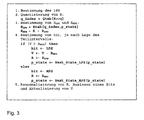
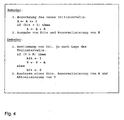
- Each probability model as used in the present invention is characterized by two parameters: 1) the index p_state characterizing the likelihood of the LPS , and 2) the value valMPS of the MPS.
- Each of these two quantities must be initialized at the beginning of the encoding or decoding of a completed encoding unit (in video coding applications, for example, a slice).
- the initialization values can be derived from control information, such as the quantization parameter (of a slice), as illustrated by way of example in FIG.
Landscapes
- Engineering & Computer Science (AREA)
- Theoretical Computer Science (AREA)
- Multimedia (AREA)
- Signal Processing (AREA)
- Physics & Mathematics (AREA)
- General Physics & Mathematics (AREA)
- Compression, Expansion, Code Conversion, And Decoders (AREA)
- Compression Of Band Width Or Redundancy In Fax (AREA)
- Signal Processing For Digital Recording And Reproducing (AREA)
- Compression Or Coding Systems Of Tv Signals (AREA)
- Hardware Redundancy (AREA)
Applications Claiming Priority (3)
| Application Number | Priority Date | Filing Date | Title |
|---|---|---|---|
| DE10220962 | 2002-05-02 | ||
| DE10220962 | 2002-05-02 | ||
| EP03725141A EP1550219B1 (fr) | 2002-05-02 | 2003-05-02 | Procede et ensemble de codage et de decodage arithmetiques d'etats binaires, programme informatique correspondant et support de memorisation correspondant lisible sur ordinateur |
Related Parent Applications (1)
| Application Number | Title | Priority Date | Filing Date |
|---|---|---|---|
| EP03725141A Division EP1550219B1 (fr) | 2002-05-02 | 2003-05-02 | Procede et ensemble de codage et de decodage arithmetiques d'etats binaires, programme informatique correspondant et support de memorisation correspondant lisible sur ordinateur |
Publications (2)
| Publication Number | Publication Date |
|---|---|
| EP1571755A2 true EP1571755A2 (fr) | 2005-09-07 |
| EP1571755A3 EP1571755A3 (fr) | 2005-10-19 |
Family
ID=29285283
Family Applications (7)
| Application Number | Title | Priority Date | Filing Date |
|---|---|---|---|
| EP08020113.0A Expired - Lifetime EP2068448B1 (fr) | 2002-05-02 | 2003-05-02 | Procédé et agencement d'encodage et de décodage arithmétiques avec utilisation de plusieurs tableaux |
| EP03725141A Expired - Lifetime EP1550219B1 (fr) | 2002-05-02 | 2003-05-02 | Procede et ensemble de codage et de decodage arithmetiques d'etats binaires, programme informatique correspondant et support de memorisation correspondant lisible sur ordinateur |
| EP08020010.8A Expired - Lifetime EP2037412B1 (fr) | 2002-05-02 | 2003-05-02 | Procédé et agencement d'encodage et de décodage arithmétiques d'états binaires et programme informatique correspondant et support de stockage lisible par ordinateur correspondant |
| EP10185219.2A Expired - Lifetime EP2290612B1 (fr) | 2002-05-02 | 2003-05-02 | Procédé et agencement d'encodage et de décodage arithmétiques d'états binaires et programme informatique correspondant et support de stockage lisible par ordinateur correspondant |
| EP05009246A Withdrawn EP1571755A3 (fr) | 2002-05-02 | 2003-05-02 | Méthode et appareil de codage et décodage arithmétique avec initialisation d'un modèle de probabilité |
| EP10185215.0A Expired - Lifetime EP2296282B1 (fr) | 2002-05-02 | 2003-05-02 | Procédé et agencement d'encodage et de décodage arithmétiques utilisant plusieurs tables de consultation |
| EP10185209.3A Expired - Lifetime EP2326013B1 (fr) | 2002-05-02 | 2003-05-02 | Procédé et agencement d'encodage et de décodage arithmétiques utilisant une pluralité de tables de consultation |
Family Applications Before (4)
| Application Number | Title | Priority Date | Filing Date |
|---|---|---|---|
| EP08020113.0A Expired - Lifetime EP2068448B1 (fr) | 2002-05-02 | 2003-05-02 | Procédé et agencement d'encodage et de décodage arithmétiques avec utilisation de plusieurs tableaux |
| EP03725141A Expired - Lifetime EP1550219B1 (fr) | 2002-05-02 | 2003-05-02 | Procede et ensemble de codage et de decodage arithmetiques d'etats binaires, programme informatique correspondant et support de memorisation correspondant lisible sur ordinateur |
| EP08020010.8A Expired - Lifetime EP2037412B1 (fr) | 2002-05-02 | 2003-05-02 | Procédé et agencement d'encodage et de décodage arithmétiques d'états binaires et programme informatique correspondant et support de stockage lisible par ordinateur correspondant |
| EP10185219.2A Expired - Lifetime EP2290612B1 (fr) | 2002-05-02 | 2003-05-02 | Procédé et agencement d'encodage et de décodage arithmétiques d'états binaires et programme informatique correspondant et support de stockage lisible par ordinateur correspondant |
Family Applications After (2)
| Application Number | Title | Priority Date | Filing Date |
|---|---|---|---|
| EP10185215.0A Expired - Lifetime EP2296282B1 (fr) | 2002-05-02 | 2003-05-02 | Procédé et agencement d'encodage et de décodage arithmétiques utilisant plusieurs tables de consultation |
| EP10185209.3A Expired - Lifetime EP2326013B1 (fr) | 2002-05-02 | 2003-05-02 | Procédé et agencement d'encodage et de décodage arithmétiques utilisant une pluralité de tables de consultation |
Country Status (11)
| Country | Link |
|---|---|
| US (1) | US6943710B2 (fr) |
| EP (7) | EP2068448B1 (fr) |
| JP (3) | JP3989485B2 (fr) |
| KR (1) | KR100733795B1 (fr) |
| AT (1) | ATE421802T1 (fr) |
| DE (1) | DE50311129D1 (fr) |
| DK (6) | DK2037412T3 (fr) |
| ES (6) | ES2442174T3 (fr) |
| PT (6) | PT2037412E (fr) |
| SI (1) | SI1550219T1 (fr) |
| WO (1) | WO2003094355A2 (fr) |
Families Citing this family (24)
| Publication number | Priority date | Publication date | Assignee | Title |
|---|---|---|---|---|
| US7408486B2 (en) * | 2003-04-21 | 2008-08-05 | Qbit Corporation | System and method for using a microlet-based modem |
| GB2398191B (en) * | 2004-03-10 | 2004-12-22 | David Asher Jaffa | Adaptive quantiser |
| KR100694098B1 (ko) * | 2005-04-04 | 2007-03-12 | 한국과학기술원 | 산술 복호 방법 및 그 장치 |
| US8572018B2 (en) * | 2005-06-20 | 2013-10-29 | New York University | Method, system and software arrangement for reconstructing formal descriptive models of processes from functional/modal data using suitable ontology |
| WO2007102518A1 (fr) * | 2006-03-07 | 2007-09-13 | The University Of Tokushima | Dispositif de codage arithmetique, procede de codage arithmetique, programme de codage arithmetique et support d'enregistrement lisible par ordinateur contenant le programme |
| US7262722B1 (en) * | 2006-06-26 | 2007-08-28 | Intel Corporation | Hardware-based CABAC decoder with parallel binary arithmetic decoding |
| JP4865509B2 (ja) * | 2006-11-01 | 2012-02-01 | キヤノン株式会社 | 復号装置及び復号方法 |
| JP4717780B2 (ja) * | 2006-11-01 | 2011-07-06 | キヤノン株式会社 | 符号化装置及びその制御方法 |
| JP4785706B2 (ja) * | 2006-11-01 | 2011-10-05 | キヤノン株式会社 | 復号装置及び復号方法 |
| US7443318B2 (en) * | 2007-03-30 | 2008-10-28 | Hong Kong Applied Science And Technology Research Institute Co. Ltd. | High speed context memory implementation for H.264 |
| TWI330006B (en) * | 2007-07-27 | 2010-09-01 | Lite On It Corp | Encoding method and encoder for generating balanced code or constant weighted code |
| JP4382840B2 (ja) * | 2007-08-20 | 2009-12-16 | Nttエレクトロニクス株式会社 | 2値算術符号化装置 |
| US20090231173A1 (en) * | 2008-03-14 | 2009-09-17 | Daniel Kilbank | System and method for using a microlet-based modem |
| JP5133950B2 (ja) * | 2009-07-16 | 2013-01-30 | 日本電信電話株式会社 | コンテクスト適応エントロピ符号化方法および装置,コンテクスト適応エントロピ復号方法および装置,並びにそれらのプログラム |
| JP5047244B2 (ja) * | 2009-09-01 | 2012-10-10 | 日本電信電話株式会社 | コンテクスト適応エントロピ符号化方法および装置,コンテクスト適応エントロピ復号方法および装置,並びにそれらのプログラム |
| KR101615384B1 (ko) * | 2010-04-05 | 2016-04-25 | 삼성전자주식회사 | 통신 시스템에서의 채널 부호화 장치 및 방법 |
| EP2559166B1 (fr) | 2010-04-13 | 2017-11-01 | Fraunhofer-Gesellschaft zur Förderung der angewandten Forschung e.V. | Codeur et décodeur de partitionnement d'intervalles de probabilité |
| JP4936574B2 (ja) * | 2011-03-02 | 2012-05-23 | キヤノン株式会社 | 符号化装置及びその制御方法 |
| DK2721822T3 (en) | 2011-06-16 | 2019-02-18 | Ge Video Compression Llc | Entropy coding of motion vector differences |
| UA114674C2 (uk) | 2011-07-15 | 2017-07-10 | ДЖ.І. ВІДІЕУ КЕМПРЕШН, ЛЛСі | Ініціалізація контексту в ентропійному кодуванні |
| US9871537B2 (en) | 2011-10-27 | 2018-01-16 | Qualcomm Incorporated | Mapping states in binary arithmetic coder for video coding |
| JP5933037B2 (ja) * | 2012-01-30 | 2016-06-08 | フラウンホッファー−ゲゼルシャフト ツァ フェルダールング デァ アンゲヴァンテン フォアシュンク エー.ファオ | 二値算術符号化スキーム |
| EP3163877A4 (fr) * | 2014-06-29 | 2018-03-07 | LG Electronics Inc. | Procédé et appareil d'exécution de codage arithmétique sur la base d'une table de rom-ram concaténée |
| US10757412B2 (en) | 2017-01-03 | 2020-08-25 | Avago Technologies International Sales Pte. Limited | Architecture flexible binary arithmetic coding system |
Family Cites Families (11)
| Publication number | Priority date | Publication date | Assignee | Title |
|---|---|---|---|---|
| US4891643A (en) * | 1986-09-15 | 1990-01-02 | International Business Machines Corporation | Arithmetic coding data compression/de-compression by selectively employed, diverse arithmetic coding encoders and decoders |
| US5475388A (en) * | 1992-08-17 | 1995-12-12 | Ricoh Corporation | Method and apparatus for using finite state machines to perform channel modulation and error correction and entropy coding |
| US5272478A (en) * | 1992-08-17 | 1993-12-21 | Ricoh Corporation | Method and apparatus for entropy coding |
| FR2703483B1 (fr) * | 1993-03-29 | 1995-06-02 | Digital Equipment Int | Dispositif de mise à jour de la valeur de code dans la méthode du codage arithmétique. |
| US5912636A (en) * | 1996-09-26 | 1999-06-15 | Ricoh Company, Ltd. | Apparatus and method for performing m-ary finite state machine entropy coding |
| JP3367370B2 (ja) * | 1997-03-14 | 2003-01-14 | 三菱電機株式会社 | 適応符号化方法 |
| US5970174A (en) * | 1997-06-19 | 1999-10-19 | Electronics For Imaging | Method and apparatus for data compression and gray value estimation |
| US6757436B2 (en) * | 1997-06-19 | 2004-06-29 | Electroncs For Imaging, Inc. | Methods and apparatus for data compression based on modeling schemes |
| US5973626A (en) * | 1998-03-17 | 1999-10-26 | Cornell Research Foundation, Inc. | Byte-based prefix encoding |
| EP1465349A1 (fr) * | 2003-03-31 | 2004-10-06 | Interuniversitair Microelektronica Centrum Vzw | Quantificateurs scalaires imbriqués pour description multiple dans le cadre de la transmission progressive d'images |
| US6894628B2 (en) * | 2003-07-17 | 2005-05-17 | Fraunhofer-Gesellschaft Zur Forderung Der Angewandten Forschung E.V. | Apparatus and methods for entropy-encoding or entropy-decoding using an initialization of context variables |
-
2003
- 2003-05-02 DK DK08020010.8T patent/DK2037412T3/da active
- 2003-05-02 DE DE50311129T patent/DE50311129D1/de not_active Expired - Lifetime
- 2003-05-02 AT AT03725141T patent/ATE421802T1/de active
- 2003-05-02 JP JP2004502472A patent/JP3989485B2/ja not_active Expired - Lifetime
- 2003-05-02 EP EP08020113.0A patent/EP2068448B1/fr not_active Expired - Lifetime
- 2003-05-02 ES ES10185215.0T patent/ES2442174T3/es not_active Expired - Lifetime
- 2003-05-02 EP EP03725141A patent/EP1550219B1/fr not_active Expired - Lifetime
- 2003-05-02 DK DK03725141T patent/DK1550219T3/da active
- 2003-05-02 PT PT80200108T patent/PT2037412E/pt unknown
- 2003-05-02 ES ES10185219.2T patent/ES2439996T3/es not_active Expired - Lifetime
- 2003-05-02 ES ES10185209.3T patent/ES2442190T3/es not_active Expired - Lifetime
- 2003-05-02 EP EP08020010.8A patent/EP2037412B1/fr not_active Expired - Lifetime
- 2003-05-02 PT PT101852093T patent/PT2326013E/pt unknown
- 2003-05-02 EP EP10185219.2A patent/EP2290612B1/fr not_active Expired - Lifetime
- 2003-05-02 SI SI200331516T patent/SI1550219T1/sl unknown
- 2003-05-02 PT PT03725141T patent/PT1550219E/pt unknown
- 2003-05-02 EP EP05009246A patent/EP1571755A3/fr not_active Withdrawn
- 2003-05-02 ES ES08020010.8T patent/ES2442215T3/es not_active Expired - Lifetime
- 2003-05-02 DK DK10185219.2T patent/DK2290612T3/da active
- 2003-05-02 PT PT101852150T patent/PT2296282E/pt unknown
- 2003-05-02 KR KR1020047017090A patent/KR100733795B1/ko not_active Expired - Lifetime
- 2003-05-02 ES ES03725141T patent/ES2316749T3/es not_active Expired - Lifetime
- 2003-05-02 EP EP10185215.0A patent/EP2296282B1/fr not_active Expired - Lifetime
- 2003-05-02 DK DK08020113.0T patent/DK2068448T3/da active
- 2003-05-02 PT PT80201130T patent/PT2068448E/pt unknown
- 2003-05-02 ES ES08020113.0T patent/ES2442173T3/es not_active Expired - Lifetime
- 2003-05-02 EP EP10185209.3A patent/EP2326013B1/fr not_active Expired - Lifetime
- 2003-05-02 PT PT101852192T patent/PT2290612E/pt unknown
- 2003-05-02 DK DK10185209.3T patent/DK2326013T3/da active
- 2003-05-02 WO PCT/EP2003/004654 patent/WO2003094355A2/fr not_active Ceased
- 2003-05-02 DK DK10185215.0T patent/DK2296282T3/da active
- 2003-12-04 US US10/727,801 patent/US6943710B2/en not_active Expired - Lifetime
-
2005
- 2005-07-25 JP JP2005213727A patent/JP4054345B2/ja not_active Expired - Lifetime
-
2007
- 2007-11-01 JP JP2007284653A patent/JP4709821B2/ja not_active Expired - Lifetime
Also Published As
Similar Documents
| Publication | Publication Date | Title |
|---|---|---|
| EP1550219B1 (fr) | Procede et ensemble de codage et de decodage arithmetiques d'etats binaires, programme informatique correspondant et support de memorisation correspondant lisible sur ordinateur | |
| DE69026292T2 (de) | Methode zur Bilddatenkodierung | |
| DE69029876T2 (de) | Anpassungsfähiger Wahrscheinlichkeitsabschätzer für Entropie-Kodierung/-Dekodierung | |
| DE69510662T2 (de) | Kompakte Quellencodierungstabellen für Codierungs-/Decodierungssystem | |
| EP1467491B1 (fr) | Codage arithmétique des coefficients de transformée | |
| EP0260748B1 (fr) | Procédé et circuit de réduction du débit de bits | |
| DE2264090C3 (de) | Datenverdichtung | |
| DE19534730B4 (de) | Verfahren zum Codieren und Decodieren von Daten | |
| DE4340591A1 (de) | Datenkompressionsverfahren unter Verwendung kleiner Wörterbücher zur Anwendung auf Netzwerkpakete | |
| DE69522497T2 (de) | System und Verfahren zur Datenkompression | |
| DE69527883T2 (de) | Decodierung eines Huffman Codes mit MSB und LSB Tabellen | |
| DE112012005164T5 (de) | Verfahren und Vorrichtung für Context-Adaptive Binäre Arithmetische Codierung von Syntaxelementen | |
| DE68926676T2 (de) | Verfahren und gerät zur statistischen kodierung von digitalen daten | |
| DE60015755T2 (de) | Verlustfreie adaptive codierung von daten eines endlichen alphabets | |
| EP1323313B1 (fr) | Procede et dispositif pour transmettre un vecteur | |
| DE69524999T2 (de) | Verfahren zum Komprimieren und Dekomprimieren von Dateien | |
| DE19653133C2 (de) | System und Verfahren zur pre-entropischen Codierung | |
| DE19549491C2 (de) | Entropie-Codierer | |
| DE3689584T2 (de) | Wahrscheinlichkeitsanpassung für arithmetische Codierer. | |
| DE3689649T2 (de) | Logarithmische Codierung/Decodierungsverfahren. | |
| EP1060565B1 (fr) | Compression de donnees a structure syntaxique | |
| EP0525349B1 (fr) | Dispositif pour codage réduisant la redondance | |
| DE3732045C2 (fr) | ||
| WO2003026308A2 (fr) | Procede et dispositif pour ameliorer le codage/decodage de signaux video | |
| DE102006028469B4 (de) | Adaptives Quantisiertes Codierungsverfahren |
Legal Events
| Date | Code | Title | Description |
|---|---|---|---|
| PUAI | Public reference made under article 153(3) epc to a published international application that has entered the european phase |
Free format text: ORIGINAL CODE: 0009012 |
|
| PUAL | Search report despatched |
Free format text: ORIGINAL CODE: 0009013 |
|
| 17P | Request for examination filed |
Effective date: 20050427 |
|
| AC | Divisional application: reference to earlier application |
Ref document number: 1550219 Country of ref document: EP Kind code of ref document: P |
|
| AK | Designated contracting states |
Kind code of ref document: A2 Designated state(s): AT BE BG CH CY CZ DE DK EE ES FI FR GB GR HU IE IT LI LU MC NL PT RO SE SI SK TR |
|
| AK | Designated contracting states |
Kind code of ref document: A3 Designated state(s): AT BE BG CH CY CZ DE DK EE ES FI FR GB GR HU IE IT LI LU MC NL PT RO SE SI SK TR |
|
| RIN1 | Information on inventor provided before grant (corrected) |
Inventor name: WIEGAND, THOMAS Inventor name: MARPE, DETLEF |
|
| STAA | Information on the status of an ep patent application or granted ep patent |
Free format text: STATUS: THE APPLICATION HAS BEEN WITHDRAWN |
|
| 18W | Application withdrawn |
Effective date: 20060330 |