EP1574525B1 - Composition catalytique pour la polymérisation d'oléfines et procédé de polymérisation employant cette composition - Google Patents
Composition catalytique pour la polymérisation d'oléfines et procédé de polymérisation employant cette composition Download PDFInfo
- Publication number
- EP1574525B1 EP1574525B1 EP04005939A EP04005939A EP1574525B1 EP 1574525 B1 EP1574525 B1 EP 1574525B1 EP 04005939 A EP04005939 A EP 04005939A EP 04005939 A EP04005939 A EP 04005939A EP 1574525 B1 EP1574525 B1 EP 1574525B1
- Authority
- EP
- European Patent Office
- Prior art keywords
- catalyst composition
- composition according
- group
- cocatalyst
- polymerization
- Prior art date
- Legal status (The legal status is an assumption and is not a legal conclusion. Google has not performed a legal analysis and makes no representation as to the accuracy of the status listed.)
- Expired - Lifetime
Links
- 239000003054 catalyst Substances 0.000 title claims abstract description 63
- 239000000203 mixture Substances 0.000 title claims abstract description 50
- 238000006116 polymerization reaction Methods 0.000 title claims abstract description 24
- 150000001336 alkenes Chemical class 0.000 title claims abstract description 10
- 230000003197 catalytic effect Effects 0.000 claims abstract description 30
- 125000001424 substituent group Chemical group 0.000 claims abstract description 11
- 125000003454 indenyl group Chemical group C1(C=CC2=CC=CC=C12)* 0.000 claims abstract description 10
- 239000003446 ligand Substances 0.000 claims abstract description 8
- 229910052799 carbon Inorganic materials 0.000 claims abstract description 6
- 230000000737 periodic effect Effects 0.000 claims abstract description 6
- 125000000129 anionic group Chemical group 0.000 claims abstract description 5
- 125000004432 carbon atom Chemical group C* 0.000 claims abstract description 5
- 229910052723 transition metal Inorganic materials 0.000 claims abstract description 5
- 150000003624 transition metals Chemical class 0.000 claims abstract description 5
- 229910052747 lanthanoid Inorganic materials 0.000 claims abstract 2
- 150000002602 lanthanoids Chemical class 0.000 claims abstract 2
- -1 ethylene, propylene, phenylene, biphenylene Chemical group 0.000 claims description 31
- 238000000034 method Methods 0.000 claims description 20
- VYPSYNLAJGMNEJ-UHFFFAOYSA-N Silicium dioxide Chemical compound O=[Si]=O VYPSYNLAJGMNEJ-UHFFFAOYSA-N 0.000 claims description 15
- 150000001875 compounds Chemical class 0.000 claims description 10
- CPOFMOWDMVWCLF-UHFFFAOYSA-N methyl(oxo)alumane Chemical group C[Al]=O CPOFMOWDMVWCLF-UHFFFAOYSA-N 0.000 claims description 10
- 229910007928 ZrCl2 Inorganic materials 0.000 claims description 9
- 239000004711 α-olefin Substances 0.000 claims description 8
- 239000004698 Polyethylene Substances 0.000 claims description 7
- 125000003118 aryl group Chemical group 0.000 claims description 7
- 229920000573 polyethylene Polymers 0.000 claims description 7
- 239000000377 silicon dioxide Substances 0.000 claims description 7
- GWEVSGVZZGPLCZ-UHFFFAOYSA-N Titan oxide Chemical compound O=[Ti]=O GWEVSGVZZGPLCZ-UHFFFAOYSA-N 0.000 claims description 6
- 125000000058 cyclopentadienyl group Chemical group C1(=CC=CC1)* 0.000 claims description 6
- 125000005842 heteroatom Chemical group 0.000 claims description 6
- CPLXHLVBOLITMK-UHFFFAOYSA-N Magnesium oxide Chemical compound [Mg]=O CPLXHLVBOLITMK-UHFFFAOYSA-N 0.000 claims description 4
- MCMNRKCIXSYSNV-UHFFFAOYSA-N Zirconium dioxide Chemical compound O=[Zr]=O MCMNRKCIXSYSNV-UHFFFAOYSA-N 0.000 claims description 4
- 229910052782 aluminium Inorganic materials 0.000 claims description 4
- UORVGPXVDQYIDP-UHFFFAOYSA-N borane Chemical compound B UORVGPXVDQYIDP-UHFFFAOYSA-N 0.000 claims description 4
- 238000007334 copolymerization reaction Methods 0.000 claims description 4
- ZGEGCLOFRBLKSE-UHFFFAOYSA-N methylene hexane Natural products CCCCCC=C ZGEGCLOFRBLKSE-UHFFFAOYSA-N 0.000 claims description 4
- MCULRUJILOGHCJ-UHFFFAOYSA-N triisobutylaluminium Chemical compound CC(C)C[Al](CC(C)C)CC(C)C MCULRUJILOGHCJ-UHFFFAOYSA-N 0.000 claims description 4
- JLTRXTDYQLMHGR-UHFFFAOYSA-N trimethylaluminium Chemical compound C[Al](C)C JLTRXTDYQLMHGR-UHFFFAOYSA-N 0.000 claims description 4
- 125000002947 alkylene group Chemical group 0.000 claims description 3
- 239000003963 antioxidant agent Substances 0.000 claims description 3
- 239000003153 chemical reaction reagent Substances 0.000 claims description 3
- 239000002516 radical scavenger Substances 0.000 claims description 3
- 239000004094 surface-active agent Substances 0.000 claims description 3
- LWNGJAHMBMVCJR-UHFFFAOYSA-N (2,3,4,5,6-pentafluorophenoxy)boronic acid Chemical class OB(O)OC1=C(F)C(F)=C(F)C(F)=C1F LWNGJAHMBMVCJR-UHFFFAOYSA-N 0.000 claims description 2
- LIKMAJRDDDTEIG-UHFFFAOYSA-N 1-hexene Chemical compound CCCCC=C LIKMAJRDDDTEIG-UHFFFAOYSA-N 0.000 claims description 2
- KWKAKUADMBZCLK-UHFFFAOYSA-N 1-octene Chemical compound CCCCCCC=C KWKAKUADMBZCLK-UHFFFAOYSA-N 0.000 claims description 2
- BTBUEUYNUDRHOZ-UHFFFAOYSA-N Borate Chemical compound [O-]B([O-])[O-] BTBUEUYNUDRHOZ-UHFFFAOYSA-N 0.000 claims description 2
- OKTJSMMVPCPJKN-UHFFFAOYSA-N Carbon Chemical compound [C] OKTJSMMVPCPJKN-UHFFFAOYSA-N 0.000 claims description 2
- YCKRFDGAMUMZLT-UHFFFAOYSA-N Fluorine atom Chemical compound [F] YCKRFDGAMUMZLT-UHFFFAOYSA-N 0.000 claims description 2
- 239000004743 Polypropylene Substances 0.000 claims description 2
- 239000004793 Polystyrene Substances 0.000 claims description 2
- 239000004372 Polyvinyl alcohol Substances 0.000 claims description 2
- WYURNTSHIVDZCO-UHFFFAOYSA-N Tetrahydrofuran Chemical compound C1CCOC1 WYURNTSHIVDZCO-UHFFFAOYSA-N 0.000 claims description 2
- RTAQQCXQSZGOHL-UHFFFAOYSA-N Titanium Chemical compound [Ti] RTAQQCXQSZGOHL-UHFFFAOYSA-N 0.000 claims description 2
- QCWXUUIWCKQGHC-UHFFFAOYSA-N Zirconium Chemical compound [Zr] QCWXUUIWCKQGHC-UHFFFAOYSA-N 0.000 claims description 2
- 150000001298 alcohols Chemical class 0.000 claims description 2
- XAGFODPZIPBFFR-UHFFFAOYSA-N aluminium Chemical compound [Al] XAGFODPZIPBFFR-UHFFFAOYSA-N 0.000 claims description 2
- PNEYBMLMFCGWSK-UHFFFAOYSA-N aluminium oxide Inorganic materials [O-2].[O-2].[O-2].[Al+3].[Al+3] PNEYBMLMFCGWSK-UHFFFAOYSA-N 0.000 claims description 2
- 229910000085 borane Inorganic materials 0.000 claims description 2
- 239000001913 cellulose Substances 0.000 claims description 2
- 229920002678 cellulose Polymers 0.000 claims description 2
- 239000004927 clay Substances 0.000 claims description 2
- 229910052570 clay Inorganic materials 0.000 claims description 2
- 150000001993 dienes Chemical class 0.000 claims description 2
- IAAKXIPQVRCQAY-UHFFFAOYSA-N difluoro-(2,3,4,5,6-pentafluorophenyl)borane Chemical compound FB(F)C1=C(F)C(F)=C(F)C(F)=C1F IAAKXIPQVRCQAY-UHFFFAOYSA-N 0.000 claims description 2
- ZSWFCLXCOIISFI-UHFFFAOYSA-N endo-cyclopentadiene Natural products C1C=CC=C1 ZSWFCLXCOIISFI-UHFFFAOYSA-N 0.000 claims description 2
- 150000002170 ethers Chemical class 0.000 claims description 2
- 239000011737 fluorine Substances 0.000 claims description 2
- 229910052731 fluorine Inorganic materials 0.000 claims description 2
- 125000002541 furyl group Chemical group 0.000 claims description 2
- 239000010439 graphite Substances 0.000 claims description 2
- 229910002804 graphite Inorganic materials 0.000 claims description 2
- 229910052735 hafnium Inorganic materials 0.000 claims description 2
- VBJZVLUMGGDVMO-UHFFFAOYSA-N hafnium atom Chemical compound [Hf] VBJZVLUMGGDVMO-UHFFFAOYSA-N 0.000 claims description 2
- 150000008040 ionic compounds Chemical class 0.000 claims description 2
- 239000000395 magnesium oxide Substances 0.000 claims description 2
- 125000002496 methyl group Chemical group [H]C([H])([H])* 0.000 claims description 2
- 239000003607 modifier Substances 0.000 claims description 2
- YWAKXRMUMFPDSH-UHFFFAOYSA-N pentene Chemical compound CCCC=C YWAKXRMUMFPDSH-UHFFFAOYSA-N 0.000 claims description 2
- 229920003229 poly(methyl methacrylate) Polymers 0.000 claims description 2
- 229920000515 polycarbonate Polymers 0.000 claims description 2
- 239000004417 polycarbonate Substances 0.000 claims description 2
- 229920001470 polyketone Polymers 0.000 claims description 2
- 239000004926 polymethyl methacrylate Substances 0.000 claims description 2
- 229920001155 polypropylene Polymers 0.000 claims description 2
- 229920002223 polystyrene Polymers 0.000 claims description 2
- 229920002451 polyvinyl alcohol Polymers 0.000 claims description 2
- 235000019422 polyvinyl alcohol Nutrition 0.000 claims description 2
- 229920000915 polyvinyl chloride Polymers 0.000 claims description 2
- 239000004800 polyvinyl chloride Substances 0.000 claims description 2
- 125000004076 pyridyl group Chemical group 0.000 claims description 2
- 239000002210 silicon-based material Substances 0.000 claims description 2
- 239000002002 slurry Substances 0.000 claims description 2
- 229910052719 titanium Inorganic materials 0.000 claims description 2
- 239000010936 titanium Substances 0.000 claims description 2
- VOITXYVAKOUIBA-UHFFFAOYSA-N triethylaluminium Chemical compound CC[Al](CC)CC VOITXYVAKOUIBA-UHFFFAOYSA-N 0.000 claims description 2
- ORYGRKHDLWYTKX-UHFFFAOYSA-N trihexylalumane Chemical compound CCCCCC[Al](CCCCCC)CCCCCC ORYGRKHDLWYTKX-UHFFFAOYSA-N 0.000 claims description 2
- 229910052726 zirconium Inorganic materials 0.000 claims description 2
- ISWSIDIOOBJBQZ-UHFFFAOYSA-M phenolate Chemical compound [O-]C1=CC=CC=C1 ISWSIDIOOBJBQZ-UHFFFAOYSA-M 0.000 claims 1
- 125000005374 siloxide group Chemical group 0.000 claims 1
- 229920000642 polymer Polymers 0.000 description 20
- 229920000098 polyolefin Polymers 0.000 description 10
- 239000011347 resin Substances 0.000 description 10
- 229920005989 resin Polymers 0.000 description 10
- 238000009826 distribution Methods 0.000 description 9
- 230000002902 bimodal effect Effects 0.000 description 7
- VGGSQFUCUMXWEO-UHFFFAOYSA-N Ethene Chemical compound C=C VGGSQFUCUMXWEO-UHFFFAOYSA-N 0.000 description 6
- 239000005977 Ethylene Substances 0.000 description 6
- YXFVVABEGXRONW-UHFFFAOYSA-N Toluene Chemical compound CC1=CC=CC=C1 YXFVVABEGXRONW-UHFFFAOYSA-N 0.000 description 6
- 229910052739 hydrogen Inorganic materials 0.000 description 6
- 239000001257 hydrogen Substances 0.000 description 6
- 238000002360 preparation method Methods 0.000 description 6
- 229920001577 copolymer Polymers 0.000 description 5
- QWTDNUCVQCZILF-UHFFFAOYSA-N isopentane Chemical compound CCC(C)C QWTDNUCVQCZILF-UHFFFAOYSA-N 0.000 description 5
- VXNZUUAINFGPBY-UHFFFAOYSA-N 1-Butene Chemical compound CCC=C VXNZUUAINFGPBY-UHFFFAOYSA-N 0.000 description 4
- YBYIRNPNPLQARY-UHFFFAOYSA-N 1H-indene Natural products C1=CC=C2CC=CC2=C1 YBYIRNPNPLQARY-UHFFFAOYSA-N 0.000 description 4
- IJGRMHOSHXDMSA-UHFFFAOYSA-N Atomic nitrogen Chemical compound N#N IJGRMHOSHXDMSA-UHFFFAOYSA-N 0.000 description 4
- UFHFLCQGNIYNRP-UHFFFAOYSA-N Hydrogen Chemical compound [H][H] UFHFLCQGNIYNRP-UHFFFAOYSA-N 0.000 description 4
- 239000011324 bead Substances 0.000 description 4
- 230000000694 effects Effects 0.000 description 4
- 125000003983 fluorenyl group Chemical group C1(=CC=CC=2C3=CC=CC=C3CC12)* 0.000 description 4
- 239000012968 metallocene catalyst Substances 0.000 description 4
- 239000000047 product Substances 0.000 description 4
- 239000004215 Carbon black (E152) Substances 0.000 description 3
- 239000000654 additive Substances 0.000 description 3
- 238000005227 gel permeation chromatography Methods 0.000 description 3
- 229920001519 homopolymer Polymers 0.000 description 3
- 229930195733 hydrocarbon Natural products 0.000 description 3
- 239000002904 solvent Substances 0.000 description 3
- 238000003756 stirring Methods 0.000 description 3
- XWJBRBSPAODJER-UHFFFAOYSA-N 1,7-octadiene Chemical compound C=CCCCCC=C XWJBRBSPAODJER-UHFFFAOYSA-N 0.000 description 2
- VTYYLEPIZMXCLO-UHFFFAOYSA-L Calcium carbonate Chemical compound [Ca+2].[O-]C([O-])=O VTYYLEPIZMXCLO-UHFFFAOYSA-L 0.000 description 2
- 239000011954 Ziegler–Natta catalyst Substances 0.000 description 2
- 125000003545 alkoxy group Chemical group 0.000 description 2
- 125000000217 alkyl group Chemical group 0.000 description 2
- 125000003710 aryl alkyl group Chemical group 0.000 description 2
- TZCXTZWJZNENPQ-UHFFFAOYSA-L barium sulfate Chemical compound [Ba+2].[O-]S([O-])(=O)=O TZCXTZWJZNENPQ-UHFFFAOYSA-L 0.000 description 2
- 125000006267 biphenyl group Chemical group 0.000 description 2
- CJZGTCYPCWQAJB-UHFFFAOYSA-L calcium stearate Chemical class [Ca+2].CCCCCCCCCCCCCCCCCC([O-])=O.CCCCCCCCCCCCCCCCCC([O-])=O CJZGTCYPCWQAJB-UHFFFAOYSA-L 0.000 description 2
- 150000001721 carbon Chemical group 0.000 description 2
- AFABGHUZZDYHJO-UHFFFAOYSA-N dimethyl butane Natural products CCCC(C)C AFABGHUZZDYHJO-UHFFFAOYSA-N 0.000 description 2
- 239000012467 final product Substances 0.000 description 2
- 239000007789 gas Substances 0.000 description 2
- 150000002431 hydrogen Chemical class 0.000 description 2
- 239000000463 material Substances 0.000 description 2
- 239000002808 molecular sieve Substances 0.000 description 2
- 229910052757 nitrogen Inorganic materials 0.000 description 2
- 239000012299 nitrogen atmosphere Substances 0.000 description 2
- JRZJOMJEPLMPRA-UHFFFAOYSA-N olefin Natural products CCCCCCCC=C JRZJOMJEPLMPRA-UHFFFAOYSA-N 0.000 description 2
- 239000000049 pigment Substances 0.000 description 2
- 238000004626 scanning electron microscopy Methods 0.000 description 2
- URGAHOPLAPQHLN-UHFFFAOYSA-N sodium aluminosilicate Chemical compound [Na+].[Al+3].[O-][Si]([O-])=O.[O-][Si]([O-])=O URGAHOPLAPQHLN-UHFFFAOYSA-N 0.000 description 2
- DGTWDUGCMACYFO-UHFFFAOYSA-N 2,2'-bis(2-indenyl) biphenyl Chemical group C1=CC=C2CC(C3=CC=CC=C3C3=CC=CC=C3C=3CC4=CC=CC=C4C=3)=CC2=C1 DGTWDUGCMACYFO-UHFFFAOYSA-N 0.000 description 1
- 229910000567 Amalgam (chemistry) Inorganic materials 0.000 description 1
- RPNUMPOLZDHAAY-UHFFFAOYSA-N Diethylenetriamine Chemical compound NCCNCCN RPNUMPOLZDHAAY-UHFFFAOYSA-N 0.000 description 1
- 239000013032 Hydrocarbon resin Substances 0.000 description 1
- DGAQECJNVWCQMB-PUAWFVPOSA-M Ilexoside XXIX Chemical compound C[C@@H]1CC[C@@]2(CC[C@@]3(C(=CC[C@H]4[C@]3(CC[C@@H]5[C@@]4(CC[C@@H](C5(C)C)OS(=O)(=O)[O-])C)C)[C@@H]2[C@]1(C)O)C)C(=O)O[C@H]6[C@@H]([C@H]([C@@H]([C@H](O6)CO)O)O)O.[Na+] DGAQECJNVWCQMB-PUAWFVPOSA-M 0.000 description 1
- 239000005909 Kieselgur Substances 0.000 description 1
- 239000006057 Non-nutritive feed additive Substances 0.000 description 1
- 238000004639 Schlenk technique Methods 0.000 description 1
- XUIMIQQOPSSXEZ-UHFFFAOYSA-N Silicon Chemical compound [Si] XUIMIQQOPSSXEZ-UHFFFAOYSA-N 0.000 description 1
- NINIDFKCEFEMDL-UHFFFAOYSA-N Sulfur Chemical compound [S] NINIDFKCEFEMDL-UHFFFAOYSA-N 0.000 description 1
- 239000012963 UV stabilizer Substances 0.000 description 1
- 230000004913 activation Effects 0.000 description 1
- 125000003368 amide group Chemical group 0.000 description 1
- 125000003277 amino group Chemical group 0.000 description 1
- 125000004104 aryloxy group Chemical group 0.000 description 1
- 125000004429 atom Chemical group 0.000 description 1
- 229940092690 barium sulfate Drugs 0.000 description 1
- 125000001797 benzyl group Chemical group [H]C1=C([H])C([H])=C(C([H])=C1[H])C([H])([H])* 0.000 description 1
- 238000000071 blow moulding Methods 0.000 description 1
- 229910000019 calcium carbonate Inorganic materials 0.000 description 1
- 239000008116 calcium stearate Substances 0.000 description 1
- 235000013539 calcium stearate Nutrition 0.000 description 1
- 239000006229 carbon black Substances 0.000 description 1
- 239000011248 coating agent Substances 0.000 description 1
- 238000000576 coating method Methods 0.000 description 1
- 125000004122 cyclic group Chemical group 0.000 description 1
- KOMDZQSPRDYARS-UHFFFAOYSA-N cyclopenta-1,3-diene titanium Chemical compound [Ti].C1C=CC=C1.C1C=CC=C1 KOMDZQSPRDYARS-UHFFFAOYSA-N 0.000 description 1
- ZMMRKRFMSDTOLV-UHFFFAOYSA-N cyclopenta-1,3-diene zirconium Chemical compound [Zr].C1C=CC=C1.C1C=CC=C1 ZMMRKRFMSDTOLV-UHFFFAOYSA-N 0.000 description 1
- 239000004205 dimethyl polysiloxane Substances 0.000 description 1
- 238000001035 drying Methods 0.000 description 1
- 230000009977 dual effect Effects 0.000 description 1
- 239000000975 dye Substances 0.000 description 1
- 239000000945 filler Substances 0.000 description 1
- 125000000524 functional group Chemical group 0.000 description 1
- 239000011521 glass Substances 0.000 description 1
- 229910052736 halogen Inorganic materials 0.000 description 1
- 125000005843 halogen group Chemical group 0.000 description 1
- 150000002367 halogens Chemical class 0.000 description 1
- BHEPBYXIRTUNPN-UHFFFAOYSA-N hydridophosphorus(.) (triplet) Chemical compound [PH] BHEPBYXIRTUNPN-UHFFFAOYSA-N 0.000 description 1
- 229920006270 hydrocarbon resin Polymers 0.000 description 1
- 150000002430 hydrocarbons Chemical class 0.000 description 1
- QLNAVQRIWDRPHA-UHFFFAOYSA-N iminophosphane Chemical compound P=N QLNAVQRIWDRPHA-UHFFFAOYSA-N 0.000 description 1
- 238000010348 incorporation Methods 0.000 description 1
- 238000003780 insertion Methods 0.000 description 1
- 230000037431 insertion Effects 0.000 description 1
- WHJXGGISJBFSJJ-UHFFFAOYSA-N iron;pyridine Chemical compound [Fe].C1=CC=NC=C1 WHJXGGISJBFSJJ-UHFFFAOYSA-N 0.000 description 1
- 239000000314 lubricant Substances 0.000 description 1
- 238000004519 manufacturing process Methods 0.000 description 1
- 239000002184 metal Substances 0.000 description 1
- 229910052751 metal Inorganic materials 0.000 description 1
- 238000002156 mixing Methods 0.000 description 1
- 125000003518 norbornenyl group Chemical class C12(C=CC(CC1)C2)* 0.000 description 1
- 239000002667 nucleating agent Substances 0.000 description 1
- 239000003921 oil Substances 0.000 description 1
- 239000002245 particle Substances 0.000 description 1
- 125000000538 pentafluorophenyl group Chemical group FC1=C(F)C(F)=C(*)C(F)=C1F 0.000 description 1
- 125000001997 phenyl group Chemical group [H]C1=C([H])C([H])=C(*)C([H])=C1[H] 0.000 description 1
- 229920000435 poly(dimethylsiloxane) Polymers 0.000 description 1
- 229920002959 polymer blend Polymers 0.000 description 1
- 238000010094 polymer processing Methods 0.000 description 1
- 230000000379 polymerizing effect Effects 0.000 description 1
- 238000004886 process control Methods 0.000 description 1
- 230000000979 retarding effect Effects 0.000 description 1
- 238000005204 segregation Methods 0.000 description 1
- 229910052710 silicon Inorganic materials 0.000 description 1
- 239000010703 silicon Substances 0.000 description 1
- 235000012239 silicon dioxide Nutrition 0.000 description 1
- 239000011734 sodium Substances 0.000 description 1
- 229910001023 sodium amalgam Inorganic materials 0.000 description 1
- 229910052717 sulfur Inorganic materials 0.000 description 1
- 239000011593 sulfur Substances 0.000 description 1
- 239000000725 suspension Substances 0.000 description 1
- 239000000454 talc Substances 0.000 description 1
- 229910052623 talc Inorganic materials 0.000 description 1
- 239000004408 titanium dioxide Substances 0.000 description 1
- 239000001993 wax Substances 0.000 description 1
- XOOUIPVCVHRTMJ-UHFFFAOYSA-L zinc stearate Chemical compound [Zn+2].CCCCCCCCCCCCCCCCCC([O-])=O.CCCCCCCCCCCCCCCCCC([O-])=O XOOUIPVCVHRTMJ-UHFFFAOYSA-L 0.000 description 1
- VPGLGRNSAYHXPY-UHFFFAOYSA-L zirconium(2+);dichloride Chemical compound Cl[Zr]Cl VPGLGRNSAYHXPY-UHFFFAOYSA-L 0.000 description 1
Images

Classifications
-
- C—CHEMISTRY; METALLURGY
- C08—ORGANIC MACROMOLECULAR COMPOUNDS; THEIR PREPARATION OR CHEMICAL WORKING-UP; COMPOSITIONS BASED THEREON
- C08F—MACROMOLECULAR COMPOUNDS OBTAINED BY REACTIONS ONLY INVOLVING CARBON-TO-CARBON UNSATURATED BONDS
- C08F10/00—Homopolymers and copolymers of unsaturated aliphatic hydrocarbons having only one carbon-to-carbon double bond
- C08F10/02—Ethene
-
- C—CHEMISTRY; METALLURGY
- C08—ORGANIC MACROMOLECULAR COMPOUNDS; THEIR PREPARATION OR CHEMICAL WORKING-UP; COMPOSITIONS BASED THEREON
- C08F—MACROMOLECULAR COMPOUNDS OBTAINED BY REACTIONS ONLY INVOLVING CARBON-TO-CARBON UNSATURATED BONDS
- C08F10/00—Homopolymers and copolymers of unsaturated aliphatic hydrocarbons having only one carbon-to-carbon double bond
-
- C—CHEMISTRY; METALLURGY
- C08—ORGANIC MACROMOLECULAR COMPOUNDS; THEIR PREPARATION OR CHEMICAL WORKING-UP; COMPOSITIONS BASED THEREON
- C08F—MACROMOLECULAR COMPOUNDS OBTAINED BY REACTIONS ONLY INVOLVING CARBON-TO-CARBON UNSATURATED BONDS
- C08F2420/00—Metallocene catalysts
- C08F2420/02—Cp or analog bridged to a non-Cp X anionic donor
-
- C—CHEMISTRY; METALLURGY
- C08—ORGANIC MACROMOLECULAR COMPOUNDS; THEIR PREPARATION OR CHEMICAL WORKING-UP; COMPOSITIONS BASED THEREON
- C08F—MACROMOLECULAR COMPOUNDS OBTAINED BY REACTIONS ONLY INVOLVING CARBON-TO-CARBON UNSATURATED BONDS
- C08F2420/00—Metallocene catalysts
- C08F2420/09—Cyclic bridge, i.e. Cp or analog where the bridging unit linking the two Cps or analogs is part of a cyclic group
-
- C—CHEMISTRY; METALLURGY
- C08—ORGANIC MACROMOLECULAR COMPOUNDS; THEIR PREPARATION OR CHEMICAL WORKING-UP; COMPOSITIONS BASED THEREON
- C08F—MACROMOLECULAR COMPOUNDS OBTAINED BY REACTIONS ONLY INVOLVING CARBON-TO-CARBON UNSATURATED BONDS
- C08F4/00—Polymerisation catalysts
- C08F4/42—Metals; Metal hydrides; Metallo-organic compounds; Use thereof as catalyst precursors
- C08F4/44—Metals; Metal hydrides; Metallo-organic compounds; Use thereof as catalyst precursors selected from light metals, zinc, cadmium, mercury, copper, silver, gold, boron, gallium, indium, thallium, rare earths or actinides
- C08F4/60—Metals; Metal hydrides; Metallo-organic compounds; Use thereof as catalyst precursors selected from light metals, zinc, cadmium, mercury, copper, silver, gold, boron, gallium, indium, thallium, rare earths or actinides together with refractory metals, iron group metals, platinum group metals, manganese, rhenium technetium or compounds thereof
- C08F4/62—Refractory metals or compounds thereof
- C08F4/64—Titanium, zirconium, hafnium or compounds thereof
- C08F4/659—Component covered by group C08F4/64 containing a transition metal-carbon bond
- C08F4/65908—Component covered by group C08F4/64 containing a transition metal-carbon bond in combination with an ionising compound other than alumoxane, e.g. (C6F5)4B-X+
-
- C—CHEMISTRY; METALLURGY
- C08—ORGANIC MACROMOLECULAR COMPOUNDS; THEIR PREPARATION OR CHEMICAL WORKING-UP; COMPOSITIONS BASED THEREON
- C08F—MACROMOLECULAR COMPOUNDS OBTAINED BY REACTIONS ONLY INVOLVING CARBON-TO-CARBON UNSATURATED BONDS
- C08F4/00—Polymerisation catalysts
- C08F4/42—Metals; Metal hydrides; Metallo-organic compounds; Use thereof as catalyst precursors
- C08F4/44—Metals; Metal hydrides; Metallo-organic compounds; Use thereof as catalyst precursors selected from light metals, zinc, cadmium, mercury, copper, silver, gold, boron, gallium, indium, thallium, rare earths or actinides
- C08F4/60—Metals; Metal hydrides; Metallo-organic compounds; Use thereof as catalyst precursors selected from light metals, zinc, cadmium, mercury, copper, silver, gold, boron, gallium, indium, thallium, rare earths or actinides together with refractory metals, iron group metals, platinum group metals, manganese, rhenium technetium or compounds thereof
- C08F4/62—Refractory metals or compounds thereof
- C08F4/64—Titanium, zirconium, hafnium or compounds thereof
- C08F4/659—Component covered by group C08F4/64 containing a transition metal-carbon bond
- C08F4/65912—Component covered by group C08F4/64 containing a transition metal-carbon bond in combination with an organoaluminium compound
-
- C—CHEMISTRY; METALLURGY
- C08—ORGANIC MACROMOLECULAR COMPOUNDS; THEIR PREPARATION OR CHEMICAL WORKING-UP; COMPOSITIONS BASED THEREON
- C08F—MACROMOLECULAR COMPOUNDS OBTAINED BY REACTIONS ONLY INVOLVING CARBON-TO-CARBON UNSATURATED BONDS
- C08F4/00—Polymerisation catalysts
- C08F4/42—Metals; Metal hydrides; Metallo-organic compounds; Use thereof as catalyst precursors
- C08F4/44—Metals; Metal hydrides; Metallo-organic compounds; Use thereof as catalyst precursors selected from light metals, zinc, cadmium, mercury, copper, silver, gold, boron, gallium, indium, thallium, rare earths or actinides
- C08F4/60—Metals; Metal hydrides; Metallo-organic compounds; Use thereof as catalyst precursors selected from light metals, zinc, cadmium, mercury, copper, silver, gold, boron, gallium, indium, thallium, rare earths or actinides together with refractory metals, iron group metals, platinum group metals, manganese, rhenium technetium or compounds thereof
- C08F4/62—Refractory metals or compounds thereof
- C08F4/64—Titanium, zirconium, hafnium or compounds thereof
- C08F4/659—Component covered by group C08F4/64 containing a transition metal-carbon bond
- C08F4/65916—Component covered by group C08F4/64 containing a transition metal-carbon bond supported on a carrier, e.g. silica, MgCl2, polymer
-
- C—CHEMISTRY; METALLURGY
- C08—ORGANIC MACROMOLECULAR COMPOUNDS; THEIR PREPARATION OR CHEMICAL WORKING-UP; COMPOSITIONS BASED THEREON
- C08F—MACROMOLECULAR COMPOUNDS OBTAINED BY REACTIONS ONLY INVOLVING CARBON-TO-CARBON UNSATURATED BONDS
- C08F4/00—Polymerisation catalysts
- C08F4/42—Metals; Metal hydrides; Metallo-organic compounds; Use thereof as catalyst precursors
- C08F4/44—Metals; Metal hydrides; Metallo-organic compounds; Use thereof as catalyst precursors selected from light metals, zinc, cadmium, mercury, copper, silver, gold, boron, gallium, indium, thallium, rare earths or actinides
- C08F4/60—Metals; Metal hydrides; Metallo-organic compounds; Use thereof as catalyst precursors selected from light metals, zinc, cadmium, mercury, copper, silver, gold, boron, gallium, indium, thallium, rare earths or actinides together with refractory metals, iron group metals, platinum group metals, manganese, rhenium technetium or compounds thereof
- C08F4/62—Refractory metals or compounds thereof
- C08F4/64—Titanium, zirconium, hafnium or compounds thereof
- C08F4/659—Component covered by group C08F4/64 containing a transition metal-carbon bond
- C08F4/6592—Component covered by group C08F4/64 containing a transition metal-carbon bond containing at least one cyclopentadienyl ring, condensed or not, e.g. an indenyl or a fluorenyl ring
- C08F4/65922—Component covered by group C08F4/64 containing a transition metal-carbon bond containing at least one cyclopentadienyl ring, condensed or not, e.g. an indenyl or a fluorenyl ring containing at least two cyclopentadienyl rings, fused or not
- C08F4/65927—Component covered by group C08F4/64 containing a transition metal-carbon bond containing at least one cyclopentadienyl ring, condensed or not, e.g. an indenyl or a fluorenyl ring containing at least two cyclopentadienyl rings, fused or not two cyclopentadienyl rings being mutually bridged
Definitions
- the present invention relates to a catalyst composition for polymerization of ⁇ -olefins according to claim 1, as well as to a process for homopolymerization or copolymerization using that catalyst composition.
- Polyolefins having a multi-modal or at least a broad molecular weight distribution can be obtained from a variety of methods, including mechanical blending, multistage reactors and mixed catalysts. Such resins have several advantages over normal polyolefins lacking a multi-modal or broad molecular weight distribution. For example, polyolefins having a multi-modal molecular weight distribution (MWD) could be processed at faster throughput rate with lower energy requirements. Such polymers are preferred because of improved properties for applications such as blow molding and/or high strength films and pipes. Polymers having a multi-modal MWD are generally characterized by having a broad MWD or more than one MWD peak, as reflected by gel permeation chromatography (GPC) curves.
- GPC gel permeation chromatography
- the most desirable method in terms of capital expense and product properties is to prepare the broad or multi-modal resin in a single reactor using a mixture of catalysts that are capable of producing the targeted polymer blend under the same polymerization conditions. This process could avoid the need for an additional reactor and controls.
- the broad or multi-modal polymer fractions could be mixed more efficiently, since they are produced together.
- the most frequently used mixed catalyst system for bimodal resins is based on a metallocene and a Ziegler-Natta catalyst. Due to the significant differences between the two catalysts, the segregation of the polymer during polymerization process often leads to reactor fouling and it is difficult to control its process and the product produced. Polymer particles produced from such catalyst systems are frequently not uniform in size.
- US 5,914,289 discloses a catalyst system comprising a bridged and a non-bridged hydrogenated indenyl or fluorenyl metallocene together with alumoxane for use in the preparation of polyolefins having a broad monomodal molecular weight distribution.
- a metallocene catalyst system is disclosed which contains binuclear or multinuclear chemically distinct active sites.
- US 5,847,059 describes a dual supported metallocene catalyst which is able to increase its activity over that for a single supported metallocene catalyst and produces only a polymer having a relatively broad molecular weight distribution.
- US 6,342,622 discloses the use of particular indenyl compounds for the polymerization of olefins, which indenyl compounds are highly active catalysts giving polymers with high molecular weight.
- a comonomer is used, this comonomer is very well incorporated into the polymer backbone.
- US 6,350,830 B1 discloses a catalyst system in which the ratio of rac isomer to meso isomer of the metallocene is from 1:10 to 2:1 which can be used for the polymerization of olefins.
- JP-A-7048408 discloses a highly stereo-regular polyolefin which is produced in a high efficiency by polymerizing an olefin using a catalyst composed of a metallocene compound containing cyclopentadienyl group bridged with biphenyl group as ligand, and a cocatalyst.
- JP-A-7173208 discloses a metallocene compound having a 2,2'-substituted biphenyl group as bridge which may be used as a catalyst for olefin polymerization.
- That catalyst systems disclosed in the prior art may be used for homopolymerization of ethylene or copolymerization of ethylene with alpha-olefin(s).
- the comonomer is better incorporated in the low molecular weight fraction, because of easier chain termination after insertion of a larger comonomer into the metal-polymer bond of the catalyst.
- the first object is achieved by a catalyst composition for polymerization of olefins as claimed in claim 1.
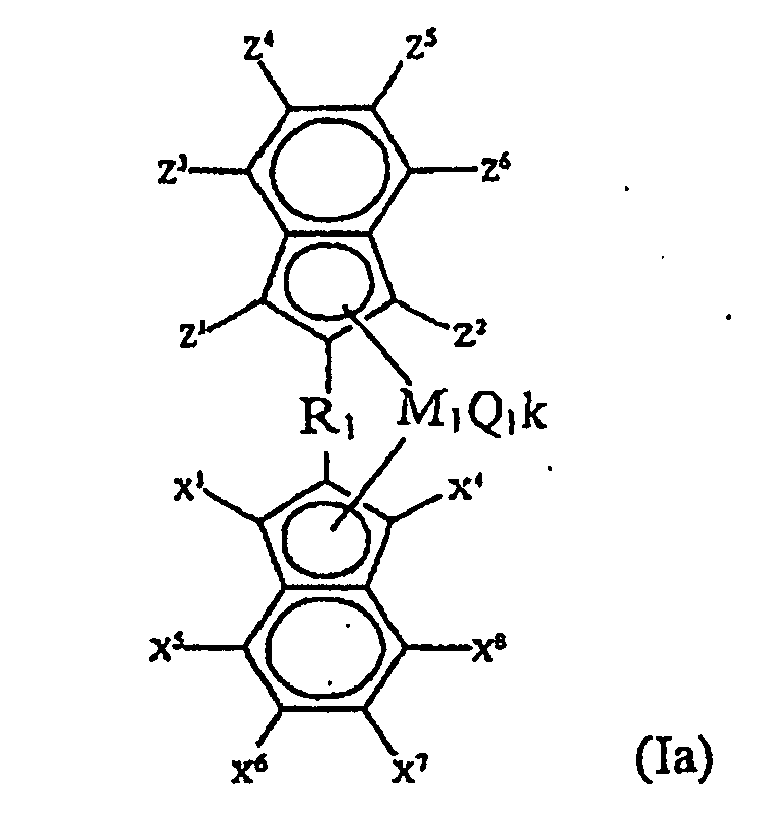
- the first catalytic component (A) is of the formula (Ia) wherein Z 1 - Z 6 and X 1 and X 4 - X 8 are substituents and R 1 contains at least one sp2-hybridized carbon atom that is bonded to one of the indenyl groups at the 2-position.
- R 1 is an alkylene-containing bridging group, an aryl-containing bridging group or a bisaryl-containing bridging group.
- R 1 is ethylene, propylene, phenylene, biphenylene, pyridyl, furyl, thiophyl, or N-substituted pyrrols.
- R 1 2,2'-biphenylene Most preferred is R 1 2,2'-biphenylene.
- Q 1 is Cl or a methyl group.
- the second catalytic component (B) which is different from the catalytic component (A), may be a (bridged) metallocene, a constrained geometry catalyst (known as DOW-catalyst), a nickel-bisimine complex, a iron-pyridine bridged bisimine complex, a FI complex or a phosphinimine complex.
- DOW-catalyst constrained geometry catalyst
- the second catalyst component (B) is Me 2 Si(Ind) 2 ZrCl 2 , C 2 H 4 (Ind) 2 ZrCl 2 , or Me 2 Si(4H-Ind) 2 ZrCl 2 .
- the cocatalyst may be an organoaluminum compound and/or a non-coordinative ionic compound.
- the cocatalyst is methylaluminoxane (MAO), modified methylaluminoxane (MMAO), triaryl borane or tetraaryl borate, such as perfluorophenyl borane and perfluorophenyl borate derivatives, or mixtures thereof.
- MAO methylaluminoxane
- MMAO modified methylaluminoxane
- triaryl borane or tetraaryl borate such as perfluorophenyl borane and perfluorophenyl borate derivatives, or mixtures thereof.
- the molar ratio of the cocatalyst relative to the catalytic components in case an organoaluminum compound is selected as the cocatalyst, is in a range of from 1:1 to 1000:1, preferably in a range of from 1:1 to 500:1, and wherein the molar ratio of the cocatalyst relative to the catalytic components, in case a non-coordinative ionic cocatalyst is selceted, is in a range of from 1:100 to 100:1, preferably in a range from 1:1 to 50:1.
- the catalyst composition is supported on a support selected from an inorganic or organic support.
- the support is preferably selected from the group consisting of silica, alumina, magnesia, titania, zirconia, clay, zeolithe, polystyrene, polyethylene, polypropylene, polyvinylchloride, polycarbonate, polyketone, polyvinylalcohol, polymethyl methacrylate, cellulose, graphite or mixtures thereof.
- modifiers modifiers, promoters, electron donor reagents, scavengers, silicon containing compounds, surfactants, antistatic regants, antioxidants or fluorine containing compounds are added.
- alcohols, titanates, ethers, such as tetrahydrofurane, are added.
- aluminum alkyl such as triisobutyl aluminum, trihexyl aluminum, triisopropyl aluminum, triethyl aluminum and trimethyl aluminum, is added as scavenger or cocatalyst to the catalyst composition.
- the second object is achieved by a process for homopolymerization or copolymerization ⁇ -olefins using a catalyst composition of the invention.
- the ⁇ -olefin is ethylene, propylene, butene, pentene, hexene, heptene, octene or mixtures thereof.
- non-conjugated dien is present. Therefore, also amorphous or rubbery copolymers may be produced, wherein preferred dienes are 1,7 octadiene and 1,9-octadiene or norbornene derivatives.
- the process is carried out in gas phase, slurry phase or solution phase.
- the polymerization is carried out at a temperature of 50 to 250°C.
- the catalytic component (A) in the catalyst composition of the invention is the indenyl compound as disclosed in US 6,342, 622.
- Q 1 may comprise one or more uni- or polyvalent anionic ligands to the transition metal M 1 .
- ligands which may be the same or different, the following can be mentioned: a hydrogen, a halogen, an alkyl group, an aryl group, an aralkyl group, an alkoxy group, an aryloxy group, or a group with a heteroatom chosen from group 14, 15 or 16 of the Periodic System of Elements, such as an amine group, an amide group, a sulfur-containing compound or a phosphorous-containing compound.
- Q 1 may be also a monoanionic ligand bonded to M 1 via a covalent metal-carbon bond and which is additionally capable to non-covalently interact with M 1 via one or more functional groups, for example 2,6-difluorophenyl, 2,4,6-trifluorophenyl, pentafluorophenyl, 2-alkoxyphenyl, 2,6-dialkoxyphenyl, 2-(dialkylamono)benzyl and 2,6-(dialkylamino)phenyl.
- functional groups for example 2,6-difluorophenyl, 2,4,6-trifluorophenyl, pentafluorophenyl, 2-alkoxyphenyl, 2,6-dialkoxyphenyl, 2-(dialkylamono)benzyl and 2,6-(dialkylamino)phenyl.
- the number of Q 1 groups in the catalytic component (A) is determined by the valence of M 1 and the valence of the Q 1 group itself.
- the sp2-hybridized carbon atom of R 1 may be a part of, for example, an alkylene-containing bridging group R 1 or of an aryl group forming part of the bridging group R 1 .
- R 1 is a bisaryl group, most preferably 2,2'-biphenylene.
- the substituents X 1 -X 8 may be each separately hydrogen or a hydrocarbon radical with 1-20 carbon atoms, e.g. alkyl, aryl, aryl alkyl. Further, X 1 -X 4 may be a halogen atom, or an alkoxy group. Also, two adjacent hydrocarbon radicals may be connected with each other in a ring system. In this way, an indenyl can be formed by connection of X 1 and X 2 , X 2 and X 3 , X 3 and X 4 , or fluorenyl can be formed by connection of both X 1 and X 2 and X 3 and X 4 .
- the substituent may also comprise one or more heteroatoms from group 14, 15 or 16 of the Periodic System of the Elements.
- the substituents Z 1 -Z 6 may each separately be a substituent as disclosed above with regard to the substituents X.
- Q 2 and Q 3 may be selected from the possible group given above for Q 1 .
- R 2 is a bridging group which may be selected from the group consisting of - (R'R")Si-, -(R'R")Ge-, -C(R'R")-C(R"'R"”)-, -(R'R")(C(R"'R"”))n-, -B(R')-, -Al(R')-, -P(R')-, -P(R')(O)-, -P(R'R"R”')-, -N(R')-, -O-, -S-, -Ar-, wherein R' - R"" may be hydrogen, hydrocarbon with C 1 -C 100 carbon atoms, substituted or unsubstituted, containing one or more heteroatoms which could be linked directly to the bridging atom(s).
- Ar is an aromatic group which could contain heteroatom(s) and could be one or more aromatic rings joined together.
- X is a substituent as disclosed for X 1 -X 8 given for formula (I). Any cyclopentadienyl ring shown includes cyclopentadienyl derivatives, such as indenyl, fluorenyl, and heteroatom substituted cyclopentadienyl.
- polymers may be produced having a multi-modal or at least a broad molecular weight distribution, wherein the catalyst composition of the invention provides a high activity and easy processability and final product control. No reactor fouling is observed during the polymerization run.
- the catalyst composition for the preparation of homopolymers such as polyethylene
- the catalytic component (B) produces high molecular weight polyolefins with high comonomer contents, wherein the catalytic component (A) produces low molecular weight polyolefins with low comonomer incorporations.
- catalytic component (A) will lead to less accessible active centers for comonomers after activation, while catalytic component (B) generates an active center which is more accessible for comonomers.
- these catalytic components have reversed effects in hydrogen. Therefore, resins produced according with the process will have comonomer more effectively placed in the high molecular weight fraction. Since the catalytic components are activated by the same cocatalyst, the catalyst composition according to the invention is greatly simplified. The process control for the catalyst composition is much easier than for bimetallic catalyst systems which contain both a metallocene and a Ziegler-Natta catalyst.
- the polymers produced according to the process may be used in a wide variety of products and end use applications.
- the polymers include polyethylene or copolymers of ethylene with alpha-olefin, and even more preferably include bimodal polyethylene produced in a single reactor.
- the catalyst composition according to the invention may be used to make polyolefins, especially polyethylene, having a weight average molecular weight of 30000 or more, preferably 50000 or more, more preferably 100000 or more with an MWD (M w /M n ) between 3 and 80, preferably between 6 and 50, more preferably between 9 and 40, with an I 21 (Flow Index, as measured at 190°C) of less than 40, a density of between 0.89 and 0.97 g/cm 3 .
- the polymers obtained by the process of the invention have an ash content of less than about 100 ppm, more preferably less than about 75 ppm and even more preferably less than about 50 ppm.
- the polyolefins obtained can be processed into films, molded articles (including pipes), sheets, wire and cable coating.
- the films produced may further contain additives, such as slip, antiblock, antioxidants, pigments, fillers, antifog, UV stabilizers, antistats, polymer processing aids, neutralizers, lubricants, surfactants, pigments, dyes and nucleating agents.
- Preferred additives include silicon dioxide, synthetic silica, titanium dioxide, polydimethylsiloxane, calcium carbonate, metal stearates, calcium stearate, zinc stearate, talc, bariumsulfate, diatomaceous earth, wax, carbon black, flame retarding additives, low molecular weight resins, hydrocarbon resins, and glass beads.
- ES70 silica which was calcinated at 600°C and 20 mL of MAO (10% in toluene) were mixed under a nitrogen atmosphere in a 100 mL round-bottom flask equipped with a stir bar. After stirring for an hour at 100°C, the suspension was allowed to settle down. The solvents were then removed under vacuum.
- the supported catalyst was used to prepare ethylene homopolymer and copolymers of ethylene and 1-butene.
- the polymerizations were carried out in a two-liter stirred autoclave charged with 1000 ml dried, deoxygenated isopentane. Hydrogen was added to control molecular weight and trimethylaluminum (TMA) + triisobutylaluminum (TIBAL) were used as scavenger. Polymerizations were carried out at 88°C and 18 bars of total pressure. Ethylene gas was used to maintain this pressure. Upon completion of the polymerization, the reactor was vented and cooled to ambient temperature to recover the polymer. Details of each polymerization and characteristics of the resins produced are provided in Table 1.
- FIG. 1 A photograph made by scanning electron microscopy of a polyethylene bead of example 1 is given in figure 1 illustrating that a very spherical polymer bead is obtained.
- Figure 2 shows the GPC curve of the polymer of example 1 indicating that example 1 provides a polymer having a very broad molecular weight distribution.
- Table 1 Example # C. Comp. A (mmol) C.
- Example 1 A(0.027) B1(0.032) 0.5 0 680 0.28 208,700 (37.8)
- Example 2 A(0.030) B1(0.032) 0.5 0 1060 0.35 99900 (9.0)
- Example 3 A(0.031) B2(0.025) 0.5 0 1320 0.33 84500 (10.5)
- Example 4 A(0.063) B2(0.026) 0.5 0 1930 0.36 81400 (11.3)
- Example 5 A(0.044) B2(0.041) 0.5 0 1330 0.36 92,000 (12.7)
- Example 6 A(0.03) B2(0.03) 0.25 40 1600 ---- 41,000 (12.6)
- Example 7 A(0.033) B3(0.028) 0.5 0 1310 0.25 34,800 (4.2)
- Example 8 A(0.03) B4(0.05) 0.5 0 18
Landscapes
- Chemical & Material Sciences (AREA)
- Health & Medical Sciences (AREA)
- Chemical Kinetics & Catalysis (AREA)
- Medicinal Chemistry (AREA)
- Polymers & Plastics (AREA)
- Organic Chemistry (AREA)
- Transition And Organic Metals Composition Catalysts For Addition Polymerization (AREA)
Claims (21)
- Composition catalytique pour la polymérisation d'oléfines comprenanta) au moins deux composants catalytiques, un premier composant catalytique (A) correspondant à la formule (I)
 b) un cocatalyseur,caractérisée en ce que le second composant catalytique (B) est choisi parmi le groupe se composant des formules (II) à (VII) comme suit:
- Composition catalytique selon la revendication 1 caractérisée en ce que le premier composant catalytique (A) correspond à la formule (Ia)
- Composition catalytique selon la revendication 1 ou 2 caractérisée en ce que R1 représente un groupement de liaison contenant un alkylène, un groupement de liaison contenant un aryle ou un groupement de liaison contenant un bisaryle.
- Composition catalytique selon la revendication 3 caractérisée en ce R1 représente un groupement éthylène, propylène, phénylène, biphénylène, pyridyle, furyle, thiophényle ou pyrrole substitué en N.
- Composition catalytique selon la revendication 4 caractérisée en ce que R1 représente un groupement 2,2'-biphénylène.
- Composition catalytique selon l'une quelconque des revendications précédentes caractérisée en ce que M1 représente du titane, du zirconium ou du hafnium.
- Composition catalytique selon l'une quelconque des revendications précédentes caractérisée en ce que Q1 représente un Cl ou un groupement méthyle.
- Composition catalytique selon l'une quelconque des revendications précédentes caractérisée en ce que le second composant catalytique (B) est du Me2Si(Ind)2ZrCl2, du C2H4(Ind)2ZrCl2 ou du Me2Si(4H-Ind)2ZrCl2.
- Composition catalytique selon l'une quelconque des revendications précédentes caractérisée en ce que le cocatalyseur est un composé organoaluminium et/ou un composé ionique non coordinatif.
- Composition catalytique selon la revendication 9 caractérisée en ce que le cocatalyseur est du méthylaluminoxane (MAO), du méthylaluminoxane modifié (MMAO), du triarylborane ou du borate de tétraryle, tel que le perfluorophénylborane et les dérivés borate de perfluorophényle, ou des mélanges de ceux-ci.
- Composition catalytique selon l'une quelconque des revendications précédentes caractérisée en ce que le rapport molaire du cocatalyseur et des composants catalytiques, dans le cas où un composé organoaluminium est choisi comme cocatalyseur, se situe dans la plage allant de 1:1 à 1 000:1, de préférence dans la plage allant de 1:1 à 500:1, et où le rapport molaire du cocatalyseur et des composants catalytiques, dans le cas où un cocatalyseur ionique non coordinatif est choisi, se situe dans la plage allant de 1:100 à 100:1, de préférence dans la plage allant de 1:1 à 50:1.
- Composition catalytique selon l'une quelconque des revendications précédentes caractérisée en ce que la composition catalytique est supportée sur un support choisi parmi un support inorganique ou organique.
- Composition catalytique selon la revendication 12 caractérisée en ce que le support est choisi parmi le groupe se composant de silice, alumine, magnésie, dioxyde de titane, zircone, argile, zéolithe, polystyrène, polyéthylène, polypropylène, polychlorure de vinyle, polycarbonate, polycétone, alcool de polyvinyle, polyméthacrylate de méthyle, cellulose, graphite ou de mélanges de ceux-ci.
- Composition catalytique selon l'une quelconque des revendications précédentes caractérisée en ce que des agents modifiants, des promoteurs, des réactifs donneurs d'électrons, des agents complexants, des composés contenant du silicone, des tensioactifs, des réactifs antistatiques, des antioxydants ou des composés contenant du fluor sont ajoutés.
- Composition catalytique selon la revendication 14 caractérisée en ce que des alcools, des titanates, des éthers, tels que le tétrahydrofurane, sont ajoutés.
- Composition catalytique selon la revendication 14 caractérisée en ce qu'un groupement alkylaluminium, tel que le triisobutylaluminium, le trihexylaluminium, le triisopropylaluminium, le triéthylaluminium et le triméthylaluminium, est ajouté comme agent complexant ou cocatalyseur à la composition catalytique.
- Procédé d'homopolymérisation ou de copolymérisation d'α-oléfines utilisant une composition catalytique selon l'une quelconque des revendications précédentes 1 à 16.
- Procédé selon la revendication 17 caractérisé en ce que l'α-oléfine est de l'éthylène, du propylène, du butène, du pentène, de l'hexène, de l'hèptène, de l'octène ou des mélanges de ceux-ci.
- Procédé selon la revendication 17 ou 18 caractérisé en ce qu'un ou plusieurs diène(s) non conjugué(s) est (sont) présent(s) de manière additionnelle.
- Procédé selon l'une quelconque des revendications 17 à 19 caractérisé en ce que le procédé est mis en oeuvre en phase gazeuse, en suspension ou en solution.
- Procédé selon l'une quelconque des revendications 17 à 20 caractérisé en ce que la polymérisation est mise en oeuvre à une température de 50 à 250°C.
Priority Applications (7)
| Application Number | Priority Date | Filing Date | Title |
|---|---|---|---|
| EP04005939A EP1574525B1 (fr) | 2004-03-12 | 2004-03-12 | Composition catalytique pour la polymérisation d'oléfines et procédé de polymérisation employant cette composition |
| AT04005939T ATE361323T1 (de) | 2004-03-12 | 2004-03-12 | Katalysatorzusammensetzung für die polymerisation von olefinen und polymerisationsverfahren unter dessen verwendung |
| DE602004006223T DE602004006223T2 (de) | 2004-03-12 | 2004-03-12 | Katalysatorzusammensetzung für die Polymerisation von Olefinen und Polymerisationsverfahren unter dessen Verwendung |
| ES04005939T ES2285295T3 (es) | 2004-03-12 | 2004-03-12 | Composicion catalizadora para la polimerizacion de olefinas y proceso de polimerizacion usando la misma. |
| PL04005939T PL1574525T3 (pl) | 2004-03-12 | 2004-03-12 | Kompozycja katalizatora do polimeryzacji olefin i sposób polimeryzacji z jej zastosowaniem |
| US11/078,020 US20050203260A1 (en) | 2004-03-12 | 2005-03-11 | Catalyst composition for polymerization of olefins and polymerization process using the same |
| JP2005070559A JP4813811B2 (ja) | 2004-03-12 | 2005-03-14 | オレフィン重合のための触媒組成物およびそれを用いた重合プロセス |
Applications Claiming Priority (1)
| Application Number | Priority Date | Filing Date | Title |
|---|---|---|---|
| EP04005939A EP1574525B1 (fr) | 2004-03-12 | 2004-03-12 | Composition catalytique pour la polymérisation d'oléfines et procédé de polymérisation employant cette composition |
Publications (2)
| Publication Number | Publication Date |
|---|---|
| EP1574525A1 EP1574525A1 (fr) | 2005-09-14 |
| EP1574525B1 true EP1574525B1 (fr) | 2007-05-02 |
Family
ID=34814310
Family Applications (1)
| Application Number | Title | Priority Date | Filing Date |
|---|---|---|---|
| EP04005939A Expired - Lifetime EP1574525B1 (fr) | 2004-03-12 | 2004-03-12 | Composition catalytique pour la polymérisation d'oléfines et procédé de polymérisation employant cette composition |
Country Status (7)
| Country | Link |
|---|---|
| US (1) | US20050203260A1 (fr) |
| EP (1) | EP1574525B1 (fr) |
| JP (1) | JP4813811B2 (fr) |
| AT (1) | ATE361323T1 (fr) |
| DE (1) | DE602004006223T2 (fr) |
| ES (1) | ES2285295T3 (fr) |
| PL (1) | PL1574525T3 (fr) |
Families Citing this family (8)
| Publication number | Priority date | Publication date | Assignee | Title |
|---|---|---|---|---|
| KR100646249B1 (ko) * | 2004-04-08 | 2006-11-23 | 주식회사 엘지화학 | 혼성 담지 메탈로센 촉매를 이용한 가공성 및 내압 특성이뛰어난 급수관 파이프용 폴리에틸렌 및 그의 제조방법 |
| EP1650231A1 (fr) * | 2004-10-21 | 2006-04-26 | Total Petrochemicals Research Feluy | Polyoléfines préparés par une combination de nouveaux catalyseurs à site unique et de metallocènes dans un seul réacteur |
| KR101339550B1 (ko) * | 2011-11-24 | 2013-12-10 | 삼성토탈 주식회사 | 올레핀 중합 및 공중합용 촉매 및 이를 사용하는 올레핀 중합 또는 공중합 방법 |
| CN104080792A (zh) * | 2011-12-19 | 2014-10-01 | 沙特基础工业公司 | 用于制备茂金属络合物的方法 |
| WO2013091836A1 (fr) * | 2011-12-19 | 2013-06-27 | Saudi Basic Industries Corporation (Sabic) | Procédé pour la préparation de complexes métallocènes |
| US11104621B2 (en) * | 2016-01-07 | 2021-08-31 | Saudi Arabian Oil Company | Antifouling oligomerization catalyst systems |
| KR101969123B1 (ko) | 2016-02-17 | 2019-08-20 | 주식회사 엘지화학 | 고강성 및 에너지 절감 발포용 폴리프로필렌 |
| EP3783038A4 (fr) | 2018-04-20 | 2022-01-26 | Toho Titanium Co., Ltd. | Polymère oléfinique et procédé de production de polymère oléfinique |
Family Cites Families (17)
| Publication number | Priority date | Publication date | Assignee | Title |
|---|---|---|---|---|
| US4530914A (en) * | 1983-06-06 | 1985-07-23 | Exxon Research & Engineering Co. | Process and catalyst for producing polyethylene having a broad molecular weight distribution |
| US5064797A (en) * | 1987-04-03 | 1991-11-12 | Phillips Petroleum Company | Process for producing polyolefins and polyolefin catalysts |
| US4975403A (en) * | 1987-09-11 | 1990-12-04 | Fina Technology, Inc. | Catalyst systems for producing polyolefins having a broad molecular weight distribution |
| US5594078A (en) * | 1991-07-23 | 1997-01-14 | Phillips Petroleum Company | Process for producing broad molecular weight polyolefin |
| NL9201970A (nl) * | 1992-11-11 | 1994-06-01 | Dsm Nv | Indenylverbindingen en katalysatorcomponenten voor de polymerisatie van olefinen. |
| ATE204884T1 (de) * | 1993-04-07 | 2001-09-15 | Atofina Res | Verfahren zur herstellung von polyolefinkatalysatoren |
| JPH0748408A (ja) * | 1993-08-03 | 1995-02-21 | Mitsui Toatsu Chem Inc | オレフィンの重合方法 |
| DE4333128A1 (de) * | 1993-09-29 | 1995-03-30 | Hoechst Ag | Verfahren zur Herstellung von Polyolefinen |
| JP3247923B2 (ja) * | 1993-12-21 | 2002-01-21 | 三井化学株式会社 | 新規メタロセン化合物及びそれを用いたオレフィンの重合方法 |
| US5914289A (en) * | 1996-02-19 | 1999-06-22 | Fina Research, S.A. | Supported metallocene-alumoxane catalysts for the preparation of polyethylene having a broad monomodal molecular weight distribution |
| JPH1045819A (ja) * | 1996-08-01 | 1998-02-17 | Mitsubishi Chem Corp | エチレン重合用触媒及びエチレンの重合法 |
| US5847059A (en) * | 1996-12-20 | 1998-12-08 | Fina Technology, Inc. | Catalyst yield from supported metallocene catalysts |
| US5892079A (en) * | 1997-10-17 | 1999-04-06 | Sri International | Metallocene catalysts and associated methods of preparation and use |
| DE19806918A1 (de) * | 1998-02-19 | 1999-08-26 | Aventis Res & Tech Gmbh & Co | Katalysatorsystem, Verfahren zu seiner Herstellung und seine Verwendung zur Polymerisation von Olefinen |
| US6342622B1 (en) * | 1999-06-11 | 2002-01-29 | Dsm B.V. | Indenyl compounds for the polymerization of olefins |
| EP1059300A1 (fr) * | 1999-06-11 | 2000-12-13 | Dsm N.V. | Composés indenyle pour la polymérisation d'oléfines |
| ATE337343T1 (de) * | 2001-04-30 | 2006-09-15 | Grace W R & Co | Geträgerte dualübergangsmetallkatalysatorsysteme |
-
2004
- 2004-03-12 AT AT04005939T patent/ATE361323T1/de not_active IP Right Cessation
- 2004-03-12 DE DE602004006223T patent/DE602004006223T2/de not_active Expired - Lifetime
- 2004-03-12 PL PL04005939T patent/PL1574525T3/pl unknown
- 2004-03-12 ES ES04005939T patent/ES2285295T3/es not_active Expired - Lifetime
- 2004-03-12 EP EP04005939A patent/EP1574525B1/fr not_active Expired - Lifetime
-
2005
- 2005-03-11 US US11/078,020 patent/US20050203260A1/en not_active Abandoned
- 2005-03-14 JP JP2005070559A patent/JP4813811B2/ja not_active Expired - Fee Related
Non-Patent Citations (1)
| Title |
|---|
| None * |
Also Published As
| Publication number | Publication date |
|---|---|
| DE602004006223D1 (de) | 2007-06-14 |
| US20050203260A1 (en) | 2005-09-15 |
| ATE361323T1 (de) | 2007-05-15 |
| ES2285295T3 (es) | 2007-11-16 |
| JP2005256002A (ja) | 2005-09-22 |
| DE602004006223T2 (de) | 2008-01-17 |
| PL1574525T3 (pl) | 2007-09-28 |
| JP4813811B2 (ja) | 2011-11-09 |
| EP1574525A1 (fr) | 2005-09-14 |
Similar Documents
| Publication | Publication Date | Title |
|---|---|---|
| EP1226191B1 (fr) | Systemes catalyseurs et leur utilisation dans un procede de polymerisation | |
| US4808561A (en) | Supported polymerization catalyst | |
| CA2387900C (fr) | Elaboration d'un systeme de catalyseur sur support et son utilisation dans un procede de polymerisation | |
| US4897455A (en) | Polymerization process | |
| US6656866B2 (en) | Catalyst preparation method | |
| EP2222723B1 (fr) | Procédé pour régler l'activité d'un catalyseur bimodal au cours d'une polymérisation | |
| US6825287B2 (en) | Polymerization process | |
| EP0206794B2 (fr) | Catalyseur de polymérisation sur support | |
| CN101218261B (zh) | 使用喷雾干燥催化剂的聚合方法 | |
| EP1764378B1 (fr) | Composition catalytique pour la polymérisation d'oléfines, procédé de polymérisation employant cette composition et procédé de leur préparation | |
| ZA200304161B (en) | Polimerization process. | |
| MXPA02003999A (es) | Composiciones catalizadoras, metodos de polimerizacion, y polimeros a partir de ellos. | |
| KR20060031633A (ko) | 올레핀 중합용 다중촉매 시스템 | |
| EP0719797B2 (fr) | Procédé d'obtention de polyoléfines possédant de larges distributions de poids moléculaires bimodales ou multimodales | |
| ZA200203053B (en) | Catalyst systems and their use in a polymerization process. | |
| EP1574525A1 (fr) | Composition catalytique pour la polymérisation d'oléfines et procédé de polymérisation employant cette composition | |
| CN101133092A (zh) | 生产率提高的齐格勒型催化剂 | |
| JP2009120748A (ja) | エチレン系重合体および製造方法 | |
| KR102619381B1 (ko) | 고활성 선형 저밀도 폴리에틸렌의 제조 방법 | |
| EP2897989A1 (fr) | Production de polyéthylène à terminaison vinyle à l'aide d'un système de catalyseur supporté |
Legal Events
| Date | Code | Title | Description |
|---|---|---|---|
| PUAI | Public reference made under article 153(3) epc to a published international application that has entered the european phase |
Free format text: ORIGINAL CODE: 0009012 |
|
| 17P | Request for examination filed |
Effective date: 20050303 |
|
| AK | Designated contracting states |
Kind code of ref document: A1 Designated state(s): AT BE BG CH CY CZ DE DK EE ES FI FR GB GR HU IE IT LI LU MC NL PL PT RO SE SI SK TR |
|
| AX | Request for extension of the european patent |
Extension state: AL LT LV MK |
|
| AKX | Designation fees paid |
Designated state(s): AT BE BG CH CY CZ DE DK EE ES FI FR GB GR HU IE IT LI LU MC NL PL PT RO SE SI SK TR |
|
| GRAP | Despatch of communication of intention to grant a patent |
Free format text: ORIGINAL CODE: EPIDOSNIGR1 |
|
| RIC1 | Information provided on ipc code assigned before grant |
Ipc: C08F 4/6592 20060101ALI20061010BHEP Ipc: C08F 4/70 20060101ALI20061010BHEP Ipc: C08F 4/646 20060101AFI20061010BHEP Ipc: C08F 10/02 20060101ALI20061010BHEP |
|
| GRAS | Grant fee paid |
Free format text: ORIGINAL CODE: EPIDOSNIGR3 |
|
| GRAA | (expected) grant |
Free format text: ORIGINAL CODE: 0009210 |
|
| AK | Designated contracting states |
Kind code of ref document: B1 Designated state(s): AT BE BG CH CY CZ DE DK EE ES FI FR GB GR HU IE IT LI LU MC NL PL PT RO SE SI SK TR |
|
| PG25 | Lapsed in a contracting state [announced via postgrant information from national office to epo] |
Ref country code: LI Free format text: LAPSE BECAUSE OF FAILURE TO SUBMIT A TRANSLATION OF THE DESCRIPTION OR TO PAY THE FEE WITHIN THE PRESCRIBED TIME-LIMIT Effective date: 20070502 Ref country code: CH Free format text: LAPSE BECAUSE OF FAILURE TO SUBMIT A TRANSLATION OF THE DESCRIPTION OR TO PAY THE FEE WITHIN THE PRESCRIBED TIME-LIMIT Effective date: 20070502 |
|
| REG | Reference to a national code |
Ref country code: GB Ref legal event code: FG4D |
|
| REG | Reference to a national code |
Ref country code: CH Ref legal event code: EP |
|
| REG | Reference to a national code |
Ref country code: IE Ref legal event code: FG4D |
|
| REF | Corresponds to: |
Ref document number: 602004006223 Country of ref document: DE Date of ref document: 20070614 Kind code of ref document: P |
|
| PG25 | Lapsed in a contracting state [announced via postgrant information from national office to epo] |
Ref country code: SE Free format text: LAPSE BECAUSE OF FAILURE TO SUBMIT A TRANSLATION OF THE DESCRIPTION OR TO PAY THE FEE WITHIN THE PRESCRIBED TIME-LIMIT Effective date: 20070802 |
|
| ET | Fr: translation filed | ||
| REG | Reference to a national code |
Ref country code: PL Ref legal event code: T3 |
|
| REG | Reference to a national code |
Ref country code: CH Ref legal event code: PL |
|
| REG | Reference to a national code |
Ref country code: ES Ref legal event code: FG2A Ref document number: 2285295 Country of ref document: ES Kind code of ref document: T3 |
|
| PG25 | Lapsed in a contracting state [announced via postgrant information from national office to epo] |
Ref country code: AT Free format text: LAPSE BECAUSE OF FAILURE TO SUBMIT A TRANSLATION OF THE DESCRIPTION OR TO PAY THE FEE WITHIN THE PRESCRIBED TIME-LIMIT Effective date: 20070502 |
|
| PG25 | Lapsed in a contracting state [announced via postgrant information from national office to epo] |
Ref country code: BE Free format text: LAPSE BECAUSE OF FAILURE TO SUBMIT A TRANSLATION OF THE DESCRIPTION OR TO PAY THE FEE WITHIN THE PRESCRIBED TIME-LIMIT Effective date: 20070502 |
|
| PG25 | Lapsed in a contracting state [announced via postgrant information from national office to epo] |
Ref country code: SI Free format text: LAPSE BECAUSE OF FAILURE TO SUBMIT A TRANSLATION OF THE DESCRIPTION OR TO PAY THE FEE WITHIN THE PRESCRIBED TIME-LIMIT Effective date: 20070502 Ref country code: CZ Free format text: LAPSE BECAUSE OF FAILURE TO SUBMIT A TRANSLATION OF THE DESCRIPTION OR TO PAY THE FEE WITHIN THE PRESCRIBED TIME-LIMIT Effective date: 20070502 Ref country code: DK Free format text: LAPSE BECAUSE OF FAILURE TO SUBMIT A TRANSLATION OF THE DESCRIPTION OR TO PAY THE FEE WITHIN THE PRESCRIBED TIME-LIMIT Effective date: 20070502 Ref country code: BG Free format text: LAPSE BECAUSE OF FAILURE TO SUBMIT A TRANSLATION OF THE DESCRIPTION OR TO PAY THE FEE WITHIN THE PRESCRIBED TIME-LIMIT Effective date: 20070802 Ref country code: PT Free format text: LAPSE BECAUSE OF FAILURE TO SUBMIT A TRANSLATION OF THE DESCRIPTION OR TO PAY THE FEE WITHIN THE PRESCRIBED TIME-LIMIT Effective date: 20071002 |
|
| PG25 | Lapsed in a contracting state [announced via postgrant information from national office to epo] |
Ref country code: SK Free format text: LAPSE BECAUSE OF FAILURE TO SUBMIT A TRANSLATION OF THE DESCRIPTION OR TO PAY THE FEE WITHIN THE PRESCRIBED TIME-LIMIT Effective date: 20070502 |
|
| PLBE | No opposition filed within time limit |
Free format text: ORIGINAL CODE: 0009261 |
|
| STAA | Information on the status of an ep patent application or granted ep patent |
Free format text: STATUS: NO OPPOSITION FILED WITHIN TIME LIMIT |
|
| 26N | No opposition filed |
Effective date: 20080205 |
|
| PG25 | Lapsed in a contracting state [announced via postgrant information from national office to epo] |
Ref country code: GR Free format text: LAPSE BECAUSE OF FAILURE TO SUBMIT A TRANSLATION OF THE DESCRIPTION OR TO PAY THE FEE WITHIN THE PRESCRIBED TIME-LIMIT Effective date: 20070803 |
|
| PG25 | Lapsed in a contracting state [announced via postgrant information from national office to epo] |
Ref country code: RO Free format text: LAPSE BECAUSE OF FAILURE TO SUBMIT A TRANSLATION OF THE DESCRIPTION OR TO PAY THE FEE WITHIN THE PRESCRIBED TIME-LIMIT Effective date: 20070502 |
|
| PG25 | Lapsed in a contracting state [announced via postgrant information from national office to epo] |
Ref country code: MC Free format text: LAPSE BECAUSE OF NON-PAYMENT OF DUE FEES Effective date: 20080331 |
|
| PG25 | Lapsed in a contracting state [announced via postgrant information from national office to epo] |
Ref country code: EE Free format text: LAPSE BECAUSE OF FAILURE TO SUBMIT A TRANSLATION OF THE DESCRIPTION OR TO PAY THE FEE WITHIN THE PRESCRIBED TIME-LIMIT Effective date: 20070502 Ref country code: IE Free format text: LAPSE BECAUSE OF NON-PAYMENT OF DUE FEES Effective date: 20080312 |
|
| PG25 | Lapsed in a contracting state [announced via postgrant information from national office to epo] |
Ref country code: CY Free format text: LAPSE BECAUSE OF FAILURE TO SUBMIT A TRANSLATION OF THE DESCRIPTION OR TO PAY THE FEE WITHIN THE PRESCRIBED TIME-LIMIT Effective date: 20070502 |
|
| PG25 | Lapsed in a contracting state [announced via postgrant information from national office to epo] |
Ref country code: HU Free format text: LAPSE BECAUSE OF FAILURE TO SUBMIT A TRANSLATION OF THE DESCRIPTION OR TO PAY THE FEE WITHIN THE PRESCRIBED TIME-LIMIT Effective date: 20071103 Ref country code: LU Free format text: LAPSE BECAUSE OF NON-PAYMENT OF DUE FEES Effective date: 20080312 |
|
| PGFP | Annual fee paid to national office [announced via postgrant information from national office to epo] |
Ref country code: TR Payment date: 20120210 Year of fee payment: 9 |
|
| PGFP | Annual fee paid to national office [announced via postgrant information from national office to epo] |
Ref country code: IT Payment date: 20120320 Year of fee payment: 9 |
|
| PGFP | Annual fee paid to national office [announced via postgrant information from national office to epo] |
Ref country code: FI Payment date: 20130312 Year of fee payment: 10 Ref country code: ES Payment date: 20130313 Year of fee payment: 10 Ref country code: GB Payment date: 20130306 Year of fee payment: 10 |
|
| PGFP | Annual fee paid to national office [announced via postgrant information from national office to epo] |
Ref country code: PL Payment date: 20130116 Year of fee payment: 10 Ref country code: NL Payment date: 20130309 Year of fee payment: 10 |
|
| REG | Reference to a national code |
Ref country code: NL Ref legal event code: V1 Effective date: 20141001 |
|
| PG25 | Lapsed in a contracting state [announced via postgrant information from national office to epo] |
Ref country code: FI Free format text: LAPSE BECAUSE OF NON-PAYMENT OF DUE FEES Effective date: 20140312 |
|
| GBPC | Gb: european patent ceased through non-payment of renewal fee |
Effective date: 20140312 |
|
| PG25 | Lapsed in a contracting state [announced via postgrant information from national office to epo] |
Ref country code: GB Free format text: LAPSE BECAUSE OF NON-PAYMENT OF DUE FEES Effective date: 20140312 |
|
| PG25 | Lapsed in a contracting state [announced via postgrant information from national office to epo] |
Ref country code: NL Free format text: LAPSE BECAUSE OF NON-PAYMENT OF DUE FEES Effective date: 20141001 |
|
| PG25 | Lapsed in a contracting state [announced via postgrant information from national office to epo] |
Ref country code: IT Free format text: LAPSE BECAUSE OF NON-PAYMENT OF DUE FEES Effective date: 20140312 |
|
| PG25 | Lapsed in a contracting state [announced via postgrant information from national office to epo] |
Ref country code: PL Free format text: LAPSE BECAUSE OF NON-PAYMENT OF DUE FEES Effective date: 20140312 |
|
| REG | Reference to a national code |
Ref country code: PL Ref legal event code: LAPE |
|
| REG | Reference to a national code |
Ref country code: FR Ref legal event code: PLFP Year of fee payment: 13 |
|
| PG25 | Lapsed in a contracting state [announced via postgrant information from national office to epo] |
Ref country code: ES Free format text: LAPSE BECAUSE OF NON-PAYMENT OF DUE FEES Effective date: 20140313 |
|
| REG | Reference to a national code |
Ref country code: FR Ref legal event code: PLFP Year of fee payment: 14 |
|
| PG25 | Lapsed in a contracting state [announced via postgrant information from national office to epo] |
Ref country code: TR Free format text: LAPSE BECAUSE OF NON-PAYMENT OF DUE FEES Effective date: 20140312 |
|
| REG | Reference to a national code |
Ref country code: FR Ref legal event code: PLFP Year of fee payment: 15 |
|
| PGFP | Annual fee paid to national office [announced via postgrant information from national office to epo] |
Ref country code: DE Payment date: 20180227 Year of fee payment: 15 |
|
| PGFP | Annual fee paid to national office [announced via postgrant information from national office to epo] |
Ref country code: FR Payment date: 20180223 Year of fee payment: 15 |
|
| REG | Reference to a national code |
Ref country code: DE Ref legal event code: R119 Ref document number: 602004006223 Country of ref document: DE |
|
| PG25 | Lapsed in a contracting state [announced via postgrant information from national office to epo] |
Ref country code: DE Free format text: LAPSE BECAUSE OF NON-PAYMENT OF DUE FEES Effective date: 20191001 |
|
| PG25 | Lapsed in a contracting state [announced via postgrant information from national office to epo] |
Ref country code: FR Free format text: LAPSE BECAUSE OF NON-PAYMENT OF DUE FEES Effective date: 20190331 |