EP1574587B1 - VERFAHREN ZUR THERMOMECHANISCHEN BEHANDLUNG FÜR EINE MIT NbC DOTIERTE Fe-Mn-Si-FORMGEDÄCHTNISLEGIERUNG - Google Patents
VERFAHREN ZUR THERMOMECHANISCHEN BEHANDLUNG FÜR EINE MIT NbC DOTIERTE Fe-Mn-Si-FORMGEDÄCHTNISLEGIERUNG Download PDFInfo
- Publication number
- EP1574587B1 EP1574587B1 EP03780855A EP03780855A EP1574587B1 EP 1574587 B1 EP1574587 B1 EP 1574587B1 EP 03780855 A EP03780855 A EP 03780855A EP 03780855 A EP03780855 A EP 03780855A EP 1574587 B1 EP1574587 B1 EP 1574587B1
- Authority
- EP
- European Patent Office
- Prior art keywords
- shape memory
- weight
- memory alloy
- alloy
- addition
- Prior art date
- Legal status (The legal status is an assumption and is not a legal conclusion. Google has not performed a legal analysis and makes no representation as to the accuracy of the status listed.)
- Expired - Lifetime
Links
Images

Classifications
-
- C—CHEMISTRY; METALLURGY
- C21—METALLURGY OF IRON
- C21D—MODIFYING THE PHYSICAL STRUCTURE OF FERROUS METALS; GENERAL DEVICES FOR HEAT TREATMENT OF FERROUS OR NON-FERROUS METALS OR ALLOYS; MAKING METAL MALLEABLE, e.g. BY DECARBURISATION OR TEMPERING
- C21D8/00—Modifying the physical properties of ferrous metals or ferrous alloys by deformation combined with, or followed by, heat treatment
-
- C—CHEMISTRY; METALLURGY
- C22—METALLURGY; FERROUS OR NON-FERROUS ALLOYS; TREATMENT OF ALLOYS OR NON-FERROUS METALS
- C22C—ALLOYS
- C22C22/00—Alloys based on manganese
-
- C—CHEMISTRY; METALLURGY
- C22—METALLURGY; FERROUS OR NON-FERROUS ALLOYS; TREATMENT OF ALLOYS OR NON-FERROUS METALS
- C22C—ALLOYS
- C22C38/00—Ferrous alloys, e.g. steel alloys
- C22C38/02—Ferrous alloys, e.g. steel alloys containing silicon
-
- C—CHEMISTRY; METALLURGY
- C22—METALLURGY; FERROUS OR NON-FERROUS ALLOYS; TREATMENT OF ALLOYS OR NON-FERROUS METALS
- C22C—ALLOYS
- C22C38/00—Ferrous alloys, e.g. steel alloys
- C22C38/04—Ferrous alloys, e.g. steel alloys containing manganese
-
- C—CHEMISTRY; METALLURGY
- C22—METALLURGY; FERROUS OR NON-FERROUS ALLOYS; TREATMENT OF ALLOYS OR NON-FERROUS METALS
- C22C—ALLOYS
- C22C38/00—Ferrous alloys, e.g. steel alloys
- C22C38/12—Ferrous alloys, e.g. steel alloys containing tungsten, tantalum, molybdenum, vanadium, or niobium
-
- C—CHEMISTRY; METALLURGY
- C22—METALLURGY; FERROUS OR NON-FERROUS ALLOYS; TREATMENT OF ALLOYS OR NON-FERROUS METALS
- C22F—CHANGING THE PHYSICAL STRUCTURE OF NON-FERROUS METALS AND NON-FERROUS ALLOYS
- C22F1/00—Changing the physical structure of non-ferrous metals or alloys by heat treatment or by hot or cold working
- C22F1/006—Resulting in heat recoverable alloys with a memory effect
-
- C—CHEMISTRY; METALLURGY
- C21—METALLURGY OF IRON
- C21D—MODIFYING THE PHYSICAL STRUCTURE OF FERROUS METALS; GENERAL DEVICES FOR HEAT TREATMENT OF FERROUS OR NON-FERROUS METALS OR ALLOYS; MAKING METAL MALLEABLE, e.g. BY DECARBURISATION OR TEMPERING
- C21D2201/00—Treatment for obtaining particular effects
- C21D2201/01—Shape memory effect
Definitions
- the present invention relates to a thermomechanical treatment method for a Fe-Mn-Si-based shape memory alloy with Nb, C addition. More particularly, the present invention relates to a thermomechanical treatment method for a Fe-Mn-Si-based shape memory alloy with Nb, C addition which exhibits a satisfactory shape memory effect without undergoing so-called training, providing improved performance.
- the training means a process sequence of repeating the following treatment several times to improve shape memory effect.
- the treatment consists of deforming an alloy by 2-3% at room temperature and then heating it to around 600°C higher than the reverse transformation temperature of the alloy.
- EP-A-1 123 983 discloses a shape memory alloy of Fe-Mn-Si system containing at least Fe, Mn and Si, wherein the alloy contains niobium carbides in the structure and the alloy is subjected to a heat treatment for homogenization at a temperature ranging from 1000°C to 1300°C and subsequently an ageing at a temperature ranging from 400°C to 1000°C to precipitate niobium carbides.
- US-A-5,032,195 discloses a Fe-based shape memory alloy which is hot-rolled in the thickness of 0.8 mm and 4 mm after homogenization, and the hot-rolled plate of 4 mm is annealed at room temperature several times and then cold-rolled into a plate having 0.8 mm in thickness and the cold-rolled plate is annealed at 600°C for 2 hours.
- the object of the present invention is to fundamentally solve the aforementioned problems.
- the inventors of this invention has earnestly studied aiming at developing and ensuring good shape memory properties for a shape memory alloy of specified components even with deformation at low temperatures. As a result, they found that the satisfactory shape memory properties can be sufficiently ensured even with deformation at room temperature so as to achieve the aforementioned object.
- the excellentshape memory property of alloy can be developed just by applying a basic operation comprising deforming a Fe-Mn-Si-based shape memory alloy with Nb, C addition at room temperature and then subjecting the deformed alloy to aging heating treatment to precipitate NbC carbides.
- a basic operation comprising deforming a Fe-Mn-Si-based shape memory alloy with Nb, C addition at room temperature and then subjecting the deformed alloy to aging heating treatment to precipitate NbC carbides.
- the deformation prior to aging is carried out in a temperature range of from 500°C to 800°C in case of the prior applications. According to the present invention, however, the deformation prior to the aging treatment can be successfully carried out not at high temperature but at room temperature, by setting the deformation ratio in a specified range.
- the technical meaning of the present invention must be clearly understood as compared to the prior art and the inventions of the prior applications on which the present invention is based because there are obvious difference therebetween. That is, according to the present invention, the remarkable improvement in shape memory property is achieved first time by a combination of specified alloy components, specified deformation ratio at room temperature, and setting of aging condition to a certain range. Amazingly by run-of-the-mill thermomechanical treatment comprising a deformation at room temperature and then aging, the shape recovery ratio equivalent to that of the sample subjected to the training can be obtained and, in addition, the shape recovery stress significantly larger than that of the sample subjected to the training can be obtained. With development of the present invention, it is expected that the use of shape memory alloys will be accelerated toward the practical use in a wide variety of fields. The invention is described in detail in conjunction with the drawings, in which
- the reason why the deformation ratio at room temperature is specified to be from 5% to 40% comes from the fact that the deformation ratio lower than 5% does not effectively contribute to improvement in shape memory property while the deformation ratio over 40% makes a sample too hard so that it is extremely difficult to deform the sample after subjected to an aging treatment.
- An alloy as to be subjected to the thermomechanical treatment method for a Fe-Mn-Si-based shape memory alloy with Nb, C addition of the present invention has the following chemical compositions, just as specified in the prior applications, 1) Mn: 15% to 40% by weight, Si: 3% to 15% by weight, Nb: 0.1% to 1.5% by weight, C: 0.01% to 0.2% by weight, and Fe and inevitable impurities: residual amount, wherein the atomic ratio Nb/C between Nb and C is 1 or more; 2)
- the Fe-Mn-Si-based shape memory alloy with Nb, C addition has the following compositions Mn: 15% to 40% by weight, Si: 3% to 15% by weight, Cr: 1% to 20% by weight, Nb: 0.1% to 1.5% by weight, C: 0.01% to 0.2% by weight, and Fe and inevitable impurities: residual amount, wherein the atomic ratio Nb/C between Nb and C is 1 or more; 3)
- the atomic ratio Nb/C between Nb and C in the alloy is preferably from 1.0 to 1.2.
- the alloy as to be subjected to a thermomechanical treatment method for the Fe-Mn-Si-based shape memory alloy of the present invention is permitted to contain, as impurities, one or more of a group consisting of Cu of 3% by weight or less, Mo of 2% by weight or less, Al of 10% by weight or less, Co of 30% by weight or less, and N of 5000 ppm or less.
- a Fe-28Mn-6Si-5Cr-0.53Nb-0.06C alloy (% by weight) with Nb, C addition of the present invention was prepared by melting. How the shape memory property is improved by rolling at room temperature and then subjecting it to an aging treatment in a temperature range of 400°C to 1000°C for a time period from 1 minute to 2 hours, is shown below.
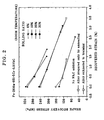
- FIG. 1 is a graph showing differences in shape recovery ratio among a case in which only aging was conducted (0% rolling) and cases in which aging was conducted after rolling by 10%, 20% and 30% at room temperature. In all of the cases, the aging treatment was conducted at 800°C for 10 minutes. For comparison, results of samples of the Fe-28Mn-6Si-5Cr alloy with no Nb, C addition prepared only by annealing and samples of the alloy prepared after subjected to the training five times are shown. The abscissa shows the initial strain (%) by tensile deformation at room temperature, and the ordinate shows the recovery ratio of strain when the sample is heated to 600°C. When heated to 400°C, approximately the same shape recovery ratio is also obtained. The samples used in tests were test pieces having a thickness of 0.6 mm, a width of 1 to 4 mm, and a length (gage length) of 15 mm.
- the sample rolled by 10% has shape memory recovery ratios nearly equivalent to or slightly lower than those of the alloy with no Nb, C addition which was subjected to training five times. Practically the necessary initial strain is believed to be about 4%. A shape memory recovery ratio of about 90% shown at this strain strongly suggests that it is used as a practically applicable alloy. Training of at least five times is necessary for obtaining the same shape recovery ratio as this sample, with a conventional Fe-Mn-Si-based shape memory alloy with no Nb, C addition. As is understood from this, the present invention exhibits shape memory properties with a simple method.
- the sample with a higher rolling ratio of 20% has shape memory recovery ratios nearly equivalent to or slightly higher than those of the case without rolling (only aged). However, the sample with a further higher rolling ratio of 30% has shape memory recovery ratios lower than those of the case which was only aged in a range with large initial strain.
- Fig. 2 is a graph showing the degrees of improvement in shape recovery stress of these samples, in comparison with the case in which only aging was conducted (0% rolling) and a case in which the aging was conducted after rolling by 10%.
- the recovery stress when recovered strain on the abscissa is zero means the stress generated when a sample is tensile-deformed at room temperature, then, heated to the reverse transformation temperature or more in a state that the both ends of the sample are fixed without any recovery, and returned to room temperature again.
- the recovery stress at recovered strain of 2% for example, means the stress generated in case that the both ends of the sample are fixed after a recovery of strain by 2%. Tests were conducted with the initial strain given at room temperature of from 4% to 6%.
- the test pieces used were the same as those used for obtaining the results shown in Fig. 1 .
- the recovered strain on the abscissa in Fig. 2 is explained, taking a case where a shape memory alloy is used as a coupling for examples. It is equivalent to the ratio (%) of clearance between the pipes and the coupling part (shape memory alloy) to the diameter.
- Remarkable increase in shape recovery stress is observed in a range of high rolling ratio: a shape recovery stress of 310MPa is obtained at the recovered strain of 0% when the rolling ratio is from 20% to 30% at room temperature and a shape recovery stress of 200 MPa is obtained even at the recovered strain of 2% for the same rolling ratio. It is also found that the same shape recovery stress as the case subjected to training is obtained even in a case that the rolling ratio is 10%.
- Fig. 2 shows shape recovery stresss of the sample with no Nb, C addition and the sample subjected to the training five times. It is seem from this figure that the recovery stresses of these samples are much smaller than those of the present invention.
- the present invention was made by finding that the deformation treatment prior to the aging treatment to a Fe-Mn-Si-based shape memory alloy having specified components with Nb, C addition can be successfully carried out at room temperature if the deformation ratio is in a specified range.
- the technical meaning of the present invention must be clearly understood because there are obvious advantages as compared to a conventional one which requires the training accompanied by troublesome operation and the inventions of the prior applications which still require high-temperature deformation in a range of from 500°C to 800°C.
- the remarkable improvement in shape memory property is achieved first time by a combination of specified alloy components, specified deformation ratio at room temperature, and setting of aging condition to a certain range.
- the shape recovery ratio equivalent to that of the sample subjected to the training can be obtained and, in addition, the shape recovery stress significantly larger than that of the sample subjected to the training can be obtained.
- the meaning of the present invention is significant.
- the shape memory alloy according to the present invention can be used as tightening materials for various applications, for example, for tightening water pipes, tightening oil pipes, etc., which will produce great economic effects.
- the present invention provides a thermomechanical treatment means for a Fe-Mn-Si-based shape memory alloy having specified components with Nb, C addition with simple processing treatment prior to aging.
- the deformation treatment prior to aging is carried out in a temperature range of from 500°C to 800°C. According to the present invention, however, the deformation treatment prior to the aging treatment can be successfully carried out not at high temperature but at room temperature, if the deformation ratio in a specified range.
- the technical meaning of the present invention must be clearly understood as compared to the prior art and the inventions of the prior applications because there are obvious difference therebetween. That is, according to the present invention, the remarkable improvement in shape memory property is achieved first time by a combination of specified alloy components, specified processing ratio at room temperature, and setting of aging condition into a certain range.
- the technical meaning of the present invention must be clearly understood as compared to the prior art and the inventions of the prior applications because there are obvious difference therebetween. That is, according to the present invention, the remarkable improvement in shape memory property is achieved first time by a combination of specified alloy components, specified deformation ratio at room temperature, and setting of aging condition to a certain range. Amazingly by run-of-the-mill thermomechanical treatment comprising a deformation at room temperature and then aging, the shape recovery ratio equivalent to that of the sample subjected to the training can be obtained and, in addition, the shape recovery stress significantly larger than that of the sample subjected to the training can be obtained. With development of the present invention, it is expected that the use of shape memory alloys will be accelerated toward the practical use in a wide variety of fields.
Landscapes
- Chemical & Material Sciences (AREA)
- Engineering & Computer Science (AREA)
- Mechanical Engineering (AREA)
- Materials Engineering (AREA)
- Metallurgy (AREA)
- Organic Chemistry (AREA)
- Physics & Mathematics (AREA)
- Thermal Sciences (AREA)
- Crystallography & Structural Chemistry (AREA)
- Heat Treatment Of Steel (AREA)
Claims (4)
- Thermomechanisches Behandlungsverfahren für eine Fe-Mn-Si-basierte Formgedächtnislegierung mit Nb- und C-Zugabe, wobei die Fe-Mn-Si-basierte Formgedächtnislegierung mit Nb- und C-Zugabe als Legierungskomponenten aufweist: Mn: 15 bis 40 Gew.-%, Si: 3 bis 15 Gew.-%, Nb: 0,1 bis 1,5 Gew.-%, C: 0,01 bis 0,2 Gew.-%, optional Cr: 1 bis 20 Gew.-% und/oder Ni: 0,1 bis 20 Gew.-% und als Rest Eisen und unvermeidliche Verunreinigungen, wobei das Atomverhältnis Nb/C zwischen Nb und C mindestens 1 beträgt,
dadurch gekennzeichnet, daß das Verfahren die Schritte aufweist:Verformen der Fe-Mn-Si-basierten Formgedächtnislegierung mit Nb- und C-Zugabe durch ein Formänderungsverhältnis von 5 % bis 40 % bei Raumtemperatur, undUnterziehen der verformten Legierung einer Wärmealterungsbehandlung, um NbC-Carbide auszuscheiden. - Thermomechanisches Behandlungsverfahren für eine Fe-Mn-Si-basierte Formgedächtnislegierung mit Nb- und C-Zugabe nach Anspruch 1, wobei das Atomverhältnis zwischen Nb und C in einem Bereich von 1,0 bis 1,2 festgelegt ist.
- Thermomechanisches Behandlungsverfahren für eine Fe-Mn-Si-basierte Formgedächtnislegierung mit Nb- und C-Zugabe nach Anspruch 1 oder 2, wobei die Fe-Mn-Si-basierte Formgedächtnislegierung mit Nb- und C-Zugabe als Verunreinigungen enthält: Cu: höchstens 3 Gew.-%, Mo: höchstens 2 Gew.-%, Al: höchstens 10 Gew.-%, Co: höchstens 30 Gew.-% und/oder N: höchstens 5000 ppm.
- Thermomechanisches Behandlungsverfahren für eine Fe-Mn-Si-basierte Formgedächtnislegierung mit Nb- und C-Zugabe nach einem der Ansprüche 1 bis 3, wobei die Bedingungen für die Wärmealterungsbehandlung ein Temperaturbereich von 400 °C bis 1000 °C und eine Zeitdauer von 1 Minute bis 2 Stunden sind.
Applications Claiming Priority (3)
| Application Number | Priority Date | Filing Date | Title |
|---|---|---|---|
| JP2002367062A JP3950963B2 (ja) | 2002-12-18 | 2002-12-18 | NbC添加Fe−Mn−Si系形状記憶合金の加工熱処理法 |
| JP2002367062 | 2002-12-18 | ||
| PCT/JP2003/016189 WO2004055222A1 (ja) | 2002-12-18 | 2003-12-17 | NbC添加Fe−Mn−Si系形状記憶合金の加工熱処理方法 |
Publications (3)
| Publication Number | Publication Date |
|---|---|
| EP1574587A1 EP1574587A1 (de) | 2005-09-14 |
| EP1574587A4 EP1574587A4 (de) | 2006-02-01 |
| EP1574587B1 true EP1574587B1 (de) | 2008-07-16 |
Family
ID=32588334
Family Applications (1)
| Application Number | Title | Priority Date | Filing Date |
|---|---|---|---|
| EP03780855A Expired - Lifetime EP1574587B1 (de) | 2002-12-18 | 2003-12-17 | VERFAHREN ZUR THERMOMECHANISCHEN BEHANDLUNG FÜR EINE MIT NbC DOTIERTE Fe-Mn-Si-FORMGEDÄCHTNISLEGIERUNG |
Country Status (7)
| Country | Link |
|---|---|
| US (1) | US20050236077A1 (de) |
| EP (1) | EP1574587B1 (de) |
| JP (1) | JP3950963B2 (de) |
| KR (1) | KR20050083601A (de) |
| CN (1) | CN100342039C (de) |
| DE (1) | DE60322260D1 (de) |
| WO (1) | WO2004055222A1 (de) |
Cited By (1)
| Publication number | Priority date | Publication date | Assignee | Title |
|---|---|---|---|---|
| DE102018119296A1 (de) * | 2018-08-08 | 2020-02-13 | Thyssenkrupp Ag | Inline Vorrecken von Formgedächtnislegierungen, insbesondere Flachstahl |
Families Citing this family (8)
| Publication number | Priority date | Publication date | Assignee | Title |
|---|---|---|---|---|
| US8409372B1 (en) | 2010-09-02 | 2013-04-02 | The United States of America as Represented by the Administraton of National Aeronautics and Space Administration | Thermomechanical methodology for stabilizing shape memory alloy (SMA) response |
| DE102013102353A1 (de) * | 2013-03-08 | 2014-09-11 | Thyssenkrupp Steel Europe Ag | Temperaturgesteuertes Umlenkmittel |
| WO2014146733A1 (de) | 2013-03-22 | 2014-09-25 | Thyssenkrupp Steel Europe Ag | Eisenbasierte formgedächtnislegierung |
| CN104328323A (zh) * | 2014-10-24 | 2015-02-04 | 王健英 | 一种锰铁合金材料及制备方法 |
| EP3511435B1 (de) * | 2016-09-06 | 2021-04-07 | Tohoku University | Fe-basiertes formgedächtnislegierungsmaterial und verfahren zur herstellung davon |
| CN107012411A (zh) * | 2017-03-08 | 2017-08-04 | 宁波高新区远创科技有限公司 | 一种土壤接地网用合金材料的制备方法 |
| WO2018219463A1 (de) | 2017-06-01 | 2018-12-06 | Thyssenkrupp Steel Europe Ag | Fe-Mn-Si FORMGEDÄCHTNISLEGIERUNG |
| WO2020108754A1 (de) | 2018-11-29 | 2020-06-04 | Thyssenkrupp Steel Europe Ag | Flachprodukt aus einem eisenbasierten formgedächtniswerkstoff |
Family Cites Families (6)
| Publication number | Priority date | Publication date | Assignee | Title |
|---|---|---|---|---|
| JPS62112720A (ja) * | 1985-11-09 | 1987-05-23 | Nippon Steel Corp | Fe−Mn−Si系形状記憶合金の特性向上方法 |
| US5032195A (en) * | 1989-03-02 | 1991-07-16 | Korea Institute Of Science And Technology | FE-base shape memory alloy |
| JPH0382741A (ja) * | 1989-08-25 | 1991-04-08 | Nisshin Steel Co Ltd | 耐応力腐食割れ性に優れた形状記憶ステンレス鋼およびその形状記憶方法 |
| FR2654748B1 (fr) * | 1989-11-22 | 1992-03-20 | Ugine Aciers | Alliage inoxydable a memoire de forme et procede d'elaboration d'un tel alliage. |
| JP3542754B2 (ja) * | 2000-02-09 | 2004-07-14 | 独立行政法人物質・材料研究機構 | 形状記憶合金 |
| JP2003277827A (ja) * | 2002-03-20 | 2003-10-02 | National Institute For Materials Science | NbC添加Fe−Mn−Si系形状記憶合金の加工熱処理方法 |
-
2002
- 2002-12-18 JP JP2002367062A patent/JP3950963B2/ja not_active Expired - Lifetime
-
2003
- 2003-12-17 KR KR1020057001247A patent/KR20050083601A/ko not_active Ceased
- 2003-12-17 WO PCT/JP2003/016189 patent/WO2004055222A1/ja not_active Ceased
- 2003-12-17 DE DE60322260T patent/DE60322260D1/de not_active Expired - Lifetime
- 2003-12-17 CN CNB2003801005661A patent/CN100342039C/zh not_active Expired - Fee Related
- 2003-12-17 US US10/519,255 patent/US20050236077A1/en not_active Abandoned
- 2003-12-17 EP EP03780855A patent/EP1574587B1/de not_active Expired - Lifetime
Cited By (1)
| Publication number | Priority date | Publication date | Assignee | Title |
|---|---|---|---|---|
| DE102018119296A1 (de) * | 2018-08-08 | 2020-02-13 | Thyssenkrupp Ag | Inline Vorrecken von Formgedächtnislegierungen, insbesondere Flachstahl |
Also Published As
| Publication number | Publication date |
|---|---|
| CN1692163A (zh) | 2005-11-02 |
| JP3950963B2 (ja) | 2007-08-01 |
| CN100342039C (zh) | 2007-10-10 |
| JP2004197161A (ja) | 2004-07-15 |
| DE60322260D1 (de) | 2008-08-28 |
| US20050236077A1 (en) | 2005-10-27 |
| EP1574587A1 (de) | 2005-09-14 |
| WO2004055222A1 (ja) | 2004-07-01 |
| KR20050083601A (ko) | 2005-08-26 |
| EP1574587A4 (de) | 2006-02-01 |
Similar Documents
| Publication | Publication Date | Title |
|---|---|---|
| US4036669A (en) | Mechanical preconditioning method | |
| US4533411A (en) | Method of processing nickel-titanium-base shape-memory alloys and structure | |
| EP1574587B1 (de) | VERFAHREN ZUR THERMOMECHANISCHEN BEHANDLUNG FÜR EINE MIT NbC DOTIERTE Fe-Mn-Si-FORMGEDÄCHTNISLEGIERUNG | |
| JPH01279736A (ja) | β型チタン合金材の熱処理方法 | |
| US3802930A (en) | Alloys | |
| US4025367A (en) | Process for treating copper alloys to improve thermal stability | |
| EP1348772B1 (de) | Verfahren zur Herstellung und thermischen Behandlung von Formgedächtnis- Fe-Mn-Si-Legierung mit NbC | |
| JPH10204592A (ja) | ステンレス鋼ワイヤーと、その製造方法 | |
| JP3970645B2 (ja) | 鉄基形状記憶合金の製造方法 | |
| JPS60234920A (ja) | 超高張力マルエ−ジング冷延鋼板の製造方法 | |
| USRE28964E (en) | Ultrahigh strength steels | |
| JPS62112720A (ja) | Fe−Mn−Si系形状記憶合金の特性向上方法 | |
| JPH0128252B2 (de) | ||
| US4395295A (en) | Process for treating copper-aluminum-silicon alloys to improve fatigue strength | |
| EP0090115A2 (de) | Kaltbearbeitete ferritische Legierungen und Bauteile | |
| JPS60251227A (ja) | 低熱膨張Fe−Ni系鋼板の製造方法 | |
| JPS62199757A (ja) | 形状記憶合金材の製造方法 | |
| JPH0238547A (ja) | Ti−Ni系形状記憶合金の製造方法 | |
| US6136102A (en) | Maraging steel | |
| JPH07258729A (ja) | マルテンサイト系析出硬化型ステンレス鋼の製造方法 | |
| JP2528358B2 (ja) | 形状回復特性に優れた鉄基形状記憶合金の製造方法 | |
| EP0460695B1 (de) | Pseudoelastische Ti-Ni-C-Formgedächtnislegierung mit einer höheren Elastizitätsgrenze | |
| JPH0770705A (ja) | 熱膨張特性に優れたオーステナイトステンレス鋼 | |
| JPS63241150A (ja) | チタン合金の熱処理方法 | |
| US3989551A (en) | Method of making a heat-recoverable article |
Legal Events
| Date | Code | Title | Description |
|---|---|---|---|
| PUAI | Public reference made under article 153(3) epc to a published international application that has entered the european phase |
Free format text: ORIGINAL CODE: 0009012 |
|
| 17P | Request for examination filed |
Effective date: 20050105 |
|
| AK | Designated contracting states |
Kind code of ref document: A1 Designated state(s): AT BE BG CH CY CZ DE DK EE ES FI FR GB GR HU IE IT LI LU MC NL PT RO SE SI SK TR |
|
| RIC1 | Information provided on ipc code assigned before grant |
Ipc: C22C 38/34 20000101ALI20051207BHEP Ipc: C22C 38/00 19740701ALI20051207BHEP Ipc: C21D 8/00 19800101AFI20040707BHEP Ipc: C22F 1/00 19680901ALI20051207BHEP Ipc: C22C 38/48 20000101ALI20051207BHEP |
|
| A4 | Supplementary search report drawn up and despatched |
Effective date: 20051216 |
|
| RBV | Designated contracting states (corrected) |
Designated state(s): DE FR GB |
|
| 17Q | First examination report despatched |
Effective date: 20060419 |
|
| RIN1 | Information on inventor provided before grant (corrected) |
Inventor name: KAJIWARA, SATOSHI Inventor name: KIKUCHI, T.,C/O NAT. INSTITUTE FOR MAT. SCIENCE Inventor name: BARUJ, A.,C/O NAT. INSTITUTE FOR MAT. SCIENCE Inventor name: SHINYA, N.,C/O NAT. INSTITUTE FOR MAT. SCIENCE Inventor name: OGAWA, K.,C/O NAT. INSTITUTE FOR MAT. SCIENCE |
|
| GRAP | Despatch of communication of intention to grant a patent |
Free format text: ORIGINAL CODE: EPIDOSNIGR1 |
|
| GRAS | Grant fee paid |
Free format text: ORIGINAL CODE: EPIDOSNIGR3 |
|
| RIN1 | Information on inventor provided before grant (corrected) |
Inventor name: OGAWA, K.,C/O NAT. INSTITUTE FOR MAT. SCIENCE Inventor name: KAJIWARA, SATOSHI Inventor name: SHINYA, N.,C/O NAT. INSTITUTE FOR MAT. SCIENCE Inventor name: BARUJ, A.,C/O NAT. INSTITUTE FOR MAT. SCIENCE Inventor name: KIKUCHI, T.,C/O NAT. INSTITUTE FOR MAT. SCIENCE |
|
| GRAA | (expected) grant |
Free format text: ORIGINAL CODE: 0009210 |
|
| AK | Designated contracting states |
Kind code of ref document: B1 Designated state(s): DE FR GB |
|
| REG | Reference to a national code |
Ref country code: GB Ref legal event code: FG4D |
|
| REF | Corresponds to: |
Ref document number: 60322260 Country of ref document: DE Date of ref document: 20080828 Kind code of ref document: P |
|
| PLBE | No opposition filed within time limit |
Free format text: ORIGINAL CODE: 0009261 |
|
| STAA | Information on the status of an ep patent application or granted ep patent |
Free format text: STATUS: NO OPPOSITION FILED WITHIN TIME LIMIT |
|
| 26N | No opposition filed |
Effective date: 20090417 |
|
| PGFP | Annual fee paid to national office [announced via postgrant information from national office to epo] |
Ref country code: FR Payment date: 20110107 Year of fee payment: 8 |
|
| PGFP | Annual fee paid to national office [announced via postgrant information from national office to epo] |
Ref country code: GB Payment date: 20101217 Year of fee payment: 8 |
|
| PGFP | Annual fee paid to national office [announced via postgrant information from national office to epo] |
Ref country code: DE Payment date: 20110131 Year of fee payment: 8 |
|
| GBPC | Gb: european patent ceased through non-payment of renewal fee |
Effective date: 20111217 |
|
| REG | Reference to a national code |
Ref country code: FR Ref legal event code: ST Effective date: 20120831 |
|
| REG | Reference to a national code |
Ref country code: DE Ref legal event code: R119 Ref document number: 60322260 Country of ref document: DE Effective date: 20120703 |
|
| PG25 | Lapsed in a contracting state [announced via postgrant information from national office to epo] |
Ref country code: DE Free format text: LAPSE BECAUSE OF NON-PAYMENT OF DUE FEES Effective date: 20120703 Ref country code: GB Free format text: LAPSE BECAUSE OF NON-PAYMENT OF DUE FEES Effective date: 20111217 |
|
| PG25 | Lapsed in a contracting state [announced via postgrant information from national office to epo] |
Ref country code: FR Free format text: LAPSE BECAUSE OF NON-PAYMENT OF DUE FEES Effective date: 20120102 |