EP1578894B1 - Klarspülmittel mitwasserlöslichem metallsalz zur verwendung beim maschinellen geschirrspülen mitglaskorrosionsschutz - Google Patents
Klarspülmittel mitwasserlöslichem metallsalz zur verwendung beim maschinellen geschirrspülen mitglaskorrosionsschutz Download PDFInfo
- Publication number
- EP1578894B1 EP1578894B1 EP03814872A EP03814872A EP1578894B1 EP 1578894 B1 EP1578894 B1 EP 1578894B1 EP 03814872 A EP03814872 A EP 03814872A EP 03814872 A EP03814872 A EP 03814872A EP 1578894 B1 EP1578894 B1 EP 1578894B1
- Authority
- EP
- European Patent Office
- Prior art keywords
- acid
- zinc
- rinse aid
- aid composition
- water
- Prior art date
- Legal status (The legal status is an assumption and is not a legal conclusion. Google has not performed a legal analysis and makes no representation as to the accuracy of the status listed.)
- Expired - Lifetime
Links
Images
Classifications
-
- C—CHEMISTRY; METALLURGY
- C11—ANIMAL OR VEGETABLE OILS, FATS, FATTY SUBSTANCES OR WAXES; FATTY ACIDS THEREFROM; DETERGENTS; CANDLES
- C11D—DETERGENT COMPOSITIONS; USE OF SINGLE SUBSTANCES AS DETERGENTS; SOAP OR SOAP-MAKING; RESIN SOAPS; RECOVERY OF GLYCEROL
- C11D3/00—Other compounding ingredients of detergent compositions covered in group C11D1/00
- C11D3/02—Inorganic compounds ; Elemental compounds
- C11D3/04—Water-soluble compounds
- C11D3/046—Salts
-
- C—CHEMISTRY; METALLURGY
- C11—ANIMAL OR VEGETABLE OILS, FATS, FATTY SUBSTANCES OR WAXES; FATTY ACIDS THEREFROM; DETERGENTS; CANDLES
- C11D—DETERGENT COMPOSITIONS; USE OF SINGLE SUBSTANCES AS DETERGENTS; SOAP OR SOAP-MAKING; RESIN SOAPS; RECOVERY OF GLYCEROL
- C11D1/00—Detergent compositions based essentially on surface-active compounds; Use of these compounds as a detergent
- C11D1/66—Non-ionic compounds
-
- C—CHEMISTRY; METALLURGY
- C11—ANIMAL OR VEGETABLE OILS, FATS, FATTY SUBSTANCES OR WAXES; FATTY ACIDS THEREFROM; DETERGENTS; CANDLES
- C11D—DETERGENT COMPOSITIONS; USE OF SINGLE SUBSTANCES AS DETERGENTS; SOAP OR SOAP-MAKING; RESIN SOAPS; RECOVERY OF GLYCEROL
- C11D3/00—Other compounding ingredients of detergent compositions covered in group C11D1/00
- C11D3/0005—Other compounding ingredients characterised by their effect
- C11D3/0073—Anticorrosion compositions
-
- C—CHEMISTRY; METALLURGY
- C11—ANIMAL OR VEGETABLE OILS, FATS, FATTY SUBSTANCES OR WAXES; FATTY ACIDS THEREFROM; DETERGENTS; CANDLES
- C11D—DETERGENT COMPOSITIONS; USE OF SINGLE SUBSTANCES AS DETERGENTS; SOAP OR SOAP-MAKING; RESIN SOAPS; RECOVERY OF GLYCEROL
- C11D3/00—Other compounding ingredients of detergent compositions covered in group C11D1/00
- C11D3/02—Inorganic compounds ; Elemental compounds
- C11D3/04—Water-soluble compounds
- C11D3/042—Acids
-
- C—CHEMISTRY; METALLURGY
- C11—ANIMAL OR VEGETABLE OILS, FATS, FATTY SUBSTANCES OR WAXES; FATTY ACIDS THEREFROM; DETERGENTS; CANDLES
- C11D—DETERGENT COMPOSITIONS; USE OF SINGLE SUBSTANCES AS DETERGENTS; SOAP OR SOAP-MAKING; RESIN SOAPS; RECOVERY OF GLYCEROL
- C11D3/00—Other compounding ingredients of detergent compositions covered in group C11D1/00
- C11D3/02—Inorganic compounds ; Elemental compounds
- C11D3/04—Water-soluble compounds
- C11D3/046—Salts
- C11D3/048—Nitrates or nitrites
-
- C—CHEMISTRY; METALLURGY
- C11—ANIMAL OR VEGETABLE OILS, FATS, FATTY SUBSTANCES OR WAXES; FATTY ACIDS THEREFROM; DETERGENTS; CANDLES
- C11D—DETERGENT COMPOSITIONS; USE OF SINGLE SUBSTANCES AS DETERGENTS; SOAP OR SOAP-MAKING; RESIN SOAPS; RECOVERY OF GLYCEROL
- C11D3/00—Other compounding ingredients of detergent compositions covered in group C11D1/00
- C11D3/16—Organic compounds
- C11D3/20—Organic compounds containing oxygen
- C11D3/2075—Carboxylic acids-salts thereof
- C11D3/2082—Polycarboxylic acids-salts thereof
-
- C—CHEMISTRY; METALLURGY
- C11—ANIMAL OR VEGETABLE OILS, FATS, FATTY SUBSTANCES OR WAXES; FATTY ACIDS THEREFROM; DETERGENTS; CANDLES
- C11D—DETERGENT COMPOSITIONS; USE OF SINGLE SUBSTANCES AS DETERGENTS; SOAP OR SOAP-MAKING; RESIN SOAPS; RECOVERY OF GLYCEROL
- C11D3/00—Other compounding ingredients of detergent compositions covered in group C11D1/00
- C11D3/16—Organic compounds
- C11D3/20—Organic compounds containing oxygen
- C11D3/2075—Carboxylic acids-salts thereof
- C11D3/2086—Hydroxy carboxylic acids-salts thereof
-
- C—CHEMISTRY; METALLURGY
- C11—ANIMAL OR VEGETABLE OILS, FATS, FATTY SUBSTANCES OR WAXES; FATTY ACIDS THEREFROM; DETERGENTS; CANDLES
- C11D—DETERGENT COMPOSITIONS; USE OF SINGLE SUBSTANCES AS DETERGENTS; SOAP OR SOAP-MAKING; RESIN SOAPS; RECOVERY OF GLYCEROL
- C11D3/00—Other compounding ingredients of detergent compositions covered in group C11D1/00
- C11D3/16—Organic compounds
- C11D3/26—Organic compounds containing nitrogen
- C11D3/33—Amino carboxylic acids
-
- C—CHEMISTRY; METALLURGY
- C11—ANIMAL OR VEGETABLE OILS, FATS, FATTY SUBSTANCES OR WAXES; FATTY ACIDS THEREFROM; DETERGENTS; CANDLES
- C11D—DETERGENT COMPOSITIONS; USE OF SINGLE SUBSTANCES AS DETERGENTS; SOAP OR SOAP-MAKING; RESIN SOAPS; RECOVERY OF GLYCEROL
- C11D3/00—Other compounding ingredients of detergent compositions covered in group C11D1/00
- C11D3/16—Organic compounds
- C11D3/37—Polymers
- C11D3/3746—Macromolecular compounds obtained by reactions only involving carbon-to-carbon unsaturated bonds
- C11D3/3757—(Co)polymerised carboxylic acids, -anhydrides, -esters in solid and liquid compositions
-
- C—CHEMISTRY; METALLURGY
- C11—ANIMAL OR VEGETABLE OILS, FATS, FATTY SUBSTANCES OR WAXES; FATTY ACIDS THEREFROM; DETERGENTS; CANDLES
- C11D—DETERGENT COMPOSITIONS; USE OF SINGLE SUBSTANCES AS DETERGENTS; SOAP OR SOAP-MAKING; RESIN SOAPS; RECOVERY OF GLYCEROL
- C11D2111/00—Cleaning compositions characterised by the objects to be cleaned; Cleaning compositions characterised by non-standard cleaning or washing processes
- C11D2111/10—Objects to be cleaned
- C11D2111/14—Hard surfaces
- C11D2111/18—Glass; Plastics
Definitions
- the present invention is in the field of dishwashing, in particular it relates to automatic dishwashing products, auxiliaries and methods suitable for protecting glassware.
- Odor, spotting, filming and corrosion of glassware in automatic dishwashing are well known problems that continually plague consumers. Consumers demand better end results. They desire better smelling products with less glassware spotting and filming. They want better shine with improved corrosion protection. Most consumers agree that corrosion of glassware in automatic dishwashing is one of their most serious unmet needs. Though when compared to over main wash detergent products alone, some current rinse aid products may deliver better spotting and filming performance with the use of dispersant polymers in combination with nonionic surfactants, they do not protect against glassware corrosion.
- compositions comprising water-soluble metal salts (such as zinc salts of chloride, sulfate or acetate) for use in dishwashing afford some measure of glassware protection.
- Water-soluble zinc salt may be employed to prevent the corrosion of ceramic surfaces.
- Solid metal plates of zinc alloys may also be used in combination with a detergent composition to provide corrosion protection to glassware.
- a water-soluble zinc salt may even be used in conjunction with a low-foaming nonionic surfactant in neutral to high pH.
- this high pH composition in automatic dishwashing can result in unsatisfactory filming and precipitation of insoluble materials. Such precipitant material is very undesirable as it can adhere to internal dishwasher parts, as well as, onto dish- and glassware during the washing cycle.
- a rinse aid composition containing certain water-soluble zinc salts in conjunction with specific components, such as non-ionic surfactants, dispersant polymers, perfumes, adjunct ingredients, and mixtures thereof) delivers consumers a better smelling product having an improved filming benefit on glassware while at the same time providing improved glassware corrosion protection without unwanted precipitation of insoluble materials on glassware.
- These zinc salt containing rinse aid compositions not only smell better and at least partially reduce unwanted precipitation, they will also aid in reducing film formation, In fact, they also surprisingly exhibit even better filming performance on glassware than the prior art due to the presence of the water-soluble zinc salt, the acid, and/or the combination of the acid and dispersant polymer together.
- a rinse aid composition containing a water-soluble zinc salt, an acid, a non-ionic surfactant, a dispersant polymer and/or a perfume for use in automatic dishwashing comprises: (a) at least one water-soluble zinc salt wherein said at least one water-soluble zinc salt is selected from the group consisting of zinc acetate, zinc chloride, zinc gluconate, zinc formate, zinc malate, zinc nitrate, zinc sulfate, and mixtures thereof; (b) an acid; (c) a non-ionic surfactant; (d) at least one of the following: a dispersant polymer, a perfume, and mixtures thereof; and (e) optionally, at least one component selected from the group consisting of: an acid, a dispersant polymer, a perfume, a hydrotrope, a binder, a carrier medium, an antibacterial active, a dye, and mixtures thereof.
- the rinse aid composition has a pH of less than about 5 when measured at a 10% concentration in an aqueous solution.
- the rinse aid composition comprises an acid that enables the water-soluble zinc salt to dissolve quickly in rinse liquor so as to eliminate formation of insoluble precipitates.
- a glassware corrosion and film formation prevention means for use in automatic dishwashing is disclosed, wherein the means comprises the step of rinsing cleaned glassware surfaces with a rinse aid composition as disclosed above.
- the use of the automatic dishwashing detergent composition in a method, and a kit are also disclosed herein.
- a rinse aid composition is disclosed herein which contains a water-soluble zinc salt for use in an automatic dishwashing appliance.
- the rinse aid composition may improve glass ware corrosion protection, as well as, filming performance without resulting in excessive precipitation in the wash and/or rinse liquor.
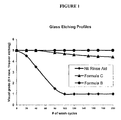
- glass-etching profiles of three treatments are performed in soft water in a multicycle test using a GE500 automatic dishwashing appliance.
- CASCADE TM Pure Rinse Gel® the main wash detergent
- Three treatments are preformed: rinse aid formula B, rinse aid formula C and nil rinse aid.
- the glasses are graded in a light box after 20, 40, 80, 100, 120, 150, 170 and 200 cycles.
- a grade of 5 is perfect (no visible etching in the light box), while a grade of 1 is evidence of severe etching.
- a grade of below about 3.5 is visible to a consumer under regular room lighting. From the data depicted in FIG. 1, it can be seen that the control formula (nil rinse aid) exhibits visible etching under regular lighting after about 40 washes. Though the rinse aid formula C exhibits slight etching (cloudiness) in the light box after 200 washes, it still exhibits no visible etching under regular lighting. Surprisingly however, formula B exhibits no etching even in the light box (still perfect) after 200 washes.
- Formulating the water-soluble zinc salt with an acid can eliminate precipitation.
- adding an acid to the rinse aid composition enables the water-soluble zinc salt to fully dissolve in the rinse aid composition and thereby reduces the chances of precipitate formation on dish- and glassware during the rinse cycle.
- An acid may be added to the rinse aid composition to enable the water-soluble zinc salt to dissolve quickly in the rinse liquor as so to keep insoluble material from forming and subsequently depositing onto glasses or dishes during the wash and/or rinse cycle.
- the addition of a water-soluble zinc salt in the presence of an acid significantly improves filming performance on glassware.
- the addition of a dispersant polymer to this zinc salt/acid mixture further improves glassware filming performance.
- the addition of a perfume to the rinse aid composition improves the odor profile of the consumer rinse aid product before, as well as, during the operation of the automatic dishwasher.
- the rinse aid composition may be in any suitable form, including liquid, gel, solid, granular, powder, and combinations thereof.
- the solid water-soluble metal salt may be in the form of a powder, crystal, core particle, aggregate of core particles, prill, agglomerate, and mixtures thereof. These solid forms may be nonfriable for handling purposes during processing and when used by consumers.
- the water-soluble zinc salt can be used directly as the raw material in the rinse aid composition or it can be provided as an additive compound, which may be added along with other components to form the rinse aid composition.
- the rinse aid composition may, for example, deliver any suitable amount of the water-soluble zinc salt compound and/or product in the rinse liquor.
- the rinse aid composition may deliver from about 0.01 mM to about 10 mM, alternatively about 0.02 mM to about 5 mM, alternatively about 0.05 mM to about 1 mM, and alternatively about 0.05 mM to about 0.5 mM of the water-soluble metal salt.
- the rinse aid composition may be designed to deliver any suitable amount of zinc ions in any suitable form in the rinse liquor of an automatic dishwashing appliance.
- the rinse aid composition may be designed to deliver from about 0.1 % to about 20%, alternatively from about 0.2% to about 15%, alternatively from about 0.5% to about 10%, and alternatively from about 1% to about 5% by weight of zinc ions in the from of a water-soluble zinc salt rinse aid composition and/or product in the rinse liquor of an automatic dishwashing appliance.
- the water-soluble zinc salt is present in an amount from about 0.01% to about 70%, alternatively from about 0.1% to about 50%, alternatively from about 0.5% to about 30%, and alternatively from about 1% to about 10% by weight of the composition.
- the water-soluble zinc salt is selected from the group consisting of zinc acetate, zinc chloride, zinc formate, zinc gluconate, zinc malate, zinc nitrate, zinc sulfate, and mixtures thereof.
- Water-soluble zinc salt can also be formed in-situ by reacting zinc oxide and an acid in rinse aid formulations. Any acid, organic or inorganic, that does not result in precipitation of the zinc salt in the composition after mixing can also be used.
- a rinse aid composition may comprise a water-soluble zinc salt, which is prepared in-situ by mixing zinc oxide with an acid.
- the components are mixed until all powder is dissolved to give a clear solution. After the in-situ neutralization process, other ingredients can be added into the liquid mixture to formulate a liquid rinse aid composition.
- a binder or a solid surfactant e.g. solid at 25°C may be used to formulate the solid rinse aid composition.
- the rinse aid composition may be designed to deliver from about 0.1% to about 20% by weight of Zn ++ ions in the form of a water-soluble zinc salt composition and/or product in the rinse liquor of an automatic dishwashing appliance.
- the water-soluble zinc salt is used directly as the raw material in the rinse aid composition and/or provided as an additive compound or product that is added along with other components to form the rinse aid composition.
- Any suitable organic and/or inorganic acid in any suitable amount may be used in the rinse aid compositions and/or products.
- suitable acids include, but are not limited to: acetic acid, aspartic acid, benzoic acid, boric acid, bromic acid, citric acid, formic acid, gluconic acid, glutamic acid, hydrochloric acid, lactic acid, malic acid, nitric acid, sulfamic acid, sulfuric acid, tartaric acid, and mixtures thereof.
- adding an acid to the rinse aid composition enables the water-soluble metal salt to at least partially dissolve, and alternatively to fully dissolve, in the composition.
- the acid also helps to at least partially reduce the precipitation on hard surfaces during the rinse cycle.
- the acid may be also needed to stabilize the liquid rinse aid composition against precipitation in the product prior to use.
- adding an acid to the rinse aid composition enables the water-soluble metal salt, once released, to at least partially dissolve, and alternatively to fully dissolve, quickly in the wash and/or rinse liquor of an automatic dishwashing appliance so as to prevent insoluble material from forming and/or from depositing onto hard surfaces, such as on flatware, glasses, dishes and/or components inside the automatic dishwashing appliance itself.
- Acids used for in-situ preparation of water-soluble metal salts must be non-precipitating acids. Certain acids will not result in precipitation of the water-soluble metal salt in the rinse aid composition and/or product itself or in rinse liquor of the automatic dishwashing appliance during the rinse cycle. For example, nitric acid, hydrochloric acid, and mixtures thereof, are typically non-precipitation acids. Conversely, other acids, like phosphoric acid, citric acid, and mixtures thereof, are precipitating acids, which may result in precipitation of an insoluble metal salt in the rinse aid composition and/or product itself These precipitating acids cannot be used in the in-situ water-soluble zinc salt preparation process itself. However, a low level of a precipitating acid may be added after the completion of the in-situ water-soluble metal salt preparation process.
- the amount of acid needed in the in-situ water-soluble zinc salt preparation process may, for example, be determined stoichimetrically using the formula: 2H x A + X ZnO ⁇ X Zn A 2/x + X H 2 O wherein A is an organic and/or an inorganic acid, and x is an integer that varies from 1 to 2.
- Suitable acids are typically present in an rinse aid compositions and/or products in the range from about 0.01°% to about 25%, alternatively from about 0.5% to about 20%, and alternatively from about 1% to about 10%, by weight of the composition.
- an acid used in the in-situ water-soluble zinc salt preparation process may be selected from the group consisting of acetic acid, formic acid, gluconic acid, glutamic acid, hydrochloric acid, malic acid, nitric acid, sulfuric acid, and mixtures thereof, by weight of the mixture may be used.
- the rinse aid composition may be formulated within any suitable acidic pH range.
- the pH is measured at a 10% concentration in an aqueous solution for any form of the rinse aid composition.
- Suitable pHs range from about 1 to less than about 5, alternatively from about 1 to about 4, and alternatively from about 1 to about 3.
- a lower pH range will tend to reduce incompatibility and negative interaction of the rinse aid composition with existing commercial rinse aid product residues left in the rinse aid dispenser reservoir of the automatic dishwashing appliance prior to use.
- the pH of the rinse aid composition may be in the range of from about I to less than about 5.
- Suitable non-ionic surfactant in any suitable amount may be used to make the rinse aid composition.
- Suitable non-ionic surfactants include, but are not limited to, low foaming nonionic surfactants (LFNIs).
- LFNIs are most typically used in automatic dishwashing compositionss on account of the improved water-sheeting action (especially from glassware) which they confer to the rinse aide product. They also may encompass non-silicone, phosphate or nonphosphate polymeric materials further Illustrated hereinafter which are known to defoam food soils encountered in automatic dishwashing.
- an LFNI may include nonionic alkoxylated surfactants, especially ethoxylates derived from primary alcohols, and blends thereof with more sophisticated surfactants, such as the polyoxypropylene / polyoxyethylene / polyoxypropylene reverse block polymers.
- Suitable block polyoxyethylene-polyoxypropylene polymeric compounds that meet the requirements may include those based on ethylene glycol, propylene glycol, glycerol, trimethylolpropane and ethylenediamine, and mixtures thereof, as initiator reactive hydrogen compound.
- a single reactive hydrogen atom such as C 12-18 aliphatic alcohols
- block polymer surfactant compounds designated as PLURONIC® and TETRONIC® by the BASF-Wyandotte Corp., Wyandotte, Michigan are suitable in rinse aide compositions.
- the LFNI may contain from about 40% to about 70% of a polyoxypropylene / polyoxyethylene / polyoxypropylene block polymer blend comprising about 75%, by weight of the blend, of a reverse block co-polymer of polyoxyethylene and polyoxypropylene containing 17 moles of ethylene oxide and 44 moles of propylene oxide; and about 25%, by weight of the blend, of a block co-polymer of polyoxyethylene and polyoxypropylene initiated with trimethylolpropane and containing 99 moles of propylene oxide and 24 moles of ethylene oxide per mole of trimethylolpropane.
- the rinse aid composition may include the use of ethoxylated monohydroxy alcohol or alkyl phenol and additionally comprise a polyoxyethylene, polyoxypropylene block polymeric compound; the ethoxylated monohydroxy alcohol or alkyl phenol fraction of the LFNI comprising from about 20% to about 80%, alternatively from about 30% to about 70%, of the total LFNI.
- the LFNI can optionally contain propylene oxide in an amount up to about 15% by weight.
- Other alternative LFNI surfactants can be prepared by the processes described in U.S. Patent 4,223,163, issued September 16,1980, Builloty.
- the LFNI may be an ethoxylated surfactant derived from the reaction of a monohydroxy alcohol or alkylphenol containing from about 8 to about 20 carbon atoms, excluding cyclic carbon atoms, with from about 6 to about 15 moles of ethylene oxide per mole of alcohol or alkyl phenol on an average basis.
- the LFNI may be derived from a straight chain fatty alcohol containing from about 16 to about 20 carbon atoms (C 16 -C 20 alcohol), alternatively a C 18 alcohol, condensed with an average of from about 6 to about 15 moles, alternatively from about 7 to about 12 moles, and alternatively from about 7 to about 9 moles of ethylene oxide per mole of alcohol.
- the ethoxylated nonionic surfactant so derived has a narrow ethoxylate distribution relative to the average.
- LFNIs Suitable for use as an LFNI in the rinse aid compositions are those LFNIs having relatively low cloud points and high hydrophilic-lipophilic balance (HLB). Cloud points of 1% solutions in water are typically below about 32°C and alternatively lower, e.g., 0°C, for optimum control of sudsing throughout a full range of water temperatures.
- HLB hydrophilic-lipophilic balance
- An LFNI may, for example, be present in an amount in the range of from about 0.0 1 % to about 60% by weight, alternatively from about 0.01% to about 50%, and alternatively from about 0.01% to about 40% by weight of the rinse aid composition.
- the rinse aid composition comprises from about 0.01% to about 60% by weight of the composition of a low-foaming nonionic surfactant having a cloud point below 30 °C.
- the surfactant may be a low cloud point nonionic surfactant selected from the group consisting of C 9/11 EO 8 -cyclohexy] acetal alkyl capped nonionic, C 11 EO 7 -n-butyl acetal, C 9/11 EO 8 -2-ethylhexyl acetal, C 11 EO 8 -pyranyl, alcohol alkoxylate, and mixtures thereof
- the LFNI may include a C 18 alcohol polyethoxylate, having a degree of ethoxylation of about 8, commercially available SLF18® from Olin Corp TM . Any biodegradable LFNI having the melting point properties discussed herein above, and mixtures thereof.
- Dispersant polymer in any suitable amount may be used to make the rinse aid composition.
- Dispersant polymers are useful in rinse aid compositions because they provide improved filming performance, improved surface wetting, and improved particulate suspension and/or dispersion.
- Suitable polymers are described in U.S. Pat. No. 4,379,080 (Murphy), issued Apr. 5, 1983. These polymers inhibit the deposition of calcium carbonate or magnesium silicate on dishware.
- Other suitable dispersant polymers include those disclosed in U.S. Patent No. 3,308,067 issued March 7, 1967, to Diehl.
- Other suitable dispersant polymers include those disclosed in U.S. Patent No. 3,308,067 issued March 7, 1967, to Diehl.
- Unsaturated monomeric acids that can be polymerized to form suitable dispersant polymers include acrylic acid, maleic acid (or maleic anhydride), fumaric acid, itaconic acid, aconitic acid, mesaconic acid, citraconic acid and methylenemalonic acid.
- the presence of monomeric segments containing no carboxylate radicals such as methyl vinyl ether, styrene, ethylene, etc. may be suitable provided that such segments do not constitute more than about 50% by weight of the dispersant poly
- the rinse aid composition may include a dispersant polymer comprising one or more homopolymer, copolymer, terpolymer, and mixtures thereof.
- Substantially non-neutralized forms of the polymer may be used in the rinse aid compositions.
- the molecular weight of the polymer can vary over a wide range, for instance from about 1000 to about 500,000, alternatively from about 1000 to about 250,000. If the rinse aid composition is for use in North American automatic dishwashing appliances, it may be desirable for the molecular weight of the polymer to range from about 1000 to about 5,000.
- Copolymers of acrylamide and acrylate having a molecular weight of from about 3,000 to about 100,000, alternatively from about 4,000 to about 20,000, and an acrylamide content of less than about 50%, alternatively less than about 20%, by weight of the dispersant polymer can also be used.
- such dispersant polymer may have a molecular weight of from about 4,000 to about 20,000 and an acrylamide content of from about 0% to about 15%, by weight of the polymer.
- the dispersant polymer may be a low molecular weight modified polyacrylate copolymer.
- Such copolymers contain as monomer units: a) from about 90% to about 10%, alternatively from about 80% to about 20% by weight acrylic acid or its salts and b) from about 10% to about 90%, alternatively from about 20% to about 80% by weight of a substituted acrylic monomer or its salt and have the general formula: -[(C(R 2 )C(R 1 )(C(O)OR 3 )]- wherein the incomplete valencies inside the square braces are hydrogen and at least one of the substituents R 1 , R 2 or R 3 , alternatively R 1 or R 2 , is a 1 to 4 carbon alkyl or hydroxyalkyl group, R 1 or R 2 can be a hydrogen and R 3 can be a hydrogen or alkali metal salt.
- a Substituted acrylic monomer may be used wherein R 1 is methyl, R 2 is hydrogen and R 3 is sodium
- the low molecular weight polyacrylate dispersant polymer alternatively has a molecular weight of less than about 15,000, alternatively from about 500 to about 10,000, alternatively from about 1,000 to about 5,000.
- the polyacrylate copolymer for use herein may have a molecular weight of 3500 and is the non-neutralized form of the polymer comprising about 70% by weight acrylic acid and about 30% by weight methacrylic acid.
- Suitable modified polyacrylate copolymers include the low molecular weight copolymers of unsaturated aliphatic carboxylic acids disclosed in U.S. Patents 4,530,766, and 5,084,535.
- the dispersant polymers may also include polyacrylates with an average molecular weight of from about 1,000 to about 10,000, and acrylate /maleate or acrylate / fumarate copolymers with an average molecular weight of from about 2,000 to about 80,000 and a ratio of acrylate to maleate or fumarate segments of from about 30:1 to about 1:2.
- polyacrylates with an average molecular weight of from about 1,000 to about 10,000
- acrylate /maleate or acrylate / fumarate copolymers with an average molecular weight of from about 2,000 to about 80,000 and a ratio of acrylate to maleate or fumarate segments of from about 30:1 to about 1:2.
- Examples of such copolymers based on a mixture of unsaturated mono- and dicarboxylate monomers are disclosed in European Patent Application No. 66,915, published December 15, 1982.
- the dispersant polymers useful herein may include the polyethylene glycols and polypropylene glycols having a molecular weight of from about 950 to about 30,000 which can be obtained from the Dow Chemical Company of Midland. Michigan. Such compounds for example, having a melting point within the range of from about 30°C to about 100°C can be obtained at molecular weights of 1450, 3400, 4500, 6000, 7400, 9500, and 20,000. Such compounds are formed by the polymerization of ethylene glycol or propylene glycol with the requisite number of moles of ethylene or propylene oxide to provide the desired molecular weight and melting point of the respective and polypropylene glycol.
- the polyethylene, polypropylene and mixed glycols are referred to using the formula: HO(CH 2 CH 2 O) m (CH 2 CH(CH 3 )O) n (CH(CH 3 )CH 2 0)OH wherein m, n, and o are integers satisfying the molecular weight and temperature requirements given above.
- the dispersant polymers useful herein may include the cellulose sulfate esters such as cellulose acetate sulfate, cellulose sulfate, hydroxyethyl cellulose sulfate, methylcellulose sulfate, hydroxypropylcellulose sulfate, and mixtures thereof.
- cellulose sulfate esters such as cellulose acetate sulfate, cellulose sulfate, hydroxyethyl cellulose sulfate, methylcellulose sulfate, hydroxypropylcellulose sulfate, and mixtures thereof.
- Sodium cellulose sulfate may be used as an alternative.
- the cellulose-derived dispersant polymer may be a carboxymethyl cellulose.
- the dispersant polymer may be an organic dispersant polymer, such as polyaspartate.
- a dispersant polymer in the rinse aid composition is compatible with other components.
- a dispersant polymer may, for example, be present in an amount in the range from about 0.01 % to about 25%, alternatively from about 0.5% to about 20%, and alternatively from about 1% to about 7% by weight of the rinse aid composition.
- any suitable perfume in any suitable amount may be used to make the rinse aid composition.
- Perfumes are useful for improved odor profiles of the water-soluble metal salt containing rinse aid composition, as well as, during the automatic dishwashing operation.
- a perfume may, for example, be present in an amount from about 0.01% to about 5%, alternatively from about 0.1% to about 3%, and alternatively from about 0.1% to about 2% of a perfume composition.
- Suitable perfumes used in this rinse aid composition may be classified as non-blooming as well as blooming perfumes.
- any suitable carrier medium in any suitable amount may be used to make the rinse aid composition.
- Suitable carrier mediums include both liquids and solids.
- the rinse aid composition can be provided in the form of an aqueous liquid in a container.
- the rinse aid composition may exist in a solid form in a container and the solid could be dissolved with water.
- the rinse aid composition can be provided in the form of a combination of both a liquid and a solid that can be diluted or dissolved with water.
- the form of the rinse aid composition can be a dry powder, granule or tablet, encapsulated product, and combinations thereof.
- One suitable carrier medium may be water, which can be distilled, deionized, or tap water. Water may be preferred due to its low cost, availability, safety, and compatibility. In other non-limiting embodiments the carrier medium may be tap water.
- the carrier medium may be aqueous
- at least some of the aqueous carrier may be purified beyond the treatment it received to convert it to tap water (that is, the tap water may be post-treated, e.g., deionized or distilled).
- the carrier in addition to water, can contain a low molecular weight organic solvent that may be highly soluble in water, e.g., ethanol, methanol, propanol, isopropanol and the like, and mixtures thereof.
- Low molecular weight alcohols can allow the treated dish- and glassware surface to dry faster.
- the optional water-soluble low molecular weight solvent can also be used at a level of up to about 50%, typically from about 0.1 % to about 25%, alternatively from about 2% to about 15%, alternatively from about 5% to about 10%, by weight of the suitable carrier medium.
- Factors that need to be considered when a high level of solvent is combined with the suitable carrier medium are odor, flammability, dispersancy and environment impact.
- Rinse aid compositions can also be in a "concentrated form", in such case, the concentrated liquid rinse aid composition according one non-limiting embodiment will contain a lower amount of a suitable carrier medium, compared to conventional liquid rinse aid compositions.
- the suitable carrier medium content of the concentrated system may, for example, be present in an amount from about 30% to about 99.99% by weight of the rinse aid composition.
- the dispersant content of the concentrated system rinse aid composition may, for example, be present in an amount from about 0.001 % to about 10 % by weight of the rinse aid composition.
- the solid rinse aid compositions may also contain any suitable binder in any suitable amount.
- the binding agent of the solid rinse aid composition holds the dry components together in a single mass.
- the binding agent may comprise any material which is relatively high melting and which will maintain product integrity.
- Suitable binders include, but are not limited to, materials such as nonionic surfactants, polyethylene glycols, anionic surfactants, film forming polymers, fatty acids, and mixtures thereof, wherein the binder does not melt below 40°C, as disclosed in U.S. Patent 4,486,327, Murphy et al, issued December 4, 1984.
- certain binders include alkali metal phosphates, fatty amides, and combinations thereof.
- Suitable binders may be optionally incorporated in the rinse aid composition at a level of from about 0.05% to about 98%, alternatively from about 0.05% to 70%, alternatively from about 0.05% to 50%, alternatively from about 0.05% to 30%, alternatively from about 0.05% to 10%, and alternatively from 0.1% to 5% by weight of the total composition.
- Filler materials can also be present in the rinse aid composition. These may include sucrose, sucrose esters, alkali metal chlorides or sulfates, in amounts from 0.001% to 60%, and alternatively from 5% to 30% of the composition.
- Suitable hydrotrope in any suitable amount may be used to make the rinse aid composition.
- Suitable hydrotropes include, but are not limited to, sodium benzene sulfonate, sodium toluene sulfonate, sodium cumene sulfonate, and mixtures thereof.
- the rinse aid composition may be used in any variety of product forms, including, but not limited to, liquid, gel, solid, granular, powder, and combinations thereof.
- the rinse aid composition may be formulated as a solid to deliver a water-soluble metal salt to the rinse without excessive precipitation.
- the rinse aid composition comprising water-soluble zinc salt in the form of a solid, which could be designed to delay release of the water-soluble zinc salt until the rinse cycle.
- the rinse aid composition in any physical form may be packaged in a water-soluble or water dispersible pouch, and combinations thereof, to deliver the water-soluble zinc salt to the rinse liquor.
- the rinse aid composition can be in the form of a unit dose, which allows for the controlled release (for example delayed, sustained, triggered or slow release) of the water-soluble zinc salt during the rinse cycle of an automatic dishwashing appliance.
- Single- and multi-compartment water-soluble pouches may be suitable for use.
- the rinse aid compositions do not need to be in the same physical form.
- the rinse aid composition may be formulated in a multi-compartmental pouch so that negative interactions with other rinse aid components are minimized.
- rinse aid compositions suitable for use can be dispensed from any suitable device, such as bottles (pump assisted bottles, squeeze bottles), paste dispensers, capsules, multi-compartment bottles, multi-compartement capsules, and single- and multi-compartment water-soluble pouches, and combinations thereof.
- suitable device such as bottles (pump assisted bottles, squeeze bottles), paste dispensers, capsules, multi-compartment bottles, multi-compartement capsules, and single- and multi-compartment water-soluble pouches, and combinations thereof.
- the rinse aid composition can be in the form of a unit dose which allows for the controlled release (for example delayed, sustained, triggered or slow release) of the water-soluble zinc salt during the rinse cycle of an automatic dishwashing appliance.
- the rinse aid composition may be a solid, granular, powder, liquid, gel, and combinations thereof, and may be provided as a tablet or contained in a single or multi-compartment water-soluble pouch.
- a method of rinsing cleaned glassware may comprise rinsing the cleaned glassware in an automatic dishwashing machine with a rinse aid composition comprising: (a) at least one water-soluble zinc salt salt wherein said at least one water-soluble zinc salt is selected from the group consisting of zinc acetate, zinc chloride, zinc gluconate, zinc formate, zinc malate, zinc nitrate, zinc sulfate, and mixtures thereof; (b) an acid; (c) a non-ionic surfactant; (d) at least one of the following: a dispersant polymer, a perfume, and mixtures thereof; and (e) optionally at least one component selected from the group consisting of acid, dispersant polymer, perfume, hydrotrope, binder, carrier medium, antibacterial active, dye, and mixtures thereof.
- the rinse aid composition has a pH of less than about 5 when measured at a 10% concentration in an aqueous solution.
- a method of rinsing cleaned glassware wherein the acid enables the water-soluble zinc salt to dissolve quickly in the rinse liquor of an automatic dishwashing appliance so as to minimize formation of insoluble precipitates on glassware.
- the rinse aid composition disclosed in the above methods may be present in any form including, but not limited to, liquid, gel, solid, granular, powder, and combinations thereof.
- the rinse aid composition may, for example, deliver from about 0.01 mM to about 10 mM, alternatively about 0.02 mM to about 5 mM, alternatively about 0.05 mM to about 1 mM, and alternatively about 0.05 mM to about 0.5 mM of the water-soluble zinc salt in the rinse liquor during the rinse cycle.
- the water-soluble zinc salt may be in the form of a powder, crystal, core particle, aggregate of core particles, prill, agglomerate, and mixtures thereof and as such may be nonfriable, water-soluble or water dispersible or which dissolve, disperse or melt in a temperature range of from about 40° C to about 50 °C.
- a kit may comprise (a) a package, (b) instructions for use, and (c) a rinse aid composition suitable for use in automatic dishwashing comprising (i) a water-soluble zinc salt salt wherein said at least one water-soluble zinc salt is selected from the group consisting of zinc acetate, zinc chloride, zinc gluconate, zinc formate, zinc malate, zinc nitrate, zinc sulfate, and mixtures thereof; (ii) an acid; (iii) a non-ionic surfactant; (iv) at least one of the following: a dispersant polymer, perfume, and mixtures thereof; and (v) optionally at least one component selected from the group consisting of hydrotrope, binder, carrier medium, antibacterial active, dye, and mixtures thereof.
- a rinse aid composition suitable for use in automatic dishwashing comprising (i) a water-soluble zinc salt salt wherein said at least one water-soluble zinc salt is selected from the group consisting of zinc acetate, zinc chloride, zinc glu
- the rinse aid composition may, for example, deliver from about 0.01 mM to about 10 mM, alternatively about 0.02 mM to about 5 mM, alternatively about 0.05 mM to about 1 mM, and alternatively about 0.05 mM to about 0.5 mM of the water-soluble zinc salt in the rinse liquor during the rinse cycle.
- the rinse aid composition may be a liquid, get, solid, granular, powder, and combinations thereof, and may be provided as a tablet or contained in a single or multi-compartment water-soluble pouch.
- Formulas B and C are non-limiting examples of formulations according to this invention.
- Formulas A, D, E and F are formulas of commercially available products and are provided for filming performance comparison.
- Test 1 is run in soft water. Both formula A (pH > 5) and formula E (with 20% chelating agent) exhibit visible crystals and film formation on glassware while formulas B and C exhibit neither visible crystals nor film formation on the glassware.
- Test 2 is run in hard water (21 gpg Ca/Mg 3:1 ratio).
- Formulas B and C contain a water-soluble zinc salt compound and/or a polymer dispersant and perform significantly better than formula F, Jet-Dry®, (i.e., significantly less film on glassware).
- Test 3 is also run in hard water (21 gpg Ca/Mg 3:1 ratio).
- Formula B contains a water-soluble zinc salt compound and performs significantly better (i.e., significantly less film) than formula D (without the zinc compound).
Landscapes
- Chemical & Material Sciences (AREA)
- Life Sciences & Earth Sciences (AREA)
- Engineering & Computer Science (AREA)
- Chemical Kinetics & Catalysis (AREA)
- Oil, Petroleum & Natural Gas (AREA)
- Wood Science & Technology (AREA)
- Organic Chemistry (AREA)
- Health & Medical Sciences (AREA)
- Emergency Medicine (AREA)
- Inorganic Chemistry (AREA)
- Detergent Compositions (AREA)
Claims (16)
- Spülhilfsmittelznssmmensetzung zum Reduzieren von Glaskorrosion, dadurch gekennzeichnet, dass sie Folgendes umfasst:a) von 0,01 Gew,-% bis 70 Gew.-% mindestens ein wasserlösliches Metallsalz, wobei das mindestens eine wasserlösliche Metallsalz Zink umfasst und wobei das wasserlösliche Zinksalz ausgewählt ist aus der Gruppe, bestehend aus Zinkacetat, Zinkchlorid, Zinkgluconat, Zinkformiat, Zinkmalat, Zinknitrat und Mischungen davon;b) von 0,01 Gew.-% bis 25 Gew.-% eine Säure;c) von 0,01 Gew.-% bis 60 Gew.-% ein nichtionisches Tensid;d) mindestens eines der Folgenden; ein Dispergierpolymer, einen Duftstoff und Mischungen davon; unde) wahlweise mindestens einen Bestandteil, ausgewählt aus der Gruppe, bestehend aus Säure, Dispergierpolymer, Duftstoff. Hydrotropikum, Bindemittel, Trägermedium, antibakteriellem Wirkstoff, Farbstoff und Mischungen davon;wobei die Spülhilfsmittelzusammensetzung einen pH-Wert von weniger als 5 aufweist, wenn bei einer Konzentration von 10 % in einer Wässrigen Lösung gemessen wird.
- Spülhilfsmittelzusammensetzung nach Anspruch 1, wobei die Spülhilfsmittelzusammensetzung von 0,01 mM bis 10 mM von dem mindestens einen wasserlöslichen Metallsalz in die Spülflotte abgibt.
- Spülhilfsimittelzusammensetzung nach einem der vorstehenden Ansprüche, wobei die Säure ausgewählt ist aus der Gruppe, bestehend aus organischen, anorganischen und Mischungen davon.
- Spülhilfsmittelzusammensetzung nach einem der vorstehenden Ansprüche, wobei die Säure, ausgewählt ist aus der Gruppe, bestehend aus Essigsäure, Asparaginsäure, Benzoesäure, Borsäure, Bromsäure, Citronensäure, Methansäure, Gluconsäure, Glutaminsäure, Salzsäure, Milchsäure, Äpfelsäure, Salpetersäure, Sulfaminsäure, Schwefeisäure, Weinsäure und Mischungen davon.
- SpüiMifsmittclzusammsBsetxung nach einem der vorstehenden Ansprüche, wobei der pH-Wert im Bereich von 1 bis 4 liegt.
- Spülhilfsmittelzusammensetzung nach einem der vorstehenden Ansprüche, wobei das Dispergierpolymer mindestens ein oder mehrere von Homopolymer, Copolymer, Terpolymer und Mischungen davon umfasst.
- Spülhilfsmittelzusammensetzung nach einem der vorstehenden Ansprüche, wobei das Dispergierpolymer ein niedermolekulares Polyacrylatdispergierpolymer mit einem Molekulargewicht von weniger als 15.000 ist und die unneutralisierte Form des Polymers ist, die 70 Gew.-% Acrylsäure und 30 Gew.-% Methacrylsäure umfasst.
- Spülhilfsmittelzusammensetzung nach einem der vorstehenden Ansprüche, wobei das Dispergierpolymer ein niedermolekulares modifiziertes Polyacrylat-Copolymer ist, wobei das Copolymer als Monomereinheiten folgende enthält:a) von 90 Gew.-% bis 10 Gew.-% Acrylsäure oder deren Salze undb) von 10 Gew.-% bis 90 Gew.-% ein substituiertes Acrylmonomer oder dessen Salz, und mit der allgemeinen Formel:
-[(C(R2)C(R1)(C(O)OR3)]-
worin die unvollständigen Valenzen innerhalb der eckigen Klammem Wasserstoff sind und mindestens einer der Substituenten R1, R2 oder R3 eine 1 bis 4 Kohlenstoffe enthaltende Alkyl- oder Hydroxyalkylgruppe ist und worin R1 oder R2 ein Wasserstoff sein kann und R3 ein Wasserstoff oder ein Alkalimetallsalz sein kann. - Spülhilfsmittelusammensetzung nach einem der vorstehenden Ansprüche, wobei die unvollständigen Valenzen innerhalb der eckigen Klammern Wasserstoff sind und mindestens einer der Substituenten R1 oder R2 eine bis 4 Kohlenstoffe enthaltende Alkyl- oder Hydroxyalkylgruppe ist.
- Spülhilfsumittelzusammensetzung nach einem der vorstehenden Ansprüche, wobei, das Dispergierpolymer ein substituiertes Acrylmonomer ist und wobei R1 Methyl ist, R2 Wasserstoff ist und R3 Natrium ist.
- Spülhilfsmittelzusammensetzung nach Anspruch 1, wobei die Zusammensetzung ferner mindestens einen Bestandteil umfasst, ausgewählt aus der Gruppe, bestehend aus Hydrotropikum, Bindemittel, Dispergierpolymer, Duftstoff, Trägermedium, antibakteriellem Wirkstoff, Farbstoff und Mischungen, davon.
- Verfahren zum Abspülen vom gereinigtem Glas, dadurch gekennzeichnet, dass es den Schritt des Abspülens des gereinigten Glases in einer automatischen Geschirrspülmaschine mit einer Spülhilfsmittelzusammensetzung umfasst, die Folgendes umfasst:a) von 0,01 Gew.-%, bis 70 Gew.-% mindestens ein wasserlösliches Metallsalz, wobei das mindestens eine wasserlösliche Metallsalz Zink umfasst und wobei das wasserlösliche Zinksalz ausgewählt ist aus der (Gruppe, bestehend aus Zinkacetat, Zinkchlorid, Zinkgluconat, Zinkformiat, Zinkmalat, Zinknitrat, Zinksulfat und Mischungen davon;b) von 0,01 Gew.-% bis 25 Gew.-% eine Säure;c) von 0,01Gew.-% bis 60 Gew.-% ein nichtionisches Tensid;d) mindestens eines der Folgenden: ein Dispergierpolymer, einen Duftstoff und Mischungen davon; unde) wahlweise mindestens einen Bestandteil, ausgewählt aus der Gruppe, bestehend aus Säure, Dispergierpolymer, Duftstoff, Hydrotropikum, Bindemittel, Trägennedium, antibakteriellem Wirkstoff, Farbstoff und Mischungen davon;wobei die Spülhilfsmittelzusammensetzung einen pH-Wert von weniger als 5 aufweist, wenn bei einer Konzentration von 10 in einer wässrigen Losung gemessen wird.
- Verfahren zum Reduzieren von Glaskorrosion und Filmbildung in einem automatischen Geschirrspülverfahren, wobei das Verfahren dadurch gekennzeichnet ist, dass es den Schritt des Abspülens von gereinigtem Glas mit einer Spülhilfsmittelzusammensetzung umfasst, die Folgendes umfasst:a) von 0,01 Gew.-%. bis 70 Gew.-% mindestens ein wasserlösliches Metallsalz, wobei das mindestens eine wasserlösliche Metallsalz Zink umfasst und wobei das wasserlösliche Zinksalz ausgewählt ist aus der Gruppe, bestehend aus Zinkacetat, Zinkchlorid, Zinkgluconat, Zinkformiat, Ziskmalat, Zinknitrat, Zinksulfat und Mischungen davon;b) von 0,01 Gew.-% bis 25 Gew.-% eine Säure;c) von 0,01 Gew.-% bis 60 Gew.-% ein nichtionisches Tensid; undd) mindestens einen Bestandteil, ausgewählt aus der Gruppe, bestehend aus Säure, Hydrotropikum, Bindemittel, Dispergierpolymer, Duftstoff, Trägermedium antibakteriellem Wirkstoff, Farbstoff und Mischungen davon;wobei die Spülhilfsmittelzusammensetzung einen pH-Wert von weniger als 5 aufweist, wenn bei einer Konzentration von 10 % in einer wässrigen Lösung gemessen wird, und wobei die Zusammensetzung.
- Verfahren nach Ansprüchen 12 oder 13, wobei die Zusammensetzung ferner mindestens einen Bestandteil umfasst, ausgewählt aus der Gruppe, bestehend aus Hydrotropikum, Bindemittel, Dispergiermolymer, Duftstoff, Trägermedium, antibakteriellem Wirkstoff, Farbstoff und Mischungen davon.
- Verfahren nach Ansprüchen 12 oder 13, wobei von 0,01 mM bis 1.0 mM des mindestens einen wasserlöslichen Metallsazes während des Betriebs in die Spülflotte einer automatischen Geschirrspülmaschine abgegeben werden.
- Set zum Reduzieren von Glaskorrosion und Filmbildung in einem automatischen Geschirrspülverfahren, dadurch gekennzeichnet, dass es Folgendes umfasst; (a) eine Verpackung, (b) Gebrauchsanweisungen und (c) eine Spülhilfsdie zum Gebrauch bei automatischem Geschirrspülen geeignet ist, umfassend (i) ein wasserlösliches Metallsalz, wobei das mindestens eine wasserlösliche Metallsalz Zink umfasst und wobei das wasserlösliche Zinksalz ausgewählt ist aus der Gruppe, bestehend aus Zinkacetat, Zinkchlorid, Zinkgluconat, Zinkformiat, Zinkmalat, Zinknitrat, Zinksulfat und Mischungen davon; (ii) eine Säure; (iii) ein nichtionisches Tensid: (iv) mindestens eines der Folgenden; ein Dispergierpolymer, einen Duftstoff und Mischungen davon; und (v) wahlweise mindestens einen Bestandteil, ausgewählt aus der Gruppe, bestehend aus Hydrotropikum, Bindemittel, Trägermedium, antibakteriellem Wirkstoff, Farbstoff und Mischungen davon.
Priority Applications (1)
| Application Number | Priority Date | Filing Date | Title |
|---|---|---|---|
| DE60313892.6T DE60313892T3 (de) | 2002-12-30 | 2003-12-19 | Klarspülmittel mit wasserlöslichem Metallsalz zur Verwendung beim maschinellen Geschirrspülen mit Glaskorrosionsschutz |
Applications Claiming Priority (3)
| Application Number | Priority Date | Filing Date | Title |
|---|---|---|---|
| US43696302P | 2002-12-30 | 2002-12-30 | |
| US436963P | 2002-12-30 | ||
| PCT/US2003/040557 WO2004061068A1 (en) | 2002-12-30 | 2003-12-19 | Rinse aid composition containing water-soluble metal salt for use in automatic dishwashing for glassware corrosion protection |
Publications (3)
| Publication Number | Publication Date |
|---|---|
| EP1578894A1 EP1578894A1 (de) | 2005-09-28 |
| EP1578894B1 true EP1578894B1 (de) | 2007-05-16 |
| EP1578894B2 EP1578894B2 (de) | 2016-07-13 |
Family
ID=32713111
Family Applications (1)
| Application Number | Title | Priority Date | Filing Date |
|---|---|---|---|
| EP03814872.2A Expired - Lifetime EP1578894B2 (de) | 2002-12-30 | 2003-12-19 | Klarspülmittel mitwasserlöslichem metallsalz zur verwendung beim maschinellen geschirrspülen mitglaskorrosionsschutz |
Country Status (10)
| Country | Link |
|---|---|
| US (1) | US20040176264A1 (de) |
| EP (1) | EP1578894B2 (de) |
| JP (1) | JP2006509896A (de) |
| AT (1) | ATE362508T1 (de) |
| AU (1) | AU2003297383A1 (de) |
| CA (1) | CA2509445A1 (de) |
| DE (1) | DE60313892T3 (de) |
| ES (1) | ES2286513T5 (de) |
| MX (1) | MXPA05007126A (de) |
| WO (1) | WO2004061068A1 (de) |
Families Citing this family (26)
| Publication number | Priority date | Publication date | Assignee | Title |
|---|---|---|---|---|
| US7196044B2 (en) | 2003-07-02 | 2007-03-27 | Ecolab, Inc. | Warewashing composition for use in automatic dishwashing machines, comprising a zinc ion and aluminum ion corrosion inhibitor |
| WO2005017083A1 (de) * | 2003-08-14 | 2005-02-24 | Henkel Kommanditgesellschaft Auf Aktien | Reiniger zur schonenden behandlung säureempfindlicher carbonat-haltiger oberflächen |
| US20060046954A1 (en) * | 2004-09-01 | 2006-03-02 | Smith Kim R | Rinse aid compositions and methods |
| US8431517B2 (en) * | 2004-09-28 | 2013-04-30 | The Procter & Gamble Company | Surface corrosion protection detergent compositions containing polyvalent metal compounds and high levels of low foaming, nonionic surfactants |
| US20060069001A1 (en) * | 2004-09-28 | 2006-03-30 | The Procter & Gamble Company | Methods of protecting glassware surfaces from corrosion using detergent compositions containing polyvalent metal compounds and high levels of low foaming, nonionic surfactants |
| JP2008515992A (ja) * | 2004-10-13 | 2008-05-15 | ピーティーシー セラピューティクス,インコーポレーテッド | 体細胞変異に起因する疾患の阻止/治療用医薬を製造するための規定化合物の使用 |
| US20060191851A1 (en) | 2005-02-25 | 2006-08-31 | Mizuno William G | Method for treating feedwater, feedwater treatment composition, and apparatus for treating feedwater |
| DE102005025332A1 (de) * | 2005-05-31 | 2006-12-07 | Henkel Kgaa | Tensidcompound |
| US20090232714A1 (en) | 2005-10-06 | 2009-09-17 | Akira Abe | Particulate combustion catalyst, particulate filter, and exhaust gas clean-up system |
| US7759299B2 (en) | 2006-07-24 | 2010-07-20 | Ecolab Inc. | Warewashing composition for use in automatic dishwashing machines |
| JP5592252B2 (ja) | 2007-05-04 | 2014-09-17 | エコラボ インコーポレイティド | 硬質イオンおよびグルコン酸塩を含む組成物、ならびに腐食およびエッチを減少させるためのそれらの使用法 |
| ES2394476T3 (es) * | 2007-05-18 | 2013-02-01 | Sciessent, Llc | Composiciones y procedimientos de conservación de alimentos |
| US7741265B2 (en) * | 2007-08-14 | 2010-06-22 | S.C. Johnson & Son, Inc. | Hard surface cleaner with extended residual cleaning benefit |
| DE102009025411B4 (de) | 2009-06-16 | 2011-05-19 | Innovent E.V. Technologieentwicklung | Verwendung von Zinkstaubpartikeln oder Partikelstaub, der Zink oder eine Zinkverbindung enthält, als Korrosionsschutzmittel für Glas |
| US8685911B2 (en) * | 2009-11-30 | 2014-04-01 | The Procter & Gamble Company | Rinse aid compositions |
| US20110126858A1 (en) * | 2009-11-30 | 2011-06-02 | Xinbei Song | Method for rinsing cleaned dishware |
| EP2766462B1 (de) | 2011-05-20 | 2019-08-28 | Ecolab USA Inc. | Säureformulierungen zur verwendung in einem waschsystem |
| RU2607085C2 (ru) * | 2011-10-19 | 2017-01-10 | Басф Се | Составы, их применение в качестве или для приготовления средств для мытья посуды и получение составов |
| US9295254B2 (en) | 2011-12-08 | 2016-03-29 | Sciessent Llc | Nematicides |
| US9567551B2 (en) * | 2012-06-22 | 2017-02-14 | Ecolab Usa Inc. | Solid rinse aid composition and method of making same |
| US10034831B2 (en) * | 2015-03-10 | 2018-07-31 | CrampsAWAY Inc. | Neuromuscular aid |
| DE102018205971A1 (de) | 2018-04-19 | 2019-10-24 | Henkel Ag & Co. Kgaa | Korrosionsschutz für Glaswaren in einer Geschirrspülmaschine |
| EP3969555A1 (de) | 2019-06-21 | 2022-03-23 | Ecolab USA, Inc. | Feste nichtionische tensidzusammensetzungen |
| CN111334376A (zh) * | 2020-05-18 | 2020-06-26 | 广东南亮艺术玻璃科技股份有限公司 | 一种数码彩釉玻璃清洁剂 |
| JP7667265B2 (ja) * | 2020-11-17 | 2025-04-22 | ザ プロクター アンド ギャンブル カンパニー | アルカリ性すすぎによる自動食器洗浄方法 |
| US12435297B2 (en) | 2021-07-01 | 2025-10-07 | The Clorox Company | Synergistic Zn/phenolic solvent formulations for sanitization and odor control in laundry |
Family Cites Families (38)
| Publication number | Priority date | Publication date | Assignee | Title |
|---|---|---|---|---|
| US2575576A (en) * | 1951-11-20 | Alkali metal salt-organic sulfoxt | ||
| US3255117A (en) * | 1963-10-08 | 1966-06-07 | Fmc Corp | Low-foaming dishwashing composition |
| US3350318A (en) * | 1964-02-18 | 1967-10-31 | Fmc Corp | Method of producing detergent composition |
| US3549316A (en) * | 1967-06-26 | 1970-12-22 | United States Borax Chem | Zinc borate of low hydration and method for preparing same |
| US3677820A (en) * | 1970-05-28 | 1972-07-18 | Whirlpool Co | Method to prevent glassware etching in a dishwasher |
| GB1430065A (en) * | 1972-05-12 | 1976-03-31 | Johnson & Johnson | Nonwoven fabric |
| US3898186A (en) * | 1973-04-09 | 1975-08-05 | Procter & Gamble | Dishwashing compositions containing gel forming gelatin |
| US4017410A (en) * | 1974-11-04 | 1977-04-12 | Basf Wyandotte Corporation | Method of washing glassware and inhibited cleaning solution and additive composition useful therein |
| ATE16403T1 (de) * | 1981-07-17 | 1985-11-15 | Procter & Gamble | Spuelhilfsmittel-zusammensetzung. |
| DE3276327D1 (en) * | 1981-09-25 | 1987-06-19 | Procter & Gamble | Rinse aid compositions containing amino-silanes |
| US4581229A (en) * | 1983-01-25 | 1986-04-08 | Henry Petrow | Method of removing metal ions and compounds from the hair |
| US4992212A (en) * | 1988-10-18 | 1991-02-12 | Lever Brothers Company, Division Of Conopco, Inc. | Alkaline light duty liquid detergents that are non-staining to aluminum |
| US4971714A (en) * | 1988-11-30 | 1990-11-20 | Ecolab Inc. | Detersive system with an improved hardness ion complexing agent |
| US4908148A (en) * | 1989-02-13 | 1990-03-13 | The Procter & Gamble Company | Rinse additive compositions providing glassware protection comprising insoluble zinc compounds |
| US4933101A (en) * | 1989-02-13 | 1990-06-12 | The Procter & Gamble Company | Liquid automatic dishwashing compositions compounds providing glassware protection |
| US4917812A (en) * | 1989-02-13 | 1990-04-17 | The Procter & Gamble Company | Granular automatic dishwasher detergent composition providing glassware protection containing insoluble zinc compound |
| US5152996A (en) * | 1990-12-10 | 1992-10-06 | Eastman Kodak Company | Nonwoven wipes impregnated with an aqueous solution of a zinc acetate peroxide and a surfactant |
| US5580849A (en) * | 1992-09-01 | 1996-12-03 | The Procter & Gamble Company | Liquid or gel detergent compositions containing calcium and stabilizing agent thereof |
| DE4316744A1 (de) † | 1993-05-19 | 1994-11-24 | Huels Chemische Werke Ag | Klarspülmittel mit biologisch abbaubaren Polymeren |
| ATE194013T1 (de) † | 1993-12-23 | 2000-07-15 | Procter & Gamble | Spülmittelzusammensetzungen |
| GB2285053A (en) † | 1993-12-23 | 1995-06-28 | Procter & Gamble | Rinse aid composition |
| AU1608695A (en) * | 1994-02-02 | 1995-08-21 | Colgate-Palmolive Company, The | Liquid cleaning compositions |
| US6335404B1 (en) * | 1994-04-05 | 2002-01-01 | Rohm And Haas Company | Aqueous process for preparing aqueous weight carboxyl containing polymers |
| US5520835A (en) * | 1994-08-31 | 1996-05-28 | The Procter & Gamble Company | Automatic dishwashing compositions comprising multiquaternary bleach activators |
| US6210600B1 (en) † | 1996-12-23 | 2001-04-03 | Lever Brothers Company, Division Of Conopco, Inc. | Rinse aid compositions containing scale inhibiting polymers |
| ES2226417T3 (es) * | 1998-08-03 | 2005-03-16 | THE PROCTER & GAMBLE COMPANY | Formulacion de ayuda en el aclarado. |
| US6448210B1 (en) * | 1999-03-19 | 2002-09-10 | Johnsondiversey, Inc. | Liquid automatic dishwashing composition with glassware protection |
| US6083894A (en) * | 1999-03-19 | 2000-07-04 | S. C. Johnson Commercial Markets, Inc. | Liquid automatic dishwashing composition with glassware protection |
| DE10032612A1 (de) † | 2000-07-07 | 2002-02-14 | Henkel Kgaa | Klarspülmittel II |
| US6280264B1 (en) * | 2000-12-28 | 2001-08-28 | Eaton Corporation | Terminal connector securing wire with a wide range of diameters to a conductor of an electric power switch and an electric power switch incorporating the terminal connector |
| MXPA03006830A (es) * | 2001-01-30 | 2003-11-13 | Procter & Gamble | Composiciones para recubrimiento superficial auxiliares en el enjuague para modificar superficies de loza. |
| DE10140535B4 (de) † | 2001-08-17 | 2006-05-04 | Henkel Kgaa | Maschinelles Geschirrspülmittel mit verbessertem Glaskorrosionsschutz |
| US6482788B1 (en) * | 2002-05-13 | 2002-11-19 | Colgate-Palmolive Company | Light duty liquid composition containing an acid and zinc chloride |
| US6544940B1 (en) * | 2002-05-13 | 2003-04-08 | Colgate-Palmolive Company | High foaming, grease cutting light duty liquid composition containing zinc chloride |
| DE10225114A1 (de) † | 2002-06-06 | 2003-12-24 | Henkel Kgaa | Klarspülmittel mit Glaskorrosionsschutz |
| US6492313B1 (en) * | 2002-07-11 | 2002-12-10 | Colgate-Palmolive Co. | Antibacterial light duty liquid detergent containing zinc salt |
| US6495500B1 (en) * | 2002-07-11 | 2002-12-17 | Colgate-Palmolive Co | Antibacterial light duty liquid cleaning composition comprising zinc salt |
| US20040147427A1 (en) * | 2002-11-14 | 2004-07-29 | The Procter & Gamble Company | Rinse aid containing encapsulated glasscare active salt |
-
2003
- 2003-12-17 US US10/738,888 patent/US20040176264A1/en not_active Abandoned
- 2003-12-19 DE DE60313892.6T patent/DE60313892T3/de not_active Expired - Lifetime
- 2003-12-19 AU AU2003297383A patent/AU2003297383A1/en not_active Abandoned
- 2003-12-19 WO PCT/US2003/040557 patent/WO2004061068A1/en not_active Ceased
- 2003-12-19 ES ES03814872.2T patent/ES2286513T5/es not_active Expired - Lifetime
- 2003-12-19 CA CA002509445A patent/CA2509445A1/en not_active Abandoned
- 2003-12-19 JP JP2004565586A patent/JP2006509896A/ja active Pending
- 2003-12-19 MX MXPA05007126A patent/MXPA05007126A/es unknown
- 2003-12-19 EP EP03814872.2A patent/EP1578894B2/de not_active Expired - Lifetime
- 2003-12-19 AT AT03814872T patent/ATE362508T1/de not_active IP Right Cessation
Also Published As
| Publication number | Publication date |
|---|---|
| US20040176264A1 (en) | 2004-09-09 |
| JP2006509896A (ja) | 2006-03-23 |
| CA2509445A1 (en) | 2004-07-22 |
| DE60313892D1 (de) | 2007-06-28 |
| ES2286513T3 (es) | 2007-12-01 |
| DE60313892T3 (de) | 2016-12-15 |
| EP1578894B2 (de) | 2016-07-13 |
| DE60313892T2 (de) | 2008-01-24 |
| ATE362508T1 (de) | 2007-06-15 |
| WO2004061068A1 (en) | 2004-07-22 |
| AU2003297383A1 (en) | 2004-07-29 |
| ES2286513T5 (es) | 2017-01-11 |
| MXPA05007126A (es) | 2005-08-26 |
| EP1578894A1 (de) | 2005-09-28 |
Similar Documents
| Publication | Publication Date | Title |
|---|---|---|
| EP1578894B2 (de) | Klarspülmittel mitwasserlöslichem metallsalz zur verwendung beim maschinellen geschirrspülen mitglaskorrosionsschutz | |
| CA2509446C (en) | Rinse aid composition containing water-soluble metal salt for use in automatic dishwashing for metal corrosion and rust formation protection | |
| JP2695268B2 (ja) | ガラス器保護用すすぎ添加剤組成物 | |
| US8685911B2 (en) | Rinse aid compositions | |
| US20080274932A1 (en) | Composition for in situ manufacture of insoluble hydroxide when cleaning hard surfaces and for use in automatic warewashing machines and methods for manufacturing and using | |
| US7241726B2 (en) | Complete-cycle methods for protecting glassware from surface corrosion in automatic dishwashing appliances | |
| US20110126858A1 (en) | Method for rinsing cleaned dishware | |
| EP1797166B1 (de) | Oberflächenkorrosionsschutz- und reinigungsmittelzusammensetzungen mit polyvalenten metallverbindungen und hohem anteil schwach schäumender nichtionischer tenside | |
| JP2011068894A (ja) | ガラス製品の表面を処理するための腐食防止剤 | |
| EP1799799B1 (de) | Verfahren zum korrosionsschutz von spülgut mit gläsernen oberflächen unter verwendung von spülmitteln mit mehrwertigen metallverbindungen und hohen gehalten an schaumarmen nichtionischen tensiden | |
| JP4410255B2 (ja) | ガラス製品の表面を腐食防止剤を使用して処理するための方法 | |
| HK1006177B (en) | Rinse additive compositions providing glassware protection |
Legal Events
| Date | Code | Title | Description |
|---|---|---|---|
| PUAI | Public reference made under article 153(3) epc to a published international application that has entered the european phase |
Free format text: ORIGINAL CODE: 0009012 |
|
| 17P | Request for examination filed |
Effective date: 20050520 |
|
| AK | Designated contracting states |
Kind code of ref document: A1 Designated state(s): AT BE BG CH CY CZ DE DK EE ES FI FR GB GR HU IE IT LI LU MC NL PT RO SE SI SK TR |
|
| AX | Request for extension of the european patent |
Extension state: AL LT LV MK |
|
| DAX | Request for extension of the european patent (deleted) | ||
| GRAP | Despatch of communication of intention to grant a patent |
Free format text: ORIGINAL CODE: EPIDOSNIGR1 |
|
| GRAS | Grant fee paid |
Free format text: ORIGINAL CODE: EPIDOSNIGR3 |
|
| GRAA | (expected) grant |
Free format text: ORIGINAL CODE: 0009210 |
|
| AK | Designated contracting states |
Kind code of ref document: B1 Designated state(s): AT BE BG CH CY CZ DE DK EE ES FI FR GB GR HU IE IT LI LU MC NL PT RO SE SI SK TR |
|
| PG25 | Lapsed in a contracting state [announced via postgrant information from national office to epo] |
Ref country code: FI Free format text: LAPSE BECAUSE OF FAILURE TO SUBMIT A TRANSLATION OF THE DESCRIPTION OR TO PAY THE FEE WITHIN THE PRESCRIBED TIME-LIMIT Effective date: 20070516 Ref country code: LI Free format text: LAPSE BECAUSE OF FAILURE TO SUBMIT A TRANSLATION OF THE DESCRIPTION OR TO PAY THE FEE WITHIN THE PRESCRIBED TIME-LIMIT Effective date: 20070516 Ref country code: CH Free format text: LAPSE BECAUSE OF FAILURE TO SUBMIT A TRANSLATION OF THE DESCRIPTION OR TO PAY THE FEE WITHIN THE PRESCRIBED TIME-LIMIT Effective date: 20070516 |
|
| REG | Reference to a national code |
Ref country code: GB Ref legal event code: FG4D |
|
| REG | Reference to a national code |
Ref country code: CH Ref legal event code: EP |
|
| REG | Reference to a national code |
Ref country code: IE Ref legal event code: FG4D |
|
| REF | Corresponds to: |
Ref document number: 60313892 Country of ref document: DE Date of ref document: 20070628 Kind code of ref document: P |
|
| REG | Reference to a national code |
Ref country code: SE Ref legal event code: TRGR |
|
| NLV1 | Nl: lapsed or annulled due to failure to fulfill the requirements of art. 29p and 29m of the patents act | ||
| ET | Fr: translation filed | ||
| PG25 | Lapsed in a contracting state [announced via postgrant information from national office to epo] |
Ref country code: AT Free format text: LAPSE BECAUSE OF FAILURE TO SUBMIT A TRANSLATION OF THE DESCRIPTION OR TO PAY THE FEE WITHIN THE PRESCRIBED TIME-LIMIT Effective date: 20070516 |
|
| REG | Reference to a national code |
Ref country code: CH Ref legal event code: PL |
|
| REG | Reference to a national code |
Ref country code: ES Ref legal event code: FG2A Ref document number: 2286513 Country of ref document: ES Kind code of ref document: T3 |
|
| PG25 | Lapsed in a contracting state [announced via postgrant information from national office to epo] |
Ref country code: BE Free format text: LAPSE BECAUSE OF FAILURE TO SUBMIT A TRANSLATION OF THE DESCRIPTION OR TO PAY THE FEE WITHIN THE PRESCRIBED TIME-LIMIT Effective date: 20070516 |
|
| PG25 | Lapsed in a contracting state [announced via postgrant information from national office to epo] |
Ref country code: BG Free format text: LAPSE BECAUSE OF FAILURE TO SUBMIT A TRANSLATION OF THE DESCRIPTION OR TO PAY THE FEE WITHIN THE PRESCRIBED TIME-LIMIT Effective date: 20070816 Ref country code: CZ Free format text: LAPSE BECAUSE OF FAILURE TO SUBMIT A TRANSLATION OF THE DESCRIPTION OR TO PAY THE FEE WITHIN THE PRESCRIBED TIME-LIMIT Effective date: 20070516 Ref country code: NL Free format text: LAPSE BECAUSE OF FAILURE TO SUBMIT A TRANSLATION OF THE DESCRIPTION OR TO PAY THE FEE WITHIN THE PRESCRIBED TIME-LIMIT Effective date: 20070516 Ref country code: SI Free format text: LAPSE BECAUSE OF FAILURE TO SUBMIT A TRANSLATION OF THE DESCRIPTION OR TO PAY THE FEE WITHIN THE PRESCRIBED TIME-LIMIT Effective date: 20070516 Ref country code: PT Free format text: LAPSE BECAUSE OF FAILURE TO SUBMIT A TRANSLATION OF THE DESCRIPTION OR TO PAY THE FEE WITHIN THE PRESCRIBED TIME-LIMIT Effective date: 20071016 Ref country code: DK Free format text: LAPSE BECAUSE OF FAILURE TO SUBMIT A TRANSLATION OF THE DESCRIPTION OR TO PAY THE FEE WITHIN THE PRESCRIBED TIME-LIMIT Effective date: 20070516 |
|
| PLBI | Opposition filed |
Free format text: ORIGINAL CODE: 0009260 |
|
| PLBI | Opposition filed |
Free format text: ORIGINAL CODE: 0009260 |
|
| PG25 | Lapsed in a contracting state [announced via postgrant information from national office to epo] |
Ref country code: SK Free format text: LAPSE BECAUSE OF FAILURE TO SUBMIT A TRANSLATION OF THE DESCRIPTION OR TO PAY THE FEE WITHIN THE PRESCRIBED TIME-LIMIT Effective date: 20070516 |
|
| 26 | Opposition filed |
Opponent name: HENKEL KOMMANDITGESELLSCHAFT AUF AKTIEN Effective date: 20080131 |
|
| 26 | Opposition filed |
Opponent name: HENKEL KOMMANDITGESELLSCHAFT AUF AKTIEN Effective date: 20080131 Opponent name: RECKITT BENCKISER (UK) LIMITED Effective date: 20080215 |
|
| PGFP | Annual fee paid to national office [announced via postgrant information from national office to epo] |
Ref country code: SE Payment date: 20071205 Year of fee payment: 5 |
|
| PLAX | Notice of opposition and request to file observation + time limit sent |
Free format text: ORIGINAL CODE: EPIDOSNOBS2 |
|
| PG25 | Lapsed in a contracting state [announced via postgrant information from national office to epo] |
Ref country code: GR Free format text: LAPSE BECAUSE OF FAILURE TO SUBMIT A TRANSLATION OF THE DESCRIPTION OR TO PAY THE FEE WITHIN THE PRESCRIBED TIME-LIMIT Effective date: 20070817 |
|
| PG25 | Lapsed in a contracting state [announced via postgrant information from national office to epo] |
Ref country code: RO Free format text: LAPSE BECAUSE OF FAILURE TO SUBMIT A TRANSLATION OF THE DESCRIPTION OR TO PAY THE FEE WITHIN THE PRESCRIBED TIME-LIMIT Effective date: 20070516 |
|
| PLAB | Opposition data, opponent's data or that of the opponent's representative modified |
Free format text: ORIGINAL CODE: 0009299OPPO |
|
| PLAB | Opposition data, opponent's data or that of the opponent's representative modified |
Free format text: ORIGINAL CODE: 0009299OPPO |
|
| R26 | Opposition filed (corrected) |
Opponent name: RECKITT BENCKISER (UK) LIMITED Effective date: 20080215 Opponent name: HENKEL AG & CO. KGAA Effective date: 20080131 |
|
| PG25 | Lapsed in a contracting state [announced via postgrant information from national office to epo] |
Ref country code: MC Free format text: LAPSE BECAUSE OF NON-PAYMENT OF DUE FEES Effective date: 20071231 |
|
| PLAF | Information modified related to communication of a notice of opposition and request to file observations + time limit |
Free format text: ORIGINAL CODE: EPIDOSCOBS2 |
|
| PLBB | Reply of patent proprietor to notice(s) of opposition received |
Free format text: ORIGINAL CODE: EPIDOSNOBS3 |
|
| PG25 | Lapsed in a contracting state [announced via postgrant information from national office to epo] |
Ref country code: IE Free format text: LAPSE BECAUSE OF NON-PAYMENT OF DUE FEES Effective date: 20071219 |
|
| PG25 | Lapsed in a contracting state [announced via postgrant information from national office to epo] |
Ref country code: EE Free format text: LAPSE BECAUSE OF FAILURE TO SUBMIT A TRANSLATION OF THE DESCRIPTION OR TO PAY THE FEE WITHIN THE PRESCRIBED TIME-LIMIT Effective date: 20070516 |
|
| PG25 | Lapsed in a contracting state [announced via postgrant information from national office to epo] |
Ref country code: CY Free format text: LAPSE BECAUSE OF FAILURE TO SUBMIT A TRANSLATION OF THE DESCRIPTION OR TO PAY THE FEE WITHIN THE PRESCRIBED TIME-LIMIT Effective date: 20070516 |
|
| EUG | Se: european patent has lapsed | ||
| PG25 | Lapsed in a contracting state [announced via postgrant information from national office to epo] |
Ref country code: LU Free format text: LAPSE BECAUSE OF NON-PAYMENT OF DUE FEES Effective date: 20071219 |
|
| PG25 | Lapsed in a contracting state [announced via postgrant information from national office to epo] |
Ref country code: HU Free format text: LAPSE BECAUSE OF FAILURE TO SUBMIT A TRANSLATION OF THE DESCRIPTION OR TO PAY THE FEE WITHIN THE PRESCRIBED TIME-LIMIT Effective date: 20071117 Ref country code: TR Free format text: LAPSE BECAUSE OF FAILURE TO SUBMIT A TRANSLATION OF THE DESCRIPTION OR TO PAY THE FEE WITHIN THE PRESCRIBED TIME-LIMIT Effective date: 20070516 |
|
| PG25 | Lapsed in a contracting state [announced via postgrant information from national office to epo] |
Ref country code: SE Free format text: LAPSE BECAUSE OF NON-PAYMENT OF DUE FEES Effective date: 20081220 |
|
| PGFP | Annual fee paid to national office [announced via postgrant information from national office to epo] |
Ref country code: FR Payment date: 20101203 Year of fee payment: 8 |
|
| APBM | Appeal reference recorded |
Free format text: ORIGINAL CODE: EPIDOSNREFNO |
|
| APBP | Date of receipt of notice of appeal recorded |
Free format text: ORIGINAL CODE: EPIDOSNNOA2O |
|
| APAH | Appeal reference modified |
Free format text: ORIGINAL CODE: EPIDOSCREFNO |
|
| APAJ | Date of receipt of notice of appeal modified |
Free format text: ORIGINAL CODE: EPIDOSCNOA2O |
|
| APBM | Appeal reference recorded |
Free format text: ORIGINAL CODE: EPIDOSNREFNO |
|
| APBP | Date of receipt of notice of appeal recorded |
Free format text: ORIGINAL CODE: EPIDOSNNOA2O |
|
| APBM | Appeal reference recorded |
Free format text: ORIGINAL CODE: EPIDOSNREFNO |
|
| APBP | Date of receipt of notice of appeal recorded |
Free format text: ORIGINAL CODE: EPIDOSNNOA2O |
|
| APBQ | Date of receipt of statement of grounds of appeal recorded |
Free format text: ORIGINAL CODE: EPIDOSNNOA3O |
|
| APBQ | Date of receipt of statement of grounds of appeal recorded |
Free format text: ORIGINAL CODE: EPIDOSNNOA3O |
|
| APBQ | Date of receipt of statement of grounds of appeal recorded |
Free format text: ORIGINAL CODE: EPIDOSNNOA3O |
|
| REG | Reference to a national code |
Ref country code: FR Ref legal event code: ST Effective date: 20120831 |
|
| PG25 | Lapsed in a contracting state [announced via postgrant information from national office to epo] |
Ref country code: FR Free format text: LAPSE BECAUSE OF NON-PAYMENT OF DUE FEES Effective date: 20120102 |
|
| APBU | Appeal procedure closed |
Free format text: ORIGINAL CODE: EPIDOSNNOA9O |
|
| RIC2 | Information provided on ipc code assigned after grant |
Ipc: C11D 3/50 20060101ALI20160224BHEP Ipc: C11D 3/02 20060101AFI20160224BHEP Ipc: C11D 1/66 20060101ALI20160224BHEP Ipc: C11D 3/20 20060101ALI20160224BHEP |
|
| PLAB | Opposition data, opponent's data or that of the opponent's representative modified |
Free format text: ORIGINAL CODE: 0009299OPPO |
|
| R26 | Opposition filed (corrected) |
Opponent name: HENKEL AG & CO. KGAA Effective date: 20080131 |
|
| PUAH | Patent maintained in amended form |
Free format text: ORIGINAL CODE: 0009272 |
|
| STAA | Information on the status of an ep patent application or granted ep patent |
Free format text: STATUS: PATENT MAINTAINED AS AMENDED |
|
| 27A | Patent maintained in amended form |
Effective date: 20160713 |
|
| AK | Designated contracting states |
Kind code of ref document: B2 Designated state(s): AT BE BG CH CY CZ DE DK EE ES FI FR GB GR HU IE IT LI LU MC NL PT RO SE SI SK TR |
|
| REG | Reference to a national code |
Ref country code: DE Ref legal event code: R102 Ref document number: 60313892 Country of ref document: DE |
|
| REG | Reference to a national code |
Ref country code: ES Ref legal event code: DC2A Ref document number: 2286513 Country of ref document: ES Kind code of ref document: T5 Effective date: 20170111 |
|
| PGFP | Annual fee paid to national office [announced via postgrant information from national office to epo] |
Ref country code: IT Payment date: 20221111 Year of fee payment: 20 Ref country code: GB Payment date: 20221103 Year of fee payment: 20 Ref country code: DE Payment date: 20221102 Year of fee payment: 20 |
|
| PGFP | Annual fee paid to national office [announced via postgrant information from national office to epo] |
Ref country code: ES Payment date: 20230112 Year of fee payment: 20 |
|
| P01 | Opt-out of the competence of the unified patent court (upc) registered |
Effective date: 20230429 |
|
| REG | Reference to a national code |
Ref country code: DE Ref legal event code: R071 Ref document number: 60313892 Country of ref document: DE |
|
| REG | Reference to a national code |
Ref country code: ES Ref legal event code: FD2A Effective date: 20231228 |
|
| REG | Reference to a national code |
Ref country code: GB Ref legal event code: PE20 Expiry date: 20231218 |
|
| PG25 | Lapsed in a contracting state [announced via postgrant information from national office to epo] |
Ref country code: GB Free format text: LAPSE BECAUSE OF EXPIRATION OF PROTECTION Effective date: 20231218 |
|
| PG25 | Lapsed in a contracting state [announced via postgrant information from national office to epo] |
Ref country code: ES Free format text: LAPSE BECAUSE OF EXPIRATION OF PROTECTION Effective date: 20231220 |
|
| PG25 | Lapsed in a contracting state [announced via postgrant information from national office to epo] |
Ref country code: GB Free format text: LAPSE BECAUSE OF EXPIRATION OF PROTECTION Effective date: 20231218 Ref country code: ES Free format text: LAPSE BECAUSE OF EXPIRATION OF PROTECTION Effective date: 20231220 |