EP1586295A1 - Composition destinée à être appliquée sur la peau, les lèvres et/ou les phanères. - Google Patents
Composition destinée à être appliquée sur la peau, les lèvres et/ou les phanères. Download PDFInfo
- Publication number
- EP1586295A1 EP1586295A1 EP05300265A EP05300265A EP1586295A1 EP 1586295 A1 EP1586295 A1 EP 1586295A1 EP 05300265 A EP05300265 A EP 05300265A EP 05300265 A EP05300265 A EP 05300265A EP 1586295 A1 EP1586295 A1 EP 1586295A1
- Authority
- EP
- European Patent Office
- Prior art keywords
- red
- composition according
- lake
- composition
- aluminum
- Prior art date
- Legal status (The legal status is an assumption and is not a legal conclusion. Google has not performed a legal analysis and makes no representation as to the accuracy of the status listed.)
- Granted
Links
Images

Classifications
-
- A—HUMAN NECESSITIES
- A61—MEDICAL OR VETERINARY SCIENCE; HYGIENE
- A61K—PREPARATIONS FOR MEDICAL, DENTAL OR TOILETRY PURPOSES
- A61K8/00—Cosmetics or similar toiletry preparations
- A61K8/02—Cosmetics or similar toiletry preparations characterised by special physical form
- A61K8/0241—Containing particulates characterized by their shape and/or structure
-
- A—HUMAN NECESSITIES
- A61—MEDICAL OR VETERINARY SCIENCE; HYGIENE
- A61K—PREPARATIONS FOR MEDICAL, DENTAL OR TOILETRY PURPOSES
- A61K8/00—Cosmetics or similar toiletry preparations
- A61K8/18—Cosmetics or similar toiletry preparations characterised by the composition
- A61K8/19—Cosmetics or similar toiletry preparations characterised by the composition containing inorganic ingredients
- A61K8/25—Silicon; Compounds thereof
-
- A—HUMAN NECESSITIES
- A61—MEDICAL OR VETERINARY SCIENCE; HYGIENE
- A61K—PREPARATIONS FOR MEDICAL, DENTAL OR TOILETRY PURPOSES
- A61K8/00—Cosmetics or similar toiletry preparations
- A61K8/18—Cosmetics or similar toiletry preparations characterised by the composition
- A61K8/19—Cosmetics or similar toiletry preparations characterised by the composition containing inorganic ingredients
- A61K8/29—Titanium; Compounds thereof
-
- A—HUMAN NECESSITIES
- A61—MEDICAL OR VETERINARY SCIENCE; HYGIENE
- A61K—PREPARATIONS FOR MEDICAL, DENTAL OR TOILETRY PURPOSES
- A61K8/00—Cosmetics or similar toiletry preparations
- A61K8/18—Cosmetics or similar toiletry preparations characterised by the composition
- A61K8/30—Cosmetics or similar toiletry preparations characterised by the composition containing organic compounds
- A61K8/40—Cosmetics or similar toiletry preparations characterised by the composition containing organic compounds containing nitrogen
- A61K8/44—Aminocarboxylic acids or derivatives thereof, e.g. aminocarboxylic acids containing sulfur; Salts; Esters or N-acylated derivatives thereof
- A61K8/445—Aminocarboxylic acids or derivatives thereof, e.g. aminocarboxylic acids containing sulfur; Salts; Esters or N-acylated derivatives thereof aromatic, i.e. the carboxylic acid directly linked to the aromatic ring
-
- A—HUMAN NECESSITIES
- A61—MEDICAL OR VETERINARY SCIENCE; HYGIENE
- A61Q—SPECIFIC USE OF COSMETICS OR SIMILAR TOILETRY PREPARATIONS
- A61Q1/00—Make-up preparations; Body powders; Preparations for removing make-up
- A61Q1/02—Preparations containing skin colorants, e.g. pigments
- A61Q1/04—Preparations containing skin colorants, e.g. pigments for lips
- A61Q1/06—Lipsticks
-
- A—HUMAN NECESSITIES
- A61—MEDICAL OR VETERINARY SCIENCE; HYGIENE
- A61K—PREPARATIONS FOR MEDICAL, DENTAL OR TOILETRY PURPOSES
- A61K2800/00—Properties of cosmetic compositions or active ingredients thereof or formulation aids used therein and process related aspects
- A61K2800/40—Chemical, physico-chemical or functional or structural properties of particular ingredients
- A61K2800/41—Particular ingredients further characterized by their size
- A61K2800/412—Microsized, i.e. having sizes between 0.1 and 100 microns
-
- A—HUMAN NECESSITIES
- A61—MEDICAL OR VETERINARY SCIENCE; HYGIENE
- A61K—PREPARATIONS FOR MEDICAL, DENTAL OR TOILETRY PURPOSES
- A61K2800/00—Properties of cosmetic compositions or active ingredients thereof or formulation aids used therein and process related aspects
- A61K2800/40—Chemical, physico-chemical or functional or structural properties of particular ingredients
- A61K2800/41—Particular ingredients further characterized by their size
- A61K2800/413—Nanosized, i.e. having sizes below 100 nm
-
- A—HUMAN NECESSITIES
- A61—MEDICAL OR VETERINARY SCIENCE; HYGIENE
- A61K—PREPARATIONS FOR MEDICAL, DENTAL OR TOILETRY PURPOSES
- A61K2800/00—Properties of cosmetic compositions or active ingredients thereof or formulation aids used therein and process related aspects
- A61K2800/40—Chemical, physico-chemical or functional or structural properties of particular ingredients
- A61K2800/42—Colour properties
- A61K2800/43—Pigments; Dyes
-
- A—HUMAN NECESSITIES
- A61—MEDICAL OR VETERINARY SCIENCE; HYGIENE
- A61K—PREPARATIONS FOR MEDICAL, DENTAL OR TOILETRY PURPOSES
- A61K2800/00—Properties of cosmetic compositions or active ingredients thereof or formulation aids used therein and process related aspects
- A61K2800/40—Chemical, physico-chemical or functional or structural properties of particular ingredients
- A61K2800/42—Colour properties
- A61K2800/43—Pigments; Dyes
- A61K2800/436—Interference pigments, e.g. Iridescent, Pearlescent
-
- A—HUMAN NECESSITIES
- A61—MEDICAL OR VETERINARY SCIENCE; HYGIENE
- A61K—PREPARATIONS FOR MEDICAL, DENTAL OR TOILETRY PURPOSES
- A61K2800/00—Properties of cosmetic compositions or active ingredients thereof or formulation aids used therein and process related aspects
- A61K2800/40—Chemical, physico-chemical or functional or structural properties of particular ingredients
- A61K2800/60—Particulates further characterized by their structure or composition
- A61K2800/61—Surface treated
- A61K2800/62—Coated
- A61K2800/623—Coating mediated by organosilicone compounds
-
- A—HUMAN NECESSITIES
- A61—MEDICAL OR VETERINARY SCIENCE; HYGIENE
- A61K—PREPARATIONS FOR MEDICAL, DENTAL OR TOILETRY PURPOSES
- A61K8/00—Cosmetics or similar toiletry preparations
- A61K8/02—Cosmetics or similar toiletry preparations characterised by special physical form
- A61K8/11—Encapsulated compositions
-
- A—HUMAN NECESSITIES
- A61—MEDICAL OR VETERINARY SCIENCE; HYGIENE
- A61K—PREPARATIONS FOR MEDICAL, DENTAL OR TOILETRY PURPOSES
- A61K8/00—Cosmetics or similar toiletry preparations
- A61K8/18—Cosmetics or similar toiletry preparations characterised by the composition
- A61K8/19—Cosmetics or similar toiletry preparations characterised by the composition containing inorganic ingredients
-
- A—HUMAN NECESSITIES
- A61—MEDICAL OR VETERINARY SCIENCE; HYGIENE
- A61Q—SPECIFIC USE OF COSMETICS OR SIMILAR TOILETRY PREPARATIONS
- A61Q3/00—Manicure or pedicure preparations
- A61Q3/02—Nail coatings
Definitions
- the present invention relates to compositions for application to the skin, including the mucous membranes, in particular the lips, and the integuments, in particular the nails, eyelashes, eyebrows and hair.
- pigments for coloring a cosmetic composition in particular pigments whose particles have an average size of between 200 nm and 1000 nm.
- the compositions comprising such pigments are colored and it is possible to make vary the transparency and saturation C * of the color by varying the pigment content.
- the Pigment concentration is reduced, which has the disadvantage of decreasing at the same time time the intensity of the coloring of the composition.
- Inorganic pigments in particular titanium oxide or iron under form of nanoparticles, are sometimes used. These pigments do not make it possible to obtain a high number of colors, and these remain relatively unsaturated.
- the invention aims in particular to meet this need.
- compositions can be obtained both relatively transparent or translucent and saturated.
- composition may for example have a covering power between about 5 and about 24.9, or even about 10 to about 24.9, e.g. about 24.9.
- the content of the composite pigment in the composition can be between about 0.05% and about 10% by weight, preferably between about 0.1% and 8% by weight. weight, more preferably between about 0.1% and about 5% by weight, based on the total weight of the composition, for example between about 0.1% and about 3% or between about 0.5% and About 3%.
- a suitable shade can be obtained in various ways, for example by mixture of composite pigments according to the invention, these pigments having colors different and / or by the presence of several organic dyestuffs in coating the cores of the composite pigment or pigments, these organic colorants for example being mixed or present in respective layers of the coating.
- At least partial coating means, within the meaning of this invention, a coating of all or part of the inorganic core.
- composition according to the invention may comprise a physiologically acceptable.
- physiologically acceptable medium means a non-toxic medium and likely to be applied to the skin, lips or integuments of human beings especially a cosmetic medium.
- the physiologically acceptable medium will be adapted to the nature of the support on which the composition is to be applied, as well as the form which the composition is intended to be packaged, in particular solid or fluid to ambient temperature and atmospheric pressure.
- cosmetic composition is meant a composition as defined in Council Directive 93/35 / EEC of 14 June 1993.
- a sample of the composition to be studied is introduced into a metal dish of about 1 cm depth.
- the composition is applied to a quartz plate 1 mm thick, in taking care to avoid air bubbles before making the measurement.
- the powder sample is compacted at a pressure of 10 MPa in a metal cup about 1 cm deep.
- a 1mm thick quartz slide was applied to the composition before making the measured.
- the composition is cast in a quartz mold with flat bottom about 2 cm deep.
- the tristimulus coordinates L *, a *, b * of the composition in space CIE L * a * b * are measured using a MINOLTA CM-508d Spectrocolorimeter, under illuminant D65, with an included specular component and in d / 8 mode.
- the formulation is previously kneaded so as to get a viscous paste.
- the formulation is then spread with a thickness of 30 ⁇ m on a map of Erichsen contrast, type 24/5, presenting a black background and a white background, and coordinates trichromatic (X, Y, Z) are measured using a CR-300 colorimeter.
- the hiding power is equal to 100 x Yn / Yb where Yn is the average value of Y on black background and Yb is the average value of Y on a white background.
- a covering power of 100 corresponds to a completely opaque formulation.
- the composite pigment is advantageously different from a pigment interference.
- An interference pigment has a superposition of layers of thicknesses constants arranged to produce interference.
- the saturation C * of the composite pigment may be greater than about 30, measured according to the following protocol:
- the pure composite pigment is compacted in a rectangular cup having for dimensions 2 x 1.5 cm and a depth of 3 mm, applying a pressure of 100 bars.
- composition especially when it is liquid or in solid form, by example of a stick, for example in the case of a liquid lip gloss, may have a average gloss T0h greater than or equal to 30 or more.
- gloss is meant the gloss as it can be measured using a glossmeter, conventionally, by the following method.
- the 5-hour contrast card can then be left on a plate thermostated at a temperature of 30 ° C. After 5 hours, remove the card from contrast of the thermostated plate so that it returns to the temperature of the room then we proceed again to measure the average gloss, called average gloss T5h, like before.
- the average gloss of the composition T0h is greater than or equal to 45, more preferably greater than or equal to 50, better still, greater than or equal to 60, better still, greater than or equal to 65, better again, greater than or equal to 70, more preferably greater than or equal to 75.
- the average gloss T5h of the composition is greater than or equal to 35, more preferably greater than or equal to 40, more preferably greater than or equal to 45, more preferably greater than or equal to 50, more preferably greater than or equal to 55, better still, greater than or equal to 60, better still, greater than or equal to 65, better again, greater than or equal to 70 or better still, greater than or equal to 75, out of 100.
- composite pigments according to the invention can some examples of implementation to obtain a relatively high gloss despite a significant relative particle content.
- the relative content of particles is determined by the measurement protocol next.
- Soxhlet with a cartridge and equipped with a balloon, a balloon heater and a ball cooler.
- a PTFE membrane is used, the mass T 1 of which is known to be folded into a cone and inserted into the cartridge. Specifically, 0.75 g (m) of product is weighed into the PTFE membrane and the membrane is folded into the cartridge so that it is tightly closed.
- toluene About 80 ml of toluene is added to the flask. We start refrigeration and heated the balloon so that the toluene is brought to a boil (boiling point 110.6 ° C) at reflux for four hours. The vapors of toluene condensate to the first coolant ball and this condensation should not to be too fast. Let cool and turn off the refrigeration.
- the cartridge is dried in an oven for two days and placed in the desiccator for a minimum of two hours, then we weigh (T 2 ) the dry cartridge containing the insoluble (fillers, pigments) immediately at the outlet of the desiccator. At least two test portions of the sample are made in order to obtain two concordant results.
- At least one binder can advantageously contribute to the fixation of the material organic dye on the inorganic core.
- the composite pigment particles may have various shapes. These particles may be in particular platelet-shaped or globular, in particular spherical, and be hollow or full. "Platelet-shaped” means particles whose ratio of the greatest dimension to the thickness is greater than or equal to 5.
- a composite pigment according to the invention may for example have a specific surface area of between 1 and 1000 m 2 / g, in particular between 10 and 600 m 2 / g approximately, and in particular between 20 and 400 m 2 / g approximately.
- the specific surface is the value measured by the BET method.
- the composition may comprise only one or more composite pigments as defined above or alternatively comprise one or more other composite pigments as well as pigments having a non-composite structure, in particular inorganic, interferential pigments, lacquers or organic pigments.
- the composition may in particular be devoid of uncoated TiO 2 particles.
- the inorganic core may be of any form suitable for fixing particles of organic dyestuff, for example spherical, globular, granular, polyhedral, acicular, fusiform, flattened in the shape of a flake, grain of rice, tortoiseshell, as well as a combination of these forms, this list not being limiting.
- the ratio of the largest dimension of the nucleus to its smallest dimension is between 1 and 50.
- the inorganic core may have an average size of between about 1 nm and about 100 nm, or even between about 5 nm and about 75 nm, for example between about 10 nm and about 50 nm.
- Medium size means the dimension given by the distribution statistical size distribution at half of the population, called D50.
- the average size can to be a number average size determined by image analysis (microscopy electronic).
- the inorganic core may have a higher refractive index or equal to 2, for example 2.1 or even 2.2.
- the inorganic core can be made from a material selected from the non-organic limiting agent comprising metal salts and metal oxides, in particular oxides of titanium, zirconium, cerium, zinc, iron, ferric blue, aluminum and chromium, alumina, glass, ceramics, graphite, silicas, silicates, in particular aluminosilicates and borosilicates, synthetic mica, and mixtures thereof.
- metal salts and metal oxides in particular oxides of titanium, zirconium, cerium, zinc, iron, ferric blue, aluminum and chromium, alumina, glass, ceramics, graphite, silicas, silicates, in particular aluminosilicates and borosilicates, synthetic mica, and mixtures thereof.
- the inorganic nucleus may have a specific surface area, measured by the BET method, for example between about 1 m 2 / g and about 1000 m 2 / g, more preferably between about 10 m 2 / g and about 600 m 2 / g, example between about 20 m 2 / g and about 400 m 2 / g.
- the inorganic core can be colored, if necessary.
- the mass proportion of the core may exceed 50% of the total weight composite pigment, for example from 50% to 70%, for example from 60% to 70%.
- the organic dyestuff may comprise, for example, at least one organic pigment, for example at least one organic lacquer.
- the organic dyestuff may be chosen for example from particulate compounds which are insoluble in the physiologically acceptable medium of the composition.
- the organic dyestuff may be different from melanin.
- organic pigments mention may be made of those known under the following denominations: D & C Blue No. 4, D & C Brown No. 1, D & C Green No. 5, D & C Green # 6, D & C Orange # 4, D & C Orange # 5, D & C Orange # 10, D & C Orange # 11, D & C Red No. 6, D & C Red No. 7, D & C Red No. 17, D & C Red No. 21, D & C Red No. 22, D & C Red No. 27, D & C Red No. 28, D & C Red No. 30, D & C Red No. 31, D & C Red No.
- organic lakes mention may in particular be made of those known under the following denominations: D & C Red No. 2 Aluminum Lake, D & C Red No. 3 Aluminum Lake, D & C Red # 4 Aluminum Lake, D & C Red # 6 Aluminum Lake, D & C Red # 6 Barium Lake, D & C Red # 6 Barium / Strontium Lake, D & C Red # 6 Strontium Lake, D & C Red No. 6 Potassium Lake, D & C Red No. 7 Aluminum Lake, D & C Red No. 7 Barium Lake, D & C Red No. 7 Calcium Lake, D & C Red No. 7 Calcium / Strontium Lake, D & C Red No.
- the proportion of the organic coloring matter may exceed 30% relative to the total weight of the composite pigment, for example going from 30 to 50%, for example from 30 to 40%.
- the binder may especially be chosen from a non-limiting list comprising silicone compounds, polymeric, oligomeric or similar compounds, and particular of organosilanes, fluoroalkyl organosilanes and polysiloxanes, polymethylhydrogensiloxane, as well as various coupling agents, such as coupling agents based on silanes, titanates, aluminates, zirconates and their mixtures.
- alkoxysilane compounds may include alkoxysilanes chosen from: methyltriethoxysilane, dimethyldiethoxysilane, phenyltriethoxysilane, diphenyldiethoxysilane, methyltrimethoxysilane, dimethyldimethoxysilane, phenyltrimethoxysilane, diphenyldimethoxysilane, isobutyltrimethoxysilane, decyltrimethoxysilane and the like, in particular from methyltriethoxysilane, phenyltriethoxysilane, methyltrimethoxysilane, dimethyldimethoxysilane, isobutyltrimethoxysilane, and even better the methyltriethoxysilane, methyltrimethoxysilane, phenyltriethoxysilane.
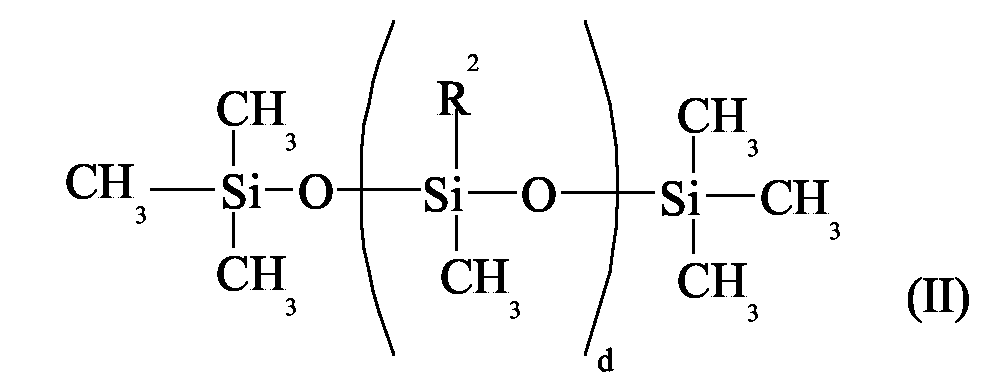
- the polysiloxanes (2) may in particular satisfy formula (II): wherein R 2 is H- or CH 3 - and d is from 15 to 450.
- the fluoroalkylsilanes may in particular be chosen from a non-selective list. including trifluoropropyltrimethoxysilane, tridecafluorooctyltrimethoxysilane, heptadecafluorodecyltrimethoxysilane, heptadecafluorodecylmethyldimethoxysilane, trifluoropropyltriethoxysilane, tridecafluorooctyltriethoxysilane, heptadecafluorodecyltriethoxysilane, heptadecafluorodecylmethyldiethoxysilane and the like, in particular the trifluoropropyltrimethoxysilane, tridecafluorooctyltrimethoxysilane and heptadecafluorodecyltrimethoxysilane, and even better trifluoropropyl trime
- the silane coupling agents may be selected from a non-selective list. limiting including especially vinyltrimethoxysilane, vinyltriethoxysilane, ⁇ -aminopropyl-triethoxysilane, ⁇ -flycidoxypropyltrimethoxysilane, ⁇ -mercaptopropyltrimethoxysilane, ⁇ -methacryloxypropyltrimethoxysilane, N- ⁇ (aminoethyl) - ⁇ -aminopropyltrimethoxysilane, ⁇ -glycidoxypropylmethyldimethoxysilane, ⁇ -chloropropyltrimethoxysilane and the like.
- Titanate coupling agents can be chosen from the list comprising isopropylstearoyl titanate, titanate isopropyltris (dioctylpyrophosphate), isopropyltri (N-aminoethylaminoethyl) titanate, tetraoctylbis titanate (ditridecylphosphate), tetra (2,2-diaryloxymethyl-1-butyl) bis (ditridecyl) phosphate titanate, the titanate of bis (dioctylpyrophosphate) oxyacetate, bis (dioctylpyrophosphate) ethylene titanate and their like.
- the aluminate coupling agents may be chosen from acetoalkoxyaluminium diisopropylate, diisopropoxymonoethylacetoacetate of aluminum, aluminum triethylacetoacetate, aluminum triacetylacetonate and their like.
- the coupling agents based on zirconate can be chosen from a list including zirconium tetrakisacetylacetonate, zirconium dibutoxybisacetylacetonate, zirconium tetrakisethylacetoacetate, zirconium tributoxymonoethylacetoacetate, zirconium tributoxyacetylacetonate and their like.
- the binder is preferably in a liquid state or soluble in water or in different solvents.
- the amount of binder can vary from 0.01 to 15%, especially from 0.02 to 12.5% and in particular from 0.03 to 10% by weight (calculated with respect to C or Si) relative to the weight particles comprising the core and the binder.
- the amount of binder can vary from 0.01 to 15%, especially from 0.02 to 12.5% and in particular from 0.03 to 10% by weight (calculated with respect to C or Si) relative to the weight particles comprising the core and the binder.
- the composite pigment can be produced for example by one of the processes disclosed in European Patent Applications EP 1 184 426 and EP 1 217 046, the contents are incorporated herein by reference, advantageously by the method described in application EP 1 184 426.
- the binder adheres uniformly to the core surface inorganic, it is preferable to pass these particles beforehand into a grinder, way to disaggregate them.
- the mixing and stirring conditions are chosen so that the core is uniformly covered with binder. These conditions can be controlled for that the linear load is between 19.6 and 19160 N / cm, in particular between 98 and 14170 N / cm and better still between 147 and 980 N / cm; the treatment time is especially between 5 minutes and 24 hours and better from 10 minutes to 20 hours; the rotation speed can be between 2 and 1000 rpm, in particular between 5 and 1000 rpm and better between 10 and 1000 rpm. and 800 rpm.
- the addition methods can for example be a fat addition quantity, continuously, or in small quantity.
- JP 3286463 Another method of manufacturing a composite pigment is described in JP 3286463, which discloses a precipitation method in solution.
- the organic coloring matter is dissolved in ethanol, the cores inorganic materials are then dispersed in this ethanolic solution.
- composition may comprise at least one aqueous or organic solvent.
- solvent (s), in particular organic (s) will depend on the nature of the medium on which the composition is intended to be applied.
- the organic solvent may be present in the composition at a content ranging for example from 30 to 99% by weight and preferably 60% to 90% by weight, based on the total weight of the composition.
- the composition may also comprise water or a mixture of water and hydrophilic organic solvents commonly used in cosmetics such as alcohols and in particular linear or branched lower monoalcohols having from 2 to 5 carbon atoms, such as ethanol, isopropanol or n-propanol, polyols such as glycerine, diglycerine, propylene glycol, sorbitol, penthylene glycol, polyethylene glycols.
- the composition may further contain C 2 ethers and C 2 -C 4 hydrophilic aldehydes.
- the water or the mixture of water and hydrophilic organic solvents may be present in the composition in a content ranging for example from 0% to 90%, especially 0.1% to 90% by weight and preferably from 0% to 60% by weight, especially 0.1% to 60% by weight, relative to the total weight of the composition.
- the composition in particular when it is intended to be applied to lips, can comprise a fatty phase and in particular at least one liquid fatty substance to ambient temperature (25 ° C) and / or a fat solid at room temperature such as waxes, pasty fatty substances, gums, and mixtures thereof.
- the fatty phase can, in addition, contain lipophilic organic solvents.
- liquid fatty substances at room temperature often called “oils”
- vegetable hydrocarbon-based oils such as liquid triglycerides of fatty acids of 4 to 10 carbon atoms such as triglycerides of heptanoic acids or octanoic, or sunflower, corn, soybean, grapeseed, sesame, apricot, macadamia, castor oil, avocado, triglycerides caprylic / capric, jojoba oil, shea butter, lanolin, acetylated lanolin ; linear or branched hydrocarbons of mineral or synthetic origin, such as paraffin oils and their derivatives, petroleum jelly, polydecenes, polyisobutene hydrogenated such as butteram; esters and synthetic ethers, in particular of fatty acids such as, for example, purcellin oil, isopropyl myristate, 2-ethylhexyl palmitate, octyl-2-dodecyl stearate,
- Waxes can be solid at room temperature (25 ° C), change reversible solid / liquid state, having a melting temperature greater than 30 ° C up to 200 ° C, hardness greater than 0.5 MPa, and having solid state an anisotropic crystalline organization.
- the waxes may have a melting temperature above 25 ° C and more preferably above 45 ° C.
- Waxes can be hydrocarbon, fluorinated and / or silicone and be of plant, mineral, animal origin and / or synthetic.
- waxes As usable waxes, mention may be made of beeswax, Carnauba or Candellila, paraffin, microcrystalline waxes, ceresin or ozokerite; synthetic waxes such as polyethylene or Fischer Tropsch waxes, silicone waxes such as alkyl or alkoxy dimethicone having from 16 to 45 carbon atoms carbon.
- the composition may contain from 0 to 50% by weight of waxes, relative to the weight total of the composition, or even 1 to 30% by weight.
- the diol dimer and the monocarboxylic acid esters can be obtained at from monocarboxylic acid comprising from 4 to 34 carbon atoms, especially from 10 to 32 carbon atoms, which acids are linear, branched, saturated or unsaturated.
- the diol dimer and dicarboxylic acid esters may be obtained from a diacid dimer derived in particular from the dimerization of an unsaturated fatty acid, in particular C 8 to C 34 , especially C 12 to C 22 , in particular C 16 to C 20 , and more particularly C 18 .
- Diol dimer esters can be obtained from a diol dimer by catalytic hydrogenation of a diacid dimer, for example dilinoleic diacid hydrogen.
- the non-volatile oils may represent from 0.001 to 90% of the total weight of the composition, preferably 0.05 at 60% and better from 1 to 35%.
- the gums that can be used are generally high molecular weight polydimethylsiloxanes (PDMS) or cellulose gums or polysaccharides.
- PDMS polydimethylsiloxanes
- cellulose gums or polysaccharides are generally high molecular weight polydimethylsiloxanes (PDMS) or cellulose gums or polysaccharides.
- composition may also comprise, for example, a film-forming polymer, especially in the case of a mascara or a nail polish.
- a film-forming polymer means a polymer capable of forming on its own or in the presence of an auxiliary agent of filming, a continuous and adherent film on a support, in particular on the materials keratin.
- the film-forming polymers of the radical type may in particular be polymers or vinyl copolymers, especially acrylic polymers.
- Vinyl film-forming polymers can result from the polymerization of ethylenically unsaturated monomers having at least one acidic group and / or esters of these acidic monomers and / or amides of these acidic monomers such as the acids unsaturated carboxylic acids ⁇ , ⁇ -ethylenic such as acrylic acid, methacrylic acid, crotonic acid, maleic acid, itaconic acid.
- Vinyl-forming polymers can also result from homopolymerization or copolymerization of monomers chosen from esters such as vinyl acetate, vinyl neodecanoate, vinyl pivalate, vinyl vinyl benzoate and vinyl t-butyl benzoate and styrene monomers such as styrene and alpha-methyl styrene.
- esters such as vinyl acetate, vinyl neodecanoate, vinyl pivalate, vinyl vinyl benzoate and vinyl t-butyl benzoate
- styrene monomers such as styrene and alpha-methyl styrene.
- film-forming polycondensates mention may be made of polyurethanes, polyesters, polyesters amides, polyamides, and polyureas, this list not being limiting.
- Polymers of natural origin can be selected from shellac resin, sandaraque gum, dammars, elemis, copals, cellulosic polymers, such as nitrocellulose, ethylcellulose or esters nitrocellulose chosen, for example, from cellulose acetate, acetobutyrate cellulose, cellulose acetate propionate, and mixtures thereof.
- the film-forming polymer may be present in the form of solid particles in aqueous or oily dispersion, generally known as latex or pseudolatex.
- the film-forming polymer may comprise one or more stable dispersions of particles of generally spherical polymers of one or more polymers, in a fatty phase physiologically acceptable liquid. These dispersions are usually called NAD (Non-Aqueous Dispersion) polymer as opposed to latexes which are dispersions aqueous polymer.
- These dispersions may especially be in the form of polymer nanoparticles in stable dispersion in said fatty phase.
- the nanoparticles are preferably of a size between 5 and 600 nm. The techniques Preparation of these dispersions are well known to those skilled in the art.
- the composition may further comprise fillers.
- charge we means particles of any form, insoluble in the medium of the composition, whatever the temperature at which the composition is manufactured. These charges can serve in particular to modify the rheology or the texture of the composition. Nature and quantity solid bodies are a function of the mechanical properties and textures sought.
- fillers examples include talc, mica, silica, kaolin, sericite, powders of polyamide, polyethylene, polytetrafluoroethylene, polymethylmethacrylate, polyurethane, powders of starch and silicone resin beads.
- composition may comprise an additional coloring matter, different from the composite pigment used in the present invention.
- the additional coloring material may be chosen from pigments minerals, organic pigments, pearlescent pigments, fat-soluble dyes or water-soluble.
- the mineral pigments can be white or colored, coated or on. We can mention titanium dioxide, optionally surface-treated, zirconium oxides or cerium, as well as oxides of iron or chromium, manganese violet, ultramarine blue, chromium hydrate and ferric blue.
- the pigments can represent from 0 to 40%, preferably 1 to 35%, and more preferably 2 to 25% of the total weight of the composition.
- the fat-soluble dyes are, for example, Sudan Red, DC Red 17, DC Green 6, ⁇ -carotene, soybean oil, Sudan Brown, DC Yellow 11, DC Violet 2, orange DC 5, quinoline yellow.
- the composition may comprise at least one cosmetic active agent or dermatology.
- cosmetic, dermatological, hygienic or pharmaceutical compositions which can be used in the compositions of the invention, mention may be made moisturizers (polyol as glycerin), vitamins (C, A, E, F, B, or PP), fatty acids essential oils, ceramides, sphingolipids, fat-soluble sunscreens or in the form of nano-particles, the specific agents for the treatment of the skin (agents of protection, anti-bacterial, anti-wrinkle ).
- vitamins C, A, E, F, B, or PP
- fatty acids essential oils C, A, E, F, B, or PP
- ceramides fatty acids essential oils
- ceramides fatty acids essential oils
- ceramides fatty acids essential oils
- sphingolipids sphingolipids
- fat-soluble sunscreens or in the form of nano-particles
- These assets can be used for example for concentrations of 0
- the composition can be in various forms, depending on its destination.
- the composition may thus be in any galenic form normally used for topical application and especially in anhydrous form, under form of an oily or aqueous solution, an oily or aqueous gel, an emulsion oil in water, water in oil, wax in water or water in wax, multiple emulsion, an oil dispersion in water through vesicles at the oil / water interface.
- composition may be in the form of a cast product, in particular stick in the case of a lipstick or a product of care of the lips.
- composition may still be in various other forms, for example example of a more or less viscous liquid, a gel or a paste.
- the invention thus also relates to a lipstick, liquid or solid, comprising a composition as defined above.
- the invention also relates to a nail polish comprising a composition as defined above.
- the subject of the invention is also a process for making up the skin, lips or integuments, in which one applies on the skin, lips or integuments a composition as defined above.
Landscapes
- Life Sciences & Earth Sciences (AREA)
- Health & Medical Sciences (AREA)
- Animal Behavior & Ethology (AREA)
- General Health & Medical Sciences (AREA)
- Public Health (AREA)
- Veterinary Medicine (AREA)
- Birds (AREA)
- Epidemiology (AREA)
- Chemical & Material Sciences (AREA)
- Inorganic Chemistry (AREA)
- Cosmetics (AREA)
- Pigments, Carbon Blacks, Or Wood Stains (AREA)
Abstract
Description
- un noyau inorganique,
- au moins un enrobage au moins partiel d'au moins une matière colorante organique dans une quantité suffisante pour que la saturation C* de la composition soit avantageusement comprise entre environ 25 et environ 100, mieux entre environ 30 et environ 100.
- un noyau inorganique,
- au moins un enrobage au moins partiel d'au moins une matière colorante organique.
- le carmin de cochenille,
- les pigments organiques de colorants azoïques, anthraquinoniques, indigoïdes, xanthéniques, pyréniques, quinoliniques, de triphénylméthane, de fluorane,
- les laques organiques ou sels organiques insolubles de sodium, de potassium, de calcium, de baryum, d'aluminium, de zirconium, de strontium, de titane, de colorants acides tels que les colorants azoïques, anthraquinoniques, indigoïdes, xanthéniques, pyréniques, quinoliniques, de triphénylméthane, de fluorane, ces colorants pouvant comporter au moins un groupe acide carboxylique ou sulfonique.
- les organosilanes (1) obtenus à partir d'alkoxysilanes,
- les polysiloxanes (2) modifiés ou non choisis parmi une liste non limitative
comprenant :
- les polysiloxanes modifiés (2A) comprenant au moins un radical choisi parmi, notamment, les polyéthers, les polyesters et les composés époxy (ils seront appelés « polysiloxanes modifiés »),
- les polysiloxanes (2B) portant sur un atome de silicium situé à l'extrémité du polymère, au moins un groupe choisi parmi une liste non limitative comprenant les acides carboxyliques, les alcools ou les groupes hydroxy, et
- les composés organosilanes fluoroalkylés (3) obtenus à partir de fluoroalkylsilanes.
- R1 représente C6H5-, (CH3)2 CH-CH2- ou un radical de type Cb H2b+1- (où b varie de 1 à 18),
- X représente CH3O- ou C2H5O-, et
- a varie de 0 à 3.
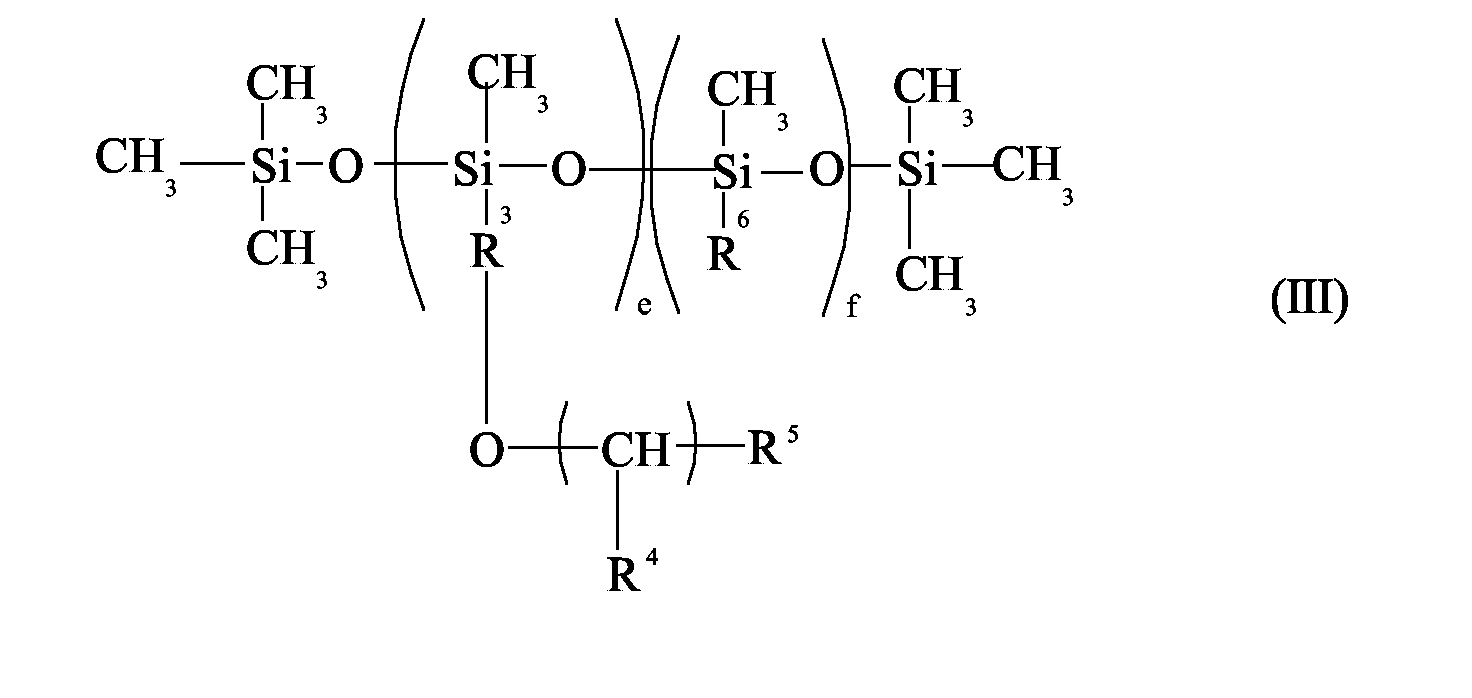
- (a1) polysiloxanes modifiés portant des polyéthers, représentés par la formule (III)
dans laquelle R3 représente -(CH2)h- ; R4 représente -(CH2)i- CH3 ; R5 représente -OH, - COOH, -CH = CH2, -C (CH3) = CH2 ou -(CH2)j- CH3 ; R6 représente -(CH2)k- CH3 ; g et h variant indépendamment de 1 à 15 ; j et k variant indépendamment de 0 à 15 ; e variant de 1 à 50 et f variant de 1 à 300,
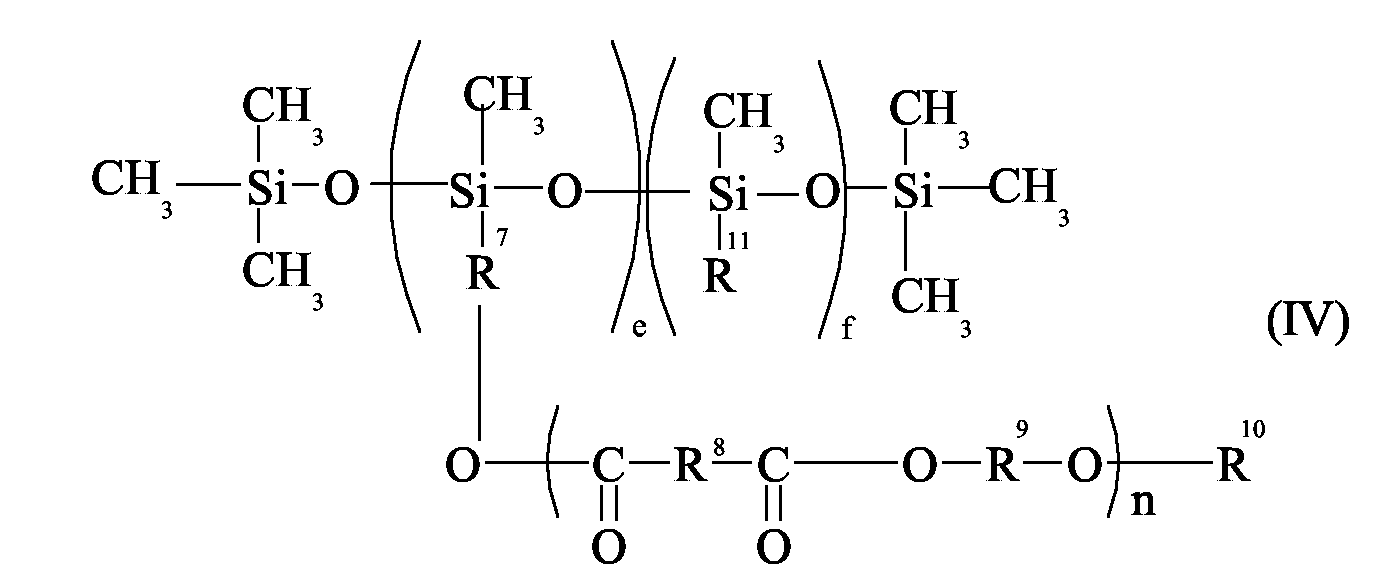
- (a2) polysiloxanes modifiés portant des polyesters, représentés par la formule (IV) :
dans laquelle R7, R8 et R9 représentent indépendamment -(CH2)q- ; R10 représente -OH ; -COOH, -CH = CH2, -C(CH3) = CH2 ou -(CH2)r- CH3 ; R11 représente -(CH2)s- CH3 ; n et q variant indépendamment de 1 à 15, r et s qui peuvent être identiques ou différents variant de 0 à 15 ; e variant de 1 à 50 et f variant de 1 à 300,
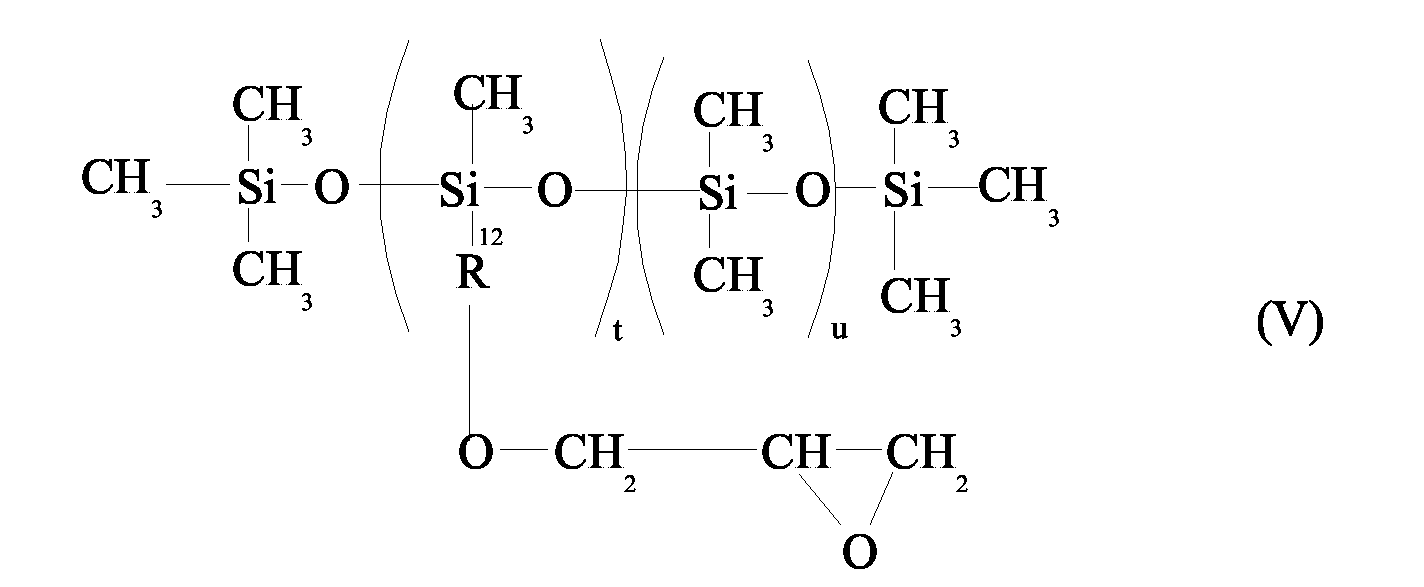
- (a3) polysiloxanes modifiés portant des radicaux époxy représentés par la formule
(V):
dans laquelle R12 représente -(CH2)v- ; v variant de 1 à 15 ; t variant de 1 à 50 et u variant de 1 à 300 ; ou leurs mélanges.
Parmi les polysiloxanes modifiés (2A), les polysiloxanes modifiés portant des polyéthers de formule (III) sont préférés.
Les polysiloxanes modifiés sur la partie terminale (2B) peuvent répondre à la formule (VI) :dans laquelle R13 et R14 peuvent représenter -OH, R16-OH ou R17-COOH, indépendamment l'un de l'autre ; R15 représente -CH3 ou -C6H5 ; R16 et R17 représentent - -(CH2)y- ; y variant de 1 à 15 ; w variant de 1 à 200 et x variant de 0 à 100.
- R18 représente CH3-, C2H5-, CH3O- ou C2H5O-,
- X représente CH3O- ou C2H5O-,
- Z varie de 0 à 15 et a varie de 0 à 3.
- les cétones liquides à température ambiante, tels que le méthyléthylcétone, méthylisobutylcétone, diisobutylcétone, l'isophorone, la cyclohexanone, l'acétone ;
- les alcools liquides à température ambiante tels que l'éthanol, l'isopropanol, le diacétone alcool, le 2-butoxyéthanol, le cyclohexanol ;
- les glycols liquides à température ambiante tels que l'éthylène glycol, le propylène glycol, le pentylène glycol, le glycérol ;
- les éthers de propylène glycol liquides à température ambiante tels que le monométhyléther de propylène glycol, l'acétate de monométhyl éther de propylène glycol, le mono n-butyl éther de dipropylène glycol ;
- les esters à chaíne courte (ayant de 3 à 8 atomes de carbone au total) tels que l'acétate d'éthyle, l'acétate de méthyle, l'acétate de propyle, l'acétate de n-butyle, l'acétate d'isopentyle ;
- les alcanes liquides à température ambiante tels que le décane, l'heptane, le dodécane, le cyclohexane ;
- les polybutylènes tels que L'INDOPOL H-100 (de masse molaire ou MM=965 g/mol), L'INDOPOL H-300 (MM=1340 g/mol), L'INDOPOL H-1500 (MM=2160g/mol) commercialisés ou fabriqués par la société AMOCO,
- les polyisobutylènes hydrogénés tels que le PANALANE H-300 E commercialisés ou fabriqué par la société AMOCO (M =1340 g/mol), le VISEAL 20000 commercialisé ou fabriqué par la société SYNTEAL (MM=6000 g/mol), le REWOPAL PIB 1000 commercialisé ou fabriqué par la société WITCO (MM=1000 g/mol),
- les polydécènes et les polydécènes hydrogénés tels que le PURESYN 150 (MM=9200 g/mol) commercialisé par la société MOBIL CHEMICALS,
- les copolymères de la vinylpyrrolidone tels que le copolymère vinylpyrrolidone/1-héxadécène, ANTARON V-216 commercialisé ou fabriqué par la société ISP (MM=7300 g/mol),
- les esters tels que :
- a) les esters d'acides gras linéaires ayant un nombre total de carbone allant de 35 à 70 comme le tétrapélargonate de pentaérythrityle (MM=697,05 g/mol),
- b) les esters hydroxylés tels que le triisostéarate de polyglycérol-2 (MM=965,58 g/mol),
- c) les esters aromatiques tels que le tridécyl trimellitate (MM=757,19 g/mol),
- d) les esters d'alcool gras ou d'acides gras ramifiés en C24-C28 tels que ceux décrits dans la demande EP-A-0 955 039, et notamment le citrate de triisoarachidyle (MM=1033,76 g/mol), le tétraisononanoate de pentaérythrityle (MM=697,05g/mol), le triisostéarate de glycéryle (MM=891.51 g/mol), le tri décyl-2 tétradécanoate de glycéryle (MM=1143,98 g/mol), le tétraisostéarate de pentaérythrityle (MM=1202,02 g/mol), le tétraisostéarate de polyglycéryle -2 (MM=1232,04 g/mol) ou encore le tétra décyl -2 tétradécanoate de pentaérythrityle (MM=1538,66 g/mol),
- e) les esters et polyesters de dimère diol, tels que les esters de dimère diol et d'acide gras, et les esters de dimère diols et de diacide.
- les huiles siliconées telles que les silicones phénylées comme la BELSIL PDM 1000 de la société WACKER (MM=9000 g/mol),
- les huiles d'origine végétale telles que l'huile de sésame (820,6 g/mol),
- et leurs mélanges.
| Cire de polyéthylène (Polywax 500 de la société BARECO) | 8,8 |
| Cire microcristalline (SP 18 de la société STRAHL & PITSCH) | 4 |
| Triglycéride d'acide palmitique-laurique-stéarique (Softisan 100 de la société SASOL) | 5 |
| Octyldodécanol | 17,5 |
| Huile de lanoline | 10,7 |
| Huile de lanoline acétylée | 10,7 |
| Lanolate d'isopropyle | 10,7 |
| Trimellilate de tridécyle | 11,7 |
| Malate de diisostéaryle | 14,6 |
| Phényl triméthicone (DC 556 de la société DOW CORNING) | 4,8 |
| Pigment composite silice/D&C Red7 | 1,5 |
| Cire de polyéthylène (Polywax 500 de la société BARECO) | 8,8 |
| Cire microcristalline (SP 18 de la société STRAHL & PITSCH) | 4 |
| Triglycéride d'acide palmitique-laurique-stéarique (Softisan 100 de la société SASOL) | 5 |
| Octyldodécanol | 17,5 |
| Huile de lanoline | 10,7 |
| Huile de lanoline acétylée | 10,7 |
| Lanolate d'isopropyle | 10,7 |
| Trimellilate de tridécyle | 11,7 |
| Malate de diisostéaryle | 14,6 |
| Phényl triméthicone (DC 556 de la société DOW CORNING) | 4,8 |
| Pigment composite TiO2/D&C Red7 | 1,5 |
| Cire de polyéthylène (Polywax 500 de la société BARECO) | 8,8 |
| Cire microcristalline (SP 18 de la société STRAHL & PITSCH) | 4 |
| Triglycéride d'acide palmitique-laurique-stéarique (Softisan 100 de la société SASOL) | 5 |
| Octyldodécanol | 17,5 |
| Huile de lanoline | 10,7 |
| Huile de lanoline acétylée | 10,7 |
| Lanolate d'isopropyle | 10,7 |
| Trimellilate de tridécyle | 11,7 |
| Malate de diisostéaryle | 14,6 |
| Phényl triméthicone (DC 556 de la société DOW CORNING) | 4,8 |
| Pigment organique pur D&C Red 7 | 1,5 |

| Nitrocellulose | 19 |
| Sulfonamide de N-éthyl-o,p-toluène | 6 |
| Acétyle citrate de tributyle | 6 |
| Agent rhéologique (hectorite) | 1,2 |
| Pigment composite silice/D&C Red N° 7 | 3 |
| Isopropanol | 8 |
| Acétate d'éthyle/Acétate de butyle | qsq 100 |
Claims (57)
- Composition présentant un pouvoir couvrant compris entre 1 et 25 et destinée à être appliquée sur la peau, les lèvres et/ou les phanères, cette composition comportant des particules d'au moins un pigment composite, ces particules comportant :un noyau inorganique,au moins un enrobage au moins partiel d'au moins une matière colorante organique dans une quantité suffisante pour que la saturation C* de la composition soit comprise entre environ 25 et environ 100.
- Composition selon la revendication 1, caractérisée en ce que la teneur en pigment composite dans la composition est comprise entre environ 0,05 % et environ 10 % en poids, par rapport au poids total de la composition.
- Composition selon la revendication 2, caractérisée par le fait que la teneur en pigment composite dans la composition est comprise entre environ 0,1 % et environ 8 % en poids, par rapport au poids total de la composition.
- Composition selon la revendication 2, caractérisée par le fait que la teneur en pigment composite dans la composition est comprise entre environ 0,1 % et environ 5 % en poids, par rapport au poids total de la composition, notamment entre environ 0,1 % et environ 3 % ou entre 0,5 % environ et 3 % environ.
- Composition selon l'une quelconque des revendications précédentes, caractérisée par le fait que le pigment composite contient une quantité suffisante de matière colorante organique pour que la saturation C* de la composition soit comprise entre environ 30 et environ 100.
- Composition selon l'une quelconque des revendications précédentes, caractérisée par le fait qu'elle présente un pouvoir couvrant compris entre 5 et 24,9.
- Composition selon la revendication précédente, caractérisée par le fait qu'elle présente un pouvoir couvrant compris entre 10 et 24,9.
- Composition selon la revendication précédente, caractérisée par le fait qu'elle présente un pouvoir couvrant compris entre 15 et 24,9.
- Composition selon l'une quelconque des revendications précédentes, caractérisée par le fait que la matière colorante organique comporte au moins un pigment organique.
- Composition selon l'une quelconque des revendications précédentes, caractérisée par le fait que la matière colorante organique comporte au moins une laque organique.
- Composition selon l'une quelconque des revendications précédentes, caractérisée par le fait que le noyau inorganique présente une taille moyenne comprise entre environ 1 nm et environ 100 nm.
- Composition selon la revendication précédente, caractérisée par le fait que le noyau inorganique présente une taille moyenne comprise entre environ 5 nm et environ 75 nm.
- Composition la revendication 11, caractérisée par le fait que le noyau inorganique présente une taille moyenne comprise entre environ 10 nm et environ 50 nm.
- Composition selon l'une quelconque des revendications précédentes, caractérisée par le fait que le noyau inorganique présente une surface spécifique comprise entre environ 1 m2/g et environ 1000 m2/g.
- Composition selon la revendication précédente, caractérisée par le fait que la surface spécifique du noyau inorganique est comprise entre environ 10 m2/g et environ 600 m2/g.
- Composition selon la revendication 14, caractérisée par le fait que la surface spécifique du noyau inorganique est comprise entre environ 20 m2/g et environ 400 m2/g.
- Composition selon l'une quelconque des revendications précédentes, caractérisée par le fait que le noyau inorganique présente une forme choisie parmi les suivantes : sphérique, globulaire, polyédrique, aciculaire, fusiforme, aplatie.
- Composition selon l'une quelconque des revendications précédentes, caractérisée par le fait que le noyau inorganique comporte un matériau choisi parmi un sel métallique, un oxyde métallique, une alumine, un verre, une céramique, un graphite, une silice, un silicate, un mica synthétique, et un de leurs mélanges.
- Composition selon la revendication précédente, caractérisée par le fait que le noyau inorganique comporte un oxyde métallique choisi parmi un oxyde de titane, de zirconium, de cérium, de zinc, de fer, de bleu ferrique, de chrome et d'aluminium.
- Composition selon la revendication 19, caractérisée par le fait que l'oxyde métallique est choisi parmi un oxyde de titane, de fer, de cérium, de zirconium, de zinc, et d'aluminium.
- Composition selon la revendication précédente, caractérisée par le fait que l'oxyde métallique comporte du dioxyde de titane.
- Composition selon la revendication 18, caractérisée par le fait que le noyau inorganique comporte au moins un silicate choisi parmi un aluminosilicate et un borosilicate.
- Composition selon la revendication 18, caractérisée par le fait que le noyau inorganique comporte de la silice.
- Composition selon l'une quelconque des revendications précédentes, caractérisée par le fait que la proportion massique de matière colorante organique est comprise entre environ 10 et environ 500 parts en poids pour 100 parts du noyau inorganique.
- Composition selon la revendication précédente, caractérisée par le fait que la proportion massique de la matière colorante organique est comprise entre environ 20 et environ 250 parts en poids pour 100 parts du noyau inorganique.
- Composition selon la revendication précédente, caractérisée par le fait que la proportion massique de la matière colorante organique est comprise entre environ 40 et environ 125 parts en poids pour 100 parts du noyau inorganique.
- Composition selon l'une quelconque des revendications précédentes, caractérisée par le fait que la matière colorante organique est choisie parmi un carmin de cochenille, un pigment organique de colorant azoïque, anthraquinonique, indigoïde, xanthénique, pyrénique, quinolinique, de triphénylméthane, de fluorane, une laque organique, un sel insoluble de sodium, de potassium, de calcium, de baryum, d'aluminium, de zirconium, de strontium, de titane, de colorant acide.
- Composition selon la revendication précédente, caractérisée par le fait que le colorant acide est choisi parmi un colorant azoïque, anthraquinonique, indigoïde, xanthénique, pyrénique, quinolinique, de triphénylméthane, de fluorane, et de tout autre colorant comportant au moins un groupe acide carboxylique ou sulfonique.
- Composition selon l'une quelconque des revendications précédentes, caractérisée par le fait que la matière colorante organique comporte une laque organique qui est supportée par un support organique comportant au moins une colophane ou du benzoate d'aluminium.
- Composition selon l'une quelconque des revendications précédentes, caractérisée par le fait que la matière colorante organique comporte un pigment organique ayant l'une des dénominations suivantes : D&C Blue n° 4, D&C Brown n° 1, D&C Green n° 5, D&C Green n° 6, D&C Orange n° 4, D&C Orange n° 5, D&C Orange n° 10, D&C Orange n° 11, D&C Red n° 6, D&C Red n° 7, D&C Red n° 17, D&C Red n° 21, D&C Red n° 22, D&C Red n° 27, D&C Red n° 28, D&C Red n° 30, D&C Red n° 31, D&C Red n° 33, D&C Red n° 34, D&C Red n° 36, D&C Violet n° 2, D&C Yellow n° 7, D&C Yellow n° 8, D&C Yellow n° 10, D&C Yellow n° 11, FD&C Blue n° 1, FD&C Green n° 3, FD&C Red n° 40, FD&C Yellow n° 5, FD&C Yellow n° 6.
- Composition selon l'une quelconque des revendications précédentes, caractérisée par le fait que la matière colorante organique comporte une laque organique ayant l'une des dénominations suivantes : D&C Red n° 2 Aluminium lake, D&C Red n° 3 Aluminium lake, D&C Red n° 4 Aluminium lake, D&C Red n° 6 Aluminium lake, D&C Red n° 6 Barium lake, D&C Red n° 6 Barium/Strontium lake, D&C Red n° 6 Strontium lake, D&C Red n° 6 Potassium lake, D&C Red n° 7 Aluminium lake, D&C Red n° 7 Barium lake, D&C Red n° 7 Calcium lake, D&C Red n° 7 Calcium/Strontium lake, D&C Red n° 7 Zirconium lake, D&C Red n° 8 Sodium lake, D&C Red n° 9 Aluminium lake, D&C Red n° 9 Barium lake, D&C Red n° 9 Barium/Strontium lake, D&C Red n° 9 Zirconium lake, D&C Red n° 10 Sodium lake, D&C Red n° 19 Aluminium lake, D&C Red n° 19 Barium lake, D&C Red n° 19 Zirconium lake, D&C Red n° 21 Aluminium lake, D&C Red n° 21 Zirconium lake, D&C Red n° 22 Aluminium lake, D&C Red n° 27 Aluminium lake, D&C Red n° 27 Aluminium/Titanium/Zirconium lake, D&C Red n° 27 Barium lake, D&C Red n° 27 Calcium lake, D&C Red n° 27 Zirconium lake, D&C Red n° 28 Aluminium lake, D&C Red n° 30 lake, D&C Red n° 31 Calcium lake, D&C Red n° 33 Aluminium lake, D&C Red n° 34 Calcium lake, D&C Red n° 36 lake, D&C Red n° 40 Aluminium lake, D&C Blue n° 1 Aluminium lake, D&C Green n° 3 Aluminium lake, D&C Orange n° 4 Aluminium lake, D&C Orange n° 5 Aluminium lake, D&C Orange n° 5 Zirconium lake, D&C Orange n° 10 Aluminium lake, D&C Orange n° 17 Barium lake, D&C Yellow n° 5 Aluminium lake, D&C Yellow n° 5 Zirconium lake, D&C Yellow n° 6 Aluminium lake, D&C Yellow n° 7 Zirconium lake, D&C Yellow n° 10 Aluminium lake, FD&C Blue n° 1 Aluminium lake, FD&C Red n° 4 Aluminium lake, FD&C Red n° 40 Aluminium lake, FD&C Yellow n° 5 Aluminium lake, FD&C Yellow n° 6 Aluminium lake.
- Composition selon l'une quelconque des revendications précédentes, caractérisée par le fait que le pigment composite comporte au moins un liant contribuant à la fixation de la matière colorante organique sur le noyau inorganique.
- Composition selon la revendication précédente, caractérisée par le fait que le liant comporte au moins l'un d'un composé siliconé, d'un composé polymérique, et d'un composé oligomérique et similaire, comportant au moins l'un d'un organosilane, d'un organosilane fluoroalkylé, d'un polysiloxane, d'un agent couplant et d'un mélange de ceux-ci.
- Composition selon la revendication 33, caractérisée par le fait que le liant comporte du polyméthylhydrogénosiloxane.
- Composition selon la revendication 33, caractérisée par le fait que l'agent couplant est à base de silane, de titanate, d'aluminate et/ou de zirconate.
- Composition selon la revendication 33, caractérisée par le fait que le liant comporte au moins un composé siliconé.
- Composition selon l'une quelconque des revendications précédentes, caractérisée par le fait que le noyau inorganique est coloré.
- Composition selon l'une quelconque des revendications précédentes, caractérisée par le fait qu'elle est dépourvue de particules de dioxyde de titane non enrobées.
- Composition selon l'une quelconque des revendications précédentes, caractérisée par le fait qu'elle comporte au moins un actif cosmétique ou dermatologique.
- Composition selon l'une quelconque des revendications précédentes, caractérisée par le fait qu'elle comporte au moins un corps gras, une cire, une gomme ou un polymère filmogène.
- Composition selon l'une quelconque des revendications précédentes, caractérisée par le fait qu'elle comporte une matière colorante additionnelle différente du pigment composite.
- Composition selon la revendication précédente, caractérisée par le fait que la matière colorante additionnelle est choisie parmi les pigments minéraux, les pigments organiques, les pigments nacrés, les colorants liposolubles et les colorants hydrosolubles.
- Composition selon l'une quelconque des revendications précédentes, caractérisée par le fait qu'elle se présente sous une forme solide.
- Composition selon l'une quelconque des revendications précédentes, caractérisée par le fait qu'elle se présente sous forme liquide, pâteuse ou gélifiée.
- Composition selon l'une quelconque des revendications 1 à 44, caractérisée par le fait que le pigment composite est non interférentiel.
- Composition selon l'une quelconque des revendications 1 à 45, caractérisée par le fait que la saturation C* du pigment composite est supérieure à 30.
- Composition selon l'une quelconque des revendications 1 à 46, caractérisée par le fait que la quantité relative de liant est inférieure ou égale à 5 % par rapport au poids total du pigment composite.
- Composition selon l'une quelconque des revendications 1 à 47, caractérisée par le fait que le liant est organique.
- Composition selon l'une quelconque des revendications 1 à 48, caractérisée par le fait que la brillance moyenne T0h est supérieure ou égale à 30.
- Composition selon l'une quelconque des revendications 1 à 49, caractérisée par le fait que la quantité Q de particules est supérieure ou égale à 5 %.
- Composition selon l'une quelconque des revendications 1 à 50, caractérisée par le fait qu'elle comporte une huile de masse molaire comprise entre 650 g/mol et 10000 g/mol.
- Procédé de maquillage de la peau, des lèvres ou des phanères, dans lequel on applique sur la peau, les lèvres ou les phanères une composition telle que définie dans l'une quelconque des revendications précédentes.
- Rouge à lèvres comportant une composition telle que défmie dans l'une quelconque des revendications 1 à 44.
- Fond de teint comportant une composition telle que définie dans l'une quelconque des revendications 1 à 44.
- Vernis à ongles comportant une composition telle que défmie dans l'une quelconque des revendications 1 à 44.
- Mascara comportant une composition telle que définie dans l'une quelconque des revendications 1 à 44.
- Produit de coloration des fibres capillaires comportant une composition telle que définie dans l'une quelconque des revendications 1 à 44.
Applications Claiming Priority (2)
| Application Number | Priority Date | Filing Date | Title |
|---|---|---|---|
| FR0450714A FR2868696B1 (fr) | 2004-04-08 | 2004-04-08 | Composition destinee a etre appliquee sur la peau, les levres et/ou les phaneres |
| FR0450714 | 2004-04-08 |
Publications (2)
| Publication Number | Publication Date |
|---|---|
| EP1586295A1 true EP1586295A1 (fr) | 2005-10-19 |
| EP1586295B1 EP1586295B1 (fr) | 2017-05-17 |
Family
ID=34942535
Family Applications (1)
| Application Number | Title | Priority Date | Filing Date |
|---|---|---|---|
| EP05300265.5A Expired - Lifetime EP1586295B1 (fr) | 2004-04-08 | 2005-04-08 | Composition destinée à être appliquée sur la peau, les lèvres et/ou les phanères. |
Country Status (6)
| Country | Link |
|---|---|
| EP (1) | EP1586295B1 (fr) |
| JP (2) | JP2005298514A (fr) |
| CN (1) | CN1679469B (fr) |
| BR (1) | BRPI0502154B1 (fr) |
| ES (1) | ES2634529T3 (fr) |
| FR (1) | FR2868696B1 (fr) |
Cited By (1)
| Publication number | Priority date | Publication date | Assignee | Title |
|---|---|---|---|---|
| KR101878136B1 (ko) * | 2018-01-31 | 2018-07-13 | (주)젠텍 | 마이크로웨이브를 이용한 복합안료의 제조방법 |
Families Citing this family (4)
| Publication number | Priority date | Publication date | Assignee | Title |
|---|---|---|---|---|
| FR2868697B1 (fr) * | 2004-04-08 | 2008-04-04 | Oreal | Gamme de compositions destinees a etre appliquees sur la peau, les levres et/ou les phaneres |
| KR101404966B1 (ko) * | 2007-07-24 | 2014-06-13 | (주)아모레퍼시픽 | 천연색소를 포함하는 아이메이크업 조성물 |
| WO2015196392A1 (fr) * | 2014-06-25 | 2015-12-30 | L'oreal | Composition huile dans l'eau, préparation et utilisation de celle-ci |
| CN113416434B (zh) * | 2021-06-07 | 2022-05-17 | 淮阴工学院 | 植物油改性的二氧化钛/类玛雅蓝复合颜料的制备方法及其应用 |
Citations (7)
| Publication number | Priority date | Publication date | Assignee | Title |
|---|---|---|---|---|
| EP0581651A2 (fr) * | 1992-07-27 | 1994-02-02 | Suzuki Yushi Industries Co., Ltd. | Matériaux en forme de fines particules sphériques colorées, procédé de production et compositions cosmétiques contenant le matériau particulaire |
| EP0587908A1 (fr) * | 1992-03-31 | 1994-03-23 | Kyowa Hakko Kogyo Kabushiki Kaisha | Produit cosmetique nouveau |
| US20020012683A1 (en) * | 2000-03-17 | 2002-01-31 | Jean-Christophe Henrion | Cosmetic composition comprising at least one ingredient chosen from compounds of formula (1) and salts thereof, use thereof as colouring agent, and novel compounds of formulae (IIa), (IIIa), (IVa), (Va), and (VIa), and salts thereof |
| EP1184426A2 (fr) * | 2000-09-01 | 2002-03-06 | Toda Kogyo Corporation | Particules composites, procédé de préparation, pigment et peinte, et composition de résine les utilisants |
| US20020039562A1 (en) * | 1998-10-02 | 2002-04-04 | Masaru Kobayashi | Pigments and extender pigments with enhanced skin adhesion for cosmetic preparations |
| EP1382323A2 (fr) * | 2002-07-19 | 2004-01-21 | L'oreal | Composition cosmétique pour le maquillage |
| EP1433461A1 (fr) * | 2002-12-24 | 2004-06-30 | L'oreal | Compositions cosmétiques et cartes de contraste permettant de les caractériser |
Family Cites Families (6)
| Publication number | Priority date | Publication date | Assignee | Title |
|---|---|---|---|---|
| US5356617A (en) * | 1990-05-14 | 1994-10-18 | Kobo Products, Inc. | Pigment-material-microsphere complexes and their production |
| JPH04292664A (ja) * | 1991-03-19 | 1992-10-16 | Kao Corp | 複合化顔料及びこれを含有する化粧料 |
| JPH1112493A (ja) * | 1997-06-24 | 1999-01-19 | Kose Corp | 複合粉体及びこれを含有する組成物 |
| JP4540921B2 (ja) * | 2001-06-05 | 2010-09-08 | 戸田工業株式会社 | インクジェット用インクの着色材及びインクジェット用インク並びに水性顔料分散体、有機無機複合粒子粉末 |
| JP5288085B2 (ja) * | 2000-09-01 | 2013-09-11 | 戸田工業株式会社 | 有機無機複合粒子粉末の製造法、該有機無機複合粒子粉末からなる有機無機複合顔料並びに該有機無機複合顔料を用いた塗料及び樹脂組成物、該有機無機複合顔料を含む顔料分散体及びマスターバッチペレット |
| FR2845277B1 (fr) * | 2002-10-02 | 2006-06-16 | Oreal | Composition destinee a etre appliquee sur la peau et les phaneres |
-
2004
- 2004-04-08 FR FR0450714A patent/FR2868696B1/fr not_active Expired - Fee Related
-
2005
- 2005-04-08 CN CN 200510063518 patent/CN1679469B/zh not_active Expired - Fee Related
- 2005-04-08 ES ES05300265.5T patent/ES2634529T3/es not_active Expired - Lifetime
- 2005-04-08 BR BRPI0502154-5A patent/BRPI0502154B1/pt not_active IP Right Cessation
- 2005-04-08 JP JP2005139024A patent/JP2005298514A/ja active Pending
- 2005-04-08 EP EP05300265.5A patent/EP1586295B1/fr not_active Expired - Lifetime
-
2009
- 2009-03-04 JP JP2009050298A patent/JP2009114215A/ja active Pending
Patent Citations (7)
| Publication number | Priority date | Publication date | Assignee | Title |
|---|---|---|---|---|
| EP0587908A1 (fr) * | 1992-03-31 | 1994-03-23 | Kyowa Hakko Kogyo Kabushiki Kaisha | Produit cosmetique nouveau |
| EP0581651A2 (fr) * | 1992-07-27 | 1994-02-02 | Suzuki Yushi Industries Co., Ltd. | Matériaux en forme de fines particules sphériques colorées, procédé de production et compositions cosmétiques contenant le matériau particulaire |
| US20020039562A1 (en) * | 1998-10-02 | 2002-04-04 | Masaru Kobayashi | Pigments and extender pigments with enhanced skin adhesion for cosmetic preparations |
| US20020012683A1 (en) * | 2000-03-17 | 2002-01-31 | Jean-Christophe Henrion | Cosmetic composition comprising at least one ingredient chosen from compounds of formula (1) and salts thereof, use thereof as colouring agent, and novel compounds of formulae (IIa), (IIIa), (IVa), (Va), and (VIa), and salts thereof |
| EP1184426A2 (fr) * | 2000-09-01 | 2002-03-06 | Toda Kogyo Corporation | Particules composites, procédé de préparation, pigment et peinte, et composition de résine les utilisants |
| EP1382323A2 (fr) * | 2002-07-19 | 2004-01-21 | L'oreal | Composition cosmétique pour le maquillage |
| EP1433461A1 (fr) * | 2002-12-24 | 2004-06-30 | L'oreal | Compositions cosmétiques et cartes de contraste permettant de les caractériser |
Cited By (1)
| Publication number | Priority date | Publication date | Assignee | Title |
|---|---|---|---|---|
| KR101878136B1 (ko) * | 2018-01-31 | 2018-07-13 | (주)젠텍 | 마이크로웨이브를 이용한 복합안료의 제조방법 |
Also Published As
| Publication number | Publication date |
|---|---|
| FR2868696A1 (fr) | 2005-10-14 |
| EP1586295B1 (fr) | 2017-05-17 |
| BRPI0502154A (pt) | 2006-04-18 |
| CN1679469B (zh) | 2010-04-21 |
| JP2005298514A (ja) | 2005-10-27 |
| ES2634529T3 (es) | 2017-09-28 |
| BRPI0502154B1 (pt) | 2019-04-24 |
| FR2868696B1 (fr) | 2008-09-12 |
| JP2009114215A (ja) | 2009-05-28 |
| CN1679469A (zh) | 2005-10-12 |
Similar Documents
| Publication | Publication Date | Title |
|---|---|---|
| JP5756251B2 (ja) | 皮膚、唇、爪、及び/又は毛髪への適用のための組成物 | |
| US20080044366A1 (en) | Compositions for application to the skin, to the lips, to the nails, and/or to hair | |
| EP1545437B1 (fr) | Composition destinee a etre appliquee sur la peau et les teguments | |
| FR2842417A1 (fr) | Composition cosmetique | |
| FR2842416A1 (fr) | Composition cosmetique | |
| EP1925278A1 (fr) | Gamme de compositions cosmétiques | |
| FR2965719A1 (fr) | Particule comportant deux metaux plasmoniques | |
| EP1588687B1 (fr) | Composition destinée à être appliquée sur la peau, les lèvres et/ou les phanères | |
| US20060018854A1 (en) | Cosmetic compositions | |
| US8007772B2 (en) | Compositions to be applied to the skin and the integuments | |
| FR2845277A1 (fr) | Composition destinee a etre appliquee sur la peau et les phaneres | |
| EP1763330B1 (fr) | Composition destinée à la peau, aux levres ou aux ongles | |
| EP1927339A2 (fr) | Composition cosmétique couvrante | |
| EP1586295B1 (fr) | Composition destinée à être appliquée sur la peau, les lèvres et/ou les phanères. | |
| US20050238979A1 (en) | Compositions for application to the skin, to the lips, to the nails, and/or to hair | |
| FR2888115A1 (fr) | Fond de teint liquide, procede de maquillage et kit pour la mise en oeuvre d'un tel procede. | |
| EP1588688A1 (fr) | Gamme de compositions destinées à être appliquées sur la peau, les lèvres et/ou les phanères. | |
| FR2848216A1 (fr) | Pigment et composition cosmetique incorporant un tel pigment | |
| FR2908638A1 (fr) | Composition cosmetique comportant au moins un agent de coloration sensible a un stimulus exterieur | |
| FR2908643A1 (fr) | Composition cosmetique comportant au moins un agent de coloration sensible a un stimulus exterieur | |
| FR2910272A1 (fr) | Gammme de compositions cosmetiques | |
| FR2908640A1 (fr) | Composition cosmetique couvrante | |
| FR2910273A1 (fr) | Gamme de compositions cosmetiques | |
| FR2908634A1 (fr) | Composition cosmetique couvrante |
Legal Events
| Date | Code | Title | Description |
|---|---|---|---|
| PUAI | Public reference made under article 153(3) epc to a published international application that has entered the european phase |
Free format text: ORIGINAL CODE: 0009012 |
|
| 17P | Request for examination filed |
Effective date: 20050415 |
|
| AK | Designated contracting states |
Kind code of ref document: A1 Designated state(s): AT BE BG CH CY CZ DE DK EE ES FI FR GB GR HU IE IS IT LI LT LU MC NL PL PT RO SE SI SK TR |
|
| AX | Request for extension of the european patent |
Extension state: AL BA HR LV MK YU |
|
| AKX | Designation fees paid |
Designated state(s): AT BE BG CH CY CZ DE DK EE ES FI FR GB GR HU IE IS IT LI LT LU MC NL PL PT RO SE SI SK TR |
|
| 17Q | First examination report despatched |
Effective date: 20100414 |
|
| RIC1 | Information provided on ipc code assigned before grant |
Ipc: A61Q 1/06 20060101ALI20160303BHEP Ipc: A61Q 5/06 20060101ALI20160303BHEP Ipc: A61Q 3/02 20060101ALI20160303BHEP Ipc: A61K 8/29 20060101ALI20160303BHEP Ipc: A61Q 1/02 20060101ALI20160303BHEP Ipc: A61K 8/04 20060101ALI20160303BHEP Ipc: A61K 8/19 20060101ALI20160303BHEP Ipc: A61K 8/11 20060101AFI20160303BHEP Ipc: A61K 8/25 20060101ALI20160303BHEP Ipc: A61K 8/02 20060101ALN20160303BHEP Ipc: A61K 8/44 20060101ALI20160303BHEP Ipc: A61Q 1/10 20060101ALI20160303BHEP |
|
| RIC1 | Information provided on ipc code assigned before grant |
Ipc: A61K 8/25 20060101AFI20160318BHEP Ipc: A61Q 3/02 20060101ALI20160318BHEP Ipc: A61Q 5/06 20060101ALI20160318BHEP Ipc: A61Q 1/10 20060101ALI20160318BHEP Ipc: A61K 8/44 20060101ALI20160318BHEP Ipc: A61Q 1/06 20060101ALI20160318BHEP Ipc: A61K 8/02 20060101ALN20160318BHEP Ipc: A61K 8/29 20060101ALI20160318BHEP Ipc: A61Q 1/02 20060101ALI20160318BHEP |
|
| REG | Reference to a national code |
Ref country code: DE Ref legal event code: R079 Ref document number: 602005051957 Country of ref document: DE Free format text: PREVIOUS MAIN CLASS: A61K0007020000 Ipc: A61K0008250000 |
|
| GRAP | Despatch of communication of intention to grant a patent |
Free format text: ORIGINAL CODE: EPIDOSNIGR1 |
|
| STAA | Information on the status of an ep patent application or granted ep patent |
Free format text: STATUS: GRANT OF PATENT IS INTENDED |
|
| RIC1 | Information provided on ipc code assigned before grant |
Ipc: A61Q 3/02 20060101ALI20161103BHEP Ipc: A61K 8/29 20060101ALI20161103BHEP Ipc: A61K 8/02 20060101ALN20161103BHEP Ipc: A61Q 1/02 20060101ALI20161103BHEP Ipc: A61K 8/25 20060101AFI20161103BHEP Ipc: A61K 8/19 20060101ALI20161103BHEP Ipc: A61K 8/44 20060101ALI20161103BHEP Ipc: A61Q 1/10 20060101ALI20161103BHEP Ipc: A61K 8/11 20060101ALI20161103BHEP Ipc: A61Q 1/06 20060101ALI20161103BHEP Ipc: A61Q 5/06 20060101ALI20161103BHEP |
|
| RIC1 | Information provided on ipc code assigned before grant |
Ipc: A61K 8/19 20060101ALI20161108BHEP Ipc: A61Q 1/02 20060101ALI20161108BHEP Ipc: A61K 8/44 20060101ALI20161108BHEP Ipc: A61Q 1/10 20060101ALI20161108BHEP Ipc: A61Q 1/06 20060101ALI20161108BHEP Ipc: A61K 8/29 20060101ALI20161108BHEP Ipc: A61K 8/11 20060101ALI20161108BHEP Ipc: A61Q 3/02 20060101ALI20161108BHEP Ipc: A61K 8/25 20060101AFI20161108BHEP Ipc: A61Q 5/06 20060101ALI20161108BHEP Ipc: A61K 8/02 20060101ALN20161108BHEP |
|
| INTG | Intention to grant announced |
Effective date: 20161128 |
|
| GRAS | Grant fee paid |
Free format text: ORIGINAL CODE: EPIDOSNIGR3 |
|
| GRAA | (expected) grant |
Free format text: ORIGINAL CODE: 0009210 |
|
| STAA | Information on the status of an ep patent application or granted ep patent |
Free format text: STATUS: THE PATENT HAS BEEN GRANTED |
|
| AK | Designated contracting states |
Kind code of ref document: B1 Designated state(s): AT BE BG CH CY CZ DE DK EE ES FI FR GB GR HU IE IS IT LI LT LU MC NL PL PT RO SE SI SK TR |
|
| REG | Reference to a national code |
Ref country code: GB Ref legal event code: FG4D Free format text: NOT ENGLISH |
|
| REG | Reference to a national code |
Ref country code: CH Ref legal event code: EP |
|
| REG | Reference to a national code |
Ref country code: IE Ref legal event code: FG4D Free format text: LANGUAGE OF EP DOCUMENT: FRENCH |
|
| REG | Reference to a national code |
Ref country code: AT Ref legal event code: REF Ref document number: 893807 Country of ref document: AT Kind code of ref document: T Effective date: 20170615 |
|
| REG | Reference to a national code |
Ref country code: DE Ref legal event code: R096 Ref document number: 602005051957 Country of ref document: DE |
|
| REG | Reference to a national code |
Ref country code: NL Ref legal event code: MP Effective date: 20170517 |
|
| REG | Reference to a national code |
Ref country code: ES Ref legal event code: FG2A Ref document number: 2634529 Country of ref document: ES Kind code of ref document: T3 Effective date: 20170928 |
|
| REG | Reference to a national code |
Ref country code: LT Ref legal event code: MG4D |
|
| REG | Reference to a national code |
Ref country code: AT Ref legal event code: MK05 Ref document number: 893807 Country of ref document: AT Kind code of ref document: T Effective date: 20170517 |
|
| PG25 | Lapsed in a contracting state [announced via postgrant information from national office to epo] |
Ref country code: FI Free format text: LAPSE BECAUSE OF FAILURE TO SUBMIT A TRANSLATION OF THE DESCRIPTION OR TO PAY THE FEE WITHIN THE PRESCRIBED TIME-LIMIT Effective date: 20170517 Ref country code: LT Free format text: LAPSE BECAUSE OF FAILURE TO SUBMIT A TRANSLATION OF THE DESCRIPTION OR TO PAY THE FEE WITHIN THE PRESCRIBED TIME-LIMIT Effective date: 20170517 Ref country code: AT Free format text: LAPSE BECAUSE OF FAILURE TO SUBMIT A TRANSLATION OF THE DESCRIPTION OR TO PAY THE FEE WITHIN THE PRESCRIBED TIME-LIMIT Effective date: 20170517 Ref country code: GR Free format text: LAPSE BECAUSE OF FAILURE TO SUBMIT A TRANSLATION OF THE DESCRIPTION OR TO PAY THE FEE WITHIN THE PRESCRIBED TIME-LIMIT Effective date: 20170818 |
|
| PG25 | Lapsed in a contracting state [announced via postgrant information from national office to epo] |
Ref country code: IS Free format text: LAPSE BECAUSE OF FAILURE TO SUBMIT A TRANSLATION OF THE DESCRIPTION OR TO PAY THE FEE WITHIN THE PRESCRIBED TIME-LIMIT Effective date: 20170917 Ref country code: PL Free format text: LAPSE BECAUSE OF FAILURE TO SUBMIT A TRANSLATION OF THE DESCRIPTION OR TO PAY THE FEE WITHIN THE PRESCRIBED TIME-LIMIT Effective date: 20170517 Ref country code: BG Free format text: LAPSE BECAUSE OF FAILURE TO SUBMIT A TRANSLATION OF THE DESCRIPTION OR TO PAY THE FEE WITHIN THE PRESCRIBED TIME-LIMIT Effective date: 20170817 Ref country code: NL Free format text: LAPSE BECAUSE OF FAILURE TO SUBMIT A TRANSLATION OF THE DESCRIPTION OR TO PAY THE FEE WITHIN THE PRESCRIBED TIME-LIMIT Effective date: 20170517 Ref country code: SE Free format text: LAPSE BECAUSE OF FAILURE TO SUBMIT A TRANSLATION OF THE DESCRIPTION OR TO PAY THE FEE WITHIN THE PRESCRIBED TIME-LIMIT Effective date: 20170517 |
|
| PG25 | Lapsed in a contracting state [announced via postgrant information from national office to epo] |
Ref country code: DK Free format text: LAPSE BECAUSE OF FAILURE TO SUBMIT A TRANSLATION OF THE DESCRIPTION OR TO PAY THE FEE WITHIN THE PRESCRIBED TIME-LIMIT Effective date: 20170517 Ref country code: RO Free format text: LAPSE BECAUSE OF FAILURE TO SUBMIT A TRANSLATION OF THE DESCRIPTION OR TO PAY THE FEE WITHIN THE PRESCRIBED TIME-LIMIT Effective date: 20170517 Ref country code: CZ Free format text: LAPSE BECAUSE OF FAILURE TO SUBMIT A TRANSLATION OF THE DESCRIPTION OR TO PAY THE FEE WITHIN THE PRESCRIBED TIME-LIMIT Effective date: 20170517 Ref country code: SK Free format text: LAPSE BECAUSE OF FAILURE TO SUBMIT A TRANSLATION OF THE DESCRIPTION OR TO PAY THE FEE WITHIN THE PRESCRIBED TIME-LIMIT Effective date: 20170517 Ref country code: EE Free format text: LAPSE BECAUSE OF FAILURE TO SUBMIT A TRANSLATION OF THE DESCRIPTION OR TO PAY THE FEE WITHIN THE PRESCRIBED TIME-LIMIT Effective date: 20170517 |
|
| REG | Reference to a national code |
Ref country code: DE Ref legal event code: R097 Ref document number: 602005051957 Country of ref document: DE |
|
| REG | Reference to a national code |
Ref country code: FR Ref legal event code: PLFP Year of fee payment: 14 |
|
| PLBE | No opposition filed within time limit |
Free format text: ORIGINAL CODE: 0009261 |
|
| STAA | Information on the status of an ep patent application or granted ep patent |
Free format text: STATUS: NO OPPOSITION FILED WITHIN TIME LIMIT |
|
| 26N | No opposition filed |
Effective date: 20180220 |
|
| PG25 | Lapsed in a contracting state [announced via postgrant information from national office to epo] |
Ref country code: SI Free format text: LAPSE BECAUSE OF FAILURE TO SUBMIT A TRANSLATION OF THE DESCRIPTION OR TO PAY THE FEE WITHIN THE PRESCRIBED TIME-LIMIT Effective date: 20170517 |
|
| PG25 | Lapsed in a contracting state [announced via postgrant information from national office to epo] |
Ref country code: MC Free format text: LAPSE BECAUSE OF FAILURE TO SUBMIT A TRANSLATION OF THE DESCRIPTION OR TO PAY THE FEE WITHIN THE PRESCRIBED TIME-LIMIT Effective date: 20170517 |
|
| REG | Reference to a national code |
Ref country code: CH Ref legal event code: PL |
|
| REG | Reference to a national code |
Ref country code: BE Ref legal event code: MM Effective date: 20180430 |
|
| REG | Reference to a national code |
Ref country code: IE Ref legal event code: MM4A |
|
| PG25 | Lapsed in a contracting state [announced via postgrant information from national office to epo] |
Ref country code: LU Free format text: LAPSE BECAUSE OF NON-PAYMENT OF DUE FEES Effective date: 20180408 |
|
| PG25 | Lapsed in a contracting state [announced via postgrant information from national office to epo] |
Ref country code: LI Free format text: LAPSE BECAUSE OF NON-PAYMENT OF DUE FEES Effective date: 20180430 Ref country code: BE Free format text: LAPSE BECAUSE OF NON-PAYMENT OF DUE FEES Effective date: 20180430 Ref country code: CH Free format text: LAPSE BECAUSE OF NON-PAYMENT OF DUE FEES Effective date: 20180430 |
|
| PG25 | Lapsed in a contracting state [announced via postgrant information from national office to epo] |
Ref country code: IE Free format text: LAPSE BECAUSE OF NON-PAYMENT OF DUE FEES Effective date: 20180408 |
|
| PG25 | Lapsed in a contracting state [announced via postgrant information from national office to epo] |
Ref country code: TR Free format text: LAPSE BECAUSE OF FAILURE TO SUBMIT A TRANSLATION OF THE DESCRIPTION OR TO PAY THE FEE WITHIN THE PRESCRIBED TIME-LIMIT Effective date: 20170517 |
|
| PG25 | Lapsed in a contracting state [announced via postgrant information from national office to epo] |
Ref country code: PT Free format text: LAPSE BECAUSE OF FAILURE TO SUBMIT A TRANSLATION OF THE DESCRIPTION OR TO PAY THE FEE WITHIN THE PRESCRIBED TIME-LIMIT Effective date: 20170517 Ref country code: HU Free format text: LAPSE BECAUSE OF FAILURE TO SUBMIT A TRANSLATION OF THE DESCRIPTION OR TO PAY THE FEE WITHIN THE PRESCRIBED TIME-LIMIT; INVALID AB INITIO Effective date: 20050408 |
|
| PG25 | Lapsed in a contracting state [announced via postgrant information from national office to epo] |
Ref country code: CY Free format text: LAPSE BECAUSE OF FAILURE TO SUBMIT A TRANSLATION OF THE DESCRIPTION OR TO PAY THE FEE WITHIN THE PRESCRIBED TIME-LIMIT Effective date: 20170517 |
|
| PGFP | Annual fee paid to national office [announced via postgrant information from national office to epo] |
Ref country code: IT Payment date: 20230310 Year of fee payment: 19 Ref country code: GB Payment date: 20230302 Year of fee payment: 19 |
|
| PGFP | Annual fee paid to national office [announced via postgrant information from national office to epo] |
Ref country code: ES Payment date: 20230511 Year of fee payment: 19 Ref country code: DE Payment date: 20230307 Year of fee payment: 19 |
|
| PGFP | Annual fee paid to national office [announced via postgrant information from national office to epo] |
Ref country code: FR Payment date: 20240308 Year of fee payment: 20 |
|
| REG | Reference to a national code |
Ref country code: DE Ref legal event code: R119 Ref document number: 602005051957 Country of ref document: DE |
|
| GBPC | Gb: european patent ceased through non-payment of renewal fee |
Effective date: 20240408 |
|
| PG25 | Lapsed in a contracting state [announced via postgrant information from national office to epo] |
Ref country code: DE Free format text: LAPSE BECAUSE OF NON-PAYMENT OF DUE FEES Effective date: 20241105 |
|
| PG25 | Lapsed in a contracting state [announced via postgrant information from national office to epo] |
Ref country code: GB Free format text: LAPSE BECAUSE OF NON-PAYMENT OF DUE FEES Effective date: 20240408 |
|
| PG25 | Lapsed in a contracting state [announced via postgrant information from national office to epo] |
Ref country code: GB Free format text: LAPSE BECAUSE OF NON-PAYMENT OF DUE FEES Effective date: 20240408 Ref country code: DE Free format text: LAPSE BECAUSE OF NON-PAYMENT OF DUE FEES Effective date: 20241105 |
|
| PG25 | Lapsed in a contracting state [announced via postgrant information from national office to epo] |
Ref country code: IT Free format text: LAPSE BECAUSE OF NON-PAYMENT OF DUE FEES Effective date: 20240408 |
|
| REG | Reference to a national code |
Ref country code: ES Ref legal event code: FD2A Effective date: 20250528 |
|
| PG25 | Lapsed in a contracting state [announced via postgrant information from national office to epo] |
Ref country code: ES Free format text: LAPSE BECAUSE OF NON-PAYMENT OF DUE FEES Effective date: 20240409 |