EP1586372A1 - Alkoxylation dans un réacteur capillaire ayant une microstructure - Google Patents
Alkoxylation dans un réacteur capillaire ayant une microstructure Download PDFInfo
- Publication number
- EP1586372A1 EP1586372A1 EP05004877A EP05004877A EP1586372A1 EP 1586372 A1 EP1586372 A1 EP 1586372A1 EP 05004877 A EP05004877 A EP 05004877A EP 05004877 A EP05004877 A EP 05004877A EP 1586372 A1 EP1586372 A1 EP 1586372A1
- Authority
- EP
- European Patent Office
- Prior art keywords
- reactor
- reaction
- catalyst
- channels
- cooling
- Prior art date
- Legal status (The legal status is an assumption and is not a legal conclusion. Google has not performed a legal analysis and makes no representation as to the accuracy of the status listed.)
- Granted
Links
- 238000006243 chemical reaction Methods 0.000 claims abstract description 94
- 238000000034 method Methods 0.000 claims abstract description 45
- 125000002947 alkylene group Chemical group 0.000 claims abstract description 44
- 238000001816 cooling Methods 0.000 claims abstract description 42
- 229920000570 polyether Polymers 0.000 claims abstract description 36
- 239000004721 Polyphenylene oxide Substances 0.000 claims abstract description 33
- 150000001298 alcohols Chemical class 0.000 claims abstract description 33
- 239000003054 catalyst Substances 0.000 claims abstract description 25
- 150000001875 compounds Chemical class 0.000 claims abstract description 18
- 230000008569 process Effects 0.000 claims abstract description 18
- IAYPIBMASNFSPL-UHFFFAOYSA-N Ethylene oxide Chemical compound C1CO1 IAYPIBMASNFSPL-UHFFFAOYSA-N 0.000 claims abstract description 17
- 238000009826 distribution Methods 0.000 claims abstract description 17
- 239000000203 mixture Substances 0.000 claims abstract description 16
- 239000000376 reactant Substances 0.000 claims abstract description 14
- 239000007788 liquid Substances 0.000 claims abstract description 12
- 239000007858 starting material Substances 0.000 claims abstract description 9
- 125000004122 cyclic group Chemical group 0.000 claims abstract description 6
- 229910052760 oxygen Inorganic materials 0.000 claims abstract description 6
- 238000002360 preparation method Methods 0.000 claims abstract description 6
- 229910052717 sulfur Inorganic materials 0.000 claims abstract description 6
- 238000010438 heat treatment Methods 0.000 claims abstract description 3
- 239000011949 solid catalyst Substances 0.000 claims abstract description 3
- 239000002585 base Substances 0.000 claims description 16
- GOOHAUXETOMSMM-UHFFFAOYSA-N Propylene oxide Chemical compound CC1CO1 GOOHAUXETOMSMM-UHFFFAOYSA-N 0.000 claims description 11
- 239000002253 acid Substances 0.000 claims description 8
- 239000012429 reaction media Substances 0.000 claims description 7
- -1 alkylene alcohols Chemical class 0.000 claims description 6
- 125000002015 acyclic group Chemical group 0.000 claims description 5
- 125000004432 carbon atom Chemical group C* 0.000 claims description 5
- UFHFLCQGNIYNRP-UHFFFAOYSA-N Hydrogen Chemical compound [H][H] UFHFLCQGNIYNRP-UHFFFAOYSA-N 0.000 claims description 4
- 229910052739 hydrogen Inorganic materials 0.000 claims description 4
- 239000001257 hydrogen Substances 0.000 claims description 4
- 125000001997 phenyl group Chemical group [H]C1=C([H])C([H])=C(*)C([H])=C1[H] 0.000 claims description 4
- 239000011541 reaction mixture Substances 0.000 claims description 4
- CRSBERNSMYQZNG-UHFFFAOYSA-N 1 -dodecene Natural products CCCCCCCCCCC=C CRSBERNSMYQZNG-UHFFFAOYSA-N 0.000 claims description 3
- SNRUBQQJIBEYMU-UHFFFAOYSA-N Dodecane Natural products CCCCCCCCCCCC SNRUBQQJIBEYMU-UHFFFAOYSA-N 0.000 claims description 3
- AWMVMTVKBNGEAK-UHFFFAOYSA-N Styrene oxide Chemical compound C1OC1C1=CC=CC=C1 AWMVMTVKBNGEAK-UHFFFAOYSA-N 0.000 claims description 3
- WYURNTSHIVDZCO-UHFFFAOYSA-N Tetrahydrofuran Chemical compound C1CCOC1 WYURNTSHIVDZCO-UHFFFAOYSA-N 0.000 claims description 3
- 229910052783 alkali metal Inorganic materials 0.000 claims description 3
- 229910052799 carbon Inorganic materials 0.000 claims description 3
- 229940069096 dodecene Drugs 0.000 claims description 3
- STMDPCBYJCIZOD-UHFFFAOYSA-N 2-(2,4-dinitroanilino)-4-methylpentanoic acid Chemical compound CC(C)CC(C(O)=O)NC1=CC=C([N+]([O-])=O)C=C1[N+]([O-])=O STMDPCBYJCIZOD-UHFFFAOYSA-N 0.000 claims description 2
- 150000008044 alkali metal hydroxides Chemical class 0.000 claims description 2
- 125000005233 alkylalcohol group Chemical group 0.000 claims description 2
- 238000001311 chemical methods and process Methods 0.000 claims description 2
- 235000014113 dietary fatty acids Nutrition 0.000 claims description 2
- 239000000194 fatty acid Substances 0.000 claims description 2
- 229930195729 fatty acid Natural products 0.000 claims description 2
- 150000004665 fatty acids Chemical class 0.000 claims description 2
- 150000002902 organometallic compounds Chemical class 0.000 claims description 2
- 235000011007 phosphoric acid Nutrition 0.000 claims description 2
- 150000003014 phosphoric acid esters Chemical class 0.000 claims description 2
- 150000003016 phosphoric acids Chemical class 0.000 claims description 2
- 150000005846 sugar alcohols Polymers 0.000 claims description 2
- 238000002156 mixing Methods 0.000 abstract description 13
- 239000007791 liquid phase Substances 0.000 abstract description 5
- 150000001412 amines Chemical class 0.000 abstract description 2
- 125000002704 decyl group Chemical group [H]C([H])([H])C([H])([H])C([H])([H])C([H])([H])C([H])([H])C([H])([H])C([H])([H])C([H])([H])C([H])([H])C([H])([H])* 0.000 abstract 1
- 150000003573 thiols Chemical class 0.000 abstract 1
- 239000000047 product Substances 0.000 description 43
- LFQSCWFLJHTTHZ-UHFFFAOYSA-N Ethanol Chemical compound CCO LFQSCWFLJHTTHZ-UHFFFAOYSA-N 0.000 description 16
- LRHPLDYGYMQRHN-UHFFFAOYSA-N N-Butanol Chemical compound CCCCO LRHPLDYGYMQRHN-UHFFFAOYSA-N 0.000 description 12
- KWYUFKZDYYNOTN-UHFFFAOYSA-M Potassium hydroxide Chemical compound [OH-].[K+] KWYUFKZDYYNOTN-UHFFFAOYSA-M 0.000 description 9
- 239000007789 gas Substances 0.000 description 9
- 238000004519 manufacturing process Methods 0.000 description 9
- XXROGKLTLUQVRX-UHFFFAOYSA-N allyl alcohol Chemical compound OCC=C XXROGKLTLUQVRX-UHFFFAOYSA-N 0.000 description 8
- AZUYLZMQTIKGSC-UHFFFAOYSA-N 1-[6-[4-(5-chloro-6-methyl-1H-indazol-4-yl)-5-methyl-3-(1-methylindazol-5-yl)pyrazol-1-yl]-2-azaspiro[3.3]heptan-2-yl]prop-2-en-1-one Chemical compound ClC=1C(=C2C=NNC2=CC=1C)C=1C(=NN(C=1C)C1CC2(CN(C2)C(C=C)=O)C1)C=1C=C2C=NN(C2=CC=1)C AZUYLZMQTIKGSC-UHFFFAOYSA-N 0.000 description 7
- 230000008901 benefit Effects 0.000 description 7
- 239000002826 coolant Substances 0.000 description 7
- 239000012071 phase Substances 0.000 description 6
- BDAWXSQJJCIFIK-UHFFFAOYSA-N potassium methoxide Chemical compound [K+].[O-]C BDAWXSQJJCIFIK-UHFFFAOYSA-N 0.000 description 6
- 239000000725 suspension Substances 0.000 description 6
- 239000000178 monomer Substances 0.000 description 4
- 150000003839 salts Chemical class 0.000 description 4
- HEMHJVSKTPXQMS-UHFFFAOYSA-M Sodium hydroxide Chemical compound [OH-].[Na+] HEMHJVSKTPXQMS-UHFFFAOYSA-M 0.000 description 3
- QYKIQEUNHZKYBP-UHFFFAOYSA-N Vinyl ether Chemical class C=COC=C QYKIQEUNHZKYBP-UHFFFAOYSA-N 0.000 description 3
- 125000003158 alcohol group Chemical group 0.000 description 3
- 150000004703 alkoxides Chemical class 0.000 description 3
- 239000006227 byproduct Substances 0.000 description 3
- 238000000354 decomposition reaction Methods 0.000 description 3
- 244000144992 flock Species 0.000 description 3
- 230000017525 heat dissipation Effects 0.000 description 3
- 229920000642 polymer Polymers 0.000 description 3
- 230000035484 reaction time Effects 0.000 description 3
- XLYOFNOQVPJJNP-UHFFFAOYSA-N water Substances O XLYOFNOQVPJJNP-UHFFFAOYSA-N 0.000 description 3
- IJGRMHOSHXDMSA-UHFFFAOYSA-N Atomic nitrogen Chemical compound N#N IJGRMHOSHXDMSA-UHFFFAOYSA-N 0.000 description 2
- PEDCQBHIVMGVHV-UHFFFAOYSA-N Glycerine Chemical compound OCC(O)CO PEDCQBHIVMGVHV-UHFFFAOYSA-N 0.000 description 2
- WQDUMFSSJAZKTM-UHFFFAOYSA-N Sodium methoxide Chemical compound [Na+].[O-]C WQDUMFSSJAZKTM-UHFFFAOYSA-N 0.000 description 2
- 230000015572 biosynthetic process Effects 0.000 description 2
- 230000008859 change Effects 0.000 description 2
- 238000010276 construction Methods 0.000 description 2
- 238000010924 continuous production Methods 0.000 description 2
- 238000002845 discoloration Methods 0.000 description 2
- 239000011552 falling film Substances 0.000 description 2
- 239000012263 liquid product Substances 0.000 description 2
- 150000002924 oxiranes Chemical group 0.000 description 2
- 230000008707 rearrangement Effects 0.000 description 2
- 238000007142 ring opening reaction Methods 0.000 description 2
- 238000007086 side reaction Methods 0.000 description 2
- 239000012265 solid product Substances 0.000 description 2
- 239000000126 substance Substances 0.000 description 2
- ZKJNETINGMOHJG-GGWOSOGESA-N (e)-1-[(e)-prop-1-enoxy]prop-1-ene Chemical compound C\C=C\O\C=C\C ZKJNETINGMOHJG-GGWOSOGESA-N 0.000 description 1
- ATVJXMYDOSMEPO-UHFFFAOYSA-N 3-prop-2-enoxyprop-1-ene Chemical compound C=CCOCC=C ATVJXMYDOSMEPO-UHFFFAOYSA-N 0.000 description 1
- LYCAIKOWRPUZTN-UHFFFAOYSA-N Ethylene glycol Chemical class OCCO LYCAIKOWRPUZTN-UHFFFAOYSA-N 0.000 description 1
- PIICEJLVQHRZGT-UHFFFAOYSA-N Ethylenediamine Chemical compound NCCN PIICEJLVQHRZGT-UHFFFAOYSA-N 0.000 description 1
- 229920003171 Poly (ethylene oxide) Polymers 0.000 description 1
- 229920005830 Polyurethane Foam Polymers 0.000 description 1
- 208000034874 Product colour issue Diseases 0.000 description 1
- 208000034809 Product contamination Diseases 0.000 description 1
- DNIAPMSPPWPWGF-UHFFFAOYSA-N Propylene glycol Chemical class CC(O)CO DNIAPMSPPWPWGF-UHFFFAOYSA-N 0.000 description 1
- GSEJCLTVZPLZKY-UHFFFAOYSA-N Triethanolamine Chemical compound OCCN(CCO)CCO GSEJCLTVZPLZKY-UHFFFAOYSA-N 0.000 description 1
- ZJCCRDAZUWHFQH-UHFFFAOYSA-N Trimethylolpropane Chemical compound CCC(CO)(CO)CO ZJCCRDAZUWHFQH-UHFFFAOYSA-N 0.000 description 1
- 229910007564 Zn—Co Inorganic materials 0.000 description 1
- 150000007513 acids Chemical class 0.000 description 1
- 230000006978 adaptation Effects 0.000 description 1
- 150000001408 amides Chemical class 0.000 description 1
- 239000012295 chemical reaction liquid Substances 0.000 description 1
- 238000004140 cleaning Methods 0.000 description 1
- 208000012839 conversion disease Diseases 0.000 description 1
- 238000009792 diffusion process Methods 0.000 description 1
- 150000002009 diols Chemical class 0.000 description 1
- 238000004821 distillation Methods 0.000 description 1
- 230000008030 elimination Effects 0.000 description 1
- 238000003379 elimination reaction Methods 0.000 description 1
- 238000005530 etching Methods 0.000 description 1
- 235000019441 ethanol Nutrition 0.000 description 1
- RTZKZFJDLAIYFH-UHFFFAOYSA-N ether Substances CCOCC RTZKZFJDLAIYFH-UHFFFAOYSA-N 0.000 description 1
- 150000002191 fatty alcohols Chemical class 0.000 description 1
- 239000012467 final product Substances 0.000 description 1
- 235000011187 glycerol Nutrition 0.000 description 1
- 150000004679 hydroxides Chemical class 0.000 description 1
- 239000011261 inert gas Substances 0.000 description 1
- 230000005764 inhibitory process Effects 0.000 description 1
- 230000007257 malfunction Effects 0.000 description 1
- 230000007246 mechanism Effects 0.000 description 1
- 229910000000 metal hydroxide Inorganic materials 0.000 description 1
- 150000004692 metal hydroxides Chemical class 0.000 description 1
- 238000003801 milling Methods 0.000 description 1
- 229910052757 nitrogen Inorganic materials 0.000 description 1
- 238000013021 overheating Methods 0.000 description 1
- 238000006116 polymerization reaction Methods 0.000 description 1
- 229920005862 polyol Polymers 0.000 description 1
- 150000003077 polyols Chemical class 0.000 description 1
- 229920001451 polypropylene glycol Polymers 0.000 description 1
- 239000011496 polyurethane foam Substances 0.000 description 1
- 239000002243 precursor Substances 0.000 description 1
- 235000013772 propylene glycol Nutrition 0.000 description 1
- 238000004080 punching Methods 0.000 description 1
- 238000000746 purification Methods 0.000 description 1
- 230000036632 reaction speed Effects 0.000 description 1
- 230000009467 reduction Effects 0.000 description 1
- 230000002787 reinforcement Effects 0.000 description 1
- 230000002040 relaxant effect Effects 0.000 description 1
- 238000013341 scale-up Methods 0.000 description 1
- 238000005476 soldering Methods 0.000 description 1
- 239000002904 solvent Substances 0.000 description 1
- 241000894007 species Species 0.000 description 1
- 229910001220 stainless steel Inorganic materials 0.000 description 1
- 239000010935 stainless steel Substances 0.000 description 1
- 230000003068 static effect Effects 0.000 description 1
- 238000003756 stirring Methods 0.000 description 1
- 230000007306 turnover Effects 0.000 description 1
- 238000011144 upstream manufacturing Methods 0.000 description 1
- 238000003466 welding Methods 0.000 description 1
Images




Classifications
-
- B—PERFORMING OPERATIONS; TRANSPORTING
- B01—PHYSICAL OR CHEMICAL PROCESSES OR APPARATUS IN GENERAL
- B01J—CHEMICAL OR PHYSICAL PROCESSES, e.g. CATALYSIS OR COLLOID CHEMISTRY; THEIR RELEVANT APPARATUS
- B01J19/00—Chemical, physical or physico-chemical processes in general; Their relevant apparatus
- B01J19/0093—Microreactors, e.g. miniaturised or microfabricated reactors
-
- C—CHEMISTRY; METALLURGY
- C08—ORGANIC MACROMOLECULAR COMPOUNDS; THEIR PREPARATION OR CHEMICAL WORKING-UP; COMPOSITIONS BASED THEREON
- C08G—MACROMOLECULAR COMPOUNDS OBTAINED OTHERWISE THAN BY REACTIONS ONLY INVOLVING UNSATURATED CARBON-TO-CARBON BONDS
- C08G65/00—Macromolecular compounds obtained by reactions forming an ether link in the main chain of the macromolecule
- C08G65/02—Macromolecular compounds obtained by reactions forming an ether link in the main chain of the macromolecule from cyclic ethers by opening of the heterocyclic ring
- C08G65/26—Macromolecular compounds obtained by reactions forming an ether link in the main chain of the macromolecule from cyclic ethers by opening of the heterocyclic ring from cyclic ethers and other compounds
- C08G65/2696—Macromolecular compounds obtained by reactions forming an ether link in the main chain of the macromolecule from cyclic ethers by opening of the heterocyclic ring from cyclic ethers and other compounds characterised by the process or apparatus used
-
- B—PERFORMING OPERATIONS; TRANSPORTING
- B01—PHYSICAL OR CHEMICAL PROCESSES OR APPARATUS IN GENERAL
- B01J—CHEMICAL OR PHYSICAL PROCESSES, e.g. CATALYSIS OR COLLOID CHEMISTRY; THEIR RELEVANT APPARATUS
- B01J2219/00—Chemical, physical or physico-chemical processes in general; Their relevant apparatus
- B01J2219/00781—Aspects relating to microreactors
- B01J2219/00783—Laminate assemblies, i.e. the reactor comprising a stack of plates
-
- B—PERFORMING OPERATIONS; TRANSPORTING
- B01—PHYSICAL OR CHEMICAL PROCESSES OR APPARATUS IN GENERAL
- B01J—CHEMICAL OR PHYSICAL PROCESSES, e.g. CATALYSIS OR COLLOID CHEMISTRY; THEIR RELEVANT APPARATUS
- B01J2219/00—Chemical, physical or physico-chemical processes in general; Their relevant apparatus
- B01J2219/00781—Aspects relating to microreactors
- B01J2219/00819—Materials of construction
- B01J2219/00835—Comprising catalytically active material
-
- B—PERFORMING OPERATIONS; TRANSPORTING
- B01—PHYSICAL OR CHEMICAL PROCESSES OR APPARATUS IN GENERAL
- B01J—CHEMICAL OR PHYSICAL PROCESSES, e.g. CATALYSIS OR COLLOID CHEMISTRY; THEIR RELEVANT APPARATUS
- B01J2219/00—Chemical, physical or physico-chemical processes in general; Their relevant apparatus
- B01J2219/00781—Aspects relating to microreactors
- B01J2219/00873—Heat exchange
-
- B—PERFORMING OPERATIONS; TRANSPORTING
- B01—PHYSICAL OR CHEMICAL PROCESSES OR APPARATUS IN GENERAL
- B01J—CHEMICAL OR PHYSICAL PROCESSES, e.g. CATALYSIS OR COLLOID CHEMISTRY; THEIR RELEVANT APPARATUS
- B01J2219/00—Chemical, physical or physico-chemical processes in general; Their relevant apparatus
- B01J2219/00781—Aspects relating to microreactors
- B01J2219/00889—Mixing
-
- B—PERFORMING OPERATIONS; TRANSPORTING
- B01—PHYSICAL OR CHEMICAL PROCESSES OR APPARATUS IN GENERAL
- B01J—CHEMICAL OR PHYSICAL PROCESSES, e.g. CATALYSIS OR COLLOID CHEMISTRY; THEIR RELEVANT APPARATUS
- B01J2219/00—Chemical, physical or physico-chemical processes in general; Their relevant apparatus
- B01J2219/00781—Aspects relating to microreactors
- B01J2219/00891—Feeding or evacuation
Definitions
- the invention relates to a method and a device for the preparation of polyether alcohols by alkoxylation of alcohols and long-chain polyether alcohols with narrow molecular mass distribution.
- Polyether alcohols are important starting materials in polyurethane foam production and the production of substances with interfacial properties.
- the production of Polyether alcohols are usually made by ring-opening addition of short-chain alkylene oxides such as ethylene oxide, propylene oxide, Butylene oxide, dodecene oxide and / or styrene oxide to low molecular weight Alcohols such as butanol and / or allyl alcohol.
- catalysts mostly metallic hydroxides or salts are used, Potassium hydroxide being the most practical Has.
- the corresponding acid can either remain in the system or removed by distillation. Remains the corresponding Acid in the system, the base is also alkoxylated. To At any given time there is a balance, so that both Polyether of the starting alcohol via the stage of the polyether alcoholate be formed as well as polyethers of the corresponding Base or the already formed polyether from the reaction the base with alkylene oxide.
- the products are mixtures of homologues of the respective starting molecule different chain length.
- a major problem with alkoxylation is that during the reaction in the reactor a large amount of not yet reacted monomer used is present and thus an elevated Represents security risk. Furthermore, at discontinuous Operation in a product change the reactor completely emptied, cleaned and refilled before a new product can be made.
- the product In discontinuous operation, the product remains usually between 1 and 30 hours, preferably between 3 and 10 Hours in the reactor, causing it to unwanted by-products comes.
- allyl alcohol initiated polymerizations thereby a rearrangement of the formed during the reaction Allyl ether to propenyl ether.
- Propylene oxide As a monomer rearrangement of the propylene oxide to Allyl alcohol, which acts as a new start alcohol and the Composition of the final product and the molecular mass distribution affected.
- the alkoxylation in a stirred reactor which can be heated and cooled is.
- the alcohol to be alkoxylated is used together with the Catalyst submitted in the stirred tank and heated.
- alkylene oxide is metered into the reactor and the Container contents mixed with a stirrer.
- the dosage of the alkylene oxide is controlled by pressure and temperature. Since the reaction is very fast and exothermic, is intensive cooling is required. This takes place at Rlickreaktoren by an outer cooling jacket and / or through internal cooling coils.
- the reactor relaxes and unreacted alkylene oxide removed by applying a vacuum.
- the catalyst is neutralized with acid and the resulting salts filtered off. Optionally, the resulting remain Salts also in the polyether.
- the alkoxylation in performed a loop reactor.
- the to be alkoxylated Alcohol together with the catalyst in one Containers presented and pumped through a pump and piping.
- the heat dissipation happens with the help of an external Heat exchanger installed in the umpumhrtechnisch is.
- the temperatures during the reaction are both Process principles in the range of 50 to 220 ° C, preferably 110 to 180 ° C.
- the pressure is 2 to 40 bar, preferably 3 to 6 bar.
- the degree of alkoxylation is determined by the Adjusted molar ratio of alcohol to alkylene oxide and is due to the structural design of the reactor considerably limited.
- the duration of the reaction depends the reactor size, the effectiveness of the cooling equipment, the quality of mixing of the reactants and the nature of the desired From the product. As a rule, the duration is several Hours.
- DE-A-41 28 827 discloses a process for catalyzed alkoxylation represented by fat derivatives in a falling film reactor, in which the alkylene oxide gas in cocurrent is brought into contact with the liquid. advantages are a low content of by-products and high safety due to very low amount of alkylene oxide in the Liquid phase.
- DE-A-100 36 602 relates to a microreactor for reactions of gases with liquids.
- Several grooved ones Plates form capillaries in which the alkylene oxide is brought into contact with the liquid.
- Advantage of this Reactor over DE-A-41 28 827 is the low Falling film thickness with low mass transfer resistances.
- the alkylene oxide is present in gaseous form in the reactor. Because the Alkoxylation is a liquid phase reaction, must first a mass transfer from the gas to the liquid phase take place. This additional mass transfer resistance extends undesirable the reaction time.
- the object of the present invention is a reactor to provide the potential of the highest possible reaction rates optimal due to high alkylene oxide pressures exploit and produce polyether alcohols that clearly have fewer by-products and a consistent quality exhibit.
- polyether alcohol includes a possible presence of polyether alkoxylates (polyether alcoholates) one.
- Other objects of the invention are the provision a corresponding economically and safely to be performed Procedure and initial provision of appropriate Polyether alcohols of an optimally uniform and high Quality.
- microstructured Reactor according to claim 1, a method according to claim 5 and polyether alcohols according to claim 18th
- the reactor according to the invention is a microstructured reactor with parallel-connected channel shares for implementation chemical reactions between essentially liquid reactants, in particular for the preparation of polyether alcohols by alkoxylation of alcohols with under the reaction conditions liquid alkylene oxide, optionally in the presence a solid catalyst, the chemical process management takes place in rooms of two or more in the Formed essentially plane-parallel plates or layers be characterized in that the educt mixture single phase is liquid in each reaction channel individually and a Heat exchanger device, namely a cooling or Heating device is provided, wherein the reactor for pressures up to 800 bar and temperatures in the range of - 30 ° C to 400 ° C, in particular - 10 ° C to 300 ° C is designed.
- microstructured devices for performing strongly exothermic or strongly endothermic and / or mixture-sensitive reactions are suitable.
- a reactor is proposed in which the process medium in parallel, possibly profiled and / or with regular changes in flow control (eg, "zigzag" pattern) provided channels.
- the channels are preferably formed as capillaries.
- the production of the channels is preferably carried out in a multi-stage Process in which, in a first step for example by milling, etching, punching or similar procedures, the capillary structure in the form of channel flocks or grooves flocks in individual plates is generated and then, for example by (diffusion) welding or soldering a compound of Plates done. Each individual process channel is thereby faced delimited adjacent process capillaries.
- the mixing of the educts can be both outside and inside of the reactor.
- a suitable mixing means e.g. a static mixer
- mixing of the reactants in the reactor This will be for contacting the educts the streams from each two adjacent Merged plates. There are openings in all of them Channels of a plate, through which then the currents from the channels the other, adjacent plate. It will ie the educt streams from one channel each for educt 1 and a channel for reactant 2 merged.
- FIG. 1 shows an overall view this embodiment.
- the reactor 1 has plane-parallel Reactor plates 2, which at their outer main planes and enclosed between each other by plane-parallel cooling plates 3 are. In the same way here and at all following exemplary embodiments described instead of cooling plates also hot plates according to the invention possible.
- Another main feed line 8 for a second reaction component (Starting material) is located on the same side of the reactor and fans out accordingly in each case a supply line 9 per reactor plate, which then through each one of the reactor plate adjacent cooling plate guided at an inlet 10th encounter the reaction channels 7.
- the cooling medium is here through the inlet 12 fed into the respective cooling channels 13. After going through the cooling plates, the cooling channels are combined and the Cooling medium discharged 14.
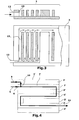
- FIG. 2 is a plan view of a reactor plate 2 of FIG. 1.
- FIG. The supply lines for the educts 5 and 9 are here with metering pumps provided that regulate the reactant stream, wherein the dashed line running part of the supply line 9 indicates that he is is in a different plane than the reactor plate 2, according to Fig. 1 within an adjacent cooling plate.
- the reaction channels here meander and essentially antiparallel alternately.
- the merging of the starting materials can be carried out according to the invention that the reaction mixture immediately behind the mixing point entering a wall-cooled area of the plate, in which the known advantageous intense heat transfer conditions be used in microstructures and a guide of reaction with negligible temperature overshoots is possible.
- Fig. 3 shows a detailed side view (top) and a Top view (bottom) of an exemplary embodiment of a Cooling plate 3, wherein Eduktzu Oberen 9 are omitted.
- the Coolant enters the cooling plate through the inlet 12, here perpendicular to the main flow direction of the reaction medium a plurality of parallel, fanned cooling channels 13 having.
- the structure of the cooling plate, in particular the course of the cooling channels also substantially the structure of the reactor plate and the course of the reaction capillaries correspond.
- Fig. 4 shows in a side view another exemplary Embodiment of the reactor according to the invention, for reasons the overview is shown only a reaction channel.
- FIG. 5 illustrates the example shown Reactor plate 2 '' receives four reaction channels 7 '', which from the inlet point 6 "of a reactant in the reaction plate up to exit in parallel and from another inlet 10 '' parallel to zigzag and on the product side to Combine product collection.
- the educt feeders have this each reaction plate expediently via a common supply line (Lead 5 is shown by way of example).
- Such a way ausgestalteter reactor has the advantage that at the lowest Space requirement already an efficient reaction management with high Throughput and excellent mixing is possible.
- Fig. 6 illustrates a possible variant of the invention Reactor based on a plan view of a reactor plate.
- the Reactor plate 2 '' ' corresponds substantially to the reactor plate 2 ( Figure 2) with the difference that in addition to the Inlet points 6 and 10 in the course of the reaction channel 7 '' ' within the reactor plate 2 '' 'two more of a fed separately laterally brought educt feed 15 Inlets 16 for the supply of more or different Educts are provided.
- Fig. 7 illustrates another possible variant of the invention Reactor based on a side view of a reactor 1''''. This corresponds essentially to that in FIG. 4 represented reactor 1 'with the difference that in addition to the inlet sites 6 and 10, respectively, in the course of the reaction channel 7 '' '' when passing through a cooling plate 3 '' '' another inlet point fed by a separate educt feed line 17 18 and when passing through another cooling plate 3 '' ''' an additional powered by a separate educt feed line 19 Inlet point 20 is provided.
- the additional Inlets may be the same as in the intake ports 6 and 10, but also supplied different reactants of the reaction become.
- the reactor can be operated single phase and also one by high Alkylenoxidkonzentrationen at the feed caused pressure increase in the typical for the alkoxylation Temperature range are controlled unlimited.
- the local stoichiometry can therefore be independent of instrumental constraints set free and thus in particular the kinetics in an advantageous Be exploited, resulting in a process intensification is achieved.
- a failure of the promotion does not lead to any comparable safety-critical Condition, as the not or badly cooled Reaction volumes due to the small hydraulic diameter the channels are drastically smaller than in conventional Reactors.
- the hold-up of unreacted alkylene oxides is so low that the adiabatic temperature increase in case of failure of the Cooling in the microstructured reactor does not pose a security problem leads.
- Another advantage of the alkoxylation in the invention Microreactor is that there is no risk in scale-up.
- modular increase of the number of channels in the microstructured reactor or increasing the Number of microstructured reactors can increase the production capacity be increased easily and without risk.
- the flameproof Construction of the reactor allows for economical pressures in the To set the critical point range and higher space-time yields to achieve.
- the pressure in the microstructured invention Reactor is preferably during operation 11 to 800 bar.
- reaction components during the entire reaction liquid be present, a mass transfer inhibition is avoided, such as in other reactor concepts, in particular stirred tank reactors, occurs. This allows extremely short residence times be that allow an increase in the reaction temperature. This is surprisingly a reduction of causes undesirable side reactions. The product quality is thereby improved.
- microstructured reactor according to the invention can therefore be used in particular for carrying out continuous procedures in be designed for the liquid phase.
- the reactor according to the invention be designed small. That means that for one year's production for example 1,500 to one reactor volume (Hold-Up) of 24 l is sufficient. This is also under safety aspects a big advantage over conventional ones Reactors for the production of polyether alcohols, the especially in loop reactors can not be achieved.
- the low reactor volume also makes fast Product change possible, resulting in the flexible production of a Range of products with otherwise continuous operation allows.
- the reactor can also be known per se from DE-A-100 36 602 Way be done with the difference and the Provided that he is responsible for conducting chemical reactions between substantially liquid reactants below high pressure and at high temperatures.
- the reaction channels can be carried out preferably profiled and / or will be with regular changes in flow guidance Mistake. In this way, optimal mixing of the reactants, resulting in short reaction times and close Molecular mass distributions in the product allows.
- the hydraulic diameter of the channels is advantageously smaller than 2 mm, in particular less than 1 mm, since here the heat transfer is better to the environment.
- the heat exchanger device is, for example, a cooling device.
- This can advantageously cooling channels in the cooling plate parallel or perpendicular to the flow direction of the reaction medium include, wherein the channels preferably from the outside with Help a cooling medium to be cooled.
- the reactor according to the invention can be particularly advantageous in the Reaction channels more, in particular up to 20, more preferably up to 10 inlets for the same or different Provide starting materials.
- An alkylene oxide or various alkylene oxides can be at one or more places in the channels of the microstructured Be metered reactor. This enables produce pure or defined mixed oligomers and / or polymers, whereby by the choice of the position and the supply of the Educts through the inlet sites not only the global composition chain or branched polymers and / or oligomers, but especially the local composition can be influenced, adjusted and / or varied.
- the alkylene oxide may thus consist of a single or of a Be constructed mixture of different monomers.
- the process can preferably be operated continuously.
- particularly short residence times of the reactants and achieve the product in the reactor resulting in particularly high product purity, Product uniformity and narrow molecular mass distribution leads.
- Have with the reactor of the invention itself in the continuous process according to the inventive method Operation, for example, polyethylene oxides and polypropylene oxides in pure white form, unlike brown ones or brownish product that is conventional after batchwise operation Method is achieved.
- the residence time of the reaction mixture in the Reaction channels 1 to 600 s in particular 50 to 400 s, completely especially 100 to 300 s.
- Shorter dwell times vary depending on Catalyst content and reaction temperature have the disadvantage that The reaction may not be complete while longer residence times to product contamination, discoloration and more heterogeneous products, in particular in terms of molecular mass distribution.
- the reaction temperature in the reaction capillaries becomes particularly preferably in the range 80 to 200 ° C, in particular 120 to 200 ° C, particularly preferred is also a reaction temperature in the range of 185 ° C to 195 ° C. This will be the one a sufficiently high reaction rate and high Reaction conversion ensured, which contributes to the residence times in the reactor to shorten and the products free of educts on the other hand may be disturbing side reactions, especially one entering at too high a temperature Decomposition of the products avoided.
- a pressure in the reaction channels in the range 11 to 800 bar, preferably 40 to 500 bar, more preferably 60 to 180 bar ensures that the alkylene oxide even at elevated Temperature is liquid.
- high pressure favors the Reaction rate and conversion and mixing the reactants. Nevertheless, the pressure should be for security reasons Do not exceed 800 bar for economic operation to enable.
- m is 1 to 8, very particularly preferably 1 and X is O.
- monohydric or polyhydric alcohols in particular alkylene alcohols and / or alkyl alcohols.
- Important Species are allyl alcohol, butanol, ether alcohols, polyether alcohols, Glycerine, propylene glycols, ethylene glycols, trimethylolpropane, Polyols, natural and synthetic fatty alcohols.
- fatty acids, Phosphoric acid esters and / or phosphoric acids advantageous be used.
- X is NH
- Alkylene oxides are ethylene oxide, propylene oxide, but also other epoxides such as butylene oxide, styrene oxide, dodecene oxide, allyl glycidyl ether as well as their mixtures.
- the catalyst in an amount of 0.001 to 30%, based on the molar amount of the compound of the general formula R 1 (XH) m .
- the catalyst is in particular a base, for example an alkali metal methoxide and / or an alkali metal hydroxide.
- bases very particular preference is given to using alkali metal methoxides, salts or metal hydroxides, with sodium hydroxide and potassium hydroxide as well as sodium methoxide and potassium methoxide being the most preferred.
- preference is given to using from 0.01 to 30%, in particular from 1 to 15%, based on the molar amount of the compound of the general formula R 1 (XH) m .
- organometallic compounds for example one or more bimetallic compounds such as Zn-Co and / or Zn-Fe catalysts or even acids, as the catalyst.
- organometallic compounds for example one or more bimetallic compounds such as Zn-Co and / or Zn-Fe catalysts or even acids, as the catalyst.
- the reaction then does not proceed via the alcoholate but via another mechanism.
- oligomers and polymers be understood by the polyaddition of alkylene oxide Alcohols or alcohols and base or their derivatives are formed.
- Derivatives of the alcohols or alcoholates or the Base are primarily those compounds that are unique or repeated addition of alkylene oxide to alcoholates and the base used is formed.
- Starting alcohol can be the corresponding acid of the used Base are removed and thus the alcoholate of the starting alcohol be formed or remain in the system. The base takes then participate in the alkoxylation reaction.
- the catalyst may be in the starting alcohol or in a suitable Solvent dissolved or, depending on the concentration preferred as Suspension can be used. This is possible, a high To provide catalyst amount. This will be a achieves high and uniform reaction speed, what in the Association with good heat dissipation while avoiding temperature peaks ("Hot spots") to a high purity of the products leads. This is expressed inter alia in that according to the invention produced polyether alcohols substantially white or are colorless.
- the inventive method provides, for example, that the alkylene oxide or the alkylene oxides in more complete Quantity in the first inlet point at the beginning of the reaction in the Reaction space of the reactor, the reaction channels, admits, without that thereby common difficulties in the prior art, For example, "hot spots" occur (monofeed variant). It There is thus no need to add to multiple inlet sites to distribute.
- the alkylene oxide or the alkylene oxides can be used also by one or more others, in particular up to a total of 20, most preferably up to a total of Feed 10 inlet points into the reaction capillary (multifeed version).
- the structure of the polyether alcohol chains especially blockwise influence or define.
- the invention also includes the same or different compounds R 1 (XH) m , preferably one or different alcohols or R 1 (XH) m catalyst mixtures, preferably in the form of one or more suspensions via different inlet sites at different Supply positions of the reaction channels or the reaction space.
- R 1 (XH) m preferably one or different alcohols or R 1 (XH) m catalyst mixtures, preferably in the form of one or more suspensions via different inlet sites at different Supply positions of the reaction channels or the reaction space.
- polyether alcohols of high uniformity and purity can be prepared in the reactor according to the invention.
- Polyether alcohols according to the invention are therefore preferably those of the general formula (I) extending through a chain length n in the range of 1 to 200, preferably 5 to 150 and a molecular weight distribution M W / M n of not more than 1.20, preferably not more than 1.08, particularly preferably not more than 1,
- R 1 in the general formula R 1 (XH) m is a mono- or polyvalent organic radical
- m is a corresponding integer
- R 2 in the molecule is identical or different for hydrogen and / or an organic radical, in particular CH 3 , C 2 H 5 , phenyl, C 10 H 21 , allyloxymethyl
- X is O, S, NH or NR 'and R' is an organic cyclic or acyclic, optionally substituted radical having 1 to 26 carbon atoms.
- the polyether alcohols of the invention may preferably have a Ethylene oxide content in the product that is less than 10 ppm is.
- a big advantage is that according to the invention for the first time up to 100 alkylene oxide units, in particular Ethylene oxide units in a polyether alcohol chain higher Unity and purity can be integrated. in the Prior art, this was continuous up to one Chain length of 20 units possible.
- the purity of the invention Among other things, products are that they essentially do without further purification steps colorless (white) can be obtained while on conventional Way produced polyether alcohols in the alkaline State always only by consuming product cleaning yellowish to brownish discoloration to be removed exhibit.
- FIGS. 1 to 3 show a reactor according to the invention, as an example of a reactor for the "Monofeed” method should serve.
- microreactor 1 made of stainless steel V2A, the had four plane-parallel reactor plates 2, which at their outer Main planes and between them of a total of five plane-parallel Cold plates 3 were enclosed.
- the reactor pointed on one side a main supply line provided with a metering pump 4 for liquid alkylene oxide, which is in each case fanned a supply 5 per reactor plate, the immediate into the inlet locations 6 at the entrance of the reaction capillaries 7 resulted.
- the reactor was essentially the same as the reactor of the example 1a with the difference that, as shown in Fig. 4, which to each other parallel reaction capillaries 7 'not substantially within the plane of a reactor plate 2 ', but within a plane perpendicular thereto, the reaction medium meandering in antiparallel alternating paths is guided, whose antiparallel sections opposite to the parallel Sections are long and each one in the level Run reactor plate 2 '.
- Fig. 4 shows only one reaction capillary. However, it became a flock of four in parallel running reaction capillaries executed.
- the reactor was essentially the same as the reactor of the example 1a with the difference that a reactor plate 2 '' as shown in FIG. 5, four reaction capillaries 7 "were recorded by the Alcohol inlet point ran zigzag parallel and united on the product side to the product collection. If at This reactor also the reaction capillaries and thus the reaction volume and the reaction time is shorter and the cooling area were lower than in the reactor of Example 1a, so this showed Reactor the advantage that with minimum space already an efficient reaction with high throughput and excellent Mixing is possible.
- FIG. 6 A variant of a reactor for the "multifeed" process is shown in Fig. 6. He essentially corresponded to the reactor of Example 1a with the difference that in addition to the inlet points 6 or, 10 in the course of the reaction capillary 7 '' ' within the reactor plate 2 '' 'two more of a separate laterally brought educt feed 15 fed intake points 16 for the supply of more or different Edukte, ie alkylene oxide and / or alcohol was provided.
- FIG. He Another variant of a reactor for the "multifeed process" is shown in FIG. He essentially corresponded to that Reactor of Example 1b with the difference that in addition to the inlet points 6 and 10 in the course of Reaction capillary 7 '' '' when passing through a cooling plate 3 '' '' another of a separate alkylene oxide feed line 17 fed inlet point 18 and the passage through a another cooling plate 3 '' ''' an additional of a separate Alcohol feed line 19 fed inlet 20 was provided. Due to the additional inlet points could be same as in the inlet sites 6 and 10, but also different reactants be supplied to the reaction.
- Example 3 a suspension of butanol and 10 mol% KOMe was continuously pumped into the reactor of Example 1a with the simultaneous feed of ethylene oxide in a ratio of 1:65.
- the residence time was 200 seconds, the heat exchanger temperature was set to 150 ° C.
- the pressure in the reactor was 120 bar.
- the product leaving the reactor was cooled after a short delay to 50 ° C and placed under vacuum in a collecting vessel.
- the conversion was 99.2% , No vinyl ether was formed.
- PO propylene oxide
- Example 2 As described in Example 1, a suspension of butanol and 5 mol% KOMe was continuously pumped into the reactor with the simultaneous feed of propylene oxide in a ratio of 1:12.
- the residence time was 300 seconds, the heat exchanger temperature was set to 150 ° C.
- the pressure in the reactor was 100 bar.
- the product leaving the reactor was cooled after a short delay to 50 ° C and placed under vacuum in a collecting vessel.
- PO propylene oxide
Landscapes
- Chemical & Material Sciences (AREA)
- Organic Chemistry (AREA)
- Chemical Kinetics & Catalysis (AREA)
- Health & Medical Sciences (AREA)
- Medicinal Chemistry (AREA)
- Polymers & Plastics (AREA)
- Polyethers (AREA)
- Organic Low-Molecular-Weight Compounds And Preparation Thereof (AREA)
Applications Claiming Priority (2)
| Application Number | Priority Date | Filing Date | Title |
|---|---|---|---|
| DE102004013551A DE102004013551A1 (de) | 2004-03-19 | 2004-03-19 | Alkoxylierungen in mikrostrukturierten Kapillarreaktoren |
| DE102004013551 | 2004-03-19 |
Publications (2)
| Publication Number | Publication Date |
|---|---|
| EP1586372A1 true EP1586372A1 (fr) | 2005-10-19 |
| EP1586372B1 EP1586372B1 (fr) | 2009-06-24 |
Family
ID=34934085
Family Applications (1)
| Application Number | Title | Priority Date | Filing Date |
|---|---|---|---|
| EP05004877A Revoked EP1586372B1 (fr) | 2004-03-19 | 2005-03-05 | Alkoxylation dans un réacteur capillaire ayant une microstructure |
Country Status (4)
| Country | Link |
|---|---|
| US (1) | US7858829B2 (fr) |
| EP (1) | EP1586372B1 (fr) |
| DE (2) | DE102004013551A1 (fr) |
| ES (1) | ES2328250T3 (fr) |
Cited By (10)
| Publication number | Priority date | Publication date | Assignee | Title |
|---|---|---|---|---|
| WO2007135154A1 (fr) * | 2006-05-23 | 2007-11-29 | Basf Se | Procédé pour la fabrication de polyols de polyéther |
| WO2008028586A1 (fr) * | 2006-09-07 | 2008-03-13 | Cognis Ip Management Gmbh | Procédé de préparation de produits d'addition d'oxydes d'alkylène |
| WO2008028587A1 (fr) | 2006-09-07 | 2008-03-13 | Cognis Ip Management Gmbh | Procédé de préparation des produits d'addition d'oxydes d'alkylène |
| WO2008148661A1 (fr) * | 2007-06-04 | 2008-12-11 | Basf Se | Procédé de production de cyclopentanone |
| DE102010039090A1 (de) | 2010-08-09 | 2012-02-09 | Basf Se | Verfahren zur Herstellung von Polyetheralkoholen |
| WO2013091721A1 (fr) * | 2011-12-23 | 2013-06-27 | Lonza Ag | Microréacteur pour la mise en œuvre de réactions chimiques |
| CN103818975A (zh) * | 2014-03-14 | 2014-05-28 | 石家庄聚业化工助剂有限公司 | 一种净水剂及其制备方法 |
| EP2826551A4 (fr) * | 2012-03-12 | 2016-01-20 | Kobe Steel Ltd | Procédé d'exploitation d'un réacteur à microcanaux et réacteur à microcanaux |
| EP1951423A4 (fr) * | 2005-10-24 | 2017-11-15 | Alfa Laval Corporate AB | Module d'ecoulement multifonction |
| EP3988601A1 (fr) | 2020-10-20 | 2022-04-27 | Clariant International Ltd | Procédé de fabrication d'alcools polyéthéraux à faible teneur en ions métalliques |
Families Citing this family (27)
| Publication number | Priority date | Publication date | Assignee | Title |
|---|---|---|---|---|
| DE10361893A1 (de) * | 2003-12-19 | 2005-07-21 | Degussa Ag | Spezielles Verfahren zur Herstellung von Fluoralkylgruppen tragenden Siliciumverbindungen durch Hydrosilylierung |
| CA2557822C (fr) * | 2004-03-02 | 2010-06-15 | Velocys, Inc. | Reacteur de polymerisation a microcanaux |
| EP2275198A1 (fr) * | 2006-05-11 | 2011-01-19 | Corning Incorporated | Distributeur microfluidique |
| DE102007023762A1 (de) * | 2006-08-10 | 2008-02-14 | Evonik Degussa Gmbh | Anlage und Verfahren zur kontinuierlichen industriellen Herstellung von 3-Glycidyloxypropylalkoxysilanen |
| DE102007023763A1 (de) * | 2006-08-10 | 2008-02-14 | Evonik Degussa Gmbh | Anlage, Reaktor und Verfahren zur kontinuierlichen industriellen Herstellung von Polyetheralkylalkoxysilanen |
| US7670567B2 (en) * | 2007-01-31 | 2010-03-02 | Stevens Institute Of Technology | Scalable microreactors and methods for using same |
| CN102186886B (zh) | 2008-08-20 | 2015-08-19 | 卡吉尔公司 | 新型聚葡萄糖材料 |
| EP2193839B1 (fr) * | 2008-11-28 | 2019-03-13 | Corning Incorporated | Dispositifs pour la distribution de fluides dans des microréacteurs |
| US8877930B2 (en) * | 2009-11-04 | 2014-11-04 | Massachusetts Institute Of Technology | Continuous flow synthesis of amino alcohols using microreactors |
| WO2011109276A1 (fr) | 2010-03-01 | 2011-09-09 | Massachussets Institute Of Technology | Catalyseurs d'époxydation |
| US9527057B2 (en) | 2010-10-18 | 2016-12-27 | Velocys, Inc. | Laminated, leak-resistant chemical processors; methods of making, and methods of operating |
| KR20140007852A (ko) * | 2011-02-24 | 2014-01-20 | 쉘 인터내셔날 리써취 마트샤피지 비.브이. | 폴리에테르 폴리올의 제조를 위한 방법 및 반응기 시스템 |
| DE102011109540A1 (de) | 2011-08-03 | 2013-02-07 | Evonik Goldschmidt Gmbh | Alkylcarbonat endverschlossene Polyethersilioxane und Verfahren zu deren Herstellung |
| DE102011083017A1 (de) | 2011-09-20 | 2013-03-21 | Evonik Industries Ag | Verbundwerkstoffe umfassend eine offenzellige Polymermatrix und darin eingebettete Granulate |
| JP5610646B2 (ja) * | 2012-10-26 | 2014-10-22 | 竹本油脂株式会社 | アルキレンオキシド付加体の製造方法 |
| DE102013204991A1 (de) | 2013-03-21 | 2014-09-25 | Evonik Industries Ag | Herstellung von Polyurethanschäumen, die Polyole auf Polyolefinbasis enthalten |
| JP6128932B2 (ja) * | 2013-04-22 | 2017-05-17 | 株式会社神戸製鋼所 | 処理装置及び処理方法 |
| CN106061932A (zh) * | 2014-03-10 | 2016-10-26 | 竹本油脂株式会社 | 环氧烷烃加成物的制造方法和环氧烷烃加成物 |
| DE102014215382A1 (de) | 2014-08-05 | 2016-02-11 | Evonik Degussa Gmbh | Stickstoffhaltige Verbindungen, geeignet zur Verwendung bei der Herstellung von Polyurethanen |
| DE102014215384A1 (de) | 2014-08-05 | 2016-02-11 | Evonik Degussa Gmbh | Stickstoffhaltige Verbindungen, geeignet zur Verwendung bei der Herstellung von Polyurethanen |
| DE102014215388A1 (de) | 2014-08-05 | 2016-02-11 | Evonik Degussa Gmbh | Stickstoffhaltige Verbindungen, geeignet zur Verwendung bei der Herstellung von Polyurethanen |
| CN104829824B (zh) * | 2015-05-18 | 2017-07-28 | 南京工业大学 | 一种微结构反应器中合成聚醚多元醇的方法 |
| US9751849B1 (en) | 2016-12-06 | 2017-09-05 | King Fahd University Of Petroleum And Minerals | Method of producing a furanone compound |
| CN106750244B (zh) * | 2016-12-20 | 2019-05-03 | 红宝丽集团股份有限公司 | 一种利用微通道反应器制备聚醚多元醇的方法 |
| CN113522195B (zh) * | 2019-06-06 | 2022-08-09 | 福建齐衡科技有限公司 | 一种便于更换催化剂的插片式微通道连续反应器 |
| CN112090388B (zh) * | 2020-09-07 | 2022-04-12 | 浙江大学 | 一种连续流反应器及其在化学反应和合成中的应用 |
| CN115710163B (zh) * | 2022-11-16 | 2023-07-07 | 信诺立兴(黄骅市)集团股份有限公司 | 一种连续流生产邻苯基苯氧乙醇的方法 |
Citations (5)
| Publication number | Priority date | Publication date | Assignee | Title |
|---|---|---|---|---|
| US5843385A (en) * | 1995-07-18 | 1998-12-01 | Basf Corporation | Plate-type chemical reactor |
| DE19728520A1 (de) * | 1997-07-04 | 1999-01-07 | Imb Inst Fuer Molekulare Biote | Schaltbarer dynamischer Mikromischer mit minimalem Totvolumen |
| DE10036602A1 (de) * | 2000-07-27 | 2002-02-14 | Cpc Cellular Process Chemistry | Mikroreaktor für Reaktionen zwischen Gasen und Flüssigkeiten |
| WO2004012864A1 (fr) * | 2002-08-06 | 2004-02-12 | Canon Kabushiki Kaisha | Appareil de transfert de liquide et procede pour produire cet appareil |
| US20040034266A1 (en) * | 2002-06-13 | 2004-02-19 | Brophy John H. | Catalytic oxidative dehydrogenation, and microchannel reactors for catalytic oxidative dehydrogenation |
Family Cites Families (11)
| Publication number | Priority date | Publication date | Assignee | Title |
|---|---|---|---|---|
| US5159092A (en) | 1989-09-22 | 1992-10-27 | Buss Ag | Process for the safe and environmentally sound production of highly pure alkylene oxide adducts |
| DE4128827A1 (de) | 1991-08-30 | 1993-03-04 | Henkel Kgaa | Verfahren zum katalysierten alkoxylieren von fettderivaten |
| DE69413012T2 (de) * | 1993-03-19 | 1999-03-25 | Du Pont | Integrierte vorrichtung für chemische verfahrensschritte und herstellungsverfahren dafür |
| US5364973A (en) * | 1993-05-06 | 1994-11-15 | Arco Chemical Technology | Productive process for making conventional and low-unsaturation polyether polyols |
| US5811062A (en) * | 1994-07-29 | 1998-09-22 | Battelle Memorial Institute | Microcomponent chemical process sheet architecture |
| US5723094A (en) * | 1996-10-29 | 1998-03-03 | Arco Chemical Technology, L.P. | Reactor for chemical reactions |
| US6749814B1 (en) * | 1999-03-03 | 2004-06-15 | Symyx Technologies, Inc. | Chemical processing microsystems comprising parallel flow microreactors and methods for using same |
| DE10054462B4 (de) | 2000-11-03 | 2005-02-17 | Basf Ag | Kontinuierliches Verfahren zur Alkoxylierung in der Flüssigphase |
| US20040141893A1 (en) * | 2003-01-21 | 2004-07-22 | Martin Jerry L. | Chemical reactor with enhanced heat exchange |
| US7422910B2 (en) * | 2003-10-27 | 2008-09-09 | Velocys | Manifold designs, and flow control in multichannel microchannel devices |
| RU2382310C2 (ru) * | 2004-11-03 | 2010-02-20 | Велосис, Инк. | Способ парциального кипячения в мини- и микроканалах |
-
2004
- 2004-03-19 DE DE102004013551A patent/DE102004013551A1/de not_active Ceased
-
2005
- 2005-03-05 ES ES05004877T patent/ES2328250T3/es not_active Expired - Lifetime
- 2005-03-05 EP EP05004877A patent/EP1586372B1/fr not_active Revoked
- 2005-03-05 DE DE502005007546T patent/DE502005007546D1/de not_active Expired - Lifetime
- 2005-03-17 US US11/083,172 patent/US7858829B2/en not_active Expired - Fee Related
Patent Citations (5)
| Publication number | Priority date | Publication date | Assignee | Title |
|---|---|---|---|---|
| US5843385A (en) * | 1995-07-18 | 1998-12-01 | Basf Corporation | Plate-type chemical reactor |
| DE19728520A1 (de) * | 1997-07-04 | 1999-01-07 | Imb Inst Fuer Molekulare Biote | Schaltbarer dynamischer Mikromischer mit minimalem Totvolumen |
| DE10036602A1 (de) * | 2000-07-27 | 2002-02-14 | Cpc Cellular Process Chemistry | Mikroreaktor für Reaktionen zwischen Gasen und Flüssigkeiten |
| US20040034266A1 (en) * | 2002-06-13 | 2004-02-19 | Brophy John H. | Catalytic oxidative dehydrogenation, and microchannel reactors for catalytic oxidative dehydrogenation |
| WO2004012864A1 (fr) * | 2002-08-06 | 2004-02-12 | Canon Kabushiki Kaisha | Appareil de transfert de liquide et procede pour produire cet appareil |
Cited By (18)
| Publication number | Priority date | Publication date | Assignee | Title |
|---|---|---|---|---|
| EP1951423A4 (fr) * | 2005-10-24 | 2017-11-15 | Alfa Laval Corporate AB | Module d'ecoulement multifonction |
| US8034980B2 (en) | 2006-05-23 | 2011-10-11 | Basf Aktiengesellschaft | Method for producing polyether polyols |
| WO2007135154A1 (fr) * | 2006-05-23 | 2007-11-29 | Basf Se | Procédé pour la fabrication de polyols de polyéther |
| US8674146B2 (en) | 2006-09-07 | 2014-03-18 | Cognis Ip Management Gmbh | Method for producing alkylene oxide addition products |
| WO2008028587A1 (fr) | 2006-09-07 | 2008-03-13 | Cognis Ip Management Gmbh | Procédé de préparation des produits d'addition d'oxydes d'alkylène |
| WO2008028586A1 (fr) * | 2006-09-07 | 2008-03-13 | Cognis Ip Management Gmbh | Procédé de préparation de produits d'addition d'oxydes d'alkylène |
| WO2008148661A1 (fr) * | 2007-06-04 | 2008-12-11 | Basf Se | Procédé de production de cyclopentanone |
| US9120731B2 (en) | 2010-08-09 | 2015-09-01 | Basf Se | Process for preparing polyether alcohols |
| DE102010039090A1 (de) | 2010-08-09 | 2012-02-09 | Basf Se | Verfahren zur Herstellung von Polyetheralkoholen |
| WO2012020005A1 (fr) | 2010-08-09 | 2012-02-16 | Basf Se | Procédé de production de polyéther-alcools |
| RU2591208C2 (ru) * | 2010-08-09 | 2016-07-20 | Басф Се | Способ получения полиэфироспиртов |
| WO2013091721A1 (fr) * | 2011-12-23 | 2013-06-27 | Lonza Ag | Microréacteur pour la mise en œuvre de réactions chimiques |
| EP2826551A4 (fr) * | 2012-03-12 | 2016-01-20 | Kobe Steel Ltd | Procédé d'exploitation d'un réacteur à microcanaux et réacteur à microcanaux |
| US9656235B2 (en) | 2012-03-12 | 2017-05-23 | Kobe Steel, Ltd. | Operation method for multichannel apparatus and multichannel apparatus |
| CN103818975B (zh) * | 2014-03-14 | 2015-08-12 | 石家庄聚业化工助剂有限公司 | 一种净水剂及其制备方法 |
| CN103818975A (zh) * | 2014-03-14 | 2014-05-28 | 石家庄聚业化工助剂有限公司 | 一种净水剂及其制备方法 |
| EP3988601A1 (fr) | 2020-10-20 | 2022-04-27 | Clariant International Ltd | Procédé de fabrication d'alcools polyéthéraux à faible teneur en ions métalliques |
| WO2022083926A1 (fr) | 2020-10-20 | 2022-04-28 | Clariant International Ltd | Procédé de préparation d'alcools de polyéther ayant une faible teneur en ions métalliques |
Also Published As
| Publication number | Publication date |
|---|---|
| US20050245628A1 (en) | 2005-11-03 |
| DE102004013551A1 (de) | 2005-10-06 |
| ES2328250T3 (es) | 2009-11-11 |
| US7858829B2 (en) | 2010-12-28 |
| EP1586372B1 (fr) | 2009-06-24 |
| DE502005007546D1 (de) | 2009-08-06 |
Similar Documents
| Publication | Publication Date | Title |
|---|---|---|
| EP1586372B1 (fr) | Alkoxylation dans un réacteur capillaire ayant une microstructure | |
| EP2603543B1 (fr) | Procédé de production de polyéther-alcools | |
| EP2027180A1 (fr) | Procédé pour la fabrication de polyols de polyéther | |
| EP2065427B1 (fr) | Procédé d'alkoxylation à l'aide de catalyseurs DMC dans un réacteur à écoulement en boucle avec aspiration des rayons | |
| EP2318129B1 (fr) | Réacteurs à jet et à boucle de circulation montés en parallèle | |
| EP1114017B1 (fr) | Procede de preparation d'aldehydes et/ou d'alcanols ou d'amines | |
| DE60109678T2 (de) | Nachrüstreaktor mit Gas-Flüssigkeitsejektor und Monolithkatalysator | |
| DE60209969T2 (de) | Monolithischer Reaktor mit Katalysator, gekoppelt mit einem statischen Mixer | |
| EP1685896B1 (fr) | Réactions d'équilibre et réaction gaz/liquide dans un réacteur en boucle | |
| EP0628553A1 (fr) | Réacteur et procédé de préparation en continu de carbonate d'éthylène glycol ou de propylène glycol réalisé dans ce réacteur | |
| DE2719967C2 (fr) | ||
| EP1259560B2 (fr) | Procede de production de polyols de polyether | |
| EP1718588A1 (fr) | Procede pour produire des diethers d'alkylene glycol | |
| DE102005043719A1 (de) | Vorrichtung und Verfahren für kontinuierlich durchgeführte Gleichgewichtsreaktionen | |
| DE10054462B4 (de) | Kontinuierliches Verfahren zur Alkoxylierung in der Flüssigphase | |
| EP4232500B1 (fr) | Procédé de fabrication d'alcools polyéthéraux à faible teneur en ions métalliques | |
| EP2059494B1 (fr) | Procédé de préparation de produits d'addition d'oxydes d'alkylène | |
| DE4128827A1 (de) | Verfahren zum katalysierten alkoxylieren von fettderivaten | |
| DE2053196A1 (de) | Verfahren zur katalytischen Spaltung von Aralkylhydroperoxiden | |
| EP1890801B1 (fr) | Production progressive de diacétoneacrylamide | |
| WO2002049737A1 (fr) | Utilisation d'un canal de micro-reaction avec element piezo-electrique |
Legal Events
| Date | Code | Title | Description |
|---|---|---|---|
| PUAI | Public reference made under article 153(3) epc to a published international application that has entered the european phase |
Free format text: ORIGINAL CODE: 0009012 |
|
| 17P | Request for examination filed |
Effective date: 20050310 |
|
| AK | Designated contracting states |
Kind code of ref document: A1 Designated state(s): AT BE BG CH CY CZ DE DK EE ES FI FR GB GR HU IE IS IT LI LT LU MC NL PL PT RO SE SI SK TR |
|
| AX | Request for extension of the european patent |
Extension state: AL BA HR LV MK YU |
|
| AKX | Designation fees paid |
Designated state(s): DE ES FR GB IT NL |
|
| 17Q | First examination report despatched |
Effective date: 20061109 |
|
| GRAP | Despatch of communication of intention to grant a patent |
Free format text: ORIGINAL CODE: EPIDOSNIGR1 |
|
| RAP1 | Party data changed (applicant data changed or rights of an application transferred) |
Owner name: EVONIK GOLDSCHMIDT GMBH |
|
| GRAS | Grant fee paid |
Free format text: ORIGINAL CODE: EPIDOSNIGR3 |
|
| GRAA | (expected) grant |
Free format text: ORIGINAL CODE: 0009210 |
|
| AK | Designated contracting states |
Kind code of ref document: B1 Designated state(s): DE ES FR GB IT NL |
|
| REG | Reference to a national code |
Ref country code: GB Ref legal event code: FG4D Free format text: NOT ENGLISH |
|
| REF | Corresponds to: |
Ref document number: 502005007546 Country of ref document: DE Date of ref document: 20090806 Kind code of ref document: P |
|
| REG | Reference to a national code |
Ref country code: ES Ref legal event code: FG2A Ref document number: 2328250 Country of ref document: ES Kind code of ref document: T3 |
|
| PLBI | Opposition filed |
Free format text: ORIGINAL CODE: 0009260 |
|
| 26 | Opposition filed |
Opponent name: BASF SE Effective date: 20100323 |
|
| PLAX | Notice of opposition and request to file observation + time limit sent |
Free format text: ORIGINAL CODE: EPIDOSNOBS2 |
|
| PLAB | Opposition data, opponent's data or that of the opponent's representative modified |
Free format text: ORIGINAL CODE: 0009299OPPO |
|
| R26 | Opposition filed (corrected) |
Opponent name: BASF SE Effective date: 20100323 |
|
| PLAF | Information modified related to communication of a notice of opposition and request to file observations + time limit |
Free format text: ORIGINAL CODE: EPIDOSCOBS2 |
|
| PLBB | Reply of patent proprietor to notice(s) of opposition received |
Free format text: ORIGINAL CODE: EPIDOSNOBS3 |
|
| PGFP | Annual fee paid to national office [announced via postgrant information from national office to epo] |
Ref country code: FR Payment date: 20120403 Year of fee payment: 8 |
|
| PGFP | Annual fee paid to national office [announced via postgrant information from national office to epo] |
Ref country code: DE Payment date: 20120323 Year of fee payment: 8 |
|
| PGFP | Annual fee paid to national office [announced via postgrant information from national office to epo] |
Ref country code: GB Payment date: 20120322 Year of fee payment: 8 Ref country code: IT Payment date: 20120327 Year of fee payment: 8 |
|
| PGFP | Annual fee paid to national office [announced via postgrant information from national office to epo] |
Ref country code: NL Payment date: 20120327 Year of fee payment: 8 |
|
| REG | Reference to a national code |
Ref country code: DE Ref legal event code: R103 Ref document number: 502005007546 Country of ref document: DE Ref country code: DE Ref legal event code: R064 Ref document number: 502005007546 Country of ref document: DE |
|
| RDAF | Communication despatched that patent is revoked |
Free format text: ORIGINAL CODE: EPIDOSNREV1 |
|
| PGFP | Annual fee paid to national office [announced via postgrant information from national office to epo] |
Ref country code: ES Payment date: 20120316 Year of fee payment: 8 |
|
| RDAG | Patent revoked |
Free format text: ORIGINAL CODE: 0009271 |
|
| STAA | Information on the status of an ep patent application or granted ep patent |
Free format text: STATUS: PATENT REVOKED |
|
| 27W | Patent revoked |
Effective date: 20121123 |
|
| GBPR | Gb: patent revoked under art. 102 of the ep convention designating the uk as contracting state |
Effective date: 20121123 |
|
| REG | Reference to a national code |
Ref country code: DE Ref legal event code: R107 Ref document number: 502005007546 Country of ref document: DE Effective date: 20131031 |