EP1586679A1 - Metallabscheidungsbeschichtungsfilm mit gleitfunktion und damit beschichteter gegenstand - Google Patents
Metallabscheidungsbeschichtungsfilm mit gleitfunktion und damit beschichteter gegenstand Download PDFInfo
- Publication number
- EP1586679A1 EP1586679A1 EP04702072A EP04702072A EP1586679A1 EP 1586679 A1 EP1586679 A1 EP 1586679A1 EP 04702072 A EP04702072 A EP 04702072A EP 04702072 A EP04702072 A EP 04702072A EP 1586679 A1 EP1586679 A1 EP 1586679A1
- Authority
- EP
- European Patent Office
- Prior art keywords
- layer
- alloy
- copper
- tin
- silver
- Prior art date
- Legal status (The legal status is an assumption and is not a legal conclusion. Google has not performed a legal analysis and makes no representation as to the accuracy of the status listed.)
- Withdrawn
Links
- 229910052751 metal Inorganic materials 0.000 title claims abstract description 14
- 239000002184 metal Substances 0.000 title claims abstract description 14
- 238000007747 plating Methods 0.000 title abstract description 35
- 239000011248 coating agent Substances 0.000 title abstract description 9
- 238000000576 coating method Methods 0.000 title abstract description 9
- 229910045601 alloy Inorganic materials 0.000 claims abstract description 98
- 239000000956 alloy Substances 0.000 claims abstract description 98
- 239000000463 material Substances 0.000 claims description 128
- RYGMFSIKBFXOCR-UHFFFAOYSA-N Copper Chemical compound [Cu] RYGMFSIKBFXOCR-UHFFFAOYSA-N 0.000 claims description 90
- 239000010949 copper Substances 0.000 claims description 85
- 239000011135 tin Substances 0.000 claims description 71
- 229910052802 copper Inorganic materials 0.000 claims description 70
- BQCADISMDOOEFD-UHFFFAOYSA-N Silver Chemical compound [Ag] BQCADISMDOOEFD-UHFFFAOYSA-N 0.000 claims description 67
- ATJFFYVFTNAWJD-UHFFFAOYSA-N Tin Chemical compound [Sn] ATJFFYVFTNAWJD-UHFFFAOYSA-N 0.000 claims description 67
- 239000004332 silver Substances 0.000 claims description 64
- 229910052718 tin Inorganic materials 0.000 claims description 62
- HCHKCACWOHOZIP-UHFFFAOYSA-N Zinc Chemical compound [Zn] HCHKCACWOHOZIP-UHFFFAOYSA-N 0.000 claims description 61
- 239000011701 zinc Substances 0.000 claims description 60
- 229910052709 silver Inorganic materials 0.000 claims description 59
- 229910052725 zinc Inorganic materials 0.000 claims description 51
- 229910000881 Cu alloy Inorganic materials 0.000 claims description 46
- APFVFJFRJDLVQX-UHFFFAOYSA-N indium atom Chemical compound [In] APFVFJFRJDLVQX-UHFFFAOYSA-N 0.000 claims description 30
- 229910052738 indium Inorganic materials 0.000 claims description 29
- WATWJIUSRGPENY-UHFFFAOYSA-N antimony atom Chemical compound [Sb] WATWJIUSRGPENY-UHFFFAOYSA-N 0.000 claims description 25
- 229910002058 ternary alloy Inorganic materials 0.000 claims description 18
- 229910052787 antimony Inorganic materials 0.000 claims description 16
- 229910052782 aluminium Inorganic materials 0.000 claims description 5
- XAGFODPZIPBFFR-UHFFFAOYSA-N aluminium Chemical compound [Al] XAGFODPZIPBFFR-UHFFFAOYSA-N 0.000 claims description 5
- 229910000838 Al alloy Inorganic materials 0.000 claims description 4
- 229910001069 Ti alloy Inorganic materials 0.000 claims description 4
- RTAQQCXQSZGOHL-UHFFFAOYSA-N Titanium Chemical compound [Ti] RTAQQCXQSZGOHL-UHFFFAOYSA-N 0.000 claims description 4
- 239000000919 ceramic Substances 0.000 claims description 4
- 239000010935 stainless steel Substances 0.000 claims description 4
- 229910001220 stainless steel Inorganic materials 0.000 claims description 4
- 239000010936 titanium Substances 0.000 claims description 4
- 229910052719 titanium Inorganic materials 0.000 claims description 4
- 239000010410 layer Substances 0.000 description 243
- 230000000052 comparative effect Effects 0.000 description 56
- 238000012360 testing method Methods 0.000 description 39
- KUNSUQLRTQLHQQ-UHFFFAOYSA-N copper tin Chemical compound [Cu].[Sn] KUNSUQLRTQLHQQ-UHFFFAOYSA-N 0.000 description 24
- 238000002203 pretreatment Methods 0.000 description 23
- 239000000203 mixture Substances 0.000 description 19
- 229910000906 Bronze Inorganic materials 0.000 description 17
- 239000010974 bronze Substances 0.000 description 17
- 230000002349 favourable effect Effects 0.000 description 16
- 238000000034 method Methods 0.000 description 16
- 239000002356 single layer Substances 0.000 description 16
- XFXPMWWXUTWYJX-UHFFFAOYSA-N Cyanide Chemical compound N#[C-] XFXPMWWXUTWYJX-UHFFFAOYSA-N 0.000 description 14
- 229910001128 Sn alloy Inorganic materials 0.000 description 14
- 238000011156 evaluation Methods 0.000 description 14
- KWYUFKZDYYNOTN-UHFFFAOYSA-M Potassium hydroxide Chemical compound [OH-].[K+] KWYUFKZDYYNOTN-UHFFFAOYSA-M 0.000 description 12
- HEMHJVSKTPXQMS-UHFFFAOYSA-M Sodium hydroxide Chemical compound [OH-].[Na+] HEMHJVSKTPXQMS-UHFFFAOYSA-M 0.000 description 12
- 229910001297 Zn alloy Inorganic materials 0.000 description 11
- 229910001316 Ag alloy Inorganic materials 0.000 description 9
- 229910020888 Sn-Cu Inorganic materials 0.000 description 9
- 229910019204 Sn—Cu Inorganic materials 0.000 description 9
- 239000010687 lubricating oil Substances 0.000 description 9
- NNFCIKHAZHQZJG-UHFFFAOYSA-N potassium cyanide Chemical compound [K+].N#[C-] NNFCIKHAZHQZJG-UHFFFAOYSA-N 0.000 description 9
- AFVFQIVMOAPDHO-UHFFFAOYSA-N Methanesulfonic acid Chemical compound CS(O)(=O)=O AFVFQIVMOAPDHO-UHFFFAOYSA-N 0.000 description 8
- DOBRDRYODQBAMW-UHFFFAOYSA-N copper(i) cyanide Chemical compound [Cu+].N#[C-] DOBRDRYODQBAMW-UHFFFAOYSA-N 0.000 description 8
- 238000009713 electroplating Methods 0.000 description 8
- 238000004519 manufacturing process Methods 0.000 description 8
- 230000013011 mating Effects 0.000 description 8
- GTLDTDOJJJZVBW-UHFFFAOYSA-N zinc cyanide Chemical compound [Zn+2].N#[C-].N#[C-] GTLDTDOJJJZVBW-UHFFFAOYSA-N 0.000 description 8
- 229910017755 Cu-Sn Inorganic materials 0.000 description 7
- 229910017927 Cu—Sn Inorganic materials 0.000 description 7
- PXHVJJICTQNCMI-UHFFFAOYSA-N Nickel Chemical compound [Ni] PXHVJJICTQNCMI-UHFFFAOYSA-N 0.000 description 7
- 239000000654 additive Substances 0.000 description 7
- KXZJHVJKXJLBKO-UHFFFAOYSA-N chembl1408157 Chemical compound N=1C2=CC=CC=C2C(C(=O)O)=CC=1C1=CC=C(O)C=C1 KXZJHVJKXJLBKO-UHFFFAOYSA-N 0.000 description 7
- AICMYQIGFPHNCY-UHFFFAOYSA-J methanesulfonate;tin(4+) Chemical compound [Sn+4].CS([O-])(=O)=O.CS([O-])(=O)=O.CS([O-])(=O)=O.CS([O-])(=O)=O AICMYQIGFPHNCY-UHFFFAOYSA-J 0.000 description 7
- 150000007524 organic acids Chemical class 0.000 description 7
- LJCNRYVRMXRIQR-OLXYHTOASA-L potassium sodium L-tartrate Chemical compound [Na+].[K+].[O-]C(=O)[C@H](O)[C@@H](O)C([O-])=O LJCNRYVRMXRIQR-OLXYHTOASA-L 0.000 description 7
- 235000011006 sodium potassium tartrate Nutrition 0.000 description 7
- 230000000996 additive effect Effects 0.000 description 6
- 238000005238 degreasing Methods 0.000 description 6
- LFAGQMCIGQNPJG-UHFFFAOYSA-N silver cyanide Chemical compound [Ag+].N#[C-] LFAGQMCIGQNPJG-UHFFFAOYSA-N 0.000 description 6
- 229940098221 silver cyanide Drugs 0.000 description 6
- XEEYBQQBJWHFJM-UHFFFAOYSA-N Iron Chemical compound [Fe] XEEYBQQBJWHFJM-UHFFFAOYSA-N 0.000 description 4
- 229910001245 Sb alloy Inorganic materials 0.000 description 4
- CDBYLPFSWZWCQE-UHFFFAOYSA-L Sodium Carbonate Chemical compound [Na+].[Na+].[O-]C([O-])=O CDBYLPFSWZWCQE-UHFFFAOYSA-L 0.000 description 4
- 229910000831 Steel Inorganic materials 0.000 description 4
- QAOWNCQODCNURD-UHFFFAOYSA-N Sulfuric acid Chemical compound OS(O)(=O)=O QAOWNCQODCNURD-UHFFFAOYSA-N 0.000 description 4
- 239000000470 constituent Substances 0.000 description 4
- 238000005520 cutting process Methods 0.000 description 4
- IOUCSUBTZWXKTA-UHFFFAOYSA-N dipotassium;dioxido(oxo)tin Chemical compound [K+].[K+].[O-][Sn]([O-])=O IOUCSUBTZWXKTA-UHFFFAOYSA-N 0.000 description 4
- 230000001747 exhibiting effect Effects 0.000 description 4
- 229940098779 methanesulfonic acid Drugs 0.000 description 4
- 229920001343 polytetrafluoroethylene Polymers 0.000 description 4
- 239000004810 polytetrafluoroethylene Substances 0.000 description 4
- 238000012805 post-processing Methods 0.000 description 4
- SQGYOTSLMSWVJD-UHFFFAOYSA-N silver(1+) nitrate Chemical compound [Ag+].[O-]N(=O)=O SQGYOTSLMSWVJD-UHFFFAOYSA-N 0.000 description 4
- 239000010959 steel Substances 0.000 description 4
- 238000007751 thermal spraying Methods 0.000 description 4
- RYKLZUPYJFFNRR-UHFFFAOYSA-N 3-hydroxypiperidin-2-one Chemical compound OC1CCCNC1=O RYKLZUPYJFFNRR-UHFFFAOYSA-N 0.000 description 3
- 229910007565 Zn—Cu Inorganic materials 0.000 description 3
- 239000003093 cationic surfactant Substances 0.000 description 3
- TVZPLCNGKSPOJA-UHFFFAOYSA-N copper zinc Chemical compound [Cu].[Zn] TVZPLCNGKSPOJA-UHFFFAOYSA-N 0.000 description 3
- BSXVKCJAIJZTAV-UHFFFAOYSA-L copper;methanesulfonate Chemical compound [Cu+2].CS([O-])(=O)=O.CS([O-])(=O)=O BSXVKCJAIJZTAV-UHFFFAOYSA-L 0.000 description 3
- 238000005242 forging Methods 0.000 description 3
- 238000000227 grinding Methods 0.000 description 3
- 239000012535 impurity Substances 0.000 description 3
- 238000000465 moulding Methods 0.000 description 3
- 229910052759 nickel Inorganic materials 0.000 description 3
- 239000002736 nonionic surfactant Substances 0.000 description 3
- 238000005554 pickling Methods 0.000 description 3
- 102220062469 rs786203185 Human genes 0.000 description 3
- 238000005245 sintering Methods 0.000 description 3
- 239000005028 tinplate Substances 0.000 description 3
- VHUUQVKOLVNVRT-UHFFFAOYSA-N Ammonium hydroxide Chemical compound [NH4+].[OH-] VHUUQVKOLVNVRT-UHFFFAOYSA-N 0.000 description 2
- 229910001369 Brass Inorganic materials 0.000 description 2
- 229910000975 Carbon steel Inorganic materials 0.000 description 2
- WQZGKKKJIJFFOK-GASJEMHNSA-N Glucose Natural products OC[C@H]1OC(O)[C@H](O)[C@@H](O)[C@@H]1O WQZGKKKJIJFFOK-GASJEMHNSA-N 0.000 description 2
- 229910000846 In alloy Inorganic materials 0.000 description 2
- 229910019142 PO4 Inorganic materials 0.000 description 2
- 229910020836 Sn-Ag Inorganic materials 0.000 description 2
- 229910020994 Sn-Zn Inorganic materials 0.000 description 2
- 229910020988 Sn—Ag Inorganic materials 0.000 description 2
- 229910009069 Sn—Zn Inorganic materials 0.000 description 2
- 235000011114 ammonium hydroxide Nutrition 0.000 description 2
- FAPDDOBMIUGHIN-UHFFFAOYSA-K antimony trichloride Chemical compound Cl[Sb](Cl)Cl FAPDDOBMIUGHIN-UHFFFAOYSA-K 0.000 description 2
- VUAQKPWIIMBHEK-UHFFFAOYSA-K bis(methylsulfonyloxy)indiganyl methanesulfonate Chemical compound [In+3].CS([O-])(=O)=O.CS([O-])(=O)=O.CS([O-])(=O)=O VUAQKPWIIMBHEK-UHFFFAOYSA-K 0.000 description 2
- 239000010951 brass Substances 0.000 description 2
- 239000010962 carbon steel Substances 0.000 description 2
- 238000011161 development Methods 0.000 description 2
- 230000007613 environmental effect Effects 0.000 description 2
- 239000008103 glucose Substances 0.000 description 2
- PSCMQHVBLHHWTO-UHFFFAOYSA-K indium(iii) chloride Chemical compound Cl[In](Cl)Cl PSCMQHVBLHHWTO-UHFFFAOYSA-K 0.000 description 2
- 229910052742 iron Inorganic materials 0.000 description 2
- 239000003921 oil Substances 0.000 description 2
- NBIIXXVUZAFLBC-UHFFFAOYSA-K phosphate Chemical compound [O-]P([O-])([O-])=O NBIIXXVUZAFLBC-UHFFFAOYSA-K 0.000 description 2
- 239000010452 phosphate Substances 0.000 description 2
- 229910001961 silver nitrate Inorganic materials 0.000 description 2
- 229910000029 sodium carbonate Inorganic materials 0.000 description 2
- KKVTYAVXTDIPAP-UHFFFAOYSA-M sodium;methanesulfonate Chemical compound [Na+].CS([O-])(=O)=O KKVTYAVXTDIPAP-UHFFFAOYSA-M 0.000 description 2
- JBQYATWDVHIOAR-UHFFFAOYSA-N tellanylidenegermanium Chemical compound [Te]=[Ge] JBQYATWDVHIOAR-UHFFFAOYSA-N 0.000 description 2
- 150000003585 thioureas Chemical class 0.000 description 2
- 229910000851 Alloy steel Inorganic materials 0.000 description 1
- 229910017770 Cu—Ag Inorganic materials 0.000 description 1
- FYYHWMGAXLPEAU-UHFFFAOYSA-N Magnesium Chemical compound [Mg] FYYHWMGAXLPEAU-UHFFFAOYSA-N 0.000 description 1
- PWHULOQIROXLJO-UHFFFAOYSA-N Manganese Chemical compound [Mn] PWHULOQIROXLJO-UHFFFAOYSA-N 0.000 description 1
- 206010027439 Metal poisoning Diseases 0.000 description 1
- 229910021586 Nickel(II) chloride Inorganic materials 0.000 description 1
- XUIMIQQOPSSXEZ-UHFFFAOYSA-N Silicon Chemical compound [Si] XUIMIQQOPSSXEZ-UHFFFAOYSA-N 0.000 description 1
- 229910006339 Si—Pb Inorganic materials 0.000 description 1
- 229910020816 Sn Pb Inorganic materials 0.000 description 1
- 229910020922 Sn-Pb Inorganic materials 0.000 description 1
- 229910008783 Sn—Pb Inorganic materials 0.000 description 1
- 239000004809 Teflon Substances 0.000 description 1
- 229920006362 Teflon® Polymers 0.000 description 1
- -1 Tin (i) Indium Chemical compound 0.000 description 1
- 238000004378 air conditioning Methods 0.000 description 1
- QVGXLLKOCUKJST-UHFFFAOYSA-N atomic oxygen Chemical compound [O] QVGXLLKOCUKJST-UHFFFAOYSA-N 0.000 description 1
- 239000001996 bearing alloy Substances 0.000 description 1
- 230000005540 biological transmission Effects 0.000 description 1
- 230000015572 biosynthetic process Effects 0.000 description 1
- 229910052797 bismuth Inorganic materials 0.000 description 1
- JCXGWMGPZLAOME-UHFFFAOYSA-N bismuth atom Chemical compound [Bi] JCXGWMGPZLAOME-UHFFFAOYSA-N 0.000 description 1
- KGBXLFKZBHKPEV-UHFFFAOYSA-N boric acid Chemical compound OB(O)O KGBXLFKZBHKPEV-UHFFFAOYSA-N 0.000 description 1
- 239000004327 boric acid Substances 0.000 description 1
- 238000005266 casting Methods 0.000 description 1
- 239000003795 chemical substances by application Substances 0.000 description 1
- 238000010276 construction Methods 0.000 description 1
- XPPKVPWEQAFLFU-UHFFFAOYSA-J diphosphate(4-) Chemical compound [O-]P([O-])(=O)OP([O-])([O-])=O XPPKVPWEQAFLFU-UHFFFAOYSA-J 0.000 description 1
- 235000011180 diphosphates Nutrition 0.000 description 1
- 238000007598 dipping method Methods 0.000 description 1
- 239000006185 dispersion Substances 0.000 description 1
- 238000007772 electroless plating Methods 0.000 description 1
- 239000012208 gear oil Substances 0.000 description 1
- 230000005484 gravity Effects 0.000 description 1
- 238000007654 immersion Methods 0.000 description 1
- 239000002440 industrial waste Substances 0.000 description 1
- 208000008127 lead poisoning Diseases 0.000 description 1
- 230000001050 lubricating effect Effects 0.000 description 1
- 238000003754 machining Methods 0.000 description 1
- 239000011777 magnesium Substances 0.000 description 1
- 229910052749 magnesium Inorganic materials 0.000 description 1
- 238000012423 maintenance Methods 0.000 description 1
- 229910052748 manganese Inorganic materials 0.000 description 1
- 239000011572 manganese Substances 0.000 description 1
- 238000010137 moulding (plastic) Methods 0.000 description 1
- LNOPIUAQISRISI-UHFFFAOYSA-N n'-hydroxy-2-propan-2-ylsulfonylethanimidamide Chemical compound CC(C)S(=O)(=O)CC(N)=NO LNOPIUAQISRISI-UHFFFAOYSA-N 0.000 description 1
- QMMRZOWCJAIUJA-UHFFFAOYSA-L nickel dichloride Chemical compound Cl[Ni]Cl QMMRZOWCJAIUJA-UHFFFAOYSA-L 0.000 description 1
- KERTUBUCQCSNJU-UHFFFAOYSA-L nickel(2+);disulfamate Chemical compound [Ni+2].NS([O-])(=O)=O.NS([O-])(=O)=O KERTUBUCQCSNJU-UHFFFAOYSA-L 0.000 description 1
- 229910052760 oxygen Inorganic materials 0.000 description 1
- 239000001301 oxygen Substances 0.000 description 1
- 239000002245 particle Substances 0.000 description 1
- 230000000704 physical effect Effects 0.000 description 1
- 239000004033 plastic Substances 0.000 description 1
- 239000002994 raw material Substances 0.000 description 1
- 229910052710 silicon Inorganic materials 0.000 description 1
- 239000010703 silicon Substances 0.000 description 1
- 238000006467 substitution reaction Methods 0.000 description 1
- 150000003443 succinic acid derivatives Chemical class 0.000 description 1
- 230000003746 surface roughness Effects 0.000 description 1
Images

Classifications
-
- F—MECHANICAL ENGINEERING; LIGHTING; HEATING; WEAPONS; BLASTING
- F16—ENGINEERING ELEMENTS AND UNITS; GENERAL MEASURES FOR PRODUCING AND MAINTAINING EFFECTIVE FUNCTIONING OF MACHINES OR INSTALLATIONS; THERMAL INSULATION IN GENERAL
- F16C—SHAFTS; FLEXIBLE SHAFTS; ELEMENTS OR CRANKSHAFT MECHANISMS; ROTARY BODIES OTHER THAN GEARING ELEMENTS; BEARINGS
- F16C33/00—Parts of bearings; Special methods for making bearings or parts thereof
- F16C33/02—Parts of sliding-contact bearings
- F16C33/04—Brasses; Bushes; Linings
- F16C33/06—Sliding surface mainly made of metal
- F16C33/14—Special methods of manufacture; Running-in
-
- C—CHEMISTRY; METALLURGY
- C25—ELECTROLYTIC OR ELECTROPHORETIC PROCESSES; APPARATUS THEREFOR
- C25D—PROCESSES FOR THE ELECTROLYTIC OR ELECTROPHORETIC PRODUCTION OF COATINGS; ELECTROFORMING; APPARATUS THEREFOR
- C25D5/00—Electroplating characterised by the process; Pretreatment or after-treatment of workpieces
- C25D5/10—Electroplating with more than one layer of the same or of different metals
-
- C—CHEMISTRY; METALLURGY
- C25—ELECTROLYTIC OR ELECTROPHORETIC PROCESSES; APPARATUS THEREFOR
- C25D—PROCESSES FOR THE ELECTROLYTIC OR ELECTROPHORETIC PRODUCTION OF COATINGS; ELECTROFORMING; APPARATUS THEREFOR
- C25D5/00—Electroplating characterised by the process; Pretreatment or after-treatment of workpieces
- C25D5/60—Electroplating characterised by the structure or texture of the layers
- C25D5/605—Surface topography of the layers, e.g. rough, dendritic or nodular layers
- C25D5/611—Smooth layers
-
- C—CHEMISTRY; METALLURGY
- C25—ELECTROLYTIC OR ELECTROPHORETIC PROCESSES; APPARATUS THEREFOR
- C25D—PROCESSES FOR THE ELECTROLYTIC OR ELECTROPHORETIC PRODUCTION OF COATINGS; ELECTROFORMING; APPARATUS THEREFOR
- C25D7/00—Electroplating characterised by the article coated
- C25D7/10—Bearings
-
- F—MECHANICAL ENGINEERING; LIGHTING; HEATING; WEAPONS; BLASTING
- F16—ENGINEERING ELEMENTS AND UNITS; GENERAL MEASURES FOR PRODUCING AND MAINTAINING EFFECTIVE FUNCTIONING OF MACHINES OR INSTALLATIONS; THERMAL INSULATION IN GENERAL
- F16C—SHAFTS; FLEXIBLE SHAFTS; ELEMENTS OR CRANKSHAFT MECHANISMS; ROTARY BODIES OTHER THAN GEARING ELEMENTS; BEARINGS
- F16C33/00—Parts of bearings; Special methods for making bearings or parts thereof
- F16C33/02—Parts of sliding-contact bearings
- F16C33/04—Brasses; Bushes; Linings
- F16C33/06—Sliding surface mainly made of metal
- F16C33/12—Structural composition; Use of special materials or surface treatments, e.g. for rust-proofing
- F16C33/122—Multilayer structures of sleeves, washers or liners
- F16C33/124—Details of overlays
-
- F—MECHANICAL ENGINEERING; LIGHTING; HEATING; WEAPONS; BLASTING
- F16—ENGINEERING ELEMENTS AND UNITS; GENERAL MEASURES FOR PRODUCING AND MAINTAINING EFFECTIVE FUNCTIONING OF MACHINES OR INSTALLATIONS; THERMAL INSULATION IN GENERAL
- F16C—SHAFTS; FLEXIBLE SHAFTS; ELEMENTS OR CRANKSHAFT MECHANISMS; ROTARY BODIES OTHER THAN GEARING ELEMENTS; BEARINGS
- F16C33/00—Parts of bearings; Special methods for making bearings or parts thereof
- F16C33/02—Parts of sliding-contact bearings
- F16C33/04—Brasses; Bushes; Linings
- F16C33/06—Sliding surface mainly made of metal
- F16C33/12—Structural composition; Use of special materials or surface treatments, e.g. for rust-proofing
- F16C33/122—Multilayer structures of sleeves, washers or liners
- F16C33/125—Details of bearing layers, i.e. the lining
-
- F—MECHANICAL ENGINEERING; LIGHTING; HEATING; WEAPONS; BLASTING
- F16—ENGINEERING ELEMENTS AND UNITS; GENERAL MEASURES FOR PRODUCING AND MAINTAINING EFFECTIVE FUNCTIONING OF MACHINES OR INSTALLATIONS; THERMAL INSULATION IN GENERAL
- F16C—SHAFTS; FLEXIBLE SHAFTS; ELEMENTS OR CRANKSHAFT MECHANISMS; ROTARY BODIES OTHER THAN GEARING ELEMENTS; BEARINGS
- F16C2202/00—Solid materials defined by their properties
- F16C2202/02—Mechanical properties
- F16C2202/04—Hardness
-
- F—MECHANICAL ENGINEERING; LIGHTING; HEATING; WEAPONS; BLASTING
- F16—ENGINEERING ELEMENTS AND UNITS; GENERAL MEASURES FOR PRODUCING AND MAINTAINING EFFECTIVE FUNCTIONING OF MACHINES OR INSTALLATIONS; THERMAL INSULATION IN GENERAL
- F16C—SHAFTS; FLEXIBLE SHAFTS; ELEMENTS OR CRANKSHAFT MECHANISMS; ROTARY BODIES OTHER THAN GEARING ELEMENTS; BEARINGS
- F16C2204/00—Metallic materials; Alloys
- F16C2204/20—Alloys based on aluminium
-
- F—MECHANICAL ENGINEERING; LIGHTING; HEATING; WEAPONS; BLASTING
- F16—ENGINEERING ELEMENTS AND UNITS; GENERAL MEASURES FOR PRODUCING AND MAINTAINING EFFECTIVE FUNCTIONING OF MACHINES OR INSTALLATIONS; THERMAL INSULATION IN GENERAL
- F16C—SHAFTS; FLEXIBLE SHAFTS; ELEMENTS OR CRANKSHAFT MECHANISMS; ROTARY BODIES OTHER THAN GEARING ELEMENTS; BEARINGS
- F16C2204/00—Metallic materials; Alloys
- F16C2204/30—Alloys based on one of tin, lead, antimony, bismuth, indium, e.g. materials for providing sliding surfaces
- F16C2204/34—Alloys based on tin
-
- F—MECHANICAL ENGINEERING; LIGHTING; HEATING; WEAPONS; BLASTING
- F16—ENGINEERING ELEMENTS AND UNITS; GENERAL MEASURES FOR PRODUCING AND MAINTAINING EFFECTIVE FUNCTIONING OF MACHINES OR INSTALLATIONS; THERMAL INSULATION IN GENERAL
- F16C—SHAFTS; FLEXIBLE SHAFTS; ELEMENTS OR CRANKSHAFT MECHANISMS; ROTARY BODIES OTHER THAN GEARING ELEMENTS; BEARINGS
- F16C2223/00—Surface treatments; Hardening; Coating
- F16C2223/30—Coating surfaces
- F16C2223/70—Coating surfaces by electroplating or electrolytic coating, e.g. anodising, galvanising
-
- Y—GENERAL TAGGING OF NEW TECHNOLOGICAL DEVELOPMENTS; GENERAL TAGGING OF CROSS-SECTIONAL TECHNOLOGIES SPANNING OVER SEVERAL SECTIONS OF THE IPC; TECHNICAL SUBJECTS COVERED BY FORMER USPC CROSS-REFERENCE ART COLLECTIONS [XRACs] AND DIGESTS
- Y10—TECHNICAL SUBJECTS COVERED BY FORMER USPC
- Y10T—TECHNICAL SUBJECTS COVERED BY FORMER US CLASSIFICATION
- Y10T428/00—Stock material or miscellaneous articles
- Y10T428/12—All metal or with adjacent metals
- Y10T428/12493—Composite; i.e., plural, adjacent, spatially distinct metal components [e.g., layers, joint, etc.]
- Y10T428/12681—Ga-, In-, Tl- or Group VA metal-base component
-
- Y—GENERAL TAGGING OF NEW TECHNOLOGICAL DEVELOPMENTS; GENERAL TAGGING OF CROSS-SECTIONAL TECHNOLOGIES SPANNING OVER SEVERAL SECTIONS OF THE IPC; TECHNICAL SUBJECTS COVERED BY FORMER USPC CROSS-REFERENCE ART COLLECTIONS [XRACs] AND DIGESTS
- Y10—TECHNICAL SUBJECTS COVERED BY FORMER USPC
- Y10T—TECHNICAL SUBJECTS COVERED BY FORMER US CLASSIFICATION
- Y10T428/00—Stock material or miscellaneous articles
- Y10T428/12—All metal or with adjacent metals
- Y10T428/12493—Composite; i.e., plural, adjacent, spatially distinct metal components [e.g., layers, joint, etc.]
- Y10T428/12708—Sn-base component
-
- Y—GENERAL TAGGING OF NEW TECHNOLOGICAL DEVELOPMENTS; GENERAL TAGGING OF CROSS-SECTIONAL TECHNOLOGIES SPANNING OVER SEVERAL SECTIONS OF THE IPC; TECHNICAL SUBJECTS COVERED BY FORMER USPC CROSS-REFERENCE ART COLLECTIONS [XRACs] AND DIGESTS
- Y10—TECHNICAL SUBJECTS COVERED BY FORMER USPC
- Y10T—TECHNICAL SUBJECTS COVERED BY FORMER US CLASSIFICATION
- Y10T428/00—Stock material or miscellaneous articles
- Y10T428/12—All metal or with adjacent metals
- Y10T428/12493—Composite; i.e., plural, adjacent, spatially distinct metal components [e.g., layers, joint, etc.]
- Y10T428/12771—Transition metal-base component
- Y10T428/12861—Group VIII or IB metal-base component
- Y10T428/12896—Ag-base component
-
- Y—GENERAL TAGGING OF NEW TECHNOLOGICAL DEVELOPMENTS; GENERAL TAGGING OF CROSS-SECTIONAL TECHNOLOGIES SPANNING OVER SEVERAL SECTIONS OF THE IPC; TECHNICAL SUBJECTS COVERED BY FORMER USPC CROSS-REFERENCE ART COLLECTIONS [XRACs] AND DIGESTS
- Y10—TECHNICAL SUBJECTS COVERED BY FORMER USPC
- Y10T—TECHNICAL SUBJECTS COVERED BY FORMER US CLASSIFICATION
- Y10T428/00—Stock material or miscellaneous articles
- Y10T428/12—All metal or with adjacent metals
- Y10T428/12493—Composite; i.e., plural, adjacent, spatially distinct metal components [e.g., layers, joint, etc.]
- Y10T428/12771—Transition metal-base component
- Y10T428/12861—Group VIII or IB metal-base component
- Y10T428/12903—Cu-base component
Definitions
- the present invention relates to an electrodeposited film for sliding parts, which is superior in seizing resistance and wear resistance, and sliding parts coated therewith.
- Sliding parts have presently been employed in all technical fields as bearing members of general industrial machinery in generating stations and factories, beginning with transportation such as aircraft, shipping and motor vehicles.
- Copper alloys such as a Cu-Zn-Mn-Si-Pb-based brass material (DIN17660 CuZn40A12) and a Cu-Zn-Sn-Pb-based bronze material (JIS H5120 CAC406), which are superior in seizing resistance, have been known as materials of the parts for sliding, and the following have widely been employed: bimetallic sliding parts which are obtained by sintering or thermal spraying a film comprising copper alloys such as the above-mentioned brass material and bronze material on an iron-based base material.
- copper alloy has sliding properties favorable for seizing resistance and wear resistance,and thereby is appropriate as a material for a sliding portion, while lead is generally added to copper alloy exhibiting favorable sliding properties.
- Plastic molding such as precision forging is occasionally employed for the molding of parts for sliding from economical viewpoint; however, bronze material exhibiting favorable sliding properties as copper alloy has trouble such that cracks are easily caused in plastic forming processes, and thereby has difficulty in the molding into sliding parts in complicated shapes by precision forging.
- bronze material exhibiting favorable sliding properties as copper alloy has trouble such that cracks are easily caused in plastic forming processes, and thereby has difficulty in the molding into sliding parts in complicated shapes by precision forging.
- the shape of sliding parts is first divided into parts in simple shapes composing the shape thereof, which are each subjected to cutting work and then joined mechanically to manufacture sliding parts. Accordingly, in manufacturing sliding parts made of bronze material in complicated shapes, their manufacturing processes become so extremely intricate and economically unfavorable.
- An electrodeposited film of the present invention can easily be used for coating a base material without undergoing particularly intricate working processes, and additionally can be adapted to sliding parts having complicated shapes, which film can be conceived to be an economically superior material by reason of having no thermal influence on a base material and being superior in the maintenance of surface flatness and shape accuracy to thereby allow postprocessing such as grinding and cutting to be rendered needless.
- the present invention is intended to provide an electrodeposited film as described above, which is harmless to the human body and the environment, and can be performed industrially favorably and is superior in sliding properties, and to provide sliding parts which are coated with the above electrodeposited film.
- the inventors of the present invention first had a conception that a surface of a base material is coated with a single layer film, and then studied so earnestly as to obtain a film capable of performing favorable sliding properties in a single layer, but could not obtain a satisfactory film.
- the inventors studied about the kind of element or alloy and the ratio of alloy having wear resistance, conformability and lubricity, and manufactured various films in plural layers comprising two layers such that a hard film is in an upper layer and a soft film is in an upper layer to evaluate sliding properties thereof.
- the inventors of the present invention have created a multilayer electrodeposited film, which comprises an alloy layer or a simple metal layer with an Hv value of not less than 60, in an upper layer and an alloy layer or a simple metal layer with an Hv value of not more than 40 thereon, and have found that the multilayer electrodeposited film can solve such problems in the prior art.
- an electrodeposited film preferably comprises double layers such that (a) a simple silver layer, (b) an alloy layer of silver and antimony, (c) an alloy layer of copper and tin or zinc, (d) a ternary alloy layer of copper, tin and zinc, (e) a simple zinc layer, or (f) an alloy layer of zinc and copper, in a under layer, and (g) a simple tin layer, (h) an alloy layer of tin and copper and/or silver, (i) an simple indium layer, or (j) an alloy layer of indium and silver, in an upper layer, and that this electrodeposited film is equal or higher in sliding properties such as seizing resistance and wear resistance in comparison with copper alloy conventionally used, and that the environmental and manufacturing problems occurred in the conventional products can be solved.
- the present invention relates to:
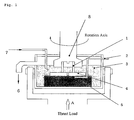
- 1 denotes a mating material
- 2 denotes a thermocouple
- 3 denotes a lubricating oil
- 4 denotes a test piece
- 5 denotes a fixing jig for test piece
- 6 denotes an overflow outlet for a lubricating oil
- 7 denotes a supply port for a lubricating oil
- 8 denotes a rotation axis.
- An under layer in the present invention is a hard alloy layer or simple metal layer having bearing alloy or main components thereof (such as copper, silver, zinc, etc.) and components to which other elements for curing them are added, which layer has an Hv value of not less than 60.
- An upper layer in the present invention is an alloy layer or a simple metal layer having favorable conformability and lubricity, which layer has an Hv value of not more than 40. Hv value denotes Vickers hardness. Preferable examples of an upper layer and an under layer are further described hereinafter.
- An electrodeposited film of the present invention is preferably a film composed of two layers comprising an under layer and an upper layer, characterized in that the under layer is (a) a simple silver layer, (b) an alloy layer of silver and antimony, (c) an alloy layer of copper and tin or zinc, (d) a ternary alloy layer of copper, tin and zinc, (e) a simple zinc layer, or (f) an alloy layer of zinc and copper, and the upper layer is (g) a simple tin layer, (h) an alloy layer of tin and copper and/or silver, (i) an simple indium layer, or (j) an alloy layer of indium and silver.
- the under layer is (a) a simple silver layer, (b) an alloy layer of silver and antimony, (c) an alloy layer of copper and tin or zinc, (d) a ternary alloy layer of copper, tin and zinc, (e) a simple zinc layer, or (f) an alloy layer of zinc and copper
- the upper layer is
- Anelectrodepositedfilmof the present invention exhibiting superior sliding properties is detailed hereinafter.
- an alloy such that the ratio of copper to alloy is higher is referred to as an alloy of copper and zinc (Cu-Zn)
- an alloy such that the ratio of zinc to alloy is higher is referred to as an alloy of zinc and copper (Zn-Cu)
- the present invention also conforms thereto.
- a ternary alloy of copper, tin and zinc (Cu-Sn-Zn), and a ternary alloy of tin, copper and silver (Sn-Cu-Ag) signify ternary alloys such that the weight ratio of copper is highest and such that the weight ratio of tin is highest, respectively.
- an alloy such that the ratio of copper to alloy is higher is hereinafter referred to as bronze.
- the silver content in an under layer is approximately 90 to 100 weight % in the case (b) where an under layer comprises an alloy layer of silver and antimony
- the copper content in an under layer is approximately 50 to 99 weight % in the case of (c) where an under layer comprises an alloy layer of copper and tin or zinc, or (d) where an under layer comprises a ternary alloy layer of copper, tin and zinc
- the content of zinc in an under layer is approximately 60 to 100 weight % in the case of (f) where an under layer comprises an alloy layer of zinc and copper.
- the content of tin and the content of indium in an upper layer are approximately 90 to 100 weight % and approximately 60 to 100 weight %, respectively in the case where tin or indium is contained in an upper layer of an electrodeposited film of the present invention.
- an electrodeposited film of the present invention is in great consideration of safety to the human being and the environment by reason of containing no lead in components thereof.
- An electrodeposited film of the present invention may contain elements such as nickel, silicon, aluminum, iron, oxygen, magnesium and manganese in addition to essential constituent elements of an electrodeposited film of the present invention, such as copper, tin, silver, antimony, zinc and indium.
- essential constituent elements of an electrodeposited film of the present invention such as copper, tin, silver, antimony, zinc and indium.
- a part of these elements are previously contained inevitably in an agent composing a plating solution used for electroplating to be subject to eutectoid during the formation of a film on a base material and occasionally become inevitable impurities.
- the total content of these inevitable impurities is within a range capable of maintaining in a predetermined range the content of copper, tin, silver, antimony, zinc and indium as essential constituent elements of an electrodeposited film of the present invention, which total content is within a range of not hindering the object of the present invention.
- These impurities substantially contain no lead.
- a film of the present invention is formed by typically subjecting a base material to plating treatment to thereby first be coated to a surface of the base material with the above-mentioned under layer and subsequently be coated to a surface of the under layer with the above-mentioned upper layer.
- the quality of a base material to be coated may be any one and is not particularly limited if a material is capable of being used as a base material of sliding parts, specifically including steels such as carbon steel (for example, S35C) and alloy steel, aluminum, aluminum alloy, titanium, titanium alloy, copper, copper alloy, stainless steel or ceramics.
- a base material of sliding parts is typically manufactured through the molding into a desirable shape by using means such as casting, precision forging, machining and presswork, and also a base material to be employed for the present invention may be manufactured by using these publicly known means. Even though a base material is in a complicated shape, the coating with a film of the present invention by using plating technique corresponding to a base material allows sliding parts in all shapes to be easily manufactured without undergoing intricate manufacturing processes.
- a plating process of coating a base material with an electrodeposited film is not particularly limited, for example, including electroplating, dry plating, electroless plating and hot-dipping, and an electroplating process is particularly preferably used in the present invention. More specific embodiment of preferable electroplating is hereinafter described in the present invention.
- An electrodeposited film of the present invention is composed of double layers comprising an under layer and an upper layer, and before coating a base material with an under layer, it is preferable to previously perform pretreatments corresponding to raw material for a base material, such as degreasing, electrolytic degreasing, pickling and strike plating by silver, copper and the like.
- a cyanide bath, a silver nitrate bath and a phosphate bath can be utilized as a bath to be used for electroplating a base material with an under layer, among which cyanide bath is particularly preferable in view of the stability of a solution and the easiness of a plating operation.
- any one of a sulfuric acid bath, an organic acid bath and an alkaline bath is used for convenience as a bath to be used for electroplating with an upper layer, among which sulfuric acid bath or organic acid bath is particularly preferable.
- a simple indium layer is subjected to an upper layer
- an organic acid bath is preferable.
- a cyanide bath, a silver nitrate bath and a phosphate bath can be utilized, among which cyanide bath is particularly preferable.
- a controlling method of the alloy ratio of alloy layer to be formed has conventionally been established sufficiently, such as the alloy ratio of silver and antimony in an alloy thereof and the alloy ratio of copper and tin in bronze, and the present invention also may conform thereto.
- the alloy ratio is controlled by current density, temperature and plating solution composition, such as examples shown in the following Tables 1 to 13.
- An additive such as nonionic or cationic surfactant may be contained in the composition of a plating solution for the purpose of imparting levelling, brightness and stability to an electrodeposited film.
- the kind of these additives or the content thereof in a bath varies with the kind of baths to be used.
- a base material to be coated for a cathode in the case of forming (a) a simple silver layer and (b) an alloy layer of silver and antimony.
- the temperature of a plating solution is properly determined by the alloy ratio of a film, current density and the physical properties of a film, which temperature is typically approximately 10 to 80°C. Current density also is properly determined in consideration of the desirable alloy ratio of an alloy film and working efficiency, which current density is typically in a range of approximately 0.1 to 10 A/cm 2 .
- the thickness of an intended film can be controlled by current density, bath temperature and plating time.
- plating solution composition and plating conditions in the case where (a) a simple silver layer, (b) an alloy layer of silver and antimony, (c-1) a bronze layer, (c-2) an alloy layer of copper and zinc, (d) a ternary alloy layer of copper, tin and zinc, (e) a simple zinc layer, or (f) an alloy layer of zinc and copper is applied to an under layer are shown in Tables 1 to 7 respectively.
- plating solution composition and plating conditions in the case where (g) a simple tin layer, (h-1) an alloy layer of tin and copper, (h-2) an alloy layer of tin and silver, (h- 3) a ternary alloy layer of tin, copper and silver, (i) a simple indium layer, or (j) an alloy layer of indium and silver is subjected to an upper layer are shown in Tables 8 to 13 respectively. It is needless to say that the above-mentioned plating solution composition and plating conditions are not limited to these examples.
- the film thickness of the present invention is not particularly limited and may be determined by uses of sliding parts to be coated therewith and the properties of sliding function to be required, and such thickness is preferably set in a range of not hindering the object of the present invention.
- the thickness of an under layer is preferably approximately 1 to 1, 000 ⁇ m, more preferably approximately 10 to 500 ⁇ m, and the thickness of an upper layer is preferably approximately 1 to 200 ⁇ m, more preferably approximately 5 to 30 ⁇ m.
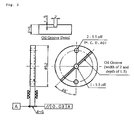
- a mating material made of SCM420H as a carburized and quenched material in a ring shape shown in Fig. 3 is fixed to a rotation axis (8) in Fig. 1, and a base material (a test piece) coated with a film of the present invention having a shape shown in Fig. 2 is fixed to a fixing jig (5) for a test piece in Fig. 1.
- the inside of a device of Fig. 1 is previously filled with a lubricating oil, which is circulated by supplying a lubricating oil from a lubricating oil supply port (7) at a constant rate and overflowing a lubricating oil through a lubricating oil overflow outlet (6) .
- a mating material and a test piece are subjected to sliding while rotating a rotation axis (8) and increasing a thrust load in the direction A, the thrust load (N) being controlled by a program.
- Thrust load the number of rotations, the temperature of a test piece, the change of frictional force are continuously measured during the test to evaluate seizing resistance and wear resistance of the test piece.
- a thrust load was increased with a gradient by a program to calculate a pressure (P) per unit area applied to a sliding portion of a test piece from a thrust load value at a point of time when seizing is caused in a test piece, and then evaluate by a PV value obtained by multiplying this P value by a sliding velocity (V).
- P pressure
- V sliding velocity
- a point of time when baking is caused signifies that either of (1) a point of time when the temperature of a test piece amounted to 250°C and (2) a point of time when the frictional force amounted to 50 N ⁇ cm.
- Wear resistance was evaluated in such a manner as to subject a mating material and a test piece to sliding at a constant load for a constant period of time and thereafter measure the depth of wear tracks remaining in a test piece. The smaller depth of wear tracks brought the better evaluation of wear resistance.
- An electrodeposited film of the present invention can be applied to all sliding parts, in which high sliding properties are required, such as a bush and a thrust plate used for bearings of general machinery, a swash plate used for a compressor for an air conditioner such as car air-conditioning and a refrigerator, a cylinder block and a piston shoe incorporated into a hydraulic unit, a valve plate, a plate for automatic transmission, and precision parts of automobiles and motorbikes.
- Base materials used in the Comparative Examples and Working Examples are all carbon steel S35C, and base materials previously molded into a shape shown in Fig. 2 was coated with films such as Working Examples and thereafter used as test pieces in Test Examples.
- a base material was previously subjected to pretreatments of degreasing, electrolytic degreasing and pickling in the conventional manner. Subjecting the base material to a cathode and a tin plate to an anode, the base material was electroplated under the conditions of room temperature and a current density of 2 A/dm 2 in an organic acid bath consisting of 40 g/L of tin methanesulfonate, 1 g/L of silver methanesulfonate, 200 g/L of Rochelle salt and 10 g/L of a succinic acid derivative. The alloy ratio of silver in the film was analyzed to be 5 weight %.
- the similar pretreatments to Comparative Example 1 were performed for a base material, and thereafter subjecting the base material to a cathode and a tin plate to an anode, the base material was electroplated under the conditions of room temperature and a current density of 3 A/dm 2 in an organic acid bath consisting of 30 g/L of tin methanesulfonate, 2 g/L of copper methanesulfonate, 150 g/L of methanesulfonic acid, 2 g/L of a thiourea derivative and 5 g/L of a nonionic surfactant.
- the alloy ratio of copper in the film was analyzed to be 2 weight %.
- the similar pretreatments to Comparative Example 1 were performed for a base material, and thereafter subjecting the base material to a cathode and a tin plate to an anode, the base material was electroplated under the conditions of room temperature and a current density of 3 A/dm 2 in an organic acid bath consisting of 30 g/L of tin methanesulfonate, 150 g/L of methanesulfonic acid, 2 g/L of a thiourea derivative and 5 g/L of a nonionic surfactant.
- a base material was previously subjected to pretreatments of degreasing, electrolytic degreasing and pickling in the conventional manner, and subsequently strike plating with silver was carried out in the conventional manner.
- the alloy ratio of antimony in the film was analyzed to be 1 weight %.
- the similar pretreatments to Comparative Example 1 were performed for a base material, and thereafter subjecting the base material to a cathode and a copper plate to an anode, the base material was electroplated under the conditions of a temperature of 60°C and a current density of 3 A/dm 2 in a cyanide bath consisting of 30 g/L of copper cyanide, 50 g/L of potassium cyanide, 35 g/L of potassium stannate, 10 g/L of potassium hydroxide and 50 g/L of Rochelle salt.
- the alloy ratio of tin in the film was analyzed to be 10 weight %.
- the same pretreatments as Comparative Example 1 were performed for a base material, and thereafter subjecting the base material to a cathode and a copper plate to an anode, the base material was electroplated under the conditions of room temperature and a current density of 1 A/dm 2 in a cyanide bath consisting of 30 g/L of copper cyanide, 10 g/L of zinc cyanide, 40 g/L of sodium cyanide, 10 g/L of sodium carbonate and 2 ml/L of ammoniawater.
- the alloyratio of zinc in the film was analyzed to be 28 weight %.
- a single layer film of an alloy of zinc and copper (Zn-Cu)
- the similar pretreatments to Comparative Example 1 were performed for a base material, and thereafter subjecting the base material to a cathode and a zinc plate to an anode, the base material was electroplated on the conditions of room temperature and a current density of 5 A/dm 2 in a cyanide bath consisting of 10 g/L of copper cyanide, 60 g/L of zinc cyanide, 50 g/L of sodium cyanide and 20 g/L of sodium hydroxide.
- the alloy ratio of copper in the film was analyzed to be 35 weight %.
- a double layer film comprising an under layer: bronze (Cu-Sn) and an upper layer: nickel into which PTFE (Teflon (registered trademark)) was dispersed (Ni/PTFE)
- the similar pretreatments to Comparative Example 1 were performed for a base material, which thereafter was plated with an under layer in accordance with Comparative Example 5.
- the base material was electroplated on the conditions of a temperature of 50°C and a current density of 3 A/dm 2 in a sulfamic acid bath consisting of 300 g/L of nickel sulfamate, 10 g/L of nickel chloride, 30 g/L of boric acid, 30 g/L of PTFE particles and 3 ml/L of a cationic surfactant.
- the dispersion ratio of PTFE in an upper layer was 7 weight % through analysis.
- a double layer film comprising an under layer: bronze (Cu-Sn) and an upper layer: indium simple (In)
- a double layer film comprising an under layer: bronze (Cu-Sn) and an upper layer: an alloy of indium and silver (In-Ag)
- a double layer film comprising an under layer: an alloy of silver and antimony (Ag-Sb) and an upper layer: an alloy of tin and copper (Sn-Cu)
- a double layer film comprising an under layer: bronze (Cu-Sn) and an upper layer: an alloy of tin and copper (Sn-Cu)
- Comparative Example 2 The similar pretreatments to Comparative Example 1 were performed for a base material, and thereafter its under layer was plated in accordance with Comparative Example 5. Next, the upper layer of the base material was plated in accordance with Comparative Example 2.
- a double layer film comprising an under layer: an alloy of copper and zinc (Cu-Zn) and an upper layer: an alloy of tin and copper (Sn-Cu)
- Comparative Example 2 The similar pretreatments to Comparative Example 1 were performed for a base material, and thereafter its under layer was plated in accordance with Comparative Example 6. Next, the base material was plated with an upper layer in accordance with Comparative Example 2.
- a double layer film comprising an under layer: a ternary alloy of copper, tin and zinc (Cu-Sn-Zn) and an upper layer: an alloy of tin and copper (Sn-Cu)
- the similar pretreatments to Comparative Example 1 were performed for a base material, and thereafter subjecting the base material to a cathode and a copper plate to an anode, the under layer of the base material was electroplated under the conditions of a temperature of 60°C and a current density of 2 A/dm 2 in a cyanide bath consisting of 35 g/L of copper cyanide, 70 g/L of sodium cyanide, 25 g/L of potassium stannate, 5 g/L of zinc cyanide, 10 g/L of potassium hydroxide and 50 g/L of Rochelle salt.
- the upper layer of the base material was plated in accordance with Comparative Example 2.
- a double layer film comprising an under layer: silver simple (Ag) and an upper layer: an alloy of tin and copper (Sn-Cu)
- a double layer film comprising an under layer: an alloy of zinc and copper (Zn-Cu) and an upper layer: an alloy of tin and copper (Sn-Cu)
- Comparative Example 2 The similar pretreatments to Comparative Example 1 were performed for a base material, which thereafter was plated with an under layer in accordance with Comparative Example 8. Next, the base material was plated with an upper layer in accordance with Comparative Example 2.
- Comparative Example 2 The similar pretreatments to Comparative Example 1 were performed for a base material, which thereafter was plated with an under layer in accordance with Comparative Example 9. Next, the base material was plated with an upper layer in accordance with Comparative Example 2.
- films of Working Examples 3, 4, 6, and 13 to 16 were greatly superior materials for sliding for the reason that both of seizing resistance and wear resistance thereof were superior to a copper alloy A for comparison, and the favorable sliding properties were equally exhibited by all of these films irrespective of film thickness.
- An electrodeposited film of the present invention is superior in seizing resistance and wear resistance, so that sliding parts coated with this electrodeposited film have favorable sliding properties.
- an electrodeposited film of the present invention can be applied to coating by an electroplating process, so as to easily coat a base material and be capable of being adapted to sliding parts in all shapes, which film can be conceived to be a superior material also in view of economy by reason of having no thermal influence on a base material and obtaining a superior smooth surface to thereby bring no necessity of particular postprocessing.
- an electrodeposited film of the present invention contains no lead in compositions thereof, so that sliding parts harmless to the human body and the environment can be provided.
Landscapes
- Engineering & Computer Science (AREA)
- General Engineering & Computer Science (AREA)
- Chemical & Material Sciences (AREA)
- Mechanical Engineering (AREA)
- Chemical Kinetics & Catalysis (AREA)
- Electrochemistry (AREA)
- Materials Engineering (AREA)
- Metallurgy (AREA)
- Organic Chemistry (AREA)
- Electroplating Methods And Accessories (AREA)
- Electroplating And Plating Baths Therefor (AREA)
- Other Surface Treatments For Metallic Materials (AREA)
Applications Claiming Priority (3)
| Application Number | Priority Date | Filing Date | Title |
|---|---|---|---|
| JP2003008849 | 2003-01-16 | ||
| JP2003008849 | 2003-01-16 | ||
| PCT/JP2004/000211 WO2004063426A1 (ja) | 2003-01-16 | 2004-01-14 | 摺動機能を有するめっき皮膜とその被覆物品 |
Publications (2)
| Publication Number | Publication Date |
|---|---|
| EP1586679A1 true EP1586679A1 (de) | 2005-10-19 |
| EP1586679A4 EP1586679A4 (de) | 2006-07-19 |
Family
ID=32709179
Family Applications (1)
| Application Number | Title | Priority Date | Filing Date |
|---|---|---|---|
| EP04702072A Withdrawn EP1586679A4 (de) | 2003-01-16 | 2004-01-14 | Metallabscheidungsbeschichtungsfilm mit gleitfunktion und damit beschichteter gegenstand |
Country Status (5)
| Country | Link |
|---|---|
| US (2) | US20060099443A1 (de) |
| EP (1) | EP1586679A4 (de) |
| JP (1) | JP4391476B2 (de) |
| CN (1) | CN1738929B (de) |
| WO (1) | WO2004063426A1 (de) |
Cited By (2)
| Publication number | Priority date | Publication date | Assignee | Title |
|---|---|---|---|---|
| WO2008074344A1 (en) * | 2006-12-19 | 2008-06-26 | Mahle International Gmbh | Sliding bearing |
| EP2128506B1 (de) * | 2007-03-02 | 2019-01-23 | Nippon Steel & Sumitomo Metal Corporation | Schraubverbindung für stahlrohre |
Families Citing this family (14)
| Publication number | Priority date | Publication date | Assignee | Title |
|---|---|---|---|---|
| US8311543B2 (en) | 2005-07-07 | 2012-11-13 | Qualcomm Incorporated | Methods and devices for interworking of wireless wide area networks and wireless local area networks or wireless personal area networks |
| US8126477B2 (en) | 2005-07-07 | 2012-02-28 | Qualcomm Incorporated | Methods and devices for interworking of wireless wide area networks and wireless local area networks or wireless personal area networks |
| US8364148B2 (en) | 2005-07-07 | 2013-01-29 | Qualcomm Incorporated | Methods and devices for interworking of wireless wide area networks and wireless local area networks or wireless personal area networks |
| JP2008001930A (ja) * | 2006-06-21 | 2008-01-10 | Nsk Ltd | 金属表面処理方法 |
| AT506641B1 (de) * | 2008-04-07 | 2011-01-15 | Miba Gleitlager Gmbh | Gleitlager |
| US20100059385A1 (en) * | 2008-09-06 | 2010-03-11 | Delin Li | Methods for fabricating thin film solar cells |
| US8426241B2 (en) | 2010-09-09 | 2013-04-23 | International Business Machines Corporation | Structure and method of fabricating a CZTS photovoltaic device by electrodeposition |
| US9234291B2 (en) | 2010-09-09 | 2016-01-12 | Globalfoundries Inc. | Zinc thin films plating chemistry and methods |
| CN102306631B (zh) * | 2011-07-20 | 2013-01-23 | 中国科学院上海微系统与信息技术研究所 | 一种基于电镀工艺改善Sn-Ag焊料性能的方法 |
| WO2013142765A1 (en) * | 2012-03-23 | 2013-09-26 | Technic, Inc. | Silver antimony coatings and connectors |
| US20140109861A1 (en) * | 2012-10-19 | 2014-04-24 | Mahle International Gmbh | Piston and tribological system consisting of a piston and a cylinder running surface of a cylinder crank case for an internal combustion engine |
| JP6915549B2 (ja) * | 2018-01-09 | 2021-08-04 | 日本製鉄株式会社 | 摺動部材およびその製造方法 |
| CN111868309B (zh) * | 2018-03-16 | 2021-06-18 | 株式会社新克 | 缸体镀覆装置用集电构件以及镀覆装置 |
| JP7523910B2 (ja) * | 2020-01-06 | 2024-07-29 | Dowaメタルテック株式会社 | 複合めっき材およびその製造方法 |
Family Cites Families (21)
| Publication number | Priority date | Publication date | Assignee | Title |
|---|---|---|---|---|
| GB556247A (en) * | 1942-03-24 | 1943-09-27 | Vandervell Products Ltd | Improvements in metal bearing surfaces |
| US2451426A (en) * | 1943-11-25 | 1948-10-12 | Du Pont | Bright zinc plating |
| JPS5365230A (en) * | 1976-11-25 | 1978-06-10 | Nippon Steel Corp | Zinc tin coated steel material |
| JPS57116924A (en) * | 1981-01-12 | 1982-07-21 | Heijiro Tarumoto | Inner wire |
| US4578319A (en) * | 1984-05-08 | 1986-03-25 | Toyo Kohan Co., Ltd. | Surface treated steel sheet having an excellent weldability and its production method |
| JPH02190497A (ja) * | 1989-01-18 | 1990-07-26 | Ndc Co Ltd | すべり軸受材ならびにその製造法 |
| WO1991011545A1 (de) * | 1990-02-03 | 1991-08-08 | Glyco Ag | Hochverschleissfeste gleitschicht mit verbesserten gleiteigenschaften und herstellungsverfahren hierzu |
| US5391290A (en) * | 1992-04-21 | 1995-02-21 | Nkk Corporation | Method for continuously tin-electroplating metal strip |
| JP2693369B2 (ja) * | 1993-12-28 | 1997-12-24 | 大同メタル工業株式会社 | 多層構造エンドベアリング及びその製造方法 |
| US5750017A (en) * | 1996-08-21 | 1998-05-12 | Lucent Technologies Inc. | Tin electroplating process |
| JPH10205539A (ja) * | 1997-01-22 | 1998-08-04 | Daido Metal Co Ltd | 銅系すべり軸受 |
| JP3570607B2 (ja) * | 1998-03-13 | 2004-09-29 | トヨタ自動車株式会社 | 摺動部材 |
| DE19852481C2 (de) * | 1998-11-13 | 2002-09-12 | Federal Mogul Wiesbaden Gmbh | Schichtverbundwerkstoff für Gleitelemente und Verfahren zu seiner Herstellung |
| JP3472198B2 (ja) * | 1999-06-09 | 2003-12-02 | 大同メタル工業株式会社 | すべり軸受 |
| US6267508B1 (en) * | 1999-11-04 | 2001-07-31 | Federal-Mogul World Wide, Inc. | Sliding bearing having multilayer lead-free overplate and method of manufacture |
| US6312579B1 (en) * | 1999-11-04 | 2001-11-06 | Federal-Mogul World Wide, Inc. | Bearing having multilayer overlay and method of manufacture |
| JP2001132754A (ja) * | 1999-11-04 | 2001-05-18 | Daido Metal Co Ltd | 多層すべり軸受 |
| JP2001241445A (ja) * | 2000-02-28 | 2001-09-07 | Daido Metal Co Ltd | 銅系摺動材料、その製造方法およびすべり軸受 |
| JP3475910B2 (ja) * | 2000-05-24 | 2003-12-10 | 株式会社村田製作所 | 電子部品、電子部品の製造方法および回路基板 |
| JP3754315B2 (ja) * | 2001-04-09 | 2006-03-08 | 大同メタル工業株式会社 | 複層摺動材料 |
| JP2005060822A (ja) * | 2003-08-08 | 2005-03-10 | Rohm & Haas Electronic Materials Llc | 複合基体の電気メッキ |
-
2004
- 2004-01-14 JP JP2005508006A patent/JP4391476B2/ja not_active Expired - Fee Related
- 2004-01-14 US US10/541,515 patent/US20060099443A1/en not_active Abandoned
- 2004-01-14 WO PCT/JP2004/000211 patent/WO2004063426A1/ja not_active Ceased
- 2004-01-14 EP EP04702072A patent/EP1586679A4/de not_active Withdrawn
- 2004-01-14 CN CN2004800022448A patent/CN1738929B/zh not_active Expired - Fee Related
-
2007
- 2007-02-13 US US11/705,415 patent/US20090321268A1/en not_active Abandoned
Non-Patent Citations (2)
| Title |
|---|
| No further relevant documents disclosed * |
| See also references of WO2004063426A1 * |
Cited By (2)
| Publication number | Priority date | Publication date | Assignee | Title |
|---|---|---|---|---|
| WO2008074344A1 (en) * | 2006-12-19 | 2008-06-26 | Mahle International Gmbh | Sliding bearing |
| EP2128506B1 (de) * | 2007-03-02 | 2019-01-23 | Nippon Steel & Sumitomo Metal Corporation | Schraubverbindung für stahlrohre |
Also Published As
| Publication number | Publication date |
|---|---|
| JPWO2004063426A1 (ja) | 2006-05-18 |
| US20090321268A1 (en) | 2009-12-31 |
| EP1586679A4 (de) | 2006-07-19 |
| JP4391476B2 (ja) | 2009-12-24 |
| WO2004063426A1 (ja) | 2004-07-29 |
| CN1738929A (zh) | 2006-02-22 |
| US20060099443A1 (en) | 2006-05-11 |
| CN1738929B (zh) | 2011-11-02 |
Similar Documents
| Publication | Publication Date | Title |
|---|---|---|
| US20090321268A1 (en) | Electrodeposited film having sliding function and coated article therewith | |
| KR101770762B1 (ko) | 안티프레팅층을 갖는 다층 평베어링 | |
| JP2601555B2 (ja) | 多層すべり軸受材 | |
| KR101786763B1 (ko) | 안티프레팅층 | |
| CN100470069C (zh) | 用于滑动轴承的层状复合材料,其制备和应用 | |
| US5879816A (en) | Metallic sliding material | |
| JPH1150296A (ja) | 摺動部材 | |
| JP3570607B2 (ja) | 摺動部材 | |
| EP3150743B1 (de) | Bismutgalvanisierbäder und verfahren zur galvanisierung von bismut auf einem substrat | |
| US6149790A (en) | Method of making iron-electroplated aluminum materials | |
| JP2007023316A (ja) | 耐摩耗性部材および動力伝達部品 | |
| EP1083246A1 (de) | Konversionsüberzug aus Zinn mit Kobalt und Wismut für Aluminiumgleitflächen | |
| KR20080077255A (ko) | Sn 함유 내구성 물질 조성물, 내구성 코팅 제조 방법 및그 용도 | |
| EP2176447B1 (de) | Mikroporöse schicht zur verminderung von reibung bei metallumformungsverfahren | |
| US5670265A (en) | Steel component with an electroplated anti-corrosive coating and process for producing same | |
| FR2485042A1 (fr) | Procede de depot electrolytique de couches d'alliages de nickel avec des elements d'alliages | |
| JP2020132924A (ja) | 摺動部材 | |
| JPH04331817A (ja) | 複合めっき皮膜を有するすべり軸受 | |
| EP3460095B1 (de) | Gleitelement | |
| JPH09209189A (ja) | 摺動部材およびその製造方法 | |
| JPH09217192A (ja) | 金属材料の高速高硬度鉄含有金属めっき方法 | |
| Bidmead | Engineering Plating | |
| EP4530379A1 (de) | Korrosions- und verschleissbeständige bremsscheibe und zugehörige verfahren | |
| EP4186618A1 (de) | Gleitelement | |
| Rustamjan o’g’li et al. | METHODS FOR INCREASING THE HANGING STRENGTH AND FATIGUE OF LOAD-BEARING PARTS MADE OF REINFORCED COMPOSITE MATERIALS |
Legal Events
| Date | Code | Title | Description |
|---|---|---|---|
| PUAI | Public reference made under article 153(3) epc to a published international application that has entered the european phase |
Free format text: ORIGINAL CODE: 0009012 |
|
| AK | Designated contracting states |
Kind code of ref document: A1 Designated state(s): AT BE BG CH CY CZ DE DK EE ES FI FR GB GR HU IE IT LI LU MC NL PT RO SE SI SK TR |
|
| AX | Request for extension of the european patent |
Extension state: AL LT LV MK |
|
| 17P | Request for examination filed |
Effective date: 20050712 |
|
| RIN1 | Information on inventor provided before grant (corrected) |
Inventor name: NAKANIWA, KUNIO, NOMURA PLATING CO., LTD. Inventor name: IKEDA, TOKUMI, NOMURA PLATING CO., LTD. Inventor name: TAKEUCHI, KAZUO, CHUETSU METAL WORKS CO., LTD. Inventor name: ICHIDA, KENICHI, CHUETSU METAL WORKS CO., LTD. Inventor name: YAGO, WATARU, CHUETSU METAL WORKS CO., LTD. Inventor name: NAKASHIMA, KUNIO, CHUETSU METAL WORKS CO., LTD. |
|
| DAX | Request for extension of the european patent (deleted) | ||
| RBV | Designated contracting states (corrected) |
Designated state(s): DE FR GB |
|
| A4 | Supplementary search report drawn up and despatched |
Effective date: 20060621 |
|
| STAA | Information on the status of an ep patent application or granted ep patent |
Free format text: STATUS: THE APPLICATION HAS BEEN WITHDRAWN |
|
| 18W | Application withdrawn |
Effective date: 20121011 |