EP1587316A2 - Verfahren der programmierten Aufnahme für kopiergeschützte Inhalte - Google Patents
Verfahren der programmierten Aufnahme für kopiergeschützte Inhalte Download PDFInfo
- Publication number
- EP1587316A2 EP1587316A2 EP05252277A EP05252277A EP1587316A2 EP 1587316 A2 EP1587316 A2 EP 1587316A2 EP 05252277 A EP05252277 A EP 05252277A EP 05252277 A EP05252277 A EP 05252277A EP 1587316 A2 EP1587316 A2 EP 1587316A2
- Authority
- EP
- European Patent Office
- Prior art keywords
- content
- control information
- interest
- copy
- copy control
- Prior art date
- Legal status (The legal status is an assumption and is not a legal conclusion. Google has not performed a legal analysis and makes no representation as to the accuracy of the status listed.)
- Withdrawn
Links
Images


Classifications
-
- D—TEXTILES; PAPER
- D06—TREATMENT OF TEXTILES OR THE LIKE; LAUNDERING; FLEXIBLE MATERIALS NOT OTHERWISE PROVIDED FOR
- D06B—TREATING TEXTILE MATERIALS USING LIQUIDS, GASES OR VAPOURS
- D06B23/00—Component parts, details, or accessories of apparatus or machines, specially adapted for the treating of textile materials, not restricted to a particular kind of apparatus, provided for in groups D06B1/00 - D06B21/00
- D06B23/04—Carriers or supports for textile materials to be treated
-
- H—ELECTRICITY
- H04—ELECTRIC COMMUNICATION TECHNIQUE
- H04N—PICTORIAL COMMUNICATION, e.g. TELEVISION
- H04N5/00—Details of television systems
- H04N5/76—Television signal recording
- H04N5/78—Television signal recording using magnetic recording
- H04N5/782—Television signal recording using magnetic recording on tape
-
- B—PERFORMING OPERATIONS; TRANSPORTING
- B65—CONVEYING; PACKING; STORING; HANDLING THIN OR FILAMENTARY MATERIAL
- B65H—HANDLING THIN OR FILAMENTARY MATERIAL, e.g. SHEETS, WEBS, CABLES
- B65H54/00—Winding, coiling, or depositing filamentary material
- B65H54/02—Winding and traversing material on to reels, bobbins, tubes, or like package cores or formers
- B65H54/10—Winding and traversing material on to reels, bobbins, tubes, or like package cores or formers for making packages of specified shapes or on specified types of bobbins, tubes, cores, or formers
-
- H—ELECTRICITY
- H04—ELECTRIC COMMUNICATION TECHNIQUE
- H04N—PICTORIAL COMMUNICATION, e.g. TELEVISION
- H04N21/00—Selective content distribution, e.g. interactive television or video on demand [VOD]
- H04N21/40—Client devices specifically adapted for the reception of or interaction with content, e.g. set-top-box [STB]; Operations thereof
- H04N21/43—Processing of content or additional data, e.g. demultiplexing additional data from a digital video stream; Elementary client operations, e.g. monitoring of home network or synchronising decoder's clock; Client middleware
- H04N21/433—Content storage operation, e.g. storage operation in response to a pause request, caching operations
- H04N21/4334—Recording operations
-
- H—ELECTRICITY
- H04—ELECTRIC COMMUNICATION TECHNIQUE
- H04N—PICTORIAL COMMUNICATION, e.g. TELEVISION
- H04N21/00—Selective content distribution, e.g. interactive television or video on demand [VOD]
- H04N21/40—Client devices specifically adapted for the reception of or interaction with content, e.g. set-top-box [STB]; Operations thereof
- H04N21/43—Processing of content or additional data, e.g. demultiplexing additional data from a digital video stream; Elementary client operations, e.g. monitoring of home network or synchronising decoder's clock; Client middleware
- H04N21/44—Processing of video elementary streams, e.g. splicing a video clip retrieved from local storage with an incoming video stream or rendering scenes according to encoded video stream scene graphs
- H04N21/44008—Processing of video elementary streams, e.g. splicing a video clip retrieved from local storage with an incoming video stream or rendering scenes according to encoded video stream scene graphs involving operations for analysing video streams, e.g. detecting features or characteristics in the video stream
-
- H—ELECTRICITY
- H04—ELECTRIC COMMUNICATION TECHNIQUE
- H04N—PICTORIAL COMMUNICATION, e.g. TELEVISION
- H04N21/00—Selective content distribution, e.g. interactive television or video on demand [VOD]
- H04N21/40—Client devices specifically adapted for the reception of or interaction with content, e.g. set-top-box [STB]; Operations thereof
- H04N21/45—Management operations performed by the client for facilitating the reception of or the interaction with the content or administrating data related to the end-user or to the client device itself, e.g. learning user preferences for recommending movies, resolving scheduling conflicts
- H04N21/462—Content or additional data management e.g. creating a master electronic programme guide from data received from the Internet and a Head-end or controlling the complexity of a video stream by scaling the resolution or bit-rate based on the client capabilities
- H04N21/4627—Rights management associated to the content
-
- H—ELECTRICITY
- H04—ELECTRIC COMMUNICATION TECHNIQUE
- H04N—PICTORIAL COMMUNICATION, e.g. TELEVISION
- H04N21/00—Selective content distribution, e.g. interactive television or video on demand [VOD]
- H04N21/40—Client devices specifically adapted for the reception of or interaction with content, e.g. set-top-box [STB]; Operations thereof
- H04N21/47—End-user applications
- H04N21/472—End-user interface for requesting content, additional data or services; End-user interface for interacting with content, e.g. for content reservation or setting reminders, for requesting event notification, for manipulating displayed content
- H04N21/47214—End-user interface for requesting content, additional data or services; End-user interface for interacting with content, e.g. for content reservation or setting reminders, for requesting event notification, for manipulating displayed content for content reservation or setting reminders; for requesting event notification, e.g. of sport results or stock market
-
- H—ELECTRICITY
- H04—ELECTRIC COMMUNICATION TECHNIQUE
- H04N—PICTORIAL COMMUNICATION, e.g. TELEVISION
- H04N21/00—Selective content distribution, e.g. interactive television or video on demand [VOD]
- H04N21/40—Client devices specifically adapted for the reception of or interaction with content, e.g. set-top-box [STB]; Operations thereof
- H04N21/47—End-user applications
- H04N21/488—Data services, e.g. news ticker
- H04N21/4882—Data services, e.g. news ticker for displaying messages, e.g. warnings, reminders
-
- H—ELECTRICITY
- H04—ELECTRIC COMMUNICATION TECHNIQUE
- H04N—PICTORIAL COMMUNICATION, e.g. TELEVISION
- H04N5/00—Details of television systems
- H04N5/76—Television signal recording
- H04N5/91—Television signal processing therefor
- H04N5/913—Television signal processing therefor for scrambling ; for copy protection
-
- H—ELECTRICITY
- H04—ELECTRIC COMMUNICATION TECHNIQUE
- H04N—PICTORIAL COMMUNICATION, e.g. TELEVISION
- H04N5/00—Details of television systems
- H04N5/76—Television signal recording
- H04N5/91—Television signal processing therefor
- H04N5/913—Television signal processing therefor for scrambling ; for copy protection
- H04N2005/91307—Television signal processing therefor for scrambling ; for copy protection by adding a copy protection signal to the video signal
- H04N2005/91328—Television signal processing therefor for scrambling ; for copy protection by adding a copy protection signal to the video signal the copy protection signal being a copy management signal, e.g. a copy generation management signal [CGMS]
Definitions
- the present invention relates to a scheduled-recording method, and more particularly, to a scheduled-recording method that schedules recording of content that is copy-protected under digital rights management.
- a home network is a network that comprises devices for reproducing content and devices for managing the devices that reproduce content. Additionally, home networks provide digital rights management for content reproduction.
- Digital rights management includes a function of managing rights given to each of the apparatuses of the home network and a function of managing rights given to contents which are reproducible on the home network.
- Digital rights management is performed by application programs installed in the apparatuses of the home network.
- SmartRight developed by Thompson
- OCCAM Open Conditional Content Access Management
- xCP Cluster Protocol developed by IBM
- DTCP Digital Transmission Content Protection
- DTLA Digital Transmission License Administration
- devices constituting a home network are classified into a master device and slave devices.
- the master device assigns rights to other devices, changes or nullifies the rights given to the other devices, sets rights in content in the home network, or changes or nullifies the rights set in the content.
- the slave devices are further classified into a media renderer and a media source.
- the media renderer decodes and then reproduces content.
- the media source provides the content to the media renderer. Whether a device in the home network is a master device or a slave device is determined depending on the particular functions a digital rights management application program serves.
- a master device and a slave device communicate with each other by using universal plug and play (uPnP) protocol.
- the uPnP protocol is a technology that automatically qualifies a device for or disqualifies the device from membership of a home network by automatically recognizing the device and whether or not the device is currently connected to the home network.
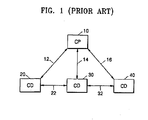
- FIG. 1 is a diagram illustrating an uPnP protocol-based home network.
- the uPnP protocol-based home network comprises control devices (CDs) 20, 30, and 40 and a control point (CP) 10.
- CDs control devices
- CP control point
- the CP 10 searches the uPnP protocol-based home network for the CDs 20 through 40 and recognizes whether each of the CDs 20 through 40 is newly connected to the uPnP protocol-based home network by receiving an advertisement message from the corresponding CD.
- the advertisement message is generated when each of the CDs 20 through 40 is newly connected to or disconnected from the uPnP protocol-based home network.
- the CP 10 receives a description message from each of the CDs 20 through 40. Also, the CP 10 transmits and receives event messages associated with actions involving each of the CDs 20 through 40.
- Each action involving the CP 10 and each of the CDs 20 through 40 is defined by a markup language, for example, XML.
- Each of the CDs 20 through 40 transmits an advertisement message to the CP 10 whenever it is connected to or disconnected from the uPnP protocol-based home network. Further, each of the CDs 20 through 40 periodically transmits a message to the CP 10 in order to confirm whether it still exists on the uPnP protocol-based home network. In addition, each of the CDs 20 through 40 responds to various requests issued by the CP 10 according to the uPnP protocol. Each of the CDs 20 through 40 may be either a media source or a media renderer. In FIG.
- elements 12, 14, and 16 denote the transmissions of messages between the CP 10 and the CD 20, between the CP 10 and the CD 30, and between the CP 10 and the CD 40, respectively
- elements 22 and 32 denote the transmissions of contents between the CD 20 and the CD 30 and between the CD 30 and the CD 40, respectively.
- each of the CDs 20 through 40 may be a media renderer, which reproduces content, or a media source, which provides the content to the media renderer.
- the media renderer generally has a recording function so that it can store content received from the media source in its recording medium.
- the media source may be a contents database or contents broadcast.
- the media renderer has two recording functions, i.e., a real-time recording function, which enables a user to manually record content when the content is broadcasted, and a scheduled recording function, which schedules recording of content to be broadcasted in the near future so that the content can be automatically recorded at scheduled recording time.
- a real-time recording function which enables a user to manually record content when the content is broadcasted
- a scheduled recording function which schedules recording of content to be broadcasted in the near future so that the content can be automatically recorded at scheduled recording time.
- copy control information can be defined in various manners depending on which digital rights management a home network employs.
- One type of copy control information is "copy never", which only allows content to be reproduced by a media renderer and prevents the content from being copied to a recording medium in the media renderer.
- FIG. 2 is a flowchart of a conventional scheduled recording method.
- a user inputs scheduled recording information and a command to scheduled-record content to a CP.
- the CP may be a device having a user interface, such as a personal digital assistant (PDA), a personal computer, or a remote control device.
- the scheduled recording information is information necessary for scheduled-recording the content and includes scheduled recording start time, scheduled recording date, running time of the content, a channel, at which the content is to be broadcasted, the title of the content, and a recording type.
- the CD determines whether the content has copy control information.
- operation 220 if the content has the copy control information, the method proceeds to operation 230, and otherwise, the method proceeds to operation 240.
- the CD transmits a message indicating that the content is recordable to the CP, which may then inform the user.
- the copy control information is periodically updated.
- the copy control information may not exist in the CD at the time when the CP transmits the command to schedule-record the content to the CD. It is impossible to determine whether the content is recordable if the copy control information does not exist in the CD.
- the CD transmits the message indicating that the content is recordable to the CD regardless of whether the content has the copy control information.
- the copy control information is included in an electronic program guide (EPG), and the EPG is updated every few hours or every few days.
- EPG electronic program guide
- the EPG is provided by a media source.
- a scheduled recordings list is formed based on the scheduled recording information of the content.
- the scheduled recordings list identifies the content, which is scheduled to be scheduled-recorded, and includes various information necessary for scheduled-recording the content, such as scheduled recording time.
- the CD checks the copy control information of the content when the scheduled recording time has arrived. At the moment when the content is broadcasted, the copy control information of the content must exist in the CD.
- the CD transmits an error message indicating that the content cannot be recorded to the CP to notify the user, and the method is completed.
- operation 230 it is determined whether the content is recordable based on the copy control information. Thereafter, depending on whether the copy control information of the content is "copy never", the method may proceed to operation 232 or 234.
- the CD transmits the error message to the CP, which may notify the user, in operation 232.
- the CD transmits an OK message indicating that the content is recordable to the user in operation 234, forms a scheduled recordings list in operation 236, and records the content at the scheduled recording time according to the scheduled recordings list in operation 238.
- the user may not have much time to come up with how to deal with a failure to scheduled-record the content of interest and cannot take appropriate measures to obtain the content of interest on time.
- the present invention provides a scheduled recording method, which addresses the disadvantages of the prior art method identified herein. According to the present invention there is provided an apparatus and method as set forth in the appended claims. Preferred features of the invention will be apparent from the dependent claims, and the description which follows.
- Operation (b) may comprise the sub-step (b1) if the copy control information of the content of interest does not exist in the recording device, setting a copy protection status variable of the content of interest to 'unknown' , the copy protection status variable indicating whether the content of interest is recordable. Operation (b) may further comprise the sub-step (b2) if the copy protection status variable is set to 'unknown' , determining whether the copy control information of the content of interest exists in the recording device whenever copy control information is newly input to the recording device.
- the scheduled recording method may further comprise (e) transmitting the error message to the user if the copy control information of the content of interest is determined to exist in the recording device in (a) and is determined to be "copy never” in (d) .
- operation (b) may comprise substeps (b1) transmitting an OK message to the user, the OK message indicating that the recording of the content of interest has been successfully scheduled.
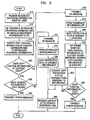
- FIG. 3 is a flowchart of a scheduled recording method according to an exemplary embodiment of the present invention.
- a user inputs scheduled recording information and a command to scheduled-record content to a CP.
- the CP may be a device having a user interface, such as a personal digital assistant (PDA), a personal computer, or a remote control device.
- the scheduled recording information is information necessary for scheduled-recording the content and includes scheduled recording start time, scheduled recording date, running time of the content, a channel, at which the content is to be broadcasted, the title of the content, and a recording type.
- the CP transmits the scheduled recording information and the command to scheduled-record the content to a recording device, i.e., a CD.
- the recording medium is a.media renderer in a home networkthat reproduces media content or stores the media content in its recording medium.
- the CD determines whether the content has copy control information.
- operation 320 if the content has the copy control information, the method proceeds to operation 330, and otherwise, the method proceeds to operation 340.
- the CD transmits a message indicating that the content is recordable to the CP, which may notify the user.
- the copy control information is periodically updated.
- the copy control information may not exist in the CD at the time when the CP transmits the command to schedule-record the content to the CD. It is impossible to determine whether the content is recordable if the copy control information does not exist in the CD.
- the CD transmits the message indicating that the content is recordable to the CD regardless of whether the content has the copy control information.
- the copy control information is included in an electronic program guide (EPG), and the EPG is updated every few hours or every few days.
- EPG is provided by a media source.
- a scheduled recordings list is formed based on the scheduled recording information of the content.
- the scheduled recordings list identifies the content, which is scheduled to be scheduled-recorded, and includes various information necessary for scheduled-recording the content, such as scheduled recording time.
- the CD defines a copy protection status variable indicating whether the content is recordable, and sets the copy protection status variable to 'unknown'.
- the copy protection status variable may be included in the scheduled recording list.
- the CD determines whether the copy control information of the content exists whenever it receives new copy control information.
- the CP may periodically transmit a polling message to the CD, and the CD may determine whether it receives the copy control information of the content whenever it receives the polling message from the CP.
- the CD determines whether the copy control information of the content is "copy never". If the copy control information of the content is "copy never”, the method proceeds to operation 370, and otherwise, the method proceeds to operation 350.
- the CD converts the copy protection status variable from 'unknown' to 'recordable', and the method proceeds to operation 360.
- the CD transmits an error message indicating that the content cannot be recorded to the CP, which may notify the user, and the method is completed.
- the CD determines whether the copy control information of the content is "copy never".
- the CD transmits the error message to the user, i.e., the CP, and the method is completed.
- the copy control information of the content is determined not to be "copy never" If the copy control information of the content is determined not to be "copy never", the content is recorded at the scheduled recording time in operations 334 through 360.
- the CD transmits an OK message indicating that the content is recordable to the user in operation 334, forms a scheduled recordings list in operation 336, converts the copy protection status variable from 'unknown' to 'recordable', and records the content at the scheduled recording time according to the scheduled recordings list in operation 338.
- the CD transmits the error message to the CP without generating the copy protection status variable, and the entire scheduled recording method is completed. Even if the copy protection status variable is generated, the content cannot be recorded at the scheduled recording time unless the copy protection status variable is set to 'recordable' .
- the OK message and the error message can be realized as uPnP protocol-based event messages transmitted between the CP and the CD.
- the copy control information of the content can be obtained from an EPG.
- the copy control information of the content can be obtained from a program mapping table or transport stream packet header.
- FIG. 4 is a flowchart of a scheduled recording method according to another exemplary embodiment of the present invention.
- operations 410 through 420 are the same as operations 310 through 320 of FIG. 3
- operations 434 through 438 are the same as operations 334 through 338 of FIG. 3.
- a CD sets a copy protection status variable defined in the content to 'not recordable' in operation 432, which is different from operation 332 of FIG. 3 in which the CD would transmit an error message to a user.
- Operations 440 through 448 are the same as operations 340 through 348 of FIG. 3.
- the CD sets the copy protection status variable to 'not recordable' in operation 460, which is different from operation 370 of FIG. 3 in which the CD would transmit the error message to the CP, which may inform the user.
- the copy protection status variable is converted from unknown to 'recordable' in operation 450.
- the CD determines whether the copy protection status variable of the content is set to 'recordable'.
- the CD records the content at the scheduled recording time according to a scheduled recordings list, formed in operation 436 or 442, in operation 480.
- the CD transmits the error message to the CP, which may inform the user, in operation 490 and the method is completed.
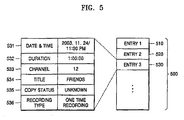
- FIG. 5 is a diagram illustrating a scheduled recordings list 500.
- the scheduled recordings list 500 includes at least one scheduled entry, i.e., entries 510, 520, 530, ....
- the entries 510, 520, 530, ... one-on-one correspond to contents scheduled to be recorded.
- Each of the entries 510, 520, 530, ... includes at least one reservation information, i.e., scheduled recording start time and date 531, duration 532, which specifies the running time of corresponding content, channel 533, which specifies a channel at which the corresponding content is to be broadcasted, title 534, which specifies the title of the corresponding content, copy protection status variable 535, and recording type 536.
- a CD searches the scheduled recording list for content of interest and then records the content of interest at scheduled recording time of the content of interest.
- the at least one reservation information of each of the entries 510, 520, 530, ... of the scheduled recording list 500 further includes copy protection status variable 535.
- a copy protection status variable is a variable indicating whether corresponding content is currently recordable and can be updated afterwards.
- a copy protection status variable for the content of interest is set to 'unknown'. Thereafter, if the EPG is updated so that copy control information of the content of interest can be newly included therein, the copy protection status variable is updated based on the copy control information of the content of interest.
- the scheduled recording method according to the exemplary aspects of the present invention can be realized as a computer program. Codes and code segments of the computer program can be easily derived from the prior art by those skilled in the art.
- the computer program can be stored in a computer-readable recording medium or can be read or executed by a computer so that the scheduled recording method according to the present invention can be realized.
- the computer-readable recording medium includes a magnetic recording medium, an optical recording medium, and a carrier wave.
- preferred embodiments of the present invention allow a user to be informed whether content of interest is recordable by defining a copy protection status variable in the content and determining whether the content of interest is recordable whenever new copy control information is received.
Landscapes
- Engineering & Computer Science (AREA)
- Multimedia (AREA)
- Signal Processing (AREA)
- Databases & Information Systems (AREA)
- Business, Economics & Management (AREA)
- Strategic Management (AREA)
- Finance (AREA)
- Human Computer Interaction (AREA)
- Computer Security & Cryptography (AREA)
- Textile Engineering (AREA)
- Signal Processing For Digital Recording And Reproducing (AREA)
- Television Signal Processing For Recording (AREA)
- Two-Way Televisions, Distribution Of Moving Picture Or The Like (AREA)
Applications Claiming Priority (4)
| Application Number | Priority Date | Filing Date | Title |
|---|---|---|---|
| US56151304P | 2004-04-13 | 2004-04-13 | |
| US561513P | 2004-04-13 | ||
| KR1020040031338A KR100601671B1 (ko) | 2004-04-13 | 2004-05-04 | 복사 금지된 콘텐츠의 예약 녹화 방법 |
| KR2004031338 | 2004-05-04 |
Publications (2)
| Publication Number | Publication Date |
|---|---|
| EP1587316A2 true EP1587316A2 (de) | 2005-10-19 |
| EP1587316A3 EP1587316A3 (de) | 2007-05-09 |
Family
ID=36605796
Family Applications (1)
| Application Number | Title | Priority Date | Filing Date |
|---|---|---|---|
| EP05252277A Withdrawn EP1587316A3 (de) | 2004-04-13 | 2005-04-12 | Verfahren der programmierten Aufnahme für kopiergeschützte Inhalte |
Country Status (4)
| Country | Link |
|---|---|
| US (1) | US7603722B2 (de) |
| EP (1) | EP1587316A3 (de) |
| KR (1) | KR100601671B1 (de) |
| CN (1) | CN1750535A (de) |
Cited By (1)
| Publication number | Priority date | Publication date | Assignee | Title |
|---|---|---|---|---|
| EP2148510A1 (de) * | 2008-07-24 | 2010-01-27 | NEC Corporation | Vorrichtung und Verfahren zur Verhinderung eines unbefugten Kopierens von Inhalten |
Families Citing this family (15)
| Publication number | Priority date | Publication date | Assignee | Title |
|---|---|---|---|---|
| US5801787A (en) | 1996-06-14 | 1998-09-01 | Starsight Telecast, Inc. | Television schedule system and method of operation for multiple program occurrences |
| CN1867068A (zh) | 1998-07-14 | 2006-11-22 | 联合视频制品公司 | 交互式电视节目导视系统及其方法 |
| ES2312475T3 (es) | 2000-10-11 | 2009-03-01 | United Video Properties, Inc. | Sistemas y metodos para proporcionar el almacenamiento de datos en servidores de un sistema de entrega de medios bajo demanda. |
| US8229283B2 (en) | 2005-04-01 | 2012-07-24 | Rovi Guides, Inc. | System and method for quality marking of a recording |
| US7646962B1 (en) | 2005-09-30 | 2010-01-12 | Guideworks, Llc | System and methods for recording and playing back programs having desirable recording attributes |
| JP2007109292A (ja) * | 2005-10-12 | 2007-04-26 | Funai Electric Co Ltd | ディスク再生装置 |
| KR100713975B1 (ko) * | 2005-11-17 | 2007-05-02 | 엘지전자 주식회사 | 홈네트워크에서의 컨텐츠 예약 재생 방법 |
| US8214869B2 (en) * | 2005-12-29 | 2012-07-03 | Rovi Guides, Inc. | Systems and methods for managing a status change of a multimedia asset in multimedia delivery systems |
| US7765235B2 (en) | 2005-12-29 | 2010-07-27 | Rovi Guides, Inc. | Systems and methods for resolving conflicts and managing system resources in multimedia delivery systems |
| US8832742B2 (en) | 2006-10-06 | 2014-09-09 | United Video Properties, Inc. | Systems and methods for acquiring, categorizing and delivering media in interactive media guidance applications |
| CN101910246B (zh) * | 2007-12-31 | 2013-01-02 | 株式会社三养生物制药 | 包含源自α-羟酸的疏水嵌段的高纯两亲共聚物及其制备方法 |
| US20090187942A1 (en) * | 2008-01-22 | 2009-07-23 | Noboru Wakabayashi | Receiving apparatus |
| KR20100055882A (ko) * | 2008-11-18 | 2010-05-27 | 삼성전자주식회사 | 컨텐츠 제어 장치 및 컨텐츠 제어 방법 |
| US10063934B2 (en) | 2008-11-25 | 2018-08-28 | Rovi Technologies Corporation | Reducing unicast session duration with restart TV |
| US8805418B2 (en) | 2011-12-23 | 2014-08-12 | United Video Properties, Inc. | Methods and systems for performing actions based on location-based rules |
Family Cites Families (9)
| Publication number | Priority date | Publication date | Assignee | Title |
|---|---|---|---|---|
| KR100296366B1 (ko) * | 1996-02-02 | 2001-09-07 | 크리트먼 어윈 엠 | 디지탈녹화모드또는아날로그녹화모드중어느하나로비디오녹화장치를작동시키는방법 |
| JP4106740B2 (ja) * | 1998-02-18 | 2008-06-25 | ソニー株式会社 | 情報記録装置および方法、情報再生装置および方法、並びにプログラム記録媒体 |
| DE69942739D1 (de) * | 1998-12-22 | 2010-10-21 | Sony Corp | System zum empfang von digitalen übertragungen und gerät zum empfang von digitalen übertragungen |
| JP3685382B2 (ja) * | 1999-05-25 | 2005-08-17 | 日本ビクター株式会社 | 映像情報記録装置 |
| JP2003189232A (ja) * | 2001-12-21 | 2003-07-04 | Mitsubishi Electric Corp | 記録mpegデータ選択装置及びmpegデータ記録装置 |
| JP2003331487A (ja) | 2002-05-09 | 2003-11-21 | Matsushita Electric Ind Co Ltd | 情報記録装置および情報記録方法 |
| GB2390249B (en) * | 2002-06-28 | 2005-12-14 | Sony Uk Ltd | Embedded data in an information signal |
| US7376337B2 (en) * | 2002-09-30 | 2008-05-20 | Matsushita Electric Industrial Co., Ltd. | Video signal recording apparatus for copyrighted works |
| US20050125357A1 (en) * | 2003-12-09 | 2005-06-09 | Saadat Abbas S. | Secure integrated media center |
-
2004
- 2004-05-04 KR KR1020040031338A patent/KR100601671B1/ko not_active Expired - Fee Related
-
2005
- 2005-04-12 EP EP05252277A patent/EP1587316A3/de not_active Withdrawn
- 2005-04-13 US US11/104,497 patent/US7603722B2/en not_active Expired - Fee Related
- 2005-04-13 CN CNA2005100645356A patent/CN1750535A/zh active Pending
Cited By (2)
| Publication number | Priority date | Publication date | Assignee | Title |
|---|---|---|---|---|
| EP2148510A1 (de) * | 2008-07-24 | 2010-01-27 | NEC Corporation | Vorrichtung und Verfahren zur Verhinderung eines unbefugten Kopierens von Inhalten |
| US8886013B2 (en) | 2008-07-24 | 2014-11-11 | Nec Corporation | Device and method for preventing unauthorized reproduction of content |
Also Published As
| Publication number | Publication date |
|---|---|
| EP1587316A3 (de) | 2007-05-09 |
| KR20050100320A (ko) | 2005-10-18 |
| US7603722B2 (en) | 2009-10-13 |
| US20050238168A1 (en) | 2005-10-27 |
| KR100601671B1 (ko) | 2006-07-14 |
| CN1750535A (zh) | 2006-03-22 |
Similar Documents
| Publication | Publication Date | Title |
|---|---|---|
| CN100433618C (zh) | 转换数字内容元数据的方法和装置以及使用其的网络系统 | |
| EP1587316A2 (de) | Verfahren der programmierten Aufnahme für kopiergeschützte Inhalte | |
| US9432628B2 (en) | Information processing device, information processing method, and computer program | |
| US8321534B1 (en) | System and method for synchronization based on preferences | |
| US9229937B2 (en) | Apparatus and method for managing digital contents distributed over network | |
| EP2249256A1 (de) | Verfahren und einrichtung zur bereitstellung von inahltsmetadaten und verfahren und einrichtung zur beschränkung von zugangsrechten zu inhalten | |
| US20080304812A1 (en) | Detailed information providing method and apparatus of personal video recorder | |
| CN103037260A (zh) | 解决冲突和管理多媒体分发系统的系统资源的系统和方法 | |
| JP2007521731A (ja) | Dvrスケジューリングコンフリクトを回避する代替的プログラムソース | |
| CN101018139B (zh) | 管理内容的方法和设备、存储介质及自适应内容播放方法 | |
| US20070100839A1 (en) | Method and apparatus for managing content on network and recording medium storing program for performing the method | |
| JP2008289102A (ja) | 受信装置、記録装置、コンテンツ受信方法及びコンテンツ記録方法 | |
| CN101646045A (zh) | 记录系统、接收装置、记录装置、记录控制方法和程序 | |
| US8340100B2 (en) | Method and apparatus for controlling quality of service in universal plug and play network | |
| JP2007158854A (ja) | Avサーバ装置、クライアント機器、及びファイル転送システム | |
| US20070288505A1 (en) | Meta Data Management Device And Meta Data Use Device | |
| JP2002354386A (ja) | コンテンツ管理受信機およびコンテンツ管理送信機ならびにコンテンツ管理プログラム | |
| US20070280271A1 (en) | Communication apparatus and communication method | |
| CN101110594A (zh) | 通信装置 | |
| US20090007183A1 (en) | Video recording apparatus and broadcast receiving apparatus | |
| EP2701384B1 (de) | Kommunikationssystem, kommunikationsgerät und kommunikationsverfahren | |
| JP2002077745A (ja) | 番組予約管理システム及び番組予約管理方法 | |
| JP2008136136A (ja) | データ通信装置、装置一覧表示方法および装置一覧表示制御プログラム | |
| US20070286578A1 (en) | Recording/reproducing apparatus and content moving method | |
| US20070233747A1 (en) | Meta Data Conversion Device, Meta Data Conversion Method, And Meta Data Conversion System |
Legal Events
| Date | Code | Title | Description |
|---|---|---|---|
| PUAI | Public reference made under article 153(3) epc to a published international application that has entered the european phase |
Free format text: ORIGINAL CODE: 0009012 |
|
| 17P | Request for examination filed |
Effective date: 20050429 |
|
| AK | Designated contracting states |
Kind code of ref document: A2 Designated state(s): AT BE BG CH CY CZ DE DK EE ES FI FR GB GR HU IE IS IT LI LT LU MC NL PL PT RO SE SI SK TR |
|
| AX | Request for extension of the european patent |
Extension state: AL BA HR LV MK YU |
|
| PUAL | Search report despatched |
Free format text: ORIGINAL CODE: 0009013 |
|
| AK | Designated contracting states |
Kind code of ref document: A3 Designated state(s): AT BE BG CH CY CZ DE DK EE ES FI FR GB GR HU IE IS IT LI LT LU MC NL PL PT RO SE SI SK TR |
|
| AX | Request for extension of the european patent |
Extension state: AL BA HR LV MK YU |
|
| 17Q | First examination report despatched |
Effective date: 20070621 |
|
| AKX | Designation fees paid |
Designated state(s): AT BE BG CH CY CZ DE DK EE ES FI FR GB GR HU IE IS IT LI LT LU MC NL PL PT RO SE SI SK TR |
|
| STAA | Information on the status of an ep patent application or granted ep patent |
Free format text: STATUS: THE APPLICATION IS DEEMED TO BE WITHDRAWN |
|
| 18D | Application deemed to be withdrawn |
Effective date: 20090905 |