EP1587594B1 - System von dreidimensionalen mehrzweckelementen - Google Patents
System von dreidimensionalen mehrzweckelementen Download PDFInfo
- Publication number
- EP1587594B1 EP1587594B1 EP03781145A EP03781145A EP1587594B1 EP 1587594 B1 EP1587594 B1 EP 1587594B1 EP 03781145 A EP03781145 A EP 03781145A EP 03781145 A EP03781145 A EP 03781145A EP 1587594 B1 EP1587594 B1 EP 1587594B1
- Authority
- EP
- European Patent Office
- Prior art keywords
- single solid
- elements
- solid element
- integrated circuit
- programmable integrated
- Prior art date
- Legal status (The legal status is an assumption and is not a legal conclusion. Google has not performed a legal analysis and makes no representation as to the accuracy of the status listed.)
- Expired - Lifetime
Links
Images


Classifications
-
- A—HUMAN NECESSITIES
- A63—SPORTS; GAMES; AMUSEMENTS
- A63H—TOYS, e.g. TOPS, DOLLS, HOOPS OR BUILDING BLOCKS
- A63H33/00—Other toys
- A63H33/04—Building blocks, strips, or similar building parts
- A63H33/042—Mechanical, electrical, optical, pneumatic or hydraulic arrangements; Motors
-
- A—HUMAN NECESSITIES
- A63—SPORTS; GAMES; AMUSEMENTS
- A63H—TOYS, e.g. TOPS, DOLLS, HOOPS OR BUILDING BLOCKS
- A63H33/00—Other toys
- A63H33/04—Building blocks, strips, or similar building parts
- A63H33/046—Building blocks, strips, or similar building parts comprising magnetic interaction means, e.g. holding together by magnetic attraction
-
- B—PERFORMING OPERATIONS; TRANSPORTING
- B25—HAND TOOLS; PORTABLE POWER-DRIVEN TOOLS; MANIPULATORS
- B25J—MANIPULATORS; CHAMBERS PROVIDED WITH MANIPULATION DEVICES
- B25J9/00—Program-controlled manipulators
- B25J9/16—Program controls
- B25J9/1615—Program controls characterised by special kind of manipulator, e.g. planar, scara, gantry, cantilever, space, closed chain, passive/active joints and tendon driven manipulators
- B25J9/1617—Cellular, reconfigurable manipulator, e.g. cebot
-
- Y—GENERAL TAGGING OF NEW TECHNOLOGICAL DEVELOPMENTS; GENERAL TAGGING OF CROSS-SECTIONAL TECHNOLOGIES SPANNING OVER SEVERAL SECTIONS OF THE IPC; TECHNICAL SUBJECTS COVERED BY FORMER USPC CROSS-REFERENCE ART COLLECTIONS [XRACs] AND DIGESTS
- Y10—TECHNICAL SUBJECTS COVERED BY FORMER USPC
- Y10S—TECHNICAL SUBJECTS COVERED BY FORMER USPC CROSS-REFERENCE ART COLLECTIONS [XRACs] AND DIGESTS
- Y10S977/00—Nanotechnology
- Y10S977/70—Nanostructure
- Y10S977/724—Devices having flexible or movable element
-
- Y—GENERAL TAGGING OF NEW TECHNOLOGICAL DEVELOPMENTS; GENERAL TAGGING OF CROSS-SECTIONAL TECHNOLOGIES SPANNING OVER SEVERAL SECTIONS OF THE IPC; TECHNICAL SUBJECTS COVERED BY FORMER USPC CROSS-REFERENCE ART COLLECTIONS [XRACs] AND DIGESTS
- Y10—TECHNICAL SUBJECTS COVERED BY FORMER USPC
- Y10S—TECHNICAL SUBJECTS COVERED BY FORMER USPC CROSS-REFERENCE ART COLLECTIONS [XRACs] AND DIGESTS
- Y10S977/00—Nanotechnology
- Y10S977/70—Nanostructure
- Y10S977/724—Devices having flexible or movable element
- Y10S977/725—Nanomotor/nanoactuator
-
- Y—GENERAL TAGGING OF NEW TECHNOLOGICAL DEVELOPMENTS; GENERAL TAGGING OF CROSS-SECTIONAL TECHNOLOGIES SPANNING OVER SEVERAL SECTIONS OF THE IPC; TECHNICAL SUBJECTS COVERED BY FORMER USPC CROSS-REFERENCE ART COLLECTIONS [XRACs] AND DIGESTS
- Y10—TECHNICAL SUBJECTS COVERED BY FORMER USPC
- Y10S—TECHNICAL SUBJECTS COVERED BY FORMER USPC CROSS-REFERENCE ART COLLECTIONS [XRACs] AND DIGESTS
- Y10S977/00—Nanotechnology
- Y10S977/84—Manufacture, treatment, or detection of nanostructure
- Y10S977/882—Assembling of separate components, e.g. by attaching
Definitions
- the subject of the invention is a system of three-dimensional multipurpose elements and the method for creating three-dimensional Multipurpose Elements used for creating three-dimensional constructions, having a vast range of forms, colours and materials, mechanical, kinematics and functional properties, by making use of autonomously independent solid elements.
- the system of three-dimensional multipurpose elements may be applied, in making functional copies of an original, object in various technologies, for example in space technologies, furniture industry, decorative and building industry, toy-making and entertainment industry, orthopedics, three-dimensional mobile telephony, the manufacturing of industrial, rescue and household robots, and finally, for generating research simulation systems, especially in genetics, crystallography and chemistry.
- I demonstrate that the micrites must be maintained in a fluid environment in order to provide sufficient lubrication for their polygonal binding surfaces to azimuthally rotate into coincidence. I calculate the speed of convergence in a lubricant environment and show that the distant micrites assemble only very slowly (for a practical range of parameters) unless there is some agitation of the fluid. I show how various solids can be constructed by convergence. I demonstrate how a primitive motor can be built from two dodecahedron-shaped micrites, and I calculate the maximum speed of the motor and the maximum power the motor can generate. I explain a surprisingly simple algorithm for a curious self-propelling flagellum constructed from a chain of dodecahedron-shaped micrites. I calculate the flagellum's maximum swimming speed and power consumption.
- Platonic solids regular polyhedra
- the dihedral angle between the adjoining faces of two cubes, joined by coinciding squares on a face of each cube, is 180°, Hence, it is difficult for an electric field, generated by charges on the perpendicular faces, to rotate the two cubes in such a way as to join at another pair of faces.
- the dodecahedron has a corresponding dihedral angle of about 127 and a pair of dodecahedra can be easily caused to roll from one contact face to another. Therefore, the dodecahedron is the only space-fllling Platonic solid that is also capable of easily-generated face-field-driven motion.
- the motion of monomers is systematically split into streams, gates, trunk lines and containers for designating individual paths of motion of respective monomers necessary in the synthesis of the entire structure.
- Specialised monomers are provided with tools, which form the intended device together with the intended and synthesised structure.
- Monomers have grooves in the vertical symmetry axes of the sidewalls; instead, inside monomers there are protrusive interlocks provided with sliding wedges.
- Neighbouring monomers may be combined and blocked with each other or linked in such a way that their reciprocal translocations upon connecting are possible trough a toothed bar and a toothed wheel [s] or otherwise.
- Respective monomers may_be positioned with each other trough a system of latches controlled either with an electromagnet or a linear induction motor.
- the second monomer form is provided with four symmetrical grooves on each wall, the grooves being positioned at an angle of 45° to the wall symmetry axis. Those grooves serve for inserting elements, which block the mutual connection of neighbouring monomers.
- the third monomer form is provided with frontal elements on all six walls, the elements being supplied with tee section grooves placed in the symmetry axes of the elements.
- latch units which allow aligning the reciprocal position of the monomers being linked.
- the latch units are controlled by gear transmissions arranged vertically to the external surface of the frontal elements of monomer.
- Linear induction motors with electromagnets secure the transport of monomers.
- the linear induction motors of stationary monomers translate the monomers, which are to be transported.
- a precise co-ordination of linear induction motors of the series of stationary monomers allows attaining a high transport velocity along that series. Electricity is supplied and the transmission of the controlling data occurs from the central source through neighbouring monomers.
- the paper entitled “ 3-D Self-Assembling and Actuation of Electrostatic Microstructures” published in the "IEEE TRANSACTION ON ELECTRON DEVICES” VOL. 48, NO 8, AUGUST 2001 reveals a three dimensional self-assembling and starting electrostatic microstructure.
- the purpose of the microstructure is completion of the dedicated controlling elements for optical applications, and specially, for micro-mirror matrices with large angles of reflection.
- the initial flat structure is performed inside one polysilicon structural layer.
- the mobile structure contains a rotating plate connected with two principal supporting beams through thin elastic props.
- Combinations of four integrated final control units SDA determine the supporting beams. Through a pulsating electric signal, SDA elements move and eventually bend the initially flat structural layer. Once the required shape of the structure is reached, the respective elements are mechanically blocked.
- the electromagnets have the magnets retracted or pushed out according to the polarisation of the voltage applied and may rotate between two magnets without any effect on the magnetic field. Each element may be linked to on more than 6 other elements.
- the communication between respective elements is secured due to an infrared optical system.
- the relays and receivers are arranged in the holes in the middle of the magnets and electromagnets. The communication occurs via an asynchronus series protocol.
- An 8-bit processor is used to decide on the polarisation of the electromagnets in compliance with the information received. Electricity is provided in a wireless system where the plate on which the elements are arranged is used as supply terminal. The plate is divided into zones and every other one of them is connected to the supply voltage, whereas the remaining ones are ground.
- the zones alternate between a zone that is connected to the supply voltage, then a zone that is grounded, then a zone that is connected to the supply voltage, then a zone that is grounded, and so on.
- the elements are fed from four contacts and a rectifier. Respective elements have only information on local connection with the neighbouring elements.
- the shape of the entire structure is based upon local links between respective elements.
- the invention which is defined in claim 1 is a system of three-dimensional multipurpose elements, consisting of single solid elements which can be computer-controlled to move, connect one to and disconnect one from another.
- a single element of the system consist of a casing made up of walls, linked with each other by means of an electroplastic actuator which changes the reciprocal position of the walls of the casing of a single element. Changes in the reciprocal position of the walls occur according to an exciting signal transmitted from a programmable integrated circuit. Heat emitters carry away excess heat from the system devices.
- interlocks for connecting to other single elements, as well as magnetic coils and a voltage source supplying the integrated circuit, interlocks, magnetic coils and electroplastic actuator.
- the invention comprises a system of three-dimensional multipurpose elements, consisting of single solid elements, which can translocate, connect one to and disconnect one from another.
- the single solid elements contain programmable integrated circuits, interlocks for linking respective single elements and electromagnets.
- the casing walls of a single element of the system have magnetic polarisation depending on the programmed position of the single element in the actual structure under formation. In the active state of a single element, the walls of the casing of a single element of the system have different magnetic polarisation, whereas in the inactive state of a single element, the walls of the casing of a single element of the system have identical magnetic polarisation.
- an active single element of the system Upon connecting an active single element of the system to an inactive single element of the system, information about the desired structure under formation (also referred to as the "virtual object” or “virtual structure") and information about the number that that particular inactive single element represents in the actual structure built thus far (referred to hereinafter as the "running number") is transmitted from the active single element of the system to the memory of the integrated circuit of the inactive single element of the system.
- a particular inactive single element might be the one hundredth single element successively connected up to that point in a structure which will eventually contain six hundred single elements connected together.
- Sets of co-ordinates of the walls of the casing of a given single element of the system are assigned to the running numbers of single elements of the system.
- the set of those data are transferred to the program in the integrated circuit of each single element of the system, while the program in the integrated circuit decides whether to activate or deactivate the various other walls of single elements of the system, and assigns the appropriate running number to the next single element of the system to be linked successively.
- Magnetic polarisation in the walls of the casing of a single element of the system is generated by electromagnets placed inside a single element of the system.
- the walls of the casing of a single element of the system are connected to each other so that their reciprocal position can be changed.
- the walls of the casing of a single element of the system are connected with each other by means of electroplastic actuators, which control the reciprocal positioning of the walls according to the exciting signals transmitted from the programmable integrated circuit.
- a single element of the system has a voltage source supplying the integrated circuit, interlocks, electromagnets and electroplastic actuators.
- the voltage source is renewable due to supply from solar batteries.
- the light to the solar batteries is carried in light pipes which also carry both information on the object and program instructions to the integrated circuit.
- the object being constructed may be disassembled, to the initial state of single elements of the system, through deactivation of all casing walls of single system elements and disconnection of all interlocks in consequence of transmitting information to the integrated circuit.
- the system enables a multiple use of the same single elements of the system for making new structures having destroyed first the previous structure.
- Each of the single elements of the system has got a set of information necessary for reconstructing an actual structure. From any quantity of single elements of the system one can create structures and constructions, designed according to one's wish, and having a vast range of forms, colours and materials, mechanical, kinematics, material and dynamic properties.
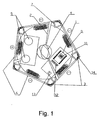
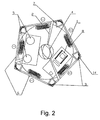
- a single element of the system of three-dimensional multipurpose elements consist of a casing made up of walls 6 linked to each other by means of electroplastic actuators 3 which can change the reciprocal position of the walls 6 of the casing of a single element of the system of three-dimensional multipurpose elements through tensioning or slackening. Changes in the reciprocal position of the walls 6 occur according to the exciting signal transmitted from a programmable integrated circuit 1. Heat emitters 14 carry away both excess heat generated in the process of changes of reciprocal position of the walls 6 of the casing of a single element and the heat from other system devices. Inside a single element there are provided interlocks 7 for connecting respective single elements, magnetic coils 8 and a voltage DC source 5 supplying the integrated circuit 1, interlocks 7, magnetic coils 8 and electroplastic actuators 3.
- the voltage source 5 is renewable due to supply from solar batteries 4.
- the light to the solar batteries is carried in light pipes 2, which also carry both information on the object 10 and program instructions 12 to the integrated circuit 1.
- the single element of the system of three-dimensional multipurpose elements has all walls 6 of the casing polarised with identical [negative or positive] magnetic poles
- the respective walls 6 of the casing of a single element may be polarised with different magnetic poles
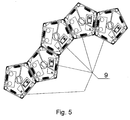
- Polarisation of the respective walls 6 of the casing of a single element of the system depends on the position of the given element of the system in the actual structure under creation 9 according to the virtual structure of the object 10 programmed in the integrated circuit 1.
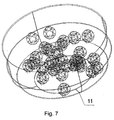
- the set of inactive single elements of identical magnetic polarity, placed in the container 11 [ Fig 7 ], is subject to a constant controlled motion.
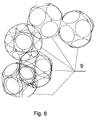
- the first active single element of the system has the initial number 13 of the virtual structure of the object 10, marked 1, and corresponds to the same number in the actual structure 9 under creation ( Fig. 6 ).
- both information on the virtual object 10 being constructed and information on the successive running number 13 that the inactive single element being connected represents in the actual structure 9 is transmitted from an active single element of the system to the memory of the integrated circuit 1 of the inactive single element of the system, while sets of co-ordinates of the walls 6 of the casing of a given single element of the system are assigned to the running numbers 13 of single elements of the system.
- the sets of those data are transferred to the program 12 in the integrated circuit 1 of each single element of the system.
- the program 12 in the integrated circuit 1 decides whether to activate or deactivate the various other walls 6 of single elements of the system, and assigns an appropriate running number 13 for the next single element of the system to be linked successively, When the successive single element of the system is linked to the prior single element of the system the connection is locked by means of interlocks 7 of any type.
- the procedure of linking and activating successive single elements of the system and making the actual structure of the object 9 continues until all single elements of the system, within the range of all running numbers 13, available in the virtual object 10 in the integrated circuit1 are connected. When all connection between single elements of the system are completed, an actual structure 9 is created which matches the virtual object 10.
- the actual structure 9 of the object can be disassembled to the initial state of the single elements of the system, namely to a loose initial set of inactivate single elements of the system. This occurs through deactivation of all walls 6 of the casing of single elements of the system and disconnection of all interlocks 7 in consequence of having transferred appropriate information to all integrated circuit 1 of the actual structure 9. After such a deactivation, all single elements of the system of three-dimensional multipurpose elements may be re-used for making a new three-dimensional structure for any purpose desired.
Landscapes
- Engineering & Computer Science (AREA)
- Health & Medical Sciences (AREA)
- General Health & Medical Sciences (AREA)
- Orthopedic Medicine & Surgery (AREA)
- Robotics (AREA)
- Mechanical Engineering (AREA)
- Toys (AREA)
- Manipulator (AREA)
- Control Of Position Or Direction (AREA)
- Electromagnets (AREA)
- Liquid Crystal (AREA)
Claims (8)
- Das System der dreidimensionalen multifunktionalen Elemente zum Aufbau von 30-Strukturen, bestehend aus den einzelnen Körperelementen, dic sich gegeneinander verlagern sowie verbinden und trennen können, programmierbare integrierte Schaltungen (1), Interlocks (7) zur Verbindung der einzelnen Elemente und Elektromagnete (8) enthalten. Das System zeichnet sich durch folgende Eigenschaften aus:Das einzelne Systemelement besitzt eine Spannungsquelle (5).Die Gehäusewände (6) des einzelnen Elements haben eine magnetische Polarisation, die von der programmierten Lage des Einzelelementes in der gebildeten realen Struktur während deren Formung abhängig ist (9).Dabei haben die Gehäusewände (6) des einzelnen Elementes im aktiven Zustand des einzelnen Elementes unterschiedliche magnetische Polarisation und im nicht aktiven Zustand des einzelnen Elementes haben die Gehäusewände (6) des einzelnen Elementes die gleiche magnetische Polarisation.Nach der Verbindung des aktiven Einzelelementes des Systems mit dem nicht aktiven Einzelelement des Systems wird die Information über das virtuelle Objekt (10), darunter die Information über die nächste Ordnungsnummer (13) in der Realstruktur (9) des angeschlossenen nicht aktiven Einzelelementes des Systems, aus dem aktiven Einzelelement des Systems zum Speicher der integrierten Schaltung (1) des nicht aktiven Einzelelementes des Systems übertragen, wobei den Ordnungsnummern (13) der Einzelelemente des Systems die Koordinatenmengen der Gehäusewände (6) des Einzelelementes des Systems zugeschrieben sind. Diese Datenmengen werden zum Programm (12) in der integrierten Schaltung (1) eines jeden Einzelelementes des Systems übertragen.Das Programm (12) in der integrierten Schaltung (1) entscheidet über die Aktivierung oder Deaktivierung der einzelnen Wände (6) der einzelnen Elemente des Systems sowie über die Vergabe der entsprechenden Ordnungsnummer (13) des nächsten angeschlossenen Einzelelementes des Systems.
- Das System zeichnet sich gemäß Anspruch 1 dadurch aus, dass die Wände (6) der einzelnen Elemente des Systems miteinander auf eine solche Art und Weise verbunden sind, dass sich ihre gegenseitige Lage verändern kann.
- Das System zeichnet sich gemäß Anspruch 1 dadurch aus, dass die Wände (6) der einzelnen Elemente des Systems mithilfe der an die integrierte Schaltung (1) angeschlossenen elektroplastischen Aktuatoren (3) miteinander verbunden sind.
- Das System zeichnet sich gemäß Anspruch 1 dadurch aus, dass die Spannungsquelle (5) erneuerbar ist.
- Das System zeichnet sich gemäß Anspruch 4 dadurch aus, dass die Spannungsquelle (5) durch die Einspeisung durch Solarbatterien (4) erneuerbar ist.
- Das System zeichnet sich gemäß Anspruch 5 dadurch aus, dass das Licht den Solarbatterien (4) über die Lichtwellenleiter (2) zugeführt wird.
- Das System zeichnet sich gemäß Anspruch 6 dadurch aus, dass die Lichtwellenleiter (2) an die integrierte Schaltung (1) operativ angeschlossen sind, um die programmierbare integrierte Schaltung (1) sowohl mit Informationen über das Objekt (10), wie auch mit Programmanweisungen (12) zu versorgen.
- Das System zeichnet sich gemäß Anspruch 1 dadurch aus, dass die reale Struktur (9) des Objektes durch die Desaktivierung aller Gehäusewände (6) der Einzelelemente des Systems und die Trennung aller Interlocks (7) auf Basis der übergebenen entsprechenden Informationen an die integrierte Schaltung (1) zu dem ursprünglichen Zustand der einzelnen Elemente des Systems zerstreut werden kann.
Applications Claiming Priority (3)
| Application Number | Priority Date | Filing Date | Title |
|---|---|---|---|
| PL35828603 | 2003-01-15 | ||
| PL35828603A PL358286A1 (en) | 2002-01-18 | 2003-01-15 | System of three-dimensional multiple-function elements |
| PCT/PL2003/000117 WO2004062759A1 (en) | 2003-01-15 | 2003-11-12 | A system of three-dimensional multipurpose elements |
Publications (2)
| Publication Number | Publication Date |
|---|---|
| EP1587594A1 EP1587594A1 (de) | 2005-10-26 |
| EP1587594B1 true EP1587594B1 (de) | 2012-01-18 |
Family
ID=32710010
Family Applications (1)
| Application Number | Title | Priority Date | Filing Date |
|---|---|---|---|
| EP03781145A Expired - Lifetime EP1587594B1 (de) | 2003-01-15 | 2003-11-12 | System von dreidimensionalen mehrzweckelementen |
Country Status (8)
| Country | Link |
|---|---|
| US (1) | US7787990B2 (de) |
| EP (1) | EP1587594B1 (de) |
| JP (1) | JP4638740B2 (de) |
| AT (1) | ATE541625T1 (de) |
| AU (1) | AU2003287107A1 (de) |
| CA (1) | CA2512778A1 (de) |
| RU (1) | RU2326423C2 (de) |
| WO (1) | WO2004062759A1 (de) |
Cited By (1)
| Publication number | Priority date | Publication date | Assignee | Title |
|---|---|---|---|---|
| CN109702725A (zh) * | 2019-01-29 | 2019-05-03 | 西安交通大学 | 一种多边形模块化可变形链式机器人 |
Families Citing this family (29)
| Publication number | Priority date | Publication date | Assignee | Title |
|---|---|---|---|---|
| US20080244407A1 (en) * | 2005-08-29 | 2008-10-02 | Eklund Don | Abstractions in disc authoring |
| US20080243303A1 (en) * | 2006-11-13 | 2008-10-02 | Solomon Research Llc | System and methods for collective nanorobotics for electronics applications |
| DE102007007881A1 (de) * | 2007-02-14 | 2008-08-21 | Adm Promotions Gmbh | Spielzeug mit nicht-permanenten Magneten |
| US9155961B2 (en) | 2009-05-28 | 2015-10-13 | Anki, Inc. | Mobile agents for manipulating, moving, and/or reorienting components |
| DE102010062217B4 (de) * | 2010-01-22 | 2018-11-22 | Kinematics Gmbh | Baukastensystem mit bewegungsfähigen Modulen |
| US9004200B2 (en) | 2011-09-09 | 2015-04-14 | Pinhas Ben-Tzvi | Mobile robot with hybrid traction and mobility mechanism |
| CN103083924B (zh) * | 2013-01-29 | 2014-10-29 | 杭州速泽电子科技有限公司 | 磁吸附式电子积木系统 |
| US20140300211A1 (en) * | 2013-03-06 | 2014-10-09 | Massachusetts Institute Of Technology | Discrete Motion System |
| US9956494B2 (en) * | 2013-03-15 | 2018-05-01 | Rnd By Us B.V. | Element comprising sensors for detecting grab motion or grab release motion for actuating inter-element holding or releasing |
| NL2013466B1 (en) * | 2014-09-12 | 2016-09-28 | Rnd By Us B V | Shape-Shifting a Configuration of Reusable Elements. |
| US10093488B2 (en) * | 2013-03-15 | 2018-10-09 | Rnd By Us B.V. | Shape-shifting a configuration of reusable elements |
| US10105592B2 (en) | 2013-03-15 | 2018-10-23 | Rnd By Us B.V. | Shape-shifting a configuration of reusable elements |
| CN103942937B (zh) * | 2014-01-07 | 2016-10-19 | 东南大学 | 一种模块化自重构机器人的通信装置及其通信方法 |
| US9996369B2 (en) | 2015-01-05 | 2018-06-12 | Anki, Inc. | Adaptive data analytics service |
| EP3297739A1 (de) | 2015-05-22 | 2018-03-28 | RnD by Us B.V. | Haltevorrichtung |
| MA42984A (fr) * | 2015-10-12 | 2018-08-22 | Rnd By Us B V | Dispositif de maintien |
| US10293482B2 (en) * | 2015-11-12 | 2019-05-21 | ITI Electromagnetic Products Inc. | Self-assembling robotic construction system and associated methods |
| US20170282090A1 (en) * | 2016-03-30 | 2017-10-05 | Fujitsu Limited | Construction toy with programmable connectors |
| CN107116544B (zh) * | 2017-05-11 | 2021-07-06 | 朱利 | 集连接和运动功能的电机及其应用的模块化机器人 |
| GB2573164B (en) * | 2018-04-27 | 2023-01-04 | Sony Interactive Entertainment Inc | Apparatus control system and method |
| CN109702726B (zh) * | 2019-01-29 | 2021-01-19 | 西安交通大学 | 一种模块化空间多稳态变构型机器人 |
| US11710357B2 (en) * | 2019-04-19 | 2023-07-25 | Hewlett-Packard Development Company, L.P. | Interlockable devices |
| PL433323A1 (pl) | 2020-03-24 | 2021-09-27 | Akademia Górniczo-Hutnicza im. Stanisława Staszica w Krakowie | Samoorganizująca się konstrukcja o budowie modułowej |
| CN111546340B (zh) * | 2020-05-11 | 2020-11-27 | 中国人民解放军军事科学院国防科技创新研究院 | 电磁驱动的多稳态软体机械臂系统 |
| FR3112981B1 (fr) * | 2020-07-30 | 2022-11-11 | Psa Automobiles Sa | Robot configurable par déformation de sous-robots autonomes et synchronisés |
| US12377362B2 (en) * | 2021-01-22 | 2025-08-05 | Retrospective Goods, LLC | Magnetic construction tile set |
| US12161934B2 (en) * | 2021-06-24 | 2024-12-10 | Microsoft Technology Licensing, Llc | Mobile haptic robots |
| TWM640006U (zh) * | 2022-09-01 | 2023-04-21 | 許皓瑄 | 具有傾斜靠抵面之多邊形立體結構 |
| CN116442204B (zh) * | 2023-05-22 | 2024-02-23 | 浣江实验室 | 一种体素型机器人及包含其的系统 |
Family Cites Families (21)
| Publication number | Priority date | Publication date | Assignee | Title |
|---|---|---|---|---|
| JPH065482B2 (ja) * | 1983-06-22 | 1994-01-19 | 株式会社日立製作所 | ロボット装置 |
| US5210821A (en) * | 1988-03-28 | 1993-05-11 | Nissan Motor Company | Control for a group of robots |
| US5361186A (en) * | 1990-09-20 | 1994-11-01 | Agency Of Industrial Science And Technology | Self reconfigurable cellular robotic system |
| DE59206947D1 (de) * | 1991-12-14 | 1996-09-26 | Uwe Kochanneck | Modularer Roboter |
| RU2053697C1 (ru) * | 1992-06-01 | 1996-02-10 | Валентин Михайлович Таран | Устройство для изготовления изделий, элемент, содержащий отдельные детали изделия, и способ изготовления одежды |
| JPH081575B2 (ja) * | 1993-07-26 | 1996-01-10 | 工業技術院長 | 機器構成用多機能モジュール |
| GB2287045B (en) * | 1994-03-04 | 1997-05-14 | Joseph Michael | Programmable materials |
| RU2083257C1 (ru) * | 1995-03-17 | 1997-07-10 | Валентин Михайлович Таран | Способ построения трехмерных фигур из магнитных элементов и устройство для его осуществления |
| JPH11109847A (ja) * | 1997-10-01 | 1999-04-23 | Sony Corp | セル及び多細胞ロボット |
| US6233502B1 (en) * | 1998-10-16 | 2001-05-15 | Xerox Corporation | Fault tolerant connection system for transiently connectable modular elements |
| NO985263D0 (no) * | 1998-11-11 | 1998-11-11 | Jarle Breivik | System som reversibelt kan reprodusere seg selv |
| US6487454B1 (en) * | 1999-03-01 | 2002-11-26 | Adrian Tymes | Programmable-shape array |
| US6510359B1 (en) * | 2000-05-11 | 2003-01-21 | Zyvex Corporation | Method and system for self-replicating manufacturing stations |
| US6477444B1 (en) * | 2000-07-07 | 2002-11-05 | Fuji Xerox Co., Ltd. | Method for the automated design of decentralized controllers for modular self-reconfigurable robots |
| US20020115373A1 (en) * | 2001-01-26 | 2002-08-22 | Leon Lazerman | Modular structure |
| US6459957B1 (en) * | 2001-04-17 | 2002-10-01 | Fuji Xerox Co., Ltd. | Programmable smart membranes and methods therefor |
| US6636781B1 (en) * | 2001-05-22 | 2003-10-21 | University Of Southern California | Distributed control and coordination of autonomous agents in a dynamic, reconfigurable system |
| US6725128B2 (en) * | 2001-07-02 | 2004-04-20 | Xerox Corporation | Self-reconfigurable robot |
| US6454624B1 (en) * | 2001-08-24 | 2002-09-24 | Xerox Corporation | Robotic toy with posable joints |
| US6842246B2 (en) * | 2001-12-10 | 2005-01-11 | Xerox Corporation | Six degree of freedom position ranging |
| DE20202183U1 (de) * | 2002-02-01 | 2002-06-06 | Kretzschmar, Michael, Dr., 22453 Hamburg | Baukasten |
-
2003
- 2003-11-12 RU RU2005126407/12A patent/RU2326423C2/ru not_active IP Right Cessation
- 2003-11-12 US US10/540,587 patent/US7787990B2/en not_active Expired - Fee Related
- 2003-11-12 JP JP2004566354A patent/JP4638740B2/ja not_active Expired - Fee Related
- 2003-11-12 WO PCT/PL2003/000117 patent/WO2004062759A1/en not_active Ceased
- 2003-11-12 CA CA002512778A patent/CA2512778A1/en not_active Abandoned
- 2003-11-12 AT AT03781145T patent/ATE541625T1/de active
- 2003-11-12 EP EP03781145A patent/EP1587594B1/de not_active Expired - Lifetime
- 2003-11-12 AU AU2003287107A patent/AU2003287107A1/en not_active Abandoned
Cited By (1)
| Publication number | Priority date | Publication date | Assignee | Title |
|---|---|---|---|---|
| CN109702725A (zh) * | 2019-01-29 | 2019-05-03 | 西安交通大学 | 一种多边形模块化可变形链式机器人 |
Also Published As
| Publication number | Publication date |
|---|---|
| RU2326423C2 (ru) | 2008-06-10 |
| EP1587594A1 (de) | 2005-10-26 |
| WO2004062759A1 (en) | 2004-07-29 |
| US7787990B2 (en) | 2010-08-31 |
| US20060155388A1 (en) | 2006-07-13 |
| AU2003287107A1 (en) | 2004-08-10 |
| RU2005126407A (ru) | 2006-03-20 |
| CA2512778A1 (en) | 2004-07-29 |
| JP4638740B2 (ja) | 2011-02-23 |
| ATE541625T1 (de) | 2012-02-15 |
| JP2006512964A (ja) | 2006-04-20 |
Similar Documents
| Publication | Publication Date | Title |
|---|---|---|
| EP1587594B1 (de) | System von dreidimensionalen mehrzweckelementen | |
| Kamimura et al. | Self-reconfigurable modular robot-experiments on reconfiguration and locomotion | |
| US6546315B1 (en) | Programmable materials | |
| Castano et al. | Autonomous and self-sufficient conro modules for reconfigurable robots | |
| Castano et al. | CONRO: Towards deployable robots with inter-robots metamorphic capabilities | |
| EP1210965B2 (de) | Mechanismus zur unabhängigen Bewegung der Teile eines dreidimensionalen Gegenstandes und dessen Anwendungen | |
| Yoshida et al. | Micro self-reconfigurable robotic system using shape memory alloy | |
| US6568869B1 (en) | Three dimensional universal unit for movable structure | |
| US20200222821A1 (en) | Cube Based Building Block System | |
| US5725411A (en) | Construction beam block toy with selective angular interlock | |
| HK1082452B (en) | A system of three-dimensional multipurpose elements | |
| HK1082452A1 (en) | A system of three-dimensional multipurpose elements | |
| WO2004001941A1 (en) | Spherical motor device | |
| Stoy | How to construct dense objects with self-recondfigurable robots | |
| CN101718114B (zh) | 活动板房 | |
| WO2022071003A1 (ja) | ロボットモジュール及びモジュール型ロボットシステム | |
| Yang et al. | A unit-compressible modular robotic system and its self-configuration strategy using meta-module | |
| Yoshida et al. | Self-reconfigurable modular robots-hardware and software development in AIST | |
| Ellery et al. | Steps towards self-assembly of lunar structures from modules of 3D printed in-situ resources | |
| Hasbulah et al. | Comprehensive review on modular self-reconfigurable robot architecture | |
| Fei et al. | Design and dock analysis for the interactive module of a lattice-based self-reconfigurable robot | |
| Yoshida et al. | Evolutionary motion synthesis for a modular robot using genetic algorithm | |
| KR102033818B1 (ko) | 허니콤 구조의 모듈형 조립체 | |
| Zhang et al. | A substructure based motion planning method for a modular self-reconfigurable robot | |
| Romanishin | M-Blocks: Three dimensional modular self-reconfigurable robots |
Legal Events
| Date | Code | Title | Description |
|---|---|---|---|
| PUAI | Public reference made under article 153(3) epc to a published international application that has entered the european phase |
Free format text: ORIGINAL CODE: 0009012 |
|
| 17P | Request for examination filed |
Effective date: 20050811 |
|
| AK | Designated contracting states |
Kind code of ref document: A1 Designated state(s): AT BE BG CH CY CZ DE DK EE ES FI FR GB GR HU IE IT LI LU MC NL PT RO SE SI SK TR |
|
| AX | Request for extension of the european patent |
Extension state: AL LT LV MK |
|
| DAX | Request for extension of the european patent (deleted) | ||
| REG | Reference to a national code |
Ref country code: HK Ref legal event code: DE Ref document number: 1082452 Country of ref document: HK |
|
| REG | Reference to a national code |
Ref country code: HK Ref legal event code: DE Ref document number: 1085958 Country of ref document: HK |
|
| 17Q | First examination report despatched |
Effective date: 20090306 |
|
| GRAP | Despatch of communication of intention to grant a patent |
Free format text: ORIGINAL CODE: EPIDOSNIGR1 |
|
| GRAS | Grant fee paid |
Free format text: ORIGINAL CODE: EPIDOSNIGR3 |
|
| GRAA | (expected) grant |
Free format text: ORIGINAL CODE: 0009210 |
|
| AK | Designated contracting states |
Kind code of ref document: B1 Designated state(s): AT BE BG CH CY CZ DE DK EE ES FI FR GB GR HU IE IT LI LU MC NL PT RO SE SI SK TR |
|
| REG | Reference to a national code |
Ref country code: GB Ref legal event code: FG4D |
|
| REG | Reference to a national code |
Ref country code: CH Ref legal event code: EP |
|
| REG | Reference to a national code |
Ref country code: AT Ref legal event code: REF Ref document number: 541625 Country of ref document: AT Kind code of ref document: T Effective date: 20120215 Ref country code: IE Ref legal event code: FG4D |
|
| REG | Reference to a national code |
Ref country code: DE Ref legal event code: R096 Ref document number: 60339780 Country of ref document: DE Effective date: 20120315 |
|
| REG | Reference to a national code |
Ref country code: NL Ref legal event code: VDEP Effective date: 20120118 |
|
| REG | Reference to a national code |
Ref country code: HK Ref legal event code: WD Ref document number: 1085958 Country of ref document: HK |
|
| PG25 | Lapsed in a contracting state [announced via postgrant information from national office to epo] |
Ref country code: NL Free format text: LAPSE BECAUSE OF FAILURE TO SUBMIT A TRANSLATION OF THE DESCRIPTION OR TO PAY THE FEE WITHIN THE PRESCRIBED TIME-LIMIT Effective date: 20120118 Ref country code: BE Free format text: LAPSE BECAUSE OF FAILURE TO SUBMIT A TRANSLATION OF THE DESCRIPTION OR TO PAY THE FEE WITHIN THE PRESCRIBED TIME-LIMIT Effective date: 20120118 Ref country code: BG Free format text: LAPSE BECAUSE OF FAILURE TO SUBMIT A TRANSLATION OF THE DESCRIPTION OR TO PAY THE FEE WITHIN THE PRESCRIBED TIME-LIMIT Effective date: 20120418 |
|
| REG | Reference to a national code |
Ref country code: HK Ref legal event code: GR Ref document number: 1082452 Country of ref document: HK |
|
| PG25 | Lapsed in a contracting state [announced via postgrant information from national office to epo] |
Ref country code: GR Free format text: LAPSE BECAUSE OF FAILURE TO SUBMIT A TRANSLATION OF THE DESCRIPTION OR TO PAY THE FEE WITHIN THE PRESCRIBED TIME-LIMIT Effective date: 20120419 Ref country code: PT Free format text: LAPSE BECAUSE OF FAILURE TO SUBMIT A TRANSLATION OF THE DESCRIPTION OR TO PAY THE FEE WITHIN THE PRESCRIBED TIME-LIMIT Effective date: 20120518 Ref country code: FI Free format text: LAPSE BECAUSE OF FAILURE TO SUBMIT A TRANSLATION OF THE DESCRIPTION OR TO PAY THE FEE WITHIN THE PRESCRIBED TIME-LIMIT Effective date: 20120118 |
|
| REG | Reference to a national code |
Ref country code: AT Ref legal event code: MK05 Ref document number: 541625 Country of ref document: AT Kind code of ref document: T Effective date: 20120118 |
|
| PG25 | Lapsed in a contracting state [announced via postgrant information from national office to epo] |
Ref country code: CY Free format text: LAPSE BECAUSE OF FAILURE TO SUBMIT A TRANSLATION OF THE DESCRIPTION OR TO PAY THE FEE WITHIN THE PRESCRIBED TIME-LIMIT Effective date: 20120118 |
|
| PG25 | Lapsed in a contracting state [announced via postgrant information from national office to epo] |
Ref country code: RO Free format text: LAPSE BECAUSE OF FAILURE TO SUBMIT A TRANSLATION OF THE DESCRIPTION OR TO PAY THE FEE WITHIN THE PRESCRIBED TIME-LIMIT Effective date: 20120118 Ref country code: SE Free format text: LAPSE BECAUSE OF FAILURE TO SUBMIT A TRANSLATION OF THE DESCRIPTION OR TO PAY THE FEE WITHIN THE PRESCRIBED TIME-LIMIT Effective date: 20120118 Ref country code: SI Free format text: LAPSE BECAUSE OF FAILURE TO SUBMIT A TRANSLATION OF THE DESCRIPTION OR TO PAY THE FEE WITHIN THE PRESCRIBED TIME-LIMIT Effective date: 20120118 Ref country code: CZ Free format text: LAPSE BECAUSE OF FAILURE TO SUBMIT A TRANSLATION OF THE DESCRIPTION OR TO PAY THE FEE WITHIN THE PRESCRIBED TIME-LIMIT Effective date: 20120118 Ref country code: EE Free format text: LAPSE BECAUSE OF FAILURE TO SUBMIT A TRANSLATION OF THE DESCRIPTION OR TO PAY THE FEE WITHIN THE PRESCRIBED TIME-LIMIT Effective date: 20120118 Ref country code: DK Free format text: LAPSE BECAUSE OF FAILURE TO SUBMIT A TRANSLATION OF THE DESCRIPTION OR TO PAY THE FEE WITHIN THE PRESCRIBED TIME-LIMIT Effective date: 20120118 |
|
| PLBE | No opposition filed within time limit |
Free format text: ORIGINAL CODE: 0009261 |
|
| STAA | Information on the status of an ep patent application or granted ep patent |
Free format text: STATUS: NO OPPOSITION FILED WITHIN TIME LIMIT |
|
| PG25 | Lapsed in a contracting state [announced via postgrant information from national office to epo] |
Ref country code: SK Free format text: LAPSE BECAUSE OF FAILURE TO SUBMIT A TRANSLATION OF THE DESCRIPTION OR TO PAY THE FEE WITHIN THE PRESCRIBED TIME-LIMIT Effective date: 20120118 Ref country code: IT Free format text: LAPSE BECAUSE OF FAILURE TO SUBMIT A TRANSLATION OF THE DESCRIPTION OR TO PAY THE FEE WITHIN THE PRESCRIBED TIME-LIMIT Effective date: 20120118 |
|
| 26N | No opposition filed |
Effective date: 20121019 |
|
| PG25 | Lapsed in a contracting state [announced via postgrant information from national office to epo] |
Ref country code: AT Free format text: LAPSE BECAUSE OF FAILURE TO SUBMIT A TRANSLATION OF THE DESCRIPTION OR TO PAY THE FEE WITHIN THE PRESCRIBED TIME-LIMIT Effective date: 20120118 |
|
| REG | Reference to a national code |
Ref country code: DE Ref legal event code: R097 Ref document number: 60339780 Country of ref document: DE Effective date: 20121019 |
|
| PG25 | Lapsed in a contracting state [announced via postgrant information from national office to epo] |
Ref country code: ES Free format text: LAPSE BECAUSE OF FAILURE TO SUBMIT A TRANSLATION OF THE DESCRIPTION OR TO PAY THE FEE WITHIN THE PRESCRIBED TIME-LIMIT Effective date: 20120429 |
|
| REG | Reference to a national code |
Ref country code: CH Ref legal event code: PL |
|
| PG25 | Lapsed in a contracting state [announced via postgrant information from national office to epo] |
Ref country code: LI Free format text: LAPSE BECAUSE OF NON-PAYMENT OF DUE FEES Effective date: 20121130 Ref country code: CH Free format text: LAPSE BECAUSE OF NON-PAYMENT OF DUE FEES Effective date: 20121130 |
|
| REG | Reference to a national code |
Ref country code: IE Ref legal event code: MM4A |
|
| REG | Reference to a national code |
Ref country code: FR Ref legal event code: ST Effective date: 20130731 |
|
| PG25 | Lapsed in a contracting state [announced via postgrant information from national office to epo] |
Ref country code: IE Free format text: LAPSE BECAUSE OF NON-PAYMENT OF DUE FEES Effective date: 20121112 |
|
| PG25 | Lapsed in a contracting state [announced via postgrant information from national office to epo] |
Ref country code: FR Free format text: LAPSE BECAUSE OF NON-PAYMENT OF DUE FEES Effective date: 20121130 |
|
| PGFP | Annual fee paid to national office [announced via postgrant information from national office to epo] |
Ref country code: DE Payment date: 20131106 Year of fee payment: 11 |
|
| PG25 | Lapsed in a contracting state [announced via postgrant information from national office to epo] |
Ref country code: MC Free format text: LAPSE BECAUSE OF NON-PAYMENT OF DUE FEES Effective date: 20121130 Ref country code: TR Free format text: LAPSE BECAUSE OF FAILURE TO SUBMIT A TRANSLATION OF THE DESCRIPTION OR TO PAY THE FEE WITHIN THE PRESCRIBED TIME-LIMIT Effective date: 20120118 |
|
| PG25 | Lapsed in a contracting state [announced via postgrant information from national office to epo] |
Ref country code: LU Free format text: LAPSE BECAUSE OF NON-PAYMENT OF DUE FEES Effective date: 20121112 |
|
| PG25 | Lapsed in a contracting state [announced via postgrant information from national office to epo] |
Ref country code: HU Free format text: LAPSE BECAUSE OF FAILURE TO SUBMIT A TRANSLATION OF THE DESCRIPTION OR TO PAY THE FEE WITHIN THE PRESCRIBED TIME-LIMIT Effective date: 20031112 |
|
| REG | Reference to a national code |
Ref country code: DE Ref legal event code: R119 Ref document number: 60339780 Country of ref document: DE |
|
| PG25 | Lapsed in a contracting state [announced via postgrant information from national office to epo] |
Ref country code: DE Free format text: LAPSE BECAUSE OF NON-PAYMENT OF DUE FEES Effective date: 20150602 |
|
| PGFP | Annual fee paid to national office [announced via postgrant information from national office to epo] |
Ref country code: GB Payment date: 20220530 Year of fee payment: 19 |
|
| GBPC | Gb: european patent ceased through non-payment of renewal fee |
Effective date: 20221112 |
|
| PG25 | Lapsed in a contracting state [announced via postgrant information from national office to epo] |
Ref country code: GB Free format text: LAPSE BECAUSE OF NON-PAYMENT OF DUE FEES Effective date: 20221112 |