EP1587965B1 - Aluminiumlegierung mit hoher festigkeit und geringer abschreckempfindlichkeit - Google Patents
Aluminiumlegierung mit hoher festigkeit und geringer abschreckempfindlichkeit Download PDFInfo
- Publication number
- EP1587965B1 EP1587965B1 EP03789376A EP03789376A EP1587965B1 EP 1587965 B1 EP1587965 B1 EP 1587965B1 EP 03789376 A EP03789376 A EP 03789376A EP 03789376 A EP03789376 A EP 03789376A EP 1587965 B1 EP1587965 B1 EP 1587965B1
- Authority
- EP
- European Patent Office
- Prior art keywords
- temperature
- ingot
- aluminium alloy
- way
- cooling
- Prior art date
- Legal status (The legal status is an assumption and is not a legal conclusion. Google has not performed a legal analysis and makes no representation as to the accuracy of the status listed.)
- Expired - Lifetime
Links
Images

Classifications
-
- C—CHEMISTRY; METALLURGY
- C22—METALLURGY; FERROUS OR NON-FERROUS ALLOYS; TREATMENT OF ALLOYS OR NON-FERROUS METALS
- C22C—ALLOYS
- C22C21/00—Alloys based on aluminium
- C22C21/10—Alloys based on aluminium with zinc as the next major constituent
-
- C—CHEMISTRY; METALLURGY
- C22—METALLURGY; FERROUS OR NON-FERROUS ALLOYS; TREATMENT OF ALLOYS OR NON-FERROUS METALS
- C22F—CHANGING THE PHYSICAL STRUCTURE OF NON-FERROUS METALS AND NON-FERROUS ALLOYS
- C22F1/00—Changing the physical structure of non-ferrous metals or alloys by heat treatment or by hot or cold working
- C22F1/04—Changing the physical structure of non-ferrous metals or alloys by heat treatment or by hot or cold working of aluminium or alloys based thereon
- C22F1/053—Changing the physical structure of non-ferrous metals or alloys by heat treatment or by hot or cold working of aluminium or alloys based thereon of alloys with zinc as the next major constituent
-
- C—CHEMISTRY; METALLURGY
- C22—METALLURGY; FERROUS OR NON-FERROUS ALLOYS; TREATMENT OF ALLOYS OR NON-FERROUS METALS
- C22F—CHANGING THE PHYSICAL STRUCTURE OF NON-FERROUS METALS AND NON-FERROUS ALLOYS
- C22F1/00—Changing the physical structure of non-ferrous metals or alloys by heat treatment or by hot or cold working
- C22F1/04—Changing the physical structure of non-ferrous metals or alloys by heat treatment or by hot or cold working of aluminium or alloys based thereon
- C22F1/057—Changing the physical structure of non-ferrous metals or alloys by heat treatment or by hot or cold working of aluminium or alloys based thereon of alloys with copper as the next major constituent
Definitions
- the invention relates to an aluminum alloy with high strength and low quenching sensitivity.
- In the context of the invention is also a method for producing thick plates of the aluminum alloy.
- the document FR-A-2 341 661 discloses an aluminum alloy whose composition is Zn 4.0-6.2 wt.%, Mg 0.8-3.0 wt.%, Cu 0-1.5 wt.%, Zr 0.05- 0.30 wt.%, Fe 0-0.2 wt.%, Si 0-0.15 wt.%, Mn 0-0.25 wt.%, Ti 0-0.1 wt. %, Remainder Al, contains.
- hot-rolled and hot-hardened plates are usually used today. Larger molds with a thickness of more than 300 mm were either made from forged blocks or even directly from continuous cast ingots.
- a major disadvantage of the aluminum alloys used today for mold making is their high quenching sensitivity.
- the cooling rate In order for the ingots or slabs to reach the level of strength required for plastic injection molding in hot curing, the cooling rate must be increased from the homogenizing or solutionizing temperature with increasing slab thickness.
- the damaging internal stresses increase, so that limits are already set for this reason for a further increase in the cooling rate and thus the level of strength ultimately achievable.
- the invention has the object of providing a suitable for the production of thick plates with high strength level aluminum alloy with less To provide quench sensitivity.
- Another object of the invention is to provide a suitable method by which the aluminum alloy can be processed into thick plates having sufficiently high strength over the entire plate thickness.
- composition of the alloy according to the invention is chosen so that it has a very low quenching sensitivity and still has an extraordinarily high level of strength. Thick cross sections can therefore be brought to a high level of strength with forced air cooling and precipitation hardening.
- the alloy according to the invention As a material for mold construction, it is desirable to have an as isotropic distribution of the residual stresses in the cross section of the plate.
- the grain size and the grain shape in the plate are important for the reduction of residual stresses. The finer and more uniform the crystals are, the better the internal stresses in the cross-section of the plate can be compensated.
- the grain boundaries act as sinks for dislocations in the degradation of local stress peaks.
- a fine grain structure in the plate can be achieved by selecting the heating rate of the ingots to the homogenizing or solution annealing temperature so that a very homogeneous distribution of submicron precipitates of Al 3 Zr in the structure arises.
- the following two methods are particularly suitable which, depending on the desired thickness of the mold, lead to a hot-rolled and hot-hardened plate or to a hot-hardened continuously cast ingot used as a plate.
- the ingots are cooled from the homogenization temperature of 470 to 490 ° C to the intermediate temperature of 400 to 410 ° C in still air.
- the cooling of the billets from the intermediate temperature of 400 to 410 ° C on the one hand should be done so quickly that the loss of strength is as low as possible. On the other hand, the cooling rate must not be too high, otherwise too high residual stresses are built up.
- the cooling of the ingot from the intermediate temperature of 400 to 410 ° C to a temperature of less than 100 ° C is preferably carried out in forced air (forced air cooling) or in a water / air spray.
- the bar thickness must also be considered. However, it is within the scope of the expert action to determine the optimum cooling conditions for a given ingot format by means of simple experiments.
- the low heating rate in the temperature range between 170 and 410 ° C when heating the billets to the homogenization temperature is an essential feature of the inventive method.
- the AlZnMg equilibrium phase (T-phase) is stable.
- the slow passage through the heterogenizing interval leads to a finely dispersed separation of the T phase, wherein the phase boundaries of the precipitated particles of the T phase form preferred nucleation sites for the precipitation of Al 3 Zr particles beginning at a temperature of about 350 ° C.
- the previously precipitated T-phase particles dissolve, leaving behind a uniform distribution of the fine, submicron Al 3 Zr precipitates, which are preferably at the original T-phase particle boundaries and at sub-particle boundaries thus giving a homogeneous distribution.
- These fine Al 3 Zr particles cause both a strong growth inhibition in the recrystallization of the plates in the solution annealing and in the homogenization annealing of ingot, and the result is the desired isotropic grain structure in the ingot.
- the grain-refining additional element Zr is thus used optimally.
- Another essential feature of the inventive method is the combined homogenization and solution annealing with subsequent two-stage cooling, whereas in the conventional method according to the prior the technique for achieving a still acceptable in the center of the ingot strength a separate solution annealing with subsequent quenching at high cooling rate is required.
- cooling in agitated air or “forced air cooling” is understood here to mean a fan-assisted air cooling, which leads to a heat transfer coefficient at the ingot surface of about 40 W / m 2 K. Cooling in a water / air spray results in a slightly higher heat transfer coefficient at the ingot surface.
- the alloy according to the invention has a low quenching sensitivity.
- the loss of strength in the plate core is smaller than that of the prior art alloys, despite the relatively mild cooling conditions. It has also surprisingly been found that this effect is even more pronounced in plates made directly from continuous cast bars than in hot-rolled plates.
- the two-stage cooling from the homogenization temperature to room temperature has proven to be particularly advantageous for achieving a structure with low residual stresses.
- thermosetting is for the heat treatment state T76.
- the field of application of the alloy according to the invention and of the thick plates produced therefrom results from the property spectrum described above.
- the plates are particularly suitable for mold making, i. for the production of plastic injection molds, but also generally for machine, tool and mold making.
- the homogenized billet was cooled in a first stage in still air from the homogenization temperature to an intermediate temperature of 400 ° C and then in a second stage with fans from 400 ° C to 100 ° C. The further cooling to room temperature was again in still air.
- the billet was after 14 days of storage at room temperature for 8h at 95 ° C and then cured for 18h at 155 ° C to the overheated state T76 warm.
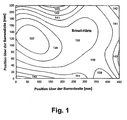
- Brinell hardness was determined over the ingot cross-section at samples of the thermoset ingots cut out perpendicular to the bar longitudinal direction. The areas of equal hardness shown in FIG. 1 clearly show the low hardness or strength loss in the barrel core relative to the bar surface.
- Fig. 2 the temperature-time curves calculated for the surface (O) and the core (K) of a billet having a cross section of 440 ⁇ 900 mm at a fan cooling and in Fig. 3 are the gradients derived therefrom between the temperature T K in the barrel core and the temperature T o shown on the bar surface.
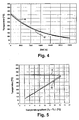
- Figs. 4 and 5 show the corresponding curves for a billet with a cross section of 1000 x 1200 mm. The results show that billets produced with the method according to the invention, with a thickness of up to 1000 mm, are still likely to fulfill the requirements imposed on plates for the production of plastic injection molds in terms of mechanical strength.
Landscapes
- Chemical & Material Sciences (AREA)
- Engineering & Computer Science (AREA)
- Materials Engineering (AREA)
- Mechanical Engineering (AREA)
- Metallurgy (AREA)
- Organic Chemistry (AREA)
- Physics & Mathematics (AREA)
- Thermal Sciences (AREA)
- Crystallography & Structural Chemistry (AREA)
- Continuous Casting (AREA)
- Moulds For Moulding Plastics Or The Like (AREA)
- Metal Rolling (AREA)
- Investigating Or Analyzing Materials By The Use Of Fluid Adsorption Or Reactions (AREA)
- Laminated Bodies (AREA)
- Manufacture Of Alloys Or Alloy Compounds (AREA)
- Safety Valves (AREA)
- Sampling And Sample Adjustment (AREA)
- Manufacture And Refinement Of Metals (AREA)
- Heat Treatment Of Steel (AREA)
- Contacts (AREA)
- Conductive Materials (AREA)
Description
- Die Erfindung betrifft eine Aluminiumlegierung mit hoher Festigkeit und geringer Abschreckempfindlichkeit. Im Rahmen der Erfindung liegt auch ein Verfahren zur Herstellung dicker Platten aus der Aluminiumlegierung.
- Insbesondere in der Automobilindustrie besteht zunehmend ein Bedarf an grossen Kunststoffbauteilen, wie z.B. integrale Stossstangen. Zur Herstellung der entsprechend grossen Spritzgiessformen werden Platten benötigt, deren Dicke sehr oft 150 mm übersteigt und in gewissen Fällen sogar mehr als 500 mm beträgt.
- Das Dokument
FR-A-2 341 661 - Für den Bau von Spritzgiessformen mit einer Dicke von beispielsweise 50 bis 300 mm werden heute üblicherweise warmgewalzte und warmausgehärtete Platten eingesetzt. Grössere Formen mit einer Dicke von mehr als 300 mm wurden entweder aus geschmiedeten Blöcken oder auch schon direkt aus Stranggussbarren gefertigt.
- Ein wesentlicher Nachteil der heute für den Formenbau eingesetzten Aluminiumlegierungen ist deren hohe Abschreckempfindlichkeit. Damit die Barren oder Platten bei der Warmaushärtung das für Kunststoff-Spritzgiessformen geforderte Festigkeitsniveau erreichen, muss die Abkühlungsgeschwindigkeit von der Homogenisierungs- oder Lösungsglühtemperatur mit zunehmender Plattendicke erhöht werden. Durch die hierbei auftretenden hohen Temperaturgradienten zwischen der Oberfläche und dem Kern der Barren oder Platten nehmen die schädlichen Eigenspannungen zu, so dass schon aus diesem Grund einer weiteren Erhöhung der Abkühlungsgeschwindigkeit und damit dem letztlich erreichbaren Festigkeitsniveau Grenzen gesetzt sind.
- Der Erfindung liegt die Aufgabe zugrunde, eine zur Herstellung von dicken Platten mit hohem Festigkeitsniveau geeignete Aluminiumlegierung mit geringer Abschreckempfindlichkeit bereitzustellen.
- Ein weiteres Ziel der Erfindung liegt darin, ein geeignetes Verfahren anzugeben, mit dem die Aluminiumlegierung zu dicken Platten mit ausreichend hoher Festigkeit über die gesamte Plattendicke verarbeitet werden kann.
- Zur erfindungsgemässen Lösung der Aufgabe führt eine Aluminiumlegierung mit
- 4,6 bis 5,2 Gew.-% Zn
- 2,6 bis 3,0 Gew.-% Mg
- 0.1 bis 0,2 Gew.-% Cu
- 0,05 bis 0,2 Gew.-% Zr
- max. 0,05 Gew.-% Mn
- max. 0,05 Gew.-% Cr
- max. 0,15 Gew.-% Fe
- max. 0,15 Gew.-% Si
- max. 0,10 Gew.-% Ti
- Die Zusammensetzung der Legierung ist erfindungsgemäss so gewählt, dass sie eine sehr geringe Abschreckempfindlichkeit aufweist und trotzdem ein ausserordentlich hohes Festigkeitsniveau besitzt. Dicke Querschnitte können daher mit forcierter Luftabkühlung und durch Ausscheidungshärtung auf ein hohes Festigkeitsniveau gebracht werden.
- Für die einzelnen Legierungselemente gelten die folgenden Vorzugsbereiche:
- 4,6 bis 4,8 Gew.-% Zn
- 2,6 bis 2,8 Gew.-% Mg
- 0,10 bis 0,15 Gew.-% Cu
- 0,08 bis 0,18 Gew.-% Zr
- max. 0,03 Gew.-% Mn
- max. 0,02 Gew.-% Cr
- max. 0,12 Gew.-% Fe
- max. 0,12 Gew.-% Si
- max. 0,05 Gew.-% Ti
- Für die Anwendung der erfindungsgemässen Legierung als Werkstoff für den Formenbau ist eine möglichst isotrope Verteilung der Eigenspannungen im Querschnitt der Platte anzustreben. Für den Abbau der Eigenspannungen ist u.a. die Korngrösse und die Kornform in der Platte von Bedeutung. Je feiner und gleichmässiger die Kristalle vorliegen, desto besser können sich die Eigenspannungen im Querschnitt der Platte ausgleichen. Die Korngrenzen wirken dabei als Senken für Versetzungen beim Abbau von lokalen Spannungsspitzen. Wie weiter unten erläutert, kann durch den Zusatz von Zirkonium ein feines Korngefüge in der Platte erreicht werden, indem man die Aufheizgeschwindigkeit der Barren auf die Homogenisierungs- bzw. Lösungsglühtemperatur so wählt, dass eine möglichst homogene Verteilung von submikronen Ausscheidungen von Al3Zr im Gefüge entsteht.
- Zur Herstellung von Platten aus der erfindungsgemässen Legierung eignen sich insbesondere die folgenden zwei Verfahren, die je nach gewünschter Dicke der Form zu einer warmgewalzten und warmausgehärteten Platte oder zu einem als Platte verwendeten warmausgehärteten Stranggussbarren führen.
- Zur Herstellung von Platten mit einer Dicke von bis zu 300 mm ist das Verfahren durch die folgenden Schritte gekennzeichnet:
- A. Stranggiessen der Aluminiumlegierung zu Barren mit einer Dicke von mehr als 300 mm,
- B. Aufheizen der Barren mit einer Aufheizgeschwindigkeit von max. 20°C/h zwischen 170 und 410°C auf eine Temperatur von 470 bis 490°C,
- C. Homogenisieren der Barren während einer Zeitdauer von 10 bis 14 h bei einer Temperatur von 470 bis 490°C,
- D. Warmwalzen der homogenisierten Barren zu Platten,
- E. Abkühlen der Platten von einer Temperatur von 400 bis 410°C auf eine Temperatur von weniger als 100°C,
- F. Abkühlen der Platten auf Raumtemperatur,
- G. Warmaushärten der Platten.
- Zur Herstellung von Platten mit einer Dicke von mehr als 300 mm und insbesondere von Platten mit einer Dicke von mehr als 500 mm kann ein aus der erfindungsgemässen Legierung hergestellter Stranggussbarren direkt als Platte verwendet werden. Das Verfahren ist in diesem Fall durch die folgenden Schritte gekennzeichnet:
- A. Stranggiessen der Legierung zu Barren mit einer Dicke von mehr als 300 mm,
- B. Aufheizen der Barren mit einer Aufheizgeschwindigkeit von max. 20°C/h zwischen 170 und 410°C auf eine Temperatur von 470 bis 490°C,
- C. Homogenisieren der Barren während einer Zeitdauer von 10 bis 14 h bei einer Temperatur von 470 bis 490°C,
- D. Abkühlen der Barren auf eine Zwischentemperatur von 400 bis 410 °C,
- E. Abkühlen der Barren von der Zwischentemperatur von 400 bis 410°C auf eine Temperatur von weniger als 100°C,
- F. Abkühlen der Barren auf Raumtemperatur,
- G. Warmaushärten der Barren,
- H. Verwenden der warmausgehärteten Barren als Platten.
- Bevorzugt erfolgt das Abkühlen der Barren von der Homogenisierungstemperatur von 470 bis 490°C auf die Zwischentemperatur von 400 bis 410 °C an ruhender Luft.
- Das Abkühlen der Barren von der Zwischentemperatur von 400 bis 410°C sollte einerseits so rasch erfolgen, dass der Festigkeitsverlust möglichst gering ist. Andererseits darf die Abkühlungsgeschwindigkeit auch nicht zu hoch sein, da sonst zu hohe Eigenspannungen aufgebaut werden.
- Das Abkühlen der Barren von der Zwischentemperatur von 400 bis 410°C auf eine Temperatur von weniger als 100°C erfolgt bevorzugt an bewegter Luft (forced air cooling) oder in einem Wasser/Luft-Sprühnebel.
- Bei der Wahl der Abkühlungsbedingungen muss auch die Barrendicke berücksichtigt werden. Es liegt jedoch im Rahmen des fachmännischen Handelns, für ein vorgegebenes Barrenformat die optimalen Abkühlungsbedingungen anhand einfacher Versuche zu ermitteln.
- Die niedrige Aufheizgeschwindigkeit im Temperaturbereich zwischen 170 und 410°C beim Aufheizen der Barren auf die Homogenisierungstemperatur ist ein wesentliches Merkmal des erfindungsgemässen Verfahrens. Im erwähnten Temperaturbereich, der auch als Heterogenisierungsintervall bezeichnet wird, ist die AlZnMg-Gleichgewichtsphase (T-Phase) stabil. Das langsame Durchlaufen des Heterogenisierungsintervalls führt zu einem fein dispersen Ausscheiden der T-Phase, wobei die Phasengrenzflächen der ausgeschiedenen Teilchen der T-Phase bevorzugte Keimstellen für die bei einer Temperatur von etwa 350°C einsetzende Ausscheidung von Al3Zr-Teilchen bilden. Beim weiteren Aufheizen der Barren auf die Homogenisierungstemperatur lösen sich die zuvor ausgeschiedenen Teilchen der T-Phase auf und zurück bleibt eine gleichmässige Verteilung der feinen, submikronen Al3Zr-Ausscheidungen, welche bevorzugt an den ursprünglichen Teilchengrenzen der T-Phase sowie an Subkomgrenzen liegen und damit eine homogene Verteilung ergeben. Diese feinen Al3Zr-Teilchen bewirken eine sowohl eine starke Wachstumshemmung bei der Rekristallisation der Platten bei der Lösungsglühung als auch bei der Homogenisierungsglühung von Gussbarren, und es resultiert das gewünschte isotrope Korngefüge im Barren. Das kornfeinende Zusatzelement Zr wird damit optimal genutzt.
- Ein weiteres wesentliches Merkmal des erfindungsgemässen Verfahrens ist die kombinierte Homogenisierungs- und Lösungsglühung mit anschliessender zweistufiger Abkühlung, wogegen bei den üblichen Verfahren nach dem Stand der Technik zur Erzielung einer auch in der Barrenmitte noch akzeptablen Festigkeit eine separate Lösungsglühung mit nachfolgendem Abschrecken bei hoher Abkühlungsgeschwindigkeit erforderlich ist.
- Unter dem Begriff "Abkühlen an bewegter Luft" bzw. "forced air cooling" wird hier eine üblicherweise durch Ventilatoren unterstützte Luftabkühlung verstanden, die zu einem Wärmeübergangskoeffizienten an der Barrenoberfläche von etwa 40 W/m2K führt. Das Abkühlen in einem Wasser/Luft-Sprühnebel führt zu einem etwas höheren Wärmeübergangskoeffizienten an der Barrenoberfläche.
- Die erfindungsgemässe Legierung weist eine geringe Abschreckempfindlichkeit auf. Bei der Herstellung dicker Platten ist der Festigkeitsverlust im Plattenkern trotz der verhältnismässig milden Abkühlungsbedingungen kleiner als bei den Legierungen nach dem Stand der Technik. Es hat sich zudem überraschenderweise herausgestellt, dass dieser Effekt bei direkt aus Stranggussbarren gefertigten Platten noch viel ausgeprägter ist als bei warmgewalzten Platten.
- Bei der Herstellung der dicken Platten hat sich die zweistufige Abkühlung von der Homogenisierungstemperatur auf Raumtemperatur als besonders vorteilhaft zur Erzielung einer Struktur mit geringen Eigenspannungen herausgestellt.
- Zum Warmaushärten wird bevorzugt nacheinander eine Raumtemperaturlagerung, eine erste Wärmebehandlung bei einer ersten Temperatur und eine zweite Wärmebehandlung bei einer gegenüber der ersten Temperatur höheren zweiten Temperatur durchgeführt, z.B.
- 1 bis 30 Tage Lagerung bei Raumtemperatur,
- 6 bis 10 h Lagerung bei einer Temperatur von 90 bis 100°C,
- 8 bis 22 h Lagerung bei einer Temperatur von 150 bis 160°C.
- Besonders bevorzugt ist die Warmaushärtung zum Wärmebehandlungszustand T76.
- Der Anwendungsbereich der erfindungsgemässen Legierung und der aus dieser hergestellten dicken Platten ergibt sich aus dem vorstehend beschriebenen Eigenschaftsspektrum. Die Platten eignen sich insbesondere für den Formenbau, d.h. für die Fertigung von Kunststoff-Spritzgiessformen, aber auch allgemein für den Maschinen-, Werkzeug- und Formenbau.
- Weitere Vorteile, Merkmale und Einzelheiten der Erfindung ergeben sich aus der nachfolgenden Beschreibung bevorzugter Ausführungsbeispiele sowie anhand der Zeichnung; diese zeigt schematisch in
- Fig. 1 die Verteilung der Brinell-Härte über einen Teil des Querschnitts eines Stranggussbarrens mit einem Querschnitt von 440 mm x 900 mm nach Ventilatorkühlung.
- Fig. 2 den gemessenen Temperaturverlauf bei einem Stranggussbarren mit einem Querschnitt von 440 mm x 900 mm an der Oberfläche und in der Mitte bei Ventilatorkühlung;
- Fig. 3 den berechneten Verlauf der inneren Temperaturgradienten beim Temperaturverlauf von Fig. 2;
- Fig. 4 den berechneten Temperaturverlauf bei einem Stranggussbarren mit einem Querschnitt von 1000 mm x 1200 mm an der Oberfläche und in der Mitte bei Ventilatorkühlung;
- Fig. 5 den berechneten Verlauf der inneren Temperaturgradienten beim Temperaturverlauf von Fig. 4;
- Eine Legierung mit der Zusammensetzung (in Gew.-%): 0.040 Si, 0.08 Fe, 0.14 Cu, 0.0046 Mn, 2.69 Mg, 0.0028 Cr, 4.69 Zn, 0.017 Ti, 0.16 Zr, Rest Al, wurde in industriellem Massstab zu einem Stranggussbarren mit einem Querschnitt von 440 x 900 mm vergossen. Der Barren wurden innerhalb von 30 h auf eine Temperatur von 480°C aufgeheizt, wobei darauf geachtet wurde, dass die Aufheizgeschwindigkeit im Bereich zwischen 170 und 410°C weniger als 20°C/h betrug. Die Homogenisierung des Barrens zum Ausgleich der erstarrungsbedingten Kristallseigerungen erfolgte durch Halten des Barrens während 12h bei 480°C.
- Der homogenisierte Barren wurden in einer ersten Stufe an ruhender Luft von der Homogenisierungstemperatur auf eine Zwischentemperatur von 400°C und anschliessend in einer zweiten Stufe mit Ventilatoren von 400°C auf 100°C abgekühlt. Die weitere Abkühlung auf Raumtemperatur erfolgte wiederum an ruhender Luft.
- Der Barren wurde nach 14 Tagen Lagerung bei Raumtemperatur während 8h bei 95°C und anschliessend während 18h bei 155°C zum überhärteten Zustand T76 warm ausgehärtet.
- An senkrecht zur Barrenlängsrichtung herausgesägten Proben der warmausgehärteten Barren wurde die Brinell-Härte über den Barrenquerschnitt bestimmt. Die in Fig. 1 dargestellten Bereiche gleicher Härte zeigen deutlich den geringen Härte- bzw. Festigkeitsverlust im Barrenkern gegenüber der Barrenoberfläche.
- In Fig. 2 sind die für die Oberfläche (O) und den Kern (K) eines Barrens mit einem Querschnitt von 440 x 900 mm berechneten Temperatur-Zeit-Kurven bei einer Ventilatorabkühlung und in Fig. 3 die daraus abgeleiteten Gradienten zwischen der Temperatur TK im Barrenkern und der Temperatur To an der Barrenoberfläche dargestellt. Zum Vergleich zeigen die Fig. 4 und 5 die entsprechenden Kurven für einen Barren mit einem Querschnitt von 1000 x 1200 mm. Die Ergebnisse zeigen, dass mit dem erfindungsgemässen Verfahren hergestellte Barren mit einer Dicke bis zu 1000 mm immer noch die an Platten zur Fertigung von Kunststoff-Spritzgiessformen bezüglich der mechanischen Festigkeit gestellten Anforderungen erfüllen dürften.
Claims (19)
- Aluminiumlegierung mit hoher Festigkeit und geringer Abschreckempfindlichkeit, mit4,6 bis 5,2 Gew.-% Zn2,6 bis 3,0 Gew.-% Mg0.1 bis 0,2 Gew.-% Cu0,05 bis 0,2 Gew.-% Zrmax. 0,05 Gew.-% Mnmax. 0,05 Gew.-% Crmax. 0,15 Gew.-% Femax. 0,15 Gew.% Simax. 0,10 Gew.-% Tiund Aluminium als Rest mit herstellungsbedingten Verunreinigungen, einzeln max. 0,05 Gew.%, insgesamt max. 0,15 Gew.-%.
- Aluminiumlegierung nach Anspruch 1, gekennzeichnet durch 4,6 bis 4,8 Gew.-% Zn.
- Aluminiumlegierung nach Anspruch 1 oder 2, gekennzeichnet durch 2,6 bis 2,8 Gew.-% Mg.
- Aluminiumlegierung nach einem der Ansprüche 1 bis 3, gekennzeichnet durch 0,10 bis 0,15 Gew.-% Cu.
- Aluminiumlegierung nach einem der Ansprüche 1 bis 4, gekennzeichnet durch 0,08 bis 0,18 Gew.% Zr.
- Aluminiumlegierung nach einem der Ansprüche 1 bis 6, gekennzeichnet durch max. 0,03 Gew.-% Mn.
- Aluminiumlegierung nach einem der Ansprüche 1 bis 5, gekennzeichnet durch max. 0,02 Gew.-% Cr.
- Aluminiumlegierung nach einem der Ansprüche 1 bis 7, gekennzeichnet durch max. 0,12 Gew.-% Fe.
- Aluminiumlegierung nach einem der Ansprüche 1 bis 8, gekennzeichnet durch max. 0,12 Gew.-% Si.
- Aluminiumlegierung nach einem der Ansprüche 1 bis 9, gekennzeichnet durch max. 0,05 Gew.-% Ti.
- Verfahren zur Herstellung von Platten mit einer Dicke bis zu 300 mm aus einer Aluminiumlegierung nach einem der Ansprüche 1 bis 10, gekennzeichnet durch die SchritteA. Stranggiessen der Aluminiumlegierung zu Barren mit einer Dicke von mehr als 300 mm,B. Aufheizen der Barren mit einer Aufheizgeschwindigkeit von max. 20°C/h zwischen 170 und 410°C auf eine Temperatur von 470 bis 490°C,C. Homogenisieren der Barren während einer Zeitdauer von 10 bis 14 h bei einer Temperatur von 470 bis 490°C,D. Warmwalzen der homogenisierten Barren zu Platten,E. Abkühlen der Platten von einer Temperatur von 400 bis 410°C auf eine Temperatur von weniger als 100°C,F. Abkühlen der Platten auf Raumtemperatur,H. Warmaushärten der Platten.
- Verfahren zur Herstellung von Platten mit einer Dicke von mehr als 300 mm aus einer Aluminiumlegierung nach einem der Ansprüche 1 bis 10, gekennzeichnet durch die SchritteA. Stranggiessen der Legierung zu Barren mit einer Dicke von mehr als 300 mm,B. Aufheizen der Barren mit einer Aufheizgeschwindigkeit von max. 20°C/h zwischen 170 und 410°C auf eine Temperatur von 470 bis 490°C,C. Homogenisieren der Barren während einer Zeitdauer von 10 bis 14 h bei einer Temperatur von 470 bis 490°C,D. Abkühlen der Barren auf eine Zwischentemperatur von 400 bis 410 °C,E. Abkühlen der Barren von der Zwischentemperatur von 400 bis 410°C auf eine Temperatur von weniger als 100°C,F. Abkühlen der Barren auf Raumtemperatur,G. Warmaushärten der Barren,H. Verwendung der warmausgehärteten Barren als Platten.
- Verfahren nach Anspruch 12, dadurch gekennzeichnet, dass das Abkühlen der Barren von der Homogenisierungstemperatur von 470 bis 490°C auf die Zwischentemperatur von 400 bis 410 °C an ruhender Luft erfolgt.
- Verfahren nach Anspruch 11 oder 12, dadurch gekennzeichnet, dass das Abkühlen der Barren von der Zwischentemperatur von 400 bis 410°C auf eine Temperatur von weniger als 100°C an bewegter Luft (forced air cooling) erfolgt.
- Verfahren nach Anspruch 11 oder 12, dadurch gekennzeichnet, dass das Abkühlen der Barren von der Zwischentemperatur von 400 bis 410°C auf eine Temperatur von weniger als 100°C in einem Wasser/Luft-Sprühnebel erfolgt.
- Verfahren nach einem der Ansprüche 11 bis 15, dadurch gekennzeichnet, dass zum Warmaushärten nacheinander eine Raumtemperaturlagerung, eine erste Wärmebehandlung bei einer ersten Temperatur und eine zweite Wärmebehandlung bei einer gegenüber der ersten Temperatur höheren zweiten Temperatur durchgeführt wird.
- Verfahren nach Anspruch 16, gekennzeichnet durch- 1 bis 30 Tage Lagerung bei Raumtemperatur,- 6 bis 10 h Lagerung bei einer Temperatur von 90 bis 100°C,- 8 bis 22 h Lagerung bei einer Temperatur von 150 bis 160°C.
- Verfahren nach Anspruch 17, dadurch gekennzeichnet, dass die Warmaushärtung zum Wärmebehandlungszustand T76 erfolgt.
- Verwendung einer mit dem Verfahren nach einem der Ansprüche 11 bis 18 hergestellten Platte für den Maschinen-, Werkzeug- und Formenbau, insbesondere für die Fertigung von Kunststoff-Spritzgiessformen.
Priority Applications (2)
| Application Number | Priority Date | Filing Date | Title |
|---|---|---|---|
| SI200330959T SI1587965T1 (sl) | 2003-01-16 | 2003-12-20 | Aluminijeva zlitina z visoko trdnostjo in majhno občutljivostjo za gašenje |
| EP03789376A EP1587965B1 (de) | 2003-01-16 | 2003-12-20 | Aluminiumlegierung mit hoher festigkeit und geringer abschreckempfindlichkeit |
Applications Claiming Priority (4)
| Application Number | Priority Date | Filing Date | Title |
|---|---|---|---|
| EP03405013 | 2003-01-16 | ||
| EP03405013A EP1441041A1 (de) | 2003-01-16 | 2003-01-16 | Aluminiumlegierung mit hoher Festigkeit und geringer Abschreckempfindlichkeit |
| EP03789376A EP1587965B1 (de) | 2003-01-16 | 2003-12-20 | Aluminiumlegierung mit hoher festigkeit und geringer abschreckempfindlichkeit |
| PCT/EP2003/014696 WO2004063407A1 (de) | 2003-01-16 | 2003-12-20 | Aluminiumlegierung mit hoher festigkeit und geringer abschreckempfindlichkeit |
Publications (2)
| Publication Number | Publication Date |
|---|---|
| EP1587965A1 EP1587965A1 (de) | 2005-10-26 |
| EP1587965B1 true EP1587965B1 (de) | 2007-07-18 |
Family
ID=32524285
Family Applications (2)
| Application Number | Title | Priority Date | Filing Date |
|---|---|---|---|
| EP03405013A Withdrawn EP1441041A1 (de) | 2003-01-16 | 2003-01-16 | Aluminiumlegierung mit hoher Festigkeit und geringer Abschreckempfindlichkeit |
| EP03789376A Expired - Lifetime EP1587965B1 (de) | 2003-01-16 | 2003-12-20 | Aluminiumlegierung mit hoher festigkeit und geringer abschreckempfindlichkeit |
Family Applications Before (1)
| Application Number | Title | Priority Date | Filing Date |
|---|---|---|---|
| EP03405013A Withdrawn EP1441041A1 (de) | 2003-01-16 | 2003-01-16 | Aluminiumlegierung mit hoher Festigkeit und geringer Abschreckempfindlichkeit |
Country Status (16)
| Country | Link |
|---|---|
| US (2) | US20060096676A1 (de) |
| EP (2) | EP1441041A1 (de) |
| AT (1) | ATE367456T1 (de) |
| AU (1) | AU2003293963A1 (de) |
| CA (1) | CA2513333C (de) |
| DE (1) | DE50307736D1 (de) |
| DK (1) | DK1587965T3 (de) |
| ES (1) | ES2290544T3 (de) |
| HR (1) | HRP20050704B1 (de) |
| NO (1) | NO340750B1 (de) |
| PL (1) | PL203780B1 (de) |
| PT (1) | PT1587965E (de) |
| RU (1) | RU2351674C2 (de) |
| SI (1) | SI1587965T1 (de) |
| TW (1) | TWI291993B (de) |
| WO (1) | WO2004063407A1 (de) |
Cited By (1)
| Publication number | Priority date | Publication date | Assignee | Title |
|---|---|---|---|---|
| DE102008053893A1 (de) * | 2008-10-30 | 2010-05-12 | Audi Ag | Vorrichtung und Verfahren zum Kühlen wenigstens eines Gussbauteils |
Families Citing this family (13)
| Publication number | Priority date | Publication date | Assignee | Title |
|---|---|---|---|---|
| DE502005001724D1 (de) * | 2005-01-19 | 2007-11-29 | Fuchs Kg Otto | Abschreckunempfindliche Aluminiumlegierung sowie Verfahren zum Herstellen eines Halbzeuges aus dieser Legierung |
| CN100363146C (zh) * | 2005-05-20 | 2008-01-23 | 东北轻合金有限责任公司 | 浮桥用铝合金型材的制造方法 |
| EP2034035B2 (de) | 2006-05-18 | 2022-09-14 | Kabushiki Kaisha Kobe Seiko Sho | Verfahren zur herstellung einer aluminiumlegierungsplatte |
| CN100523242C (zh) * | 2006-11-13 | 2009-08-05 | 上海昊华模具有限公司 | 车用子午线轮胎模具用铝合金 |
| EP2288738B1 (de) * | 2008-06-24 | 2014-02-12 | Aleris Rolled Products Germany GmbH | Al-zn-mg-legierungsprodukt mit verringerter quetschempfindlichkeit |
| RU2457422C2 (ru) * | 2010-04-16 | 2012-07-27 | Российская Федерация в лице Министерства промышленности торговли Российской Федерации | Способ изготовления слоистой плиты на основе алюминия для противопульной сварной брони |
| FR2968675B1 (fr) | 2010-12-14 | 2013-03-29 | Alcan Rhenalu | Produits epais en alliage 7xxx et procede de fabrication |
| RU2489217C1 (ru) * | 2011-12-27 | 2013-08-10 | Открытое акционерное общество "Всероссийский институт легких сплавов" (ОАО "ВИЛС") | Способ производства листов из термически упрочняемых алюминиевых сплавов, легированных скандием и цирконием |
| JP6344923B2 (ja) * | 2014-01-29 | 2018-06-20 | 株式会社Uacj | 高強度アルミニウム合金及びその製造方法 |
| CA3032261A1 (en) | 2016-08-26 | 2018-03-01 | Shape Corp. | Warm forming process and apparatus for transverse bending of an extruded aluminum beam to warm form a vehicle structural component |
| JP2019534380A (ja) * | 2016-09-30 | 2019-11-28 | オプシチェストボ エス オグラニチェンノイ オトヴェストヴェンノストユ “オベディネンナヤ カンパニアルサール インゼネルノ−テクノロギケスキー チェントル”Obshchestvo S Ogranichennoy Otvetstvennost’Yu ‘Obedinennaya Kompaniya Rusal Inzhenerno−Tekhnologicheskiy Tsentr’ | アルミニウム基合金から変形半製品の製造方法 |
| CN110114498A (zh) | 2016-10-24 | 2019-08-09 | 形状集团 | 用于生产车辆零件的多阶段铝合金形成与热加工方法 |
| CN112921220A (zh) * | 2021-01-25 | 2021-06-08 | 西南铝业(集团)有限责任公司 | 一种Al-Zn-Cu-Mg铸锭及其制备方法 |
Family Cites Families (15)
| Publication number | Priority date | Publication date | Assignee | Title |
|---|---|---|---|---|
| US3542606A (en) * | 1968-03-13 | 1970-11-24 | Kaiser Aluminium Chem Corp | Hot worked metal article of aluminum base alloy and method of producing same |
| US3694272A (en) * | 1970-12-24 | 1972-09-26 | Kaiser Aluminium Chem Corp | Method for forming aluminum sheet |
| ATA113876A (de) * | 1976-02-18 | 1978-04-15 | Vmw Ranshofen Berndorf Ag | Schweissbare, gut warmverformbare borfreie aluminiumguss- und -knetlegierung mit hoher bestandigkeit gegen spannungsriss- und schicht korrosion bei gleichzeitig guten mechanischen eigenschaften |
| US4618382A (en) * | 1983-10-17 | 1986-10-21 | Kabushiki Kaisha Kobe Seiko Sho | Superplastic aluminium alloy sheets |
| JPH0794701B2 (ja) * | 1991-04-01 | 1995-10-11 | 住友軽金属工業株式会社 | 溶接構造用アルミニウム合金軟質材の製造方法 |
| US5389165A (en) * | 1991-05-14 | 1995-02-14 | Reynolds Metals Company | Low density, high strength Al-Li alloy having high toughness at elevated temperatures |
| ZA925491B (en) * | 1991-07-23 | 1993-03-05 | Alcan Int Ltd | Aluminum alloy. |
| JPH07252573A (ja) * | 1994-03-17 | 1995-10-03 | Kobe Steel Ltd | 靭性に優れたAl−Zn−Mg−Cu系合金及びその製造方法 |
| US5961752A (en) * | 1994-04-07 | 1999-10-05 | Northwest Aluminum Company | High strength Mg-Si type aluminum alloy |
| RU2094516C1 (ru) * | 1995-02-24 | 1997-10-27 | Акционерное общество "Самарская металлургическая компания" | Алюминиевый деформируемый термоупрочняемый сплав |
| RU2094517C1 (ru) * | 1995-02-24 | 1997-10-27 | Акционерное общество "Самарская металлургическая компания" | Алюминиевый деформируемый термоупрочняемый сплав |
| RU2087582C1 (ru) * | 1996-02-20 | 1997-08-20 | Галина Ивановна Медведева | Способ изготовления деталей из алюминиевых сплавов |
| JP4204650B2 (ja) | 1996-12-09 | 2009-01-07 | 三井金属鉱業株式会社 | 高強度耐熱亜鉛合金及び成形品 |
| JP3638188B2 (ja) * | 1996-12-12 | 2005-04-13 | 住友軽金属工業株式会社 | 耐応力腐食割れ性に優れた自動二輪車のフロントフォークアウターチューブ用高力アルミニウム合金押出管の製造方法 |
| EP1409759A4 (de) * | 2000-10-20 | 2004-05-06 | Pechiney Rolled Products Llc | Hochfeste aluminiumlegierung |
-
2003
- 2003-01-16 EP EP03405013A patent/EP1441041A1/de not_active Withdrawn
- 2003-12-20 SI SI200330959T patent/SI1587965T1/sl unknown
- 2003-12-20 CA CA2513333A patent/CA2513333C/en not_active Expired - Fee Related
- 2003-12-20 WO PCT/EP2003/014696 patent/WO2004063407A1/de not_active Ceased
- 2003-12-20 PL PL376309A patent/PL203780B1/pl not_active IP Right Cessation
- 2003-12-20 ES ES03789376T patent/ES2290544T3/es not_active Expired - Lifetime
- 2003-12-20 US US10/541,788 patent/US20060096676A1/en not_active Abandoned
- 2003-12-20 DK DK03789376T patent/DK1587965T3/da active
- 2003-12-20 EP EP03789376A patent/EP1587965B1/de not_active Expired - Lifetime
- 2003-12-20 RU RU2005125727/02A patent/RU2351674C2/ru not_active IP Right Cessation
- 2003-12-20 DE DE50307736T patent/DE50307736D1/de not_active Expired - Lifetime
- 2003-12-20 AT AT03789376T patent/ATE367456T1/de active
- 2003-12-20 AU AU2003293963A patent/AU2003293963A1/en not_active Abandoned
- 2003-12-20 HR HR20050704A patent/HRP20050704B1/xx not_active IP Right Cessation
- 2003-12-20 PT PT03789376T patent/PT1587965E/pt unknown
- 2003-12-25 TW TW092136857A patent/TWI291993B/zh not_active IP Right Cessation
-
2005
- 2005-08-15 NO NO20053832A patent/NO340750B1/no not_active IP Right Cessation
-
2009
- 2009-03-12 US US12/402,966 patent/US7901522B2/en not_active Expired - Fee Related
Non-Patent Citations (1)
| Title |
|---|
| None * |
Cited By (2)
| Publication number | Priority date | Publication date | Assignee | Title |
|---|---|---|---|---|
| DE102008053893A1 (de) * | 2008-10-30 | 2010-05-12 | Audi Ag | Vorrichtung und Verfahren zum Kühlen wenigstens eines Gussbauteils |
| DE102008053893B4 (de) * | 2008-10-30 | 2010-08-19 | Audi Ag | Vorrichtung und Verfahren zum Kühlen wenigstens eines Gussbauteils |
Also Published As
| Publication number | Publication date |
|---|---|
| TW200427850A (en) | 2004-12-16 |
| WO2004063407A1 (de) | 2004-07-29 |
| HRP20050704A2 (en) | 2006-02-28 |
| CA2513333A1 (en) | 2004-07-29 |
| US20060096676A1 (en) | 2006-05-11 |
| RU2351674C2 (ru) | 2009-04-10 |
| PL376309A1 (en) | 2005-12-27 |
| PL203780B1 (pl) | 2009-11-30 |
| TWI291993B (en) | 2008-01-01 |
| DE50307736D1 (de) | 2007-08-30 |
| ES2290544T3 (es) | 2008-02-16 |
| EP1441041A1 (de) | 2004-07-28 |
| AU2003293963A1 (en) | 2004-08-10 |
| DK1587965T3 (da) | 2007-11-19 |
| RU2005125727A (ru) | 2007-02-27 |
| NO20053832L (no) | 2005-10-17 |
| PT1587965E (pt) | 2007-10-12 |
| US20090223608A1 (en) | 2009-09-10 |
| HRP20050704B1 (en) | 2008-06-30 |
| ATE367456T1 (de) | 2007-08-15 |
| NO340750B1 (no) | 2017-06-12 |
| EP1587965A1 (de) | 2005-10-26 |
| US7901522B2 (en) | 2011-03-08 |
| SI1587965T1 (sl) | 2007-12-31 |
| CA2513333C (en) | 2010-09-14 |
| NO20053832D0 (no) | 2005-08-15 |
Similar Documents
| Publication | Publication Date | Title |
|---|---|---|
| DE69326838T3 (de) | Zähe aluminiumlegierung mit kupfer und magnesium | |
| DE3689777T2 (de) | Mehrzweck-Kupferlegierungen mittelhoher Leitfähigkeit und hoher Festigkeit und Verfahren zu ihrer Herstellung. | |
| AT502310B1 (de) | Eine al-zn-mg-cu-legierung | |
| DE2953182C2 (en) | Method for producing an alloy product from an aluminium alloy | |
| EP1682688B1 (de) | Al-Mg-Si-Aluminium-Gusslegierung mit Scandium | |
| DE69737768T2 (de) | 6xxx aluminiumlegierung | |
| DE69836569T3 (de) | Verfahren zur Erhöhung der Bruchzähigkeit in Aluminium-Lithium-Legierungen | |
| DE102011007946B4 (de) | Verfahren zur Verfestigung von langsam abgeschreckten/gekühlten Aluminiumgusskomponenten | |
| DE68928676T3 (de) | Erzeugnis aus einer Aluminium-Legierung mit verbesserten Kombinationen der Festigkeit, der Zähigkeit und der Korrosionsbeständigkeit | |
| DE112008003052T5 (de) | Produkt aus Al-Mg-Zn-Knetlegierung und Herstellungsverfahren dafür | |
| DE69618710T2 (de) | Verfahren und Vorrichtung zur vereinfachten Herstellung einer wärmebehandlungsfähigen Aluminiumlegierung | |
| DE69325804T2 (de) | Hochfeste-al-li-legierung mit niedriger dichte und hoher zähigkeit bei hohen temperaturen | |
| DE60023753T2 (de) | Wärmebehandlung für alterungshärtende aluminiumlegierungen | |
| DE102008033027A1 (de) | Verfahren zur Erhöhung von Festigkeit und Verformbarkeit von ausscheidungshärtbaren Werkstoffen | |
| EP0918095A1 (de) | Strukturbauteil aus einer Aluminium-Druckgusslegierung | |
| DE60001249T2 (de) | Ti-Al-(Mo,V,Si,Fe) Legierungen und Verfahren zu ihrer Herstellung | |
| EP1587965A1 (de) | Aluminiumlegierung mit hoher festigkeit und geringer abschreckempfindlichkeit | |
| DE60114281T2 (de) | Guss- und Schmiedprodukt unter Verwendung einer Kupfer-basis Legierung | |
| DE2348248A1 (de) | Verfahren zum behandeln einer nickelgrundlegierung | |
| DE10163039C1 (de) | Warm- und kaltumformbares Bauteil aus einer Aluminiumlegierung und Verfahren zu seiner Herstellung | |
| CH623359A5 (de) | ||
| EP2061912B1 (de) | ALUMINIUMLEGIERUNG VOM TYP AlZnMg UND VERFAHREN ZU DEREN HERSTELLUNG | |
| EP0989195B1 (de) | Warmfeste Aluminiumlegierung vom Typ AlCuMg | |
| DE69921146T2 (de) | Verfahren zur herstellung von wärmebehandlungsfähigen blech-gegenständen | |
| DE3486352T2 (de) | Aluminium-Lithium-Legierung. |
Legal Events
| Date | Code | Title | Description |
|---|---|---|---|
| PUAI | Public reference made under article 153(3) epc to a published international application that has entered the european phase |
Free format text: ORIGINAL CODE: 0009012 |
|
| 17P | Request for examination filed |
Effective date: 20050816 |
|
| AK | Designated contracting states |
Kind code of ref document: A1 Designated state(s): AT BE BG CH CY CZ DE DK EE ES FI FR GB GR HU IE IT LI LU MC NL PT RO SE SI SK TR |
|
| AX | Request for extension of the european patent |
Extension state: AL LT LV MK |
|
| RIN1 | Information on inventor provided before grant (corrected) |
Inventor name: HOELLRIGL, GUENTHER Inventor name: JAQUEROD, CHRISTOPHE |
|
| DAX | Request for extension of the european patent (deleted) | ||
| GRAP | Despatch of communication of intention to grant a patent |
Free format text: ORIGINAL CODE: EPIDOSNIGR1 |
|
| RBV | Designated contracting states (corrected) |
Designated state(s): AT BE BG CH CZ DE DK ES FI FR GB GR HU IT LI LU MC NL PT RO SE SI SK TR |
|
| GRAS | Grant fee paid |
Free format text: ORIGINAL CODE: EPIDOSNIGR3 |
|
| GRAA | (expected) grant |
Free format text: ORIGINAL CODE: 0009210 |
|
| AK | Designated contracting states |
Kind code of ref document: B1 Designated state(s): AT BE BG CH CZ DE DK ES FI FR GB GR HU IT LI LU MC NL PT RO SE SI SK TR |
|
| REG | Reference to a national code |
Ref country code: GB Ref legal event code: FG4D Free format text: NOT ENGLISH |
|
| REG | Reference to a national code |
Ref country code: CH Ref legal event code: EP |
|
| REF | Corresponds to: |
Ref document number: 50307736 Country of ref document: DE Date of ref document: 20070830 Kind code of ref document: P |
|
| GBT | Gb: translation of ep patent filed (gb section 77(6)(a)/1977) |
Effective date: 20070815 |
|
| REG | Reference to a national code |
Ref country code: RO Ref legal event code: EPE |
|
| REG | Reference to a national code |
Ref country code: SE Ref legal event code: TRGR |
|
| REG | Reference to a national code |
Ref country code: PT Ref legal event code: SC4A Free format text: AVAILABILITY OF NATIONAL TRANSLATION Effective date: 20071001 |
|
| ET | Fr: translation filed | ||
| REG | Reference to a national code |
Ref country code: GR Ref legal event code: EP Ref document number: 20070402961 Country of ref document: GR |
|
| REG | Reference to a national code |
Ref country code: DK Ref legal event code: T3 |
|
| REG | Reference to a national code |
Ref country code: HU Ref legal event code: AG4A Ref document number: E002077 Country of ref document: HU |
|
| REG | Reference to a national code |
Ref country code: ES Ref legal event code: FG2A Ref document number: 2290544 Country of ref document: ES Kind code of ref document: T3 |
|
| PLBE | No opposition filed within time limit |
Free format text: ORIGINAL CODE: 0009261 |
|
| STAA | Information on the status of an ep patent application or granted ep patent |
Free format text: STATUS: NO OPPOSITION FILED WITHIN TIME LIMIT |
|
| 26N | No opposition filed |
Effective date: 20080421 |
|
| PGFP | Annual fee paid to national office [announced via postgrant information from national office to epo] |
Ref country code: MC Payment date: 20101201 Year of fee payment: 8 |
|
| PGFP | Annual fee paid to national office [announced via postgrant information from national office to epo] |
Ref country code: BG Payment date: 20101215 Year of fee payment: 8 Ref country code: FI Payment date: 20101229 Year of fee payment: 8 Ref country code: LU Payment date: 20110103 Year of fee payment: 8 Ref country code: RO Payment date: 20101213 Year of fee payment: 8 |
|
| PGFP | Annual fee paid to national office [announced via postgrant information from national office to epo] |
Ref country code: GR Payment date: 20101228 Year of fee payment: 8 Ref country code: SE Payment date: 20101229 Year of fee payment: 8 |
|
| REG | Reference to a national code |
Ref country code: ES Ref legal event code: PC2A Owner name: ENGINEERED PRODUCTS SWITZERLAND AG Effective date: 20110907 |
|
| BECN | Be: change of holder's name |
Owner name: CONSTELLIUM SWITZERLAND A.G. Effective date: 20110906 |
|
| REG | Reference to a national code |
Ref country code: CH Ref legal event code: PUE Owner name: CONSTELLIUM SWITZERLAND AG (LTD, SA) Free format text: ALCAN TECHNOLOGY & MANAGEMENT LTD.#BADISCHE BAHNHOFSTRASSE 16#8212 NEUHAUSEN AM RHEINFALL (CH) -TRANSFER TO- CONSTELLIUM SWITZERLAND AG (LTD, SA)#MAX HOEGGER-STRASSE 6#8048 ZUERICH (CH) Ref country code: CH Ref legal event code: NV Representative=s name: NOVAGRAAF SWITZERLAND SA |
|
| REG | Reference to a national code |
Ref country code: FR Ref legal event code: TP Owner name: ENGINEERED PRODUCTS SWITZERLAND AG, CH Effective date: 20111004 Ref country code: FR Ref legal event code: CD Owner name: ENGINEERED PRODUCTS SWITZERLAND AG, CH Effective date: 20111004 |
|
| REG | Reference to a national code |
Ref country code: NL Ref legal event code: SD Effective date: 20111214 Ref country code: NL Ref legal event code: TD Effective date: 20111214 |
|
| REG | Reference to a national code |
Ref country code: SI Ref legal event code: SP73 Owner name: CONSTELLIUM SWITZERLAND AG; CH Effective date: 20111103 Ref country code: FR Ref legal event code: CD Owner name: CONSTELLIUM SWITZERLAND AG, CH Effective date: 20111130 |
|
| REG | Reference to a national code |
Ref country code: SK Ref legal event code: TC4A Ref document number: E 2528 Country of ref document: SK Owner name: CONSTELLIUM SWITZERLAND AG, ZUERICH, CH Effective date: 20111212 Ref country code: SK Ref legal event code: PC4A Ref document number: E 2528 Country of ref document: SK Owner name: ALCAN FINANCES SWITZERLAND AG, ZUERICH, CH Free format text: FORMER OWNER: ALCAN TECHNOLOGY & MANAGEMENT LTD., NEUHAUSEN AM RHEINFALL, CH Effective date: 20111103 |
|
| REG | Reference to a national code |
Ref country code: PT Ref legal event code: PC4A Owner name: ALCAN FINANCES SWITZERLAND AG, CH Effective date: 20120118 |
|
| REG | Reference to a national code |
Ref country code: ES Ref legal event code: PC2A Owner name: CONSTELLIUM SWITZERLAND AG Effective date: 20120228 |
|
| REG | Reference to a national code |
Ref country code: HU Ref legal event code: FH1C Free format text: FORMER REPRESENTATIVE(S): ERDELY PETER, DANUBIA SZABADALMI ES JOGI IRODA KFT., HU Representative=s name: DANUBIA SZABADALMI ES JOGI IRODA KFT., HU Ref country code: HU Ref legal event code: GB9C Owner name: CONSTELLIUM SWITZERLAND AG, CH Free format text: FORMER OWNER(S): ALCAN TECHNOLOGY & MANAGEMENT LTD., CH |
|
| REG | Reference to a national code |
Ref country code: DE Ref legal event code: R081 Ref document number: 50307736 Country of ref document: DE Owner name: CONSTELLIUM SWITZERLAND AG, CH Free format text: FORMER OWNER: ALCAN TECHNOLOGY & MANAGEMENT LTD., NEUHAUSEN AM RHEINFALL, CH Effective date: 20120319 |
|
| REG | Reference to a national code |
Ref country code: GB Ref legal event code: 732E Free format text: REGISTERED BETWEEN 20120510 AND 20120516 |
|
| REG | Reference to a national code |
Ref country code: AT Ref legal event code: PC Ref document number: 367456 Country of ref document: AT Kind code of ref document: T Owner name: CONSTELLIUM SWITZERLAND AG, CH Effective date: 20120420 |
|
| PG25 | Lapsed in a contracting state [announced via postgrant information from national office to epo] |
Ref country code: MC Free format text: LAPSE BECAUSE OF NON-PAYMENT OF DUE FEES Effective date: 20111231 |
|
| REG | Reference to a national code |
Ref country code: SE Ref legal event code: EUG |
|
| PG25 | Lapsed in a contracting state [announced via postgrant information from national office to epo] |
Ref country code: FI Free format text: LAPSE BECAUSE OF NON-PAYMENT OF DUE FEES Effective date: 20111220 |
|
| REG | Reference to a national code |
Ref country code: GR Ref legal event code: ML Ref document number: 20070402961 Country of ref document: GR Effective date: 20120704 |
|
| PG25 | Lapsed in a contracting state [announced via postgrant information from national office to epo] |
Ref country code: RO Free format text: LAPSE BECAUSE OF NON-PAYMENT OF DUE FEES Effective date: 20111220 Ref country code: SE Free format text: LAPSE BECAUSE OF NON-PAYMENT OF DUE FEES Effective date: 20111221 |
|
| PG25 | Lapsed in a contracting state [announced via postgrant information from national office to epo] |
Ref country code: GR Free format text: LAPSE BECAUSE OF NON-PAYMENT OF DUE FEES Effective date: 20120704 |
|
| PG25 | Lapsed in a contracting state [announced via postgrant information from national office to epo] |
Ref country code: LU Free format text: LAPSE BECAUSE OF NON-PAYMENT OF DUE FEES Effective date: 20111220 |
|
| PG25 | Lapsed in a contracting state [announced via postgrant information from national office to epo] |
Ref country code: BG Free format text: LAPSE BECAUSE OF NON-PAYMENT OF DUE FEES Effective date: 20121231 |
|
| REG | Reference to a national code |
Ref country code: FR Ref legal event code: PLFP Year of fee payment: 13 |
|
| REG | Reference to a national code |
Ref country code: FR Ref legal event code: PLFP Year of fee payment: 14 |
|
| PG25 | Lapsed in a contracting state [announced via postgrant information from national office to epo] |
Ref country code: IT Free format text: LAPSE BECAUSE OF NON-PAYMENT OF DUE FEES Effective date: 20151220 |
|
| PGFP | Annual fee paid to national office [announced via postgrant information from national office to epo] |
Ref country code: HU Payment date: 20161214 Year of fee payment: 14 Ref country code: DK Payment date: 20161227 Year of fee payment: 14 Ref country code: SK Payment date: 20161202 Year of fee payment: 14 Ref country code: NL Payment date: 20161226 Year of fee payment: 14 Ref country code: CH Payment date: 20161227 Year of fee payment: 14 Ref country code: GB Payment date: 20161228 Year of fee payment: 14 Ref country code: CZ Payment date: 20161208 Year of fee payment: 14 |
|
| PGFP | Annual fee paid to national office [announced via postgrant information from national office to epo] |
Ref country code: ES Payment date: 20161227 Year of fee payment: 14 Ref country code: SI Payment date: 20161205 Year of fee payment: 14 Ref country code: AT Payment date: 20161202 Year of fee payment: 14 Ref country code: PT Payment date: 20161205 Year of fee payment: 14 |
|
| PGFP | Annual fee paid to national office [announced via postgrant information from national office to epo] |
Ref country code: TR Payment date: 20161207 Year of fee payment: 14 |
|
| PG25 | Lapsed in a contracting state [announced via postgrant information from national office to epo] |
Ref country code: IT Free format text: LAPSE BECAUSE OF NON-PAYMENT OF DUE FEES Effective date: 20151220 |
|
| PGFP | Annual fee paid to national office [announced via postgrant information from national office to epo] |
Ref country code: IT Payment date: 20161222 Year of fee payment: 14 |
|
| PGRI | Patent reinstated in contracting state [announced from national office to epo] |
Ref country code: IT Effective date: 20170710 |
|
| REG | Reference to a national code |
Ref country code: FR Ref legal event code: PLFP Year of fee payment: 15 |
|
| REG | Reference to a national code |
Ref country code: DK Ref legal event code: EBP Effective date: 20171231 |
|
| PG25 | Lapsed in a contracting state [announced via postgrant information from national office to epo] |
Ref country code: CZ Free format text: LAPSE BECAUSE OF NON-PAYMENT OF DUE FEES Effective date: 20171220 Ref country code: PT Free format text: LAPSE BECAUSE OF NON-PAYMENT OF DUE FEES Effective date: 20180620 |
|
| REG | Reference to a national code |
Ref country code: CH Ref legal event code: PL |
|
| REG | Reference to a national code |
Ref country code: NL Ref legal event code: MM Effective date: 20180101 |
|
| REG | Reference to a national code |
Ref country code: AT Ref legal event code: MM01 Ref document number: 367456 Country of ref document: AT Kind code of ref document: T Effective date: 20171220 |
|
| GBPC | Gb: european patent ceased through non-payment of renewal fee |
Effective date: 20171220 |
|
| REG | Reference to a national code |
Ref country code: SK Ref legal event code: MM4A Ref document number: E 2528 Country of ref document: SK Effective date: 20171220 |
|
| PG25 | Lapsed in a contracting state [announced via postgrant information from national office to epo] |
Ref country code: NL Free format text: LAPSE BECAUSE OF NON-PAYMENT OF DUE FEES Effective date: 20180101 |
|
| REG | Reference to a national code |
Ref country code: SI Ref legal event code: KO00 Effective date: 20180806 |
|
| PG25 | Lapsed in a contracting state [announced via postgrant information from national office to epo] |
Ref country code: IT Free format text: LAPSE BECAUSE OF NON-PAYMENT OF DUE FEES Effective date: 20171220 Ref country code: HU Free format text: LAPSE BECAUSE OF NON-PAYMENT OF DUE FEES Effective date: 20171221 |
|
| PG25 | Lapsed in a contracting state [announced via postgrant information from national office to epo] |
Ref country code: SK Free format text: LAPSE BECAUSE OF NON-PAYMENT OF DUE FEES Effective date: 20171220 Ref country code: GB Free format text: LAPSE BECAUSE OF NON-PAYMENT OF DUE FEES Effective date: 20171220 Ref country code: CH Free format text: LAPSE BECAUSE OF NON-PAYMENT OF DUE FEES Effective date: 20171231 Ref country code: AT Free format text: LAPSE BECAUSE OF NON-PAYMENT OF DUE FEES Effective date: 20171220 Ref country code: SI Free format text: LAPSE BECAUSE OF NON-PAYMENT OF DUE FEES Effective date: 20171221 Ref country code: LI Free format text: LAPSE BECAUSE OF NON-PAYMENT OF DUE FEES Effective date: 20171231 |
|
| PG25 | Lapsed in a contracting state [announced via postgrant information from national office to epo] |
Ref country code: DK Free format text: LAPSE BECAUSE OF NON-PAYMENT OF DUE FEES Effective date: 20171231 |
|
| REG | Reference to a national code |
Ref country code: ES Ref legal event code: FD2A Effective date: 20190703 |
|
| PG25 | Lapsed in a contracting state [announced via postgrant information from national office to epo] |
Ref country code: ES Free format text: LAPSE BECAUSE OF NON-PAYMENT OF DUE FEES Effective date: 20171221 |
|
| PG25 | Lapsed in a contracting state [announced via postgrant information from national office to epo] |
Ref country code: TR Free format text: LAPSE BECAUSE OF NON-PAYMENT OF DUE FEES Effective date: 20171220 |
|
| PGFP | Annual fee paid to national office [announced via postgrant information from national office to epo] |
Ref country code: FR Payment date: 20221227 Year of fee payment: 20 |
|
| PGFP | Annual fee paid to national office [announced via postgrant information from national office to epo] |
Ref country code: BE Payment date: 20221227 Year of fee payment: 20 |
|
| PGFP | Annual fee paid to national office [announced via postgrant information from national office to epo] |
Ref country code: DE Payment date: 20221228 Year of fee payment: 20 |
|
| REG | Reference to a national code |
Ref country code: DE Ref legal event code: R071 Ref document number: 50307736 Country of ref document: DE |
|
| REG | Reference to a national code |
Ref country code: BE Ref legal event code: MK Effective date: 20231220 |