EP1589007A2 - Dérivés d'hétérocycles à 5 chainons, leur préparation et leur application comme médicaments - Google Patents
Dérivés d'hétérocycles à 5 chainons, leur préparation et leur application comme médicaments Download PDFInfo
- Publication number
- EP1589007A2 EP1589007A2 EP05076749A EP05076749A EP1589007A2 EP 1589007 A2 EP1589007 A2 EP 1589007A2 EP 05076749 A EP05076749 A EP 05076749A EP 05076749 A EP05076749 A EP 05076749A EP 1589007 A2 EP1589007 A2 EP 1589007A2
- Authority
- EP
- European Patent Office
- Prior art keywords
- radical
- alkyl
- hydrogen atom
- atome
- alkoxy
- Prior art date
- Legal status (The legal status is an assumption and is not a legal conclusion. Google has not performed a legal analysis and makes no representation as to the accuracy of the status listed.)
- Granted
Links
- 239000003814 drug Substances 0.000 title claims abstract description 25
- 125000000623 heterocyclic group Chemical group 0.000 title abstract description 90
- 238000004519 manufacturing process Methods 0.000 title description 3
- 150000001875 compounds Chemical class 0.000 claims abstract description 231
- 125000000304 alkynyl group Chemical group 0.000 claims abstract description 113
- 208000024827 Alzheimer disease Diseases 0.000 claims abstract description 10
- 208000002193 Pain Diseases 0.000 claims abstract description 9
- 230000036407 pain Effects 0.000 claims abstract description 9
- 208000018737 Parkinson disease Diseases 0.000 claims abstract description 8
- 208000028017 Psychotic disease Diseases 0.000 claims abstract description 6
- 206010015037 epilepsy Diseases 0.000 claims abstract description 6
- 201000000980 schizophrenia Diseases 0.000 claims abstract description 6
- 206010002026 amyotrophic lateral sclerosis Diseases 0.000 claims abstract description 5
- 208000023105 Huntington disease Diseases 0.000 claims abstract description 4
- 206010039966 Senile dementia Diseases 0.000 claims abstract description 4
- 150000003839 salts Chemical class 0.000 claims description 41
- 208000037265 diseases, disorders, signs and symptoms Diseases 0.000 claims description 15
- 230000007170 pathology Effects 0.000 claims description 11
- 125000002768 hydroxyalkyl group Chemical group 0.000 claims description 9
- 208000019695 Migraine disease Diseases 0.000 claims description 8
- 208000035475 disorder Diseases 0.000 claims description 8
- 206010027599 migraine Diseases 0.000 claims description 8
- 201000010099 disease Diseases 0.000 claims description 7
- 239000008194 pharmaceutical composition Substances 0.000 claims description 5
- 230000003612 virological effect Effects 0.000 claims description 4
- NDHYEIVULGZZBZ-UHFFFAOYSA-N 2,6-ditert-butyl-4-[2-(methylaminomethyl)-1,3-thiazol-4-yl]phenol Chemical compound S1C(CNC)=NC(C=2C=C(C(O)=C(C=2)C(C)(C)C)C(C)(C)C)=C1 NDHYEIVULGZZBZ-UHFFFAOYSA-N 0.000 claims description 3
- 206010012335 Dependence Diseases 0.000 claims description 3
- 208000019022 Mood disease Diseases 0.000 claims description 3
- 230000001363 autoimmune Effects 0.000 claims description 3
- 210000003169 central nervous system Anatomy 0.000 claims description 3
- 206010061428 decreased appetite Diseases 0.000 claims description 3
- 230000002757 inflammatory effect Effects 0.000 claims description 3
- CPMPDJUVSZYPTG-UHFFFAOYSA-N 2,6-ditert-butyl-4-[2-[[2-hydroxyethyl(methyl)amino]methyl]-1,3-thiazol-4-yl]phenol Chemical compound S1C(CN(CCO)C)=NC(C=2C=C(C(O)=C(C=2)C(C)(C)C)C(C)(C)C)=C1 CPMPDJUVSZYPTG-UHFFFAOYSA-N 0.000 claims description 2
- AMDZCRQLSLSBRE-UHFFFAOYSA-N 2,6-ditert-butyl-4-[2-[[methyl(prop-2-ynyl)amino]methyl]-1,3-thiazol-4-yl]phenol Chemical compound S1C(CN(CC#C)C)=NC(C=2C=C(C(O)=C(C=2)C(C)(C)C)C(C)(C)C)=C1 AMDZCRQLSLSBRE-UHFFFAOYSA-N 0.000 claims description 2
- ZJFRYRLFVAGHKP-UHFFFAOYSA-N 4-[[4-(3,5-ditert-butyl-4-hydroxyphenyl)-1,3-thiazol-2-yl]methyl-methylamino]butanenitrile Chemical compound S1C(CN(CCCC#N)C)=NC(C=2C=C(C(O)=C(C=2)C(C)(C)C)C(C)(C)C)=C1 ZJFRYRLFVAGHKP-UHFFFAOYSA-N 0.000 claims description 2
- YEULGLQYNMIRNC-UHFFFAOYSA-N 5-[[4-(3,5-ditert-butyl-4-hydroxyphenyl)-1,3-thiazol-2-yl]methyl-methylamino]pentanenitrile Chemical compound S1C(CN(CCCCC#N)C)=NC(C=2C=C(C(O)=C(C=2)C(C)(C)C)C(C)(C)C)=C1 YEULGLQYNMIRNC-UHFFFAOYSA-N 0.000 claims description 2
- 208000032841 Bulimia Diseases 0.000 claims description 2
- 206010006550 Bulimia nervosa Diseases 0.000 claims description 2
- 208000020401 Depressive disease Diseases 0.000 claims description 2
- 208000026139 Memory disease Diseases 0.000 claims description 2
- 208000022531 anorexia Diseases 0.000 claims description 2
- 230000003542 behavioural effect Effects 0.000 claims description 2
- 210000001428 peripheral nervous system Anatomy 0.000 claims description 2
- 231100000614 poison Toxicity 0.000 claims description 2
- 230000002062 proliferating effect Effects 0.000 claims description 2
- 239000003440 toxic substance Substances 0.000 claims description 2
- FNEWGIUXILJZHD-UHFFFAOYSA-N 2,6-ditert-butyl-4-[2-(hydroxymethyl)-1,3-thiazol-4-yl]phenol Chemical compound CC(C)(C)C1=C(O)C(C(C)(C)C)=CC(C=2N=C(CO)SC=2)=C1 FNEWGIUXILJZHD-UHFFFAOYSA-N 0.000 claims 1
- LOWKQMDXLJRXGE-UHFFFAOYSA-N 2-[[4-(3,5-ditert-butyl-4-hydroxyphenyl)-1,3-thiazol-2-yl]methyl-methylamino]acetonitrile Chemical compound S1C(CN(CC#N)C)=NC(C=2C=C(C(O)=C(C=2)C(C)(C)C)C(C)(C)C)=C1 LOWKQMDXLJRXGE-UHFFFAOYSA-N 0.000 claims 1
- VUEMQRPBOALIHG-UHFFFAOYSA-N 4-[2-(methylaminomethyl)-1,3-thiazol-4-yl]-2,6-di(propan-2-yl)phenol Chemical compound S1C(CNC)=NC(C=2C=C(C(O)=C(C(C)C)C=2)C(C)C)=C1 VUEMQRPBOALIHG-UHFFFAOYSA-N 0.000 claims 1
- IBTPSWBOLPLLFX-UHFFFAOYSA-N 6-[[4-(3,5-ditert-butyl-4-hydroxyphenyl)-1,3-thiazol-2-yl]methyl-methylamino]hexanenitrile Chemical compound S1C(CN(CCCCCC#N)C)=NC(C=2C=C(C(O)=C(C=2)C(C)(C)C)C(C)(C)C)=C1 IBTPSWBOLPLLFX-UHFFFAOYSA-N 0.000 claims 1
- 125000004435 hydrogen atom Chemical group [H]* 0.000 abstract description 362
- 125000000217 alkyl group Chemical group 0.000 abstract description 301
- 125000005842 heteroatom Chemical group 0.000 abstract description 85
- 125000000753 cycloalkyl group Chemical group 0.000 abstract description 65
- 229910052760 oxygen Inorganic materials 0.000 abstract description 56
- 229910052717 sulfur Inorganic materials 0.000 abstract description 49
- 102000010909 Monoamine Oxidase Human genes 0.000 abstract description 33
- 108010062431 Monoamine oxidase Proteins 0.000 abstract description 33
- 108010052164 Sodium Channels Proteins 0.000 abstract description 22
- 102000018674 Sodium Channels Human genes 0.000 abstract description 22
- 230000002401 inhibitory effect Effects 0.000 abstract description 19
- 125000001997 phenyl group Chemical group [H]C1=C([H])C([H])=C(*)C([H])=C1[H] 0.000 abstract description 18
- 230000003859 lipid peroxidation Effects 0.000 abstract description 15
- ZUOUZKKEUPVFJK-UHFFFAOYSA-N phenylbenzene Natural products C1=CC=CC=C1C1=CC=CC=C1 ZUOUZKKEUPVFJK-UHFFFAOYSA-N 0.000 abstract description 8
- 235000010290 biphenyl Nutrition 0.000 abstract description 5
- 239000004305 biphenyl Substances 0.000 abstract description 5
- 150000003254 radicals Chemical class 0.000 description 777
- -1 alkoxy radical Chemical class 0.000 description 736
- 125000003545 alkoxy group Chemical group 0.000 description 224
- 229910052757 nitrogen Inorganic materials 0.000 description 129
- 125000003342 alkenyl group Chemical group 0.000 description 114
- RWRDLPDLKQPQOW-UHFFFAOYSA-N Pyrrolidine Chemical compound C1CCNC1 RWRDLPDLKQPQOW-UHFFFAOYSA-N 0.000 description 111
- 125000000449 nitro group Chemical group [O-][N+](*)=O 0.000 description 102
- 125000004093 cyano group Chemical group *C#N 0.000 description 96
- 125000004433 nitrogen atom Chemical group N* 0.000 description 94
- YMWUJEATGCHHMB-UHFFFAOYSA-N Dichloromethane Chemical compound ClCCl YMWUJEATGCHHMB-UHFFFAOYSA-N 0.000 description 91
- 125000003118 aryl group Chemical group 0.000 description 90
- 238000002844 melting Methods 0.000 description 90
- 230000008018 melting Effects 0.000 description 90
- 125000005282 allenyl group Chemical group 0.000 description 85
- XEKOWRVHYACXOJ-UHFFFAOYSA-N Ethyl acetate Chemical compound CCOC(C)=O XEKOWRVHYACXOJ-UHFFFAOYSA-N 0.000 description 81
- 238000000034 method Methods 0.000 description 77
- YNAVUWVOSKDBBP-UHFFFAOYSA-N Morpholine Chemical compound C1COCCN1 YNAVUWVOSKDBBP-UHFFFAOYSA-N 0.000 description 74
- 125000004966 cyanoalkyl group Chemical group 0.000 description 74
- 125000001424 substituent group Chemical group 0.000 description 71
- NQRYJNQNLNOLGT-UHFFFAOYSA-N Piperidine Chemical compound C1CCNCC1 NQRYJNQNLNOLGT-UHFFFAOYSA-N 0.000 description 64
- 125000003710 aryl alkyl group Chemical group 0.000 description 63
- 229910052736 halogen Inorganic materials 0.000 description 62
- 150000002367 halogens Chemical group 0.000 description 62
- ZMXDDKWLCZADIW-UHFFFAOYSA-N N,N-Dimethylformamide Chemical compound CN(C)C=O ZMXDDKWLCZADIW-UHFFFAOYSA-N 0.000 description 57
- LFQSCWFLJHTTHZ-UHFFFAOYSA-N Ethanol Chemical compound CCO LFQSCWFLJHTTHZ-UHFFFAOYSA-N 0.000 description 54
- 239000000203 mixture Substances 0.000 description 54
- 125000005843 halogen group Chemical group 0.000 description 53
- 125000003282 alkyl amino group Chemical group 0.000 description 52
- GLUUGHFHXGJENI-UHFFFAOYSA-N Piperazine Chemical compound C1CNCCN1 GLUUGHFHXGJENI-UHFFFAOYSA-N 0.000 description 51
- 239000002904 solvent Substances 0.000 description 51
- WYURNTSHIVDZCO-UHFFFAOYSA-N Tetrahydrofuran Chemical compound C1CCOC1 WYURNTSHIVDZCO-UHFFFAOYSA-N 0.000 description 48
- 239000002253 acid Substances 0.000 description 46
- 239000012458 free base Substances 0.000 description 46
- 125000002887 hydroxy group Chemical group [H]O* 0.000 description 45
- VYPSYNLAJGMNEJ-UHFFFAOYSA-N Silicium dioxide Chemical compound O=[Si]=O VYPSYNLAJGMNEJ-UHFFFAOYSA-N 0.000 description 42
- 125000004432 carbon atom Chemical group C* 0.000 description 42
- QTBSBXVTEAMEQO-UHFFFAOYSA-N Acetic acid Chemical compound CC(O)=O QTBSBXVTEAMEQO-UHFFFAOYSA-N 0.000 description 41
- OKKJLVBELUTLKV-UHFFFAOYSA-N Methanol Chemical compound OC OKKJLVBELUTLKV-UHFFFAOYSA-N 0.000 description 41
- 125000002924 primary amino group Chemical group [H]N([H])* 0.000 description 41
- VEXZGXHMUGYJMC-UHFFFAOYSA-N Hydrochloric acid Chemical compound Cl VEXZGXHMUGYJMC-UHFFFAOYSA-N 0.000 description 40
- CSNNHWWHGAXBCP-UHFFFAOYSA-L Magnesium sulfate Chemical compound [Mg+2].[O-][S+2]([O-])([O-])[O-] CSNNHWWHGAXBCP-UHFFFAOYSA-L 0.000 description 38
- 125000005129 aryl carbonyl group Chemical group 0.000 description 38
- BRNULMACUQOKMR-UHFFFAOYSA-N thiomorpholine Chemical compound C1CSCCN1 BRNULMACUQOKMR-UHFFFAOYSA-N 0.000 description 37
- ZMANZCXQSJIPKH-UHFFFAOYSA-N Triethylamine Chemical compound CCN(CC)CC ZMANZCXQSJIPKH-UHFFFAOYSA-N 0.000 description 36
- IJGRMHOSHXDMSA-UHFFFAOYSA-N Atomic nitrogen Chemical compound N#N IJGRMHOSHXDMSA-UHFFFAOYSA-N 0.000 description 34
- 239000000243 solution Substances 0.000 description 34
- 125000004663 dialkyl amino group Chemical group 0.000 description 33
- 238000003786 synthesis reaction Methods 0.000 description 33
- 239000000543 intermediate Substances 0.000 description 32
- 238000002360 preparation method Methods 0.000 description 32
- 125000004429 atom Chemical group 0.000 description 31
- 150000007513 acids Chemical class 0.000 description 30
- 150000001412 amines Chemical group 0.000 description 30
- 229940082150 encore Drugs 0.000 description 29
- 125000005099 aryl alkyl carbonyl group Chemical group 0.000 description 28
- XLYOFNOQVPJJNP-UHFFFAOYSA-N water Substances O XLYOFNOQVPJJNP-UHFFFAOYSA-N 0.000 description 28
- 125000004076 pyridyl group Chemical group 0.000 description 27
- RTZKZFJDLAIYFH-UHFFFAOYSA-N Diethyl ether Chemical compound CCOCC RTZKZFJDLAIYFH-UHFFFAOYSA-N 0.000 description 26
- 239000007787 solid Substances 0.000 description 26
- HONIICLYMWZJFZ-UHFFFAOYSA-N azetidine Chemical compound C1CNC1 HONIICLYMWZJFZ-UHFFFAOYSA-N 0.000 description 25
- 238000006243 chemical reaction Methods 0.000 description 25
- 125000001316 cycloalkyl alkyl group Chemical group 0.000 description 25
- VNWKTOKETHGBQD-UHFFFAOYSA-N methane Chemical compound C VNWKTOKETHGBQD-UHFFFAOYSA-N 0.000 description 25
- 125000004467 aryl imino group Chemical group 0.000 description 24
- 230000000694 effects Effects 0.000 description 24
- 125000001072 heteroaryl group Chemical group 0.000 description 24
- 239000000843 powder Substances 0.000 description 24
- YLQBMQCUIZJEEH-UHFFFAOYSA-N tetrahydrofuran Natural products C=1C=COC=1 YLQBMQCUIZJEEH-UHFFFAOYSA-N 0.000 description 24
- 230000015572 biosynthetic process Effects 0.000 description 23
- 239000012074 organic phase Substances 0.000 description 23
- 229910052739 hydrogen Inorganic materials 0.000 description 22
- FAPWRFPIFSIZLT-UHFFFAOYSA-M Sodium chloride Chemical class [Na+].[Cl-] FAPWRFPIFSIZLT-UHFFFAOYSA-M 0.000 description 21
- 239000003480 eluent Substances 0.000 description 21
- 239000000377 silicon dioxide Substances 0.000 description 21
- 239000001257 hydrogen Substances 0.000 description 19
- 229910052943 magnesium sulfate Inorganic materials 0.000 description 19
- 235000019341 magnesium sulphate Nutrition 0.000 description 19
- VOPWNXZWBYDODV-UHFFFAOYSA-N Chlorodifluoromethane Chemical compound FC(F)Cl VOPWNXZWBYDODV-UHFFFAOYSA-N 0.000 description 18
- 125000004414 alkyl thio group Chemical group 0.000 description 18
- BWHMMNNQKKPAPP-UHFFFAOYSA-L potassium carbonate Chemical compound [K+].[K+].[O-]C([O-])=O BWHMMNNQKKPAPP-UHFFFAOYSA-L 0.000 description 18
- 239000000047 product Substances 0.000 description 18
- 239000007858 starting material Substances 0.000 description 18
- ISWSIDIOOBJBQZ-UHFFFAOYSA-N Phenol Chemical compound OC1=CC=CC=C1 ISWSIDIOOBJBQZ-UHFFFAOYSA-N 0.000 description 17
- CIUQDSCDWFSTQR-UHFFFAOYSA-N [C]1=CC=CC=C1 Chemical group [C]1=CC=CC=C1 CIUQDSCDWFSTQR-UHFFFAOYSA-N 0.000 description 17
- 239000003292 glue Substances 0.000 description 17
- 239000003921 oil Substances 0.000 description 17
- 235000019198 oils Nutrition 0.000 description 17
- 125000006239 protecting group Chemical group 0.000 description 17
- PAYRUJLWNCNPSJ-UHFFFAOYSA-N Aniline Chemical compound NC1=CC=CC=C1 PAYRUJLWNCNPSJ-UHFFFAOYSA-N 0.000 description 16
- 125000004183 alkoxy alkyl group Chemical group 0.000 description 16
- 239000002585 base Substances 0.000 description 16
- WEVYAHXRMPXWCK-UHFFFAOYSA-N Acetonitrile Chemical compound CC#N WEVYAHXRMPXWCK-UHFFFAOYSA-N 0.000 description 15
- FZWLAAWBMGSTSO-UHFFFAOYSA-N Thiazole Chemical compound C1=CSC=N1 FZWLAAWBMGSTSO-UHFFFAOYSA-N 0.000 description 15
- RAXXELZNTBOGNW-UHFFFAOYSA-N imidazole Natural products C1=CNC=N1 RAXXELZNTBOGNW-UHFFFAOYSA-N 0.000 description 15
- 238000003756 stirring Methods 0.000 description 15
- 239000000460 chlorine Substances 0.000 description 14
- 238000010511 deprotection reaction Methods 0.000 description 14
- 239000011541 reaction mixture Substances 0.000 description 14
- 125000004103 aminoalkyl group Chemical group 0.000 description 13
- 125000002883 imidazolyl group Chemical group 0.000 description 13
- JKKOLPWDKQDVJE-UHFFFAOYSA-N 3-[(3-fluoro-4-methoxyphenyl)methylamino]-6-(trifluoromethyl)quinoxaline-2-carboxylic acid Chemical compound C1=C(F)C(OC)=CC=C1CNC1=NC2=CC(C(F)(F)F)=CC=C2N=C1C(O)=O JKKOLPWDKQDVJE-UHFFFAOYSA-N 0.000 description 12
- UIIMBOGNXHQVGW-UHFFFAOYSA-M Sodium bicarbonate Chemical compound [Na+].OC([O-])=O UIIMBOGNXHQVGW-UHFFFAOYSA-M 0.000 description 12
- VSCWAEJMTAWNJL-UHFFFAOYSA-K aluminium trichloride Chemical compound Cl[Al](Cl)Cl VSCWAEJMTAWNJL-UHFFFAOYSA-K 0.000 description 12
- 150000005840 aryl radicals Chemical group 0.000 description 12
- 125000001797 benzyl group Chemical group [H]C1=C([H])C([H])=C(C([H])=C1[H])C([H])([H])* 0.000 description 12
- 150000003857 carboxamides Chemical class 0.000 description 12
- 150000002431 hydrogen Chemical class 0.000 description 12
- 238000000746 purification Methods 0.000 description 12
- 150000003557 thiazoles Chemical class 0.000 description 12
- KWYUFKZDYYNOTN-UHFFFAOYSA-M Potassium hydroxide Chemical compound [OH-].[K+] KWYUFKZDYYNOTN-UHFFFAOYSA-M 0.000 description 11
- 229960000583 acetic acid Drugs 0.000 description 11
- 230000009471 action Effects 0.000 description 11
- 125000004946 alkenylalkyl group Chemical group 0.000 description 11
- 125000005160 aryl oxy alkyl group Chemical group 0.000 description 11
- 229910052799 carbon Inorganic materials 0.000 description 11
- PXBRQCKWGAHEHS-UHFFFAOYSA-N dichlorodifluoromethane Chemical compound FC(F)(Cl)Cl PXBRQCKWGAHEHS-UHFFFAOYSA-N 0.000 description 11
- 229940079593 drug Drugs 0.000 description 11
- 150000002148 esters Chemical class 0.000 description 11
- CYEBJEDOHLIWNP-UHFFFAOYSA-N methanethioamide Chemical compound NC=S CYEBJEDOHLIWNP-UHFFFAOYSA-N 0.000 description 11
- 238000010992 reflux Methods 0.000 description 11
- HEMHJVSKTPXQMS-UHFFFAOYSA-M sodium hydroxide Inorganic materials [OH-].[Na+] HEMHJVSKTPXQMS-UHFFFAOYSA-M 0.000 description 11
- MXFOQZLUCVHVRD-UHFFFAOYSA-N 2-methylsulfonyloxyethyl-[2,3,4,5-tetrahydroxy-6-(2-methylsulfonyloxyethylamino)hexyl]azanium;chloride Chemical compound [Cl-].CS(=O)(=O)OCCNCC(O)C(O)C(O)C(O)C[NH2+]CCOS(C)(=O)=O MXFOQZLUCVHVRD-UHFFFAOYSA-N 0.000 description 10
- IMNFDUFMRHMDMM-UHFFFAOYSA-N N-Heptane Chemical compound CCCCCCC IMNFDUFMRHMDMM-UHFFFAOYSA-N 0.000 description 10
- DTQVDTLACAAQTR-UHFFFAOYSA-N Trifluoroacetic acid Chemical compound OC(=O)C(F)(F)F DTQVDTLACAAQTR-UHFFFAOYSA-N 0.000 description 10
- 235000001014 amino acid Nutrition 0.000 description 10
- 125000002837 carbocyclic group Chemical group 0.000 description 10
- BLNWTAHYTCHDJH-UHFFFAOYSA-O hydroxy(oxo)azanium Chemical compound O[NH+]=O BLNWTAHYTCHDJH-UHFFFAOYSA-O 0.000 description 10
- 239000012047 saturated solution Substances 0.000 description 10
- 125000000999 tert-butyl group Chemical group [H]C([H])([H])C(*)(C([H])([H])[H])C([H])([H])[H] 0.000 description 10
- RZRJACCZWZTYJY-UHFFFAOYSA-N tert-butylsulfanyl n,n-dimethylcarbamodithioate Chemical compound CN(C)C(=S)SSC(C)(C)C RZRJACCZWZTYJY-UHFFFAOYSA-N 0.000 description 10
- UHOVQNZJYSORNB-UHFFFAOYSA-N Benzene Chemical compound C1=CC=CC=C1 UHOVQNZJYSORNB-UHFFFAOYSA-N 0.000 description 9
- QGJOPFRUJISHPQ-UHFFFAOYSA-N Carbon disulfide Chemical compound S=C=S QGJOPFRUJISHPQ-UHFFFAOYSA-N 0.000 description 9
- QOSSAOTZNIDXMA-UHFFFAOYSA-N Dicylcohexylcarbodiimide Chemical compound C1CCCCC1N=C=NC1CCCCC1 QOSSAOTZNIDXMA-UHFFFAOYSA-N 0.000 description 9
- YXFVVABEGXRONW-UHFFFAOYSA-N Toluene Chemical compound CC1=CC=CC=C1 YXFVVABEGXRONW-UHFFFAOYSA-N 0.000 description 9
- 229910052794 bromium Inorganic materials 0.000 description 9
- 150000001721 carbon Chemical group 0.000 description 9
- DEQYTNZJHKPYEZ-UHFFFAOYSA-N ethyl acetate;heptane Chemical compound CCOC(C)=O.CCCCCCC DEQYTNZJHKPYEZ-UHFFFAOYSA-N 0.000 description 9
- 125000001495 ethyl group Chemical group [H]C([H])([H])C([H])([H])* 0.000 description 9
- NPZTUJOABDZTLV-UHFFFAOYSA-N hydroxybenzotriazole Substances O=C1C=CC=C2NNN=C12 NPZTUJOABDZTLV-UHFFFAOYSA-N 0.000 description 9
- 150000002460 imidazoles Chemical class 0.000 description 9
- 125000000814 indol-3-yl group Chemical group [H]C1=C([H])C([H])=C2N([H])C([H])=C([*])C2=C1[H] 0.000 description 9
- 125000002496 methyl group Chemical group [H]C([H])([H])* 0.000 description 9
- 229910000027 potassium carbonate Inorganic materials 0.000 description 9
- 238000006467 substitution reaction Methods 0.000 description 9
- FQUYSHZXSKYCSY-UHFFFAOYSA-N 1,4-diazepane Chemical compound C1CNCCNC1 FQUYSHZXSKYCSY-UHFFFAOYSA-N 0.000 description 8
- JMTMSDXUXJISAY-UHFFFAOYSA-N 2H-benzotriazol-4-ol Chemical compound OC1=CC=CC2=C1N=NN2 JMTMSDXUXJISAY-UHFFFAOYSA-N 0.000 description 8
- ZCQWOFVYLHDMMC-UHFFFAOYSA-N Oxazole Chemical compound C1=COC=N1 ZCQWOFVYLHDMMC-UHFFFAOYSA-N 0.000 description 8
- 150000001413 amino acids Chemical class 0.000 description 8
- 125000002490 anilino group Chemical group [H]N(*)C1=C([H])C([H])=C([H])C([H])=C1[H] 0.000 description 8
- 239000003153 chemical reaction reagent Substances 0.000 description 8
- VYFYYTLLBUKUHU-UHFFFAOYSA-N dopamine Chemical compound NCCC1=CC=C(O)C(O)=C1 VYFYYTLLBUKUHU-UHFFFAOYSA-N 0.000 description 8
- 238000001035 drying Methods 0.000 description 8
- 238000001704 evaporation Methods 0.000 description 8
- 230000008020 evaporation Effects 0.000 description 8
- 125000004446 heteroarylalkyl group Chemical group 0.000 description 8
- KRKPYFLIYNGWTE-UHFFFAOYSA-N n,o-dimethylhydroxylamine Chemical compound CNOC KRKPYFLIYNGWTE-UHFFFAOYSA-N 0.000 description 8
- CYJAWBVQRMVFEO-UHFFFAOYSA-N piperazine-2,6-dione Chemical compound O=C1CNCC(=O)N1 CYJAWBVQRMVFEO-UHFFFAOYSA-N 0.000 description 8
- 239000011780 sodium chloride Substances 0.000 description 8
- 125000002023 trifluoromethyl group Chemical group FC(F)(F)* 0.000 description 8
- KXDHJXZQYSOELW-UHFFFAOYSA-M Carbamate Chemical compound NC([O-])=O KXDHJXZQYSOELW-UHFFFAOYSA-M 0.000 description 7
- 238000005727 Friedel-Crafts reaction Methods 0.000 description 7
- 241001080024 Telles Species 0.000 description 7
- 125000004448 alkyl carbonyl group Chemical group 0.000 description 7
- 150000002576 ketones Chemical class 0.000 description 7
- 150000002916 oxazoles Chemical class 0.000 description 7
- 235000011181 potassium carbonates Nutrition 0.000 description 7
- BAIRYLCZWZOXAL-UHFFFAOYSA-N 3-(butoxycarbonylamino)propanoic acid Chemical compound CCCCOC(=O)NCCC(O)=O BAIRYLCZWZOXAL-UHFFFAOYSA-N 0.000 description 6
- WFDIJRYMOXRFFG-UHFFFAOYSA-N Acetic anhydride Chemical compound CC(=O)OC(C)=O WFDIJRYMOXRFFG-UHFFFAOYSA-N 0.000 description 6
- CSCPPACGZOOCGX-UHFFFAOYSA-N Acetone Chemical compound CC(C)=O CSCPPACGZOOCGX-UHFFFAOYSA-N 0.000 description 6
- KWOLFJPFCHCOCG-UHFFFAOYSA-N Acetophenone Chemical compound CC(=O)C1=CC=CC=C1 KWOLFJPFCHCOCG-UHFFFAOYSA-N 0.000 description 6
- IAZDPXIOMUYVGZ-UHFFFAOYSA-N Dimethylsulphoxide Chemical compound CS(C)=O IAZDPXIOMUYVGZ-UHFFFAOYSA-N 0.000 description 6
- UFHFLCQGNIYNRP-UHFFFAOYSA-N Hydrogen Chemical compound [H][H] UFHFLCQGNIYNRP-UHFFFAOYSA-N 0.000 description 6
- WMFOQBRAJBCJND-UHFFFAOYSA-M Lithium hydroxide Chemical compound [Li+].[OH-] WMFOQBRAJBCJND-UHFFFAOYSA-M 0.000 description 6
- 125000005466 alkylenyl group Chemical group 0.000 description 6
- 239000007795 chemical reaction product Substances 0.000 description 6
- JHIVVAPYMSGYDF-UHFFFAOYSA-N cyclohexanone Chemical compound O=C1CCCCC1 JHIVVAPYMSGYDF-UHFFFAOYSA-N 0.000 description 6
- 238000010908 decantation Methods 0.000 description 6
- 230000006870 function Effects 0.000 description 6
- 230000005764 inhibitory process Effects 0.000 description 6
- CFHGBZLNZZVTAY-UHFFFAOYSA-N lawesson's reagent Chemical compound C1=CC(OC)=CC=C1P1(=S)SP(=S)(C=2C=CC(OC)=CC=2)S1 CFHGBZLNZZVTAY-UHFFFAOYSA-N 0.000 description 6
- OLBCVFGFOZPWHH-UHFFFAOYSA-N propofol Chemical compound CC(C)C1=CC=CC(C(C)C)=C1O OLBCVFGFOZPWHH-UHFFFAOYSA-N 0.000 description 6
- 230000002829 reductive effect Effects 0.000 description 6
- 235000017557 sodium bicarbonate Nutrition 0.000 description 6
- 229910000030 sodium bicarbonate Inorganic materials 0.000 description 6
- 125000000876 trifluoromethoxy group Chemical group FC(F)(F)O* 0.000 description 6
- RIOQSEWOXXDEQQ-UHFFFAOYSA-N triphenylphosphine Chemical compound C1=CC=CC=C1P(C=1C=CC=CC=1)C1=CC=CC=C1 RIOQSEWOXXDEQQ-UHFFFAOYSA-N 0.000 description 6
- RYHBNJHYFVUHQT-UHFFFAOYSA-N 1,4-Dioxane Chemical compound C1COCCO1 RYHBNJHYFVUHQT-UHFFFAOYSA-N 0.000 description 5
- SIKJAQJRHWYJAI-UHFFFAOYSA-N Indole Chemical compound C1=CC=C2NC=CC2=C1 SIKJAQJRHWYJAI-UHFFFAOYSA-N 0.000 description 5
- KDLHZDBZIXYQEI-UHFFFAOYSA-N Palladium Chemical compound [Pd] KDLHZDBZIXYQEI-UHFFFAOYSA-N 0.000 description 5
- 239000000853 adhesive Substances 0.000 description 5
- 230000001070 adhesive effect Effects 0.000 description 5
- 230000001476 alcoholic effect Effects 0.000 description 5
- 229910052801 chlorine Inorganic materials 0.000 description 5
- 238000004587 chromatography analysis Methods 0.000 description 5
- 238000009833 condensation Methods 0.000 description 5
- 230000005494 condensation Effects 0.000 description 5
- 125000001188 haloalkyl group Chemical group 0.000 description 5
- 238000010438 heat treatment Methods 0.000 description 5
- 239000005457 ice water Substances 0.000 description 5
- 229910052740 iodine Inorganic materials 0.000 description 5
- 150000002547 isoxazolines Chemical class 0.000 description 5
- 239000003960 organic solvent Substances 0.000 description 5
- CDBYLPFSWZWCQE-UHFFFAOYSA-L sodium carbonate Substances [Na+].[Na+].[O-]C([O-])=O CDBYLPFSWZWCQE-UHFFFAOYSA-L 0.000 description 5
- LMDZBCPBFSXMTL-UHFFFAOYSA-N 1-ethyl-3-(3-dimethylaminopropyl)carbodiimide Chemical compound CCN=C=NCCCN(C)C LMDZBCPBFSXMTL-UHFFFAOYSA-N 0.000 description 4
- KDPFHBWKQMYZKF-UHFFFAOYSA-N 2-[5-(4-phenylphenyl)-1h-imidazol-2-yl]ethanamine Chemical compound N1C(CCN)=NC(C=2C=CC(=CC=2)C=2C=CC=CC=2)=C1 KDPFHBWKQMYZKF-UHFFFAOYSA-N 0.000 description 4
- SLRMQYXOBQWXCR-UHFFFAOYSA-N 2154-56-5 Chemical compound [CH2]C1=CC=CC=C1 SLRMQYXOBQWXCR-UHFFFAOYSA-N 0.000 description 4
- FPQQSJJWHUJYPU-UHFFFAOYSA-N 3-(dimethylamino)propyliminomethylidene-ethylazanium;chloride Chemical compound Cl.CCN=C=NCCCN(C)C FPQQSJJWHUJYPU-UHFFFAOYSA-N 0.000 description 4
- UJOBWOGCFQCDNV-UHFFFAOYSA-N 9H-carbazole Chemical compound C1=CC=C2C3=CC=CC=C3NC2=C1 UJOBWOGCFQCDNV-UHFFFAOYSA-N 0.000 description 4
- 241000349731 Afzelia bipindensis Species 0.000 description 4
- KYNSBQPICQTCGU-UHFFFAOYSA-N Benzopyrane Chemical compound C1=CC=C2C=CCOC2=C1 KYNSBQPICQTCGU-UHFFFAOYSA-N 0.000 description 4
- VGCXGMAHQTYDJK-UHFFFAOYSA-N Chloroacetyl chloride Chemical compound ClCC(Cl)=O VGCXGMAHQTYDJK-UHFFFAOYSA-N 0.000 description 4
- MZRVEZGGRBJDDB-UHFFFAOYSA-N N-Butyllithium Chemical compound [Li]CCCC MZRVEZGGRBJDDB-UHFFFAOYSA-N 0.000 description 4
- 238000005804 alkylation reaction Methods 0.000 description 4
- UCMIRNVEIXFBKS-UHFFFAOYSA-N beta-alanine Chemical compound NCCC(O)=O UCMIRNVEIXFBKS-UHFFFAOYSA-N 0.000 description 4
- 238000002425 crystallisation Methods 0.000 description 4
- 230000008025 crystallization Effects 0.000 description 4
- 238000010586 diagram Methods 0.000 description 4
- 229960003638 dopamine Drugs 0.000 description 4
- 239000012362 glacial acetic acid Substances 0.000 description 4
- 125000003387 indolinyl group Chemical group N1(CCC2=CC=CC=C12)* 0.000 description 4
- IHLVCKWPAMTVTG-UHFFFAOYSA-N lithium;carbanide Chemical compound [Li+].[CH3-] IHLVCKWPAMTVTG-UHFFFAOYSA-N 0.000 description 4
- HQFYIDOMCULPIW-UHFFFAOYSA-N n-methylprop-2-yn-1-amine Chemical compound CNCC#C HQFYIDOMCULPIW-UHFFFAOYSA-N 0.000 description 4
- 201000001119 neuropathy Diseases 0.000 description 4
- 230000007823 neuropathy Effects 0.000 description 4
- LIGACIXOYTUXAW-UHFFFAOYSA-N phenacyl bromide Chemical class BrCC(=O)C1=CC=CC=C1 LIGACIXOYTUXAW-UHFFFAOYSA-N 0.000 description 4
- 239000012429 reaction media Substances 0.000 description 4
- 230000009467 reduction Effects 0.000 description 4
- 238000006722 reduction reaction Methods 0.000 description 4
- 239000012321 sodium triacetoxyborohydride Substances 0.000 description 4
- WSLDOOZREJYCGB-UHFFFAOYSA-N 1,2-Dichloroethane Chemical compound ClCCCl WSLDOOZREJYCGB-UHFFFAOYSA-N 0.000 description 3
- LFDPCVMXSXYDQA-UHFFFAOYSA-N 1-ethenylpyridin-1-ium;hydrobromide Chemical compound Br.C=C[N+]1=CC=CC=C1 LFDPCVMXSXYDQA-UHFFFAOYSA-N 0.000 description 3
- PGJIJHNIIQRRGV-UHFFFAOYSA-N 2-[(2-methylpropan-2-yl)oxycarbonylamino]octanoic acid Chemical compound CCCCCCC(C(O)=O)NC(=O)OC(C)(C)C PGJIJHNIIQRRGV-UHFFFAOYSA-N 0.000 description 3
- CCMLIFHRMDXEBM-UHFFFAOYSA-N 2-phenyl-1,3-thiazol-4-ol Chemical class OC1=CSC(C=2C=CC=CC=2)=N1 CCMLIFHRMDXEBM-UHFFFAOYSA-N 0.000 description 3
- QTBSBXVTEAMEQO-UHFFFAOYSA-M Acetate Chemical compound CC([O-])=O QTBSBXVTEAMEQO-UHFFFAOYSA-M 0.000 description 3
- USFZMSVCRYTOJT-UHFFFAOYSA-N Ammonium acetate Chemical compound N.CC(O)=O USFZMSVCRYTOJT-UHFFFAOYSA-N 0.000 description 3
- 239000005695 Ammonium acetate Substances 0.000 description 3
- WKBOTKDWSSQWDR-UHFFFAOYSA-N Bromine atom Chemical compound [Br] WKBOTKDWSSQWDR-UHFFFAOYSA-N 0.000 description 3
- QUSNBJAOOMFDIB-UHFFFAOYSA-N Ethylamine Chemical compound CCN QUSNBJAOOMFDIB-UHFFFAOYSA-N 0.000 description 3
- PEDCQBHIVMGVHV-UHFFFAOYSA-N Glycerine Chemical compound OCC(O)CO PEDCQBHIVMGVHV-UHFFFAOYSA-N 0.000 description 3
- CPELXLSAUQHCOX-UHFFFAOYSA-N Hydrogen bromide Chemical compound Br CPELXLSAUQHCOX-UHFFFAOYSA-N 0.000 description 3
- LRHPLDYGYMQRHN-UHFFFAOYSA-N N-Butanol Chemical compound CCCCO LRHPLDYGYMQRHN-UHFFFAOYSA-N 0.000 description 3
- 102000008299 Nitric Oxide Synthase Human genes 0.000 description 3
- 108010021487 Nitric Oxide Synthase Proteins 0.000 description 3
- YUDRVAHLXDBKSR-UHFFFAOYSA-N [CH]1CCCCC1 Chemical compound [CH]1CCCCC1 YUDRVAHLXDBKSR-UHFFFAOYSA-N 0.000 description 3
- 125000002252 acyl group Chemical group 0.000 description 3
- 150000001299 aldehydes Chemical class 0.000 description 3
- 230000029936 alkylation Effects 0.000 description 3
- 229940043376 ammonium acetate Drugs 0.000 description 3
- 235000019257 ammonium acetate Nutrition 0.000 description 3
- 150000008064 anhydrides Chemical class 0.000 description 3
- 239000007864 aqueous solution Substances 0.000 description 3
- 230000008901 benefit Effects 0.000 description 3
- IANQTJSKSUMEQM-UHFFFAOYSA-N benzofuran Natural products C1=CC=C2OC=CC2=C1 IANQTJSKSUMEQM-UHFFFAOYSA-N 0.000 description 3
- SIPUZPBQZHNSDW-UHFFFAOYSA-N bis(2-methylpropyl)aluminum Chemical compound CC(C)C[Al]CC(C)C SIPUZPBQZHNSDW-UHFFFAOYSA-N 0.000 description 3
- 238000005893 bromination reaction Methods 0.000 description 3
- GDTBXPJZTBHREO-UHFFFAOYSA-N bromine Substances BrBr GDTBXPJZTBHREO-UHFFFAOYSA-N 0.000 description 3
- 244000309464 bull Species 0.000 description 3
- 239000003054 catalyst Substances 0.000 description 3
- 239000001913 cellulose Substances 0.000 description 3
- 229920002678 cellulose Polymers 0.000 description 3
- 235000010980 cellulose Nutrition 0.000 description 3
- 238000001816 cooling Methods 0.000 description 3
- UAOMVDZJSHZZME-UHFFFAOYSA-N diisopropylamine Chemical compound CC(C)NC(C)C UAOMVDZJSHZZME-UHFFFAOYSA-N 0.000 description 3
- DMBHHRLKUKUOEG-UHFFFAOYSA-N diphenylamine Chemical compound C=1C=CC=CC=1NC1=CC=CC=C1 DMBHHRLKUKUOEG-UHFFFAOYSA-N 0.000 description 3
- 239000000706 filtrate Substances 0.000 description 3
- 239000006260 foam Substances 0.000 description 3
- 238000005984 hydrogenation reaction Methods 0.000 description 3
- 229940079865 intestinal antiinfectives imidazole derivative Drugs 0.000 description 3
- 239000002808 molecular sieve Substances 0.000 description 3
- 201000006417 multiple sclerosis Diseases 0.000 description 3
- VLKZOEOYAKHREP-UHFFFAOYSA-N n-Hexane Chemical compound CCCCCC VLKZOEOYAKHREP-UHFFFAOYSA-N 0.000 description 3
- 230000004770 neurodegeneration Effects 0.000 description 3
- LQNUZADURLCDLV-UHFFFAOYSA-N nitrobenzene Chemical compound [O-][N+](=O)C1=CC=CC=C1 LQNUZADURLCDLV-UHFFFAOYSA-N 0.000 description 3
- 125000006501 nitrophenyl group Chemical group 0.000 description 3
- 125000002971 oxazolyl group Chemical group 0.000 description 3
- 125000004430 oxygen atom Chemical group O* 0.000 description 3
- 125000003884 phenylalkyl group Chemical group 0.000 description 3
- 230000008569 process Effects 0.000 description 3
- 230000002633 protecting effect Effects 0.000 description 3
- 239000011347 resin Substances 0.000 description 3
- 229920005989 resin Polymers 0.000 description 3
- 229920006395 saturated elastomer Polymers 0.000 description 3
- URGAHOPLAPQHLN-UHFFFAOYSA-N sodium aluminosilicate Chemical compound [Na+].[Al+3].[O-][Si]([O-])=O.[O-][Si]([O-])=O URGAHOPLAPQHLN-UHFFFAOYSA-N 0.000 description 3
- 229910000029 sodium carbonate Inorganic materials 0.000 description 3
- 239000008096 xylene Substances 0.000 description 3
- UICOPAANNFMFRH-MRXNPFEDSA-N (1r)-2-(1h-indol-3-yl)-1-(5-phenyl-1h-imidazol-2-yl)ethanamine Chemical compound C=1NC([C@@H](CC=2C3=CC=CC=C3NC=2)N)=NC=1C1=CC=CC=C1 UICOPAANNFMFRH-MRXNPFEDSA-N 0.000 description 2
- LICKDWCYNCCCOJ-HNNXBMFYSA-N (s)-cyclohexyl-[5-(4-fluorophenyl)-1h-imidazol-2-yl]methanamine Chemical compound C1([C@H](N)C=2NC=C(N=2)C=2C=CC(F)=CC=2)CCCCC1 LICKDWCYNCCCOJ-HNNXBMFYSA-N 0.000 description 2
- LBUJPTNKIBCYBY-UHFFFAOYSA-N 1,2,3,4-tetrahydroquinoline Chemical compound C1=CC=C2CCCNC2=C1 LBUJPTNKIBCYBY-UHFFFAOYSA-N 0.000 description 2
- ADFXKUOMJKEIND-UHFFFAOYSA-N 1,3-dicyclohexylurea Chemical compound C1CCCCC1NC(=O)NC1CCCCC1 ADFXKUOMJKEIND-UHFFFAOYSA-N 0.000 description 2
- CKZMGVXFCYVEHY-UHFFFAOYSA-N 1-(5-cyclohexyl-1h-imidazol-2-yl)heptan-1-amine Chemical compound N1C(C(N)CCCCCC)=NC(C2CCCCC2)=C1 CKZMGVXFCYVEHY-UHFFFAOYSA-N 0.000 description 2
- DXZJXKPTEKBKTF-UHFFFAOYSA-N 1-[5-(3-bromophenyl)-1h-imidazol-2-yl]-5-methylhexan-1-amine Chemical compound N1C(C(N)CCCC(C)C)=NC(C=2C=C(Br)C=CC=2)=C1 DXZJXKPTEKBKTF-UHFFFAOYSA-N 0.000 description 2
- BKDINLKWZBENKQ-UHFFFAOYSA-N 1-[5-(4-fluorophenyl)-1h-imidazol-2-yl]heptan-1-amine Chemical compound N1C(C(N)CCCCCC)=NC(C=2C=CC(F)=CC=2)=C1 BKDINLKWZBENKQ-UHFFFAOYSA-N 0.000 description 2
- QSZCGGBDNYTQHH-UHFFFAOYSA-N 2,3-dimethoxyphenol Chemical compound COC1=CC=CC(O)=C1OC QSZCGGBDNYTQHH-UHFFFAOYSA-N 0.000 description 2
- YBIATPYFMDGVHN-UHFFFAOYSA-N 2,6-ditert-butyl-4-[4-(2-piperazin-1-ylethyl)-1,3-oxazol-2-yl]phenol hydrochloride Chemical compound Cl.CC(C)(C)C1=C(O)C(C(C)(C)C)=CC(C=2OC=C(CCN3CCNCC3)N=2)=C1 YBIATPYFMDGVHN-UHFFFAOYSA-N 0.000 description 2
- ZWEHNKRNPOVVGH-UHFFFAOYSA-N 2-Butanone Chemical compound CCC(C)=O ZWEHNKRNPOVVGH-UHFFFAOYSA-N 0.000 description 2
- HAQZOFISOAXSHD-UHFFFAOYSA-N 2-bromo-1-(10h-phenothiazin-2-yl)ethanone Chemical compound C1=CC=C2NC3=CC(C(=O)CBr)=CC=C3SC2=C1 HAQZOFISOAXSHD-UHFFFAOYSA-N 0.000 description 2
- UYPXQSLSPUBZQW-UHFFFAOYSA-N 2-bromo-1-(3,5-ditert-butyl-4-hydroxyphenyl)ethanone Chemical compound CC(C)(C)C1=CC(C(=O)CBr)=CC(C(C)(C)C)=C1O UYPXQSLSPUBZQW-UHFFFAOYSA-N 0.000 description 2
- ADLIDZNESKOPIP-UHFFFAOYSA-N 2-bromo-1-cyclohexylethanone Chemical compound BrCC(=O)C1CCCCC1 ADLIDZNESKOPIP-UHFFFAOYSA-N 0.000 description 2
- YERQIOHZAIKQJU-UHFFFAOYSA-N 2-chloro-1-(10h-phenothiazin-2-yl)ethanone Chemical compound C1=CC=C2NC3=CC(C(=O)CCl)=CC=C3SC2=C1 YERQIOHZAIKQJU-UHFFFAOYSA-N 0.000 description 2
- AFXKCBFBGDUFAM-UHFFFAOYSA-N 2-methylpropan-2-amine;hydrofluoride Chemical compound [F-].CC(C)(C)[NH3+] AFXKCBFBGDUFAM-UHFFFAOYSA-N 0.000 description 2
- 125000006275 3-bromophenyl group Chemical group [H]C1=C([H])C(Br)=C([H])C(*)=C1[H] 0.000 description 2
- WEQPBCSPRXFQQS-UHFFFAOYSA-N 4,5-dihydro-1,2-oxazole Chemical compound C1CC=NO1 WEQPBCSPRXFQQS-UHFFFAOYSA-N 0.000 description 2
- BXRFQSNOROATLV-UHFFFAOYSA-N 4-nitrobenzaldehyde Chemical compound [O-][N+](=O)C1=CC=C(C=O)C=C1 BXRFQSNOROATLV-UHFFFAOYSA-N 0.000 description 2
- AMAFOMIBEAFCPF-UHFFFAOYSA-N 6-methyl-2-[(2-methylpropan-2-yl)oxycarbonylamino]heptanoic acid Chemical compound CC(C)CCCC(C(O)=O)NC(=O)OC(C)(C)C AMAFOMIBEAFCPF-UHFFFAOYSA-N 0.000 description 2
- NLXLAEXVIDQMFP-UHFFFAOYSA-N Ammonia chloride Chemical compound [NH4+].[Cl-] NLXLAEXVIDQMFP-UHFFFAOYSA-N 0.000 description 2
- XKRFYHLGVUSROY-UHFFFAOYSA-N Argon Chemical compound [Ar] XKRFYHLGVUSROY-UHFFFAOYSA-N 0.000 description 2
- KXDAEFPNCMNJSK-UHFFFAOYSA-N Benzamide Chemical compound NC(=O)C1=CC=CC=C1 KXDAEFPNCMNJSK-UHFFFAOYSA-N 0.000 description 2
- KXDHJXZQYSOELW-UHFFFAOYSA-N Carbamic acid Chemical group NC(O)=O KXDHJXZQYSOELW-UHFFFAOYSA-N 0.000 description 2
- OKTJSMMVPCPJKN-UHFFFAOYSA-N Carbon Chemical compound [C] OKTJSMMVPCPJKN-UHFFFAOYSA-N 0.000 description 2
- 229910021589 Copper(I) bromide Inorganic materials 0.000 description 2
- 101100536354 Drosophila melanogaster tant gene Proteins 0.000 description 2
- 235000004694 Eucalyptus leucoxylon Nutrition 0.000 description 2
- 244000166102 Eucalyptus leucoxylon Species 0.000 description 2
- 241001191009 Gymnomyza Species 0.000 description 2
- WTDHULULXKLSOZ-UHFFFAOYSA-N Hydroxylamine hydrochloride Chemical compound Cl.ON WTDHULULXKLSOZ-UHFFFAOYSA-N 0.000 description 2
- DGAQECJNVWCQMB-PUAWFVPOSA-M Ilexoside XXIX Chemical compound C[C@@H]1CC[C@@]2(CC[C@@]3(C(=CC[C@H]4[C@]3(CC[C@@H]5[C@@]4(CC[C@@H](C5(C)C)OS(=O)(=O)[O-])C)C)[C@@H]2[C@]1(C)O)C)C(=O)O[C@H]6[C@@H]([C@H]([C@@H]([C@H](O6)CO)O)O)O.[Na+] DGAQECJNVWCQMB-PUAWFVPOSA-M 0.000 description 2
- WTDRDQBEARUVNC-LURJTMIESA-N L-DOPA Chemical compound OC(=O)[C@@H](N)CC1=CC=C(O)C(O)=C1 WTDRDQBEARUVNC-LURJTMIESA-N 0.000 description 2
- 238000005684 Liebig rearrangement reaction Methods 0.000 description 2
- AFVFQIVMOAPDHO-UHFFFAOYSA-N Methanesulfonic acid Chemical compound CS(O)(=O)=O AFVFQIVMOAPDHO-UHFFFAOYSA-N 0.000 description 2
- BAVYZALUXZFZLV-UHFFFAOYSA-N Methylamine Chemical compound NC BAVYZALUXZFZLV-UHFFFAOYSA-N 0.000 description 2
- JGFZNNIVVJXRND-UHFFFAOYSA-N N,N-Diisopropylethylamine (DIPEA) Chemical compound CCN(C(C)C)C(C)C JGFZNNIVVJXRND-UHFFFAOYSA-N 0.000 description 2
- PCLIMKBDDGJMGD-UHFFFAOYSA-N N-bromosuccinimide Chemical compound BrN1C(=O)CCC1=O PCLIMKBDDGJMGD-UHFFFAOYSA-N 0.000 description 2
- JRNVZBWKYDBUCA-UHFFFAOYSA-N N-chlorosuccinimide Chemical compound ClN1C(=O)CCC1=O JRNVZBWKYDBUCA-UHFFFAOYSA-N 0.000 description 2
- CTQNGGLPUBDAKN-UHFFFAOYSA-N O-Xylene Chemical compound CC1=CC=CC=C1C CTQNGGLPUBDAKN-UHFFFAOYSA-N 0.000 description 2
- 229930040373 Paraformaldehyde Natural products 0.000 description 2
- SMWDFEZZVXVKRB-UHFFFAOYSA-N Quinoline Chemical compound N1=CC=CC2=CC=CC=C21 SMWDFEZZVXVKRB-UHFFFAOYSA-N 0.000 description 2
- 206010037779 Radiculopathy Diseases 0.000 description 2
- 208000006011 Stroke Diseases 0.000 description 2
- YTPLMLYBLZKORZ-UHFFFAOYSA-N Thiophene Chemical compound C=1C=CSC=1 YTPLMLYBLZKORZ-UHFFFAOYSA-N 0.000 description 2
- TUCNEACPLKLKNU-UHFFFAOYSA-N acetyl Chemical compound C[C]=O TUCNEACPLKLKNU-UHFFFAOYSA-N 0.000 description 2
- 230000021736 acetylation Effects 0.000 description 2
- 238000006640 acetylation reaction Methods 0.000 description 2
- 125000004442 acylamino group Chemical group 0.000 description 2
- 230000010933 acylation Effects 0.000 description 2
- 238000005917 acylation reaction Methods 0.000 description 2
- 230000006978 adaptation Effects 0.000 description 2
- 239000000556 agonist Substances 0.000 description 2
- 125000003158 alcohol group Chemical group 0.000 description 2
- 150000001298 alcohols Chemical class 0.000 description 2
- 150000001408 amides Chemical class 0.000 description 2
- 150000001409 amidines Chemical class 0.000 description 2
- 239000005557 antagonist Substances 0.000 description 2
- 229940082992 antihypertensives mao inhibitors Drugs 0.000 description 2
- YZXBAPSDXZZRGB-DOFZRALJSA-N arachidonic acid Chemical compound CCCCC\C=C/C\C=C/C\C=C/C\C=C/CCCC(O)=O YZXBAPSDXZZRGB-DOFZRALJSA-N 0.000 description 2
- CELPHAGZKFMOMR-UHFFFAOYSA-N azanium;dichloromethane;methanol;hydroxide Chemical compound [NH4+].[OH-].OC.ClCCl CELPHAGZKFMOMR-UHFFFAOYSA-N 0.000 description 2
- AGEZXYOZHKGVCM-UHFFFAOYSA-N benzyl bromide Chemical compound BrCC1=CC=CC=C1 AGEZXYOZHKGVCM-UHFFFAOYSA-N 0.000 description 2
- KCXMKQUNVWSEMD-UHFFFAOYSA-N benzyl chloride Chemical compound ClCC1=CC=CC=C1 KCXMKQUNVWSEMD-UHFFFAOYSA-N 0.000 description 2
- 229940073608 benzyl chloride Drugs 0.000 description 2
- 229940000635 beta-alanine Drugs 0.000 description 2
- 239000012267 brine Substances 0.000 description 2
- 230000031709 bromination Effects 0.000 description 2
- 125000001246 bromo group Chemical group Br* 0.000 description 2
- 125000000484 butyl group Chemical group [H]C([*])([H])C([H])([H])C([H])([H])C([H])([H])[H] 0.000 description 2
- FHSPYURXUUPIND-UHFFFAOYSA-N butyl n-[2-[5-(4-phenylphenyl)-1h-imidazol-2-yl]ethyl]carbamate Chemical compound N1C(CCNC(=O)OCCCC)=NC(C=2C=CC(=CC=2)C=2C=CC=CC=2)=C1 FHSPYURXUUPIND-UHFFFAOYSA-N 0.000 description 2
- FJDQFPXHSGXQBY-UHFFFAOYSA-L caesium carbonate Chemical compound [Cs+].[Cs+].[O-]C([O-])=O FJDQFPXHSGXQBY-UHFFFAOYSA-L 0.000 description 2
- 229910000024 caesium carbonate Inorganic materials 0.000 description 2
- PFKFTWBEEFSNDU-UHFFFAOYSA-N carbonyldiimidazole Chemical compound C1=CN=CN1C(=O)N1C=CN=C1 PFKFTWBEEFSNDU-UHFFFAOYSA-N 0.000 description 2
- 125000003178 carboxy group Chemical group [H]OC(*)=O 0.000 description 2
- 239000000969 carrier Substances 0.000 description 2
- 206010008118 cerebral infarction Diseases 0.000 description 2
- 239000003638 chemical reducing agent Substances 0.000 description 2
- 238000007796 conventional method Methods 0.000 description 2
- 229920001577 copolymer Chemical class 0.000 description 2
- QTMDXZNDVAMKGV-UHFFFAOYSA-L copper(ii) bromide Chemical compound [Cu+2].[Br-].[Br-] QTMDXZNDVAMKGV-UHFFFAOYSA-L 0.000 description 2
- 238000005859 coupling reaction Methods 0.000 description 2
- 125000001995 cyclobutyl group Chemical group [H]C1([H])C([H])([H])C([H])(*)C1([H])[H] 0.000 description 2
- 125000000113 cyclohexyl group Chemical group [H]C1([H])C([H])([H])C([H])([H])C([H])(*)C([H])([H])C1([H])[H] 0.000 description 2
- 206010012601 diabetes mellitus Diseases 0.000 description 2
- 238000000605 extraction Methods 0.000 description 2
- 238000001914 filtration Methods 0.000 description 2
- 125000004438 haloalkoxy group Chemical group 0.000 description 2
- JARKCYVAAOWBJS-UHFFFAOYSA-N hexanal Chemical compound CCCCCC=O JARKCYVAAOWBJS-UHFFFAOYSA-N 0.000 description 2
- 230000007062 hydrolysis Effects 0.000 description 2
- 238000006460 hydrolysis reaction Methods 0.000 description 2
- 239000012442 inert solvent Substances 0.000 description 2
- 230000008595 infiltration Effects 0.000 description 2
- 238000001764 infiltration Methods 0.000 description 2
- 239000003112 inhibitor Substances 0.000 description 2
- QWTDNUCVQCZILF-UHFFFAOYSA-N isopentane Chemical compound CCC(C)C QWTDNUCVQCZILF-UHFFFAOYSA-N 0.000 description 2
- 125000001449 isopropyl group Chemical group [H]C([H])([H])C([H])(*)C([H])([H])[H] 0.000 description 2
- 125000003971 isoxazolinyl group Chemical group 0.000 description 2
- 239000007788 liquid Substances 0.000 description 2
- 239000012280 lithium aluminium hydride Substances 0.000 description 2
- 206010025135 lupus erythematosus Diseases 0.000 description 2
- 150000002680 magnesium Chemical class 0.000 description 2
- HQKMJHAJHXVSDF-UHFFFAOYSA-L magnesium stearate Chemical compound [Mg+2].CCCCCCCCCCCCCCCCCC([O-])=O.CCCCCCCCCCCCCCCCCC([O-])=O HQKMJHAJHXVSDF-UHFFFAOYSA-L 0.000 description 2
- CCERQOYLJJULMD-UHFFFAOYSA-M magnesium;carbanide;chloride Chemical compound [CH3-].[Mg+2].[Cl-] CCERQOYLJJULMD-UHFFFAOYSA-M 0.000 description 2
- VUQUOGPMUUJORT-UHFFFAOYSA-N methyl 4-methylbenzenesulfonate Chemical compound COS(=O)(=O)C1=CC=C(C)C=C1 VUQUOGPMUUJORT-UHFFFAOYSA-N 0.000 description 2
- 230000004048 modification Effects 0.000 description 2
- 238000012986 modification Methods 0.000 description 2
- 239000002899 monoamine oxidase inhibitor Substances 0.000 description 2
- 125000002950 monocyclic group Chemical group 0.000 description 2
- LPQBCFDLDCHGDR-IBGZPJMESA-N n-[(s)-cyclohexyl-[5-(4-fluorophenyl)-1h-imidazol-2-yl]methyl]cyclobutanamine Chemical compound C1=CC(F)=CC=C1C1=CNC([C@@H](NC2CCC2)C2CCCCC2)=N1 LPQBCFDLDCHGDR-IBGZPJMESA-N 0.000 description 2
- YTONWDZJHSGFCJ-UHFFFAOYSA-N n-[1-(5-cyclohexyl-1h-imidazol-2-yl)heptyl]cyclohexanamine Chemical compound N=1C(C2CCCCC2)=CNC=1C(CCCCCC)NC1CCCCC1 YTONWDZJHSGFCJ-UHFFFAOYSA-N 0.000 description 2
- SJRGBJWZPDBYFC-UHFFFAOYSA-N n-[1-[5-(3-bromophenyl)-1h-imidazol-2-yl]-5-methylhexyl]cyclohexanamine Chemical compound N=1C(C=2C=C(Br)C=CC=2)=CNC=1C(CCCC(C)C)NC1CCCCC1 SJRGBJWZPDBYFC-UHFFFAOYSA-N 0.000 description 2
- MUFCOGIHWXWPLM-UHFFFAOYSA-N n-[1-[5-(4-fluorophenyl)-1h-imidazol-2-yl]heptyl]cyclohexanamine Chemical compound N=1C(C=2C=CC(F)=CC=2)=CNC=1C(CCCCCC)NC1CCCCC1 MUFCOGIHWXWPLM-UHFFFAOYSA-N 0.000 description 2
- GNRUVSQGCXVQBZ-UHFFFAOYSA-N n-[2-[5-(4-phenylphenyl)-1h-imidazol-2-yl]ethyl]pentanamide Chemical compound N1C(CCNC(=O)CCCC)=NC(C=2C=CC(=CC=2)C=2C=CC=CC=2)=C1 GNRUVSQGCXVQBZ-UHFFFAOYSA-N 0.000 description 2
- KOFJTOPZJLSNIG-UHFFFAOYSA-N n-methyl-1-[4-(10h-phenothiazin-2-yl)-1,3-thiazol-2-yl]methanamine;hydrochloride Chemical compound Cl.S1C(CNC)=NC(C=2C=C3NC4=CC=CC=C4SC3=CC=2)=C1 KOFJTOPZJLSNIG-UHFFFAOYSA-N 0.000 description 2
- 208000004296 neuralgia Diseases 0.000 description 2
- 208000015122 neurodegenerative disease Diseases 0.000 description 2
- 208000021722 neuropathic pain Diseases 0.000 description 2
- 229920002866 paraformaldehyde Polymers 0.000 description 2
- 230000000144 pharmacologic effect Effects 0.000 description 2
- IMACFCSSMIZSPP-UHFFFAOYSA-N phenacyl chloride Chemical class ClCC(=O)C1=CC=CC=C1 IMACFCSSMIZSPP-UHFFFAOYSA-N 0.000 description 2
- 125000002071 phenylalkoxy group Chemical group 0.000 description 2
- 238000007745 plasma electrolytic oxidation reaction Methods 0.000 description 2
- 239000002798 polar solvent Substances 0.000 description 2
- 230000002265 prevention Effects 0.000 description 2
- 239000003642 reactive oxygen metabolite Substances 0.000 description 2
- 239000012279 sodium borohydride Substances 0.000 description 2
- 229910000033 sodium borohydride Inorganic materials 0.000 description 2
- HPALAKNZSZLMCH-UHFFFAOYSA-M sodium;chloride;hydrate Chemical compound O.[Na+].[Cl-] HPALAKNZSZLMCH-UHFFFAOYSA-M 0.000 description 2
- 239000000725 suspension Substances 0.000 description 2
- DYHSDKLCOJIUFX-UHFFFAOYSA-N tert-butoxycarbonyl anhydride Chemical compound CC(C)(C)OC(=O)OC(=O)OC(C)(C)C DYHSDKLCOJIUFX-UHFFFAOYSA-N 0.000 description 2
- VXMJEMJQRVMGNS-UHFFFAOYSA-N tert-butyl n-[2-(methylamino)acetyl]carbamate Chemical compound CNCC(=O)NC(=O)OC(C)(C)C VXMJEMJQRVMGNS-UHFFFAOYSA-N 0.000 description 2
- DNPNINLQXASJSN-UHFFFAOYSA-N tert-butyl n-[2-[5-(4-phenylphenyl)-1h-imidazol-2-yl]ethyl]carbamate Chemical compound N1C(CCNC(=O)OC(C)(C)C)=NC(C=2C=CC(=CC=2)C=2C=CC=CC=2)=C1 DNPNINLQXASJSN-UHFFFAOYSA-N 0.000 description 2
- 125000001981 tert-butyldimethylsilyl group Chemical group [H]C([H])([H])[Si]([H])(C([H])([H])[H])[*]C(C([H])([H])[H])(C([H])([H])[H])C([H])([H])[H] 0.000 description 2
- 230000001225 therapeutic effect Effects 0.000 description 2
- VZCYOOQTPOCHFL-UHFFFAOYSA-N trans-butenedioic acid Natural products OC(=O)C=CC(O)=O VZCYOOQTPOCHFL-UHFFFAOYSA-N 0.000 description 2
- AQRLNPVMDITEJU-UHFFFAOYSA-N triethylsilane Chemical compound CC[SiH](CC)CC AQRLNPVMDITEJU-UHFFFAOYSA-N 0.000 description 2
- NQPDZGIKBAWPEJ-UHFFFAOYSA-N valeric acid Chemical compound CCCCC(O)=O NQPDZGIKBAWPEJ-UHFFFAOYSA-N 0.000 description 2
- GTEXTHNEQJVFPE-UHFFFAOYSA-N (1-benzyl-4-phenylimidazol-2-yl)methanamine Chemical compound NCC1=NC(C=2C=CC=CC=2)=CN1CC1=CC=CC=C1 GTEXTHNEQJVFPE-UHFFFAOYSA-N 0.000 description 1
- VHNXFIXVAASWBM-OAQYLSRUSA-N (1r)-1-(4,5-diphenyl-1h-imidazol-2-yl)-2-(1h-indol-3-yl)ethanamine Chemical compound N1C([C@@H](CC=2C3=CC=CC=C3NC=2)N)=NC(C=2C=CC=CC=2)=C1C1=CC=CC=C1 VHNXFIXVAASWBM-OAQYLSRUSA-N 0.000 description 1
- QJTZUFDRYUDSHO-XMMPIXPASA-N (1r)-n-benzyl-2-(1h-indol-3-yl)-1-(5-phenyl-1h-imidazol-2-yl)ethanamine Chemical compound C=1NC([C@@H](CC=2C3=CC=CC=C3NC=2)NCC=2C=CC=CC=2)=NC=1C1=CC=CC=C1 QJTZUFDRYUDSHO-XMMPIXPASA-N 0.000 description 1
- PNSVTPKUIWQSLL-LBPRGKRZSA-N (1s)-3-methyl-1-(5-phenyl-1h-imidazol-2-yl)butan-1-amine Chemical compound N1C([C@@H](N)CC(C)C)=NC(C=2C=CC=CC=2)=C1 PNSVTPKUIWQSLL-LBPRGKRZSA-N 0.000 description 1
- VVIXOTCTYAILNP-UHFFFAOYSA-N (2-amino-2-oxoethyl)-methylazanium;chloride Chemical compound Cl.CNCC(N)=O VVIXOTCTYAILNP-UHFFFAOYSA-N 0.000 description 1
- NWZSZGALRFJKBT-KNIFDHDWSA-N (2s)-2,6-diaminohexanoic acid;(2s)-2-hydroxybutanedioic acid Chemical compound OC(=O)[C@@H](O)CC(O)=O.NCCCC[C@H](N)C(O)=O NWZSZGALRFJKBT-KNIFDHDWSA-N 0.000 description 1
- UHFUDHZHEWKZRT-UHFFFAOYSA-N (5-phenyl-1H-imidazol-2-yl) N-methylcarbamate Chemical compound CNC(=O)Oc1nc(c[nH]1)-c1ccccc1 UHFUDHZHEWKZRT-UHFFFAOYSA-N 0.000 description 1
- HRELUUJYACRYGH-UHFFFAOYSA-N (5-phenyl-1h-imidazol-2-yl)methanamine Chemical compound N1C(CN)=NC=C1C1=CC=CC=C1 HRELUUJYACRYGH-UHFFFAOYSA-N 0.000 description 1
- DNIAPMSPPWPWGF-GSVOUGTGSA-N (R)-(-)-Propylene glycol Chemical compound C[C@@H](O)CO DNIAPMSPPWPWGF-GSVOUGTGSA-N 0.000 description 1
- RCXFSBRMWBFWMH-UHFFFAOYSA-N 1-(2-bromo-4-fluorophenyl)ethanone Chemical compound CC(=O)C1=CC=C(F)C=C1Br RCXFSBRMWBFWMH-UHFFFAOYSA-N 0.000 description 1
- OGCGYLXULXCGON-UHFFFAOYSA-N 1-[2-(2-bromoacetyl)phenothiazin-10-yl]-2-chloroethanone Chemical compound C1=C(C(=O)CBr)C=C2N(C(=O)CCl)C3=CC=CC=C3SC2=C1 OGCGYLXULXCGON-UHFFFAOYSA-N 0.000 description 1
- XZKFBZOAIGFZSU-UHFFFAOYSA-N 1-bromo-4-methylpentane Chemical compound CC(C)CCCBr XZKFBZOAIGFZSU-UHFFFAOYSA-N 0.000 description 1
- WDRZVZVXHZNSFG-UHFFFAOYSA-N 1-ethenylpyridin-1-ium Chemical compound C=C[N+]1=CC=CC=C1 WDRZVZVXHZNSFG-UHFFFAOYSA-N 0.000 description 1
- PJUPKRYGDFTMTM-UHFFFAOYSA-N 1-hydroxybenzotriazole;hydrate Chemical compound O.C1=CC=C2N(O)N=NC2=C1 PJUPKRYGDFTMTM-UHFFFAOYSA-N 0.000 description 1
- HXBSQJZPAFCWLU-UHFFFAOYSA-N 1-phenyl-n-[[5-(4-phenylphenyl)-1h-imidazol-2-yl]methyl]methanamine Chemical compound N=1C(C=2C=CC(=CC=2)C=2C=CC=CC=2)=CNC=1CNCC1=CC=CC=C1 HXBSQJZPAFCWLU-UHFFFAOYSA-N 0.000 description 1
- WJFKNYWRSNBZNX-UHFFFAOYSA-N 10H-phenothiazine Chemical compound C1=CC=C2NC3=CC=CC=C3SC2=C1 WJFKNYWRSNBZNX-UHFFFAOYSA-N 0.000 description 1
- BMZBFEOLHFSVTR-UHFFFAOYSA-N 2,6-ditert-butyl-4-[2-(methylaminomethyl)-1,3-thiazol-4-yl]phenol;hydrochloride Chemical compound Cl.S1C(CNC)=NC(C=2C=C(C(O)=C(C=2)C(C)(C)C)C(C)(C)C)=C1 BMZBFEOLHFSVTR-UHFFFAOYSA-N 0.000 description 1
- VISGYBMMMCCUFF-UHFFFAOYSA-N 2,6-ditert-butyl-4-[2-(methylaminomethyl)-1h-imidazol-5-yl]phenol Chemical compound N1C(CNC)=NC=C1C1=CC(C(C)(C)C)=C(O)C(C(C)(C)C)=C1 VISGYBMMMCCUFF-UHFFFAOYSA-N 0.000 description 1
- BJFWVLXPDUBYDD-UHFFFAOYSA-N 2,6-ditert-butyl-4-[2-[(n-methyl-4-nitroanilino)methyl]-1,3-thiazol-4-yl]phenol Chemical compound C=1C=C([N+]([O-])=O)C=CC=1N(C)CC(SC=1)=NC=1C1=CC(C(C)(C)C)=C(O)C(C(C)(C)C)=C1 BJFWVLXPDUBYDD-UHFFFAOYSA-N 0.000 description 1
- ODIVESGPMWBQOY-UHFFFAOYSA-N 2,6-ditert-butyl-4-[2-[(n-methyl-4-nitroanilino)methyl]-1h-imidazol-5-yl]phenol Chemical compound C=1C=C([N+]([O-])=O)C=CC=1N(C)CC(NC=1)=NC=1C1=CC(C(C)(C)C)=C(O)C(C(C)(C)C)=C1 ODIVESGPMWBQOY-UHFFFAOYSA-N 0.000 description 1
- KYXTWYZRLSFAJM-UHFFFAOYSA-N 2,6-ditert-butyl-4-[2-[[(3-nitrophenyl)methylamino]methyl]-1,3-thiazol-4-yl]phenol Chemical compound CC(C)(C)C1=C(O)C(C(C)(C)C)=CC(C=2N=C(CNCC=3C=C(C=CC=3)[N+]([O-])=O)SC=2)=C1 KYXTWYZRLSFAJM-UHFFFAOYSA-N 0.000 description 1
- NSSRINWVSYSLAG-UHFFFAOYSA-N 2,6-ditert-butyl-4-[2-[[(4-nitrophenyl)methylamino]methyl]-1,3-thiazol-4-yl]phenol Chemical compound CC(C)(C)C1=C(O)C(C(C)(C)C)=CC(C=2N=C(CNCC=3C=CC(=CC=3)[N+]([O-])=O)SC=2)=C1 NSSRINWVSYSLAG-UHFFFAOYSA-N 0.000 description 1
- QEBNLFRFUYWWGR-UHFFFAOYSA-N 2,6-ditert-butyl-4-[2-[[4-(dimethylamino)-n-methylanilino]methyl]-1,3-thiazol-4-yl]phenol Chemical compound C1=CC(N(C)C)=CC=C1N(C)CC1=NC(C=2C=C(C(O)=C(C=2)C(C)(C)C)C(C)(C)C)=CS1 QEBNLFRFUYWWGR-UHFFFAOYSA-N 0.000 description 1
- AOLBAIJBFRBIQE-UHFFFAOYSA-N 2,6-ditert-butyl-4-[2-[[methyl-[(4-nitrophenyl)methyl]amino]methyl]-1,3-thiazol-4-yl]phenol Chemical compound C=1C=C([N+]([O-])=O)C=CC=1CN(C)CC(SC=1)=NC=1C1=CC(C(C)(C)C)=C(O)C(C(C)(C)C)=C1 AOLBAIJBFRBIQE-UHFFFAOYSA-N 0.000 description 1
- VWUUDMXMGLVDHQ-UHFFFAOYSA-N 2,6-ditert-butyl-4-[4-(2-hydroxyethyl)-1,3-oxazol-2-yl]phenol Chemical compound CC(C)(C)C1=C(O)C(C(C)(C)C)=CC(C=2OC=C(CCO)N=2)=C1 VWUUDMXMGLVDHQ-UHFFFAOYSA-N 0.000 description 1
- NNSXLJQREFPTRB-UHFFFAOYSA-N 2,6-ditert-butyl-4-[4-[2-[methyl(prop-2-ynyl)amino]ethyl]-1,3-oxazol-2-yl]phenol Chemical compound C#CCN(C)CCC1=COC(C=2C=C(C(O)=C(C=2)C(C)(C)C)C(C)(C)C)=N1 NNSXLJQREFPTRB-UHFFFAOYSA-N 0.000 description 1
- BCXUTETYMPZQEF-UHFFFAOYSA-N 2,6-ditert-butyl-4-[5-(2-hydroxyethyl)-4,5-dihydro-1,2-oxazol-3-yl]phenol Chemical compound CC(C)(C)C1=C(O)C(C(C)(C)C)=CC(C=2CC(CCO)ON=2)=C1 BCXUTETYMPZQEF-UHFFFAOYSA-N 0.000 description 1
- LDXJRKWFNNFDSA-UHFFFAOYSA-N 2-(2,4,6,7-tetrahydrotriazolo[4,5-c]pyridin-5-yl)-1-[4-[2-[[3-(trifluoromethoxy)phenyl]methylamino]pyrimidin-5-yl]piperazin-1-yl]ethanone Chemical compound C1CN(CC2=NNN=C21)CC(=O)N3CCN(CC3)C4=CN=C(N=C4)NCC5=CC(=CC=C5)OC(F)(F)F LDXJRKWFNNFDSA-UHFFFAOYSA-N 0.000 description 1
- CBBFWSMELCDMPZ-UHFFFAOYSA-N 2-(methylamino)acetamide Chemical compound CNCC(N)=O CBBFWSMELCDMPZ-UHFFFAOYSA-N 0.000 description 1
- PVVRRUUMHFWFQV-UHFFFAOYSA-N 2-(methylamino)acetonitrile Chemical compound CNCC#N PVVRRUUMHFWFQV-UHFFFAOYSA-N 0.000 description 1
- 125000003821 2-(trimethylsilyl)ethoxymethyl group Chemical group [H]C([H])([H])[Si](C([H])([H])[H])(C([H])([H])[H])C([H])([H])C(OC([H])([H])[*])([H])[H] 0.000 description 1
- VRPJIFMKZZEXLR-UHFFFAOYSA-N 2-[(2-methylpropan-2-yl)oxycarbonylamino]acetic acid Chemical compound CC(C)(C)OC(=O)NCC(O)=O VRPJIFMKZZEXLR-UHFFFAOYSA-N 0.000 description 1
- KRQUFUKTQHISJB-YYADALCUSA-N 2-[(E)-N-[2-(4-chlorophenoxy)propoxy]-C-propylcarbonimidoyl]-3-hydroxy-5-(thian-3-yl)cyclohex-2-en-1-one Chemical compound CCC\C(=N/OCC(C)OC1=CC=C(Cl)C=C1)C1=C(O)CC(CC1=O)C1CCCSC1 KRQUFUKTQHISJB-YYADALCUSA-N 0.000 description 1
- PZMIXMGZCNXUGS-UHFFFAOYSA-N 2-[amino(cyclohexyl)amino]-3-[(2-methylpropan-2-yl)oxy]-3-oxopropanoic acid Chemical compound CC(C)(C)OC(=O)C(C(O)=O)N(N)C1CCCCC1 PZMIXMGZCNXUGS-UHFFFAOYSA-N 0.000 description 1
- AKVBCGQVQXPRLD-UHFFFAOYSA-N 2-aminooctanoic acid Chemical compound CCCCCCC(N)C(O)=O AKVBCGQVQXPRLD-UHFFFAOYSA-N 0.000 description 1
- MZBXSQBQPJWECM-UHFFFAOYSA-N 2-bromo-1-(3-bromophenyl)ethanone Chemical compound BrCC(=O)C1=CC=CC(Br)=C1 MZBXSQBQPJWECM-UHFFFAOYSA-N 0.000 description 1
- CIBGXJVJPZCMFX-UHFFFAOYSA-N 2-bromobutanenitrile Chemical compound CCC(Br)C#N CIBGXJVJPZCMFX-UHFFFAOYSA-N 0.000 description 1
- LDLCZOVUSADOIV-UHFFFAOYSA-N 2-bromoethanol Chemical compound OCCBr LDLCZOVUSADOIV-UHFFFAOYSA-N 0.000 description 1
- RIRQUEWOTWOTPW-UHFFFAOYSA-N 2-bromohexanenitrile Chemical compound CCCCC(Br)C#N RIRQUEWOTWOTPW-UHFFFAOYSA-N 0.000 description 1
- OETNUCMBHKNECJ-UHFFFAOYSA-N 2-bromopentanenitrile Chemical compound CCCC(Br)C#N OETNUCMBHKNECJ-UHFFFAOYSA-N 0.000 description 1
- PGFIHORVILKHIA-UHFFFAOYSA-N 2-bromopyrimidine Chemical compound BrC1=NC=CC=N1 PGFIHORVILKHIA-UHFFFAOYSA-N 0.000 description 1
- FZTBAQBBLSYHJZ-UHFFFAOYSA-N 2-phenyl-1,3-oxazol-4-ol Chemical class OC1=COC(C=2C=CC=CC=2)=N1 FZTBAQBBLSYHJZ-UHFFFAOYSA-N 0.000 description 1
- UNIJBMUBHBAUET-UHFFFAOYSA-N 3-(methylamino)propanenitrile Chemical compound CNCCC#N UNIJBMUBHBAUET-UHFFFAOYSA-N 0.000 description 1
- WCFJUSRQHZPVKY-UHFFFAOYSA-N 3-[(2-methylpropan-2-yl)oxycarbonylamino]propanoic acid Chemical compound CC(C)(C)OC(=O)NCCC(O)=O WCFJUSRQHZPVKY-UHFFFAOYSA-N 0.000 description 1
- CCVQEWGLSZNIQP-UHFFFAOYSA-N 3-[2-[2-(3,5-ditert-butyl-4-hydroxyphenyl)-1,3-oxazol-4-yl]ethyl-methylamino]propanenitrile Chemical compound N#CCCN(C)CCC1=COC(C=2C=C(C(O)=C(C=2)C(C)(C)C)C(C)(C)C)=N1 CCVQEWGLSZNIQP-UHFFFAOYSA-N 0.000 description 1
- 125000004180 3-fluorophenyl group Chemical group [H]C1=C([H])C(*)=C([H])C(F)=C1[H] 0.000 description 1
- ZETIVVHRRQLWFW-UHFFFAOYSA-N 3-nitrobenzaldehyde Chemical compound [O-][N+](=O)C1=CC=CC(C=O)=C1 ZETIVVHRRQLWFW-UHFFFAOYSA-N 0.000 description 1
- HAQOEWGSBVQDHB-UHFFFAOYSA-N 4-[2-(aminomethyl)-1,3-thiazol-4-yl]-2,6-ditert-butylphenol Chemical compound CC(C)(C)C1=C(O)C(C(C)(C)C)=CC(C=2N=C(CN)SC=2)=C1 HAQOEWGSBVQDHB-UHFFFAOYSA-N 0.000 description 1
- XWGZIZNOKZMWTP-UHFFFAOYSA-N 4-[2-[(4-amino-n-methylanilino)methyl]-1,3-thiazol-4-yl]-2,6-ditert-butylphenol Chemical compound C=1C=C(N)C=CC=1N(C)CC(SC=1)=NC=1C1=CC(C(C)(C)C)=C(O)C(C(C)(C)C)=C1 XWGZIZNOKZMWTP-UHFFFAOYSA-N 0.000 description 1
- QCRCSUWHMZKOIS-UHFFFAOYSA-N 4-[2-[(4-amino-n-methylanilino)methyl]-1h-imidazol-5-yl]-2,6-ditert-butylphenol Chemical compound C=1C=C(N)C=CC=1N(C)CC(NC=1)=NC=1C1=CC(C(C)(C)C)=C(O)C(C(C)(C)C)=C1 QCRCSUWHMZKOIS-UHFFFAOYSA-N 0.000 description 1
- ZCQHYJOKZDAFNH-UHFFFAOYSA-N 4-[2-[[(4-aminophenyl)methyl-methylamino]methyl]-1,3-thiazol-4-yl]-2,6-ditert-butylphenol Chemical compound C=1C=C(N)C=CC=1CN(C)CC(SC=1)=NC=1C1=CC(C(C)(C)C)=C(O)C(C(C)(C)C)=C1 ZCQHYJOKZDAFNH-UHFFFAOYSA-N 0.000 description 1
- QALQGXVXRLCIPU-UHFFFAOYSA-N 4-[2-[[(4-aminophenyl)methylamino]methyl]-1,3-thiazol-4-yl]-2,6-ditert-butylphenol Chemical compound CC(C)(C)C1=C(O)C(C(C)(C)C)=CC(C=2N=C(CNCC=3C=CC(N)=CC=3)SC=2)=C1 QALQGXVXRLCIPU-UHFFFAOYSA-N 0.000 description 1
- KKSQTZGJQNSEPA-UHFFFAOYSA-N 4-[2-[[benzyl(methyl)amino]methyl]-1,3-thiazol-4-yl]-2,6-ditert-butylphenol Chemical compound C=1C=CC=CC=1CN(C)CC(SC=1)=NC=1C1=CC(C(C)(C)C)=C(O)C(C(C)(C)C)=C1 KKSQTZGJQNSEPA-UHFFFAOYSA-N 0.000 description 1
- WBWYCSJXVVHAFZ-UHFFFAOYSA-N 4-amino-n-[[5-(3,5-ditert-butyl-4-hydroxyphenyl)-1h-imidazol-2-yl]methyl]-n-methylbenzamide Chemical compound C=1C=C(N)C=CC=1C(=O)N(C)CC(NC=1)=NC=1C1=CC(C(C)(C)C)=C(O)C(C(C)(C)C)=C1 WBWYCSJXVVHAFZ-UHFFFAOYSA-N 0.000 description 1
- VOLRSQPSJGXRNJ-UHFFFAOYSA-N 4-nitrobenzyl bromide Chemical compound [O-][N+](=O)C1=CC=C(CBr)C=C1 VOLRSQPSJGXRNJ-UHFFFAOYSA-N 0.000 description 1
- MATABXAHMDUBEQ-UHFFFAOYSA-N 6-(5-phenyl-1H-imidazol-2-yl)dodecan-6-amine Chemical compound C(CCCC)C(CCCCCC)(N)C=1NC=C(N=1)C1=CC=CC=C1 MATABXAHMDUBEQ-UHFFFAOYSA-N 0.000 description 1
- LLQHSBBZNDXTIV-UHFFFAOYSA-N 6-[5-[[4-[2-(2,3-dihydro-1H-inden-2-ylamino)pyrimidin-5-yl]piperazin-1-yl]methyl]-4,5-dihydro-1,2-oxazol-3-yl]-3H-1,3-benzoxazol-2-one Chemical compound C1C(CC2=CC=CC=C12)NC1=NC=C(C=N1)N1CCN(CC1)CC1CC(=NO1)C1=CC2=C(NC(O2)=O)C=C1 LLQHSBBZNDXTIV-UHFFFAOYSA-N 0.000 description 1
- 208000030507 AIDS Diseases 0.000 description 1
- 206010000599 Acromegaly Diseases 0.000 description 1
- 208000002485 Adiposis dolorosa Diseases 0.000 description 1
- GUBGYTABKSRVRQ-XLOQQCSPSA-N Alpha-Lactose Chemical compound O[C@@H]1[C@@H](O)[C@@H](O)[C@@H](CO)O[C@H]1O[C@@H]1[C@@H](CO)O[C@H](O)[C@H](O)[C@H]1O GUBGYTABKSRVRQ-XLOQQCSPSA-N 0.000 description 1
- 208000020925 Bipolar disease Diseases 0.000 description 1
- 201000006474 Brain Ischemia Diseases 0.000 description 1
- 206010058019 Cancer Pain Diseases 0.000 description 1
- 206010008111 Cerebral haemorrhage Diseases 0.000 description 1
- 206010008120 Cerebral ischaemia Diseases 0.000 description 1
- ZAMOUSCENKQFHK-UHFFFAOYSA-N Chlorine atom Chemical compound [Cl] ZAMOUSCENKQFHK-UHFFFAOYSA-N 0.000 description 1
- RENMDAKOXSCIGH-UHFFFAOYSA-N Chloroacetonitrile Chemical compound ClCC#N RENMDAKOXSCIGH-UHFFFAOYSA-N 0.000 description 1
- KRKNYBCHXYNGOX-UHFFFAOYSA-K Citrate Chemical compound [O-]C(=O)CC(O)(CC([O-])=O)C([O-])=O KRKNYBCHXYNGOX-UHFFFAOYSA-K 0.000 description 1
- 229910021590 Copper(II) bromide Inorganic materials 0.000 description 1
- 239000004375 Dextrin Substances 0.000 description 1
- 229920001353 Dextrin Polymers 0.000 description 1
- FEWJPZIEWOKRBE-JCYAYHJZSA-N Dextrotartaric acid Chemical compound OC(=O)[C@H](O)[C@@H](O)C(O)=O FEWJPZIEWOKRBE-JCYAYHJZSA-N 0.000 description 1
- 208000032131 Diabetic Neuropathies Diseases 0.000 description 1
- ZAFNJMIOTHYJRJ-UHFFFAOYSA-N Diisopropyl ether Chemical compound CC(C)OC(C)C ZAFNJMIOTHYJRJ-UHFFFAOYSA-N 0.000 description 1
- XTHFKEDIFFGKHM-UHFFFAOYSA-N Dimethoxyethane Chemical compound COCCOC XTHFKEDIFFGKHM-UHFFFAOYSA-N 0.000 description 1
- 241000790917 Dioxys <bee> Species 0.000 description 1
- 102000004190 Enzymes Human genes 0.000 description 1
- 108090000790 Enzymes Proteins 0.000 description 1
- PXGOKWXKJXAPGV-UHFFFAOYSA-N Fluorine Chemical compound FF PXGOKWXKJXAPGV-UHFFFAOYSA-N 0.000 description 1
- 238000005618 Fries rearrangement reaction Methods 0.000 description 1
- VZCYOOQTPOCHFL-OWOJBTEDSA-N Fumaric acid Chemical compound OC(=O)\C=C\C(O)=O VZCYOOQTPOCHFL-OWOJBTEDSA-N 0.000 description 1
- 208000012671 Gastrointestinal haemorrhages Diseases 0.000 description 1
- 108010010803 Gelatin Proteins 0.000 description 1
- 208000021965 Glossopharyngeal Nerve disease Diseases 0.000 description 1
- 239000007818 Grignard reagent Substances 0.000 description 1
- 108010051696 Growth Hormone Proteins 0.000 description 1
- JVTAAEKCZFNVCJ-UHFFFAOYSA-M Lactate Chemical compound CC(O)C([O-])=O JVTAAEKCZFNVCJ-UHFFFAOYSA-M 0.000 description 1
- GUBGYTABKSRVRQ-QKKXKWKRSA-N Lactose Natural products OC[C@H]1O[C@@H](O[C@H]2[C@H](O)[C@@H](O)C(O)O[C@@H]2CO)[C@H](O)[C@@H](O)[C@H]1O GUBGYTABKSRVRQ-QKKXKWKRSA-N 0.000 description 1
- 102000003820 Lipoxygenases Human genes 0.000 description 1
- 108090000128 Lipoxygenases Proteins 0.000 description 1
- 208000016285 Movement disease Diseases 0.000 description 1
- 108700003203 N-methylglycinamide Proteins 0.000 description 1
- 229910002651 NO3 Inorganic materials 0.000 description 1
- 206010028980 Neoplasm Diseases 0.000 description 1
- 208000012902 Nervous system disease Diseases 0.000 description 1
- 208000025966 Neurological disease Diseases 0.000 description 1
- NHNBFGGVMKEFGY-UHFFFAOYSA-N Nitrate Chemical compound [O-][N+]([O-])=O NHNBFGGVMKEFGY-UHFFFAOYSA-N 0.000 description 1
- AQLLBJAXUCIJSR-UHFFFAOYSA-N OC(=O)C[Na] Chemical compound OC(=O)C[Na] AQLLBJAXUCIJSR-UHFFFAOYSA-N 0.000 description 1
- 208000008589 Obesity Diseases 0.000 description 1
- 208000001132 Osteoporosis Diseases 0.000 description 1
- 229910019142 PO4 Inorganic materials 0.000 description 1
- 208000030852 Parasitic disease Diseases 0.000 description 1
- YGYAWVDWMABLBF-UHFFFAOYSA-N Phosgene Chemical compound ClC(Cl)=O YGYAWVDWMABLBF-UHFFFAOYSA-N 0.000 description 1
- 208000004550 Postoperative Pain Diseases 0.000 description 1
- ZLMJMSJWJFRBEC-UHFFFAOYSA-N Potassium Chemical compound [K] ZLMJMSJWJFRBEC-UHFFFAOYSA-N 0.000 description 1
- 102000004005 Prostaglandin-endoperoxide synthases Human genes 0.000 description 1
- 108090000459 Prostaglandin-endoperoxide synthases Proteins 0.000 description 1
- 208000025747 Rheumatic disease Diseases 0.000 description 1
- 241001302210 Sida <water flea> Species 0.000 description 1
- KEAYESYHFKHZAL-UHFFFAOYSA-N Sodium Chemical compound [Na] KEAYESYHFKHZAL-UHFFFAOYSA-N 0.000 description 1
- PMZURENOXWZQFD-UHFFFAOYSA-L Sodium Sulfate Chemical compound [Na+].[Na+].[O-]S([O-])(=O)=O PMZURENOXWZQFD-UHFFFAOYSA-L 0.000 description 1
- UIIMBOGNXHQVGW-DEQYMQKBSA-M Sodium bicarbonate-14C Chemical compound [Na+].O[14C]([O-])=O UIIMBOGNXHQVGW-DEQYMQKBSA-M 0.000 description 1
- 229940089973 Sodium channel antagonist Drugs 0.000 description 1
- 102000005157 Somatostatin Human genes 0.000 description 1
- 108010056088 Somatostatin Proteins 0.000 description 1
- 102100038803 Somatotropin Human genes 0.000 description 1
- 229920002472 Starch Polymers 0.000 description 1
- 208000032851 Subarachnoid Hemorrhage Diseases 0.000 description 1
- QAOWNCQODCNURD-UHFFFAOYSA-L Sulfate Chemical compound [O-]S([O-])(=O)=O QAOWNCQODCNURD-UHFFFAOYSA-L 0.000 description 1
- 208000030886 Traumatic Brain injury Diseases 0.000 description 1
- GSEJCLTVZPLZKY-UHFFFAOYSA-N Triethanolamine Chemical compound OCCN(CCO)CCO GSEJCLTVZPLZKY-UHFFFAOYSA-N 0.000 description 1
- 208000036142 Viral infection Diseases 0.000 description 1
- ZNJBPYXLVPCOQM-UHFFFAOYSA-N [1-methyl-4-(4-phenylphenyl)imidazol-2-yl]methanamine Chemical compound N1=C(CN)N(C)C=C1C1=CC=C(C=2C=CC=CC=2)C=C1 ZNJBPYXLVPCOQM-UHFFFAOYSA-N 0.000 description 1
- BIJOLSIBKNIMMP-UHFFFAOYSA-N [4-(3,5-ditert-butyl-4-hydroxyphenyl)-1,3-thiazol-2-yl] N-methylcarbamate Chemical compound CNC(=O)Oc1nc(cs1)-c1cc(c(O)c(c1)C(C)(C)C)C(C)(C)C BIJOLSIBKNIMMP-UHFFFAOYSA-N 0.000 description 1
- BQOWUDKEXDCGQS-UHFFFAOYSA-N [CH]1CCCC1 Chemical compound [CH]1CCCC1 BQOWUDKEXDCGQS-UHFFFAOYSA-N 0.000 description 1
- JFBZPFYRPYOZCQ-UHFFFAOYSA-N [Li].[Al] Chemical compound [Li].[Al] JFBZPFYRPYOZCQ-UHFFFAOYSA-N 0.000 description 1
- WETWJCDKMRHUPV-UHFFFAOYSA-N acetyl chloride Chemical compound CC(Cl)=O WETWJCDKMRHUPV-UHFFFAOYSA-N 0.000 description 1
- 239000012346 acetyl chloride Substances 0.000 description 1
- 125000002777 acetyl group Chemical group [H]C([H])([H])C(*)=O 0.000 description 1
- 230000032683 aging Effects 0.000 description 1
- 125000001931 aliphatic group Chemical group 0.000 description 1
- 125000000278 alkyl amino alkyl group Chemical group 0.000 description 1
- 125000005910 alkyl carbonate group Chemical group 0.000 description 1
- 125000003275 alpha amino acid group Chemical group 0.000 description 1
- 235000019270 ammonium chloride Nutrition 0.000 description 1
- 150000001448 anilines Chemical class 0.000 description 1
- 230000003042 antagnostic effect Effects 0.000 description 1
- 239000003963 antioxidant agent Substances 0.000 description 1
- 235000006708 antioxidants Nutrition 0.000 description 1
- 239000008346 aqueous phase Substances 0.000 description 1
- 229940114079 arachidonic acid Drugs 0.000 description 1
- 235000021342 arachidonic acid Nutrition 0.000 description 1
- 229910052786 argon Inorganic materials 0.000 description 1
- 239000012300 argon atmosphere Substances 0.000 description 1
- 239000012298 atmosphere Substances 0.000 description 1
- 230000009286 beneficial effect Effects 0.000 description 1
- PUJDIJCNWFYVJX-UHFFFAOYSA-N benzyl carbamate Chemical group NC(=O)OCC1=CC=CC=C1 PUJDIJCNWFYVJX-UHFFFAOYSA-N 0.000 description 1
- HQYMUNCIMNFLDT-UHFFFAOYSA-N benzyl n-(2-amino-2-oxoethyl)carbamate Chemical compound NC(=O)CNC(=O)OCC1=CC=CC=C1 HQYMUNCIMNFLDT-UHFFFAOYSA-N 0.000 description 1
- 238000004061 bleaching Methods 0.000 description 1
- UORVGPXVDQYIDP-UHFFFAOYSA-N borane Chemical compound B UORVGPXVDQYIDP-UHFFFAOYSA-N 0.000 description 1
- 229910010277 boron hydride Inorganic materials 0.000 description 1
- 210000004556 brain Anatomy 0.000 description 1
- OGDBYKXYIXUNQT-UHFFFAOYSA-N butane;sulfurochloridic acid Chemical compound CCCC.OS(Cl)(=O)=O OGDBYKXYIXUNQT-UHFFFAOYSA-N 0.000 description 1
- 125000006309 butyl amino group Chemical group 0.000 description 1
- NRDQFWXVTPZZAZ-UHFFFAOYSA-N butyl carbonochloridate Chemical compound CCCCOC(Cl)=O NRDQFWXVTPZZAZ-UHFFFAOYSA-N 0.000 description 1
- TVFDJXOCXUVLDH-UHFFFAOYSA-N caesium atom Chemical class [Cs] TVFDJXOCXUVLDH-UHFFFAOYSA-N 0.000 description 1
- LYQFWZFBNBDLEO-UHFFFAOYSA-M caesium bromide Chemical compound [Br-].[Cs+] LYQFWZFBNBDLEO-UHFFFAOYSA-M 0.000 description 1
- 239000001506 calcium phosphate Substances 0.000 description 1
- 229910000389 calcium phosphate Inorganic materials 0.000 description 1
- 235000011010 calcium phosphates Nutrition 0.000 description 1
- 201000011510 cancer Diseases 0.000 description 1
- 239000002775 capsule Substances 0.000 description 1
- GTCAXTIRRLKXRU-UHFFFAOYSA-N carbamic acid methyl ester Natural products COC(N)=O GTCAXTIRRLKXRU-UHFFFAOYSA-N 0.000 description 1
- 235000013877 carbamide Nutrition 0.000 description 1
- 125000000609 carbazolyl group Chemical group C1(=CC=CC=2C3=CC=CC=C3NC12)* 0.000 description 1
- 125000002915 carbonyl group Chemical group [*:2]C([*:1])=O 0.000 description 1
- 150000001735 carboxylic acids Chemical class 0.000 description 1
- 230000015556 catabolic process Effects 0.000 description 1
- 230000002490 cerebral effect Effects 0.000 description 1
- 208000026106 cerebrovascular disease Diseases 0.000 description 1
- 239000003610 charcoal Substances 0.000 description 1
- 239000007810 chemical reaction solvent Substances 0.000 description 1
- 239000003795 chemical substances by application Substances 0.000 description 1
- 150000001805 chlorine compounds Chemical class 0.000 description 1
- 230000001684 chronic effect Effects 0.000 description 1
- 210000001072 colon Anatomy 0.000 description 1
- 230000000295 complement effect Effects 0.000 description 1
- 230000008878 coupling Effects 0.000 description 1
- 238000010168 coupling process Methods 0.000 description 1
- KZZKOVLJUKWSKX-UHFFFAOYSA-N cyclobutanamine Chemical compound NC1CCC1 KZZKOVLJUKWSKX-UHFFFAOYSA-N 0.000 description 1
- UHBZEAPZATVYKV-UHFFFAOYSA-N cyclohexylacetone Chemical compound CC(=O)CC1CCCCC1 UHBZEAPZATVYKV-UHFFFAOYSA-N 0.000 description 1
- 238000006731 degradation reaction Methods 0.000 description 1
- 235000019425 dextrin Nutrition 0.000 description 1
- 238000003745 diagnosis Methods 0.000 description 1
- 125000004985 dialkyl amino alkyl group Chemical group 0.000 description 1
- 229940043279 diisopropylamine Drugs 0.000 description 1
- AFABGHUZZDYHJO-UHFFFAOYSA-N dimethyl butane Natural products CCCC(C)C AFABGHUZZDYHJO-UHFFFAOYSA-N 0.000 description 1
- 239000001177 diphosphate Substances 0.000 description 1
- XPPKVPWEQAFLFU-UHFFFAOYSA-J diphosphate(4-) Chemical compound [O-]P([O-])(=O)OP([O-])([O-])=O XPPKVPWEQAFLFU-UHFFFAOYSA-J 0.000 description 1
- 235000011180 diphosphates Nutrition 0.000 description 1
- 210000005064 dopaminergic neuron Anatomy 0.000 description 1
- 230000002526 effect on cardiovascular system Effects 0.000 description 1
- 125000006575 electron-withdrawing group Chemical group 0.000 description 1
- 239000000839 emulsion Substances 0.000 description 1
- PUSKHXMZPOMNTQ-UHFFFAOYSA-N ethyl 2,1,3-benzoselenadiazole-5-carboxylate Chemical compound CCOC(=O)C1=CC=C2N=[Se]=NC2=C1 PUSKHXMZPOMNTQ-UHFFFAOYSA-N 0.000 description 1
- 230000002349 favourable effect Effects 0.000 description 1
- 229910052731 fluorine Inorganic materials 0.000 description 1
- 239000011737 fluorine Substances 0.000 description 1
- 238000001640 fractional crystallisation Methods 0.000 description 1
- 230000007760 free radical scavenging Effects 0.000 description 1
- 125000002541 furyl group Chemical group 0.000 description 1
- 239000007789 gas Substances 0.000 description 1
- 210000004211 gastric acid Anatomy 0.000 description 1
- 208000030304 gastrointestinal bleeding Diseases 0.000 description 1
- 229920000159 gelatin Polymers 0.000 description 1
- 239000008273 gelatin Substances 0.000 description 1
- 235000019322 gelatine Nutrition 0.000 description 1
- 235000011852 gelatine desserts Nutrition 0.000 description 1
- 201000005442 glossopharyngeal neuralgia Diseases 0.000 description 1
- 150000002334 glycols Chemical class 0.000 description 1
- 239000008187 granular material Substances 0.000 description 1
- 150000004795 grignard reagents Chemical class 0.000 description 1
- 239000000122 growth hormone Substances 0.000 description 1
- 229940093915 gynecological organic acid Drugs 0.000 description 1
- 150000004820 halides Chemical class 0.000 description 1
- 230000036541 health Effects 0.000 description 1
- 208000006454 hepatitis Diseases 0.000 description 1
- 231100000283 hepatitis Toxicity 0.000 description 1
- AXMPFOXRWZXZFA-UHFFFAOYSA-N heptyl carbamate Chemical compound CCCCCCCOC(N)=O AXMPFOXRWZXZFA-UHFFFAOYSA-N 0.000 description 1
- 125000003187 heptyl group Chemical group [H]C([*])([H])C([H])([H])C([H])([H])C([H])([H])C([H])([H])C([H])([H])C([H])([H])[H] 0.000 description 1
- WTVNABTWDZCYCN-UHFFFAOYSA-N hexane;hydrobromide Chemical compound Br.CCCCCC WTVNABTWDZCYCN-UHFFFAOYSA-N 0.000 description 1
- ROASJEHPZNKHOF-UHFFFAOYSA-N hexyl carbamate Chemical compound CCCCCCOC(N)=O ROASJEHPZNKHOF-UHFFFAOYSA-N 0.000 description 1
- 125000004051 hexyl group Chemical group [H]C([H])([H])C([H])([H])C([H])([H])C([H])([H])C([H])([H])C([H])([H])* 0.000 description 1
- IKDUDTNKRLTJSI-UHFFFAOYSA-N hydrazine monohydrate Substances O.NN IKDUDTNKRLTJSI-UHFFFAOYSA-N 0.000 description 1
- XMBWDFGMSWQBCA-UHFFFAOYSA-N hydrogen iodide Chemical compound I XMBWDFGMSWQBCA-UHFFFAOYSA-N 0.000 description 1
- 238000011065 in-situ storage Methods 0.000 description 1
- 229910052738 indium Inorganic materials 0.000 description 1
- APFVFJFRJDLVQX-UHFFFAOYSA-N indium atom Chemical compound [In] APFVFJFRJDLVQX-UHFFFAOYSA-N 0.000 description 1
- PZOUSPYUWWUPPK-UHFFFAOYSA-N indole Natural products CC1=CC=CC2=C1C=CN2 PZOUSPYUWWUPPK-UHFFFAOYSA-N 0.000 description 1
- RKJUIXBNRJVNHR-UHFFFAOYSA-N indolenine Natural products C1=CC=C2CC=NC2=C1 RKJUIXBNRJVNHR-UHFFFAOYSA-N 0.000 description 1
- 208000015181 infectious disease Diseases 0.000 description 1
- 208000027866 inflammatory disease Diseases 0.000 description 1
- 208000014674 injury Diseases 0.000 description 1
- 238000010255 intramuscular injection Methods 0.000 description 1
- 239000007927 intramuscular injection Substances 0.000 description 1
- 208000002551 irritable bowel syndrome Diseases 0.000 description 1
- 125000000959 isobutyl group Chemical group [H]C([H])([H])C([H])(C([H])([H])[H])C([H])([H])* 0.000 description 1
- 239000012948 isocyanate Substances 0.000 description 1
- 150000002513 isocyanates Chemical class 0.000 description 1
- 125000004491 isohexyl group Chemical group C(CCC(C)C)* 0.000 description 1
- 125000001972 isopentyl group Chemical group [H]C([H])([H])C([H])(C([H])([H])[H])C([H])([H])C([H])([H])* 0.000 description 1
- 239000008101 lactose Substances 0.000 description 1
- 230000003902 lesion Effects 0.000 description 1
- 239000002502 liposome Substances 0.000 description 1
- 235000019359 magnesium stearate Nutrition 0.000 description 1
- VZCYOOQTPOCHFL-UPHRSURJSA-N maleic acid Chemical compound OC(=O)\C=C/C(O)=O VZCYOOQTPOCHFL-UPHRSURJSA-N 0.000 description 1
- 230000002503 metabolic effect Effects 0.000 description 1
- 230000004060 metabolic process Effects 0.000 description 1
- 230000001394 metastastic effect Effects 0.000 description 1
- 206010061289 metastatic neoplasm Diseases 0.000 description 1
- 229920000609 methyl cellulose Polymers 0.000 description 1
- 239000001923 methylcellulose Substances 0.000 description 1
- 235000010981 methylcellulose Nutrition 0.000 description 1
- 150000007522 mineralic acids Chemical class 0.000 description 1
- HBVHMLWDRYKJPS-UHFFFAOYSA-N n-[2-[5-(4-phenylphenyl)-1h-imidazol-2-yl]ethyl]butane-1-sulfonamide Chemical compound N1C(CCNS(=O)(=O)CCCC)=NC(C=2C=CC(=CC=2)C=2C=CC=CC=2)=C1 HBVHMLWDRYKJPS-UHFFFAOYSA-N 0.000 description 1
- SYSQUGFVNFXIIT-UHFFFAOYSA-N n-[4-(1,3-benzoxazol-2-yl)phenyl]-4-nitrobenzenesulfonamide Chemical class C1=CC([N+](=O)[O-])=CC=C1S(=O)(=O)NC1=CC=C(C=2OC3=CC=CC=C3N=2)C=C1 SYSQUGFVNFXIIT-UHFFFAOYSA-N 0.000 description 1
- ZYCSHKXFHJATLW-UHFFFAOYSA-N n-[[5-(3,5-ditert-butyl-4-hydroxyphenyl)-1h-imidazol-2-yl]methyl]-n-methyl-4-nitrobenzamide Chemical compound C=1C=C([N+]([O-])=O)C=CC=1C(=O)N(C)CC(NC=1)=NC=1C1=CC(C(C)(C)C)=C(O)C(C(C)(C)C)=C1 ZYCSHKXFHJATLW-UHFFFAOYSA-N 0.000 description 1
- HNHVTXYLRVGMHD-UHFFFAOYSA-N n-butyl isocyanate Chemical compound CCCCN=C=O HNHVTXYLRVGMHD-UHFFFAOYSA-N 0.000 description 1
- 125000001280 n-hexyl group Chemical group C(CCCCC)* 0.000 description 1
- ZVVCAJHCTAIIEZ-UHFFFAOYSA-N n-methyl-1-[5-(4-phenylphenyl)-1h-imidazol-2-yl]methanamine Chemical compound N1C(CNC)=NC(C=2C=CC(=CC=2)C=2C=CC=CC=2)=C1 ZVVCAJHCTAIIEZ-UHFFFAOYSA-N 0.000 description 1
- DKNGJISFWRUHBK-UHFFFAOYSA-N n-methyl-1-phenyl-n-[[5-(4-phenylphenyl)-1h-imidazol-2-yl]methyl]methanamine Chemical compound C=1C=CC=CC=1CN(C)CC(NC=1)=NC=1C(C=C1)=CC=C1C1=CC=CC=C1 DKNGJISFWRUHBK-UHFFFAOYSA-N 0.000 description 1
- 125000000740 n-pentyl group Chemical group [H]C([H])([H])C([H])([H])C([H])([H])C([H])([H])C([H])([H])* 0.000 description 1
- 125000001624 naphthyl group Chemical group 0.000 description 1
- 125000001971 neopentyl group Chemical group [H]C([*])([H])C(C([H])([H])[H])(C([H])([H])[H])C([H])([H])[H] 0.000 description 1
- 150000002828 nitro derivatives Chemical class 0.000 description 1
- 238000010534 nucleophilic substitution reaction Methods 0.000 description 1
- QIQXTHQIDYTFRH-UHFFFAOYSA-N octadecanoic acid Chemical compound CCCCCCCCCCCCCCCCCC(O)=O QIQXTHQIDYTFRH-UHFFFAOYSA-N 0.000 description 1
- 150000007524 organic acids Chemical class 0.000 description 1
- 235000005985 organic acids Nutrition 0.000 description 1
- 125000001181 organosilyl group Chemical group [SiH3]* 0.000 description 1
- 230000036542 oxidative stress Effects 0.000 description 1
- 150000002923 oximes Chemical class 0.000 description 1
- 230000020477 pH reduction Effects 0.000 description 1
- 229910052763 palladium Inorganic materials 0.000 description 1
- 230000003071 parasitic effect Effects 0.000 description 1
- 239000004031 partial agonist Substances 0.000 description 1
- 230000036961 partial effect Effects 0.000 description 1
- 230000037361 pathway Effects 0.000 description 1
- 125000001147 pentyl group Chemical group C(CCCC)* 0.000 description 1
- 238000010647 peptide synthesis reaction Methods 0.000 description 1
- 208000027232 peripheral nervous system disease Diseases 0.000 description 1
- 208000033808 peripheral neuropathy Diseases 0.000 description 1
- 229950000688 phenothiazine Drugs 0.000 description 1
- 125000000951 phenoxy group Chemical group [H]C1=C([H])C([H])=C(O*)C([H])=C1[H] 0.000 description 1
- 239000010452 phosphate Substances 0.000 description 1
- NBIIXXVUZAFLBC-UHFFFAOYSA-K phosphate Chemical compound [O-]P([O-])([O-])=O NBIIXXVUZAFLBC-UHFFFAOYSA-K 0.000 description 1
- 125000003367 polycyclic group Chemical group 0.000 description 1
- 229920006316 polyvinylpyrrolidine Polymers 0.000 description 1
- 229940072033 potash Drugs 0.000 description 1
- CHKVPAROMQMJNQ-UHFFFAOYSA-M potassium bisulfate Chemical compound [K+].OS([O-])(=O)=O CHKVPAROMQMJNQ-UHFFFAOYSA-M 0.000 description 1
- 235000015320 potassium carbonate Nutrition 0.000 description 1
- 239000001120 potassium sulphate Substances 0.000 description 1
- LPNYRYFBWFDTMA-UHFFFAOYSA-N potassium tert-butoxide Chemical compound [K+].CC(C)(C)[O-] LPNYRYFBWFDTMA-UHFFFAOYSA-N 0.000 description 1
- 239000002244 precipitate Substances 0.000 description 1
- 150000003141 primary amines Chemical class 0.000 description 1
- 229940002612 prodrug Drugs 0.000 description 1
- 239000000651 prodrug Substances 0.000 description 1
- 125000001436 propyl group Chemical group [H]C([*])([H])C([H])([H])C([H])([H])[H] 0.000 description 1
- 230000001012 protector Effects 0.000 description 1
- 125000003373 pyrazinyl group Chemical group 0.000 description 1
- 125000000714 pyrimidinyl group Chemical group 0.000 description 1
- 125000005493 quinolyl group Chemical group 0.000 description 1
- 238000001953 recrystallisation Methods 0.000 description 1
- 238000006268 reductive amination reaction Methods 0.000 description 1
- 208000037803 restenosis Diseases 0.000 description 1
- 206010039073 rheumatoid arthritis Diseases 0.000 description 1
- 238000007127 saponification reaction Methods 0.000 description 1
- 125000002914 sec-butyl group Chemical group [H]C([H])([H])C([H])([H])C([H])(*)C([H])([H])[H] 0.000 description 1
- 229930000044 secondary metabolite Natural products 0.000 description 1
- 230000028327 secretion Effects 0.000 description 1
- 239000011734 sodium Substances 0.000 description 1
- 239000003195 sodium channel blocking agent Substances 0.000 description 1
- 239000012312 sodium hydride Substances 0.000 description 1
- 229910000104 sodium hydride Inorganic materials 0.000 description 1
- 229910052938 sodium sulfate Inorganic materials 0.000 description 1
- 235000011152 sodium sulphate Nutrition 0.000 description 1
- NHXLMOGPVYXJNR-ATOGVRKGSA-N somatostatin Chemical compound C([C@H]1C(=O)N[C@H](C(N[C@@H](CO)C(=O)N[C@@H](CSSC[C@@H](C(=O)N[C@@H](CCCCN)C(=O)N[C@@H](CC(N)=O)C(=O)N[C@@H](CC=2C=CC=CC=2)C(=O)N[C@@H](CC=2C=CC=CC=2)C(=O)N[C@@H](CC=2C3=CC=CC=C3NC=2)C(=O)N[C@@H](CCCCN)C(=O)N[C@H](C(=O)N1)[C@@H](C)O)NC(=O)CNC(=O)[C@H](C)N)C(O)=O)=O)[C@H](O)C)C1=CC=CC=C1 NHXLMOGPVYXJNR-ATOGVRKGSA-N 0.000 description 1
- 229960000553 somatostatin Drugs 0.000 description 1
- 210000000278 spinal cord Anatomy 0.000 description 1
- 239000008107 starch Substances 0.000 description 1
- 235000019698 starch Nutrition 0.000 description 1
- 239000000126 substance Substances 0.000 description 1
- KDYFGRWQOYBRFD-UHFFFAOYSA-L succinate(2-) Chemical compound [O-]C(=O)CCC([O-])=O KDYFGRWQOYBRFD-UHFFFAOYSA-L 0.000 description 1
- 235000000346 sugar Nutrition 0.000 description 1
- 150000008163 sugars Chemical class 0.000 description 1
- 150000003456 sulfonamides Chemical class 0.000 description 1
- 125000004434 sulfur atom Chemical group 0.000 description 1
- XTHPWXDJESJLNJ-UHFFFAOYSA-N sulfurochloridic acid Chemical class OS(Cl)(=O)=O XTHPWXDJESJLNJ-UHFFFAOYSA-N 0.000 description 1
- 239000000829 suppository Substances 0.000 description 1
- 230000001629 suppression Effects 0.000 description 1
- 208000011580 syndromic disease Diseases 0.000 description 1
- 239000006188 syrup Substances 0.000 description 1
- 235000020357 syrup Nutrition 0.000 description 1
- 239000003826 tablet Substances 0.000 description 1
- 239000000454 talc Substances 0.000 description 1
- 229910052623 talc Inorganic materials 0.000 description 1
- 235000012222 talc Nutrition 0.000 description 1
- 229940095064 tartrate Drugs 0.000 description 1
- GEFQRDUHPGDFLZ-UHFFFAOYSA-N tert-butyl 4-[2-[2-(3,5-ditert-butyl-4-hydroxyphenyl)-1,3-oxazol-4-yl]ethyl]piperazine-1-carboxylate Chemical compound C1CN(C(=O)OC(C)(C)C)CCN1CCC1=COC(C=2C=C(C(O)=C(C=2)C(C)(C)C)C(C)(C)C)=N1 GEFQRDUHPGDFLZ-UHFFFAOYSA-N 0.000 description 1
- KYZYVGBBYFHROZ-UHFFFAOYSA-N tert-butyl n-(2-amino-2-sulfanylideneethyl)-n-methylcarbamate Chemical compound NC(=S)CN(C)C(=O)OC(C)(C)C KYZYVGBBYFHROZ-UHFFFAOYSA-N 0.000 description 1
- MDLBNMPBLYYQOW-UHFFFAOYSA-N tert-butyl n-[1-[5-(3-bromophenyl)-1h-imidazol-2-yl]-5-methylhexyl]carbamate Chemical compound N1C(C(NC(=O)OC(C)(C)C)CCCC(C)C)=NC(C=2C=C(Br)C=CC=2)=C1 MDLBNMPBLYYQOW-UHFFFAOYSA-N 0.000 description 1
- WDNMTCPYOJPZBJ-UHFFFAOYSA-N tert-butyl n-[[4-(3,5-ditert-butyl-4-hydroxyphenyl)-1,3-thiazol-2-yl]methyl]-n-methylcarbamate Chemical compound S1C(CN(C)C(=O)OC(C)(C)C)=NC(C=2C=C(C(O)=C(C=2)C(C)(C)C)C(C)(C)C)=C1 WDNMTCPYOJPZBJ-UHFFFAOYSA-N 0.000 description 1
- INNYIYVRIWAQJS-UHFFFAOYSA-N tert-butyl n-hexyl-n-methylcarbamate Chemical compound CCCCCCN(C)C(=O)OC(C)(C)C INNYIYVRIWAQJS-UHFFFAOYSA-N 0.000 description 1
- CWXPZXBSDSIRCS-UHFFFAOYSA-N tert-butyl piperazine-1-carboxylate Chemical compound CC(C)(C)OC(=O)N1CCNCC1 CWXPZXBSDSIRCS-UHFFFAOYSA-N 0.000 description 1
- 230000000542 thalamic effect Effects 0.000 description 1
- 229930192474 thiophene Natural products 0.000 description 1
- JOXIMZWYDAKGHI-UHFFFAOYSA-N toluene-4-sulfonic acid Chemical compound CC1=CC=C(S(O)(=O)=O)C=C1 JOXIMZWYDAKGHI-UHFFFAOYSA-N 0.000 description 1
- 125000005490 tosylate group Chemical group 0.000 description 1
- 230000008733 trauma Effects 0.000 description 1
- QORWJWZARLRLPR-UHFFFAOYSA-H tricalcium bis(phosphate) Chemical compound [Ca+2].[Ca+2].[Ca+2].[O-]P([O-])([O-])=O.[O-]P([O-])([O-])=O QORWJWZARLRLPR-UHFFFAOYSA-H 0.000 description 1
- QAEDZJGFFMLHHQ-UHFFFAOYSA-N trifluoroacetic anhydride Chemical compound FC(F)(F)C(=O)OC(=O)C(F)(F)F QAEDZJGFFMLHHQ-UHFFFAOYSA-N 0.000 description 1
- 206010044652 trigeminal neuralgia Diseases 0.000 description 1
- 150000003672 ureas Chemical class 0.000 description 1
- 229940005605 valeric acid Drugs 0.000 description 1
- 230000009385 viral infection Effects 0.000 description 1
- 150000003738 xylenes Chemical class 0.000 description 1
Classifications
-
- C—CHEMISTRY; METALLURGY
- C07—ORGANIC CHEMISTRY
- C07D—HETEROCYCLIC COMPOUNDS
- C07D277/00—Heterocyclic compounds containing 1,3-thiazole or hydrogenated 1,3-thiazole rings
- C07D277/02—Heterocyclic compounds containing 1,3-thiazole or hydrogenated 1,3-thiazole rings not condensed with other rings
- C07D277/20—Heterocyclic compounds containing 1,3-thiazole or hydrogenated 1,3-thiazole rings not condensed with other rings having two or three double bonds between ring members or between ring members and non-ring members
- C07D277/22—Heterocyclic compounds containing 1,3-thiazole or hydrogenated 1,3-thiazole rings not condensed with other rings having two or three double bonds between ring members or between ring members and non-ring members with only hydrogen atoms, hydrocarbon or substituted hydrocarbon radicals, directly attached to ring carbon atoms
- C07D277/28—Radicals substituted by nitrogen atoms
-
- A—HUMAN NECESSITIES
- A61—MEDICAL OR VETERINARY SCIENCE; HYGIENE
- A61K—PREPARATIONS FOR MEDICAL, DENTAL OR TOILETRY PURPOSES
- A61K31/00—Medicinal preparations containing organic active ingredients
- A61K31/33—Heterocyclic compounds
- A61K31/395—Heterocyclic compounds having nitrogen as a ring hetero atom, e.g. guanethidine or rifamycins
- A61K31/41—Heterocyclic compounds having nitrogen as a ring hetero atom, e.g. guanethidine or rifamycins having five-membered rings with two or more ring hetero atoms, at least one of which being nitrogen, e.g. tetrazole
- A61K31/4164—1,3-Diazoles
- A61K31/417—Imidazole-alkylamines, e.g. histamine, phentolamine
-
- A—HUMAN NECESSITIES
- A61—MEDICAL OR VETERINARY SCIENCE; HYGIENE
- A61K—PREPARATIONS FOR MEDICAL, DENTAL OR TOILETRY PURPOSES
- A61K31/00—Medicinal preparations containing organic active ingredients
- A61K31/33—Heterocyclic compounds
- A61K31/395—Heterocyclic compounds having nitrogen as a ring hetero atom, e.g. guanethidine or rifamycins
- A61K31/41—Heterocyclic compounds having nitrogen as a ring hetero atom, e.g. guanethidine or rifamycins having five-membered rings with two or more ring hetero atoms, at least one of which being nitrogen, e.g. tetrazole
- A61K31/4164—1,3-Diazoles
- A61K31/4178—1,3-Diazoles not condensed 1,3-diazoles and containing further heterocyclic rings, e.g. pilocarpine, nitrofurantoin
-
- A—HUMAN NECESSITIES
- A61—MEDICAL OR VETERINARY SCIENCE; HYGIENE
- A61K—PREPARATIONS FOR MEDICAL, DENTAL OR TOILETRY PURPOSES
- A61K31/00—Medicinal preparations containing organic active ingredients
- A61K31/33—Heterocyclic compounds
- A61K31/395—Heterocyclic compounds having nitrogen as a ring hetero atom, e.g. guanethidine or rifamycins
- A61K31/41—Heterocyclic compounds having nitrogen as a ring hetero atom, e.g. guanethidine or rifamycins having five-membered rings with two or more ring hetero atoms, at least one of which being nitrogen, e.g. tetrazole
- A61K31/42—Oxazoles
-
- A—HUMAN NECESSITIES
- A61—MEDICAL OR VETERINARY SCIENCE; HYGIENE
- A61K—PREPARATIONS FOR MEDICAL, DENTAL OR TOILETRY PURPOSES
- A61K31/00—Medicinal preparations containing organic active ingredients
- A61K31/33—Heterocyclic compounds
- A61K31/395—Heterocyclic compounds having nitrogen as a ring hetero atom, e.g. guanethidine or rifamycins
- A61K31/41—Heterocyclic compounds having nitrogen as a ring hetero atom, e.g. guanethidine or rifamycins having five-membered rings with two or more ring hetero atoms, at least one of which being nitrogen, e.g. tetrazole
- A61K31/42—Oxazoles
- A61K31/421—1,3-Oxazoles, e.g. pemoline, trimethadione
-
- A—HUMAN NECESSITIES
- A61—MEDICAL OR VETERINARY SCIENCE; HYGIENE
- A61K—PREPARATIONS FOR MEDICAL, DENTAL OR TOILETRY PURPOSES
- A61K31/00—Medicinal preparations containing organic active ingredients
- A61K31/33—Heterocyclic compounds
- A61K31/395—Heterocyclic compounds having nitrogen as a ring hetero atom, e.g. guanethidine or rifamycins
- A61K31/41—Heterocyclic compounds having nitrogen as a ring hetero atom, e.g. guanethidine or rifamycins having five-membered rings with two or more ring hetero atoms, at least one of which being nitrogen, e.g. tetrazole
- A61K31/425—Thiazoles
- A61K31/426—1,3-Thiazoles
-
- A—HUMAN NECESSITIES
- A61—MEDICAL OR VETERINARY SCIENCE; HYGIENE
- A61K—PREPARATIONS FOR MEDICAL, DENTAL OR TOILETRY PURPOSES
- A61K31/00—Medicinal preparations containing organic active ingredients
- A61K31/33—Heterocyclic compounds
- A61K31/395—Heterocyclic compounds having nitrogen as a ring hetero atom, e.g. guanethidine or rifamycins
- A61K31/41—Heterocyclic compounds having nitrogen as a ring hetero atom, e.g. guanethidine or rifamycins having five-membered rings with two or more ring hetero atoms, at least one of which being nitrogen, e.g. tetrazole
- A61K31/425—Thiazoles
- A61K31/427—Thiazoles not condensed and containing further heterocyclic rings
-
- A—HUMAN NECESSITIES
- A61—MEDICAL OR VETERINARY SCIENCE; HYGIENE
- A61K—PREPARATIONS FOR MEDICAL, DENTAL OR TOILETRY PURPOSES
- A61K31/00—Medicinal preparations containing organic active ingredients
- A61K31/33—Heterocyclic compounds
- A61K31/395—Heterocyclic compounds having nitrogen as a ring hetero atom, e.g. guanethidine or rifamycins
- A61K31/435—Heterocyclic compounds having nitrogen as a ring hetero atom, e.g. guanethidine or rifamycins having six-membered rings with one nitrogen as the only ring hetero atom
- A61K31/44—Non condensed pyridines; Hydrogenated derivatives thereof
- A61K31/445—Non condensed piperidines, e.g. piperocaine
- A61K31/4523—Non condensed piperidines, e.g. piperocaine containing further heterocyclic ring systems
- A61K31/454—Non condensed piperidines, e.g. piperocaine containing further heterocyclic ring systems containing a five-membered ring with nitrogen as a ring hetero atom, e.g. pimozide, domperidone
-
- A—HUMAN NECESSITIES
- A61—MEDICAL OR VETERINARY SCIENCE; HYGIENE
- A61K—PREPARATIONS FOR MEDICAL, DENTAL OR TOILETRY PURPOSES
- A61K31/00—Medicinal preparations containing organic active ingredients
- A61K31/33—Heterocyclic compounds
- A61K31/395—Heterocyclic compounds having nitrogen as a ring hetero atom, e.g. guanethidine or rifamycins
- A61K31/495—Heterocyclic compounds having nitrogen as a ring hetero atom, e.g. guanethidine or rifamycins having six-membered rings with two or more nitrogen atoms as the only ring heteroatoms, e.g. piperazine or tetrazines
- A61K31/496—Non-condensed piperazines containing further heterocyclic rings, e.g. rifampin, thiothixene or sparfloxacin
-
- A—HUMAN NECESSITIES
- A61—MEDICAL OR VETERINARY SCIENCE; HYGIENE
- A61P—SPECIFIC THERAPEUTIC ACTIVITY OF CHEMICAL COMPOUNDS OR MEDICINAL PREPARATIONS
- A61P1/00—Drugs for disorders of the alimentary tract or the digestive system
-
- A—HUMAN NECESSITIES
- A61—MEDICAL OR VETERINARY SCIENCE; HYGIENE
- A61P—SPECIFIC THERAPEUTIC ACTIVITY OF CHEMICAL COMPOUNDS OR MEDICINAL PREPARATIONS
- A61P1/00—Drugs for disorders of the alimentary tract or the digestive system
- A61P1/04—Drugs for disorders of the alimentary tract or the digestive system for ulcers, gastritis or reflux esophagitis, e.g. antacids, inhibitors of acid secretion, mucosal protectants
-
- A—HUMAN NECESSITIES
- A61—MEDICAL OR VETERINARY SCIENCE; HYGIENE
- A61P—SPECIFIC THERAPEUTIC ACTIVITY OF CHEMICAL COMPOUNDS OR MEDICINAL PREPARATIONS
- A61P1/00—Drugs for disorders of the alimentary tract or the digestive system
- A61P1/14—Prodigestives, e.g. acids, enzymes, appetite stimulants, antidyspeptics, tonics, antiflatulents
-
- A—HUMAN NECESSITIES
- A61—MEDICAL OR VETERINARY SCIENCE; HYGIENE
- A61P—SPECIFIC THERAPEUTIC ACTIVITY OF CHEMICAL COMPOUNDS OR MEDICINAL PREPARATIONS
- A61P25/00—Drugs for disorders of the nervous system
-
- A—HUMAN NECESSITIES
- A61—MEDICAL OR VETERINARY SCIENCE; HYGIENE
- A61P—SPECIFIC THERAPEUTIC ACTIVITY OF CHEMICAL COMPOUNDS OR MEDICINAL PREPARATIONS
- A61P25/00—Drugs for disorders of the nervous system
- A61P25/02—Drugs for disorders of the nervous system for peripheral neuropathies
-
- A—HUMAN NECESSITIES
- A61—MEDICAL OR VETERINARY SCIENCE; HYGIENE
- A61P—SPECIFIC THERAPEUTIC ACTIVITY OF CHEMICAL COMPOUNDS OR MEDICINAL PREPARATIONS
- A61P25/00—Drugs for disorders of the nervous system
- A61P25/04—Centrally acting analgesics, e.g. opioids
-
- A—HUMAN NECESSITIES
- A61—MEDICAL OR VETERINARY SCIENCE; HYGIENE
- A61P—SPECIFIC THERAPEUTIC ACTIVITY OF CHEMICAL COMPOUNDS OR MEDICINAL PREPARATIONS
- A61P25/00—Drugs for disorders of the nervous system
- A61P25/06—Antimigraine agents
-
- A—HUMAN NECESSITIES
- A61—MEDICAL OR VETERINARY SCIENCE; HYGIENE
- A61P—SPECIFIC THERAPEUTIC ACTIVITY OF CHEMICAL COMPOUNDS OR MEDICINAL PREPARATIONS
- A61P25/00—Drugs for disorders of the nervous system
- A61P25/08—Antiepileptics; Anticonvulsants
-
- A—HUMAN NECESSITIES
- A61—MEDICAL OR VETERINARY SCIENCE; HYGIENE
- A61P—SPECIFIC THERAPEUTIC ACTIVITY OF CHEMICAL COMPOUNDS OR MEDICINAL PREPARATIONS
- A61P25/00—Drugs for disorders of the nervous system
- A61P25/14—Drugs for disorders of the nervous system for treating abnormal movements, e.g. chorea, dyskinesia
-
- A—HUMAN NECESSITIES
- A61—MEDICAL OR VETERINARY SCIENCE; HYGIENE
- A61P—SPECIFIC THERAPEUTIC ACTIVITY OF CHEMICAL COMPOUNDS OR MEDICINAL PREPARATIONS
- A61P25/00—Drugs for disorders of the nervous system
- A61P25/14—Drugs for disorders of the nervous system for treating abnormal movements, e.g. chorea, dyskinesia
- A61P25/16—Anti-Parkinson drugs
-
- A—HUMAN NECESSITIES
- A61—MEDICAL OR VETERINARY SCIENCE; HYGIENE
- A61P—SPECIFIC THERAPEUTIC ACTIVITY OF CHEMICAL COMPOUNDS OR MEDICINAL PREPARATIONS
- A61P25/00—Drugs for disorders of the nervous system
- A61P25/18—Antipsychotics, i.e. neuroleptics; Drugs for mania or schizophrenia
-
- A—HUMAN NECESSITIES
- A61—MEDICAL OR VETERINARY SCIENCE; HYGIENE
- A61P—SPECIFIC THERAPEUTIC ACTIVITY OF CHEMICAL COMPOUNDS OR MEDICINAL PREPARATIONS
- A61P25/00—Drugs for disorders of the nervous system
- A61P25/24—Antidepressants
-
- A—HUMAN NECESSITIES
- A61—MEDICAL OR VETERINARY SCIENCE; HYGIENE
- A61P—SPECIFIC THERAPEUTIC ACTIVITY OF CHEMICAL COMPOUNDS OR MEDICINAL PREPARATIONS
- A61P25/00—Drugs for disorders of the nervous system
- A61P25/28—Drugs for disorders of the nervous system for treating neurodegenerative disorders of the central nervous system, e.g. nootropic agents, cognition enhancers, drugs for treating Alzheimer's disease or other forms of dementia
-
- A—HUMAN NECESSITIES
- A61—MEDICAL OR VETERINARY SCIENCE; HYGIENE
- A61P—SPECIFIC THERAPEUTIC ACTIVITY OF CHEMICAL COMPOUNDS OR MEDICINAL PREPARATIONS
- A61P25/00—Drugs for disorders of the nervous system
- A61P25/30—Drugs for disorders of the nervous system for treating abuse or dependence
-
- A—HUMAN NECESSITIES
- A61—MEDICAL OR VETERINARY SCIENCE; HYGIENE
- A61P—SPECIFIC THERAPEUTIC ACTIVITY OF CHEMICAL COMPOUNDS OR MEDICINAL PREPARATIONS
- A61P29/00—Non-central analgesic, antipyretic or antiinflammatory agents, e.g. antirheumatic agents; Non-steroidal antiinflammatory drugs [NSAID]
-
- A—HUMAN NECESSITIES
- A61—MEDICAL OR VETERINARY SCIENCE; HYGIENE
- A61P—SPECIFIC THERAPEUTIC ACTIVITY OF CHEMICAL COMPOUNDS OR MEDICINAL PREPARATIONS
- A61P29/00—Non-central analgesic, antipyretic or antiinflammatory agents, e.g. antirheumatic agents; Non-steroidal antiinflammatory drugs [NSAID]
- A61P29/02—Non-central analgesic, antipyretic or antiinflammatory agents, e.g. antirheumatic agents; Non-steroidal antiinflammatory drugs [NSAID] without antiinflammatory effect
-
- A—HUMAN NECESSITIES
- A61—MEDICAL OR VETERINARY SCIENCE; HYGIENE
- A61P—SPECIFIC THERAPEUTIC ACTIVITY OF CHEMICAL COMPOUNDS OR MEDICINAL PREPARATIONS
- A61P3/00—Drugs for disorders of the metabolism
- A61P3/04—Anorexiants; Antiobesity agents
-
- A—HUMAN NECESSITIES
- A61—MEDICAL OR VETERINARY SCIENCE; HYGIENE
- A61P—SPECIFIC THERAPEUTIC ACTIVITY OF CHEMICAL COMPOUNDS OR MEDICINAL PREPARATIONS
- A61P3/00—Drugs for disorders of the metabolism
- A61P3/08—Drugs for disorders of the metabolism for glucose homeostasis
- A61P3/10—Drugs for disorders of the metabolism for glucose homeostasis for hyperglycaemia, e.g. antidiabetics
-
- A—HUMAN NECESSITIES
- A61—MEDICAL OR VETERINARY SCIENCE; HYGIENE
- A61P—SPECIFIC THERAPEUTIC ACTIVITY OF CHEMICAL COMPOUNDS OR MEDICINAL PREPARATIONS
- A61P31/00—Antiinfectives, i.e. antibiotics, antiseptics, chemotherapeutics
- A61P31/12—Antivirals
-
- A—HUMAN NECESSITIES
- A61—MEDICAL OR VETERINARY SCIENCE; HYGIENE
- A61P—SPECIFIC THERAPEUTIC ACTIVITY OF CHEMICAL COMPOUNDS OR MEDICINAL PREPARATIONS
- A61P31/00—Antiinfectives, i.e. antibiotics, antiseptics, chemotherapeutics
- A61P31/12—Antivirals
- A61P31/14—Antivirals for RNA viruses
- A61P31/18—Antivirals for RNA viruses for HIV
-
- A—HUMAN NECESSITIES
- A61—MEDICAL OR VETERINARY SCIENCE; HYGIENE
- A61P—SPECIFIC THERAPEUTIC ACTIVITY OF CHEMICAL COMPOUNDS OR MEDICINAL PREPARATIONS
- A61P33/00—Antiparasitic agents
-
- A—HUMAN NECESSITIES
- A61—MEDICAL OR VETERINARY SCIENCE; HYGIENE
- A61P—SPECIFIC THERAPEUTIC ACTIVITY OF CHEMICAL COMPOUNDS OR MEDICINAL PREPARATIONS
- A61P37/00—Drugs for immunological or allergic disorders
- A61P37/02—Immunomodulators
- A61P37/06—Immunosuppressants, e.g. drugs for graft rejection
-
- A—HUMAN NECESSITIES
- A61—MEDICAL OR VETERINARY SCIENCE; HYGIENE
- A61P—SPECIFIC THERAPEUTIC ACTIVITY OF CHEMICAL COMPOUNDS OR MEDICINAL PREPARATIONS
- A61P39/00—General protective or antinoxious agents
- A61P39/02—Antidotes
-
- A—HUMAN NECESSITIES
- A61—MEDICAL OR VETERINARY SCIENCE; HYGIENE
- A61P—SPECIFIC THERAPEUTIC ACTIVITY OF CHEMICAL COMPOUNDS OR MEDICINAL PREPARATIONS
- A61P39/00—General protective or antinoxious agents
- A61P39/06—Free radical scavengers or antioxidants
-
- A—HUMAN NECESSITIES
- A61—MEDICAL OR VETERINARY SCIENCE; HYGIENE
- A61P—SPECIFIC THERAPEUTIC ACTIVITY OF CHEMICAL COMPOUNDS OR MEDICINAL PREPARATIONS
- A61P43/00—Drugs for specific purposes, not provided for in groups A61P1/00-A61P41/00
-
- C—CHEMISTRY; METALLURGY
- C07—ORGANIC CHEMISTRY
- C07D—HETEROCYCLIC COMPOUNDS
- C07D233/00—Heterocyclic compounds containing 1,3-diazole or hydrogenated 1,3-diazole rings, not condensed with other rings
- C07D233/54—Heterocyclic compounds containing 1,3-diazole or hydrogenated 1,3-diazole rings, not condensed with other rings having two double bonds between ring members or between ring members and non-ring members
- C07D233/64—Heterocyclic compounds containing 1,3-diazole or hydrogenated 1,3-diazole rings, not condensed with other rings having two double bonds between ring members or between ring members and non-ring members with substituted hydrocarbon radicals attached to ring carbon atoms, e.g. histidine
-
- C—CHEMISTRY; METALLURGY
- C07—ORGANIC CHEMISTRY
- C07D—HETEROCYCLIC COMPOUNDS
- C07D261/00—Heterocyclic compounds containing 1,2-oxazole or hydrogenated 1,2-oxazole rings
- C07D261/02—Heterocyclic compounds containing 1,2-oxazole or hydrogenated 1,2-oxazole rings not condensed with other rings
- C07D261/04—Heterocyclic compounds containing 1,2-oxazole or hydrogenated 1,2-oxazole rings not condensed with other rings having one double bond between ring members or between a ring member and a non-ring member
-
- C—CHEMISTRY; METALLURGY
- C07—ORGANIC CHEMISTRY
- C07D—HETEROCYCLIC COMPOUNDS
- C07D263/00—Heterocyclic compounds containing 1,3-oxazole or hydrogenated 1,3-oxazole rings
- C07D263/02—Heterocyclic compounds containing 1,3-oxazole or hydrogenated 1,3-oxazole rings not condensed with other rings
- C07D263/30—Heterocyclic compounds containing 1,3-oxazole or hydrogenated 1,3-oxazole rings not condensed with other rings having two or three double bonds between ring members or between ring members and non-ring members
- C07D263/32—Heterocyclic compounds containing 1,3-oxazole or hydrogenated 1,3-oxazole rings not condensed with other rings having two or three double bonds between ring members or between ring members and non-ring members with only hydrogen atoms, hydrocarbon or substituted hydrocarbon radicals, directly attached to ring carbon atoms
-
- C—CHEMISTRY; METALLURGY
- C07—ORGANIC CHEMISTRY
- C07D—HETEROCYCLIC COMPOUNDS
- C07D277/00—Heterocyclic compounds containing 1,3-thiazole or hydrogenated 1,3-thiazole rings
- C07D277/02—Heterocyclic compounds containing 1,3-thiazole or hydrogenated 1,3-thiazole rings not condensed with other rings
- C07D277/20—Heterocyclic compounds containing 1,3-thiazole or hydrogenated 1,3-thiazole rings not condensed with other rings having two or three double bonds between ring members or between ring members and non-ring members
- C07D277/22—Heterocyclic compounds containing 1,3-thiazole or hydrogenated 1,3-thiazole rings not condensed with other rings having two or three double bonds between ring members or between ring members and non-ring members with only hydrogen atoms, hydrocarbon or substituted hydrocarbon radicals, directly attached to ring carbon atoms
- C07D277/24—Radicals substituted by oxygen atoms
-
- C—CHEMISTRY; METALLURGY
- C07—ORGANIC CHEMISTRY
- C07D—HETEROCYCLIC COMPOUNDS
- C07D403/00—Heterocyclic compounds containing two or more hetero rings, having nitrogen atoms as the only ring hetero atoms, not provided for by group C07D401/00
- C07D403/02—Heterocyclic compounds containing two or more hetero rings, having nitrogen atoms as the only ring hetero atoms, not provided for by group C07D401/00 containing two hetero rings
- C07D403/04—Heterocyclic compounds containing two or more hetero rings, having nitrogen atoms as the only ring hetero atoms, not provided for by group C07D401/00 containing two hetero rings directly linked by a ring-member-to-ring-member bond
-
- C—CHEMISTRY; METALLURGY
- C07—ORGANIC CHEMISTRY
- C07D—HETEROCYCLIC COMPOUNDS
- C07D403/00—Heterocyclic compounds containing two or more hetero rings, having nitrogen atoms as the only ring hetero atoms, not provided for by group C07D401/00
- C07D403/02—Heterocyclic compounds containing two or more hetero rings, having nitrogen atoms as the only ring hetero atoms, not provided for by group C07D401/00 containing two hetero rings
- C07D403/06—Heterocyclic compounds containing two or more hetero rings, having nitrogen atoms as the only ring hetero atoms, not provided for by group C07D401/00 containing two hetero rings linked by a carbon chain containing only aliphatic carbon atoms
-
- C—CHEMISTRY; METALLURGY
- C07—ORGANIC CHEMISTRY
- C07D—HETEROCYCLIC COMPOUNDS
- C07D405/00—Heterocyclic compounds containing both one or more hetero rings having oxygen atoms as the only ring hetero atoms, and one or more rings having nitrogen as the only ring hetero atom
- C07D405/02—Heterocyclic compounds containing both one or more hetero rings having oxygen atoms as the only ring hetero atoms, and one or more rings having nitrogen as the only ring hetero atom containing two hetero rings
- C07D405/06—Heterocyclic compounds containing both one or more hetero rings having oxygen atoms as the only ring hetero atoms, and one or more rings having nitrogen as the only ring hetero atom containing two hetero rings linked by a carbon chain containing only aliphatic carbon atoms
-
- C—CHEMISTRY; METALLURGY
- C07—ORGANIC CHEMISTRY
- C07D—HETEROCYCLIC COMPOUNDS
- C07D409/00—Heterocyclic compounds containing two or more hetero rings, at least one ring having sulfur atoms as the only ring hetero atoms
- C07D409/02—Heterocyclic compounds containing two or more hetero rings, at least one ring having sulfur atoms as the only ring hetero atoms containing two hetero rings
- C07D409/06—Heterocyclic compounds containing two or more hetero rings, at least one ring having sulfur atoms as the only ring hetero atoms containing two hetero rings linked by a carbon chain containing only aliphatic carbon atoms
-
- C—CHEMISTRY; METALLURGY
- C07—ORGANIC CHEMISTRY
- C07D—HETEROCYCLIC COMPOUNDS
- C07D413/00—Heterocyclic compounds containing two or more hetero rings, at least one ring having nitrogen and oxygen atoms as the only ring hetero atoms
- C07D413/02—Heterocyclic compounds containing two or more hetero rings, at least one ring having nitrogen and oxygen atoms as the only ring hetero atoms containing two hetero rings
- C07D413/06—Heterocyclic compounds containing two or more hetero rings, at least one ring having nitrogen and oxygen atoms as the only ring hetero atoms containing two hetero rings linked by a carbon chain containing only aliphatic carbon atoms
-
- C—CHEMISTRY; METALLURGY
- C07—ORGANIC CHEMISTRY
- C07D—HETEROCYCLIC COMPOUNDS
- C07D417/00—Heterocyclic compounds containing two or more hetero rings, at least one ring having nitrogen and sulfur atoms as the only ring hetero atoms, not provided for by group C07D415/00
- C07D417/02—Heterocyclic compounds containing two or more hetero rings, at least one ring having nitrogen and sulfur atoms as the only ring hetero atoms, not provided for by group C07D415/00 containing two hetero rings
- C07D417/04—Heterocyclic compounds containing two or more hetero rings, at least one ring having nitrogen and sulfur atoms as the only ring hetero atoms, not provided for by group C07D415/00 containing two hetero rings directly linked by a ring-member-to-ring-member bond
-
- C—CHEMISTRY; METALLURGY
- C07—ORGANIC CHEMISTRY
- C07D—HETEROCYCLIC COMPOUNDS
- C07D417/00—Heterocyclic compounds containing two or more hetero rings, at least one ring having nitrogen and sulfur atoms as the only ring hetero atoms, not provided for by group C07D415/00
- C07D417/02—Heterocyclic compounds containing two or more hetero rings, at least one ring having nitrogen and sulfur atoms as the only ring hetero atoms, not provided for by group C07D415/00 containing two hetero rings
- C07D417/06—Heterocyclic compounds containing two or more hetero rings, at least one ring having nitrogen and sulfur atoms as the only ring hetero atoms, not provided for by group C07D415/00 containing two hetero rings linked by a carbon chain containing only aliphatic carbon atoms
Definitions
- the present invention relates to the use of compounds of general formula (I) for preparing a medicament for inhibiting monoamine oxidases (MAO) and / or lipid peroxidation and / or acting as modulators of sodium channels. It also relates, as medicaments, compounds of general formula (II) defined below. It relates more to new compounds of general formula (III).
- the compounds mentioned above often have 2 or 3 of the activities mentioned above, which give them advantageous pharmacological properties.
- lipid peroxidation is well illustrated in Parkinson's disease.
- This pathology is characterized by a loss of dopaminergic neurons from the pathway nigrostriatal whose cause is partly related to oxidative stress due to ROS.
- L Dopa is used therapeutically to maintain sufficient levels of dopamine.
- MAO inhibitors are also used with L Dopa to avoid metabolic degradation but do not act on ROS. Compounds acting on both MAO and ROS will therefore have a definite advantage.
- European Patent Application EP 432 740 discloses derivatives hydroxyphenylthiazoles, which can be used in the treatment of inflammatory diseases, in particular rheumatic diseases. These derivatives of hydroxyphenylthiazoles show free radical scavenging properties and inhibitors of arachidonic acid metabolism (they inhibit lipoxygenase and cyclooxygenase).
- imidazole derivatives of structures similar to or identical to those of compounds corresponding to the general formula (I) according to the invention have, moreover, been described by the Applicant in the PCT patent application WO 99/64401 as agonists or somatostatin antagonists.
- said imidazole derivatives have therapeutic properties in areas different from those indicated above (the suppression of growth hormone and the treatment of acromegaly, the treatment of restenosis, the inhibition of the secretion of gastric acid and the prevention of gastrointestinal bleeding in particular).
- these compounds will possess at least two of the activities mentioned above. In particular, they will inhibit both MAOs and will trap ROS or they will have both sodium channel antagonist activity and ROS trapping activity. In some cases, the compounds of general formula (I) will combine even the three activities.
- alkyl when not more precise is meant a linear or branched alkyl radical having from 1 to 6 carbon atoms.
- cycloalkyl when not more precise is meant a monocyclic carbon system having 3 to 7 carbon atoms.
- alkenyl when not more precise is meant a linear or branched alkyl radical having from 1 to 6 carbon atoms and having at least one unsaturation (double bond).
- alkynyl when not more precise is meant a linear or branched alkyl radical having from 1 to 6 carbon atoms and having at least a double unsaturation (triple bond).
- carbocyclic or heterocyclic aryl is meant a carbocyclic system (in particular the phenyl radical which may be abbreviated as Ph) or heterocyclic radical comprising at least one aromatic ring, a heterocyclic ring system when at least one of the rings which the compound comprises a heteroatom (O, N or S).
- Heterocycle means a mono- or polycyclic system, said system comprising at least one heteroatom selected from O, N and S and being saturated, partially or totally unsaturated or aromatic.
- heteroaryl is meant a heterocycle as defined above in which at least one of the rings which compose it is aromatic.
- haloalkyl is meant an alkyl radical of which at least one of the hydrogen atoms (and possibly all) is replaced by a halogen atom.
- radical optionally substituted a radical having one or more substituents selected independently from the group consisting of a halogen atom and alkyl radicals and alkoxy.
- Alkylthio, alkoxy, haloalkyl, alkoxyalkyl and trifluoromethylalkyl radicals, cycloalkylalkyl, haloalkoxy, aminoalkyl, alkenyl, alkynyl, allenylalkyl, cyanoalkyl and aralkyl are respectively alkylthio and alkoxy radicals, haloalkyl, alkoxyalkyl, trifluoromethylalkyl, cycloalkylalkyl, haloalkoxy, aminoalkyl, alkenyl, alkynyl, alkenylalkyl, cyanoalkyl and aralkyl, the radical of which alkyl (alkyl radicals) has the meaning (s) previously indicated.
- Heterocycle is understood to mean, in particular, thiophene, piperidine and piperazine radicals, quinoline, indoline and indole.
- linear or branched alkyl having 1 to 6 carbon atoms carbon is meant in particular methyl, ethyl, propyl, isopropyl, butyl, isobutyl, sec-butyl and tert-butyl, pentyl, neopentyl, isopentyl, hexyl, isohexyl.
- halogen means the fluorine, chlorine, bromine or diode.
- radical Q is preferably in the para position with respect to the heterocycle Het.
- the compounds of Examples 1 to 30, 210, 291, 316, 319 to 323, 329 to 336 and 346 to 349 (sometimes described as salts), or their pharmaceutically acceptable salts acceptable, will be preferred when MAO inhibitory activity and / or ROS will be searched first. Even more preferentially, the compounds of Examples 1, 3, 6, 22, 24, 26 to 29, 323 and 332 (sometimes described as salts), or their pharmaceutically acceptable salts, will be preferred when an activity activity inhibition of MAO and / or ROS will be sought first.
- R 1 and R 2 will preferably represent hydrogen atoms.
- the compounds of Examples 1, 3, 6, 7, 9 to 11, 13, 15 to 17, 20, 24, 26, 28 to 318, 321, 324 to 330 and 337 to 345 (sometimes described as salts), or their salts pharmaceutically acceptable, will be preferred when activity activity modulator of the sodium channels will be sought in the first place.
- n will preferably represent 0 when Het is such that the compounds of general formula ( I) correspond to the general sub-formula (I) 1 in which X is S and preferably 1 when Het is such that the compounds of general formula (I) correspond to the general sub-formula (I) 3 in which Y represents O.
- Examples 1, 3, 6, 24, 26, 28 and 29 (sometimes described under form of salts) or their pharmaceutically acceptable salts will be preferred when it is desired to prepare a medicament for both inhibiting MAO and lipid peroxidation and to modulate the sodium channels.
- A represents a radical wherein Q is OH and two of R 19 , R 20 and R 21 are alkyl radicals.
- Het is an imidazole ring.
- the medicaments of general formula (II) will be chosen from the compounds described (sometimes in the form of salts) in Examples 1 to 35, 52, 57, 61, 80, 82, 83, 85 to 87, 90, 94 , 113, 115, 123, 127, 130, 132, 134, 138, 139, 147, 152, 154, 161, 164, 169, 171 to 173, 176 to 180, 203, 237 to 239, 243 to 247, 249 , 251, 255, 258-262, 264-271, 273-275 and 277-349 or the pharmaceutically acceptable salts of these compounds.
- the medicaments of general formula (II) will be chosen from the compounds described (sometimes in the form of salts) in Examples 1, 3, 6, 7, 11, 17, 24, 26 to 35, 57, 61, 82. , 83, 85 to 87, 94, 113, 123, 130, 132, 134, 138, 139, 152, 154, 164, 169, 171 to 173, 176 to 178, 203, 237 to 239, 243 to 247, 249 , 255, 258, 259, 261, 262, 264 to 271, 273 to 275, 277 to 281, 283 to 288, 293 to 313, 321, 323, 324, 332 and 338 to 340 or the pharmaceutically acceptable salts of these compounds. .
- the compounds of general formula (III) sodium channel modulators will be such that Het represents an imidazole ring (that is to say they will correspond to one of the general formulas (III) 1 or (III) 2 in which X represents an NR 38 radical in which R 38 is as defined above).
- the compounds of general formula (III) will preferably be chosen from the compounds described (sometimes in the form of salts) in Examples 1 to 7, 9, 10, 24, 26 to 35, 52, 57, 61, 80, 82, 83, 85-87, 90, 94, 113, 115, 123, 127, 130, 132, 134, 138, 139, 147, 152, 154, 161, 164, 169, 171-173, 176 to 180, 203, 237 to 239, 243 to 247, 249, 251, 255, 258 to 262, 264 to 271, 273 to 275, 277 to 333 and 335 to 349, or the salts of these compounds.
- the compounds of general formula (III) will be chosen from the compounds described (sometimes in the form of salts) in Examples 1, 3, 6, 7, 24, 26 to 35, 57, 61, 82, 83, 85 at 87, 94, 113, 123, 130, 132, 134, 138, 139, 152, 154, 164, 169, 171 to 173, 176 to 178, 203, 237 to 239, 243 to 247, 249, 255, 258 , 259, 261, 262, 264 to 271, 273 to 275, 277 to 281, 283 to 288, 293 to 313, 321, 323, 324, 332 and 338 to 340 or the salts of these compounds.
- the compounds according to the present invention may comprise asymmetric carbon atoms. Therefore, the compounds of the present invention have two possible enantiomeric forms, i.e. the "R” and “S” configurations.
- the present invention includes both enantiomeric forms and any combinations of these forms, including racemic "RS" mixtures.
- RS racemic
- the invention also relates to pharmaceutical compositions containing, as active principle, a compound of general formula (II) or a pharmaceutically acceptable salt of a compound of general formula (II), as well as the use of compounds of general formula (II) for preparing a medicament for inhibiting monoamine oxidases, in particular monoamine oxidase B, inhibiting lipid peroxidation, having a sodium channel modulating activity or having two of the three or three aforementioned activities.
- the invention further relates, as medicaments, to the compounds of general formula (III) or their pharmaceutically acceptable salts. It likewise relates to pharmaceutical compositions containing, as active principle, a compound of general formula (III) or a pharmaceutically acceptable salt of a compound of general formula (III), as well as the use of compounds of general formula ( III) for preparing a medicament for inhibiting monoamine oxidases, in particular monoamine oxidase B, inhibiting lipid peroxidation, having a sodium channel modulating activity or having two of the three or three aforementioned activities.
- the compounds of general formula (I), (II) or (III) can be used to prepare a medicament for treating one of the following disorders or one of the following diseases: Parkinson's disease, senile dementia , Alzheimer's disease, Huntington's disease, amyotrophic lateral sclerosis, schizophrenia, depression, psychosis, migraine or pain and especially neuropathic pain.
- salt in particular inorganic acid addition salts such as hydrochloride, hydrobromide, hydroiodide, sulfate, phosphate, diphosphate and nitrate or organic acids such as acetate, maleate, fumarate, tartrate, succinate, citrate. , lactate, methanesulfonate, p-toluenesulfonate, pamoate and stearate.
- salts formed from bases such as sodium or potassium hydroxide.
- the pharmaceutical composition may be in the form of a solid, for example powders, granules, tablets, capsules, liposomes or suppositories.
- Suitable solid carriers may be, for example, calcium phosphate, magnesium stearate, talc, sugars, lactose, dextrin, starch, gelatin, Cellulose, Methyl Cellulose, Carboxymethyl Sodium Cellulose, Cellulose polyvinylpyrrolidine and wax.
- compositions containing a compound of the invention may also be be in liquid form, for example, solutions, emulsions, suspensions or syrups.
- suitable liquid carriers may be, for example, water, organic solvents such as glycerol or glycols, as well as their mixtures, in varying proportions, in water.
- a medicament according to the invention may be carried out topically, oral, parenteral, intramuscular injection, etc.
- the dose of administration envisaged for the drug according to the invention is understood between 0.1 mg to 10 g depending on the type of active compound used.
- the compounds of the general formula (I) can be prepared by the processes described below.
- Lane 1 Het is imidazole and ⁇ is NR 46 R 47 but not a carbamate type radical
- the amines and carboxamides of general formula (I), scheme 2, in which A, B, R 1 , R 2 , R 46 , R 47 , Het and n are as defined above, are prepared by deprotection, for example , in the case where Gp represents SEM, with tert- butylammonium fluoride (TBAF) in THF, amine of general formula (IV) for releasing the amine from the heterocycle of the compound of general formula (I) .
- Protected amines of general formula (IV) are accessible by a general route of synthesis described in Biorg. and Med. Chem. Lett., 1993, 3 , 915 and Tetrahedron Lett., 1993. 34, 1901 and more particularly in PCT patent application WO 98/58934.
- the compounds of general formula (V) are converted into the corresponding compounds of general formula (I) by reaction with the halogenated derivatives of general formula ( XI) in a solvent such as acetonitrile, dichloromethane or acetone and in the presence of a base such as triethylamine or potassium carbonate at a temperature between room temperature and the reflux temperature of the solvent.
- a solvent such as acetonitrile, dichloromethane or acetone
- a base such as triethylamine or potassium carbonate
- the derivatives of general formula (V) are in particular accessible by a general route of synthesis described in Biorg. and Med. Chem. Lett ., 1993, 3, 915 and Tetrahedron Lett., 1993. 34 , 1901, and more particularly in the patent application WO 98/58934.
- R 46 H
- the compounds of general formula (V) may be prepared, for example, according to a protocol described in patent application WO 98/58934 (using the appropriate amino acid in place of N-Boc- sarcosinamide).
- R 47 represents a cycloalkyl radical
- the amines of general formula (I), scheme 3a in which A, B, R 1 , R 2 , R 46 , Het and n are as defined above and i represents an integer of 0 to 4 are prepared by condensation of amines of general formula (V) with cycloalkyl ketones of general formula (XIV) in the presence of a reducing agent such as sodium triacetoxyborohydride or sodium borohydride in an alcohol lower aliphatic such as methanol and optionally in the presence of molecular sieves at room temperature.
- a reducing agent such as sodium triacetoxyborohydride or sodium borohydride in an alcohol lower aliphatic such as methanol
- the sulphonamides of general formula (I), scheme 3b , in which A, B, R 1 , R 2 , R 46 , Het and n are as defined above, R 47 represents a radical -SO 2 - ⁇ and A represents an alkyl, cycloalkyl, cycloalkylalkyl or arylalkyl radical, are prepared by condensation of amines of general formula (V) with sulfochlorides of general formula (XV) under standard conditions, for example in a solvent such as dimethylformamide at room temperature.
- ureas of general formula (I), scheme 3c in which A, B, R 1 , R 2 , R 46 , Het and n are as defined above, R 47 represents a radical -CO-NH-A and ⁇ represents an alkyl, cycloalkyl, cycloalkylalkyl or arylalkyl radical, are prepared by reaction of the amines of general formula (V) with the isocyanates of general formula (XVI) in an inert solvent such as dichloromethane or 1,2-dichloroethane.
- an inert solvent such as dichloromethane or 1,2-dichloroethane.
- Lane 3 Het is oxazole or thiazole, R 1 and R 2 are both H and ⁇ is OH.
- the alcoholic derivatives of general formula (I), scheme 4, in which A, B, Het and n are as defined above and R 1 and R 2 are hydrogen atoms are obtained by reduction of the acids or esters of general formula (VI) (accessible by a general route of synthesis described in J.Med Chem., 1996, 39, 237-245 and PCT patent application WO 99/09829).
- This reduction can, for example, be carried out by action of boron hydride or lithium aluminum or of diisobutylaluminum hydride in an aprotic polar solvent such as tetrahydrofuran.
- Lane 4 Het is oxazole or thiazole and ⁇ is NR 46 R 47
- the amines of general formula (I), scheme 5, in which A, B, R 1 , R 2 , R 46 , R 47 , Het, and n are as defined above, are prepared by condensation of the primary amines or secondary compounds of the general formula R 46 -NHR 47 with the compounds of the general formula (VII) (in which L preferably represents a Hal halogen atom, but may also represent a mesylate or tosylate group) according to a general route of synthesis described in J. Med. Chem., 1996, 39 , 237-245 and PCT Patent Application WO 99/09829 or US Patent 4,123,529.
- This synthesis route can in particular be used when R 46 and R 47 taken together form with the nitrogen atom which carries them a non-aromatic heterocycle of 4 to 8 chains.
- the reaction typically takes place in an anhydrous solvent (for example dimethylformamide, dichloromethane, tetrahydrofuran or acetone) in the presence of a base (for example Na 2 CO 3 or K 2 CO 3 in the presence of triethylamine), and preferably by heating.
- anhydrous solvent for example dimethylformamide, dichloromethane, tetrahydrofuran or acetone
- a base for example Na 2 CO 3 or K 2 CO 3 in the presence of triethylamine
- the acids of general formula (VIII) can be cyclized in the form of imidazole derivatives of general formula (I), scheme 6, by adding cesium carbonate followed by condensation with a ⁇ -haloketone of formula A-CO-CH (B) - [Br, Cl] followed by the addition of a large excess of ammonium acetate (for example 15 or 20 equivalents per equivalent of acid of general formula (VIII)).
- This reaction is preferably carried out in a mixture of xylenes and heating (it is also possible, where appropriate, to simultaneously remove the water formed during the reaction).
- Lane 6 Het is imidazole, oxazole or thiazole and ⁇ is NR 46 R 47
- ⁇ is a radical NR 46 R 47 in which R 47 is a radical comprising a termination of the aminophenylene, alkylaminophenylene or dialkylaminophenylene type
- a solvent such as, for example, methanol, ethanol, dichloromethane or tetra
- Reduction of the nitro function can also be effected, for example, by heating the product in a suitable solvent such as ethyl acetate with a little ethanol in the presence of SnCl 2 ( J. Heterocyclic Chem (1987) , 24, 927-930; Tetrahedron Letters (1984), 25 (8), 839-842) or in the presence of SnCl 2 / Zn (Synthesis (1996), from 9.1076 to 1078), using NaBH 4 -BiCl 3 ( Synth Com (1995) 25 (23), 3799-3803) in a solvent such as ethanol, or else using Ni Raney supplemented with hydrazine hydrate ( Monatshefte für Chemie, (1995)). 126, 725-732), or with indium in a mixture of ethanol and refluxing ammonium chloride ( Synlett (1998) 9, 1028).
- a suitable solvent such as ethyl acetate with a little ethanol in the presence of SnCl 2 (
- R 47 is a radical of the aminophenylene, alkylaminophenylene or dialkylaminophenylene type (Alk and Alk 'are identical or different alkyl radicals)
- the compound of general formula (IX) is reduced to yield the aniline derivative of general formula (I) and optionally mono- or di-alkylated according to conventional reactions known to those skilled in the art.
- the mono-alkylation is carried out by reductive amination with an aldehyde or by a nucleophilic substitution by reaction with an equivalent of haloalkyl Alk-Hal.
- a second alkylation can then be carried out optionally using a haloalkyl Alk'-Hal.
- Lane 7 Het is imidazole, oxazole or thiazole and ⁇ is OH
- Gp ' is a silyl protecting group
- deprotection may be done, for example, by the addition of tetra- tert- butylammonium fluoride in a solvent such as tetrahydrofuran.
- the deprotection will be done by hydrogenation in a solvent such as, for example, methanol, ethanol, dichloromethane or tetrahydrofuran.
- the deprotection may be carried out, for example, using sodium or potassium carbonate in an alcoholic solvent such as methanol.
- those skilled in the art will usefully consult the following document: Protective groups in organic synthesis , 2nd ed., (John Wiley & Sons Inc., 1991).
- Lane 8 Het is imidazole, oxazole or thiazole and ⁇ is OR 48 with R 48 H
- a solvent such as dichloromethane, acetonitrile, anhydrous tetrahydrofuran or anhydrous ether
- a base such as potassium or sodium carbonate, sodium hydride or triethylamine.
- radicals A, B, R 1 and R 2 contain alcohol, phenol, amine or aniline functions, it may be necessary to add protection / deprotection steps of these functions according to conventional methods known to the art. skilled person (steps not shown in Figure 9).
- the recovered cesium salt is added the ⁇ -halogenoketone of general formula (V.ii) in an inert solvent such as dimethylformamide.
- the intermediate ketoester cyclizes by refluxing in xylene (mixture of isomers) in the presence of a large excess of ammonium acetate (15 or 20 equivalents, for example) to give the imidazole derivative of the general formula (V). .iv) (the formed water being possibly eliminated during the reaction).
- R 38 is not H
- the protected amine function is then deprotected under standard conditions in a strong acid medium (for example: trifluoroacetic acid or HCl in an organic solvent when it is a carbamate protecting group), releasing the amine of general formula (V).
- a strong acid medium for example: trifluoroacetic acid or HCl in an organic solvent when it is a carbamate protecting group
- the acid derivatives of general formula (V.iii) can be obtained, scheme 3.17, directly by reaction of the commercial amino acid of general formula (V.vi) with compounds of (ar) alkylchloroformates or di (ar) alkylcarbonates type ( ⁇ represents an alkyl or benzyl radical) under standard conditions known to those skilled in the art.
- the thiocarboxamides of general formula (Vv) can be obtained in three steps from the compounds of general formula (V.vi) as shown in scheme 3.18 below.
- the amine function of the amino acid of the general formula (V.vi) is first protected under standard conditions with tBu-O-CO-Cl or (tBu-O-CO) 2 O (or other known protecting groups of a person skilled in the art), then the intermediate obtained is converted into its corresponding amide by methods described in the literature (see, for example, J. Chem Soc., Perkin Trans., 1 (1998), 20 , 3479-3484 or PCT patent application WO 99/09829).
- the carboxamide is converted into thiocarboxamide of general formula (Vv), for example by reaction with Lawesson's reagent in a solvent such as dioxane or tetrahydrofuran at a temperature preferably between room temperature and that of the reflux of the mixture, or again using (P 2 S 5 ) 2 under conditions that are conventional for those skilled in the art.
- a solvent such as dioxane or tetrahydrofuran
- the thiocarboxamides of general formula (Vv) can also be obtained, scheme 3.19, by adding H 2 S to the corresponding cyano derivatives of general formula (Vx) under standard conditions known to those skilled in the art.
- the carboxamides of general formula (VII.ii) are treated under standard conditions to give the thiocarboxamide of general formula (VII.iii) , for example by the Lawesson reagent or with the aid of (P 2 S 5 ) 2 under conventional conditions for those skilled in the art.
- the acid of general formula (VII.i) is activated by the action of 1,1'-carbonyldiimidazole and then treated with methylamine in an aprotic polar solvent such as tetrahydrofuran.
- the resulting carboxamide is converted into the thiocarboxamide of the general formula (VI.i) under standard conditions, for example using the Lawesson reagent or using (P 2 S 5 ) 2 under conventional conditions.
- the thiocarboxamide of general formula (VII.iii) or (VI.i) is then reacted with the compound of general formula (VI.ii), for example by heating under reflux in a solvent such as benzene, dioxane or dimethylformamide.
- the ester of general formula (VI.iii) obtained can then be saponified by action of a base such as potash in an alcoholic medium or LiOH in tetrahydrofuran to give the acid of general formula (VI).
- the carboxamides of general formula (VII.ii) are reacted with the compound of general formula (VI.ii) by heating, for example under reflux, in the absence or in the presence of a solvent such as dimethylformamide.
- the ester of general formula (VI.iv) obtained can then be saponified by action of a base such as potassium hydroxide in an alcoholic medium or LiOH in tetrahydrofuran to give the acid of general formula (VI).
- the acids of general formula (VI) derived from isoxazolines can be prepared as follows: commercial aldehydes of general formula (VI.v) are reacted with hydroxylamine hydrochloride.
- the oxime of general formula (VI.vi) thus obtained is activated in the form of oxime chloride, of general formula (VI.vii), by reaction with N-chlorosuccinimide in DMF before reacting with the esters of formula (VI.viii) (in which Alk represents an alkyl radical) to give the isoxazoline derivatives according to an experimental protocol described in the literature (Tetrahedron Lett., 1996, 37 (26), 4455, J. Med Chem., 1997 , 40 , 50-60 and 2064-2084).
- isoxazolines of general formula (VI.ix) is then carried out conventionally (for example by the action of KOH in an alcoholic solvent or LiOH in a solvent such as tetrahydrofuran) to give the acid derivative of general formula (VI).
- Non-commercial unsaturated esters of general formula (VI.x) can be prepared according to methods described in the literature ( J. Med Chem, 1987, 30 , 193, J. Org Chem, 1980, 45 , 5017). .
- This synthetic route is useful for subsequently preparing compounds corresponding to general sub-formulas (I) 1 and (I) 3 .
- the thiazoles of general formula (VII) intended for the preparation of compounds of general formula (I) 3 may be prepared according to the method summarized in scheme 5.2.
- the carboxamide of general formula (VII.ii) is converted into the corresponding thiocarboxamide of general formula (VII.iii) in the presence of Lawesson's reagent in a solvent such as dioxane or benzene at a temperature preferably between room temperature and that of the reflux of the mixture.
- the thiocarboxamide of general formula (VII.iii) is then treated with the ⁇ -haloketoester of general formula (VII.iv) in which Alk represents an alkyl radical (for example methyl, ethyl or tert- butyl), to give the ester of general formula (VII.v), which is reduced to the corresponding alcohol of general formula (VII.vi), for example by action of lithium aluminum hydride or diisobutylaluminum hydride in a solvent such as tetrahydrofuran.
- Alk represents an alkyl radical (for example methyl, ethyl or tert- butyl)
- the thiazoles of general formula (VII) intended for the preparation of compounds of general formula (I) 1 may be prepared according to the method summarized in scheme 5.3.
- the cyano derivative of general formula (VII.vii) in which Gp 'is a protecting group for an alcohol function (for example a benzyl group or -CO-p in which ⁇ represents alkyl, for example methyl or tert- butyl) is converted to the corresponding thiocarboxamide of general formula (VII.viii) by the action of H 2 S in a solvent such as ethanol in the presence of triethanolamine at a temperature preferably between room temperature and that of the mixture reflux.
- the thiocarboxamide of general formula (VII.viii) is then treated with the ⁇ -haloketone of general formula (VII.ix) to give the compound of general formula (VII.x), which is deprotected to give the corresponding alcohol of general formula (VII.xi) according to methods known to those skilled in the art (for example when Gp 'is an acetate-type protective group, it is removed in situ by the action of an aqueous sodium carbonate solution) .
- the oxazoles of general formula (VII) intended for the preparation of compounds of general formula (I) 3 may be prepared according to the method summarized in scheme 5.4.
- the carboxamide of general formula (VII.ii) is treated with the ⁇ - halokokesteroester of general formula (VII.iv) in which Alk represents an alkyl radical (for example methyl, ethyl or tert- butyl), to give the ester the acid of general formula (VII.xii).
- the latter is reduced to the corresponding alcohol of general formula (VII.xiii), for example by action of lithium aluminum hydride or diisobutylaluminum hydride in a solvent such as tetrahydrofuran when starting from the ester or by action of diborane in tetrahydrofuran when starting from the acid.
- protected amino acids of general formula (VIII) are either commercial or obtained by protecting commercial amino acids with a carbamate type group according to methods known to those skilled in the art.
- the expected product is obtained after chromatography on a silica column (eluent: 20% ethyl acetate in heptane) in the form of an oil which crystallizes very slowly in the refrigerator with a yield of 28%. Melting point: 126.5-127.3 ° C.
- Example 19 4- [3,5-bis (1,1-dimethylethyl) -4-hydroxyphenyl] -N-methyl-N- (4-aminophenyl) -1H-imidazole-2-methanamine :
- the compound of Example 23 can be obtained according to procedures described in PCT Patent Application WO 99/09829 .
- the compound of Example 23 is converted into brominated derivative, intermediate 3, according to the procedure shown in Scheme 1 (c) of PCT application WO 99/09829. Then the brominated derivative (0.5 g, 1.31 mmol) is added to a solution of N-methylpropargylamine (0.34 ml, 3.94 mmol) and potassium carbonate (1.11 g) in dimethylformamide (20 ml). ml). After stirring overnight at 80 ° C, the reaction mixture is concentrated in vacuo and the residue is diluted with dichloromethane and 50 ml of saturated NaCl solution. After stirring and decantation, the organic phase is separated and dried over magnesium sulfate, filtered and concentrated in vacuo.
- this compound can be obtained according to a similar method, but using 2-chloro-1- (10H-phenothiazin-2-yl) ethanone instead of 2-bromo-1- (10H-phenothiazin-2-yl) ethanone :
- the previously prepared 2- (4- [1,1'-biphenyl] -4-yl-1H-imidazol-2-yl) ethylamine is added and the mixture is then stirred for 48 hours at 23 ° C.
- the dicyclohexylurea formed is filtered and the DMF evaporated under reduced pressure.
- This compound is obtained according to a procedure analogous to the preparation of the compound of step 31.2 of Example 31 using Boc-aminocyclohexylglycine (9.4 g, 0.036 mol) in place of N- (butoxycarbonyl) - ⁇ -alanine and parafluorobromoacetophenone (7.9 g, 0.036 mol) in place of 4-phenyl-bromoacetophenone.
- Boc-aminocyclohexylglycine (9.4 g, 0.036 mol) in place of N- (butoxycarbonyl) - ⁇ -alanine and parafluorobromoacetophenone (7.9 g, 0.036 mol) in place of 4-phenyl-bromoacetophenone.
- a white powder is obtained with a yield of 53%.
- MH + 374.2.
- This compound is prepared according to a procedure analogous to that of step 32.2 of Example 32 using the (S) -cyclohexyl [4- (4-fluorophenyl) -1H-imidazol-2-yl] methylcarbamate tert - butyl (7.5 g, 0.02 mol) as the starting compound.
- a white powder is obtained with a yield of 92%.
- MH + 274.2.
- This compound is obtained according to a procedure analogous to that of step 31.2 of Example 31, using 2 - [(tert-butoxycarbonyl) amino] octanoic acid (8.1 g; 0.0314 mol) in place of N- (butoxycarbonyl) - ⁇ -alanine and 2-bromo-1-cyclohexylethanone (6.4 g, 0.0314 mol) in place of 4-phenyl-bromoacetophenone. A sufficiently clean oil is obtained for use in the next reaction (88% yield).
- This compound is obtained according to a procedure analogous to that of step 31.2 of Example 31, using 2 - [(tert-butoxycarbonyl) amino] -6-methylheptanoic acid (3.5 g, 0.0135 mol ) instead of N- (butoxycarbonyl) - ⁇ -alanine and 3-bromophenacyl bromide (3.75 g, 0.0135 mol) in place of 4-phenyl-bromoacetophenone.
- This compound is obtained according to a procedure analogous to that of step 32.2 of Example 32, using 1- [4- (3-bromophenyl) -1H-imidazol-2-yl] -5-as the starting compound.
- tert- butyl methylhexylcarbamate obtained in step 37.2, 3.5 g, 0.008 mol.
- This compound is obtained according to a procedure analogous to that of step 35.3 of Example 35, using as starting amine 1- [4- (3-bromophenyl) -1H-imidazol-2-yl] -5-methyl -1-hexanamine (obtained in step 7.3, 0.8 g, 0.0019 mol) and cyclohexanone as ketone (0.32 ml, 0.0023 mol).
- This compound is obtained according to a procedure analogous to that of step 31.2 of Example 31 using 2 - [(tert-butoxycarbonyl) amino] octanoic acid (6.2 g; 0.024 mol) in place of N- (butoxycarbonyl) - ⁇ -alanine and 2-bromo-4-fluoroacetophenone (5.2 g, 0.024 mol) in place of 4-phenyl-bromoacetophenone.
- a white powder (yield: 58%) is obtained which is clean enough to be used as is for the future.
- This compound is obtained according to a procedure analogous to that of step 35.3 of Example 35, using as starting amine 1- [4- (4-fluorophenyl) -1H-imidazol-2-yl] -1- heptanamine (0.5 g, 0.0014 mol) and cyclohexanone as ketone (0.17 ml, 0.0014 mol).
- Triethylamine (0.83 ml, 0.006 mol) is added at 23 ° C. to a solution containing (1 R ) -1- (1-benzyl-4- tert - butyl - 1H- imidazol-2-yl).
- -2- (1 H -indol-3-yl) ethanamine (0.7 g, 0.002 mol, prepared under similar experimental conditions and using the appropriate starting reagents and reaction products) in 15 ml of acetonitrile.
- the mixture is stirred for one hour at 23 ° C. and then benzyl chloride (0.23 ml, 0.002 mol) is added. Stirring is maintained for 16 hours.
- the reaction mixture is concentrated using a rotary evaporator and the oil obtained is taken up with ethyl acetate and water.
- the aqueous phase is extracted with ethyl acetate and washed with water and then with a saturated solution of sodium chloride.
- the solvents are evaporated under vacuum.
- N -benzyl (4- [1,1'-biphenyl] -4-yl- 1H- imidazol-2-yl) methanamine (1 g, 0.0024 mol, prepared under experimental conditions similar to the previous ones, and using the appropriate starting reagents and reaction products) is diluted in 15 ml of dimethylformamide.
- Potassium carbonate (1 g, 0.0073 mol) is added at 23 ° C. and then hexane bromide (0.34 ml, 0.0024 mol) is added rather slowly.
- the reaction mixture is brought to about 70 ° C for 3 hours before being poured into ice water.
- the mixture is extracted with ethyl acetate and the organic phase washed with water.
- Example 90 (1 R ) -1- (4,5-diphenyl-1 H -imidazol-2-yl) -2- (1 H -indol-3-yl) ethanamine
- Example 96 (1 R ) -2- (1 H -indol-3-yl) -1- (4-phenyl-1 H -imidazol-2-yl) ethylcarbamate of tert butyl
- Example 100 (1 R ) - NOT -benzyl-2- (1 H -indol-3-yl) -1- (4-phenyl-1,3-thiazol-2-yl) ethanamine
- Example 106 (1 R ) -2- (1 H -indol-3-yl) -1- [4- (4-nitrophenyl) -1 H -imidazol-2-yl] ethanamine
- Example 108 (1 R ) -2- (1 H -indol-3-yl) - NOT - (2-phenoxyethyl) -1- (4-phenyl-1 H -imidazol-2-yl) ethanamine
- Example 111 (1 R ) -2- (1-benzothien-3-yl) - NOT -benzyl-1- (4-phenyl-1 H -imidazol-2-yl) ethanamine
- Example 112 (1 R ) -2- (1 H -indol-3-yl) - NOT - (2-phenoxyethyl) -1- (4-phenyl-1,3-thiazol-2-yl) ethanamine
- Example 117 NOT - [(1 R ) -2- (1 H -indol-3-yl) -1- (4-phenyl-1 H -imidazol-2-yl) ethyl] benzenecarboximidamide
- Example 118 (1 R ) -NOT - (cyclohexylmethyl) -2- (1 H -indol-3-yl) -1- (4-phenyl-1 H -imidazol-2-yl) ethanamine
- Example 121 NOT - [(1 R ) -2- (1 H -indol-3-yl) -1- (4-phenyl-1 H -imidazol-2-yl) ethyl] -4-méthoxybenzènecarboximidamide
- Example 127 1-methyl-1- (4-phenyl-1) H -imidazol-2-yl) ethylcarbamate tert butyl
- Example 130 (1 R ) -2-cyclohexyl-1- (4-phenyl-1 H -imidazol-2-yl) ethylcarbamate tert butyl
- Example 135 (1 R ) - NOT -benzyl-3-phenyl-1- (4-phenyl-1 H -imidazol-2-yl) -1-propanamine
- Example 138 NOT - ⁇ ( S ) -Cyclohexyl [4- (4-methylsulfonylphenyl) -1 H -imidazol-2-yl] methyl ⁇ cyclohexanamine
- Example 140 4- (1-benzyl-2 - ⁇ [( tert -butoxycarbonyl) amino] methyl ⁇ -1 H -imidazol-4-yl) -1,1'-biphenyl
- Example 144 NOT , NOT -dibenzyl (4- [1,1'-biphenyl] -4-yl-1 H -imidazol-2-yl) methanamine
- Example 146 4- (2 - ⁇ [:( tert -butoxycarbonyl) amino] methyl ⁇ -1-methyl-1 H -imidazol-4-yl) -1,1'-biphenyl
- Example 148 (1 R ) -2- (1 H -indol-3-yl) -1- (1-methyl-4-phenyl-1 H -imidazol-2-yl) ethylcarbamate of tert butyl
- Example 150 4- (2 - ⁇ (1 R ) -1 - [( tert -butoxycarbonyl) amino] -2-cyclohexyl-ethyl ⁇ -1 H -imidazol-4-yl) -1,1'-biphenyl
- Example 151 (1 R ) -2- (1 H -indol-3-yl) -1- (1-methyl-4-phenyl-1 H -imidazol-2-yl) ethanamine
- Example 152 4- (2- ⁇ 2 - [( tert -butoxycarbonyl) amino] ethyl ⁇ -1 H -imidazol-4-yl) -1,1'-biphenyl
- Example 153 methyl [(5-methyl-4-phenyl) H -imidazol-2-yl) methyl] carbamate tert butyl
- Example 154 (1 R ) -1- (4- [1,1'-biphenyl] -4-yl-1 H -imidazol-2-yl) 2-cyclohexyléthanamine
- Example 165 4- (2 - ⁇ [benzyl ( tert -butoxycarbonyl) amino] methyl ⁇ -1H-imidazol-4-yl) -1,1'-biphenyl
- Example 166 (1 R ) -1- (4- [1,1'-biphenyl] 4-yl-1 H -imidazol-2-yl) -3-phenyl-1-propanamine
- Example 167 4- (2 - ⁇ (1 R ) -1 - [( tert -butoxycarbonyl) amino] -3-phenylpropyl ⁇ -1 H -imidazol-4-yl) -1,1'-biphenyl
- Example 170 (1 R ) - NOT -benzyl-1- (4- [1,1'-biphenyl] -4-yl-1 H -imidazol-2-yl) -3-phenyl-1-propanamine
- Example 171 4- (2- ⁇ 3 - [( tert -butoxycarbonyl) amino] propyl ⁇ -1 H -imidazol-4-yl) -1,1'-biphenyl
- Example 172 4- [2- (2 - ⁇ [:( tert butylamino) carbothioyl] amino ⁇ ethyl) -1 H -imidazol-4-yl] -1,1'-biphenyl
- Example 177 4- [2- (2 - ⁇ [:( tert butylamino) carbonyl] amino ⁇ ethyl) -1 H -imidazol-4-yl] -1,1'-biphenyl
- Example 194 4- (2 - ⁇ (1 S ) -1- ( tert -butoxycarbonyl) amino] propyl ⁇ -1 H -imidazol-4-yl) -1,1'-biphenyl
- Example 196 (1 S ) -1- (4- [1,1'-biphenyl] -4-yl-1 H -imidazol-2-yl) -1-propanamine
- Example 203 4- [2- (2 - ⁇ [(neopentyloxy) carbonyl] amino ⁇ ethyl) -1 H -imidazol-4-yl] -1,1'-biphenyl
- Example 208 4- (2 - ⁇ (1 R ) -1- ( tert -butoxycarbonyl) amino] butyl ⁇ -1 H -imidazol-4-yl) -1,1'-biphenyl
- Free base becomes sticky from 130 ° C.
- Example 237 4- [2- (2 - ⁇ [(benzyloxy) carbouyl] amino ⁇ ethyl) -1 H -imidazol-4-yl] -1,1'-biphenyl
- Example 241 4- (2 - ⁇ (1 S ) -1 - [(butoxycarbonyl) amino] ethyl ⁇ -1 H -imidazol-4-yl) -1,1'-biphenyl
- Example 242 4- (2 - ⁇ (1 R ) -1 - [(butoxycarbonyl) amino] ethyl ⁇ -1 H -imidazol-4-yl) -1,1'-biphenyl
- Example 244 4- (2- ⁇ 2 - [(methoxycarbonyl) amino] ethyl ⁇ -1 H -imidazol-4-yl) -1,1'-biphenyl
- Example 245 4- (2- ⁇ 2 - [(propoxycarbonyl) amino] ethyl ⁇ -1 H -imidazol-4-yl) -1,1'-biphenyl
- Example 247 4- [2- (1 - ⁇ [(benzyloxy) carbouyl] amino ⁇ -1-methylethyl) -1 H -imidazol-4-yl] -1,1'-biphenyl
- Example 269 4- [2- (2 - ⁇ [(cyclohexyloxy) carbonyl] amino ⁇ ethyl) -1 H -imidazol-4-yl] -1,1'-biphenyl
- Example 270 NOT - (( S ) -Cyclohexyl ⁇ 4- [4- (trifluoromethoxy) phenyl] -1 H -imidazol-2-yl ⁇ methyl) -cyclobutanamine
- Example 271 4- [2- (2 - ⁇ [(cyclopentyloxy) carbonyl] amino ⁇ ethyl) -1 H -imidazol-4-yl] -1,1'-biphenyl
- Example 276 NOT - ⁇ (1 R ) -1- [4- (4-fluorophenyl) -1 H -imidazol-2-yl] -2-methylpropyl ⁇ -cyclohexanamine
- Example 280 2- (4- [1,1'-biphenyl] -4-yl-1 H -imidazol-2-yl) ethylcarbamate cyclobexylméthyle
- Example 281 4-bromo-4 '- (2- ⁇ 2 - [(butoxycarbonyl) amino] ethyl ⁇ -1 H -imidazol-4-yl) -1,1'-biphenyl
- Example 282 NOT - (( S ) -Cyclohexyl ⁇ 4-methylthiophenyl] -1 H -imidazol-2-yl ⁇ methyl) cyclohexanamine
- Example 284 NOT - [( S ) - ⁇ 4- [3,5-bis (trifluoromethyl) phenyl] -1 H -imidazol-2-yl ⁇ (cyclohexyl) methyl] cyclohexanamine
- Example 288 4- [2- (2 - ⁇ [(2-methoxyethoxy) carbonyl] amino ⁇ ethyl) -1 H -imidazol-4-yl] -1,1'-biphenyl
- Example 292 4- ⁇ 2 - [(S) -cyclohexyl (cyclohexylamino) methyl] -1 H -imidazol-4-yl ⁇ - N, N -diéthylaniline
- Example 300 2- ⁇ 4- [4- (trifluoromethyl) phenyl] -1 H -imidazol-2-yl ⁇ ethylcarbamate butyl
- Example 302 2- [4- (4- tert -butylphenyl) -1 H -imidazol-2-yl] ethylcarbamate cyclohexylmethyl
- Example 304 NOT - (( S ) -Cyclohexyl ⁇ 4- [3- (trifluoromethyl) phenyl] -1 H -imidazol-2-yl ⁇ methyl) cyclohexanamine
- Example 310 4- ⁇ 2 - [(S) -amino (cyclohexyl) methyl] -1 H -imidazol-4-yl ⁇ - N, N -diéthylaniline
- Example 315 NOT - ⁇ (1 R ) -2-cyclohexyl-1- [4- (4-fluorophenyl) -1 H -imidazol-2-yl] ethyl ⁇ cyclohexanamine
- Example 316 4- ⁇ 2 - [( S ) -Amino (cycloheryl) methyl] -1 H -imidazol-4-yl ⁇ -2,6-di tert butylphenol
- the compound of Example 319 can be obtained according to a protocol similar to that described for the compound of Example 38, Step E of PCT Patent Application WO 99/09829, except that ethyl bromopyruvate replaces the 3-chloroacetoacetate in step 38.C and that the disobutylaluminum hydride replaces the lithiumaluminum hydride in step 38.E.
- this compound can also be obtained according to the procedure described in J. Med. Chem. (1996), 39, 237-245. White solid. Melting point: 123-124 ° C.
- Example 320 hydrochloride meta - [4- (2,3-dihydro-1H-indol-6-yl) -1,3-thiazol-2-yl] -N-methylmethanamine
- This compound is obtained according to Tetrahedron (1980), 36, 3017-3019.
- the carbazole (10 g, 60 mmol) is suspended in 150 ml of acetic anhydride. 70% perchloric acid (0.5 ml) is added. After stirring for half an hour at room temperature, the mixture is poured onto ice and the precipitate formed is filtered. After drying under vacuum, redissolution in dichloromethane and treatment with animal black, the suspension is filtered on celite, the solvents are evaporated and the product recrystallized from heptane. 12 g of brown crystals are thus obtained (yield of 90%). Melting point: 70-71 ° C (Literature: 72-74 ° C).
- Example 328 (1 R ) - NOT - (cyclohexylmethyl) -1- [4- (4-fluorophenyl) -1 H -imidazol-2-yl] -2-phenylethanamine
- Intermediate 331.3 is prepared according to an experimental protocol described in the example 1, step 1.3, using intermediate 331.2 in place of bromo-1- (3,5-ditert-butyl-4-hydroxyphenyl) ethanone.
- the expected compound is obtained under form of a white solid with a yield of 55%. Melting point: 135.2-137.4 ° C.
- Intermediate 333.2 is prepared according to a protocol identical to that described for example 1, step 1.3, using intermediate 333.1 in place of bromo-1- (3,5-di- tert - butyl -4-hydroxyphenyl) ) ethanone and toluene replacing benzene.
- the expected compound is obtained in the form of a yellow-colorless oil which crystallizes very slowly in cold with a yield of 35%.
- MH + 321.30.
- Intermediate 334.1 is prepared according to a protocol identical to that described for Example 1, step 1.3, using 2- ( tert- butylcarbonyloxy) thioacetamide in place of 2 - ⁇ [(1,1-dimethylethoxy) carbonyl] methyl ⁇ amino-ethanethioamide and toluene replacing benzene.
- the expected compound is obtained in the form of a white solid with a yield of 100%. Melting point: 114.6-116.0 ° C.
- the expected product is obtained after chromatography on a silica column (eluent: 50% ethyl acetate in heptane), to yield an orange oil with a yield of 92%.
- Hydrochloride is then obtained by dissolving the base in ether and adding 1.2 ml of a 1N solution of HCl in ether. After filtration and washing of the solid formed with ether and then with isopentane, a beige-pink solid is obtained with a yield of 15.2%. Melting point: 166.8-169.0 ° C.
Landscapes
- Health & Medical Sciences (AREA)
- Chemical & Material Sciences (AREA)
- Organic Chemistry (AREA)
- Life Sciences & Earth Sciences (AREA)
- Veterinary Medicine (AREA)
- Public Health (AREA)
- Medicinal Chemistry (AREA)
- Pharmacology & Pharmacy (AREA)
- Animal Behavior & Ethology (AREA)
- General Health & Medical Sciences (AREA)
- Nuclear Medicine, Radiotherapy & Molecular Imaging (AREA)
- General Chemical & Material Sciences (AREA)
- Chemical Kinetics & Catalysis (AREA)
- Bioinformatics & Cheminformatics (AREA)
- Engineering & Computer Science (AREA)
- Epidemiology (AREA)
- Neurology (AREA)
- Biomedical Technology (AREA)
- Neurosurgery (AREA)
- Pain & Pain Management (AREA)
- Psychiatry (AREA)
- Diabetes (AREA)
- Immunology (AREA)
- Virology (AREA)
- Toxicology (AREA)
- Oncology (AREA)
- Obesity (AREA)
- Rheumatology (AREA)
- Tropical Medicine & Parasitology (AREA)
- Psychology (AREA)
- Hematology (AREA)
- Communicable Diseases (AREA)
- Hospice & Palliative Care (AREA)
- Transplantation (AREA)
- AIDS & HIV (AREA)
- Addiction (AREA)
- Child & Adolescent Psychology (AREA)
- Biochemistry (AREA)
- Emergency Medicine (AREA)
- Endocrinology (AREA)
Abstract
Description
- les troubles du système nerveux central ou périphérique comme par exemple les maladies neurologiques où l'on peut notamment citer la maladie de Parkinson, les traumatismes cérébraux ou de la moelle épinière, l'infarctus cérébral, l'hémorragie sub arachnoïde, l'épilepsie, le vieillissement, les démences séniles, la maladie d'Alzheimer, la chorée de Huntington, la sclérose latérale amyotrophique, les neuropathies périphériques, la douleur ;
- la schizophrénie, les dépressions, les psychoses ;
- les troubles de la mémoire et de l'humeur ;
- les pathologies comme par exemple la migraine ;
- les troubles du comportement, la boulimie et l'anorexie ;
- les maladies auto-immunes et virales comme par exemple le lupus, le sida, les infections parasitaires et virales, le diabète et ses complications, la sclérose en plaques.
- l'addiction aux substances toxiques ;
- les pathologies inflammatoires et prolifératives ;
- et plus généralement toutes les pathologies caractérisées par une production excessive des ROS et/ou une participation des MAO.
- le traitement ou la prévention de la douleur, et notamment :
- des douleurs post-opératoires,

- de la migraine,

- des douleurs neuropathiques telles que la névralgie du trijumeau, la douleur post-herpétique, les neuropathies diabétiques, les névralgies glosso-pharyngiennes, les radiculopathies et neuropathies secondaires à des infiltrations métastatiques, l'adiposis dolorosa et les douleurs liées aux brûlures,

- des douleurs centrales consécutives aux accidents cérébraux vasculaires, lésions thalamiques et sclérose en plaques, et

- des douleurs chroniques inflammatoires ou liées à un cancer ;

- le traitement de l'épilepsie ;
- le traitement de troubles liés à la neurodégénération, et en particulier :
- des accidents cérébraux vasculaires,

- du traumatisme cérébral, et

- de maladies neurodégénératives telles que la maladie d'Alzheimer, la maladie de Parkinson et la sclérose latérale amyotrophique ;

- le traitement des troubles bipolaires et du syndrome du colon irritable.

R1 représente l'un des radicaux aryle, hétéroaryle, aralkyle ou cycloalkyle optionnellement substitués par un à trois substituants choisis indépendamment parmi un atome halogène, le radical CF3, CN, OH, alkyle ou alkoxy, SO2R9 avec R9 représentant NH2 ou NHCH3;
X représente NR2, R2 représentant H ou alkyle ;
Y représente N ou CR3 ;
Z représente CR3 ou N ;
à la condition toutefois que Y et Z ne sont pas tous deux CR3 ou N en même temps ;
R3 représente H, alkyle, halogène, hydroxyalkyle ou phényle éventuellement substitué par 1 à 3 subtituants choisis parmi H, CF3, CN, SO2NH2, OH, alkyle ou alkoxy ;
m représente 0, 1 ou 2 ;
R4 représente H ou alkyle ;
lorsque Z représente CR3, alors R3 et R4 peuvent aussi représenter ensemble -(CH2)n1- avec n1 entier de 2 à 4 ou R2 et R4 peuvent aussi représenter ensemble -(CH2)n2- avec n2 entier de 2 à 4 ;
R5 et R6 représentent indépendamment H, alkyle, alkoxy, aryle ou aralkyle ;
NR5R6 pouvant aussi représenter ensemble (notamment) :
- le radical 2-(1,2,3,4-tétrahydroquinolyl) éventuellement substitué,
- un radical
dans lequel R7 représente l'un des radicaux phényle, benzyle ou phénéthyle dans lequels le cycle phényle peut être substitué ;

- un radical

W est N et R8 représente H, CF3, l'un des radicaux phényle, pyridyle ou pyrimidinyle éventuellement substitués de 1 à 2 fois par des radicaux choisis parmi halogène, OH, alkyle ou alkoxy, ou
W est CH et R8 représente phényle éventuellement substitué ou aralkyle éventuellement substitué sur le groupe aryle ;
ont été décrits dans la demande de brevet PCT WO 96/16040 en tant qu'agonistes partiels ou antagonistes des sous-récepteurs de la dopamine du cerveau ou en tant que formes prodrogues de tels agonistes partiels ou antagonistes. Ces composés présenteraient de ce fait des propriétés intéressantes dans le diagnostic et le traitement de désordres affectifs tels que la schizophrénie et la dépression ainsi que certains désordres du mouvement tels que la maladie de Parkinson.
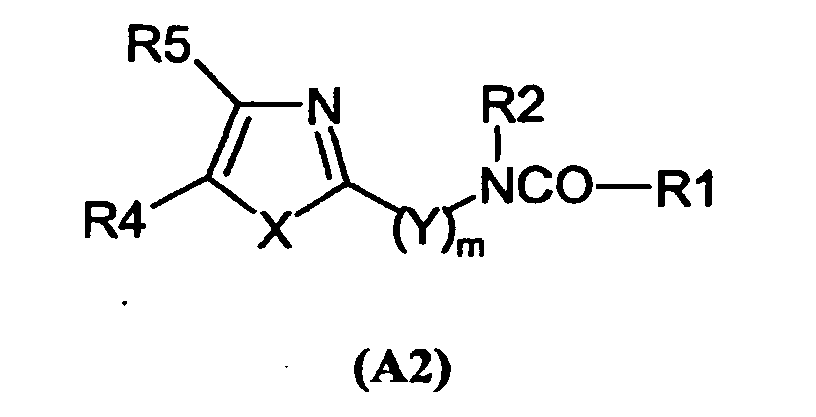
- des propriétés d'inhibition des MAO ;
- des propriétés d'inhibition de la peroxydation lipidique ; et
- des propriétés de modulation des canaux sodiques.

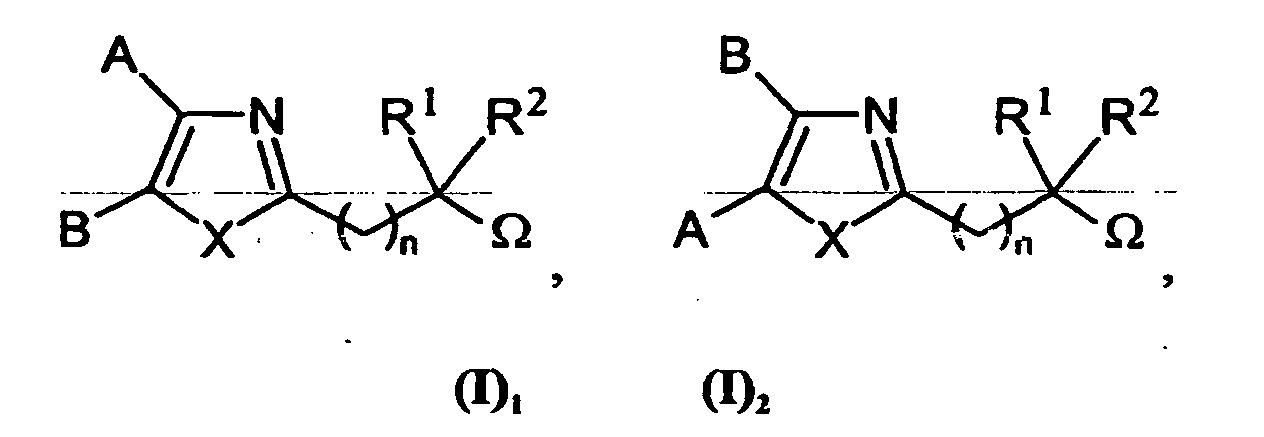
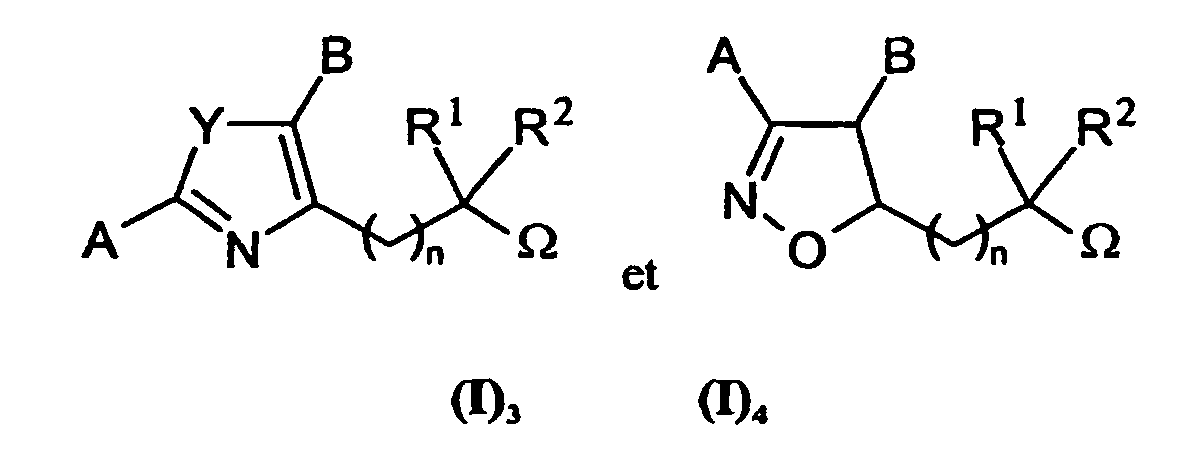
A représente
soit un radical
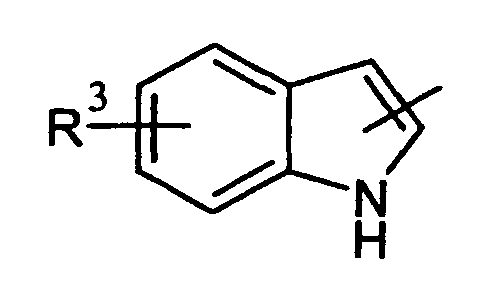
soit un radical

R10 et R11 représentant, indépendamment, un atome d'hydrogène, un radical alkyle ou un groupe -COR12, ou bien R10 et R11 formant ensemble avec l'atome d'azote un hétérocycle éventuellement substitué comptant de 4 à 7 chaínons et de 1 à 3 hétéroatomes incluant l'atome d'azote déjà présent, les hétéroatomes supplémentaires étant choisis indépendamment dans le groupe constitué des atomes O, N et S, ledit hétérocycle pouvant être par exemple azétidine, pyrrolidine, pipéridine, pipérazine, morpholine ou thiomorpholine,
R12 représentant un atome d'hydrogène ou un radical alkyle, alkoxy ou NR13R14,
R13 et R14 représentant, indépendamment, un atome d'hydrogène ou un radical alkyle, ou bien R13 et R14 formant ensemble avec l'atome d'azote un hétérocycle éventuellement substitué comptant de 4 à 7 chaínons et de 1 à 3 hétéroatomes incluant l'atome d'azote déjà présent, les hétéroatomes supplémentaires étant choisis indépendamment dans le groupe constitué des atomes O, N et S, ledit hétérocycle pouvant être par exemple azétidine, pyrrolidine, pipéridine, pipérazine, morpholine ou thiomorpholine,
R9 représente un atome d'hydrogène, un radical alkyle ou un groupe -COR15,
R15 représentant un atome d'hydrogène ou un radical alkyle, alkoxy ou NR16R17,
R16 et R17 représentant, indépendamment, un atome d'hydrogène ou un radical alkyle, ou bien R16 et R17 formant ensemble avec l'atome d'azote un hétérocycle éventuellement substitué comptant de 4 à 7 chaínons et de 1 à 3 hétéroatomes incluant l'atome d'azote déjà présent, les hétéroatomes supplémentaires étant choisis indépendamment dans le groupe constitué des atomes O, N et S, ledit hétérocycle pouvant être par exemple azétidine, pyrrolidine, pipéridine, pipérazine, morpholine ou thiomorpholine,
et W n'existe pas, ou représente une liaison, ou -O-, -S- ou -NR18-, dans lequel R18 représente un atome d'hydrogène ou un radical alkyle ;
soit un radical
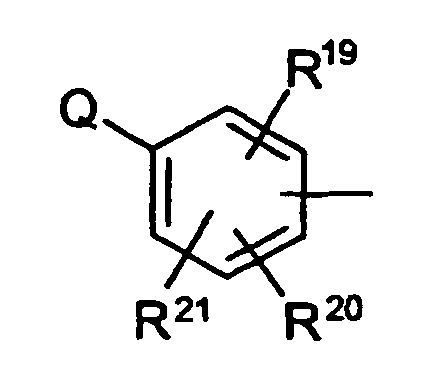
R10 et R11 représentant, indépendamment, un atome d'hydrogène, un radical alkyle ou un groupe -COR12, ou bien R10 et R11 formant ensemble avec l'atome d'azote un hétérocycle éventuellement substitué comptant de 4 à 7 chaínons et de 1 à 3 hétéroatomes incluant l'atome d'azote déjà présent, les hétéroatomes supplémentaires étant choisis indépendamment dans le groupe constitué des atomes O, N et S, ledit hétérocycle pouvant être par exemple azétidine, pyrrolidine, pipéridine, pipérazine, morpholine ou thiomorpholine,
R12 représentant un atome d'hydrogène, un radical alkyle ou alkoxy ou NR13R14,
R13 et R14 représentant, indépendamment, un atome d'hydrogène ou un radical alkyle, ou bien R13 et R14 formant ensemble avec l'atome d'azote un hétérocycle éventuellement substitué comptant de 4 à 7 chaínons et de 1 à 3 hétéroatomes incluant l'atome d'azote déjà présent, les hétéroatomes supplémentaires étant choisis indépendamment dans le groupe constitué des atomes O, N et S, ledit hétérocycle pouvant être par exemple azétidine, pyrrolidine, pipéridine, pipérazine, morpholine ou thiomorpholine,
R22 représentant un atome d'hydrogène, un radical alkyle ou un radical aryle éventuellement substitué par un ou plusieurs substituants choisis parmi les radicaux alkyle, OH, halogène, nitro et alkoxy,
R23 et R24 représentant, indépendamment, un atome d'hydrogène, un radical alkyle ou un radical -CO-R25,
R25 représentant un radical alkyle,
et R19, R20 et R21 représentent, indépendamment, un hydrogène, un halogène, le groupe OH ou SR26, ou un radical alkyle, cycloalkyle, alkényle, alkoxy, cyano, nitro, -SO2NHR49, -CONHR55, -S(O)qR56, -NH(CO)R57, -CF3, -OCF3 ou NR27R28,
R26 représentant un atome d'hydrogène ou un radical alkyle,
R27 et R28 représentant, indépendamment, un atome d'hydrogène, un radical alkyle ou un groupe -COR29, ou bien R27 et R28 formant ensemble avec l'atome d'azote un hétérocycle éventuellement substitué comptant de 4 à 7 chaínons et de 1 à 3 hétéroatomes incluant l'atome d'azote déjà présent, les hétéroatomes supplémentaires étant choisis indépendamment dans le groupe constitué des atomes O, N et S, ledit hétérocycle pouvant être par exemple azétidine, pyrrolidine, pipéridine, pipérazine, morpholine ou thiomorpholine,
R49 et R55 représentant, indépendamment à chaque fois qu'ils interviennent, un atome d'hydrogène ou un radical alkyle ou alkylcarbonyle,
q représentant un entier de 0 à 2,
R56 et R57 représentant, indépendamment à chaque fois qu'ils interviennent, un atome d'hydrogène ou un radical alkyle ou alkoxy,
R29 représentant un atome d'hydrogène, un radical alkyle, alkoxy ou -NR30R31,
R30 et R31 représentant, indépendamment, un atome d'hydrogène ou un radical alkyle, ou bien R30 et R31 formant ensemble avec l'atome d'azote un hétérocycle éventuellement substitué comptant de 4 à 7 chaínons et de 1 à 3 hétéroatomes incluant l'atome d'azote déjà présent, les hétéroatomes supplémentaires étant choisis indépendamment dans le groupe constitué des atomes O, N et S, ledit hétérocycle pouvant être par exemple azétidine, pyrrolidine, pipéridine, pipérazine, morpholine ou thiomorpholine,
soit un radical
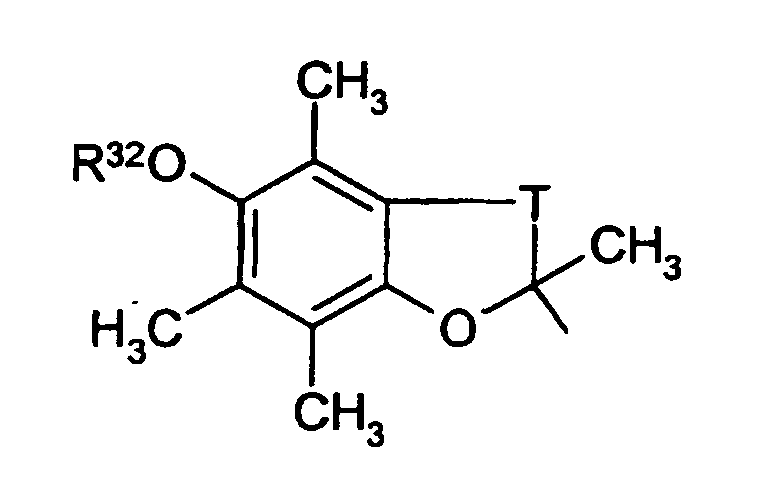
et T représente un radical -(CH2)m- avec m = 1 ou 2,
soit enfin un radical
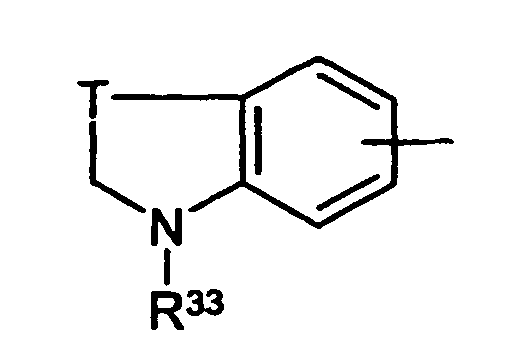
Σ représentant un radical alkylène linéaire ou ramifié comptant de 1 à 6 atomes de carbone,
R34 et R35 représentant, indépendamment, un atome d'hydrogène ou un radical alkyle,
R36 et R37 représentant, indépendamment, un atome d'hydrogène ou un radical aryle carbocyclique ou hétérocyclique éventuellement substitué par un ou plusieurs substituants choisis parmi les radicaux alkyle, OH, halogène, nitro, alkoxy ou NR10R11,
R10 et R11 représentant, indépendamment, un atome d'hydrogène, un radical alkyle ou un groupe -COR12, ou bien R10 et R11 formant ensemble avec l'atome d'azote un hétérocycle éventuellement substitué comptant de 4 à 7 chaínons et de 1 à 3 hétéroatomes incluant l'atome d'azote déjà présent, les hétéroatomes supplémentaires étant choisis indépendamment dans le groupe constitué des atomes O, N et S, ledit hétérocycle pouvant être par exemple azétidine, pyrrolidine, pipéridine, pipérazine, morpholine ou thiomorpholine,
R12 représentant un atome d'hydrogène ou un radical alkyle, alkoxy ou NR13R14,
R13 et R14 représentant, indépendamment, un atome d'hydrogène ou un radical alkyle, ou bien R13 et R14 formant ensemble avec l'atome d'azote un hétérocycle éventuellement substitué comptant de 4 à 7 chaínons et de 1 à 3 hétéroatomes incluant l'atome d'azote déjà présent, les hétéroatomes supplémentaires étant choisis indépendamment dans le groupe constitué des atomes O, N et S, ledit hétérocycle pouvant être par exemple azétidine, pyrrolidine, pipéridine, pipérazine, morpholine ou thiomorpholine,
et T représente un radical -(CH2)m- avec m = 1 ou 2,
ou encore A représente un radical alkyle, cycloalkyle ou cycloalkylalkyle ;
X représente S ou NR38,
R38 représentant un atome d'hydrogène ou un radical alkyle, cyanoalkyle, aralkyle, alkylcarbonyle ou aralkylcarbonyle,
Y représente O ou S ;
R1 représente un atome d'hydrogène, un radical alkyle, aminoalkyle, alkoxyalkyle, cycloalkyle, cycloalkylalkyle, trifluorométhylalkyle, alkényle, allènyle, allènylalkyle, alkynyle, cyanoalkyle, -(CH2)g-Z1R39, -(CH2)g-COR40, -(CH2)g-NHCOR70, aryle, aralkyle, arylcarbonyle, hétéroarylalkyle ou aralkylcarbonyle, le groupement aryle des radicaux aryle, aralkyle, arylcarbonyle, hétéroarylalkyle ou aralkylcarbonyle étant lui-même éventuellement substitué par un ou plusieurs substituants choisis parmi le groupe constitué des radicaux alkyle, halogène, alkoxy, nitro, cyano, cyanoalkyle, amino, alkylamino, dialkylamino, -(CH2)k-Z2R39 ou -(CH2)k-COR40,
Z1 et Z2 représentant une liaison, -O-, -NR41- ou -S-,
R39 et R41 représentant, indépendamment à chaque fois qu'ils interviennent, un atome d'hydrogène ou un radical alkyle, alkényle, alkynyle ou cyanoalkyle,
R40 représentant, indépendamment à chaque fois qu'il intervient, un atome d'hydrogène ou un radical alkyle, allènyle, allènylalkyle, alkényle, alkynyle, cyanoalkyle, alkoxy ou NR42R43,
R42 et R43 représentant, indépendamment, indépendamment à chaque fois qu'ils interviennent, un atome d'hydrogène ou un radical alkyle, allènyle, allènylalkyle, alkényle, alkynyle ou cyanoalkyle,
et R2 représente un atome d'hydrogène, un radical alkyle, aminoalkyle, alkoxyalkyle, cycloalkyle, cycloalkylalkyle, trifluorométhylalkyle ou -(CH2)g-NHCOR71, ou encore l'un des radicaux aralkyle ou hétéroarylalkyle éventuellement substitués sur le groupe aryle ou hétéroaryle par un ou des groupes choisis indépendamment parmi le groupe composé d'un atome halogène et d'un radical alkyle, alkoxy, hydroxy, cyano, nitro, amino, alkylamino ou dialkylamino,
R70 et R71 représentant indépendamment un radical alkyle ou alkoxy ;
ou bien R1 et R2, pris ensemble avec l'atome de carbone qui les porte, forment un carbocycle de 3 à 7 chaínons ;
B représente un atome d'hydrogène, un radical alkyle, un radical -(CH2)g-Z3R44 ou un radical aryle carbocyclique éventuellement substitué de 1 à 3 fois par des radicaux choisis parmi le groupe composé d'un atome halogène, d'un radical alkyle ou alkoxy linéaire ou ramifié comptant de 1 à 6 atomes de carbone, d'un radical hydroxy, cyano ou nitro, d'un radical amino, alkylamino ou dialkylamino et d'un radical aryle carbocyclique,
Z3 représentant une liaison, -O-, -NR45- ou -S-,
R44 et R45 représentant, indépendamment, un atome d'hydrogène ou un radical alkyle, alkényle, alkynyle, allènyle, allènylalkyle ou cyanoalkyle ;
Ω représente l'un des radicaux NR46R47 ou OR48, dans lesquels :
- g et p, chaque fois qu'ils interviennent, étant indépendamment des entiers de 1 à 6, et k et n, chaque fois qu'ils interviennent, étant indépendamment des entiers de 0 à 6 ;
- A représente le radical 4-hydroxy-2,3-di-tertiobutyl-phényle ;
- B, R1 et R2 représentent tous H ; et enfin
- Ω représente OH ;
- ou des sels pharmaceutiquement acceptables de composés de formule générale (I) ;
- peuvent être utilisés pour préparer un médicament destiné à avoir au moins l'une des
trois activités suivantes :
- inhiber les monoamine oxydases, en particulier la monoamine oxydase B,
- inhiber la peroxydation lipidique,
- avoir une activité modulatrice vis-à-vis des canaux sodiques.
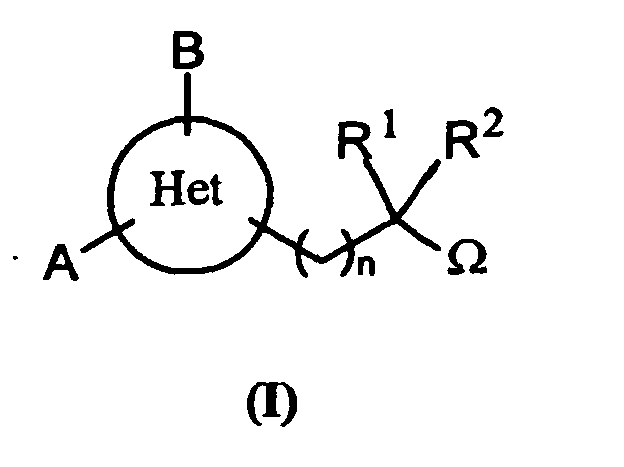
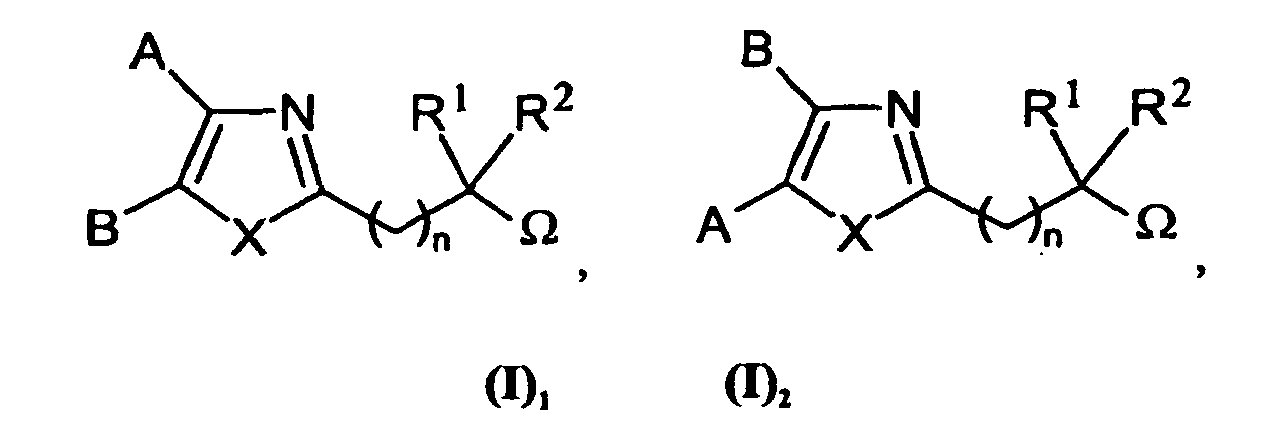
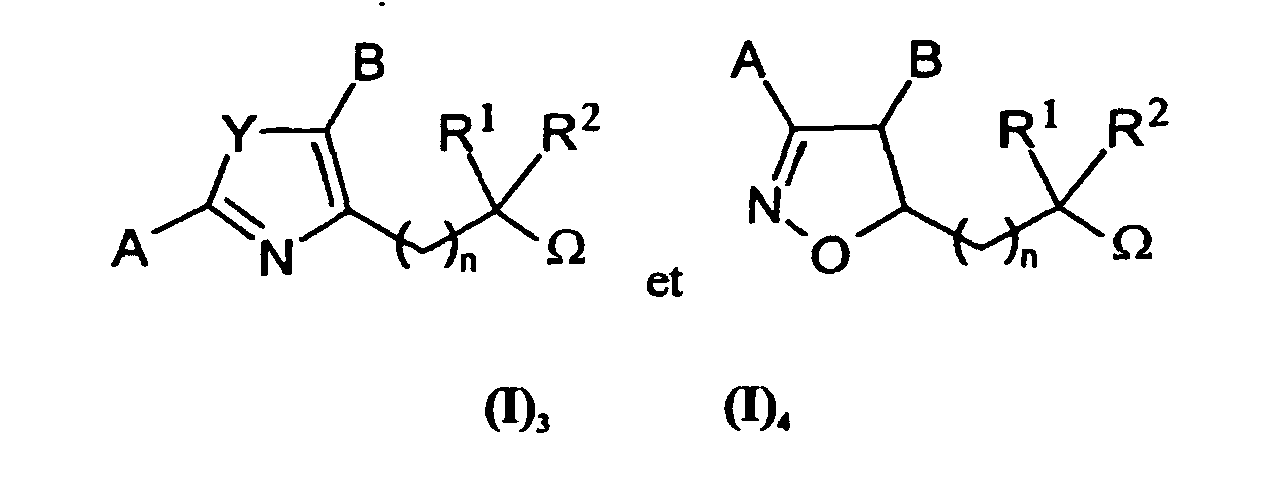
A représente
soit un radical

soit un radical
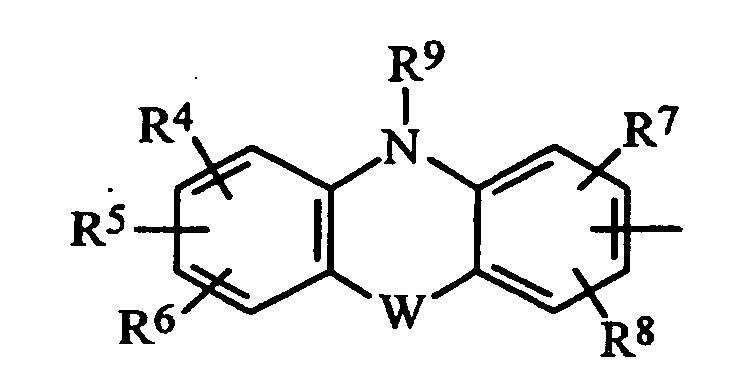
R10 et R11 représentant, indépendamment, un atome d'hydrogène ou un radical alkyle
R9 représente un atome d'hydrogène ou un radical alkyle,
et W n'existe pas, ou représente une liaison, ou -O-, -S- ou -NR18-, dans lequel R18 représente un atome d'hydrogène ou un radical alkyle ;
soit un radical
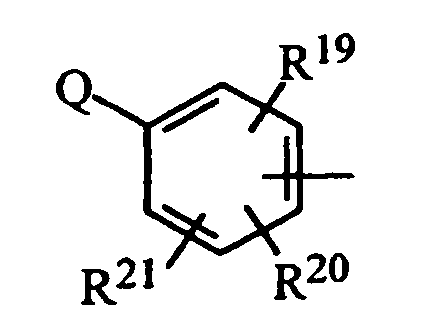
R10 et R11 représentant, indépendamment, un atome d'hydrogène ou un radical alkyle, ou bien R10 et R11 formant ensemble avec l'atome d'azote un hétérocycle éventuellement substitué comptant de 4 à 7 chaínons et de 1 à 3 hétéroatomes incluant l'atome d'azote déjà présent, les hétéroatomes supplémentaires étant choisis indépendamment dans le groupe constitué des atomes O, N et S, ledit hétérocycle pouvant être par exemple azétidine, pyrrolidine, pipéridine, pipérazine, morpholine ou thiomorpholine,
R22 représentant un atome d'hydrogène, un radical alkyle ou un radical aryle éventuellement substitué par un ou plusieurs substituants choisis parmi les radicaux alkyle, OH, halogène, nitro et alkoxy,
R23 et R24 représentant, indépendamment, un atome d'hydrogène, un radical alkyle ou un radical -CO-R25,
R25 représentant un radical alkyle,
et R19, R20 et R21 représentent, indépendamment, un hydrogène, un halogène, le groupe OH ou SR26, ou un radical alkyle, cycloalkyle, alkényle, alkoxy, cyano, nitro, - SO2NHR49, -CONHR55, -S(O)qR56, -NH(CO)R57, -CF3, -OCF3 ou NR27R28,
R26 représentant un atome d'hydrogène ou un radical alkyle,
R27 et R28 représentant, indépendamment, un atome d'hydrogène, un radical alkyle ou un groupe -COR29, ou bien R27 et R28 formant ensemble avec l'atome d'azote un hétérocycle éventuellement substitué comptant de 4 à 7 chaínons et de 1 à 3 hétéroatomes incluant l'atome d'azote déjà présent, les hétéroatomes supplémentaires étant choisis indépendamment dans le groupe constitué des atomes O, N et S, ledit hétérocycle pouvant être par exemple azétidine, pyrrolidine, pipéridine, pipérazine, morpholine ou thiomorpholine,
R49 et R55 représentant, indépendamment à chaque fois qu'ils interviennent, un atome d'hydrogène ou un radical alkyle ou alkylcarbonyle,
q représentant un entier de 0 à 2,
R56 et R57 représentant, indépendamment à chaque fois qu'ils interviennent, un atome d'hydrogène ou un radical alkyle ou alkoxy,
R29 représentant un atome d'hydrogène, un radical alkyle, alkoxy ou -NR30R31,
R30 et R31 représentant, indépendamment, un atome d'hydrogène ou un radical alkyle, ou bien R30 et R31 formant ensemble avec l'atome d'azote un hétérocycle éventuellement substitué comptant de 4 à 7 chaínons et de 1 à 3 hétéroatomes incluant l'atome d'azote déjà présent, les hétéroatomes supplémentaires étant choisis indépendamment dans le groupe constitué des atomes O, N et S, ledit hétérocycle pouvant être par exemple azétidine, pyrrolidine, pipéridine, pipérazine, morpholine ou thiomorpholine,
soit un radical
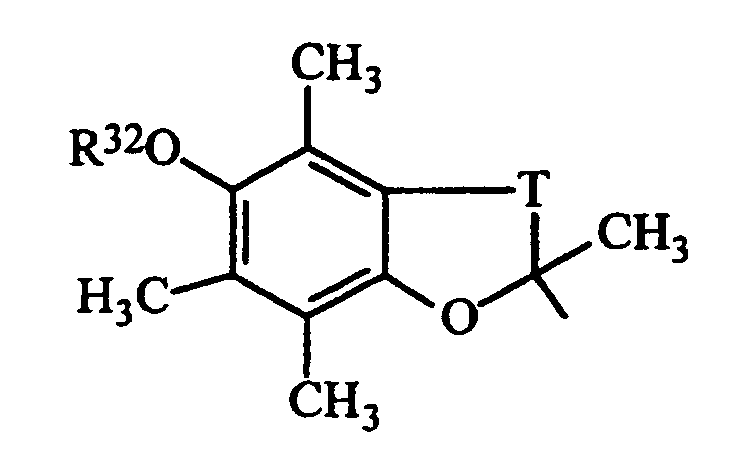
et T représente un radical -(CH2)m- avec m = 1 ou 2,
soit enfin un radical
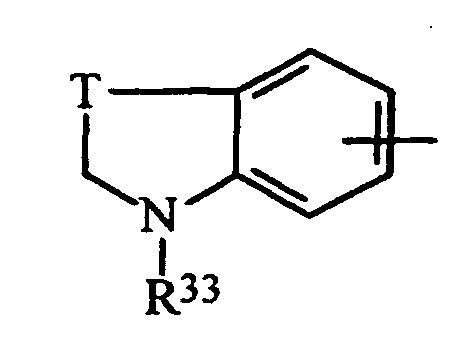
Σ représentant un radical alkylène linéaire ou ramifié comptant de 1 à 6 atomes de carbone,
R34 et R35 représentant, indépendamment, un atome d'hydrogène ou un radical alkyle,
R36 et R37 représentant, indépendamment, un atome d'hydrogène ou un radical aryle carbocyclique ou hétérocyclique éventuellement substitué par un ou plusieurs substituants choisis parmi les radicaux alkyle, OH, halogène, nitro, alkoxy ou NR10R11,
R10 et R11 représentant, indépendamment, un atome d'hydrogène, un radical alkyle, ou bien R10 et R11 formant ensemble avec l'atome d'azote un hétérocycle éventuellement substitué comptant de 4 à 7 chaínons et de 1 à 3 hétéroatomes incluant l'atome d'azote déjà présent, les hétéroatomes supplémentaires étant choisis indépendamment dans le groupe constitué des atomes O, N et S, ledit hétérocycle pouvant être par exemple azétidine, pyrrolidine, pipéridine, pipérazine, morpholine ou thiomorpholine,
et T représente un radical -(CH2)m avec m = 1 ou 2,
ou encore A représente un radical alkyle, cycloalkyle ou cycloalkylalkyle ;
X représente S ou NR38,
R38 représentant un atome d'hydrogène ou un radical alkyle, cyanoalkyle, aralkyle, alkylcarbonyle ou aralkylcarbonyle,
Y représente O ou S ;
R1 représente un atome d'hydrogène, un radical alkyle, aminoalkyle, alkoxyalkyle, cycloalkyle, cycloalkylalkyle, trifluorométhylalkyle, alkényle, allènyle, allènylalkyle, alkynyle, cyanoalkyle, -(CH2)g-Z1R39, -(CH2)g-COR40, -(CH2)g-NHCOR70, aryle, aralkyle, arylcarbonyle, hétéroarylalkyle ou aralkylcarbonyle, le groupement aryle des radicaux aryle, aralkyle, arylcarbonyle, hétéroarylalkyle ou aralkylcarbonyle étant lui-même éventuellement substitué par un ou plusieurs substituants choisis parmi le groupe constitué des radicaux alkyle, halogène, alkoxy, nitro, cyano, cyanoalkyle, amino, alkylamino, dialkylamino, -(CH2)k-Z2R39 ou -(CH2)k-COR40,
Z1 et Z2 représentant une liaison, -O-, -NR41- ou -S-,
R39 et R41 représentant, indépendamment à chaque fois qu'ils interviennent, un atome d'hydrogène ou un radical alkyle, alkényle, alkynyle ou cyanoalkyle,
R40 représentant, indépendamment à chaque fois qu'il intervient, un atome d'hydrogène ou un radical alkyle, allènyle, allènylalkyle, alkényle, alkynyle, cyanoalkyle, alkoxy ou NR42R43,
R42 et R43 représentant, indépendamment à chaque fois qu'ils interviennent, un atome d'hydrogène ou un radical alkyle, allènyle, allènylalkyle, alkényle, alkynyle ou cyanoalkyle,
et R2 représente un atome d'hydrogène, un radical alkyle, aminoalkyle, alkoxyalkyle, cycloalkyle, cycloalkylalkyle, trifluorométhylalkyle ou -(CH2)g-NHCOR71, ou encore l'un des radicaux aralkyle ou hétéroarylalkyle éventuellement substitués sur le groupe aryle ou hétéroaryle par un ou des groupes choisis indépendamment parmi le groupe composé d'un atome halogène et d'un radical alkyle, alkoxy, hydroxy, cyano, nitro, amino, alkylamino ou dialkylamino,
R70 et R71 représentant indépendamment un radical alkyle ou alkoxy ;
ou bien R1 et R2, pris ensemble avec l'atome de carbone qui les porte, forment un carbocycle de 3 à 7. chaínons ;
B représente un atome d'hydrogène, un radical alkyle, un radical -(CH2)g-Z3R44 ou un radical aryle carbocyclique éventuellement substitué de 1 à 3 fois par des radicaux choisis parmi le groupe composé d'un atome halogène, d'un radical alkyle ou alkoxy linéaire ou ramifié comptant de 1 à 6 atomes de carbone, d'un radical hydroxy, cyano ou nitro, d'un radical amino, alkylamino ou dialkylamino et d'un radical aryle carbocyclique,
Z3 représentant une liaison, -O-, -NR45- ou -S-,
R44 et R45 représentant, indépendamment, un atome d'hydrogène ou un radical alkyle, alkényle, alkynyle, allènyle, allènylalkyle ou cyanoalkyle ;
Ω représente l'un des radicaux NR46R47 ou OR48, dans lesquels :
et R48 représente un atome d'hydrogène ou un radical alkyle, alkynyle ou cyanoalkyle ;
étant entendu que lorsque Het est tel que le composé de formule générale (I) réponde à la sous-formule générale (I) 4 , alors :
- A représente exclusivement le radical 4-hydroxy-2,3-di-tertiobutyl-phényle ;
- B représente H ;
Ω représente OH ;
ou soient des sels de tels composés.
- A représentant:
- soit le radical
dans lequel R3 représente un atome d'hydrogène, le groupe OH ou un radical alkoxy ou alkyle,
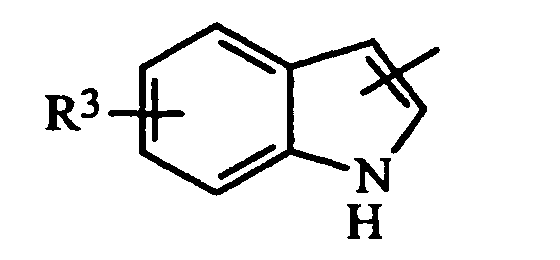
- soit le radical
dans lequel R4, R5, R6, R7 et R8 représentent, indépendamment, un atome d'hydrogène, le groupe OH ou un radical alkyle ou alkoxy,
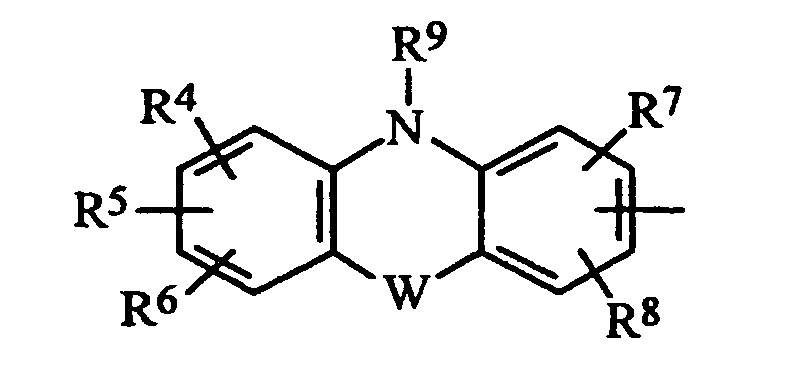
R9 représente un atome d'hydrogène ou un radical alkyle,
et W n'existe pas, ou représente une liaison, -O-, -S- ou -NR18-, R18 représentant un atome d'hydrogène ou un radical alkyle ; - soit le radical
dans lequel Q représente H, -OR22, -SR22 ou un radical phényle éventuellement substitué par un ou des substituants choisis indépendamment parmi un atome halogène, un radical OH, cyano, nitro, alkyle, alkoxy ou -NR10R11 et un groupe de deux substituants représentant ensemble un radical méthylène dioxy ou éthylènedioxy, ou encore Q représente un radical -OPh, -SPh , -SO2Ph ou -CH2Ph, ledit radical -OPh, -SPh , -SO2Ph ou -CH2Ph étant éventuellement substitué sur sa partie aromatique par un ou des substituants choisis parmi un radical alkyle ou alkoxy et un atome halogène,
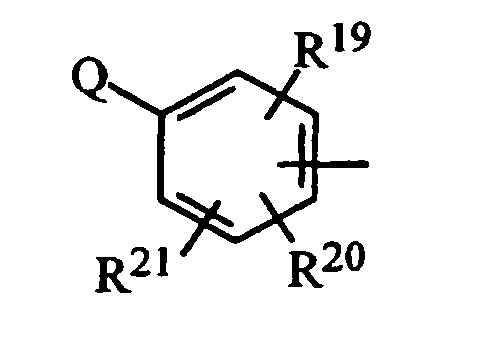
R10 et R11 représentant, indépendamment, un atome d'hydrogène ou un radical alkyle ;
R22 représentant un atome d'hydrogène, un radical alkyle ou un radical aryle éventuellement substitué par un ou plusieurs substituants choisis parmi les radicaux alkyle, OH, halogène, nitro et alkoxy,
et R19, R20 et R21 représentent, indépendamment, un hydrogène, un halogène, le groupe OH ou SR26, ou un radical alkyle, cycloalkyle, alkényle, alkoxy, cyano, nitro, -SO2NHR49, -CONHR55, -S(O)qR56, -NH(CO)R57, -CF3, -OCF3 ou NR27R28,
R26 représentant un atome d'hydrogène ou un radical alkyle,
R27 et R28 représentant, indépendamment, un atome d'hydrogène, un radical alkyle ou un groupe -COR29, ou encore R21 et R28 formant ensemble avec l'atome d'azote qui les porte un hétérocycle de 5 à 6 chaínons choisis parmi -CH2-, -NH- et -O-,
R49 et R55 représentant, indépendamment à chaque fois qu'ils interviennent, un atome d'hydrogène ou un radical alkyle ou alkylcarbonyle,
q représentant un entier de 0 à 2,
R56 et R57 représentant, indépendamment à chaque fois qu'ils interviennent, un atome d'hydrogène ou un radical alkyle ou alkoxy,
R29 représentant un atome d'hydrogène, un radical alkyle, alkoxy ou -NR30R31,
R30 et R31 représentant, indépendamment, un atome d'hydrogène ou un radical alkyle, - soit le radical
dans lequel R32 représente un atome d'hydrogène ou un radical alkyle,

et T représente le radical -(CH2)2- - soit enfin le radical
dans lequel R33 représente un atome d'hydrogène ou un radical alkyle, -Σ-NR34R35 ou -Σ-CHR36R37,
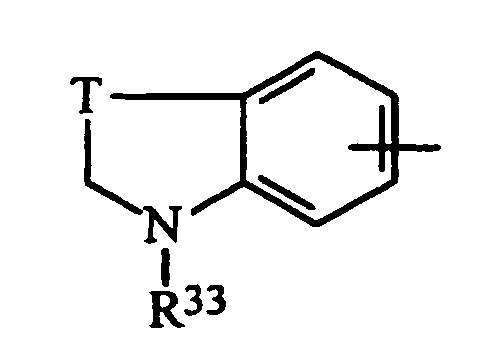
Σ représentant un radical alkylène linéaire ou ramifié comptant de 1 à 6 atomes de carbone,
R34 et R35 représentant, indépendamment, un atome d'hydrogène ou un radical alkyle,
R36 et R37 représentant, indépendamment, un atome d'hydrogène ou un radical aryle carbocyclique ou hétérocyclique éventuellement substitué par un ou plusieurs substituants choisis parmi les radicaux alkyle, OH, halogène, nitro, alkoxy ou NR10R11,
R10 et R11 représentant, indépendamment, un atome d'hydrogène, un radical alkyle ou un groupe -COR12, ou bien R10 et R11 formant ensemble avec l'atome d'azote un hétérocycle éventuellement substitué comptant de 4 à 7 chaínons et de 1 à 3 hétéroatomes incluant l'atome d'azote déjà présent, les hétéroatomes supplémentaires étant choisis indépendamment dans le groupe constitué des atomes O, N et S, ledit hétérocycle pouvant être par exemple azétidine, pyrrolidine, pipéridine, pipérazine, morpholine ou thiomorpholine,
R12 représentant un atome d'hydrogène ou un radical alkyle, alkoxy ou NR13R14,
R13 et R14 représentant, indépendamment, un atome d'hydrogène ou un radical alkyle, ou bien R13 et R14 formant ensemble avec l'atome d'azote un hétérocycle éventuellement substitué comptant de 4 à 7 chaínons et de 1 à 3 hétéroatomes incluant l'atome d'azote déjà présent, les hétéroatomes supplémentaires étant choisis indépendamment dans le groupe constitué des atomes O, N et S, tels que par exemple azétidine, pyrrolidine, pipéridine, pipérazine, morpholine ou thiomorpholine,
et T représente le radical -(CH2)- ;
- soit le radical
- Ω représentant :
- soit le radical NR46R47 dans lequel R46 et R47 représentent, indépendamment,
un atome d'hydrogène ou un radical alkyle, cycloalkyle, cycloalkylalkyle,
alkényle, alkynyle, allènyle, allènylalkyle, cyanoalkyle, -(CH2)k-COR51,
-COOR51 ou -SO2R51ou encore un radical choisi parmi les radicaux aryle,
aralkyle, aryloxyalkyle, arylcarbonyle, arylimino, aralkylcarbonyle, hétéroaryle
et en particulier pyridinyle, pyridinylalkyle ou pyridinylcarbonyle, le
groupement aryle ou hétéroaryle desdits radicaux aryle, aralkyle,
aryloxyalkyle, arylcarbonyle, arylimino, aralkylcarbonyle, hétéroaryle,
pyridinylalkyle ou pyridinylcarbonyle étant éventuellement substitué par un ou
des substituants choisis indépendamment parmi halogène, alkyle, alkoxy,
hydroxy, nitro, cyano, cyanoalkyle, amino, alkylamino, dialkylamino,
-(CH2)k-Z5R50, -(CH2)k-COR51 et -(CH2)k-COOR51,
R51 représentant un atome d'hydrogène ou un radical alkyle, alkényle, alkynyle ou alkoxyalkyle, - soit le radical OH ;
- soit le radical NR46R47 dans lequel R46 et R47 représentent, indépendamment,
un atome d'hydrogène ou un radical alkyle, cycloalkyle, cycloalkylalkyle,
alkényle, alkynyle, allènyle, allènylalkyle, cyanoalkyle, -(CH2)k-COR51,
-COOR51 ou -SO2R51ou encore un radical choisi parmi les radicaux aryle,
aralkyle, aryloxyalkyle, arylcarbonyle, arylimino, aralkylcarbonyle, hétéroaryle
et en particulier pyridinyle, pyridinylalkyle ou pyridinylcarbonyle, le
groupement aryle ou hétéroaryle desdits radicaux aryle, aralkyle,
aryloxyalkyle, arylcarbonyle, arylimino, aralkylcarbonyle, hétéroaryle,
pyridinylalkyle ou pyridinylcarbonyle étant éventuellement substitué par un ou
des substituants choisis indépendamment parmi halogène, alkyle, alkoxy,
hydroxy, nitro, cyano, cyanoalkyle, amino, alkylamino, dialkylamino,
-(CH2)k-Z5R50, -(CH2)k-COR51 et -(CH2)k-COOR51,
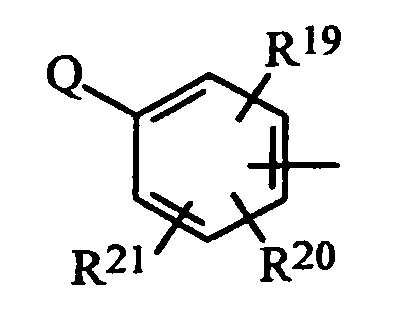
soit un radical

soit un radical

R10 et R11 représentant, indépendamment, un atome d'hydrogène ou un radical alkyle, ou bien R10 et R11 formant ensemble avec l'atome d'azote un hétérocycle éventuellement substitué comptant de 4 à 7 chaínons et de 1 à 3 hétéroatomes incluant l'atome d'azote déjà présent, les hétéroatomes supplémentaires étant choisis indépendamment dans le groupe constitué des atomes O, N et S, ledit hétérocycle pouvant être par exemple azétidine, pyrrolidine, pipéridine, pipérazine, morpholine ou thiomorpholine,
R9 représente un atome d'hydrogène ou un radical alkyle,
et W n'existe pas, ou représente une liaison, ou -O-, -S- ou -NR18-, dans lequel R18 représente un atome d'hydrogène ou un radical alkyle,
soit un radical
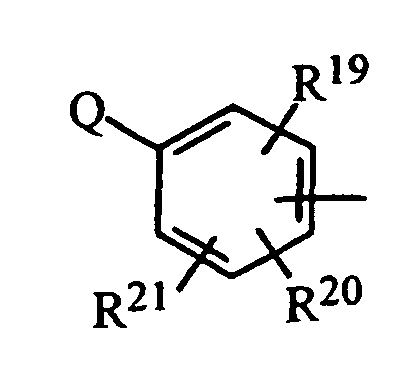
R10 et R11 représentant, indépendamment, un atome d'hydrogène ou un radical alkyle, ou bien R10 et R11 formant ensemble avec l'atome d'azote un hétérocycle éventuellement substitué comptant de 4 à 7 chaínons et de 1 à 3 hétéroatomes incluant l'atome d'azote déjà présent, les hétéroatomes supplémentaires étant choisis indépendamment dans le groupe constitué des atomes O, N et S, ledit hétérocycle pouvant être par exemple azétidine, pyrrolidine, pipéridine, pipérazine, morpholine ou thiomorpholine,
R22 représentant un atome d'hydrogène, un radical alkyle ou un radical aryle éventuellement substitué par un ou plusieurs substituants choisis parmi les radicaux alkyle, OH, halogène, nitro et alkoxy,
R23 et R24 représentant, indépendamment, un atome d'hydrogène ou un radical alkyle, et R19, R20 et R21 représentent, indépendamment, un hydrogène, un halogène, le groupe OH ou SR26, ou un radical alkyle, alkényle, alkoxy ou NR27R28,
R26 représentant un atome d'hydrogène ou un radical alkyle,
R27 et R28 représentant, indépendamment, un atome d'hydrogène ou un radical alkyle, ou bien R27 et R28 formant ensemble avec l'atome d'azote un hétérocycle éventuellement substitué comptant de 4 à 7 chaínons et de 1 à 3 hétéroatomes incluant l'atome d'azote déjà présent, les hétéroatomes supplémentaires étant choisis indépendamment dans le groupe constitué des atomes O, N et S, ledit hétérocycle pouvant être par exemple azétidine, pyrrolidine, pipéridine, pipérazine, morpholine ou thiomorpholine,
soit un radical

et T représente un radical -(CH2)m- avec m = 1 ou 2,
soit enfin un radical
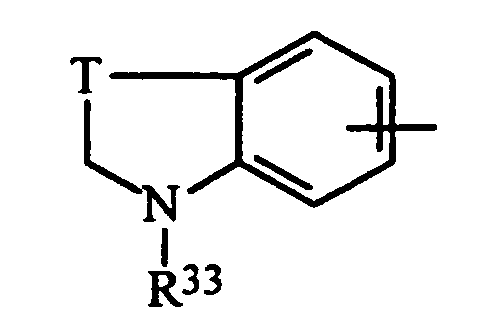
Σ représentant un radical alkylène linéaire ou ramifié comptant de 1 à 6 atomes de carbone,
R34 et R35 représentant, indépendamment, un atome d'hydrogène ou un radical alkyle,
R36 et R37 représentant, indépendamment, un atome d'hydrogène ou un radical aryle carbocyclique ou hétérocyclique éventuellement substitué par un ou plusieurs substituants choisis parmi les radicaux alkyle, OH, halogène, nitro, alkoxy ou NR10R11, R10 et R11 représentant, indépendamment, un atome d'hydrogène ou un radical alkyle, ou bien R10 et R11 formant ensemble avec l'atome d'azote un hétérocycle éventuellement substitué comptant de 4 à 7 chaínons et de 1 à 3 hétéroatomes incluant l'atome d'azote déjà présent, les hétéroatomes supplémentaires étant choisis indépendamment dans le groupe constitué des atomes O, N et S, ledit hétérocycle pouvant être par exemple azétidine, pyrrolidine, pipéridine, pipérazine, morpholine ou thiomorpholine,
et T représente un radical -(CH2)m- avec m = 1 ou 2,
X représente S ou NR38,
R38 représentant un atome d'hydrogène ou un radical alkyle ou cyanoalkyle ;
Y représente O ou S ;
R1 représente un atome d'hydrogène, un radical alkyle, cycloalkyle, alkényle, allènyle, allènylalkyle, alkynyle, cyanoalkyle, -(CH2)g-Z1R39, -(CH2)g-COR40, aryle, aralkyle, arylcarbonyle, ou aralkylcarbonyle, le groupement aryle des radicaux aryle, aralkyle, arylcarbonyle, ou aralkylcarbonyle étant lui-même éventuellement substitué par un ou plusieurs substituants choisis parmi le groupe constitué des radicaux alkyle, halogène, alkoxy, nitro, cyano, cyanoalkyle, -(CH2)k-Z2R39 ou -(CH2)k-COR40,
Z1 et Z2 représentant une liaison, -O-, -NR41- ou -S-,
R39 et R41 représentant, indépendamment à chaque fois qu'ils interviennent, un atome d'hydrogène ou un radical alkyle, alkényle, alkynyle ou cyanoalkyle,
R40 représentant, indépendamment à chaque fois qu'il intervient, un atome d'hydrogène ou un radical alkyle, allènyle, allènylalkyle, alkényle, alkynyle, cyanoalkyle, alkoxy ou NR42R43,
R42 et R43 représentant, indépendamment à chaque fois qu'ils interviennent, un atome d'hydrogène ou un radical alkyle, allènyle, allènylalkyle, alkényle, alkynyle ou cyanoalkyle,
et R2 représente un atome d'hydrogène ou un radical alkyle ;
B représente un atome d'hydrogène ou un radical -(CH2)g-Z3R44,
Z3 représentant une liaison, -O-, -NR45- ou -S-,
R44 et R45 représentant, indépendamment, un atome d'hydrogène ou un radical alkyle, alkényle, alkynyle, allènyle, allènylalkyle ou cyanoalkyle ;
Ω représente l'un des radicaux NR46R47 ou OR48, dans lesquels :
soit un radical
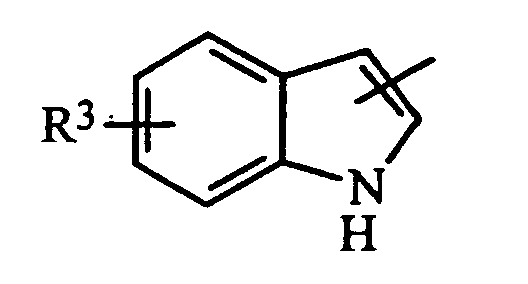
soit un radical

ou un radical alkyle ou alkoxy,
R9 représente un atome d'hydrogène,
et W n'existe pas, ou représente une liaison, ou -O-, -S- ou -NR18-, dans lequel R18 représente un atome d'hydrogène ou un radical alkyle;
soit un radical

R22 représentant un atome d'hydrogène ou un radical alkyle, et R19, R20 et R21 représentent, indépendamment, un hydrogène, un halogène, le groupe OH ou SR26, ou un radical alkyle ou alkoxy,
R26 représentant un atome d'hydrogène ou un radical alkyle,
soit un radical

et T représente un radical -(CH2)m- avec m = 1 ou 2,
soit enfin un radical

Σ représentant un radical alkylène linéaire ou ramifié comptant de 1 à 6 atomes de carbone,
R34 et R35 représentant, indépendamment, un atome d'hydrogène ou un radical alkyle,
R36 et R37 représentant, indépendamment, un atome d'hydrogène ou un radical aryle carbocyclique ou hétérocyclique éventuellement substitué par un ou plusieurs substituants choisis parmi les radicaux alkyle, OH, halogène, nitro ou alkoxy,
et T représente un radical -(CH2)m- avec m = 1 ou 2,
X représente S ou NR38,
R38 représentant un atome d'hydrogène ou un radical alkyle ou cyanoalkyle,
Y représente O ou S ;
R1 représente un atome d'hydrogène, un radical alkyle, cycloalkyle, alkényle, allènyle, allènylalkyle, alkynyle, cyanoalkyle, -(CH2)g-Z1R39, -(CH2)g-COR40, aryle, aralkyle, arylcarbonyle, ou aralkylcarbonyle, le groupement aryle des radicaux aryle, aralkyle, arylcarbonyle, ou aralkylcarbonyle étant lui-même éventuellement substitué par un ou plusieurs substituants choisis parmi le groupe constitué des radicaux alkyle, halogène, alkoxy, nitro, cyano, cyanoalkyle, -(CH2)k-Z2R39 ou -(CH2)k-COR40,
Z1 et Z2 représentant une liaison, -O-, -NR41- ou -S-,
R39 et R41 représentant, indépendamment à chaque fois qu'ils interviennent, un atome d'hydrogène ou un radical alkyle, alkényle, alkynyle ou cyanoalkyle,
R40 représentant, indépendamment à chaque fois qu'il intervient, un atome d'hydrogène ou un radical alkyle, allènyle, allènylalkyle, alkényle, alkynyle, cyanoalkyle, alkoxy ou NR42R43,
R42 et R43 représentant, indépendamment à chaque fois qu'ils interviennent, un atome d'hydrogène ou un radical alkyle, allènyle, allènylalkyle, alkényle, alkynyle ou cyanoalkyle,
et R2 représente un atome d'hydrogène ou un radical alkyle
Z3 représentant une liaison, -O-, -NR45- ou -S-,
R44 et R45 représentant, indépendamment, un atome d'hydrogène ou un radical alkyle, alkényle, alkynyle, allènyle, allènylalkyle ou cyanoalkyle ;
Ω représente l'un des radicaux NR46R47 ou OR48, dans lesquels :
- le composé répond à la sous-formule générale (I), ou (I) 2 dans laquelle X représente S, le composé répond à la formule générale (I) 3 dans laquelle Y représente O ou le composé répond à la sous-formule générale (I) 4 ;
- A représente le radical
- soit le radical
dans lequel R4, R5, R6, R7 et R8 représentent, indépendamment, un atome d'hydrogène, ou un radical alkyle ou alkoxy,
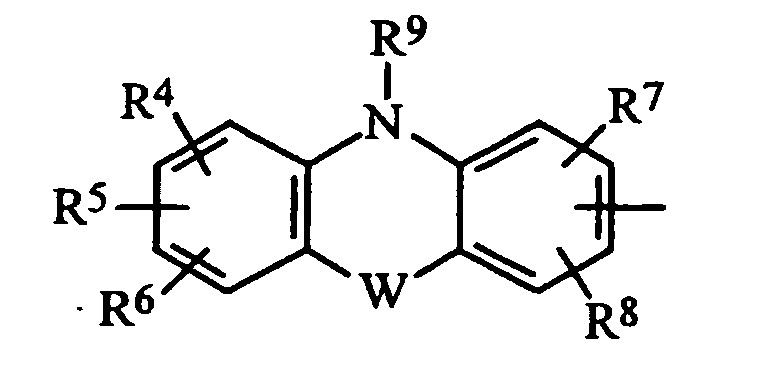
R9 représente un atome d'hydrogène,
et W n'existe pas, ou représente une liaison, -O- ou -S-, - soit le radical
dans lequel Q représente OH, deux des radicaux R19, R20 et R21 représentent des radicaux choisis indépendamment parmi les radicaux alkyle, alkoxy, alkylthio, amino, alkylamino ou dialkylamino et le troisième représente un radical choisi parmi un atome d'hydrogène et les radicaux radicaux alkyle, alkoxy, alkylthio, amino, alkylamino ou dialkylamino,
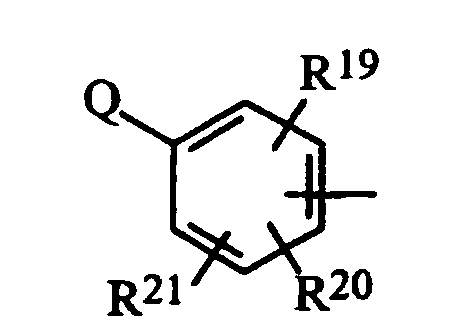
ou dans lequel Q représente un radical phényle substitué par un radical OH et un ou des radicaux choisis indépendamment parmi un atome halogène et un radical OH, alkyle, alkoxy ou -NR10R11 dans lequel R10 et R11 représentent indépendamment un atome d'hydrogène ou un radical alkyle, - soit encore le radical
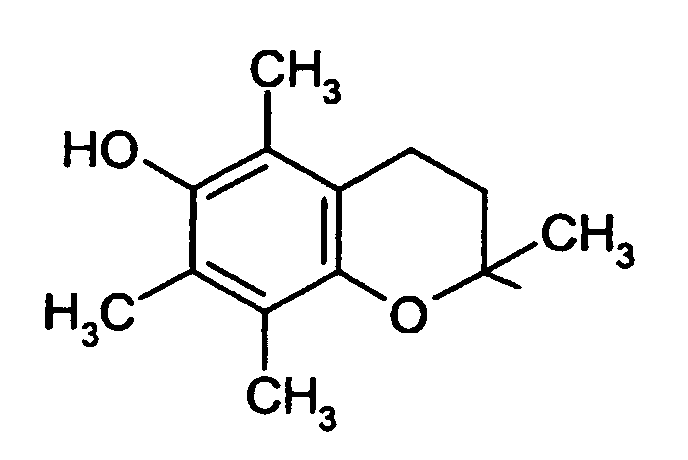
- soit enfin le radical
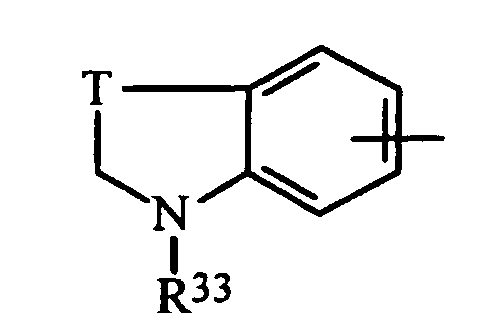
- soit le radical
- B représente H ;
- n représente 0 ou 1 ;
- R1 et R2 représentent tous deux H ;
- Ω représente :
- de préférence : un radical NR46R47 tel que NR46R47 représente le radical pipéridinyle ou le radical N-pipérazinyle éventuellement N-substitué par un radical alkyle ou dans lequel l'un de R46 et R47 représente H ou un radical hydroxyalkyle, alkynyle ou cyanoalkyle et l'autre représente H ou un radical alkyle,
- ou bien le radical OR48 dans lequel R48 représente un atome d'hydrogène ou un radical alkyle, alkynyle ou cyanoalkyle.
- le composé répond à la sous-formule générale (I) 1 ou (I) 2 dans laquelle X représente S ou le composé répond à la formule générale (I) 3 dans laquelle Y représente O ;
- A représente le radical
dans lequel Q représente OH, deux des radicaux R19, R20 et R21 représentent un radical alkyle et le troisième représente H,
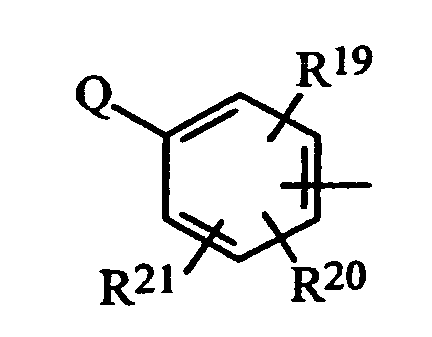
ou dans lequel Q représente un radical phényle substitué par un radical OH et un ou des radicaux choisis indépendamment parmi des radicaux alkyle ; - B représente H ;
- n représente 0 ou 1 ;
- R1 et R2 représentent tous deux H ;
- Ω représente :
- de préférence : un radical NR46R47 tel que NR46R47 représente un radical N-pipérazinyle ou dans lequel l'un de R46 et R47 représente H ou un radical hydroxyallcyle, alkynyle ou cyanoalkyle et l'autre représente H ou un radical alkyle,
- ou bien le radical OH.
soit un radical

R22 représentant un atome d'hydrogène ou un radical alkyle,
et R19, R20 et R21 représentent, indépendamment, un hydrogène, un halogène, le groupe OH ou un radical alkyle, alkoxy, cyano, nitro, cycloalkyle, -SO2NHR49, -CONHR55, -S(O)qR56, -NH(CO)R57, -CF3, -OCF3 ou NR27R28,
R27 et R28 représentant, indépendamment, un atome d'hydrogène ou un radical alkyle ou R27 et R28 formant ensemble avec l'atome d'azote qui les porte un hétérocycle de 5 à 6 chaínons choisis parmi -CH2-, -NH- et -O-,
R49 et R55 représentant, indépendamment à chaque fois qu'ils interviennent, un atome d'hydrogène ou un radical alkyle ou alkylcarbonyle,
q représentant un entier de 0 à 2,
R56 et R57 représentant, indépendamment à chaque fois qu'ils interviennent, un atome d'hydrogène ou un radical alkyle ou alkoxy,
soit un radical

R10 et R11 représentant, indépendamment, un atome d'hydrogène ou un radical alkyle, ou bien R10 et R11 formant ensemble avec l'atome d'azote un hétérocycle éventuellement substitué comptant de 4 à 7 chaínons et de 1 à 3 hétéroatomes incluant l'atome d'azote déjà présent, les hétéroatomes supplémentaires étant choisis indépendamment dans le groupe constitué des atomes O, N et S, ledit hétérocycle pouvant être par exemple azétidine, pyrrolidine, pipéridine, pipérazine, morpholine ou thiomorpholine,
R9 représente un atome d'hydrogène ou un radical alkyle,
et W n'existe pas, ou représente une liaison, ou -O-, -S- ou -NR18-, dans lequel R18 représente un atome d'hydrogène ou un radical alkyle ;
soit un radical

et T représente un radical -(CH2)m- avec m = 1 ou 2,
ou encore A représente un radical alkyle, cycloalkyle ou cycloalkylalkyle ;
X représente NR38 ou S,
R38 représentant un atome d'hydrogène ou un radical alkyle, aralkyle, alkylcarbonyle ou aralkylcarbonyle,
R1 et R2 représentent, indépendamment, un atome d'hydrogène, un radical alkyle, cycloalkyle, cycloalkylalkyle, alkoxyalkyle, aminoalkyle, -(CH2)g-NH-CO-R70 ou un radical aralkyle ou hétéroarylalkyle éventuellement substitué sur le groupe aryle ou hétéroaryle par un ou plusieurs groupes choisis parmi le groupe composé d'un atome halogène, d'un radical alkyle ou alkoxy, d'un radical hydroxy, cyano ou nitro et d'un radical amino, alkylamino ou dialkylamino,
R70 représentant, indépendamment à chaque fois qu'il intervient, un radical alkyle ou alkoxy ;
R1 et R2 pris ensemble pouvant éventuellement former avec l'atome de carbone qui les porte un carbocycle de 3 à 7 chaínons ;
Ω représente OH ou un radical NR46R47, dans lequel :
R46 et R47 représentent, indépendamment, un atome d'hydrogène ou un radical alkyle, cycloalkyle ou cycloalkylalkyle, -CO-NH-R51, -CO-O-R51 ou -SO2-R72 ou l'un des radicaux hétéroaryle, aralkyle, aryloxyalkyle ou arylimino éventuellement substitués sur le groupe hétéroaryle ou aryle par un ou plusieurs groupes choisis parmi le groupe composé d'un atome halogène, d'un radical alkyle ou alkoxy linéaire ou ramifié comptant de 1 à 6 atomes de carbone, d'un radical hydroxy, cyano ou nitro, d'un radical amino, alkylamino ou dialkylamino,
R51 représentant un atome d'hydrogène, l'un des radicaux cycloalkyle ou cycloalkylalkyle dans lesquels le radical cycloallcyle compte de 3 à 7 atomes de carbone, un radical alkyle linéaire ou ramifié comptant de 1 à 8 atomes de carbone, un radical alkoxyalkyle ou encore un radical aryle ou aralkyle, ledit radical aryle ou aralkyle pouvant être substitué par un ou des substituants choisis indépendamment parmi un atome halogène et un radical alkyle ou alkoxy,
et R72 représentant un radical alkyle, ou l'un des radicaux phényle ou aralkyle éventuellement substitués sur le noyau aromatique par un ou des radicaux choisis parmi un atome halogène, un radical alkyle ou alkoxy ;
g représente un entier de 1 à 6 ; et enfin
n représente un entier de 0 à 6.
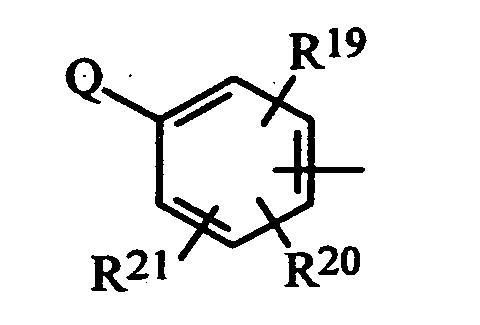
R22 représentant un atome d'hydrogène ou un radical alkyle,
et R19, R20 et R21 représentent, indépendamment, un hydrogène, un halogène, le groupe OH ou un radical alkyle, alkoxy, cyano, nitro, cycloalkyle, -SO2NHR49, -CONHR55, -S(O)qR56, -NH(CO)R57, -OCF3 ou NR27R28,
R27 et R28 représentant, indépendamment, un atome d'hydrogène ou un radical alkyle ou R27 et R28 formant ensemble avec l'atome d'azote qui les porte un hétérocycle de 5 à 6 chaínons choisis parmi -CH2-, -NH- et -O-,
R49 et R55 représentant, indépendamment à chaque fois qu'ils interviennent, un atome d'hydrogène ou un radical alkyle ou alkylcarbonyle,
q représentant un entier de 0 à 2,
R56 et R57 représentant, indépendamment à chaque fois qu'ils interviennent, un atome d'hydrogène ou un radical alkyle ou alkoxy,
ou encore A représente un radical alkyle, cycloalkyle ou cycloalkylalkyle,
X représente NR38 ou S,
R38 représentant un atome d'hydrogène ou un radical alkyle, aralkyle, alkylcarbonyle ou aralkylcarbonyle,
R1 et R2 représentent, indépendamment, un atome d'hydrogène, un radical alkyle, cycloalkyle, cycloalkylalkyle, alkoxyalkyle, aminoalkyle, -(CH2)g-NH-CO-R70 ou un radical aralkyle ou hétéroarylalkyle éventuellement substitué sur le groupe aryle ou hétéroaryle par un ou plusieurs groupes choisis parmi le groupe composé d'un atome halogène, d'un radical alkyle ou alkoxy, d'un radical hydroxy, cyano ou nitro et d'un radical amino, alkylamino ou dialkylamino,
R70 représentant, indépendamment à chaque fois qu'il intervient, un radical alkyle ou alkoxy ;
R1 et R2 pris ensemble pouvant éventuellement former avec l'atome de carbone qui les porte un carbocycle de 3 à 7 chaínons ;
Ω représente le radical NR46R47, dans lequel :
- A représente :
- le radical
dans lequel Q représente un atome d'hydrogène, un atome halogène, le groupe OH, un radical alkoxy, alkylthio ou phényle éventuellement substitué par un ou des radicaux choisis parmi un atome halogène et un radical alkoxy,

et R19, R20 et R21 représentent, indépendamment, un atome d'hydrogène, un atome halogène, le groupe OH ou un radical alkyle, alkoxy, cyano, nitro, cycloalkyle, -SO2NHR49, -CONHR55, -S(O)qR56, -NH(CO)R57, -CF3, -OCF3 ou NR27R28,
R27 et R28 représentant, indépendamment, un atome d'hydrogène ou un radical alkyle ou R27 et R28 formant ensemble avec l'atome d'azote qui les porte un hétérocycle de 5 à 6 chaínons choisis parmi -CH2-, -NH- et -O-,
R49 et R55 représentant, indépendamment à chaque fois qu'ils interviennent, un atome d'hydrogène ou un radical alkyle ou alkylcarbonyle,
q représentant un entier de 0 à 2,
R56 et R57 représentant, indépendamment à chaque fois qu'ils interviennent, un atome d'hydrogène ou un radical alkyle ou alkoxy ; - ou un radical alkyle, cycloalkyle ou cycloalkylalkyle ;
- le radical
- B représente H, alkyle ou phényle ;
- n représente 0 ou 1 ;
- R1 et R2 sont tels que :
- R1 et R2 représentent indépendamment H, un radical alkyle, cycloalkyle et en particulier cyclohexyle, cycloalkylalkyle; ou encore un radical aralkyle ou hétéroarylalkyle éventuellement substitué sur le groupe aryle ou hétéroaryle par un ou plusieurs groupes choisis parmi le groupe composé d'un atome halogène, d'un radical alkyle ou alkoxy ; en particulier, R1 représente un radical alkyle linéaire ou ramifié comptant de 2 à 6 atomes de carbone, et de préférence 4 à 6 atomes de carbone, le radical cyclohexyle ou le radical indolylméthyle éventuellement substitué et R2 représente H ;
- ou R1 et R2 pris ensemble forment avec l'atome de carbone qui les porte un carbocycle de 3 à 7 chaínons ;
- Ω représente un radical OH ou de préférence un radical NR46R47 dans lequel R46 représente H, un radical alkyle et en particulier isopropyle, n-pentyle ou n-hexyle, un radical cycloalkylalkyle, un radical cycloalkyle et en particulier cyclobutyle, cyclopentyle ou cyclohexyle, un radical alkylcarbonyle, un radical alkoxycarbonyle, un radical (cycloalkyl)oxycarbonyle, un radical cycloalkylalkoxycarbonyle, un radical alkylaminocarbonyle ou encore un radical benzyle éventuellement substitué par un radical alkoxy, et R47 représente H ;
- X représente S ou de préférence le radical NR38 dans lequel R38 représente un atome d'hydrogène ou un radical alkyle, aralkyle, alkylcarbonyle ou aralkylcarbonyle.
- A représente :
- le radical
dans lequel Q représente un atome d'hydrogène, un atome halogène ou un radical alkoxy, alkylthio ou phényle éventuellement substitué par un ou des radicaux choisis parmi un atome halogène et un radical alkoxy,

et R19, R20 et R21 représentent, indépendamment, un atome d'hydrogène, un atome halogène ou un radical alkyle, alkoxy, cyano,cycloalkyle, -CF3 ou NR27R28,
R27 et R28 représentant, indépendamment, un atome d'hydrogène ou un radical alkyle ou R27 et R28 formant ensemble avec l'atome d'azote qui les porte un hétérocycle de 5 à 6 chaínons choisis parmi -CH2- et -NH- ; - ou un radical cycloalkyle ;
- le radical
- B représente H ;
- n représente 0 ou 1 ;
- R1 représente H, un radical alkyle, cycloalkyle et en particulier cyclohexyle, et R2 représente H ;
- Ω représente un radical NR46R47 dans lequel R46 représente un radical cycloalkylalkyle, un radical cycloalkyle et en particulier cyclobutyle ou cyclohexyle, un radical alkoxycarbonyle, un radical (cycloalkyl)oxycarbonyle, un radical cycloalkylalkoxycarbonyle ou encore un radical benzyle éventuellement substitué par un radical alkoxy, et R47 représente H ;
- X représente le radical NH.

ou dans lequel Q représente un radical phényle substitué par un radical OH et un ou des radicaux choisis indépendamment parmi des radicaux alkyle ;

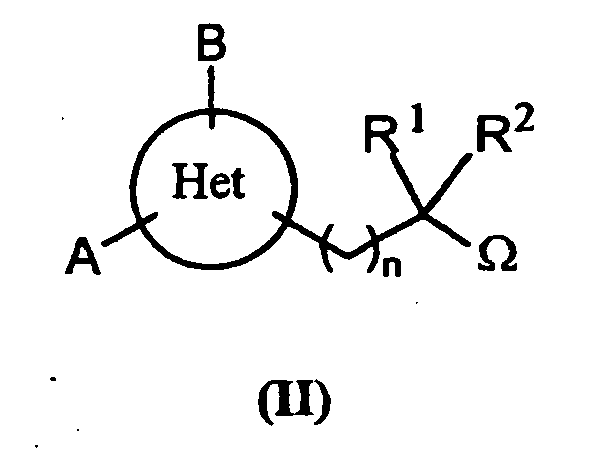


A représente
soit un radical
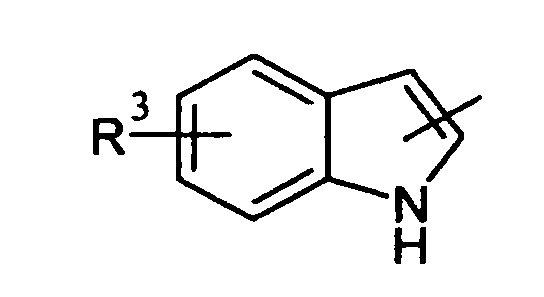
soit un radical

R10 et R11 représentant, indépendamment, un atome d'hydrogène, un radical alkyle ou un groupe -COR12, ou bien R10 et R11 formant ensemble avec l'atome d'azote un hétérocycle éventuellement substitué comptant de 4 à 7 chaínons et de 1 à 3 hétéroatomes incluant l'atome d'azote déjà présent, les hétéroatomes supplémentaires étant choisis indépendamment dans le groupe constitué des atomes O, N et S,
R12 représentant un atome d'hydrogène ou un radical alkyle, alkoxy ou NR13R14,
R13 et R14 représentant, indépendamment, un atome d'hydrogène ou un radical alkyle, ou bien R13 et R14 formant ensemble avec l'atome d'azote un hétérocycle éventuellement substitué comptant de 4 à 7 chaínons et de 1 à 3 hétéroatomes incluant l'atome d'azote déjà présent, les hétéroatomes supplémentaires étant choisis indépendamment dans le groupe constitué des atomes O, N et S,
R9 représente un atome d'hydrogène, un radical alkyle ou un groupe -COR15,
R15 représentant un atome d'hydrogène ou un radical alkyle, alkoxy ou NR16R17,
R16 et R17 représentant, indépendamment, un atome d'hydrogène ou un radical alkyle, ou bien R16 et R17 formant ensemble avec l'atome d'azote un hétérocycle éventuellement substitué comptant de 4 à 7 chaínons et de 1 à 3 hétéroatomes incluant l'atome d'azote déjà présent, les hétéroatomes supplémentaires étant choisis indépendamment dans le groupe constitué des atomes O, N et S,
et W n'existe pas, ou représente une liaison, ou -O-, -S- ou -NR18-, dans lequel R18 représente un atome d'hydrogène ou un radical alkyle ;
soit un radical

R10 et R11 représentant, indépendamment, un atome d'hydrogène, un radical alkyle ou un groupe -COR12, ou bien R10 et R11 formant ensemble avec l'atome d'azote un hétérocycle éventuellement substitué comptant de 4 à 7 chaínons et de 1 à 3 hétéroatomes incluant l'atome d'azote déjà présent, les hétéroatomes supplémentaires étant choisis indépendamment dans le groupe constitué des atomes O, N et S,
R12 représentant un atome d'hydrogène, un radical alkyle ou alkoxy ou NR13R14,
R13 et R14 représentant, indépendamment, un atome d'hydrogène ou un radical alkyle, ou bien R13 et R14 formant ensemble avec l'atome d'azote un hétérocycle éventuellement substitué comptant de 4 à 7 chaínons et de 1 à 3 hétéroatomes incluant l'atome d'azote déjà présent, les hétéroatomes supplémentaires étant choisis indépendamment dans le groupe constitué des atomes O, N et S,
R22 représentant un atome d'hydrogène, un radical alkyle ou un radical aryle éventuellement substitué par un ou plusieurs substituants choisis parmi les radicaux alkyle, OH, halogène, nitro et alkoxy,
R23 et R24 représentant, indépendamment, un atome d'hydrogène, un radical alkyle ou un radical -CO-R25,
R25 représentant un radical alkyle,
et R19, R20 et R21 représentent, indépendamment, un hydrogène, un halogène, le groupe OH ou SR26, ou un radical alkyle, cycloalkyle, alkényle, alkoxy, cyano, nitro, -SO2NHR49, -CONHR55, -S(O)qR56, -NH(CO)R57, -CF3, -OCF3 ou NR27R28,
R26 représentant un atome d'hydrogène ou un radical alkyle,
R27 et R28 représentant, indépendamment, un atome d'hydrogène, un radical alkyle ou un groupe -COR29, ou bien R27 et R28 formant ensemble avec l'atome d'azote un hétérocycle éventuellement substitué comptant de 4 à 7 chaínons et de 1 à 3 hétéroatomes incluant l'atome d'azote déjà présent, les hétéroatomes supplémentaires étant choisis indépendamment dans le groupe constitué des atomes O, N et S,
R49 et R55 représentant, indépendamment à chaque fois qu'ils interviennent, un atome d'hydrogène ou un radical alkyle ou alkylcarbonyle,
q représentant un entier de 0 à 2,
R56 et R57 représentant, indépendamment à chaque fois qu'ils interviennent, un atome d'hydrogène ou un radical alkyle ou alkoxy,
R29 représentant un atome d'hydrogène, un radical alkyle, alkoxy ou -NR30R31,
R30 et R31 représentant, indépendamment, un atome d'hydrogène ou un radical alkyle, ou bien R30 et R31 formant ensemble avec l'atome d'azote un hétérocycle éventuellement substitué comptant de 4 à 7 chaínons et de 1 à 3 hétéroatomes incluant l'atome d'azote déjà présent, les hétéroatomes supplémentaires étant choisis indépendamment dans le groupe constitué des atomes O, N et S,
soit un radical

et T représente un radical -(CH2)m- avec m = 1 ou 2,
soit enfin un radical
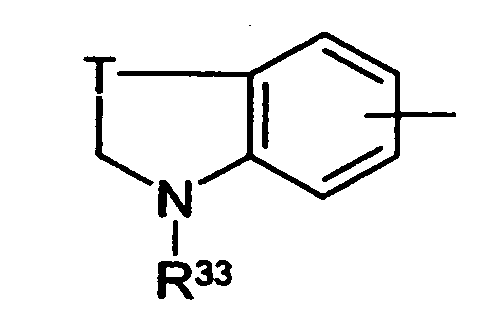
Σ représentant un radical alkylène linéaire ou ramifié comptant de 1 à 6 atomes de carbone,
R34 et R35 représentant, indépendamment, un atome d'hydrogène ou un radical alkyle,
R36 et R37 représentant, indépendamment, un atome d'hydrogène ou un radical aryle carbocyclique ou hétérocyclique éventuellement substitué par un ou plusieurs substituants choisis parmi les radicaux alkyle, OH, halogène, nitro, alkoxy ou NR10R11,
R10 et R11 représentant, indépendamment, un atome d'hydrogène, un radical alkyle ou un groupe -COR12, ou bien R10 et R11 formant ensemble avec l'atome d'azote un hétérocycle éventuellement substitué comptant de 4 à 7 chaínons et de 1 à 3 hétéroatomes incluant l'atome d'azote déjà présent, les hétéroatomes supplémentaires étant choisis indépendamment dans le groupe constitué des atomes O, N et S,
R12 représentant un atome d'hydrogène ou un radical alkyle, alkoxy ou NR13R14,
R13 et R14 représentant, indépendamment, un atome d'hydrogène ou un radical alkyle, ou bien R13 et R14 formant ensemble avec l'atome d'azote un hétérocycle éventuellement substitué comptant de 4 à 7 chaínons et de 1 à 3 hétéroatomes incluant l'atome d'azote déjà présent, les hétéroatomes supplémentaires étant choisis indépendamment dans le groupe constitué des atomes O, N et S,
et T représente un radical -(CH2)m- avec m = 1 ou 2,
ou encore A représente un radical alkyle, cycloalkyle ou cycloalkylalkyle ;
X représente S ou NR38,
R38 représentant un atome d'hydrogène ou un radical alkyle, cyanoalkyle, aralkyle, alkylcarbonyle ou aralkylcarbonyle,
Y représente O ou S ;
R1 représente un atome d'hydrogène, un radical alkyle, aminoalkyle, alkoxyalkyle, cycloalkyle, cycloalkylalkyle, trifluorométhylalkyle, alkényle, allènyle, allènylalkyle, alkynyle, cyanoalkyle, -(CH2)g-Z1R39, -(CH2)g-COR40, -(CH2)g-NHCOR70, aryle, aralkyle, arylcarbonyle, hétéroarylalkyle ou aralkylcarbonyle, le groupement aryle des radicaux aryle, aralkyle, arylcarbonyle, hétéroarylalkyle ou aralkylcarbonyle étant lui-même éventuellement substitué par un ou plusieurs substituants choisis parmi le groupe constitué des radicaux alkyle, halogène, alkoxy, nitro, cyano, cyanoalkyle, amino, alkylamino, dialkylamino, -(CH2)k-Z2R39 ou -(CH2)k-COR40,
Z1 et Z2 représentant une liaison, -O-, -NR41- ou -S-,
R39 et R41 représentant, indépendamment à chaque fois qu'ils interviennent, un atome d'hydrogène ou un radical alkyle, alkényle, alkynyle ou cyanoalkyle,
R40 représentant, indépendamment à chaque fois qu'il intervient, un atome d'hydrogène ou un radical alkyle, allènyle, allènylalkyle, alkényle, alkynyle, cyanoalkyle, alkoxy ou NR42R43,
R42 et R43 représentant, indépendamment, indépendamment à chaque fois qu'ils interviennent, un atome d'hydrogène ou un radical alkyle, allènyle, allènylalkyle, alkényle, alkynyle ou cyanoalkyle,
et R2 représente un atome d'hydrogène, un radical alkyle, aminoalkyle, alkoxyalkyle, cycloalkyle, cycloalkylalkyle, trifluorométhylalkyle ou -(CH2)g-NHCOR71, ou encore l'un des radicaux aralkyle ou hétéroarylalkyle éventuellement substitués sur le groupe aryle ou hétéroaryle par un ou des groupes choisis indépendamment parmi le groupe composé d'un atome halogène et d'un radical alkyle, alkoxy, hydroxy, cyano, nitro, amino, alkylamino ou dialkylamino,
R70 et R71 représentant indépendamment un radical alkyle ou alkoxy ;
ou bien R1 et R2, pris ensemble avec l'atome de carbone qui les porte, forment un carbocycle de 3 à 7 chaínons ;
B représente un atome d'hydrogène, un radical alkyle, un radical -(CH2)g-Z3R44 ou un radical aryle carbocyclique éventuellement substitué de 1 à 3 fois par des radicaux choisis parmi le groupe composé d'un atome halogène, d'un radical alkyle ou alkoxy linéaire ou ramifié comptant de 1 à 6 atomes de carbone, d'un radical hydroxy, cyano ou nitro, d'un radical amino, alkylamino ou dialkylamino et d'un radical aryle carbocyclique,
Z3 représentant une liaison, -O-, -NR45- ou -S-,
R44 et R45 représentant, indépendamment, un atome d'hydrogène ou un radical alkyle, alkényle, alkynyle, allènyle, allènylalkyle ou cyanoalkyle ;
Ω représente l'un des radicaux NR46R47 ou OR48, dans lesquels :
étant entendu que lorsque Het est tel que le composé de formule générale (II) réponde à la sous-formule générale (II) 4 , alors :
- A représente le radical 4-hydroxy-2,3-di-tertiobutyl-phényle ;
- B, R1 et R2 représentent tous H ; et enfin
- Ω représente OH ;
- Het est un cycle thiazole, oxazole ou isoxazoline, et
A représente un radicaldans lequel R3 représente un atome d'hydrogène, le groupe OH ou un radical alkoxy ou alkyle,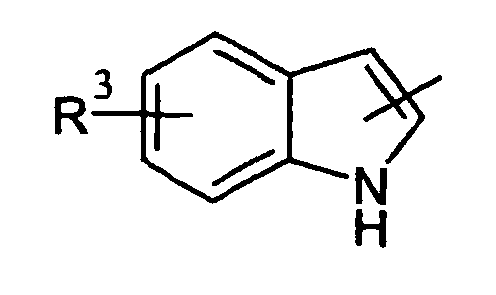
ou A représente un radicaldans lequel R4, R5, R6, R7 et R8 représentent, indépendamment, un atome d'hydrogène, un halogène, le groupe OH ou un radical alkyle, alkoxy, cyano, nitro ou NR10R11, R10 et R11 représentant, indépendamment, un atome d'hydrogène ou un radical alkyle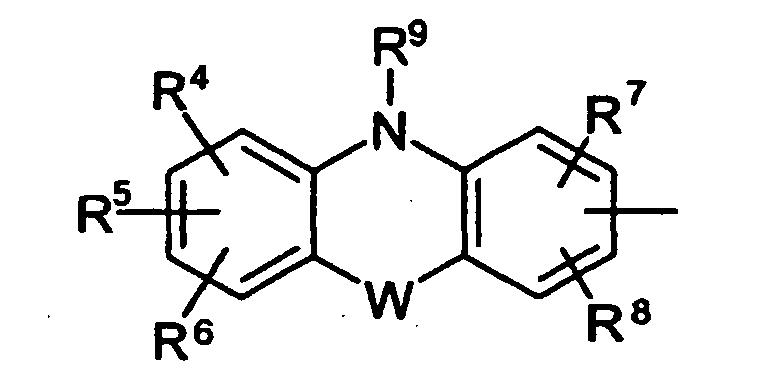
R9 représente un atome d'hydrogène ou un radical alkyle,
et W n'existe pas, ou représente une liaison, ou -O-, -S- ou -NR18-, dans lequel R18 représente un atome d'hydrogène ou un radical alkyle,
ou A représente un radicaldans lequel Q représente OH ou Q représente un radical phényle substitué par un radical OH et un ou des radicaux choisis indépendamment parmi un atome halogène et un radical OH, alkyle, alkoxy ou -NR10R11 dans lequel R10 et R11 représentent indépendamment un atome d'hydrogène ou un radical alkyle,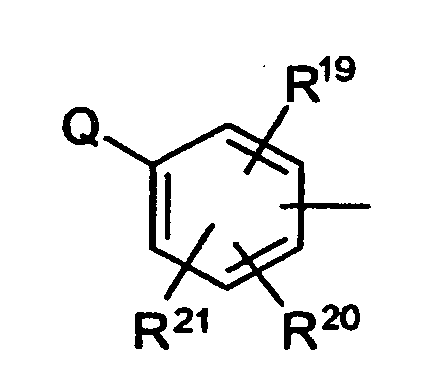
ou encore A représente un radicaldans lequel R32 représente un atome d'hydrogène ou un radical alkyle et T représente un radical -(CH2)m- avec m = 1 ou 2,
ou enfin A représente un radicaldans lequel le radical R33 représente un atome d'hydrogène ou un radical alkyle, -Σ-NR34R35 ou -Σ-CHR36R37, Σ représentant un radical alkylène linéaire ou ramifié comptant de 1 à 6 atomes de carbone, R34 et R35 représentant, indépendamment, un atome d'hydrogène ou un radical alkyle, R36 et R37 représentant, indépendamment, un atome d'hydrogène ou un radical aryle carbocyclique ou hétérocyclique éventuellement substitué par un ou plusieurs substituants choisis parmi les radicaux alkyle, OH, halogène, nitro, alkoxy ou NR10R11, R10 et R11 représentant, indépendamment, un atome d'hydrogène, un radical alkyle, ou bien R10 et R11 formant ensemble avec l'atome d'azote un hétérocycle éventuellement substitué comptant de 4 à 7 chaínons et de 1 à 3 hétéroatomes incluant l'atome d'azote déjà présent, les hétéroatomes supplémentaires étant choisis indépendamment dans le groupe constitué des atomes O, N et S, ledit hétérocycle pouvant être par exemple azétidine, pyrrolidine, pipéridine, pipérazine, morpholine ou thiomorpholine,
et T représente un radical un radical -(CH2)m- avec m = 1 ou 2 ; - Het est un cycle imidazole,
A représente un radicaldans lequel Q représente OH,
et Ω représente NR46R47 dans lequel R46 ou R47 représente un radical aminophényle, nitrophényle, aminophénylcarbonyle, nitrophénylcarbonyle, aminophénylalkyle ou nitrophénylalkyle ; - A représente un radical
B représente un radical aryle carbocyclique éventuellement substitué de 1 à 3 fois par des radicaux choisis parmi le groupe composé d'un atome halogène, d'un radical alkyle ou alkoxy linéaire ou ramifié comptant de 1 à 6 atomes de carbone, d'un radical hydroxy, cyano ou nitro, d'un radical amino, alkylamino ou dialkylamino et d'un radical aryle carbocyclique,
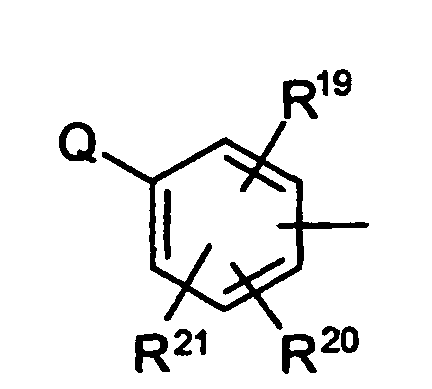
et l'un de R1 et R2 représente l'un des radicaux arylalkyle ou hétéroarylalkyle éventuellement substitués ; - A représente un radical cycloalkyle ou cycloalkylalkyle ;
- Ω représente NR46R47 et l'un de R46 et R47 représente un radical alkényle, allényle, allénylalkyle, alkynyle, cyanoalkyle ou hydroxyalkyle ;
- l'un de R1 et R2 représente un radical cycloalkyle ou cycloalkylalkyle ;
- aucun de R1 et R2 ne représente H ;
- n = 1 et A représente un radical biphényle, phénoxyphényle, phénylthiophényle, phénylcarbonylphényle ou phénylsulfonylphényle ;
- lorsque Het est un cycle thiazole et Ω représente le radical OR48 dans lequel R48 est un radical cyanoalkyle, alors le groupe cyano n'est pas attaché à l'atome de carbone immédiatement adjacent à l'atome d'oxygène ;
Het est un cycle oxazole, thiazole ou isoxazoline
A représente un radical
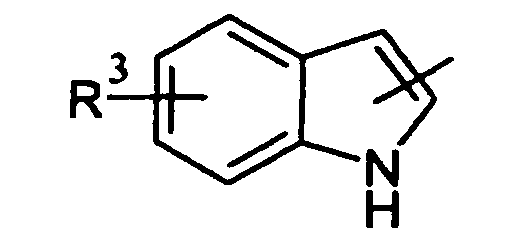
ou A représente un radical
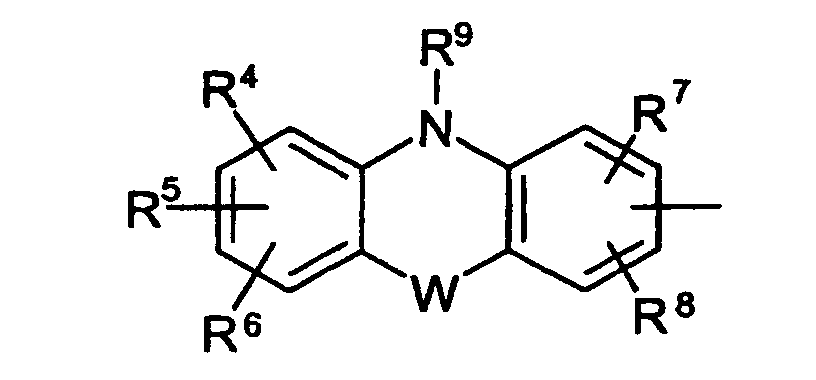
ou A représente un radical
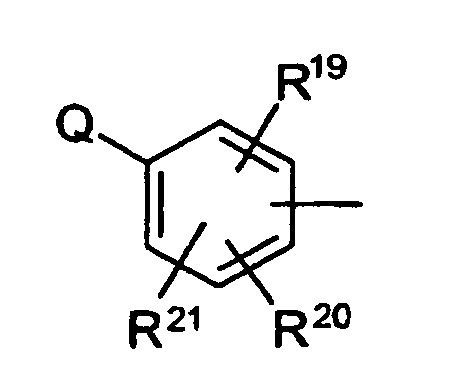
ou dans lequel Q représente un radical phényle substitué par un radical OH et un ou des radicaux choisis indépendamment parmi un atome halogène et un radical OH, alkyle, alkoxy ou -NR10R11 dans lequel R10 et R11 représentent indépendamment un atome d'hydrogène ou un radical alkyle,
ou encore A représente un radical
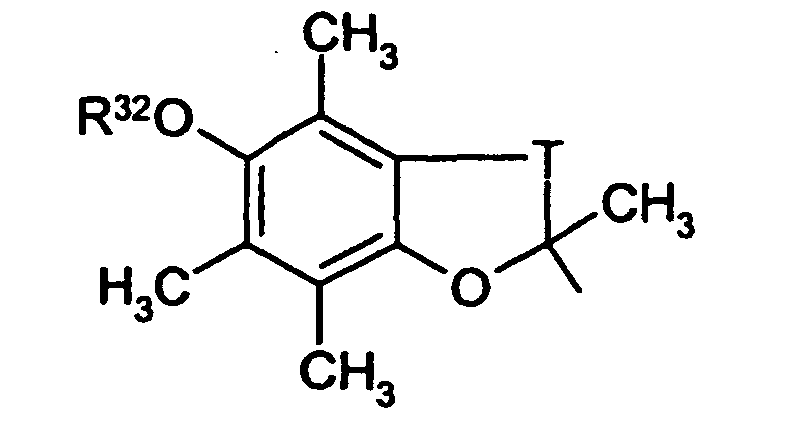
ou enfin A représente un radical
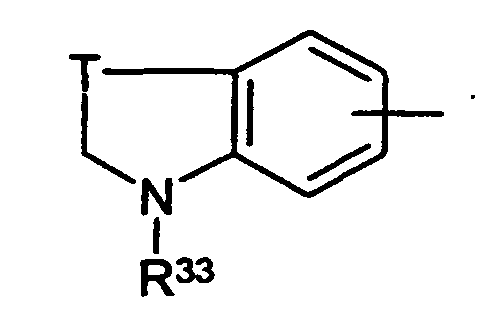
ou ramifié comptant de 1 à 6 atomes de carbone, et R34 et R35 représentant, indépendamment, un atome d'hydrogène ou un radical alkyle,
B représente H,
R1 et R2 représentent, indépendamment, un atome d'hydrogène ou un radical alkyle, et Ω représente un radical NR46R47 dans lequel l'un de R46 et R47 représente un radical alkyle, alkényle, allényle, allénylalkyle, alkynyle, cyanoalkyle ou hydroxyalkyle et l'autre représente un atome d'hydrogène ou un radical alkyle ; ou
A représente un radical

R19, R20 et R21 représentent, indépendamment, un hydrogène, un halogène, un radical SR26, ou un radical alkyle, cycloalkyle, alkényle, alkoxy, cyano, nitro, -SO2NHR49, -CONHR55, -S(O)qR56, -NH(CO)R57, -CF3, -OCF3 ou NR27R28,
R26 représentant un radical alkyle,
R27 et R28 représentant, indépendamment, un atome d'hydrogène ou un radical alkyle ou R27 et R28 formant ensemble avec l'atome d'azote qui les porte un hétérocycle de 5 à 6 chaínons choisis parmi -CH2-, -NH- et -O-,
R49 et R55 représentant, indépendamment à chaque fois qu'ils interviennent, un atome d'hydrogène ou un radical alkyle ou alkylcarbonyle,
q représentant un entier de 0 à 2,
R56 et R57 représentant, indépendamment à chaque fois qu'ils interviennent, un atome d'hydrogène ou un radical alkyle ou alkoxy,
et l'un de R1 et R2 représente un radical cycloalkyle ou cycloalkylalkyle ou bien aucun de R1 et R2 ne représente un atome d'hydrogène ; ou enfin
A représente un radical biphényle éventuellement substitué ou le radical cyclohexylphényle,
B représente un atome d'hydrogène,
R1 et R2 représentent chacun un atome d'hydrogène,
et Ω représente un radical NR46R47 dans lequel R46 représente un radical -COOR51,
R51 représentant un radical alkyle, cycloalkyle, cycloalkylalkyle ou alkoxyalkyle et
R47 représentant un atome d'hydrogène.


A représente
soit un radical
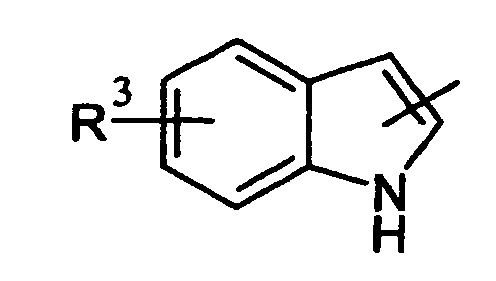
soit un radical

R10 et R11 représentant, indépendamment, un atome d'hydrogène, un radical alkyle ou un groupe -COR12, ou bien R10 et R11 formant ensemble avec l'atome d'azote un hétérocycle éventuellement substitué comptant de 4 à 7 chaínons et de 1 à 3 hétéroatomes incluant l'atome d'azote déjà présent, les hétéroatomes supplémentaires étant choisis indépendamment dans le groupe constitué des atomes O, N et S,
R12 représentant un atome d'hydrogène ou un radical alkyle, alkoxy ou NR13R14,
R13 et R14 représentant, indépendamment, un atome d'hydrogène ou un radical alkyle, ou bien R13 et R14 formant ensemble avec l'atome d'azote un hétérocycle éventuellement substitué comptant de 4 à 7 chaínons et de 1 à 3 hétéroatomes incluant l'atome d'azote déjà présent, les hétéroatomes supplémentaires étant choisis indépendamment dans le groupe constitué des atomes O, N et S,
R9 représente un atome d'hydrogène, un radical alkyle ou un groupe -COR15,
R15 représentant un atome d'hydrogène ou un radical alkyle, alkoxy ou NR16R17,
R16 et R17 représentant, indépendamment, un atome d'hydrogène ou un radical alkyle, ou bien R16 et R17 formant ensemble avec l'atome d'azote un hétérocycle éventuellement substitué comptant de 4 à 7 chaínons et de 1 à 3 hétéroatomes incluant l'atome d'azote déjà présent, les hétéroatomes supplémentaires étant choisis indépendamment dans le groupe constitué des atomes O, N et S,
et W n'existe pas, ou représente une liaison, ou -O-, -S- ou -NR18-, dans lequel R18 représente un atome d'hydrogène ou un radical alkyle ;
soit un radical
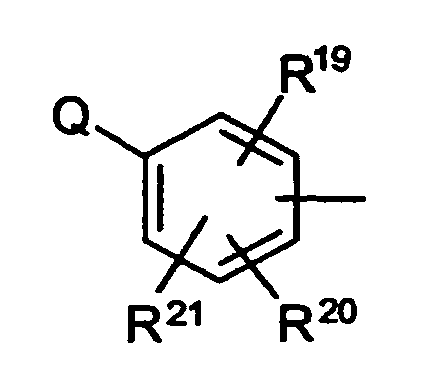
R10 et R11 représentant, indépendamment, un atome d'hydrogène, un radical alkyle ou un groupe -COR12, ou bien R10 et R11 formant ensemble avec l'atome d'azote un hétérocycle éventuellement substitué comptant de 4 à 7 chaínons et de 1 à 3 hétéroatomes incluant l'atome d'azote déjà présent, les hétéroatomes supplémentaires étant choisis indépendamment dans le groupe constitué des atomes O, N et S,
R12 représentant un atome d'hydrogène, un radical alkyle ou alkoxy ou NR13R14,
R13 et R14 représentant, indépendamment, un atome d'hydrogène ou un radical alkyle, ou bien R13 et R14 formant ensemble avec l'atome d'azote un hétérocycle éventuellement substitué comptant de 4 à 7 chaínons et de 1 à 3 hétéroatomes incluant l'atome d'azote déjà présent, les hétéroatomes supplémentaires étant choisis indépendamment dans le groupe constitué des atomes O, N et S,
R22 représentant un atome d'hydrogène, un radical alkyle ou un radical aryle éventuellement substitué par un ou plusieurs substituants choisis parmi les radicaux alkyle, OH, halogène, nitro et alkoxy,
R23 et R24 représentant, indépendamment, un atome d'hydrogène, un radical alkyle ou un radical -CO-R25,
R25 représentant un radical alkyle,
et R19, R20 et R21 représentent, indépendamment, un hydrogène, un halogène, le groupe OH ou SR26, ou un radical alkyle, cycloalkyle, alkényle, alkoxy, cyano, nitro, -SO2NHR49, -CONHR55, -S(O)qR56, -NH(CO)R57, -CF3, -OCF3 ou NR27R28,
R26 représentant un atome d'hydrogène ou un radical alkyle,
R27 et R28 représentant, indépendamment, un atome d'hydrogène, un radical alkyle ou un groupe -COR29, ou bien R27 et R28 formant ensemble avec l'atome d'azote un hétérocycle éventuellement substitué comptant de 4 à 7 chaínons et de 1 à 3 hétéroatomes incluant l'atome d'azote déjà présent, les hétéroatomes supplémentaires étant choisis indépendamment dans le groupe constitué des atomes O, N et S,
R49 et R55 représentant, indépendamment à chaque fois qu'ils interviennent, un atome d'hydrogène ou un radical alkyle ou alkylcarbonyle,
q représentant un entier de 0 à 2,
R56 et R57 représentant, indépendamment à chaque fois qu'ils interviennent, un atome d'hydrogène ou un radical alkyle ou alkoxy,
R29 représentant un atome d'hydrogène, un radical alkyle, alkoxy ou -NR30R31,
R30 et R31 représentant, indépendamment, un atome d'hydrogène ou un radical alkyle, ou bien R30 et R31 formant ensemble avec l'atome d'azote un hétérocycle éventuellement substitué comptant de 4 à 7 chaínons et de 1 à 3 hétéroatomes incluant l'atome d'azote déjà présent, les hétéroatomes supplémentaires étant choisis indépendamment dans le groupe constitué des atomes O, N et S,
soit un radical
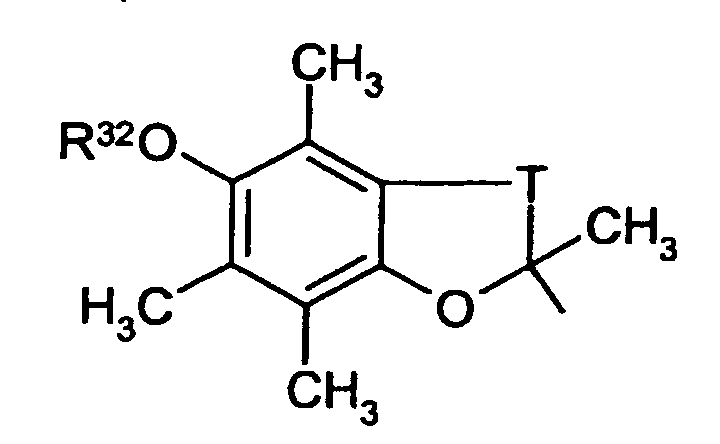
et T représente un radical -(CH2)m- avec m = 1 ou 2,
soit enfin un radical
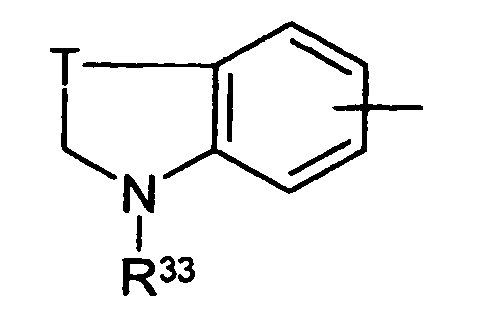
Σ représentant un radical alkylène linéaire ou ramifié comptant de 1 à 6 atomes de carbone,
R34 et R35 représentant, indépendamment, un atome d'hydrogène ou un radical alkyle,
R36 et R37 représentant, indépendamment, un atome d'hydrogène ou un radical aryle carbocyclique ou hétérocyclique éventuellement substitué par un ou plusieurs substituants choisis parmi les radicaux alkyle, OH, halogène, nitro, alkoxy ou NR10R11,
R10 et R11 représentant, indépendamment, un atome d'hydrogène, un radical alkyle ou un groupe -COR12, ou bien R10 et R11 formant ensemble avec l'atome d'azote un hétérocycle éventuellement substitué comptant de 4 à 7 chaínons et de 1 à 3 hétéroatomes incluant l'atome d'azote déjà présent, les hétéroatomes supplémentaires étant choisis indépendamment dans le groupe constitué des atomes O, N et S,
R12 représentant un atome d'hydrogène ou un radical alkyle, alkoxy ou NR13R14,
R13 et R14 représentant, indépendamment, un atome d'hydrogène ou un radical alkyle, ou bien R13 et R14 formant ensemble avec l'atome d'azote un hétérocycle éventuellement substitué comptant de 4 à 7 chaínons et de 1 à 3 hétéroatomes incluant l'atome d'azote déjà présent, les hétéroatomes supplémentaires étant choisis indépendamment dans le groupe constitué des atomes O, N et S,
et T représente un radical -(CH2)m- avec m = 1 ou 2,
ou encore A représente un radical alkyle, cycloalkyle ou cycloalkylalkyle ;
X représente S ou NR38,
R38 représentant un atome d'hydrogène ou un radical alkyle, cyanoalkyle, aralkyle, alkylcarbonyle ou aralkylcarbonyle,
Y représente O ou S ;
R1 représente un atome d'hydrogène, un radical alkyle, aminoalkyle, alkoxyalkyle, cycloalkyle, cycloalkylalkyle, trifluorométhylalkyle, alkényle, allènyle, allènylalkyle, alkynyle, cyanoalkyle, -(CH2)g-Z1R39, -(CH2)g-COR40, -(CH2)g-NHCOR70, aryle, aralkyle, arylcarbonyle, hétéroarylalkyle ou aralkylcarbonyle, le groupement aryle des radicaux aryle, aralkyle, arylcarbonyle, hétéroarylalkyle ou aralkylcarbonyle étant lui-même éventuellement substitué par un ou plusieurs substituants choisis parmi le groupe constitué des radicaux alkyle, halogène, alkoxy, nitro, cyano, cyanoalkyle, amino, alkylamino, dialkylamino, -(CH2)k-Z2R39 ou -(CH2)k-COR40,
Z1 et Z2 représentant une liaison, -O-, -NR41- ou -S-,
R39 et R41 représentant, indépendamment à chaque fois qu'ils interviennent, un atome d'hydrogène ou un radical alkyle, alkényle, alkynyle ou cyanoalkyle,
R40 représentant, indépendamment à chaque fois qu'il intervient, un atome d'hydrogène ou un radical alkyle, allènyle, allènylalkyle, alkényle, alkynyle, cyanoalkyle, alkoxy ou NR42R43,
R42 et R43 représentant, indépendamment, indépendamment à chaque fois qu'ils interviennent, un atome d'hydrogène ou un radical alkyle, allènyle, allènylalkyle, alkényle, alkynyle ou cyanoalkyle,
et R2 représente un atome d'hydrogène, un radical alkyle, aminoalkyle, alkoxyalkyle, cycloalkyle, cycloalkylalkyle, trifluorométhylalkyle ou -(CH2)g-NHCOR71, ou encore l'un des radicaux aralkyle ou hétéroarylalkyle éventuellement substitués sur le groupe aryle ou hétéroaryle par un ou des groupes choisis indépendamment parmi le groupe composé d'un atome halogène et d'un radical alkyle, alkoxy, hydroxy, cyano, nitro, amino, alkylamino ou dialkylamino,
R70 et R71 représentant indépendamment un radical alkyle ou alkoxy ;
ou bien R1 et R2, pris ensemble avec l'atome de carbone qui les porte, forment un carbocycle de 3 à 7 chaínons ;
B représente un atome d'hydrogène, un radical alkyle, un radical -(CH2)g-Z3R44 ou un radical aryle carbocyclique éventuellement substitué de 1 à 3 fois par des radicaux choisis parmi le groupe composé d'un atome halogène, d'un radical alkyle ou alkoxy linéaire ou ramifié comptant de 1 à 6 atomes de carbone, d'un radical hydroxy, cyano ou nitro, d'un radical amino, alkylamino ou dialkylamino et d'un radical aryle carbocyclique,
Z3 représentant une liaison, -O-, -NR45- ou -S-,
R44 et R45 représentant, indépendamment, un atome d'hydrogène ou un radical alkyle, alkényle, alkynyle, allènyle, allènylalkyle ou cyanoalkyle ;
Ω représente l'un des radicaux NR46R47 ou OR48, dans lesquels :
étant entendu que lorsque Het est tel que le composé de formule générale (III) réponde à la sous-formule générale (III) 4 , alors :
- A représente le radical 4-hydroxy-2,3-di-tertiobutyl-phényle ;
- B, R1 et R2 représentent tous H ; et enfin
- Ω représente OH ;
- étant entendu également que l'une au moins des caractéristiques suivantes doit être
présente :
- lorsque A représente un radical
dans lequel Q représente OH,
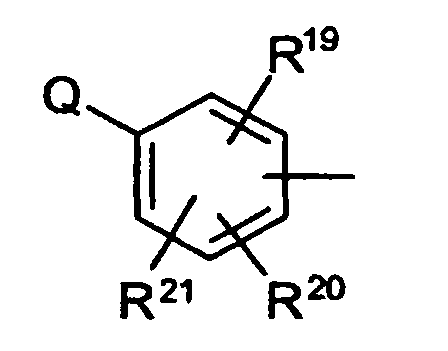
Ω ne représente pas un radical NR46R47 dans lequel R46 ou R47 sont choisis parmi un atome d'hydrogène et un radical alkyle ou un radical NR46R47 dans lequel R46 ou R47 représente un radical aminophényle, nitrophényle, aminophénylcarbonyle, nitrophénylcarbonyle, aminophénylalkyle ou nitrophénylalkyle ; - A représente un radical
B représente un radical aryle carbocyclique éventuellement substitué de 1 à 3 fois par des radicaux choisis parmi le groupe composé d'un atome halogène, d'un radical alkyle ou alkoxy linéaire ou ramifié comptant de 1 à 6 atomes de carbone, d'un radical hydroxy, cyano ou nitro, d'un radical amino, alkylamino ou dialkylamino et d'un radical aryle carbocyclique,

et l'un de R1 et R2 représente l'un des radicaux arylalkyle ou hétéroarylalkyle éventuellement substitués ; - A représente un radical cycloalkyle ou cycloalkylalkyle ;
- Ω représente NR46R47 et l'un de R46 et R47 représente un radical alkényle, allényle, allénylalkyle, alkynyle, cyanoalkyle ou hydroxyalkyle ;
- l'un de R1 et R2 représente un radical cycloalkyle ou cycloalkylalkyle ;
- aucun de R1 et R2 ne représente H ;
- n = 1 et A représente un radical biphényle, phénoxyphényle, phénylthiophényle, phénylcarbonylphényle ou phénylsulfonylphényle ;
- lorsque Het est un cycle thiazole et Ω représente le radical OR48 dans lequel R48 est un radical cyanoalkyle, alors le groupe cyano n'est pas attaché à l'atome de carbone immédiatement adjacent à l'atome d'oxygène ;
- lorsque A représente un radical
- A représentant le radical :
dans lequel Q représente OH, deux des radicaux R19, R20 et R21 représentent des radicaux choisis indépendamment parmi les radicaux alkyle, alkoxy, alkylthio, amino, alkylamino ou dialkylamino et le troisième représente un radical choisi parmi un atome d'hydrogène et les radicaux radicaux alkyle, alkoxy, alkylthio, amino, alkylamino ou dialkylamino ;
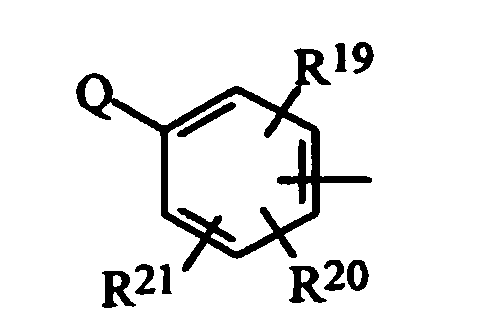
- n représentant 0 ou 1 ;
- R1 et R2 représentant tous deux H ;
- Ω représentant OH ou le radical NR46R47 dans lequel l'un de R46 et R47 représente un radical cyanoalkyle et l'autre représente H ou alkyle ou encore dans lequel R46 et R47 pris ensemble forment avec l'atome d'azote un hétérocycle non aromatique de 4 à 8 chaínons, les éléments de la chaíne étant choisis parmi un groupe composé de -CH(R53)-, -NR54-, -O-, -S-, -CO-, R53 et R54 étant tels que définis dans la formule générale (III).
- n=0,
A représente un radicaldans lequel Q représente un atome d'hydrogène ou un radical -OR22 ou -SR22 dans lequel R22 représente un radical alkyle ou un radical aryle éventuellement substitué par un ou plusieurs substituants choisis parmi les radicaux alkyle, OH, halogène, nitro et alkoxy,
R19, R20 et R21 représentent, indépendamment, un hydrogène, un halogène, un radical SR26, ou un radical alkyle, cycloalkyle, alkényle, alkoxy, cyano, nitro, -SO2NHR49, -CONHR55, -S(O)qR56, -NH(CO)R57, -CF3, -OCF3 ou NR27R28,
R26 représentant un radical alkyle,
R27 et R28 représentant, indépendamment, un atome d'hydrogène ou un radical alkyle ou R27 et R28 formant ensemble avec l'atome d'azote qui les porte un hétérocycle de 5 à 6 chaínons choisis parmi -CH2-, -NH- et -O-,
R49 et R55 représentant, indépendamment à chaque fois qu'ils interviennent, un atome d'hydrogène ou un radical alkyle ou alkylcarbonyle,
q représentant un entier de 0 à 2,
R56 et R57 représentant, indépendamment à chaque fois qu'ils interviennent, un atome d'hydrogène ou un radical alkyle ou alkoxy,
et l'un de R1 et R2 représente un radical cycloalkyle ou cycloalkylalkyle ou bien aucun de R1 et R2 ne représente un atome d'hydrogène ; ou enfin - n = 1,
A représente un radical biphényle ou cyclohexylphényle,
B représente un atome d'hydrogène,
R1 et R2 représentent chacun un atome d'hydrogène,
et Ω représente un radical NR46R47 dans lequel R46 représente un radical -COOR51, R51 représentant un radical alkyle, cycloalkyle, cycloalkylalkyle ou alkoxyalkyle et R47 représentant un atome d'hydrogène.
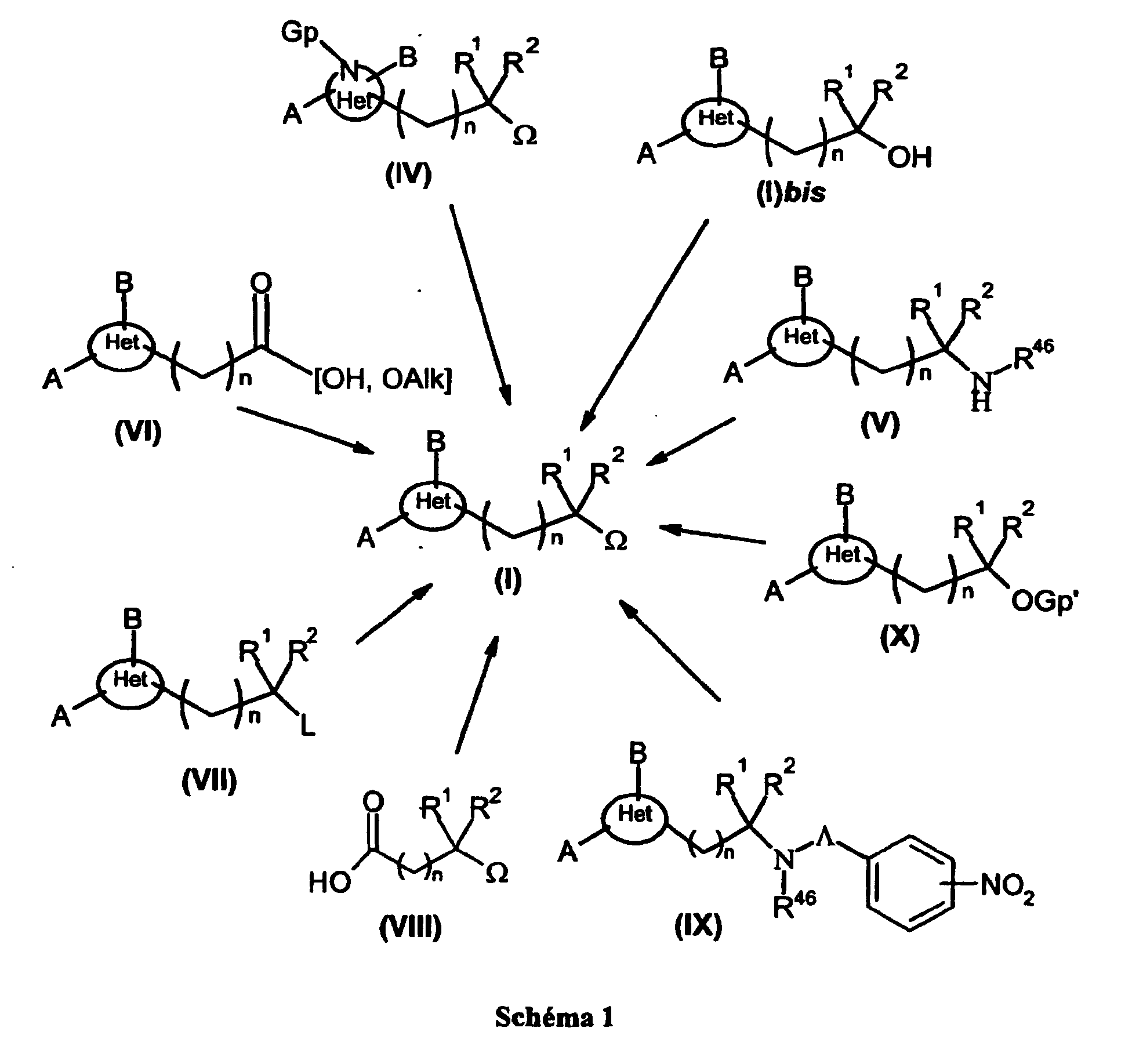
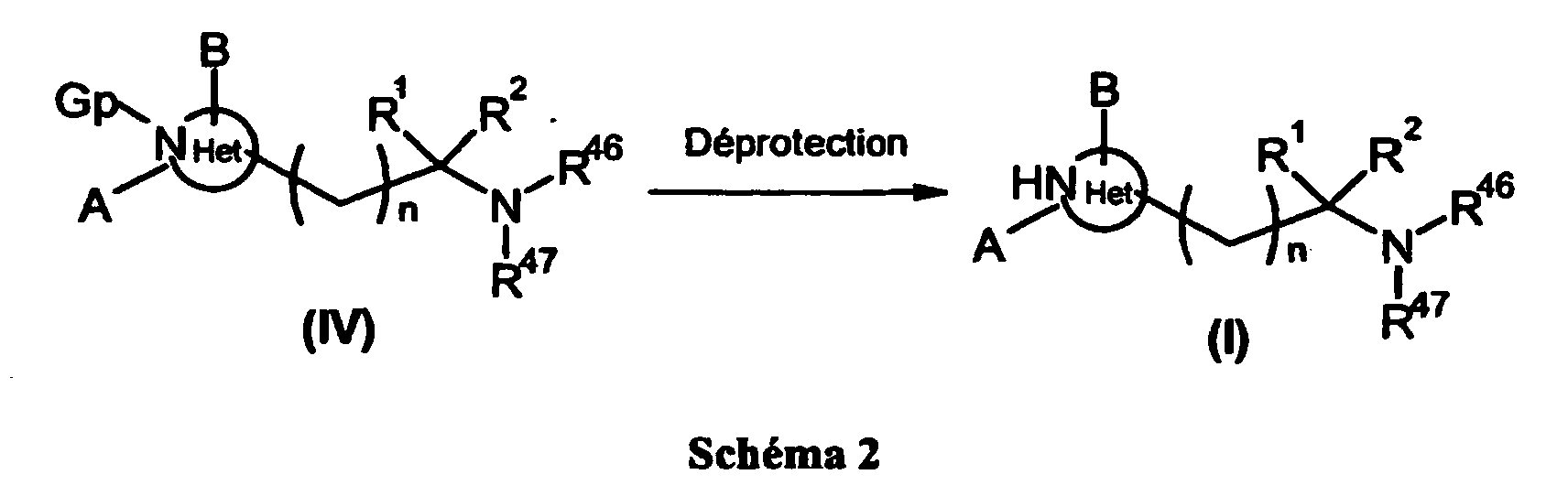


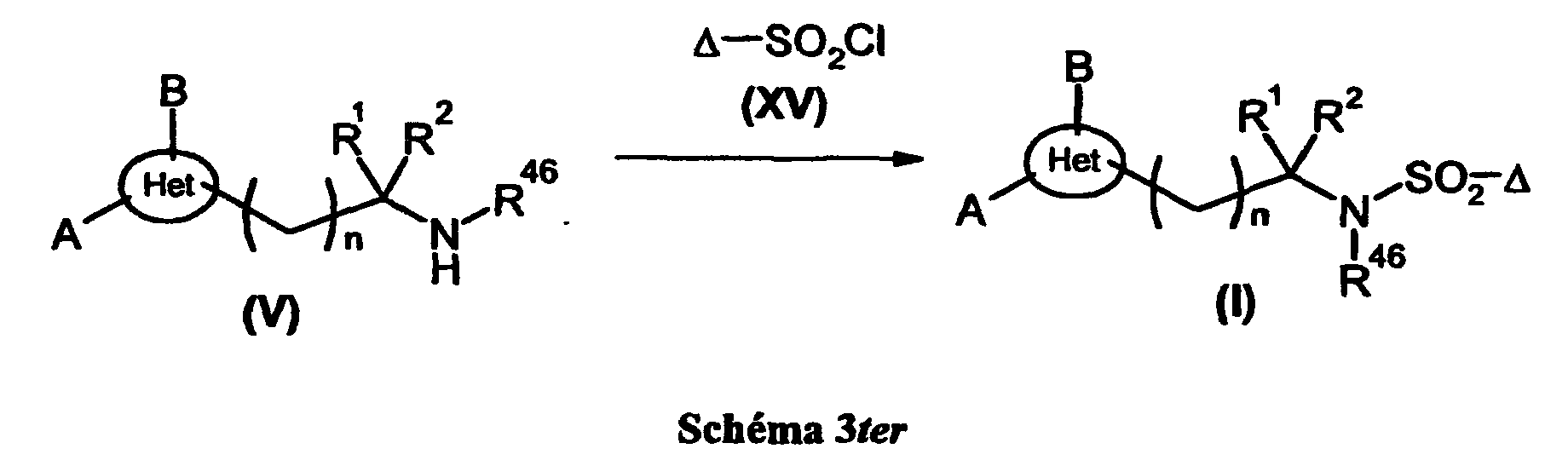
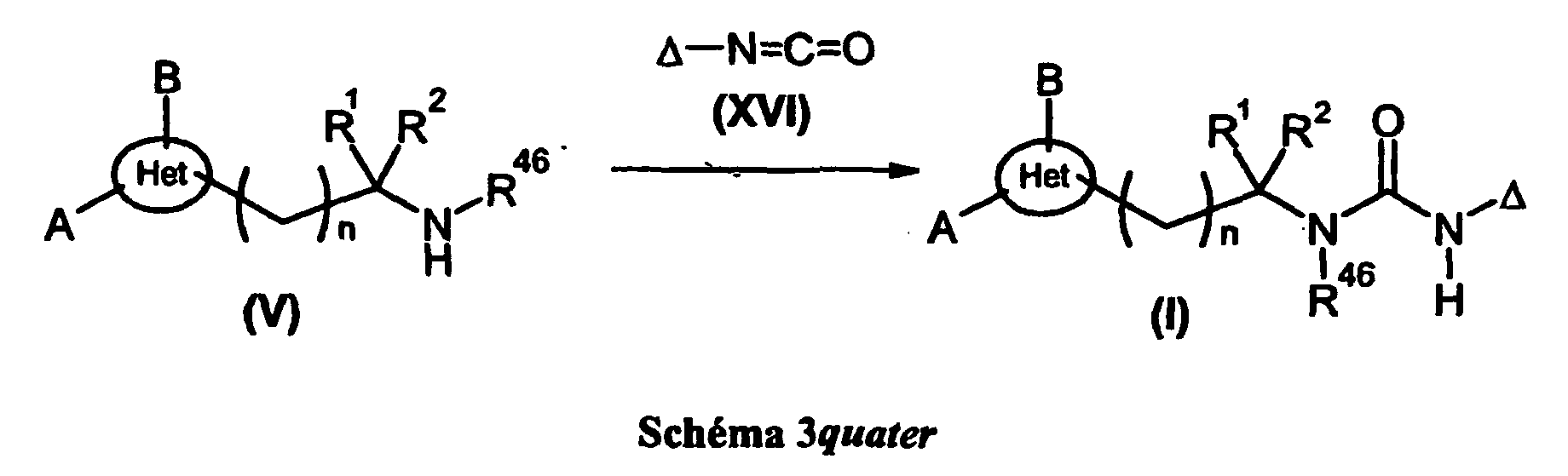
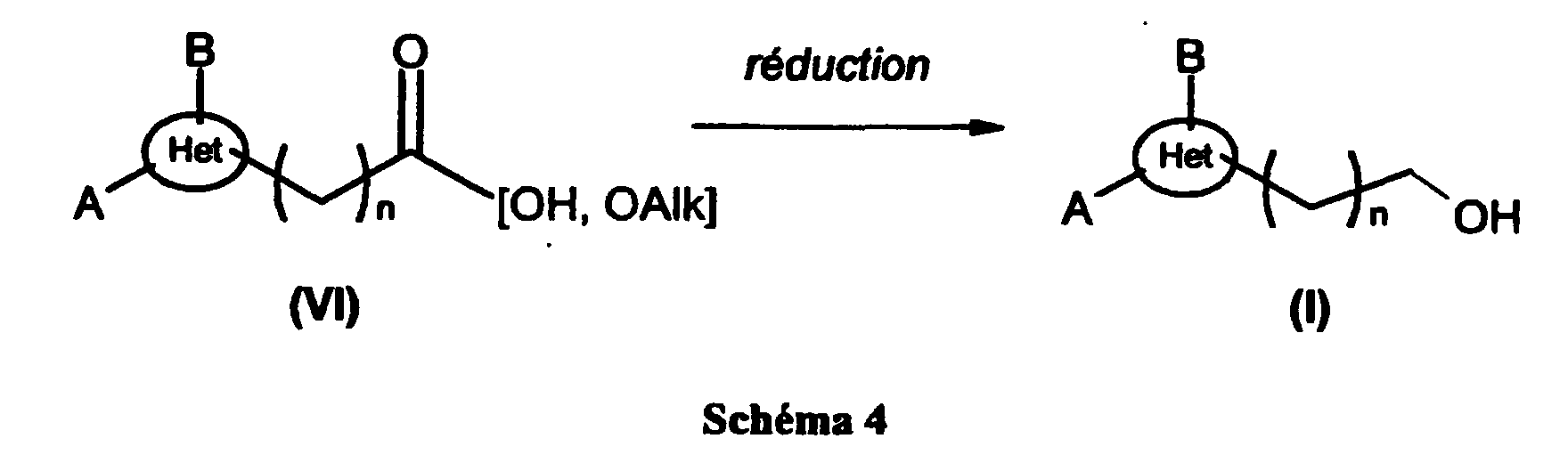


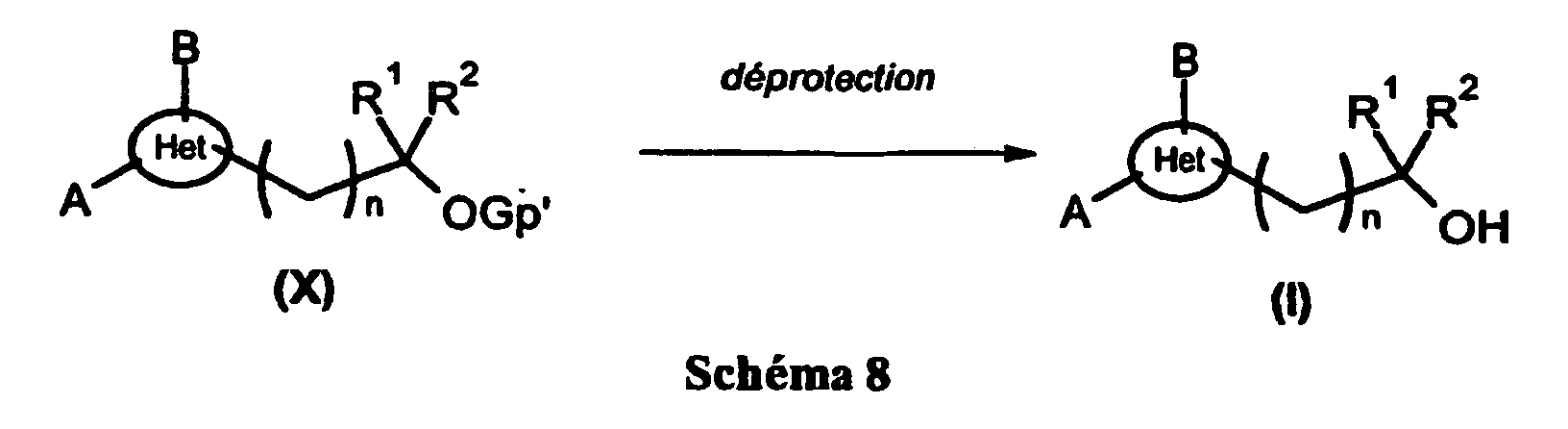
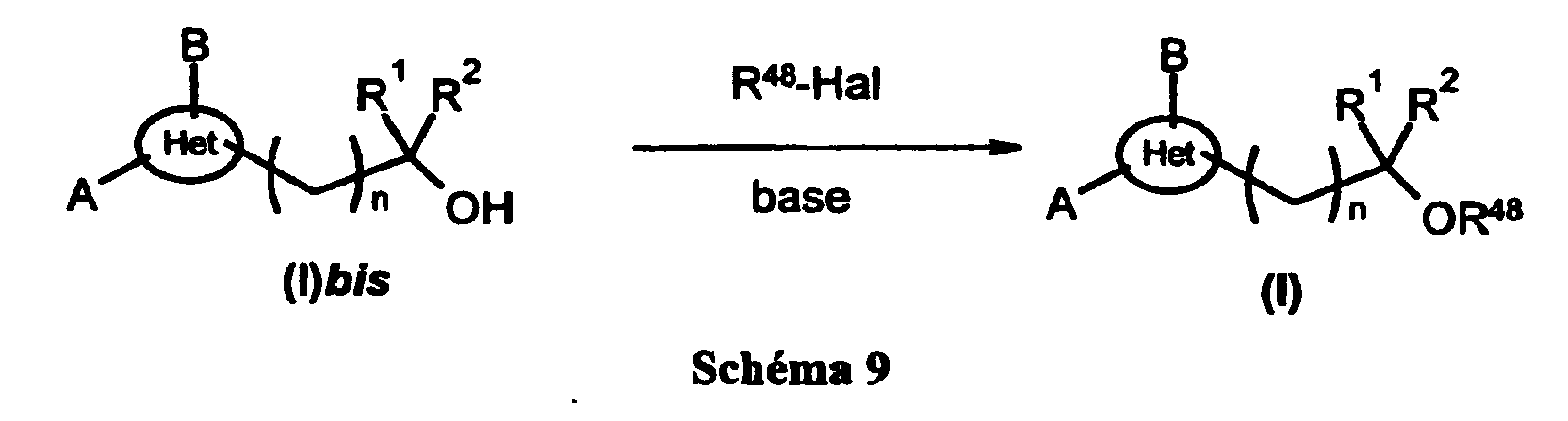


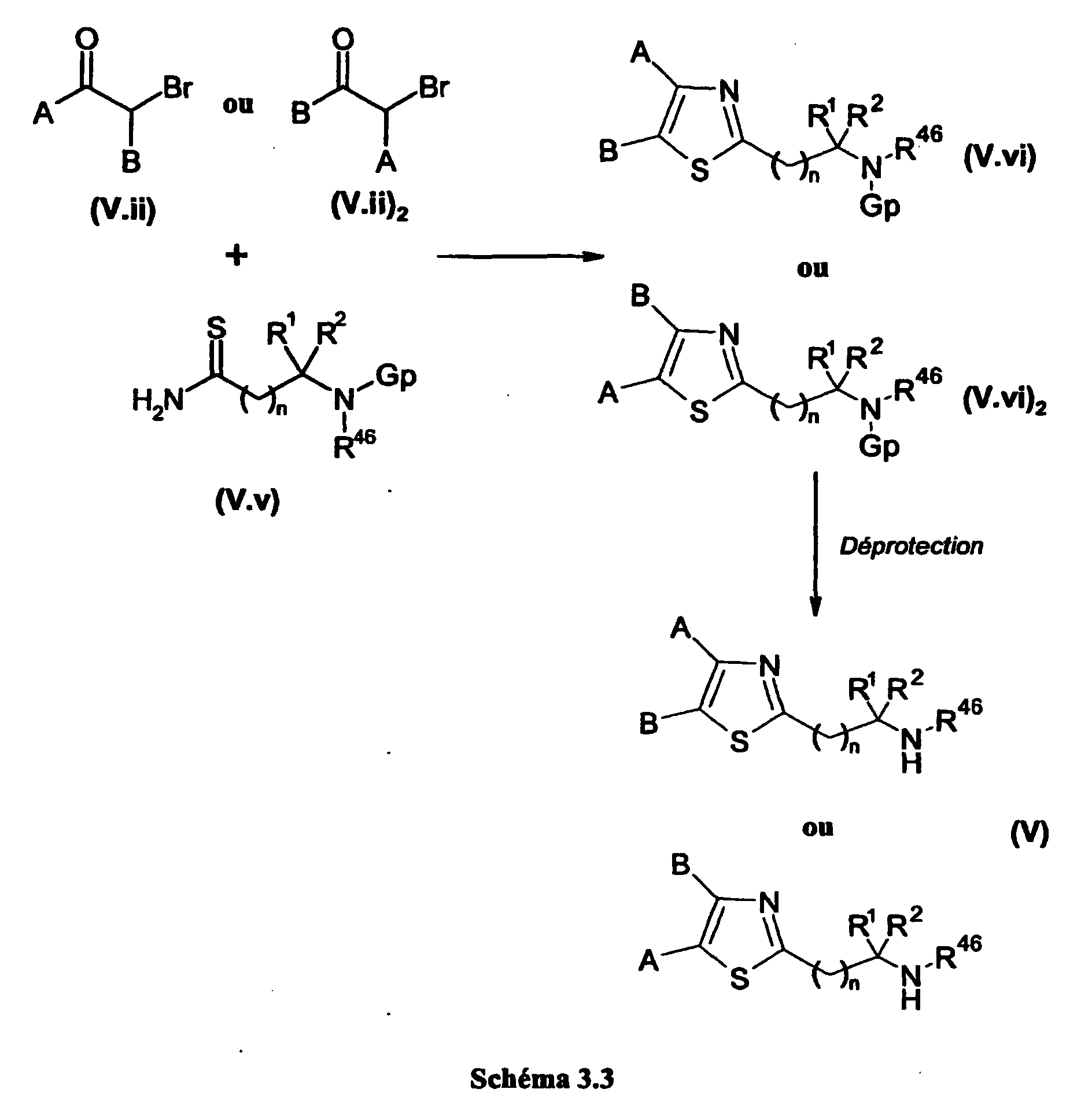
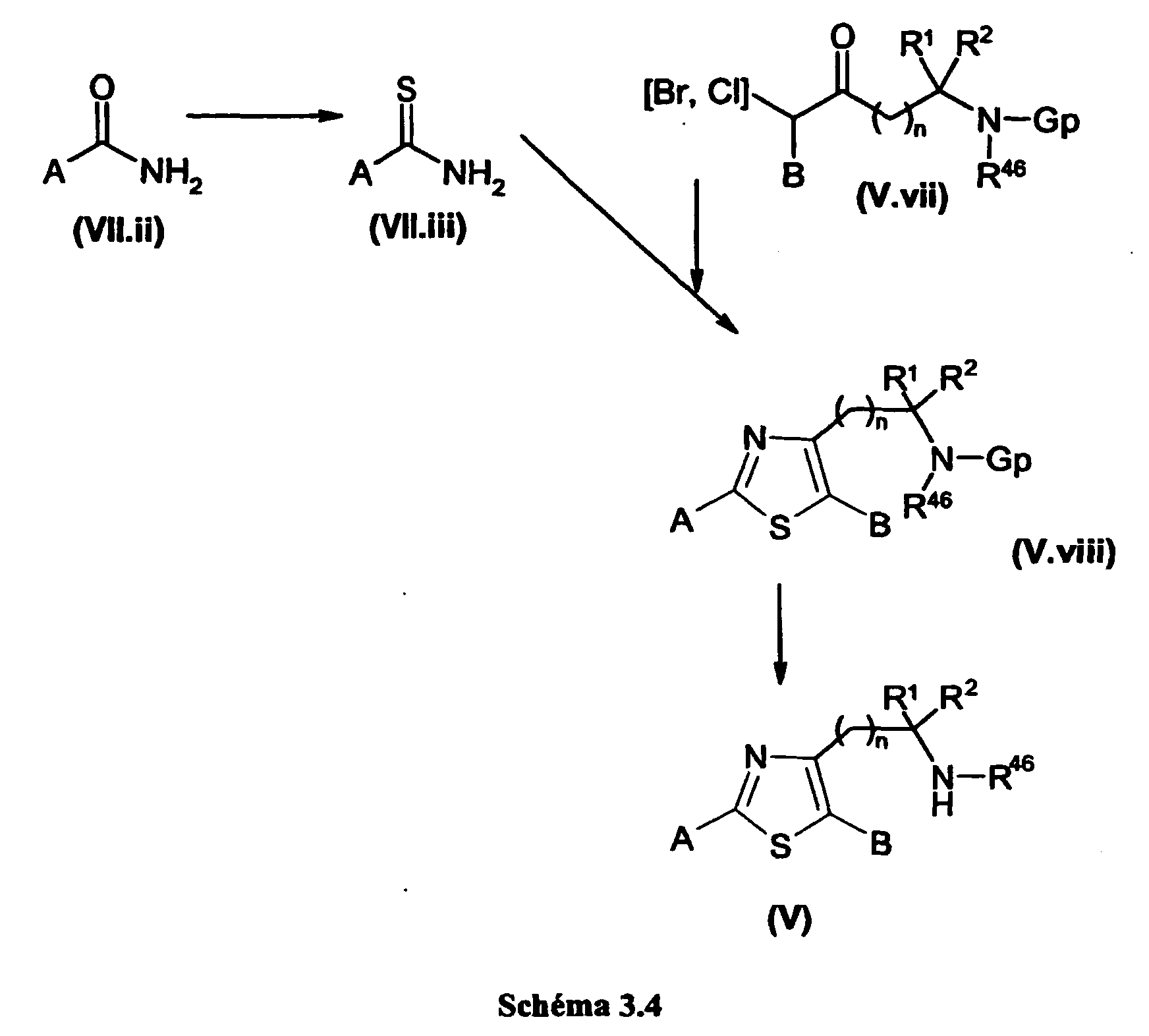
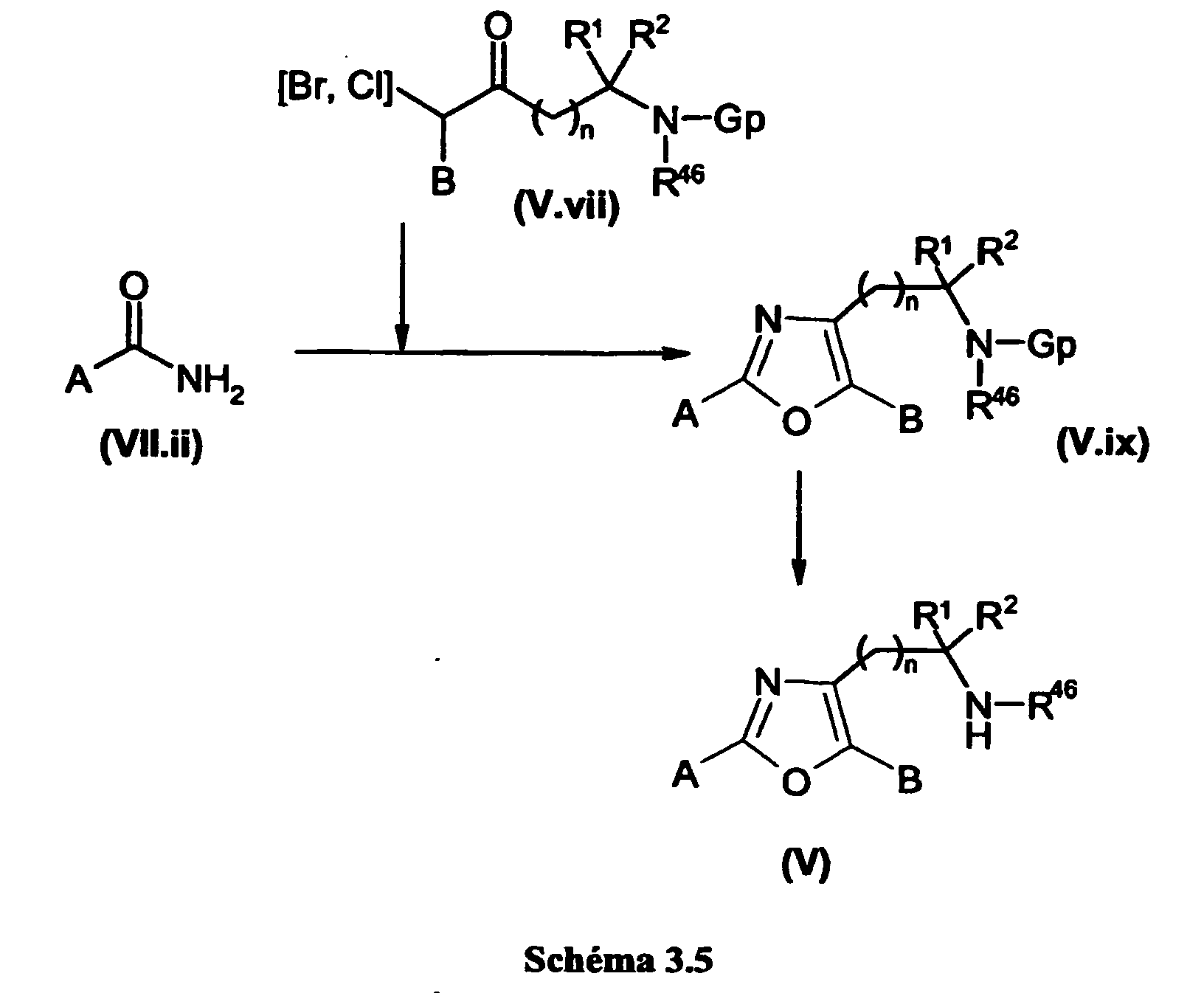
- lorsque A représente un radical indolinyle ou tétrahydroquinolyle, les composés de
formule générale (V.i) sont accessibles à partir de méthodes de la littérature comme,
par exemple, J. Med. Chem. (1986), 29, (6), 1009-1015 ou J. Chem. Soc., Perkin
Trans. 1 (1992), 24, 3401-3406.
Alternativement, les composés de formule générale (V.ii) dans lesquels A représente
un radical indolinyle ou tétrahydroquinolyle dans lequel R33 représente H peuvent
être synthétisés selon un protocole légèrement modifié par rapport à celui décrit
dans J. Chem. Soc., Perkin Trans 1 (1992), 24, 3401-3406. Ce protocole est résumé
dans le schéma 3.6 ci-après.
 L'indoline ou la tétrahydroquinoléine (T représente -CH2- ou -(CH2)2-) est protégée en utilisant le chlorure de chloroacétyle pour donner le composé de formule générale (XVII) qui est soumis à une réaction de Friedel-Crafts (chlorure de chloroacétyle substitué de formule générale (XVIII), dans laquelle B a la signification indiquée précédemment, dans un solvant comme le disulfure de carbone et en présence de chlorure d'aluminium) pour conduire au composé de formule générale (XIX). Ensuite le composé de formule générale (XIX) est hydrolyse en présence d'acide, par exemple un mélange acide acétique/HCl, pour conduire aux composés de formule générale (V.ii) sous forme d'un mélange des isomères méta et para. Ces isomères peuvent être séparés par cristallisation fractionnée dans un solvant comme l'acide acétique glacial.L'homme du métier saura adapter les synthèses décrites précédemment aux cas où A représente un radical indolinyle ou tétrahydroquinolyle dans lequel R33 ne représente pas H. Par exemple, lorsque R33 représentera un radical alkyle ou aralkyle, les étapes de protection et de déprotection seront inutiles.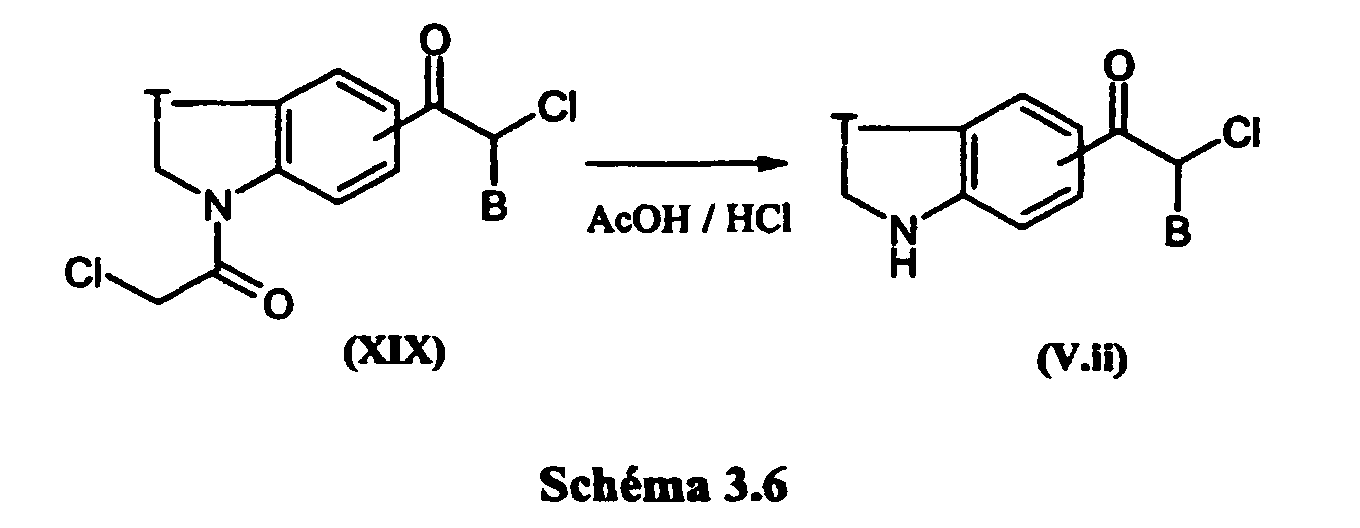
- lorsque A représente un radical du type 4-(4-hydroxyphényl)-phényle, les composés
de formule générale (V.i) sont accessibles à partir de méthodes de la littérature
comme par exemple J. Org. Chem., (1994), 59(16), 4482-4489.
Alternativement, les composés de formule générale (V.i) et (V.ii) dans lesquels A
représente un radical du type 4-(4-hydroxyphényl)-phényle sont accessibles par
exemple par la méthode illustrée dans le schéma 3.7 ci après.
Les composés de formule générale (V.i) ou (V.ii), dans lesquels S1, S2, S3 et S4 sont choisis indépendamment parmi un atome d'hydrogène et OH, cyano, nitro, alkyle, alkoxy ou -NR10R11 tel que défini dans la formule générale (I), sont préparés, schéma 3.7, à partir des esters de formule générale (XX) (cf. notamment Chem. Lett. (1998), 9, 931-932 et Synthesis (1993), 8, 788-790). Bien entendu, les fonctions phénol ou aniline résultant de la nature des substituants R19, R20, R21, S1, S2, S3 et S4 peuvent conduire l'homme du métier à ajouter aux étapes représentées dans le schéma 3.7 des étapes de protection (et, ultérieurement dans la synthèse des composés de formule générale (I), de déprotection) de ces fonctions afin qu'elles n'interfèrent pas avec le reste de la synthèse chimique. Les esters de formule générale (XX) sont hydrolysés pour donner les acides de formule générale (XXI). Ces derniers sont ensuite soumis à un couplage avec la N,O-diméthylhydroxylamine (Syn. Commun. (1995), 25(8), 1255; Tetrahedron Lett. (1999), 40(3), 411-414) dans un solvant comme le diméthylformamide ou le dichlorométhane, en présence d'une base telle que la triéthylamine avec du dicyclohexylcarbodiimide ou du chlorhydrate de 1-(3-diméthylaminopropyl)-3-éthylcarbodiimide et de l'hydroxybenzotriazole, pour conduire aux intermédiaires de formule générale (XXII). Les composés de formule générale (V.i) sont préparés à partir des composés de formule générale (XXII) par une réaction de substitution avec MeLi (J. Med. Chem. (1992), 35(13), 2392). Les bromoacétophénones de formule générale (V.ii) sont maintenant accessibles à partir de l'acétophénone de formule générale (V.i) dans des conditions précédemment décrites.

- lorsque A représente un radical carbazolyle, les composés de formule générale (V.i)
sont accessibles à partir de méthodes de la littérature comme par exemple J. Org.
Chem., (1951), 16, 1198 ou Tetrahedron (1980), 36, 3017.
Alternativement, les composés de formule générale (V.ii) dans lesquels A représente
un radical carbazolyle dans lequel R9 représente H peuvent être synthétisés selon un
protocole légèrement modifié par rapport à celui décrit pour A = carbazolyle dans
Tetrahedron (1980), 36, 3017. Cette méthode est résumée dans le schéma 3.8
ci-après :
Le carbazole de formule générale (XXIII) est protégé en utilisant l'anhydride acétique pour donner le composé de formule générale (XXIV), lequel est soumis à une réaction de Friedel-Crafts (chlorure de chloroacétyle substitué de formule générale (XVIII) tel que défini précédemment dans un solvant comme le disulfure de carbone et en présence de chlorure d'aluminium) pour conduire au composé de formule générale (XXV). Ensuite le groupe acyle protégeant la fonction amine est hydrolysé en présence d'acide, par exemple un mélange AcOH/HCl, pour conduire au composé de formule générale (V.ii). Lorsque A représente un radical carbazolyle dans lequel R9 représente alkyle ou un groupe -COR15 (cas non représenté dans le schéma 3.8), l'étape d'acylation initiale est inutile et les deux dernières étapes du schéma 3.8 permettent d'obtenir les composés de formule générale (V.ii). Bien entendu, les fonctions phénol ou aniline résultant de la nature des substituants R4, R5, R6, R7 et R8 peuvent conduire l'homme du métier à ajouter aux étapes représentées dans le schéma 3.8 des étapes de protection (et, ultérieurement dans la synthèse des composés de formule générale (I), de déprotection) de ces fonctions afin qu'elles n'interfèrent pas avec le reste de la synthèse chimique.

- lorsque A représente un radical phénothiazinyle, les intermédiaires de formule
générale (V.i) et (V.ii) sont accessibles à partir de méthodes de la littérature :
J. Heterocyclic. Chem. (1978), 15, 175-176 et Arzneimittel Forschung (1962), 12,
48.
Alternativement, les intermédiaires de formule générale (V.ii) dans lesquels A
représente un radical phénothiazinyle peuvent être préparés selon un protocole
légèrement modifié par rapport à celui décrit pour le radical phénothiazinyle dans
Arzneimittel Forschung (1962), 12, 48, lequel est résumé dans le schéma 3.9 ci-après
(voir aussi les exemples). La phénothiazine de formule générale (XXVI) est
protégée en utilisant le chlorure de chloroacétyle pour donner le composé de
formule générale (XXVII), lequel est ensuite soumis à une réaction de Friedel-Crafts
(composé de formule générale (XVIII) dans un solvant comme le disulfure
de carbone en présence de chlorure d'aluminium) pour conduire au composé de
formule générale (XXVIII). Lors de la dernière étape du procédé, l'hydrolyse avec
HCl/acide acétique est accompagnée d'un échange d'halogène et permet d'obtenir la
chlorocétone de formule générale (V.ii). Bien entendu, les fonctions phénol ou
aniline résultant de la nature des substituants R4, R5, R6, R7 et R8 peuvent conduire
l'homme du métier à ajouter aux étapes représentées dans le schéma 3.9 des étapes
de protection (et, ultérieurement dans la synthèse des composés de formule générale
(I), de déprotection) de ces fonctions afin qu'elles n'interfèrent pas avec le reste de
la synthèse chimique.
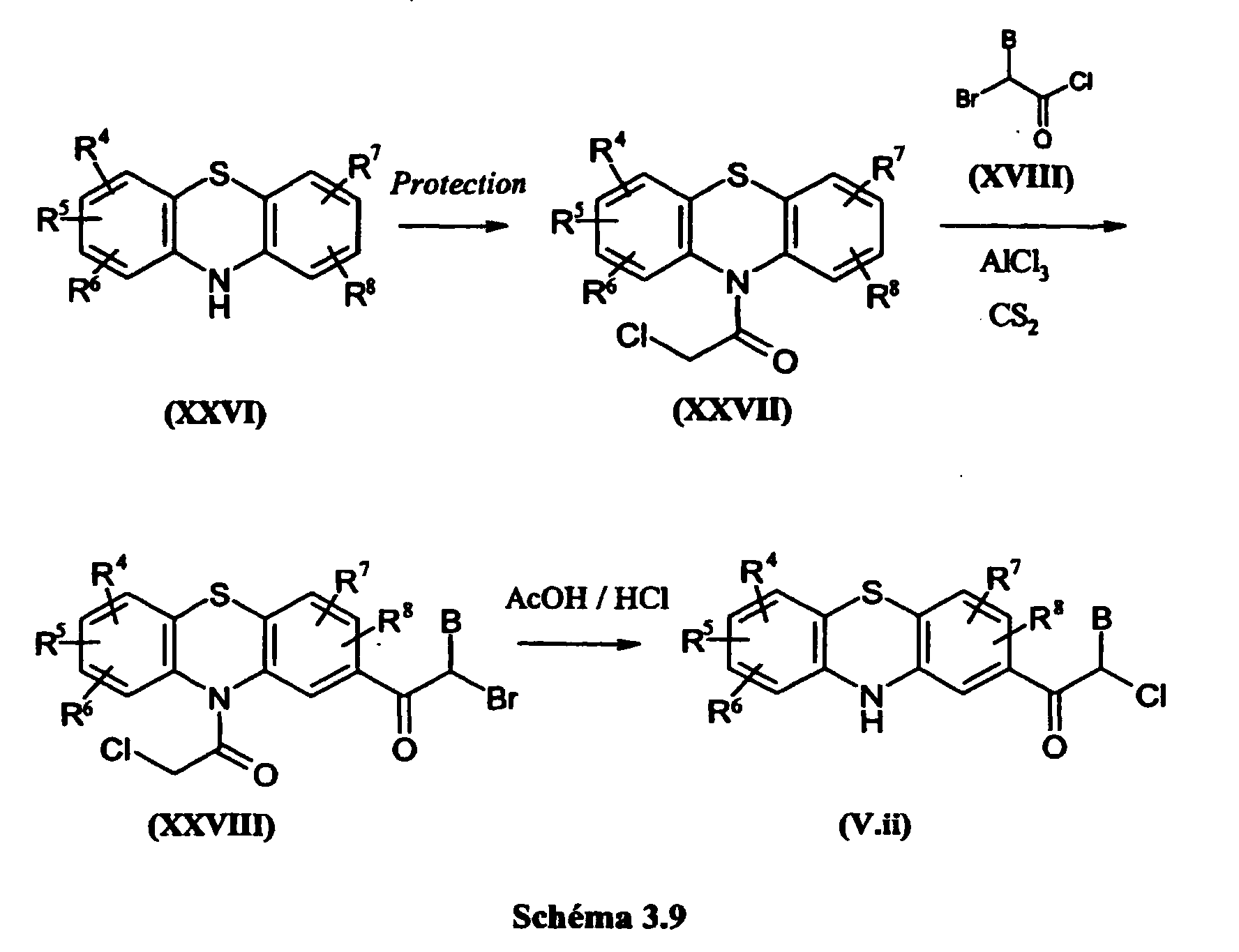
- lorsque A représente un radical phénylaminophényle, les composés de formule
générale (V.i) sont accessibles à partir de méthodes de la littérature comme par
exemple Chem. Commun., (1998), 15, (6) 1509-1510 ou Chem Ber., (1986), 119,
3165-3197, ou de méthodes similaires que l'homme du métier aura adaptées.
Par exemple, les intermédiaires de formule générale (V.i) bis et (V.ii) bis dans
lesquels A représente un radical phénylaminophényle (qui correspondent aux
composés de formule générale (V.i) et (V.ii) correspondants dont la fonction aniline
a été acétylée), peuvent être préparés selon un protocole légèrement modifié par
rapport à celui décrit pour le radical phénylaminophényle dans Chem Ber. (1986),
119, 3165-3197. Ce protocole est résumé dans le schéma 3.10 ci-après.
Dans le cas (représenté sur le schéma 3.10) où le radical R9 du composé de formule générale (I) à synthétiser est un atome d'hydrogène ou un groupe acétyle, la diphénylamine de formule générale (XXIX) formée après la réaction de couplage en présence de CuI est protégée par acétylation en utilisant, par exemple, l'anhydride acétique pour donner le composé de formule générale (V.i) bis . Dans le cas (non représenté sur le schéma 3.10) où le radical R9 du composé de formule générale (I) à synthétiser n'est pas un atome d'hydrogène ou un radical acétyle, l'étape d'acétylation est remplacée par une étape de substitution sur l'aniline selon des méthodes classiques connues de l'homme du métier pour donner le composé de formule générale (V.i) correspondant. Le composé de formule générale (V.i) bis (ou (V.i), dans le cas non représenté dans le schéma 3.10) est ensuite soumis à une réaction de bromation à l'aide d'une résine de bromation, la résine PVPHP (Poly(VinylPyridinium Hydrobromide Perbromide) ou poly(perbromure d'hydrobromure de vinylpyridinium)), décrite dans J. Macromol. Sci. Chem. (1977), A11, (3), 507-514, pour conduire au composé de formule générale (V.ii) bis (ou (V.ii), dans le cas non représenté dans le schéma 3.10). Bien entendu, les fonctions phénol ou aniline résultant de la nature des substituants R4, R5, R6, R7 et R8 peuvent conduire l'homme du métier à ajouter aux étapes représentées dans le schéma 3.10 des étapes de protection (et, ultérieurement dans la synthèse des composés de formule générale (I), de déprotection) de ces fonctions afin qu'elles n'interfèrent pas avec le reste de la synthèse chimique. La déprotection de la fonction aniline acétylée sera effectuée en principe lors de la dernière étape de la synthèse des composés de formule générale (I).

- lorsque A représente un radical benzopyrane ou benzofuranne tel que défini dans la
formule générale (I) avec R32 représentant un atome d'hydrogène, les intermédiaires
de formule générale (V.i) et (V.ii) sont accessibles par les méthodes illustrées dans
le schéma 3.11 ci après.
Les composés de formules générales (V.i) et (V.ii), schéma 3.11, dans laquelle T est tel que défini ci-dessus et Gp = groupe protecteur, sont préparés à partir des acides de formule générale (XXX). Les acides de formule générale (XXX) sont soumis à un couplage avec la N,O-diméthylhydroxylamine (Syn. Commun. (1995), 25, (8), 1255 ; Tetrahedron Lett. (1999), 40, (3), 411-414) dans un solvant comme le diméthylformamide ou le dichlorométhane, en présence d'une base telle que la triéthylamine avec du dicyclohexylcarbodiimide ou du chlorhydrate de 1-(3-diméthylaminopropyl)3-éthylcarbodiimide et de l'hydroxybenzotriazole, pour conduire aux intermédiaires de formule générale (XXXI). La protection de la fonction phénol sous forme de dérivé benzylé ou tert-butyldiméthylsilylé ou par d'autres groupes protecteurs (Gp) connus de l'homme du métier est alors effectuée pour conduire aux composés de formule générale (XXXII). Les composés de formule générale (V.i) sont préparés à partir des composés de formule générale (XXXII) par une réaction de substitution avec un réactif de Grignard, MeMgCl (J. Het. Chem. (1990), 27, 1709-1712) ou avec MeLi (J. Med. Chem. (1992), 35, 13). Les bromoacétophénones de formule générale (V.ii) sont maintenant accessibles à partir de l'acétophénone de formule générale (V.i) dans des conditions précédemment décrites.Alternativement, le composé de formule générale (V.ii) dans lequel R32 représente un atome d'hydrogène ou un radical alkyle peut être préparé selon un procédé en 3 étapes seulement (cf. schéma 3.12 - voir aussi les exemples). Dans ce procédé, la bromation dans la dernière étape du composé de formule générale (V.i) pour donner le composé de formule générale (V.ii) sera de préférence effectuée selon J. Am. Chem. Soc. (1999), 121, 24.
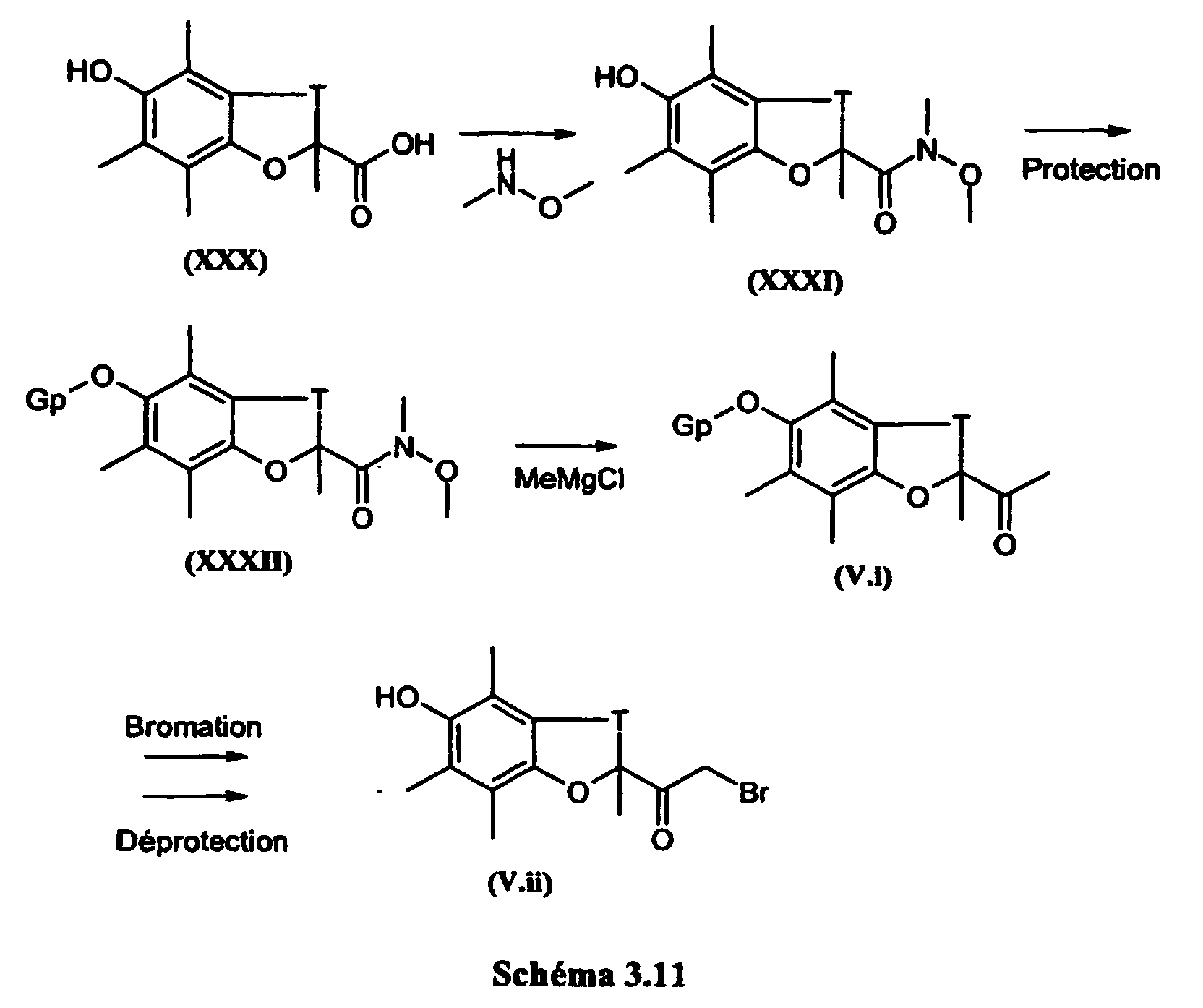 Lorsque A représente un radical phénol substitué, il peut être nécessaire de d'utiliser des intermédiaires de formule générale (V.ii) telle que définie précédemment dont la fonction phénol a été acétylée (ci-après désignés comme composés de formule générale (V.ii) ter ). En particulier :
- lorsque A représente un radical 4-hydroxy-3,5-diisopropylphényle, les dérivés
α-bromocétoniques homologues du composé de formule (V.ii) dont la fonction
phénol est protégée par un radical acétyle peuvent être préparés comme résumé dans
le schéma 3.13 ci-après.
Le 2,6-diisopropylphénol est acétylé selon des méthodes connues de l'homme du métier, par exemple en le faisant réagir avec de l'acide acétique en présence d'anhydride d'acide trifluoroacétique ou avec du chlorure d'acétyle en présence d'une base comme par exemple K2CO3. L'homologue acétylé du 2,6-diisopropylphénol est alors soumis à un réarrangement de Fries en présence de chlorure d'aluminium dans un solvant comme le nitrobenzène pour conduire au composé de formule (V.i). Ensuite le composé de formule (V.i) est acétylé pour conduire au composé de formule (V.i) ter . Une bromation est alors effectuée avec CuBr2 comme précédemment décrit pour conduire au composé de formule (V.ii) ter . L'étape de déprotection pour libérer la fonction phénol interviendra ultérieurement dans la synthèse des composés de formule générale (I) (au moment jugé le plus adapté par l'homme du métier).
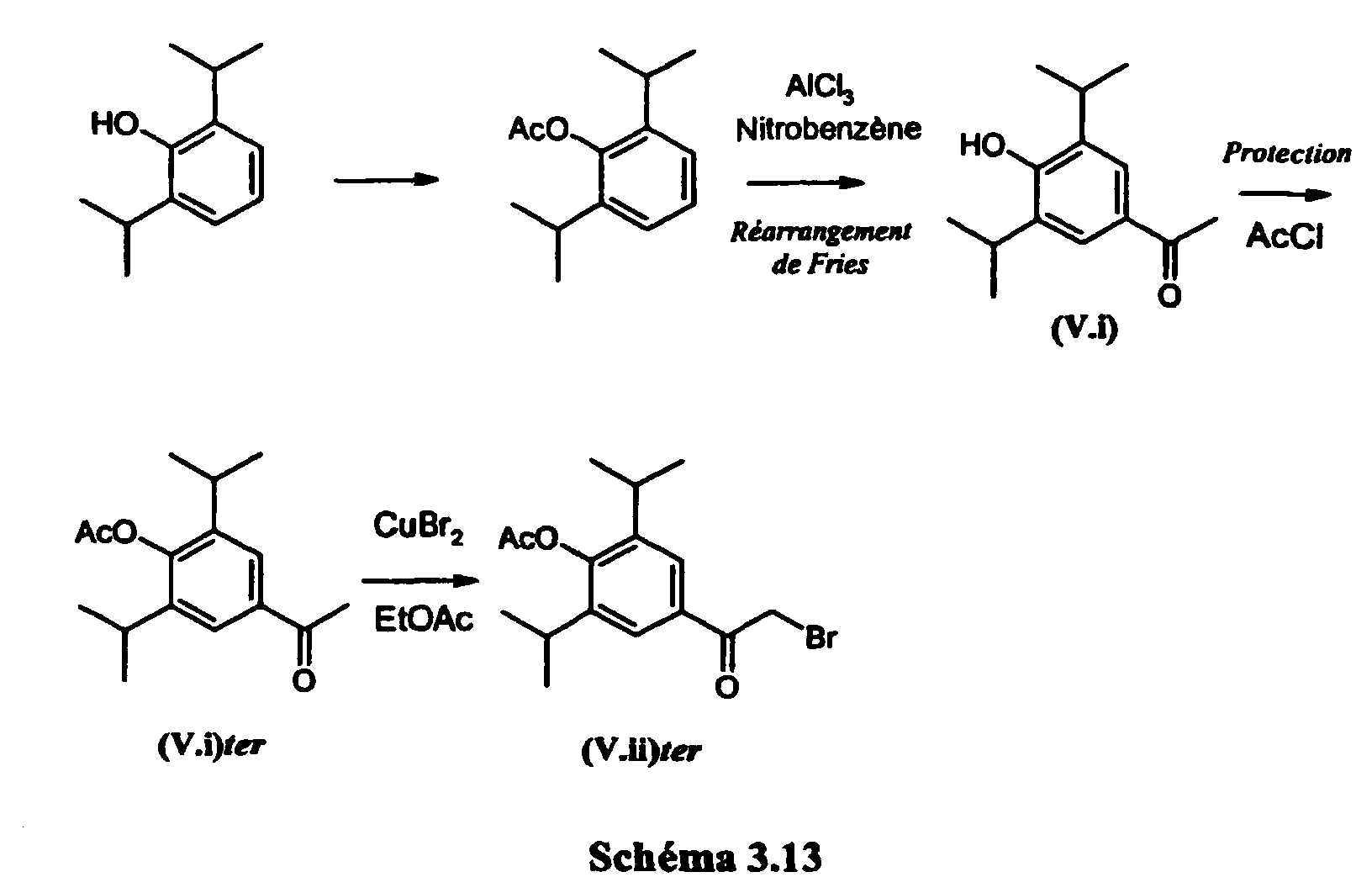
- lorsque A représente un radical de type diméthoxyphénol, les composés de formule
générale (V.ii) ter peuvent être préparés de façon analogue à la synthèse décrite pour
le composé de formule (V.ii) ter dérivé du 2,6-diisopropylphénol, avec
éventuellement quelques modifications mineures à la portée de l'homme du métier.
Par exemple, lorsque A représente le radical 3,5-diméthoxy-4-hydroxyphényle, le
dérivé α-bromocétonique de formule (V.ii) ter correspondant peut être préparé, par
exemple, comme indiqué dans le schéma 3.13 à partir du composé commercial de
formule (XXXV) :
Les composés de formule générale (V.ii) 2 dans laquelle A et B sont tels que définis précédemment peuvent être préparés selon la méthode résumée dans le schéma 3.15 ci-après.
 Les acides de formule générale (XXXVI) sont soumis à un couplage avec la N,O-diméthylhydroxylamine (Syn. Commun. (1995), 25, (8), 1255 ; Tetrahedron Lett. (1999), 40, (3), 411-414) dans un solvant comme le diméthylformamide ou le dichlorométhane, en présence d'une base telle que la triéthylamine avec du dicyclohexylcarbodiimide ou du chlorhydrate de 1-(3-diméthylaminopropyl)-3-éthylcarbodiimide et de l'hydroxybenzotriazole, pour conduire aux intermédiaires de formule générale (XXXVII). Les composés de formule générale (V.i) 2 sont préparés à partir des composés de formule générale (XXXVII) par une réaction de substitution avec des dérivés lithiens ou magnésiens de formule générale B-M dans laquelle M représente Li ou MgHal (Hal = I, Br ou Cl) dans des solvants comme l'éther ou le tétrahydrofuranne anhydre. Les α-bromo- ou α-chlorocétones de formule générale (V.ii) 2 sont maintenant accessibles à partir des cétones de formule générale (V.i) 2 dans des conditions précédemment décrites.Par ailleurs, les dérivés α-halogénocétoniques de formule générale (V.vii) non commerciaux sont accessibles à partir de méthodes de la littérature. En particulier, ils peuvent être obtenus selon une procédure résumée dans le schéma 3.16.
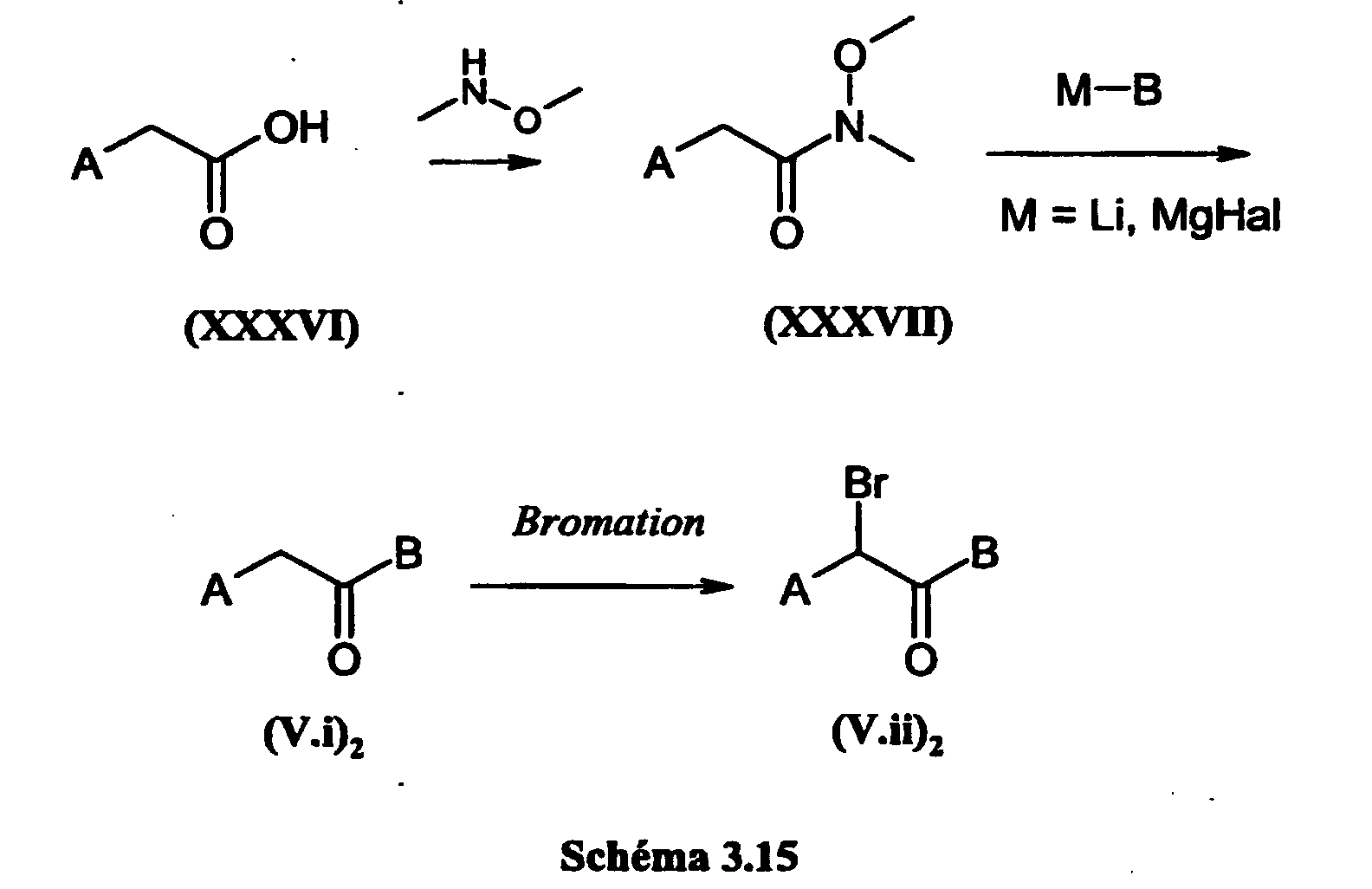 Les aminoacides protégés de formule générale (XXXVIII) sont obtenus par la protection des aminoacides correspondants par un groupe de type carbamate selon des méthodes connues de l'homme du métier. Les acides de formule générale (XXXVIII) sont ensuite soumis à un couplage avec la N,O-diméthylhydroxylamine (Syn. Commun. (1995), 25, (8), 1255 ; Tetrahedron Lett. (1999), 40, (3), 411-414) dans un solvant comme le diméthylformamide ou le dichlorométhane, en présence d'une base telle que la triéthylamine avec du dicyclohexylcarbodiimide ou du chlorhydrate de 1-(3-diméthylaminopropyl)-3-éthylcarbodiimide et de l'hydroxybenzotriazole, pour conduire aux intermédiaires de formule générale (XXXIX). Les composés de formule générale (XLI) sont préparés à partir des composés de formule générale (XXXIX) par une réaction de substitution avec des dérivés lithiens ou magnésiens de formule générale (XL) (dans laquelle Hal = I, Br ou Cl) dans des solvants comme l'éther ou le tétrahydrofuranne anhydre. Les bromo ou chloroacétophénones de formule générale (V.vii) sont maintenant accessibles à partir de l'acétophénone de formule générale (XLI) dans des conditions précédemment décrites. Alternativement, l'homme du métier pourra aussi utiliser ou adapter les synthèses décrites dans Angew. Chem. Int. (1998), 37 (10), 411-414, Liebigs Ann. Chem. (1995), 1217 ou Chem. Pharm. Bull. (1981), 29(11), 3249-3255.


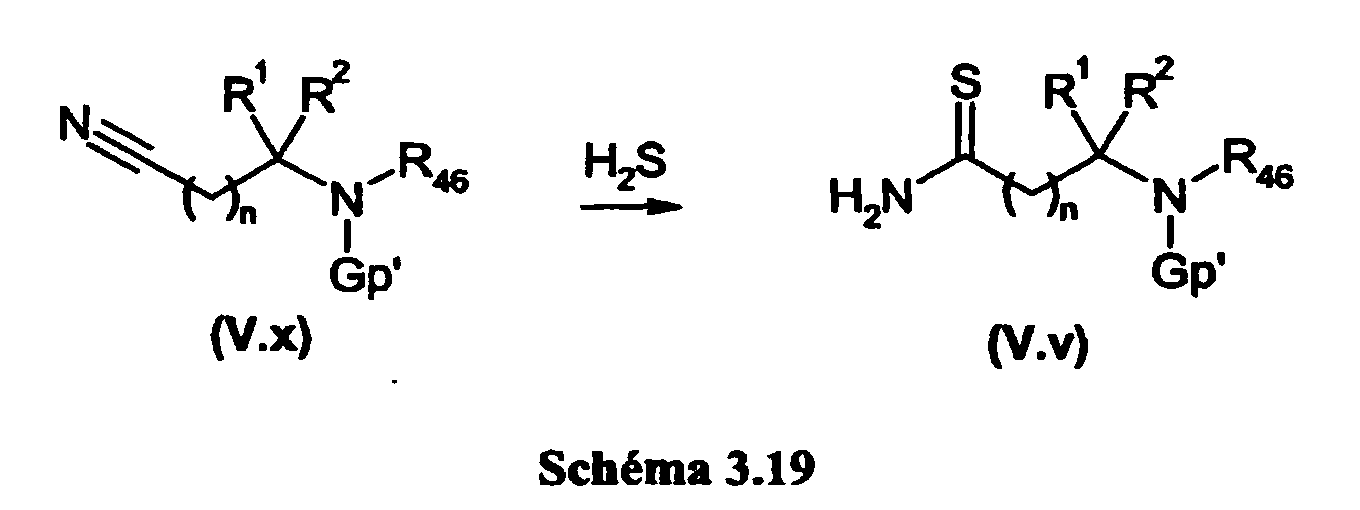


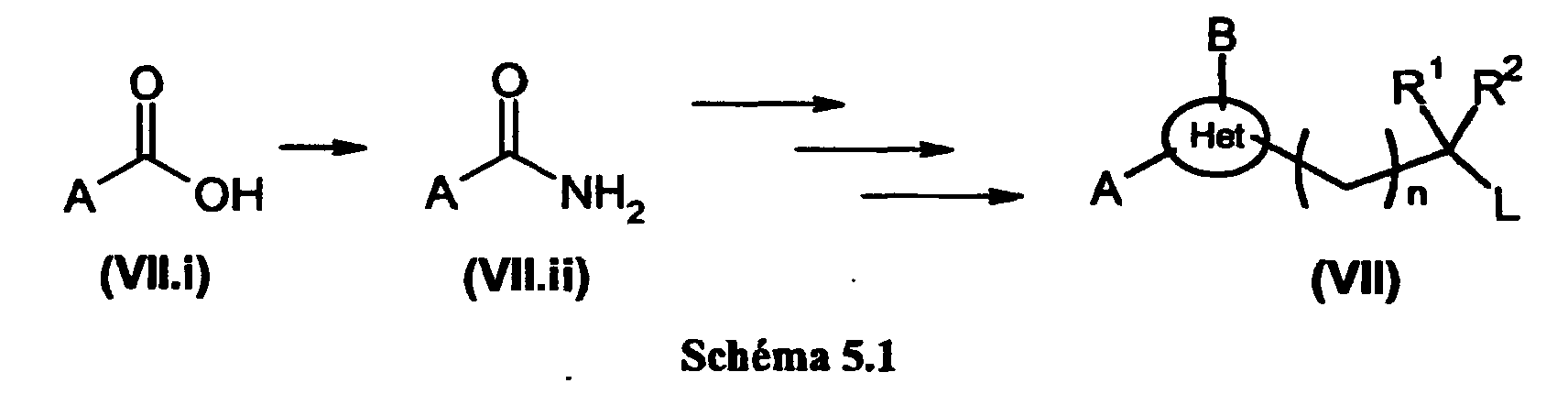
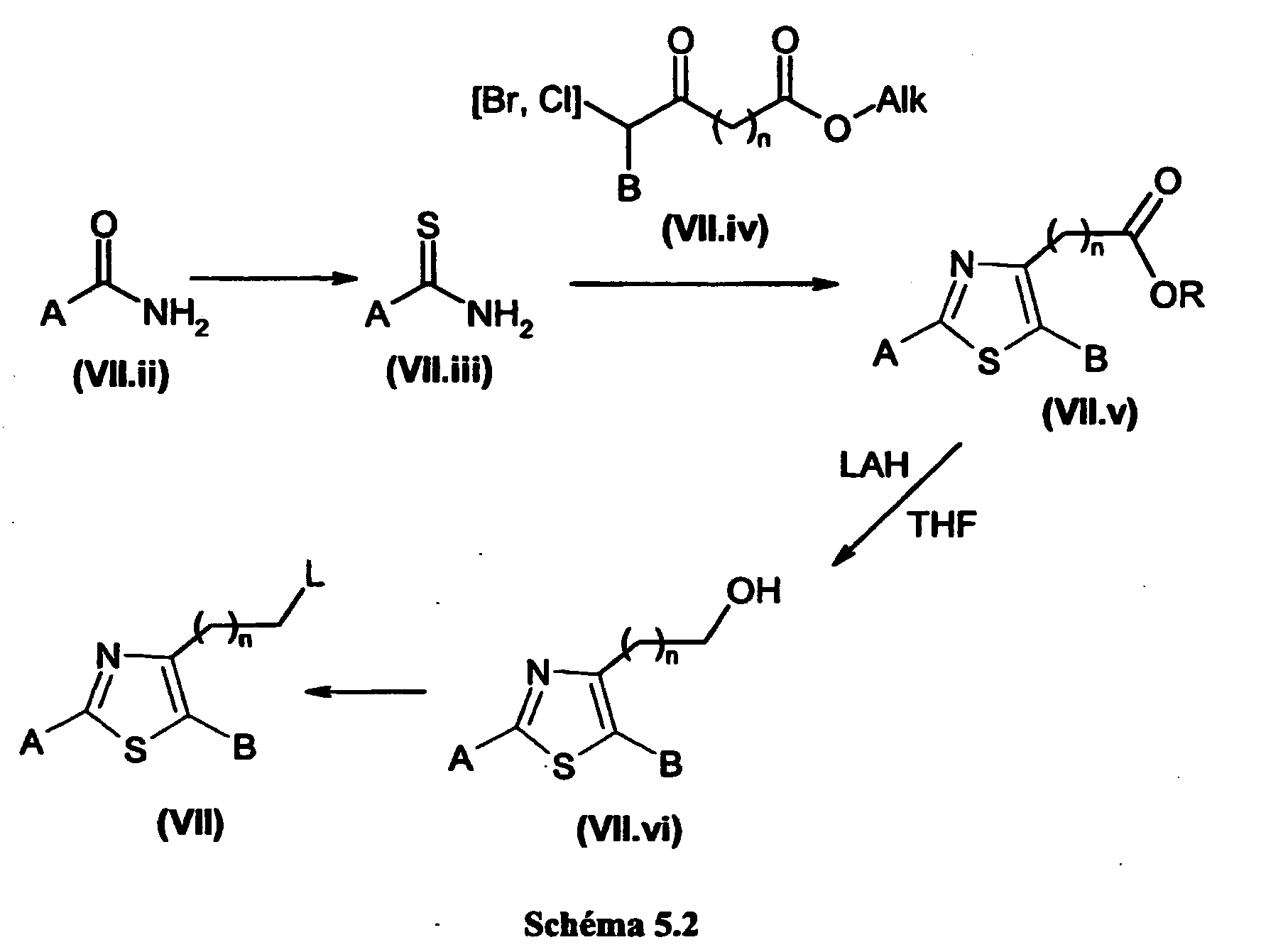

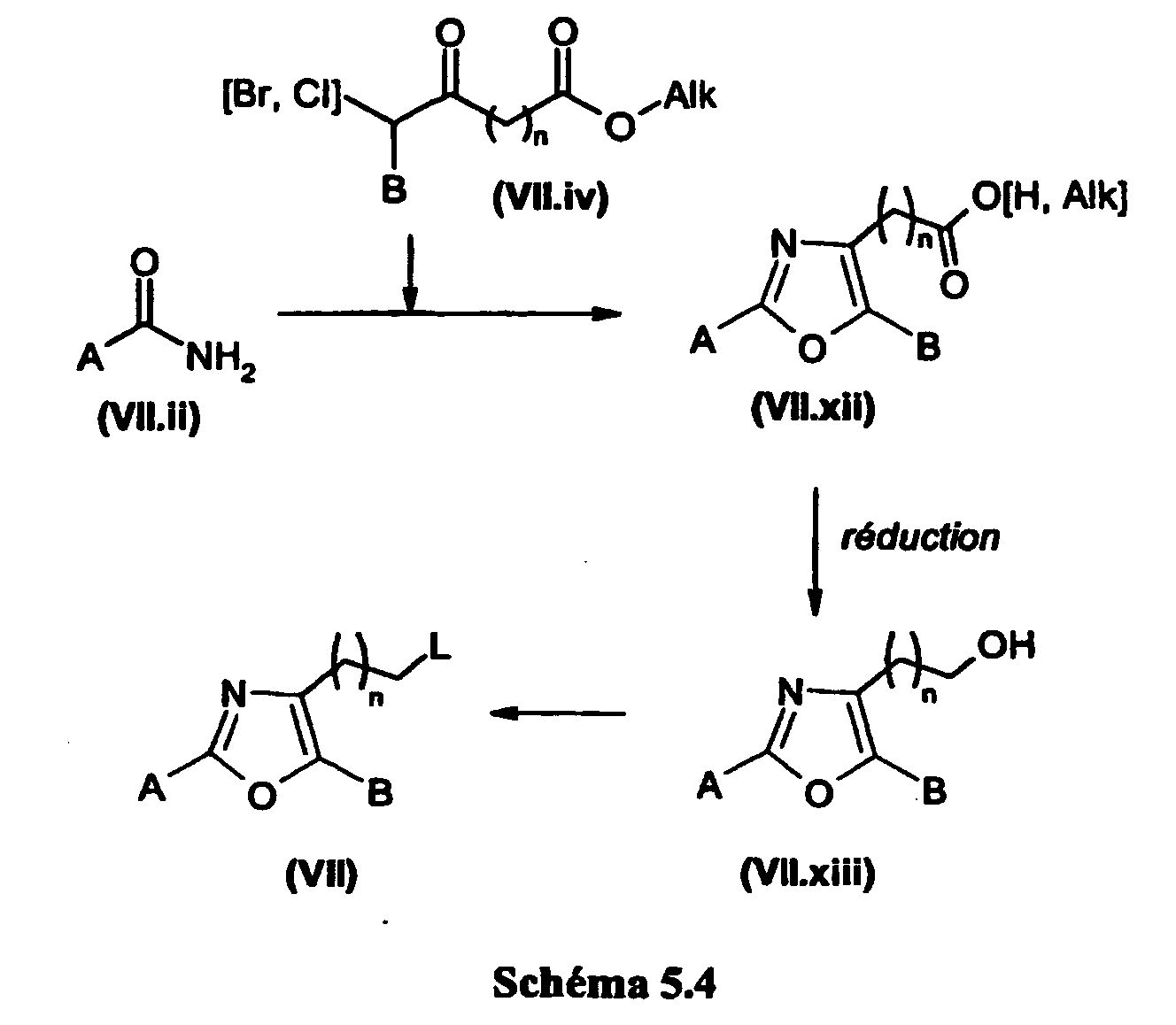
- lorsque A représente un radical phénothiazinyle, les acides de formule générale (VII.i) sont accessibles à partir de méthodes de la littérature comme par exemple J. Med. Chem. (1992), 35, 716-724, J. Med. Chem. (1998), 41, 148 -156 ; Synthesis (1988) 215-217 ; ou J. Chem. Soc. Perkin. Trans. 1 (1998), 351-354 ;
- lorsque A représente un radical indolinyle, les acides de formule générale (VII.i) sont accessibles à partir de méthodes de la littérature comme par exemple J. Het. Chem. (1993), 30, 1133-1136 ou Tetrahedron (1967), 23, 3823 ;
- lorsque A représente un radical phénylaminophényle, les acides de formule générale (VII.i) sont accessibles à partir de méthodes de la littérature comme par exemple J. Amer. Chem Soc. (1940), 62, 3208 ; Zh. Obshch. Khim. (1953), 23, 121-122 ou J. Org. Chem. (1974), 1239-1243 ;
- lorsque A représente un radical carbazolyle, les acides de formule générale (VII.i) sont accessibles à partir de methodes de la littérature comme par exemple J. Amer. Chem Soc., (1941), 63, 1553-1555 ; J. Chem. Soc. (1934), 1142-1144 ; J. Chem. Soc. (1945), 945-956 ; ou Can. J. Chem. Soc. (1982), 945-956 ; et
- lorsque A représente un radical du type 4-(4-hydroxyphényl)-phényle, on se référera par exemple à la publication suivante : Synthesis, (1993) 788-790.
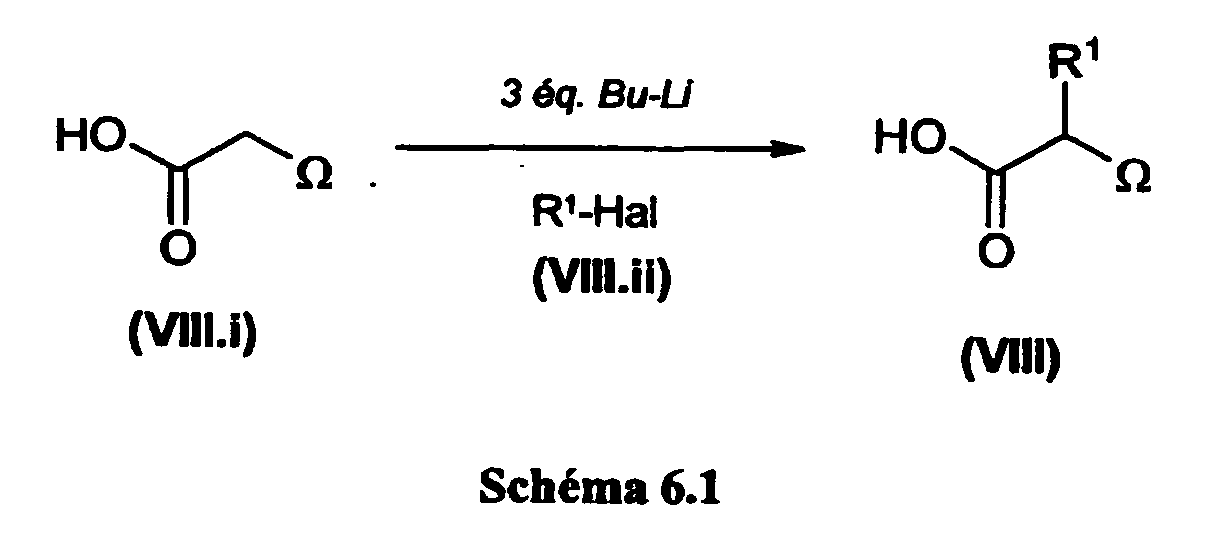
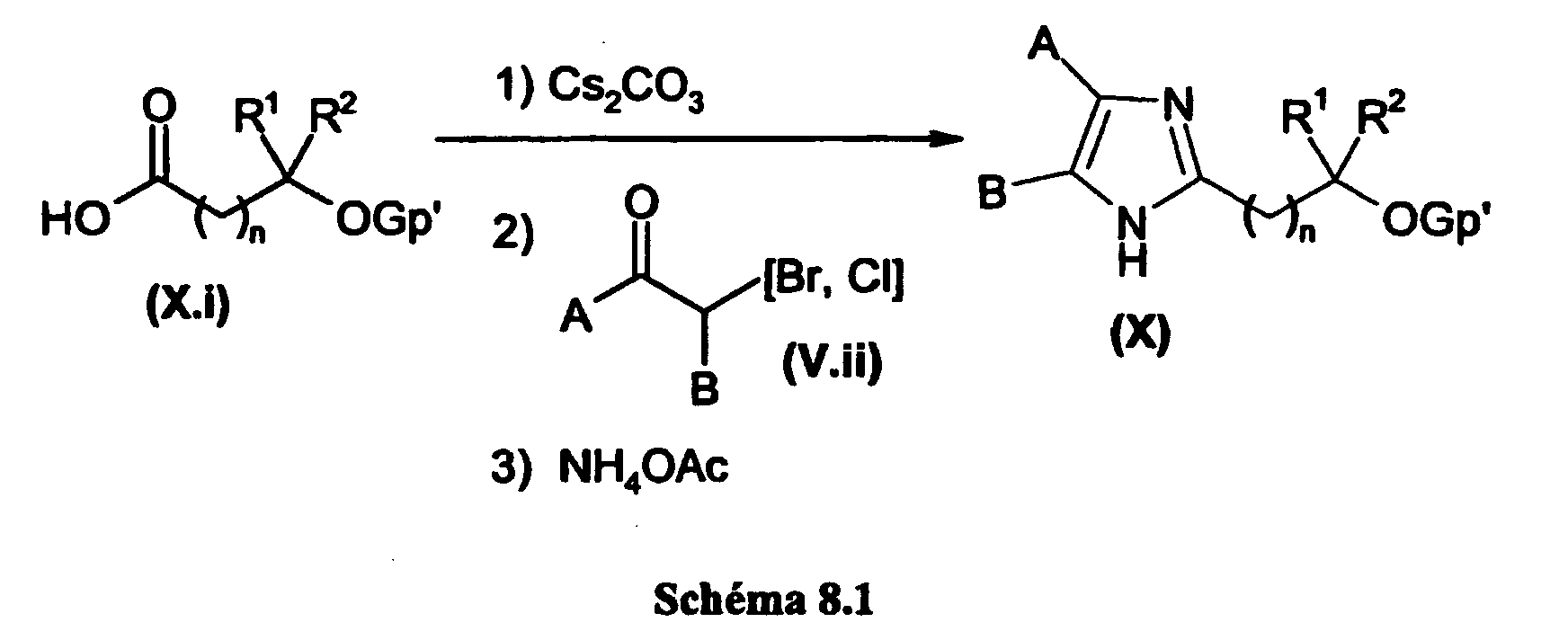
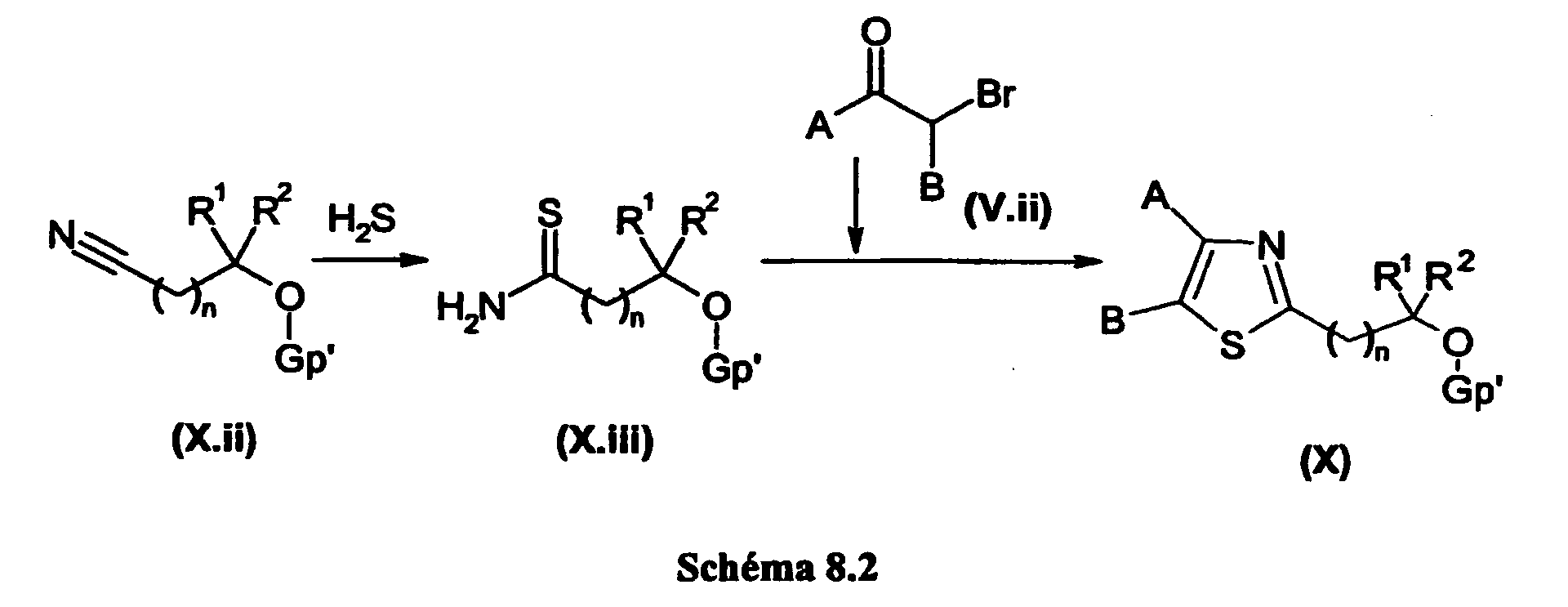
- lorsque A représente un radical phénothiazinyle, les acides de formule générale (XXXVI) sont accessibles à partir de méthodes de la littérature : J. Org. Chem., (1956), 21, 1006 ; Chem. Abstr., 89, 180029 et Arzneimittel Forschung (1969), 19, 1193.
- lorsque A représente un radical diphénylamine, les acides de formule générale (XXXVI) sont accessibles à partir de méthodes de la littérature : Chem Ber., (1986), 119, 3165-3197; J. Heterocyclic. Chem. (1982), 15, 1557-1559 ; Chem. Abstr., (1968), 68, 68730x ; ou par adaptation de ces méthodes par l'homme du métier ;
- lorsque A représente un radical du type 4-(4-hydroxyphényl)-phényle, les acides de formule générale (XXXVI) sont accessibles à partir de méthodes de la littérature comme par exemple Tetrahedron Lett. (1968), 4739 ou J. Chem. Soc. (1961), 2898.
- lorsque A représente un radical carbazolyle, les acides de formule générale (XXXVI) sont accessibles à partir de méthodes de la littérature comme par exemple J. Amer. Chem., (1946), 68, 2104 ou J. Het. Chem (1975), 12, 547-549.
- lorsque A représente un radical de type benzopyrane ou benzofuranne, les acides de formule générale (XXXVI) sont accessibles par des méthodes de la littérature comme par exemple Syn. Commun. (1982), 12(8), 57-66 ; J. Med. Chem. (1995), 38(15), 2880-2886 ; ou Helv. Chim. Acta . (1978), 61, 837-843.
- lorsque A représente un radical indolinyle ou tétrahydroquinolyle, les acides de formule générale (XXXVI) sont accessibles à partir de méthodes de la littérature comme, par exemple, J. Med. Chem. (1997), 40, (7), 1049-1062 ; Bioorg. Med. Chem. Lett. (1997), 1519-1524 ; Chem. Abstr. (1968), 69, 43814k ; ou Chem. Abstr. (1966), 66, 17538c.
MH+ = 371,20.
MH+= 372,30
MH+ = 414,30
MH+ = 428,40.
MH+ = 377,30
MH+ = 423,30
MH+ = 452,30
MH+ = 453,20
MH+ = 319,29.
MH+ = 468,3
MH+ = 438,29.
MH+ = 454,20.
MH+ = 424,20.
MH+ = 316,33.
MH+ = 400,30.
MH+ = 454,20.
MH+ = 369,30.
MH+ = 486,20.
MH+ = 364,3.
MH+ = 364,2.
MH+ = 264,2.
MH+ = 348,2.
MH+ = 384,2.
MH+ = 363,3.
MH+ = 374,2.
MH+ = 274,2.
MH+ = 328,2.
RMN 1H (δ ppm, DMSO) : 1,21-1,27 (m, 5H) ; 1,59-1,83 (m, 5H) ; 2,59-2,64 (m, 1H) ; 4,42 (s, 2H).
RMN H1 (δ ppm, DMSO) : 0,85 (t, 3H) ; 1,11-1,27 (m, 8H) ; 1,37 (s, 9H) ; 1,51-1,65 (m, 2H) ; 3,81-3,87 (m, 1H) ; 6,96-6,97 (m, 1H) ; 12,3 (s, 1H).
IR (cm-1): 3500; 2860; 1721 (νC-O (acide)); 1680 (νC-O (carbamate)) ; 1513 (νC-NH (carbamate)).
MH+ = 264,2.
MH+ = 346,3.
MH+ = 260,3.
MH+ = 436,2.
MH+ = 336,2.
MH+ = 418,2.
MH+ = 276,2.
MH+ = 358,2.
MH+ = 463,3.
MH+ = 438,3.
MH+= 424,3.
MH+= 354,2.
MH+ = 426,4.
MH+ = 381,2.
MH+ = 292,2.
MH+ = 407,3.
Alternativement, ce composé peut aussi être obtenu selon la procédure décrite dans J. Med. Chem. (1996), 39, 237-245. Solide blanc. Point de fusion: 123-124 °C.
MH+ = 271.
MH+ = 196.
La structure méta du composé a été établie par RMN/NOESY.
MH+ = 246.
MH+ = 294.
MH+ = 248.
MH+ = 326.
MH+ = 509,43.
MH+ = 381,20.
MH+ = 447,20.
MH+ = 405,20.
MH+ = 321,30.
MH+ = 438,30.
MH+ = 382,20.
Claims (5)

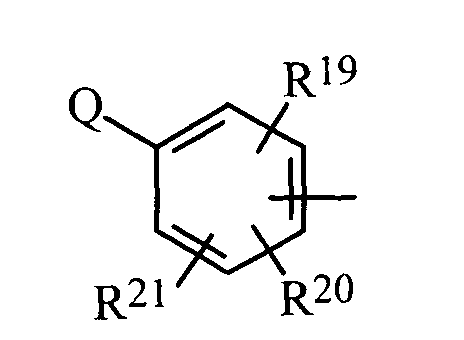
Applications Claiming Priority (7)
| Application Number | Priority Date | Filing Date | Title |
|---|---|---|---|
| FR9912643 | 1999-10-11 | ||
| FR9912643A FR2799461B1 (fr) | 1999-10-11 | 1999-10-11 | Derives d'heterocycles a 5 chainons, leur preparation et leur application a titre de medicaments |
| FR0010151A FR2812546B1 (fr) | 2000-08-01 | 2000-08-01 | Derives d'heterocycles a 5 chainons, leur preparation et leur application a titre de medicaments |
| FR0010151 | 2000-08-01 | ||
| FR0011169 | 2000-09-01 | ||
| FR0011169 | 2000-09-01 | ||
| EP00967988A EP1223933B1 (fr) | 1999-10-11 | 2000-10-10 | Dérivés d'hétérocycles à 5 chainons et leur application comme inhibiteurs de monoamine oxydase |
Related Parent Applications (1)
| Application Number | Title | Priority Date | Filing Date |
|---|---|---|---|
| EP00967988A Division EP1223933B1 (fr) | 1999-10-11 | 2000-10-10 | Dérivés d'hétérocycles à 5 chainons et leur application comme inhibiteurs de monoamine oxydase |
Publications (3)
| Publication Number | Publication Date |
|---|---|
| EP1589007A2 true EP1589007A2 (fr) | 2005-10-26 |
| EP1589007A3 EP1589007A3 (fr) | 2009-04-29 |
| EP1589007B1 EP1589007B1 (fr) | 2015-06-03 |
Family
ID=27248695
Family Applications (3)
| Application Number | Title | Priority Date | Filing Date |
|---|---|---|---|
| EP05076749.0A Expired - Lifetime EP1589007B1 (fr) | 1999-10-11 | 2000-10-10 | Dérivés d'hétérocycles à 5 chainons, leur préparation et leur application comme médicaments |
| EP00967988A Expired - Lifetime EP1223933B1 (fr) | 1999-10-11 | 2000-10-10 | Dérivés d'hétérocycles à 5 chainons et leur application comme inhibiteurs de monoamine oxydase |
| EP02076763A Expired - Lifetime EP1228760B1 (fr) | 1999-10-11 | 2000-10-10 | Dérivés d'hétérocycles à 5 chaînons, leur préparation et leur application à titre de médicaments |
Family Applications After (2)
| Application Number | Title | Priority Date | Filing Date |
|---|---|---|---|
| EP00967988A Expired - Lifetime EP1223933B1 (fr) | 1999-10-11 | 2000-10-10 | Dérivés d'hétérocycles à 5 chainons et leur application comme inhibiteurs de monoamine oxydase |
| EP02076763A Expired - Lifetime EP1228760B1 (fr) | 1999-10-11 | 2000-10-10 | Dérivés d'hétérocycles à 5 chaînons, leur préparation et leur application à titre de médicaments |
Country Status (27)
| Country | Link |
|---|---|
| US (4) | US20070021390A1 (fr) |
| EP (3) | EP1589007B1 (fr) |
| JP (1) | JP4972263B2 (fr) |
| KR (2) | KR20070068491A (fr) |
| CN (1) | CN100488506C (fr) |
| AR (1) | AR029006A1 (fr) |
| AT (2) | ATE522213T1 (fr) |
| AU (1) | AU783129B2 (fr) |
| BR (1) | BR0014649A (fr) |
| CA (1) | CA2388505C (fr) |
| CY (1) | CY1106237T1 (fr) |
| CZ (1) | CZ304331B6 (fr) |
| DE (1) | DE60030574T2 (fr) |
| DK (2) | DK1589007T3 (fr) |
| ES (2) | ES2270873T3 (fr) |
| HK (1) | HK1049957B (fr) |
| HU (1) | HU228254B1 (fr) |
| IL (3) | IL148896A0 (fr) |
| MX (1) | MXPA02003665A (fr) |
| MY (1) | MY145388A (fr) |
| NO (1) | NO331874B1 (fr) |
| NZ (2) | NZ518304A (fr) |
| PL (1) | PL215580B1 (fr) |
| PT (2) | PT1589007E (fr) |
| RU (1) | RU2271355C2 (fr) |
| TW (2) | TWI283577B (fr) |
| WO (1) | WO2001026656A2 (fr) |
Families Citing this family (57)
| Publication number | Priority date | Publication date | Assignee | Title |
|---|---|---|---|---|
| FR2823208B1 (fr) * | 2001-04-10 | 2004-03-19 | Sod Conseils Rech Applic | Derives d'heterocycles a 5 chainons, leur preparation et leur application a titre de medicaments |
| US7291641B2 (en) * | 1999-10-11 | 2007-11-06 | Societe De Conseils De Recherches Et D'applications Scientifiques (S.C.R.A.S.) | Derivatives of heterocycles with 5 members, their preparation and their use as medicaments |
| TWI283577B (en) * | 1999-10-11 | 2007-07-11 | Sod Conseils Rech Applic | Pharmaceutical composition of imidazole derivatives acting as modulators of sodium channels and the use thereof |
| FR2818978B1 (fr) * | 2000-12-28 | 2003-02-28 | Sod Conseils Rech Applic | Modulateurs de canaux sodiques derives de 2-piperidylimidazoles |
| TWI248438B (en) * | 2001-04-10 | 2006-02-01 | Sod Conseils Rech Applic | Derivatives of heterocycles with 5 members, their preparation and their use as medicaments |
| FR2825926A1 (fr) | 2001-06-14 | 2002-12-20 | Sod Conseils Rech Applic | Derives d'imidazoles modulant les canaux sodiques |
| HU228783B1 (en) * | 2001-07-26 | 2013-05-28 | Greenearth Cleaning | Dry cleaning apparatus and method capable of utilizing a siloxane solvent |
| EP1430017A2 (fr) | 2001-09-26 | 2004-06-23 | Theravance, Inc. | Composes phenoliques substitues utiles pour l'anesthesie et la sedation |
| JP2005512975A (ja) | 2001-10-25 | 2005-05-12 | アストラゼネカ アクチボラグ | 抗菌薬として有用なイソキサゾリン誘導体 |
| US7163952B2 (en) | 2001-12-03 | 2007-01-16 | Japan Tobacco Inc. | Azole compound and medicinal use thereof |
| FR2835254B1 (fr) * | 2002-01-25 | 2006-04-07 | Sod Conseils Rech Applic | Derives de thiazoles dans le traitement de maladies neurologiques |
| FR2842808B1 (fr) * | 2002-07-25 | 2004-09-10 | Sod Conseils Rech Applic | Nouveaux derives d'arylimidazoles, leur preparation et leurs applications therapeutiques |
| WO2004014902A2 (fr) * | 2002-08-09 | 2004-02-19 | Astrazeneca Ab | Nouveaux composes |
| TW200424183A (en) * | 2002-08-09 | 2004-11-16 | Nps Pharma Inc | New compounds |
| AR040847A1 (es) | 2002-08-09 | 2005-04-20 | Astrazeneca Ab | 1,2,4-oxadiazoles como moduladores de receptores de glutamato metabotropicos, para el tratamiento de desordenes neurologicos y psiquiatricos |
| WO2004071448A2 (fr) * | 2003-02-12 | 2004-08-26 | Transtech Pharma Inc. | Derives d'azole substitues comme agents therapeutiques |
| JP3819415B2 (ja) * | 2003-04-09 | 2006-09-06 | 日本たばこ産業株式会社 | 複素芳香5員環化合物及びその医薬用途 |
| US7732162B2 (en) | 2003-05-05 | 2010-06-08 | Probiodrug Ag | Inhibitors of glutaminyl cyclase for treating neurodegenerative diseases |
| US7446127B2 (en) | 2003-08-27 | 2008-11-04 | Sk Holdings Co, Ltd. | Chroman carboxylic acid derivatives for the treatment of diabetes and lipid disorders |
| EP1533295A1 (fr) * | 2003-11-24 | 2005-05-25 | Newron Pharmaceuticals S.p.A. | Dérivés de cyclopentyle |
| ES2530579T3 (es) | 2003-12-23 | 2015-03-03 | Abraxis Bioscience Llc | Análogos de propofol, procedimiento para su preparación, y procedimientos de uso |
| US7453002B2 (en) | 2004-06-15 | 2008-11-18 | Bristol-Myers Squibb Company | Five-membered heterocycles useful as serine protease inhibitors |
| JP4836280B2 (ja) | 2004-06-18 | 2011-12-14 | ノバルティス バクシンズ アンド ダイアグノスティックス,インコーポレーテッド | 癌を治療するためのキネシンスピンドルタンパク質(ksp)阻害剤としてのn−(1−(1−ベンジル−4−フェニル−1h−イミダゾール−2−イル)−2,2−ジメチルプロピル)ベンズアミド誘導体および関連化合物 |
| AU2005313108B2 (en) * | 2004-12-10 | 2011-05-26 | Msd Italia S.R.L. | Heterocycle derivatives as histone deacetylase (HDAC) inhibitors |
| AU2006206654A1 (en) * | 2005-01-19 | 2006-07-27 | Merck & Co., Inc. | Tertiary carbinamines having substituted heterocycles, which are active as inhibitors of beta-secretase, for the treatment of Alzheimer's disease |
| FR2888116A1 (fr) * | 2005-07-08 | 2007-01-12 | Sod Conseils Rech Applic | Derives de thiazoles pour traiter les dyskinesies |
| US8278345B2 (en) | 2006-11-09 | 2012-10-02 | Probiodrug Ag | Inhibitors of glutaminyl cyclase |
| JP5523107B2 (ja) | 2006-11-30 | 2014-06-18 | プロビオドルグ エージー | グルタミニルシクラーゼの新規阻害剤 |
| JP2010515687A (ja) | 2007-01-05 | 2010-05-13 | ノバルティス アーゲー | キネシンスピンドルタンパク質阻害剤(eg−5)としてのイミダゾール誘導体 |
| TW200848417A (en) * | 2007-02-22 | 2008-12-16 | Organon Nv | Indole derivatives |
| EP2481408A3 (fr) | 2007-03-01 | 2013-01-09 | Probiodrug AG | Nouvelle utilisation d'inhibiteurs glutaminyle cyclase |
| AU2008223916A1 (en) * | 2007-03-05 | 2008-09-12 | F. Hoffmann-La Roche Ag | Aminoamides as orexin antagonists |
| WO2008128985A1 (fr) | 2007-04-18 | 2008-10-30 | Probiodrug Ag | Dérivés de thio-urée utilisés comme inhibiteurs de la glutaminyl cyclase |
| ES2371210T3 (es) * | 2008-03-28 | 2011-12-28 | Magforce Nanotechnologies Ag | Dispositivo de aplicaciã“n de campo magnã‰tico alterno para el calentamiento de sustancias magnã‰ticas o magnetizables en tejido biolã“gico. |
| US20110190356A1 (en) * | 2008-08-19 | 2011-08-04 | Knopp Neurosciences Inc. | Compositions and Methods of Using (R)- Pramipexole |
| GB0822486D0 (en) * | 2008-12-10 | 2009-01-14 | Univ Liverpool | Compounds for use in the treatment of pain |
| KR101220182B1 (ko) | 2009-02-25 | 2013-01-11 | 에스케이바이오팜 주식회사 | 치환된 아졸 유도체 화합물, 이를 포함하는 약제학적 조성물 및 이를 이용한 파킨슨씨 병 치료방법 |
| MX2012002993A (es) | 2009-09-11 | 2012-04-19 | Probiodrug Ag | Derivados heterociclicos como inhibidores de ciclasa glutaminilo. |
| JP6026284B2 (ja) | 2010-03-03 | 2016-11-16 | プロビオドルグ エージー | グルタミニルシクラーゼの阻害剤 |
| US8269019B2 (en) | 2010-03-10 | 2012-09-18 | Probiodrug Ag | Inhibitors |
| WO2011131748A2 (fr) | 2010-04-21 | 2011-10-27 | Probiodrug Ag | Nouveaux inhibiteurs |
| ES2570167T3 (es) | 2011-03-16 | 2016-05-17 | Probiodrug Ag | Derivados de benzimidazol como inhibidores de glutaminil ciclasa |
| RU2506082C2 (ru) * | 2011-05-24 | 2014-02-10 | Государственное учебно-научное учреждение Химический факультет Московского государственного университета им. М.В. Ломоносова | Антигипотоническое средство |
| MD20140037A2 (ro) * | 2011-10-26 | 2014-08-31 | Pfizer Limited | Derivaţi de (4-fenilimidazol-2-il)etilamină utili ca modulatori ai canalului de sodiu |
| WO2013096816A1 (fr) | 2011-12-22 | 2013-06-27 | Biogen Idec Ma Inc. | Synthèse améliorée de composés substitués par amine de 4,5,6,7-tétrahydrobenzothiazole |
| WO2013131018A1 (fr) * | 2012-03-02 | 2013-09-06 | Zalicus Pharmaceuticals Ltd. | Inhibiteurs biaryle du canal sodique |
| US9662313B2 (en) | 2013-02-28 | 2017-05-30 | Knopp Biosciences Llc | Compositions and methods for treating amyotrophic lateral sclerosis in responders |
| ES3043076T3 (en) | 2013-07-12 | 2025-11-24 | Areteia Therapeutics Inc | Treating elevated levels of eosinophils and/or basophils |
| WO2015023786A1 (fr) | 2013-08-13 | 2015-02-19 | Knopp Biosciences Llc | Compositions et méthodes de traitement de troubles des cellules plasmatiques et de troubles prolymphocytaires à cellules b |
| ES2871556T3 (es) | 2013-08-13 | 2021-10-29 | Knopp Biosciences Llc | Composiciones y métodos para el tratamiento de la urticaria crónica |
| PL3461819T3 (pl) | 2017-09-29 | 2020-11-30 | Probiodrug Ag | Inhibitory cyklazy glutaminylowej |
| EP3846793B1 (fr) | 2018-09-07 | 2024-01-24 | PIC Therapeutics, Inc. | Inhibiteurs d'eif4e et leurs utilisations |
| MX2022010944A (es) | 2020-03-03 | 2022-11-09 | Pic Therapeutics Inc | Inhibidores del factor de iniciacion de traduccion eucariotica 4e (eif4e) y sus usos. |
| WO2022015782A1 (fr) * | 2020-07-15 | 2022-01-20 | Board Of Trustees Of Michigan State University | Compositions et procédés associés pour le recyclage en boucle fermée de polyesters |
| TW202315621A (zh) | 2021-08-25 | 2023-04-16 | 美商皮克醫療公司 | Eif4e抑制劑及其用途 |
| JP2024532276A (ja) | 2021-08-25 | 2024-09-05 | ピク セラピューティクス, インコーポレイテッド | eIF4E阻害剤及びその使用 |
| CN115000305B (zh) * | 2022-05-09 | 2025-07-04 | 广州光达创新科技有限公司 | 一种小分子共轭材料及其在量子点光探测器和阵列中的应用 |
Citations (7)
| Publication number | Priority date | Publication date | Assignee | Title |
|---|---|---|---|---|
| US4123529A (en) | 1976-04-23 | 1978-10-31 | Lilly Industries Limited | Phenylpiperazine derivatives |
| EP0432740A2 (fr) | 1989-12-15 | 1991-06-19 | Hoechst Aktiengesellschaft | 4-(3-Alkyl-5-tert.-butyl-4-hydroxyphényl)-thiazoles substitués en 2, procédé de préparation, médicaments les contenant et leur utilisation |
| WO1996016040A1 (fr) | 1994-11-23 | 1996-05-30 | Neurogen Corporation | Certains derives 4-aminomethyl 2-substitues de l'imidazole et derives 2-aminomethyl 4-substitues de l'imidazole, nouvelles categories de ligands specifiques du sous-type du recepteur de la dopamine |
| WO1998027108A2 (fr) | 1996-12-16 | 1998-06-25 | Fujisawa Pharmaceutical Co., Ltd. | Nouveaux composes amide |
| WO1998058934A1 (fr) | 1997-06-20 | 1998-12-30 | Societe De Conseils De Recherches Et D'applications Scientifiques (S.C.R.A.S.) | Nouveaux derives du 2-(iminomethyl)amino-phenyle, leur preparation, leur application a titre de medicaments et les compositions pharmaceutiques les contenant |
| WO1999009829A1 (fr) | 1997-08-28 | 1999-03-04 | Eli Lilly And Company | Procede de traitement d'une douleur |
| WO1999064401A2 (fr) | 1998-06-12 | 1999-12-16 | Societe De Conseils De Recherches Et D'applications Scientifiques Sas | Derives d'imidazolyles |
Family Cites Families (22)
| Publication number | Priority date | Publication date | Assignee | Title |
|---|---|---|---|---|
| FR4231E (fr) | 1905-08-25 | Francisque Voland | Disposition nouvelle de métier à tisser, en vue de l'obtention d'un tissu biaisé | |
| US1743083A (en) * | 1928-02-03 | 1930-01-07 | Winthrop Chem Co | Catechol thiazoles and process of making the same |
| FR2132632A1 (en) * | 1971-04-07 | 1972-11-24 | Berlin Chemie Veb | Prepn of 2-aminomethyl imidazole derivs - hypotensives mao inhibitors anticonvulsant s, antiphlogistics, choleretics and ant |
| DE2702714A1 (de) | 1977-01-24 | 1978-07-27 | Lek Tovarna Farmacevtskih | Verfahren zur herstellung von phenothiazin-derivaten |
| US4348404A (en) * | 1980-07-21 | 1982-09-07 | E. I. Du Pont De Nemours And Company | Antiinflammatory 4,5-diaryl-α-polyfluoroalkyl-1H-imidazole-2-methanamines |
| US4372964A (en) * | 1980-10-30 | 1983-02-08 | E. I. Du Pont De Nemours And Company | Antiinflammatory 4,5-diaryl-1H-imidazole-2-methanols |
| JPS62132871A (ja) * | 1985-12-03 | 1987-06-16 | Yamanouchi Pharmaceut Co Ltd | 新規チアゾ−ル誘導体 |
| JP3003148B2 (ja) * | 1989-01-05 | 2000-01-24 | 藤沢薬品工業株式会社 | チアゾール化合物、その製造法およびそれを含有する医薬組成物 |
| EP0388909A3 (fr) * | 1989-03-22 | 1991-05-08 | Fujisawa Pharmaceutical Co., Ltd. | Thiazoles, procédés pour les préparer et compositions pharmaceutiques les contenant |
| GB9204958D0 (en) * | 1992-03-06 | 1992-04-22 | Fujisawa Pharmaceutical Co | Thiazole derivatives |
| AU702661B2 (en) * | 1994-06-29 | 1999-02-25 | Smithkline Beecham Corporation | Vitronectin receptor antagonists |
| US5620999A (en) * | 1994-07-28 | 1997-04-15 | Weier; Richard M. | Benzenesulfonamide subtituted imidazolyl compounds for the treatment of inflammation |
| FR2727969B1 (fr) * | 1994-12-09 | 1997-01-17 | Roussel Uclaf | Nouveaux derives de l'erythromycine, leur procede de preparation et leur application comme medicaments |
| ATE240728T1 (de) * | 1996-10-07 | 2003-06-15 | Lilly Co Eli | Neue verbindungen nutlich als neuroschützende mittel |
| US6335445B1 (en) * | 1997-03-24 | 2002-01-01 | Societe De Conseils De Recherches Et D'applications Scientifiques (S.C.R.A.S.) | Derivatives of 2-(iminomethyl)amino-phenyl, their preparation, their use as medicaments and the pharmaceutical compositions containing them |
| AU9575698A (en) * | 1997-10-06 | 1999-04-27 | Eli Lilly And Company | Novel compounds useful as neuro-protective agents |
| ES2188184T3 (es) * | 1998-06-12 | 2003-06-16 | Sod Conseils Rech Applic | Compuestos de beta-carbolinas. |
| AU2717100A (en) * | 1998-12-31 | 2000-07-31 | Societe De Conseils De Recherches Et D'applications Scientifiques (S.C.R.A.S.) | Prenyl transferase inhibitors |
| ES2345921T3 (es) * | 1999-03-26 | 2010-10-06 | Euro-Celtique S.A. | Pirazoles, imidazoles, oxazoles, tiazoles y pirroles sustituidos con arilo y su uso. |
| TWI283577B (en) * | 1999-10-11 | 2007-07-11 | Sod Conseils Rech Applic | Pharmaceutical composition of imidazole derivatives acting as modulators of sodium channels and the use thereof |
| JP2004516271A (ja) * | 2000-12-20 | 2004-06-03 | アストラゼネカ・アクチエボラーグ | 治療法 |
| TWI248438B (en) | 2001-04-10 | 2006-02-01 | Sod Conseils Rech Applic | Derivatives of heterocycles with 5 members, their preparation and their use as medicaments |
-
2000
- 2000-10-09 TW TW089121109A patent/TWI283577B/zh not_active IP Right Cessation
- 2000-10-09 TW TW093132951A patent/TWI292316B/zh not_active IP Right Cessation
- 2000-10-10 AU AU77965/00A patent/AU783129B2/en not_active Ceased
- 2000-10-10 NZ NZ518304A patent/NZ518304A/en not_active IP Right Cessation
- 2000-10-10 PT PT50767490T patent/PT1589007E/pt unknown
- 2000-10-10 PT PT00967988T patent/PT1223933E/pt unknown
- 2000-10-10 EP EP05076749.0A patent/EP1589007B1/fr not_active Expired - Lifetime
- 2000-10-10 JP JP2001529718A patent/JP4972263B2/ja not_active Expired - Fee Related
- 2000-10-10 DK DK05076749.0T patent/DK1589007T3/en active
- 2000-10-10 ES ES00967988T patent/ES2270873T3/es not_active Expired - Lifetime
- 2000-10-10 PL PL355147A patent/PL215580B1/pl not_active IP Right Cessation
- 2000-10-10 WO PCT/FR2000/002805 patent/WO2001026656A2/fr not_active Ceased
- 2000-10-10 KR KR1020077013941A patent/KR20070068491A/ko not_active Abandoned
- 2000-10-10 DE DE60030574T patent/DE60030574T2/de not_active Expired - Lifetime
- 2000-10-10 KR KR1020027004578A patent/KR100731698B1/ko not_active Expired - Fee Related
- 2000-10-10 IL IL14889600A patent/IL148896A0/xx active IP Right Grant
- 2000-10-10 MX MXPA02003665A patent/MXPA02003665A/es active IP Right Grant
- 2000-10-10 CN CNB008158479A patent/CN100488506C/zh not_active Expired - Fee Related
- 2000-10-10 CA CA2388505A patent/CA2388505C/fr not_active Expired - Fee Related
- 2000-10-10 HU HU0203841A patent/HU228254B1/hu not_active IP Right Cessation
- 2000-10-10 HK HK03101645.4A patent/HK1049957B/zh not_active IP Right Cessation
- 2000-10-10 EP EP00967988A patent/EP1223933B1/fr not_active Expired - Lifetime
- 2000-10-10 ES ES05076749.0T patent/ES2544856T3/es not_active Expired - Lifetime
- 2000-10-10 AT AT02076763T patent/ATE522213T1/de not_active IP Right Cessation
- 2000-10-10 NZ NZ533429A patent/NZ533429A/en not_active IP Right Cessation
- 2000-10-10 DK DK00967988T patent/DK1223933T3/da active
- 2000-10-10 MY MYPI20004725A patent/MY145388A/en unknown
- 2000-10-10 BR BR0014649-8A patent/BR0014649A/pt not_active IP Right Cessation
- 2000-10-10 AT AT00967988T patent/ATE338547T1/de active
- 2000-10-10 EP EP02076763A patent/EP1228760B1/fr not_active Expired - Lifetime
- 2000-10-10 RU RU2002112227/15A patent/RU2271355C2/ru not_active IP Right Cessation
- 2000-10-10 CZ CZ2002-1292A patent/CZ304331B6/cs not_active IP Right Cessation
- 2000-10-11 AR ARP000105353A patent/AR029006A1/es active IP Right Grant
-
2002
- 2002-03-26 IL IL148896A patent/IL148896A/en not_active IP Right Cessation
- 2002-04-10 NO NO20021689A patent/NO331874B1/no not_active IP Right Cessation
-
2005
- 2005-10-24 US US11/256,901 patent/US20070021390A1/en not_active Abandoned
-
2006
- 2006-11-08 CY CY20061101600T patent/CY1106237T1/el unknown
-
2007
- 2007-02-20 US US11/708,531 patent/US20070179153A1/en not_active Abandoned
- 2007-08-08 IL IL185118A patent/IL185118A0/en not_active IP Right Cessation
- 2007-12-11 US US12/001,439 patent/US7956075B2/en not_active Expired - Fee Related
-
2011
- 2011-03-21 US US13/053,092 patent/US8288560B2/en not_active Expired - Fee Related
Patent Citations (7)
| Publication number | Priority date | Publication date | Assignee | Title |
|---|---|---|---|---|
| US4123529A (en) | 1976-04-23 | 1978-10-31 | Lilly Industries Limited | Phenylpiperazine derivatives |
| EP0432740A2 (fr) | 1989-12-15 | 1991-06-19 | Hoechst Aktiengesellschaft | 4-(3-Alkyl-5-tert.-butyl-4-hydroxyphényl)-thiazoles substitués en 2, procédé de préparation, médicaments les contenant et leur utilisation |
| WO1996016040A1 (fr) | 1994-11-23 | 1996-05-30 | Neurogen Corporation | Certains derives 4-aminomethyl 2-substitues de l'imidazole et derives 2-aminomethyl 4-substitues de l'imidazole, nouvelles categories de ligands specifiques du sous-type du recepteur de la dopamine |
| WO1998027108A2 (fr) | 1996-12-16 | 1998-06-25 | Fujisawa Pharmaceutical Co., Ltd. | Nouveaux composes amide |
| WO1998058934A1 (fr) | 1997-06-20 | 1998-12-30 | Societe De Conseils De Recherches Et D'applications Scientifiques (S.C.R.A.S.) | Nouveaux derives du 2-(iminomethyl)amino-phenyle, leur preparation, leur application a titre de medicaments et les compositions pharmaceutiques les contenant |
| WO1999009829A1 (fr) | 1997-08-28 | 1999-03-04 | Eli Lilly And Company | Procede de traitement d'une douleur |
| WO1999064401A2 (fr) | 1998-06-12 | 1999-12-16 | Societe De Conseils De Recherches Et D'applications Scientifiques Sas | Derives d'imidazolyles |
Non-Patent Citations (91)
| Title |
|---|
| "Handbook of Synthetic Antioxidants", vol. 4, 1997, article "Antioxid. Health. Dis.", pages: 1 - 52 |
| "Protective groups in organic synthesis, 2nd ed.,", 1991, JOHN WILEY & SONS INC. |
| "Salt selection for basic drugs", INT. J PHARM., vol. 33, 1986, pages 201 - 217 |
| ANGEW. CHEM. INT., vol. 37, no. 10, 1998, pages 411 - 414 |
| ARZNEIMITTEL FORSCHUNG, vol. 12, 1962, pages 48 |
| ARZNEIMITTEL FORSCHUNG, vol. 19, 1969, pages 1193 |
| BIOORG. MED. CHEM. LETT., 1997, pages 1519 - 1524 |
| BIORG. AND MED. CHEM. LETT., vol. 3, 1993, pages 915 |
| BIORG. MED. CHEM. LETT., vol. 6, no. 3, 1996, pages 253 - 258 |
| BROWN, J. NEUROSCI., vol. 6, 1986, pages 2064 - 2070 |
| BULL. ACD. SCI. USSR DIV. CHEM. SCI. (ENGL TRANSL, vol. 29, 1980, pages 1830 - 1833 |
| CALDWELL, EUROPEAN J. PHARMACOL., vol. 285, 1995, pages 203 - 206 |
| CAN. J CHEM. SOC., 1982, pages 945 - 956 |
| CESURA A M; GALVA M D; IMHOF R; DA PRADA M, J NEUROCHEM., vol. 48, 1987, pages 170 - 176 |
| CHEM BER., vol. 119, 1986, pages 3165 - 3197 |
| CHEM. ABSTR., vol. 66, 1966, pages 17538C |
| CHEM. ABSTR., vol. 68, 1968, pages 68730X |
| CHEM. ABSTR., vol. 69, 1968, pages 43814K |
| CHEM. ABSTR., vol. 89, pages 180029 |
| CHEM. COMMUN., vol. 15, no. 6, 1998, pages 1509 - 1510 |
| CHEM. LETT., vol. 9, 1998, pages 931 - 932 |
| CHEM. PHARM. BULL., vol. 29, no. 11, 1981, pages 3249 - 3255 |
| FREE RADIC. BIOL. MED., vol. 20, 1996, pages 675 - 705 |
| GOODMAN; GILMAN'S: "The pharmacological basis of therapeutics , 9th ed.,", 1995, pages: 431 - 519 |
| GRIGNARD, MEMGCL, J. HET. CHEM., vol. 27, 1990, pages 1709 - 1712 |
| H ESTERBAUER; KH CHEESEMAN, METH. ENZYMOL., vol. 186, 1990, pages 407 - 421 |
| HELV. CHIM. ACTA ., vol. 61, 1978, pages 837 - 843 |
| J AM. CHEM. SOC., vol. 121, 1999, pages 24 |
| J AMER. CHEM SOC., vol. 63, 1941, pages 1553 - 1555 |
| J AMER. CHEM., vol. 68, 1946, pages 2104 |
| J CHEM. SOC., 1934, pages 1142 - 1144 |
| J CHEM. SOC., 1961, pages 2898 |
| J CHEM. SOC., PERKIN TRANS. 1, vol. 20, 1998, pages 3479 - 3484 |
| J CHEM. SOC., PERKIN TRANS. 1, vol. 24, 1992, pages 3401 - 3406 |
| J HETEROCYCLIC. CHEM., vol. 15, 1978, pages 175 - 176 |
| J MED. CHEM., vol. 29, no. 6, 1986, pages 1009 - 1015 |
| J MED. CHEM., vol. 38, no. 15, 1995, pages 2880 - 2886 |
| J MED. CHEM., vol. 39, 1996, pages 237 - 245 |
| J MED. CHEM., vol. 40, 1997, pages 50 - 60,2064-2084 |
| J MED. CHEM., vol. 40, no. 7, 1997, pages 1049 - 1062 |
| J ORG. CHEM., 1974, pages 1239 - 1243 |
| J ORG. CHEM., vol. 59, no. 16, 1994, pages 4482 - 4489 |
| J. AM. CHEM. SOC., vol. 121, 1999, pages 24 |
| J. AMER. CHEM SOC., vol. 62, 1940, pages 3208 |
| J. AMER. CHEM. SOC., vol. 102, 1980, pages 2838 |
| J. CHEM. SOC. PERKIN. TRANS., vol. 1, 1998, pages 351 - 354 |
| J. CHEM. SOC., 1945, pages 945 - 956 |
| J. CHEM. SOC., PERKIN TRANS 1, vol. 24, 1992, pages 3401 - 3406 |
| J. HET. CHEM, vol. 12, 1975, pages 547 - 549 |
| J. HET. CHEM., vol. 25, 1988, pages 337 |
| J. HET. CHEM., vol. 30, 1993, pages 1133 - 1136 |
| J. HETEROCYCLIC CHEM., vol. 24, 1987, pages 927 - 930 |
| J. HETEROCYCLIC. CHEM., vol. 15, 1978, pages 175 |
| J. HETEROCYCLIC. CHEM., vol. 15, 1978, pages 175 - 176 |
| J. HETEROCYCLIC. CHEM., vol. 15, 1982, pages 1557 - 1559 |
| J. MACROMOL. SCI. CHEM., 1977, pages 507 - 514 |
| J. MED. CHEM., vol. 30, 1987, pages 193 |
| J. MED. CHEM., vol. 31, no. 10, 1988, pages 1910 - 1918 |
| J. MED. CHEM., vol. 35, 1992, pages 716 - 724 |
| J. MED. CHEM., vol. 39, 1996, pages 237 - 245 |
| J. MED. CHEM., vol. 41, 1998, pages 148 - 156 |
| J. ORG. CHEM., vol. 16, 1951, pages 1198 |
| J. ORG. CHEM., vol. 21, 1956 |
| J. ORG. CHEM., vol. 29, 1964, pages 3459 |
| J. ORG. CHEM., vol. 45, 1980, pages 5017 |
| J. ORG. CHEM., vol. 60, 1995, pages 5638 - 5642 |
| J.MED CHEM., vol. 39, 1996, pages 237 - 245 |
| J.MED. CHEM., vol. 17, 1974, pages 369 - 371 |
| LIEBIGS ANN. CHEM., 1995, pages 1217 |
| MELI, J. MED. CHEM., vol. 35, 1992, pages 13 |
| MELI, J. MED. CHEM., vol. 35, no. 13, 1992, pages 2392 |
| MONATSHEFTEFÜR CHEMIE, vol. 126, 1995, pages 725 - 732 |
| SYN. COMMUN., vol. 12, no. 8, 1982, pages 57 - 66 |
| SYN. COMMUN., vol. 25, no. 8, 1995, pages 1255 |
| SYNLETT, vol. 9, 1998, pages 1028 |
| SYNTH. COM., vol. 25, no. 23, 1995, pages 3799 - 3803 |
| SYNTHESIS, 1988, pages 215 - 217 |
| SYNTHESIS, 1993, pages 788 - 790 |
| SYNTHESIS, vol. 8, 1993, pages 788 - 790 |
| SYNTHESIS, vol. 9, 1996, pages 1076 - 1078 |
| TETRAHEDRON LETT., 1968, pages 4739 |
| TETRAHEDRON LETT., vol. 34, 1993, pages 1901 |
| TETRAHEDRON LETT., vol. 34, no. 28, 1993, pages 4481 - 4484 |
| TETRAHEDRON LETT., vol. 37, no. 26, 1996, pages 4455 |
| TETRAHEDRON LETT., vol. 39, no. 28, 1998, pages 4987 |
| TETRAHEDRON LETT., vol. 40, no. 3, 1999, pages 411 - 414 |
| TETRAHEDRON LETTERS, vol. 25, no. 8, 1984, pages 839 - 842 |
| TETRAHEDRON, vol. 23, 1967, pages 3823 |
| TETRAHEDRON, vol. 36, 1980, pages 3017 |
| TETRAHEDRON, vol. 36, 1980, pages 3017 - 3019 |
| ZH. OBSHCH. KHIM., vol. 23, 1953, pages 121 - 122 |
Also Published As
Similar Documents
| Publication | Publication Date | Title |
|---|---|---|
| EP1589007B1 (fr) | Dérivés d'hétérocycles à 5 chainons, leur préparation et leur application comme médicaments | |
| US7291641B2 (en) | Derivatives of heterocycles with 5 members, their preparation and their use as medicaments | |
| US20040132788A1 (en) | Derivatives of heterocycles with 5 members, their preparation and their use as medicaments | |
| EP1379514B1 (fr) | Derives d'heterocycles a 5 chainons, leur preparation et leur application comme medicaments | |
| ES2370274T3 (es) | Derivados de heterociclos de 5 miembros, su preparación y su aplicación como medicamentos. | |
| RU2380362C2 (ru) | Производные пятичленных гетероциклов, способ их получения и их применение в качестве лекарственных средств | |
| KR100822085B1 (ko) | 5-원 헤테로사이클 유도체, 이의 제조 방법 및의약으로서의 이의 용도 | |
| FR2812546A1 (fr) | Derives d'heterocycles a 5 chainons, leur preparation et leur application a titre de medicaments | |
| FR2823208A1 (fr) | Derives d'heterocycles a 5 chainons, leur preparation et leur application a titre de medicaments |
Legal Events
| Date | Code | Title | Description |
|---|---|---|---|
| PUAI | Public reference made under article 153(3) epc to a published international application that has entered the european phase |
Free format text: ORIGINAL CODE: 0009012 |
|
| AC | Divisional application: reference to earlier application |
Ref document number: 1223933 Country of ref document: EP Kind code of ref document: P |
|
| AK | Designated contracting states |
Kind code of ref document: A2 Designated state(s): AT BE CH CY DE DK ES FI FR GB GR IE IT LI LU MC NL PT SE |
|
| AX | Request for extension of the european patent |
Extension state: LT LV SI |
|
| RIN1 | Information on inventor provided before grant (corrected) |
Inventor name: HARNETT, JEREMIAH Inventor name: CHABRIER DE LASSAUNIERE, PIERRE ETIENNE Inventor name: BIGG, DENNIS Inventor name: LIBERATORE, ANNE MARIE Inventor name: LANNOY, JACQUES Inventor name: THURIEAU, CHRISTOPHE Inventor name: POMMIER, JACQUES |
|
| RIN1 | Information on inventor provided before grant (corrected) |
Inventor name: THURIEAU, CHRISTOPHE Inventor name: LANNOY, JACQUES Inventor name: HARNETT, JEREMIAH Inventor name: BIGG, DENNIS Inventor name: LIBERATORE, ANNE MARIE Inventor name: POMMIER, JACQUES Inventor name: CHABRIER DE LASSAUNIERE, PIERRE ETIENNE |
|
| RAP1 | Party data changed (applicant data changed or rights of an application transferred) |
Owner name: IPSEN PHARMA |
|
| PUAL | Search report despatched |
Free format text: ORIGINAL CODE: 0009013 |
|
| AK | Designated contracting states |
Kind code of ref document: A3 Designated state(s): AT BE CH CY DE DK ES FI FR GB GR IE IT LI LU MC NL PT SE |
|
| AX | Request for extension of the european patent |
Extension state: LT LV SI |
|
| 17P | Request for examination filed |
Effective date: 20091029 |
|
| AKX | Designation fees paid |
Designated state(s): AT BE CH CY DE DK ES FI FR GB GR IE IT LI LU MC NL PT SE |
|
| AXX | Extension fees paid |
Extension state: SI Payment date: 20091029 Extension state: LV Payment date: 20091029 Extension state: LT Payment date: 20091029 |
|
| 17Q | First examination report despatched |
Effective date: 20100706 |
|
| GRAP | Despatch of communication of intention to grant a patent |
Free format text: ORIGINAL CODE: EPIDOSNIGR1 |
|
| INTG | Intention to grant announced |
Effective date: 20150108 |
|
| GRAS | Grant fee paid |
Free format text: ORIGINAL CODE: EPIDOSNIGR3 |
|
| GRAA | (expected) grant |
Free format text: ORIGINAL CODE: 0009210 |
|
| AC | Divisional application: reference to earlier application |
Ref document number: 1223933 Country of ref document: EP Kind code of ref document: P |
|
| AK | Designated contracting states |
Kind code of ref document: B1 Designated state(s): AT BE CH CY DE DK ES FI FR GB GR IE IT LI LU MC NL PT SE |
|
| AX | Request for extension of the european patent |
Extension state: LT LV SI |
|
| REG | Reference to a national code |
Ref country code: GB Ref legal event code: FG4D Free format text: NOT ENGLISH |
|
| REG | Reference to a national code |
Ref country code: CH Ref legal event code: EP |
|
| REG | Reference to a national code |
Ref country code: IE Ref legal event code: FG4D Free format text: LANGUAGE OF EP DOCUMENT: FRENCH |
|
| REG | Reference to a national code |
Ref country code: AT Ref legal event code: REF Ref document number: 729842 Country of ref document: AT Kind code of ref document: T Effective date: 20150715 |
|
| REG | Reference to a national code |
Ref country code: DE Ref legal event code: R096 Ref document number: 60048978 Country of ref document: DE |
|
| REG | Reference to a national code |
Ref country code: CH Ref legal event code: NV Representative=s name: MICHELI AND CIE SA, CH |
|
| REG | Reference to a national code |
Ref country code: DK Ref legal event code: T3 Effective date: 20150806 |
|
| REG | Reference to a national code |
Ref country code: SE Ref legal event code: TRGR |
|
| REG | Reference to a national code |
Ref country code: NL Ref legal event code: T3 |
|
| REG | Reference to a national code |
Ref country code: ES Ref legal event code: FG2A Ref document number: 2544856 Country of ref document: ES Kind code of ref document: T3 Effective date: 20150904 |
|
| REG | Reference to a national code |
Ref country code: PT Ref legal event code: SC4A Free format text: AVAILABILITY OF NATIONAL TRANSLATION Effective date: 20150901 |
|
| REG | Reference to a national code |
Ref country code: GR Ref legal event code: EP Ref document number: 20150401764 Country of ref document: GR Effective date: 20150929 |
|
| REG | Reference to a national code |
Ref country code: LT Ref legal event code: MG9D |
|
| PGFP | Annual fee paid to national office [announced via postgrant information from national office to epo] |
Ref country code: GR Payment date: 20150915 Year of fee payment: 16 |
|
| PGFP | Annual fee paid to national office [announced via postgrant information from national office to epo] |
Ref country code: DK Payment date: 20151012 Year of fee payment: 16 |
|
| REG | Reference to a national code |
Ref country code: FR Ref legal event code: PLFP Year of fee payment: 16 |
|
| PGFP | Annual fee paid to national office [announced via postgrant information from national office to epo] |
Ref country code: IE Payment date: 20151012 Year of fee payment: 16 Ref country code: FI Payment date: 20151012 Year of fee payment: 16 |
|
| REG | Reference to a national code |
Ref country code: AT Ref legal event code: UEP Ref document number: 729842 Country of ref document: AT Kind code of ref document: T Effective date: 20150603 |
|
| PGFP | Annual fee paid to national office [announced via postgrant information from national office to epo] |
Ref country code: AT Payment date: 20150928 Year of fee payment: 16 Ref country code: PT Payment date: 20151027 Year of fee payment: 16 Ref country code: NL Payment date: 20151012 Year of fee payment: 16 Ref country code: SE Payment date: 20151013 Year of fee payment: 16 Ref country code: BE Payment date: 20151012 Year of fee payment: 16 |
|
| REG | Reference to a national code |
Ref country code: DE Ref legal event code: R097 Ref document number: 60048978 Country of ref document: DE |
|
| PLBE | No opposition filed within time limit |
Free format text: ORIGINAL CODE: 0009261 |
|
| STAA | Information on the status of an ep patent application or granted ep patent |
Free format text: STATUS: NO OPPOSITION FILED WITHIN TIME LIMIT |
|
| 26N | No opposition filed |
Effective date: 20160304 |
|
| PG25 | Lapsed in a contracting state [announced via postgrant information from national office to epo] |
Ref country code: LU Free format text: LAPSE BECAUSE OF FAILURE TO SUBMIT A TRANSLATION OF THE DESCRIPTION OR TO PAY THE FEE WITHIN THE PRESCRIBED TIME-LIMIT Effective date: 20151010 |
|
| PG25 | Lapsed in a contracting state [announced via postgrant information from national office to epo] |
Ref country code: MC Free format text: LAPSE BECAUSE OF FAILURE TO SUBMIT A TRANSLATION OF THE DESCRIPTION OR TO PAY THE FEE WITHIN THE PRESCRIBED TIME-LIMIT Effective date: 20150603 |
|
| REG | Reference to a national code |
Ref country code: FR Ref legal event code: PLFP Year of fee payment: 17 |
|
| PG25 | Lapsed in a contracting state [announced via postgrant information from national office to epo] |
Ref country code: BE Free format text: LAPSE BECAUSE OF NON-PAYMENT OF DUE FEES Effective date: 20161031 |
|
| REG | Reference to a national code |
Ref country code: DK Ref legal event code: EBP Effective date: 20161031 |
|
| REG | Reference to a national code |
Ref country code: NL Ref legal event code: MM Effective date: 20161101 |
|
| REG | Reference to a national code |
Ref country code: AT Ref legal event code: MM01 Ref document number: 729842 Country of ref document: AT Kind code of ref document: T Effective date: 20161010 |
|
| PG25 | Lapsed in a contracting state [announced via postgrant information from national office to epo] |
Ref country code: CY Free format text: LAPSE BECAUSE OF FAILURE TO SUBMIT A TRANSLATION OF THE DESCRIPTION OR TO PAY THE FEE WITHIN THE PRESCRIBED TIME-LIMIT Effective date: 20150603 |
|
| PG25 | Lapsed in a contracting state [announced via postgrant information from national office to epo] |
Ref country code: FI Free format text: LAPSE BECAUSE OF NON-PAYMENT OF DUE FEES Effective date: 20161010 Ref country code: GR Free format text: LAPSE BECAUSE OF NON-PAYMENT OF DUE FEES Effective date: 20170504 |
|
| PG25 | Lapsed in a contracting state [announced via postgrant information from national office to epo] |
Ref country code: NL Free format text: LAPSE BECAUSE OF NON-PAYMENT OF DUE FEES Effective date: 20161101 Ref country code: SE Free format text: LAPSE BECAUSE OF NON-PAYMENT OF DUE FEES Effective date: 20161011 Ref country code: AT Free format text: LAPSE BECAUSE OF NON-PAYMENT OF DUE FEES Effective date: 20161010 Ref country code: PT Free format text: LAPSE BECAUSE OF NON-PAYMENT OF DUE FEES Effective date: 20170410 |
|
| REG | Reference to a national code |
Ref country code: FR Ref legal event code: PLFP Year of fee payment: 18 |
|
| PGFP | Annual fee paid to national office [announced via postgrant information from national office to epo] |
Ref country code: FR Payment date: 20170915 Year of fee payment: 18 |
|
| PG25 | Lapsed in a contracting state [announced via postgrant information from national office to epo] |
Ref country code: DK Free format text: LAPSE BECAUSE OF NON-PAYMENT OF DUE FEES Effective date: 20161031 Ref country code: IE Free format text: LAPSE BECAUSE OF NON-PAYMENT OF DUE FEES Effective date: 20161010 |
|
| REG | Reference to a national code |
Ref country code: BE Ref legal event code: MM Effective date: 20161031 |
|
| PGFP | Annual fee paid to national office [announced via postgrant information from national office to epo] |
Ref country code: DE Payment date: 20171004 Year of fee payment: 18 |
|
| PGFP | Annual fee paid to national office [announced via postgrant information from national office to epo] |
Ref country code: GB Payment date: 20171004 Year of fee payment: 18 Ref country code: ES Payment date: 20171102 Year of fee payment: 18 Ref country code: CH Payment date: 20171013 Year of fee payment: 18 Ref country code: IT Payment date: 20171024 Year of fee payment: 18 |
|
| REG | Reference to a national code |
Ref country code: DE Ref legal event code: R119 Ref document number: 60048978 Country of ref document: DE |
|
| REG | Reference to a national code |
Ref country code: CH Ref legal event code: PL |
|
| GBPC | Gb: european patent ceased through non-payment of renewal fee |
Effective date: 20181010 |
|
| PG25 | Lapsed in a contracting state [announced via postgrant information from national office to epo] |
Ref country code: DE Free format text: LAPSE BECAUSE OF NON-PAYMENT OF DUE FEES Effective date: 20190501 |
|
| PG25 | Lapsed in a contracting state [announced via postgrant information from national office to epo] |
Ref country code: LI Free format text: LAPSE BECAUSE OF NON-PAYMENT OF DUE FEES Effective date: 20181031 Ref country code: CH Free format text: LAPSE BECAUSE OF NON-PAYMENT OF DUE FEES Effective date: 20181031 Ref country code: FR Free format text: LAPSE BECAUSE OF NON-PAYMENT OF DUE FEES Effective date: 20181031 |
|
| PG25 | Lapsed in a contracting state [announced via postgrant information from national office to epo] |
Ref country code: GB Free format text: LAPSE BECAUSE OF NON-PAYMENT OF DUE FEES Effective date: 20181010 Ref country code: IT Free format text: LAPSE BECAUSE OF NON-PAYMENT OF DUE FEES Effective date: 20181010 |
|
| REG | Reference to a national code |
Ref country code: ES Ref legal event code: FD2A Effective date: 20191129 |
|
| PG25 | Lapsed in a contracting state [announced via postgrant information from national office to epo] |
Ref country code: ES Free format text: LAPSE BECAUSE OF NON-PAYMENT OF DUE FEES Effective date: 20181011 |