EP1591835B1 - Azin-basierte Ladungtransportmaterialien mit zwei reaktiven Ringen - Google Patents
Azin-basierte Ladungtransportmaterialien mit zwei reaktiven Ringen Download PDFInfo
- Publication number
- EP1591835B1 EP1591835B1 EP05252648A EP05252648A EP1591835B1 EP 1591835 B1 EP1591835 B1 EP 1591835B1 EP 05252648 A EP05252648 A EP 05252648A EP 05252648 A EP05252648 A EP 05252648A EP 1591835 B1 EP1591835 B1 EP 1591835B1
- Authority
- EP
- European Patent Office
- Prior art keywords
- group
- charge transport
- organophotoreceptor
- independently
- transport material
- Prior art date
- Legal status (The legal status is an assumption and is not a legal conclusion. Google has not performed a legal analysis and makes no representation as to the accuracy of the status listed.)
- Expired - Lifetime
Links
- 0 C**(C)(**)C(*)=NC(C)=C(*)* Chemical compound C**(C)(**)C(*)=NC(C)=C(*)* 0.000 description 1
Classifications
-
- C—CHEMISTRY; METALLURGY
- C07—ORGANIC CHEMISTRY
- C07D—HETEROCYCLIC COMPOUNDS
- C07D303/00—Compounds containing three-membered rings having one oxygen atom as the only ring hetero atom
- C07D303/02—Compounds containing oxirane rings
- C07D303/12—Compounds containing oxirane rings with hydrocarbon radicals, substituted by singly or doubly bound oxygen atoms
- C07D303/18—Compounds containing oxirane rings with hydrocarbon radicals, substituted by singly or doubly bound oxygen atoms by etherified hydroxyl radicals
- C07D303/28—Ethers with hydroxy compounds containing oxirane rings
- C07D303/30—Ethers of oxirane-containing polyhydroxy compounds in which all hydroxyl radicals are etherified with oxirane-containing hydroxy compounds
-
- C—CHEMISTRY; METALLURGY
- C07—ORGANIC CHEMISTRY
- C07D—HETEROCYCLIC COMPOUNDS
- C07D303/00—Compounds containing three-membered rings having one oxygen atom as the only ring hetero atom
- C07D303/02—Compounds containing oxirane rings
- C07D303/12—Compounds containing oxirane rings with hydrocarbon radicals, substituted by singly or doubly bound oxygen atoms
- C07D303/18—Compounds containing oxirane rings with hydrocarbon radicals, substituted by singly or doubly bound oxygen atoms by etherified hydroxyl radicals
- C07D303/20—Ethers with hydroxy compounds containing no oxirane rings
- C07D303/22—Ethers with hydroxy compounds containing no oxirane rings with monohydroxy compounds
-
- G—PHYSICS
- G03—PHOTOGRAPHY; CINEMATOGRAPHY; ANALOGOUS TECHNIQUES USING WAVES OTHER THAN OPTICAL WAVES; ELECTROGRAPHY; HOLOGRAPHY
- G03G—ELECTROGRAPHY; ELECTROPHOTOGRAPHY; MAGNETOGRAPHY
- G03G5/00—Recording-members for original recording by exposure, e.g. to light, to heat or to electrons; Manufacture thereof; Selection of materials therefor
- G03G5/02—Charge-receiving layers
- G03G5/04—Photoconductive layers; Charge-generation layers or charge-transporting layers; Additives therefor; Binders therefor
- G03G5/06—Photoconductive layers; Charge-generation layers or charge-transporting layers; Additives therefor; Binders therefor characterised by the photoconductive material being organic
- G03G5/0601—Acyclic or carbocyclic compounds
-
- G—PHYSICS
- G03—PHOTOGRAPHY; CINEMATOGRAPHY; ANALOGOUS TECHNIQUES USING WAVES OTHER THAN OPTICAL WAVES; ELECTROGRAPHY; HOLOGRAPHY
- G03G—ELECTROGRAPHY; ELECTROPHOTOGRAPHY; MAGNETOGRAPHY
- G03G5/00—Recording-members for original recording by exposure, e.g. to light, to heat or to electrons; Manufacture thereof; Selection of materials therefor
- G03G5/02—Charge-receiving layers
- G03G5/04—Photoconductive layers; Charge-generation layers or charge-transporting layers; Additives therefor; Binders therefor
- G03G5/06—Photoconductive layers; Charge-generation layers or charge-transporting layers; Additives therefor; Binders therefor characterised by the photoconductive material being organic
- G03G5/0601—Acyclic or carbocyclic compounds
- G03G5/0603—Acyclic or carbocyclic compounds containing halogens
-
- G—PHYSICS
- G03—PHOTOGRAPHY; CINEMATOGRAPHY; ANALOGOUS TECHNIQUES USING WAVES OTHER THAN OPTICAL WAVES; ELECTROGRAPHY; HOLOGRAPHY
- G03G—ELECTROGRAPHY; ELECTROPHOTOGRAPHY; MAGNETOGRAPHY
- G03G5/00—Recording-members for original recording by exposure, e.g. to light, to heat or to electrons; Manufacture thereof; Selection of materials therefor
- G03G5/02—Charge-receiving layers
- G03G5/04—Photoconductive layers; Charge-generation layers or charge-transporting layers; Additives therefor; Binders therefor
- G03G5/06—Photoconductive layers; Charge-generation layers or charge-transporting layers; Additives therefor; Binders therefor characterised by the photoconductive material being organic
- G03G5/0601—Acyclic or carbocyclic compounds
- G03G5/0605—Carbocyclic compounds
-
- G—PHYSICS
- G03—PHOTOGRAPHY; CINEMATOGRAPHY; ANALOGOUS TECHNIQUES USING WAVES OTHER THAN OPTICAL WAVES; ELECTROGRAPHY; HOLOGRAPHY
- G03G—ELECTROGRAPHY; ELECTROPHOTOGRAPHY; MAGNETOGRAPHY
- G03G5/00—Recording-members for original recording by exposure, e.g. to light, to heat or to electrons; Manufacture thereof; Selection of materials therefor
- G03G5/02—Charge-receiving layers
- G03G5/04—Photoconductive layers; Charge-generation layers or charge-transporting layers; Additives therefor; Binders therefor
- G03G5/06—Photoconductive layers; Charge-generation layers or charge-transporting layers; Additives therefor; Binders therefor characterised by the photoconductive material being organic
- G03G5/0601—Acyclic or carbocyclic compounds
- G03G5/0609—Acyclic or carbocyclic compounds containing oxygen
-
- G—PHYSICS
- G03—PHOTOGRAPHY; CINEMATOGRAPHY; ANALOGOUS TECHNIQUES USING WAVES OTHER THAN OPTICAL WAVES; ELECTROGRAPHY; HOLOGRAPHY
- G03G—ELECTROGRAPHY; ELECTROPHOTOGRAPHY; MAGNETOGRAPHY
- G03G5/00—Recording-members for original recording by exposure, e.g. to light, to heat or to electrons; Manufacture thereof; Selection of materials therefor
- G03G5/02—Charge-receiving layers
- G03G5/04—Photoconductive layers; Charge-generation layers or charge-transporting layers; Additives therefor; Binders therefor
- G03G5/06—Photoconductive layers; Charge-generation layers or charge-transporting layers; Additives therefor; Binders therefor characterised by the photoconductive material being organic
- G03G5/0601—Acyclic or carbocyclic compounds
- G03G5/0612—Acyclic or carbocyclic compounds containing nitrogen
- G03G5/0614—Amines
- G03G5/06142—Amines arylamine
-
- G—PHYSICS
- G03—PHOTOGRAPHY; CINEMATOGRAPHY; ANALOGOUS TECHNIQUES USING WAVES OTHER THAN OPTICAL WAVES; ELECTROGRAPHY; HOLOGRAPHY
- G03G—ELECTROGRAPHY; ELECTROPHOTOGRAPHY; MAGNETOGRAPHY
- G03G5/00—Recording-members for original recording by exposure, e.g. to light, to heat or to electrons; Manufacture thereof; Selection of materials therefor
- G03G5/02—Charge-receiving layers
- G03G5/04—Photoconductive layers; Charge-generation layers or charge-transporting layers; Additives therefor; Binders therefor
- G03G5/06—Photoconductive layers; Charge-generation layers or charge-transporting layers; Additives therefor; Binders therefor characterised by the photoconductive material being organic
- G03G5/0601—Acyclic or carbocyclic compounds
- G03G5/0612—Acyclic or carbocyclic compounds containing nitrogen
- G03G5/0616—Hydrazines; Hydrazones
-
- G—PHYSICS
- G03—PHOTOGRAPHY; CINEMATOGRAPHY; ANALOGOUS TECHNIQUES USING WAVES OTHER THAN OPTICAL WAVES; ELECTROGRAPHY; HOLOGRAPHY
- G03G—ELECTROGRAPHY; ELECTROPHOTOGRAPHY; MAGNETOGRAPHY
- G03G5/00—Recording-members for original recording by exposure, e.g. to light, to heat or to electrons; Manufacture thereof; Selection of materials therefor
- G03G5/02—Charge-receiving layers
- G03G5/04—Photoconductive layers; Charge-generation layers or charge-transporting layers; Additives therefor; Binders therefor
- G03G5/06—Photoconductive layers; Charge-generation layers or charge-transporting layers; Additives therefor; Binders therefor characterised by the photoconductive material being organic
- G03G5/0601—Acyclic or carbocyclic compounds
- G03G5/0618—Acyclic or carbocyclic compounds containing oxygen and nitrogen
-
- G—PHYSICS
- G03—PHOTOGRAPHY; CINEMATOGRAPHY; ANALOGOUS TECHNIQUES USING WAVES OTHER THAN OPTICAL WAVES; ELECTROGRAPHY; HOLOGRAPHY
- G03G—ELECTROGRAPHY; ELECTROPHOTOGRAPHY; MAGNETOGRAPHY
- G03G5/00—Recording-members for original recording by exposure, e.g. to light, to heat or to electrons; Manufacture thereof; Selection of materials therefor
- G03G5/02—Charge-receiving layers
- G03G5/04—Photoconductive layers; Charge-generation layers or charge-transporting layers; Additives therefor; Binders therefor
- G03G5/06—Photoconductive layers; Charge-generation layers or charge-transporting layers; Additives therefor; Binders therefor characterised by the photoconductive material being organic
- G03G5/0601—Acyclic or carbocyclic compounds
- G03G5/062—Acyclic or carbocyclic compounds containing non-metal elements other than hydrogen, halogen, oxygen or nitrogen
-
- G—PHYSICS
- G03—PHOTOGRAPHY; CINEMATOGRAPHY; ANALOGOUS TECHNIQUES USING WAVES OTHER THAN OPTICAL WAVES; ELECTROGRAPHY; HOLOGRAPHY
- G03G—ELECTROGRAPHY; ELECTROPHOTOGRAPHY; MAGNETOGRAPHY
- G03G5/00—Recording-members for original recording by exposure, e.g. to light, to heat or to electrons; Manufacture thereof; Selection of materials therefor
- G03G5/02—Charge-receiving layers
- G03G5/04—Photoconductive layers; Charge-generation layers or charge-transporting layers; Additives therefor; Binders therefor
- G03G5/06—Photoconductive layers; Charge-generation layers or charge-transporting layers; Additives therefor; Binders therefor characterised by the photoconductive material being organic
- G03G5/0622—Heterocyclic compounds
- G03G5/0624—Heterocyclic compounds containing one hetero ring
- G03G5/0625—Heterocyclic compounds containing one hetero ring being three- or four-membered
Definitions
- This invention relates to organophotoreceptors suitable for use in electrophotography and, more specifically, to organophotoreceptors having a charge transport materials containing an azine group and at least two reactive ring groups. Furthermore, the invention further relates to a polymeric charge transport material formed by the reaction between the azine-based charge transport material and a binder containing at least a functional group that can react with the reactive ring groups.
- an organophotoreceptor in the form of a plate, disk, sheet, belt, drum or the like having an electrically insulating photoconductive element on an electrically conductive substrate is imaged by first uniformly electrostatically charging the surface of the photoconductive layer, and then exposing the charged surface to a pattern of light.
- the light exposure selectively dissipates the charge in the illuminated areas where light strikes the surface, thereby forming a pattern of charged and uncharged areas, referred to as a latent image.
- a liquid or solid toner is then provided in the vicinity of the latent image, and toner droplets or particles deposit in the vicinity of either the charged or uncharged areas to create a toned image on the surface of the photoconductive layer.
- the resulting toned image can be transferred to a suitable ultimate or intermediate receiving surface, such as paper, or the photoconductive layer can operate as an ultimate receptor for the image.
- the imaging process can be repeated many times to complete a single image, for example, by overlaying images of distinct color components or effect shadow images, such as overlaying images of distinct colors to form a full color final image, and/or to reproduce additional images.
- a charge transport material and charge generating material are combined with a polymeric binder and then deposited on the electrically conductive substrate.
- the charge transport material and charge generating material are present in the element in separate layers, each of which can optionally be combined with a polymeric binder, deposited on the electrically conductive substrate.
- Two arrangements are possible for a two-layer photoconductive element. In one two-layer arrangement (the “dual layer” arrangement), the charge-generating layer is deposited on the electrically conductive substrate and the charge transport layer is deposited on top of the charge generating layer. In an alternate two-layer arrangement (the "inverted dual layer” arrangement), the order of the charge transport layer and charge generating layer is reversed.
- the purpose of the charge generating material is to generate charge carriers (i.e., holes and/or electrons) upon exposure to light.
- the purpose of the charge transport material is to accept at least one type of these charge carriers and transport them through the charge transport layer in order to facilitate discharge of a surface charge on the photoconductive element.
- the charge transport material can be a charge transport compound, an electron transport compound, or a combination of both. When a charge transport compound is used, the charge transport compound accepts the hole carriers and transports them through the layer with the charge transport compound. When an electron transport compound is used, the electron transport compound accepts the electron carriers and transports them through the layer with the electron transport compound.
- Organophotoreceptors may be used for both dry and liquid electrophotography. There are many differences between dry and liquid electrophotography. A significant difference is that a dry toner is used in dry electrophotography, whereas a liquid toner is used in liquid electrophotography. A potential advantage of liquid electrophotography is that it can provide a higher resolution and thus sharper images than dry electrophotography because liquid toner particles can be generally significantly smaller than dry toner particles. As a result of their smaller size, liquid toners are able to provide images of higher optical density than dry toners.
- the charge transport material used for the organophotoreceptor should be compatible with the polymeric binder in the photoconductive element.
- the selection of a suitable polymeric binder for a particular charge transport material can place constraints on the formation of the photoconductive element. If the charge transport material is not compatible with the polymeric binder, the charge transport material may phase-separate or crystallize in the polymeric binder matrix, or may diffuse onto the surface of the layer containing the charge transport material. If such incompatibility occurs, the organophotoreceptor can cease to transport charges.
- liquid electrophotography faces an additional issue.
- the organophotoreceptor for liquid electrophotography is in contact with the liquid carrier of a liquid toner while the toner dries or pending transfer to a receiving surface.
- the charge transport material in the photoconductive element may be removed by extraction by the liquid carrier. Over a long period of operation, the amount of the charge transport material removed by extraction may be significant and, therefore, detrimental to the performance of the organophotoreceptor.
- An aim of the present invention is to provide organophotoreceptors, electrophotographic imaging apparatus, electrophotographic imaging processes, charge transport materials, and polymeric charge transport materials, typically generally featuring (a) good, and/or beneficial, and/or useful propert(y)ies, or combinations of such properties, and typically preferably addressing at least one or some of the problems and limitations in the art.
- a preferred aim of the present invention is to provide organophotoreceptors having good electrostatic properties.
- a further preferred aim of the present invention or embodiments thereof is to provide improved organophotoreceptors, preferably having improved properties, such as improved electrostatic properties, particularly compared with known organophotoreceptors.
- a further preferred aim of the present invention or embodiments thereof is to provide charge transport materials for organophotoreceptors featuring good mechanical and/or chemical and/or electrostatic properties, and/or a combination of good chemical and electrostatic properties.
- a further aim of embodiments of the present invention is to provide organophotoreceptors and electrophotographic imaging apparatus which can be used to provide high quality of images, even after repeated cycling, electrophotographic apparatus employing the organophotoreceptors and electrophotographic imaging methods using the organophotoreceptors/charge transport materials.
- this invention suitably seeks to provide organophotoreceptors having good electrostatic properties such as high V acc and low V dis .
- This invention also suitably seeks to provide charge transport materials having a high compatibility with the polymeric binder, reduced phase separation, or reduced extraction by liquid carriers.
- an organophotoreceptor an electrophotographic imaging apparatus, an electrophotographic imaging process, a charge transport material, and a polymeric charge transport material, as set forth in the appended claims.
- Preferred features of the invention will be apparent from the dependent claims, and the description which follows.
- an organophotoreceptor comprising an electrically conductive substrate and a photoconductive element on the electrically conductive substrate, the photoconductive element comprising:
- R 1 and R 2 comprise, each independently, an [(N,N-disubstituted)amino]aryl group.
- E 1 and E 2 are, each independently, an epoxy group, a thiiranyl group, an aziridino group, or an oxetanyl group.
- the photoconductive element further comprises a second charge transport material.
- the second charge transport material comprises an electron transport compound.
- the photoconductive element further comprises a binder.
- the organophotoreceptor may be provided, for example, in the form of a plate, a flexible belt, a flexible disk, a sheet, a rigid drum, or a sheet around a rigid or compliant drum.
- the organophotoreceptor includes: (a) a photoconductive element comprising the charge transport material, the charge generating compound, a second charge transport material, and a polymeric binder; and (b) the electrically conductive substrate.
- an electrophotographic imaging apparatus that comprises (a) a light imaging component; and (b) the organophotoreceptor described herein oriented to receive light from the light imaging component.
- the apparatus can further comprise a toner dispenser, more preferably such as a liquid toner dispenser.
- the method of electrophotographic imaging with photoreceptors containing the above noted charge transport materials is also described.
- an electrophotographic imaging process that includes (a) applying an electrical charge to a surface of the organophotoreceptor described herein; (b) imagewise exposing the surface of the organophotoreceptor to radiation to dissipate charge in selected areas and thereby form a pattern of at least relatively charged and uncharged areas on the surface; (c) contacting the surface with a toner, preferably such as a liquid toner that includes a dispersion of colorant particles in an organic liquid, to create a toned image; and (d) transferring the toned image to a substrate.
- a toner preferably such as a liquid toner that includes a dispersion of colorant particles in an organic liquid
- Ar is an aromatic C 6 H 3 group.
- a polymeric charge transport material prepared by, or obtainable by, the reaction between a functional group in a polymeric binder and at least a reactive ring group in a charge transport material having Formula (I)and wherein the polymeric binder is a polyvinyl butyrate.
- the functional group is selected from the group consisting of a hydroxyl group, a thiol group, amino groups, and a carboxyl group.
- a process for the preparation of a polymeric charge transport material comprising the reaction between a functional group in a polymeric binder and at least a reactive ring group in a charge transport material having Formula (I).
- the invention provides suitable charge transport materials for organophotoreceptors featuring a combination of good chemical and electrostatic properties. These photoreceptors can be used successfully with toners, including liquid toners, to produce high quality images. The high quality of the imaging system can be maintained after repeated cycling.
- the invention and/or embodiments thereof provides organophotoreceptors having good electrostatic properties such as high V acc and low V dis .
- the invention and/or embodiments thereof provides charge transport materials having a high compatibility with the polymeric binder, reduced phase separation, or reduced extraction by liquid carriers.
- first, second, third, fourth, fifth, and sixth aspects of the present invention may be regarded as preferred features and embodiments of one, some, or all of the other aspects of the present invention, i.e. the other aspects being the remaining first, second, third, fourth, fifth, and sixth aspects.
- An organophotoreceptor as described herein has an electrically conductive substrate and a photoconductive element including a charge generating compound and a charge transport material having an azine group bonded through an aromatic group to at least two reactive ring groups, such as an epoxy group, a thiiranyl group, an aziridino group, and an oxetanyl group.
- charge transport materials have desirable properties as evidenced by their performance in organophotoreceptors for electrophotography.
- the charge transport materials of this invention have high charge carrier mobilities and good compatibility with various binder materials, and possess excellent electrophotographic properties.
- the organophotoreceptors according to this invention generally have a high photosensitivity, a low residual potential, and a high stability with respect to cycle testing, crystallization, and organophotoreceptor bending and stretching.
- the organophotoreceptors are particularly useful in laser printers and the like as well as fax machines, photocopiers, scanners and other electronic devices based on electrophotography.
- the use of these charge transport materials is described in more detail below in the context of laser printer use, although their application in other devices operating by electrophotography can be generalized from the discussion below.
- the charge transport materials To produce high quality images, particularly after multiple cycles, it is desirable for the charge transport materials to form a homogeneous mixture with the polymeric binder and remain approximately homogeneously distributed through the organophotoreceptor material during the cycling of the material. In addition, it is desirable to increase the amount of charge that the charge transport material can accept (indicated by a parameter known as the acceptance voltage or "V acc "), and to reduce retention of that charge upon discharge (indicated by a parameter known as the discharge voltage or "V dis ").
- Charge transport materials may comprise monomeric molecules (e.g., N-ethyl-carbazolo-3-aldehyde-N-methyl-N-phenyl-hydrazone, dimeric molecules (e.g., disclosed in U.S. Patent Nos. 6,140,004 and 6,670,085), or polymeric compositions (e.g., poly(vinylcarbazole)).
- the charge transport materials can be classified as a charge transport compound or an electron transport compound. There are many charge transport compounds and electron transport compounds known in the art for electrophotography.
- Non-limiting examples of charge transport compounds include, for example, pyrazoline derivatives, fluorene derivatives, oxadiazole derivatives, stilbene derivatives, enamine derivatives, enamine stilbene derivatives, hydrazone derivatives, carbazole hydrazone derivatives, (N,N-disubstituted)arylamines such as triaryl amines, polyvinyl carbazole, polyvinyl pyrene, polyacenaphthylene, and the charge transport compounds described in U.S. Patent Nos. 6,689,523, 6,670,085, and 6,696,209, and U.S. Patent Application Nos.
- Non-limiting examples of electron transport compounds include, for example, bromoaniline, tetracyanoethylene, tetracyanoquinodimethane, 2,4,7-trinitro-9-fluorenone, 2,4,5,7-tetranitro-9-fluorenone, 2,4,5,7-tetranitroxanthone, 2,4,8-trinitrothioxanthone, 2,6,8-trinitro-indeno[1,2-b]thiophene-4-one, and 1,3,7-trinitrodibenzo thiophene-5,5-dioxide, (2,3-diphenyl-1-indenylidene)malononitrile, 4H-thiopyran-1,1-dioxide and its derivatives such as 4-dicyanomethylene-2,6-diphenyl-4H-thiopyran-1,1-dioxide, 4-dicyanomethylene-2,6-di-m-tolyl-4H-thiopyran-1,1-dioxide, and unsymmetric
- a charge-generating compound within an organophotoreceptor absorbs light to form electron-hole pairs. These electrons and holes can be transported over an appropriate time frame under a large electric field to discharge locally a surface charge that is generating the field. The discharge of the field at a particular location results in a surface charge pattern that essentially matches the pattern drawn with the light. This charge pattern then can be used to guide toner deposition.
- the charge transport materials described herein are especially effective at transporting charge, and in particular holes from the electron-hole pairs formed by the charge generating compound.
- a specific electron transport compound or charge transport compound can also be used along with the charge transport material of this invention.
- the layer or layers of materials containing the charge generating compound and the charge transport materials are within an organophotoreceptor.
- the organophotoreceptor has a two dimensional surface for forming at least a portion of the image.
- the imaging process then continues by cycling the organophotoreceptor to complete the formation of the entire image and/or for the processing of subsequent images.
- the organophotoreceptor may be provided in the form of a plate, a flexible belt, a disk, a rigid drum, a sheet around a rigid or compliant drum, or the like.
- the charge transport material can be in the same layer as the charge generating compound and/or in a different layer from the charge generating compound. Additional layers can be used also, as described further below.
- the organophotoreceptor material comprises, for example: (a) a charge transport layer comprising the charge transport material and a polymeric binder; (b) a charge generating layer comprising the charge generating compound and a polymeric binder; and (c) the electrically conductive substrate.
- the charge transport layer may be intermediate between the charge generating layer and the electrically conductive substrate.
- the charge generating layer may be intermediate between the charge transport layer and the electrically conductive substrate.
- the organophotoreceptor material has a single layer with both a charge transport material and a charge generating compound within a polymeric binder.
- the organophotoreceptors can be incorporated into an electrophotographic imaging apparatus, such as laser printers.
- an image is formed from physical embodiments and converted to a light image that is scanned onto the organophotoreceptor to form a surface latent image.
- the surface latent image can be used to attract toner onto the surface of the organophotoreceptor, in which the toner image is the same or the negative of the light image projected onto the organophotoreceptor.
- the toner can be a liquid toner or a dry toner.
- the toner is subsequently transferred, from the surface of the organophotoreceptor, to a receiving surface, such as a sheet of paper. After the transfer of the toner, the surface is discharged, and the material is ready to cycle again.
- the imaging apparatus can further comprise, for example, a plurality of support rollers for transporting a paper receiving medium and/or for movement of the photoreceptor, a light imaging component with suitable optics to form the light image, a light source, such as a laser, a toner source and delivery system and an appropriate control system.
- a light source such as a laser, a toner source and delivery system and an appropriate control system.
- An electrophotographic imaging process generally can comprise (a) applying an electrical charge to a surface of the organophotoreceptor described herein; (b) imagewise exposing the surface of the organophotoreceptor to radiation to dissipate charge in selected areas and thereby form a pattern of charged and uncharged areas on the surface; (c) exposing the surface with a toner, such as a liquid toner that includes a dispersion of colorant particles in an organic liquid to create a toner image, to attract toner to the charged or discharged regions of the organophotoreceptor; and (d) transferring the toner image to a substrate.
- a toner such as a liquid toner that includes a dispersion of colorant particles in an organic liquid to create a toner image
- R 1 and R 2 comprise, each independently, an [(N,N-disubstituted)amino]aryl group.
- X and X' are, each independently, a -Z-CH 2 - group where Z is O, S, or an NR a group.
- E 1 and E 2 are, each independently, an epoxy group, a thiiranyl group, an aziridino group, or an oxetanyl group.
- the photoconductive element of the organophotoreceptor further comprises a second charge transport material.
- the second charge transport material comprises an electron transport compound.
- the photoconductive element of the organophotoreceptor further comprises a binder.
- R 1 , R 2 and R 3 are, each independently, H, an alkyl group, an alkenyl group, an alkynyl group, an aromatic group, or a heterocyclic group.
- R 1 and R 2 are, each independently, an [(N,N-disubstituted)amino]aryl group, such as an [(N,N-disubstituted)amino]phenyl group.
- both R 1 and R 2 are the same [(N,N-disubstituted)amino]aryl group, such as an [(N,N-disubstituted)amino]phenyl group.
- R 3 is H, or an alkyl group, preferably H .
- X and X' are, each independently, a -Z-CH 2 - group where Z is O, S, or an NRa group, preferably Z is O.
- E 1 and E 2 are, each independently, an epoxy group.
- X and X' are, each independently, a -Z-CH 2 - group where Z is O, S, or an NRa group, preferably Z is O; E 1 and E 2 are, each independently, an epoxy group; Ar is an aromatic C 6 H 3 group; R 1 and R 2 are, each independently, an [(N,N-disubstituted)amino]aryl group, preferably an [(N,N-disubstituted)amino]phenyl group; and R 3 is H.
- E 1 and E 2 are the same. In other embodiments, E 1 and E 2 are different.
- X and X' are the same. In other embodiments, X and X' are different.
- Ar is an aromatic C 6 H 3 group.
- a heterocyclic group includes any monocyclic or polycyclic (e.g., bicyclic, tricyclic, etc.) ring compound having at least a heteroatom (e.g., O, S, N, P, B, Si, etc.) in the ring.
- a heteroatom e.g., O, S, N, P, B, Si, etc.
- An aromatic group can be any conjugated ring system containing 4n + 2 pi-electrons. There are many criteria available for determining aromaticity. A widely employed criterion for the quantitative assessment of aromaticity is the resonance energy. Specifically, an aromatic group has a resonance energy. In some embodiments, the resonance energy of the aromatic group is at least 10 KJ/mol. In further embodiments, the resonance energy of the aromatic group is greater than 0.1 KJ/mol. Aromatic groups may be classified as an aromatic heterocyclic group which contains at least a heteroatom in the 4n + 2 pi-electron ring, or as an aryl group which does not contain a heteroatom in the 4n + 2 pi-electron ring. The aromatic group may comprise a combination of aromatic heterocyclic group and aryl group.
- either the aromatic heterocyclic or the aryl group may have at least one heteroatom in a substituent attached to the 4n + 2 pi-electron ring.
- either the aromatic heterocyclic or the aryl group may comprise a monocyclic or polycyclic (such as bicyclic, tricyclic, etc.) ring.
- Non-limiting examples of the aromatic heterocyclic group are furanyl, thiophenyl, pyrrolyl, indolyl, carbazolyl, benzofuranyl, benzothiophenyl, dibenzofuranyl, dibenzothiophenyl, pyridinyl, pyridazinyl, pyrimidinyl, pyrazinyl, triazinyl, tetrazinyl, pentazinyl, quinolinyl, isoquinolinyl, cinnolinyl, phthalazinyl, quinazolinyl, quinoxalinyl, naphthyridinyl, acridinyl, phenanthridinyl, phenanthrolinyl, anthyridinyl, purinyl, pteridinyl, alloxazinyl, phenazinyl, phenothiazinyl, phenoxazinyl,
- the aromatic heterocyclic group may also include any combination of the above aromatic heterocyclic groups bonded together either by a bond (as in bicarbazolyl) or by a linking group (as in 1,6 di(10H-10-phenothiazinyl)hexane).
- the linking group may include an aliphatic group, an aromatic group, a heterocyclic group, or a combination thereof.
- the linking group may comprise at least one heteroatom such as O, S, Si, and N.
- Non-limiting examples of the aryl group are phenyl, naphthyl, benzyl, or tolanyl group, sexiphenylene, phenanthrenyl, anthracenyl, coronenyl, and tolanylphenyl.
- the aryl group may also include any combination of the above aryl groups bonded together by either a bond (as in biphenyl group) or a linking group (as in stilbenyl, diphenyl sulfone, an arylamine group).
- the linking group may include an aliphatic group, an aromatic group, a heterocyclic group, or a combination thereof.
- the linking group may comprise at least one heteroatom such as O, S, Si, and N.
- substitution is liberally allowed on the chemical groups to affect various physical effects on the properties of the compounds, such as mobility, sensitivity, solubility, stability, and the like, as is known generally in the art.
- chemical substituents there are certain practices common to the art that are reflected in the use of language.
- the term group indicates that the generically recited chemical entity (e.g., alkyl group, phenyl group, aromatic group, etc.) may have any substituent thereon which is consistent with the bond structure of that group.
- alkyl group' that term would not only include unsubstituted linear, branched and cyclic alkyls, such as methyl, ethyl, isopropyl, tert-butyl, cyclohexyl, dodecyl and the like, but also substituents having heteroatom, such as 3-ethoxylpropyl, 4-(N,N-diethylamino)butyl, 3-hydroxypentyl, 2-thiolhexyl, 1,2,3-tribromoopropyl, and the like, and aromatic group, such as phenyl, naphthyl, carbazolyl, pyrrole, and the like.
- substitution such as 2- or 4-aminophenyl, 2- or 4-(N,N-disubstituted)aminophenyl, 2,4-dihydroxyphenyl, 2,4,6-trithiophenyl, 2,4,6-trimethoxyphenyl and the like would be acceptable within the terminology, while substitution of 1,1,2,2,3,3-hexamethylphenyl would not be acceptable as that substitution would require the ring bond structure of the phenyl group to be altered to a non-aromatic form.
- alkyl moiety such as alkyl moiety or phenyl moiety
- alkyl moiety that term represents only an unsubstituted alkyl hydrocarbon group, whether branched, straight chain, or cyclic.
- alkyl (or alk-, as in, for example, alkoxy) groups are C 1-24 alkyl, especially C 1-16 alkyl, more especially C 1-12 alkyl, yet more especially C 1-8 alkyl, even more especially C 1-6 alkyl, yet even more especially C 1-4 alkyl, being substituted or unsubstituted, being linear, branched or cyclic (where applicable), for example linear or branched.
- Preferred alkenyl groups are C 2-20 alkenyl, especially C 2-16 alkenyl, more especially C 2-12 alkenyl, yet more especially C 2-8 alkenyl, even more especially C 2-6 alkenyl, yet even more especially C 2-4 alkenyl, being substituted or unsubstituted, being linear, branched, or cyclic (where applicable), for example linear or branched.
- Preferred alkynyl groups are C 2-20 alkynyl, especially C 2-16 alkynyl, especially C 2-12 alkynyl, more especially C 2-8 alkynyl, even more especially C 2-6 alkynyl, yet even more especially C 2-4 alkynyl, either substituted or unsubstituted, either linear, branched, or cyclic (where applicable), especially linear or branched. More preferred cycloalkyl are C 5-20 cycloalkyl, especially C 5-10 cycloalkyl. Preferred amino is -NH 2 .
- the organophotoreceptor may be, for example, in the form of a plate, a sheet, a flexible belt, a disk, a rigid drum, or a sheet around a rigid or compliant drum, with flexible belts and rigid drums generally being used in commercial embodiments.
- the organophotoreceptor may comprise, for example, an electrically conductive substrate and on the electrically conductive substrate a photoconductive element in the form of one or more layers.
- the photoconductive element can comprise both a charge transport material and a charge generating compound in a polymeric binder, which may or may not be in the same layer, as well as a second charge transport material such as a charge transport compound or an electron transport compound in some embodiments.
- the charge transport material and the charge generating compound can be in a single layer.
- the photoconductive element comprises a bilayer construction featuring a charge generating layer and a separate charge transport layer.
- the charge generating layer may be located intermediate between the electrically conductive substrate and the charge transport layer.
- the photoconductive element may have a structure in which the charge transport layer is intermediate between the electrically conductive substrate and the charge generating layer.
- the electrically conductive substrate may be flexible, for example in the form of a flexible web or a belt, or inflexible, for example in the form of a drum.
- a drum can have a hollow cylindrical structure that provides for attachment of the drum to a drive that rotates the drum during the imaging process.
- a flexible electrically conductive substrate comprises an electrically insulating substrate and a thin layer of electrically conductive material onto which the photoconductive material is applied.
- the electrically insulating substrate may be paper or a film forming polymer such as polyester (e.g., polyethylene terephthalate or polyethylene naphthalate), polyimide, polysulfone, polypropylene, nylon, polyester, polycarbonate, polyvinyl resin, polyvinyl fluoride, polystyrene and the like.
- polyester e.g., polyethylene terephthalate or polyethylene naphthalate
- polyimide e.g., polysulfone, polypropylene, nylon, polyester, polycarbonate, polyvinyl resin, polyvinyl fluoride, polystyrene and the like.
- polymers for supporting substrates included, for example, polyethersulfone (STABARTM S-100, available from ICI), polyvinyl fluoride (Tedlar ® , available from E.I.
- the electrically conductive materials may be graphite, dispersed carbon black, iodine, conductive polymers such as polypyrroles and Calgon ® conductive polymer 261 (commercially available from Calgon Corporation, Inc., Pittsburgh, Pa.), metals such as aluminum, titanium, chromium, brass, gold, copper, palladium, nickel, or stainless steel, or metal oxide such as tin oxide or indium oxide.
- the electrically conductive material is aluminum.
- the photoconductor substrate has a thickness adequate to provide the required mechanical stability.
- flexible web substrates generally have a thickness from about 0.01 to about 1 mm
- drum substrates generally have a thickness from about 0.5 mm to about 2 mm.
- the charge generating compound is a material that is capable of absorbing light to generate charge carriers (such as a dye or pigment).
- suitable charge generating compounds include, for example, metal-free phthalocyanines (e.g., ELA 8034 metal-free phthalocyanine available from H.W. Sands, Inc.
- metal phthalocyanines such as titanium phthalocyanine, copper phthalocyanine, oxytitanium phthalocyanine (also referred to as titanyl oxyphthalocyanine, and including any crystalline phase or mixtures of crystalline phases that can act as a charge generating compound), hydroxygallium phthalocyanine, squarylium dyes and pigments, hydroxy-substituted squarylium pigments, perylimides, polynuclear quinones available from Allied Chemical Corporation under the trade name INDOFASTTM Double Scarlet, INDOFASTTM Violet Lake B, INDOFASTTM Brilliant Scarlet and INDOFASTTM Orange, quinacridones available from DuPont under the trade name MONASTRALTM Red, MONASTRALTM Violet and MONASTRALTM Red Y, naphthalene 1,4,5,8-tetracarboxylic acid derived pigments including the perinones, tetra
- the photoconductive layer of this invention may optionally contain a second charge transport material which may be a charge transport compound, an electron transport compound, or a combination of both.
- a second charge transport material which may be a charge transport compound, an electron transport compound, or a combination of both.
- any charge transport compound or electron transport compound known in the art can be used as the second charge transport material.
- An electron transport compound and a UV light stabilizer can have a synergistic relationship for providing desired electron flow within the photoconductor.
- the presence of the UV light stabilizers alters the electron transport properties of the electron transport compounds to improve the electron transporting properties of the composite.
- UV light stabilizers can be ultraviolet light absorbers or ultraviolet light inhibitors that trap free radicals.
- UV light absorbers can absorb ultraviolet radiation and dissipate it as heat. UV light inhibitors are thought to trap free radicals generated by the ultraviolet light and after trapping of the free radicals, subsequently to regenerate active stabilizer moieties with energy dissipation.
- the particular advantages of the UV stabilizers may not be their UV stabilizing abilities, although the UV stabilizing ability may be further advantageous in reducing degradation of the organophotoreceptor over time.
- the improved synergistic performance of organophotoreceptors with layers comprising both an electron transport compound and a UV stabilizer are described further in copending U.S. Patent Application Serial Number 10/425,333 filed on April 28, 2003 to Zhu, entitled “Organophotoreceptor With A Light Stabilizer,” published as US 2003/0228534 A1.
- Non-limiting examples of suitable light stabilizer include, for example, hindered trialkylamines such as Tinuvin 144 and Tinuvin 292 (from Ciba Specialty Chemicals, Terrytown, NY), hindered alkoxydialkylamines such as Tinuvin 123 (from Ciba Specialty Chemicals), benzotriazoles such as Tinuvan 328, Tinuvin 900 and Tinuvin 928 (from Ciba Specialty Chemicals), benzophenones such as Sanduvor 3041 (from Clariant Corp., Charlotte, N.C.), nickel compounds such as Arbestab (from Robinson Brothers Ltd, West Midlands, Great Britain), salicylates, cyanocinnamates, benzylidene malonates, benzoates, oxanilides such as Sanduvor VSU (from Clariant Corp., Charlotte, N.C.), triazines such as Cyagard UV-1164 (from Cytec Industries Inc., N.J.), polymeric sterically hindered amines
- the light stabilizer is selected from the group consisting of hindered trialkylamines having the following formula: where R 1 , R 2 , R 3 , R 4 , R 6 , R 7 , R 8 , R 10 , R 11 , R 12 , R 13 , R 15 , R 16 are, each independently, hydrogen, alkyl group, or ester, or ether group; and R 5 , R 9 , and R 14 are, each independently, alkyl group; and X is a linking group selected from the group consisting of -O-CO-(CH 2 ) m CO-O- where m is between 2 to 20.
- the crosslinking agent is a cyclic acid anhydride, which effectively is at least bifunctional.
- suitable cyclic acid anhydrides include, for example, 1,8-naphthalene dicarboxylic acid anhydride, itaconic anhydride, glutaric anhydride and citraconic anhydride, fumaric anhydride, phthalic anhydride, isophthalic anhydride, and terephthalic anhydride with maleic anhydride and phthalic anhydride being of particular interest.
- the binder generally is capable of dispersing or dissolving the charge transport compound (in the case of the charge transport layer or a single layer construction) and/or the charge generating compound (in the case of the charge generating layer or a single layer construction).
- suitable binders for both the charge generating layer and charge transport layer generally include, for example, polystyrene-co-butadiene, polystyrene-co- acrylonitrile, modified acrylic polymers, polyvinyl acetate, styrene-alkyd resins, soya-alkyl resins, polyvinylchloride, polyvinylidene chloride, polyacrylonitrile, polycarbonates, polyacrylic acid, polyacrylates, polymethacrylates, styrene polymers, polyvinyl butyral, alkyd resins, polyamides, polyurethanes, polyesters, polysulfones, polyethers, polyketones, phenoxy resins, epoxy resins, silicone resins
- the binder comprises a polymer with a reactive functional group, such as hydroxyl, thiol, an amino group, carboxyl group, or a combination thereof, that can react with the reactive ring groups of the charge transport materials of this invention or with a functional group of a crosslinking agent, such as a cyclic acid anhydride.
- a reactive functional group such as hydroxyl, thiol, an amino group, carboxyl group, or a combination thereof
- a crosslinking agent such as a cyclic acid anhydride.
- the functional group of the polymer can be bonded directly with at least one of the reactive ring groups or indirectly through a co-reactive crosslinking agent, for example, a cyclic acid anhydride group, to form the corresponding and predictable reaction product.
- Suitable binders with reactive functionality include, for example, polyvinyl butyral, such as BX-1 and BX-5 form Sekisui Chemical Co. Ltd., Japan.
- suitable binders include polycarbonates and polyesters.
- suitable polycarbonate include polycarbonate A which is derived from bisphenol-A (e.g. Iupilon-A from Mitsubishi Engineering Plastics, or Lexan 145 from General Electric); polycarbonate Z which is derived from cyclohexylidene bisphenol (e.g. Iupilon-Z from Mitsubishi Engineering Plastics Corp, White Plain, New York); and polycarbonate C which is derived from methylbisphenol A (from Mitsubishi Chemical Corporation).
- suitable polyester binders include ortho-polyethylene terephthalate (e.g. OPET TR-4 from Kanebo Ltd., Yamaguchi, Japan).
- Suitable optional additives for any one or more of the layers include, for example, antioxidants, coupling agents, dispersing agents, curing agents, surfactants, and combinations thereof.
- the photoconductive element overall typically has a thickness from about 10 microns to about 45 microns.
- charge generation layer generally has a thickness form about 0.5 microns to about 2 microns
- the charge transport layer typically, in embodiments, has a thickness from about 5 microns to about 35 microns.
- the layer with the charge generating compound and the charge transport composition generally has a thickness from about 7 microns to about 30 microns.
- the electron transport layer typically, in embodiments, has an average thickness from about 0.5 microns to about 10 microns and in further embodiments from about 1 micron to about 3 microns.
- an electron transport overcoat layer can increase mechanical abrasion resistance, increases resistance to carrier liquid and atmospheric moisture, and decreases degradation of the photoreceptor by corona gases.
- the charge generation compound is in an amount from about 0.5 to about 25 weight percent, in further embodiments in an amount from about 1 to about 15 weight percent, and in other embodiments in an amount from about 2 to about 10 weight percent, based on the weight of the photoconductive layer.
- the charge transport material is in an amount from about 10 to about 80 weight percent, based on the weight of the photoconductive layer, in further embodiments in an amount from about 35 to about 60 weight percent, and in other embodiments from about 45 to about 55 weight percent, based on the weight of the photoconductive layer.
- the optional second charge transport material when present, can be in an amount of at least about 2 weight percent, in other embodiments from about 2.5 to about 25 weight percent, based on the weight of the photoconductive layer, and in further embodiments in an amount from about 4 to about 20 weight percent, based on the weight of the photoconductive layer.
- the binder is in an amount from about 15 to about 80 weight percent, based on the weight of the photoconductive layer, and in further embodiments in an amount from about 20 to about 75 weight percent, based on the weight of the photoconductive layer.
- the charge generation layer generally comprises a binder in an amount from about 10 to about 90 weight percent, in further embodiments from about 15 to about 80 weight percent and in some embodiments in an amount from about 20 to about 75 weight percent, based on the weight of the charge generation layer.
- the optional charge transport material in the charge generating layer generally can be in an amount of at least about 2.5 weight percent, in further embodiments from about 4 to about 30 weight percent and in other embodiments in an amount from about 10 to about 25 weight percent, based on the weight of the charge generating layer.
- the charge transport layer generally comprises a binder in an amount from about 20 weight percent to about 70 weight percent and in further embodiments in an amount from about 30 weight percent to about 50 weight percent.
- a binder in an amount from about 20 weight percent to about 70 weight percent and in further embodiments in an amount from about 30 weight percent to about 50 weight percent.
- the photoconductive layer generally comprises a binder, a charge transport material, and a charge generation compound.
- the charge generation compound can be in an amount from about 0.05 to about 25 weight percent and in further embodiment in an amount from about 2 to about 15 weight percent, based on the weight of the photoconductive layer.
- the charge transport material can be in an amount from about 10 to about 80 weight percent, in other embodiments from about 25 to about 65 weight percent, in additional embodiments from about 30 to about 60 weight percent and in further embodiments in an amount from about 35 to about 55 weight percent, based on the weight of the photoconductive layer, with the remainder of the photoconductive layer comprising the binder, and optionally additives, such as any conventional additives.
- a single layer with a charge transport composition and a charge generating compound generally comprises a binder in an amount from about 10 weight percent to about 75 weight percent, in other embodiments from about 20 weight percent to about 60 weight percent, and in further embodiments from about 25 weight percent to about 50 weight percent.
- the layer with the charge generating compound and the charge transport material may comprise a second charge transport material.
- the optional second charge transport material if present, generally can be in an amount of at least about 2.5 weight percent, in further embodiments from about 4 to about 30 weight percent and in other embodiments in an amount from about 10 to about 25 weight percent, based on the weight of the photoconductive layer.
- any layer with an electron transport layer can advantageously further include a UV light stabilizer.
- the electron transport layer generally can comprise an electron transport compound, a binder, and an optional UV light stabilizer.
- An overcoat layer comprising an electron transport compound is described further in copending U.S. Patent Application Serial No. 10/396,536 to Zhu et al. entitled, "Organophotoreceptor With An Electron Transport Layer,” published as US 2003/0194626 A1.
- an electron transport compound as described above may be used in the release layer of the photoconductors described herein.
- the electron transport compound in an electron transport layer can be in an amount from about 10 to about 50 weight percent, and in other embodiments in an amount from about 20 to about 40 weight percent, based on the weight of the electron transport layer.
- a person of ordinary skill in the art will recognize that additional ranges of compositions within the explicit ranges are contemplated and are within the present disclosure.
- the UV light stabilizer if present, in any one or more appropriate layers of the photoconductor generally is in an amount from about 0.5 to about 25 weight percent and in some embodiments in an amount from about 1 to about 10 weight percent, based on the weight of the particular layer.
- a person of ordinary skill in the art will recognize that additional ranges of compositions within the explicit ranges are contemplated and are within the present disclosure.
- the photoconductive layer may be formed by dispersing or dissolving the components, such as one or more of a charge generating compound, the charge transport material of this invention, a second charge transport material such as a charge transport compound or an electron transport compound, a UV light stabilizer, and a polymeric binder in organic solvent, coating the dispersion and/or solution on the respective underlying layer and drying the coating.
- the components can be dispersed by high shear homogenization, ball-milling, attritor milling, high energy bead (sand) milling or other size reduction processes or mixing means known in the art for effecting particle size reduction in forming a dispersion.
- the photoreceptor may optionally have one or more additional layers as well.
- An additional layer can be, for example, a sub-layer or an overcoat layer, such as a barrier layer, a release layer, a protective layer, or an adhesive layer.
- a release layer or a protective layer may form the uppermost layer of the photoconductor element.
- a barrier layer may be sandwiched between the release layer and the photoconductive element or used to overcoat the photoconductive element. The barrier layer provides protection from abrasion to the underlayers.
- An adhesive layer locates and improves the adhesion between a photoconductive element, a barrier layer and a release layer, or any combination thereof.
- a sub-layer is a charge blocking layer and locates between the electrically conductive substrate and the photoconductive element. The sub-layer may also improve the adhesion between the electrically conductive substrate and the photoconductive element.
- Suitable barrier layers include, for example, coatings such as crosslinkable siloxanol-colloidal silica coating and hydroxylated silsesquioxane-colloidal silica coating, and organic binders such as polyvinyl alcohol, methyl vinyl ether/maleic anhydride copolymer, casein, polyvinyl pyrrolidone, polyacrylic acid, gelatin, starch, polyurethanes, polyimides, polyesters, polyamides, polyvinyl acetate, polyvinyl chloride, polyvinylidene chloride, polycarbonates, polyvinyl butyral, polyvinyl acetoacetal, polyvinyl formal, polyacrylonitrile, polymethyl methacrylate, polyacrylates, polyvinyl carbazoles, copolymers of monomers used in the above-mentioned polymers, vinyl chloride/vinyl acetate/vinyl alcohol terpolymers, vinyl chloride/vinyl acetate/maleic acid
- the above barrier layer polymers optionally may contain small inorganic particles such as fumed silica, silica, titania, alumina, zirconia, or a combination thereof.
- Barrier layers are described further in U.S. Patent 6,001,522 to Woo et al., entitled “Barrier Layer For Photoconductor Elements Comprising An Organic Polymer And Silica,".
- the release layer topcoat may comprise any release layer composition known in the art.
- the release layer is a fluorinated polymer, siloxane polymer, fluorosilicone polymer, silane, polyethylene, polypropylene, polyacrylate, or a combination thereof.
- the release layers can comprise crosslinked polymers.
- the release layer may comprise, for example, any release layer composition known in the art.
- the release layer comprises a fluorinated polymer, siloxane polymer, fluorosilicone polymer, polysilane, polyethylene, polypropylene, polyacrylate, poly(methyl methacrylate-co-methacrylic acid), urethane resins, urethane-epoxy resins, acrylated-urethane resins, urethane-acrylic resins, or a combination thereof.
- the release layers comprise crosslinked polymers.
- the protective layer can protect the organophotoreceptor from chemical and mechanical degradation.
- the protective layer may comprise any protective layer composition known in the art.
- the protective layer is a fluorinated polymer, siloxane polymer, fluorosilicone polymer, polysilane, polyethylene, polypropylene, polyacrylate, poly(methyl methacrylate-co-methacrylic acid), urethane resins, urethane-cpoxy resins, acrylated-urethane resins, urethane-acrylic resins, or a combination thereof.
- the release layers are crosslinked polymers.
- adhesive layers comprise a film forming polymer, such as polyester, polyvinylbutyral, polyvinylpyrrolidone, polyurethane, polymethyl methacrylate, poly(hydroxy amino ether) and the like.
- Barrier and adhesive layers are described further in U.S. Patent 6,180,305 to Ackley et al., entitled “Organic Photoreceptors for Liquid Electrophotography,”.
- Sub-layers can comprise, for example, polyvinylbutyral, organosilanes, hydrolyzable silanes, epoxy resins, polyesters, polyamides, polyurethanes, cellulosics, and the like.
- the sub-layer has a dry thickness between about 20 Angstroms and about 20,000 Angstroms.
- Sublayers containing metal oxide conductive particles can be between about 1 and about 25 microns thick.
- the charge transport materials as described herein, and photoreceptors including these compounds are suitable for use in an imaging process with either dry or liquid toner development.
- any dry toners and liquid toners known in the art may be used in the process and the apparatus of this invention.
- Liquid toner development can be desirable because it offers the advantages of providing higher resolution images and requiring lower energy for image fixing compared to dry toners.
- suitable liquid toners are known in the art.
- Liquid toners generally comprise toner particles dispersed in a carrier liquid.
- the toner particles can comprise a colorant/pigment, a resin binder, and/or a charge director.
- a resin to pigment ratio can be from 1:1 to 10:1, and in other embodiments, from 4:1 to 8:1.
- Liquid toners are described further in Published U.S. Patent Applications 2002/0128349, entitled “Liquid Inks Comprising A Stable Organosol,” and 2002/0086916, entitled “Liquid Inks Comprising Treated Colorant Particles,” and U.S. Patent No. 6,649,316, entitled “Phase Change Developer For Liquid Electrophotography,”.
- R 1 and R 2 comprise, each independently, an [(N,N-disubstituted)amino]aryl group.
- X and X' are, each independently, a -Z-CH 2 - group where Z is O, S, or an NR a group.
- E 1 and E 2 are, each independently, an epoxy group, a thiiranyl group, an aziridino group, or an oxetanyl group.
- the photoconductive element of the organophotoreceptor further comprises a second charge transport material.
- the second charge transport material comprises an electron transport compound.
- the photoconductive element of the organophotoreceptor further comprises a binder.
- R 1 , R 2 and R 3 are, each independently, H, an alkyl group, an alkenyl group, an alkynyl group, an aromatic group, or a heterocyclic group.
- R 1 and R 2 are, each independently, an [(N,N-disubstituted)amino]aryl group, such as an [(N,N-disubstituted)amino]phenyl group.
- both R 1 and R 2 are the same [(N,N-disubstituted)amino]aryl group, such as an [(N,N-disubstituted)amino]phenyl group.
- R 3 is H, or an alkyl group, preferably H .
- X and X' are, each independently, a -Z-CH 2 - group where Z is O, S, or an NRa group, preferably Z is O.
- E 1 and E 2 are, each independently, an epoxy group.
- X and X' are, each independently, a -Z-CH 2 - group where Z is O, S, or an NRa group, preferably Z is O; E 1 and E 2 are, each independently, an epoxy group; Ar is an aromatic C 6 H 3 group; R 1 and R 2 are, each independently, an [(N,N-disubstituted)amino]aryl group, preferably an [(N,N-disubstituted)amino]phenyl group; and R 3 is H.
- E 1 and E 2 are the same. In other embodiments, E 1 and E 2 are different.
- X and X' are the same. In other embodiments, X and X' are different.
- Ar is an aromatic C 6 H 3 group.
- substitution is liberally allowed, especially on X, X', Ar, E 1 , and E 2 .
- X, X', and Ar may have, each independently, at least a reactive ring group as substituent.
- Variation of the substituents, such as an aromatic group, an alkyl group, a heterocyclic group, and a ring group such as a benzo group, on X, X', Ar, E 1 , and E 2 can result in various physical effects on the properties of the compounds, such as mobility, solubility, compatibility, stability, spectral absorbance, dispersibility, and the like, including, for example, substitutions known in the art to effect particular modifications.
- the organophotoreceptors as described herein can comprise an improved charge transport material of Formula (I) where X and X' are, each independently, a -Z-CH 2 - group where Z is O, S, or an NR a group, for example Z is O; E 1 and E 2 are, each independently, an epoxy group; Ar is an aromatic C 6 H 3 group; and/or R 1 and R 2 , each independently, comprise an aromatic group, such as an [(N,N-disubstituted)amino]aryl group.
- a specific, non-limiting example of a suitable charge transport material within Formula (I) of the present invention has the following structure:
- the synthesis of the charge transport materials of this invention can be prepared by the following multi-step synthetic procedure, although other suitable synthetic procedures can be used by a person of ordinary skill in the art based on the disclosure herein.
- Ar comprises an aromatic group.
- R 1 , R 2 , and R 3 comprise, each independently, H, an alkyl group, an alkenyl group, an alkynyl group, an aromatic group, or a heterocyclic group.
- E 1 and E 2 are, each independently, a reactive ring group, such as an epoxy group, a thiiranyl group, an aziridino group, and an oxetanyl group.
- Q 1 and Q 2 are, each independently, a functional group, such as a hydroxyl group, a thiol group, a carboxyl group, and an amino group, that may react with a reactive ring group.
- the first step is the hydrazone formation reaction between an aldehyde or a ketone with an excess of hydrazine (H 2 N-NH 2 ) to form the corresponding hydrazone of Formula (III).
- the reaction can be catalyzed with acids, such as sulfuric acid and hydrochloric acid.
- the hydrazone of Formula (III) may react with an aromatic aldehyde or ketone having two functional groups (Q 1 and Q 2 that can react with a reactive ring group) to form the corresponding azine compound of Formula (II).
- Q 1 and Q 2 can be the same or different.
- Q 1 and Q 2 each independently, are selected from the group consisting of hydroxyl group, thiol group, carboxyl group, and an amino group.
- the reaction can be catalyzed with acids, such as sulfuric acid and hydrochloric acid.
- the azine compound of Formula (II) may react with at least an organic halide comprising one reactive ring group in the presence of an alkaline to form the corresponding azine compound of Formula (I) having two reactive ring groups (E 1 and E 2 ).
- E 1 and E 2 can be the same or different. If E 1 and E 2 are desired to be the same, one organic halide having one reactive ring group may be used. If E 1 and E 2 are desired to be different, the azine compound of Formula (II) may react with two different organic halides having one reactive ring group, either simultaneously or sequentially.
- the desired product may be isolated and purified by the conventional purification techniques, such as column chromatography, thin layer chromatography, and recrystallization.
- the reactive ring group may be selected from the group consisting of heterocyclic ring groups which have a higher strain energy than its corresponding open-ring structure.
- strain energy is that it represents the difference in energy between the actual molecule and a completely strain-free molecule of the same constitution. More information about the origin of strain energy can be found in the article by Wiberg et al., "A Theoretical Analysis of Hydrocarbon Properties: II Additivity of Group Properties and the Origin of Strain Energy," J. Am. Chem. Soc. 109 , 985 (1987).
- the heterocyclic ring group may have 3, 4, 5, 7, 8, 9, 10, 11, or 12 members, in further embodiments 3, 4, 5, 7, or 8 members, in some embodiment 3, 4, or 8 members, and in additional embodiments 3 or 4 members.
- Non-limiting examples of such heterocyclic ring are cyclic ethers (e.g., epoxides and oxetane), cyclic amines (e.g., aziridine), cyclic sulfides (e.g., thiirane), cyclic amides (e.g., 2-azetidinone, 2-pyrrolidone, 2-piperidone, caprolactam, enantholactam, and capryllactam), N-carboxy- ⁇ -amino acid anhydrides, lactones, and cyclosiloxanes.
- cyclic ethers e.g., epoxides and oxetane
- cyclic amines e.g., aziridine
- cyclic sulfides e.g., thiirane
- cyclic amides e.g., 2-azetidinone, 2-pyrrolidone, 2-piperid
- E 1 and E 2 are selected from the group consisting of an epoxy group, a thiiranyl group, an aziridino group, and an oxetanyl group.
- At least one of the E 1 and E 2 groups is an epoxy group.
- suitable organic halide comprising an epoxy group as the reactive ring group are epihalohydrins, such as epichlorohydrin.
- the organic halide comprising an epoxy group can also be prepared by the epoxidation reaction of the corresponding alkene having a halide group. Such epoxidation reaction is described in Carey et al., "Advanced Organic Chemistry, Part B: Reactions and Synthesis," New York, 1983, pp. 494-498.
- the alkene having a halide group can be prepared by the Wittig reaction between a suitable aldehyde or keto compound and a suitable Wittig reagent. The Wittig and related reactions are described in Carey et al., "Advanced Organic Chemistry, Part B: Reactions and Synthesis," New York, 1983, pp. 69-77.
- At least one of the E 1 and E 2 groups is a thiiranyl group.
- An epoxy compound such as those described above, can be converted into the corresponding thiiranyl compound by refluxing the epoxy compound and ammonium thiocyanate in tetrahydrofuran.
- the corresponding thiiranyl compound may be obtained by passing a solution of the above-described epoxy compound through 3-(thiocyano)propyl-functionalized silica gel (commercially available form Aldrich, Milwaukee, WI).
- a thiiranyl compound may be obtained by the thia-Payne rearrangement of a corresponding epoxy compound. The thia-Payne rearrangement is described in Rayner, C. M.
- At least one of the E 1 and E 2 groups is an aziridinyl group.
- An aziridine compound may be obtained by the aza-Payne rearrangement of a corresponding epoxy compound, such as one of those epoxy compounds described above. The thia-Payne rearrangement is described in Rayner, C. M. Synlett 1997, 11; Liu, Q. Y.; Marchington, A. P.; Rayner, C. M. Tetrahedron 1997, 53 , 15729; and Ibuka, T. Chem. Soc. Rev. 1998, 27 , 145.
- an aziridine compound may be prepared by the addition reaction between a suitable nitrene compound and a suitable alkene. Such addition reaction is described in Carey et al., "Advanced Organic Chemistry, Part B: Reactions and Synthesis," New York, 1983, pp. 446-448.
- At least one of the E 1 and E 2 groups is an oxetanyl group.
- An oxetane compound may be prepared by the Patemo-Buchi reaction between a suitable carbonyl compound and a suitable alkene. The Paterno-Buchi reaction is described in Carey et al., "Advanced Organic Chemistry, Part B: Reactions and Synthesis," New York, 1983, pp. 335-336.
- Steps 1-3 may be modified by a person of ordinary skill in the art based on the disclosure herein.
- Step 1 and Step 2 may be reversed.
- the aromatic aldehyde or ketone having two functional groups may react fust with an excess of hydrazine to form the corresponding hydrazone, which then reacts with the aldehyde or ketone to form the corresponding azine of Formula (II).
- Step 2 and Step 3 may be reversed so that the aromatic aldehyde or ketone having two reactive functional groups may react with an organic halide first and then with the hydrazone of Formula (III) to form the corresponding azine of Formula (I).
- Polymeric charge transport materials may be prepared by reacting the charge transport material of Formula (I) with binders having a functional group, such as a hydroxyl group, a thiol group, an amino group, and a carboxyl group, that can react with the reactive ring group of Formula (I).
- binders having a functional group include, for example, polyvinyl butyral, such as BX-1 and BX-5 form Sekisui Chemical Co. Ltd., Japan.
- the polymerization reaction can be initiated, for example, by appropriately adjusting the pH, the temperature, or other appropriate change of conditions.
- This example describes the synthesis and characterization of Compound 1 in which the numbers refer to formula numbers above.
- the characterization involves chemical characterization of the compounds.
- the electrostatic characterization, such as mobility and ionization potential, of the materials formed with the compound is presented in a subsequent example.
- This example describes the measurement of charge mobility and ionization potential for charge transport materials, specifically Compound (1) above.
- Sample 2 was prepared and tested similarly as Sample 1, except that polycarbonate Z was replaced by polyvinyl butyral (BX-1 from Sekisui Chemical Co. Ltd., Japan).
- polycarbonate Z was replaced by polyvinyl butyral (BX-1 from Sekisui Chemical Co. Ltd., Japan).
- Each sample was corona charged positively up to a surface potential U and illuminated with 2 ⁇ s long nitrogen laser light pulse.
- the hole mobility ⁇ was determined as described in Kalade et al., "Investigation of charge carrier transfer in electrophotographic layers of chalkogenide glasses," Proceeding IPCS 1994: The Physics and Chemistry of Imaging Systems, Rochester, NY, pp. 747-752, incorporated herein by reference.
- E electric field strength
- ⁇ 0 the zero field mobility
- ⁇ Pool-Frenkel parameter.
- Table 1 lists the mobility characterizing parameters ⁇ 0 and ⁇ values and the mobility value at the 6.4x10 5 V/cm field strength as determined by these measurements for the four samples.
- Table 1 Sample ⁇ 0 (cm 2 /V . s) ⁇ (cm 2 /V . s) at 6.4 ⁇ 10 5 V/cm ⁇ (cm/V) 0.5 Ionization Potential (eV) Sample 1 2.0x10 -8 3.0x10 -7 0.0060 - Sample 2 7.0x10 -11 3.6x10 -8 0.0082 - Sample 3 - - - 5.40
- This example describes the measurement of the ionization potential for the charge transport material described in Example 1.
- Sample 3 To perform the ionization potential measurements, a thin layer of Compound (1) about 0.5 ⁇ m thickness was coated from a solution of 2 mg of charge transport material in 0.2 ml of tetrahydrofuran on a 20 cm 2 substrate surface.
- the substrate was an aluminized polyester film coated with a 0.4 ⁇ m thick methylcellulose sub-layer.
- Ionization potential was measured as described in Grigalevicius et al., "3,6-Di(N-diphenylamino)-9-phenylcarbazole and its methyl-substituted derivative as novel hole-transporting amorphous molecular materials," Synthetic Metals 128 (2002), p. 127-131.
- each sample was illuminated with monochromatic light from the quartz monochromator with a deuterium lamp source. The power of the incident light beam was 2-5 ⁇ 10 -8 W. A negative voltage of - 300 V was supplied to the sample substrate.
- a counter-electrode with the 4.5 ⁇ 15 mm 2 slit for illumination was placed at 8 mm distance from the sample surface.
- the counter-electrode was connected to the input of a BK2-16 type electrometer, working in the open input regime, for the photocurrent measurement.
- a 10 -15 -10 -12 amp photocurrent was flowing in the circuit under illumination.
- the photocurrent, I was strongly dependent on the incident light photon energy hv.
- the dependence of the square root of photocurrent on incident light quanta energy is well described by linear relationship near the threshold (see references "Ionization Potential of Organic Pigment Film by Atmospheric Photoelectron Emission Analysis," Electrophotography , 28, Nr. 4, p. 364 (1989) by E. Miyamoto, Y. Yamaguchi, and M.
Landscapes
- Physics & Mathematics (AREA)
- General Physics & Mathematics (AREA)
- Chemical & Material Sciences (AREA)
- Organic Chemistry (AREA)
- Health & Medical Sciences (AREA)
- Emergency Medicine (AREA)
- Photoreceptors In Electrophotography (AREA)
- Heterocyclic Carbon Compounds Containing A Hetero Ring Having Nitrogen And Oxygen As The Only Ring Hetero Atoms (AREA)
- Plural Heterocyclic Compounds (AREA)
Claims (17)
- Ein Organofotorezeptor, der ein elektrisch leitendes Substrat und ein fotoleitendes Element auf dem elektrisch leitenden Substrat umfasst, wobei das fotoleitende Element das Folgende umfasst:(a) ein Ladungstransportmaterial mit der Formel:
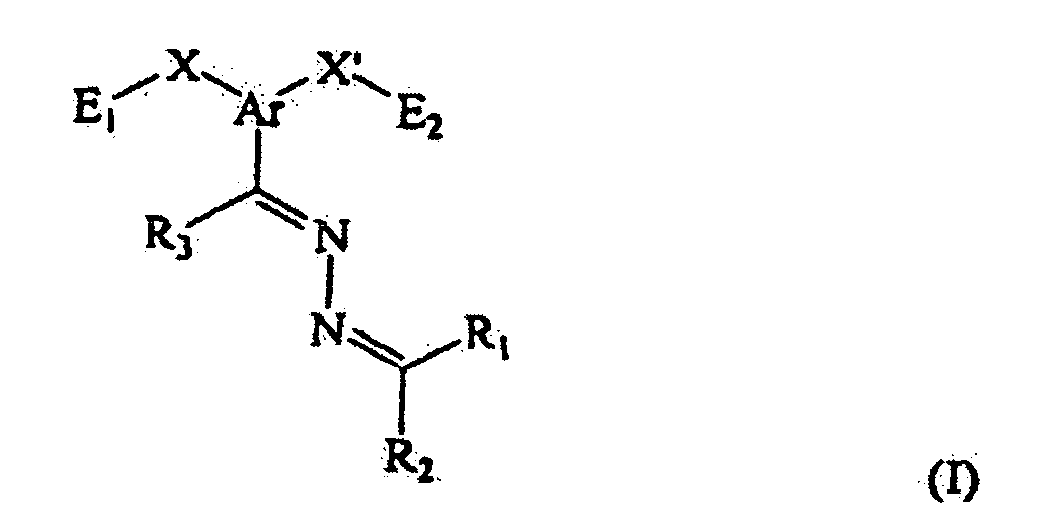
Ar eine aromatische Gruppe umfasst;
R1' R2 und R3 jeweils unabhängig voneinander H, eine Alkylgruppe, eine
Alkenylgruppe, eine Alkinylgruppe, eine aromatische Gruppe oder eine heterocyclische Gruppe umfassen; und
E1 und E2 jeweils unabhängig voneinander eine reaktive Ringgruppe sind; und(b) eine ladungsgenerierende Verbindung. - Ein Organofotorezeptor gemäß Anspruch 1, wobei R1 und R2 jeweils unabhängig voneinander eine [(N,N-disubstituierte)Amino]arylgruppe umfassen.
- Ein Organofotorezeptor gemäß einem der Ansprüche 1 und 2, wobei X und X' jeweils unabhängig voneinander eine -(CH2)p-Gruppe umfassen, worin p eine ganze Zahl zwischen und einschließlich 1 und 10 ist, und eine oder mehrere der Methylengruppen optional durch O, S, N, C, B, Si, P, C=O, O=S=O, eine heterocyclische Gruppe, eine aromatische Gruppe, eine NRa-Gruppe, eine CRb-Gruppe, eine CRcRd-Gruppe oder eine SiReRf-Gruppe ersetzt ist, worin Ra, Rb, Rc, Rd, Re und Rf jeweils unabhängig voneinander eine Bindung, H, eine Hydroxylgruppe, eine Thiolgruppe, eine Carboxylgruppe, eine Aminogruppe, eine Alkylgruppe, eine Alkoxygruppe, eine Alkenylgruppe, eine Alkinylgruppe, eine heterocyclische Gruppe, eine aromatische Gruppe oder ein Teil einer Ringgruppe sind.
- Ein Organofotorezeptor gemäß Anspruch 3, wobei X und X' jeweils unabhängig voneinander eine -Z-CH2-Gruppe sind, worin Z gleich O, S oder eine NRa-Gruppe ist.
- Ein Organofotorezeptor gemäß einem der Ansprüche 1 bis 4, wobei E1 und E2 jeweils unabhängig voneinander eine Epoxygruppe, eine Thiiranylgruppe, eine Aziridinogruppe oder eine Oxetanylgruppe sind.
- Ein Organofotorezeptor gemäß einem der vorangegangenen Ansprüche, wobei das fotoleitende Element zusätzlich ein zweites Ladungstransportmaterial umfasst.
- Ein Organofotorezeptor gemäß Anspruch 6, wobei das zweite Ladungstransportmaterial eine Elektronentransportverbindung umfasst.
- Ein Organofotorezeptor gemäß einem der vorangegangenen Ansprüche, wobei das fotoleitende Element zusätzlich ein Bindemittel umfasst.
- Eine elektrofotografische bildgebende Vorrichtung, umfassend:(a) eine Lichtbild-gebende Komponente; und(b) einen Organofotorezeptor, der so orientiert ist, um Licht aus der Lichtbildgebenden Komponente aufzunehmen, wobei der Organofotorezeptor ein elektrisch leitendes Substrat und ein fotoleitendes Element auf dem elektrisch leitenden Substrat umfasst, wobei das fotoleitende Element das Folgende umfasst:(i) ein Ladungstransportmaterial, wie es in einem der Ansprüche 1 bis 5 definiert wird, und(ii) eine ladungsgenerierende Verbindung.
- Eine elektrofotografische bildgebende Vorrichtung gemäß Anspruch 9, wobei das fotoleitende Element zusätzlich ein zweites Ladungstransportmaterial umfasst.
- Eine elektrofotografische bildgebende Vorrichtung gemäß einem der Ansprüche 9 und 10, die zusätzlich eine Dispensiervorrichtung für Toner umfasst.
- Ein elektrofotografisches bildgebendes Verfahren, umfassend:(a) das Auftragen einer elektrischen Ladung auf eine Oberfläche eines Organofotorezeptors, der ein elektrisch leitendes Substrat und ein fotoleitendes Element auf dem elektrisch leitenden Substrat umfasst, wobei das fotoleitende Element das Folgende umfasst:(i) ein Ladungstransportmaterial, wie es in einem der Ansprüche 1 bis 5 definiert wird; und(ii) eine ladungsgenerierende Verbindung;(b) das bildweise Aussetzen der Oberfläche des Organofotorezeptors an Strahlung, um Ladung in ausgewählten Bereichen zu dissipieren und dadurch ein Muster aus geladenen oder ungeladenen Bereichen auf der Oberfläche zu bilden;(c) das in Kontakt bringen der Oberfläche mit einem Toner, um ein getöntes Bild herzustellen; und(d) das Übertragen des getönten Bildes auf ein Substrat.
- Ein elektrofotografisches bildgebendes Verfahren gemäß Anspruch 12, wobei das fotoleitende Element zusätzlich ein zweites Ladungstransportmaterial umfasst.
- Ein elektrofotografisches bildgebendes Verfahren gemäß einem der Ansprüche 12 und 13, wobei das fotoleitende Element zusätzlich ein Bindemittel umfasst.
- Ein elektrofotografisches bildgebendes Verfahren gemäß einem der Ansprüche 12 bis 14, wobei der Toner Farbstoffpartikel umfasst.
- Ein polymeres Ladungstransportmaterial, das durch die Reaktion zwischen einer funktionellen Gruppe in einem polymeren Bindemittel und wenigstens einer reaktiven Ringgruppe in einem Ladungstransportmaterial, wie es in einem der Ansprüche 1 bis 5 definiert wird, hergestellt wird und wobei das polymere Bindemittel ein Polyvinylbutyrat ist.
- Ein polymeres Ladungstransportmaterial gemäß Anspruch 16, wobei die funktionelle Gruppe aus der Gruppe ausgewählt wird, die aus einer Hydroxylgruppe, einer Thiolgruppe, Aminogruppen und einer Carboxylgruppe besteht.
Applications Claiming Priority (2)
| Application Number | Priority Date | Filing Date | Title |
|---|---|---|---|
| US10/834,656 US7534540B2 (en) | 2004-03-31 | 2004-04-29 | Azine-based charge transport materials having two reactive rings |
| US834656 | 2004-04-29 |
Publications (3)
| Publication Number | Publication Date |
|---|---|
| EP1591835A2 EP1591835A2 (de) | 2005-11-02 |
| EP1591835A3 EP1591835A3 (de) | 2005-12-14 |
| EP1591835B1 true EP1591835B1 (de) | 2007-01-17 |
Family
ID=34941078
Family Applications (1)
| Application Number | Title | Priority Date | Filing Date |
|---|---|---|---|
| EP05252648A Expired - Lifetime EP1591835B1 (de) | 2004-04-29 | 2005-04-28 | Azin-basierte Ladungtransportmaterialien mit zwei reaktiven Ringen |
Country Status (6)
| Country | Link |
|---|---|
| US (1) | US7534540B2 (de) |
| EP (1) | EP1591835B1 (de) |
| JP (1) | JP2005316477A (de) |
| KR (1) | KR100571935B1 (de) |
| CN (1) | CN1693997A (de) |
| DE (1) | DE602005000458T2 (de) |
Families Citing this family (1)
| Publication number | Priority date | Publication date | Assignee | Title |
|---|---|---|---|---|
| JP2018028642A (ja) * | 2016-08-19 | 2018-02-22 | 富士ゼロックス株式会社 | 電子写真感光体、プロセスカートリッジ、及び画像形成装置 |
Family Cites Families (23)
| Publication number | Priority date | Publication date | Assignee | Title |
|---|---|---|---|---|
| US4297426A (en) * | 1979-05-28 | 1981-10-27 | Ricoh Co., Ltd. | Electrophotographic element with carbazole hydrazone or anile charge transport compounds |
| JPH0693127B2 (ja) * | 1986-05-20 | 1994-11-16 | ミノルタ株式会社 | 感光体 |
| JPH01298363A (ja) | 1988-05-26 | 1989-12-01 | Kao Corp | 電子写真感光体 |
| GB8912456D0 (en) | 1989-05-31 | 1989-07-19 | Secr Defence | Polymerisation of cyclic ether monomers capable of undergoing cationic oxonium ion ring-opening polymerisation |
| JP3141504B2 (ja) | 1992-03-03 | 2001-03-05 | 東ソー株式会社 | ポリ塩化ビニル系樹脂組成物 |
| DE69326414T2 (de) | 1992-05-01 | 2000-05-11 | Idemitsu Kosan Co. Ltd., Tokio/Tokyo | Ester-polymer, seine herstellung, und daraus hergestellter elektrophotographischer photorezeptor |
| JP3257089B2 (ja) | 1992-10-28 | 2002-02-18 | 東ソー株式会社 | 熱可塑性エラストマー組成物 |
| JP3497199B2 (ja) | 1993-03-12 | 2004-02-16 | 出光興産株式会社 | ヒドラゾン誘導体及びこれを用いた電子写真感光体 |
| JPH1059952A (ja) * | 1996-08-14 | 1998-03-03 | Takasago Internatl Corp | フェノチアジン誘導体、フェノキサジン誘導体、それを用いた電荷輸送材料及び電子写真感光体 |
| US6066426A (en) * | 1998-10-14 | 2000-05-23 | Imation Corp. | Organophotoreceptors for electrophotography featuring novel charge transport compounds |
| JP4115056B2 (ja) | 1999-12-13 | 2008-07-09 | キヤノン株式会社 | 電子写真感光体、プロセスカートリッジ及び電子写真装置 |
| US6214503B1 (en) * | 1999-12-21 | 2001-04-10 | Imation Corp. | Organophotoreceptors for electrophotography featuring novel charge transport compounds based upon hydroxy-functional compounds |
| US6340548B1 (en) * | 2000-03-16 | 2002-01-22 | Imation Corp. | Organophotoreceptors for electrophotography featuring novel charge transport compounds |
| DE60229695D1 (de) * | 2001-08-10 | 2008-12-18 | Samsung Electronics Co Ltd | Elektrophotographischer organischer Photorezeptor mit Ladungsübertragungsmitteln |
| EP1293837B1 (de) * | 2001-09-14 | 2008-10-08 | Samsung Electronics Co., Ltd. | Elektrophotographischer organischer Photorezeptor |
| US6670085B2 (en) * | 2001-09-24 | 2003-12-30 | Samsung Electronics Co. Ltd | Electrophotographic organophotoreceptors with novel charge transport compounds |
| US6749978B2 (en) * | 2001-09-24 | 2004-06-15 | Samsung Electronics Co., Ltd. | Electrophotographic organophotoreceptors with novel charge transport compounds |
| US7118839B2 (en) * | 2001-09-28 | 2006-10-10 | Samsung Electronics Co., Ltd. | Electrophotographic organophotoreceptors with novel charge transport materials |
| EP1310489B1 (de) | 2001-11-02 | 2006-12-13 | Samsung Electronics Co., Ltd. | Elektrophotographischer organischer Photorezeptor mit Ladungstransportverbindungen |
| EP1310483B9 (de) * | 2001-11-09 | 2006-07-05 | Samsung Electronics Co., Ltd. | Elektrophotografischer organischer Photorezeptor mit Ladungstransportverbindungen |
| US6905804B2 (en) * | 2002-02-08 | 2005-06-14 | Samsung Electronics Co., Ltd. | Electrophotographic organophotoreceptors with novel charge transport materials |
| US6768010B1 (en) * | 2003-09-16 | 2004-07-27 | Samsung Electronics Co., Ltd. | Organophotoreceptor with an epoxy-modified charge transport compound having an azine group |
| US7320848B2 (en) | 2004-03-31 | 2008-01-22 | Samsung Electronics Co., Ltd. | Poly(azine)-based charge transport materials |
-
2004
- 2004-04-29 US US10/834,656 patent/US7534540B2/en not_active Expired - Fee Related
- 2004-07-22 KR KR1020040057159A patent/KR100571935B1/ko not_active Expired - Fee Related
-
2005
- 2005-04-26 JP JP2005128498A patent/JP2005316477A/ja not_active Withdrawn
- 2005-04-27 CN CNA200510068927XA patent/CN1693997A/zh active Pending
- 2005-04-28 DE DE602005000458T patent/DE602005000458T2/de not_active Expired - Fee Related
- 2005-04-28 EP EP05252648A patent/EP1591835B1/de not_active Expired - Lifetime
Also Published As
| Publication number | Publication date |
|---|---|
| DE602005000458D1 (de) | 2007-03-08 |
| US7534540B2 (en) | 2009-05-19 |
| KR20050105426A (ko) | 2005-11-04 |
| JP2005316477A (ja) | 2005-11-10 |
| CN1693997A (zh) | 2005-11-09 |
| US20070148569A9 (en) | 2007-06-28 |
| EP1591835A2 (de) | 2005-11-02 |
| KR100571935B1 (ko) | 2006-04-17 |
| EP1591835A3 (de) | 2005-12-14 |
| US20050244734A1 (en) | 2005-11-03 |
| DE602005000458T2 (de) | 2007-08-23 |
Similar Documents
| Publication | Publication Date | Title |
|---|---|---|
| EP1591836B1 (de) | Ladungstransportmaterialien mit Hydrazongruppe | |
| US7445877B2 (en) | Charge transport materials having a central disulfane linkage | |
| EP1471391B1 (de) | Polymerzusammensetzungen enthaltendes Ladungstransportmaterial | |
| US7348116B2 (en) | Aromatic heterocyclic-based charge transport materials having two amino groups | |
| EP1452924A1 (de) | Organophotorezeptor enthaltend ein ladungstransportierendes Material, welches zwei Hydrazon- Gruppen enthält | |
| EP1555577B1 (de) | Organischer Photorezeptor mit einem Ladungstransportmaterial | |
| EP1591837B1 (de) | Ladungstransportmaterialien mit Hydrazongruppe | |
| US7371493B2 (en) | Charge transport materials having a 1,3,6,8-tetraoxo-1,3,6,8-tetrahydrobenzo[lmn][3,8]phenanthroline-2,7-diyl group | |
| EP1482376A1 (de) | Ladungstransportmaterialen enthaltend heteroaromatische Hydrazongruppen | |
| EP1584986B1 (de) | Polyazine-basierende Ladungstransportverbindungen | |
| US7014968B2 (en) | Organophotoreceptor with charge transport material having a thiiranyl group | |
| EP1584985B1 (de) | Hydrozonbasierende Ladungstransportmaterialen | |
| EP1550914A1 (de) | Organischer Photorezeptor mit einem Ladungstransport -Material enthaltend zwei Epoxy-Hydrazon Gruppen | |
| EP1591835B1 (de) | Azin-basierte Ladungtransportmaterialien mit zwei reaktiven Ringen | |
| EP1591834B1 (de) | Ladungstransportmaterial mit Azingruppe | |
| EP1600821B1 (de) | Verbrückte Ladungstransportmaterialien mit zentraler Schwefelatombindung | |
| US7348112B2 (en) | Polymeric charge transport materials having repeating units comprising an aromatic group and a —S— linkage | |
| EP1569040B1 (de) | Ladungstransportierende Verbindungen enthaltender organischer Photorezeptor | |
| EP1584987B1 (de) | Polyhydrazonbasierende Ladungstransportverbindungen | |
| US7534541B2 (en) | Heterocycle-hydrazone based charge transport materials | |
| EP1550653A1 (de) | Organophotorezeptor enthaltend Ladungstransportmaterial mit mindestens drei verbundenen Hydrazongruppen |
Legal Events
| Date | Code | Title | Description |
|---|---|---|---|
| PUAI | Public reference made under article 153(3) epc to a published international application that has entered the european phase |
Free format text: ORIGINAL CODE: 0009012 |
|
| PUAL | Search report despatched |
Free format text: ORIGINAL CODE: 0009013 |
|
| 17P | Request for examination filed |
Effective date: 20050518 |
|
| AK | Designated contracting states |
Kind code of ref document: A2 Designated state(s): AT BE BG CH CY CZ DE DK EE ES FI FR GB GR HU IE IS IT LI LT LU MC NL PL PT RO SE SI SK TR |
|
| AX | Request for extension of the european patent |
Extension state: AL BA HR LV MK YU |
|
| AK | Designated contracting states |
Kind code of ref document: A3 Designated state(s): AT BE BG CH CY CZ DE DK EE ES FI FR GB GR HU IE IS IT LI LT LU MC NL PL PT RO SE SI SK TR |
|
| AX | Request for extension of the european patent |
Extension state: AL BA HR LV MK YU |
|
| RIC1 | Information provided on ipc code assigned before grant |
Ipc: 7G 03G 5/06 A Ipc: 7C 07D 303/22 B |
|
| GRAP | Despatch of communication of intention to grant a patent |
Free format text: ORIGINAL CODE: EPIDOSNIGR1 |
|
| AKX | Designation fees paid |
Designated state(s): DE FR GB NL |
|
| GRAS | Grant fee paid |
Free format text: ORIGINAL CODE: EPIDOSNIGR3 |
|
| GRAA | (expected) grant |
Free format text: ORIGINAL CODE: 0009210 |
|
| AK | Designated contracting states |
Kind code of ref document: B1 Designated state(s): DE FR GB NL |
|
| REG | Reference to a national code |
Ref country code: GB Ref legal event code: FG4D |
|
| REF | Corresponds to: |
Ref document number: 602005000458 Country of ref document: DE Date of ref document: 20070308 Kind code of ref document: P |
|
| ET | Fr: translation filed | ||
| PLBE | No opposition filed within time limit |
Free format text: ORIGINAL CODE: 0009261 |
|
| STAA | Information on the status of an ep patent application or granted ep patent |
Free format text: STATUS: NO OPPOSITION FILED WITHIN TIME LIMIT |
|
| 26N | No opposition filed |
Effective date: 20071018 |
|
| PGFP | Annual fee paid to national office [announced via postgrant information from national office to epo] |
Ref country code: DE Payment date: 20080502 Year of fee payment: 4 Ref country code: FR Payment date: 20080312 Year of fee payment: 4 |
|
| GBPC | Gb: european patent ceased through non-payment of renewal fee |
Effective date: 20090428 |
|
| NLV4 | Nl: lapsed or anulled due to non-payment of the annual fee |
Effective date: 20091101 |
|
| REG | Reference to a national code |
Ref country code: FR Ref legal event code: ST Effective date: 20091231 |
|
| PG25 | Lapsed in a contracting state [announced via postgrant information from national office to epo] |
Ref country code: DE Free format text: LAPSE BECAUSE OF NON-PAYMENT OF DUE FEES Effective date: 20091103 |
|
| PG25 | Lapsed in a contracting state [announced via postgrant information from national office to epo] |
Ref country code: NL Free format text: LAPSE BECAUSE OF NON-PAYMENT OF DUE FEES Effective date: 20091101 |
|
| PG25 | Lapsed in a contracting state [announced via postgrant information from national office to epo] |
Ref country code: GB Free format text: LAPSE BECAUSE OF NON-PAYMENT OF DUE FEES Effective date: 20090428 Ref country code: FR Free format text: LAPSE BECAUSE OF NON-PAYMENT OF DUE FEES Effective date: 20091222 |
|
| REG | Reference to a national code |
Ref country code: GB Ref legal event code: 732E Free format text: REGISTERED BETWEEN 20170406 AND 20170412 |
|
| REG | Reference to a national code |
Ref country code: FR Ref legal event code: TP Owner name: S-PRINTING SOLUTION CO., LTD., KR Effective date: 20170912 |