EP1594880B1 - Compositions photoprotectrices a base de methyltrialkylsilanes possedant une fonction cinnamate, cinnamamide, benzalmalonamide ou benzalmalonate - Google Patents
Compositions photoprotectrices a base de methyltrialkylsilanes possedant une fonction cinnamate, cinnamamide, benzalmalonamide ou benzalmalonate Download PDFInfo
- Publication number
- EP1594880B1 EP1594880B1 EP03815550A EP03815550A EP1594880B1 EP 1594880 B1 EP1594880 B1 EP 1594880B1 EP 03815550 A EP03815550 A EP 03815550A EP 03815550 A EP03815550 A EP 03815550A EP 1594880 B1 EP1594880 B1 EP 1594880B1
- Authority
- EP
- European Patent Office
- Prior art keywords
- denotes
- formula
- group
- denote
- branched
- Prior art date
- Legal status (The legal status is an assumption and is not a legal conclusion. Google has not performed a legal analysis and makes no representation as to the accuracy of the status listed.)
- Expired - Lifetime
Links
- 0 *COc1ccc(C=C(CN)C(N)=O)cc1 Chemical compound *COc1ccc(C=C(CN)C(N)=O)cc1 0.000 description 3
- NUJGQVCYDKHBDK-UHFFFAOYSA-N CC(C)(OC(C1=Cc(cc2)ccc2OC[Si+](C)(C)C)=O)OC1=O Chemical compound CC(C)(OC(C1=Cc(cc2)ccc2OC[Si+](C)(C)C)=O)OC1=O NUJGQVCYDKHBDK-UHFFFAOYSA-N 0.000 description 1
- SDVDEAQLZCXUFW-UHFFFAOYSA-N CC(C)COC(C(C(OCC(C)C)=O)=Cc(cc1)ccc1OC[N](C)(C)C)=O Chemical compound CC(C)COC(C(C(OCC(C)C)=O)=Cc(cc1)ccc1OC[N](C)(C)C)=O SDVDEAQLZCXUFW-UHFFFAOYSA-N 0.000 description 1
- IRPRAPCGTKLSLH-UHFFFAOYSA-N CCOC(C(C(OCC)=O)=Cc(cc1)ccc1OC[SiH-](C)(C)C)=O Chemical compound CCOC(C(C(OCC)=O)=Cc(cc1)ccc1OC[SiH-](C)(C)C)=O IRPRAPCGTKLSLH-UHFFFAOYSA-N 0.000 description 1
- LRIZCLJPYVIUQO-YFHOEESVSA-N COC(/C(/C(N)=O)=C\c(cc1)ccc1OC)O Chemical compound COC(/C(/C(N)=O)=C\c(cc1)ccc1OC)O LRIZCLJPYVIUQO-YFHOEESVSA-N 0.000 description 1
- GSSOMXFPDBTDFR-UKTHLTGXSA-N COc1ccc(/C=C(/C(OCS(C)(C)C)=O)\C#N)cc1 Chemical compound COc1ccc(/C=C(/C(OCS(C)(C)C)=O)\C#N)cc1 GSSOMXFPDBTDFR-UKTHLTGXSA-N 0.000 description 1
- LQGHBKPIJSBKEY-QPJJXVBHSA-N COc1ccc(/C=C/C(N)=O)cc1 Chemical compound COc1ccc(/C=C/C(N)=O)cc1 LQGHBKPIJSBKEY-QPJJXVBHSA-N 0.000 description 1
- IEEACLGIWDQSJA-UHFFFAOYSA-N COc1ccc(C=C(C(OC[Si](C)(C)C)=O)C(OC[Si](C)(C)C)=O)cc1 Chemical compound COc1ccc(C=C(C(OC[Si](C)(C)C)=O)C(OC[Si](C)(C)C)=O)cc1 IEEACLGIWDQSJA-UHFFFAOYSA-N 0.000 description 1
- IMHKECIXWYMKEV-WQLSENKSSA-N C[Si](C)(C)COc1ccc(/C=C(/CN)\C(N)=O)cc1 Chemical compound C[Si](C)(C)COc1ccc(/C=C(/CN)\C(N)=O)cc1 IMHKECIXWYMKEV-WQLSENKSSA-N 0.000 description 1
Classifications
-
- A—HUMAN NECESSITIES
- A61—MEDICAL OR VETERINARY SCIENCE; HYGIENE
- A61K—PREPARATIONS FOR MEDICAL, DENTAL OR TOILETRY PURPOSES
- A61K8/00—Cosmetics or similar toiletry preparations
- A61K8/18—Cosmetics or similar toiletry preparations characterised by the composition
- A61K8/72—Cosmetics or similar toiletry preparations characterised by the composition containing organic macromolecular compounds
- A61K8/84—Cosmetics or similar toiletry preparations characterised by the composition containing organic macromolecular compounds obtained by reactions otherwise than those involving only carbon-carbon unsaturated bonds
- A61K8/89—Polysiloxanes
- A61K8/891—Polysiloxanes saturated, e.g. dimethicone, phenyl trimethicone, C24-C28 methicone or stearyl dimethicone
- A61K8/893—Polysiloxanes saturated, e.g. dimethicone, phenyl trimethicone, C24-C28 methicone or stearyl dimethicone modified by an alkoxy or aryloxy group, e.g. behenoxy dimethicone or stearoxy dimethicone
-
- A—HUMAN NECESSITIES
- A61—MEDICAL OR VETERINARY SCIENCE; HYGIENE
- A61K—PREPARATIONS FOR MEDICAL, DENTAL OR TOILETRY PURPOSES
- A61K8/00—Cosmetics or similar toiletry preparations
- A61K8/18—Cosmetics or similar toiletry preparations characterised by the composition
- A61K8/30—Cosmetics or similar toiletry preparations characterised by the composition containing organic compounds
- A61K8/58—Cosmetics or similar toiletry preparations characterised by the composition containing organic compounds containing atoms other than carbon, hydrogen, halogen, oxygen, nitrogen, sulfur or phosphorus
- A61K8/585—Organosilicon compounds
-
- A—HUMAN NECESSITIES
- A61—MEDICAL OR VETERINARY SCIENCE; HYGIENE
- A61K—PREPARATIONS FOR MEDICAL, DENTAL OR TOILETRY PURPOSES
- A61K8/00—Cosmetics or similar toiletry preparations
- A61K8/18—Cosmetics or similar toiletry preparations characterised by the composition
- A61K8/72—Cosmetics or similar toiletry preparations characterised by the composition containing organic macromolecular compounds
- A61K8/84—Cosmetics or similar toiletry preparations characterised by the composition containing organic macromolecular compounds obtained by reactions otherwise than those involving only carbon-carbon unsaturated bonds
- A61K8/89—Polysiloxanes
- A61K8/896—Polysiloxanes containing atoms other than silicon, carbon, oxygen and hydrogen, e.g. dimethicone copolyol phosphate
- A61K8/898—Polysiloxanes containing atoms other than silicon, carbon, oxygen and hydrogen, e.g. dimethicone copolyol phosphate containing nitrogen, e.g. amodimethicone, trimethyl silyl amodimethicone or dimethicone propyl PG-betaine
-
- A—HUMAN NECESSITIES
- A61—MEDICAL OR VETERINARY SCIENCE; HYGIENE
- A61Q—SPECIFIC USE OF COSMETICS OR SIMILAR TOILETRY PREPARATIONS
- A61Q17/00—Barrier preparations; Preparations brought into direct contact with the skin for affording protection against external influences, e.g. sunlight, X-rays or other harmful rays, corrosive materials, bacteria or insect stings
- A61Q17/04—Topical preparations for affording protection against sunlight or other radiation; Topical sun tanning preparations
-
- C—CHEMISTRY; METALLURGY
- C07—ORGANIC CHEMISTRY
- C07F—ACYCLIC, CARBOCYCLIC OR HETEROCYCLIC COMPOUNDS CONTAINING ELEMENTS OTHER THAN CARBON, HYDROGEN, HALOGEN, OXYGEN, NITROGEN, SULFUR, SELENIUM OR TELLURIUM
- C07F7/00—Compounds containing elements of Groups 4 or 14 of the Periodic Table
- C07F7/02—Silicon compounds
- C07F7/08—Compounds having one or more C—Si linkages
- C07F7/0803—Compounds with Si-C or Si-Si linkages
- C07F7/081—Compounds with Si-C or Si-Si linkages comprising at least one atom selected from the elements N, O, halogen, S, Se or Te
-
- C—CHEMISTRY; METALLURGY
- C07—ORGANIC CHEMISTRY
- C07F—ACYCLIC, CARBOCYCLIC OR HETEROCYCLIC COMPOUNDS CONTAINING ELEMENTS OTHER THAN CARBON, HYDROGEN, HALOGEN, OXYGEN, NITROGEN, SULFUR, SELENIUM OR TELLURIUM
- C07F7/00—Compounds containing elements of Groups 4 or 14 of the Periodic Table
- C07F7/02—Silicon compounds
- C07F7/08—Compounds having one or more C—Si linkages
- C07F7/0803—Compounds with Si-C or Si-Si linkages
- C07F7/081—Compounds with Si-C or Si-Si linkages comprising at least one atom selected from the elements N, O, halogen, S, Se or Te
- C07F7/0812—Compounds with Si-C or Si-Si linkages comprising at least one atom selected from the elements N, O, halogen, S, Se or Te comprising a heterocyclic ring
Definitions
- the invention relates to photoprotective compositions comprising methyltrialkylsilanes containing a cinnamate, cinnamamide, benzalmalonamide or benzalmalonate function, as sunscreens that are active in the field of UV radiation.
- the invention also relates to novel methyltrialkylsilanes containing a cinnamate, cinnamamide, benzalmalonamide or benzalmalonate function and to uses thereof.
- UV-B radiation radiation with wavelengths of between 280 nm and 400 nm permits tanning of the human epidermis, and that radiation with wavelengths of between 280 and 320 nm, known as UV-B radiation, causes skin burns and erythema that may harm the development of a natural tan. For these reasons, and also for aesthetic reasons, there is increasing demand for means for controlling this natural tanning. This UV-B radiation should thus be screened out.
- UV-A rays with wavelengths of between 320 and 400 nm, which cause browning of the skin, are liable to induce impairment in the skin, especially in the case of sensitive skin and/or skin that is continually exposed to sunlight.
- UV-A rays in particular cause a loss of elasticity of the skin and the appearance of wrinkles, leading to premature ageing of the skin. They promote the triggering of the erythemal reaction or amplify this reaction in the case of certain individuals and may even be the cause of phototoxic or photoallergic reactions.
- UV-A rays for aesthetic and cosmetic reasons such as conservation of the skin's natural elasticity, more and more people wish to control the effect of UV-A rays on their skin. It is thus desirable also to screen out UV-A radiation.
- aromatic compounds that absorb UV radiation in the region between 280 nm and 315 nm, or in the region between 315 nm and 400 nm and beyond, or even within both these regions. They are usually formulated in antisun compositions that are in the form of oil-in-water or water-in-oil emulsions.
- the organic screening agents which are generally lipophilic or hydrophilic, are present in dissolved form, in one or other of these phases, in amounts that are suitable to obtain the desired sun protection factor (SPF).
- the "sun protection factor” means the ratio of the irradiation time required to reach the erythema-forming threshold in the presence of the test screening agent, to the radiation time required to reach this same threshold in the absence of screening agent.
- photoprotective compounds Besides their screening power on sunlight, photoprotective compounds must also have good cosmetic properties, good solubility in the usual solvents and in particular in fatty substances such as oils and fats, good resistance to water and to perspiration (remanence) and satisfactory photostability.
- silane compounds containing benzalmalonate groups described in patent application EP-A-2 868 905 , which describes a process for improving the photostability of dibenzoylmethane derivatives with silane derivatives of benzalmalonates. Mention may also be made of the silane compounds containing benzalmalonate groups described in patent application JP-07-330 779 . In this case also, their solubilities in fatty substances and their cosmetic properties are not always satisfactory.
- the present invention is directed towards solving the above problems by proposing novel, cinnamate, cinnamamide, benzalmalonamide and benzalmalonate derivatives bearing a methyltrialkylsilane chain, which gives these derivatives very good solubility in fatty substances, improved cosmetic properties (such as the softness of feel) and better absorption (higher E1%).
- a first subject of the present invention is thus a cosmetic or dermatological composition for photoprotecting keratin materials, characterized in that it contains at least one methyltrialkylsilane compound corresponding to formula (I) below: in which:
- the alkyl radicals may be linear or branched, saturated or unsaturated, and chosen especially from methyl ethyl, n-propyl, isopropyl, n-butyl, isobutyl, tert-butyl, n-amyl, isoamyl, neopentyl, n-hexyl, n-heptyl, n-octyl, 2-ethylhexyl and tert-octyl radicals.
- the alkyl radical that is particularly preferred is the methyl radical.
- the alkoxy radicals may be linear or branched and chosen especially from methoxy, ethoxy, n-propoxy, isopropoxy, n-butoxy and isobutoxy radicals.
- the alkoxy radical that is particularly preferred is the methoxy radical.
- alkenyl radicals may be linear or branched and chosen especially from ethylene, propylene and butene radicals.
- the aryl radicals are preferably phenyl or benzyl radicals.
- the compounds of formula (I) according to the invention are novel, with the exception of trimethylsilanylmethyl 2-cyano-3-(4-methoxyphenyl)acrylic acid (compound (d) as described above; RN: 165552-16-9) described in the article N.G. Senchenya et al., Tzvestiya Akademii Nauk, Seriya Khimicheskaya, 5, 949-52 (1993) .
- Aromatic benzaldehyde derivatives of formula (4) that may be mentioned include 4-hydroxybenzaldehyde and vanillin, which are commercial products.
- Z'-CH 2 -Z Derivatives of Z'-CH 2 -Z" type that may be mentioned include dimethyl malonate and diethyl malonate, which are commercial products.
- a derivative of formula (6) that may be mentioned is dimethyl para-hydroxybenzalmalonate sold by the company Acros.
- Silane halide derivatives of formula (5) include chloromethyltrimethylsilane (RN 2344-80-1) and bis(chloromethyl)dimethylsilane (RN 2917-46-6), sold by the company Wacker. Mention may also be made of the following commercial products: (chloromethyl)dimethylethylsilane (RN 3121-77-5), (chloromethyl)dimethyl-n-butylsilane (RN 3121-75-3), (chloromethyl)dimethylpentylsilane (RN 73013-39-5), (chloromethyl)dodecyldimethylsilane (RN 70851-47-7), (chloromethyl)triethylsilane (RN 757-34-6), 2-chloroethyltrimethylsilane (RN 7787-87-3), bis(trimethylsilyl)methyl chloride (RN 5926-35-2), (chloromethyl)dimethylphenylsilane (RN 1833-
- Aromatic benzaldehyde derivatives of formula (7) that may be mentioned include 4-methoxybenzaldehyde, veratraldehyde and piperonal, which are commercial products.
- Z'-CH 2 -COOH type that may be mentioned include cyanoacetic acid, monoethyl malonate and mono-tert-butyl malonate, which are commercial products.
- a derivative of Z'-CH 2 COCl type that may be mentioned is monoethyl malonate acid chloride, which is a commercial product.
- Derivatives of formulae (9) and (10) that may be mentioned include hydroxymethyltrimethylsilane and aminomethyltrimethylsilane, sold by the company Gelest, and bis(trimethylsilyl)methylamine (RN 134340-00-4).
- the compounds of formula (I) are generally present in the composition of the invention in proportions of between 0.01% and 20% by weight and preferably between 0.1% and 10% by weight relative to the total weight of the composition.
- compositions in accordance with the invention may also comprise other additional UVA-active and/or UVB-active organic or mineral UV-screening agents, which are water-soluble or liposoluble or even insoluble in the cosmetic solvents commonly used.
- the additional organic screening agents are chosen especially from anthranilates; cinnamic derivatives; dibenzoylmethane derivatives; salicylic derivatives; camphor derivatives; triazine derivatives such as those described in patent applications US 4 367 390 , EP 863 145 , EP 517 104 , EP 570 838 , EP 796 851 , EP 775 698 , EP 878 469 , EP 933 376 , EP 507 691 , EP 507 692 , EP 790 243 , EP 944 624 ; benzophenone derivatives; ⁇ , ⁇ -diphenylacrylate derivatives; benzotriazole derivatives; benzalmalonate derivatives; benzimidazole derivatives; imidazolines; bis-benzazolyl derivatives as described in patents EP 669 323 and US 2 463 264 ; p-aminobenzoic acid (PABA) derivatives; methylenebis(hydroxyphenylbenzotriazole
- the preferred additional organic UV-screening agents are chosen from:
- the additional mineral screening agents are chosen from pigments or nanopigments (mean size of the primary particles: generally between 5 nm and 100 nm and preferably between 10 nm and 50 nm) of coated or uncoated metal oxides such as, for example, nanopigments of titanium oxide (amorphous or crystallized in rutile and/or anatase form), of iron oxide, of zinc oxide, of zirconium oxide or of cerium oxide, which are all UV photoprotective agents that are well known per se. Standard coating agents are, moreover, alumina and/or aluminium stearate. Such coated or uncoated metal oxide nanopigments are described in particular in patent applications EP 518 772 and EP 518 773 .
- the additional UV-screening agents in accordance with the invention are generally present in the compositions according to the invention in proportions ranging from 0.01% to 20% by weight relative to the total weight of the composition, and preferably ranging from 0.1% to 10% by weight relative to the total weight of the composition.
- the cosmetic compositions according to the invention may also contain agents for artificially tanning and/or browning the skin (self-tanning agents) such as dihydroxyacetone (DHA).
- self-tanning agents such as dihydroxyacetone (DHA).
- compositions in accordance with the present invention may also comprise standard cosmetic adjuvants chosen especially from fatty substances, organic solvents, ionic or nonionic thickeners, softeners, humectants, antioxidants, moisturizers, desquamating agents, free-radical scavengers, antipollution agents, antibacterial agents, antiinflammatory agents, depigmenting agents, propigmenting agents, opacifiers, stabilizers, emollients, silicones, antifoams, insect repellents, fragrances, preserving agents, anionic, cationic, nonionic, zwitterionic or amphoteric surfactants, substance P antagonists, substance CGRP antagonists, fillers, pigments, polymers, propellants, acidifying or basifying agents, or any other ingredient usually used in cosmetics and/or dermatology.
- standard cosmetic adjuvants chosen especially from fatty substances, organic solvents, ionic or nonionic thickeners, softeners, humectants, antioxidants
- the fatty substances may consist of an oil or a wax or mixtures thereof.
- oil means a compound that is liquid at room temperature.
- wax means a compound that is solid or substantially solid at room temperature, and whose melting point is generally above 35°C.
- Oils that may be mentioned include mineral oils (paraffin); plant oils (sweet almond oil, macadamia oil, blackcurrant seed oil or jojoba oil); synthetic oils, for instance perhydrosqualene, fatty alcohols, fatty acids or fatty acid esters (for instance the C12-C15 alcohol benzoate sold under the trade name "Finsolv TN" by the company Witco, octyl palmitate, isopropyl lanolate, triglycerides, including capric/caprylic acid triglycerides), oxyethylenated or oxypropylenated fatty esters and ethers; silicone oils (cyclomethicone and polydimethylsiloxanes, or PDMS) or fluoro oils, and polyalkylenes.
- mineral oils paraffin
- plant oils sweet almond oil, macadamia oil, blackcurrant seed oil or jojoba oil
- synthetic oils for instance perhydrosqualene, fatty alcohols, fatty
- Waxy compounds that may be mentioned include paraffin, carnauba wax, beeswax and hydrogenated castor oil.
- organic solvents that may be mentioned are lower alcohols and polyols. These solvents may be chosen from glycols and glycol ethers, for instance ethylene glycol, propylene glycol, butylene glycol, dipropylene glycol or diethylene glycol.
- the thickeners may be chosen especially from crosslinked acrylic polymers, for instance Carbomers, crosslinked polymer acrylates/C10-C30 alkylacrylate crosslinked polymers of the type such as Pemulen or polyacrylate-3 sold under the name Viscophobe DB 1000 by Amerchol; polyacrylamides such as the emulsion of polyacrylamide, C13-C14 isoparaffin and laureth-7 sold under the name Sepigel 305 by SEPPIC, AMPS homopolymers or copolymers such as Hostacerin AMPS sold by Clariant, modified or unmodified guar gums and celluloses, such as hydroxypropyl guar gum, methylhydroxyethylcellulose and hydroxypropylmethyl cellulose, xanthan gum, and nanometric silicas of the Aerosil type.
- crosslinked acrylic polymers for instance Carbomers, crosslinked polymer acrylates/C10-C30 alkylacrylate crosslinked polymers of the type such as Pemulen or poly
- compositions according to the invention may be prepared according to techniques that are well known to those skilled in the art, in particular those intended for the preparation of emulsions of oil-in-water or water-in-oil type.
- This composition may be in particular in the form of a simple or complex emulsion (O/W, W/O, O/W/O or W/O/W emulsion) such as a cream or a milk, in the form of a gel or a cream-gel, or in the form of a lotion, an oil, a powder or a solid tube, and may optionally be packaged as an aerosol and may be in the form of a mousse or a spray.
- a simple or complex emulsion such as a cream or a milk
- a gel or a cream-gel such as a lotion, an oil, a powder or a solid tube
- compositions according to the invention are preferably in the form of an oil-in-water or water-in-oil emulsion.
- the aqueous phase of this emulsion may comprise a nonionic vesicular dispersion prepared according to known processes ( Bangham, Standish and Watkins, J. Mol. Biol. 13, 238 (1965 ), FR 2 315 991 and FR 2 416 008 ).
- the cosmetic composition according to the invention when used to care for the human epidermis, it may be in the form of a suspension or a dispersion in solvents or fatty substances, in the form of a nonionic vesicular dispersion or in the form of an emulsion, preferably of oil-in-water type, such as a cream or a milk, or in the form of an ointment, a gel, a cream-gel, an antisun oil, a solid tube, a powder, an aerosol mousse or a spray.
- a suspension or a dispersion in solvents or fatty substances in the form of a nonionic vesicular dispersion or in the form of an emulsion, preferably of oil-in-water type, such as a cream or a milk, or in the form of an ointment, a gel, a cream-gel, an antisun oil, a solid tube, a powder, an aerosol mousse or a spray.
- the cosmetic composition according to the invention when used for haircare, it may be in the form of a shampoo, a lotion, a gel, an emulsion or a nonionic vesicular dispersion and may constitute, for example, a rinse-out composition, to be applied before or after shampooing, before or after dyeing or bleaching, or before, during or after permanent-waving or relaxing the hair, a styling or treating lotion or gel, a blow-drying or hairsetting lotion or gel, or a composition for permanent-waving, relaxing, dyeing or bleaching the hair.
- composition When used as a makeup product for the nails, the lips, the eyelashes, the eyebrows or the skin, such as an epidermal treatment cream, a foundation, a tube of lipstick, an eyeshadow, a makeup rouge, a mascara or an eyeliner, it may be in solid or pasty, anhydrous or aqueous form, such as oil-in-water or water-in-oil emulsions, nonionic vesicular dispersions or suspensions.
- anhydrous or aqueous form such as oil-in-water or water-in-oil emulsions, nonionic vesicular dispersions or suspensions.
- the aqueous phase (especially comprising the hydrophilic screening agents) generally represents from 50% to 95% by weight and preferably from 70% to 90% by weight relative to the total weight of the formulation
- the oily phase (especially comprising the lipophilic screening agents) generally represents from 5% to 50% by weight and preferably from 10% to 30% by weight relative to the total weight of the formulation
- the (co)-emulsifier(s) generally represent(s) from 0.5% to 20% by weight and preferably from 2% to 10% by weight relative to the total weight of the formulation.
- Another subject of the invention is the use of a compound of formula (I) as defined above in a cosmetic or dermatological composition, as an agent for screening out UV radiation.
- Another subject of the invention is the use of a compound of formula (I) as defined above in a cosmetic composition, as an agent for controlling the variation in the colour of the skin caused by UV radiation.
- Another subject of the invention is the use of a compound of formula (I) as defined above as an agent for photostabilizing synthetic polymers such as plastics or glasses, in particular spectacle glasses or contact lenses.
- Chloromethyltrimethylsilane (110.5 g, 0.9 mol) is added dropwise over 30 minutes to a mixture of para-hydroxybenzaldehyde (110 g, 0.82 mol) and potassium carbonate (124.5 g, 0.9 mol) in 1 L of dry DMF maintained at 80°C, and while sparging with nitrogen. The mixture is left at 90°C for 4 hours. The reaction mixture is filtered and the solvent is removed from the filtrate by distillation under vacuum. The final traces of DMF are removed via a stage at 60°C under a vacuum of 2 mmHg. 142.4 g (yield: 84%) of 4-trimethylsilanylmethoxybenzaldehyde are obtained in the form of an orange-yellow oil, which is used without further purification in the next step.
- Chloromethyltrimethylsilane (9.5 ml, 0.068 mol) is added dropwise over 30 minutes to a mixture of dimethyl para-hydroxybenzalmalonate (15 g, 0.056 mol) and potassium carbonate (9.4 g, 0.068 mol) in 60 ml of dry DMF maintained at 80°C, and while sparging with nitrogen. The mixture is left at 120°C for 2 hours.
- the reaction mixture is cooled and poured into ice-cold water.
- the oily phase is extracted with dichloromethane.
- the organic phase is washed 3 times with water, dried over sodium sulphate and filtered, and the solvent is evaporated off under vacuum.
- Chloromethyltrimethylsilane (9.5 ml, 0.068 mol) is added dropwise over 30 minutes to a mixture of diethyl para-hydroxybenzalmalonate (15 g, 0.056 mol) and potassium carbonate (9.4 g, 0.068 mol) in 60 ml of dry DMF maintained at 80°C, and while sparging with nitrogen. The mixture is left at 120°C for 2 hours.
- the reaction mixture is cooled and poured into ice-cold water.
- the oily phase is extracted with dichloromethane.
- the organic phase is washed 3 times with water, dried over sodium sulphate and filtered, and the solvent is evaporated off under vacuum.
- Chloromethyltrimethylsilane (36.7 g, 0.3 mol) is added dropwise over 10 minutes to a mixture of vanillin (45.6 g, 0.3 mol) and potassium carbonate (41.4 g, 0.3 mol) in 300 ml of dry DMF maintained at 100°C, and while sparging with nitrogen. The mixture is left at 100°C for 2 hours. The reaction mixture is filtered and the solvent is removed from the filtrate by distillation under vacuum. The final traces of DMF are removed via a stage at 60°C under a vacuum of 2 mmHg. 70 g of a pink syrup, which crystallizes, are obtained.
- EXAMPLE 8 Preparation of ethyl 2-(aminocarbonyl)-3-[4-(trimethylsilanylmethoxy)phenyl]acrylate according to route A:
- Bis(chloromethyl)dimethylsilane (1.53 ml, 0.0105 mol) is added dropwise over 30 minutes to a mixture of dimethyl para-hydroxybenzalmalonate (5 g, 0.021 mol) and potassium carbonate (2.9 g, 0.021 mol) in 15 ml of dry DMF maintained at 60°C, and while sparging with nitrogen. The mixture is left at 60°C for 2 hours.
- the reaction mixture is cooled and poured into ice-cold water.
- the oily phase is extracted with dichloromethane.
- the organic phase is washed 3 times with water, dried over sodium sulphate and filtered, and the solvent is evaporated off under vacuum.
- Chloromethyltrimethylsilane (0.4 ml, 2.42 ⁇ 10 -3 mol) is added to a mixture of isopropyl para-hydroxycinnamate (0.5 g, 2.42 ⁇ 10 -3 mol) and potassium carbonate (0.4 g, 2.86 ⁇ 10 -3 mol) in 5 ml of dry DMF maintained at 80°C, and while sparging with nitrogen. The mixture is left at 120°C for 1 hour. The reaction mixture is cooled and poured into ice-cold water. The oily phase is extracted with dichloromethane. The organic phase is washed twice with water, dried over sodium sulphate and filtered, and the solvent is evaporated off under vacuum.
- the fatty phase is weighed out in a beaker.
- the aqueous phase is weighed out in the final beaker.
- the two phases are heated on a waterbath (80°C).
- the aqueous phase is stirred and the fatty phase is poured slowly onto the aqueous phase.
- the mixture is emulsified with vigorous stirring ( ⁇ 1000 rpm).
- the thickener is introduced and stirring is continued for 15 to 20 minutes. At about 30°C, the formulation is neutralized and is allowed to cool to room temperature.
- the Sun Protection Factors (SPF) obtained are: Compositions SPF Example A 2.3 ⁇ 0.2 Example B 9.7 ⁇ 0.7
Landscapes
- Health & Medical Sciences (AREA)
- Life Sciences & Earth Sciences (AREA)
- Organic Chemistry (AREA)
- Animal Behavior & Ethology (AREA)
- General Health & Medical Sciences (AREA)
- Public Health (AREA)
- Veterinary Medicine (AREA)
- Chemical & Material Sciences (AREA)
- Epidemiology (AREA)
- Birds (AREA)
- Dermatology (AREA)
- Cosmetics (AREA)
- Compositions Of Macromolecular Compounds (AREA)
- Organic Low-Molecular-Weight Compounds And Preparation Thereof (AREA)
- Adhesives Or Adhesive Processes (AREA)
Claims (29)
- Composition cosmétique ou dermatologique destinée à la photoprotection de matières kératiniques, caractérisée en ce qu'elle contient, dans un milieu cosmétiquement acceptable, au moins un composé de méthyltrialkylsilane correspondant à la formule (I) ci-après :
 - B désigne un groupement chromophore correspondant à l'une ou l'autre des formules (1) et (2) ci-après :
 - R1 et R2, qui peuvent être identiques ou différents, représentent un radical alkyle en C1-C12 linéaire ou ramifié, éventuellement halogéné ou contenant une double liaison ou une triple liaison ; un radical phényle ou benzyle ;- R3 désigne un radical R1 ou R2 ou un groupement B ;- n est un nombre entier allant de 0 à 3 inclus ;- X désigne -O- ou -NR5- ;- A désigne un atome d'hydrogène ; un radical alkyle en C1-C4 linéaire ou ramifié ; un groupement SiR1R2R3 dans lequel R1, R2 et R3 ont les mêmes significations qu'indiquées ci-dessus, à condition que R3 soit autre que B ;- les radicaux R' désignent un atome d'hydrogène, un radical alkyle en C1-C10 linéaire ou ramifié, un radical alcényle en C2-C8 linéaire ou ramifié ou un groupement Si(CH3)3 ;- les radicaux R", qui peuvent être identiques ou différents, désignent un radical hydroxyle ; un radical alkyle en C1-C10 linéaire ou ramifié ; un radical alcényle en C2-C8 linéaire ou ramifié ; un radical alcoxy en C1-C10 linéaire ou ramifié ; R" formant éventuellement, conjointement avec un R" ou OR' adjacent, un groupement alkylidènedioxy dans lequel le groupement alkylidène contient un ou deux atomes de carbone ; ou un groupement -OSi(CH3)3 ;- Z, Z' et Z", qui peuvent être identiques ou différents, désignent un atome d'hydrogène ; un radical alkyle en C1-C4 linéaire ou ramifié ; un groupement- (C=O)R4, -(C=O)OR4, -SO2R5, -(C=O)NR6R7, -CN ou- (C=O)XCHASiR1R2R3 dans lequel R1, R2 et R3 ont les mêmes significations qu'indiquées ci-dessus, à condition que R3 soit autre que B ; à condition que :(i) au moins un parmi les radicaux Z' et Z" soit autre qu'hydrogène, et(ii) lorsque Z' désigne -SO2R5, alors Z" est autre qu'un groupement -CN ;- R4 désigne un atome d'hydrogène ou un radical alkyle en C1-C20 linéaire ou ramifié ;- R5 désigne un radical alkyle en C1-C20 ou un groupement aryle en C6-C12 ;- R6 et R7, qui peuvent être identiques ou différents, désignent un atome d'hydrogène ou un radical alkyle en C1-C4 ;- Z' et Z" peuvent également former ensemble un acide de Meldrum de formule (3) ci-après :dans laquelle
 - R8 et R9, qui peuvent être identiques ou différents, désignent hydrogène ou un radical alkyle en C1-C20 linéaire ou ramifié ; R8 et R9 peuvent également former ensemble un cycle en C5-C12.
 - Composition selon la revendication 1, contenant au moins un composé de formule (I) dans laquelle B correspond à la formule (1) et dans laquelle les caractéristiques suivantes sont satisfaites :- R1, R2 et R3 désignent un radical alkyle en C1-C4 et plus particulièrement simultanément méthyle ;- Z désigne hydrogène, COOR4 dans lequel R4 désigne alkyle en C1-C8 et plus particulièrement méthyle ; CN ou- (C=O)XCHASiR1R2R3;- A désigne un atome d'hydrogène ;- X désigne O ou NH ;- n = 0 ;- R' désigne un radical alkyle en C1-C4 et plus particulièrement méthyle.
- Composition selon la revendication 2, contenant au moins un composé de formule (I) dans laquelle B correspond à la formule (1) et dans laquelle les caractéristiques suivantes sont satisfaites :- lorsque Z désigne COOR4, alors R4 désigne méthyle ;- R1, R2 et R3 désignent simultanément méthyle.
- Composition selon la revendication 2, dans laquelle le composé de formule (I) est choisi parmi les composés suivants :


- Composition selon la revendication 1, contenant au moins un composé de formule (I) dans laquelle B correspond à la formule (2) et dans laquelle les caractéristiques suivantes sont satisfaites :- A désigne un atome d'hydrogène ;- R1 et R2 désignent alkyle en C1-C4 ;- n = 0 ou 1 avec, lorsque n = 1, R" désigne un radical alcoxy en C1-C4 ;- Z' et Z", qui peuvent être identiques ou différents, désignent un groupement choisi parmi :1) -(C=O)OR4 dans lequel R4 désigne alkyle en C1-C8 ;2) -(C=O)NH2 ;3) -CN ;4) ou un groupement de formule (3) dans laquelle R8 et R9 désignent alkyle en C1-C4.
- Composition selon la revendication 5, dans laquelle les caractéristiques suivantes sont satisfaites :- R1 et R2 désignent simultanément méthyle ;- lorsque Z' et Z" forment un groupement de formule (3), alors R8 et R9 désignent méthyle ;- lorsque n= 1, alors R" désigne méthoxy.
- Composition selon la revendication 5, contenant au moins un composé de formule (I) dans laquelle B correspond à la formule (2), choisi parmi les composés suivants :


- Composition selon l'une quelconque des revendications 1 à 7, caractérisée en ce que le composé de formule (I) est présent dans la composition en une teneur allant de 0,01% à 20% en poids par rapport au poids total de la composition, et préférablement allant de 0,1% à 10% en poids par rapport au poids total de la composition.
- Composition selon l'une quelconque des revendications 1 à 8, caractérisée en ce que ledit support cosmétiquement acceptable est sous la forme d'une émulsion huile-dans-eau ou eau-dans-huile.
- Composition selon l'une quelconque des revendications 1 à 9, caractérisée en ce qu'elle comprend également un ou plusieurs filtres minéraux ou organiques actifs contre les UVA et/ou actifs contre les UVB.
- Composition selon la revendication 10,
caractérisée en ce que lesdits filtres organiques supplémentaires sont choisis parmi les anthranilates ; les dérivés cinnamiques ; les dérivés de dibenzoylméthane ; les dérivés salicyliques ; les dérivés de camphre ; les dérivés de triazine ; les dérivés de benzophénone ; les dérivés de β,β-diphénylacrylate ; les dérivés de benzotriazole ; les dérivés de benzalmalonate ; les dérivés de benzimidazole ; les imidazolines ; les dérivés de bis-benzazolyle ; les dérivés de l'acide p-aminobenzoïque (PABA) ; les dérivés de méthylènebis(hydroxyphénylbenzotriazole) ; les dérivés de benzoxazole ; les polymères filtrants et les silicones filtrantes ; les dimères dérivés de l'α-alkylstyrène ; les 4,4-diarylbutadiènes ; et des mélanges de ceux-ci. - Composition selon la revendication 11,
caractérisée en ce que lesdits filtres organiques supplémentaires sont choisis parmile salicylate d'éthylhexyle,le méthoxycinnamate d'éthylhexyle,le méthoxydibenzoylméthane de butyle,l'octocrylène,l'acide phénylbenzimidazolesulfonique,la benzophénone-3,la benzophénone-4,la benzophénone-5,le 2-(4-diéthylamino-2-hydroxybenzoyl)benzoate de n-hexyle,le 4-méthylbenzylidènecamphre,l'acide téréphtalylidènecamphresulfonique,le phényldibenzimidazoletétrasulfonate disodique,la 2,4,6-tris(4'-aminobenzalmalonate de diisobutyle)-s-triazine,l'anisotriazine,l'éthylhexyltriazone,la diéthylhexylbutamidotriazone,le méthylènebis(benzotriazolyl)tétraméthylbutylphénol,le drométrizole trisiloxane,la polysilicone-15,le 1,1-dicarboxy(2,2'-diméthylpropyl)-4,4-diphénylbutadiène,la 2,4-bis[5-1-diméthylpropyl)benzoxazol-2-yl(4-phényl)imino]-6-(2-éthylhexyl)imino-1,3,5-triazine,et des mélanges de ceux-ci. - Composition selon la revendication 10, caractérisée en ce que les filtres minéraux supplémentaires sont des pigments ou des nanopigments d'oxyde métallique revêtus ou non revêtus.
- Composition selon la revendication 13, caractérisée en ce que lesdits pigments ou nanopigments sont choisis parmi l'oxyde de titane, l'oxyde de zinc, l'oxyde de fer, l'oxyde de zirconium et l'oxyde de cérium, et des mélanges de ceux-ci, pouvant être revêtus ou non revêtus.
- Composition selon l'une quelconque des revendications 1 à 14, caractérisée en ce qu'elle comprend également au moins un agent destiné au brunissage et/ou au bronzage artificiel de la peau.
- Composition selon l'une quelconque des revendications 1 à 15, caractérisée en ce qu'elle comprend également au moins un adjuvant choisi parmi les corps gras, les solvants organiques, les épaississants ioniques ou non ioniques, les adoucissants, les humectants, les antioxydants, les hydratants, les agents de desquamation, les agents anti-radicalaires, les agents anti-pollution, les agents antibactériens, les agents anti-inflammatoires, les agents de dépigmentation, les agents de pro-pigmentation, les opacifiants, les stabilisants, les émollients, les silicones, les agents antimousse, les insectifuges, les parfums, les conservateurs, les agents tensioactifs anioniques, cationiques, non ioniques, zwitterioniques ou amphotères, les antagonistes de la substance P, les antagonistes de la substance CGRP, les charges, les pigments, les polymères, les propulseurs et les agents acidifiants ou alcalinisants.
- Composition selon l'une quelconque des revendications 1 à 16, caractérisée en ce qu'il s'agit d'une composition destinée à protéger l'épiderme humain ou une composition antisolaire, et qu'elle se trouve sous la forme d'une dispersion vésiculaire non ionique, d'une émulsion, en particulier d'une émulsion de type huile-dans-eau, d'une crème, d'un lait, d'un gel, d'un gel crème, d'une suspension, d'une dispersion, d'une huile, d'une poudre, d'un tube solide, d'une mousse ou d'un spray.
- Composition selon l'une quelconque des revendications 1 à 16, caractérisée en ce qu'il s'agit d'une composition de maquillage pour les cils, les sourcils, les ongles ou la peau, et qu'elle est sous forme solide ou pâteuse, anhydre ou aqueuse, ou sous la forme d'une émulsion, d'une suspension ou d'une dispersion.
- Composition selon l'une quelconque des revendications 1 à 16, caractérisée en ce qu'il s'agit d'une composition destinée à protéger les cheveux contre les rayons ultraviolets et qu'elle se trouve sous la forme d'un shampooing, d'une lotion, d'un gel, d'une émulsion ou d'une dispersion vésiculaire non ionique.
- Utilisation d'un composé de silane de formule (I) telle que définie selon l'une quelconque des revendications précédentes, dans une composition cosmétique ou dermatologique, comme agent destiné à filtrer le rayonnement UV.
- Utilisation d'un composé de silane de formule (I) telle que définie selon l'une quelconque des revendications précédentes, dans une composition cosmétique, comme agent destiné à contrôler la variation de couleur de la peau provoquée par le rayonnement UV.
- Utilisation d'un composé de silane de formule (I) telle que définie selon l'une quelconque des revendications précédentes, comme agent destiné à photostabiliser les polymères synthétiques ou les verres.
- Composé de méthyltrialkylsilane correspondant à la formule (I) ci-après :
 - B désigne un groupement chromophore correspondant à l'une ou l'autre des formules (1) et (2) ci-après :
 - R1 et R2, qui peuvent être identiques ou différents, représentent un radical alkyle en C1-C12 linéaire ou ramifié, éventuellement halogéné ou contenant une double liaison ou une triple liaison ; un radical phényle ou benzyle ;- R3 désigne un radical R1 ou R2 ou un groupement B ;- n est un nombre entier allant de 0 à 3 inclus ;- X désigne -O- ou -NR5- ;- A désigne un atome d'hydrogène ; un radical alkyle en C1-C4 linéaire ou ramifié ; un groupement SiR1R2R3 dans lequel R1, R2 et R3 ont les mêmes significations qu'indiquées ci-dessus, à condition que R3 soit autre que B ;- les radicaux R' désignent un atome d'hydrogène, un radical alkyle en C1-C10 linéaire ou ramifié, un radical alcényle en C2-C8 linéaire ou ramifié ou un groupement Si(CH3)3;- les radicaux R", qui peuvent être identiques ou différents, désignent un radical hydroxyle ; un radical alkyle en C1-C10 linéaire ou ramifié ; un radical alcényle en C2-C8 linéaire ou ramifié ; un radical alcoxy en C1-C10 linéaire ou ramifié ; R" formant éventuellement, conjointement avec un R" ou OR' adjacent, un groupement alkylidènedioxy dans lequel le groupement alkylidène contient un ou deux atomes de carbone ; ou un groupement -OSi(CH3)3 ;- Z, Z' et Z", qui peuvent être identiques ou différents, désignent un atome d'hydrogène ; un radical alkyle en C1-C4 linéaire ou ramifié ; un groupement -(C=O)R4, -(C=O)OR4, -SO2R5, -(C=O)NR6R7, -CN ou -(C=O)XCHASiR1R2R3 dans lequel R1, R2 et R3 ont les mêmes significations qu'indiquées ci-dessus, à condition que R3 soit autre que B ; à condition que :(i) au moins un parmi les radicaux Z' et Z" soit autre qu'hydrogène, et(ii) lorsque Z' désigne -SO2R5, alors Z" est autre qu'un groupement -CN ;- R4 désigne un atome d'hydrogène ou un radical alkyle en C1-C20 linéaire ou ramifié ;- R5 désigne un radical alkyle en C1-C20 ou un groupement aryle en C6-C12 ;- R6 et R7, qui peuvent être identiques ou différents, désignent un atome d'hydrogène ou un radical alkyle en C1-C4 ;- Z' et Z" peuvent également former ensemble un acide de Meldrum de formule (3) ci-après :dans laquelle
 - R8 et R9, qui peuvent être identiques ou différents, désignent hydrogène ou un radical alkyle en C1-C20 linéaire ou ramifié ; R8 et R9 peuvent également former ensemble un cycle en C5-C12 ; à l'exception du 2-cyano-3-(4-méthoxyphényl)acrylate de triméthylsilanylméthyle et du (E)-N-[bis(triméthylsilyl)méthyl]-3-(4-méthoxyphényl)-N-(phénylméthyl)-2-propénamide.100
 - Composé selon la revendication 23, dans lequel B correspond à la formule (1) et dans lequel les caractéristiques suivantes sont satisfaites :- R1, R2 et R3 désignent alkyle en C1-C4 et plus particulièrement simultanément méthyle ;- Z désigne gydrogène, COOR4 dans lequel R4 désigne alkyle en C1-C8 et plus particulièrement méthyle ; CN ou -(C=O)XCHASiR1R2R3 ;- A désigne un atome d'hydrohène ;- X désigne O ou NH ;- n = 0 ;- R' désigne un radical alkyle en C1-C4 et plus particulièrement méthyle.
- Composé selon la revendication 24, dans lequel les caractéristiques suivantes sont satisfaites :- lorsque Z désigna COOR4, alors R4 désigne méthyle ;- R1, R2 et R3 désignent simultanment méthyle.
- Composé selon la revendication 24, choisi parmi les comosés suivantes :


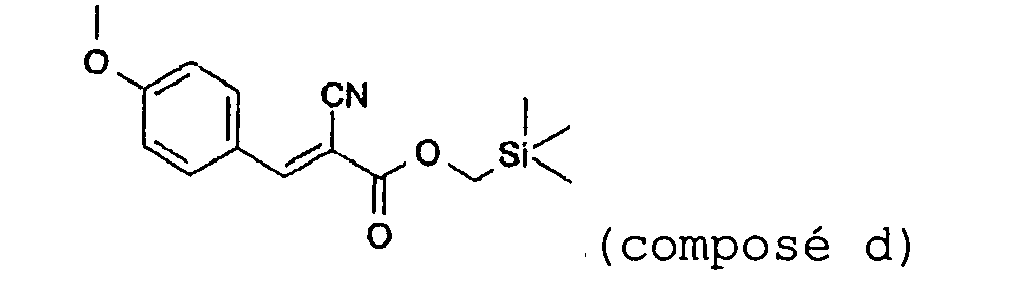

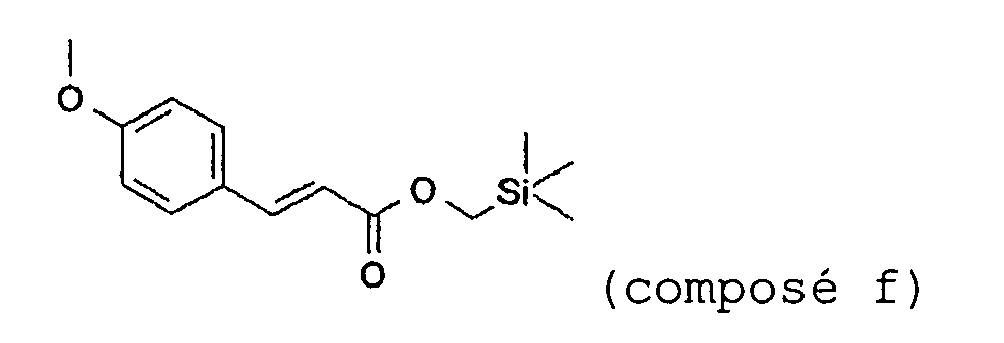
- Composé selon la revendication 23, dans lequel B correspond à la formule (2) et dans lequel les caractéristiques suivantes sont satisfaites :- A désigne un atome d'hydrogène ;- R1 et R2 désignent alkyle en C1-C4 ;- n = 0 ou 1 avec, lorsque n = 1, R" désigne un radical alcoxy en C1-C4 ;- Z' et Z", qui peuvent être identiques ou différents, désignent un groupement choisi parmi :1) -(C=O)OR4 dans lequel R4 désigne en C1-C8 ;2) -(C=O)NH2;3) -CN ;4) un groupement de formule (3) dans laquelle R8 et R9 désignent alkyle en C1-C4.
- Composé selon la revendication 27, dans laquelle les caractéristiques suivantes sont satisfaites :- R1 et R2 désignent simultanément méthyle ;- lorsque Z' et Z" forment un groupement de formule (3), alors R8 et R9 désignent méthyle ;- lorsque n= 1, alors R" désigne méthoxy.
- Composé selon la revendication 27, choisi parmi les molécules suivantes :


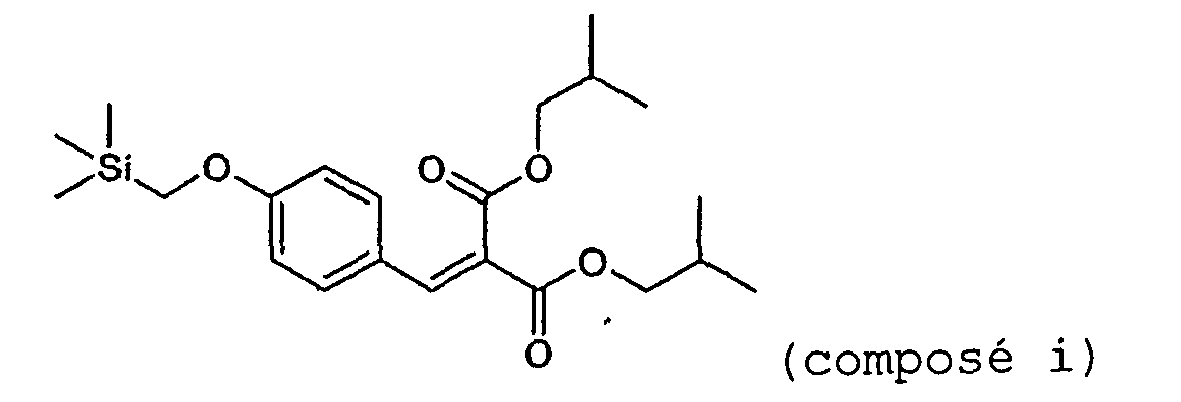
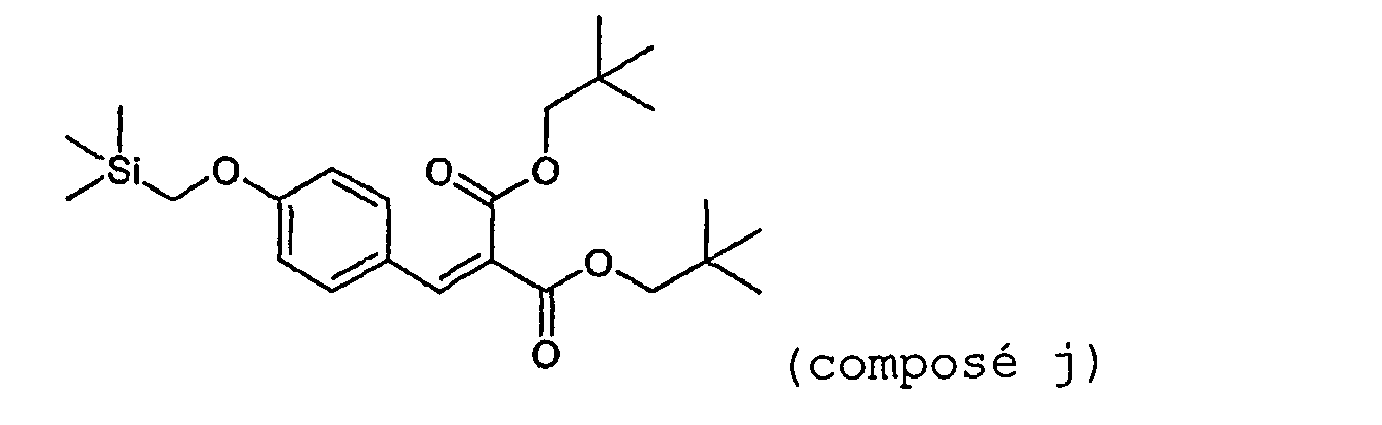


Applications Claiming Priority (5)
| Application Number | Priority Date | Filing Date | Title |
|---|---|---|---|
| FR0300909 | 2003-01-28 | ||
| FR0300909A FR2850382B1 (fr) | 2003-01-28 | 2003-01-28 | Compositions photoprotectrices a base de methyltrialkylsilanes a fonction cinnamate, cinnamamide, benzalmalonamide ou benzalmalonate |
| US45070803P | 2003-03-03 | 2003-03-03 | |
| US450708P | 2003-03-03 | ||
| PCT/EP2003/015038 WO2004067539A1 (fr) | 2003-01-28 | 2003-12-19 | Compositions photoprotectrices a base de methyltrialkylsilanes possedant une fonction cinnamate, cinnamamide, benzalmalonamide ou benzalmalonate |
Publications (2)
| Publication Number | Publication Date |
|---|---|
| EP1594880A1 EP1594880A1 (fr) | 2005-11-16 |
| EP1594880B1 true EP1594880B1 (fr) | 2008-03-19 |
Family
ID=32826942
Family Applications (1)
| Application Number | Title | Priority Date | Filing Date |
|---|---|---|---|
| EP03815550A Expired - Lifetime EP1594880B1 (fr) | 2003-01-28 | 2003-12-19 | Compositions photoprotectrices a base de methyltrialkylsilanes possedant une fonction cinnamate, cinnamamide, benzalmalonamide ou benzalmalonate |
Country Status (8)
| Country | Link |
|---|---|
| US (2) | US7354571B2 (fr) |
| EP (1) | EP1594880B1 (fr) |
| JP (1) | JP4117742B2 (fr) |
| AT (1) | ATE389661T1 (fr) |
| AU (1) | AU2003300564A1 (fr) |
| DE (1) | DE60319884T2 (fr) |
| ES (1) | ES2304551T3 (fr) |
| WO (1) | WO2004067539A1 (fr) |
Cited By (1)
| Publication number | Priority date | Publication date | Assignee | Title |
|---|---|---|---|---|
| DE102008013804A1 (de) * | 2008-03-10 | 2009-09-17 | Beiersdorf Ag | Foundation mit UV-Filterkombination |
Families Citing this family (6)
| Publication number | Priority date | Publication date | Assignee | Title |
|---|---|---|---|---|
| EP1647258A1 (fr) * | 2004-10-13 | 2006-04-19 | L'oreal | Composition capillaire à base de monomères électrophiles et de micro- ou nanoparticule de lubrifiant solide |
| JP5067831B2 (ja) * | 2006-06-16 | 2012-11-07 | 株式会社 資生堂 | ベンジリデンマロンアミド及びその塩、紫外線吸収剤、皮膚外用剤 |
| KR20120018812A (ko) * | 2009-05-29 | 2012-03-05 | 바스프 에스이 | 벤질리덴 말로네이트 |
| KR101390075B1 (ko) | 2009-07-07 | 2014-04-29 | 바스프 에스이 | 벤질리덴 말로네이트를 포함하는 uv 필터 조합물 |
| JP5955583B2 (ja) * | 2012-02-24 | 2016-07-20 | 株式会社Adeka | 新規化合物、染料及び着色感光性組成物 |
| JP6217940B2 (ja) * | 2012-12-19 | 2017-10-25 | 日産化学工業株式会社 | 環状ジエステル基を有するシリコン含有レジスト下層膜形成組成物 |
Family Cites Families (5)
| Publication number | Priority date | Publication date | Assignee | Title |
|---|---|---|---|---|
| JP3447804B2 (ja) * | 1994-06-10 | 2003-09-16 | 花王株式会社 | 有機ケイ素基を有するベンザルマロネート誘導体及びその製造法並びにこれを含有する紫外線吸収剤及び化粧料 |
| FR2760464B1 (fr) * | 1997-03-07 | 2005-07-01 | Oreal | Procede pour ameliorer la photostabilite d'un derive de dibenzoylmethane par un silane, benzalmalonate, procede de preparation de silanes benzalmalonates |
| US6080880A (en) * | 1997-11-28 | 2000-06-27 | Societe L'oreal S.A. | Silicone-substituted cinnamamide/malonamide/malonate compounds and photoprotective compositions comprised thereof |
| DE10113058A1 (de) * | 2001-03-15 | 2002-09-19 | Basf Ag | Verwendung von Lichtschutzmittelkombinationen, die als wesentlichen Bestandteil 2-(4-Alkoxy-anilinomethylen)-malonsäure-dialkylester enthalten als photostabile UV-Filter in kosmetischen und pharmazeutischen Zubereitungen |
| FR2826365B1 (fr) * | 2001-06-20 | 2003-09-26 | Oreal | Compositions cosmetiques photoprotectrices contenant des derives amides, sulfonamides ou carbamates aromatiques d'acrylonitrile et nouveaux derives amides, sulfonamides ou carbamates d'acrylonitrile |
-
2003
- 2003-12-19 EP EP03815550A patent/EP1594880B1/fr not_active Expired - Lifetime
- 2003-12-19 AT AT03815550T patent/ATE389661T1/de not_active IP Right Cessation
- 2003-12-19 AU AU2003300564A patent/AU2003300564A1/en not_active Abandoned
- 2003-12-19 DE DE60319884T patent/DE60319884T2/de not_active Expired - Fee Related
- 2003-12-19 ES ES03815550T patent/ES2304551T3/es not_active Expired - Lifetime
- 2003-12-19 JP JP2005515524A patent/JP4117742B2/ja not_active Expired - Fee Related
- 2003-12-19 WO PCT/EP2003/015038 patent/WO2004067539A1/fr not_active Ceased
-
2005
- 2005-07-27 US US11/189,975 patent/US7354571B2/en not_active Expired - Fee Related
-
2008
- 2008-03-07 US US12/073,670 patent/US20080171802A1/en not_active Abandoned
Cited By (1)
| Publication number | Priority date | Publication date | Assignee | Title |
|---|---|---|---|---|
| DE102008013804A1 (de) * | 2008-03-10 | 2009-09-17 | Beiersdorf Ag | Foundation mit UV-Filterkombination |
Also Published As
| Publication number | Publication date |
|---|---|
| JP2006513272A (ja) | 2006-04-20 |
| US7354571B2 (en) | 2008-04-08 |
| US20060018848A1 (en) | 2006-01-26 |
| EP1594880A1 (fr) | 2005-11-16 |
| ATE389661T1 (de) | 2008-04-15 |
| DE60319884D1 (de) | 2008-04-30 |
| US20080171802A1 (en) | 2008-07-17 |
| AU2003300564A1 (en) | 2004-08-23 |
| DE60319884T2 (de) | 2009-03-05 |
| ES2304551T3 (es) | 2008-10-16 |
| WO2004067539A1 (fr) | 2004-08-12 |
| JP4117742B2 (ja) | 2008-07-16 |
Similar Documents
| Publication | Publication Date | Title |
|---|---|---|
| US7390916B2 (en) | Photoprotective cosmetic compositions containing aromatic amide, sulphonamide or carbamate derivatives of acrylonitrile and novel aromatic amide, sulphonamide or carbamate derivatives of acrylonitrile | |
| US8747816B2 (en) | UV-photoprotective compositions comprising diebenzoylmethane screening agents and silicon-containing s-triazine compounds substituted with two aminobenzoate or aminobenzamide groups | |
| US20080171802A1 (en) | Methyltrialkylsilanes containing a cinnamate, cinnamamide, benzalmalonamide or benzalmalonate function and photostabilizing methods | |
| US7217821B2 (en) | Photoprotective cosmetic compositions comprising para-aminobenzalmalonate-substituted s-triazine compounds | |
| US7432386B2 (en) | Diarylbutadiene-substituted methyltrialkylsilanes and photoprotective compositions comprised thereof | |
| US7138108B2 (en) | Photoprotective UV-screening compositions comprising (phenylsulfonyl) acrylonitrile-substituted silanes/siloxanes | |
| JP4467003B2 (ja) | 4,4−ジアリールブタジエン官能基を有するジオルガノポリシロキサン化合物、それらを含有する光保護用組成物及びその使用 | |
| US7439380B2 (en) | Diarylbutadiene-substituted diorganopolysiloxanes and photoprotective compositions comprised thereof | |
| US7326407B2 (en) | Amine, amide, sulphonamide and carbamate derivatives of benzalmalonic salts and photoprotective cosmetic compositions comprised thereof | |
| JP4301561B2 (ja) | 少なくとも一のグラフト化パラ−アミノベンザルマロン酸塩を有する新規のs−トリアジン誘導体とこれらの誘導体を含有する光保護用化粧品組成物 | |
| JP4242332B2 (ja) | 4,4−ジアリールブタジエン官能基を有するメチルトリアルキルシラン類、それらを含有する化粧品用又は皮膚科学用の光保護用組成物及びその使用 | |
| JP3979970B2 (ja) | (フェニルスルホニル)アクリロニトリルのシラン又はシロキサン誘導体を含有する光保護用組成物、(フェニルスルホニル)アクリロニトリル誘導体、及びそのuv遮蔽剤としての用途 | |
| JP2004262943A (ja) | 新規のベンザルマロン酸塩のアミン、アミド、スルホンアミド及びカルバマート誘導体、これらの誘導体を含有する光保護用化粧品組成物 | |
| FR2850382A1 (fr) | Compositions photoprotectrices a base de methyltrialkylsilanes a fonction cinnamate, cinnamamide, benzalmalonamide ou benzalmalonate |
Legal Events
| Date | Code | Title | Description |
|---|---|---|---|
| PUAI | Public reference made under article 153(3) epc to a published international application that has entered the european phase |
Free format text: ORIGINAL CODE: 0009012 |
|
| 17P | Request for examination filed |
Effective date: 20050829 |
|
| AK | Designated contracting states |
Kind code of ref document: A1 Designated state(s): AT BE BG CH CY CZ DE DK EE ES FI FR GB GR HU IE IT LI LU MC NL PT RO SE SI SK TR |
|
| AX | Request for extension of the european patent |
Extension state: AL LT LV MK |
|
| DAX | Request for extension of the european patent (deleted) | ||
| 17Q | First examination report despatched |
Effective date: 20061128 |
|
| GRAP | Despatch of communication of intention to grant a patent |
Free format text: ORIGINAL CODE: EPIDOSNIGR1 |
|
| GRAC | Information related to communication of intention to grant a patent modified |
Free format text: ORIGINAL CODE: EPIDOSCIGR1 |
|
| RIC1 | Information provided on ipc code assigned before grant |
Ipc: A61Q 17/04 20060101ALI20071109BHEP Ipc: C07F 7/08 20060101AFI20071109BHEP |
|
| GRAS | Grant fee paid |
Free format text: ORIGINAL CODE: EPIDOSNIGR3 |
|
| GRAA | (expected) grant |
Free format text: ORIGINAL CODE: 0009210 |
|
| AK | Designated contracting states |
Kind code of ref document: B1 Designated state(s): AT BE BG CH CY CZ DE DK EE ES FI FR GB GR HU IE IT LI LU MC NL PT RO SE SI SK TR |
|
| REG | Reference to a national code |
Ref country code: GB Ref legal event code: FG4D |
|
| REG | Reference to a national code |
Ref country code: CH Ref legal event code: EP |
|
| REF | Corresponds to: |
Ref document number: 60319884 Country of ref document: DE Date of ref document: 20080430 Kind code of ref document: P |
|
| REG | Reference to a national code |
Ref country code: IE Ref legal event code: FG4D |
|
| PG25 | Lapsed in a contracting state [announced via postgrant information from national office to epo] |
Ref country code: FI Free format text: LAPSE BECAUSE OF FAILURE TO SUBMIT A TRANSLATION OF THE DESCRIPTION OR TO PAY THE FEE WITHIN THE PRESCRIBED TIME-LIMIT Effective date: 20080319 |
|
| PG25 | Lapsed in a contracting state [announced via postgrant information from national office to epo] |
Ref country code: AT Free format text: LAPSE BECAUSE OF FAILURE TO SUBMIT A TRANSLATION OF THE DESCRIPTION OR TO PAY THE FEE WITHIN THE PRESCRIBED TIME-LIMIT Effective date: 20080319 |
|
| NLV1 | Nl: lapsed or annulled due to failure to fulfill the requirements of art. 29p and 29m of the patents act | ||
| ET | Fr: translation filed | ||
| PG25 | Lapsed in a contracting state [announced via postgrant information from national office to epo] |
Ref country code: SI Free format text: LAPSE BECAUSE OF FAILURE TO SUBMIT A TRANSLATION OF THE DESCRIPTION OR TO PAY THE FEE WITHIN THE PRESCRIBED TIME-LIMIT Effective date: 20080319 Ref country code: BE Free format text: LAPSE BECAUSE OF FAILURE TO SUBMIT A TRANSLATION OF THE DESCRIPTION OR TO PAY THE FEE WITHIN THE PRESCRIBED TIME-LIMIT Effective date: 20080319 |
|
| REG | Reference to a national code |
Ref country code: ES Ref legal event code: FG2A Ref document number: 2304551 Country of ref document: ES Kind code of ref document: T3 |
|
| PG25 | Lapsed in a contracting state [announced via postgrant information from national office to epo] |
Ref country code: PT Free format text: LAPSE BECAUSE OF FAILURE TO SUBMIT A TRANSLATION OF THE DESCRIPTION OR TO PAY THE FEE WITHIN THE PRESCRIBED TIME-LIMIT Effective date: 20080826 Ref country code: CZ Free format text: LAPSE BECAUSE OF FAILURE TO SUBMIT A TRANSLATION OF THE DESCRIPTION OR TO PAY THE FEE WITHIN THE PRESCRIBED TIME-LIMIT Effective date: 20080319 Ref country code: SE Free format text: LAPSE BECAUSE OF FAILURE TO SUBMIT A TRANSLATION OF THE DESCRIPTION OR TO PAY THE FEE WITHIN THE PRESCRIBED TIME-LIMIT Effective date: 20080619 Ref country code: SK Free format text: LAPSE BECAUSE OF FAILURE TO SUBMIT A TRANSLATION OF THE DESCRIPTION OR TO PAY THE FEE WITHIN THE PRESCRIBED TIME-LIMIT Effective date: 20080319 |
|
| PG25 | Lapsed in a contracting state [announced via postgrant information from national office to epo] |
Ref country code: RO Free format text: LAPSE BECAUSE OF FAILURE TO SUBMIT A TRANSLATION OF THE DESCRIPTION OR TO PAY THE FEE WITHIN THE PRESCRIBED TIME-LIMIT Effective date: 20080319 Ref country code: NL Free format text: LAPSE BECAUSE OF FAILURE TO SUBMIT A TRANSLATION OF THE DESCRIPTION OR TO PAY THE FEE WITHIN THE PRESCRIBED TIME-LIMIT Effective date: 20080319 |
|
| PLBE | No opposition filed within time limit |
Free format text: ORIGINAL CODE: 0009261 |
|
| STAA | Information on the status of an ep patent application or granted ep patent |
Free format text: STATUS: NO OPPOSITION FILED WITHIN TIME LIMIT |
|
| PG25 | Lapsed in a contracting state [announced via postgrant information from national office to epo] |
Ref country code: DK Free format text: LAPSE BECAUSE OF FAILURE TO SUBMIT A TRANSLATION OF THE DESCRIPTION OR TO PAY THE FEE WITHIN THE PRESCRIBED TIME-LIMIT Effective date: 20080319 |
|
| 26N | No opposition filed |
Effective date: 20081222 |
|
| PGFP | Annual fee paid to national office [announced via postgrant information from national office to epo] |
Ref country code: IT Payment date: 20081222 Year of fee payment: 6 |
|
| PG25 | Lapsed in a contracting state [announced via postgrant information from national office to epo] |
Ref country code: BG Free format text: LAPSE BECAUSE OF FAILURE TO SUBMIT A TRANSLATION OF THE DESCRIPTION OR TO PAY THE FEE WITHIN THE PRESCRIBED TIME-LIMIT Effective date: 20080619 Ref country code: EE Free format text: LAPSE BECAUSE OF FAILURE TO SUBMIT A TRANSLATION OF THE DESCRIPTION OR TO PAY THE FEE WITHIN THE PRESCRIBED TIME-LIMIT Effective date: 20080319 |
|
| PGFP | Annual fee paid to national office [announced via postgrant information from national office to epo] |
Ref country code: ES Payment date: 20090120 Year of fee payment: 6 Ref country code: FR Payment date: 20081212 Year of fee payment: 6 |
|
| PGFP | Annual fee paid to national office [announced via postgrant information from national office to epo] |
Ref country code: DE Payment date: 20081211 Year of fee payment: 6 |
|
| PGFP | Annual fee paid to national office [announced via postgrant information from national office to epo] |
Ref country code: GB Payment date: 20081217 Year of fee payment: 6 |
|
| PG25 | Lapsed in a contracting state [announced via postgrant information from national office to epo] |
Ref country code: MC Free format text: LAPSE BECAUSE OF NON-PAYMENT OF DUE FEES Effective date: 20081231 |
|
| REG | Reference to a national code |
Ref country code: CH Ref legal event code: PL |
|
| PG25 | Lapsed in a contracting state [announced via postgrant information from national office to epo] |
Ref country code: CY Free format text: LAPSE BECAUSE OF FAILURE TO SUBMIT A TRANSLATION OF THE DESCRIPTION OR TO PAY THE FEE WITHIN THE PRESCRIBED TIME-LIMIT Effective date: 20080319 |
|
| PG25 | Lapsed in a contracting state [announced via postgrant information from national office to epo] |
Ref country code: LI Free format text: LAPSE BECAUSE OF NON-PAYMENT OF DUE FEES Effective date: 20081231 Ref country code: IE Free format text: LAPSE BECAUSE OF NON-PAYMENT OF DUE FEES Effective date: 20081219 Ref country code: CH Free format text: LAPSE BECAUSE OF NON-PAYMENT OF DUE FEES Effective date: 20081231 |
|
| PG25 | Lapsed in a contracting state [announced via postgrant information from national office to epo] |
Ref country code: HU Free format text: LAPSE BECAUSE OF FAILURE TO SUBMIT A TRANSLATION OF THE DESCRIPTION OR TO PAY THE FEE WITHIN THE PRESCRIBED TIME-LIMIT Effective date: 20080920 Ref country code: LU Free format text: LAPSE BECAUSE OF NON-PAYMENT OF DUE FEES Effective date: 20081219 |
|
| GBPC | Gb: european patent ceased through non-payment of renewal fee |
Effective date: 20091219 |
|
| PG25 | Lapsed in a contracting state [announced via postgrant information from national office to epo] |
Ref country code: TR Free format text: LAPSE BECAUSE OF FAILURE TO SUBMIT A TRANSLATION OF THE DESCRIPTION OR TO PAY THE FEE WITHIN THE PRESCRIBED TIME-LIMIT Effective date: 20080319 |
|
| REG | Reference to a national code |
Ref country code: FR Ref legal event code: ST Effective date: 20100831 |
|
| PG25 | Lapsed in a contracting state [announced via postgrant information from national office to epo] |
Ref country code: GR Free format text: LAPSE BECAUSE OF FAILURE TO SUBMIT A TRANSLATION OF THE DESCRIPTION OR TO PAY THE FEE WITHIN THE PRESCRIBED TIME-LIMIT Effective date: 20080620 Ref country code: FR Free format text: LAPSE BECAUSE OF NON-PAYMENT OF DUE FEES Effective date: 20091231 |
|
| PG25 | Lapsed in a contracting state [announced via postgrant information from national office to epo] |
Ref country code: DE Free format text: LAPSE BECAUSE OF NON-PAYMENT OF DUE FEES Effective date: 20100701 |
|
| PG25 | Lapsed in a contracting state [announced via postgrant information from national office to epo] |
Ref country code: GB Free format text: LAPSE BECAUSE OF NON-PAYMENT OF DUE FEES Effective date: 20091219 |
|
| REG | Reference to a national code |
Ref country code: ES Ref legal event code: FD2A Effective date: 20110309 |
|
| PG25 | Lapsed in a contracting state [announced via postgrant information from national office to epo] |
Ref country code: IT Free format text: LAPSE BECAUSE OF NON-PAYMENT OF DUE FEES Effective date: 20091219 |
|
| PG25 | Lapsed in a contracting state [announced via postgrant information from national office to epo] |
Ref country code: ES Free format text: LAPSE BECAUSE OF NON-PAYMENT OF DUE FEES Effective date: 20110308 |
|
| PG25 | Lapsed in a contracting state [announced via postgrant information from national office to epo] |
Ref country code: ES Free format text: LAPSE BECAUSE OF NON-PAYMENT OF DUE FEES Effective date: 20091220 |