EP1596037A2 - Schaufelanordnung - Google Patents
Schaufelanordnung Download PDFInfo
- Publication number
- EP1596037A2 EP1596037A2 EP05252279A EP05252279A EP1596037A2 EP 1596037 A2 EP1596037 A2 EP 1596037A2 EP 05252279 A EP05252279 A EP 05252279A EP 05252279 A EP05252279 A EP 05252279A EP 1596037 A2 EP1596037 A2 EP 1596037A2
- Authority
- EP
- European Patent Office
- Prior art keywords
- blades
- blade
- arrangement
- blade arrangement
- damping
- Prior art date
- Legal status (The legal status is an assumption and is not a legal conclusion. Google has not performed a legal analysis and makes no representation as to the accuracy of the status listed.)
- Withdrawn
Links
- 238000013016 damping Methods 0.000 claims abstract description 40
- 230000001939 inductive effect Effects 0.000 claims abstract description 13
- 238000000034 method Methods 0.000 claims description 32
- 230000000977 initiatory effect Effects 0.000 claims description 25
- 239000004020 conductor Substances 0.000 claims description 17
- 230000036541 health Effects 0.000 claims description 3
- 238000012544 monitoring process Methods 0.000 claims description 2
- 230000008859 change Effects 0.000 description 7
- 239000000463 material Substances 0.000 description 6
- 230000004907 flux Effects 0.000 description 5
- 230000000694 effects Effects 0.000 description 3
- 239000012530 fluid Substances 0.000 description 3
- 239000002245 particle Substances 0.000 description 3
- 230000001141 propulsive effect Effects 0.000 description 3
- 230000005284 excitation Effects 0.000 description 2
- 230000009471 action Effects 0.000 description 1
- 230000003213 activating effect Effects 0.000 description 1
- 238000003491 array Methods 0.000 description 1
- 230000008901 benefit Effects 0.000 description 1
- 230000015556 catabolic process Effects 0.000 description 1
- 238000002485 combustion reaction Methods 0.000 description 1
- 230000006835 compression Effects 0.000 description 1
- 238000007906 compression Methods 0.000 description 1
- 230000003750 conditioning effect Effects 0.000 description 1
- 238000013461 design Methods 0.000 description 1
- 238000001514 detection method Methods 0.000 description 1
- 238000006073 displacement reaction Methods 0.000 description 1
- 230000009977 dual effect Effects 0.000 description 1
- 230000005672 electromagnetic field Effects 0.000 description 1
- 230000037406 food intake Effects 0.000 description 1
- 239000000446 fuel Substances 0.000 description 1
- 230000006872 improvement Effects 0.000 description 1
- 238000007689 inspection Methods 0.000 description 1
- 238000009413 insulation Methods 0.000 description 1
- 238000005259 measurement Methods 0.000 description 1
- 239000007769 metal material Substances 0.000 description 1
- 239000000203 mixture Substances 0.000 description 1
- 238000012986 modification Methods 0.000 description 1
- 230000004048 modification Effects 0.000 description 1
- 230000000737 periodic effect Effects 0.000 description 1
- 230000009467 reduction Effects 0.000 description 1
- 239000007787 solid Substances 0.000 description 1
- 238000003325 tomography Methods 0.000 description 1
- 238000012546 transfer Methods 0.000 description 1
- 239000013585 weight reducing agent Substances 0.000 description 1
Images



Classifications
-
- F—MECHANICAL ENGINEERING; LIGHTING; HEATING; WEAPONS; BLASTING
- F04—POSITIVE - DISPLACEMENT MACHINES FOR LIQUIDS; PUMPS FOR LIQUIDS OR ELASTIC FLUIDS
- F04D—NON-POSITIVE-DISPLACEMENT PUMPS
- F04D29/00—Details, component parts, or accessories
- F04D29/66—Combating cavitation, whirls, noise, vibration or the like; Balancing
- F04D29/661—Combating cavitation, whirls, noise, vibration or the like; Balancing especially adapted for elastic fluid pumps
- F04D29/668—Combating cavitation, whirls, noise, vibration or the like; Balancing especially adapted for elastic fluid pumps damping or preventing mechanical vibrations
-
- F—MECHANICAL ENGINEERING; LIGHTING; HEATING; WEAPONS; BLASTING
- F01—MACHINES OR ENGINES IN GENERAL; ENGINE PLANTS IN GENERAL; STEAM ENGINES
- F01D—NON-POSITIVE DISPLACEMENT MACHINES OR ENGINES, e.g. STEAM TURBINES
- F01D5/00—Blades; Blade-carrying members; Heating, heat-insulating, cooling or antivibration means on the blades or the members
- F01D5/12—Blades
- F01D5/26—Antivibration means not restricted to blade form or construction or to blade-to-blade connections or to the use of particular materials
-
- F—MECHANICAL ENGINEERING; LIGHTING; HEATING; WEAPONS; BLASTING
- F04—POSITIVE - DISPLACEMENT MACHINES FOR LIQUIDS; PUMPS FOR LIQUIDS OR ELASTIC FLUIDS
- F04D—NON-POSITIVE-DISPLACEMENT PUMPS
- F04D25/00—Pumping installations or systems
- F04D25/02—Units comprising pumps and their driving means
- F04D25/06—Units comprising pumps and their driving means the pump being electrically driven
- F04D25/0606—Units comprising pumps and their driving means the pump being electrically driven the electric motor being specially adapted for integration in the pump
- F04D25/066—Linear Motors
-
- F—MECHANICAL ENGINEERING; LIGHTING; HEATING; WEAPONS; BLASTING
- F05—INDEXING SCHEMES RELATING TO ENGINES OR PUMPS IN VARIOUS SUBCLASSES OF CLASSES F01-F04
- F05D—INDEXING SCHEME FOR ASPECTS RELATING TO NON-POSITIVE-DISPLACEMENT MACHINES OR ENGINES, GAS-TURBINES OR JET-PROPULSION PLANTS
- F05D2270/00—Control
- F05D2270/01—Purpose of the control system
- F05D2270/09—Purpose of the control system to cope with emergencies
- F05D2270/096—Purpose of the control system to cope with emergencies caused by water or hail ingestion
-
- F—MECHANICAL ENGINEERING; LIGHTING; HEATING; WEAPONS; BLASTING
- F05—INDEXING SCHEMES RELATING TO ENGINES OR PUMPS IN VARIOUS SUBCLASSES OF CLASSES F01-F04
- F05D—INDEXING SCHEME FOR ASPECTS RELATING TO NON-POSITIVE-DISPLACEMENT MACHINES OR ENGINES, GAS-TURBINES OR JET-PROPULSION PLANTS
- F05D2270/00—Control
- F05D2270/01—Purpose of the control system
- F05D2270/11—Purpose of the control system to prolong engine life
-
- F—MECHANICAL ENGINEERING; LIGHTING; HEATING; WEAPONS; BLASTING
- F05—INDEXING SCHEMES RELATING TO ENGINES OR PUMPS IN VARIOUS SUBCLASSES OF CLASSES F01-F04
- F05D—INDEXING SCHEME FOR ASPECTS RELATING TO NON-POSITIVE-DISPLACEMENT MACHINES OR ENGINES, GAS-TURBINES OR JET-PROPULSION PLANTS
- F05D2300/00—Materials; Properties thereof
- F05D2300/50—Intrinsic material properties or characteristics
- F05D2300/507—Magnetic properties
-
- Y—GENERAL TAGGING OF NEW TECHNOLOGICAL DEVELOPMENTS; GENERAL TAGGING OF CROSS-SECTIONAL TECHNOLOGIES SPANNING OVER SEVERAL SECTIONS OF THE IPC; TECHNICAL SUBJECTS COVERED BY FORMER USPC CROSS-REFERENCE ART COLLECTIONS [XRACs] AND DIGESTS
- Y02—TECHNOLOGIES OR APPLICATIONS FOR MITIGATION OR ADAPTATION AGAINST CLIMATE CHANGE
- Y02T—CLIMATE CHANGE MITIGATION TECHNOLOGIES RELATED TO TRANSPORTATION
- Y02T50/00—Aeronautics or air transport
- Y02T50/60—Efficient propulsion technologies, e.g. for aircraft
-
- Y—GENERAL TAGGING OF NEW TECHNOLOGICAL DEVELOPMENTS; GENERAL TAGGING OF CROSS-SECTIONAL TECHNOLOGIES SPANNING OVER SEVERAL SECTIONS OF THE IPC; TECHNICAL SUBJECTS COVERED BY FORMER USPC CROSS-REFERENCE ART COLLECTIONS [XRACs] AND DIGESTS
- Y10—TECHNICAL SUBJECTS COVERED BY FORMER USPC
- Y10S—TECHNICAL SUBJECTS COVERED BY FORMER USPC CROSS-REFERENCE ART COLLECTIONS [XRACs] AND DIGESTS
- Y10S416/00—Fluid reaction surfaces, i.e. impellers
- Y10S416/50—Vibration damping features
Definitions
- the invention relates to a blade arrangement, particularly but not exclusively for a gas turbine engine for an aircraft.
- the blades of fans, propellers, compressors and turbines of aircraft engines are generally mounted on a rotor so as to extend radially outwardly from a central axis and to rotate about that axis.
- a casing is usually provided around the tips of the blades, remote from the rotor, for containment of the blades should one of them break off the rotor. The casing may also enhance the aerodynamic flow over the blades.
- Blades may be subject to vibration excitation from numerous different sources.
- any type of obstruction in front of or behind the blade arrangement the flow of fluid over the blades is not uniform and the lack of uniformity in the fluid stream can excite some components of vibration in the blades.
- Another source of excitation arises when the blades are struck by objects borne in the fluid stream. A particular case of this is the widely appreciated phenomenon of bird strike for aircraft engines.
- the casing around the blades is conventional for the casing around the blades to be made from a sacrificial material which is worn away by the blades. This ensures a minimum tip clearance between the tips of the blades and the internal surface of the casing.
- the size of this clearance gap is very important in determining the efficiency of the blade stage. When the blades vibrate in an axial direction, this causes additional wearing away of the sacrificial material, resulting in an axially elongated groove. This can reduce the efficiency of the blade stage in addition to contributing to possible fatigue of the blades. Limiting this axial displacement would increase the blade fatigue life, which could make significant weight reduction possible.
- the present invention is concerned with the damping of blade vibrations, particularly vibrations in an axial direction of the engine.
- a blade arrangement including an array of radially extending blades mounted for rotation about a central axis, characterised in that the blade arrangement further includes a damping arrangement comprising means for inducing an axi-symmetric magnetic field whose axis of symmetry coincides with the central axis of rotation of the blades, the damping arrangement being configured such that when the magnetic field is induced, any movement of a blade other than pure rotation about the central axis results in the magnetic field causing a force to be exerted on the blade, the force resisting such movement.
- the damping arrangement includes a current carrying conductor.
- the conductor preferably forms a loop around the array of blades, the loop being arranged axi-symmetrically around the central axis of rotation of the blades.
- the damping arrangement may include a plurality of such conductors.
- loops may be formed from a single conductor wound many times in a close packed helix, with direction changes preferably clockwise, anticlockwise, and then clockwise again, so that the total number of clockwise loops is equal to the total number of anticlockwise loops.
- the blade arrangement may further include a casing which surrounds the array of blades.
- the conductors may be mounted on or in the casing.
- the blades are elongate, including blade tips remote from the central axis.
- the damping arrangement includes means for inducing a magnetic field having its maximum field strength in the region of the blade tips.
- the damping arrangement may include means for inducing the magnetic field only on receiving an initiation signal, which may indicate an increased likelihood of vibration of the blades.
- the blade arrangement may include a controller for providing the initiation signal.
- the controller may be configured to provide the initiation signal at times when resonant vibration of the blades is likely.
- the blade arrangement may comprise a fan, propeller, compressor or turbine stage for a gas turbine engine for an aircraft.
- control means may be configured to provide the initiation signal at least during take off.
- the blade arrangement may further include a sensor arrangement for location in the gas turbine engine in a position axially forward of the array of blades.
- the sensor arrangement may include a plurality of sensors for sensing foreign bodies entering the engine.
- the sensors may be electrostatic, capacitive, optic or other sensors configured for mounting around a periphery of an intake region of the engine.
- the controller is configured to provide the initiation signal a calculated time period after a foreign body is sensed.
- the controller may include a processor provided with inputs indicative of the distance of each sensor from the array of blades and the speed of travel of the engine and configured to calculate the time period depending upon the inputs.
- the controller may be configured to provide the initiation signal for a predetermined time period only.
- the time period may be between 0.1 and 2 seconds.
- the controller may also be used to store information about the usage of the damping system and/or about debris ingestion, and may thus instruct manual inspection or be used to predict component life (reduction).
- a gas turbine engine comprising a blade arrangement according to any of the preceding definitions.
- the blade arrangement may comprise a fan, propeller, compressor or turbine stage for the gas turbine engine.
- a method of damping blades of a blade arrangement including an array of radially extending blades mounted for rotation about a central axis, characterised in that the method includes the step of inducing an axi-symmetric magnetic field whose axis of symmetry coincides with the central axis of rotation of the blades, the magnetic field being such that any movement of a blade other than pure rotation about the central axis results in the magnetic field causing a force to be exerted on the blade, the force resisting such movement.
- the method includes the step of causing a current to flow in a conductor which forms a loop around the array of blades.
- the method may include the step of inducing the magnetic field only on receiving an initiation signal, which may indicate an increased likelihood of vibration of the blades.
- the method may include the step of providing the initiation signal at times when resonant vibration of the blades is likely.
- the method may be for damping blades in a blade arrangement comprising a fan, propeller, compressor or turbine stage for a gas turbine engine for an aircraft.
- the initiation signal may be provided at least during vulnerable times, such as take-off.
- the method may further include the step of providing a sensor arrangement located in the gas turbine engine in a position axially forward of the array of blades.
- the method may include the step of using the sensors to sense foreign bodies entering the engine.
- the method may include the step of providing the initiation signal a calculated time period after a foreign body is sensed.
- the method may include the step of providing inputs indicative of the distance of each sensor from the array of blades and the relative speed of travel of the air entering the engine and the aircraft and thereby calculating the time period depending upon the inputs.
- the method may include the step of providing the initiation signal for a predetermined time period only.
- the method may also provide an input into an engine health monitoring system, which might track the number of high amplitude vibrations and thereby assess the remaining useful safe component life.
- a gas turbine engine is generally indicated at 10 and comprises, in axial flow series, an air intake 11, a propulsive fan 12, an intermediate pressure compressor 13, a high pressure compressor 14, a combustor 15, a turbine arrangement comprising a high pressure turbine 16, an intermediate pressure turbine 17 and a low pressure turbine 18, and an exhaust nozzle 19.
- the gas turbine engine 10 operates in a conventional manner so that air entering the intake 11 is accelerated by the fan 12 which produce two air flows: a first air flow into the intermediate pressure compressor 13 and a second air flow which provides propulsive thrust.
- the intermediate pressure compressor compresses the air flow directed into it before delivering that air to the high pressure compressor 14 where further compression takes place.
- the compressed air exhausted from the high pressure compressor 14 is directed into the combustor 15 where it is mixed with fuel and the mixture combusted.
- the resultant hot combustion products then expand through, and thereby drive, the high, intermediate and low pressure turbines 16, 17 and 18 before being exhausted through the nozzle 19 to provide additional propulsive thrust.
- the high, intermediate and low pressure turbines 16, 17 and 18 respectively drive the high and intermediate pressure compressors 14 and 13 and the fan 12 by suitable interconnecting shafts.
- the fan, compressor and turbine of the above gas turbine engine each comprise one or more arrays of blades mounted on a rotor so as to extend radially outwardly therefrom.
- the blades are mounted such that they can rotate about a central axis, X - X (see Fig. 1) this coinciding with the central axis of the gas turbine engine.
- Fig. 2 shows a fan blade 20 mounted within a casing 22.
- the blade 20 includes a root portion 24 via which the blade 20 is mounted on a rotor 26, and an aerofoil portion 28, the radially outermost part of which comprises a blade tip 30.
- the casing 22 may be provided with a sacrificial material on its inner surface, the material being worn away by the blade tips 30 of the respective blades 20, thereby providing minimum blade tip clearance.
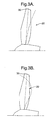
- vibration of the blade 20 can occur generally in an axial direction of the engine, in a first flap mode (see Fig. 3A) or a second flap mode (see Fig. 3B). Such vibration may cause significant axial movement of the blade tips 30.
- the resonance frequency associated with the first flap mode is typically just above first engine order, generally around 450 rad/s.
- the second flap resonance frequency might be in the order of 750 rad/s. It is desirable that these modes of vibration in particular are damped.
- Vibration may also be caused by foreign bodies entering the engine and either contacting the blades or at least disrupting the airflow over the blades. This is a particular problem with fan blades. It is therefore also desirable to damp out vibration caused by such foreign bodies.
- blades may quickly fatigue and can break off, usually (but not always) near to their roots.
- vibration of the blades in the axial direction wears an excessively large groove in any sacrificial material of the casing, thus reducing efficiency.
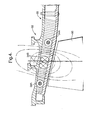
- a blade arrangement 31 includes a damping arrangement 32 comprising in this example two pairs of rings of electrical conductors 34A, 34B. Two of the rings 34A are arranged to conduct electrical current in a clockwise direction about the axis of the machine and the other two rings 34B are arranged to conduct the same electrical current in an anti-clockwise direction about the axis of the machine (as viewed from the air intake).
- the damping arrangement could include just one pair of rings of electrical conductors, or more than two pairs.
- the current through the rings 34A and 34B is controlled by a controller in the form of a damper control unit 35 (shown highly diagrammatically in Fig. 2) which provides an initiation signal when the current is to flow.
- a damper control unit 35 shown highly diagrammatically in Fig. 2 which provides an initiation signal when the current is to flow.
- the net magnetic dipole created is zero so that the field strength dies away very quickly at any significant distance away from the conductors.
- the field strength is at a maximum near the tips 30 of the blades.
- the magnetic field cutting through any conductive body may be caused to change by either:
- any motion of the fan blades other than a pure rotation about their central axis will result in a change in the lines of flux cutting the blades. This will result in eddy currents being induced and the force will resist the movement of the blade. For example, if the blade starts to vibrate in an axial direction, this vibration causes eddy currents and the effect of the resulting force is to damp the vibration.
- the shape and configuration of a blade 20 in many engines is such that its tip 30 is solid, as opposed to the main body of the aerofoil portion 28, which is hollow or partially comprised of non-metallic material.
- eddy currents tend to be primarily induced in the tip portion 30, thus assisting the damping action.
- the controller may be configured such that the initiation signal causes current to flow through the conductors 34A, 34B at times when blade vibration is particularly likely. For example, current may be caused to flow through the conductor during take-off or at engine speeds which are known to trigger resonant vibration of the blades.
- Figs. 5 to 7 illustrate a further embodiment of the invention in which the damper control unit 35 may cause the initiation means to trigger the flow of current only or particularly at certain times when additional damping is required.
- a fan blade arrangement 31 comprising a plurality of fan blades 20 mounted on a rotor 26 in a gas turbine engine.
- the air intake 11 of the gas turbine engine is provided with a plurality of electrostatic debris sensors 38 arranged in tomography configuration. The sensors may be located on tapes 40 attached to the air intake.
- the sensors 38 are able to detect particles entering the air intake 11 and, by using several sensors and tomography software, the polar position and approximate particle size can be determined by software in a debris sensor unit 42.
- a number of sensors 38 can be used to track the progress of a particle and thus to provide a value for its velocity.
- the sensors 38 are axially spaced, with one sensor as close to the engine as possible.
- the sensors are also radially spaced.
- the sensors monitor an electrostatic charge, the charge signals being converted to voltage signals using a charge amplifier, filter and signal conditioning electronics in the sensor unit 42.
- the signals from the sensors are processed to produce charge and velocity values which are passed to the damper control unit 35. The combination of these values can be used by the damper control unit 35 to determine whether the debris material is potentially damaging or dangerous and to calculate the likely impact on the fan blades.
- the above information can be used to determine whether damping is required and the amount of damping necessary.
- a signal can then be provided by the damper control unit 35, to cause current to flow through the coils 34A, 34B thus activating the damping arrangement.
- the current will generally be held on for a time period which is at least several times longer than the periodic time of the vibrations to be damped, but not so long that the coil overheats. (The temperature of the coil is likely to rise almost linearly with time, and the coil design must be such that the conductor and insulation is still below thermal breakdown at the end of the damping period). Alternatively, the current may be held on for longer periods if the coil is super conducting.
- a sensor 43 may be provided to detect blade flutter and initiate blade damping. This may be through a differential pressure, absolute pressure or stall wire measurement/detection.
- Parameters from the engine controller 45 may be used to predict that blades will change speed or otherwise be more likely to vibrate.
- the damper control unit 35 may also pass signals to an engine health monitor 44, which monitors and reports on the overall condition of the engine.
- a high damping level is required which would require the transfer of a significant charge into an inductive coil.
- this is done by utilising a dual coil system, using one coil set to store the energy before switching or pulsing across into the other coil set, the coils being set up as a resonant pair L-C circuit.
- both coils would act in changing the magnetic flux and so produce damping that could be switched quickly.
- the coils have identical but opposite total axial MMFs (magneto motive forces).
- a damping arrangement which only effects damping when required.
- the current may flow permanently in the coils 34 but would only have a damping effect when the blade 20 vibrated (i.e. would not take any energy out of the rotating blades normally) or the current may only flow when a signal indicates that damping is required, for example when debris is sensed.
- This is an improvement over existing arrangements which tend to take energy out of the blades even when damping is not required.
- the above arrangement also has the advantage that it does not add any weight to the blades.
Landscapes
- Engineering & Computer Science (AREA)
- Mechanical Engineering (AREA)
- General Engineering & Computer Science (AREA)
- Structures Of Non-Positive Displacement Pumps (AREA)
- Turbine Rotor Nozzle Sealing (AREA)
Applications Claiming Priority (2)
| Application Number | Priority Date | Filing Date | Title |
|---|---|---|---|
| GBGB0410778.5A GB0410778D0 (en) | 2004-05-13 | 2004-05-13 | Blade arrangement |
| GB0410778 | 2004-05-13 |
Publications (2)
| Publication Number | Publication Date |
|---|---|
| EP1596037A2 true EP1596037A2 (de) | 2005-11-16 |
| EP1596037A3 EP1596037A3 (de) | 2011-12-21 |
Family
ID=32527042
Family Applications (1)
| Application Number | Title | Priority Date | Filing Date |
|---|---|---|---|
| EP05252279A Withdrawn EP1596037A3 (de) | 2004-05-13 | 2005-04-12 | Schaufelanordnung |
Country Status (3)
| Country | Link |
|---|---|
| US (1) | US7399158B2 (de) |
| EP (1) | EP1596037A3 (de) |
| GB (1) | GB0410778D0 (de) |
Cited By (6)
| Publication number | Priority date | Publication date | Assignee | Title |
|---|---|---|---|---|
| EP2072755A1 (de) | 2007-12-21 | 2009-06-24 | Siemens Aktiengesellschaft | Magnetische Vorrichtung zur Dämpfung von Schaufelschwingungen bei Strömungsmaschinen |
| EP2256302A1 (de) * | 2009-05-05 | 2010-12-01 | Rolls-Royce plc | Kanalwand für ein Gebläse eines Gasturbinenmotors |
| EP2273076A1 (de) * | 2009-05-05 | 2011-01-12 | Rolls-Royce plc | Kanalwand für ein Gebläse eines Gasturbinenmotors |
| EP2947269A1 (de) * | 2014-05-22 | 2015-11-25 | United Technologies Corporation | Gasturbinenmotorschaufelkrümmung |
| EP3000976A1 (de) * | 2014-09-29 | 2016-03-30 | Siemens Aktiengesellschaft | Verfahren zum Beeinflussen eines Schwingungszustands eines Läuferbauteils, zugehörige System und Fluidenergiemaschine |
| EP2363576A3 (de) * | 2010-03-05 | 2017-12-06 | Rolls-Royce plc | Berstschutzring für ein Flugtriebwerk |
Families Citing this family (10)
| Publication number | Priority date | Publication date | Assignee | Title |
|---|---|---|---|---|
| FR2921978B1 (fr) * | 2007-10-08 | 2014-04-11 | Snecma | Turboreacteur a generateur electrique agence dans la soufflante |
| EP2253801A1 (de) * | 2009-05-12 | 2010-11-24 | Alstom Technology Ltd | Rotorschaufel mit Schwingungsdämpfungssystem |
| US7955054B2 (en) * | 2009-09-21 | 2011-06-07 | Pratt & Whitney Rocketdyne, Inc. | Internally damped blade |
| US8066479B2 (en) | 2010-04-05 | 2011-11-29 | Pratt & Whitney Rocketdyne, Inc. | Non-integral platform and damper for an airfoil |
| GB201302815D0 (en) | 2013-02-19 | 2013-04-03 | Rolls Royce Plc | Determining the deterioration of a gas turbine engine in use |
| JP6335537B2 (ja) * | 2014-02-12 | 2018-05-30 | 三菱日立パワーシステムズ株式会社 | 翼振動制御装置、翼振動制御方法、及び回転機械 |
| JP6380845B2 (ja) * | 2014-12-22 | 2018-08-29 | 三菱日立パワーシステムズ株式会社 | 回転機械 |
| US20160319845A1 (en) * | 2015-05-01 | 2016-11-03 | Rolls-Royce North American Technologies Inc. | Fan blade monitoring and control system |
| ES2701323T3 (es) * | 2016-01-19 | 2019-02-21 | MTU Aero Engines AG | Etapa de turbomáquina |
| CN114589168A (zh) * | 2022-02-15 | 2022-06-07 | 华能陇东能源有限责任公司 | 一种电气设备除尘降温除湿装置及除尘降温除湿的方法 |
Citations (3)
| Publication number | Priority date | Publication date | Assignee | Title |
|---|---|---|---|---|
| US3775763A (en) | 1972-03-07 | 1973-11-27 | Us Air Force | Apparatus for indicating the impending failure of a jet engine |
| WO1984001438A1 (en) | 1982-10-04 | 1984-04-12 | United Technologies Corp | Noncontact electrostatic hoop probe for combustion engines |
| EP0256845A2 (de) | 1986-08-20 | 1988-02-24 | Stewart Hughes Limited | Überwachung der Abgase eines Düsenflugzeugmotors |
Family Cites Families (7)
| Publication number | Priority date | Publication date | Assignee | Title |
|---|---|---|---|---|
| GB217924A (en) | 1923-06-22 | 1924-10-02 | British Thomson Houston Co Ltd | Improvements in and relating to elastic fluid turbine rotors and methods of avoiding tangential bucket vibration therein |
| DE3667521D1 (de) | 1985-08-31 | 1990-01-18 | Bbc Brown Boveri & Cie | Einrichtung zur daempfung von schaufelschwingungen bei turbomaschinen. |
| GB8707187D0 (en) * | 1987-03-25 | 1987-04-29 | Hughes Ltd Stewart | Monitoring of foreign object in engines |
| US5490759A (en) * | 1994-04-28 | 1996-02-13 | Hoffman; Jay | Magnetic damping system to limit blade tip vibrations in turbomachines |
| DE19505389A1 (de) * | 1995-02-17 | 1996-08-22 | Abb Research Ltd | Schwingungsdämpfung für Turbinenschaufeln |
| US6213737B1 (en) * | 1997-04-18 | 2001-04-10 | Ebara Corporation | Damper device and turbomolecular pump with damper device |
| GB2365945B (en) * | 2000-08-16 | 2004-02-11 | Rolls Royce Plc | A vibration damping system and a method of damping vibrations |
-
2004
- 2004-05-13 GB GBGB0410778.5A patent/GB0410778D0/en not_active Ceased
-
2005
- 2005-04-12 EP EP05252279A patent/EP1596037A3/de not_active Withdrawn
- 2005-04-13 US US11/104,485 patent/US7399158B2/en not_active Expired - Fee Related
Patent Citations (3)
| Publication number | Priority date | Publication date | Assignee | Title |
|---|---|---|---|---|
| US3775763A (en) | 1972-03-07 | 1973-11-27 | Us Air Force | Apparatus for indicating the impending failure of a jet engine |
| WO1984001438A1 (en) | 1982-10-04 | 1984-04-12 | United Technologies Corp | Noncontact electrostatic hoop probe for combustion engines |
| EP0256845A2 (de) | 1986-08-20 | 1988-02-24 | Stewart Hughes Limited | Überwachung der Abgase eines Düsenflugzeugmotors |
Cited By (9)
| Publication number | Priority date | Publication date | Assignee | Title |
|---|---|---|---|---|
| EP2072755A1 (de) | 2007-12-21 | 2009-06-24 | Siemens Aktiengesellschaft | Magnetische Vorrichtung zur Dämpfung von Schaufelschwingungen bei Strömungsmaschinen |
| US8568088B2 (en) | 2007-12-21 | 2013-10-29 | Siemens Aktiengesellschaft | Magnetic device for damping blade vibrations in turbomachines |
| EP2256302A1 (de) * | 2009-05-05 | 2010-12-01 | Rolls-Royce plc | Kanalwand für ein Gebläse eines Gasturbinenmotors |
| EP2273076A1 (de) * | 2009-05-05 | 2011-01-12 | Rolls-Royce plc | Kanalwand für ein Gebläse eines Gasturbinenmotors |
| US8434995B2 (en) | 2009-05-05 | 2013-05-07 | Rolls-Royce Plc | Duct wall for a fan of a gas turbine engine |
| US8506234B2 (en) | 2009-05-05 | 2013-08-13 | Rolls-Royce Plc | Duct wall for a fan of a gas turbine engine |
| EP2363576A3 (de) * | 2010-03-05 | 2017-12-06 | Rolls-Royce plc | Berstschutzring für ein Flugtriebwerk |
| EP2947269A1 (de) * | 2014-05-22 | 2015-11-25 | United Technologies Corporation | Gasturbinenmotorschaufelkrümmung |
| EP3000976A1 (de) * | 2014-09-29 | 2016-03-30 | Siemens Aktiengesellschaft | Verfahren zum Beeinflussen eines Schwingungszustands eines Läuferbauteils, zugehörige System und Fluidenergiemaschine |
Also Published As
| Publication number | Publication date |
|---|---|
| GB0410778D0 (en) | 2004-06-16 |
| EP1596037A3 (de) | 2011-12-21 |
| US7399158B2 (en) | 2008-07-15 |
| US20050254940A1 (en) | 2005-11-17 |
Similar Documents
| Publication | Publication Date | Title |
|---|---|---|
| US7399158B2 (en) | Blade arrangement | |
| CN104234837B (zh) | 用于抑制在涡轮机的进气口的构造上形成冰的方法和设备 | |
| Yuan et al. | Efficient computational techniques for mistuning analysis of bladed discs: a review | |
| US7688081B2 (en) | Apparatus to measure the clearance between a first component and a second component | |
| US7884490B1 (en) | Resonating blade for electric power generation | |
| EP3093440A1 (de) | Gebläseschaufelschwingungsüberwachungs- und -steuerungssystem und -verfahren | |
| JP2007292069A (ja) | タービンエンジン用の監視システム及びガスタービンエンジン組立体 | |
| JP2013144977A (ja) | ターボ機械ブレード監視システム | |
| US20120102701A1 (en) | Method for reducing vibration amplitudes | |
| CN110168199A (zh) | 用于燃气涡轮发动机的可控磁流变装置 | |
| EP1312766A2 (de) | Einrichtung und Methode zur Entdeckung einer beschädigten Rotorschaufel | |
| US9140187B2 (en) | Magnetic de-icing | |
| US20160090860A1 (en) | Damping system for a turbomachine slip ring | |
| CA2992487A1 (en) | Piezoelectric vibratory control for static engine components | |
| US5709527A (en) | Vibration damping for turbine blades | |
| US10822965B2 (en) | Active airfoil vibration control | |
| KR20150131247A (ko) | 상이한 후행 에지 프로파일을 갖는 교호하는 베인을 갖는 베인 장치 | |
| US20160194961A1 (en) | Piezoelectric damping rings | |
| WO2018089057A9 (en) | Gas turbine engine installed monitoring and control to prevent standing wave dynamic resonance | |
| US3502967A (en) | System for detecting twist and bend in turbine blades | |
| GB2540469B (en) | Composite component | |
| KR102252548B1 (ko) | 모터에 의해 구동 가능한 과급기의 진동 억제 방법 및 진동 억제 장치 | |
| US2701092A (en) | Rotary compressor | |
| US6409465B1 (en) | Blade vibration control in turbo-machinery | |
| RU2411466C1 (ru) | Способ обнаружения резонансных колебаний лопаток ротора турбомашины |
Legal Events
| Date | Code | Title | Description |
|---|---|---|---|
| PUAI | Public reference made under article 153(3) epc to a published international application that has entered the european phase |
Free format text: ORIGINAL CODE: 0009012 |
|
| AK | Designated contracting states |
Kind code of ref document: A2 Designated state(s): AT BE BG CH CY CZ DE DK EE ES FI FR GB GR HU IE IS IT LI LT LU MC NL PL PT RO SE SI SK TR |
|
| AX | Request for extension of the european patent |
Extension state: AL BA HR LV MK YU |
|
| PUAL | Search report despatched |
Free format text: ORIGINAL CODE: 0009013 |
|
| AK | Designated contracting states |
Kind code of ref document: A3 Designated state(s): AT BE BG CH CY CZ DE DK EE ES FI FR GB GR HU IE IS IT LI LT LU MC NL PL PT RO SE SI SK TR |
|
| AX | Request for extension of the european patent |
Extension state: AL BA HR LV MK YU |
|
| RIC1 | Information provided on ipc code assigned before grant |
Ipc: F04D 29/66 20060101ALI20111114BHEP Ipc: F01D 5/26 20060101AFI20111114BHEP |
|
| 17P | Request for examination filed |
Effective date: 20111207 |
|
| 17Q | First examination report despatched |
Effective date: 20120625 |
|
| AKX | Designation fees paid |
Designated state(s): DE FR GB |
|
| RAP1 | Party data changed (applicant data changed or rights of an application transferred) |
Owner name: ROLLS-ROYCE PLC |
|
| STAA | Information on the status of an ep patent application or granted ep patent |
Free format text: STATUS: EXAMINATION IS IN PROGRESS |
|
| STAA | Information on the status of an ep patent application or granted ep patent |
Free format text: STATUS: THE APPLICATION IS DEEMED TO BE WITHDRAWN |
|
| 18D | Application deemed to be withdrawn |
Effective date: 20161101 |