EP1600775B1 - Verfahren zur Anti-Limulus-Faktoren-unabhängien Bestimmung der Lipopolysaccarid- und/oder Lipid-A- und/oder Glukan-Reaktivität - Google Patents
Verfahren zur Anti-Limulus-Faktoren-unabhängien Bestimmung der Lipopolysaccarid- und/oder Lipid-A- und/oder Glukan-Reaktivität Download PDFInfo
- Publication number
- EP1600775B1 EP1600775B1 EP05009273A EP05009273A EP1600775B1 EP 1600775 B1 EP1600775 B1 EP 1600775B1 EP 05009273 A EP05009273 A EP 05009273A EP 05009273 A EP05009273 A EP 05009273A EP 1600775 B1 EP1600775 B1 EP 1600775B1
- Authority
- EP
- European Patent Office
- Prior art keywords
- lps
- limulus
- sample
- lipid
- glucan
- Prior art date
- Legal status (The legal status is an assumption and is not a legal conclusion. Google has not performed a legal analysis and makes no representation as to the accuracy of the status listed.)
- Expired - Lifetime
Links
Images






Classifications
-
- G—PHYSICS
- G01—MEASURING; TESTING
- G01N—INVESTIGATING OR ANALYSING MATERIALS BY DETERMINING THEIR CHEMICAL OR PHYSICAL PROPERTIES
- G01N33/00—Investigating or analysing materials by specific methods not covered by groups G01N1/00 - G01N31/00
- G01N33/48—Biological material, e.g. blood, urine; Haemocytometers
- G01N33/50—Chemical analysis of biological material, e.g. blood, urine; Testing involving biospecific ligand binding methods; Immunological testing
- G01N33/92—Chemical analysis of biological material, e.g. blood, urine; Testing involving biospecific ligand binding methods; Immunological testing involving lipids, e.g. cholesterol, lipoproteins, or their receptors
-
- G—PHYSICS
- G01—MEASURING; TESTING
- G01N—INVESTIGATING OR ANALYSING MATERIALS BY DETERMINING THEIR CHEMICAL OR PHYSICAL PROPERTIES
- G01N33/00—Investigating or analysing materials by specific methods not covered by groups G01N1/00 - G01N31/00
- G01N33/48—Biological material, e.g. blood, urine; Haemocytometers
- G01N33/50—Chemical analysis of biological material, e.g. blood, urine; Testing involving biospecific ligand binding methods; Immunological testing
- G01N33/579—Chemical analysis of biological material, e.g. blood, urine; Testing involving biospecific ligand binding methods; Immunological testing involving limulus lysate
-
- Y—GENERAL TAGGING OF NEW TECHNOLOGICAL DEVELOPMENTS; GENERAL TAGGING OF CROSS-SECTIONAL TECHNOLOGIES SPANNING OVER SEVERAL SECTIONS OF THE IPC; TECHNICAL SUBJECTS COVERED BY FORMER USPC CROSS-REFERENCE ART COLLECTIONS [XRACs] AND DIGESTS
- Y10—TECHNICAL SUBJECTS COVERED BY FORMER USPC
- Y10T—TECHNICAL SUBJECTS COVERED BY FORMER US CLASSIFICATION
- Y10T436/00—Chemistry: analytical and immunological testing
- Y10T436/25—Chemistry: analytical and immunological testing including sample preparation
- Y10T436/25125—Digestion or removing interfering materials
Definitions
- the present invention relates to an improved assay for determining lipopolysaccharide and / or lipid A and / or glucan reactivity in body fluids.
- reactivity is understood to mean the activity of lipopolysaccharide and / or lipid A and / or glucan, in particular beta-1,3-D-glucan, in a biological fluid, such as, for example, plasma.
- Reactive lipopolysaccharide and / or lipid A and / or glucan is pathophysiologically and / or pharmacologically-toxicologically active and / or free lipopolysaccharide and / or lipid-A and / or glucan.
- LPS lipopolysaccharides
- DIC pathological disseminated intravascular coagulation
- the cell wall of Gram-negative bacteria consists partly of LPS (formerly known as endotoxin), which is composed of a harmless polysaccharide part and a lipid A part which is dangerous for many cells.
- LPS originally known as endotoxin
- LPS and / or lipid A and / or glucan reactivity is of high pathophysiological importance: active LPS and / or free LPS and / or active and / or free lipid A and / or active and / or free glucan reacts for example very intense with the monocytes of the blood or the endothelium.
- the monocytes can be strongly activated or destroyed, and the cell interior comes into contact with plasma and platelets.
- the present invention provides a method which mimics the pathophysiological interaction, ie the reactivity, of LPS or lipid A or glucan with sensitive cells, the cells and / or cell membranes being replaced by the limulus factors in vitro.
- a method which within minutes LPS, lipid A or glucans, especially reactive and / or free LPS and / or reactive and / or free lipid-A and / or reactive and / or free glucans, sensitive and specifically detected, is therefore of great clinical importance.
- LPS is detected by the Limulus assay [ Hurley JC Endotoxemia: methods of detection and clinical correlates. Clinical Microbiology Reviews 1995; 8: 268-292 ].
- the principle of this test is that LPS - but also glucans - activate the coagulogen / coagulin system of the horseshoe crab (Limulus polyphemus), called the limulus system.
- the limulus system for LPS or lipid A consists essentially of the following factors: factor C, factor B, factor A and coagulogen.
- LPS or lipid A activates factor C
- activated factor C activates factor B
- activated factor B activates factor A
- Activated factor A converts soluble coagulogen to insoluble coagulin.
- glucans which are fungal components
- factor G which is activated by glucans, particularly beta-1,3-D-glucan, to a serine protease, thereby forming activated factor A.
- the Limulus system is a horseshoe crab defense system against invading pathogens and is a primitive system of innate immunity.
- LPS and / or lipid A and / or glucans of the sample interact with Limulus amebocyte factors, hereafter referred to as limulus factors, leading to changes that can be detected in different ways ( Hurley J., Clin. Microbiol. Rev. 8 (2), 268-292, 1995 . Ochiai et al., Microbiol. Immunol. 46, 527-533, 2002 ).
- limulus factors are obtained in the prior art from the lysate of Limulus amebocytes ( US 3,954,663 ), where the abbreviation LAL comes from.
- detection methods are the LAL gelation test, the coagulogen-based LAL assay and the chromogenic LAA assay (cf. Hurley JC, Clinical Microbiology Reviews 1995; 8: 272 ).
- a chromogenic substrate e.g. B.
- S-2423® CH3-CO-Ile-Glu-Gly-Arg-pNA
- the chromogenic limulus test is commercially available, for example under the trade names Limulus Amebocyte Lysate Endochrome® (Charles River Endosafe, Charleston, USA), Coatest® Plasma Endotoxin or Coamatic® Endotoxin (Chromogenix, Mölndal, Sweden) or Pyrochrome® (Cape Code; Falmouth, USA).
- the chromogenic limulus assay can be performed at the so-called endpoint hyperbolic rate assay kinetics (at 37 ° C, 41 min. Incubation time for plasma, product information Pyrochrome®, Haemochrom, Essen, Germany), i. Chromogenic substrate and Limulus factors C, B, A are added together to the sample to be tested for endotoxin. Thus, the activation of the factors C, B, A and the substrate cleavage occur simultaneously. The longer the test runs before the addition of the Stop reagent, the more activated Factor A is generated and the more chromogenic substrate is split.
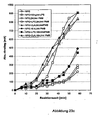
- the chromogenic substrate can also be added only a time interval after the addition of factors C, B, A. This has the disadvantage that during the action of the endotoxin on the factors C, B and A increased autocatalytic and / or autodestructive interactions take place (s. Fig. 21 ). The chromogenic substrate (as given in the hyperbolic rate assay) partially inhibits these interactions.
- the main problem with the Limulus test is that anti-limulus factors contained in the sample, such as proteins, in particular serine protease inhibitors, such as antithrombin III and / or heparin cofactor II and / or alpha2-antiplasmin, activate the activation of the limulus. Systems disturb. This means that the result of the Limulus test depends inter alia on the content of anti-limulus factors, such as, for example, proteins, in particular serine protease inhibitors such as antithrombin III and / or heparin cofactor II and / or alpha2-antiplasmin, in the sample (cf. Fig. 12 . 14 ).
- anti-limulus factors contained in the sample such as proteins, in particular serine protease inhibitors, such as antithrombin III and / or heparin cofactor II and / or alpha2-antiplasmin
- the sample can be strongly acidified to inactivate anti-limulus factors (see Obayashi, T. et al. Clin. Chim. Acta 149, 55-65, 1985 ; J. Lab. Clin Med. 4, 321-330, 1984 ; US 4,495,294 Tsuji et al., Prog. Clin. Biol.
- LBP lipopolysaccharide binding protein
- lipid A or glucan such as the Candida substance zymosan A
- the object of the present invention was to provide a simple method by which the content of active LPS and / or active lipid A and / or active glucan of a sample, i. the LPS reactivity and / or lipid A reactivity and / or glucan reactivity can be rapidly determined.
- Another object of the present invention was to provide a method by which a distinction can be made between active LPS or active lipid A and active glucan of a sample.
- a further object of the present invention was to provide a method by means of which the active and / or free LPS and / or lipid A and / or glucan present in a sample can be determined and which are based on the neutralized LPS present in a sample and / or or lipid-A and / or glucan does not respond.
- Yet another object of the present invention was to provide a method which can be used with linear kinetics and / or which is suitable for routine use.
- Yet another object of the present invention was to provide a method of carrying out the same on the prior dilution and / or heating of the sample for the determination of the LPS and / or lipid A and / or glucan can be dispensed with.
- a detergent such as Triton-X100®
- Oxidizing agents used according to the invention may be of any desired nature, provided that the oxidation of anti-limulus factors of the sample, in particular Antithrombin III and / or heparin cofactor II and / or alpha2-antiplasmin can be effected.
- oxidizing agents are singlet oxygen (1 O 2) Generating Sets as chloramines or salts of HOCl, particularly chloramine-T ® (N-chloro-toluene-sulfonamide) or chloramine-B TM (N-chloro-benzene-sulfonamide).
- the oxidizing agents used in the invention are used in relatively high doses to inactivate the anti-limulus factors without, however, altering the reactivity of LPS and / or glucan, in particular avoiding inactive and / or bound LPS present in the sample / or reactivate glucan in the assay procedure and / or release it from binding and not inactivate active LPS or lipid A and / or glucan.
- oxidant doses are required that are more than 5-10 fold greater than the doses required for the oxidative inactivation of oxidase-sensitive serine protease inhibitors, for example, antithrombin III or ⁇ 2-antiplasmin in plasma.
- the concentration of the oxidizing agent, for example of chloramine-T®, in the oxidant reagent is usually 15-200 mmol / l, in particular 30-120 mmol / l, particularly preferably 50-70 mmol / l.
- the oxidizing agent is typically added to the sample in an amount of 15-200 ⁇ mol, in particular 30-120 ⁇ mol, more preferably 50-70 ⁇ mol per ml of sample liquid, in particular plasma.
- the oxidant may optionally be present in physiological NaCl solution and / or in a buffer, in particular PBS (pH 7.4), NaHCO 3 (pH 8-9), or citrate (pH 7-9, preferably 7.4-8.4), preferably citrate, particularly preferably sodium citrate, in a concentration of 10-200 mM, in particular 20-100 mM, particularly preferably 50 mM, when the ratio of sample to oxidant reagent is 1: 1.
- a buffer in particular PBS (pH 7.4), NaHCO 3 (pH 8-9), or citrate (pH 7-9, preferably 7.4-8.4), preferably citrate, particularly preferably sodium citrate, in a concentration of 10-200 mM, in particular 20-100 mM, particularly preferably 50 mM, when the ratio of sample to oxidant reagent is 1: 1.
- Lower doses usually do not eliminate the interfering influence of the plasma matrix on the limulus system; higher doses usually lead to an increasing inactivation of LPS and / or lipid A and / or glucans in the plasma.
- the amount of oxidant remaining after the oxidation time is antagonized by a singlet oxygen quencher, eg ascorbate or preferably methionine, before the limulus factors are added to the reaction mixture or singlet oxygen quencher and limulus. Factors are added at the same time.
- a singlet oxygen quencher eg ascorbate or preferably methionine
- Preferred amounts of oxidant, in particular chloramine, after step a) in the sample range from 20 to 100 .mu.mol per ml of plasma sample.
- the limulus amebocyte factors used in step b) can be reagents known per se, which are generally obtained by lysis of limulus amebocytes (so-called LAL), which, however, could also be produced by genetic engineering.
- LAL limulus amebocytes
- the Pyrochrome® reagent is to be used here, which is comparatively more sensitive to Coamatic® for LPS. Indications of LAL within this specification are to be understood as meaning that otherwise produced Limulus amebocyte factors may be used.
- step b) individual but also all Limulus amebocyte factors can be used. Preference is given to using a combination of factors A, B and C.
- the determination of the activation of at least one of the limulus amebocyte (LA) factors can be carried out in a manner known per se, for example by determining the gelation time by the LA factors, by determining the amount of coagulin produced by LA factors, or preferably by determining the amount of chromophors released by LA factors from a chromogenic compound cleavable by activated LA factors.
- the samples to be used according to the invention may be any biological liquids in which active lipopolysaccharides and / or lipid A and / or glucans may be present.
- Examples are blood, blood products, Cerebrospinal fluid, urine, saliva, bronchoalveolar lavage, ascites, pericardial effusion, pleural effusion, milk, tissue fluids, lymphatic fluid, and especially plasma.
- Further samples to be used are products, preferably manufactured industrially, which contain anti-limulus factors, for example plasma protein therapeutics such as albumin or antithrombin III.
- heparin-containing biological fluids despite an oxidation treatment, can influence the measurement results.
- the matrix independence is guaranteed only if the sample contains less than 1 IU / ml heparin.
- patient plasma normally contains less than 0.5 IU / ml heparin even under therapeutic heparinization, almost all patient plasmas can be assayed for reactive LPS and / or lipid A and / or glucan.
- oxidizing agents such as 100 ⁇ mol Chloramin-T® per ml plasma sample should be oxidized to ensure complete matrix independence or the heparin would need to be neutralized by adding a heparin inhibitor such as Polybren®.
- LPS reactivity or lipid A reactivity or glucan reactivity For example, a concentration of approximately 60 mmol / l chloramine-T® is more physiological than a concentration of 120 mmol / l in the oxidant reagent (chloramine concentrations around 10 mmol / l are present in the microenvironment of activated neutrophilic granulocytes).
- oxidizing agent preferably chloramine-T®
- a heparin inhibitor for example Polybrene® (Hexadimethrinebromide, Sigma, Deisenhofen, Germany) can be added to the sample.
- Polybrene® stimulates the LPS / Limulus system, which is not in the sense of an imitation of LPS / monocyte reactivity.
- prior art heparin samples of the patient typically about 30-60 IU / ml heparin in plasma, for example Endo Tube ET, Chromogenix, Mölndal, Sweden) are preferably used for the Limulus test.
- Samples preferably used according to the invention have up to 1 IU / ml heparin, and contain a calcium complexing agent such as citrate or EDTA, citrate being preferred as the calcium complexing compound.
- a calcium complexing agent such as citrate or EDTA, citrate being preferred as the calcium complexing compound.
- a glucan inhibitor and / or glucan inactivator such as Zwittergent®, especially Zwittergent® 3-14 (3- (N, N-dimethylmyristylammonio) propanesulfonate) and / or beta-1,3-D-glucanase (Helix pomatia or Rhizoctonia solani) may be added to the assay to increase specificity for LPS or lipid A.
- the evaluation of the claimed detection method can be carried out by conventional methods, e.g. hyperbolic rate kinetics.
- Another object of the present invention is a method in which the complicated hyperbolic rate kinetics of the Limulus test is converted into a linear kinetics, which facilitates the evaluation of the measurement results extremely.
- guanidino compound such as arginine or guanidinium carbonate
- a chaotropic for example, an alkali metal cation such as K + , Na + or Cs + or an alkaline earth metal cation, such as Ca ++ or Mg ++ before or during the performance of step c) or together with the limulus factors, a linear kinetics of the assay is achieved.
- the elimination of the matrix disorder but also the linearization of the Limulus test and the differentiation between reactivity of on the one hand LPS or lipid A and on the other hand of glucans allow for the first time routine suitable measurements of LPS and / or lipid A and / or glucan, especially of free LPS and / or lipid A and / or glucans, in body fluids of patients, such as in their blood or in blood products.
- a differentiation between reactivity of LPS or lipid A and glucans and reactivity of glucans is made possible, so that the reactivity of both groups of toxins can be determined.
- the method described above is carried out in the presence and in the absence of an LPS inhibitor or lipid A inhibitor.
- the determined reactivities are subtracted from one another and in this way the reactivity specifically induced by LPS and / or lipid-A is determined.
- the LPS and / or lipid A and / or glucan reactivity in the sample is first pre-oxidized by an oxidant, such as a chloramine, and the reaction is preferably terminated by the addition of an antioxidant. Subsequently or simultaneously with the antioxidant supplement, the Limulus test is carried out in a manner known per se and the samples are measured both in the absence (batch A) and in the presence of an endotoxin inhibitor (batch B). From approach A, the LPS + lipid A + glucan reactivity of the sample can be determined, while approach B only gives the glucan reactivity. The difference in the measured reactivities, for example determined as the difference between the absorbances A - B of the released chromophores, gives the content of LPS and lipid A reactivity in glucan-containing or glucan-free samples.
- an oxidant such as a chloramine
- the measured and PMB intrinsic activity-corrected absorbances for batch B can be converted into reactivities of glucans, for example in Zymosan A like Reactivity in ⁇ g / ml.
- the difference in the absorbances A - Bcorr can be converted into reactivities of LPS and / or lipid A, for example in LPS like Reactivity in ng / ml.
- NPG pooled normal plasma
- a sample may contain 3-10%, preferably 4-9%, especially 7% albumin, preferably human albumin, preferably in Phosphate Buffered Saline (PBS ) are diluted.
- PBS Phosphate Buffered Saline
- the LPS or lipid A or glucan reactivity shows no high-dose inhibitory effect, i. extreme concentrations of LPS or lipid A or glucan, for example around the 10,000 ng / ml or 100 ⁇ g / ml zymosan A, do not lead to an inhibition of the Limulus reaction.
- the sample in the Limulus test described herein should preferably have a protein concentration approximately equal to that of human plasma, i. 30-100 g / l, in particular 60-90 g / l.
- both the oxidation reaction and the limulus reaction are preferably carried out at temperatures between 0 ° C. and 50 ° C., particularly preferably between 15 ° C. and 45 ° C. Furthermore, the process is preferably carried out under physiological conditions, in particular at a pH of between 6 and 10, preferably between 7.0 and 9.5, in particular between 7.5 and 9.0. If appropriate, a corresponding buffer is added to the biological fluid or the reagents used.
- a suitable test system for determining the lipopolysaccharide and / or lipid A and / or glucan reactivity is also described. This includes at least one oxidizing agent and limulus amebocyte factors for the treatment of the sample.
- test system with linear kinetics which is suitable for determining the lipopolysaccharide and / or lipid A and / or glucan reactivity and which contains at least one linearization reagent in addition to the abovementioned reagents.
- test system which, in addition to the reagents mentioned above, contains at least one LPS and / or lipid A inhibitor to differentiate between on the one hand lipopolysaccharide and / or lipid A reactivity and on the other hand glucan reactivity of the sample.
- 1 part of sample (eg 10 ⁇ l) was mixed with 1 part 15-200 mmol / l, preferably 30-120 mmol / l, in particular 50-70 mmol / l chloramine T (CT) in PBS or by addition of 0, 1-2 .mu.mol, preferably 0.3-1.2 .mu.mol, in particular 0.5-0.7 .mu.mol, of CT in 0.1-100 parts of PBS for 10 min at 37.degree. C. (or for 30 min at room temperature). Then 1-5 parts, preferably 1 part, 100-230 mmol / l methionine in H 2 O or 1-11.5 ⁇ mole methionine in H 2 O were added.
- CT mmol / l chloramine T
- Limulus reagent with or without chromogenic limulus substrate were added (eg, Pyrochrome®, which was previously reconstituted in the manufacturer's specified amount of Tris buffer , usually 3.2 ml 200 mmol / l Tris, pH 8, for the limulus assay in hyperbolic rate kinetics).
- the antioxidant and / or the LPS inhibitor may be included in the reconstitution material for the limulus factors or already in the limulus factor lyophilisate.
- the antioxidant reagent may optionally contain a trypsin inhibitor, in particular aprotinin, preferably in a concentration of 100-10000 KIU / ml, in particular 200-2000 KIU / ml and / or aprotinin doses from 100-10000 KIU, in particular 200-2000 KIU per ml of sample to the reaction mixture.
- a trypsin inhibitor in particular aprotinin, preferably in a concentration of 100-10000 KIU / ml, in particular 200-2000 KIU / ml and / or aprotinin doses from 100-10000 KIU, in particular 200-2000 KIU per ml of sample to the reaction mixture.
- the absorbance was determined immediately (BASE-value) and after 1 - 10 min (at room temperature). As a result, a possibly existing linear extinction control increase (delta A c ) was determined. If the sample contained trypsin or had trypsin-like activity, such as pancreatitis (about 10-100 ng trypsin / ml), the linear delta A c / min, which may have been determined, had to be later than all values determined in the hyperbolic rate assay subtracted from.
- linearization reagent transformed the hyperbolic into a linear kinetics.
- arginine specificity reagent
- both the linearization reagent and the specificity reagent can be selected from another substance having a guanine group base, such as e.g. As guanidinium, the pH of these reagents should be between 7 and 10, in particular between 7.5 and 9.5, are.
- the delta A value determined for normal pool was subtracted from all delta A values determined in batch B. This was a delta A generated by the addition of polymyxin B, which had to be subtracted from all B values.
- batch B could also be carried out with 10-fold lower addition of polymyxin-B, ie more preferably 0.1-0.3 mg / ml plasma sample. This led to an improvement in the sensitivity of the test.
- Approach C gives the trypsin-like activity (TLAC), normally absent; e.g. in pancreatitis, intensive care patients with coagulation activation, cooled plasma samples or not fresh limulus reagent positive.
- TLAC trypsin-like activity
- pooled normal plasma or 7% human albumin having a basal LPS reactivity (BL) of 0.2-2 ng / ml LPS, in particular 0.4-1.2 ng / ml
- LPS basal LPS reactivity
- these calibration standards had LPS reactivities such as 0 + BL, 1 + BL, 10 + BL, 100 + BL, 1000 + BL, 10000 + BL ng / ml LPS in normal plasma.
- Further calibration standards had 0, 0.1, 1, 10, 100 ⁇ g / ml zymosan A.
- it is also possible to standardize with a trypsin control for example 100 ng / ml trypsin in 7% albumin PBS) to determine the content of active trypsin to be determined in the sample.
- substrates were chosen that had a matrix - that is, an analyte environment - that resembled the environment in which the analyte was embedded.
- Suitable sample material are in particular citrate or EDTA plasmas.
- standards should also include EDTA.
- a sample is to be examined with a matrix other than plasma, e.g. Cerebrospinal fluid, urine, bronchoalveolar lavage, milk, a blood product, a commercial factor concentrate or saliva (saliva physiologically contains 100-500 ng / ml LPS reactivity, which is one reason why the Limulus test is so prone to failure)
- the sample may be brought to approximate plasma matrix by plasma dilution or, where appropriate, 7% human albumin by a dilution of 1 + 2 to 1 + 100, in particular 1 + 4 to 1 + 9, before assaying in the assay described herein.
- an addition calibration may be performed, i. Addition of known amounts of LPS or lipid A or glucan to a sample, for example, a commercial antithrombin III drug, and determination of LPS or lipid A or glucan reactivity in the supplemented and nonsupplemented sample.
- the absorption difference corresponds to the amount of LPS or lipid A or glucan added and is a measure of the basal LPS, lipid A or glucan amount.
- 1 standard deviation (SD) 0.4 ng / ml LPS reactivity.
- the intra-assay coefficients of variation are below 10%.
- Septic patients have up to about 200 ng / ml, isolated> 200 ng / ml LPS reactivity and / or up to 10 ⁇ g / ml, isolated> 10 ⁇ g / ml glucan reactivity in the plasma.
- the lower detection limit of the test according to the invention is about 0.1 ng / ml LPS reactivity and / or about 0.1 ⁇ g / ml glucan reactivity in the plasma.
- Plasma samples should be used as undiluted as possible, as this is the best way to mimic the pathophysiological LPS and / or lipid A and / or glucan reactivity.
- antioxidant reagent additionally contains 15000 U / ml polymyxin B
- Linearization Test As in Run A, Linearization Reagent is added to the Limulus Reagent before (or optionally up to 3 minutes after); the 20 min or 40 min RT incubation is omitted before the addition of the linearization reagent.
- LPS and / or lipid A and / or glucan reactivity could be tested after addition of LPS or lipid A or glucans were added to the sample.
- the individual inhibition capacity against LPS and / or lipid A and / or glucans was tested.
- FIGS. 1 to 24 show measurement results obtained using the method according to the invention.
- the procedure was as in approach A with the change that mitge messengere standards were 0, 1, 2, 4, 8, 16, 32 ug / ml zymosan A in pooled glucan-free normal plasma.
- the methionine reagent additionally contained 15,000 U / ml polymyxin B (PMB).
- PMB polymyxin B
- the delta A value determined for normal pool (without zymosan A) was subtracted from all delta A values determined in batch B (PMB correction).
- the PMB-corrected B value corresponded to the glucan reactivity of the sample in question.
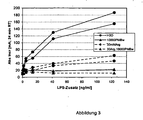
- Figure 3 shows the hyperbolic rate assay in this experiment in the low range of LPS addition to plasma.
- Normal plasma is completely neutralized by PMB in the first 44 min RT limulus reaction time. 1000 ng / ml Zymosan A with PMB (+) or without PMB ( ⁇ ) can be detected without interference; (-) shows the difference of 1000 ng / ml zymosan A (ZyA) with PMB (+) minus the PMB self-monitoring ( ⁇ ).
- FIG. 5 it is shown how a linear rate kinetics can be generated when carrying out the method according to the invention.
- FIGS. 6 and 7 illustrate the performance of the method according to the invention using a hyperbolic-rate assay with Coamatic® reagent in comparison with a hyperbolic-rate assay with Pyrochrome® reagent.
- Figure 6 shows that 20% of the delta A max. about 200 mA; this delta A is reached after 40 min RT at + 100 ng / ml LPS, after 50 min RT at + 50 ng / ml LPS, after 60 min RT at + 25 ng / ml LPS, after 70 min RT at 12.5 ng / ml LPS, after 75 min RT at + 6.3 ng / ml LPS, after 100 min RT at + 3.1 ng / ml LPS, after 120 min RT at + 1.6 ng / ml LPS, after 140 min RT at +0.8 ng / ml LPS, after about 270 min RT at + 0 ng / ml LPS.
- the Coamatic® reagent is much more insensitive to LPS than the Pyrochrome® reagent.
- Figure 8 shows that 2000 U / ml PMB completely inhibit only up to about 20 ng / ml LPS reactivity, that 50 ng / ml LPS despite 2000 U / ml PMB lead to a delta A of additional 100 mA, which has an LPS reactivity of + 1 ng / ml. 30 mM arginine inhibits the LAL system significantly less in Coamatic than in Pyrochrome.
- Coamatic reagent contains less factor C but more chromogenic substrate than pyrochrome.
- FIG 9 an inventive method is shown in which the reactivity of 100 ng / ml zymosan A was determined in normal plasma.
- 10 .mu.l normal pool plasma supplemented and incubated with 0 or 100 ng / ml Zymosan A with 10 ul 60 mmol / l CT for 10 min at 37 ° C.
- 10 ⁇ l of 200 mmol / l methionine with 2000 U / ml polymyxin B was added.
- 3 min (RT) 30 ⁇ l of LAL Reagent Coatest® (limulus factors not as a polyphosphoride with a chromogenic substrate) were added.
- Figure 9 shows that the maximum rash is about 1800 mA, achieved by 25 ul 2 mM S-2834®, corresponding to 30 ul 1.7 mM chromogenic substrate (CS), ie that in Coamatic reagent about 0.55 mM CS and im Pyrochrome reagent about 0.33 mM CS as a polyisocyanate.
- CS chromogenic substrate
- Figure 10 shows the results of a method according to the invention, in which 10 .mu.l normal plasma pool supplemented with 0 - 100 ug / ml zymosan A with 10 .mu.l 60 mmol / l CT 30 mmol / l NaHCO 3 were incubated for 30 min at RT. Then 10 ⁇ l of 215 mmol / l methionine, 150 mmol / l arginine, pH 8.7, and 1000 U / ml polymyxin B were added and after 3 min (RT) 15 ⁇ l LAL reagent Coamatic® was added and delta A was measured. The test here is linear up to 2 ⁇ g / ml Zymosan A.
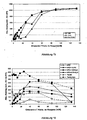
- Figure 11 shows the results of a method according to the invention, in which 10 .mu.l of normal plasma (Citrol; DadeBehring, Marburg, Germany) supplemented with 0 - 1000 ng / ml LPS with 10 ul 60 mmol / l CT were incubated. After 30 min at RT, 10 ⁇ l of 210 mmol / l arginine, 210 mmol / l sodium ascorbate and 30 ⁇ l LAL reagent Coamatic® were added and delta A was measured at 405 nm. Figure 11 shows the kinetics at room temperature.
- FIG. 12 shows the results of a method according to the invention, in which 10 ul 0-20% human albumin supplemented with 5 ng / ml LPS with 10 ul 60 mmol / l CT for 10 min at 37 ° C were incubated. Then 10 ⁇ l 200 mmol / l methionine and 30 ⁇ l LAL reagent Coamatic® were added and delta A was measured at RT.
- 10 ul 0-20% human albumin supplemented with 5 ng / ml LPS with 10 ul 60 mmol / l CT for 10 min at 37 ° C were incubated.
- 10 ⁇ l 200 mmol / l methionine and 30 ⁇ l LAL reagent Coamatic® were added and delta A was measured at RT.
- Out Figure 12 is to recognize that as the albumin concentration of the sample increases from 0% to 1%, the LPS reactivity drops to approximately 1/5 of the initial value. If the albumin concentration is increased to approx. 2%, the initial value is restored. With further increasing albumin concentration from 2% to 10% of the sample, the LPS reactivity drops to 1/3 of the initial value; a further increase in the sample albumin concentration from 10% to 20% does not result in a change in the LPS reactivity of the sample. Thus, albumin stabilizes LPS (eg, against binding to the plastic wall of the plate), but at the same time inhibits LPS reactivity with Limulus factors.
- Figure 13 shows the results of a method according to the invention, in which 10 .mu.l normal plasma pool (NPG) supplemented with 0 - 6667 ng / ml zymosan A with 10 .mu.l 60 mmol / l CT for 10 min at 37 ° C were incubated. Then 10 ⁇ l 200 mmol / l methionine and 30 ⁇ l LAL reagent Coamatic® were added and delta A was measured at RT.
- the linearity (ratio of glucan concentration to resulting delta A) of the limulus test for glucans can be recognized here up to a plasma concentration of about 2 ⁇ g / ml glucans.
- Figures 14 and 15 show the results of a method according to the invention in which 10 ⁇ l sample (NPG, NPG plus 3.2 mg / ml EDTA, NPG plus 70 IU / ml heparin) supplemented with 0 or 10 ng / ml LPS with 10 ⁇ l 0-133 mmol / l CT in H 2 O for 10 min at 37 ° C. Then 10 ⁇ l 200 mmol / l ascorbate and 30 ⁇ l LAL reagent Coamatic® were added.
- Figure 14 for 10 ng / ml supplemented plasmas
- Figure 15 show that CT concentrations of 40-80 mmol / l are optimal to eliminate the heparin effect.
- Figure 14 shows that no measurable LPS reactivity results in 50 min RT without oxidation.
- 70 IU / ml heparin in the sample stimulate LPS reactivity about 5-fold using an oxidant reagent with ⁇ 60 mM CT.
- the method according to the invention is intended to mimic the pathophysiological reactivity of LPS and / or lipid A and / or glucans with human receptors for LPS and / or lipid A and / or glucans (eg CD 14 or phospholipases of monocytes)
- heparin is used instead of heparin Sample tubes - as in the prior art preferably citrate or EDTA Monovetten recommended for sampling.
- Figure 15 shows that without oxidation only a limulus reactivity of ⁇ 100 mA / 19 h RT for normal plasma results. Addition of 40-80 mM CT increases this more than 10-fold. At least 60 mM CT in the oxidizing reagent is necessary for the LPS reactivity of heparin plasma (70 IU / ml in sample) to equal the LPS reactivity of normal citrate or EDTA pool.
- Figure 16 shows the results of a further method according to the invention in which 10 ⁇ l of 0-133 mmol / l CT in 100 mmol / l NaHCO 3 , pH 8.5, for 10 min (37 ° C) were incubated with 10 .mu.l plasma plasma plasma normal clotting ( NPG) or 7% human albumin (Kabi, Sweden), each supplemented with 0 or 10 ng / ml LPS and / or 1000 ng / ml zymosan A (ZyA).
- NPG .mu.l plasma plasma plasma plasma normal clotting
- ZyA 1000 ng / ml zymosan A
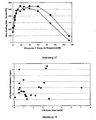
- Figure 17 shows the results of a further inventive method in which 10 ul 0-133 mmol / l CT in 100 mmol / l NaHCO 3 , pH 8.5 with 10 ul 7% human albumin supplemented with 10 ng / ml LPS (•) or with 10 ng / ml LPS and 1000 ng / ml zymosan A ( ⁇ ) were incubated at 37 ° C for 10 min. 50 ⁇ l of 200 mmol / l methionine were added, and after 3 min RT, 30 ⁇ l of LAL reagent Coamatic® were added and delta A was measured at 405 nm.
- Figure 17 shows the results with different CT concentrations, over 80 mmol / L CT inactivated endotoxin.
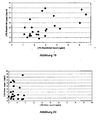
- Figure 20 shows the results of other methods in which addition of 5 ⁇ l 10 ng / ml LPS on heat treatment results in 5.8 + - 4.6 ng / ml LPS after 1.5 + -1.1 ng / ml previously;
- Figure 21 shows the reactivity results of other procedures in which 10 ⁇ l NPG (pooled from 12 normal plasmas) supplemented with 0-10 ng / ml LPS with 10 ⁇ l 60 mmol / l CT were incubated for 10 min at 37 ° C. Then 10 ⁇ l of 210 mmol / l ascorbate, 210 mmol / l arginine, pH 8.7, were added.
- Figure 21 further shows that Limulus factor incubation times> 60 min RT even lead to a decrease in LPS reactivity ( ⁇ , ⁇ ). This is due to a self-destruction of Limulus factors, presence of CS (as in the hyperbolic-rate assay before addition of the linearization reagent) protects against it.
- Figure 22 shows the results of other procedures involving 10 ⁇ l NPG (from 12 normal plasmas) supplemented with 0-100 ng / ml LPS or 0-100 ⁇ g / ml zymosan A with 10 ml 60 mmol / l CT for 10 min at 37 ° C were incubated. Then 10 ⁇ l 210 mmol / l arginine, 210 mmol / l ascorbate (LPS assay) or 2000 U / ml polymyxin B (glucan assay, ZyA assay) and 30 ⁇ l LAL Reagent Coamatic added and delta A determined.
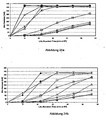
- Figures 23a-b show the results of other methods using 200 ⁇ l NPG ( ⁇ ), NPG + 50 ng / ml LPS (•) or + 91 ng / ml LPS ( ⁇ ), NPG + 50 ⁇ g / ml ZyA ( ⁇ ) with 200 ul 60 mmol / l CT in H 2 O for 10 min at 37 ° C were incubated. 20 .mu.l thereof were incubated with 10 .mu.l of 210 mmol / l arginine, 210 mmol / l ascorbate and 0-250 000 U / ml polymyxin B at 37.degree. C. and delta A determined.
- Figure 23c shows the results of other procedures involving 200 ⁇ l NPG ( ⁇ ), +50ng / ml LPS ( ⁇ ), + 2kU / ml PMB ( ⁇ gray), + LPS and 2kU / ml PMB ( ⁇ gray), + ZyA and 2kU / ml PMB ( ⁇ gray), + 16kU / ml PMB (•), + LPS and 16kU / ml PMB ( ⁇ ), + ZyA and 16kU / ml PMB ( ⁇ ).
- Figure 24 shows a comparative experiment of the prior art method with 75 ° C (15 min) treatment of the samples and the method according to the invention with oxidation of the samples with 60 mM chloramine-T® (10 min, 37 ° C).
- 7.5% human albumin (Kabi, Sweden) basal containing 0.5 ⁇ g / ml zymosan A supplemented with 0-10,000 ng / ml LPS (E. coli 0111: B4; purified via gel filtration; Product L 3012; Sigma , Deisenhofen, Germany) or with 0-100 ⁇ g / ml zymosan A as follows:
- 24a and b show the following approaches: + 0 ng / ml LPS ( ⁇ ), + 0.1 ng / ml LPS (gray ⁇ ), + 1 ng / ml LPS (gray ⁇ ), + 10 ng / ml LPS (gray ⁇ ), + 100 ng / ml LPS ( ⁇ ), + 1000 ng / ml LPS ( ⁇ ), + 0.1 ⁇ g / ml ZyA ( ⁇ ), + 1 ⁇ g / ml ZyA ( ⁇ ), + 10 ⁇ g / ml ZyA ( ⁇ ), + 100 ⁇ g / ml ZyA (X).
Landscapes
- Life Sciences & Earth Sciences (AREA)
- Health & Medical Sciences (AREA)
- Engineering & Computer Science (AREA)
- Molecular Biology (AREA)
- Biomedical Technology (AREA)
- Chemical & Material Sciences (AREA)
- Hematology (AREA)
- Immunology (AREA)
- Urology & Nephrology (AREA)
- Food Science & Technology (AREA)
- General Physics & Mathematics (AREA)
- Cell Biology (AREA)
- Biotechnology (AREA)
- Medicinal Chemistry (AREA)
- Physics & Mathematics (AREA)
- Analytical Chemistry (AREA)
- Biochemistry (AREA)
- General Health & Medical Sciences (AREA)
- Microbiology (AREA)
- Pathology (AREA)
- Biophysics (AREA)
- Endocrinology (AREA)
- Measuring Or Testing Involving Enzymes Or Micro-Organisms (AREA)
- Investigating Or Analysing Biological Materials (AREA)
- Polysaccharides And Polysaccharide Derivatives (AREA)
- Medicines That Contain Protein Lipid Enzymes And Other Medicines (AREA)
Description
- Die vorliegende Erfindung betrifft einen verbesserten Test zur Bestimmung der Lipopolysaccharid- und/oder Lipid-A- und/oder Glukan-Reaktivität in Körperflüssigkeiten.
- Unter Reaktivität wird im Rahmen dieser Beschreibung die Aktivität von Lipopolysaccharid und/oder Lipid-A und/oder Glukan, insbesondere beta-1,3-D-Glukan in einer biologischen Flüssigkeit, wie beispielsweise Plasma, verstanden. Reaktives Lipopolysaccharid und/oder Lipid-A und/oder Glukan ist pathophysiologisch und/oder pharmakologisch-toxikologisch aktives und/oder freies Lipopolysaccharid und/oder Lipid-A und/oder Glukan.
- Infektionen mit gramnegativen Bakterien (wie Escherichia coli) oder mit Pilzen (wie Candida albicans) stellen bereits seit langem ein großes medizinisches Problem dar. Die Keime können in die Blutbahn oder die Meningen eindringen und dort zu lebensbedrohlichen Zuständen, wie Sepsis oder Meningitis, führen. Daher sollte die Diagnose dieser medizinisch so relevanten Erreger möglichst frühzeitig gestellt werden.
- Mikrobiologische Verfahren der Anzüchtung dieser Keime sind jedoch sehr langwierig. In vielen Fällen kann die Diagnose erst nach Tagen oder nach Wochen gestellt werden. In wenigen Stunden kann sich allerdings das Krankheitsbild des Patienten derart verschlechtern, so daß er im schlimmsten Fall an diesem Infekt stirbt.
- Es hat daher nicht an Versuchen gefehlt, den Zeitraum für das Stellen einer Diagnose zu verkürzen. Einer dieser Ansätze ist der Nachweis von Lipopolysacchariden (nachstehend auch "LPS" genannt), von Lipid-A oder von Glukanen mit dem sogenannten Limulus-Assay. LPS, Lipid-A und Glukane sind für den Patienten gefährlich, da deren Anwesenheit im Blut zu einer pathologischen disseminierten intravaskulären Gerinnung (DIC) führen können.
- Die Zellwand der gramnegativen Bakterien besteht zum Teil aus LPS (früher Endotoxin genannt), welches sich zusammensetzt aus einem harmlosen Polysaccharid-Teil und einem für viele Zellen gefährlichen Lipid-A-Teil.
- Die LPS- und/oder Lipid-A- und/oder Glukan-Reaktivität ist von hoher pathophysiologischer Bedeutung: aktives LPS und/oder freies LPS und/oder aktives und/oder freies Lipid A und/oder aktives und/oder freies Glukan, reagiert zum Beispiel sehr intensiv mit den Monozyten des Blutes oder dem Endothel. Die Monozyten können dabei stark aktiviert oder zerstört werden, und Zellinneres gerät in Kontakt mit Plasma und Thrombozyten.
- Da Monozyten DNA und sogenannten Tissue-Factor enthalten, wird die Gerinnung bei Sepsis sofort aktiviert. Dabei kommt es folglich zu lebensbedrohlich-gesteigerter disseminierter intravaskulärer Gerinnung mit z. B. multipler Thrombosierung kleiner Gefäße, was zum Multiorganversagen führen kann.
- Mit der vorliegenden Erfindung wird ein Verfahren bereitgestellt, welches die pathophysiologische Interaktion, d.h. die Reaktivität, von LPS bzw. Lipid-A bzw. Glukan mit empfindlichen Zellen imitiert, wobei die Zellen und/oder Zellmembranen durch die Limulusfaktoren in vitro ersetzt werden. Ein solches Verfahren, welches innerhalb von Minuten LPS, Lipid-A oder Glukane, insbesondere reaktives und/oder freies LPS und/oder reaktives und/oder freies Lipid-A und/oder reaktive und/oder freie Glukane, sensitiv und spezifisch nachweist, ist demzufolge von großer klinischer Bedeutung.
- Nach dem Stand der Technik wird LPS mit dem Limulus-Assay nachgewiesen [Hurley J.C. Endotoxemia: methods of detection and clinical correlates. Clinical Microbiology Reviews 1995; 8: 268-292]. Das Prinzip dieses Testes besteht darin, daß LPS - aber auch Glukane - das Coagulogen/Coagulin System der Horseshoe-Krabbe (Pfeilschwanzkrebs; Limulus polyphemus), genannt das Limulus-System, aktivieren.
- Das Limulus-System für LPS oder Lipid A besteht im wesentlichen aus folgenden Faktoren: Faktor C, Faktor B, Faktor A und Coagulogen.
- LPS oder Lipid-A aktiviert Faktor C, aktivierter Faktor C aktiviert Faktor B, aktivierter Faktor B aktiviert Faktor A. Aktivierter Faktor A wandelt lösliches Coagulogen in unlösliches Coagulin um. Beim Limulus-System für Glukane, die Pilzbestandteile sind, gibt es noch einen Faktor G, der durch Glukane, insbesondere beta-1,3-D-Glukan zu einer Serinprotease aktiviert wird, wodurch aktivierter Faktor A gebildet wird.
- Das Limulus-System ist ein Abwehrsystem des Pfeilschwanzkrebses gegen eindringende pathologische Keime und stellt ein primitives System der angeborenen Immunität dar.
- Beim Limulus-Assay wirkt LPS und/oder Lipid-A und/oder Glukane der Probe auf Limulus Amöbocyten-Faktoren, im folgenden Limulus-Faktoren genannt, ein und führt zu Veränderungen, die auf unterschiedliche Arten nachgewiesen werden können (Hurley J., Clin. Microbiol. Rev. 8(2), 268-292, 1995, Ochiai et al., Microbiol. Immunol. 46, 527-533, 2002). Diese Limulus-Faktoren werden nach dem Stand der Technik aus dem Lysat von Limulus-Amebozyten gewonnen (
US 3,954,663 ), woher die Abkürzung LAL stammt. - Beispiele für Nachweisverfahren sind der LAL-Gelierungstest, der Coagulogenbasierte LAL Assay und der chromogene LÄL Assay (vergl. Hurley J.C., Clinical Microbiology Reviews 1995; 8: 272).
- Beim chromogenen LAL Assay oder chromogenen Limulustest wird die Reaktion des aktivierten Faktors A auf das Coagulogen durch Ersatz des Coagulogens durch ein chromogenes Substrat imitiert, z. B. S-2834® (Isoleucyl-Glutamyl-Glycyl-Arginylparanitro-Anilid = Ile-Glu-Gly-Arg-pNA) oder S-2423® (CH3-CO-Ile-Glu-Gly-Arg-pNA) (Chromogenix, Mölndal, Schweden).
- Der chromogene Limulustest ist kommerziell erhältlich, beispielsweise unter den Handelsnamen Limulus Amebocyte Lysate Endochrome® (Charles River Endosafe; Charleston, USA), Coatest® Plasma Endotoxin oder Coamatic® Endotoxin (Chromogenix, Mölndal, Schweden) oder Pyrochrome® (Cape Code; Falmouth, USA).
- Der chromogene Limulus-Test kann in der sogenannten Endpunkt-Hyperbolic-Rate-Assay-Kinetik durchgeführt werden (bei 37°C, Ikubationszeit 41 min für Plasma, Produktinformation Pyrochrome®, Haemochrom, Essen, Deutschland), d.h. chromogenes Substrat und Limulus-Faktoren C, B, A werden gemeinsam der auf Endotoxin zu testenden Probe zugesetzt. So erfolgen die Aktivierung der Faktoren C, B, A und die Substratspaltung gleichzeitig. Je länger der Test vor Zusatz des Stop-Reagenz läuft, desto mehr aktivierter Faktor A wird generiert und desto mehr chromogenes Substrat wird gespalten.
- Alternativ kann das chromogene Substrat auch erst ein Zeitintervall nach dem Zusatz der Faktoren C, B, A zugesetzt werden. Dieses hat den Nachteil, daß während der Einwirkung des Endotoxins auf die Faktoren C, B und A vermehrt autokatalytische und/oder autodestruktive Interaktionen stattfinden (s.
Abb. 21 ). Das chromogene Substrat (wie im Hyperbolic-Rate-Assay gegeben) inhibiert teilweise diese Interaktionen. - Das Haupt-Problem mit dem Limulus-Test ist, daß in der Probe enthaltene Anti-Limulusfaktoren, wie beispielsweise Proteine, insbesondere Serinprotease-Inhibitoren, wie Antithrombin III und/oder Heparin Cofaktor II und/oder alpha2-Antiplasmin, die Aktivierung des Limulus-Systems stören. Dies bedeutet, daß das Ergebnis des Limulus-Tests u.a. abhängt von dem Gehalt an Anti-Limulusfaktoren, wie beispielsweise Proteinen, insbesondere Serinprotease-Inhibitoren wie Antithrombin III und/oder Heparin Cofaktor II und/oder alpha2-Antiplasmin, in der Probe (s.
Abb. 12 ,14 ). - Diese Interferenz wird nach dem Stand der Technik beseitigt, indem die Probe 10-fach verdünnt wird und die verdünnte Probe vor dem eigentlichen Test erhitzt wird, beispielsweise 15-20 min bei 75°C. Alternativ kann die Probe auch stark angesäuert werden, um die Anti-Limulus-Faktoren zu inaktivieren (siehe Obayashi, T. et al. Clin. Chim. Acta 149, 55-65, 1985; J. Lab. Clin Med. 4, 321-330, 1984;
US 4,495,294 Tsuji et al., Prog. Clin. Biol. Res., 231, 443-457, 1987) Dieses Prozedere ist jedoch problematisch, da von physiologischen Inhibitoren gebundenes und damit inaktives LPS und/oder Lipid-A und/oder Glukan wieder aus der Bindung freigesetzt werden kann, d.h. die Methode mißt nicht hauptsächlich reaktives und/oder aktives und/oder freies, sondern insbesondere auch gebundenes LPS oder Lipid-A bzw. Glukan, was letztlich dazu führt, daß die Methode nicht routinetauglich ist. Inhibiertes LPS bzw. Lipid-A bzw. Glukan hat untergeordnete pathophysiologische Bedeutung. Außerdem werden bei Erhitzung das in der Probe vorhandenen aktive und/oder freie LPS oder Lipid A nahezu vollständig inaktiviert. Die kommerziell erhältlichen Limulus-Tests haben unter anderem aufgrund dieser Probleme bislang keinen Eingang in die Klinikroutine gefunden. - Beispielsweise gibt es plasmatische Antikörper und andere Binde-Proteine, wie das Lipopolysaccharid-Binding-Protein (LBP), die LPS und/oder Lipid-A und/oder Glukane neutralisieren. Dieses gebundene und dadurch neutralisierte LPS und/oder Lipid-A und/oder Glukan ist jedoch von untergeordneter klinischer Bedeutung. Von pathophysiologischer Bedeutung ist LPS, Lipid-A oder Glukan (wie beispielsweise die Candida-Substanz Zymosan A), welches nicht-neutralisiert und/oder frei ist und somit frei mit empfindlichen Zellen wie beispielsweise den Monozyten des Blutes reagieren kann, sogenanntes reaktives LPS bzw. Lipid-A bzw. Glukan. Ein Freisetzen dieses neutralisierten LPS und/oder Lipid-A und/oder Glukan z.B. durch Hitzebehandlung würde das Testergebnis somit verfälschen und nur eine äußerst bedingte Aussage über die Konzentration des nicht-neutralisierten LPS und/oder Lipid-A und/oder Glukan gestatten.
- Weiterhin ist ein Verfahren zur Bestimmung der Aktivität von Limulus-Endotoxinaktivierbaren Proteasen bekannt (
DE 195 49 117 ). - Ausgehend von diesem Stand der Technik lag der vorliegenden Erfindung die Aufgabe zugrunde, ein einfaches Verfahren bereitzustellen, mit denen der Gehalt an aktivem LPS und/oder aktivem Lipid-A und/oder aktivem Glukan einer Probe, d.h. die LPS-Reaktivität und/oder Lipid-A-Reaktivität und/oder Glukan-Reaktivität, rasch bestimmt werden kann.
- Eine weitere Aufgabe der vorliegenden Erfindung war die Bereitstellung eines Verfahrens, mit denen zwischen aktivem LPS bzw. aktivem Lipid-A und aktivem Glukan einer Probe differenziert werden kann.
- Eine weitere Aufgabe der vorliegenden Erfindung war die Bereitstellung eines Verfahrens, mit denen das in einer Probe vorhandene aktive und/oder freie LPS und/oder Lipid-A und/oder Glukan ermittelt werden kann und die auf das in einer Probe vorhandene neutralisierte LPS und/oder Lipid-A und/oder Glukan nicht ansprechen.
- Noch eine weitere Aufgabe der vorliegenden Erfindung war die Bereitstellung eines Verfahrens, deren Einsatz mit einer linearen Kinetik erfolgt und/oder die routinetauglich sind.
- Noch eine weitere Aufgabe der vorliegenden Erfindung war die Bereitstellung eines Verfahrens, bei deren Durchführung auf die vorhergehende Verdünnung und/oder Erhitzung der Probe zur Bestimmung des LPS und/oder Lipid-A und/oder Glukan verzichtet werden kann.
- Überraschenderweise hat sich gezeigt, daß durch Zusatz eines geeigneten Oxidationsmittels, gegebenenfalls in Verbindung mit einem Detergenz, wie beispielsweise Triton-X100®, vorzugsweise in einer finalen Konzentration bis zu 0,1%, und/oder einem Lösungsvermittler, wie beispielsweise Polyethylenglykol, vorzugsweise in einer finalen Konzentration bis zu 10 %, die Interferenz der in der Matrix der Probe (= Analyt-Umgebung) vorhandenen Störfaktoren auf das Limulus-System ausgeschaltet werden kann.
- Es ist zwar aus der
EP-A-297,597 - Die vorliegende Erfindung betrifft ein Verfahren zur Bestimmung des Gehaltes an aktivem und/oder freiem Lipopolysaccharid und/oder Lipid-A und/oder Glukan in biologischen Flüssigkeiten bei einem pH-Wert zwischen 6 und 10 gemäß Anspruch 1 umfassend
- a) die Behandlung der Probe mit mindestens einem Oxidationsmittel, aus der Gruppe der Singulett-Sauerstoff-Erzeuger,
- b) den Zusatz von mindestens einem Limulus Amöbocyten - Faktor zur oxidierten Probe, und
- c) die Bestimmung der Aktivierung mindestens eines der Limulus Amöbocyten - Faktoren.
- Erfindungsgemäß eingesetzte Oxidationsmittel können beliebiger Natur sein, soweit dadurch die Oxidation von Anti-Limulus Faktoren der Probe, insbesondere Antithrombin III und/oder Heparin Cofaktor II und/oder alpha2-Antiplasmin bewirkt werden kann.
- Beispiele für Oxidationsmittel sind Singulett-Sauerstoff (1O2)-Erzeuger wie Chloramine oder Salze der HOCI, insbesondere Chloramin-T® (N-Chlor-Toluol-Sulfonamid) oder Chloramin-B® (N-Chlor-Benzol-Sulfonamid).
- Die erfindungsgemäß eingesetzten Oxidationsmittel kommen in vergleichsweise hohen Dosen zum Einsatz, um die Anti-Limulus Faktoren zu inaktivieren ohne jedoch die Reaktivität von LPS und/oder Glukan zu verändern, insbesondere gilt es zu vermeiden, in der Probe vorliegendes inaktives und/oder gebundenes LPS und/oder Glukan im Testverfahren zu reaktivieren und/oder aus der Bindung freizusetzen und aktives LPS oder Lipid A und/oder Glukan nicht zu inaktivieren.
- Typischerweise sind Oxidans-Dosen erforderlich, die mehr als 5-10fach über den Dosen liegen, welche für die oxidative Inaktivierung von oxidansempfindlichen Serinproteaseinhibitoren, beispielsweise Antithrombin III oder α2-Antiplasmin im Plasma erforderlich sind.
- Die Konzentration des Oxidationsmittels, beispielsweise von Chloramin-T®, im Oxidansreagenz beträgt üblicherweise 15 - 200 mmol/l, insbesondere 30-120 mmol/l, besonders bevorzugt 50-70 mmol/l.
Das Oxidationsmittel wird der Probe typischerweise in einer Menge von 15-200 µmol, insbesondere 30-120 µmol, besonders bevorzugt 50-70 µmol pro ml Probenflüssigkeit, insbesondere Plasma, zugesetzt. Das Oxidans kann gegebenenfalls in physiologischer NaCl-Lösung und/oder in einem Puffer vorliegen, insbesondere PBS (pH 7.4), NaHCO3 (pH 8 - 9), oder Citrat (pH 7 - 9, bevorzugt 7.4 - 8.4), bevorzugt Citrat, insbesondere bevorzugt Natrium-Citrat, in einer Konzentration von 10 - 200 mM, insbesondere 20 - 100 mM, besonders bevorzugt 50 mM, wenn das Verhältnis Probe : Oxidansreagenz 1:1 beträgt. - Niedrigere Dosen beseitigen in der Regel nicht den störenden Einfluß der Plasmamatrix auf das Limulus-System; höhere Dosen führen in der Regel zu einer zunehmenden Inaktivierung von LPS und/oder Lipid-A und/oder Glukanen im Plasma.
- Des weiteren ist bei der Durchführung des erfindungsgemäßen Verfahrens zu beachten, daß nach der Durchführung der Oxidationsreaktion nicht zu große Mengen an Oxidans in der Probe zurückbleiben. So sind die Limulus-Faktoren C, B, A nur bis zu einem Zusatz von etwa 5 µmol Chloramin-T® pro ml Plasma-Probe resistent (im Gegensatz zu typischen Säugetier-Serinproteasen, wie beispielsweise Trypsin oder Plasmin, welche um mindestens das 10-fache resistenter sind, weswegen nach
EP-A-297,597 - Bevorzugte Mengen an Oxidans, insbesondere Chloramin, nach Schritt a) in der Probe bewegen sich im Bereich von 20 bis 100 µmol pro ml Plasma-Probe.
- Bei dem in Schritt b) eingesetzten Limulus Amöbocyten - Faktoren kann es sich um an sich bekannte Reagenzien handeln, die in der Regel gewonnen werden durch Lyse von Limulus-Amöbocyten (sogenanntes LAL), die allerdings auch gentechnisch hergestellt werden könnten. Vorzugsweise ist hier das Pyrochrome®-Reagenz einzusetzen, welches vergleichsweise zum Coamatic® sensitiver für LPS ist. Hinweise auf LAL innerhalb dieser Beschreibung sind so zu verstehen, dass auch anders hergestellte Limulus Amöbocyten - Faktoren eingesetzt werden können.
- In Schritt b) können einzelne aber auch alle Limulus Amöbocyten - Faktoren eingesetzt werden. Bevorzugt setzt man eine Kombination der Faktoren A, B und C ein.
- Die Bestimmung der Aktivierung mindestens eines der Limulus Amebozyten (LA)-Faktoren kann in an sich bekannter Weise erfolgen, beispielsweise durch die Ermittlung der Gelierungs-Zeit durch die LA-Faktoren, durch die Ermittlung der durch LA-Faktoren erzeugten Menge an Coagulin oder vorzugsweise durch die Ermittlung der Menge der durch LA-Faktoren freigesetzten Chromophors aus einer durch aktivierte LA- Faktoren spaltbaren chromogenen Verbindung.
- Bei den erfindungsgemäß einzusetzenden Proben kann es sich um beliebige biologische Flüssigkeiten handeln, in denen aktive Lipopolysaccharide und/oder Lipid-A und/oder Glukane vorliegen können. Beispiele dafür sind Blut, Blutprodukte, Liquor, Urin, Saliva, Bronchoalveoläre Lavage, Aszites, Perikarderguß, Pleuraerguß, Milch, Gewebeflüssigkeiten, Lymphflüssigkeit und insbesondere Plasma. Weiterhin einzusetzende Proben sind Produkte, vorzugsweise industriell hergestellt, welche Anti-Limulus Faktoren enthalten, beispielsweise Plasmaprotein-Therapeutika wie Albumin oder Antithrombin III.
- Ferner wurde gefunden, daß heparinhaltige biologische Flüssigkeiten trotz einer Oxidationsbehandlung die Meßergebnisse beeinflussen können. So ist beispielsweise selbst bei einer Oxidation mit 1 Teil 60 mmol/l Chloramin-T® pro 1 Teil Plasma die Matrix-Unabhängigkeit nur dann gewährleistet, wenn die Probe weniger als 1 IU/ml Heparin enthält.
- Da Patientenplasma normalerweise selbst unter therapeutischer Heparinisierung weniger als 0,5 IU/ml Heparin enthält, können nahezu alle Patientenplasmen auf reaktives LPS und/oder Lipid-A und/oder Glukan untersucht werden.
- Proben mit mehr als 1 IU/ml Heparin, wie sie beispielsweise bei Proben von Patienten unter Hämodialyse oder unter Herzlungenmaschinen-Operation mit bis zu etwa 10 IU/ml Heparin vorkommen, müssten mit hohen Dosen an Oxidationsmitteln, beispielsweise mit 100 µmol Chloramin-T® pro ml Plasma-Probe oxidiert werden, um vollständige Matrixunabhängigkeit zu gewährleisten oder das Heparin müsste durch Zusatz eines Heparininhibitors wie Polybren® neutralisiert werden.
- Vorzugsweise arbeitet man mit vergleichsweise niedrigen Konzentrationen an Oxidationsmitteln, um die pathophysiologische Interaktion zwischen LPS bzw. Lipid-A bzw. Glukan und sensiblen menschlichen Zellen (= LPS-Reaktivität bzw. Lipid-A-Reaktivität bzw. Glukan-Reaktivität) besser zu imitieren. So ist eine Konzentration von etwa 60 mmol/l Chloramin-T® physiologischer als eine Konzentration von 120 mmol/l im Oxidansreagenz (Chloramin-Konzentrationen um die 10 mmol/l gibt es in der Mikroumgebung von aktivierten neutrophilen Granulozyten). Aus diesem Grunde werden vorzugsweise Konzentrationen von kleiner gleich 100 mmol/l, insbesondere kleiner gleich 60 mmol/l, Oxidationsmittel, vorzugsweise Chloramin-T®, im Oxidationsreagenz (bei 1:1 Verhältnis Plasmaprobe:Oxidans) verwendet, vorzugsweise bei Proben mit weniger als 1 IU/ml Heparin.
- Gegebenenfalls kann der Probe ein Heparininhibitor, beispielsweise Polybrene® (Hexadimethrinebromide, Sigma, Deisenhofen, Deutschland) zugesetzt werden. Allerdings stimuliert Polybrene® das LPS/Limulus-System, was nicht im Sinne einer Imitation der LPS/Monozyten Reaktivität ist. Dennoch werden nach dem Stand der Technik vorzugsweise Heparinproben des Patienten (von typischerweise etwa 30-60 IU/ml Heparin im Plasma, beispielsweise Endo Tube ET, Chromogenix, Mölndal, Schweden) für den Limulus-Test eingesetzt.
- Erfindungsgemäß bevorzugt eingesetzte Proben weisen bis zu 1 IU/ml Heparin auf, und enthalten einen Calcium-Komplexierer wie Citrat oder EDTA, wobei als Calcium komplexierende Verbindung Citrat bevorzugt ist. Gegebenenfalls kann ein Glukan-Inhibitor und/oder Glukan-Inaktivator (wie beispielsweise Zwittergent®, insbesondere Zwittergent® 3-14 (3-(N,N-Dimethylmyristylammonio)propansulfonat) und/oder beta-1,3-D-Glukanase (Helix pomatia oder Rhizoctonia solani) dem Test zugesetzt werden, um die Spezifität für LPS oder Lipid A zu erhöhen.
- Die Auswertung des beanspruchten Nachweisverfahrens kann mit herkömmlichen Methoden, wie z.B. der Hyperbolic-Rate-Kinetik erfolgen. Ein weiterer Gegenstand der vorliegenden Erfindung ist allerdings ein Verfahren, bei dem die komplizierte Hyperbolic-Rate-Kinetik des Limulus-Tests in eine lineare Kinetik umgewandelt wird, was die Auswertung der Meßergebnisse extrem erleichtert.
- Es wurde gefunden, daß durch Zusatz mindestens einer Guanidino-Verbindung, wie Arginin oder Guanidiniumkarbonat, und/oder eines Chaotropikums, beispielsweise eines Alkalimetallkations, wie K+ , Na+ oder Cs+ oder eines Erdalkalimetallkations, wie Ca++ oder Mg++ vor oder während der Durchführung von Schritt c) oder zusammen mit den Limulus-Faktoren eine lineare Kinetik des Tests erreicht wird.
- Insbesondere die Beseitigung der Matrixstörung aber auch die Linearisierung des Limulus-Testes und die Differenzierung zwischen Reaktivität von einerseits LPS bzw. Lipid-A und andererseits von Glukanen ermöglichen erstmals routinetaugliche Messungen von LPS und/oder Lipid-A und/oder Glukan, insbesondere von freiem LPS und/oder Lipid-A und/oder Glukanen, in Körperflüssigkeiten von Patienten, wie in deren Blut oder in Blutprodukten.
- In einer weiteren Ausgestaltung des erfindungsgemäßen Verfahrens wird demzufolge eine Differenzierung zwischen Reaktivität von LPS bzw. Lipid-A und Glukanen und Reaktivität von Glukanen ermöglicht, so daß die Reaktivität beider Gruppen von Toxinen bestimmt werden kann. Dazu wird das oben beschriebene Verfahren in Anwesenheit und in Abwesenheit eines LPS-Inhibitors bzw. Lipid-A-Inhibitors durchgeführt. Die ermittelten Reaktivitäten werden voneinander subtrahiert und auf diese Weise die durch LPS und/oder Lipid-A spezifisch hervorgerufene Reaktivität ermittelt.
Als LPS-Inhibitor bzw. Lipid-A-Inhibitor läßt sich beispielsweise Polymyxin-B (PMB, 1 mg = 7868 IU, Aerosporin, Euro OTC Pharma, Kamen, Deutschland; oder von Sigma-Fluka, Deisenhofen, Deutschland) einsetzen. - Zur Bestimmung der LPS- und/oder Lipid-A- und/oder Glukan-Reaktivität in der Probe wird diese zunächst durch ein Oxidans, wie ein Chloramin, voroxidiert, und die Reaktion wird vorzugsweise durch Zugabe eines Antioxidans beendet. Anschließend oder gleichzeitig zum Antioxidanszusatz wird der Limulus Test in an sich bekannter Weise durchgeführt und die Proben sowohl in Abwesenheit (Ansatz A) als auch in Anwesenheit eines Endotoxin-Inhibitors (Ansatz B) vermessen. Aus Ansatz A läßt sich die LPS+Lipid-A+Glukan Reaktivität der Probe ermitteln, während Ansatz B lediglich die Glukan-Reaktivität ergibt. Die Differenz der gemessenen Reaktivitäten, beispielsweise ermittelt als Differenz der Absorptionen A - B der freigesetzten Chromophore, ergibt den Gehalt an LPS- und Lipid-A-Reaktivität in Glukan-haltigen oder Glukan-freien Proben.
- Die gemessenen und PMB-Eigenaktivität-korrigierten Absorptionen für Ansatz B (Bcorr) können in Reaktivitäten von Glukanen, beispielsweise in Zymosan A like Reactivity in µg/ml, umgerechnet werden.
- Die Differenz der Absorptionen A - Bcorr können in Reaktivitäten von LPS und/oder Lipid-A, beispielsweise in LPS like Reactivity in ng/ml, umgerechnet werden.
- Die Eichkurve des Tests ist bei Verwendung der oben beschriebenen Maßnahmen bis zu etwa 10000 ng/ml LPS in Normal-Plasma, insbesondere zwischen 200-300 ng/ml LPS, oder bis zu etwa 100 µg/ml Zymosan A in Normal-Plasma, insbesondere zwischen 2000-3000ng/ml = 2-3 µg/ml Zymosan A, linear. Diese Reaktivitäten beziehen sich auf gepooltes Normalplasma (NPG), welches mit diesen Mengen an LPS bzw. Lipid-A oder Glukan supplementiert wurde.
- Bei Verwendung der Hyperbolic-Rate-Kinetic werden plasmatische LPS-Reaktivitäten
- solche um die 1 ng/ml (d.h. 0.1 bis 5 ng/ml) nach ca. 60-120 min bei Raumtemperatur (RT, ca. 23°C) nachweisbar:
- solche um die 10 ng/ml (das heißt von 1 bis 50 ng/ml) nach ca. 30-60 min RT, solche um die 100 ng/ml (das heißt von 10 bis 500 ng/ml) nach ca. 15-30 min RT, solche um die 1000 ng/ml (das heißt von 100 bis 5000 ng/ml) nach ca. 8-15 min RT, solche um die 10000 ng/ml (das heißt von 1000 bis 50000 ng/ml) nach ca. 4-8 min RT, je nach Variabilität der produzierten LAL-Faktoren Charge Bezüglich der plasmatischen Glukan-Reaktivitäten ergeben sich vergleichbare Werte. Allerdings die ng/ml multipliziert mit dem Faktor 100.
- Weist eine Probe höhere Werte an reaktivem LPS und/oder Lipid-A und/oder Glukan auf, so kann diese mit 3 - 10 %, bevorzugt 4-9 %, insbesondere 7% Albumin, vorzugsweise Humanalbumin, vorzugsweise in Phosphate Buffered Saline (PBS) verdünnt werden.
- Die LPS- bzw. Lipid-A- oder Glukan-Reaktivität zeigt keinen "High-Dose-Inhibitory"-Effekt, d.h. extreme Konzentrationen an LPS bzw. Lipid-A oder Glukan, beispielsweise um die 10000 ng/ml bzw. 100 µg/ml Zymosan A, führen nicht zu einer Inhibition der Limulus-Reaktion.
- Die Probe im hier beschriebenen Limulus-Test sollte vorzugsweise eine Proteinkonzentration haben, die in etwa der von menschlichem Plasma entspricht, d.h. 30 - 100 g/l, insbesondere 60 - 90 g/l.
- Das erfindungsgemäße Verfahren, sowohl die Oxidationreaktion als auch die Limulusreaktion, werden bevorzugt bei Temperaturen zwischen 0°C und 50 °C, insbesondere bevorzugt zwischen 15°C und 45°C, durchgeführt. Weiterhin wird das Verfahren bevorzugt unter physiologischen Bedingungen durchgeführt, insbesondere bei einem pH-Wert zwischen 6 und 10, bevorzugt zwischen 7,0 und 9,5, insbesondere zwischen 7,5 und 9,0. Gegebenenfalls wird der biologischen Flüssigkeit bzw. den verwendeten Reagenzien ein entsprechender Puffer zugesetzt.
- Weiterhin wird auch ein geeignetes Testsystem zur Bestimmung der Lipopolysaccharid- und/oder Lipid-A- und/oder Glukan-Reaktivität beschrieben. Dieses umfaßt mindestens ein Oxidationsmittel und Limulus Amöbocyten-Faktoren zur Behandlung der Probe.
- Besonders bevorzugt wird ein zur Bestimmung der Lipopolysaccharid- und/oder Lipid-A- und/oder Glukan-Reaktivität geeignetes Testsystem mit linearer Kinetik verwendet, das zusätzlich zu den oben genannten Reagenzien mindestens ein Linearisierungsreagenz enthält.
- Weiterhin beschrieben wird ein Testsystem, das zusätzlich zu den oben genannten Reagenzien mindestens einen einen LPS- und/oder Lipid-A- Inhibitor enthält, um zwischen einerseits Lipopolysaccharid- und/oder Lipid-A- Reaktivität und andererseits Glukan-Reaktivität der Probe zu differenzieren.
- Nachstehend wird eine typische Durchführung des erfindungsgemässen Tests zur Bestimmung der basalen LPS- und/oder Lipid-A- und/oder Glukan-Reaktivität beschrieben. Dieser wird vorzugsweise in zwei Ansätzen durchgeführt; beide Ansätze können jedoch auch getrennt voneinander durchgeführt werden.
- Ansatz A (ergibt basale (LPS+Lipid-A+Glukane)-Reaktivität)
- 1 Teil Probe (z. B. 10 µl) wurde mit 1 Teil 15 - 200 mmol/l, bevorzugt 30 - 120 mmol/l, insbesondere 50-70 mmol/l Chloramin T (CT) in PBS oder durch Zusatz von 0,1-2 µmolen, bevorzugt 0,3-1,2 µmolen, insbesondere 0,5-0,7 µmolen CT in 0,1 - 100 Teilen PBS für 10 min bei 37°C (oder für 30 min bei Raumtemperatur) inkubiert. Dann wurden 1-5 Teile, bevorzugt 1 Teil, 100-230 mmol/l Methionin in H2O oder 1 - 11,5 µmole Methionin in H2O zugesetzt. Nach 0 - 5 min Raumtemperatur wurden 0,5 -5, vorzugsweise 2-3, Teile Limulus-Reagenz mit oder ohne chromogenes Limulus-Substrat zugesetzt (z. B. Pyrochrome®, welches zuvor in der vom Hersteller angegebenen Menge an Trispuffer rekonstituiert wurde, üblicherweise 3,2 ml 200 mmol/l Tris, pH 8, für den Limulus-Assay in Hyperbolic-Rate-Kinetik). Gegebenenfalls kann das Antioxidans und/oder der LPS-Inhibitor im Rekonstitutionsmaterial für die Limulusfaktoren oder bereits im Limulusfaktoren-Lyophilisat enthalten sein. Zur Erhöhung der Spezifität des chromogenen Substrates für Limulus-Faktoren kann gegebenenfalls das Antioxidans-Reagenz einen TrypsinInhibitor, insbesondere Aprotinin, vorzugsweise in einer Konzentration von 100-10000 KIU/ml, insbesondere 200-2000 KIU/ml enthalten und/oder Aprotinin-Dosen von 100-10000 KIU, insbesondere 200-2000 KIU pro ml Probe zu dem Reaktionsansatz zugesetzt werden.
- Die Absorption wurde nach sofort bestimmt (BASE-value) und nach 1 - 10 min (bei Raumtemperatur). Dadurch wurde ein eventuell vorhandener linearer Extinktions-Kontroll-Anstieg (delta Ac) ermittelt. Falls die Probe Trypsin enthielt oder eine Trypsin-ähnliche Aktivität aufwies, wie bei einer Pankreatitis (ca. 10 - 100 ng Trypsin/ml) mußte die hier eventuell ermittelte lineare delta Ac / min später von allen im Hyperbolic-Rate-Assay ermittelten Werten abgezogen werden.
- Entweder wurde nun bei Raumtemperatur in 2-15 minütigem Abstand der Extinktions-Anstieg (delta A) bestimmt (Hyperbolic-Rate-Kinetik), oder nach 0,5 - 300 Minuten, bevorzugt 5 - 100 Minuten, insbesondere 10 - 50 Minuten, besonders bevorzugt 15 - 30 Minuten (RT) und/oder wenn beim 10 oder 100 ng/ml LPS-Reaktivitäts-Standard eine delta A von 3 - 30%, insbesondere ca. 15 % der maximal erreichbaren delta A auftrat, wurden 1-20 Teile, vorzugsweise 5-10 Teile, insbesondere 5 Teile Linearisierungsreagenz zugesetzt, bestehend aus einer Guanidino-Verbindung wie Arginin und/oder einem Chaotropikum wie Alkalikationen wie K+ , Na+ oder Cs+ oder Erdalkalikationen wie Ca++ oder Mg++ (finale Konzentration vorzugsweise 75-750 mmol/l; bevorzugte Konzentration im Zusatz = 100-1000 mmol/l, mit gegebenenfalls 0,1 - 2 mmol/l finaler Konzentration an chromogenem Substrat) und es wurde die delta A / t bestimmt. Die Zugabe von Substrat erfolgte vorzugsweise dann, wenn zuvor kein Substrat im Limulus-Reagenz enthalten war.
- Der Zusatz von Linearisierungsreagenz transformierte die hyperbole in eine lineare Kinetik.
- Gegebenenfalls wurden bis zu 50 mmol/l, insbesondere bis zu 30 mmol/l, Arginin (Spezifitätsreagenz) bereits in der ersten LAL-Inkubationsphase zugesetzt, da Arginin die Spezifität des Testes erhöhte, allerdings auch die Reaktionsgeschwindigkeit herabsetzte.
- Statt Arginin kann erfindungsgemäß sowohl beim Linearisierungsreagenz als auch beim Spezifitätsreagenz eine andere guandinogruppentragende Substanz gewählt werden, wie z. B. Guanidiniumkarbonat, der pH Wert dieser Reagenzien sollte zwischen 7 und 10, insbesondere zwischen 7,5 und 9,5, liegen.
- Es wurde wie bei Ansatz A vorgegangen mit der Änderung, daß zusätzlich Polymyxin B eingesetzt wurde und zwar 0,01 - 100 mg/ml Plasma-Probe, bevorzugt 0,1 - 10 mg/ml Plasma-Probe, insbesondere 0,2-5 mg/ml Plasma-Probe, besonders bevorzugt 1-3 mg/ml Polymyxin B (entsprechend 10-30 µg Polymyxin B pro 10 µl Plasma; 1 mg=7868 U).
- 15000 U/ml Polymyxin B neutralisierte bis zu 10000 ng/ml LPS-Reaktivität im gepoolten Normalplasma im hier beschriebenen Limulus-System.
- Der für Normalpool (ohne Zymosan A) ermittelte delta A Wert wurde von allen im Ansatz B ermittelten delta A Werten abgezogen. Hierbei handelte es sich um eine durch den Polymyxin B - Zusatz erzeugte delta A, die von allen B-Werten abgezogen werden mußte.
- Hatte der Patient nach dieser Korrektur der im Ansatz B ermittelten Werte positive delta A-Werte, so handelte es sich hierbei um die durch Glukane hervorgerufene Reaktivität.
- Wies die Probe weniger als 50 ng/ml LPS Reaktivität auf, so konnte der Ansatz B auch mit 10-fach geringerem Zusatz an Polymyxin-B durchgeführt werden, d.h. besonders bevorzugt 0,1-0,3 mg/ml Plasma-Probe. Dies führte zu einer Verbesserung der Sensitivität des Testes.
- Die im B-Ansatz ermittelten und korrigierten Werte (PMB-Base-Line = Aktivität in Normalplasma) sind von denen im A-Ansatz abzuziehen. Auf dieses Weise ermittelte man die LPS-Reaktivität im Untersuchungsmaterial

Ansatz C (ergibt Trypsin-like-activity)
wie A, Linearisierungsreagenz wurde vor (oder gegebenenfalls bis zu 3 min nach) dem Limulus-Reagenz zugesetzt; die Inkubation nach Limulus-Reagenz-Zusatz entfiel. - Ansatz C ergibt die Trypsin-like-Activity (TLAC), im Normalfall nicht vorhanden; z.B. bei Pankreatitis, Intensivpatienten mit Gerinnungsaktivierung, gekühlten PlasmaProben oder bei nicht frischem Limulus-Reagenz positiv. Die TLAC ausgedrückt in mA/min muß von allen in A und B ermittelten Werten abgezogen werden.
- Als Standards für das erfindungsgemäße Verfahren wurden beispielsweise gepooltes Normal-Plasma (oder 7% Humanalbumin) mit einer basalen LPS-Reaktivität (BL) von 0,2-2 ng/ml LPS, insbesondere von 0,4-1,2 ng/ml LPS, gemessen, das mit 0, 1, 10, 100, 1000, 10000 ng/ml LPS supplementiert wurde. Diese Eichstandards hatten definitionsgemäß LPS-Reaktivitäten wie 0+BL, 1 +BL, 10+BL, 100+BL, 1000+BL, 10000+BL ng/ml LPS in Normalplasma. Weitere Eichstandards hatten 0, 0.1, 1, 10, 100 µg/ml Zymosan A. Gegebenenfalls kann auch noch mit einer Trypsin-Kontrolle (beispielsweise 100 ng/ml Trypsin in 7 % Albumin-PBS) standardisiert werden, um den Gehalt an aktivem Trypsin in der Probe zu ermitteln.
- Als Standards wurden Substrate gewählt, die eine Matrix - also eine Analyt-Umgebung - aufwiesen, die derjenigen Umgebung ähnelte, in welcher der Analyt eingebettet war. Geeignetes Probenmaterial sind insbesondere Citrat- oder EDTA-Plasmen. Bei der Untersuchung von EDTA-Proben sollten die Standards ebenfalls EDTA enthalten.
- Soll eine Probe mit einer von Plasma verschiedenen Matrix untersucht werden, z.B. Liquor cerebrospinalis, Urin, bronchoalveoläre Lavage, Milch, ein Blutprodukt, ein kommerzielles Faktorenkonzentrat oder Saliva (Saliva enthält physiologischerweise 100-500 ng/ml LPS-Reaktivität, was ein Grund dafür ist, weswegen der Limulus-Test so störanfällig ist), so sollte die Probe mit Plasmapool oder gegebenenfalls mit 7 % Humanalbumin auf ungefähre Plasmamatrix durch eine Verdünnung von 1+2 bis 1+100, insbesondere von 1+4 bis 1 +9, gebracht werden, bevor sie im hier beschriebenen Test untersucht wird.
- Alternativ kann eine Additionskalibration durchgeführt werden, d.h. Zusatz bekannter Mengen an LPS oder Lipid-A oder Glukan zu einer Probe, beispielsweise ein kommerzielles Antithrombin III Medikament, und Bestimmung der LPS- oder Lipid-A-oder Glukan-Reaktivität in der supplementierten und der nichtsupplementierten Probe. Die Absorptions-Differenz entspricht der zugesetzten LPS- oder Lipid-A- oder Glukan-Menge und ist ein Maß für die basale LPS-, Lipid-A- oder Glukan-Menge.
- Normales Plasma hat ca. 0,8 ng/ml LPS-Reaktivität (Mittelwert=MV; d.h. es reagiert so, als hätte man einem Plasma ohne LPS-Reaktivität 0,8 ng/ml LPS hinzugesetzt). 1 Standardabweichung (SD) = 0,4 ng/ml LPS Reaktivität. Die intra-assay Variationskoeffizienten liegen unter 10 %.
- Septische Patienten haben bis zu ca. 200 ng/ml, vereinzelt > 200 ng/ml LPS-Reaktivität und/oder bis zu 10 µg/ml, vereinzelt > 10 µg/ml Glukan-Reaktivität im Plasma. Die untere Nachweisgrenze des erfindungsgemäßen Testes beträgt ca. 0,1 ng/ml LPS-Reaktivität und/oder ca. 0.1 µg/ml Glukan-Reaktivität im Plasma.
- Nur etwa 1 % des zu Normalpool zugesetzten LPS reagiert im erfindungsgemäßen Verfahren so wie LPS bei Zusatz zu 7 % Humanalbumin reagiert, d.h. das Plasma enthält LPS-Inhibitoren, inhibiertes LPS wird im vorliegenden Verfahren nicht miterfasst. Nur etwa 10 % des zu Normalpool zugesetztem Glukan reagierte im erfindungsgemäßen Verfahren so wie Glukan bei Zusatz zu 7 % Humanalbumin reagiert, d.h. das vorliegende Verfahren erfasst nicht neutralisierte Glukane.
- Plasmaproben sollten möglichst unverdünnt eingesetzt werden, da so die pathophysiologische LPS- und/oder Lipid-A- und/oder Glukan-Reaktivität am besten imitiert wird.
- Die Inkubationszeiten bei Raumtemperatur (RT, ca. 23°C) werden 3-fach verkürzt, wenn bei 37°C inkubiert wird. Da das Limulus-System extrem hitzesensibel ist, sollte die Inkubationstemperatur 37°C nach Möglichkeit nicht überschreiten.
- Ausgewertet werden nur delta A Werte unter 45% der maximal erreichbaren delta A.
- In der nachstehenden Auflistung wird die beste Ausführungsform für Ansatz A dargestellt. Danach werden die besten Ausführungsformen für Ansätze B und C beschrieben.
- Bestimmung der LPS und/oder Lipid-A und/oder Glukan-Reaktivität (Ansatz A)
- 10 µl Probe
- 10 µl Oxidans-Reagenz (60 mM CT)
- 10 min 37°C (oder 30 min RT)
- 10 µl Antioxidans-Reagenz (230 mM Methionin)
- 3 min RT
- 30 µl Limulus-Reagenz (z. B. Pyrochrome®, rekonst. in 3,2 ml Trispuffer)
- 20 min RT
- 50 µl Linearisierungs-Reagenz (750 mM Arginin, pH 8,7)
- Test mit Linearisierung der Kinetik:
- delta A / t
- Gegebenenfalls Test mit Linearisierung der Kinetik:
- 20 min RT oder 40 min RT
- 50 µl Linearisierungs-Reagenz (750 mM Arginin, pH 8,7)
- delta A/t
- Bestimmung der basalen Glukan-Reaktivität (Ansatz B)
- Wie Ansatz A, Antioxidans-Reagenz enthält zusätzlich 15000 U/ml Polymyxin B
- Bestimmung der Trypsin-like-activity (Ansatz C)
- Test ohne Linearisierung: Wie Ansatz A, Bestimmung eines linearen delta A/t Anstiegs innerhalb der ersten 1-10 min RT in Ansatz A und B.
- Test mit Linearisierung: Wie in Ansatz A, Linearisierungsreagenz wird vor (oder gegebenenfalls bis zu 3 min nach) dem Limulus-Reagenz zugesetzt; die 20 min oder 40 min RT -Inkubation vor der Zugabe des Linearisierungs-Reagenzes entfällt.
- Wird bei 37° statt bei RT inkubiert, so verkürzen sich die Zeiten dreifach.
- Zusätzlich zur basalen LPS- und/oder Lipid-A- und/oder Glukane-Reaktivität (Ansätze A, B) konnte die LPS- und/oder Lipid-A- und/oder Glukane-Reaktivität getestet werden, nachdem zusätzlich LPS oder Lipid-A oder Glukane zur Probe zugesetzt wurden. Damit wurde die individuelle Inhibitionskapazität gegenüber LPS und/oder Lipid-A und/oder Glukanen getestet.
- Patienten mit geringer LPS/Lipid-A/Glukane-Inhibitionskapazität (z. B. wenig diesbezügliche Antikörper oder LBP im Plasma) sind empfindlicher für pathologische DIC. Dies wurde in den nachstehend beschriebenen Ansätzen D oder E getestet.
- Ansatz D (ergibt addierte LPS-und/oder Lipid-A-Reaktivität=LPS-und/oder Lipid-A-Inhibitionskapazität)
- Es wurde wie bei Ansatz A vorgegangen mit der Änderung, daß der Probe 0,5 Teile 1 - 1000, bevorzugt 2 - 50, insbesondere 10 ng/ml LPS zugesetzt wurden und gegebenenfalls vor Oxidation 1-60 min RT inkubiert wurde:
- 100 % der Norm = Anstieg um 5 ng/ml LPS-Reaktivität; SD = 50 %, Patienten haben bis zu etwa 1000 - 10000 % der Norm.
- Es wurde wie bei Ansatz A vorgegangen mit der Änderung, daß, der Probe 0,5 Teile 0,1 - 100, bevorzugt 0,4 - 4, besonders bevorzugt 1 µg/ml Zymosan A zugesetzt wurde:
- 100 % der Norm = Anstieg um 0,5 µg/ml Glukan-Reaktivität; SD = 20 %, Patienten haben bis zu ca. 100 - 1000 % der Norm.
- Die nachstehenden Beispiele erläutern das erfindungsgemäße Verfahren, ohne dieses zu begrenzen.
- In den Abbildungen 1 bis 24 sind unter Einsatz des erfindungsgemäßen Verfahrens erhaltenen Meßergebnisse dargestellt.
- 10 µl Plasma des Patienten und Plasma-Standards mit 0, 1, 10, 100, 1000, 10000 ng/ml LPS-Reaktivität wurden in Doppelbestimmung mit 10 µl 60 mM Chloramin-T® in PBS für 10 min bei 37°C (oder 30 min bei Raumtemperatur=RT) inkubiert. Dann wurden 10 µl 230 mM Methionin in H2O zugesetzt. Nach 3 min RT wurden 30 µl Limulus-Reagenz mit chromogenem Limulus-Substrat S-2834® zugesetzt (Pyrochrome®). Die Absorption wurde nach 2 min (RT; BASE-value) und nach 4 min (RT; Trypsin-Kontrolle für Hyperbolic-Rate-Kinetik) bestimmt. Nach 20 min (RT) wurde das Linearisierungreagenz zugesetzt, hier 50 µl 750 mM Arginin, pH 8,7 (finale Konzentration 341 mM) und die delta A / t bestimmt.
- Dieser Wert entsprach der (LPS+Lipid-A+Glukan)-Reaktivität der Probe.
- Es wurde wie bei Ansatz A vorgegangen mit der Änderung, daß mitgemessene Standards 0, 1, 2, 4, 8, 16, 32 µg/ml Zymosan A in gepooltem Glukan-freiem Normalplasma waren. Das Methionin-Reagenz enthielt zusätzlich 15000 U/ml Polymyxin B (PMB). Der für Normalpool (ohne Zymosan A) ermittelte delta A Wert wurde von allen im Ansatz B ermittelten delta A Werten abgezogen (PMB-Korrektur). Der PMB-korrigierte B-Wert entsprach der Glukan-Reaktivität der betreffenden Probe. Die im B-Ansatz ermittelten und PMB-korrigierten Werte waren von denen im A-Ansatz abzuziehen: so erhielt man die LPS-+Lipid-A-Reaktivität der Probe [LPS+Lipid-A+Glukane] - [Glukane] = LPS+Lipid-A.
- Es wurde wie bei Ansatz A vorgegangen mit der Änderung, dass das Linearisierungsreagenz vor dem Limulus-Reagenz zugesetzt wurde und der Absorptionsanstieg (delta A) direkt bestimmt wurde.
- Es wurde wie bei Ansatz A vorgegangen mit der Änderung, daß der Probe 5 µl 10 ng/ml LPS zugesetzt wurden und für 10 min RT vor der Oxidation inkubiert wurde.
- Es wurde wie bei Ansatz A vorgegangen mit der Änderung, daß der Probe 5 µl 1 µg/ml Zymosan A zugesetzt wurden und für 10 min RT vor der Oxidation inkubiert wurde.
- 1 ml gepooltes Patientenplasma (Citrat; enthaltend 1,8 ng/ml LPS Reaktivität) mit normaler plasmatischer Gerinnung wurde mit 0 - 10000 ng/ml LPS (Sigma, E. coli B5, gelfiltriert) oder mit 1 µg/ml Zymosan A (Sigma) supplementiert und mit 1 ml 60 mM Chloramin-T® (=CT) in PBS 10 min (37°C) in pyrogenfreien U-Mikrotiterplatten inkubiert. 1 ml 230 mmol/l Methionin in H2O wurde zugesetzt (vergleichbar 3,33 µl Probe + 3,33 µl 60 mM CT + 3,33 µl 230 mM Methionin) und nach 3 min (Raumtemperatur) wurden je 10 µl dieser Mischung mit 5 µl H2O oder 10000 U/ml Polymyxin B (Euro OTC Pharma, Kamen, Deutschland) in H2O und 5 µl H2O (Ansatz 1 a) oder 240 mM Arginin (Ansatz 1 b), pH 8,7 (30 mmol/l final) und 20 µl Pyrochrome®-Reagenz bei Raumtemperatur inkubiert.
- Die Absorptions-Werte des gemäß Beispiel 6 durchgeführten Versuchs wurden nach 0 - 44 min (RT) bei 405 nm bestimmt. Es wurden die in Abbildungen 1-3 dargestellten Werte ermittelt.
- Aus
Abbildung 1 ist zu erkennen, dass bei Einsatz von 20 µl Limulus-Reagenz (mit chromogenem Substrat-Kolyophilisat; Probenmenge = 3,3 µl) sich eine maximale delta A von 470 mA ergibt. Eine delta A von 100 mA (entsprechend ca. 20 % der delta A max.) resultiert bei 1,7 ng/ml LPS-Reaktivität im Plasma nach 37 min RT, bei 3,2 ng/ml LPS-Reaktivität nach 32 min RT, bei 6,3 ng/ml LPS-Reaktivität nach 26 min RT, bei 15,4 ng/ml LPS-Reaktivität nach 24 min RT, bei 42,9 ng/ml LPS-Reaktivität nach 23 min RT, bei 125 ng/ml LPS-Reaktivität nach 22 min RT, bei 373 ng/ml LPS-Reaktivität nach 18 min RT. - Aus
Abbildung 2 ist zu erkennen, dass bei Verwendung von 3,3 µl Probe, 3,3 µl Oxidans, 3,3 µl Methionin, 10 µl H2O oder Arginin und 20 µl Pyrochrome®-Reagenz und 24 min RT -Inkubation sich eine Linearität des Limulus-Assays bis zu ca. 100-300 ng/ml LPS-Zusatz zu Normalplasma zeigt, entsprechend 300 ng/ml LPS-Reaktivität. Ohne Einsatz von 30 mM finalem Arginin als Spezifitätsreagenz ergibt sich lediglich eine ca. 5 % Verminderung der Extinktion bei 10000 ng/ml LPS-Reaktivität gegenüber 3333 ng/ml LPS-Reaktivität (•-• in Doppelbestimmung), d.h. der Test hat keinen high-dose-inhibitory-effect. - Wird 30 mM Arginin als Spezifitätsreagenz verwendet (•- -• in Doppelbestimmung), so verlangsamt sich die Limulus-Reaktion, eine delta A von 200 mA nach 24 min RT wird ohne 30 mM Arginin durch Zusatz zu Plasma von ca. 100 ng/ml LPS, mit 30 mM Arginin durch Zusatz zu Plasma von ca. 3000 ng/ml LPS erreicht. Zusatz von 50 µl 10000 U/ml PMB inhibiert jeglichen LPS-Zusatz bis zu 10000 ng/ml (▲).
-
Abbildung 3 zeigt den Hyperbolic-Rate-Assay in diesem Experiment im niedrigen Bereich des LPS-Zusatz zu Plasma. - In
Abbildung 4 wird die Inhibition von LPS durch Polymyxin B und die basale Aktivität von Polymyxin B selbst auf das Limulus-System dargestellt. Alle mit Polymyxin B erhaltenen Werte delta A-Werten mussten folglich korrigiert werden, indem der basale delta A- Wert für Glukan-freies Plasma abgezogen wurde. Wird der so korrigierte Polymyxin-B Wert vom Wert im Ansatz A (vergleicheAbbildung 1 ) abgezogen, so erhielt man die LPS- und/oder Lipid-A- Reaktivität des Patienten. - Aus
Abbildung 4 ist zu erkennen, dass 5 µl 10000 U/ml PMB Zusatz zu einem delta A von ca. 70 mA nach 44 min RT selbst in Glukane-freiem Plasmapool (O) führt. DieAbbildung 4 zeigt, dass LPS-Zusatz bis zu 371 ng/ml (▲, ■, •, ×, △, □) zu - Normalplasma vollständig neutralisiert wird durch PMB in den ersten 44 min RT Limulus-Reaktions-Zeit. 1000 ng/ml Zymosan A mit PMB (+) oder ohne PMB (◊) kann störungsfrei nachgewiesen werden; (-) zeigt die Differenz von 1000 ng/ml Zymosan A (ZyA) mit PMB (+) minus die PMB-Eigenkontrolle (○).
- In
Abbildung 5 wird gezeigt, wie bei der Durchführung des erfindungsgemäßen Verfahrens eine linear Rate-Kinetik erzeugt werden kann. So wurde beispielsweise die Kinetik von Ansatz 1 b durch Zusatz von 50 µl 750 mM Arginin, pH 8,7 (finale Arginin-Konzentration 30+417=447 mmol/l) 23 min bei RT nach Zusatz des LAL-Reagenzes linearisiert. - Der in
Abbildung 5 dargestellte 30 mM final Arginin-Ansatz wurde mit 50 µl 750 mM Arginin linearisiert (•). Es ergeben sich lineare Extinktionsanstiege, hier als Anstieg /15 min RT dargestellt. Es ergibt sich eine Test-Linearität bis zu ca. 300 ng/ml LPS-Reaktivität. Selbst 10000 ng/ml LPS-Reaktivität führt nicht zu einem High-Dose-Inhibitory-Effect. 5 µl 10000 U/ml PMB-Zusatz neutralisiert die LPS-Reaktivität bis zu 10000 ng/ml (▲), wenn der Linearisierungszeitpunkt 23 min RT ist. - In den Abbildungen 6 und 7 wird die Durchführung des erfindungsgemäßen Verfahrens unter Einsatz eines Hyperbolic-Rate Assay mit Coamatic®-Reagenz im Vergleich zu einem Hyperbolic-Rate Assay mit Pyrochrome®-Reagenz dargestellt.
- Dazu wurden 10 µl Normalplasmapool, supplementiert mit 0 -100 ng/ml LPS mit 10 µl 60 mmol/l CT 10 min lang bei 37°C inkubiert. 10 µl 200 mmol/l Methionin mit 2000 U/ml Polymyxin B (Sigma) wurden zugesetzt und nach 3 min RT wurden 30 µl LAL-Reagenz Coamatic® (Chromogenix, Mölndal, Schweden) zugesetzt und bei 23°C oder 37°C inkubiert.
-
Abbildung 6 zeigt, dass 20 % der delta A max. ca. 200 mA sind; diese delta A wird erreicht nach 40 min RT bei + 100 ng/ml LPS, nach 50 min RT bei + 50 ng/ml LPS, nach 60 min RT bei + 25 ng/ml LPS, nach 70 min RT bei 12,5 ng/ml LPS, nach 75 min RT bei + 6,3 ng/ml LPS, nach 100 min RT bei + 3,1 ng/ml LPS, nach 120 min RT bei + 1,6 ng/ml LPS, nach 140 min RT bei + 0,8 ng/ml LPS, nach ca. 270 min RT bei + 0 ng/ml LPS. Das Coamatic®-Reagenz ist wesentlich insensitiver für LPS als das Pyrochrome®-Reagenz. - In
Abbildung 7 wird der Einfluß der Zugabe von Ascorbat (Asc) und Methionin (Met) im erfindungsgemäßen Verfahren dargestellt. Dazu wurde Normalpool mit 0-100 ng/ml LPS supplementiert. 10 µl davon wurden mit 10 µl 60 mmol/l CT 10 min bei 37°C inkubiert. 10 µl 210 mmol/l Ascorbat oder 210 mmol/l Methionin mit oder ohne 210 mmol/l Arginin jeweils mit oder ohne 2000 U/ml Polymyxin B wurden zugesetzt. Nach 3 min bei RT wurden 30 µl LAL-Reagenz Coamatic® zugesetzt und bei 37°C inkubiert. Der Anstieg der Absorption wurde gemessen. Man erkennt, daß sich sowohl Ascorbat als auch Methionin eignen, um die Oxidation zu neutralisieren. - Aus
Abbildung 7 ist zu erkennen, dass der Wert für + 0 ng/ml LPS erst richtig beurteilt werden kann bei Verlängerung der Inkubationszeit auf über 100 min RT. Die verlängerte Inkubationszeit erlaubt eine bessere Messung der LPS-Reaktivitäten unter 5 ng/ml LPS. -
Abbildung 8 zeigt, dass 2000 U/ml PMB nur bis zu ca. 20 ng/ml LPS-Reaktivität vollständig inhibieren, dass 50 ng/ml LPS trotz 2000 U/ml PMB zu einem delta A von zusätzlich 100 mA führen, der einer LPS-Reaktivität von + 1 ng/ml entspricht. 30 mM Arginin inhibiert das LAL-System bei Coamatic wesentlich weniger als bei Pyrochrome. - Aus den Abbildungen 7 und 8 erkennt man, daß das Coamatic®-Reagenz eine wesentliche langsamere Kinetik aufweist als das Pyrochrome®-Reagenz, d.h.
- Coamatic-Reagenz enthält weniger Faktor C aber mehr chromogenes Substrat als Pyrochrome.
- In
Abbildung 9 wird ein erfindungsgemäßes Verfahren dargestellt, bei dem die Reaktivität von 100 ng/ml Zymosan A in Normalplasma ermittelt wurde. Dazu wurden 10 µl Normalpoolplasma supplementiert und mit 0 oder 100 ng/ml Zymosan A mit 10 µl 60 mmol/l CT für 10 min bei 37°C inkubiert. Dann wurden 10 µl 200 mmol/l Methionin mit 2000 U/ml Polymyxin B zugesetzt. Nach 3 min (RT) wurden 30 µl LAL-Reagenz Coatest® (Limulus-Faktoren nicht als Kolyophilisat mit einem chromogenen Substrat) zugesetzt. Nach 40 min bei 37°C wurden 75 µl 750 mM Arginin, pH 8,7 und 25 µl 2 mmol/l CS-2834® zugesetzt und bei RT der Absorptionsanstieg gemessen. AusAbbildung 9 ist zu erkennen, daß 100 ng/ml Zymosan deutlich gemessen werden konnten. -
Abbildung 9 zeigt, dass der Maximalausschlag ca. 1800 mA beträgt, erreicht durch 25 µl 2 mM S-2834®, entsprechend 30 µl 1,7 mM chromogenem Substrat (CS), d.h. dass im Coamatic-Reagenz ca. 0,55 mM CS und im Pyrochrome-Reagenz ca. 0,33 mM CS als Kolyophilisat vorliegen. -
Abbildung 10 zeigt die Ergebnisse eines erfindungsgemäßen Verfahrens, bei dem 10 µl Normalplasmapool supplementiert mit 0 - 100 µg/ml Zymosan A mit 10 µl 60 mmol/l CT 30 mmol/l NaHCO3 für 30 min bei RT inkubiert wurden. Dann wurden 10 µl 215 mmol/l Methionin, 150 mmol/l Arginin, pH 8,7, und 1000 U/ml Polymyxin B zugesetzt und nach 3 min (RT) wurden 15 µl LAL-Reagenz Coamatic® zugesetzt und delta A gemessen. Der Test hier ist linear bis zu 2 µg/ml Zymosan A. -
Abbildung 11 zeigt die Ergebnisse eines erfindungsgemäßen Verfahrens, bei dem 10 µl Normal-Plasma (Citrol; DadeBehring, Marburg, Deutschland) supplementiert mit 0 - 1000 ng/ml LPS mit 10 µl 60 mmol/l CT inkubiert wurden. Nach 30 min bei RT wurden 10 µl 210 mmol/l Arginin, 210 mmol/l Natrium-Ascorbat und 30 µl LAL-Reagenz Coamatic® zugesetzt und delta A bei 405 nm gemessen.Abbildung 11 zeigt die Kinetik bei Raumtemperatur. - Aus
Abbildung 11 ist zu entnehmen, dass eine delta A von 200 mA, d.h. ca. 20 % der max. delta A, erreicht wird bei + 1000 ng/ml LPS nach 20 min RT, bei + 500 ng/ml LPS nach 25 min RT, bei + 250 ng/ml LPS nach + 30 min RT, bei + 125 ng/ml LPS nach 32 min RT, bei +63 ng/ml LPS nach 37 min RT, bei + 31 ng/ml LPS nach 45 min RT, bei + 8 ng/ml LPS nach 57 min RT, bei + 4 ng/ml LPS nach 72 min RT, bei + 1 ng/ml LPS nach 80 min RT, bei + 0 ng/ml LPS nach 108 min RT. Die LPS-Kinetik bei Coamatic ist folglich wesentlich langsamer als die bei Pyrochrome (Abb.1 ), insbesondere bei niedrig LPS-supplementierten Proben (hier um den Faktor 2-3).Abbildung 12 zeigt die Ergebnisse eines erfindungsgemäßen Verfahrens, bei dem 10 µl 0-20 % Humanalbumin supplementiert mit 5 ng/ml LPS mit 10 µl 60 mmol/l CT für 10 min bei 37°C inkubiert wurden. Sodann wurden 10 µl 200 mmol/l Methionin und 30 µl LAL-Reagenz Coamatic® zugesetzt und delta A bei RT gemessen. Man erkennt die starke Abhängigkeit des Limulus-Testes vom Proteingehalt der Probe. - Aus
Abbildung 12 ist,zu erkennen, dass bei Ansteigen der Albumin-Konzentration der Probe von 0 % auf 1 %, die LPS-Reaktivität auf ca. 1/5 des Ausgangswertes abfällt. Wird die Albumin-Konzentration auf ca. 2 % erhöht, so ergibt sich wieder der Ausgangswert. Bei weiter steigender Albuminkonzentration von 2 % auf 10 % der Probe fällt die LPS-Reaktivität auf 1/3 des Ausgangswertes; eine weitere Steigerung der Albuminkonzentration der Probe von 10 % auf 20 % führt nicht zu einer Veränderung der LPS-Reaktivität der Probe. Albumin stabilisiert folglich LPS (z.B. gegenüber Bindung an die Plastikwand der Platte), inhibiert aber zugleich die LPS-Reaktivität mit Limulus-Faktoren. -
Abbildung 13 zeigt die Ergebnisse eines erfindungsgemäßen Verfahrens, bei dem 10 µl Normalplasmapool (NPG) supplementiert mit 0 - 6667 ng/ml Zymosan A mit 10 µl 60 mmol/l CT für 10 min bei 37°C inkubiert wurden. Sodann wurden 10 µl 200 mmol/l Methionin und 30 µl LAL-Reagenz Coamatic® zugesetzt und delta A bei RT gemessen. Man erkennt die Linearität (Verhältnis von Glukane-Konzentration zu resultierender delta A) des Limulus-Testes für Glukane hier bis zu einer PlasmaKonzentration von etwa 2 µg/ml Glukane. - Abbildungen 14 und 15 zeigen die Ergebnisse eines erfindungsgemäßen Verfahrens, bei dem 10 µl Probe (NPG, NPG plus 3,2 mg/ml EDTA, NPG plus 70 IU/ml Heparin) supplementiert mit 0 oder 10 ng/ml LPS mit 10 µl 0-133 mmol/l CT in H2O für 10 min bei 37°C inkubiert wurden. Sodann wurden 10 µl 200 mmol/l Ascorbat und 30 µl LAL-Reagenz Coamatic® zugesetzt.
Abbildung 14 (für 10 ng/ml supplementierte Plasmen) undAbbildung 15 (für unsupplementierte Plasmen) zeigen, daß CT - Konzentrationen von 40-80 mmol/l optimal sind, um den Heparineffekt auszuschalten. -
Abbildung 14 zeigt, dass sich ohne Oxidation keine messbare LPS-Reaktivität in 50 min RT ergibt. 70 IU/ml Heparin in der Probe stimulieren die LPS-Reaktivität ca. 5-fach bei Verwendung eines Oxidans-Reagenzes mit ≥60 mM CT. Da das erfindungsgemäße Verfahren die pathophysiologische Reaktivität von LPS und/oder Lipid-A und/oder Glukanen mit humanen Rezeptoren für LPS und/oder Lipid-A und/oder Glukanen (z.B. CD 14 oder Phospholipasen von Monozyten) imitieren soll, werden erfindungsgemäß statt Heparin-Probenröhrchen - wie nach dem Stand der Technik vorzugsweise Citrat- oder EDTA- Monovetten für die Probennahme empfohlen. -
Abbildung 15 zeigt, dass sich ohne Oxidation nur eine Limulus-Reaktivität von < 100 mA/19 h RT für Normalplasma ergibt. Zusatz von 40-80 mM CT erhöht diese mehr als 10fach. Mindestens 60 mM CT im Oxidationsreagenz sind notwendig, damit die LPS-Reaktivität von Heparinplasmen (70 IU/ml in Probe) der LPS-Reaktivität von normalem Citrat- oder EDTA-Pool gleichkommt. -
Abbildung 16 zeigt die Ergebnisse eines weiteren erfindungsgemäßen Verfahrens, bei dem 10 µl 0-133 mmol/l CT in 100 mmol/l NaHCO3, pH 8,5, für 10 min (37°C) inkubiert wurden mit 10 µl Poolplasma normaler plasmatischer Gerinnung (NPG) oder 7% Humanalbumin (Kabi, Stockholm, Schweden), jeweils supplementiert mit 0 oder 10 ng/ml LPS und/oder 1000 ng/ml Zymosan A (ZyA). Sodann wurden 50 µl 200 mmol/l Methionin und nach 3 min bei RT 30 µl LAL-Reagenz Coamatic® zugesetzt und delta A wurde nach 93 min bei RT bestimmt. Die optimale CT Konzentration in diesem Versuch liegt bei etwa 60 mmol/l. - Aus
Abbildung 16 ist zu erkennen, dass für Normalplasma, unsupplementiert und LPS- oder ZyA- supplementiert, sich maximale LPS- oder Glukane-Reaktivitäten ergeben, wenn das Oxidans-Reagenz 40-80 mM CT enthält. Im Oxidans-Maximum ergibt Plasmapool (NPG) + LPS + ZyA eine ca. 30 % niedrigere Endotoxin-Reaktivität als NPG + LPS. Oxidation mit > 60 mM CT führen zu einem Abfall der Limulus-Aktivität der 7 % Humanalbumin-Probe, bei > 60 mM CT scheint ZyA zunehmend zerstört zu werden. LPS in Plasma wird durch Oxidation mit > 90 mM CT zunehmend zerstört. -
Abbildung 17 zeigt die Ergebnisse eines weiteren erfindungsgemäßen Verfahrens, bei dem 10 µl 0-133 mmol/l CT in 100 mmol/l NaHCO3, pH 8,5 mit 10 µl 7% Humanalbumin supplementiert mit 10 ng/ml LPS (•) oder mit 10 ng/ml LPS und 1000 ng/ml Zymosan A (■) 10 min bei 37°C inkubiert wurden. Es wurden 50 µl 200 mmol/l Methionin zugesetzt und nach 3 min RT wurden 30 µl LAL-Reagenz Coamatic® zugefügt und delta A bei 405 nm gemessen.Abbildung 17 zeigt die Ergebnisse mit unterschiedlichen CT Konzentrationen, über 80 mmol/l CT inaktivierten Endotoxin. - Aus
Abbildung 17 ist zu erkennen, dass sich maximale LPS-Reaktivität durch Oxidation mit 20-60 mM CT ergibt, dass höhere Oxidans-Konzentrationen zu einer verringerten LPS-Reaktivität führen und dass LPS in Albuminprobe durch Oxidation mit > 80 mM CT zunehmend zerstört zu werden scheint. -
Abbildung 18 zeigt die Ergebnisse weiterer Verfahren, bei denen n=24 willkürliche EDTA-Plasmen von Patienten mittels Coamatic®-LAL Test analysiert wurden und mit Hitze (10-fache Verdünnung mit H2O, 15 min bei 75 °C) und mit 60 mmol/l CT behandelt wurden. AusAbbildung 18 ist zu erkennen, daß die Verfahren unterschiedliche Reaktivitäts-Ergebnisse liefern (Erhitzen: 1,8 ng/ml LPS +- 1,6 ng/ml; CT-Behandlung: 2,8 ng/ml +- 1,6 ng/ml; der Korrelationsfaktor r= 0,210). -
Abbildung 19 zeigt die Reaktivitäts-Ergebnisse weiterer Verfahren, bei denen 5 µl 0 oder 10 ng/ml LPS den Proben zugesetzt und im oxidativen Test mit dem Coamatic-Reagenz getestet wurden. Aus vorher 2,8 +- 1,6 ng/ml LPS wurden nach LPS Zusatz 6,2 ng/ml +- 3,8 ng/ml, der Korrelationsfaktor r = 0,574 -
Abbildung 20 zeigt die Ergebnisse weiterer Verfahren, bei denen Zusatz von 5 µl 10 ng/ml LPS bei Hitzebehandlung zu 5,8 +- 4,6 ng/ml LPS nach zuvor 1,5+- 1,1 ng/ml führt; Der Korrelationsfaktor ist r= 0,024. Dieser Korrelationsfaktor ist wesentlich kleiner als der durch Oxidation der Proben (r=0,574), d.h. es existiert eine extreme interindividuelle Streuung beim Supplementieren und Wiederfinden von LPS bei Testung mit der (stark denaturierenden) Hitzebehandlung im Gegensatz zur Oxidationsmethode. -
Abbildung 21 zeigt die Reaktivitäts-Ergebnisse weiterer Verfahren, bei denen 10 µl NPG (gepoolt aus 12 Normalplasmen) supplementiert mit 0 - 10 ng/ml LPS mit 10 µl 60 mmol/l CT für 10 min 37°C inkubiert wurden. Sodann wurden 10 µl 210 mmol/l Ascorbat, 210 mmol/l Arginin, pH 8,7, zugesetzt. Nach 3 min bei RT wurden 30 µl LAL-Reagenz (Coatest®, Chromogenix; zu rekonstituieren in 1,4 ml H2O; ohne chromogenes Substrat) zugesetzt, und nach 0-90 min bei RT wurden 75 µl 750 mmol/l Arginin, pH 8,7, und 30 µl 2 mmol/l Ile-Glu-Gly-Arg-pNA zugesetzt und die lineare delta A bei 405 nm bestimmt. AusAbbildung 21 ist zu erkennen, daß der optimale Linearisierungs-Zeitpunkt in diesem Ansatz 45 min RT ist (LPS-Eichgerade linear bis zu 10 ng/ml LPS).Abbildung 21 zeigt weiterhin, dass Limulus-Faktoren-Inkubationszeiten > 60 min RT sogar zu einem Abfall an LPS-Reaktivität führen (◆,▲). Dies ist bedingt durch eine Selbstzerstörung der Limulus-Faktoren, Anwesenheit von CS (wie im hyperbolic-rate-assay vor Zusatz des Linearisierungs-Reagenzes) schützt davor. -
Abbildung 22 zeigt die Ergebnisse weiterer Verfahren, bei denen 10 µl NPG (aus 12 Normalplasmen) supplementiert mit 0-100 ng/ml LPS oder mit 0-100 µg/ml Zymosan A mit 10 ml 60 mmol/l CT für 10 min bei 37°C inkubiert wurden. Sodann wurden 10 µl 210 mmol/l Arginin, 210 mmol/l Ascorbat (LPS-Assay) oder 2000 U/ml Polymyxin B (Glukane-Test, ZyA-Assay) und 30 µl LAL Reagenz Coamatic zugesetzt und delta A bestimmt. AusAbbildung 22 ist zu erkennen, daß hier eine Linearität bis zu 2 µg/ml Zymosan A oder bis zu 100 ng/ml LPS auftritt. LPS Konzentrationen > 40 ng/ml konnten durch die eingesetzten 2000 U/ml Polymyxin B nicht mehr vollständig inhibiert werden. - Abbildungen 23a-b zeigen die Ergebnisse weiterer Verfahren, bei denen 200 µl NPG (○), NPG+50 ng/ml LPS (•) oder +91 ng/ml LPS (■), NPG+50 µg/ml ZyA (▲) mit 200 µl 60 mmol/l CT in H2O für 10 min bei 37°C inkubiert wurden. Je 20 µl davon wurden mit 10 µl 210 mmol/l Arginin, 210 mmol/l Ascorbat und 0 - 250 000 U/ml Polymyxin B bei 37°C inkubiert und delta A bestimmt. Aus den Abbildungen 23a-c ist zu erkennen, daß Polymyxin B selbst das Limulus-System stimuliert.
Abbildung 23c zeigt die Ergebnisse weiterer Verfahren, bei denen 200µl NPG (○), +50 ng/ml LPS (□), +2kU/ml PMB (○ grau), +LPS und 2kU/ml PMB (□ grau), +ZyA und 2kU/ml PMB (△ grau), + 16kU/ml PMB (•), + LPS und 16kU/ml PMB (■), +ZyA und 16kU/ml PMB (▲). -
Abbildung 24 zeigt einen Vergleichsversuch des Verfahrens nach dem Stand der Technik mit 75°C (15 min) Behandlung der Proben und dem erfindungsgemäßen Verfahren mit Oxidation der Proben mit 60 mM Chloramin-T® (10 min, 37°C). Hierzu wurde 7.5 % Human-Albumin (Kabi, Stockholm, Schweden) basal enthaltend 0.5 µg/ml Zymosan A supplementiert mit 0 - 10000 ng/ml LPS (E. coli 0111:B4; gereinigt über Gel-Filtration; Product L 3012; Sigma, Deisenhofen, Germany) oder mit 0 - 100 µg/ml Zymosan A folgendermaßen untersucht: - 20 µl Probe wurde 10 fach verdünnt mit aqua dest. und 15 min bei RT (
Abb. 24a ) oder bei 75°C (Wasserbad) (Abb. 24b ) inkubiert. Dann wurde 20 µl Hitze-behandelte Probe in Doppelbestimmung mit 20 µl LAL-Reagenz (Pyrochrome®) bei RT inkubiert und die delta A bei 405 nm mittels eines Mikrotiterplattenphotometers (Milenia-DPC, Los Angeles, USA) bestimmt.Abb. 24a und b zeigen folgende Ansätze: + 0 ng/ml LPS (○), + 0.1 ng/ml LPS (grau Δ), + 1 ng/ml LPS (grau ◊), + 10 ng/ml LPS (grau □), + 100 ng/ml LPS (•), + 1000 ng/ml LPS (▲), + 0.1 µg/ml ZyA (△), + 1 µg/ml ZyA (◊), + 10 µg/ml ZyA (□), + 100 µg/ml ZyA (X). Man erkennt, dass + 1000 ng/ml LPS nach Hitzebehandlung wie + 0.1 ng/ml LPS bei RT (Abb.24a ) agiert, d.h. 99.99 % des aktiven LPS wurden durch die Hitzebehandlung inaktiviert (Abb. 24b ). Zymosan A erweist sich als Hitze-resistent. - 5 µl Probe wurde in Doppelbestimmung mit 5 µl PBS oder 60 mM Chloramin-T® (CT) in PBS 10 min bei 37°C (Wasserbad) inkubiert. Dann wurde 5 µl 230 mM Methionin in aqua dest. zugesetzt und nach 3 min RT wurde 15 µl LAL-Reagenz (Pyrochrome®) zugesetzt und die delta A bei 405 nm (RT) bestimmt. Man erkennt, dass sowohl die LPS-Reaktivität (
Abb. 24c ) als auch die Zymosan-Reaktivität Oxidations-resistent ist (Abb. 24d ).
Claims (16)
- Verfahren zur Bestimmung des Gehaltes an aktivem und/oder freiem Lipopolysaccharid und/oder Lipid-A und/oder Glukan in biologischen Flüssigkeiten bei einem pH-Wert zwischen 6 und 10 umfassenda) die Behandlung der Probe mit mindestens einem Oxidationsmittel aus der Gruppe der Singulett-Sauerstoff-Erzeuger,b) den Zusatz von mindestens einem Limulus Amöbocyten - Faktor zur oxidierten Probe, undc) die Bestimmung der Aktivierung mindestens eines der Limulus Amöbocyten -Faktoren.
- Verfahren nach Anspruch 1, dadurch gekennzeichnet, dass als Oxidationsmittel ein Chloramin, insbesondere Chloramin-T® (N-Chlor-Toluol-Sulfonamid), eingesetzt wird.
- Verfahren nach Anspruch 1, dadurch gekennzeichnet, dass Oxidationsmittel der Probe in einer Menge von 15-200 µmol, insbesondere 30-120 µmol, besonders bevorzugt 50-70 µmol pro ml Probenflüssigkeit zugesetzt wird.
- Verfahren nach Anspruch 1, dadurch gekennzeichnet, dass nach der Durchführung der Oxidation die verbliebene Menge des Oxidans durch Zugabe eines Antioxidans inaktiviert wird, insbesondere durch Zugabe eines Quenchers für Singulett-Sauerstoff, vorzugsweise von Ascorbat oder Methionin.
- Verfahren nach Anspruch 1, dadurch gekennzeichnet, dass die Bestimmung der Aktivierung mindestens eines der Faktoren des Limulus-Systems durch die Ermittlung der Menge des durch das Limulus-System erzeugten Chromophors einer durch aktivierten Limulus-Faktor spaltbaren chromogenen Verbindung erfolgt.
- Verfahren nach Anspruch 1, dadurch gekennzeichnet, dass es sich bei der biologischen Flüssigkeit um Blut, Blutprodukte, Liquor, Urin, Saliva, Bronchoalveoläre Lavage, Aszites, Perikarderguß, Pleuraerguß, Milch, Gewebeflüssigkeiten, Lymphflüssigkeit und insbesondere Plasma handelt.
- Verfahren nach Anspruch 1, dadurch gekennzeichnet, dass eine heparinhaltige biologische Flüssigkeit eingesetzt wird, der vor oder im Test mindestens ein Heparininhibitor zugesetzt worden ist.
- Verfahren nach Anspruch 1, dadurch gekennzeichnet, dass eine biologische Flüssigkeit eingesetzt wird, die kein Heparin oder die bis zu 1 IU/ml Heparin enthält, und die Citrat oder EDTA enthält.
- Verfahren nach Anspruch 1, dadurch gekennzeichnet, dass zur Linearisierung der Kinetik des Verfahrens vor oder während der Durchführung von Schritt c) eine Reagenz eingesetzt wird, die mindestens eine Guanidino-Verbindung oder ein Chaotropikum oder neben der Guanidino-Verbindung mindestens ein weiteres Chaotropikum enthält.
- Verfahren nach Anspruch 9, dadurch gekennzeichnet, dass als Guanidino-Verbindung Arginin, und/oder als Chaotropikum ein Alkalimetallkation und/oder ein Erdalkalimetallkation eingesetzt wird.
- Verfahren nach Anspruch 1, dadurch gekennzeichnet, dass dieses zwecks Differenzierung zwischen Reaktivität von LPS und Lipid-A und Glukan und Reaktivität von Glukan in Anwesenheit und in Abwesenheit eines LPS-Inhibitors durchgeführt wird und dass die in beiden Messreihen ermittelten Reaktivitäten voneinander subtrahiert werden, so dass auf diese Weise die durch Gukane und/oder durch LPS und/oder Lipid A hervorgerufene Reaktivität ermittelt wird.
- Verfahren nach Anspruch 11, dadurch gekennzeichnet, dass als LPS-Inhibitor Polymyxin-B eingesetzt wird.
- Verfahren nach Anspruch 1, dadurch gekennzeichnet, dass die biologische Flüssigkeit vor oder während Schritt a) mit (Human)Albumin verdünnt wird.
- Verfahren nach Anspruch 1, dadurch gekennzeichnet, dass die biologische Flüssigkeit eine Proteinkonzentration von 30 -100 g/l, insbesondere von 60 - 90 g/l, aufweist.
- Verfahren nach Anspruch 1, dadurch gekennzeichnet, dass der Probe zur Bestimmung der LPS- und/oder Lipid-A-Inhibitionskapazität eine definierte Menge an Lipopolysaccharid zugesetzt wird und der Gehalt an Lipopolysaccharid bestimmt wird.
- Verfahren nach Anspruch 1, dadurch gekennzeichnet, dass der Probe zur Bestimmung der Glukan-Inhibitionskapazität eine definierte Menge an Glukan zugesetzt wird und der Gehalt an Glukan bestimmt wird.
Applications Claiming Priority (2)
| Application Number | Priority Date | Filing Date | Title |
|---|---|---|---|
| DE102004025780A DE102004025780B4 (de) | 2004-05-26 | 2004-05-26 | Verfahren zur Anti-Limulus-Faktoren-unabhängigen Bestimmung der Lipopolysaccharid- und/oder Lipid-A- und/oder Glukan-Reaktivität, dafür geeignetes Testsystem sowie dessen Verwendung |
| DE102004025780 | 2004-05-26 |
Publications (3)
| Publication Number | Publication Date |
|---|---|
| EP1600775A2 EP1600775A2 (de) | 2005-11-30 |
| EP1600775A3 EP1600775A3 (de) | 2006-01-18 |
| EP1600775B1 true EP1600775B1 (de) | 2008-10-01 |
Family
ID=35045119
Family Applications (1)
| Application Number | Title | Priority Date | Filing Date |
|---|---|---|---|
| EP05009273A Expired - Lifetime EP1600775B1 (de) | 2004-05-26 | 2005-04-28 | Verfahren zur Anti-Limulus-Faktoren-unabhängien Bestimmung der Lipopolysaccarid- und/oder Lipid-A- und/oder Glukan-Reaktivität |
Country Status (7)
| Country | Link |
|---|---|
| US (1) | US7192697B2 (de) |
| EP (1) | EP1600775B1 (de) |
| AT (1) | ATE409863T1 (de) |
| DE (2) | DE102004025780B4 (de) |
| DK (1) | DK1600775T3 (de) |
| ES (1) | ES2314512T3 (de) |
| PT (1) | PT1600775E (de) |
Families Citing this family (2)
| Publication number | Priority date | Publication date | Assignee | Title |
|---|---|---|---|---|
| CN120401756A (zh) | 2019-09-24 | 2025-08-01 | 瓦林格创新股份有限公司 | 建筑镶板 |
| EP3798385A1 (de) | 2019-09-24 | 2021-03-31 | Välinge Innovation AB | Gebäudeplatte |
Family Cites Families (8)
| Publication number | Priority date | Publication date | Assignee | Title |
|---|---|---|---|---|
| US3954663A (en) * | 1972-12-18 | 1976-05-04 | Teikoku Horinine Mfg. Co. Ltd. | Process for the preparation of Limulina lysate |
| JPS5885162A (ja) * | 1981-11-16 | 1983-05-21 | Seikagaku Kogyo Co Ltd | エンドトキシン測定法 |
| DE3722082A1 (de) * | 1987-07-03 | 1989-01-12 | Behringwerke Ag | Verfahren zur bestimmung der aktivitaet von serinproteasen oder serinproteaseinhibitoren |
| US5594113A (en) * | 1988-06-23 | 1997-01-14 | Associates Of Cape Cod, Inc. | Endotoxin binding and neutralizing protein and uses thereof |
| JP2737514B2 (ja) * | 1992-01-24 | 1998-04-08 | 和光純薬工業株式会社 | エンドトキシン測定用試料の前処理方法 |
| JP3524120B2 (ja) * | 1992-05-08 | 2004-05-10 | 生化学工業株式会社 | 前処理剤、前処理方法、前処理された試料による測定法、測定用キット及び試料の判定方法 |
| DE19549117A1 (de) * | 1995-12-29 | 1997-07-03 | Thomas W Dr Stief | Verfahren zum spezifischen Nachweisen von Enzymaktivität |
| US5773306A (en) * | 1996-05-24 | 1998-06-30 | Trustees Of The University Of Pennsylvania | Methods and kits for the detection of endotoxin |
-
2004
- 2004-05-26 DE DE102004025780A patent/DE102004025780B4/de not_active Expired - Fee Related
-
2005
- 2005-04-28 DE DE502005005504T patent/DE502005005504D1/de not_active Expired - Lifetime
- 2005-04-28 EP EP05009273A patent/EP1600775B1/de not_active Expired - Lifetime
- 2005-04-28 DK DK05009273T patent/DK1600775T3/da active
- 2005-04-28 PT PT05009273T patent/PT1600775E/pt unknown
- 2005-04-28 ES ES05009273T patent/ES2314512T3/es not_active Expired - Lifetime
- 2005-04-28 AT AT05009273T patent/ATE409863T1/de active
- 2005-05-25 US US11/137,612 patent/US7192697B2/en not_active Expired - Fee Related
Also Published As
| Publication number | Publication date |
|---|---|
| DE102004025780A1 (de) | 2005-12-22 |
| DK1600775T3 (da) | 2009-01-19 |
| ATE409863T1 (de) | 2008-10-15 |
| DE102004025780B4 (de) | 2008-04-03 |
| EP1600775A3 (de) | 2006-01-18 |
| ES2314512T3 (es) | 2009-03-16 |
| PT1600775E (pt) | 2008-12-22 |
| US20050266514A1 (en) | 2005-12-01 |
| US7192697B2 (en) | 2007-03-20 |
| DE502005005504D1 (de) | 2008-11-13 |
| EP1600775A2 (de) | 2005-11-30 |
Similar Documents
| Publication | Publication Date | Title |
|---|---|---|
| DE69415364T2 (de) | Reagens für die Endotoxinbestimmung und Methode zur Endotoxinbestimmung unter Verwendung desselben | |
| DE69325848T2 (de) | Vorbehandlungsreagenz, Verfahren und Kit und Diagnoseverfahren für Infektionskrankheiten | |
| DE69108896T2 (de) | Verfahren zur bestimmung der konzentration von antikoagulantien. | |
| DE69316572T2 (de) | Messung von blutplättchenaktivitäten | |
| EP0915340B1 (de) | Verfahren zur Bestimmung des antikoagulatorischen Potentials einer Probe und Verfahren zur Bestimmung der Glykosilierung von Thrombomodulin | |
| EP0158254B1 (de) | Reagenz zur Bestimmung der Thromboplastinzeit | |
| DE69430974T2 (de) | Reagens zur spezifischen Bestimmung von Endotoxin | |
| CN108982865A (zh) | 一种血栓弹力图法肝素定量检测试剂盒及其制备方法 | |
| EP0711838A1 (de) | Verfahren zum spezifischen Nachweis eines aktivierten Gerinnungsfaktors V mit einer erhöhten Stabilität gegenüber aktiviertem Protein C | |
| WO1982001377A1 (en) | Method for determining a bm-antithrombin | |
| DE102005028018A1 (de) | Verfahren zur Standardisierung von Gerinnungstesten | |
| EP1624072A1 (de) | Verfahren zur Bestimmung der Aktivität der Faktor VII-aktivierenden Protease aus Proteinlösungen | |
| DE2654189C3 (de) | Verfahren zur in-vitro-Bestimmung der biologischen Aktivität von Faktor Xa-Inhibitor im Blut | |
| CA1079166A (en) | Process for the quantitative determination of antithrombin iii | |
| EP1752772B1 (de) | Faktor Xa basiertes Heparin-Testverfahren unter Verwendung einer Heparin-modifizierenden Komponente | |
| Collatos et al. | Fibrinolytic activity in plasma from horses with gastrointestinal diseases: changes associated with diagnosis, surgery, and outcome | |
| EP0185335A2 (de) | Verfahren zum Nachweis des Vorliegens einer Allergie und zum spezifischen Nachweis des für die Allergie verantwortlichen Allergens | |
| DE102004025780B4 (de) | Verfahren zur Anti-Limulus-Faktoren-unabhängigen Bestimmung der Lipopolysaccharid- und/oder Lipid-A- und/oder Glukan-Reaktivität, dafür geeignetes Testsystem sowie dessen Verwendung | |
| DE112006003476T5 (de) | Verfahren und Systeme zum Nachweisen und Quantifizieren indirekter Thrombininhibitoren | |
| DE69320661T2 (de) | Verfahren zur messung von heparin | |
| EP0587090B1 (de) | Verfahren zur Bestimmung von Thrombose verursachenden Lupus-anticoagulant-Antikörpern | |
| DE4439756C2 (de) | Kalibrator zur Verwendung in Testverfahren zum Nachweis eines defekten Gerinnungsfaktors V | |
| EP1484615B1 (de) | Nachweisverfahren für Fibrinogen und/oder Fibrinogen-Derivate | |
| DE69916816T2 (de) | Verbesserter blutgerinnungstest | |
| EP4239338A1 (de) | Globaltest zur feststellung des status des blutgerinnungssystems |
Legal Events
| Date | Code | Title | Description |
|---|---|---|---|
| PUAI | Public reference made under article 153(3) epc to a published international application that has entered the european phase |
Free format text: ORIGINAL CODE: 0009012 |
|
| AK | Designated contracting states |
Kind code of ref document: A2 Designated state(s): AT BE BG CH CY CZ DE DK EE ES FI FR GB GR HU IE IS IT LI LT LU MC NL PL PT RO SE SI SK TR |
|
| AX | Request for extension of the european patent |
Extension state: AL BA HR LV MK YU |
|
| PUAL | Search report despatched |
Free format text: ORIGINAL CODE: 0009013 |
|
| RIC1 | Information provided on ipc code assigned before grant |
Ipc: G01N 33/92 19800101ALI20051123BHEP Ipc: G01N 33/579 19850101AFI20051013BHEP Ipc: G01N 33/53 19850101ALI20051123BHEP |
|
| AK | Designated contracting states |
Kind code of ref document: A3 Designated state(s): AT BE BG CH CY CZ DE DK EE ES FI FR GB GR HU IE IS IT LI LT LU MC NL PL PT RO SE SI SK TR |
|
| AX | Request for extension of the european patent |
Extension state: AL BA HR LV MK YU |
|
| 17P | Request for examination filed |
Effective date: 20060718 |
|
| AKX | Designation fees paid |
Designated state(s): AT BE BG CH CY CZ DE DK EE ES FI FR GB GR HU IE IS IT LI LT LU MC NL PL PT RO SE SI SK TR |
|
| 17Q | First examination report despatched |
Effective date: 20061208 |
|
| 17Q | First examination report despatched |
Effective date: 20061208 |
|
| GRAP | Despatch of communication of intention to grant a patent |
Free format text: ORIGINAL CODE: EPIDOSNIGR1 |
|
| GRAS | Grant fee paid |
Free format text: ORIGINAL CODE: EPIDOSNIGR3 |
|
| GRAA | (expected) grant |
Free format text: ORIGINAL CODE: 0009210 |
|
| AK | Designated contracting states |
Kind code of ref document: B1 Designated state(s): AT BE BG CH CY CZ DE DK EE ES FI FR GB GR HU IE IS IT LI LT LU MC NL PL PT RO SE SI SK TR |
|
| REG | Reference to a national code |
Ref country code: GB Ref legal event code: FG4D Free format text: NOT ENGLISH |
|
| REG | Reference to a national code |
Ref country code: CH Ref legal event code: EP |
|
| REG | Reference to a national code |
Ref country code: IE Ref legal event code: FG4D Free format text: LANGUAGE OF EP DOCUMENT: GERMAN |
|
| REF | Corresponds to: |
Ref document number: 502005005504 Country of ref document: DE Date of ref document: 20081113 Kind code of ref document: P |
|
| REG | Reference to a national code |
Ref country code: CH Ref legal event code: NV Representative=s name: PATENTANWAELTE SCHAAD, BALASS, MENZL & PARTNER AG |
|
| REG | Reference to a national code |
Ref country code: PT Ref legal event code: SC4A Free format text: AVAILABILITY OF NATIONAL TRANSLATION Effective date: 20081211 |
|
| REG | Reference to a national code |
Ref country code: SE Ref legal event code: TRGR |
|
| REG | Reference to a national code |
Ref country code: DK Ref legal event code: T3 |
|
| PG25 | Lapsed in a contracting state [announced via postgrant information from national office to epo] |
Ref country code: SI Free format text: LAPSE BECAUSE OF FAILURE TO SUBMIT A TRANSLATION OF THE DESCRIPTION OR TO PAY THE FEE WITHIN THE PRESCRIBED TIME-LIMIT Effective date: 20081001 |
|
| REG | Reference to a national code |
Ref country code: ES Ref legal event code: FG2A Ref document number: 2314512 Country of ref document: ES Kind code of ref document: T3 |
|
| PG25 | Lapsed in a contracting state [announced via postgrant information from national office to epo] |
Ref country code: BG Free format text: LAPSE BECAUSE OF FAILURE TO SUBMIT A TRANSLATION OF THE DESCRIPTION OR TO PAY THE FEE WITHIN THE PRESCRIBED TIME-LIMIT Effective date: 20090101 Ref country code: LT Free format text: LAPSE BECAUSE OF FAILURE TO SUBMIT A TRANSLATION OF THE DESCRIPTION OR TO PAY THE FEE WITHIN THE PRESCRIBED TIME-LIMIT Effective date: 20081001 |
|
| PG25 | Lapsed in a contracting state [announced via postgrant information from national office to epo] |
Ref country code: IS Free format text: LAPSE BECAUSE OF FAILURE TO SUBMIT A TRANSLATION OF THE DESCRIPTION OR TO PAY THE FEE WITHIN THE PRESCRIBED TIME-LIMIT Effective date: 20090201 Ref country code: FI Free format text: LAPSE BECAUSE OF FAILURE TO SUBMIT A TRANSLATION OF THE DESCRIPTION OR TO PAY THE FEE WITHIN THE PRESCRIBED TIME-LIMIT Effective date: 20081001 Ref country code: PL Free format text: LAPSE BECAUSE OF FAILURE TO SUBMIT A TRANSLATION OF THE DESCRIPTION OR TO PAY THE FEE WITHIN THE PRESCRIBED TIME-LIMIT Effective date: 20081001 |
|
| PG25 | Lapsed in a contracting state [announced via postgrant information from national office to epo] |
Ref country code: EE Free format text: LAPSE BECAUSE OF FAILURE TO SUBMIT A TRANSLATION OF THE DESCRIPTION OR TO PAY THE FEE WITHIN THE PRESCRIBED TIME-LIMIT Effective date: 20081001 Ref country code: RO Free format text: LAPSE BECAUSE OF FAILURE TO SUBMIT A TRANSLATION OF THE DESCRIPTION OR TO PAY THE FEE WITHIN THE PRESCRIBED TIME-LIMIT Effective date: 20081001 |
|
| PLBE | No opposition filed within time limit |
Free format text: ORIGINAL CODE: 0009261 |
|
| STAA | Information on the status of an ep patent application or granted ep patent |
Free format text: STATUS: NO OPPOSITION FILED WITHIN TIME LIMIT |
|
| PG25 | Lapsed in a contracting state [announced via postgrant information from national office to epo] |
Ref country code: CZ Free format text: LAPSE BECAUSE OF FAILURE TO SUBMIT A TRANSLATION OF THE DESCRIPTION OR TO PAY THE FEE WITHIN THE PRESCRIBED TIME-LIMIT Effective date: 20081001 |
|
| 26N | No opposition filed |
Effective date: 20090702 |
|
| PG25 | Lapsed in a contracting state [announced via postgrant information from national office to epo] |
Ref country code: SK Free format text: LAPSE BECAUSE OF FAILURE TO SUBMIT A TRANSLATION OF THE DESCRIPTION OR TO PAY THE FEE WITHIN THE PRESCRIBED TIME-LIMIT Effective date: 20081001 |
|
| PG25 | Lapsed in a contracting state [announced via postgrant information from national office to epo] |
Ref country code: MC Free format text: LAPSE BECAUSE OF NON-PAYMENT OF DUE FEES Effective date: 20090430 |
|
| PG25 | Lapsed in a contracting state [announced via postgrant information from national office to epo] |
Ref country code: GR Free format text: LAPSE BECAUSE OF FAILURE TO SUBMIT A TRANSLATION OF THE DESCRIPTION OR TO PAY THE FEE WITHIN THE PRESCRIBED TIME-LIMIT Effective date: 20090102 |
|
| PG25 | Lapsed in a contracting state [announced via postgrant information from national office to epo] |
Ref country code: LU Free format text: LAPSE BECAUSE OF NON-PAYMENT OF DUE FEES Effective date: 20090428 |
|
| PG25 | Lapsed in a contracting state [announced via postgrant information from national office to epo] |
Ref country code: HU Free format text: LAPSE BECAUSE OF FAILURE TO SUBMIT A TRANSLATION OF THE DESCRIPTION OR TO PAY THE FEE WITHIN THE PRESCRIBED TIME-LIMIT Effective date: 20090402 |
|
| PG25 | Lapsed in a contracting state [announced via postgrant information from national office to epo] |
Ref country code: TR Free format text: LAPSE BECAUSE OF FAILURE TO SUBMIT A TRANSLATION OF THE DESCRIPTION OR TO PAY THE FEE WITHIN THE PRESCRIBED TIME-LIMIT Effective date: 20081001 |
|
| PG25 | Lapsed in a contracting state [announced via postgrant information from national office to epo] |
Ref country code: CY Free format text: LAPSE BECAUSE OF FAILURE TO SUBMIT A TRANSLATION OF THE DESCRIPTION OR TO PAY THE FEE WITHIN THE PRESCRIBED TIME-LIMIT Effective date: 20081001 |
|
| PGFP | Annual fee paid to national office [announced via postgrant information from national office to epo] |
Ref country code: IE Payment date: 20140428 Year of fee payment: 10 Ref country code: GB Payment date: 20140422 Year of fee payment: 10 |
|
| PGFP | Annual fee paid to national office [announced via postgrant information from national office to epo] |
Ref country code: IT Payment date: 20140423 Year of fee payment: 10 Ref country code: AT Payment date: 20140411 Year of fee payment: 10 Ref country code: PT Payment date: 20140424 Year of fee payment: 10 Ref country code: CH Payment date: 20140418 Year of fee payment: 10 Ref country code: NL Payment date: 20140418 Year of fee payment: 10 Ref country code: DE Payment date: 20140418 Year of fee payment: 10 Ref country code: FR Payment date: 20140422 Year of fee payment: 10 Ref country code: ES Payment date: 20140428 Year of fee payment: 10 Ref country code: SE Payment date: 20140418 Year of fee payment: 10 |
|
| PGFP | Annual fee paid to national office [announced via postgrant information from national office to epo] |
Ref country code: DK Payment date: 20140422 Year of fee payment: 10 Ref country code: BE Payment date: 20140418 Year of fee payment: 10 |
|
| REG | Reference to a national code |
Ref country code: DE Ref legal event code: R119 Ref document number: 502005005504 Country of ref document: DE |
|
| REG | Reference to a national code |
Ref country code: PT Ref legal event code: MM4A Free format text: LAPSE DUE TO NON-PAYMENT OF FEES Effective date: 20151028 |
|
| REG | Reference to a national code |
Ref country code: DK Ref legal event code: EBP Effective date: 20150430 |
|
| REG | Reference to a national code |
Ref country code: CH Ref legal event code: PL |
|
| REG | Reference to a national code |
Ref country code: SE Ref legal event code: EUG Ref country code: AT Ref legal event code: MM01 Ref document number: 409863 Country of ref document: AT Kind code of ref document: T Effective date: 20150428 |
|
| GBPC | Gb: european patent ceased through non-payment of renewal fee |
Effective date: 20150428 |
|
| REG | Reference to a national code |
Ref country code: NL Ref legal event code: MM Effective date: 20150501 |
|
| REG | Reference to a national code |
Ref country code: IE Ref legal event code: MM4A |
|
| PG25 | Lapsed in a contracting state [announced via postgrant information from national office to epo] |
Ref country code: GB Free format text: LAPSE BECAUSE OF NON-PAYMENT OF DUE FEES Effective date: 20150428 Ref country code: LI Free format text: LAPSE BECAUSE OF NON-PAYMENT OF DUE FEES Effective date: 20150430 Ref country code: IT Free format text: LAPSE BECAUSE OF NON-PAYMENT OF DUE FEES Effective date: 20150428 Ref country code: CH Free format text: LAPSE BECAUSE OF NON-PAYMENT OF DUE FEES Effective date: 20150430 Ref country code: DE Free format text: LAPSE BECAUSE OF NON-PAYMENT OF DUE FEES Effective date: 20151103 |
|
| REG | Reference to a national code |
Ref country code: FR Ref legal event code: ST Effective date: 20151231 |
|
| PG25 | Lapsed in a contracting state [announced via postgrant information from national office to epo] |
Ref country code: SE Free format text: LAPSE BECAUSE OF NON-PAYMENT OF DUE FEES Effective date: 20150429 Ref country code: PT Free format text: LAPSE BECAUSE OF NON-PAYMENT OF DUE FEES Effective date: 20151028 Ref country code: FR Free format text: LAPSE BECAUSE OF NON-PAYMENT OF DUE FEES Effective date: 20150430 Ref country code: AT Free format text: LAPSE BECAUSE OF NON-PAYMENT OF DUE FEES Effective date: 20150428 |
|
| PG25 | Lapsed in a contracting state [announced via postgrant information from national office to epo] |
Ref country code: NL Free format text: LAPSE BECAUSE OF NON-PAYMENT OF DUE FEES Effective date: 20150501 |
|
| PG25 | Lapsed in a contracting state [announced via postgrant information from national office to epo] |
Ref country code: IE Free format text: LAPSE BECAUSE OF NON-PAYMENT OF DUE FEES Effective date: 20150428 Ref country code: DK Free format text: LAPSE BECAUSE OF NON-PAYMENT OF DUE FEES Effective date: 20150430 |
|
| REG | Reference to a national code |
Ref country code: ES Ref legal event code: FD2A Effective date: 20160527 |
|
| PG25 | Lapsed in a contracting state [announced via postgrant information from national office to epo] |
Ref country code: ES Free format text: LAPSE BECAUSE OF NON-PAYMENT OF DUE FEES Effective date: 20150429 |
|
| PG25 | Lapsed in a contracting state [announced via postgrant information from national office to epo] |
Ref country code: BE Free format text: LAPSE BECAUSE OF NON-PAYMENT OF DUE FEES Effective date: 20150430 |