EP1600920A2 - Dispositif d'affichage à plasma et méthode de traitement d'image adaptée à ce dispositif - Google Patents
Dispositif d'affichage à plasma et méthode de traitement d'image adaptée à ce dispositif Download PDFInfo
- Publication number
- EP1600920A2 EP1600920A2 EP05010965A EP05010965A EP1600920A2 EP 1600920 A2 EP1600920 A2 EP 1600920A2 EP 05010965 A EP05010965 A EP 05010965A EP 05010965 A EP05010965 A EP 05010965A EP 1600920 A2 EP1600920 A2 EP 1600920A2
- Authority
- EP
- European Patent Office
- Prior art keywords
- signal data
- image signal
- information
- apl
- halftoning
- Prior art date
- Legal status (The legal status is an assumption and is not a legal conclusion. Google has not performed a legal analysis and makes no representation as to the accuracy of the status listed.)
- Withdrawn
Links
Images





Classifications
-
- G—PHYSICS
- G06—COMPUTING OR CALCULATING; COUNTING
- G06K—GRAPHICAL DATA READING; PRESENTATION OF DATA; RECORD CARRIERS; HANDLING RECORD CARRIERS
- G06K19/00—Record carriers for use with machines and with at least a part designed to carry digital markings
- G06K19/06—Record carriers for use with machines and with at least a part designed to carry digital markings characterised by the kind of the digital marking, e.g. shape, nature, code
- G06K19/067—Record carriers with conductive marks, printed circuits or semiconductor circuit elements, e.g. credit or identity cards also with resonating or responding marks without active components
- G06K19/07—Record carriers with conductive marks, printed circuits or semiconductor circuit elements, e.g. credit or identity cards also with resonating or responding marks without active components with integrated circuit chips
- G06K19/077—Constructional details, e.g. mounting of circuits in the carrier
- G06K19/0772—Physical layout of the record carrier
- G06K19/07732—Physical layout of the record carrier the record carrier having a housing or construction similar to well-known portable memory devices, such as SD cards, USB or memory sticks
-
- G—PHYSICS
- G09—EDUCATION; CRYPTOGRAPHY; DISPLAY; ADVERTISING; SEALS
- G09G—ARRANGEMENTS OR CIRCUITS FOR CONTROL OF INDICATING DEVICES USING STATIC MEANS TO PRESENT VARIABLE INFORMATION
- G09G3/00—Control arrangements or circuits, of interest only in connection with visual indicators other than cathode-ray tubes
- G09G3/20—Control arrangements or circuits, of interest only in connection with visual indicators other than cathode-ray tubes for presentation of an assembly of a number of characters, e.g. a page, by composing the assembly by combination of individual elements arranged in a matrix no fixed position being assigned to or needed to be assigned to the individual characters or partial characters
- G09G3/2007—Display of intermediate tones
- G09G3/2059—Display of intermediate tones using error diffusion
-
- G—PHYSICS
- G09—EDUCATION; CRYPTOGRAPHY; DISPLAY; ADVERTISING; SEALS
- G09G—ARRANGEMENTS OR CIRCUITS FOR CONTROL OF INDICATING DEVICES USING STATIC MEANS TO PRESENT VARIABLE INFORMATION
- G09G3/00—Control arrangements or circuits, of interest only in connection with visual indicators other than cathode-ray tubes
- G09G3/20—Control arrangements or circuits, of interest only in connection with visual indicators other than cathode-ray tubes for presentation of an assembly of a number of characters, e.g. a page, by composing the assembly by combination of individual elements arranged in a matrix no fixed position being assigned to or needed to be assigned to the individual characters or partial characters
- G09G3/2007—Display of intermediate tones
- G09G3/2018—Display of intermediate tones by time modulation using two or more time intervals
- G09G3/2022—Display of intermediate tones by time modulation using two or more time intervals using sub-frames
-
- G—PHYSICS
- G09—EDUCATION; CRYPTOGRAPHY; DISPLAY; ADVERTISING; SEALS
- G09G—ARRANGEMENTS OR CIRCUITS FOR CONTROL OF INDICATING DEVICES USING STATIC MEANS TO PRESENT VARIABLE INFORMATION
- G09G3/00—Control arrangements or circuits, of interest only in connection with visual indicators other than cathode-ray tubes
- G09G3/20—Control arrangements or circuits, of interest only in connection with visual indicators other than cathode-ray tubes for presentation of an assembly of a number of characters, e.g. a page, by composing the assembly by combination of individual elements arranged in a matrix no fixed position being assigned to or needed to be assigned to the individual characters or partial characters
- G09G3/2007—Display of intermediate tones
- G09G3/2044—Display of intermediate tones using dithering
- G09G3/2051—Display of intermediate tones using dithering with use of a spatial dither pattern
-
- G—PHYSICS
- G09—EDUCATION; CRYPTOGRAPHY; DISPLAY; ADVERTISING; SEALS
- G09G—ARRANGEMENTS OR CIRCUITS FOR CONTROL OF INDICATING DEVICES USING STATIC MEANS TO PRESENT VARIABLE INFORMATION
- G09G2300/00—Aspects of the constitution of display devices
- G09G2300/04—Structural and physical details of display devices
- G09G2300/0421—Structural details of the set of electrodes
- G09G2300/0426—Layout of electrodes and connections
-
- G—PHYSICS
- G09—EDUCATION; CRYPTOGRAPHY; DISPLAY; ADVERTISING; SEALS
- G09G—ARRANGEMENTS OR CIRCUITS FOR CONTROL OF INDICATING DEVICES USING STATIC MEANS TO PRESENT VARIABLE INFORMATION
- G09G2320/00—Control of display operating conditions
- G09G2320/02—Improving the quality of display appearance
- G09G2320/0238—Improving the black level
-
- G—PHYSICS
- G09—EDUCATION; CRYPTOGRAPHY; DISPLAY; ADVERTISING; SEALS
- G09G—ARRANGEMENTS OR CIRCUITS FOR CONTROL OF INDICATING DEVICES USING STATIC MEANS TO PRESENT VARIABLE INFORMATION
- G09G2320/00—Control of display operating conditions
- G09G2320/02—Improving the quality of display appearance
- G09G2320/0261—Improving the quality of display appearance in the context of movement of objects on the screen or movement of the observer relative to the screen
-
- G—PHYSICS
- G09—EDUCATION; CRYPTOGRAPHY; DISPLAY; ADVERTISING; SEALS
- G09G—ARRANGEMENTS OR CIRCUITS FOR CONTROL OF INDICATING DEVICES USING STATIC MEANS TO PRESENT VARIABLE INFORMATION
- G09G2320/00—Control of display operating conditions
- G09G2320/02—Improving the quality of display appearance
- G09G2320/0271—Adjustment of the gradation levels within the range of the gradation scale, e.g. by redistribution or clipping
-
- G—PHYSICS
- G09—EDUCATION; CRYPTOGRAPHY; DISPLAY; ADVERTISING; SEALS
- G09G—ARRANGEMENTS OR CIRCUITS FOR CONTROL OF INDICATING DEVICES USING STATIC MEANS TO PRESENT VARIABLE INFORMATION
- G09G2320/00—Control of display operating conditions
- G09G2320/02—Improving the quality of display appearance
- G09G2320/0271—Adjustment of the gradation levels within the range of the gradation scale, e.g. by redistribution or clipping
- G09G2320/0276—Adjustment of the gradation levels within the range of the gradation scale, e.g. by redistribution or clipping for the purpose of adaptation to the characteristics of a display device, i.e. gamma correction
-
- G—PHYSICS
- G09—EDUCATION; CRYPTOGRAPHY; DISPLAY; ADVERTISING; SEALS
- G09G—ARRANGEMENTS OR CIRCUITS FOR CONTROL OF INDICATING DEVICES USING STATIC MEANS TO PRESENT VARIABLE INFORMATION
- G09G2320/00—Control of display operating conditions
- G09G2320/02—Improving the quality of display appearance
- G09G2320/0285—Improving the quality of display appearance using tables for spatial correction of display data
-
- G—PHYSICS
- G09—EDUCATION; CRYPTOGRAPHY; DISPLAY; ADVERTISING; SEALS
- G09G—ARRANGEMENTS OR CIRCUITS FOR CONTROL OF INDICATING DEVICES USING STATIC MEANS TO PRESENT VARIABLE INFORMATION
- G09G2320/00—Control of display operating conditions
- G09G2320/10—Special adaptations of display systems for operation with variable images
- G09G2320/106—Determination of movement vectors or equivalent parameters within the image
-
- G—PHYSICS
- G09—EDUCATION; CRYPTOGRAPHY; DISPLAY; ADVERTISING; SEALS
- G09G—ARRANGEMENTS OR CIRCUITS FOR CONTROL OF INDICATING DEVICES USING STATIC MEANS TO PRESENT VARIABLE INFORMATION
- G09G3/00—Control arrangements or circuits, of interest only in connection with visual indicators other than cathode-ray tubes
- G09G3/20—Control arrangements or circuits, of interest only in connection with visual indicators other than cathode-ray tubes for presentation of an assembly of a number of characters, e.g. a page, by composing the assembly by combination of individual elements arranged in a matrix no fixed position being assigned to or needed to be assigned to the individual characters or partial characters
- G09G3/22—Control arrangements or circuits, of interest only in connection with visual indicators other than cathode-ray tubes for presentation of an assembly of a number of characters, e.g. a page, by composing the assembly by combination of individual elements arranged in a matrix no fixed position being assigned to or needed to be assigned to the individual characters or partial characters using controlled light sources
- G09G3/28—Control arrangements or circuits, of interest only in connection with visual indicators other than cathode-ray tubes for presentation of an assembly of a number of characters, e.g. a page, by composing the assembly by combination of individual elements arranged in a matrix no fixed position being assigned to or needed to be assigned to the individual characters or partial characters using controlled light sources using luminous gas-discharge panels, e.g. plasma panels
- G09G3/288—Control arrangements or circuits, of interest only in connection with visual indicators other than cathode-ray tubes for presentation of an assembly of a number of characters, e.g. a page, by composing the assembly by combination of individual elements arranged in a matrix no fixed position being assigned to or needed to be assigned to the individual characters or partial characters using controlled light sources using luminous gas-discharge panels, e.g. plasma panels using AC panels
Definitions
- the present invention relates to a plasma display apparatus and, more particularly, to a plasma display apparatus in which the ability to represent gray levels can be improved and halftone noise can be reduced by improving a plasma display apparatus and image processing method thereof.
- a plasma display apparatus includes a plasma display panel in which a barrier rib formed between a front substrate and a rear substrate form one unit cell.
- Each cell is filled with a main discharge gas such as neon (Ne), helium (He) or a mixed gas (Ne + He) of Ne and He, and an inert gas containing a small amount of xenon. If the inert gas is discharged with a high frequency voltage, it generates vacuum ultraviolet rays, and light-emits phosphors formed between the barrier ribs, thereby implementing an image.
- This plasma display apparatus can be made thin and slim, and thus has been in the spotlight as next-generation display devices.
- FIG. 1 is a perspective view illustrating the construction of a conventional plasma display panel.
- the plasma display panel includes a front substrate 100 and a rear substrate 110, which are combined parallel to each other.
- a plurality of sustain electrode pairs in which scan electrodes 102 and sustain electrodes 103 are formed in pairs is arranged in a front glass 101 used as a display surface on which an image is displayed.
- a plurality of address electrodes 113 are arranged on a rear glass 111 forming a rear surface in such a manner that they cross the plurality of the sustain electrode pairs.
- the front substrate 100 is covered with one or more dielectric layers 104.
- the dielectric layers 104 serves to limit a discharge current of the scan electrodes 102 and the sustain electrode 103 for performing a discharge mutually and maintaining emission of a cell in one discharge cell, i.e., the scan electrodes 102 and the sustain electrode 103 each having a transparent electrode (a) made of a transparent ITO material and a bus electrode (b) made of a metal material, and to insulate electrode pairs.
- a protection layer 105 on which magnesium oxide (MgO) is deposited in order to facilitate the discharge condition is formed on the entire dielectric layer 104.
- barrier ribs 112 having the form of a stripe (or a well type) for defining a plurality of discharge spaces, i.e., discharge cells are arranged in a parallel manner. Further, a plurality of address electrodes 113 that performs an address discharge is disposed parallel to the barrier ribs 112. R, G and B phosphors 114 that emit visible ray for image display upon address discharging are coated on a top surface of the rear substrate 110. A lower dielectric layer 115 for protecting the address electrodes 113 is formed between the address electrodes 113 and the phosphors 114.
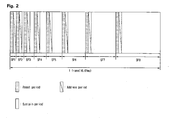
- FIG. 2 is a view for explaining a method of implementing an image of a plasma display apparatus in the prior art.
- the plasma display apparatus is adapted to implement an image in such a manner that one frame period is divided into a plurality of sub-fields having a different frequency of emission and a plasma display panel is light-emitted in a sub-field period corresponding to a gray level value of an input picture signal.
- Each of the sub fields is divided into a reset period for uniformly generating discharging, an address period for selecting a discharge cell, and a sustain period for implementing gray levels according to the number of discharging. For example, if it is desired to display an image with 256 gray scales, a frame period (16.67 ms) corresponding to 1/60 seconds is divided into eight sub-fields.
- each of the eight sub-fields is subdivided into a reset period, an address period and a sustain period.
- FIG. 3 is a graph showing a comparison result of brightness characteristics between a plasma display apparatus and a cathode-ray tube (CRT).
- a CRT and a liquid crystal display represent a desired gray level by controlling displayed light in the analog mode according to an input video signal, and thus generally have non-linear brightness characteristics.
- a plasma display apparatus represents a gray level by modulating the number of optical pulses using the matrix array of a discharge cell that can be turned on/off, and thus has linear brightness characteristics.
- the gray level representation method of this plasma display apparatus is called a " pulse width modulation (PWM) method" .
- a display current versus brightness characteristics is proportional to a 2.2 multiplier.
- An external input image signal such as a broadcasting signal transmits a signal corresponding to an opposite of the 2.2 multiplier. Accordingly, in the plasma display apparatus having linear brightness characteristics, an external input image signal needs to undergo inverse gamma correction.
- FIG. 4 is a graph showing inverse gamma correction in the conventional plasma display apparatus.
- a target brightness indicates an ideal inverse gamma result to be corrected
- an actual brightness indicates a measured brightness value, which is shown as a result of inverse gamma correction
- a PDP brightness indicates below brightness value 3, which is measured in a state in which inverse gamma correction does not exist.
- 61-step gray level values from 0 to 60 are represented as different brightness values, respectively.
- 61-step gray level values from 0 to 60 are represented as different as only eight brightness values. Accordingly, when inverse gamma correction is performed in the plasma display apparatus, gray levels are not sufficiently represented in a dark region. Therefore, there is a problem in that a pseudo contour in which images look united is generated.
- a halftone method such as a dithering method and an error diffusion method, has been used.
- the dithering method will be first described with reference to FIGS. 5a and 5b.
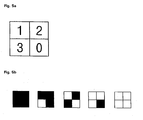
- FIGS. 5a and 5b are views illustrating the dithering method of the plasma display panel in the prior art.
- FIG. 5a shows a conventional 2 ⁇ 2 dither mask
- FIG. 5b shows dither mask patterns by the 2 ⁇ 2 dither mask.
- the dithering method is a method in which whether to generate a carry is determined by comparing a gray level value of each pixel with a predetermined threshold value of a dither mask.
- this method is designed to increase the ability to represent gray levels by turning on pixels in which a carry is generated, and turning off pixels in which a carry is not generated.
- the dithering method is a method in which adequate noise is added so that pseudo contour is invisible with the naked eye.
- three-dimensional dither mask patterns corresponding to a number of frames, a number of lines and a number of columns of a plasma display panel are repeatedly used.
- the dithering method has a problem in that dithering noise to reduce the picture quality in a predetermined gray level is generated. There is also a problem in that error indicating how much is a carry greater or smaller than a threshold value when generating the carry is never taken into consideration.
- FIG. 6 is a view illustrating the error diffusion method of the plasma display apparatus in the prior art.
- the error diffusion method is a method in which correction for abandoned error is spatially solved by allowing error generated when a corresponding pixel is quantized to affect neighboring pixels.
- the error diffusion method includes multiplying predetermined coefficients to error values, which are generated in picture signals a, b, c and d of neighboring pixels.
- the error values multiplied by the coefficients are added to i values and then undergo quantization.
- the error values resulting from the quantization are then stored in a line memory and are repeated every pixel.
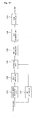
- FIG. 7 is a block diagram showing a conventional halftoning unit.
- the conventional halftoning unit 700 includes a halftone selection information table storage unit 710, a selection unit 720 and a halftoning processing unit 730.
- the halftone selection information table storage unit 710 of each gray level stores information on which one of three kinds of halftone methods will be used according to a gray level value of input image signal data.
- the selection unit 720 selects image signal data, which are processed by means of a halftone method corresponding to information output from the halftone selection information table storage unit 710.
- the selection unit 720 can be substantially implemented using a multiplexer (MUX).
- the three kinds of the halftone methods include the error diffusion method, the dithering method and a mixed method of error diffusion and dithering. These three kinds of the halftone methods are performed by means of the halftoning processing unit 730 having an error diffusion unit 731, a dithering unit 732 and an error diffusion/dithering unit 733.
- the respective halftone methods used in the conventional halftoning unit have different properties in the case of a still image and in the case of a motion picture. That is, if a motion image signalis halftoned by means of a halftone method capable of reducing halftone noise generated in a still image, there is a problem in that halftone noise generated in the motion picture increases. To the contrary, if a still image signal is halftoned by means of a halftone method capable of reducing halftone noise generated in a motion picture, there is a problem in that halftone noise generated in the still image increases.
- the respective halftone methods have different characteristics according to the brightness of the whole screen on a frame basis. For example, there is a problem in that dither noise increases more in a dark screen than in a bright screen.
- the present invention has been made in view of the above problems occurring in the prior art, and it is an object of the present invention to provide a plasma display apparatus and image processing method thereof, in which the picture quality can be improved by using a halftone method suitable for a motion or an APL value of a screen displayed.
- a plasma display apparatus including a motion detection unit that detects motion information of input image signal data, and a halftoning unit that halftones the image signal data by using at least one or more of a dithering method and an error diffusion method according to the motion information received from the motion detection unit.
- the motion detection unit of the present invention can detect whether a motion exists or one or more information of the motion degree by comparing gray level values of image signal data corresponding to respective cells in at least two or more consecutive frames.
- the motion detection unit of the present invention can detect whether a motion exists or one or more information of the motion degree by measuring variations in a turn on or off state of each cell in at least two or more consecutive frames.
- the halftoning unit of the present invention can include a first selection unit that selects a halftone method according to the motion information, a halftoning processing unit that halftones the image signal data using each of the methods, and a second selection unit that selects and outputs image signal data, which are processed in the halftoning processing unit, according to information received from the first selection unit.
- different halftone methods can be set according to gray level values of the input image signal data.
- different halftone methods can be set to the same gray level value of image signal data according to the motion information.
- the gray level value of the present invention can be a predetermined threshold value or less, the image signal data are halftoned by means of the error diffusion method.
- the plasma display apparatus can further include a halftone selection information table storage unit that previously stores at least two or more halftone selection information tables in which halftone methods are set according to the motion information or any one or more information of gray level values of image signal data.
- an image processing method of a plasma display apparatus including a motion detection step of detecting motion information of input image signal data, and a halftoning step of halftoning the image signal data by using at least one or more methods of a dithering method and an error diffusion method according to the motion information received in the motion detection step.
- the motion detection step of the present invention can include detecting whether a motion exists or one or more information of the motion degree by comparing gray level values of image signal data corresponding to respective cells in at least two or more consecutive frames.
- the motion detection step of the present invention can include detecting whether a motion exists or one or more information of the motion degree by measuring variations in a turn on or off state of each cell in at least two or more consecutive frames.
- the halftoning step of the present invention can include a first selection step that selects a halftone method according to the motion information, a halftoning processing step that halftones the image signal data using each of the methods, and a second selection step that selects and outputs image signal data, which are processed in the halftoning processing step, according to information received from the first selection step.
- different halftone methods are set according to gray level values of the input image signal data.
- different halftone methods are set with respect to the same gray level value of image signal data according to the motion information.
- the gray level value can be a predetermined threshold value or less
- the image signal data are halftoned by means of the error diffusion method.
- the image processing method of the present invention can further include a halftone selection information table storage unit that previously stores at least two or more halftone selection information tables in which halftone methods are set according to the motion information or any one or more information of gray level values of image signal data.
- a plasma display apparatus including an APL (Average Picture Level) detection unit that detects APL information of input image signal data, and a halftoning unit that halftones the image signal data by using at least one or more of a dithering method and an error diffusion method according to the APL information received from the APL detection unit.
- APL Average Picture Level
- the APL detection unit of the present invention can detect the APL information by calculating an APL value of a gray level value of image signal data corresponding to the entire cells on a frame basis.
- the halftoning unit of the present invention can include a first selection unit that selects a halftone method according to the APL information, a halftoning processing unit that halftones the image signal data using each of the methods, and a second selection unit that selects and outputs image signal data, which are processed in the halftoning processing unit, according to information received from the first selection unit.
- different halftone methods can be set according to gray level values of the input image signal data.
- different halftone methods can be set to the same gray level value of image signal data according to the APL information.
- the gray level value can be a predetermined threshold value or less
- the image signal data are halftoned by means of the error diffusion method.
- the plasma display apparatus can further include a halftone selection information table storage unit that previously stores at least two or more halftone selection information tables in which halftone methods are set according to the APL information or any one or more information of gray level values of image signal data.
- an image processing method of a plasma display apparatus including an APL (Average Picture Level) detection step that detects APL information of input image signal data, and a halftoning step that halftones the image signal data by using at least one or more of a dithering method and an error diffusion method according to the APL information received from the APL detection step.
- APL Average Picture Level
- the APL detection step of the present invention can include detecting the APL information by calculating an APL value of a gray level value of image signal data corresponding to the entire cells on a frame basis.
- the halftoning step of the present invention can include a first selection step that selects a halftone method according to the APL information, a halftoning processing step that halftones the image signal data using each of the methods, and a second selection step that selects and outputs image signal data, which are processed in the halftoning processing step, according to information received from the first selection step.
- different halftone methods can be set according to gray level values of the input image signal data.
- different halftone methods can be set to the same gray level value of image signal data according to the APL information.
- the image signal data are halftoned by means of the error diffusion method.
- the image processing method can further include a halftone selection information table storage step that previously stores at least two or more halftone selection information tables in which halftone methods are set according to the APL information or any one or more information of gray level values of image signal data.
- a plasma display apparatus including a motion detection unit that detects motion information of input image signal data, an APL detection unit that detects APL (Average Picture Level) information of the image signal data, and a halftoning unit that halftones the image signal data by using at least one or more methods of a dithering method and an error diffusion method according to the motion information and the APL information.
- APL Average Picture Level
- an image processing method of a plasma display apparatus including a motion detection step that detects motion information of input image signal data, an APL detection step that detects APL (Average Picture Level) information of the image signal data, and a halftoning step that halftones the image signal data by using at least one or more methods of a dithering method and an error diffusion method according to the motion information and the APL information.
- FIG.1 is a perspective view illustrating the construction of a conventional plasma display panel
- FIG. 2 is a view for explaining a method of implementing an image of a plasma display apparatus in the prior art
- FIG. 3 is a graph showing a comparison result of brightness characteristics between a plasma display apparatus and a CRT;
- FIG. 4 is a graph showing inverse gamma correction in the conventional plasma display apparatus
- FIGS. 5a and 5b are views illustrating a dithering method of a plasma display panel in the prior art
- FIG. 6 is a view illustrating an error diffusion method of a plasma display apparatus in the prior art
- FIG. 7 is a block diagram showing a conventional halftoning unit
- FIG. 8 is a block diagram showing a plasma display apparatus according to a first embodiment of the present invention.
- FIG. 9 is a detailed block diagram showing the construction of a halftoning unit according to a first embodiment of the present invention.
- FIG. 10 is a view for explaining halftone selection information tables according to a first embodiment of the present invention.
- FIG. 11 is a block diagram showing a plasma display apparatus according to a second embodiment of the present invention.
- FIG. 12 is a detailed block diagram showing the construction of the halftoning unit according to a second embodiment of the present invention.
- FIG. 13 is a view for explaining halftone selection information tables according to a second embodiment of the present invention.
- FIG. 14 is a block diagram showing a plasma display apparatus according to a third embodiment of the present invention.
- FIG. 15 is a view for explaining halftone selection information tables according to a third embodiment of the present invention.
- FIG. 8 is a block diagram showing a plasma display apparatus according to a first embodiment of the present invention.
- the plasma display apparatus includes an inverse gamma correction unit 810, a gain controller 820, a motion detection unit 830, a halftoning unit 840 and a sub-field mapping unit 850.
- the inverse gamma correction unit 810 linearly converts a brightness value that is displayed depending upon a gray level value of an input image signalby performing inverse gamma correction on input image signal data.
- the gain controller 820 controls gains for red (R), green (G) and blue (B) by multiplying R, G and B picture signals which are inverse gamma corrected by the inverse gamma correction unit 810 by gain values that can be controlled by a user or a set maker. In this case, the user or the set maker can set a desired color temperature through the gain controller 820.
- the motion detection unit 830 detects motion information of the input image signal data.
- the motion picture consists of variations in a turn on or off state of a cell of one frame and a cell of a next frame and variations in a gray level.
- the motion information can also be detected through variations in the turn on/off of these cells and variations in the gray level.
- the motion detection unit 840 determines whether a motion has been generated by comparing gray level values of image signal data corresponding to respective cells in at least two or more consecutive frames, and detects the degree on how much is a motion generated.
- the motion detection unit 840 can detect whether a motion has occurred or one or more information of the motion degree by measuring variations in the turn on/off state of each cell in at least two or more consecutive frames that are substantially driven after image signal data processing.
- the halftoning unit 840 halftones the image signal data received from the gain controller 820 by using at least one or more of the dithering method and the error diffusion method according to motion information on whether a motion has occurred or the motion degree, which is received from the motion detection unit 830. It is thus possible to finely control brightness values displayed according to gray level values of image signal data, and also to improve the ability to represent gray levels.
- the plasma display apparatus includes a halftone selection information table storage unit (not shown) in which halftone methods depending upon motion information are set.
- the halftoning unit 840 will be described in more detail later on.
- the sub-field mapping unit 850 maps the picture signals received from the halftone unit 840 to a predetermined sub-field mapping table.
- the data alignment unit 860 aligns spatially aligned sub-field mapping data, which are received from the sub-field mapping unit 850, as temporal data.
- the data driving unit 870 receives the data, which are temporally aligned by the data alignment unit 860, and supplies an address driving pulse to address electrodes (not shown) of a plasma display panel, thereby implementing an image of the plasma display panel.
- the operation of the halftoning unit 840 according to a first embodiment of the present invention will now be described with reference to FIG. 9.
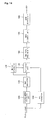
- FIG. 9 is a detailed block diagram showing the construction of the halftoning unit according to a first embodiment of the present invention.
- the halftoning unit includes a halftone selection information table storage unit 910, a first selection unit 920, a halftoning processing unit 930 and a second selection unit 940.
- the halftone selection information table storage unit 910 stores at least two or more halftone selection information tables in which halftone methods are set according to motion information or one or more information of gray level values of image signal data.
- input image signal data can be processed in real time.
- a low gray level region LS can be set differently every table. This will be described in detail with reference to FIG. 10.
- the first selection unit 920 selects a halftone method based on motion information received from the motion detection unit 830. That is, the first selection unit 920 selects a halftone method corresponding to motion information, which is received from the motion detection unit 830, from the halftone selection information tables downloaded from the halftone selection information table storage unit 910.
- the halftoning processing unit 930 halftones the image signal data received from the gain controller 820 by means of the dithering method, the error diffusion method and a mixture of dithering and error diffusion.
- the second selection unit 940 selects and outputs image signal data that are processed in the halftoning processing unit 930 according to halftone method information output from the first selection unit 920.
- each of the first selection unit 920 and the second selection unit 940 includes a multiplexer.
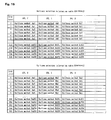
- FIG. 10 is a view for explaining halftone selection information tables according to a first embodiment of the present invention.
- the halftone selection information tables according to a first embodiment of the present invention have different halftone methods set in according to gray level values of image signal data.
- low gray level refers to a gray level having a low gray level value among image signal data. Generally, 16 or less gray levels among 256 gray levels from 0 to 255 are referred as a low gray level.
- the halftone selection information table according to a first embodiment of the present invention has different halftone methods set in for the same gray level value of image signal data according to motion information.
- the degree of noise which is represented in a still image and a motion picture, is different according to dither mask patterns. Accordingly, in a still image, the dithering method and the error diffusion method are used, but a dither mask that can reduce dithering noise generated due to the still image, i.e., dither mask pattern noise is used. In a motion picture, the dithering method is used, but a dither mask that can reduce dithering noise generated due to the motion picture, i.e., false color is used. More particularly, in a motion picture having a high motion degree, an error diffusion pattern is rarely visible with the naked eye. Therefore, image signal data are halftoned by means of the error diffusion method.
- a halftone method is decided according to two kinds of factors, motion information and a gray level value. That is, the halftone selection information table storage unit 910 includes a plurality of tables in which halftone methods are set according to the motion degree, wherein each of the tables has a halftoning method corresponding to each gray level value set in.
- the error diffusion method when the motion degree is high and in the case of a low gray level in each of the two factors of motion information and a gray level value, the error diffusion method is used. That is, when a gray level value of image signal data is a predetermined threshold value or less, image signal data are determined as a low gray level, and are halftoned by means of the error diffusion method.
- a low gray level region is more expanded, and in the low gray level region, halftoning is performed by means of the error diffusion method. From Fig. 10, it can be seen that a low gray level region having tables corresponding to higher motions is expanded.
- halftone noise can be reduced through differentiation of halftoning methods depending upon motion information of image signal data.
- the reliability of halftoning can also be secured considering motion information in selecting a halftone method.
- FIG. 11 is a block diagram of a plasma display apparatus according to a second embodiment of the present invention.
- the plasma display apparatus includes an inverse gamma correction unit 1110, a gain controller 1120, an APL detection unit 1130, a halftoning unit 1140 and a sub-field mapping unit 1150.
- the inverse gamma correction unit 1110 linearly converts a brightness value that is displayed depending upon a gray level value of an input image signalby performing inverse gamma correction on input image signal data.
- the gain controller 1120 controls gains for red (R), green (G) and blue (B) by multiplying R, G and B picture signals which are inverse gamma corrected by the inverse gamma correction unit 1110 by gain values that can be controlled by a user or a set maker. In this case, the user or the set maker can set a desired color temperature through the gain controller 1120.
- the APL detection unit 1130 detects APL (Average Picture Level) information by calculating APL values of gray level values of image signal data corresponding to the entire cells on a frame basis.
- APL Average Picture Level
- the plasma display apparatus has high power consumption since it uses a high voltage.
- the APL detection unit 1130 is used to allocate different weights of the number of sustain pulses, which are applied in a sustain period, according to APL values whereby power consumption is kept to a predetermined level.
- the reliability is secured in selecting a halftoning method using APL information output from the APL detection unit 1130 having this function.
- the halftoning unit 1140 halftones image signal data received from the gain controller 1120 by using at least one or more of the aforementioned dithering method and the error diffusion method according to information of an APL value received from the APL detection unit 1130. It is thus possible to finely control brightness values displayed according to gray level values of image signal data and also to improve the ability to represent gray levels.
- the plasma display apparatus includes a halftone selection information table storage unit (not shown) in which halftone methods depending upon APL information are set.
- the halftoning unit 1140 will be described in more detail later on.
- the sub-field mapping unit 1150 maps the picture signals received from the halftone unit 1140 to a predetermined sub-field mapping table.
- the data alignment unit 1160 aligns spatially aligned sub-field mapping data, which are received from the sub-field mapping unit 1150, as temporal data.
- the data driving unit 1170 receives the data, which are temporally aligned by the data alignment unit 1160, and supplies an address driving pulse to address electrodes (not shown) of a plasma display panel, thereby implementing an image of the plasma display panel.
- the operation of the halftoning unit 1140 according to a second embodiment of the present invention will now be described with reference to FIG. 12.
- FIG. 12 is a detailed block diagram showing the construction of the halftoning unit according to a second embodiment of the present invention.
- the halftoning unit includes a halftone selection information table storage unit 1210, a first selection unit 1220, a halftoning processing unit 1230 and a second selection unit 1240.
- the halftone selection information table storage unit 1210 stores at least two or more halftone selection information tables in which halftone methods are set according to APL information or one or more information of gray level values of image signal data.
- APL information or one or more information of gray level values of image signal data.
- the halftone selection information table storage unit 1210 since the halftone selection information table storage unit 1210 is provided, input image signal data can be processed in real time. In this case, a low gray level region LS can be set differently every table. This will be described in detail with reference to FIG. 13.
- the first selection unit 1220 selects a halftone method based on APL information received from the APL detection unit 1130. That is, the first selection unit 1220 selects a halftone method corresponding to APL information, which is received from the APL detection unit 1130, from the halftone selection information tables downloaded from the halftone selection information table storage unit 1210.
- the halftoning processing unit 1230 halftones the image signal data received from the gain controller 1120 by means of the dithering method, the error diffusion method and a mixture of dithering and error diffusion, respectively.
- the second selection unit 1240 selects and outputs image signal data that are processed in the halftoning processing unit 1230 according to halftone method information output from the first selection unit 1220.
- each of the first selection unit 1220 and the second selection unit 1240 includes a multiplexer.
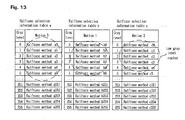
- FIG. 13 is a view for explaining halftone selection information tables according to a second embodiment of the present invention.
- the halftone selection information tables according to a second embodiment of the present invention store halftone methods, which are differently set according to gray level values of image signal data. Description thereof has been given with reference to FIG. 10 of a first embodiment, and will be thus omitted for simplicity.
- halftone selection information tables according to a second embodiment of the present invention store halftone methods, which are differently set to the same gray level value of image signal data according to APL information.
- the dithering method when comparing a dark screen having a low APL value and a bright screen having a high APL value, lots of dithering noise is generated in the dark screen. This is because the number of sustain pulses is great in a dark screen having a low APL value. Due to this, the error diffusion method is mainly used in a dark screen.
- a halftone method is decided according to the two kinds of the factors including APL information and gray level value. That is, the halftone selection information table storage unit 1210 stores a plurality of tables in which halftone methods are set according to APL values, wherein a halftoning method corresponding to each of the gray level values is set in each of the tables.
- the error diffusion method when an APL value is low and in the case of a low gray level in each of two factors of APL information and a gray level value, the error diffusion method is used. That is, when a gray level value of image signal data is a predetermined threshold value or less, image signal data are determined as a low gray level, and are halftoned by means of the error diffusion method.
- halftone noise can be reduced through differentiation of halftoning methods depending upon APL information of image signal data.
- the reliability of halftoning can also be secured considering APL information in selecting a halftone method.
- FIG. 14 is a block diagram showing a plasma display apparatus according to a third embodiment of the present invention.
- the plasma display apparatus include an inverse gamma correction unit 1410, a gain controller 1420, a motion detection unit 1430, an APL detection unit 1440, a halftoning unit 1450 and a sub-field mapping unit 1460.
- the halftoning unit 1450 halftones image signal data received from the gain controller 1420 by selectively using a halftone method according to motion information and APL information, which are received from the motion detection unit 1430 and the APL detection unit 1440, respectively.
- each of the inverse gamma correction unit 1410, the gain controller 1420, the motion detection unit 1430, the APL detection unit 1440, the sub-field mapping unit 1460, the data alignment unit 1470 and the data driving unit 1480 has been described in first and second embodiments of the present invention. Description thereof will be thus omitted for simplicity.
- FIG. 15 is a view for explaining halftone selection information tables according to a third embodiment of the present invention.
- the halftone selection information tables according to a third embodiment of the present invention store halftone methods, which are differently set according to gray level values of image signal data, APL information and motion information.
- the halftone selection information tables are generated by reflecting the halftone noise propensity depending upon two factors of motion information and APL information, as listed in the following Table 1.
- Classification Motion Information APL Information Halftone Noise A Degree of motion increase APL value increase Dithering noise increase B Degree of motion increase APL value decrease Dithering noise further increase C Degree of motion decrease APL value increase Error diffusion pattern increase D Degree of motion decrease APL value decrease Error diffusion pattern further increase
- a table in which information of a halftone method capable of reducing dither noise is set is selected.
- a table in which information of a halftone method capable of reducing an error diffusion pattern is set is selected.
- B of Table 1 when the motion degree is great and the APL value is low, dithering noise further increases.
- the error diffusion method is mainly used. That is, as described in the first and second embodiments, a low gray level region is set high. The error diffusion method is used in the low gray level region.
- optimized image representation can be obtained using a proper halftone method according to motion information of image signal data and APL information.
- halftone noise generated when implementing an image can be reduced by improving a plasma display apparatus and image processing method thereof. Therefore, there is an effect in that the ability to represent gray levels can be improved. There is also an effect in that the picture quality of a plasma display apparatus can be improved.
Landscapes
- Engineering & Computer Science (AREA)
- Physics & Mathematics (AREA)
- Computer Hardware Design (AREA)
- General Physics & Mathematics (AREA)
- Theoretical Computer Science (AREA)
- Microelectronics & Electronic Packaging (AREA)
- Control Of Indicators Other Than Cathode Ray Tubes (AREA)
- Control Of Gas Discharge Display Tubes (AREA)
Applications Claiming Priority (2)
| Application Number | Priority Date | Filing Date | Title |
|---|---|---|---|
| KR1020040036510A KR100571201B1 (ko) | 2004-05-21 | 2004-05-21 | 하프톤 노이즈를 감소시킬 수 있는 플라즈마 표시 패널의구동 장치 및 구동 방법 |
| KR2004036510 | 2004-05-21 |
Publications (2)
| Publication Number | Publication Date |
|---|---|
| EP1600920A2 true EP1600920A2 (fr) | 2005-11-30 |
| EP1600920A3 EP1600920A3 (fr) | 2006-10-04 |
Family
ID=34936753
Family Applications (1)
| Application Number | Title | Priority Date | Filing Date |
|---|---|---|---|
| EP05010965A Withdrawn EP1600920A3 (fr) | 2004-05-21 | 2005-05-20 | Dispositif d'affichage à plasma et méthode de traitement d'image adaptée à ce dispositif |
Country Status (3)
| Country | Link |
|---|---|
| US (1) | US7609283B2 (fr) |
| EP (1) | EP1600920A3 (fr) |
| KR (1) | KR100571201B1 (fr) |
Cited By (1)
| Publication number | Priority date | Publication date | Assignee | Title |
|---|---|---|---|---|
| WO2013039909A1 (fr) * | 2011-09-16 | 2013-03-21 | Qualcomm Mems Technologies, Inc. | Procédés et appareils permettant une obtention hybride de demi-teintes d'une image |
Families Citing this family (4)
| Publication number | Priority date | Publication date | Assignee | Title |
|---|---|---|---|---|
| KR100658359B1 (ko) * | 2005-02-18 | 2006-12-15 | 엘지전자 주식회사 | 플라즈마 디스플레이 패널의 화상처리 장치 및 화상처리 방법 |
| KR20070072121A (ko) * | 2005-12-30 | 2007-07-04 | 엘지전자 주식회사 | 플라즈마 디스플레이 장치 및 그 화상처리 방법 |
| JPWO2008126338A1 (ja) * | 2007-03-30 | 2010-07-22 | パナソニック株式会社 | プラズマ表示装置及び該プラズマ表示装置に用いられる駆動方法 |
| KR20160072344A (ko) | 2014-12-12 | 2016-06-23 | 삼성디스플레이 주식회사 | 유기 발광 표시 장치 및 그 구동 방법 |
Family Cites Families (7)
| Publication number | Priority date | Publication date | Assignee | Title |
|---|---|---|---|---|
| JP3494127B2 (ja) * | 2000-05-30 | 2004-02-03 | 日本電気株式会社 | 映像表示装置 |
| JP2003015588A (ja) * | 2001-06-28 | 2003-01-17 | Pioneer Electronic Corp | ディスプレイ装置 |
| JP4064268B2 (ja) | 2002-04-10 | 2008-03-19 | パイオニア株式会社 | サブフィールド法を用いた表示装置及び表示方法 |
| EP1376521A1 (fr) | 2002-06-28 | 2004-01-02 | Deutsche Thomson Brandt | Traitement d'images vidéo pour la compensation améliorée de l'effet de faux contours dynamique |
| EP1406236A3 (fr) * | 2002-10-02 | 2006-06-07 | Lg Electronics Inc. | Procédé et dispositif de commande d'un panneau d'affichage à plasma |
| JP2005024717A (ja) * | 2003-06-30 | 2005-01-27 | Fujitsu Hitachi Plasma Display Ltd | ディスプレイ装置およびディスプレイの駆動方法 |
| KR101062198B1 (ko) * | 2004-04-09 | 2011-09-05 | 삼성전자주식회사 | 디스플레이장치 및 그 제어방법 |
-
2004
- 2004-05-21 KR KR1020040036510A patent/KR100571201B1/ko not_active Expired - Fee Related
-
2005
- 2005-05-20 EP EP05010965A patent/EP1600920A3/fr not_active Withdrawn
- 2005-05-20 US US11/133,412 patent/US7609283B2/en not_active Expired - Fee Related
Cited By (2)
| Publication number | Priority date | Publication date | Assignee | Title |
|---|---|---|---|---|
| WO2013039909A1 (fr) * | 2011-09-16 | 2013-03-21 | Qualcomm Mems Technologies, Inc. | Procédés et appareils permettant une obtention hybride de demi-teintes d'une image |
| CN103890830A (zh) * | 2011-09-16 | 2014-06-25 | 高通Mems科技公司 | 用于图像的混合半色调的方法及设备 |
Also Published As
| Publication number | Publication date |
|---|---|
| KR20050111271A (ko) | 2005-11-24 |
| KR100571201B1 (ko) | 2006-04-17 |
| US7609283B2 (en) | 2009-10-27 |
| US20050259046A1 (en) | 2005-11-24 |
| EP1600920A3 (fr) | 2006-10-04 |
Similar Documents
| Publication | Publication Date | Title |
|---|---|---|
| US20080012883A1 (en) | Display apparatus and display driving method for effectively eliminating the occurrence of a moving image false contour | |
| US7414598B2 (en) | Apparatus and method for driving plasma display panel | |
| US7256794B2 (en) | Method and apparatus for processing video data of display device | |
| US8471786B2 (en) | Plasma display device and plasma display panel driving method | |
| US7649510B2 (en) | Plasma display apparatus and image processing method thereof | |
| US7453422B2 (en) | Plasma display panel having an apparatus and method for displaying pictures | |
| US7609283B2 (en) | Plasma display apparatus and image processing method thereof | |
| EP1580715B1 (fr) | Dispositif d'affichage à plasma et procédé de traitement d'image lui étant adapté | |
| US20050104811A1 (en) | Apparatus and method of driving a plasma display panel | |
| EP1587053A2 (fr) | Panneau d'affichage au plasma et méthode de traitement d'image associée | |
| JP4160575B2 (ja) | プラズマディスプレイ装置及びその駆動方法 | |
| US20070024609A1 (en) | Apparatus and method of driving plasma display panel | |
| US20060152442A1 (en) | Plasma display apparatus and driving method thereof | |
| EP1596354A2 (fr) | Dispositif d'affichage à plasma et sa méthode de traitement d'image | |
| KR100487807B1 (ko) | 플라즈마 디스플레이 패널의 의사윤곽 감소장치 및 방법 | |
| KR100607258B1 (ko) | 플라즈마 디스플레이 패널의 화상처리 방법 및 화상처리장치 | |
| KR100738816B1 (ko) | 플라즈마 디스플레이 패널의 화상처리 장치 및 화상처리방법 | |
| KR100658359B1 (ko) | 플라즈마 디스플레이 패널의 화상처리 장치 및 화상처리 방법 | |
| KR100612514B1 (ko) | 플라즈마 디스플레이 패널의 화상처리 장치 및 화상처리방법 | |
| KR100705831B1 (ko) | 플라즈마 디스플레이 장치 및 그 화상처리 방법 | |
| KR100612516B1 (ko) | 플라즈마 디스플레이 패널의 화상처리 장치 및 화상처리방법 | |
| KR100658353B1 (ko) | 플라즈마 디스플레이 패널의 화상처리 장치 및 화상처리방법 | |
| KR100625467B1 (ko) | 플라즈마 디스플레이 장치 및 그 구동 방법 | |
| JPH07140923A (ja) | ディスプレイ装置の駆動回路 | |
| KR100612515B1 (ko) | 플라즈마 디스플레이 패널의 화상처리 장치 및 화상처리방법 |
Legal Events
| Date | Code | Title | Description |
|---|---|---|---|
| PUAI | Public reference made under article 153(3) epc to a published international application that has entered the european phase |
Free format text: ORIGINAL CODE: 0009012 |
|
| 17P | Request for examination filed |
Effective date: 20050520 |
|
| AK | Designated contracting states |
Kind code of ref document: A2 Designated state(s): AT BE BG CH CY CZ DE DK EE ES FI FR GB GR HU IE IS IT LI LT LU MC NL PL PT RO SE SI SK TR |
|
| AX | Request for extension of the european patent |
Extension state: AL BA HR LV MK YU |
|
| RIN1 | Information on inventor provided before grant (corrected) |
Inventor name: MYOUNG, DAE JIN Inventor name: LEE, JUN HAKGGOTMEBEODEUL MAEUL GEUMGANG |
|
| PUAL | Search report despatched |
Free format text: ORIGINAL CODE: 0009013 |
|
| AK | Designated contracting states |
Kind code of ref document: A3 Designated state(s): AT BE BG CH CY CZ DE DK EE ES FI FR GB GR HU IE IS IT LI LT LU MC NL PL PT RO SE SI SK TR |
|
| AX | Request for extension of the european patent |
Extension state: AL BA HR LV MK YU |
|
| AKX | Designation fees paid |
Designated state(s): DE FR GB NL |
|
| 17Q | First examination report despatched |
Effective date: 20071102 |
|
| STAA | Information on the status of an ep patent application or granted ep patent |
Free format text: STATUS: THE APPLICATION IS DEEMED TO BE WITHDRAWN |
|
| 18D | Application deemed to be withdrawn |
Effective date: 20091201 |