EP1601178A2 - Messung und Regelung von hochfrequenten Streifen in einem Markierungssystem - Google Patents
Messung und Regelung von hochfrequenten Streifen in einem Markierungssystem Download PDFInfo
- Publication number
- EP1601178A2 EP1601178A2 EP05104463A EP05104463A EP1601178A2 EP 1601178 A2 EP1601178 A2 EP 1601178A2 EP 05104463 A EP05104463 A EP 05104463A EP 05104463 A EP05104463 A EP 05104463A EP 1601178 A2 EP1601178 A2 EP 1601178A2
- Authority
- EP
- European Patent Office
- Prior art keywords
- high frequency
- test pattern
- banding
- amplitude
- frequency banding
- Prior art date
- Legal status (The legal status is an assumption and is not a legal conclusion. Google has not performed a legal analysis and makes no representation as to the accuracy of the status listed.)
- Granted
Links
Images





Classifications
-
- H—ELECTRICITY
- H04—ELECTRIC COMMUNICATION TECHNIQUE
- H04N—PICTORIAL COMMUNICATION, e.g. TELEVISION
- H04N1/00—Scanning, transmission or reproduction of documents or the like, e.g. facsimile transmission; Details thereof
- H04N1/00002—Diagnosis, testing or measuring; Detecting, analysing or monitoring not otherwise provided for
-
- H—ELECTRICITY
- H04—ELECTRIC COMMUNICATION TECHNIQUE
- H04N—PICTORIAL COMMUNICATION, e.g. TELEVISION
- H04N1/00—Scanning, transmission or reproduction of documents or the like, e.g. facsimile transmission; Details thereof
- H04N1/00002—Diagnosis, testing or measuring; Detecting, analysing or monitoring not otherwise provided for
- H04N1/00007—Diagnosis, testing or measuring; Detecting, analysing or monitoring not otherwise provided for relating to particular apparatus or devices
- H04N1/00015—Reproducing apparatus
-
- H—ELECTRICITY
- H04—ELECTRIC COMMUNICATION TECHNIQUE
- H04N—PICTORIAL COMMUNICATION, e.g. TELEVISION
- H04N1/00—Scanning, transmission or reproduction of documents or the like, e.g. facsimile transmission; Details thereof
- H04N1/00002—Diagnosis, testing or measuring; Detecting, analysing or monitoring not otherwise provided for
- H04N1/00026—Methods therefor
- H04N1/00031—Testing, i.e. determining the result of a trial
-
- H—ELECTRICITY
- H04—ELECTRIC COMMUNICATION TECHNIQUE
- H04N—PICTORIAL COMMUNICATION, e.g. TELEVISION
- H04N1/00—Scanning, transmission or reproduction of documents or the like, e.g. facsimile transmission; Details thereof
- H04N1/00002—Diagnosis, testing or measuring; Detecting, analysing or monitoring not otherwise provided for
- H04N1/00026—Methods therefor
- H04N1/00045—Methods therefor using a reference pattern designed for the purpose, e.g. a test chart
-
- H—ELECTRICITY
- H04—ELECTRIC COMMUNICATION TECHNIQUE
- H04N—PICTORIAL COMMUNICATION, e.g. TELEVISION
- H04N1/00—Scanning, transmission or reproduction of documents or the like, e.g. facsimile transmission; Details thereof
- H04N1/00002—Diagnosis, testing or measuring; Detecting, analysing or monitoring not otherwise provided for
- H04N1/00026—Methods therefor
- H04N1/00053—Methods therefor out of service, i.e. outside of normal operation
-
- H—ELECTRICITY
- H04—ELECTRIC COMMUNICATION TECHNIQUE
- H04N—PICTORIAL COMMUNICATION, e.g. TELEVISION
- H04N1/00—Scanning, transmission or reproduction of documents or the like, e.g. facsimile transmission; Details thereof
- H04N1/00002—Diagnosis, testing or measuring; Detecting, analysing or monitoring not otherwise provided for
- H04N1/00026—Methods therefor
- H04N1/00063—Methods therefor using at least a part of the apparatus itself, e.g. self-testing
-
- H—ELECTRICITY
- H04—ELECTRIC COMMUNICATION TECHNIQUE
- H04N—PICTORIAL COMMUNICATION, e.g. TELEVISION
- H04N1/00—Scanning, transmission or reproduction of documents or the like, e.g. facsimile transmission; Details thereof
- H04N1/00002—Diagnosis, testing or measuring; Detecting, analysing or monitoring not otherwise provided for
- H04N1/00026—Methods therefor
- H04N1/00068—Calculating or estimating
-
- H—ELECTRICITY
- H04—ELECTRIC COMMUNICATION TECHNIQUE
- H04N—PICTORIAL COMMUNICATION, e.g. TELEVISION
- H04N1/00—Scanning, transmission or reproduction of documents or the like, e.g. facsimile transmission; Details thereof
- H04N1/00002—Diagnosis, testing or measuring; Detecting, analysing or monitoring not otherwise provided for
- H04N1/00071—Diagnosis, testing or measuring; Detecting, analysing or monitoring not otherwise provided for characterised by the action taken
- H04N1/00082—Adjusting or controlling
- H04N1/00087—Setting or calibrating
Definitions
- This invention relates to marking systems in general and in particular to high frequency banding in marking systems.
- banding The image quality defect known as banding is, within a printed image, a periodic modulation of lightness and darkness on a printed medium that runs in the marking process direction. Moreover, banding amplitude can change over time to produce different banding characteristics for printed images produced at different times. Banding and high frequency banding generally occur across the full width of an image, and may vary in amplitude in both time and in the direction perpendicular to the marking process direction, i.e., the cross-process direction.
- Banding and high frequency banding can be caused by a number of fluctuations that occur within the subsystems of a marking engine such as, for example, laser polygon Raster Optical Scanner (ROS) facet-to-facet reflectivity variation, intensity and spot size variation in a multibeam ROS, ROS polygon wobble, and photoreceptor velocity modulation.
- ROS laser polygon Raster Optical Scanner
- a conventional approach to eliminate banding defects is generally to require the manufacture of parts/subsystems to tight tolerances.
- Alternative approaches include using active compensation schemes. For instance, a compensation scheme has been proposed wherein banding defects are being sensed with optical sensors in the developed image on the photoreceptor in real time, and then the development field is actuated according to a feedback control strategy in order to prevent the formation of the bands. In such an approach, accurate sensing of banding defects plays a critical role in the effectiveness of the compensation.
- toner area coverage sensors which are point sensors and array sensors.
- Toner area coverage sensors generally possess large apertures, and thus cannot resolve high frequency banding if the period is smaller than the size of the aperture.
- full-width array sensors typically provide high resolution in the cross-process direction.
- constraints on cost, limitations on the illuminator exposure intensity, and/or limitations on the size and processing of the collected image may require the sensor to have a relatively long integration time in the process direction. This long integration time generally prevents the detection of high frequency banding using these conventional data extraction techniques.
- various exemplary embodiments of the systems and methods according to this invention provide for a method of measuring high frequency banding which includes creating a test pattern, sensing the test pattern with one or more sensors, determining a beat frequency based on the sensed test pattern and determining a frequency, phase, and/or amplitude of the higher frequency banding based on the determined beat frequency, phase, and amplitude.
- the at least one test pattern is a diagonal line pattern.
- the one or more sensors are array-type sensors.
- the one or more sensors are point sensors.
- the at least one test pattern is a periodic variation of gray level in a process direction.
- the beat frequency is determined from a signal sensed by the one or more sensors.
- determining the beat frequency comprises:
- Various exemplary embodiments of the systems and methods according to this invention also provide for a feedback control method of controlling high frequency banding, the method including creating a test pattern, sensing the test pattern with one or more sensors, measuring high frequency banding from the sensed pattern, and adjusting imaging parameters based on the measured high frequency banding.
- controlling high frequency banding is performed using a feedback control routine or application.
- the feedback control routine or application interpolates the measured high frequency banding to adjust an imaging output.
- the test pattern is at least one of a fan pattern, a falling domino pattern and a diagonal lines pattern.
- a method of measuring high frequency banding amplitude includes creating a test pattern, imaging the test pattern with an array-type sensor, averaging individual pixel responses of each sensor of the array-type sensor to extract a profile in a cross process direction, determining the amplitude of the periodic signal from the extracted profile across the array-type sensors, and determining an amplitude of high frequency banding based on the determined amplitude of the periodic signal.
- determining the amplitude of the periodic signal is performed via a Fourier transform or another signal processing method that extracts the amplitude of a periodic signal.
- the amplitude of high frequency banding is determined by calculating the amplitude of the peak in the Fourier transform or in another signal processing method.
- the at least one test pattern is made of substantially diagonal, substantially parallel lines.
- the parallel lines are halftoned.
- the spacing between the diagonal lines is chosen so as to beat with the high frequency banding in substantially the cross process direction.
- the at least one test pattern is made of inclined, substantially parallel lines, and wherein an inclination angle of the substantially parallel lines increases from a first side of the test pattern to a second side of the test pattern, opposite the first side.
- the parallel lines are halftoned.
- the spacing between the substantially parallel lines is chosen so as to beat with the high frequency banding in substantially the cross process direction.
- a system for measuring high frequency banding in a marking device with a receiving member includes optical sensors arranged on the receiving member, the optical sensors sensing a test pattern, a controller functionally coupled to the optical sensors and to the marking device, the controller determining a beat frequency based on the sensed test pattern, the controller also determining the frequency and phase of high frequency banding based on the beat frequency.
- the controller adjusts the imaging parameters by actuating at least one of electromechanical actuator and an exposure actuator in response to the measured high frequency banding; and the actuated at least one of the electromechanical actuator and the exposure actuator adjusts the amount of high frequency banding in response to the actuation.
- the controller uses a feedback control routine or application.
- the controller using the feedback control routine or application interpolates the measured high frequency banding to adjust an imaging output.
- the test pattern is at least one of a fan pattern, a falling domino pattern and a diagonal lines pattern.
- a system for measuring high frequency banding amplitude in a marking device with a receiving member includes array-type sensors arranged on the receiving member, the sensors sensing a test pattern, a controller functionally coupled to the sensors and the marking device and capable of measuring an array type signal for the imaged test pattern, the controller extracting the amplitude of the periodic signal and determining the amplitude of high frequency banding based on the extracted amplitude of the periodic signal.
- a xerographic marking device which comprises optical sensors, at least one of either an electromechanical actuator, and/or an exposure actuator, and a controller functionally coupled to the optical sensor, the electromechanical actuator and the exposure actuator.
- a machine readable medium that provides instructions for controlling high frequency banding on a receiving member in a xerographic marking device, the instructions, when executed by a processor, cause the processor to perform operations that include creating a test pattern, sensing the test pattern with sensors, determining a beat frequency, and determining a frequency and phase of the high frequency banding based on the determined beat frequency and phase.
- a machine readable medium that provides instructions to create a test pattern, sense the test pattern with one or more sensors, measure high frequency banding and adjust the imaging parameters based on the measured high frequency banding.
- a machine readable medium that provides instructions to a processor, to create a test pattern, image the test pattern with array type sensors, measure the signal from the array type sensors, extract the amplitude of the periodic signal from the measured signal and determine an amount of high frequency banding based on the amplitude of the extracted periodic signal.
- a machine-readable medium that provides instructions for controlling high frequency banding in a xerographic marking device on a receiving member, the instructions, when executed by a processor, cause the processor to perform operations comprising:
- Fig. 1 is an illustration of an example of image banding
- Fig. 2 is a flowchart illustrating the method of determining high frequency banding according to various exemplary embodiments
- Figs. 3A and 3B illustrate test patterns used in the determination of high frequency banding according to various exemplary embodiments
- Fig. 4 is a fan pattern similar to Fig. 3B, separated into two portions, a top portion and a bottom portion according to various exemplary embodiments;
- Figs. 5A and 5B are graphs illustrating the evolution of the intensity of a sensed signal for a test pattern according to various exemplary embodiments
- Figs. 6A and 6B are portions of the charts shown in Fig. 5B for the top and the bottom portion of the test pattern and plotted at a smaller scale according to various exemplary embodiments;
- Fig. 7 is a flowchart illustrating a method of control of high frequency banding through a feedback loop according to various exemplary embodiments
- Fig. 8 is a block diagram illustrating a system of high frequency banding control, according to various exemplary embodiments.
- Fig. 9 is a flowchart illustrating a method of determining the amplitude of high frequency banding according to various exemplary embodiments.
- Figs. 10A and 10B are illustrations of a test pattern and its corresponding optical sensor response according to various exemplary embodiments
- Fig. 11 is a block diagram illustrating a system of determining the amplitude of high frequency banding and adjusting imaging parameters through a feedback control loop
- Fig. 12 is an illustration of a "falling domino" test pattern according to various exemplary embodiments.
- Fig. 1 is an illustration of an example of image banding.
- the image is alternately dark and light in the direction in which the image is formed, i.e., the process direction.
- Banding is a periodic modulation of a print with regularly spaced peaks and troughs that run in the cross-process direction.
- High frequency banding is a banding at a spatial frequency that is high compared to the resolution of the sensor. Specifically, the transition to high frequency banding occurs when the sampling rate of the sensor is slower than the Nyquist frequency of the banding.
- Fig. 2 is a flowchart illustrating a method of determining the frequency, phase, and amplitude of high frequency banding.
- the method starts at step S100, then continues to step S 110.
- a test pattern is created.
- the test pattern is a periodic spatial representation in which the periodic pattern is arranged in the process direction.
- control continues to step S120.
- the test pattern is imaged in a marking device and is sensed by one or more optical sensors inside the marking device, i.e., in situ.
- the one or more optical sensors could be located outside the print engine.
- step S 140 the frequency, phase and amplitude of high frequency banding of the marking device are determined on the basis of the beat frequency, phase, and amplitude determined in step S130. Following the determination of the phase, frequency and amplitude of high frequency banding, control continues to step S 150 where the method ends.
- the test pattern created during step S 110 can be similar to a fan pattern, with lines originating from the same point and evolving in an outwards direction, or a "falling domino" pattern, which is a series of substantially parallel and diagonal lines with their progressively lowering angle, or a series of substantially parallel diagonal lines where the inclination angle is constant.
- the test pattern created during step S 110 is a periodic variation of gray level in the process direction.
- sensing of the test pattern in step S120 may be performed by optical sensors that can be either array-type optical sensors or point optical sensors.
- Figs. 3A and 3B are illustrations of two possible test patterns according to various exemplary embodiments of this invention.
- Fig. 3A represents a test pattern configured as a fan of lines that are separated by the same angle from each other, but originating from the same point. The lines in the fan pattern evolve outwardly, which corresponds to a continuum of frequency.
- the continuum of frequency evolves in an arc-like shape, as shown by the arc-shaped arrow.
- Fig. 3B which is a fan pattern where the lines are equidistant from each other in the process direction (rather than separated by the same angle as in Fig. 3A)
- the continuum of frequency occurs in a straight line, as indicated by the vertical arrow in Fig. 3B.
- the beat frequency which is the frequency of the signal resulting from the interaction between the periodicity of the fan pattern and the high frequency banding of the marking device, will correspond to the position of the vertical straight line.
- the range in line spacing determines the range of frequencies that can be evaluated, where this range should be selected to cover all the possible frequencies of interest.
- a useful range for many digital printers may be 4 lines per inch to 60 lines per inch, which corresponds to a period of a few raster lines to a period of a few millimeters.
- the pattern can also be configured to include those frequencies within its range of frequencies.
- the fan pattern can be configured with long lines that cover only a narrow frequency range in the vicinity of the targeted frequency. Also, using curved lines where regions around a specific frequency change slowly in space, while regions between specific frequencies change more quickly in space, can also be done.
- the ideal density levels of the line image should be levels that are most sensitive to banding defects for the local frequency or frequencies of interest.
- the fan patterns described in Figs. 3A and 3B have achieved a high sensitivity using gray lines on a white background, where the gray level of the lines is set by observing which gray level produces the most visible banding on a gray wedge calibration image. In some instances, that level is 10% area coverage.
- the fan configuration does not need to be limited to gray lines on a white background.
- the line pattern may consist of two levels of gray, or of continuously fluctuating gray levels if this configuration is more sensitive than the gray/white structure. Further, any other configuration known to those skilled in the art may be used.
- the contone levels of the gray lines may be used for writing the lines when the banding detecting test pattern is applied to a gray scale printer.
- a halftone printer it is desirable to use a halftone that does not interfere with the detection processes or restoration of the lines. For example, halftones of certain frequencies and angle could beat with either the line frequency or the banding frequency, thereby confusing the measurement process.
- a high frequency line screen such as, for instance, 600 lines per inch, produce high sensitivity while not introducing artifacts that may interfere with the measurement process.
- Other rendering methods such as stochastic screening and error diffusion, according to various exemplary embodiments, are also adequate. Generally, halftoning rendering methods that approach contone imaging are most sensitive.
- rasterization of angled lines can result in a plurality of defects, such as line width variations and jaggedness.
- these defects can create patterns that have the potential to confuse the banding measurement.
- sampling defects can be created when sampling the printed pattern.
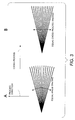
- Fig. 4 is a fan pattern similar to Fig. 3B, separated into two portions, a top portion and a bottom portion.
- the fan pattern has a gray level of the lines of about 10% coverage.
- a 600 line per inch halftone screen is used so that the marking process reacts like a contone device.
- the simulated high frequency banding in Fig. 4 is roughly equivalent to less than one percent banding modulation.
- the interaction between the test pattern and the banding defect translates the high frequency banding defect to a very low frequency moiré pattern on the test pattern.
- the moiré pattern can be seen on Fig. 4 at around the 1 cycle/mm mark.
- the position of the moiré pattern in the cross process direction indicates the frequency of the banding, and the contrast of the moiré pattern corresponds to the amplitude of the banding.
- the phase of the high frequency banding can be estimated from the sinusoidal position of the pattern.
- the center of the moiré pattern is generally located at the center of the test pattern in the process direction when the 2 halves are connected.
- the moiré pattern can still be observed, but the center of the moiré pattern would be off center of the test pattern.
- fan test patterns in which the lines run primarily across the process are generally used to detect banding in the process direction
- fan test patterns in which the lines run primarily in the process direction are generally used to detect banding that occurs across the process.
- Periodic banding in the diagonal direction is rare.
- One example of periodic banding in another, i.e., diagonal, direction is a beating between halftone and some periodic function of the marking engine.
- the location of the center of the moiré pattern can be used to detect the angle of the banding.
- the center of the moiré pattern appears at the line that is perpendicular to the banding direction.
- the frequency of high frequency banding is extracted by first performing columnwise sums of the sensed test pattern by the optical sensors to the bottom and top portions of the test pattern shown on Fig. 4. Locations of maximums or minimums are extracted from the two column sums and averaged to obtain the beat frequency from which the frequency of high frequency banding is then calculated. These maximums and minimums are shown in Figs. 6A and 6B.
- Figs. 5A and 5B are graphs illustrating the evolution of the intensity of a sensed signal of a fan test pattern, according to various exemplary embodiments.
- Fig. 5A illustrates the columnwise sum of the top half of the pattern.
- the location of the peak in Fig. 5A indicates the beat frequency between the test pattern and the banding of the marking device.
- the columnwise sum illustrated in Fig. 5A results in a downward-sloping linear trend because of the fan-shaped design of the test pattern.
- the amount of background contribution depends on the column position in the cross-process direction, where the more background occurring within a column, the higher value of the columnwise sum sensed by the optical sensors and plotted in Fig. 5A.
- Fig. 5B illustrates the same sensed signal as plotted in Fig. 5A after the downward-sloping linear trend has been subtracted from the intensity sensed by the optical sensors.
- the test pattern can be constructed with lines that increase in width as the period increased so as to maintain the same average signal in each column except for the variation due to banding.
- Figs. 6A and 6B illustrate portions of Fig. 5B generated at a smaller scale, according to various exemplary embodiments, for both the top and the bottom of the fan test pattern.
- Fig. 6A is an enlarged view of the area in Fig. 5B where the beat frequency occurs, for the top portion of the fan test pattern. Accordingly, Fig. 6A shows more details and features of the shape and intensity of the measured optical signal for the top half of the test pattern illustrated in Fig. 4.
- Fig. 6B is an enlarged view of the beat frequency as measured by the optical sensors for the bottom half of the fan test pattern illustrated in Fig. 4.
- Figs. 6A and 6B show, for both of the top portion and the bottom portion of the fan test pattern illustrated in Fig. 4, a maximum peak and a minimum peak. According to various exemplary embodiments, these peaks will be utilized to calculate the beat frequency and the high frequency banding.
- the locations of the peaks in Figs. 6A and 6B provide an estimate of the beat frequency.
- the beat frequency may be calculated by: [Position of the maximum peak in the upper portion + position of the maximum peak in the lower portion] / 2
- the beat frequency may be calculated by: [Position of the minimum peak of the upper portion + the position of the minimum peak of the lower portion] / 2
- the resolution power of the beat frequency depends on the slope of the lines in the test pattern illustrated in Figs. 3 and 4. Accordingly, it is possible to choose between covering a large range of frequencies with a lesser resolution and covering a mirror range of frequencies with a higher resolution by creating a fan test pattern where the lines are very close to each other, or relatively far from each other.
- a more accurate estimation of the beat frequency that is the result of an interaction between the high frequency banding of the marking device and the periodicity of the test pattern can be done by averaging the beat frequencies calculated through Equations (1) and (2).
- the beating frequency i.e., ⁇ hf - ⁇ tp
- the frequency of the test pattern ⁇ tp
- phase can also be calculated by the distance of the minimum to the estimated high frequency banding, as shown in Equation (7), and this phase can also be averaged between the top half and the bottom half.
- the averaged phases calculated by the distance of the maximum to the averaged estimated frequency of high frequency banding, and by the distance of the minimum to the averaged estimated high frequency banding can then themselves be averaged for increased accuracy.
- the amplitude of banding which represents the extent of the high frequency banding, is correlated with the amplitude of the maximums and the minimums in the curves illustrated in Figs. 6A and 6B.
- Fig. 7 is a flowchart illustrating a method to control or reduce high frequency banding through a feedback loop, according to various exemplary embodiments.
- the method starts in step S200, then continues to step S210 where a test pattern is created.
- Control then continues to step S220 where the test pattern is imaged and optical sensors sense the test pattern during the imaging process.
- step S230 the frequency, phase and amplitude of high frequency banding are determined and calculated as discussed above.
- step S240 the amplitude of high frequency banding is compared to a predetermined acceptable value of high frequency banding. If the high frequency banding determined is found to be unacceptable during step S240, i.e., exceeds a predetermined high frequency banding amplitude, then control continues to step S250. In step S250, the imaging parameters are adjusted on the basis of the calculated frequency, phase and amplitude of high frequency banding. Next, control goes back to step S220 where the test pattern is again imaged and is sensed by optical sensors. Next, control continues to steps S230 and S240 as discussed above.
- step S240 If the determined high frequency banding is found to be acceptable during step S240, then control goes to step S260, where the method ends.
- the test pattern can be a fan pattern, a falling domino pattern or a diagonal lines pattern.
- Fig. 8 is a block diagram illustrating a system to control high frequency banding according to various exemplary embodiments.
- Fig. 8 is a block diagram illustrating a system, according to various exemplary embodiments, of determining high frequency banding and also, according to other exemplary embodiments, a system of controlling high frequency banding through a feedback control loop.
- the system is part of an image marking device 110 having a receiving member.
- the image marking device is functionally coupled to optical sensors 120 arranged on the receiving member of the marking device 110.
- the purpose of the optical sensor 120 is to sense the reflectance from a test pattern 100 being imaged by the image marking device 110.
- a controller 130 is functionally coupled to both the image marking device 110 and the optical sensors 120 in order to receive the reflectance signal measured by the optical sensors 120.
- the controller is also used to process the received signal and determine the beat frequency, phase, and amplitude which are then used to determine the frequency, phase and amplitude of high frequency banding results 140.
- the determination of high frequency banding can be performed by the controller 130 to adjust imaging parameters by the use of actuators 150 in order to decrease the extent of high frequency banding before conducting other imaging of the test pattern 100.
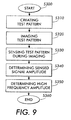
- Fig. 9 is a flowchart illustrating a method of determining the amplitude of high frequency banding when the frequency of high frequency banding is known, according to various exemplary embodiments. As shown in Fig. 9, the method starts at step S300 and continues to step S310 during which a test pattern is created. According to various exemplary embodiments, the test pattern created during step S310 corresponds to a frequency of high frequency banding of the marking device that is already known.
- Fig. 10A shows a test pattern for detecting the amplitude of a known frequency of high frequency banding.
- the process direction is vertical, and the diagonal lines are all parallel and ultimately dark and light.
- the angle of the diagonal lines is calculated such that, in a vertical direction, all the lines that pass through a trough of the high frequency banding are aligned on the same array-type pixels and all the lines that pass through a peak of the high frequency banding are also aligned on a different set of array-type pixels.
- the angle of the diagonal lines and the spacing between the diagonal lines is specifically chosen to fit the known frequency of high frequency banding of the marking device.
- monitoring these test patterns provides a measure of the extent of the high frequency banding, i.e., a measure of the deleterious nature of the high frequency banding of the marking device.
- a measure of the extent of the high frequency banding i.e., a measure of the deleterious nature of the high frequency banding of the marking device.
- multiple test patterns are created and used. When the test patterns are created, then control continues to step S320.
- step S320 a test pattern is imaged using array-type optical sensors.
- step S330 the array-type signal emitted by the array type optical sensors during the imaging of the test pattern in step S320 is measured.
- step S340 the array-type signal is processed, as illustrated in Fig. 10B, where a Fourier transform of the signal measured by the array optical sensors is performed in order to determine the amplitude of the high frequency banding. Alternative methods of extracting the amplitude of a periodic signal may also be used.
- step S350 the amplitude of the periodic variation at the known frequency of high frequency banding is determined. When the amplitude of the known frequency of high frequency banding is determined during step S350, then control continues to step S360, where the method ends.
- the amplitude of the peak and the expected frequency of high frequency banding is proportional to the magnitude, or extent, of the high frequency banding of the marking device.
- this method can be used as a diagnostics method in order to determine how deleterious high frequency banding is for a given marking device.
- Fig. 11 is a block diagram illustrating a system to determine amplitude of high frequency banding and adjusting the imaging parameters of the marking device in order to reduce high frequency banding based on the measured amplitude, according to various exemplary embodiments.
- the system includes a test pattern 200 that is imaged by an image marking device 210, and optical sensors 220 that are arranged on the receiving member of the marking device 210.
- both the image marking device 210 and the optical sensors 220 are functionally coupled to a controller 230.
- the controller 230 is capable of calculating and determining the amplitude of the high frequency banding at the known frequency of high frequency banding of the image marking device 210.
- the controller 230 calculates the amplitude results of high frequency banding 240
- the controller 230 adjusts the imaging parameters 250 on the basis of the amplitude results of high frequency banding 240.
- the imaging parameters 250 are adjusted by the controller, according to various exemplary embodiments, the test pattern 200 is imaged with the new imaging parameters 250.
- the optical sensors 220 sense the reflectance from the test pattern 200 imaged on the basis of the adjusted imaging parameters 250.
- Fig. 12 is an illustration of another test pattern, according to various exemplary embodiments of this invention, used to determine high frequency banding.
- the test pattern is a series of diagonal lines that are equidistant in space, but which slope varies continuously, in a "falling domino" pattern.
- the frequency range that can be detected with the test pattern described in Fig. 12 is proportional to the difference in the slope of the left most line in the test pattern and the right most line in the test pattern.
- the slope of the diagonal lines is such that the peaks and troughs of the high frequency banding align with the diagonal line spacing, the pattern beats with the high frequency banding.
- the sensor response will change as shown at the bottom of the test pattern in Fig. 12.
- the maximum amplitude of this oscillating signal is proportional to the amplitude of the high frequency banding.
- the frequency of the high frequency banding can be determined from the position of the maximum amplitude of the response in the cross process direction and from the slopes of the "falling dominos" test pattern. Signal processing of the sensor response can increase the sensitivity of the technique in determining the amplitude and frequency in the presence of sensor noise.
- the test pattern illustrated in Fig. 12 allows for the measurement of the frequency and amplitude of high frequency banding in a similar manner as described above for the "fan like" test pattern.
Landscapes
- Engineering & Computer Science (AREA)
- Health & Medical Sciences (AREA)
- Biomedical Technology (AREA)
- General Health & Medical Sciences (AREA)
- Multimedia (AREA)
- Signal Processing (AREA)
- Control Or Security For Electrophotography (AREA)
- Accessory Devices And Overall Control Thereof (AREA)
- Investigating Materials By The Use Of Optical Means Adapted For Particular Applications (AREA)
- Length Measuring Devices By Optical Means (AREA)
Applications Claiming Priority (2)
| Application Number | Priority Date | Filing Date | Title |
|---|---|---|---|
| US852243 | 2004-05-25 | ||
| US10/852,243 US7283143B2 (en) | 2004-05-25 | 2004-05-25 | Measurement and control of high frequency banding in a marking system |
Publications (3)
| Publication Number | Publication Date |
|---|---|
| EP1601178A2 true EP1601178A2 (de) | 2005-11-30 |
| EP1601178A3 EP1601178A3 (de) | 2008-02-20 |
| EP1601178B1 EP1601178B1 (de) | 2012-08-15 |
Family
ID=34939971
Family Applications (1)
| Application Number | Title | Priority Date | Filing Date |
|---|---|---|---|
| EP05104463A Ceased EP1601178B1 (de) | 2004-05-25 | 2005-05-25 | Messung und Regelung von hochfrequenten Streifen in einem Markierungssystem |
Country Status (3)
| Country | Link |
|---|---|
| US (1) | US7283143B2 (de) |
| EP (1) | EP1601178B1 (de) |
| JP (1) | JP4891564B2 (de) |
Cited By (1)
| Publication number | Priority date | Publication date | Assignee | Title |
|---|---|---|---|---|
| WO2011008256A1 (en) * | 2009-07-15 | 2011-01-20 | Eastman Kodak Company | Improved setting of imaging parameters |
Families Citing this family (25)
| Publication number | Priority date | Publication date | Assignee | Title |
|---|---|---|---|---|
| CN1985276A (zh) * | 2004-07-07 | 2007-06-20 | 惠普发展公司,有限责任合伙企业 | 使用波纹图检测条带效应的方法和装置 |
| US7911652B2 (en) * | 2005-09-08 | 2011-03-22 | Xerox Corporation | Methods and systems for determining banding compensation parameters in printing systems |
| JP4555212B2 (ja) * | 2005-11-10 | 2010-09-29 | 株式会社沖データ | 透かし情報埋め込み装置,透かし情報埋め込み方法,およびコンピュータプログラム |
| US7492381B2 (en) * | 2005-12-21 | 2009-02-17 | Xerox Corporation | Compensation of MPA polygon once around with exposure modulation |
| US7561747B2 (en) * | 2005-12-23 | 2009-07-14 | Xerox Corporation | Image data processing system and method |
| US8194262B2 (en) * | 2006-02-27 | 2012-06-05 | Xerox Corporation | System for masking print defects |
| US20070247514A1 (en) * | 2006-04-25 | 2007-10-25 | Ran Waidman | Automatic laser power uniformity calibration |
| US7623271B2 (en) * | 2006-06-09 | 2009-11-24 | Xerox Corporation | Automatic grainy noise control for optimal macro uniformity appearance |
| JP2008233187A (ja) * | 2007-03-16 | 2008-10-02 | Ricoh Co Ltd | 速度変動検知装置、画像形成装置及び速度変動検知方法 |
| US7962056B2 (en) | 2006-12-25 | 2011-06-14 | Ricoh Company, Ltd. | Method and apparatus for speed change detection based on a latent image pattern |
| JP2008173869A (ja) * | 2007-01-19 | 2008-07-31 | Konica Minolta Business Technologies Inc | 画像処理装置及びテスト制御方法 |
| US7855806B2 (en) * | 2007-06-27 | 2010-12-21 | Xerox Corporation | Banding profile estimator using multiple sampling intervals |
| US7564475B1 (en) | 2008-03-28 | 2009-07-21 | Xerox Corporation | Compensation of high frequency banding in printing systems |
| JP5434028B2 (ja) * | 2008-09-26 | 2014-03-05 | 富士ゼロックス株式会社 | 位相差検出装置及びこれを用いた画像形成装置 |
| US7834900B2 (en) * | 2009-02-03 | 2010-11-16 | Xerox Corporation | Method and apparatus for correcting banding defects in a photoreceptor image forming apparatus |
| US8446640B2 (en) * | 2009-07-15 | 2013-05-21 | Eastman Kodak Company | Setting of imaging parameters using a scanner |
| US8213816B2 (en) * | 2009-08-27 | 2012-07-03 | Xerox Corporation | Method and system for banding compensation using electrostatic voltmeter based sensing |
| JP5578823B2 (ja) * | 2009-09-29 | 2014-08-27 | キヤノン株式会社 | 画像形成装置、及び濃度ムラ検出方法 |
| JP5570310B2 (ja) * | 2010-06-07 | 2014-08-13 | キヤノン株式会社 | 画像形成装置 |
| US8351081B2 (en) | 2010-07-20 | 2013-01-08 | Xerox Corporation | Digital printing control using a spectrophotometer |
| US8514470B2 (en) * | 2010-12-08 | 2013-08-20 | Xerox Corporation | Digital printing control using a spectrophotometer |
| US8736894B2 (en) * | 2011-12-20 | 2014-05-27 | Eastman Kodak Company | Producing correction data for printer |
| JP2015082005A (ja) * | 2013-10-22 | 2015-04-27 | 富士ゼロックス株式会社 | 画像形成装置、及びプログラム |
| US11626663B2 (en) * | 2019-01-24 | 2023-04-11 | Intellian Technologies, Inc. | Band changer and communication system including the band changer |
| US11934712B2 (en) | 2021-11-17 | 2024-03-19 | Xerox Corporation | System and method for automatically diagnosing media handling defects in a printing device |
Family Cites Families (13)
| Publication number | Priority date | Publication date | Assignee | Title |
|---|---|---|---|---|
| JPS61157170A (ja) * | 1984-12-28 | 1986-07-16 | Canon Inc | 画像処理装置 |
| JP3029133B2 (ja) * | 1990-03-27 | 2000-04-04 | キヤノン株式会社 | 測定方法及び装置 |
| US5877494A (en) * | 1996-07-29 | 1999-03-02 | Agfa Division, Bayer Corporation | Beam error correction using movable correction element |
| JP3633764B2 (ja) * | 1997-11-14 | 2005-03-30 | 株式会社リコー | バンディングの定量化方法 |
| JP3085290B2 (ja) * | 1998-09-14 | 2000-09-04 | 株式会社ニコン | 走査露光装置及び方法 |
| US6584233B1 (en) * | 1999-07-19 | 2003-06-24 | Eastman Kodak Company | Method for determining the components of image noise patterns of an imaging device and use of this method in an imaging device |
| JP2001261192A (ja) * | 2000-03-21 | 2001-09-26 | Sharp Corp | 画像形成装置 |
| US6710795B2 (en) * | 2001-04-11 | 2004-03-23 | Eastman Kodak Company | Tuning a printer by printing patterns which beat against a spatial frequency of a component within the printer |
| US7095883B2 (en) * | 2001-07-05 | 2006-08-22 | Photon Dynamics, Inc. | Moiré suppression method and apparatus |
| US6950211B2 (en) * | 2001-07-05 | 2005-09-27 | Corel Corporation | Fine moire correction in images |
| US6862414B2 (en) * | 2002-01-30 | 2005-03-01 | Xerox Corporation | Automated banding defect analysis and repair for document processing systems |
| JP2004050452A (ja) * | 2002-07-16 | 2004-02-19 | Ricoh Co Ltd | 画像評価装置及び画像評価方法 |
| US7120369B2 (en) * | 2004-05-25 | 2006-10-10 | Xerox Corporation | Method and apparatus for correcting non-uniform banding and residual toner density using feedback control |
-
2004
- 2004-05-25 US US10/852,243 patent/US7283143B2/en not_active Expired - Lifetime
-
2005
- 2005-05-23 JP JP2005149550A patent/JP4891564B2/ja not_active Expired - Fee Related
- 2005-05-25 EP EP05104463A patent/EP1601178B1/de not_active Ceased
Cited By (4)
| Publication number | Priority date | Publication date | Assignee | Title |
|---|---|---|---|---|
| WO2011008256A1 (en) * | 2009-07-15 | 2011-01-20 | Eastman Kodak Company | Improved setting of imaging parameters |
| CN102474561A (zh) * | 2009-07-15 | 2012-05-23 | 伊斯曼柯达公司 | 成像参数的改进设置 |
| US8427695B2 (en) | 2009-07-15 | 2013-04-23 | Eastman Kodak Company | Setting of imaging parameters |
| CN102474561B (zh) * | 2009-07-15 | 2015-01-21 | 伊斯曼柯达公司 | 成像参数的改进设置 |
Also Published As
| Publication number | Publication date |
|---|---|
| EP1601178B1 (de) | 2012-08-15 |
| JP4891564B2 (ja) | 2012-03-07 |
| JP2005338835A (ja) | 2005-12-08 |
| US7283143B2 (en) | 2007-10-16 |
| EP1601178A3 (de) | 2008-02-20 |
| US20050275855A1 (en) | 2005-12-15 |
Similar Documents
| Publication | Publication Date | Title |
|---|---|---|
| US7283143B2 (en) | Measurement and control of high frequency banding in a marking system | |
| US7515305B2 (en) | Systems and methods for measuring uniformity in images | |
| EP1602986B1 (de) | Verfahren und Vorrichtung zur Kontrolle von ungleichmässiger Streifenbildung und Resttonerdichte mittels Rückkopplungskontrolle | |
| US7095531B2 (en) | Systems and methods for compensating for streaks in images | |
| US5349377A (en) | Printer toner usage indicator with image weighted calculation | |
| US7574014B2 (en) | Digital watermark detection utilizing host carrier information | |
| EP1574909B1 (de) | Verfahren und System zur Bestimmung einer Resttonermasse | |
| US7830554B2 (en) | Fiducial artifact detection and compensation algorithm | |
| US6763141B2 (en) | Estimation of local defocus distance and geometric distortion based on scanned image features | |
| JP6680070B2 (ja) | 画像形成装置、画像形成ユニット、およびプログラム | |
| US7547903B2 (en) | Technique to remove sensing artifacts from a linear array sensor | |
| US8090156B2 (en) | Print quality evaluation apparatus and method of print quality evaluation | |
| US7516040B2 (en) | System and method for automated detection of printing defects in an image output device | |
| JP4580666B2 (ja) | 画像形成装置、画質管理方法、コンピュータプログラムおよび記録媒体 | |
| JP3364533B2 (ja) | カラー濃度センサーおよびそれを使用した画像形成装置 | |
| JP3576577B2 (ja) | 画像濃度検知装置 | |
| Mizes | Precision Tone Reproduction Curve Measurement Technique for High Image Quality and Halftone Design Applications | |
| JP2003298864A (ja) | 画像評価方法、画像評価装置及び画像形成装置 | |
| JP2003121368A (ja) | 欠陥検査方法及び装置 | |
| JP2007036378A (ja) | 迷光補正方法及び迷光補正装置及び画像読取装置 | |
| JP2010074680A (ja) | 画像評価装置、画像評価方法、画像形成装置、および画像形成装置の診断方法 | |
| JP2001127997A (ja) | 画像シミュレーション方法、画像シミュレーション装置及び記録媒体 | |
| JPH11348236A (ja) | 印刷物網点着肉評価装置 | |
| JP2002232609A (ja) | 画像シミュレーション装置、画像シミュレーション方法及び該方法を実行するためのプログラムを格納したコンピュータ読み取り可能な記憶媒体 |
Legal Events
| Date | Code | Title | Description |
|---|---|---|---|
| PUAI | Public reference made under article 153(3) epc to a published international application that has entered the european phase |
Free format text: ORIGINAL CODE: 0009012 |
|
| AK | Designated contracting states |
Kind code of ref document: A2 Designated state(s): AT BE BG CH CY CZ DE DK EE ES FI FR GB GR HU IE IS IT LI LT LU MC NL PL PT RO SE SI SK TR |
|
| AX | Request for extension of the european patent |
Extension state: AL BA HR LV MK YU |
|
| RIN1 | Information on inventor provided before grant (corrected) |
Inventor name: HAMBY, ERIC S. Inventor name: THOMPSON, MICHAEL D. Inventor name: VITURRO, R ENRIQUE Inventor name: XU, BEILEI Inventor name: LOCE, ROBERT P. Inventor name: LIU, CHU-HENG Inventor name: MIZES, HOWARD A. |
|
| RTI1 | Title (correction) |
Free format text: MEASUREMENT AND CONTROL OF HIGH FREQUENCY BANDING IN A MARKING SYSTEM |
|
| PUAL | Search report despatched |
Free format text: ORIGINAL CODE: 0009013 |
|
| AK | Designated contracting states |
Kind code of ref document: A3 Designated state(s): AT BE BG CH CY CZ DE DK EE ES FI FR GB GR HU IE IS IT LI LT LU MC NL PL PT RO SE SI SK TR |
|
| AX | Request for extension of the european patent |
Extension state: AL BA HR LV MK YU |
|
| 17P | Request for examination filed |
Effective date: 20080820 |
|
| 17Q | First examination report despatched |
Effective date: 20080918 |
|
| AKX | Designation fees paid |
Designated state(s): DE FR GB |
|
| GRAP | Despatch of communication of intention to grant a patent |
Free format text: ORIGINAL CODE: EPIDOSNIGR1 |
|
| RIN1 | Information on inventor provided before grant (corrected) |
Inventor name: HAMBY, ERIC S. Inventor name: MIZES, HOWARD A. Inventor name: LIU, CHU-HENG Inventor name: VITURRO, R ENRIQUE Inventor name: XU, BEILEI Inventor name: THOMPSON, MICHAEL D. Inventor name: LOCE, ROBERT P. |
|
| GRAS | Grant fee paid |
Free format text: ORIGINAL CODE: EPIDOSNIGR3 |
|
| GRAA | (expected) grant |
Free format text: ORIGINAL CODE: 0009210 |
|
| AK | Designated contracting states |
Kind code of ref document: B1 Designated state(s): DE FR GB |
|
| REG | Reference to a national code |
Ref country code: GB Ref legal event code: FG4D |
|
| REG | Reference to a national code |
Ref country code: DE Ref legal event code: R096 Ref document number: 602005035596 Country of ref document: DE Effective date: 20121018 |
|
| PLBE | No opposition filed within time limit |
Free format text: ORIGINAL CODE: 0009261 |
|
| STAA | Information on the status of an ep patent application or granted ep patent |
Free format text: STATUS: NO OPPOSITION FILED WITHIN TIME LIMIT |
|
| 26N | No opposition filed |
Effective date: 20130516 |
|
| REG | Reference to a national code |
Ref country code: DE Ref legal event code: R097 Ref document number: 602005035596 Country of ref document: DE Effective date: 20130516 |
|
| REG | Reference to a national code |
Ref country code: FR Ref legal event code: PLFP Year of fee payment: 12 |
|
| REG | Reference to a national code |
Ref country code: FR Ref legal event code: PLFP Year of fee payment: 13 |
|
| REG | Reference to a national code |
Ref country code: FR Ref legal event code: PLFP Year of fee payment: 14 |
|
| PGFP | Annual fee paid to national office [announced via postgrant information from national office to epo] |
Ref country code: DE Payment date: 20180419 Year of fee payment: 14 |
|
| PGFP | Annual fee paid to national office [announced via postgrant information from national office to epo] |
Ref country code: FR Payment date: 20180423 Year of fee payment: 14 |
|
| PGFP | Annual fee paid to national office [announced via postgrant information from national office to epo] |
Ref country code: GB Payment date: 20180419 Year of fee payment: 14 |
|
| REG | Reference to a national code |
Ref country code: DE Ref legal event code: R119 Ref document number: 602005035596 Country of ref document: DE |
|
| GBPC | Gb: european patent ceased through non-payment of renewal fee |
Effective date: 20190525 |
|
| PG25 | Lapsed in a contracting state [announced via postgrant information from national office to epo] |
Ref country code: DE Free format text: LAPSE BECAUSE OF NON-PAYMENT OF DUE FEES Effective date: 20191203 Ref country code: GB Free format text: LAPSE BECAUSE OF NON-PAYMENT OF DUE FEES Effective date: 20190525 |
|
| PG25 | Lapsed in a contracting state [announced via postgrant information from national office to epo] |
Ref country code: FR Free format text: LAPSE BECAUSE OF NON-PAYMENT OF DUE FEES Effective date: 20190531 |