EP1602504A2 - Motorsteuerungsvorrichtung und -verfahren - Google Patents
Motorsteuerungsvorrichtung und -verfahren Download PDFInfo
- Publication number
- EP1602504A2 EP1602504A2 EP05076859A EP05076859A EP1602504A2 EP 1602504 A2 EP1602504 A2 EP 1602504A2 EP 05076859 A EP05076859 A EP 05076859A EP 05076859 A EP05076859 A EP 05076859A EP 1602504 A2 EP1602504 A2 EP 1602504A2
- Authority
- EP
- European Patent Office
- Prior art keywords
- paper
- current value
- motor
- paper feeding
- value signal
- Prior art date
- Legal status (The legal status is an assumption and is not a legal conclusion. Google has not performed a legal analysis and makes no representation as to the accuracy of the status listed.)
- Granted
Links
Images





Classifications
-
- B—PERFORMING OPERATIONS; TRANSPORTING
- B41—PRINTING; LINING MACHINES; TYPEWRITERS; STAMPS
- B41J—TYPEWRITERS; SELECTIVE PRINTING MECHANISMS, i.e. MECHANISMS PRINTING OTHERWISE THAN FROM A FORME; CORRECTION OF TYPOGRAPHICAL ERRORS
- B41J19/00—Character- or line-spacing mechanisms
- B41J19/18—Character-spacing or back-spacing mechanisms; Carriage return or release devices therefor
- B41J19/20—Positive-feed character-spacing mechanisms
- B41J19/202—Drive control means for carriage movement
-
- B—PERFORMING OPERATIONS; TRANSPORTING
- B41—PRINTING; LINING MACHINES; TYPEWRITERS; STAMPS
- B41J—TYPEWRITERS; SELECTIVE PRINTING MECHANISMS, i.e. MECHANISMS PRINTING OTHERWISE THAN FROM A FORME; CORRECTION OF TYPOGRAPHICAL ERRORS
- B41J11/00—Devices or arrangements of selective printing mechanisms, e.g. ink-jet printers or thermal printers, for supporting or handling copy material in sheet or web form
- B41J11/0065—Means for printing without leaving a margin on at least one edge of the copy material, e.g. edge-to-edge printing
-
- B—PERFORMING OPERATIONS; TRANSPORTING
- B41—PRINTING; LINING MACHINES; TYPEWRITERS; STAMPS
- B41J—TYPEWRITERS; SELECTIVE PRINTING MECHANISMS, i.e. MECHANISMS PRINTING OTHERWISE THAN FROM A FORME; CORRECTION OF TYPOGRAPHICAL ERRORS
- B41J11/00—Devices or arrangements of selective printing mechanisms, e.g. ink-jet printers or thermal printers, for supporting or handling copy material in sheet or web form
- B41J11/0095—Detecting means for copy material, e.g. for detecting or sensing presence of copy material or its leading or trailing end
-
- B—PERFORMING OPERATIONS; TRANSPORTING
- B41—PRINTING; LINING MACHINES; TYPEWRITERS; STAMPS
- B41J—TYPEWRITERS; SELECTIVE PRINTING MECHANISMS, i.e. MECHANISMS PRINTING OTHERWISE THAN FROM A FORME; CORRECTION OF TYPOGRAPHICAL ERRORS
- B41J11/00—Devices or arrangements of selective printing mechanisms, e.g. ink-jet printers or thermal printers, for supporting or handling copy material in sheet or web form
- B41J11/36—Blanking or long feeds; Feeding to a particular line, e.g. by rotation of platen or feed roller
- B41J11/42—Controlling printing material conveyance for accurate alignment of the printing material with the printhead; Print registering
-
- B—PERFORMING OPERATIONS; TRANSPORTING
- B41—PRINTING; LINING MACHINES; TYPEWRITERS; STAMPS
- B41J—TYPEWRITERS; SELECTIVE PRINTING MECHANISMS, i.e. MECHANISMS PRINTING OTHERWISE THAN FROM A FORME; CORRECTION OF TYPOGRAPHICAL ERRORS
- B41J13/00—Devices or arrangements of selective printing mechanisms, e.g. ink-jet printers or thermal printers, specially adapted for supporting or handling copy material in short lengths, e.g. sheets
- B41J13/0009—Devices or arrangements of selective printing mechanisms, e.g. ink-jet printers or thermal printers, specially adapted for supporting or handling copy material in short lengths, e.g. sheets control of the transport of the copy material
-
- B—PERFORMING OPERATIONS; TRANSPORTING
- B41—PRINTING; LINING MACHINES; TYPEWRITERS; STAMPS
- B41J—TYPEWRITERS; SELECTIVE PRINTING MECHANISMS, i.e. MECHANISMS PRINTING OTHERWISE THAN FROM A FORME; CORRECTION OF TYPOGRAPHICAL ERRORS
- B41J19/00—Character- or line-spacing mechanisms
- B41J19/18—Character-spacing or back-spacing mechanisms; Carriage return or release devices therefor
- B41J19/20—Positive-feed character-spacing mechanisms
- B41J19/202—Drive control means for carriage movement
- B41J19/205—Position or speed detectors therefor
- B41J19/207—Encoding along a bar
Definitions
- the invention relates to a motor control device and a motor control method for paper feed control of a printer enabling a print over a wide area of a sheet including portions nearest to ends of the sheet.
- the invention further relates to a recording medium having recorded a computer program for executing any of those motor control methods.
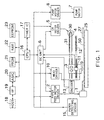
- Fig. 1 is a block diagram that shows general configuration of an ink jet printer.
- the ink jet printer shown in Fig. 1 includes a paper feed motor (hereinafter also called a PF motor) 1 that feeds paper; a paper feed motor driver 2 that drives the paper feed motor 1; a carriage 3 that supports a head 9 fixed thereto to supply ink onto printing paper 50 and is driven to move in parallel to the printing paper 50 and vertically of the paper feeding direction; a carriage motor (hereinafter also called a CR motor) 4 that drives the carriage 3; a CR motor driver 5 that drives the carriage motor 4; a DC unit 6 that outputs a d.c.
- a paper feed motor hereinafter also called a PF motor
- a paper feed motor driver 2 that drives the paper feed motor 1
- a carriage 3 that supports a head 9 fixed thereto to supply ink onto printing paper 50 and is driven to move in parallel to the printing paper 50 and vertically of the paper feeding direction
- a carriage motor hereinafter also called a CR motor 4 that drives the carriage 3
- a CR motor driver 5 that drives the
- a pump motor 7 that controls the draft of ink for the purpose of preventing clogging of the head 9
- a pump motor driver 8 that drives the pump motor 7
- a head driver 10 that drives and controls the head 9
- a linear encoder 11 fixed to the carriage 3
- a linear encoder coding plate 12 having slits in predetermined intervals
- a rotary encoder 13 for the PF motor 1
- a paper detecting sensor 15 that detects the terminal position of each sheet of paper under printing
- a CPU 16 that controls the whole printer
- a timer IC 17 that periodically generates interruption signals to the CPU 16
- an interface portion (hereinafter also called IF) 19 that exchanges data with a host computer 18
- an ASIC 20 that controls the character resolution, driving waveform of the head 9, and so on, in accordance with character information sent from the host computer 18 through the IF 19
- a PROM 21, a RAM 22 and an EEPROM 23 that are used as an operation area of the ASIC 20 and the CPU 16 and
- the DC unit 6 controls and drives the paper feed motor driver 2 and the CR motor driver 5 in response to a control instruction sent from the CPU 16 and outputs of the encoders 11, 13. Both the paper feed motor 1 and the CR motor 4 are DC motors.
- Fig. 2 is a perspective view that illustrates configuration around the carriage 3 of the ink jet printer.
- the carriage 3 is connected to the carriage motor 4 by the timing belt 31 via the pulley 30, and driven to move in parallel with the platen 25 under guidance of a guide member 32.
- the carriage 3 has the recording head 9 projecting from its surface opposed to the printing paper and having a row of nozzles for releasing black ink and a row of nozzles for releasing color ink. These nozzles are supplied with ink from the ink cartridge 34 and release drops of ink onto the printing paper to print characters and images.
- a capping device 35 for shutting nozzle openings of the recording head 9 when printing is not executed, and a pump unit 36 having the pump motor 7 shown in Fig. 1.
- the carriage 3 moves from the print area to the non-print area, it contacts a lever, not shown, and the capping device 35 moves upward to close the head 9.
- the pump unit 36 When any of the nozzle openings of the head 9 is clogged, or ink is forcibly released from the head 9 just after replacement of the cartridge 34, the pump unit 36 is activated while closing the head 9, and a negative pressure from the pump unit 36 is used to suck out ink from the nozzle openings. As a result, dust and paper powder are washed out from around the nozzle openings, and bubbles in the head 9, if any, are discharged together with the ink to the cap 37.
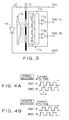
- Fig. 3 is a diagram schematically illustrating configuration of the linear encoder 11 attached to the carriage 3.
- the encoder 11 shown in Fig. 3 includes a light emitting diode 11a, collimator lens 11b and detector/processor 11c.
- the detector/processor 11c has a plurality of (four) photo diodes 11d, signal processing circuit 11e, and two comparators 11 fA , 11 fB .
- the coding plate 12 has slits in predetermined intervals (for example, in intervals of 1/180 inch).
- Parallel beams passing through the coding plate 12 enter into photo diodes 11d through fixed slits, not shown, and are converted into electric signals. Electric signals output from these four photo diodes 11d are processes in the signal processing circuit 11e. Signals output from the signal processing circuit 11e are compared in the comparators 11 fA , 11 fB , and comparison results are output as pulses. Pulses ENC-A, ENC-B output from the comparators 11 fA , 11 fB are outputs of the encoder 11.
- Figs. 4A and 4B are timing charts showing waveforms of two output signals from the encoder 11 during normal rotation of the CR motor and during its reverse rotation.
- the pulse ENC-A and the pulse ENC-B are different in phase by 90 degrees.
- the encoder 4 is so configured that the pulse ENC-A is forward in phase by 90 degrees relative to the pulse ENC-B as shown in Fig. 4A when the CR motor 4 rotates in the normal direction, i.e., when the carriage 3 is moving in its main scanning direction whereas the pulse ENC-A is behind in phase by 90 degrees relative to the pulse ENC-B as shown in Fig. 4B when the CR motor 4 rotates in the reverse direction.
- one period T of these pulses corresponds to each interval of the slits of the coding plate 12 (for example, 1/180 inch), and it is equal to the time required for the carriage 3 to move from a slit to another.
- the rotary encoder 13 for the PF motor 1 has the same configuration as the linear encoder 11 except that the former is a rotatable disc that rotates in response to rotation of the PF motor 1, and the rotary encoder 13 also outputs two output pulses ENC-A, ENC-B.
- slit interval of a plurality of slits provided on a coding plate of the encoder 13 for the PF motor 1 is 1/180 inch, and paper is fed by 1/1440 inch when the PF motor rotates by each slit interval.
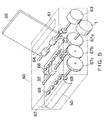
- Fig. 5 is a perspective view showing a part related to paper feeding and paper detection.
- a sheet of printing paper 50 inserted into a paper feed inlet 61 of a printer 60 is conveyed into the printer 60 by a paper feed roller 64 driven by a paper feed motor 63.
- the forward end of the printing paper 50 conveyed into the printer 60 is detected by an optical paper detecting sensor 15, for example.
- the paper 50 whose forward end is detected by the paper detecting sensor 15 is transported by a paper feed roller 65 driven by the PF motor 1 and a free roller 66.
- ink is released from the recording head (not shown) fixed to the carriage 3 which moves along the carriage guide member 32 to print something on the printing paper 50.
- the paper detecting sensor 15 detects the terminal end of the printing paper 50 currently under printing.
- the printing paper 50 after printing is discharged outside from a paper outlet 62 by a discharge roller 68 driven by a gear 67C, which is driven by the PF motor 1 via gears 67A, 67B, and a free roller 69.
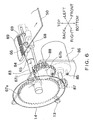
- Fig. 6 is a perspective view illustrating details of parts associated to paper feeding in a printer, where a paper feeding roller 65 has a rotation axis coupled to a rotary encoder 13.
- the paper feeding roller 65 is provided on and about a smap shaft 83 or a rotation axis of a large gear 67a engaged with a small gear 87 driven by a PF motor 1 while the follower roller 66 is provided in a holder 89 at its paper evacuating end in the context of a paper feeding direction, where the printing paper 50 from a paper supply source is pressed vertically.
- the PF motor 1 is fitted in and secured to a frame 86 in the printer 60 by a screw 85, and the rotary encoder 13 is placed in a specified position around the large gear 67a while a character board 14 for the rotary encoder is connected to the smap shaft 83 or the rotation axis of the large gear 67a.
- a paper evacuating gear 68 which is rotated by the PF motor 1 via a group of gears, the small gear 87, the large gear 67a, a medium gear 67b, a small gear 88, and a paper evacuating gear 67c, and a toothed roller 69 or a follower roller cooperatively presses and holds the printing paper 50 between them to further feed the printing paper 50 until it is evacuated from the paper outlet 62 to the outside of the printer.
- a carriage 3 moves laterally in a space defined above the platen 84 along a guide member 32, and simultaneously, ink is injected from a recording head (not shown) fixed to the carriage 3 to print characters in the printing paper.
- DC unit 6 is a prior art DC motor control apparatus used to control a carriage (CR) motor 4 for such an ink jet printer as mentioned above, and additionally, a control method by the DC unit 6 will also be explained.
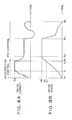
- Fig. 7 is a block diagram showing an arrangement of the DC unit 6 serving as the DC motor control apparatus while Figs. 8A and 8B are graphs illustrating time - varying motor current and motor speed of the CR motor 4 under control by the DC unit 6.
- the DC unit 6 shown in Fig. 7 includes a position operator 6a, a subtracter 6b, a target speed operator 6c, a speed operator 6d, a subtracter 6e, a proportional element 6f, an integral element 6g, a differential element 6h, an adder 6i, a D/A converter 6j, a timer 6k, and an acceleration controller 6m.
- the position operator 6a detects rising edges and tail edges of the output pulses ENC-A and ENC-B of the encoder 11, then counts the number of edges detected, and operates the position of the carriage 3 from the counted value. This counting adds "+1" when one edge is detected while the CR motor 4 rotates in the normal direction, and adds "-1" when one edge is detected while the CR motor 4 rotates in the reverse direction.
- Period of pulses ENC-A and period of pulses ENC-B are equal to the slit interval of the coding plate 12, and the pulses ENC-A and ENC-B are different in phase by 90 degrees. Therefore, the count value "1" of that counting corresponds to 1/4 of the slit interval of the coding plate 12.
- the subtracter 6b operates positional difference between the target position sent from the CPU 16 and the actual position of the carriage 3 obtained by the position operator 6a.
- the target speed calculator 6c computes a target speed of the carriage 3 by referring to a positional deviation produced by a subtracter 6b.
- a result of the arithmetic operation is obtained by a multiply operation of the positional deviation by a gain KP.
- the gain KP varies depending upon the positional deviation.
- a value of the gain KP may be stored in a look-up table not shown.
- the speed calculator 6d computes the speed of the carriage 3 on the basis of the output pulses ENC-A and ENC-B from the encoder 11. The speed is obtained in a manner as explained below. First, rising edges and tail edges of output pulses ENC-A, ENC-B of the encoder 11 are detected, and the duration of time between edges corresponding to 1/4 of the slit interval of the coding plate 12 is counted by a timer counter, for example. When the count value is T and the slit interval of the coding plate 12 is ⁇ , the speed of the carriage is obtained as ⁇ /(4T). Note here that operation of the speed is performed by measuring one period of output pulses ENC-A, e.g., from a rising edge to the next rising edge, by means of a timer counter.
- the subtracter 6e operates speed difference between the target speed and the actual speed of the carriage 3 operated by the speed operator 6d.
- the proportional element 6f multiplies the speed difference by a constant Gp, and outputs its multiplication result.
- the integral element 6g cumulates products of speed differences and a constant Gi.
- the differential element 6h multiplies the difference between the current speed difference and its preceding speed difference by a constant Gd, and outputs its multiplication result. Operations of the proportional element 6f, the integral element 6g and the differential element 6h are conducted in every period of output pulses ENC-A of the encoder 11, synchronizing with the rising edge of each output pulse ENC-A, for example.
- the timer 6k and the acceleration controller 6m are used for controlling acceleration whereas PID control using the proportional element 6f, the integral element 6g and the differential element 6h is used for constant speed and deceleration control during acceleration.
- the timer 6k generates a timer interrupt signal every predetermined interval in response to a clock signal sent from the CPU 16.
- the acceleration controller 6m cumulates a predetermined current value (for example 20 mA) to the target current value every time it receives the timer interrupt signal, and results of the integration, i.e, target current values of the DC motor during acceleration, are sent to the D/A converter 6j from time to time. Similarly to PID control, the target current value is converted into an analog current by the D/A converter 6j, and the CR motor 4 is driven by the driver 5 according to this analog current.
- a predetermined current value for example 20 mA
- the driver 5 has four transistors, for example, and it can create (a) a drive mode for rotating the CR motor 4 in the normal or reverse direction; (b) a regeneration brake drive mode (a short brake drive mode, which is the mode maintaining a halt of the CR motor); and (c) a mode for stopping the CR motor, by turning those transistors ON or OFF in accordance with outputs from the D/A converter 6j.
- a start initial current value I 0 is sent from the acceleration controller 6m to the D/A converter 6j.
- This start initial current value I 0 is sent together with the start instruction signal from the CPU 16 to the acceleration controller 6m. Then, this current value I 0 is converted into an analog current by the D/A converter 6j and sent to the driver 5 which in turn start the CR motor 4 (see Figs. 8A and 8B).
- the timer interrupt signal is generated every predetermined interval from the timer 6k.
- the acceleration controller 6m cumulates a predetermined current value (for example, 20 mA) to the start initial current value I 0 every time it receives the timer interrupt signal, and sends the cumulated current value to the D/A converter 6j. Then, the cumulated current value is converted into an analog current by the D/A converter 6j and sent to the driver 5. Then, the CR motor is driven by the driver 5 so that the value of the current supplied to the CR motor 4 becomes the cumulated current value mentioned above, and the speed of the CR motor 4 increases (see Fig. 8B). Therefore, the current value supplied to the CR motor 4 represents a step-like aspect as shown in Fig. 8A. At that time, the PID control system also works, but the D/A converter 6j selects and employs the output from the acceleration controller 6m.
- a predetermined current value for example, 20 mA
- Cumulative processing of current values of the acceleration controller 6m is continued until the cumulated current value reaches a fixed current value I s .
- the acceleration controller 6m stops its cumulative processing, and supplies the fixed current value I s to the D/A converter 6j.
- the CR motor 4 is driven by the driver 5 such that the value of the current supplied to the CR motor 4 becomes the current value I s (see Fig. 8A).
- the acceleration controller 6m makes a control to reduce the current supplied to the CR motor 4. At that time, the speed of the CR motor 4 further increases, but when it reaches a predetermined speed Vc (see time t3 of Fig. 8B), the D/A converter 6j selects the output of the PID control system, i.e., the output of the adder 6i, and PID control is effected.
- the target speed is operated, and based on the speed difference between this target speed and the actual speed obtained from the output of the encoder 11, the proportional element 6f, the integral element 6g and the differential element 6h act to perform proportional, the integral and the differential operations, respectively, and based on the sum of results of these operations, the CR motor 4 is controlled.
- These proportional, integral and differential operations are conducted synchronously with the rising edge of the output pulse ENC-A of the encoder 11, for example.
- speed of the DC motor 4 is controlled to be a desired speed Ve.
- the predetermined speed Vc is preferably a value corresponding to 70 through 80% of the desired speed Ve.
- the DC motor 4 reaches the desired speed, and the carriage 3 also reaches the desired constant speed Ve and can perform printing.
- paper feeding is effected by the paper-feeding roller 65 driven by the PF motor 1 and the follower roller 66 as already explained with reference to Figs. 5 and 6.
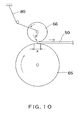
- the follower roller 66 is configured to urge the paper sheet 50 onto the paper-feeding roller 65 during the paper feeding motion with the aid of the spring 80 as shown in Fig. 9.
- the second object of the invention is to provide a motor control apparatus and a motor control method for controlling paper feeding in a manner enabling printing over a wider area of a sheet to near its perimeters.
- the motor control apparatus includes a position detector for detecting the position of paper driven by a paper feeding motor on the basis of output pulses of an encoder that rotates in response to rotation of the paper feeding motor; and a drive controller for controllably driving the paper feeding motor by additionally applying a current value to the paper feeding motor on the basis of a target value of the paper feeding amount and an output of the position detector, and it is characterized in generating a current value signal that causes the paper to stop or rotate in the opposite direction from a normal paper feeding direction in response to output pulses of the encoder after arrival of the paper feeding amount reaches the target value, and controllably driving the paper feeding motor with the driving controller in response to the current value signal.
- the motor control apparatus may further comprise a pulse counter for counting output pulses of the encoder during movement of the paper in the reverse direction from the normal paper feeding direction after the feeding amount of the paper reaches the target feeding value and for outputting an instruction signal when the count value reaches a predetermined value; and a current value signal generator for generating the current value signal upon receipt of the instruction signal or during movement of the paper in the reverse direction from the normal paper feeding direction.
- the current value signal generator may include a detector for detecting whether the paper remains still, or is moving in the reverse direction from the normal paper feeding direction, in response to outputs from the encoder; and a current value determiner for determining and outputting the current value signal in response to the instruction signal or a result of detection by the detector.
- the current value determiner may output the same current value signal as the latest current value signal when the paper remains still, and generate a current value signal that is smaller in absolute value than the latest current value signal but equal in sign when the paper is moving in the reverse direction from the normal paper feeding direction.
- the motor control method is characterized in comprising the steps of: generating a current value signal causing paper to stop or move in the opposite direction from a normal paper feeding direction in response to output pulses given from an encoder after the paper feeding amount reaches a target feeding value, said encoder rotating in response to ration of a paper feeding motor; and controllably driving said paper feeding motor in response to said current value signal.
- the step of generating the current value signal may include the steps of: counting output pulses of the encoder during movement of the paper in the reverse direction from the normal paper feeding direction; and generating the current value signal when the count value of the output pulses reaches a predetermined value.
- the recording medium of a computer program according to the invention is characterized in having recorded a computer program for executing in a computer system one of the above-summarized motor control methods according to the invention.
- Fig. 11 is a block diagram that shows configuration of a motor control apparatus according to the second embodiment of the invention
- Fig. 12 is a block diagram that shows a specific example of a current value signal generator of the motor control apparatus according to the second embodiment of the invention.
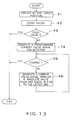
- Fig. 13 is a flow chart that shows behaviors of the motor control apparatus according to the second embodiment of the invention, that is, procedures of a motor control method according to the second embodiment of the invention.
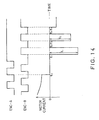
- Fig. 14 is a timing chart that explains behaviors of the motor control apparatus according to the second embodiment of the invention.
- the motor control apparatus 6 has a configuration in which a pulse counter 6p and a current value signal generator 6q are added to the conventional motor control apparatus 6 shown in Fig.7.
- the part of the motor control apparatus 6 other than the pulse counter 6p and the current value signal generator 6q was already explained, its explanation is omitted here.
- the current value signal generator 6q is made up of a current value determiner 71 and a detector 72 as shown in Fig 12.
- the pulse counter 6p starts counting the risings and tailing edges of output pulses ENC-A, ENC-B of the encoder 13 (see the step F2 of Fig. 13). If the count value is still lower than a predetermined value (for example, 5) even after a predetermined period of time (see the step F3), it is considered that the sheet 50 is held in the predetermined extent between the paper feeding roller 65 and the follower roller 66. Thus the control is finished, and a printing process takes place.
- a predetermined value for example, 5
- the reason why the value 5 is selected as the predetermined value lies in that the DC motor is difficult to stop at the position where the positional deviation zero and it is usually stopped within the range where the positional deviation is ⁇ 3.
- an instruction signal is sent from the pulse counter 6p to the current value determiner 71 of the current value signal generator 6q. Then, the current value determiner 71 of the current value signal generator 6q determines a current value signal, which will become a predetermined current value I 1 necessary for rotating the PF motor 1 in the reverse direction, and sends it to the D/A converter 6j (see the step F4 of Fig.13).
- the predetermined current value I 1 is determined in accordance with thickness of the sheet 50, for example, and it may be the minimum value among absolute values of current values causing the PF motor 1 to rotate in the reverse direction, for example. It is previously obtained by experiments.
- the current value signal which will become the predetermined current value I 1 is converted to an analog current instruction value by the D/A converter 6j, and sent out to the driver 2. Then the driver 2 drives the PF motor 1 such that the current value additionally applied to the PF motor 1 becomes I 1
- the current value signal that will become the said predetermined current value I 1 is output from the current value signal generator 6q when the output pulse ECN-B of the encoder 13 is the "H" level, i.e., from the point of time t 1 to t 2 shown in Fig.14).
- the PF motor 1 rotates in the reverse direction or stops. Whether the PF motor 1 has stopped or not is detected by the detector 72 of the current value signal generator 6q from output pulses of the encoder 13 (see the step F5 of Fig. 13).
- I 1 ) is determined by the current value signal determiner 71 of the current value signal generator 6q (see the point of time t 3 of Fig. 14), and sent to the D/A converter 6j (see the step F6 of Fig. 13).
- the current value signal which is the current value I 2
- step F5 if the sheet is judged to have stopped, it is considered that the perimeter of the sheet 50 is held in the predetermined extend (extent x shown in Fig. 10) between the paper feeding roller 65 and the follower roller 66, and a signal is sent from the detector 72 to the current value determiner 71 which thereafter continuously output the current value signal (see the point of time t 5 of shown in Fig.14).
- the current value determined by the current value determiner 71 is preferably extracted from a table that store values previously obtained through experiments, or the like.
- the perimeter of the sheet 50 can be held within the predetermined extent between the paper feeding roller 65 and the follower roller 66, and a wide area of the sheet to near its perimeters can be used for printing.
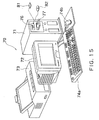
- Fig.15 is an explanatory diagram that illustrate configuration in external appearance of a recording medium having recorded a program for executing a motor control method according to the invention and a computer system in which the recording medium is used
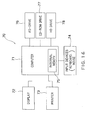
- Fig. 16 is a block diagram that shows configuration of the computer system shown in Fig. 15.
- the computer system 70 shown in Fig. 15 is made up of a computer main body 71 housed in a casing like a mini tower, for example, a display 72 such as CRT (cathode ray tube), plasma display, liquid crystal display, or the like, a printer 73 as a record output apparatus, a key board 74a and a mouse 74b as input devices, a flexible disk drive 76, and a CD-ROM drive 77.
- a display 72 such as CRT (cathode ray tube), plasma display, liquid crystal display, or the like
- printer 73 as a record output apparatus
- key board 74a and a mouse 74b as input devices
- a flexible disk drive 76 a CD-ROM drive 77.
- Fig. 16 illustrates configuration of the computer system 70 as a block diagram, and the casing that houses the computer main body 71 further contains internal memory 75 such as RAM (random access memory), for example, and external memory like a hard disk drive unit 78, for example.
- the recording medium having recorded a computer program for executing the motor control method according to the invention is used on the computer system 70.
- Used as the recording medium is a flexible disk 81 or CD-ROM (read only memory) 82, for example, but other means may be used, such as MO (magneto-optical) disk, DVD (digital versatile disk), other optical recording disks, card memory, magnetic tape, and so on.
Landscapes
- Character Spaces And Line Spaces In Printers (AREA)
- Control Of Electric Motors In General (AREA)
- Preparation Of Compounds By Using Micro-Organisms (AREA)
- Delivering By Means Of Belts And Rollers (AREA)
- Control Of Direct Current Motors (AREA)
Applications Claiming Priority (5)
| Application Number | Priority Date | Filing Date | Title |
|---|---|---|---|
| JP200058645 | 2000-03-03 | ||
| JP2000058486A JP3871181B2 (ja) | 2000-03-03 | 2000-03-03 | 印刷制御装置および制御方法ならびに印刷制御プログラムを記録した記録媒体 |
| JP200058486 | 2000-03-03 | ||
| JP2000058645A JP3780804B2 (ja) | 2000-03-03 | 2000-03-03 | モータ制御装置及び制御方法 |
| EP01400549A EP1129856B1 (de) | 2000-03-03 | 2001-03-02 | Motorsteuerungsvorrichtung und -verfahren |
Related Parent Applications (1)
| Application Number | Title | Priority Date | Filing Date |
|---|---|---|---|
| EP01400549A Division EP1129856B1 (de) | 2000-03-03 | 2001-03-02 | Motorsteuerungsvorrichtung und -verfahren |
Publications (3)
| Publication Number | Publication Date |
|---|---|
| EP1602504A2 true EP1602504A2 (de) | 2005-12-07 |
| EP1602504A3 EP1602504A3 (de) | 2005-12-14 |
| EP1602504B1 EP1602504B1 (de) | 2007-04-25 |
Family
ID=26586705
Family Applications (2)
| Application Number | Title | Priority Date | Filing Date |
|---|---|---|---|
| EP01400549A Expired - Lifetime EP1129856B1 (de) | 2000-03-03 | 2001-03-02 | Motorsteuerungsvorrichtung und -verfahren |
| EP05076859A Expired - Lifetime EP1602504B1 (de) | 2000-03-03 | 2001-03-02 | Motorsteuerungsvorrichtung und -verfahren |
Family Applications Before (1)
| Application Number | Title | Priority Date | Filing Date |
|---|---|---|---|
| EP01400549A Expired - Lifetime EP1129856B1 (de) | 2000-03-03 | 2001-03-02 | Motorsteuerungsvorrichtung und -verfahren |
Country Status (4)
| Country | Link |
|---|---|
| US (2) | US6600286B2 (de) |
| EP (2) | EP1129856B1 (de) |
| AT (1) | ATE360534T1 (de) |
| DE (2) | DE60128164T2 (de) |
Families Citing this family (34)
| Publication number | Priority date | Publication date | Assignee | Title |
|---|---|---|---|---|
| JP3921928B2 (ja) * | 1999-09-24 | 2007-05-30 | セイコーエプソン株式会社 | 印刷制御装置および印刷制御方法ならびに印刷制御プログラムを記録した記録媒体 |
| DE60128164T2 (de) * | 2000-03-03 | 2008-03-06 | Seiko Epson Corp. | Motorsteuerungsvorrichtung und -verfahren |
| EP1286237A1 (de) * | 2001-07-20 | 2003-02-26 | Valtronic S.A. | Verfahren zur Steurerung eines Motors |
| JP3673745B2 (ja) * | 2001-10-01 | 2005-07-20 | キヤノン株式会社 | 制御装置及びその方法、記録装置及びその制御方法 |
| JP3741071B2 (ja) * | 2002-03-29 | 2006-02-01 | ブラザー工業株式会社 | 給紙装置 |
| JP2004237501A (ja) * | 2003-02-04 | 2004-08-26 | Brother Ind Ltd | キャリッジ駆動装置及びモータ制御方法 |
| JP4144426B2 (ja) * | 2003-05-02 | 2008-09-03 | セイコーエプソン株式会社 | Dcモータを用いたプリンタ及びその制御方法 |
| WO2004106075A1 (en) * | 2003-05-30 | 2004-12-09 | Ricoh Company, Ltd. | Image forming apparatus |
| AU2004281370A1 (en) * | 2003-08-29 | 2005-04-28 | Engineered Support Systems, Inc. | Electronically programmable actively damped sensor mount |
| US7821216B2 (en) * | 2003-09-12 | 2010-10-26 | Brother Kogyo Kabushiki Kaisha | Motor control method and control device |
| JP4059213B2 (ja) * | 2004-02-27 | 2008-03-12 | ブラザー工業株式会社 | モータ制御装置およびモータ制御方法 |
| JP4552541B2 (ja) * | 2004-07-09 | 2010-09-29 | ブラザー工業株式会社 | キャリッジ駆動制御装置及び方法 |
| JP2006201148A (ja) * | 2004-12-22 | 2006-08-03 | Toshiba Mach Co Ltd | 信号処理装置、信号処理方法、信号処理プログラム、信号処理プログラムを記録した記録媒体、速度検出装置、サーボ機構 |
| JP4760090B2 (ja) * | 2005-03-30 | 2011-08-31 | ブラザー工業株式会社 | 搬送装置及び画像形成装置 |
| JP4470795B2 (ja) * | 2005-03-30 | 2010-06-02 | ブラザー工業株式会社 | 画像形成装置 |
| US8004724B2 (en) * | 2005-12-05 | 2011-08-23 | Canon Kabushiki Kaisha | Method and apparatus for image reading with synchronized readout and lighting control |
| JP2007330000A (ja) * | 2006-06-06 | 2007-12-20 | Seiko Epson Corp | モータ制御装置 |
| US7868568B2 (en) * | 2007-02-28 | 2011-01-11 | Brother Kogyo Kabushiki Kaisha | Motor driving device |
| US20090057997A1 (en) * | 2007-08-31 | 2009-03-05 | Seiko Epson Corporation | Printer, drive control method, and motor control program for printer |
| US7719224B2 (en) * | 2007-09-28 | 2010-05-18 | Rockwell Automation Technologies, Inc. | Simulated encoder pulse output system and method |
| US8310178B2 (en) * | 2009-02-27 | 2012-11-13 | Canon Kabushiki Kaisha | Motor control apparatus and image forming apparatus |
| JP5177195B2 (ja) * | 2010-09-21 | 2013-04-03 | 株式会社デンソー | 回転機の制御装置 |
| JP5707129B2 (ja) * | 2010-12-28 | 2015-04-22 | Thk株式会社 | モータ制御装置、モータ制御方法、及び制御プログラム |
| JP5713031B2 (ja) * | 2012-02-06 | 2015-05-07 | 株式会社リコー | モータ制御装置、モータシステム、搬送装置、画像形成装置、モータ制御方法およびプログラム |
| US20140055064A1 (en) * | 2012-08-27 | 2014-02-27 | Allegro Microsystems, Inc. | Systems and Methods for Controlling Motor Speeds |
| JP5724977B2 (ja) * | 2012-09-20 | 2015-05-27 | 株式会社デンソー | ブラシレスモータの制御システム |
| JP6650720B2 (ja) * | 2015-10-09 | 2020-02-19 | キヤノン株式会社 | 記録装置、記録装置の制御方法、及びプログラム |
| CN108062038A (zh) * | 2016-11-08 | 2018-05-22 | 广州奥睿智能科技有限公司 | 舵机控制方法、控制系统和舵机 |
| JP2019030033A (ja) * | 2017-07-25 | 2019-02-21 | 東芝テック株式会社 | モータ制御装置及びプリンタ |
| JP7052255B2 (ja) * | 2017-08-25 | 2022-04-12 | コニカミノルタ株式会社 | 画像形成装置 |
| CN109109474B (zh) * | 2018-09-19 | 2021-07-13 | 南阳柯丽尔科技有限公司 | 打印设备的控制方法及系统 |
| CN109849534B (zh) * | 2018-12-29 | 2021-03-23 | 厦门汉印电子技术有限公司 | 一种照片打印机、打印方法、装置和存储介质 |
| CN115683196B (zh) * | 2022-11-17 | 2025-02-18 | 遨博(北京)智能科技股份有限公司 | 一种自动化测试编码器方法及系统 |
| CN116520901B (zh) * | 2023-04-04 | 2026-04-07 | 北京环境特性研究所 | 高精度速率转台的伺服控制设备、系统及方法 |
Family Cites Families (16)
| Publication number | Priority date | Publication date | Assignee | Title |
|---|---|---|---|---|
| US3950685A (en) * | 1974-04-25 | 1976-04-13 | Lrc, Inc. | Dc motor position controller |
| US4369402A (en) * | 1980-07-22 | 1983-01-18 | Xerox Corporation | Motion damping apparatus |
| US4591774A (en) * | 1981-05-21 | 1986-05-27 | Dataproducts Corporation | High performance incremental motion system using a closed loop stepping motor |
| US4460968A (en) * | 1981-10-16 | 1984-07-17 | International Business Machines Corporation | Print head motor control with stop distance compensation |
| US4777609A (en) | 1985-12-11 | 1988-10-11 | International Business Machines Corporation | Print head motor control system having steady state velocity compensation |
| JPH0729454B2 (ja) * | 1990-04-10 | 1995-04-05 | 旭光学工業株式会社 | プリンタの書き出し位置調整機構 |
| JP3204664B2 (ja) * | 1990-09-17 | 2001-09-04 | オリンパス光学工業株式会社 | モータの駆動制御装置 |
| US5057859A (en) * | 1990-11-23 | 1991-10-15 | Olympus Optical Co., Ltd. | Camera having high-precision stop function for movable unit |
| JPH05338306A (ja) * | 1992-06-11 | 1993-12-21 | Fuji Xerox Co Ltd | シリアルプリンタ |
| JPH07137376A (ja) * | 1993-06-30 | 1995-05-30 | Asahi Optical Co Ltd | 用紙搬送機構 |
| JP3555669B2 (ja) * | 1995-11-09 | 2004-08-18 | ブラザー工業株式会社 | 記録装置 |
| EP0807528B1 (de) * | 1996-05-15 | 2001-12-12 | Océ-Technologies B.V. | Verfahren und System zur Detektierung einer Wagenlage |
| JP3736010B2 (ja) * | 1997-03-19 | 2006-01-18 | 富士ゼロックス株式会社 | 印刷装置及び用紙送り装置 |
| US5826157A (en) * | 1997-07-31 | 1998-10-20 | Xerox Corporation | Sychronized paper feeding across module boundaries with timed clock ticks |
| ATE410309T1 (de) * | 1999-12-24 | 2008-10-15 | Seiko Epson Corp | Vorrichtung und verfahren zur motorsteuerung |
| DE60128164T2 (de) * | 2000-03-03 | 2008-03-06 | Seiko Epson Corp. | Motorsteuerungsvorrichtung und -verfahren |
-
2001
- 2001-03-02 DE DE60128164T patent/DE60128164T2/de not_active Expired - Fee Related
- 2001-03-02 US US09/796,429 patent/US6600286B2/en not_active Expired - Fee Related
- 2001-03-02 EP EP01400549A patent/EP1129856B1/de not_active Expired - Lifetime
- 2001-03-02 DE DE60126001T patent/DE60126001T2/de not_active Expired - Fee Related
- 2001-03-02 AT AT05076859T patent/ATE360534T1/de not_active IP Right Cessation
- 2001-03-02 EP EP05076859A patent/EP1602504B1/de not_active Expired - Lifetime
-
2003
- 2003-05-27 US US10/445,344 patent/US6756760B2/en not_active Expired - Fee Related
Also Published As
| Publication number | Publication date |
|---|---|
| US20030205982A1 (en) | 2003-11-06 |
| US6756760B2 (en) | 2004-06-29 |
| DE60128164T2 (de) | 2008-03-06 |
| EP1129856B1 (de) | 2007-01-17 |
| ATE360534T1 (de) | 2007-05-15 |
| EP1602504B1 (de) | 2007-04-25 |
| EP1602504A3 (de) | 2005-12-14 |
| DE60126001D1 (de) | 2007-03-08 |
| US6600286B2 (en) | 2003-07-29 |
| EP1129856A1 (de) | 2001-09-05 |
| DE60128164D1 (de) | 2007-06-06 |
| US20010035724A1 (en) | 2001-11-01 |
| DE60126001T2 (de) | 2007-06-14 |
Similar Documents
| Publication | Publication Date | Title |
|---|---|---|
| EP1602504B1 (de) | Motorsteuerungsvorrichtung und -verfahren | |
| EP1681173B1 (de) | Vorrichtung und Verfahren zur Motorsteuerung | |
| EP1124320B1 (de) | Verfahren und Vorrichtung zur Motorsteuerung | |
| JP3859115B2 (ja) | プリンタ用モータの制御装置および制御方法ならびに制御プログラムを記録した記録媒体 | |
| JP2001169584A (ja) | プリンタ用モータの制御装置およびその制御方法ならびに制御プログラムを記録した記録媒体 | |
| US6805342B2 (en) | Printer-control method and printer-control apparatus | |
| JP3832174B2 (ja) | モータ制御装置及び制御方法 | |
| EP1080928B1 (de) | Steuereinheit und Verfahren zur Steuerung eines Motors für einen Drucker und Steuerungsprogramm speicherndes Speichermedium | |
| JP4362815B2 (ja) | プラテンギャップ調整装置及び印刷装置並びにモータ制御装置 | |
| JP4306185B2 (ja) | プリンタ制御装置、プリンタ制御方法及びコンピュータプログラム | |
| JP3705061B2 (ja) | モータの制御装置およびその制御方法ならびにモータの制御プログラムを記録した記録媒体 | |
| JP3818496B2 (ja) | プリンタ制御装置及びプリンタ制御方法 | |
| JP2005231243A (ja) | プリンタ制御装置及びプリンタ制御方法並びにプリンタ | |
| JP3871181B2 (ja) | 印刷制御装置および制御方法ならびに印刷制御プログラムを記録した記録媒体 | |
| JP2001224189A (ja) | モータ制御方法及び制御装置 | |
| JP4003721B2 (ja) | プリンタ | |
| JP2001142537A (ja) | プリンタ用モータの制御装置および制御方法ならびに制御プログラムを記録した記録媒体 | |
| JP3900401B2 (ja) | Dcモータ制御方法及び制御装置 | |
| JP3885559B2 (ja) | プリンタ制御方法及びプリンタ制御装置 | |
| JP2001315395A (ja) | 印刷制御装置および印刷制御方法ならびに印刷制御プログラムを記録した記録媒体 | |
| JP2002273966A (ja) | 印刷制御装置および印刷制御方法ならびに印刷制御プログラムを記録した記録媒体 | |
| JP2005200222A (ja) | 印刷制御装置および制御方法ならびに印刷制御プログラムを記録した記録媒体 | |
| JP2001180054A (ja) | 印刷制御装置および印刷制御方法 | |
| JP2002283559A (ja) | 印刷制御装置および印刷制御方法ならびに印刷制御プログラムを記録した記録媒体 | |
| JP2007030521A (ja) | プリンタ用モータの制御装置および制御方法 |
Legal Events
| Date | Code | Title | Description |
|---|---|---|---|
| PUAI | Public reference made under article 153(3) epc to a published international application that has entered the european phase |
Free format text: ORIGINAL CODE: 0009012 |
|
| PUAL | Search report despatched |
Free format text: ORIGINAL CODE: 0009013 |
|
| AC | Divisional application: reference to earlier application |
Ref document number: 1129856 Country of ref document: EP Kind code of ref document: P |
|
| AK | Designated contracting states |
Kind code of ref document: A2 Designated state(s): AT BE CH CY DE DK ES FI FR GB GR IE IT LI LU MC NL PT SE TR |
|
| AK | Designated contracting states |
Kind code of ref document: A3 Designated state(s): AT BE CH CY DE DK ES FI FR GB GR IE IT LI LU MC NL PT SE TR |
|
| 17P | Request for examination filed |
Effective date: 20060614 |
|
| 17Q | First examination report despatched |
Effective date: 20060724 |
|
| AKX | Designation fees paid |
Designated state(s): AT BE CH CY DE DK ES FI FR GB GR IE IT LI LU MC NL PT SE TR |
|
| GRAP | Despatch of communication of intention to grant a patent |
Free format text: ORIGINAL CODE: EPIDOSNIGR1 |
|
| GRAS | Grant fee paid |
Free format text: ORIGINAL CODE: EPIDOSNIGR3 |
|
| GRAA | (expected) grant |
Free format text: ORIGINAL CODE: 0009210 |
|
| AC | Divisional application: reference to earlier application |
Ref document number: 1129856 Country of ref document: EP Kind code of ref document: P |
|
| AK | Designated contracting states |
Kind code of ref document: B1 Designated state(s): AT BE CH CY DE DK ES FI FR GB GR IE IT LI LU MC NL PT SE TR |
|
| PG25 | Lapsed in a contracting state [announced via postgrant information from national office to epo] |
Ref country code: LI Free format text: LAPSE BECAUSE OF FAILURE TO SUBMIT A TRANSLATION OF THE DESCRIPTION OR TO PAY THE FEE WITHIN THE PRESCRIBED TIME-LIMIT Effective date: 20070425 Ref country code: FI Free format text: LAPSE BECAUSE OF FAILURE TO SUBMIT A TRANSLATION OF THE DESCRIPTION OR TO PAY THE FEE WITHIN THE PRESCRIBED TIME-LIMIT Effective date: 20070425 Ref country code: CH Free format text: LAPSE BECAUSE OF FAILURE TO SUBMIT A TRANSLATION OF THE DESCRIPTION OR TO PAY THE FEE WITHIN THE PRESCRIBED TIME-LIMIT Effective date: 20070425 |
|
| REG | Reference to a national code |
Ref country code: GB Ref legal event code: FG4D |
|
| REG | Reference to a national code |
Ref country code: IE Ref legal event code: FG4D |
|
| REG | Reference to a national code |
Ref country code: CH Ref legal event code: EP |
|
| REF | Corresponds to: |
Ref document number: 60128164 Country of ref document: DE Date of ref document: 20070606 Kind code of ref document: P |
|
| PG25 | Lapsed in a contracting state [announced via postgrant information from national office to epo] |
Ref country code: SE Free format text: LAPSE BECAUSE OF FAILURE TO SUBMIT A TRANSLATION OF THE DESCRIPTION OR TO PAY THE FEE WITHIN THE PRESCRIBED TIME-LIMIT Effective date: 20070725 |
|
| PG25 | Lapsed in a contracting state [announced via postgrant information from national office to epo] |
Ref country code: ES Free format text: LAPSE BECAUSE OF FAILURE TO SUBMIT A TRANSLATION OF THE DESCRIPTION OR TO PAY THE FEE WITHIN THE PRESCRIBED TIME-LIMIT Effective date: 20070805 |
|
| ET | Fr: translation filed | ||
| PG25 | Lapsed in a contracting state [announced via postgrant information from national office to epo] |
Ref country code: PT Free format text: LAPSE BECAUSE OF FAILURE TO SUBMIT A TRANSLATION OF THE DESCRIPTION OR TO PAY THE FEE WITHIN THE PRESCRIBED TIME-LIMIT Effective date: 20070925 |
|
| REG | Reference to a national code |
Ref country code: CH Ref legal event code: PL |
|
| NLV1 | Nl: lapsed or annulled due to failure to fulfill the requirements of art. 29p and 29m of the patents act | ||
| PG25 | Lapsed in a contracting state [announced via postgrant information from national office to epo] |
Ref country code: AT Free format text: LAPSE BECAUSE OF FAILURE TO SUBMIT A TRANSLATION OF THE DESCRIPTION OR TO PAY THE FEE WITHIN THE PRESCRIBED TIME-LIMIT Effective date: 20070425 |
|
| PG25 | Lapsed in a contracting state [announced via postgrant information from national office to epo] |
Ref country code: BE Free format text: LAPSE BECAUSE OF FAILURE TO SUBMIT A TRANSLATION OF THE DESCRIPTION OR TO PAY THE FEE WITHIN THE PRESCRIBED TIME-LIMIT Effective date: 20070425 |
|
| PG25 | Lapsed in a contracting state [announced via postgrant information from national office to epo] |
Ref country code: NL Free format text: LAPSE BECAUSE OF FAILURE TO SUBMIT A TRANSLATION OF THE DESCRIPTION OR TO PAY THE FEE WITHIN THE PRESCRIBED TIME-LIMIT Effective date: 20070425 Ref country code: DK Free format text: LAPSE BECAUSE OF FAILURE TO SUBMIT A TRANSLATION OF THE DESCRIPTION OR TO PAY THE FEE WITHIN THE PRESCRIBED TIME-LIMIT Effective date: 20070425 |
|
| PLBE | No opposition filed within time limit |
Free format text: ORIGINAL CODE: 0009261 |
|
| STAA | Information on the status of an ep patent application or granted ep patent |
Free format text: STATUS: NO OPPOSITION FILED WITHIN TIME LIMIT |
|
| 26N | No opposition filed |
Effective date: 20080128 |
|
| PG25 | Lapsed in a contracting state [announced via postgrant information from national office to epo] |
Ref country code: GR Free format text: LAPSE BECAUSE OF FAILURE TO SUBMIT A TRANSLATION OF THE DESCRIPTION OR TO PAY THE FEE WITHIN THE PRESCRIBED TIME-LIMIT Effective date: 20070726 Ref country code: IT Free format text: LAPSE BECAUSE OF FAILURE TO SUBMIT A TRANSLATION OF THE DESCRIPTION OR TO PAY THE FEE WITHIN THE PRESCRIBED TIME-LIMIT Effective date: 20070425 |
|
| PG25 | Lapsed in a contracting state [announced via postgrant information from national office to epo] |
Ref country code: MC Free format text: LAPSE BECAUSE OF NON-PAYMENT OF DUE FEES Effective date: 20080331 |
|
| PG25 | Lapsed in a contracting state [announced via postgrant information from national office to epo] |
Ref country code: IE Free format text: LAPSE BECAUSE OF NON-PAYMENT OF DUE FEES Effective date: 20080303 |
|
| PGFP | Annual fee paid to national office [announced via postgrant information from national office to epo] |
Ref country code: GB Payment date: 20090225 Year of fee payment: 9 |
|
| PG25 | Lapsed in a contracting state [announced via postgrant information from national office to epo] |
Ref country code: CY Free format text: LAPSE BECAUSE OF FAILURE TO SUBMIT A TRANSLATION OF THE DESCRIPTION OR TO PAY THE FEE WITHIN THE PRESCRIBED TIME-LIMIT Effective date: 20070425 |
|
| PGFP | Annual fee paid to national office [announced via postgrant information from national office to epo] |
Ref country code: DE Payment date: 20090429 Year of fee payment: 9 |
|
| PGFP | Annual fee paid to national office [announced via postgrant information from national office to epo] |
Ref country code: FR Payment date: 20090211 Year of fee payment: 9 |
|
| PG25 | Lapsed in a contracting state [announced via postgrant information from national office to epo] |
Ref country code: LU Free format text: LAPSE BECAUSE OF NON-PAYMENT OF DUE FEES Effective date: 20080302 |
|
| PG25 | Lapsed in a contracting state [announced via postgrant information from national office to epo] |
Ref country code: TR Free format text: LAPSE BECAUSE OF FAILURE TO SUBMIT A TRANSLATION OF THE DESCRIPTION OR TO PAY THE FEE WITHIN THE PRESCRIBED TIME-LIMIT Effective date: 20070425 |
|
| GBPC | Gb: european patent ceased through non-payment of renewal fee |
Effective date: 20100302 |
|
| REG | Reference to a national code |
Ref country code: FR Ref legal event code: ST Effective date: 20101130 |
|
| PG25 | Lapsed in a contracting state [announced via postgrant information from national office to epo] |
Ref country code: FR Free format text: LAPSE BECAUSE OF NON-PAYMENT OF DUE FEES Effective date: 20100331 |
|
| PG25 | Lapsed in a contracting state [announced via postgrant information from national office to epo] |
Ref country code: DE Free format text: LAPSE BECAUSE OF NON-PAYMENT OF DUE FEES Effective date: 20101001 |
|
| PG25 | Lapsed in a contracting state [announced via postgrant information from national office to epo] |
Ref country code: GB Free format text: LAPSE BECAUSE OF NON-PAYMENT OF DUE FEES Effective date: 20100302 |