EP1603609B1 - Vorrichtung zur blutbehandlung mit selektiver entfernung gelöster substanzen - Google Patents
Vorrichtung zur blutbehandlung mit selektiver entfernung gelöster substanzen Download PDFInfo
- Publication number
- EP1603609B1 EP1603609B1 EP04720673A EP04720673A EP1603609B1 EP 1603609 B1 EP1603609 B1 EP 1603609B1 EP 04720673 A EP04720673 A EP 04720673A EP 04720673 A EP04720673 A EP 04720673A EP 1603609 B1 EP1603609 B1 EP 1603609B1
- Authority
- EP
- European Patent Office
- Prior art keywords
- exchanger
- outlet
- inlet
- fluid communication
- treatment unit
- Prior art date
- Legal status (The legal status is an assumption and is not a legal conclusion. Google has not performed a legal analysis and makes no representation as to the accuracy of the status listed.)
- Expired - Lifetime
Links
Images




Classifications
-
- A—HUMAN NECESSITIES
- A61—MEDICAL OR VETERINARY SCIENCE; HYGIENE
- A61L—METHODS OR APPARATUS FOR STERILISING MATERIALS OR OBJECTS IN GENERAL; DISINFECTION, STERILISATION OR DEODORISATION OF AIR; CHEMICAL ASPECTS OF BANDAGES, DRESSINGS, ABSORBENT PADS OR SURGICAL ARTICLES; MATERIALS FOR BANDAGES, DRESSINGS, ABSORBENT PADS OR SURGICAL ARTICLES
- A61L2/00—Disinfection or sterilisation of materials or objects, in general; Accessories therefor
- A61L2/02—Disinfection or sterilisation of materials or objects, in general; Accessories therefor using physical processes
- A61L2/022—Filtration
-
- A—HUMAN NECESSITIES
- A61—MEDICAL OR VETERINARY SCIENCE; HYGIENE
- A61L—METHODS OR APPARATUS FOR STERILISING MATERIALS OR OBJECTS IN GENERAL; DISINFECTION, STERILISATION OR DEODORISATION OF AIR; CHEMICAL ASPECTS OF BANDAGES, DRESSINGS, ABSORBENT PADS OR SURGICAL ARTICLES; MATERIALS FOR BANDAGES, DRESSINGS, ABSORBENT PADS OR SURGICAL ARTICLES
- A61L2/00—Disinfection or sterilisation of materials or objects, in general; Accessories therefor
- A61L2/02—Disinfection or sterilisation of materials or objects, in general; Accessories therefor using physical processes
-
- A—HUMAN NECESSITIES
- A61—MEDICAL OR VETERINARY SCIENCE; HYGIENE
- A61M—DEVICES FOR INTRODUCING MEDIA INTO, OR ONTO, THE BODY; DEVICES FOR TRANSDUCING BODY MEDIA OR FOR TAKING MEDIA FROM THE BODY; DEVICES FOR PRODUCING OR ENDING SLEEP OR STUPOR
- A61M1/00—Suction or pumping devices for medical purposes; Devices for carrying-off, for treatment of, or for carrying-over, body-liquids; Drainage systems
- A61M1/14—Dialysis systems; Artificial kidneys; Blood oxygenators ; Reciprocating systems for treatment of body fluids, e.g. single needle systems for hemofiltration or pheresis
- A61M1/16—Dialysis systems; Artificial kidneys; Blood oxygenators ; Reciprocating systems for treatment of body fluids, e.g. single needle systems for hemofiltration or pheresis with membranes
- A61M1/1694—Dialysis systems; Artificial kidneys; Blood oxygenators ; Reciprocating systems for treatment of body fluids, e.g. single needle systems for hemofiltration or pheresis with membranes with recirculating dialysing liquid
- A61M1/1696—Dialysis systems; Artificial kidneys; Blood oxygenators ; Reciprocating systems for treatment of body fluids, e.g. single needle systems for hemofiltration or pheresis with membranes with recirculating dialysing liquid with dialysate regeneration
-
- A—HUMAN NECESSITIES
- A61—MEDICAL OR VETERINARY SCIENCE; HYGIENE
- A61M—DEVICES FOR INTRODUCING MEDIA INTO, OR ONTO, THE BODY; DEVICES FOR TRANSDUCING BODY MEDIA OR FOR TAKING MEDIA FROM THE BODY; DEVICES FOR PRODUCING OR ENDING SLEEP OR STUPOR
- A61M1/00—Suction or pumping devices for medical purposes; Devices for carrying-off, for treatment of, or for carrying-over, body-liquids; Drainage systems
- A61M1/34—Filtering material out of the blood by passing it through a membrane, i.e. hemofiltration or diafiltration
- A61M1/342—Adding solutions to the blood, e.g. substitution solutions
-
- A—HUMAN NECESSITIES
- A61—MEDICAL OR VETERINARY SCIENCE; HYGIENE
- A61M—DEVICES FOR INTRODUCING MEDIA INTO, OR ONTO, THE BODY; DEVICES FOR TRANSDUCING BODY MEDIA OR FOR TAKING MEDIA FROM THE BODY; DEVICES FOR PRODUCING OR ENDING SLEEP OR STUPOR
- A61M1/00—Suction or pumping devices for medical purposes; Devices for carrying-off, for treatment of, or for carrying-over, body-liquids; Drainage systems
- A61M1/34—Filtering material out of the blood by passing it through a membrane, i.e. hemofiltration or diafiltration
- A61M1/342—Adding solutions to the blood, e.g. substitution solutions
- A61M1/3424—Substitution fluid path
- A61M1/3431—Substitution fluid path upstream of the filter
- A61M1/3434—Substitution fluid path upstream of the filter with pre-dilution and post-dilution
-
- A—HUMAN NECESSITIES
- A61—MEDICAL OR VETERINARY SCIENCE; HYGIENE
- A61M—DEVICES FOR INTRODUCING MEDIA INTO, OR ONTO, THE BODY; DEVICES FOR TRANSDUCING BODY MEDIA OR FOR TAKING MEDIA FROM THE BODY; DEVICES FOR PRODUCING OR ENDING SLEEP OR STUPOR
- A61M1/00—Suction or pumping devices for medical purposes; Devices for carrying-off, for treatment of, or for carrying-over, body-liquids; Drainage systems
- A61M1/34—Filtering material out of the blood by passing it through a membrane, i.e. hemofiltration or diafiltration
- A61M1/342—Adding solutions to the blood, e.g. substitution solutions
- A61M1/3424—Substitution fluid path
- A61M1/3437—Substitution fluid path downstream of the filter, e.g. post-dilution with filtrate
-
- A—HUMAN NECESSITIES
- A61—MEDICAL OR VETERINARY SCIENCE; HYGIENE
- A61M—DEVICES FOR INTRODUCING MEDIA INTO, OR ONTO, THE BODY; DEVICES FOR TRANSDUCING BODY MEDIA OR FOR TAKING MEDIA FROM THE BODY; DEVICES FOR PRODUCING OR ENDING SLEEP OR STUPOR
- A61M1/00—Suction or pumping devices for medical purposes; Devices for carrying-off, for treatment of, or for carrying-over, body-liquids; Drainage systems
- A61M1/34—Filtering material out of the blood by passing it through a membrane, i.e. hemofiltration or diafiltration
- A61M1/342—Adding solutions to the blood, e.g. substitution solutions
- A61M1/3441—Substitution rate control as a function of the ultrafiltration rate
- A61M1/3451—Substitution rate control as a function of the ultrafiltration rate the difference in weight between both ultra-filtrate and substitution reservoir being used as control signal
-
- A—HUMAN NECESSITIES
- A61—MEDICAL OR VETERINARY SCIENCE; HYGIENE
- A61M—DEVICES FOR INTRODUCING MEDIA INTO, OR ONTO, THE BODY; DEVICES FOR TRANSDUCING BODY MEDIA OR FOR TAKING MEDIA FROM THE BODY; DEVICES FOR PRODUCING OR ENDING SLEEP OR STUPOR
- A61M1/00—Suction or pumping devices for medical purposes; Devices for carrying-off, for treatment of, or for carrying-over, body-liquids; Drainage systems
- A61M1/34—Filtering material out of the blood by passing it through a membrane, i.e. hemofiltration or diafiltration
- A61M1/342—Adding solutions to the blood, e.g. substitution solutions
- A61M1/3455—Substitution fluids
- A61M1/3468—Substitution fluids using treated filtrate as substitution fluid
-
- A—HUMAN NECESSITIES
- A61—MEDICAL OR VETERINARY SCIENCE; HYGIENE
- A61M—DEVICES FOR INTRODUCING MEDIA INTO, OR ONTO, THE BODY; DEVICES FOR TRANSDUCING BODY MEDIA OR FOR TAKING MEDIA FROM THE BODY; DEVICES FOR PRODUCING OR ENDING SLEEP OR STUPOR
- A61M1/00—Suction or pumping devices for medical purposes; Devices for carrying-off, for treatment of, or for carrying-over, body-liquids; Drainage systems
- A61M1/34—Filtering material out of the blood by passing it through a membrane, i.e. hemofiltration or diafiltration
- A61M1/3472—Filtering material out of the blood by passing it through a membrane, i.e. hemofiltration or diafiltration with treatment of the filtrate
- A61M1/3479—Filtering material out of the blood by passing it through a membrane, i.e. hemofiltration or diafiltration with treatment of the filtrate by dialysing the filtrate
-
- A—HUMAN NECESSITIES
- A61—MEDICAL OR VETERINARY SCIENCE; HYGIENE
- A61M—DEVICES FOR INTRODUCING MEDIA INTO, OR ONTO, THE BODY; DEVICES FOR TRANSDUCING BODY MEDIA OR FOR TAKING MEDIA FROM THE BODY; DEVICES FOR PRODUCING OR ENDING SLEEP OR STUPOR
- A61M1/00—Suction or pumping devices for medical purposes; Devices for carrying-off, for treatment of, or for carrying-over, body-liquids; Drainage systems
- A61M1/34—Filtering material out of the blood by passing it through a membrane, i.e. hemofiltration or diafiltration
- A61M1/3472—Filtering material out of the blood by passing it through a membrane, i.e. hemofiltration or diafiltration with treatment of the filtrate
- A61M1/3482—Filtering material out of the blood by passing it through a membrane, i.e. hemofiltration or diafiltration with treatment of the filtrate by filtrating the filtrate using another cross-flow filter, e.g. a membrane filter
-
- A—HUMAN NECESSITIES
- A61—MEDICAL OR VETERINARY SCIENCE; HYGIENE
- A61M—DEVICES FOR INTRODUCING MEDIA INTO, OR ONTO, THE BODY; DEVICES FOR TRANSDUCING BODY MEDIA OR FOR TAKING MEDIA FROM THE BODY; DEVICES FOR PRODUCING OR ENDING SLEEP OR STUPOR
- A61M1/00—Suction or pumping devices for medical purposes; Devices for carrying-off, for treatment of, or for carrying-over, body-liquids; Drainage systems
- A61M1/34—Filtering material out of the blood by passing it through a membrane, i.e. hemofiltration or diafiltration
- A61M1/3472—Filtering material out of the blood by passing it through a membrane, i.e. hemofiltration or diafiltration with treatment of the filtrate
- A61M1/3486—Biological, chemical treatment, e.g. chemical precipitation; treatment by absorbents
-
- A—HUMAN NECESSITIES
- A61—MEDICAL OR VETERINARY SCIENCE; HYGIENE
- A61M—DEVICES FOR INTRODUCING MEDIA INTO, OR ONTO, THE BODY; DEVICES FOR TRANSDUCING BODY MEDIA OR FOR TAKING MEDIA FROM THE BODY; DEVICES FOR PRODUCING OR ENDING SLEEP OR STUPOR
- A61M1/00—Suction or pumping devices for medical purposes; Devices for carrying-off, for treatment of, or for carrying-over, body-liquids; Drainage systems
- A61M1/34—Filtering material out of the blood by passing it through a membrane, i.e. hemofiltration or diafiltration
- A61M1/3496—Plasmapheresis; Leucopheresis; Lymphopheresis
-
- A—HUMAN NECESSITIES
- A61—MEDICAL OR VETERINARY SCIENCE; HYGIENE
- A61L—METHODS OR APPARATUS FOR STERILISING MATERIALS OR OBJECTS IN GENERAL; DISINFECTION, STERILISATION OR DEODORISATION OF AIR; CHEMICAL ASPECTS OF BANDAGES, DRESSINGS, ABSORBENT PADS OR SURGICAL ARTICLES; MATERIALS FOR BANDAGES, DRESSINGS, ABSORBENT PADS OR SURGICAL ARTICLES
- A61L2103/00—Materials or objects being the target of disinfection or sterilisation
- A61L2103/05—Living organisms or biological materials
-
- A—HUMAN NECESSITIES
- A61—MEDICAL OR VETERINARY SCIENCE; HYGIENE
- A61M—DEVICES FOR INTRODUCING MEDIA INTO, OR ONTO, THE BODY; DEVICES FOR TRANSDUCING BODY MEDIA OR FOR TAKING MEDIA FROM THE BODY; DEVICES FOR PRODUCING OR ENDING SLEEP OR STUPOR
- A61M1/00—Suction or pumping devices for medical purposes; Devices for carrying-off, for treatment of, or for carrying-over, body-liquids; Drainage systems
- A61M1/36—Other treatment of blood in a by-pass of the natural circulatory system, e.g. temperature adaptation, irradiation ; Extra-corporeal blood circuits
- A61M1/3681—Other treatment of blood in a by-pass of the natural circulatory system, e.g. temperature adaptation, irradiation ; Extra-corporeal blood circuits by irradiation
-
- A—HUMAN NECESSITIES
- A61—MEDICAL OR VETERINARY SCIENCE; HYGIENE
- A61M—DEVICES FOR INTRODUCING MEDIA INTO, OR ONTO, THE BODY; DEVICES FOR TRANSDUCING BODY MEDIA OR FOR TAKING MEDIA FROM THE BODY; DEVICES FOR PRODUCING OR ENDING SLEEP OR STUPOR
- A61M2205/00—General characteristics of the apparatus
- A61M2205/75—General characteristics of the apparatus with filters
Definitions
- the object of the present application is blood filtration to selectively separate and extract selected size molecules through extracorporeal systems for the separation of substances.
- Such systems are used for the treatment of blood with solutes of different molecular mass.
- substances are, for example, urea with a molecular weight of 60 daltons, phosphate (96-97 daltons), creatinine (113 daltons), vitamin B 12 (1355 daltons), inulin ( 5200 daltons), beta 2-microglobulin (12000 daltons), albumin (58000 daltons).
- Such systems are often extracorporeal membrane systems for separating solutes of lower albumin mass applied to renal insufficiency treatments.
- the clearance of a solute is the level of solute in the blood cleaned for a given volume.
- the first membranes used were highly permeable to small solutes having a size up to 200 daltons.
- the clearance of small solutes depends on the permeability and diffusion capacity of the membrane used.
- a first solution was to add to the diffusive flow through the membrane a convective flow using high flux membranes having a cutting point ("cut off" in English) of size molecular of 40000 dalton. It is recalled that the cut off point of a membrane is defined by the molecular size at which only 10% of the solutes pass through the membrane.
- a second solution concerning the improvement of the clearance of medium molecules was hemofiltration, that is to say a purely convective process of solute removal by the membrane. But such a process extracts a lot of liquid and requires in compensation a dilution of sterile liquid in pre-dilution and / or post-dilution and the use of a highly permeable membrane with solutes of molecular size up to 40 000 daltons.
- the clearance depends on the dilution mode (pre or post-dilution), blood flow and infusate flow. With conventional haemofiltration, the clearance of small molecules is lower than that obtained in hemodialysis mode.
- a first ultrafiltration is performed through a first high flux membrane and not permeable to molecules of molecular mass greater than 10,000 daltons.
- the size of the orifices through the second membrane is smaller than that of the first.
- the unfiltered liquid mainly containing high mass molecules is fed back to the patient.
- the first ultrafiltrate containing small and medium mass molecules is filtered through the second membrane.
- the unfiltered liquid by the second membrane mainly containing molecules of average mass is collected in a waste bag.
- the second ultrafiltrate containing mainly small molecules is reinjected post-dilution on the patient's venous line.
- uremic molecules to be eliminated had a molecular weight of less than 200 daltons and a molecular weight of between 10,000 and 40,000 daltons.
- a first filter has a cut off point of about 40,000 daltons.
- the blood passes through this first filter and produces a first filtrate containing small and medium molecules, that is to say molecules with a molecular mass of less than 40,000 daltons.
- Solutes with a mass of between 10,000 and 40,000 daltons are then removed by ultrafiltration through the filter 2 having a cut off point of less than 10,000 daltons.
- the second filtrate is treated in hemofiltration with a membrane having a cutoff point of about 200 daltons.
- the purified filtrate containing solutes between 200 and 10,000 daltons is returned post-infusion to the patient who also receives the molecules of mass greater than 40,000 daltons.
- the patent US 6,193,681 describes an apparatus for treating sepsis in the blood represented in figure 3 .
- the blood passes through an ultraviolet irradiation device and then through a hemoconcentrator before being re-injected into the patient.
- a secondary circuit is connected to a second output of the hemoconcentrator, the outgoing fluid passes through a filter, then a membrane module and a dilution source before being injected upstream of the hemoconcentrator.
- Plasapheresis of therapeutic exchange is performed on a patient whose plasma contains one or more harmful or toxic substances.
- solutes from the plasma is carried out according to the same principle as the elimination of solutes from the blood, a difference being the largest molecular mass of the solutes to be extracted from the plasma.
- the cost of the device comprising several filters and pumps.
- the problem of demand is to selectively remove molecules by molecular weight range (s) with good clearance and consume very little sterile liquid.
- s molecular weight range
- An ancillary problem would be the optimal adaptation of such a system to long-term therapy in intensive care without the risk of clogging filters.
- the adaptation would be carried out by the choice of the operating modes of the different filters, the use and the timely placement of flow control means, the controlled flow rates, and the hydraulic architecture of the lines.
- an extracorporeal blood treatment device as claimed.
- a method of extracorporeal treatment of blood for use on an extracorporeal blood treatment device comprising an exchanger 1 on which are connected a blood line 10 and an output line 11 of the blood, and a treatment unit 21, the method comprising the following steps: sending the blood to the inlet line connected to the exchanger 1, performing a first filtration of the blood via the exchanger 1 by producing a first filtrate, performing at least a second filtration of the first filtrate via the treatment unit 21 by producing a second filtrate, returning the second filtrate to the inlet line 10 to perform a pre-dilution of the blood to be treated , send the blood at the outlet of the exchanger 1 to the exit line 11.
- the figure 4 schematically represents the principle of the invention: the passage of blood in an input line, its entry into an exchanger and its exit from the exchanger to an output line, and the treatment of the first filtrate by a unit treatment and injection of the liquid at the outlet of the treatment unit in pre-dilution on the arterial line.
- This concept can be seen as a filtration "cascade" with injection of the final filtrate into the pre-dilution of the circuit: a first filtrate is filtered a second time, and the second filtrate is injected at the inlet of the first filter, or in "pre-dilution". dilution ".
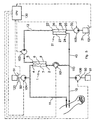
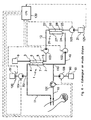
- the figure 5 represents the extracorporeal blood treatment device of the invention comprising a heat exchanger 1 having a first input 2 for the blood to be treated, a first fluid outlet 4 and a second fluid outlet 5, an inlet line 10 of the blood to be treated or arterial line connected to the first inlet 2 of the exchanger 1 , a blood outlet line or venous line 11 connected to the first outlet 4 of the exchanger 1.
- a treatment unit 21 comprises a first fluid inlet 22 and a first fluid outlet 24, the second outlet 25 of the exchanger 1 is in fluid communication with the first input 22 of the processing unit 21, and the first output 24 of the processing unit 21 is in fluid communication with the input line 10.
- the fluid communication between the first inlet 22 of the treatment unit 21 and the second outlet 5 of the exchanger 1 is effected by a pipe 12.
- the exchanger 1 may comprise a semipermeable membrane 6 dividing it into a first chamber 7 and a second chamber 8.
- the first inlet 2 of the exchanger is in fluid communication with the first chamber 7 of the exchanger and the first outlet 4 of the exchanger is in fluid communication with the first chamber 7 of the exchanger and the second outlet 5 of the exchanger is in fluid communication with the second chamber 8 of the exchanger.
- the line of blood input 10 called “arterial line” connected to the first inlet 2 of the exchanger 1
- the blood outlet line 11 called “venous line” connected to the first outlet 4 of the exchanger and the first Chamber 7 of the exchanger are part of an extracorporeal blood treatment circuit.
- the exchanger 1 may comprise a second input 3 in fluid communication with the second chamber 8 and in fluid communication with a first source of dialysis liquid 9.
- the blood and the dialysis liquid flow in opposite directions in each of the two chambers.
- the figure 5 represents the processing unit 21 with a semipermeable membrane 26 dividing it into a first chamber 27 and a second chamber 28.
- the processing unit 21 may comprise a second fluid outlet 25.
- first output 24 of the processing unit 21 is in fluid communication with the first chamber 27 of the processing unit 21 and the second output 25 of the processing unit 21 is in fluid communication with the second chamber 28 of the processing unit 21.
- the first input 22 of the processing unit 21 may be in fluid communication with either the second chamber 28 of the processing unit 21 or with the first chamber 27 of the processing unit 21.
- the second outlet 25 of the treatment unit 21 is in fluid communication with a first discharged liquid discharge line 30, said first discharge line 30 being able to connect the second outlet 25 of the treatment unit 21 to a sewer or to a first spent liquid reservoir 31.
- the processing unit 21 may also comprise a second input 23, the second input 23 being in fluid communication with the second chamber 28 and with a second source of dialysis liquid 29.
- the dialysis liquid circulates in the opposite direction to the physiological fluid arriving through the first inlet 22.
- the exchanger 1 and the processing unit 21 have different characteristics. Indeed, the membrane 6 of the exchanger 1 may be a high flux membrane and the membrane 26 of the processing unit 21 may be a low flux membrane.
- a low flux membrane has low water permeability.
- the ultrafiltration coefficient is approximately 2 to 10 mL / h, mmHg, m 2 .
- a high flux membrane has a higher water permeability.
- the ultrafiltration coefficient is approximately 20 to 50 mL / h, mmHg, m 2 .
- the exchanger or the treatment unit may comprise a hollow fiber membrane (also referred to as a capillary filter) or a flat-fiber membrane, that is to say a plate.
- a hollow fiber membrane also referred to as a capillary filter
- a flat-fiber membrane that is to say a plate.
- the permeability to the molecules of the membrane 6 of the exchanger 1 is greater than the permeability to the molecules of the membrane 26 of the treatment unit 21 at least above a certain molecular mass.
- the ratio of the cutoff point of the first membrane to the cutoff point of the second membrane is less than or equal to 3.
- the difference of cutoff point between the first membrane and the second membrane is between 20,000 and 30,000 daltons.
- the point of cut of the first membrane is less than or equal to 40000 daltons
- the cutoff point of the second membrane is less than or equal to 10000 daltons.
- the cutoff point of the first membrane is approximately 40,000 daltons and the cutoff point of the second membrane is approximately 10,000 daltons.
- a post-dilution line 50 connected to a first source of sterile liquid 51 and / or to the input line 10 a pre-dilution line 60 connected to a second source of sterile liquid 61.
- a pipe 40 places in fluid communication the first outlet 24 of the treatment unit 21 and the first inlet 2 of the exchanger 1.
- the pre-dilution line 60 can be connected directly to said pipe 40 or directly to the inlet line 10.
- the different sources of sterile liquid 51, 61 can be sterile liquid bags and / or can be obtained by an in-line preparation of sterile liquid from the water of the water network.
- the exchanger is a plasma-filter.
- the plasma filter has a cutoff point of between one million and five million daltons.
- the exchanger or the treatment unit may comprise a hollow fiber membrane (also known as capillary filter) or a flat-fiber membrane, that is to say plates.
- the processing unit 21 comprises a unit capable of fixing at least one given substance. It may be an adsorption cartridge, a reactor, for example an electropheresis cell.
- the treatment unit may comprise a semipermeable membrane 26 dividing it into a first chamber 27 having a first outlet 24 and a second chamber 28 having a first inlet 22 and a second outlet 25.
- the second outlet is connected to a discharge.
- the processing unit may have a cutoff point of less than or equal to 250000 daltons.
- the cutoff point may be less than or equal to 200000 daltons.
- the treatment unit may have a cutoff point such that the membrane passes 100% of the albumin molecules at 58,000 daltons.
- the device may comprise at least one auxiliary exchanger 81 having a membrane 86 separating it in a first chamber 87 in fluid communication with a first inlet 82 and a first outlet 84 and in a second chamber 88 in fluid communication with at least a second output 85.
- the cutoff point of such an auxiliary exchanger would be lower than the cutoff points of the other two membranes (6, 26).
- the first input 82 of the auxiliary exchanger 81 is in fluid communication with the second output 24 of the processing unit 21 and one of the two outputs 84, 85 of the auxiliary exchanger 81 is in fluid communication with the first input 2 of the exchanger 1.
- a second discharge line 90 of spent liquid connects the other outlet 84, 85 of the auxiliary exchanger 81 to a sewer, the sewer may be a second reservoir of spent liquid 91.
- the figure 8 represents the auxiliary exchanger operating in dialysis mode: the auxiliary exchanger 81 has a second inlet 83 in fluid communication with the second chamber 88 of the auxiliary exchanger 81 and in fluid communication with a third source of dialysis liquid 89, the first outlet 84 of the auxiliary exchanger 81 being in fluid communication with the first inlet 82 of the exchanger 1, the second outlet 85 of the auxiliary exchanger 81 being in fluid communication with a sewer 91 via a second line of used liquid discharge 90.
- the choice of the three membranes will be made very precisely depending on the patient and the treatment to be adopted regarding the mass of molecules that it is desired to eliminate or keep.
- the first membrane 6 makes it possible to work on molecules of high molecular mass (preferably in hemofiltration mode)
- the second membrane 26 makes it possible to work on molecules of medium molecular mass (preferably in haemofiltration mode)
- the third membrane 86 makes it possible to work on molecules of small molecular mass, so preferably in the dialysis mode. This does not prevent auxiliary exchanger 81 from operating in ultrafiltration mode as well.
- the choice of operation makes it possible to personalize the treatment and to access optimal functioning of the membranes without too much sealing.
- first liquid flow control means 101 active on the inlet line 10 connected to the first inlet 2 of the exchanger 1.
- the first flow control means 101 may be exactly between the first inlet 2 of the exchanger 1 and the connection point 110 connecting the inlet line to the pipeline or upstream of the connection point 110 connecting the line entry 10 to line 40.
- the depression of the line 40 requires a lower positive pressure on the line 12 to achieve the trans-membrane pressure (TMP) of the desired membrane 26.
- TMP trans-membrane pressure
- a single pump 101 is sufficient for the pipe 40 and the arterial line 11.
- second active liquid flow control means 102 are on the second pipe 40 connecting the first outlet 24 of the treatment unit 21 to the first inlet 2 of the exchanger 1.
- third liquid flow control means 103 active on the first pipe 12 connecting the second outlet 5 of the exchanger 1 to one of the inputs 22, 23 of the processing unit 21.
- fourth active liquid flow control means 104 can be connected to the post-dilution line 50.
- Fifth active liquid flow control means 105 may be connected to the used liquid discharge line 30 connecting the second outlet 25 of the treatment unit 21 to a sewer 31.
- Active sixth liquid flow control means 106 may be connected to the pre-dilution line 60.
- These flow control means 101, 102, 103, 104 and 105 may be pumps and / or valves.
- the flow control means on the discharge line 30, or on the post-dilution line 50 or the pre-dilution line 60 will be valves.
- the first source 51 of sterile liquid for the post-dilution is a sterile liquid bag and the first spent liquid reservoir 31 connected to the discharge line at the outlet of the treatment unit is a pocket. of used liquid.
- the device comprises a first scale 120 for measuring the weight of the sterile liquid bag 51 and a second scale 121 for measuring the weight of the used liquid bag 31.
- a single scale 120, 121 can measure the total weight of the bag of sterile liquid 51 and spent liquid bag 31.
- a computing and control unit 130 will receive the signals transmitted by at least one balance 120, 121 and control the liquid flow control means 101, 102, 103, 104, 105.
- the calculation and control unit periodically calculates the actual flow rate or a parameter that is a function of the actual flow rate, for example from the weight and the time interval between each two measurements. It will compare the actual flow measured at the desired flow rate and will be able to control one or more liquid flow control means (101, 102, 103, 104, 105).
- the amounts of sterile liquid and waste fluid, or their difference can be known and controlled during the treatment. Knowing the said weights, the control and control unit will be able to obtain a desired quantity of sterile liquid solution and spent liquid. The water balance can be well controlled.
- the device described above is applicable to plasmapheresis.
- a method of extracorporeal treatment of blood for use on an extracorporeal blood treatment device comprising an exchanger 1 on which are connected a blood line 10 and an output line 11 of the blood, and a processing unit 21, the method comprising the following steps: sending the blood to the input line 10 connected to the first input of the exchanger 1, perform a first filtration of the blood via the exchanger 1 by producing a first filtrate exiting through the second outlet of the exchanger, performing at least a second filtration of the first filtrate via the treatment unit 21 by producing a second filtrate, returning the second filtrate leaving the first outlet of the treatment unit to the inlet line 10 to carry out a pre-dilution of the blood to be treated, send the blood through the first exit of the exchanger to the exit line 11.
- the process has a second filtration carried out through a semi-permeable membrane 26 in a treatment unit 21 divided into a first chamber 27 and a second chamber 28 producing on the one hand the second filtrate and on the other hand at the outlet the unfiltered liquid to a sewage line 30.
- Another characteristic of the process is that the first filtration is carried out through a semipermeable membrane 6 dividing exchanger 1 into a first chamber 7 and a second chamber 8.
- the membrane 26 of the treatment unit filters molecules of molecular mass lower than the molecular weight of the filtered molecules of the membrane 16 of the exchanger.
- the method comprises the step of infusing a sterile liquid into the outlet line 11 of the blood of the exchanger.
- the method includes the step of infusing a sterile liquid into the blood inlet line of the exchanger.
- the process employs a membrane 16 of the exchanger having a cutoff point of less than 40,000 daltons.
- the method employs a membrane 16 of the processing unit having a cutoff point of less than 10,000 daltons.
- the treatment performed is plasmapheresis and the treatment unit fixes at least a certain given substance.
- the membrane 16 of the exchanger has a cutoff point of between one million and five million daltons.
- the membrane 16 of the treatment unit has a cutoff point of less than 250000 daltons.
- the figures 10 and 11 represent the estimated results in terms of clearance as a function of the molecular mass of solutes for two device configurations according to the invention.
- the figure 10 represents a first configuration having a cutoff point exchanger equal to 40000 daltons, and a processing unit having a cutoff point exchanger equal to 10000 daltons. Clearance (curve 1) for molecules around 11000 daltons is very good whereas the clearance of small molecules is kept constant by relative to an operating device having a single filter (curve 2).
- the figure 11 represents a second configuration for plasmapheresis having a cutoff point exchanger equal to 1,000,000 daltons, and a processing unit having a cutoff point exchanger equal to 250,000 daltons.
- the clearance (curve 1 ') for molecules around 300 000 daltons is very good whereas the clearance of the average molecules is kept constant with respect to an operating device having a single filter (curve 2').
- a minimum number of flow control means is required: a peristaltic pump 101 on the arterial line and a pump 103 on the pipe 40 make it possible to operate the device.
- the position of the flow control means is intelligently studied: it is not necessarily necessary to pump on the pipe 40, even if this is possible, and the flow control means 103 need not be very powerful. This makes it possible to have a long-term operation for intensive care, avoiding a strong filling of the pores of the different membranes.
- Plasmapheresis functioning reaches its optimum when the membranes are chosen and used with care.
Landscapes
- Health & Medical Sciences (AREA)
- Heart & Thoracic Surgery (AREA)
- Life Sciences & Earth Sciences (AREA)
- Animal Behavior & Ethology (AREA)
- General Health & Medical Sciences (AREA)
- Public Health (AREA)
- Veterinary Medicine (AREA)
- Engineering & Computer Science (AREA)
- Biomedical Technology (AREA)
- Vascular Medicine (AREA)
- Hematology (AREA)
- Anesthesiology (AREA)
- Epidemiology (AREA)
- Urology & Nephrology (AREA)
- Molecular Biology (AREA)
- Cell Biology (AREA)
- Biodiversity & Conservation Biology (AREA)
- Emergency Medicine (AREA)
- Cardiology (AREA)
- External Artificial Organs (AREA)
- Medicines Containing Material From Animals Or Micro-Organisms (AREA)
- Separation Using Semi-Permeable Membranes (AREA)
Claims (33)
- Extrakorporale Blutbehandlungsvorrichtung umfassend:- mindestens einen Austauscher (1) enthaltend eine semipermeable Membran (6), die den benannten Austauscher in einen ersten Abteil (7) und einen zweiten Abteil (8) trennt, mindestens einen ersten Eingang (2) für das zu behandelnde Blut, der mit dem ersten Abteil (7) des Austauschers (1) in Fluidkommunikation steht, einen ersten Fluidausgang (4), der mit dem ersten Abteil (7) des Austauschers (1) in Fluidkommunikation steht, und einen zweiten Fluidausgang (5), der mit dem zweiten Abteil (8) des Austauschers (1) in Fluidkommunikation steht,- eine Eingangsleitung (10) für das zu behandelnde Blut, die mit dem ersten Eingang (2) des Austauschers (1) verbunden ist;- eine Ausgangsleitung (11) für das Blut, die mit dem ersten Ausgang (4) des Austauschers (1) verbunden ist;- mindestens eine Behandlungseinheit (21) enthaltend eine semipermeable Membran (26), die die Behandlungseinheit (21) in einen ersten Abteil (27) und einen zweiten Abteil (28) trennt, und mindestens einen ersten Fluideingang (22), der mit dem zweiten Abteil (28) der Behandlungseinheit (21) in Fluidkommunikation steht, und mindestens einen ersten Fluidausgang (24), der mit dem ersten Abteil (27) der Behandlungseinheit (21) in Fluidkommunikation steht,- wobei der zweite Ausgang (5) des Austauschers (1) mit dem ersten Eingang (22) der Behandlungseinheit (21) in Fluidkommunikation steht,- wobei der erste Eingang (24) der Behandlungseinheit (21) mit der Eingangsleitung (10) in Fluidkommunikation steht,dadurch gekennzeichnet, daß:- die Behandlungseinheit (21) einen zweiten Fluidausgang (25) umfasst, der mit dem zweiten Abteil (28) der Behandlungseinheit (21) in Fluidkommunikation steht,- der zweite Ausgang (25) der Behandlungseinheit (21) mit einer ersten Auslaufleitung (30) für die gebrauchte Flüssigkeit in Fluidkommunikation steht, wobei die benannte erste Auslaufleitung (30) den zweiten Ausgang (25) der Behandlungseinheit (21) mit einem Abflußkanal oder mit einem ersten Behälter für gebrauchte Flüssigkeit (31) verbinden kann.
- Vorrichtung nach dem vorherigen Anspruch, dadurch gekennzeichnet, daß die Eingangsleitung (10) für das Blut, die mit dem ersten Eingang (2) des Austauschers (1) verbunden ist, die Ausgangsleitung (11) für das Blut, die mit dem ersten Ausgang (4) des Austauschers verbunden ist, und der erste Abteil (7) des Austauschers Teile eines extrakorporalen Blutbehandlungskreislaufs sind.
- Vorrichtung nach Anspruch 1 oder 2, worin eine erste Kanalisation zwischen dem zweiten Ausgang (5) des Austauschers (1) und dem ersten der Behandlungseinheit (21) angeschlossen ist, um die Fluidkommunikation durchzuführen.
- Vorrichtung nach einem der vorherigen Ansprüche, worin eine zweite Kanalisation (40) zwischen dem ersten Ausgang (24) der Behandlungseinheit (21) und dem ersten Eingang (2) des Austauschers (1) angeschlossen ist, um die Fluidkommunikation durchzuführen.
- Vorrichtung nach irgendeinem der vorherigen Ansprüche, dadurch gekennzeichnet, daß der Austauscher (1) einen zweiten Eingang (3) umfasst, der gemeinsam mit dessen zweiten Abteil (8) ist und mit einer ersten Dialyseflüssigkeitsquelle (9) in Fluidkommunikation steht, wobei das Blut und die Dialyseflüssigkeit in jedem der beiden Abteile des Austauschers in umgekehrter Richtung umlaufen.
- Vorrichtung nach irgendeinem der vorherigen Ansprüche, dadurch gekennzeichnet, daß die Molekülpermeabilität der Membran (6) des Austauschers (1) höher ist als die Molekülpermeabilität der Membran (26) der Behandlungseinheit (21) mindestens oberhalb einer bestimmten Molekülmasse.
- Vorrichtung nach irgendeinem der vorherigen Ansprüche, dadurch gekennzeichnet, daß die Membran (6) des Austauschers (1) eine Hochflussmembran ist und die Membran (26) der Behandlungseinheit (21) eine Niederflussmembran ist.
- Vorrichtung nach irgendeinem der Ansprüche 6 bis 7, dadurch gekennzeichnet, daß das Verhältnis des Grenzpunkts der ersten Membran (6) zum Grenzpunkt der zweiten Membran (26) 3 oder weniger beträgt.
- Vorrichtung nach irgendeinem der Ansprüche 6 bis 8, dadurch gekennzeichnet, daß der Grenzpunktunterschied zwischen der ersten Membran und der zweiten Membran 20.000 Dalton bis 30.000 Dalton beträgt.
- Vorrichtung nach irgendeinem der Ansprüche 6 bis 9, dadurch gekennzeichnet, daß der Grenzpunkt der ersten Membran 40.000 Dalton oder weniger beträgt.
- Vorrichtung nach irgendeinem der Ansprüche 6 bis 10, dadurch gekennzeichnet, daß der Grenzpunkt der zweiten Membran 10.000 oder weniger beträgt.
- Vorrichtung nach irgendeinem der vorherigen Ansprüche, dadurch gekennzeichnet, daß eine Nachverdünnungsleitung (50) an die Ausgangsleitung (11) angeschlossen ist und mit einer ersten Quelle von steriler Flüssigkeit (51) verbunden ist.
- Vorrichtung nach irgendeinem der vorherigen Ansprüche, dadurch gekennzeichnet, daß sie eine Vorverdünnungsleitung (60) umfasst, die mit der Eingangsleitung (10) in Fluidkommunikation steht und mit einer zweiten Quelle von steriler Flüssigkeit (61) verbunden ist.
- Vorrichtung nach einem der Ansprüche 1 bis 13, dadurch gekennzeichnet, daß die Vorverdünnungsleitung (60) unmittelbar an die zweite Kanalisation (40) angeschlossen ist.
- Vorrichtung nach einem der Ansprüche 1 bis 13, dadurch gekennzeichnet, daß die Vorverdünnungsleitung (60) unmittelbar an die Eingangsleitung (10) angeschlossen ist.
- Vorrichtung nach irgendeinem der Ansprüche 1 bis 8 oder 12 bis 15, dadurch gekennzeichnet, daß der Austauscher ein Plasmafilter ist.
- Vorrichtung nach Anspruch 16, dadurch gekennzeichnet, daß der Plasmafilter einen Grenzpunkt von 1.000.000 bis 5.000.000 Dalton besitzt.
- Vorrichtung nach Anspruch 16 oder 17, dadurch gekennzeichnet, daß die Behandlungseinheit eine semipermeable Membran (26) mit einem Grenzpunkt von 250.000 Dalton oder weniger besitzt.
- Vorrichtung nach einem der Ansprüche 16 bis 18, dadurch gekennzeichnet, daß die Behandlungseinheit (21) eine semipermeable Membran (26) mit einem solchen Grenzpunkt besitzt, daß wesentlich alle Albuminmoleküle durch die benannte Membran durchgehen.
- Vorrichtung nach einem der Ansprüche 16 bis 19, dadurch gekennzeichnet, daß sie Mittel zur Reaktion gegen mindestens bestimmte Moleküle (70) aufweist, die auf die erste Rohrleitung (12) wirken, die die Fluidkommunikation zwischen dem zweiten Ausgang (5) des Austauschers (1) und dem ersten Eingang (22) der Behandlungseinheit (21) gewährleistet.
- Vorrichtung nach irgendeinem der vorherigen Ansprüche, umfassend mindestens:- einen Nebenaustauscher (81) enthaltend eine Membran (86), die ihn in einen ersten, mit einem ersten Eingang (82) und einem ersten Ausgang (84) in Fluidkommunikation stehenden Abteil (87) und in einen zweiten, mit mindestens einem zweiten Ausgang (85) in Fluidkommunikation stehenden Abteil (88) trennt, und deren Grenzpunkt kleiner ist als die Grenzpunkte der Membranen (6, 26) des Austauschers und der Behandlungseinheit,- wobei der erste Eingang (82) des Nebenaustauschers (81) mit dem zweiten Ausgang (24) der Behandlungseinheit (21) in Fluidkommunikation steht,- wobei einer der beiden Ausgänge (84, 85) des Nebenaustauschers (81) mit dem ersten Eingang (2) des Austauschers (1) in Fluidkommunikation steht.
- Vorrichtung nach Anspruch 21, dadurch gekennzeichnet, daß der Nebenaustauscher (81) einen zweiten Eingang (83) umfasst, der mit dem zweiten Abteil (88) des Nebenaustauschers (81) und mit einer dritten Quelle von Dialyseflüssigkeit (89) in Fluidkommunikation steht,- wobei der erste Ausgang (84) des Nebenaustauschers (81) mit dem ersten Eingang (2) des Austauschers (1) in Fluidkommunikation steht,- wobei der zweite Ausgang (85) des Nebenaustauschers (81) mit einem Abflußkanal (91) durch eine zweite Auslaufleitung für gebrauchte Flüssigkeit (90) in Fluidkommunikation steht.
- Vorrichtung nach irgendeinem der vorherigen Ansprüche, dadurch gekennzeichnet, daß sie erste Flüssigkeitsfördermengeregelmittel (101) umfasst, die auf die mit dem ersten Eingang (2) des Austauschers (1) verbundene Eingangsleitung (10) wirken.
- Vorrichtung nach Anspruch 23, dadurch gekennzeichnet, daß die ersten, auf die Eingangsleitung (10) wirkenden Flüssigkeitsfördermengeregelmittel (101) zwischen dem ersten Eingang (2) des Austauschers (1) und dem die Eingangsleitung mit der Kanalisation (40) verbindenden Anschlußpunkt (110) genau liegen.
- Vorrichtung nach Anspruch 23, dadurch gekennzeichnet, daß die ersten Flüssigkeitsfördermengeregelmittel (101), die auf die Eingangsleitung (10) wirken, aufwärts vom die Eingangsleitung (10) mit der zweiten Kanalisation (40) verbindenden Anschlußpunkt liegen, und zweite Flüssigkeitsfördermengeregelmittel (102) auf die zweite, den ersten Ausgang (24) der Behandlungseinheit (21) mit dem ersten Eingang (2) des Austauschers (1) verbindende Kanalisation (40) wirken.
- Vorrichtung nach irgendeinem der Ansprüche 23 bis 25, dadurch gekennzeichnet, daß sie dritte Flüssigkeitsfördermengeregelmittel (103), die auf die den zweiten Ausgang (5) des Austauschers (1) mit einem der beiden Eingänge (22, 23) der Behandlungseinheit (21) verbindende Rohrleitung (12) wirken, umfasst.
- Vorrichtung nach irgendeinem der Ansprüche 23 bis 26, dadurch gekennzeichnet, daß sie vierte Flüssigkeitsfördermengeregelmittel (104), die auf die Nachverdünnungsleitung (50) wirken, umfasst.
- Vorrichtung nach irgendeinem der Ansprüche 23 bis 27, dadurch gekennzeichnet, daß sie fünfte Flüssigkeitsfördermengeregelmittel (105), die auf die den zweiten Ausgang (25) der Behandlungseinheit (21) mit einem Abflußkanal (31) verbindende Auslaufleitung für gebrauchte Flüssigkeit (30) wirken, umfasst.
- Vorrichtung nach irgendeinem der Ansprüche 23 bis 28, dadurch gekennzeichnet, daß sie sechste Flüssigkeitsfördermengeregelmittel (106), die auf die Vorverdünnungsleitung (60) wirken, umfasst.
- Vorrichtung nach irgendeinem der Ansprüche 27 bis 29, dadurch gekennzeichnet, daß die erste Quelle von steriler Flüssigkeit (51) für die Nachverdünnung ein steriler Flüssigkeitsbeutel ist, und daß der erste, mit der Auslaufleitung ausgehend von der Behandlungseinheit verbundene Behälter von gebrauchter Flüssigkeit (31) ein gebrauchter Flüssigkeitsbeutel ist.
- Vorrichtung nach Anspruch 30, dadurch gekennzeichnet, daß sie eine erste Waage (120) zur Messung des Gewichts des sterilen Flüssigkeitsbeutels (51) und eine zweite Waage (121) zur Messung des Gewichts des gebrauchtes Flüssigkeitsbeutels (31) umfasst.
- Vorrichtung nach Anspruch 30, dadurch gekennzeichnet, daß sie eine einzige Waage (120, 121) zur Messung des Gesamtgewichts des sterilen Flüssigkeitsbeutels (51) und des gebrauchten Flüssigkeitsbeutels (31) umfasst.
- Vorrichtung nach Anspruch 31 oder 32, dadurch gekennzeichnet, daß sie eine Rechen- und Steuerungseinheit (130) umfasst, um die von mindestens einer Waage (120, 121) ausgegebenen Signale zu empfangen und die Flüssigkeitsfördermengeregelmittel (101, 102, 103, 104, 105) zu steuern.
Priority Applications (2)
| Application Number | Priority Date | Filing Date | Title |
|---|---|---|---|
| PL04720673T PL1603609T3 (pl) | 2003-03-17 | 2004-03-15 | Urządzenie do przetwarzania krwi z selektywną ekstrakcją substancji rozpuszczonych |
| EP10016027.4A EP2324870B1 (de) | 2003-03-17 | 2004-03-15 | Vorrichtung zur blutbehandlung mit selektiver entfernung gelöster substanzen |
Applications Claiming Priority (3)
| Application Number | Priority Date | Filing Date | Title |
|---|---|---|---|
| FR0303257A FR2852515B1 (fr) | 2003-03-17 | 2003-03-17 | Dispositif et procede de traitement de sang avec extraction selective de solutes |
| FR0303257 | 2003-03-17 | ||
| PCT/IB2004/000896 WO2004082733A2 (fr) | 2003-03-17 | 2004-03-15 | Dispositif et procede de traitement de sang avec extraction selective de solutes |
Related Child Applications (2)
| Application Number | Title | Priority Date | Filing Date |
|---|---|---|---|
| EP10016027.4A Division EP2324870B1 (de) | 2003-03-17 | 2004-03-15 | Vorrichtung zur blutbehandlung mit selektiver entfernung gelöster substanzen |
| EP10016027.4 Division-Into | 2010-12-23 |
Publications (2)
| Publication Number | Publication Date |
|---|---|
| EP1603609A2 EP1603609A2 (de) | 2005-12-14 |
| EP1603609B1 true EP1603609B1 (de) | 2011-05-18 |
Family
ID=32922232
Family Applications (2)
| Application Number | Title | Priority Date | Filing Date |
|---|---|---|---|
| EP04720673A Expired - Lifetime EP1603609B1 (de) | 2003-03-17 | 2004-03-15 | Vorrichtung zur blutbehandlung mit selektiver entfernung gelöster substanzen |
| EP10016027.4A Expired - Lifetime EP2324870B1 (de) | 2003-03-17 | 2004-03-15 | Vorrichtung zur blutbehandlung mit selektiver entfernung gelöster substanzen |
Family Applications After (1)
| Application Number | Title | Priority Date | Filing Date |
|---|---|---|---|
| EP10016027.4A Expired - Lifetime EP2324870B1 (de) | 2003-03-17 | 2004-03-15 | Vorrichtung zur blutbehandlung mit selektiver entfernung gelöster substanzen |
Country Status (10)
| Country | Link |
|---|---|
| EP (2) | EP1603609B1 (de) |
| JP (1) | JP4571621B2 (de) |
| KR (1) | KR101047970B1 (de) |
| CN (1) | CN1761494B (de) |
| AT (1) | ATE509649T1 (de) |
| CA (1) | CA2518969C (de) |
| ES (1) | ES2365136T3 (de) |
| FR (1) | FR2852515B1 (de) |
| PL (1) | PL1603609T3 (de) |
| WO (1) | WO2004082733A2 (de) |
Cited By (7)
| Publication number | Priority date | Publication date | Assignee | Title |
|---|---|---|---|---|
| US10005038B2 (en) | 2014-09-02 | 2018-06-26 | Lockheed Martin Corporation | Hemodialysis and hemofiltration membranes based upon a two-dimensional membrane material and methods employing same |
| US10017852B2 (en) | 2016-04-14 | 2018-07-10 | Lockheed Martin Corporation | Method for treating graphene sheets for large-scale transfer using free-float method |
| US10118130B2 (en) | 2016-04-14 | 2018-11-06 | Lockheed Martin Corporation | Two-dimensional membrane structures having flow passages |
| US10203295B2 (en) | 2016-04-14 | 2019-02-12 | Lockheed Martin Corporation | Methods for in situ monitoring and control of defect formation or healing |
| US10201784B2 (en) | 2013-03-12 | 2019-02-12 | Lockheed Martin Corporation | Method for forming perforated graphene with uniform aperture size |
| US10213746B2 (en) | 2016-04-14 | 2019-02-26 | Lockheed Martin Corporation | Selective interfacial mitigation of graphene defects |
| US11364330B2 (en) | 2020-11-10 | 2022-06-21 | Alfredo R. Zarate | System and method for facilitating extracorporeal inactivation of pathogens of blood products |
Families Citing this family (33)
| Publication number | Priority date | Publication date | Assignee | Title |
|---|---|---|---|---|
| DE102004054747A1 (de) * | 2004-11-12 | 2006-05-24 | Fresenius Medical Care Deutschland Gmbh | Verfahren und Vorrichtung zur Abreicherung wenigstens einer Komponente eines fluiden Mediums |
| SE532147C2 (sv) * | 2005-02-16 | 2009-11-03 | Triomed Ab | Bärbart dialyssystem |
| EP2002855B1 (de) * | 2007-06-14 | 2012-07-11 | RenApta B.V. | Künstliche Niere |
| US8298167B2 (en) * | 2008-11-03 | 2012-10-30 | B. Braun Avitum Ag | Modular hemofiltration apparatus with interactive operator instructions and control system |
| JP5711214B2 (ja) * | 2009-04-23 | 2015-04-30 | フレゼニウス メディカル ケア ドイッチェランド ゲゼルシャフト ミット ベシュレンクテル ハフツング | 外部機能手段、本発明に係る外部機能手段を受けるための血液処理機器、および、方法 |
| DE102009026901A1 (de) * | 2009-06-10 | 2010-12-16 | Fresenius Medical Care Deutschland Gmbh | Dialysevorrichtung |
| CN102481400B (zh) * | 2009-09-08 | 2015-08-05 | 弗雷泽纽斯医疗保健控股有限公司 | 腹膜透析系统 |
| CN102107032B (zh) * | 2009-12-29 | 2014-08-27 | 重庆医科大学 | 作用于血液中低分子物质的大分子药物的体外给药装置及其应用 |
| KR101227453B1 (ko) * | 2010-07-29 | 2013-01-29 | 서강대학교산학협력단 | 인공 신단위 장치 |
| US9475709B2 (en) | 2010-08-25 | 2016-10-25 | Lockheed Martin Corporation | Perforated graphene deionization or desalination |
| EP2727615B1 (de) | 2010-09-30 | 2015-11-04 | Gambro Lundia AB | Vorrichtung zur extrakorporalen Blutbehandlung |
| DE102011018601B4 (de) * | 2011-04-21 | 2017-04-06 | Fresenius Medical Care Deutschland Gmbh | Vorrichtung zur extrakorporalen Blutbehandlung und Verfahren zur Überwachung der Flüssigkeitsströmung einer extrakorporalen Blutbehandlungsvorrichtung |
| DE102011108784A1 (de) * | 2011-07-29 | 2013-01-31 | Fresenius Medical Care Deutschland Gmbh | Verfahren sowie Vorrichtungen zum Überprüfen wenigstens einer Funktion einer medizinischen Funktionseinrichtung |
| EP3799897B1 (de) * | 2011-08-30 | 2024-07-10 | Gambro Lundia AB | Vorrichtung zur exrakorporalen behandlung von blut |
| EP2644215B1 (de) | 2012-03-28 | 2014-12-17 | Gambro Lundia AB | Vorrichtung zur exrakorporalen Behandlung von Blut |
| US10376845B2 (en) | 2016-04-14 | 2019-08-13 | Lockheed Martin Corporation | Membranes with tunable selectivity |
| US10980919B2 (en) | 2016-04-14 | 2021-04-20 | Lockheed Martin Corporation | Methods for in vivo and in vitro use of graphene and other two-dimensional materials |
| US9834809B2 (en) | 2014-02-28 | 2017-12-05 | Lockheed Martin Corporation | Syringe for obtaining nano-sized materials for selective assays and related methods of use |
| US10653824B2 (en) | 2012-05-25 | 2020-05-19 | Lockheed Martin Corporation | Two-dimensional materials and uses thereof |
| US9744617B2 (en) | 2014-01-31 | 2017-08-29 | Lockheed Martin Corporation | Methods for perforating multi-layer graphene through ion bombardment |
| US9572918B2 (en) | 2013-06-21 | 2017-02-21 | Lockheed Martin Corporation | Graphene-based filter for isolating a substance from blood |
| CA2938273A1 (en) | 2014-01-31 | 2015-08-06 | Peter V. Bedworth | Perforating two-dimensional materials using broad ion field |
| EP3099645A4 (de) | 2014-01-31 | 2017-09-27 | Lockheed Martin Corporation | Verfahren zur formung von verbundstrukturen mit einem zweidimensionalen material unter verwendung einer porösen, nichtbeschädigenden trägerschicht |
| CA2942496A1 (en) | 2014-03-12 | 2015-09-17 | Lockheed Martin Corporation | Separation membranes formed from perforated graphene |
| AU2016303048A1 (en) | 2015-08-05 | 2018-03-01 | Lockheed Martin Corporation | Perforatable sheets of graphene-based material |
| MX2018001559A (es) | 2015-08-06 | 2018-09-27 | Lockheed Corp | Modificacion de nanoparticula y perforacion de grafeno. |
| TWI765069B (zh) | 2017-07-18 | 2022-05-21 | 德商費森尤斯醫療護理德國有限責任公司 | 廢液袋、廢液袋之排液方法、排放軟管系統及血液處理設備 |
| CN112839689A (zh) * | 2018-09-29 | 2021-05-25 | 费森尤斯医疗护理德国有限责任公司 | 使用交互媒介的透析装置、透析系统、透析装置的用途、用于建立透析系统的方法、用于填充和/或预充透析系统的方法以及用于从透析系统中去除空气的方法 |
| WO2021203144A1 (en) * | 2020-04-02 | 2021-10-07 | Nuwellis, Inc. | Multi-stage blood filtration |
| KR102718437B1 (ko) * | 2020-07-20 | 2024-10-16 | 울산과학기술원 | 유체 장치를 이용하여 혈액 내 감염성 물질 또는 혈전을 제거하는 혈액 투석 장치 및 혈액 투석 방법 |
| US11904078B2 (en) | 2021-05-28 | 2024-02-20 | Diality Inc. | Hemodialysis system with variable dialysate flow rate |
| GB2624444B (en) | 2022-11-18 | 2025-01-08 | Ipswich Medical | A dialysis apparatus which ultra-filters blood and a related method |
| WO2025029952A1 (en) * | 2023-07-31 | 2025-02-06 | Diality Inc. | Hemodialysis system with variable dialysate flow rate |
Family Cites Families (11)
| Publication number | Priority date | Publication date | Assignee | Title |
|---|---|---|---|---|
| GB1558370A (en) * | 1975-09-26 | 1979-12-28 | Asahi Chemical Ind | Blood treating apparatus |
| JPS52118895A (en) * | 1976-03-29 | 1977-10-05 | Asahi Chemical Ind | Blood processor |
| DE3927633C1 (de) * | 1989-08-22 | 1990-10-04 | Fresenius Ag, 6380 Bad Homburg, De | |
| DE4102693A1 (de) * | 1991-01-30 | 1992-08-06 | Schurek Hans Joachim Prof Dr M | Verfahren und einrichtung zur haemofiltratdialyse |
| WO1995004560A1 (en) * | 1993-08-10 | 1995-02-16 | Ao-Forschungsinstitut Davos | Treatment of tumors by selective protein depletion |
| AU2069695A (en) * | 1995-03-13 | 1996-10-02 | Ao Forschungsinstitut Davos | An extracorporeal blood treatment apparatus and method for removal of free circulating infectious agents |
| EP0832656A1 (de) * | 1996-09-30 | 1998-04-01 | B. BRAUN CAREX S.p.A. | Verfahren und Gerät zur Steuerung des Flüssigkeitsgleichgewichtes von Patienten während Einnadelblutbehandlung |
| US6193681B1 (en) * | 1998-09-14 | 2001-02-27 | American Immuno Tech, Llc. | Septicemia prevention and treatment system |
| DE19854338B4 (de) * | 1998-11-25 | 2005-11-17 | Ulrich Dr.med. Saueressig | Verfahren und Einrichtung zur Nierenersatztherapie |
| FR2800618B1 (fr) * | 1999-11-08 | 2002-02-22 | Bert Christophe | Appareil d'hemofiltration permettant de controler, de facon independante, la concentration d'au moins deux substances ioniques dans le milieu interieur d'un patient |
| US6842522B1 (en) * | 2000-06-01 | 2005-01-11 | Macrovision Corporation | Secure digital video disk and player |
-
2003
- 2003-03-17 FR FR0303257A patent/FR2852515B1/fr not_active Expired - Fee Related
-
2004
- 2004-03-15 CA CA2518969A patent/CA2518969C/en not_active Expired - Lifetime
- 2004-03-15 CN CN2004800070333A patent/CN1761494B/zh not_active Expired - Lifetime
- 2004-03-15 PL PL04720673T patent/PL1603609T3/pl unknown
- 2004-03-15 EP EP04720673A patent/EP1603609B1/de not_active Expired - Lifetime
- 2004-03-15 AT AT04720673T patent/ATE509649T1/de not_active IP Right Cessation
- 2004-03-15 KR KR1020057017532A patent/KR101047970B1/ko not_active Expired - Fee Related
- 2004-03-15 WO PCT/IB2004/000896 patent/WO2004082733A2/fr not_active Ceased
- 2004-03-15 EP EP10016027.4A patent/EP2324870B1/de not_active Expired - Lifetime
- 2004-03-15 JP JP2006506384A patent/JP4571621B2/ja not_active Expired - Fee Related
- 2004-03-15 ES ES04720673T patent/ES2365136T3/es not_active Expired - Lifetime
Cited By (7)
| Publication number | Priority date | Publication date | Assignee | Title |
|---|---|---|---|---|
| US10201784B2 (en) | 2013-03-12 | 2019-02-12 | Lockheed Martin Corporation | Method for forming perforated graphene with uniform aperture size |
| US10005038B2 (en) | 2014-09-02 | 2018-06-26 | Lockheed Martin Corporation | Hemodialysis and hemofiltration membranes based upon a two-dimensional membrane material and methods employing same |
| US10017852B2 (en) | 2016-04-14 | 2018-07-10 | Lockheed Martin Corporation | Method for treating graphene sheets for large-scale transfer using free-float method |
| US10118130B2 (en) | 2016-04-14 | 2018-11-06 | Lockheed Martin Corporation | Two-dimensional membrane structures having flow passages |
| US10203295B2 (en) | 2016-04-14 | 2019-02-12 | Lockheed Martin Corporation | Methods for in situ monitoring and control of defect formation or healing |
| US10213746B2 (en) | 2016-04-14 | 2019-02-26 | Lockheed Martin Corporation | Selective interfacial mitigation of graphene defects |
| US11364330B2 (en) | 2020-11-10 | 2022-06-21 | Alfredo R. Zarate | System and method for facilitating extracorporeal inactivation of pathogens of blood products |
Also Published As
| Publication number | Publication date |
|---|---|
| CA2518969C (en) | 2011-05-24 |
| FR2852515B1 (fr) | 2005-11-18 |
| JP4571621B2 (ja) | 2010-10-27 |
| WO2004082733A8 (fr) | 2005-04-07 |
| JP2006520635A (ja) | 2006-09-14 |
| CN1761494B (zh) | 2010-04-07 |
| EP1603609A2 (de) | 2005-12-14 |
| AU2004222460A1 (en) | 2004-09-30 |
| ATE509649T1 (de) | 2011-06-15 |
| CA2518969A1 (en) | 2004-09-30 |
| CN1761494A (zh) | 2006-04-19 |
| WO2004082733A2 (fr) | 2004-09-30 |
| EP2324870B1 (de) | 2016-06-01 |
| WO2004082733A9 (fr) | 2005-02-17 |
| ES2365136T3 (es) | 2011-09-23 |
| WO2004082733A3 (fr) | 2004-11-04 |
| FR2852515A1 (fr) | 2004-09-24 |
| KR101047970B1 (ko) | 2011-07-13 |
| PL1603609T3 (pl) | 2011-12-30 |
| KR20050113232A (ko) | 2005-12-01 |
| EP2324870A1 (de) | 2011-05-25 |
Similar Documents
| Publication | Publication Date | Title |
|---|---|---|
| EP2324870B1 (de) | Vorrichtung zur blutbehandlung mit selektiver entfernung gelöster substanzen | |
| EP0527696B1 (de) | Künstliche Niere und Steuerungsverfahren | |
| EP1351756B1 (de) | Mehrstufiges hämodiafiltration/hämofiltrations-vorrichtung | |
| US6406631B1 (en) | Two stage diafiltration method and apparatus | |
| EP1066068B1 (de) | Anordnung für die peritonealdialyse | |
| US20070181500A1 (en) | Shear-Enhanced Systems and Methods for Removing Waste Materials and Liquid from the Blood | |
| US6423231B1 (en) | Non-isosmotic diafiltration system | |
| US7291269B2 (en) | Apparatus and process for extracorporeal treatment of blood with selective extraction of solutes | |
| EP0532432A1 (de) | Kunstniere | |
| JP2002521162A (ja) | 効率的な血液透析濾過法 | |
| Man et al. | Basic Principles of Hemodialysis | |
| EP3024510A1 (de) | Blutreinigungssysteme und vorrichtungen mit intern generierter ersatzflüssigkeit | |
| JPS6330026B2 (de) | ||
| UA46256A (uk) | Спосіб збільшення елімінації токсичних речовин через мембрану діалізатора |
Legal Events
| Date | Code | Title | Description |
|---|---|---|---|
| PUAI | Public reference made under article 153(3) epc to a published international application that has entered the european phase |
Free format text: ORIGINAL CODE: 0009012 |
|
| 17P | Request for examination filed |
Effective date: 20050720 |
|
| AK | Designated contracting states |
Kind code of ref document: A2 Designated state(s): AT BE BG CH CY CZ DE DK EE ES FI FR GB GR HU IE IT LI LU MC NL PL PT RO SE SI SK TR |
|
| AX | Request for extension of the european patent |
Extension state: AL LT LV MK |
|
| DAX | Request for extension of the european patent (deleted) | ||
| 17Q | First examination report despatched |
Effective date: 20090327 |
|
| 111Z | Information provided on other rights and legal means of execution |
Free format text: AT BE BG CH CY CZ DE DK EE ES FI FR GB GR HU IE IT LU MC NL PL PT RO SE SI SK TR Effective date: 20090504 |
|
| GRAP | Despatch of communication of intention to grant a patent |
Free format text: ORIGINAL CODE: EPIDOSNIGR1 |
|
| RTI1 | Title (correction) |
Free format text: BLOOD TREATMENT DEVICE WITH SELECTIVE SOLUTE EXTRACTION |
|
| GRAS | Grant fee paid |
Free format text: ORIGINAL CODE: EPIDOSNIGR3 |
|
| GRAA | (expected) grant |
Free format text: ORIGINAL CODE: 0009210 |
|
| AK | Designated contracting states |
Kind code of ref document: B1 Designated state(s): AT BE BG CH CY CZ DE DK EE ES FI FR GB GR HU IE IT LI LU MC NL PL PT RO SE SI SK TR |
|
| REG | Reference to a national code |
Ref country code: GB Ref legal event code: FG4D Free format text: NOT ENGLISH |
|
| REG | Reference to a national code |
Ref country code: CH Ref legal event code: EP |
|
| REG | Reference to a national code |
Ref country code: IE Ref legal event code: FG4D Free format text: LANGUAGE OF EP DOCUMENT: FRENCH |
|
| REG | Reference to a national code |
Ref country code: DE Ref legal event code: R096 Ref document number: 602004032722 Country of ref document: DE Effective date: 20110630 |
|
| REG | Reference to a national code |
Ref country code: NL Ref legal event code: VDEP Effective date: 20110518 |
|
| REG | Reference to a national code |
Ref country code: ES Ref legal event code: FG2A Ref document number: 2365136 Country of ref document: ES Kind code of ref document: T3 Effective date: 20110923 |
|
| PG25 | Lapsed in a contracting state [announced via postgrant information from national office to epo] |
Ref country code: PT Free format text: LAPSE BECAUSE OF FAILURE TO SUBMIT A TRANSLATION OF THE DESCRIPTION OR TO PAY THE FEE WITHIN THE PRESCRIBED TIME-LIMIT Effective date: 20110919 Ref country code: SE Free format text: LAPSE BECAUSE OF FAILURE TO SUBMIT A TRANSLATION OF THE DESCRIPTION OR TO PAY THE FEE WITHIN THE PRESCRIBED TIME-LIMIT Effective date: 20110518 |
|
| PG25 | Lapsed in a contracting state [announced via postgrant information from national office to epo] |
Ref country code: GR Free format text: LAPSE BECAUSE OF FAILURE TO SUBMIT A TRANSLATION OF THE DESCRIPTION OR TO PAY THE FEE WITHIN THE PRESCRIBED TIME-LIMIT Effective date: 20110819 Ref country code: AT Free format text: LAPSE BECAUSE OF FAILURE TO SUBMIT A TRANSLATION OF THE DESCRIPTION OR TO PAY THE FEE WITHIN THE PRESCRIBED TIME-LIMIT Effective date: 20110518 Ref country code: FI Free format text: LAPSE BECAUSE OF FAILURE TO SUBMIT A TRANSLATION OF THE DESCRIPTION OR TO PAY THE FEE WITHIN THE PRESCRIBED TIME-LIMIT Effective date: 20110518 Ref country code: CY Free format text: LAPSE BECAUSE OF FAILURE TO SUBMIT A TRANSLATION OF THE DESCRIPTION OR TO PAY THE FEE WITHIN THE PRESCRIBED TIME-LIMIT Effective date: 20110518 Ref country code: SI Free format text: LAPSE BECAUSE OF FAILURE TO SUBMIT A TRANSLATION OF THE DESCRIPTION OR TO PAY THE FEE WITHIN THE PRESCRIBED TIME-LIMIT Effective date: 20110518 |
|
| REG | Reference to a national code |
Ref country code: IE Ref legal event code: FD4D |
|
| PG25 | Lapsed in a contracting state [announced via postgrant information from national office to epo] |
Ref country code: NL Free format text: LAPSE BECAUSE OF FAILURE TO SUBMIT A TRANSLATION OF THE DESCRIPTION OR TO PAY THE FEE WITHIN THE PRESCRIBED TIME-LIMIT Effective date: 20110518 |
|
| REG | Reference to a national code |
Ref country code: PL Ref legal event code: T3 |
|
| PG25 | Lapsed in a contracting state [announced via postgrant information from national office to epo] |
Ref country code: CZ Free format text: LAPSE BECAUSE OF FAILURE TO SUBMIT A TRANSLATION OF THE DESCRIPTION OR TO PAY THE FEE WITHIN THE PRESCRIBED TIME-LIMIT Effective date: 20110518 Ref country code: EE Free format text: LAPSE BECAUSE OF FAILURE TO SUBMIT A TRANSLATION OF THE DESCRIPTION OR TO PAY THE FEE WITHIN THE PRESCRIBED TIME-LIMIT Effective date: 20110518 Ref country code: IE Free format text: LAPSE BECAUSE OF FAILURE TO SUBMIT A TRANSLATION OF THE DESCRIPTION OR TO PAY THE FEE WITHIN THE PRESCRIBED TIME-LIMIT Effective date: 20110518 |
|
| PG25 | Lapsed in a contracting state [announced via postgrant information from national office to epo] |
Ref country code: SK Free format text: LAPSE BECAUSE OF FAILURE TO SUBMIT A TRANSLATION OF THE DESCRIPTION OR TO PAY THE FEE WITHIN THE PRESCRIBED TIME-LIMIT Effective date: 20110518 Ref country code: DK Free format text: LAPSE BECAUSE OF FAILURE TO SUBMIT A TRANSLATION OF THE DESCRIPTION OR TO PAY THE FEE WITHIN THE PRESCRIBED TIME-LIMIT Effective date: 20110518 Ref country code: RO Free format text: LAPSE BECAUSE OF FAILURE TO SUBMIT A TRANSLATION OF THE DESCRIPTION OR TO PAY THE FEE WITHIN THE PRESCRIBED TIME-LIMIT Effective date: 20110518 |
|
| PLBE | No opposition filed within time limit |
Free format text: ORIGINAL CODE: 0009261 |
|
| STAA | Information on the status of an ep patent application or granted ep patent |
Free format text: STATUS: NO OPPOSITION FILED WITHIN TIME LIMIT |
|
| 26N | No opposition filed |
Effective date: 20120221 |
|
| REG | Reference to a national code |
Ref country code: DE Ref legal event code: R097 Ref document number: 602004032722 Country of ref document: DE Effective date: 20120221 |
|
| BERE | Be: lapsed |
Owner name: GAMBRO LUNDIA A.B. Effective date: 20120331 |
|
| PG25 | Lapsed in a contracting state [announced via postgrant information from national office to epo] |
Ref country code: MC Free format text: LAPSE BECAUSE OF NON-PAYMENT OF DUE FEES Effective date: 20120331 |
|
| REG | Reference to a national code |
Ref country code: CH Ref legal event code: PL |
|
| PG25 | Lapsed in a contracting state [announced via postgrant information from national office to epo] |
Ref country code: BE Free format text: LAPSE BECAUSE OF NON-PAYMENT OF DUE FEES Effective date: 20120331 Ref country code: LI Free format text: LAPSE BECAUSE OF NON-PAYMENT OF DUE FEES Effective date: 20120331 Ref country code: CH Free format text: LAPSE BECAUSE OF NON-PAYMENT OF DUE FEES Effective date: 20120331 |
|
| PG25 | Lapsed in a contracting state [announced via postgrant information from national office to epo] |
Ref country code: BG Free format text: LAPSE BECAUSE OF FAILURE TO SUBMIT A TRANSLATION OF THE DESCRIPTION OR TO PAY THE FEE WITHIN THE PRESCRIBED TIME-LIMIT Effective date: 20110818 |
|
| PG25 | Lapsed in a contracting state [announced via postgrant information from national office to epo] |
Ref country code: LU Free format text: LAPSE BECAUSE OF NON-PAYMENT OF DUE FEES Effective date: 20120315 |
|
| PG25 | Lapsed in a contracting state [announced via postgrant information from national office to epo] |
Ref country code: HU Free format text: LAPSE BECAUSE OF FAILURE TO SUBMIT A TRANSLATION OF THE DESCRIPTION OR TO PAY THE FEE WITHIN THE PRESCRIBED TIME-LIMIT Effective date: 20040315 |
|
| REG | Reference to a national code |
Ref country code: FR Ref legal event code: PLFP Year of fee payment: 13 |
|
| REG | Reference to a national code |
Ref country code: FR Ref legal event code: PLFP Year of fee payment: 14 |
|
| REG | Reference to a national code |
Ref country code: FR Ref legal event code: PLFP Year of fee payment: 15 |
|
| PGFP | Annual fee paid to national office [announced via postgrant information from national office to epo] |
Ref country code: ES Payment date: 20220405 Year of fee payment: 19 |
|
| PGFP | Annual fee paid to national office [announced via postgrant information from national office to epo] |
Ref country code: FR Payment date: 20230217 Year of fee payment: 20 |
|
| PGFP | Annual fee paid to national office [announced via postgrant information from national office to epo] |
Ref country code: TR Payment date: 20230303 Year of fee payment: 20 Ref country code: PL Payment date: 20230111 Year of fee payment: 20 Ref country code: IT Payment date: 20230113 Year of fee payment: 20 Ref country code: GB Payment date: 20230213 Year of fee payment: 20 Ref country code: DE Payment date: 20230206 Year of fee payment: 20 |
|
| REG | Reference to a national code |
Ref country code: DE Ref legal event code: R071 Ref document number: 602004032722 Country of ref document: DE |
|
| REG | Reference to a national code |
Ref country code: GB Ref legal event code: PE20 Expiry date: 20240314 |
|
| REG | Reference to a national code |
Ref country code: ES Ref legal event code: FD2A Effective date: 20240429 |
|
| PG25 | Lapsed in a contracting state [announced via postgrant information from national office to epo] |
Ref country code: GB Free format text: LAPSE BECAUSE OF EXPIRATION OF PROTECTION Effective date: 20240314 |
|
| PG25 | Lapsed in a contracting state [announced via postgrant information from national office to epo] |
Ref country code: ES Free format text: LAPSE BECAUSE OF NON-PAYMENT OF DUE FEES Effective date: 20230316 |
|
| PG25 | Lapsed in a contracting state [announced via postgrant information from national office to epo] |
Ref country code: ES Free format text: LAPSE BECAUSE OF NON-PAYMENT OF DUE FEES Effective date: 20230316 |