EP1610208A1 - Appareil d'entrée à touches pour entrer des numéros plus facilement et un dispositif électronique correspondant - Google Patents
Appareil d'entrée à touches pour entrer des numéros plus facilement et un dispositif électronique correspondant Download PDFInfo
- Publication number
- EP1610208A1 EP1610208A1 EP05013512A EP05013512A EP1610208A1 EP 1610208 A1 EP1610208 A1 EP 1610208A1 EP 05013512 A EP05013512 A EP 05013512A EP 05013512 A EP05013512 A EP 05013512A EP 1610208 A1 EP1610208 A1 EP 1610208A1
- Authority
- EP
- European Patent Office
- Prior art keywords
- key
- keys
- inputted
- control unit
- interface apparatus
- Prior art date
- Legal status (The legal status is an assumption and is not a legal conclusion. Google has not performed a legal analysis and makes no representation as to the accuracy of the status listed.)
- Granted
Links
Images




Classifications
-
- G—PHYSICS
- G06—COMPUTING OR CALCULATING; COUNTING
- G06F—ELECTRIC DIGITAL DATA PROCESSING
- G06F3/00—Input arrangements for transferring data to be processed into a form capable of being handled by the computer; Output arrangements for transferring data from processing unit to output unit, e.g. interface arrangements
- G06F3/01—Input arrangements or combined input and output arrangements for interaction between user and computer
- G06F3/02—Input arrangements using manually operated switches, e.g. using keyboards or dials
- G06F3/0202—Constructional details or processes of manufacture of the input device
- G06F3/0219—Special purpose keyboards
-
- G—PHYSICS
- G06—COMPUTING OR CALCULATING; COUNTING
- G06F—ELECTRIC DIGITAL DATA PROCESSING
- G06F1/00—Details not covered by groups G06F3/00 - G06F13/00 and G06F21/00
- G06F1/16—Constructional details or arrangements
- G06F1/1613—Constructional details or arrangements for portable computers
-
- G—PHYSICS
- G06—COMPUTING OR CALCULATING; COUNTING
- G06F—ELECTRIC DIGITAL DATA PROCESSING
- G06F1/00—Details not covered by groups G06F3/00 - G06F13/00 and G06F21/00
- G06F1/16—Constructional details or arrangements
- G06F1/1613—Constructional details or arrangements for portable computers
- G06F1/1633—Constructional details or arrangements of portable computers not specific to the type of enclosures covered by groups G06F1/1615 - G06F1/1626
- G06F1/1662—Details related to the integrated keyboard
-
- G—PHYSICS
- G06—COMPUTING OR CALCULATING; COUNTING
- G06F—ELECTRIC DIGITAL DATA PROCESSING
- G06F3/00—Input arrangements for transferring data to be processed into a form capable of being handled by the computer; Output arrangements for transferring data from processing unit to output unit, e.g. interface arrangements
- G06F3/01—Input arrangements or combined input and output arrangements for interaction between user and computer
- G06F3/02—Input arrangements using manually operated switches, e.g. using keyboards or dials
- G06F3/023—Arrangements for converting discrete items of information into a coded form, e.g. arrangements for interpreting keyboard generated codes as alphanumeric codes, operand codes or instruction codes
- G06F3/0233—Character input methods
-
- H—ELECTRICITY
- H04—ELECTRIC COMMUNICATION TECHNIQUE
- H04M—TELEPHONIC COMMUNICATION
- H04M1/00—Substation equipment, e.g. for use by subscribers
- H04M1/02—Constructional features of telephone sets
- H04M1/23—Construction or mounting of dials or of equivalent devices; Means for facilitating the use thereof
Definitions
- the present invention relates to a portable terminal, and more particularly to a key interface apparatus having a QWERTY keyboard for easy input of numerals or any arbitrarily-set characters, and a portable terminal adapting the same.
- a portable terminal refers to a portable apparatus capable of providing a user with a wireless communication service while performing wireless communication with a base station.
- a portable terminal is now commonly used by all kinds of people throughout the world, and is recognized by some people as a nearly indispensable commodity which must always be carried.
- the portable terminal includes a transceiver unit, data input/output units, and an antenna device to transmit/receive audio or video data signals to/from a partner.
- Some recent portable terminals have a small QWERTY keyboard installed thereon for easier input of characters.
- the keys of the QWERTY keyboard are used to input characters in a character input mode and numerals in a numeral input mode, respectively.
- the QWERTY keyboard replaces a conventional 3x4 key interface for numeral and character input, and is typically positioned on a surface of the portable terminal.
- FIG. 1 shows a conventional portable terminal having a QWERTY keyboard.
- the portable terminal includes a screen 12 for displaying the operation status of the terminal, a speech key 14 for entering an operation command on speech and related services, an end key 16 for entering a command to end speech and a power on/off command, and a QWERTY keyboard 20 for entering numerals, characters, and signs.
- the portable terminal may include keys for entering a command to adjust the volume of inputted/outputted sound, a command to move a cursor to indicate a specific character, numeral, sign, or icon from the information displayed on the screen 12, and a command to scroll a page of the displayed information.
- the QWERTY keyboard 20 of the portable terminal has a small overall size, compact keys are positioned with a narrow spacing among them, considering the portability of the terminal. Accordingly, when a specific key of the QWERTY keyboard 20 is to be pressed, other adjacent keys may be pressed together, or one of the adjacent keys may be pressed erroneously.
- the QWERTY keyboard 20 of a conventional portable terminal is configured in such a manner that a key can be used to input either a character or a numeral, according to a chosen input mode, in consideration of the limitation in the number of keys.
- FIG. 2 shows in more detail the key structure of the QWERTY keyboard 20 of FIG. 1.
- each key of the QWERTY keyboard 20 can be used to input at least one numeral, character, or sign.
- the QWERTY keyboard 20 includes a space key for entering a command to move the cursor displayed on the screen 12, a telephone mode selection key for making a call, and a direction key .
- Each numeral/character combination key 30 of the keyboard is associated with a numeral, as well as with a character, and performs different functions according to the input mode. Particularly, the numeral/character combination keys 30 are used to input numerals (0, 1, 2, 3, 4, 5, 6, 7, 8, 9) and signs (*, #) in a numeral input mode and are used to input characters (W, E, R, S, D, F, Z, X, C) and to perform shift function, tab function, and caps lock function in a character input mode.
- the numeral/character combination keys 30 of the QWERTY keyboard 20 have a compact size, as mentioned above, and it is difficult to correctly press a specific key as desired. In particular, if a user uses his finger, instead of a pointed device, to press a key, it may not be pressed correctly. Accordingly, key input errors occur frequently.
- the present invention has been made to solve the above-mentioned problems occurring in the prior art.
- An aspect of the present invention is to provide a key interface apparatus having key values associated with input signals so that, in a numeral input mode, a desired numeral can be chosen correctly in an easier manner.
- a key interface apparatus provided in a limited space of a compact device for entering numerals, characters, and signs, the apparatus including at least one key which is recognized as at least one identical key value according to a key input mode.
- the keys which are recognized as at least one identical key value, are preferably disposed adjacently to each other.
- the key input mode is a mode for entering numerals
- at least one key is recognized as a single numeral.
- the key interface apparatus is a QWERTY keyboard.
- a portable terminal including a key interface apparatus provided in a limited space for entering numerals, characters, and signs and a control unit adapted to recognize a key selection signal, which is inputted from at least one key, as an identical key value according to the key input mode of the key interface apparatus.
- the portable terminal preferably further includes a storage unit having a mapping table which associated key values in such a manner that at least one key is recognized as an identical key value.
- the control unit determines which key value corresponds to an inputted key selection signal with reference to the mapping table.
- the keys, which are recognized as an identical key value are preferably disposed adjacently to each other.
- a plurality of adjacent keys are recognized as a single numeral, except for numeral keys which are not used in a conventional numeral input mode. This increases the input area for a specific numeral. Consequently, numerals can be easily entered even with keys arranged with a narrow spacing among them.
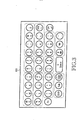
- FIG. 3 is a front view of a key interface apparatus according to an embodiment of the present invention showing the arrangement structure of keys which are recognized as an identical numeral value in a numeral input mode.
- the present embodiment adopts a QWERTY keyboard as a key interface.
- character and sign keys may be grouped into a block, which correspond to each numeral, and printed, so that numeral recognition values, which correspond to respective numerals, can be identified more easily.
- a function key Fn a delete key DEL for deleting entered characters or numerals, a confirmation key OK for entering a specific operation command or a dialing command using entered numbers, and the like, are used to perform existing functions, as mentioned above, separate from the keys associated with numeral recognition values.
- the key interface apparatus When any key belonging to the same block is pressed in a numeral input mode, e.g., in a speech mode, the key interface apparatus always recognizes the same numeral, which is associated with the block, as an input. For example, when any key of Q, W, E, and R is pressed, numeral "1" is recognized as an input, and when any key of J, K, and L is pressed, numeral "2" is recognized as an input.
- a plurality of adjacent keys are recognized as a single numeral, except for numeral keys which are not used in a conventional numeral input mode. This increases the input area for a specific numeral. Consequently, numerals can be easily entered even with keys arranged with a narrow spacing among them.
- FIG. 4 is a block diagram of a portable terminal according to a preferred embodiment of the present invention, which has a QWERTY keyboard for recognizing numerals by means of corresponding blocks having a plurality of keys.
- a portable terminal includes a QWERTY keyboard 100 configured as shown in FIG. 3, a control unit 110, a data processing unit 120, a communication unit 123, an audio processing unit 125, a speaker 126, a microphone 127, a display unit 130, and a storage unit 140.
- the control unit 110 takes the overall control of the portable terminal. If a signal regarding the selection of a key is inputted from the QWERTY keyboard 100, which is configured as an input interface of the portable terminal in the present embodiment, the control unit 110 performs preset operations in response to the inputted selection signal.
- the data processing unit 120 modulates or demodulates transmitted/ received data under the control of the control unit 110.
- the communication unit 123 converts data, which is received via an antenna, into a predetermined frequency band and outputs it to the data processing unit 120. The communication unit 123 also converts data, which is entered from the data processing unit 120, into a frequency band for radio transmission via the antenna.
- the audio processing unit 125 converts audio data, which is output from the data processing unit 120, into audible sound and outputs it via the speaker 126 under the control of the control unit 110.
- the audio processing unit 125 also converts audio signals, which are inputted from the microphone 127, into data and outputs it to the control unit 110.
- the display unit 130 displays various messages and information on the operation status of the portable terminal, under the control of the control unit 110. Particularly, the display unit 130 displays numerals, characters, and signs, which correspond to the respective numeral, character, and sign keys in the QWERTY keyboard 100, under the control of the control unit 110.
- the QWERTY keyboard 100 has a key arrangement structure as shown in FIG. 3, wherein a plurality of keys are recognized as a single numeral for easier selection of numerals.
- the storage unit 140 stores program data 142 necessary for controlling the operation of the portable terminal, as well as data 144 created when the control is performed or when a user uses the portable terminal.
- the storage unit 140 has a mapping table 150 so that at least one key of the QWERTY keyboard 100 is grouped into a block, and, when any key belonging to the same block is pressed in a numeral input mode (e.g., a speech mode), the same numeral or sign (*, #), which is associated with the block, is recognized as an input.
- a numeral input mode e.g., a speech mode
- any key belonging to the same block which corresponds to the desired numeral, causes that numeral to be displayed as the key is pressed. This makes it easier to select desired numerals.
- FIG. 5 shows in more detail a mapping table 150 belonging to the storage unit 140 of FIG. 4.
- the mapping table 150 includes preset block recognition values 180 and character keys 170 corresponding to them.
- the character keys 170 are grouped according to corresponding blocks.
- Q, W, E, and R keys are grouped into a block and, when any key of Q, W, E, and R are pressed, numeral "1" is determined as an input.
- the block recognition values and corresponding keys will be described later with reference to FIGs. 7 and 8.
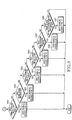
- FIG. 6 is a flow chart showing a preferred embodiment of a key recognition method of a portable terminal using a key interface apparatus for easier key input according to the present invention.
- a control unit 110 determines whether a command to switch the portable terminal to a telephone mode is entered from a QWERTY keyboard 100 at step S110. If it is determined that no command was entered, the control unit 110 performs operations which have been performed, or which is to be performed, according to a preset mode at step S 120.
- control unit 110 switches the operation mode of the portable terminal to a telephone mode and groups the keys of the QWERTY keyboard 110 into groups with reference to a mapping table 150, according to preset recognition values at step S 130.
- the control unit 110 determines, as keys are pressed, whether a key signal is inputted from the QWERTY keyboard 100 at step S140. If it is determined that no key signal is entered, the control unit 110 maintains the existing telephone mode and detects later input of a key signal from the QWERTY keyboard 100 at step S150.
- the control unit 110 determines whether the inputted key signal is a signal value corresponding to a key included in the mapping table 150 at step S160. If it is determined that the inputted key signal is not a signal value included and preset in the mapping table 150, the control unit 110 performs operations corresponding to the inputted key signal and detects later input of a key signal at step S 170. If it is determined that the inputted key signal is a signal value included and preset in the mapping table 150, the control unit 110 decides which preset block recognition value corresponds to the inputted key signal at step S200. The control unit 110 then displays the decided recognition value through a display unit 130 at step S420. After displaying the recognition value, the control unit 110 determines whether a command to end the telephone mode is entered at step S440.
- control unit 110 repeats the steps S 140 to S420. If it is determined that a command to end the telephone mode is entered, the control unit 110 undoes the blocking of keys and switches the operation mode of the portable terminal to a normal mode at step S460.
- FIGs. 7 and 8 are flow charts showing in more detail a step S200 of FIG 6 for deciding which preset recognition value corresponds to an inputted key signal.
- the control unit 110 determines whether the inputted key signal is from any one of Q, W, E, and R keys at step S210. If it is determined that the inputted signal is from any one of Q, W, E, and R keys, the control unit 110 decides that the inputted key signal is "1"at step S212. If it is determined that the inputted signal is not from at least one of Q, W, E, and R keys, the control unit 110 determines whether the inputted key signal is from any one of A, S, D, and F keys at step S220. If it is determined that the inputted signal is from any one of A, S, D, and F keys, the control unit 110 decides that the inputted key signal is "4" at step S222.
- the control unit 110 determines whether the inputted key signal is any one from Z, X, and C keys at step S230. If it is determined that the inputted key signal is from any one of Z, X, and C keys, the control unit 110 decides that the inputted key signal is "7"at step S232.
- the control unit 110 determines whether the inputted key signal is any one from shift, tab, and cap lock keys at step S240. If it is determined that the inputted key signal is from any one of shift, tab, and cap lock keys, the control unit 110 decides that the inputted key signal is "*" at step S242.
- the control unit 110 determines whether the inputted key signal is any one from T and Y keys at step S250. If it is determined that the inputted key signal is from any one of T and Y keys, the control unit 110 decides that the inputted key signal is "2" at step S252.
- the control unit 110 determines whether the inputted key signal is any one from G and H keys at step S260. If it is determined that the inputted key signal is from any one of G and H keys, the control unit 110 decides that the inputted key signal is "5" at step S262.
- the control unit 110 determines whether the inputted key signal is any one from V and B keys at step S310. If it is determined that the inputted key signal is from any one of V and B keys, the control unit 110 decides that the inputted key signal is "8" at step S312.
- the control unit 110 determines whether the inputted key signal is from space key at step S320. If it is determined that the inputted key signal is from space key, the control unit 110 decides that the inputted key signal is "0" at step S322.
- control unit 110 determines whether the inputted key signal is from any one of U, I, O, and P keys at step S330. If it is determined that the inputted key signal is from any one of U, I, O, and P keys, the control unit 110 decides that the inputted key signal is "3" at step S332.
- the control unit 110 determines whether the inputted key signal is from any one of J, K, and L keys at step S340. If it is determined that the inputted key signal is from any one of J, K, and L keys, the control unit 110 decides that the inputted key signal is "6" at step S342.
- the control unit 110 determines whether the inputted key signal is from any one of N and M at step S350. If it is determined that the inputted key signal is from any one of N and M keys, the control unit 110 decides that the inputted key signal is "9" at step S352.
- the control unit 110 determines whether the inputted key signal is from any one of telephone mode key, direction key, and dot (.) key at step S360. If it is determined that the inputted key signal is from any one of telephone mode key, direction key, and dot key, the control unit 110 decides that the inputted key signal is "#" at step S362.
- a plurality of adjacent keys are recognized as a single numeral, except for numeral keys which are not used in a conventional numeral input mode. This increases the input area for a specific numeral. Consequently, numerals can be entered easily even with keys arranged with a narrow spacing among them.
Landscapes
- Engineering & Computer Science (AREA)
- Theoretical Computer Science (AREA)
- General Engineering & Computer Science (AREA)
- Human Computer Interaction (AREA)
- Physics & Mathematics (AREA)
- General Physics & Mathematics (AREA)
- Computer Hardware Design (AREA)
- Signal Processing (AREA)
- Input From Keyboards Or The Like (AREA)
- Telephone Function (AREA)
Applications Claiming Priority (2)
| Application Number | Priority Date | Filing Date | Title |
|---|---|---|---|
| KR1020040046782A KR100617753B1 (ko) | 2004-06-22 | 2004-06-22 | 키 입력이 용이한 키 인터페이스 장치 및 이것이 적용된전자기기 |
| KR2004046782 | 2004-06-22 |
Publications (2)
| Publication Number | Publication Date |
|---|---|
| EP1610208A1 true EP1610208A1 (fr) | 2005-12-28 |
| EP1610208B1 EP1610208B1 (fr) | 2007-08-15 |
Family
ID=34937618
Family Applications (1)
| Application Number | Title | Priority Date | Filing Date |
|---|---|---|---|
| EP05013512A Expired - Lifetime EP1610208B1 (fr) | 2004-06-22 | 2005-06-22 | Appareil d'entrée à touches pour entrer des numéros plus facilement et un dispositif électronique correspondant |
Country Status (5)
| Country | Link |
|---|---|
| US (1) | US20050280560A1 (fr) |
| EP (1) | EP1610208B1 (fr) |
| KR (1) | KR100617753B1 (fr) |
| CN (1) | CN1713121A (fr) |
| DE (1) | DE602005001982T2 (fr) |
Cited By (2)
| Publication number | Priority date | Publication date | Assignee | Title |
|---|---|---|---|---|
| EP2175346A1 (fr) | 2008-10-09 | 2010-04-14 | Research in Motion Limited | Procédé de contrôle d'un dispositif électronique utilisant de grandes cibles de clavier et dispositif électronique utilisant les grandes cibles de clavier |
| US7941580B2 (en) * | 2006-09-27 | 2011-05-10 | Hewlett-Packard Development Company L.P. | Apparatus and methods for providing keypress commands and directional commands to a mobile computing device |
Families Citing this family (9)
| Publication number | Priority date | Publication date | Assignee | Title |
|---|---|---|---|---|
| US20060259758A1 (en) * | 2005-05-16 | 2006-11-16 | Arcsoft, Inc. | Instant mode switch for a portable electronic device |
| KR100757743B1 (ko) * | 2006-05-17 | 2007-09-11 | 삼성전자주식회사 | 휴대용 단말기에서 문자입력 장치 및 방법 |
| CN101241399B (zh) * | 2007-02-08 | 2010-12-01 | 佛山市顺德区顺达电脑厂有限公司 | 简易数字输入法及使用该方法之输入装置 |
| US20100090958A1 (en) * | 2008-10-09 | 2010-04-15 | Research In Motion Limited | Method for controlling an electronic device using large keyboard targets and an electronic device which uses large keyboard targets |
| US10203870B2 (en) * | 2015-04-07 | 2019-02-12 | Blackberry Limited | Authentication using a touch-sensitive keyboard with distinct pluralities of keys as respective regions |
| CN105610418B (zh) * | 2016-01-12 | 2019-01-08 | 京东方科技集团股份有限公司 | 一种选择电路及电子设备 |
| JP1707836S (fr) * | 2021-06-15 | 2022-02-18 | ||
| JP1707837S (fr) | 2021-06-15 | 2022-02-18 | ||
| JP1707838S (fr) | 2021-06-15 | 2022-02-18 |
Citations (1)
| Publication number | Priority date | Publication date | Assignee | Title |
|---|---|---|---|---|
| JPH10207596A (ja) * | 1997-01-27 | 1998-08-07 | Mitsuo Tarama | パラシャワー99 |
Family Cites Families (4)
| Publication number | Priority date | Publication date | Assignee | Title |
|---|---|---|---|---|
| US5938768A (en) * | 1997-07-30 | 1999-08-17 | Northern Telecom Limited | Feature to facilitate numeric passcode entry |
| CN1271490C (zh) * | 2001-09-25 | 2006-08-23 | 田中胜三 | 便携式电话机的文字输入装置 |
| US7083342B2 (en) * | 2001-12-21 | 2006-08-01 | Griffin Jason T | Keyboard arrangement |
| KR20050008818A (ko) * | 2002-06-12 | 2005-01-21 | 노키아 코포레이션 | 키패드를 포함하는 키보드를 가지는 이동 통신 장치 |
-
2004
- 2004-06-22 KR KR1020040046782A patent/KR100617753B1/ko not_active Expired - Fee Related
- 2004-12-08 US US11/007,025 patent/US20050280560A1/en not_active Abandoned
-
2005
- 2005-04-15 CN CNA2005100655432A patent/CN1713121A/zh active Pending
- 2005-06-22 EP EP05013512A patent/EP1610208B1/fr not_active Expired - Lifetime
- 2005-06-22 DE DE602005001982T patent/DE602005001982T2/de not_active Expired - Lifetime
Patent Citations (1)
| Publication number | Priority date | Publication date | Assignee | Title |
|---|---|---|---|---|
| JPH10207596A (ja) * | 1997-01-27 | 1998-08-07 | Mitsuo Tarama | パラシャワー99 |
Non-Patent Citations (2)
| Title |
|---|
| ANONYMOUS: "Get to know your Keyboard", INTERNET ARTICLE, XP002343571, Retrieved from the Internet <URL:http://www.btinternet.com/~bill.furnell/QWERTY.jpg> * |
| PATENT ABSTRACTS OF JAPAN vol. 1998, no. 13 30 November 1998 (1998-11-30) * |
Cited By (3)
| Publication number | Priority date | Publication date | Assignee | Title |
|---|---|---|---|---|
| US7941580B2 (en) * | 2006-09-27 | 2011-05-10 | Hewlett-Packard Development Company L.P. | Apparatus and methods for providing keypress commands and directional commands to a mobile computing device |
| EP2175346A1 (fr) | 2008-10-09 | 2010-04-14 | Research in Motion Limited | Procédé de contrôle d'un dispositif électronique utilisant de grandes cibles de clavier et dispositif électronique utilisant les grandes cibles de clavier |
| EP2515204A1 (fr) * | 2008-10-09 | 2012-10-24 | Research In Motion Limited | Procédé de contrôle d'un dispositif électronique utilisant de grandes cibles de clavier et dispositif électronique utilisant les grandes cibles de clavier |
Also Published As
| Publication number | Publication date |
|---|---|
| DE602005001982D1 (de) | 2007-09-27 |
| US20050280560A1 (en) | 2005-12-22 |
| KR100617753B1 (ko) | 2006-08-28 |
| KR20050121608A (ko) | 2005-12-27 |
| CN1713121A (zh) | 2005-12-28 |
| DE602005001982T2 (de) | 2007-12-06 |
| EP1610208B1 (fr) | 2007-08-15 |
Similar Documents
| Publication | Publication Date | Title |
|---|---|---|
| EP1954015B1 (fr) | Dispositif de communication mobile capable de fournir une liste de numéro de téléphone de candidat et procédé de contrôle de fonctionnement du dispositif de communication mobile | |
| US20060103623A1 (en) | Method and apparatus to enter text in a phone dialer entry field | |
| JP2009259262A (ja) | キーボード配置 | |
| JP2007517294A (ja) | キーボード配置 | |
| EP1610208B1 (fr) | Appareil d'entrée à touches pour entrer des numéros plus facilement et un dispositif électronique correspondant | |
| KR100672343B1 (ko) | 문자 입력 장치 및 이의 입력 방법 | |
| US9924015B2 (en) | Method of displaying call information in mobile communication terminal and mobile communication terminal adapted to display call information | |
| CN100422912C (zh) | 移动终端中键输入的方法和设备 | |
| EP1971114B1 (fr) | Terminal de communication mobile doté d'un clavier Qwerty et procédé pour la génération d'un signal multifréquence à double tonalité | |
| US20060012494A1 (en) | Method and apparatus for inputting an alphabet character in a terminal with a keypad | |
| EP1777609A1 (fr) | Clavier pour un dispositif electronique et procédé d'utilisation | |
| JP2007141249A (ja) | キーボード配置 | |
| KR101122386B1 (ko) | 단말기에서의 문자 입력 방법 및 장치 | |
| KR100545671B1 (ko) | 개선된 키패드를 구비한 휴대용 무선정보 단말장치 및 이휴대용 무선정보단말장치에서 정보를 입력처리하는 방법 | |
| KR100684509B1 (ko) | 이동통신 단말기에서 초성조합을 이용한 문자 입력 방법 | |
| CN101365007B (zh) | 通信终端 | |
| KR100430922B1 (ko) | 문자입력키패드 | |
| KR100663505B1 (ko) | 휴대전화단말장치의 한글입력방법과 그 입력장치 | |
| JP2008287318A (ja) | 情報通信端末 | |
| JPH11161406A (ja) | 文字入力装置 | |
| JP2002082760A (ja) | 携帯通信機器 | |
| KR100638404B1 (ko) | 이동 통신 단말기의 문자 입력 장치 및 방법 | |
| JP3737508B1 (ja) | 文字入力装置及び文字入力プログラム | |
| KR100834658B1 (ko) | 휴대단말기에서 폰북 데이터 전송을 위한 장치 및 방법 | |
| KR100810237B1 (ko) | 휴대 단말기에서 다중언어를 이용한 텍스트 입력 방법 |
Legal Events
| Date | Code | Title | Description |
|---|---|---|---|
| PUAI | Public reference made under article 153(3) epc to a published international application that has entered the european phase |
Free format text: ORIGINAL CODE: 0009012 |
|
| 17P | Request for examination filed |
Effective date: 20050622 |
|
| AK | Designated contracting states |
Kind code of ref document: A1 Designated state(s): AT BE BG CH CY CZ DE DK EE ES FI FR GB GR HU IE IS IT LI LT LU MC NL PL PT RO SE SI SK TR |
|
| AX | Request for extension of the european patent |
Extension state: AL BA HR LV MK YU |
|
| AKX | Designation fees paid |
Designated state(s): DE FR GB |
|
| GRAP | Despatch of communication of intention to grant a patent |
Free format text: ORIGINAL CODE: EPIDOSNIGR1 |
|
| GRAS | Grant fee paid |
Free format text: ORIGINAL CODE: EPIDOSNIGR3 |
|
| GRAA | (expected) grant |
Free format text: ORIGINAL CODE: 0009210 |
|
| AK | Designated contracting states |
Kind code of ref document: B1 Designated state(s): DE FR GB |
|
| REG | Reference to a national code |
Ref country code: GB Ref legal event code: FG4D |
|
| REF | Corresponds to: |
Ref document number: 602005001982 Country of ref document: DE Date of ref document: 20070927 Kind code of ref document: P |
|
| ET | Fr: translation filed | ||
| PLBE | No opposition filed within time limit |
Free format text: ORIGINAL CODE: 0009261 |
|
| STAA | Information on the status of an ep patent application or granted ep patent |
Free format text: STATUS: NO OPPOSITION FILED WITHIN TIME LIMIT |
|
| 26N | No opposition filed |
Effective date: 20080516 |
|
| PGFP | Annual fee paid to national office [announced via postgrant information from national office to epo] |
Ref country code: GB Payment date: 20140522 Year of fee payment: 10 |
|
| PGFP | Annual fee paid to national office [announced via postgrant information from national office to epo] |
Ref country code: DE Payment date: 20140523 Year of fee payment: 10 |
|
| PGFP | Annual fee paid to national office [announced via postgrant information from national office to epo] |
Ref country code: FR Payment date: 20140522 Year of fee payment: 10 |
|
| REG | Reference to a national code |
Ref country code: DE Ref legal event code: R119 Ref document number: 602005001982 Country of ref document: DE |
|
| GBPC | Gb: european patent ceased through non-payment of renewal fee |
Effective date: 20150622 |
|
| REG | Reference to a national code |
Ref country code: FR Ref legal event code: ST Effective date: 20160229 |
|
| PG25 | Lapsed in a contracting state [announced via postgrant information from national office to epo] |
Ref country code: DE Free format text: LAPSE BECAUSE OF NON-PAYMENT OF DUE FEES Effective date: 20160101 Ref country code: GB Free format text: LAPSE BECAUSE OF NON-PAYMENT OF DUE FEES Effective date: 20150622 |
|
| PG25 | Lapsed in a contracting state [announced via postgrant information from national office to epo] |
Ref country code: FR Free format text: LAPSE BECAUSE OF NON-PAYMENT OF DUE FEES Effective date: 20150630 |