EP1611087B1 - Verfahren zur rückgewinnung von reinem acetonitril - Google Patents
Verfahren zur rückgewinnung von reinem acetonitril Download PDFInfo
- Publication number
- EP1611087B1 EP1611087B1 EP03719083.2A EP03719083A EP1611087B1 EP 1611087 B1 EP1611087 B1 EP 1611087B1 EP 03719083 A EP03719083 A EP 03719083A EP 1611087 B1 EP1611087 B1 EP 1611087B1
- Authority
- EP
- European Patent Office
- Prior art keywords
- acrylonitrile
- contaminated
- fresh
- moisture content
- atfe
- Prior art date
- Legal status (The legal status is an assumption and is not a legal conclusion. Google has not performed a legal analysis and makes no representation as to the accuracy of the status listed.)
- Expired - Lifetime
Links
- NLHHRLWOUZZQLW-UHFFFAOYSA-N Acrylonitrile Chemical compound C=CC#N NLHHRLWOUZZQLW-UHFFFAOYSA-N 0.000 title claims description 137
- 238000000034 method Methods 0.000 title claims description 59
- 238000011084 recovery Methods 0.000 title claims description 16
- 150000008360 acrylonitriles Chemical class 0.000 claims description 31
- 239000003795 chemical substances by application Substances 0.000 claims description 23
- DNIAPMSPPWPWGF-UHFFFAOYSA-N monopropylene glycol Natural products CC(O)CO DNIAPMSPPWPWGF-UHFFFAOYSA-N 0.000 claims description 20
- 239000010409 thin film Substances 0.000 claims description 16
- 239000000203 mixture Substances 0.000 claims description 14
- 229960004063 propylene glycol Drugs 0.000 claims description 11
- 230000008016 vaporization Effects 0.000 claims description 11
- PEDCQBHIVMGVHV-UHFFFAOYSA-N Glycerine Chemical compound OCC(O)CO PEDCQBHIVMGVHV-UHFFFAOYSA-N 0.000 claims description 6
- DNIAPMSPPWPWGF-GSVOUGTGSA-N (R)-(-)-Propylene glycol Chemical compound C[C@@H](O)CO DNIAPMSPPWPWGF-GSVOUGTGSA-N 0.000 claims description 2
- LYCAIKOWRPUZTN-UHFFFAOYSA-N Ethylene glycol Chemical compound OCCO LYCAIKOWRPUZTN-UHFFFAOYSA-N 0.000 claims description 2
- MTHSVFCYNBDYFN-UHFFFAOYSA-N diethylene glycol Chemical compound OCCOCCO MTHSVFCYNBDYFN-UHFFFAOYSA-N 0.000 claims description 2
- 150000002009 diols Chemical group 0.000 claims description 2
- 235000013772 propylene glycol Nutrition 0.000 claims description 2
- 238000004821 distillation Methods 0.000 description 30
- 239000000047 product Substances 0.000 description 30
- 229920000536 2-Acrylamido-2-methylpropane sulfonic acid Polymers 0.000 description 27
- XHZPRMZZQOIPDS-UHFFFAOYSA-N 2-Methyl-2-[(1-oxo-2-propenyl)amino]-1-propanesulfonic acid Chemical compound OS(=O)(=O)CC(C)(C)NC(=O)C=C XHZPRMZZQOIPDS-UHFFFAOYSA-N 0.000 description 27
- 239000000356 contaminant Substances 0.000 description 25
- XLYOFNOQVPJJNP-UHFFFAOYSA-N water Chemical compound O XLYOFNOQVPJJNP-UHFFFAOYSA-N 0.000 description 25
- 229910001868 water Inorganic materials 0.000 description 24
- 238000000746 purification Methods 0.000 description 20
- 238000004519 manufacturing process Methods 0.000 description 17
- QAOWNCQODCNURD-UHFFFAOYSA-N Sulfuric acid Chemical compound OS(O)(=O)=O QAOWNCQODCNURD-UHFFFAOYSA-N 0.000 description 16
- WEVYAHXRMPXWCK-UHFFFAOYSA-N Acetonitrile Chemical compound CC#N WEVYAHXRMPXWCK-UHFFFAOYSA-N 0.000 description 15
- QGZKDVFQNNGYKY-UHFFFAOYSA-N Ammonia Chemical compound N QGZKDVFQNNGYKY-UHFFFAOYSA-N 0.000 description 15
- 239000000463 material Substances 0.000 description 14
- 239000002253 acid Substances 0.000 description 13
- 238000000895 extractive distillation Methods 0.000 description 12
- HGINCPLSRVDWNT-UHFFFAOYSA-N Acrolein Chemical compound C=CC=O HGINCPLSRVDWNT-UHFFFAOYSA-N 0.000 description 10
- VQTUBCCKSQIDNK-UHFFFAOYSA-N Isobutene Chemical group CC(C)=C VQTUBCCKSQIDNK-UHFFFAOYSA-N 0.000 description 10
- 239000011521 glass Substances 0.000 description 10
- 238000006116 polymerization reaction Methods 0.000 description 9
- CSCPPACGZOOCGX-UHFFFAOYSA-N Acetone Chemical compound CC(C)=O CSCPPACGZOOCGX-UHFFFAOYSA-N 0.000 description 8
- 150000007513 acids Chemical class 0.000 description 8
- 239000006227 byproduct Substances 0.000 description 8
- 150000002825 nitriles Chemical class 0.000 description 8
- 229910021529 ammonia Inorganic materials 0.000 description 7
- 238000006243 chemical reaction Methods 0.000 description 7
- 235000008733 Citrus aurantifolia Nutrition 0.000 description 6
- 235000011941 Tilia x europaea Nutrition 0.000 description 6
- LELOWRISYMNNSU-UHFFFAOYSA-N hydrogen cyanide Chemical compound N#C LELOWRISYMNNSU-UHFFFAOYSA-N 0.000 description 6
- 239000004571 lime Substances 0.000 description 6
- 150000003839 salts Chemical class 0.000 description 6
- 150000003926 acrylamides Chemical class 0.000 description 5
- 230000001186 cumulative effect Effects 0.000 description 5
- 238000005259 measurement Methods 0.000 description 5
- QQONPFPTGQHPMA-UHFFFAOYSA-N propylene Natural products CC=C QQONPFPTGQHPMA-UHFFFAOYSA-N 0.000 description 5
- 125000004805 propylene group Chemical group [H]C([H])([H])C([H])([*:1])C([H])([H])[*:2] 0.000 description 5
- 239000002699 waste material Substances 0.000 description 5
- 238000004458 analytical method Methods 0.000 description 4
- 230000015572 biosynthetic process Effects 0.000 description 4
- 239000012267 brine Substances 0.000 description 4
- 230000003197 catalytic effect Effects 0.000 description 4
- 239000005457 ice water Substances 0.000 description 4
- 239000012535 impurity Substances 0.000 description 4
- HPALAKNZSZLMCH-UHFFFAOYSA-M sodium;chloride;hydrate Chemical compound O.[Na+].[Cl-] HPALAKNZSZLMCH-UHFFFAOYSA-M 0.000 description 4
- 239000012808 vapor phase Substances 0.000 description 4
- 238000005303 weighing Methods 0.000 description 4
- 238000003109 Karl Fischer titration Methods 0.000 description 3
- GYCMBHHDWRMZGG-UHFFFAOYSA-N Methylacrylonitrile Chemical compound CC(=C)C#N GYCMBHHDWRMZGG-UHFFFAOYSA-N 0.000 description 3
- HEMHJVSKTPXQMS-UHFFFAOYSA-M Sodium hydroxide Chemical compound [OH-].[Na+] HEMHJVSKTPXQMS-UHFFFAOYSA-M 0.000 description 3
- 238000010438 heat treatment Methods 0.000 description 3
- 238000006386 neutralization reaction Methods 0.000 description 3
- FVSKHRXBFJPNKK-UHFFFAOYSA-N propionitrile Chemical compound CCC#N FVSKHRXBFJPNKK-UHFFFAOYSA-N 0.000 description 3
- 239000000376 reactant Substances 0.000 description 3
- 238000001179 sorption measurement Methods 0.000 description 3
- 238000003860 storage Methods 0.000 description 3
- 238000009834 vaporization Methods 0.000 description 3
- MYMOFIZGZYHOMD-UHFFFAOYSA-N Dioxygen Chemical compound O=O MYMOFIZGZYHOMD-UHFFFAOYSA-N 0.000 description 2
- STNJBCKSHOAVAJ-UHFFFAOYSA-N Methacrolein Chemical compound CC(=C)C=O STNJBCKSHOAVAJ-UHFFFAOYSA-N 0.000 description 2
- IKHGUXGNUITLKF-XPULMUKRSA-N acetaldehyde Chemical compound [14CH]([14CH3])=O IKHGUXGNUITLKF-XPULMUKRSA-N 0.000 description 2
- 230000002378 acidificating effect Effects 0.000 description 2
- 150000001336 alkenes Chemical class 0.000 description 2
- 239000007864 aqueous solution Substances 0.000 description 2
- KVNRLNFWIYMESJ-UHFFFAOYSA-N butyronitrile Chemical compound CCCC#N KVNRLNFWIYMESJ-UHFFFAOYSA-N 0.000 description 2
- 239000003054 catalyst Substances 0.000 description 2
- 239000007795 chemical reaction product Substances 0.000 description 2
- 150000001875 compounds Chemical class 0.000 description 2
- 238000009833 condensation Methods 0.000 description 2
- 230000005494 condensation Effects 0.000 description 2
- 229910001882 dioxygen Inorganic materials 0.000 description 2
- 230000007613 environmental effect Effects 0.000 description 2
- 239000000543 intermediate Substances 0.000 description 2
- 239000002808 molecular sieve Substances 0.000 description 2
- 239000000178 monomer Substances 0.000 description 2
- 230000007935 neutral effect Effects 0.000 description 2
- JRZJOMJEPLMPRA-UHFFFAOYSA-N olefin Natural products CCCCCCCC=C JRZJOMJEPLMPRA-UHFFFAOYSA-N 0.000 description 2
- 150000002894 organic compounds Chemical class 0.000 description 2
- 238000000926 separation method Methods 0.000 description 2
- URGAHOPLAPQHLN-UHFFFAOYSA-N sodium aluminosilicate Chemical compound [Na+].[Al+3].[O-][Si]([O-])=O.[O-][Si]([O-])=O URGAHOPLAPQHLN-UHFFFAOYSA-N 0.000 description 2
- 239000000126 substance Substances 0.000 description 2
- 238000003786 synthesis reaction Methods 0.000 description 2
- 229920003176 water-insoluble polymer Polymers 0.000 description 2
- QIVUCLWGARAQIO-OLIXTKCUSA-N (3s)-n-[(3s,5s,6r)-6-methyl-2-oxo-1-(2,2,2-trifluoroethyl)-5-(2,3,6-trifluorophenyl)piperidin-3-yl]-2-oxospiro[1h-pyrrolo[2,3-b]pyridine-3,6'-5,7-dihydrocyclopenta[b]pyridine]-3'-carboxamide Chemical compound C1([C@H]2[C@H](N(C(=O)[C@@H](NC(=O)C=3C=C4C[C@]5(CC4=NC=3)C3=CC=CN=C3NC5=O)C2)CC(F)(F)F)C)=C(F)C=CC(F)=C1F QIVUCLWGARAQIO-OLIXTKCUSA-N 0.000 description 1
- CBRJPFGIXUFMTM-WDEREUQCSA-N 1-[(2S,5R)-2-methyl-5-(7H-pyrrolo[2,3-d]pyrimidin-4-ylamino)piperidin-1-yl]prop-2-en-1-one Chemical compound N1=CN=C(C2=C1NC=C2)N[C@@H]2CC[C@@H](N(C2)C(C=C)=O)C CBRJPFGIXUFMTM-WDEREUQCSA-N 0.000 description 1
- OFUMROLKEGKJMS-UHFFFAOYSA-N 2-[2-(1,3-benzodioxol-5-yl)-3-[2-(cyclohexylamino)pyrimidin-4-yl]imidazol-4-yl]acetonitrile Chemical compound O1COC2=C1C=CC(=C2)C=1N(C(=CN=1)CC#N)C1=NC(=NC=C1)NC1CCCCC1 OFUMROLKEGKJMS-UHFFFAOYSA-N 0.000 description 1
- ZAWQXWZJKKICSZ-UHFFFAOYSA-N 3,3-dimethyl-2-methylidenebutanamide Chemical compound CC(C)(C)C(=C)C(N)=O ZAWQXWZJKKICSZ-UHFFFAOYSA-N 0.000 description 1
- SJVGFKBLUYAEOK-SFHVURJKSA-N 6-[4-[(3S)-3-(3,5-difluorophenyl)-3,4-dihydropyrazole-2-carbonyl]piperidin-1-yl]pyrimidine-4-carbonitrile Chemical compound FC=1C=C(C=C(C=1)F)[C@@H]1CC=NN1C(=O)C1CCN(CC1)C1=CC(=NC=N1)C#N SJVGFKBLUYAEOK-SFHVURJKSA-N 0.000 description 1
- HRPVXLWXLXDGHG-UHFFFAOYSA-N Acrylamide Chemical compound NC(=O)C=C HRPVXLWXLXDGHG-UHFFFAOYSA-N 0.000 description 1
- 238000010521 absorption reaction Methods 0.000 description 1
- QVGXLLKOCUKJST-UHFFFAOYSA-N atomic oxygen Chemical compound [O] QVGXLLKOCUKJST-UHFFFAOYSA-N 0.000 description 1
- 238000009835 boiling Methods 0.000 description 1
- AXCZMVOFGPJBDE-UHFFFAOYSA-L calcium dihydroxide Chemical compound [OH-].[OH-].[Ca+2] AXCZMVOFGPJBDE-UHFFFAOYSA-L 0.000 description 1
- 239000000920 calcium hydroxide Substances 0.000 description 1
- 229910001861 calcium hydroxide Inorganic materials 0.000 description 1
- BRPQOXSCLDDYGP-UHFFFAOYSA-N calcium oxide Chemical compound [O-2].[Ca+2] BRPQOXSCLDDYGP-UHFFFAOYSA-N 0.000 description 1
- 239000000292 calcium oxide Substances 0.000 description 1
- ODINCKMPIJJUCX-UHFFFAOYSA-N calcium oxide Inorganic materials [Ca]=O ODINCKMPIJJUCX-UHFFFAOYSA-N 0.000 description 1
- 159000000007 calcium salts Chemical class 0.000 description 1
- 238000006555 catalytic reaction Methods 0.000 description 1
- 238000010961 commercial manufacture process Methods 0.000 description 1
- 238000011109 contamination Methods 0.000 description 1
- 238000010908 decantation Methods 0.000 description 1
- 239000008367 deionised water Substances 0.000 description 1
- 229910021641 deionized water Inorganic materials 0.000 description 1
- 238000009826 distribution Methods 0.000 description 1
- -1 e.g. Chemical class 0.000 description 1
- 238000001704 evaporation Methods 0.000 description 1
- 230000008020 evaporation Effects 0.000 description 1
- 238000001914 filtration Methods 0.000 description 1
- 231100001261 hazardous Toxicity 0.000 description 1
- 239000004615 ingredient Substances 0.000 description 1
- 230000008018 melting Effects 0.000 description 1
- 238000002844 melting Methods 0.000 description 1
- 229910000069 nitrogen hydride Inorganic materials 0.000 description 1
- 230000003647 oxidation Effects 0.000 description 1
- 238000007254 oxidation reaction Methods 0.000 description 1
- 239000001301 oxygen Substances 0.000 description 1
- 229910052760 oxygen Inorganic materials 0.000 description 1
- 238000011020 pilot scale process Methods 0.000 description 1
- 239000004033 plastic Substances 0.000 description 1
- 229920003023 plastic Polymers 0.000 description 1
- 239000002244 precipitate Substances 0.000 description 1
- 238000002360 preparation method Methods 0.000 description 1
- 239000012264 purified product Substances 0.000 description 1
- 238000010992 reflux Methods 0.000 description 1
- 230000008929 regeneration Effects 0.000 description 1
- 238000011069 regeneration method Methods 0.000 description 1
- 239000002002 slurry Substances 0.000 description 1
- 239000002689 soil Substances 0.000 description 1
- 239000007787 solid Substances 0.000 description 1
- 229920003051 synthetic elastomer Polymers 0.000 description 1
- 239000012209 synthetic fiber Substances 0.000 description 1
- 229920002994 synthetic fiber Polymers 0.000 description 1
- 239000005061 synthetic rubber Substances 0.000 description 1
Images


Definitions
- the present invention relates to a process for the recovery of highly pure acrylonitrile. More particularly the present invention relates to a process for the recovery of highly pure acrylonitrile from contaminated acrylonitrile as well as fresh acrylonitrile having 0.5-1% moisture content by quickly vaporization under vacuum followed by contacting with hydrophilic agents in an extractive distillation column using plural number of packed sections.
- acrylonitrile There are many procedures for the production of acrylonitrile. This compound is one of the most important organic chemical intermediates available. It is a major intermediate in the manufacture of a wide range of products, plastics, synthetic rubber, synthetic fibers, soil conditioners and the like. For many uses, acrylonitrile must be of high purity and, for this reason, strict specifications must be met in the commercial manufacture of acrylonitrile. Each of the commercial procedures used for the preparation of acrylonitrile produces its own set of impurities and by-products and each presents its own problems of purification. (See U.S. Patent 3,459,639 .)
- one very good and commercially practiced method of producing olefinically unsaturated nitriles is the catalytic reaction of ammonia and an olefin.
- acrylonitrile and methacrylonitrile may be produced by the vapor phase catalytic oxidation of propylene and isobutylene respectively, in the presence of ammonia.
- significant amounts of impurities are produced.
- the production of acrylonitrile from ammonia and propylene results in the formation of significant quantities of acetonitrile., propionitrile, acetone and the like. It is necessary to remove these by-product impurities to produce an unsaturated nitrile suitable for polymerization to other products.
- U.S. Patent 3,459,639 to Borrel et al discloses a process for the purification of a complex mixture of acrylonitrile, acetonitrile and other materials formed in the vapor phase conversion of acrolein or propylene to acrylonitrile over a catalyst in the presence of ammonia and oxygen. Separation of acrylonitrile from acetonitrile is accomplished by extractive distillation using deionized water at a pH of at least 5 and preferably 5-7 with the introduction of an alkaline-agent to the distillation mixture.
- U.S. Patent 4,377,444 to Wu relates to the recovery and purification of olefinic nitriles and more particularly pertains to an improved process for the recovery and purification of olefinic nitriles, such as methacrylonitrile and acrylonitrile, produced by the ammoxidation of isobutylene and propylene from mixtures of said olefinic nitriles with such materials as acetonitrile, hydrogen cyanide, propionitrile, butyronitrile, methacrolein, acrolein, acetone, acetaldehyde, etc.
- olefinic nitriles such as methacrylonitrile and acrylonitrile
- the products of the ammoxidation reaction are recovered in a first step by absorption in water during which step some heavy or high-boiling organic compounds are formed through polymerization, condensation, etc., of some of the lighter organic products. Accordingly, the Wu process is an improved method for separating the olefinic nitriles from the by-products formed in the ammoxidation reaction as well as from the heavy organic compounds.
- the tower is comprised of a lower opening, a plurality of distillation trays and an upper opening, with the tower being maintained under vacuum.
- a majority of the heated material entering the distillation tower falls to the bottom of the tower whereas a small amount of purified acrylonitrile rises to the top of the tower and is evacuated therefrom via a pressure differential.
- the heated material falling to the bottom of the distillation tower is divided into two portions with the major portion being returned to the heat exchanger and a minor portion is transferred to a thin film evaporator which is maintained under vacuum at a temperature above the melting point and below about 78°C and preferably in the range of about 49°C to about 63°C.
- contaminated wastes containing relatively high amounts of residual acids fall to the bottom of the evaporator and a partially purified acrylonitrile product is removed from the top of the evaporator and transferred to the distillation tower.
- a highly purified acrylonitrile product is removed from the top opening of the distillation tower. Contaminants within the distillation tower continue to fall to the bottom of the tower and are removed.
- the purified acrylonitrile product removed from the upper portions of the distillation tower contains negligible amounts of contaminants such as residual acids and acrylamides.
- 2-acrylamido-2-methyl propane sulfonic acid In order to synthesize 2-acrylamido-2-methyl propane sulfonic acid, excess amounts of acrylonitrile are combined with sulfuric acid and isobutene. The resulting reaction product includes 2-acrylamido-2-methyl propane sulfonic acid along with substantial amounts of unreacted acrylonitrile and other by-products. The 2-acrylamido-2-methyl propane sulfonic acid can be separated away leaving the acrylonitrile present along with various residual acids, acrylamides, and other by-product contaminants. The contaminants are present in an amount of about 1-2 percent by weight based on the weight of the composition.
- the acid contaminants include sulfuric acid, isobutylene monosulfonic acid, isobutylene disulfonic acid and small amounts of 2-acrylamido-2-methyl propane sulfonic acid, t-butyl acrylamide and acrylamide.
- the resulting product i.e., the 2-acrylamido-2-methyl propane sulfonic acid
- the resulting product will have various undesirable characteristics.
- the resulting product will contain undesirable polymerized material formed by the polymerization of acrylonitrile monomers with contaminant monomers. Accordingly, it is desirable to purify the acrylonitrile before it is reused, and the present invention is directed to such a purification process and the product resulting therefrom.
- this purified acrylonitrile itself has the desired average molecular weight and excellent storage stability.
- the purified acrylonitrile can be utilized in the production of other materials such as being recycled for use in the production of 2-acrylamido-2-methyl propane sulfonic acid, which will also have a high degree of purity. This high degree of purity is particularly important to obtain when eliminating contaminants, which are particularly reactive with the acrylonitrile. Such reactive contaminants react with the acrylonitrile to form water insoluble polymers which cloud up aqueous solutions prepared by including 2-acrylamido2-methyl propane sulfonic acid with water.
- the main object of the present invention is to provide a process for recovery of highly pure acrylonitrile by quickly vaporizing the contaminated acrylonitrile as well as fresh acrylonitrile having 0.5-1% moisture content followed by contacting with hydrophilic agents in an extractive distillation column using plural number of packed sections
- Another object of the present invention is to avoid the neutralization of contaminated acrylonitrile by bases.
- Still another object of the present invention is to avoid any additional contamination of water during the recovery process.
- Yet another object of the present invention is to minimize the residence time for the preheating and vaporization of contaminated acrylonitrile so that the same can be carried out at higher temperature than 78°C with minimum loss due to polymerization.
- a further another object of the present invention is to provide a method of extractive distillation to reduce the moisture content of acrylonitrile to as low as possible.
- the present invention provides a process for the recovery of highly pure acrylonitrile from contaminated acrylonitrile or fresh acrylonitrile having 0.5-1% moisture content or a mixture thereof, which comprises vaporizing the contaminated acrylonitrile or or fresh acrylonitrile having 0.5-1% moisture content or a mixture thereof in a conventional agitated thin film evaporator (ATFE) running at a speed of 600-1200 rpm, at a temperature of 100-150°C under reduced pressure of 8-33.3 kPa (60-250 mmHg) abs, contacting the vapour feed so obtained consisting of fresh acrylonitrile or a mixture of contaminated acrylonitrile and fresh acrylonitrile, with a hydrophilic agent having a diol group, and then condensing the distillate so obtained to obtain the desired pure acrylonitrile.
- ATFE agitated thin film evaporator
- the speed of agitated thin film evaporator (ATFE) used is preferably in the range of 700-1000 rpm.
- the temperature used for vaporising is in the range of 120-140°C.
- the reduced pressure used is preferably in the range of 13.3-26.7 kPa (100-200 mmHg) abs.
- the hydrophilic agent used is selected from the group consisting of 1,2-propane diol, mono ethylene glycol, di-ethylene glycol and glycerol.
- the most important feature of the present invention is to provide a process for recovery of highly pure acrylonitrile by quickly vaporizing the contaminated acrylonitrile as well as fresh acrylonitrile followed by contacting with hydrophilic agents in an extractive distillation column using plural number of packed sections
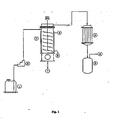
- Figure 1 represents the schematic of a pilot plant set-up for the process of recovery of highly pure acrylonitrile by quickly vaporizing under vacuum the contaminated acrylonitrile followed by condensation.
- Figure 2 represents the schematic of the experimental set-up for the process of recovery of highly pure acrylonitrile by quickly vaporizing the commercial grade fresh acrylonitrile having 0.5-1% moisture content under vacuum followed by contacting with hydrophilic agents in an extractive distillation column using plural number of packed sections showing an embodiment of the present invention.
- Figure 3 represents a schematic view of the conceptual combined purification and recovery system, which can be used, on an industrial scale for the process of recovery of highly pure acrylonitrile by quickly vaporizing under vacuum the combined mixture of contaminated acrylonitrile and commercial grade fresh acrylonitrile having 0.5-1% moisture content and followed by contacting with hydrophilic agents in an extractive distillation column using plural number of packed sections showing another embodiment of the present invention.
- the chemical product 2-acrylamido-2-methyl propane sulfonic acid is used throughout industry for a variety of different purposes.
- the 2-acrylamido-2-methyl propane sulfonic acid product, as well as other products, can be produced by reacting an excess amount of acrylonitrile with sulfuric acid and isobutylene. Due to economic and environmental factors, it is desirable to reuse the unreacted acrylonitrile in order to produce more 2-acrylamido-2-methyl propane sulfonic acid. However, the unreacted acrylonitrile is present with other contaminants, such as acrylamides and residual acids and as such has poor storage stability and can not be reused in the production of 2-acrylamido-2-methyl propane sulfonic acid of high quality.
- the acrylonitrile is not purified to the necessary degree, it will react with contaminants present and form water insoluble compounds.
- the present inventors have discovered an improved means for the purification of the unreacted contaminated acrylonitrile waste stream generated from the production of 2-acrylamido-2-methyl propane sulfonic acid.
- the desired 2-acrylamido-2-methyl propane sulfonic acid product formed can be removed leaving behind acrylonitrile present with 1-2 percent by weight of contaminants (such as sulfuric acid, isobutylene monosulfonic acid, isobutylene disulfonic acid, acrylamides and small amounts of 2-acrylamido-2-methyl propane sulfonic acid) which were not successfully removed.
- This acrylonitrile is the contaminated waste stream acrylonitrile referred to above.
- the present inventors have found that in order to achieve the objectives as stated above, it is desirable to quickly vaporise the contaminated or fresh acrylonitrile on a hot surface using an equipment like agitated thin film evaporator or a hot bath of inert material followed by extractive distillation in contact with hydrophilic agents.
- the contaminated acrylonitrile from (1) is fed to an agitated thin film evaporator [ATFE] (3) by pump (2).
- the ATFE is maintained at 100°C to 150°C, preferably in the range of 120°C to 140°C by suitable heating medium in its jacket.
- the agitator of the ATFE is preferably of close clearance type so that the feed is subjected to the hot surface of ATFE in form of a thin film.
- the speed of agitator is controlled at 600 to 1200 RPM, preferably in the range of 700 to 1000 RPM.
- the total assembly is maintained under reduced pressure at 8 kPa (60 mmHg) abs to 33.3 kPa (250 mm Hg) abs, preferably within 13.3-26.7 kPa (100 to 200 mm Hg) abs.
- High agitator speed and hot surface of ATFE enable the acrylonitrile product to get quickly evaporated from the contaminated feed within a very short residence time living behind a residue of various contaminants.
- the product vapor is immediately evacuated into a condenser (4) where it is condensed at low temperature by chilled water, and collected in the receiver (5). Alternatively this vapor can be fed to an extractive distillation column for contacting with hydrophilic agents so as to reduce the moisture content to a desirable extent.
- the residue of acidic contaminants which contains only traces of acrylonitrile, is continuously withdrawn from the bottom of ATFE and can be safely disposed by conventional treatment methods.
- the purified acrylonitrile product removed from the upper portions of the distillation tower contains negligible amounts of contaminants such as residual acids and acrylamides and its moisture content is also substantially reduced.
- the fresh acrylonitrile of commercial grade contains about 0.5% [by wt] of moisture in dissolved state. If this acrylonitrile is directly used as an excess reactant in the manufacture of materials such as 2-acrylamido-2-methyl propane sulfonic acid, it has been found that yield and selectivity drastically reduces. Therefore it is necessary to reduce the moisture content below 0.25 [by wt].
- the inventors of this invention have developed an extractive distillation process for reducing the moisture content of acrylonitrile.
- the flask (6) is connected to first packed section (8) of a distillation column of 25 mm diameter and 1100 mm height, packed with 10 mm glass bids.
- the top of this section is connected to a receiver (9) where the hydrophilic agent having moisture content less than 4000 ppm, preferably about 0 to 3000 ppm is sucked under vacuum via a dip tube from container (1).
- Container (1) is kept on a weighing scale (2) for cumulative weight measurement.
- the feed rate of hydrophilic agent is controlled with respect to that of fresh acrylonitrile in a ratio of about 0.5 to 2, preferably about 0.9 to 1,5.
- Receiver (9) is further connected to second packed sections 10 of the distillation column of 25 mm diameter and 500 mm height, packed with 10 mm glass bids.
- the distillation column is provided with a condenser (14) via a vapor space (12).
- the condenser is conventionally provided with a circulation of chilled brine of suitable lower temperature.
- the distillate is collected in the receiver (11).
- Whole set up is maintained under reduced pressure at about 13.3 to 33.3 kPa (100 to 250 minHg) abs, preferably about 20 to 24 kPa (150 to 180 mmHg) abs via the trap (13) and vacuum pump (5).
- the purified acrylonitrile product removed from the upper portions of the distillation tower contains negligible amount of moisture.
- acrylonitrile of very low water content and high purity which is almost free from all the acidic contaminants generated during the synthesis of materials like 2-acrylamido-2-methyl propane sulfonic acid can be obtained. It is also found that the loss of acrylonitrile product due to polymerization is minimized by the method of present invention. Similarly the methods of this invention obviates the pretreatment of contaminated acrylonitrile by bases and thus the difficulties thereof and generates a residue which can be safely neutralized and disposed.
- the novelty of the present invention lies in the purification of waste stream type contaminated acrylonitrile by avoiding polymerization of the acrylonitrile during purification and also purifying the contaminated acrylonitrile as well as fresh acrylonitrile having high moisture content by using hydrophilic agents, which make this process of purification economical and efficient
- the agitated thin film evaporator [ATFE] (3) as indicated in Figure 1 was provided with a zero clearance agitator.
- the agitator speed was 800 RPM.
- the heat transfer area was 0.12 square meter.
- the jacket was provided with hot oil circulation.
- the distillate condenser was provided with ice water circulation.
- the contaminated acrylonitrile from (1) was fed to (3) by pump (2) at a rate of 10.5 kg/h.
- ATFE was maintained at 140°C. Total assembly was maintained under reduced pressure at 26.7 kPa (200 mm Hg) abs,
- the product vapor was immediately evacuated into condenser (4) where it was condensed at low temperature by ice-chilled water, and collected in receiver (5). Operation was carried out at steady state for 1 hour.
- the agitated thin film evaporator [ATFE] (3) as indicated in Figure 1 was provided with a zero clearance agitator.
- the agitator speed was 800 RPM.
- the heat transfer area was 0.12 square meter.
- the jacket was provided with hot oil circulation.
- the distillate condenser was provided with ice water circulation.
- the contaminated acrylonitrile from (1) was fed to (3) by pump (2) at a rate of 10.5kglh.
- the ATFE was maintained at 140°C.
- the total assembly was maintained under reduced pressure at 22.7 kPa (170 mm Hg) abs,
- the product vapor was immediately evacuated into condenser (4) where it was condensed at low temperature by ice-chilled water, and collected in the receiver (5).
- the operation was carried out at steady state for I hour.
- the agitated thin film evaporator [ATFE] (3) as indicated in Figure 1 was provided with a zero clearance agitator.
- the agitator speed was 800 RPM.
- the heat transfer area was 0.12 square meter.
- the jacket was provided with hot oil circulation.
- the distillate condenser was provided with ice water circulation.
- the contaminated acrylonitrile from (1) was fed to (3) by pump (2) at a rate of 10.5 kg/h.
- the ATFE was maintained at 146°C.
- the total assembly was maintained under reduced pressure at 26.7 kPa (200 mm Hg) abs,
- the product vapor was immediately evacuated into condenser (4) where it was condensed at low temperature by ice-chilled water, and collected in the receiver (5).
- the operation was carried out at steady state for 1 hour.
- the temperature of the vapor exiting from (3) was 45°C.
- the residue temperature was 96°C.
- the residue on analysis showed 7300 ppm of Acrylonitrile content and 5.98% water by weight.
- the moisture content in distillate was found to be 2800 ppm, while the acidity as sulfuric acid was 0,11% by weight.
- Agitated thin film evaporator [ATFE] (3) as indicated in Figure 1 was provided with a zero clearance agitator. Agitator speed was 800 RPM. Heat transfer area was 0.12 square meter. Jacket was provided with hot oil circulation. The distillate condenser was provided with ice water circulation. The contaminated acrylonitrile from (1) was fed to (3) by pump (2) at a rate of 10.5 kg/h. The ATFE was maintained at 120 °C. The total assembly was maintained under reduced pressure at 13.3 kPa (100 mm Hg) abs, The product vapor was immediately evacuated into condenser (4) where it was condensed at low temperature by ice-chilled water, and collected in the receiver (5). The operation was carried out at steady state for 1 hour.
- the temperature of the vapor exiting from (3) was 42°C.
- the residue temperature was 92 °C.
- the residue on analysis showed 6976 ppm of Acrylonitrile content
- the moisture content in distillate was found to be 3000 ppm while the acidity as sulfuric acid, was 0.09% by weight.
- Fresh acrylonitrile of commercial grade containing 1.0042% [by wt] of moisture in dissolved state was continuously fed from container (3) into the 2 liter capacity three neck round bottom flask (7) which was immersed in a water bath (6) and heated by a heater (4).
- the round bottom flask (6) was filled with 600 g 1,2-propylene glycol having a moisture content of 2937 ppm [by wt.] and was maintained at 70°C before the feed of acrylonitrile was made on.
- the feed rate of acrylonitrile was maintained at 5 g/min.
- the flask (6) was connected to first packed section (8) of the distillation column of 25 mm diameter and 1100 mm height, packed with 10 mm glass bids.
- the top of this section was connected to a receiver (9) where 1,2-propylene glycol having a moisture content of 2937 ppm was is sucked under vacuum via a dip tube from container (1).
- Container (1) was kept on a weighing scale (2) for cumulative weight measurement.
- the feed rate of 1,2-propylene glycol was controlled with respect to that of fresh acrylonitrile in a ratio of about 1.0.
- Receiver (9) was further connected to second packed section (10) of the distillation column of 25 mm diameter and 500 mm height, packed with 10 mm glass bids.
- the distillation column was provided with a condenser (14) via a vapor space (12).
- the condenser was conventionally provided with a circulation of chilled brine of suitable lower temperature.
- the distillate was collected in the receiver (11).
- Fresh acrylonitrile of commercial grade containing 1.0042% [by wt] of moisture in dissolved state was continuously fed from container (3) into the 2 liter capacity three neck round bottom flask (7) which was immersed in a water bath (6) and heated by a heater (4).
- the round bottom flask (6) was filled with 600g 1,2-propylene glycol having a moisture content of 2937 ppm [by wt] and was maintained at 70°C before the feed of acrylonitrile was made on Feed rate of acrylonitrile was maintained at 5 g/min.
- Flask (6) was connected to first packed section (8) of a distillation column of 25mm diameter and 1100 mm height, packed with 10 mm glass bids.
- Receiver (9) was further connected to second packed section (10) of the distillation column of 25 mm diameter and 500 mm height, packed with 10 mm glass bids. Distillation column was provided with a condenser (14) via a vapor space (12). Condenser was conventionally provided with a circulation of chilled brine of suitable lower temperature. Distillate was collected in the receiver (11).
- the fresh acrylonitrile of commercial grade containing 1.0042% [by wt] of moisture in dissolved state was continuously fed from container (3) into the 2 liter capacity three neck round bottom flask (7) which was immersed in a water bath (6) and heated by a heater (4).
- the round bottom flask (6) was filled with 600g 1,2-propylene glycol having a moisture content of 2937 ppm [by wt.] and was maintained at 70°C before the feed of acrylonitrile was made on The feed rate of acrylonitrile was maintained at 5g/min.
- the flask (6) was connected to first packed section (8) of a distillation column of 25 mm diameter and 1100 mm height, packed with 10 mm glass bids.
- the top of this section was connected to a receiver (9) where 1,2-propylene glycol having a moisture content of 2937 ppm was is sucked under vacuum via a dip tube from container (1).
- Container (1) was kept on a weighting scale (2) for cumulative weight measurement.
- the feed rate of 1,2-propylene glycol was controlled with respect to that of fresh acrylonitrile in a ratio of about 1.3.
- Receiver (9) was further connected to second packed section (10) of the distillation column of 25 mm diameter and 500 mm height, packed with 10 mm glass bids.
- the distillation column was provided with a condenser (14) via a vapor space (12).
- the condenser was conventionally provided with a circulation of chilled brine of suitable lower temperature.
- the distillate was collected in the receiver (11).
- An important feature of the present invention is that it provides a means whereby unreacted acrylonitrile used in the production of 2-acrylamido-2-methyl propane sulfonic acid can be reused to produce a purified product such as 2-acrylamido-2-methyl propane sulfonic acid having the desired characteristics such as storage stability and the lack of high molecular weight water insoluble polymers formed by the reaction of acrylonitrile with various reactive contaminants.
Landscapes
- Organic Low-Molecular-Weight Compounds And Preparation Thereof (AREA)
Claims (5)
- Verfahren zur Gewinnung von hochreinem Acrylnitril aus verunreinigtem Acrylnitril oder frischem Acrylnitril mit einem Feuchtigkeitsgehalt von 0,5-1 % oder einem Gemisch derselben, umfassend: Verdampfen des verunreinigten Acrylnitrils oder frischen Acrylnitrils mit einem Feuchtigkeitsgehalt von 0,5-1 % oder eines Gemischs davon in einem herkömmlichen Dünnschichtverdampfer mit Wischern, der mit einer Geschwindigkeit von 600-1.200 UpM bei einer Temperatur von 100-150°C und einem reduzierten Druck von 8-33,3 kPa (60-250 mm Hg) abs. arbeitet, Inkontaktbringen des so erhaltenen dampfförmigen Einsatzguts bestehend aus frischem Acrylnitril oder einem Gemisch aus verunreinigtem Acrylnitril und frischem Acrylnitril mit einem hydrophilen Agens mit einer Diolgruppe und anschließend Kondensieren des so erhaltenen Destillats zwecks Erhalts des gewünschten reinen Acrylnitrils.
- Verfahren nach Anspruch 1, wobei die Geschwindigkeit des verwendeten Dünnschichtverdampfers mit Wischern im Bereich von 700-1.000 UpM liegt.
- Verfahren nach Anspruch 1, wobei die zur Verdampfung verwendete Temperatur im Bereich von 120-140°C liegt.
- Verfahren nach Anspruch 1, wobei der verwendete reduzierte Druck im Bereich von 13,3-26,7 kPa (100-200 mm Hg) abs. liegt.
- Verfahren nach Anspruch 1, wobei das hydrophile Agens aus der Gruppe bestehend aus 1,2-Propandiol, Monoethylenglykol, Diethylenglykol und Glycerin ausgewählt ist.
Applications Claiming Priority (1)
| Application Number | Priority Date | Filing Date | Title |
|---|---|---|---|
| PCT/IN2003/000112 WO2004087642A1 (en) | 2003-03-25 | 2003-03-31 | Process for recovery of pure acrylonitrile |
Publications (2)
| Publication Number | Publication Date |
|---|---|
| EP1611087A1 EP1611087A1 (de) | 2006-01-04 |
| EP1611087B1 true EP1611087B1 (de) | 2013-10-16 |
Family
ID=34385760
Family Applications (1)
| Application Number | Title | Priority Date | Filing Date |
|---|---|---|---|
| EP03719083.2A Expired - Lifetime EP1611087B1 (de) | 2003-03-31 | 2003-03-31 | Verfahren zur rückgewinnung von reinem acetonitril |
Country Status (5)
| Country | Link |
|---|---|
| EP (1) | EP1611087B1 (de) |
| JP (1) | JP4527549B2 (de) |
| CN (1) | CN100402493C (de) |
| AU (1) | AU2003223112A1 (de) |
| DE (1) | DE10394218T5 (de) |
Families Citing this family (3)
| Publication number | Priority date | Publication date | Assignee | Title |
|---|---|---|---|---|
| CN105727582A (zh) * | 2014-09-29 | 2016-07-06 | 英尼奥斯欧洲股份公司 | 用于工艺流的蒸发系统 |
| CN107778197B (zh) * | 2016-08-29 | 2020-07-10 | 中国石油化工股份有限公司 | 一种丙烯腈的提纯方法 |
| CN115671771B (zh) * | 2022-11-21 | 2026-02-10 | 山东永成新材料有限公司 | 一种聚丙烯腈基碳纤维聚合原料的纯化方法及其装置 |
Family Cites Families (14)
| Publication number | Priority date | Publication date | Assignee | Title |
|---|---|---|---|---|
| GB970629A (en) * | 1962-07-06 | 1964-09-23 | Distillers Co Yeast Ltd | Improvements in or relating to the purification of acrylonitrile |
| DE2420471B2 (de) * | 1974-04-27 | 1979-01-25 | Bayer Ag, 5090 Leverkusen | Verfahren zur Abtrennung und Rückgewinnung von Restmonomeren aus wäßrigen Dispersionen von Acrylnitrilpolymerisaten |
| US4404064A (en) * | 1982-12-30 | 1983-09-13 | Monsanto Company | Water extractive distillation of olefinically unsaturated nitriles |
| EP0276297B1 (de) * | 1986-08-13 | 1991-12-27 | The Lubrizol Corporation | Verfahren zur gewinnung und reinigung von nicht umgesetztem acrylnitril |
| JPH0759544B2 (ja) * | 1987-07-30 | 1995-06-28 | ザ ルブリゾル コーポレーション | アクリロニトリルの精製および回収方法 |
| JPH0770036A (ja) * | 1993-09-02 | 1995-03-14 | Toagosei Co Ltd | アクリロニトリルの精製方法 |
| JPH10158208A (ja) * | 1996-11-25 | 1998-06-16 | Maruzen Petrochem Co Ltd | シクロヘキシルビニルエーテルの分離回収方法 |
| US5863391A (en) * | 1997-08-15 | 1999-01-26 | Arco Chemical Technology, L.P. | Purification of a methanol stream |
| JP3617338B2 (ja) * | 1997-11-06 | 2005-02-02 | 三菱化学株式会社 | ガス中のアクリロニトリルの回収方法 |
| US6107509A (en) * | 1999-03-31 | 2000-08-22 | The Standard Oil Company | Process for the recovery of acrylonitrile and methacrylontrile |
| JP3846101B2 (ja) * | 1999-04-08 | 2006-11-15 | 住友化学株式会社 | β−フェニルエチルアルコールの精製方法 |
| JP4143218B2 (ja) * | 1999-04-23 | 2008-09-03 | 株式会社日本触媒 | 薄膜式蒸発装置における重合防止方法および薄膜式蒸発装置 |
| JP3932814B2 (ja) * | 2001-02-28 | 2007-06-20 | 東亞合成株式会社 | アクリロニトリルの回収方法 |
| US6559248B2 (en) * | 2001-08-31 | 2003-05-06 | Exxonmobil Chemical Patents Inc. | Process of removing contaminants from an olefin stream using extractive distillation |
-
2003
- 2003-03-31 EP EP03719083.2A patent/EP1611087B1/de not_active Expired - Lifetime
- 2003-03-31 AU AU2003223112A patent/AU2003223112A1/en not_active Abandoned
- 2003-03-31 DE DE10394218T patent/DE10394218T5/de not_active Ceased
- 2003-03-31 CN CNB038264080A patent/CN100402493C/zh not_active Expired - Fee Related
- 2003-03-31 JP JP2004570081A patent/JP4527549B2/ja not_active Expired - Fee Related
Also Published As
| Publication number | Publication date |
|---|---|
| JP2006514091A (ja) | 2006-04-27 |
| CN1802347A (zh) | 2006-07-12 |
| JP4527549B2 (ja) | 2010-08-18 |
| AU2003223112A1 (en) | 2004-10-25 |
| DE10394218T5 (de) | 2007-07-26 |
| EP1611087A1 (de) | 2006-01-04 |
| CN100402493C (zh) | 2008-07-16 |
Similar Documents
| Publication | Publication Date | Title |
|---|---|---|
| EP4305014A1 (de) | Verfahren zur rückgewinnung von isoprenol | |
| KR840001470B1 (ko) | 아크릴로니트릴 정제방법 | |
| BG51039A3 (bg) | Метод за пречистване на етиленгликол получен от етиленкарбонат | |
| ZA200605556B (en) | Process for the purification of olefinically unsaturated nitriles | |
| US4808344A (en) | Process for recovering and purifying unreacted acrylonitrile from the waste stream in the manufacture of 2-acrylamido-2-methyl propane sulfonic acid | |
| JP2002518353A (ja) | オレフィン系不飽和ニトリルの回収方法 | |
| KR0172652B1 (ko) | 디메틸 카르보네이트 합성공정에서 응축상의 반응유출물로부터 산과 염 불순물을 제거하는 방법 | |
| US3408157A (en) | Process for recovery of ammonium salts from process waste streams and disposal thereof | |
| KR100237806B1 (ko) | 아크릴로니트릴의 제조 방법 | |
| JP2002501476A (ja) | アクリロニトリルの精製法 | |
| US7128815B2 (en) | Process for recovery of pure acrylonitrile | |
| EP1611087A1 (de) | Verfahren zur rückgewinnung von reinem acetonitril | |
| TWI312774B (en) | Method for inhibiting polymerization during the recovery and purification of unsaturated mononitriles | |
| US3442771A (en) | Extractive distillation process for separating nitrites,peroxides and precursors thereof from crude unsaturated nitriles saturated with water by alkaline addition | |
| JP7725555B2 (ja) | 3-メチルチオプロピオンアルデヒドの製造方法 | |
| CN112587950A (zh) | 用于工艺流的蒸发系统 | |
| JPH0948774A (ja) | 1,3−ジオキソランの製造方法 | |
| JPH0759544B2 (ja) | アクリロニトリルの精製および回収方法 | |
| KR20220052985A (ko) | 산화 처리를 통한 폐수 중 포름알데히드의 제거 | |
| CN1258523C (zh) | 丙烯腈生产中头馏分塔改进的操作 | |
| JPH0853393A (ja) | メタクリル酸メチルの連続製造方法 | |
| JP2025524876A (ja) | 合成オリゴヌクレオチドの製造方法及びオリゴヌクレオチド合成に使用される有機洗浄溶媒から不純物を除去するための除去剤 | |
| JPH01226845A (ja) | メタクロレインの吸収方法 | |
| JPH0748335A (ja) | アクリロニトリルを用いる反応の廃物流から未反応のアクリロニトリルを回収しかつ精製するための方法 | |
| KR810001375B1 (ko) | 올레핀 나트릴의 회수방법 |
Legal Events
| Date | Code | Title | Description |
|---|---|---|---|
| PUAI | Public reference made under article 153(3) epc to a published international application that has entered the european phase |
Free format text: ORIGINAL CODE: 0009012 |
|
| 17P | Request for examination filed |
Effective date: 20051031 |
|
| AK | Designated contracting states |
Kind code of ref document: A1 Designated state(s): AT BE BG CH CY CZ DE DK EE ES FI FR GB GR HU IE IT LI LU MC NL PT RO SE SI SK TR |
|
| AX | Request for extension of the european patent |
Extension state: AL LT LV MK |
|
| RIN1 | Information on inventor provided before grant (corrected) |
Inventor name: GHIKE, SHRIKANT, MADHUKAR Inventor name: GUPTE, MILIND, YASHWANT Inventor name: BARVE, PRASHANT, PURUSHOTTAM Inventor name: JOSHI, CHANDRASHEKHAR, NARAYAN Inventor name: SHINDE, RAVINDRA, WILLIAMC |
|
| 17Q | First examination report despatched |
Effective date: 20100408 |
|
| GRAP | Despatch of communication of intention to grant a patent |
Free format text: ORIGINAL CODE: EPIDOSNIGR1 |
|
| INTG | Intention to grant announced |
Effective date: 20130508 |
|
| GRAS | Grant fee paid |
Free format text: ORIGINAL CODE: EPIDOSNIGR3 |
|
| GRAA | (expected) grant |
Free format text: ORIGINAL CODE: 0009210 |
|
| AK | Designated contracting states |
Kind code of ref document: B1 Designated state(s): AT BE BG CH CY CZ DE DK EE ES FI FR GB GR HU IE IT LI LU MC NL PT RO SE SI SK TR |
|
| AX | Request for extension of the european patent |
Extension state: AL LT LV MK |
|
| REG | Reference to a national code |
Ref country code: GB Ref legal event code: FG4D |
|
| REG | Reference to a national code |
Ref country code: CH Ref legal event code: EP |
|
| REG | Reference to a national code |
Ref country code: IE Ref legal event code: FG4D |
|
| REG | Reference to a national code |
Ref country code: AT Ref legal event code: REF Ref document number: 636421 Country of ref document: AT Kind code of ref document: T Effective date: 20131115 |
|
| REG | Reference to a national code |
Ref country code: DE Ref legal event code: R096 Ref document number: 60345087 Country of ref document: DE Effective date: 20131212 |
|
| REG | Reference to a national code |
Ref country code: NL Ref legal event code: T3 |
|
| REG | Reference to a national code |
Ref country code: AT Ref legal event code: MK05 Ref document number: 636421 Country of ref document: AT Kind code of ref document: T Effective date: 20131016 |
|
| REG | Reference to a national code |
Ref country code: LT Ref legal event code: MG9D |
|
| PG25 | Lapsed in a contracting state [announced via postgrant information from national office to epo] |
Ref country code: SE Free format text: LAPSE BECAUSE OF FAILURE TO SUBMIT A TRANSLATION OF THE DESCRIPTION OR TO PAY THE FEE WITHIN THE PRESCRIBED TIME-LIMIT Effective date: 20131016 Ref country code: FI Free format text: LAPSE BECAUSE OF FAILURE TO SUBMIT A TRANSLATION OF THE DESCRIPTION OR TO PAY THE FEE WITHIN THE PRESCRIBED TIME-LIMIT Effective date: 20131016 |
|
| PG25 | Lapsed in a contracting state [announced via postgrant information from national office to epo] |
Ref country code: ES Free format text: LAPSE BECAUSE OF FAILURE TO SUBMIT A TRANSLATION OF THE DESCRIPTION OR TO PAY THE FEE WITHIN THE PRESCRIBED TIME-LIMIT Effective date: 20131016 Ref country code: CY Free format text: LAPSE BECAUSE OF FAILURE TO SUBMIT A TRANSLATION OF THE DESCRIPTION OR TO PAY THE FEE WITHIN THE PRESCRIBED TIME-LIMIT Effective date: 20131016 Ref country code: AT Free format text: LAPSE BECAUSE OF FAILURE TO SUBMIT A TRANSLATION OF THE DESCRIPTION OR TO PAY THE FEE WITHIN THE PRESCRIBED TIME-LIMIT Effective date: 20131016 |
|
| PG25 | Lapsed in a contracting state [announced via postgrant information from national office to epo] |
Ref country code: PT Free format text: LAPSE BECAUSE OF FAILURE TO SUBMIT A TRANSLATION OF THE DESCRIPTION OR TO PAY THE FEE WITHIN THE PRESCRIBED TIME-LIMIT Effective date: 20140217 |
|
| REG | Reference to a national code |
Ref country code: DE Ref legal event code: R097 Ref document number: 60345087 Country of ref document: DE |
|
| PG25 | Lapsed in a contracting state [announced via postgrant information from national office to epo] |
Ref country code: EE Free format text: LAPSE BECAUSE OF FAILURE TO SUBMIT A TRANSLATION OF THE DESCRIPTION OR TO PAY THE FEE WITHIN THE PRESCRIBED TIME-LIMIT Effective date: 20131016 |
|
| PLBE | No opposition filed within time limit |
Free format text: ORIGINAL CODE: 0009261 |
|
| STAA | Information on the status of an ep patent application or granted ep patent |
Free format text: STATUS: NO OPPOSITION FILED WITHIN TIME LIMIT |
|
| PG25 | Lapsed in a contracting state [announced via postgrant information from national office to epo] |
Ref country code: CZ Free format text: LAPSE BECAUSE OF FAILURE TO SUBMIT A TRANSLATION OF THE DESCRIPTION OR TO PAY THE FEE WITHIN THE PRESCRIBED TIME-LIMIT Effective date: 20131016 Ref country code: SK Free format text: LAPSE BECAUSE OF FAILURE TO SUBMIT A TRANSLATION OF THE DESCRIPTION OR TO PAY THE FEE WITHIN THE PRESCRIBED TIME-LIMIT Effective date: 20131016 Ref country code: RO Free format text: LAPSE BECAUSE OF FAILURE TO SUBMIT A TRANSLATION OF THE DESCRIPTION OR TO PAY THE FEE WITHIN THE PRESCRIBED TIME-LIMIT Effective date: 20131016 |
|
| 26N | No opposition filed |
Effective date: 20140717 |
|
| PG25 | Lapsed in a contracting state [announced via postgrant information from national office to epo] |
Ref country code: DK Free format text: LAPSE BECAUSE OF FAILURE TO SUBMIT A TRANSLATION OF THE DESCRIPTION OR TO PAY THE FEE WITHIN THE PRESCRIBED TIME-LIMIT Effective date: 20131016 |
|
| REG | Reference to a national code |
Ref country code: DE Ref legal event code: R097 Ref document number: 60345087 Country of ref document: DE Effective date: 20140717 |
|
| PG25 | Lapsed in a contracting state [announced via postgrant information from national office to epo] |
Ref country code: LU Free format text: LAPSE BECAUSE OF FAILURE TO SUBMIT A TRANSLATION OF THE DESCRIPTION OR TO PAY THE FEE WITHIN THE PRESCRIBED TIME-LIMIT Effective date: 20140331 |
|
| REG | Reference to a national code |
Ref country code: CH Ref legal event code: PL |
|
| REG | Reference to a national code |
Ref country code: IE Ref legal event code: MM4A |
|
| PG25 | Lapsed in a contracting state [announced via postgrant information from national office to epo] |
Ref country code: CH Free format text: LAPSE BECAUSE OF NON-PAYMENT OF DUE FEES Effective date: 20140331 Ref country code: IE Free format text: LAPSE BECAUSE OF NON-PAYMENT OF DUE FEES Effective date: 20140331 Ref country code: LI Free format text: LAPSE BECAUSE OF NON-PAYMENT OF DUE FEES Effective date: 20140331 |
|
| PG25 | Lapsed in a contracting state [announced via postgrant information from national office to epo] |
Ref country code: SI Free format text: LAPSE BECAUSE OF FAILURE TO SUBMIT A TRANSLATION OF THE DESCRIPTION OR TO PAY THE FEE WITHIN THE PRESCRIBED TIME-LIMIT Effective date: 20131016 |
|
| REG | Reference to a national code |
Ref country code: FR Ref legal event code: PLFP Year of fee payment: 13 |
|
| REG | Reference to a national code |
Ref country code: FR Ref legal event code: PLFP Year of fee payment: 14 |
|
| PG25 | Lapsed in a contracting state [announced via postgrant information from national office to epo] |
Ref country code: BG Free format text: LAPSE BECAUSE OF FAILURE TO SUBMIT A TRANSLATION OF THE DESCRIPTION OR TO PAY THE FEE WITHIN THE PRESCRIBED TIME-LIMIT Effective date: 20131016 Ref country code: MC Free format text: LAPSE BECAUSE OF FAILURE TO SUBMIT A TRANSLATION OF THE DESCRIPTION OR TO PAY THE FEE WITHIN THE PRESCRIBED TIME-LIMIT Effective date: 20131016 |
|
| PG25 | Lapsed in a contracting state [announced via postgrant information from national office to epo] |
Ref country code: GR Free format text: LAPSE BECAUSE OF FAILURE TO SUBMIT A TRANSLATION OF THE DESCRIPTION OR TO PAY THE FEE WITHIN THE PRESCRIBED TIME-LIMIT Effective date: 20140117 |
|
| PG25 | Lapsed in a contracting state [announced via postgrant information from national office to epo] |
Ref country code: HU Free format text: LAPSE BECAUSE OF FAILURE TO SUBMIT A TRANSLATION OF THE DESCRIPTION OR TO PAY THE FEE WITHIN THE PRESCRIBED TIME-LIMIT; INVALID AB INITIO Effective date: 20030331 Ref country code: TR Free format text: LAPSE BECAUSE OF FAILURE TO SUBMIT A TRANSLATION OF THE DESCRIPTION OR TO PAY THE FEE WITHIN THE PRESCRIBED TIME-LIMIT Effective date: 20131016 |
|
| REG | Reference to a national code |
Ref country code: FR Ref legal event code: PLFP Year of fee payment: 15 |
|
| REG | Reference to a national code |
Ref country code: FR Ref legal event code: PLFP Year of fee payment: 16 |
|
| PGFP | Annual fee paid to national office [announced via postgrant information from national office to epo] |
Ref country code: GB Payment date: 20180321 Year of fee payment: 16 Ref country code: NL Payment date: 20180321 Year of fee payment: 16 Ref country code: DE Payment date: 20180322 Year of fee payment: 16 |
|
| PGFP | Annual fee paid to national office [announced via postgrant information from national office to epo] |
Ref country code: BE Payment date: 20180321 Year of fee payment: 16 Ref country code: FR Payment date: 20180323 Year of fee payment: 16 |
|
| PGFP | Annual fee paid to national office [announced via postgrant information from national office to epo] |
Ref country code: IT Payment date: 20180327 Year of fee payment: 16 |
|
| REG | Reference to a national code |
Ref country code: DE Ref legal event code: R119 Ref document number: 60345087 Country of ref document: DE |
|
| REG | Reference to a national code |
Ref country code: NL Ref legal event code: MM Effective date: 20190401 |
|
| GBPC | Gb: european patent ceased through non-payment of renewal fee |
Effective date: 20190331 |
|
| REG | Reference to a national code |
Ref country code: BE Ref legal event code: MM Effective date: 20190331 |
|
| PG25 | Lapsed in a contracting state [announced via postgrant information from national office to epo] |
Ref country code: GB Free format text: LAPSE BECAUSE OF NON-PAYMENT OF DUE FEES Effective date: 20190331 Ref country code: DE Free format text: LAPSE BECAUSE OF NON-PAYMENT OF DUE FEES Effective date: 20191001 Ref country code: NL Free format text: LAPSE BECAUSE OF NON-PAYMENT OF DUE FEES Effective date: 20190401 |
|
| PG25 | Lapsed in a contracting state [announced via postgrant information from national office to epo] |
Ref country code: FR Free format text: LAPSE BECAUSE OF NON-PAYMENT OF DUE FEES Effective date: 20190331 Ref country code: BE Free format text: LAPSE BECAUSE OF NON-PAYMENT OF DUE FEES Effective date: 20190331 Ref country code: IT Free format text: LAPSE BECAUSE OF NON-PAYMENT OF DUE FEES Effective date: 20190331 |