EP1613032A1 - System, Endgerät, Verfahren und Programm zur Übertragung von Aktionsanforderungen - Google Patents
System, Endgerät, Verfahren und Programm zur Übertragung von Aktionsanforderungen Download PDFInfo
- Publication number
- EP1613032A1 EP1613032A1 EP05013148A EP05013148A EP1613032A1 EP 1613032 A1 EP1613032 A1 EP 1613032A1 EP 05013148 A EP05013148 A EP 05013148A EP 05013148 A EP05013148 A EP 05013148A EP 1613032 A1 EP1613032 A1 EP 1613032A1
- Authority
- EP
- European Patent Office
- Prior art keywords
- information
- variation
- intensity information
- amplification factor
- action
- Prior art date
- Legal status (The legal status is an assumption and is not a legal conclusion. Google has not performed a legal analysis and makes no representation as to the accuracy of the status listed.)
- Withdrawn
Links
Images




Classifications
-
- H—ELECTRICITY
- H04—ELECTRIC COMMUNICATION TECHNIQUE
- H04M—TELEPHONIC COMMUNICATION
- H04M1/00—Substation equipment, e.g. for use by subscribers
- H04M1/72—Mobile telephones; Cordless telephones, i.e. devices for establishing wireless links to base stations without route selection
- H04M1/724—User interfaces specially adapted for cordless or mobile telephones
- H04M1/72403—User interfaces specially adapted for cordless or mobile telephones with means for local support of applications that increase the functionality
-
- H—ELECTRICITY
- H04—ELECTRIC COMMUNICATION TECHNIQUE
- H04M—TELEPHONIC COMMUNICATION
- H04M2250/00—Details of telephonic subscriber devices
- H04M2250/12—Details of telephonic subscriber devices including a sensor for measuring a physical value, e.g. temperature or motion
Definitions
- the present invention relates to an action transmission system, a terminal apparatus, an action transmission method, and an action transmission program and, more particularly, to an action transmission system, a terminal apparatus, an action transmission method, and an action transmission program that are capable of transmitting the intensity of action after adjusting the same so as to be adapted to the subjectivities of sender person and receiver person.
- Telephone, electronic mail, and chat for example are known as means of communication executed by use of terminal apparatuses.
- the communication based on terminal apparatuses is effective mainly in conveying meanings by natural language, but is difficult in conveying emotions, situations, and feelings that are not expressed by natural language, for example.
- physical quantities such as acceleration and temperature detected by a detection unit including an acceleration sensor and a thermistor arranged in a sender terminal apparatus are encoded.
- the encoded information is received by a receiver terminal apparatus for use in driving a vibrator and a temperature control device, thereby reproducing equivalent physical quantities.
- an action transmission system including a first terminal apparatus for detecting a physical variation applied by a first user and a second terminal apparatus for outputting information to a second user as the physical variation.
- the first terminal apparatus transmits, to the second terminal apparatus, variation information indicative of a variation in physical quantity and intensity information subjectively set by the first user for the physical quantity by use of the physical variation applied by the first user.
- the second terminal apparatus receives the variation information and the intensity information from the first terminal apparatus, amplifies the received variation information by an amplification factor subjectively set by the second user to the intensity information, and outputs the amplified variation information as a physical variation.
- a terminal apparatus including: action detection means for detecting a predetermined variation in physical quantity caused by an action applied by a first user; intensity information acquisition means for acquiring intensity information corresponding to a magnitude of the detected variation in physical quantity; and transmission means for transmitting variation information indicative of the detected variation in physical quantity and the acquired intensity information.
- a terminal apparatus including: reception means for receiving variation information indicative of a variation in physical quantity based on an action applied by a second user to a second terminal apparatus and intensity information corresponding to a magnitude of the variation in physical quantity from the second terminal apparatus; amplification factor storage means for storing a correlation between intensity information and amplification factor; amplification factor acquisition means for acquiring an amplification factor corresponding to the received intensity information by use of the amplification factor storage means; output information generation means for generating output information by amplifying the received variation information by the acquired amplification factor; and output means for outputting the generated output information as a predetermined physical variation.
- an action transmission method for a computer having action detection step, intensity information acquisition step, and transmission step, including the steps of: detecting a predetermined variation in physical quantity caused by an action applied by a first user; acquiring intensity information corresponding to a magnitude of the detected variation in physical quantity; and transmitting variation information indicative of the detected variation in physical quantity and the acquired intensity information.
- an action transmission method for a computer having reception step, amplification factor storage step storing correlation between intensity information and amplification factor, amplification factor acquisition step, output information generation step, and output step, including: receiving variation information indicative of a variation in physical quantity based on an action applied by a second user to a second terminal apparatus and intensity information corresponding to a magnitude of the variation in physical quantity from.the second terminal apparatus; acquiring an amplification factor corresponding to the received intensity information by use of the amplification factor storage step; generating output information by amplifying the received variation information by the acquired amplification factor; and output step for outputting the generated output information as a predetermined physical variation.
- an action transmission program for realizing, by use of a computer, including the steps of: detecting a predetermined variation in physical quantity caused by an action applied by a first user; acquiring intensity information corresponding to a magnitude of the detected variation in physical quantity; and transmitting variation information indicative of the detected variation in physical quantity and the acquired intensity information.
- an action transmission program for realizing, by use of a computer, including the steps of: receiving variation information indicative of a variation in physical quantity based on an action applied by a second user to a second terminal apparatus and intensity information corresponding to a magnitude of the variation in physical quantity from the second terminal apparatus; acquiring an amplification factor corresponding to the received intensity information by use of an amplification factor storage step storing a correlation between intensity information and amplification factor; generating output information by amplifying the received variation information by the acquired amplification factor; and outputting the generated output information as a predetermined physical variation.
- a terminal apparatus including: an action detection section for detecting a predetermined variation in physical quantity caused by an action applied by a first user; an intensity information acquisition section for acquiring intensity information corresponding to a magnitude of the detected variation in physical quantity; and a transmission section for transmitting variation information indicative of the detected variation in physical quantity and the acquired intensity information.
- the sender party is able to transmit action information with an intensity according to his own subjectivity and the receiver party is able to reproduce the received action information with an intensity according to his own subjectivity, thereby realizing operations of inputting/outputting action information suitable for personal characteristics.
- a sender party enters action information by shaking a mobile phone 2 for example, transmitting the action information to a mobile phone 3 of a receiver party.
- the receiver party receives the action information and vibrates the mobile phone 3 on the basis of the received information, sensing the operation entered by the sender party.
- the sender party shakes the mobile phone 2 with three kinds of intensity; "high”, “medium”, and “low”, thereby storing these intensities into the mobile phone 2 as an action intensity decision table.
- the receiver party shakes the mobile phone 3 with three kinds of intensity; "high”, “medium”, and “low” that the receiver party feels so, to enter these intensities into the mobile phone 3, thereby storing the gains or amplification factors corresponding to these kinds of intensity as an output intensity setting table.
- the mobile phone 2 detects the time-dependent change of the acceleration of the mobile phone 2 by use of its cancellation sensor, for example, to get action information 5, thereby generating variation information 6 and intensity information 7 on the basis of acquired action information 5.
- Variation information 6 is obtained by standardizing action information such that the maximum value of a variation of acceleration becomes a predetermined standard reference value and represents the time-dependent information of a vibration (or a physical variation) applied to the mobile phone 2 as a relative value for the standard reference value.
- the maximum output of the vibrator in the mobile phone 3 may be used, for example.
- intensity information 7 the magnitude of displacement of the mobile phone 2 is related to one of "high”, “medium”, and "low” by use of the action intensity table registered as described above.
- the mobile phone 2 is capable of dividing the action information into variation information consisting of relative values of user's action and intensity information that is highly influenced by user's subjectivity. Consequently, the action information highly influenced by subjectivity may be processed independently.
- the mobile phone 2 of the sender party Having generated variation information 6 obtained by standardizing action information 5 as described above and intensity information 7 indicative of a subjective value of the sender party for the action information, the mobile phone 2 of the sender party transmits these pieces of information to the mobile phone 3 of the receiver party.
- the mobile phone 3 of the receiver party Having received variation information 6 and intensity information 7 from the mobile phone 2 of the sender party, the mobile phone 3 of the receiver party references the output intensity setting table to get an amplification factor corresponding to received intensity information 7, thereby amplifying received variation information 6 by this amplification factor to output information. On the basis of this output information, the mobile phone 3 drives its vibrator to transmit a vibration to the receiver party.
- the sender party is capable of transmitting a waveform (or variation information 6) caused by the shaking of the mobile phone 2 and the subjective intensity indicative of whether the mobile phone 2 has been shaken with low, medium, or high intensity.
- the mobile phone 3 is capable of reproducing the waveform received from the mobile phone 2 of the sender party with the subjective intensity of the receiver party corresponding to the subjectivity of the sender party.
- a variation in physical quantity is given to the mobile phone 2 by vibration; alternatively, another physical quantity such as pressure (the pressure of holding the mobile phone 2 by the hand of the sender party) or temperature may be used, for example.
- the mobile phone 3 is capable of reproducing an action of the sender party by another physical quantity such as pressure or temperature instead of vibration, for example.
- the mobile phone 2 would be also practicable for the mobile phone 2 to enter an action by pressure and for the mobile phone 3 to reproduce the input by vibration, for example; namely, would be practicable that there is a difference between a physical quantity entered in the mobile phone 2 and a physical quantity reproduced in the mobile phone 3.
- FIG. 2 is a block diagram illustrating a functional configuration of a mobile phone for use in inputting/outputting action information in the present embodiment.
- a mobile phone is used as a terminal apparatus for inputting/outputting action information for one example; alternatively a mobile terminal such as a PDA (Personal Digital Assistant), a personal computer, or a game machine that is network-connectable may be used as a terminal apparatus in the present embodiment.
- a mobile terminal such as a PDA (Personal Digital Assistant), a personal computer, or a game machine that is network-connectable may be used as a terminal apparatus in the present embodiment.
- a mobile phone 9 is an information processing apparatus based on an information processing block 18, a storage block 20, a phone information control block 17, an action information control block 21, and a communication control block 22 that are interconnected by a bus line 19.
- the phone information control block 17 controls information input/output operations such as phone call, electronic mail transmission/reception, image (still or moving) transmission/reception so as to make the most of the normal mobile phone capabilities by the mobile phone 9.
- the phone information control block 17 is connected with an image input block 11, a key input block 16, and a microphone 13 for example as input means.
- the image input block 11 is based on a lens for imaging a photographic subject, a CCD (Charge Coupled Device) for converting a formed image into an electrical signal, and an image sensor such as CMOS (Complementary Metal Oxide Semiconductor), for example.
- CMOS Complementary Metal Oxide Semiconductor
- the user is able to direct the image input block 11 to a photographic subject to take a still image or a moving image thereof.
- the key input block 16 has keys for entering numerals, letters, and symbols. Pressing these keys, the user is able to enter numerals, letters, and symbols to create electronic mail or enter commands into the system of the mobile phone 9.
- the microphone 13 picks up voice and outputs the voice as an analog signal.
- the voice detected by the microphone 13 is amplified by an AMP (amplifier) 13a, the amplified analog signal is converted into a digital signal, and the resultant digital signal is inputted in the phone information control block 17.
- AMP amplifier
- the user is able to enter voice information and sound information through the microphone 13.
- the phone information control block 17 is connected with a display 15 and a loudspeaker 12 as output means.
- the display 15 is based on a display device such as a liquid crystal display (LED) for example, showing letter and symbol information and images.
- a display device such as a liquid crystal display (LED) for example, showing letter and symbol information and images.
- the user is able to display the electronic mail or images received from the sender party onto the display 15 for making a confirmation thereof.
- the loudspeaker 12 vibrates the air with an analog voice signal to sound voice or sound.
- a voice signal is received as a digital signal
- the voice signal is converted by a D/A converter 12b into an analog signal
- the converted analog signal is amplified by an AMP 12a, and the amplified signal is inputted in the loudspeaker 12.
- the user is able to make a confirmation of the voice or sound received from the sender party by the voice sounded from the loudspeaker 12.
- the action information control block 21 controls the input/output operations of action information.
- acceleration and pressure are used as exemplary physical quantities.
- the action information received from the mobile phone of the sender party is used to cause a physical variation on the mobile phone 9 and this physical variation is outputted.
- a vibrator is used to cause a physical variation on the mobile phone 9.
- the action information control block 21 is connected with an acceleration sensor 28 and a pressure sensor 30 as input means.
- the acceleration sensor 28, arranged inside or outside of the mobile phone 9, detects the acceleration of the mobile phone 9 and outputs the detected acceleration as an analog signal.
- the acceleration to be detected may be any of spatial three-dimensional acceleration components.
- the acceleration sensor 28 may be a sensor based on strain gage, load cell, electrical capacitance, or diaphragm.
- An acceleration signal detected by the acceleration sensor 28 is amplified by an AMP 28a, the amplified acceleration signal is converted by an A/D converter 28b into a digital signal, and the digital signal is inputted in the action information control block 21.
- the acceleration sensor 28 detects an acceleration that is generated when the user shakes the mobile phone 9 according to user's sensitivity after pressing a predetermined key according to a command shown on the display 15 and then presses a predetermined key according to a command shown on the display 15, for example.
- the pressure detected by the pressure sensor 30 is amplified by an AMP 32a, and the amplified signal is converted by an A/D converter 30b into a digital signal, which is inputted in the action information control block 21.
- the output of the pressure sensor 30 may be filtered by a bandpass filter, not shown.
- the pressure sensor 30 is also used in a manner in which the user presses a predetermined key, grips the mobile phone 9, and then ends this sequence by pressing a predetermined key. Time dependent information of the pressure during this sequence is used as action information.
- the action information control block 21 is connected with a vibrator 32 as output means.
- the vibrator 32 is a device for generating vibration to vibrate the mobile phone 9 in accordance with a drive signal formed by an analog signal.
- the vibrator 32 may be formed by a vibration motor, a piezoelectric element, a giantmagnetostrictive device, or a solenoid device, for example.
- the vibration motor herein denotes a device that generates vibration by attaching a weight on the motor shaft in an eccentric manner and rotating the motor shaft.
- a drive signal of the vibrator 32 is outputted from the action information control block 21 as a digital signal, this digital signal is converted by a D/A converter 32b into an analog signal, and this analog signal is amplified by the AMP 32a to be inputted in the vibrator 32.
- the vibrator 32 On the basis of the acceleration or the pressure detected on the mobile phone of the sender party, the vibrator 32 outputs vibration and the receiver party senses the vibration of the mobile phone 9 to get the feeling of the sender party.
- the communication control block 22 controls radio communication with a base station via a radio unit 24.
- the radio unit 24 has an antenna and transmits a signal outputted from the communication control block 22 to the base station in a wireless manner and receives a signal from the base station to output the received signal to the communication control block 22.
- the base station is arranged such that the base station is connectable with a network such as the Internet or a communication line such as a public switched line.
- the storage block 20 stores programs and data and is constituted by a storage device such as EEPROM (Electrically Erasable And Programmable ROM), for example.
- the storage block 20 may be accessed by the information processing block 18 for writing or deleting programs and data and retains the storage contents after the power to the mobile phone 9 is turned off.
- Programs stored in the storage block 20 include an OS (Operating System) that is the basic program for controlling the mobile phone 9 in its entirety and an action transmission program.
- the action transmission program generates variation information and intensity information from the action information entered by the user or generates a drive signal for driving the vibrator 32 from variation information and intensity information received from the sender party, for example, which will be described later.
- the data stored in the storage block 20 includes an action intensity decision table and an output intensity setting table, for example, which will be described later.
- the information processing block 18 executes various computation processing operations and the system control of the mobile phone 9 in its entirety in accordance with predetermined programs.
- the information processing block 18 is based on a CPU (Central Processing Unit), a ROM (Read Only Memory), and a RAM (Random Access Memory), for example.
- a CPU Central Processing Unit
- ROM Read Only Memory
- RAM Random Access Memory
- the information processing block 18 uses 2-byte code tag information as shown in FIG. 3 for the identification of the type of information to be transmitted or received with the mobile phone of the other party.
- tag information "AA is added thereto or in the case of letter or symbol information, tag information "BB" is added thereto.
- tag information "CC" is added thereto.
- tag information "DD” is added thereto or in the case of intensity information and variation information, tag information "EE" is added thereto.
- the information processing block 18 encodes the information and attaches the tag information to the encoded information, thereby allowing the mobile phone of the other party to identify the type of the information.
- the information processing block 18 separates and decodes the received information by use of the tag information thereof and transmits the decoded information to the phone information control block 17 or the action information control block 21 depending on the type of the information.
- the information transmitted to the phone information control block 17 or the action information control block 21 is outputted to the display 15, the loudspeaker 12, and the vibrator 32 to drive these devices.
- the mobile phone of the other party has the same configuration as that of the mobile phone 9.
- the configuration of the mobile phone 9 is as described above.
- the acceleration sensor 28 and the pressure sensor 30 have each an action detection means for detecting the variation in a predetermined physical quantity (acceleration or pressure).
- the information processing block 18 has sender means and receiver means for transmitting and receiving variation information and intensity information.
- FIG. 4 shows an external view of the mobile phone 9 and a device installation thereon.
- the mobile phone 9 has a loudspeaker 12 one end thereof and the microphone 13 on the other end thereof.
- a display 15 Adjacent to the loudspeaker 12, a display 15 is arranged. In the vicinity of the rear of the display 15, acceleration sensor 28 is incorporated.
- an image input block 11 is arranged adjacent to display 15 adjacent to display 15.
- the key input block 16 is arranged.
- the pressure sensor 30 is arranged on the right and left sides of the mobile phone 9 to detect a pressure caused by the grasping of the mobile phone 9 by the user.
- the vibrator 32 is incorporated in the mobile phone 9; when the vibrator 32 generates vibration, it propagates throughout the mobile phone 9, thereby vibrating the mobile phone 9.
- the mobile phone 9 has the acceleration sensor 28 and the pressure sensor 30 as means of inputting action information.
- the action intensity in the case where the user shakes (or grips) the mobile phone 9 to enter action information, namely, whether the user shakes (or grips) the 9 intensely, in a medium manner, or weakly is associated with user's subjectivity in feeling; therefore, it is necessary to create a table in which the intensity information for specifying action intensities and user's subjectivity are related with each other.
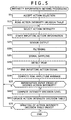
- the user starts up the intensity information setting function on the mobile phone 9.
- This function is realized by executing an action transmission program stored in the storage block 20 by the information processing block 18.
- the information processing that follows is executed by the CPU of the information processing block 18 in accordance with the action transmission program.
- an intensity information setting screen is shown on the display 15, waiting for the selection of an action by the user (step 5).
- the intensity information setting screen allows the selection of "shake” action and "grip” action. Selecting "shake” action generates the action intensity decision table for the acceleration sensor 28. Selecting "grip” action generates the action intensity decision table for the pressure sensor 30.
- the information processing block 18 reads the action intensity decision table corresponding to the selection made in step 5 from the storage block 20 (step 10).
- the storage block 20 stores the action intensity decision tables for the types of actions; "shake" action intensity decision table and "grip” action intensity decision table, for example.
- the action intensity decision table for the action selected in step 5 is read from the storage block 20 to be updated.
- each table to be read in step 10 has been created by the user beforehand or has been stored as default at the purchase of the mobile phone 9 for example.
- the information processing block 18 shows options on the display 15 representative of an intensity of the action to be executed.
- the user selects a desired intensity (step 15).
- the display 15 shows "Intense”, “Medium”, and “Weak”; if the user wants an intense action (shake or grip) according to his subjectivity, the user selects "Intense”, if the user wants a medium action, the user selects “Medium”, and, if the user wants a weak action, the user selects "Weak”.
- the information processing block 18 prompts the user to press a predetermined key on the display 15.
- the information processing block 18 starts entering an action information (step 20).
- the user Having pressed a predetermined key, the user starts an operation with the operation intensity selected in step 15.
- the information processing block 18 starts getting sensor output from the sensor corresponding to the type of action selected by the user; namely, the acceleration sensor 28 if the user has selected "Shake” action or the pressure sensor 30 if the user has selected "Grip” action. Consequently, the inputting of the action information gets started (step 20).
- the acceleration sensor 28 When the user shakes the mobile phone 9, the acceleration sensor 28 outputs an acceleration signal (step 25).
- the signal outputted from the acceleration sensor 28 is filtered by a bandpass filter, not shown, (step 30).
- This bandpass filter is set to about 0.5 Hz to 5 Hz of pass band. Of the sensor outputs, those in this band range are used for the creation of the action intensity decision table.
- a frequency is selected that prevents the direct current component and the low-frequency component from being outputted to provide a signal other than that indicative of the action made by the user.
- the upper limit of an output device (the vibrator 32) responsible range is selected.
- the filtering is executed at the stage of analog signal; alternatively, the filtering may be executed on the digital signal obtained by analog-to-digital converting the output signal of the acceleration sensor 28.
- the filtered output signal is amplified by the AMP 28a and the amplified signal is sampled in the D/A converter 28b to be converted in a digital signal (step 35).
- the resultant digital output signal is transmitted to the action information control block 21 and the information processing block 18 via the bus line 19.
- the information processing block 18 detects peaks from this action information and temporarily stores the detected peak values in the RAM or the storage block 20 (step 40).
- the information processing block 18 prompts the user to press a predetermined key to end inputting the action information (step 45).
- the information processing block 18 computes an amplitude average of the peak values stored in step 40 and stores a computed average (step 50).
- the information processing block 18 shows on the display 15 a message such as "Do you want to end setting intensity information?" for example and "Yes” and “No” buttons to let the user select the continuation or the end of intensity information setting (step 55).
- step 55, N the information processing block 18 returns to step 15, letting the user to continue to input action intensity information.
- the values recorded to the action intensity decision table are used for the intensity information not set by the user.
- step 60 If the user selects "Yes” (step 55, Y), then the information processing block 18 computes an intensity decision level (step 60).
- the information processing block 18 computes a value obtained by adding the amplitude average for action intensity "Intense” and the amplitude average for action intensity "Medium” and diving the obtained value by two, namely, computes an average value of both intensities, thereby providing level 1.
- the information processing block 18 computes a value obtained by adding the amplitude average for action intensity "Medium” and the amplitude average for action intensity "Weak” and diving the obtained value by two, thereby providing level 2.
- the information processing block 18 updates the action intensity decision table (step 65).
- the information processing block 18 has intensity information specification means for allowing the user to specify intensity information about physical quantity variations (acceleration, pressure, and so on).
- the information processing block 18 sets a correlation between physical quantity variation and intensity information by use of the magnitude of the detected physical quantity variation and the user-specified intensity information and records this correlation to the action intensity decision table (or intensity information storage means).
- the information processing block 18 sets another action intensity decision table (for example, "Grip” action intensity decision table after "Shake” action intensity decision table) or gives the user an enquiry. If the user selects the setting of another action intensity decision table (step 70, N), the information processing block 18 returns to step 15 to repeat the above-mentioned processing for that action intensity decision table. If the user selects the end of the setting (step 70, Y), the above-mentioned processing comes to an end.
- another action intensity decision table for example, "Grip" action intensity decision table after "Shake” action intensity decision table
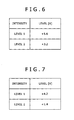
- FIG. 6 shows a logical configuration of "Shake" action intensity decision table.
- level 1 is set to +5.6 V and level 2 is set to +3.2 V.
- the acceleration sensor 28 outputs an acceleration signal in voltage, while "Shake" action intensity decision table sets the levels by the output voltage of the acceleration sensor 28.
- the maximum output of the acceleration sensor 28 is 7.0 V.
- the "Shake” action intensity decision table is used for the information processing block 18 to determine to which of "Intense”, “Medium”, and “Weak” the intensity of this shake corresponds.
- FIG. 7 shows a logical configuration of "Grip” action intensity decision table.
- level 1 is set to +4.2 V and level 2 is set to +1.4 V.
- the maximum output of the pressure sensor 30 is also 7.0 V.
- the information processing block 18 determines "Intense”; if the output is between level 1 and level 2, the information processing block 18 determines "Middle”; and if the output is smaller than level 2, the information processing block 18 determines "Weak".
- each of the action intensity decision tables is configured by sensor output voltages; alternatively, the tables may be configured percentages of outputs to maximum outputs.
- level 1 is equivalent to 80% and level 2 is equivalent to 40%, for example.
- the user operates a menu screen shown on the display 15, for example, and puts the mobile phone 9 into an action information input mode.
- an option for manual or automatic setting of action intensity is displayed, and user selects one of these setting modes (step 105). At this moment, the user also selects the type of action, "Shake” or "Grip", for example.
- the information processing block 18 sets an action intensity by use of the corresponding action intensity decision table.
- the user starts entering the action information by pressing a predetermined key (step 110), acting on the mobile phone 9 with a desired intensity. Consequently, an output signal is generated from the corresponding sensor (the acceleration sensor 28 or the pressure sensor 30) (step 115).
- the output signal is filtered by a bandpass filter (step 120) and the filtered signal is sampled by the D/A converter into a digital signal (step 125).
- the information processing block 18 gets this digital signal and stores the signal into the RAM or the storage block 20.
- the information processing block 18 lets the user press a predetermined key to end the operation of entering the action information (step 130).
- the information processing block 18 determines whether the user has selected the manual setting or the automatic setting in step 105 (step S135).
- the information processing block 18 shows "Intense”, “Medium”, and “Weak” on the display 15 and lets the user select one (step 180).
- step 160 which will be described later.
- the information processing block 18 detects peaks of the action information (step 140) and averages the detected peak values to get an amplitude average (step 145).
- the information processing block 18 references the action intensity decision table corresponding to the type of the action made by the user (step 150), thereby determining an action intensity from the relationship in magnitude between the levels in the action intensity decision table and the computed amplitude average (step 155).
- the information processing block 18 has intensity information acquisition means for acquiring intensity information by use of the intensity information storage means (or the action intensity decision tables).
- the information processing block 18 determines "Intense”; if the amplitude average is between level 1 and level 2, the information processing block 18 determines "Medium”; and if the amplitude average is smaller than level 2, the information processing block 18 determines "Weak".
- the action intensity is "Medium" from the action intensity decision table shown in FIG. 6.
- the information processing block 18 standardizes the action information inputted by the user and stored, thereby generating variation information (step 160).
- This standardization processing may be executed by use of the maximum value of sensor output as a standard reference value and dividing a measurement obtained from the sensor by the maximum value of sensor output.
- the information processing block 18 has variation information generation means for generating variation information by standardizing detected physical quantity variation (or action information).
- Action information is time-dependent information describing the magnitude of a predetermined physical quantity (acceleration or pressure for example) and its temporal variation. Resolving this action information into action intensity and variation information allows the separation of the action intensity of which impression heavily depends on user's subjectivity. This action intensity is processed separately from the action variation.
- the information processing block 18 may enter other forms of information, such as text, image, and voice, for example, as desired by the user.
- the information processing block 18 attaches these pieces of input information to the intensity information and the variation information (step 165). At the same time, the information processing block 18 attaches the tag information shown in FIG. 3 to these pieces of information.
- the information processing block 18 encodes these pieces of information (step 170) and transmits the encoded information to the mobile phone of the opposite party (step 175).
- a combination of intensity information and standardized sensor output time-dependent information may be transmitted to the mobile phone of the opposite party.
- the following describes the reproduction of the action information (intensity information and variation information) received from the mobile phone of the opposite party.
- the mobile phone 9 outputs the information about physical quantity variation received from the mobile phone of the opposite party, namely, the action information, as a physical variation that the user may recognize by user's tactile sensibility.
- the mobile phone 9 outputs the action information transmitted by vibrating the mobile phone 9 with the vibrator 32 (FIG. 2).
- This processing creates an output intensity setting table for correlating the reference vibration output to be outputted to the mobile phone 9 with the subjectivity about the vibration output. It should be noted that the output intensity setting table constitutes amplification factor storage means.
- the user operates a menu screen shown on the display 15 and starts an output intensity setting table setting function.
- the information processing block 18 reads the output intensity setting table from the storage block 20.
- This table is one that was created by the user before or provided as default.
- the information processing block 18 outputs sequentially drive signals having a same amplitude at frequencies (or vibratory frequencies) 1 to 50 Hz (in units of 1 Hz) to drive the vibrator 32 for vibration (step 205).
- the user feels the outputted vibration and selects the frequency at which the vibration is most intense (the frequency of highest sensitivity).
- the information processing block 18 accepts this selection (step 210).
- This processing may be executed by showing message "Press number 9 when you feel the vibration most intense" for example on the display 15 and accepting the frequency at which the user has pressed number 9 on the key input block 16.
- the information processing block 18 has a frequency specification means for letting the user specify the frequency of the vibrator 32 at specification of intensity information.
- the information processing block 18 outputs a drive signal of selected frequency fs in an amplitude sweep manner, thereby executing amplitude output (step 215).
- the amplitude is gradually increased while keeping the vibratory frequency of the vibrator 32 at constant level of fs.
- the user feels the outputted vibration and, when the user feels "Weak”, “Medium”, and “Intense” vibrations according to user's subjectivity, these pieces of information is transmitted to the information processing block 18.
- the information processing block 18 then makes confirmation of the output of the vibrator 32.
- the user may execute this processing by pressing a predetermined key on the key input block 16 in accordance with instructions shown on the display 15, while feeling the vibration of the mobile phone 9.
- the information processing block 18 accepts the selection of vibration intensity (the output of the vibrator 32) (step 220).
- the information processing block 18 updates the output intensity setting table by use of the amplitude (the input voltage to the vibrator 32) at the time of selection by the user (step 225).
- the information processing block 18 prompts the user whether or not to end the updating the output intensity setting table by showing a message on the display 15 for example (step 230). If the user selects the end of updating (step 230, Y), the information processing block 18 ends the vibration output setting processing.
- step 230, N the information processing block 18 returns to step 205 to repeat the above-mentioned vibration output setting processing.
- the information processing block 18 has intensity information specification means, amplification factor setting means, and updating means.
- Intensity information specification means let the user specify intensity information for an outputted physical variation (the vibration of the vibrator 32).
- Amplification factor setting means sets the correlation between intensity information and amplification factor by use of the output value of physical variation (vibration) at the time of the specification.
- Updating means updates the correlation between intensity information and amplification factor stored in the amplification factor storage means (the output intensity setting table).
- FIG. 10 shows one example of the logical configuration of the output intensity setting table created as described above.
- amplification factor namely gain, is related with intensity information.
- intensity information is "Intense”, amplification factor is 4.8; if intensity information is “Medium”, amplification factor is 2.5; and if intensity information is "Weak”, amplification factor is 1.8.
- the drive voltages at user's selection of "Intense”, “Middle”, and “Weak” may be used as amplification factors without change.
- the vibrator 32 may be vibrated at the frequency at which the user feels "Medium”.
- the information processing block 18 receives encoded information from the mobile phone of the opposite party (step 305) and decodes the received information (step 310).
- the decoded information may have information other than action information, so that the information processing block 18 separates the decoded information into action information, display information, and voice information by use of tag information (step 315).
- the information processing block 18 reproduces text, symbol, and image to show on the display 15 for the display information (step 315, display information) (step 330).
- the information processing block 18 reproduces voice and sound to output from the loudspeaker 12 (step 315, voice information) (step 335).
- the information processing block 18 uses this information to generate a drive signal for vibrating the vibrator 32 (step 320).
- the information processing block 18 outputs the generated drive signal to the vibrator 32 to vibrate the same, eventually vibrating the mobile phone 9 (step 325).
- the information processing block 18 separates action information into intensity information and variation information (step 350).
- the information processing block 18 reads the output intensity setting table (step 355) to determine the amplification factor of corresponding intensity information (step 365).
- step 360 If the user wants the adjustment of amplification factor at this moment, the user presses a predetermined key for example to manually adjust amplification factors specified in a main setting table (step 360).
- the information processing block 18 amplifies the variation information by an amplification factor determined in step 365 to generate a drive signal (step 375).
- the drive signal generated by the information processing block 18 is converted by the D/A converter 32a (FIG. 2) into an analog signal (step 380) and this analog signal is outputted to the vibrator 32 through the AMP 32a.
- the information processing block 18 has amplification factor acquisition means, output information generation means, and output means.
- Amplification factor acquisition means acquires amplification factor by use of the amplification factor storage means (the output intensity setting table).
- Output information generation means generates output information (a drive signal) by amplifying the variation information by acquired amplification factor.
- Output means outputs a generated output signal as a predetermined physical quantity (for vibrating the vibrator 32).
- the vibration of the vibrator 32 may be outputted as a new drive signal that is obtained by modulating a basic vibration 41 shown in FIG. 13 by a drive signal (reproduced action information).
- the vibrator 32 is vibrated at the frequency of the basic vibration 41 and its amplitude is varied in accordance with the drive signal, which allows the user to feel the action information as an envelope 42.
- This method is effective when reproducing low-frequency vibrations that are hard to be reproduced by the vibrator 32.
- the present embodiment is capable of providing an information processing apparatus (or a terminal apparatus) that follows.
- An information processing apparatus has an action information input block for inputting information about human action and a tactile sensibility information output block for outputting information as tactile sensibility information.
- the subjectivity of action information inputting person is related with action information characteristic.
- Information transmission is executed by combining subjectivity of action information inputting person and action information that are obtained from action information characteristic at entering action information.
- Tactile sensibility information is outputted by relating it with the subjectivity of the tactile sensibility of information receiver person.
- an acceleration sensor may be used.
- a pressure sensor may be used for the tactile sensibility information output block.
- a vibrator may be used for the tactile sensibility information output block.
- the mobile phone 9 is used as one example of the terminal apparatus; it is also practicable to use a desktop personal computer, for example.
- an externally attached device incorporating the acceleration sensor 28, the pressure sensor 30, and the vibrator 32 for example may be prepared to be connected to the personal computer.
Landscapes
- Engineering & Computer Science (AREA)
- Human Computer Interaction (AREA)
- Computer Networks & Wireless Communication (AREA)
- Signal Processing (AREA)
- Mobile Radio Communication Systems (AREA)
- Telephone Function (AREA)
- Telephonic Communication Services (AREA)
- User Interface Of Digital Computer (AREA)
Applications Claiming Priority (1)
| Application Number | Priority Date | Filing Date | Title |
|---|---|---|---|
| JP2004191065A JP4214481B2 (ja) | 2004-06-29 | 2004-06-29 | 動作伝達システム、端末装置、動作伝達方法、及び動作伝達プログラム |
Publications (1)
| Publication Number | Publication Date |
|---|---|
| EP1613032A1 true EP1613032A1 (de) | 2006-01-04 |
Family
ID=34937527
Family Applications (1)
| Application Number | Title | Priority Date | Filing Date |
|---|---|---|---|
| EP05013148A Withdrawn EP1613032A1 (de) | 2004-06-29 | 2005-06-17 | System, Endgerät, Verfahren und Programm zur Übertragung von Aktionsanforderungen |
Country Status (3)
| Country | Link |
|---|---|
| US (1) | US7725824B2 (de) |
| EP (1) | EP1613032A1 (de) |
| JP (1) | JP4214481B2 (de) |
Families Citing this family (10)
| Publication number | Priority date | Publication date | Assignee | Title |
|---|---|---|---|---|
| US8315652B2 (en) | 2007-05-18 | 2012-11-20 | Immersion Corporation | Haptically enabled messaging |
| US8621348B2 (en) * | 2007-05-25 | 2013-12-31 | Immersion Corporation | Customizing haptic effects on an end user device |
| JP5294989B2 (ja) * | 2009-05-28 | 2013-09-18 | Kddi株式会社 | 振動通信機能付き携帯端末 |
| JP5341678B2 (ja) * | 2009-08-27 | 2013-11-13 | 京セラ株式会社 | 通信システム |
| JP5278912B2 (ja) * | 2009-12-15 | 2013-09-04 | 株式会社ワインスペース | 通信装置、通信方法およびプログラム |
| KR101141311B1 (ko) | 2010-12-28 | 2012-05-04 | 네무스텍(주) | 모바일 기기의 모션 인식을 이용한 통신 방법 |
| JP2014016842A (ja) * | 2012-07-10 | 2014-01-30 | Ricoh Co Ltd | 評価システム、プログラム |
| US9575557B2 (en) | 2013-04-19 | 2017-02-21 | Qualcomm Incorporated | Grip force sensor array for one-handed and multimodal interaction on handheld devices and methods |
| CN106792014B (zh) * | 2016-11-25 | 2019-02-26 | 广州酷狗计算机科技有限公司 | 一种推荐音频的方法、装置及系统 |
| JP7595437B2 (ja) * | 2020-10-13 | 2024-12-06 | Lineヤフー株式会社 | 通信システム、通信方法及び通信プログラム |
Citations (3)
| Publication number | Priority date | Publication date | Assignee | Title |
|---|---|---|---|---|
| JPS60181813A (ja) * | 1984-02-28 | 1985-09-17 | Fujitsu Ltd | 打撃シヨツク入力装置 |
| EP0875821A2 (de) * | 1997-04-28 | 1998-11-04 | Matsushita Electric Industrial Co., Ltd. | Übertragungsendgerät mit taktiler Rückkopplung |
| JP2000049956A (ja) * | 1998-08-03 | 2000-02-18 | Sharp Corp | 通信装置及び通信システム |
Family Cites Families (3)
| Publication number | Priority date | Publication date | Assignee | Title |
|---|---|---|---|---|
| JP2002112969A (ja) * | 2000-09-02 | 2002-04-16 | Samsung Electronics Co Ltd | 身体及び感情状態の認識装置及び方法 |
| JP2002232317A (ja) | 2001-02-07 | 2002-08-16 | Nippon Telegr & Teleph Corp <Ntt> | 触覚通信装置 |
| FI115605B (fi) * | 2001-12-21 | 2005-06-15 | Newtest Oy | Anturiyksikkö, laitejärjestely ja laitejärjestelyä hyödyntävä menetelmä kehoon kohdistuvien voimien mittaamiseksi ja arvioimiseksi |
-
2004
- 2004-06-29 JP JP2004191065A patent/JP4214481B2/ja not_active Expired - Fee Related
-
2005
- 2005-05-19 US US11/133,656 patent/US7725824B2/en not_active Expired - Fee Related
- 2005-06-17 EP EP05013148A patent/EP1613032A1/de not_active Withdrawn
Patent Citations (3)
| Publication number | Priority date | Publication date | Assignee | Title |
|---|---|---|---|---|
| JPS60181813A (ja) * | 1984-02-28 | 1985-09-17 | Fujitsu Ltd | 打撃シヨツク入力装置 |
| EP0875821A2 (de) * | 1997-04-28 | 1998-11-04 | Matsushita Electric Industrial Co., Ltd. | Übertragungsendgerät mit taktiler Rückkopplung |
| JP2000049956A (ja) * | 1998-08-03 | 2000-02-18 | Sharp Corp | 通信装置及び通信システム |
Non-Patent Citations (2)
| Title |
|---|
| PATENT ABSTRACTS OF JAPAN vol. 010, no. 034 (P - 427) 8 February 1986 (1986-02-08) * |
| PATENT ABSTRACTS OF JAPAN vol. 2000, no. 05 14 September 2000 (2000-09-14) * |
Also Published As
| Publication number | Publication date |
|---|---|
| JP4214481B2 (ja) | 2009-01-28 |
| US7725824B2 (en) | 2010-05-25 |
| US20050289091A1 (en) | 2005-12-29 |
| JP2006014141A (ja) | 2006-01-12 |
Similar Documents
| Publication | Publication Date | Title |
|---|---|---|
| EP2175647B1 (de) | Vorrichtung und Verfahren zur Bereitstellung eines Gefühlsausdrucksdienstes in einem mobilen Kommunikationsendgerät | |
| US6957040B1 (en) | Image communication system | |
| JP2024522679A (ja) | アクチュエータ・パラメータのシステム内推定のための方法及びシステム | |
| US11601765B2 (en) | Method for adapting a hearing instrument and hearing system therefor | |
| CN110568926B (zh) | 一种声音信号处理方法及终端设备 | |
| US7725824B2 (en) | Action transmission system, terminal apparatus, action transmission method, and action transmission program | |
| US9472176B2 (en) | Performance recording system, performance recording method, and musical instrument | |
| JP2007028609A (ja) | 補聴器及びその調節方法 | |
| JP4932159B2 (ja) | 通信端末、通信端末の表示方法、及び、コンピュータプログラム | |
| JP2002078970A (ja) | ゲーム用入力装置 | |
| JP2003518349A (ja) | 装置入力識別方法および装置 | |
| CN110621384B (zh) | 信息处理设备、信息处理方法和程序 | |
| US20060084218A1 (en) | Method and apparatus for providing an instrument playing service | |
| JP2012004885A (ja) | 音声通話端末装置、音声通話システム、及び音声通話方法 | |
| CN110516495A (zh) | 一种扫码方法和移动终端 | |
| EP1781000A1 (de) | Verfahren zur Auswertung von Informationen und zur Ausführung entsprechender Funktionen in einem tragbaren Endgerät | |
| CN112997144A (zh) | 一种录音方法、装置、电子设备和计算机可读存储介质 | |
| JP2006033817A (ja) | 携帯端末機のデータ伝送および出力装置、並びにその方法 | |
| JP2001045347A (ja) | データ通信システムおよびそのシステムを構成するディジタル・カメラ | |
| CN110213431B (zh) | 消息发送方法及移动终端 | |
| JPH1049191A (ja) | 話速変換装置 | |
| JP6773876B2 (ja) | 入出力装置 | |
| JP4504216B2 (ja) | 画像処理装置および画像処理プログラム | |
| JP2004254198A (ja) | 携帯電話端末 | |
| JP2021006921A (ja) | 入出力装置 |
Legal Events
| Date | Code | Title | Description |
|---|---|---|---|
| PUAI | Public reference made under article 153(3) epc to a published international application that has entered the european phase |
Free format text: ORIGINAL CODE: 0009012 |
|
| AK | Designated contracting states |
Kind code of ref document: A1 Designated state(s): AT BE BG CH CY CZ DE DK EE ES FI FR GB GR HU IE IS IT LI LT LU MC NL PL PT RO SE SI SK TR |
|
| AX | Request for extension of the european patent |
Extension state: AL BA HR LV MK YU |
|
| 17P | Request for examination filed |
Effective date: 20060419 |
|
| 17Q | First examination report despatched |
Effective date: 20060704 |
|
| AKX | Designation fees paid |
Designated state(s): DE FR GB NL |
|
| STAA | Information on the status of an ep patent application or granted ep patent |
Free format text: STATUS: THE APPLICATION IS DEEMED TO BE WITHDRAWN |
|
| 18D | Application deemed to be withdrawn |
Effective date: 20130103 |