EP1619218A1 - Vulcanisats thermoplastiques a refroidissement renforcé et produits obtenus - Google Patents
Vulcanisats thermoplastiques a refroidissement renforcé et produits obtenus Download PDFInfo
- Publication number
- EP1619218A1 EP1619218A1 EP05106340A EP05106340A EP1619218A1 EP 1619218 A1 EP1619218 A1 EP 1619218A1 EP 05106340 A EP05106340 A EP 05106340A EP 05106340 A EP05106340 A EP 05106340A EP 1619218 A1 EP1619218 A1 EP 1619218A1
- Authority
- EP
- European Patent Office
- Prior art keywords
- composition
- thermoplastic
- shore
- component
- hardness
- Prior art date
- Legal status (The legal status is an assumption and is not a legal conclusion. Google has not performed a legal analysis and makes no representation as to the accuracy of the status listed.)
- Granted
Links
Images
Classifications
-
- C—CHEMISTRY; METALLURGY
- C08—ORGANIC MACROMOLECULAR COMPOUNDS; THEIR PREPARATION OR CHEMICAL WORKING-UP; COMPOSITIONS BASED THEREON
- C08L—COMPOSITIONS OF MACROMOLECULAR COMPOUNDS
- C08L23/00—Compositions of homopolymers or copolymers of unsaturated aliphatic hydrocarbons having only one carbon-to-carbon double bond; Compositions of derivatives of such polymers
- C08L23/02—Compositions of homopolymers or copolymers of unsaturated aliphatic hydrocarbons having only one carbon-to-carbon double bond; Compositions of derivatives of such polymers not modified by chemical after-treatment
- C08L23/10—Homopolymers or copolymers of propene
-
- C—CHEMISTRY; METALLURGY
- C08—ORGANIC MACROMOLECULAR COMPOUNDS; THEIR PREPARATION OR CHEMICAL WORKING-UP; COMPOSITIONS BASED THEREON
- C08K—Use of inorganic or non-macromolecular organic substances as compounding ingredients
- C08K5/00—Use of organic ingredients
- C08K5/0008—Organic ingredients according to more than one of the "one dot" groups of C08K5/01 - C08K5/59
- C08K5/0083—Nucleating agents promoting the crystallisation of the polymer matrix
-
- C—CHEMISTRY; METALLURGY
- C08—ORGANIC MACROMOLECULAR COMPOUNDS; THEIR PREPARATION OR CHEMICAL WORKING-UP; COMPOSITIONS BASED THEREON
- C08K—Use of inorganic or non-macromolecular organic substances as compounding ingredients
- C08K5/00—Use of organic ingredients
- C08K5/04—Oxygen-containing compounds
- C08K5/09—Carboxylic acids; Metal salts thereof; Anhydrides thereof
- C08K5/098—Metal salts of carboxylic acids
-
- C—CHEMISTRY; METALLURGY
- C08—ORGANIC MACROMOLECULAR COMPOUNDS; THEIR PREPARATION OR CHEMICAL WORKING-UP; COMPOSITIONS BASED THEREON
- C08L—COMPOSITIONS OF MACROMOLECULAR COMPOUNDS
- C08L101/00—Compositions of unspecified macromolecular compounds
-
- C—CHEMISTRY; METALLURGY
- C08—ORGANIC MACROMOLECULAR COMPOUNDS; THEIR PREPARATION OR CHEMICAL WORKING-UP; COMPOSITIONS BASED THEREON
- C08L—COMPOSITIONS OF MACROMOLECULAR COMPOUNDS
- C08L21/00—Compositions of unspecified rubbers
-
- C—CHEMISTRY; METALLURGY
- C08—ORGANIC MACROMOLECULAR COMPOUNDS; THEIR PREPARATION OR CHEMICAL WORKING-UP; COMPOSITIONS BASED THEREON
- C08L—COMPOSITIONS OF MACROMOLECULAR COMPOUNDS
- C08L23/00—Compositions of homopolymers or copolymers of unsaturated aliphatic hydrocarbons having only one carbon-to-carbon double bond; Compositions of derivatives of such polymers
- C08L23/02—Compositions of homopolymers or copolymers of unsaturated aliphatic hydrocarbons having only one carbon-to-carbon double bond; Compositions of derivatives of such polymers not modified by chemical after-treatment
- C08L23/16—Ethylene-propylene or ethylene-propylene-diene copolymers
-
- F—MECHANICAL ENGINEERING; LIGHTING; HEATING; WEAPONS; BLASTING
- F16—ENGINEERING ELEMENTS AND UNITS; GENERAL MEASURES FOR PRODUCING AND MAINTAINING EFFECTIVE FUNCTIONING OF MACHINES OR INSTALLATIONS; THERMAL INSULATION IN GENERAL
- F16L—PIPES; JOINTS OR FITTINGS FOR PIPES; SUPPORTS FOR PIPES, CABLES OR PROTECTIVE TUBING; MEANS FOR THERMAL INSULATION IN GENERAL
- F16L11/00—Hoses, i.e. flexible pipes
- F16L11/04—Hoses, i.e. flexible pipes made of rubber or flexible plastics
- F16L11/08—Hoses, i.e. flexible pipes made of rubber or flexible plastics with reinforcements embedded in the wall
- F16L11/081—Hoses, i.e. flexible pipes made of rubber or flexible plastics with reinforcements embedded in the wall comprising one or more layers of a helically wound cord or wire
-
- C—CHEMISTRY; METALLURGY
- C08—ORGANIC MACROMOLECULAR COMPOUNDS; THEIR PREPARATION OR CHEMICAL WORKING-UP; COMPOSITIONS BASED THEREON
- C08K—Use of inorganic or non-macromolecular organic substances as compounding ingredients
- C08K5/00—Use of organic ingredients
- C08K5/49—Phosphorus-containing compounds
- C08K5/51—Phosphorus bound to oxygen
- C08K5/52—Phosphorus bound to oxygen only
- C08K5/521—Esters of phosphoric acids, e.g. of H3PO4
- C08K5/523—Esters of phosphoric acids, e.g. of H3PO4 with hydroxyaryl compounds
-
- C—CHEMISTRY; METALLURGY
- C08—ORGANIC MACROMOLECULAR COMPOUNDS; THEIR PREPARATION OR CHEMICAL WORKING-UP; COMPOSITIONS BASED THEREON
- C08L—COMPOSITIONS OF MACROMOLECULAR COMPOUNDS
- C08L2205/00—Polymer mixtures characterised by other features
- C08L2205/03—Polymer mixtures characterised by other features containing three or more polymers in a blend
-
- C—CHEMISTRY; METALLURGY
- C08—ORGANIC MACROMOLECULAR COMPOUNDS; THEIR PREPARATION OR CHEMICAL WORKING-UP; COMPOSITIONS BASED THEREON
- C08L—COMPOSITIONS OF MACROMOLECULAR COMPOUNDS
- C08L23/00—Compositions of homopolymers or copolymers of unsaturated aliphatic hydrocarbons having only one carbon-to-carbon double bond; Compositions of derivatives of such polymers
- C08L23/02—Compositions of homopolymers or copolymers of unsaturated aliphatic hydrocarbons having only one carbon-to-carbon double bond; Compositions of derivatives of such polymers not modified by chemical after-treatment
- C08L23/10—Homopolymers or copolymers of propene
- C08L23/12—Polypropene
-
- C—CHEMISTRY; METALLURGY
- C08—ORGANIC MACROMOLECULAR COMPOUNDS; THEIR PREPARATION OR CHEMICAL WORKING-UP; COMPOSITIONS BASED THEREON
- C08L—COMPOSITIONS OF MACROMOLECULAR COMPOUNDS
- C08L2312/00—Crosslinking
Definitions
- Embodiments of the present inventions generally relate to thermoplastic vulcanizates and articles made therefrom.
- Thermoplastic vulcanizates may be characterized by finely divided rubber particles dispersed within a plastic matrix. These rubber particles are crosslinked to promote elasticity. As such, TPVs exhibit the processing properties of the plastic and the elasticity of the rubber.
- TPVs are conventionally produced by dynamic vulcanization.
- Dynamic vulcanization is a process whereby a rubber component is crosslinked or vulcanized within a blend of at least one non-vulcanizing polymer component while undergoing mixing or masticating at some elevated temperature.
- the temperature of this curing step is greater than the melt temperature of the non-vulcanizing polymer component.
- TPVs are useful for forming extruded articles for use in automotive, industrial, and consumer markets. Some of these uses require extruded articles having thick cross sections of TPV. Such thick sections are slow to cool at extrusion temperatures causing incomplete crystallization through the cross section thereby reducing optimal performance. Therefore, there is a need to enhance cooling of the TPV without sacrificing the flexibility, processability, and mechanical performance of the TPV and the articles extruded therefrom.
- thermoplastic vulcanizate (TPV) composition and articles for using the same are provided.
- the TPV includes a dispersed, at least partially vulcanized rubber component; an unvulcanized, or non-crosslinked, thermoplastic component; and a nucleating agent, wherein the composition has a Shore A Hardness of at least 60 and a Shore D Hardness less than 50.
- the thermoplastic component is unvulcanized or non-crosslinked.
- thermoplastic vulcanizate composition that includes the dispersed, at least partially vulcanized rubber component; the thermoplastic component; and the nucleating agent.
- the thermoplastic vulcanizate composition has a Shore A hardness of at least 60 and a Shore D hardness less than 50.
- the extruded article is elongated and has a wall thickness of at least 5 mm.
- a flexible conduit such as cable or pipeline, is also provided.
- the conduit comprises an inner housing having a channel formed therethrough; at least one tensile layer at least partially disposed about the inner housing; and the thermoplastic vulcanizate composition at least partially disposed about the at least one tensile layer.
- the thermoplastic vulcanizate composition includes the dispersed, at least partially vulcanized rubber component; the thermoplastic component; and the nucleating agent.
- the thermoplastic vulcanizate composition has a Shore A hardness of at least 60 and a Shore D hardness less than 50, and also has a wall thickness of at least 5 mm.
- the conduit comprises a tubular having an annulus formed therethrough; at least one tensile layer at least partially disposed about the inner housing; and an outer covering at least partially disposed about the at least one tensile layer.
- the outer covering comprises the dispersed, at least partially vulcanized rubber component; the isotactic polypropylene component; and the nucleating agent, particularly including one comprising sodium 2,2'-methylene-bis-(2,6-di-tert-butylphenyl)phosphate or norbomane (bicyclo(2.2.1)heptane carboxylic acid salt.
- the outer covering has a Shore A hardness of at least 60 and a Shore D hardness less than 50, and also has a wall thickness of at least 5 mm.
- thermoplastic vulcanizate composition (also referred to as simply thermoplastic vulcanizate or TPV) is broadly defined as any material that includes a dispersed, at least partially vulcanized, rubber component; a thermoplastic component; and an additive oil.
- a TPV material may further include other ingredients, other additives, or both.
- vulcanizate means a composition that includes some component (e.g., rubber component) that has been vulcanized.
- vulcanized is defined herein in its broadest sense, as reflected in any issued patent, printed publication, or dictionary, and refers in general to the state of a composition after all or a portion of the composition (e.g., crosslinkable rubber) has been subjected to some degree or amount of vulcanization. Accordingly, the term encompasses both partial and total vulcanization.
- vulcanization refers to more than insubstantial vulcanization, e.g., curing (crosslinking) that results in a measurable change in pertinent properties, e.g., a change in the melt flow index (MFI) of the composition by 10% or more (according to any ASTM-1238 procedure).
- MFI melt flow index
- vulcanization encompasses any form of curing (crosslinking), both thermal and chemical, that can be utilized in dynamic vulcanization.
- dynamic vulcanization means vulcanization or curing of a curable rubber blended with a thermoplastic resin under conditions of shear at temperatures sufficient to plasticize the mixture.
- the rubber is simultaneously crosslinked and dispersed as micro-sized particles within the thermoplastic component.
- the rubber to thermoplastic component ratio, compatibility of rubber and thermoplastic component, the kneader type and the intensity of mixing (shear rate) are possible.
- a "partially vulcanized" rubber is one wherein more than 5 weight percent (wt%) of the crosslinkable rubber is extractable in boiling xylene, subsequent to vulcanization (preferably dynamic vulcanization), e.g., crosslinking of the rubber phase of the thermoplastic vulcanizate.
- wt% weight percent
- less than 5 wt%, or less than 20 wt%, or less than 30 wt%, or less than 50 wt% of the crosslinkable rubber may be extractable from the specimen of the thermoplastic vulcanizate in boiling xylene.
- the percentage of extractable rubber can be determined by the technique set forth in U.S. Patent No. 4,311,628, and the portions of that patent referring to that technique are hereby incorporated by reference.
- the percent of soluble rubber in the cured composition is determined by refluxing a specimen in boiling xylene, weighing the dried residue and making suitable corrections for soluble and insoluble components based upon knowledge of the composition.
- corrected initial and final weights are obtained by subtracting from the initial weight the weight of the soluble components, other than the rubber to be vulcanized, such as extender oils, plasticizers and components of the compositions soluble in organic solvent, as well as that rubber component of the TPV that it is not intended to cure. Any insoluble pigments, fillers, etc., are subtracted from both the initial and final weights.
- any materials in the uncured rubber that are soluble in refluxing xylene or any ethylene-propylene copolymer containing no unsaturation are regarded as being non-crosslinkable components of the rubber which quantities are subtracted from the rubber when calculating the percent of soluble rubber in a cured composition, up to about 5 weight percent, typically between about 0.5 to about 2.0 weight percent, of EPDM rubber is soluble in refluxing xylene.
- a "fully vulcanized" (or fully cured or fully crosslinked) rubber is one wherein less than 5 weight percent (wt%) of the crosslinkable rubber is extractable in boiling xylene or cyclohexane, subsequent to vulcanization (preferably dynamic vulcanization), e.g., crosslinking of the rubber phase of the thermoplastic vulcanizate.
- vulcanization preferably dynamic vulcanization
- crosslinking of the rubber phase of the thermoplastic vulcanizate Preferably, less than 4 wt% or less, or 3 wt% or less, or 2 wt% or less, or 1 wt% or less of the crosslinkable rubber is extractable in boiling xylene or cyclohexane.
- polypropylene as used herein broadly means any polymer that is considered a "polypropylene” by persons skilled in the art (as reflected in at least one patent or publication).
- the polypropylene used in the compositions described herein that has a melting point above 110°C includes at least 90 wt% propylene units and contains isotactic sequences of those units.
- a composition may include a syndiotactic polypropylene, which in certain cases can have a melting point above 110°C.
- the polypropylene can either be derived exclusively from propylene monomers (i.e., having only propylene units) or be derived from mainly propylene (more than 80% propylene) with the remainder derived from olefins, particularly ethylene, and/or C 4 -C 10 ⁇ -olefins.
- certain polypropylenes have a high MFI (e.g., from a low of 10, or 15, or 20 g/10 min to a high of 25 to 30 g/10 min.
- Others have a lower MFI, e.g., "fractional" polypropylenes which have an MFI less than 1.0. Those with high MFI may be preferred for ease of processing or compounding.
- nucleating agent means any additive that produces a nucleation site for thermoplastic crystals to grow from a molten state to a solid, cooled structure.
- nucleating agents provide sites for growing thermoplastic crystals upon cooling the thermoplastic from its molten state.
- At least one specific embodiment is directed to a thermoplastic vulcanizate having an at least partially vulcanized rubber component dispersed within a thermoplastic component, and a nucleating agent for controlling crystallization.
- the amount of the rubber component and the amount of the thermoplastic component is controlled such that the thermoplastic vulcanizate composition has a Shore A hardness of at least 60 and a Shore D hardness less than 50.
- the rubber component is present in the amount of from about 5 weight percent (wt%) to about 85 wt% based upon the total weight of rubber and thermoplastic. In one or more embodiments, the rubber component is present in the amount of less than 70 wt% or less than 50 wt% based upon the total weight of rubber and thermoplastic. In one or more embodiments, the thermoplastic component is present in the amount of from about 15 wt% to about 95 wt% based upon the total weight of rubber and thermoplastic. In one or more embodiments, the thermoplastic component is present in the amount of more than 30 wt% or more than 50 wt% based upon the total weight of rubber and thermoplastic.
- the nucleating agent is present in an amount sufficient to induce crystallization to produce the described TPV compositions. In one or more embodiments, the nucleating agent is present in the amount of from about 0.05 wt% to about 5 wt% based on the total weight of the composition or the total weight of the thermoplastic component. In one or more embodiments, the nucleating agent is present in the amount of from less than 3 wt%, or less than 2 wt%, or less than 1 wt%, or less than 0.5 wt% based on the total weight of the composition or the total weight of the thermoplastic component.
- these TPV compositions have a Shore-A Hardness of greater than 60, greater than 70, or greater than 80. These TPV compositions also have a Shore-D Hardness of less than 50, less than 40, or less than 30. In one or more embodiments, the Shore-A Hardness may range from a low of 60, 65, or 70 to a high of 75, 80, or 90. In one or more embodiments, the Shore-D Hardness may range from a low of 5, 10, or 15 to a high of 40, 45, or 50. Those Shore Hardness values are measured according to ASTM D-2240.
- those hardness values are achieved without sacrificing other important mechanical properties, and also without the need to add amounts of oil that cause oil seepage. Also surprising is that those Shore-A Hardness and Shore-D Hardness values are achieved without sacrificing ease of processability.
- those TPV compositions have a Tensile Strength (TS) measured in accordance with ASTM D412 (ISO 37), ranging from 10 to 25 MPa, or more narrowly from 11 to 16 MPa.
- TS Tensile Strength
- Those TPV compositions also have an Elongation at break measured in accordance with ASTM D412 (ISO 37), ranging from a low of 50%, 70%, or 100% to a high of 200%, 400% or 700%.
- TPV compositions also have a 100% Modulus, also measured in accordance with ASTM D412 (ISO 37), ranging from a low of 10 MPa to a high of 15 MPa, more narrowly from 11 to 14 MPa, and more narrowly from 12 MPa to 13 MPa.
- ASTM D412 ISO 37
- the nucleating agent provides a plurality of nucleating sites for the thermoplastic component to crystallize when cooled. Surprisingly, this plurality of nucleating sites promotes even crystallization within the thermoplastic vulcanizate composition, allowing the composition to crystallize throughout an entire cross section in less time and at higher temperature. This plurality of nucleating sites produces a greater amount of smaller crystals within the thermoplastic vulcanizate composition which require less cooling time.
- Extruded articles of the TPVs described herein having a thickness greater than 2 mm, such as greater than 5 mm, greater than 10 mm, and even greater than 15 mm.
- Extruded articles of the TPV described can have thicknesses greater than 20 mm and still exhibit effective cooling (i.e. cooling from an outer surface of the cross section to an inner surface of the cross section) at extrusion temperatures without sacrificing mechanical strength.
- Such extrusion temperatures typically will be at or above the melting point of the thermoplastic component.
- nucleating agents include, but are not limited to dibenzylidene sorbitol based compounds, sodium benzoate, sodium phosphate salts, as well as lithium phosphate salts.
- the nucleating agent may include sodium 2,2'-methylene-bis-(2,6-di-tert-butylphenyl)phosphate which is commercially available from Milliken & Company.
- Another specific nucleating agent is norbornane (bicyclo(2.2.1)heptane carboxylic acid salt, which is commercially available from CIBA Specialty Chemicals.
- the "thermoplastic component” may be any material that is not a “rubber” (as defined herein) and that is a polymer or polymer blend considered by persons skilled in the art as being thermoplastic in nature, e.g., a polymer that softens when exposed to heat and returns to its original condition when cooled to room temperature.
- the thermoplastic component may contain one or more polyolefins.
- Useful polyolefins include thermoplastic, crystalline polyolefin homopolymers and copolymers.
- Illustrative polyolefins may be prepared from mono-olefin monomers including, but are not limited to, monomers having 2 to 7 carbon atoms, such as ethylene, propylene, 1-butene, isobutylene, 1-pentene, 1-hexene, 1-octene, 3-methyl-1-pentene, 4-methyl-1-pentene, 5-methyl-1-hexene, mixtures thereof and copolymers thereof with (meth)acrylates and/or vinyl acetates.
- the thermoplastic component may be added to the composition alone, or in a blend of two or more polypropylenes, polyethylenes, other polyolefins, derivatives thereof, or any combination thereof.
- the thermoplastic component is unvulcanized or non cross-linked.
- the thermoplastic component contains polypropylene.
- the thermoplastic component contains isotactic polypropylene.
- a preferable isotactic polypropylene has a weight average molecular weight from about 200,000 to about 600,000, and a number average molecular weight from about 80,000 to about 200,000.
- a more preferable isotactic polypropylene has a weight average molecular weight from about 300,000 to about 500,000, and a number average molecular weight from about 90,000 to about 150,000.
- the isotactic polypropylene has a molecular weight distribution (Mw/Mn) (MWD), also referred to as “polydispersity index” (PDI), within a range having a low 1.5, 1.8. or 2.0 and a high of 4.5, 5, 10, 20, or 40.
- Mw/Mn molecular weight distribution
- PDI polydispersity index
- the isotactic polypropylene preferably has a melt temperature (T m ) ranging from a low of 150°C, 155°C, or 160°C to a high of 160°C, 170°C, or 175°C.
- T m melt temperature
- the isotactic polypropylene preferably has a glass transition temperature (Tg) ranging from a low of -5°C, -3°C , or 0°C to a high of 2°C , 5°C, or 10°C.
- the crystallization temperature (T c ) of the isotactic polypropylene component preferably ranges from a low of about 95°C, 100°C, or 105°C to a high of about 110°C, 120°C or 130°C, as measured by differential scanning calorimetry (DSC) at 10°C/min.
- the isotactic polypropylene preferably has a crystallinity of at least 25 percent as measured by differential scanning calorimetry.
- the isotactic polypropylene has a melt flow rate of less than about 10 dg/min, preferably less than about 2 dg/min, and still more preferably less than about 1.0 dg/min.
- a preferred isotactic polypropylene has a heat of fusion of greater than 75 J/g, or greater than 80 J/g, or greater than 90 J/g.
- the isotactic polypropylene has a density of from about 0.85 g/cc to about 0.93 g/cc. In one or more embodiments, the isotactic polypropylene has a density of from about 0.88 to about 0.92 g/cc. In one or more embodiments, the isotactic polypropylene has a density of from about 0.90 to about 0.91 g/cc.
- Such an isotactic polypropylene may be synthesized using any polymerization technique known in the art such as, but not limited to, the "Phillips catalyzed reactions," conventional Ziegler-Natta type polymerizations, and single-site organometallic compound catalysis, such as metallocene catalysis, for example.
- Illustrative metallocene catalyst compounds include, but are not limited to, the reaction products of metallocene-alumoxane and metallocene-ionic activator reagents.
- Illustrative polymerization methods include, but are not limited to, slurry, bulk phase, solution phase, and any combination thereof. Polymerization may be carried out by a continuous or batch process in a single stage, such as a single reactor, or in two or more stages, such as in two or more reactors arranged in parallel or series.
- the “rubber component” may be any material that is considered by persons skilled in the art to be a “rubber,” preferably a crosslinkable rubber (e.g., prior to vulcanization) or crosslinked rubber (e.g., after vulcanization).
- specific rubber components include, without limitation, any olefin-containing rubber such as ethylene-propylene copolymers (EPM), including particularly saturated compounds that can be vulcanized using free radical generators such as organic peroxides, as noted in U.S. Patent No. 5,177,147, which is incorporated by reference in pertinent part.
- EPM ethylene-propylene copolymers
- Other rubber components are ethylene-propylene-diene (EPDM) rubber, or EPDM-type rubber.
- An EPDM-type rubber can be a terpolymer derived from the polymerization of at least two different monoolefin monomers having from 2 to 10 carbon atoms, preferably 2 to 4 carbon atoms, and at least one poly-unsaturated olefm having from 5 to 20 carbon atoms.
- the repeat units from at least two monoolefins are present in the polymer in weight ratios of 25:75 to 75:25 (ethylene:propylene) and constitute from about 90 to about 99.6 weight percent of the polymer.
- the polyunsaturated olefin can be a straight chained, branched, cyclic, bridged ring, bicyclic, fused ring bicyclic compound etc., and preferably is a nonconjugated diene.
- repeat units from the nonconjugated polyunsaturated olefin are from about 0.4 to about 10 weight percent of the rubber.
- butyl rubber includes a polymer that predominantly includes repeat units from isobutylene but also includes a few repeat units of a monomer that provides a site for crosslinking.
- Monomers providing sites for crosslinking include a polyunsaturated monomer such as a conjugated diene or divinyl benzene.
- from about 90 to about 99.5 weight percent of the butyl rubber are repeat units derived from the polymerization of isobutylene, and from about 0.5 to about 10 weight percent of the repeat units are front at least one polyunsaturated monomer having from 4 to 19 carbon atoms.
- the polyunsaturated monomer is isoprene or divinylbenzene.
- the polymer may be halogenated to further enhance reactivity in crosslinking.
- the halogen is present in amounts from about 0.1 to about 10 weight percent, more preferably about 0.5 to about 3.0 weight percent based upon the weight of the halogenated polymer; preferably the halogen is chlorine or bromine.
- the brominated copolymer of p-alkylstyrene, having from about 9 to 12 carbon atoms, and an isomonoolefin, having from 4 to 7 carbon atoms, desirably has from about 88 to about 99 weight percent isomonoolefin, more desirably from about 92 to about 98 weight percent, and from about 1 to about 12 weight percent p-alkylstyrene, more desirably from about 2 to about 8 weight percent based upon the weight of the copolymer before halogenation.
- the alkylstyrene is p-methylstyrene and the isomonoolefin is isobutylene.
- the percent bromine is from about 0.2 to about 8, more desirably from about 0.2 to about 3 weight percent based on the weight of the halogenated copolymer.
- the copolymer is a complementary amount, i.e., from about 92 to about 99.8, more desirably from about 97 to about 99.8 weight percent.
- These polymers are commercially available from, for example, ExxonMobil Chemical Co.
- copolymer means polymers derived from two or more monomers (including terpolymers, tetrapolymers, etc.), and the term “polymer” refers to carbon-containing compounds having repeat units from one or more different monomers.
- EPDM, butyl and halobutyl rubbers are rubbers low in residual unsaturation and are preferred when the vulcanizate needs good thermal stability or oxidative stability.
- the rubbers low in residual unsaturation desirably have less than 10 weight percent repeat units having unsaturation. Desirably excluded are acrylate rubber and epichlorohydrin rubber.
- rubber components are halobutyl rubbers and halogenated (e.g., brominated) rubber copolymers of p-alkylstyrene and an isomonoolefin having from 4 to 7 carbon atoms (e.g. isobutylene).
- Still other examples are rubber homopolymers of conjugated dienes having from 4 to 8 carbon atoms and rubber copolymers having at least 50 weight percent repeat units from at least one conjugated diene having from 4 to 8 carbon atoms.
- Rubber components can also be natural rubbers or synthetic homo or copolymers of at least one conjugated diene. Those rubbers are higher in unsaturation than EPDM rubber or butyl rubber. Those rubbers can optionally be partially hydrogenated to increase thermal and oxidative stability. Desirably those rubbers have at least 50 weight percent repeat units from at least one conjugated diene monomer having from 4 to 8 carbon atoms.
- Comonomers that may be used include vinyl aromatic monomer(s) having from 8 to 12 carbon atoms and acrylonitrile or alkyl-substituted acrylonitrile monomer(s) having from 3 to 8 carbon atoms.
- Other comonomers desirably include repeat units from monomers having unsaturated carboxylic acids, unsaturated dicarboxylic acids, unsaturated anhydrides of dicarboxylic acids, and include divinylbenzene, alkylacrylates and other monomers having from 3 to 20 carbon atoms.
- Rubber components can also be synthetic rubber, which can be nonpolar or polar depending on the comonomers.
- synthetic rubbers include synthetic polyisoprene, polybutadiene rubber, styrene-butadiene rubber, butadiene-acrylonitrile rubber, etc.
- Amine-functionalized, carboxy-functionalized or epoxy-functionalized synthetic rubbers may be used, and examples of these include maleated EPDM, and epoxy-functionalized natural rubbers. These materials are commercially available.
- Non-polar rubbers are preferred; polar rubbers may be used but may require the use of one or more compatibilizers, as is well known to those skilled in the art.
- a list of preferred rubber components include ethylene-propylene-diene rubber, natural rubber, butyl rubber, halobutyl rubber, halogenated rubber copolymer of p-alkystyrene and at least one isomonoolefm having 4 to 7 carbon atoms, a copolymer of isobutylene and divinyl-benzene, a rubber homopolymer of a conjugated diene having from 4 to 8 carbon atoms, a rubber copolymer having at least 50 weight percent repeat units from at least one conjugated diene having from 4 to 8 carbon atoms and a vinyl aromatic monomer having from 8 to 12 carbon atoms, or acrylonitrile monomer, or an alkyl substituted acrylonitrile monomer having from 3 to 8 carbon atoms, or an unsaturated carboxylic acid monomer, or an unsaturated anhydride of a dicarboxylic acid, or combinations thereon.
- any curative that is capable of curing or crosslinking the rubber component may be used.
- Illustrative curatives include, but are not limited to, phenolic resins, peroxides, maleimides, and silicon-containing curatives.
- certain curatives may be preferred.
- a peroxide curative may be preferred because the required quantity of peroxide will not have a deleterious impact on the engineering properties of the thermoplastic phase of the thermoplastic vulcanizate. In other situations, however, it may be preferred not to employ peroxide curatives because they may, at certain levels, degrade the thermoplastic components of the thermoplastic vulcanizate.
- Phenolic resins are described U.S. Patent Numbers 2,972,600; 3,287,440; and 6,433,090, which are incorporated herein in this regard.
- the preferred phenolic resin curatives can be referred to as resole resins and are made by condensation of alkyl substituted phenols or unsubstituted phenols with aldehydes, preferably formaldehydes, in an alkaline medium or by condensation of bi-functional phenoldialcohols.
- the alkyl substituents of the alkyl substituted phenols typically contain 1 to about 10 carbon atoms. Dimethylol phenols or phenolic resins, substituted in para-positions with alkyl groups containing 1 to about 10 carbon atoms are preferred.
- phenolic curatives are typically thermosetting resins and may be referred to as phenolic resin curatives or phenolic resins. These phenolic resins are ideally used in conjunction with a catalyst system. For example, non-halogenated phenol curing resins are preferably used in conjunction with halogen donors and, optionally, a hydrogen halide scavenger. Where the phenolic curing resin is halogenated, a halogen donor is not required but the use of a hydrogen halide scavenger, such as ZnO, is preferred.
- a hydrogen halide scavenger such as ZnO
- Useful silicon-containing curatives generally include silicon hydride compounds having at least two SiH groups. These compounds react with carbon-carbon double bonds of unsaturated polymers in the presence of a hydrosilation catalyst. Silicon hydride compounds that are useful in practicing the present invention include, but are not limited to, methylhydrogen polysiloxanes, methylhydrogen dimethyl-siloxane copolymers, alkyl methyl polysiloxanes, bis(dimethylsilyl)alkanes, bis(dimethylsilyl)benzene, and mixtures thereof.
- Peroxide curatives are generally selected from organic peroxides.
- organic peroxides include, but are not limited to, di-tert-butyl peroxide, dicumyl peroxide, t-butylcumyl peroxide, alpha,alpha-bis(tert-butylperoxy)diisopropyl benzene, 2,5 dimethyl 2,5-di(t-butylperoxy)hexane, 1,1-di(t-butylperoxy)-3,3,5-trimethyl cyclohexane, -butyl-4,4-bis(tert-butylperoxy)valerate, benzoyl peroxide, lauroyl peroxide, dilauroyl peroxide, 2,5-dimethyl-2,5-di(tert-butylperoxy)hexene-3, and mixtures thereof.
- diaryl peroxides, ketone peroxides, peroxydicarbonates, peroxyesters, dialkyl peroxides, hydroperoxides, peroxyketals and mixtures thereof may be used.
- peroxide curatives and their use for preparing thermoplastic vulcanizates reference can be made to U.S. Pat. No. 5,656,693, which is incorporated herein by reference.
- additive oil includes both “process oils” and “extender oils.”
- additive oil may include hydrocarbon oils and plasticizers, such as organic esters and synthetic plasticizers.
- hydrocarbon oils and plasticizers such as organic esters and synthetic plasticizers.
- Many additive oils are derived from petroleum fractions, and have particular ASTM designations depending on whether they fall into the class of paraffinic, naphthenic, or aromatic oils.
- Other types of additive oils include alpha olefinic synthetic oils, such as liquid polybutylene, e.g., products sold under the trademark Parapol®.
- Additive oils other than petroleum based oils can also be used, such as oils derived from coal tar and pine tar, as well as synthetic oils, e.g., polyolefm materials (e.g., NexbaseTM, supplied by Fortum Oil and Gas Oy).
- Certain rubber components e.g., EPDMs, such as Vistalon 3666
- EPDMs include additive oil that is preblended before the rubber component is combined with the thermoplastic. The type of additive oil utilized will be that customarily used in conjunction with a particular rubber component.
- the ordinarily skilled chemist will recognize which type of oil should be used with a particular rubber, and also be able to determine the amount (quantity) of oil.
- the additive oil can be present in amounts from about 5 to about 300 parts by weight per 100 parts by weight of the blend of the rubber and isotactic polypropylene components.
- the amount of additive oil may also be expressed as from about 30 to 250 parts, and more desirably from about 70 to 200 parts by weight per 100 parts by weight of the rubber component.
- the quantity of additive oil can be based on the total rubber content, and defined as the ratio, by weight, of additive oil to total rubber in the TPV, and that amount may in certain cases be the combined amount of process oil (typically added during processing) and extender oil (typically added after processing).
- the ratio may range, for example, from about 0 to about 4.0/1.
- Other ranges, having any of the following lower and upper limits, may also be utilized: a lower limit of 0.4/1, or 0.6/1, or 0.8/1, or 1.0/1, or 1.2/1, or 1.5/1, or 1.8/1, or 2.0/1, or 2.5/1; and an upper limit (which may be combined with any of the foregoing lower limits) of 4.0/1, or 3.8/1, or 3.5/1, or 3.2/1, or 3.0/1, or 2.8/1.
- Larger amounts of additive oil can be used, although the deficit is often reduced physical strength of the composition, or oil weeping, or both.
- the thermoplastic vulcanizate composition may further include one or more additives.
- additives include, but are not limited, to particulate fillers, lubricants, antioxidants, antiblocking agents, stabilizers, anti-degradants, anti-static agents, waxes, foaming agents, pigments, flame retardants, processing aids, adhesives, tackifiers, plasticizers, wax, and discontinuous fibers (such as world cellulose fibers).
- Exemplary particulate fillers are carbon black, silica, titanium dioxide, calcium carbonate, colored pigments, clay, and combinations thereof. When non-black fillers are used, it may be desirable to include a coupling agent to compatibilize the interface between the non-black fillers and polymers. Desirable amounts of carbon black, or other colorants, when present, are from about 5 to about 250 parts by weight per 100 parts by weight of rubber.
- the TPV is prepared by melt-mixing in any order, the thermoplastic component, the rubber component, and any additive in a mixer heated to above the melting temperature of the polypropylene component.
- the mixing equipment can include BanburyTM mixers, BrabenderTM mixers, multiroll mills and melt mixing extruders, for example.
- one or more curatives are added.
- the one or more curatives in solution with a liquid, such as a rubber processing oil or in a masterbatch, for example, which is compatible with the other components. It is convenient to follow the progress of crosslinking (vulcanization) by monitoring mixing torque or mixing energy requirements during mixing. The mixing torque or mixing energy curve generally goes through a maximum after which mixing can be continued somewhat longer to improve the fabricability of the blend.
- Crosslinking (vulcanization) of the rubber can occur in a few minutes or less depending on the mix temperature, shear rate, and activators present for the curative. Suitable curing temperatures include from about 120°C or 150°C to about 250°C, more preferred temperatures are from about 150°C or 170°C to about 425°C or 250°C.
- the one or more nucleating agents can be added before, during, or after vulcanization. After discharge from the mixer, the blend containing the at least partially vulcanized rubber dispersed in the polypropylene component along with the one or more nucleating agents can be milled, chopped, extruded, pelletized, injection-molded, or processed by any other desirable technique.
- thermoplastic vulcanizate composition is useful for making a variety of articles including, but not limited to, conduits, pipes, tubing, hoses, tires, belts, gaskets, moldings and molded parts, for example.
- the thermoplastic vulcanizate composition is useful for making articles by extrusion, injection molding, blow molding, and compression molding techniques.
- the thermoplastic vulcanizate composition is useful for making articles by extrusion, and more preferably elongated, extruded articles having lengths greater than 1 meter, such as greater than 50 meters, greater than 100 meters, or greater than 1,000 meters, for example.
- the thermoplastic vulcanizate composition may be useful as a covering or sheath ( i . e .
- thermoplastic vulcanizate composition disposed about an elongated conduit for transporting fluids, such as oil and gas related fluids for example.
- the thermoplastic vulcanizate composition may also be useful as a covering or jacket disposed about cables containing electrical power cables, electrical conductors, fiber optics, data lines, or other communication lines, and combinations or bundles thereof.
- the thermoplastic vulcanizate composition may further be useful for securing wires, ropes, etc.
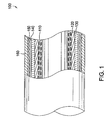
- Figure 1 shows a cross-sectional view of an exemplary pipe or conduit 100 having an outer covering made of the TPV described above.
- the conduit 100 includes an inner tube 110 having a channel or bore 105 formed therethrough.
- the tube 110 is made of a flexible material and includes a helically wound flat or profiled metallic strips to provide collapse resistance.
- a polymeric sheath 120 is at least partially disposed or wrapped around the tube 110 for containing the fluid in the pipe.
- the sheath 120 is preferably made of an impervious polymeric material.
- a layer 130 is at least partially disposed or wrapped around the layer 120 and provides resistance to internal pressure, hydrostatic collapse and crush.
- the layer 130 can be formed by helically wrapping a continuous metallic strip, preferably formed of carbon steel, with adjacent windings being interlocked, to form a flexible layer that provides significant hoop and axial strength, such as FLEXLOKTM, commercially available from Wellstream, Inc.
- An inner tensile layer 140 is at least partially disposed or wrapped around the layer 130, and an outer tensile layer 150 is at least partially disposed or wrapped around the layer 140.
- Each layer 140 and 150 includes at least one tensile reinforcement element that is wound to resist the hoop stress, the axial component of the internal pressure, and the axial load due to the weight of the suspended pipe and exterior effects.
- one or more adhesive layers may be provided between any of the layers 110, 120, 130, 140, and 150.
- An outer covering or sheath 160 is then at least partially disposed or otherwise formed over the outer tensile layer 150.
- the sheath 160 is fabricated from the TPV described herein.
- the TPV sheath 160 provides low temperature flexibility, improved thermal insulation characteristics, lighter weight and resistance to degradation.
- the TPV sheath 160 also has a very good resistance to chemical elements and fatigue when in contact with drilling fluids and seawater. Moreover, the TPV sheath 160 exhibits good fatigue properties, low environmental stress-cracking resistance, and good temperature resistance.
- the TPV sheath 160 is capable of having a cross sectional thickness greater than 5 mm, such as greater than 6 mm, greater than 10 mm, and greater than 16 mm, because of the enhanced cooling afforded by the one or more nucleating agents.
- the addition of the one or more nucleating agents provides a plurality of nucleating sites for the polypropylene component to crystallize. As such, a greater amount of smaller crystals are formed in contrast to fewer, larger crystals that form without the addition of the nucleating agents described herein. As a result, the smaller crystals require less cooling time, thereby setting the entire cross section of the TPV material as opposed to just the outer portions.
- Comparative Samples 1-5 are compositions of a TPV with no nucleating agent. Comparative Samples 1-5 were extruded samples of Santoprene® 203-50 (Advanced Elastomer Systems, L.P.) and polypropylene in the weight percentages shown in Table 1.
- Samples 1-6 are compositions of a TPV blended with one or more nucleating agents as described. Samples 1-6 were extruded samples of Santoprene® 203-50 (Advanced Elastomer Systems, L.P.), polypropylene, and the one or more nucleating agents in the weight percentages shown in Table 1.
- Each extruded strip was 46 mm wide and 2 mm thick, and was extruded on a MAPRE 38mm single-screw extruder.
- the extruded strip of Comparative Sample 1 (CS-1) was cooled at rapid cooling conditions using tap-water.
- the extruded strip of Comparative Sample 2 (CS-2) was cooled at slower cooling conditions with air.
- the extruded strips of Comparative Samples 3-5 (CS 3-5) were cooled in a drying oven at 120°C for 10 minutes, 20 minutes, or 30 minutes, as recited in Table 1.
- Each of the extruded strips of Samples 1-6 were cooled in a drying oven at 120°C for 20 minutes. The drying oven was placed in close proximity to the extrusion line to prevent a premature cooling of the extruded strip samples.
Landscapes
- Chemical & Material Sciences (AREA)
- Health & Medical Sciences (AREA)
- Chemical Kinetics & Catalysis (AREA)
- Medicinal Chemistry (AREA)
- Polymers & Plastics (AREA)
- Organic Chemistry (AREA)
- Engineering & Computer Science (AREA)
- General Engineering & Computer Science (AREA)
- Mechanical Engineering (AREA)
- Crystallography & Structural Chemistry (AREA)
- Compositions Of Macromolecular Compounds (AREA)
Applications Claiming Priority (1)
| Application Number | Priority Date | Filing Date | Title |
|---|---|---|---|
| US58769704P | 2004-07-14 | 2004-07-14 |
Publications (2)
| Publication Number | Publication Date |
|---|---|
| EP1619218A1 true EP1619218A1 (fr) | 2006-01-25 |
| EP1619218B1 EP1619218B1 (fr) | 2008-05-28 |
Family
ID=34979340
Family Applications (1)
| Application Number | Title | Priority Date | Filing Date |
|---|---|---|---|
| EP05106340A Expired - Lifetime EP1619218B1 (fr) | 2004-07-14 | 2005-07-12 | Vulcanisats thermoplastiques a refroidissement renforcé et produits obtenus |
Country Status (4)
| Country | Link |
|---|---|
| US (1) | US20060014903A1 (fr) |
| EP (1) | EP1619218B1 (fr) |
| AT (1) | ATE397039T1 (fr) |
| DE (1) | DE602005007111D1 (fr) |
Cited By (3)
| Publication number | Priority date | Publication date | Assignee | Title |
|---|---|---|---|---|
| WO2008039599A1 (fr) | 2006-09-29 | 2008-04-03 | Advanced Elastomer Systems, L.P. | Compositions d'élastomères thermoplastiques, leurs procédés de fabrication et articles en étant faits |
| FR2931098A1 (fr) * | 2008-05-13 | 2009-11-20 | Technip France | Procede de fabrication d'une structure tubulaire flexible |
| DE102009060065C5 (de) | 2009-12-22 | 2024-09-05 | Veritas Ag | Fluidleitung |
Families Citing this family (17)
| Publication number | Priority date | Publication date | Assignee | Title |
|---|---|---|---|---|
| US8076416B2 (en) | 2005-02-04 | 2011-12-13 | Exxonmobil Chemical Patents Inc. | Thermoplastic vulcanizates and their use |
| US20070112139A1 (en) * | 2005-11-14 | 2007-05-17 | Ellul Maria D | Peroxide-cured thermoplastic vulcanizates and process for making the same |
| WO2008090880A1 (fr) * | 2007-01-24 | 2008-07-31 | The Furukawa Electric Co., Ltd. | Câble à fibres optiques |
| CN101687399A (zh) * | 2007-05-31 | 2010-03-31 | 米其林技术公司 | 使用硫化补丁的轮胎修补 |
| JP2009173926A (ja) * | 2007-12-31 | 2009-08-06 | Bridgestone Corp | ポリマーの耐コールドフロー性を向上させる方法 |
| US8119712B2 (en) * | 2009-07-10 | 2012-02-21 | Acushnet Company | Golf balls having layers made from rubber compositions containing nucleating agents |
| US20110009213A1 (en) * | 2009-07-10 | 2011-01-13 | Acushnet Company | Golf balls having layers made from thermoplastic compositions containing nucleating agents |
| FR2959745B1 (fr) * | 2010-05-10 | 2012-06-01 | Michelin Soc Tech | Pneumatique dont la bande de roulement comporte un elastomere thermoplastique vulcanisat (tpv). |
| ES2902829T3 (es) * | 2011-09-09 | 2022-03-30 | Chevron Phillips Chemical Co Lp | Composiciones aditivas de polietileno y artículos fabricados con ellas |
| KR20160119079A (ko) * | 2014-02-07 | 2016-10-12 | 제너럴 케이블 테크놀로지즈 코오포레이션 | 개선된 외피를 가지는 케이블 형성방법 |
| WO2018175996A1 (fr) * | 2017-03-24 | 2018-09-27 | Saint-Gobain Performance Plastics Corporation | Tubulure souple présentant un niveau d'écoulement stable et procédé pour la fabriquer et l'utiliser |
| US11725098B2 (en) * | 2017-12-18 | 2023-08-15 | Celanese International Corporation | Thermoplastic vulcanizate conduits for transporting hydrocarbon fluids |
| CN112997033B (zh) * | 2018-09-14 | 2023-07-25 | 国际人造丝公司 | 热塑性硫化橡胶组合物、其制备和在柔性管状管道中的用途 |
| EP3849791A1 (fr) * | 2018-09-14 | 2021-07-21 | ExxonMobil Chemical Patents Inc. | Compositions de vulcanisat thermoplastique pour des gaines internes/sous pression polymères de tuyaux souples pour des applications dans le pétrole et le gaz |
| WO2020068409A1 (fr) * | 2018-09-24 | 2020-04-02 | Exxonmobil Chemical Patents Inc. | Mélanges élastomériques-polymères réticulés |
| WO2020068408A1 (fr) | 2018-09-24 | 2020-04-02 | Exxonmobil Chemical Patents Inc. | Mélanges thermoplastiques et composites pour tuyaux flexibles |
| FR3104667B1 (fr) * | 2019-12-17 | 2023-07-28 | Technip France | Conduite flexible sous-marine comprenant une couche comprenant du polyméthylpentène |
Citations (9)
| Publication number | Priority date | Publication date | Assignee | Title |
|---|---|---|---|---|
| US2972600A (en) | 1957-09-27 | 1961-02-21 | Schenectady Varnish Company In | Substituted phenols |
| US3287440A (en) | 1961-11-24 | 1966-11-22 | Albert Ag Chem Werke | Process for the cross-linking of unsaturated copolymers and ethylene-propylene terpolymers |
| US4311628A (en) | 1977-11-09 | 1982-01-19 | Monsanto Company | Thermoplastic elastomeric blends of olefin rubber and polyolefin resin |
| US5177147A (en) | 1986-03-03 | 1993-01-05 | Advanced Elastomer Systems, Lp | Elastomer-plastic blends |
| US5656693A (en) | 1995-06-14 | 1997-08-12 | Exxon Chemical Patents Inc. | Thermoplastic elastomers having improved cure |
| US6433090B1 (en) | 2001-01-26 | 2002-08-13 | Advanced Elastomer Systems, L.P. | Thermoplastic elastomers having improved set foams made therefrom |
| US20020132956A1 (en) * | 2001-01-14 | 2002-09-19 | Tomoya Matayoshi | Injection molding soft resin composition and uses thereof |
| US20020177642A1 (en) * | 2001-03-24 | 2002-11-28 | Zhao Xiaodong Edward | Novel thermoplastic nucleating compounds |
| US20040059061A1 (en) * | 2000-12-22 | 2004-03-25 | Jourdian Eric P | Multicomponent thermoset structures |
Family Cites Families (1)
| Publication number | Priority date | Publication date | Assignee | Title |
|---|---|---|---|---|
| US7601285B2 (en) * | 2003-12-31 | 2009-10-13 | Boston Scientific Scimed, Inc. | Medical device with varying physical properties and method for forming same |
-
2005
- 2005-07-01 US US11/173,963 patent/US20060014903A1/en not_active Abandoned
- 2005-07-12 DE DE602005007111T patent/DE602005007111D1/de not_active Expired - Fee Related
- 2005-07-12 EP EP05106340A patent/EP1619218B1/fr not_active Expired - Lifetime
- 2005-07-12 AT AT05106340T patent/ATE397039T1/de not_active IP Right Cessation
Patent Citations (9)
| Publication number | Priority date | Publication date | Assignee | Title |
|---|---|---|---|---|
| US2972600A (en) | 1957-09-27 | 1961-02-21 | Schenectady Varnish Company In | Substituted phenols |
| US3287440A (en) | 1961-11-24 | 1966-11-22 | Albert Ag Chem Werke | Process for the cross-linking of unsaturated copolymers and ethylene-propylene terpolymers |
| US4311628A (en) | 1977-11-09 | 1982-01-19 | Monsanto Company | Thermoplastic elastomeric blends of olefin rubber and polyolefin resin |
| US5177147A (en) | 1986-03-03 | 1993-01-05 | Advanced Elastomer Systems, Lp | Elastomer-plastic blends |
| US5656693A (en) | 1995-06-14 | 1997-08-12 | Exxon Chemical Patents Inc. | Thermoplastic elastomers having improved cure |
| US20040059061A1 (en) * | 2000-12-22 | 2004-03-25 | Jourdian Eric P | Multicomponent thermoset structures |
| US20020132956A1 (en) * | 2001-01-14 | 2002-09-19 | Tomoya Matayoshi | Injection molding soft resin composition and uses thereof |
| US6433090B1 (en) | 2001-01-26 | 2002-08-13 | Advanced Elastomer Systems, L.P. | Thermoplastic elastomers having improved set foams made therefrom |
| US20020177642A1 (en) * | 2001-03-24 | 2002-11-28 | Zhao Xiaodong Edward | Novel thermoplastic nucleating compounds |
Cited By (11)
| Publication number | Priority date | Publication date | Assignee | Title |
|---|---|---|---|---|
| WO2008039599A1 (fr) | 2006-09-29 | 2008-04-03 | Advanced Elastomer Systems, L.P. | Compositions d'élastomères thermoplastiques, leurs procédés de fabrication et articles en étant faits |
| US8207270B2 (en) | 2006-09-29 | 2012-06-26 | Exxonmobil Chemical Patents Inc. | Thermoplastic elastomer compositions, methods of making and articles made from the same |
| FR2931098A1 (fr) * | 2008-05-13 | 2009-11-20 | Technip France | Procede de fabrication d'une structure tubulaire flexible |
| FR2931099A1 (fr) * | 2008-05-13 | 2009-11-20 | Technip France Sa | Procede de fabrication d'une structure tubulaire flexible |
| WO2009141538A3 (fr) * | 2008-05-13 | 2010-01-14 | Technip France | Procede de fabrication d'une structure tubulaire flexible |
| GB2473357A (en) * | 2008-05-13 | 2011-03-09 | Technip France | Method of manufacturing a flexible tubular structure |
| GB2473357B (en) * | 2008-05-13 | 2012-08-15 | Technip France | Method of manufacturing a flexible tubular structure |
| AU2009248601B2 (en) * | 2008-05-13 | 2013-08-22 | Technip France | Method of manufacturing a flexible tubular structure |
| DK178345B1 (en) * | 2008-05-13 | 2015-12-21 | Technip France | A flexible tubular structure and a method of manufacturing a flexible tubular structure |
| NO342067B1 (no) * | 2008-05-13 | 2018-03-19 | Technip France | Fremgangsmåte for fremstilling av en fleksibel rørkonstruksjon |
| DE102009060065C5 (de) | 2009-12-22 | 2024-09-05 | Veritas Ag | Fluidleitung |
Also Published As
| Publication number | Publication date |
|---|---|
| ATE397039T1 (de) | 2008-06-15 |
| EP1619218B1 (fr) | 2008-05-28 |
| DE602005007111D1 (de) | 2008-07-10 |
| US20060014903A1 (en) | 2006-01-19 |
Similar Documents
| Publication | Publication Date | Title |
|---|---|---|
| EP1619218B1 (fr) | Vulcanisats thermoplastiques a refroidissement renforcé et produits obtenus | |
| JP5539192B2 (ja) | 架橋されたポリエチレン製品とその製造法 | |
| JP4362253B2 (ja) | 改良された加工性及び物理的性質の改良されたバランスを有する熱可塑性エラストマー | |
| US7964672B2 (en) | High strength thermoplastic elastomers with high filler loading | |
| JP5764669B2 (ja) | 熱可塑性加硫組成物、その製造方法、及びそれから製造される物品 | |
| JP5216182B2 (ja) | 熱可塑性エラストマーの製造方法 | |
| US11725098B2 (en) | Thermoplastic vulcanizate conduits for transporting hydrocarbon fluids | |
| US20220112362A1 (en) | Thermoplastic Vulcanizate Compositions Their Preparation and Use in Flexible Tubular Pipes | |
| AU599643B2 (en) | Method of manufacture of thermoplastic elastomer compositions | |
| WO2001081462A1 (fr) | Composition elastomere thermoplastique | |
| WO2008039599A1 (fr) | Compositions d'élastomères thermoplastiques, leurs procédés de fabrication et articles en étant faits | |
| JP2001524563A (ja) | エチレンの熱可塑性ランダムコポリマーによる熱可塑性加硫ゴムの改良 | |
| JP2000072924A (ja) | スタ―状に枝分かれしたゴム熱可塑性エラストマ―加硫ゴム | |
| CN111918920A (zh) | 热塑性硫化橡胶组合物 | |
| US20070299160A1 (en) | Insulating Extrudates from Polyolefin Blends | |
| JP7603369B2 (ja) | 変性エラストマー組成物、架橋エラストマー組成物及びその成形体 | |
| JP5503873B2 (ja) | 熱可塑性加硫ゴム接着剤組成物 | |
| JP5611849B2 (ja) | エチレン・α−オレフィン・非共役ポリエン共重合体およびそれを含む熱可塑性エラストマー | |
| KR20020089405A (ko) | 저온 특성이 개선된 열가소성 탄성중합체 | |
| KR20250133402A (ko) | 가교가능한 에틸렌 중합체 기반의 열가소성 가황물 및 이로부터 제조된 성형 물품 | |
| JPH0260951A (ja) | 耐侯性に優れた熱可塑性エラストマー組成物 |
Legal Events
| Date | Code | Title | Description |
|---|---|---|---|
| PUAI | Public reference made under article 153(3) epc to a published international application that has entered the european phase |
Free format text: ORIGINAL CODE: 0009012 |
|
| AK | Designated contracting states |
Kind code of ref document: A1 Designated state(s): AT BE BG CH CY CZ DE DK EE ES FI FR GB GR HU IE IS IT LI LT LU LV MC NL PL PT RO SE SI SK TR |
|
| AX | Request for extension of the european patent |
Extension state: AL BA HR MK YU |
|
| 17P | Request for examination filed |
Effective date: 20060715 |
|
| 17Q | First examination report despatched |
Effective date: 20060825 |
|
| AKX | Designation fees paid |
Designated state(s): AT BE BG CH CY CZ DE DK EE ES FI FR GB GR HU IE IS IT LI LT LU LV MC NL PL PT RO SE SI SK TR |
|
| GRAP | Despatch of communication of intention to grant a patent |
Free format text: ORIGINAL CODE: EPIDOSNIGR1 |
|
| GRAS | Grant fee paid |
Free format text: ORIGINAL CODE: EPIDOSNIGR3 |
|
| GRAA | (expected) grant |
Free format text: ORIGINAL CODE: 0009210 |
|
| AK | Designated contracting states |
Kind code of ref document: B1 Designated state(s): AT BE BG CH CY CZ DE DK EE ES FI FR GB GR HU IE IS IT LI LT LU LV MC NL PL PT RO SE SI SK TR |
|
| REG | Reference to a national code |
Ref country code: GB Ref legal event code: FG4D |
|
| REG | Reference to a national code |
Ref country code: CH Ref legal event code: EP |
|
| REF | Corresponds to: |
Ref document number: 602005007111 Country of ref document: DE Date of ref document: 20080710 Kind code of ref document: P |
|
| REG | Reference to a national code |
Ref country code: IE Ref legal event code: FG4D |
|
| PG25 | Lapsed in a contracting state [announced via postgrant information from national office to epo] |
Ref country code: SI Free format text: LAPSE BECAUSE OF FAILURE TO SUBMIT A TRANSLATION OF THE DESCRIPTION OR TO PAY THE FEE WITHIN THE PRESCRIBED TIME-LIMIT Effective date: 20080528 |
|
| PG25 | Lapsed in a contracting state [announced via postgrant information from national office to epo] |
Ref country code: ES Free format text: LAPSE BECAUSE OF FAILURE TO SUBMIT A TRANSLATION OF THE DESCRIPTION OR TO PAY THE FEE WITHIN THE PRESCRIBED TIME-LIMIT Effective date: 20080908 Ref country code: FI Free format text: LAPSE BECAUSE OF FAILURE TO SUBMIT A TRANSLATION OF THE DESCRIPTION OR TO PAY THE FEE WITHIN THE PRESCRIBED TIME-LIMIT Effective date: 20080528 |
|
| PGFP | Annual fee paid to national office [announced via postgrant information from national office to epo] |
Ref country code: DE Payment date: 20080731 Year of fee payment: 4 |
|
| PG25 | Lapsed in a contracting state [announced via postgrant information from national office to epo] |
Ref country code: LV Free format text: LAPSE BECAUSE OF FAILURE TO SUBMIT A TRANSLATION OF THE DESCRIPTION OR TO PAY THE FEE WITHIN THE PRESCRIBED TIME-LIMIT Effective date: 20080528 Ref country code: AT Free format text: LAPSE BECAUSE OF FAILURE TO SUBMIT A TRANSLATION OF THE DESCRIPTION OR TO PAY THE FEE WITHIN THE PRESCRIBED TIME-LIMIT Effective date: 20080528 Ref country code: NL Free format text: LAPSE BECAUSE OF FAILURE TO SUBMIT A TRANSLATION OF THE DESCRIPTION OR TO PAY THE FEE WITHIN THE PRESCRIBED TIME-LIMIT Effective date: 20080528 |
|
| NLV1 | Nl: lapsed or annulled due to failure to fulfill the requirements of art. 29p and 29m of the patents act | ||
| PG25 | Lapsed in a contracting state [announced via postgrant information from national office to epo] |
Ref country code: IS Free format text: LAPSE BECAUSE OF FAILURE TO SUBMIT A TRANSLATION OF THE DESCRIPTION OR TO PAY THE FEE WITHIN THE PRESCRIBED TIME-LIMIT Effective date: 20080928 |
|
| PG25 | Lapsed in a contracting state [announced via postgrant information from national office to epo] |
Ref country code: SE Free format text: LAPSE BECAUSE OF FAILURE TO SUBMIT A TRANSLATION OF THE DESCRIPTION OR TO PAY THE FEE WITHIN THE PRESCRIBED TIME-LIMIT Effective date: 20080828 Ref country code: DK Free format text: LAPSE BECAUSE OF FAILURE TO SUBMIT A TRANSLATION OF THE DESCRIPTION OR TO PAY THE FEE WITHIN THE PRESCRIBED TIME-LIMIT Effective date: 20080528 Ref country code: CZ Free format text: LAPSE BECAUSE OF FAILURE TO SUBMIT A TRANSLATION OF THE DESCRIPTION OR TO PAY THE FEE WITHIN THE PRESCRIBED TIME-LIMIT Effective date: 20080528 Ref country code: LT Free format text: LAPSE BECAUSE OF FAILURE TO SUBMIT A TRANSLATION OF THE DESCRIPTION OR TO PAY THE FEE WITHIN THE PRESCRIBED TIME-LIMIT Effective date: 20080528 |
|
| PG25 | Lapsed in a contracting state [announced via postgrant information from national office to epo] |
Ref country code: SK Free format text: LAPSE BECAUSE OF FAILURE TO SUBMIT A TRANSLATION OF THE DESCRIPTION OR TO PAY THE FEE WITHIN THE PRESCRIBED TIME-LIMIT Effective date: 20080528 Ref country code: BE Free format text: LAPSE BECAUSE OF FAILURE TO SUBMIT A TRANSLATION OF THE DESCRIPTION OR TO PAY THE FEE WITHIN THE PRESCRIBED TIME-LIMIT Effective date: 20080528 Ref country code: PT Free format text: LAPSE BECAUSE OF FAILURE TO SUBMIT A TRANSLATION OF THE DESCRIPTION OR TO PAY THE FEE WITHIN THE PRESCRIBED TIME-LIMIT Effective date: 20081028 Ref country code: RO Free format text: LAPSE BECAUSE OF FAILURE TO SUBMIT A TRANSLATION OF THE DESCRIPTION OR TO PAY THE FEE WITHIN THE PRESCRIBED TIME-LIMIT Effective date: 20080528 |
|
| PG25 | Lapsed in a contracting state [announced via postgrant information from national office to epo] |
Ref country code: MC Free format text: LAPSE BECAUSE OF NON-PAYMENT OF DUE FEES Effective date: 20080731 |
|
| PLBE | No opposition filed within time limit |
Free format text: ORIGINAL CODE: 0009261 |
|
| STAA | Information on the status of an ep patent application or granted ep patent |
Free format text: STATUS: NO OPPOSITION FILED WITHIN TIME LIMIT |
|
| REG | Reference to a national code |
Ref country code: IE Ref legal event code: MM4A |
|
| PG25 | Lapsed in a contracting state [announced via postgrant information from national office to epo] |
Ref country code: EE Free format text: LAPSE BECAUSE OF FAILURE TO SUBMIT A TRANSLATION OF THE DESCRIPTION OR TO PAY THE FEE WITHIN THE PRESCRIBED TIME-LIMIT Effective date: 20080528 Ref country code: BG Free format text: LAPSE BECAUSE OF FAILURE TO SUBMIT A TRANSLATION OF THE DESCRIPTION OR TO PAY THE FEE WITHIN THE PRESCRIBED TIME-LIMIT Effective date: 20080828 |
|
| 26N | No opposition filed |
Effective date: 20090303 |
|
| PG25 | Lapsed in a contracting state [announced via postgrant information from national office to epo] |
Ref country code: IE Free format text: LAPSE BECAUSE OF NON-PAYMENT OF DUE FEES Effective date: 20080712 |
|
| PG25 | Lapsed in a contracting state [announced via postgrant information from national office to epo] |
Ref country code: IT Free format text: LAPSE BECAUSE OF FAILURE TO SUBMIT A TRANSLATION OF THE DESCRIPTION OR TO PAY THE FEE WITHIN THE PRESCRIBED TIME-LIMIT Effective date: 20080528 |
|
| REG | Reference to a national code |
Ref country code: CH Ref legal event code: PL |
|
| PG25 | Lapsed in a contracting state [announced via postgrant information from national office to epo] |
Ref country code: LI Free format text: LAPSE BECAUSE OF NON-PAYMENT OF DUE FEES Effective date: 20090731 Ref country code: CH Free format text: LAPSE BECAUSE OF NON-PAYMENT OF DUE FEES Effective date: 20090731 |
|
| PG25 | Lapsed in a contracting state [announced via postgrant information from national office to epo] |
Ref country code: PL Free format text: LAPSE BECAUSE OF FAILURE TO SUBMIT A TRANSLATION OF THE DESCRIPTION OR TO PAY THE FEE WITHIN THE PRESCRIBED TIME-LIMIT Effective date: 20080528 |
|
| PG25 | Lapsed in a contracting state [announced via postgrant information from national office to epo] |
Ref country code: DE Free format text: LAPSE BECAUSE OF NON-PAYMENT OF DUE FEES Effective date: 20100202 |
|
| PG25 | Lapsed in a contracting state [announced via postgrant information from national office to epo] |
Ref country code: HU Free format text: LAPSE BECAUSE OF FAILURE TO SUBMIT A TRANSLATION OF THE DESCRIPTION OR TO PAY THE FEE WITHIN THE PRESCRIBED TIME-LIMIT Effective date: 20081129 Ref country code: LU Free format text: LAPSE BECAUSE OF NON-PAYMENT OF DUE FEES Effective date: 20080712 Ref country code: CY Free format text: LAPSE BECAUSE OF FAILURE TO SUBMIT A TRANSLATION OF THE DESCRIPTION OR TO PAY THE FEE WITHIN THE PRESCRIBED TIME-LIMIT Effective date: 20080528 |
|
| PG25 | Lapsed in a contracting state [announced via postgrant information from national office to epo] |
Ref country code: TR Free format text: LAPSE BECAUSE OF FAILURE TO SUBMIT A TRANSLATION OF THE DESCRIPTION OR TO PAY THE FEE WITHIN THE PRESCRIBED TIME-LIMIT Effective date: 20080528 |
|
| PG25 | Lapsed in a contracting state [announced via postgrant information from national office to epo] |
Ref country code: GR Free format text: LAPSE BECAUSE OF FAILURE TO SUBMIT A TRANSLATION OF THE DESCRIPTION OR TO PAY THE FEE WITHIN THE PRESCRIBED TIME-LIMIT Effective date: 20080829 |
|
| REG | Reference to a national code |
Ref country code: FR Ref legal event code: PLFP Year of fee payment: 12 |
|
| REG | Reference to a national code |
Ref country code: FR Ref legal event code: PLFP Year of fee payment: 13 |
|
| REG | Reference to a national code |
Ref country code: FR Ref legal event code: PLFP Year of fee payment: 14 |
|
| REG | Reference to a national code |
Ref country code: GB Ref legal event code: 732E Free format text: REGISTERED BETWEEN 20220616 AND 20220622 |
|
| PGFP | Annual fee paid to national office [announced via postgrant information from national office to epo] |
Ref country code: GB Payment date: 20220621 Year of fee payment: 18 |
|
| PGFP | Annual fee paid to national office [announced via postgrant information from national office to epo] |
Ref country code: FR Payment date: 20220622 Year of fee payment: 18 |
|
| P01 | Opt-out of the competence of the unified patent court (upc) registered |
Effective date: 20231220 |
|
| GBPC | Gb: european patent ceased through non-payment of renewal fee |
Effective date: 20230712 |
|
| PG25 | Lapsed in a contracting state [announced via postgrant information from national office to epo] |
Ref country code: GB Free format text: LAPSE BECAUSE OF NON-PAYMENT OF DUE FEES Effective date: 20230712 |
|
| PG25 | Lapsed in a contracting state [announced via postgrant information from national office to epo] |
Ref country code: FR Free format text: LAPSE BECAUSE OF NON-PAYMENT OF DUE FEES Effective date: 20230731 |