EP1619258B1 - Verfahren zum nachweis oder zur quantitativen bestimmung der mitochondrialen dna-variation 3243 und kit dafür - Google Patents
Verfahren zum nachweis oder zur quantitativen bestimmung der mitochondrialen dna-variation 3243 und kit dafür Download PDFInfo
- Publication number
- EP1619258B1 EP1619258B1 EP04728015A EP04728015A EP1619258B1 EP 1619258 B1 EP1619258 B1 EP 1619258B1 EP 04728015 A EP04728015 A EP 04728015A EP 04728015 A EP04728015 A EP 04728015A EP 1619258 B1 EP1619258 B1 EP 1619258B1
- Authority
- EP
- European Patent Office
- Prior art keywords
- probe
- nucleotide sequence
- nucleic acid
- mutation
- dna
- Prior art date
- Legal status (The legal status is an assumption and is not a legal conclusion. Google has not performed a legal analysis and makes no representation as to the accuracy of the status listed.)
- Expired - Lifetime
Links
- 238000000034 method Methods 0.000 title claims abstract description 89
- 108020005196 Mitochondrial DNA Proteins 0.000 title claims abstract description 29
- 239000002773 nucleotide Substances 0.000 claims abstract description 140
- 125000003729 nucleotide group Chemical group 0.000 claims abstract description 140
- 239000000523 sample Substances 0.000 claims abstract description 120
- 230000035772 mutation Effects 0.000 claims abstract description 65
- 239000007850 fluorescent dye Substances 0.000 claims abstract description 47
- 108020004711 Nucleic Acid Probes Proteins 0.000 claims abstract description 31
- 239000002853 nucleic acid probe Substances 0.000 claims abstract description 31
- 230000000295 complement effect Effects 0.000 claims abstract description 19
- FWMNVWWHGCHHJJ-SKKKGAJSSA-N 4-amino-1-[(2r)-6-amino-2-[[(2r)-2-[[(2r)-2-[[(2r)-2-amino-3-phenylpropanoyl]amino]-3-phenylpropanoyl]amino]-4-methylpentanoyl]amino]hexanoyl]piperidine-4-carboxylic acid Chemical compound C([C@H](C(=O)N[C@H](CC(C)C)C(=O)N[C@H](CCCCN)C(=O)N1CCC(N)(CC1)C(O)=O)NC(=O)[C@H](N)CC=1C=CC=CC=1)C1=CC=CC=C1 FWMNVWWHGCHHJJ-SKKKGAJSSA-N 0.000 claims abstract description 15
- 230000007423 decrease Effects 0.000 claims abstract description 10
- 238000009396 hybridization Methods 0.000 claims abstract description 10
- 230000003321 amplification Effects 0.000 claims description 53
- 238000003199 nucleic acid amplification method Methods 0.000 claims description 53
- 108020004707 nucleic acids Proteins 0.000 claims description 17
- 102000039446 nucleic acids Human genes 0.000 claims description 17
- 150000007523 nucleic acids Chemical class 0.000 claims description 17
- 102000016928 DNA-directed DNA polymerase Human genes 0.000 claims description 10
- 108010014303 DNA-directed DNA polymerase Proteins 0.000 claims description 10
- 238000011880 melting curve analysis Methods 0.000 claims description 10
- 108020004414 DNA Proteins 0.000 abstract description 52
- 238000003753 real-time PCR Methods 0.000 abstract description 9
- 238000001514 detection method Methods 0.000 description 36
- 238000011002 quantification Methods 0.000 description 36
- 238000010791 quenching Methods 0.000 description 25
- 230000000171 quenching effect Effects 0.000 description 25
- PEDCQBHIVMGVHV-UHFFFAOYSA-N Glycerine Chemical compound OCC(O)CO PEDCQBHIVMGVHV-UHFFFAOYSA-N 0.000 description 18
- 238000004458 analytical method Methods 0.000 description 15
- 239000000203 mixture Substances 0.000 description 11
- 108090000623 proteins and genes Proteins 0.000 description 9
- TWRXJAOTZQYOKJ-UHFFFAOYSA-L Magnesium chloride Chemical compound [Mg+2].[Cl-].[Cl-] TWRXJAOTZQYOKJ-UHFFFAOYSA-L 0.000 description 8
- 239000013612 plasmid Substances 0.000 description 8
- 239000011541 reaction mixture Substances 0.000 description 8
- 108091028043 Nucleic acid sequence Proteins 0.000 description 7
- 238000000137 annealing Methods 0.000 description 7
- 108091008146 restriction endonucleases Proteins 0.000 description 7
- 239000003153 chemical reaction reagent Substances 0.000 description 6
- 108700028369 Alleles Proteins 0.000 description 5
- 238000005259 measurement Methods 0.000 description 5
- ABZLKHKQJHEPAX-UHFFFAOYSA-N tetramethylrhodamine Chemical compound C=12C=CC(N(C)C)=CC2=[O+]C2=CC(N(C)C)=CC=C2C=1C1=CC=CC=C1C([O-])=O ABZLKHKQJHEPAX-UHFFFAOYSA-N 0.000 description 5
- 241000282414 Homo sapiens Species 0.000 description 4
- 238000004925 denaturation Methods 0.000 description 4
- 230000036425 denaturation Effects 0.000 description 4
- 229910001629 magnesium chloride Inorganic materials 0.000 description 4
- QKNYBSVHEMOAJP-UHFFFAOYSA-N 2-amino-2-(hydroxymethyl)propane-1,3-diol;hydron;chloride Chemical compound Cl.OCC(N)(CO)CO QKNYBSVHEMOAJP-UHFFFAOYSA-N 0.000 description 3
- AHCYMLUZIRLXAA-SHYZEUOFSA-N Deoxyuridine 5'-triphosphate Chemical compound O1[C@H](COP(O)(=O)OP(O)(=O)OP(O)(O)=O)[C@@H](O)C[C@@H]1N1C(=O)NC(=O)C=C1 AHCYMLUZIRLXAA-SHYZEUOFSA-N 0.000 description 3
- 102000006943 Uracil-DNA Glycosidase Human genes 0.000 description 3
- 108010072685 Uracil-DNA Glycosidase Proteins 0.000 description 3
- 238000011109 contamination Methods 0.000 description 3
- SUYVUBYJARFZHO-RRKCRQDMSA-N dATP Chemical compound C1=NC=2C(N)=NC=NC=2N1[C@H]1C[C@H](O)[C@@H](COP(O)(=O)OP(O)(=O)OP(O)(O)=O)O1 SUYVUBYJARFZHO-RRKCRQDMSA-N 0.000 description 3
- SUYVUBYJARFZHO-UHFFFAOYSA-N dATP Natural products C1=NC=2C(N)=NC=NC=2N1C1CC(O)C(COP(O)(=O)OP(O)(=O)OP(O)(O)=O)O1 SUYVUBYJARFZHO-UHFFFAOYSA-N 0.000 description 3
- RGWHQCVHVJXOKC-SHYZEUOFSA-J dCTP(4-) Chemical compound O=C1N=C(N)C=CN1[C@@H]1O[C@H](COP([O-])(=O)OP([O-])(=O)OP([O-])([O-])=O)[C@@H](O)C1 RGWHQCVHVJXOKC-SHYZEUOFSA-J 0.000 description 3
- HAAZLUGHYHWQIW-KVQBGUIXSA-N dGTP Chemical compound C1=NC=2C(=O)NC(N)=NC=2N1[C@H]1C[C@H](O)[C@@H](COP(O)(=O)OP(O)(=O)OP(O)(O)=O)O1 HAAZLUGHYHWQIW-KVQBGUIXSA-N 0.000 description 3
- 230000005284 excitation Effects 0.000 description 3
- 239000012634 fragment Substances 0.000 description 3
- 102000053602 DNA Human genes 0.000 description 2
- 108091034117 Oligonucleotide Proteins 0.000 description 2
- 230000005856 abnormality Effects 0.000 description 2
- 206010012601 diabetes mellitus Diseases 0.000 description 2
- 238000001962 electrophoresis Methods 0.000 description 2
- 239000007788 liquid Substances 0.000 description 2
- 210000003470 mitochondria Anatomy 0.000 description 2
- 230000001575 pathological effect Effects 0.000 description 2
- 238000002360 preparation method Methods 0.000 description 2
- 238000007894 restriction fragment length polymorphism technique Methods 0.000 description 2
- 239000000126 substance Substances 0.000 description 2
- 238000012408 PCR amplification Methods 0.000 description 1
- 238000011529 RT qPCR Methods 0.000 description 1
- 230000002159 abnormal effect Effects 0.000 description 1
- CUJRVFIICFDLGR-UHFFFAOYSA-N acetylacetonate Chemical compound CC(=O)[CH-]C(C)=O CUJRVFIICFDLGR-UHFFFAOYSA-N 0.000 description 1
- 238000000246 agarose gel electrophoresis Methods 0.000 description 1
- 239000008280 blood Substances 0.000 description 1
- 210000004369 blood Anatomy 0.000 description 1
- 150000001768 cations Chemical class 0.000 description 1
- 238000004590 computer program Methods 0.000 description 1
- 239000000356 contaminant Substances 0.000 description 1
- 239000012530 fluid Substances 0.000 description 1
- 230000002438 mitochondrial effect Effects 0.000 description 1
- 230000007170 pathology Effects 0.000 description 1
- 238000010223 real-time analysis Methods 0.000 description 1
- 230000001225 therapeutic effect Effects 0.000 description 1
- 210000001519 tissue Anatomy 0.000 description 1
Images


Classifications
-
- C—CHEMISTRY; METALLURGY
- C12—BIOCHEMISTRY; BEER; SPIRITS; WINE; VINEGAR; MICROBIOLOGY; ENZYMOLOGY; MUTATION OR GENETIC ENGINEERING
- C12Q—MEASURING OR TESTING PROCESSES INVOLVING ENZYMES, NUCLEIC ACIDS OR MICROORGANISMS; COMPOSITIONS OR TEST PAPERS THEREFOR; PROCESSES OF PREPARING SUCH COMPOSITIONS; CONDITION-RESPONSIVE CONTROL IN MICROBIOLOGICAL OR ENZYMOLOGICAL PROCESSES
- C12Q1/00—Measuring or testing processes involving enzymes, nucleic acids or microorganisms; Compositions therefor; Processes of preparing such compositions
- C12Q1/68—Measuring or testing processes involving enzymes, nucleic acids or microorganisms; Compositions therefor; Processes of preparing such compositions involving nucleic acids
- C12Q1/6876—Nucleic acid products used in the analysis of nucleic acids, e.g. primers or probes
- C12Q1/6883—Nucleic acid products used in the analysis of nucleic acids, e.g. primers or probes for diseases caused by alterations of genetic material
-
- C—CHEMISTRY; METALLURGY
- C12—BIOCHEMISTRY; BEER; SPIRITS; WINE; VINEGAR; MICROBIOLOGY; ENZYMOLOGY; MUTATION OR GENETIC ENGINEERING
- C12Q—MEASURING OR TESTING PROCESSES INVOLVING ENZYMES, NUCLEIC ACIDS OR MICROORGANISMS; COMPOSITIONS OR TEST PAPERS THEREFOR; PROCESSES OF PREPARING SUCH COMPOSITIONS; CONDITION-RESPONSIVE CONTROL IN MICROBIOLOGICAL OR ENZYMOLOGICAL PROCESSES
- C12Q2600/00—Oligonucleotides characterized by their use
- C12Q2600/156—Polymorphic or mutational markers
Definitions
- the present invention relates to methods for detecting and quantifying mitochondrial DNA 3243 mutation and a kit therefor.
- the A ⁇ G mutation at the 3243rd position of mitochondrial DNA is a mutation existing in 1% of Japanese diabetes mellitus patients, and occurs at the highest frequency among diabetic conditions caused by abnormality of a single gene.
- One of the characteristics of abnormality of mitochondrial genes is coexistence of normal and abnormal mitochondrial DNAs in various proportions, and this state is referred to as heteroplasmy.
- the ratio of mt3243 mutation heteroplasmy is said to relate to progression degree of the pathological condition, and it is considered that it can be used for the determination of progression degree of the pathological condition or therapeutic effect.
- the mutation can be detected by a method of amplifying DNA by PCR so that a portion including the mutation position should be amplified, digesting the amplification product with a restriction enzyme and determining whether the DNA has been digested or not by electrophoresis (PCR-RFLP) (for example, refer to The Japanese Journal of Clinical Pathology, vol. 44, 8, pp. 778-782, 1996 ).
- PCR-RFLP electrophoresis
- PCR-RFLP PCR-RFLP
- the amplification product needs to be collected and subjected to a treatment with a restriction enzyme after PCR, and therefore the amplification product may contaminate the subsequent reaction system. Accordingly, a false positive or false negative result may be obtained.
- DNA is treated with a restriction enzyme and then subjected to electrophoresis after completion of PCR. Therefore, time required for the detection becomes extremely long. In addition, because the procedure is complicated, automatization is difficult. Furthermore, because denaturation and annealing are repeated during PCR, a normal type sequence and a mutant type sequence may erroneously bind to each other. Such a product is not recognized by a restriction enzyme, and therefore it is not digested (DNA is digested by a restriction enzyme only when both of the double strands are of mutant type). Accordingly, in the quantification of the ratio of heteroplasmy, the proportion of the mutant type becomes lower than the actual value.
- MASA mutant allele specific amplification
- a method is also known in which by using a system in which fluorescence changes depending on amount of an amplification product; PCR amplification product is quantified on a real time basis by measuring fluorescence; and on the basis of the results, nucleic acids in a sample are quantified (real time quantitative PCR).
- PCR amplification product is quantified on a real time basis by measuring fluorescence; and on the basis of the results, nucleic acids in a sample are quantified (real time quantitative PCR).
- a method is generally known in which a region containing a mutation is amplified by PCR, then a melting curve analysis is performed by using a nucleic acid probe labeled with a fluorescent dye, and the mutation is analyzed on the basis of the result of the melting curve analysis ( Clinical Chemistry, vol. 46, 5, pp.631-635, 2000 ; Japanese Patent Application Laid-open (Kokai) No. 2002-119291 ).
- An object of the present invention is to provide methods for detecting and quantifying the mt3243 mutation and a kit therefor. Further, another object of the present invention is to identify a quenching probe effective for the detection of the mt3243 mutation and thereby provide a method for detecting the mt3243 mutation and a kit therefor.
- the inventors of the present invention found that by designing a primer pair on the basis of a specific region containing the mt3243 mutation in a mitochondrial DNA, the mt3243 mutation could be detected by the MASA method.
- the literature concerning the aforementioned method of using a probe only teaches that, concerning the design of the probe, the probe should be designed so that, when a quenching probe having an end labeled with a fluorescent dye hybridizes with a target nucleic acid, two or more nucleotide pairs of the probe-nucleic acid hybrid should form at least one pair of G and C in the end portion.
- the inventors of the present invention designed a quenching probe satisfying the aforementioned condition and attempted the detection. However, no quenching probe that enabled detection was easily obtained.
- the inventors of the present invention found that by designing a quenching probe based on a specific region containing the mt3243 mutation, the mt3243 mutation could be detected by a melting curve analysis using the quenching probe.
- the present invention was accomplished on the basis of the above findings and provides the following.
- a nucleotide sequence complementary to an objective nucleotide sequence means a nucleotide sequence complementary to the objective nucleotide sequence for the full length of the objective nucleotide sequence.
- the first detection method is a method for detecting a DNA having the mitochondrial DNA 3243 mutation, comprising performing PCR using a DNA obtained from a sample as a template and detecting an amplification product, characterized in that primers used for PCR comprises a primer having a nucleotide sequence complementary to a nucleotide sequence starting from the nucleotide number 243 in the nucleotide sequence of SEQ ID NO: 2 and having a length of 12 to 30 nucleotides.
- the sample is not particularly limited so long as it contains mitochondria.
- Examples thereof include blood, oral swab, tissue and so forth. DNAs can be obtained from these samples in an ordinary manner under conditions under which mitochondrial DNAs can be prepared.
- PCR in the first detection method can be performed by a usual PCR method except that a DNA obtained from a sample is used as a template, and specific primers are used.
- the primers used in the present invention comprise a primer having a nucleotide sequence complementary to a nucleotide sequence starting from the nucleotide number 243 in the nucleotide sequence of SEQ ID NO: 1 and having a length of 12 to 30 nucleotides. That is, one of the primers used in PCR is a primer having a nucleotide sequence complementary to a nucleotide sequence starting from the nucleotide number 243 in the nucleotide sequence of SEQ ID NO: 1 and having a length of 12 to 30 nucleotides.
- the 3' end of this primer is the site of the mt3243 mutation. Accordingly, an extension reaction by a DNA polymerase occurs only when this primer anneals, and thus a DNA having the mutant type sequence is specifically amplified. Therefore, a DNA having the mt3243 mutation can be detected by detecting the amplification product.
- the primers used for PCR can be designed in the same manner as in a method for designing a primer pair for usual PCR except that they are designed in a region enabling PCR and comprise a primer designed so that the 3' end thereof should be the mt3243 mutation site as described above.
- the length and Tm of the primers are usually 12- to 40-mer and 40 to 70°C, preferably 16- to 30-mer and 55 to 60°C, respectively.
- Primers of the primer pair may not be equal in length. However, it is preferred that the Tm values of the primers are substantially equal (the difference is usually within 2°C).
- the Tm values are values calculated by the nearest neighbor method. Examples of the primer pair include primers having the nucleotide sequences of SEQ ID NOS: 3 and 5.
- the aforementioned primer pair in a specific region can be designed according to a method known to those skilled in the art taking PCR conditions into consideration.
- the primer pair can be designed by using a computer program for designing primers.
- PCR conditions can be selected according to a usual PCR method.
- a typical example of the composition of the PCR reaction mixture used for the first detection method of the present invention is as follows.
- Table 1 DNA fragments 10 1 to 10 8 molecules/reaction Primers 200 to 1000 nM Nucleotides 20 to 200 ⁇ M each DNA polymerase 0.01 to 0.03 U/ ⁇ l Tris-HCl (pH 8.4 to 9.0) 5 to 20 mM MgCl 2 1.5 to 3 mM KCl 10 to 100 mM Glycerol 0 to 20% (Final liquid volume: 10 to 100 ⁇ l)
- a typical example of the temperature cycle used for the first detection method of the present invention is as follows, and this temperature cycle is usually repeated 25 to 40 times.
- conditions of 60 to 70°C for 10 to 180 seconds may be used, for example.
- an amplification product can be detected according to a usual method for detecting an amplification product.
- the amplification product may be detected by agarose gel electrophoresis, or measuring fluorescence in the presence of a substance of which fluorescence changes when it binds to the amplification product (for example, a fluorescent dye that binds to a double-stranded DNA, of which fluorescence intensity changes due to the binding etc.).
- the quantification method is a method for quantifying a DNA having the mitochondrial DNA 3243 mutation, comprising performing quantitative PCR using a DNA obtained from a sample as a template and quantifying an amplification product, and characterized in that the quantitative PCR is a method of using a system in which fluorescence changes depending on amount of an amplification product to quantify the amplification product in PCR on real time basis by measurement of fluorescence and quantifying the DNA in the sample on the basis of the result of the measurement, and primers used for quantitative PCR comprise a primer having a nucleotide sequence complementary to a nucleotide sequence starting from the nucleotide number 243 in the nucleotide sequence of SEQ ID NO: 1 and having a length of 12 to 30 nucleotides.
- the quantitative PCR in which the amplification product of PCR is quantified on real time basis by using a system in which fluorescence changes depending on the amount of amplification product and measuring the fluorescence, and a DNA in the sample is quantified on the basis of the result, can be performed according to a known method.
- a method of using a fluorescence-labeled probe that hybridizes with the amplification product a method of using a reagent that specifically binds to double-stranded DNA and so forth.
- fluorescence-labeled probe examples include a probe bound with a fluorescent dye at the 5' end and bound with a quenching substance that absorbs energy emitted from the fluorescent dye at the 3' end (for example, TaqMan ® Probe), a nucleic acid probe of which end is labeled with a fluorescent dye of which fluorescence decreases upon hybridization (for example, see Japanese Patent Application Laid-open No. 2002-119291 ) and so forth.
- a probe that can be used will be explained below by referring, as an example, to a nucleic acid probe of which end is labeled with a fluorescent dye of which fluorescence decreases upon hybridization (quenching probe).
- quenching probe is designed so that, when the probe hybridizes with a target nucleic acid, the probe-nucleic acid hybrid comprising two or more nucleotide pairs should form at least one pair of G and C in the end portion.
- Examples of the probe designed as described above and having a 5' end labeled with a fluorescent dye include those having a nucleotide sequence starting from the nucleotide number 212 or 215 in the nucleotide sequence of SEQ ID NO: 1 and having a length of 15 to 40 nucleotides or a nucleotide sequence starting from the nucleotide number 222 in the nucleotide sequence of SEQ ID NO: 2 and having a length of 15 to 40 nucleotides.
- examples of the probe having a 3' end labeled with a fluorescent dye include those having a nucleotide sequence complementary to a nucleotide sequence starting from the nucleotide number 230 in the nucleotide sequence of SEQ ID NO: 2 and having a length of 14 to 40 nucleotides.
- the quenching probe used may be the same as the quenching probe described in Japanese Patent Application Laid-open No. 2002-119291 except that it should have such a nucleotide sequences as described above.
- Examples of the nucleotide sequence of the quenching probe used include the sequences of SEQ ID NOS: 6 to 10.
- the fluorescent dye those described in Japanese Patent Application Laid-open No. 2002-119291 can be used, and specific examples thereof include FAM (trademark), TAMRA (trademark), BODIPY (trademark) FL and so forth.
- the fluorescent dye can be bound to an oligonucleotide according to a usual method, for example, by the method described in Japanese Patent Application Laid-open No. 2002-119291 .
- the quantification method can be performed according to a real time PCR method based on measurement of fluorescence of a fluorescent dye except that a region containing the mt3243 mutation in a mitochondrial DNA is amplified by using a specific primer pair.
- amplification is performed in the presence of the aforementioned probe, and the amplification reaction conditions and so forth can be easily adjusted by those skilled in the art depending on the used probe.
- a typical example of the composition of the PCR reaction mixture used for the quantification method is as follows.
- Table 2 DNA fragments 10 1 to 10 8 molecules/reaction Primers 200 to 1000 nM Probe 100 to 1000 nM Nucleotides 20 to 200 ⁇ M each DNA polymerase 0.01 to 0.03 U/ ⁇ l Tris-HCl (pH 8.4 to 9.0) 5 to 20 mM MgCl 2 1.5 to 3 mM KCl 10 to 100 mM Glycerol 0 to 20% (Final liquid volume: 10 to 100 ⁇ l)
- a typical example of the temperature cycle is as follows, and this temperature cycle is usually repeated 25 to 40 times.
- the detection is performed while PCR is being performed. Therefore, it is not necessary to handle the amplification product after completion of the reaction. Accordingly, there is no risk of contamination with the amplification product. Further, the detection is performed while PCR is being performed, time required for the detection can be markedly reduced. Furthermore, because the detection is performed with the same equipment as required for the amplification, it is not necessary to move a vessel. Therefore, automatization of the method is also easy. Further, because restriction enzymes are not used, the method shows superior quantitativity.
- This method is also highly sensitive and enables detection even for a heteroplasmy ratio of 1% or lower. Therefore, by quantifying a DNA having the mt3243 mutation by the aforementioned quantification method and quantifying the total mitochondrial DNAs, the heteroplasmy ratio of mt3243 mutation can be obtained on the basis of the results of those quantifications. That is, there is provided a method for determining the heteroplasmy ratio of mt3243 mutation.
- the determination method is characterized by comprising (a) quantifying a DNA having the mitochondrial DNA 3243 mutation by the quantification method of the present invention, (b) quantifying mitochondrial DNAs by a method for quantifying mitochondrial DNAs comprising performing quantitative PCR using a DNA obtained from a sample as a template and quantifying an amplification product, wherein the quantitative PCR uses a system in which fluorescence changes depending on amount of an amplification product to quantify the amplification product of PCR on real time basis by measurement of fluorescence, and the DNAs in the sample are quantified on the basis of the result of the measurement, and (c) calculating the heteroplasmy ratio of the mitochondrial DNA 3243 mutation from the results of (a) and (b).
- the step (b) can be performed in the same manner as in the step (a) except that the primers are designed so that mitochondrial DNAs can be amplified regardless of the presence or absence of the mt3243 mutation.
- the primer pair used for PCR in the step (b) can be designed in the same manner as in a method for designing a primer pair for usual PCR.
- the length and Tm of the primers are usually 12- to 40-mer and 40 to 70°C, preferably 16- to 30-mer and 55 to 60°C, respectively.
- Primers of the primer pair may not be equal in length. However, it is preferred that the Tm values of the primers are substantially equal (the difference is usually within 2°C).
- the Tm values are values calculated by the nearest neighbor method.
- the primer pair used in the step (b) preferably overlaps the primer pair used in the step (a) in most parts.
- primer pairs By designing the primer pairs as described above, influence of the differences between the primer pairs on amplification efficiency can be reduced, and a correct heteroplasmy ratio can be obtained.
- the primer pair include a pair of primers having the nucleotide sequences of SEQ ID NOS: 3 and 4.
- the heteroplasmy ratio can be obtained by dividing the quantified value of (a) with the quantified value of (b). Because the quantification results of the steps (a) and (b) are used in the step (c), the steps (a) and (b) may be simultaneously performed, or either one of them may be performed first.
- the detection kit is a kit used for the first detection method. This kit is characterized by including a primer having a nucleotide sequence complementary to a nucleotide sequence starting from the nucleotide number 243 in the nucleotide sequence of SEQ ID NO: 1 and having a length of 12 to 30 nucleotides.
- the primers are as explained in the above with regard to the detection method.
- primers may be supplied as a mixture or separately included.
- the detection kit may further include reagents required for PCR and/or the detection of amplification product in addition to the primers.
- the quantification kit is a kit used for the quantification method. This kit is characterized by including a primer having a nucleotide sequence complementary to a nucleotide sequence starting from the nucleotide number 243 in the nucleotide sequence of SEQ ID NO: 1 and having a length of 12 to 30 nucleotides.
- the quantification kit preferably includes a nucleic acid probe (quenching probe) of which 5' end is labeled with a fluorescent dye, and in which fluorescence of the fluorescent dye decreases upon hybridization, wherein the nucleic acid probe has a nucleotide sequence starting from the nucleotide number 212 or 215 in the nucleotide sequence of SEQ ID NO: 1 and having a length of 15 to 40 nucleotides or a nucleotide sequence starting from the nucleotide number 222 in the nucleotide sequence of SEQ ID NO: 2 and having a length of 15 to 40 nucleotides.
- the primers and the quenching probe are as explained above with regard to the quantification method.
- the quantification kit may further include reagents required for PCR in the quantification method in addition to the quenching probe.
- the primer pair in the quantification kit used in the step (b) preferably overlaps the primer pair used in the step (a) in most parts.
- the quenching probe, primers and other reagents may be separately included, or a part thereof may be provided as a mixture.
- the probe of the present invention is a nucleic acid probe of which end is labeled with a fluorescent dye, and in which fluorescence of the fluorescent dye decreases upon hybridization, wherein the probe has a nucleotide sequence complementary to a nucleotide sequence starting from the nucleotide number 230 in the nucleotide sequence of SEQ ID NO: 2 and having a length of 14 to 40 nucleotides, and the 3' end of the probe is labeled with the fluorescent dye.
- the probe of the present invention may be similar to the quenching probe described in Japanese Patent Application Laid-open No. 2002-119291 except that it has a nucleotide sequence complementary to a nucleotide sequence starting from the nucleotide number 230 in the nucleotide sequence of SEQ ID NO: 2 (sequence having the mutant type nucleotide in the mt3243 mutation) and having a length of 14 to 40 nucleotides.
- Examples of the nucleotide sequence of the quenching probe used in the present invention include the nucleotide sequences of SEQ ID NOS: 21 and 22.
- As the fluorescent dye those described in Japanese Patent Application Laid-open No.
- 2002-119291 can be used, and specific examples thereof include FAM (trademark), TAMRA (trademark), BODIPY (trademark) FL and so forth.
- the fluorescent dye can be bound to an oligonucleotide in an ordinary manner, for example, by the method described in Japanese Patent Application Laid-open No. 2002-119291 .
- the second detection method of the present invention is a method for detecting a mutation by performing a melting curve analysis for a nucleic acid having a single nucleotide polymorphism site by using a nucleic acid probe labeled with a fluorescent dye and measuring fluorescence of the fluorescent dye, and detecting the mutation on the basis of the result of the melting curve analysis, and characterized in that the single nucleotide polymorphism is the 3243 mutation, and the nucleic acid probe is the probe of the present invention.
- the second detection method of the present invention can be performed according to usual methods for nucleic acid amplification and melting curve analysis (Tm analysis) except that a region containing the mt3243 mutation is amplified, and the probe of the present invention is used.
- Tm analysis nucleic acid amplification and melting curve analysis
- a method of using a polymerase is preferred, and examples thereof include PCR, ICAN, LAMP and so forth.
- amplification is preferably performed in the presence of the probe of the present invention.
- the reaction conditions of the amplification and others can be easily adjusted depending on the used probe by those skilled in the art.
- Tm of the probe is analyzed after amplification of a nucleic acid, and therefore it is not necessary to handle the amplification product after completion of the reaction. Thus, there is no risk of contamination with the amplification product. Further, because the detection is performed with the same equipment as required for the amplification, it is not even necessary to move a vessel. Therefore, automatization of the method is also easy.
- the primer pair used for PCR can be designed in the same manner as in a method for designing a primer pair in usual PCR except that it is designed so that a region to which the probe of the present invention is hybridizable should be amplified.
- the length and Tm of the primers are usually 12- to 40-mer and 40 to 70°C, preferably 16- to 30-mer and 55 to 60°C, respectively.
- Primers of the primer pair may not be equal in length. However, it is preferred that the Tm values of the primers are substantially equal (the difference is usually within 2°C).
- the Tm values are values calculated by the nearest neighbor method.
- Examples of the primer pair include a primer pair comprising primers having the nucleotide sequences of SEQ ID NOS: 2 and 3.
- PCR is preferably performed in the presence of the probe of the present invention. This enables the Tm analysis without performing any operation of handling the amplification product after completion of the amplification reaction. Tm values of primers and reaction conditions of PCR can be easily adjusted by those skilled in the art depending on the used probe.
- a typical example of the composition of the reaction mixture for PCR is as follows. Table 3 DNA fragments 10 1 to 10 8 molecules/reaction Primers 200 to 1000 nM Probe 100 to 1000 nM Nucleotides 20 to 200 ⁇ M each DNA polymerase 0.01 to 0.03 U/ ⁇ l Tris-HCl (pH 8.4 to 9.0) 5 to 20 mM MgCl 2 1.5 to 3 mM KCl 10 to 100 mM Glycerol 0 to 20% (Final fluid volume: 10 to 100 ⁇ l)
- a typical example of the temperature cycle is as follows, and this temperature cycle is usually repeated 25 to 40 times.
- the Tm analysis can be performed in a conventional manner except that fluorescence of the fluorescent dye binding to the probe of the present invention is measured. Fluorescence can be measured by using excitation light having a wavelength suitable for the fluorescent dye and measuring intensity of light of the emission wavelength.
- the temperature increasing rate in the Tm analysis is usually 0.1 to 1°C per second.
- Composition of the reaction mixture for Tm analysis is not particularly limited so long as a probe and a nucleic acid having a sequence complementary to the nucleotide sequence of the prove can hybridize to each other.
- the monovalent cation concentration is usually 1.5 to 5 mM, and pH is usually 7 to 9. Because a reaction mixture for an amplification method using a DNA polymerase such as PCR usually satisfies these conditions, the reaction mixture after the amplification can be used as it is for the Tm analysis.
- the mt3243 mutation can be detected on the basis of the results of the Tm analysis in an ordinary manner.
- the detection in the second detection method of the present invention include not only detection of the presence or absence of a mutation, but also quantification of mutant type DNA and determination of the ratio of wild type DNA and mutant type DNA.
- the kit of the present invention is a kit used for the second detection method of the present invention.
- This kit is characterized by including a nucleic acid probe of which end is labeled with a fluorescent dye and in which fluorescence of the fluorescent dye decreases upon hybridization (quenching probe), wherein the probe has a nucleotide sequence complementary to a nucleotide sequence starting from the nucleotide number 230 in the nucleotide sequence of SEQ ID NO: 2 and having a length of 14 to 40 nucleotides, and the 3' end of the probe is labeled with the fluorescent dye.
- the quenching probe is as explained above with regard to the probe of the present invention.
- the kit of the present invention may include reagents required for amplification of a nucleic acid in the second detection method of the present invention, in particular, primers for amplification using a DNA polymerase, in addition to the quenching probe.
- the quenching probe, primers and other reagents may be separately included, or a part thereof may be provided as a mixture.
- the primers shown in Table 4 were designed on the basis of the nucleotide sequence containing the site of human mitochondrial 3243 A ⁇ G mutation (mt3243 mutation) (SEQ ID NO: 2, the nucleotide number 243 corresponds to the 3243rd position in the mitochondrial gene) so that a region containing the mt3243 mutation could be amplified.
- the positions are indicated with the nucleotide numbers in the nucleotide sequence of SEQ ID NO: 2.
- probes having C at the ends shown in Table 5 were designed.
- Table 5 the positions are indicated with the nucleotide numbers in the nucleotide sequence of SEQ ID NO: 1 or 2. Further, the capital letters in the nucleotide sequences represent sites of the mt3243 mutation, and (P) at the 3' ends means being phosphorylated.
- the probe was labeled with BODIPY (trademark) FL in a conventional manner.
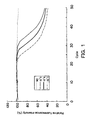
- Real time PCR was performed by using a plasmid incorporated with a region around the mt3243 mutation as a sample and iCycler (Bio-Rad) under the conditions shown below.
- the excitation wavelength and detection wavelength in the real time analysis were 490 nm and 530 nm, respectively.
- Table 6 Compositions of Reaction mixture 1.
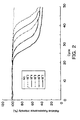
- Samples containing plasmids having the mutant type sequence in various copy numbers were prepared as samples, and quantification was performed by using the probe 5FL-3-30 as the probe in the system 2 mentioned above. The results are shown in Fig. 2 . As seen from the results shown in the drawing, it was confirmed that quantification was possible.
- probes 5FL-1-24, 5FL-1-26, 5FL-1-28 and 5FL-mut-5-23 were used as the probes, similar results were also obtained.
- the vertical axis represents fluorescence intensity relative to the intensity at the start of the reaction, which was taken as 100%, and the horizontal axis represents the number of PCR cycles.
- the primers shown in Table 8 were designed on the basis of the nucleotide sequence containing the site of human mitochondria 3243 A ⁇ G mutation (mt3243 mutation) (SEQ ID NO: 2, the nucleotide number 243 corresponds to the 3243rd position in the mitochondrial gene) so that a region containing the mt3243 mutation could be amplified.
- the positions are indicated with the nucleotide numbers in the nucleotide sequence of SEQ ID NO: 1.
- Table 8 Primers Name Sequence (5' ⁇ 3') mer Position SEQ ID NO: F-27 catctcaacttagtattatacccacac 27 184-210 11 R-22 agaggaattgaacctctgactg 22 296-275 12
- the probes having C at the ends shown in Table 9 were designed.
- the positions are indicated with the nucleotide numbers in the nucleotide sequence of SEQ ID NO: 1. Further, the capital letters in the nucleotide sequences represent sites of the mt3243 mutation, and (P) at the 3' ends means being phosphorylated.
- the probes were labeled with BODIPY (trademark) FL or TAMRA (trademark) in a conventional manner.
- PCR and Tm analysis were performed by using a plasmid incorporated with a region around the mt3243 mutation as a sample and Smart Cycler System (Cephied) under the conditions shown below.
- the excitation wavelength and the detection wavelength in the Tm analysis were 450 to 495 nm and 505 to 537 nm (BODIPY FL) and 527 to 555 nm and 565 to 605 nm (TAMRA), respectively.
- PCR and Tm analysis were performed by using each probe.
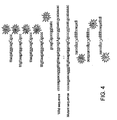
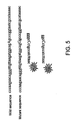
- the positions of the probes relative to the nucleotide sequence containing the mt3243 mutation are shown in Figs. 4 and 5 .
- the wild type sequence and mutant type sequence shown in the drawings correspond to the nucleotide numbers 214 to 263 in the nucleotide sequence of SEQ ID NOS: 1 and 2, respectively.
- F denotes a fluorescent dye.
- the vertical axis represents a primary derivative value of fluorescence intensity with an inverted sign (-dF/dt), and the horizontal axis represents temperature (°C).
- a quenching probe effective for detecting the mt3243 mutation is provided, and a method for detecting the mt3243 mutation by using it and a kit therefor are further provided. Because the Tm analysis is completed within several tens of seconds, time required for the detection can be markedly reduced. According to a preferred embodiment of the present invention, wherein amplification of nucleic acid in the presence of the probe and Tm analysis are combined, only the Tm of the probe is analyzed after the amplification of nucleic acid, and therefore it is not necessary to handle the amplification product after completion of the reaction. Accordingly, there is no risk of contamination with the amplification product. Further, because the detection can be performed with the same equipment as required for the amplification, it is even unnecessary to move a vessel. Therefore, automatization of the method is also easy.
Landscapes
- Chemical & Material Sciences (AREA)
- Life Sciences & Earth Sciences (AREA)
- Proteomics, Peptides & Aminoacids (AREA)
- Health & Medical Sciences (AREA)
- Organic Chemistry (AREA)
- Wood Science & Technology (AREA)
- Analytical Chemistry (AREA)
- Zoology (AREA)
- Genetics & Genomics (AREA)
- Engineering & Computer Science (AREA)
- Pathology (AREA)
- Immunology (AREA)
- Microbiology (AREA)
- Molecular Biology (AREA)
- Biotechnology (AREA)
- Biophysics (AREA)
- Physics & Mathematics (AREA)
- Biochemistry (AREA)
- Bioinformatics & Cheminformatics (AREA)
- General Engineering & Computer Science (AREA)
- General Health & Medical Sciences (AREA)
- Measuring Or Testing Involving Enzymes Or Micro-Organisms (AREA)
Claims (7)
- Nukleinsäuresonde, deren Ende mit einem fluoreszierenden Farbstoff markiert ist, und bei der die Fluoreszenz des fluoreszierenden Farbstoffs bei Hybridisierung abnimmt, wobei die Nukleinsäuresonde eine Nukleotidsequenz aufweist, die komplementär ist zu einer Nukleotidsequenz, die ab dem Nukleotid mit der Nummer 230 in der Nukleotidsequenz gemäß SEQ ID NO:2 beginnt und eine Länge von 14 bis 40 Nukleotiden aufweist, und wobei das 3'-Ende der Sonde mit dem fluoreszierenden Farbstoff markiert ist und die Nukleinsäuresonde die Nukleotidsequenz gemäß SEQ ID NO:21 oder 22 aufweist.
- Verfahren zum Nachweis einer Mutation, wobei man eine Schmelzkurvenanalyse für eine Nukleinsäure, die eine Einzelnukleotidpolymorphismus-Stelle aufweist, unter Verwendung einer mit einem fluoreszierenden Farbstoff markierten Nukleinsäuresonde durchführt und die Fluoreszenz des fluoreszierenden Farbstoffes misst, und die Mutation auf der Grundlage des Ergebnisses der Schmelzkurvenanalyse nachweist, wobei der Einzelnukleotidpolymorphismus eine Mutation an der Position 3243 in einer mitochondrialen DNA ist, und die Nukleinsäuresonde die Nukleinsäuresonde gemäß der Definition in Anspruch 1 ist.
- Verfahren nach Anspruch 2, wobei eine Region, welche die Einzelnukleotidpolymorphismus-Stelle in einer Nukleinsäure enthält, die in einer Probe enthalten ist, amplifiziert wird, um die Nukleinsäure zu erhalten, die den Einzelnukleotidpolymorphismus aufweist.
- Verfahren nach Anspruch 3, wobei die Amplifizierung mittels eines Verfahrens unter Verwendung einer DNA-Polymerase durchgeführt wird.
- Verfahren nach Anspruch 4, wobei die Amplifizierung in Gegenwart einer Nukleinsäuresonde durchgeführt wird.
- Kit für das Verfahren gemäß der Definition in Anspruch 2, der eine Nukleinsäuresonde umfasst, deren Ende mit einem fluoreszierenden Farbstoff markiert ist, und bei der die Fluoreszenz des fluoreszierenden Farbstoffs bei Hybridisierung abnimmt, wobei die Nukleinsäuresonde eine Nukleotidsequenz aufweist, die komplementär ist zu einer Nukleotidsequenz, die ab dem Nukleotid mit der Nummer 230 in der Nukleotidsequenz gemäß SEQ ID NO:2 beginnt und eine Länge von 14 bis 40 Nukleotiden aufweist, und wobei das 3'-Ende der Sonde mit dem fluoreszierenden Farbstoff markiert ist und die Nukleinsäuresonde die Nukleotidsequenz gemäß SEQ ID NO:21 oder 22 aufweist.
- Kit nach Anspruch 6, der zusätzlich einen Primer für die Amplifizierung einer Region, welche die Mutation an Position 3243 in einer mitochondrialen DNA enthält, mittels eines Verfahrens unter Verwendung einer DNA-Polymerase umfasst.
Applications Claiming Priority (3)
| Application Number | Priority Date | Filing Date | Title |
|---|---|---|---|
| JP2003111173A JP2004313073A (ja) | 2003-04-16 | 2003-04-16 | ミトコンドリアdna3243変異の検出法および定量法ならびにそのためのキット |
| JP2003114382A JP4276874B2 (ja) | 2003-04-18 | 2003-04-18 | ミトコンドリアdna3243変異の検出法ならびにそのための核酸プローブおよびキット |
| PCT/JP2004/005496 WO2004092415A1 (ja) | 2003-04-16 | 2004-04-16 | ミトコンドリアdna3243変異の検出法および定量法ならびにそのためのキット |
Publications (3)
| Publication Number | Publication Date |
|---|---|
| EP1619258A1 EP1619258A1 (de) | 2006-01-25 |
| EP1619258A4 EP1619258A4 (de) | 2007-03-07 |
| EP1619258B1 true EP1619258B1 (de) | 2011-06-15 |
Family
ID=33302216
Family Applications (1)
| Application Number | Title | Priority Date | Filing Date |
|---|---|---|---|
| EP04728015A Expired - Lifetime EP1619258B1 (de) | 2003-04-16 | 2004-04-16 | Verfahren zum nachweis oder zur quantitativen bestimmung der mitochondrialen dna-variation 3243 und kit dafür |
Country Status (4)
| Country | Link |
|---|---|
| US (2) | US7625723B2 (de) |
| EP (1) | EP1619258B1 (de) |
| AT (1) | ATE513059T1 (de) |
| WO (1) | WO2004092415A1 (de) |
Families Citing this family (5)
| Publication number | Priority date | Publication date | Assignee | Title |
|---|---|---|---|---|
| US9115391B2 (en) | 2008-07-02 | 2015-08-25 | Arkray, Inc. | Method of detecting a polymorphism at a polymorphism site |
| US8346485B2 (en) | 2008-11-25 | 2013-01-01 | Quest Diagnostics Investments Incorporated | Methods and apparatuses for estimating initial target nucleic acid concentration in a sample by modeling background signal and cycle-dependent amplification efficiency of a polymerase chain reaction |
| WO2010126856A1 (en) * | 2009-04-27 | 2010-11-04 | The Charles Stark Draper Laboratory, Inc. | Rapid detection of volatile organic compounds for identification of mycobacterium tuberculosis in a sample |
| JP5684737B2 (ja) | 2010-01-21 | 2015-03-18 | アークレイ株式会社 | 標的配列の増幅方法、多型検出方法およびそれに用いる試薬 |
| CN103852368B (zh) * | 2013-09-04 | 2016-05-04 | 南京农业大学 | 黄瓜花粉半薄切片mtg-dapi双染色观察线粒体dna |
Family Cites Families (8)
| Publication number | Priority date | Publication date | Assignee | Title |
|---|---|---|---|---|
| US7081226B1 (en) * | 1996-06-04 | 2006-07-25 | University Of Utah Research Foundation | System and method for fluorescence monitoring |
| JPH11221077A (ja) | 1998-02-04 | 1999-08-17 | Otsuka Pharmaceut Co Ltd | 変異ヒトミトコンドリア遺伝子及び糖尿病遺伝子診断への応用 |
| JP3437816B2 (ja) | 1999-04-20 | 2003-08-18 | 環境エンジニアリング株式会社 | 核酸の測定方法 |
| CA2383939C (en) | 2000-06-27 | 2009-12-01 | National Institute Of Advanced Industrial Science And Technology | Novel nucleic acid probes, method for determining nucleic acids by using the probes, and method for analyzing data obtained by the method |
| JP3963422B2 (ja) | 2000-08-03 | 2007-08-22 | 日鉄環境エンジニアリング株式会社 | 核酸の測定方法 |
| EP1334113A4 (de) | 2000-10-20 | 2007-08-08 | Expression Diagnostics Inc | Erstellen von leukozytenexpressionsprofilen |
| WO2002072875A1 (en) * | 2001-03-14 | 2002-09-19 | The Chinese University Of Hong Kong | Method and compositions for evaluating risk of developing type 2 diabetes in people of chinese descent |
| US6979541B1 (en) * | 2001-07-26 | 2005-12-27 | University Of Utah Research Foundation | Methods for identifying chromosomal aneuploidy |
-
2004
- 2004-04-16 AT AT04728015T patent/ATE513059T1/de not_active IP Right Cessation
- 2004-04-16 US US10/553,576 patent/US7625723B2/en not_active Ceased
- 2004-04-16 US US13/234,907 patent/USRE44894E1/en not_active Expired - Fee Related
- 2004-04-16 WO PCT/JP2004/005496 patent/WO2004092415A1/ja not_active Ceased
- 2004-04-16 EP EP04728015A patent/EP1619258B1/de not_active Expired - Lifetime
Also Published As
| Publication number | Publication date |
|---|---|
| US20060188886A1 (en) | 2006-08-24 |
| USRE44894E1 (en) | 2014-05-13 |
| ATE513059T1 (de) | 2011-07-15 |
| WO2004092415A1 (ja) | 2004-10-28 |
| US7625723B2 (en) | 2009-12-01 |
| EP1619258A1 (de) | 2006-01-25 |
| EP1619258A4 (de) | 2007-03-07 |
Similar Documents
| Publication | Publication Date | Title |
|---|---|---|
| EP2447378B1 (de) | Sonde zur Erkennung von Polymorphismen des EGFR-Gens, Verstärkungsprimer und Anwendung davon | |
| EP2518164B1 (de) | Sonde zum Erkennen der Mutation in Exon 12 des NPM1-Gens und Verwendung davon | |
| EP2511370B1 (de) | SONDE ZUR ERKENNUNG VON POLYMORPHISMEN IM K-ras GEN UND VERWENDUNG DAVON | |
| EP1619258B1 (de) | Verfahren zum nachweis oder zur quantitativen bestimmung der mitochondrialen dna-variation 3243 und kit dafür | |
| EP1616953B1 (de) | Verfahren zum nachweis des gens einer beta-3-adrenalinrezeptor-mutante sowie nukleinsäuresonde und kit dafür | |
| EP2447376A1 (de) | Polymorphismuserkennungssonde, Polymorphismuserkennungsverfahren, Bewertung der Arzneimittelwirksamkeit und Erkennungskit für Polymorphismus | |
| JP4505838B2 (ja) | Nat2*6の変異の検出法ならびにそのための核酸プローブおよびキット | |
| KR20120124028A (ko) | 다형 검출용 프로브, 다형 검출 방법, 약효 평가 방법, 질환 예측 방법 및 다형 검출용 시약 키트 | |
| EP1616952B1 (de) | Verfahren zum nachweis des gens einer mutante des pankreatischen insel-amyloidproteins sowie nukleinsäuresonde und kit dafür | |
| JP4437207B2 (ja) | Cyp2d6の変異の検出法ならびにそのための核酸プローブおよびキット | |
| JP6205216B2 (ja) | 変異検出用プローブ、変異検出方法、薬効判定方法及び変異検出用キット | |
| JP4505839B2 (ja) | Cyp2d6*4の変異の検出法ならびにそのための核酸プローブおよびキット | |
| JP4276874B2 (ja) | ミトコンドリアdna3243変異の検出法ならびにそのための核酸プローブおよびキット | |
| JP2004313073A (ja) | ミトコンドリアdna3243変異の検出法および定量法ならびにそのためのキット | |
| JP4517175B2 (ja) | Nat2*7の変異の検出法ならびにそのための核酸プローブおよびキット | |
| JP4517176B2 (ja) | Nat2*5の変異の検出法ならびにそのための核酸プローブおよびキット | |
| JP4437206B2 (ja) | Cyp2c9の変異の検出法ならびにそのための核酸プローブおよびキット | |
| JP5047450B2 (ja) | Cyp2c19*3アレルの検出法およびそのための核酸プローブ | |
| JP4454365B2 (ja) | Cyp2d6*2の変異の検出法ならびにそのための核酸プローブおよびキット | |
| JP4454377B2 (ja) | チオプリンメチルトランスフェラーゼの変異の検出法ならびにそのための核酸プローブおよびキット |
Legal Events
| Date | Code | Title | Description |
|---|---|---|---|
| PUAI | Public reference made under article 153(3) epc to a published international application that has entered the european phase |
Free format text: ORIGINAL CODE: 0009012 |
|
| 17P | Request for examination filed |
Effective date: 20051031 |
|
| AK | Designated contracting states |
Kind code of ref document: A1 Designated state(s): AT BE BG CH CY CZ DE DK EE ES FI FR GB GR HU IE IT LI LU MC NL PL PT RO SE SI SK TR |
|
| AX | Request for extension of the european patent |
Extension state: AL HR LT LV MK |
|
| XX | Miscellaneous (additional remarks) |
Free format text: THE APPLICANT HAS REQUESTED CORRECTION OF OBVIOUS ERRORS. |
|
| DAX | Request for extension of the european patent (deleted) | ||
| RIC1 | Information provided on ipc code assigned before grant |
Ipc: C12Q 1/68 20060101AFI20041102BHEP |
|
| A4 | Supplementary search report drawn up and despatched |
Effective date: 20070206 |
|
| 17Q | First examination report despatched |
Effective date: 20080424 |
|
| GRAP | Despatch of communication of intention to grant a patent |
Free format text: ORIGINAL CODE: EPIDOSNIGR1 |
|
| GRAS | Grant fee paid |
Free format text: ORIGINAL CODE: EPIDOSNIGR3 |
|
| GRAA | (expected) grant |
Free format text: ORIGINAL CODE: 0009210 |
|
| AK | Designated contracting states |
Kind code of ref document: B1 Designated state(s): AT BE BG CH CY CZ DE DK EE ES FI FR GB GR HU IE IT LI LU MC NL PL PT RO SE SI SK TR |
|
| REG | Reference to a national code |
Ref country code: GB Ref legal event code: FG4D Ref country code: CH Ref legal event code: EP |
|
| XX | Miscellaneous (additional remarks) |
Free format text: THE APPLICANT HAS REQUESTED CORRECTION OF OBVIOUS ERRORS. |
|
| REG | Reference to a national code |
Ref country code: IE Ref legal event code: FG4D |
|
| REG | Reference to a national code |
Ref country code: DE Ref legal event code: R096 Ref document number: 602004033076 Country of ref document: DE Effective date: 20110721 |
|
| REG | Reference to a national code |
Ref country code: NL Ref legal event code: VDEP Effective date: 20110615 |
|
| PG25 | Lapsed in a contracting state [announced via postgrant information from national office to epo] |
Ref country code: SE Free format text: LAPSE BECAUSE OF FAILURE TO SUBMIT A TRANSLATION OF THE DESCRIPTION OR TO PAY THE FEE WITHIN THE PRESCRIBED TIME-LIMIT Effective date: 20110615 |
|
| PG25 | Lapsed in a contracting state [announced via postgrant information from national office to epo] |
Ref country code: FI Free format text: LAPSE BECAUSE OF FAILURE TO SUBMIT A TRANSLATION OF THE DESCRIPTION OR TO PAY THE FEE WITHIN THE PRESCRIBED TIME-LIMIT Effective date: 20110615 Ref country code: AT Free format text: LAPSE BECAUSE OF FAILURE TO SUBMIT A TRANSLATION OF THE DESCRIPTION OR TO PAY THE FEE WITHIN THE PRESCRIBED TIME-LIMIT Effective date: 20110615 Ref country code: CY Free format text: LAPSE BECAUSE OF FAILURE TO SUBMIT A TRANSLATION OF THE DESCRIPTION OR TO PAY THE FEE WITHIN THE PRESCRIBED TIME-LIMIT Effective date: 20110615 Ref country code: SI Free format text: LAPSE BECAUSE OF FAILURE TO SUBMIT A TRANSLATION OF THE DESCRIPTION OR TO PAY THE FEE WITHIN THE PRESCRIBED TIME-LIMIT Effective date: 20110615 Ref country code: GR Free format text: LAPSE BECAUSE OF FAILURE TO SUBMIT A TRANSLATION OF THE DESCRIPTION OR TO PAY THE FEE WITHIN THE PRESCRIBED TIME-LIMIT Effective date: 20110916 |
|
| PG25 | Lapsed in a contracting state [announced via postgrant information from national office to epo] |
Ref country code: BE Free format text: LAPSE BECAUSE OF FAILURE TO SUBMIT A TRANSLATION OF THE DESCRIPTION OR TO PAY THE FEE WITHIN THE PRESCRIBED TIME-LIMIT Effective date: 20110615 Ref country code: NL Free format text: LAPSE BECAUSE OF FAILURE TO SUBMIT A TRANSLATION OF THE DESCRIPTION OR TO PAY THE FEE WITHIN THE PRESCRIBED TIME-LIMIT Effective date: 20110615 |
|
| PG25 | Lapsed in a contracting state [announced via postgrant information from national office to epo] |
Ref country code: PT Free format text: LAPSE BECAUSE OF FAILURE TO SUBMIT A TRANSLATION OF THE DESCRIPTION OR TO PAY THE FEE WITHIN THE PRESCRIBED TIME-LIMIT Effective date: 20111017 Ref country code: CZ Free format text: LAPSE BECAUSE OF FAILURE TO SUBMIT A TRANSLATION OF THE DESCRIPTION OR TO PAY THE FEE WITHIN THE PRESCRIBED TIME-LIMIT Effective date: 20110615 Ref country code: EE Free format text: LAPSE BECAUSE OF FAILURE TO SUBMIT A TRANSLATION OF THE DESCRIPTION OR TO PAY THE FEE WITHIN THE PRESCRIBED TIME-LIMIT Effective date: 20110615 |
|
| PG25 | Lapsed in a contracting state [announced via postgrant information from national office to epo] |
Ref country code: PL Free format text: LAPSE BECAUSE OF FAILURE TO SUBMIT A TRANSLATION OF THE DESCRIPTION OR TO PAY THE FEE WITHIN THE PRESCRIBED TIME-LIMIT Effective date: 20110615 Ref country code: SK Free format text: LAPSE BECAUSE OF FAILURE TO SUBMIT A TRANSLATION OF THE DESCRIPTION OR TO PAY THE FEE WITHIN THE PRESCRIBED TIME-LIMIT Effective date: 20110615 Ref country code: RO Free format text: LAPSE BECAUSE OF FAILURE TO SUBMIT A TRANSLATION OF THE DESCRIPTION OR TO PAY THE FEE WITHIN THE PRESCRIBED TIME-LIMIT Effective date: 20110615 |
|
| PLBE | No opposition filed within time limit |
Free format text: ORIGINAL CODE: 0009261 |
|
| STAA | Information on the status of an ep patent application or granted ep patent |
Free format text: STATUS: NO OPPOSITION FILED WITHIN TIME LIMIT |
|
| 26N | No opposition filed |
Effective date: 20120316 |
|
| PG25 | Lapsed in a contracting state [announced via postgrant information from national office to epo] |
Ref country code: DK Free format text: LAPSE BECAUSE OF FAILURE TO SUBMIT A TRANSLATION OF THE DESCRIPTION OR TO PAY THE FEE WITHIN THE PRESCRIBED TIME-LIMIT Effective date: 20110615 |
|
| REG | Reference to a national code |
Ref country code: DE Ref legal event code: R097 Ref document number: 602004033076 Country of ref document: DE Effective date: 20120316 |
|
| PG25 | Lapsed in a contracting state [announced via postgrant information from national office to epo] |
Ref country code: MC Free format text: LAPSE BECAUSE OF NON-PAYMENT OF DUE FEES Effective date: 20120430 |
|
| REG | Reference to a national code |
Ref country code: CH Ref legal event code: PL |
|
| REG | Reference to a national code |
Ref country code: IE Ref legal event code: MM4A |
|
| PG25 | Lapsed in a contracting state [announced via postgrant information from national office to epo] |
Ref country code: LI Free format text: LAPSE BECAUSE OF NON-PAYMENT OF DUE FEES Effective date: 20120430 Ref country code: IE Free format text: LAPSE BECAUSE OF NON-PAYMENT OF DUE FEES Effective date: 20120416 Ref country code: CH Free format text: LAPSE BECAUSE OF NON-PAYMENT OF DUE FEES Effective date: 20120430 |
|
| PG25 | Lapsed in a contracting state [announced via postgrant information from national office to epo] |
Ref country code: ES Free format text: LAPSE BECAUSE OF FAILURE TO SUBMIT A TRANSLATION OF THE DESCRIPTION OR TO PAY THE FEE WITHIN THE PRESCRIBED TIME-LIMIT Effective date: 20110926 |
|
| PG25 | Lapsed in a contracting state [announced via postgrant information from national office to epo] |
Ref country code: BG Free format text: LAPSE BECAUSE OF FAILURE TO SUBMIT A TRANSLATION OF THE DESCRIPTION OR TO PAY THE FEE WITHIN THE PRESCRIBED TIME-LIMIT Effective date: 20110915 |
|
| PG25 | Lapsed in a contracting state [announced via postgrant information from national office to epo] |
Ref country code: TR Free format text: LAPSE BECAUSE OF FAILURE TO SUBMIT A TRANSLATION OF THE DESCRIPTION OR TO PAY THE FEE WITHIN THE PRESCRIBED TIME-LIMIT Effective date: 20110615 |
|
| PG25 | Lapsed in a contracting state [announced via postgrant information from national office to epo] |
Ref country code: LU Free format text: LAPSE BECAUSE OF NON-PAYMENT OF DUE FEES Effective date: 20120416 |
|
| PG25 | Lapsed in a contracting state [announced via postgrant information from national office to epo] |
Ref country code: HU Free format text: LAPSE BECAUSE OF FAILURE TO SUBMIT A TRANSLATION OF THE DESCRIPTION OR TO PAY THE FEE WITHIN THE PRESCRIBED TIME-LIMIT Effective date: 20040416 |
|
| REG | Reference to a national code |
Ref country code: FR Ref legal event code: PLFP Year of fee payment: 13 |
|
| REG | Reference to a national code |
Ref country code: FR Ref legal event code: PLFP Year of fee payment: 14 |
|
| PGFP | Annual fee paid to national office [announced via postgrant information from national office to epo] |
Ref country code: FR Payment date: 20170419 Year of fee payment: 14 Ref country code: DE Payment date: 20170419 Year of fee payment: 14 Ref country code: GB Payment date: 20170419 Year of fee payment: 14 |
|
| PGFP | Annual fee paid to national office [announced via postgrant information from national office to epo] |
Ref country code: IT Payment date: 20170424 Year of fee payment: 14 |
|
| REG | Reference to a national code |
Ref country code: DE Ref legal event code: R119 Ref document number: 602004033076 Country of ref document: DE |
|
| GBPC | Gb: european patent ceased through non-payment of renewal fee |
Effective date: 20180416 |
|
| PG25 | Lapsed in a contracting state [announced via postgrant information from national office to epo] |
Ref country code: DE Free format text: LAPSE BECAUSE OF NON-PAYMENT OF DUE FEES Effective date: 20181101 |
|
| PG25 | Lapsed in a contracting state [announced via postgrant information from national office to epo] |
Ref country code: GB Free format text: LAPSE BECAUSE OF NON-PAYMENT OF DUE FEES Effective date: 20180416 |
|
| PG25 | Lapsed in a contracting state [announced via postgrant information from national office to epo] |
Ref country code: IT Free format text: LAPSE BECAUSE OF NON-PAYMENT OF DUE FEES Effective date: 20180416 Ref country code: FR Free format text: LAPSE BECAUSE OF NON-PAYMENT OF DUE FEES Effective date: 20180430 |