EP1619927A2 - Boîtier pour appareil auditif placé derrière l'oreille avec propriétés auto-adhérentes - Google Patents
Boîtier pour appareil auditif placé derrière l'oreille avec propriétés auto-adhérentes Download PDFInfo
- Publication number
- EP1619927A2 EP1619927A2 EP05018379A EP05018379A EP1619927A2 EP 1619927 A2 EP1619927 A2 EP 1619927A2 EP 05018379 A EP05018379 A EP 05018379A EP 05018379 A EP05018379 A EP 05018379A EP 1619927 A2 EP1619927 A2 EP 1619927A2
- Authority
- EP
- European Patent Office
- Prior art keywords
- housing
- shell
- hearing aid
- slip
- hearing
- Prior art date
- Legal status (The legal status is an assumption and is not a legal conclusion. Google has not performed a legal analysis and makes no representation as to the accuracy of the status listed.)
- Withdrawn
Links
Images

Classifications
-
- H—ELECTRICITY
- H04—ELECTRIC COMMUNICATION TECHNIQUE
- H04R—LOUDSPEAKERS, MICROPHONES, GRAMOPHONE PICK-UPS OR LIKE ACOUSTIC ELECTROMECHANICAL TRANSDUCERS; ELECTRIC HEARING AIDS; PUBLIC ADDRESS SYSTEMS
- H04R25/00—Electric hearing aids
- H04R25/65—Housing parts, e.g. shells, tips or moulds, or their manufacture
- H04R25/658—Manufacture of housing parts
-
- H—ELECTRICITY
- H04—ELECTRIC COMMUNICATION TECHNIQUE
- H04R—LOUDSPEAKERS, MICROPHONES, GRAMOPHONE PICK-UPS OR LIKE ACOUSTIC ELECTROMECHANICAL TRANSDUCERS; ELECTRIC HEARING AIDS; PUBLIC ADDRESS SYSTEMS
- H04R25/00—Electric hearing aids
- H04R25/65—Housing parts, e.g. shells, tips or moulds, or their manufacture
-
- H—ELECTRICITY
- H04—ELECTRIC COMMUNICATION TECHNIQUE
- H04R—LOUDSPEAKERS, MICROPHONES, GRAMOPHONE PICK-UPS OR LIKE ACOUSTIC ELECTROMECHANICAL TRANSDUCERS; ELECTRIC HEARING AIDS; PUBLIC ADDRESS SYSTEMS
- H04R25/00—Electric hearing aids
- H04R25/60—Mounting or interconnection of hearing aid parts, e.g. inside tips, housings or to ossicles
- H04R25/607—Mounting or interconnection of hearing aid parts, e.g. inside tips, housings or to ossicles of earhooks
Definitions
- the present invention relates to a hearing aid according to the preamble of claim 1, and a method for its production.
- Hearing aids in particular behind the ear hearing aids, are getting smaller and the hook, which holds the hearing aid in position behind the ear, is getting finer and thinner.
- these hearing aids are desirable properties for hearing aid wearers, but there is the problem that these hearing aids hardly remain in position, or can fall off this position. Especially in sports or physical work, this problem is particularly strong by i.d.R. the head is moved strongly and thus used hearing aids do not remain in position.
- the object is achieved by means of a hearing aid according to the wording of claim 1.
- the hearing aid housing at least partially has a non-slip surface.
- the non-slip surface is preferably located in a region of the device which has contact with the carrier.
- This non-slip surface may, for example, consist of an elastomeric polymer, which, in addition to hydrophilic properties, may optionally also have self-adhesive properties.
- the non-slip surface can also have the property of absorbing moisture or sweat easily on the skin. This effect is particularly effective in situations where conventional equipment begins to slip for improved support and comfort for the wearer.
- the elastomeric polymer may be, for example, a natural rubber, a synthetic rubber such as, in particular, an isoprene-based rubber, a silicone rubber, a styrene-, butadiene- and isoprene-based elastomer, etc.
- the elastomeric material is slightly open-pored to increase the adhesive properties.
- This open porosity can, for example, also be achieved by the fact that the elastomeric material is at least partially foamed.
- adhesive silicone materials which have a particularly good skin and body compatibility.
- adhesive silicone materials also have self-adhesive properties on the skin, which is advantageous in the context of the present invention.
- non-slip areas can either be colored or kept in the same color as the device.
- the hearing aid housing it is possible to form a part of the hearing aid housing with the proposed elastomeric material, for example by means of a so-called 2K injection method.
- the proposed elastomeric material for the manufacture of the entire housing.
- a coating on an already existing, conventional hearing device housing or a hearing aid shell either by using a coating technique or by sticking so-called adhesive pads.
- adhesive pads can either be firmly applied to the hearing aid shell or removable again, which has the advantage that after a certain gestation these adhesive pads can be replaced.
- parts of the housing shell may be formed as adhesive chips, which are exchangeable or attachable to the housing.
- the work-enhancing surface by means of a pull-on, elastic, stocking-like hose which can be pulled over a conventionally produced hearing aid housing.
- a pull-on, elastic, stocking-like hose which can be pulled over a conventionally produced hearing aid housing.
- the stocking-like elastic tube it is, for example, already possible to provide corresponding guides or grooves or knobs in the hearing device housing, so that the tube can be arranged in a positionally reliable manner on the hearing aid.
- the hearing aid proposed according to the invention directly, for example by simultaneously spraying two materials during the manufacture of the housing, wherein one material is the at least partially elastomeric polymer proposed according to the invention. It goes without saying that at least those surface parts are to be equipped with this material, which rests when wearing the hearing aid on the skin or the game behind the ear on the body.
- Another manufacturing method is that initially in the hearing aid housing on the housing recessed areas, in the sense of a form, for example, are provided, in which then the self-adhesive pads of the elastomeric material, for example, can be glued.
- the great advantage of the proposed position or non-slip hearing aids according to the invention is, in particular, that even such active hearing aids can easily support such hearing aids in all situations of life, which certainly can also contribute to strengthening the personality.
- today worn hearing aids and in particular those which have very small housing and a small hook it is disadvantageous that these devices often have to be stored in active operations of people.
- the present invention is not limited to only hearing aids, but may be applied to others Miniature devices, such as headsets, communication devices, etc., which are worn for example in the ear area and which can hardly find support because of their very small dimensions.
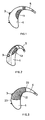
- Fig. 1 shows schematically seen from the side of a hearing aid 1, comprising, for example, an operating element 3, and arranged on the hearing aid, so-called hook 5 for connecting the hearing aid via a connecting tube to the otoplastic (not shown).
- a non-slip portion 11 is formed, for example. Consisting of a hydrophilic Elastomeric polymer, such as, for example, synthetic rubber, silicone rubber, styrene-butadiene-styrene elastomer, etc.
- This lot 11 can, for example, already be created in the manufacture of the hearing aid housing, by means of so-called 2K spray technique by the two for The hearing aid housing used polymers are injected simultaneously into a tool.
- Fig. 2 shows in perspective from behind a further embodiment of an inventive hearing aid 1 with microphone cover, in which now non-slip trained surface parts 13 are created by sticking corresponding self-adhesive pads.
- These pads can be glued both firmly on the housing, as well as removable again, which has the advantage that after a certain gestation these pads can be replaced.
- hearing aids are quite expensive, it certainly makes sense if these pads, which can be contaminated by the up or concern on the skin by sweat, from time to time replaced or cleaned.
- a stocking-like tube 21 has been raised to form the non-slip surface.
- this tube 21 In order for this tube 21 to be held in a positionally accurate manner on the housing 1, it is advantageous to provide corresponding guides or depressions 23 which, for example, can already be provided when spraying the housing.
- the tube 21 proposed in Fig. 3 can be easily replaced.
- Suitable materials for the production of the inventively proposed slip-trained hose are preferably hydrophilic elastomeric materials, for example. On the basis of Silicone rubber. However, elastomeric copolyamide materials and the like can certainly be used for the production of the inventive non-slip hose. It is also conceivable to produce the tube in different colors. Thus, the non-slip areas can either be colored or kept in the same color as the device.
- FIG. 4 serves as an illustration of how corresponding locations can already be provided on a conventional hearing device housing on which the non-slip and self-adhesive polymer can be arranged.
- a region, or a form, 31 is provided on the hearing aid housing 1, which is slightly recessed, so that subsequently a self-adhesive elastomer pad, such as. Consisting of silicone rubber can be inserted.
- the hearing aid housings and materials mentioned with reference to FIGS. 1 to 4 are only examples for a better explanation of the present invention.
- the hearing aid shell at any point non-slip and possibly self-adhesive form, and it is certainly advantageous to make this at those points which bear when wearing the hearing aid on or on the skin.
- the mentioned or proposed materials are only examples and x-any elastomeric polymer materials can be used which on the one hand have a certain hydrophilicity, a certain self-adhesive effect and of course which are skin-friendly, or medically safe.
- these materials may also be slightly porous be formed or it may even be slightly foamed polymers.
- the present invention is by no means limited to hearing aid housings, but also applies to all kinds of differently designed miniature devices, especially in the electronics sector, which are worn on any part of the body, in particular the ear.
- These may be, for example, headsets, communication devices, transmission modules, etc., which due to their smallest dimensioning adhere poorly to the body, and thus there is a risk of dropping out.
Landscapes
- Engineering & Computer Science (AREA)
- Manufacturing & Machinery (AREA)
- Health & Medical Sciences (AREA)
- General Health & Medical Sciences (AREA)
- Neurosurgery (AREA)
- Otolaryngology (AREA)
- Physics & Mathematics (AREA)
- Acoustics & Sound (AREA)
- Signal Processing (AREA)
- Orthopedics, Nursing, And Contraception (AREA)
- Materials For Medical Uses (AREA)
- Headphones And Earphones (AREA)
Priority Applications (2)
| Application Number | Priority Date | Filing Date | Title |
|---|---|---|---|
| EP05018379A EP1619927A3 (fr) | 2005-08-24 | 2005-08-24 | Boîtier pour appareil auditif placé derrière l'oreille avec propriétés auto-adhérentes |
| EP05023815A EP1624720A3 (fr) | 2005-08-24 | 2005-11-02 | Boîtier d'équipement placé derrière l'oreille avec propriétés autoadhésives |
Applications Claiming Priority (1)
| Application Number | Priority Date | Filing Date | Title |
|---|---|---|---|
| EP05018379A EP1619927A3 (fr) | 2005-08-24 | 2005-08-24 | Boîtier pour appareil auditif placé derrière l'oreille avec propriétés auto-adhérentes |
Publications (2)
| Publication Number | Publication Date |
|---|---|
| EP1619927A2 true EP1619927A2 (fr) | 2006-01-25 |
| EP1619927A3 EP1619927A3 (fr) | 2006-04-19 |
Family
ID=34937965
Family Applications (1)
| Application Number | Title | Priority Date | Filing Date |
|---|---|---|---|
| EP05018379A Withdrawn EP1619927A3 (fr) | 2005-08-24 | 2005-08-24 | Boîtier pour appareil auditif placé derrière l'oreille avec propriétés auto-adhérentes |
Country Status (1)
| Country | Link |
|---|---|
| EP (1) | EP1619927A3 (fr) |
Cited By (1)
| Publication number | Priority date | Publication date | Assignee | Title |
|---|---|---|---|---|
| WO2010096032A1 (fr) * | 2009-02-20 | 2010-08-26 | Siemens Hearing Instruments, Inc. | Coque d'instrument auditif composite |
Family Cites Families (9)
| Publication number | Priority date | Publication date | Assignee | Title |
|---|---|---|---|---|
| DE3738212A1 (de) * | 1987-11-11 | 1989-05-24 | Herbert Weisener | Verfahren zur herstellung eines mit einer bedruckung und/oder einer dekoration versehenen gegenstandes aus einem thermoplastischen kunststoff |
| DE8816422U1 (de) * | 1988-05-06 | 1989-08-10 | Siemens AG, 1000 Berlin und 8000 München | Hörhilfegerät mit drahtloser Fernsteuerung |
| JP2571128B2 (ja) * | 1989-06-16 | 1997-01-16 | フオスター電機株式会社 | ヘッドホン |
| JPH11510345A (ja) * | 1995-08-03 | 1999-09-07 | ハンス・ディーター ボロフスキー | 補聴器 |
| US5687244A (en) * | 1996-03-28 | 1997-11-11 | Stanton Magnetics, Inc. | Bone conduction speaker and mounting system |
| US6167141A (en) * | 1998-04-30 | 2000-12-26 | Beltone Electronics Corporation | Multimaterial hearing aid housing |
| AT411512B (de) * | 2000-06-30 | 2004-01-26 | Spirit Design Huber Christoffe | Hörer |
| US20030044036A1 (en) * | 2001-08-31 | 2003-03-06 | Masters Martin W. | Textured surfaces fo hearing instruments |
| EP1307071A1 (fr) * | 2002-08-05 | 2003-05-02 | Phonak Ag | Prothese auditive retro-auriculaire comme commutateur |
-
2005
- 2005-08-24 EP EP05018379A patent/EP1619927A3/fr not_active Withdrawn
Cited By (1)
| Publication number | Priority date | Publication date | Assignee | Title |
|---|---|---|---|---|
| WO2010096032A1 (fr) * | 2009-02-20 | 2010-08-26 | Siemens Hearing Instruments, Inc. | Coque d'instrument auditif composite |
Also Published As
| Publication number | Publication date |
|---|---|
| EP1619927A3 (fr) | 2006-04-19 |
Similar Documents
| Publication | Publication Date | Title |
|---|---|---|
| EP2632524B1 (fr) | Pansement pour le cou destiné à des canules trachéales ou des nez artificiels comportant une membrane vocale | |
| DE102010019405A1 (de) | Textillaminat und Bandage | |
| DE102008036258A1 (de) | Ohrpassstück für ein Hörgerät | |
| DE102009031405B3 (de) | Gehäuseschale für ein Hörhilfegerät, Hörhilfegerät und Verfahren zur Herstellung | |
| EP0821541A2 (fr) | Prothèse auditive portable complètement dans le conduit auditif et individualisée par moulage d'un corps | |
| DE102005009634A1 (de) | Folienverband mit verbesserter Applikationshilfe | |
| EP1563712A1 (fr) | Ensemble et procede pour produire une prothese auditive et prothese auditive produite selon ledit procede | |
| EP1619927A2 (fr) | Boîtier pour appareil auditif placé derrière l'oreille avec propriétés auto-adhérentes | |
| EP1624720A2 (fr) | Boîtier d'équipement placé derrière l'oreille avec propriétés autoadhésives | |
| EP3089480B2 (fr) | Procédé de fabrication d'une prothèse auditive et prothèse auditive | |
| DE102011051272B4 (de) | Haltevorrichtung für die Fixierung von Tracheostoma-Kanülen | |
| EP1841288A2 (fr) | Appareil auditif doté d'un dispositif anti-cérumen à pores ouverts | |
| EP1900323A1 (fr) | Electrode médicale | |
| DE102017217718B4 (de) | Otoplastik zur Einführung in einen Ohrkanal und Verfahren zur Fertigung einer Otoplastik | |
| DE102018125347A1 (de) | Verfahren zur Erfassung und lokalisierenden Darstellung bewegungsabhängiger Verformungen eines äußeren Gehörgangs, Verfahren zur Herstellung eines Ohrabformelements, Verfahren zur Herstellung einer Otoplastik und Ohreinsatzelement | |
| DE202015007965U1 (de) | Anordnung zur transkutanen Stimulation eines Abschnittes des Ohrs eines Benutzers | |
| DE102004050133A1 (de) | Offene Otoplastik | |
| DE102014221590B4 (de) | Ohrstöpselset und Ohrstöpsel | |
| EP3204053B1 (fr) | Procédé et dispositif de traitement pour l'élimination permanente des moisissures | |
| DE202008014098U1 (de) | Kompresse | |
| EP3383612B1 (fr) | Procédé pour produire sélectivement une première ou une deuxième variante d'une pièce plastique à plusieurs couches | |
| DE3006391C2 (de) | Verfahren zur Herstellung einer Randauflage aus Schaumstoff für Sportbrillen | |
| AT518147B1 (de) | Gerät, welches einen Ohrlautsprecher umfasst und zwei Hebel aufweist | |
| DE202012004277U1 (de) | Schuhlöffel mit aufgerauter Oberfläche | |
| DE202024101159U1 (de) | Paar von Otoplastiken |
Legal Events
| Date | Code | Title | Description |
|---|---|---|---|
| PUAI | Public reference made under article 153(3) epc to a published international application that has entered the european phase |
Free format text: ORIGINAL CODE: 0009012 |
|
| AK | Designated contracting states |
Kind code of ref document: A2 Designated state(s): AT BE BG CH CY CZ DE DK EE ES FI FR GB GR HU IE IS IT LI LT LU LV MC NL PL PT RO SE SI SK TR |
|
| AX | Request for extension of the european patent |
Extension state: AL BA HR MK YU |
|
| PUAL | Search report despatched |
Free format text: ORIGINAL CODE: 0009013 |
|
| AK | Designated contracting states |
Kind code of ref document: A3 Designated state(s): AT BE BG CH CY CZ DE DK EE ES FI FR GB GR HU IE IS IT LI LT LU LV MC NL PL PT RO SE SI SK TR |
|
| AX | Request for extension of the european patent |
Extension state: AL BA HR MK YU |
|
| AKX | Designation fees paid | ||
| REG | Reference to a national code |
Ref country code: DE Ref legal event code: 8566 |
|
| STAA | Information on the status of an ep patent application or granted ep patent |
Free format text: STATUS: THE APPLICATION IS DEEMED TO BE WITHDRAWN |
|
| 18D | Application deemed to be withdrawn |
Effective date: 20061020 |