EP1620118B1 - Reversible pegylierte arzneimittel - Google Patents
Reversible pegylierte arzneimittel Download PDFInfo
- Publication number
- EP1620118B1 EP1620118B1 EP04726602.8A EP04726602A EP1620118B1 EP 1620118 B1 EP1620118 B1 EP 1620118B1 EP 04726602 A EP04726602 A EP 04726602A EP 1620118 B1 EP1620118 B1 EP 1620118B1
- Authority
- EP
- European Patent Office
- Prior art keywords
- peg
- fms
- exendin
- drug
- peptide
- Prior art date
- Legal status (The legal status is an assumption and is not a legal conclusion. Google has not performed a legal analysis and makes no representation as to the accuracy of the status listed.)
- Expired - Lifetime
Links
- 0 **1CC=C(C=C(C(*)=CC2)C2=C2)C2=CC1 Chemical compound **1CC=C(C=C(C(*)=CC2)C2=C2)C2=CC1 0.000 description 8
Images









Classifications
-
- A—HUMAN NECESSITIES
- A61—MEDICAL OR VETERINARY SCIENCE; HYGIENE
- A61K—PREPARATIONS FOR MEDICAL, DENTAL OR TOILETRY PURPOSES
- A61K47/00—Medicinal preparations characterised by the non-active ingredients used, e.g. carriers or inert additives; Targeting or modifying agents chemically bound to the active ingredient
- A61K47/50—Medicinal preparations characterised by the non-active ingredients used, e.g. carriers or inert additives; Targeting or modifying agents chemically bound to the active ingredient the non-active ingredient being chemically bound to the active ingredient, e.g. polymer-drug conjugates
- A61K47/51—Medicinal preparations characterised by the non-active ingredients used, e.g. carriers or inert additives; Targeting or modifying agents chemically bound to the active ingredient the non-active ingredient being chemically bound to the active ingredient, e.g. polymer-drug conjugates the non-active ingredient being a modifying agent
- A61K47/56—Medicinal preparations characterised by the non-active ingredients used, e.g. carriers or inert additives; Targeting or modifying agents chemically bound to the active ingredient the non-active ingredient being chemically bound to the active ingredient, e.g. polymer-drug conjugates the non-active ingredient being a modifying agent the modifying agent being an organic macromolecular compound, e.g. an oligomeric, polymeric or dendrimeric molecule
- A61K47/59—Medicinal preparations characterised by the non-active ingredients used, e.g. carriers or inert additives; Targeting or modifying agents chemically bound to the active ingredient the non-active ingredient being chemically bound to the active ingredient, e.g. polymer-drug conjugates the non-active ingredient being a modifying agent the modifying agent being an organic macromolecular compound, e.g. an oligomeric, polymeric or dendrimeric molecule obtained otherwise than by reactions only involving carbon-to-carbon unsaturated bonds, e.g. polyureas or polyurethanes
- A61K47/60—Medicinal preparations characterised by the non-active ingredients used, e.g. carriers or inert additives; Targeting or modifying agents chemically bound to the active ingredient the non-active ingredient being chemically bound to the active ingredient, e.g. polymer-drug conjugates the non-active ingredient being a modifying agent the modifying agent being an organic macromolecular compound, e.g. an oligomeric, polymeric or dendrimeric molecule obtained otherwise than by reactions only involving carbon-to-carbon unsaturated bonds, e.g. polyureas or polyurethanes the organic macromolecular compound being a polyoxyalkylene oligomer, polymer or dendrimer, e.g. PEG, PPG, PEO or polyglycerol
-
- A—HUMAN NECESSITIES
- A61—MEDICAL OR VETERINARY SCIENCE; HYGIENE
- A61K—PREPARATIONS FOR MEDICAL, DENTAL OR TOILETRY PURPOSES
- A61K31/00—Medicinal preparations containing organic active ingredients
- A61K31/70—Carbohydrates; Sugars; Derivatives thereof
- A61K31/7028—Compounds having saccharide radicals attached to non-saccharide compounds by glycosidic linkages
- A61K31/7034—Compounds having saccharide radicals attached to non-saccharide compounds by glycosidic linkages attached to a carbocyclic compound, e.g. phloridzin
- A61K31/7036—Compounds having saccharide radicals attached to non-saccharide compounds by glycosidic linkages attached to a carbocyclic compound, e.g. phloridzin having at least one amino group directly attached to the carbocyclic ring, e.g. streptomycin, gentamycin, amikacin, validamycin, fortimicins
-
- A—HUMAN NECESSITIES
- A61—MEDICAL OR VETERINARY SCIENCE; HYGIENE
- A61K—PREPARATIONS FOR MEDICAL, DENTAL OR TOILETRY PURPOSES
- A61K38/00—Medicinal preparations containing peptides
- A61K38/16—Peptides having more than 20 amino acids; Gastrins; Somatostatins; Melanotropins; Derivatives thereof
- A61K38/17—Peptides having more than 20 amino acids; Gastrins; Somatostatins; Melanotropins; Derivatives thereof from animals; from humans
- A61K38/1703—Peptides having more than 20 amino acids; Gastrins; Somatostatins; Melanotropins; Derivatives thereof from animals; from humans from vertebrates
- A61K38/1709—Peptides having more than 20 amino acids; Gastrins; Somatostatins; Melanotropins; Derivatives thereof from animals; from humans from vertebrates from mammals
-
- A—HUMAN NECESSITIES
- A61—MEDICAL OR VETERINARY SCIENCE; HYGIENE
- A61K—PREPARATIONS FOR MEDICAL, DENTAL OR TOILETRY PURPOSES
- A61K38/00—Medicinal preparations containing peptides
- A61K38/16—Peptides having more than 20 amino acids; Gastrins; Somatostatins; Melanotropins; Derivatives thereof
- A61K38/17—Peptides having more than 20 amino acids; Gastrins; Somatostatins; Melanotropins; Derivatives thereof from animals; from humans
- A61K38/19—Cytokines; Lymphokines; Interferons
- A61K38/21—Interferons [IFN]
- A61K38/212—IFN-alpha
-
- A—HUMAN NECESSITIES
- A61—MEDICAL OR VETERINARY SCIENCE; HYGIENE
- A61K—PREPARATIONS FOR MEDICAL, DENTAL OR TOILETRY PURPOSES
- A61K38/00—Medicinal preparations containing peptides
- A61K38/16—Peptides having more than 20 amino acids; Gastrins; Somatostatins; Melanotropins; Derivatives thereof
- A61K38/17—Peptides having more than 20 amino acids; Gastrins; Somatostatins; Melanotropins; Derivatives thereof from animals; from humans
- A61K38/22—Hormones
-
- A—HUMAN NECESSITIES
- A61—MEDICAL OR VETERINARY SCIENCE; HYGIENE
- A61K—PREPARATIONS FOR MEDICAL, DENTAL OR TOILETRY PURPOSES
- A61K38/00—Medicinal preparations containing peptides
- A61K38/16—Peptides having more than 20 amino acids; Gastrins; Somatostatins; Melanotropins; Derivatives thereof
- A61K38/17—Peptides having more than 20 amino acids; Gastrins; Somatostatins; Melanotropins; Derivatives thereof from animals; from humans
- A61K38/22—Hormones
- A61K38/2242—Atrial natriuretic factor complex: Atriopeptins, atrial natriuretic protein [ANP]; Cardionatrin, Cardiodilatin
-
- A—HUMAN NECESSITIES
- A61—MEDICAL OR VETERINARY SCIENCE; HYGIENE
- A61K—PREPARATIONS FOR MEDICAL, DENTAL OR TOILETRY PURPOSES
- A61K38/00—Medicinal preparations containing peptides
- A61K38/16—Peptides having more than 20 amino acids; Gastrins; Somatostatins; Melanotropins; Derivatives thereof
- A61K38/17—Peptides having more than 20 amino acids; Gastrins; Somatostatins; Melanotropins; Derivatives thereof from animals; from humans
- A61K38/22—Hormones
- A61K38/2278—Vasoactive intestinal peptide [VIP]; Related peptides (e.g. Exendin)
-
- A—HUMAN NECESSITIES
- A61—MEDICAL OR VETERINARY SCIENCE; HYGIENE
- A61K—PREPARATIONS FOR MEDICAL, DENTAL OR TOILETRY PURPOSES
- A61K38/00—Medicinal preparations containing peptides
- A61K38/16—Peptides having more than 20 amino acids; Gastrins; Somatostatins; Melanotropins; Derivatives thereof
- A61K38/17—Peptides having more than 20 amino acids; Gastrins; Somatostatins; Melanotropins; Derivatives thereof from animals; from humans
- A61K38/22—Hormones
- A61K38/26—Glucagons
-
- A—HUMAN NECESSITIES
- A61—MEDICAL OR VETERINARY SCIENCE; HYGIENE
- A61K—PREPARATIONS FOR MEDICAL, DENTAL OR TOILETRY PURPOSES
- A61K38/00—Medicinal preparations containing peptides
- A61K38/16—Peptides having more than 20 amino acids; Gastrins; Somatostatins; Melanotropins; Derivatives thereof
- A61K38/17—Peptides having more than 20 amino acids; Gastrins; Somatostatins; Melanotropins; Derivatives thereof from animals; from humans
- A61K38/22—Hormones
- A61K38/27—Growth hormone [GH], i.e. somatotropin
-
- A—HUMAN NECESSITIES
- A61—MEDICAL OR VETERINARY SCIENCE; HYGIENE
- A61K—PREPARATIONS FOR MEDICAL, DENTAL OR TOILETRY PURPOSES
- A61K38/00—Medicinal preparations containing peptides
- A61K38/16—Peptides having more than 20 amino acids; Gastrins; Somatostatins; Melanotropins; Derivatives thereof
- A61K38/17—Peptides having more than 20 amino acids; Gastrins; Somatostatins; Melanotropins; Derivatives thereof from animals; from humans
- A61K38/22—Hormones
- A61K38/28—Insulins
-
- A—HUMAN NECESSITIES
- A61—MEDICAL OR VETERINARY SCIENCE; HYGIENE
- A61K—PREPARATIONS FOR MEDICAL, DENTAL OR TOILETRY PURPOSES
- A61K47/00—Medicinal preparations characterised by the non-active ingredients used, e.g. carriers or inert additives; Targeting or modifying agents chemically bound to the active ingredient
- A61K47/50—Medicinal preparations characterised by the non-active ingredients used, e.g. carriers or inert additives; Targeting or modifying agents chemically bound to the active ingredient the non-active ingredient being chemically bound to the active ingredient, e.g. polymer-drug conjugates
- A61K47/51—Medicinal preparations characterised by the non-active ingredients used, e.g. carriers or inert additives; Targeting or modifying agents chemically bound to the active ingredient the non-active ingredient being chemically bound to the active ingredient, e.g. polymer-drug conjugates the non-active ingredient being a modifying agent
- A61K47/54—Medicinal preparations characterised by the non-active ingredients used, e.g. carriers or inert additives; Targeting or modifying agents chemically bound to the active ingredient the non-active ingredient being chemically bound to the active ingredient, e.g. polymer-drug conjugates the non-active ingredient being a modifying agent the modifying agent being an organic compound
-
- A—HUMAN NECESSITIES
- A61—MEDICAL OR VETERINARY SCIENCE; HYGIENE
- A61K—PREPARATIONS FOR MEDICAL, DENTAL OR TOILETRY PURPOSES
- A61K47/00—Medicinal preparations characterised by the non-active ingredients used, e.g. carriers or inert additives; Targeting or modifying agents chemically bound to the active ingredient
- A61K47/50—Medicinal preparations characterised by the non-active ingredients used, e.g. carriers or inert additives; Targeting or modifying agents chemically bound to the active ingredient the non-active ingredient being chemically bound to the active ingredient, e.g. polymer-drug conjugates
- A61K47/51—Medicinal preparations characterised by the non-active ingredients used, e.g. carriers or inert additives; Targeting or modifying agents chemically bound to the active ingredient the non-active ingredient being chemically bound to the active ingredient, e.g. polymer-drug conjugates the non-active ingredient being a modifying agent
- A61K47/54—Medicinal preparations characterised by the non-active ingredients used, e.g. carriers or inert additives; Targeting or modifying agents chemically bound to the active ingredient the non-active ingredient being chemically bound to the active ingredient, e.g. polymer-drug conjugates the non-active ingredient being a modifying agent the modifying agent being an organic compound
- A61K47/545—Heterocyclic compounds
-
- A—HUMAN NECESSITIES
- A61—MEDICAL OR VETERINARY SCIENCE; HYGIENE
- A61P—SPECIFIC THERAPEUTIC ACTIVITY OF CHEMICAL COMPOUNDS OR MEDICINAL PREPARATIONS
- A61P11/00—Drugs for disorders of the respiratory system
- A61P11/16—Central respiratory analeptics
-
- A—HUMAN NECESSITIES
- A61—MEDICAL OR VETERINARY SCIENCE; HYGIENE
- A61P—SPECIFIC THERAPEUTIC ACTIVITY OF CHEMICAL COMPOUNDS OR MEDICINAL PREPARATIONS
- A61P13/00—Drugs for disorders of the urinary system
- A61P13/12—Drugs for disorders of the urinary system of the kidneys
-
- A—HUMAN NECESSITIES
- A61—MEDICAL OR VETERINARY SCIENCE; HYGIENE
- A61P—SPECIFIC THERAPEUTIC ACTIVITY OF CHEMICAL COMPOUNDS OR MEDICINAL PREPARATIONS
- A61P3/00—Drugs for disorders of the metabolism
- A61P3/04—Anorexiants; Antiobesity agents
-
- A—HUMAN NECESSITIES
- A61—MEDICAL OR VETERINARY SCIENCE; HYGIENE
- A61P—SPECIFIC THERAPEUTIC ACTIVITY OF CHEMICAL COMPOUNDS OR MEDICINAL PREPARATIONS
- A61P3/00—Drugs for disorders of the metabolism
- A61P3/06—Antihyperlipidemics
-
- A—HUMAN NECESSITIES
- A61—MEDICAL OR VETERINARY SCIENCE; HYGIENE
- A61P—SPECIFIC THERAPEUTIC ACTIVITY OF CHEMICAL COMPOUNDS OR MEDICINAL PREPARATIONS
- A61P3/00—Drugs for disorders of the metabolism
- A61P3/08—Drugs for disorders of the metabolism for glucose homeostasis
-
- A—HUMAN NECESSITIES
- A61—MEDICAL OR VETERINARY SCIENCE; HYGIENE
- A61P—SPECIFIC THERAPEUTIC ACTIVITY OF CHEMICAL COMPOUNDS OR MEDICINAL PREPARATIONS
- A61P3/00—Drugs for disorders of the metabolism
- A61P3/08—Drugs for disorders of the metabolism for glucose homeostasis
- A61P3/10—Drugs for disorders of the metabolism for glucose homeostasis for hyperglycaemia, e.g. antidiabetics
-
- A—HUMAN NECESSITIES
- A61—MEDICAL OR VETERINARY SCIENCE; HYGIENE
- A61P—SPECIFIC THERAPEUTIC ACTIVITY OF CHEMICAL COMPOUNDS OR MEDICINAL PREPARATIONS
- A61P31/00—Antiinfectives, i.e. antibiotics, antiseptics, chemotherapeutics
- A61P31/12—Antivirals
-
- A—HUMAN NECESSITIES
- A61—MEDICAL OR VETERINARY SCIENCE; HYGIENE
- A61P—SPECIFIC THERAPEUTIC ACTIVITY OF CHEMICAL COMPOUNDS OR MEDICINAL PREPARATIONS
- A61P35/00—Antineoplastic agents
-
- A—HUMAN NECESSITIES
- A61—MEDICAL OR VETERINARY SCIENCE; HYGIENE
- A61P—SPECIFIC THERAPEUTIC ACTIVITY OF CHEMICAL COMPOUNDS OR MEDICINAL PREPARATIONS
- A61P5/00—Drugs for disorders of the endocrine system
- A61P5/02—Drugs for disorders of the endocrine system of the hypothalamic hormones, e.g. TRH, GnRH, CRH, GRH, somatostatin
-
- A—HUMAN NECESSITIES
- A61—MEDICAL OR VETERINARY SCIENCE; HYGIENE
- A61P—SPECIFIC THERAPEUTIC ACTIVITY OF CHEMICAL COMPOUNDS OR MEDICINAL PREPARATIONS
- A61P9/00—Drugs for disorders of the cardiovascular system
- A61P9/04—Inotropic agents, i.e. stimulants of cardiac contraction; Drugs for heart failure
-
- A—HUMAN NECESSITIES
- A61—MEDICAL OR VETERINARY SCIENCE; HYGIENE
- A61P—SPECIFIC THERAPEUTIC ACTIVITY OF CHEMICAL COMPOUNDS OR MEDICINAL PREPARATIONS
- A61P9/00—Drugs for disorders of the cardiovascular system
- A61P9/12—Antihypertensives
-
- C—CHEMISTRY; METALLURGY
- C07—ORGANIC CHEMISTRY
- C07D—HETEROCYCLIC COMPOUNDS
- C07D207/00—Heterocyclic compounds containing five-membered rings not condensed with other rings, with one nitrogen atom as the only ring hetero atom
- C07D207/02—Heterocyclic compounds containing five-membered rings not condensed with other rings, with one nitrogen atom as the only ring hetero atom with only hydrogen or carbon atoms directly attached to the ring nitrogen atom
- C07D207/30—Heterocyclic compounds containing five-membered rings not condensed with other rings, with one nitrogen atom as the only ring hetero atom with only hydrogen or carbon atoms directly attached to the ring nitrogen atom having two double bonds between ring members or between ring members and non-ring members
- C07D207/34—Heterocyclic compounds containing five-membered rings not condensed with other rings, with one nitrogen atom as the only ring hetero atom with only hydrogen or carbon atoms directly attached to the ring nitrogen atom having two double bonds between ring members or between ring members and non-ring members with hetero atoms or with carbon atoms having three bonds to hetero atoms with at the most one bond to halogen, e.g. ester or nitrile radicals, directly attached to ring carbon atoms
- C07D207/36—Oxygen or sulfur atoms
- C07D207/40—2,5-Pyrrolidine-diones
- C07D207/404—2,5-Pyrrolidine-diones with only hydrogen atoms or radicals containing only hydrogen and carbon atoms directly attached to other ring carbon atoms, e.g. succinimide
-
- C—CHEMISTRY; METALLURGY
- C07—ORGANIC CHEMISTRY
- C07D—HETEROCYCLIC COMPOUNDS
- C07D207/00—Heterocyclic compounds containing five-membered rings not condensed with other rings, with one nitrogen atom as the only ring hetero atom
- C07D207/02—Heterocyclic compounds containing five-membered rings not condensed with other rings, with one nitrogen atom as the only ring hetero atom with only hydrogen or carbon atoms directly attached to the ring nitrogen atom
- C07D207/30—Heterocyclic compounds containing five-membered rings not condensed with other rings, with one nitrogen atom as the only ring hetero atom with only hydrogen or carbon atoms directly attached to the ring nitrogen atom having two double bonds between ring members or between ring members and non-ring members
- C07D207/34—Heterocyclic compounds containing five-membered rings not condensed with other rings, with one nitrogen atom as the only ring hetero atom with only hydrogen or carbon atoms directly attached to the ring nitrogen atom having two double bonds between ring members or between ring members and non-ring members with hetero atoms or with carbon atoms having three bonds to hetero atoms with at the most one bond to halogen, e.g. ester or nitrile radicals, directly attached to ring carbon atoms
- C07D207/36—Oxygen or sulfur atoms
- C07D207/40—2,5-Pyrrolidine-diones
- C07D207/416—2,5-Pyrrolidine-diones with hetero atoms or with carbon atoms having three bonds to hetero atoms with at the most one bond to halogen, e.g. ester or nitrile radicals, directly attached to other ring carbon atoms
-
- C—CHEMISTRY; METALLURGY
- C07—ORGANIC CHEMISTRY
- C07D—HETEROCYCLIC COMPOUNDS
- C07D207/00—Heterocyclic compounds containing five-membered rings not condensed with other rings, with one nitrogen atom as the only ring hetero atom
- C07D207/02—Heterocyclic compounds containing five-membered rings not condensed with other rings, with one nitrogen atom as the only ring hetero atom with only hydrogen or carbon atoms directly attached to the ring nitrogen atom
- C07D207/44—Heterocyclic compounds containing five-membered rings not condensed with other rings, with one nitrogen atom as the only ring hetero atom with only hydrogen or carbon atoms directly attached to the ring nitrogen atom having three double bonds between ring members or between ring members and non-ring members
- C07D207/444—Heterocyclic compounds containing five-membered rings not condensed with other rings, with one nitrogen atom as the only ring hetero atom with only hydrogen or carbon atoms directly attached to the ring nitrogen atom having three double bonds between ring members or between ring members and non-ring members having two doubly-bound oxygen atoms directly attached in positions 2 and 5
- C07D207/448—Heterocyclic compounds containing five-membered rings not condensed with other rings, with one nitrogen atom as the only ring hetero atom with only hydrogen or carbon atoms directly attached to the ring nitrogen atom having three double bonds between ring members or between ring members and non-ring members having two doubly-bound oxygen atoms directly attached in positions 2 and 5 with only hydrogen atoms or radicals containing only hydrogen and carbon atoms directly attached to other ring carbon atoms, e.g. maleimide
- C07D207/452—Heterocyclic compounds containing five-membered rings not condensed with other rings, with one nitrogen atom as the only ring hetero atom with only hydrogen or carbon atoms directly attached to the ring nitrogen atom having three double bonds between ring members or between ring members and non-ring members having two doubly-bound oxygen atoms directly attached in positions 2 and 5 with only hydrogen atoms or radicals containing only hydrogen and carbon atoms directly attached to other ring carbon atoms, e.g. maleimide with hydrocarbon radicals, substituted by hetero atoms, directly attached to the ring nitrogen atom
-
- C—CHEMISTRY; METALLURGY
- C07—ORGANIC CHEMISTRY
- C07D—HETEROCYCLIC COMPOUNDS
- C07D403/00—Heterocyclic compounds containing two or more hetero rings, having nitrogen atoms as the only ring hetero atoms, not provided for by group C07D401/00
- C07D403/02—Heterocyclic compounds containing two or more hetero rings, having nitrogen atoms as the only ring hetero atoms, not provided for by group C07D401/00 containing two hetero rings
- C07D403/12—Heterocyclic compounds containing two or more hetero rings, having nitrogen atoms as the only ring hetero atoms, not provided for by group C07D401/00 containing two hetero rings linked by a chain containing hetero atoms as chain links
Definitions
- the present invention relates to reversible pegylation of drugs and to pegylated drugs that are slowly converted to the drugs in physiological conditions.
- ANP atrial natriuretic peptide
- t-Boc tert-butyloxycarbonyl
- BSA bovine serum albumin
- DCC N,N'-dicyclohexylcarbodiimide
- DCU dicyclohexylurea
- DMF dimethylformamide
- DTNB 5,5-dithiobis(2-nitrobenzoic acid)
- ESMS electrospray ionization mass spectra
- Fmoc 9-fluorenylmethoxycarbonyl
- Fmoc-OSu Fmoc-N-hydroxysuccinimide ester
- FMS 2-sulfo-9-fluorenyl-methoxycarbonyl
- GSH reduced glutathione
- hGH human growth hormone
- HOSu N-hydroxy-succinimide
- HPLC high-performance liquid chromatography
- IFN- ⁇ 2, human interferon- ⁇ 2; ifnar2-EC EC
- Precursor 8 MAL-FMS-OSu, MAL-FMS-NHS; NHS, N-hydroxy-succinimide; PBS, phosphate-buffered saline; PEG, polyethylene glycol; PEG 5000 , 5,000 Da-PEG; PEG 40 or PEG 40000 , 40,000 Da-branched PEG; PEG 40 -SH, a 40 kDa-branched PEG containing a sulfhydryl moiety; PEG 40 -OSu, PEG 40 -N-hydroxysuccinimide ester; SC, subcutaneous; TFA, trifluoroacetic acid; TNBS, 2,4,6-trinitrobenzenesulfonic acid.
- TFA trifluoroacetic acid
- TNBS 2,4,6-trinitrobenzenesulfonic acid.
- peptide and protein drugs are short-lived and have often a short circulatory half life in vivo. This is particularly valid for nonglycosylated proteins of a molecular mass less than 50 kDa.
- the short lifetime of proteins in vivo is attributed to several factors, including glomerular filtration in the kidney and proteolysis. Considering that peptide and protein drugs are not absorbed orally, prolonged maintenance of therapeutically active drugs in the circulation is a desirable feature of obvious clinical importance. Proteins with molecular masses above ⁇ 60 kDa largely avoid glomerular filtration and are not, for the mainpart, filtered in the kidney. Therefore they remain in the circulation longer than smaller proteins.
- PEGylation or pegylation, as used hereinafter.
- PEG polyethylene glycol
- Important clinical advantages are gained by pegylation. For example, life-time in vivo can be prolonged in some instances from minutes to hours, owing to the steric interference that protects conjugates from proteolysis in vivo and the increase in molecular mass, which precludes filtration by the kidney.
- Protein pegylation also decreases immunogenicity, presumably by protecting conjugates from being recognized as foreign antigens by the immune system.
- this deficiency can be overcome by introducing the PEG chains via a chemical bond that is sensitive to hydrolysis, or can be cleaved enzymatically by serum proteases or esterases.
- a consistent rate of hydrolysis is crucial.
- a prerequisite condition is therefore that the hydrolysis of the PEG chains from the conjugate is to take place at a slow rate, and in a homogenous fashion in vivo.
- Disulfide-bonded conjugate is not to be cleaved in the nonreducing environment of the body fluids (Zalipsky et al., 1999).
- a reversibly pegylated conjugate which still retain an active moiety capable of reacting with free SH functions may result in complex undesired cross-linking (Garman and Kalindjian, 1987). It would be very desirable to design a version of reversible pegylation that would overcome these deficiencies.
- Fmoc and FMS derivatives of peptidic drugs such as insulin and human growth hormone as well as of non-peptidic drugs such as propanolol, cephalexin and piperacillin have been described in said WO 98/05361 .
- FMS derivatives of cytokines have been disclosed in WO 02/36067
- FMS derivatives of enkephalin, doxorubicin, amphotericin B, gentamicin and gonadotropin releasing hormone (GnRH) were disclosed in WO 02/7859 .
- US Patent No. 6,433,135 discloses a pegylated derivative of an analogue of luteinizing hormone releasing hormone (LHRH or GnRH) in which the PEG moiety is covalently bound to a serine residue of said LHRH analogue.
- LHRH luteinizing hormone releasing hormone
- a pegylated serine residue such as Fmoc-Ser(PEG)-OH or tBoc-Ser(PEG)-OH is introduced into the LHRH analogue, and the produced PEG-LHRH analogue is recovered (without the protective group Fmoc or t-Boc).
- JP Patent Application JP 3148298 describes PEG-peptide conjugates, e.g., PEG-GnRH conjugate, obtained by reacting the guanidino group of an arginine residue with PEG, while protecting the amino groups present in the molecules.
- Y is a moiety of a drug bearing at least one functional group selected from free amino, carboxyl, phosphate, hydroxyl and/or mercapto
- X is a radical that is highly sensitive to bases and is removable under mild basic conditions, said radical carrying a linear or branched PEG moiety
- n is an integer of at least one, and pharmaceutically acceptable salts thereof.
- the prodrug obtained is inactive but undergoes transformation into the active drug Y under physiological conditions in the body.
- the radical X is Fmoc or 2-sulfo-Fmoc (herein "FMS")
- Y is a peptide or protein drug linked to Y through an amino group
- n is 1 or 2
- the linear or branched PEG moiety has a molecular weight of 5,000-40,000 Da.
- the present invention provides novel methods and intermediates and precursors for the preparation of the conjugates of the invention.
- the present invention provides pharmaceutical compositions comprising a pharmaceutically acceptable carrier and a prodrug of the invention.
- the present invention provides a new conceptual approach for reversible pegylation of drugs, particularly peptides and proteins of low or medium molecular weight, whereby the PEG moiety and the drug residue are not linked directly to each other, as in standard pegylation procedures, but rather both residues are linked to different positions of a scaffold structure that is highly sensitive to bases and is removable under physiological conditions.
- the present invention provides a compound of the formula: (X) n - Y wherein Y is a moiety of a drug bearing at least one functional group selected from free amino, carboxyl, phosphate, hydroxyl and/or mercapto, and X is a radical of the formula: wherein:
- alkyl alkoxy, alkoxyalkyl, aryl, “alkaryl” and “aralkyl” in the definitions of R 1 , R 2 , R 3 and R 4 herein are used to denote alkyl radicals of 1-8; preferably 1-4 carbon atoms, e.g. methyl, ethyl, propyl, isopropyl and butyl, and aryl radicals of 6-10 carbon atoms, e.g. phenyl and naphthyl.
- halogen includes bromo, fluoro, chloro and iodo.
- X is a radical of the formula (i), preferably a radical of formula (i) wherein R 2 , R 3 and R 4 are each hydrogen and A is -OCO-, namely the 9-fluorenylmethoxycarbonyl radical (hereinafter "Fmoc"), or most preferably, a radical of formula (i) wherein R 2 is - SO 3 H at position 2 of the fluorene ring, R 3 and R 4 are each hydrogen, and A is - OCO-, namely the 2-sulfo-9-fluorenylmethoxycarbonyl radical (hereinafter "FMS").
- FMS 2-sulfo-9-fluorenylmethoxycarbonyl radical
- the functional group is the radical (i), wherein R 2 , R 3 and R 4 are hydrogen and A is a covalent bond, i.e. the 9-fluorenylmethyl (Fm) group, which is applicable for reversible masking of free mercapto groups, of carboxylic functions of aspartic and glutamic acid moieties, and of C-terminal carboxyl functions of the cytokine molecules.
- the resulting 9-fluorenylmethyl esters (Fm-esters) generate the parent free carboxylic functions following a ⁇ -elimination reaction pathway upon mild basic treatment, and thus can be similarly employed for reversible masking of carboxylic functions of drugs.
- the Fmoc-group is of further potential similar use in the reversible protection of hydroxyl groups of tyrosine, serine and threonine.
- radicals (i) to (iv) belong to a general family of rare chemical entities that undergo hydrolysis at neutral or slightly alkaline pH and mild conditions, and can therefore be used for temporary reversible protection of ⁇ - and ⁇ -amino groups, for example in peptide synthesis, and can be removed from the amino function by a ⁇ -elimination reaction, under mild basic conditions.
- a radical (i), preferably Fmoc or FMS covalently linked to amino and/or hydroxyl moieties or Fm covalently linked to carboxyl and/or mercapto moieties undergoes hydrolysis (via ⁇ -elimination) back to the free amino, hydroxy, mercapto or carboxyl functions, under physiological conditions in the body fluid, namely at pH 7.4 and 37°C.
- R 1 is a radical of the formula: -R 5 -R 6 -PEG wherein R 5 is selected from the group consisting of -NH-, -S-, -CO-, -COO-, -CH 2 -, - SO 2 -, -SO 3 -, -PO 2 -, and -PO 3 -; and R 6 is a bond or a radical by which the PEG moiety is covalently attached to R 5 .
- R 5 is -NH-
- R 6 is selected from the group consisting of -CO-, -COO-, -CH 2 -, -CH(CH 3 )-, CO-NH-, -CS-NH, - CO-CH 2 -NH-CO-, -CO-CH(CH 3 )-NH-CO-, -CO-CH 2 -NH-CO-NH, and Z is O, S or NH
- R 7 is selected from the group consisting of C1-C18 straight or branched alkylene, phenylene, an oxyalkylene radical having 3-18 carbon atoms in the backbone, a residue of a peptide containing 2-10 amino acid residues, and a residue of a saccharide containing 1-10 monosaccharide residues.
- the 6-Z- group is linked to the PEG moiety while the 2 position is linked to R 5 , which is NH- in this case.
- the thio -S- group at position 3 is linked to the PEG moiety while the -CO- is linked to R 5 , which is NH- in this case.
- the pegylated drug compound of the invention is a conjugate of the formula: wherein R 2 is H or -SO 3 H at position 2 of the fluorene ring, and Y is preferably a peptide or protein drug.
- R 2 is H
- Y is preferably a peptide or protein drug.
- R 2 is H
- PEG-Fmoc-drug Y conjugate is obtained.
- R 2 is -SO 3 H at position 2 of the fluorene ring
- a herein designated PEG-FMS-drug Y conjugate is obtained.
- the pegylated drug of the invention is a compound of the formula: wherein R 2 is H or -SO 3 H.
- the pegylated drug of the invention is a compound of the formula above, wherein R 2 is -SO 3 H at position 2 of the fluorene ring, and the PEG moiety is a 40 kDa branched PEG.
- R 2 is -SO 3 H at position 2 of the fluorene ring
- PEG moiety is a 40 kDa branched PEG.
- conjugates are herein identified as (PEG 40 -FMS) n -peptide/protein, wherein n is 1 to 3, preferably 1 or 2, most preferably 1.
- R 5 is -NH-
- R 5 is -NH-
- Fmoc-OSu N-(9-fluorenylmethoxy-carbonyloxy)-succinimide
- FMS-OSu N-(2-sulfo-9-fluorenylmethoxy-carbonyloxy)-succinimide substituted by -NH 2 in the fluorene ring (depicted in Scheme 7, page a, first row, first column), by reacting the amino group with the activated PEG-OH (e.g PEG-O-CO-Cl) or an activated derivatized PEG such as PEG-carboxylate (PEG-COOH, e.g.
- the conjugate of the invention is a (PEG-Fmoc) n -peptide/protein
- the starting compound for their preparation is the maleimido derivative of Fmoc-OSu, herein designated Precursor 7 or MAL-Fmoc-NHS or MAL-Fmoc-OSu, of the formula depicted in Scheme 3.
- the conjugate of the invention is a (PEG-FMS) n -peptide/protein
- the starting compound for their preparation is the maleimido derivative of FMS-OSu, herein designated Precursor 8 or MAL-FMS-NHS or MAL-FMS-OSu, of the formula depicted in Scheme 3.
- MAL-FMS-NHS or MAL-Fmoc-NHS is first attached to the amine component of the target peptide/protein, thus obtaining a MAL-FMS-peptide/protein or MAL-Fmoc-peptide/protein conjugate, and then substituting PEG-SH for the maleimide moiety, producing the (PEG-FMS) n -peptide/protein or (PEG-Fmoc) n -peptide/protein conjugate, respectively.
- MAL-FMS-NHS or MAL-Fmoc-NHS is first reacted with PEG-SH, thus forming a PEG-FMS-NHS or PEG-Fmoc-NHS conjugate, and then reacting it with the amine component of the target peptide or protein resulting in the desired (PEG-FMS) n -peptide/protein or (PEG-Fmoc) n -peptide/protein conjugate, respectively.
- This pathway is suitable for sulfhydryl- or disulfide-containing peptides and proteins.
- R 5 is -NH- and R 6 is -CO-NH- or -CS-NH-
- R 6 is -CO-NH- or -CS-NH-
- R 5 is -S-; and R 6 is selected from the group consisting of and wherein Z is O, S or NH.
- R 5 is - CO
- R 6 is selected from the group consisting of -O-; -NH-;-NH-R 7 -COO-; -NH-R 7 -NH; -NH-R 7 -CO-NH; and Z is O, S or NH
- R 7 is selected from the group consisting of C1-C18 straight or branched allcylene, phenylene, an oxyalkylene radical having 3-18 carbon atoms in the backbone, a residue of a peptide containing 2-10 amino acid residues, and a residue of a saccharide containing 1-10 monosaccharide residues.
- R 5 is -CO-
- R 6 is -O- or -NH-
- the reaction will occur with PEG (PEG-OH) or PEG-amine (PEG-NH 2 ), respectively, thus obtaining a pegylated compound wherein the PEG moiety is linked to the fluorene ring trough a residue -CO-O- or -CO-NH-, respectively, as depicted in Scheme 7, page b, middle column (3 rd and 4 th rows).
- a coupling reagent e.g. DCC/HOBt, or PyBOP(benzotriazol-1-yloxy)tripyrrolidinophosphonium hexafluorophosphate)/triethylamine
- the compounds of the invention wherein R 5 is -CO- and R 6 is NH-R 7 -NH can be prepared from Fmoc-OSu or FMS-OSu substituted by -COOH in the fluorene ring, by reaction with H 2 N-R 7 -NH- t Bu using a coupling reagent and removing the t Bu protecting group as described above, reacting the free amino group with PEG-OSu to obtain the -CO-NH-R 7 -NH-PEG derivative.
- the compounds of the invention wherein R 5 is -CO- and R 6 is NH-R 7 -CO-NH- can be prepared from Fmoc-OSu or FMS-OSu substituted by -COOH in the fluorene ring, by reaction with H 2 N-R 7 -CO-NH- t Bu using a coupling reagent and removing the t Bu protecting group as described above, activating the free carboxyl group with DCC/NHS and reacting of the -NH-R 7 -CO-N-hydroxysuccinimide ester formed with PEG-NH 2 to obtain the -CO-NH-R 7 -CO-NH-PEG derivative.
- the compounds of the invention wherein R 5 is -CO- and R 6 is -NH-R 7 -NH-Z-(4-chloro-6-Z-PEG-1,3,5-triazin-2-yl can be prepared from Fmoc-OSu or FMS-OSu substituted by -COOH in the fluorene ring, by reaction with H 2 N-R 7 -NH- t Boc or H 2 N-R 7 -O- t Bu or H 2 N-R 7 -S-trityl using a coupling reagent and removing the tBoc, t Bu or trityl protecting group as described above, reacting the free NH 2 , OH or SH group with 2,4,6-trichloro-1,3,5-triazine, and further reacting the -NH-R 7 -NH[O or S]-(4-chloro-6-NH[O or S]-1,3,5-triazin-2-yl thus formed with PEG-NH 2 ,
- the compounds of the invention wherein R 5 is -CO- and R 6 is NH-R 7 -ethylene-succinimido can be prepared from Fmoc-OSu or FMS-OSu substituted by -COOH in the fluorene ring, by reaction with H 2 N-R 7 -ethylene-maleimide using a coupling reagent (e.g. DCC/HOBt, PyBoP/Triethylamine) followed by reaction of the maleimide moiety with PEG-SH at pH 6-8 to obtain the -CO-NH-R 7 -ethylene-succinimido-S-PEG derivative.
- a coupling reagent e.g. DCC/HOBt, PyBoP/Triethylamine
- the pegylated-Fmoc/FMS-drugs of the invention are then prepared from these intermediates by the one-step procedure described in Example 5 hereinafter.
- R 5 is -CH 2 -; and R 6 is -(CH 2 ) n -S- or -(CH 2 ) n -NH-, wherein n is 0 to 18, preferably 1.
- the pegylated-Fmoc/FMS-drugs of the invention are then prepared from the above intermediates by the one-step procedure described in Example 5 hereinafter.
- R 5 is -SO 2 - and R 6 is -O-, -NH- or -CH 2 -CH 2 -S.
- the compounds wherein R 6 is -O- or -NH- can be prepared from Fmoc-OSu or FMS-OSu substituted by -SO 2 Cl in the fluorene ring (depicted in Scheme 7, page c, first column, 3 rd row), by reaction with PEG-OH or PEG-NH 2 , respectively.
- the pegylated-Fmoc/FMS-drugs of the invention are then prepared from these intermediates by the one-step procedure described in Example 5 hereinafter.
- the pegylated-Fmoc/FMS-drugs of the invention are then prepared from these intermediates by the two-step procedure described in Examples 16 or 17 hereinafter.
- R 5 is -PO 2 - and R 6 is -O- or NH-.
- These compounds can be prepared from Fmoc-OSu or FMS-OSu substituted by -PO 2 Cl in the fluorene ring (depicted in Scheme 7, page d, first column, first row), by reaction with PEG-OH or PEG-NH 2 , respectively.
- the pegylated-Fmoc/FMS-drugs of the invention are then prepared from these intermediates by the one-step procedure described in Example 5 hereinafter.
- Y is a moiety of a drug bearing at least one functional group selected from free amino, carboxyl, hydroxyl, phosphate and/or mercapto.
- the drug contains at least one free amino group and is a peptide or a protein drug or a non-peptidic drug.
- the drug is a non-peptidic drug that contains at least one amino group and the invention relates to PEG-Fmoc and PEG-FMS conjugates thereof.
- Non-peptidic drugs that are amenable to the technology of the invention include antibiotic aminoglycosides such as gentamicin and amphotericin B, and antineoplastic drugs such as aminolevulinic acid, daunorubicin and doxorubicin.
- the drug containing at least one amino group is a peptide or protein drug, most preferably a peptide or protein of low or medium molecular weight, that can be used as a drug for human or veterinary use.
- pegylated drug conjugates PEG-FMS-Y and PEG-Fmoc-Y herein identified by the formulas: (PEG-FMS) n -Y or (PEG-Fmoc) n -Y wherein Y is a moiety of a peptide or protein drug, n is an integer of at least one, preferably 1 or 2, and Y is linked to the FMS or Fmoc radical through at least one amino group.
- the conjugate is (PEG-FMS) n -Y and the PEG moiety is PEG 40000 .
- Examples of peptides and proteins Y that can be pegylated according to the invention include insulin, an interferon such as IFN- ⁇ 2, a PYY agonist such as the peptide PYY 3-36 , an exendin such as exendin-3 and exendin-4 and exendin analogues and agonists, atrial natriuretic peptide (ANP), human growth hormone (hGH), erythropoietin, TNF- ⁇ , calcitonin, gonadotropin releasing hormone (GnRH) or an analogue thereof such as leuprolide and D-Lys 6 -GnRH, hirudin, glucagon, and a monoclonal antibody fragment such as anti-TNF- ⁇ monoclonal antibody fragment.
- insulin an interferon such as IFN- ⁇ 2
- a PYY agonist such as the peptide PYY 3-36
- exendin such as exendin-3 and exendin-4 and exendin
- the peptidic drug is insulin and the invention provides PEG-Fmoc-insulin and PEG-FMS-insulin conjugates and pharmaceutical compositions comprising them for use in treatment of diabetes mellitus and hyperglycemia.
- PEG-Fmoc-insulin and PEG-FMS-insulin conjugates and pharmaceutical compositions comprising them for use in treatment of diabetes mellitus and hyperglycemia.
- conjugates are the (PEG 5000 -Fmoc) 1 -insulin, (PEG 5000 -Fmoc) 2 -insulin and PEG 40000 -FMS-insulin conjugates.
- the drug is an exendin or an exendin agonist.
- the drug is exendin-4 of the sequence represented by SEQ. ID. NO:1:
- the drug is exendin-3 of the sequence represented by SEQ. ID. NO:2:
- the drug is an exendin agonist defined herein as a compound that mimics the activities of exendin-3 or exendin-4 by binding to the receptor(s) at which exendin-3 or exendin-4 exerts its actions which are beneficial as insulinotropic and in the treatment of diabetes mellitus or by mimicking the effects of exendin on increasing urine flow, increasing urinary sodium excretion and/or decreasing urinary potassium concentration, by binding to the receptor(s) where exendins cause these effects.
- the exendin agonist is selected from the group of insulinotropic exendin-4 fragments and analogues consisting of exendin agonists represented by SEQ ID NO:3 to SEQ ID NO: 10:
- the invention provides PEG-Fmoc-exendin/exendin agonist and PEG-FMS-exendin/exendin agonist conjugates and pharmaceutical compositions comprising them for use in the prevention of hyperglycemia and for use in the treatment of diabetes mellitus selected from the group consisting of non-insulin dependent diabetes mellitus, insulin-dependent diabetes mellitus, and gestational diabetes mellitus.
- the pegylated exendin conjugate of the invention is PEG 40 -FMS-exendin-4.
- the peptidic drug is an interferon, preferably IFN- ⁇
- the invention provides PEG-Fmoc-IFN- ⁇ and PEG-FMS-IFN- ⁇ conjugates and pharmaceutical compositions comprising them for use in the treatment of diseases treatable by IFN- ⁇ , particularly viral diseases, more particularly hepatitis B or C, both as sole therapy or in conjunction with an antiviral agent such as ribavirin, or for use in the treatment of cancer, e.g.
- transitional cell carcinoma the most common type of bladder cancer, ovarian cancer, pancreatic cancer melanoma, non-Hodgkin's lymphoma, hairy cell leukemia, and AIDS-related Kaposi's sarcoma, both as sole therapy or in conjunction with a cytotoxic agent such as carboplatin and/or cyclophosphamide.
- the conjugate is (PEG 40 -FMS) 2 -IFN ⁇ 2 or, most preferably, PEG 40 -FMS-IFN ⁇ 2.
- the peptidic drug is a PYY agonist, herein defined as a molecule that has a PYY- or PYY[3-36]-like biological activity such as reducing food intake in mammals, and acts by a mechanism similar to that of PYY and PYY[3-36], for example by binding to the Y2 receptor.
- the PYY agonist is preferably an agonist specific for the Y2 receptor and is preferably a peptide containing, at a minimum, the sequence of amino acids 25-36 of PYY, most preferably the sequence 3-36 of PYY.
- the PYY agonist is the 36-mer peptide PYY of the sequence represented by SEQ ID NO: 11:
- the invention provides PEG-Fmoc-PYY agonist and PEG-FMS-PYY agonist conjugates and pharmaceutical compositions comprising them particularly for use in the reduction of food intake, for use in inducing weight loss and for use in the treatment of diseases or disorders which can be alleviated by reduction of food intake such as obesity, hypertension, dyslipidemia, cardiovascular risk, insulin-resistance, and diabetes mellitus (particularly type II diabetes).
- the pegylated PYY agonist of the invention is PEG 40 -FMS-PYY 3-36 .
- the peptidic drug is human growth hormone (hGH) and the invention provides PEG-Fmoc-hGH and PEG-FMS-hGH conjugates and pharmaceutical compositions comprising them for use in the treatment of conditions and disorders treatable by hGH, particularly for use in the treatment of children of pathologically short stature and as anti-aging agent.
- the pegylated hGH conjugates of the invention are (PEG 40 -FMS) 2 -hGH and PEG-FMS-hGH.
- the peptidic drug is atrial natriuretic peptide (ANP) or an analog thereof, particularly the cyclic 28-amino acid ANP of the sequence represented by SEQ ID NO:13, as follows:
- the invention provides PEG-Fmoc-ANP and PEG-FMS-ANP conjugates and pharmaceutical compositions comprising them for use in the treatment of conditions and disorders treatable by the invention provides PEG-Fmoc-ANP and PEG-FMS-ANP conjugates and pharmaceutical compositions comprising them for use in the treatment of conditions and disorders treatable by natriuretic peptides and variants thereof, particularly for use in the treatment of cardiovascular diseases, congestive heart failure, hypertension, acute kidney failure and adult respiratory distress syndrome (ARDS).
- the pegylated ANP is the PEG 40 -FMS-ANP conjugate.
- salts refers to both salts of carboxyl groups and to acid addition salts of amino groups of the drug , e.g. peptide or protein, molecule.
- Salts of a carboxyl group may be formed by means known in the art and include inorganic salts, for example, sodium, calcium, ammonium, ferric or zinc salts, and salts with organic bases such as those formed for example, with amines, such as triethanolamine, arginine, or lysine, piperidine and procaine.
- Acid addition salts include, for example, salts with mineral acids such as, for example, hydrochloric acid or sulfuric acid, and salts with organic acids, such as, for example, acetic acid or oxalic acid.
- the present invention further relates to methods for the preparation of the pegylated conjugates of the invention and to several novel precursor compounds used in these methods.
- the present invention also relates to a precursor of the formula: wherein:
- R 5 is NH-;
- R 6 is selected from the group consisting of -CO-, -COO-, -CH 2 -, -CH(CH 3 )-, CO-NH-, -CS-NH-, - CO-CH 2 -NH-CO-, - CO-CH(CH 3 )-NH-CO-, -CO-CH 2 -NH-CO-NH, -CO-R 8 -; and Z is O, S or NH;
- R 7 is selected from the group consisting of C1-C18 straight or branched alkylene, phenylene, an oxyalkylene radical having 3-18 carbon atoms in the backbone, a residue of a peptide containing 2-10 amino acid residues, and a residue of a saccharide containing 1-10 monosaccharide residues; and
- R 8 is a C1-C8 straight or branched alkylene, preferably ethylene, when B is maleimido or -S-CO-CH 3
- the invention relates to the novel Precursors 1-7 , whose formulas are depicted in Schemes 1 and 3.
- the invention relates to the compound herein identified as Precursor 8 or MAL-FMS-NHS of the formula:
- Precursor 8 is the compound N-[2-(maleimido-propionyl amino)-7-sulfo-fluoren-9-yl-methoxycarbonyloxy]-succinimide [or 9-hydroxymethyl-2-(amino-3-maleimidopropionate)-7-sulfo-fluorene-N-hydroxysuccinimide] and is also herein identified as MAL-FMS-OSu.
- MAL-FMS-NHS is a water-soluble hetero-bifunctional reagent, consisting of a sulfonated fluorenyloxycarbonyl N-hydroxysuccinimide ester that reacts with peptide and protein amino groups.
- a maleimide group was attached to the fluorenyl backbone to enable coupling to sulfhydryl-containing PEG, most preferably PEG 40000 -SH.
- precursor drug conjugates herein identified by the formula: (MAL-FMS) n -Y or (MAL-Fmoc) n -Y wherein Y is a moiety of a drug, more preferably a peptide or protein drug, n is an integer of at least one, preferably 1 or 2, and Y is linked to the FMS or Fmoc radical through an amino group.
- the present invention also provides a method for the preparation of a conjugate (PEG-Fmoc) n -Y, wherein Y is a moiety of a drug, more preferably a peptide or protein drug, n is an integer of at least one, preferably 1 or 2, and Y is linked to the Fmoc radical through an amino group, which comprises:
- the invention relates to a method for preparation of a conjugate (PEG-FMS) n -Y, wherein Y is a moiety of a drug, more preferably a peptide or protein drug, n is an integer of at least one, preferably 1 or 2, and Y is linked to the FMS radical through an amino group, which comprises:
- the invention relates to a method for preparation of a conjugate (PEG-FMS) n -Y, which comprises:
- the PEG-SH reagent is preferably PEG 40 -SH, wherein the PEG moiety is a branched PEG moiety of molecular weight 40,000 Da.
- the pegylation technique has been extensively used for modifying molecules, in particular peptide and protein drugs, in an attempt to improve some of its characteristics such as improved stability and solubility, reduced immunogenicity, reduced proteolysis, reduced toxicity, reduced clearance by the kidneys, improved bioavailability, and extended circulating life thus less frequent dosing being required.
- one of the main problems of pegylation is that covalent bonding between the PEG moiety and the drug most often causes loss of biological activity or drastic decrease of pharmacological potency of the drug. For this reason, pegylation is used more for high-molecular weight proteins, that are less likely to be inactivated by the reaction with PEG, but is less frequent for peptides and low-molecular weight proteins.
- FMS-OSu 2-sulfo-9-fluorenylmethoxycarbonyl-N-hydroxysuccinimide
- the hydrolysis rate by substitution of the fluorenyl moiety with electron-withdrawing or electron-inducing groups that increase or decrease, respectively, the hydrolysis rate.
- the number of PEG-FMS chains attached to the drug should also affect the rate at which the native drug is released.
- the sulfonated fluorene moiety is not toxic, as previously shown (Shechter et a;, 2001).
- High molecular-weight PEG is known to be safe in terms of toxicity and immunogenicity and is widely used in the food, cosmetic and pharmaceutical industries (Working et al., 1997; Roberts et al., 2002).
- the present invention provides a procedure herein designated "reversible pegylation".
- the PEG moiety is not attached directly to the drug, as in the standard pegylation procedure, but rather the PEG moiety is attached directly or through a linker to a moiety of formula (i) herein, and the drug is attached to another position of the moiety (i).
- Said moiety (i), preferably the Fmoc or FMS moiety (i) is highly sensitive to bases and is removable under mild basic conditions.
- a prodrug is obtained that is inactive, but undergoes transformation into the active drug under the physiological conditions of the body.
- the prodrug has an extended circulation life but the PEG moiety is removed together with the Fmoc or FMS moiety and the drug recovers its full pharmacological potency.
- This novel approach enables the desirable pharmacological features associated with pegylation to be conferred on low molecular-weight peptide and protein drugs that would otherwise have been fully or partially inactivated by this technique.
- a pharmacologically 'silent' conjugate that is 'trapped' in the circulatory system releases the covalently-linked parent peptide or protein, with a desirable pharmacokinetic profile.
- This new approach is expected to extend the life-time, bioavailability and efficacy of existing peptide drugs, and to extend the same in known peptide drugs and peptide drug candidates that may yet be discovered.
- the inactive but reactivatable PEG-protein conjugate has the profound advantage of maintaining a low circulating level of the active protein drug at any time point after administration. In this way, a well-known risk of the presence of a "burst" of toxifying or desensitizing drug in the circulation is avoided.
- PEG chains that can be released from PEG-protein conjugates by serum proteases or esterases.
- rapid or unpredictable rate of release is not useful.
- a prerequisite condition with this new technology is that the PEG-chains should be hydrolyzed spontaneously from the conjugates at a slow, continuous and predictable rate. Release of PEG-chains should occur over a prolonged period, thus maintaining the projected conjugates in the circulatory system, prior to removal of PEG-chains by hydrolysis.
- the present invention fulfills these requirements. For example, upon incubation in normal human serum at 37°C, PEG-chains are hydrolyzed from proteins, with a half-time of 8.0 ⁇ 2 hrs. Rates of release are dictated exclusively by the nature of the Fmoc-moiety (Fmoc/FMS), by the pH and the reactivity of the blood serum, and mammals maintain strict homeostasis with regards to these last two parameters.
- Fmoc/FMS Fmoc/FMS
- a pilot experiment included synthesis of a pegylated insulin.
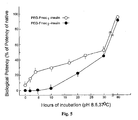
- (PEG 5000 -Fmoc) 1 -insulin derivative at pH 8.5, or at normal human serum at 37°C, the lipogenic activity was restored with a half-life of 30 ⁇ 2 hrs.
- Regeneration of the lipogenic potency of bis-modified insulin, (PEG 5000 -Fmoc) 2 -insulin followed an additional lag period of 10 ⁇ 1 hrs.
- Compounds containing FMS-PEG moieties are more suitable when 2-5 PEG-chains are to be introduced into a peptide or a protein drug, for obtaining the desirable pharmacological features of the conjugates.
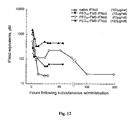
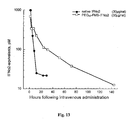
- the in vitro rate of regeneration of native interferon was estimated to have a half-life of 65 hrs. Following subcutaneous administration to rats and monitoring circulating antiviral potency, active IFN ⁇ 2 levels peaked at 50 hrs, with substantial levels still being detected 200 hrs post administration. This value contrasts with a half-life of about 1 hr measured for unmodified interferon.
- the pharmacokinetic profile of this novel pegylated IFN ⁇ 2 conjugate combines a prolonged maintenance in vivo with the regeneration of active-native IFN ⁇ 2, ensuring ready access to peripheral tissues and thus an overall advantage over currently used formulations.
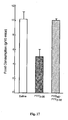
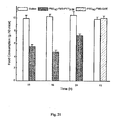
- Peptide YY 3-36 (PYY 3-36 ) was recently shown to induce satiety in mice and humans. It is described herein that the satiety induced by subcutaneous administration of PYY 3-36 to fasting mice had a half-life of ⁇ 3 h. Pegylation of PYY 3-36 through a non-hydrolysable bond yielded an inactive conjugate but the conjugate of the invention PEG 40 -FMS-PYY 3-36 gradually released unmodified YY 3-36 under physiological conditions. Subcutaneous administration of PEG 40 -FMS-PYY 3-36 to mice resulted in protracted satiety, with a half-life of ⁇ 24 h. PEG 40 -FMS-PYY 3-36 can therefore serve as a long-acting prodrug of PYY 3-36 , thereby providing a more practical means for controlling human obesity.
- the PEG moiety according to the invention may be linear or branched PEG and has a molecular weight in the range of 200 to 200,000 Da, preferably up to 80,000 Da, more preferably 5,000-40,000 Da, and most preferably between about 20,000 Da and 40,000 Da.
- the PEG moiety is a branched PEG molecule of 40,000 Da.
- the PEGylating agent is usually used in its mono-methoxylated form where only one hydroxyl group at one terminus of the PEG molecule is available for conjugation.
- a bifunctional form of PEG where both termini are available for conjugation may be used if, for example, it is desired to obtain a conjugate with two peptide or protein residues covalently attached to a single PEG moiety.
- the PEG moiety is branched.
- Branched PEGs are in common use. They can be represented as R(PEG-OH) m in which R represents a central core moiety such as pentaerythritol or glycerol, and m represents the number of branching arms.
- R represents a central core moiety such as pentaerythritol or glycerol
- m represents the number of branching arms.
- the number of branching arms (m) can range from three to a hundred or more.
- the hydroxyl groups are subject to chemical modification.
- branched PEG molecules have several advantages including the fact that they require substantially fewer conjugation sites and loss of bioactivity is minimized.
- Branched PEG molecules are described in US Patents No. 6,113,906 , No. 5,919,455 , No. 5,643,575 , and No. 5,681,567 .
- the present invention further provides pharmaceutical compositions comprising a pegylated compound according to the invention or a pharmaceutically acceptable salt thereof, and a pharmaceutically acceptable carrier.
- the carrier must be "acceptable” in the sense of being compatible with the active ingredient(s) of the formulation (and preferably, capable of stabilizing peptides) and not deleterious to the subject to be treated.
- formulations may conveniently be presented in unit dosage form and may be prepared by any of the methods well known in the art of pharmacy, for example as described in Remington: The Science and Practice of Pharmacy, A.R. Gennaro, ed., 20th edition, 2000 . All methods include the step of bringing the active ingredient(s) into association with the carrier which constitutes one or more accessory ingredients.
- any suitable route of administration of the conjugates of the invention to humans or for veterinary purposes is envisaged by the invention, for example via conventional oral, intramuscular, intravenous, subcutaneous, intranasal and transdermal administration.
- Precursor 1 of the formula depicted in Scheme 1 was prepared starting from 2-aminofluorene and t-Boc-alanine (BocAla) by several steps, as depicted in Scheme 2.
- t-Boc-Ala (4.16 gr, 22 mmol) was dissolved in 11 ml dioxane.
- N,N'-Dicyclohexylcarbodiimide (DCC) (11 mmol in 11 ml 1 M DMF) was then added and the reaction was carried out for 3 hours at 25°C under stirring.
- Dicyclohexylurea (DCU) formed was removed by centrifugation.
- Precursor 2 PEG 5,000 -FMS-OSu, depicted in Scheme 1, was prepared by sulfonation of Precursor 1 , PEG 5 , 000 -Fmoc-OSu, with chlorosulfonic acid, as depicted in Scheme 2. Briefly, to a solution of Precursor 1 in 4.0 ml CH 2 Cl 2 , cooled to 0°C, a solution of ClSO 3 H in CH 2 Cl 2 was added dropwise over a period of 15 min and the solution was stirred for 2 hours at 25°C.
- Precursor 3 PEG 40000 -Fmoc-OSu, depicted in Scheme 1, was prepared as described in Example 1, steps 1(e) and 1(f), but replacing PEG 5000 -OSu with PEG 40000 -Osu under the same reaction conditions.
- Precursor 4 PEG 40000 -FMS-OSu, depicted in Scheme 1, was prepared by sulfonation of Precursor 3 , PEG 40000 -Fmoc-OSu, as described in Example 2, but replacing Precursor 1 with Precursor 3 under the same reaction conditions.
- a "one-step" procedure can be used wherein a PEG-Fmoc-OSu or PEG-FMS-OSu precursor reacts with one or more amino groups of the drug in aqueous conditions.
- Solid Precursor 1 PEG 5000 -FMS-OSu, obtained in Example 1, was added at a 10-fold molar excess to stirred solutions of gentamicin or insulin (10 mg/ml) in phosphate-buffered saline (PBS) buffer, pH 7.4, at 0°C. Under these conditions, five to seven moles of Precursor 1 were incorporated per mole protein. The reaction was completed within 15 minutes after addition of the solid PEG-Fmoc-OSu.
- PBS phosphate-buffered saline
- the product, PEG 5000 -Fmoc-gentamicin contained one mol PEG-Fmoc covalently linked to one mol gentamicin as judged by its absorbance at 280 nm, and by amino acid analysis, following acid hydrolysis of a measured aliquot.
- the hydrolyzate contained alanine (derived from the PEG-ala-Fmoc moiety) and two peaks that emerged at the positions of proline and leucine, following acid hydrolysis of gentamicin (not shown).
- Solid Precursor 1 (11.3 mg, 2.1 ⁇ mol) was added to a stirred solution of gentamicin (0.5 mg, 1 ⁇ mol, in 1.0 ml 0.05 M NaHCO 3 ). The reaction was carried out for 2 hours at 25°C and dialyzed overnight.
- the product, (PEG 5000 -Fmoc) 2 -gentamicin contained about two moles PEG-Fmoc covalently linked to gentamicin, as verified by amino acid analysis following acid hydrolysis (see Example 6 above) and by determining the amount of non-modified amino groups with TNBS.
- Example 8 Synthesis of (PEG 5000 -Fmoc) 1 -insulin and (PEG 5000 -Fmoc) 2 -insulin
- Step 9(b) Sodium borohydride (NaBH 4 ) (0.38 g, 10 mmol) was added portionwise to a suspension of Intermediate g (2.8 g, 9 mmol) obtained in step 9(b), in dry methanol, and the reaction allowed to proceed for 4 hours.
- the product, Intermediate h was purified by flash chromatography on silica gel column, that was eluted with chloroform:methanol (98:2, v:v), and was obtained in 50% yield (1.4 g, 4.5 mmol).
- step 9(e) 3-S-acetylthiopropionic acid of step 9(e) (1.8 g, 12 mmol) and DCC (1.4 g, 6 mmol) were dissolved in DMF (15 ml) for 4 hours. The precipitated DCU was filtered out and the anhydride thus formed was kept at 4°C until used.
- Precursor 6 depicted in Scheme 3, was prepared by sulfonation of Precursor 5 with chlorosulfonic acid as described above in Example 2.
- 3-Maleimidopropionic anhydride was prepared by dissolving 3-maleimidopropionic acid (1 g, 5.9 mmol) and DCC (0.69 g, 2.95 mmol) in 10 ml DMF and incubating for 4 h. DCU was filtered out and the anhydride thus formed was kept at 4°C.
- Example 12 Synthesis of MAL-FMS-NHS, N-[2-(maleimido-propionylamino)-7-sulfo-fluoren-9-yl]methoxycarbonyloxysucinimide (Precursor 8)
- Precursor 8 depicted in Scheme 3, herein also identified by the abbreviation MAL-FMS-NHS (or MAL-FMS-OSu), was prepared by sulfonation of Precursor 7, MAL-Fmoc-NHS, with chlorosulfonic acid as depicted in Scheme 5, as follows:
- MAL-FMS-NHS or MAL-FMS-OSu is a water-soluble, hetero-bifunctional reagent consisting of a sulfonated fluorenylmethoxycarbonyl N-hydroxysuccinimide ester that reacts with peptide and protein amino groups.
- a maleimide group was attached to the fluorenyl backbone to enable coupling to sulfhydryl-containing PEG 40000 -SH.
- MAL-FMS-NHS is a cleavable reagent capable of reacting covalently with the amino side chains of peptides, proteins and aminoglycosides. According to the present invention, it enables PEG chains to be linked to peptides and proteins through a slowly hydrolysable chemical bond. PEG-FMS-peptide/protein conjugates thus formed undergo spontaneous hydrolysis at a slow rate upon incubation at ph 8.5, 37°C, with a t 1/2 value of 8-14 ⁇ 2 h, generating the unmodified parent molecule.
- MAL-FMS-NHS Stability of the MAL-functional moiety in aqueous solutions.
- MAL-FMS-NHS (1 mM) was incubated at room temperature in water (pH 6.0), in 0.007M acetic acid (pH ⁇ 4.0), in 0.1M phosphate buffer (pH 7.4), and in 0.1M NaHCO 3 (pH 8.5).
- Example 14 Degree of incorporation of MAL-FMS-NHS at pH 7.2 into ⁇ -lactalbumin as a function of the amount of added reagent
- ⁇ -lactalbumin was used as a model.
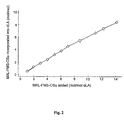
- MAL-FMS-NHS was added in 0.1M PBS, pH 7.2, at concentrations ranging from 1 equivalent up to 14 molar equivalents of MAL-FMS-NHS, for 30 min at 25°C, that is, under experimental conditions where the maleimide-alkylating capacity of the spacer remains unmodified.
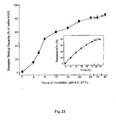
- the amount incorporated into the protein was determined by UV absorbance at 280 nm, after dialysis, and by quantitating the amount of unmodified amino side-chain moieties with TNBS. As shown in Fig. 2 , about one mole of MAL-FMS was incorporated into ⁇ -LA per 2.1 mole of reagent added, up to a fourteen molar excess over the protein.
- PEG 40 -SH was prepared either by reaction of 2-tritylthioethylamine and PEG 40 -OSu as described below in 15(a), or from PEG 40 -OSu and cystamine [2,2'-dithio-bis(ethylamine)] dihydrochloride, as described below in 15 (b).
- 2-Tritylthioethylamine and PEG 40 -OSu (0.25 g, 6.25 ⁇ mol) were dissolved in 4 ml THF:acetonitrile (1:2, v:v). After one hour, the product was precipitated with cooled ether and washed ( ⁇ 3). The dry pellet was dissolved in TFA:triethylsilane:water (95:2.5:2.5, 6 ml) and, after one hour, PEG 40 -SH was precipitated by cooled ether (100 ml) and desiccated.
- PEG 40 -OSu was dissolved at a concentration of 40 mg/ml in an aqueous solution of cystamine-di-HCl (1M) and brought to pH 8.5 with NaHCO 3 . Reaction was carried out for 2 h at 25°C. The product thus obtained was dialyzed overnight against 0.1 M NaHCO 3 , treated with 30 mM dithiothreitol (25°C, 1 h) and re-dialyzed against 0.01 M HCl containing 10 mM ascorbic acid. PEG 40 -SH was obtained with a 93% yield. It contained 1 mole sulfhydryl moiety per mole PEG 40 , as determined with DTNB in the presence of ascorbate. PEG 40 -SH was kept frozen until used.
- a MAL-FMS-drug conjugate is prepared by adding one to seven molar excess of MAL-FMS-NHS, Precursor 8, to a stirred solution of the drug (1 mg/ml) in 0.1 M PBS buffer, pH 7.2.
- the reaction is carried out for 30 min at 25°C, and then dialyzed against water at 7°C over a period of 24 h to remove excess MAL-FMS-NHS.
- a stoichiometric amount of solid PEG 40 -SH is added to the MAL-FMS-drug conjugate of step 16(a), and the reaction proceeds for additional 60 min in 0.1 M phosphate buffer, pH 7.2, containing 2 mM ascorbic acid.
- the PEG-FMS-drug conjugate thus obtained is further purified by HPLC-procedures using C4 or C18 reverse phase columns under conditions resolving the conjugate from the drug, preferably a peptide or protein drug (or protein-FMS-MAL) that has not been covalently linked to PEG 40 -SH.
- PEG-FMS-drug conjugates according to the invention may be also prepared by an alternative "two-step" Procedure II depicted in Scheme 6 whereby MAL-FMS-NHS is first reacted with PEG-SH and the resulting PEG-FMS-NHS conjugate is further reacted with an amino-containing drug or with the amino group of a peptide or protein drug. as follows:
- a PEG-FMS-NHS conjugate is prepared by MAL-FMS-NHS to a stirred solution of PEG-SH in PBS buffer, pH 7.4. The reaction is carried out for 30 min at 25°C and the product is then purified by HPLC and lyophilized.
- step 17(a) a stoichiometric amount of the MAL-FMS-NHS conjugate of step 17(a) is added to the amino-containing drug, and the reaction proceeds under stirring for 2 hours.
- the product is then purified by HPLC and lyophilized.
- PEG 40 -FMS-exendin-4 was prepared by the two-step Procedure I described in Example 16. Thus, 280 ⁇ g of MAL-FMS-NHS (28 ⁇ l from a fresh solution of MAL-FMS-NHS in DMF, 10 mg/ml, 2.0 molar excess over the peptide) was added to a stirred solution of exendin-4 (1 mg in 1.0 ml 0.1 M phosphate buffer, 2 mM ascorbate, pH 7.2, 0.239 mM). After 7 min, solid PEG 40000 -SH was added to a final concentration of 0.5 mM (2.1 molar excess over the peptide).
- the reaction was carried out for 1 h hour, dialyzed overnight against water and then further filtered through Centricon with a molecular weight cutoff of 50 kDa to remove any residual exendin-4 or MAL-FMS-exendin-4 that had not linked to PEG 40000 -SH.
- concentration of the conjugate was determined by acid hydrolysis of a 20 ⁇ l aliquot followed by amino acid analysis, according to aspartic acid (2 residues), alanine (2 residues) and valine (1 residue), and absorbance at 280 nm was monitored.
- the conjugate had a 1:1 1 PEG 40000 -FMS/exendin stoichiometry (as determined from the UV absorption of the conjugate following purification and acid hydrolysis followed by amino acid analysis as described above).
- PEG 5000 -FMS-exendin-4 was prepared by the two-step Procedure II described in Example 17.
- the product PEG 5000 -FMS-NHS was purified by HPLC on a RP-4 column and lyophilized.
- the product PEG 5000 -FMS-exendin-4 was purified by HPLC on a RP-4 column and lyophilized.
- PYY 3-36 was allowed to react first with 2 equivalents of MAL-FMS-NHS, at pH 7.2, for 7 min, followed by the addition of 2.1 equivalents of PEG 40 -SH, at pH 7.2, for 1 hour.
- (PEG 40 -FMS) 2 -hGH was prepared by the two-step procedure described in Example 16, as follows: To a stirred solution of human growth hormone (4.4 mg, 0.22 ⁇ mol) in phosphate buffer (1 ml, 0.1 M, pH 7.2), MAL-FMS-NHS (4 eq, 0.47 mg, 0.8 ⁇ mol) was added. The reaction was carried out for 30 min at 25°C, and then dialyzed against H 2 O (pH 6) at 4°C for 24 h, to remove excess MAL-FMS-NHS.
- a suspension of Escherichia coli E. coli strain N-4156-W.T, 1% v/v in LB medium
- a suspension of Escherichia coli E. coli strain N-4156-W.T, 1% v/v in LB medium
- plastic tubes 0.5 ml per tube
- PEG 5,000 -gentamicin derivatives 0.2-50 ⁇ M
- E. coli replication was evaluated by measuring the absorbance at 600 nm. Incubation was terminated when O.D 600 nm in the tubes containing no gentamicin reached a value of 0.6 ⁇ 0.1.
- Human insulin was modified with increasing concentrations of Precursor 1 and loss of biological potency as a function of PEG 5000 -Fmoc incorporated into insulin was determined.
- Insulin (17.24 nmoles in 0.2 ml 0.01 M NaHCO 3 ) reacted with increasing concentrations of PEG 5000 -Fmoc-OSu at a molar excess over the protein as indicated in Fig. 4A for 2 hours at 25°C.
- the degree of derivatization was quantitated by determining the number of free amino groups that remained unmodified and were available for reaction with TNBS.
- insulin can incorporate 3 moles of PEG 5000 -Fmoc on the amino side chains of Lys B29, PheB1 and GlyA1. As shown in Fig.
- Insulin conjugates containing one and two moles of PEG 5000 -Fmoc/mole insulin were incubated for different times at a concentration of 0.172 ⁇ M in 0.1 M NaHCO 3 -0.5% bovine serum albumin (BSA) and 1 mM NaN 3 (pH 8.5) at 37°C. The results are shown in Fig. 5 . At the indicated time points, aliquots were analyzed (in several concentrations for each aliquot) for their lipogenic potencies in rat adipocytes. With (PEG 5000 -Fmoc) 2 -insulin, no reactivation could be observed in the first 10 hours of incubation. Lipogenic activity then increased, reaching 45 ⁇ 3 and 90% of the native insulin potency at 30 ⁇ 2 and 80 ⁇ 4 hours, respectively.
- BSA bovine serum albumin
- (PEG 5000 -Fmoc) 1 -insulin has 7 ⁇ 1% the biological potency of the native hormone prior to undergoing PEG-Fmoc hydrolysis. Based on these findings in vitro, (PEG 5000 -Fmoc) 1 -insulin was administered in vivo at ten times higher concentrations than the native hormone, in order to obtain the same glucose-lowering effect (see below).
- the prolonged action of subcutaneously administered (PEG 5000 -Fmoc) 1 -insulin can be attributed, theoretically, to a slower absorption rate from the subcutaneous compartment to the circulation as well as to the low fraction of the administered material exposed to receptor-mediated degradation and hydrolysis of the inactive to the active species.
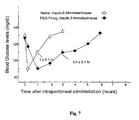
- the subcutaneous compartment was bypassed by administering native insulin (Zn 2+ -free, 0.345 nmoles/mouse, in 0.2 ml PBS buffer) or (PEG 5000 -Fmoc) 1 -insulin (3.45 nmoles/mouse, in 0.2 ml PBS buffer) intraperitoneally. The glucose lowering capacities were then monitored. Blood glucose levels were determined at different time points.
- Fig. 7 The results are shown in Fig. 7 .
- circulating glucose levels fell maximally at 15 min and returned to normal level with a t 1/2 value of 1.0 ⁇ 0.1 hours.
- circulating glucose level declined more gradually, reaching a maximal fall at 1.0 hour.
- Levels were then gradually elevated, showing a t 1/2 value of 3.4 ⁇ 0.1 hours, and returning to normal values only 6 hours after administration ( Fig. 7 ).
- Exendin-4 is an insulinotropic glucagon-like peptide-1 (GLP-1) agonist associated with the ⁇ -pancreatic cells, elevates endogenous cAMP levels, enhances secretion of insulin, and lowers circulating glucose levels (Eng et al., 1992; Goke et al., 1993; Schepp et al., 1994; Fehmann et al., 1994).
- GLP-1 agonist A profound pharmacological advantage of this GLP-1 agonist is that, following administration at any dosage, the circulating blood glucose level (BGL) never falls below a threshold glucose level that, in non-diabetic healthy CD1-mice, is 74 ⁇ 7 mg/dl (Shechter et al., 2003).
- the conjugate PEG 40000 -FMS-exendin-4 was prepared (Example 19).
- Exendin-4 contains one His N ⁇ amino function and two Lys N ⁇ amino groups, enabling modification at these three positions.
- N-terminal amino acid sequencing revealed that, although the PEG 40000 -FMS-exendin-4 product eluted as a single peak on HPLC, it was actually a mixture containing primarily the N ⁇ -modified hormone.
- this point deserves only minor consideration.
- the hydrolysis rates and reaction orders of the PEG-FMS conjugates PEG 5000 -FMS-4-nitro-phenethylamine, PEG 5000 -FMS-exendin-4 and PEG 40 -FMS-exendin-4, and one MAL-FMS conjugate, N-(MAL-FMS)-Peptide 27, were evaluated at pH 8.5, 37°C.
- the structures and half-lives of the conjugates are presented in Table 3.
- PEG 5000 -FMS-4-nitro-phenetylamine was prepared as described in Example 20.
- the conjugate MAL-FMS-Peptide 27 was prepared by reaction of MAL-FMS-NHS with the non-relevant peptide 27 (SEQ ID NO: 14).
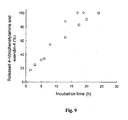
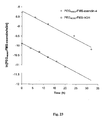
- Fig. 9 shows the hydrolysis of PEG 5000 -FMS-exendin-4 (circles) and of PEG 5000 -FMS-4-nitro-phenethylamine (squares) after incubation in PBS at pH 8.5, 37°C. Results in Figs. 8 and 9 are expressed as percent of the maximal peak area of released exendin-4 and 4-nitrophenethylamine, as a function of time.
- the hydrolysis rate at pH 8.5 is equivalent to the hydrolysis rate in serum.
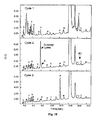
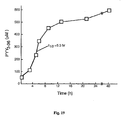
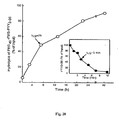
- the release of 4-nitro-phenethylamine and exendin-4 was monitored by RP-HPLC and was determined to be a first order reaction (Table 3 and Figs. 8 , 9 ). As shown ( Figs. 8-9 , Table 3), the peptides and protein were released from the conjugates in a slow homogenous fashion, with t 1/2 of 9.4 (PEG 5000 -FMS-4-nitro-phenethylamine), 13.8 (PEG 5000 -FMS-exendin-4), and 11.9 (PEG 40000 -FMS-exendin-4). Exendin-4 was fully released from the PEG 40 conjugate after 48 h of incubation.
- the conjugate MAL-FMS-Peptide 27 is TNBS negative as the sole ⁇ -amino moiety of Peptide 27 was derivatized.
- a solution of MAL-FMS-Peptide 27 (0.5 mM in 0.1 M NaHCO 3 , pH 8.5) was incubated at 37°C. Aliquots (0.2 ml) were withdrawn at different time points and analyzed for the appearance of the free ⁇ -amino group using TNBS.
- the FMS-MAL (N-ethyl maleimide) moiety was hydrolyzed in a slow and nearly homogeneous fashion from the ⁇ -amino moiety of the peptide, with a t 1/2 value of 8.4 h. Hydrolysis was complete after 32 hrs of incubation.
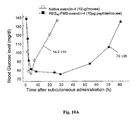
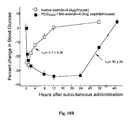
- Figs. 10A-10B show the glucose-lowering profile of subcutaneously administered native exendin-4 and of PEG 40 -FMS-exendin-4, both at a dose of 10 ⁇ g ( Fig. 10A ) or 4 ⁇ g ( Fig. 10B ) peptide/mouse relative to a saline-treated group of mice.
- Fig. 10A shows the glucose lowering profile of subcutaneously administered native-exendin-4 and of PEG 40 -FMS-exendin-4, both at a dose of 10 ⁇ g/mouse.
- native peptide blood glucose levels declined from 139 ⁇ 10 to 96 ⁇ 7 within 0.5 h reaching a maximal fall in 2-4 hours after administration (74 mg/dl).
- the return to initial glucose level was then proceeded with a t 1/2 value of 14.2 ⁇ 1 h.
- Circulating glucose level then fall gradually, with the lowest glucose concentration reached at 6-8 hours after administration (80-90 mg/dl). Stable, low circulating glucose concentrations then maintained over nearly 50 hours, prior to the return to initial glucose levels with a t 1/2 value of 70 ⁇ 3 hrs.
- Fig. 10B shows the glucose lowering profile of subcutaneously administered native-exendin-4 and of PEG 40 -FMS-exendin-4, both at a dose of 4 ⁇ g/mouse.
- native peptide blood glucose levels declined by 26-28% (from 140 mg/dl to 104-101 mg/dl), with the largest percent change in blood glucose levels occurring 0.5-1 h after administration.
- Glucose concentrations then returned to their initial levels with a t 1/2 value of 3.7 ⁇ 0.3 h.
- Circulating glucose reached its lowest concentration 8-12 hours after administration (92 mg/dl, 33%).
- Stable, low circulating glucose concentrations were then maintained for a further 12 hours. Return to initial glucose levels took place with a t 1/2 of 30 ⁇ 2 h, being 7.5 times longer than that obtained by the same dose of the native hormone.
- Example 30 Biological activity of PEG 40 -FMS-IFN ⁇ 2
- Type I interferons are proteins that initiate antiviral and antiproliferative responses. Interferons are clinically important, and several subtypes of IFN ⁇ 2 were approved as drugs for the treatment of hepatitis B and C as well as for cancers such as chronic myelogenous leukemia and hairy cell leukemia. Interferons regulate signals through the Janus tyrosine kinase (Jak/STAT proteins), and by reducing phosphorylation and activation of MEK1 and ERK1/2 through a Ras / Raf independent pathways (Romerio et al., 2000).
- Jak/STAT proteins Janus tyrosine kinase
- MEK1 and ERK1/2 Ras / Raf independent pathways
- Human type I interferons induce differential cellular effects, but act through a common cell surface receptor complex comprised of the two subunits, Ifnar1 and Ifnar2.
- Human Ifnar2 binds all type I IFNs, but with a lower affinity and specificity than the Ifnar complex.
- Human Ifnar1 has a low intrinsic binding affinity towards human IFNs, but modulates specificity and affinity of other ligands of the Ifnar complex (Cutrone and Langer, 2001).
- IFN ⁇ 2 may be administered intramuscularly, subcutaneously or intravenously, resulting in different pharmacokinetic profiles.
- the administered cytokine is rapidly inactivated by body fluids and tissues (O'Kelly et al.,1985), and cleared from the blood plasma several hours following administration (Rostaing et al., 1998).
- the major routes of IFN ⁇ 2 elimination from the circulatory system are through proteolysis, receptor mediated endocytosis and kidney filtration (Goodman and Gilman, 2001).
- Prolonging the maintenance dose of IFN ⁇ 2 in circulation is a desirable clinical task.
- a non-reversible, 12 kDa-PEG-IFN ⁇ 2 conjugate has been therapeutically approved in 2001. It is administered once a week to hepatitis C patients, and facilitates a sustained anti-viral response rate of 24%, as opposed to a 12% response rate obtained by the native cytokine (Schering-Plough Corporation, 2001 press release; Baker, 2003).
- PEG-IFN does not readily penetrate all tissues: while 12 kDa PEG-IFN ⁇ 2b is widely distributed, 40 kDa -PEG-IFN ⁇ 2a is restricted to the blood and the interstitial fluid (Glue et al., 2000; Reddy et al., 2002).
- This major drawback can be overcome by designing a PEG-IFN ⁇ 2 conjugate capable of generating native IFN ⁇ 2 at a slow rate under physiological conditions.
- k 1 0.02 hr -1
- k 2 0.01 hr -1
- k 3 0.65 hr -1 .
- k 1 which could not be determined directly, was estimated to be 0.02 hr -1 from the fit of the simulation to the experimental data.
- the binding capacity of the modified IFN ⁇ 2 of the invention toward the immobilized recombinant extracellular part of IFN ⁇ 2 receptor (ifnar2-EC) was monitored under flow-through conditions by an optical probe called reflectometric interference spectroscopy (RIFS).
- RIFS reflectometric interference spectroscopy
- This method detects biomolecular interactions of ligands to transducer-bound proteins as a shift in the interference spectrum caused by change of the apparent optical thickness of the transducer chip. A shift of 1 pm corresponds to approximately 1 pg/mm 2 protein on the surface.
- the transducer surface was modified with a dextran layer and carboxylated by reaction with molten glutaric anhydride (Sigma) at 75° for 2-8 h.
- PEG 40 -FMS-IFN ⁇ 2 releases native-active IFN ⁇ 2 upon incubation, at a rate constant of 0.01hr -1 .
- IFN ⁇ 2 is released from the conjugate with a rate constant of 0.01hr -1 ( Fig, 11 ).
- 50% of the IFN ⁇ 2 in the conjugate is discharged and is fully active. From the extrapolation of the curve fit obtained, it is assumed that nearly all of the interferon will eventually be released and regain full activity. No BIAcore data was collected at very long time points as keeping proteins for weeks at 37 °C is not advisable.
- the circulatory behavior of PEG 40 -FMS-IFN ⁇ 2 following subcutaneous administration to rats shows a clearly visible dose-dependent behavior ( Fig. 12 ).
- Administration of 12 ⁇ g/rat of the conjugated IFN ⁇ 2 yielded maintenance levels of 70 ⁇ 10 pM IFN ⁇ 2 which were maintained 56 hours following administration.
- IFN ⁇ 2 was continuously present in the serum 56 hours at a molar concentration of 450 pM.
- both the conjugate and the native cytokine were administered to rats (30 ⁇ g/rat) intravenously.
- native interferon the same half-life was measured, indicating that it readily penetrates the circulatory system following subcutaneous administration ( Fig. 13 ).
- antiviral activity was still detected 150 hours following intravenous administration, demonstrating the prolonged effects of the pegylated cytokine.
- Discharged IFN ⁇ 2 level of 10 pM still remained 150 hours post administration, while native IFN ⁇ 2 was eliminated within 30 hours post-administration. It should be noted that the large shoulder observed following subcutaneous administration of the conjugate ( Fig. 12 ) is not observed when PEG 40 -FMS-IFN ⁇ 2 was administered intravenously ( Fig. 13 ).
- both the subcutaneous and intravenous administration modes of PEG 40 -FMS-IFN ⁇ 2 to rats were simulated ( Figs 14A and 14B , respectively).
- the simulated data and the experimental results were in good agreement.
- the passage of the conjugate, but not of the native interferon, from the subcutaneous volume to the bloodstream proceeds at a slow rate and is in the order of the discharge of interferon from the conjugate. This explains the shoulder observed between 10-70 hours in the active protein concentration. As expected, this shoulder is not found when PEG 40 -FMS-IFN ⁇ 2 is administered intravenously.
- the pegylating technology applied to therapeutic proteins often leads to a drastic loss in the biological and the pharmacological potencies of the conjugates.
- this deficiency can be overcome by introducing the PEG chains via a chemical bond that is either sensitive to hydrolysis or can be cleaved enzymatically by serum proteases or esterases.
- a prerequisite condition for efficient pegylation is that the hydrolysis of the PEG chains from the conjugate is to take place at a slow rate, and in a homogenous fashion in vivo.
- IFN ⁇ 2 molecule contains 13 amino functions theoretically available for PEG 40 -FMS attachment. The exact site of pegylation was not determined. In view however, of its reversibility and the generation of the native protein, it seems that this point deserves a rather minor consideration.
- Example 31 Biological activity of the PEG 40 -FMS-PYY 3-36 conjugate
- NPY neuropeptide Y
- Y2R putative inhibitory Y2 pre-synaptic receptor
- PYY 3-36 peptide YY 3-36
- PYY 3-36 peptide YY 3-36
- PYY 3-36 may find a clinical use in treatment of obesity and its associated disorders, including type II diabetes mellitus and cardiovascular diseases (Schwartz and Morton, 2002).
- PEG 40 -FMS-PYY 3-36 was prepared as in Example 23.
- PEG 40 -FMS-Glycine ethyl ester PEG 40 -FMS GEE.
- PEG 40 -SH 0.25 mM in 0.1M phosphate buffer pH 7.2-10 mM Na ascorbate
- 292 ⁇ g MAL-FMS-NHS was added (two-fold molar excess over PEG 40 -SH).
- 0.2 ml from a solution of 0.5M glycine ethyl ester was added. The reaction was carried out for 1 h, and the mixture was then dialyzed overnight against water.
- PEG 40 -PYY 3-36 Irreversibly pegylated PYY 3-36 was prepared by reacting PYY 3-36 (1 mg/ml in 0.1 M phosphate buffer pH 7.2) with four equivalents of solid PEG 40 -OSu, (43 mg). The reaction was carried out for 1 h and the mixture was then dialyzed overnight against water. The conjugate thus obtained contains one PEG 40 residue per PYY 3-36 , as determined by MALDI-TOF MS. (PEG 40 -OSu, 43,626 D; PYY 3-36 , 4,047 D; conjugate, 47,712 D).
- Intraperitoneal (rather than subcutaneous) administration of PYY 3-36 to mice has induced a considerably shorter-lived satiety effect.
- an ip dose of 5 nmol PYY 3-36 /mouse was fully effective when administered 30 min before re-feeding, but had no effect when administered 2 h before meal (not shown).
- mice injected with 20 ⁇ g N ⁇ -N ⁇ -diacetyl-PYY 3-36 per mouse ate 10.54 ⁇ 0.08 g chow per 10 mice, as compared with 10.6 ⁇ 1.26 g in the saline group and 5.26 ⁇ 1.47 g in the PYY 3-36 group.
- a small acetyl group was sufficient to disrupt the biological activity of PYY 3-36 .
- PEG 40 -FMS is linked to the a amino, group of PYY 3-36 .
- Peptide YY 3-36 contains the N-terminal ⁇ -amino group of isoleucine and one ⁇ -amino group of lysine at position 2, both of which are potentially available for acylation by MAL-FMS-OSu.
- PEG 40 -FMS-PYY 3-36 was reacted with a 500 molar excess of acetic anhydride at pH 7.0 for 1 h, followed by dialysis against water overnight. The PEG 40 -FMS group was then removed by incubating the acetylated PEG 40 -FMS-PYY 3-36 for 4 days at pH 8.5. The product was then subjected to N-terminal protein sequence analysis. As shown in Fig.
- cycles 1, 2 and 3 yielded the expected amounts of isoleucine, ⁇ -acetyl lysine and proline, respectively. No free lysine was found in cycle 2.
- the conjugate consists of PEG 40 -FMS and PYY 3-36 at a 1:1 ratio.
- the PEG 40 -FMS group is primarily linked to the N-terminal ⁇ -amino group of PYY 3-36 . Nevertheless, this analysis could not entirely exclude the presence of a PYY 3-36 mono-substituted at its ⁇ -lysine side chain. However, in view of the complete regeneration of the native peptide, this point is of a rather minor significance.
- Example 32 Biological activity of (PEG 40 -FMS) 2 -hGH and PE G 40 -FMS-hGH
- hGH Human growth hormone
- HGH Human growth hormone
- Pegylation often results in a drastic decrease in the biological or pharmacological potencies of peptides and proteins. This is especially valid for hGH owing to the relatively large surface area of site 1 and site 2 through which the hormone binds the first receptor and then the second receptor to form a homodimeric receptor complex that initiates signaling.
- the hGH displacement assay was performed as previously described (Tsushima et al., 1980).
- (PEG 40 -FMS) 2 -hGH prepared by linking two PEG 40 -FMS moieties to hGH, has an effective molecular weight of about 120 kDa and exhibits 9 ⁇ 2% the receptor binding potency of the native hGH.
- Receptor binding capacity is regenerated upon incubation at 37°C in normal rat serum or in 0.1M phosphate buffer (pH 8.5) at 37°C with a t 1/2 value of ⁇ 20 hrs, reaching 70-80% the native-receptor binding capacity following 50 hours of incubation (not shown).
- the release of hGH was monitored by RP-HPLC and was determined to be a first order reaction (Table 3, Fig. 22 ).
- PEG 40000 -FMS-hGH exhibits no receptor binding affinity.
- recognition of the released hGH by the native hGH receptor was preserved ( Fig. 22 ).
- Human growth hormone was released from the conjugate in a slow homogenous fashion, with t 1/2 of 11.8 h (Table 3, Fig. 23 ).
- Example 33 PEG 40 -FMS-ANP undergoes time-dependent hydrolysis at physiological conditions
- Atrial natriuretic peptide is a 28-mer amino acid non-lysine containing peptide which exerts natriuretic, diuretic and vasorelaxant actions. It plays an important role in the body's blood volume and blood pressure homeostasis.
- ANP has a very high affinity for its receptor sites (10 pm), and is therefore cleared very rapidly (t 1/2 ⁇ 0.5 min) by receptor and protease-mediated events. ANP is therefore not suitable as a drug for subcutaneous administration for regulation of blood pressure homeostasis in humans.
- the covalent attachment of a PEG 40 -chain to the ⁇ -amino moiety of ANP generates a conjugate which is fully devoid of receptor binding affinity (data not shown).
- PEG 40 -FMS-ANP prepared by linking PEG 40 -FMS to the ⁇ -amino side chain of ANP, is TNBS negative. Upon incubation at pH 8.5 and 37°C, this conjugate undergoes spontaneous hydrolysis with a t 1/2 value of 23 ⁇ 2 hrs, generating the parent ANP following 50 hours of incubation ( Table 5 ). Preliminary measurements in rats in vivo revealed that SC-administered PEG 40 -FMS-ANP has a 60-fold increase in serum half-life, in comparison to native ANP. The conjugate is fully protected from receptor-mediated degradation prior to the fall-off of the PEG 40 -FMS chain from ANP by hydrolysis.
Landscapes
- Health & Medical Sciences (AREA)
- Life Sciences & Earth Sciences (AREA)
- Chemical & Material Sciences (AREA)
- Organic Chemistry (AREA)
- Veterinary Medicine (AREA)
- Pharmacology & Pharmacy (AREA)
- General Health & Medical Sciences (AREA)
- Animal Behavior & Ethology (AREA)
- Public Health (AREA)
- Medicinal Chemistry (AREA)
- Engineering & Computer Science (AREA)
- Bioinformatics & Cheminformatics (AREA)
- Epidemiology (AREA)
- Endocrinology (AREA)
- Zoology (AREA)
- Proteomics, Peptides & Aminoacids (AREA)
- Gastroenterology & Hepatology (AREA)
- Immunology (AREA)
- General Chemical & Material Sciences (AREA)
- Chemical Kinetics & Catalysis (AREA)
- Nuclear Medicine, Radiotherapy & Molecular Imaging (AREA)
- Diabetes (AREA)
- Cardiology (AREA)
- Molecular Biology (AREA)
- Hematology (AREA)
- Obesity (AREA)
- Marine Sciences & Fisheries (AREA)
- Vascular Medicine (AREA)
- Emergency Medicine (AREA)
- Heart & Thoracic Surgery (AREA)
- Virology (AREA)
- Oncology (AREA)
- Child & Adolescent Psychology (AREA)
- Communicable Diseases (AREA)
- Pulmonology (AREA)
- Urology & Nephrology (AREA)
- Hospice & Palliative Care (AREA)
- Medicinal Preparation (AREA)
- Medicines That Contain Protein Lipid Enzymes And Other Medicines (AREA)
- Peptides Or Proteins (AREA)
Claims (45)
- Eine Verbindung der Formel:
(X)n - Y
wobei
Y eine Einheit eines Arzneistoffs ist, der mindestens eine funktionelle Gruppe, ausgewählt aus freiem Amino, Carboxyl, Phosphat, Hydroxyl und/oder Mercapto, trägt, und
X ein Rest der Formel:
wobei:
R1 ein Rest ist, der eine lineare oder verzweigte Polyethylenglykol(PEG)-Einheit mit einem Molekulargewicht im Bereich von 5000 bis 40000 Da enthält;
R2 aus der Gruppe bestehend aus Wasserstoff, (C1-C8)-Alkyl, (C1-C8)-Alkoxy, (C1-C8)-Alkoxyalkyl, (C6-C10)-Aryl, (C1-C8)-Alkaryl, (C6-C10)-Ar(C1-C8)alkyl, Halogen, Nitro, -SO3H, -SO2NHR, Amino, Ammonium, Carboxyl, PO3H2 und OPO3H2 ausgewählt ist;
R aus der Gruppe bestehend aus Wasserstoff, (C1-C8)-Alkyl und (C6-C10)-Aryl ausgewählt ist;
R3 und R4, gleich oder verschieden, jeweils aus der Gruppe bestehend aus Wasserstoff, (C1-C8)-Alkyl und (C6-C10)-Aryl ausgewählt sind;
A eine kovalente Bindung ist, wenn der Rest an eine Carboxyl-, Phosphat- oder Mercaptogruppe des Arzneistoffs Y gebunden ist, oder A gleich -OCO- ist, wenn der Rest an eine Amino- oder Hydroxylgruppe des Arzneistoffs Y gebunden ist;
n eine, ganze Zahl von mindestens eins ist,
und pharmazeutisch verträgliche Salze davon. - Eine Verbindung nach Anspruch 1, wobei R2, R3 und R4 jeweils Wasserstoff sind und A gleich -OCO- ist (nachfolgend "Fmoc").
- Eine Verbindung nach Anspruch 1, wobei R2 gleich -SO3H an Position 2 des Fluorenrings ist, R3 und R4 jeweils Wasserstoff sind und A gleich -OCO- ist (nachfolgend "FMS").
- Eine Verbindung nach Anspruch 1, wobei R1 ein Rest der Formel:
-R5-R6-PEG
ist,
wobei
R5 aus der Gruppe bestehend aus -NH-, -S-, -CO-, -COO-, -CH2-, -SO2-, -SO3-, -PO2- und -PO3- ausgewählt ist und
R6 eine Bindung oder ein Rest ist, durch die/den die Polyethylenglykol(PEG)-Einheit kovalent an R5 gebunden ist. - Eine Verbindung nach Anspruch 4, wobei:R5 gleich -NH- ist;R6 aus der Gruppe bestehend aus -CO-, -COO-, -CH2-, -CH(CH3)-, -CO-NH-, -CS-NH-, -CO-CH2-NH-CO-, -CO-CH(CH3)-NH-CO-, -CO-CH2-NH-CO-NH-,

 Z gleich O, S oder NH ist, das an die PEG-Einheit gebunden ist; undR7 aus der Gruppe bestehend aus geradkettigem oder verzweigtem C1-C18-Alklyen, Phenylen, einem Oxyalkylenrest mit 3-18 Kohlenstoffatomen im Gerüst, einem Rest eines 2-10 Aminosäurereste enthaltenden Peptids und einem Rest eines 1-10 Monosaccharidreste enthaltenden Saccharids ausgewählt ist.
 - Eine Verbindung nach einem der Ansprüche 1 bis 5, wobei der Rest R1 eine verzweigte PEG-Einheit mit einem Molekulargewicht von 40000 Da oder 5000 Da enthält.
- Eine Verbindung nach Anspruch 5, wobei Y eine Einheit eines Arzneistoffes, der mindestens eine Aminogruppe enthält, wie z.B. eines antibiotischen Aminoglycosids, vorzugsweise Gentamicin oder Amphotericin; eines antineoplastischen Arzneistoffes, vorzugsweise Aminolevulinsäure, Daunorubicin oder Doxorubicin; oder eines Peptid- oder eines Protein-Arzneistoffes mit niedrigem oder mittlerem Molekulargewicht, wie z.B. Insulin, vorzugsweise Humaninsulin, ein Interferon, wie z.B. IFN-α2, ein PYY-Agonist, wie z.B. das Peptid PYY3-36, ein Exendin, wie z.B. Exendin-3 und Exendin-4 und Exendin-Analoga und -Agonisten, ein atriales natriuretisches Peptid (ANP), humanes Wachstumshormon (hgH), Erythropoietin, TNF-α, Calcitonin, Gonadotropin-freisetzendes Hormon (GnRH) oder ein Analogon davon, Hirudin, Glucagon oder ein monoklonales Antikörperfragment, wie z.B. anti-TNF-α-monoklonales Antikörperfragment, ist.
- Eine Verbindung nach Anspruch 5 der Formel:

R2 gleich H oder -SO3H an Position 2 des Fluorenrings ist,
Y der Rest eines Arzneistoffs ist, der mindestens eine Aminogruppe enthält, und
PEG eine lineare oder verzweigte PEG-Einheit mit einem Molekulargewicht im Bereich von 5000 bis 40000 Da ist, wobei die PEG-Einheit vorzugsweise ein verzweigtes Molekül mit 40000 Da oder 5000 Da ist. - Eine Verbindung nach Anspruch 8, wobei R2 gleich H ist, hierin bezeichnet als (PEG-Fmoc)n- Arzneistoffkonjugat.
- Eine Verbindung nach Anspruch 9, wobei n eine ganze Zahl von 1 bis 3, vorzugsweise 1 oder 2, ist.
- Eine Verbindung nach Anspruch 9, wobei der Arzneistoff ein antibiotischer Aminoglycosid-Arzneistoff, wie z.B. Gentamicin oder Amphotericin B; ein antineoplastischer Arzneistoff, wie z.B. Aminolevulinsäure, Daunorubicin oder Doxorubicin; oder ein Peptid- oder ein Protein-Arzneistoff mit niedrigem oder mittlerem Molekulargewicht, wie z.B. Insulin, vorzugsweise Humaninsulin, ein Interferon, wie z.B. IFN-α2, ein PYY-Agonist, wie z.B. das Peptid PYY3-36, ein Exendin, wie z.B. Exendin-3 und Exendin-4 und Exendin-Analoga und -Agonisten, atriales natriuretisches Peptid (ANP), humanes Wachstumshormon (hGH), Erythropoietin, TNF-α, Calcitonin, Gonadotropin-freisetzendes Hormon (GnRH) oder ein Analogon davon, Hirudin, Glucagon oder ein monoklonales Antikörperfragment, wie z.B. anti-TNF-α-monoklonales Antikörperfragment, ist.
- Eine Verbindung nach Anspruch 8, wobei R2 gleich -SO3H ist, hierin bezeichnet als (PEG-FMS)n-Arzneistoffkonjugat.
- Eine Verbindung nach Anspruch 12, wobei n eine ganze Zahl von 1 bis 3, vorzugweise 1 oder 2, ist.
- Eine Verbindung nach Anspruch 10 oder 13, wobei die PEG-Einheit ein verzweigtes Molekül mit einem Molekulargewicht von 40000 Da oder 5000 Da ist.
- Eine Verbindung nach Anspruch 12, wobei der Arzneistoff ein antibiotischer Aminoglycosid-Arzneistoff, wie z.B. Gentamicin oder Amphotericin B; ein antineoplastischer Arzneistoff, wie z.B. Aminolevulinsäure, Daunorubicin oder Doxorubicin; oder ein Peptid- oder ein Protein-Arzneistoff mit niedrigem oder mittlerem Molekulargewicht, wie z.B. Insulin, vorzugsweise Humaninsulin, ein Interferon, wie z.B. IFN-α2, ein PYY-Agonist, wie z.B. das Peptid PYY3-36, ein Exendin, wie z.B. Exendin-3 und Exendin-4 und Exendin-Analoga und -Agonisten, atriales natriuretisches Peptid (ANP), humanes Wachstumshormon (hGH), Erythropoietin, TNF-α, Calcitonin, Gonadotropin-freisetzendes Hormon (GnRH) oder ein Analogon davon, Hirudin, Glucagon oder ein monoklonales Antikörperfragment, wie z.B. anti-TNF-α-monoklonales Antikörperfragment, ist.
- Eine Verbindung nach Anspruch 15, wobei der Peptid- oder Protein-Arzneistoff Humaninsulin, hierin als das Konjugat PEG40-FMS-Insulin bezeichnet; IFN-α2, hierin als das Konjugat PEG40-FMS-IFN-α2 oder (PEG40-FMS)2-IFN-a2 bezeichnet, PYY3-36 [SEQ ID-Nr. 12], hierein als das Konjugat PEG40-FMS-PYY3-36. bezeichnet, humanes Wachstumshormon (hGH), hierin als das Konjugat PEG40-FMS-hGH oder (PEG40-FMS)2-hGH bezeichnet; atriales natriuretisches Peptid (ANP) [SEQ ID-Nr. 13], hierein als das Konjugat PEG40-FMS-ANP bezeichnet; Exendin-4 [SEQ ID-Nr. 1], hierin als das Konjugat PEG40-FMS-Exendin-4 bezeichnet; Exendin-3 [SEQ ID-NR. 2] ist; oder der Exendin-Agonist aus der Gruppe bestehend aus [SEQ ID-Nr. 3], [SEQ ID-Nr. 4], [SEQ ID-Nr. 5], [SEQ ID-Nr. 6], [SEQ ID-Nr. 7], [SEQ ID-Nr. 8], [SEQ ID-Nr. 9] und [SEQ ID-Nr. 10] ausgewählt ist.
- Eine Verbindung nach Anspruch 5 der Formel:
 R2 gleich H oder -SO3H an Position 2 des Fluorenrings ist,Y der Rest eines Arzneistoffes, der mindestens eine Aminogruppe enthält, ist, undPEG eine lineare oder verzweigte PEG-Einheit mit einem Molekulargewicht im Bereich von 5000 bis 40000 Da ist, wobei die PEG-Einheit vorzugsweise ein verzweigtes Molekül mit 40000 Da oder 5000 Da ist.
 - Eine Verbindung nach Anspruch 17, wobei Y eine Einheit eines Arzneistoffes, der mindestens eine Aminogruppe enthält, wie z.B. eines antibiotischen Aminoglycosids, vorzugsweise Gentamicin oder Amphotericin B; eines antineoplastischen Arzneistoffes, vorzugsweise Aminolevulinsäure, Daunorubicin oder Doxorubicin; oder eines Peptid- oder eines Protein-Arzneistoffes mit niedrigem oder mittlerem Molekulargewicht, wie z.B. Insulin, vorzugsweise Humaninsulin, ein Interferon, wie z.B. IFN-α2, ein PYY-Agonist, wie z.B. das Peptid PYY3-36, ein Exendin, wie z.B. Exendin-3 und Exendin-4 und Exendin-Analoga und -Agonisten, atriales natriuretisches Peptid (ANP), humanes Wachstumshormon (hGH), Erythropoietin, TNF-α, Calcitonin, Gonadotropinfreisetzendes Hormon (GnRH) oder ein Analogon davon, Hirudin, Glucagon oder ein monoklonales Antikörper-Fragment, wie z.B. anti-TNF-α-monoklonales Antikörperfragment, ist.
- Eine Verbindung nach Anspruch 4, wobei:R5 gleich -S- ist; undR6 aus der Gruppe bestehend aus

 ausgewählt ist, wobei Z gleich O, S oder NH ist.
 - Eine Verbindung nach Anspruch 4, wobei:R5 gleich -CO- ist;R6 aus der Gruppe bestehend aus -O-, -NH-, -NH-R7-COO-, -NH-R7-NH-, -NH-R7-CO-NH-,


Z gleich O, S oder NH ist; und
R7 aus der Gruppe bestehend aus geradkettigem oder verzweigtem C1-C18-Alkylen, Phenylen, einem Oxyalkylenrest mit 3-18 Kohlenstoffatomen im Gerüst, einem Rest eines 2-10 Aminosäurereste enthaltenden Peptids und einem Rest eines 1-10 Monosaccharidreste enthaltenden Saccharids ausgewählt ist. - Eine Verbindung nach Anspruch 4, wobei:R5 gleich -CH2- ist;und R6 gleich -(CH2)n-S- oder -(CH2)n-NH- ist, wobei n 0 bis 18 ist.
- Eine Verbindung nach Anspruch 4, wobei:R5 gleich -SO2- ist; undR6 gleich -O-; -NH- oder -CH2-CH2-S- ist.
- Eine Verbindung nach Anspruch 4, wobei:R5 gleich -PO2- ist; undR6 gleich -O- oder -NH- ist.
- Eine Verbindung nach einem der Ansprüche 19 bis 23, wobei der Rest R1 eine verzweigte PEG-Einheit mit einem Molekulargewicht von 40000 Da oder 5000 Da enthält.
- Eine Verbindung nach Anspruch 24, wobei Y eine Einheit eines mindestens eine Aminogruppe enthaltenden Arzneistoffes, wie z.B. eines antibiotischen Aminoglycosids, vorzugsweise Gentamicin oder Amphotericin B; eines antineoplastischen Arzneistoffes, vorzugsweise Aminolevulinsäure, Daunorubicin oder Doxorubicin; oder eines Peptid- oder eines Protein-Arzneistoffes mit niedrigem oder mittlerem Molekulargewicht, wie z.B. Insulin, vorzugsweise Humaninsulin, ein Interferon, wie z.B. IFN-α2, ein PYY-Agonist, wie z.B. das Peptid PYY3-36, ein Exendin, wie z.B. Exendin-3 und Exendin-4 und Exendin-Analoga und -Agonisten, atriales natriuretisches Peptid (ANP), humanes Wachstumshormon (hGH), Erythropoietin, TNF-α, Calcitonin, Gonadotropin-freisetzendes Hormon (GnRH) oder ein Analogon davon, Hirudin, Glucagon oder ein monoklonales Antikörperfragment, wie z.B. anti-TNF-α-monoklonales Antikörperfragment, ist.
- Ein Arzneimittel, umfassend eine Verbindung der Formel:
(X)n - Y
wobei
Y eine Einheit eines Arzneistoffes, der mindestens eine funktionelle Gruppe, ausgewählt aus freiem Amino, Carboxyl, Phosphat, Hydroxyl und/oder Mercapto, trägt, ist oder
X ein Rest der Formel:
R1 ein Rest ist, der eine Polyethylenglykol(PEG)-Einheit enthält;
R2 aus der Gruppe bestehend aus Wasserstoff, (C1-C8)-Alkyl, (C1-C8)-Alkoxy, (C1-C8)-Alkoxyalkyl, (C6-C10)-Aryl, (C1-C8)-Alkaryl, (C6-C10)Ar(C1-C8)alkyl, Halogen, Nitro, -SO3H, -SO2NHR, Amino, Ammonium, Carboxyl, PO3H2 und OPO3H2 ausgewählt ist;
R aus der Gruppe bestehend aus Wasserstoff, (C1-C8)-Alkyl und (C6-C10)-Aryl ausgewählt ist;
R3 und R4, gleich oder verschieden, jeweils aus der Gruppe bestehend aus Wasserstoff, (C1-C8)-Alkyl und (C6-C10)-Aryl ausgewählt sind;
A eine kovalente Bindung ist, wenn der Rest an eine Carboxyl-, Phosphat- oder Mercaptogruppe des Arzneistoffes Y gebunden ist, oder A gleich -OCO- ist, wenn der Rest an eine Amino- oder Hydroxylgruppe des Arzneistoffes Y gebunden ist; und
n eine ganze Zahl von mindestens eins ist,
oder ein pharmazeutisch verträgliches Salz davon, und einen pharmazeutisch verträglichen Träger. - Ein Arzneimittel nach Anspruch 26, wobei R1 ein Rest der Formel:
-R5-R6-PEG
ist,
wobei
R5 aus der Gruppe bestehend aus -NH-, -S-, -CO-, -COO-, -CH2-, -SO2- -SO3-, -PO2- und -PO3- ausgewählt ist; und
R6 eine Bindung oder ein Rest ist, durch die/den die PEG-Einheit kovalent an R5 gebunden ist. - Ein Arzneimittel nach Anspruch 27, wobei
R5 gleich -NH- ist;
R6 aus der Gruppe bestehend aus -CO-, -COO-, -CH2-, -CH(CH3)-, -CO-NH-, -CS-NH-, -CO-CH2-NH-CO-, -CO-CH(CH3)-NH-CO-, -CO-CH2-NH-CO-NH-,

Z gleich O, S oder NH ist, das an die PEG-Einheit gebunden ist; und
R7 aus der Gruppe bestehend aus geradkettigem oder verzweigtem C1-C18-Alkylen, Phenylen, einem Oxyalkylenrest mit 3-18 Kohlenstoffatomen im Gerüst, einem Rest eines 2-10 Aminosäurereste enthaltenden Peptids und einem Rest eines 1-10 Monosaccharidreste enthaltenden Saccharids ausgewählt ist. - Ein Arzneimittel nach Anspruch 28, wobei die Verbindung die Formel:

wobei
R2 gleich H oder -SO3H an Position 2 des Fluorenrings ist;
Y der Rest eines Arzneistoffes, der mindestens eine Aminogruppe enthält, ist und
PEG eine lineare oder verzweigte PEG-Einheit mit einem Molekulargewicht im Bereich von 200 bis 200000 Da, vorzugsweise im Bereich von 5000 bis 40000 Da, ist, wobei die PEG-Einheit stärker bevorzugt ein verzweigtes Molekül mit 40000 Da oder 5000 Da ist. - Ein Arzneimittel nach Anspruch 27, umfassend eine hierein als (PEG-FMS)n-Arzneistoff-Konjugat bezeichnete Verbindung, wobei R2 gleich -SO3H ist; n eine ganze Zahl von 1 bis 3, vorzugsweise 1 oder 2, ist; das PEG vorzugsweise ein verzweigtes Molekül mit 40000 Da oder 5000 Da ist; und der Arzneistoff ein antibiotischer Aminoglycosid-Arzneistoff, wie z.B. Gentamicin oder Amphotericin B; ein antineoplastischer Arzneistoff, wie z.B. Aminolevulinsäure, Daunorubicin oder Doxorubicin; oder ein Peptid- oder ein Protein-Arzneistoff mit niedrigem oder mittlerem Molekulargewicht, wie z.B. Insulin, vorzugsweise Humaninsulin, ein Interferon, wie z.B. IFN-α2, ein PYY-Agonist, wie z.B. das Peptid PYY3-36, ein Exendin, wie z.B. Exendin-3 und Exendin-4, und Exendin-Analoga und -Agonisten, atriales natriuretisches Peptid (ANP), humanes Wachstumshormon (hGH); Erythropoietin, TNF-α, Calcitonin, Gonadotropin-freisetzendes Hormon (GnRH) oder ein Analogon davon, Hirudin, Glucagon oder ein monoklonales Antikörperfragment, wie z.B. anti-TNF-α-monoklonales Antikörperfragment, ist.
- Ein pegyliertes FMS-Konjugat von Insulin nach Anspruch 16 zur Verwendung bei der Behandlung von Diabetes mellitus und Hyperglykämie.
- Ein pegyliertes FMS-Konjugat von IFN-α2, vorzugsweise PEG40-FMS-IFN-α2 oder (PEG40-FMS)2-IFN-α2, nach Anspruch 16 zur Verwendung bei der Behandlung einer viralen Erkrankung, wie z.B. Hepatitis B oder Hepatitis C, oder zur Behandlung von Krebs, wie z.B. Blasenkrebs, Eierstockkrebs, Bauchspeicheldrüsenkrebs-Melanom, Non-Hodgkin-Lymphom, haariger Zellleukämie oder mit AIDS in Zusammenhang stehendem Kaposi-Sarkom.
- Ein pegyliertes FMS-Konjugat von PYY3-36, vorzugsweise PEG40-FMS-PYY3-36, nach Anspruch 16 zur Verwendung bei der Verringerung von Nahrungsaufnahme und zur Behandlung von Adipositas und Erkrankungen, Zuständen oder Störungen, die durch die Verringerung von Nahrungsaufnahme gelindert werden können, wie z.B. Bluthochdruck, Dyslipidämie, kardiovaskuläres Risiko, Insulinresistenz und Diabetes mellitus.
- Ein pegyliertes FMS-Konjugat von hGH, vorzugsweise PEG40-FMS-hGH oder (PEG40-FMS)2-hGH, nach Anspruch 16 zur Verwendung bei der Behandlung von Kindern mit pathologischem Kleinwuchs oder zur Anti-Aging-Behandlung.
- Ein pegyliertes FMS-Konjugat von ANP, vorzugsweise PEG40-FMS-ANP, nach Anspruch 16 zur Verwendung bei der Behandlung kardiovaskulärer Erkrankungen, kongestiver Herzinsuffizienz, Bluthochdruck, akutem Nierenversagen oder Schocklunge (ARDS).
- Ein pegyliertes FMS-Konjugat eines Exendins oder Exendin-Agonisten, vorzugsweise [SEQ ID-Nr. 1], [SEQ ID-Nr. 2], [SEQ ID-Nr. 3], [SEQ ID-Nr. 4], [SEQ ID-Nr. 5], [SEQ ID-Nr. 6], [SEQ ID-Nr. 7], [SEQ ID-Nr. 8], [SEQ ID-Nr. 9] oder [SEQ ID-Nr. 10], nach Anspruch 16 zur Verwendung bei der Behandlung von Insulin-abhängigem Diabetes mellitus, nicht-Insulin-abhängigem Diabetes mellitus oder Schwangerschafts-Diabetes mellitus, oder zur Prävention von Hyperglykämie.
- Ein Intermediat der Formel:
 R1 ein Rest der Formel:
-R5-R6-B
ist;R2 gleich H oder -SO3H an Position 2 des Fluorenrings ist;B Maleimido, -S-CO-CH3 oder eine PEG-Einheit ist;R5 aus der Gruppe bestehend aus -NH-, -S-, -CO-, -COO-, -CH2-, -SO2-, -SO3-, -PO2- und -PO3- ausgewählt ist; undR6 eine Bindung oder ein Rest ist, durch die/den die Maleimido-, -S-CO-CH3- oder PEG-Einheit an R5 gebunden ist. - Eine Verbindung nach Anspruch 37, wobei:R5 gleich -NH- ist;R6 aus der Gruppe bestehend aus -CO-, -COO-, -CH2-, -CH(CH3)-, -CO-NH-, -CS-NH-, -CO-CH2-NH-CO-, -CO-CH(CH3)-NH-CO-, -CO-CH2-NH-CO-NH,
 Z gleich O, S oder NH ist;R7 aus der Gruppe bestehend aus geradkettigem oder verzweigtem C1-C18-Alkylen, Phenylen, einem Oxyalkylen-Rest mit 3-18 Kohlenstoffatomen im Gerüst, einem Rest eines 2-10 Aminosäurereste enthaltenden Peptids und einem Rest eines 1-10 Monosaccharide enthaltenden Saccharids ausgewählt ist; undR8 ein geradkettiges oder verzweigtes C1-C8-Alkylen, vorzugsweise Ethylen, ist, wenn B Maleimido oder -S-CO-CH3 ist.
 - Eine Verbindung nach Anspruch 38, hierin als Precursor 1-8 der Formeln:


- Ein Konjugat, hierin gekennzeichnet durch die Formel:
(MAL-FMS)n-Y
wobei Y eine Einheit eines Peptid- oder Protein-Arzneistoffes, ausgewählt aus der Gruppe bestehend aus Insulin, IFN-α2, PYY3-36, Exendin-4, hGH und ANP, ist, n eine ganze Zahl von mindestens eins, vorzugsweise 1 oder 2, ist und Y an den FMS-Rest über eine Aminogruppe gebunden ist, und MAL-FMS 2-(Maleimido-propionylamino)-7-sulfo-fluoren-9-yl-methoxy-carbonyl-oxy ist. - Ein Verfahren zur Herstellung eines hierin als (PEG-FMS)n-Arzneistoff bezeichneten Konjugats nach Anspruch 13, wobei FMS der 2-Sulfo-9-fluorenylmethoxycarbonylrest ist, n eine ganze Zahl von 1 bis 3, vorzugsweise 1 oder 2, stärker bevorzugt 1, ist und der Arzneistoff ein Peptid- oder ein Protein-Arzneistoff mit niedrigem oder mittlerem Molekulargewicht ist, welches umfasst:(i) Umsetzen eines Peptid- oder Protein-Arzneistoffes mit niedrigem oder mittlerem Molekulargewicht mit mindestens einem Äquivalent von MAL-FMS-NHS, wodurch ein (MAL-FMS)n-Peptid-/Protein-Arzneistoff-Konjugat erhalten wird; und(ii) Umsetzen des (MAL-FMS)n-Peptid-/Protein-Arzneistoff-Konjugats mit PEG-SH, wodurch das (PEG-FMS)n-Peptid-/Protein-Arzneistoff-Konjugat erhalten wird.
- Ein Verfahren nach Anspruch 41, wobei das Peptid oder Protein Insulin, ein Interferon, wie z.B. IFN-α2, ein PYY-Agonist, wie z.B. das Peptid PYY3-36, ein Exendin, wie z.B. Exendin-3 und Exendin-4, und Exendin-Analoga und -Agonisten, atriales natriuretisches Peptid (ANP), humanes Wachstumshormon (hGH), Erythropoietin, TNF-α, Calcitonin, Gonadotropin-freisetzendes Hormon (GnRH) oder ein Analogon davon, Hirudin, Glucagon oder ein monoklonales Antikörperfragment, wie z.B. anti-TNF-α-monoklonales Antikörperfragment, ist.
- Ein Verfahren zur Herstellung eines hierin als (PEG-FMS)n-Arzneistoff bezeichneten Konjugats nach Anspruch 13, wobei FMS der 2-Sulfo-9-fluorenylmethoxycarbonylrest ist, n eine ganze Zahl von 1 bis 3, vorzugsweise 1 oder 2, stärker bevorzugt 1, ist und der Arzneistoff ein Peptid- oder ein Protein-Arzneistoff mit niedrigem oder mittlerem Molekulargewicht ist, welches umfasst:(i) Umsetzen von MAL-FMS-NHS mit PEG-SH, wodurch ein PEG-FMS-NHS-Konjugat erhalten wird;(ii) Umsetzen eines Peptid- oder Protein-Arzneistoffes mit niedrigem oder mittlerem Molekulargewicht mit mindestens einem Äquivalent des PEG-FMS-NHS-Konjugats, wodurch das (PEG-FMS)n-Peptid-/Protein-Arzneistoff-Konjugat erhalten wird.
- Ein Verfahren nach Anspruch 41 oder 43, wobei die PEG-Einheit ein Molekulargewicht im Bereich von 5000 bis 40000 Da aufweist, wobei die PEG-Einheit vorzugsweise ein verzweigtes Molekül mit 40000 Da oder 5000 Da ist.
- Ein Verfahren nach Anspruch 43, wobei das Peptid oder Protein Insulin, ein Interferon, wie z.B. IFN-α2, ein PYY-Agonist, wie z.B. das Peptid PYY3-36, ein Exendin, wie z.B. Exendin-3 und Exendin-4, und Exendin-Analoga und -Agonisten, atriales natriuretisches Peptid (ANP), humanes Wachstumshormon (hGH), Erythropoietin, TNF-α, Calcitonin, Gonadotropin-freisetzendes Hormon (GnRH), Hirudin, Glucagon oder ein monoklonales Antikörperfragment, wie z.B. anti-TNF-α-monoklonales Antikörperfragment, ist.
Priority Applications (3)
| Application Number | Priority Date | Filing Date | Title |
|---|---|---|---|
| PL04726602T PL1620118T3 (pl) | 2003-04-08 | 2004-04-08 | Leki odwracalnie pegylowane |
| SI200432187T SI1620118T1 (sl) | 2003-04-08 | 2004-04-08 | Reverzibilna pegilirana zdravila |
| CY20141100753T CY1115885T1 (el) | 2003-04-08 | 2014-09-17 | Αντιστρεπτα πεγκυλιωμενα (pegylated) φαρμακα |
Applications Claiming Priority (2)
| Application Number | Priority Date | Filing Date | Title |
|---|---|---|---|
| US46081603P | 2003-04-08 | 2003-04-08 | |
| PCT/IL2004/000321 WO2004089280A2 (en) | 2003-04-08 | 2004-04-08 | Reversible pegylated drugs |
Publications (3)
| Publication Number | Publication Date |
|---|---|
| EP1620118A2 EP1620118A2 (de) | 2006-02-01 |
| EP1620118A4 EP1620118A4 (de) | 2010-08-04 |
| EP1620118B1 true EP1620118B1 (de) | 2014-06-18 |
Family
ID=33159805
Family Applications (1)
| Application Number | Title | Priority Date | Filing Date |
|---|---|---|---|
| EP04726602.8A Expired - Lifetime EP1620118B1 (de) | 2003-04-08 | 2004-04-08 | Reversible pegylierte arzneimittel |
Country Status (12)
| Country | Link |
|---|---|
| US (7) | US7585837B2 (de) |
| EP (1) | EP1620118B1 (de) |
| JP (1) | JP4698579B2 (de) |
| AU (2) | AU2004228793B2 (de) |
| CA (2) | CA2521784C (de) |
| CY (1) | CY1115885T1 (de) |
| DK (1) | DK1620118T3 (de) |
| ES (1) | ES2512499T3 (de) |
| PL (1) | PL1620118T3 (de) |
| PT (1) | PT1620118E (de) |
| SI (1) | SI1620118T1 (de) |
| WO (1) | WO2004089280A2 (de) |
Families Citing this family (218)
| Publication number | Priority date | Publication date | Assignee | Title |
|---|---|---|---|---|
| US20020028178A1 (en) * | 2000-07-12 | 2002-03-07 | Nabil Hanna | Treatment of B cell malignancies using combination of B cell depleting antibody and immune modulating antibody related applications |
| US20030211107A1 (en) * | 2002-01-31 | 2003-11-13 | Kandasamy Hariharan | Use of CD23 antagonists for the treatment of neoplastic disorders |
| US20020159996A1 (en) * | 2001-01-31 | 2002-10-31 | Kandasamy Hariharan | Use of CD23 antagonists for the treatment of neoplastic disorders |
| GB0121709D0 (en) * | 2001-09-07 | 2001-10-31 | Imp College Innovations Ltd | Food inhibition agent |
| PL205971B1 (pl) * | 2001-09-24 | 2010-06-30 | Imp Innovations Ltd | Zastosowanie PYY₃-₃₆ do wytwarzania leku na ograniczanie apetytu, zmniejszenie otyłości lub do zapobiegania otyłości |
| US8058233B2 (en) * | 2002-01-10 | 2011-11-15 | Oregon Health And Science University | Modification of feeding behavior using PYY and GLP-1 |
| GB0300571D0 (en) * | 2003-01-10 | 2003-02-12 | Imp College Innovations Ltd | Modification of feeding behaviour |
| CA2521784C (en) | 2003-04-08 | 2012-03-27 | Yeda Research And Development Co. Ltd. | Reversible pegylated drugs |
| KR101224781B1 (ko) * | 2004-12-22 | 2013-01-21 | 암브룩스, 인코포레이티드 | 비천연적으로 코딩된 아미노산을 포함하는 인간 성장호르몬의 조제물 |
| EP1835933A4 (de) | 2005-01-04 | 2015-01-07 | Yeda Res & Dev | Hsp60, hsp60-peptide und t-zellen-impfstoffe zur immunmodulation |
| CA2603630C (en) * | 2005-01-14 | 2015-06-09 | Wuxi Grandchamp Pharmaceutical Technology Co., Ltd. | Modified exendins and uses thereof |
| EP1885403B1 (de) | 2005-04-12 | 2013-05-08 | Nektar Therapeutics | Poly(ethylenglykol)-Konjugate von Lysostaphin |
| GB0511986D0 (en) * | 2005-06-13 | 2005-07-20 | Imp College Innovations Ltd | Novel compounds and their effects on feeding behaviour |
| PT2279758E (pt) | 2005-06-16 | 2015-05-27 | Nektar Therapeutics | Conjugados possuindo uma ligação degradável e reagentes poliméricos úteis na preparação de tais conjugados |
| JP5208733B2 (ja) | 2005-06-29 | 2013-06-12 | イエダ リサーチ アンド デベロップメント カンパニー リミテッド | 組換えインターフェロンα2(IFNα2)変異体 |
| CA2628241C (en) | 2005-11-07 | 2016-02-02 | Indiana University Research And Technology Corporation | Glucagon analogs exhibiting physiological solubility and stability |
| WO2007065808A2 (en) | 2005-12-07 | 2007-06-14 | F. Hoffmann-La Roche Ag | Neuropeptide-2 receptor-agonists |
| EP2364735A3 (de) | 2005-12-16 | 2012-04-11 | Nektar Therapeutics | Verzweigte PEG-Kon jugate von GLP-1 |
| US10351615B2 (en) | 2006-02-03 | 2019-07-16 | Opko Biologics Ltd. | Methods of treatment with long-acting growth hormone |
| US9458444B2 (en) | 2006-02-03 | 2016-10-04 | Opko Biologics Ltd. | Long-acting coagulation factors and methods of producing same |
| US9249407B2 (en) | 2006-02-03 | 2016-02-02 | Opko Biologics Ltd. | Long-acting coagulation factors and methods of producing same |
| US20150038413A1 (en) | 2006-02-03 | 2015-02-05 | Opko Biologics Ltd. | Long-acting polypeptides and methods of producing and administering same |
| US20140113860A1 (en) | 2006-02-03 | 2014-04-24 | Prolor Biotech Ltd. | Long-acting polypeptides and methods of producing and administering same |
| US8048849B2 (en) | 2006-02-03 | 2011-11-01 | Modigene, Inc. | Long-acting polypeptides and methods of producing same |
| US10221228B2 (en) | 2006-02-03 | 2019-03-05 | Opko Biologics Ltd. | Long-acting polypeptides and methods of producing and administering same |
| US8946155B2 (en) | 2006-02-03 | 2015-02-03 | Opko Biologics Ltd. | Long-acting polypeptides and methods of producing and administering same |
| JP4991168B2 (ja) * | 2006-03-10 | 2012-08-01 | 大阪瓦斯株式会社 | 新規デンドリマー |
| US7645860B2 (en) | 2006-03-31 | 2010-01-12 | Baxter Healthcare S.A. | Factor VIII polymer conjugates |
| US7985839B2 (en) | 2006-03-31 | 2011-07-26 | Baxter International Inc. | Factor VIII polymer conjugates |
| KR20080108147A (ko) | 2006-03-31 | 2008-12-11 | 백스터 인터내셔널 인코포레이티드 | 페질화된 인자 viii |
| US7982010B2 (en) | 2006-03-31 | 2011-07-19 | Baxter International Inc. | Factor VIII polymer conjugates |
| EP2044150B1 (de) | 2006-07-21 | 2014-01-15 | Nektar Therapeutics | Polymere reagenzien mit einer vinyl-endgruppe und daraus geformten konjugaten |
| EP2057189B1 (de) * | 2006-08-25 | 2013-03-06 | Novo Nordisk A/S | Acylierte exendin-4-verbindungen |
| CN102827284B (zh) * | 2006-11-14 | 2015-07-29 | 上海仁会生物制药股份有限公司 | 带有聚乙二醇基团的Exendin或其类似物及其制剂和用途 |
| TWI428346B (zh) | 2006-12-13 | 2014-03-01 | Imp Innovations Ltd | 新穎化合物及其等對進食行為影響 |
| MX2009007145A (es) * | 2006-12-27 | 2009-08-27 | Nektar Therapeutics Al Corp | Conjugados de polimero con factor viii y factor de von willebrand que tienen una ligadura liberable. |
| NZ577397A (en) * | 2006-12-27 | 2012-01-12 | Nektar Therapeutics | Factor ix moiety-polymer conjugates having a releasable linkage |
| CN101578102B (zh) * | 2007-01-05 | 2013-07-17 | 印第安纳大学研究及科技有限公司 | 在生理性pH缓冲液中显示增强的溶解性的胰高血糖素类似物 |
| MX2009008241A (es) | 2007-02-15 | 2009-10-08 | Univ Indiana Res & Tech Corp | Co-agonistas de receptor de glucagon/glp-1. |
| US8420598B2 (en) | 2007-04-20 | 2013-04-16 | B & L Delipharm Corp. | Mono modified exendin with polyethylene glycol or its derivatives and uses thereof |
| NZ582670A (en) | 2007-06-26 | 2012-05-25 | Baxter Int | Method for preparing FMOC-based hydrolysable linkers |
| KR101654375B1 (ko) * | 2007-06-26 | 2016-09-05 | 박스알타 인코퍼레이티드 | 가수분해성 중합체 fmoc-링커 |
| CA2707861A1 (en) | 2007-10-30 | 2009-05-07 | Indiana University Research And Technology Corporation | Glucagon antagonists |
| JP5771005B2 (ja) * | 2007-10-30 | 2015-08-26 | インディアナ ユニバーシティー リサーチ アンド テクノロジー コーポレーションIndiana University Research And Technology Corporation | グルカゴンアンタゴニスト及びglp−1アゴニスト活性を示す化合物 |
| AU2008323768A1 (en) | 2007-11-09 | 2009-05-14 | Baxter Healthcare S.A. | Modified recombinant Factor VIII and von Willebrand Factor and methods of use |
| AU2008342260B2 (en) | 2007-12-27 | 2013-10-17 | Baxter Healthcare S.A. | Chemically modified Factor IX |
| WO2009099763A1 (en) * | 2008-01-30 | 2009-08-13 | Indiana University Research And Technology Corporation | Ester-based peptide prodrugs |
| EP2268673B1 (de) * | 2008-03-28 | 2017-10-25 | The Regents of The University of California | Polypeptid-polymerkonjugate und verwendungsverfahren dafür |
| TWI451876B (zh) * | 2008-06-13 | 2014-09-11 | Lilly Co Eli | 聚乙二醇化之離脯胰島素化合物 |
| TWI541023B (zh) * | 2008-06-17 | 2016-07-11 | 印第安納大學科技研究公司 | 在生理ph緩衝液中呈現增強之溶解度及穩定性之升糖激素類似物 |
| EP2300037B1 (de) | 2008-06-17 | 2016-03-30 | Indiana University Research and Technology Corporation | Coagonisten des glucagon/glp-1 rezeptors |
| TWI474835B (zh) * | 2008-06-17 | 2015-03-01 | Univ Indiana Res & Tech Corp | 用於治療代謝病症及肥胖症之基於gip之混合激動劑 |
| WO2009158668A1 (en) | 2008-06-26 | 2009-12-30 | Prolynx Llc | Prodrugs and drug-macromolecule conjugates having controlled drug release rates |
| WO2010014258A2 (en) * | 2008-08-01 | 2010-02-04 | Nektar Therapeutics Al, Corporation | Conjugates having a releasable linkage |
| MX2011001887A (es) | 2008-08-22 | 2011-04-04 | Baxter Int | Derivados de bencil carbonato polimericos. |
| WO2010033216A1 (en) | 2008-09-19 | 2010-03-25 | Nektar Therapeutics | Polymer conjugates of nesiritide peptides |
| EP2340045B1 (de) | 2008-09-19 | 2017-04-12 | Nektar Therapeutics | Polymerkonjugate aus protegrin-peptiden |
| EP2344200A2 (de) * | 2008-09-19 | 2011-07-20 | Nektar Therapeutics | Modifizierte therapeutische peptide, herstellungsverfahren und verwendung |
| EP2898900B1 (de) * | 2008-09-19 | 2017-11-15 | Nektar Therapeutics | Polymerkonjugate von Ziconotid |
| AR074797A1 (es) | 2008-10-10 | 2011-02-16 | Japan Tobacco Inc | Compuesto de fluoreno , composiciones farmaceuticas , inhibidores de pdhk y pdhk2 , metodos de tratamiento , usos de los mismos y kit comercial |
| AU2009303368B2 (en) | 2008-10-15 | 2012-04-05 | Takeda Pharmaceutical Company Limited | Pegylation of recombinant blood coagulation factors in the presence of bound antibodies |
| WO2010048184A2 (en) | 2008-10-21 | 2010-04-29 | Baxter International Inc. | Methods for determining active ingredients in pro-drug peg protein conjugates with releasable peg reagents (in vitro de-pegylation) |
| KR20110114568A (ko) * | 2008-12-19 | 2011-10-19 | 인디애나 유니버시티 리서치 앤드 테크놀로지 코퍼레이션 | 디펩티드 링크된 약효 물질 |
| JP5789515B2 (ja) | 2008-12-19 | 2015-10-07 | インディアナ ユニバーシティー リサーチ アンド テクノロジー コーポレーションIndiana University Research And Technology Corporation | インスリン類似体 |
| CN102245624B (zh) | 2008-12-19 | 2016-08-10 | 印第安纳大学研究及科技有限公司 | 基于酰胺的胰岛素前药 |
| RU2550696C2 (ru) | 2008-12-19 | 2015-05-10 | Индиана Юниверсити Рисерч Энд Текнолоджи Корпорейшн | Основанные на амидах пролекарства пептидов глюкагонового надсемейства |
| CN102413843A (zh) * | 2009-03-05 | 2012-04-11 | 阿森迪斯药物股份有限公司 | 干扰素α载体前药 |
| WO2010140148A1 (en) * | 2009-06-01 | 2010-12-09 | Yeda Research And Development Co . Ltd | Prodrugs containing albumin binding probe |
| WO2010148089A1 (en) | 2009-06-16 | 2010-12-23 | Indiana University Research And Technology Corporation | Gip receptor-active glucagon compounds |
| US9663778B2 (en) | 2009-07-09 | 2017-05-30 | OPKO Biologies Ltd. | Long-acting coagulation factors and methods of producing same |
| US12203113B2 (en) | 2009-07-09 | 2025-01-21 | Opko Biologics Ltd. | Long-acting coagulation factors and methods of producing same |
| US8809501B2 (en) | 2009-07-27 | 2014-08-19 | Baxter International Inc. | Nucleophilic catalysts for oxime linkage |
| US8642737B2 (en) | 2010-07-26 | 2014-02-04 | Baxter International Inc. | Nucleophilic catalysts for oxime linkage |
| WO2011012850A2 (en) | 2009-07-27 | 2011-02-03 | Lipoxen Technologies Limited | Glycopolysialylation of non-blood coagulation proteins |
| RU2744370C2 (ru) | 2009-07-27 | 2021-03-05 | Баксалта Инкорпорейтед | Конъюгаты белков свертывания крови |
| US8637640B2 (en) | 2009-07-27 | 2014-01-28 | Baxter International Inc. | Blood coagulation protein conjugates |
| SG178193A1 (en) | 2009-07-31 | 2012-03-29 | Sanofi Aventis Deutschland | Prodrugs comprising an insulin linker conjugate |
| SG178195A1 (en) | 2009-07-31 | 2012-03-29 | Sanofi Aventis Deutschland | Long acting insulin composition |
| WO2011013128A2 (en) | 2009-07-31 | 2011-02-03 | Yeda Research And Development Co. Ltd. | Vectors for delivery of neurotherapeutics to the central nervous system |
| RU2554854C9 (ru) | 2009-07-31 | 2017-02-03 | Асцендис Фарма Ас | Биоразлагаемые нерастворимые в воде гидрогели на основе полиэтиленгликоля |
| US8703701B2 (en) | 2009-12-18 | 2014-04-22 | Indiana University Research And Technology Corporation | Glucagon/GLP-1 receptor co-agonists |
| EP2528618A4 (de) | 2010-01-27 | 2015-05-27 | Univ Indiana Res & Tech Corp | Glucagon-antagonisten- und gip-agonisten-konjugate sowie zusammensetzungen zur behandlung von stoffwechselerkrankungen und adipositas |
| ES2584381T3 (es) * | 2010-05-05 | 2016-09-27 | Prolynx Llc | Liberación controlada de compuestos activos desde conjugados macromoleculares |
| US8703907B2 (en) | 2010-05-05 | 2014-04-22 | Prolynx Llc | Controlled drug release from dendrimers |
| WO2011140392A1 (en) | 2010-05-05 | 2011-11-10 | Prolynx Llc | Controlled drug release from solid supports |
| WO2011143208A1 (en) | 2010-05-13 | 2011-11-17 | Indiana University Research And Technology Corporation | Glucagon superfamily peptides exhibiting g protein-coupled receptor activity |
| CA2797095A1 (en) | 2010-05-13 | 2011-11-17 | Indiana University Research And Technology Corporation | Glucagon superfamily peptides exhibiting nuclear hormone receptor activity |
| EP2582719B1 (de) | 2010-06-16 | 2016-08-10 | Indiana University Research and Technology Corporation | Einkettige insulinagonisten mit hoher aktivität am insulinrezeptor |
| MX2012014576A (es) | 2010-06-24 | 2013-02-21 | Univ Indiana Res & Tech Corp | Profarmacos de peptido de la superfamilia de glucagon basado en amida. |
| CA2803164C (en) | 2010-06-24 | 2018-08-21 | Indiana University Research And Technology Corporation | Amide-based insulin prodrugs |
| AU2011282571C1 (en) | 2010-07-30 | 2018-04-05 | Takeda Pharmaceutical Company Limited | Nucleophilic catalysts for oxime linkage |
| EP2438930A1 (de) | 2010-09-17 | 2012-04-11 | Sanofi-Aventis Deutschland GmbH | Prodrug mit einem exendinbindenden Konjugat |
| WO2012054861A1 (en) | 2010-10-22 | 2012-04-26 | Nektar Therapeutics | Glp-1 polymer conjugates having a releasable linkage |
| KR102591732B1 (ko) | 2010-11-12 | 2023-10-19 | 넥타르 테라퓨틱스 | Il-2 부분 및 중합체의 접합체 |
| WO2012088116A2 (en) | 2010-12-22 | 2012-06-28 | Indiana University Research And Technology Corporation | Glucagon analogs exhibiting gip receptor activity |
| PL2654794T3 (pl) | 2010-12-22 | 2020-07-27 | Baxalta GmbH | Materiały i sposoby sprzęgania rozpuszczalnej w wodzie pochodnej kwasu tłuszczowego z białkiem |
| EP2678002A2 (de) | 2011-02-25 | 2014-01-01 | Medtronic, Inc. | Therapie für nierenerkrankungen und/oder herzinsuffizienz |
| EP2714093A1 (de) | 2011-05-27 | 2014-04-09 | Baxter International Inc. | Therapeutische proteine mit erhöhter halbwertzeit und verfahren zu ihrer herstellung |
| EP2714070B1 (de) * | 2011-06-02 | 2024-03-20 | OPKO Biologics Ltd. | Langwirkende glp-1/glucagonrezeptoragonisten |
| US10166295B2 (en) | 2011-06-02 | 2019-01-01 | Opko Biologics Ltd. | Pegylated OXM variants |
| DE102011118029A1 (de) | 2011-06-20 | 2012-12-20 | Universität Leipzig | Modifizierte antibiotische Peptide mit variabler systemischer Freisetzung |
| CN103857408B (zh) | 2011-06-22 | 2017-04-12 | 印第安那大学科技研究公司 | 胰高血糖素/glp‑1受体协同激动剂 |
| MX2013015168A (es) | 2011-06-22 | 2014-03-31 | Univ Indiana Res & Tech Corp | Co-agonista del receptor de glucagon/glp-1. |
| BR112014001274A2 (pt) | 2011-07-18 | 2017-04-18 | Arts Biologics As | composto de hormônio luteinizante, e, composição farmacêutica |
| AU2012296949B2 (en) | 2011-08-12 | 2016-09-15 | Ascendis Pharma A/S | High-loading water-soluble carrier-linked prodrugs |
| WO2013024049A1 (en) | 2011-08-12 | 2013-02-21 | Ascendis Pharma A/S | Protein carrier-linked prodrugs |
| EP2741778A1 (de) | 2011-08-12 | 2014-06-18 | Ascendis Pharma A/S | Polymere hyperverzweigte trägerstoffverknüpfte prodrugs |
| CA2843506C (en) | 2011-08-12 | 2020-05-12 | Ascendis Pharma A/S | Carrier-linked prodrugs having reversible carboxylic ester linkages |
| EP2741781A1 (de) * | 2011-08-12 | 2014-06-18 | Ascendis Pharma A/S | Trägerverknüpfte treprostinil-prodrugs |
| EP2750697A4 (de) | 2011-09-02 | 2015-03-25 | Medtronic Inc | Chimäre natriuretische peptidzusammensetzungen und verfahren zu ihrer herstellung |
| JP6158185B2 (ja) | 2011-09-07 | 2017-07-05 | プロリンクス エルエルシー | 生分解性架橋を有するヒドロゲル |
| CN102309453A (zh) * | 2011-09-27 | 2012-01-11 | 四川大学 | 醋酸艾塞那肽多囊脂质体及其制备方法 |
| RU2014118642A (ru) | 2011-10-12 | 2015-11-20 | Асцендис Фарма Офтальмолоджи Дивижн А/С | Предотвращение и лечение глазных нарушений |
| HK1198810A1 (en) | 2011-11-17 | 2015-06-12 | Indiana University Research And Technology Corporation | Glucagon superfamily peptides exhibiting glucocorticoid receptor activity |
| CN104114183A (zh) | 2011-12-20 | 2014-10-22 | 印第安纳大学研究及科技有限公司 | 用于治疗糖尿病的基于ctp的胰岛素类似物 |
| GB201910190D0 (en) * | 2012-04-16 | 2019-08-28 | Cantab Biopharmaceuticals Patents Ltd | Optimised subsutaneous therapeutic agents |
| US9522945B2 (en) * | 2012-04-19 | 2016-12-20 | Opko Biologics Ltd. | Long-acting oxyntomodulin variants and methods of producing same |
| US20150133383A1 (en) | 2012-05-11 | 2015-05-14 | Prorec Bio Ab | Method for diagnosis and treatment of prolactin associated disorders |
| AU2013204754C1 (en) | 2012-05-16 | 2018-10-11 | Takeda Pharmaceutical Company Limited | Nucleophilic Catalysts for Oxime Linkage |
| PE20150181A1 (es) * | 2012-06-04 | 2015-02-28 | Opko Biolog Ltd | Variantes de oxm pegilada |
| US9340600B2 (en) | 2012-06-21 | 2016-05-17 | Indiana University Research And Technology Corporation | Glucagon analogs exhibiting GIP receptor activity |
| CN102716471A (zh) * | 2012-07-03 | 2012-10-10 | 童长虹 | 一种降血脂的保健品 |
| CN108383902A (zh) | 2012-09-26 | 2018-08-10 | 印第安纳大学研究及科技有限公司 | 胰岛素类似物二聚体 |
| UA116217C2 (uk) | 2012-10-09 | 2018-02-26 | Санофі | Пептидна сполука як подвійний агоніст рецепторів glp1-1 та глюкагону |
| BR112015007814B1 (pt) | 2012-10-11 | 2022-04-19 | Ascendis Pharma A/S | Uso de profármaco polimérico no diagnóstico, prevenção e tratamento de doenças da articulação |
| SG10202010383YA (en) | 2012-11-20 | 2020-11-27 | Opko Biologics Ltd | Method of increasing the hydrodynamic volume of polypeptides by attaching to gonadotrophin carboxy terminal peptides |
| US9708413B2 (en) | 2012-11-22 | 2017-07-18 | Glytech, Inc. | Glycosylated linker, compound containing glycosylated linker moiety and physiologically active substance moiety or salt thereof, and methods for producing said compound or salt thereof |
| US9707276B2 (en) | 2012-12-03 | 2017-07-18 | Merck Sharp & Dohme Corp. | O-glycosylated carboxy terminal portion (CTP) peptide-based insulin and insulin analogues |
| JP2016506401A (ja) | 2012-12-21 | 2016-03-03 | サノフイ | 二重glp1/gipまたは三方glp1/gip/グルカゴンアゴニストとしてのエキセンジン−4誘導体 |
| JP6538645B2 (ja) | 2013-03-14 | 2019-07-03 | インディアナ ユニバーシティー リサーチ アンド テクノロジー コーポレーションIndiana University Research And Technology Corporation | インスリン‐インクレチン複合物 |
| JP6208603B2 (ja) | 2013-03-15 | 2017-10-04 | 日本たばこ産業株式会社 | ピラゾール−アミド化合物およびその医薬用途 |
| US20150158926A1 (en) | 2013-10-21 | 2015-06-11 | Opko Biologics, Ltd. | Long-acting polypeptides and methods of producing and administering same |
| EP3080150B1 (de) | 2013-12-13 | 2018-08-01 | Sanofi | Exendin-4-peptidanaloga als duale glp-1/gip-rezeptoragonisten |
| TW201609796A (zh) | 2013-12-13 | 2016-03-16 | 賽諾菲公司 | 非醯化之艾塞那肽-4(exendin-4)胜肽類似物 |
| WO2015086733A1 (en) | 2013-12-13 | 2015-06-18 | Sanofi | Dual glp-1/glucagon receptor agonists |
| TW201609799A (zh) | 2013-12-13 | 2016-03-16 | 賽諾菲公司 | 雙重glp-1/gip受體促效劑 |
| TW201625668A (zh) | 2014-04-07 | 2016-07-16 | 賽諾菲公司 | 作為胜肽性雙重glp-1/昇糖素受體激動劑之艾塞那肽-4衍生物 |
| TW201625670A (zh) | 2014-04-07 | 2016-07-16 | 賽諾菲公司 | 衍生自exendin-4之雙重glp-1/升糖素受體促效劑 |
| TW201625669A (zh) | 2014-04-07 | 2016-07-16 | 賽諾菲公司 | 衍生自艾塞那肽-4(Exendin-4)之肽類雙重GLP-1/升糖素受體促效劑 |
| US9932381B2 (en) | 2014-06-18 | 2018-04-03 | Sanofi | Exendin-4 derivatives as selective glucagon receptor agonists |
| US10272158B2 (en) * | 2014-07-03 | 2019-04-30 | Board Of Regents, The University Of Texas System | Compounds for treating biofilm infection |
| US10232020B2 (en) | 2014-09-24 | 2019-03-19 | Indiana University Research And Technology Corporation | Incretin-insulin conjugates |
| CN107001441A (zh) | 2014-09-24 | 2017-08-01 | 印第安纳大学研究及科技有限公司 | 脂质化的基于酰胺的胰岛素前药 |
| EA201791275A1 (ru) | 2014-12-10 | 2017-12-29 | Опко Байолоджикс Лтд. | Способы получения ctp-модифицированных полипептидов длительного действия |
| HK1247283A1 (zh) * | 2015-03-02 | 2018-09-21 | 科罗纳里康赛普茨有限责任公司 | 用於peg代谢物及peg分解产物检测的化合物及方法 |
| KR20180014754A (ko) | 2015-05-29 | 2018-02-09 | 옵코 바이오로직스 리미티드 | 페길화된 옥신토모둘린 변이체 |
| AR105319A1 (es) | 2015-06-05 | 2017-09-27 | Sanofi Sa | Profármacos que comprenden un conjugado agonista dual de glp-1 / glucagón conector ácido hialurónico |
| IL301728A (en) | 2015-06-19 | 2023-05-01 | Opko Biologics Ltd | Long-term coagulation factors and methods for their preparation |
| TW201706291A (zh) | 2015-07-10 | 2017-02-16 | 賽諾菲公司 | 作為選擇性肽雙重glp-1/升糖素受體促效劑之新毒蜥外泌肽(exendin-4)衍生物 |
| MA47290A (fr) | 2015-10-08 | 2019-11-27 | Nektar Therapeutics | Combinaison d'un agoniste sélectif de l'il-2rbeta et d'un agoniste de l'il-15 à action prolongée |
| WO2017100470A1 (en) | 2015-12-09 | 2017-06-15 | The Regents Of The University Of California | Methods of treating an ocular disease or disorder |
| AU2017205694B2 (en) | 2016-01-08 | 2022-05-26 | Ascendis Pharma Growth Disorders A/S | Controlled-release CNP agonists with low NPR-C binding |
| NZ743488A (en) | 2016-01-08 | 2023-02-24 | Ascendis Pharma Growth Disorders As | Controlled-release cnp agonists with low initial npr-b activity |
| CA3008017C (en) | 2016-01-08 | 2024-01-02 | Ascendis Pharma Growth Disorders A/S | Controlled-release cnp agonists with reduced side-effects |
| AU2017205690B2 (en) | 2016-01-08 | 2022-04-28 | Ascendis Pharma Growth Disorders A/S | Controlled-release CNP agonists with increased NEP stability |
| US10835578B2 (en) | 2016-01-08 | 2020-11-17 | Ascendis Pharma Growth Disorders A/S | CNP prodrugs with large carrier moieties |
| AU2017205688C1 (en) | 2016-01-08 | 2022-03-10 | Ascendis Pharma Growth Disorders A/S | Cnp prodrugs with carrier attachment at the ring moiety |
| IL317744A (en) | 2016-03-01 | 2025-02-01 | Ascendis Pharma Bone Diseases As | PTH drug agonists |
| EP3468610A1 (de) | 2016-06-09 | 2019-04-17 | OPKO Biologics Ltd. | Langwirkende oxyntomodulinformulierung und verfahren zur herstellung und verabreichung davon |
| WO2017223207A1 (en) | 2016-06-22 | 2017-12-28 | University Of Rochester | Cyclic peptide inhibitors of hedgehog proteins |
| HUE064463T2 (hu) | 2016-07-11 | 2024-03-28 | Opko Biologics Ltd | Hosszantartó hatású VII. koagulációs faktor és az elõállítására vonatkozó eljárások |
| EP3484523A1 (de) | 2016-07-13 | 2019-05-22 | Ascendis Pharma A/S | Konjugationsverfahren für trägerstoffverknüpfte prodrugs |
| JP7036724B2 (ja) | 2016-07-29 | 2022-03-15 | 日本たばこ産業株式会社 | ピラゾール-アミド化合物の製造方法 |
| EP3496732A4 (de) * | 2016-08-12 | 2020-05-06 | Purdue Research Foundation | Polymerlungentenside |
| HRP20230385T1 (hr) | 2016-09-29 | 2023-06-23 | Ascendis Pharma Growth Disorders A/S | Kombinirana terapija sa cnp agonistima s kontroliranim oslobađanjem |
| RS64440B1 (sr) | 2016-09-29 | 2023-09-29 | Ascendis Pharma Bone Diseases As | Režim doziranja za pth jedinjenje sa kontrolisanim oslobađanjem |
| PL3518961T3 (pl) | 2016-09-29 | 2023-08-14 | Ascendis Pharma Bone Diseases A/S | Związki pth o niskim stosunku wartości maksymalnej do minimalnej |
| FI3518982T3 (fi) | 2016-09-29 | 2025-02-11 | Ascendis Pharma Bone Diseases As | Säädellysti vapautuvia PTH-yhdisteitä |
| DE17829597T1 (de) * | 2016-11-30 | 2019-12-05 | Noxxon Pharma Ag | Verfahren zur polyalkoxylierung von nukleinsäuren zur rückgewinnung und wiederverwendung einer überschüssigen polyalkoxylierungsreagenz |
| IL269506B2 (en) | 2017-03-22 | 2024-04-01 | Genentech Inc | Hydrogel cross-linked hyaluronic acid prodrug compositions and methods |
| US20190142901A1 (en) * | 2017-11-16 | 2019-05-16 | Claresa Levetan | Compositions and methods for treating or preventing type 1 diabetes using a biologic response modifier in combination with one or more islet or beta cell regeneration or replacement therapies |
| CA3130653A1 (en) | 2018-03-09 | 2019-09-12 | Valitor, Inc. | Multivalent peptide conjugates for sustained intra-articular treatment of joint inflammation |
| CA3093083A1 (en) | 2018-03-28 | 2019-10-03 | Ascendis Pharma A/S | Conjugates |
| CN119504973A (zh) | 2018-03-28 | 2025-02-25 | 阿森迪斯药物肿瘤股份有限公司 | Il-2缀合物 |
| WO2019211842A1 (en) | 2018-04-30 | 2019-11-07 | Opko Biologics Ltd. | Long-acting human growth hormone-antagonists and methods of producing the same |
| CA3099620A1 (en) | 2018-05-18 | 2019-11-21 | Ascendis Pharma Bone Diseases A/S | Starting dose of pth conjugates |
| MX2021003186A (es) | 2018-09-26 | 2021-07-16 | Ascendis Pharma As | Nuevos conjugados de hidrogel. |
| US12594345B2 (en) | 2018-09-26 | 2026-04-07 | Ascendis Pharma A/S | Degradable hyaluronic acid hydrogels |
| EP3856255A1 (de) | 2018-09-26 | 2021-08-04 | Ascendis Pharma A/S | Behandlung von infektionen |
| US12441776B2 (en) | 2018-11-30 | 2025-10-14 | Eirgen Pharma Ltd. | Oxyntomodulin peptide analog formulations |
| US20220054476A1 (en) | 2019-01-04 | 2022-02-24 | Ascendis Pharma Oncology Division A/S | Sustained local drug levels for innate immune agonists |
| TWI856997B (zh) | 2019-01-04 | 2024-10-01 | 丹麥商阿仙帝斯製藥公司 | 模式辨別受體(pattern recognition receptor)促效劑的共軛物 |
| WO2020141223A1 (en) | 2019-01-04 | 2020-07-09 | Ascendis Pharma A/S | Induction of sustained local inflammation |
| SG11202105833WA (en) | 2019-01-04 | 2021-07-29 | Ascendis Pharma Oncology Div A/S | Minimization of systemic inflammation |
| EP3923906A1 (de) | 2019-02-11 | 2021-12-22 | Ascendis Pharma Growth Disorders A/S | Trockene pharmazeutische formulierungen von cnp-konjugaten |
| US12403182B2 (en) | 2019-02-11 | 2025-09-02 | Ascendis Pharma Bone Diseases A/S | Liquid pharmaceutical formulations of PTH conjugates |
| US20200254065A1 (en) * | 2019-02-11 | 2020-08-13 | Opko Biologics Ltd. | Long-acting glp-2 analogs |
| WO2020254612A1 (en) | 2019-06-21 | 2020-12-24 | Ascendis Pharma Oncology Division A/S | Controlled-release tyrosine kinase inhibitor compounds with localized pd properties |
| CA3143278A1 (en) | 2019-06-21 | 2020-12-24 | Ascendis Pharma Oncology Division A/S | Tyrosine kinase inhibitor conjugates |
| WO2020254607A1 (en) | 2019-06-21 | 2020-12-24 | Ascendis Pharma Oncology Division A/S | Anti-ctla4 compounds with localized pd properties |
| WO2020254617A1 (en) | 2019-06-21 | 2020-12-24 | Ascendis Pharma Oncology Division A/S | Anti-ctla4 compounds with localized pk properties |
| WO2020254613A1 (en) | 2019-06-21 | 2020-12-24 | Ascendis Pharma Oncology Division A/S | Controlled-release tyrosine kinase inhibitor compounds with localized pk properties |
| TW202114738A (zh) | 2019-06-21 | 2021-04-16 | 丹麥商阿仙帝斯製藥公司 | 抗ctla4結合物 |
| CN115003320A (zh) | 2020-01-13 | 2022-09-02 | 阿森迪斯药物骨疾病股份有限公司 | 甲状旁腺功能减退的治疗 |
| CN113121670B (zh) * | 2020-01-15 | 2022-11-22 | 天津键凯科技有限公司 | 二取代peg化白细胞介素2及其制备方法、应用 |
| AU2021269007A1 (en) | 2020-05-04 | 2022-11-24 | Ascendis Pharma A/S | Hydrogel irradiation |
| IL298642A (en) | 2020-06-03 | 2023-01-01 | Ascendis Pharma Oncology Div A/S | il-2 sequences and uses thereof |
| CA3189715A1 (en) | 2020-08-28 | 2022-03-03 | Ascendis Pharma Oncology Division A/S | Glycosylated il-2 proteins and uses thereof |
| EP4217004A1 (de) | 2020-09-28 | 2023-08-02 | Ascendis Pharma Bone Diseases A/S | Verbesserung des physischen und geistigen wohlbefindens von patienten mit hypoparathyroidismus |
| KR20230164709A (ko) | 2021-04-01 | 2023-12-04 | 아센디스 파마 에이에스 | 염증 유발 질환을 치료하기 위한 지속형 성장 호르몬의 용도 |
| EP4404951A1 (de) | 2021-09-22 | 2024-07-31 | Ascendis Pharma Bone Diseases A/S | Langwirkende behandlungen von pth-verbindungen |
| MX2024006698A (es) | 2021-12-13 | 2024-06-19 | Ascendis Pharma Oncology Div A/S | Tratamientos de cancer con agonistas de los receptores tipo toll 7 y 8 (tlr7/8). |
| CA3236278A1 (en) | 2021-12-13 | 2023-06-22 | Kennett Sprogoe | Effective doses of cnp conjugates |
| WO2023227505A1 (en) | 2022-05-23 | 2023-11-30 | Ascendis Pharma Growth Disorders A/S | Liquid pharmaceutical formulations of cnp compounds |
| US12533321B2 (en) * | 2022-10-14 | 2026-01-27 | Bhami's Research Laboratory, Pvt. Ltd. | Polypeptide formulations for oral delivery |
| CN120752051A (zh) | 2022-11-02 | 2025-10-03 | 阿森迪斯药物骨疾病股份有限公司 | 包含两种pth化合物的pth治疗方案 |
| WO2024104922A1 (en) | 2022-11-14 | 2024-05-23 | Ascendis Pharma Growth Disorders A/S | Method of improving skeletal muscle function |
| TW202430223A (zh) | 2023-01-05 | 2024-08-01 | 丹麥商阿仙帝斯眼科製藥有限公司 | 用於治療眼部病症之藥物結合物 |
| TW202434299A (zh) | 2023-01-05 | 2024-09-01 | 丹麥商阿仙帝斯製藥公司 | 製造水凝膠微球之方法 |
| AU2024232125A1 (en) | 2023-03-06 | 2025-08-28 | Ascendis Pharma A/S | Compounds of drugs with an albumin binding moiety |
| IL323039A (en) | 2023-03-06 | 2025-10-01 | Ascendis Pharma As | Drug compounds containing albumin-binding moieties |
| AU2024233842A1 (en) | 2023-03-06 | 2025-09-04 | Ascendis Pharma A/S | Multi-albumin binding compounds |
| JP2026510974A (ja) | 2023-03-20 | 2026-04-10 | アセンディス ファーマ グロース ディスオーダーズ エー/エス | 軟骨形成不全症のヒト対象における胸腰椎奇形の治療の方法 |
| WO2024231442A1 (en) | 2023-05-09 | 2024-11-14 | Ascendis Pharma Oncology Division A/S | Novel cancer treatments with il-2 conjugates |
| IL326658A (en) | 2023-09-04 | 2026-04-01 | Ascendis Pharma Bone Diseases As | PTH treatment in chronic kidney disease |
| WO2026013138A1 (en) | 2024-07-10 | 2026-01-15 | Ascendis Pharma A/S | Compounds with improved albumin-binding |
| WO2026013135A1 (en) | 2024-07-10 | 2026-01-15 | Ascendis Pharma A/S | Albumin-binding reagents |
| WO2026013136A1 (en) | 2024-07-10 | 2026-01-15 | Ascendis Pharma A/S | Albumin-binding compounds |
Family Cites Families (4)
| Publication number | Priority date | Publication date | Assignee | Title |
|---|---|---|---|---|
| IL119029A0 (en) * | 1996-08-07 | 1996-11-14 | Yeda Res & Dev | Long-acting drugs and pharamaceutical compositions comprising them |
| IL139400A0 (en) * | 2000-11-01 | 2001-11-25 | Yeda Res & Dev | Long-acting cytokine derivatives and pharmaceutical compositions comprising them |
| AU2002230843B8 (en) * | 2000-12-14 | 2007-05-17 | Amylin Pharmaceuticals, Llc | Peptide YY and peptide YY agonists for treatment of metabolic disorders |
| CA2521784C (en) * | 2003-04-08 | 2012-03-27 | Yeda Research And Development Co. Ltd. | Reversible pegylated drugs |
-
2004
- 2004-04-08 CA CA2521784A patent/CA2521784C/en not_active Expired - Lifetime
- 2004-04-08 CA CA2843439A patent/CA2843439A1/en not_active Abandoned
- 2004-04-08 PT PT47266028T patent/PT1620118E/pt unknown
- 2004-04-08 PL PL04726602T patent/PL1620118T3/pl unknown
- 2004-04-08 SI SI200432187T patent/SI1620118T1/sl unknown
- 2004-04-08 AU AU2004228793A patent/AU2004228793B2/en not_active Ceased
- 2004-04-08 EP EP04726602.8A patent/EP1620118B1/de not_active Expired - Lifetime
- 2004-04-08 DK DK04726602.8T patent/DK1620118T3/da active
- 2004-04-08 JP JP2006507605A patent/JP4698579B2/ja not_active Expired - Fee Related
- 2004-04-08 WO PCT/IL2004/000321 patent/WO2004089280A2/en not_active Ceased
- 2004-04-08 ES ES04726602.8T patent/ES2512499T3/es not_active Expired - Lifetime
-
2005
- 2005-10-06 US US11/244,402 patent/US7585837B2/en not_active Expired - Lifetime
-
2009
- 2009-08-12 US US12/540,169 patent/US8343910B2/en not_active Expired - Fee Related
- 2009-10-19 AU AU2009227867A patent/AU2009227867B2/en not_active Ceased
-
2012
- 2012-12-31 US US13/731,989 patent/US8735350B2/en not_active Expired - Lifetime
-
2014
- 2014-01-02 US US14/146,396 patent/US8877709B2/en not_active Expired - Lifetime
- 2014-08-26 US US14/468,672 patent/US9119883B2/en not_active Expired - Fee Related
- 2014-09-17 CY CY20141100753T patent/CY1115885T1/el unknown
-
2015
- 2015-07-10 US US14/795,974 patent/US9433683B2/en not_active Expired - Fee Related
-
2016
- 2016-07-22 US US15/216,870 patent/US9956295B2/en not_active Expired - Lifetime
Non-Patent Citations (1)
| Title |
|---|
| ZIER A: "DERIVES DE POLYETHYLENE GLYCOL EN TANT QUE GROUPES PROTECTEURS D'AMINO ACIDES SOLUBLES ET LEUR APPLICATION DANS LES STRATEGIES CONVERGENTES DE LA SYNTHESE PEPTIDIQUE // POLYETHYLENGLYKOLDERIVATE ALS SOLUBILISIERENDE ANIMOSAEURE-SEITENSCHUTZGRUPPEN UND DEREN ANWENDUNG IN DER KONVERGENTEN SYNTHESESTRA", THESIS SUBMITTED IN FULFILLMENT OF THE REQUIREMENTS FOR THE AWARD OF THE DOCTORAL DEGREE OF SCIENCES FROM THE DEPARTEMENT OF CHEMISTRY OF THE UNIVERSITY OF LAUSANNE, CH, 1 January 1992 (1992-01-01), pages 142PAGES, XP007901222 * |
Also Published As
Similar Documents
| Publication | Publication Date | Title |
|---|---|---|
| AU2004228793B2 (en) | Reversible pegylated drugs | |
| Tsubery et al. | Prolonging the action of protein and peptide drugs by a novel approach of reversible polyethylene glycol modification | |
| CN104302772B (zh) | 用于糖尿病治疗的蛋白、蛋白缀合物及其应用 | |
| EP3302567B1 (de) | Prodrug mit einem glp-1/glucagon-dualagonisten-hyaluronsäure-verbinderkonjugat | |
| EP2437786B1 (de) | Prodrugs mit albuminbindender sonde | |
| US20080249018A1 (en) | Exendin Analog Formulations | |
| JP2005525302A (ja) | 化学的に修飾されたヒト成長ホルモンコンジュゲート | |
| PT1143989E (pt) | Exendinas para supressão de glucagon | |
| JP2013136756A (ja) | 生物学的に活性な化合物の結合のための部分を有するポリアルキレングリコール | |
| MX2007009243A (es) | Conjugados de un polipeptido y un pentasacarido. | |
| JP2005526151A5 (de) | ||
| JP2009529007A (ja) | 選択的vpac2受容体ペプチドアゴニスト | |
| KR101057284B1 (ko) | 선택적 vpac2 수용체 펩티드 작동제 | |
| CA2763817C (en) | Reversible pegylated drugs | |
| Class et al. | Patent application title: REVERSIBLE PEGYLATED DRUGS Inventors: Yoram Shechter (Rehovot, IL) Yoram Shechter (Rehovot, IL) Matityahu Fridkin (Rehovot, IL) Matityahu Fridkin (Rehovot, IL) Haim Tsubery (Elad, IL) |
Legal Events
| Date | Code | Title | Description |
|---|---|---|---|
| PUAI | Public reference made under article 153(3) epc to a published international application that has entered the european phase |
Free format text: ORIGINAL CODE: 0009012 |
|
| 17P | Request for examination filed |
Effective date: 20051107 |
|
| AK | Designated contracting states |
Kind code of ref document: A2 Designated state(s): AT BE BG CH CY CZ DE DK EE ES FI FR GB GR HU IE IT LI LU MC NL PL PT RO SE SI SK TR |
|
| DAX | Request for extension of the european patent (deleted) | ||
| RIN1 | Information on inventor provided before grant (corrected) |
Inventor name: FRIDKIN, MATITYAHU Inventor name: TSUBERY, HAIM Inventor name: SHECHTER, YORAM |
|
| RAP1 | Party data changed (applicant data changed or rights of an application transferred) |
Owner name: YEDA RESEARCH AND DEVELOPMEMT CO., LTD. |
|
| RAP1 | Party data changed (applicant data changed or rights of an application transferred) |
Owner name: YEDA RESEARCH AND DEVELOPMENT CO., LTD. |
|
| A4 | Supplementary search report drawn up and despatched |
Effective date: 20100701 |
|
| RIC1 | Information provided on ipc code assigned before grant |
Ipc: A61K 47/48 20060101ALI20100625BHEP Ipc: A61K 38/43 20060101ALI20100625BHEP Ipc: A61K 38/00 20060101AFI20050324BHEP |
|
| 17Q | First examination report despatched |
Effective date: 20110223 |
|
| GRAP | Despatch of communication of intention to grant a patent |
Free format text: ORIGINAL CODE: EPIDOSNIGR1 |
|
| INTG | Intention to grant announced |
Effective date: 20131205 |
|
| GRAS | Grant fee paid |
Free format text: ORIGINAL CODE: EPIDOSNIGR3 |
|
| GRAA | (expected) grant |
Free format text: ORIGINAL CODE: 0009210 |
|
| AK | Designated contracting states |
Kind code of ref document: B1 Designated state(s): AT BE BG CH CY CZ DE DK EE ES FI FR GB GR HU IE IT LI LU MC NL PL PT RO SE SI SK TR |
|
| REG | Reference to a national code |
Ref country code: GB Ref legal event code: FG4D |
|
| REG | Reference to a national code |
Ref country code: CH Ref legal event code: EP |
|
| REG | Reference to a national code |
Ref country code: AT Ref legal event code: REF Ref document number: 672942 Country of ref document: AT Kind code of ref document: T Effective date: 20140715 |
|
| REG | Reference to a national code |
Ref country code: IE Ref legal event code: FG4D |
|
| REG | Reference to a national code |
Ref country code: DE Ref legal event code: R096 Ref document number: 602004045292 Country of ref document: DE Effective date: 20140731 |
|
| REG | Reference to a national code |
Ref country code: DK Ref legal event code: T3 Effective date: 20140925 |
|
| REG | Reference to a national code |
Ref country code: CH Ref legal event code: NV Representative=s name: MEYER AND KOLLEGEN, CH |
|
| REG | Reference to a national code |
Ref country code: SE Ref legal event code: TRGR |
|
| REG | Reference to a national code |
Ref country code: RO Ref legal event code: EPE |
|
| REG | Reference to a national code |
Ref country code: PT Ref legal event code: SC4A Free format text: AVAILABILITY OF NATIONAL TRANSLATION Effective date: 20141009 |
|
| REG | Reference to a national code |
Ref country code: ES Ref legal event code: FG2A Ref document number: 2512499 Country of ref document: ES Kind code of ref document: T3 Effective date: 20141024 |
|
| REG | Reference to a national code |
Ref country code: NL Ref legal event code: T3 |
|
| REG | Reference to a national code |
Ref country code: GR Ref legal event code: EP Ref document number: 20140401907 Country of ref document: GR Effective date: 20141017 |
|
| REG | Reference to a national code |
Ref country code: PL Ref legal event code: T3 |
|
| REG | Reference to a national code |
Ref country code: EE Ref legal event code: FG4A Ref document number: E009667 Country of ref document: EE Effective date: 20141105 |
|
| REG | Reference to a national code |
Ref country code: SK Ref legal event code: T3 Ref document number: E 17396 Country of ref document: SK |
|
| REG | Reference to a national code |
Ref country code: DE Ref legal event code: R097 Ref document number: 602004045292 Country of ref document: DE |
|
| PLBE | No opposition filed within time limit |
Free format text: ORIGINAL CODE: 0009261 |
|
| STAA | Information on the status of an ep patent application or granted ep patent |
Free format text: STATUS: NO OPPOSITION FILED WITHIN TIME LIMIT |
|
| 26N | No opposition filed |
Effective date: 20150319 |
|
| REG | Reference to a national code |
Ref country code: HU Ref legal event code: AG4A Ref document number: E024051 Country of ref document: HU |
|
| REG | Reference to a national code |
Ref country code: FR Ref legal event code: PLFP Year of fee payment: 13 |
|
| PG25 | Lapsed in a contracting state [announced via postgrant information from national office to epo] |
Ref country code: PL Free format text: LAPSE BECAUSE OF NON-PAYMENT OF DUE FEES Effective date: 20150408 |
|
| REG | Reference to a national code |
Ref country code: FR Ref legal event code: PLFP Year of fee payment: 14 |
|
| REG | Reference to a national code |
Ref country code: FR Ref legal event code: PLFP Year of fee payment: 15 |
|
| PGFP | Annual fee paid to national office [announced via postgrant information from national office to epo] |
Ref country code: PT Payment date: 20220331 Year of fee payment: 19 |
|
| PGFP | Annual fee paid to national office [announced via postgrant information from national office to epo] |
Ref country code: NL Payment date: 20220420 Year of fee payment: 19 |
|
| PGFP | Annual fee paid to national office [announced via postgrant information from national office to epo] |
Ref country code: SK Payment date: 20220413 Year of fee payment: 19 Ref country code: SE Payment date: 20220421 Year of fee payment: 19 Ref country code: RO Payment date: 20220401 Year of fee payment: 19 Ref country code: MC Payment date: 20220422 Year of fee payment: 19 Ref country code: LU Payment date: 20220427 Year of fee payment: 19 Ref country code: IT Payment date: 20220420 Year of fee payment: 19 Ref country code: IE Payment date: 20220420 Year of fee payment: 19 Ref country code: HU Payment date: 20220417 Year of fee payment: 19 Ref country code: GB Payment date: 20220420 Year of fee payment: 19 Ref country code: FR Payment date: 20220421 Year of fee payment: 19 Ref country code: ES Payment date: 20220629 Year of fee payment: 19 Ref country code: EE Payment date: 20220421 Year of fee payment: 19 Ref country code: DK Payment date: 20220422 Year of fee payment: 19 Ref country code: DE Payment date: 20220420 Year of fee payment: 19 Ref country code: CZ Payment date: 20220408 Year of fee payment: 19 Ref country code: CY Payment date: 20220405 Year of fee payment: 19 Ref country code: BG Payment date: 20220421 Year of fee payment: 19 |
|
| PGFP | Annual fee paid to national office [announced via postgrant information from national office to epo] |
Ref country code: TR Payment date: 20220407 Year of fee payment: 19 Ref country code: SI Payment date: 20220406 Year of fee payment: 19 Ref country code: GR Payment date: 20220421 Year of fee payment: 19 Ref country code: FI Payment date: 20220421 Year of fee payment: 19 Ref country code: CH Payment date: 20220421 Year of fee payment: 19 Ref country code: BE Payment date: 20220421 Year of fee payment: 19 Ref country code: AT Payment date: 20220421 Year of fee payment: 19 |
|
| PG25 | Lapsed in a contracting state [announced via postgrant information from national office to epo] |
Ref country code: CZ Free format text: LAPSE BECAUSE OF NON-PAYMENT OF DUE FEES Effective date: 20230408 |
|
| REG | Reference to a national code |
Ref country code: DE Ref legal event code: R119 Ref document number: 602004045292 Country of ref document: DE |
|
| REG | Reference to a national code |
Ref country code: EE Ref legal event code: MM4A Ref document number: E009667 Country of ref document: EE Effective date: 20230430 |
|
| REG | Reference to a national code |
Ref country code: SK Ref legal event code: MM4A Ref document number: E 17396 Country of ref document: SK Effective date: 20230408 |
|
| REG | Reference to a national code |
Ref country code: DK Ref legal event code: EBP Effective date: 20230430 |
|
| REG | Reference to a national code |
Ref country code: SE Ref legal event code: EUG |
|
| REG | Reference to a national code |
Ref country code: CH Ref legal event code: PL |
|
| REG | Reference to a national code |
Ref country code: NL Ref legal event code: MM Effective date: 20230501 |
|
| REG | Reference to a national code |
Ref country code: AT Ref legal event code: MM01 Ref document number: 672942 Country of ref document: AT Kind code of ref document: T Effective date: 20230408 |
|
| GBPC | Gb: european patent ceased through non-payment of renewal fee |
Effective date: 20230408 |
|
| PG25 | Lapsed in a contracting state [announced via postgrant information from national office to epo] |
Ref country code: LU Free format text: LAPSE BECAUSE OF NON-PAYMENT OF DUE FEES Effective date: 20230408 |
|
| REG | Reference to a national code |
Ref country code: BE Ref legal event code: MM Effective date: 20230430 |
|
| PG25 | Lapsed in a contracting state [announced via postgrant information from national office to epo] |
Ref country code: SK Free format text: LAPSE BECAUSE OF NON-PAYMENT OF DUE FEES Effective date: 20230408 |
|
| PG25 | Lapsed in a contracting state [announced via postgrant information from national office to epo] |
Ref country code: MC Free format text: LAPSE BECAUSE OF NON-PAYMENT OF DUE FEES Effective date: 20230502 |
|
| PG25 | Lapsed in a contracting state [announced via postgrant information from national office to epo] |
Ref country code: GB Free format text: LAPSE BECAUSE OF NON-PAYMENT OF DUE FEES Effective date: 20230408 Ref country code: GR Free format text: LAPSE BECAUSE OF NON-PAYMENT OF DUE FEES Effective date: 20231110 |
|
| PG25 | Lapsed in a contracting state [announced via postgrant information from national office to epo] |
Ref country code: SK Free format text: LAPSE BECAUSE OF NON-PAYMENT OF DUE FEES Effective date: 20230408 Ref country code: SI Free format text: LAPSE BECAUSE OF NON-PAYMENT OF DUE FEES Effective date: 20230409 Ref country code: SE Free format text: LAPSE BECAUSE OF NON-PAYMENT OF DUE FEES Effective date: 20230409 Ref country code: RO Free format text: LAPSE BECAUSE OF NON-PAYMENT OF DUE FEES Effective date: 20230408 Ref country code: PT Free format text: LAPSE BECAUSE OF NON-PAYMENT OF DUE FEES Effective date: 20231009 Ref country code: NL Free format text: LAPSE BECAUSE OF NON-PAYMENT OF DUE FEES Effective date: 20230501 Ref country code: MC Free format text: LAPSE BECAUSE OF NON-PAYMENT OF DUE FEES Effective date: 20230502 Ref country code: LI Free format text: LAPSE BECAUSE OF NON-PAYMENT OF DUE FEES Effective date: 20230430 Ref country code: HU Free format text: LAPSE BECAUSE OF NON-PAYMENT OF DUE FEES Effective date: 20230409 Ref country code: GR Free format text: LAPSE BECAUSE OF NON-PAYMENT OF DUE FEES Effective date: 20231110 Ref country code: GB Free format text: LAPSE BECAUSE OF NON-PAYMENT OF DUE FEES Effective date: 20230408 Ref country code: FR Free format text: LAPSE BECAUSE OF NON-PAYMENT OF DUE FEES Effective date: 20230430 Ref country code: FI Free format text: LAPSE BECAUSE OF NON-PAYMENT OF DUE FEES Effective date: 20230408 Ref country code: EE Free format text: LAPSE BECAUSE OF NON-PAYMENT OF DUE FEES Effective date: 20230430 Ref country code: DE Free format text: LAPSE BECAUSE OF NON-PAYMENT OF DUE FEES Effective date: 20231103 Ref country code: CY Free format text: LAPSE BECAUSE OF NON-PAYMENT OF DUE FEES Effective date: 20230408 Ref country code: CH Free format text: LAPSE BECAUSE OF NON-PAYMENT OF DUE FEES Effective date: 20230430 Ref country code: AT Free format text: LAPSE BECAUSE OF NON-PAYMENT OF DUE FEES Effective date: 20230408 |
|
| REG | Reference to a national code |
Ref country code: IE Ref legal event code: MM4A |
|
| PG25 | Lapsed in a contracting state [announced via postgrant information from national office to epo] |
Ref country code: BE Free format text: LAPSE BECAUSE OF NON-PAYMENT OF DUE FEES Effective date: 20230430 |
|
| REG | Reference to a national code |
Ref country code: SI Ref legal event code: KO00 Effective date: 20240112 |
|
| PG25 | Lapsed in a contracting state [announced via postgrant information from national office to epo] |
Ref country code: IE Free format text: LAPSE BECAUSE OF NON-PAYMENT OF DUE FEES Effective date: 20230408 |
|
| PG25 | Lapsed in a contracting state [announced via postgrant information from national office to epo] |
Ref country code: IT Free format text: LAPSE BECAUSE OF NON-PAYMENT OF DUE FEES Effective date: 20230408 Ref country code: IE Free format text: LAPSE BECAUSE OF NON-PAYMENT OF DUE FEES Effective date: 20230408 Ref country code: DK Free format text: LAPSE BECAUSE OF NON-PAYMENT OF DUE FEES Effective date: 20230430 |
|
| REG | Reference to a national code |
Ref country code: ES Ref legal event code: FD2A Effective date: 20240527 |
|
| PG25 | Lapsed in a contracting state [announced via postgrant information from national office to epo] |
Ref country code: ES Free format text: LAPSE BECAUSE OF NON-PAYMENT OF DUE FEES Effective date: 20230409 |
|
| PG25 | Lapsed in a contracting state [announced via postgrant information from national office to epo] |
Ref country code: ES Free format text: LAPSE BECAUSE OF NON-PAYMENT OF DUE FEES Effective date: 20230409 |
|
| PG25 | Lapsed in a contracting state [announced via postgrant information from national office to epo] |
Ref country code: PT Free format text: LAPSE BECAUSE OF EXPIRATION OF PROTECTION Effective date: 20240417 |
|
| PG25 | Lapsed in a contracting state [announced via postgrant information from national office to epo] |
Ref country code: PT Free format text: LAPSE BECAUSE OF EXPIRATION OF PROTECTION Effective date: 20240417 |
|
| PG25 | Lapsed in a contracting state [announced via postgrant information from national office to epo] |
Ref country code: BG Free format text: LAPSE BECAUSE OF NON-PAYMENT OF DUE FEES Effective date: 20230408 |
|
| PG25 | Lapsed in a contracting state [announced via postgrant information from national office to epo] |
Ref country code: BG Free format text: LAPSE BECAUSE OF NON-PAYMENT OF DUE FEES Effective date: 20230408 |
|
| PG25 | Lapsed in a contracting state [announced via postgrant information from national office to epo] |
Ref country code: PT Free format text: LAPSE BECAUSE OF NON-PAYMENT OF DUE FEES Effective date: 20230408 |