EP1620363B1 - Verfahren zur aufbereitung von nitrathaltigen abwässern - Google Patents
Verfahren zur aufbereitung von nitrathaltigen abwässern Download PDFInfo
- Publication number
- EP1620363B1 EP1620363B1 EP04731621A EP04731621A EP1620363B1 EP 1620363 B1 EP1620363 B1 EP 1620363B1 EP 04731621 A EP04731621 A EP 04731621A EP 04731621 A EP04731621 A EP 04731621A EP 1620363 B1 EP1620363 B1 EP 1620363B1
- Authority
- EP
- European Patent Office
- Prior art keywords
- nitrate
- nitrates
- reverse osmosis
- litre
- waste water
- Prior art date
- Legal status (The legal status is an assumption and is not a legal conclusion. Google has not performed a legal analysis and makes no representation as to the accuracy of the status listed.)
- Expired - Lifetime
Links
- 238000000034 method Methods 0.000 title claims abstract description 49
- NHNBFGGVMKEFGY-UHFFFAOYSA-N Nitrate Chemical compound [O-][N+]([O-])=O NHNBFGGVMKEFGY-UHFFFAOYSA-N 0.000 title abstract description 31
- 229910002651 NO3 Inorganic materials 0.000 title abstract description 30
- XLYOFNOQVPJJNP-UHFFFAOYSA-N water Substances O XLYOFNOQVPJJNP-UHFFFAOYSA-N 0.000 title abstract description 16
- 239000002699 waste material Substances 0.000 title description 4
- 239000002351 wastewater Substances 0.000 claims abstract description 34
- 238000001223 reverse osmosis Methods 0.000 claims abstract description 32
- 150000002823 nitrates Chemical class 0.000 claims abstract description 24
- 239000012141 concentrate Substances 0.000 claims abstract description 21
- 239000007787 solid Substances 0.000 claims abstract description 20
- 239000003513 alkali Substances 0.000 claims abstract description 9
- 150000001875 compounds Chemical class 0.000 claims abstract description 4
- BVKZGUZCCUSVTD-UHFFFAOYSA-L Carbonate Chemical compound [O-]C([O-])=O BVKZGUZCCUSVTD-UHFFFAOYSA-L 0.000 claims abstract description 3
- 150000003839 salts Chemical class 0.000 claims abstract description 3
- 239000012466 permeate Substances 0.000 claims description 12
- 229910001385 heavy metal Inorganic materials 0.000 claims description 10
- VWDWKYIASSYTQR-UHFFFAOYSA-N sodium nitrate Chemical compound [Na+].[O-][N+]([O-])=O VWDWKYIASSYTQR-UHFFFAOYSA-N 0.000 claims description 10
- 238000000909 electrodialysis Methods 0.000 claims description 9
- GRYLNZFGIOXLOG-UHFFFAOYSA-N Nitric acid Chemical compound O[N+]([O-])=O GRYLNZFGIOXLOG-UHFFFAOYSA-N 0.000 claims description 7
- 229910017604 nitric acid Inorganic materials 0.000 claims description 7
- MMDJDBSEMBIJBB-UHFFFAOYSA-N [O-][N+]([O-])=O.[O-][N+]([O-])=O.[O-][N+]([O-])=O.[NH6+3] Chemical compound [O-][N+]([O-])=O.[O-][N+]([O-])=O.[O-][N+]([O-])=O.[NH6+3] MMDJDBSEMBIJBB-UHFFFAOYSA-N 0.000 claims description 6
- 150000001339 alkali metal compounds Chemical class 0.000 claims description 5
- 239000004317 sodium nitrate Substances 0.000 claims description 5
- 235000010344 sodium nitrate Nutrition 0.000 claims description 5
- 238000000746 purification Methods 0.000 claims description 4
- 229910052783 alkali metal Inorganic materials 0.000 claims description 2
- 150000001340 alkali metals Chemical class 0.000 claims description 2
- 238000005342 ion exchange Methods 0.000 claims description 2
- 238000001728 nano-filtration Methods 0.000 claims description 2
- 239000000356 contaminant Substances 0.000 claims 1
- 230000020477 pH reduction Effects 0.000 claims 1
- 239000000463 material Substances 0.000 abstract description 3
- 239000012535 impurity Substances 0.000 abstract description 2
- 239000000243 solution Substances 0.000 description 17
- IJGRMHOSHXDMSA-UHFFFAOYSA-N Atomic nitrogen Chemical compound N#N IJGRMHOSHXDMSA-UHFFFAOYSA-N 0.000 description 13
- 239000012528 membrane Substances 0.000 description 11
- OKKJLVBELUTLKV-UHFFFAOYSA-N Methanol Chemical group OC OKKJLVBELUTLKV-UHFFFAOYSA-N 0.000 description 9
- 239000000126 substance Substances 0.000 description 9
- 239000003638 chemical reducing agent Substances 0.000 description 8
- 238000000926 separation method Methods 0.000 description 7
- 238000006243 chemical reaction Methods 0.000 description 6
- 238000001914 filtration Methods 0.000 description 6
- 150000002500 ions Chemical class 0.000 description 6
- 229910052757 nitrogen Inorganic materials 0.000 description 6
- 241000894006 Bacteria Species 0.000 description 5
- 150000002736 metal compounds Chemical class 0.000 description 5
- 239000003054 catalyst Substances 0.000 description 4
- 238000005189 flocculation Methods 0.000 description 4
- 230000016615 flocculation Effects 0.000 description 4
- 239000002245 particle Substances 0.000 description 4
- 239000000047 product Substances 0.000 description 4
- PAWQVTBBRAZDMG-UHFFFAOYSA-N 2-(3-bromo-2-fluorophenyl)acetic acid Chemical compound OC(=O)CC1=CC=CC(Br)=C1F PAWQVTBBRAZDMG-UHFFFAOYSA-N 0.000 description 3
- HEMHJVSKTPXQMS-UHFFFAOYSA-M Sodium hydroxide Chemical compound [OH-].[Na+] HEMHJVSKTPXQMS-UHFFFAOYSA-M 0.000 description 3
- 239000002253 acid Substances 0.000 description 3
- 230000015556 catabolic process Effects 0.000 description 3
- 238000005119 centrifugation Methods 0.000 description 3
- 238000004140 cleaning Methods 0.000 description 3
- 238000006731 degradation reaction Methods 0.000 description 3
- 239000001257 hydrogen Substances 0.000 description 3
- 229910052739 hydrogen Inorganic materials 0.000 description 3
- 238000004519 manufacturing process Methods 0.000 description 3
- 238000001471 micro-filtration Methods 0.000 description 3
- 239000000203 mixture Substances 0.000 description 3
- MWUXSHHQAYIFBG-UHFFFAOYSA-N nitrogen oxide Inorganic materials O=[N] MWUXSHHQAYIFBG-UHFFFAOYSA-N 0.000 description 3
- 150000002894 organic compounds Chemical class 0.000 description 3
- 238000004062 sedimentation Methods 0.000 description 3
- 238000000108 ultra-filtration Methods 0.000 description 3
- QGZKDVFQNNGYKY-UHFFFAOYSA-N Ammonia Chemical compound N QGZKDVFQNNGYKY-UHFFFAOYSA-N 0.000 description 2
- BVKZGUZCCUSVTD-UHFFFAOYSA-M Bicarbonate Chemical class OC([O-])=O BVKZGUZCCUSVTD-UHFFFAOYSA-M 0.000 description 2
- CURLTUGMZLYLDI-UHFFFAOYSA-N Carbon dioxide Chemical compound O=C=O CURLTUGMZLYLDI-UHFFFAOYSA-N 0.000 description 2
- UFHFLCQGNIYNRP-UHFFFAOYSA-N Hydrogen Chemical compound [H][H] UFHFLCQGNIYNRP-UHFFFAOYSA-N 0.000 description 2
- GQPLMRYTRLFLPF-UHFFFAOYSA-N Nitrous Oxide Chemical compound [O-][N+]#N GQPLMRYTRLFLPF-UHFFFAOYSA-N 0.000 description 2
- 230000001580 bacterial effect Effects 0.000 description 2
- 229910052799 carbon Inorganic materials 0.000 description 2
- 150000004649 carbonic acid derivatives Chemical class 0.000 description 2
- 238000005868 electrolysis reaction Methods 0.000 description 2
- 239000000706 filtrate Substances 0.000 description 2
- 230000002452 interceptive effect Effects 0.000 description 2
- IIPYXGDZVMZOAP-UHFFFAOYSA-N lithium nitrate Chemical compound [Li+].[O-][N+]([O-])=O IIPYXGDZVMZOAP-UHFFFAOYSA-N 0.000 description 2
- 229910052751 metal Inorganic materials 0.000 description 2
- 239000002184 metal Substances 0.000 description 2
- 230000007935 neutral effect Effects 0.000 description 2
- 235000015097 nutrients Nutrition 0.000 description 2
- 230000003204 osmotic effect Effects 0.000 description 2
- FGIUAXJPYTZDNR-UHFFFAOYSA-N potassium nitrate Chemical compound [K+].[O-][N+]([O-])=O FGIUAXJPYTZDNR-UHFFFAOYSA-N 0.000 description 2
- 238000011084 recovery Methods 0.000 description 2
- 230000000717 retained effect Effects 0.000 description 2
- QGZKDVFQNNGYKY-UHFFFAOYSA-O Ammonium Chemical class [NH4+] QGZKDVFQNNGYKY-UHFFFAOYSA-O 0.000 description 1
- OKTJSMMVPCPJKN-UHFFFAOYSA-N Carbon Chemical compound [C] OKTJSMMVPCPJKN-UHFFFAOYSA-N 0.000 description 1
- WHXSMMKQMYFTQS-UHFFFAOYSA-N Lithium Chemical compound [Li] WHXSMMKQMYFTQS-UHFFFAOYSA-N 0.000 description 1
- 239000004952 Polyamide Substances 0.000 description 1
- 229910000288 alkali metal carbonate Inorganic materials 0.000 description 1
- 150000008041 alkali metal carbonates Chemical class 0.000 description 1
- 229910052784 alkaline earth metal Inorganic materials 0.000 description 1
- 150000001341 alkaline earth metal compounds Chemical class 0.000 description 1
- 150000001342 alkaline earth metals Chemical class 0.000 description 1
- 229910052782 aluminium Inorganic materials 0.000 description 1
- 229910021529 ammonia Inorganic materials 0.000 description 1
- 239000008346 aqueous phase Substances 0.000 description 1
- 239000001569 carbon dioxide Substances 0.000 description 1
- 229910002092 carbon dioxide Inorganic materials 0.000 description 1
- 238000006555 catalytic reaction Methods 0.000 description 1
- 229920002301 cellulose acetate Polymers 0.000 description 1
- 239000007795 chemical reaction product Substances 0.000 description 1
- 239000003795 chemical substances by application Substances 0.000 description 1
- 229910052804 chromium Inorganic materials 0.000 description 1
- 239000000084 colloidal system Substances 0.000 description 1
- 229910052802 copper Inorganic materials 0.000 description 1
- 238000000354 decomposition reaction Methods 0.000 description 1
- 238000000151 deposition Methods 0.000 description 1
- 238000010612 desalination reaction Methods 0.000 description 1
- 238000011033 desalting Methods 0.000 description 1
- 238000010586 diagram Methods 0.000 description 1
- 238000000502 dialysis Methods 0.000 description 1
- 239000003792 electrolyte Substances 0.000 description 1
- 239000008151 electrolyte solution Substances 0.000 description 1
- 229940021013 electrolyte solution Drugs 0.000 description 1
- 238000005516 engineering process Methods 0.000 description 1
- 230000007613 environmental effect Effects 0.000 description 1
- 238000012851 eutrophication Methods 0.000 description 1
- 239000002360 explosive Substances 0.000 description 1
- 230000002349 favourable effect Effects 0.000 description 1
- 239000007789 gas Substances 0.000 description 1
- 239000005431 greenhouse gas Substances 0.000 description 1
- 239000003673 groundwater Substances 0.000 description 1
- 150000004677 hydrates Chemical class 0.000 description 1
- 125000004435 hydrogen atom Chemical group [H]* 0.000 description 1
- 150000004679 hydroxides Chemical class 0.000 description 1
- -1 hydroxyl ions Chemical class 0.000 description 1
- 239000010842 industrial wastewater Substances 0.000 description 1
- 229910052742 iron Inorganic materials 0.000 description 1
- 229910052745 lead Inorganic materials 0.000 description 1
- 229910052744 lithium Inorganic materials 0.000 description 1
- 238000012423 maintenance Methods 0.000 description 1
- 229910052748 manganese Inorganic materials 0.000 description 1
- 229910001960 metal nitrate Inorganic materials 0.000 description 1
- 150000002739 metals Chemical class 0.000 description 1
- 150000007522 mineralic acids Chemical class 0.000 description 1
- 238000006386 neutralization reaction Methods 0.000 description 1
- 229910052759 nickel Inorganic materials 0.000 description 1
- 239000001272 nitrous oxide Substances 0.000 description 1
- 239000006259 organic additive Substances 0.000 description 1
- 239000011368 organic material Substances 0.000 description 1
- 229910052763 palladium Inorganic materials 0.000 description 1
- 150000003014 phosphoric acid esters Chemical class 0.000 description 1
- 229920002647 polyamide Polymers 0.000 description 1
- 239000004323 potassium nitrate Substances 0.000 description 1
- 235000010333 potassium nitrate Nutrition 0.000 description 1
- 230000001376 precipitating effect Effects 0.000 description 1
- 238000004886 process control Methods 0.000 description 1
- 238000006479 redox reaction Methods 0.000 description 1
- 238000011946 reduction process Methods 0.000 description 1
- 239000010865 sewage Substances 0.000 description 1
- 239000010801 sewage sludge Substances 0.000 description 1
- 239000002904 solvent Substances 0.000 description 1
- 238000000638 solvent extraction Methods 0.000 description 1
- 239000010409 thin film Substances 0.000 description 1
- 231100000331 toxic Toxicity 0.000 description 1
- 230000002588 toxic effect Effects 0.000 description 1
- 238000004065 wastewater treatment Methods 0.000 description 1
- 239000003643 water by type Substances 0.000 description 1
- 229910052725 zinc Inorganic materials 0.000 description 1
Images


Classifications
-
- B—PERFORMING OPERATIONS; TRANSPORTING
- B01—PHYSICAL OR CHEMICAL PROCESSES OR APPARATUS IN GENERAL
- B01D—SEPARATION
- B01D61/00—Processes of separation using semi-permeable membranes, e.g. dialysis, osmosis or ultrafiltration; Apparatus, accessories or auxiliary operations specially adapted therefor
- B01D61/02—Reverse osmosis; Hyperfiltration ; Nanofiltration
- B01D61/025—Reverse osmosis; Hyperfiltration
-
- B—PERFORMING OPERATIONS; TRANSPORTING
- B01—PHYSICAL OR CHEMICAL PROCESSES OR APPARATUS IN GENERAL
- B01D—SEPARATION
- B01D61/00—Processes of separation using semi-permeable membranes, e.g. dialysis, osmosis or ultrafiltration; Apparatus, accessories or auxiliary operations specially adapted therefor
- B01D61/02—Reverse osmosis; Hyperfiltration ; Nanofiltration
- B01D61/025—Reverse osmosis; Hyperfiltration
- B01D61/026—Reverse osmosis; Hyperfiltration comprising multiple reverse osmosis steps
-
- B—PERFORMING OPERATIONS; TRANSPORTING
- B01—PHYSICAL OR CHEMICAL PROCESSES OR APPARATUS IN GENERAL
- B01D—SEPARATION
- B01D61/00—Processes of separation using semi-permeable membranes, e.g. dialysis, osmosis or ultrafiltration; Apparatus, accessories or auxiliary operations specially adapted therefor
- B01D61/02—Reverse osmosis; Hyperfiltration ; Nanofiltration
- B01D61/04—Feed pretreatment
-
- B—PERFORMING OPERATIONS; TRANSPORTING
- B01—PHYSICAL OR CHEMICAL PROCESSES OR APPARATUS IN GENERAL
- B01D—SEPARATION
- B01D61/00—Processes of separation using semi-permeable membranes, e.g. dialysis, osmosis or ultrafiltration; Apparatus, accessories or auxiliary operations specially adapted therefor
- B01D61/42—Electrodialysis; Electro-osmosis ; Electro-ultrafiltration; Membrane capacitive deionization
- B01D61/422—Electrodialysis
-
- B—PERFORMING OPERATIONS; TRANSPORTING
- B01—PHYSICAL OR CHEMICAL PROCESSES OR APPARATUS IN GENERAL
- B01D—SEPARATION
- B01D61/00—Processes of separation using semi-permeable membranes, e.g. dialysis, osmosis or ultrafiltration; Apparatus, accessories or auxiliary operations specially adapted therefor
- B01D61/42—Electrodialysis; Electro-osmosis ; Electro-ultrafiltration; Membrane capacitive deionization
- B01D61/44—Ion-selective electrodialysis
-
- B—PERFORMING OPERATIONS; TRANSPORTING
- B01—PHYSICAL OR CHEMICAL PROCESSES OR APPARATUS IN GENERAL
- B01D—SEPARATION
- B01D61/00—Processes of separation using semi-permeable membranes, e.g. dialysis, osmosis or ultrafiltration; Apparatus, accessories or auxiliary operations specially adapted therefor
- B01D61/42—Electrodialysis; Electro-osmosis ; Electro-ultrafiltration; Membrane capacitive deionization
- B01D61/44—Ion-selective electrodialysis
- B01D61/52—Accessories; Auxiliary operation
-
- B—PERFORMING OPERATIONS; TRANSPORTING
- B01—PHYSICAL OR CHEMICAL PROCESSES OR APPARATUS IN GENERAL
- B01D—SEPARATION
- B01D61/00—Processes of separation using semi-permeable membranes, e.g. dialysis, osmosis or ultrafiltration; Apparatus, accessories or auxiliary operations specially adapted therefor
- B01D61/58—Multistep processes
-
- C—CHEMISTRY; METALLURGY
- C02—TREATMENT OF WATER, WASTE WATER, SEWAGE, OR SLUDGE
- C02F—TREATMENT OF WATER, WASTE WATER, SEWAGE, OR SLUDGE
- C02F1/00—Treatment of water, waste water, or sewage
- C02F1/44—Treatment of water, waste water, or sewage by dialysis, osmosis or reverse osmosis
- C02F1/441—Treatment of water, waste water, or sewage by dialysis, osmosis or reverse osmosis by reverse osmosis
-
- C—CHEMISTRY; METALLURGY
- C02—TREATMENT OF WATER, WASTE WATER, SEWAGE, OR SLUDGE
- C02F—TREATMENT OF WATER, WASTE WATER, SEWAGE, OR SLUDGE
- C02F1/00—Treatment of water, waste water, or sewage
- C02F1/46—Treatment of water, waste water, or sewage by electrochemical methods
- C02F1/469—Treatment of water, waste water, or sewage by electrochemical methods by electrochemical separation, e.g. by electro-osmosis, electrodialysis, electrophoresis
-
- B—PERFORMING OPERATIONS; TRANSPORTING
- B01—PHYSICAL OR CHEMICAL PROCESSES OR APPARATUS IN GENERAL
- B01D—SEPARATION
- B01D2311/00—Details relating to membrane separation process operations and control
- B01D2311/04—Specific process operations in the feed stream; Feed pretreatment
-
- C—CHEMISTRY; METALLURGY
- C02—TREATMENT OF WATER, WASTE WATER, SEWAGE, OR SLUDGE
- C02F—TREATMENT OF WATER, WASTE WATER, SEWAGE, OR SLUDGE
- C02F1/00—Treatment of water, waste water, or sewage
- C02F1/02—Treatment of water, waste water, or sewage by heating
- C02F1/04—Treatment of water, waste water, or sewage by heating by distillation or evaporation
-
- C—CHEMISTRY; METALLURGY
- C02—TREATMENT OF WATER, WASTE WATER, SEWAGE, OR SLUDGE
- C02F—TREATMENT OF WATER, WASTE WATER, SEWAGE, OR SLUDGE
- C02F1/00—Treatment of water, waste water, or sewage
- C02F1/38—Treatment of water, waste water, or sewage by centrifugal separation
- C02F1/385—Treatment of water, waste water, or sewage by centrifugal separation by centrifuging suspensions
-
- C—CHEMISTRY; METALLURGY
- C02—TREATMENT OF WATER, WASTE WATER, SEWAGE, OR SLUDGE
- C02F—TREATMENT OF WATER, WASTE WATER, SEWAGE, OR SLUDGE
- C02F1/00—Treatment of water, waste water, or sewage
- C02F1/42—Treatment of water, waste water, or sewage by ion-exchange
-
- C—CHEMISTRY; METALLURGY
- C02—TREATMENT OF WATER, WASTE WATER, SEWAGE, OR SLUDGE
- C02F—TREATMENT OF WATER, WASTE WATER, SEWAGE, OR SLUDGE
- C02F1/00—Treatment of water, waste water, or sewage
- C02F1/44—Treatment of water, waste water, or sewage by dialysis, osmosis or reverse osmosis
- C02F1/444—Treatment of water, waste water, or sewage by dialysis, osmosis or reverse osmosis by ultrafiltration or microfiltration
-
- C—CHEMISTRY; METALLURGY
- C02—TREATMENT OF WATER, WASTE WATER, SEWAGE, OR SLUDGE
- C02F—TREATMENT OF WATER, WASTE WATER, SEWAGE, OR SLUDGE
- C02F1/00—Treatment of water, waste water, or sewage
- C02F1/46—Treatment of water, waste water, or sewage by electrochemical methods
- C02F1/469—Treatment of water, waste water, or sewage by electrochemical methods by electrochemical separation, e.g. by electro-osmosis, electrodialysis, electrophoresis
- C02F1/4693—Treatment of water, waste water, or sewage by electrochemical methods by electrochemical separation, e.g. by electro-osmosis, electrodialysis, electrophoresis electrodialysis
-
- C—CHEMISTRY; METALLURGY
- C02—TREATMENT OF WATER, WASTE WATER, SEWAGE, OR SLUDGE
- C02F—TREATMENT OF WATER, WASTE WATER, SEWAGE, OR SLUDGE
- C02F1/00—Treatment of water, waste water, or sewage
- C02F1/52—Treatment of water, waste water, or sewage by flocculation or precipitation of suspended impurities
-
- C—CHEMISTRY; METALLURGY
- C02—TREATMENT OF WATER, WASTE WATER, SEWAGE, OR SLUDGE
- C02F—TREATMENT OF WATER, WASTE WATER, SEWAGE, OR SLUDGE
- C02F1/00—Treatment of water, waste water, or sewage
- C02F1/66—Treatment of water, waste water, or sewage by neutralisation; pH adjustment
-
- C—CHEMISTRY; METALLURGY
- C02—TREATMENT OF WATER, WASTE WATER, SEWAGE, OR SLUDGE
- C02F—TREATMENT OF WATER, WASTE WATER, SEWAGE, OR SLUDGE
- C02F2101/00—Nature of the contaminant
- C02F2101/10—Inorganic compounds
- C02F2101/16—Nitrogen compounds, e.g. ammonia
- C02F2101/163—Nitrates
Definitions
- the invention relates to a process for the treatment of nitrate-containing wastewater.
- metal nitrates or nitric acid are used throughout the manufacturing process. Larger amounts of nitrates enter the wastewater as waste products and - if they are not removed - into the receiving water.
- Nitrates contribute to the eutrophication of waters in rivers and lakes. Therefore, in the EU and some other countries of the world, nitrate levels in rivers and lakes are limited, both in concentration and in freight (quantity).
- nitrate decomposition is chemically a redox reaction, according to the reaction equation NO 3 - + 3H 2 O + 5e ⁇ 1 ⁇ 2N 2 + 6 OH - .
- the nitrogen of the nitrate is reduced to gaseous nitrogen. It takes up 5 electrons, which must be supplied by a reducing agent, i. depending on how many electrons a reducing agent provides, from the reducing agent up to five times the molar amount of nitrogen may be necessary.
- a reducing agent i. depending on how many electrons a reducing agent provides, from the reducing agent up to five times the molar amount of nitrogen may be necessary.
- the pH increases during the reaction, so it must be - e.g. to keep the environmental conditions of the bacteria constant - be kept neutral by adding acid.
- a special case of removing nitrates from wastewater is the most frequently used biological denitrification in practice. This method is based on the degradation (reduction) of nitrate by suitable bacteria.
- nitrate can also be reduced in electrolysis cells instead of hydrogen. This produces nitrogen oxides (NO x ). These gases are toxic and must be further processed to nitric acid or catalytically reduced to nitrogen with ammonia.
- the technology used here is based on two steps: The first step involves raw water treatment with an ion exchanger. In the filter material of the ion exchanger, the nitrate is absorbed and later enriched in Filter confusewasser. The second step involves the rinse water treatment with an electrolysis cell, wherein the im Water dissolved nitrate is reduced and outgassed as elemental nitrogen.
- the concentration range in which the reverse osmosis can be useful for electrolyte solutions is about 35 g nitrate nitrogen / liter. In the area of higher concentrations, the maximum working pressure of the module currently limits the applicability of reverse osmosis.
- the plant consists essentially of a pump that brings the waste water to the required pressure; from a fine filter, filters to remove particles that could deposit on the membrane; consisting mostly of several closed units with the semipermeable membranes (modules) and a control valve that regulates the outflow of the concentrate and the maintenance of the working pressure.
- semipermeable membranes extremely thin films were developed with 0.2 to 0.5 microns thick, which are supported by a porous support material of about 100 microns thick.
- the semipermeable membranes are usually made of cellulose acetate or polyamide. Many modules are assembled into a technical system.
- JP 2002/018486 A is a method for removing nitrates from water by reverse osmosis known.
- the enriched in the concentrate nitrate is converted by the addition of denitrifying bacteria and organic substances such as methanol in molecular nitrogen, ie not recovered.
- From the DE 199 01 571 A1 discloses a method for separating ammonium nitrate-containing condensate wastewater by reverse osmosis, wherein a concentrate and a permeate is obtained in several stages.
- the permeate can be reused as process water, while the ammonium nitrate-enriched concentrate is returned to an evaporator, ie, the initial process.
- the return of the ammonium nitrate in the initial process is not possible, for example, if the nitrates in the wastewater do not correspond to the nitrates in the process.
- the method is not concerned with the treatment of waste water containing alkali and / or alkaline earth nitrates together with interfering substances.
- nitrate-containing wastewater by reverse osmosis or electrodialysis
- the desalinated water with a low nitrate concentration is reused.
- the metal compounds contained in the waste water are removed by neutralization with alkali prior to desalination.
- the nitrate-containing concentrate is further concentrated in an evaporator, whereupon an inorganic acid is added.
- the nitric acid produced by double reaction is subjected to solvent extraction with a neutral phosphoric acid ester. Then, the solvent is added with water to obtain pure nitric acid in the aqueous phase.
- the invention has for its object to provide a method for the treatment of nitrate-containing effluents containing nitrates in addition to interfering substances, the process is cheaper due to the recovery of nitrates as the known method for removing nitrates from waste water.
- the invention thus relates to a process for the treatment of alkali or erdalkalinitrat practisen wastewater according to claim 1.
- Interference substances are, on the one hand, substances which can damage the semipermeable membranes in the reverse osmosis or electrodialysis cells. These include solid and suspended matter that can clog the channels of the semipermeable membranes. On the other hand, these include substances that can contaminate the end product. These include primarily carbonates and ammonium or heavy metal compounds.
- the process according to the invention is preferably used for obtaining alkali nitrates, in particular sodium nitrate.
- alkali nitrates in particular sodium nitrate.
- potassium nitrate or lithium nitrate can be obtained, the latter being obtained in the treatment of lithium batteries in contaminated form.
- non-alkali metal compounds in particular compounds which are not alkaline earth metal compounds, in particular heavy metal compounds, are removed by the process according to the invention.
- the pre-cleaning can be carried out in one or more stages.
- filtration a distinction is made between an ordinary filtration, and the ultrafiltration or microfiltration through fine-pored membranes.
- the flocculation is used primarily in poorly filterable suspended solids. The precipitated flakes can then be filtered off.
- the separation of the non-alkali metal compounds may be formed by precipitating insoluble compounds, e.g. the hydroxides, oxide hydrates and carbonates or bicarbonates take place.
- the precipitated substances can then be removed like the solids, i. by sedimentation, filtration, centrifugation, cyclone separation or flocculation.
- the solution is subjected to nanofiltration or ion exchange.
- ion exchangers in the alkali or H form.
- the solution according to the invention is slightly acidified with nitric acid (for example, to a pH of 4 to 5), whereby carbon dioxide is expelled from the solution.
- the acidified solution is neutralized with sodium hydroxide solution and passed through ion exchangers in the H-form and neutralized again. This removes the remaining traces of heavy metals.
- the solution is then, if necessary, cooled to below 30 ° C, as thus sets for the subsequent reverse osmosis or dialysis treatment a more favorable balance.
- the inventive method allows the treatment of waste water with a high content of nitrates, eg of more than 200 mg nitrate nitrogen / liter.
- concentration of nitrate nitrogen is not limited to the top and depends practically only on what pressure the membrane cells can still endure or what energy costs for the production of the osmotic Pressure economically still considered justifiable.
- the reverse osmosis or the electrodialysis are preferably carried out in multiple stages, the concentrate and permeate streams are generally carried out in opposite directions, so that on the one hand as possible salt-free permeates and on the other highly concentrated concentrates are obtained.
- the reverse osmosis is carried out at high pressure.
- the at least one reverse osmosis cell is operated at a pressure of more than 30 bar, preferably more than 55 bar, in particular more than 80 bar.
- the pressure ranges are limited only by the stability of the osmosis cell or the performance of the pump.
- the pressure is preferably selected within a range of 30 to 250 bar, preferably 55 to 180 bar, particularly preferably 80 to 120 bar.
- the reverse osmosis cells are preferably operated at different pressures.
- the pressure is adjusted to the concentration of nitrate-containing wastewater.
- the highly concentrated nitrate-containing concentrates are further evaporated to obtain the solid nitrates. These are distributed as commercial products. But it is also possible to bring the highly concentrated nitrate solutions on the market.
- the process according to the invention is far less expensive than the denitrification process. It eliminates the costs of bacterial cultures, the reducing agents (eg methanol) and other chemicals. Another cost factor in the denitrification process is the disposal of the bacterial mass as sewage sludge. Furthermore, the reaction solution becomes alkaline according to the equation given above, so that the hydroxyl ions must be neutralized by acid. This leads to an increase in the salt load. Furthermore, denitrification produces nitrous oxide (N 2 O), which is undesirable as a greenhouse gas. The process according to the invention has none of these disadvantages. In addition, the operating costs are reduced by the fact that the resulting nitrates in pure form are suitable as salable products.
- all metals except the alkali metals and alkaline earth metals are to be seen as heavy metals, preferably Fe, Ni, Co, Cu, Al, Zn, Mn, Pb, Cr.
- NH 4 + or NO 2 - may be present in traces.
- the selection of the suitable process or the suitable process combination depends essentially on the expected amount of insoluble solids.
- the pH is lowered with nitric acid to such an extent that CO 2 escapes. It is then neutralized with alkali or alkaline earth liquor (depending on the nitrate to be recovered, eg sodium nitrate with sodium nitrate), once more possibly resulting solid is separated, cooled to below 30 ° C and still present in the solution of heavy metals via an ion exchanger away.
- alkali or alkaline earth liquor depending on the nitrate to be recovered, eg sodium nitrate with sodium nitrate
- the prepurified wastewater is subjected to a reverse osmosis or electrodialysis, wherein a concentration of the solutions takes place.
- the concentrate may be further evaporated to solid nitrate or used as a concentrated nitrate solution.
- the permeate can either be sent to the receiving water or used as process water.
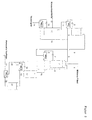
- Fig. 2 shows a plant with five reverse osmosis cells (U01, U02, U03, U04 and U05).
- the collecting tank 1 From the collecting tank 1 is pumped via the pump 2, which generates an operating pressure of 60 bar, a NaNO 3 solution with a concentration of 42 g / liter in the first reverse osmosis cell UO1.
- the NaNO 3 solution represents a recycled concentrate solution from the third reverse osmosis cell U03 (9).
- UO1 a permeate is passed via a line 3 with a NaNO 3 content of 11 g / liter in a collecting container 4.
- a "mean filtrate" purified wastewater from the pre-purification stage with average concentration of NaNO 3
- a concentrate from the fourth reverse osmosis cell U04 is passed with a NaNO 3 concentration of 9 g / liter.
- the solution mixture from the collecting container 4 is pumped by means of the pump 7 under a pressure of 55 bar via the line 8 into the third reverse osmosis cell U03.
- From the UO3 a concentrate with a NaNO 3 content of 42 g / liter is passed into the container 1 via line 9.
- the "concentrate filtrate” (purified waste water from the high NaNO 3 -control prepurification stage (NaNO 3 content 90 g / liter) is also passed through the line 12 into the container 11.
- the solution mixture is conveyed out of the container 11 with the aid of Pump 13 is passed into the second reverse osmosis cell U02, which is operated at a pressure of 80 to 120 bar
- the concentrate with a NaNO 3 content of 160 g / liter is passed via line 14 to an evaporator, in which solid sodium nitrate is recovered ,
- the permeate from the stage U02 with a NaNO 3 concentration of 33 g / liter is passed via the line 15 into the conduit 3 and from there into the collecting container 4.
- the permeate from the reverse osmosis stage UO3 (NaNO 3 content 3 g / liter) is passed via the line 16 into the collecting tank 17 and from this via a pump 18 (30 bar) into the reverse osmosis stage U04.
- From U04 enters a concentrate with a NaNO 3 concentration of 9 g / liter via the line 6 in the sump 4.
- the permeate from the stage U04 passes via line 19 into the sump 21 and from there via the pump 22 (30 bar) into the reverse osmosis stage UO5, where it is divided into a concentrate with a NaNO 3 content of 9 g / liter (which flows via line 20 into the reverse osmosis stage U04), and into a permeate.
- the permeate has a NaNO 3 concentration of 0.3 g / liter and can safely be introduced via line 23 into the receiving water or used as process water.
- FIG. 3 A plant for concentration of the pre-purification stage of FIG. 1 incoming purified wastewater by electrodialysis is in Fig. 3 shown.
- the remaining stages remain as reverse osmosis levels.
- the achievable with the electrodialysis NaNO 3 concentration is in the range of about 200 g / liter, ie in the same range as in reverse osmosis.
Landscapes
- Water Supply & Treatment (AREA)
- Engineering & Computer Science (AREA)
- Chemical & Material Sciences (AREA)
- Chemical Kinetics & Catalysis (AREA)
- Health & Medical Sciences (AREA)
- Urology & Nephrology (AREA)
- Nanotechnology (AREA)
- Life Sciences & Earth Sciences (AREA)
- Hydrology & Water Resources (AREA)
- Organic Chemistry (AREA)
- Environmental & Geological Engineering (AREA)
- Analytical Chemistry (AREA)
- Electrochemistry (AREA)
- General Chemical & Material Sciences (AREA)
- Molecular Biology (AREA)
- Separation Using Semi-Permeable Membranes (AREA)
- Water Treatment By Electricity Or Magnetism (AREA)
- Treatment Of Water By Oxidation Or Reduction (AREA)
- Removal Of Specific Substances (AREA)
Description
- Die Erfindung betrifft ein Verfahren zur Aufbereitung von nitrathaltigen Abwässern.
- In einer Reihe von Industriezweigen (z.B. in der Katalysatorindustrie, pyrotechnischen und Sprengstoffindustrie, Metallverarbeitung) werden im Laufe des Herstellungsprozesses Metallnitrate oder Salpetersäure eingesetzt. Dabei gelangen Nitrate in größeren Mengen als Abfallprodukte in das betriebliche Abwasser und - falls sie nicht entfernt werden - in den Vorfluter.
- Nitrate tragen in den Flüssen und Seen zu Eutrophierung der Gewässer bei. Deshalb ist in der EU und in einigen weiteren Staaten der Erde der Eintrag von Nitrat in Flüsse und Seen begrenzt, sowohl in der Konzentration als auch in der Fracht (Menge).
- Man hat bereits auf verschiedenen Wegen versucht, Nitrate aus Abwässern zu entfernen, wobei das Nitration zu unschädlichem Stickstoff reduziert wurde. Der Nitratabbau ist chemisch eine Redoxreaktion, entsprechend der Reaktionsgleichung
NO3 - + 3 H2O + 5e → ½ N2 + 6 OH- .
- Dabei wird der Stickstoff des Nitrats zu gasförmigem Stickstoff reduziert. Er nimmt dabei 5 Elektronen auf, die von einem Reduktionsmittel geliefert werden müssen, d.h. je nachdem wie viele Elektronen ein Reduktionsmittel liefert, kann vom Reduktionsmittel bis zum fünffachen der molaren Menge des Stickstoffs notwendig sein. Wie aus der obigen Gleichung ersichtlich, steigt der pH-Wert während der Reaktion an, muss also - z.B. um die Umgebungsbedingungen der Bakterien konstant zu halten - durch Zugabe von Säure im Neutralen gehalten werden.
- Es ist damit offensichtlich, dass jeder chemische oder elektrochemische Abbau des Nitrats erhebliche Mengen eines Reduktionsmittels notwendig macht und diesen Prozess kostenintensiv gestaltet. Als Ausnahme gilt, wenn das Reduktionsmittel bereits gewissermaßen als Abfallprodukt im Abwasser enthalten ist.
- Ein Sonderfall, Nitrate aus Abwässern zu entfernen, ist die in der Praxis am häufigsten angewandte biologische Denitrifikation. Dieses Verfahren beruht auf dem Abbau (Reduktion) von Nitrat durch geeignete Bakterien. Als Reduktionsmittel (= Nährstoff für die Bakterien) dienen praktisch ausschließlich organische Verbindungen, die häufig als Abfallstoffe bereits im Abwasser enthalten sind. Falls Denitrifikationsstufen eingebaut sind, arbeiten alle kommunalen Kläranlagen nach diesem Verfahren, da immer organische Materialien als Nährstoffe für die denitrifizierenden Bakterien geeignet sind.
- Im Falle industrieller Kläranlagen mit hoher Nitratfracht reicht oft die organische Zusatzkomponente im Abwasser nicht aus, um alles Nitrat zu reduzieren. Deshalb muss in diesen Fällen die zusätzlich benötigte Menge an organischen Verbindungen künstlich zugeführt werden. Die billigste und am einfachsten zu dosierende Kohlenstoffquelle ist Methanol.
- Ferner ist die katalytische Reaktion des Nitrats im Abwasser durch Wasserstoff bekannt. Bei diesem Verfahren erfolgt die Reduktion des Nitrats in kaskadenförmigen Druckreaktoren an Pd/Cu-Katalysatoren. Als Reduktionsmittel dient Wasserstoff. Mit 1 m3 Katalysator (4 Gew.-% Pd) erzielt man eine Abbauleistung von 70 kg Nitrat pro Tag. Die Kosten eines derartigen Katalysators sind aber sehr hoch. Auch bei dieser Reaktion steigt während der Umsetzung der pH-Wert und muss mit Säure neutralisiert werden.
- Ferner kann Nitrat statt mit Wasserstoff auch in Elektrolysezellen reduziert werden. Dabei entstehen Stickoxide (NOx). Diese Gase sind toxisch und müssen zu Salpetersäure weiter verarbeitet oder mit Ammoniak katalytisch zu Stickstoff reduziert werden.
- Von der Firma Vattenfall Europe AG, wurde ein elektrochemisches Reduktionsverfahren zur Nitratentfernung aus belasteten Grundwässern auf den Markt gebracht. Die hierbei angewandte Technik basiert auf zwei Schritten: Der erste Schritt umfasst die Rohwasseraufbereitung mit einem Ionenaustauscher. Im Filtermaterial des Ionenaustauschers wird das Nitrat absorbiert und später im Filterspülwasser angereichert. Der zweite Schritt umfasst die Spülwasseraufbereitung mit einer Elektrolysezelle, wobei das im Wasser gelöste Nitrat reduziert wird und als elementarer Stickstoff ausgast.
- Allen diesen Verfahren ist gemeinsam, dass die im Abwasser enthaltenen Nitrate nicht wiedergewonnen werden, so dass die hohen Verfahrenskosten nicht gesenkt werden können.
- Aus Ullmanns Enzyklopädie der Technischen Chemie, Band 6, Seite 448/449 (1981) ist bekannt, dass Abwässer durch Umkehrosmose gereinigt werden können. Bei diesem Verfahren werden mit Hilfe einer semipermeablen Membran und unter Anwendung eines Druckes, der größer als der osmotische Gegendruck ist, Ionen, Moleküle, Kolloide oder emulgierte Teilchen zurückgehalten. Das Wasser tritt durch die Membran, und die aufgegebene Lösung wird aufkonzentriert. Bei der Umkehrosmose werden Elektrolyte und/oder niedermolekulare organische Verbindungen mit Teilchengrößen zwischen 5 · 10-7 und 10-6 mm bei Drücken bis zu etwa 200 bar von der Membran zurückgehalten.
- Der Konzentrationsbereich, in dem die Umkehrosmose sinnvoll sein kann, liegt für Elektrolytlösungen etwa bis 35 g Nitratstickstoff/Liter. Im Bereich höherer Konzentrationen begrenzt derzeit noch der maximale Arbeitsdruck des Moduls die Anwendbarkeit der Umkehrosmose.
- Die Anlage besteht im wesentlichen aus einer Pumpe, die das Abwasser auf den erforderlichen Druck bringt; aus einem Feinfilter, Filter zur Entfernung von Teilchen, die sich auf der Membran ablagern könnten; aus meist mehreren geschlossenen Baueinheiten mit den semipermeablen Membranen (Modulen) und aus einem Regelventil, dass den Abfluss des Konzentrates und die Aufrechterhaltung des Arbeitsdruckes regelt.
- Als semipermeable Membranen wurden extrem dünne Folien mit 0,2 bis 0,5 µm Dicke entwickelt, die von einem porösen Trägermaterial von etwa 100 µm Dicke gestützt werden. Die semipermeablen Membranen werden meist aus Celluloseacetat oder Polyamid hergestellt. Es werden viele Module zu einer technischen Anlage zusammengebaut.
- Über die Aufbereitung bzw. Wiedergewinnung der in diesen Abwässern enthaltenen Nitrate finden sich in dieser Literaturstelle keine Angaben.
- Aus der
JP 2002/018486 A - Aus der
DE 199 01 571 A1 ist ein Verfahren zur Trennung von Ammoniumnitrat enthaltendem Kondensat-Abwasser durch Umkehrosmose bekannt, wobei in mehreren Stufen ein Konzentrat und ein Permeat erhalten wird. Das Permeat kann als Prozesswasser wieder verwendet werden, während das mit Ammoniumnitrat angereicherte Konzentrat in einen Verdampfer, d.h. in den Ausgangsprozess zurückgeleitet wird. Das Zurückleiten des Ammoniumnitrats in den Ausgangsprozess ist nicht möglich, z.B. wenn die Nitrate im Abwasser nicht den Nitraten im Prozess entsprechen. Das Verfahren befasst sich nicht mit der Aufbereitung von Abwässern, die Alkali- und/oder Erdalkalinitrate zusammen mit Störsubstanzen enthalten. - Aus der
JP 54117150 A - Der Erfindung liegt die Aufgabe zugrunde, ein Verfahren zur Aufbereitung von nitrathaltigen Abwässern bereitzustellen, die neben Nitraten noch Störsubstanzen enthalten, wobei das Verfahren aufgrund der Wiedergewinnung der Nitrate kostengünstiger ist als die bekannten Verfahren zur Entfernung von Nitraten aus Abwässern.
- Gegenstand der Erfindung ist somit ein Verfahren zur Aufbereitung von alkali- oder erdalkalinitrathaltigen Abwässern nach Anspruch 1.
- Unter Störsubstanzen versteht man einerseits solche Substanzen, die die semipermeablen Membranen in den Umkehrosmose- bzw. Elektrodialysezellen schädigen können. Dazu gehören Fest- und Schwebstoffe, die die Kanäle der semipermeablen Membranen verstopfen können. Zum anderen versteht man darunter Substanzen, die das Endprodukt verunreinigen können. Dazu zählen in erster Linie Carbonate sowie Ammonium- oder Schwermetallverbindungen.
- Vorzugsweise wird das erfindungsgemäße Verfahren zur Gewinnung von Alkalinitraten, insbesondere Natriumnitrat, angewendet. Daneben können aber auch Kaliumnitrat oder Lithiumnitrat gewonnen werden, wobei letzteres bei der Aufbereitung von Lithiumbatterien in verunreinigter Form erhalten wird.
- Als Nicht-Alkalimetallverbindungen werden nach dem erfindungsgemäßen Verfahren insbesondere Verbindungen entfernt, die keine Erdalkalimetallverbindungen sind, insbesondere Schwermetallverbindungen.
- Die Vorreinigung kann in einer oder mehreren Stufen durchgeführt werden. Zunächst werden im Allgemeinen die unlöslichen Feststoffe oder Schwebstoffe entfernt. Dies erfolgt in Abhängigkeit von der Größe der zu entfernenden Teilchen durch Sedimentation, Filtration, Zentrifugieren, Zyklonabscheidung und Flockung. Es kann aber auch eine Kombination dieser Abscheidungsverfahren angewendet werden. Bei der Filtration unterscheidet man zwischen einer gewöhnlichen Filtration, und der Ultrafiltration bzw. Mikrofiltration durch feinporige Membranen. Die Flockung wird in erster Linie bei schlecht filtrierbaren Schwebstoffen angewendet. Die ausgefällten Flocken können dann abfiltriert werden.
- Die Abtrennung der Nicht-Alkalimetallverbindungen, z.B. der Schwermetallverbindungen kann durch Ausfällen von unlöslichen Verbindungen, z.B. der Hydroxide, Oxidhydrate und Carbonate bzw. Bicarbonate erfolgen. Die ausgefällten Substanzen können dann wie die Feststoffe entfernt werden, d.h. durch Sedimentation, Filtration, Zentrifugieren, Zyklonabscheidung oder Flockung.
- Falls noch Spuren an Schwermetallen vorhanden sind, wird die Lösung einer Nanofiltration oder einem Ionenaustausch unterzogen. Dazu können Ionenaustauscher in der Alkali- oder der H-Form verwendet werden.
- Werden zum Ausfällen der Schwermetallverbindungen Alkalicarbonate bzw. -bicarbonate verwendet oder sind diese bereits im Abwasser enthalten, so muss das Carbonation entfernt werden, da es einen Störstoff darstellt. Zu diesem Zweck wird die Lösung erfindungsgemäß mit Salpetersäure leicht angesäuert (beispielsweise bis auf einen pH-Wert von 4 bis 5), wodurch Kohlendioxid aus der Lösung ausgetrieben wird. Die angesäuerte Lösung wird mit Natronlauge neutralisiert und über Ionenaustauscher in der H-Form geleitet und wiederum neutralisiert. Damit sind die restlichen Spuren von Schwermetallen entfernt. Die Lösung wird anschließend, falls notwendig auf unter 30°C abgekühlt, da sich damit für die nachfolgende Umkehrosmose- bzw. Dialysebehandlung ein günstigeres Gleichgewicht einstellt.
- Das erfindungsgemäße Verfahren ermöglicht die Aufbereitung von Abwässern mit einem hohen Gehalt an Nitraten, z.B. von mehr als 200 mg Nitratstickstoff/Liter. Die Konzentration an Nitratstickstoff ist nach oben nicht begrenzt und hängt praktisch nur davon ab, welchen Druck die Membranzellen noch aushalten können bzw. welchen energetischen Aufwand für die Erzeugung des osmotischen Drucks man wirtschaftlich noch für vertretbar erachtet. Im Allgemeinen geht man von einem Abwasser mit einem Nitratstickstoff-Gehalt von etwa 200 mg/Liter bis 35 g/Liter, vorzugsweise von 200 mg/Liter bis 20 g/Liter aus.
- Die Umkehrosmose bzw. die Elektrodialyse werden vorzugsweise mehrstufig durchgeführt, wobei die Konzentrat- und Permeat-Ströme im allgemeinen gegenläufig geführt werden, so dass einerseits möglichst salzfreie Permeate und andererseits möglichst hochkonzentrierte Konzentrate erhalten werden.
- Die Umkehrosmose wird bei hohem Druck durchgeführt. Vorzugsweise wird die mindestens eine Umkehrosmosezelle bei einem Druck von mehr als 30 bar, bevorzugt mehr als 55 bar, insbesondere mehr als 80 bar betrieben. Die Druckbereiche sind an sich nur durch die Stabilität der Osmosezelle bzw. die Leistung der Pumpe beschränkt. Bevorzugt wird der Druck innerhalb eines Bereichs von 30 bis 250 bar, bevorzugt 55 bis 180 bar, insbesondere bevorzugt 80 bis 120 bar gewählt.
- Bei mehrstufiger Prozessführung werden die Umkehrosmosezellen vorzugsweise bei unterschiedlichem Druck betrieben. Der Druck wird dabei der Konzentration der nitrathaltigen Abwässer angepasst.
- Die hochkonzentrierten nitrathaltigen Konzentrate werden zur Gewinnung der festen Nitrate noch weiter eingedampft. Diese werden als Handelsprodukte vertrieben. Es ist aber auch möglich die hochkonzentrierten Nitratlösungen in den Handel zu bringen.
- Das erfindungsgemäße Verfahren ist weit kostengünstiger als das Denitrifikationsverfahren. Es entfallen die Kosten für die Bakterienkulturen, die Reduktionsmittel (z.B. Methanol) und sonstige Chemikalien. Ein weiterer Kostenfaktor beim Denitrifikationsverfahren ist die Entsorgung der Bakterienmasse als Klärschlamm. Weiterhin wird die Reaktionslösung entsprechend der eingangs angegebenen Gleichung alkalisch, so dass die Hydroxylionen durch Säure neutralisiert werden müssen. Dies führt zu einer Erhöhung der Salzfracht. Weiterhin entsteht bei der Denitrifikation Distickstoffoxid (N2O), das als Treibhausgas unerwünscht ist. Das erfindungsgemäße Verfahren hat keinen dieser Nachteile. Außerdem werden die Betriebskosten dadurch gesenkt, dass die erhaltenen Nitrate in reiner Form als verkaufsfähige Produkte geeignet sind.
- Die Erfindung ist nachstehend anhand der beigefügten Schemaskizzen erläutert:
-
Fig. 1 zeigt das Gesamtverfahren mit Vorreinigung und Umkehrosmose bzw. Elektrodialyse. - Das Betriebswasser (Abwasser) wird zunächst zur Feststoff- bzw. Schwebstoffabtrennung in die Vorreinigungsstufe geleitet. Ein typisches Abwasser aus der ... Produktion hat beispielsweise folgende Zusammensetzung:
- NO3 - 0,6 bis 80 g/Liter
- CO3 2- 0,0 bis 4 g/Liter
- Schwermetalle (als Summe) 0,0 bis 10 g/Liter
- Feststoffe/Schwebstoffe 0,0 bis 10 g/Liter
- Als Schwermetalle sind prinzipiell alle Metalle außer den Alkali- und Erdalkalimetallen zu sehen, vorzugsweise Fe, Ni, Co, Cu, Al, Zn, Mn, Pb, Cr. Weiterhin können NH4 + oder NO2 - in Spuren vorhanden sein.
- Zur Feststoffabtrennung bzw. Schwebstoffabtrennung kann eine Sedimentation, eine Zentrifugation bzw. eine Zyklonabscheidung, eine Filtration (Beutelfilter, Kerzenfilter, Bandfilter, Lamellenfilter, Automatikfilter, Filterpressen usw.) eine Flockung, eine Ultrafiltration oder eine Mikrofiltration oder eine Kombination dieser Verfahren eingesetzt werden. Die Mikrofiltration bzw. Ultrafiltration wird eingesetzt, wenn die übliche Filtration nicht ausreicht.
- Die Auswahl des geeigneten Verfahrens bzw. der geeigneten Verfahrenskombination richtet sich im Wesentlichen nach der zu erwartenden Menge an unlöslichen Feststoffen.
- An den ersten Reinigungsschritt der Abtrennung der Feststoffanteile wird mit Salpetersäure der pH-Wert soweit abgesenkt, dass CO2 entweicht. Anschließend wird mit Alkali- oder Erdalkalilauge (hängt von dem zu gewinnenden Nitrat ab, z.B. bei Natriumnitrat setzt man Natronlauge ein) neutralisiert, ein weiteres Mal eventuell entstehender Feststoff abgetrennt, auf unter 30°C abgekühlt und noch in der Lösung vorhandene Schwermetalle über einen Ionenaustauscher entfernt.
- Anschließend wird das vorgereinigte Abwasser einer Umkehrosmose bzw. einer Elektrodialyse unterzogen, wobei eine Aufkonzentrierung der Lösungen erfolgt. Das Konzentrat kann weiter zu festem Nitrat eingedampft oder als konzentrierte Nitratlösung verwendet werden. Das Permeat kann entweder in den Vorfluter geleitet oder als Betriebswasser verwendet werden.
-
Fig. 2 zeigt eine Anlage mit fünf Umkehrosmosezellen (U01, U02, U03, U04 und U05). Aus dem Sammelbehälter 1 wird über die Pumpe 2, die einen Betriebsdruck von 60 bar erzeugt, eine NaNO3-Lösung mit einer Konzentration von 42 g/Liter in die erste Umkehrosmosezelle UO1 gepumpt. Die NaNO3-Lösung stellt eine rückgeführte Konzentratlösung aus der dritten Umkehrosmosezelle U03 dar (9). Aus UO1 wird über eine Leitung 3 ein Permeat mit einem NaNO3-Gehalt von 11 g/Liter in einen Sammelbehälter 4 geleitet. In den Sammelbehälter 4 wird ferner über die Leitung 5 ein "mittleres Filtrat" (gereinigtes Abwasser aus der Vorreinigungsstufe mit mittlerer Konzentration an NaNO3) mit einer NaNO3-Konzentration von 8 g/Liter und über die Leitung 6 ein Konzentrat aus der vierten Umkehrosmosezelle U04 mit einer NaNO3-Konzentration von 9 g/Liter geleitet. Das Lösungsgemisch aus dem Sammelbehälter 4 wird mit Hilfe der Pumpe 7 unter einem Druck von 55 bar über die Leitung 8 in die dritte Umkehrosmosezelle U03 gepumpt. Aus der UO3 wird über die Leitung 9 ein Konzentrat mit einem NaNO3-Gehalt von 42 g/Liter in den Behälter 1 geleitet. - Aus UO1 gelangt ein Konzentrat mit einem NaNO3-Gehalt von 92 g/Liter über die Leitung 10 in den Behälter 11.
- In den Behälter 11 wird auch das "Konzentrat-Filtrat" (gereinigtes Abwasser aus der Vorreinigungsstufe mit hoher NaNO3-Konzentration (NaNO3-Gehalt 90 g/Liter) durch die Leitung 12 geleitet. Aus dem Behälter 11 wird das Lösungsgemisch mit Hilfe der Pumpe 13 in die zweite Umkehrosmosezelle U02 geleitet, die bei einem Druck von 80 bis 120 bar betrieben wird. Das Konzentrat mit einem NaNO3-Gehalt von 160 g/ Liter wird über die Leitung 14 zu einem Verdampfer geleitet, in welchem festes Natriumnitrat gewonnen wird.
- Das Permeat aus der Stufe U02 mit einer NaNO3-Konzentration von 33 g/Liter wird über die Leitung 15 in die Leitung 3 und von da aus in den Sammelbehälter 4 geleitet.
- Das Permeat aus der Umkehrosmosestufe UO3 (NaNO3-Gehalt 3 g/Liter) wird über die Leitung 16 in den Sammelbehälter 17 und aus diesem über eine Pumpe 18 (30 bar) in die Umkehrosmosestufe U04 geleitet. Aus U04 gelangt ein Konzentrat mit einer NaNO3-Konzentration von 9 g/Liter über die Leitung 6 in den Sammelbehälter 4. Das Permeat aus der Stufe U04 gelangt über die Leitung 19 in den Sammelbehälter 21 und von da aus über die Pumpe 22 (30 bar) in die Umkehrosmosestufe UO5, und wird dort in ein Konzentrat mit einem NaNO3-Gehalt von 9 g/Liter (das über die Leitung 20 in die Umkehrosmosestufe U04 strömt), und in ein Permeat aufgeteilt. Das Permeat hat eine NaNO3-Konzentration von 0,3 g/ Liter und kann über die Leitung 23 unbedenklich in den Vorfluter eingeleitet oder als Betriebswasser verwendet werden.
- Eine Anlage zur Aufkonzentrierung des aus der Vorreinigungsstufe von
Figur 1 kommenden gereinigten Abwassers durch Elektrodialyse ist inFig. 3 dargestellt. Diese zeigt eine beispielhafte Ausführungsform, bei der die Hochdruck-Umkehrosmosezelle U02 durch eine Elektrodialysezelle ED ersetzt ist, in die das Konzentrat aus dem Sammelbehälter 11 drucklos eingeleitet wird, d.h. es fehlt die Pumpe 13 vonFig. 2 . - Die übrigen Stufen bleiben als Umkehrosmosestufen erhalten. Die mit der Elektrodialysezelle erzielbare NaNO3-Konzentration liegt im Bereicht von etwa 200 g/Liter d.h. im gleichen Bereich wie bei der Umkehrosmose.
Claims (9)
- Verfahren zur Aufbereitung von alkali- und/oder erdalkalinitrathaltigen Abwässern, dadurch gekennzeichnet, dass man die Abwässer, die neben Nitraten noch Störsubstanzen enthalten, nach einer Vorreinigung unter Ansäuern mit Salpetersäure auf einen pH-Wert zwischen 4 und 5 zur Entfernung der Fest- oder Schwebstoffe und/oder der Nicht-Alkalimetallverbindungen und/oder Carbonationen durch mindestens eine Umkehrosmose- und/oder Elektrodialysezelle leitet, das Konzentrat gegebenenfalls weiter aufkonzentriert und die Nitrate in Form einer konzentrierten Lösung oder in Form der festen Salze gewinnt.
- Verfahren nach Anspruch 1, dadurch gekennzeichnet, dass man Alkali- oder Erdalkalinitrate, vorzugsweise Natriumnitrat, gewinnt.
- Verfahren nach Anspruch 1 oder 2, dadurch gekennzeichnet, dass die Nicht- Alkalimetallverbindungen Schwermetallverbindungen darstellen.
- Verfahren nach einem der Ansprüche 1 bis 3, dadurch gekennzeichnet, dass man die Nicht-Alkalimetallverbindungen als unlösliche Verbindungen ausfällt oder die Nicht-Alkalimetalle durch Ionenaustausch und/oder Nanofiltration entfernt.
- Verfahren nach einem der Ansprüche 1 bis 4, dadurch gekennzeichnet, dass man von einem Abwasser mit einem Nitrat-Stickstoff-Gehalt von mindestens 200 mg/Liter ausgeht.
- Verfahren nach einem der Ansprüche 1 bis 5, dadurch gekennzeichnet, dass man von einem Abwasser mit einem Nitrat-Stickstoff-Gehalt von etwa 200 mg/Liter bis 30 g/Liter, vorzugsweise von etwa 200 mg/Liter bis 20 g/Liter ausgeht.
- Verfahren nach einem der Ansprüche 1 bis 6, dadurch gekennzeichnet, dass man mehrstufig arbeitet, wobei die Konzentrat- und Permeat-Ströme im Allgemeinen gegenläufig geführt werden.
- Verfahren nach einem der Ansprüche 1 bis 7, dadurch gekennzeichnet, dass die mindestens eine Umkehrosmosezelle bei einem Druck von mehr als 30 bar, bevorzugt mehr als 55 bar, insbesondere bevorzugt mehr als 80 bar betrieben wird.
- Verfahren nach Anspruch 7, wobei bei mehrstufiger Prozessführung die Umkehrosmosezellen bei unterschiedlichen Drücken betrieben werden.
Priority Applications (1)
| Application Number | Priority Date | Filing Date | Title |
|---|---|---|---|
| PL04731621T PL1620363T3 (pl) | 2003-05-07 | 2004-05-07 | Sposób uzdatniania ścieków zawierających azotany |
Applications Claiming Priority (2)
| Application Number | Priority Date | Filing Date | Title |
|---|---|---|---|
| DE10320368A DE10320368A1 (de) | 2003-05-07 | 2003-05-07 | Verfahren zur Aufbereitung von nitrathaltigen Abwässern |
| PCT/EP2004/004907 WO2004099087A1 (de) | 2003-05-07 | 2004-05-07 | Verfahren zur aufbereitung von nitrathaltigen abwässern |
Publications (2)
| Publication Number | Publication Date |
|---|---|
| EP1620363A1 EP1620363A1 (de) | 2006-02-01 |
| EP1620363B1 true EP1620363B1 (de) | 2009-10-07 |
Family
ID=33394244
Family Applications (1)
| Application Number | Title | Priority Date | Filing Date |
|---|---|---|---|
| EP04731621A Expired - Lifetime EP1620363B1 (de) | 2003-05-07 | 2004-05-07 | Verfahren zur aufbereitung von nitrathaltigen abwässern |
Country Status (6)
| Country | Link |
|---|---|
| EP (1) | EP1620363B1 (de) |
| AT (1) | ATE444939T1 (de) |
| DE (2) | DE10320368A1 (de) |
| DK (1) | DK1620363T3 (de) |
| PL (1) | PL1620363T3 (de) |
| WO (1) | WO2004099087A1 (de) |
Cited By (1)
| Publication number | Priority date | Publication date | Assignee | Title |
|---|---|---|---|---|
| EP4640642A1 (de) * | 2024-04-22 | 2025-10-29 | SK Innovation Co., Ltd. | Elektrochemisches wasserbehandlungsverfahren mit selektiver ionentrennung |
Families Citing this family (7)
| Publication number | Priority date | Publication date | Assignee | Title |
|---|---|---|---|---|
| DE102006047681A1 (de) | 2006-10-09 | 2008-04-10 | Lk Metallwaren Gmbh | Verfahren und Vorrichtung zur Behandlung von Abwässern einer Metallgießerei |
| FR2930246B1 (fr) * | 2008-04-18 | 2011-12-09 | Veolia Eau Cie Generale Des Eaux | Procede de traitement des effluents aqueux de purge ou de nettoyage des circuits de generateurs de vapeur et unite mobile permettant la mise en oeuvre de ce procede |
| EP2216088A1 (de) * | 2009-02-04 | 2010-08-11 | Lonza Ltd. | Rückgewinnung von Produktverlusten aus ED-Abfallströmen |
| IT1400942B1 (it) * | 2010-06-23 | 2013-07-02 | Kron Morelli | Impianto e procedimento per l'estrazione di azoto ammoniacale da reflui liquidi, particolarmente per la riduzione della quantita' di refluo destinata allo spandimento |
| CA3120818A1 (en) * | 2018-12-19 | 2020-06-25 | H.C. Starck Tungsten Gmbh | Method for preparing ammonium metatungstate |
| CN111875125A (zh) * | 2020-06-30 | 2020-11-03 | 成都泓润科技有限公司 | 结合膜分离与电渗析的废水处理方法 |
| CN112607926A (zh) * | 2020-12-29 | 2021-04-06 | 中海油天津化工研究设计院有限公司 | 一种硝酸钠废水资源化处理系统及方法 |
Family Cites Families (7)
| Publication number | Priority date | Publication date | Assignee | Title |
|---|---|---|---|---|
| DE3041209A1 (de) * | 1980-11-03 | 1982-05-13 | Josef van Opbergen GmbH & Co KG, 4040 Neuss | Verfahren zur aufbereitung von insbesondere nitrathaltigem wasser |
| HU200971B (en) * | 1984-09-12 | 1990-09-28 | Magyar Asvanyolaj Es Foeldgaz | Combined separation process for reducing inactive salt content of waste solutions of atomic power stations |
| DE3619086A1 (de) * | 1986-06-06 | 1987-12-10 | Klaus Prof Dr Kock | Verfahren zum entsalzen von wasserhaltigen loesungen, vorrichtung zur durchfuehrung desselben sowie deren verwendung |
| CH677325A5 (de) * | 1989-04-28 | 1991-05-15 | Asea Brown Boveri | |
| JPH0866686A (ja) * | 1994-08-29 | 1996-03-12 | Shinko Pantec Co Ltd | 廃液等の被処理液の処理方法とその装置 |
| CA2186963C (en) * | 1996-10-01 | 1999-03-30 | Riad A. Al-Samadi | High water recovery membrane purification process |
| DE19901571A1 (de) * | 1999-01-16 | 2000-07-20 | Uwatech Gmbh | Verfahren zur Trennung von ammoniumnitrathaltigem Kondensat-Abwasser in zwei wiederverwendbare flüssige Anteile |
-
2003
- 2003-05-07 DE DE10320368A patent/DE10320368A1/de not_active Withdrawn
-
2004
- 2004-05-07 WO PCT/EP2004/004907 patent/WO2004099087A1/de not_active Ceased
- 2004-05-07 PL PL04731621T patent/PL1620363T3/pl unknown
- 2004-05-07 EP EP04731621A patent/EP1620363B1/de not_active Expired - Lifetime
- 2004-05-07 AT AT04731621T patent/ATE444939T1/de not_active IP Right Cessation
- 2004-05-07 DK DK04731621T patent/DK1620363T3/da active
- 2004-05-07 DE DE502004010197T patent/DE502004010197D1/de not_active Expired - Lifetime
Cited By (1)
| Publication number | Priority date | Publication date | Assignee | Title |
|---|---|---|---|---|
| EP4640642A1 (de) * | 2024-04-22 | 2025-10-29 | SK Innovation Co., Ltd. | Elektrochemisches wasserbehandlungsverfahren mit selektiver ionentrennung |
Also Published As
| Publication number | Publication date |
|---|---|
| PL1620363T3 (pl) | 2010-03-31 |
| DE10320368A1 (de) | 2004-11-25 |
| EP1620363A1 (de) | 2006-02-01 |
| ATE444939T1 (de) | 2009-10-15 |
| WO2004099087A1 (de) | 2004-11-18 |
| DE502004010197D1 (de) | 2009-11-19 |
| DK1620363T3 (da) | 2009-12-14 |
Similar Documents
| Publication | Publication Date | Title |
|---|---|---|
| DE69527021T2 (de) | Vorrichtung und Verfahren zum Entsalzen von Meerwasser durch mehrstufige Umkehrosmose | |
| EP2162401B1 (de) | Aufbereitung von wasser mit hypobromitlösung | |
| CA2812455C (en) | An integrated selenium removal system for waste water | |
| EP0968964B1 (de) | Verfahren zur stofflichen Verwertung von Gülle | |
| PL173335B1 (pl) | Sposób wytwarzania roztworu wodnego o wysokim stężeniu NaCl | |
| DE60303364T2 (de) | Verfahren zur entfernung eines stickoxides aus einem mit diesem beladenen gas | |
| CN115108673B (zh) | 一种氧化法生产磷酸铁母液资源化处理的工艺 | |
| DE69521079T2 (de) | Verfahren zur Behandlung einer photographischen Schmutzlösung | |
| EP2537813A1 (de) | Verfahren zur Aufarbeitung von Minenwässern | |
| EP1310581A2 (de) | Verfahren zur Behandlung säure- und metallhaltiger Abwässer | |
| EP1620363B1 (de) | Verfahren zur aufbereitung von nitrathaltigen abwässern | |
| CN115991560A (zh) | 一种磷酸铁生产废水资源化的处理方法 | |
| DE112014001292T5 (de) | Verfahren zur Wasseraufbereitung vor der Umkehrosmose | |
| DE3109848A1 (de) | Verfahren zum behandeln von abwasser | |
| DE102022104474A1 (de) | Abtrennung von Säuren oder Laugen aus gelöste Metallionen enthaltenden sauren oder alkalischen wässrigen Lösungen | |
| US20240228350A9 (en) | Process for treating waste waters having high saline content | |
| EP3429968B1 (de) | Modulares verfahren und abwasserbehandlungsanordnung zur effizienten reinigung von abwasser | |
| DE19630826A1 (de) | Verfahren zur Aufbereitung von Chlor und gegebenenfalls chlororganische Verbindung enthaltendem Rohwasser, insbesondere Badwasser, sowie Vorrichtung zur Durchführung des vorgenannten Verfahrens | |
| EP0968756B1 (de) | Verfahren zur Aufbereitung metallhaltiger verbrauchter Beizsäuren | |
| EP2754158B1 (de) | Verfahren zur abtrennung von radioaktiven nukliden mittels keramischer filtermembranen | |
| DE60006718T2 (de) | Verfahren zur wiedergewinnung von kupfer aus iodierte organische verbindungen enthaltenden wässrigen lösungen | |
| DE2933499C2 (de) | Verfahren und Vorrichtung zur Herstellung und Bereitstellung von Reinstwasser | |
| DE3830332A1 (de) | Verfahren zum entfernen von nitrationen aus rohwasser zum zwecke der trinkwasseraufbereitung | |
| EP3749616B1 (de) | Verfahren zur abwasserbehandlung | |
| CN116354456A (zh) | 一种含硫酸盐的溶液的浓缩方法 |
Legal Events
| Date | Code | Title | Description |
|---|---|---|---|
| PUAI | Public reference made under article 153(3) epc to a published international application that has entered the european phase |
Free format text: ORIGINAL CODE: 0009012 |
|
| 17P | Request for examination filed |
Effective date: 20041210 |
|
| AK | Designated contracting states |
Kind code of ref document: A1 Designated state(s): AT BE BG CH CY CZ DE DK EE ES FI FR GB GR HU IE IT LI LU MC NL PL PT RO SE SI SK TR |
|
| DAX | Request for extension of the european patent (deleted) | ||
| GRAP | Despatch of communication of intention to grant a patent |
Free format text: ORIGINAL CODE: EPIDOSNIGR1 |
|
| GRAP | Despatch of communication of intention to grant a patent |
Free format text: ORIGINAL CODE: EPIDOSNIGR1 |
|
| GRAS | Grant fee paid |
Free format text: ORIGINAL CODE: EPIDOSNIGR3 |
|
| GRAA | (expected) grant |
Free format text: ORIGINAL CODE: 0009210 |
|
| AK | Designated contracting states |
Kind code of ref document: B1 Designated state(s): AT BE BG CH CY CZ DE DK EE ES FI FR GB GR HU IE IT LI LU MC NL PL PT RO SE SI SK TR |
|
| REG | Reference to a national code |
Ref country code: GB Ref legal event code: FG4D Free format text: NOT ENGLISH |
|
| REG | Reference to a national code |
Ref country code: CH Ref legal event code: EP |
|
| REG | Reference to a national code |
Ref country code: IE Ref legal event code: FG4D |
|
| REF | Corresponds to: |
Ref document number: 502004010197 Country of ref document: DE Date of ref document: 20091119 Kind code of ref document: P |
|
| REG | Reference to a national code |
Ref country code: DK Ref legal event code: T3 |
|
| PG25 | Lapsed in a contracting state [announced via postgrant information from national office to epo] |
Ref country code: SI Free format text: LAPSE BECAUSE OF FAILURE TO SUBMIT A TRANSLATION OF THE DESCRIPTION OR TO PAY THE FEE WITHIN THE PRESCRIBED TIME-LIMIT Effective date: 20091007 |
|
| NLV1 | Nl: lapsed or annulled due to failure to fulfill the requirements of art. 29p and 29m of the patents act | ||
| REG | Reference to a national code |
Ref country code: PL Ref legal event code: T3 |
|
| PG25 | Lapsed in a contracting state [announced via postgrant information from national office to epo] |
Ref country code: ES Free format text: LAPSE BECAUSE OF FAILURE TO SUBMIT A TRANSLATION OF THE DESCRIPTION OR TO PAY THE FEE WITHIN THE PRESCRIBED TIME-LIMIT Effective date: 20100118 Ref country code: FI Free format text: LAPSE BECAUSE OF FAILURE TO SUBMIT A TRANSLATION OF THE DESCRIPTION OR TO PAY THE FEE WITHIN THE PRESCRIBED TIME-LIMIT Effective date: 20091007 Ref country code: PT Free format text: LAPSE BECAUSE OF FAILURE TO SUBMIT A TRANSLATION OF THE DESCRIPTION OR TO PAY THE FEE WITHIN THE PRESCRIBED TIME-LIMIT Effective date: 20100208 Ref country code: SE Free format text: LAPSE BECAUSE OF FAILURE TO SUBMIT A TRANSLATION OF THE DESCRIPTION OR TO PAY THE FEE WITHIN THE PRESCRIBED TIME-LIMIT Effective date: 20091007 |
|
| REG | Reference to a national code |
Ref country code: IE Ref legal event code: FD4D |
|
| PG25 | Lapsed in a contracting state [announced via postgrant information from national office to epo] |
Ref country code: IE Free format text: LAPSE BECAUSE OF FAILURE TO SUBMIT A TRANSLATION OF THE DESCRIPTION OR TO PAY THE FEE WITHIN THE PRESCRIBED TIME-LIMIT Effective date: 20091007 Ref country code: BG Free format text: LAPSE BECAUSE OF FAILURE TO SUBMIT A TRANSLATION OF THE DESCRIPTION OR TO PAY THE FEE WITHIN THE PRESCRIBED TIME-LIMIT Effective date: 20100107 Ref country code: EE Free format text: LAPSE BECAUSE OF FAILURE TO SUBMIT A TRANSLATION OF THE DESCRIPTION OR TO PAY THE FEE WITHIN THE PRESCRIBED TIME-LIMIT Effective date: 20091007 Ref country code: NL Free format text: LAPSE BECAUSE OF FAILURE TO SUBMIT A TRANSLATION OF THE DESCRIPTION OR TO PAY THE FEE WITHIN THE PRESCRIBED TIME-LIMIT Effective date: 20091007 Ref country code: RO Free format text: LAPSE BECAUSE OF FAILURE TO SUBMIT A TRANSLATION OF THE DESCRIPTION OR TO PAY THE FEE WITHIN THE PRESCRIBED TIME-LIMIT Effective date: 20091007 |
|
| RAP2 | Party data changed (patent owner data changed or rights of a patent transferred) |
Owner name: SUED-CHEMIE AG |
|
| PLBE | No opposition filed within time limit |
Free format text: ORIGINAL CODE: 0009261 |
|
| STAA | Information on the status of an ep patent application or granted ep patent |
Free format text: STATUS: NO OPPOSITION FILED WITHIN TIME LIMIT |
|
| PG25 | Lapsed in a contracting state [announced via postgrant information from national office to epo] |
Ref country code: SK Free format text: LAPSE BECAUSE OF FAILURE TO SUBMIT A TRANSLATION OF THE DESCRIPTION OR TO PAY THE FEE WITHIN THE PRESCRIBED TIME-LIMIT Effective date: 20091007 |
|
| 26N | No opposition filed |
Effective date: 20100708 |
|
| REG | Reference to a national code |
Ref country code: GB Ref legal event code: 732E Free format text: REGISTERED BETWEEN 20100916 AND 20100922 |
|
| PG25 | Lapsed in a contracting state [announced via postgrant information from national office to epo] |
Ref country code: GR Free format text: LAPSE BECAUSE OF FAILURE TO SUBMIT A TRANSLATION OF THE DESCRIPTION OR TO PAY THE FEE WITHIN THE PRESCRIBED TIME-LIMIT Effective date: 20100108 |
|
| BERE | Be: lapsed |
Owner name: SUD-CHEMIE A.G. Effective date: 20100531 Owner name: KCS OSMOTA G.M.B.H. Effective date: 20100531 |
|
| PG25 | Lapsed in a contracting state [announced via postgrant information from national office to epo] |
Ref country code: MC Free format text: LAPSE BECAUSE OF NON-PAYMENT OF DUE FEES Effective date: 20100531 |
|
| REG | Reference to a national code |
Ref country code: CH Ref legal event code: PL |
|
| REG | Reference to a national code |
Ref country code: FR Ref legal event code: ST Effective date: 20110131 |
|
| PG25 | Lapsed in a contracting state [announced via postgrant information from national office to epo] |
Ref country code: LI Free format text: LAPSE BECAUSE OF NON-PAYMENT OF DUE FEES Effective date: 20100531 Ref country code: CH Free format text: LAPSE BECAUSE OF NON-PAYMENT OF DUE FEES Effective date: 20100531 |
|
| PG25 | Lapsed in a contracting state [announced via postgrant information from national office to epo] |
Ref country code: IT Free format text: LAPSE BECAUSE OF FAILURE TO SUBMIT A TRANSLATION OF THE DESCRIPTION OR TO PAY THE FEE WITHIN THE PRESCRIBED TIME-LIMIT Effective date: 20091007 Ref country code: BE Free format text: LAPSE BECAUSE OF NON-PAYMENT OF DUE FEES Effective date: 20100531 |
|
| PG25 | Lapsed in a contracting state [announced via postgrant information from national office to epo] |
Ref country code: FR Free format text: LAPSE BECAUSE OF NON-PAYMENT OF DUE FEES Effective date: 20100531 |
|
| PG25 | Lapsed in a contracting state [announced via postgrant information from national office to epo] |
Ref country code: AT Free format text: LAPSE BECAUSE OF NON-PAYMENT OF DUE FEES Effective date: 20100507 |
|
| REG | Reference to a national code |
Ref country code: GB Ref legal event code: 732E Free format text: REGISTERED BETWEEN 20120712 AND 20120718 |
|
| REG | Reference to a national code |
Ref country code: DE Ref legal event code: R081 Ref document number: 502004010197 Country of ref document: DE Owner name: SUED-CHEMIE IP GMBH & CO. KG, DE Free format text: FORMER OWNER: SUED-CHEMIE AG, 80333 MUENCHEN, DE Effective date: 20120628 Ref country code: DE Ref legal event code: R082 Ref document number: 502004010197 Country of ref document: DE Representative=s name: KUBA, STEFAN, DE Effective date: 20120628 Ref country code: DE Ref legal event code: R082 Ref document number: 502004010197 Country of ref document: DE Representative=s name: ABITZ & PARTNER, DE Effective date: 20120628 Ref country code: DE Ref legal event code: R082 Ref document number: 502004010197 Country of ref document: DE Representative=s name: KUBA, STEFAN, LL.M, DE Effective date: 20120628 Ref country code: DE Ref legal event code: R082 Ref document number: 502004010197 Country of ref document: DE Representative=s name: KUBA, STEFAN, LL.M., DE Effective date: 20120628 |
|
| PG25 | Lapsed in a contracting state [announced via postgrant information from national office to epo] |
Ref country code: CY Free format text: LAPSE BECAUSE OF FAILURE TO SUBMIT A TRANSLATION OF THE DESCRIPTION OR TO PAY THE FEE WITHIN THE PRESCRIBED TIME-LIMIT Effective date: 20091007 |
|
| PG25 | Lapsed in a contracting state [announced via postgrant information from national office to epo] |
Ref country code: HU Free format text: LAPSE BECAUSE OF FAILURE TO SUBMIT A TRANSLATION OF THE DESCRIPTION OR TO PAY THE FEE WITHIN THE PRESCRIBED TIME-LIMIT Effective date: 20100408 Ref country code: LU Free format text: LAPSE BECAUSE OF NON-PAYMENT OF DUE FEES Effective date: 20100507 |
|
| PG25 | Lapsed in a contracting state [announced via postgrant information from national office to epo] |
Ref country code: TR Free format text: LAPSE BECAUSE OF FAILURE TO SUBMIT A TRANSLATION OF THE DESCRIPTION OR TO PAY THE FEE WITHIN THE PRESCRIBED TIME-LIMIT Effective date: 20091007 |
|
| REG | Reference to a national code |
Ref country code: DE Ref legal event code: R082 Ref document number: 502004010197 Country of ref document: DE Representative=s name: KUBA, STEFAN, DE Ref country code: DE Ref legal event code: R082 Ref document number: 502004010197 Country of ref document: DE Representative=s name: KUBA, STEFAN, LL.M, DE Ref country code: DE Ref legal event code: R082 Ref document number: 502004010197 Country of ref document: DE Representative=s name: KUBA, STEFAN, LL.M., DE |
|
| REG | Reference to a national code |
Ref country code: DE Ref legal event code: R082 Ref document number: 502004010197 Country of ref document: DE Representative=s name: KUBA, STEFAN, LL.M., DE Ref country code: DE Ref legal event code: R081 Ref document number: 502004010197 Country of ref document: DE Owner name: CLARIANT INTERNATIONAL LTD., CH Free format text: FORMER OWNER: SUED-CHEMIE IP GMBH & CO. KG, 80333 MUENCHEN, DE |
|
| REG | Reference to a national code |
Ref country code: GB Ref legal event code: 732E Free format text: REGISTERED BETWEEN 20220421 AND 20220427 |
|
| PGFP | Annual fee paid to national office [announced via postgrant information from national office to epo] |
Ref country code: GB Payment date: 20220524 Year of fee payment: 19 Ref country code: DK Payment date: 20220524 Year of fee payment: 19 Ref country code: CZ Payment date: 20220505 Year of fee payment: 19 |
|
| PGFP | Annual fee paid to national office [announced via postgrant information from national office to epo] |
Ref country code: PL Payment date: 20220428 Year of fee payment: 19 |
|
| P01 | Opt-out of the competence of the unified patent court (upc) registered |
Effective date: 20230510 |
|
| PGFP | Annual fee paid to national office [announced via postgrant information from national office to epo] |
Ref country code: DE Payment date: 20230530 Year of fee payment: 20 |
|
| REG | Reference to a national code |
Ref country code: DK Ref legal event code: EBP Effective date: 20230531 |
|
| GBPC | Gb: european patent ceased through non-payment of renewal fee |
Effective date: 20230507 |
|
| PG25 | Lapsed in a contracting state [announced via postgrant information from national office to epo] |
Ref country code: CZ Free format text: LAPSE BECAUSE OF NON-PAYMENT OF DUE FEES Effective date: 20230507 |
|
| PG25 | Lapsed in a contracting state [announced via postgrant information from national office to epo] |
Ref country code: DK Free format text: LAPSE BECAUSE OF NON-PAYMENT OF DUE FEES Effective date: 20230531 Ref country code: GB Free format text: LAPSE BECAUSE OF NON-PAYMENT OF DUE FEES Effective date: 20230507 |
|
| REG | Reference to a national code |
Ref country code: DE Ref legal event code: R071 Ref document number: 502004010197 Country of ref document: DE |
|
| PG25 | Lapsed in a contracting state [announced via postgrant information from national office to epo] |
Ref country code: PL Free format text: LAPSE BECAUSE OF NON-PAYMENT OF DUE FEES Effective date: 20230507 |
|
| PG25 | Lapsed in a contracting state [announced via postgrant information from national office to epo] |
Ref country code: PL Free format text: LAPSE BECAUSE OF NON-PAYMENT OF DUE FEES Effective date: 20230507 |