EP1621197A2 - Composition comprenant un stéröide et un anticholinérgique - Google Patents
Composition comprenant un stéröide et un anticholinérgique Download PDFInfo
- Publication number
- EP1621197A2 EP1621197A2 EP05109887A EP05109887A EP1621197A2 EP 1621197 A2 EP1621197 A2 EP 1621197A2 EP 05109887 A EP05109887 A EP 05109887A EP 05109887 A EP05109887 A EP 05109887A EP 1621197 A2 EP1621197 A2 EP 1621197A2
- Authority
- EP
- European Patent Office
- Prior art keywords
- propellant
- inhalable
- inhalation
- contain
- medicament according
- Prior art date
- Legal status (The legal status is an assumption and is not a legal conclusion. Google has not performed a legal analysis and makes no representation as to the accuracy of the status listed.)
- Withdrawn
Links
- 239000000203 mixture Substances 0.000 title claims abstract description 36
- 150000003431 steroids Chemical class 0.000 title claims description 88
- 239000000812 cholinergic antagonist Substances 0.000 title abstract description 7
- 229940121948 Muscarinic receptor antagonist Drugs 0.000 title abstract description 5
- 239000003814 drug Substances 0.000 claims abstract description 41
- CPELXLSAUQHCOX-UHFFFAOYSA-M Bromide Chemical compound [Br-] CPELXLSAUQHCOX-UHFFFAOYSA-M 0.000 claims abstract description 24
- -1 2,2-diphenylpropionic acid scopine ester Chemical class 0.000 claims abstract description 23
- 150000001450 anions Chemical class 0.000 claims abstract description 12
- VZCYOOQTPOCHFL-UHFFFAOYSA-N trans-butenedioic acid Natural products OC(=O)C=CC(O)=O VZCYOOQTPOCHFL-UHFFFAOYSA-N 0.000 claims abstract description 9
- VEXZGXHMUGYJMC-UHFFFAOYSA-M Chloride anion Chemical compound [Cl-] VEXZGXHMUGYJMC-UHFFFAOYSA-M 0.000 claims abstract description 8
- VZCYOOQTPOCHFL-OWOJBTEDSA-N Fumaric acid Chemical compound OC(=O)\C=C\C(O)=O VZCYOOQTPOCHFL-OWOJBTEDSA-N 0.000 claims abstract description 7
- WPYMKLBDIGXBTP-UHFFFAOYSA-N benzoic acid Chemical compound OC(=O)C1=CC=CC=C1 WPYMKLBDIGXBTP-UHFFFAOYSA-N 0.000 claims abstract description 6
- AFVFQIVMOAPDHO-UHFFFAOYSA-N Methanesulfonic acid Chemical compound CS(O)(=O)=O AFVFQIVMOAPDHO-UHFFFAOYSA-N 0.000 claims abstract description 5
- 150000004677 hydrates Chemical class 0.000 claims abstract description 5
- VZCYOOQTPOCHFL-UPHRSURJSA-N maleic acid Chemical compound OC(=O)\C=C/C(O)=O VZCYOOQTPOCHFL-UPHRSURJSA-N 0.000 claims abstract description 5
- JOXIMZWYDAKGHI-UHFFFAOYSA-N toluene-4-sulfonic acid Chemical compound CC1=CC=C(S(O)(=O)=O)C=C1 JOXIMZWYDAKGHI-UHFFFAOYSA-N 0.000 claims abstract description 5
- QTBSBXVTEAMEQO-UHFFFAOYSA-M Acetate Chemical compound CC([O-])=O QTBSBXVTEAMEQO-UHFFFAOYSA-M 0.000 claims abstract description 4
- FEWJPZIEWOKRBE-JCYAYHJZSA-N Dextrotartaric acid Chemical compound OC(=O)[C@H](O)[C@@H](O)C(O)=O FEWJPZIEWOKRBE-JCYAYHJZSA-N 0.000 claims abstract description 4
- NHNBFGGVMKEFGY-UHFFFAOYSA-N Nitrate Chemical compound [O-][N+]([O-])=O NHNBFGGVMKEFGY-UHFFFAOYSA-N 0.000 claims abstract description 4
- 229910019142 PO4 Inorganic materials 0.000 claims abstract description 4
- KRKNYBCHXYNGOX-UHFFFAOYSA-K Citrate Chemical compound [O-]C(=O)CC(O)(CC([O-])=O)C([O-])=O KRKNYBCHXYNGOX-UHFFFAOYSA-K 0.000 claims abstract description 3
- 229910002651 NO3 Inorganic materials 0.000 claims abstract description 3
- MUBZPKHOEPUJKR-UHFFFAOYSA-N Oxalic acid Chemical compound OC(=O)C(O)=O MUBZPKHOEPUJKR-UHFFFAOYSA-N 0.000 claims abstract description 3
- QAOWNCQODCNURD-UHFFFAOYSA-L Sulfate Chemical compound [O-]S([O-])(=O)=O QAOWNCQODCNURD-UHFFFAOYSA-L 0.000 claims abstract description 3
- XMBWDFGMSWQBCA-UHFFFAOYSA-N hydrogen iodide Chemical compound I XMBWDFGMSWQBCA-UHFFFAOYSA-N 0.000 claims abstract description 3
- NBIIXXVUZAFLBC-UHFFFAOYSA-K phosphate Chemical compound [O-]P([O-])([O-])=O NBIIXXVUZAFLBC-UHFFFAOYSA-K 0.000 claims abstract description 3
- 239000010452 phosphate Substances 0.000 claims abstract description 3
- 239000012453 solvate Substances 0.000 claims abstract description 3
- KDYFGRWQOYBRFD-UHFFFAOYSA-L succinate(2-) Chemical compound [O-]C(=O)CCC([O-])=O KDYFGRWQOYBRFD-UHFFFAOYSA-L 0.000 claims abstract description 3
- 229940095064 tartrate Drugs 0.000 claims abstract description 3
- 150000003839 salts Chemical class 0.000 claims description 126
- 239000000443 aerosol Substances 0.000 claims description 41
- LFQSCWFLJHTTHZ-UHFFFAOYSA-N Ethanol Chemical compound CCO LFQSCWFLJHTTHZ-UHFFFAOYSA-N 0.000 claims description 28
- 150000001875 compounds Chemical class 0.000 claims description 28
- 239000003380 propellant Substances 0.000 claims description 24
- 239000000843 powder Substances 0.000 claims description 20
- 239000000546 pharmaceutical excipient Substances 0.000 claims description 17
- 239000000725 suspension Substances 0.000 claims description 17
- 239000013543 active substance Substances 0.000 claims description 11
- VOVIALXJUBGFJZ-KWVAZRHASA-N Budesonide Chemical compound C1CC2=CC(=O)C=C[C@]2(C)[C@@H]2[C@@H]1[C@@H]1C[C@H]3OC(CCC)O[C@@]3(C(=O)CO)[C@@]1(C)C[C@@H]2O VOVIALXJUBGFJZ-KWVAZRHASA-N 0.000 claims description 9
- 239000002253 acid Substances 0.000 claims description 9
- 229960004436 budesonide Drugs 0.000 claims description 9
- 239000002552 dosage form Substances 0.000 claims description 9
- 239000002904 solvent Substances 0.000 claims description 9
- KFZMGEQAYNKOFK-UHFFFAOYSA-N Isopropanol Chemical compound CC(C)O KFZMGEQAYNKOFK-UHFFFAOYSA-N 0.000 claims description 8
- ATUOYWHBWRKTHZ-UHFFFAOYSA-N Propane Chemical compound CCC ATUOYWHBWRKTHZ-UHFFFAOYSA-N 0.000 claims description 8
- 239000002245 particle Substances 0.000 claims description 8
- LUKZNWIVRBCLON-GXOBDPJESA-N Ciclesonide Chemical compound C1([C@H]2O[C@@]3([C@H](O2)C[C@@H]2[C@@]3(C[C@H](O)[C@@H]3[C@@]4(C)C=CC(=O)C=C4CC[C@H]32)C)C(=O)COC(=O)C(C)C)CCCCC1 LUKZNWIVRBCLON-GXOBDPJESA-N 0.000 claims description 7
- 229960003728 ciclesonide Drugs 0.000 claims description 7
- XLYOFNOQVPJJNP-UHFFFAOYSA-N water Substances O XLYOFNOQVPJJNP-UHFFFAOYSA-N 0.000 claims description 7
- OVBJJZOQPCKUOR-UHFFFAOYSA-L EDTA disodium salt dihydrate Chemical compound O.O.[Na+].[Na+].[O-]C(=O)C[NH+](CC([O-])=O)CC[NH+](CC([O-])=O)CC([O-])=O OVBJJZOQPCKUOR-UHFFFAOYSA-L 0.000 claims description 6
- PEDCQBHIVMGVHV-UHFFFAOYSA-N Glycerine Chemical compound OCC(O)CO PEDCQBHIVMGVHV-UHFFFAOYSA-N 0.000 claims description 6
- DNIAPMSPPWPWGF-UHFFFAOYSA-N Propylene glycol Chemical compound CC(O)CO DNIAPMSPPWPWGF-UHFFFAOYSA-N 0.000 claims description 6
- 239000003755 preservative agent Substances 0.000 claims description 6
- 229940037001 sodium edetate Drugs 0.000 claims description 6
- 239000003963 antioxidant agent Substances 0.000 claims description 5
- 239000008139 complexing agent Substances 0.000 claims description 5
- 229920003171 Poly (ethylene oxide) Polymers 0.000 claims description 4
- 150000001298 alcohols Chemical class 0.000 claims description 4
- 208000006673 asthma Diseases 0.000 claims description 4
- 230000002757 inflammatory effect Effects 0.000 claims description 4
- NNPPMTNAJDCUHE-UHFFFAOYSA-N isobutane Chemical compound CC(C)C NNPPMTNAJDCUHE-UHFFFAOYSA-N 0.000 claims description 4
- 238000004519 manufacturing process Methods 0.000 claims description 4
- IJDNQMDRQITEOD-UHFFFAOYSA-N n-butane Chemical compound CCCC IJDNQMDRQITEOD-UHFFFAOYSA-N 0.000 claims description 4
- 239000003381 stabilizer Substances 0.000 claims description 4
- 229940125904 compound 1 Drugs 0.000 claims description 3
- 229940125782 compound 2 Drugs 0.000 claims description 3
- 239000000470 constituent Substances 0.000 claims description 3
- 150000002016 disaccharides Chemical class 0.000 claims description 3
- 229960002714 fluticasone Drugs 0.000 claims description 3
- MGNNYOODZCAHBA-GQKYHHCASA-N fluticasone Chemical compound C1([C@@H](F)C2)=CC(=O)C=C[C@]1(C)[C@]1(F)[C@@H]2[C@@H]2C[C@@H](C)[C@@](C(=O)SCF)(O)[C@@]2(C)C[C@@H]1O MGNNYOODZCAHBA-GQKYHHCASA-N 0.000 claims description 3
- 229960001664 mometasone Drugs 0.000 claims description 3
- QLIIKPVHVRXHRI-CXSFZGCWSA-N mometasone Chemical compound C1CC2=CC(=O)C=C[C@]2(C)[C@]2(Cl)[C@@H]1[C@@H]1C[C@@H](C)[C@@](C(=O)CCl)(O)[C@@]1(C)C[C@@H]2O QLIIKPVHVRXHRI-CXSFZGCWSA-N 0.000 claims description 3
- 150000002772 monosaccharides Chemical class 0.000 claims description 3
- 229930003231 vitamin Natural products 0.000 claims description 3
- 239000011782 vitamin Substances 0.000 claims description 3
- 235000013343 vitamin Nutrition 0.000 claims description 3
- 229940088594 vitamin Drugs 0.000 claims description 3
- PMPVIKIVABFJJI-UHFFFAOYSA-N Cyclobutane Chemical class C1CCC1 PMPVIKIVABFJJI-UHFFFAOYSA-N 0.000 claims description 2
- LVZWSLJZHVFIQJ-UHFFFAOYSA-N Cyclopropane Chemical class C1CC1 LVZWSLJZHVFIQJ-UHFFFAOYSA-N 0.000 claims description 2
- OTMSDBZUPAUEDD-UHFFFAOYSA-N Ethane Chemical class CC OTMSDBZUPAUEDD-UHFFFAOYSA-N 0.000 claims description 2
- 208000027771 Obstructive airways disease Diseases 0.000 claims description 2
- 239000002202 Polyethylene glycol Substances 0.000 claims description 2
- 239000002671 adjuvant Substances 0.000 claims description 2
- 239000001273 butane Chemical class 0.000 claims description 2
- UREBDLICKHMUKA-CXSFZGCWSA-N dexamethasone Chemical compound C1CC2=CC(=O)C=C[C@]2(C)[C@]2(F)[C@@H]1[C@@H]1C[C@@H](C)[C@@](C(=O)CO)(O)[C@@]1(C)C[C@@H]2O UREBDLICKHMUKA-CXSFZGCWSA-N 0.000 claims description 2
- 235000014113 dietary fatty acids Nutrition 0.000 claims description 2
- LYCAIKOWRPUZTN-UHFFFAOYSA-N ethylene glycol Natural products OCCO LYCAIKOWRPUZTN-UHFFFAOYSA-N 0.000 claims description 2
- 229930195729 fatty acid Natural products 0.000 claims description 2
- 239000000194 fatty acid Substances 0.000 claims description 2
- 150000004676 glycans Chemical class 0.000 claims description 2
- 150000002334 glycols Chemical class 0.000 claims description 2
- 229930195733 hydrocarbon Natural products 0.000 claims description 2
- 150000002430 hydrocarbons Chemical class 0.000 claims description 2
- 125000002887 hydroxy group Chemical group [H]O* 0.000 claims description 2
- WGCNASOHLSPBMP-UHFFFAOYSA-N hydroxyacetaldehyde Natural products OCC=O WGCNASOHLSPBMP-UHFFFAOYSA-N 0.000 claims description 2
- 208000027866 inflammatory disease Diseases 0.000 claims description 2
- 239000001282 iso-butane Substances 0.000 claims description 2
- VNWKTOKETHGBQD-UHFFFAOYSA-N methane Chemical class C VNWKTOKETHGBQD-UHFFFAOYSA-N 0.000 claims description 2
- OFBQJSOFQDEBGM-UHFFFAOYSA-N n-pentane Chemical class CCCCC OFBQJSOFQDEBGM-UHFFFAOYSA-N 0.000 claims description 2
- 150000002482 oligosaccharides Chemical class 0.000 claims description 2
- 229920001223 polyethylene glycol Polymers 0.000 claims description 2
- 229920001451 polypropylene glycol Polymers 0.000 claims description 2
- 229920001282 polysaccharide Polymers 0.000 claims description 2
- 239000005017 polysaccharide Substances 0.000 claims description 2
- 239000001294 propane Chemical class 0.000 claims description 2
- 150000005846 sugar alcohols Polymers 0.000 claims description 2
- 229940041682 inhalant solution Drugs 0.000 claims 2
- 150000008282 halocarbons Chemical class 0.000 claims 1
- 229920001542 oligosaccharide Polymers 0.000 claims 1
- FIMXSEMBHGTNKT-UHFFFAOYSA-N Scopine Natural products CN1C2CC(O)CC1C1C2O1 FIMXSEMBHGTNKT-UHFFFAOYSA-N 0.000 abstract description 5
- 230000000694 effects Effects 0.000 abstract description 5
- 230000001078 anti-cholinergic effect Effects 0.000 abstract description 4
- FIMXSEMBHGTNKT-RZVDLVGDSA-N scopine Chemical class C([C@@H]1N2C)[C@H](O)C[C@@H]2[C@@H]2[C@H]1O2 FIMXSEMBHGTNKT-RZVDLVGDSA-N 0.000 abstract description 3
- 230000003454 betamimetic effect Effects 0.000 abstract 2
- 239000003795 chemical substances by application Substances 0.000 abstract 2
- HBAQYPYDRFILMT-UHFFFAOYSA-N 8-[3-(1-cyclopropylpyrazol-4-yl)-1H-pyrazolo[4,3-d]pyrimidin-5-yl]-3-methyl-3,8-diazabicyclo[3.2.1]octan-2-one Chemical class C1(CC1)N1N=CC(=C1)C1=NNC2=C1N=C(N=C2)N1C2C(N(CC1CC2)C)=O HBAQYPYDRFILMT-UHFFFAOYSA-N 0.000 abstract 1
- 230000001088 anti-asthma Effects 0.000 abstract 1
- 230000003110 anti-inflammatory effect Effects 0.000 abstract 1
- 239000000924 antiasthmatic agent Substances 0.000 abstract 1
- 230000010534 mechanism of action Effects 0.000 abstract 1
- 150000001768 cations Chemical class 0.000 description 41
- 239000000243 solution Substances 0.000 description 30
- 239000004615 ingredient Substances 0.000 description 23
- YMWUJEATGCHHMB-UHFFFAOYSA-N Dichloromethane Chemical compound ClCCl YMWUJEATGCHHMB-UHFFFAOYSA-N 0.000 description 15
- 238000009472 formulation Methods 0.000 description 15
- 239000004480 active ingredient Substances 0.000 description 14
- 239000002775 capsule Substances 0.000 description 14
- 229940079593 drug Drugs 0.000 description 14
- GUBGYTABKSRVRQ-XLOQQCSPSA-N Alpha-Lactose Chemical compound O[C@@H]1[C@@H](O)[C@@H](O)[C@@H](CO)O[C@H]1O[C@@H]1[C@@H](CO)O[C@H](O)[C@H](O)[C@H]1O GUBGYTABKSRVRQ-XLOQQCSPSA-N 0.000 description 13
- GUBGYTABKSRVRQ-QKKXKWKRSA-N Lactose Natural products OC[C@H]1O[C@@H](O[C@H]2[C@H](O)[C@@H](O)C(O)O[C@@H]2CO)[C@H](O)[C@@H](O)[C@H]1O GUBGYTABKSRVRQ-QKKXKWKRSA-N 0.000 description 13
- 239000008101 lactose Substances 0.000 description 13
- 229960001375 lactose Drugs 0.000 description 13
- LVGUZGTVOIAKKC-UHFFFAOYSA-N 1,1,1,2-tetrafluoroethane Chemical compound FCC(F)(F)F LVGUZGTVOIAKKC-UHFFFAOYSA-N 0.000 description 9
- WEVYAHXRMPXWCK-UHFFFAOYSA-N Acetonitrile Chemical compound CC#N WEVYAHXRMPXWCK-UHFFFAOYSA-N 0.000 description 9
- VEXZGXHMUGYJMC-UHFFFAOYSA-N Hydrochloric acid Chemical compound Cl VEXZGXHMUGYJMC-UHFFFAOYSA-N 0.000 description 9
- KRKNYBCHXYNGOX-UHFFFAOYSA-N citric acid Chemical compound OC(=O)CC(O)(C(O)=O)CC(O)=O KRKNYBCHXYNGOX-UHFFFAOYSA-N 0.000 description 9
- 239000007789 gas Substances 0.000 description 9
- 125000001449 isopropyl group Chemical group [H]C([H])([H])C([H])(*)C([H])([H])[H] 0.000 description 9
- CIWBSHSKHKDKBQ-JLAZNSOCSA-N Ascorbic acid Chemical compound OC[C@H](O)[C@H]1OC(=O)C(O)=C1O CIWBSHSKHKDKBQ-JLAZNSOCSA-N 0.000 description 8
- LERNTVKEWCAPOY-VOGVJGKGSA-N C[N+]1(C)[C@H]2C[C@H](C[C@@H]1[C@H]1O[C@@H]21)OC(=O)C(O)(c1cccs1)c1cccs1 Chemical compound C[N+]1(C)[C@H]2C[C@H](C[C@@H]1[C@H]1O[C@@H]21)OC(=O)C(O)(c1cccs1)c1cccs1 LERNTVKEWCAPOY-VOGVJGKGSA-N 0.000 description 8
- 238000002360 preparation method Methods 0.000 description 8
- 229960000257 tiotropium bromide Drugs 0.000 description 8
- 239000012530 fluid Substances 0.000 description 7
- 230000007246 mechanism Effects 0.000 description 7
- 238000000034 method Methods 0.000 description 7
- 230000008569 process Effects 0.000 description 6
- FAPWRFPIFSIZLT-UHFFFAOYSA-M Sodium chloride Chemical compound [Na+].[Cl-] FAPWRFPIFSIZLT-UHFFFAOYSA-M 0.000 description 5
- 150000007513 acids Chemical class 0.000 description 5
- 208000006545 Chronic Obstructive Pulmonary Disease Diseases 0.000 description 4
- NBIIXXVUZAFLBC-UHFFFAOYSA-N Phosphoric acid Chemical compound OP(O)(O)=O NBIIXXVUZAFLBC-UHFFFAOYSA-N 0.000 description 4
- QAOWNCQODCNURD-UHFFFAOYSA-N Sulfuric acid Chemical compound OS(O)(=O)=O QAOWNCQODCNURD-UHFFFAOYSA-N 0.000 description 4
- 230000009471 action Effects 0.000 description 4
- 239000000654 additive Substances 0.000 description 4
- 235000006708 antioxidants Nutrition 0.000 description 4
- 235000010323 ascorbic acid Nutrition 0.000 description 4
- 239000011668 ascorbic acid Substances 0.000 description 4
- 229960005070 ascorbic acid Drugs 0.000 description 4
- 239000012141 concentrate Substances 0.000 description 4
- 229960000289 fluticasone propionate Drugs 0.000 description 4
- WMWTYOKRWGGJOA-CENSZEJFSA-N fluticasone propionate Chemical compound C1([C@@H](F)C2)=CC(=O)C=C[C@]1(C)[C@]1(F)[C@@H]2[C@@H]2C[C@@H](C)[C@@](C(=O)SCF)(OC(=O)CC)[C@@]2(C)C[C@@H]1O WMWTYOKRWGGJOA-CENSZEJFSA-N 0.000 description 4
- BDAGIHXWWSANSR-UHFFFAOYSA-N methanoic acid Natural products OC=O BDAGIHXWWSANSR-UHFFFAOYSA-N 0.000 description 4
- 229960002744 mometasone furoate Drugs 0.000 description 4
- WOFMFGQZHJDGCX-ZULDAHANSA-N mometasone furoate Chemical compound O([C@]1([C@@]2(C)C[C@H](O)[C@]3(Cl)[C@@]4(C)C=CC(=O)C=C4CC[C@H]3[C@@H]2C[C@H]1C)C(=O)CCl)C(=O)C1=CC=CO1 WOFMFGQZHJDGCX-ZULDAHANSA-N 0.000 description 4
- 239000006199 nebulizer Substances 0.000 description 4
- 208000023504 respiratory system disease Diseases 0.000 description 4
- NMGODFWGUBLTTA-UHFFFAOYSA-N 3-amino-1h-quinazoline-2,4-dione Chemical compound C1=CC=C2C(=O)N(N)C(=O)NC2=C1 NMGODFWGUBLTTA-UHFFFAOYSA-N 0.000 description 3
- QTBSBXVTEAMEQO-UHFFFAOYSA-N Acetic acid Chemical compound CC(O)=O QTBSBXVTEAMEQO-UHFFFAOYSA-N 0.000 description 3
- AFVFQIVMOAPDHO-UHFFFAOYSA-M Methanesulfonate Chemical compound CS([O-])(=O)=O AFVFQIVMOAPDHO-UHFFFAOYSA-M 0.000 description 3
- ZMXDDKWLCZADIW-UHFFFAOYSA-N N,N-Dimethylformamide Chemical compound CN(C)C=O ZMXDDKWLCZADIW-UHFFFAOYSA-N 0.000 description 3
- XBDQKXXYIPTUBI-UHFFFAOYSA-N Propionic acid Chemical class CCC(O)=O XBDQKXXYIPTUBI-UHFFFAOYSA-N 0.000 description 3
- 235000015165 citric acid Nutrition 0.000 description 3
- 239000000890 drug combination Substances 0.000 description 3
- 239000013583 drug formulation Substances 0.000 description 3
- 229940093915 gynecological organic acid Drugs 0.000 description 3
- 150000007522 mineralic acids Chemical class 0.000 description 3
- 150000007524 organic acids Chemical class 0.000 description 3
- 235000005985 organic acids Nutrition 0.000 description 3
- GVJHHUAWPYXKBD-UHFFFAOYSA-N (±)-α-Tocopherol Chemical compound OC1=C(C)C(C)=C2OC(CCCC(C)CCCC(C)CCCC(C)C)(C)CCC2=C1C GVJHHUAWPYXKBD-UHFFFAOYSA-N 0.000 description 2
- OSWFIVFLDKOXQC-UHFFFAOYSA-N 4-(3-methoxyphenyl)aniline Chemical compound COC1=CC=CC(C=2C=CC(N)=CC=2)=C1 OSWFIVFLDKOXQC-UHFFFAOYSA-N 0.000 description 2
- VTYYLEPIZMXCLO-UHFFFAOYSA-L Calcium carbonate Chemical compound [Ca+2].[O-]C([O-])=O VTYYLEPIZMXCLO-UHFFFAOYSA-L 0.000 description 2
- WQZGKKKJIJFFOK-GASJEMHNSA-N Glucose Natural products OC[C@H]1OC(O)[C@H](O)[C@@H](O)[C@@H]1O WQZGKKKJIJFFOK-GASJEMHNSA-N 0.000 description 2
- CDBYLPFSWZWCQE-UHFFFAOYSA-L Sodium Carbonate Chemical compound [Na+].[Na+].[O-]C([O-])=O CDBYLPFSWZWCQE-UHFFFAOYSA-L 0.000 description 2
- 229940065524 anticholinergics inhalants for obstructive airway diseases Drugs 0.000 description 2
- 229960000686 benzalkonium chloride Drugs 0.000 description 2
- UKXSKSHDVLQNKG-UHFFFAOYSA-N benzilic acid Chemical class C=1C=CC=CC=1C(O)(C(=O)O)C1=CC=CC=C1 UKXSKSHDVLQNKG-UHFFFAOYSA-N 0.000 description 2
- CADWTSSKOVRVJC-UHFFFAOYSA-N benzyl(dimethyl)azanium;chloride Chemical compound [Cl-].C[NH+](C)CC1=CC=CC=C1 CADWTSSKOVRVJC-UHFFFAOYSA-N 0.000 description 2
- WQZGKKKJIJFFOK-VFUOTHLCSA-N beta-D-glucose Chemical compound OC[C@H]1O[C@@H](O)[C@H](O)[C@@H](O)[C@@H]1O WQZGKKKJIJFFOK-VFUOTHLCSA-N 0.000 description 2
- BTANRVKWQNVYAZ-UHFFFAOYSA-N butan-2-ol Chemical compound CCC(C)O BTANRVKWQNVYAZ-UHFFFAOYSA-N 0.000 description 2
- 238000007906 compression Methods 0.000 description 2
- 230000006835 compression Effects 0.000 description 2
- 201000010099 disease Diseases 0.000 description 2
- 208000037265 diseases, disorders, signs and symptoms Diseases 0.000 description 2
- 239000003937 drug carrier Substances 0.000 description 2
- 235000019253 formic acid Nutrition 0.000 description 2
- 239000001530 fumaric acid Substances 0.000 description 2
- 239000008103 glucose Substances 0.000 description 2
- 239000007788 liquid Substances 0.000 description 2
- 239000000463 material Substances 0.000 description 2
- 230000000414 obstructive effect Effects 0.000 description 2
- CTSLXHKWHWQRSH-UHFFFAOYSA-N oxalyl chloride Chemical compound ClC(=O)C(Cl)=O CTSLXHKWHWQRSH-UHFFFAOYSA-N 0.000 description 2
- 235000021317 phosphate Nutrition 0.000 description 2
- 239000004033 plastic Substances 0.000 description 2
- 229920003023 plastic Polymers 0.000 description 2
- 238000000746 purification Methods 0.000 description 2
- FIMXSEMBHGTNKT-UPGAHCIJSA-N scopine Chemical compound C([C@@H]1N2C)C(O)C[C@@H]2[C@@H]2[C@H]1O2 FIMXSEMBHGTNKT-UPGAHCIJSA-N 0.000 description 2
- 239000011780 sodium chloride Substances 0.000 description 2
- 238000003860 storage Methods 0.000 description 2
- 239000000126 substance Substances 0.000 description 2
- KDYFGRWQOYBRFD-UHFFFAOYSA-N succinic acid Chemical compound OC(=O)CCC(O)=O KDYFGRWQOYBRFD-UHFFFAOYSA-N 0.000 description 2
- 239000004094 surface-active agent Substances 0.000 description 2
- 230000002195 synergetic effect Effects 0.000 description 2
- 230000001225 therapeutic effect Effects 0.000 description 2
- 238000002604 ultrasonography Methods 0.000 description 2
- HDTRYLNUVZCQOY-UHFFFAOYSA-N α-D-glucopyranosyl-α-D-glucopyranoside Natural products OC1C(O)C(O)C(CO)OC1OC1C(O)C(O)C(O)C(CO)O1 HDTRYLNUVZCQOY-UHFFFAOYSA-N 0.000 description 1
- JNYAEWCLZODPBN-JGWLITMVSA-N (2r,3r,4s)-2-[(1r)-1,2-dihydroxyethyl]oxolane-3,4-diol Chemical class OC[C@@H](O)[C@H]1OC[C@H](O)[C@H]1O JNYAEWCLZODPBN-JGWLITMVSA-N 0.000 description 1
- WRIDQFICGBMAFQ-UHFFFAOYSA-N (E)-8-Octadecenoic acid Natural products CCCCCCCCCC=CCCCCCCC(O)=O WRIDQFICGBMAFQ-UHFFFAOYSA-N 0.000 description 1
- BJEPYKJPYRNKOW-REOHCLBHSA-N (S)-malic acid Chemical compound OC(=O)[C@@H](O)CC(O)=O BJEPYKJPYRNKOW-REOHCLBHSA-N 0.000 description 1
- YFMFNYKEUDLDTL-UHFFFAOYSA-N 1,1,1,2,3,3,3-heptafluoropropane Chemical compound FC(F)(F)C(F)C(F)(F)F YFMFNYKEUDLDTL-UHFFFAOYSA-N 0.000 description 1
- JLPULHDHAOZNQI-ZTIMHPMXSA-N 1-hexadecanoyl-2-(9Z,12Z-octadecadienoyl)-sn-glycero-3-phosphocholine Chemical compound CCCCCCCCCCCCCCCC(=O)OC[C@H](COP([O-])(=O)OCC[N+](C)(C)C)OC(=O)CCCCCCC\C=C/C\C=C/CCCCC JLPULHDHAOZNQI-ZTIMHPMXSA-N 0.000 description 1
- PZNPLUBHRSSFHT-RRHRGVEJSA-N 1-hexadecanoyl-2-octadecanoyl-sn-glycero-3-phosphocholine Chemical compound CCCCCCCCCCCCCCCCCC(=O)O[C@@H](COP([O-])(=O)OCC[N+](C)(C)C)COC(=O)CCCCCCCCCCCCCCC PZNPLUBHRSSFHT-RRHRGVEJSA-N 0.000 description 1
- OWEGMIWEEQEYGQ-UHFFFAOYSA-N 100676-05-9 Natural products OC1C(O)C(O)C(CO)OC1OCC1C(O)C(O)C(O)C(OC2C(OC(O)C(O)C2O)CO)O1 OWEGMIWEEQEYGQ-UHFFFAOYSA-N 0.000 description 1
- FPIPGXGPPPQFEQ-UHFFFAOYSA-N 13-cis retinol Natural products OCC=C(C)C=CC=C(C)C=CC1=C(C)CCCC1(C)C FPIPGXGPPPQFEQ-UHFFFAOYSA-N 0.000 description 1
- STYYTQKQOWKLIL-UHFFFAOYSA-N 2,2-diphenylpropanoyl chloride Chemical compound C=1C=CC=CC=1C(C(Cl)=O)(C)C1=CC=CC=C1 STYYTQKQOWKLIL-UHFFFAOYSA-N 0.000 description 1
- ZMPRRFPMMJQXPP-UHFFFAOYSA-N 2-sulfobenzoic acid Chemical class OC(=O)C1=CC=CC=C1S(O)(=O)=O ZMPRRFPMMJQXPP-UHFFFAOYSA-N 0.000 description 1
- LQJBNNIYVWPHFW-UHFFFAOYSA-N 20:1omega9c fatty acid Natural products CCCCCCCCCCC=CCCCCCCCC(O)=O LQJBNNIYVWPHFW-UHFFFAOYSA-N 0.000 description 1
- BMYNFMYTOJXKLE-UHFFFAOYSA-N 3-azaniumyl-2-hydroxypropanoate Chemical compound NCC(O)C(O)=O BMYNFMYTOJXKLE-UHFFFAOYSA-N 0.000 description 1
- QSBYPNXLFMSGKH-UHFFFAOYSA-N 9-Heptadecensaeure Natural products CCCCCCCC=CCCCCCCCC(O)=O QSBYPNXLFMSGKH-UHFFFAOYSA-N 0.000 description 1
- WSVLPVUVIUVCRA-KPKNDVKVSA-N Alpha-lactose monohydrate Chemical compound O.O[C@@H]1[C@@H](O)[C@@H](O)[C@@H](CO)O[C@H]1O[C@@H]1[C@@H](CO)O[C@H](O)[C@H](O)[C@H]1O WSVLPVUVIUVCRA-KPKNDVKVSA-N 0.000 description 1
- 239000005711 Benzoic acid Substances 0.000 description 1
- 208000017667 Chronic Disease Diseases 0.000 description 1
- FBPFZTCFMRRESA-FSIIMWSLSA-N D-Glucitol Natural products OC[C@H](O)[C@H](O)[C@@H](O)[C@H](O)CO FBPFZTCFMRRESA-FSIIMWSLSA-N 0.000 description 1
- FBPFZTCFMRRESA-KVTDHHQDSA-N D-Mannitol Chemical compound OC[C@@H](O)[C@@H](O)[C@H](O)[C@H](O)CO FBPFZTCFMRRESA-KVTDHHQDSA-N 0.000 description 1
- FBPFZTCFMRRESA-JGWLITMVSA-N D-glucitol Chemical compound OC[C@H](O)[C@@H](O)[C@H](O)[C@H](O)CO FBPFZTCFMRRESA-JGWLITMVSA-N 0.000 description 1
- 229920002307 Dextran Polymers 0.000 description 1
- GUBGYTABKSRVRQ-PICCSMPSSA-N Maltose Natural products O[C@@H]1[C@@H](O)[C@H](O)[C@@H](CO)O[C@@H]1O[C@@H]1[C@@H](CO)OC(O)[C@H](O)[C@H]1O GUBGYTABKSRVRQ-PICCSMPSSA-N 0.000 description 1
- 229930195725 Mannitol Natural products 0.000 description 1
- GRYLNZFGIOXLOG-UHFFFAOYSA-N Nitric acid Chemical compound O[N+]([O-])=O GRYLNZFGIOXLOG-UHFFFAOYSA-N 0.000 description 1
- 239000005642 Oleic acid Substances 0.000 description 1
- ZQPPMHVWECSIRJ-UHFFFAOYSA-N Oleic acid Natural products CCCCCCCCC=CCCCCCCCC(O)=O ZQPPMHVWECSIRJ-UHFFFAOYSA-N 0.000 description 1
- MUBZPKHOEPUJKR-UHFFFAOYSA-L Oxalate Chemical compound [O-]C(=O)C([O-])=O MUBZPKHOEPUJKR-UHFFFAOYSA-L 0.000 description 1
- OFOBLEOULBTSOW-UHFFFAOYSA-N Propanedioic acid Natural products OC(=O)CC(O)=O OFOBLEOULBTSOW-UHFFFAOYSA-N 0.000 description 1
- CZMRCDWAGMRECN-UGDNZRGBSA-N Sucrose Chemical compound O[C@H]1[C@H](O)[C@@H](CO)O[C@@]1(CO)O[C@@H]1[C@H](O)[C@@H](O)[C@H](O)[C@@H](CO)O1 CZMRCDWAGMRECN-UGDNZRGBSA-N 0.000 description 1
- 229930006000 Sucrose Natural products 0.000 description 1
- FEWJPZIEWOKRBE-UHFFFAOYSA-N Tartaric acid Natural products [H+].[H+].[O-]C(=O)C(O)C(O)C([O-])=O FEWJPZIEWOKRBE-UHFFFAOYSA-N 0.000 description 1
- HDTRYLNUVZCQOY-WSWWMNSNSA-N Trehalose Natural products O[C@@H]1[C@@H](O)[C@@H](O)[C@@H](CO)O[C@@H]1O[C@@H]1[C@H](O)[C@@H](O)[C@@H](O)[C@@H](CO)O1 HDTRYLNUVZCQOY-WSWWMNSNSA-N 0.000 description 1
- FPIPGXGPPPQFEQ-BOOMUCAASA-N Vitamin A Natural products OC/C=C(/C)\C=C\C=C(\C)/C=C/C1=C(C)CCCC1(C)C FPIPGXGPPPQFEQ-BOOMUCAASA-N 0.000 description 1
- 229930003427 Vitamin E Natural products 0.000 description 1
- TVXBFESIOXBWNM-UHFFFAOYSA-N Xylitol Natural products OCCC(O)C(O)C(O)CCO TVXBFESIOXBWNM-UHFFFAOYSA-N 0.000 description 1
- 150000001242 acetic acid derivatives Chemical class 0.000 description 1
- 230000001476 alcoholic effect Effects 0.000 description 1
- 150000001335 aliphatic alkanes Chemical class 0.000 description 1
- FPIPGXGPPPQFEQ-OVSJKPMPSA-N all-trans-retinol Chemical compound OC\C=C(/C)\C=C\C=C(/C)\C=C\C1=C(C)CCCC1(C)C FPIPGXGPPPQFEQ-OVSJKPMPSA-N 0.000 description 1
- HDTRYLNUVZCQOY-LIZSDCNHSA-N alpha,alpha-trehalose Chemical compound O[C@@H]1[C@@H](O)[C@H](O)[C@@H](CO)O[C@@H]1O[C@@H]1[C@H](O)[C@@H](O)[C@H](O)[C@@H](CO)O1 HDTRYLNUVZCQOY-LIZSDCNHSA-N 0.000 description 1
- BJEPYKJPYRNKOW-UHFFFAOYSA-N alpha-hydroxysuccinic acid Natural products OC(=O)C(O)CC(O)=O BJEPYKJPYRNKOW-UHFFFAOYSA-N 0.000 description 1
- 229910000147 aluminium phosphate Inorganic materials 0.000 description 1
- 239000008346 aqueous phase Substances 0.000 description 1
- 239000003125 aqueous solvent Substances 0.000 description 1
- PYMYPHUHKUWMLA-WDCZJNDASA-N arabinose Chemical compound OC[C@@H](O)[C@@H](O)[C@H](O)C=O PYMYPHUHKUWMLA-WDCZJNDASA-N 0.000 description 1
- PYMYPHUHKUWMLA-UHFFFAOYSA-N arabinose Natural products OCC(O)C(O)C(O)C=O PYMYPHUHKUWMLA-UHFFFAOYSA-N 0.000 description 1
- 244000052616 bacterial pathogen Species 0.000 description 1
- NBMKJKDGKREAPL-DVTGEIKXSA-N beclomethasone Chemical compound C1CC2=CC(=O)C=C[C@]2(C)[C@]2(Cl)[C@@H]1[C@@H]1C[C@H](C)[C@@](C(=O)CO)(O)[C@@]1(C)C[C@@H]2O NBMKJKDGKREAPL-DVTGEIKXSA-N 0.000 description 1
- 229940092705 beclomethasone Drugs 0.000 description 1
- 230000008901 benefit Effects 0.000 description 1
- 235000010233 benzoic acid Nutrition 0.000 description 1
- 229960004365 benzoic acid Drugs 0.000 description 1
- 150000001558 benzoic acid derivatives Chemical class 0.000 description 1
- SRBFZHDQGSBBOR-UHFFFAOYSA-N beta-D-Pyranose-Lyxose Natural products OC1COC(O)C(O)C1O SRBFZHDQGSBBOR-UHFFFAOYSA-N 0.000 description 1
- GUBGYTABKSRVRQ-QUYVBRFLSA-N beta-maltose Chemical compound OC[C@H]1O[C@H](O[C@H]2[C@H](O)[C@@H](O)[C@H](O)O[C@@H]2CO)[C@H](O)[C@@H](O)[C@@H]1O GUBGYTABKSRVRQ-QUYVBRFLSA-N 0.000 description 1
- 230000000903 blocking effect Effects 0.000 description 1
- GZUXJHMPEANEGY-UHFFFAOYSA-N bromomethane Chemical compound BrC GZUXJHMPEANEGY-UHFFFAOYSA-N 0.000 description 1
- KDYFGRWQOYBRFD-NUQCWPJISA-N butanedioic acid Chemical compound O[14C](=O)CC[14C](O)=O KDYFGRWQOYBRFD-NUQCWPJISA-N 0.000 description 1
- 229910000019 calcium carbonate Inorganic materials 0.000 description 1
- 229960001927 cetylpyridinium chloride Drugs 0.000 description 1
- NFCRBQADEGXVDL-UHFFFAOYSA-M cetylpyridinium chloride monohydrate Chemical compound O.[Cl-].CCCCCCCCCCCCCCCC[N+]1=CC=CC=C1 NFCRBQADEGXVDL-UHFFFAOYSA-M 0.000 description 1
- 229960004106 citric acid Drugs 0.000 description 1
- 238000004891 communication Methods 0.000 description 1
- 238000011109 contamination Methods 0.000 description 1
- 239000003246 corticosteroid Substances 0.000 description 1
- 229960001334 corticosteroids Drugs 0.000 description 1
- 238000000921 elemental analysis Methods 0.000 description 1
- 239000003480 eluent Substances 0.000 description 1
- 238000011049 filling Methods 0.000 description 1
- 239000000706 filtrate Substances 0.000 description 1
- 229960002598 fumaric acid Drugs 0.000 description 1
- 235000011087 fumaric acid Nutrition 0.000 description 1
- 230000006870 function Effects 0.000 description 1
- WIGCFUFOHFEKBI-UHFFFAOYSA-N gamma-tocopherol Natural products CC(C)CCCC(C)CCCC(C)CCCC1CCC2C(C)C(O)C(C)C(C)C2O1 WIGCFUFOHFEKBI-UHFFFAOYSA-N 0.000 description 1
- 239000011521 glass Substances 0.000 description 1
- 238000000227 grinding Methods 0.000 description 1
- 150000005826 halohydrocarbons Chemical class 0.000 description 1
- 238000001746 injection moulding Methods 0.000 description 1
- TWBYWOBDOCUKOW-UHFFFAOYSA-N isonicotinic acid Chemical class OC(=O)C1=CC=NC=C1 TWBYWOBDOCUKOW-UHFFFAOYSA-N 0.000 description 1
- QXJSBBXBKPUZAA-UHFFFAOYSA-N isooleic acid Natural products CCCCCCCC=CCCCCCCCCC(O)=O QXJSBBXBKPUZAA-UHFFFAOYSA-N 0.000 description 1
- 239000007951 isotonicity adjuster Substances 0.000 description 1
- 229960001021 lactose monohydrate Drugs 0.000 description 1
- 239000012669 liquid formulation Substances 0.000 description 1
- 230000005923 long-lasting effect Effects 0.000 description 1
- 239000000314 lubricant Substances 0.000 description 1
- 239000011976 maleic acid Substances 0.000 description 1
- 239000001630 malic acid Substances 0.000 description 1
- 235000011090 malic acid Nutrition 0.000 description 1
- 239000000594 mannitol Substances 0.000 description 1
- 235000010355 mannitol Nutrition 0.000 description 1
- HEBKCHPVOIAQTA-UHFFFAOYSA-N meso ribitol Natural products OCC(O)C(O)C(O)CO HEBKCHPVOIAQTA-UHFFFAOYSA-N 0.000 description 1
- 229910052751 metal Inorganic materials 0.000 description 1
- 239000002184 metal Substances 0.000 description 1
- 238000002156 mixing Methods 0.000 description 1
- 229910017604 nitric acid Inorganic materials 0.000 description 1
- ZQPPMHVWECSIRJ-KTKRTIGZSA-N oleic acid Chemical compound CCCCCCCC\C=C/CCCCCCCC(O)=O ZQPPMHVWECSIRJ-KTKRTIGZSA-N 0.000 description 1
- 239000012074 organic phase Substances 0.000 description 1
- 230000020477 pH reduction Effects 0.000 description 1
- 150000002942 palmitic acid derivatives Chemical class 0.000 description 1
- 239000000825 pharmaceutical preparation Substances 0.000 description 1
- 230000000144 pharmacologic effect Effects 0.000 description 1
- 150000003013 phosphoric acid derivatives Chemical class 0.000 description 1
- 125000005547 pivalate group Chemical group 0.000 description 1
- 229920000136 polysorbate Polymers 0.000 description 1
- 229940068965 polysorbates Drugs 0.000 description 1
- 239000001267 polyvinylpyrrolidone Substances 0.000 description 1
- 229920000036 polyvinylpyrrolidone Polymers 0.000 description 1
- 235000013855 polyvinylpyrrolidone Nutrition 0.000 description 1
- 239000002244 precipitate Substances 0.000 description 1
- 238000003825 pressing Methods 0.000 description 1
- 235000019260 propionic acid Nutrition 0.000 description 1
- 230000001681 protective effect Effects 0.000 description 1
- IUVKMZGDUIUOCP-BTNSXGMBSA-N quinbolone Chemical compound O([C@H]1CC[C@H]2[C@H]3[C@@H]([C@]4(C=CC(=O)C=C4CC3)C)CC[C@@]21C)C1=CCCC1 IUVKMZGDUIUOCP-BTNSXGMBSA-N 0.000 description 1
- 238000001953 recrystallisation Methods 0.000 description 1
- 229910052710 silicon Inorganic materials 0.000 description 1
- 239000010703 silicon Substances 0.000 description 1
- 238000009097 single-agent therapy Methods 0.000 description 1
- 239000011734 sodium Substances 0.000 description 1
- WXMKPNITSTVMEF-UHFFFAOYSA-M sodium benzoate Chemical compound [Na+].[O-]C(=O)C1=CC=CC=C1 WXMKPNITSTVMEF-UHFFFAOYSA-M 0.000 description 1
- 239000004299 sodium benzoate Substances 0.000 description 1
- 235000010234 sodium benzoate Nutrition 0.000 description 1
- 229910000029 sodium carbonate Inorganic materials 0.000 description 1
- 159000000000 sodium salts Chemical class 0.000 description 1
- 239000011877 solvent mixture Substances 0.000 description 1
- 239000000600 sorbitol Substances 0.000 description 1
- 235000010356 sorbitol Nutrition 0.000 description 1
- 229940083466 soybean lecithin Drugs 0.000 description 1
- 239000008347 soybean phospholipid Substances 0.000 description 1
- 239000007921 spray Substances 0.000 description 1
- 238000004544 sputter deposition Methods 0.000 description 1
- 239000005720 sucrose Substances 0.000 description 1
- 239000011975 tartaric acid Substances 0.000 description 1
- 235000002906 tartaric acid Nutrition 0.000 description 1
- 238000002560 therapeutic procedure Methods 0.000 description 1
- 229930003799 tocopherol Natural products 0.000 description 1
- 239000011732 tocopherol Substances 0.000 description 1
- 235000019149 tocopherols Nutrition 0.000 description 1
- JOXIMZWYDAKGHI-UHFFFAOYSA-M toluene-4-sulfonate Chemical compound CC1=CC=C(S([O-])(=O)=O)C=C1 JOXIMZWYDAKGHI-UHFFFAOYSA-M 0.000 description 1
- 230000001960 triggered effect Effects 0.000 description 1
- CYHOMWAPJJPNMW-JIGDXULJSA-N tropine Chemical group C1[C@@H](O)C[C@H]2CC[C@@H]1N2C CYHOMWAPJJPNMW-JIGDXULJSA-N 0.000 description 1
- 235000019155 vitamin A Nutrition 0.000 description 1
- 239000011719 vitamin A Substances 0.000 description 1
- 235000019165 vitamin E Nutrition 0.000 description 1
- 239000011709 vitamin E Substances 0.000 description 1
- 229940046009 vitamin E Drugs 0.000 description 1
- 229940045997 vitamin a Drugs 0.000 description 1
- 230000036642 wellbeing Effects 0.000 description 1
- 239000000811 xylitol Substances 0.000 description 1
- HEBKCHPVOIAQTA-SCDXWVJYSA-N xylitol Chemical compound OC[C@H](O)[C@@H](O)[C@H](O)CO HEBKCHPVOIAQTA-SCDXWVJYSA-N 0.000 description 1
- 235000010447 xylitol Nutrition 0.000 description 1
- 229960002675 xylitol Drugs 0.000 description 1
- QUEDXNHFTDJVIY-UHFFFAOYSA-N γ-tocopherol Chemical class OC1=C(C)C(C)=C2OC(CCCC(C)CCCC(C)CCCC(C)C)(C)CCC2=C1 QUEDXNHFTDJVIY-UHFFFAOYSA-N 0.000 description 1
Images

Classifications
-
- A—HUMAN NECESSITIES
- A61—MEDICAL OR VETERINARY SCIENCE; HYGIENE
- A61K—PREPARATIONS FOR MEDICAL, DENTAL OR TOILETRY PURPOSES
- A61K31/00—Medicinal preparations containing organic active ingredients
- A61K31/56—Compounds containing cyclopenta[a]hydrophenanthrene ring systems; Derivatives thereof, e.g. steroids
-
- A—HUMAN NECESSITIES
- A61—MEDICAL OR VETERINARY SCIENCE; HYGIENE
- A61K—PREPARATIONS FOR MEDICAL, DENTAL OR TOILETRY PURPOSES
- A61K31/00—Medicinal preparations containing organic active ingredients
- A61K31/33—Heterocyclic compounds
- A61K31/395—Heterocyclic compounds having nitrogen as a ring hetero atom, e.g. guanethidine or rifamycins
- A61K31/435—Heterocyclic compounds having nitrogen as a ring hetero atom, e.g. guanethidine or rifamycins having six-membered rings with one nitrogen as the only ring hetero atom
- A61K31/46—8-Azabicyclo [3.2.1] octane; Derivatives thereof, e.g. atropine, cocaine
-
- A—HUMAN NECESSITIES
- A61—MEDICAL OR VETERINARY SCIENCE; HYGIENE
- A61K—PREPARATIONS FOR MEDICAL, DENTAL OR TOILETRY PURPOSES
- A61K31/00—Medicinal preparations containing organic active ingredients
- A61K31/33—Heterocyclic compounds
- A61K31/395—Heterocyclic compounds having nitrogen as a ring hetero atom, e.g. guanethidine or rifamycins
- A61K31/435—Heterocyclic compounds having nitrogen as a ring hetero atom, e.g. guanethidine or rifamycins having six-membered rings with one nitrogen as the only ring hetero atom
- A61K31/47—Quinolines; Isoquinolines
- A61K31/4738—Quinolines; Isoquinolines ortho- or peri-condensed with heterocyclic ring systems
- A61K31/4745—Quinolines; Isoquinolines ortho- or peri-condensed with heterocyclic ring systems condensed with ring systems having nitrogen as a ring hetero atom, e.g. phenantrolines
-
- A—HUMAN NECESSITIES
- A61—MEDICAL OR VETERINARY SCIENCE; HYGIENE
- A61K—PREPARATIONS FOR MEDICAL, DENTAL OR TOILETRY PURPOSES
- A61K31/00—Medicinal preparations containing organic active ingredients
- A61K31/56—Compounds containing cyclopenta[a]hydrophenanthrene ring systems; Derivatives thereof, e.g. steroids
- A61K31/57—Compounds containing cyclopenta[a]hydrophenanthrene ring systems; Derivatives thereof, e.g. steroids substituted in position 17 beta by a chain of two carbon atoms, e.g. pregnane or progesterone
- A61K31/573—Compounds containing cyclopenta[a]hydrophenanthrene ring systems; Derivatives thereof, e.g. steroids substituted in position 17 beta by a chain of two carbon atoms, e.g. pregnane or progesterone substituted in position 21, e.g. cortisone, dexamethasone, prednisone or aldosterone
-
- A—HUMAN NECESSITIES
- A61—MEDICAL OR VETERINARY SCIENCE; HYGIENE
- A61K—PREPARATIONS FOR MEDICAL, DENTAL OR TOILETRY PURPOSES
- A61K31/00—Medicinal preparations containing organic active ingredients
- A61K31/70—Carbohydrates; Sugars; Derivatives thereof
-
- A—HUMAN NECESSITIES
- A61—MEDICAL OR VETERINARY SCIENCE; HYGIENE
- A61K—PREPARATIONS FOR MEDICAL, DENTAL OR TOILETRY PURPOSES
- A61K9/00—Medicinal preparations characterised by special physical form
- A61K9/10—Dispersions; Emulsions
- A61K9/12—Aerosols; Foams
-
- A—HUMAN NECESSITIES
- A61—MEDICAL OR VETERINARY SCIENCE; HYGIENE
- A61P—SPECIFIC THERAPEUTIC ACTIVITY OF CHEMICAL COMPOUNDS OR MEDICINAL PREPARATIONS
- A61P11/00—Drugs for disorders of the respiratory system
-
- A—HUMAN NECESSITIES
- A61—MEDICAL OR VETERINARY SCIENCE; HYGIENE
- A61P—SPECIFIC THERAPEUTIC ACTIVITY OF CHEMICAL COMPOUNDS OR MEDICINAL PREPARATIONS
- A61P11/00—Drugs for disorders of the respiratory system
- A61P11/06—Antiasthmatics
-
- A—HUMAN NECESSITIES
- A61—MEDICAL OR VETERINARY SCIENCE; HYGIENE
- A61P—SPECIFIC THERAPEUTIC ACTIVITY OF CHEMICAL COMPOUNDS OR MEDICINAL PREPARATIONS
- A61P11/00—Drugs for disorders of the respiratory system
- A61P11/08—Bronchodilators
-
- A—HUMAN NECESSITIES
- A61—MEDICAL OR VETERINARY SCIENCE; HYGIENE
- A61P—SPECIFIC THERAPEUTIC ACTIVITY OF CHEMICAL COMPOUNDS OR MEDICINAL PREPARATIONS
- A61P11/00—Drugs for disorders of the respiratory system
- A61P11/16—Central respiratory analeptics
-
- A—HUMAN NECESSITIES
- A61—MEDICAL OR VETERINARY SCIENCE; HYGIENE
- A61P—SPECIFIC THERAPEUTIC ACTIVITY OF CHEMICAL COMPOUNDS OR MEDICINAL PREPARATIONS
- A61P19/00—Drugs for skeletal disorders
- A61P19/06—Antigout agents, e.g. antihyperuricemic or uricosuric agents
-
- A—HUMAN NECESSITIES
- A61—MEDICAL OR VETERINARY SCIENCE; HYGIENE
- A61P—SPECIFIC THERAPEUTIC ACTIVITY OF CHEMICAL COMPOUNDS OR MEDICINAL PREPARATIONS
- A61P29/00—Non-central analgesic, antipyretic or antiinflammatory agents, e.g. antirheumatic agents; Non-steroidal antiinflammatory drugs [NSAID]
-
- A—HUMAN NECESSITIES
- A61—MEDICAL OR VETERINARY SCIENCE; HYGIENE
- A61P—SPECIFIC THERAPEUTIC ACTIVITY OF CHEMICAL COMPOUNDS OR MEDICINAL PREPARATIONS
- A61P43/00—Drugs for specific purposes, not provided for in groups A61P1/00-A61P41/00
Definitions
- the present invention relates to novel drug compositions based on long-acting steroids and salts of a novel anticholinergic, to processes for their preparation and to their use in the treatment of respiratory diseases.
- the present invention relates to novel drug compositions based on steroids and salts of a novel anticholinergic 1 , to processes for their preparation and to their use in the treatment of respiratory diseases.
- Particularly preferred according to the invention is that salt of formula 1 in which X - represents bromide.
- Anticholinergics can be therapeutically useful in a variety of diseases. Special mention should be made, for example, of the treatment of asthma or COPD (chronic obstructive pulmonary disease). For the treatment of these diseases, WO 92/16528 proposes anticholinergics which have a scopin, tropenol or tropine skeleton.
- WO 92/16528 discloses, inter alia, benzilic acid esters of scopine, tropenols or tropins.
- the desired onset of action of the drug should occur relatively quickly and ideally have a constant as possible over a subsequent longer period of time.
- the duration of action of the drug should be a Not substantially exceed a period of about one day.
- an active substance exhibits such an activity profile that it is possible to specifically control the production of a medicament which can be administered once a day and which contains the active substance in therapeutically sensible doses.
- an unexpectedly advantageous therapeutic effect in particular a synergistic effect in the treatment of inflammatory or obstructive respiratory diseases, can be observed if the anticholinergic agent of the formula 1 is used together with one or more, preferably one steroid 2 .
- the drug combinations according to the invention can be used in a lower dosage than is the case with the otherwise customary monotherapy of the individual compounds.
- undesired side effects as may occur, for example, in the application of steroids, can be reduced if necessary.
- the above-mentioned effects can be observed both in simultaneous application within a single drug formulation as well as in successive application of the two drugs in separate formulations.
- the simultaneous application of the two active ingredient components in a single formulation is preferred.
- the medicaments according to the invention are preferably applied by inhalation according to the invention.
- Reference to compounds 1 naturally includes a reference to cation 1 ' .
- active compounds 1 and 2 may be present either together in a single dosage form or in two separate dosage forms.
- Preferred according to the invention are medicaments which contain active substances 1 and 2 in a single administration form.
- steroids hereinafter 2
- corticosteroids mean compounds which are selected from the group consisting of flunisolides, beclomethasone, triamcinolones, budesonide, fluticasones, mometasones, ciclesonides, rofleponides, ST-126 and Dexametasone.
- compound 2 is selected from the group consisting of budesonide, fluticasone, mometasone, ciclesonide and ST-126.
- Reference to steroids 2 in the context of the present invention includes reference to salts or derivatives that may be formed by the steroids. Examples of possible salts or derivatives are: sodium salts, sulphobenzoates, phosphates, isonicotinates, acetates, propionates, dihydrogen phosphates, palmitates, pivalates or furoates. Optionally, the compounds of formula 2 may also be present in the form of their hydrates.
- a reference to steroids 2 in the context of the present invention further includes a reference to the compounds 2 in the form of their diastereomers, mixtures of diastereomers or in the form of the racemates.
- One aspect of the present invention relates to the above-mentioned medicaments which, in addition to therapeutically effective amounts of 1 and 2, are pharmaceutically acceptable Carrier included.
- Another aspect of the present invention relates to the above-mentioned medicaments which, in addition to therapeutically effective amounts of 1 and 2, contain no pharmaceutically acceptable carrier.
- the present invention further relates to the use of therapeutically effective amounts of salts 1 for the manufacture of a further steroids 2- containing medicament for the treatment of inflammatory or obstructive respiratory diseases.
- the present invention relates to the above use for the manufacture of a medicament for the treatment of asthma or COPD.
- the application of the compounds 1 and 2 can take place simultaneously or successively, the simultaneous administration of the compounds 1 and 2 being preferred according to the invention.
- the present invention further relates to the use of therapeutically effective amounts of salts 1 and steroids 2 for the treatment of inflammatory or obstructive airways diseases, in particular asthma or COPD.
- the conditions in which the active compounds 1 and 2 can be used in the active compound combinations according to the invention are variable.
- the active compounds 1 and 2 can optionally be in the form of their solvates or hydrates.
- the weight ratios which can be used in the context of the present invention vary due to the different molecular weight of the various compounds and due to their different potency.
- the drug combinations according to the invention may contain the cation 1 ' and a steroid 2 in weight ratios ranging from 1: 250 to 250: 1, preferably from 1: 150 to 150: 1.
- the weight ratios of 1 ' to 2 are more preferably in a range of about 1 : 40 to 40: 1, more preferably from 1:30 to 30: 1.
- preferred combinations of 1 and 2 according to the invention may comprise the cation 1 ' and one of the above-mentioned preferred steroids 2 in the following Weight ratios included: 1:20; 1:19; 1:18; 1:17; 1:16; 1:15; 1:14; 1:13; 1:12; 1:11; 1:10; 1: 9; 1: 8; 1: 7; 1: 6; 1: 5; 1: 4; 1: 3; 1: 2; 1: 1; 2: 1; 3: 1; 4: 1; 5: 1; 6: 1; 7: 1; 8: 1; 9: 1; 10: 1; 11: 1; 12: 1; 13: 1; 14: 1; 15: 1; 16: 1; 17: 1; 18: 1; 19: 1; 20: 1.
- the use of the medicaments according to the invention containing the combinations of 1 and 2 is usually carried out so that 1 ' and 2 together in dosages of 5 to 5000 ⁇ g, preferably from 10 to 2000 ⁇ g, more preferably from 15 to 1000 ⁇ g, further preferably from 20 to 800 ⁇ g, according to the invention preferably from 30 to 700 ⁇ g, preferably from 40 to 600 ⁇ g, preferably from 50 to 550 ⁇ g, preferably from 40 to 500 ⁇ g, more preferably from 50 to 400 ⁇ g are included per single dose.
- combinations according to the invention of 1 and 2 contain such an amount of 1 ' and steroid 2 that the total dosage per single dose is approximately 35 ⁇ g, 45 ⁇ g, 50 ⁇ g, 55 ⁇ g, 60 ⁇ g, 65 ⁇ g, 70 ⁇ g, 75 ⁇ g, 80 ⁇ g, 85 ⁇ g, 90 ⁇ g, 95 ⁇ g, 100 ⁇ g.
- the combinations of 1 and 2 according to the invention may contain an amount of cation 1 ' and steroid 2 such that 16.5 ⁇ g 1 ' and 25 ⁇ g 2 , 16.5 ⁇ g 1 ' and 50 ⁇ g per single dose 2 , 16.5 ⁇ g 1 ' and 100 ⁇ g 2 , 16.5 ⁇ g 1 ' and 150 ⁇ g 2 , 16.5 ⁇ g 1 ' and 200 ⁇ g 2 , 16.5 ⁇ g 1 ' and 250 ⁇ g 2, 33.0 ⁇ g 1 ' and 25 ⁇ g 2 , 33.0 ⁇ g 1 ' and 50 ⁇ g 2 , 33.0 ⁇ g 1 ' and 100 ⁇ g 2 , 33.0 ⁇ g 1 ' and 150 ⁇ g 2 , 33.0 ⁇ g 1 ' and 200 ⁇ g 2 , 33.0 ⁇ g 1 ' and 250 ⁇ g 2 , 49.5 ⁇ g 1 ' and 25 ⁇ g 2 , 49.5 ⁇ g 1 ' and 50 ⁇ g 2 , 49.5 ⁇ g 1 ' and 100 ⁇ g
- the active ingredient amounts of 1 ' and 1 ' applied by way of example correspond to those mentioned above 2 the following administered per single dose amounts of 1 and 2: 20 .mu.g of 1 and 25 .mu.g 2, 20 .mu.g of 1 and 50 ug 2, 20 .mu.g of 1 and 100 .mu.g 2, 20 .mu.g 1 and 150 ⁇ g 2, 20 .mu.g of 1 and 200 ug 2, 20 .mu.g 1 and 250 ⁇ g 2, 40 ⁇ g 1 and 25 ⁇ g 2 , 40 ⁇ g 1 and 25 ⁇ g 2 , 40 ⁇ g 1 and 50 ⁇ g 2 , 40 ⁇ g 1 and 100 ⁇ g 2 , 40 ⁇ g 1 and 150 ⁇ g 2 40 ⁇ g 1 and 200 ⁇ g 2 , 40 ⁇ g 1 and 250
- Suitable inhalable dosage forms according to the invention are inhalable powders, propellant-containing metered-dose aerosols or propellant-free inhalable solutions.
- Inventive inhalable powders comprising the active ingredient combination of 1 and 2 may consist solely of the active substances mentioned or of a mixture of the active substances mentioned with physiologically acceptable excipients.
- excipient instead of the term excipient also the term Carrier used.
- propellant-free inhalable solutions also includes concentrates or sterile, ready-to-use inhalable solutions.
- the administration forms according to the invention may contain the active ingredient combination of 1 and 2 either together in one or in two separate administration forms. These administration forms which can be used in the context of the present invention are described in detail in the following part of the description.
- the inhalable powders of the invention may contain 1 and 2 either alone or in admixture with suitable physiologically acceptable excipients.
- physiologically acceptable excipients can be used to prepare these inhalable powders according to the invention: monosaccharides (eg glucose or arabinose), disaccharides (eg lactose, sucrose, maltose, trehalose), Oligo- and polysaccharides (eg dextrans), polyalcohols (eg sorbitol, mannitol, xylitol), salts (eg sodium chloride, calcium carbonate) or mixtures of these excipients.
- monosaccharides eg glucose or arabinose
- disaccharides eg lactose, sucrose, maltose, trehalose
- Oligo- and polysaccharides eg dextrans
- polyalcohols eg sorbitol, mannitol, xylitol
- salts eg sodium chloride, calcium carbonate
- lactose Preferably, mono- or disaccharides are used, wherein the use of lactose or glucose, in particular, but not exclusively in the form of their hydrates, is preferred. Lactose, most preferably lactose monohydrate, is used as adjuvant for the purposes of the invention.
- the excipients have within the scope of the invention, a maximum average particle size of up to 250 ⁇ m, preferably between 10 and 150 ⁇ m, more preferably between 15 and 80 ⁇ m.
- a maximum average particle size of up to 250 ⁇ m, preferably between 10 and 150 ⁇ m, more preferably between 15 and 80 ⁇ m.
- the latter finer excipients are also selected from the aforementioned group of usable excipients.
- micronized active substance 1 and 2 preferably having an average particle size of from 0.5 to 10 ⁇ m , more preferably from 1 to 5 ⁇ m , are added to the excipient mixture to prepare the inhalable powders according to the invention.
- inhalable powders of the invention may be provided and applied either in the form of a single powder mixture containing both 1 and 2 or in the form of separate inhalable powders containing only 1 and 2 .
- the inhalable powders according to the invention can be applied by means of inhalers known from the prior art.
- Inhalable powders according to the invention, which in addition to 1 and 2 also contain one or more physiologically acceptable auxiliaries, can be administered, for example, by means of inhalers comprising a single dose from a supply by means of a measuring chamber as described in US 4570630A or by other apparatuses, as described in DE 36 25 685 A, dose.
- the inhalable powders according to the invention, which in addition to 1 and 2 contain physiologically acceptable auxiliaries are preferably filled into capsules (known as inhalers) which are used in inhalers, for example as described in WO 94/28958.
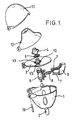
- FIG. 1 A particularly preferred inhaler for use of the medicament combination according to the invention in inhalants is shown in FIG.
- This inhaler (handihaler) for the inhalation of powdered medicines from capsules is characterized by a housing 1, comprising two windows 2, a deck 3, in which there are air inlet openings and which is provided with a sieve 5 fastened via a screen housing 4, one with deck 3 connected inhalation chamber 6, at which a provided with two ground needles 7, is provided against a spring 8 movable pusher 9, and a hinged via an axis 10 with the housing 1, the deck 3 and a cap 11 mouthpiece 12 and air passage holes thirteenth for adjusting the flow resistance.
- inhalable powders according to the invention are to be filled into capsules (inhalettes) in the sense of the preferred application mentioned above, fillages of from 1 to 30 mg, preferably from 3 to 20 mg, preferably from 5 to 10 mg of inhalable powder per capsule are suitable. According to the invention, these contain either together or in each case the doses already mentioned above for 1 or 1 ' and 2 per single dose.
- Propellant gas-containing inhalation aerosols according to the invention may contain 1 and 2 dissolved in propellant gas or in dispersed form.
- 1 and 2 may be contained in separate dosage forms or in a common dosage form, wherein 1 and 2 either dissolved both, both dispersed or optionally dissolved only one component and the other component may be contained dispersed.
- the propellant gases which can be used for the preparation of the inhalation aerosols according to the invention are known from the prior art.
- Suitable propellant gases are selected from the group consisting of hydrocarbons such as n-propane, n-butane or isobutane and halohydrocarbons such as fluorinated derivatives of methane, ethane, propane, butane, cyclopropane or cyclobutane.
- hydrocarbons such as n-propane, n-butane or isobutane
- halohydrocarbons such as fluorinated derivatives of methane, ethane, propane, butane, cyclopropane or cyclobutane.
- the abovementioned propellant gases may be used alone or in mixtures thereof.
- propellant gases are halogenated alkane derivatives selected from TG11, TG12, TG134a (1,1,1,2-tetrafluoroethane) and TG227 (1,1,1,2,3,3,3-heptafluoropropane) and mixtures thereof, where the propellant gases are TG134a , TG227 and mixtures thereof are preferred.
- the propellant-containing inhalation aerosols of the present invention may further contain other ingredients such as co-solvents, stabilizers, surfactants, antioxidants, lubricants, preservatives, and pH adjusters. All of these ingredients are known in the art.
- the propellant gas-containing inhalation aerosols according to the invention may contain up to 5% by weight of active compound 1 and / or 2 .
- Aerosols according to the invention contain, for example, 0.002 to 5% by weight, 0.01 to 3% by weight, 0.015 to 2% by weight, 0.1 to 2% by weight, 0.5 to 2% by weight or 0.5 to 1 % By weight of active ingredient 1 and / or 2.
- the active substance particles preferably have an average particle size of up to 10 ⁇ m , preferably from 0.1 to 6 ⁇ m , particularly preferably from 1 to 5 ⁇ m .
- Propellant-free inhalable solutions and suspension suspensions according to the invention contain, for example, aqueous or alcoholic, preferably ethanolic, optionally ethanolic, in admixture with aqueous solvents.
- aqueous or alcoholic solvent mixtures the relative proportion of ethanol to water is not limited, but the maximum limit is preferably up to 70% by volume, in particular up to 60% by volume and particularly preferably up to 30% by volume of ethanol.
- the remaining volume percentages are filled up with water.
- the solutions 1 or 2 separated or co-containing, are adjusted to a pH of from 2 to 7, preferably from 2 to 5, with suitable acids. To adjust this pH, acids selected from inorganic or organic acids can be used.
- Examples of particularly suitable inorganic acids are hydrochloric acid, hydrobromic acid, nitric acid, sulfuric acid and / or phosphoric acid.
- Examples of particularly suitable organic acids are: ascorbic acid, citric acid, malic acid, tartaric acid, maleic acid, succinic acid, fumaric acid, acetic acid, formic acid and / or propionic acid and others.
- Preferred inorganic acids are hydrochloric acid and sulfuric acid. It is also possible to use the acids which, if appropriate, already form an acid addition salt with one of the active compounds.
- the organic acids ascorbic acid, fumaric acid and citric acid are preferable.
- mixtures of the abovementioned acids in particular in the case of acids which, in addition to their acidification properties, also have other properties, for example as flavorings, antioxidants or complexing agents, such as citric acid or ascorbic acid.
- Hydrochloric acid is particularly preferably used according to the invention for adjusting the pH.
- the addition of editic acid (EDTA) or one of the known salts thereof, sodium edetate, as a stabilizer or complexing agent can be dispensed with in the present formulation.
- Other embodiments include this compound (s).
- the content based on sodium edetate is below 100 mg / 100 ml, preferably below 50 mg / 100 ml, particularly preferably below 20 mg / 100 ml.
- such inhalable solutions are preferred in which the content of sodium edetate is 0 to 10 mg / 100 ml.
- Co-solvents and / or further auxiliaries can be added to the propellant-free inhalable solutions according to the invention.
- Preferred co-solvents are those which contain hydroxyl groups or other polar groups, for example alcohols - in particular isopropyl alcohol, glycols - in particular propylene glycol, polyethylene glycol, polypropylene glycol, glycol ethers, glycerol, polyoxyethylene alcohols and polyoxyethylene fatty acid esters.
- auxiliaries and additives is meant in this context any physiologically acceptable substance that is not an active ingredient but can be formulated together with the active ingredient (s) in the physiologically suitable solvent in order to improve the qualitative properties of the active ingredient formulation.
- auxiliaries and additives include, for example, surfactants such as soybean lecithin, oleic acid, sorbitan esters such as polysorbates, polyvinylpyrrolidone other stabilizers, complexing agents, antioxidants and / or preservatives that ensure or prolong the useful life of the finished drug formulation, flavorings, vitamins and / or other additives known in the art.
- the additives also include physiologically acceptable salts such as sodium chloride as isotonic agents.
- Preferred excipients include antioxidants, such as ascorbic acid, if not already used to adjust the pH, vitamin A, vitamin E, Tocopherols and similar vitamins or provitamins found in the human organism.
- Preservatives may be used to protect the formulation from contamination by germs. Suitable preservatives are those known in the art, in particular cetylpyridinium chloride, benzalkonium chloride or benzoic acid or benzoates such as sodium benzoate in the concentration known from the prior art.
- the above-mentioned preservatives are preferably contained in concentrations of up to 50 mg / 100 ml, more preferably between 5 and 20 mg / 100 ml.
- Preferred formulations contain, apart from the solvent water and the active ingredient combination of 1 and 2, only benzalkonium chloride and sodium edetate. In another preferred embodiment, sodium edetate is dispensed with.
- propellant-free inhalable solutions are particularly those inhalers that can nebulise a small amount of a liquid formulation in the therapeutically necessary dosage within a few seconds in a therapeutically inhalable suitable aerosol.
- Such a device for the propellant-free administration of a metered amount of a liquid medicament for inhalation use is described in detail, for example, in International Patent Application WO 91/14468 as well as in WO 97/12687 (there in particular Figures 6a and 6b).
- the nebulizers (devices) described there are also known as Respimat®.
- This nebuliser can advantageously be used to produce the inhalable aerosols according to the invention containing the active ingredient combination of 1 and 2 . Due to its cylinder-like shape and a handy size of less as 9 to 15 cm in length and 2 to 4 cm in width, this device can always be carried by the patient.
- the nebulizer sprays a defined volume of the drug formulation using high pressures through small nozzles to produce inhalable aerosols.
- the hollow piston with valve body corresponds to a device disclosed in WO 97/12687. It partially protrudes into the cylinder of the pump housing and is arranged axially displaceably in the cylinder. In particular, reference is made to FIGS. 1-4, in particular FIG. 3, and the associated parts of the description.
- the hollow piston with valve body exerts on its high pressure side at the time of release of the spring a pressure of 5 to 60 Mpa (about 50 to 600 bar), preferably 10 to 60 Mpa (about 100 to 600 bar) on the fluid, the measured drug solution. Volumes of from 10 to 50 microliters are preferred, volumes from 10 to 20 microliters are particularly preferred, and a volume of 15 microliters per stroke is very particularly preferred.
- the valve body is preferably attached to the end of the hollow piston, which faces the nozzle body.
- the nozzle in the nozzle body is preferably microstructured, ie produced by microtechnology.
- Microstructured nozzle bodies are described, for example, in WO-94/07607 disclosed; This document is hereby incorporated by reference, in particular to the figure 1 and its description disclosed therein.
- the nozzle body consists for example of two firmly interconnected plates made of glass and / or silicon, of which at least one plate has one or more microstructured channels which connect the nozzle inlet side with the Düsenauslledge.
- At the nozzle outlet side, at least one round or non-round aperture is 2 to 10 microns deep and 5 to 15 microns wide, with the depth preferably being 4.5 to 6.5 microns and the length being 7 to 9 microns.
- the jet directions of the nozzles in the nozzle body can be parallel to one another or they are inclined towards one another in the direction of the nozzle opening.
- the beam directions may be inclined at an angle of 20 degrees to 160 degrees to each other, preferably an angle of 60 to 150 degrees, particularly preferably 80 to 100 °.
- the nozzle orifices are preferably located at a distance of 10 to 200 microns, more preferably at a distance of 10 to 100 microns, more preferably 30 to 70 microns. Most preferred are 50 microns.
- the jet directions accordingly meet in the vicinity of the nozzle openings.
- the liquid pharmaceutical preparation meets the nozzle body with an inlet pressure of up to 600 bar, preferably 200 to 300 bar, and is atomized via the nozzle openings into an inhalable aerosol.
- the preferred particle or droplet sizes of the aerosol are up to 20 microns, preferably 3 to 10 microns.
- the locking mechanism includes a spring, preferably a cylindrical helical compression spring, as a memory for the mechanical energy.
- the spring acts on the output flange as a jump piece whose movement is determined by the position of a locking member.
- the path of the output flange is precisely limited by an upper and a lower stop.
- the spring is preferably tensioned via a force-transmitting gear, for example a screw thrust gear, by an external torque which is generated when the housing upper part is rotated against the spring housing in the housing bottom part.
- the upper housing part and the output flange contain a single or multi-start wedge gear.
- the locking member with engaging locking surfaces is arranged annularly around the output flange.
- the ring is arranged in a plane perpendicular to the atomizer axis. After tensioning the spring, the locking surfaces of the locking member push in the path of the output flange and prevent the relaxation of the spring.
- the Sprerrglied is triggered by a button.
- the release button is connected or coupled to the locking member.
- the shutter button is parallel to the ring plane, and preferably in the atomizer, moved; while the deformable ring is deformed in the ring plane. Constructive details of the locking mechanism are described in WO 97/20590.
- the lower housing part is pushed in the axial direction over the spring housing and covers the storage, the drive of the spindle and the reservoir for the fluid.
- the housing upper part When actuating the atomizer, the housing upper part is rotated against the lower housing part, wherein the lower housing part entrains the spring housing.
- the spring is compressed and tensioned via the screw slide, and the lock engages automatically.
- the angle of rotation is preferably an integer fraction of 360 degrees, e.g. 180 degrees.
- the driven part Simultaneously with the tensioning of the spring, the driven part is displaced in the upper housing part by a predetermined path, the hollow piston is withdrawn within the cylinder in the pump housing, whereby a subset of the fluid from the reservoir is sucked into the high-pressure chamber in front of the nozzle.
- the storage container contains the aqueous aerosol preparation according to the invention.
- the sputtering process is initiated by lightly pressing the shutter button.
- the blocking mechanism clears the way for the stripping section.
- the tensioned spring pushes the piston into the cylinder of the pump housing.
- the fluid exits the nozzle of the atomizer in atomized form.
- the components of the atomizer are made of a functionally suitable material.
- the housing of the atomizer and, as far as the function permits, other parts are preferably made of plastic, e.g. by injection molding. Physiologically harmless materials are used for medical purposes.
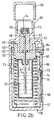
- FIG. 2 a shows a longitudinal section through the atomizer with the spring tensioned
- FIG. 2 b shows a longitudinal section through the atomizer with the spring relaxed.
- the upper housing part (51) contains the pump housing (52), at the end of which the holder (53) for the atomizer nozzle is mounted. In the holder is the nozzle body (54) and a filter (55).
- the hollow piston (57) fastened in the output flange (56) of the locking mechanism projects partially into the cylinder of the pump housing. At its end, the hollow piston carries the valve body (58).
- the hollow piston is sealed by means of the seal (59).
- the stop (60) on which the output flange rests with a relaxed spring.
- the stop (61) On which the output flange rests when the spring is tensioned.
- the locking member (62) slides between the stop (61) and a support (63) in the upper housing part.
- the release button (64) is in communication with the locking member.
- the housing upper part ends in the mouthpiece (65) and is closed with the attachable protective cap (66).
- the spring housing (67) with compression spring (68) is rotatably supported by means of the snap lugs (69) and pivot bearing on the upper housing part.
- the lower housing part (70) is pushed.
- the replaceable reservoir (71) for the fluid (72) to be atomized Within the spring housing is the replaceable reservoir (71) for the fluid (72) to be atomized.
- the reservoir is closed with the stopper (73) through which the hollow piston protrudes into the reservoir and with its end immersed in the fluid (stock of drug solution).
- the spindle (74) for the mechanical counter is mounted in the lateral surface of the spring housing.
- the drive pinion (75) At the end of the spindle, which faces the upper housing part, there is the drive pinion (75). The rider (76) sits on the spindle.
- the nebulizer described above is suitable for nebulizing the aerosol preparations according to the invention to form an aerosol suitable for inhalation.
- the applied mass should contain at least 97%, preferably at least 98%, of all actuations of the inhaler (Hube) of a defined amount with a maximum tolerance of 25%, preferably 20% Amount correspond.
- the inhaler Hube
- a maximum tolerance of 25% preferably 20% Amount correspond.
- between 5 and 30 mg of formulation per stroke are applied as a defined mass, more preferably between 5 and 20 mg.
- formulation according to the invention may also be aerosolized by means of inhalers other than those described above, for example jet-stream inhalers.
- a further aspect of the present invention relates to pharmaceuticals in the form of propellant-free inhalable solutions or suspensions as described above in conjunction with a device suitable for administering these formulations, preferably in conjunction with the Respimat®.
- the present invention is directed to propellant-free inhalable solutions or suspensions characterized by the active ingredient combination according to the invention from 1 and 2 in conjunction with the device known under the name Respimat®.
- the present invention relates to the above-mentioned devices for inhalation, preferably the Respimat®, characterized in that they contain above-described propellant-free inhalable solutions or suspensions according to the invention.
- the propellant-free inhalable solutions or suspensions according to the invention can also be present as concentrates or sterile ready-to-use inhalable solutions or suspensions in addition to the solutions and suspensions provided above for application in the Respimat.
- ready-to-use formulations can be generated from the concentrates by adding isotonic saline solutions.
- Sterile ready-to-use formulations can be applied by means of energy-powered, stand-alone or portable nebulizers which generate inhalable aerosols by means of ultrasound or compressed air according to the Venturi principle or other principles.
- a further aspect of the present invention relates to pharmaceuticals in the form of propellant-free inhalable solutions or suspensions, described above as concentrates or sterile ready-to-use formulations, in combination with a device suitable for administering these solutions, characterized in that the device is is an energy-powered stand-alone or portable nebulizer that generates inhalable aerosols by means of ultrasound or compressed air according to the Venturi principle or other principles.
Landscapes
- Health & Medical Sciences (AREA)
- Chemical & Material Sciences (AREA)
- Life Sciences & Earth Sciences (AREA)
- Veterinary Medicine (AREA)
- Public Health (AREA)
- Medicinal Chemistry (AREA)
- General Health & Medical Sciences (AREA)
- Animal Behavior & Ethology (AREA)
- Pharmacology & Pharmacy (AREA)
- Epidemiology (AREA)
- Nuclear Medicine, Radiotherapy & Molecular Imaging (AREA)
- General Chemical & Material Sciences (AREA)
- Chemical Kinetics & Catalysis (AREA)
- Organic Chemistry (AREA)
- Engineering & Computer Science (AREA)
- Bioinformatics & Cheminformatics (AREA)
- Pulmonology (AREA)
- Pain & Pain Management (AREA)
- Rheumatology (AREA)
- Emergency Medicine (AREA)
- Dispersion Chemistry (AREA)
- Physical Education & Sports Medicine (AREA)
- Molecular Biology (AREA)
- Pharmaceuticals Containing Other Organic And Inorganic Compounds (AREA)
- Medicinal Preparation (AREA)
- Medicines That Contain Protein Lipid Enzymes And Other Medicines (AREA)
- Steroid Compounds (AREA)
- Nitrogen Condensed Heterocyclic Rings (AREA)
Applications Claiming Priority (2)
| Application Number | Priority Date | Filing Date | Title |
|---|---|---|---|
| DE10216429A DE10216429A1 (de) | 2002-04-12 | 2002-04-12 | Arzneimittel enthaltend Steroide und ein neues Anticholinergikum |
| EP03712137A EP1496902B1 (fr) | 2002-04-12 | 2003-04-09 | Medicament contenant des steroides et un nouvel anticholinergique |
Related Parent Applications (1)
| Application Number | Title | Priority Date | Filing Date |
|---|---|---|---|
| EP03712137A Division EP1496902B1 (fr) | 2002-04-12 | 2003-04-09 | Medicament contenant des steroides et un nouvel anticholinergique |
Publications (2)
| Publication Number | Publication Date |
|---|---|
| EP1621197A2 true EP1621197A2 (fr) | 2006-02-01 |
| EP1621197A3 EP1621197A3 (fr) | 2010-01-06 |
Family
ID=28458802
Family Applications (2)
| Application Number | Title | Priority Date | Filing Date |
|---|---|---|---|
| EP05109887A Withdrawn EP1621197A3 (fr) | 2002-04-12 | 2003-04-09 | Composition comprenant un stéröide et un anticholinérgique |
| EP03712137A Expired - Lifetime EP1496902B1 (fr) | 2002-04-12 | 2003-04-09 | Medicament contenant des steroides et un nouvel anticholinergique |
Family Applications After (1)
| Application Number | Title | Priority Date | Filing Date |
|---|---|---|---|
| EP03712137A Expired - Lifetime EP1496902B1 (fr) | 2002-04-12 | 2003-04-09 | Medicament contenant des steroides et un nouvel anticholinergique |
Country Status (29)
| Country | Link |
|---|---|
| EP (2) | EP1621197A3 (fr) |
| JP (1) | JP4559086B2 (fr) |
| KR (1) | KR101010869B1 (fr) |
| CN (1) | CN1646126A (fr) |
| AR (1) | AR039275A1 (fr) |
| AT (1) | ATE312607T1 (fr) |
| AU (1) | AU2003216921B2 (fr) |
| BR (1) | BR0309085A (fr) |
| CA (1) | CA2481268C (fr) |
| DE (2) | DE10216429A1 (fr) |
| DK (1) | DK1496902T3 (fr) |
| EA (1) | EA008386B1 (fr) |
| EC (1) | ECSP045355A (fr) |
| ES (1) | ES2254917T3 (fr) |
| HR (1) | HRP20040943B1 (fr) |
| IL (2) | IL164391A0 (fr) |
| ME (1) | MEP54208A (fr) |
| MX (1) | MXPA04009917A (fr) |
| MY (1) | MY137045A (fr) |
| NO (1) | NO20044097L (fr) |
| NZ (1) | NZ536284A (fr) |
| PE (1) | PE20040326A1 (fr) |
| PL (1) | PL211227B1 (fr) |
| RS (1) | RS50776B (fr) |
| TW (1) | TWI311055B (fr) |
| UA (1) | UA80125C2 (fr) |
| UY (1) | UY27758A1 (fr) |
| WO (1) | WO2003086399A1 (fr) |
| ZA (1) | ZA200406751B (fr) |
Cited By (3)
| Publication number | Priority date | Publication date | Assignee | Title |
|---|---|---|---|---|
| US9415009B2 (en) | 2009-05-29 | 2016-08-16 | Pearl Therapeutics, Inc. | Compositions, methods and systems for respiratory delivery of two or more active agents |
| US9463161B2 (en) | 2009-05-29 | 2016-10-11 | Pearl Therapeutics, Inc. | Compositions for pulmonary delivery of long-acting muscarinic antagonists and associated methods and systems |
| US11471468B2 (en) | 2013-03-15 | 2022-10-18 | Pearl Therapeutics, Inc. | Methods and systems for conditioning of particulate crystalline materials |
Families Citing this family (11)
| Publication number | Priority date | Publication date | Assignee | Title |
|---|---|---|---|---|
| ES2165768B1 (es) | 1999-07-14 | 2003-04-01 | Almirall Prodesfarma Sa | Nuevos derivados de quinuclidina y composiciones farmaceuticas que los contienen. |
| GB0019172D0 (en) | 2000-08-05 | 2000-09-27 | Glaxo Group Ltd | Novel compounds |
| US6777399B2 (en) | 2000-08-05 | 2004-08-17 | Smithkline Beecham Corporation | Anti-inflammatory androstane derivative compositions |
| US6858596B2 (en) | 2000-08-05 | 2005-02-22 | Smithkline Beecham Corporation | Formulation containing anti-inflammatory androstane derivative |
| AR033290A1 (es) | 2001-04-30 | 2003-12-10 | Glaxo Group Ltd | Derivados antiinflamatorios de androstano |
| GB2389530B (en) | 2002-06-14 | 2007-01-10 | Cipla Ltd | Pharmaceutical compositions |
| ES2413011T3 (es) | 2004-02-06 | 2013-07-15 | Meda Pharma Gmbh & Co. Kg | Combinación de anticolinérgicos y glucocorticoides para el tratamiento a largo plazo de asma y EPOC |
| EP2100599A1 (fr) | 2008-03-13 | 2009-09-16 | Laboratorios Almirall, S.A. | Composition à inhaler comprenant aclidinium pour le traitement de l'asthme et de maladies respiratoires obstructives chroniques |
| EP2100598A1 (fr) | 2008-03-13 | 2009-09-16 | Laboratorios Almirall, S.A. | Composition à inhaler comprenant aclidinium pour le traitement de l'asthme et de maladies respiratoires obstructives chroniques |
| EP2510928A1 (fr) | 2011-04-15 | 2012-10-17 | Almirall, S.A. | Aclidinium pour l'amélioration du sommeil des patients avec des maldadies respiratoires |
| CN115282411A (zh) * | 2022-01-14 | 2022-11-04 | 温州医科大学 | 利用鼻嗅区递送药物入脑的输送系统及其应用方法 |
Citations (9)
| Publication number | Priority date | Publication date | Assignee | Title |
|---|---|---|---|---|
| US4570630A (en) | 1983-08-03 | 1986-02-18 | Miles Laboratories, Inc. | Medicament inhalation device |
| DE3625685A1 (de) | 1985-07-30 | 1987-03-12 | Glaxo Group Ltd | Geraet zum eingeben von medikamenten |
| WO1991014468A1 (fr) | 1990-03-21 | 1991-10-03 | Dmw (Technology) Limited | Dispositifs et procedes de pulverisation |
| WO1992016528A1 (fr) | 1991-03-15 | 1992-10-01 | Boehringer Ingelheim Kg | Esters nouveaux d'amino-alcools bicycliques et tricycliques, leur preparation et leur utilisation dans des medicaments |
| WO1994007607A1 (fr) | 1992-09-29 | 1994-04-14 | Boehringer Ingelheim International Gmbh | Ajutage de pulverisation et filtre, et dispositif generant une pulverisation |
| WO1994028958A1 (fr) | 1993-06-03 | 1994-12-22 | Boehringer Ingelheim Kg | Porte-capsules |
| WO1997012687A1 (fr) | 1995-10-04 | 1997-04-10 | Boehringer Ingelheim International Gmbh | Dispositif, sous forme miniature, destine a produire une pression elevee dans un fluide a atomiser |
| WO1997012683A1 (fr) | 1995-10-04 | 1997-04-10 | Boehringer Ingelheim International Gmbh | Dispositif de fixation pour composant expose a un fluide sous pression |
| WO1997020590A1 (fr) | 1995-12-05 | 1997-06-12 | Boehringer Ingelheim International Gmbh | Mecanisme de blocage destine a un dispositif actionne par un ressort |
Family Cites Families (4)
| Publication number | Priority date | Publication date | Assignee | Title |
|---|---|---|---|---|
| KR19990008109A (ko) * | 1995-04-28 | 1999-01-25 | 나가사까 겐지로 | 1,4-이치환 피페리딘 유도체 |
| GB0009591D0 (en) * | 2000-04-18 | 2000-06-07 | Glaxo Group Ltd | Medical combinations |
| DE10050994A1 (de) * | 2000-10-14 | 2002-04-18 | Boehringer Ingelheim Pharma | Neue als Arneimittel einsetzbare Anticholinergika sowie Verfahren zu deren Herstellung |
| CA2733294C (fr) * | 2000-10-31 | 2011-12-20 | Boehringer Ingelheim Pharma Gmbh & Co. Kg | Combinaison pharmaceutique constituee d'un sel de tiotropium et de ciclesonide |
-
2002
- 2002-04-12 DE DE10216429A patent/DE10216429A1/de not_active Withdrawn
-
2003
- 2003-04-09 PL PL371561A patent/PL211227B1/pl not_active IP Right Cessation
- 2003-04-09 MX MXPA04009917A patent/MXPA04009917A/es active IP Right Grant
- 2003-04-09 DE DE50301934T patent/DE50301934D1/de not_active Expired - Lifetime
- 2003-04-09 AT AT03712137T patent/ATE312607T1/de active
- 2003-04-09 IL IL16439103A patent/IL164391A0/xx unknown
- 2003-04-09 CN CNA038083299A patent/CN1646126A/zh active Pending
- 2003-04-09 WO PCT/EP2003/003668 patent/WO2003086399A1/fr not_active Ceased
- 2003-04-09 AR ARP030101241A patent/AR039275A1/es unknown
- 2003-04-09 JP JP2003583418A patent/JP4559086B2/ja not_active Expired - Lifetime
- 2003-04-09 EP EP05109887A patent/EP1621197A3/fr not_active Withdrawn
- 2003-04-09 AU AU2003216921A patent/AU2003216921B2/en not_active Expired
- 2003-04-09 RS YUP-899/04A patent/RS50776B/sr unknown
- 2003-04-09 ES ES03712137T patent/ES2254917T3/es not_active Expired - Lifetime
- 2003-04-09 DK DK03712137T patent/DK1496902T3/da active
- 2003-04-09 EP EP03712137A patent/EP1496902B1/fr not_active Expired - Lifetime
- 2003-04-09 ME MEP-542/08A patent/MEP54208A/xx unknown
- 2003-04-09 CA CA2481268A patent/CA2481268C/fr not_active Expired - Lifetime
- 2003-04-09 BR BR0309085-0A patent/BR0309085A/pt not_active IP Right Cessation
- 2003-04-09 NZ NZ536284A patent/NZ536284A/en not_active IP Right Cessation
- 2003-04-09 EA EA200401303A patent/EA008386B1/ru not_active IP Right Cessation
- 2003-04-09 KR KR1020047016335A patent/KR101010869B1/ko not_active Expired - Fee Related
- 2003-04-09 HR HRP20040943AA patent/HRP20040943B1/hr not_active IP Right Cessation
- 2003-04-10 TW TW092108227A patent/TWI311055B/zh not_active IP Right Cessation
- 2003-04-10 PE PE2003000365A patent/PE20040326A1/es not_active Application Discontinuation
- 2003-04-10 UY UY27758A patent/UY27758A1/es not_active Application Discontinuation
- 2003-04-10 MY MYPI20031320A patent/MY137045A/en unknown
- 2003-09-04 UA UA20041109192A patent/UA80125C2/uk unknown
-
2004
- 2004-08-25 ZA ZA200406751A patent/ZA200406751B/en unknown
- 2004-09-27 NO NO20044097A patent/NO20044097L/no not_active Application Discontinuation
- 2004-10-04 IL IL164391A patent/IL164391A/en not_active IP Right Cessation
- 2004-10-11 EC EC2004005355A patent/ECSP045355A/es unknown
Patent Citations (9)
| Publication number | Priority date | Publication date | Assignee | Title |
|---|---|---|---|---|
| US4570630A (en) | 1983-08-03 | 1986-02-18 | Miles Laboratories, Inc. | Medicament inhalation device |
| DE3625685A1 (de) | 1985-07-30 | 1987-03-12 | Glaxo Group Ltd | Geraet zum eingeben von medikamenten |
| WO1991014468A1 (fr) | 1990-03-21 | 1991-10-03 | Dmw (Technology) Limited | Dispositifs et procedes de pulverisation |
| WO1992016528A1 (fr) | 1991-03-15 | 1992-10-01 | Boehringer Ingelheim Kg | Esters nouveaux d'amino-alcools bicycliques et tricycliques, leur preparation et leur utilisation dans des medicaments |
| WO1994007607A1 (fr) | 1992-09-29 | 1994-04-14 | Boehringer Ingelheim International Gmbh | Ajutage de pulverisation et filtre, et dispositif generant une pulverisation |
| WO1994028958A1 (fr) | 1993-06-03 | 1994-12-22 | Boehringer Ingelheim Kg | Porte-capsules |
| WO1997012687A1 (fr) | 1995-10-04 | 1997-04-10 | Boehringer Ingelheim International Gmbh | Dispositif, sous forme miniature, destine a produire une pression elevee dans un fluide a atomiser |
| WO1997012683A1 (fr) | 1995-10-04 | 1997-04-10 | Boehringer Ingelheim International Gmbh | Dispositif de fixation pour composant expose a un fluide sous pression |
| WO1997020590A1 (fr) | 1995-12-05 | 1997-06-12 | Boehringer Ingelheim International Gmbh | Mecanisme de blocage destine a un dispositif actionne par un ressort |
Cited By (4)
| Publication number | Priority date | Publication date | Assignee | Title |
|---|---|---|---|---|
| US9415009B2 (en) | 2009-05-29 | 2016-08-16 | Pearl Therapeutics, Inc. | Compositions, methods and systems for respiratory delivery of two or more active agents |
| US9463161B2 (en) | 2009-05-29 | 2016-10-11 | Pearl Therapeutics, Inc. | Compositions for pulmonary delivery of long-acting muscarinic antagonists and associated methods and systems |
| US10716753B2 (en) | 2009-05-29 | 2020-07-21 | Pearl Therapeutics, Inc. | Compositions for pulmonary delivery of long-acting muscarinic antagonists or long-acting B2 adrenergic receptor agonists and associated methods and systems |
| US11471468B2 (en) | 2013-03-15 | 2022-10-18 | Pearl Therapeutics, Inc. | Methods and systems for conditioning of particulate crystalline materials |
Also Published As
Similar Documents
| Publication | Publication Date | Title |
|---|---|---|
| EP2105143B1 (fr) | Compositions pharmaceutiques basées sur des séls de tiotropium et ceclesonide | |
| EP1372649B1 (fr) | Nouvelles preparations de medicaments a base d'anticholinergiques et d'inhibiteurs pde-iv | |
| EP1385519B1 (fr) | Composes destines au traitement de maladies inflammatoires | |
| EP1335728B1 (fr) | Compositions de medicaments a base de sels de tiotropium et de sels de salmeterol | |
| EP1497289B1 (fr) | Medicament contenant des betamimetiques et un nouvel anticholinergique | |
| EP1530471B1 (fr) | Medicament a inhaler contenant un nouvel anticholinergique en combinaison avec des corticosteroides et de betamimetiques | |
| EP1333830A2 (fr) | Nouvelle composition medicamenteuse a base d'anticholinergiques et de corticosteroides | |
| WO2002060532A1 (fr) | Compositions medicamenteuses contenant des betamimetiques et ayant des effets secondaires limites | |
| WO2003087049A2 (fr) | Combinaisons de produits pharmaceutiques contenant des composes heterocycliques et un nouvel anticholinergique | |
| EP1496902B1 (fr) | Medicament contenant des steroides et un nouvel anticholinergique | |
| DE10104370A1 (de) | Arzneimittelkompositionen mit geringeren Nebenwirkungen | |
| EP1819327A1 (fr) | Medicaments administres par inhalation contenant un anticholinergique, du salmeterol et un steroide du groupe ciclesonide ou mometasone furoate | |
| EP1341538B1 (fr) | Compositions des medicaments avec des sels du tiotropium et epinastin pour la therapie des maladies respiratoires | |
| EP1379225B1 (fr) | Nouvelles compositions medicamenteuses a base d'anticholinergiques et d'antagonistes de l'endotheline | |
| DE10111058A1 (de) | Neue Arzneimittelkompositionen auf der Basis von Anticholinergika und NK¶1¶-Rezeptor-Antagonisten | |
| EP1586574A1 (fr) | Médicament contenant des betamimetiques et un nouvel anticholinergique | |
| EP1827432A1 (fr) | Medicaments administres par inhalation contenant un nouvel anticholinergique, du formoterol et un steroide | |
| DE102004038886A1 (de) | Inhalative Arzneimittel enthaltend Corticosteroide, Betamimetika sowie ein neues Anticholinergikum |
Legal Events
| Date | Code | Title | Description |
|---|---|---|---|
| PUAI | Public reference made under article 153(3) epc to a published international application that has entered the european phase |
Free format text: ORIGINAL CODE: 0009012 |
|
| AC | Divisional application: reference to earlier application |
Ref document number: 1496902 Country of ref document: EP Kind code of ref document: P |
|
| AK | Designated contracting states |
Kind code of ref document: A2 Designated state(s): AT BE BG CH CY CZ DE DK EE ES FI FR GB GR HU IE IT LI LU MC NL PT RO SE SI SK TR |
|
| AX | Request for extension of the european patent |
Extension state: LT LV |
|
| PUAL | Search report despatched |
Free format text: ORIGINAL CODE: 0009013 |
|
| AK | Designated contracting states |
Kind code of ref document: A3 Designated state(s): AT BE BG CH CY CZ DE DK EE ES FI FR GB GR HU IE IT LI LU MC NL PT RO SE SI SK TR |
|
| AX | Request for extension of the european patent |
Extension state: LT LV |
|
| 17P | Request for examination filed |
Effective date: 20100706 |
|
| AKX | Designation fees paid |
Designated state(s): AT BE BG CH CY CZ DE DK EE ES FI FR GB GR HU IE IT LI LU MC NL PT RO SE SI SK TR |
|
| AXX | Extension fees paid |
Extension state: LV Payment date: 20100706 Extension state: LT Payment date: 20100706 |
|
| 17Q | First examination report despatched |
Effective date: 20101005 |
|
| STAA | Information on the status of an ep patent application or granted ep patent |
Free format text: STATUS: THE APPLICATION IS DEEMED TO BE WITHDRAWN |
|
| 18D | Application deemed to be withdrawn |
Effective date: 20110216 |