EP1621882A2 - Procédé et dispositif de détection des gaz combustibles et d'hydrogène en particulier - Google Patents
Procédé et dispositif de détection des gaz combustibles et d'hydrogène en particulier Download PDFInfo
- Publication number
- EP1621882A2 EP1621882A2 EP05011919A EP05011919A EP1621882A2 EP 1621882 A2 EP1621882 A2 EP 1621882A2 EP 05011919 A EP05011919 A EP 05011919A EP 05011919 A EP05011919 A EP 05011919A EP 1621882 A2 EP1621882 A2 EP 1621882A2
- Authority
- EP
- European Patent Office
- Prior art keywords
- sensor
- temperature
- thermal conductivity
- semiconductor gas
- signals
- Prior art date
- Legal status (The legal status is an assumption and is not a legal conclusion. Google has not performed a legal analysis and makes no representation as to the accuracy of the status listed.)
- Granted
Links
Images


Classifications
-
- G—PHYSICS
- G01—MEASURING; TESTING
- G01N—INVESTIGATING OR ANALYSING MATERIALS BY DETERMINING THEIR CHEMICAL OR PHYSICAL PROPERTIES
- G01N33/00—Investigating or analysing materials by specific methods not covered by groups G01N1/00 - G01N31/00
- G01N33/0004—Gaseous mixtures, e.g. polluted air
- G01N33/0009—General constructional details of gas analysers, e.g. portable test equipment
- G01N33/0027—General constructional details of gas analysers, e.g. portable test equipment concerning the detector
- G01N33/0031—General constructional details of gas analysers, e.g. portable test equipment concerning the detector comprising two or more sensors, e.g. a sensor array
- G01N33/0032—General constructional details of gas analysers, e.g. portable test equipment concerning the detector comprising two or more sensors, e.g. a sensor array using two or more different physical functioning modes
-
- G—PHYSICS
- G01—MEASURING; TESTING
- G01N—INVESTIGATING OR ANALYSING MATERIALS BY DETERMINING THEIR CHEMICAL OR PHYSICAL PROPERTIES
- G01N27/00—Investigating or analysing materials by the use of electric, electrochemical, or magnetic means
- G01N27/02—Investigating or analysing materials by the use of electric, electrochemical, or magnetic means by investigating impedance
- G01N27/04—Investigating or analysing materials by the use of electric, electrochemical, or magnetic means by investigating impedance by investigating resistance
- G01N27/12—Investigating or analysing materials by the use of electric, electrochemical, or magnetic means by investigating impedance by investigating resistance of a solid body in dependence upon absorption of a fluid; of a solid body in dependence upon reaction with a fluid, for detecting components in the fluid
- G01N27/122—Circuits particularly adapted therefor, e.g. linearising circuits
- G01N27/123—Circuits particularly adapted therefor, e.g. linearising circuits for controlling the temperature
-
- G—PHYSICS
- G01—MEASURING; TESTING
- G01N—INVESTIGATING OR ANALYSING MATERIALS BY DETERMINING THEIR CHEMICAL OR PHYSICAL PROPERTIES
- G01N27/00—Investigating or analysing materials by the use of electric, electrochemical, or magnetic means
- G01N27/02—Investigating or analysing materials by the use of electric, electrochemical, or magnetic means by investigating impedance
- G01N27/04—Investigating or analysing materials by the use of electric, electrochemical, or magnetic means by investigating impedance by investigating resistance
- G01N27/14—Investigating or analysing materials by the use of electric, electrochemical, or magnetic means by investigating impedance by investigating resistance of an electrically-heated body in dependence upon change of temperature
- G01N27/18—Investigating or analysing materials by the use of electric, electrochemical, or magnetic means by investigating impedance by investigating resistance of an electrically-heated body in dependence upon change of temperature caused by changes in the thermal conductivity of a surrounding material to be tested
-
- G—PHYSICS
- G01—MEASURING; TESTING
- G01N—INVESTIGATING OR ANALYSING MATERIALS BY DETERMINING THEIR CHEMICAL OR PHYSICAL PROPERTIES
- G01N33/00—Investigating or analysing materials by specific methods not covered by groups G01N1/00 - G01N31/00
- G01N33/0004—Gaseous mixtures, e.g. polluted air
- G01N33/0009—General constructional details of gas analysers, e.g. portable test equipment
- G01N33/0062—General constructional details of gas analysers, e.g. portable test equipment concerning the measuring method or the display, e.g. intermittent measurement or digital display
- G01N33/0063—General constructional details of gas analysers, e.g. portable test equipment concerning the measuring method or the display, e.g. intermittent measurement or digital display using a threshold to release an alarm or displaying means
Definitions
- the invention relates to a method and an arrangement for detecting combustible gases, in particular for detecting hydrogen, by evaluating signals of a gas-sensitive semiconductor gas sensor.
- the arrangement serves to determine the concentration of hydrogen and other combustible gases in order to deliver a signal that can be evaluated when a nominal value is exceeded. It is necessary that the arrangement in a temperature range of -50 ° C to + 150 ° C allows safe detection.
- One frequently used method employs electrochemical measuring cells which are very selective and accurate in measurement, but which have high temperature sensitivity and drying effects for many applications, e.g. B. outdoors or in motor vehicles, can be used only with great effort.
- sensors which use the temperature increase in the catalytic conversion of hydrogen and air on a single element or on a combination element for signal generation.
- comparison elements are used with and without catalytic additives.
- the disadvantage here is that poisoning phenomena and thus malfunctions can occur.
- So-called heat-conduction sensors which generate highly accurate signals by evaluating the thermal conductivity of gases, can be used in a wide temperature range, but have the disadvantage that your signal in gas mixtures with multiple gases may be undefined because the heat conduction of various gases to air is not always a clear statement about the existing gas mixture allowed.
- a device for monitoring the hydrogen concentration in a medium in which heat conductivity sensors are used for hydrogen detection.
- the measured thermal conductivity is converted by a signal conditioning into an electrical voltage and compared with a permissible value.
- Another gas sensor element which has proved to be very advantageous especially for studies in the trace range, works on the basis of semiconducting metal oxides.
- the disadvantage here is that the selectivity and sensitivity to poisoning is very high.
- Another disadvantage is that the accuracy in the upper concentration range is quite low and the slope of the sensor is very flat at about 1-2 vol%.
- a hydrogen sensor with a temperature-sensitive hydrogen-sensitive semiconductor layer of strontium titanate SrTiO 3 and a hydrogen-permeable cover layer is known, in which a further Strontiumtitanat harsh is arranged to compensate for the temperature dependence, which is covered by a selectively filtering cover layer and another course of Conductivity characteristic as the first semiconductor layer.
- JP 08-3 27 576 A an arrangement is described in which a dressingleitsensor that reacts at high gas concentration, has been combined with a semiconductor gas sensor that responds at low gas concentration.
- the disadvantage here is that this arrangement is not suitable for the detection of hydrogen in tertiary mixtures and in the detection of gas mixtures, the risk of signal extinction.
- the invention has for its object to provide a method and an arrangement of the type mentioned, which cost high accuracy is possible.
- the object is achieved with a method having the features specified in claim 1, and with an arrangement having the features specified in claim 7.
- thermal conductivity sensor With the method according to the invention and the arrangement according to the invention, it is possible to improve the low selectivity of a thermal conductivity sensor by combining it with a special metal oxide semiconductor gas sensor. This arrangement can be operated even at very low temperatures and yet is characterized by a high selective sensitivity.
- the thermal conductivity sensor determines the gas concentration very precisely, but has only a low selective sensitivity for the gases in question here.
- the two sensors can be arranged individually or in a common housing.
- the thermal conductivity sensor has two temperature sensor elements connected by a thermal bridge.
- the semiconductor gas sensor is connected to a temperature sensor and is heated to a certain temperature above ambient temperature, wherein the gas sensor represents the selectivity and zero signal for the determination of thermal conductivity.
- the sensor housing is designed so that the thermal resistance of the thermal bridges and the thermal resistance of the air volume surrounding the sensor are in a defined ratio.
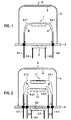
- a semiconductor gas sensor (GS) and a thermal conductivity sensor (WS) are arranged in a common housing (5).
- the housing 5 is mounted on a support 3, in which above the support 3, a chip 1 is located, which contains a special hydrogen-sensitive metal oxide layer, a heater and an internal temperature sensor.
- a hydrogen-sensitive metal oxide a specially doped tin dioxide has proven particularly useful, but there are also other metal oxides can be used.
- a heating resistor is arranged, which also serves as a temperature measuring resistor.
- the chip 1 contains a heating resistor and two temperature measuring resistors in addition to the sensitive layer.
- the use of two temperature measuring resistors which are preferably arranged in a series circuit, enables the detection of soiling on the chip.
- the chip 1 is suspended from wires cantilevered in the medium to be examined.
- the chip 1 is acting as a thermal bridge B electrical connecting lines 4.1.1 and 4.1.4 with the leading through the carrier 3 electrical connections 4.1 and 4.4 connected.
- connection lines lead to two other terminals, which are also not shown in the figure.
- the housing 5 is provided on the upper side opposite the carrier 3 with a membrane 6, through which the gas G to be monitored passes into the housing 5.
- the chip 1 is located approximately in the middle between the support 3 and the top of the housing 5 and defines with its position a certain ratio of the thermal conductivity, which is determined by the inside of the housing 5 located gas, and theticianleitvons, which through the thermal bridge B is realized.
- Below the carrier 3 is the outer temperature sensor 2, with which the ambient temperature can be determined.
- the temperature sensor 2 can be contacted via the electrical connections 4.2 and 4.3 to the outside.
- the arrangement can be connected via a total of six connections, of which in the figure, the connections 4.1 ... 4.4 are visible, with an evaluation unit, not shown here.
- the thermal conductivity of the thermal bridge B is determined by the length and diameter of the connecting lines and the connections and their material properties. By dimensioning the thermal bridge B, the ratio of the heat flow flowing through the gas volume to the heat flow flowing over the thermal bridge B can be determined. From the temperature difference, which is measurable between the heating resistor, which contains the chip 1, and the temperature sensor 2, a thermal conductivity signal is obtained.
- two chips 1.1 and 1.2 are arranged one above the other, wherein in the upper chip 1-1, the metal oxide layer and the heater are arranged and mounted in the lower chip 1.2, a temperature sensor for determining the temperature of the gas G located in the housing 5 is.
- the chip 1.1 is connected via the connecting lines 4.1.1 and 4.4.1 thermally and electrically to the terminals 4.1 and 4.4 and two other terminals, while the chip 1.2 in the same way through the connecting lines 4.5.1 and 4.6.1 with the terminals 4.5 and 4.6 is connected.
- the connection lines form in the same way, as explained above, a thermal bridge B. This arrangement makes it possible to suspend the upper chip 1.1 a higher temperature without an impermissible gas temperature in the housing, so that a larger temperature gradient and thus a higher accuracy can be achieved.
- FIG. 4 illustrates an arrangement in which the semiconductor gas sensor GS and the thermal conductivity sensor WS are each arranged side by side on the substrate 7 in a separate SMD housing 5.
- the substrate 7 is preferably made of ceramic, metal or commercially available printed circuit board material.
- the temperature sensor 2 is mounted approximately centrally below the heat conductivity sensor WS and the semiconductor gas sensor GS.
- the overall arrangement is protected by a potting 8, wherein the respective upper sides of the sensors GS and WS, which are each terminated with a membrane 6, protrude from the potting 8.
- the sensors GS and WS are connected to the terminals 4, wherein a thermal bridge B to the temperature sensor 2 is formed by the connection of chip 1 of the thermal conductivity sensor WS through its connecting lines 4.1.1 and 4.4.1 and electrical connections 4.1 and 4.4 with the substrate 7 , Thermal conductivity sensor WS and semiconductor gas sensor GS are covered on their upper side by a membrane 6.
- FIG. 5 An advantageous embodiment shown in FIG. 5 is provided above the membrane 6 with a further membrane 6.1, with which an additional diffusion region is created and the wind sensitivity of the heat conductivity sensor WS is reduced.
- the temperature sensor 2 is below the thermal conductivity sensor WS.
- the parameters of the thermal bridge B can be optimally matched to the properties of the thermal conductivity sensor WS and cross-influences can be reduced.
- FIG. 7 shows an embodiment in which the two sensors GS and WS and the temperature sensor 2 are arranged in the manner described in FIG.
- the semiconductor gas sensor GS is provided here with an additional bottom 10. This can reduce the influence of interfering heat input caused by the gas sensor.
- FIG. 1 Another possibility of the sensor arrangement is shown in FIG .
- the two sensors GS and WS are each separately fixed in a separate SMD housing in a potting 8.
- the temperature sensor 2 is located below the thermal conductivity sensor WS and the semiconductor gas sensor GS has an additional bottom 10.
- the two individual sensors GS and WS can be accommodated separately, but must be exposed to the same gas G to be examined. In the example shown, they are arranged side by side on a fastening part 11.
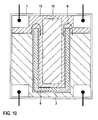
- the sensors GS and WS are mounted in a flat overall arrangement on a chip 1.
- the metal oxide layer 12 of the semiconductor gas sensor GS, a resistance element 13 which contains the temperature sensor and a heating device are integrated in a first layer.
- the temperature sensor 2 is located in a second layer which is arranged in the same plane on the chip 1 and is separated from the first layer by a separating trench 9, which represents the gas-sensitive thermal resistance of the thermal conductivity sensor.
- semiconductor gas sensor GS and temperature sensor are integrated in a first layer, which is separated from the separation trench 9 by a second layer which contains temperature sensor and heating device.
- the thermal conductivities of the thermal bridges B are determined by the distances between the two layers.
Landscapes
- Chemical & Material Sciences (AREA)
- Life Sciences & Earth Sciences (AREA)
- Engineering & Computer Science (AREA)
- Health & Medical Sciences (AREA)
- Analytical Chemistry (AREA)
- Food Science & Technology (AREA)
- Medicinal Chemistry (AREA)
- Physics & Mathematics (AREA)
- Combustion & Propulsion (AREA)
- Biochemistry (AREA)
- General Health & Medical Sciences (AREA)
- General Physics & Mathematics (AREA)
- Immunology (AREA)
- Pathology (AREA)
- Investigating Or Analyzing Materials By The Use Of Electric Means (AREA)
- Investigating Or Analyzing Materials By The Use Of Fluid Adsorption Or Reactions (AREA)
- Investigating Or Analyzing Non-Biological Materials By The Use Of Chemical Means (AREA)
Applications Claiming Priority (2)
| Application Number | Priority Date | Filing Date | Title |
|---|---|---|---|
| DE102004027267 | 2004-06-03 | ||
| DE102004058836 | 2004-12-06 |
Publications (3)
| Publication Number | Publication Date |
|---|---|
| EP1621882A2 true EP1621882A2 (fr) | 2006-02-01 |
| EP1621882A3 EP1621882A3 (fr) | 2007-09-12 |
| EP1621882B1 EP1621882B1 (fr) | 2009-10-21 |
Family
ID=34937173
Family Applications (1)
| Application Number | Title | Priority Date | Filing Date |
|---|---|---|---|
| EP05011919A Expired - Lifetime EP1621882B1 (fr) | 2004-06-03 | 2005-06-02 | Procédé de détection des gaz combustibles et d'hydrogène en particulier |
Country Status (3)
| Country | Link |
|---|---|
| EP (1) | EP1621882B1 (fr) |
| AT (1) | ATE446505T1 (fr) |
| DE (1) | DE502005008363D1 (fr) |
Cited By (5)
| Publication number | Priority date | Publication date | Assignee | Title |
|---|---|---|---|---|
| DE102006054505A1 (de) * | 2006-11-20 | 2008-05-29 | Escube Gmbh & Co. Kg | Vorrichtung und Verfahren zur Bestimmung der Konzentration eines Stoffes in einem Gas |
| EP3163290A1 (fr) * | 2015-10-29 | 2017-05-03 | Inficon GmbH | Détecteur de gaz à infrarouges avec capteur secondaire |
| WO2022063476A1 (fr) * | 2020-09-23 | 2022-03-31 | Robert Bosch Gmbh | Capteur pour détecter au moins une propriété d'un milieu fluide dans au moins une chambre de mesure |
| EP4191238A1 (fr) * | 2017-04-11 | 2023-06-07 | InvenSense, Inc. | Procédé et dispositif de détection de gaz |
| EP4567414A4 (fr) * | 2022-08-02 | 2026-07-22 | Hangzhou Sanhua Research Inst Co Ltd | Ensemble de mesure, appareil de détection et procédé de fabrication d'un appareil de détection |
Citations (4)
| Publication number | Priority date | Publication date | Assignee | Title |
|---|---|---|---|---|
| FR2577320A1 (fr) | 1985-02-09 | 1986-08-14 | Draegerwerk Ag | Detecteur de gaz a plusieurs elements detecteurs. |
| JPH08327576A (ja) | 1995-03-27 | 1996-12-13 | Nok Corp | 油種識別装置およびガス識別方法 |
| JPH0949814A (ja) | 1995-08-04 | 1997-02-18 | Nok Corp | 油種識別装置およびその方法 |
| DE19819575C1 (de) | 1998-04-30 | 2000-03-16 | Siemens Ag | Wasserstoffsensor |
Family Cites Families (2)
| Publication number | Priority date | Publication date | Assignee | Title |
|---|---|---|---|---|
| DE19634690C2 (de) * | 1996-08-10 | 2002-10-24 | Entec Umweltmestechnik Gmbh | Mikro-Wärmeleitfähigkeitsdetektor für Gasanalysen |
| DE10082701D2 (de) * | 1999-09-09 | 2002-08-14 | Sensirion Ag Zuerich | Verfahren und Vorrichtung zur Präzisions-Massenflussmessung |
-
2005
- 2005-06-02 AT AT05011919T patent/ATE446505T1/de not_active IP Right Cessation
- 2005-06-02 DE DE502005008363T patent/DE502005008363D1/de not_active Expired - Lifetime
- 2005-06-02 EP EP05011919A patent/EP1621882B1/fr not_active Expired - Lifetime
Patent Citations (4)
| Publication number | Priority date | Publication date | Assignee | Title |
|---|---|---|---|---|
| FR2577320A1 (fr) | 1985-02-09 | 1986-08-14 | Draegerwerk Ag | Detecteur de gaz a plusieurs elements detecteurs. |
| JPH08327576A (ja) | 1995-03-27 | 1996-12-13 | Nok Corp | 油種識別装置およびガス識別方法 |
| JPH0949814A (ja) | 1995-08-04 | 1997-02-18 | Nok Corp | 油種識別装置およびその方法 |
| DE19819575C1 (de) | 1998-04-30 | 2000-03-16 | Siemens Ag | Wasserstoffsensor |
Cited By (8)
| Publication number | Priority date | Publication date | Assignee | Title |
|---|---|---|---|---|
| DE102006054505A1 (de) * | 2006-11-20 | 2008-05-29 | Escube Gmbh & Co. Kg | Vorrichtung und Verfahren zur Bestimmung der Konzentration eines Stoffes in einem Gas |
| EP3163290A1 (fr) * | 2015-10-29 | 2017-05-03 | Inficon GmbH | Détecteur de gaz à infrarouges avec capteur secondaire |
| WO2017072159A1 (fr) * | 2015-10-29 | 2017-05-04 | Inficon Gmbh | Détecteur de gaz infrarouge avec capteur secondaire |
| US10309943B2 (en) | 2015-10-29 | 2019-06-04 | Inficon Gmbh | Infrared gas detector with secondary sensor |
| EP4191238A1 (fr) * | 2017-04-11 | 2023-06-07 | InvenSense, Inc. | Procédé et dispositif de détection de gaz |
| WO2022063476A1 (fr) * | 2020-09-23 | 2022-03-31 | Robert Bosch Gmbh | Capteur pour détecter au moins une propriété d'un milieu fluide dans au moins une chambre de mesure |
| US12706317B2 (en) | 2020-09-23 | 2026-08-11 | Robert Bosch Gmbh | Sensor for detecting at least one property of a fluid medium in at least one measuring chamber |
| EP4567414A4 (fr) * | 2022-08-02 | 2026-07-22 | Hangzhou Sanhua Research Inst Co Ltd | Ensemble de mesure, appareil de détection et procédé de fabrication d'un appareil de détection |
Also Published As
| Publication number | Publication date |
|---|---|
| EP1621882A3 (fr) | 2007-09-12 |
| EP1621882B1 (fr) | 2009-10-21 |
| DE502005008363D1 (de) | 2009-12-03 |
| ATE446505T1 (de) | 2009-11-15 |
Similar Documents
| Publication | Publication Date | Title |
|---|---|---|
| DE69627093T2 (de) | Wasserstoffsensor | |
| EP0527258B1 (fr) | Matrice de détecteurs de gaz pour la détection des composants individuels dans un mélange de gaz | |
| EP1236038B1 (fr) | Capteur capacitif | |
| DE3711511C1 (de) | Verfahren zur Bestimmung der Gaskonzentrationen in einem Gasgemisch und Sensor zur Messung der Waermeleitfaehigkeit | |
| DE69713698T2 (de) | Gasfühler | |
| DE2826515A1 (de) | Festkoerper-sensorelement | |
| DE3921526A1 (de) | Diffusionsbarriere mit temperaturfuehler fuer einen elektrochemischen gassensor | |
| DE19549147C2 (de) | Gassensor | |
| EP0464244B1 (fr) | Capteur pour la détection de gaz réducteurs | |
| DE102018122860A1 (de) | Verfahren zum Betreiben einer Sensorvorrichtung | |
| DE3839414C2 (de) | Sensoranordnung zum Nachweis von Gasen durch exotherme katalytische Reaktionen | |
| DE102018119212A1 (de) | Sensorvorrichtung und elektronische Anordnung | |
| DE10146321A1 (de) | Sensorbaustein mit einem Sensorelement, das von einem Heizelement umgeben ist | |
| EP0464243B1 (fr) | Capteur d'oxygène avec oxyde de gallium semi-conducteur | |
| EP1621882B1 (fr) | Procédé de détection des gaz combustibles et d'hydrogène en particulier | |
| DE102016200270A1 (de) | Vorrichtung und Verfahren zum Detektieren eines Fluids | |
| DE102006019534A1 (de) | Mikrosensor | |
| EP1010002A1 (fr) | Detecteur pour hydrogene | |
| DE102004060103A1 (de) | Verfahren und Anordnung zur Erfassung brennbarer Gase, insbesondere zur Erfassung von Wasserstoff | |
| DE112017002435T5 (de) | Gassensor | |
| DE102007057520A1 (de) | Messung der Umgebungstemperatur mit einem Gassensorelement | |
| WO2007009948A1 (fr) | Procede de detection simultanee de differentes pollutions de l'air par des transistors a effet de champ sensibles au gaz | |
| EP1003030A2 (fr) | Procédé et transducteur pour la détermination de la teneur en oxygène d'un gaz | |
| DE102006054505A1 (de) | Vorrichtung und Verfahren zur Bestimmung der Konzentration eines Stoffes in einem Gas | |
| EP1602924B1 (fr) | Dispositif et procédé pour detecter des composés organiques volatiles |
Legal Events
| Date | Code | Title | Description |
|---|---|---|---|
| PUAI | Public reference made under article 153(3) epc to a published international application that has entered the european phase |
Free format text: ORIGINAL CODE: 0009012 |
|
| AK | Designated contracting states |
Kind code of ref document: A2 Designated state(s): AT BE BG CH CY CZ DE DK EE ES FI FR GB GR HU IE IS IT LI LT LU MC NL PL PT RO SE SI SK TR |
|
| AX | Request for extension of the european patent |
Extension state: AL BA HR LV MK YU |
|
| RIC1 | Information provided on ipc code assigned before grant |
Ipc: G01N 27/12 20060101ALI20070307BHEP Ipc: G01N 33/00 20060101AFI20051212BHEP |
|
| PUAL | Search report despatched |
Free format text: ORIGINAL CODE: 0009013 |
|
| AK | Designated contracting states |
Kind code of ref document: A3 Designated state(s): AT BE BG CH CY CZ DE DK EE ES FI FR GB GR HU IE IS IT LI LT LU MC NL PL PT RO SE SI SK TR |
|
| AX | Request for extension of the european patent |
Extension state: AL BA HR LV MK YU |
|
| 17P | Request for examination filed |
Effective date: 20080125 |
|
| RTI1 | Title (correction) |
Free format text: METHOD FOR DETECTING COMBUSTIBLE GASES, IN PARTICULAR HYDROGEN |
|
| AKX | Designation fees paid |
Designated state(s): AT BE BG CH CY CZ DE DK EE ES FI FR GB GR HU IE IS IT LI LT LU MC NL PL PT RO SE SI SK TR |
|
| 17Q | First examination report despatched |
Effective date: 20080717 |
|
| GRAP | Despatch of communication of intention to grant a patent |
Free format text: ORIGINAL CODE: EPIDOSNIGR1 |
|
| GRAS | Grant fee paid |
Free format text: ORIGINAL CODE: EPIDOSNIGR3 |
|
| GRAA | (expected) grant |
Free format text: ORIGINAL CODE: 0009210 |
|
| AK | Designated contracting states |
Kind code of ref document: B1 Designated state(s): AT BE BG CH CY CZ DE DK EE ES FI FR GB GR HU IE IS IT LI LT LU MC NL PL PT RO SE SI SK TR |
|
| REG | Reference to a national code |
Ref country code: GB Ref legal event code: FG4D Free format text: NOT ENGLISH |
|
| REG | Reference to a national code |
Ref country code: CH Ref legal event code: EP |
|
| REG | Reference to a national code |
Ref country code: IE Ref legal event code: FG4D |
|
| REF | Corresponds to: |
Ref document number: 502005008363 Country of ref document: DE Date of ref document: 20091203 Kind code of ref document: P |
|
| LTIE | Lt: invalidation of european patent or patent extension |
Effective date: 20091021 |
|
| NLV1 | Nl: lapsed or annulled due to failure to fulfill the requirements of art. 29p and 29m of the patents act | ||
| PG25 | Lapsed in a contracting state [announced via postgrant information from national office to epo] |
Ref country code: FI Free format text: LAPSE BECAUSE OF FAILURE TO SUBMIT A TRANSLATION OF THE DESCRIPTION OR TO PAY THE FEE WITHIN THE PRESCRIBED TIME-LIMIT Effective date: 20091021 Ref country code: SE Free format text: LAPSE BECAUSE OF FAILURE TO SUBMIT A TRANSLATION OF THE DESCRIPTION OR TO PAY THE FEE WITHIN THE PRESCRIBED TIME-LIMIT Effective date: 20091021 Ref country code: PT Free format text: LAPSE BECAUSE OF FAILURE TO SUBMIT A TRANSLATION OF THE DESCRIPTION OR TO PAY THE FEE WITHIN THE PRESCRIBED TIME-LIMIT Effective date: 20100222 Ref country code: LT Free format text: LAPSE BECAUSE OF FAILURE TO SUBMIT A TRANSLATION OF THE DESCRIPTION OR TO PAY THE FEE WITHIN THE PRESCRIBED TIME-LIMIT Effective date: 20091021 Ref country code: IS Free format text: LAPSE BECAUSE OF FAILURE TO SUBMIT A TRANSLATION OF THE DESCRIPTION OR TO PAY THE FEE WITHIN THE PRESCRIBED TIME-LIMIT Effective date: 20100221 Ref country code: ES Free format text: LAPSE BECAUSE OF FAILURE TO SUBMIT A TRANSLATION OF THE DESCRIPTION OR TO PAY THE FEE WITHIN THE PRESCRIBED TIME-LIMIT Effective date: 20100201 |
|
| REG | Reference to a national code |
Ref country code: IE Ref legal event code: FD4D |
|
| PG25 | Lapsed in a contracting state [announced via postgrant information from national office to epo] |
Ref country code: SI Free format text: LAPSE BECAUSE OF FAILURE TO SUBMIT A TRANSLATION OF THE DESCRIPTION OR TO PAY THE FEE WITHIN THE PRESCRIBED TIME-LIMIT Effective date: 20091021 Ref country code: PL Free format text: LAPSE BECAUSE OF FAILURE TO SUBMIT A TRANSLATION OF THE DESCRIPTION OR TO PAY THE FEE WITHIN THE PRESCRIBED TIME-LIMIT Effective date: 20091021 |
|
| PG25 | Lapsed in a contracting state [announced via postgrant information from national office to epo] |
Ref country code: RO Free format text: LAPSE BECAUSE OF FAILURE TO SUBMIT A TRANSLATION OF THE DESCRIPTION OR TO PAY THE FEE WITHIN THE PRESCRIBED TIME-LIMIT Effective date: 20091021 Ref country code: IE Free format text: LAPSE BECAUSE OF FAILURE TO SUBMIT A TRANSLATION OF THE DESCRIPTION OR TO PAY THE FEE WITHIN THE PRESCRIBED TIME-LIMIT Effective date: 20091021 Ref country code: DK Free format text: LAPSE BECAUSE OF FAILURE TO SUBMIT A TRANSLATION OF THE DESCRIPTION OR TO PAY THE FEE WITHIN THE PRESCRIBED TIME-LIMIT Effective date: 20091021 Ref country code: BG Free format text: LAPSE BECAUSE OF FAILURE TO SUBMIT A TRANSLATION OF THE DESCRIPTION OR TO PAY THE FEE WITHIN THE PRESCRIBED TIME-LIMIT Effective date: 20100121 Ref country code: EE Free format text: LAPSE BECAUSE OF FAILURE TO SUBMIT A TRANSLATION OF THE DESCRIPTION OR TO PAY THE FEE WITHIN THE PRESCRIBED TIME-LIMIT Effective date: 20091021 |
|
| PLBE | No opposition filed within time limit |
Free format text: ORIGINAL CODE: 0009261 |
|
| STAA | Information on the status of an ep patent application or granted ep patent |
Free format text: STATUS: NO OPPOSITION FILED WITHIN TIME LIMIT |
|
| PG25 | Lapsed in a contracting state [announced via postgrant information from national office to epo] |
Ref country code: CZ Free format text: LAPSE BECAUSE OF FAILURE TO SUBMIT A TRANSLATION OF THE DESCRIPTION OR TO PAY THE FEE WITHIN THE PRESCRIBED TIME-LIMIT Effective date: 20091021 Ref country code: SK Free format text: LAPSE BECAUSE OF FAILURE TO SUBMIT A TRANSLATION OF THE DESCRIPTION OR TO PAY THE FEE WITHIN THE PRESCRIBED TIME-LIMIT Effective date: 20091021 |
|
| 26N | No opposition filed |
Effective date: 20100722 |
|
| PG25 | Lapsed in a contracting state [announced via postgrant information from national office to epo] |
Ref country code: GR Free format text: LAPSE BECAUSE OF FAILURE TO SUBMIT A TRANSLATION OF THE DESCRIPTION OR TO PAY THE FEE WITHIN THE PRESCRIBED TIME-LIMIT Effective date: 20100122 |
|
| BERE | Be: lapsed |
Owner name: UST UMWELTSENSORTECHNIK G.M.B.H. Effective date: 20100630 |
|
| PG25 | Lapsed in a contracting state [announced via postgrant information from national office to epo] |
Ref country code: MC Free format text: LAPSE BECAUSE OF NON-PAYMENT OF DUE FEES Effective date: 20100630 |
|
| REG | Reference to a national code |
Ref country code: CH Ref legal event code: PL |
|
| PG25 | Lapsed in a contracting state [announced via postgrant information from national office to epo] |
Ref country code: IT Free format text: LAPSE BECAUSE OF FAILURE TO SUBMIT A TRANSLATION OF THE DESCRIPTION OR TO PAY THE FEE WITHIN THE PRESCRIBED TIME-LIMIT Effective date: 20091021 |
|
| PG25 | Lapsed in a contracting state [announced via postgrant information from national office to epo] |
Ref country code: CH Free format text: LAPSE BECAUSE OF NON-PAYMENT OF DUE FEES Effective date: 20100630 Ref country code: LI Free format text: LAPSE BECAUSE OF NON-PAYMENT OF DUE FEES Effective date: 20100630 |
|
| PG25 | Lapsed in a contracting state [announced via postgrant information from national office to epo] |
Ref country code: BE Free format text: LAPSE BECAUSE OF NON-PAYMENT OF DUE FEES Effective date: 20100630 |
|
| PG25 | Lapsed in a contracting state [announced via postgrant information from national office to epo] |
Ref country code: AT Free format text: LAPSE BECAUSE OF NON-PAYMENT OF DUE FEES Effective date: 20100602 |
|
| PG25 | Lapsed in a contracting state [announced via postgrant information from national office to epo] |
Ref country code: CY Free format text: LAPSE BECAUSE OF FAILURE TO SUBMIT A TRANSLATION OF THE DESCRIPTION OR TO PAY THE FEE WITHIN THE PRESCRIBED TIME-LIMIT Effective date: 20091021 |
|
| PG25 | Lapsed in a contracting state [announced via postgrant information from national office to epo] |
Ref country code: HU Free format text: LAPSE BECAUSE OF FAILURE TO SUBMIT A TRANSLATION OF THE DESCRIPTION OR TO PAY THE FEE WITHIN THE PRESCRIBED TIME-LIMIT Effective date: 20100422 Ref country code: LU Free format text: LAPSE BECAUSE OF NON-PAYMENT OF DUE FEES Effective date: 20100602 Ref country code: NL Free format text: LAPSE BECAUSE OF FAILURE TO SUBMIT A TRANSLATION OF THE DESCRIPTION OR TO PAY THE FEE WITHIN THE PRESCRIBED TIME-LIMIT Effective date: 20091021 |
|
| PG25 | Lapsed in a contracting state [announced via postgrant information from national office to epo] |
Ref country code: TR Free format text: LAPSE BECAUSE OF FAILURE TO SUBMIT A TRANSLATION OF THE DESCRIPTION OR TO PAY THE FEE WITHIN THE PRESCRIBED TIME-LIMIT Effective date: 20091021 |
|
| REG | Reference to a national code |
Ref country code: FR Ref legal event code: PLFP Year of fee payment: 12 |
|
| REG | Reference to a national code |
Ref country code: FR Ref legal event code: PLFP Year of fee payment: 13 |
|
| REG | Reference to a national code |
Ref country code: FR Ref legal event code: PLFP Year of fee payment: 14 |
|
| PGFP | Annual fee paid to national office [announced via postgrant information from national office to epo] |
Ref country code: GB Payment date: 20240620 Year of fee payment: 20 |
|
| PGFP | Annual fee paid to national office [announced via postgrant information from national office to epo] |
Ref country code: DE Payment date: 20240429 Year of fee payment: 20 |
|
| PGFP | Annual fee paid to national office [announced via postgrant information from national office to epo] |
Ref country code: FR Payment date: 20240621 Year of fee payment: 20 |
|
| REG | Reference to a national code |
Ref country code: DE Ref legal event code: R071 Ref document number: 502005008363 Country of ref document: DE |
|
| REG | Reference to a national code |
Ref country code: GB Ref legal event code: PE20 Expiry date: 20250601 |
|
| PG25 | Lapsed in a contracting state [announced via postgrant information from national office to epo] |
Ref country code: GB Free format text: LAPSE BECAUSE OF EXPIRATION OF PROTECTION Effective date: 20250601 |