EP1622155B1 - Verrouillage de porte et dispositif d'enregistrement /de reproduction à disque utilisant un tel verrouillage - Google Patents
Verrouillage de porte et dispositif d'enregistrement /de reproduction à disque utilisant un tel verrouillage Download PDFInfo
- Publication number
- EP1622155B1 EP1622155B1 EP05254592A EP05254592A EP1622155B1 EP 1622155 B1 EP1622155 B1 EP 1622155B1 EP 05254592 A EP05254592 A EP 05254592A EP 05254592 A EP05254592 A EP 05254592A EP 1622155 B1 EP1622155 B1 EP 1622155B1
- Authority
- EP
- European Patent Office
- Prior art keywords
- door
- disk
- prevention member
- disk tray
- opening prevention
- Prior art date
- Legal status (The legal status is an assumption and is not a legal conclusion. Google has not performed a legal analysis and makes no representation as to the accuracy of the status listed.)
- Expired - Lifetime
Links
Images





Classifications
-
- G—PHYSICS
- G11—INFORMATION STORAGE
- G11B—INFORMATION STORAGE BASED ON RELATIVE MOVEMENT BETWEEN RECORD CARRIER AND TRANSDUCER
- G11B17/00—Guiding record carriers not specifically of filamentary or web form, or of supports therefor
- G11B17/02—Details
- G11B17/04—Feeding or guiding single record carrier to or from transducer unit
- G11B17/0401—Details
- G11B17/0405—Closing mechanism, e.g. door
-
- G—PHYSICS
- G11—INFORMATION STORAGE
- G11B—INFORMATION STORAGE BASED ON RELATIVE MOVEMENT BETWEEN RECORD CARRIER AND TRANSDUCER
- G11B17/00—Guiding record carriers not specifically of filamentary or web form, or of supports therefor
- G11B17/02—Details
- G11B17/04—Feeding or guiding single record carrier to or from transducer unit
-
- G—PHYSICS
- G11—INFORMATION STORAGE
- G11B—INFORMATION STORAGE BASED ON RELATIVE MOVEMENT BETWEEN RECORD CARRIER AND TRANSDUCER
- G11B17/00—Guiding record carriers not specifically of filamentary or web form, or of supports therefor
- G11B17/02—Details
- G11B17/04—Feeding or guiding single record carrier to or from transducer unit
- G11B17/05—Feeding or guiding single record carrier to or from transducer unit specially adapted for discs not contained within cartridges
- G11B17/053—Indirect insertion, i.e. with external loading means
- G11B17/056—Indirect insertion, i.e. with external loading means with sliding loading means
-
- G—PHYSICS
- G11—INFORMATION STORAGE
- G11B—INFORMATION STORAGE BASED ON RELATIVE MOVEMENT BETWEEN RECORD CARRIER AND TRANSDUCER
- G11B33/00—Constructional parts, details or accessories not provided for in the other groups of this subclass
- G11B33/02—Cabinets; Cases; Stands; Disposition of apparatus therein or thereon
- G11B33/027—Covers
Definitions
- the present invention relates to an apparatus to record/reproduce information in a disk, such as CD-ROM driver, video disk device, digital audio device, DVD player, etc. More particularly, the present invention relates to a door interlock unit to prevent a door, through which a disk tray accesses the apparatus, from being forcibly opened, and a disk recording/reproducing apparatus with the door interlock unit.
- a disk recording/reproducing apparatus records information in a disk-shaped medium, or reproduces the information from the medium.
- the disk recording/reproducing apparatus includes a disk tray and a door which opens/closes an opening formed at a front panel to allow the disk tray access to a body of the apparatus.
- the door is generally divided into an integral door, which is integrally formed with the disk tray, and a detached door detached from the disk tray.
- Figures 1 and 2 show a conventional disk recording/reproducing apparatus with a detached door.
- the disk recording/reproducing apparatus 10 includes a body 11, a disk tray 12, a front panel 13, a door 14, and a torsion spring 15.
- the disk tray 12 is connected to the body 11 in such a manner that the disk tray can slidably reciprocate in a first moving direction B or C.
- the front panel 13 is assembled to a front side of the body 11.
- the front panel 13 is provided with an opening 31 through which the disk tray 12 reciprocates, supporting parts 32 and 32' to which the door 14 is assembled, and a rear side 34 to which one arm 51 of the torsion spring 15 is secured.
- the door 14 closes the opening 31 so as not to expose an interior of the body 11 when the disk tray 12 is inserted into the body 11 and is positioned to load the disk.
- the door 14 is provided at both ends thereof with left and right hinge arms 41 and 41' pivotally coupled to the supporting parts 32 and 32', respectively.
- the right hinge arm 41' is provided with a restricting part 42 to contact the rear side 34 of the front panel 13, and thus prevent the door from further rotating, when the disk tray 12 is inserted into the body 11 and the door is closed.
- the torsion spring 15 is provided to the right hinge arm 41'. One end 51 of the torsion spring 15 is coupled to the rear side 34 of the front panel 13, while the other end 52 is coupled to the restricting part 42, such that a resilient force is applied to the door 14 to rotate the door 14 in a door closing direction D.
- the door 14 is closed by the resilient force of the torsion spring 15 provided between the restricting part 42 and the rear side 34 of the front panel 13. Then, when the disk tray 12 slides in a first moving direction B to eject or receive the disk, a front side 21 of the disk tray 12 makes contact with the door 14, so that the door 14 is pushed and rotated in a door opening direction E.
- the disk tray 12 comes out of the body 11 through the opening 31, and is positioned at a position for ejecting or receiving the disk.
- the door 14 is rotated in the door closing direction D by the resilient force of the torsion spring 15 to again close the opening 31.
- the door 14 is closed by means of the force of the spring only. After the disk tray 12 is inserted into the body 11, when the door 14 is forcibly opened by a child or other user through carelessness during operation of the disk recording/reproducing apparatus 10, an accident may result from the disk rotating at a high speed.
- the rotation speed of the disk has rapidly increased from 1 ⁇ speed to 16 ⁇ speed through 32 ⁇ and 52 ⁇ speed.
- the disk rotates at a rotation speed of about 3,600 rpm (revolution per minute), while for the 52 ⁇ speed, the disk rotates at a rotation speed of about 12,000 rpm.
- the conventional disk recording/reproducing apparatus 10 can start a play operation automatically, even though the child or other user forcibly pushes the disk tray 12 into the body 11 and then causes the opened door 14 to remain open. At that time, the child or other user may be injured by the disk rotating at high speed.
- US-A-2004/0004785 discloses a front panel assembly of a disk drive having door locking means.
- a door locking apparatus selectively allows and prevents the rotation of the door in connection with the movements of a tray for accommodating the disk.
- An aim of the present invention is to address the above described and/or other problems pertaining to a conventional disk recording/reproducing apparatus, and to provide a door interlock unit to prevent a door from being forcibly opened when a disk tray is positioned at a disk loading position, and a disk recording/reproducing apparatus with the door interlock unit.
- Another aim of the present invention is to provide a door interlock unit to prevent a disk tray from being moved to a disk loading position when a door is forcibly opened, and a disk recording/reproducing apparatus with the door interlock unit.
- a door interlock unit to be used with a disk recording/reproducing apparatus, the apparatus including a front panel having an opening, a disk tray which is movable between a first position at which it is ejected out of the front panel through the opening and a second position at which it is inserted into the front panel, a door pivotally installed to the front panel to rotate between an open position to open the opening and a closed position to close the opening, and an elastic member applying an elastic force to the door to rotate the door to the closed position, the door interlock unit comprising at least one member to prevent the door from being forcibly opened, wherein the at least one member selectively restricts the rotation of the door according to a position of the disk tray, being characterized in that the at least one member selectively restricts movement of the disk tray according to a position of the door.
- the at least one member may restrict the rotation of the door to the open position in response to the disk tray being positioned at the second position, and may restrict movement of the disk tray to the second position in response to the door being positioned at the open position.
- the at least one member may include a first opening prevention member being movable between a protruded position at which the first opening prevention member protrudes outward from a longitudinal edge of the disk tray and a retracted position at which the first opening prevention member is retracted so as not to protrude from the longitudinal edge of the disk tray, the first opening prevention member moving in cooperation with movement of the disk tray moving between the first position and the second position; and a second opening prevention member being movable between a blocking position on a moving path of the first opening prevention member and an unblocking position out of the moving path of the first opening prevention member, the second opening prevention member moving in cooperation with movement of the door between the open position and closed position, wherein the first opening prevention member does not move to the protruded position to prevent the disk tray from being moved in response to the second opening prevention member being positioned at the blocking position, and the second opening prevention member does not move to the blocking position to prevent the door from being rotated in response to the first opening prevention member being positioned at the protruded position.
- the door interlock unit may further comprise a pickup base with a provided turntable, and a lift guide to lift the pickup base, wherein the first opening prevention member may include an extension element protruding from the lift guide in a direction perpendicular to a moving direction of the disk tray.
- the second opening prevention member may include a blocking element on one side of the door, the blocking element being at approximately a right angle relative to the extension element.
- the blocking wing may include a blocking surface, formed in a direction perpendicular to the moving direction of the extension element, to block movement of the extension element to the protruded position in response to the blocking element being positioned at the blocking position; and a hook surface, formed in parallel with the moving direction of the extension element and abutting against the extension element, to restrict movement of the blocking element to the blocking position in response to the extension element being positioned at the protruded position.
- the elastic member may include an extension spring having one end supported by the blocking element and a second end supported by the front panel.
- the door interlock unit may further include a reinforcing member provided to the front panel to support and/or reinforce the second opening prevention member.
- the reinforcing member supports the second opening prevention member in response to the first opening prevention member attempting to move to the protruded position and contacting the second opening prevention member while the second opening prevention member is positioned at the blocking position.
- disk recording/reproducing apparatus comprising: a front panel assembly comprising the front panel; a body comprising the disk tray; a lift guide to lift a pickup base with a turntable installed thereon; and the door interlock unit as hereinbefore described.
- Figure 3 shows a disk recording/reproducing apparatus 100 including a door interlock unit according to an embodiment of the present invention.
- the disk recording/reproducing apparatus 100 includes a front panel 130, a main base 150, a pickup base 151, a disk tray 120, a disk clamping member 160, a door interlock unit 180, and a housing 110, in which the main base 150, the pickup base 151, the disk tray 120, the disk clamping member 160, and the housing 110 constitute a body of the disk recording/reproducing apparatus 100.
- the front panel 130 includes an opening 133 opened/closed by a door 140.
- the door 140 is pivotally supported to a support bracket (not shown) of the opening 133 by left and right hinge arms 141 and 141' formed at a lower portion of the door 140.
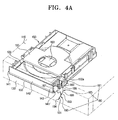
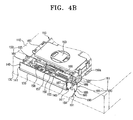
- the door 140 pivots between an open position (see Figures 5A and 5B ), at which the opening 133 is opened by the disk tray 120, and a closed position (see Figures 4A and 4B ), at which the opening 133 is closed by the disk tray 120.
- the front panel 130 and the door 140 constitute a front panel assembly engaged with the body.
- the main base 150 is provided at a front end thereof with a loading motor 155 to supply a power to move the disk tray 120 and a power to lift the pickup base 151.
- the power of the loading motor 155 is transferred from a motor pulley 156, coupled to an output shaft, through a belt 157 to a gear pulley 158.
- a first gear (not shown) formed at a lower portion of the gear pulley 158 is meshed with a second gear 164 of a loading gear 159 to transfer the power from the loading motor 155 to the loading gear 159.
- the power transferred to the loading gear 159 is transferred to a first rack gear 121 formed at a lower surface of the disk tray 120 through a pinion gear 165 of the loading gear 159, so that the disk tray 120 is moved between a disk unloading position (see Figure 5A ), at which the disk tray is ejected outward from the front panel 130 through the opening 133, and a disk loading position (see Figure 4A ), into which the disk is inserted into the front panel 130.
- the power transferred to the loading gear 159 is transferred to a second rack gear 167 formed at a first end 166a of a lift guide 166 through the pinion gear 165 of the loading gear 159, so that the lift guide 166 is moved in a second moving direction (direction F or G in Figures 4B , 5B and 7 ) perpendicular to a first moving direction (direction B or C in Figure 5A ) of the disk tray 120 by the loading motor 155.
- the lift guide 166 is provided with cam grooves 168 and 169 ( Figure 7 ). Guide bosses 154a and 154b of the pickup base 151 are inserted into the cam grooves 168 and 169, respectively.
- the pickup base 151 is installed on the main base 150.
- the pickup base 151 has a front end which is moved up and down at a desired angle by a supporting shaft (not shown) pivotally supported to the main base 150 at a rear end thereof.
- the pickup base 151 is provided at the front end thereof with guide bosses 154a and 154b guided by the cam grooves 168 and 169 of the lift guide 166.
- a spindle motor 152 is provided to the pickup base 151, and a turntable 153, on which a disk is seated, is provided to an output shaft of the spindle motor 152.
- the disk clamping member 160 to clamp the disk seated on the turntable 153 is secured to the main base 150 on the turntable 153.
- the disk clamping member 160 is provided at a center thereof with a clamp 163.
- the construction of the clamp 163 is widely known, the description of which will be omitted herein.
- the door interlock unit 180 restricts opening of the door 140 when the disk tray 120 is positioned at the disk loading position ( Figure 4A ), and also restricts movement of the disk tray 120 toward the disk loading position when the door 140 is opened ( Figure 5B ).
- the door interlock unit 180 includes first and second opening prevention members 181 and 185.
- the first opening prevention member 181 comprises an extension element, such as a straight protruding bar 183, which protrudes from a second end 166b of the lift guide 166, which lifts the pickup base 151 with the turntable provided, in a direction perpendicular to the first moving direction (direction B or C) of the disk tray 120.
- the protruding bar 183 may have a round-shaped front end.
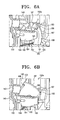
- the protruding bar 183 moves in cooperation with the movement of the disk tray 120 moving between the disk unloading position ( Figure 5A ) and the disk loading position ( Figure 4A ) by the loading motor 155, and is moved between a projected position ( Figures 4B and 6A ) and a retracted position ( Figures 5B and 6C ) by movement of the lift guide 166 moving in the second moving direction (direction F or G) perpendicular to the first moving direction (direction B or C) of the disk tray 120.
- the protruding bar 183 is protruded outward from a longitudinal edge 120a of the disk tray 120, i.e., a side wall 150a of the main base 150, through an access opening 197 formed at the side wall 150a of the main base 150.
- the protruding bar 183 is retracted into the side wall 150a of the main base 150.
- the protruding bar 183 is positioned at the protruded position ( Figures 4B and 6A ). Conversely, when the disk tray 120 is positioned at the disk unloading position ( Figure 5A ), the protruding bar 183 is positioned at the retracted position ( Figures 5B and 6C ).
- the second opening prevention member 185 comprises a blocking element, such as a blocking wing 186, protruding from a bracket 143 adjacent to the right hinge arm 141' of the door 140, the blocking wing 186 being at a right angle relative to the protruding bar 183.
- the blocking wing 186 may be formed with an L-shaped plate.
- the blocking wing 186 moves in cooperation with the pivoting movement of the door 140 moving between the open position and the closed position, and is moved between a blocking position ( Figure 5B ) within a moving path of the protruding bar 183 and unblocking position ( Figures 4B and 6A ) out of the moving path of the protruding bar 183.
- the blocking wing 186 includes a blocking surface 187 formed in a direction perpendicular to the second moving direction (direction F or G) of the protruding bar 183, and a hook surface 188 protruding in parallel with the second moving direction (direction F or G) of the protruding bar 183.
- the blocking surface 187 blocks the movement of the protruding bar 183 toward the protruding position.
- the lift guide 166 which is moved with the disk tray 120 in the second direction by the loading motor 155, is blocked by the protruding bar 183, which is blocked by the blocking surface 187, thereby stopping the loading motor 155.
- a controller (not shown) determines that the door 140 is opened or the disk tray 120 is obstructed by an object such as a user's finger.
- the loading motor 155 is rotated in a reverse direction by control of the controller, so that the disk tray 120 is returned to its original position (unloading position).
- An elastic member 190 is displaced under the blocking wing 186 to apply an elastic force to the door 140 in a direction (direction D in Figures 3 , 5A and 5B ) of pivoting the door 140 toward the closed position.
- the elastic member 190 may include an extension spring 191 having one end supported by a first latch 193 provided at a lower portion of the blocking wing 186, and the other end supported by a second latch (indicated by 194 in Figures 6A and 6C ) provided at an inner surface of the front panel 130.
- the door interlock unit 180 also includes a reinforcing rib 195 provided at an inner surface of the front panel 130 to support and reinforce the blocking wing 186.
- the reinforcing rib 195 is formed opposite to the blocking wing 186 positioned at the unblocking position so as not to prevent the movement of the protruding bar 183. Accordingly, the reinforcing rib 195 supports and reinforces the blocking wing 186 abutting with the protruding bar 183 to restrict the movement of the protruding bar 183, when the protruding bar 183 is moved to the protruded position in the state in which the blocking wing 186 is positioned at the blocking position.
- the controller When a button (not shown) to operate the tray is turned on, the controller operates to rotate the loading motor 155 in one direction, e.g., clockwise direction, to load the disk tray 120. At that time, if the disk tray 120 is forcibly pushed into the loading position, the controller detects the movement of the disk tray 120 by means of a detecting sensor (now shown), and rotates the loading motor 155 in a counterclockwise direction.
- a detecting sensor now shown
- the disk tray 120 is moved in the first moving direction C by the power of the loading motor 155 transferred through the motor pulley 156, the belt 157, the gear pulley 158, the pinion gear 165 of the loading gear 159, and the first rack gear 121.
- the lift gear 166 is moved in the second moving direction G by the power of the loading motor 155 transferred through the second rack gear 167 meshed with the pinion gear 165.
- the door 140 is rotated in the closed direction D by tension of the extension spring 191, and is thus closed.
- the pickup base 151 which is moved relatively down so as not to interfere with the movement of the disk tray 120, is lifted.
- the guide bosses 154a and 154b of the pickup base 151 are guided along the cam grooves 168 and 169 by the movement of the lift guide 166, which is transferred with the power from the loading motor 155 to move in the second direction G.
- the pickup base 151 starts to lift such that the disk tray 120 is completely inserted into the front panel 130 through the opening 133.
- the front end of the protruding bar 183 formed at the second end 166b of the lift guide 166 starts to protrude outward from the side wall 150a through the access opening 197 of the side wall 150a of the main base 150.
- the disk laid on the disk tray 120 is seated on the turntable 153 by the lift of the pickup base 151.
- the turntable 153 is further moved up, and the disk seated on the turntable 153 is secured by the clamp 163.
- the front end of the protruding bar 183 is completely protruded outward from the side wall 150a through the access opening 197 of the side wall 150a of the main base 150, which is positioned at the protruded position.
- the front end of the protruding bar 183 is in contact with the blocking surface 187 of the blocking wing 186 positioned at the blocking position, as shown in Figure 6B . As such, it prevents the protruding bar 183 from being moved to the protruded position, thereby stopping the loading motor 155.
- the controller determines that the door 140 is opened or the disk tray 120 is obstructed by an object such as the user's finger.
- the loading motor 155 is rotated in a reverse direction (e.g., clockwise direction) by control of the controller, so that the disk tray 120 is returned to the unloading position, as shown in Figure 5A .
- the disk recording/reproducing apparatus 100 of the present invention prevents the disk tray 120 from being inserted into the disk loading position in the case in which the door 140 is opened through carelessness. Accordingly, when, after the disk tray 120 is positioned at the disk loading position in the state that the door 140 is opened, the disk recording/reproducing apparatus is automatically operated or is operated by operating the button, a safety accident that may result when the child or other user is exposed to the disk rotating at high speed is prevented.
- the present invention operates as follows.
- the disk tray 120 When the disk recording/reproducing apparatus 100 is operating, as shown in Figure 4A , the disk tray 120 is positioned at the disk loading position, and the protruding bar 183 is positioned at the protruded position.
- the blocking wing 186 which is integrally formed with the bracket 143 adjacent to the right hinge arm 141' of the door 140, is restricted from moving toward the blocking position. Therefore, the door 140 is not opened.
- the disk recording/reproducing apparatus 100 of the present invention prevents the door 140 from being opened in operation, thereby preventing a safety accident that may result when the child or other user is exposed to the disk rotating at a high speed.
- the controller When the button for opening/closing the tray is actuated, the controller operates the loading motor 155 to rotate in a direction (e.g., clockwise direction) to eject the disk tray 120.
- a direction e.g., clockwise direction
- the lift guide 166 is moved in the second moving direction F by the power of the loading motor 155 transferred through the motor pulley 156, the belt 157, the gear pulley 158, the pinion gear 165 of the loading gear 159, and the second rack gear 167.
- the guide bosses 154a and 154b of the pickup base 151 are guided along the cam grooves 168 and 169 by the movement of the lift guide 166, which is transferred with the power from the loading motor 155 to move in the second moving direction F. As the guide bosses 154a and 154b are guided along the cam grooves 168 and 169, the pickup base 151 starts to move down.
- the front end of the protruding bar 183 formed at the second end 166b of the lift guide 166 starts to retract into the side wall 150a through the access opening 197 of the side wall 150a of the main base 150.
- the clamp 163 is detached from the turntable 153 by the descent of the pickup base 151 to release the disk.
- the turntable 153 is further moved down, and the disk seated on the turntable 153 is seated on the disk tray 120.
- the disk tray 120 is moved in the first moving direction B by the power of the loading motor 155 transferred through the motor pulley 156, the belt 157, the gear pulley 158, the pinion gear 165 of the loading gear 159, and the first rack gear 121.
- the door interlock unit of the present invention when the disk tray is positioned at the disk loading position, it prevents the door from being forcibly opened. Also, if the door is forcibly opened, the disk tray is not inserted into the disk loading position. As such, in the case in which the door is opened by a child or other user through carelessness, it can prevent a safety accident that may be result when the child or other user is exposed to the disk rotating at a high speed.
Landscapes
- Feeding And Guiding Record Carriers (AREA)
Claims (13)
- Unité d'interverrouillage de porte (180) destinée à être utilisée avec un appareil d'enregistrement/reproduction de disque, l'appareil comportant un panneau frontal (130) ayant une ouverture (133), un plateau à disques (120) qui est déplaçable entre une première position à laquelle le plateau à disques (120) est éjecté hors du panneau frontal (130) à travers l'ouverture (133) et une seconde position à laquelle le plateau à disques (120) est inséré dans le panneau frontal (130), une porte (140) montée de façon pivotante sur le panneau frontal (130) afin de tourner entre une position ouverte afin d'ouvrir l'ouverture (133) et une position fermée afin de fermer l'ouverture (133), et un élément élastique (190) afin d'appliquer une force élastique pour faire tourner la porte (140) sur la position fermée,
l'unité d'interverrouillage de porte (180) comprenant
au moins un élément (181, 185) pour empêcher l'ouverture de force de la porte (140),
dans laquelle l'au moins un élément (181, 185) restreint sélectivement la rotation de la porte (140) en fonction d'une position du plateau à disques (120),
étant caractérisée en ce que
l'au moins un élément (181, 185) restreint sélectivement le déplacement du plateau à disques (120) en fonction d'une position de la porte (140). - Unité d'interverrouillage de porte (180) selon la revendication 1, dans laquelle l'au moins un élément (181, 185) restreint la rotation de la porte (140) vers la position ouverte en réponse au positionnement du plateau à disques (120) à la seconde position, et restreint le déplacement du plateau à disques (120) vers la seconde position en réponse au positionnement de la porte (140) à la position ouverte.
- Unité d'interverrouillage de porte (180) selon la revendication 2, dans laquelle l'au moins un élément (181, 185) comprend :un premier élément anti-ouverture (181) déplaçable entre une position saillante à laquelle le premier élément anti-ouverture (181) fait saillie vers l'extérieur depuis un bord longitudinal du plateau à disques (120) et une position rétractée à laquelle le premier élément anti-ouverture (181) est rétracté de façon à ne pas faire saillie depuis le bord longitudinal du plateau à disques (120), le premier élément anti-ouverture (181) se déplaçant en coopération avec le déplacement du plateau à disques (120) entre la première position et la seconde position ; etun second élément anti-ouverture (185) déplaçable entre une position de blocage sur une trajectoire de déplacement du premier élément anti-ouverture (181) et une position de déblocage écartée de la trajectoire de déplacement du premier élément anti-ouverture (181), le second élément anti-ouverture (185) se déplaçant en coopération avec le déplacement de la porte (140) entre la position ouverte et la position fermée ;dans laquelle le premier élément anti-ouverture (181) ne se déplace pas jusqu'à la position saillante pour empêcher le déplacement du plateau à disques (120) en réponse au positionnement du second élément anti-ouverture (185) à la position de blocage ; etle second élément anti-ouverture (185) ne se déplace pas jusqu'à la position de blocage pour empêcher la rotation de la porte (140) en réponse au positionnement du premier élément anti-ouverture (181) à la position saillante.
- Unité d'interverrouillage de porte (180) selon la revendication 3, comprenant en outre :une base de lecture (151) dotée d'une platine ; etun guide de levée (166) pour soulever la base de lecture (151) ;dans laquelle le premier élément anti-ouverture (181) comprend un élément d'extension (183) saillant du guide de levée (166) dans un sens perpendiculaire à un sens de déplacement du plateau à disques (120).
- Unité d'interverrouillage de porte (180) selon la revendication 4, dans laquelle le second élément anti-ouverture (185) comprend un élément de blocage (186) sur un côté de la porte (140), l'élément de blocage (186) étant approximativement en angle droit par rapport à élément d'extension (183).
- Unité d'interverrouillage de porte (180) selon la revendication 5, dans laquelle l'élément de blocage (186) comprend :une surface de blocage (187), formée dans un sens perpendiculaire au sens de déplacement de l'élément d'extension (183), afin de bloquer le déplacement de l'élément d'extension (183) jusqu'à la position saillante en réponse au positionnement de l'élément de blocage (186) à la position de blocage ; etune surface de crochet (188), formée parallèlement au sens de déplacement de l'élément d'extension (183) et butant contre l'élément d'extension (183), afin de limiter le déplacement de l'élément de blocage (186) jusqu'à la position de blocage en réponse au positionnement de l'élément d'extension (183) à la position saillante.
- Unité d'interverrouillage de porte (180) selon la revendication 5 ou 6, dans laquelle l'élément élastique (190) comprend un ressort d'extension (191) ayant une extrémité supportée par l'élément de blocage (186) et une seconde extrémité supportée par le panneau frontal (130).
- Unité d'interverrouillage de porte (180) selon l'une quelconque des revendications 3 à 7, comprenant en outre un élément de renforcement (195) fourni sur le panneau frontal (130) afin de supporter et/ou renforcer le second élément anti-ouverture (185).
- Unité d'interverrouillage de porte (180) selon la revendication 8, dans laquelle l'élément de renforcement (195) supporte le second élément anti-ouverture (185) en réponse à la tentative par le premier élément anti-ouverture (185) de se déplacer jusqu'à la position saillante et à son contact avec le second élément anti-ouverture (185) pendant que le second élément anti-ouverture (185) est positionné à la position de blocage.
- Unité d'interverrouillage de porte (180) selon la revendication 8, dans laquelle l'élément de renforcement (195) est fourni sous forme de nervure s'étendant depuis le panneau frontal (130).
- Unité d'interverrouillage de porte (180) selon l'une quelconque des revendications 4 à 10, dans laquelle l'élément d'extension (183) est une barre saillant du guide de levée (166).
- Unité d'interverrouillage de porte (180) selon la revendication 5, dans laquelle l'élément de blocage (186) est une aile fournie sur un côté de la porte (140).
- Appareil d'enregistrement/reproduction de disque comprenant :un ensemble de panneau frontal composant le panneau frontal (130) ;un corps comprenant le plateau à disques (120) ;un guide de levée (166) afin de soulever une base de lecture (151) sur laquelle est installée une platine ; etl'unité d'interverrouillage de porte (180) selon l'une quelconque de revendications précédentes.
Applications Claiming Priority (1)
| Application Number | Priority Date | Filing Date | Title |
|---|---|---|---|
| KR1020040058076A KR100598018B1 (ko) | 2004-07-24 | 2004-07-24 | 도어안전장치 및 그것을 갖는 디스크 기록/재생장치 |
Publications (3)
| Publication Number | Publication Date |
|---|---|
| EP1622155A2 EP1622155A2 (fr) | 2006-02-01 |
| EP1622155A3 EP1622155A3 (fr) | 2007-05-02 |
| EP1622155B1 true EP1622155B1 (fr) | 2009-01-28 |
Family
ID=36076998
Family Applications (1)
| Application Number | Title | Priority Date | Filing Date |
|---|---|---|---|
| EP05254592A Expired - Lifetime EP1622155B1 (fr) | 2004-07-24 | 2005-07-22 | Verrouillage de porte et dispositif d'enregistrement /de reproduction à disque utilisant un tel verrouillage |
Country Status (5)
| Country | Link |
|---|---|
| US (1) | US7487519B2 (fr) |
| EP (1) | EP1622155B1 (fr) |
| KR (1) | KR100598018B1 (fr) |
| CN (1) | CN1734658B (fr) |
| DE (1) | DE602005012561D1 (fr) |
Families Citing this family (5)
| Publication number | Priority date | Publication date | Assignee | Title |
|---|---|---|---|---|
| TW200901170A (en) * | 2007-06-28 | 2009-01-01 | Daxon Technology Inc | Disk storage apparatus and method for using the same |
| JP2009076148A (ja) * | 2007-09-21 | 2009-04-09 | Funai Electric Co Ltd | ディスク装置 |
| JP2009170051A (ja) * | 2008-01-18 | 2009-07-30 | Funai Electric Co Ltd | ディスク装置 |
| JP2014209400A (ja) * | 2013-03-28 | 2014-11-06 | 富士通株式会社 | ライブラリ装置及びライブラリ装置の制御方法 |
| US10400978B2 (en) * | 2013-11-21 | 2019-09-03 | Ford Global Technologies, Llc | Photoluminescent lighting apparatus for vehicles |
Family Cites Families (8)
| Publication number | Priority date | Publication date | Assignee | Title |
|---|---|---|---|---|
| JPH08138294A (ja) * | 1994-11-07 | 1996-05-31 | Onkyo Corp | 記録、再生機器における扉開閉装置 |
| JPH09282758A (ja) | 1996-04-12 | 1997-10-31 | Sony Corp | 扉開閉装置 |
| JP3216521B2 (ja) | 1996-04-19 | 2001-10-09 | 松下電器産業株式会社 | ローディング装置 |
| KR100212486B1 (ko) | 1996-12-11 | 1999-08-02 | 정선종 | 저속병렬상관기 |
| TW430782B (en) * | 1999-02-12 | 2001-04-21 | Acer Peripherals Inc | Trigger mechanism of eject device for disk players |
| JP3747715B2 (ja) * | 1999-10-29 | 2006-02-22 | ティアック株式会社 | 記録媒体装着装置 |
| JP4132856B2 (ja) * | 2002-02-13 | 2008-08-13 | 松下電器産業株式会社 | ディスク装置のドライブドアロック機構 |
| KR100464422B1 (ko) * | 2002-07-03 | 2005-01-03 | 삼성전자주식회사 | 도어잠금수단을 갖는 디스크 드라이브의 프런트 패널조립체 및 이를 구비한 디스크 드라이브 |
-
2004
- 2004-07-24 KR KR1020040058076A patent/KR100598018B1/ko not_active Expired - Fee Related
-
2005
- 2005-07-21 US US11/185,872 patent/US7487519B2/en not_active Expired - Fee Related
- 2005-07-22 DE DE602005012561T patent/DE602005012561D1/de not_active Expired - Lifetime
- 2005-07-22 EP EP05254592A patent/EP1622155B1/fr not_active Expired - Lifetime
- 2005-07-25 CN CN2005100848952A patent/CN1734658B/zh not_active Expired - Fee Related
Also Published As
| Publication number | Publication date |
|---|---|
| KR20060008817A (ko) | 2006-01-27 |
| DE602005012561D1 (de) | 2009-03-19 |
| EP1622155A3 (fr) | 2007-05-02 |
| CN1734658A (zh) | 2006-02-15 |
| US7487519B2 (en) | 2009-02-03 |
| KR100598018B1 (ko) | 2006-07-13 |
| CN1734658B (zh) | 2010-06-16 |
| US20060020955A1 (en) | 2006-01-26 |
| EP1622155A2 (fr) | 2006-02-01 |
Similar Documents
| Publication | Publication Date | Title |
|---|---|---|
| JP3747715B2 (ja) | 記録媒体装着装置 | |
| EP1622155B1 (fr) | Verrouillage de porte et dispositif d'enregistrement /de reproduction à disque utilisant un tel verrouillage | |
| US6081494A (en) | Disc recording and reproducing apparatus having a drive mechanism for loading and ejecting a disc cartridge | |
| US6078553A (en) | Disc cartridge loading and unloading apparatus with shutter opening structure | |
| JPH09223386A (ja) | 蓋体開閉機構およびそれを備えた記録再生装置 | |
| US5881040A (en) | Disc device with slider contact prevention mechanism | |
| EP1630807B1 (fr) | Porte avec verrouillage de sécurité et lecteur de disques | |
| JP2006252683A (ja) | 光ディスク装置 | |
| JP4132856B2 (ja) | ディスク装置のドライブドアロック機構 | |
| JP3746118B2 (ja) | カートリッジのローディング機構 | |
| JP3114639B2 (ja) | ディスク装置 | |
| JP2000123456A (ja) | ディスクドライブ装置 | |
| JP3650284B2 (ja) | 車載用電子機器 | |
| JPH05159432A (ja) | 記録装置 | |
| JP3591008B2 (ja) | カートリッジ排出装置及び記録及び/又は再生装置 | |
| US20070028252A1 (en) | Optical recording and playback apparatus | |
| JP3613011B2 (ja) | ディスク装置 | |
| JP3180560B2 (ja) | ディスク装置 | |
| JP3553754B2 (ja) | ディスクプレーヤ | |
| JP3642983B2 (ja) | ディスク装置におけるディスク移動防止装置 | |
| JP3806570B2 (ja) | カートリッジの収納装置 | |
| JP2967059B2 (ja) | カートリッジのローディング機構 | |
| JPH06243670A (ja) | ディスクプレ−ヤの開閉蓋ロック装置 | |
| JPH03283047A (ja) | ディスクドライブ | |
| JPH11353759A (ja) | 記録媒体駆動装置 |
Legal Events
| Date | Code | Title | Description |
|---|---|---|---|
| PUAI | Public reference made under article 153(3) epc to a published international application that has entered the european phase |
Free format text: ORIGINAL CODE: 0009012 |
|
| AK | Designated contracting states |
Kind code of ref document: A2 Designated state(s): AT BE BG CH CY CZ DE DK EE ES FI FR GB GR HU IE IS IT LI LT LU LV MC NL PL PT RO SE SI SK TR |
|
| AX | Request for extension of the european patent |
Extension state: AL BA HR MK YU |
|
| PUAL | Search report despatched |
Free format text: ORIGINAL CODE: 0009013 |
|
| AK | Designated contracting states |
Kind code of ref document: A3 Designated state(s): AT BE BG CH CY CZ DE DK EE ES FI FR GB GR HU IE IS IT LI LT LU LV MC NL PL PT RO SE SI SK TR |
|
| AX | Request for extension of the european patent |
Extension state: AL BA HR MK YU |
|
| 17P | Request for examination filed |
Effective date: 20070829 |
|
| 17Q | First examination report despatched |
Effective date: 20070928 |
|
| AKX | Designation fees paid |
Designated state(s): DE GB NL |
|
| GRAP | Despatch of communication of intention to grant a patent |
Free format text: ORIGINAL CODE: EPIDOSNIGR1 |
|
| GRAS | Grant fee paid |
Free format text: ORIGINAL CODE: EPIDOSNIGR3 |
|
| GRAA | (expected) grant |
Free format text: ORIGINAL CODE: 0009210 |
|
| AK | Designated contracting states |
Kind code of ref document: B1 Designated state(s): DE GB NL |
|
| REG | Reference to a national code |
Ref country code: GB Ref legal event code: FG4D |
|
| REF | Corresponds to: |
Ref document number: 602005012561 Country of ref document: DE Date of ref document: 20090319 Kind code of ref document: P |
|
| PLBE | No opposition filed within time limit |
Free format text: ORIGINAL CODE: 0009261 |
|
| STAA | Information on the status of an ep patent application or granted ep patent |
Free format text: STATUS: NO OPPOSITION FILED WITHIN TIME LIMIT |
|
| 26N | No opposition filed |
Effective date: 20091029 |
|
| PGFP | Annual fee paid to national office [announced via postgrant information from national office to epo] |
Ref country code: NL Payment date: 20140711 Year of fee payment: 10 Ref country code: DE Payment date: 20140718 Year of fee payment: 10 |
|
| PGFP | Annual fee paid to national office [announced via postgrant information from national office to epo] |
Ref country code: GB Payment date: 20140717 Year of fee payment: 10 |
|
| REG | Reference to a national code |
Ref country code: DE Ref legal event code: R119 Ref document number: 602005012561 Country of ref document: DE |
|
| GBPC | Gb: european patent ceased through non-payment of renewal fee |
Effective date: 20150722 |
|
| REG | Reference to a national code |
Ref country code: NL Ref legal event code: MM Effective date: 20150801 |
|
| PG25 | Lapsed in a contracting state [announced via postgrant information from national office to epo] |
Ref country code: GB Free format text: LAPSE BECAUSE OF NON-PAYMENT OF DUE FEES Effective date: 20150722 Ref country code: DE Free format text: LAPSE BECAUSE OF NON-PAYMENT OF DUE FEES Effective date: 20160202 |
|
| PG25 | Lapsed in a contracting state [announced via postgrant information from national office to epo] |
Ref country code: NL Free format text: LAPSE BECAUSE OF NON-PAYMENT OF DUE FEES Effective date: 20150801 |