EP1629800A1 - Tränenpunktpfropf - Google Patents
Tränenpunktpfropf Download PDFInfo
- Publication number
- EP1629800A1 EP1629800A1 EP04734946A EP04734946A EP1629800A1 EP 1629800 A1 EP1629800 A1 EP 1629800A1 EP 04734946 A EP04734946 A EP 04734946A EP 04734946 A EP04734946 A EP 04734946A EP 1629800 A1 EP1629800 A1 EP 1629800A1
- Authority
- EP
- European Patent Office
- Prior art keywords
- brim
- thread
- punctal plug
- present
- punctal
- Prior art date
- Legal status (The legal status is an assumption and is not a legal conclusion. Google has not performed a legal analysis and makes no representation as to the accuracy of the status listed.)
- Granted
Links
- WNDXRJBYZOSNQO-ZCFIWIBFSA-N CCC[C@@H](C)CN Chemical compound CCC[C@@H](C)CN WNDXRJBYZOSNQO-ZCFIWIBFSA-N 0.000 description 1
Images

















Classifications
-
- A—HUMAN NECESSITIES
- A61—MEDICAL OR VETERINARY SCIENCE; HYGIENE
- A61B—DIAGNOSIS; SURGERY; IDENTIFICATION
- A61B17/00—Surgical instruments, devices or methods
- A61B17/12—Surgical instruments, devices or methods for ligaturing or otherwise compressing tubular parts of the body, e.g. blood vessels or umbilical cord
- A61B17/12022—Occluding by internal devices, e.g. balloons or releasable wires
-
- A—HUMAN NECESSITIES
- A61—MEDICAL OR VETERINARY SCIENCE; HYGIENE
- A61B—DIAGNOSIS; SURGERY; IDENTIFICATION
- A61B17/00—Surgical instruments, devices or methods
- A61B17/12—Surgical instruments, devices or methods for ligaturing or otherwise compressing tubular parts of the body, e.g. blood vessels or umbilical cord
- A61B17/12022—Occluding by internal devices, e.g. balloons or releasable wires
- A61B17/12099—Occluding by internal devices, e.g. balloons or releasable wires characterised by the location of the occluder
-
- A—HUMAN NECESSITIES
- A61—MEDICAL OR VETERINARY SCIENCE; HYGIENE
- A61B—DIAGNOSIS; SURGERY; IDENTIFICATION
- A61B17/00—Surgical instruments, devices or methods
- A61B17/12—Surgical instruments, devices or methods for ligaturing or otherwise compressing tubular parts of the body, e.g. blood vessels or umbilical cord
- A61B17/12022—Occluding by internal devices, e.g. balloons or releasable wires
- A61B17/12131—Occluding by internal devices, e.g. balloons or releasable wires characterised by the type of occluding device
- A61B17/12159—Solid plugs; being solid before insertion
-
- A—HUMAN NECESSITIES
- A61—MEDICAL OR VETERINARY SCIENCE; HYGIENE
- A61F—FILTERS IMPLANTABLE INTO BLOOD VESSELS; PROSTHESES; DEVICES PROVIDING PATENCY TO, OR PREVENTING COLLAPSING OF, TUBULAR STRUCTURES OF THE BODY, e.g. STENTS; ORTHOPAEDIC, NURSING OR CONTRACEPTIVE DEVICES; FOMENTATION; TREATMENT OR PROTECTION OF EYES OR EARS; BANDAGES, DRESSINGS OR ABSORBENT PADS; FIRST-AID KITS
- A61F9/00—Methods or devices for treatment of the eyes; Devices for putting in contact-lenses; Devices to correct squinting; Apparatus to guide the blind; Protective devices for the eyes, carried on the body or in the hand
- A61F9/007—Methods or devices for eye surgery
- A61F9/00772—Apparatus for restoration of tear ducts
-
- Y—GENERAL TAGGING OF NEW TECHNOLOGICAL DEVELOPMENTS; GENERAL TAGGING OF CROSS-SECTIONAL TECHNOLOGIES SPANNING OVER SEVERAL SECTIONS OF THE IPC; TECHNICAL SUBJECTS COVERED BY FORMER USPC CROSS-REFERENCE ART COLLECTIONS [XRACs] AND DIGESTS
- Y10—TECHNICAL SUBJECTS COVERED BY FORMER USPC
- Y10S—TECHNICAL SUBJECTS COVERED BY FORMER USPC CROSS-REFERENCE ART COLLECTIONS [XRACs] AND DIGESTS
- Y10S623/00—Prosthesis, i.e. artificial body members, parts thereof, or aids and accessories therefor
- Y10S623/902—Method of implanting
- Y10S623/905—Eye
Definitions
- This invention relates to a punctal plug and an apparatus for intubation of the lacrimal duct for treatment of dry eye.
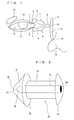
- the lacrimal gland 14 secretes tears which drain into the inferior nasal meatus 18 via the lacrimal duct after moistening the ocular surface 17 having the cornea 15 and conjunctiva 16.
- the lacrimal duct consists of the upper punctum 1, lower punctum 2, vertical portion of the upper canaliculus 3, vertical portion of the lower canaliculus 4, boundary portion between the upper vertical and horizontal portions 5, boundary portion between the lower vertical and horizontal portions 6, upper horizontal portion 7, lower horizontal portion 8, common canaliculus 9, internal common punctum 10, lacrimal sac 11 and nasolacrimal duct 12.
- the lower end 13 of the nasolacrimal duct 12 opens into the inferior nasal meatus 18.
- the inner space of the horizontal portion 7, 8 is spindle shaped.
- tears which are very important for the eye, immediately drain away via the lacrimal duct.
- occlusion of the upper punctum 1 and/or lower punctum 2 using electric cautery or argon laser is performed. Occlusion using a punctal plug (mentioned later) inserted into the upper punctum 1 and lower punctum 2 is also performed.
- Dry eye symptoms include asthenopia, waking irritation, grittiness, foreign body sensation, scratchiness, soreness, difficulty to open the eyes in an air conditioned room, injection, burning and so on.
- tears Unlike artificial tears, tears contain lysozyme, lactoferrin, immunoglobulin, and so on which protect the eyes from bacteria and viruses. And some artificial tears contain a preservative which is harmful to the eye.
- Tears also have an optical role wherein tears smoothen the microscopically irregular surface of the cornea 15 to improve eyesight, a lubricanting role wherein tears act as a lubricant and the movement of the eyelids become smooth. Artificial tears are not expected to play these various roles, among others.
- occlusion of the upper punctum 1 and/or lower punctum 2 to wet the eye with natural tears is superior.
- punctal occlusion by argon laser, etc may induce epiphora postoperatively. In such a case, punctal and canalicular surgery are needed to reconstruct canaliculi and puncta.
- the use of a punctal plug is superior because a punctal plug can be removed easily in such cases.
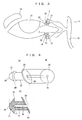
- the punctal plug shown in FIG. 2 consists of the tip portion 21, shaft 22, brim 23 and there is a hole 24 in the center of brim 23.
- the hole 24 is continuous with a tubular lumen 25 of shaft 22 and the lumen 26 with a closed end 27 of the tip portion 21.
- the punctal plug shown in FIG. 2 measures 2.8 mm in total length, 1.5 ⁇ 2.0 mm in diameter of brim, 0.7 mm in height of brim, 1.5 mm in length of shaft and 0.7 mm in diameter of shaft.
- the punctal plug in FIG. 2 is used as shown in FIG. 3.
- the punctal plug is inserted into puncta 1, 2 and vertical portion of canaliculus 3, 4 and the total length of the puncta 1, 2 and vertical portions of canaliculus 3, 4 is 2.5 mm on the average. Therefore, the total length 2.8 mm of the punctal plug is too long. Consequently, the brim 23 touches the cornea 15 and not infrequently induces a foreign body sensation.
- FIG. 4 shows a punctal plug of the FCI company. This is also used for the treatment of dry eye in Japan. For example, see Junzo Hirano & Miki Hirano: Experience of the treatment for a case with Stevens-Johnson syndrome with severe keratoconus, Japanese Review of Clinical Ophthalmology 91: 41-44, 1997.
- the punctal plug in FIG. 4 is a miniaturized one. This punctal plug measures 1.7 mm in total length, 1.5 mm in diameter of brim 23, and is miniaturized as a whole. It measures 0.1 mm in thickness of brim 23 which inclines 20° against the shaft 22.
- the punctal plug in FIG. 4 also consists of the tip portion 21, shaft 22 and brim 23, and as in the punctal plug as shown in FIG. 2, hole 24 is continuous with the lumen 25 with closed end 27.
- the tip of the punctal plug is pushed into the lacrimal duct to or near the boundary portion 5, 6 between the vertical portion 3, 4 and horizontal portion 7, 8 of canaliculus, by a metal probe which is inserted from the hole 24 until the closed end 27.
- FIG. 5 shows a punctal plug with a tapered shaft form.
- This plug is also miniaturized and consists of the tip portion 21, shaft 22 and brim 23.
- the hole 24 is continuous with lumen 25 with a closed end 27.
- the shaft 22 becomes gradually smaller as it tapers toward the brim 23.
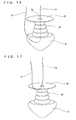
- the miniature punctal plug can also migrate into the vertical portion of the upper canaliculus 3,4 as shown in FIG. 6, the horizontal portion of canaliculus 7, 8 as shown in FIG. 7, and as shown in FIG. 8 into the lacrimal sac 11 and nasolacrimal duct 12, resulting in canaliculitis and dacryocystitis which sometimes need surgical intervention (For example, see Rumelt S et al: silicone punctal plug migration resulting in dacryocystitis and canaliculitis. Cornea 16: 377-399, 1997.). It is a problem that the punctal plug lodged in the lacrimal passage cannot be detected by X-ray.
- the edges 28 of the tip portion 21 of either punctal plug are angular and sometimes stimulate canaliculus, resulting in the growth of pyogenic granuloma (For example, see Rapoza P A & Ruddat M S: Pyogenic granuloma as a complication of silicone punctal plug. Am J Ophthalmol 113: 454-455, 1992).
- Granuloma sometimes pushes the punctal plug out of the puncta.
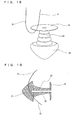
- the shaft of the punctal plug shown in FIG. 9 is accordion-shaped, the brim becomes smaller with a diameter 1 mm, and the stimulus to the eyeball decreases all the more. (For example, see Jp Patent No. 2002-529144.)
- the size of the opening of the lacrimal punctum has an individual variation of 0.1-0.5 mm in diameter. As shown in FIG. 10, a brim can easily be lodged inside the lacrimal duct at the time of insertion though the patients comfort is increased when the diameter of the brim is 1 mm or less. If the punctal plug can be inserted precisely and safely, the diameter of the brim can be made smaller, possibly less than 1 mm.
- This invention aims at providing a punctal plug with a brim smaller than a conventional one to improve comfort and which also can be inserted more safely and surely into the lacrimal duct.
- One of the means for solution according to the present invention is a punctal plug having a shaft, a tip portion connected with one end of said shaft and a brim connected with the other end of said shaft wherein a prescribed length of a very thin member, for example, a thread, is inserted into either one of said tip portion, shaft, and brim, or into said tip portion and shaft, or into said shaft and brim.
- a very thin member for example, a thread
- Another means for solution according to the present invention is an apparatus for intubation of the lacrimal duct having a thin, soft tube with a sufficient length to cover the distance between the lacrimal sac and the punctum, the punctal plug fixed at one end of said thin tube and the thick heavy tube fixed at the other end of said thin tube wherein a very thin member, for example a thread is inserted into one or two of said punctal plugs, thin and/or thick tubes.
- Another means for solution according to the present invention is a device for intubation of the lacrimal duct having a thin, soft tube with a sufficient length to cover the distance between the lacrimal sac and punctum, a brim fixed at one end of said thin tube and a thick tube fixed at the other end of said thin tube, wherein a very thin member, for example a thread is inserted into one or two out of said brim, thin tube and/or thick tubes.
- a suitable example of the thin member is thread 0.05 mm or less in diameter.
- the present inventor has continued in earnest research for many years an apparatus for intubation of the lacrimal duct such as a punctal plug for the treatment of dry eye which can be used easily with little pain to the patient, and can be inserted precisely, quickly and safely, is not easily dislocated, and can be removed easily after attaining the purpose of treatment.
- an apparatus for intubation of the lacrimal duct such as a punctal plug for the treatment of dry eye which can be used easily with little pain to the patient, and can be inserted precisely, quickly and safely, is not easily dislocated, and can be removed easily after attaining the purpose of treatment.
- the present invention is an improved apparatus for intubation of lacrimal duct developed by the present inventor. Especially, the present invention prevents the accident which occurs during insertion of a punctal plug and apparatus for intubation of lacrimal duct, resulting in marked improvement of safety, and improves comfort for the wearer by providing a smaller brim.
- the punctal plug according to the present invention consists of a shaft, a brim attached to one end of said shaft, and a tip attached to the other end of said shaft and as shown in FIG. 11 ⁇ 26, a very thin thread is penetrated into a part or the whole body of the punctal plug. This thin thread is used to pull out the brim which is lodged in the canaliculus, that is, by pulling both sides of the thread simultaneously, the brim included in the canaliculus can be easily pulled out.
- FIG. 31 other apparatus for intubation of lacrimal duct according to the present invention, consists of a thin, soft plastic tube with a sufficient length to reach from the puncta to the lacrimal sac, a punctal plug attached to one end of said thin tube, and a thick, heavy plastic tube attached to the other end of said thin tube, and a thin thread is penetrating one or two out of said punctal plug, thin tube and thick tube, when the brim is lodged in the lacrimal duct, the brim can be pulled out of the punctum by pulling both sides of the thread.
- the thick, heavy tube attached to one end of the thin tube, pulls the thin tube downward and makes the punctal plug attached to the other end of the thin tube more stable.
- the thick heavy tube running almost perpendicularly pulls the thin tube running almost horizontally which is connected with the upper end of said thick tube.
- still other apparatus for intubation consists of a thin, soft plastic tube with a sufficient length to cover the distance between the punctum and the lacrimal sac, the brim attached to one end of said thin tube and a thick heavy tube attached to the other end of said thin tube, and a very thin thread is penetrated into one or two out of the brim, thin tube and thick tube.
- This thread enables a brim lodged in the lacrimal duct to be pulled out.
- the thin tube is drawn by the thick and heavy tube, the brim attached to said thin tube can seal the punctum.
- Most parts of the thin tube exists in the canaliculus which runs almost horizontally.
- the thick heavy tube exists in the sac ⁇ lacrimal duct which runs almost perpendicularly and tends to move downward by gravity. Therefore, the thin tube running horizontally, which is fixed at the upper end of the thick and heavy tube, is pulled.
- nylon 0.02 ⁇ 0.05 mm in diameter or other threads difficult to be broken in the same diameter for the present invention.
- 9-0 nylon with a very thin needle having a round edge or 10 ⁇ 0 nylon with a very thin needle having a round edge is used to enable apparatus for intubation of the lacrimal duct such as the punctal plug etc to be penetrated by thread without damage to said punctal plug and apparatus for intubation of the lacrimal duct.
- the brim of the apparatus for intubation of the lacrimal duct such as punctal plug etc is 0.7 ⁇ 2.0 mm in diameter, and in the punctal plug only, small brims also are useful.
- the apparatus for intubation of the lacrimal duct having the thin tube and thick tube it is necessary to use a brim with large diameters compared to a brim of a punctal plug because the brim is pulled nasally as described already.
- the brim 0.3 ⁇ 1.0 mm in diameter is appropriate and in the apparatus for intubation of the lacrimal duct with the thin and thick tubes, the brim 0.5 ⁇ 1.5 mm in diameter is appropriate.
- the smallest disc shaped brim is 1 mm in diameter when the diameter of the tip is 1 mm.
- each person can select a minimally sized brim individually fit for each of them because the brim of any punctal plug lodged in the lacrimal duct and any apparatus with a brim for intubation of lacrimal duct, can be pulled out by the thread.
- the opening of punctum is 0.1 mm in diameter
- a small brim 0.5 mm or less in diameter can be selected for a threaded punctal plug having a tip portion 1 mm in diameter, that is, in the threaded punctal plug according to the present invention, the diameter of the brim (a) can be far smaller than the diameter of the tip (b).
- thread 31 used in FIGS. 11 ⁇ 26 thread 0.02 ⁇ 0.05 mm in diameter, sufficiently thin for the punctal plug and not easily broken is suitable like 9-0 nylon and 10-0 nylon.
- the threaded punctal plug is inserted using a metal probe (inserter). If the brim is lodged in the lacrimal duct, because of over insertion; both sides of the thread 31 are pulled simultaneously to pull the brim out of the punctum for correct placement of the punctal plug.
- the threaded punctal plug with an accordion shaped shaft also can be inserted safely by the thread 31 because the brim included in the lacrimal duct can be pulled out of the punctum using the thread 31.
- the method using the thread 31 can be applied for any type of punctal plug with a brim.
- the suitable brim size is different from person to person, and a threaded punctal plug with a minimally sized brim can be chosen because the plug can be inserted correctly and safely, resulting in the unnecessity of making the brim bigger.
- FIGS. 31 ⁇ 33 show other apparatus for intubation of lacrimal duct having a thin tube with a sufficient length to cover from punctum to lacrimal sac, punctal plug attached to one end of said thin tube, and a thick tube attached to the other end of said thin tube, wherein the tip portion 21 of the punctal plug is penetrated by the thread 31 which can be allowed to penetrate the thinner tube 40 or thicker tube 42.
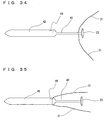
- FIGS. 34 ⁇ 37 show still other apparatus for intubation of lacrimal duct having a thin tube with a sufficient length to cover from the punctum to the lacrimal sac, the brim 23 attached to one end of said thin tube, and the thick tube attached to the other end of said thin tube, and in FIG. 34, the thin tube is penetrated by thread. In FIG. 35, the thick tube is penetrated by thread 31.
- Apparatus for intubation of lacrimal duct shown in FIGS. 31 ⁇ 37 are pushed into the lacrimal duct using a metal probe which is inserted into a thick tube from a small cut applied to said thick tube.
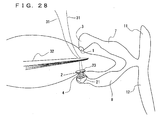
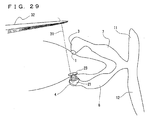
- FIG. 32 shows the state wherein the brim 23 of the apparatus for intubation of the lacrimal duct shown in FIG. 31 is lodged in the lacrimal duct from the upper punctum 1, and as shown in FIG. 33 the brim 23 can be pulled out of the punctum by pulling both sides of the thread 31 using forceps because the tip portion 21 of the punctal plug is penetrated by the thread 31.
- FIG. 36 shows the state wherein the brim 23 of the apparatus for intubation of the lacrimal duct shown in FIG. 34 is lodged in the lacrimal duct from the lower punctum, and as shown in FIG. 37, the brim can be pulled out of the punctum by pulling both sides of the thread 31 because the thin tube is penetrated by the thread 31.
- the brim 23 lodged inside the lacrimal duct as shown in FIG. 36 the brim can be pulled out of the punctum by pulling both sides of the thread 31 simultaneously, as shown in FIG. 37.
- Apparatus for intubation of lacrimal duct shown in FIG. 31 ⁇ 37 are applicable to any type of apparatus for intubation having a brim, a thin tube and a thick tube.
- the technique for punctal plug using the thread is applicable not only to the punctal plugs until now, but also any punctal plug which will be improved and appear in the future. Once the brim lodged inside the lacrimal duct during insertion is pulled out, the brim is not included in the lacrimal duct later.
- the brim outside may go into the lacrimal duct if the brim is too small, so a bigger brim is required compared to a brim of a punctal plug.
- the threaded apparatus for intubation of the lacrimal duct mostly a smaller brim is allowed to be adopted compared to a brim of a conventional apparatus for intubation of lacrimal duct. If the opening of the punctum is too large, a threaded apparatus for intubation for the lacrimal duct having a small brim may be used after making the opening of the punctum smaller by surgery.
- FIG. 38 (A), (B) shows a punctal plug wherein the thread 71 is fixed at the lumen of the shaft 22 from the hole 24 of the brim 23.
- FIG. 38 (C) shows the thread 71 and the fixed point 72.
- FIG. 38 (D) shows the thread 71 fixed at the edge of the brim 23.
- FIG. 39 shows the thread 71 fixed at the midpoint of the lumen through the inner surface of the shaft.
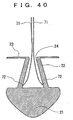
- FIGS. 40 ⁇ 42 show the thread 71 fixed at the deep part of the lumen of the shaft 22.
- FIG. 43 shows the thread 71 fixed at the lumen of the shaft 22 near the hole 24.
- FIG. 44 shows the thread 71 fixed at the midpoint of the surface of the shaft 22 without entering into the hole 24.
- FIG. 45 (A) and (B) show the thread 71 fixed at the midpoint and edge of the tip 21 respectively.
- the brim of the threaded punctal plug is included in the lacrimal duct during insertion using metal probe (inserter) as shown in FIG. 46, the brim can be pulled out of the punctum by pulling both sides of the thread 71 and left correctly in place as shown in FIGS. 47 ⁇ 49.
- the thread 71 is cut using a small scissors 33 after pulling the brim 23 out of the punctum. Fragment of the thread 73 fixed at the punctal plug is allowed to be left if the tip of the fragment of the thread does not protrude from the punctum as shown in FIG. 49.
- FIG. 50 shows other apparatus for intubation of the lacrimal duct by the present inventor.
- This apparatus for intubation of the lacrimal duct having a thinner tube with a sufficient length to cover from the punctum to the lacrimal sac, a punctal plug attached to one end of said thin tube and the thick tube attached to the other end of said thin tube, wherein the thread 71 is fixed at the tip 21 of the plug. It is allowed for the thread 71 to be fixed at the thin tube 40 or the thick tube 42.
- FIGS. 51 ⁇ 54 show still other apparatus for intubation of the lacrimal duct by the present inventor having a thin tube with a sufficient length to cover the punctum to the lacrimal sac, a brim attached to one end of said thin tube and a thick tube attached to the other end of said thin tube.
- the thread 71 is fixed at the midpoint of the thin tube.
- the thread 71 is fixed at the hole 24 of the brim 23.
- FIG. 54 An apparatus for intubation of the lacrimal duct shown in FIG. 54, the tube is pushed into the lacrimal duct by a metal probe inserted into the thicker tube from the small cut 49 and the thread 71 is fixed at the thick tube.
- FIG. 55 shows the state wherein the brim 23 of the apparatus for intubation shown in FIG. 50 is included in the lacrimal duct, but as shown in FIG: 56 the brim 23 can be pulled out of the punctum using forceps because the thread 71 is fixed at the tip 21 of the punctal plug.
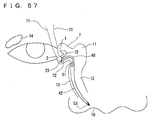
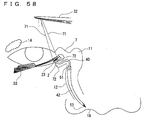
- FIG. 57 shows the state wherein the brim 23 of an apparatus for intubation of the lacrimal duct shown in FIG. 52 is included in the lacrimal duct from the lower punctum 2, but the brim 23 can be pulled out of the punctum by pulling both sides of the thread because the thread 71 is fixed at the thin tube as shown in FIG. 58.
- FIGS. 59 (A), (B)) and (C) are still another punctal plugs by the present inventor, wherein a conical shaped protuberance 81 is attached to the side of the tip portion 21.
- the protuberance 81 in the horizontal part of the canalicular 7, 8 makes the punctal plug more stable.
- the shape of the protuberance 81 is preferably conical in shape, though other shapes also can be adopted. Because the shape of the inner space of the horizontal part of the canaliculus is conical in shape, a conical shaped protuberance 81 is desirable.
- the protuberance 81 attached to the tip 21 portion of the punctal plug makes the plug more stable and negative pressure generated in the lumen of the canaliculus also contributes stableness in the punctal plug.
- the length of the protuberance 81 is preferably 3-7 mm.
- the punctal plug is inserted after the protuberance 81 is inserted into the lacrimal duct using forceps from the punctum which is dilated by a punctal dilator.
- the brim 23 included in the lacrimal duct as shown in FIG. 59 (C) can be pulled out of the punctum by pulling both sides of the thread simultaneously.
- FIGS. 60 and 61 Next, still other embodiments will be explained by referring to FIGS. 60 and 61.
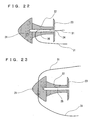
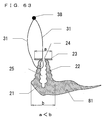
- the diameter (a) of the brim 23 is far smaller than the diameter (b) of the tip portion 21. Therefore, the brim 23 is easily included in the lacrimal duct following insertion of the tip portion 21 from the punctum. But the brim can be pulled out of the lacrimal duct and can be left in place correctly because the thread 31 is penetrates into the tip portion 21.
- FIG. 61 shows the thread 31 penetrating the tip portion 21 and the diameter (a) of the brim 23 is far smaller than the diameter (b) of the tip portion 21, so the brim 23 is easily included in the lacrimal duct. But the brim 23 can be left in place correctly by pulling it out because the thread 31 penetrates the tip portion 21.
- the brim 23 in FIGS. 60 and 61 is not pulled out immediately; the brim 23 is pulled out of the punctum after a short wait for the opening of the punctum to shrink by contraction.
- the mark 72 stands for the fixed point for thread 71 in the various parts of the punctal plug and the apparatus for intubation.
- a spindle shaped protuberance 81 is allowed to be attached to the apex of the tip portion 21, and the longitudinal length of the tip portion 21 is shorter than that of the punctal plug shown in FIG. 61.
- the threaded punctal plug with the protuberance 81 is also useful.
- the protuberance 81 also prevents the brim 23 from entering into the canaliculus.
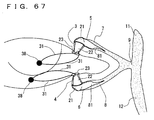
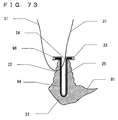
- FIGS. 65-66 show the dimension of a typical example according to the present invention.
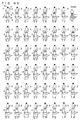
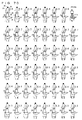
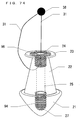
- various sized punctal plugs can be produced to present the most appropriate sized punctal plug for each individual according to the size of the punctum and canaliculus because the punctal plugs with thread shown in FIGS. 63 ⁇ 73 can be placed safely and surely even if using the smallest sized brim 23.
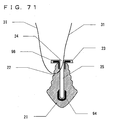
- a reinforcement member made of a material with excellent character in the pulling strength, heat-resistance, anti-fatigability and radiopaque, such as stainless steel, piano wire and plastics is arranged in the brim 23 and the shaft 22 and the tip of the cavity 27.
- the brim 23 is reinforced with the disk-shaped reinforcement member 95.
- the shaft 22 is reinforced with the cylinder-shaped reinforcement member.
- the tip of the cavity 27 is reinforced with the cup-shaped reinforcement member 94.
- the reinforced punctal plug according to the present invention has the following advantages: the punctal plug is not easily penetrated by a metal probe, and an irretrievable punctal plug in the lacrimal passage can be detected by X-ray.
Landscapes
- Health & Medical Sciences (AREA)
- Surgery (AREA)
- Life Sciences & Earth Sciences (AREA)
- General Health & Medical Sciences (AREA)
- Veterinary Medicine (AREA)
- Vascular Medicine (AREA)
- Nuclear Medicine, Radiotherapy & Molecular Imaging (AREA)
- Engineering & Computer Science (AREA)
- Biomedical Technology (AREA)
- Heart & Thoracic Surgery (AREA)
- Public Health (AREA)
- Animal Behavior & Ethology (AREA)
- Molecular Biology (AREA)
- Medical Informatics (AREA)
- Reproductive Health (AREA)
- Ophthalmology & Optometry (AREA)
- Plastic & Reconstructive Surgery (AREA)
- Prostheses (AREA)
- Detergent Compositions (AREA)
- Saccharide Compounds (AREA)
- Cosmetics (AREA)
Applications Claiming Priority (2)
| Application Number | Priority Date | Filing Date | Title |
|---|---|---|---|
| JP2003154328A JP4104137B2 (ja) | 2003-05-30 | 2003-05-30 | 涙点プラグ |
| PCT/JP2004/007552 WO2004105658A1 (ja) | 2003-05-30 | 2004-05-26 | 涙点プラグ |
Publications (3)
| Publication Number | Publication Date |
|---|---|
| EP1629800A1 true EP1629800A1 (de) | 2006-03-01 |
| EP1629800A4 EP1629800A4 (de) | 2007-09-19 |
| EP1629800B1 EP1629800B1 (de) | 2009-12-02 |
Family
ID=33487319
Family Applications (1)
| Application Number | Title | Priority Date | Filing Date |
|---|---|---|---|
| EP04734946A Expired - Lifetime EP1629800B1 (de) | 2003-05-30 | 2004-05-26 | Tränenpunktpfropf |
Country Status (6)
| Country | Link |
|---|---|
| US (1) | US7785285B2 (de) |
| EP (1) | EP1629800B1 (de) |
| JP (1) | JP4104137B2 (de) |
| AT (1) | ATE450234T1 (de) |
| DE (1) | DE602004024389D1 (de) |
| WO (1) | WO2004105658A1 (de) |
Cited By (3)
| Publication number | Priority date | Publication date | Assignee | Title |
|---|---|---|---|---|
| WO2010117719A1 (en) * | 2009-03-31 | 2010-10-14 | Johnson & Johnson Vision Care, Inc. | Punctal plugs |
| WO2011066479A1 (en) * | 2009-11-27 | 2011-06-03 | Qlt Plug Delivery, Inc. | Lacrimal implants including split and insertable drug core |
| WO2022055825A1 (en) * | 2020-09-10 | 2022-03-17 | Oasis Medical, Inc. | Devices and methods for occluding the punctal opening |
Families Citing this family (24)
| Publication number | Priority date | Publication date | Assignee | Title |
|---|---|---|---|---|
| US20050232972A1 (en) * | 2004-04-15 | 2005-10-20 | Steven Odrich | Drug delivery via punctal plug |
| EP1765454B1 (de) | 2004-07-02 | 2016-04-13 | Mati Therapeutics Inc. | Behandlungsmittelabgabevorrichtung für das auge |
| WO2007028005A2 (en) * | 2005-09-01 | 2007-03-08 | Bristol-Myers Squibb Company | Biomarkers and methods for determining sensitivity to vascular endothelial growth factor receptor-2 modulators |
| EP2004172B1 (de) | 2006-03-31 | 2019-03-13 | Mati Therapeutics Inc. | Wirkstofffreisetzungsstrukturen und zusammensetzungen für nasolacrimales system |
| FR2906712B1 (fr) * | 2006-10-09 | 2025-02-28 | France Chirurgie Instr | Bouchon meatique a pose simplifiee. |
| US9011361B2 (en) | 2007-09-07 | 2015-04-21 | Mati Therapeutics Inc. | Lacrimal implant detection |
| EP2207529B1 (de) * | 2007-09-07 | 2014-12-31 | Mati Therapeutics Inc. | Arzneikerne zur verzögerten freisetzung von therapeutischen mitteln |
| US20090209918A1 (en) * | 2007-09-07 | 2009-08-20 | Imtec, Llc | Method and device for dialysis |
| ES2732555T3 (es) | 2007-09-07 | 2019-11-25 | Mati Therapeutics Inc | Implantes lagrimales y métodos relacionados |
| MX2010002618A (es) * | 2007-09-07 | 2010-11-10 | Qlt Plug Delivery Inc | Herramientas de insercion y extraccion para implantes lagrimales. |
| CA2715489C (en) | 2008-02-18 | 2017-09-19 | Qlt Plug Delivery, Inc. | Lacrimal implants and their use in the treatment of eye disorders |
| WO2009134371A2 (en) | 2008-04-30 | 2009-11-05 | Qlt Plug Delivery, Inc. | Composite lacrimal insert and related methods |
| MX2010012022A (es) * | 2008-05-09 | 2011-03-15 | Qlt Plug Delivery Inc | Suministro de liberacion sostenida de agentes activos para tratar glaucoma e hipertension ocular. |
| USD631541S1 (en) * | 2008-06-18 | 2011-01-25 | International Medical, Inc. | Dacryocyst drainage tube |
| US20100152640A1 (en) * | 2008-09-05 | 2010-06-17 | Imtecbiomedical, Inc. | Methods and apparatus for vascular access |
| WO2010096822A2 (en) | 2009-02-23 | 2010-08-26 | Qlt Plug Delivery, Inc. | Lacrimal implants and related methods |
| US9421127B2 (en) | 2009-03-31 | 2016-08-23 | Johnson & Johnson Vision Care, Inc. | Punctal plugs |
| US9259352B2 (en) * | 2010-03-29 | 2016-02-16 | Johnson & Johnson Vision Care, Inc. | Punctal plugs |
| US20120157938A1 (en) * | 2010-12-16 | 2012-06-21 | Tokarski Jason M | Punctal plug with drug core retention features |
| ES2727203T3 (es) | 2011-08-29 | 2019-10-14 | Mati Therapeutics Inc | Administración por liberación sostenida de agentes activos para tratar glaucoma e hipertensión ocular |
| US9974685B2 (en) * | 2011-08-29 | 2018-05-22 | Mati Therapeutics | Drug delivery system and methods of treating open angle glaucoma and ocular hypertension |
| CA2872338C (en) * | 2012-05-03 | 2021-09-14 | Qlt Inc. | Drug delivery system and methods of treating open angle glaucoma and ocular hypertension |
| US20180193193A1 (en) * | 2015-07-06 | 2018-07-12 | The Regents Of The University Of Colorado, A Body Corporate | Lacrimal drainage system diagnostic implant |
| US20210298762A1 (en) * | 2018-08-03 | 2021-09-30 | The Johns Hopkins University | Reversible lacrimal canalicular occlusion device |
Family Cites Families (12)
| Publication number | Priority date | Publication date | Assignee | Title |
|---|---|---|---|---|
| US5171270A (en) * | 1990-03-29 | 1992-12-15 | Herrick Robert S | Canalicular implant having a collapsible flared section and method |
| US5417651A (en) * | 1993-07-01 | 1995-05-23 | Guena; Nicolas | Punctum plug and monocanalicular probe for lacrimal pathology |
| US5741292A (en) * | 1995-10-26 | 1998-04-21 | Eagle Vision | Punctum dilating and plug inserting instrument with push-button plug release |
| US6849069B1 (en) * | 1995-11-07 | 2005-02-01 | Boston Scientitfic Corporation | Medical device with tail(s) for assisting flow of urine |
| JP3792775B2 (ja) | 1996-04-08 | 2006-07-05 | 有限会社エム・エル・シー | 涙道挿管器具 |
| US6027470A (en) * | 1998-06-10 | 2000-02-22 | Eagle Vision, Inc. | Punctum plug and method for inserting the same into the punctual opening |
| US6041785A (en) | 1997-03-27 | 2000-03-28 | Eaglevision, Inc. | Punctum plug |
| JPH1147183A (ja) | 1997-08-05 | 1999-02-23 | Kaneka Medics:Kk | 涙点プラグ装置 |
| US6290684B1 (en) * | 1998-03-02 | 2001-09-18 | Herrick Family Limited Partnership | Punctum plug having a collapsible expanded section and distal tip extending substantially perpendicular thereto and method of inserting same |
| JP2000070296A (ja) | 1998-08-27 | 2000-03-07 | M L C:Kk | 涙道内挿管器具 |
| US6168623B1 (en) * | 1998-08-31 | 2001-01-02 | Cardiothoracic Systems, Inc. | Deformable conduits and methods for shunting bodily fluid during surgery |
| JP2005516648A (ja) * | 2001-12-13 | 2005-06-09 | エスディージーアイ・ホールディングス・インコーポレーテッド | インプラントを椎骨空間内に導入する器具及び方法 |
-
2003
- 2003-05-30 JP JP2003154328A patent/JP4104137B2/ja not_active Expired - Fee Related
-
2004
- 2004-05-26 AT AT04734946T patent/ATE450234T1/de not_active IP Right Cessation
- 2004-05-26 DE DE602004024389T patent/DE602004024389D1/de not_active Expired - Lifetime
- 2004-05-26 EP EP04734946A patent/EP1629800B1/de not_active Expired - Lifetime
- 2004-05-26 WO PCT/JP2004/007552 patent/WO2004105658A1/ja not_active Ceased
- 2004-05-26 US US10/524,824 patent/US7785285B2/en not_active Expired - Fee Related
Cited By (9)
| Publication number | Priority date | Publication date | Assignee | Title |
|---|---|---|---|---|
| WO2010117719A1 (en) * | 2009-03-31 | 2010-10-14 | Johnson & Johnson Vision Care, Inc. | Punctal plugs |
| CN102448411A (zh) * | 2009-03-31 | 2012-05-09 | 庄臣及庄臣视力保护公司 | 泪点塞 |
| JP2012521857A (ja) * | 2009-03-31 | 2012-09-20 | ジョンソン・アンド・ジョンソン・ビジョン・ケア・インコーポレイテッド | 涙点プラグ |
| US8439865B2 (en) | 2009-03-31 | 2013-05-14 | Johnson & Johnson Vision Care, Inc. | Punctal plugs |
| AU2010234876B2 (en) * | 2009-03-31 | 2014-08-21 | Johnson & Johnson Vision Care, Inc. | Punctal plugs |
| RU2530723C2 (ru) * | 2009-03-31 | 2014-10-10 | Джонсон Энд Джонсон Вижн Кэа, Инк. | Пробки слезного канала |
| WO2011066479A1 (en) * | 2009-11-27 | 2011-06-03 | Qlt Plug Delivery, Inc. | Lacrimal implants including split and insertable drug core |
| WO2022055825A1 (en) * | 2020-09-10 | 2022-03-17 | Oasis Medical, Inc. | Devices and methods for occluding the punctal opening |
| US12396734B1 (en) | 2020-09-10 | 2025-08-26 | Oasis Medical, Inc. | Devices and methods for occluding the punctal opening |
Also Published As
| Publication number | Publication date |
|---|---|
| US7785285B2 (en) | 2010-08-31 |
| EP1629800A4 (de) | 2007-09-19 |
| WO2004105658A1 (ja) | 2004-12-09 |
| DE602004024389D1 (de) | 2010-01-14 |
| EP1629800B1 (de) | 2009-12-02 |
| JP4104137B2 (ja) | 2008-06-18 |
| US20060106352A1 (en) | 2006-05-18 |
| JP2004351060A (ja) | 2004-12-16 |
| ATE450234T1 (de) | 2009-12-15 |
Similar Documents
| Publication | Publication Date | Title |
|---|---|---|
| US7785285B2 (en) | Lacrimal punctum plug | |
| US6238363B1 (en) | Apparatus for intubation of lacrimal drainage pathway | |
| US12343287B2 (en) | Methods and apparatus for treating glaucoma | |
| US20240390184A1 (en) | Delivering ocular implants into the eye | |
| US4959048A (en) | Lacrimal duct occluder | |
| US5171270A (en) | Canalicular implant having a collapsible flared section and method | |
| US5163959A (en) | Method for treating an eye with a canalicular implant having a collapsible flared section | |
| US6736791B1 (en) | Glaucoma treatment device | |
| US7740604B2 (en) | Ocular implants for placement in schlemm's canal | |
| JP4339635B2 (ja) | 涙点プラグ | |
| EP2521517B1 (de) | Augenchirurgievorrichtung | |
| US20030060752A1 (en) | Glaucoma device and methods thereof | |
| JP2004518450A (ja) | 緑内障の治療装置および治療方法 | |
| WO2002036052A1 (en) | Glaucoma treatment device | |
| WO2002102274A2 (en) | Glaucoma device and methods thereof | |
| JP4280128B2 (ja) | 涙点プラグ | |
| JP2005110930A (ja) | 涙点プラグセット | |
| JP2005110765A (ja) | 涙点プラグセット | |
| JP4358578B2 (ja) | 涙点プラグ | |
| AU2015201008B2 (en) | Delivering ocular implants into the eye | |
| JPH1147183A (ja) | 涙点プラグ装置 | |
| VanderVeen | Lacrimal Apparatus in Infancy and Childhood | |
| Leonard et al. | Pre-, Per-, and Postoperative Management of Lens Implantation |
Legal Events
| Date | Code | Title | Description |
|---|---|---|---|
| PUAI | Public reference made under article 153(3) epc to a published international application that has entered the european phase |
Free format text: ORIGINAL CODE: 0009012 |
|
| 17P | Request for examination filed |
Effective date: 20050401 |
|
| AK | Designated contracting states |
Kind code of ref document: A1 Designated state(s): AT BE BG CH CY CZ DE DK EE ES FI FR GB GR HU IE IT LI LU MC NL PL PT RO SE SI SK TR |
|
| DAX | Request for extension of the european patent (deleted) | ||
| A4 | Supplementary search report drawn up and despatched |
Effective date: 20070822 |
|
| 17Q | First examination report despatched |
Effective date: 20080923 |
|
| GRAP | Despatch of communication of intention to grant a patent |
Free format text: ORIGINAL CODE: EPIDOSNIGR1 |
|
| GRAS | Grant fee paid |
Free format text: ORIGINAL CODE: EPIDOSNIGR3 |
|
| GRAA | (expected) grant |
Free format text: ORIGINAL CODE: 0009210 |
|
| AK | Designated contracting states |
Kind code of ref document: B1 Designated state(s): AT BE BG CH CY CZ DE DK EE ES FI FR GB GR HU IE IT LI LU MC NL PL PT RO SE SI SK TR |
|
| REG | Reference to a national code |
Ref country code: GB Ref legal event code: FG4D |
|
| REG | Reference to a national code |
Ref country code: CH Ref legal event code: EP |
|
| REG | Reference to a national code |
Ref country code: IE Ref legal event code: FG4D |
|
| REF | Corresponds to: |
Ref document number: 602004024389 Country of ref document: DE Date of ref document: 20100114 Kind code of ref document: P |
|
| REG | Reference to a national code |
Ref country code: NL Ref legal event code: VDEP Effective date: 20091202 |
|
| PG25 | Lapsed in a contracting state [announced via postgrant information from national office to epo] |
Ref country code: SE Free format text: LAPSE BECAUSE OF FAILURE TO SUBMIT A TRANSLATION OF THE DESCRIPTION OR TO PAY THE FEE WITHIN THE PRESCRIBED TIME-LIMIT Effective date: 20091202 Ref country code: FI Free format text: LAPSE BECAUSE OF FAILURE TO SUBMIT A TRANSLATION OF THE DESCRIPTION OR TO PAY THE FEE WITHIN THE PRESCRIBED TIME-LIMIT Effective date: 20091202 |
|
| PG25 | Lapsed in a contracting state [announced via postgrant information from national office to epo] |
Ref country code: PL Free format text: LAPSE BECAUSE OF FAILURE TO SUBMIT A TRANSLATION OF THE DESCRIPTION OR TO PAY THE FEE WITHIN THE PRESCRIBED TIME-LIMIT Effective date: 20091202 Ref country code: CY Free format text: LAPSE BECAUSE OF FAILURE TO SUBMIT A TRANSLATION OF THE DESCRIPTION OR TO PAY THE FEE WITHIN THE PRESCRIBED TIME-LIMIT Effective date: 20091202 Ref country code: SI Free format text: LAPSE BECAUSE OF FAILURE TO SUBMIT A TRANSLATION OF THE DESCRIPTION OR TO PAY THE FEE WITHIN THE PRESCRIBED TIME-LIMIT Effective date: 20091202 |
|
| PG25 | Lapsed in a contracting state [announced via postgrant information from national office to epo] |
Ref country code: AT Free format text: LAPSE BECAUSE OF FAILURE TO SUBMIT A TRANSLATION OF THE DESCRIPTION OR TO PAY THE FEE WITHIN THE PRESCRIBED TIME-LIMIT Effective date: 20091202 |
|
| PG25 | Lapsed in a contracting state [announced via postgrant information from national office to epo] |
Ref country code: PT Free format text: LAPSE BECAUSE OF FAILURE TO SUBMIT A TRANSLATION OF THE DESCRIPTION OR TO PAY THE FEE WITHIN THE PRESCRIBED TIME-LIMIT Effective date: 20100402 Ref country code: BG Free format text: LAPSE BECAUSE OF FAILURE TO SUBMIT A TRANSLATION OF THE DESCRIPTION OR TO PAY THE FEE WITHIN THE PRESCRIBED TIME-LIMIT Effective date: 20100302 Ref country code: ES Free format text: LAPSE BECAUSE OF FAILURE TO SUBMIT A TRANSLATION OF THE DESCRIPTION OR TO PAY THE FEE WITHIN THE PRESCRIBED TIME-LIMIT Effective date: 20100313 Ref country code: EE Free format text: LAPSE BECAUSE OF FAILURE TO SUBMIT A TRANSLATION OF THE DESCRIPTION OR TO PAY THE FEE WITHIN THE PRESCRIBED TIME-LIMIT Effective date: 20091202 Ref country code: NL Free format text: LAPSE BECAUSE OF FAILURE TO SUBMIT A TRANSLATION OF THE DESCRIPTION OR TO PAY THE FEE WITHIN THE PRESCRIBED TIME-LIMIT Effective date: 20091202 Ref country code: RO Free format text: LAPSE BECAUSE OF FAILURE TO SUBMIT A TRANSLATION OF THE DESCRIPTION OR TO PAY THE FEE WITHIN THE PRESCRIBED TIME-LIMIT Effective date: 20091202 |
|
| PG25 | Lapsed in a contracting state [announced via postgrant information from national office to epo] |
Ref country code: CZ Free format text: LAPSE BECAUSE OF FAILURE TO SUBMIT A TRANSLATION OF THE DESCRIPTION OR TO PAY THE FEE WITHIN THE PRESCRIBED TIME-LIMIT Effective date: 20091202 Ref country code: SK Free format text: LAPSE BECAUSE OF FAILURE TO SUBMIT A TRANSLATION OF THE DESCRIPTION OR TO PAY THE FEE WITHIN THE PRESCRIBED TIME-LIMIT Effective date: 20091202 Ref country code: BE Free format text: LAPSE BECAUSE OF FAILURE TO SUBMIT A TRANSLATION OF THE DESCRIPTION OR TO PAY THE FEE WITHIN THE PRESCRIBED TIME-LIMIT Effective date: 20091202 |
|
| PLBE | No opposition filed within time limit |
Free format text: ORIGINAL CODE: 0009261 |
|
| STAA | Information on the status of an ep patent application or granted ep patent |
Free format text: STATUS: NO OPPOSITION FILED WITHIN TIME LIMIT |
|
| PG25 | Lapsed in a contracting state [announced via postgrant information from national office to epo] |
Ref country code: GR Free format text: LAPSE BECAUSE OF FAILURE TO SUBMIT A TRANSLATION OF THE DESCRIPTION OR TO PAY THE FEE WITHIN THE PRESCRIBED TIME-LIMIT Effective date: 20100303 |
|
| 26N | No opposition filed |
Effective date: 20100903 |
|
| PG25 | Lapsed in a contracting state [announced via postgrant information from national office to epo] |
Ref country code: MC Free format text: LAPSE BECAUSE OF NON-PAYMENT OF DUE FEES Effective date: 20100531 |
|
| REG | Reference to a national code |
Ref country code: CH Ref legal event code: PL |
|
| PG25 | Lapsed in a contracting state [announced via postgrant information from national office to epo] |
Ref country code: DK Free format text: LAPSE BECAUSE OF FAILURE TO SUBMIT A TRANSLATION OF THE DESCRIPTION OR TO PAY THE FEE WITHIN THE PRESCRIBED TIME-LIMIT Effective date: 20091202 |
|
| PG25 | Lapsed in a contracting state [announced via postgrant information from national office to epo] |
Ref country code: LI Free format text: LAPSE BECAUSE OF NON-PAYMENT OF DUE FEES Effective date: 20100531 Ref country code: CH Free format text: LAPSE BECAUSE OF NON-PAYMENT OF DUE FEES Effective date: 20100531 |
|
| PG25 | Lapsed in a contracting state [announced via postgrant information from national office to epo] |
Ref country code: IT Free format text: LAPSE BECAUSE OF FAILURE TO SUBMIT A TRANSLATION OF THE DESCRIPTION OR TO PAY THE FEE WITHIN THE PRESCRIBED TIME-LIMIT Effective date: 20091202 |
|
| PG25 | Lapsed in a contracting state [announced via postgrant information from national office to epo] |
Ref country code: IE Free format text: LAPSE BECAUSE OF NON-PAYMENT OF DUE FEES Effective date: 20100526 |
|
| PG25 | Lapsed in a contracting state [announced via postgrant information from national office to epo] |
Ref country code: HU Free format text: LAPSE BECAUSE OF FAILURE TO SUBMIT A TRANSLATION OF THE DESCRIPTION OR TO PAY THE FEE WITHIN THE PRESCRIBED TIME-LIMIT Effective date: 20100603 Ref country code: LU Free format text: LAPSE BECAUSE OF NON-PAYMENT OF DUE FEES Effective date: 20100526 |
|
| PG25 | Lapsed in a contracting state [announced via postgrant information from national office to epo] |
Ref country code: TR Free format text: LAPSE BECAUSE OF FAILURE TO SUBMIT A TRANSLATION OF THE DESCRIPTION OR TO PAY THE FEE WITHIN THE PRESCRIBED TIME-LIMIT Effective date: 20091202 |
|
| PGFP | Annual fee paid to national office [announced via postgrant information from national office to epo] |
Ref country code: GB Payment date: 20140521 Year of fee payment: 11 |
|
| PGFP | Annual fee paid to national office [announced via postgrant information from national office to epo] |
Ref country code: DE Payment date: 20140628 Year of fee payment: 11 Ref country code: FR Payment date: 20140527 Year of fee payment: 11 |
|
| REG | Reference to a national code |
Ref country code: DE Ref legal event code: R119 Ref document number: 602004024389 Country of ref document: DE |
|
| GBPC | Gb: european patent ceased through non-payment of renewal fee |
Effective date: 20150526 |
|
| REG | Reference to a national code |
Ref country code: FR Ref legal event code: ST Effective date: 20160129 |
|
| PG25 | Lapsed in a contracting state [announced via postgrant information from national office to epo] |
Ref country code: GB Free format text: LAPSE BECAUSE OF NON-PAYMENT OF DUE FEES Effective date: 20150526 Ref country code: DE Free format text: LAPSE BECAUSE OF NON-PAYMENT OF DUE FEES Effective date: 20151201 |
|
| PG25 | Lapsed in a contracting state [announced via postgrant information from national office to epo] |
Ref country code: FR Free format text: LAPSE BECAUSE OF NON-PAYMENT OF DUE FEES Effective date: 20150601 |