EP1630895A2 - Lithium-Salze von polyhalogenierten Bor-Clusters hoher Reinheit und deren Verwendung in Lithium-Batterien - Google Patents
Lithium-Salze von polyhalogenierten Bor-Clusters hoher Reinheit und deren Verwendung in Lithium-Batterien Download PDFInfo
- Publication number
- EP1630895A2 EP1630895A2 EP05018211A EP05018211A EP1630895A2 EP 1630895 A2 EP1630895 A2 EP 1630895A2 EP 05018211 A EP05018211 A EP 05018211A EP 05018211 A EP05018211 A EP 05018211A EP 1630895 A2 EP1630895 A2 EP 1630895A2
- Authority
- EP
- European Patent Office
- Prior art keywords
- lithium
- salt
- carbonate
- solution
- electrolyte
- Prior art date
- Legal status (The legal status is an assumption and is not a legal conclusion. Google has not performed a legal analysis and makes no representation as to the accuracy of the status listed.)
- Granted
Links
Images
Classifications
-
- H—ELECTRICITY
- H01—ELECTRIC ELEMENTS
- H01M—PROCESSES OR MEANS, e.g. BATTERIES, FOR THE DIRECT CONVERSION OF CHEMICAL ENERGY INTO ELECTRICAL ENERGY
- H01M10/00—Secondary cells; Manufacture thereof
- H01M10/05—Accumulators with non-aqueous electrolyte
- H01M10/052—Li-accumulators
-
- H—ELECTRICITY
- H01—ELECTRIC ELEMENTS
- H01M—PROCESSES OR MEANS, e.g. BATTERIES, FOR THE DIRECT CONVERSION OF CHEMICAL ENERGY INTO ELECTRICAL ENERGY
- H01M10/00—Secondary cells; Manufacture thereof
- H01M10/05—Accumulators with non-aqueous electrolyte
- H01M10/056—Accumulators with non-aqueous electrolyte characterised by the materials used as electrolytes, e.g. mixed inorganic/organic electrolytes
- H01M10/0564—Accumulators with non-aqueous electrolyte characterised by the materials used as electrolytes, e.g. mixed inorganic/organic electrolytes the electrolyte being constituted of organic materials only
- H01M10/0566—Liquid materials
- H01M10/0568—Liquid materials characterised by the solutes
-
- C—CHEMISTRY; METALLURGY
- C01—INORGANIC CHEMISTRY
- C01B—NON-METALLIC ELEMENTS; COMPOUNDS THEREOF; METALLOIDS OR COMPOUNDS THEREOF NOT COVERED BY SUBCLASS C01C
- C01B35/00—Boron; Compounds thereof
- C01B35/06—Boron halogen compounds
-
- C—CHEMISTRY; METALLURGY
- C01—INORGANIC CHEMISTRY
- C01B—NON-METALLIC ELEMENTS; COMPOUNDS THEREOF; METALLOIDS OR COMPOUNDS THEREOF NOT COVERED BY SUBCLASS C01C
- C01B35/00—Boron; Compounds thereof
- C01B35/06—Boron halogen compounds
- C01B35/068—Halogenated hydrides
-
- C—CHEMISTRY; METALLURGY
- C01—INORGANIC CHEMISTRY
- C01D—COMPOUNDS OF ALKALI METALS, i.e. LITHIUM, SODIUM, POTASSIUM, RUBIDIUM, CAESIUM, OR FRANCIUM
- C01D15/00—Lithium compounds
-
- H—ELECTRICITY
- H01—ELECTRIC ELEMENTS
- H01M—PROCESSES OR MEANS, e.g. BATTERIES, FOR THE DIRECT CONVERSION OF CHEMICAL ENERGY INTO ELECTRICAL ENERGY
- H01M10/00—Secondary cells; Manufacture thereof
- H01M10/05—Accumulators with non-aqueous electrolyte
- H01M10/052—Li-accumulators
- H01M10/0525—Rocking-chair batteries, i.e. batteries with lithium insertion or intercalation in both electrodes; Lithium-ion batteries
-
- H—ELECTRICITY
- H01—ELECTRIC ELEMENTS
- H01M—PROCESSES OR MEANS, e.g. BATTERIES, FOR THE DIRECT CONVERSION OF CHEMICAL ENERGY INTO ELECTRICAL ENERGY
- H01M10/00—Secondary cells; Manufacture thereof
- H01M10/05—Accumulators with non-aqueous electrolyte
- H01M10/058—Construction or manufacture
-
- H—ELECTRICITY
- H01—ELECTRIC ELEMENTS
- H01M—PROCESSES OR MEANS, e.g. BATTERIES, FOR THE DIRECT CONVERSION OF CHEMICAL ENERGY INTO ELECTRICAL ENERGY
- H01M10/00—Secondary cells; Manufacture thereof
- H01M10/05—Accumulators with non-aqueous electrolyte
- H01M10/056—Accumulators with non-aqueous electrolyte characterised by the materials used as electrolytes, e.g. mixed inorganic/organic electrolytes
- H01M10/0564—Accumulators with non-aqueous electrolyte characterised by the materials used as electrolytes, e.g. mixed inorganic/organic electrolytes the electrolyte being constituted of organic materials only
- H01M10/0565—Polymeric materials, e.g. gel-type or solid-type
-
- H—ELECTRICITY
- H01—ELECTRIC ELEMENTS
- H01M—PROCESSES OR MEANS, e.g. BATTERIES, FOR THE DIRECT CONVERSION OF CHEMICAL ENERGY INTO ELECTRICAL ENERGY
- H01M10/00—Secondary cells; Manufacture thereof
- H01M10/05—Accumulators with non-aqueous electrolyte
- H01M10/056—Accumulators with non-aqueous electrolyte characterised by the materials used as electrolytes, e.g. mixed inorganic/organic electrolytes
- H01M10/0564—Accumulators with non-aqueous electrolyte characterised by the materials used as electrolytes, e.g. mixed inorganic/organic electrolytes the electrolyte being constituted of organic materials only
- H01M10/0566—Liquid materials
- H01M10/0569—Liquid materials characterised by the solvents
-
- H—ELECTRICITY
- H01—ELECTRIC ELEMENTS
- H01M—PROCESSES OR MEANS, e.g. BATTERIES, FOR THE DIRECT CONVERSION OF CHEMICAL ENERGY INTO ELECTRICAL ENERGY
- H01M2300/00—Electrolytes
- H01M2300/0085—Immobilising or gelification of electrolyte
-
- Y—GENERAL TAGGING OF NEW TECHNOLOGICAL DEVELOPMENTS; GENERAL TAGGING OF CROSS-SECTIONAL TECHNOLOGIES SPANNING OVER SEVERAL SECTIONS OF THE IPC; TECHNICAL SUBJECTS COVERED BY FORMER USPC CROSS-REFERENCE ART COLLECTIONS [XRACs] AND DIGESTS
- Y02—TECHNOLOGIES OR APPLICATIONS FOR MITIGATION OR ADAPTATION AGAINST CLIMATE CHANGE
- Y02E—REDUCTION OF GREENHOUSE GAS [GHG] EMISSIONS, RELATED TO ENERGY GENERATION, TRANSMISSION OR DISTRIBUTION
- Y02E60/00—Enabling technologies; Technologies with a potential or indirect contribution to GHG emissions mitigation
- Y02E60/10—Energy storage using batteries
-
- Y—GENERAL TAGGING OF NEW TECHNOLOGICAL DEVELOPMENTS; GENERAL TAGGING OF CROSS-SECTIONAL TECHNOLOGIES SPANNING OVER SEVERAL SECTIONS OF THE IPC; TECHNICAL SUBJECTS COVERED BY FORMER USPC CROSS-REFERENCE ART COLLECTIONS [XRACs] AND DIGESTS
- Y02—TECHNOLOGIES OR APPLICATIONS FOR MITIGATION OR ADAPTATION AGAINST CLIMATE CHANGE
- Y02T—CLIMATE CHANGE MITIGATION TECHNOLOGIES RELATED TO TRANSPORTATION
- Y02T10/00—Road transport of goods or passengers
- Y02T10/60—Other road transportation technologies with climate change mitigation effect
- Y02T10/70—Energy storage systems for electromobility, e.g. batteries
Definitions
- Lithium secondary batteries by virtue of the large reduction potential and low molecular weight of elemental lithium, offer a dramatic improvement in power density over existing primary and secondary battery technologies.
- lithium secondary battery refers to both batteries containing metallic lithium as the negative electrode and batteries which contain a lithium ion host material as the negative electrode, also known as lithium-ion batteries.
- secondary battery it is meant a battery that provides for multiple cycles of charging and discharging.
- the small size and high mobility of lithium cations allow for the possibility of rapid recharging.
- US 4,201,839 discloses an electrochemical cell based upon alkali metal-containing anodes, solid cathodes, and electrolytes where the electrolytes are closoborane compounds carried in aprotic solvents.
- Closoboranes employed are of the formula Z 2 BnXn and ZCRBmXm wherein Z is an alkali metal, C is carbon, R is a radical selected from the group consisting of organic hydrogen and halogen atoms, B is boron, X is one or more substituents from the group consisting of hydrogen and the halogens, m is an integer from 5 to 11, and n is an integer from 6-12.
- closoborane electrolytes employed in the electrochemical cells include lithium bromooctaborate, lithium chlorodecaborate, lithium chlorododecabate, and lithium iododecaborate.
- US 5,849,432 discloses electrolyte solvents for use in liquid or rubbery polymer electrolyte solutions based upon boron compounds with Lewis acid characteristics, e.g., boron linked to oxygen, halogen atoms, and sulfur.
- a specific example of an electrolyte solution comprises lithium perchlororate and boron ethylene carbonate.
- US 6,346,351 discloses secondary electrolyte systems for a rechargeable battery of high compatibility towards positive electrode structures based upon a salt and solvent mixture.
- Lithium tetrafluoroborate and lithium hexafluorophosphate are examples of salts.
- solvents include diethyl carbonate, dimethoxyethane, methylformate, and so forth.
- electrolytes for lithium batteries which include lithium perchlorate, lithium hexafluoroarsenate, lithium trifluoromethylsulfonate, lithium tetrafluoroborate, lithium bromide, and lithium hexafluoroantimonate electrolytes incorporated in solvents.
- US 6,537,697 discloses lithium secondary battery using a nonaqueous electrolyte including lithium tetrakis(pentafluorophenyl)borate as an electrolyte salt.
- US 6514,474 discloses the need for removing traces of water and acid from lithium hexafluorophosphate salt to be used in lithium battery applications and a purification process.
- lithium-based electrolytes comprising a lithium salt for lithium batteries are disclosed and, although having use in many electronic applications, they are faced with problems associated with safety, oxidative stability, thermal stability, and so forth. Fluorinated electrolyte salts have had the additional problem that deleterious and toxic HF can be produced on compound breakdown.
- lithium hexafluorophosphate fails primarily on the basis that it is unstable, generating HF, which leads to electrode corrosion, particularly with LiMn 2 O 4 cathode materials; lithium perchlorate has relatively low thermal stability leading to explosive mixtures above 100°C; lithium hexafluoroarsenate has a problem of arsenic toxicity; and lithium triflate lead to significant corrosion of aluminum current collectors typically used in lithium ion batteries.
- the present invention relates to lithium secondary batteries comprising a negative electrode, a positive electrode and an electrolyte comprising a combination of at least one solvent and at least one lithium based electrolyte salt of the formula: Li 2 B 12 F x H 12-x-y Z y where x+y is from 3 to 12, and x and y are independently from 0 to 12, and Z comprises at least one of Cl and Br.
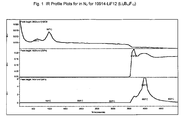
- Figure 1 is a Thermogravimetric Analysis in which volatiles are analyzed by IR spectroscopy.
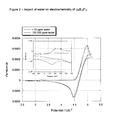
- Figure 2 is a cyclic voltammetry graph illustrating the affect of OH impurities.
- the instant invention relates to a lithium secondary battery, an electrolyte containing lithium ions, high purity lithium containing salts and methods for making and using the salts.
- Two desirable properties for lithium battery electrolyte solutions are: (a) a high conductivity in a non-aqueous ionizing solution, and (b) chemical stability to both heat, hydrolysis and to electrochemical cycling over a wide potential range.
- lithium electrolyte solutions include: high flash point; low vapor pressure; high boiling point; low viscosity; good miscibility with solvents customarily employed in batteries, especially ethylene carbonate, propylene carbonate and alpha-omega-dialkyl glycol ethers; good electrical conductivity of their solutions over a wide temperature range, and tolerance to initial moisture content.
- the present lithium secondary battery is characterized in that the lithium based electrolyte salt for forming lithium electrolyte solutions is based upon a lithium fluorododecaborate comprising: Li 2 B 12 F x H 12-x-y Z y where x+y is from 3 to 12, and x and y are independently from 0 to 12, and Z is at least one of Cl and Br.
- lithium based dodecaborates comprise at least one member selected from the group consisting of Li 2 B 12 F 5 H 7, Li 2 B 12 F 6 H 6 , Li 2 B 12 F 7 H 5 , Li 2 B 12 F 8 H 4 , Li 2 B 12 F 9 H 3 , Li 2 B 12 F 10 H 2 , Li 2 B 12 F 11 H and mixtures of salts with varying x such that the average x is equal to or greater than 5, or equal to 9 or 10, or Li 2 B 12 F x Cl 12-x and Li 2 B 12 F x Br 12-x where x is 10 or 11, or Li 2 B 12 FCl 2 H 9 , Li 2 B 12 Cl 3 H 9 , Li 2 B 12 F 2 Cl 3 H 7 , Li 2 B 12 Cl 5 H 7 and Li 2 B 12 FCl 6 H 5; and mixtures thereof.
- the lithium salt employed for forming electrolytes solutions for use in lithium batteries can be formed by fluorinating hydridodecaborates to provide a fluorododecaborate having at least 5, usually at least 8 and typically at least 10 but not more than 12 or more hydrogen atoms replaced with fluorine (average basis). Metathesis using lithium hydroxide can provide the lithium salt. This reaction is normally conducted in a liquid medium. In direct fluorination, fluorine is usually diluted with an inert gas, e.g., nitrogen. Fluorine concentrations from about 10 to about 40 % by volume are commonly employed. If further halogenation is desired, the partially fluorinated hydridoborate can be reacted with the desired halogen, e.g., chlorine or bromine.
- the desired halogen e.g., chlorine or bromine.
- direct fluorination of the lithium hydridododecaborate can be conducted in an acidic liquid medium, e.g., an acidic liquid medium or carrier such as neat or anhydrous HF reduced in acidity by the incorporation of a weak base.
- an acidic liquid medium e.g., an acidic liquid medium or carrier
- suitable acids comprise at least one member selected from the group consisting of formic, acetic, trifluoroacetic, dilute sulfuric triflic, and sulfonic acids hydrohalic (HCl (aq) , HBr (aq) , HI (aq) , and HF (aq) ), and mixtures thereof.
- buffering salts e.g., alkali metal fluorides such as potassium and sodium fluoride
- alkali metal fluorides such as potassium and sodium fluoride
- H o Hammett acidity
- Radical scavengers can be used in the fluorination of lithium hydridododecaborates to reduce byproduct formation and improve reaction efficiency. Without wishing to be bound by any theory or explanation, it is believed that radical scavengers can limit the formation of hydrogen peroxide, or HOF which may be generated with fluorine. Radical scavengers can be used to inhibit the side-reaction of fluorine with the solvent, thereby improving fluorination efficiency. Examples of radical scavengers comprise oxygen, nitroaromatics, and mixtures thereof.
- One method for employing a radical scavenger comprises introducing a relatively small amount of air to the liquid medium.
- Fluorinating hydridododecaborate anion can be conducted under conditions sufficient to maintain liquid phase conditions. Fluorination of the hydridododecaborate anion can be performed at a temperature from about -30 to about 100°C, typically from about 0 to about 20°C. Pressures during fluorination are such as to maintain liquid phase conditions, and typically atmospheric for fluorinating the dodecaborate anion.
- Lithium ion cells can be sensitive to impurities in any of the components.
- the lithium containing salts as well as the electrolyte are substantianlly free of impurities.
- substantially free it is meant that the lithium salts and electrolyte comprising such salts have less than about 500 ppm, normally less than about 100 ppm (e.g., 10-20 ppm) of active hydrogens such as hydroxyl groups (e.g., OH and other moieties).
- active hydrogens such as hydroxyl groups (e.g., OH and other moieties).
- These impurities can react with the electrodes themselves, or when present with a hydrolyzable salt such as lithium hexafluorophosphate, lead to HF generation, which, in turn, can corrode electrode materials.
- the inventive salts and electrolytes are also substantially free of hydrogen fluoride (HF).
- Typical OH containing impurities are water and alcohols in the electrolyte salts and solvents.
- the inventive salts and electrolyte are also substantially free of metal cations including alkali metals (other than lithium).
- substantially free of metal cations it is meant that the salts and electrolytes contain less than about 500, normally less than about 100 ppm (e.g., 10-20ppm) of such non-lithium cations.
- ppm e.g. 10-20ppm
- Impurities may be removed from the salt and/or an electrolyte containing the salt by at least one of the following methods:
- a lithium salt containing from about 0.02 mol% -OH substituted dodecaborate anion, or ⁇ 10ppm hydroxyl group impurity to 10 mol % - OH substituted anion, or ⁇ 5000 ppm hydroxyl group impurity can be dissolved in at least one aprotic organic solvent. While any suitable aprotic solvent can be employed, examples of suitable solvents comprise at least one member selected from the group consisting of ketones, carbonates esters alcohols and mixtures thereof. The solvent concentration ranges from about 0.1 to about 50 weight %.
- the solvated salt is eluted through a column containing neutral alumina at room temperature under atmospheric pressure, vacuum or elevated pressure between about -20 and about 80°C.
- a hydrophobic ketone solvent e.g., such as 5-methyl-2-hexanone
- the purified salt may be extracted from the aprotic organic solvent using water. Residual organic solvent in the aqueous product solution may be removed by extraction with an even less polar organic solvent, e.g., hexanes. Removal of water can provide a purified salt containing less than about 100 ppm and usually less than about 10 ppm bound -hydroxyl group impurity.
- the salt as well as the electrolyte can also be purified by removing metal cation impurities including alkali metal impurities.
- an aqueous solution comprising the lithium fluorododecaborate containing between about 100 ppm and about 10 weight % (100,000 ppm) of sodium or potassium is eluted via a column with cation - exchange resin (e.g., DOWEX 50WX8-200), in its Li + form, at a temperature between about 0 and about 80°C, under atmospheric pressure, vacuum or elevated pressure.
- the purified salt lithium salt contains less than about 100 ppm of sodium or potassium, as determined by ICP/MS.
- the amount of water impurity in the lithium salt can be reduced to less than about 200 ppm and typically below about 20 ppm by grinding and drying.
- the salt is ground with a mortar and pestle, and dried in a vacuum oven under a dynamic vacuum of less than about 100 mTorr at a temperature of about 150 to about 200°C for approximately 4 hrs.
- This step produces a lithium salt product containing between about 200 to about 1,000 ppm water.
- TGA/IR analysis shows a drying temperature of greater than about 180°C and usually greater than about 220°C is needed for efficient drying.
- the lithum salt is further ground and loaded into a vessel (e.g., a drying column), which can be heated and allows for a dry, inert gas to a be purged through the lithium salt at sufficient rate to fluidize or cause percolation of the bed of salt.
- a vessel e.g., a drying column
- Dry nitrogen is suitable as an inert gas and the vessel is typically heated to between about 230 to about 280°C.
- the lithium salt was analyized (i.e., by Karl-Fischer analysis), and determined to contain between about 1 to about 50 ppm water, and usually about 5 to about 20 ppm water.
- an electrolyte solution that comprises a combination of about 0.1 to about 25 weight % of the lithium salt and any aprotic organic solvent or combination of solvents, and containing from about 20 to about 100 ppm water, may be dried.
- the solution is stored over dry, lithium substituted molecular sieves for about 1 to about 72 hrs. While any suitable molecular sieves can be used, examples of suitable molecular sieves comprise 3A through 5A and normally lithium cation exchanged versions of these.
- the electrolyte solution typically contains less than about 20ppm water and usually less than about 10 ppm water.
- the inventive lithium containing salt is combined with at least one aprotic solvent.
- these aprotic solvents are anhydrous, and anhydrous electrolyte solutions are desirable.
- examples of aprotic solvents or carriers for forming the electrolyte systems can comprise at least one member selected from the group consisting of dimethyl carbonate, ethyl methyl carbonate, diethyl carbonate, methyl propyl carbonate, ethyl propyl carbonate, dipropyl carbonate, bis(trifluoroethyl) carbonate, bis(pentafluoropropyl) carbonate, trifluoroethyl methyl carbonate, pentafluoroethyl methyl carbonate, heptafluoropropyl methyl carbonate, perfluorobutyl methyl carbonate, trifluoroethyl ethyl carbonate, pentafluoroe
- the electrolyte system of the present invention can comprise an aprotic gel polymer carrier/solvent.
- suitable gel polymer carrier/solvents comprise at least one member selected from the group consisting of polyethers, polyethylene oxides, polyimides, polyphosphazines, polyacrylonitriles, polysiloxanes, polyether grafted polysiloxanes, derivatives of the foregoing, copolymers of the foregoing, crosslinked and network structures of the foregoing, blends of the foregoing, which are added an appropriate ionic electrolyte salt.
- gel-polymer carrier/solvents can comprise those prepared from polymer matrices derived from polypropylene oxides, polysiloxanes, sulfonated polyimides, perfluorinated membranes (NafionTM resins), divinyl polyethylene glycols, polyethylene glycol-bis-(methyl acrylates), polyethylene glycol-bis(methyl methacrylates), derivatives of the foregoing, copolymers of the foregoing, crosslinked and network structures of the foregoing; and mixtures thereof.
- a combination or solution comprising at least one aprotic solvent and at least one fluorinated lithium dodecaborate salt employed for forming the lithium based electrolyte for the lithium battery typically will have a concentration of lithium fluorododecaborate of at least about 0.01 to about 1 molar and typically from about 0.1 to about 0.6 molar (e.g., about 0.2 to about 0.5 molar).
- electrolytes formed from lithium based fluoroborates having an increased concentration of halogen atoms other than fluorine may show an increase viscosity relative to the lithium fluorododecaborates having higher fluorine content.
- lithium based salts can be used in combination with the lithium based fluorododecaborates, e.g. LiPF 6 , lithium perchlorate, lithium hexafluoroarsenate, lithium trifluoromethylsulfonate, lithium tetrafluoroborate, lithium bromide, and lithium hexafluoroantimonate, and mixtures thereof.
- the inventive salts can be used in combination with other salts including, without limitation, hydrolyzable salts such as LiPF 6 in any suitable amounts.
- the amout of such additional salts ranges from about 0.01 M to about 1.5 M.
- a lithium battery employing the lithium fluorododecaborate electrolyte can employ any suitable cathode and anode.
- the negative electrodes for use in a lithium secondary battery typically can be based upon non-graphitizing carbon, natural or artificial graphite carbon, or tin oxide, silicon, or germanium compounds. Any of the conventional anode compositions may be used in combination with the inventive lithium fluorododecaborate electrolytes.
- the positive electrode for use in lithium secondary batteries typically is based upon a lithium composite oxide with a transition metal such as cobalt, nickel, manganese, among others and mixtures thereof, or a lithium composite oxide, part of whose lithium sites or transition metal sites are replaced with cobalt, nickel, manganese, aluminum, boron, magnesium, iron, copper, among others and mixtures thereof or iron complex compounds such as ferrocyan blue, berlin green, among others and mixtures thereof.
- Specific examples of lithium composites for use as positive electrodes include LiNi 1-x Co x O 2 and lithium manganese spinel, LiMn 2 O 4 .
- the separator for the lithium battery can comprise a microporous polymer film.
- polymers for forming films comprise at least one member selected from the group consisting of nylon, cellulose, nitrocellulose, polysulfone, polyacrylonitrile, polyvinylidene fluoride, polypropylene, polyethylene, polybutene, and mixtures thereof.
- Ceramic separators, such as those based on silicates, can be used.
- the battery is not limited to particular shapes, and can take any appropriate shape such as cylindrical shape, a coin shape, and a square shape.
- the battery is also not limited to particular capacities, and can have any appropriate capacity for both small appliances and power storage for electric cars.
- Examples 1-6 illustrate a process for making crude Li 2 B 12 F x Z 12-x salts.
- Example 7-9 illustrate a method to remove impurities comprising OH groups substituted on the B 12 cage and alkali metal impurities.
- Example 10 shows that the last equivalent of water associated with the salt comes off most rapidly abobe 180°C and preferably above 220°C.
- Examples 11 and 12 illustrate the difference in efficiency of vacuum drying vs fluidized bed drying of the salt compositions produced in accordance with example 9 (e.g., water levels of 10-20 ppm were obtained).
- Examples 13 and 14 illustrate molecular sieve drying of electrolyte solutions.
- Example 15 illustrates the electrochemical impact of traces of water.
- 100% of the desired F 2 (142 mmol) was added as a mixture of 10%F 2 /10%O 2 /80%N 2 , a colorless solution remained. Further fluorination (3%) at 30°C resulted in precipitation of solid from solution. Solvents were evacuated overnight, leaving 5.1 g of a colorless, friable solid.
- partially fluorinated lithium fluorododecaborate salt having an average composition Li 2 B 12 F 9 H 3 , and also containing ⁇ 10 mol. % of Li 2 B 12 F 9 H 2 (OH) (an average composition of hydroxyl-substituted anions), was dissolved in 250 ml of 5-methyl-2-hexanone. The small amount of insoluble material was removed on the centrifuge and the clear solution was eluted via a column containing neutral alumina. The lithium salt was extracted from the eluent with 4x75 ml of water. Aqueous fraction was washed with 3x100 ml of hexanes and water was distilled off.
- the solid was dried under vacuum at 150 °C to give 38.6 g of white powder, having an average composition Li 2 B 12 F 9 H 3 and having undetectable by NMR or IR levels of hydroxyl-derivatives of fluoroborate anions ( ⁇ 1000 ppm).
- Alumina column was washed with 600 ml of water, water was distilled off and the residue was dried under vacuum at 150 °C to give 5.8 g of tan solid, which was mostly lithium salt with average composition Li 2 B 12 F 9 H 2 (OH).
- lithium fluorododecaborate salts can be purified from the fluorinated hydroxyl derivatives.
- Li 2 B 12 F 12 containing ⁇ 200 ppm of hydroxyl-derivatives of fluorododecaborate anions ( ⁇ ⁇ 10 ppm of hydroxyl group) can be prepared.
- Li 2 B 12 F 12 An aqueous solution of Li 2 B 12 F 12 containing ⁇ 200 ppm of sodium was eluted via a column with cation -exchange resin DOWEX 50WX8-200 in Li + form. Water was distilled off from the eluent and the residue was dried under vacuum at 150 °C. The purified salt Li 2 B 12 F 12 contained ⁇ 60 ppm of sodium, as determined by ICP.
- TGA/IR analyses were performed on Li 2 B 12 F 12 by ramping the sample in the TA 2960 SDT by heating from RT to 800 °C at 10 °C/min. in 100 cc/min. of N 2 , H 2 O saturated N 2 or air.
- the evolved gas is passed through a 10 cm IR gas cell.
- the IR spectrum is collected at 4 cm -1 resolution and a gain of 1 on the AVATAR IR.
- the spectra are collected as a series of spectra at 1-minute intervals.
- Profiles of the evolved gases were prepared by measuring the absorbance for different compounds at the band maximum in the IR spectra. The quantitative information was derived by multiplying the area under the profile curve by the calibration factor and dividing by the sample weight.
- the IR profiles shown in Figure 1 show that under N 2 purge most of the water comes off this sample at ⁇ 190°C, and it is still being removed at 225°C. Final water removal at or below 180°C will proceed relatively slowly.
- Li 2 B 12 F 12 salt prepared according to example 1 was ground and dried under a dynamic vacuum of 30 mTorr for 8 hrs at 250°C. The sample was transferred to an argon-filled inert atmosphere dry-box. Moisture analysis of our salt was carried out on an Orion AF7 Coulometeric Karl - Fischer Titrator. HydranalTM Karl-Fischer reagents and standards from Riedel-de Haen were used. ⁇ 0.60g Li 2 B 12 F 12 was dissolved in 3 ml dry acetonitrile and 3-1 mL were taken for water analysis. After this drying procedure water values of ⁇ 100 ppm on a salt weight basis were obtained. Vacuum drying in this manner typically gave water readings of 100-500 ppm.
- Li 2 B 12 F 12 salt prepared according to example 1 was ground and dried under a dynamic vacuum of 100 mTorr at 150-200°C for 4 hrs. The sample was further ground and loaded on to a quartz frit in a vertical glass tube. The tube was externally heated to 260°C and dry nitrogen was purged through the salt at a sufficient rate to fluidize the bed of salt. After 12 hrs the sample was cooled and transferred to an argon filled inert atmosphere box for analysis of water content. Karl-Fischer analysis performed as in example 7 showed the salt contained 10-20 ppm water on a salt weight basis.
- Electrolyte Solution Comprising a Combination of Li 2 B 12 F 12 in 1:1 Ethylene carbonate (EC):Diethylene carbonate (DEC)
- Electrolyte Solution Comprising a Combination of mixtures of Li 2 B 12 F 12 and LiPF 6 in 1:1 Ethylene carbonate (EC):Diethylene carbonate (DEC)
- FIG. 2 shows that Li 2 B 12 F 12 containing only 100-200 ppm water has observable electrochemistry at ⁇ 3 V vs lithium. Because this is well within the electrochemical window of lithium ion cells water is shown to have a deleterious affect on electrolyte performance (and in turn adversely affect battery performance).
Landscapes
- Chemical & Material Sciences (AREA)
- Organic Chemistry (AREA)
- Engineering & Computer Science (AREA)
- Inorganic Chemistry (AREA)
- Chemical Kinetics & Catalysis (AREA)
- General Chemical & Material Sciences (AREA)
- Electrochemistry (AREA)
- Manufacturing & Machinery (AREA)
- Materials Engineering (AREA)
- Physics & Mathematics (AREA)
- Condensed Matter Physics & Semiconductors (AREA)
- General Physics & Mathematics (AREA)
- Secondary Cells (AREA)
Applications Claiming Priority (2)
| Application Number | Priority Date | Filing Date | Title |
|---|---|---|---|
| US60357604P | 2004-08-23 | 2004-08-23 | |
| US11/197,478 US7465517B2 (en) | 2004-08-23 | 2005-08-05 | High purity lithium polyhalogenated boron cluster salts useful in lithium batteries |
Publications (4)
| Publication Number | Publication Date |
|---|---|
| EP1630895A2 true EP1630895A2 (de) | 2006-03-01 |
| EP1630895A3 EP1630895A3 (de) | 2008-02-13 |
| EP1630895B1 EP1630895B1 (de) | 2011-03-30 |
| EP1630895B9 EP1630895B9 (de) | 2011-11-09 |
Family
ID=35462256
Family Applications (1)
| Application Number | Title | Priority Date | Filing Date |
|---|---|---|---|
| EP05018211A Expired - Lifetime EP1630895B9 (de) | 2004-08-23 | 2005-08-22 | Lithium-Salze von polyhalogenierten Bor-Clusters hoher Reinheit und deren Verwendung in Lithium-Batterien |
Country Status (8)
| Country | Link |
|---|---|
| US (1) | US7465517B2 (de) |
| EP (1) | EP1630895B9 (de) |
| JP (1) | JP4703319B2 (de) |
| KR (1) | KR100709958B1 (de) |
| CN (2) | CN101383430B (de) |
| AT (1) | ATE504099T1 (de) |
| DE (1) | DE602005027154D1 (de) |
| TW (1) | TWI295117B (de) |
Cited By (3)
| Publication number | Priority date | Publication date | Assignee | Title |
|---|---|---|---|---|
| WO2008109734A1 (en) | 2007-03-06 | 2008-09-12 | Air Products And Chemicals, Inc. | Overcharge protection by coupling redox shuttle chemistry with radical polymerization additives |
| EP2031690A1 (de) | 2007-08-23 | 2009-03-04 | Air Products and Chemicals, Inc. | Elektrolyte, Zellen und Verfahren zur Formung von Passivierungsschichten |
| EP1964813A3 (de) * | 2007-02-23 | 2010-04-07 | Air Products and Chemicals, Inc. | Hochreine polyhalogenierte Lithium-Boron-Cluster-Salze zur Verwendung in Lithiumbatterien |
Families Citing this family (26)
| Publication number | Priority date | Publication date | Assignee | Title |
|---|---|---|---|---|
| CA2479589C (en) * | 2003-09-04 | 2011-05-24 | Air Products And Chemicals, Inc. | Polyfluorinated boron cluster anions for lithium electrolytes |
| US20060216612A1 (en) * | 2005-01-11 | 2006-09-28 | Krishnakumar Jambunathan | Electrolytes, cells and methods of forming passivation layers |
| US20060204843A1 (en) * | 2005-03-10 | 2006-09-14 | Ivanov Sergei V | Polyfluorinated boron cluster anions for lithium electrolytes |
| US20070072085A1 (en) * | 2005-09-26 | 2007-03-29 | Zonghai Chen | Overcharge protection for electrochemical cells |
| JP5034287B2 (ja) * | 2006-03-24 | 2012-09-26 | ソニー株式会社 | 電池 |
| US7429671B2 (en) | 2006-12-06 | 2008-09-30 | Air Products And Chemicals, Inc. | Process for the fluorination of boron hydrides |
| JP5148125B2 (ja) * | 2007-02-08 | 2013-02-20 | ステラケミファ株式会社 | 六フッ化リン酸塩の製造方法 |
| US9755269B2 (en) * | 2007-11-30 | 2017-09-05 | Air Products And Chemicals, Inc. | Dodecaborate salt radical anion compositions and methods for making and using such compositions |
| US8795905B2 (en) * | 2008-07-10 | 2014-08-05 | Uchicago Argonne, Llc | Electrolytes for lithium ion batteries |
| JP5351463B2 (ja) * | 2008-08-08 | 2013-11-27 | ステラケミファ株式会社 | 六フッ化リン酸塩の製造方法 |
| US8993177B2 (en) | 2009-12-04 | 2015-03-31 | Envia Systems, Inc. | Lithium ion battery with high voltage electrolytes and additives |
| US20120064414A1 (en) * | 2010-09-10 | 2012-03-15 | Basf Se | Producing solvent mixtures having a low water content |
| CN102491364B (zh) * | 2011-12-01 | 2013-04-10 | 上海绿强新材料有限公司 | 一种从含锂交换废液中回收再利用锂的方法及装置 |
| TWI473321B (zh) * | 2012-12-12 | 2015-02-11 | Ind Tech Res Inst | 鋰電池與其形成方法 |
| US10411299B2 (en) | 2013-08-02 | 2019-09-10 | Zenlabs Energy, Inc. | Electrolytes for stable cycling of high capacity lithium based batteries |
| FR3011683A1 (fr) * | 2013-10-03 | 2015-04-10 | Arkema France | Sel d'anion pentacyclique : composition pour batteries |
| KR20150078690A (ko) * | 2013-12-31 | 2015-07-08 | 삼성정밀화학 주식회사 | 리튬 이차전지용 비수 전해액 및 이를 포함하는 리튬 이차전지 |
| FR3036978B1 (fr) * | 2015-06-05 | 2020-02-21 | Eramet | Procede de preparation d'un materiau adsorbant comprenant une etape de precipitation de boehmite operant dans des conditions specifiques et procede d'extraction de lithium a partir de solutions salines utilisant ledit materiau |
| KR102444524B1 (ko) * | 2017-09-12 | 2022-09-19 | 오르가노 코포레이션 | 전해액의 정제장치 및 정제방법 |
| WO2019054220A1 (ja) * | 2017-09-12 | 2019-03-21 | オルガノ株式会社 | 電解液の精製装置および精製方法 |
| US11845765B1 (en) * | 2018-01-31 | 2023-12-19 | National Technology & Engineering Solutions Of Sandia, Llc | Anion binding agent lithium salts for battery electrolytes |
| KR20190106639A (ko) | 2018-03-09 | 2019-09-18 | 주식회사 엘지화학 | 리튬 이차전지 |
| US11973178B2 (en) | 2019-06-26 | 2024-04-30 | Ionblox, Inc. | Lithium ion cells with high performance electrolyte and silicon oxide active materials achieving very long cycle life performance |
| US12355079B2 (en) | 2020-07-02 | 2025-07-08 | Ionblox, Inc. | Lithium ion cells with silicon based active materials and negative electrodes with water-based binders having good adhesion and cohesion |
| US11498846B2 (en) | 2020-07-15 | 2022-11-15 | Toyota Motor Engineering & Manufacturing North America, Inc. | Method for synthesis of solvent-free lithium boron cluster based salts |
| CN115196646A (zh) * | 2022-08-23 | 2022-10-18 | 江苏瀚康电子材料有限公司 | 一种四氟硼酸锂的合成方法 |
Citations (6)
| Publication number | Priority date | Publication date | Assignee | Title |
|---|---|---|---|---|
| US4201839A (en) | 1978-11-01 | 1980-05-06 | Exxon Research And Engineering Co. | Cell containing an alkali metal anode, a solid cathode, and a closoborane and/or closocarborane electrolyte |
| US5849432A (en) | 1995-11-03 | 1998-12-15 | Arizona Board Of Regents | Wide electrochemical window solvents for use in electrochemical devices and electrolyte solutions incorporating such solvents |
| US6159640A (en) | 1997-06-13 | 2000-12-12 | Hoechst Research & Technology Gmbh & Co. Kg | Electrolyte system for lithium batteries and use of said system, and method for increasing the safety of lithium batteries |
| US6346351B1 (en) | 1996-09-30 | 2002-02-12 | Danionics A/S | Lithium salt/carbonate electrolyte system, a method for the preparation thereof, the use thereof and a battery containing the electrolyte system |
| US6514474B1 (en) | 1998-11-17 | 2003-02-04 | Stella Chemifa Kabushiki Kaisha | Method of purifying lithium hexafluorosphate |
| US6537697B2 (en) | 1999-12-22 | 2003-03-25 | Sanyo Electric Co., Ltd. | Lithium secondary battery |
Family Cites Families (34)
| Publication number | Priority date | Publication date | Assignee | Title |
|---|---|---|---|---|
| US4020240A (en) | 1975-09-03 | 1977-04-26 | P. R. Mallory & Co., Inc. | Electrochemical cell with clovoborate salt in electrolyte and method of operation and composition of matter |
| US4071664A (en) * | 1977-04-01 | 1978-01-31 | P. R. Mallory & Co. Inc. | Electrolyte salt additive |
| US4274834A (en) * | 1979-04-11 | 1981-06-23 | Foote Mineral Company | Process for purification of lithium chloride |
| US4331743A (en) * | 1980-09-02 | 1982-05-25 | Duracell International Inc. | Method for increasing recycling life of non-aqueous cells |
| AU1377283A (en) | 1982-03-18 | 1983-10-24 | Agence Nationale De Valorisation De La Recherche (Anvar) | Electrolytes formed of solid solutions of closoboranes in a02plastic macromolecular material and electrochemical generators containing such electrolytes |
| FR2523770A1 (fr) | 1982-03-18 | 1983-09-23 | Anvar | Nouveaux electrolytes solides polymeres |
| US5714279A (en) * | 1989-10-24 | 1998-02-03 | The United States Of America As Represented By The Secretary Of The Navy | Non-aqueous lithium cells |
| JPH03285264A (ja) | 1990-03-30 | 1991-12-16 | Sanyo Electric Co Ltd | 非水系電解液電池 |
| ATE120153T1 (de) * | 1990-10-05 | 1995-04-15 | Ferag Ag | Dickenmessung an druckprodukten in einem schuppenstrom. |
| US5154989A (en) * | 1991-09-04 | 1992-10-13 | Medtronic, Inc. | Energy storage device |
| GB9121117D0 (en) * | 1991-10-03 | 1991-11-13 | Nat Res Dev | Ionically conductive polymer gels |
| WO1994026016A1 (fr) | 1993-04-27 | 1994-11-10 | Mingyuen Law | Dispositif electrodynamique a courant alternatif comprenant plusieurs rotors |
| FR2743798B1 (fr) * | 1996-01-18 | 1998-02-27 | Air Liquide | Procede de purification d'une solution de sels de lithium contaminee par des cations metalliques et utilisation de ce procede dans la fabrication de zeolites echangees au lithium |
| US6001325A (en) * | 1996-11-26 | 1999-12-14 | Fmc Corporation | Process for removing acids from lithium salt solutions |
| US6448447B1 (en) | 1997-04-03 | 2002-09-10 | Colorado State University Research Foundation | Fluoroborate salts comprising a reactive cation and uses thereof |
| US6517974B1 (en) * | 1998-01-30 | 2003-02-11 | Canon Kabushiki Kaisha | Lithium secondary battery and method of manufacturing the lithium secondary battery |
| TW434923B (en) * | 1998-02-20 | 2001-05-16 | Hitachi Ltd | Lithium secondary battery and liquid electrolyte for the battery |
| US6614474B1 (en) * | 1998-08-27 | 2003-09-02 | Polycom, Inc. | Electronic pan tilt zoom video camera with adaptive edge sharpening filter |
| KR100309774B1 (ko) * | 1999-09-16 | 2001-11-07 | 김순택 | 수명 특성이 개선된 리튬 이차 전지용 전해액 |
| KR100354258B1 (ko) | 2000-09-05 | 2002-09-27 | 삼성에스디아이 주식회사 | 리튬 2차 전지 |
| CN100414765C (zh) | 2000-09-05 | 2008-08-27 | 三星Sdi株式会社 | 锂电池 |
| JP2002110243A (ja) * | 2000-09-29 | 2002-04-12 | Pionics Co Ltd | リチウム二次電池 |
| US7060297B2 (en) * | 2000-11-06 | 2006-06-13 | Alcon, Inc. | Carrageenan viscoelastics for ocular surgery |
| US6844113B2 (en) * | 2001-04-13 | 2005-01-18 | Sanyo Electric Co., Ltd. | Electrode for lithium secondary battery and method for producing the same |
| JP4997674B2 (ja) * | 2001-09-03 | 2012-08-08 | 日本電気株式会社 | 二次電池用負極および二次電池 |
| JP4679819B2 (ja) * | 2001-11-09 | 2011-05-11 | ヤードニー、テクニカル、プロダクツ、インコーポレーテッド | リチウム電気化学的電池用の非水性電解質 |
| JP4614625B2 (ja) * | 2002-09-30 | 2011-01-19 | 三洋電機株式会社 | リチウム二次電池の製造方法 |
| JP4270894B2 (ja) * | 2003-01-31 | 2009-06-03 | 三洋電機株式会社 | リチウム二次電池用負極及びリチウム二次電池 |
| JP4307962B2 (ja) | 2003-02-03 | 2009-08-05 | 三洋電機株式会社 | 非水電解質二次電池 |
| US6781005B1 (en) * | 2003-05-01 | 2004-08-24 | Air Products And Chemicals, Inc. | Process for the fluorination of boron hydrides |
| CA2479589C (en) | 2003-09-04 | 2011-05-24 | Air Products And Chemicals, Inc. | Polyfluorinated boron cluster anions for lithium electrolytes |
| US7311993B2 (en) * | 2003-09-04 | 2007-12-25 | Air Products And Chemicals, Inc. | Polyfluorinated boron cluster anions for lithium electrolytes |
| US7785740B2 (en) | 2004-04-09 | 2010-08-31 | Air Products And Chemicals, Inc. | Overcharge protection for electrochemical cells |
| US7981388B2 (en) * | 2004-08-23 | 2011-07-19 | Air Products And Chemicals, Inc. | Process for the purification of lithium salts |
-
2005
- 2005-08-05 US US11/197,478 patent/US7465517B2/en active Active
- 2005-08-22 TW TW094128649A patent/TWI295117B/zh not_active IP Right Cessation
- 2005-08-22 EP EP05018211A patent/EP1630895B9/de not_active Expired - Lifetime
- 2005-08-22 DE DE602005027154T patent/DE602005027154D1/de not_active Expired - Lifetime
- 2005-08-22 AT AT05018211T patent/ATE504099T1/de not_active IP Right Cessation
- 2005-08-23 CN CN2008100817638A patent/CN101383430B/zh not_active Expired - Lifetime
- 2005-08-23 JP JP2005241095A patent/JP4703319B2/ja not_active Expired - Fee Related
- 2005-08-23 KR KR1020050077458A patent/KR100709958B1/ko not_active Expired - Fee Related
- 2005-08-23 CN CN2010101668835A patent/CN101814625B/zh not_active Expired - Lifetime
Patent Citations (6)
| Publication number | Priority date | Publication date | Assignee | Title |
|---|---|---|---|---|
| US4201839A (en) | 1978-11-01 | 1980-05-06 | Exxon Research And Engineering Co. | Cell containing an alkali metal anode, a solid cathode, and a closoborane and/or closocarborane electrolyte |
| US5849432A (en) | 1995-11-03 | 1998-12-15 | Arizona Board Of Regents | Wide electrochemical window solvents for use in electrochemical devices and electrolyte solutions incorporating such solvents |
| US6346351B1 (en) | 1996-09-30 | 2002-02-12 | Danionics A/S | Lithium salt/carbonate electrolyte system, a method for the preparation thereof, the use thereof and a battery containing the electrolyte system |
| US6159640A (en) | 1997-06-13 | 2000-12-12 | Hoechst Research & Technology Gmbh & Co. Kg | Electrolyte system for lithium batteries and use of said system, and method for increasing the safety of lithium batteries |
| US6514474B1 (en) | 1998-11-17 | 2003-02-04 | Stella Chemifa Kabushiki Kaisha | Method of purifying lithium hexafluorosphate |
| US6537697B2 (en) | 1999-12-22 | 2003-03-25 | Sanyo Electric Co., Ltd. | Lithium secondary battery |
Cited By (7)
| Publication number | Priority date | Publication date | Assignee | Title |
|---|---|---|---|---|
| US7981388B2 (en) | 2004-08-23 | 2011-07-19 | Air Products And Chemicals, Inc. | Process for the purification of lithium salts |
| EP1964813A3 (de) * | 2007-02-23 | 2010-04-07 | Air Products and Chemicals, Inc. | Hochreine polyhalogenierte Lithium-Boron-Cluster-Salze zur Verwendung in Lithiumbatterien |
| WO2008109734A1 (en) | 2007-03-06 | 2008-09-12 | Air Products And Chemicals, Inc. | Overcharge protection by coupling redox shuttle chemistry with radical polymerization additives |
| EP2237360A1 (de) * | 2007-03-06 | 2010-10-06 | Air Products And Chemicals, Inc. | Überladungsschutz durch die Kombination von Redox-Shuttle Chemikalien mit Radikalpolymerisierungsadditiven |
| US8758945B2 (en) | 2007-03-06 | 2014-06-24 | Air Products And Chemicals, Inc. | Overcharge protection by coupling redox shuttle chemistry with radical polymerization additives |
| CN101689678B (zh) * | 2007-03-06 | 2014-10-22 | 气体产品与化学公司 | 通过结合氧化还原对化学与自由基聚合添加剂来进行过充电保护 |
| EP2031690A1 (de) | 2007-08-23 | 2009-03-04 | Air Products and Chemicals, Inc. | Elektrolyte, Zellen und Verfahren zur Formung von Passivierungsschichten |
Also Published As
| Publication number | Publication date |
|---|---|
| JP4703319B2 (ja) | 2011-06-15 |
| JP2006080063A (ja) | 2006-03-23 |
| US20060040180A1 (en) | 2006-02-23 |
| EP1630895B1 (de) | 2011-03-30 |
| CN101383430B (zh) | 2011-09-07 |
| TW200608617A (en) | 2006-03-01 |
| US7465517B2 (en) | 2008-12-16 |
| DE602005027154D1 (de) | 2011-05-12 |
| CN101814625A (zh) | 2010-08-25 |
| EP1630895A3 (de) | 2008-02-13 |
| KR100709958B1 (ko) | 2007-04-25 |
| TWI295117B (en) | 2008-03-21 |
| ATE504099T1 (de) | 2011-04-15 |
| KR20060050582A (ko) | 2006-05-19 |
| CN101814625B (zh) | 2012-05-30 |
| CN101383430A (zh) | 2009-03-11 |
| EP1630895B9 (de) | 2011-11-09 |
Similar Documents
| Publication | Publication Date | Title |
|---|---|---|
| US7981388B2 (en) | Process for the purification of lithium salts | |
| US7465517B2 (en) | High purity lithium polyhalogenated boron cluster salts useful in lithium batteries | |
| US7311993B2 (en) | Polyfluorinated boron cluster anions for lithium electrolytes | |
| US20080063945A1 (en) | Polyfluorinated Boron Cluster Anions for Lithium Electrolytes | |
| EP2207234B1 (de) | Nicht-wässriger Elektrolyt | |
| JP5862094B2 (ja) | ヘキサフルオロリン酸リチウム濃縮液の製造方法 | |
| CN100384009C (zh) | 用于锂电池的高纯多卤化硼簇锂盐 | |
| US20060204843A1 (en) | Polyfluorinated boron cluster anions for lithium electrolytes |
Legal Events
| Date | Code | Title | Description |
|---|---|---|---|
| PUAI | Public reference made under article 153(3) epc to a published international application that has entered the european phase |
Free format text: ORIGINAL CODE: 0009012 |
|
| AK | Designated contracting states |
Kind code of ref document: A2 Designated state(s): AT BE BG CH CY CZ DE DK EE ES FI FR GB GR HU IE IS IT LI LT LU LV MC NL PL PT RO SE SI SK TR |
|
| AX | Request for extension of the european patent |
Extension state: AL BA HR MK YU |
|
| PUAL | Search report despatched |
Free format text: ORIGINAL CODE: 0009013 |
|
| RIC1 | Information provided on ipc code assigned before grant |
Ipc: C01B 35/06 20060101ALI20071218BHEP Ipc: H01M 10/40 20060101AFI20051221BHEP |
|
| AK | Designated contracting states |
Kind code of ref document: A3 Designated state(s): AT BE BG CH CY CZ DE DK EE ES FI FR GB GR HU IE IS IT LI LT LU LV MC NL PL PT RO SE SI SK TR |
|
| AX | Request for extension of the european patent |
Extension state: AL BA HR MK YU |
|
| 17P | Request for examination filed |
Effective date: 20080530 |
|
| 17Q | First examination report despatched |
Effective date: 20080703 |
|
| AKX | Designation fees paid |
Designated state(s): AT BE BG CH CY CZ DE DK EE ES FI FR GB GR HU IE IS IT LI LT LU LV MC NL PL PT RO SE SI SK TR |
|
| GRAP | Despatch of communication of intention to grant a patent |
Free format text: ORIGINAL CODE: EPIDOSNIGR1 |
|
| RIC1 | Information provided on ipc code assigned before grant |
Ipc: H01M 10/0569 20100101ALN20101006BHEP Ipc: C01D 15/00 20060101ALI20101006BHEP Ipc: H01M 10/0568 20100101AFI20101006BHEP Ipc: H01M 10/052 20100101ALI20101006BHEP Ipc: C01B 35/06 20060101ALI20101006BHEP Ipc: H01M 10/0525 20100101ALN20101006BHEP Ipc: H01M 10/0565 20100101ALN20101006BHEP |
|
| GRAS | Grant fee paid |
Free format text: ORIGINAL CODE: EPIDOSNIGR3 |
|
| GRAA | (expected) grant |
Free format text: ORIGINAL CODE: 0009210 |
|
| AK | Designated contracting states |
Kind code of ref document: B1 Designated state(s): AT BE BG CH CY CZ DE DK EE ES FI FR GB GR HU IE IS IT LI LT LU LV MC NL PL PT RO SE SI SK TR |
|
| REG | Reference to a national code |
Ref country code: GB Ref legal event code: FG4D |
|
| REG | Reference to a national code |
Ref country code: CH Ref legal event code: EP |
|
| REG | Reference to a national code |
Ref country code: IE Ref legal event code: FG4D |
|
| REF | Corresponds to: |
Ref document number: 602005027154 Country of ref document: DE Date of ref document: 20110512 Kind code of ref document: P |
|
| REG | Reference to a national code |
Ref country code: DE Ref legal event code: R096 Ref document number: 602005027154 Country of ref document: DE Effective date: 20110512 |
|
| REG | Reference to a national code |
Ref country code: NL Ref legal event code: VDEP Effective date: 20110330 |
|
| PG25 | Lapsed in a contracting state [announced via postgrant information from national office to epo] |
Ref country code: GR Free format text: LAPSE BECAUSE OF FAILURE TO SUBMIT A TRANSLATION OF THE DESCRIPTION OR TO PAY THE FEE WITHIN THE PRESCRIBED TIME-LIMIT Effective date: 20110701 Ref country code: LT Free format text: LAPSE BECAUSE OF FAILURE TO SUBMIT A TRANSLATION OF THE DESCRIPTION OR TO PAY THE FEE WITHIN THE PRESCRIBED TIME-LIMIT Effective date: 20110330 Ref country code: LV Free format text: LAPSE BECAUSE OF FAILURE TO SUBMIT A TRANSLATION OF THE DESCRIPTION OR TO PAY THE FEE WITHIN THE PRESCRIBED TIME-LIMIT Effective date: 20110330 Ref country code: SE Free format text: LAPSE BECAUSE OF FAILURE TO SUBMIT A TRANSLATION OF THE DESCRIPTION OR TO PAY THE FEE WITHIN THE PRESCRIBED TIME-LIMIT Effective date: 20110330 |
|
| LTIE | Lt: invalidation of european patent or patent extension |
Effective date: 20110330 |
|
| PG25 | Lapsed in a contracting state [announced via postgrant information from national office to epo] |
Ref country code: FI Free format text: LAPSE BECAUSE OF FAILURE TO SUBMIT A TRANSLATION OF THE DESCRIPTION OR TO PAY THE FEE WITHIN THE PRESCRIBED TIME-LIMIT Effective date: 20110330 Ref country code: SI Free format text: LAPSE BECAUSE OF FAILURE TO SUBMIT A TRANSLATION OF THE DESCRIPTION OR TO PAY THE FEE WITHIN THE PRESCRIBED TIME-LIMIT Effective date: 20110330 Ref country code: CY Free format text: LAPSE BECAUSE OF FAILURE TO SUBMIT A TRANSLATION OF THE DESCRIPTION OR TO PAY THE FEE WITHIN THE PRESCRIBED TIME-LIMIT Effective date: 20110330 Ref country code: AT Free format text: LAPSE BECAUSE OF FAILURE TO SUBMIT A TRANSLATION OF THE DESCRIPTION OR TO PAY THE FEE WITHIN THE PRESCRIBED TIME-LIMIT Effective date: 20110330 |
|
| PG25 | Lapsed in a contracting state [announced via postgrant information from national office to epo] |
Ref country code: BE Free format text: LAPSE BECAUSE OF FAILURE TO SUBMIT A TRANSLATION OF THE DESCRIPTION OR TO PAY THE FEE WITHIN THE PRESCRIBED TIME-LIMIT Effective date: 20110330 |
|
| PG25 | Lapsed in a contracting state [announced via postgrant information from national office to epo] |
Ref country code: PT Free format text: LAPSE BECAUSE OF FAILURE TO SUBMIT A TRANSLATION OF THE DESCRIPTION OR TO PAY THE FEE WITHIN THE PRESCRIBED TIME-LIMIT Effective date: 20110801 Ref country code: EE Free format text: LAPSE BECAUSE OF FAILURE TO SUBMIT A TRANSLATION OF THE DESCRIPTION OR TO PAY THE FEE WITHIN THE PRESCRIBED TIME-LIMIT Effective date: 20110330 |
|
| PG25 | Lapsed in a contracting state [announced via postgrant information from national office to epo] |
Ref country code: CZ Free format text: LAPSE BECAUSE OF FAILURE TO SUBMIT A TRANSLATION OF THE DESCRIPTION OR TO PAY THE FEE WITHIN THE PRESCRIBED TIME-LIMIT Effective date: 20110330 Ref country code: ES Free format text: LAPSE BECAUSE OF FAILURE TO SUBMIT A TRANSLATION OF THE DESCRIPTION OR TO PAY THE FEE WITHIN THE PRESCRIBED TIME-LIMIT Effective date: 20110711 Ref country code: RO Free format text: LAPSE BECAUSE OF FAILURE TO SUBMIT A TRANSLATION OF THE DESCRIPTION OR TO PAY THE FEE WITHIN THE PRESCRIBED TIME-LIMIT Effective date: 20110330 Ref country code: IS Free format text: LAPSE BECAUSE OF FAILURE TO SUBMIT A TRANSLATION OF THE DESCRIPTION OR TO PAY THE FEE WITHIN THE PRESCRIBED TIME-LIMIT Effective date: 20110730 Ref country code: SK Free format text: LAPSE BECAUSE OF FAILURE TO SUBMIT A TRANSLATION OF THE DESCRIPTION OR TO PAY THE FEE WITHIN THE PRESCRIBED TIME-LIMIT Effective date: 20110330 |
|
| PG25 | Lapsed in a contracting state [announced via postgrant information from national office to epo] |
Ref country code: NL Free format text: LAPSE BECAUSE OF FAILURE TO SUBMIT A TRANSLATION OF THE DESCRIPTION OR TO PAY THE FEE WITHIN THE PRESCRIBED TIME-LIMIT Effective date: 20110330 |
|
| PLBE | No opposition filed within time limit |
Free format text: ORIGINAL CODE: 0009261 |
|
| STAA | Information on the status of an ep patent application or granted ep patent |
Free format text: STATUS: NO OPPOSITION FILED WITHIN TIME LIMIT |
|
| PG25 | Lapsed in a contracting state [announced via postgrant information from national office to epo] |
Ref country code: DK Free format text: LAPSE BECAUSE OF FAILURE TO SUBMIT A TRANSLATION OF THE DESCRIPTION OR TO PAY THE FEE WITHIN THE PRESCRIBED TIME-LIMIT Effective date: 20110330 Ref country code: PL Free format text: LAPSE BECAUSE OF FAILURE TO SUBMIT A TRANSLATION OF THE DESCRIPTION OR TO PAY THE FEE WITHIN THE PRESCRIBED TIME-LIMIT Effective date: 20110330 |
|
| 26N | No opposition filed |
Effective date: 20120102 |
|
| PG25 | Lapsed in a contracting state [announced via postgrant information from national office to epo] |
Ref country code: MC Free format text: LAPSE BECAUSE OF NON-PAYMENT OF DUE FEES Effective date: 20110831 |
|
| REG | Reference to a national code |
Ref country code: CH Ref legal event code: PL |
|
| REG | Reference to a national code |
Ref country code: DE Ref legal event code: R097 Ref document number: 602005027154 Country of ref document: DE Effective date: 20120102 |
|
| PG25 | Lapsed in a contracting state [announced via postgrant information from national office to epo] |
Ref country code: CH Free format text: LAPSE BECAUSE OF NON-PAYMENT OF DUE FEES Effective date: 20110831 Ref country code: LI Free format text: LAPSE BECAUSE OF NON-PAYMENT OF DUE FEES Effective date: 20110831 |
|
| REG | Reference to a national code |
Ref country code: IE Ref legal event code: MM4A |
|
| PG25 | Lapsed in a contracting state [announced via postgrant information from national office to epo] |
Ref country code: IE Free format text: LAPSE BECAUSE OF NON-PAYMENT OF DUE FEES Effective date: 20110822 |
|
| PG25 | Lapsed in a contracting state [announced via postgrant information from national office to epo] |
Ref country code: LU Free format text: LAPSE BECAUSE OF NON-PAYMENT OF DUE FEES Effective date: 20110822 |
|
| PG25 | Lapsed in a contracting state [announced via postgrant information from national office to epo] |
Ref country code: BG Free format text: LAPSE BECAUSE OF FAILURE TO SUBMIT A TRANSLATION OF THE DESCRIPTION OR TO PAY THE FEE WITHIN THE PRESCRIBED TIME-LIMIT Effective date: 20110630 |
|
| PG25 | Lapsed in a contracting state [announced via postgrant information from national office to epo] |
Ref country code: TR Free format text: LAPSE BECAUSE OF FAILURE TO SUBMIT A TRANSLATION OF THE DESCRIPTION OR TO PAY THE FEE WITHIN THE PRESCRIBED TIME-LIMIT Effective date: 20110330 |
|
| PG25 | Lapsed in a contracting state [announced via postgrant information from national office to epo] |
Ref country code: HU Free format text: LAPSE BECAUSE OF FAILURE TO SUBMIT A TRANSLATION OF THE DESCRIPTION OR TO PAY THE FEE WITHIN THE PRESCRIBED TIME-LIMIT Effective date: 20110330 |
|
| REG | Reference to a national code |
Ref country code: FR Ref legal event code: PLFP Year of fee payment: 12 |
|
| REG | Reference to a national code |
Ref country code: FR Ref legal event code: PLFP Year of fee payment: 13 |
|
| REG | Reference to a national code |
Ref country code: FR Ref legal event code: PLFP Year of fee payment: 14 |
|
| P01 | Opt-out of the competence of the unified patent court (upc) registered |
Effective date: 20230505 |
|
| PGFP | Annual fee paid to national office [announced via postgrant information from national office to epo] |
Ref country code: DE Payment date: 20240625 Year of fee payment: 20 |
|
| PGFP | Annual fee paid to national office [announced via postgrant information from national office to epo] |
Ref country code: GB Payment date: 20240701 Year of fee payment: 20 |
|
| PGFP | Annual fee paid to national office [announced via postgrant information from national office to epo] |
Ref country code: FR Payment date: 20240702 Year of fee payment: 20 |
|
| PGFP | Annual fee paid to national office [announced via postgrant information from national office to epo] |
Ref country code: IT Payment date: 20240710 Year of fee payment: 20 |
|
| REG | Reference to a national code |
Ref country code: DE Ref legal event code: R071 Ref document number: 602005027154 Country of ref document: DE |
|
| REG | Reference to a national code |
Ref country code: GB Ref legal event code: PE20 Expiry date: 20250821 |