EP1634041B1 - Messeinrichtung zur zerstörungsfreien bestimmung der einwaage in kapseln - Google Patents
Messeinrichtung zur zerstörungsfreien bestimmung der einwaage in kapseln Download PDFInfo
- Publication number
- EP1634041B1 EP1634041B1 EP04734470A EP04734470A EP1634041B1 EP 1634041 B1 EP1634041 B1 EP 1634041B1 EP 04734470 A EP04734470 A EP 04734470A EP 04734470 A EP04734470 A EP 04734470A EP 1634041 B1 EP1634041 B1 EP 1634041B1
- Authority
- EP
- European Patent Office
- Prior art keywords
- capsules
- microwave
- weighing
- process according
- resonator
- Prior art date
- Legal status (The legal status is an assumption and is not a legal conclusion. Google has not performed a legal analysis and makes no representation as to the accuracy of the status listed.)
- Expired - Lifetime
Links
Images


Classifications
-
- G—PHYSICS
- G01—MEASURING; TESTING
- G01G—WEIGHING
- G01G9/00—Methods of, or apparatus for, the determination of weight, not provided for in groups G01G1/00 - G01G7/00
- G01G9/005—Methods of, or apparatus for, the determination of weight, not provided for in groups G01G1/00 - G01G7/00 using radiations, e.g. radioactive
-
- A—HUMAN NECESSITIES
- A61—MEDICAL OR VETERINARY SCIENCE; HYGIENE
- A61J—CONTAINERS SPECIALLY ADAPTED FOR MEDICAL OR PHARMACEUTICAL PURPOSES; DEVICES OR METHODS SPECIALLY ADAPTED FOR BRINGING PHARMACEUTICAL PRODUCTS INTO PARTICULAR PHYSICAL OR ADMINISTERING FORMS; DEVICES FOR ADMINISTERING FOOD OR MEDICINES ORALLY; BABY COMFORTERS; DEVICES FOR RECEIVING SPITTLE
- A61J3/00—Devices or methods specially adapted for bringing pharmaceutical products into particular physical or administering forms
- A61J3/07—Devices or methods specially adapted for bringing pharmaceutical products into particular physical or administering forms into the form of capsules or similar small containers for oral use
- A61J3/071—Devices or methods specially adapted for bringing pharmaceutical products into particular physical or administering forms into the form of capsules or similar small containers for oral use into the form of telescopically engaged two-piece capsules
- A61J3/074—Filling capsules; Related operations
-
- G—PHYSICS
- G01—MEASURING; TESTING
- G01G—WEIGHING
- G01G17/00—Apparatus for or methods of weighing material of special form or property
-
- G—PHYSICS
- G01—MEASURING; TESTING
- G01G—WEIGHING
- G01G9/00—Methods of, or apparatus for, the determination of weight, not provided for in groups G01G1/00 - G01G7/00
-
- G—PHYSICS
- G01—MEASURING; TESTING
- G01N—INVESTIGATING OR ANALYSING MATERIALS BY DETERMINING THEIR CHEMICAL OR PHYSICAL PROPERTIES
- G01N22/00—Investigating or analysing materials by the use of microwaves or radio waves, i.e. electromagnetic waves with a wavelength of one millimetre or more
-
- G—PHYSICS
- G01—MEASURING; TESTING
- G01N—INVESTIGATING OR ANALYSING MATERIALS BY DETERMINING THEIR CHEMICAL OR PHYSICAL PROPERTIES
- G01N33/00—Investigating or analysing materials by specific methods not covered by groups G01N1/00 - G01N31/00
- G01N33/15—Medicinal preparations ; Physical properties thereof, e.g. dissolubility
-
- A—HUMAN NECESSITIES
- A61—MEDICAL OR VETERINARY SCIENCE; HYGIENE
- A61J—CONTAINERS SPECIALLY ADAPTED FOR MEDICAL OR PHARMACEUTICAL PURPOSES; DEVICES OR METHODS SPECIALLY ADAPTED FOR BRINGING PHARMACEUTICAL PRODUCTS INTO PARTICULAR PHYSICAL OR ADMINISTERING FORMS; DEVICES FOR ADMINISTERING FOOD OR MEDICINES ORALLY; BABY COMFORTERS; DEVICES FOR RECEIVING SPITTLE
- A61J2200/00—General characteristics or adaptations
- A61J2200/70—Device provided with specific sensor or indicating means
- A61J2200/74—Device provided with specific sensor or indicating means for weight
Definitions
- the invention relates to a method for non-destructive net weighing of capsules with the aid of microwaves.
- gravimetric load cells are subject to the restriction of being very sensitive to vibrations and having to be operated in clocked instead of continuous mode. As a result, gravimetric weighing cells can only be used to a limited extent on continuously operating capsule filling machines.
- Figure 1 discloses the schematic structure of such a device.
- This device is, as shown in Figure 1, characterized by a by a processor (2) digitally tunable microwave generator (3) with variable frequency, which is connected to a coupling probe (5) in an applicator (4) for measuring the measuring signals F and B of a sample (11) is arranged, which has a further coupling probe (6) which is connected via a microwave amplifier or attenuator (7) with a detector diode (8) whose signal output to the processor ( 2) is connected.
- the detector diode (8) can be connected to the processor (2) via an analog / digital converter (9).
- the attenuator (7) can be connected to the processor (2) via a digital / analogue converter (10).
- a respective circulator (28) is arranged for decollation.
- FIG. 2 discloses the schematic structure of the coupling of the microwave method to the gross weighing.
- a separation unit (2 ') With the aid of a separation unit (2 '), the filled and sealed capsules are guided from a funnel (1') serially and / or individually through the microwave resonator (3 ').
- An adjoining distributor unit (4 ') as used in today's capsule weighing machines, parallelises the transport and distributes the capsules to a plurality of tracks in which the gravimetric weighing cells (5') are located.
- a computer-aided data acquisition unit (7 ') which is connected to the units (3'), (4 ') and (5'), ensures the correct assignment of the measured values to the individual capsules and carries out the evaluation. Capsules with incorrect weight are eliminated by a switch (6 ').
- Microwave resonator (3 ') is understood to mean a device according to FIG.
- This method is suitable for weighing down to the mg range: It operates at high speed and can be used even if the weight of the packaging or the empty capsule far exceeds the weight of the capsule contents.
- the special advantage of the method is that the required measurement can be carried out with high speed and precision, so that even mill-mg weights can be processed. Fluctuations in the product or packaging moisture are also compensated by the method according to the invention.
- the evaluation of the data sets obtained by the method according to the invention is carried out as described below.
- the masses of the packaging (tare) and the material to be measured (net) are included m T , m denotes N.
- Either the packaging or the contents may be hydrous.
- the water mass contained either in the empty capsule or in the contents is referred to below as m H 2 0 .
- the detuning of the microwave resonator F and the broadening of the resonance B are proportional to the mass of each introduced into the resonator sample.
- B b T m T + b H 2 O m H 2 O + b N m N ,
- the coefficients ⁇ T , ⁇ H20 , ⁇ N and b T , b H 20 ' b N represent the substance-specific proportionality constants.
- the measurement signal B is essentially determined by the term b H20 m H20 in equation (2). Fluctuations in either the product or the packaging moisture are thus compensated by taking into account the measured value B.
- m N ⁇ F + ⁇ B + ⁇ C + ⁇
- the coefficients ⁇ , ⁇ , ⁇ , ⁇ in equation (4) are determined by linear regression from a series of measurements with reference samples of known weight.
- the coefficient ⁇ here takes account of a possible shift of the calibration by other influencing factors (for example temperature).
- the microwave detuning F is always proportional to the respective dielectric constant (DK) of the materials introduced into the resonator, the operating principle of the proposed apparatus is ensured if the DKs of the packaging material and contents are sufficiently different.
- capsules are understood as meaning closed capsules which are characterized by a content of a powder.
- the material of which these capsules are made according to the invention is selected from the group consisting of gelatin, cellulose derivatives, starch, starch derivatives, chitosan and synthetic plastics.
- Gelatin used as capsule material may be used in admixture with other additives selected from the group consisting of polyethylene glycol (PEG), preferably PEG 3350, glycerol, sorbitol, propylene glycol, PEO-PPO block copolymers and other polyalcohols and polyethers.
- PEG polyethylene glycol
- PEG 3350 polyethylene glycol
- glycerol glycerol
- sorbitol propylene glycol
- PEO-PPO block copolymers e.glycerol
- a gelatin capsule according to the invention contains PEG in a proportion of 1-10% (% by weight), preferably 3-8%. Particularly preferred gelatin capsules contain PEG in a proportion of 4-6%, with a PEG content of about 5% being most preferred according to the invention.
- PEG hydroxypropylmethylcellulose
- HPMC hydroxypropylmethylcellulose
- HPMC 2910 hydroxypropylmethylcellulose
- synthetic plastics are used as capsule material, they are preferably selected according to the invention from the group consisting of polyethylene, polycarbonate, polyester, polypropylene and polyethylene terephthalate.
- Polyethylene, polycarbonate or polyethylene terephthalate are particularly preferred as synthetic plastic materials for the inhalation capsules according to the invention.
- polyethylene is used as one of the capsule materials which are particularly preferred according to the invention, preference is given to polyethylene having a density of from 900 to 1000 kg / m 3 , preferably from 940 to 980 kg / m 3 , particularly preferably from 960 kg / m 3 (high-density polyethylene) for use.
- the preparation of the empty capsules can be carried out by procedures known in the art. Examples which may be mentioned as possible manufacturing processes known in the prior art processes of the dipping process, blown printing process, injection molding process, extrusion process and Taufziehvons.
- the method according to the invention for the net weighing of capsules aims at determining the exact weight or mass m N of the powder contained in the capsules.
- This powder is preferably one for inhalation intended powder, which contains in addition to an active ingredient a pharmaceutically acceptable excipient.
- excipients are, for example, monosaccharides (eg glucose or arabinose), disaccharides (eg lactose, sucrose, maltose, trehalose), oligo- and polysaccharides (eg dextrans), polyalcohols (eg sorbitol, mannitol, xylitol), salts (eg sodium chloride , Calcium carbonate) or mixtures of these excipients with each other.
- mono- or disaccharides are used, wherein the use of lactose or glucose, in particular, but not exclusively in the form of their hydrates, is preferred.
- Lactose most preferably lactose monohydrate, is used as adjuvant for the purposes of the invention.
- active compounds are understood to mean compounds which are preferably selected from the group of anticholinergics, betamimetics, dopamine agonists, antiallergic agents, leukotriene antagonists and corticosteroids, and also, if appropriate, active ingredient combinations thereof.
- Preferred anticholinergic compounds are compounds selected from the group of tiotropium salts, ipratropium salts, oxitropium salts, Salts of the compounds known from WO 02/32899 N-methyl-2,2-diphenylpropionate, N-methyl-2,2-diphenylpropionate, N-methyl-2-fluoro-2,2-Diphenylessigkladrescopinester and N-methyl-2-fluoro-2,2-diphenylacetate and salts of the compounds known from WO 02/32899 N-methyl-3,3 ', 4,4'-Tetrafluorbenzilklaretropenolester, N-methyl-3,3 ', 4,4'-Tetrafluorbenzilklarescopinester; N-methyl-4,4'-Dichlorbenzilklarescopinester, N-methyl-4,4'-difluorobenzilic acid copop ester, N-methyl-3,3'-difluorobenzilate, N-methyl-3,3
- Salts are to be understood as meaning those compounds which, in addition to the abovementioned cations, contain as counterion a singly negatively charged anion selected from the group consisting of chloride, bromide and methanesulfonate.
- Particularly suitable as active ingredients in the context of the present invention are the bromides or methanesulfonates of the abovementioned structures.
- anticholinergic tiotropium bromide ipratropium bromide, oxitropium bromide, 2,2-diphenylpropionic acid tropol ester methobromide, 2,2-diphenylpropionic acid cophenester methobromide, 2-fluoro-2,2-diphenylacetic acid methopromide, 2-fluoro-2 , 2-diphenylacetic acid tropol ester methobromide, 3,3 ', 4,4'-tetrafluorobenzylic acid, tropol ester methobromide, 3,3', 4,4'-tetrafluorobenzilatescopinester methobromide; 4,4'-Dichlorobenzilic acid cophenester methobromide, 4,4'-difluorobenzilic acid copopriester methobromide, 3,3'-difluorobenzylic acid, tri-sty
- Preferred betamimetics are those compounds which are selected from the group consisting of bambuterol, bitolterol, carbuterol, clenbuterol, fenoterol, formoterol, hexoprenaline, ibuterol, pirbuterol, procaterol, reproterol, salbutamol, salmeterol, sulfonterol, terbutaline, toluubuterol, 4-Hydroxy-7- [2 - ⁇ [2 - ⁇ [3- (2-phenylethoxy) -propyl] sulfonyl ⁇ ethyl] amino ⁇ ethyl] -2 (3H) -benzothiazolone, 1- (2-fluoro-4- hydroxyphenyl) -2- [4- (1-benzimidazolyl) -2-methyl-2-butylamino] ethanol, 1- [3- (4-methoxybenzylamino) -4-hydroxy
- betamimetics those active substances which are selected from the group consisting of fenoterol, formoterol, salmeterol, salbutamol, 1- [3- (4-methoxybenzylamino) -4-hydroxyphenyl] -2- [4- (4- 1-benzimidazolyl) -2-methyl-2-butylamino] ethanol, 1- [2H-5-hydroxy-3-oxo-4H-1,4-benzoxazin-8-yl] -2- [3- (4-N , N-dimethylaminophenyl) -2-methyl-2-propylamino] ethanol, 1- [2H-5-hydroxy-3-oxo-4H-1,4-benzoxazin-8-yl] -2- [3- (4- methoxyphenyl) -2-methyl-2-propylamino] ethanol, 1- [2H-5-hydroxy-3-oxo-4H-1,4-benzoxazin-8-yl] -2- [3- [3- meth
- the compounds formoterol and salmeterol are optionally of particular importance in the form of their racemates, their enantiomers, their diastereomers and optionally their pharmacologically acceptable acid addition salts and hydrates.
- the acid addition salts of the betamimetics are selected from the group consisting of hydrochloride, hydrobromide, sulfate, phosphate, fumarate, methanesulfonate and xinafoate.
- Particularly preferred are the salts in the case of the formoterol selected from hydrochloride, sulfate and fumarate, of which the hydrochloride and fumarate are particularly preferred.
- corticosteroids which can be used according to the invention are compounds which are selected from the group consisting of flunisolides, beclomethasone, triamcinolones, Budesonide, fluticasone, mometasone, ciclesonide, rofleponide, GW 215864, KSR 592, ST-126 and dexametasone.
- Preferred in the context of the present invention are the corticosteroids selected from the group consisting of flunisolides, beclomethasones, triamcinolones, budesonide, fluticasones, mometasones, ciclesonides and dexametasone, in which case the budesonide, fluticasone, mometasone and ciclesonide, in particular budesonide and fluticasone, have a special Meaning.
- corticosteroids instead of the term corticosteroids only the term steroids is used.
- Reference to steroids in the context of the present invention includes reference to salts or derivatives that may be formed by the steroids.
- Examples of possible salts or derivatives are: sodium salts, sulphobenzoates, phosphates, isonicotinates, acetates, propionates, dihydrogen phosphates, palmitates, pivalates or furoates.
- the corticosteroids may also be in the form of their hydrates.
- dopamine agonists are understood as meaning compounds selected from the group consisting of bromocriptine, cabergoline, alpha-dihydroergocryptine, lisuride, pergolide, pramipexole, roxindole, ropinirole, talipexole, terguride and viozan.
- dopamine agonists are preferably used which are selected from the group consisting of pramipexole, talipexole and viozan, with pramipexole being of particular importance.
- a reference to the above-mentioned dopamine agonists in the context of the present invention includes a reference to their optionally existing pharmacologically acceptable acid addition salts and optionally their hydrates.
- physiologically acceptable acid addition salts which can be formed by the aforementioned dopamine agonists are, for example, pharmaceutically acceptable salts selected from the salts of hydrochloric, hydrobromic, sulfuric, phosphoric, methanesulfonic, acetic, fumaric, succinic, lactic, citric, tartaric and maleic acid.
- antiallergic agents examples include epinastine, cetirizine, azelastine, fexofenadine, levocabastine, loratadine, mizolastine, ketotifen, emedastine, dimetinden, clemastine, bamipine, cexchlorpheniramine, pheniramine, doxylamine, chlorphenoxamine, dimenhydrinate, diphenhydramine, Promethazine, ebastine, desloratidine and meclozin.
- Preferred antiallergic drugs in the context of the present Invention can be used are selected from the group consisting of epinastine, cetirizine, azelastine, fexofenadine, levocabastine, loratadine, ebastine, desloratidine and mizolastine with epinastine and desloratidine are particularly preferred.
- Reference to the aforementioned antiallergic agents in the context of the present invention includes a reference to their optionally existing pharmacologically acceptable acid addition salts.
- Table 1 summarizes all measured and sample values.
- the first 15 samples were used for instrument calibration.
- the coefficients ⁇ , ⁇ , ⁇ , ⁇ from equation (4) were calculated by linear regression of the measured values F, B, C with the known weighing values m N.
- m N - 0.18105 mg MHz * A + 0.0438 mg MHz * B + 1470 * C ,
Landscapes
- Health & Medical Sciences (AREA)
- Physics & Mathematics (AREA)
- General Physics & Mathematics (AREA)
- Life Sciences & Earth Sciences (AREA)
- General Health & Medical Sciences (AREA)
- Chemical & Material Sciences (AREA)
- Pharmacology & Pharmacy (AREA)
- Pathology (AREA)
- Immunology (AREA)
- Engineering & Computer Science (AREA)
- Medicinal Chemistry (AREA)
- Biochemistry (AREA)
- Analytical Chemistry (AREA)
- Public Health (AREA)
- Food Science & Technology (AREA)
- Molecular Biology (AREA)
- Biophysics (AREA)
- Bioinformatics & Cheminformatics (AREA)
- Veterinary Medicine (AREA)
- Animal Behavior & Ethology (AREA)
- Toxicology (AREA)
- Electromagnetism (AREA)
- Medicinal Preparation (AREA)
- Investigating Or Analyzing Materials By The Use Of Ultrasonic Waves (AREA)
- Investigating Or Analyzing Materials By The Use Of Magnetic Means (AREA)
- Sorting Of Articles (AREA)
- Investigating Materials By The Use Of Optical Means Adapted For Particular Applications (AREA)
- Geophysics And Detection Of Objects (AREA)
- Electric Ovens (AREA)
- Powder Metallurgy (AREA)
- Pharmaceuticals Containing Other Organic And Inorganic Compounds (AREA)
Description
- Die Erfindung betrifft ein Verfahren zur zerstörungsfreien Nettoverwiegung von Kapseln mit Hilfe von Mikrowellen.
- In vielen industriellen Herstellprozessen ist die Kenntnis des Nettogewichts verpackter Ware (z.B. Schüttgüter, Lebensmittel usw.) von besonderer Bedeutung. Wenn das Taragewicht gegenüber der Einwaage vernachlässigbar klein ist, so genügt in der Regel eine Bruttoverwiegung der verpackten Ware. Sind die Gebinde jedoch sehr klein, wie z.B. bei Arzneimittelwirkstoffe enthaltenden pharmazeutischen Formulierungen, wie beispielsweise Kapseln, so ist die Relation zwischen Oberfläche und Volumen stark zugunsten der Oberfläche verschoben, und das Taragewicht überschreitet die Einwaage leicht um ein Mehrfaches. In solchen Fällen sind die Schwankungen des Taragewichts nicht mehr zu ignorieren. Die Einwaage muß daher entweder durch direkte NettoVerwiegung des Inhalts bestimmt werden oder durch Verwiegung des Meßobjektes vor und nach der Verpackung (Tara- und Bruttoverwiegung).
- Naturgemäß wird eine Nettoverwiegung stets auf der Abfüll- oder Verpackungsmaschine erfolgen, wo die eigentliche Dosierung stattfindet. Gleiches gilt aber auch für die Brutto/Tara-Verwiegung, wenn mit hohen Produktionsraten gearbeitet wird, denn andernfalls wäre die richtige Zuordnung zwischen Tara- und Bruttomeßwerten der einzelnen Meßstücke nur schwer oder nur mit hohem Aufwand zu gewährleisten.
- Werden bei gleichzeitig geringen Einwaagen im mg-Bereich hohe Produktionsraten (z.B. 100000 Stück/Stunde und mehr) gefordert, so ergeben sich extreme Präzisions- und Schnelligkeitsanforderungen an die Meßapparatur. Im Stand der Technik sind beispielsweise Online-Brutto-Tara-Verwiegesysteme auf Kapselfüllmaschinen bekannt, bei denen ein kapazitives Meßsystem zum Einsatz gelangt. Dort wird das Meßgut vor und nach der Befüllung durch einen Kondensator geführt, aus dessen Kapazitätsveränderung man auf die jeweils eingebrachte Masse zurückrechnet. Solche Verfahren sind jedoch erfahrungsgemäß nur für Einwaagen größer als 50 mg spezifiziert. Moderne gravimetrische Wiegezellen erfüllen deutlich höhere Genauigkeitsspezifikationen. Sie arbeiten jedoch mit einer nur geringen Geschwindigkeit von einigen wenigen Kapseln pro Sekunde. Bei entsprechender Parallelschaltung solcher Wiegezellen sind zwar grundsätzlich höhere Durchsatzgeschwindigkeiten erreichbar, allerdings unterliegen gravimetrische Wiegezellen der Beschränkung, sehr empfindlich auf Vibrationen zu reagieren und im getakteten statt im kontinuierlichen Modus betrieben werden zu müssen. Dadurch sind gravimetrische Wiegezellen auf kontinuierlich arbeitenden Kapselfüllmaschinen nur sehr bedingt einsetzbar.
- Es resultiert also ein Bedarf nach einer Verwiegemethode, die - von der Abfüllmaschine losgelöst als Standalone-Lösung fungierend - den Inhalt fertig befüllter und verschlossener Kapsel zu bestimmen in der Lage ist.
- Die vorstehend genannte Aufgabe wird durch das erfindungsgemäße Verfahren gelöst. Die Erfindung betrifft ein Verfahren zur zerstörungsfreien Nettoverwiegung von Kapseln mit Hilfe von Mikrowellen, bei dem in einem ersten Verfahrensschritt durch einen Prozessor gesteuert in einem Mikrowellen-Generator eine elektromagnetische Strahlung variabler Frequenz erzeugt und einem als Resonator ausgebildeten Probenapplikator zugeführt wird, bei dem das aus dem Applikator austretende Mikrowellensignal einer Detektor-Diode zugeführt wird, aus deren Signalen über einen Analog/Digital-Wandler vom Rechner als primäre Meßgrößen b(0) und f(0) ermittelt werden, wobei b(0) die Halbwertsbreite bei der Resonanzfrequenz f(0) des mit einer Messprobe in Wirkverbindung stehenden Applikators ist, dadurch gekennzeichnet, dass mit dem Resonator eine Materialprobe so in Verbindung gebracht wird, dass das elektrische Feld des Resonators beim Übergang in das Material der Probe allgemein parallel zur Oberfläche verläuft und dass aus den primären Messgrössen b(0) und f(0) die Messsignale

und bei dem in einem zweiten Schritt eine gravimetrische Bruttoverwiegung zur Bestimmung des Bruttowiegesignals
in dem die Grösse m T für die Masse des leeren Gebindes und die Grösse m N für die zu bestimmende Nettomasse steht, durchgeführt wird, und abschließend aus den erhaltenen Messsignalen F, B und C die zu bestimmende Nettomasse m N gemäß nachfolgender Relation
rechnerisch bestimmt wird, wobei die Koeffizienten α, β, γ und δ zuvor über Kalibrierung des Messsystems durch lineare Regression aus einer Meßreihe mit Referenzproben bekannter Einwaage bestimmt wurden. - Zur Bestimmung der Meßsignale F und B können Vorrichtungen, wie sie beispielsweise in der DE 4004119 offenbart werden, zum Einsatz gelangen. Figur 1 offenbart den schematischen Aufbau einer solchen Vorrichtung.
- Diese Vorrichtung ist, wie in Figur 1 dargestellt, gekennzeichnet durch einen von einem Prozessor (2) digital abstimmbaren Mikrowellengenerator (3) mit variabler Frequenz, der mit einer Ankopplungssonde (5) verbunden ist, die in einem Applikator (4) zur Messung der Meßsignale F und B einer Probe (11) angeordnet ist, der eine weitere Ankopplungssonde (6) aufweist, die über einen Mikrowellen-Verstärker bzw. - Abschwächer (7) mit einer Detektor-Diode (8) verbunden ist, deren Signalausgang mit dem Prozessor (2) verbunden ist. Die Detektor-Diode (8) kann, wie in Figur 1 dargestellt über einen Analog/Digital-Wandler (9) mit dem Prozessor (2) verbunden sein. Der Abschwächer (7) kann, wie in Figur 1 dargestellt über einen Digital/Analog-Wandler (10) mit dem Prozessor (2) verbunden sein. Zwischen dem Mikrowellengeneraqtor (3) und der Ankopplungssonde (5) sowie der Ankopplungssonde (6) und dem Mikrowellen-Verstärker bzw. -Abschwächer (7) ist jeweils zur Entkollpung ein Zirkulator (28) angeordnet.
- Zur Bestimmung des Bruttowiegesignals C können gravimetrische Wiegezellen zum Einsatz gelangen, die das Gewicht mit einer Standardabweichung von +/- 0.1 mg bestimmen.
- Figur 2 offenbart den schematischen Aufbau der Ankopplung des Mkrowellenverfahrens an die Bruttoverwiegung. Mit Hilfe einer Vereinzelungseinheit (2') werden die befüllten und verschlossenen Kapseln aus einem Trichter (1') seriell und/oder einzeln durch den Mikrowellenresonator (3') geführt. Eine sich daran anschließende Verteilereinheit (4') wie sie in heutigen Kapselwiegemaschinen eingesetzt wird, parallelisiert den Transport und verteilt die Kapseln auf mehrere Spuren, in denen sich die gravimetrischen Wiegezellen (5') befinden. Eine computergestützte Datenerfassungseinheit (7'), die mit den Einheiten (3'), (4') und (5') verbunden ist, sorgt für die richtige Zuordnung der Meßwerte zu den einzelnen Kapseln und führt die Auswertung durch. Kapseln mit fehlgewichtiger Einwaage werden durch eine Weiche (6') ausgeschieden.
- Unter Mikrowellenresonator (3') wird dabei eine Vorrichtung gemäß Figur 1 verstanden.
- Dieses Verfahren ist geeignet für Einwaagen bis hinunter in den mg-Bereich: Es arbeitet mit hoher Geschwindigkeit und ist selbst dann einsetzbar, wenn das Gewicht der Verpackung bzw. der leeren Kapsel die Einwaage des Kapselinhalts weit überschreitet.
- Der besondere Nutzen des Verfahrens besteht darin, dass die erforderliche Messung mit hoher Geschwindigkeit und Präzision durchführen zu können, so daß auch noch Einwaagen im mg-Bereich verarbeitet werden können. Schwankungen in der Produkt- oder Packungsmittelfeuchte werden durch das erfindungsgemäße Verfahren ebenfalls kompensiert.
- Die Auswertung der durch das erfindungsgemäße Verfahren erhaltenen Datensätze erfolgt wie nachstehend beschrieben.
Die Massen der Verpackung (Tara) und des Meßgutes (Netto) werden mit
m T , m N bezeichnet. Entweder die Verpackung oder der Inhalt dürfen wasserhaltig sein. Die entweder in der Leerkapsel oder im Füllgut enthaltene Wassermasse wird nachstehend mit m H20 bezeichnet. - Die durch die Mikrowellenmeßmethode bestimmten beiden Meßsignale für Verstimmung und Verbreiterung der Resonanz werden nachstehend mit F = ƒ(L) - ƒ(0) bzw.
B = b(0) -b(L) bezeichnet und das Resultat der Bruttoverwiegung mit C. - Die Verstimmung des Mikrowellenresonators F als auch die Verbreiterung der Resonanz B sind proportional zur Masse der jeweils in den Resonator eingebrachten Probe. Mithin können die beiden Mikrowellenmeßsignale in der folgenden Form dargestellt werden


- Hierbei stehen die Koeffizienten ƒ T , ƒ H20 , ƒ N und b T , b H 20' b N für die jeweils substanzspezifischen Proportionalitätskonstanten.
- Da die Mikrowellendämpfung in erster Linie vom Wassergehalt des Meßgutes abhängt, wird das Meßsignal B im Wesentlichen durch den Term b H20 m H20 in Gleichung (2) bestimmt. Schwankungen in entweder der Produkt- oder der Packungsmittelfeuchte werden also durch Berücksichtigung des Meßwertes B kompensiert.
- Für das Bruttowiegesignal gilt

- Nach Inversion des linearen Gleichungssystems (1),(2),3) und Auflösung nach der gesuchten Nettoeinwaage erhält man m N als Linearkombination der erhobenen Meßdaten F, B , und C in der Form

- Zur Kalibrierung werden die Koeffizienten α, β, γ, δ in Gleichung (4) durch lineare Regression aus einer Meßreihe mit Referenzproben bekannter Einwaage bestimmt. Der Koeffizient δ trägt hier einer möglichen Verschiebung der Kalibrierung durch andere Einflußfaktoren (z.B .Temperatur) Rechnung.
- Da die Mikrowellenverstimmung F stets zur jeweiligen Dielektrizitätskonstanten (DK) der in den Resonator eingebrachten Materialen proportional ist, ist das Funktionsprinzip der vorgeschlagenen Apparatur gewährleistet, wenn die DK's von Packmittel und Inhalt hinreichend verschieden sind.
- Unter Kapseln werden im Rahmen der vorliegenden Erfindung geschlossene Kapseln verstanden, die durch einen Gehalt an einem Pulver gekennzeichnet sind.
Das Material, aus welchem diese Kapseln bestehen ist erfindungsgemäß ausgewählt aus der Gruppe bestehend aus Gelatine, Cellulosederivaten, Stärke, Stärkederivaten, Chitosan und synthetischen Kunststoffen. Wird Gelatine als Kapselmaterial verwendet, so kann diese im Gemisch mit anderen Zusätzen ausgewählt aus der Gruppe bestehend aus Polyethylenglycol (PEG), bevorzugt PEG 3350, Glycerol, Sorbitol, Propylenglycol, PEO-PPO-Blockcopolymeren und anderen Polyalkoholen und Polyethern zum Einsatz kommen. Besonders bevorzugt wird im Rahmen der vorliegenden Erfindung Gelatine im Gemisch mit PEG, bevorzugt PEG 3350, verwendet. Besonders bevorzugt enthält eine erfindungsgemäße Gelatine-Kapsel PEG in einem Anteil von 1-10% (Gew-%), bevorzugt 3-8 %. Besonders bevorzugte Gelatine-Kapseln enthalten PEG in einem Anteil von 4-6%, wobei ein PEG-Anteil von etwa 5% erfindungsgemäß höchstbevorzugt ist.
Werden Cellulosederivate als Kapselmaterial verwendet, so ist die Verwendung von Hydroxypropylmethylcellulose, Hydroxypropylcellulose, Methylcellulose, Hydroxymethylcellulose und Hydroxyethylcellulose bevorzugt. Besonders bevorzugt wird in diesem Fall Hydroxypropylmethylcellulose (HPMC), besonders bevorzugt HPMC 2910 als Kapselmaterial eingesetzt. Werden als Kapselmaterial synthetische Kunststoffe eingesetzt, so sind diese erfindungsgemäß bevorzugt ausgewählt aus der Gruppe bestehend aus Polyethylen Polycarbonat, Polyester, Polypropylen und Polyethylenterephthalat. Besonders bevorzugt sind als synthetische Kunststoffmaterialien für die erfindungsgemäßen Inhalationskapseln Polyethylen, Polycarbonat oder Polyethylenterephthalat. Wird Polyethylen als eines der erfindungsgemäß besonders bevorzugten Kapselmaterialien verwendet, gelangt vorzugsweise Polyethylen mit einer Dichte zwischen 900 und 1000 kg/m3, bevorzugt von 940 - 980 kg/m3, besonders bevorzugt von 960 kg/m3 (high-density Polyethylen) zur Anwendung. - Die Herstellung der leeren Kapseln kann nach im Stand der Technik bekannten Vorgehensweisen erfolgen. Beispielsweise seien als mögliche Herstellungsverfahren die im Stand der Technik bekannten Prozesse des Tauchverfahrens, Blasdruckverfahrens, Spritzgußverfahrens, Extrusionsverfahrens und Taufziehverfahrens genannt.
- Das erfindungsgemäße Verfahren zur Nettoverwiegung von Kapseln zielt ab auf die Bestimmung der genauen Einwaage bzw. Masse m N des in den Kapseln enthaltenen Pulvers. Bei diesem Pulver handelt es sich vorzugsweise um ein für die inhalation vorgesehenes Pulver, welches neben einem Wirkstoff einen pharmazeutisch verträglichen Hilfsstoff enthält.
- Als pharmazeutisch verträgliche Hilfsstoffe seien beispielsweise genannt Monosaccharide (z.B. Glucose oder Arabinose), Disaccharide (z.B. Lactose, Saccharose, Maltose, Trehalose), Oligo- und Polysaccharide (z.B. Dextrane), Polyalkohole (z.B. Sorbit, Mannit, Xylit), Salze (z.B. Natriumchlorid, Calciumcarbonat) oder Mischungen dieser Hilfsstoffe miteinander. Bevorzugt gelangen Mono- oder Disaccharide zur Anwendung, wobei die Verwendung von Lactose oder Glucose, insbesondere, aber nicht ausschließlich in Form ihrer Hydrate, bevorzugt ist. Als besonders bevorzugt im Sinne der Erfindung gelangt Lactose, höchst bevorzugt Lactosemonohydrat als Hilfsstoff zur Anwendung.
- Als Wirkstoffe werden im Rahmen der vorliegenden Erfindung Verbindungen verstanden, die bevorzugt ausgewählt sind aus der Gruppe der Anticholinergika, Betamimetica, Dopaminagonisten, Antiallergika, Leukotrien-Antagonisten und Corticosteroiden, sowie gegebenenfalls Wirkstoffkombinationen davon.
- Als Anticholinergika kommen bevorzugt Verbindungen ausgewählt aus der Gruppe der Tiotropiumsalze, Ipratropiumsalze, Oxitropiumsalze,
Salze der aus der WO 02/32899 bekannten Verbindungen
N-Methyl-2,2-Diphenylpropionsäuretropenolester,
N-Methyl-2,2-Diphenylpropionsäurescopinester,
N-Methyl-2-Fluor-2,2-Diphenylessigsäurescopinester und
N-Methyl-2-Fluor-2,2-Diphenylessigsäuretropenolester
sowie Salze der aus der WO 02/32899 bekannten Verbindungen
N-Methyl-3,3',4,4'-Tetrafluorbenzilsäuretropenolester,
N-Methyl-3,3',4,4'-Tetrafluorbenzilsäurescopinester;
N-Methyl-4,4'-Dichlorbenzilsäurescopinester,
N-Methyl- 4,4'-Difluorbenzilsäurescopinester,
N-Methyl-3,3'-Difluorbenzilsäuretropenolester,
N-Methyl- 3,3'-Difluorbenzilsäurescopinester und
N-Ethyl-4,4'-Difluorbenzilsäuretropenolester gegebenenfalls in Form ihrer Hydrate und Solvate, in Betracht. - Unter Salzen sind dabei diejenigen Verbindungen zu verstehen, die neben den vorstehend genannten Kationen als Gegenion ein einfach negativ geladenes Anion ausgewählt aus der Gruppe Chlorid, Bromid und Methansulfonat enthalten.
- Besonders bevorzugt kommen als Wirkstoffe im Rahmen der vorliegenden Erfindung die Bromide oder Methansulfonate der vorstehend genannten Strukturen in Betracht.
- Von herausragendem Interesse sind im Rahmen der vorliegenden Erfindung beispielsweise Anticholinergika Tiotropiumbromid, Ipratropiumbromid, Oxitropiumbromid, 2,2-Diphenylpropionsäuretropenolester-methobromid, 2,2-Diphenylpropionsäurescopinester-methobromid, 2-Fluor-2,2-Diphenylessigsäurescopinester-methobromid, 2-Fluor-2,2-Diphenylessigsäuretropenolester-methobromid, 3,3',4,4'-Tetrafluorbenzilsäuretropenolester-methobromid, 3,3',4,4'-Tetrafluorbenzilsäurescopinester-methobromid; 4,4'-Dichlorbenzilsäurescopinestermethobromid, 4,4'-Difluorbenzilsäurescopinester-methobromid, 3,3'-Difluorbenzilsäuretropenolester-methobromid, 3,3'-Difluorbenzilsäurescopinester-methobromid und 4,4'-Difluorbenzilsäuretropenolester-ethylbromid woebi der Tiotropiumbromid, dem Ipratropiumbromid, dem 2,2-Diphenylpropionsäuretropenolester-methobromid, dem 2,2-Diphenylpropionsäurescopinester-methobromid, dem 2-Fluor-2,2-Diphenylessigsäurescopinester-methobromid sowie dem 2-Fluor-2,2-Diphenylessigsäuretropenolester-methobromid besondere Bedeutung zukommen.
Von herausragender Bedeutung ist hierbei das Tiotropiumbromid, besonders bevorzugt in Form seines aus der WO 02/30928 bekannten kristallinen Monohydrats. - Als Betamimetika kommen erfindungsgemäß bevorzugt diejenigen Verbindungen in Betracht, die ausgewählt sind aus der Gruppe bestehend aus Bambuterol, Bitolterol, Carbuterol, Clenbuterol, Fenoterol, Formoterol, Hexoprenalin, Ibuterol, Pirbuterol, Procaterol, Reproterol, Salbutamol, Salmeterol, Sulfonterol, Terbutalin, Tolubuterol, 4-Hydroxy-7-[2-{[2-{[3-(2-phenylethoxy)propyl]sulfonyl}ethyl]-amino}ethyl]-2(3H)-benzothiazolon, 1-(2-Fluoro-4-hydroxyphenyl)-2-[4-(1-benzimidazolyl)-2-methyl-2-butylamino]ethanol, 1-[3-(4-Methoxybenzyl-amino)-4-hydroxyphenyl]-2-[4-(1-benzimidazolyl)-2-methyl-2-butylamino]ethanol, 1-[2H-5-Hydroxy-3-oxo-4H-1,4-benzoxazin-8-yl]-2-[3-(4-N,N-dimethylaminophenyl)-2-methyl-2-propylamino]ethanol, 1-[2H-5-Hydroxy-3-oxo-4H-1,4-benzoxazin-8-yl]-2-[3-(4-methoxyphenyl)-2-methyl-2-propylamino]ethanol, 1-[2H-5-Hydroxy-3-oxo-4H-1,4-benzoxazin-8-yl]-2-[3-(4-n-butyloxyphenyl)-2-methyl-2-propylamino]ethanol, 1-[2H-5-Hydroxy-3-oxo-4H-1,4-benzoxazin-8-yl]-2-{4-[3-(4-methoxyphenyl)-1,2,4-triazol-3-yl]-2-methyl-2-butylamino}ethanol, 5-Hydroxy-8-(1-hydroxy-2-isopropylaminobutyl)-2H-1,4-benzoxazin-3-(4H)-on, 1-(4-Amino-3-chloro-5-trifluormethylphenyl)-2-tert.-butylamino)ethanol und 1-(4-Ethoxycarbonylamino-3-cyano-5-fluorophenyl)-2-(tert.-butylamino)ethanol, gegebenenfalls in Form ihrer Racemate, ihrer Enantiomere, ihrer Diastereomere, sowie gegebenenfalls ihrer pharmakologisch unbedenklichen Säureadditionssalze und Hydrate. Besonders bevorzugt gelangen als Betamimetika solche Wirkstoffe zur Anwendung, die ausgewählt sind aus der Gruppe bestehend aus Fenoterol, Formoterol, Salmeterol, Salbutamol, 1-[3-(4-Methoxybenzyl-amino)-4-hydroxyphenyl]-2-[4-(1-benzimidazolyl)-2-methyl-2-butylamino]ethanol, 1-[2H-5-Hydroxy-3-oxo-4H-1,4-benzoxazin-8-yl]-2-[3-(4-N,N-dimethylaminophenyl)-2-methyl-2-propylamino]ethanol, 1-[2H-5-Hydroxy-3-oxo-4H-1,4-benzoxazin-8-yl]-2-[3-(4-methoxyphenyl)-2-methyl-2-propylamino]ethanol, 1-[2H-5-Hydroxy-3-oxo-4H-1,4-benzoxazin-8-yl]-2-[3-(4-n-butyloxyphenyl)-2-methyl-2-propylamino]ethanol, 1-[2H-5-Hydroxy-3-oxo-4H-1,4-benzoxazin-8-yl]-2-{4-[3-(4-methoxyphenyl)-1,2,4-triazol-3-yl]-2-methyl-2-butylamino}ethanol, gegebenenfalls in Form ihrer Racemate, ihrer Enantiomere, ihrer Diastereomere, sowie gegebenenfalls ihrer pharmakologisch unbedenklichen Säureadditionssalze und Hydrate. Von den vorstehend genannten Betamimetika kommt hierbei den Verbindungen Formoterol und Salmeterol gegebenenfalls in Form ihrer Racemate, ihrer Enantiomere, ihrer Diastereomere, sowie gegebenenfalls ihrer pharmakologisch unbedenklichen Säureadditionssalze und Hydrate besondere Bedeutung zu.
Beispeilsweise sind die Säureadditionssalze der Betamimetika ausgewählt aus der Gruppe bestehend aus Hydrochlorid, Hydrobromid, Sulfat, Phosphat, Fumarat Methansulfonat und Xinafoat.
Besonders bevorzugt sind die Salze im Falle des Formoterols ausgewählt aus Hydrochlorid, Sulfat und Fumarat, von denen das Hydrochlorid und Fumarat besonders bevorzugt sind. Erfindungsgemäß von herausragender Bedeutung ist Formoterolfumarat. Besonders bevorzugt sind die Salze im Falle des Salmeterols ausgewählt aus Hydrochlorid, Sulfat und Xinafoat, von denen das Xinafoat besonders bevorzugt ist. - Im Rahmen der vorliegenden Erfindung werden unter Corticosteroiden, die erfindungsgemäß zum Einsatz gelangen können, Verbindungen verstanden, die ausgewählt sind aus der Gruppe bestehend aus Flunisolide, Beclomethasone, Triamcinolone, Budesonid, Fluticasone, Mometasone, Ciclesonide, Rofleponide, GW 215864, KSR 592, ST-126 und Dexametasone. Bevorzugt sind im Rahmen der vorliegenden Erfindung die Corticosteroide ausgewählt aus der Gruppe bestehend aus Flunisolide, Beclomethasone, Triamcinolone, Budesonid, Fluticasone, Mometasone, Ciclesonide und Dexametasone, wobei hier dem Budesonid, Fluticasone, Mometasone und Ciclesonide, insbesondere dem Budesonid und dem Fluticason eine besondere Bedeutung zukommt. Gegebenfalls wird im Rahmen der vorliegenden Patentanmeldung statt der Bezeichnung Corticosteroide auch nur die Bezeichnung Steroide verwendet. Eine Bezugnahme auf Steroide schließt im Rahmen der vorliegenden Erfindung eine Bezugnahme auf Salze oder Derivate, die von den Steroiden gebildet werden können, mit ein. Als mögliche Salze oder Derivate werden beispielsweise genannt: Natriumsalze, Sulfobenzoate, Phosphate, Isonicotinate, Acetate, Propionate, Dihydrogenphosphate, Palmitate, Pivalate oder Furoate. Gegebenenfalls können die Corticosteroide auch in Form ihrer Hydrate vorliegen.
- Im Rahmen der vorliegenden Erfindung werden unter Dopamin-Agonisten Verbindungen verstanden, die ausgewählt sind aus der Gruppe bestehend aus Bromocriptin, Cabergolin, Alpha-Dihydroergocryptin, Lisurid, Pergolid, Pramipexol, Roxindol, Ropinirol, Talipexol, Tergurid und Viozan. Bevorzugt werden im Rahmen der vorliegenden Erfindung Dopamin-Agonisten eingesetzt, die ausgewählt sind aus der Gruppe bestehend aus Pramipexol, Talipexol und Viozan, wobei Pramipexol eine besondere Bedeutung zukommt. Eine Bezugnahme auf die vorstehend genannten Dopamin-Agonisten schließt im Rahmen der vorliegenden Erfindung eine Bezugnahme auf deren gegebenenfalls existierende pharmakologisch verträgliche Säureadditionssalze und gegebenenfalls deren Hydrate ein. Unter den physiologisch verträglichen Säureadditionssalzen, die von den vorstehend genannten Dopaminagonisten gebildet werden können, werden beispielsweise pharmazeutisch verträgliche Salze verstanden, die ausgewählt aus den Salzen der Salzsäure, Bromwasserstoffsäure, Schwefelsäure, Phosphorsäure, Methansulfonsäure, Essigsäure, Fumarsäure, Bernsteinsäure, Milchsäure, Zitronensäure, Weinsäure und Maleinsäure sind.
- Als Beispiel für Antiallergika, die erfindungsgemäß zum Einsatz kommen können, seien genannt Epinastin, Cetirizin, Azelastin, Fexofenadin, Levocabastin, Loratadin, Mizolastin, Ketotifen, Emedastin, Dimetinden, Clemastin, Bamipin, Cexchlorpheniramin, Pheniramin, Doxylamin, Chlorphenoxamin, Dimenhydrinat, Diphenhydramin, Promethazin, Ebastin, Desloratidin und Meclozin. Bevorzugte Antiallergika, die im Rahmen der vorliegenden Erfindung zum Einsatz gelangen können, sind ausgewählt aus der Gruppe bestehend aus Epinastin, Cetirizin, Azelastin, Fexofenadin, Levocabastin, Loratadin, Ebastin, Desloratidin und Mizolastin wobei Epinastin und Desloratidin besonders bevorzugt sind. Eine Bezugnahme auf die vorstehend genannten Antiallergika schließt im Rahmen der vorliegenden Erfindung eine Bezugnahme auf deren gegebenenfalls existierende pharmakologisch verträgliche Säureadditionssalze ein.
- Die nachfolgenden Ausführungsbeispiele dienen der weitergehenden Erläuterung der Erfindung. Die folgenden Meßresultate wurden an einem Ensemble von 25 mit einem Tiotropiumbromid-haltigen Inhalationspulver befüllten Kapseln erzielt.
Die Mikrowellenmeßwerte F und B wurden mit Hilfe einer durch die Firma TEWS Elektronik (Sperberhorst 10, D-22459 Hamburg) konstruierten und gelieferten Mikrowellen-Feuchtemeßanlage MW3010, der Mikrowellenauswerteelektronik MW3010 und dem Resonator E83/8 gemessen. Die Bruttoverwiegungen zur Ermittlung des Meßwertes C wurden mit Hilfe einer Analysenwaage AX105 der Firma Mettler Toledo GmbH (Im Langacher, CH-8606 Greifensee, Schweiz) bei der reduzierten Ablesegenauigkeit von 0.1mg vorgenommen. - Zur Kalibrierung der Apparatur und zur Bewertung der erzielbaren Genauigkeit des Verfahrens war es notwenig, die wahren Einwaagen m N der 25 Kapseln genau zu kennen. Dazu wurden die Kapseln manuell durch einen Handpulverstechheber befüllt. Durch jeweilige Verwiegung der einzelnen Kapseln vor und nach der Befüllung auf der o.g. Mettler Analysewaage bei einer Ablesegenauigkeit von 0.01mg wurde das Nettofüllgewicht ermittelt.
- Tabelle 1 faßt alle Meß- und Einwaagewerte zusammen. Die ersten 15 Proben wurden zur Gerätekalibrierung verwendet. Zu diesem Zweck wurden die Koeffizienten α, β, γ, δ aus Gleichung(4) durch lineare Regression der Meßwerte F, B, C mit den bekannten Einwaagewerten m N berechnet.
Als Zusammengang zwischen Meßsignal und Einwaage wurde daraus erhalten
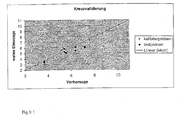
- Als Standardabweichung zwischen den 15 Kalibrierdaten und den nach Kalibrierung errechneten Vorhersagen (Kreuzkalibrierung) erhält man σ Kalibrierdaten = 0.33 mg.
- Nach der so durchgeführten Kalibrierung wurden die restlichen 10 Kapseln zum Test der Genauigkeit der vorgeschlagenen Verwiegemethode herangezogen. Hier liefert der Vergleich zwischen den wahren Einwaagewerten und den auf der Kalibrierung (5) basierenden Vorhersagen eine Standardabweichung von σ Testproben = 0.68 mg. Fig. 3 faßt alle Kalibrier- und Testdaten im Kreuzvalidierungsdiagramm zusammen.


Claims (8)
- Verfahren zur zerstörungsfreien Nettoverwiegung von Kapseln, bei dem in einem ersten Verfahrensschritt durch einen Prozessor gesteuert in einem Mikrowellen-Generator eine elektromagnetische Strahlung variabler Frequenz erzeugt und einem als Resonator ausgebildeten Probenapplikator zugeführt wird, bei dem das aus dem Applikator austretende Mikrowellensignal einer Detektor-Diode zugeführt wird, aus deren Signalen über einen Analog/Digital-Wandler vom Rechner als primäre Meßgrößen b(0) und f(0) ermittelt werden, wobei b(0) die Halbwertsbreite bei der Resonanzfrequenz f(0) des mit einer Messprobe in Wirkverbindung stehenden Applikators ist, dadurch gekennzeichnet, dass mit dem Resonator eine Materialprobe so in Verbindung gebracht wird, dass das elektrische Feld des Resonators beim Übergang in das Material der Probe allgemein parallel zur Oberfläche verläuft und dass aus den primären Messgrössen b(0) und f(0) die Messsignale

und bei dem in einem zweiten Schritt eine gravimetrische Bruttoverwiegung zur Bestimmung des Bruttowiegesignals
in dem die Grösse m T für die Masse des leeren Gebindes und die Grösse m N für die zu bestimmende Nettomasse steht, durchgeführt wird, und abschließend aus den erhaltenen Messsignalen F, B und C die zu bestimmende Nettomasse m N gemäß nachfolgender Relation
rechnerisch bestimmt wird, wobei die Koeffizienten α β, γ und δ zuvor über Kalibrierung des Messsystems durch lineare Regression aus einer Meßreihe mit Referenzproben bekannter Einwaage bestimmt wurden. - Verfahren nach Anspruch 1, dadurch gekennzeichnet, dass befüllte Kapseln verwogen werden, deren Material ausgewählt ist aus der Gruppe bestehend aus Gelatine, Cellulosederivaten, Stärke, Stärkederivaten, Chitosan und synthetischen Kunststoffen.
- Verfahren nach Anspruch 1 oder 2, dadurch gekennzeichnet, dass die Kapseln ein Pulver enthalten, welches einen Wirkstoff und ggebenenfalls einen pharmazeutisch verträglichen Hilfsstoff enthält.
- Verfahren nach Anspruch 3, dadurch gekennzeichnet, dass der Wirkstoff ausgewählt ist aus der Gruppe der Anticholinergika, Betamimetica, Dopaminagonisten, Antiallergika, Leukotrien-Antagonisten und Corticosteroiden, sowie gegebenenfalls Wirkstoffkombinationen davon.
- Verfahren nach einem der Ansprüche 1 bis 4, dadurch gekennzeichnet, dass die Meßsignalwerte F und B mittels einer Vorrichtung bestimmt werden, welche gekennzeichnet ist durch einen von einem Prozessor (2) digital abstimmbaren Mikrowellengenerator (3) mit variabler Frequenz, der mit einer Ankopplungssonde (5) verbunden ist, die in einem Applikator (4) zur Messung der Meßsignale F und B einer Probe (11) angeordnet ist, der eine weitere Ankopplungssonde (6) aufweist, die über einen Mikrowellen-Verstärker bzw. -Abschwächer (7) mit einer Detektor-Diode (8) verbunden ist, deren Signalausgang mit dem Prozessor (2) verbunden ist.
- Verfahren nach einem der Ansprüche 1 bis 5, dadurch gekennzeichnet, dass zur Bestimmung des Bruttowiegesignals C eine gravimetrische Wiegezelle zum Einsatz gelangt, die das Gewicht mit einer Standardabweichung von +/- 0.1 mg bestimmt.
- Verfahren nach einem der Ansprüche 1 bis 6, dadurch gekennzeichnet, dass es mittels einer Vorrichtung durchgeführt wird, welche einen Trichter (1') aufweist, aus dem die befüllten und verschlossenen Kapseln mittels einer Vereinzelungseinheit (2') seriell und/oder einzeln durch den Mikrowellenresonator (3') geführt werden, welche ferner eine sich daran anschließende Verteilereinheit (4') aufweist, durch welche der Transport der Kapseln parallelisiert wird und durch welche die Kapseln auf mehrere Spuren verteilt werden, in denen sich die gravimetrischen Wiegezellen (5') befinden, welche ferner eine computergestützte Datenerfassungseinheit (7') aufweist, die mit den Einheiten (3'), (4') und (5') verbunden ist und für die richtige Zuordnung der Meßwerte zu den einzelnen Kapseln sorgt und die Auswertung durchführt und welche schließlich eine Weiche (6') aufweist, durch die Kapseln mit fehlgewichtiger Einwaage ausgeschieden werden.
- Vorrichtung zur Ausführung des Verfahrens nach Anspruch 1, welche einen Trichter (1') aufweist, aus dem die befüllten und verschlossenen Kapseln mittels einer Vereinzelungseinheit (2') seriell und/oder einzeln durch den Mikrowellenresonator (3') geführt werden, welche ferner eine sich daran anschließende Verteilereinheit (4') aufweist, durch welche der Transport der Kapseln parallelisiert wird und durch welche die Kapseln auf mehrere Spuren verteilt werden, in denen sich die gravimetrischen Wiegezellen (5') befinden, welche ferner eine computergestützte Datenerfassungseinheit (7') aufweist, die mit den Einheiten (3'), (4') und (5') verbunden ist und für die richtige Zuordnung der Meßwerte zu den einzelnen Kapseln sorgt und die Auswertung durchführt und welche schließlich eine Weiche (6') aufweist, durch die Kapseln mit fehlgewichtiger Einwaage ausgeschieden werden.
Priority Applications (4)
| Application Number | Priority Date | Filing Date | Title |
|---|---|---|---|
| EP04734470A EP1634041B1 (de) | 2003-06-03 | 2004-05-22 | Messeinrichtung zur zerstörungsfreien bestimmung der einwaage in kapseln |
| PL04734470T PL1634041T3 (pl) | 2003-06-03 | 2004-05-22 | Urządzenie pomiarowe do nieniszczącego oznaczania odważek netto w kapsułkach |
| SI200430087T SI1634041T1 (sl) | 2003-06-03 | 2004-05-22 | Merilna priprava za nedestruktivno dolocanje netomase v kapsulah |
| CY20061101378T CY1105406T1 (el) | 2003-06-03 | 2006-09-26 | Διαταξη μετρησης για τον μη καταστροφικο προσδιορισμο του βαρους του πepιεχομενου καψουλων |
Applications Claiming Priority (3)
| Application Number | Priority Date | Filing Date | Title |
|---|---|---|---|
| EP03012566A EP1484586A1 (de) | 2003-06-03 | 2003-06-03 | Messeinrichtung zur zerstörungsfreien Bestimmung der Einwaage in Kapseln |
| EP04734470A EP1634041B1 (de) | 2003-06-03 | 2004-05-22 | Messeinrichtung zur zerstörungsfreien bestimmung der einwaage in kapseln |
| PCT/EP2004/005529 WO2004106870A1 (de) | 2003-06-03 | 2004-05-22 | Messeinrichtung zur zerstörungsfreien bestimmung der einwaage in kapseln |
Publications (2)
| Publication Number | Publication Date |
|---|---|
| EP1634041A1 EP1634041A1 (de) | 2006-03-15 |
| EP1634041B1 true EP1634041B1 (de) | 2006-07-19 |
Family
ID=33155142
Family Applications (2)
| Application Number | Title | Priority Date | Filing Date |
|---|---|---|---|
| EP03012566A Withdrawn EP1484586A1 (de) | 2003-06-03 | 2003-06-03 | Messeinrichtung zur zerstörungsfreien Bestimmung der Einwaage in Kapseln |
| EP04734470A Expired - Lifetime EP1634041B1 (de) | 2003-06-03 | 2004-05-22 | Messeinrichtung zur zerstörungsfreien bestimmung der einwaage in kapseln |
Family Applications Before (1)
| Application Number | Title | Priority Date | Filing Date |
|---|---|---|---|
| EP03012566A Withdrawn EP1484586A1 (de) | 2003-06-03 | 2003-06-03 | Messeinrichtung zur zerstörungsfreien Bestimmung der Einwaage in Kapseln |
Country Status (12)
| Country | Link |
|---|---|
| EP (2) | EP1484586A1 (de) |
| JP (1) | JP4828410B2 (de) |
| AT (1) | ATE333634T1 (de) |
| CA (1) | CA2527972C (de) |
| CY (1) | CY1105406T1 (de) |
| DE (1) | DE502004000995D1 (de) |
| DK (1) | DK1634041T3 (de) |
| ES (1) | ES2268658T3 (de) |
| PL (1) | PL1634041T3 (de) |
| PT (1) | PT1634041E (de) |
| SI (1) | SI1634041T1 (de) |
| WO (1) | WO2004106870A1 (de) |
Families Citing this family (7)
| Publication number | Priority date | Publication date | Assignee | Title |
|---|---|---|---|---|
| DE502004002875D1 (de) * | 2004-12-08 | 2007-03-22 | Tews Elektronik Dipl Ing Manfr | Verfahren und Vorrichtung zum Messen der Masse und/oder Feuchte des Inhalts von Kapseln |
| US7755368B2 (en) | 2007-02-06 | 2010-07-13 | Tews Elektronik Dipl.-Ing. Manfred Tews | Method and device for measuring mass and/or moisture of the content of capsules |
| WO2008141833A1 (de) * | 2007-05-22 | 2008-11-27 | Mediseal Gmbh | Dielektrizitätsmesseinrichtung |
| DE102007026646A1 (de) | 2007-06-06 | 2008-12-11 | Körber Ag | Dielektrizitätsmesseinrichtung |
| DE102007024071A1 (de) | 2007-05-22 | 2008-11-27 | Körber Ag | Dielektrizitätsmesseinrichtung |
| EP2875340B1 (de) * | 2012-07-20 | 2018-02-21 | President and Fellows of Harvard College | Fouriertransformations-mikrowellenspektroskopie für enantiomer-spezifischen nachweis von chiralen molekülen |
| IT201900011109A1 (it) * | 2019-07-08 | 2021-01-08 | Azionaria Costruzioni Acma Spa | Dispositivo e metodo di ispezione di contenitori |
Family Cites Families (7)
| Publication number | Priority date | Publication date | Assignee | Title |
|---|---|---|---|---|
| DE4004119A1 (de) * | 1990-02-10 | 1991-08-14 | Tews Elektronik Dipl Ing Manfr | Verfahren zur messung der feuchte eines messgutes mit hilfe von mikrowellen und vorrichtung zur durchfuehrung des verfahrens |
| IT1258025B (it) * | 1992-07-31 | 1996-02-20 | Mg 2 Spa | Metodo e dispositivo per il dosaggio di un prodotto farmaceutico all'interno di capsule |
| US6163158A (en) * | 1996-02-20 | 2000-12-19 | Hauni Maschinenbau Ag | Method of and apparatus for ascertaining at least one characteristic of a substance |
| IT1285463B1 (it) * | 1996-02-21 | 1998-06-08 | Ima Spa | Apparato per la pesatura automatica, continua, rapida e precisa di prodotti di piccole dimensioni, particolarmente di capsule di gelatina |
| JP3343480B2 (ja) * | 1996-08-05 | 2002-11-11 | アンリツ株式会社 | カプセル重量測定装置 |
| IT1292645B1 (it) * | 1997-06-27 | 1999-02-08 | Mg 2 Spa | Metodo e relativa macchina per la dosatura di prodotti farmaceutici. |
| ITBO20020432A1 (it) * | 2002-07-04 | 2004-01-05 | Ima Spa | Metodo per il rilevamento ed il controllo di caratteristiche di articoli farmaceutici |
-
2003
- 2003-06-03 EP EP03012566A patent/EP1484586A1/de not_active Withdrawn
-
2004
- 2004-05-22 WO PCT/EP2004/005529 patent/WO2004106870A1/de not_active Ceased
- 2004-05-22 SI SI200430087T patent/SI1634041T1/sl unknown
- 2004-05-22 AT AT04734470T patent/ATE333634T1/de active
- 2004-05-22 CA CA2527972A patent/CA2527972C/en not_active Expired - Fee Related
- 2004-05-22 ES ES04734470T patent/ES2268658T3/es not_active Expired - Lifetime
- 2004-05-22 PT PT04734470T patent/PT1634041E/pt unknown
- 2004-05-22 PL PL04734470T patent/PL1634041T3/pl unknown
- 2004-05-22 EP EP04734470A patent/EP1634041B1/de not_active Expired - Lifetime
- 2004-05-22 JP JP2006508191A patent/JP4828410B2/ja not_active Expired - Lifetime
- 2004-05-22 DK DK04734470T patent/DK1634041T3/da active
- 2004-05-22 DE DE502004000995T patent/DE502004000995D1/de not_active Expired - Lifetime
-
2006
- 2006-09-26 CY CY20061101378T patent/CY1105406T1/el unknown
Also Published As
| Publication number | Publication date |
|---|---|
| JP4828410B2 (ja) | 2011-11-30 |
| DK1634041T3 (da) | 2006-11-13 |
| ES2268658T3 (es) | 2007-03-16 |
| DE502004000995D1 (de) | 2006-08-31 |
| CY1105406T1 (el) | 2010-04-28 |
| JP2006526770A (ja) | 2006-11-24 |
| SI1634041T1 (sl) | 2006-12-31 |
| CA2527972C (en) | 2013-12-03 |
| CA2527972A1 (en) | 2004-12-09 |
| PL1634041T3 (pl) | 2006-12-29 |
| EP1484586A1 (de) | 2004-12-08 |
| EP1634041A1 (de) | 2006-03-15 |
| ATE333634T1 (de) | 2006-08-15 |
| PT1634041E (pt) | 2006-11-30 |
| WO2004106870A1 (de) | 2004-12-09 |
Similar Documents
| Publication | Publication Date | Title |
|---|---|---|
| EP1326585B2 (de) | Verfahren zur herstellung von pulverformulierungen | |
| EP1487832B9 (de) | Kristallines mikronisat des tiotropiumbromids | |
| EP1467191B1 (de) | Verfahren und Vorrichtung zum Bestimmen der Masse von portionierten Wirkstoffeinheiten | |
| EP1429722B1 (de) | Aufstreuverfahren zur herstellung von pulverformulierungen | |
| US20070231272A1 (en) | Process for Preparing Inhalable Powders | |
| US20040002510A1 (en) | Crystalline micronisate, process for the manufacture thereof and use thereof for the preparation of a medicament | |
| EP3254093A2 (de) | Verfahren und vorrichtung zur bestimmung des wassergehalts | |
| EP1670443B1 (de) | Aerosol-formulierung mit formoterol in suspension | |
| EP1484586A1 (de) | Messeinrichtung zur zerstörungsfreien Bestimmung der Einwaage in Kapseln | |
| US7071706B2 (en) | Measuring device for rapid non-destructive measurement of the contents of capsules | |
| EP1567135B1 (de) | Tiotropiumhaltige pulverformulierung für die inhalation | |
| Kudrik et al. | Development of the composition and technology of the capsulated drug based on bee bread and honey powder. Report 2. The study of pharmacotechnological properties of the mixtures of active pharmaceutical ingredients with excipients of “Api-Immuno-Vit” caps | |
| Vyshnevska et al. | Pharmacotechnological studies of model samples in the development of a composition of solid gastrosoluble capsules | |
| Orr et al. | Applications of particle size analysis in the pharmaceutical industry | |
| DE102009021843B4 (de) | Verfahren zur Bestimmung einer in einen zu befüllenden Körper zudosierten Menge eines fließfähigen Stoffes | |
| DE10331350A1 (de) | Pulverformulierungen für die Inhalation enthaltend ein neues Anticholinergikum | |
| DE10138022A1 (de) | Verfahren zur Herstellung von Pulverformulierungen | |
| CH662179A5 (de) | Verfahren und vorrichtung zum einspeisen von schuettgut. |
Legal Events
| Date | Code | Title | Description |
|---|---|---|---|
| PUAI | Public reference made under article 153(3) epc to a published international application that has entered the european phase |
Free format text: ORIGINAL CODE: 0009012 |
|
| 17P | Request for examination filed |
Effective date: 20060103 |
|
| AK | Designated contracting states |
Kind code of ref document: A1 Designated state(s): AT BE BG CH CY CZ DE DK EE ES FI FR GB GR HU IE IT LI LU MC NL PL PT RO SE SI SK TR |
|
| GRAP | Despatch of communication of intention to grant a patent |
Free format text: ORIGINAL CODE: EPIDOSNIGR1 |
|
| GRAS | Grant fee paid |
Free format text: ORIGINAL CODE: EPIDOSNIGR3 |
|
| GRAA | (expected) grant |
Free format text: ORIGINAL CODE: 0009210 |
|
| DAX | Request for extension of the european patent (deleted) | ||
| RAP1 | Party data changed (applicant data changed or rights of an application transferred) |
Owner name: BOEHRINGER INGELHEIM INTERNATIONAL GMBH Owner name: BOEHRINGER INGELHEIM PHARMA GMBH & CO.KG |
|
| AK | Designated contracting states |
Kind code of ref document: B1 Designated state(s): AT BE BG CH CY CZ DE DK EE ES FI FR GB GR HU IE IT LI LU MC NL PL PT RO SE SI SK TR |
|
| PG25 | Lapsed in a contracting state [announced via postgrant information from national office to epo] |
Ref country code: IT Free format text: LAPSE BECAUSE OF FAILURE TO SUBMIT A TRANSLATION OF THE DESCRIPTION OR TO PAY THE FEE WITHIN THE PRESCRIBED TIME-LIMIT;WARNING: LAPSES OF ITALIAN PATENTS WITH EFFECTIVE DATE BEFORE 2007 MAY HAVE OCCURRED AT ANY TIME BEFORE 2007. THE CORRECT EFFECTIVE DATE MAY BE DIFFERENT FROM THE ONE RECORDED. Effective date: 20060719 |
|
| REG | Reference to a national code |
Ref country code: GB Ref legal event code: FG4D Free format text: NOT ENGLISH |
|
| REG | Reference to a national code |
Ref country code: CH Ref legal event code: EP |
|
| REG | Reference to a national code |
Ref country code: IE Ref legal event code: FG4D Free format text: LANGUAGE OF EP DOCUMENT: GERMAN |
|
| REF | Corresponds to: |
Ref document number: 502004000995 Country of ref document: DE Date of ref document: 20060831 Kind code of ref document: P |
|
| GBT | Gb: translation of ep patent filed (gb section 77(6)(a)/1977) |
Effective date: 20060815 |
|
| REG | Reference to a national code |
Ref country code: RO Ref legal event code: EPE |
|
| REG | Reference to a national code |
Ref country code: SE Ref legal event code: TRGR |
|
| REG | Reference to a national code |
Ref country code: DK Ref legal event code: T3 |
|
| REG | Reference to a national code |
Ref country code: GR Ref legal event code: EP Ref document number: 20060403648 Country of ref document: GR |
|
| REG | Reference to a national code |
Ref country code: HU Ref legal event code: AG4A Ref document number: E000737 Country of ref document: HU |
|
| REG | Reference to a national code |
Ref country code: PT Ref legal event code: SC4A Free format text: AVAILABILITY OF NATIONAL TRANSLATION Effective date: 20060915 |
|
| ET | Fr: translation filed | ||
| REG | Reference to a national code |
Ref country code: ES Ref legal event code: FG2A Ref document number: 2268658 Country of ref document: ES Kind code of ref document: T3 |
|
| PLBE | No opposition filed within time limit |
Free format text: ORIGINAL CODE: 0009261 |
|
| STAA | Information on the status of an ep patent application or granted ep patent |
Free format text: STATUS: NO OPPOSITION FILED WITHIN TIME LIMIT |
|
| 26N | No opposition filed |
Effective date: 20070420 |
|
| PG25 | Lapsed in a contracting state [announced via postgrant information from national office to epo] |
Ref country code: PL Free format text: LAPSE BECAUSE OF FAILURE TO SUBMIT A TRANSLATION OF THE DESCRIPTION OR TO PAY THE FEE WITHIN THE PRESCRIBED TIME-LIMIT Effective date: 20070815 |
|
| PGRI | Patent reinstated in contracting state [announced from national office to epo] |
Ref country code: IT Effective date: 20080601 |
|
| PGFP | Annual fee paid to national office [announced via postgrant information from national office to epo] |
Ref country code: LU Payment date: 20140527 Year of fee payment: 11 |
|
| PGFP | Annual fee paid to national office [announced via postgrant information from national office to epo] |
Ref country code: IE Payment date: 20140527 Year of fee payment: 11 Ref country code: EE Payment date: 20140513 Year of fee payment: 11 Ref country code: MC Payment date: 20140514 Year of fee payment: 11 |
|
| PGFP | Annual fee paid to national office [announced via postgrant information from national office to epo] |
Ref country code: RO Payment date: 20140428 Year of fee payment: 11 Ref country code: CZ Payment date: 20140516 Year of fee payment: 11 Ref country code: BG Payment date: 20140514 Year of fee payment: 11 Ref country code: SI Payment date: 20140428 Year of fee payment: 11 Ref country code: SK Payment date: 20140521 Year of fee payment: 11 Ref country code: FI Payment date: 20140513 Year of fee payment: 11 Ref country code: PT Payment date: 20140520 Year of fee payment: 11 Ref country code: GR Payment date: 20140519 Year of fee payment: 11 |
|
| PGFP | Annual fee paid to national office [announced via postgrant information from national office to epo] |
Ref country code: CY Payment date: 20140509 Year of fee payment: 11 |
|
| REG | Reference to a national code |
Ref country code: FR Ref legal event code: PLFP Year of fee payment: 12 |
|
| REG | Reference to a national code |
Ref country code: PT Ref legal event code: MM4A Free format text: LAPSE DUE TO NON-PAYMENT OF FEES Effective date: 20151123 |
|
| REG | Reference to a national code |
Ref country code: EE Ref legal event code: MM4A Ref document number: E000574 Country of ref document: EE Effective date: 20150531 |
|
| PG25 | Lapsed in a contracting state [announced via postgrant information from national office to epo] |
Ref country code: EE Free format text: LAPSE BECAUSE OF NON-PAYMENT OF DUE FEES Effective date: 20150531 Ref country code: FI Free format text: LAPSE BECAUSE OF NON-PAYMENT OF DUE FEES Effective date: 20150522 Ref country code: MC Free format text: LAPSE BECAUSE OF NON-PAYMENT OF DUE FEES Effective date: 20150601 Ref country code: LU Free format text: LAPSE BECAUSE OF NON-PAYMENT OF DUE FEES Effective date: 20150522 Ref country code: GR Free format text: LAPSE BECAUSE OF NON-PAYMENT OF DUE FEES Effective date: 20151208 |
|
| REG | Reference to a national code |
Ref country code: SK Ref legal event code: MM4A Ref document number: E 751 Country of ref document: SK Effective date: 20150522 |
|
| REG | Reference to a national code |
Ref country code: IE Ref legal event code: MM4A |
|
| PG25 | Lapsed in a contracting state [announced via postgrant information from national office to epo] |
Ref country code: RO Free format text: LAPSE BECAUSE OF NON-PAYMENT OF DUE FEES Effective date: 20150522 Ref country code: SK Free format text: LAPSE BECAUSE OF NON-PAYMENT OF DUE FEES Effective date: 20150522 Ref country code: CZ Free format text: LAPSE BECAUSE OF NON-PAYMENT OF DUE FEES Effective date: 20150522 Ref country code: SI Free format text: LAPSE BECAUSE OF NON-PAYMENT OF DUE FEES Effective date: 20150523 Ref country code: CY Free format text: LAPSE BECAUSE OF NON-PAYMENT OF DUE FEES Effective date: 20150522 Ref country code: PT Free format text: LAPSE BECAUSE OF NON-PAYMENT OF DUE FEES Effective date: 20151123 |
|
| REG | Reference to a national code |
Ref country code: SI Ref legal event code: KO00 Effective date: 20160112 |
|
| REG | Reference to a national code |
Ref country code: GR Ref legal event code: ML Ref document number: 20060403648 Country of ref document: GR Effective date: 20151208 |
|
| PG25 | Lapsed in a contracting state [announced via postgrant information from national office to epo] |
Ref country code: BG Free format text: LAPSE BECAUSE OF NON-PAYMENT OF DUE FEES Effective date: 20160331 Ref country code: IE Free format text: LAPSE BECAUSE OF NON-PAYMENT OF DUE FEES Effective date: 20150522 |
|
| REG | Reference to a national code |
Ref country code: FR Ref legal event code: PLFP Year of fee payment: 13 |
|
| REG | Reference to a national code |
Ref country code: FR Ref legal event code: PLFP Year of fee payment: 14 |
|
| REG | Reference to a national code |
Ref country code: FR Ref legal event code: PLFP Year of fee payment: 15 |
|
| PGFP | Annual fee paid to national office [announced via postgrant information from national office to epo] |
Ref country code: NL Payment date: 20230519 Year of fee payment: 20 Ref country code: IT Payment date: 20230526 Year of fee payment: 20 Ref country code: FR Payment date: 20230525 Year of fee payment: 20 Ref country code: DK Payment date: 20230524 Year of fee payment: 20 Ref country code: DE Payment date: 20220620 Year of fee payment: 20 Ref country code: CH Payment date: 20230605 Year of fee payment: 20 |
|
| PGFP | Annual fee paid to national office [announced via postgrant information from national office to epo] |
Ref country code: TR Payment date: 20230518 Year of fee payment: 20 Ref country code: SE Payment date: 20230519 Year of fee payment: 20 Ref country code: PL Payment date: 20230512 Year of fee payment: 20 Ref country code: HU Payment date: 20230523 Year of fee payment: 20 Ref country code: AT Payment date: 20230522 Year of fee payment: 20 |
|
| PGFP | Annual fee paid to national office [announced via postgrant information from national office to epo] |
Ref country code: BE Payment date: 20230519 Year of fee payment: 20 |
|
| PGFP | Annual fee paid to national office [announced via postgrant information from national office to epo] |
Ref country code: GB Payment date: 20230523 Year of fee payment: 20 Ref country code: ES Payment date: 20230724 Year of fee payment: 20 |
|
| REG | Reference to a national code |
Ref country code: DE Ref legal event code: R071 Ref document number: 502004000995 Country of ref document: DE Ref country code: NL Ref legal event code: MK Effective date: 20240521 |
|
| REG | Reference to a national code |
Ref country code: DK Ref legal event code: EUP Expiry date: 20240522 |
|
| REG | Reference to a national code |
Ref country code: ES Ref legal event code: FD2A Effective date: 20240529 |
|
| REG | Reference to a national code |
Ref country code: CH Ref legal event code: PL |
|
| REG | Reference to a national code |
Ref country code: BE Ref legal event code: MK Effective date: 20240522 |
|
| REG | Reference to a national code |
Ref country code: GB Ref legal event code: PE20 Expiry date: 20240521 |
|
| REG | Reference to a national code |
Ref country code: SE Ref legal event code: EUG |
|
| PG25 | Lapsed in a contracting state [announced via postgrant information from national office to epo] |
Ref country code: GB Free format text: LAPSE BECAUSE OF EXPIRATION OF PROTECTION Effective date: 20240521 |
|
| REG | Reference to a national code |
Ref country code: AT Ref legal event code: MK07 Ref document number: 333634 Country of ref document: AT Kind code of ref document: T Effective date: 20240522 |
|
| PG25 | Lapsed in a contracting state [announced via postgrant information from national office to epo] |
Ref country code: ES Free format text: LAPSE BECAUSE OF EXPIRATION OF PROTECTION Effective date: 20240523 |
|
| PG25 | Lapsed in a contracting state [announced via postgrant information from national office to epo] |
Ref country code: GB Free format text: LAPSE BECAUSE OF EXPIRATION OF PROTECTION Effective date: 20240521 Ref country code: ES Free format text: LAPSE BECAUSE OF EXPIRATION OF PROTECTION Effective date: 20240523 |