EP1635525A1 - Estimation de canal pour un système de communication duplex à répartition dans le temps - Google Patents
Estimation de canal pour un système de communication duplex à répartition dans le temps Download PDFInfo
- Publication number
- EP1635525A1 EP1635525A1 EP05111738A EP05111738A EP1635525A1 EP 1635525 A1 EP1635525 A1 EP 1635525A1 EP 05111738 A EP05111738 A EP 05111738A EP 05111738 A EP05111738 A EP 05111738A EP 1635525 A1 EP1635525 A1 EP 1635525A1
- Authority
- EP
- European Patent Office
- Prior art keywords
- bursts
- data
- user equipment
- communication
- detector
- Prior art date
- Legal status (The legal status is an assumption and is not a legal conclusion. Google has not performed a legal analysis and makes no representation as to the accuracy of the status listed.)
- Granted
Links
- 238000004891 communication Methods 0.000 title claims abstract description 62
- 239000011159 matrix material Substances 0.000 claims abstract description 35
- 239000013598 vector Substances 0.000 claims abstract description 18
- 238000001228 spectrum Methods 0.000 claims abstract description 12
- 125000004122 cyclic group Chemical group 0.000 claims description 6
- 238000001514 detection method Methods 0.000 description 8
- 238000000034 method Methods 0.000 description 8
- 238000013459 approach Methods 0.000 description 7
- 238000012549 training Methods 0.000 description 4
- 238000003775 Density Functional Theory Methods 0.000 description 2
- 230000010363 phase shift Effects 0.000 description 2
- 238000012935 Averaging Methods 0.000 description 1
- 238000003780 insertion Methods 0.000 description 1
- 230000037431 insertion Effects 0.000 description 1
- 230000000737 periodic effect Effects 0.000 description 1
- 238000011084 recovery Methods 0.000 description 1
Images

Classifications
-
- H—ELECTRICITY
- H04—ELECTRIC COMMUNICATION TECHNIQUE
- H04L—TRANSMISSION OF DIGITAL INFORMATION, e.g. TELEGRAPHIC COMMUNICATION
- H04L25/00—Baseband systems
- H04L25/02—Details ; arrangements for supplying electrical power along data transmission lines
- H04L25/0202—Channel estimation
- H04L25/024—Channel estimation channel estimation algorithms
- H04L25/0242—Channel estimation channel estimation algorithms using matrix methods
-
- H—ELECTRICITY
- H04—ELECTRIC COMMUNICATION TECHNIQUE
- H04L—TRANSMISSION OF DIGITAL INFORMATION, e.g. TELEGRAPHIC COMMUNICATION
- H04L25/00—Baseband systems
- H04L25/02—Details ; arrangements for supplying electrical power along data transmission lines
- H04L25/0202—Channel estimation
- H04L25/0204—Channel estimation of multiple channels
-
- H—ELECTRICITY
- H04—ELECTRIC COMMUNICATION TECHNIQUE
- H04L—TRANSMISSION OF DIGITAL INFORMATION, e.g. TELEGRAPHIC COMMUNICATION
- H04L25/00—Baseband systems
- H04L25/02—Details ; arrangements for supplying electrical power along data transmission lines
- H04L25/0202—Channel estimation
- H04L25/0224—Channel estimation using sounding signals
-
- H—ELECTRICITY
- H04—ELECTRIC COMMUNICATION TECHNIQUE
- H04L—TRANSMISSION OF DIGITAL INFORMATION, e.g. TELEGRAPHIC COMMUNICATION
- H04L25/00—Baseband systems
- H04L25/02—Details ; arrangements for supplying electrical power along data transmission lines
- H04L25/0202—Channel estimation
- H04L25/024—Channel estimation channel estimation algorithms
- H04L25/025—Channel estimation channel estimation algorithms using least-mean-square [LMS] method
-
- H—ELECTRICITY
- H04—ELECTRIC COMMUNICATION TECHNIQUE
- H04B—TRANSMISSION
- H04B1/00—Details of transmission systems, not covered by a single one of groups H04B3/00 - H04B13/00; Details of transmission systems not characterised by the medium used for transmission
- H04B1/69—Spread spectrum techniques
- H04B1/707—Spread spectrum techniques using direct sequence modulation
- H04B1/7097—Interference-related aspects
- H04B1/7103—Interference-related aspects the interference being multiple access interference
- H04B1/7105—Joint detection techniques, e.g. linear detectors
-
- H—ELECTRICITY
- H04—ELECTRIC COMMUNICATION TECHNIQUE
- H04B—TRANSMISSION
- H04B2201/00—Indexing scheme relating to details of transmission systems not covered by a single group of H04B3/00 - H04B13/00
- H04B2201/69—Orthogonal indexing scheme relating to spread spectrum techniques in general
- H04B2201/707—Orthogonal indexing scheme relating to spread spectrum techniques in general relating to direct sequence modulation
- H04B2201/70707—Efficiency-related aspects
- H04B2201/70709—Efficiency-related aspects with discontinuous detection
Definitions
- the invention generally relates to wireless communication systems.
- the invention relates to channel estimation in a wireless communication system.
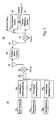
- FIG. 1 is an illustration of a wireless communication system 10.
- the communication system 10 has base stations 12 1 to 12 5 which communicate with user equipments (UEs) 14 1 to 14 3 .
- Each base station 12 has an associated operational area where it communicates with DEs 14 1 to 14 3 in its operational area.
- CDMA code division multiple access
- TDD/CDMA time division duplex using code division multiple access
- multiple communications are sent over the same frequency spectrum. These communications are typically differentiated by their chip code sequences.
- TDD/CDMA communication systems use repeating frames divided into time slots for communication. A communication sent in such a system will have one or multiple associated chip codes and time slots assigned to it based on the communication's bandwidth.
- a receiver in such a system must distinguish between the multiple communications.
- One approach to detecting such signals is single user detection.
- single user detection a receiver detects only the communications from a desired transmitter using a code associated with the desired transmitter, and treats signals of other transmitters as interference.
- Another approach is referred to as joint detection. In joint detection, multiple communications are detected simultaneously.
- the channel estimation is performed using midamble sequences in communication bursts.
- a typical communication burst 16 has a midamble 20, a guard period 18 and two data bursts 22, 24, as shown in Figure 2.
- the midamble 20 separates the two data bursts 22, 24 and the guard period 18 separates the communication bursts 16 to allow for the difference in arrival times of bursts 16 transmitted from different transmitters.
- the two data bursts 22, 24 contain the communication burst's data.
- the midamble 20 contains a training sequence for use in channel estimation.
- a receiver After a receiver receives a communication burst 16, it estimates the channel using the received midamble sequence. When a receiver receives multiple bursts 16 in a time slot, it typically estimates the channel for each burst 16.
- One approach for such channel estimation for communication bursts 16 sent through multiple channels is a Steiner Channel Estimator. Steiner Channel Estimation is typically used for uplink communications from multiple UEs, 14 1 to 14 3 , where the channel estimator needs to estimate multiple channels.
- multiple bursts 16 experience the same wireless channel.
- One case is a high data rate service, such as a 2 megabits per second (Mbps) service.
- a transmitter may transmit multiple bursts in a single time slot.
- Steiner estimation can be applied in such a case by averaging the estimated channel responses from all the bursts 16.
- this approach has a high complexity. Accordingly, it is desirable to have alternate approaches to channel estimation.
- a single transmitter transmits K communication bursts in a shared spectrum in a time slot of a time division duplex communication system.
- the system associated with N midainble sequences. Each burst has an associated midamble sequence.
- a receiver receives a vector corresponding to the transmitted midamble sequences of the K communication bursts.
- a matrix having N identical right circulant matrix blocks is constructed based in part on the known N midamble sequences.
- the wireless channel between the transmitter and receiver is estimated based on in part one of the N blocks and the received vector.
- Figure 3 illustrates a simplified multicode transmitter 26 and receiver 28 in a TDD/CDMA communication system.
- the receiver 28 is in a UE 14 1 and the transmitter 26 is in a base station 12 1 , although the receiver 28 and transmitter 26 may be used in other applications.
- the transmitter 26 sends data over a wireless radio channel 30.
- the data is sent in K communication bursts.
- Data generators 32 1 to 32 K in the transmitter 26 generate data to be communicated to the receiver 28.
- Modulation/spreading and training sequence insertion devices 34 1 to 34 K spread the data and make the spread reference datatime-multiplexed with amidamble training sequence in the appropriate assigned time slot and codes for spreading the data, producing the K communication bursts.
- Typical values of K for a base station 12, transmitting downlink bursts are from 1 to 16.
- the communication bursts are combined by a combiner 48 and modulated by a modulator 36 to radio frequency (RF).
- An antenna 38 radiates the RF signal through the wireless radio channel 30 to an antenna 40 ofthe receiver 28.
- the type of modulation used for the transmitted communication can be any of those known to those skilled in the art, such as binary phase shift keying (BPSK) or quadrature phase shift keying (QPSK).
- BPSK binary phase shift keying
- QPSK quadrature phase shift keying
- the antenna 40 of the receiver 28 receives various radio frequency signals.
- the received signals are demodulated by a demodulator 42 to produce a baseband signal.
- the baseband signal is processed, such as by a channel estimation device 44 and a data detection device 46, in the time slot and with the appropriate codes assigned to the transmitted communication bursts.
- the data detection device 46 may be a multiuser detector or a single user detector.
- the channel estimation device 44 uses the midamble training sequence component in the baseband signal to provide channel information, such as channel impulse responses.
- the channel information is used by the data detection device 46 to estimate the transmitted data of the received communication bursts as hard symbols.
- W is the length of the user channel impulse response. Typical values for L m are 256 and 512 chips. W is the length ofthe user channel impulse response.
- the analysis is based on N midamble codes, N ⁇ K.
- the system may have a maximum number of acceptable midamble codes N.
- the receiver 28 in such a system may estimate the channel for the N maximum number of codes, even if less than N codes are transmitted.
- the elements of m p take values from the integer set ⁇ 1, -1 ⁇ .
- the m ( k ) are obtained by picking K sub-sequences of length L m from a 2 P long sequence formed by concatenating two periods of m ⁇ P .
- the i th element of m ( k ) is related to m ⁇ P by Equation 1.
- the starting point of m ( k ) , k 1... K shifts to the right by W chips as k increases from 1 to K .
- the combined received midamble sequences are a superposition of the K convolutions.
- the k th convolution represents the convolution of m ( k ) with h ( k ) ⁇ .
- h ( k ) ⁇ is the channel response of the k th user.
- the preceding data field in the burst corrupts the first ( W -1) chips of the received midamble. Hence, for the purpose of channel estimation, only the last P of L m chips are used to estimate the channel.
- Equation 2 To solve for the individual channel responses h ( k ) ⁇ , Equation 2 is used. r W ⁇ r LM are the received combined chips of the midamble sequences. The m values are the elements of m p .
- Equation 2 may also be rewritten in shorthand as Equation 3.
- M ( k ) is a KW-by-W matrix.
- r ⁇ is the received midamble chip responses.
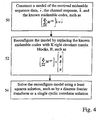
- h ( l ) ⁇ ⁇ ⁇ ⁇ ⁇ h ( k ) ⁇ can be replaced by h ⁇ as in Equation 4,50.
- G [ M ( l ) , ... , M ( k ) , ...
- Equation 4 can be rewritten using K identical right circulant matrix blocks B, as per Equation 6, 52.
- the number of B-blocks is K.
- One approach to solve Equation 7 is a least squares solution, 54.
- the least squares solution of Equation 7 is given by Equation 8.
- the received vector r ⁇ of dimension KW can be decomposed as per Equation 10.
- r ⁇ [ r ⁇ 1 r ⁇ 2 ⁇ ⁇ ⁇ r ⁇ k ]
- the dimension of r ⁇ k is W.
- Equation 11 Equation 12.
- h ⁇ ⁇ B - 1 r ⁇ ⁇ k
- B is a right circulant matrix and the inverse of a right circulant matrix is also right circulant
- the channel estimator can be implemented by a single cyclic correlator of dimension 57, or by a discrete fourier transform (DFT) solution.
- DFT discrete fourier transform
- D W [ W ⁇ 0 W ⁇ 0 W ⁇ 0 W ⁇ 0 W ⁇ 0 ... W ⁇ 0 W ⁇ 1 W ⁇ 2 W ⁇ 3 ... W ⁇ ( W - 1 ) W ⁇ 0 W ⁇ 2 W ⁇ 4 W ⁇ 6 ... W ⁇ 2 ( W - 1 ) W ⁇ 0 W ⁇ 3 W ⁇ 6 W ⁇ 9 ...
- ⁇ C is a diagonal matrix whose main diagonal is the DFT of the first column of B, as per Equation 15.
- D w is the DFT operator so that D W x represents the W point DFT of the vector x .
- h ⁇ ( D W * ⁇ 1 W ⁇ ⁇ C - 1 ⁇ D W ) r ⁇ D W * is the element-by-element complex conjugate of D W .
- ⁇ R is a diagonal matrix whose main diagonal is the DFT ofthe first row of B per Equation 17.
- ⁇ R diag ( D W ( B ( 1 , : ) ) ) Since the transpose ofB, B T , is also right circulant and that its first column is the first row of B, B T can be expressed by Equation 18.
- B D W ⁇ ⁇ R ⁇ D W - 1
- Equation 19 D W * W .
- h ⁇ ( D W ⁇ ⁇ R - 1 ⁇ 1 W D W * ) r ⁇ Equations 16 or 20 can be used to solve for h ⁇ . Since all DFTs are of length W, the complexity in solving the equations is dramatically reduced.
- B -1 is the inverse of a right circulant matrix, it can be written as Equation 21.
- the first row ofthe matrix T is equal to the inverse DFT of the main diagonal of ⁇ R - 1 .
- the matrix T is completely determined by ⁇ R - 1 .
- the taps of the channel response h ⁇ are obtained successively by an inner product of successive rows of T with the average of W-length segments of the received vector r ⁇ .
- the successive rows of T are circularly right shifted versions of the previous row.
- the first register holds the averaged segments of r ⁇
- the second register is a shift register that holds the first row of the matrix T.
- the second register is circularly shifted at a certain clock rate.
- a new element of h ⁇ is determined by the inner product of the vectors stored in the two registers. It is advantageous to shift the first row of the matrix T rather than the received midambles. As a result, no extra storage is required for the midambles.
- the midambles continue to reside in the received buffer that holds the entire burst. Since the correlator length is only W, a significant reduction in complexity of estimating the channel is achieved.
Landscapes
- Engineering & Computer Science (AREA)
- Power Engineering (AREA)
- Computer Networks & Wireless Communication (AREA)
- Signal Processing (AREA)
- Physics & Mathematics (AREA)
- Mathematical Physics (AREA)
- Mobile Radio Communication Systems (AREA)
Priority Applications (1)
| Application Number | Priority Date | Filing Date | Title |
|---|---|---|---|
| EP07110145A EP1830530A3 (fr) | 2000-01-07 | 2001-01-05 | Estimation de canal dans des systèmes de communication en duplex par division temporelle |
Applications Claiming Priority (3)
| Application Number | Priority Date | Filing Date | Title |
|---|---|---|---|
| US17516700P | 2000-01-07 | 2000-01-07 | |
| EP04006212A EP1437869B1 (fr) | 2000-01-07 | 2001-01-05 | Estimation de canal pour un système de communication duplex à répartition dans le temps |
| EP01901796A EP1245100B1 (fr) | 2000-01-07 | 2001-01-05 | Estimation de voie pour les systemes de communication duplex a repartition dans le temps |
Related Parent Applications (1)
| Application Number | Title | Priority Date | Filing Date |
|---|---|---|---|
| EP04006212A Division EP1437869B1 (fr) | 2000-01-07 | 2001-01-05 | Estimation de canal pour un système de communication duplex à répartition dans le temps |
Related Child Applications (1)
| Application Number | Title | Priority Date | Filing Date |
|---|---|---|---|
| EP07110145A Division EP1830530A3 (fr) | 2000-01-07 | 2001-01-05 | Estimation de canal dans des systèmes de communication en duplex par division temporelle |
Publications (3)
| Publication Number | Publication Date |
|---|---|
| EP1635525A1 true EP1635525A1 (fr) | 2006-03-15 |
| EP1635525B1 EP1635525B1 (fr) | 2007-08-01 |
| EP1635525B8 EP1635525B8 (fr) | 2007-10-03 |
Family
ID=35883350
Family Applications (1)
| Application Number | Title | Priority Date | Filing Date |
|---|---|---|---|
| EP05111738A Expired - Lifetime EP1635525B8 (fr) | 2000-01-07 | 2001-01-05 | Estimation de canal pour un système de communication duplex à répartition dans le temps |
Country Status (1)
| Country | Link |
|---|---|
| EP (1) | EP1635525B8 (fr) |
Cited By (1)
| Publication number | Priority date | Publication date | Assignee | Title |
|---|---|---|---|---|
| RU2487477C1 (ru) * | 2009-06-18 | 2013-07-10 | ЭлДжи ЭЛЕКТРОНИКС ИНК. | Способ и устройство передачи кода коррекции в системе беспроводной связи |
-
2001
- 2001-01-05 EP EP05111738A patent/EP1635525B8/fr not_active Expired - Lifetime
Non-Patent Citations (1)
| Title |
|---|
| STEINER B ET AL: "OPTIMUM AND SUBOPTIMUM CHANNEL ESTIMATION FOR THE UPLINK OF CDMA MOBILE RADIO SYSTEMS WITH JOINT DETECTION", EUROPEAN TRANSACTIONS ON TELECOMMUNICATIONS AND RELATED TECHNOLOGIES, AEI, MILANO, IT, vol. 5, no. 1, 1994, pages 39 - 50, XP000445714, ISSN: 1120-3862 * |
Cited By (1)
| Publication number | Priority date | Publication date | Assignee | Title |
|---|---|---|---|---|
| RU2487477C1 (ru) * | 2009-06-18 | 2013-07-10 | ЭлДжи ЭЛЕКТРОНИКС ИНК. | Способ и устройство передачи кода коррекции в системе беспроводной связи |
Also Published As
| Publication number | Publication date |
|---|---|
| EP1635525B8 (fr) | 2007-10-03 |
| EP1635525B1 (fr) | 2007-08-01 |
Similar Documents
| Publication | Publication Date | Title |
|---|---|---|
| US6985513B2 (en) | Channel estimation for time division duplex communication systems | |
| US7768986B2 (en) | Method and apparatus for receiving plurality of data signals | |
| EP1635525B1 (fr) | Estimation de canal pour un système de communication duplex à répartition dans le temps | |
| EP1437869B1 (fr) | Estimation de canal pour un système de communication duplex à répartition dans le temps | |
| EP1830530A2 (fr) | Estimation de canal dans des systèmes de communication en duplex par division temporelle | |
| HK1088154B (en) | Channel estimation for time division duplex communication systems | |
| HK1065202B (en) | Channel estimation for time division duplex communication systems | |
| HK1048715B (en) | Channel estimation for time division duplex communication systems | |
| CA2554193A1 (fr) | Estimation relative aux canaux pour systemes de communication duplex a repartition dans le temps |
Legal Events
| Date | Code | Title | Description |
|---|---|---|---|
| PUAI | Public reference made under article 153(3) epc to a published international application that has entered the european phase |
Free format text: ORIGINAL CODE: 0009012 |
|
| 17P | Request for examination filed |
Effective date: 20051206 |
|
| AC | Divisional application: reference to earlier application |
Ref document number: 1245100 Country of ref document: EP Kind code of ref document: P Ref document number: 1437869 Country of ref document: EP Kind code of ref document: P |
|
| AK | Designated contracting states |
Kind code of ref document: A1 Designated state(s): AT BE CH CY DE DK ES FI FR GB GR IE IT LI LU MC NL PT SE TR |
|
| REG | Reference to a national code |
Ref country code: HK Ref legal event code: DE Ref document number: 1088154 Country of ref document: HK |
|
| AKX | Designation fees paid |
Designated state(s): AT BE CH CY DE DK ES FI FR GB GR IE IT LI LU MC NL PT SE TR |
|
| GRAP | Despatch of communication of intention to grant a patent |
Free format text: ORIGINAL CODE: EPIDOSNIGR1 |
|
| GRAS | Grant fee paid |
Free format text: ORIGINAL CODE: EPIDOSNIGR3 |
|
| GRAA | (expected) grant |
Free format text: ORIGINAL CODE: 0009210 |
|
| AC | Divisional application: reference to earlier application |
Ref document number: 1437869 Country of ref document: EP Kind code of ref document: P Ref document number: 1245100 Country of ref document: EP Kind code of ref document: P |
|
| AK | Designated contracting states |
Kind code of ref document: B1 Designated state(s): AT BE CH CY DE DK ES FI FR GB GR IE IT LI LU MC NL PT SE TR |
|
| REG | Reference to a national code |
Ref country code: GB Ref legal event code: FG4D |
|
| RAP2 | Party data changed (patent owner data changed or rights of a patent transferred) |
Owner name: INTERDIGITAL TECHNOLOGY CORPORATION |
|
| REG | Reference to a national code |
Ref country code: CH Ref legal event code: EP |
|
| REG | Reference to a national code |
Ref country code: IE Ref legal event code: FG4D |
|
| REF | Corresponds to: |
Ref document number: 60129756 Country of ref document: DE Date of ref document: 20070913 Kind code of ref document: P |
|
| NLT2 | Nl: modifications (of names), taken from the european patent patent bulletin |
Owner name: INTERDIGITAL TECHNOLOGY CORPORATION Effective date: 20070822 |
|
| REG | Reference to a national code |
Ref country code: SE Ref legal event code: TRGR |
|
| REG | Reference to a national code |
Ref country code: DK Ref legal event code: T3 |
|
| ET | Fr: translation filed | ||
| PG25 | Lapsed in a contracting state [announced via postgrant information from national office to epo] |
Ref country code: NL Free format text: LAPSE BECAUSE OF FAILURE TO SUBMIT A TRANSLATION OF THE DESCRIPTION OR TO PAY THE FEE WITHIN THE PRESCRIBED TIME-LIMIT Effective date: 20070801 |
|
| PGFP | Annual fee paid to national office [announced via postgrant information from national office to epo] |
Ref country code: MC Payment date: 20071224 Year of fee payment: 8 |
|
| NLV1 | Nl: lapsed or annulled due to failure to fulfill the requirements of art. 29p and 29m of the patents act | ||
| REG | Reference to a national code |
Ref country code: HK Ref legal event code: GR Ref document number: 1088154 Country of ref document: HK Ref country code: CH Ref legal event code: PL |
|
| PG25 | Lapsed in a contracting state [announced via postgrant information from national office to epo] |
Ref country code: LI Free format text: LAPSE BECAUSE OF FAILURE TO SUBMIT A TRANSLATION OF THE DESCRIPTION OR TO PAY THE FEE WITHIN THE PRESCRIBED TIME-LIMIT Effective date: 20070801 Ref country code: CH Free format text: LAPSE BECAUSE OF FAILURE TO SUBMIT A TRANSLATION OF THE DESCRIPTION OR TO PAY THE FEE WITHIN THE PRESCRIBED TIME-LIMIT Effective date: 20070801 Ref country code: AT Free format text: LAPSE BECAUSE OF FAILURE TO SUBMIT A TRANSLATION OF THE DESCRIPTION OR TO PAY THE FEE WITHIN THE PRESCRIBED TIME-LIMIT Effective date: 20070801 |
|
| REG | Reference to a national code |
Ref country code: ES Ref legal event code: FG2A Ref document number: 2292076 Country of ref document: ES Kind code of ref document: T3 |
|
| PG25 | Lapsed in a contracting state [announced via postgrant information from national office to epo] |
Ref country code: BE Free format text: LAPSE BECAUSE OF FAILURE TO SUBMIT A TRANSLATION OF THE DESCRIPTION OR TO PAY THE FEE WITHIN THE PRESCRIBED TIME-LIMIT Effective date: 20070801 |
|
| PG25 | Lapsed in a contracting state [announced via postgrant information from national office to epo] |
Ref country code: GR Free format text: LAPSE BECAUSE OF FAILURE TO SUBMIT A TRANSLATION OF THE DESCRIPTION OR TO PAY THE FEE WITHIN THE PRESCRIBED TIME-LIMIT Effective date: 20071102 |
|
| PG25 | Lapsed in a contracting state [announced via postgrant information from national office to epo] |
Ref country code: PT Free format text: LAPSE BECAUSE OF FAILURE TO SUBMIT A TRANSLATION OF THE DESCRIPTION OR TO PAY THE FEE WITHIN THE PRESCRIBED TIME-LIMIT Effective date: 20080102 |
|
| PGFP | Annual fee paid to national office [announced via postgrant information from national office to epo] |
Ref country code: IE Payment date: 20080111 Year of fee payment: 8 Ref country code: LU Payment date: 20080114 Year of fee payment: 8 |
|
| PLBE | No opposition filed within time limit |
Free format text: ORIGINAL CODE: 0009261 |
|
| STAA | Information on the status of an ep patent application or granted ep patent |
Free format text: STATUS: NO OPPOSITION FILED WITHIN TIME LIMIT |
|
| 26N | No opposition filed |
Effective date: 20080506 |
|
| PG25 | Lapsed in a contracting state [announced via postgrant information from national office to epo] |
Ref country code: CY Free format text: LAPSE BECAUSE OF FAILURE TO SUBMIT A TRANSLATION OF THE DESCRIPTION OR TO PAY THE FEE WITHIN THE PRESCRIBED TIME-LIMIT Effective date: 20070801 |
|
| PG25 | Lapsed in a contracting state [announced via postgrant information from national office to epo] |
Ref country code: MC Free format text: LAPSE BECAUSE OF NON-PAYMENT OF DUE FEES Effective date: 20090131 |
|
| PG25 | Lapsed in a contracting state [announced via postgrant information from national office to epo] |
Ref country code: IE Free format text: LAPSE BECAUSE OF NON-PAYMENT OF DUE FEES Effective date: 20090105 |
|
| PG25 | Lapsed in a contracting state [announced via postgrant information from national office to epo] |
Ref country code: TR Free format text: LAPSE BECAUSE OF FAILURE TO SUBMIT A TRANSLATION OF THE DESCRIPTION OR TO PAY THE FEE WITHIN THE PRESCRIBED TIME-LIMIT Effective date: 20070801 |
|
| PG25 | Lapsed in a contracting state [announced via postgrant information from national office to epo] |
Ref country code: LU Free format text: LAPSE BECAUSE OF NON-PAYMENT OF DUE FEES Effective date: 20090105 |
|
| PGFP | Annual fee paid to national office [announced via postgrant information from national office to epo] |
Ref country code: ES Payment date: 20131211 Year of fee payment: 14 |
|
| PGFP | Annual fee paid to national office [announced via postgrant information from national office to epo] |
Ref country code: DK Payment date: 20140110 Year of fee payment: 14 Ref country code: FI Payment date: 20140110 Year of fee payment: 14 Ref country code: SE Payment date: 20140113 Year of fee payment: 14 Ref country code: DE Payment date: 20131231 Year of fee payment: 14 |
|
| PGFP | Annual fee paid to national office [announced via postgrant information from national office to epo] |
Ref country code: IT Payment date: 20140108 Year of fee payment: 14 Ref country code: FR Payment date: 20140108 Year of fee payment: 14 |
|
| PGFP | Annual fee paid to national office [announced via postgrant information from national office to epo] |
Ref country code: GB Payment date: 20140102 Year of fee payment: 14 |
|
| REG | Reference to a national code |
Ref country code: DE Ref legal event code: R119 Ref document number: 60129756 Country of ref document: DE |
|
| REG | Reference to a national code |
Ref country code: DK Ref legal event code: EBP Effective date: 20150131 |
|
| REG | Reference to a national code |
Ref country code: SE Ref legal event code: EUG |
|
| GBPC | Gb: european patent ceased through non-payment of renewal fee |
Effective date: 20150105 |
|
| PG25 | Lapsed in a contracting state [announced via postgrant information from national office to epo] |
Ref country code: DE Free format text: LAPSE BECAUSE OF NON-PAYMENT OF DUE FEES Effective date: 20150801 Ref country code: GB Free format text: LAPSE BECAUSE OF NON-PAYMENT OF DUE FEES Effective date: 20150105 Ref country code: FI Free format text: LAPSE BECAUSE OF NON-PAYMENT OF DUE FEES Effective date: 20150105 |
|
| REG | Reference to a national code |
Ref country code: FR Ref legal event code: ST Effective date: 20150930 |
|
| PG25 | Lapsed in a contracting state [announced via postgrant information from national office to epo] |
Ref country code: SE Free format text: LAPSE BECAUSE OF NON-PAYMENT OF DUE FEES Effective date: 20150106 Ref country code: FR Free format text: LAPSE BECAUSE OF NON-PAYMENT OF DUE FEES Effective date: 20150202 |
|
| PG25 | Lapsed in a contracting state [announced via postgrant information from national office to epo] |
Ref country code: IT Free format text: LAPSE BECAUSE OF NON-PAYMENT OF DUE FEES Effective date: 20150105 |
|
| PG25 | Lapsed in a contracting state [announced via postgrant information from national office to epo] |
Ref country code: DK Free format text: LAPSE BECAUSE OF NON-PAYMENT OF DUE FEES Effective date: 20150131 |
|
| REG | Reference to a national code |
Ref country code: ES Ref legal event code: FD2A Effective date: 20160226 |
|
| PG25 | Lapsed in a contracting state [announced via postgrant information from national office to epo] |
Ref country code: ES Free format text: LAPSE BECAUSE OF NON-PAYMENT OF DUE FEES Effective date: 20150106 |