EP1245100B1 - Estimation de voie pour les systemes de communication duplex a repartition dans le temps - Google Patents
Estimation de voie pour les systemes de communication duplex a repartition dans le temps Download PDFInfo
- Publication number
- EP1245100B1 EP1245100B1 EP01901796A EP01901796A EP1245100B1 EP 1245100 B1 EP1245100 B1 EP 1245100B1 EP 01901796 A EP01901796 A EP 01901796A EP 01901796 A EP01901796 A EP 01901796A EP 1245100 B1 EP1245100 B1 EP 1245100B1
- Authority
- EP
- European Patent Office
- Prior art keywords
- further characterized
- receiver
- midamble
- bursts
- data
- Prior art date
- Legal status (The legal status is an assumption and is not a legal conclusion. Google has not performed a legal analysis and makes no representation as to the accuracy of the status listed.)
- Expired - Lifetime
Links
- 238000004891 communication Methods 0.000 title claims abstract description 55
- 239000011159 matrix material Substances 0.000 claims abstract description 28
- 239000013598 vector Substances 0.000 claims abstract description 15
- 238000001228 spectrum Methods 0.000 claims abstract description 9
- 125000004122 cyclic group Chemical group 0.000 claims description 6
- 238000000034 method Methods 0.000 claims 8
- 238000011084 recovery Methods 0.000 claims 1
- 238000013459 approach Methods 0.000 description 9
- 238000001514 detection method Methods 0.000 description 9
- 238000012549 training Methods 0.000 description 4
- 238000003775 Density Functional Theory Methods 0.000 description 2
- 230000010363 phase shift Effects 0.000 description 2
- 238000012935 Averaging Methods 0.000 description 1
- 238000003780 insertion Methods 0.000 description 1
- 230000037431 insertion Effects 0.000 description 1
- 230000000737 periodic effect Effects 0.000 description 1
Images


Classifications
-
- H—ELECTRICITY
- H04—ELECTRIC COMMUNICATION TECHNIQUE
- H04B—TRANSMISSION
- H04B1/00—Details of transmission systems, not covered by a single one of groups H04B3/00 - H04B13/00; Details of transmission systems not characterised by the medium used for transmission
- H04B1/69—Spread spectrum techniques
- H04B1/707—Spread spectrum techniques using direct sequence modulation
- H04B1/7097—Interference-related aspects
- H04B1/7103—Interference-related aspects the interference being multiple access interference
-
- H—ELECTRICITY
- H04—ELECTRIC COMMUNICATION TECHNIQUE
- H04L—TRANSMISSION OF DIGITAL INFORMATION, e.g. TELEGRAPHIC COMMUNICATION
- H04L25/00—Baseband systems
- H04L25/02—Details ; arrangements for supplying electrical power along data transmission lines
- H04L25/0202—Channel estimation
- H04L25/0224—Channel estimation using sounding signals
- H04L25/0228—Channel estimation using sounding signals with direct estimation from sounding signals
-
- H—ELECTRICITY
- H04—ELECTRIC COMMUNICATION TECHNIQUE
- H04B—TRANSMISSION
- H04B1/00—Details of transmission systems, not covered by a single one of groups H04B3/00 - H04B13/00; Details of transmission systems not characterised by the medium used for transmission
- H04B1/69—Spread spectrum techniques
- H04B1/707—Spread spectrum techniques using direct sequence modulation
- H04B1/7097—Interference-related aspects
- H04B1/7103—Interference-related aspects the interference being multiple access interference
- H04B1/7105—Joint detection techniques, e.g. linear detectors
- H04B1/71052—Joint detection techniques, e.g. linear detectors using decorrelation matrix
-
- H—ELECTRICITY
- H04—ELECTRIC COMMUNICATION TECHNIQUE
- H04L—TRANSMISSION OF DIGITAL INFORMATION, e.g. TELEGRAPHIC COMMUNICATION
- H04L25/00—Baseband systems
- H04L25/02—Details ; arrangements for supplying electrical power along data transmission lines
- H04L25/0202—Channel estimation
- H04L25/0204—Channel estimation of multiple channels
-
- H—ELECTRICITY
- H04—ELECTRIC COMMUNICATION TECHNIQUE
- H04L—TRANSMISSION OF DIGITAL INFORMATION, e.g. TELEGRAPHIC COMMUNICATION
- H04L25/00—Baseband systems
- H04L25/02—Details ; arrangements for supplying electrical power along data transmission lines
- H04L25/0202—Channel estimation
- H04L25/0212—Channel estimation of impulse response
-
- H—ELECTRICITY
- H04—ELECTRIC COMMUNICATION TECHNIQUE
- H04L—TRANSMISSION OF DIGITAL INFORMATION, e.g. TELEGRAPHIC COMMUNICATION
- H04L25/00—Baseband systems
- H04L25/02—Details ; arrangements for supplying electrical power along data transmission lines
- H04L25/0202—Channel estimation
- H04L25/0224—Channel estimation using sounding signals
- H04L25/0226—Channel estimation using sounding signals sounding signals per se
-
- H—ELECTRICITY
- H04—ELECTRIC COMMUNICATION TECHNIQUE
- H04L—TRANSMISSION OF DIGITAL INFORMATION, e.g. TELEGRAPHIC COMMUNICATION
- H04L25/00—Baseband systems
- H04L25/02—Details ; arrangements for supplying electrical power along data transmission lines
- H04L25/0202—Channel estimation
- H04L25/024—Channel estimation channel estimation algorithms
- H04L25/0242—Channel estimation channel estimation algorithms using matrix methods
-
- H—ELECTRICITY
- H04—ELECTRIC COMMUNICATION TECHNIQUE
- H04L—TRANSMISSION OF DIGITAL INFORMATION, e.g. TELEGRAPHIC COMMUNICATION
- H04L25/00—Baseband systems
- H04L25/02—Details ; arrangements for supplying electrical power along data transmission lines
- H04L25/0202—Channel estimation
- H04L25/024—Channel estimation channel estimation algorithms
- H04L25/0242—Channel estimation channel estimation algorithms using matrix methods
- H04L25/0246—Channel estimation channel estimation algorithms using matrix methods with factorisation
-
- H—ELECTRICITY
- H04—ELECTRIC COMMUNICATION TECHNIQUE
- H04L—TRANSMISSION OF DIGITAL INFORMATION, e.g. TELEGRAPHIC COMMUNICATION
- H04L25/00—Baseband systems
- H04L25/02—Details ; arrangements for supplying electrical power along data transmission lines
- H04L25/0202—Channel estimation
- H04L25/024—Channel estimation channel estimation algorithms
- H04L25/025—Channel estimation channel estimation algorithms using least-mean-square [LMS] method
-
- H—ELECTRICITY
- H04—ELECTRIC COMMUNICATION TECHNIQUE
- H04B—TRANSMISSION
- H04B1/00—Details of transmission systems, not covered by a single one of groups H04B3/00 - H04B13/00; Details of transmission systems not characterised by the medium used for transmission
- H04B1/69—Spread spectrum techniques
- H04B1/707—Spread spectrum techniques using direct sequence modulation
- H04B1/7097—Interference-related aspects
- H04B1/7103—Interference-related aspects the interference being multiple access interference
- H04B1/7105—Joint detection techniques, e.g. linear detectors
-
- H—ELECTRICITY
- H04—ELECTRIC COMMUNICATION TECHNIQUE
- H04B—TRANSMISSION
- H04B2201/00—Indexing scheme relating to details of transmission systems not covered by a single group of H04B3/00 - H04B13/00
- H04B2201/69—Orthogonal indexing scheme relating to spread spectrum techniques in general
- H04B2201/707—Orthogonal indexing scheme relating to spread spectrum techniques in general relating to direct sequence modulation
- H04B2201/70701—Orthogonal indexing scheme relating to spread spectrum techniques in general relating to direct sequence modulation featuring pilot assisted reception
-
- H—ELECTRICITY
- H04—ELECTRIC COMMUNICATION TECHNIQUE
- H04L—TRANSMISSION OF DIGITAL INFORMATION, e.g. TELEGRAPHIC COMMUNICATION
- H04L25/00—Baseband systems
- H04L25/02—Details ; arrangements for supplying electrical power along data transmission lines
- H04L25/03—Shaping networks in transmitter or receiver, e.g. adaptive shaping networks
- H04L25/03006—Arrangements for removing intersymbol interference
- H04L25/03178—Arrangements involving sequence estimation techniques
- H04L25/03331—Arrangements for the joint estimation of multiple sequences
Definitions
- the invention generally relates to wireless communication systems.
- the invention relates to channel estimation in a wireless communication system.
- FIG. 1 is an illustration of a wireless communication system 10.
- the communication system 10 has base stations 12 1 to 12 5 which communicate with user equipments (UEs) 14 1 to 14 3 .
- Each base station 12 1 has an associated operational area where it communicates with UEs 14 1 to 14 3 in its operational area.
- TDD/CDMA time division duplex using code division multiple access
- CDMA code division multiple access
- TDD/CDMA time division duplex using code division multiple access
- multiple communications are sent over the same frequency spectrum. These communications are typically differentiated by their chip code sequences.
- TDD/CDMA communication systems use repeating frames divided into time slots for communication. A communication sent in such a system will have one or multiple associated chip codes and time slots assigned to it based on the communication's bandwidth.
- a receiver in such a system must distinguish between the multiple communications.
- One approach to detecting such signals is single user detection.
- single user detection a receiver detects only the communications from a desired transmitter using a code associated with the desired transmitter, and treats signals of other transmitters as interference.
- Another approach is referred to as joint detection. In joint detection, multiple communications are detected simultaneously.
- the channel estimation is performed using midamble sequences in communication bursts.
- a typical communication burst 16 has a midamble 20, a guard period 18 and two data bursts 22, 24, as shown in Figure 2.
- the midamble 20 separates the two data bursts 22, 24 and the guard period 18 separates the communication bursts 16 to allow for the difference in arrival times of bursts 16 transmitted from different transmitters.
- the two data bursts 22, 24 contain the communication burst's data.
- the midamble 20 contains a training sequence for use in channel estimation.
- a receiver After a receiver receives a communication burst 16, it estimates the channel using the received midamble sequence. When a receiver receives multiple bursts 16 in a time slot, it typically estimates the channel for each burst 16.
- One approach for such channel estimation for communication bursts 16 sent through multiple channels is a Steiner Channel Estimator. Steiner Channel Estimation is typically used for uplink communications from multiple UEs, 14 1 to 14 3 , where the channel estimator needs to estimate multiple channels.
- Optimum and Suboptimum Channel Estimation for the Uplink of CDMA Mobile Radio Systems with Joint and Detection discloses an approach for channel estimation.
- One approach uses a single cyclic correlator. Using the known transmitted midamble sequences, a matrix M is constructed. The received midamble vector e is multiplied by the first column of M. The multiplication is performed by the cyclic correlator over P values and by shifting the values 2P-1 times. P is a period of the midamble codes.
- multiple bursts 16 experience the same wireless channel.
- One case is a high data rate service, such as a 2 megabits per second (Mbps) service.
- a transmitter may transmit multiple bursts in a single time slot.
- Steiner estimation can be applied in such a case by averaging the estimated channel responses from all the bursts 16.
- this approach has a high complexity. Accordingly, it is desirable to have alternate approaches to channel estimation.
- a single transmitter transmits K communication bursts in a shared spectrum in a time slot of a time division duplex communication system.
- the system associated with N midamble sequences. Each burst has an associated midamble sequence.
- a receiver receives a vector corresponding to the transmitted midamble sequences of the K communication bursts.
- a matrix having N identical right circulant matrix blocks is constructed based in part on the known N midamble sequences.
- the wireless channel between the transmitter and receiver is estimated based on in part one of the N blocks and the received vector.
- Figure 3 illustrates a simplified multicode transmitter 26 and receiver 28 in a TDD/CDMA communication system.
- the receiver 28 is in a UE 14, and the transmitter 26 is in a base station 12 1 , although the receiver 28 and transmitter 26 may be used in other applications.
- the transmitter 26 sends data over a wireless radio channel 30.
- the data is sent in K communication bursts.
- Data generators 32 1 to 32 K in the transmitter 26 generate data to be communicated to the receiver 28.
- Modulation/spreading and training sequence insertion devices 34 1 to 34 K spread the data and make the spread reference data time-multiplexed with a midamble training sequence in the appropriate assigned time slot and codes for spreading the data, producing the K communication bursts.
- Typical values of K for a base station 12 1 transmitting downlink bursts are from 1 to 16.
- the communication bursts are combined by a combiner 48 and modulated by a modulator 36 to radio frequency (RF).
- An antenna 38 radiates the RF signal through the wireless radio channel 30 to an antenna 40 of the receiver 28.
- the type of modulation used for the transmitted communication can be any of those known to those skilled in the art, such as binary phase shift keying (BPSK) or quadrature phase shift keying (QPSK).
- the antenna 40 of the receiver 28 receives various radio frequency signals.
- the received signals are demodulated by a demodulator 42 to produce a baseband signal.
- the baseband signal is processed, such as by a channel estimation device 44 and a data detection device 46, in the time slot and with the appropriate codes assigned to the transmitted communication bursts.
- the data detection device 46 may be a multiuser detector or a single user detector.
- the channel estimation device 44 uses the midamble training sequence component in the baseband signal to provide channel information, such as channel impulse responses.
- the channel information is used by the data detection device 46 to estimate the transmitted data of the received communication bursts as hard symbols.
- W is the length of the user channel impulse response. Typical values for L m are 256 and 512 chips. W is the length of the user channel impulse response.
- the analysis is based on N midamble codes, N ⁇ K.
- the system may have a maximum number of acceptable midamble codes N.
- the receiver 28 in such a system may estimate the channel for the N maximum number of codes, even if less than N codes are transmitted.
- the elements of m P take values from the integer set ⁇ 1, -1 ⁇ .
- the m (k) are obtained by picking K sub-sequences of length L m from a 2 P long sequence formed by concatenating two periods of P .
- the i th element of m (k) is related to P by Equation 1.
- the combined received midamble sequences are a superposition of the K convolutions.
- the k th convolution represents the convolution of m (k) with h ( k ) .
- h (k) is the channel response of the k th user.
- the preceding data field in the burst corrupts the first (W - 1) chips of the received midamble. Hence, for the purpose of channel estimation, only the last P of L m chips are used to estimate the channel.
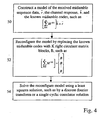
- Multiburst channel estimation will be explained in conjunction with the flow chart of Figure 4.
- h (k) Equation 2 is used.
- r W ... r LM are the received combined chips of the midamble sequences.
- the m values are the elements of m p .
- Equation 2 may also be rewritten in shorthand as Equation 3.
- Each M (k) is a KW-by-W matrix.
- r is the received midamble chip responses.
- h (1) ... h (k) can be replaced by h as in Equation 4, 50.
- G is defined as per Equation 5.
- G [ M (1) ,..., M ( k ) ,..., M ( k ) ]
- G is a KW-by-KW matrix.
- Equation 4 can be rewritten using K identical right circulant matrix blocks B, as per Equation 6, 52.
- B is a W-by-W right circulant matrix.
- the number of B-blocks is K.
- Equation 7 describes an over-determined system with dimensions KW-by-W.
- Equation 7 is a least squares solution, 54.
- Equation 8. h ( D H D ) -1 D H r D H is the hermitian of D.
- the received vector r of dimension KW can be decomposed as per Equation 10.
- the dimension of r k is W.
- Equation 9 and 10 the least-squares solution for the channel coefficients per Equation 11 results.
- r k represents the average of the segments of r . Since B is a square matrix, Equation 11 becomes Equation 12.
- the channel estimator can be implemented by a single cyclic correlator of dimension 57, or by a discrete fourier transform (DFT) solution.
- DFT discrete fourier transform
- D* W is the element-by-element complex conjugate of D w .
- ⁇ R is a diagonal matrix whose main diagonal is the DFT of the first row of B per Equation 17. Since the transpose of B, B T , is also right circulant and that its first column is the first row of B, B T can be expressed by Equation 18.
- Equation 20 Equation 20. Equations 16 or 20 can be used to solve for h . Since all DFTs are of length W, the complexity in solving the equations is dramatically reduced.
- Equation 21 An approach using a single cycle correlator is as follows. Since B -1 is the inverse of a right circulant matrix, it can be written as Equation 21. The first row of the matrix T is equal to the inverse DFT of the main diagonal of A -1 R . Thus, the matrix T is completely determined by ⁇ -1 R .
- the taps of the channel response h are obtained successively by an inner product of successive rows of T with the average of W-length segments of the received vector r .
- the successive rows of T are circularly right shifted versions of the previous row.
- the first register holds the averaged segments of r and the second register is a shift register that holds the first row of the matrix T.
- the second register is circularly shifted at a certain clock rate.
- a new element of h is determined by the inner product of the vectors stored in the two registers. It is advantageous to shift the first row of the matrix T rather than the received midambles. As a result, no extra storage is required for the midambles.
- the midambles continue to reside in the received buffer that holds the entire burst. Since the correlator length is only W, a significant reduction in complexity of estimating the channel is achieved.
Landscapes
- Engineering & Computer Science (AREA)
- Computer Networks & Wireless Communication (AREA)
- Signal Processing (AREA)
- Power Engineering (AREA)
- Physics & Mathematics (AREA)
- Mathematical Physics (AREA)
- Mobile Radio Communication Systems (AREA)
- Time-Division Multiplex Systems (AREA)
- Bidirectional Digital Transmission (AREA)
- Cable Transmission Systems, Equalization Of Radio And Reduction Of Echo (AREA)
Claims (20)
- Procédé permettant d'estimer un canal sans fil dans un système de communication bidirectionnelle à répartition dans le temps, utilisant un accès multiple à répartition par code, le système étant associé à N séquences d'apprentissage, le canal sans fil existant entre un émetteur unique et un récepteur unique, l'émetteur unique émettant K salves de communication dans un spectre partagé dans un intervalle de temps, chaque salve ayant une séquence d'apprentissage associée des N séquences, le récepteur connaissant les N séquences d'apprentissage et recevant un vecteur correspondant aux séquences d'apprentissage émises des K salves de communication au niveau du récepteur unique, le procédé étant caractérisé en ce que :on construit une matrice ayant N blocs de matrice circulante droite identiques en partie sur la base des N séquences d'apprentissage connues (50, 52) ; eton estime le canal sans fil en partie sur la base des N blocs et du vecteur reçu (54).
- Procédé selon la revendication 1, caractérisé en outre en ce que l'estimation du canal sans fil est réalisée en utilisant une solution des moindres carrés.
- Procédé selon la revendication 2, caractérisé en outre en ce que la solution des moindres carrés est mise en oeuvre en utilisant un seul corrélateur cyclique.
- Procédé selon la revendication 2, caractérisé en outre en ce que la solution des moindres carrés est mise en oeuvre en utilisant une solution de transformée de Fourier discrète.
- Procédé selon la revendication 1, caractérisé en outre en ce que N est un nombre maximum de codes d'apprentissage associés au système.
- Procédé selon la revendication 1, caractérisé en outre en ce que N est un nombre de phases d'apprentissage différentes émises dans les K salves.
- Procédé selon la revendication 1, caractérisé en outre en ce qu'une dimension de l'estimation est une longueur d'une réponse de canal du canal sans fil.
- Récepteur (28) destiné à être utilisé dans un système de communication bidirectionnelle à répartition dans le temps sans fil utilisant un accès multiple à répartition par code, le système étant associé à N séquences d'apprentissage, un émetteur unique (38) dans le système émettant K salves de communication dans un spectre partagé dans un intervalle de temps, chaque salve ayant une séquence d'apprentissage associée constituée des N séquences, le récepteur (28) connaissant les N séquences d'apprentissage, le récepteur (28) comprenant une antenne (40) permettant de recevoir les K salves de communication comprenant un vecteur correspondant aux séquences d'apprentissage émises des salves, le récepteur (28) étant caractérisé en ce qu'il comprend :un estimateur de canal (44) permettant de construire une matrice ayant N blocs de matrice circulante droite identiques en partie sur la base des N séquences d'apprentissage connues, et d'estimer le canal sans fil entre le récepteur et l'émetteur unique en partie sur la base de l'un des N blocs et du vecteur reçu ; etun détecteur de données (46) permettant de capter les données provenant des salves de communication reçues en utilisant le canal sans fil estimé.
- Récepteur selon la revendication 8, caractérisé en outre en ce que le détecteur de données est un détecteur multiutilisateur.
- Récepteur selon la revendication 8, caractérisé en outre en ce que le détecteur de données est un détecteur destiné à un seul utilisateur.
- Récepteur selon la revendication 8, caractérisé en outre en ce que l'estimation du canal sans fil est réalisée en utilisant une solution des moindres carrés.
- Récepteur selon la revendication 11, caractérisé en outre en ce que la solution des moindres carrés est mise en oeuvre en utilisant une solution de transformée de Fourier discrète.
- Récepteur selon la revendication 11, caractérisé en outre en ce que la solution des moindres carrés est mise en oeuvre en utilisant un seul corrélateur cyclique.
- Système de communication à étalement du spectre sans fil utilisant un accès multiple à répartition par code associé à N séquences d'apprentissage, le système communiquant en utilisant des salves de communication, chaque salve ayant une séquence d'apprentissage associée, une station de base (12) comprenant : un générateur de données (32) permettant de générer des données ; une pluralité de dispositifs de modulation / d'étalement (34) permettant de formater les données générées en K salves de communication multiplexées dans le temps de telle sorte qu'elles se trouvent dans un même intervalle de temps et dans un spectre partagé ; et une antenne (38) permettant de diffuser les K salves de communication ; et un équipement utilisateur (28) comprenant : une antenne (40) permettant de recevoir les K salves de communication, y compris un vecteur correspondant aux séquences d'apprentissage émises des salves ; le système étant caractérisé en ce que l'équipement utilisateur comprend :un estimateur de canal (44) permettant de construire une matrice ayant N blocs de matrice circulante droite identiques en partie sur la base des N séquences d'apprentissage, et d'estimer le canal sans fil entre la station de base et l'équipement utilisateur en partie sur la base de l'un des N blocs et du vecteur reçu ; etun détecteur de données (46) permettant de capter les données provenant des salves de communication reçues en utilisant le canal sans fil estimé.
- Système selon la revendication 14, caractérisé en outre en ce que le détecteur de données (46) est un détecteur multiutilisateur.
- Système selon la revendication 14, caractérisé en outre en ce que le détecteur de données (46) est constitué d'une pluralité de détecteurs destinés à un seul utilisateur.
- Système selon la revendication 14, caractérisé en outre en ce que l'estimation du canal sans fil est réalisée en utilisant une solution des moindres carrés.
- Système selon la revendication 17, caractérisé en outre en ce que la solution des moindres carrés est mise en oeuvre en utilisant une solution de transformée de Fourier discrète.
- Système selon la revendication 17, caractérisé en outre en ce que la solution des moindres carrés est mise en oeuvre en utilisant un seul corrélateur cyclique.
- Système selon la revendication 14, caractérisé en outre en ce que la station de base (12) émet de manière efficace des données à un débit de 2 Mbps à l'équipement utilisateur (28).
Priority Applications (4)
| Application Number | Priority Date | Filing Date | Title |
|---|---|---|---|
| EP05111738A EP1635525B8 (fr) | 2000-01-07 | 2001-01-05 | Estimation de canal pour un système de communication duplex à répartition dans le temps |
| EP07110145A EP1830530A3 (fr) | 2000-01-07 | 2001-01-05 | Estimation de canal dans des systèmes de communication en duplex par division temporelle |
| EP04006212A EP1437869B1 (fr) | 2000-01-07 | 2001-01-05 | Estimation de canal pour un système de communication duplex à répartition dans le temps |
| DK04006212T DK1437869T3 (da) | 2000-01-07 | 2001-01-05 | Kanalestimering til TDD (time division duplex) kommunikationssystemer |
Applications Claiming Priority (3)
| Application Number | Priority Date | Filing Date | Title |
|---|---|---|---|
| US17516700P | 2000-01-07 | 2000-01-07 | |
| US175167P | 2000-01-07 | ||
| PCT/US2001/000388 WO2001052489A1 (fr) | 2000-01-07 | 2001-01-05 | Estimation de voie pour les systemes de communication duplex a repartition dans le temps |
Related Child Applications (1)
| Application Number | Title | Priority Date | Filing Date |
|---|---|---|---|
| EP04006212A Division EP1437869B1 (fr) | 2000-01-07 | 2001-01-05 | Estimation de canal pour un système de communication duplex à répartition dans le temps |
Publications (2)
| Publication Number | Publication Date |
|---|---|
| EP1245100A1 EP1245100A1 (fr) | 2002-10-02 |
| EP1245100B1 true EP1245100B1 (fr) | 2004-05-26 |
Family
ID=22639211
Family Applications (1)
| Application Number | Title | Priority Date | Filing Date |
|---|---|---|---|
| EP01901796A Expired - Lifetime EP1245100B1 (fr) | 2000-01-07 | 2001-01-05 | Estimation de voie pour les systemes de communication duplex a repartition dans le temps |
Country Status (15)
| Country | Link |
|---|---|
| US (5) | US6985513B2 (fr) |
| EP (1) | EP1245100B1 (fr) |
| JP (2) | JP3809377B2 (fr) |
| KR (4) | KR100671869B1 (fr) |
| CN (3) | CN1227877C (fr) |
| AT (3) | ATE268084T1 (fr) |
| AU (1) | AU2765801A (fr) |
| CA (1) | CA2396571C (fr) |
| DE (3) | DE60103495T2 (fr) |
| DK (1) | DK1635525T3 (fr) |
| ES (3) | ES2255010T3 (fr) |
| MX (1) | MXPA02006668A (fr) |
| NO (1) | NO20023119L (fr) |
| TW (1) | TW512611B (fr) |
| WO (1) | WO2001052489A1 (fr) |
Families Citing this family (35)
| Publication number | Priority date | Publication date | Assignee | Title |
|---|---|---|---|---|
| US6765894B1 (en) * | 1999-07-05 | 2004-07-20 | Matsushita Electric Industrial Co, Ltd. | Communication terminal apparatus and base station apparatus |
| ATE268084T1 (de) | 2000-01-07 | 2004-06-15 | Interdigital Tech Corp | Kanalschätzung für zeit- duplexkommunikationssysteme |
| FI115268B (fi) * | 2000-05-12 | 2005-03-31 | Nokia Corp | Tehonsäätö radiojärjestelmässä |
| GB2378328B (en) * | 2001-08-01 | 2005-07-13 | Ipwireless Inc | AGC scheme and receiver for use in a wireless communication system |
| DE10138962B4 (de) * | 2001-08-08 | 2011-05-12 | Rohde & Schwarz Gmbh & Co. Kg | Verfahren zur Erkennung von aktiven Codesequenzen |
| US7218624B2 (en) * | 2001-11-14 | 2007-05-15 | Interdigital Technology Corporation | User equipment and base station performing data detection using a scalar array |
| EP1464127B1 (fr) * | 2002-01-09 | 2013-05-22 | Nokia Corporation | Procede et recepteur pour la reception d'un signal composite |
| US7593357B2 (en) | 2002-03-28 | 2009-09-22 | Interdigital Technology Corporation | Transmit processing using receiver functions |
| US7428278B2 (en) * | 2002-05-09 | 2008-09-23 | Interdigital Technology Corporation | Method and apparatus for parallel midamble cancellation |
| US7260056B2 (en) * | 2002-05-29 | 2007-08-21 | Interdigital Technology Corporation | Channel estimation in a wireless communication system |
| US7039001B2 (en) * | 2002-10-29 | 2006-05-02 | Qualcomm, Incorporated | Channel estimation for OFDM communication systems |
| US7042967B2 (en) | 2003-03-03 | 2006-05-09 | Interdigital Technology Corporation | Reduced complexity sliding window based equalizer |
| US6944142B2 (en) * | 2003-05-13 | 2005-09-13 | Interdigital Technology Corporation | Method for soft and softer handover in time division duplex code division multiple access (TDD-CDMA) networks |
| US7437135B2 (en) | 2003-10-30 | 2008-10-14 | Interdigital Technology Corporation | Joint channel equalizer interference canceller advanced receiver |
| US7400692B2 (en) | 2004-01-14 | 2008-07-15 | Interdigital Technology Corporation | Telescoping window based equalization |
| US8891349B2 (en) | 2004-07-23 | 2014-11-18 | Qualcomm Incorporated | Method of optimizing portions of a frame |
| KR100600817B1 (ko) * | 2004-12-09 | 2006-07-18 | 한국전자통신연구원 | 주기적 상관 관계의 특성을 이용한 타이밍 에러 검출 장치및 그 방법 |
| US8045599B2 (en) * | 2005-02-17 | 2011-10-25 | Sony Corporation | Selection of training sequences for multiple-in multiple-out transmissions |
| US7373130B2 (en) * | 2005-04-13 | 2008-05-13 | Telefonaktiebolaget L M Ericsson (Publ) | Simultaneous channel estimation of a carrier and an interferer |
| US8170047B2 (en) * | 2005-05-09 | 2012-05-01 | Qualcomm Incorporated | Data transmission with efficient slot and block formats in a wireless communication system |
| CN1863021B (zh) * | 2005-05-13 | 2010-04-28 | 上海原动力通信科技有限公司 | 无线通信系统中的码道分配方法和多用户检测方法 |
| CN101467407B (zh) * | 2006-04-27 | 2016-05-04 | 意大利电信股份公司 | 单一载波频分多址系统中的频域信道估计 |
| FI20065276A0 (fi) * | 2006-04-28 | 2006-04-28 | Nokia Corp | Signaalin käsittelymenetelmä, vastaanotin ja tasoitusmenetelmä vastaanottimessa |
| KR100766065B1 (ko) | 2006-06-01 | 2007-10-11 | 한국전자통신연구원 | 다중 입출력 시스템 및 그 시스템의 수신기에서의 송신벡터 복조 방법 |
| KR101298546B1 (ko) * | 2006-06-27 | 2013-08-22 | 한국과학기술원 | 시분할 복신 시스템에서 시분할 스케줄링 장치 및 방법 |
| FR2903257A1 (fr) * | 2006-06-30 | 2008-01-04 | Thomson Licensing Sas | Procede de communication adapte a la transmission de paquets de donnees |
| US8102795B2 (en) * | 2007-03-09 | 2012-01-24 | Qualcomm Incorporated | Channel equalization with non-common midamble allocation in 3GPP TD-CDMA systems |
| US8379778B2 (en) * | 2007-06-28 | 2013-02-19 | Qualcomm Incorporated | Bursty interference suppression for communications receivers |
| KR100910822B1 (ko) * | 2007-11-03 | 2009-08-04 | 민병돈 | 코사혈침이 형성된 플래시 |
| KR100918500B1 (ko) * | 2007-12-03 | 2009-09-24 | 한국전자통신연구원 | 무선 통신 시스템에서의 채널 추정 방법 및 장치 |
| KR100966018B1 (ko) * | 2008-02-04 | 2010-06-24 | 에스케이 텔레콤주식회사 | 이동 통신망의 상향 링크에서의 다중셀 결합 채널 추정방법 및 시스템 |
| US8654911B2 (en) * | 2008-08-20 | 2014-02-18 | Qualcomm Incorporated | Uplink SDMA pilot estimation |
| KR101446927B1 (ko) * | 2013-04-04 | 2014-10-06 | 전북대학교산학협력단 | 대규모 mimo에서 cjm에 기반한 채널 추정 방법 및 시스템 |
| KR102190919B1 (ko) * | 2014-09-11 | 2020-12-14 | 삼성전자주식회사 | 시분할 듀플렉싱 코드 분할 다중 접속 방식을 지원하는 통신 시스템에서 신호 검출 장치 및 방법 |
| US11381281B2 (en) * | 2020-02-04 | 2022-07-05 | Powermat Technologies Ltd. | Fast data transmission for wireless power transfer systems |
Family Cites Families (8)
| Publication number | Priority date | Publication date | Assignee | Title |
|---|---|---|---|---|
| US5047859A (en) * | 1990-10-09 | 1991-09-10 | North American Philips Corporation | Method and apparatus for communication channel identification and signal restoration |
| FI102797B (fi) | 1994-10-07 | 1999-02-15 | Nokia Mobile Phones Ltd | Signaalin ilmaisumenetelmä TDMA-matkaviestinjärjestelmän vastaanottime ssa sekä menetelmän toteuttava vastaanotin |
| EP0767543A3 (fr) | 1995-10-06 | 2000-07-26 | Siemens Aktiengesellschaft | Communication à multiplexage par répartition de code avec suppression d'interférence |
| US5790060A (en) * | 1996-09-11 | 1998-08-04 | Harris Corporation | Digital-to-analog converter having enhanced current steering and associated method |
| US5933768A (en) | 1997-02-28 | 1999-08-03 | Telefonaktiebolaget L/M Ericsson | Receiver apparatus, and associated method, for receiving a receive signal transmitted upon a channel susceptible to interference |
| DE19820761C1 (de) | 1998-05-08 | 1999-06-24 | Siemens Ag | Verfahren und Einrichtung zur Kanalschätzung |
| US6535554B1 (en) * | 1998-11-17 | 2003-03-18 | Harris Corporation | PCS signal separation in a one dimensional channel |
| ATE268084T1 (de) | 2000-01-07 | 2004-06-15 | Interdigital Tech Corp | Kanalschätzung für zeit- duplexkommunikationssysteme |
-
2001
- 2001-01-05 AT AT01901796T patent/ATE268084T1/de not_active IP Right Cessation
- 2001-01-05 CN CNB018034764A patent/CN1227877C/zh not_active Expired - Fee Related
- 2001-01-05 DE DE60103495T patent/DE60103495T2/de not_active Expired - Lifetime
- 2001-01-05 MX MXPA02006668A patent/MXPA02006668A/es active IP Right Grant
- 2001-01-05 KR KR1020067002308A patent/KR100671869B1/ko not_active Expired - Fee Related
- 2001-01-05 US US09/755,400 patent/US6985513B2/en not_active Expired - Fee Related
- 2001-01-05 AT AT05111738T patent/ATE368996T1/de not_active IP Right Cessation
- 2001-01-05 DE DE60129756T patent/DE60129756T2/de not_active Expired - Lifetime
- 2001-01-05 CN CNA2006100999478A patent/CN1893296A/zh active Pending
- 2001-01-05 AT AT04006212T patent/ATE312459T1/de not_active IP Right Cessation
- 2001-01-05 ES ES04006212T patent/ES2255010T3/es not_active Expired - Lifetime
- 2001-01-05 CA CA002396571A patent/CA2396571C/fr not_active Expired - Fee Related
- 2001-01-05 KR KR1020067000267A patent/KR100671868B1/ko not_active Expired - Fee Related
- 2001-01-05 DK DK05111738T patent/DK1635525T3/da active
- 2001-01-05 ES ES01901796T patent/ES2218370T3/es not_active Expired - Lifetime
- 2001-01-05 KR KR1020047014349A patent/KR100604732B1/ko not_active Expired - Fee Related
- 2001-01-05 WO PCT/US2001/000388 patent/WO2001052489A1/fr not_active Ceased
- 2001-01-05 DE DE60115723T patent/DE60115723T2/de not_active Expired - Lifetime
- 2001-01-05 EP EP01901796A patent/EP1245100B1/fr not_active Expired - Lifetime
- 2001-01-05 TW TW090100264A patent/TW512611B/zh not_active IP Right Cessation
- 2001-01-05 JP JP2001552588A patent/JP3809377B2/ja not_active Expired - Fee Related
- 2001-01-05 AU AU27658/01A patent/AU2765801A/en not_active Abandoned
- 2001-01-05 ES ES05111738T patent/ES2292076T3/es not_active Expired - Lifetime
- 2001-01-05 CN CNB2005100992811A patent/CN100531162C/zh not_active Expired - Fee Related
- 2001-01-05 KR KR10-2002-7008737A patent/KR100481261B1/ko not_active Expired - Fee Related
-
2002
- 2002-06-27 NO NO20023119A patent/NO20023119L/no not_active Application Discontinuation
-
2005
- 2005-03-14 JP JP2005070834A patent/JP2005245004A/ja not_active Ceased
- 2005-09-01 US US11/217,960 patent/US7103092B2/en not_active Expired - Fee Related
-
2006
- 2006-07-21 US US11/491,463 patent/US7280584B2/en not_active Expired - Fee Related
-
2007
- 2007-10-01 US US11/865,268 patent/US7474689B2/en not_active Expired - Fee Related
-
2008
- 2008-12-31 US US12/346,985 patent/US7672360B2/en not_active Expired - Fee Related
Also Published As
Similar Documents
| Publication | Publication Date | Title |
|---|---|---|
| US7672360B2 (en) | Channel estimation for time division duplex communication systems | |
| KR100669959B1 (ko) | 단일 사용자 검출 방법 및 장치 | |
| JP2007060686A (ja) | 高速ジョイント検出 | |
| EP1437869B1 (fr) | Estimation de canal pour un système de communication duplex à répartition dans le temps | |
| EP1635525B1 (fr) | Estimation de canal pour un système de communication duplex à répartition dans le temps | |
| EP1830530A2 (fr) | Estimation de canal dans des systèmes de communication en duplex par division temporelle | |
| HK1048715B (en) | Channel estimation for time division duplex communication systems | |
| HK1065202B (en) | Channel estimation for time division duplex communication systems | |
| HK1088154B (en) | Channel estimation for time division duplex communication systems | |
| CA2554193A1 (fr) | Estimation relative aux canaux pour systemes de communication duplex a repartition dans le temps |
Legal Events
| Date | Code | Title | Description |
|---|---|---|---|
| PUAI | Public reference made under article 153(3) epc to a published international application that has entered the european phase |
Free format text: ORIGINAL CODE: 0009012 |
|
| 17P | Request for examination filed |
Effective date: 20020705 |
|
| AK | Designated contracting states |
Kind code of ref document: A1 Designated state(s): AT BE CH CY DE DK ES FI FR GB GR IE IT LI LU MC NL PT SE TR |
|
| AX | Request for extension of the european patent |
Free format text: AL;LT;LV;MK;RO;SI |
|
| GRAP | Despatch of communication of intention to grant a patent |
Free format text: ORIGINAL CODE: EPIDOSNIGR1 |
|
| GRAS | Grant fee paid |
Free format text: ORIGINAL CODE: EPIDOSNIGR3 |
|
| GRAA | (expected) grant |
Free format text: ORIGINAL CODE: 0009210 |
|
| AK | Designated contracting states |
Kind code of ref document: B1 Designated state(s): AT BE CH CY DE DK ES FI FR GB GR IE IT LI LU MC NL PT SE TR |
|
| PG25 | Lapsed in a contracting state [announced via postgrant information from national office to epo] |
Ref country code: BE Free format text: LAPSE BECAUSE OF FAILURE TO SUBMIT A TRANSLATION OF THE DESCRIPTION OR TO PAY THE FEE WITHIN THE PRESCRIBED TIME-LIMIT Effective date: 20040526 Ref country code: LI Free format text: LAPSE BECAUSE OF FAILURE TO SUBMIT A TRANSLATION OF THE DESCRIPTION OR TO PAY THE FEE WITHIN THE PRESCRIBED TIME-LIMIT Effective date: 20040526 Ref country code: AT Free format text: LAPSE BECAUSE OF FAILURE TO SUBMIT A TRANSLATION OF THE DESCRIPTION OR TO PAY THE FEE WITHIN THE PRESCRIBED TIME-LIMIT Effective date: 20040526 Ref country code: CH Free format text: LAPSE BECAUSE OF FAILURE TO SUBMIT A TRANSLATION OF THE DESCRIPTION OR TO PAY THE FEE WITHIN THE PRESCRIBED TIME-LIMIT Effective date: 20040526 Ref country code: TR Free format text: LAPSE BECAUSE OF FAILURE TO SUBMIT A TRANSLATION OF THE DESCRIPTION OR TO PAY THE FEE WITHIN THE PRESCRIBED TIME-LIMIT Effective date: 20040526 Ref country code: NL Free format text: LAPSE BECAUSE OF FAILURE TO SUBMIT A TRANSLATION OF THE DESCRIPTION OR TO PAY THE FEE WITHIN THE PRESCRIBED TIME-LIMIT Effective date: 20040526 |
|
| REG | Reference to a national code |
Ref country code: GB Ref legal event code: FG4D |
|
| REG | Reference to a national code |
Ref country code: CH Ref legal event code: EP |
|
| REG | Reference to a national code |
Ref country code: SE Ref legal event code: TRGR |
|
| REG | Reference to a national code |
Ref country code: IE Ref legal event code: FG4D |
|
| REF | Corresponds to: |
Ref document number: 60103495 Country of ref document: DE Date of ref document: 20040701 Kind code of ref document: P |
|
| PG25 | Lapsed in a contracting state [announced via postgrant information from national office to epo] |
Ref country code: DK Free format text: LAPSE BECAUSE OF FAILURE TO SUBMIT A TRANSLATION OF THE DESCRIPTION OR TO PAY THE FEE WITHIN THE PRESCRIBED TIME-LIMIT Effective date: 20040826 Ref country code: GR Free format text: LAPSE BECAUSE OF FAILURE TO SUBMIT A TRANSLATION OF THE DESCRIPTION OR TO PAY THE FEE WITHIN THE PRESCRIBED TIME-LIMIT Effective date: 20040826 |
|
| REG | Reference to a national code |
Ref country code: ES Ref legal event code: FG2A Ref document number: 2218370 Country of ref document: ES Kind code of ref document: T3 |
|
| LTIE | Lt: invalidation of european patent or patent extension |
Effective date: 20040526 |
|
| REG | Reference to a national code |
Ref country code: CH Ref legal event code: PL |
|
| NLV1 | Nl: lapsed or annulled due to failure to fulfill the requirements of art. 29p and 29m of the patents act | ||
| REG | Reference to a national code |
Ref country code: HK Ref legal event code: GR Ref document number: 1048715 Country of ref document: HK |
|
| PG25 | Lapsed in a contracting state [announced via postgrant information from national office to epo] |
Ref country code: CY Free format text: LAPSE BECAUSE OF FAILURE TO SUBMIT A TRANSLATION OF THE DESCRIPTION OR TO PAY THE FEE WITHIN THE PRESCRIBED TIME-LIMIT Effective date: 20050105 Ref country code: IE Free format text: LAPSE BECAUSE OF NON-PAYMENT OF DUE FEES Effective date: 20050105 Ref country code: LU Free format text: LAPSE BECAUSE OF NON-PAYMENT OF DUE FEES Effective date: 20050105 |
|
| PG25 | Lapsed in a contracting state [announced via postgrant information from national office to epo] |
Ref country code: MC Free format text: LAPSE BECAUSE OF NON-PAYMENT OF DUE FEES Effective date: 20050131 |
|
| ET | Fr: translation filed | ||
| PLBE | No opposition filed within time limit |
Free format text: ORIGINAL CODE: 0009261 |
|
| STAA | Information on the status of an ep patent application or granted ep patent |
Free format text: STATUS: NO OPPOSITION FILED WITHIN TIME LIMIT |
|
| 26N | No opposition filed |
Effective date: 20050301 |
|
| REG | Reference to a national code |
Ref country code: IE Ref legal event code: MM4A |
|
| PG25 | Lapsed in a contracting state [announced via postgrant information from national office to epo] |
Ref country code: PT Free format text: LAPSE BECAUSE OF NON-PAYMENT OF DUE FEES Effective date: 20041026 |
|
| PGFP | Annual fee paid to national office [announced via postgrant information from national office to epo] |
Ref country code: ES Payment date: 20131211 Year of fee payment: 14 |
|
| PGFP | Annual fee paid to national office [announced via postgrant information from national office to epo] |
Ref country code: FI Payment date: 20140110 Year of fee payment: 14 Ref country code: SE Payment date: 20140113 Year of fee payment: 14 Ref country code: DE Payment date: 20131231 Year of fee payment: 14 |
|
| PGFP | Annual fee paid to national office [announced via postgrant information from national office to epo] |
Ref country code: IT Payment date: 20140108 Year of fee payment: 14 Ref country code: FR Payment date: 20140108 Year of fee payment: 14 |
|
| PGFP | Annual fee paid to national office [announced via postgrant information from national office to epo] |
Ref country code: GB Payment date: 20140102 Year of fee payment: 14 |
|
| REG | Reference to a national code |
Ref country code: DE Ref legal event code: R119 Ref document number: 60103495 Country of ref document: DE |
|
| REG | Reference to a national code |
Ref country code: SE Ref legal event code: EUG |
|
| GBPC | Gb: european patent ceased through non-payment of renewal fee |
Effective date: 20150105 |
|
| PG25 | Lapsed in a contracting state [announced via postgrant information from national office to epo] |
Ref country code: GB Free format text: LAPSE BECAUSE OF NON-PAYMENT OF DUE FEES Effective date: 20150105 Ref country code: FI Free format text: LAPSE BECAUSE OF NON-PAYMENT OF DUE FEES Effective date: 20150105 Ref country code: DE Free format text: LAPSE BECAUSE OF NON-PAYMENT OF DUE FEES Effective date: 20150801 |
|
| REG | Reference to a national code |
Ref country code: FR Ref legal event code: ST Effective date: 20150930 |
|
| PG25 | Lapsed in a contracting state [announced via postgrant information from national office to epo] |
Ref country code: SE Free format text: LAPSE BECAUSE OF NON-PAYMENT OF DUE FEES Effective date: 20150106 Ref country code: FR Free format text: LAPSE BECAUSE OF NON-PAYMENT OF DUE FEES Effective date: 20150202 |
|
| PG25 | Lapsed in a contracting state [announced via postgrant information from national office to epo] |
Ref country code: IT Free format text: LAPSE BECAUSE OF NON-PAYMENT OF DUE FEES Effective date: 20150105 |
|
| REG | Reference to a national code |
Ref country code: ES Ref legal event code: FD2A Effective date: 20160226 |
|
| PG25 | Lapsed in a contracting state [announced via postgrant information from national office to epo] |
Ref country code: ES Free format text: LAPSE BECAUSE OF NON-PAYMENT OF DUE FEES Effective date: 20150106 |