EP1637639A2 - Procédé pour la fabrication d'une bande élastique - Google Patents
Procédé pour la fabrication d'une bande élastique Download PDFInfo
- Publication number
- EP1637639A2 EP1637639A2 EP05018520A EP05018520A EP1637639A2 EP 1637639 A2 EP1637639 A2 EP 1637639A2 EP 05018520 A EP05018520 A EP 05018520A EP 05018520 A EP05018520 A EP 05018520A EP 1637639 A2 EP1637639 A2 EP 1637639A2
- Authority
- EP
- European Patent Office
- Prior art keywords
- nonwoven web
- laminate
- composite
- elongating
- elongation
- Prior art date
- Legal status (The legal status is an assumption and is not a legal conclusion. Google has not performed a legal analysis and makes no representation as to the accuracy of the status listed.)
- Withdrawn
Links
Images

Classifications
-
- D—TEXTILES; PAPER
- D06—TREATMENT OF TEXTILES OR THE LIKE; LAUNDERING; FLEXIBLE MATERIALS NOT OTHERWISE PROVIDED FOR
- D06C—FINISHING, DRESSING, TENTERING OR STRETCHING TEXTILE FABRICS
- D06C3/00—Stretching, tentering or spreading textile fabrics; Producing elasticity in textile fabrics
- D06C3/06—Stretching, tentering or spreading textile fabrics; Producing elasticity in textile fabrics by rotary disc, roller, or like apparatus
-
- D—TEXTILES; PAPER
- D06—TREATMENT OF TEXTILES OR THE LIKE; LAUNDERING; FLEXIBLE MATERIALS NOT OTHERWISE PROVIDED FOR
- D06C—FINISHING, DRESSING, TENTERING OR STRETCHING TEXTILE FABRICS
- D06C3/00—Stretching, tentering or spreading textile fabrics; Producing elasticity in textile fabrics
-
- B—PERFORMING OPERATIONS; TRANSPORTING
- B32—LAYERED PRODUCTS
- B32B—LAYERED PRODUCTS, i.e. PRODUCTS BUILT-UP OF STRATA OF FLAT OR NON-FLAT, e.g. CELLULAR OR HONEYCOMB, FORM
- B32B27/00—Layered products comprising a layer of synthetic resin
- B32B27/12—Layered products comprising a layer of synthetic resin next to a fibrous or filamentary layer
-
- B—PERFORMING OPERATIONS; TRANSPORTING
- B32—LAYERED PRODUCTS
- B32B—LAYERED PRODUCTS, i.e. PRODUCTS BUILT-UP OF STRATA OF FLAT OR NON-FLAT, e.g. CELLULAR OR HONEYCOMB, FORM
- B32B5/00—Layered products characterised by the non- homogeneity or physical structure, i.e. comprising a fibrous, filamentary, particulate or foam layer; Layered products characterised by having a layer differing constitutionally or physically in different parts
- B32B5/22—Layered products characterised by the non- homogeneity or physical structure, i.e. comprising a fibrous, filamentary, particulate or foam layer; Layered products characterised by having a layer differing constitutionally or physically in different parts characterised by the presence of two or more layers which are next to each other and are fibrous, filamentary, formed of particles or foamed
- B32B5/24—Layered products characterised by the non- homogeneity or physical structure, i.e. comprising a fibrous, filamentary, particulate or foam layer; Layered products characterised by having a layer differing constitutionally or physically in different parts characterised by the presence of two or more layers which are next to each other and are fibrous, filamentary, formed of particles or foamed one layer being a fibrous or filamentary layer
- B32B5/26—Layered products characterised by the non- homogeneity or physical structure, i.e. comprising a fibrous, filamentary, particulate or foam layer; Layered products characterised by having a layer differing constitutionally or physically in different parts characterised by the presence of two or more layers which are next to each other and are fibrous, filamentary, formed of particles or foamed one layer being a fibrous or filamentary layer another layer next to it also being fibrous or filamentary
-
- D—TEXTILES; PAPER
- D04—BRAIDING; LACE-MAKING; KNITTING; TRIMMINGS; NON-WOVEN FABRICS
- D04H—MAKING TEXTILE FABRICS, e.g. FROM FIBRES OR FILAMENTARY MATERIAL; FABRICS MADE BY SUCH PROCESSES OR APPARATUS, e.g. FELTS, NON-WOVEN FABRICS; COTTON-WOOL; WADDING ; NON-WOVEN FABRICS FROM STAPLE FIBRES, FILAMENTS OR YARNS, BONDED WITH AT LEAST ONE WEB-LIKE MATERIAL DURING THEIR CONSOLIDATION
- D04H1/00—Non-woven fabrics formed wholly or mainly of staple fibres or like relatively short fibres
- D04H1/40—Non-woven fabrics formed wholly or mainly of staple fibres or like relatively short fibres from fleeces or layers composed of fibres without existing or potential cohesive properties
- D04H1/42—Non-woven fabrics formed wholly or mainly of staple fibres or like relatively short fibres from fleeces or layers composed of fibres without existing or potential cohesive properties characterised by the use of certain kinds of fibres insofar as this use has no preponderant influence on the consolidation of the fleece
-
- D—TEXTILES; PAPER
- D04—BRAIDING; LACE-MAKING; KNITTING; TRIMMINGS; NON-WOVEN FABRICS
- D04H—MAKING TEXTILE FABRICS, e.g. FROM FIBRES OR FILAMENTARY MATERIAL; FABRICS MADE BY SUCH PROCESSES OR APPARATUS, e.g. FELTS, NON-WOVEN FABRICS; COTTON-WOOL; WADDING ; NON-WOVEN FABRICS FROM STAPLE FIBRES, FILAMENTS OR YARNS, BONDED WITH AT LEAST ONE WEB-LIKE MATERIAL DURING THEIR CONSOLIDATION
- D04H13/00—Other non-woven fabrics
-
- B—PERFORMING OPERATIONS; TRANSPORTING
- B32—LAYERED PRODUCTS
- B32B—LAYERED PRODUCTS, i.e. PRODUCTS BUILT-UP OF STRATA OF FLAT OR NON-FLAT, e.g. CELLULAR OR HONEYCOMB, FORM
- B32B2250/00—Layers arrangement
- B32B2250/20—All layers being fibrous or filamentary
-
- D—TEXTILES; PAPER
- D10—INDEXING SCHEME ASSOCIATED WITH SUBLASSES OF SECTION D, RELATING TO TEXTILES
- D10B—INDEXING SCHEME ASSOCIATED WITH SUBLASSES OF SECTION D, RELATING TO TEXTILES
- D10B2509/00—Medical; Hygiene
- D10B2509/02—Bandages, dressings or absorbent pads
- D10B2509/026—Absorbent pads; Tampons; Laundry; Towels
-
- Y—GENERAL TAGGING OF NEW TECHNOLOGICAL DEVELOPMENTS; GENERAL TAGGING OF CROSS-SECTIONAL TECHNOLOGIES SPANNING OVER SEVERAL SECTIONS OF THE IPC; TECHNICAL SUBJECTS COVERED BY FORMER USPC CROSS-REFERENCE ART COLLECTIONS [XRACs] AND DIGESTS
- Y10—TECHNICAL SUBJECTS COVERED BY FORMER USPC
- Y10T—TECHNICAL SUBJECTS COVERED BY FORMER US CLASSIFICATION
- Y10T442/00—Fabric [woven, knitted, or nonwoven textile or cloth, etc.]
- Y10T442/60—Nonwoven fabric [i.e., nonwoven strand or fiber material]
-
- Y—GENERAL TAGGING OF NEW TECHNOLOGICAL DEVELOPMENTS; GENERAL TAGGING OF CROSS-SECTIONAL TECHNOLOGIES SPANNING OVER SEVERAL SECTIONS OF THE IPC; TECHNICAL SUBJECTS COVERED BY FORMER USPC CROSS-REFERENCE ART COLLECTIONS [XRACs] AND DIGESTS
- Y10—TECHNICAL SUBJECTS COVERED BY FORMER USPC
- Y10T—TECHNICAL SUBJECTS COVERED BY FORMER US CLASSIFICATION
- Y10T442/00—Fabric [woven, knitted, or nonwoven textile or cloth, etc.]
- Y10T442/60—Nonwoven fabric [i.e., nonwoven strand or fiber material]
- Y10T442/601—Nonwoven fabric has an elastic quality
-
- Y—GENERAL TAGGING OF NEW TECHNOLOGICAL DEVELOPMENTS; GENERAL TAGGING OF CROSS-SECTIONAL TECHNOLOGIES SPANNING OVER SEVERAL SECTIONS OF THE IPC; TECHNICAL SUBJECTS COVERED BY FORMER USPC CROSS-REFERENCE ART COLLECTIONS [XRACs] AND DIGESTS
- Y10—TECHNICAL SUBJECTS COVERED BY FORMER USPC
- Y10T—TECHNICAL SUBJECTS COVERED BY FORMER US CLASSIFICATION
- Y10T442/00—Fabric [woven, knitted, or nonwoven textile or cloth, etc.]
- Y10T442/60—Nonwoven fabric [i.e., nonwoven strand or fiber material]
- Y10T442/69—Autogenously bonded nonwoven fabric
Definitions
- Embodiments relate generally to methods for activating nonwoven webs, laminates, and composites thereof. More particularly, embodiments relate to the activation of nonwoven webs, laminates, and composites thereof for use in, for example, diapers, articles for the control of the effects of incontinence, bandages, and other hygiene articles.
- Nonwoven fabrics especially inexpensive polymer-based nonwoven fabrics, have found increasing use in the textile market.
- Nonwoven fabrics typically are webs, batts, mats, sheets, or films of fiber networks. They are commonly referred to simply as “nonwoven webs” or “webs.”
- Many different natural, synthetic, and semi-synthetic polymer fibers are used to create nonwoven webs.
- Nonwoven webs may consist of one type of fiber, several different types of fibers, laminates of different fibers, and composites. The fibers may be staple (short fibers) or filaments (long fibers).
- Nonwoven webs often are combined with other materials to form laminates or composites. If desired, the fibers that comprise the nonwoven web may be bonded to one another using, for example, a chemical binder. Otherwise, the nonwoven webs usually are mechanically bonded through fiber entanglement.
- Nonwoven fabrics have been the relatively inelastic nature of some nonwoven webs. Inelastic fabric often is rough and uncomfortable and therefore of limited utility as a textile. Nonwoven webs may be made more elastic, however; and therefore softer in feel, by a process known as activation. "Activating" a nonwoven web involves stretching or elongating the web in one or more directions beyond the elastic limit of the web. As the nonwoven web is elongated beyond its elastic limit, some of the fibers, inter-fiber bonds, and intra-fiber bonds are believed to be broken. It is believed that breaking of the fibers and bonds of the nonwoven web results in increased elasticity and softness in the web, at least to the degree of elongation.
- U.S. Pat. No. 5,167,897 describes an alternative stretching process in relation to a method for incrementally stretching a laminate web to impart elasticity.
- the method described involves transverse stretching whereby the nonwoven web is stretched by passing it through the nip of interdigitating corrugated or grooved rollers with ribs substantially perpendicular to the axis of rotation.
- the degree of overlap of the opposing ribs on the corrugated rollers may be adjusted to control the degree of stretching or elongation of the web.
- the nonwoven web is stretched in the "transverse" direction (i.e. perpendicular to the direction of travel) as it passes through the nip between the rollers.
- the activation step can likewise be performed on the laminate or composite containing the nonwoven web rather than the nonwoven web by itself.
- U.S. Pat. No. 5,861,074 the disclosure of which is incorporated herein in its entirety, describes using a diagonal intermeshing stretcher, cross direction intermeshing stretcher, machine direction intermeshing stretcher, or incremental stretching technique to stretch the laminate.
- a method for activating a nonwoven web, laminate, composite thereof wherein a nonwoven web, laminate, or composite thereof precursor material is elongated by a first means for elongation to provide a first elongated material.
- the first elongated material then is elongated by a second means for elongation in substantially the same direction and to substantially the same degree of elongation as in the first means for elongation.
- a method for activating a nonwoven web, laminate, or composite thereof includes a first means for elongating the nonwoven web, laminate, or composite thereof precursor material to provide a first elongated material, and a second means for elongating the first elongated material in substantially the same direction and to substantially the same degree of elongation as in the first means for elongation.
- the first and second means for elongation may be, for example, sets of intermeshing gear rollers with ribs, grooves, or teeth either parallel or perpendicular to the axis of rotation of the gear rollers.
- an activated nonwoven web, laminate, or composite thereof is provided, whereby the material is produced by elongating the nonwoven web, laminate, or composite thereof precursor material a first time to provide a first elongated material, and then elongating the first elongated material a second time in substantially the same direction and to substantially the same degree as the first time.
- the nonwoven web, laminate, or composite thereof may possess superior mechanical properties compared to webs activated by other methods.
- an absorbent article in another embodiment, includes an activated nonwoven web, laminate, or composite thereof produced by elongating a nonwoven web, laminate, or composite thereof precursor material a first time to provide a first elongated material, and then elongating the first elongated material a second time in substantially the same direction and to substantially the same degree as the first time.
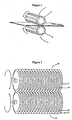
- Figure 1 is a drawing of an exemplary machine direction elongation means.
- Figure 2 is a drawing of an exemplary transverse direction elongation means.
- Figure 3 is a drawing of another exemplary machine direction elongation means.
- Embodiments include the possibility of using a less expensive precursor nonwoven web and still producing an activated nonwoven web, laminate, or composite thereof with acceptable end use properties by carrying out the activation in two procedures, wherein the two activations are carried out in substantially the same direction to the substantially the same degree of activation.
- Tensile and elastic properties in the finished product are as good as, or superior to, more expensive nonwoven webs, laminates, or composites thereof that undergo single activation steps, or double activation steps that are more severe in terms of the degree of elongation that is applied to the web, or where the second activation step applies a higher degree of elongation to the material than does the first.
- substantially means that a given property or parameter (such as direction) may vary by about 10% from the stated value. Preferably, the property or parameter varies by less than 5% of the stated value, and most preferably less than 3%.
- permeability denotes the ability of the vapor or liquid to permeate through the substrate.
- the term "extensibility" of a web refers to the amount of strain (in percent relative to the zero strain state) that can be applied to a web by a tensile force without breakage of fibers, bonds between fibers, or undue distortion of the web structure.
- a nonwoven web to be extensible in any given direction means that when a tensile force is applied to the web in that direction, the web expands in that direction, and a strain is induced in the web, substantially without breakage of fibers or of bonds between fibers.
- the extensibility of a creped web has two components. One is the "intrinsic extensibility" of the web, that refers to the extensibility of the web in its natural, uncreped, state.
- the second component is the "crepe induced extensibility", that refers to the strain that can be applied to extend the web in a given direction by virtue of the creping structure. It can be seen, for example, that after a creped web has been stretched to the point of "crepe induced extensibility," the web is predominantly in its uncreped state.
- absorbent articles means articles that absorb and contain body fluids and other body exudates. More specifically; an absorbent article includes garments that are placed against or in proximity to the body of a wearer to absorb and contain the various exudates discharged from the body.
- knee elongation refers to the inflexion in the stress/strain tensile curve of a material that occurs when the rate of application of stress required to incrementally stretch the material beyond its current point of tension increases significantly.
- the knee elongation refers to the point in the stress/strain curve of the material at which the rate of increase of tensile force with elongation reaches and thereafter exceeds 0.1 Newtons/% elongation, measured on a sample with a width of one inch (25.4 millimeters).
- the significance of "knee elongation” is that it defines a point at which it becomes progressively more difficult in terms of applied stress to stretch the web. For a soft structure, therefore, it is preferable that the knee elongation be as high as possible, so that the web subjectively feels stretchable.
- peak force refers to the maximum force that is seen in the tensile curve of the material, referred to in Newtons per inch of sample width (N/in). A minimum peak force of 8.0 N/in is desirable to ensure that the material has sufficient strength in use.
- a method of activating a nonwoven web, laminate, or composite thereof comprises elongating the nonwoven web, laminate, or composite thereof a first time to provide a first elongated material, and then elongating the first elongated material a second time in substantially the same direction and to substantially the same degree as in the first time.
- the nonwoven web, laminate, or composite thereof may be comprised of any appropriate fiber.
- any appropriate fiber for example, polyethylene, polypropylene, acrylic, polyamide, polyester, rayon, cellulose, nylon, and combinations of such fibers are all appropriate for use in the nonwoven web.
- the nonwoven web in the embodiments also may be the product of any process for forming the same.
- the nonwoven web may be carded, spun-bonded, wet-laid, air-laid and melt-blown as such processes are well known in the art.
- the web is a spun-bonded material made of polypropylene fiber.
- the nonwoven web may be laminated with another film or otherwise formed into a composite structure.
- apertured films where the film has a plurality of holes that extend from one surface to a second surface, may be formed with at least one layer of a nonwoven web.
- the apertured films may be two-dimensional films, where there is no three-dimensional structure in the holes that connect the first surface of the film to the second surface of the film, or three-dimensional films, where protuberances are found on the surface of the film.
- the protuberances are preferably in the shape of polygons, for example, squares, hexagons, pentagons, ellipses, circles, ovals, slots, etc., in a regular or random pattern.
- the film also may be a monolayer film, coextruded film, coated film, or composite film.
- Coated films are films comprising a monolayer or coextruded film that are subsequently coated, ( e.g., extrusion coated, impression coated, or printed) with a thin layer of the same or different material to which it is inseparably bonded.
- Composite films are films comprising more than one film where at least two films are combined in a bonding process. Bonding processes may incorporate adhesive layers between the film layers.
- the film used in the laminate may be of any appropriate material.
- the film may be made of an elastomeric polymer.
- the elastomeric film may be of the polyolefin type that is processable into a film for direct lamination by melt extrusion onto the nonwoven web.
- Suitable elastomeric polymers also may be biodegradable or environmentally degradable.
- Suitable elastomeric polymers for the film include, but are not limited to poly(ethylene-butene), poly(ethylene-hexene), poly(ethylene-octene), poly (ethylene-propylene), poly(styrenebutadiene-styrene), poly(styrene-isoprene-styrene), poly(styrene-ethylenebutylene-styrene), poly(ester-ether), poly(ether-amide), poly(ethylenevinylacetate), poly(ethylene-methylacrylate), poly(ethylene-acrylic acid), poly(ethylene butylacrylate), polyurethane, poly(ethylene-propylene-diene), ethylene-propylene rubber, polyisoprene, and butadiene-styrene copolymers.
- a new class of rubber-like polymers also may be employed that are generally referred to as polyolefins produced from single-site catalysts.
- the most preferred catalysts are metallocene catalysts whereby ethylene, propylene, styrene and other olefins may be polymerized with butene, hexene, octene, etc., to provide elastomers suitable for use in accordance with the principles herein, such as poly(ethylene-butene), poly(ethylene-hexene), poly(ethylene-octene), poly(ethylene-propylene) and/or polyolefin terpolymers thereof.
- the elastomeric materials may comprise high performance elastomeric materials such as elastomeric block copolymers.
- elastomeric block copolymers An example of a suitable elastomeric block copolymer is KRATON® (commercially available from Kraton Polymers of Houston, Texas).
- Polyethylene is a preferred material for production of the film.
- LDPE low density polyethylene
- LLDPE linear low density polyethylene
- polypropylene and combinations thereof are useful.
- the film is made from a mixture of at least about 10% by weight, or about 10% to about 50% by weight of medium density polyethylene (MDPE), and the remainder is LDPE, LLDPE or a blend of LDPE and LLDPE.
- MDPE medium density polyethylene
- the film also may be made from a mixture of at least 10% by weight, or about 10% to about 50% by weight of high density polyethylene (HDPE) and the remainder is LDPE, LLDPE or a blend of LDPE and LLDPE.
- HDPE high density polyethylene
- a particularly preferred film material is a coextruded film with skin layers composed of metallocene LLDPE, blended with LDPE, where the core material is a styrenic polymer, preferably a styrene butadiene rubber blend.
- the core material is a styrenic polymer, preferably a styrene butadiene rubber blend.
- Each of the material formulations may include additional materials, usually in small percentages relative to the polymer, such as processing aids, colorants (e.g. , whiteners), and surfactants.
- LLDPE herein also includes those LLDPE's that are made using metallocene catalysts and are commonly referred to as mLLDPE.
- the film may be produced by any appropriate method including, but not limited to, cast or blown extrusion processes.
- Extrusion processes are well known in the art, and any suitable extrusion process can be used to prepare a molten sheet of polymer, using the guidelines provided herein. These extrusion processes usually comprise mechanisms for feeding materials to the extruder, mechanisms for melting and mixing materials, mechanisms for transporting the molten materials to a forming die, and mechanisms for cooling the molten sheet of polymer to form a polymer film.
- the second film or web may participate in the cooling process.
- a preferred feeding mechanism comprises a conveying mechanism such as a vacuum pump connected to a vacuum pipe, the pipe being submerged in a reservoir of polymer material.
- the pump generates vacuum in the pipe causing the pipe to suction polymer from the reservoir and deposit the polymer in a feed hopper.
- the feed hopper typically contains a metering device that deposits accurately controlled amounts of polymer into the extruder receiving cavity. Multiple cavities and feed hoppers may be present in a single extruder thereby enabling feeding of multiple components. Additional, antistatic and vibratory devices can be positioned at or near the feed hoppers to assist in accurately dosing the polymer.
- Other feeding mechanisms known to those skilled in the art or later discovered are also contemplated for use herein.
- a preferred melt forming die is a cast die, but other types of dies are possible such as blown film dies.
- the die forms a molten polymer sheet that is subsequently cooled to create a film or a laminate structure.
- the molten polymer exits the extruder through a pelletizing die (a flat, cylindrical plate with multiple small openings). As the polymer passes through the die, it forms strings of polymer. The strings may be subsequently cooled and cut by a rotating knife. The cut strings are called "compounded pellets.” Compounded pellets can then be transported to a second extruder where they are melted again, transported to a die, and formed into a sheet that is subsequently cooled to form a film or laminate structure. In certain embodiments, the compounded pellets are combined with other polymer pellets in the second extruder.
- a pelletizing die a flat, cylindrical plate with multiple small openings.
- a primary cooling mechanism can include an embossing station comprising two cooled rollers that are pressed against each other. The molten polymer is caused to pass between the embossing rollers (called engraving and anvil rollers, respectively) where it is cooled by contact with the cooler rollers. Alternatively, the rollers can both be smooth chill rollers without an engraving or embossing roll.
- Another well known cooling device comprises passing the polymer sheet over a single roll and applying an air or cool water curtain to the molten polymer to cause it to contact the single cooling roll. Both the air or water curtain and the contact with the roll contribute to cooling.
- Another well known cooling mechanism comprises passing the polymer sheet over an apertured screen while in the presence of vacuum. Vacuum causes the polymer sheet to come into close contact with the screen, causing the polymer to cool. In one embodiment the vacuum and screen combination causes the polymer sheet to conform to the shape of the apertured screen surface, forming protrusions in the film.
- the side of the film that contacts the screen is called the formed film inner surface, and the side of the film that is opposite the inner surface is called the formed film outer surface.
- the protrusions can be apertured, or they can be unapertured. Forming apertured polymer films in this manner is well known in the art, as exemplified by U.S. Patent Nos. 3,045,148; 4,155,693; 4,252,516; 4,508,256; and 4,509,907; the disclosures of which are incorporated by reference herein in their entirety.
- perforation include passing the film over a perforating roll with projecting pins or blades that enter the film and produce holes as the film passes over the roll.
- a backing roll is generally used that holds the film in place against the perforating roll. The actual perforation then takes place in the nip between the perforating roll and the backing roll.
- the nonwoven web precursor material has a basis weight of 25 or less grams per square meter. In another embodiment, the nonwoven web precursor material has a basis weight of 20 or less grams per square meter.
- Another embodiment provides a method for activating a nonwoven web, laminate, or composite thereof.
- the method includes a first means for elongating the nonwoven web, laminate, or composite thereof to provide a first elongated material.
- the method further includes a second means for elongating the first elongated material in substantially the same direction and to substantially the same degree as in the first means.
- the first and second means for elongating the nonwoven web, laminate, or composite thereof may be an intermeshing gear (IMG) machine where elongation is accomplished by stretching the film through a gear-like pair of rollers, as is exemplarily illustrated in Figure 1.
- IMG intermeshing gear
- the rollers 1 have ribs, grooves, or teeth 2 that extend parallel to the axis of rotation of the rollers.
- the rollers have ribs, grooves, or teeth that extend perpendicular to the axis of rotation of the rollers, as is exemplarily illustrated in Figure 2.
- the intermeshing gears 10 may be described as an alternating stack of two different diameter disks 11 and 12. Disks that are larger in diameter 11 alternate on the rollers with disks that are smaller in diameter 12. The two rollers are aligned so that the larger diameter disks 11 of one roller are opposite the smaller diameter disks 12 of the other roller. In this way, the ribs, grooves, or teeth that extend perpendicular to the axis of rotation of the rollers intermesh.
- the shafts where the rollers may be mounted can be positioned between two machine side plates, the first shaft being located in fixed bearings and the second shaft being located in bearings in slidable members.
- the position of the slidable members is adjustable by means of wedge shaped elements operable by adjusting screws or other devices. Screwing the wedges out or in will move the vertically slidable member respectively down or up to further engage or disengage the gear-like teeth of the second intermeshing roll with the first intermeshing roll.
- Micrometers mounted to the side frames indicate the depth of engagement of the teeth of the intermeshing roll.
- Air cylinders may be employed to hold the slidable members in their engaged position firmly against the adjusting wedges to oppose the opposing force exerted by the material being stretched. These cylinders also may be retracted to disengage the upper and lower intermeshing rollers from each other for purposes of threading material through the intermeshing equipment or in conjunction with a safety circuit that would open all the machine nip points when activated.
- a drive means typically is utilized to drive the stationery intermeshing roll. If the intermeshing rollers are to remain in constant engagement, the second intermeshing roller typically need not be driven because torque will be transferred from the driven roller through the nonwoven web, laminate, or composite thereof to the second roller.
- the teeth preferably are not designed to transmit rotational torque and do not contact metal-to-metal in normal intermeshing stretching operation.
- an anti-backlash gearing arrangement to facilitate disengagement of the second intermeshing roller from the driven roller.
- An anti-backlash gearing arrangement assures that upon reengagement, the teeth of one intermeshing roller always fall between the teeth of the other intermeshing roller. This feature avoids potentially damaging physical contact between addendums of intermeshing teeth. If the intermeshing rolls are to remain in constant engagement, the second intermeshing roll typically need not be driven. Driving the second roll may be accomplished by the driven intermeshing roll through the material being stretched. The teeth are not designed to transmit rotational torque and do not contact motal-to-metal in normal intermeshing stretching operation.
- rollers with ribs, grooves, or teeth perpendicular to the axis of rotation of the rollers it may be preferable to incorporate a means for causing the shafts of the two intermeshing rollers to remain parallel when the movable second shaft is raising or lowering. This is necessary to assure that the teeth of one intermeshing roller falls between the teeth of the other intermeshing roller to avoid potentially damaging physical contact between the intermeshing teeth.
- This parallel motion may be assured, for example, by a rack and pinion arrangement wherein a stationary gear rack is attached to each side frame in juxtaposition to the vertically slidable members. A gear resides on each end of this shaft and operates in engagement with the racks to produce the desired parallel motion.
- An example of a particularly useful embodiment employs IMG rollers that can be temperature controlled from about 50°F to about 210°F, and more preferably in a range of from about 70°F to about 190°F.
- the roll temperature may be maintained through the use of an internal flow of a heated or cooled liquid, an electrical system, an external source of cooling/heating, combinations thereof, and other temperature control and maintenance methods that will be apparent to those of ordinary skill in the art.
- the preferred temperature control method is internal flow through the rollers of a heated or cooled liquid.
- the depth of engagement of the roller teeth determines the degree of elongation to which the web is subjected. A balance usually is drawn between the depth of engagement of the roller teeth and the precursor web composition, as these affect many important physical properties of the web. Some of the factors affecting the choice of pitch, teeth depth, and depth of engagement include the composition of the web, desired final properties (breathability, absorbency, strength, cloth-feel), and the width and diameter of the IMG rollers. The final application of the nonwoven web, laminate, or composite thereof also affects these choices because it determines desired final properties.
- the width of the IMG rollers presents economic and technical limitations ⁇ as the width increases the weight of the rollers also increases and so does the amount of deflection experienced by the rollers. Deflection creates variation not only in the process of stretching, but also in the process of making the rollers, particularly as the pitch and tooth depth increases. Those skilled in the art are capable of designing a suitable means for elongation in the transverse direction depending on the myriad factors noted above, using the guidelines provided herein.
- FIG. 3 Another embodiment involves incrementally stretching the webs without using IMG rollers.
- first means for elongating the nonwoven web, laminate, or composite thereof there is a first means for elongating the nonwoven web, laminate, or composite thereof and a second means for elongating the nonwoven web, laminate, or composite, thereof, as illustrated in Figure 3.
- first means and second means may have a variety of alternative configurations, following the guidelines provided herein.
- Figure 3 generally depicts a series of rollers (first pair and second pair of rollers 33, 34, and first pair and second pair of rollers, 35, 36) rotating at different circumferential speeds.
- the first means 30 for elongating the nonwoven web, laminate, or composite thereof comprises a first pair 33 of rollers and a second pair 34 of rollers.
- the second means 31 for elongating the nonwoven web, laminate, or composite thereof also comprises a first pair 35 of rollers and a second pair 36 of rollers.
- the rollers on each pair of rollers 33, 34, 35, and 36 may have frictional engaging means 32 for frictionally engaging the nonwoven web, laminate, or composite thereof.
- the frictional engaging means may be similar to sand paper or other means as will be appreciated by one of ordinary skill in the art, using the guidelines herein.
- the second pair of driven rollers 34 of the first means 30 for elongating the nonwoven web, laminate, or composite thereof is operated at a faster linear circumferential speed than is the first pair of driven rollers 33 of the first means 30. If the coefficient of friction between the nonwoven web, laminate, or composite thereof and the frictional engaging means 32 is sufficiently high, the web is forced to stretch in the gap between the first pair 33 and second pair 34 of driven rollers, resulting in machine direction elongation.
- the second pair of driven rollers 36 of the second means 31 for elongating the nonwoven web, laminate, or composite thereof likewise is operated at a faster linear circumferential speed than is the first pair of driven rollers 35 of the second means 31.
- the nonwoven web, laminate, or composite thereof again is forced to stretch in the gap between the first pair 35 and second pair 36 of driven rollers, resulting in machine direction elongation.
- the degree of elongation of the nonwoven web, laminate, or composite thereof in the first means 30 of elongation is substantially the same as in the second means 31 of elongation.
- Another embodiment provides an activated nonwoven web, laminate, or composite thereof made by a process comprising elongating a precursor nonwoven web, laminate, or composite thereof a first time to provide a first elongated material.
- the method further includes elongating the first elongated material a second time in substantially the same direction and to substantially the same degree as the first time to produce the activated nonwoven web, laminate, or composite thereof.
- the activated nonwoven web, laminate, or composite thereof is prepared from a nonwoven precursor having a basis weight of 25 or less grams per square meter. Use of such a low basis weight precursor material may make production of the activated nonwoven web, laminate, or composite thereof less expensive than that produced by previously known methods. Nevertheless, the activated nonwoven web, laminate, or composite thereof has excellent strength and elasticity characteristics.
- a sample of a nonwoven web/elastic laminate precursor material that has been activated twice, each time to a depth of 0.2 inches, had a peak force of 10.52 Newtons per inch of sample width.
- the identical precursor material incrementally activated once at 0.175 inches and a second time at 0.2 inches had a peak force of 8.54 Newtons per inch of sample width.
- the same precursor material activated twice, each time to a depth of 0.2 inches had a knee elongation value at 0.1 Newtons/percent elongation of 102.87%.
- the same precursor sample activated once at 0.2 inches had a knee elongation value at 0.1 Newtons/percent elongation of 63.8%.
- the activated nonwoven web, laminate, or composite thereof is prepared from a nonwoven precursor material having a basis weight of 20 or less grams per square meter.
- a sample of a nonwoven web/elastic laminate precursor material that has been activated twice, each time to a depth of 0.2 inches, had a peak force of 8.77 Newtons per inch of sample width.
- the same precursor incrementally activated once at 0.175 inches and a second time at 0.2 inches had a peak force of 7.43 Newtons per inch of sample width.
- an absorbent article including an activated nonwoven web, laminate, or composite thereof made by the process of the embodiments.
- the absorbent article is made of an activated laminate of a nonwoven web and an elastic film.
- the nonwoven web and elastic film may be made from any of the polymers mentioned herein or other polymers as will be appreciated by someone of ordinary skill in the art using the guidelines herein. It is preferred that the activated material be included as part of the topsheet, backsheet, fastening elements, side panels, and other extensible elements of the absorbent article.
- the elongation means utilized to elongate the nonwoven web, laminate, or composite thereof may be any of the means described herein or other applicable means as will be appreciated by persons of ordinary skill in the art, using the guidelines herein.
- a 200 activation depth refers to a laminate being activated once, and to a depth of 200 mils (thousandths of an inch).
- a 200/200 pattern refers to a laminate being activated twice, to depths of 200 mils each time.
- Table 1 illustrates the effect of nonwoven basis weight and activation pattern on the peak force and knee elongation of the laminate. A double activation yields a superior knee elongation value, but at the cost of some loss of peak force.
- Basis Weight grams per square meter
- Activation Depth thousandth of inch
- Peak Force Nowtons/inch of sample width
- Table 2 demonstrates an advantage of embodiments over the use of a process where the second activation is to a greater degree than the first.
- a particularly useful embodiment is exemplified by the example above designated basis weight of 20 and activation depth of 175/175.
- embodiments are limited to webs subjected to two activation procedures. However, embodiments are not limited to two activation procedures, and it will be understood by one skilled in the art that a process characterized by further activation, for example three or more, falls within the scope of the appended claims.
Landscapes
- Engineering & Computer Science (AREA)
- Textile Engineering (AREA)
- Laminated Bodies (AREA)
- Nonwoven Fabrics (AREA)
- Absorbent Articles And Supports Therefor (AREA)
- Orthopedics, Nursing, And Contraception (AREA)
Applications Claiming Priority (1)
| Application Number | Priority Date | Filing Date | Title |
|---|---|---|---|
| US10/942,999 US20060063454A1 (en) | 2004-09-17 | 2004-09-17 | Method of producing low cost elastic web |
Publications (2)
| Publication Number | Publication Date |
|---|---|
| EP1637639A2 true EP1637639A2 (fr) | 2006-03-22 |
| EP1637639A3 EP1637639A3 (fr) | 2007-07-04 |
Family
ID=35149625
Family Applications (1)
| Application Number | Title | Priority Date | Filing Date |
|---|---|---|---|
| EP20050018520 Withdrawn EP1637639A3 (fr) | 2004-09-17 | 2005-08-25 | Procédé pour la fabrication d'une bande élastique |
Country Status (7)
| Country | Link |
|---|---|
| US (1) | US20060063454A1 (fr) |
| EP (1) | EP1637639A3 (fr) |
| JP (1) | JP2006089907A (fr) |
| KR (1) | KR20060051370A (fr) |
| CN (1) | CN1749460A (fr) |
| BR (1) | BRPI0503635A (fr) |
| TW (1) | TW200611824A (fr) |
Cited By (6)
| Publication number | Priority date | Publication date | Assignee | Title |
|---|---|---|---|---|
| EP1982823A2 (fr) | 2007-04-19 | 2008-10-22 | Fameccanica.Data S.p.A. | Processus et dispositif de traitement de matériau de toile |
| WO2008126746A1 (fr) | 2007-04-09 | 2008-10-23 | Uni-Charm Corporation | Feuille composite étirable et article vestimentaire jetable l'utilisant |
| WO2010001272A3 (fr) * | 2008-06-30 | 2010-03-25 | Kimberly-Clark Worldwide, Inc. | Composites élastiques formés de multiples structures stratifiées |
| EP2478882A1 (fr) * | 2006-11-30 | 2012-07-25 | Pliant, LLC | Stratifié étendu MD présentant l'étirement de CD |
| US8603281B2 (en) | 2008-06-30 | 2013-12-10 | Kimberly-Clark Worldwide, Inc. | Elastic composite containing a low strength and lightweight nonwoven facing |
| CN112746421A (zh) * | 2020-04-27 | 2021-05-04 | 童福妹 | 一种适用于布料印染的压平与拆装控制方法 |
Families Citing this family (26)
| Publication number | Priority date | Publication date | Assignee | Title |
|---|---|---|---|---|
| US8241543B2 (en) | 2003-08-07 | 2012-08-14 | The Procter & Gamble Company | Method and apparatus for making an apertured web |
| ITCH20060026A1 (it) * | 2006-06-01 | 2007-12-02 | Texol Srl | Macchina per produrre ed ottenere un film soffice al tatto e resiliente adatto ad uso drenante |
| JP4757139B2 (ja) * | 2006-08-09 | 2011-08-24 | 花王株式会社 | シートの製造方法及び加工装置 |
| JP5159082B2 (ja) * | 2006-10-23 | 2013-03-06 | 花王株式会社 | 伸縮性不織布 |
| EP2095939B1 (fr) | 2006-11-28 | 2015-07-22 | Uni-Charm Corporation | Feuille composite et article absorbant comprenant ladite feuille |
| CA2668868A1 (fr) | 2006-11-28 | 2008-06-05 | Uni-Charm Corporation | Feuille composite et article absorbant comprenant ladite feuille |
| US9067357B2 (en) | 2010-09-10 | 2015-06-30 | The Procter & Gamble Company | Method for deforming a web |
| US9220638B2 (en) | 2010-09-10 | 2015-12-29 | The Procter & Gamble Company | Deformed web materials |
| US20120276238A1 (en) | 2011-04-26 | 2012-11-01 | John Brian Strube | Apparatus for Deforming a Web |
| US8657596B2 (en) | 2011-04-26 | 2014-02-25 | The Procter & Gamble Company | Method and apparatus for deforming a web |
| JP5511860B2 (ja) * | 2012-01-27 | 2014-06-04 | 花王株式会社 | 伸縮性不織布 |
| CN103341429A (zh) * | 2013-07-11 | 2013-10-09 | 广州市华滤精密设备有限公司 | 打胶机及其打胶方法 |
| US20150173964A1 (en) | 2013-12-20 | 2015-06-25 | The Procter & Gamble Company | Method for fabricating absorbent articles |
| US20150173956A1 (en) | 2013-12-20 | 2015-06-25 | The Procter & Gamble Company | Method for fabricating absorbent articles |
| US9724901B2 (en) * | 2014-03-12 | 2017-08-08 | Jindal Films Europe Virton Sprl | Biaxially oriented metallocene linear low density polyethylene film, method and resin composition for same |
| WO2017011341A1 (fr) | 2015-07-10 | 2017-01-19 | Berry Plastics Corporation | Film microporeux perméable à l'air et procédé de fabrication dudit film microporeux perméable à l'air |
| US20170296396A1 (en) | 2016-04-14 | 2017-10-19 | The Procter & Gamble Company | Absorbent article manufacturing process incorporating in situ process sensors |
| WO2019035965A1 (fr) | 2017-08-16 | 2019-02-21 | Kimberly-Clark Worldwide, Inc. | Bandes de non-tissés souples et leurs procédés de fabrication |
| US11220085B2 (en) | 2017-08-31 | 2022-01-11 | Kimberly-Clark Worldwide, Inc. | Apertured elastic film laminates |
| US12083779B2 (en) | 2017-08-31 | 2024-09-10 | Kimberly-Clark Worldwide, Inc. | Composite elastic laminate having discrete film segments |
| CN112533567A (zh) | 2018-08-22 | 2021-03-19 | 宝洁公司 | 一次性吸收制品 |
| CN110497731A (zh) * | 2019-08-02 | 2019-11-26 | 泉州京宝城文化传播有限公司 | 一种丝绸织锦挂画的拼接生产工艺及其拼接结构 |
| CN110946711B (zh) * | 2019-11-25 | 2021-05-04 | 福建恒安集团有限公司 | 一种一次性裤型卫生用品的制备方法 |
| CN111302109A (zh) * | 2020-03-30 | 2020-06-19 | 广州市兴世机械制造有限公司 | 穿着物生产系统及布料处理装置 |
| JP7708875B2 (ja) * | 2021-05-17 | 2025-07-15 | ファイバーテクス・パーソナル・ケア・アクティーゼルスカブ | 活性化及び結合の組み合わせによる不織布シートの処理方法 |
| CN114426007A (zh) * | 2022-02-07 | 2022-05-03 | 奇瑞汽车股份有限公司 | 预紧装置、安全带组件及车辆 |
Family Cites Families (9)
| Publication number | Priority date | Publication date | Assignee | Title |
|---|---|---|---|---|
| US4285100A (en) * | 1975-03-31 | 1981-08-25 | Biax Fiberfilm Corporation | Apparatus for stretching a non-woven web or an orientable polymeric material |
| US4525407A (en) * | 1982-08-27 | 1985-06-25 | Chicopee | Elastic composites |
| US5143679A (en) * | 1991-02-28 | 1992-09-01 | The Procter & Gamble Company | Method for sequentially stretching zero strain stretch laminate web to impart elasticity thereto without rupturing the web |
| US5422172A (en) * | 1993-08-11 | 1995-06-06 | Clopay Plastic Products Company, Inc. | Elastic laminated sheet of an incrementally stretched nonwoven fibrous web and elastomeric film and method |
| US5626571A (en) * | 1995-11-30 | 1997-05-06 | The Procter & Gamble Company | Absorbent articles having soft, strong nonwoven component |
| US6383431B1 (en) * | 1997-04-04 | 2002-05-07 | The Procter & Gamble Company | Method of modifying a nonwoven fibrous web for use as component of a disposable absorbent article |
| US6372172B1 (en) * | 1997-12-19 | 2002-04-16 | Kimberly-Clark Worldwide, Inc. | Nonwoven webs having improved softness and barrier properties |
| JP4191855B2 (ja) * | 1999-08-24 | 2008-12-03 | 新日本石油株式会社 | 横延伸不織布の製造方法及び横延伸装置 |
| AR038590A1 (es) * | 2002-02-22 | 2005-01-19 | Clopay Plastic Prod Co | Hoja laminada de pelicula y metodos para su fabricacion |
-
2004
- 2004-09-17 US US10/942,999 patent/US20060063454A1/en not_active Abandoned
-
2005
- 2005-08-22 TW TW094128590A patent/TW200611824A/zh unknown
- 2005-08-25 EP EP20050018520 patent/EP1637639A3/fr not_active Withdrawn
- 2005-08-30 BR BRPI0503635 patent/BRPI0503635A/pt not_active IP Right Cessation
- 2005-09-16 CN CNA2005101041103A patent/CN1749460A/zh active Pending
- 2005-09-16 KR KR1020050086649A patent/KR20060051370A/ko not_active Ceased
- 2005-09-20 JP JP2005272691A patent/JP2006089907A/ja active Pending
Cited By (10)
| Publication number | Priority date | Publication date | Assignee | Title |
|---|---|---|---|---|
| EP2478882A1 (fr) * | 2006-11-30 | 2012-07-25 | Pliant, LLC | Stratifié étendu MD présentant l'étirement de CD |
| EP2086485B1 (fr) * | 2006-11-30 | 2013-04-03 | Pliant, LLC | Stratifié pouvant être étiré dans le sens des fibres, mais également dans le sens transversal aux fibres |
| WO2008126746A1 (fr) | 2007-04-09 | 2008-10-23 | Uni-Charm Corporation | Feuille composite étirable et article vestimentaire jetable l'utilisant |
| EP2135590A4 (fr) * | 2007-04-09 | 2011-12-28 | Uni Charm Corp | Feuille composite étirable et article vestimentaire jetable l'utilisant |
| EP1982823A2 (fr) | 2007-04-19 | 2008-10-22 | Fameccanica.Data S.p.A. | Processus et dispositif de traitement de matériau de toile |
| WO2010001272A3 (fr) * | 2008-06-30 | 2010-03-25 | Kimberly-Clark Worldwide, Inc. | Composites élastiques formés de multiples structures stratifiées |
| US8603281B2 (en) | 2008-06-30 | 2013-12-10 | Kimberly-Clark Worldwide, Inc. | Elastic composite containing a low strength and lightweight nonwoven facing |
| US8679992B2 (en) | 2008-06-30 | 2014-03-25 | Kimberly-Clark Worldwide, Inc. | Elastic composite formed from multiple laminate structures |
| CN112746421A (zh) * | 2020-04-27 | 2021-05-04 | 童福妹 | 一种适用于布料印染的压平与拆装控制方法 |
| CN112746421B (zh) * | 2020-04-27 | 2022-12-06 | 淄博恒智威通医疗器械科技有限公司 | 一种适用于布料印染的压平与拆装工作方法 |
Also Published As
| Publication number | Publication date |
|---|---|
| JP2006089907A (ja) | 2006-04-06 |
| CN1749460A (zh) | 2006-03-22 |
| BRPI0503635A (pt) | 2006-05-02 |
| EP1637639A3 (fr) | 2007-07-04 |
| KR20060051370A (ko) | 2006-05-19 |
| TW200611824A (en) | 2006-04-16 |
| US20060063454A1 (en) | 2006-03-23 |
Similar Documents
| Publication | Publication Date | Title |
|---|---|---|
| EP1637639A2 (fr) | Procédé pour la fabrication d'une bande élastique | |
| US7351297B2 (en) | Composite elastic web | |
| JP2625263B2 (ja) | 増進的に延伸された不織繊維状ウエブと熱可塑性フィルムの押出貼合せシート及びその製法 | |
| US10632027B2 (en) | Method of making post-bonded grooved elastic materials | |
| US7507680B2 (en) | Composite elastic web | |
| US6465073B1 (en) | Variable stretch material and process to make it | |
| KR101057924B1 (ko) | 신축성이 개선된 연신성 라미네이트 및 이의 제조 방법 | |
| EP0714351B1 (fr) | Feuille stratifiee elastique comprenant une bande fibreuse non tissee etiree de maniere incrementielle et un film elastomere, et procede de fabrication | |
| AU765784B2 (en) | High speed method of making plastic film and nonwoven laminates | |
| US20090047855A1 (en) | Stretchable elastic nonwoven laminates | |
| US20030005999A1 (en) | Incrementally Stretched Non-Embossed Films Having High Moisture Vapor Transmission Rates (MVTRs) | |
| US20050241750A1 (en) | Method and apparatus for making extensible and stretchable laminates | |
| JP7600467B2 (ja) | 弾性不織布 | |
| US20210052438A1 (en) | Elastic laminate with multiple stretch zones and method for making same | |
| KR20260020223A (ko) | 높은 횡방향 신율 부직포 |
Legal Events
| Date | Code | Title | Description |
|---|---|---|---|
| PUAI | Public reference made under article 153(3) epc to a published international application that has entered the european phase |
Free format text: ORIGINAL CODE: 0009012 |
|
| 17P | Request for examination filed |
Effective date: 20050825 |
|
| AK | Designated contracting states |
Kind code of ref document: A2 Designated state(s): AT BE BG CH CY CZ DE DK EE ES FI FR GB GR HU IE IS IT LI LT LU LV MC NL PL PT RO SE SI SK TR |
|
| AX | Request for extension of the european patent |
Extension state: AL BA HR MK YU |
|
| PUAL | Search report despatched |
Free format text: ORIGINAL CODE: 0009013 |
|
| AK | Designated contracting states |
Kind code of ref document: A3 Designated state(s): AT BE BG CH CY CZ DE DK EE ES FI FR GB GR HU IE IS IT LI LT LU LV MC NL PL PT RO SE SI SK TR |
|
| AX | Request for extension of the european patent |
Extension state: AL BA HR MK YU |
|
| 17Q | First examination report despatched |
Effective date: 20070813 |
|
| AKX | Designation fees paid |
Designated state(s): DE ES FR GB IT |
|
| STAA | Information on the status of an ep patent application or granted ep patent |
Free format text: STATUS: THE APPLICATION IS DEEMED TO BE WITHDRAWN |
|
| 18D | Application deemed to be withdrawn |
Effective date: 20071227 |