EP1638012A2 - Système et procédé de construction automatisée des equations - Google Patents
Système et procédé de construction automatisée des equations Download PDFInfo
- Publication number
- EP1638012A2 EP1638012A2 EP05105526A EP05105526A EP1638012A2 EP 1638012 A2 EP1638012 A2 EP 1638012A2 EP 05105526 A EP05105526 A EP 05105526A EP 05105526 A EP05105526 A EP 05105526A EP 1638012 A2 EP1638012 A2 EP 1638012A2
- Authority
- EP
- European Patent Office
- Prior art keywords
- equation
- format
- buildup
- module
- input
- Prior art date
- Legal status (The legal status is an assumption and is not a legal conclusion. Google has not performed a legal analysis and makes no representation as to the accuracy of the status listed.)
- Withdrawn
Links
Images


Classifications
-
- G—PHYSICS
- G06—COMPUTING OR CALCULATING; COUNTING
- G06F—ELECTRIC DIGITAL DATA PROCESSING
- G06F40/00—Handling natural language data
- G06F40/10—Text processing
- G06F40/103—Formatting, i.e. changing of presentation of documents
- G06F40/111—Mathematical or scientific formatting; Subscripts; Superscripts
-
- G—PHYSICS
- G06—COMPUTING OR CALCULATING; COUNTING
- G06F—ELECTRIC DIGITAL DATA PROCESSING
- G06F3/00—Input arrangements for transferring data to be processed into a form capable of being handled by the computer; Output arrangements for transferring data from processing unit to output unit, e.g. interface arrangements
- G06F3/14—Digital output to display device ; Cooperation and interconnection of the display device with other functional units
-
- G—PHYSICS
- G06—COMPUTING OR CALCULATING; COUNTING
- G06F—ELECTRIC DIGITAL DATA PROCESSING
- G06F40/00—Handling natural language data
- G06F40/10—Text processing
- G06F40/166—Editing, e.g. inserting or deleting
-
- G—PHYSICS
- G06—COMPUTING OR CALCULATING; COUNTING
- G06F—ELECTRIC DIGITAL DATA PROCESSING
- G06F9/00—Arrangements for program control, e.g. control units
- G06F9/06—Arrangements for program control, e.g. control units using stored programs, i.e. using an internal store of processing equipment to receive or retain programs
- G06F9/44—Arrangements for executing specific programs
Definitions
- the present invention relates to systems and methods for the interpretation and buildup of equations entered into a computer system.
- Word processor programs are typically bundled with an editor that allows a user to create and edit equations within the word-processing environment.
- Microsoft® Equation Editor 3.0 which is distributed by Microsoft Corporation of Redmond, Washington.
- WYSIWYG editors that require users to select among various toolbar icons to develop two-dimensional equations.
- the selection of toolbar icons can be cumbersome for experienced users who frequently enter complicated and lengthy equations.
- the present invention relates to systems and methods for the interpretation and buildup of equations entered into a computer system.
- the system can include an input module that accepts input of the equation in a linear string format, and an interpret module that interprets the input and automatically determines when a buildup point is reached.
- the system can also include a formatting module that, upon reaching the buildup point, automatically formats at least a portion of the equation into a two-dimensional format.
- Another aspect of the invention relates to a method for automatically building up an equation entered into a computer system.
- the method can include: accepting input of the equation in a linear string format, automatically determining if a buildup point has been reached, and automatically converting at least a portion of the equation from the linear string format to a two-dimensional format upon reaching the buildup point.
- Yet another aspect of the invention relates to a method for automatically building up an equation entered into a computer system.
- the method can include: accepting input of a first character of the equation in a linear string format; examining the first character to determine if a first buildup point has been reached; if the first buildup point has been reached: converting automatically a first portion of the equation from the linear string format to a two-dimensional format; displaying the first portion of the equation in the two-dimensional format; and thereafter, continuing to accept input of a second character of the equation in the linear string format; if the first buildup point has not been reached, accepting input of the second character of the equation in the linear string format.
- the present invention relates to systems and methods for the interpretation and buildup of equations entered into a computer system.
- linear string format refers to a linear text-based representation of an equation using a linear notation such as, for example, TeX or LaTeX.
- two-dimensional format refers to a format in which an equation is represented using a non-linear notation such as, for example, Polish prefix format.
- Polish prefix format is a format including, for example, a function start character followed by a numerator, a separator character, a denominator, and an end-function delimiter.
- An equation can be converted from linear string format to two-dimensional format and vice versa.
- embodiments disclosed herein including systems and methods for automatically converting portions of equations from linear string format to two-dimensional format.
- FIG. 1 an example computer system 100 is illustrated.
- the computer system 100 illustrated in Figure 1 can take a variety of forms such as, for example, a desktop computer, a laptop computer, and a hand-held computer.
- computer system 100 is illustrated, the systems and methods disclosed herein can be implemented in various alternative computer systems as well.
- the system 100 includes a processor unit 102, a system memory 104, and a system bus 106 that couples various system components including the system memory 104 to the processor unit 102.
- the system bus 106 can be any of several types of bus structures including a memory bus, a peripheral bus and a local bus using any of a variety of bus architectures.
- the system memory includes read only memory (ROM) 108 and random access memory (RAM) 110.
- ROM read only memory
- RAM random access memory
- BIOS basic input/output system 112
- BIOS basic routines that help transfer information between elements within the computer system 100, is stored in ROM 108.
- the computer system 100 further includes a hard disk drive 112 for reading from and writing to a hard disk, a magnetic disk drive 114 for reading from or writing to a removable magnetic disk 116, and an optical disk drive 118 for reading from or writing to a removable optical disk 119 such as a CD ROM, DVD, or other optical media.
- the hard disk drive 112, magnetic disk drive 114, and optical disk drive 118 are connected to the system bus 106 by a hard disk drive interface 120, a magnetic disk drive interface 122, and an optical drive interface 124, respectively.
- the drives and their associated computer-readable media provide nonvolatile storage of computer readable instructions, data structures, programs, and other data for the computer system 100.
- the example environment described herein can employ a hard disk 112, a removable magnetic disk 116, and a removable optical disk 119, other types of computer-readable media capable of storing data can be used in the example system 100.
- Examples of these other types of computer-readable mediums that can be used in the example operating environment include magnetic cassettes, flash memory cards, digital video disks, Bernoulli cartridges, random access memories (RAMs), and read only memories (ROMs).
- a number of program modules can be stored on the hard disk 112, magnetic disk 116, optical disk 119, ROM 108, or RAM 110, including an operating system 126, one or more application programs 128, other program modules 130, and program data 132.
- a user may enter commands and information into the computer system 100 through input devices such as, for example, a keyboard 134, mouse 136, or other pointing device.
- input devices such as, for example, a keyboard 134, mouse 136, or other pointing device.
- Other input devices include a toolbar, menu, touch screen, microphone, joystick, game pad, pen, satellite dish, and scanner.
- serial port interface 140 that is coupled to the system bus 106.
- these input devices also may be connected by other interfaces, such as a parallel port, game port, or a universal serial bus (USB).
- An LCD display 142 or other type of display device is also connected to the system bus 106 via an interface, such as a video adapter 144.
- computer systems can typically include other peripheral output devices (not shown), such as speakers and printers.
- the computer system 100 may operate in a networked environment using logical connections to one or more remote computers, such as a remote computer 146.
- the remote computer 146 may be a computer system, a server, a router, a network PC, a peer device or other common network node, and typically includes many or all of the elements described above relative to the computer system 100.
- the network connections include a local area network (LAN) 148 and a wide area network (WAN) 150.
- LAN local area network
- WAN wide area network
- the computer system 100 When used in a LAN networking environment, the computer system 100 is connected to the local network 148 through a network interface or adapter 152. When used in a WAN networking environment, the computer system 100 typically includes a modem 154 or other means for establishing communications over the wide area network 150, such as the Internet.
- the modem 154 which can be internal or external, is connected to the system bus 106 via the serial port interface 140.
- program modules depicted relative to the computer system 100, or portions thereof may be stored in the remote memory storage device. It will be appreciated that the network connections shown are examples and other means of establishing a communications link between the computers may be used.
- the embodiments described herein can be implemented as logical operations in a computing system.
- the logical operations can be implemented (1) as a sequence of computer implemented steps or program modules running on a computer system and (2) as interconnected logic or hardware modules running within the computing system.
- This implementation is a matter of choice dependent on the performance requirements of the specific computing system. Accordingly, the logical operations making up the embodiments described herein are referred to as operations, steps, or modules. It will be recognized by one of ordinary skill in the art that these operations, steps, and modules may be implemented in software, in firmware, in special purpose digital logic, and any combination thereof without deviating from the spirit and scope of the present invention as recited within the claims attached hereto.
- This software, firmware, or similar sequence of computer instructions may be encoded and stored upon computer readable storage medium and may also be encoded within a carrier-wave signal for transmission between computing devices.
- System 200 includes an input module 210, an interpret module 220, an autobuildup module 230, a display module 240, and a revision module 250.
- System 200 can be, for example, an application running on computer system 100 described above.
- the input module 210 allows a user to input an equation into system 200.
- the user can input an equation using input devices such as keyboard 134 and/or mouse 136 described above.
- the input module 210 allows the user to input the equation using a linear string format notation.
- linear string format notations include TeX and LaTeX. Other linear string format notations can also be used.
- input module 210 accepts input of an equation using a Linear Format notation similar to that incorporated into the application PS Technical Word Processor offered by Scroll Systems, Inc. and described in M. Sargent III, "Unicode Nearly Plain-Text Encoding of Mathematics," 26th Internationalization & Unicode Conference, San Jose, California (September 2004).
- Linear Format notation is similar to that of TeX and LaTeX, but is a simplified notation that is similar to that interpreted by computer language compilers.
- interpret module 220 interprets the input to identify when a portion of the equation can automatically be built up into two-dimensional format.
- Buildup generally occurs when the user enters a character that forces the text preceding the character to be an unambiguous linearly formatted text for a built-up expression as defined by an active linear format grammar (e.g., TeX, LaTeX, Linear Format).
- active linear format grammar e.g., TeX, LaTeX, Linear Format.
- the decision regarding whether a portion of an equation can be built up is based on an analysis of the most recently entered character and its precedence relative to the operand preceding the character.
- each character is checked to determine what buildup can occur in view of the character. For example, if a user types an operand and then types a character that is separate from the operand, autobuildup may occur if the precedence of the character is less than or equal to that of the preceding character. For example, operators such as the plus "+" symbol can cause autobuildup if a preceding operator is a division "/" symbol.
- interpret module 220 can be configured to identify when buildup of a portion of an equation can occur.
- Linear Format is used for the examples.
- other linear string format grammars e.g., TeX, LaTeX
- TeX TeX
- LaTeX LaTeX
- the interpret module 220 examines each character typed by the user.
- a precedence-oriented technique is used to determine when autobuildup is to occur. For example, in one embodiment, operators in the Linear Format grammar have the precedences given in the following Table 1.
- the interpret module 220 When examining an input to determine whether or not to trigger autobuildup, the interpret module 220 first checks for conversions to/from math italic. If the character typed is an ASCII or Greek alphabetic with a math italic counterpart, then the character is translated to the math italic version. If the character is subscript "_”, superscript " ⁇ ", or space, and the preceding character is a math italic and still more characters precede that character in the equation, then a span of math italics is compared to a dictionary of function names. If found, the name is translated back to ordinary text (e.g., " sin " is translated back to "sin").
- interpret module 220 starts at the beginning of the current argument if the insertion point (IP) is inside a built-up function, or the start of the entire equation or carriage return preceding the IP, whichever is closest to the IP.
- the choice for possible autobuildup is narrowed by advancing to the first major buildup operator, (i.e., an operator other than one of ")" or “]” or “ ⁇ ” or “ ⁇ "). If such an operator is found before getting back to the IP, then the range is expanded backward to include the numerator for a fraction or the scriptbase for a subscript "_” or superscript " ⁇ ” symbol. Then buildup is attempted on the text in this range.
- the first major buildup operator i.e., an operator other than one of "
- the range is expanded backward to include the numerator for a fraction or the scriptbase for a subscript "_” or superscript " ⁇ ” symbol.
- interpret module 220 scans this range, pushing simple operands onto a rich-text string stack and operators onto an operator stack. Autobuildup of an expression is triggered when the operator immediately following the expression is a ")" or “]” or “ ⁇ ” or “ ⁇ “, or when the operator is not a “(" or “[” or “ ⁇ ” or “ ⁇ " and one of the following conditions is true: (i) precedence of the operator is less than that of the previous operator; or (ii) precedences of the operator and the previous operator both equal 4, 5, or 7.
- interpret module 220 if a change is made inside an argument of a builtup function (i.e., the IP is within a portion of an equation that has already been builtup), analysis by interpret module 220 for determining when to trigger autobuildup can be restricted the argument that is being edited. This restriction can simplify the analysis performed by the interpret module 220 and thereby increase processing efficiency. In other embodiments, the interpret module 220 can be configured to analyze the entire equation regardless of whether a builtup argument is edited.
- autobuildup is not always successful upon the interpret module 220 identifying one of the predetermined characters that signifies an autobuildup point.
- interpret module 220 does not trigger autobuildup upon entry of the plus symbol "+” because at that point in the entry of Equation A no portion of the equation can be built up into two-dimensional format because there is no previous operator having a greater precedence.
- interpret module 220 does not trigger autobuildup upon entry of the left parenthesis ")" because additional information may be entered that would be needed before buildup of a portion of Equation A can occur.
- interpret module 220 can trigger autobuildup of portion Equation A' of Equation A because the character immediately following the space is one of ")" or “]” or “ ⁇ ” or “ ⁇ " (see precedence value 2 in Table 1 above).
- each entered character is placed in a backing store.
- the backing store is a persistent storage space from which typed data can be stored and retrieved.
- the interpret module 220 can also perform some aspects of formatting of the equation such as, for example, conversion of variables into math italic format.
- autobuildup module 230 performs buildup using a precedence-sensitive expression analysis similar to that used by computer language compilers.
- autobuildup module 230 can further format the equation as desired. For example, as illustrated by Equation B', autobuildup module 230 formats the equation by removing the parenthesis "(" and ")" and the space after the left parenthesis ")" upon autobuildup.
- Display module 240 displays the portion of the equation that has been built up in two-dimensional format for the user using a display device such as LCD display 142 described above.
- the display device 240 also displays any portion of the equation that has been entered but not yet built up in linear string format.
- the revision module 250 allows the user to edit the equation.
- the user can edit the equation while the equation is in linear string format or in two-dimensional format.
- the interpret module 220 continues to monitor the input to determine if additional portions of the equation can be automatically built up into two-dimensional format.
- Equation C Another example illustrative of autobuildup is provided by Equation C shown in two-dimensional format below.
- y a b 2 + c 2
- interpret module 220 examines each character to determine when to trigger autobuildup.
- the interpret module 220 triggers buildup of a portion of Equation C by autobuildup module 230, illustrated as Equation C' below.
- Equation C the denominator of Equation C is builtup as shown as Equation C above.
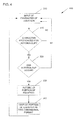
- an example method 300 is shown for automatically building up an equation as a user inputs the equation into a computer system.
- the user is allowed to begin input of the equation in linear string format.
- control is passed to operation 320, where a determination is made as to whether or not autobuildup can occur on a portion of the equation that has been entered using, for example, the precedence buildup logic described above. If autobuildup can occur, control is passed to operation 330. Otherwise, if autobuildup cannot occur, control is passed back to operation 310 and input of the equation continues.
- Method 400 is similar to method 300 and includes operations 310, 320, 330, and 340. However, method 400 also includes operation 415 positioned between entry operation 310 and buildup determination operation 320. Operation 415 examines the input to look for predetermined characters that signal that buildup can occur. Examples of such characters include: right parenthesis ")", binary operators, any punctuation, tab, enter, and space. If any of these characters are entered, operation 415 passes control to operation 320 to allow for a determination as to whether or not autobuildup can occur. If the character that has been entered is not one of the noted characters, operation 415 passed control back to operation 310 and input of the equation in linear string format continues without a determination as to whether or not a portion of the equation can be built up.
- operation 415 passed control back to operation 310 and input of the equation in linear string format continues without a determination as to whether or not a portion of the equation can be built up.
- the systems and methods disclosed herein are further enhanced by allowing portions of commonly-used equations to be automatically entered and built up.
- the application Microsoft® Word which is distributed by Microsoft Corporation of Redmond, Washington, includes an "AutoCorrect" feature that allows a user to automatically expand frequently-used text strings by entering a few identifying characters. A user can use these features to expand commonly-used portions of equations based on a few keystrokes by the user.
- the systems and methods disclosed herein can be used to automatically analyze the string that is expanded by the "AutoCorrect" feature and automatically buildup the string, if possible. In this manner, commonly-used portions of equations can be quickly entered and built up.
Landscapes
- Engineering & Computer Science (AREA)
- Theoretical Computer Science (AREA)
- Physics & Mathematics (AREA)
- General Physics & Mathematics (AREA)
- General Engineering & Computer Science (AREA)
- Artificial Intelligence (AREA)
- Health & Medical Sciences (AREA)
- General Health & Medical Sciences (AREA)
- Computational Linguistics (AREA)
- Audiology, Speech & Language Pathology (AREA)
- Mathematical Physics (AREA)
- Pure & Applied Mathematics (AREA)
- Algebra (AREA)
- Mathematical Optimization (AREA)
- Mathematical Analysis (AREA)
- Software Systems (AREA)
- Human Computer Interaction (AREA)
- Document Processing Apparatus (AREA)
- Image Generation (AREA)
Applications Claiming Priority (1)
| Application Number | Priority Date | Filing Date | Title |
|---|---|---|---|
| US10/943,095 US7698638B2 (en) | 2004-09-15 | 2004-09-15 | Systems and methods for automated equation buildup |
Publications (2)
| Publication Number | Publication Date |
|---|---|
| EP1638012A2 true EP1638012A2 (fr) | 2006-03-22 |
| EP1638012A3 EP1638012A3 (fr) | 2008-12-17 |
Family
ID=35517177
Family Applications (1)
| Application Number | Title | Priority Date | Filing Date |
|---|---|---|---|
| EP05105526A Withdrawn EP1638012A3 (fr) | 2004-09-15 | 2005-06-22 | Système et procédé de construction automatisée des equations |
Country Status (5)
| Country | Link |
|---|---|
| US (2) | US7698638B2 (fr) |
| EP (1) | EP1638012A3 (fr) |
| JP (1) | JP4965090B2 (fr) |
| KR (1) | KR101150031B1 (fr) |
| CN (1) | CN1749992B (fr) |
Families Citing this family (21)
| Publication number | Priority date | Publication date | Assignee | Title |
|---|---|---|---|---|
| US7698638B2 (en) * | 2004-09-15 | 2010-04-13 | Microsoft Corporation | Systems and methods for automated equation buildup |
| US20060190474A1 (en) * | 2005-02-22 | 2006-08-24 | Microsoft Corporation | Extensible markup language schema for mathematical expressions |
| US20060190821A1 (en) * | 2005-02-22 | 2006-08-24 | Microsoft Corporation | Programmable object model for mathematical expressions |
| US8020091B2 (en) * | 2005-07-15 | 2011-09-13 | Microsoft Corporation | Alignment and breaking of mathematical expressions in documents |
| US20070033524A1 (en) * | 2005-08-02 | 2007-02-08 | Microsoft Corporation | Mapping codes for characters in mathematical expressions |
| US7777744B2 (en) * | 2006-04-07 | 2010-08-17 | Texas Instruments Incorporated | Systems and methods for multiple equation graphing |
| US20080077854A1 (en) * | 2006-09-25 | 2008-03-27 | Kehinde Alabi | Generation, documentation and presentation of mathematical equations and symbolic scientific expressions using pure html, css, and javascript |
| US20080120355A1 (en) * | 2006-11-19 | 2008-05-22 | Kehinde Alabi | System and method for generating mathematical equations and symbolic scientific expressions in html and css |
| US8213719B2 (en) * | 2008-09-24 | 2012-07-03 | Microsoft Corporation | Editing 2D structures using natural input |
| US20100115403A1 (en) * | 2008-11-06 | 2010-05-06 | Microsoft Corporation | Transforming math text objects using build down and build up |
| US8190406B2 (en) * | 2008-11-26 | 2012-05-29 | Microsoft Corporation | Hybrid solver for data-driven analytics |
| CN102033856B (zh) * | 2009-09-29 | 2013-12-11 | 北大方正集团有限公司 | 一种公式排版方法及其系统 |
| US8761658B2 (en) | 2011-01-31 | 2014-06-24 | FastTrack Technologies Inc. | System and method for a computerized learning system |
| US20130305133A1 (en) * | 2012-05-11 | 2013-11-14 | Elia Freedman | Interactive Notepad For Computing Equations in Context |
| CN103646316A (zh) * | 2013-12-18 | 2014-03-19 | 世纪禾光科技发展(北京)有限责任公司 | 一种分布式金融计算的公式处理方法 |
| CN104408020A (zh) * | 2014-10-30 | 2015-03-11 | 北京思特奇信息技术股份有限公司 | 一种公式解析计算系统及方法 |
| US10031906B2 (en) | 2015-11-02 | 2018-07-24 | Microsoft Technology Licensing, Llc | Images and additional data associated with cells in spreadsheets |
| US10515145B2 (en) | 2015-11-02 | 2019-12-24 | Microsoft Technology Licensing, Llc | Parameterizing and working with math equations in a spreadsheet application |
| CN105677438A (zh) * | 2016-01-07 | 2016-06-15 | 南京邮电大学 | 一种利用编译器对文件中计算公式进行自动化计算的方法 |
| CN107665087B (zh) * | 2016-07-28 | 2021-03-16 | 夏普株式会社 | 图像显示装置、图像显示方法以及图像显示系统 |
| CN109992121B (zh) * | 2017-12-29 | 2023-02-03 | 北京搜狗科技发展有限公司 | 一种输入方法、装置和用于输入的装置 |
Family Cites Families (46)
| Publication number | Priority date | Publication date | Assignee | Title |
|---|---|---|---|---|
| US5189633A (en) * | 1990-01-12 | 1993-02-23 | Bonadio Allan R | Apparatus and method for interactively manipulating mathematical equations |
| US5067102A (en) * | 1990-01-31 | 1991-11-19 | Hewlett-Packard Company | Method and apparatus for displaying and editing mathematical expressions in textbook format |
| US5251292A (en) * | 1990-07-25 | 1993-10-05 | Wordperfect Corporation | Method and apparatus for an equation editor |
| US5544262A (en) * | 1992-04-07 | 1996-08-06 | Apple Computer, Inc. | Method and apparatus for processing graphically input equations |
| JP3111120B2 (ja) * | 1992-12-28 | 2000-11-20 | シャープ株式会社 | 数式表示方法 |
| JPH06231081A (ja) * | 1993-01-29 | 1994-08-19 | Sharp Corp | 数式表示方式 |
| US5469538A (en) * | 1994-03-02 | 1995-11-21 | Mathsoft, Inc. | Mathematical document editor and method performing live symbolic calculations for use with an electronic book |
| JP3837759B2 (ja) * | 1995-07-31 | 2006-10-25 | カシオ計算機株式会社 | 電子式計算機 |
| US5784071A (en) * | 1995-09-13 | 1998-07-21 | Apple Computer, Inc. | Context-based code convertor |
| US5793381A (en) * | 1995-09-13 | 1998-08-11 | Apple Computer, Inc. | Unicode converter |
| US5682158A (en) * | 1995-09-13 | 1997-10-28 | Apple Computer, Inc. | Code converter with truncation processing |
| US5844555A (en) * | 1996-06-20 | 1998-12-01 | Mathsoft, Inc. | Locking mechanism for live mathematical documents |
| JPH11259456A (ja) * | 1998-03-12 | 1999-09-24 | Toshiba Corp | 文書作成装置、数式変換方法、及び記録媒体 |
| US6204782B1 (en) * | 1998-09-25 | 2001-03-20 | Apple Computer, Inc. | Unicode conversion into multiple encodings |
| JP3975588B2 (ja) * | 1998-11-19 | 2007-09-12 | カシオ計算機株式会社 | 電子機器および記憶媒体 |
| US6795838B1 (en) * | 1999-02-05 | 2004-09-21 | Nec Corporation | Apparatus and method for transforming mathematical expression, and storage medium |
| JP3705065B2 (ja) * | 1999-02-05 | 2005-10-12 | 日本電気株式会社 | 数式処理システム、数式処理方法及び数式処理用プログラムを記録した記録媒体 |
| US6610106B1 (en) * | 1999-08-27 | 2003-08-26 | International Business Machines Corporation | Expression editor |
| EP1109105A1 (fr) * | 1999-12-14 | 2001-06-20 | Sun Microsystems, Inc. | Insertion d'un objet texte dans un document |
| EP1126379A1 (fr) * | 2000-02-16 | 2001-08-22 | Sun Microsystems, Inc. | Conversion d'attributs directement assignés de format de document |
| JP3917343B2 (ja) * | 2000-02-25 | 2007-05-23 | 株式会社東芝 | マルチプラットフォーム環境における文字コード変換方式および文字コード変換プログラムを記録したコンピュータ読み取り可能な記録媒体 |
| US7055095B1 (en) * | 2000-04-14 | 2006-05-30 | Picsel Research Limited | Systems and methods for digital document processing |
| JP4181310B2 (ja) * | 2001-03-07 | 2008-11-12 | 昌和 鈴木 | 数式認識装置および数式認識方法 |
| US6829620B2 (en) * | 2001-09-20 | 2004-12-07 | International Business Machines Corporation | Table-level unicode handling in a database engine |
| US7373291B2 (en) * | 2002-02-15 | 2008-05-13 | Mathsoft Engineering & Education, Inc. | Linguistic support for a recognizer of mathematical expressions |
| US7036073B2 (en) * | 2002-06-27 | 2006-04-25 | Microsoft Corporation | System and method for supporting non-native XML in native XML of a word-processor document |
| US7523394B2 (en) * | 2002-06-28 | 2009-04-21 | Microsoft Corporation | Word-processing document stored in a single XML file that may be manipulated by applications that understand XML |
| US20030056181A1 (en) * | 2002-09-17 | 2003-03-20 | Marathe Sharad M. | System and method for displaying spreadsheet cell formulas in two dimensional mathematical notation |
| US20040117731A1 (en) * | 2002-09-27 | 2004-06-17 | Sergey Blyashov | Automated report building system |
| US20040114258A1 (en) * | 2002-12-17 | 2004-06-17 | Harris Richard Alexander | Device and method for combining dynamic mathematical expressions and other multimedia objects within a document |
| US7466958B2 (en) * | 2003-02-10 | 2008-12-16 | Educational Testing Service | Equation editor |
| CA2426496A1 (fr) * | 2003-04-24 | 2004-10-24 | Ibm Canada Limited - Ibm Canada Limitee | Traitement de donnees de format fixe dans un environnement unicode |
| US20050041017A1 (en) * | 2003-08-08 | 2005-02-24 | De Brebisson Cyrille | Function drawing in polar plan using a calculator |
| US7324931B1 (en) * | 2003-11-17 | 2008-01-29 | The Mathworks, Inc. | Conversion of model components into references |
| US20060005115A1 (en) * | 2004-06-30 | 2006-01-05 | Steven Ritter | Method for facilitating the entry of mathematical expressions |
| US20060001667A1 (en) * | 2004-07-02 | 2006-01-05 | Brown University | Mathematical sketching |
| TWI263848B (en) * | 2004-09-07 | 2006-10-11 | Optimax Tech Corp | An optical sheet for a super twisted nematic display |
| US7698638B2 (en) * | 2004-09-15 | 2010-04-13 | Microsoft Corporation | Systems and methods for automated equation buildup |
| US20060190474A1 (en) * | 2005-02-22 | 2006-08-24 | Microsoft Corporation | Extensible markup language schema for mathematical expressions |
| US20060190821A1 (en) * | 2005-02-22 | 2006-08-24 | Microsoft Corporation | Programmable object model for mathematical expressions |
| US20060274070A1 (en) | 2005-04-19 | 2006-12-07 | Herman Daniel L | Techniques and workflows for computer graphics animation system |
| US7492366B2 (en) * | 2005-05-13 | 2009-02-17 | Microsoft Corporation | Method and system of character placement in opentype fonts |
| US7636913B2 (en) * | 2005-06-22 | 2009-12-22 | Microsoft Corporation | System and method for evaluating an expression in a debugger |
| US20070033524A1 (en) * | 2005-08-02 | 2007-02-08 | Microsoft Corporation | Mapping codes for characters in mathematical expressions |
| US7865826B2 (en) * | 2006-05-15 | 2011-01-04 | Waterloo Maple Inc. | System and method for creating and presenting mathematical documents |
| US20080077854A1 (en) * | 2006-09-25 | 2008-03-27 | Kehinde Alabi | Generation, documentation and presentation of mathematical equations and symbolic scientific expressions using pure html, css, and javascript |
-
2004
- 2004-09-15 US US10/943,095 patent/US7698638B2/en not_active Expired - Fee Related
-
2005
- 2005-06-22 EP EP05105526A patent/EP1638012A3/fr not_active Withdrawn
- 2005-06-28 JP JP2005187819A patent/JP4965090B2/ja not_active Expired - Fee Related
- 2005-06-29 KR KR1020050056757A patent/KR101150031B1/ko not_active Expired - Fee Related
- 2005-07-29 CN CN2005100885186A patent/CN1749992B/zh not_active Expired - Fee Related
- 2005-09-16 US US11/229,023 patent/US8209604B2/en not_active Expired - Fee Related
Non-Patent Citations (1)
| Title |
|---|
| "NONYMOUS: ''The LyX User's Guide", February 2004 |
Also Published As
| Publication number | Publication date |
|---|---|
| EP1638012A3 (fr) | 2008-12-17 |
| JP2006085673A (ja) | 2006-03-30 |
| JP4965090B2 (ja) | 2012-07-04 |
| US8209604B2 (en) | 2012-06-26 |
| KR101150031B1 (ko) | 2012-07-02 |
| CN1749992A (zh) | 2006-03-22 |
| US7698638B2 (en) | 2010-04-13 |
| US20060059217A1 (en) | 2006-03-16 |
| US20060059214A1 (en) | 2006-03-16 |
| CN1749992B (zh) | 2011-01-26 |
| KR20060048667A (ko) | 2006-05-18 |
Similar Documents
| Publication | Publication Date | Title |
|---|---|---|
| US7698638B2 (en) | Systems and methods for automated equation buildup | |
| US6356866B1 (en) | Method for converting a phonetic character string into the text of an Asian language | |
| US6326953B1 (en) | Method for converting text corresponding to one keyboard mode to text corresponding to another keyboard mode | |
| US7802184B1 (en) | Method and apparatus for processing text and character data | |
| US8726148B1 (en) | Method and apparatus for processing text and character data | |
| US6944820B2 (en) | Ensuring proper rendering order of bidirectionally rendered text | |
| US7496230B2 (en) | System and method for automatic natural language translation of embedded text regions in images during information transfer | |
| US6735347B1 (en) | Method and apparatus for text extraction from cut image | |
| US20030160807A1 (en) | System and method for associating popup windows with selective regions of a document | |
| EP1645973A2 (fr) | Procédé et système permettant de vérifier l'exactitude orthographique et grammaticale d'un document | |
| CN1107275C (zh) | 在非拉丁文文档中插入大写拉丁文字符的方法 | |
| US6424982B1 (en) | System and method for parsing a document using one or more break characters | |
| US7284006B2 (en) | Method and apparatus for browsing document content | |
| JPH113338A (ja) | 多言語入力システム、多言語入力方法及び多言語入力プログラムを記録した記録媒体 | |
| CN1987848A (zh) | 字符串处理方法以及设备 | |
| CN104424180A (zh) | 文本输入方法及设备 | |
| US20070033524A1 (en) | Mapping codes for characters in mathematical expressions | |
| CN114528859A (zh) | 机器翻译系统及机器翻译方法 | |
| EP1221082B1 (fr) | Utilisation de la phonetique anglaise pour ecrire avec des caracteres non romains | |
| JPH11306176A (ja) | 文字処理装置及び方法並びにその制御プログラムを記憶した媒体 | |
| Chan | Building Multilingual Web Sites for Today’s Global Network using Unicode Standard | |
| JPH09106393A (ja) | 機械翻訳装置及び機械翻訳方法 | |
| JPH11272661A (ja) | 日本語辞書自動登録システム及び方法 | |
| JPH07210552A (ja) | 文書編集装置 | |
| JP2003242145A (ja) | 言語処理プログラム、言語処理装置、その方法および記録媒体 |
Legal Events
| Date | Code | Title | Description |
|---|---|---|---|
| PUAI | Public reference made under article 153(3) epc to a published international application that has entered the european phase |
Free format text: ORIGINAL CODE: 0009012 |
|
| AK | Designated contracting states |
Kind code of ref document: A2 Designated state(s): AT BE BG CH CY CZ DE DK EE ES FI FR GB GR HU IE IS IT LI LT LU MC NL PL PT RO SE SI SK TR |
|
| AX | Request for extension of the european patent |
Extension state: AL BA HR LV MK YU |
|
| PUAL | Search report despatched |
Free format text: ORIGINAL CODE: 0009013 |
|
| AK | Designated contracting states |
Kind code of ref document: A3 Designated state(s): AT BE BG CH CY CZ DE DK EE ES FI FR GB GR HU IE IS IT LI LT LU MC NL PL PT RO SE SI SK TR |
|
| AX | Request for extension of the european patent |
Extension state: AL BA HR LV MK YU |
|
| 17P | Request for examination filed |
Effective date: 20090507 |
|
| AKX | Designation fees paid |
Designated state(s): AT BE BG CH CY CZ DE DK EE ES FI FR GB GR HU IE IS IT LI LT LU MC NL PL PT RO SE SI SK TR |
|
| 17Q | First examination report despatched |
Effective date: 20110726 |
|
| RAP1 | Party data changed (applicant data changed or rights of an application transferred) |
Owner name: MICROSOFT TECHNOLOGY LICENSING, LLC |
|
| STAA | Information on the status of an ep patent application or granted ep patent |
Free format text: STATUS: THE APPLICATION IS DEEMED TO BE WITHDRAWN |
|
| 18D | Application deemed to be withdrawn |
Effective date: 20170103 |