EP1640831B1 - Dispositif de pliage et procédé de commande du dispositif de pliage - Google Patents
Dispositif de pliage et procédé de commande du dispositif de pliage Download PDFInfo
- Publication number
- EP1640831B1 EP1640831B1 EP05024676A EP05024676A EP1640831B1 EP 1640831 B1 EP1640831 B1 EP 1640831B1 EP 05024676 A EP05024676 A EP 05024676A EP 05024676 A EP05024676 A EP 05024676A EP 1640831 B1 EP1640831 B1 EP 1640831B1
- Authority
- EP
- European Patent Office
- Prior art keywords
- bending
- swivel
- sheet
- profile
- bending machine
- Prior art date
- Legal status (The legal status is an assumption and is not a legal conclusion. Google has not performed a legal analysis and makes no representation as to the accuracy of the status listed.)
- Expired - Lifetime
Links
Images


Classifications
-
- B—PERFORMING OPERATIONS; TRANSPORTING
- B21—MECHANICAL METAL-WORKING WITHOUT ESSENTIALLY REMOVING MATERIAL; PUNCHING METAL
- B21D—WORKING OR PROCESSING OF SHEET METAL OR METAL TUBES, RODS OR PROFILES WITHOUT ESSENTIALLY REMOVING MATERIAL; PUNCHING METAL
- B21D5/00—Bending sheet metal along straight lines, e.g. to form simple curves
- B21D5/04—Bending sheet metal along straight lines, e.g. to form simple curves on brakes making use of clamping means on one side of the work
-
- G—PHYSICS
- G05—CONTROLLING; REGULATING
- G05B—CONTROL OR REGULATING SYSTEMS IN GENERAL; FUNCTIONAL ELEMENTS OF SUCH SYSTEMS; MONITORING OR TESTING ARRANGEMENTS FOR SUCH SYSTEMS OR ELEMENTS
- G05B19/00—Program-control systems
- G05B19/02—Program-control systems electric
- G05B19/18—Numerical control [NC], i.e. automatically operating machines, in particular machine tools, e.g. in a manufacturing environment, so as to execute positioning, movement or co-ordinated operations by means of program data in numerical form
- G05B19/406—Numerical control [NC], i.e. automatically operating machines, in particular machine tools, e.g. in a manufacturing environment, so as to execute positioning, movement or co-ordinated operations by means of program data in numerical form characterised by monitoring or safety
- G05B19/4061—Avoiding collision or forbidden zones
-
- G—PHYSICS
- G05—CONTROLLING; REGULATING
- G05B—CONTROL OR REGULATING SYSTEMS IN GENERAL; FUNCTIONAL ELEMENTS OF SUCH SYSTEMS; MONITORING OR TESTING ARRANGEMENTS FOR SUCH SYSTEMS OR ELEMENTS
- G05B19/00—Program-control systems
- G05B19/02—Program-control systems electric
- G05B19/18—Numerical control [NC], i.e. automatically operating machines, in particular machine tools, e.g. in a manufacturing environment, so as to execute positioning, movement or co-ordinated operations by means of program data in numerical form
- G05B19/4093—Numerical control [NC], i.e. automatically operating machines, in particular machine tools, e.g. in a manufacturing environment, so as to execute positioning, movement or co-ordinated operations by means of program data in numerical form characterised by part programming, e.g. entry of geometrical information as taken from a technical drawing, combining this with machining and material information to obtain control information, named part program, for the NC machine
- G05B19/40931—Numerical control [NC], i.e. automatically operating machines, in particular machine tools, e.g. in a manufacturing environment, so as to execute positioning, movement or co-ordinated operations by means of program data in numerical form characterised by part programming, e.g. entry of geometrical information as taken from a technical drawing, combining this with machining and material information to obtain control information, named part program, for the NC machine concerning programming of geometry
-
- G—PHYSICS
- G05—CONTROLLING; REGULATING
- G05B—CONTROL OR REGULATING SYSTEMS IN GENERAL; FUNCTIONAL ELEMENTS OF SUCH SYSTEMS; MONITORING OR TESTING ARRANGEMENTS FOR SUCH SYSTEMS OR ELEMENTS
- G05B2219/00—Program-control systems
- G05B2219/30—Nc systems
- G05B2219/35—Nc in input of data, input till input file format
- G05B2219/35192—From design derive sequence of bending so that bending is possible
-
- G—PHYSICS
- G05—CONTROLLING; REGULATING
- G05B—CONTROL OR REGULATING SYSTEMS IN GENERAL; FUNCTIONAL ELEMENTS OF SUCH SYSTEMS; MONITORING OR TESTING ARRANGEMENTS FOR SUCH SYSTEMS OR ELEMENTS
- G05B2219/00—Program-control systems
- G05B2219/30—Nc systems
- G05B2219/36—Nc in input of data, input key till input tape
- G05B2219/36071—Simulate on screen, if operation value out of limits, edit program
-
- G—PHYSICS
- G05—CONTROLLING; REGULATING
- G05B—CONTROL OR REGULATING SYSTEMS IN GENERAL; FUNCTIONAL ELEMENTS OF SUCH SYSTEMS; MONITORING OR TESTING ARRANGEMENTS FOR SUCH SYSTEMS OR ELEMENTS
- G05B2219/00—Program-control systems
- G05B2219/30—Nc systems
- G05B2219/45—Nc applications
- G05B2219/45143—Press-brake, bending machine
-
- Y—GENERAL TAGGING OF NEW TECHNOLOGICAL DEVELOPMENTS; GENERAL TAGGING OF CROSS-SECTIONAL TECHNOLOGIES SPANNING OVER SEVERAL SECTIONS OF THE IPC; TECHNICAL SUBJECTS COVERED BY FORMER USPC CROSS-REFERENCE ART COLLECTIONS [XRACs] AND DIGESTS
- Y02—TECHNOLOGIES OR APPLICATIONS FOR MITIGATION OR ADAPTATION AGAINST CLIMATE CHANGE
- Y02P—CLIMATE CHANGE MITIGATION TECHNOLOGIES IN THE PRODUCTION OR PROCESSING OF GOODS
- Y02P90/00—Enabling technologies with a potential contribution to greenhouse gas [GHG] emissions mitigation
- Y02P90/02—Total factory control, e.g. smart factories, flexible manufacturing systems [FMS] or integrated manufacturing systems [IMS]
Definitions
- the present invention relates to a folding machine for bending sheets with a control device which can be operated via an input unit, and which has a computer unit, wherein in the input unit, a desired bending profile can be entered. Furthermore, the present invention relates to a corresponding method for controlling a folding machine.
- Swivel bending machines are used to produce profiled sheet metal workpieces, such as those used for gutters, house coverings and the like.
- the bending steps are programmed by manually entering the lengths of the profile sections, the bending angles and the bending order.
- Such a folding machine is for example from the European Patent Application EP 0 836 896 A2 known.
- the computer-controlled folding machine described there has a conventional control unit which is connected to a computer.
- the computer is provided with an input keyboard oriented to the characteristics of a folding machine and a screen display for displaying a graphical surface that proportionally represents the bending operation in both a programming mode and an operating mode. This is for the operator helpful to perform the programmed bending operation.
- the programming of the bending process is relatively complex and often impossible for untrained operating personnel.
- the object of the present invention is therefore to simplify the programming of a computer-controlled folding machine.
- a folding machine for bending sheets with a control device which is operable via an input unit, and which has a computer unit, wherein in the input unit, a desired bending profile is entered, and Furthermore, by the computer unit for an input, desired bending profile, taking into account the geometry of components of the pivoting bending machine, a bending order of a sheet is calculated, so that there is a predetermined allowable bending of the sheet to be machined in a collision.
- the invention also provides a method for controlling a folding machine by entering a desired bending profile in an input unit of the folding machine and automatic or semi-automatic calculation of a bending order of a sheet for the entered desired bending profile, taking into account the geometry of components of the folding machine, so that it is a predefinable permissible bending of the sheet to be machined in a collision comes.
- the input unit comprises a so-called touch screen, in which the inputs via touches of the screen are possible.
- the end points and bending points of a bending profile can be entered by tapping the touch screen.
- This can be entered with simple means a desired bending profile, searched and selected.
- the input unit may also include a scanner with which, for example, a CAD graphic can be scanned and thus a desired bending profile can be entered.
- a scanner with which, for example, a CAD graphic can be scanned and thus a desired bending profile can be entered.
- an interface may be provided on the pivoting bending machine over which other devices, e.g. Internet, bending profiles can be entered.
- a bending sequence can be calculated automatically or semi-automatically taking into account the geometry of the folding machine.
- the programming process of the pivoting bending machine can be reduced to entering a bending profile.
- the computer unit also automatically suggests tools for a top and bottom cheek of the folding machine.
- tools for a top and bottom cheek of the folding machine not only the bending angles and bending radii of the profile are considered, but also possible collisions of the sheet with the tools.
- the bending order is calculated by a trial-and-error method. Accordingly, in a simulation, the bending steps starting from an arbitrary starting point are carried out until, if appropriate, a collision of the bent sheet metal with a component of the folding machine takes place. In the event of a collision, one or more bending steps may be withdrawn and simulation of the bend continued at another location on the sheet. Thus, the bending process does not have to be calculated completely from the front.
- a bending step can be performed even though a collision occurs or has occurred.
- the automation can therefore be given semiautomatically or automatically in a collision, a maximum allowable bending depending on the type of material, the material thickness and / or the length of an already bent sheet metal section.
- Another degree of freedom for avoiding collisions is the choice of a suitable bending tool of the folding machine.
- This procedure can also be automated by automatically proposing a specific shape of the tool on the bending or upper beam of the folding machine, taking into account collisions and permissible deflections.
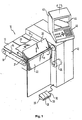
- FIG. 1 is merely schematic and for better clarity half rough perspective a folding machine 10 shown.
- These feed fingers 14, which are connected to a drive 16, can move the sheet metal very accurately by a set amount, the "depth stop", in the direction of a slot 18 so that the strip of sheet 23 to be folded protrudes through the slot.
- a clamping cheek or upper beam 20 can be raised or lowered. With this upper beam 20, the sheet is held against an abutment or a lower beam 21 and a bending beam 22 pivots, driven by a motor 24 to the desired or set bending angle B tofastkanten the strip of the sheet 23 relative to the residual sheet.
- the machine is operated via a footswitch 26 with three buttons 28, 30 and 32.
- the clamping cheek 20 moves down and slowly closes the slot 18. If the key 28 is pressed all the way, this closing movement can be kept in any position. With the key 30, the bending cheek 22 can be pivoted and stopped by the operator in a similar manner, while the key 32 is to be actuated, for example, for opening the clamping cheek 20.
- the machine 10 is connected via a control box 42 to a computer 40.
- the computer 40 is provided with a screen 44 displaying a graphical interface.
- the computer 40 is operated via a control panel 46.
- FIG. 2 typical working tools of the folding machine are shown in cross section in detail. This view is also presented to the operator of the pivoting bending machine on the screen 44 during the bending operation.
- the plate 23 rests on the abutment or the lower cheek 21.
- a tool or a Oberwangenschiene 25 is mounted, which then presses the sheet 23 against the lower beam 21.
- a bending rail 27 is pivotable about a bending point B. It is mounted on the bending cheek 22, not shown. The sheet 23 is bent by means of the voltage applied to the bending point B front side of the bending rail 27.
- the sheet 23 is already bent into a plurality of sheet metal sections.
- the individual sheet metal sections are marked with numbers from 0 to 8, which also indicates the bending sequence.
- FIG. 2 shows either the actual bending state of the sheet metal value during a bending operation or a corresponding, simulated on the computer 40 bending state.
- FIG. 3 shows a screen display of a touch screen for entering a desired bending profile.
- the entry is made by tapping the touch screen.
- computer 40 automatically draws the intermediate profile piece.
- the further bending points 53, 54 and 55 and finally the second end point 56 are entered.
- the start key 57 is pressed, whereupon the computer searches in a database for similar profiles.
- the bending profiles 61, 62, and 63 determined in the database and similar to the desired bending profile are graphically displayed on the screen 44.
- those profiles can be proposed according to predetermined criteria, which have the same or a similar number of bends. But it can also be proposed profiles in which only the most prominent bends correspond to those of the entered profile 50.
- the bending profile to be used is selected from the suggested profiles 61 to 63.
- the computer from the database can not propose a bending profile similar to the profile 50 entered, the text entered on the touch screen is immediately entered Profile 50 used and recycled for the bending process.
- the bending order which is stored in the database for each bending profile, must be determined. This takes place automatically according to the present invention. For this purpose, a trial-error method is used.
- the trial-error method is based on the example of FIG. 3 explained. For this it is assumed that the profiles 61 to 63 could not be determined in the database.
- the bends 52, 53 and 54 are performed in the order given for the illustrated profile.
- the bend 55 is completed, wherein the sheet is clamped between the bend 55 and the second end 56.
- the computer 40 registers that it would come to a collision of the sheet with the upper beam 20 at the bend 55. Therefore, in addition to the possibly not executable collision step 55, the computer also takes back the bend 54 in its simulation. Due to this "error", the computer now tries to execute the bend 55 before the bend 54, which ultimately also leads to the desired target, if possible without collision.
- the bending orders can be determined for any bending profiles.
- all bending steps can be withdrawn.
- To determine the order of bending it may also be necessary to re-clamp the plate accordingly, which increases the number of attempts accordingly.
- a suitably shaped bending tool 25, 27 for the upper beam 20 and / or the bending beam 22 may also be attempted to find a suitably shaped bending tool 25, 27 for the upper beam 20 and / or the bending beam 22.
- the forms of bending tools are also stored in a database.
- FIG. 4 shows a cross-sectional view through the working tool of a folding machine with an octagonal profile has been bent.
- the sheet 23 penetrates the upper beam 20 in its bent state.
- the computer 40 usually interprets this case as a collision case.
- the first bent part of the sheet rolls namely helically on the surface of the upper beam 20 inwards.
- the pressed-in part of the sheet springs outward, creating an exact, octagonal sheet metal profile. This means that collision cases do not make the bending process impossible from the outset. Rather, the spring properties of the sheet can be exploited.
- the deformations can be classified as permissible or inadmissible by simple approximations for a material type and thickness, for example, linearly dependent on the length of the piece of sheet metal from the collision point to the bending point. If enough computing capacity is available, such estimates can also be made using complex bending equations.
Landscapes
- Engineering & Computer Science (AREA)
- Physics & Mathematics (AREA)
- Human Computer Interaction (AREA)
- Manufacturing & Machinery (AREA)
- General Physics & Mathematics (AREA)
- Automation & Control Theory (AREA)
- Mechanical Engineering (AREA)
- Geometry (AREA)
- Bending Of Plates, Rods, And Pipes (AREA)
Claims (10)
- Machine à plier oscillante pour la tôle équipée d'un
dispositif de commande (42) actionnable via une unité d'entrée et disposant d'une unité de calcul (40), offrant la possibilité d'entrer un profil de pliage souhaité (50) par le biais de l'unité d'entrée,
caractérisée en ce que
l'unité de calcul (40) est programmée de manière à permettre de calculer une série de pliages d'une tôle (23) à usiner pour un profil de pliage souhaité, prédéfini (50), en considérant la géométrie des composants de la machine à plier oscillante, de manière à obtenir, en cas de collision, un pliage autorisé, prédéfini de la tôle. - Machine à plier oscillante conformément à la revendication 1, la série de pliages pouvant être calculée en utilisant la méthode essai-erreur.
- Machine à plier oscillante conformément à l'une des revendications 1 ou 2, la série de pliages pouvant être prédéfinie dans le cadre d'une simulation à l'aide de l'unité de calcul (40), de façon à pouvoir, en cas de collision, retirer un ou plusieurs pliages pour que le pliage se poursuive à un autre endroit de la tôle (23) à usiner.
- Machine à plier oscillante conformément à l'une des revendications 1 à 3, permettant l'entrée, automatique ou semi-automatique, d'un pliage maximal autorisé en cas de collision, correspondant au type et à l'épaisseur du matériau, et/ou à la longueur d'une section de tôle déjà pliée.
- Machine à plier oscillante conformément à l'une des revendications 1 à 4 sur laquelle les outils de pliage (25, 27) peuvent être proposés automatiquement.
- Procédé de commande d'une machine à plier oscillante en
entrant un profil de pliage souhaité (50) par le biais d'une unité d'entrée de la machine à plier oscillante,
caractérisé en ce
qu'une série de pliage d'une tôle (23) à usiner est calculée de façon automatique ou semi-automatique pour le profil de pliage entré souhaité (50) en considérant la géométrie des composants de la machine à plier oscillante de manière à obtenir, en cas de collision, le pliage autorisé prédéfini de la tôle à usiner. - Procédé conformément à la revendication 6, dans lequel la série de pliages est calculée selon la méthode essai-erreur.
- Procédé conformément aux revendications 6 ou 7, dans lequel la série de pliage est simulée pour être définie, et pour pouvoir, en cas de collision, retirer un ou plusieurs pliages et poursuivre le pliage à un autre endroit de la tôle (23) à usiner.
- Procédé conformément à l'une des revendications 6 à 8, dans lequel en cas de collision, le pliage maximal autorisé correspondant au type et à l'épaisseur du matériau et/ou à la longueur d'une section de tôle déjà pliée, est prescrit automatiquement ou semi-automatiquement.
- Procédé conformément à l'une des revendications de 6 à 9, dans laquelle un outil de pliage (25, 27) de la machine à plier oscillante est proposé automatiquement à l'aide d'un profil de pliage à exécuter compte tenu des collisions et pliages.
Applications Claiming Priority (1)
| Application Number | Priority Date | Filing Date | Title |
|---|---|---|---|
| EP02023377A EP1411404B1 (fr) | 2002-10-18 | 2002-10-18 | Dispositif de pliage et procédé de commande du dispositif de pliage |
Related Parent Applications (1)
| Application Number | Title | Priority Date | Filing Date |
|---|---|---|---|
| EP02023377A Division EP1411404B1 (fr) | 2002-10-18 | 2002-10-18 | Dispositif de pliage et procédé de commande du dispositif de pliage |
Publications (2)
| Publication Number | Publication Date |
|---|---|
| EP1640831A1 EP1640831A1 (fr) | 2006-03-29 |
| EP1640831B1 true EP1640831B1 (fr) | 2008-04-02 |
Family
ID=32039152
Family Applications (2)
| Application Number | Title | Priority Date | Filing Date |
|---|---|---|---|
| EP02023377A Expired - Lifetime EP1411404B1 (fr) | 2002-10-18 | 2002-10-18 | Dispositif de pliage et procédé de commande du dispositif de pliage |
| EP05024676A Expired - Lifetime EP1640831B1 (fr) | 2002-10-18 | 2002-10-18 | Dispositif de pliage et procédé de commande du dispositif de pliage |
Family Applications Before (1)
| Application Number | Title | Priority Date | Filing Date |
|---|---|---|---|
| EP02023377A Expired - Lifetime EP1411404B1 (fr) | 2002-10-18 | 2002-10-18 | Dispositif de pliage et procédé de commande du dispositif de pliage |
Country Status (3)
| Country | Link |
|---|---|
| EP (2) | EP1411404B1 (fr) |
| AT (2) | ATE336741T1 (fr) |
| DE (2) | DE50212039D1 (fr) |
Families Citing this family (2)
| Publication number | Priority date | Publication date | Assignee | Title |
|---|---|---|---|---|
| AT501465B8 (de) * | 2004-11-11 | 2007-02-15 | Duscher Nikolaus | Anordnung mit einer biegemaschine |
| WO2009103168A1 (fr) * | 2008-02-20 | 2009-08-27 | Jorns Ag Lotzwil | Appareil permettant de plier des feuilles métalliques |
Family Cites Families (3)
| Publication number | Priority date | Publication date | Assignee | Title |
|---|---|---|---|---|
| BR9205777A (pt) * | 1991-03-14 | 1994-04-26 | Lift Verkaufsgeraete Gmbh | Dispositivo de dobramento de chapas metálicas |
| US5835684A (en) * | 1994-11-09 | 1998-11-10 | Amada Company, Ltd. | Method for planning/controlling robot motion |
| DE19643146A1 (de) * | 1996-10-18 | 1998-04-23 | Schechtl Maschinenbau Gmbh | Computersteuerbare Schwenkbiegemaschine |
-
2002
- 2002-10-18 DE DE50212039T patent/DE50212039D1/de not_active Expired - Lifetime
- 2002-10-18 EP EP02023377A patent/EP1411404B1/fr not_active Expired - Lifetime
- 2002-10-18 EP EP05024676A patent/EP1640831B1/fr not_active Expired - Lifetime
- 2002-10-18 AT AT02023377T patent/ATE336741T1/de active
- 2002-10-18 AT AT05024676T patent/ATE391311T1/de active
- 2002-10-18 DE DE50207873T patent/DE50207873D1/de not_active Expired - Lifetime
Also Published As
| Publication number | Publication date |
|---|---|
| EP1640831A1 (fr) | 2006-03-29 |
| DE50207873D1 (de) | 2006-09-28 |
| EP1411404B1 (fr) | 2006-08-16 |
| EP1411404A1 (fr) | 2004-04-21 |
| DE50212039D1 (de) | 2008-05-15 |
| ATE336741T1 (de) | 2006-09-15 |
| ATE391311T1 (de) | 2008-04-15 |
Similar Documents
| Publication | Publication Date | Title |
|---|---|---|
| DE3781887T2 (de) | Adaptivsteuerungssystem fuer hydraulische abkantpresse. | |
| AT401484B (de) | Verfahren und vorrichtung zum einstellen eines biegeprozesses sowie verfahren zum vorbereiten von biegedaten | |
| DE69736112T2 (de) | Abkantpresse mit Vorrichtung zur Kollisionsüberwachung der Biegewerkzeuge | |
| DE3852237T2 (de) | Verfahren zur eingabe der profildaten. | |
| DE102018009023A1 (de) | Einlernvorrichtung zum ausführen von robotereinlernvorgängen und einlernverfahren | |
| DE102018133551B4 (de) | Biegemaschine, Bearbeitungslinie und Verfahren zum Biegen | |
| DE2142178A1 (de) | Verfahren und Anordnung zur Her stellung eines Werkzeugs | |
| EP2311583B1 (fr) | Procédé de détermination de l'épaisseur d'une pièce à usiner à l'aide d'une plieuse et une telle plieuse | |
| DE112009005038B4 (de) | Numeriksteuerungs-Programmierverfahren, Vorrichtung dafür, und Programm, das einen Computer veranlasst, das Verfahren auszuführen | |
| DE3887422T2 (de) | Verfahren zum eintragen von informationen über das profil eines gegenstandes. | |
| EP0836896B1 (fr) | Cintreuse pouvant être commandé par ordinateur | |
| EP1398094A1 (fr) | Procédé et dispositif pour déterminer la longueur de branche de pièces cintrées | |
| EP1640831B1 (fr) | Dispositif de pliage et procédé de commande du dispositif de pliage | |
| DE102017122073B4 (de) | Verfahren und Steuerung einer Biegemaschine | |
| EP3778062B1 (fr) | Procédé de changement de forme d'une pièce de type plaque | |
| EP4076779B1 (fr) | Machine à cintrer pourvue d'un dispositif de commande | |
| EP2532452A1 (fr) | Procédé et outil de poinçonnage et de dressage de tôles | |
| DE112017004487T5 (de) | Maschine und Verfahren zum Fluidstrahlschneiden | |
| WO2025082721A1 (fr) | Procédé de surveillance d'un processus de mise en forme, programme informatique et support de données lisible électroniquement | |
| EP2118618A1 (fr) | Procédé de détermination de points de mesure | |
| EP3631387A1 (fr) | Procédé de détermination de propriétés de matériau d'une pièce par analyse audio d'un usinage de pièce, machine de poinçonnage et produit programme d'ordinateur | |
| DE102009023547A1 (de) | Verfahren und Vorrichtung zur Herstellung von Freiform-Werkstücken | |
| DE19840260B4 (de) | Sickenmaschine zum Sicken von Blechelementen | |
| DE4008149C2 (fr) | ||
| DE3925925C2 (de) | Biegeverfahren und Biegevorrichtung |
Legal Events
| Date | Code | Title | Description |
|---|---|---|---|
| PUAI | Public reference made under article 153(3) epc to a published international application that has entered the european phase |
Free format text: ORIGINAL CODE: 0009012 |
|
| 17P | Request for examination filed |
Effective date: 20051111 |
|
| AC | Divisional application: reference to earlier application |
Ref document number: 1411404 Country of ref document: EP Kind code of ref document: P |
|
| AK | Designated contracting states |
Kind code of ref document: A1 Designated state(s): AT BE BG CH CY CZ DE DK EE ES FI FR GB GR IE IT LI LU MC NL PT SE SK TR |
|
| AX | Request for extension of the european patent |
Extension state: AL LT LV MK RO SI |
|
| AKX | Designation fees paid |
Designated state(s): AT CH DE LI |
|
| GRAP | Despatch of communication of intention to grant a patent |
Free format text: ORIGINAL CODE: EPIDOSNIGR1 |
|
| GRAS | Grant fee paid |
Free format text: ORIGINAL CODE: EPIDOSNIGR3 |
|
| GRAA | (expected) grant |
Free format text: ORIGINAL CODE: 0009210 |
|
| AC | Divisional application: reference to earlier application |
Ref document number: 1411404 Country of ref document: EP Kind code of ref document: P |
|
| AK | Designated contracting states |
Kind code of ref document: B1 Designated state(s): AT CH DE LI |
|
| REG | Reference to a national code |
Ref country code: CH Ref legal event code: EP |
|
| REF | Corresponds to: |
Ref document number: 50212039 Country of ref document: DE Date of ref document: 20080515 Kind code of ref document: P |
|
| REG | Reference to a national code |
Ref country code: CH Ref legal event code: NV Representative=s name: KELLER & PARTNER PATENTANWAELTE AG WINTERTHUR |
|
| PLBE | No opposition filed within time limit |
Free format text: ORIGINAL CODE: 0009261 |
|
| STAA | Information on the status of an ep patent application or granted ep patent |
Free format text: STATUS: NO OPPOSITION FILED WITHIN TIME LIMIT |
|
| 26N | No opposition filed |
Effective date: 20090106 |
|
| REG | Reference to a national code |
Ref country code: CH Ref legal event code: PCAR Free format text: NEW ADDRESS: EIGERSTRASSE 2 POSTFACH, 3000 BERN 14 (CH) |
|
| PGFP | Annual fee paid to national office [announced via postgrant information from national office to epo] |
Ref country code: CH Payment date: 20161025 Year of fee payment: 15 |
|
| PGFP | Annual fee paid to national office [announced via postgrant information from national office to epo] |
Ref country code: AT Payment date: 20161024 Year of fee payment: 15 |
|
| REG | Reference to a national code |
Ref country code: CH Ref legal event code: PL |
|
| REG | Reference to a national code |
Ref country code: AT Ref legal event code: MM01 Ref document number: 391311 Country of ref document: AT Kind code of ref document: T Effective date: 20171018 |
|
| PG25 | Lapsed in a contracting state [announced via postgrant information from national office to epo] |
Ref country code: LI Free format text: LAPSE BECAUSE OF NON-PAYMENT OF DUE FEES Effective date: 20171031 Ref country code: CH Free format text: LAPSE BECAUSE OF NON-PAYMENT OF DUE FEES Effective date: 20171031 |
|
| PG25 | Lapsed in a contracting state [announced via postgrant information from national office to epo] |
Ref country code: AT Free format text: LAPSE BECAUSE OF NON-PAYMENT OF DUE FEES Effective date: 20171018 |
|
| PGFP | Annual fee paid to national office [announced via postgrant information from national office to epo] |
Ref country code: DE Payment date: 20211027 Year of fee payment: 20 |
|
| REG | Reference to a national code |
Ref country code: DE Ref legal event code: R071 Ref document number: 50212039 Country of ref document: DE |