EP1641981B1 - Polyvalentes modul für die erstellung von drahtschotterverhauen - Google Patents
Polyvalentes modul für die erstellung von drahtschotterverhauen Download PDFInfo
- Publication number
- EP1641981B1 EP1641981B1 EP04739903A EP04739903A EP1641981B1 EP 1641981 B1 EP1641981 B1 EP 1641981B1 EP 04739903 A EP04739903 A EP 04739903A EP 04739903 A EP04739903 A EP 04739903A EP 1641981 B1 EP1641981 B1 EP 1641981B1
- Authority
- EP
- European Patent Office
- Prior art keywords
- cross
- pyramid
- wire
- tube
- wire ropes
- Prior art date
- Legal status (The legal status is an assumption and is not a legal conclusion. Google has not performed a legal analysis and makes no representation as to the accuracy of the status listed.)
- Expired - Lifetime
Links
- XLYOFNOQVPJJNP-UHFFFAOYSA-N water Substances O XLYOFNOQVPJJNP-UHFFFAOYSA-N 0.000 description 7
- 230000004888 barrier function Effects 0.000 description 4
- 238000000429 assembly Methods 0.000 description 3
- 238000010276 construction Methods 0.000 description 3
- 239000002184 metal Substances 0.000 description 3
- 230000002787 reinforcement Effects 0.000 description 3
- 229910001335 Galvanized steel Inorganic materials 0.000 description 2
- 238000004873 anchoring Methods 0.000 description 2
- 230000000712 assembly Effects 0.000 description 2
- 239000002131 composite material Substances 0.000 description 2
- 238000007596 consolidation process Methods 0.000 description 2
- 230000003628 erosive effect Effects 0.000 description 2
- 239000008397 galvanized steel Substances 0.000 description 2
- 238000009434 installation Methods 0.000 description 2
- 238000011084 recovery Methods 0.000 description 2
- 230000006978 adaptation Effects 0.000 description 1
- 235000021167 banquet Nutrition 0.000 description 1
- 230000001427 coherent effect Effects 0.000 description 1
- 230000006355 external stress Effects 0.000 description 1
- 230000001788 irregular Effects 0.000 description 1
- 230000014759 maintenance of location Effects 0.000 description 1
- 238000004519 manufacturing process Methods 0.000 description 1
- 239000000463 material Substances 0.000 description 1
- 238000005192 partition Methods 0.000 description 1
- 230000003014 reinforcing effect Effects 0.000 description 1
- 239000003643 water by type Substances 0.000 description 1
Images

Classifications
-
- E—FIXED CONSTRUCTIONS
- E02—HYDRAULIC ENGINEERING; FOUNDATIONS; SOIL SHIFTING
- E02D—FOUNDATIONS; EXCAVATIONS; EMBANKMENTS; UNDERGROUND OR UNDERWATER STRUCTURES
- E02D29/00—Independent underground or underwater structures; Retaining walls
- E02D29/02—Retaining or protecting walls
- E02D29/0208—Gabions
Definitions
- ballast gravel which are carried along the banks of rivers or along coasts to prevent overflowing the rivers and erosion of the coasts.
- This wire ballast Verhaue have mostly prismatic shape, are made of grids made of galvanized steel wire and filled with stones or gravel.
- prismatic box-shaped baskets of galvanized steel wire are used, which are covered with a plastic sheath, with transverse stiffening Partitions are equipped and filled with large stones.
- this wire ballast entails considerable problems, be it in the laying phase, in particular when laying the first layer of wire ballast boxes which are exposed to the action of the flowing water and often laid on irregular ground, which is constantly exposed to erosion, as well as during the following final stages, during the repair work and / or the subsequent enhancement work.
- the known wire ballast boxes have in relation to the surface exposed to the flow of a modest weight and can not be installed in the flowing water in practice because they would be adjusted by the water flow, or from the swell. Because of the relatively modest dimensions of the known Drahtschotterhimsten must be largely by hand or at least by means Workers exposed to hazards and forced to work equipped with boots in the water. Furthermore, the lattice structure of said wire ballast boxes is not very stable, so that even when laying this or at the beginning of the filling, easily excessive deformations occur which make the laying of the parent wire ballast boxes in question or difficult.
- tie rods which should prevent deformation of the lattice walls, in particular when filling the wire boxes.
- tie rods which consist of, hingedly connected, metal rods which are mounted in the central region of the grid surfaces, although a greater buckling of the lattice walls can be prevented to the outside while the overall geometric shape of the box and the shape of the lattice walls, especially when exposed from external stress, not stabilized.
- the object of the invention is to provide a polyvalent module for the creation of wire ballast scrapers which is easy to assemble and transport, which is suitable for giving these structures a remarkable dimensional stability during installation, and subsequently for fracturing during filling or when loads occur prevent a limited adaptation of the structure is possible, which has such a relationship between weight and the surface exposed to the flow of water, which allows a safe and definitive installation even in moving waters and / or on precarious ground.
- the invention proposes the use of a polyvalent module with articulated pyramidal structure before which acts as a reinforcement for the lattice structure of the individual wire ballast boxes which in turn are variously assemble and can be used for Drahtschotterverhaue different form.
- the invention proposes the use of a structure which is known per se as an avalanche barrier element or as a consolidation element and is always anchored to the apex by means of plates, tie rods or anchor piles on slopes and is equipped with a network exclusively in the pyramid base area and which as a barrier, for the purpose Retention of the snow masses flowing downwards is effective.
- the well-known pyramid structure consists essentially of a base which is formed by four cross-shaped profiles which are articulated at the end of a pipe or a profile and made of wire ropes which the outer Connect ends of the four cross-shaped profiles by defining a square or rectangular circumference; the same ends of the cross-shaped profiles are further connected by wire cables with the free end (apex of the pyramid) of the profile or tube which occupies the position of the pyramid height.
- the articulated pyramid structure is used as the basic module for the creation of various reinforcing structures of wire ballast, wherein it assumes the holding and supporting function for a wire ballast box or a lattice structure consisting of several surfaces as a single module or in combination with a plurality of modules or module parts hinged way prevents excessive deformation of the individual surfaces and the overall shape of the wire ballast Verhaues and also acts as a ballast and as a considerable reinforcement of the mounting front or mounting fronts of Drahtschotterverhaues.
- a grid may be attached to each of said pyramidal structures to hold the stones together, which is inside the cross-shaped profiles and inside or outside the wire ropes connecting the outer ends of said base profiles to the apex, the said Possibility, after completion of filling, a pyramidal wire ballast box or, in upwardly extending grids in the region of the vertex, a gore-shaped wire ballast box to form.
- a pyramidal wire ballast box or, in upwardly extending grids in the region of the vertex a gore-shaped wire ballast box to form.
- the free spaces in turn may be filled with stones, with or without the use of gratings.
- Drahtschotterverhaues in the case of a shore or coastal fortification, formed by the structures of the bases of the pyramids while ground consolidations this front the terracing or barrier forms which anchored by the, possibly on a slope generated gradation, applied Drahtschotterverhau is.
- the pyramid structures according to the invention are easy to manufacture and easy to install, they possibly allow pre-assembly and subsequent transport to the site, possibly by helicopter, this is also possible in the case of already equipped with grid pyramid structures.
- the pyramid structure acts as ballast and prevents the wire ballast box from being driven off by the water flow.
- a second cross-shaped structure which corresponds to that on the pyramid base and the same of four articulated, at the second end of said tube or Profiles, specified profiles exists.
- the profile ends of each cross assembly can be connected by wire ropes to the opposite end of the connection pipe or profile creating a structure for a prismatic wire ballast box, wherein the connection pipe or Profile runs along the longitudinal axis of the prism.
- the attachment of the wire ropes which are attached to the outer ends of the cross-shaped profiles are also attached at a point in the central region or outside the center of the longitudinal extent of the tube or the profile or at two separate spaced points.
- the prismatic wire ballast box in this case is formed of grids which are mounted within the two cross arrangements and inside or outside the wire ropes, which are the respective outer ends of the cross-shaped profiles of the pyramid structures which are connected by a pipe or profile and define the longitudinal edges of the prism ,
- the Drahtschotterverhau which is created according to the invention is offered by placing, extending vertically, tubes or profiles in the region of the cross arrangements of the composite pyramid structures to provide another wire ballast box which at the four vertical edges of said patch tubes or profiles together with any in between attached connecting and / or twisting wire ropes, is supported.
- the grid which forms the outer surface at the end of the Verhaues be equipped with a pyramidal structure, wherein the connecting pipe or profile which extends according to the pyramid height, with the dacasrohr- or profile which connects the two cross-arrangements or with a other structural element, can be connected.
- the wire ballast structures thus created can be completely filled with mechanical means.
- the connecting wire ropes, between the outer ends of the cross-shaped arranged profiles and the connecting tube or profile between the two cross assemblies can be replaced by wire cables which connect said ends of the profiles of a cross assembly with those of the opposite cross arrangement, wherein they are parallel to each other and the longitudinal edges of the prism corresponding, or the diagonal of the outer surfaces Corresponding to the prism, or the space diagonals accordingly and overlap.
- a cube-shaped but also a prismatic wire ballast box can be equipped with an articulated cross arrangement on all outer surfaces, the tubes or profiles which are equipped with the articulated connection part being connected in the central region of the geometric body.
- this structure allows the complete or partial recovery of the structural elements, without emptying the thus created wire ballast cage, by loosening the fasteners at the outer ends of the cross-shaped profiles, by turning the profiles outward in the manner of a reverse umbrella and possibly loosening the grid and Extracting the connecting pipes or connecting profiles if they are arranged like a cross without being connected to each other.
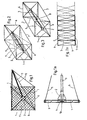
- Fig. 1 is a perspective view of a known pyramid structure which is installed as an avalanche barrier element with vertex anchored to the ground.
- Fig. 1a shows a side view of the detail of the articulation between the cross-shaped profiles which form the base of the pyramidal structure shown in Fig. 1 and the pipe or profile end which forms the apex of the pyramid with the opposite end.
- Fig. 2 shows schematically a support structure according to the invention for a prismatic wire ballast box which is formed from the assembly of two pyramidal modules, wherein the apex of each of the pyramids corresponds to the joint at the base of the corresponding assembled pyramid.
- Fig. 2a shows schematically in plan view the construction of a Drahtschotterverhaues means of several shown in Fig. 2 modules which are aligned among themselves.
- Fig. 3 shows schematically a support structure according to the invention for a prismatic wire ballast box which is formed by the assembly of two pyramid modules, the apex of the pyramids are located at the midpoint on the connecting pipe or profile of the two bases of the assembled pyramids.
- Fig. 4 shows schematically in plan view a polygonal Drahtschotterverhau in plan view which is composed of modules according to the invention.
- Fig. 5 shows schematically in perspective the creation of a cube-shaped wire ballast box whose shell is reinforced by four pyramidal elements, wherein the cross-arrangements of the four lateral faces of the cube Cover and the connecting tubes or profiles are interconnected inside in the center of the cube.
- FIG. 5a shows schematically in plan view the creation of a Drahtschotterverhaues means of several shown in Fig. 2 modules wherein the end face of the wire ballast box is reinforced at the end of the structure by a third pyramid element.
- FIG. 6 shows a front view of a filled according to the invention reinforced, prismatic wire ballast box which is provided above with a body structure with encircling grid to be filled from above with stones.
- the pyramidal structure which forms the basic module (FIG. 1, 1a) for the reinforcement and support of a wire ballast box essentially consists of a tube or profile 3 which at one of the ends has a connecting part 2 on which the ends of the crosswise arranged profiles 1 are articulated ,
- the flanges 1a which project at one of the ends of the profile 1 are provided with a through bore 1b in order to be fixed by means of pins or bolts 4 on a connecting element 2 which has corresponding bores.
- the outer ends of the profiles 1 are connected by a wire 6 to form the base of the pyramid, these outer ends are further connected by wire ropes 5 with the apex of the pyramidal structure which is formed by the free end of the tube or profile 3 while at the other end the connecting element 2 is provided.
- the free end of this tube or profile 3 may be provided with a connecting element 2 to which further cross-shaped and articulated fixed profiles 1, mirror images of those at the opposite end, are provided.
- a structure of a double pyramid wherein the wire ropes 5 which at the outer Ends of the cross-shaped profiles 1 are attached, are attached to the second end of the connecting element 2 of the opposite cross assembly (Fig. 2).
- the outer ends of the profiles 1 of the two cross assemblies can further be connected to each other via wire ropes 7 without precluding that these wires cross each other.
- the grids constituting the wire ballast box are arranged inboard at the cross arrangements of the profiles 1, while the grids constituting the rest of the unwinding of the wire ballast box are fixed inside or outside the wire cables 7 which define the longitudinal edges of the box.
- the wire ropes 5 which connect the outer ends of the profiles 1 to the tube or profile 3, or to the connecting elements 2 in the middle region of the longitudinal extent of the tube or profile 3, or at two spaced points; the anchoring of the wire ropes 5 a cross arrangement can be carried out at the closer or at the farther point, wherein in this latter case, an overlap between the wire ropes 5 takes place.
- the prismatic structure of a wire ballast basket reinforced by the pyramidal module according to the invention can also be reinforced on one (Fig. 5a) or on several (Fig. 5) further surfaces by providing another pyramidal element whose tube or profile 3, forming an angle of 90 °, on the connecting tube or profile 3 which connects the two cross-arrangements of the support structure or is fixed to another element of the pyramidal structure.
- a particular embodiment of the support structure for a wire ballast box which preferably has the shape of a cube (FIG. 5), but without precluding a prismatic shape, arises from the fact that on each of the four side surfaces of the cube and possibly also on the base surface and the upper surface Profiles 1 formed cross assembly together with the corresponding connecting elements 2 and the connecting pipe 3, which possibly with is associated with that of the second or third pair of cross arrangements is provided.
- This structure also offers the advantage that by mutual fixing of the corresponding outer ends of the cross-shaped profiles 1, the entire structure is stable, wherein the cross-assemblies are provided with circumferential wire ropes 6.
- Such a structure makes possible the complete or partial recovery of the elements by releasing the fixings at the outer ends of the cross-shaped profiles 1 by folding them over the lattices 11 as a reverse screen and releasing the connecting tubes or connecting profiles 3 preferably upwards, are pulled through the loose superimposed material.
- each individual pyramidal element may be provided with a metal grid, or several pyramidal elements may be connected such that a composite, e.g. polygonal structure is created, which is equipped with a metal grid.
- the pyramidal element and the structures composed of two or more pyramidal elements may be provided with vertical structural elements 9 ( Figure 6) which protrude above the top surface of the wire ballast box at the top corner regions of the structure around the top ends 9a with wire ropes 9b and any diagonal wire cables 9c to be connected and equipped with a grid 10 for the purpose of forming another wire ballast cell for increasing the Verhaues.
- the grids 10, 11 which form the wire ballast box may be of different types and possibly superimposed in more layers, furthermore, separate grids may be used for the individual surfaces of a wire ballast box, which at the edges below and / or on wire cables or other structural elements of the Support modules are attached.
Landscapes
- Engineering & Computer Science (AREA)
- Environmental & Geological Engineering (AREA)
- Life Sciences & Earth Sciences (AREA)
- General Life Sciences & Earth Sciences (AREA)
- Mining & Mineral Resources (AREA)
- Paleontology (AREA)
- Civil Engineering (AREA)
- General Engineering & Computer Science (AREA)
- Structural Engineering (AREA)
- Revetment (AREA)
- Input Circuits Of Receivers And Coupling Of Receivers And Audio Equipment (AREA)
- Thermistors And Varistors (AREA)
- Piezo-Electric Or Mechanical Vibrators, Or Delay Or Filter Circuits (AREA)
- Networks Using Active Elements (AREA)
- Devices Affording Protection Of Roads Or Walls For Sound Insulation (AREA)
- Pit Excavations, Shoring, Fill Or Stabilisation Of Slopes (AREA)
Description
- Es sind Befestigungsarbeiten und Eindämmungsarbeiten unter der Bezeichnung "Drahtschotterverhau" bekannt welche entlang der Ufer von Flüssen oder entlang von Küsten ausgeführt werden um ein über die Ufer Treten der Flüsse und die Erosion der Küsten zu verhindern. Diese Drahtschotterverhaue haben meist prismatische Form, sind aus Gitter aus verzinktem Stahldraht hergestellt und mit Steinen oder Schotter gefüllt. Für den Schutz der Küsten und für die Erstellung von parallel als auch quer (Buhnen) zur Küste verlaufenden Befestigungen, seltener für Banketts bei begrenzter Wassertiefe, werden prismatische kastenförmige Körbe aus verzinktem Stahldraht verwendet welche mit einer Hülle aus Kunststoff überzogen sind, mit quer verlaufenden aussteifenden Zwischenwänden ausgestattet sind und mit großen Steinen gefüllt werden.
- Die Erstellung dieser Drahtschotterverhaue bringt beachtliche Probleme mit sich, sei es in der Verlegungsphase, insbesondere beim Verlegen der ersten Lage der Drahtschotterkästen welche der Wirkung des strömenden Wassers ausgesetzt sind und oft auf unregelmäßigem Untergrund verlegt werden, welcher dauernd der Erosion ausgesetzt ist, als auch während der folgenden abschließenden Phasen, während der Ausbesserungsarbeiten und/oder den nachträglichen Erhöhungsarbeiten.
- Die bekannten Drahtschotterkästen haben im Verhältnis zu der, der Strömung ausgesetzten, Oberfläche ein bescheidenes Gewicht und können in der Praxis nicht im strömenden Wasser verlegt werden weil sie vom Wasserstrom, bzw. vom Wellengang verstellt würden. Wegen der relativ bescheidenen Ausmaße müssen die bekannten Drahtschotterkästen zum Großteil von Hand oder immerhin mittels Arbeitskräften gefüllt werden welche Gefahren ausgesetzt sind und gezwungen sind mit Stiefeln ausgerüstet im Wasser zu arbeiten. Weiters ist die Gitterstruktur der besagten Drahtschotterkästen wenig stabil so dass es bereits beim Verlegen dieser oder beim Beginn des Fültens, leicht zu übermäßigen Verformungen kommt welche das Verlegen der übergeordneten Drahtschotterkästen in Frage stellen oder erschweren.
- Aus der
FR 2500864 - Aus der
EP 0816572 A2 sind Drahtkästen für die Errichtung von Schotterdrahtverhaue bekannt welche eine schnelle modulare Montage ermöglichen. Die einzelnen Module der Drahtkästen welche unter sich verbunden sind um einen zusammenhängenden, wesentlich geradlinig verlaufenden, Schotterdrahtverhau zu errichten sind mit vertikalen steifen Stützen versehen welche bodenseitig von den Enden steifer horizontaler Spreizen gehalten werden und von außen durch ein X-förmig angebrachtes Strebenpaar in vertikaler Position außeinandergespreizt werden. Die vertikalen Stützen und die X-förmig angebrachten Streben verspannen die jeweils zwei gegenüberliegenden äußeren Gitterflächen der einzelnen zusammenhängenden Drahtkästen, ohne jedoch eine Verankerung oder Verstrebung dieser Gitterflächen in Richtung Kasteninneres zu erreichen und somit ohne den einzelnen Kastenelementen ausreichende Formstabilität beim Befüllen oder bei von außen wirkenden Belastungen zu verleihen. - Die Erfindung stellt sich die Aufgabe ein polyvalentes Modul für die Erstellung von Drahtschotterverhauen zu schaffen welches leicht montierbar und transportierbar ist, welches geeignet ist diesen Strukturen eine beachtenswerte Formstabilität während der Verlegung zu verleihen, während anschließend beim Füllen oder beim Auftreten von Belastungen, um Brüche zu verhindern, eine begrenzte Anpassung der Struktur möglich ist, wobei diese ein derartiges Verhältnis zwischen Gewicht und der, dem Wasserstrom ausgesetzten, Oberfläche aufweist welches ein sicheres und definitives Verlegen auch in bewegten Gewässern und/oder auf prekärem Untergrund ermöglicht.
- Zur Lösung dieser Aufgabe schlägt die Erfindung die Nutzung eines polyvalenten Moduls mit gelenkiger pyramidenförmiger Struktur vor welche als Verstärkung für die Gitterstruktur der einzelnen Drahtschotterkästen wirkt die ihrerseits verschiedenartig zusammenbaubar sind und für Drahtschotterverhaue verschiedener Form einsetzbar sind.
- Die Erfindung schlägt den Einsatz einer Struktur vor welche an sich als Lawinenverbauungselement oder als Konsolidierungselement bekannt ist und immer mit dem Scheitel mittels Platten, Zugankern oder Ankerpfählen an Hängen verankert ist und mit einem Netz ausschließlich im Bereich der Pyramidengrundfläche ausgestattet ist und welche als Barriere, zwecks Zurückhalten der talwärts strömenden Schneemassen wirkt. Die bekannte Pyramidenstruktur besteht wesentlich aus einer Grundfläche welche von vier kreuzartig angeordneten Profilen gebildet wird welche am Ende eines Rohres oder eines Profils gelenkig festgelegt sind und aus Drahtseilen welche die äußeren Enden der vier kreuzartig angeordneten Profile verbinden indem sie einen quadratischen oder rechteckigen Umfang bestimmen; die selben Enden der kreuzförmig angeordneten Profile sind weiters durch Drahtseile mit dem freien Ende (Scheitel der Pyramide) des Profils oder Rohres verbunden welches die Position der Pyramidenhöhe einnimmt.
- Die gelenkige Pyramidenstruktur wird erfindungsgemäß als Grundmodul für die Erstellung verschiedener Verstärkungsstrukturen von Drahtschotterverhauen eingesetzt, wobei sie erfindungsgemäß als einzelnes Modul oder in Kombination mit mehreren Modulen oder Modulteilen die Halte- und Stützfunktion für einen Drahtschotterkasten oder eine Gitterstruktur welche aus mehreren Flächen besteht übernimmt und dabei auf gelenkige Weise eine zu starke Verformung der einzelnen Flächen und der Gesamtform des Drahtschotterverhaues verhindert und überdies als Ballast und als beachtliche Verstärkung der Befestigungsfront oder Befestigungsfronten des Drahtschotterverhaues wirkt.
- Bei Verlegen mehrerer Pyramidenstrukturen mit seitlich anliegenden Grundflächen und am Boden aufliegenden Scheiteln welche entweder an einem einzigen Punkt vereint sind oder konvergieren, ist die Möglichkeit gegeben vieleckige oder halbvieleckige Drahtschotterverhaue zu erstellen, bzw. Abschnitte mit vieleckiger Anordnung zu erstellen und zwar mit der Möglichkeit die Scheitel mit gleichen Abständen, entsprechend einer Seitenlänge der Grundfläche, anzuordnen um so einen geradlinigen Verlauf der Struktur zu erhalten oder mit den Scheiteln mit größerem Abstand als die genannte Seitenlänge, um so einen konkaven vieleckigen Verlauf der Befestigungsstruktur zu erhalten. In diesen letzten Fällen werden die Freiräume zwischen den Scheiteln vorteilhafterweise von weiteren Drahtschotterkästen mit oder ohne entgegengesetzt ausgerichteter Pyramidenstruktur besetzt. Erfindungsgemäß kann an jeder der genannten Pyramidenstrukturen ein Gitter zwecks Zusammenhalten der Steine angebracht werden, dieses ist innerhalb der kreuzförmig verlaufenden Profile und innerhalb oder auch außerhalb der Drahtseile, welche die äußeren Enden der genannten Profile der Grundfläche mit dem Scheitel verbinden, angebracht wobei die Möglichkeit besteht, nach erfolgtem Füllen, einen pyramidenförmigen Drahtschotterkasten oder, bei nach oben sich erstreckenden Gittern im Bereich der Scheitel, einen zwickelförmigen Drahtschotterkasten, zu bilden. Im Falle einer derart gebildeten Serie von Drahtschotterkästen mit beabstandeten Scheiteln, können die freien Zwischenräume ihrerseits mit Steinen, mit oder ohne Einsatz von Gittern, aufgefüllt werden. Natürlich wird die Befestigungsfront eines derart erstellten Drahtschotterverhaues, im Falle einer Ufer- oder Küstenbefestigung, von den Strukturen der Grundflächen der Pyramiden gebildet während bei Bodenkonsolidierungen diese Front die Terrassierung oder Sperre bildet welche durch den, eventuell auf einer am Hang erzeugten Abstufung, angelegten Drahtschotterverhau verankert ist.
- Die erfindungsgemäßen Pyramidenstrukturen sind einfach in der Herstellung und montagefreundlich, sie ermöglichen eventuell eine Vormontage und den anschließenden Transport an die Einsatzstelle eventuell mittels Helikopter, dies ist auch im Falle von bereits mit Gitter ausgestatteten Pyramidenstrukturen möglich. Im Falle einer Verlegung in Wasser wirkt die Pyramidenstruktur als Ballast und verhindert dass der Drahtschotterkasten von der Wasserströmung abgetrieben wird.
- Erfindungsgemäß ermöglicht das beschriebene Modul eine Erweiterung indem am Scheitel also am Ende des Rohres oder des Profils welches sich entsprechend der Pyramidenhöhe erstreckt eine zweite kreuzförmige Struktur vorgesehen ist welche jener an der Pyramidengrundfläche entspricht und gleich dieser aus vier gelenkig, am zweiten Ende des genannten Rohres oder Profils, festgelegten Profilen besteht. In diesem Fall können, bezüglich der Längserstreckung des Verbindungsrohres oder -profils, zwischen den beiden kreuzförmigen Strukturen, die Profilenden jeder Kreuzanordnung mittels Drahtseile mit dem entgegengesetzten Ende des Verbindungsrohres oder -profils verbunden werden wodurch eine Struktur für einen prismatischen Drahtschotterkasten entsteht, wobei das Verbindungsrohr oder -profil entsprechend der Längsachse des Prismas verläuft. Erfindungsgemäß kann jedoch die Befestigung der Drahtseile welche an den äußeren Enden der kreuzförmig angeordneten Profile befestigt sind, auch an einem Punkt im Mittelbereich oder außerhalb der Mitte der Längserstreckung des Rohres oder des Profils oder an zwei getrennten beabstandeten Punkten befestigt werden. Der prismatische Drahtschotterkasten wird in diesem Fall aus Gitter gebildet welche innerhalb der beiden Kreuzanordnungen und innerhalb oder außerhalb der Drahtseile, welche die entsprechenden äußeren Enden der kreuzförmig angeordneten Profile der Pyramidenstrukturen welche durch ein Rohr oder Profil verbundenen sind, angebracht sind und die Längskanten des Prismas definieren.
- Der Drahtschotterverhau welcher erfindungsgemäß erstellt wird bietet sich an durch Aufsetzen von, sich senkrecht erstreckenden, Rohren oder Profilen im Bereich der Kreuzanordnungen der zusammengesetzten Pyramidenstrukturen, einen weiteren Drahtschotterkasten zu schaffen welcher an den vier senkrechten Kanten von den genannten aufgesetzten Rohren oder Profilen zusammen mit eventuellen dazwischen angebrachten Verbindungs- oder/und Verwindungsdrahtseilen, gestützt wird.
- Erfindungsgemäß kann, zwecks Verstärkung der Drahtschotterkästen in Eck- oder Endbereichen, z.B. am Ende von Buhnen, auch das Gitter welche die Außenfläche am Ende des Verhaues bildet, mit einer Pyramidenstruktur ausgestattet werden wobei das Verbindungsrohr oder -profil welches sich entsprechend der Pyramidenhöhe erstreckt, mit dem Verbindungsrohr- oder -profil welches die beiden Kreuzanordnungen verbindet oder mit einem anderen Strukturelement, verbunden werden kann.
- Wegen der inneren Pyramidenstruktur welche geeignet ist in gelenkiger Art die Form des Drahtschotterkastens zu stützen, können die derart erstellten Drahtschotterverhaue vollständig mit mechanischen Mitteln gefüllt werden.
- Die Erfindung schließt nicht aus, dass im Falle prismatischer Strukturen die Verbindungsdrahtseile, zwischen den äußeren Enden der kreuzförmig angeordneten Profile und dem Verbindungsrohr oder -profil zwischen den beiden Kreuzanordnungen, von Drahtseilen ersetzt werden können welche die genannten Enden der Profile einer Kreuzanordnung mit jenen der entgegengesetzten Kreuzanordnung verbinden, wobei sie zueinander parallel und den Längskanten des Prismas entsprechend verlaufen, oder den Diagonalen der Außenflächen des Prismas entsprechend, bzw. den Raumdiagonalen entsprechend verlaufen und sich überschneiden.
- Gemäß einer Weiterentwicklung des Erfindungsgedankens kann, insbesondere ein würfelförmiger aber auch ein prismatischer Drahtschotterkasten an allen Außenflächen mit einer gelenkigen Kreuzanordnung ausgestattet sein wobei die Rohre oder Profile welche mit dem gelenkigen Verbindungsteil ausgestattet sind im zentralen Bereich des geometrischen Körpers verbunden sind. Diese Lösung ermöglicht die Erstellung einer Stützstruktur bei welcher nur die äußeren Enden der kreuzförmig angeordneten Profile, welche den Ecken des geometrischen Körpers entsprechen, unter sich verbunden sind. Weiters ermöglicht diese Struktur die vollständige oder teilweise Rückgewinnung der Strukturelemente, ohne Entleerung des derart erstellten Drahtschotterkorbes, durch Lösen der Befestigungen an den äußeren Enden der kreuzförmig angeordneten Profile, durch Umlegen der Profile nach außen nach Art eines umgekehrten Schirmes und durch eventuelles Lösen der Gitter und Ausziehen der Verbindungsrohre oder Verbindungsprofile falls diese kreuzartig angeordnet sind ohne unter sich verbunden zu sein.
- Die Erfindung wird anschließend anhand einiger, in den beigelegten Zeichnungen schematisch dargestellter, vorzuziehender Ausführungsbeispiele polyvalenter erfindungsgemäßer Module für die Erstellung von Drahtschotterverhauen näher erklärt, weiters sind in den Zeichnungen unterschiedliche Kombinationen der Module gezeigt.
- Die Fig. 1 ist eine perspektivische Darstellung einer bekannten Pyramidenstruktur welche als Lawinenverbauungselement mit am Boden verankertem Scheitel installiert ist.
- Die Fig. 1a zeigt in Seitenansicht das Detail der gelenkigen Festlegung zwischen den kreuzförmig angeordneten Profilen welche die Grundfläche der in Fig. 1 gezeigten Pyramidenstruktur bilden und des Rohr- oder Profilendes welches mit dem entgegengesetzten Ende den Scheitel der Pyramide bildet.
- Die Fig. 2 zeigt schematisch eine erfindungsgemäße Stützstruktur für einen prismatischen Drahtschotterkasten welche aus dem Zusammenbau zweier pyramidenförmiger Module gebildet wird, wobei der Scheitel jeder der Pyramiden dem Gelenk an der Grundfläche der entsprechenden zusammengebauten Pyramide entspricht.
- Die Fig. 2a zeigt schematisch in Draufsicht die Errichtung eines Drahtschotterverhaues mittels mehrerer in Fig. 2 gezeigter Module welche unter sich ausgerichtet sind.
- Die Fig. 3 zeigt schematisch eine erfindungsgemäße Stützstruktur für einen prismatischen Drahtschotterkasten welche durch den Zusammenbau zweier Pyramidenmodule entstanden ist, die Scheitel der Pyramiden befinden sich am Mittelpunkt am Verbindungsrohr oder -profil der zwei Grundflächen der zusammengebauten Pyramiden.
- Die Fig. 4 zeigt schematisch in Draufsicht einen vieleckig verlaufenden Drahtschotterverhau in Draufsicht welcher aus erfindungsgemäßen Modulen zusammengesetzt ist.
- Die Fig. 5 zeigt schematisch in perspektivischer Darstellung die Schaffung eines würfelförmigen Drahtschotterkastens dessen Hülle von vier Pyramidenelementen verstärkt ist wobei die Kreuzanordnungen die vier seitlichen Flächen des Würfels abdecken und die Verbindungsrohre oder-profile untereinander innen im Zentrum des Würfel verbunden sind.
- Die Fig. 5a zeigt schematisch in Draufsicht die Erstellung eines Drahtschotterverhaues mittels mehrerer in Fig. 2 gezeigter Module wobei die Stirnfläche des Drahtschotterkastens am Ende der Struktur durch ein drittes Pyramidenelement verstärkt ist.
- Die Fig. 6 zeigt in Vorderansicht einen gefüllten erfindungsgemäß verstärkten, prismatischen Drahtschotterkasten welcher oberhalb mit einer Aufbaustruktur mit umlaufendem Gitter versehen ist um von oben weiter mit Steine gefüllt werden zu können.
- Die Pyramidenstruktur welche das Grundmodul (Fig. 1, 1a) für die Verstärkung und Stützung eines Drahtschotterkastens bildet, besteht wesentlich aus einem Rohr oder Profil 3 welches an einem der Enden ein Verbindungsteil 2 aufweist an welchem die Enden der kreuzförmig angeordneten Profile 1 gelenkig festgelegt sind. Dazu sind z.B. die Flansche 1a welche an einem der Enden des Profils 1 vorstehen mit einer durchgehenden Bohrung 1 b versehen um mittels Zapfen oder Bolzen 4 an einem Verbindungselement 2 welches entsprechende Bohrungen aufweist festgelegt zu werden. Die äußeren Enden der Profile 1 sind durch ein Drahtseile 6 verbunden um die Grundfläche der Pyramide zu bilden, diese äußeren Enden sind weiters mittels Drahtseile 5 mit dem Scheitel der Pyramidenstruktur verbunden welcher durch das freie Ende des Rohres oder Profils 3 gebildet wird während am anderen Ende das Verbindungselement 2 vorgesehen ist.
- Erfindungsgemäß kann jedoch auch das freie Ende dieses Rohres oder Profils 3 mit einem Verbindungselement 2 versehen sein an welchem weitere kreuzförmig angeordnete und gelenkig festgelegte Profile 1, spiegelbildlich zu jenen am entgegengesetzten Ende, vorgesehenen sind. In diesem Fall erhält man eine Struktur aus einer Doppelpyramide wobei die Drahtseile 5 welche an den äußeren Enden der kreuzförmig angeordneten Profile 1 befestigt sind, am zweiten Ende am Verbindungselement 2 der gegenüberliegenden Kreuzanordnung (Fig. 2) befestigt sind. Die äußeren Enden der Profile 1 der beiden Kreuzanordnungen können weiters unter sich über Drahtseile 7 verbunden sein ohne auszuschließen dass diese Drahtseile sich überkreuzen. Die Gitter welche den Drahtschotterkasten bilden sind an den Kreuzanordnungen der Profile 1 innenliegend angeordnet während die Gitter welche den Rest der Abwicklung des Drahtschotterkastens bilden innerhalb oder außerhalb an den Drahtseilen 7, welche die Längskanten des Kastens definieren, befestigt sind.
- Gemäß einer Weiterentwicklung des Erfindungsgedankens können die Drahtseile 5 welche die äußeren Enden der Profile 1 mit dem Rohr oder Profil 3, bzw. mit den Verbindungselementen 2 im Mittelbereich der Längserstreckung des Rohres oder Profils 3, oder an zwei beabstandeten Punkten, verbunden sein; die Verankerung der Drahtseile 5 einer Kreuzanordnung kann dabei am näheren oder am entfernteren Punkt erfolgen wobei in diesem letzteren Fall eine Überschneidung zwischen den Drahtseilen 5 stattfindet.
- Die prismatische Struktur eines durch das pyramidenförmige erfindungsgemäße Modul verstärkten Drahtschotterkorbes kann auch an einer (Fig. 5a) oder an mehreren (Fig. 5) weiteren Flächen verstärkt werden indem ein weiteres Pyramidenelement vorgesehen wird dessen Rohr oder Profil 3, unter Bildung eines Winkels von 90°, am Verbindungsrohr oder -profil 3 welches die beiden Kreuzanordnungen der Stützstruktur verbindet oder an einem anderen Element der pyramidenförmigen Struktur festgelegt wird.
- Eine besondere Ausführung der Stützstruktur für einen Drahtschotterkasten welcher vorzugsweise die Form eines Würfels hat (Fig. 5), ohne jedoch eine prismatische Form auszuschließen, entsteht dadurch dass an den vier Seitenflächen des Würfels und eventuell auch an der Grundfläche und der oberen Fläche je eine aus Profilen 1 gebildete Kreuzanordnung samt den entsprechenden Verbindungselementen 2 und dem Verbindungsrohr 3, welches eventuell mit jenem des zweiten oder des dritten Paares von Kreuzanordnungen verbunden ist, vorgesehen ist. Diese Struktur bietet auch den Vorteil, dass durch gegenseitiges Festlegen der entsprechenden äußeren Enden der kreuzförmig angeordneten Profile 1 die gesamte Struktur stabil wird wobei die Kreuzanordnungen mit umlaufenden Drahtseilen 6 versehen sind. Eine derartige Struktur macht die vollständige oder teilweise Rückgewinnung der Elemente möglich indem die Festlegungen an den äußeren Enden der kreuzförmig angeordneten Profile 1 gelöst werden, indem diese, infolge Loslösen von den Gittern 11, wie ein umgekehrter Schirm umgelegt werden und indem die Verbindungsrohre oder Verbindungsprofile 3 vorzugsweise nach oben, durch das lockere überlagerte Material hindurchgezogen werden.
- Die Erfindung schließt jedoch nicht aus einfache Pyramidenelemente für die Erstellung von z.B. vieleckig verlaufenden Drahtschotterverhauen (Fig. 4) einzusetzen, in diesem Fall kann jedes einzelne Pyramidenelement mit einem Metallgitter versehen werden oder es können mehrere Pyramidenelemente so verbunden werden dass eine zusammengesetzte, z.B. vieleckige Struktur entsteht, welche mit einem Metallgitter ausgestattet wird.
- Das Pyramidenelement und die aus zwei oder mehreren Pyramidenelementen zusammengesetzten Strukturen können mit vertikalen Strukturelementen 9 (Fig. 6) ausgestattet werden welche an den oberen Eckbereichen der Struktur über die obere Fläche des Drahtschotterkastens emporragen um an den oberen Enden 9a mit Drahtseilen 9b und eventuellen diagonalen Drahtseilen 9c verbunden zu werden und mit einem Gitter 10 zwecks Ausbildung einer weiteren Drahtschotterzelle für die Erhöhung des Verhaues auszustatten.
- Natürlich können die Gitter 10, 11 welche den Drahtschotterkasten bilden verschiedener Art sein und eventuell in mehr Schichten überlagert sein, weiters können für die einzelnen Flächen eines Drahtschotterkastens eigene Gitter eingesetzt werden welche an den Kanten unter sich und/oder an Drahtseilen oder an anderen Strukturelementen der Stützmodule befestigt werden.
Claims (4)
- Polyvalentes Modul für die Erstellung von Drahtschotterverhauen, wobei das Modul pyramidenförmig ist, wobei es vier kreuzförmig angeordnete erste Profile (1) umfaßt welche die Grundfläche der Pyramide bilden und gelenkig an einem Verbindungselement (2) festgelegt sind welches am Ende eines, entsprechend der Höhe der Pyramide sich erstreckenden zweiten Profils oder Rohres (3) befestigt ist, wobei die äußeren Enden dieser kreuzförmig angeordneten ersten Profile (1) unter sich durch erste Drahtseile (6) verbunden sind, wobei diese selben Enden mittels zweiter Drahtseile (5) mit dem freien Ende des Rohres oder zweiten Profils (3) oder mit einem zum Verbindungselement (2) beabstandten Punkt am Rohr oder zweiten Profil (3) verbunden sind, wobei das Modul des weiteren mindestens ein Gitterelement (11) umfaßt, wobei das oder die Gitter elemente (11) an der das oder die Gitter elemente (11) an der Pyramide zur Erstellung eines Drahtgitterkastens, angebracht sind, und wobei die Gitterelement (11) bezüglich der kreuzförmig angeordneten die Grundfläche der Pyramide bildenden ersten Profile (1) innen und bezüglich zweier benachbarten zweiten Drahtseilen (5) welche die Seitenkanten der Pyramide definieren, innen oder außen angebracht sind.
- Modul gemäß Anspruch 1, wobei das Rohr oder zweite Profil (3) zweckes Ausbildung einer zweiten Kruzanordnungen ersten Profile (1) auch am anderen Ende mit einem Verbindungselement (2) für die gelenkige Festlegung weiterer kreuzförmig angeordneten ersten Profile (1) versehen ist, wobei weiterer zweite Drahtseile (5) die äußeren Enden dieser an beiden Enden des Rohres oder des zweiten Profils (3) festgelegten ersten Profile (1) der zweiten Krenzanordnung mit dem entgegengesetzten Ende des Rohres oder zweiten Profils (3) oder dem an diesem Ende vorgesehenen Verbindungselementes (2) verbinden, wobei die äußeren Enden der ersten Profile (1) der beiden beabstandeten Kreuzanordnungen mittels paralleler und/oder sich eventuell überschneidender dritter Drahtseile (7) verbunden sind und wobei weitere Gitter elemente (10, 11) welche den Drahtkasten bilden innen an den beiden Kreuzanordnungen und außen oder innen an den Drahtseilen (7) welche die Längskanten und/ die Diagonalen der Mantelflächen der prismatischen Struktur bestimmen, befestigt sind.
- Modul gemäß Anspruch 2, wobei die dritten Drahtseile (7) welche die äußeren Enden der ersten Profile (1) einer Kreuzanordnung mit jenen der entgegengesetzten Kreuzanordnung verbinden, den Raumdiagonalen der prismatischen Struktur gemäß angeordnet sind.
- Modul gemäß Anspruch 2, wobei die Drahtseile (5) welche die äußeren Enden der estern Profile (1) beider Kreuzanordnungen mit dem Rohr oder zweiten Profil (3) verbinden betreffend dessen Längserstreckung, mittig an einem einzigen Punkt oder außerhalb der Mitte oder in zwei beabstandeten Punkten befestigt sind und zwar mit der Möglichkeit der Befestigung am jeweils der Kreuzanordnung näher liegenden Punkt oder am entfernteren Punkt wobei sich die zweiten Drahtseile (5) überschneiden.
Applications Claiming Priority (2)
| Application Number | Priority Date | Filing Date | Title |
|---|---|---|---|
| IT000033A ITBZ20030033A1 (it) | 2003-06-18 | 2003-06-18 | Modulo polivalente per la realizzazione di strutture gabbionate |
| PCT/EP2004/006433 WO2004111351A1 (de) | 2003-06-18 | 2004-06-15 | Polyvalentes modul für die erstellung von drahtschotterverhauen |
Publications (2)
| Publication Number | Publication Date |
|---|---|
| EP1641981A1 EP1641981A1 (de) | 2006-04-05 |
| EP1641981B1 true EP1641981B1 (de) | 2008-01-16 |
Family
ID=33548850
Family Applications (1)
| Application Number | Title | Priority Date | Filing Date |
|---|---|---|---|
| EP04739903A Expired - Lifetime EP1641981B1 (de) | 2003-06-18 | 2004-06-15 | Polyvalentes modul für die erstellung von drahtschotterverhauen |
Country Status (6)
| Country | Link |
|---|---|
| EP (1) | EP1641981B1 (de) |
| AT (1) | ATE384170T1 (de) |
| DE (1) | DE502004005971D1 (de) |
| ES (1) | ES2299840T3 (de) |
| IT (1) | ITBZ20030033A1 (de) |
| WO (1) | WO2004111351A1 (de) |
Families Citing this family (1)
| Publication number | Priority date | Publication date | Assignee | Title |
|---|---|---|---|---|
| FR3134124B1 (fr) * | 2022-03-30 | 2024-09-27 | Sbj & Co Sa | Structure de soutènement et dispositif de soutènement correspondant |
Family Cites Families (2)
| Publication number | Priority date | Publication date | Assignee | Title |
|---|---|---|---|---|
| FR2500864A1 (fr) * | 1980-12-19 | 1982-09-03 | Zimmermann Eugene | Armature de liaison et de renforcement incorporee au gabion metallique |
| IT1284463B1 (it) * | 1996-07-03 | 1998-05-21 | Valsella Meccanotecnica Spa | Sistema modulare di protezione a rapida messa in opera |
-
2003
- 2003-06-18 IT IT000033A patent/ITBZ20030033A1/it unknown
-
2004
- 2004-06-15 DE DE502004005971T patent/DE502004005971D1/de not_active Expired - Fee Related
- 2004-06-15 AT AT04739903T patent/ATE384170T1/de active
- 2004-06-15 ES ES04739903T patent/ES2299840T3/es not_active Expired - Lifetime
- 2004-06-15 EP EP04739903A patent/EP1641981B1/de not_active Expired - Lifetime
- 2004-06-15 WO PCT/EP2004/006433 patent/WO2004111351A1/de not_active Ceased
Also Published As
| Publication number | Publication date |
|---|---|
| ATE384170T1 (de) | 2008-02-15 |
| WO2004111351A1 (de) | 2004-12-23 |
| ES2299840T3 (es) | 2008-06-01 |
| DE502004005971D1 (de) | 2008-03-06 |
| EP1641981A1 (de) | 2006-04-05 |
| ITBZ20030033A1 (it) | 2004-12-19 |
Similar Documents
| Publication | Publication Date | Title |
|---|---|---|
| EP2912238B1 (de) | Wandelement für gebäude in fertigbauweise | |
| DE4030885A1 (de) | Verfahren und element fuer die herstellung von strukturen fuer die aufnahme von terrainflaeche | |
| EP4148186A1 (de) | Fundament für eine windkraftanlage | |
| EP0828897B1 (de) | Lawinenverbauungselement mit schirmartiger struktur und netzwerk | |
| DE69813809T2 (de) | Böschungsmauersystem | |
| EP0202552B1 (de) | Raumelement aus Gittermatten | |
| EP3183401B1 (de) | Betonkonstruktion in modulbauweise | |
| DE4208964A1 (de) | Steilboeschungsbaute | |
| DE8916082U1 (de) | Schotterkorb-Bausatz | |
| DE3719523A1 (de) | Fundierungs- oder absicherungselement | |
| EP1641981B1 (de) | Polyvalentes modul für die erstellung von drahtschotterverhauen | |
| DE3103849A1 (de) | Sicherungsbauwerk fuer begruenbare steilboeschungen und -waelle | |
| CH651095A5 (de) | Bewehrungselement zur uebertragung von querkraeften in plattenartigen traggliedern, z.b. flachdecken. | |
| DE3833414A1 (de) | Gittermatten-laermschutzwand | |
| EP2292846B1 (de) | Steinkorbanordnung | |
| EP1131498A1 (de) | Stützwandanordnung | |
| EP1898005B1 (de) | Steinkorbelement zum Errichten von Stützmauern oder dergleichen | |
| DE102005014025A1 (de) | Als Stahlfachwerkkonstruktion ausgebildeter Turm, vorzugsweise für Windkraftanlagen | |
| AT304833B (de) | Dreieckförmiges Bauelement, Verfahren zur Herstellung eines Turmbauwerkes und Turmbauwerk aus solchen Bauelementen | |
| EP0497179A2 (de) | Ortsveränderliche Überdachung für Deponien | |
| AT372733B (de) | Bauwerksskelett aus lasttragenden vorgefertigten bauelementen | |
| DE8612622U1 (de) | Raumelement aus Gittermatten | |
| EP4522823A1 (de) | Fachwerk-eckverbindungsbaugruppe, fachwerk und fachwerkstruktur | |
| CH680599A5 (en) | Terracing support for sloping ground - has anchor bolts for wall secured in ground at upwards side | |
| DE202021105272U1 (de) | Ankerkorb für ein Fundament für eine Windkraftanlage |
Legal Events
| Date | Code | Title | Description |
|---|---|---|---|
| PUAI | Public reference made under article 153(3) epc to a published international application that has entered the european phase |
Free format text: ORIGINAL CODE: 0009012 |
|
| 17P | Request for examination filed |
Effective date: 20051214 |
|
| AK | Designated contracting states |
Kind code of ref document: A1 Designated state(s): AT BE BG CH CY CZ DE DK EE ES FI FR GB GR HU IE IT LI LU MC NL PL PT RO SE SI SK TR |
|
| 17Q | First examination report despatched |
Effective date: 20060703 |
|
| DAX | Request for extension of the european patent (deleted) | ||
| GRAP | Despatch of communication of intention to grant a patent |
Free format text: ORIGINAL CODE: EPIDOSNIGR1 |
|
| GRAC | Information related to communication of intention to grant a patent modified |
Free format text: ORIGINAL CODE: EPIDOSCIGR1 |
|
| GRAS | Grant fee paid |
Free format text: ORIGINAL CODE: EPIDOSNIGR3 |
|
| GRAA | (expected) grant |
Free format text: ORIGINAL CODE: 0009210 |
|
| AK | Designated contracting states |
Kind code of ref document: B1 Designated state(s): AT BE BG CH CY CZ DE DK EE ES FI FR GB GR HU IE IT LI LU MC NL PL PT RO SE SI SK TR |
|
| REG | Reference to a national code |
Ref country code: GB Ref legal event code: FG4D Free format text: NOT ENGLISH |
|
| REG | Reference to a national code |
Ref country code: CH Ref legal event code: EP |
|
| REG | Reference to a national code |
Ref country code: IE Ref legal event code: FG4D Free format text: LANGUAGE OF EP DOCUMENT: GERMAN |
|
| REF | Corresponds to: |
Ref document number: 502004005971 Country of ref document: DE Date of ref document: 20080306 Kind code of ref document: P |
|
| REG | Reference to a national code |
Ref country code: CH Ref legal event code: NV Representative=s name: BUGNION S.A. |
|
| PG25 | Lapsed in a contracting state [announced via postgrant information from national office to epo] |
Ref country code: NL Free format text: LAPSE BECAUSE OF FAILURE TO SUBMIT A TRANSLATION OF THE DESCRIPTION OR TO PAY THE FEE WITHIN THE PRESCRIBED TIME-LIMIT Effective date: 20080116 |
|
| REG | Reference to a national code |
Ref country code: ES Ref legal event code: FG2A Ref document number: 2299840 Country of ref document: ES Kind code of ref document: T3 |
|
| NLV1 | Nl: lapsed or annulled due to failure to fulfill the requirements of art. 29p and 29m of the patents act | ||
| PG25 | Lapsed in a contracting state [announced via postgrant information from national office to epo] |
Ref country code: FI Free format text: LAPSE BECAUSE OF FAILURE TO SUBMIT A TRANSLATION OF THE DESCRIPTION OR TO PAY THE FEE WITHIN THE PRESCRIBED TIME-LIMIT Effective date: 20080116 |
|
| GBV | Gb: ep patent (uk) treated as always having been void in accordance with gb section 77(7)/1977 [no translation filed] | ||
| PG25 | Lapsed in a contracting state [announced via postgrant information from national office to epo] |
Ref country code: BG Free format text: LAPSE BECAUSE OF FAILURE TO SUBMIT A TRANSLATION OF THE DESCRIPTION OR TO PAY THE FEE WITHIN THE PRESCRIBED TIME-LIMIT Effective date: 20080416 |
|
| ET | Fr: translation filed | ||
| PG25 | Lapsed in a contracting state [announced via postgrant information from national office to epo] |
Ref country code: SI Free format text: LAPSE BECAUSE OF FAILURE TO SUBMIT A TRANSLATION OF THE DESCRIPTION OR TO PAY THE FEE WITHIN THE PRESCRIBED TIME-LIMIT Effective date: 20080116 Ref country code: PT Free format text: LAPSE BECAUSE OF FAILURE TO SUBMIT A TRANSLATION OF THE DESCRIPTION OR TO PAY THE FEE WITHIN THE PRESCRIBED TIME-LIMIT Effective date: 20080616 Ref country code: PL Free format text: LAPSE BECAUSE OF FAILURE TO SUBMIT A TRANSLATION OF THE DESCRIPTION OR TO PAY THE FEE WITHIN THE PRESCRIBED TIME-LIMIT Effective date: 20080116 |
|
| REG | Reference to a national code |
Ref country code: IE Ref legal event code: FD4D |
|
| PG25 | Lapsed in a contracting state [announced via postgrant information from national office to epo] |
Ref country code: CZ Free format text: LAPSE BECAUSE OF FAILURE TO SUBMIT A TRANSLATION OF THE DESCRIPTION OR TO PAY THE FEE WITHIN THE PRESCRIBED TIME-LIMIT Effective date: 20080116 Ref country code: SK Free format text: LAPSE BECAUSE OF FAILURE TO SUBMIT A TRANSLATION OF THE DESCRIPTION OR TO PAY THE FEE WITHIN THE PRESCRIBED TIME-LIMIT Effective date: 20080116 Ref country code: DK Free format text: LAPSE BECAUSE OF FAILURE TO SUBMIT A TRANSLATION OF THE DESCRIPTION OR TO PAY THE FEE WITHIN THE PRESCRIBED TIME-LIMIT Effective date: 20080116 Ref country code: IE Free format text: LAPSE BECAUSE OF FAILURE TO SUBMIT A TRANSLATION OF THE DESCRIPTION OR TO PAY THE FEE WITHIN THE PRESCRIBED TIME-LIMIT Effective date: 20080116 Ref country code: SE Free format text: LAPSE BECAUSE OF FAILURE TO SUBMIT A TRANSLATION OF THE DESCRIPTION OR TO PAY THE FEE WITHIN THE PRESCRIBED TIME-LIMIT Effective date: 20080416 |
|
| PLBE | No opposition filed within time limit |
Free format text: ORIGINAL CODE: 0009261 |
|
| STAA | Information on the status of an ep patent application or granted ep patent |
Free format text: STATUS: NO OPPOSITION FILED WITHIN TIME LIMIT |
|
| PG25 | Lapsed in a contracting state [announced via postgrant information from national office to epo] |
Ref country code: RO Free format text: LAPSE BECAUSE OF FAILURE TO SUBMIT A TRANSLATION OF THE DESCRIPTION OR TO PAY THE FEE WITHIN THE PRESCRIBED TIME-LIMIT Effective date: 20080116 |
|
| 26N | No opposition filed |
Effective date: 20081017 |
|
| BERE | Be: lapsed |
Owner name: LASAR SRL Effective date: 20080630 |
|
| PG25 | Lapsed in a contracting state [announced via postgrant information from national office to epo] |
Ref country code: GB Free format text: LAPSE BECAUSE OF FAILURE TO SUBMIT A TRANSLATION OF THE DESCRIPTION OR TO PAY THE FEE WITHIN THE PRESCRIBED TIME-LIMIT Effective date: 20080116 |
|
| PG25 | Lapsed in a contracting state [announced via postgrant information from national office to epo] |
Ref country code: MC Free format text: LAPSE BECAUSE OF NON-PAYMENT OF DUE FEES Effective date: 20080630 |
|
| PG25 | Lapsed in a contracting state [announced via postgrant information from national office to epo] |
Ref country code: BE Free format text: LAPSE BECAUSE OF NON-PAYMENT OF DUE FEES Effective date: 20080630 |
|
| PG25 | Lapsed in a contracting state [announced via postgrant information from national office to epo] |
Ref country code: EE Free format text: LAPSE BECAUSE OF FAILURE TO SUBMIT A TRANSLATION OF THE DESCRIPTION OR TO PAY THE FEE WITHIN THE PRESCRIBED TIME-LIMIT Effective date: 20080116 Ref country code: DE Free format text: LAPSE BECAUSE OF NON-PAYMENT OF DUE FEES Effective date: 20090101 |
|
| PG25 | Lapsed in a contracting state [announced via postgrant information from national office to epo] |
Ref country code: CY Free format text: LAPSE BECAUSE OF FAILURE TO SUBMIT A TRANSLATION OF THE DESCRIPTION OR TO PAY THE FEE WITHIN THE PRESCRIBED TIME-LIMIT Effective date: 20080116 |
|
| PG25 | Lapsed in a contracting state [announced via postgrant information from national office to epo] |
Ref country code: HU Free format text: LAPSE BECAUSE OF FAILURE TO SUBMIT A TRANSLATION OF THE DESCRIPTION OR TO PAY THE FEE WITHIN THE PRESCRIBED TIME-LIMIT Effective date: 20080717 Ref country code: LU Free format text: LAPSE BECAUSE OF NON-PAYMENT OF DUE FEES Effective date: 20080615 |
|
| PG25 | Lapsed in a contracting state [announced via postgrant information from national office to epo] |
Ref country code: TR Free format text: LAPSE BECAUSE OF FAILURE TO SUBMIT A TRANSLATION OF THE DESCRIPTION OR TO PAY THE FEE WITHIN THE PRESCRIBED TIME-LIMIT Effective date: 20080116 |
|
| PG25 | Lapsed in a contracting state [announced via postgrant information from national office to epo] |
Ref country code: GR Free format text: LAPSE BECAUSE OF FAILURE TO SUBMIT A TRANSLATION OF THE DESCRIPTION OR TO PAY THE FEE WITHIN THE PRESCRIBED TIME-LIMIT Effective date: 20080417 |
|
| PGFP | Annual fee paid to national office [announced via postgrant information from national office to epo] |
Ref country code: CH Payment date: 20120629 Year of fee payment: 9 |
|
| PGFP | Annual fee paid to national office [announced via postgrant information from national office to epo] |
Ref country code: IT Payment date: 20120626 Year of fee payment: 9 |
|
| PGFP | Annual fee paid to national office [announced via postgrant information from national office to epo] |
Ref country code: FR Payment date: 20120712 Year of fee payment: 9 Ref country code: ES Payment date: 20120709 Year of fee payment: 9 |
|
| PGFP | Annual fee paid to national office [announced via postgrant information from national office to epo] |
Ref country code: AT Payment date: 20120619 Year of fee payment: 9 |
|
| REG | Reference to a national code |
Ref country code: CH Ref legal event code: PL |
|
| REG | Reference to a national code |
Ref country code: AT Ref legal event code: MM01 Ref document number: 384170 Country of ref document: AT Kind code of ref document: T Effective date: 20130615 |
|
| REG | Reference to a national code |
Ref country code: FR Ref legal event code: ST Effective date: 20140228 |
|
| PG25 | Lapsed in a contracting state [announced via postgrant information from national office to epo] |
Ref country code: CH Free format text: LAPSE BECAUSE OF NON-PAYMENT OF DUE FEES Effective date: 20130630 Ref country code: LI Free format text: LAPSE BECAUSE OF NON-PAYMENT OF DUE FEES Effective date: 20130630 |
|
| PG25 | Lapsed in a contracting state [announced via postgrant information from national office to epo] |
Ref country code: IT Free format text: LAPSE BECAUSE OF NON-PAYMENT OF DUE FEES Effective date: 20130615 Ref country code: FR Free format text: LAPSE BECAUSE OF NON-PAYMENT OF DUE FEES Effective date: 20130701 Ref country code: AT Free format text: LAPSE BECAUSE OF NON-PAYMENT OF DUE FEES Effective date: 20130615 |
|
| REG | Reference to a national code |
Ref country code: ES Ref legal event code: FD2A Effective date: 20140707 |
|
| PG25 | Lapsed in a contracting state [announced via postgrant information from national office to epo] |
Ref country code: ES Free format text: LAPSE BECAUSE OF NON-PAYMENT OF DUE FEES Effective date: 20130616 |