EP1643731A1 - Méthode et dispositif pour la fusion des composants des appels pendant une reconstruction d'appel - Google Patents
Méthode et dispositif pour la fusion des composants des appels pendant une reconstruction d'appel Download PDFInfo
- Publication number
- EP1643731A1 EP1643731A1 EP05254997A EP05254997A EP1643731A1 EP 1643731 A1 EP1643731 A1 EP 1643731A1 EP 05254997 A EP05254997 A EP 05254997A EP 05254997 A EP05254997 A EP 05254997A EP 1643731 A1 EP1643731 A1 EP 1643731A1
- Authority
- EP
- European Patent Office
- Prior art keywords
- communication
- node
- identifier
- information
- server
- Prior art date
- Legal status (The legal status is an assumption and is not a legal conclusion. Google has not performed a legal analysis and makes no representation as to the accuracy of the status listed.)
- Granted
Links
Images



Classifications
-
- H—ELECTRICITY
- H04—ELECTRIC COMMUNICATION TECHNIQUE
- H04L—TRANSMISSION OF DIGITAL INFORMATION, e.g. TELEGRAPHIC COMMUNICATION
- H04L65/00—Network arrangements, protocols or services for supporting real-time applications in data packet communication
- H04L65/10—Architectures or entities
- H04L65/102—Gateways
- H04L65/1043—Gateway controllers, e.g. media gateway control protocol [MGCP] controllers
-
- H—ELECTRICITY
- H04—ELECTRIC COMMUNICATION TECHNIQUE
- H04L—TRANSMISSION OF DIGITAL INFORMATION, e.g. TELEGRAPHIC COMMUNICATION
- H04L65/00—Network arrangements, protocols or services for supporting real-time applications in data packet communication
- H04L65/1066—Session management
- H04L65/1083—In-session procedures
-
- H—ELECTRICITY
- H04—ELECTRIC COMMUNICATION TECHNIQUE
- H04L—TRANSMISSION OF DIGITAL INFORMATION, e.g. TELEGRAPHIC COMMUNICATION
- H04L65/00—Network arrangements, protocols or services for supporting real-time applications in data packet communication
- H04L65/1066—Session management
- H04L65/1101—Session protocols
-
- H—ELECTRICITY
- H04—ELECTRIC COMMUNICATION TECHNIQUE
- H04L—TRANSMISSION OF DIGITAL INFORMATION, e.g. TELEGRAPHIC COMMUNICATION
- H04L69/00—Network arrangements, protocols or services independent of the application payload and not provided for in the other groups of this subclass
- H04L69/40—Network arrangements, protocols or services independent of the application payload and not provided for in the other groups of this subclass for recovering from a failure of a protocol instance or entity, e.g. service redundancy protocols, protocol state redundancy or protocol service redirection
Definitions
- the present invention is directed to realtime data transmission over a network.
- the present invention is directed to maintaining call state information when migrating between call controllers.
- Packet data networks are increasingly used for the exchange of realtime audio, video and data communications.
- Various protocols including the H.323 protocol, require the establishment of a call signaling channel that is separate from the bearer channel.
- the call signaling channel is used to exchange signaling messages, such as call setup, tear down, address translation and messages related to billing.
- a signaling channel is usually established over the IP network 100 between a media gateway 104 and/or communication device 108 on the one hand and a primary communication server 112, providing call controller functionality for basic call service and for various call feature support, on the other. Failure of the network 100 (or a link in the network) or the primary server 112 such that the call signaling channel is lost can lead to a service outage at the media gateway 104 or communication device 108. In order to prevent a loss of service under such circumstances, an alternate or secondary communication server 116 is typically provided.
- the existing calls i.e., the bearer channels
- the existing calls may get torn down. Even if they are not torn down, it is likely that no call features will be available to the media gateway 104 or communication device 108, since the secondary communication server 116 has no knowledge of the call state information associated with the calls.
- preservation of call features in addition to bearer connections requires that the secondary communication server 116 be supplied with call state information.
- Such information can be stored in a database that can be accessed by all primary and secondary servers.
- establishing a common, redundant database can be expensive.
- databases can create a data bottleneck, especially when a large number of servers are accessing the database.
- such a solution is not very robust, as network failures can prevent call controllers from accessing the common database.
- Another approach to providing call state information to secondary communication servers 116 dynamically updates available secondary communication servers 116 with call state information. That is, as call state information is generated or updated; that information is provided to the secondary communication server 116 that would be contacted by the client if the primary communication server 112 were lost.
- this approach adds overhead and complexity, particularly as the number of communication servers available on a system increases.
- the secondary communication servers 116 must be updated with call state information regarding all of the calls on the primary communication server 112. This can result in network congestion.
- the solution is not very robust, as network failures can prevent servers from communicating with one another.
- the components of the calls are not merged; in other words, they are reconstructed as separate calls.
- the separate calls would not behave the same with respect to some features as the original or a merged call. For example, it is possible that a component separately reconstructed as a call has no disconnect supervision.
- the secondary communication server 116 attempts to reconstruct stable calls (calls with established talk paths) on the gateway 104 by querying the gateway 104 for call state information.
- the call state information was saved by the primary communication server 112 when it originally created the call on the gateway 104.
- a naive call reconstruction algorithm would, as the call components migrate, reconstruct the part of _the_call handled by each gateway as a separate or new call, which, as noted above, can cause some features to be lost to the communicants.
- the present invention is directed to communication reconstruction during transition from a primary to a secondary communication server by maintaining communication state information or a representation thereof on a communication node, such as a media gateway or communication terminal.
- communication state information refers to communication-related information, such as call set-up information, tear down, address translation, call appearances for each party, feature selections, and billing information and "communication" refers to packet-switched and/or circuit-switched, analog and/or digital real-time or near-real-time communication signals between two or more parties.
- the communication information maintained on a first communication node comprises a communication identifier and/or node identifier.
- the communication identifier identifies a selected communication uniquely among a defined group of communications.
- the node identifier identifies a second communication node, which is also involved in the selected communication, and/or communication state information on the second node uniquely among a defined group of communication nodes and/or call controllers.
- the identifier(s) are selected so as to be unique across reboots of the same call controller.
- the communication identifier and/or node identifier can be stored on the first communication node as part of the context of the selected communication (or as a property of a termination), and the node can include both a resource identifier, such as an resource identifier, and a local identifier, which represents an association between terminations in a connection such as an resource identifier.
- the resource and local identifiers are both associated with the second communication node.
- the identifier(s) are used for reconstructing communications that involve one or more inter-gateway connections.
- an inter-gateway connection is an IP-bearer connection established between two or more gateways to connect two or more parts of a communication.
- the present invention can effect efficient and rapid matching of the various components of a communication in the event of a failure requiring transition from the primary to the secondary communication controller. It merges the communication components and therefore the reconstructed communication is identical to the original communication in terms of the number of parties in the call, features related to the structure of the communication, and the like.
- the identifier(s) can be relatively low bit numeric, alphabetical, or alphanumeric sequences, thereby requiring fewer resources to store and manage and may be used as an index to an array.
- the communication arrangement 200 involves a number of communication nodes 204a-c interconnected to one another by communication networks 220 and 224.
- the communication nodes are further in communication, via the networks 220 and 224, with a primary and secondary communication servers 212 and 216.
- the communication nodes 204a-c can be any terminating or intermediate node.
- the nodes can represent one or more of a gateway, port network, center stage switch, and a communication terminal, such as a wired or wireless circuit-switched or packet-switched telephone (e.g., an IP soft phone or hard phone, a Digital Signal Processor or DSP telephone, a video phone, a Personal Digital Assistant, a computer running an instant messaging application, and the like).
- the first, second, and third communication nodes 204a-c are gateways, particularly the G700 TM or G350 TM media gateways by Avaya Inc. modified as hereinafter described.
- a gateway provides for an interconnection between a communication endpoint(or to a non-IP protocol network) that is not capable of direct interconnection to the IP protocol communication network.
- the networks 220 and 224 can be synchronous and/or asynchronous transfer mode, connection-oriented and/or connectionless, and circuit and/or packet-switched.
- the networks can be the Public Switched Telephone Network (PSTN), wireless cellular networks, Wide Area Networks, (WANs), Metropolitan Area Networks (MANs), Regional Area Networks (RANs) or Local Area Networks (LANs), depending on the application.
- PSTN Public Switched Telephone Network
- WANs Wide Area Networks
- MANs Metropolitan Area Networks
- RANs Regional Area Networks
- LANs Local Area Networks
- the primary and secondary communication servers 212 and 216 function to facilitate or enable communications between the first, second, and third nodes 204 of the communication networks 220 and 224.
- the communication servers control media gateways during call set-up and termination and maintain communication-related information, such as call state information.
- call state information include Session Initiation Protocol (SIP), H.248, and/or H.323 communication information generated in connection with real-time or near real-time communications over an IP protocol communication network.
- communication information may include static and dynamic call-state information, such as calling and called party identities, call setup, tear down, address translation, call appearances for each party, feature selections, and billing information.
- the communication information is saved as properties of the termination of a corresponding communication
- the "context" refers to a particular node's data representation of a communication, such as a group of (physical and/or ephemeral) terminations which are associated together in a communication.
- the servers 212 and 216 also function to control access to the communication networks.
- the primary and secondary communication servers are software-controlled, and the call control functionality is provided by a modified version of Communication ManagerTM by Avaya Inc.
- the secondary communication server 216 includes a reconstruction agent 228 to reconstruct communications, during communication node transition from the primary to the secondary communication servers, by populating a communication map 232 that replicates the call state information on the primary communications server 212.
- a media gateway is in transition from the time it detects failure of its signaling link to the primary communication server to the time it regains connectivity to the primary or secondary communications server).
- the primary and secondary communication servers commonly have identical copies of the static data but the primary server and not the secondary communication server has the call status information. During node transition from the primary to the secondary server, the call state or status information must be reconstructed by the secondary server.
- each of the communication nodes 204a-c maintains in memory a corresponding node identifier 236a-c and a communication identifier 240a-c.
- the node identifier 236a-c identifies uniquely the distant node and/or a component thereof and/or the distant node's communication information relative to a selected group of network components.
- the node identifier is commonly unique within a group of network nodes and/or primary communication and secondary servers. More typically, it is unique among a group of network components controlled by the primary communication server and/or within the set of nodes that fail over to the secondary communication server.
- the group of network components is typically part of an enterprise network.
- the communication identifier uniquely identifies a communication uniquely relative to a set of other communications handled by a group of network nodes and/or primary and secondary communication servers.
- the set of other communications is handled by one or more of the group of network components controlled by the primary communication server and/or the set of nodes that fail over to the secondary communication server.
- the node identifier will typically be different from node-to-node (so that the first, second, and third identifiers are each different from one another), and the communication identifier is the same for each node involved in the selected communication.
- the node identifier is one or more of an electronic address (e.g., a Media Access Control or MAC address or an Internet Protocol address) of a node or a network endpoint involved in a specific communication, an identifier of a data structure (e.g., a pointer), such as a communication context, related to or used by the communication, an identifier of one or more resources (e.g., port, port network, DSP, DSP channel, set of one or more tones, tone detector, set of one or more announcements, and the like) in the node involved in the communication, and combinations thereof.
- an electronic address e.g., a Media Access Control or MAC address or an Internet Protocol address
- a data structure e.g., a pointer
- resources e.g., port, port network, DSP, DSP channel, set of one or more tones, tone detector, set of one or more announcements, and the like
- the node identifier has two components, namely a resource identifier and a local identifier, that are each associated with a far end-node that is connected as part of the same communication to a selected node.
- the first node identifier could be a unique identifier associated with the second and/or third communication node; the second node identifier a unique identifier associated with the first and/or third node; and so forth.
- the local-identifier refers to a unique identifier of context information stored in a far end-node that is connected as part of the same communication to a selected node.
- the resource identifier is an identifier (such as an electronic address) of a node, such as a gateway, and/or a resource on the node that is at the far end of an inter-node connection, such as an inter-gateway connection, and the local identifier identifies the context stored in the node identified by the resource identifier.
- a resource can refer to a gateway or a resource thereof, such as a port, DSP channel, set of one or more tones, tone detector, set of one or more announcements, and the like, used by the selected communication at the far end node.
- the resource and local identifiers are commonly saved in a selected node as a property (each of which includes a property name and value) of the ephemeral termination corresponding to the selected communication being handled by the selected node.
- the communication identifier is any identifier generated as part of the communication and/or generated in addition to the communication.
- the identifier can be a session identifier, a session key, or a random variable generated specifically for the purpose of acting as the communication identifier.
- the node and/or communication identifiers are pushed, as properties of the termination, to the communication nodes by the primary communication server 212 during normal operations.
- the identifiers can be specified in the H.248 add/subtract/modify/move messages.
- the identifiers can be included in messages currently being exchanged between the primary communication server and the node.
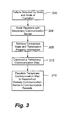
- a node will detect a failure of a signaling link with the primary communication server 212. It then attempts to register with the secondary communication server 216.
- step 304 the node registers with the secondary communication server 304.
- the communication server 304 determines, based on the type of registration and identification of the primary server 212, that the node has failed over with active call state information.
- step 308 the secondary communication server 304 retrieves connection state and termination property information. For example, this can be done using the H.248 audit mechanism known to those skilled in the art.
- the agent 228 uses the retrieved information to construct a temporary communication map, such as a temporary connection or context map.
- the termination property information is saved with each termination in the map.
- the agent 228 sweeps through the map and discards unstable connections and corresponding terminations.
- step 316 which is discussed in detail below with reference to Fig. 4, the agent 228 populates the map to reconstruct the primary communication server's records.
- the agent 228 processes the filtered temporary communication map, one context at a time, to reconstruct the connection records. Once the connection records and user state of the terminations with preserved connections are in place, call records are reconstructed.
- Step 316 will now be described in greater detail with reference to Fig. 4.
- Fig. 4 assumes that the various node and communication identifiers have been or are being received at different times from the nodes impacted by the failure.
- the first, second, and third nodes are gateways.
- a communication spans the first and second communication nodes or an inter-gateway connection exists between the two nodes.
- the first node identifier is related to a representation of the communication maintained by the second communication node, and the second node identifier to a representation of the communication maintained by the first communication node.
- a communication spans the first, second, and third communication nodes or an inter-gateway connection exists between the first and second nodes and between the second and third nodes.
- the first node identifier is related to representation of the communication maintained by the second communication node; the second node identifier to different representations of the communication maintained by each of the first and third communication nodes; and the third node identifier to a representation of the communication maintained by the first communication node. Since gateways migrate to a secondary server one at a time, the node and communication identifiers move to the secondary communication at different times. In the examples, the nodes fail over to the secondary server as follows: the first node precedes the second and third nodes and the third node precedes the second node.
- the agent 228 selects and reads a next node data for processing.
- the next node data is next communication information maintained by the first node (which is the first node to migrate over) for a selected communication that includes the first node and communication identifiers associated with that communication.
- the agent 228 determines whether an inter-node connection exists. When no inter-node connection exists, the agent 228 reconstructs the communication normally. When, as in both examples, an inter-node connection exists, the agent 228 retrieves the far end information, or first node identifier, in step 408 and proceeds to decision diamond 416.
- the agent 228 determines whether a far end or node identifier exists (or whether the node associated with the identifier has already migrated to the secondary communication server 216 and has corresponding data structures already created). In one configuration, the agent 228 searches for an unmerged inter-node connection (INC) termination that matches the information contained in the first node identifier. The agent 228 searches among the unmerged terminations belonging to the first communication node for a match in a communication already received from another communication node. In the first example, no such communication information exists as the second and third communication nodes 204b and c have not yet registered with the secondary communication server 216.
- IOC inter-node connection
- the answer is "yes" as the second node identifier is associated with the previously migrated first communication node.
- the answer is "no" (as the third node identifier is associated with the as yet-unmigrated second communication node)
- the answer is "yes" (as the second node identifier is associated the previously migrated first and third nodes).
- the first node identifier causes the existence of the second (in the first and second examples) and not the third (in the second example) node to be flagged to indicate that it has not yet migrated to the secondary communication server.
- the agent 228 in step 428 associates the selected communication information with the selected communication in the communication map 232.
- the agent 228 in decision diamond 420 determines whether the far end information is flagged in the communication information associated with already migrated communication nodes. In other words, the agent 228 determines if the selected node identifier and any existing unmerged (INC) terminations belong to the same far end communication node and associated communication information. The agent 228 searches for an unmerged INC termination among all terminations such that the unmerged INC termination's far end communication node is the same as the selected node identifier's far end node.
- IOC unmerged
- the agent 228 searches for an unmerged termination among all of the terminations in all of nodes previously migrated to the secondary server, including in the first node's communication information, such that the unmerged termination's far end node matches the node identified in the third node identifier. Because the first node identifier matches the third node identifier (each of which are associated with the second communication node) a match is found.
- the agent 228 proceeds to step 428.
- the agent 228 proceeds to optional decision diamond 424.
- the agent 228 determines whether the selected communication information includes a communication identifier.
- the communication identifier permits the association of communication information with a communication even where an identified far end node is more than one hop away from the currently migrating node.
- the agent 228 proceeds to step 428.
- the agent 228 proceeds to step 412.
- step 428 the agent 228 determines whether next communication data from the instant node has been received. If so, the agent returns to step 400. If not, the agent 228 terminates operation until data from another node arrives.
- the node identifier or communication identifier can be used alone to effect communication reconstruction.
- the reconstruction agent is embodied as a logic circuit, such as an Application Specific Integrated Circuit or ASIC or as a combination of software and a logic circuit.
- the invention is used with protocols other than SIP, H.248, and H.323, such as MGCP.
- the present invention in various embodiments, includes components, methods, processes, systems and/or apparatus substantially as depicted and described herein, including various embodiments, subcombinations, and subsets thereof. Those of skill in the art will understand how to make and use the present invention after understanding the present disclosure.
- the present invention in various embodiments, includes providing devices and processes in the absence of items not depicted and/or described herein or in various embodiments hereof, including in the absence of such items as may have been used in previous devices or processes, e.g., for improving performance, achieving ease and ⁇ or reducing cost of implementation.
Landscapes
- Engineering & Computer Science (AREA)
- Computer Networks & Wireless Communication (AREA)
- Signal Processing (AREA)
- Multimedia (AREA)
- Business, Economics & Management (AREA)
- General Business, Economics & Management (AREA)
- Computer Security & Cryptography (AREA)
- Data Exchanges In Wide-Area Networks (AREA)
Applications Claiming Priority (2)
| Application Number | Priority Date | Filing Date | Title |
|---|---|---|---|
| US61529504P | 2004-09-30 | 2004-09-30 | |
| US11/045,702 US7366110B2 (en) | 2004-09-30 | 2005-01-27 | Method and apparatus for merging call components during call reconstruction |
Publications (2)
| Publication Number | Publication Date |
|---|---|
| EP1643731A1 true EP1643731A1 (fr) | 2006-04-05 |
| EP1643731B1 EP1643731B1 (fr) | 2007-10-03 |
Family
ID=35584574
Family Applications (1)
| Application Number | Title | Priority Date | Filing Date |
|---|---|---|---|
| EP05254997A Expired - Lifetime EP1643731B1 (fr) | 2004-09-30 | 2005-08-11 | Méthode et dispositif pour la fusion des composants des appels pendant une reconstruction d'appel |
Country Status (5)
| Country | Link |
|---|---|
| US (2) | US7366110B2 (fr) |
| EP (1) | EP1643731B1 (fr) |
| JP (1) | JP2006109407A (fr) |
| CA (1) | CA2505021A1 (fr) |
| DE (1) | DE602005002710T2 (fr) |
Families Citing this family (34)
| Publication number | Priority date | Publication date | Assignee | Title |
|---|---|---|---|---|
| US7366110B2 (en) * | 2004-09-30 | 2008-04-29 | Avaya Technology Corp. | Method and apparatus for merging call components during call reconstruction |
| US7457249B2 (en) * | 2005-01-04 | 2008-11-25 | Avaya, Inc. | Alternate routing of media connections within a single communications system across public or private network facilities |
| US7496056B2 (en) * | 2005-01-04 | 2009-02-24 | Avaya Inc. | Conference connections using dynamic topology switching for IP and circuit-switched fabrics |
| US7564793B2 (en) * | 2005-01-04 | 2009-07-21 | Avaya Inc. | In-band call association signaling for a single number destination |
| US8462637B1 (en) | 2005-01-04 | 2013-06-11 | Sheridan Ross P.C. | Dial plan routing for fragmented networks |
| US20060146859A1 (en) * | 2005-01-04 | 2006-07-06 | Avaya Technology Corp. | Alternate routing of media connections within a single communications system across public or private network facilities |
| US7613106B2 (en) * | 2005-01-04 | 2009-11-03 | Avaya Inc. | Dial plan transparency for fragmented networks |
| US7668100B2 (en) * | 2005-06-28 | 2010-02-23 | Avaya Inc. | Efficient load balancing and heartbeat mechanism for telecommunication endpoints |
| US20070011735A1 (en) * | 2005-07-06 | 2007-01-11 | Cable Television Laboratories, Inc. | Open standard conditional access system |
| US8599879B1 (en) * | 2005-11-30 | 2013-12-03 | At&T Intellectual Property Ii, L.P. | External application gateway |
| US8233384B2 (en) * | 2005-12-21 | 2012-07-31 | Rockstar Bidco, LP | Geographic redundancy in communication networks |
| JP4847889B2 (ja) * | 2007-02-13 | 2011-12-28 | 株式会社日立国際電気 | ソフトウェア無線機 |
| WO2008110896A1 (fr) * | 2007-03-15 | 2008-09-18 | Telefonaktiebolaget Lm Ericsson (Publ) | Transfert d'un plan de numérotation utilisateur vers une passerelle d'accès |
| US8844002B2 (en) * | 2007-06-29 | 2014-09-23 | Ebay Inc. | Method and system for notification and request processing |
| US8352550B2 (en) | 2007-07-27 | 2013-01-08 | Research In Motion Limited | Wireless communication systems |
| EP2031914B1 (fr) * | 2007-07-27 | 2011-02-02 | Research In Motion Limited | Administration de systèmes sans fil |
| US10079912B2 (en) | 2007-07-27 | 2018-09-18 | Blackberry Limited | Wireless communication system installation |
| EP2034775B1 (fr) | 2007-07-27 | 2010-05-26 | Research In Motion Limited | Appareil et procédés de fonctionnement d'un serveur sans fil |
| US9270682B2 (en) | 2007-07-27 | 2016-02-23 | Blackberry Limited | Administration of policies for wireless devices in a wireless communication system |
| US8086677B2 (en) | 2007-07-27 | 2011-12-27 | Research In Motion Limited | Information exchange in wireless servers |
| EP2031913B1 (fr) | 2007-07-27 | 2011-01-12 | Research In Motion Limited | Appareil et procédés de coordination de systèmes sans fil |
| US8634344B2 (en) * | 2007-08-06 | 2014-01-21 | Marvell World Trade Ltd. | Dynamic internet protocol addressing solutions with network-based mobility |
| US8140003B2 (en) * | 2008-07-23 | 2012-03-20 | Qualcomm Incorporated | Method and apparatus for supporting multi-hop communications in a peer to peer communication system |
| US8626693B2 (en) | 2011-01-14 | 2014-01-07 | Hewlett-Packard Development Company, L.P. | Node similarity for component substitution |
| US8730843B2 (en) * | 2011-01-14 | 2014-05-20 | Hewlett-Packard Development Company, L.P. | System and method for tree assessment |
| US8832012B2 (en) | 2011-01-14 | 2014-09-09 | Hewlett-Packard Development Company, L. P. | System and method for tree discovery |
| US9817918B2 (en) | 2011-01-14 | 2017-11-14 | Hewlett Packard Enterprise Development Lp | Sub-tree similarity for component substitution |
| US8914850B1 (en) * | 2011-10-14 | 2014-12-16 | West Corporation | Context aware transactions performed on integrated service platforms |
| US9589021B2 (en) | 2011-10-26 | 2017-03-07 | Hewlett Packard Enterprise Development Lp | System deconstruction for component substitution |
| US8750122B1 (en) * | 2012-03-22 | 2014-06-10 | Avaya, Inc. | Method and apparatus for layer 2 loop prevention in a multi-node switch cluster |
| US9948625B2 (en) | 2015-01-07 | 2018-04-17 | Cyph, Inc. | Encrypted group communication method |
| US10103891B2 (en) * | 2015-01-07 | 2018-10-16 | Cyph, Inc. | Method of generating a deniable encrypted communications via password entry |
| US9954906B2 (en) | 2015-03-27 | 2018-04-24 | At&T Intellectual Property I, L.P. | Method and system for providing media services in a communication system |
| US10469655B2 (en) | 2018-03-21 | 2019-11-05 | Avaya Inc. | Call reconstruction sequenced application |
Citations (2)
| Publication number | Priority date | Publication date | Assignee | Title |
|---|---|---|---|---|
| EP0964563A2 (fr) * | 1998-06-09 | 1999-12-15 | AT&T Corp. | Traitement d'appel redondant |
| US6292463B1 (en) * | 1998-07-06 | 2001-09-18 | Alcatel Canada Inc. | Method and apparatus for recovering from a signalling failure in a switched connection data transmission network |
Family Cites Families (86)
| Publication number | Priority date | Publication date | Assignee | Title |
|---|---|---|---|---|
| JPS58170272A (ja) | 1982-03-31 | 1983-10-06 | Fujitsu Ltd | 呼出音送出方式 |
| JP2598159B2 (ja) | 1990-08-28 | 1997-04-09 | 三菱電機株式会社 | 音声信号処理装置 |
| US5206903A (en) | 1990-12-26 | 1993-04-27 | At&T Bell Laboratories | Automatic call distribution based on matching required skills with agents skills |
| JPH04245793A (ja) | 1991-01-31 | 1992-09-02 | Fujitsu Ltd | Pbx内線ダイヤルイン方式 |
| US5442696A (en) * | 1991-12-31 | 1995-08-15 | At&T Corp. | Method and apparatus for detecting control signals |
| US6717938B1 (en) * | 1999-04-15 | 2004-04-06 | J2 Global Communications, Inc. | System controlling use of a communication channel |
| JPH0865340A (ja) | 1994-08-25 | 1996-03-08 | Fujitsu Ltd | パケット交換機のデータ通信料金通知方法 |
| JPH08320800A (ja) | 1995-05-25 | 1996-12-03 | Hitachi Ltd | メッセージ回復処理方式 |
| GB9609148D0 (en) | 1996-05-01 | 1996-07-03 | Plessey Telecomm | Multi-party communication |
| JPH10164240A (ja) | 1996-11-25 | 1998-06-19 | Nec Corp | 多地点接続制御方式 |
| US5828747A (en) | 1997-01-28 | 1998-10-27 | Lucent Technologies Inc. | Call distribution based on agent occupancy |
| JPH10214240A (ja) | 1997-01-29 | 1998-08-11 | Kokusai Denshin Denwa Co Ltd <Kdd> | ファイル転送システム |
| JP3708656B2 (ja) | 1997-02-04 | 2005-10-19 | 株式会社東芝 | 通信システム |
| JPH10240656A (ja) | 1997-02-25 | 1998-09-11 | Fujitsu Ltd | 着信制御方式 |
| US5905793A (en) | 1997-03-07 | 1999-05-18 | Lucent Technologies Inc. | Waiting-call selection based on anticipated wait times |
| US5982873A (en) | 1997-03-07 | 1999-11-09 | Lucent Technologies Inc. | Waiting-call selection based on objectives |
| US5974114A (en) | 1997-09-25 | 1999-10-26 | At&T Corp | Method and apparatus for fault tolerant call processing |
| US6389005B1 (en) | 1997-12-01 | 2002-05-14 | Nortel Networks Limited | Automatic backup trunking for voice over the internet |
| US6192122B1 (en) | 1998-02-12 | 2001-02-20 | Avaya Technology Corp. | Call center agent selection that optimizes call wait times |
| US6173053B1 (en) | 1998-04-09 | 2001-01-09 | Avaya Technology Corp. | Optimizing call-center performance by using predictive data to distribute calls among agents |
| US6188760B1 (en) | 1998-05-08 | 2001-02-13 | Cisco Technology, Inc. | Signaling state management system for packet network gateways |
| JPH11331153A (ja) | 1998-05-13 | 1999-11-30 | Victor Co Of Japan Ltd | Isdnターミナルアダプタの送信制御方法 |
| US6314114B1 (en) * | 1998-06-23 | 2001-11-06 | Oracle Corporation | Distributed resource management |
| JP3606770B2 (ja) | 1998-07-17 | 2005-01-05 | 松下電器産業株式会社 | 通信システム、通信システムに使用するゲートウェイ、無線情報端末、及び無線通信方法。 |
| WO2000008812A1 (fr) | 1998-08-04 | 2000-02-17 | At & T Corp. | Procede d'attribution de ressources reseau |
| GB2344018B (en) * | 1998-11-18 | 2003-06-25 | Mitel Corp | Remote peripheral switch backup call service mechanism |
| US6463053B1 (en) | 1998-12-01 | 2002-10-08 | Nortel Networks Limited | Voice-and-fax-over IP dialing plan |
| US6925076B1 (en) | 1999-04-13 | 2005-08-02 | 3Com Corporation | Method and apparatus for providing a virtual distributed gatekeeper in an H.323 system |
| US7006616B1 (en) | 1999-05-21 | 2006-02-28 | Terayon Communication Systems, Inc. | Teleconferencing bridge with EdgePoint mixing |
| AU5164200A (en) | 1999-05-26 | 2000-12-12 | Nortel Networks Limited | Quality of service based transitioning between alternate transport paths |
| US6738343B1 (en) | 1999-05-26 | 2004-05-18 | Siemens Information & Communication Networks, Inc. | System and method for utilizing direct user signaling to enhance fault tolerant H.323 systems |
| US6731734B1 (en) | 1999-08-19 | 2004-05-04 | Siemens Information & Communication Networks, Inc. | Apparatus and method for intelligent conference call codec selection |
| US6687234B1 (en) | 1999-10-05 | 2004-02-03 | Siemens Information & Communication Networks, Inc. | Apparatus and method for optimal conference call renegotiation in telephony over LAN systems |
| US6661785B1 (en) * | 1999-10-12 | 2003-12-09 | Bellsouth Intellectual Property Corporation | Method and apparatus for providing internet call waiting with voice over internet protocol |
| US6363065B1 (en) | 1999-11-10 | 2002-03-26 | Quintum Technologies, Inc. | okApparatus for a voice over IP (voIP) telephony gateway and methods for use therein |
| JP2001156786A (ja) | 1999-11-30 | 2001-06-08 | Nec Corp | コネクション経路変更方法及びその方式 |
| JP3964589B2 (ja) | 1999-12-27 | 2007-08-22 | 東芝ソリューション株式会社 | 情報通信システムおよび呼制御装置の接続方法 |
| US6671262B1 (en) | 1999-12-30 | 2003-12-30 | At&T Corp. | Conference server for automatic x-way call port expansion feature |
| JP2001196165A (ja) | 2000-01-13 | 2001-07-19 | Sony Corp | 有機エレクトロルミネッセンスディスプレイ |
| US6282192B1 (en) | 2000-01-27 | 2001-08-28 | Cisco Technology, Inc. | PSTN fallback using dial on demand routing scheme |
| JP3688547B2 (ja) * | 2000-02-15 | 2005-08-31 | 株式会社東芝 | 位置識別子管理装置及び移動計算機並びに位置識別子管理方法及び位置識別子処理方法 |
| WO2001065808A2 (fr) | 2000-02-28 | 2001-09-07 | Iperia, Inc. | Appareil et procede relatifs a une interface entre des services telephoniques et un controleur logiciel de commutation |
| GB0005426D0 (en) * | 2000-03-08 | 2000-04-26 | Ericsson Telefon Ab L M | Signalling in a telecommunications network |
| NO313950B1 (no) | 2000-03-14 | 2002-12-30 | Ericsson Telefon Ab L M | Kommunikasjonsidentifikatormetode |
| US6574469B1 (en) | 2000-05-09 | 2003-06-03 | Telefonaktiebolaget L M Ericsson (Publ) | System and method of minimizing the number of voice transcodings during a conference call in a packet-switched network |
| US7227927B1 (en) | 2000-09-08 | 2007-06-05 | Tekelec | Scalable call processing node |
| US7243365B1 (en) * | 2000-09-29 | 2007-07-10 | Intel Corporation | Apparatus and method for delivery of metadata on ATVEF transport B enabled platform |
| US6665375B1 (en) | 2000-11-21 | 2003-12-16 | International Business Machines Corporation | Method and apparatus for providing accessibility to call connection status |
| US7161897B1 (en) * | 2000-11-27 | 2007-01-09 | Nortel Networks Limited | Communications system, apparatus and method therefor |
| US6950874B2 (en) * | 2000-12-15 | 2005-09-27 | International Business Machines Corporation | Method and system for management of resource leases in an application framework system |
| JP4516227B2 (ja) | 2001-02-08 | 2010-08-04 | 株式会社日立国際電気 | 通信システム |
| JP2002247187A (ja) | 2001-02-16 | 2002-08-30 | Soft Front:Kk | 電話回線網とコンピュータ通信ネットワークの両方を利用できる電話システム |
| JP4028690B2 (ja) | 2001-04-03 | 2007-12-26 | 株式会社エヌ・ティ・ティ・ドコモ | Ip電話との相互接続通信システムおよび通信方法 |
| US7215643B2 (en) * | 2003-07-29 | 2007-05-08 | Level 3 Communications, Llc | System and method for providing alternate routing in a network |
| EP1250023A1 (fr) | 2001-04-11 | 2002-10-16 | Alcatel | Provision des garanties de qualité de service pour abonnés en itinerance |
| US7145900B2 (en) | 2001-05-31 | 2006-12-05 | Go2Call.Com, Inc. | Packet-switched telephony call server |
| US6968382B2 (en) * | 2001-07-12 | 2005-11-22 | International Business Machines Corporation | Activating a volume group without a quorum of disks in the volume group being active |
| JP2003101669A (ja) | 2001-09-20 | 2003-04-04 | Mitsubishi Electric Corp | アダプタ及び回線接続方法 |
| US7382767B2 (en) * | 2001-09-27 | 2008-06-03 | Siemens Communications, Inc. | Transparent interchangeable network (TIN) |
| US6980643B2 (en) * | 2001-11-08 | 2005-12-27 | Askey Computer Corp. | Fallback function telecommunications device |
| DE10158822B4 (de) * | 2001-11-30 | 2006-06-08 | Siemens Ag | Verfahren zum Bereitstellen von Leistungsmerkmalen für Alternativ-Verbindungen von Primär-Verbindungen |
| US6721712B1 (en) | 2002-01-24 | 2004-04-13 | Mindspeed Technologies, Inc. | Conversion scheme for use between DTX and non-DTX speech coding systems |
| US7243142B2 (en) * | 2002-02-01 | 2007-07-10 | Sun Microsystems, Inc | Distributed computer system enhancing a protocol service to a highly available service |
| JP3785101B2 (ja) | 2002-02-13 | 2006-06-14 | 日本電信電話株式会社 | 通信コネクション確立方法及び通信制御装置並びに記録媒体及び制御プログラム |
| US20030202462A1 (en) * | 2002-04-29 | 2003-10-30 | Smith David B. | Method and apparatus for fail over protection in a voice over internet communication system |
| EP1508340A4 (fr) * | 2002-05-24 | 2009-07-01 | Takeda Pharmaceutical | Agents renforcateurs de la resistance a l'insuline |
| US7317791B2 (en) | 2002-08-08 | 2008-01-08 | International Business Machines Corporation | Apparatus and method for controlling conference call participants |
| WO2004017260A2 (fr) * | 2002-08-16 | 2004-02-26 | Nuasis Corporation | Gestion automatique de l'espace visuel pendant l'execution d'une tache |
| US6801612B2 (en) | 2002-11-21 | 2004-10-05 | International Business Machines Corporation | System and method for conference call consolidation |
| JP2004186766A (ja) | 2002-11-29 | 2004-07-02 | Fujitsu I-Network Systems Ltd | バックアップ制御装置および制御装置バックアップ方法 |
| US7403995B2 (en) * | 2003-01-08 | 2008-07-22 | Outhink, Inc. | Symmetrical bi-directional communication |
| US6937873B2 (en) * | 2003-01-22 | 2005-08-30 | Motorola, Inc. | Method and apparatus for dropping and reacquiring a dispatch channel |
| US8094629B2 (en) | 2003-05-22 | 2012-01-10 | Broadcom Corporation | Wireless local area network real-time quality management |
| JP2005039565A (ja) | 2003-07-16 | 2005-02-10 | Nec Corp | Ip電話ネットワーク及びそれに用いる通話迂回方法 |
| US7042871B2 (en) * | 2003-07-23 | 2006-05-09 | Mci, Llc | Method and system for suppressing early media in a communications network |
| US7483369B2 (en) * | 2003-09-30 | 2009-01-27 | Avaya Inc. | Method and apparatus for migrating to an alternate call controller |
| DE60330350D1 (de) * | 2003-10-30 | 2010-01-14 | Hewlett Packard Development Co | Kommunikationsverfahren und Vorrichtung |
| FI20040841A0 (fi) * | 2004-06-17 | 2004-06-17 | Nokia Corp | Menetelmä tietoliikenteen valvomiseksi käyttäen verkkonoodiryhmää kommunikaatiojärjestelmässä |
| US7366182B2 (en) * | 2004-08-13 | 2008-04-29 | Qualcomm Incorporated | Methods and apparatus for efficient VPN server interface, address allocation, and signaling with a local addressing domain |
| US7366110B2 (en) * | 2004-09-30 | 2008-04-29 | Avaya Technology Corp. | Method and apparatus for merging call components during call reconstruction |
| US7684385B2 (en) | 2004-11-03 | 2010-03-23 | Cisco Technology, Inc. | Inter-enterprise telephony using a central brokerage device |
| US7564793B2 (en) | 2005-01-04 | 2009-07-21 | Avaya Inc. | In-band call association signaling for a single number destination |
| US7613106B2 (en) | 2005-01-04 | 2009-11-03 | Avaya Inc. | Dial plan transparency for fragmented networks |
| US7457249B2 (en) * | 2005-01-04 | 2008-11-25 | Avaya, Inc. | Alternate routing of media connections within a single communications system across public or private network facilities |
| US7496056B2 (en) * | 2005-01-04 | 2009-02-24 | Avaya Inc. | Conference connections using dynamic topology switching for IP and circuit-switched fabrics |
| US20060146859A1 (en) | 2005-01-04 | 2006-07-06 | Avaya Technology Corp. | Alternate routing of media connections within a single communications system across public or private network facilities |
-
2005
- 2005-01-27 US US11/045,702 patent/US7366110B2/en not_active Expired - Lifetime
- 2005-04-22 CA CA002505021A patent/CA2505021A1/fr not_active Abandoned
- 2005-07-15 JP JP2005206407A patent/JP2006109407A/ja active Pending
- 2005-08-11 DE DE602005002710T patent/DE602005002710T2/de not_active Expired - Lifetime
- 2005-08-11 EP EP05254997A patent/EP1643731B1/fr not_active Expired - Lifetime
-
2007
- 2007-10-29 US US11/927,164 patent/US7738360B2/en not_active Expired - Lifetime
Patent Citations (2)
| Publication number | Priority date | Publication date | Assignee | Title |
|---|---|---|---|---|
| EP0964563A2 (fr) * | 1998-06-09 | 1999-12-15 | AT&T Corp. | Traitement d'appel redondant |
| US6292463B1 (en) * | 1998-07-06 | 2001-09-18 | Alcatel Canada Inc. | Method and apparatus for recovering from a signalling failure in a switched connection data transmission network |
Non-Patent Citations (1)
| Title |
|---|
| BOZINOVSKI M ET AL: "Fault-tolerant SIP-based call control system", ELECTRONICS LETTERS, IEE STEVENAGE, GB, vol. 39, no. 2, 23 January 2003 (2003-01-23), pages 254 - 256, XP006019695, ISSN: 0013-5194 * |
Also Published As
| Publication number | Publication date |
|---|---|
| US7366110B2 (en) | 2008-04-29 |
| US20080049770A1 (en) | 2008-02-28 |
| EP1643731B1 (fr) | 2007-10-03 |
| CA2505021A1 (fr) | 2006-03-30 |
| DE602005002710D1 (de) | 2007-11-15 |
| JP2006109407A (ja) | 2006-04-20 |
| DE602005002710T2 (de) | 2008-01-24 |
| US20060067274A1 (en) | 2006-03-30 |
| US7738360B2 (en) | 2010-06-15 |
Similar Documents
| Publication | Publication Date | Title |
|---|---|---|
| US7366110B2 (en) | Method and apparatus for merging call components during call reconstruction | |
| US7016343B1 (en) | PSTN call routing control features applied to a VoIP | |
| US7974277B2 (en) | System and method for routing calls | |
| EP1230824B1 (fr) | Procede et appareil permettant d'associer un identificateur de communication de bout en bout a une connexion dans un reseau multimedia a commutation de paquets | |
| JP4386905B2 (ja) | 遠距離通信のエンドポイントのための効率的な負荷分散およびハートビート機構 | |
| US8411670B2 (en) | Reverse ENUM based routing for communication networks | |
| CN102025720B (zh) | 关联非企业电话和企业用户的网络架构 | |
| US8199898B2 (en) | System and method for routing calls across call managers using a route plan | |
| US20170134438A1 (en) | Methods and apparatus for providing network based services to non-registering endpoints | |
| US7870418B2 (en) | Enhanced presence routing and roster fidelity by proactive crashed endpoint detection | |
| JP2004166000A (ja) | 帯域管理システム | |
| US10348781B2 (en) | Method and apparatus for enabling registration of aggregate end point devices through provisioning | |
| US20140325258A1 (en) | Communication failover in a distributed network | |
| US8750132B2 (en) | Method and apparatus for completing a call in a network with ENUM failure | |
| US20050068889A1 (en) | Method and apparatus for migrating to an alternate call controller | |
| US20030158967A1 (en) | Trunk group implementation in networks | |
| US20070127445A1 (en) | System and Method for Providing Shared Line Appearances in a Distributed Call Routing Network | |
| CN101437176B (zh) | 提供网际协议多媒体子系统业务的方法、系统及装置 | |
| CN103259730A (zh) | 不同网络之间进行互通信的方法、系统和域名系统服务器 | |
| US20200374261A1 (en) | ENUM/DNS Server, ENUM/DNS System, and Control Method For ENUM/DNS System | |
| WO2006015539A1 (fr) | Procede d'appel du processus de suivi complet pour passerelle de support ngn | |
| US7733845B1 (en) | System and method for device registration replication in a communication network | |
| CN104125093B (zh) | 分布式网络中的通信故障转移 | |
| CA2561223A1 (fr) | Methode et appareil pour assurer la connectivite ip sans consulter un serveur de systeme de noms de domaine | |
| US7990953B2 (en) | Systems and methods for utilizing a spare switch in a distributed VOIP system |
Legal Events
| Date | Code | Title | Description |
|---|---|---|---|
| PUAI | Public reference made under article 153(3) epc to a published international application that has entered the european phase |
Free format text: ORIGINAL CODE: 0009012 |
|
| AK | Designated contracting states |
Kind code of ref document: A1 Designated state(s): AT BE BG CH CY CZ DE DK EE ES FI FR GB GR HU IE IS IT LI LT LU LV MC NL PL PT RO SE SI SK TR |
|
| AX | Request for extension of the european patent |
Extension state: AL BA HR MK YU |
|
| 17P | Request for examination filed |
Effective date: 20061004 |
|
| 17Q | First examination report despatched |
Effective date: 20061103 |
|
| AKX | Designation fees paid |
Designated state(s): DE FR GB |
|
| GRAP | Despatch of communication of intention to grant a patent |
Free format text: ORIGINAL CODE: EPIDOSNIGR1 |
|
| GRAS | Grant fee paid |
Free format text: ORIGINAL CODE: EPIDOSNIGR3 |
|
| GRAA | (expected) grant |
Free format text: ORIGINAL CODE: 0009210 |
|
| AK | Designated contracting states |
Kind code of ref document: B1 Designated state(s): DE FR GB |
|
| REG | Reference to a national code |
Ref country code: GB Ref legal event code: FG4D |
|
| REF | Corresponds to: |
Ref document number: 602005002710 Country of ref document: DE Date of ref document: 20071115 Kind code of ref document: P |
|
| ET | Fr: translation filed | ||
| PLBE | No opposition filed within time limit |
Free format text: ORIGINAL CODE: 0009261 |
|
| STAA | Information on the status of an ep patent application or granted ep patent |
Free format text: STATUS: NO OPPOSITION FILED WITHIN TIME LIMIT |
|
| 26N | No opposition filed |
Effective date: 20080704 |
|
| REG | Reference to a national code |
Ref country code: GB Ref legal event code: 732E Free format text: REGISTERED BETWEEN 20090430 AND 20090506 |
|
| REG | Reference to a national code |
Ref country code: FR Ref legal event code: PLFP Year of fee payment: 12 |
|
| REG | Reference to a national code |
Ref country code: FR Ref legal event code: PLFP Year of fee payment: 13 |
|
| REG | Reference to a national code |
Ref country code: FR Ref legal event code: PLFP Year of fee payment: 14 |
|
| REG | Reference to a national code |
Ref country code: DE Ref legal event code: R079 Ref document number: 602005002710 Country of ref document: DE Free format text: PREVIOUS MAIN CLASS: H04L0029140000 Ipc: H04L0069400000 |
|
| PGFP | Annual fee paid to national office [announced via postgrant information from national office to epo] |
Ref country code: DE Payment date: 20240828 Year of fee payment: 20 |
|
| PGFP | Annual fee paid to national office [announced via postgrant information from national office to epo] |
Ref country code: GB Payment date: 20240827 Year of fee payment: 20 |
|
| PGFP | Annual fee paid to national office [announced via postgrant information from national office to epo] |
Ref country code: FR Payment date: 20240826 Year of fee payment: 20 |
|
| REG | Reference to a national code |
Ref country code: DE Ref legal event code: R071 Ref document number: 602005002710 Country of ref document: DE |
|
| REG | Reference to a national code |
Ref country code: GB Ref legal event code: PE20 Expiry date: 20250810 |