EP1648352B1 - Arnordnung aus einer zervikalprothese und einsetzinstrument - Google Patents
Arnordnung aus einer zervikalprothese und einsetzinstrument Download PDFInfo
- Publication number
- EP1648352B1 EP1648352B1 EP04707909A EP04707909A EP1648352B1 EP 1648352 B1 EP1648352 B1 EP 1648352B1 EP 04707909 A EP04707909 A EP 04707909A EP 04707909 A EP04707909 A EP 04707909A EP 1648352 B1 EP1648352 B1 EP 1648352B1
- Authority
- EP
- European Patent Office
- Prior art keywords
- arrangement according
- block
- end plate
- intervertebral
- insertion instrument
- Prior art date
- Legal status (The legal status is an assumption and is not a legal conclusion. Google has not performed a legal analysis and makes no representation as to the accuracy of the status listed.)
- Expired - Lifetime
Links
Images


Classifications
-
- A—HUMAN NECESSITIES
- A61—MEDICAL OR VETERINARY SCIENCE; HYGIENE
- A61F—FILTERS IMPLANTABLE INTO BLOOD VESSELS; PROSTHESES; DEVICES PROVIDING PATENCY TO, OR PREVENTING COLLAPSING OF, TUBULAR STRUCTURES OF THE BODY, e.g. STENTS; ORTHOPAEDIC, NURSING OR CONTRACEPTIVE DEVICES; FOMENTATION; TREATMENT OR PROTECTION OF EYES OR EARS; BANDAGES, DRESSINGS OR ABSORBENT PADS; FIRST-AID KITS
- A61F2/00—Filters implantable into blood vessels; Prostheses, i.e. artificial substitutes or replacements for parts of the body; Appliances for connecting them with the body; Devices providing patency to, or preventing collapsing of, tubular structures of the body, e.g. stents
- A61F2/02—Prostheses implantable into the body
- A61F2/30—Joints
- A61F2/44—Joints for the spine, e.g. vertebrae, spinal discs
- A61F2/442—Intervertebral or spinal discs, e.g. resilient
- A61F2/4425—Intervertebral or spinal discs, e.g. resilient made of articulated components
-
- A—HUMAN NECESSITIES
- A61—MEDICAL OR VETERINARY SCIENCE; HYGIENE
- A61F—FILTERS IMPLANTABLE INTO BLOOD VESSELS; PROSTHESES; DEVICES PROVIDING PATENCY TO, OR PREVENTING COLLAPSING OF, TUBULAR STRUCTURES OF THE BODY, e.g. STENTS; ORTHOPAEDIC, NURSING OR CONTRACEPTIVE DEVICES; FOMENTATION; TREATMENT OR PROTECTION OF EYES OR EARS; BANDAGES, DRESSINGS OR ABSORBENT PADS; FIRST-AID KITS
- A61F2/00—Filters implantable into blood vessels; Prostheses, i.e. artificial substitutes or replacements for parts of the body; Appliances for connecting them with the body; Devices providing patency to, or preventing collapsing of, tubular structures of the body, e.g. stents
- A61F2/02—Prostheses implantable into the body
- A61F2/30—Joints
- A61F2/46—Special tools for implanting artificial joints
- A61F2/4603—Special tools for implanting artificial joints for insertion or extraction of endoprosthetic joints or of accessories thereof
- A61F2/4611—Special tools for implanting artificial joints for insertion or extraction of endoprosthetic joints or of accessories thereof of spinal prostheses
-
- A—HUMAN NECESSITIES
- A61—MEDICAL OR VETERINARY SCIENCE; HYGIENE
- A61F—FILTERS IMPLANTABLE INTO BLOOD VESSELS; PROSTHESES; DEVICES PROVIDING PATENCY TO, OR PREVENTING COLLAPSING OF, TUBULAR STRUCTURES OF THE BODY, e.g. STENTS; ORTHOPAEDIC, NURSING OR CONTRACEPTIVE DEVICES; FOMENTATION; TREATMENT OR PROTECTION OF EYES OR EARS; BANDAGES, DRESSINGS OR ABSORBENT PADS; FIRST-AID KITS
- A61F2/00—Filters implantable into blood vessels; Prostheses, i.e. artificial substitutes or replacements for parts of the body; Appliances for connecting them with the body; Devices providing patency to, or preventing collapsing of, tubular structures of the body, e.g. stents
- A61F2/02—Prostheses implantable into the body
- A61F2/30—Joints
- A61F2/46—Special tools for implanting artificial joints
- A61F2/4603—Special tools for implanting artificial joints for insertion or extraction of endoprosthetic joints or of accessories thereof
-
- A—HUMAN NECESSITIES
- A61—MEDICAL OR VETERINARY SCIENCE; HYGIENE
- A61F—FILTERS IMPLANTABLE INTO BLOOD VESSELS; PROSTHESES; DEVICES PROVIDING PATENCY TO, OR PREVENTING COLLAPSING OF, TUBULAR STRUCTURES OF THE BODY, e.g. STENTS; ORTHOPAEDIC, NURSING OR CONTRACEPTIVE DEVICES; FOMENTATION; TREATMENT OR PROTECTION OF EYES OR EARS; BANDAGES, DRESSINGS OR ABSORBENT PADS; FIRST-AID KITS
- A61F2/00—Filters implantable into blood vessels; Prostheses, i.e. artificial substitutes or replacements for parts of the body; Appliances for connecting them with the body; Devices providing patency to, or preventing collapsing of, tubular structures of the body, e.g. stents
- A61F2/02—Prostheses implantable into the body
- A61F2/30—Joints
- A61F2002/30001—Additional features of subject-matter classified in A61F2/28, A61F2/30 and subgroups thereof
- A61F2002/30316—The prosthesis having different structural features at different locations within the same prosthesis; Connections between prosthetic parts; Special structural features of bone or joint prostheses not otherwise provided for
- A61F2002/30329—Connections or couplings between prosthetic parts, e.g. between modular parts; Connecting elements
- A61F2002/30331—Connections or couplings between prosthetic parts, e.g. between modular parts; Connecting elements made by longitudinally pushing a protrusion into a complementarily-shaped recess, e.g. held by friction fit
-
- A—HUMAN NECESSITIES
- A61—MEDICAL OR VETERINARY SCIENCE; HYGIENE
- A61F—FILTERS IMPLANTABLE INTO BLOOD VESSELS; PROSTHESES; DEVICES PROVIDING PATENCY TO, OR PREVENTING COLLAPSING OF, TUBULAR STRUCTURES OF THE BODY, e.g. STENTS; ORTHOPAEDIC, NURSING OR CONTRACEPTIVE DEVICES; FOMENTATION; TREATMENT OR PROTECTION OF EYES OR EARS; BANDAGES, DRESSINGS OR ABSORBENT PADS; FIRST-AID KITS
- A61F2/00—Filters implantable into blood vessels; Prostheses, i.e. artificial substitutes or replacements for parts of the body; Appliances for connecting them with the body; Devices providing patency to, or preventing collapsing of, tubular structures of the body, e.g. stents
- A61F2/02—Prostheses implantable into the body
- A61F2/30—Joints
- A61F2002/30001—Additional features of subject-matter classified in A61F2/28, A61F2/30 and subgroups thereof
- A61F2002/30316—The prosthesis having different structural features at different locations within the same prosthesis; Connections between prosthetic parts; Special structural features of bone or joint prostheses not otherwise provided for
- A61F2002/30535—Special structural features of bone or joint prostheses not otherwise provided for
- A61F2002/30576—Special structural features of bone or joint prostheses not otherwise provided for with extending fixation tabs
-
- A—HUMAN NECESSITIES
- A61—MEDICAL OR VETERINARY SCIENCE; HYGIENE
- A61F—FILTERS IMPLANTABLE INTO BLOOD VESSELS; PROSTHESES; DEVICES PROVIDING PATENCY TO, OR PREVENTING COLLAPSING OF, TUBULAR STRUCTURES OF THE BODY, e.g. STENTS; ORTHOPAEDIC, NURSING OR CONTRACEPTIVE DEVICES; FOMENTATION; TREATMENT OR PROTECTION OF EYES OR EARS; BANDAGES, DRESSINGS OR ABSORBENT PADS; FIRST-AID KITS
- A61F2/00—Filters implantable into blood vessels; Prostheses, i.e. artificial substitutes or replacements for parts of the body; Appliances for connecting them with the body; Devices providing patency to, or preventing collapsing of, tubular structures of the body, e.g. stents
- A61F2/02—Prostheses implantable into the body
- A61F2/30—Joints
- A61F2002/30001—Additional features of subject-matter classified in A61F2/28, A61F2/30 and subgroups thereof
- A61F2002/30316—The prosthesis having different structural features at different locations within the same prosthesis; Connections between prosthetic parts; Special structural features of bone or joint prostheses not otherwise provided for
- A61F2002/30535—Special structural features of bone or joint prostheses not otherwise provided for
- A61F2002/30604—Special structural features of bone or joint prostheses not otherwise provided for modular
- A61F2002/30616—Sets comprising a plurality of prosthetic parts of different sizes or orientations
-
- A—HUMAN NECESSITIES
- A61—MEDICAL OR VETERINARY SCIENCE; HYGIENE
- A61F—FILTERS IMPLANTABLE INTO BLOOD VESSELS; PROSTHESES; DEVICES PROVIDING PATENCY TO, OR PREVENTING COLLAPSING OF, TUBULAR STRUCTURES OF THE BODY, e.g. STENTS; ORTHOPAEDIC, NURSING OR CONTRACEPTIVE DEVICES; FOMENTATION; TREATMENT OR PROTECTION OF EYES OR EARS; BANDAGES, DRESSINGS OR ABSORBENT PADS; FIRST-AID KITS
- A61F2/00—Filters implantable into blood vessels; Prostheses, i.e. artificial substitutes or replacements for parts of the body; Appliances for connecting them with the body; Devices providing patency to, or preventing collapsing of, tubular structures of the body, e.g. stents
- A61F2/02—Prostheses implantable into the body
- A61F2/30—Joints
- A61F2/30767—Special external or bone-contacting surface, e.g. coating for improving bone ingrowth
- A61F2/30771—Special external or bone-contacting surface, e.g. coating for improving bone ingrowth applied in original prostheses, e.g. holes or grooves
- A61F2002/30795—Blind bores, e.g. of circular cross-section
-
- A—HUMAN NECESSITIES
- A61—MEDICAL OR VETERINARY SCIENCE; HYGIENE
- A61F—FILTERS IMPLANTABLE INTO BLOOD VESSELS; PROSTHESES; DEVICES PROVIDING PATENCY TO, OR PREVENTING COLLAPSING OF, TUBULAR STRUCTURES OF THE BODY, e.g. STENTS; ORTHOPAEDIC, NURSING OR CONTRACEPTIVE DEVICES; FOMENTATION; TREATMENT OR PROTECTION OF EYES OR EARS; BANDAGES, DRESSINGS OR ABSORBENT PADS; FIRST-AID KITS
- A61F2/00—Filters implantable into blood vessels; Prostheses, i.e. artificial substitutes or replacements for parts of the body; Appliances for connecting them with the body; Devices providing patency to, or preventing collapsing of, tubular structures of the body, e.g. stents
- A61F2/02—Prostheses implantable into the body
- A61F2/30—Joints
- A61F2/30767—Special external or bone-contacting surface, e.g. coating for improving bone ingrowth
- A61F2/30771—Special external or bone-contacting surface, e.g. coating for improving bone ingrowth applied in original prostheses, e.g. holes or grooves
- A61F2002/30795—Blind bores, e.g. of circular cross-section
- A61F2002/308—Blind bores, e.g. of circular cross-section oblong
-
- A—HUMAN NECESSITIES
- A61—MEDICAL OR VETERINARY SCIENCE; HYGIENE
- A61F—FILTERS IMPLANTABLE INTO BLOOD VESSELS; PROSTHESES; DEVICES PROVIDING PATENCY TO, OR PREVENTING COLLAPSING OF, TUBULAR STRUCTURES OF THE BODY, e.g. STENTS; ORTHOPAEDIC, NURSING OR CONTRACEPTIVE DEVICES; FOMENTATION; TREATMENT OR PROTECTION OF EYES OR EARS; BANDAGES, DRESSINGS OR ABSORBENT PADS; FIRST-AID KITS
- A61F2/00—Filters implantable into blood vessels; Prostheses, i.e. artificial substitutes or replacements for parts of the body; Appliances for connecting them with the body; Devices providing patency to, or preventing collapsing of, tubular structures of the body, e.g. stents
- A61F2/02—Prostheses implantable into the body
- A61F2/30—Joints
- A61F2/30767—Special external or bone-contacting surface, e.g. coating for improving bone ingrowth
- A61F2/30771—Special external or bone-contacting surface, e.g. coating for improving bone ingrowth applied in original prostheses, e.g. holes or grooves
- A61F2002/30904—Special external or bone-contacting surface, e.g. coating for improving bone ingrowth applied in original prostheses, e.g. holes or grooves serrated profile, i.e. saw-toothed
-
- A—HUMAN NECESSITIES
- A61—MEDICAL OR VETERINARY SCIENCE; HYGIENE
- A61F—FILTERS IMPLANTABLE INTO BLOOD VESSELS; PROSTHESES; DEVICES PROVIDING PATENCY TO, OR PREVENTING COLLAPSING OF, TUBULAR STRUCTURES OF THE BODY, e.g. STENTS; ORTHOPAEDIC, NURSING OR CONTRACEPTIVE DEVICES; FOMENTATION; TREATMENT OR PROTECTION OF EYES OR EARS; BANDAGES, DRESSINGS OR ABSORBENT PADS; FIRST-AID KITS
- A61F2/00—Filters implantable into blood vessels; Prostheses, i.e. artificial substitutes or replacements for parts of the body; Appliances for connecting them with the body; Devices providing patency to, or preventing collapsing of, tubular structures of the body, e.g. stents
- A61F2/02—Prostheses implantable into the body
- A61F2/30—Joints
- A61F2/44—Joints for the spine, e.g. vertebrae, spinal discs
- A61F2/442—Intervertebral or spinal discs, e.g. resilient
- A61F2/4425—Intervertebral or spinal discs, e.g. resilient made of articulated components
- A61F2002/443—Intervertebral or spinal discs, e.g. resilient made of articulated components having two transversal endplates and at least one intermediate component
-
- A—HUMAN NECESSITIES
- A61—MEDICAL OR VETERINARY SCIENCE; HYGIENE
- A61F—FILTERS IMPLANTABLE INTO BLOOD VESSELS; PROSTHESES; DEVICES PROVIDING PATENCY TO, OR PREVENTING COLLAPSING OF, TUBULAR STRUCTURES OF THE BODY, e.g. STENTS; ORTHOPAEDIC, NURSING OR CONTRACEPTIVE DEVICES; FOMENTATION; TREATMENT OR PROTECTION OF EYES OR EARS; BANDAGES, DRESSINGS OR ABSORBENT PADS; FIRST-AID KITS
- A61F2/00—Filters implantable into blood vessels; Prostheses, i.e. artificial substitutes or replacements for parts of the body; Appliances for connecting them with the body; Devices providing patency to, or preventing collapsing of, tubular structures of the body, e.g. stents
- A61F2/02—Prostheses implantable into the body
- A61F2/30—Joints
- A61F2/46—Special tools for implanting artificial joints
- A61F2/4603—Special tools for implanting artificial joints for insertion or extraction of endoprosthetic joints or of accessories thereof
- A61F2002/4622—Special tools for implanting artificial joints for insertion or extraction of endoprosthetic joints or of accessories thereof having the shape of a forceps or a clamp
-
- A—HUMAN NECESSITIES
- A61—MEDICAL OR VETERINARY SCIENCE; HYGIENE
- A61F—FILTERS IMPLANTABLE INTO BLOOD VESSELS; PROSTHESES; DEVICES PROVIDING PATENCY TO, OR PREVENTING COLLAPSING OF, TUBULAR STRUCTURES OF THE BODY, e.g. STENTS; ORTHOPAEDIC, NURSING OR CONTRACEPTIVE DEVICES; FOMENTATION; TREATMENT OR PROTECTION OF EYES OR EARS; BANDAGES, DRESSINGS OR ABSORBENT PADS; FIRST-AID KITS
- A61F2/00—Filters implantable into blood vessels; Prostheses, i.e. artificial substitutes or replacements for parts of the body; Appliances for connecting them with the body; Devices providing patency to, or preventing collapsing of, tubular structures of the body, e.g. stents
- A61F2/02—Prostheses implantable into the body
- A61F2/30—Joints
- A61F2/46—Special tools for implanting artificial joints
- A61F2/4603—Special tools for implanting artificial joints for insertion or extraction of endoprosthetic joints or of accessories thereof
- A61F2002/4625—Special tools for implanting artificial joints for insertion or extraction of endoprosthetic joints or of accessories thereof with relative movement between parts of the instrument during use
- A61F2002/4628—Special tools for implanting artificial joints for insertion or extraction of endoprosthetic joints or of accessories thereof with relative movement between parts of the instrument during use with linear motion along or rotating motion about an axis transverse to the instrument axis or to the implantation direction, e.g. clamping
-
- A—HUMAN NECESSITIES
- A61—MEDICAL OR VETERINARY SCIENCE; HYGIENE
- A61F—FILTERS IMPLANTABLE INTO BLOOD VESSELS; PROSTHESES; DEVICES PROVIDING PATENCY TO, OR PREVENTING COLLAPSING OF, TUBULAR STRUCTURES OF THE BODY, e.g. STENTS; ORTHOPAEDIC, NURSING OR CONTRACEPTIVE DEVICES; FOMENTATION; TREATMENT OR PROTECTION OF EYES OR EARS; BANDAGES, DRESSINGS OR ABSORBENT PADS; FIRST-AID KITS
- A61F2/00—Filters implantable into blood vessels; Prostheses, i.e. artificial substitutes or replacements for parts of the body; Appliances for connecting them with the body; Devices providing patency to, or preventing collapsing of, tubular structures of the body, e.g. stents
- A61F2/02—Prostheses implantable into the body
- A61F2/30—Joints
- A61F2/46—Special tools for implanting artificial joints
- A61F2002/4681—Special tools for implanting artificial joints by applying mechanical shocks, e.g. by hammering
-
- A—HUMAN NECESSITIES
- A61—MEDICAL OR VETERINARY SCIENCE; HYGIENE
- A61F—FILTERS IMPLANTABLE INTO BLOOD VESSELS; PROSTHESES; DEVICES PROVIDING PATENCY TO, OR PREVENTING COLLAPSING OF, TUBULAR STRUCTURES OF THE BODY, e.g. STENTS; ORTHOPAEDIC, NURSING OR CONTRACEPTIVE DEVICES; FOMENTATION; TREATMENT OR PROTECTION OF EYES OR EARS; BANDAGES, DRESSINGS OR ABSORBENT PADS; FIRST-AID KITS
- A61F2220/00—Fixations or connections for prostheses classified in groups A61F2/00 - A61F2/26 or A61F2/82 or A61F9/00 or A61F11/00 or subgroups thereof
- A61F2220/0025—Connections or couplings between prosthetic parts, e.g. between modular parts; Connecting elements
- A61F2220/0033—Connections or couplings between prosthetic parts, e.g. between modular parts; Connecting elements made by longitudinally pushing a protrusion into a complementary-shaped recess, e.g. held by friction fit
Definitions
- the invention relates to an assembly of a multipart inter vertebral endoprosthesis having an upper and lower end plate and a slide core therebetween, each end plate being associated with a pair of receiving apertures or projections, and an insertion instrument having a handle portion and a barrel portion with retaining projections or apertures which can be introduced into the receiving openings or projections for holding the intervertebral endoprosthesis on the insertion instrument.
- the invention has for its object to provide an improved arrangement of insects and Einsetzinstrument, which is particularly adapted to the needs of implantation in confined conditions, as they occur mainly in the cervical spine.
- each end plate being associated with a pair of receiving apertures or projections
- an insertion instrument having a handle portion and a barrel portion with retaining projections or apertures provided for holding the insects or apertures provided for holding the insects on the Einsetzinstrument in the receiving openings or projections, provided that the receiving openings are arranged in lateral side surfaces of the Eisenwirbelendoprothese and at least one of the end plates associated pair of receiving openings has a direction extended to the other end plate shape.
- the receiving opening for a cross-holding projection in one direction namely to the other end plate leaves free space, so that the retaining projection seen in this direction can take different positions.
- the end plate is shaped like a slot, with the longitudinal axis of the slot facing the other end plate.
- a convenient embodiment for such a shaped receiving opening is a slot.
- the arrangement according to the invention allows grasping and inserting intervertebral endoprostheses with sliding cores of different thickness without the need for adjustments or changes.
- the surgeon can so if it turns out in the course of surgery that the proposed insectsbelendoprothese does not fit, select from one instrument another with a different height and easily pick up and insert easily with the insertion.
- This is especially for small intervertebral endoprostheses, z.
- the cervical spine which allow only small tolerances in the implantation due to their small size, a significant advantage.
- the arrangement of the receiving openings (or projections) on the lateral side surfaces instead of as in the prior art on the front side of the end plates reduces the space requirement. It allows a space-saving and smaller version of the intervertebral endoprosthesis.
- the arrangement on the lateral side surfaces has the further advantage that the Holding projections are arranged transversely to the direction of insertion and so the power transmission takes place positively when inserting the embwirbelendoprothese. Thanks to this design, the intervertebral endoprosthesis, on the one hand, is securely held on the insertion instrument, but on the other hand can easily be separated from the insertion instrument by releasing the positive connection.
- the receiving opening having an expanded shape extends over the entire height of the associated end plate. This allows a compensation of different heights over a larger area.
- the receiving opening having an expanded shape can also be arranged on the sliding core or on both. In the latter case, it is important that they are aligned. It may extend over part of the height or preferably over the entire height of the slide core.
- the shape of the receiving opening so that it tapers with increasing depth. As a result, the insertion of the corresponding retaining projection is facilitated and it is still achieved a secure fit, so that little or no play.
- the pair of receiving apertures associated with the other end plate has a concentrated shape.
- a concentrated form unlike the expanded form, there is no clearance available to the engaging retaining projection, i. H. the retaining projection can occupy only one position.
- this receiving opening is formed as a round bore. It is thereby achieved that the intervertebral endoprosthesis occupies a defined position with respect to the holding projection engaging therewith and thus also with respect to the insertion instrument. Differences in the dimensions of the intervertebral endoprosthesis, whether due to different heights of the slide core or due to manufacturing tolerances, can be absorbed by the receiving opening with the expanded shape, thanks to the design according to the invention.
- the intervertebral endoprosthesis can thus be kept defined despite possible differences.
- a different design of the two pairs of receiving openings also has the advantage that it gives security against confusion. Namely, the intervertebral endoprosthesis can then only be held with the appropriate orientation on the insertion instrument; a wrong arrangement is thereby avoided.
- the receiving openings on the inter vertebral endoprosthesis and the holding projections are arranged on the insertion instrument. This is a proven arrangement.
- the invention is not limited thereto, but it can also be provided that the projections on the insects on the insects and the openings are arranged on the Einsetzinstrument.
- the insertion instrument is advantageously designed as a pliers.
- the retaining projections may be arranged on the inner sides of the jaw parts. This makes it possible to introduce the retaining projections in the receiving openings by simply closing the pliers and so to keep the Eisenwirbelendoprothese on the pliers.
- the design as a pliers allows a space-saving design. This results in considerable advantages in terms of handling, especially in confined spaces such as in the cervical spine.
- the forceps-like design has the advantage that different width dimensions of the intervertebral endoprosthesis can be easily compensated with it. This is done by closing the forceps more or less widely depending on the width dimensions of the intervertebral endoprosthesis. In combination with the inventive design of the receiving openings thus both different width dimensions as well as thicknesses of the insectsbelendoprothese can be compensated. This results in a high universality of the arrangement.
- the holding projections are preferably platelet-like and pin-shaped. Such designed retaining projections allow a good adaptation to the shape of the receiving openings and thus ensure a safe and low-backlash of the intervertebral endoprosthesis on the Einsetzinstrument.
- a block with a stop surface for abutment with the intervertebral prosthesis on a barrel area Upon receiving the inter vertebral endoprosthesis with the insertion instrument, the retaining projections engage the receiving openings (or vice versa), thereby causing the intervertebral endoprosthesis to assume a defined position with respect to the insertion instrument.
- the block is arranged so that its abutment surface abuts the Eisenwirbelendoprothese. The forces required for insertion of the intervertebral endoprosthesis can then be applied to the intervertebral endoprosthesis via the abutment surface, the retaining projections need not absorb these forces acting in the insertion direction.
- the block has the beneficial effect of preventing twisting of the intervertebral endoprosthesis or unfolding of its members. This facilitates a safe, simple and accurate placement of the intervertebral endoprosthesis.
- the block can be arranged to be movable in the longitudinal direction by means of an actuating device. But it can also be arranged rigidly on the barrel area. Under rigid is understood in this case that the block is not moved in the use of the insertion tool for holding and inserting; but it should not be ruled out that it can be added to Einstell sectionen, z. B. to adapt to another prosthesis size. This can be achieved for example by fastening by means of a clamping screw. Preferably, however, the block is fastened to the barrel area by means of a through-bolt.
- a rod with a handle in the rear region of the handle part is arranged on the block. It simplifies the application of the insertion force to the insertion instrument and the inter vertebral endoprosthesis.
- the handle is designed as a percussion head.
- pliers insertion instrument provided in its entirety by the reference numeral 1
- a cervical prosthesis 9 as epitaxurization prothese. It is intended for implantation in the space between two adjacent vertebral bodies of the cervical spine (not shown).
- the cervical prosthesis 9 consists of an upper end plate 91 and a lower end plate 92 with a slide core 93 interposed therebetween.
- the cervical prosthesis 9 is intended for implantation in the interspace of two adjacent vertebrae of the cervical spine of a human.
- the upper end plate 91 is attached to the underside of the cranial vertebra and the lower end plate 92 at the top of the caudal vertebra. So that the cervical prosthesis 9 can be safely received for insertion by the forceps 1, the upper and lower end plates 91, 92 are provided with receiving openings. They are in the front region of the end plates in the region of a ventral mounting flange 94, 95.
- the upper end plate 91 associated receiving opening is designed as a round bore 97 with a countersink.
- the receiving opening associated with the lower end plate 92 is provided as a slot 96 on the side flank of the lower end plate 92 itself and as a slot 96 'formed on the side flank of the slide core 93.
- the slots 96 and 96 ' are aligned so that they provide a continuous groove. It is not mandatory that the slot 96, 96 'is formed in both the lower end plate 92 and the slide core 93; it may also be sufficient to provide it only in the end plate 92.
- the pliers 1 is formed from two pliers halves 2, 3, which are connected to each other via a pivot joint 4 movable.
- the pliers halves 2, 3 each have a handle part 21, 31 in their rear region and in each case a back part 22, 32 in their front region.
- the pivot joint 4 is arranged in the transition between the handle parts 21, 31 and the jaw parts 22, 32nd. It is formed by a pin 42 on the pliers half 2 (in Fig. 1 it extends upwards out of the plane of the drawing), which is mounted in a suitable opening 43 in the middle region of the other tong half 3.
- the bearing pin 42 has a through hole 44, which runs from the handle side region of the pliers halves 2, 3 to the back-side region. It will be explained later.
- the pivot bearing 4 allows the handle parts 21, 31 of the pliers halves 2, 3 to move towards each other, so that the jaw parts 22, 32 close and vice versa.
- the jaw parts 22, 32 act as gripping members. In the front region, they each have two projections 51, 52 pointing in the clamping direction 12 on their inner sides facing each other. These projections are not arranged directly on the jaw parts 22, 32, but on jaw inserts 53, which are fastened by means of a screw (not shown) replaceable on the outer sides of the jaw members 22, 32 in a corresponding receptacle.
- Each jaw insert 53 has a projection 51 and a projection 52 each.
- the projection 51 is pin-shaped and located in the upper region, while the projection 52 is formed like a plate and is located in the lower region of the jaw insert 53.
- the dimensions and the arrangement of the projections 51, 52 are adapted to corresponding receiving openings on the male cervical prosthesis 9. This will be explained in more detail below.
- the round hole 97 is sized to fit a pin-like projection 51 of the forceps 1. Thanks to the countersink, the pin-like projection 51 can be easily inserted into the round hole 97 become.
- the slot 96, 96 ' has an elongated shape toward the upper end plate 91.
- the arranged on the forceps 1 plate-like projection 52 is in its width to the width of the slot 96, 96 'tuned so that it is guided along the slot.
- Fig. 5a is a cervical prosthesis of medium thickness and the front region of the forceps 1 with the projections 51 and 52 shown.
- the plate-like projection 52 engages in the slot 96 of the lower end plate 92 and in the immediately adjacent lower portion of the slot 96 'of the slide core 93.
- a cervical prosthesis 9 'with a thicker sliding core 93' is shown.
- the pin-like projection 51 engages in the receiving bore 97.
- the plate-like projection 52 engages because of the thicker slide core 93 'no longer in the slot 96 of the lower end plate 92, but only in the slot 96' of the slide core 93 '.
- the cervical prosthesis 9 ' is also held securely in a defined position on the forceps 1 despite their differing height.
- a guide rail 60 is arranged, which is a block 61 longitudinally displaceable on the pliers half 2 keeps movable in forward and backward direction.
- the guide rail 60 is formed as a slot in the jaw insert 53 of the jaw member 22.
- a laterally disposed in the block 61 grub screw engages in the guide rail 60 forming slot and guides the block 61 in the longitudinal direction.
- other guide elements may also be provided which allow a longitudinally movable back and forth guidance of the block 61, for example a dovetail guide.
- the block 61 is provided at its front end with a stop surface 62, which is designed to cooperate with the cervical prosthesis 9.
- the actuator 7 comprises a coupling member 70 having the block 61 which, in the illustrated embodiment, is a swirl bearing suitable for transmitting thrust forces, further comprising a rod 71 and a handle 72 for actuation.
- a coupling member 70 having the block 61 which, in the illustrated embodiment, is a swirl bearing suitable for transmitting thrust forces, further comprising a rod 71 and a handle 72 for actuation.
- an external thread 73 is provided, which cooperates with a complementary internal thread (not shown) in the through hole 44 of the pin 42 as instrument-fixed guide.
- the handle 72 is designed as a rotary knob, which on its outer lateral surface 74 to provide a good gripping opportunity for the surgeon a suitable surface design, such as a rough flute 75 has.
- the rear end of the handle 72 is provided with a convex curvature 76. It serves as a striking head for the actuator 7. It transmits pulses from acting on the curvature 76 of the impact head punches on the rod 71 of the actuator 7, the shear-resistant swirl bearing 70 and the block 61 on the stop surface 62nd
- the cervical prostheses 9 used can indeed differ in their height and / or width dimensions, but have identical longitudinal dimensions. Since the cervical prosthesis 9 is held by the inventive design of the receiving openings 96, 97 and holding projections 51, 52 in a defined position on the forceps 1, a longitudinal mobility of the block is not mandatory. Thanks to the defined position, it is also possible with rigid block 61 'that it abuts with its stop surface 62' on the cervical prosthesis 9.
- the insertion forces in particular the impact forces, can be transmitted as safely and gently as in the embodiment with a movable block.
- a guide 60 is unnecessary. But it can also be maintained, in which case the attachment of the block 61 'can take place by means of a clamping screw 66 ( Fig. 6 ).
- To better secure the slot 60 is provided with a ribbing 65 for the clamping screw 66.
- the rigid block 61 'on the Fadedteil by means of a weld or screw to the Fadedteil 22 and to fix its jaw insert 53. In the latter case, preferably a sunk in a bore 67 of the jaw insert 53 arranged screw 68 is provided (see Fig.
- the shear-resistant swirl bearing 70 also does not need to transmit any rotational movement and can be replaced by a rigid shear-resistant connection, for example a screw connection or welding.
- the handle 72 continues to act as a striking head and preferably has the buckle 76 for this purpose. This embodiment is by eliminating the longitudinally movable arrangement of the block 61 'and the elimination of the actuator for moving the block and less expensive to manufacture and easier to use.
- the rear end of the handle portion 21 form as a percussion head and provided with a curvature 76 '.
- a reinforcing bar 71 ' may be provided connecting the rear end of the handle portion 21 to its forward end.
- the pulses from the camber 76, 76' are transmitted via the rod 71, 71 'and the pincer half 2 to the block 61' and its abutment surface 62 '.
- a latching device 8 for the handle parts 21, 31 comprises a pivotable locking element 83 and a detent pawl 84 (which are respectively arranged opposite to the handle parts 21, 31), a release device 81, a foot 82 and a spring 87.
- the rear end of the handle part 21 is designed as a fork, wherein the latch 84 is formed by a chamfer of the base of the fork.
- the latching element 83 is supported by the foot 82 in the plane defined by the handle parts 21, 31 plane.
- the spring 87 is formed as a leaf spring and acts on the foot 82 mounted in the end of the locking element 83 so that it is pushed forward to the latch 84.
- the locking element 83 has a wide area and a narrow area.
- the latching element 83 on its front side a toothing 86, in which in the closed state of the pliers 1, the latch 84 engages and locked so that the handle parts 21, 31 can not move away from each other and thus the Einsetzinstrument 1 relative to a accidental popping is secured.
- considerable burdens, such as hammer blows on the buckle 76 can be exercised on the forceps 1, without an accidental opening is to be feared and without the surgeon needs to secure the handle parts 21, 31 with manual force against an unwanted opening.
- the latching element 83 is pivoted backward by pressure on the rear of the trigger element 81, whereby the latch 84 is released from the latching element 83 and thus the handle parts 21, 31 move apart under the action of the spring 11.
- the latching element 83 is pivoted against the force of the spring 87 to the rear.
- the wide region of the latching element 83 designed as an elongated hole guide 85 is provided, which serves to keep the rod 71 even with the pliers 1 open in a defined position in the longitudinal axis 10 and to avoid buckling of the rod 71, even under high impact load ,
- a leaf spring 11 is further attached, which is guided around the rod 71 around to the other handle part 21.
- this leaf spring 11 is under tension and causes the insertion instrument 1 to open automatically after release of the latching element 83 in order to enable removal.
- the cervical prosthesis 9 is brought into the area between the jaw parts 22, 32 and the forceps 1 are closed, whereby the jaw parts 22, 32 move towards each other.
- the projections 51, 52 engage in the corresponding receiving openings of the two end plates 91, 92, wherein the pins 51 in the bore 97 and the plates 52 in the slots 96, 96 'engage.
- the cervical prosthesis 9 is held without play on the forceps 1 in the clamping direction.
- the different design of the projections 51, 52 and the receiving openings in the form of the holes 97 and slots 96 ensures that the cervical prosthesis 9 can be held only with the correct orientation on the forceps 1. If the pliers 1 are also provided with a marking 14 for the upper side, as in the illustrated exemplary embodiment, so incorrect implantation due to wrong orientation of the cervical prosthesis 9 are practically impossible. After having received in this way the cervical prosthesis 9 on the forceps 1 in the correct orientation, the rod 71 can be moved forward by turning the handle 72 so that the block 61 with its abutment surface 62 from the rear to the flange 94, 95 of the cervical prosthesis 9 comes to rest.
- the block 61 tensions the cervical prosthesis 9 against the projections 51, 52 and thus aligns the cervical prosthesis 9 in a defined position. Any existing game in the longitudinal axis direction between the projections 51, 52 and the holes 97 and slots 96 is pushed out in this way.
- the cervical prosthesis 9 is thus held securely and accurately positioned on the insertion instrument 1.
- the abutment of the block 61 on the flanges 93, 94 of the two end plates 91, 92 causes the two end plates 91, 92 move away from each other at its front end. As a result, unfolding the cervical prosthesis 9, which would prevent successful introduction into the intervertebral space, is excluded.
- cervical prostheses of a different height without changing the forceps 1.
- Fig. 5 cervical prosthesis 9, 9 ' are shown, one of which has a thicker slide core 93'. It is (as well as the sliding core 93) provided with a slot 96 ', which is aligned with the slot 96 of the lower end plate 92.
- This design of the receiving opening on the lower end plate 92 as a slot 96 and its continuation as a slot 96 'in the slide core 93' allow the thicker cervical prosthesis 9 'with the same forceps 1 with unchanged Arrangement of the projections 51, 52 to grab and hold securely. The positioning accuracy is secured by the pin-like projections 51 which engage in the holes 97.
- jaw inserts 53 ' may be provided, which have a different arrangement of the projections 51', 52 ', as in Fig. 4 are shown. In the illustrated example, the projections are closer together and are in a plane.
- the forceps 1 can be adapted to other intervertebral endoprostheses, z. B. to very small for the therapy of children.
- the block 61 provides with its stop surface 62 a sufficiently large-sized force transmission surface available to transmit the applied to the buckle 76 as impact head impulses to the cervical prosthesis 9. This has the great advantage that in the interest of accurate positioning finely executed projections 51, 52 do not have to transmit the impact forces, so that the risk of bending or even breaking off of the projections 51, 52 due to overload even under high impact load thanks to the transfer of power Blocks 61 and 61 'is excluded with its stop surface 62.
- the forceps 1 of the invention allows a confusion-safe and positionally accurate arrangement of the cervical prosthesis 9 on the forceps 1, wherein an undesirable unfolding of the cervical prosthesis 9 is prevented. It also allows thanks to the block 61 and 61 'with the stop surface 62, even with small-sized pliers 1, the transmission of high forces. This is a safe implantation of the prosthesis guaranteed.
- the small dimensioning also has the advantage of giving the surgeon good visibility and accessibility to the site of implantation.
Landscapes
- Health & Medical Sciences (AREA)
- Engineering & Computer Science (AREA)
- Biomedical Technology (AREA)
- Orthopedic Medicine & Surgery (AREA)
- Transplantation (AREA)
- Neurology (AREA)
- Oral & Maxillofacial Surgery (AREA)
- Cardiology (AREA)
- Heart & Thoracic Surgery (AREA)
- Vascular Medicine (AREA)
- Life Sciences & Earth Sciences (AREA)
- Animal Behavior & Ethology (AREA)
- General Health & Medical Sciences (AREA)
- Public Health (AREA)
- Veterinary Medicine (AREA)
- Physical Education & Sports Medicine (AREA)
- Prostheses (AREA)
- Surgical Instruments (AREA)
Abstract
Description
- Die Erfindung betrifft eine Anordnung aus einer mehrteiligen Zwischenwirbelendoprothese, die eine obere und untere Abschlußplatte und einen Gleitkern dazwischen aufweist, wobei jeder Abschlußplatte ein Paar Aufnahmeöffnungen oder -vorsprünge zugeordnet ist, und einem Einsetzinstrument, das einen Griffbereich und einen Faßbereich mit Haltevorsprüngen oder -öffnungen aufweist, die zum Halten der Zwischenwirbelendoprothese an dem Einsetzinstrument in die Aufnahmeöffnungen oder -vorsprünge einbringbar sind.
- Das Dokument
WO-A-0119295 - Zum Implantieren von Zwischenwirbelprothesen sind aufgrund des schwierigen Zugangs zum Implantationsort spezielle Einsetzinstrumente erforderlich. Damit die Zwischenwirbelprothese von dem Einsetzinstrument gehalten werden kann, ist es bekannt, an der ventralen Stirnfläche der Abschlußplatten in Einsetzrichtung weisende Bohrungen vorzusehen, in die passend geformte Stifte des Einsetzinstruments eingreifen (
US-A-5,314,477 undWO-A-0119295 - Bei einem anderen bekannten (
EP-A-1 306 064 ) Zwischenwirbelprothesen-System sind keine Bohrungen vorgesehen, statt dessen weist das Einsetzinstrument zwei Paare von starr miteinander verbundenen Greifgliedern auf, die jeweils eine Abschlußplatte durch Reibkraft zwischen sich halten. Für sehr kleine Implantate, wie sie im Bereich der Halswirbelsäule verwendet werden und die sehr genau plaziert werden müssen, kann dies zu unsicher sein. - Der Erfindung liegt die Aufgabe zugrunde, eine verbesserte Anordnung aus Zwischenwirbelendoprothese und Einsetzinstrument zu schaffen, die insbesondere an die Bedürfnisse bei der Implantation unter beengten Verhältnisse angepaßt ist, wie sie vor allem im Bereich der Halswirbelsäule auftreten.
- Die erfindungsgemäße Lösung liegt in einer Anordnung mit den Merkmalen des Anspruchs 1. Vorteilhafte Weiterbildungen sind Gegenstand der Unteransprüche.
- Erfindungsgemäß ist bei einer Anordnung aus einer mehrteiligen Zwischenwirbelendoprothese, die eine obere und untere Abschlußplatte und einen Gleitkern dazwischen aufweist, wobei jeder Abschlußplatte ein Paar Aufnahmeöffnungen oder -vorsprünge zugeordnet ist, und einem Einsetzinstrument, das einen Griffbereich und einen Faßbereich mit Haltevorsprüngen oder -öffnungen aufweist, die zum Halten der Zwischenwirbelendoprothese an dem Einsetzinstrument in die Aufnahmeöffnungen oder -vorsprünge einbringbar sind, vorgesehen, daß die Aufnahmeöffnungen in lateralen Seitenflächen der Zwischenwirbelendoprothese angeordnet sind und zumindest das einer der Abschlußplatten zugeordnete Paar von Aufnahmeöffnungen eine in Richtung zur anderen Abschlußplatte ausgedehnte Form aufweist.
- Unter in Richtung zur anderen Abschlußplatte ausgedehnte Form wird verstanden, daß die Aufnahmeöffnung für einen in sie greifenden Haltevorsprung in einer Richtung, nämlich zu der anderen Abschlußplatte, Freiraum läßt, so daß der Haltevorsprung in dieser Richtung gesehen verschieden Positionen einnehmen kann. Man könnte auch sagen, daß die Abschlußplatte wie ein Langloch geformt ist, wobei die Längsachse des Langlochs zur anderen Abschlußplatte weist. Eine zweckmäßige Ausführungsform für eine derart geformte Aufnahmeöffnung ist ein Schlitz.
- Mit dieser Ausführung der Aufnahmeöffnungen erlaubt es die erfindungsgemäße Anordnung, Zwischenwirbelendoprotesen mit unterschiedlich dicken Gleitkernen zu fassen und einzusetzen, ohne daß dazu Einstellungen oder Änderungen vorzunehmen wären. Der Chirurg kann so, wenn sich im Laufe einer Operation herausstellt, daß die vorgesehene Zwischenwirbelendoprothese nicht paßt, aus einem Instrumentarium eine andere mit anderer Höhe aussuchen und einfach ohne weiteres mit dem Einsetzinstrument aufnehmen und einsetzen. Das ist insbesondere bei kleinen Zwischenwirbelendoprothesen, z. B. für die Halswirbelsäule, die aufgrund ihrer Kleinheit nur geringe Toleranzen bei der Implantation zulassen, ein erheblicher Vorteil.
- Die Anordnung der Aufnahmeöffnungen (oder -vorsprünge) an den lateralen Seitenflächen anstatt wie im Stand der Technik an den Stirnseite der Abschlußplatten verringert den Platzbedarf. Sie erlaubt eine platzsparendere und kleinere Ausführung der Zwischenwirbelendoprothese. Die Anordnung an den lateralen Seitenflächen hat weiter den Vorteil, daß die Haltevorsprünge quer zur Einsetzrichtung angeordnet sind und so die Kraftübertragung beim Einsetzen der Zwischenwirbelendoprothese formschlüssig erfolgt. Die Zwischenwirbelendoprothese ist dank dieser Gestaltung einerseits sicher am Einsetzinstrument gehalten, kann aber andererseits durch Lösen des Formschlusses leicht von dem Einsetzinstrument getrennt werden. Im Stand der Technik ist das anders, dort erfolgt die Kraftübertragung aufgrund der in Einsetzrichtung weisenden Haltevorsprüngen durch Reibschluß. Das bedeutet einen unsichere Positionierung Halt und unerwünscht hohe Lösekräfte, um den Reibschluß zu überwinden. Die Erfindung ermöglicht so eine leichtere Handhabung und eine genauere Positionierung, worauf es besonders bei beengten Platzverhältnissen ankommt.
- Vorzugsweise erstreckt sich die eine ausgedehnte Form aufweisende Aufnahmeöffnung über die ganze Höhe der zugeordneten Abschlußplatte. Das ermöglicht einen Ausgleich unterschiedlicher Höhen über einen größeren Bereich. Die eine ausgedehnte Form aufweisende Aufnahmeöffnung kann aber auch an dem Gleitkern oder an beidem angeordnet sein. In letzterem Fall ist es wichtig, daß sie miteinander fluchten. Sie kann sich über einen Teil der Höhe oder vorzugsweise über die gesamte Höhe des Gleitkerns erstrecken.
- Es kann zweckmäßig sein, die Form der Aufnahmeöffnung so zu wählen, daß sie sich mit zunehmender Tiefe verjüngt. Dadurch wird das Einführen des entsprechenden Haltevorsprungs erleichtert und es wird trotzdem ein sicherer Sitz erreicht, so daß nur wenig oder gar kein Spiel besteht.
- Vorzugsweise weist das der anderen Abschlußplatte zugeordnete Paar von Aufnahmeöffnungen eine konzentrierte Form auf. Bei einer konzentrierten Form steht dem eingreifenden Haltevorsprung anders als bei der ausgedehnten Form kein Freiraum zur Verfügung, d. h. der Haltevorsprung kann nur eine Position einnehmen. Zweckmäßigerweise ist diese Aufnahmeöffnung als eine Rundbohrung ausgebildet. Dadurch wird erreicht, daß die Zwischenwirbelendoprothese eine definierte Position in Bezug auf den darein eingreifenden Haltevorsprung und damit auch in Bezug auf das Einsetzinstrument einnimmt. Unterschiede in den Abmessungen der Zwischenwirbelendoprothese, sei es durch verschiedene Höhen des Gleitkerns oder aufgrund von Herstellungstoleranzen, können dank der erfindungsgemäßen Gestaltung von der Aufnahmeöffnung mit der ausgedehnten Form aufgenommen werden. Die Zwischenwirbelendoprothese kann somit trotz möglicher Unterschiede definiert gehalten werden. Eine unterschiedliche Gestaltung der beiden Paare von Aufnahmeöffnungen hat ferner den Vorteil, daß sie Verwechselungssicherheit gibt. Die Zwischenwirbelendoprothese kann dann nämlich nur mit der passenden Orientierung an dem Einsetzinstrument gehalten sein; eine verkehrte Anordnung wird dadurch vermieden.
- Im Regelfall sind die Aufnahmeöffnungen an der Zwischenwirbelendoprothese und die Haltevorsprünge an dem Einsetzinstrument angeordnet. Das ist eine bewährte Anordnung. Die Erfindung ist aber nicht darauf beschränkt, sondern es kann auch vorgesehen sein, daß die Vorsprünge an der Zwischenwirbelendoprothese und die Öffnungen an dem Einsetzinstrument angeordnet sind.
- Besonders vorteilhaft ist es, für die Zwischenwirbelendoprothese verschiedene Größen mit unterschiedlich dickem Gleitkern vorzusehen. Damit kann je nach anatomischen Anforderungen die passende Zwischenwirbelendoprothese ausgewählt und mit dem Einsetzinstrument implantiert werden, ohne daß Veränderungen an dem Einsetzinstrument vorgenommen werden müßten. Erkennt der Chirurg im Laufe einer Operation, daß die ursprünglich vorgesehene Zwischenwirbelendoprothese zu hoch oder zu niedrig ist, so braucht er nur eine andere Zwischenwirbelendoprothese passender Höhe auszuwählen und kann sie ohne weiteres einsetzen.
- Das Einsetzinstrument ist mit Vorteil als Zange ausgeführt. Die Haltevorsprünge können an den Innenseiten der Backenteile angeordnet sein. Dadurch ist es ermöglicht, durch einfaches Schließen der Zange die Haltevorsprünge in die Aufnahmeöffnungen einzubringen und so die Zwischenwirbelendoprothese an der Zange zu halten. Ferner ermöglicht die Ausbildung als Zange eine raumsparende Konstruktion. Dadurch ergeben sich beträchtliche Vorteile hinsichtlich der Handhabung insbesondere unter beengten Platzverhältnissen wie im Bereich der Halswirbelsäule. Außerdem hat die zangenartige Ausführung den Vorteil, daß mit ihr unterschiedliche Breitenabmessungen der Zwischenwirbelendoprothese einfach ausgeglichen werden können. Dies geschieht, indem die Zange je nach den Breitenabmessungen der Zwischenwirbelendoprothese mehr oder weniger weit geschlossen wird. In Kombination mit der erfindungsgemäßen Gestaltung der Aufnahmeöffnungen können somit sowohl unterschiedliche Breitenabmessungen wie auch Dicken der Zwischenwirbelendoprothese ausgeglichen werden. Das ergibt eine hohe Universalität der Anordnung.
- Die Haltevorsprünge sind vorzugsweise plättchenartig und stiftartig ausgeführt. Derart gestaltete Haltevorsprünge erlauben eine gute Anpassung an die Form der Aufnahmeöffnungen und gewährleisten so einen sicheren und spielarmen Sitz der Zwischenwirbelendoprothese an dem Einsetzinstrument.
- Es ist zweckmäßig, an einem Faßbereich einen Block mit einer Anschlagfläche zur Anlage an die Zwischenwirbelendoprothese vorzusehen. Beim Aufnehmen der Zwischenwirbelendoprothese mit dem Einsetzinstrument greifen die Haltevorsprünge in die Aufnahmeöffnungen (oder umgekehrt) und bewirken so, daß die Zwischenwirbelendoprothese eine definierte Position zu dem Einsetzinstrument einnimmt. Der Block ist so angeordnet, daß seine Anschlagfläche an der Zwischenwirbelendoprothese anliegt. Die zum Einsetzen der Zwischenwirbelendoprothese erforderlichen Kräfte können dann über die Anschlagfläche auf die Zwischenwirbelendoprothese aufgebracht werden, die Haltevorsprünge brauchen diese in Einsetzrichtung wirkenden Kräfte nicht aufzunehmen. Sie können schwächer dimensioniert und so fein ausgeführt werden, wie es für eine genaue Positionierung gewünscht ist, ohne auf die hohe Kraftbelastung beim Einschlagen Rücksicht nehmen zu müssen. Außerdem hat der Block die vorteilhafte Wirkung, daß er ein Verdrehen der Zwischenwirbelendoprothese oder ein Aufklappen ihrer Elemente verhindert. Das erleichtert ein sicheres, einfaches und auch positionsgenaues Einsetzen der Zwischenwirbelendoprothese.
- Der Block kann in Längsrichtung mittels einer Betätigungseinrichtung beweglich angeordnet sein. Er kann aber auch starr an dem Faßbereich angeordnet sein. Unter starr wird hierbei verstanden, daß der Block bei der Verwendung des Einsetzinstruments zum Halten und Einsetzen nicht bewegt wird; es soll aber nicht ausgeschlossen sein, daß er zu Einstellzwecken versetzt werden kann, z. B. zur Anpassung an eine andere Prothesengröße. Das kann beispielsweise durch eine Befestigung mittels einer Klemmschraube erreicht werden. Vorzugsweise ist der Block aber mittels einer Durchgangsschraube an dem Faßbereich befestigt.
- Zweckmäßigerweise ist an dem Block eine Stange mit einer Handhabe im hinteren Bereich des Griffteils angeordnet. Sie vereinfacht das Aufbringen der Einsetzkraft auf das Einsetzinstrument und die Zwischenwirbelendoprothese. Vorzugsweise ist dazu die Handhabe als Schlagkopf ausgebildet.
- Günstig ist es, den starren Block an dem Backeneinsatz anzuordnen. Eine Anpassung an unterschiedliche Zwischenwirbelendoprothesen kann damit auf einfache Weise durch Austausch des Backeneinsatzes erfolgen.
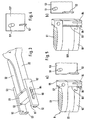
- Die Erfindung wird nachfolgend unter Bezugnahme auf die Zeichnung erläutert, in der ein vorteilhaftes Ausführungsbeispiel dargestellt ist. Es zeigen:
- Fig. 1
- eine Gesamtansicht des erfindungsgemäßen Anordnung von ihrer Oberseite;
- Fig. 2
- eine Gesamtansicht des Einsetzinstruments von der Unterseite;
- Fig. 3
- eine vergrößerte Teilansicht eines Backenteils des Einsetzinstruments in einem Längsachsenschnitt;
- Fig. 4
- eine Teilansicht eines anderen Backeneinsatz;
- Fig. 5
- eine Teilansicht des Einsetzinstruments mit daran angeordneter Zwischenwirbelendoprothese;
- Fig. 6
- eine vergrößerte Teilansicht eines Backenteils einer anderen Ausführungsform des Einsetzinstruments;
- Fig. 7
- eine vergrößerte Teilansicht eines Backenteils einer weiteren anderen Ausführungsform des Einsatzinstruments; und
- Fig. 8
- eine Teilansicht eines Griffteils des Einsatzinstruments gemäß
Fig. 7 . - Bei dem dargestellten Ausführungsbeispiel handelt es sich um ein als Zange ausgeführtes Einsetzinstrument (in seiner Gesamtheit mit dem Bezugszeichen 1 versehen) und einer Zervikalprothesen 9 als Zwischenwirbelendoprothese. Sie ist zur Implantation in den Zwischenraum zweier benachbarter Wirbelkörper der Halswirbelsäule (nicht dargestellt) vorgesehen.
- Die Zervikalprothese 9 besteht aus einer oberen Abschlußplatte 91 und einer unteren Abschlußplatte 92 mit einem dazwischen angeordneten Gleitkern 93. Die Zervikalprothese 9 ist zur Implantation in dem Zwischenraum zweier benachbarter wirbel der Halswirbelsäule eines Menschen vorgesehen. Dabei wird die obere Abschlußplatte 91 an der Unterseite des kranialen Wirbels und die untere Abschlußplatte 92 an der Oberseite des kaudalen Wirbels befestigt. Damit die Zervikalprothese 9 zum Einsetzen sicher von der Zange 1 aufgenommen werden kann, sind die obere und die untere Abschlußplatte 91, 92 mit Aufnahmeöffnungen versehen. Sie befinden im vorderen Bereich der Abschlußplatten im Bereich eines ventralen Befestigungsflansch 94, 95. Die der oberen Abschlußplatte 91 zugeordnete Aufnahmeöffnung ist als Rundbohrung 97 mit einer Ansenkung ausgeführt. Die der unteren Abschlußplatte 92 zugeordnete Aufnahmeöffnung ist als ein Schlitz 96 an der Seitenflanke der unteren Abschlußplatte 92 selbst und als ein Schlitz 96' augeführt, der an der Seitenflanke des Gleitkerns 93 ausgebildet ist. Die Schlitze 96 und 96' fluchten, so daß sie eine durchgehende Rinne ergeben. Es ist nicht zwingend erforderlich, daß der Schlitz 96, 96' sowohl in der unteren Abschlußplatte 92 wie auch dem Gleitkern 93 ausgebildet ist; es kann auch ausreichen, ihn nur in der Abschlußplatte 92 vorzusehen.
- Die Zange 1 ist aus zwei Zangenhälften 2, 3 gebildet, die über ein Schwenkgelenk 4 beweglich miteinander verbunden sind. Die Zangenhälften 2, 3 weisen in ihrem hinteren Bereich jeweils ein Griffteil 21, 31 und in ihrem vorderen Bereich jeweils ein Backenteil 22, 32 auf. In dem Übergang zwischen den Griffteilen 21, 31 und den Backenteilen 22, 32 ist das Schwenkgelenk 4 angeordnet. Es ist gebildet durch einen Zapfen 42 an der Zangenhälfte 2 (in
Fig. 1 erstreckt er sich aus der Zeichenebene nach oben heraus), der in einer passenden Öffnung 43 in dem mittleren Bereich der anderen Zangenhälfte 3 gelagert ist. Der Lagerzapfen 42 weist eine Durchgangsbohrung 44 auf, die von dem griffseitigen Bereich der Zangenhälften 2, 3 zu dem backenseitigen Bereich läuft. Sie wird später noch näher erläutert werden. Das Schwenklager 4 erlaubt es, die Griffteile 21, 31 der Zangenhälften 2, 3 aufeinander zu zu bewegen, damit sich die Backenteile 22, 32 schließen und umgekehrt. - Die Backenteile 22, 32 fungieren als Greifglieder. Sie weisen im vorderen Bereich an ihren einander zugewandten Innenseiten jeweils zwei in Spannrichtung 12 weisende Vorsprünge 51, 52 auf. Diese Vorsprünge sind nicht unmittelbar an den Backenteilen 22, 32, sondern an Backeneinsätzen 53 angeordnet, die mittels einer Schraube (nicht dargestellt) auswechselbar an den Außenseiten der Backenteile 22, 32 in einer entsprechenden Aufnahme befestigt sind. Jeder Backeneinsatz 53 weist je einen Vorsprung 51 und einen Vorsprung 52 auf. Der Vorsprung 51 ist stiftartig geformt und befindet sich im oberen Bereich, während der Vorsprung 52 plättchenartig geformt ist und sich im unteren Bereich des Backeneinsatzes 53 befindet. Die Abmessungen und die Anordnung der Vorsprünge 51, 52 sind auf entsprechende Aufnahmeöffnungen an den aufzunehmenden Zervikalprothesen 9 angepaßt. Das wird nachfolgend näher erläutert.
- Die Rundbohrung 97 ist passend zu einem stiftartigen Vorsprung 51 der Zange 1 bemessen. Dank der Ansenkung kann der stiftartige Vorsprung 51 leicht in die Rundbohrung 97 eingeführt werden. Der Schlitz 96, 96' weist eine langgestreckte Form in Richtung zu oberen Abschlußplatte 91 auf. Der an der Zange 1 angeordnete plättchenartige Vorsprung 52 ist in seiner Breite auf die Weite des Schlitzes 96, 96' abgestimmt, so daß er entlang dem Schlitz geführt ist. Dadurch wird die relative Position der Zervikalprothese 9 in Bezug auf die Zange 1 durch den in die Rundbohrung 97 eingreifenden stiftartigen Vorsprung 51 festgelegt, während der plättchenartige Vorsprung 52 je nach der Dicke des Gleitkerns 93 an unterschiedlichen Stellen in den Schlitz 96, 96' einfaßt und somit einen Ausgleich für unterschiedliche Gleitkerne 93 ermöglicht. In
Fig. 5a ist eine Zervikalprothese mittlerer Dicke und der vordere Bereich der Zange 1 mit den Vorsprüngen 51 und 52 dargestellt. Beim Aufnehmen der Zervikalprothese 9 durch die Zange 1 greift der stiftartige Vorsprung 51 in die Rundbohrung 97 und fixiert die Zervikalprothese gegenüber Verschiebungen. Der plättchenartige Vorsprung 52 greift in den Schlitz 96 der unteren Abschlußplatte 92 und in den sich unmittelbar anschließenden unteren Bereich des Schlitz 96' des Gleitkerns 93. Zum Vergleich ist inFig. 5b eine Zervikalprothese 9' mit einem dickeren Gleitkern 93' dargestellt. Wieder greift der stiftartige Vorsprung 51 in die Aufnahmebohrung 97. Der plättchenartige Vorsprung 52 greift aber wegen des dickeren Gleitkerns 93' nicht mehr in den Schlitz 96 der unteren Abschlußplatte 92, sondern nur in den Schlitz 96' des Gleitkerns 93'. Damit wird die Zervikalprothese 9' trotz ihrer abweichenden Höhe ebenfalls sicher in einer definierten Position an der Zange 1 gehalten. - An dem Backenteil 22 ist eine Führungsschiene 60 angeordnet, die einen Block 61 längsverschieblich an der Zangenhälfte 2 in Vor- und Rückwärtsrichtung beweglich hält. Die Führungsschiene 60 ist als ein Langloch in dem Backeneinsatz 53 des Backenteils 22 ausgebildet. Eine seitlich in dem Block 61 angeordnete Madenschraube greift in das die Führungsschiene 60 bildende Langloch ein und führt den Block 61 in Längsrichtung. Anstelle des Langlochs können auch andere Führungselemente vorgesehen sein, die eine in Längsrichtung vor- und zurückbewegliche Führung des Blocks 61 erlauben, beispielsweise eine Schwalbenschwanzführung. Der Block 61 ist an seinem vorderen Ende mit einer Anschlagfläche 62 versehen, die zum Zusammenwirken mit der Zervikalprothese 9 ausgebildet ist.
- An dem Block 61 greift eine Betätigungseinrichtung 7 an, die sich von dem hinteren Bereich des Blocks 61 durch die Durchgangsbohrung 44 in den Bereich zwischen den Griffteilen 21, 31 erstreckt. Die Betätigungseinrichtung 7 umfaßt ein Kopplungselement 70 mit dem Block 61, das in dem dargestellten Ausführungsbeispiel ein zur Übertragung von Schubkräften geeignetes Wirbellager ist, ferner eine Stange 71 und eine Handhabe 72 zur Betätigung. Im vorderen Bereich der Stange 71 ist ein Außengewinde 73 vorgesehen, das mit einem komplementären Innengewinde (nicht dargestellt) in der Durchgangsbohrung 44 des Zapfens 42 als instrumentenfeste Führung zusammenwirkt. Damit ist es ermöglicht, durch Drehen der Handhabe 72 die Stange 71 und damit über das Kopplungselement 70 den Block 61 entlang der Führungsschiene 60 vor- und zurückzubewegen. Die Handhabe 72 ist als Drehknopf ausgebildet, der an seiner äußeren Mantelfläche 74 zur Bereitstellung einer guten Greifmöglichkeit für den Operateur eine geeignete Oberflächengestaltung, wie eine Grobriffelung 75, aufweist.
- Das hintere Ende der Handhabe 72 ist mit einer konvexen Wölbung 76 versehen. Sie dient als Schlagkopf für die Betätigungseinrichtung 7. Sie überträgt Impulse von auf die Wölbung 76 des Schlagkopfes einwirkenden Schlägen über die Stange 71 der Betätigungseinrichtung 7, das schubfeste Wirbellager 70 und den Block 61 auf dessen Anschlagfläche 62.
- Alternativ kann auch vorgesehen sein, statt des längsbeweglichen Blocks 61 einen starr an der Zangenhälfte 2 angeordneten Block 61' vorzusehen und so anzuordnen, daß seine Anschlagläche 62' an der gehaltenen Zervikalprothese 9 anliegt. Dies ist insbesondere dann von Interesse, wenn die verwendeten Zervikalprothesen 9 sich zwar in ihren Höhen- und/oder Breitenabmessungen unterscheiden können, aber identische Längsabmessungen aufweisen. Da die Zervikalprothese 9 durch die erfindungsgemäßen Gestaltung der Aufnahmeöffnungen 96, 97 und Haltevorsprünge 51, 52 in einer definierten Position an der Zange 1 gehalten ist, ist eine Längsbeweglichkeit des Blocks nicht zwingend erforderlich. Dank der definierten Position ist es auch mit starrem Block 61' möglich, daß er mit seiner Anschlagfläche 62' an der Zervikalprothese 9 anliegt. Die Einsetzkräfte, insbesondere die Schlagkräfte, können so sicher und schonend wie bei der Ausführungsform mit beweglichem Block übertragen werden. Es versteht sich, daß bei dem starr angeordneten Block 61' eine Führung 60 entbehrlich ist. Sie kann aber auch beibehalten sein, wobei dann die Befestigung des Blocks 61' mittels einer Klemmschraube 66 erfolgen kann (
Fig. 6 ). Zur besseren Befestigen ist das Langloch 60 mit einer Riffelung 65 für die Klemmschraube 66 versehen. Einfacher ist es, den starren Block 61' an dem Faßteil mittels einer Verschweißung oder Verschraubung an dem Faßteil 22 bzw. dessen Backeneinsatz 53 zu befestigen. Im letzteren Fall ist vorzugsweise eine versenkt in einer Bohrung 67 des Backeneinsatzes 53 angeordnete Schraube 68 vorgesehen (sieheFig. 7 ). Da die Betätigungseinrichtung 7 keine Längsverstellung mehr zu bewirken braucht, können das Außengewinde 73 an der Stange 71 sowie das Gegengewinde in der Durchgangsbohrung 44 entfallen; die Durchgangsbohrung 44 fungiert nur noch als Führung für die Stange 71. Das schubfeste Wirbellager 70 braucht auch keine Drehbewegung zu übertragen und kann durch eine starre schubfeste Verbindung ersetzt werden, bspw. eine Verschraubung oder Verschweißung. Die Handhabe 72 fungiert weiter als Schlagkopf und weist dazu vorzugsweise die Wölbung 76 auf. Diese Ausführungsform ist durch den Verzicht auf die längsbewegliche Anordnung des Blocks 61' und den Entfall der Betätigungseinrichtung zum Bewegen des Blocks und weniger aufwendig in der Herstellung und einfacher in der Bedienung. - Bei einer anderen Ausführungsform ist zur weiteren Vereinfachung außerdem vorgesehen, das hintere Ende der Griffteils 21 als Schlagkopf auszubilden und mit einer Wölbung 76' zu versehen. Gegebenenfalls kann eine Verstärkungsstange 71' vorgesehen sein, die das hintere Ende des Griffteils 21 mit seinem vorderen Ende verbindet.
- Bei den Ausführungsformen mit starrem Block 61' werden die Impulse von der Wölbung 76, 76' über die Stange 71, 71' und die Zangenhälfte 2 auf den Block 61' und dessen Anschlagfläche 62' übertragen.
- Im hinteren Bereich der Zange 1 ist eine Rasteinrichtung 8 für die Griffteile 21, 31 vorgesehen. Sie umfaßt ein schwenkbewegliches Verrastungselement 83 und eine Rastklinke 84 (die jeweils gegenüberliegend an den Griffteilen 21, 31 angeordnet sind), eine Löseeinrichtung 81, einen Fuß 82 und eine Feder 87. Das hintere Ende des Griffteils 21 ist als Gabel ausgeführt, wobei die Rastklinke 84 durch eine Anschrägung des Fußpunkt der Gabel gebildet ist. Das Verrastungselement 83 ist durch den Fuß 82 in der durch die Griffteile 21, 31 aufgespannten Ebene gelagert. Die Feder 87 ist als Blattfeder ausgebildet und wirkt auf das in dem Fuß 82 gelagerte Ende des Verrastungselements 83 so ein, daß es nach vorne zur Rastklinke 84 gedrückt wird. Ausgehend von dem Fuß 82 weist das Verrastungselement 83 einen breiten Bereich und einen schmalen Bereich auf. In seinem schmalen Bereich weist das Verrastungselement 83 an seiner Vorderseite eine Verzahnung 86 auf, in welche im geschlossenen Zustand der Zange 1 die Rastklinke 84 greift und verrastet, so daß die Griffteile 21, 31 sich nicht voneinander wegbewegen können und damit das Einsetzinstrument 1 gegenüber einem versehentlichen Aufspringen gesichert ist. Dadurch können auch erhebliche Belastungen, wie bspw. Hammerschläge auf die Wölbung 76, auf der Zange 1 ausgeübt werden, ohne daß ein versehentliches Öffnen zu befürchten ist und ohne daß der Operateur die Griffteile 21, 31 mit Handkraft gegenüber einem unerwünschten Öffnen zu sichern braucht. Zum Öffnen der Zange 1 nach erfolgter Implantation wird durch Druck nach hinten auf das Auslöseelement 81 das Verrastungselement 83 nach hinten geschwenkt, wodurch die Rastklinke 84 von dem Verrastungselement 83 freikommt und somit die Griffteile 21, 31 sich unter der Wirkung der Feder 11 auseinander bewegen. Im geöffneten Zustand der Zange 1 ist das Verrastungselement 83 gegen die Kraft der Feder 87 nach hinten geschwenkt. In dem breiten Bereich des Verrastungselements 83 ist eine als Langloch ausgebildete Führung 85 vorgesehen, die dazu dient, die Stange 71 auch bei geöffneter Zange 1 in einer definierten Position in der Längsachse 10 zu halten und ein Ausknicken der Stange 71 auch unter hoher Schlagbelastung zu vermeiden.
- An dem Griffteil 31 ist ferner eine Blattfeder 11 befestigt, die um die Stange 71 herum zu dem anderen Griffteil 21 geführt ist. Bei geschlossener Zange 1 steht diese Blattfeder 11 unter Spannung und bewirkt, daß das Einsetzinstrument 1 nach dem Lösen des Verrastungselements 83 selbsttätig öffnet, um ein Abnehmen zu ermöglichen.
- Nachfolgend soll das Zusammenwirken mit der Zervikalprothese 9 beschrieben werden. Zum Aufnehmen der Zervikalprothese 9 mit der Zange 1 wird die Zervikalprothese 9 in dem Bereich zwischen die Backenteile 22, 32 gebracht und die Zange 1 geschlossen, wodurch sich die Backenteile 22, 32 aufeinander zu bewegen. Dabei greifen die Vorsprünge 51, 52 in die entsprechenden Aufnahmeöffnungen der beiden Abschlußplatten 91, 92 ein, wobei die Stifte 51 in die Bohrung 97 und die Plättchen 52 in die Schlitze 96, 96' eingreifen. Dadurch wird die Zervikalprothese 9 in Spannrichtung spielfrei an der Zange 1 gehalten. Die unterschiedliche Ausführung der Vorsprünge 51, 52 und der Aufnahmeöffnungen in Gestalt der Bohrungen 97 und Schlitze 96 stellt sicher, daß die Zervikalprothese 9 nur mit der richtigen Orientierung an der Zange 1 gehalten werden kann. Ist die Zange 1 wie in dem dargestellten Ausführungsbeispiel auch zusätzlich mit einer Markierung 14 für die Oberseite versehen, so sind Fehlimplantationen aufgrund verkehrter Orientierung der Zervikalprothese 9 praktisch ausgeschlossen. Nachdem auf diese Weise die Zervikalprothese 9 an der Zange 1 in der richtigen Orientierung aufgenommen wurde, kann mittels der Betätigungseinrichtung 7 durch Drehen der Handhabe 72 die Stange 71 nach vorne bewegt werden, so daß der Block 61 mit seiner Anschlagsfläche 62 von hinten an den Flansch 94, 95 der Zervikalprothese 9 zur Anlage kommt. Dabei spannt der Block 61 die Zervikalprothese 9 gegen die Vorsprünge 51, 52 und richtet so die Zervikalprothese 9 in eine definierte Position aus. Eventuell vorhandenes Spiel in Längsachsenrichtung zwischen den Vorsprüngen 51, 52 und den Bohrungen 97 und Schlitzen 96 wird auf diese Weise herausgedrückt. Die Zervikalprothese 9 ist damit sicher und positionsgenau an dem Einsetzinstrument 1 gehalten. Außerdem bewirkt das Anliegen des Blocks 61 an den Flanschen 93, 94 der beiden Abschlußplatten 91, 92, daß sich die beiden Abschlußplatten 91, 92 an ihrem vorderen Ende voneinander wegbewegen. Dadurch wird ein Aufklappen der Zervikalprothese 9, das ein erfolgreiches Einbringen in den Zwischenwirbelraum verhindern würde, ausgeschlossen.
- Weiter ist es ermöglicht, Zervikalprothesen mit anderer Höhe ohne Veränderungen an der Zange 1 zu implantieren. In
Fig. 5 sind Zervikalprothese 9, 9' dargestellt, die von denen eine einen dickeren Gleitkern 93' aufweist. Er ist (ebenso wie der Gleitkern 93) mit einem Schlitz 96' versehen, der mit dem Schlitz 96 der unteren Abschlußplatte 92 fluchtet. Diese Gestaltung der Aufnahmeöffnung an der unteren Abschlußplatte 92 als Schlitz 96 und seine Fortsetzung als Schlitz 96' in dem Gleitkern 93' ermöglichen es, die dickere Zervikalprothese 9' mit derselben Zange 1 mit unveränderter Anordnung der Vorsprünge 51, 52 zu greifen und sicher zu halten. Die Positionierungsgenauigkeit ist dabei durch die stiftartigen Vorsprünge 51, die in die Bohrungen 97 eingreifen, gesichert. - Bei Bedarf können aber auch andere Backeneinsätze 53' vorgesehen sein, die eine andere Anordnung der Vorsprünge 51', 52' aufweisen, wie sie in
Fig. 4 dargestellt sind. In dem dargestellten Beispiel stehen die Vorsprünge näher zusammen und sind in einer Ebene. Damit kann die Zange 1 an andere Zwischenwirbelendoprothesen angepaßt werden, z. B. an besonders kleine zur Therapie von Kindern. - Der Block 61 stellt mit seiner Anschlagfläche 62 eine hinreichend groß dimensionierte Kraftübertragungsfläche zur Verfügung, um die auf die Wölbung 76 als Schlagkopf aufgebrachten Impulse auf die Zervikalprothese 9 zu übertragen. Das hat den großen Vorteil, daß die im Interesse einer genauen Positionierung feingliedrig ausgeführten Vorsprünge 51, 52 nicht die Schlagkräfte übertragen müssen, so daß die Gefahr eines Verbiegens oder gar Abbrechens der Vorsprünge 51, 52 aufgrund Überbelastung auch bei hoher Schlagbelastung dank des die Kraftübertragung übernehmenden Blocks 61 bzw. 61' mit seiner Anschlagfläche 62 ausgeschlossen ist.
- Die erfindungsgemäße Zange 1 ermöglicht eine verwechslungssichere und positionsgenaue Anordnung der Zervikalprothese 9 an der Zange 1, wobei ein unerwünschtes Aufklappen der Zervikalprothese 9 verhindert wird. Ferner ermöglicht sie dank des Blocks 61 bzw. 61' mit der Anschlagfläche 62 auch bei kleindimensionierten Zangen 1 die Übertragung hoher Kräfte. Damit ist ein sicheres Implantieren der Prothese gewährleistet. Die kleine Dimensionierung.hat ferner den Vorteil, daß sie dem Operateur gute Sicht- und Zugangsbedingungen auf den Implantationsort gibt.
Claims (18)
- Anordnung aus einer mehrteiligen Zwischenwirbelendoprothese (9), die eine obere und untere Abschlußplatte (91, 92) und einen Gleitkern (93) dazwischen aufweist, wobei jeder Abschlußplatte (91, 92) ein Paar Aufnahmeöffnungen (96, 97) oder - vorsprünge zugeordnet ist, und einem Einsetzinstrument (1), das einen Griffbereich (21, 31) und einen Faßbereich (22, 32) mit Haltevorsprüngen (51, 52) oder -öffnungen aufweist, die zum Halten der Zwischenwirbelendoprothese (9) an dem Einsetzinstrument (1) in die Aufnahmeöffnungen (96, 97) oder -vorsprünge einbringbar sind,
dadurch gekennzeichnet, daß
die Aufnahmeöffnungen (96, 97) oder -vorsprünge in lateralen Seitenflächen der Zwischenwirbelendoprothese (9) angeordnet sind und zumindest das einer der Abschlußplatten (92) zugeordnete Paar von AufnahmeÖffnungen (96) oder -vorsprünge eine in Richtung zur anderen Abschlußplatte (91) ausgedehnte Form aufweist. - Anordnung nach Anspruch 1,
dadurch gekennzeichnet, daß
die eine ausgedehnte Form aufweisende Aufnahmeöffnung (96) ein Schlitz ist. - Anordnung nach Anspruch 1 oder 2,
dadurch gekennzeichnet, daß
die eine ausgedehnte Form aufweisende Aufnahmeöffnung (96) sich über die ganze Höhe der zugeordneten Abschlußplatte (92) erstreckt. - Anordnung nach einem der vorhergehenden Ansprüche,
dadurch gekennzeichnet, daß
die eine ausgedehnte Form aufweisende Aufnahmeöffnung (96') sich über einen Teil der Höhe des Gleitkerns (93) erstreckt. - Anordnung nach einem der vorhergehenden Ansprüche,
dadurch gekennzeichnet, daß
daß die eine ausgedehnte Form aufweisende Aufnahmeöffnung (96') sich über die ganze Höhe des Gleitkerns (93) erstreckt. - Anordnung nach einem der vorhergehenden Ansprüche,
dadurch gekennzeichnet, daß
die eine ausgedehnte Form aufweisende Aufnahmeöffnung (96) sich mit zunehmender Tiefe verjüngt. - Anordnung nach einem der vorhergehenden Ansprüche;
dadurch gekennzeichnet, daß
die der anderen Abschlußplatte (91) zugeordnete Aufnahmeöffnung (97) eine konzentrierte Form aufweist. - Anordnung nach Anspruch 7,
dadurch gekennzeichnet, daß
sie als Rundbohrung ausgeführt ist. - Anordnung nach einem der vorhergehenden Ansprüche,
dadurch gekennzeichnet, daß
die Haltevorsprünge plättchenartig (52) und stiftartig (51) ausgeführt sind. - Anordnung nach einem der vorhergehenden Ansprüche,
dadurch gekennzeichnet, daß
die Halteöffnungen an dem Einsetzinstrument (1) und die Aufnahmevorsprünge an der Zwischenwirbelendoprothese (9) angeordnet sind. - Anordnung nach einem der vorhergehenden Ansprüche,
dadurch gekennzeichnet, daß
für die Zwischenwirbelendoprothese (9, 9') verschiedene Größen mit unterschiedlich dicken Gleitkern (93, 93') vorgesehen sind. - Anordnung nach einem der vorhergehenden Ansprüche,
dadurch gekennzeichnet, daß
an einem Faßteil ein Block (61') mit einer Anschlagfläche (62) zur Anlage an die Zwischenwirbelendoprothese (9) vorgesehen ist, der mit einem Kraftaufnahmeteil zur Ausübung einer Einsetzkraft auf die Zwischenwirbelendoprothese (9) verbunden ist. - Anordnung nach Anspruch 12,
dadurch gekennzeichnet, daß
der Block (61') starr an dem Faßteil (22) angeordnet ist. - Anordnung nach Anspruch 13,
dadurch gekennzeichnet, daß
der Block (61') mittels einer Durchgangsschraube (68) befestigt ist. - Anordnung nach Anspruch 13,
dadurch gekennzeichnet, daß
der Block (61') mittels einer Klemmschraube (66) befestigt ist. - Anordnung nach einem der Ansprüche 12 bis 15,
dadurch gekennzeichnet, daß
an dem Block (61') eine Stange (71) mit einer Handhabe (72) im hinteren Bereich des Griffteils (21) angeordnet ist. - Anordnung nach Anspruch 16,
dadurch gekennzeichnet, daß
die Handhabe als Schlagkopf (76) ausgebildet ist. - Anordnung nach einem der Ansprüche 13 bis 17
dadurch gekennzeichnet, daß
der Block (61') an einem Backeneinsatz (53) angeordnet ist.
Applications Claiming Priority (2)
| Application Number | Priority Date | Filing Date | Title |
|---|---|---|---|
| US10/619,179 US7320689B2 (en) | 2003-07-15 | 2003-07-15 | Multi-part cervical endoprosthesis with insertion instrument |
| PCT/EP2004/001027 WO2005007042A1 (de) | 2003-07-15 | 2004-02-04 | Arnordnung aus einer zervikalprothese und einsetzinstrument |
Publications (2)
| Publication Number | Publication Date |
|---|---|
| EP1648352A1 EP1648352A1 (de) | 2006-04-26 |
| EP1648352B1 true EP1648352B1 (de) | 2008-05-14 |
Family
ID=34062519
Family Applications (1)
| Application Number | Title | Priority Date | Filing Date |
|---|---|---|---|
| EP04707909A Expired - Lifetime EP1648352B1 (de) | 2003-07-15 | 2004-02-04 | Arnordnung aus einer zervikalprothese und einsetzinstrument |
Country Status (17)
| Country | Link |
|---|---|
| US (1) | US7320689B2 (de) |
| EP (1) | EP1648352B1 (de) |
| JP (1) | JP4713472B2 (de) |
| KR (1) | KR101035191B1 (de) |
| CN (1) | CN1822803B (de) |
| AR (1) | AR056618A1 (de) |
| AT (1) | ATE395017T1 (de) |
| AU (1) | AU2004257394C1 (de) |
| BR (1) | BRPI0411981A (de) |
| CA (1) | CA2532479C (de) |
| DE (1) | DE502004007158D1 (de) |
| ES (1) | ES2305719T3 (de) |
| IL (1) | IL173137A (de) |
| MX (1) | MXPA06000546A (de) |
| RU (1) | RU2309707C2 (de) |
| WO (1) | WO2005007042A1 (de) |
| ZA (1) | ZA200601315B (de) |
Families Citing this family (163)
| Publication number | Priority date | Publication date | Assignee | Title |
|---|---|---|---|---|
| FR2824261B1 (fr) * | 2001-05-04 | 2004-05-28 | Ldr Medical | Prothese de disque intervertebral et procede et outils de mise en place |
| US8038713B2 (en) | 2002-04-23 | 2011-10-18 | Spinecore, Inc. | Two-component artificial disc replacements |
| US20080027548A9 (en) | 2002-04-12 | 2008-01-31 | Ferree Bret A | Spacerless artificial disc replacements |
| US6706068B2 (en) | 2002-04-23 | 2004-03-16 | Bret A. Ferree | Artificial disc replacements with natural kinematics |
| FR2846550B1 (fr) * | 2002-11-05 | 2006-01-13 | Ldr Medical | Prothese de disque intervertebral |
| US7887539B2 (en) * | 2003-01-24 | 2011-02-15 | Depuy Spine, Inc. | Spinal rod approximators |
| US7988698B2 (en) | 2003-01-28 | 2011-08-02 | Depuy Spine, Inc. | Spinal rod approximator |
| JP4398975B2 (ja) * | 2003-01-31 | 2010-01-13 | スパイナルモーション, インコーポレイテッド | 脊髄中線指示器 |
| WO2004066884A1 (en) | 2003-01-31 | 2004-08-12 | Spinalmotion, Inc. | Intervertebral prosthesis placement instrument |
| EP1594423B1 (de) | 2003-02-14 | 2009-01-07 | DePuy Spine, Inc. | In-situ hergestellte intervertebrale fusionsvorrichtung |
| US6908484B2 (en) * | 2003-03-06 | 2005-06-21 | Spinecore, Inc. | Cervical disc replacement |
| US7662182B2 (en) * | 2003-03-06 | 2010-02-16 | Spinecore, Inc. | Instrumentation and methods for use in implanting a cervical disc replacement device |
| US20090076614A1 (en) * | 2007-09-17 | 2009-03-19 | Spinalmotion, Inc. | Intervertebral Prosthetic Disc with Shock Absorption Core |
| US7442211B2 (en) | 2003-05-27 | 2008-10-28 | Spinalmotion, Inc. | Intervertebral prosthetic disc |
| US7575599B2 (en) | 2004-07-30 | 2009-08-18 | Spinalmotion, Inc. | Intervertebral prosthetic disc with metallic core |
| US10052211B2 (en) | 2003-05-27 | 2018-08-21 | Simplify Medical Pty Ltd. | Prosthetic disc for intervertebral insertion |
| US7842044B2 (en) * | 2003-12-17 | 2010-11-30 | Depuy Spine, Inc. | Instruments and methods for bone anchor engagement and spinal rod reduction |
| BRPI0417670A (pt) * | 2003-12-17 | 2007-04-03 | Depuy Spine Inc | instrumentos e métodos para acoplamento de áncora óssea e redução de haste espinhal |
| US8123757B2 (en) * | 2003-12-31 | 2012-02-28 | Depuy Spine, Inc. | Inserter instrument and implant clip |
| PT1711133E (pt) | 2004-02-04 | 2011-06-01 | Ldr Medical | Prótese de disco intervertebral |
| FR2865629B1 (fr) * | 2004-02-04 | 2007-01-26 | Ldr Medical | Prothese de disque intervertebral |
| FR2869528B1 (fr) * | 2004-04-28 | 2007-02-02 | Ldr Medical | Prothese de disque intervertebral |
| US7294134B2 (en) * | 2004-07-28 | 2007-11-13 | Weber Instrumente Gmbh | Surgical instrument for the introduction of a multi-component intervertebral prosthesis |
| US7585326B2 (en) | 2004-08-06 | 2009-09-08 | Spinalmotion, Inc. | Methods and apparatus for intervertebral disc prosthesis insertion |
| JP2006068086A (ja) * | 2004-08-31 | 2006-03-16 | Takiron Co Ltd | 人工椎間板挿入治具及び治具セット |
| FR2879436B1 (fr) | 2004-12-22 | 2007-03-09 | Ldr Medical | Prothese de disque intervertebral |
| US7625376B2 (en) * | 2005-01-26 | 2009-12-01 | Warsaw Orthopedic, Inc. | Reducing instrument for spinal surgery |
| US20060167465A1 (en) * | 2005-01-27 | 2006-07-27 | Erasmo Lopez | System for facilitating attachment of a delivery instrument with a bone screw |
| US8083797B2 (en) | 2005-02-04 | 2011-12-27 | Spinalmotion, Inc. | Intervertebral prosthetic disc with shock absorption |
| US7951172B2 (en) | 2005-03-04 | 2011-05-31 | Depuy Spine Sarl | Constrained motion bone screw assembly |
| US7951175B2 (en) | 2005-03-04 | 2011-05-31 | Depuy Spine, Inc. | Instruments and methods for manipulating a vertebra |
| US8777959B2 (en) | 2005-05-27 | 2014-07-15 | Spinecore, Inc. | Intervertebral disc and insertion methods therefor |
| US20060293692A1 (en) * | 2005-06-02 | 2006-12-28 | Whipple Dale E | Instruments and methods for manipulating a spinal fixation element |
| FR2887762B1 (fr) * | 2005-06-29 | 2007-10-12 | Ldr Medical Soc Par Actions Si | Instrumentation d'insertion de prothese de disque intervertebral entre des vertebres |
| US7670375B2 (en) | 2005-08-16 | 2010-03-02 | Benvenue Medical, Inc. | Methods for limiting the movement of material introduced between layers of spinal tissue |
| US8591583B2 (en) | 2005-08-16 | 2013-11-26 | Benvenue Medical, Inc. | Devices for treating the spine |
| US8454617B2 (en) | 2005-08-16 | 2013-06-04 | Benvenue Medical, Inc. | Devices for treating the spine |
| US8366773B2 (en) | 2005-08-16 | 2013-02-05 | Benvenue Medical, Inc. | Apparatus and method for treating bone |
| FR2891135B1 (fr) * | 2005-09-23 | 2008-09-12 | Ldr Medical Sarl | Prothese de disque intervertebral |
| FR2893838B1 (fr) * | 2005-11-30 | 2008-08-08 | Ldr Medical Soc Par Actions Si | Prothese de disque intervertebral et instrumentation d'insertion de la prothese entre les vertebres |
| US8377072B2 (en) * | 2006-02-06 | 2013-02-19 | Depuy Spine, Inc. | Medical device installation tool |
| WO2007121320A2 (en) | 2006-04-12 | 2007-10-25 | Spinalmotion, Inc. | Posterior spinal device and method |
| US8303601B2 (en) * | 2006-06-07 | 2012-11-06 | Stryker Spine | Collet-activated distraction wedge inserter |
| NZ548878A (en) * | 2006-08-01 | 2008-11-28 | Enztec Ltd | Improved impactor |
| US8454621B2 (en) * | 2006-09-19 | 2013-06-04 | Warsaw Orthopedic, Inc. | Instruments and methods for spinal implant revision |
| US9381098B2 (en) * | 2006-09-28 | 2016-07-05 | Spinal Kinetics, Inc. | Tool systems for implanting prosthetic intervertebral discs |
| WO2008070863A2 (en) | 2006-12-07 | 2008-06-12 | Interventional Spine, Inc. | Intervertebral implant |
| US8465546B2 (en) | 2007-02-16 | 2013-06-18 | Ldr Medical | Intervertebral disc prosthesis insertion assemblies |
| US8172847B2 (en) | 2007-03-29 | 2012-05-08 | Depuy Spine, Inc. | In-line rod reduction device and methods |
| US8579910B2 (en) | 2007-05-18 | 2013-11-12 | DePuy Synthes Products, LLC | Insertion blade assembly and method of use |
| FR2916956B1 (fr) | 2007-06-08 | 2012-12-14 | Ldr Medical | Cage intersomatique,prothese intervertebrale,dispositif d'ancrage et instrumentation d'implantation |
| US8900307B2 (en) | 2007-06-26 | 2014-12-02 | DePuy Synthes Products, LLC | Highly lordosed fusion cage |
| US8486081B2 (en) * | 2007-07-23 | 2013-07-16 | DePuy Synthes Products, LLC | Implant insertion device and method |
| US20090030420A1 (en) * | 2007-07-26 | 2009-01-29 | Depuy Spine, Inc. | Spinal rod reduction instruments and methods for use |
| US20090043391A1 (en) | 2007-08-09 | 2009-02-12 | Spinalmotion, Inc. | Customized Intervertebral Prosthetic Disc with Shock Absorption |
| WO2009023157A1 (en) | 2007-08-13 | 2009-02-19 | Stryker, Spine | Insertion instrument for intervertebral implants |
| EP2200499B1 (de) * | 2007-09-14 | 2019-05-01 | Medtronic Monitoring, Inc. | Multi-sensor-patientenmonitor zum nachweis von bevorstehender herzdekompensation |
| WO2009036327A1 (en) * | 2007-09-14 | 2009-03-19 | Corventis, Inc. | Adherent device for respiratory monitoring and sleep disordered breathing |
| US20090076559A1 (en) * | 2007-09-14 | 2009-03-19 | Corventis, Inc. | Adherent Device for Cardiac Rhythm Management |
| US20090076397A1 (en) * | 2007-09-14 | 2009-03-19 | Corventis, Inc. | Adherent Emergency Patient Monitor |
| EP2194847A1 (de) | 2007-09-14 | 2010-06-16 | Corventis, Inc. | Haftende vorrichtung mit mehreren physiologischen sensoren |
| WO2009036333A1 (en) | 2007-09-14 | 2009-03-19 | Corventis, Inc. | Dynamic pairing of patients to data collection gateways |
| WO2009036334A1 (en) * | 2007-09-14 | 2009-03-19 | Corventis, Inc. | Adherent multi-sensor device with empathic monitoring |
| WO2009036306A1 (en) | 2007-09-14 | 2009-03-19 | Corventis, Inc. | Adherent cardiac monitor with advanced sensing capabilities |
| US9186089B2 (en) | 2007-09-14 | 2015-11-17 | Medtronic Monitoring, Inc. | Injectable physiological monitoring system |
| WO2009036348A1 (en) * | 2007-09-14 | 2009-03-19 | Corventis, Inc. | Medical device automatic start-up upon contact to patient tissue |
| US20090076341A1 (en) * | 2007-09-14 | 2009-03-19 | Corventis, Inc. | Adherent Athletic Monitor |
| US20090076350A1 (en) * | 2007-09-14 | 2009-03-19 | Corventis, Inc. | Data Collection in a Multi-Sensor Patient Monitor |
| US8790348B2 (en) | 2007-09-28 | 2014-07-29 | Depuy Spine, Inc. | Dual pivot instrument for reduction of a fixation element and method of use |
| WO2009055477A1 (en) | 2007-10-22 | 2009-04-30 | Spinalmotion, Inc. | Method and spacer device for spanning a space formed upon removal of an intervertebral disc |
| US8142441B2 (en) * | 2008-10-16 | 2012-03-27 | Aesculap Implant Systems, Llc | Surgical instrument and method of use for inserting an implant between two bones |
| US8591587B2 (en) | 2007-10-30 | 2013-11-26 | Aesculap Implant Systems, Llc | Vertebral body replacement device and method for use to maintain a space between two vertebral bodies within a spine |
| US8241363B2 (en) * | 2007-12-19 | 2012-08-14 | Depuy Spine, Inc. | Expandable corpectomy spinal fusion cage |
| US8241294B2 (en) * | 2007-12-19 | 2012-08-14 | Depuy Spine, Inc. | Instruments for expandable corpectomy spinal fusion cage |
| AU2009205896A1 (en) | 2008-01-17 | 2009-07-23 | Synthes Gmbh | An expandable intervertebral implant and associated method of manufacturing the same |
| CA2847598A1 (en) | 2008-01-18 | 2009-07-23 | Spinecore, Inc. | Instruments and methods for inserting artificial intervertebral implants |
| WO2009094477A1 (en) * | 2008-01-25 | 2009-07-30 | Spinalmotion, Inc. | Compliant implantable prosthetic joint with preloaded spring |
| US8840622B1 (en) | 2008-02-14 | 2014-09-23 | Nuvasive, Inc. | Implant installation assembly and related methods |
| US8343163B1 (en) | 2008-02-14 | 2013-01-01 | Nuvasive, Inc. | Spinal implant installation device |
| US8608746B2 (en) | 2008-03-10 | 2013-12-17 | DePuy Synthes Products, LLC | Derotation instrument with reduction functionality |
| US8709015B2 (en) | 2008-03-10 | 2014-04-29 | DePuy Synthes Products, LLC | Bilateral vertebral body derotation system |
| US8764833B2 (en) | 2008-03-11 | 2014-07-01 | Spinalmotion, Inc. | Artificial intervertebral disc with lower height |
| JP5405500B2 (ja) * | 2008-03-12 | 2014-02-05 | コーヴェンティス,インク. | 心調律に基づく心代償不全予測 |
| AU2009231637A1 (en) | 2008-04-05 | 2009-10-08 | Synthes Gmbh | Expandable intervertebral implant |
| US9034038B2 (en) * | 2008-04-11 | 2015-05-19 | Spinalmotion, Inc. | Motion limiting insert for an artificial intervertebral disc |
| US8412317B2 (en) * | 2008-04-18 | 2013-04-02 | Corventis, Inc. | Method and apparatus to measure bioelectric impedance of patient tissue |
| KR20110009216A (ko) * | 2008-05-05 | 2011-01-27 | 스피날모우션, 인코포레이티드 | 폴리아릴에테르케톤 인공 추간판 |
| US10973556B2 (en) | 2008-06-17 | 2021-04-13 | DePuy Synthes Products, Inc. | Adjustable implant assembly |
| US9220603B2 (en) * | 2008-07-02 | 2015-12-29 | Simplify Medical, Inc. | Limited motion prosthetic intervertebral disc |
| EP2299944A4 (de) * | 2008-07-17 | 2013-07-31 | Spinalmotion Inc | System zur platzierung künstlicher bandscheiben |
| WO2010009153A1 (en) | 2008-07-18 | 2010-01-21 | Spinalmotion, Inc. | Posterior prosthetic intervertebral disc |
| US20100191310A1 (en) * | 2008-07-29 | 2010-07-29 | Corventis, Inc. | Communication-Anchor Loop For Injectable Device |
| US9095450B2 (en) * | 2008-12-24 | 2015-08-04 | DePuy Syntheses Products, Inc. | Insertion instrument for anteriorly inserting intervertebral spinal implants |
| US9220609B2 (en) * | 2009-02-25 | 2015-12-29 | Spinewelding Ag | Spine stabilization device, and method and kit for its implantation |
| US8535327B2 (en) | 2009-03-17 | 2013-09-17 | Benvenue Medical, Inc. | Delivery apparatus for use with implantable medical devices |
| US8906033B2 (en) * | 2009-03-30 | 2014-12-09 | DePuy Synthes Products, LLC | Cervical motion disc inserter |
| US9526620B2 (en) | 2009-03-30 | 2016-12-27 | DePuy Synthes Products, Inc. | Zero profile spinal fusion cage |
| US8876905B2 (en) * | 2009-04-29 | 2014-11-04 | DePuy Synthes Products, LLC | Minimally invasive corpectomy cage and instrument |
| US8206394B2 (en) | 2009-05-13 | 2012-06-26 | Depuy Spine, Inc. | Torque limited instrument for manipulating a spinal rod relative to a bone anchor |
| WO2011050283A2 (en) | 2009-10-22 | 2011-04-28 | Corventis, Inc. | Remote detection and monitoring of functional chronotropic incompetence |
| US8425515B2 (en) * | 2009-10-30 | 2013-04-23 | Depuy Spine, Inc. | Bone graft loading instruments and methods of connecting a bone graft to a bone plate |
| US8425520B2 (en) * | 2009-10-30 | 2013-04-23 | Depuy Spine, Inc. | Bone plate holder |
| US8470003B2 (en) | 2009-10-30 | 2013-06-25 | DePuy Synthes Products, LLC | Laminoplasty plates and methods of expanding the spinal canal |
| US20110106087A1 (en) * | 2009-10-30 | 2011-05-05 | Gamache Thomas J | Bone Plate Holder |
| US9393129B2 (en) | 2009-12-10 | 2016-07-19 | DePuy Synthes Products, Inc. | Bellows-like expandable interbody fusion cage |
| US9451897B2 (en) * | 2009-12-14 | 2016-09-27 | Medtronic Monitoring, Inc. | Body adherent patch with electronics for physiologic monitoring |
| US8965498B2 (en) | 2010-04-05 | 2015-02-24 | Corventis, Inc. | Method and apparatus for personalized physiologic parameters |
| US8979860B2 (en) | 2010-06-24 | 2015-03-17 | DePuy Synthes Products. LLC | Enhanced cage insertion device |
| US9763678B2 (en) | 2010-06-24 | 2017-09-19 | DePuy Synthes Products, Inc. | Multi-segment lateral cage adapted to flex substantially in the coronal plane |
| AU2011271465B2 (en) | 2010-06-29 | 2015-03-19 | Synthes Gmbh | Distractible intervertebral implant |
| US8685029B2 (en) | 2010-09-27 | 2014-04-01 | DePuy Synthes Products, LLC | Rod reduction instrument and methods of rod reduction |
| US8777953B1 (en) | 2010-10-06 | 2014-07-15 | Greatbatch Ltd. | Rocker mechanism |
| US9402732B2 (en) | 2010-10-11 | 2016-08-02 | DePuy Synthes Products, Inc. | Expandable interspinous process spacer implant |
| US8814873B2 (en) | 2011-06-24 | 2014-08-26 | Benvenue Medical, Inc. | Devices and methods for treating bone tissue |
| US8986307B2 (en) | 2012-07-10 | 2015-03-24 | X-Spine Systems, Inc. | Surgical instrument with pivotable implant holder |
| US9011450B2 (en) | 2012-08-08 | 2015-04-21 | DePuy Synthes Products, LLC | Surgical instrument |
| US9717601B2 (en) | 2013-02-28 | 2017-08-01 | DePuy Synthes Products, Inc. | Expandable intervertebral implant, system, kit and method |
| US9522070B2 (en) | 2013-03-07 | 2016-12-20 | Interventional Spine, Inc. | Intervertebral implant |
| US10085783B2 (en) | 2013-03-14 | 2018-10-02 | Izi Medical Products, Llc | Devices and methods for treating bone tissue |
| US10478097B2 (en) | 2013-08-13 | 2019-11-19 | Innovative Surgical Solutions | Neural event detection |
| US10478096B2 (en) | 2013-08-13 | 2019-11-19 | Innovative Surgical Solutions. | Neural event detection |
| US10376209B2 (en) | 2013-09-20 | 2019-08-13 | Innovative Surgical Solutions, Llc | Neural locating method |
| US10449002B2 (en) | 2013-09-20 | 2019-10-22 | Innovative Surgical Solutions, Llc | Method of mapping a nerve |
| US10376208B2 (en) | 2013-09-20 | 2019-08-13 | Innovative Surgical Solutions, Llc | Nerve mapping system |
| US10034754B2 (en) * | 2014-09-12 | 2018-07-31 | Greatbatch Medical S.A. | Taper protection system for orthopedic implants during polishing phases by tribofinishing |
| US11426290B2 (en) | 2015-03-06 | 2022-08-30 | DePuy Synthes Products, Inc. | Expandable intervertebral implant, system, kit and method |
| US10610376B2 (en) * | 2015-10-16 | 2020-04-07 | Warsaw Orthopedic, Inc. | Expandable spinal implant system and method |
| US10842651B2 (en) * | 2016-06-10 | 2020-11-24 | Globus Medical, Inc. | Vertebral implants and attachment assemblies |
| EP4233801B1 (de) | 2016-06-28 | 2025-11-05 | Eit Emerging Implant Technologies GmbH | Expandierbare, winkeleinstellbare bandscheiben-cages |
| US11596522B2 (en) | 2016-06-28 | 2023-03-07 | Eit Emerging Implant Technologies Gmbh | Expandable and angularly adjustable intervertebral cages with articulating joint |
| US10321833B2 (en) | 2016-10-05 | 2019-06-18 | Innovative Surgical Solutions. | Neural locating method |
| US10888433B2 (en) | 2016-12-14 | 2021-01-12 | DePuy Synthes Products, Inc. | Intervertebral implant inserter and related methods |
| US10398563B2 (en) | 2017-05-08 | 2019-09-03 | Medos International Sarl | Expandable cage |
| US11344424B2 (en) | 2017-06-14 | 2022-05-31 | Medos International Sarl | Expandable intervertebral implant and related methods |
| US10940016B2 (en) | 2017-07-05 | 2021-03-09 | Medos International Sarl | Expandable intervertebral fusion cage |
| US10966762B2 (en) | 2017-12-15 | 2021-04-06 | Medos International Sarl | Unilateral implant holders and related methods |
| US10932922B2 (en) * | 2018-04-20 | 2021-03-02 | JWD Products, LLC | Spinal implant insertion tool |
| US11324609B2 (en) * | 2018-04-20 | 2022-05-10 | JWD Products, LLC | Spinal implant insertion tool |
| US10869616B2 (en) | 2018-06-01 | 2020-12-22 | DePuy Synthes Products, Inc. | Neural event detection |
| CN108969158B (zh) * | 2018-07-27 | 2021-07-09 | 深圳清华大学研究院 | 一种椎间运动保留装置及其引导式植入器械和植入方法 |
| US10870002B2 (en) | 2018-10-12 | 2020-12-22 | DePuy Synthes Products, Inc. | Neuromuscular sensing device with multi-sensor array |
| US11446156B2 (en) | 2018-10-25 | 2022-09-20 | Medos International Sarl | Expandable intervertebral implant, inserter instrument, and related methods |
| CN109730747B (zh) * | 2019-01-08 | 2020-08-25 | 王峰 | 一种定位准确的创伤骨科用复位固定钳 |
| CN109646155B (zh) * | 2019-02-15 | 2023-11-21 | 天衍医疗器材有限公司 | 一种便于假体植入的多用式持髁器 |
| US11291482B2 (en) | 2019-03-21 | 2022-04-05 | Medos International Sarl | Rod reducers and related methods |
| US11291481B2 (en) | 2019-03-21 | 2022-04-05 | Medos International Sarl | Rod reducers and related methods |
| USD1004774S1 (en) | 2019-03-21 | 2023-11-14 | Medos International Sarl | Kerrison rod reducer |
| ES2899356T3 (es) * | 2019-04-26 | 2022-03-11 | Link Waldemar Gmbh Co | Pieza de cuello de ensayo para una endoprótesis de articulación |
| US11399777B2 (en) | 2019-09-27 | 2022-08-02 | DePuy Synthes Products, Inc. | Intraoperative neural monitoring system and method |
| US11426286B2 (en) | 2020-03-06 | 2022-08-30 | Eit Emerging Implant Technologies Gmbh | Expandable intervertebral implant |
| CN111419482B (zh) * | 2020-04-03 | 2024-09-13 | 菅凤增 | 分体式加压融合器及系统 |
| US11517363B2 (en) | 2020-11-05 | 2022-12-06 | Warsaw Orthopedic, Inc. | Screw driver and complimentary screws |
| US11833059B2 (en) | 2020-11-05 | 2023-12-05 | Warsaw Orthopedic, Inc. | Expandable inter-body device, expandable plate system, and associated methods |
| US12318121B2 (en) | 2020-11-09 | 2025-06-03 | Medos International Sàrl | Biplanar forceps reducers and methods of use |
| US11850160B2 (en) | 2021-03-26 | 2023-12-26 | Medos International Sarl | Expandable lordotic intervertebral fusion cage |
| US11752009B2 (en) | 2021-04-06 | 2023-09-12 | Medos International Sarl | Expandable intervertebral fusion cage |
| US12414863B2 (en) | 2021-06-24 | 2025-09-16 | Warsaw Orthopedic, Inc. | Expandable interbody implant and corresponding surgical tool |
| US12440349B2 (en) | 2021-11-01 | 2025-10-14 | Warsaw Orthopedic, Inc. | Expandable interbody implant and breakoff screw |
| US12485019B2 (en) * | 2021-06-24 | 2025-12-02 | Warsaw Orthopedic, Inc. | Parallel jaw inserter |
| JP2024538403A (ja) | 2021-11-19 | 2024-10-18 | メドス・インターナショナル・エスエイアールエル | 整復係止機構 |
| US12090064B2 (en) | 2022-03-01 | 2024-09-17 | Medos International Sarl | Stabilization members for expandable intervertebral implants, and related systems and methods |
| JP7488388B1 (ja) | 2023-03-15 | 2024-05-21 | オリンパステルモバイオマテリアル株式会社 | スペーサ挿入器具 |
| US12533241B2 (en) | 2023-05-16 | 2026-01-27 | Warsaw Orthopedic, Inc. | Distracting and angling expandable interbody device |
Family Cites Families (25)
| Publication number | Priority date | Publication date | Assignee | Title |
|---|---|---|---|---|
| US3960147A (en) * | 1975-03-10 | 1976-06-01 | Murray William M | Compression bone staples and methods of compressing bone segments |
| EP0176728B1 (de) * | 1984-09-04 | 1989-07-26 | Humboldt-Universität zu Berlin | Bandscheibenendoprothese |
| SU1470289A1 (ru) * | 1986-12-09 | 1989-04-07 | Н. А. Марков, А. М. Куварин, А. П. Давыдов и А. Я. Шайхаев | Эндопротез-дистрактор Н.А.Маркова |
| DE3809793A1 (de) * | 1988-03-23 | 1989-10-05 | Link Waldemar Gmbh Co | Chirurgischer instrumentensatz |
| FR2659226B1 (fr) * | 1990-03-07 | 1992-05-29 | Jbs Sa | Prothese pour disques intervertebraux et ses instruments d'implantation. |
| SU1811822A1 (en) * | 1990-09-18 | 1993-04-30 | Nikolaj A Markov | Endoprosthesis of vertebra |
| DE4208115A1 (de) * | 1992-03-13 | 1993-09-16 | Link Waldemar Gmbh Co | Bandscheibenendoprothese |
| RU2063730C1 (ru) * | 1992-11-02 | 1996-07-20 | Научно-практический центр имплантатов с памятью формы "Доктор" | Устройство для спондилодеза |
| US5431658A (en) * | 1994-02-14 | 1995-07-11 | Moskovich; Ronald | Facilitator for vertebrae grafts and prostheses |
| US5720751A (en) * | 1996-11-27 | 1998-02-24 | Jackson; Roger P. | Tools for use in seating spinal rods in open ended implants |
| US6159215A (en) * | 1997-12-19 | 2000-12-12 | Depuy Acromed, Inc. | Insertion instruments and method for delivering a vertebral body spacer |
| US7189234B2 (en) * | 1998-10-20 | 2007-03-13 | St. Francis Medical Technologies, Inc. | Interspinous process implant sizer and distractor with a split head and size indicator and method |
| US6368350B1 (en) * | 1999-03-11 | 2002-04-09 | Sulzer Spine-Tech Inc. | Intervertebral disc prosthesis and method |
| US6113639A (en) * | 1999-03-23 | 2000-09-05 | Raymedica, Inc. | Trial implant and trial implant kit for evaluating an intradiscal space |
| JP2003501142A (ja) * | 1999-06-04 | 2003-01-14 | エスディージーアイ・ホールディングス・インコーポレーテッド | 椎間板用人工移植部材 |
| RU2145199C1 (ru) * | 1999-06-17 | 2000-02-10 | Закрытое акционерное общество "КОНМЕТ Инкорпорейтед" | Имплантат для операций на позвоночнике |
| AU780719B2 (en) * | 1999-07-02 | 2005-04-14 | Spine Solutions Inc. | Intervertebral implant |
| FR2795945B1 (fr) * | 1999-07-09 | 2001-10-26 | Scient X | Implant intersomatique anatomique et pince de prehension pour un tel implant |
| EP1779815A3 (de) | 1999-09-14 | 2007-06-27 | Spine Solutions Inc. | Einsetzinstrument für ein Zwischenwirbelimplantat |
| FR2805733B1 (fr) * | 2000-03-03 | 2002-06-07 | Scient X | Prothese discale pour vertebre cervicale |
| US6478800B1 (en) * | 2000-05-08 | 2002-11-12 | Depuy Acromed, Inc. | Medical installation tool |
| US7169182B2 (en) * | 2001-07-16 | 2007-01-30 | Spinecore, Inc. | Implanting an artificial intervertebral disc |
| EP1306064A1 (de) | 2001-10-29 | 2003-05-02 | Waldemar Link (GmbH & Co.) | Instrument zum Einsetzen einer Zwischenwirbelprothese |
| WO2003037228A2 (en) * | 2001-10-30 | 2003-05-08 | Osteotech, Inc. | Bone implant and insertion tools |
| US6981990B2 (en) * | 2003-08-04 | 2006-01-03 | Cervitech, Inc. | Cervical prosthesis with insertion instrument |
-
2003
- 2003-07-15 US US10/619,179 patent/US7320689B2/en not_active Expired - Lifetime
-
2004
- 2004-02-04 WO PCT/EP2004/001027 patent/WO2005007042A1/de not_active Ceased
- 2004-02-04 CA CA002532479A patent/CA2532479C/en not_active Expired - Fee Related
- 2004-02-04 BR BRPI0411981-9A patent/BRPI0411981A/pt active Search and Examination
- 2004-02-04 JP JP2006519772A patent/JP4713472B2/ja not_active Expired - Fee Related
- 2004-02-04 MX MXPA06000546A patent/MXPA06000546A/es active IP Right Grant
- 2004-02-04 CN CN2004800203782A patent/CN1822803B/zh not_active Expired - Fee Related
- 2004-02-04 ES ES04707909T patent/ES2305719T3/es not_active Expired - Lifetime
- 2004-02-04 RU RU2006104616/14A patent/RU2309707C2/ru not_active IP Right Cessation
- 2004-02-04 AU AU2004257394A patent/AU2004257394C1/en not_active Ceased
- 2004-02-04 AT AT04707909T patent/ATE395017T1/de not_active IP Right Cessation
- 2004-02-04 KR KR1020067000815A patent/KR101035191B1/ko not_active Expired - Fee Related
- 2004-02-04 EP EP04707909A patent/EP1648352B1/de not_active Expired - Lifetime
- 2004-02-04 DE DE502004007158T patent/DE502004007158D1/de not_active Expired - Lifetime
- 2004-06-14 AR ARP040102055A patent/AR056618A1/es active IP Right Grant
-
2006
- 2006-01-12 IL IL173137A patent/IL173137A/en not_active IP Right Cessation
- 2006-02-14 ZA ZA200601315A patent/ZA200601315B/en unknown
Also Published As
| Publication number | Publication date |
|---|---|
| CN1822803B (zh) | 2010-04-28 |
| MXPA06000546A (es) | 2006-03-30 |
| CA2532479A1 (en) | 2005-01-27 |
| CA2532479C (en) | 2009-06-16 |
| IL173137A (en) | 2010-05-31 |
| BRPI0411981A (pt) | 2006-08-29 |
| JP2007535969A (ja) | 2007-12-13 |
| WO2005007042A1 (de) | 2005-01-27 |
| IL173137A0 (en) | 2006-06-11 |
| AU2004257394A1 (en) | 2005-01-27 |
| DE502004007158D1 (de) | 2008-06-26 |
| AU2004257394C1 (en) | 2010-02-11 |
| AR056618A1 (es) | 2007-10-17 |
| CN1822803A (zh) | 2006-08-23 |
| US7320689B2 (en) | 2008-01-22 |
| ZA200601315B (en) | 2007-04-25 |
| AU2004257394B2 (en) | 2009-06-11 |
| EP1648352A1 (de) | 2006-04-26 |
| JP4713472B2 (ja) | 2011-06-29 |
| US20050015094A1 (en) | 2005-01-20 |
| ES2305719T3 (es) | 2008-11-01 |
| RU2006104616A (ru) | 2006-06-27 |
| KR20060056322A (ko) | 2006-05-24 |
| RU2309707C2 (ru) | 2007-11-10 |
| ATE395017T1 (de) | 2008-05-15 |
| KR101035191B1 (ko) | 2011-05-17 |
Similar Documents
| Publication | Publication Date | Title |
|---|---|---|
| EP1648352B1 (de) | Arnordnung aus einer zervikalprothese und einsetzinstrument | |
| EP1646341B1 (de) | Einsetzinstrument für zervikalprothesen | |
| DE19851370C2 (de) | Endoskopisches Einsetzinstrumentarium | |
| DE60110735T2 (de) | Knochentransplantatformendes Führungsinstrument | |
| EP1222903B1 (de) | Chirurgisches Instrument zum Einsetzen einer Zwischenwirbelendoprothese | |
| EP0998883B1 (de) | Instrumentarium zum Implantieren eines Kreuzbandersatzes in einem Kniegelenk | |
| EP2621383B1 (de) | Bilaterales lamina-implantat | |
| EP2756825B1 (de) | Ausschlagwerkzeug für minimalinvasive Prothesenrevision | |
| DE69102369T2 (de) | Bandscheibenprothese und instrumente für ihre implantation. | |
| EP1922035B1 (de) | Einsetzinstrument für eine endoprothese mit einem in einem markraum einzusetzenden prothesenschaft | |
| WO2003037230A2 (de) | Instrumentarium zum einsetzen einer zwischenwirbelprothese | |
| EP1729673A2 (de) | Zervikale zwischenwirbelprothese | |
| EP1792587A2 (de) | Einsetzinstrument für ein Zwischenwirbelimplantat | |
| EP2931183B1 (de) | Stufig expandierbarer wirbelzwischenraum-cage | |
| EP1621163A1 (de) | Chirurgisches Instrument zum Einführen einer mehrteiligen Zwischenwirbelprothese | |
| DE3538654A1 (de) | Bohrsystem, enthaltend eine bohrlehre zum einsetzen einer endoprothese sowie zugehoerige prothese | |
| EP1790298A1 (de) | Chirurgisches Führungsinstrument | |
| EP3370653B1 (de) | Kniegelenkendoprothese | |
| DE102004043996A1 (de) | Chirurgisches Instrument | |
| EP3730097B1 (de) | Probe halsstück für eine gelenkendoprothese | |
| DE202008017199U1 (de) | Chirurgischer Raspelgriff und chirurgische Raspel | |
| EP2754421B1 (de) | Medizinisches Implantat und Kniegelenkendoprothese | |
| EP1774927B1 (de) | Chirurgisches Instrument zum Entfernen eines Zwischenwirbelimplantats | |
| EP0170982A1 (de) | Gelenkendoprothese, insbesondere Hüftgelenkprothese | |
| DE102008064518B4 (de) | Chirurgischer Raspelgriff und chirurgische Raspel |
Legal Events
| Date | Code | Title | Description |
|---|---|---|---|
| PUAI | Public reference made under article 153(3) epc to a published international application that has entered the european phase |
Free format text: ORIGINAL CODE: 0009012 |
|
| 17P | Request for examination filed |
Effective date: 20060215 |
|
| AK | Designated contracting states |
Kind code of ref document: A1 Designated state(s): AT BE BG CH CY CZ DE DK EE ES FI FR GB GR HU IE IT LI LU MC NL PT RO SE SI SK TR |
|
| DAX | Request for extension of the european patent (deleted) | ||
| GRAP | Despatch of communication of intention to grant a patent |
Free format text: ORIGINAL CODE: EPIDOSNIGR1 |
|
| GRAS | Grant fee paid |
Free format text: ORIGINAL CODE: EPIDOSNIGR3 |
|
| GRAA | (expected) grant |
Free format text: ORIGINAL CODE: 0009210 |
|
| AK | Designated contracting states |
Kind code of ref document: B1 Designated state(s): AT BE BG CH CY CZ DE DK EE ES FI FR GB GR HU IE IT LI LU MC NL PT RO SE SI SK TR |
|
| REG | Reference to a national code |
Ref country code: GB Ref legal event code: FG4D Free format text: NOT ENGLISH |
|
| REG | Reference to a national code |
Ref country code: CH Ref legal event code: EP |
|
| REG | Reference to a national code |
Ref country code: IE Ref legal event code: FG4D Free format text: LANGUAGE OF EP DOCUMENT: GERMAN |
|
| REF | Corresponds to: |
Ref document number: 502004007158 Country of ref document: DE Date of ref document: 20080626 Kind code of ref document: P |
|
| REG | Reference to a national code |
Ref country code: SE Ref legal event code: TRGR |
|
| PG25 | Lapsed in a contracting state [announced via postgrant information from national office to epo] |
Ref country code: SI Free format text: LAPSE BECAUSE OF FAILURE TO SUBMIT A TRANSLATION OF THE DESCRIPTION OR TO PAY THE FEE WITHIN THE PRESCRIBED TIME-LIMIT Effective date: 20080514 |
|
| PG25 | Lapsed in a contracting state [announced via postgrant information from national office to epo] |
Ref country code: FI Free format text: LAPSE BECAUSE OF FAILURE TO SUBMIT A TRANSLATION OF THE DESCRIPTION OR TO PAY THE FEE WITHIN THE PRESCRIBED TIME-LIMIT Effective date: 20080514 |
|
| REG | Reference to a national code |
Ref country code: ES Ref legal event code: FG2A Ref document number: 2305719 Country of ref document: ES Kind code of ref document: T3 |
|
| NLV1 | Nl: lapsed or annulled due to failure to fulfill the requirements of art. 29p and 29m of the patents act | ||
| PG25 | Lapsed in a contracting state [announced via postgrant information from national office to epo] |
Ref country code: NL Free format text: LAPSE BECAUSE OF FAILURE TO SUBMIT A TRANSLATION OF THE DESCRIPTION OR TO PAY THE FEE WITHIN THE PRESCRIBED TIME-LIMIT Effective date: 20080514 |
|
| PG25 | Lapsed in a contracting state [announced via postgrant information from national office to epo] |
Ref country code: CZ Free format text: LAPSE BECAUSE OF FAILURE TO SUBMIT A TRANSLATION OF THE DESCRIPTION OR TO PAY THE FEE WITHIN THE PRESCRIBED TIME-LIMIT Effective date: 20080514 Ref country code: DK Free format text: LAPSE BECAUSE OF FAILURE TO SUBMIT A TRANSLATION OF THE DESCRIPTION OR TO PAY THE FEE WITHIN THE PRESCRIBED TIME-LIMIT Effective date: 20080514 Ref country code: PT Free format text: LAPSE BECAUSE OF FAILURE TO SUBMIT A TRANSLATION OF THE DESCRIPTION OR TO PAY THE FEE WITHIN THE PRESCRIBED TIME-LIMIT Effective date: 20081014 |
|
| PG25 | Lapsed in a contracting state [announced via postgrant information from national office to epo] |
Ref country code: SK Free format text: LAPSE BECAUSE OF FAILURE TO SUBMIT A TRANSLATION OF THE DESCRIPTION OR TO PAY THE FEE WITHIN THE PRESCRIBED TIME-LIMIT Effective date: 20080514 Ref country code: RO Free format text: LAPSE BECAUSE OF FAILURE TO SUBMIT A TRANSLATION OF THE DESCRIPTION OR TO PAY THE FEE WITHIN THE PRESCRIBED TIME-LIMIT Effective date: 20080514 |
|
| PLBE | No opposition filed within time limit |
Free format text: ORIGINAL CODE: 0009261 |
|
| STAA | Information on the status of an ep patent application or granted ep patent |
Free format text: STATUS: NO OPPOSITION FILED WITHIN TIME LIMIT |
|
| 26N | No opposition filed |
Effective date: 20090217 |
|
| PG25 | Lapsed in a contracting state [announced via postgrant information from national office to epo] |
Ref country code: BG Free format text: LAPSE BECAUSE OF FAILURE TO SUBMIT A TRANSLATION OF THE DESCRIPTION OR TO PAY THE FEE WITHIN THE PRESCRIBED TIME-LIMIT Effective date: 20080814 Ref country code: EE Free format text: LAPSE BECAUSE OF FAILURE TO SUBMIT A TRANSLATION OF THE DESCRIPTION OR TO PAY THE FEE WITHIN THE PRESCRIBED TIME-LIMIT Effective date: 20080514 |
|
| REG | Reference to a national code |
Ref country code: CH Ref legal event code: PFA Owner name: CERVITECH, INC. Free format text: CERVITECH, INC.#300 ROUNDHILL DRIVE#ROCKAWAY, NJ 07866 (US) -TRANSFER TO- CERVITECH, INC.#C/O NUVASIVE, INC. 7475 LUSK BOULEVARD#SAN DIEGO, CA 92121 (US) |
|
| BERE | Be: lapsed |
Owner name: CERVITECH, INC. Effective date: 20090228 |
|
| PG25 | Lapsed in a contracting state [announced via postgrant information from national office to epo] |
Ref country code: MC Free format text: LAPSE BECAUSE OF NON-PAYMENT OF DUE FEES Effective date: 20090228 |
|
| REG | Reference to a national code |
Ref country code: FR Ref legal event code: CA |
|
| PG25 | Lapsed in a contracting state [announced via postgrant information from national office to epo] |
Ref country code: BE Free format text: LAPSE BECAUSE OF NON-PAYMENT OF DUE FEES Effective date: 20090228 |
|
| PGFP | Annual fee paid to national office [announced via postgrant information from national office to epo] |
Ref country code: CH Payment date: 20100222 Year of fee payment: 7 Ref country code: ES Payment date: 20100219 Year of fee payment: 7 Ref country code: IE Payment date: 20100219 Year of fee payment: 7 |
|
| PGFP | Annual fee paid to national office [announced via postgrant information from national office to epo] |
Ref country code: IT Payment date: 20100223 Year of fee payment: 7 |
|
| PG25 | Lapsed in a contracting state [announced via postgrant information from national office to epo] |
Ref country code: AT Free format text: LAPSE BECAUSE OF NON-PAYMENT OF DUE FEES Effective date: 20090204 |
|
| PG25 | Lapsed in a contracting state [announced via postgrant information from national office to epo] |
Ref country code: GR Free format text: LAPSE BECAUSE OF FAILURE TO SUBMIT A TRANSLATION OF THE DESCRIPTION OR TO PAY THE FEE WITHIN THE PRESCRIBED TIME-LIMIT Effective date: 20080815 |
|
| PGFP | Annual fee paid to national office [announced via postgrant information from national office to epo] |
Ref country code: SE Payment date: 20100215 Year of fee payment: 7 |
|
| PG25 | Lapsed in a contracting state [announced via postgrant information from national office to epo] |
Ref country code: LU Free format text: LAPSE BECAUSE OF NON-PAYMENT OF DUE FEES Effective date: 20090204 |
|
| PG25 | Lapsed in a contracting state [announced via postgrant information from national office to epo] |
Ref country code: HU Free format text: LAPSE BECAUSE OF FAILURE TO SUBMIT A TRANSLATION OF THE DESCRIPTION OR TO PAY THE FEE WITHIN THE PRESCRIBED TIME-LIMIT Effective date: 20081115 |
|
| PG25 | Lapsed in a contracting state [announced via postgrant information from national office to epo] |
Ref country code: TR Free format text: LAPSE BECAUSE OF FAILURE TO SUBMIT A TRANSLATION OF THE DESCRIPTION OR TO PAY THE FEE WITHIN THE PRESCRIBED TIME-LIMIT Effective date: 20080514 |
|
| PG25 | Lapsed in a contracting state [announced via postgrant information from national office to epo] |
Ref country code: CY Free format text: LAPSE BECAUSE OF FAILURE TO SUBMIT A TRANSLATION OF THE DESCRIPTION OR TO PAY THE FEE WITHIN THE PRESCRIBED TIME-LIMIT Effective date: 20080514 |
|
| REG | Reference to a national code |
Ref country code: CH Ref legal event code: PL |
|
| REG | Reference to a national code |
Ref country code: SE Ref legal event code: EUG |
|
| PG25 | Lapsed in a contracting state [announced via postgrant information from national office to epo] |
Ref country code: CH Free format text: LAPSE BECAUSE OF NON-PAYMENT OF DUE FEES Effective date: 20110228 Ref country code: LI Free format text: LAPSE BECAUSE OF NON-PAYMENT OF DUE FEES Effective date: 20110228 |
|
| REG | Reference to a national code |
Ref country code: IE Ref legal event code: MM4A |
|
| PG25 | Lapsed in a contracting state [announced via postgrant information from national office to epo] |
Ref country code: IT Free format text: LAPSE BECAUSE OF NON-PAYMENT OF DUE FEES Effective date: 20110204 |
|
| PG25 | Lapsed in a contracting state [announced via postgrant information from national office to epo] |
Ref country code: IE Free format text: LAPSE BECAUSE OF NON-PAYMENT OF DUE FEES Effective date: 20110204 |
|
| REG | Reference to a national code |
Ref country code: ES Ref legal event code: FD2A Effective date: 20120411 |
|
| PG25 | Lapsed in a contracting state [announced via postgrant information from national office to epo] |
Ref country code: ES Free format text: LAPSE BECAUSE OF NON-PAYMENT OF DUE FEES Effective date: 20110205 |
|
| PG25 | Lapsed in a contracting state [announced via postgrant information from national office to epo] |
Ref country code: SE Free format text: LAPSE BECAUSE OF NON-PAYMENT OF DUE FEES Effective date: 20110205 |
|
| PGFP | Annual fee paid to national office [announced via postgrant information from national office to epo] |
Ref country code: FR Payment date: 20130315 Year of fee payment: 10 |
|
| PGFP | Annual fee paid to national office [announced via postgrant information from national office to epo] |
Ref country code: DE Payment date: 20140220 Year of fee payment: 11 |
|
| REG | Reference to a national code |
Ref country code: FR Ref legal event code: ST Effective date: 20141031 |
|
| PG25 | Lapsed in a contracting state [announced via postgrant information from national office to epo] |
Ref country code: FR Free format text: LAPSE BECAUSE OF NON-PAYMENT OF DUE FEES Effective date: 20140228 |
|
| PGFP | Annual fee paid to national office [announced via postgrant information from national office to epo] |
Ref country code: GB Payment date: 20150223 Year of fee payment: 12 |
|
| REG | Reference to a national code |
Ref country code: DE Ref legal event code: R119 Ref document number: 502004007158 Country of ref document: DE |
|
| PG25 | Lapsed in a contracting state [announced via postgrant information from national office to epo] |
Ref country code: DE Free format text: LAPSE BECAUSE OF NON-PAYMENT OF DUE FEES Effective date: 20150901 |
|
| GBPC | Gb: european patent ceased through non-payment of renewal fee |
Effective date: 20160204 |
|
| PG25 | Lapsed in a contracting state [announced via postgrant information from national office to epo] |
Ref country code: GB Free format text: LAPSE BECAUSE OF NON-PAYMENT OF DUE FEES Effective date: 20160204 |