EP1649832A2 - Intraokulares Ringsystem - Google Patents
Intraokulares Ringsystem Download PDFInfo
- Publication number
- EP1649832A2 EP1649832A2 EP05022731A EP05022731A EP1649832A2 EP 1649832 A2 EP1649832 A2 EP 1649832A2 EP 05022731 A EP05022731 A EP 05022731A EP 05022731 A EP05022731 A EP 05022731A EP 1649832 A2 EP1649832 A2 EP 1649832A2
- Authority
- EP
- European Patent Office
- Prior art keywords
- ring
- ring element
- intraocular
- elements
- securing
- Prior art date
- Legal status (The legal status is an assumption and is not a legal conclusion. Google has not performed a legal analysis and makes no representation as to the accuracy of the status listed.)
- Withdrawn
Links
Images





Classifications
-
- A—HUMAN NECESSITIES
- A61—MEDICAL OR VETERINARY SCIENCE; HYGIENE
- A61F—FILTERS IMPLANTABLE INTO BLOOD VESSELS; PROSTHESES; DEVICES PROVIDING PATENCY TO, OR PREVENTING COLLAPSING OF, TUBULAR STRUCTURES OF THE BODY, e.g. STENTS; ORTHOPAEDIC, NURSING OR CONTRACEPTIVE DEVICES; FOMENTATION; TREATMENT OR PROTECTION OF EYES OR EARS; BANDAGES, DRESSINGS OR ABSORBENT PADS; FIRST-AID KITS
- A61F2/00—Filters implantable into blood vessels; Prostheses, i.e. artificial substitutes or replacements for parts of the body; Appliances for connecting them with the body; Devices providing patency to, or preventing collapsing of, tubular structures of the body, e.g. stents
- A61F2/02—Prostheses implantable into the body
- A61F2/14—Eye parts, e.g. lenses or corneal implants; Artificial eyes
- A61F2/16—Intraocular lenses
- A61F2/1613—Intraocular lenses having special lens configurations, e.g. multipart lenses; having particular optical properties, e.g. pseudo-accommodative lenses, lenses having aberration corrections, diffractive lenses, lenses for variably absorbing electromagnetic radiation, lenses having variable focus
-
- A—HUMAN NECESSITIES
- A61—MEDICAL OR VETERINARY SCIENCE; HYGIENE
- A61F—FILTERS IMPLANTABLE INTO BLOOD VESSELS; PROSTHESES; DEVICES PROVIDING PATENCY TO, OR PREVENTING COLLAPSING OF, TUBULAR STRUCTURES OF THE BODY, e.g. STENTS; ORTHOPAEDIC, NURSING OR CONTRACEPTIVE DEVICES; FOMENTATION; TREATMENT OR PROTECTION OF EYES OR EARS; BANDAGES, DRESSINGS OR ABSORBENT PADS; FIRST-AID KITS
- A61F2/00—Filters implantable into blood vessels; Prostheses, i.e. artificial substitutes or replacements for parts of the body; Appliances for connecting them with the body; Devices providing patency to, or preventing collapsing of, tubular structures of the body, e.g. stents
- A61F2/02—Prostheses implantable into the body
- A61F2/14—Eye parts, e.g. lenses or corneal implants; Artificial eyes
- A61F2/16—Intraocular lenses
- A61F2/1613—Intraocular lenses having special lens configurations, e.g. multipart lenses; having particular optical properties, e.g. pseudo-accommodative lenses, lenses having aberration corrections, diffractive lenses, lenses for variably absorbing electromagnetic radiation, lenses having variable focus
- A61F2/1624—Intraocular lenses having special lens configurations, e.g. multipart lenses; having particular optical properties, e.g. pseudo-accommodative lenses, lenses having aberration corrections, diffractive lenses, lenses for variably absorbing electromagnetic radiation, lenses having variable focus having adjustable focus; power activated variable focus means, e.g. mechanically or electrically by the ciliary muscle or from the outside
- A61F2/1629—Intraocular lenses having special lens configurations, e.g. multipart lenses; having particular optical properties, e.g. pseudo-accommodative lenses, lenses having aberration corrections, diffractive lenses, lenses for variably absorbing electromagnetic radiation, lenses having variable focus having adjustable focus; power activated variable focus means, e.g. mechanically or electrically by the ciliary muscle or from the outside for changing longitudinal position, i.e. along the visual axis when implanted
-
- A—HUMAN NECESSITIES
- A61—MEDICAL OR VETERINARY SCIENCE; HYGIENE
- A61F—FILTERS IMPLANTABLE INTO BLOOD VESSELS; PROSTHESES; DEVICES PROVIDING PATENCY TO, OR PREVENTING COLLAPSING OF, TUBULAR STRUCTURES OF THE BODY, e.g. STENTS; ORTHOPAEDIC, NURSING OR CONTRACEPTIVE DEVICES; FOMENTATION; TREATMENT OR PROTECTION OF EYES OR EARS; BANDAGES, DRESSINGS OR ABSORBENT PADS; FIRST-AID KITS
- A61F2/00—Filters implantable into blood vessels; Prostheses, i.e. artificial substitutes or replacements for parts of the body; Appliances for connecting them with the body; Devices providing patency to, or preventing collapsing of, tubular structures of the body, e.g. stents
- A61F2/02—Prostheses implantable into the body
- A61F2/14—Eye parts, e.g. lenses or corneal implants; Artificial eyes
- A61F2/16—Intraocular lenses
- A61F2/1613—Intraocular lenses having special lens configurations, e.g. multipart lenses; having particular optical properties, e.g. pseudo-accommodative lenses, lenses having aberration corrections, diffractive lenses, lenses for variably absorbing electromagnetic radiation, lenses having variable focus
- A61F2/1648—Multipart lenses
-
- A—HUMAN NECESSITIES
- A61—MEDICAL OR VETERINARY SCIENCE; HYGIENE
- A61F—FILTERS IMPLANTABLE INTO BLOOD VESSELS; PROSTHESES; DEVICES PROVIDING PATENCY TO, OR PREVENTING COLLAPSING OF, TUBULAR STRUCTURES OF THE BODY, e.g. STENTS; ORTHOPAEDIC, NURSING OR CONTRACEPTIVE DEVICES; FOMENTATION; TREATMENT OR PROTECTION OF EYES OR EARS; BANDAGES, DRESSINGS OR ABSORBENT PADS; FIRST-AID KITS
- A61F2/00—Filters implantable into blood vessels; Prostheses, i.e. artificial substitutes or replacements for parts of the body; Appliances for connecting them with the body; Devices providing patency to, or preventing collapsing of, tubular structures of the body, e.g. stents
- A61F2/02—Prostheses implantable into the body
- A61F2/14—Eye parts, e.g. lenses or corneal implants; Artificial eyes
- A61F2/16—Intraocular lenses
- A61F2/1694—Capsular bag spreaders therefor
-
- A—HUMAN NECESSITIES
- A61—MEDICAL OR VETERINARY SCIENCE; HYGIENE
- A61F—FILTERS IMPLANTABLE INTO BLOOD VESSELS; PROSTHESES; DEVICES PROVIDING PATENCY TO, OR PREVENTING COLLAPSING OF, TUBULAR STRUCTURES OF THE BODY, e.g. STENTS; ORTHOPAEDIC, NURSING OR CONTRACEPTIVE DEVICES; FOMENTATION; TREATMENT OR PROTECTION OF EYES OR EARS; BANDAGES, DRESSINGS OR ABSORBENT PADS; FIRST-AID KITS
- A61F2/00—Filters implantable into blood vessels; Prostheses, i.e. artificial substitutes or replacements for parts of the body; Appliances for connecting them with the body; Devices providing patency to, or preventing collapsing of, tubular structures of the body, e.g. stents
- A61F2/02—Prostheses implantable into the body
- A61F2/14—Eye parts, e.g. lenses or corneal implants; Artificial eyes
- A61F2/16—Intraocular lenses
- A61F2002/1681—Intraocular lenses having supporting structure for lens, e.g. haptics
- A61F2002/169—Surrounding optic
-
- A—HUMAN NECESSITIES
- A61—MEDICAL OR VETERINARY SCIENCE; HYGIENE
- A61F—FILTERS IMPLANTABLE INTO BLOOD VESSELS; PROSTHESES; DEVICES PROVIDING PATENCY TO, OR PREVENTING COLLAPSING OF, TUBULAR STRUCTURES OF THE BODY, e.g. STENTS; ORTHOPAEDIC, NURSING OR CONTRACEPTIVE DEVICES; FOMENTATION; TREATMENT OR PROTECTION OF EYES OR EARS; BANDAGES, DRESSINGS OR ABSORBENT PADS; FIRST-AID KITS
- A61F2220/00—Fixations or connections for prostheses classified in groups A61F2/00 - A61F2/26 or A61F2/82 or A61F9/00 or A61F11/00 or subgroups thereof
- A61F2220/0025—Connections or couplings between prosthetic parts, e.g. between modular parts; Connecting elements
-
- A—HUMAN NECESSITIES
- A61—MEDICAL OR VETERINARY SCIENCE; HYGIENE
- A61F—FILTERS IMPLANTABLE INTO BLOOD VESSELS; PROSTHESES; DEVICES PROVIDING PATENCY TO, OR PREVENTING COLLAPSING OF, TUBULAR STRUCTURES OF THE BODY, e.g. STENTS; ORTHOPAEDIC, NURSING OR CONTRACEPTIVE DEVICES; FOMENTATION; TREATMENT OR PROTECTION OF EYES OR EARS; BANDAGES, DRESSINGS OR ABSORBENT PADS; FIRST-AID KITS
- A61F2250/00—Special features of prostheses classified in groups A61F2/00 - A61F2/26 or A61F2/82 or A61F9/00 or A61F11/00 or subgroups thereof
- A61F2250/0058—Additional features; Implant or prostheses properties not otherwise provided for
- A61F2250/006—Additional features; Implant or prostheses properties not otherwise provided for modular
- A61F2250/0062—Kits of prosthetic parts to be assembled in various combinations for forming different prostheses
Definitions
- the present invention relates to an accommodating intraocular lens to be implanted in a lens capsule (or a capsular bag) of human or natural eye in a surgical procedure subsequent to extracapsular cataract extraction.
- the invention is directed to a novel intraocular ring assembly and a novel artificial lens kit for implantation in the lens capsule or capsular bag, which are designed to enable the eye to have an optimal accommodation to gain near and distant visions.
- a human eye has a crystalline lens which is endowed with accommodation, i.e. a natural focal function in the lens to adjust its focus on an object being moved from a far distance to a nearby distance, or vice versa, so that a human being with the eyes can keep a clear vision for the moving object.
- a crystalline lens in the eye which substantially serves as an artificial optical lens, is kept in a flattened state.
- a circular ciliary muscle a circular muscle of ciliary body (at 50 in Fig. 21)
- zonule of Zinn see the designation 42 in Fig. 21
- the lens being connected via the zonule (plural thin fibrous tissues) with a ciliary body (at 50 in Fig. 21) .
- Such relaxation of zonule allows the crystalline lens to become inflated into a spherical shape, increasing its thickness, due to the inherent elastic expansive property of the lens, whereby the refractive power of the lens is increased so as to properly adjust a focus on the object at near distance, thus attaining a clear vision thereof.
- the actions are reversal: the circular ciliary muscle mentioned above is then relaxed to cause traction of the crystalline lens via the zonule, thereby stretching the crystalline lens outwardly, with the result that the lens is transformed into a fattened shape from the spherical shape, thus decreasing the refractive power of the lens so as to properly adjust focus on the far distant object.
- the crystalline lens is normally transparent, but, for some reasons or other, the lens itself is subjected to opacification. In that case, a light entering the eye is scattered by the opacified crystalline lens before reaching a retina, and therefore, a precise image can hardly be formed at the retina or fundus, which results in a misted or dim vision. In most cases, this symptom is what is generally known as "cataract".
- the nature of the cataract varies according to different causes, such as an age-related cataract, a congenital cataract, a diabetic cataract, a traumatic cataract, and a glass-blower's cataract due to an occupational disease caused by exposure to infrared rays. Recent years witness an increased number of cataract patients.
- Crystalline lens is in the form of a biconvex lens and has a transparent outer thin capsular membrane with an elastic property, which covers the entirety of an inner lens matrix.
- Such capsular outer membrane is what is referred to as "lens capsule", Ophthalmologically stated, the lens capsule is divided into a forward portion facing to a cornea (see the designation 52 in Fig. 21) ; i.e, what is referred to as “anterior capsule”, and a rearward portion facing to a vitreous (see the designation 53 in Fig. 21); i.e. what is referred to as "posterior capsule".
- the boundary between those anterior and posterior capsules is the so-called "equator” which expends along the outer circumference of the lens capsule.
- the zonule Integrally fixed to the periphery of the lens capsule substantially corresponding to the equator is the zonule which connect the crystalline lens and the ciliary body.
- Typical treatment for the foregoing crystalline lens disease, or the cataract Includes an intraocular lens implantation to replace an opacified natural lens.
- This sort of procedure normally entails the steps of making an incision to the anterior capsule of the lens to form a circular opening therein, then extracting an inner matrix from the lens capsule via such circular opening to leave an empty capsule or the so-called capsular bag, and thereafter, implanting an intraocular lens in that capsular bag.
- the conventional intraocular lenses can not work with ciliary body and zonule to a satisfactory degree, and therefore, have not yet achieved an optimum focus on every object located at near or far distance, raising the problem that the lens wearer can not have a satisfactory clear vision for various objects at all ranges of distances and will encounter any unexpected inconvenience and trouble postoperatively.
- an intraocular ring assembly that is of such a structure that allows its ideal implantation in a lens capsule or capsular bag of natural eye, while achieving a high sensitivity to changes in shape of the lens capsule due to contraction and relaxation of the ciliary body via the zonule, and also preventing after-cataract problem.
- the intraocular ring assembly in accordance with the present invention is basically comprised of:
- the artificial lens kit in accordance with the present invention is basically comprised of:
- the support means may comprise at least two support recessions defined in the first ring means, and each of the at least two haptic portions may include a base area connected with the peripheral end of optic portion and is so formed as to be movably supported in each of the at least two support recessions at a point adjacent to the base area thereof.
- each of the at least two haptic portions may include a bendable means defined adjacent to the base area thereof, the bendable means being adapted to render each of the at least two haptic portions bendable at that base area in a vertical direction relative to the optic portion.
- the bendable means may comprise a cutout formed in one side of each of the at least two haptic portions in proximity to the base area.
- a first securing means may be provided in the first ring means, while a second securing means be provided in the second ring means, and the biasing means be secured by and between the first and second securing means.
- the biasing means may comprise at least two elastic elements each having a generally figure-of-eight or circular configuration.
- each of the first and second securing means may comprise at least two grooves and at least one securing cavity formed in each of the at least two grooves, and further may include at least one anchor portion formed in the biasing means, so that the at least one anchor portion is securely engaged in the at least one securing cavity and the biasing means is partway fitted in the groove.
- a guide means may be provided between the first and second ring elements, the guide means being adapted to assist in a rectilinear coaxial movement of the first and second ring elements.
- the biasing means may be integrally and directly connected between the first and second ring elements.
- a fibronectin or fibronectin-like substance may be included, which is applied to a part of or a substantially whole of said at least two haptic portions of said intraocular lens element.
- reference numeral 2 generally represents an artificial lens kit that can be used for implantation in a lens capsule or a capsular bag of a natural or human's eye within the gist and scopes of the present invention.
- FIGs. 1 to 3 are illustrative of one preferred mode of the artificial lens kit in the present Invention, which is presented for exemplary purpose only, and therefore, the invention is not limited to the shown embodiments.
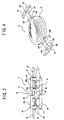
- the artificial lens kit 2 is basically comprised of an intraocular lens 24 and an intraocular ring assembly 4 in which the lens 24 is movably supported. As will be described later, this artificial lens kit 2 is to be implanted within a lens capsule of natural crystalline lens, or in most cases, it is to be implanted within a capsular bag 34 (see Fig, 21) which is an empty lens capsule from which an inner lens matrix has been extracted from a natural lens capsule by extracapsular cataract extraction, for instance.
- a center of the intraocular lens 24 and a center of the ring assembly 4 should be in a coaxial relation with each other, and that their central axes be coaxial with an optical axis l of eye ball E when placing the lens unit 2 in the capsular bag 34, as can be seen from Fig. 21.
- description will be made in the case where the kit 2 is to be assembled and placed or implanted in the capsular bag 34.
- Figs. 7 to 11 show one exemplary mode of the intraocular ring assembly 4.
- the ring assembly 4 is composed of an anterior ring element 6, a posterior ring element 8, and a plurality of elastic biasing elements 16 provided between the anterior and posterior ring elements 6, 8.
- the anterior ring element 6 is to be disposed at a side facing to the anterior capsule 36 of natural crystalline lens or capsular bag 34
- the posterior ring element 8 is to be disposed at a side facing to the posterior capsule 38 of the crystalline lens or capsular bag 34.
- Those two ring elements 6, 8 are assembled together via the elastic biasing elements 16 in a mutually coaxial relation.
- the centers (or central axes) of the two ring elements 6, 8 be in a coaxial relation with the optical axis l when placing the lens kit 2 in the capsular bag 34.
- Both anterior and posterior ring elements 6, 8 are depicted in the figures to assume a perfect circular configuration, but, in general, they may be formed in any desired fashion analogous to a circle for optimum implantation in the capsular bag 34.
- Both two ring elements 6 and 8, a principal part of the intraocular ring assembly 4 may preferably be formed from a soft elastic material, such as acrylic or silicon, that can be easily and resiliently deformed.
- an optic portion 26 of the intraocular lens 24, which is to be incorporated in the intraocular ring assembly 4 may be formed from the foregoing soft elastic material, as well.
- both intraocular lens 24 and intraocular ring assembly 4 may preferably be formed from the soft elastic material.
- the corresponding portions of intraocular ring assembly 4 may be formed in any desired structure or shape (not shown) that permits it to be folded or rolled and then recovered into its original shape.
- Preferred dimensions of the anterior and posterior ring element 6, 8 are commonly such that the outer diameters of those two ring elements 6, 8 may be set in the ranges of from 7.0 mm to 8.0 mm, whereas the inner diameters of the same (6, 8) be set in the ranges of from 6.0 mm to 7.0 mm, and the height-wise thickness of each ring element 6 or 8, as viewed from the side elevation of Fig. 3 for instance, may be in the ranges of from 1.5 mm to 2.5 mm.
- These parameters are found effective in designing the two ring elements 6, 8 for implantation in an ordinary size of crystalline lens or capsular bag 34. Of course, this is not limitative and the dimensions of the ring elements 6, 8 may be set as desired insofar as they serve the purposes of the present invention.
- the anterior ring element 6 is formed by four first sectorial ring portions 8A and four second sectorial ring portions 6B in such a manner that those first and second sectorial ring portions 6A, 6B are disposed equidistant in an alternately offset way.
- each second sectorial ring portion 6B is recessed vertically from the adjoining two first sectorial ring portions 6A that extends horizontally along the circumference of anterior ring element 6, thereby, in the aggregate, defining four generally "U" shaped ring portions (i.e.
- Each first sectorial ring portion 6A has a first end surface 6Au and a second end surface 6Ab opposite thereto.
- the first end surface 6Au slopes upwardly in a gradual way (at a relatively small angle of inclination) as it proceeds toward the center (or central axis) of the anterior ring element 6 (i.e. in a direction from the outer arcuate wall thereof to the inner arcuate wall thereof) , as can be seen from Figs. 1 and 3.
- This end surface 6Au may be formed flat, but, such sloped formation thereof is recommended to allow the ring element 6 to be smoothly placed within the capsular bag 34 in a moderate and intimate contact with and along the generally concave inner surfaces of the capsular bag 34 (which serves to prevent damage to that capsular bag 34 per se) .
- the second end surface 6Ab is flat, in which is formed a first securing groove 13 extending therealong in an arcuate manner, as best seen from Figs. 8, 9 and 10.
- a first securing groove 13 extending therealong in an arcuate manner, as best seen from Figs. 8, 9 and 10.
- formed in the first sectorial ring portion 6A is a spherical securing cavity 14 at a point midway of and adjacent to the securing groove 13.
- the spherical securing cavity 14 communicates with the groove 13 at the neck portion (N) thereof (see Fig. 12 (A)) and Is adapted to snappingly receive and securely engage a spherical (or dumbbell-headed) anchor piece 18 of the elastic biasing element 16, as will be specified later.
- Designation 10 represents a support recession defined in each of the generally U-shaped ring portions 6B. the support recession 10 being adapted to receive and support a haptic portion 28 of intraocular lens 24 therein, as will be described.
- the posterior ring element 8 is shown as being simply of a circular ring shape and having outer and inner diameters equal to those of the anterior ring element 6.
- the posterior ring element 8 has a first flat end surface 8A and a second sloped end surface 8B opposite thereto, wherein the second end surface 8B slopes downwardly as it proceeds to the center (axis) of the anterior ring element 6 (i.e. In a direction from the outer arcuate wall thereof to the inner arcuate wall thereof) , as can be seen from Figs. 1 and 3.
- the second end surface 8B may be formed flat.
- the illustrated sloped formation thereof is preferable to allow smooth placement of the ring element 8 within the capsular bag 34 in a moderate and intimate contact with and along the generally concave inner surfaces of capsular bag 34. This will advantageously avoid damage to the capsular bag 34.
- the sloped end surfaces 6Au and 8B respectively of the anterior and posterior ring elements 6, 8 are sloped in a direction away from each other as they proceed toward a central of both two ring elements 6, 8.
- each of the first flat end surface 8A of posterior ring element 8 four second securing grooves 12 are disposed equidistantly, such that each of them extends therealong in an arcuate manner.
- a spherical securing cavity 15 is formed in the posterior ring element 8 at a point midway of and adjacent to the securing groove 12.
- the spherical securing cavity 15 communicates with the groove 12 at the neck portion (N) thereof (see Fig. 12 (A)) and is adapted to snappingly receive and securely engage a spherical anchor piece 15 of the elastic biasing element 16, as will be specified later.
- the spherical securing cavity 15 is slightly larger than the spherical anchor piece 18.
- the elastic biasing element 16 is interposed between the anterior and posterior ring elements 6, 8.
- the elastic biasing element 16 may be of a generally figure-of-eight shape, for instance which is shown to have a pair of integral spherical (or dumbbell-headed) anchor pieces 18, 18 formed respectively in one and another opposite distal ends thereof.
- the purpose of this biasing element 16 is to keep the anterior and posterior ring elements 6, 8 away from each other in a resilient way.
- an assembled unit of the present artificial lens kit 2 is implanted in a capsular bag 34 as in Fig.
- the elastic biasing element 16 acts to bias the anterior ring element 6 in a direction to the anterior capsule 36, while biasing the posterior ring element 8 in a direction to the posterior capsule 38.
- the four sloped end surfaces 6Au of anterior ring element 6 are kept in a close contact with the inner surface of anterior capsule 36, while the entire sloped end surface 8B of posterior ring element 8 is kept in a close contact with the inner surface of posterior capsule 38, whereby the capsular bag 34 is normally retained in a proper biconvex shape while being allowed to become adjustably flattened and inflated along the optic axis l , in substantially the same manner as a natural crystalline lens does,
- the vertical length of generally figure-of-eight-shaped elastic biasing element 16 between the anterior and posterior ring elements 6, 8 may be such as to normally resiliently inflate the capsular bag 34 into a proper biconvex shape suited for individual patient.
- the entire body of biasing element 16 may be slightly warped to assume an arcuate shape equal in curvature to the first and second arcuate securing grooves 13, 12 stated above, since the two opposite distal end portions of the biasing element 16 have to be fitted in and along the respective first and second arcuate securing grooves 13, 12. This is preferable to avoid interference with smooth contraction and expansion of the biasing element 16 per se.
- the biasing or repercussive force of the biasing element 16 may be preset to a suitable degree, depending upon the elasticity of capsular bag 34 of individual patients' eye, or other conditions required in surgical operation.
- the four figure-of-eight-shaped biasing elements 16 are arranged In equidistant manner between the anterior and posterior ring elements 6, 8 such that each of the biasing elements 16 is disposed between each anterior ring element sectorial ring portion 6A and the corresponding local area of posterior ring element B.
- the shape of the elastic biasing element 16 is not limited to the figure-of-eight mode in Fig. 11 (A), but may be of generally "O" shape, for instance, (See Fig. 13) , which has a diameter equal to the vertical length of the aforementioned generally figure-of-eight-shaped biasing element 16.
- the figure-of-eight-shaped or "O" shaped blasing element may preferably be formed from a soft elastic material such as polypropylene.
- fixation of the four biasing elements 16 (of figure-of-eight shape) between the anterior and posterior ring elements 6, 8 is such that two opposite arcuate distal end portions of each biasing element 16 are respectively fitted and engaged in the first and second securing grooves 13, 12, while the two spherical anchor pieces 18, 18 of each biasing element 16 are snappingly anchored in the spherical securing cavity 14 of the anterior ring element 6 and the spherical securing cavity 15 of the posterior ring element 8, respectively.
- both two ring elements 6, 8 are coupled together via the four biasing elements 16 against separation from each other, thereby forming an intraocular ring assembly 4, wherein the biasing elements 16 themselves are prevented against dislocation from their respective securing points.
- any other suitable coupling and fitting members or engagement members may be provided to securely dispose the biasing elements 16 between the anterior and posterior ring elements 6, 8,
- the first and second securing grooves 12, 13 may be formed in an appropriate shape and size, depending on the configuration of the elastic biasing element 16.
- both two lateral arcuate portions of the biasing element 16 to become protrudent outwardly and stored partway in the respective two groove extensions, when the biasing element 16 is subjected to elastic depression or contraction.
- each first securing groove 13 may be formed with a pair of groove extensions 13A, 13A in the respective two extremities thereof, while on the other hand, each second securing groove 12 be formed with a pair of groove extensions 12A, 12A in the respective two extremities thereof.
- the biasing elements 16 are freely contractible and expandable without interference with the grooves 12, 13 along a rectilinear direction, which advantageously insures rectilinear coaxial displacement of both anterior and posterior ring elements 6, 8.
- This is applicable to any configuration of the elastic biasing element that has arcuate end portions, including "O" shape (similar to the integral "O" shape as in Fig, 13).
- a pair of spherical (dumbbell-headed) anchor portions 18, 18 may be formed in each of the two distal arcuate end portions of biasing element 16.
- one pair of spherical securing cavities 14 may be formed in the anterior ring element 6 (i.e, in each sectorial ring section 6A)
- another pair of spherical securing cavities 15 be formed in the posterior ring element 8 in such dimensions as to snappingly receive and securely engage the corresponding two spherical anchor portions 18, 18.
- This is not limitative, but a desired number of such securing elements (14, 15, 18) may be provided to attain a more robust and stable structure of the intraocular ring assembly 4.
- the elastic biasing element 16 may be formed directly and integrally between the anterior and posterior ring elements 6, 8, without using the aforementioned anchoring or securing means (e.g. at 14, 15 and 18) .
- the elastic biasing element 16 may be formed in a generally "O" shaped configuration and Interposed integrally between the anterior and posterior ring elements 6, 8. in this embodiment, four generally "O" shaped elastic biasing elements 16 are arranged integrally between the respective four first sectorial ring portions 6A of anterior ring element 6 and the flat surface 8A of posterior ring element 8.
- each of those four biasing elements 16 is at one end portion thereof integrally and continuously formed with each first sectorial ring portion 6A of anterior ring element 6 and is at another end portion thereof integrally and continuously formed with the posterior ring element flat surface 8A.
- the diameter of each generally "O" shaped biasing element 16 is such a degree as to normally resiliently inflate the capsular bag 34 into a proper biconvex shape suited for individual patient as described earlier.
- the elastic biasing element 16 may be a coil spring. According to this particular mode, four sets of two rectilinearly extending coil springs 16 are disposed in equidistant manner between the anterior and posterior ring elements 6, 8 such that the paired coil springs 16 are each disposed between each generally U-shaped ring section 6B and the corresponding local area of posterior ring element 8. Further, as best shown in Fig.
- each coil spring 16 is at its one end firmly secured in the first securing hole 12, while being at its another end firmly secured in the second securing hole 13.
- the coil spring 16 may be formed from a suitable metallic material with elastic property, for instance.
- the vertical length of each coil spring 16 is of such a degree as to normally resiliently inflate the capsular bag 34 into a proper biconvex shape suited for individual patient as described earlier.
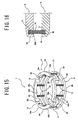
- a guide means 22 may be incorporated in the intraocular ring assembly 4 to assist in rectilinear coaxial movement of the anterior and posterior ring elements 6, 8.
- Figs. 17 depict one exemplary mode of the guide means generally indicated by the parenthetic designations (22) , I which is interposed between the anterior and posterior ring elements 6, 8.
- Figs. 17, 18 and 19 four sets of two guide means 22, 22 are arranged in equidistant manner between the two ring elements 6, 8 such that each of the paired guide means 22, 22 is disposed between each generally U-shaped ring portion 6B and the corresponding local area of posterior ring element end surface 8A.
- Figs. 17 depict one exemplary mode of the guide means generally indicated by the parenthetic designations (22) , I which is interposed between the anterior and posterior ring elements 6, 8.
- four sets of two guide means 22, 22 are arranged in equidistant manner between the two ring elements 6, 8 such that each of the paired guide means 22, 22 is disposed between each generally U-shaped
- each of the illustrated guide means 22 basically comprises a guide rod member 22A and a cylindrical guide member 22B having a through-bore 22Bh formed therein and further includes a cylindrical cavity 6H formed in the anterior ring element 6 (i.e. in the generally U-shaped ring portion 6B).
- the guide rod member 22A is at its one end portion fixed in a securing hole 8H formed in the posterior ring element 8, projecting vertically therefrom,
- Each of the cylindrical guide member 22B has an outer diameter generally equal to the inner diameter of the cylindrical cavity 6H and also has a whole length generally equal to that of the cavity 6H.
- the cylindrical guide member 22B is fixedly provided in the cylindrical cavity 6H.
- FIG. 18 Another end portion of the guide rod member 22A is slidably inserted in the through-bore 22Bh of cylindrical guide member 22B. Accordingly, as indicated by the arrow in Fig. 18, the anterior and posterior ring elements 6, 8 are positively assisted by the guide means 22 in their precise coaxial rectilinear movements toward and away from each other. It is noted that this guide means 22 may be formed in any other suitable configuration insofar as it serves to guide both two ring elements 6, 8 in the coaxial rectilinear direction.
- a rectilinearly extending coil spring similar to the one (16) described earlier, is secured in the cylindrical guide through-bore 2Bh and cavity 6H to apply a resilient biasing force to the guide rod member 22A, thereby achieving both biasing and guiding effects collectively in one localized small area for each of plural guide means 22.
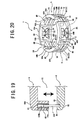
- Fig. 20 shows another alternative embodiment of the guide means generally indicated by the parenthetic designation (22), according to which, the guide means may be an elastic thin plate material 48 which has a circular hole 4BH formed centrally thereof.
- the elastic thin plate material 48 per se may be formed from a thin sheet of transparent plastic material with a proper resilient bendable property.
- a pair of outward and inward elastic thin plate materials 48A, 48B are provided. Total four sets of such paired plate materials 48A, 48B are connected between the anterior and posterior ring elements 6, 8 in such a manner that the four sets of the paired plate materials 48A, 48B are disposed at the four first sectorial ring portions 6A, respectively.
- each outward elastic thin plate material 48A is firmly attached at the upper region thereof to the outward arcuate lateral surface of the corresponding one of the four first sectorial ring portions 6A of anterior ring element 6, and is also firmly attached at the lower region thereof to the outward arcuate lateral surface of posterior ring element 8.
- each inward elastic thin plate material 48B is, at the upper region thereof, firmly attached to the inward arcuate lateral surface of corresponding one of the four first sectorial ring portions 6A, while being, at the lower region thereof, firmly attached to the inward arcuate lateral surface of posterior ring element 8.
- the provision of the holes 48H is effective in allowing the two plate materials 48A and 48B to be easily and smoothly bendable outwardly in a direction away from each other, and also insuring smooth flow of air and aqueous humor between the paired plate material 48A, 48B.
- the intraocular lens 24 is basically comprised of an optic portion 26 and a pair of haptic portions 28, 28.
- the optic portion 26 is of a generally biconvex lens configuration having a circumferential end, and the two haptic portions 28, 28 are integrally connected with the circumferential end of optic portion 26, projecting outwardly therefrom in a diametrically opposed direction relative to the center of the optic portion 26.
- Both optic and haptic portions 26, 28 may preferably be formed from a soft elastic material, such as acrylic or silicon.
- the optic and haptic portions 26, 28 should not necessarily be of a same material, but may each be of a different proper material, It is noted that the intraocular lens 24 may be of any normally available type that can be mounted in the intraocular ring assembly 4 and has the bendable haptic portions 28 which will be described later. With regard to the optic portion 26, it is not limited to the illustrated one, but may be formed in any suitable lens configuration having a proper thickness so as to attain an optimal refractive power on the basis of a diagnostic data on individual patient's eyes.
- the Illustrated two haptic portions 28 are each of a generally "T" shape which basically comprises: a base portion 28B Integrally connected with the circumferential end of optic portion 26; a curved distal end 28E; and a generally rectilinear body portion 28A defined between the base portion 28B and curved distal end 28E, wherein it is seen that the body portion 28A has a divergently widened region near to the distal end 28E.
- a generally triangular or sector-shaped hole 28H is formed in such divergently widened region of the body portion 28A in the proximity of the curved distal end 28E.
- both two end portions of the haptic portion 28 are provided with a proper elasticity to render themselves resiliently deformable according to different shape and size of capsular bag 34, so that the whole intraocular lens 24 can be smoothly set in position and retained within a different capsular bag 34 of different patient's eye.
- the whole size of the two haptic portions 28 is slightly larger than the diameter of capsular bag 34 to attain a positive resilient attachment of the former (28) to an inside of the latter (34).
- each curved distal end 28E increases an area for contact with and along the inner surface of capsular bag 34 corresponding to the equator 40 thereof.
- This allows the entirety of intraocular lens element 24 to be adjustably and stably fitted in any different diameter of capsular bag 34, and also makes the elastic action of both two haptic portions 28 more sensitive to a contour change of the capsular bag 34 being caused by the contraction and relaxation of zonule (at 42 in Fig. 21).
- each haptic portion 28 has a bendable area 28F defined at a point adjacent to the base portion 28B thereof, so that the haptic portion 28 per se may be resiliently bended or folded in vertical direction relative to the optic portion 26.
- a bendable means is provided in proximity to the base portion 28B.
- a transverse cutout 30 is formed in one side of that bendable area 28F adjacent to the base portion 28B in such a fashion as to assume a generally inverted-V-shaped cross-section extending transversely of the haptic portion 28.
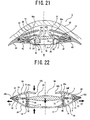
- both two haptic portions 28 are pressed toward each other in a direction inwardly of the optic portion 26, they are quickly bended at their respective cutouts 30 in one direction (i.e. a direction toward a side where those particular cutouts 30 are situated) relative to the optic portion 26, which in turn causes that optic portion 26 to displace in the same direction as that one direction (as can be seen from Fig. 23)
- the two haptic portions 28 are pulled outwardly from such bended state in a direction away from each other, they are extended outwardly on the same rectilinear horizontal line from the optic portion 24 (as can be seen from Fig. 22) .
- cutout 30 is just one example of bendable means for facilitating the ease with which the bendable area 28F of haptic portion 28 is bended to cause the displacement of optic portion 26, and such bendable means may be embodied in any other suitable manner, including hinges or the like.
- a reinforcement core element 32 is preferably embedded in the rectilinear body portion 2BA of haptic portion 28. Provision of such core element 32 effectively serves to reinforce the haptic portion 28 and prevent the same from being bent together with the above-stated bending action of bendable area 28F. This is also effective in transmitting most of force applied to the haptic portion 28 directly to the cutout 30, thereby inducing more smooth bending action of the haptic portion 28 relative to the cutout 30.
- the core element 32 is preferably formed from such a rigid material as a hard plastic or metallic material.
- the artificial lens kit 2 may preferably include a fibronectin or fibronectin-like substance.
- both two haptic portions 28 may be positively adhered via the fibronectin or fibronectin-like substance to and along the inner surface regions of capsular bag 34 corresponding to the equator 40 thereof, wherein the fibronectin or fibronectin-like substance induces a biological fibrous adhesion of the haptic portion 28 to such equator regions of capsular bag 34.
- fibronectin-like substance is defined as a substance containing a fibronectin, a fibronectin-related substance, or any other substance exhibiting the same fibrous adhesion effect as the fibronectins.
- a suitable fibronectin or fibronectin-like substance may be applied to the partial end region of each haptic portion 28.
- the fibronectin or fibronectin-like substance may be applied to a substantially whole of each haptic portion 28.
- fibronectin or fibronectin-like substance
- fibronectin-like substance should be applied to the partial end region of haptic portion 28 or applied to a substantially whole of the same is dependent upon the conditions and dimensions of patient's lens capsule in order to insure an optimum adhesion of the haptic portion 28 to the capsular bag equator region (at 40).
- the above-described intraocular ring assembly 4 and intraocular lens 24 constitute one artificial lens kit 2 usable for implantation in the capsular bag 34.
- the two haptic portions 28 may be set in place in the corresponding selected two of the four support recessions 10 of the intraocular ring assembly 4.
- the illustrated formation of four equidistant support recessions 10 is superior to such formation of only two support recessions 10. This is because, when putting together the lens 24 and ring assembly 4 within the capsular bag 34.
- the distance between the adjacent two recessions 10 is quite small and therefore requires a less amount of rotation of the lens 24 upon the ring assembly 4 to drop and set the two haptic portions 28 in selected two of the four recessions 10, respectively.
- the number and shape of the support recessions 10 are not limitative and may be varied, depending on the configuration of haptic portions 28 to be received therein.
- an after-cataract In the case of extracapsular cataract extraction procedure, it is with a high frequency that an opacification will occur along the capsular bag 34 postoperatively and the opacification may progress on to a pupil region of the eye (i,e. a point adjacent to the center of capsular bag 34), which may result in a decreased visual acuity. This symptom is what is called "after-cataract". Such decreased visual acuity due to the after-cataract is a critical problem among ophthalmologists, but, there is no effective measure to prevent the after-cataract.
- the after-cataract can be classified into the following two typical cases: "fibrous opacification” and "Elschnig's pearls".
- the fibrous opacification is a state where the posterior capsule area of capsular bag 34 becomes white and cloudy due to the production of extracellular matrix such as collagen.
- extracellular matrix such as collagen.
- a part of the epithelial cells of natural crystalline lens is transformed into myofibroblast-like cells which in turn produce a great amount of the extracellular matrix composed of fibrous tissues (including "type I” collagen and "type II” collagen) .
- fibrous opacification fibrosis
- an incision is first made to the anterior capsule of lens 36 in a circular manner relative to the center thereof (i.e. anterior capsulotomy) , the anterior capsule 36 having a lens epithelial cell thereon (the lens epithelial cell exists only in the anterior capsule) .
- the anterior capsule 36 having a lens epithelial cell thereon (the lens epithelial cell exists only in the anterior capsule) .
- a circular edge defined in the anterior capsule 36 is a circular edge (see 44E in Fig.
- annular closed space is defined between the anterior and posterior capsules 36, 38 in a doughnut-like fashion.
- the major constituent tissue of the new natural crystalline lens comprises lens fiber cells regenerated in the space.
- the natural crystalline lens occupies that closed space, the plural lens fiber cells thereof keep on proliferating and passing through the adhesion area at which the anterior capsule annular edges 44E are adhered to the posterior capsule 3B.
- the lens fiber cells reach a humor chamber outside the posterior capsule 38 and are exposed to aqueous humor in the anterior chamber.
- the lens fiber cells become swollen into a plurality of the so-called "Elschnig's pearls", another case of the after-cataract.
- the Elschnig's pearls scatter a light entering the eye and decrease the visual acuity.
- the intraocular ring assembly 4 works effectively for that purpose. Namely, shortly after completion of the anterior capsulotomy, the ring assembly 4 is inserted through the circular opening (see 44 in Fig. 21) and placed in the inside of the capsular bag 34, whereupon the anterior and posterior capsules 36, 38 are biasingly separated from each other by the respective anterior and posterior ring elements 6, 8, due to the elastic biasing elements 16, thereby keeping the circular opening 44 and Its annular edge 44E away from the anterior capsule 36, as understandable from Fig. 21.
- the fibrous opacification if any, would occur within a very limited small region around the annular edge 44E and thus will never develop therefrom to the anterior capsule 38.
- the intraocular ring assembly 4 of the present invention therefore, insures to prevent the decreased visual acuity due to the fibrous opacification.
- grooves and holes in the anterior ring element 6 for the purpose of allowing free circulation of aqueous humor, though not shown.
- those grooves and holes will allow a proper amount of the aqueous humor to be flowed between the ring 6 and anterior capsule 36, thereby eliminating a possible increase of transdifferentiated cells and other factors which may produce a great amount of fibrous extracellular matrixes.
- any biological adhesion will not cause between the circular edge 44E and both anterior and posterior capsules 36, 38, and neither will be formed any closed space in the capsular bag 34, the closed space being a place allowing regeneration of lens fibrous cells and incidental formation of Elschnig's pearls therein as mentioned above.
- Such provision of grooves and holes is a matter of choice to effectively prevent a lowered visual acuity due to the Elschnig's pearls.
- Figs. 21 depicts the state where the artificial lens kit 4 is used for implantation in a crystalline lens of human eye.
- a crystalline lens or a capsular bag 34 is inherently connected at its entire equator region 40 with the zonule 42 which are in turn inherently connected with the circular ciliary muscle 50.
- Designations 51 and 52 denote a comea and an iris, respectively.
- Designation 53 denotes a vitreous body.
- an anterior capsulotomy is effected by making a circular incision to the anterior capsule 36 of crystalline lens so as to form a circular opening 44 therein.
- An inner matrix Is then extracted from the crystalline lens via the opening 44 to leave an empty lens capsule or a capsular bag 34.
- one artificial lens kit 2 of the present invention which is a normally available mode complete with both intraocular ring assembly 34 and intraocular lens 24.
- the intraocular ring assembly 34 is taken from such kit 2 and inserted through the opening 44 Into the inside of capsular bag 34.
- the intraocular lens 24 with a pair of bendable haptic portions 28, taken also from the kit 2 is likewise inserted through the opening 44 into the capsular bag 34 and placed upon the ring assembly 34 therewithin.
- a surgeon should rotate the intraocular lens 24 generally coaxially of the ring assembly 34 so that the two haptic portions 28 of the former are respectively dropped and received in a selected diametrically-opposing pair of support recessions 10 of the latter.
- both two haptic portions 28 are firmly and integrally adhered, as indicated at F, to the inner surface regions of capsular bag 34 corresponding to the equator region 40 thereof under the biological adhesive effect induced by the fibronectin or fibronectin-like substance.
- both intraocular lens 24 and ring assembly 4 are assembled and retained in position within the capsular bag 34 in a coaxial relation with each other, wherein their axes extend along the optic axis l , as can be seen from Fig. 21.
- the anterior ring element 6 is urged by the elastic biasing element 16 into contact with the inner surface of anterior capsule 36, while simultaneously, the posterior ring element 8 is urged by the biasing element 16 into contact with the inner surface of posterior capsule 38. More specifically, the two sloped end faces 6Au, 8B respectively of the posterior and anterior ring elements 6, 8 are biasingly kept in a fit contact with and along the generally concave inner surfaces of posterior and anterior capsules 36, 38.
- the capsular bag 34 is retained in a proper biconvex shape while being allowed to be flattened and inflated in a coaxial relation with the optic axis l, which positively keeps the anterior capsule circular edge 44E away from the posterior capsule 8, as described above.
- both two arcuate ends 28E respectively of the two haptic portions 28 are securely contacted with and along the inner surface regions of capsular bag 34 corresponding to the equator region 40 thereof.
- the anterior and posterior capsules 36, 38 are displaced toward each other, whereby the capsular bag 34 is flattened, hence reducing the distance between the anterior and posterior ring elements 6, 8, while resiliently depressing the elastic biasing elements 16, with the result that the two haptic portions 28 received in the support recessions 10 of anterior ring element 6 are extended oufinrardly and brought to substantially the same line with the equator region 40 (i.e.
- the optic portion 26 is rectilinearly moved along the optic axis l in a direction posteriorly of the capsular bag 34 (i.e. toward the posterior capsule 38) and located at a point generally level with the equator 40. Accordingly, the eye E has made a proper accommodation to adjust its focus on a far or distant object,
- both two haptic portions 28 are bent in one direction toward each other with respect to their respective bendable portions 28F or cutouts 30 and thus displaced nearer to the center of optic portion 26.
- the eye E has made a proper accommodation to adjust its focus on a near object.
- the thus-implanted unit of intraocular lens 24 and ring assembly 4 in the eye E works finely and precisely in response to contraction and relaxation of the zonule 42 as well as to change in shape of whole capsular bag 34, whereby the optic portion 26 is quickly subjected to a proper variation in refractive power and smoothly changes its focus upon a near or distant object being viewed.
- the intraocular ring assembly 4 and the artificial lens kit 2 in accordance with the present invention has the following effects and advantages:
Landscapes
- Health & Medical Sciences (AREA)
- Ophthalmology & Optometry (AREA)
- Cardiology (AREA)
- Oral & Maxillofacial Surgery (AREA)
- Transplantation (AREA)
- Engineering & Computer Science (AREA)
- Biomedical Technology (AREA)
- Heart & Thoracic Surgery (AREA)
- Vascular Medicine (AREA)
- Life Sciences & Earth Sciences (AREA)
- Animal Behavior & Ethology (AREA)
- General Health & Medical Sciences (AREA)
- Public Health (AREA)
- Veterinary Medicine (AREA)
- Prostheses (AREA)
Applications Claiming Priority (2)
| Application Number | Priority Date | Filing Date | Title |
|---|---|---|---|
| JP2001380870 | 2001-12-14 | ||
| EP02027246A EP1321112B1 (de) | 2001-12-14 | 2002-12-06 | Intraokulares Ringsystem und Bausatz mit künstlichen Linsen |
Related Parent Applications (1)
| Application Number | Title | Priority Date | Filing Date |
|---|---|---|---|
| EP02027246A Division EP1321112B1 (de) | 2001-12-14 | 2002-12-06 | Intraokulares Ringsystem und Bausatz mit künstlichen Linsen |
Publications (1)
| Publication Number | Publication Date |
|---|---|
| EP1649832A2 true EP1649832A2 (de) | 2006-04-26 |
Family
ID=19187264
Family Applications (3)
| Application Number | Title | Priority Date | Filing Date |
|---|---|---|---|
| EP02027246A Expired - Lifetime EP1321112B1 (de) | 2001-12-14 | 2002-12-06 | Intraokulares Ringsystem und Bausatz mit künstlichen Linsen |
| EP05022729A Withdrawn EP1647241A2 (de) | 2001-12-14 | 2002-12-06 | Intraokulares Ringsystem (und Bausatz mit künstlichen Linsen) |
| EP05022731A Withdrawn EP1649832A2 (de) | 2001-12-14 | 2002-12-06 | Intraokulares Ringsystem |
Family Applications Before (2)
| Application Number | Title | Priority Date | Filing Date |
|---|---|---|---|
| EP02027246A Expired - Lifetime EP1321112B1 (de) | 2001-12-14 | 2002-12-06 | Intraokulares Ringsystem und Bausatz mit künstlichen Linsen |
| EP05022729A Withdrawn EP1647241A2 (de) | 2001-12-14 | 2002-12-06 | Intraokulares Ringsystem (und Bausatz mit künstlichen Linsen) |
Country Status (3)
| Country | Link |
|---|---|
| US (3) | US7037338B2 (de) |
| EP (3) | EP1321112B1 (de) |
| DE (1) | DE60206727T2 (de) |
Cited By (1)
| Publication number | Priority date | Publication date | Assignee | Title |
|---|---|---|---|---|
| RU2355367C2 (ru) * | 2007-05-07 | 2009-05-20 | Николай Маркович Сергиенко | Устройство для фиксации капсульного мешка |
Families Citing this family (112)
| Publication number | Priority date | Publication date | Assignee | Title |
|---|---|---|---|---|
| US20060238702A1 (en) | 1999-04-30 | 2006-10-26 | Advanced Medical Optics, Inc. | Ophthalmic lens combinations |
| US20030060881A1 (en) | 1999-04-30 | 2003-03-27 | Advanced Medical Optics, Inc. | Intraocular lens combinations |
| US20030078658A1 (en) * | 2001-01-25 | 2003-04-24 | Gholam-Reza Zadno-Azizi | Single-piece accomodating intraocular lens system |
| US7087080B2 (en) * | 2001-01-25 | 2006-08-08 | Visiogen, Inc. | Materials for use in intraocular lens system |
| US6884261B2 (en) * | 2001-01-25 | 2005-04-26 | Visiogen, Inc. | Method of preparing an intraocular lens for implantation |
| US7780729B2 (en) | 2004-04-16 | 2010-08-24 | Visiogen, Inc. | Intraocular lens |
| US20060184244A1 (en) * | 2005-02-14 | 2006-08-17 | Nguyen Tuan A | Biasing system for intraocular lens |
| US7198640B2 (en) * | 2001-01-25 | 2007-04-03 | Visiogen, Inc. | Accommodating intraocular lens system with separation member |
| US20030078657A1 (en) | 2001-01-25 | 2003-04-24 | Gholam-Reza Zadno-Azizi | Materials for use in accommodating intraocular lens system |
| US8062361B2 (en) * | 2001-01-25 | 2011-11-22 | Visiogen, Inc. | Accommodating intraocular lens system with aberration-enhanced performance |
| IL145015A0 (en) * | 2001-08-21 | 2002-06-30 | Nun Yehoshua Ben | Accommodating lens |
| US7763069B2 (en) | 2002-01-14 | 2010-07-27 | Abbott Medical Optics Inc. | Accommodating intraocular lens with outer support structure |
| US6972033B2 (en) * | 2002-08-26 | 2005-12-06 | Advanced Medical Optics, Inc. | Accommodating intraocular lens assembly with multi-functional capsular bag ring |
| US7125422B2 (en) * | 2002-10-25 | 2006-10-24 | Quest Vision Technology, Inc. | Accommodating intraocular lens implant |
| US7662180B2 (en) | 2002-12-05 | 2010-02-16 | Abbott Medical Optics Inc. | Accommodating intraocular lens and method of manufacture thereof |
| US7615056B2 (en) | 2003-02-14 | 2009-11-10 | Visiogen, Inc. | Method and device for compacting an intraocular lens |
| US6986787B1 (en) * | 2003-03-12 | 2006-01-17 | Baker Jr David Littleton | Accomodative intraocular lens |
| US7628810B2 (en) | 2003-05-28 | 2009-12-08 | Acufocus, Inc. | Mask configured to maintain nutrient transport without producing visible diffraction patterns |
| US20040249455A1 (en) * | 2003-06-09 | 2004-12-09 | Tran Son Trung | Accommodative intraocular lens system |
| US20050131535A1 (en) | 2003-12-15 | 2005-06-16 | Randall Woods | Intraocular lens implant having posterior bendable optic |
| US7645300B2 (en) * | 2004-02-02 | 2010-01-12 | Visiogen, Inc. | Injector for intraocular lens system |
| IL161706A0 (en) * | 2004-04-29 | 2004-09-27 | Nulens Ltd | Intraocular lens fixation device |
| WO2006040759A1 (en) * | 2004-10-13 | 2006-04-20 | Nulens Ltd | Accommodating intraocular lens (aiol), and aiol assemblies including same |
| US8377123B2 (en) | 2004-11-10 | 2013-02-19 | Visiogen, Inc. | Method of implanting an intraocular lens |
| EP1890650A2 (de) | 2005-03-30 | 2008-02-27 | Nulens Ltd | Akkommodierende intraokularlinsen- (aiol) anordungen und diskrete komponenten dafür |
| US20070016293A1 (en) * | 2005-07-18 | 2007-01-18 | Alcon, Inc. | Accommodative intraocular lens system |
| US20070027541A1 (en) * | 2005-07-26 | 2007-02-01 | Visioncare Ophthalmic Technologies Inc. | Intraocular devices and methods for implantation thereof |
| US9636213B2 (en) | 2005-09-30 | 2017-05-02 | Abbott Medical Optics Inc. | Deformable intraocular lenses and lens systems |
| US20070100446A1 (en) * | 2005-10-27 | 2007-05-03 | Donald Horvatich | Intraocular lens |
| US8377125B2 (en) * | 2006-04-05 | 2013-02-19 | Anew Optics, Inc. | Intraocular lens with accommodation |
| US20070260308A1 (en) * | 2006-05-02 | 2007-11-08 | Alcon, Inc. | Accommodative intraocular lens system |
| US20090198247A1 (en) * | 2006-08-25 | 2009-08-06 | Nulens Ltd. | Intraocular lens implantation kit |
| US8403984B2 (en) | 2006-11-29 | 2013-03-26 | Visiogen, Inc. | Apparatus and methods for compacting an intraocular lens |
| AU2007338100B2 (en) * | 2006-12-22 | 2014-01-30 | Amo Groningen Bv | Accommodating intraocular lens, lens system and frame therefor |
| US20080161914A1 (en) | 2006-12-29 | 2008-07-03 | Advanced Medical Optics, Inc. | Pre-stressed haptic for accommodating intraocular lens |
| US20080161912A1 (en) * | 2007-01-02 | 2008-07-03 | Alcon, Inc. | Intraocular Lens |
| USD702346S1 (en) | 2007-03-05 | 2014-04-08 | Nulens Ltd. | Haptic end plate for use in an intraocular assembly |
| WO2008107882A2 (en) * | 2007-03-05 | 2008-09-12 | Nulens Ltd | Unitary accommodating intraocular lenses (aiols) and discrete base members for use therewith |
| US8480734B2 (en) * | 2007-12-27 | 2013-07-09 | Anew Optics, Inc. | Intraocular lens with accommodation |
| US8425595B2 (en) | 2008-03-12 | 2013-04-23 | Visiogen, Inc. | Method for inserting an intraocular lens |
| US8034108B2 (en) | 2008-03-28 | 2011-10-11 | Abbott Medical Optics Inc. | Intraocular lens having a haptic that includes a cap |
| EP2315559B1 (de) * | 2008-07-24 | 2012-01-25 | Nulens Ltd | Akkommodierende intraokularlinsen-(aiol) kapseln |
| EP2358305A4 (de) * | 2008-11-26 | 2014-02-26 | Anew Optics Inc | Intraokulare linsenoptik |
| AU2009319753B2 (en) * | 2008-11-26 | 2013-11-14 | Anew Iol Technologies, Inc. | Haptic devices for intraocular lens |
| US10010405B2 (en) | 2008-11-26 | 2018-07-03 | Anew Aol Technologies, Inc. | Haptic devices for intraocular lens |
| WO2010093548A1 (en) * | 2009-02-10 | 2010-08-19 | Alcon, Inc. | Accommodative intraocular lens system |
| US9078744B2 (en) * | 2009-02-11 | 2015-07-14 | Novartis Ag | Single optic accommodative intraocular lens system |
| EP2403442A4 (de) * | 2009-03-04 | 2014-04-09 | Anew Optics Inc | Injektor für intraokularlinse |
| US8486142B2 (en) | 2009-06-26 | 2013-07-16 | Abbott Medical Optics Inc. | Accommodating intraocular lenses |
| WO2011017322A1 (en) | 2009-08-03 | 2011-02-10 | Abbott Medical Optics Inc. | Intraocular lens for providing accomodative vision |
| US10004593B2 (en) | 2009-08-13 | 2018-06-26 | Acufocus, Inc. | Intraocular lens with elastic mask |
| RU2012108951A (ru) | 2009-08-13 | 2013-09-20 | Акуфокус, Инк. | Скрытые интраокулярные имплантанты и линзы |
| WO2011094139A1 (en) * | 2010-01-26 | 2011-08-04 | Klein, David | Accommodating intraocular lens |
| US8869975B2 (en) * | 2010-02-12 | 2014-10-28 | Presbibio, Llc | Lens holder apparatus and system and method |
| EP2579813B1 (de) * | 2010-06-10 | 2016-03-16 | Ram Srikanth Mirlay | Kontaktlinse mit scharnier und kontaktlinse mit pendel mit mehrfach-optikanordnung |
| JP2013528098A (ja) * | 2010-06-10 | 2013-07-08 | スリカンス ミレイ,ラム | 複数の光学部品を備えた眼内レンズ(iol) |
| US9220590B2 (en) | 2010-06-10 | 2015-12-29 | Z Lens, Llc | Accommodative intraocular lens and method of improving accommodation |
| US8523942B2 (en) | 2011-05-17 | 2013-09-03 | James Stuart Cumming | Variable focus intraocular lens |
| US9918830B2 (en) | 2010-06-21 | 2018-03-20 | James Stuart Cumming | Foldable intraocular lens with rigid haptics |
| US8734512B2 (en) | 2011-05-17 | 2014-05-27 | James Stuart Cumming | Biased accommodating intraocular lens |
| US9351825B2 (en) | 2013-12-30 | 2016-05-31 | James Stuart Cumming | Semi-flexible posteriorly vaulted acrylic intraocular lens for the treatment of presbyopia |
| WO2011162896A1 (en) * | 2010-06-21 | 2011-12-29 | Novartis Ag | Intraocular rings and associated systems and methods |
| US9585745B2 (en) | 2010-06-21 | 2017-03-07 | James Stuart Cumming | Foldable intraocular lens with rigid haptics |
| US9295545B2 (en) | 2012-06-05 | 2016-03-29 | James Stuart Cumming | Intraocular lens |
| US9295544B2 (en) | 2012-06-05 | 2016-03-29 | James Stuart Cumming | Intraocular lens |
| US10736732B2 (en) | 2010-06-21 | 2020-08-11 | James Stuart Cumming | Intraocular lens with longitudinally rigid plate haptic |
| WO2012051118A1 (en) * | 2010-10-12 | 2012-04-19 | University Of Miami | Islet storing intraocular implant, method of using the same and kit including the same |
| US9295546B2 (en) | 2013-09-24 | 2016-03-29 | James Stuart Cumming | Anterior capsule deflector ridge |
| WO2012167246A1 (en) * | 2011-06-03 | 2012-12-06 | Anew Optics, Inc. | Capsular opacification blocking lens |
| WO2013082545A1 (en) | 2011-12-02 | 2013-06-06 | Acufocus, Inc. | Ocular mask having selective spectral transmission |
| US20130184816A1 (en) * | 2011-12-30 | 2013-07-18 | Anew Optics, Inc. | Intraocular lens rings |
| US8900300B1 (en) | 2012-02-22 | 2014-12-02 | Omega Ophthalmics Llc | Prosthetic capsular bag and method of inserting the same |
| US9084674B2 (en) | 2012-05-02 | 2015-07-21 | Abbott Medical Optics Inc. | Intraocular lens with shape changing capability to provide enhanced accomodation and visual acuity |
| US9364318B2 (en) | 2012-05-10 | 2016-06-14 | Z Lens, Llc | Accommodative-disaccommodative intraocular lens |
| AU2014228357B2 (en) | 2013-03-11 | 2018-08-23 | Johnson & Johnson Surgical Vision, Inc. | Intraocular lens that matches an image surface to a retinal shape, and method of designing same |
| US9204962B2 (en) | 2013-03-13 | 2015-12-08 | Acufocus, Inc. | In situ adjustable optical mask |
| US9427922B2 (en) | 2013-03-14 | 2016-08-30 | Acufocus, Inc. | Process for manufacturing an intraocular lens with an embedded mask |
| WO2015087931A1 (ja) * | 2013-12-13 | 2015-06-18 | 株式会社Frontier Vision | 調節眼内レンズ |
| US9615916B2 (en) | 2013-12-30 | 2017-04-11 | James Stuart Cumming | Intraocular lens |
| WO2016038470A2 (en) | 2014-03-10 | 2016-03-17 | Amo Groningen B.V. | Dual-optic intraocular lens that improves overall vision where there is a local loss of retinal function |
| CN115232614A (zh) | 2014-03-31 | 2022-10-25 | 默克专利有限公司 | 白光发射组合物及包含所述组合物的制剂和器件 |
| WO2015177651A1 (en) | 2014-04-21 | 2015-11-26 | Amo Groningen B.V. | Ophthalmic devices, system and methods that improve peripheral vision |
| US10004594B2 (en) | 2014-06-19 | 2018-06-26 | Omega Ophthalmics Llc | Prosthetic capsular devices, systems, and methods |
| US10945832B2 (en) | 2014-09-22 | 2021-03-16 | Onpoint Vision, Inc. | Intraocular pseudophakic contact lens with mechanism for securing by anterior leaflet of capsular wall and related system and method |
| US10159562B2 (en) | 2014-09-22 | 2018-12-25 | Kevin J. Cady | Intraocular pseudophakic contact lenses and related systems and methods |
| US10299910B2 (en) | 2014-09-22 | 2019-05-28 | Kevin J. Cady | Intraocular pseudophakic contact lens with mechanism for securing by anterior leaflet of capsular wall and related system and method |
| US11109957B2 (en) | 2014-09-22 | 2021-09-07 | Onpoint Vision, Inc. | Intraocular pseudophakic contact lens with mechanism for securing by anterior leaflet of capsular wall and related system and method |
| US11938018B2 (en) | 2014-09-22 | 2024-03-26 | Onpoint Vision, Inc. | Intraocular pseudophakic contact lens (IOPCL) for treating age-related macular degeneration (AMD) or other eye disorders |
| US12447007B2 (en) | 2014-09-22 | 2025-10-21 | Onpoint Vision, Inc. | Intraocular pseudophakic contact lens with mechanism for securing by anterior leaflet of capsular wall and related system and method |
| EP3042634B1 (de) * | 2015-01-06 | 2017-09-27 | Infinitevision Optics | Mehrkomponenten-Intraokularlinse |
| US9358103B1 (en) | 2015-02-10 | 2016-06-07 | Omega Ophthalmics Llc | Prosthetic capsular devices, systems, and methods |
| JP6023283B1 (ja) * | 2015-07-27 | 2016-11-09 | 株式会社中京メディカル | 眼内装着物及び眼内装着物の保持部材 |
| ES2972581T3 (es) | 2015-10-05 | 2024-06-13 | Acufocus Inc | Métodos de moldeo de lentes intraoculares |
| WO2017070288A1 (en) * | 2015-10-21 | 2017-04-27 | The Regents Of The University Of Colorado, A Body Corporate | Intraocular devices and methods for correction of aphakia, restoration of accommodation, and treatment of glaucoma |
| EP3384342B1 (de) | 2015-11-24 | 2021-08-25 | AcuFocus, Inc. | Torische intraokularlinse mit kleiner apertur und erweiterter tiefenschärfe |
| EP3426191B1 (de) | 2016-03-11 | 2024-09-11 | Amo Groningen B.V. | Intraokulare linsen zur verbesserung der peripheren sicht |
| US11096778B2 (en) * | 2016-04-19 | 2021-08-24 | Amo Groningen B.V. | Ophthalmic devices, system and methods that improve peripheral vision |
| IL245775A0 (en) | 2016-05-22 | 2016-08-31 | Joshua Ben Nun | Hybrid accommodative intraocular lens |
| JP2019520886A (ja) | 2016-06-06 | 2019-07-25 | オメガ・オフサルミックス・エルエルシーOmega Ophthalmics LLC | 人工水晶体嚢装置、システムおよび方法 |
| CN109890325B (zh) | 2016-08-24 | 2021-10-26 | Z晶状体有限责任公司 | 双模式调节-去调节型人工晶状体 |
| CA3109979C (en) | 2016-10-21 | 2023-10-17 | Omega Ophthalmics Llc | Prosthetic capsular devices |
| EP3649498A4 (de) | 2017-07-05 | 2021-03-24 | AcuFocus, Inc. | Schutzlinsenhalter |
| EP3681438A1 (de) | 2017-09-11 | 2020-07-22 | AMO Groningen B.V. | Verfahren und vorrichtungen zur erhöhung der positionsstabilität von intraokularlinsen |
| EP3773334A4 (de) | 2018-04-06 | 2021-12-29 | Omega Ophthalmics LLC | Prothesenkapselvorrichtungen, systeme und verfahren |
| US11364110B2 (en) | 2018-05-09 | 2022-06-21 | Acufocus, Inc. | Intraocular implant with removable optic |
| GB2578639A (en) | 2018-11-02 | 2020-05-20 | Rayner Intraocular Lenses Ltd | Hybrid accommodating intraocular lens assemblages including discrete lens unit with segmented lens haptics |
| JP7690483B2 (ja) | 2020-03-05 | 2025-06-10 | アルコン インコーポレイティド | ロック機構を有する多部品眼内レンズ |
| EP4125718B1 (de) | 2020-03-27 | 2025-11-26 | Alcon Inc. | Modulare iol-konstruktion |
| EP4135622A1 (de) * | 2020-04-16 | 2023-02-22 | Alcon Inc. | Mehrteiliges iol mit stabiler iol-basis zum tragen einer zweiten optik |
| AU2021359888A1 (en) | 2020-10-12 | 2023-06-15 | Omega Ophthalmics Llc | Prosthetic capsular devices, systems, and methods |
| CA3195360A1 (en) * | 2020-10-28 | 2022-05-05 | SpyGlass Pharma, Inc. | Sulcus implants and methods of using the same |
| US20240058115A1 (en) * | 2021-01-13 | 2024-02-22 | Kim Dae Yune | Support structure for artificial eye lens |
Family Cites Families (15)
| Publication number | Priority date | Publication date | Assignee | Title |
|---|---|---|---|---|
| US4842601A (en) * | 1987-05-18 | 1989-06-27 | Smith S Gregory | Accommodating intraocular lens and method of implanting and using same |
| US5282851A (en) * | 1987-07-07 | 1994-02-01 | Jacob Labarre Jean | Intraocular prostheses |
| CS271606B1 (en) * | 1988-04-11 | 1990-10-12 | Sulc Jiri | Intraocular optical system |
| JP2718961B2 (ja) | 1988-11-04 | 1998-02-25 | 株式会社メニコン | 眼内レンズ |
| US5326347A (en) * | 1991-08-12 | 1994-07-05 | Cumming J Stuart | Intraocular implants |
| US5275623A (en) * | 1991-11-18 | 1994-01-04 | Faezeh Sarfarazi | Elliptical accommodative intraocular lens for small incision surgery |
| DE4340205C1 (de) * | 1993-11-25 | 1995-04-20 | Dieter W Klaas | Intraokularlinse mit einer Akkomodationseinrichtung |
| US6013101A (en) * | 1994-11-21 | 2000-01-11 | Acuity (Israel) Limited | Accommodating intraocular lens implant |
| US6488708B2 (en) * | 1999-04-09 | 2002-12-03 | Faezeh Sarfarazi | Open chamber, elliptical, accommodative intraocular lens system |
| US7662179B2 (en) * | 1999-04-09 | 2010-02-16 | Sarfarazi Faezeh M | Haptics for accommodative intraocular lens system |
| US6616692B1 (en) * | 1999-04-30 | 2003-09-09 | Advanced Medical Optics, Inc. | Intraocular lens combinations |
| FR2804860B1 (fr) * | 2000-02-16 | 2002-04-12 | Humanoptics Ag | Implant cristallinien accomodatif |
| US6464725B2 (en) * | 2001-01-23 | 2002-10-15 | Bernt Christian Skotton | Two-lens adjustable intraocular lens system |
| US7087080B2 (en) * | 2001-01-25 | 2006-08-08 | Visiogen, Inc. | Materials for use in intraocular lens system |
| US6443985B1 (en) * | 2001-08-27 | 2002-09-03 | Randall Woods | Intraocular lens implant having eye accommodating capabilities |
-
2002
- 2002-11-18 US US10/295,856 patent/US7037338B2/en not_active Expired - Fee Related
- 2002-12-06 EP EP02027246A patent/EP1321112B1/de not_active Expired - Lifetime
- 2002-12-06 EP EP05022729A patent/EP1647241A2/de not_active Withdrawn
- 2002-12-06 EP EP05022731A patent/EP1649832A2/de not_active Withdrawn
- 2002-12-06 DE DE60206727T patent/DE60206727T2/de not_active Expired - Lifetime
-
2006
- 2006-03-17 US US11/377,677 patent/US7462193B2/en not_active Expired - Fee Related
-
2008
- 2008-07-08 US US12/216,604 patent/US7674288B2/en not_active Expired - Fee Related
Cited By (1)
| Publication number | Priority date | Publication date | Assignee | Title |
|---|---|---|---|---|
| RU2355367C2 (ru) * | 2007-05-07 | 2009-05-20 | Николай Маркович Сергиенко | Устройство для фиксации капсульного мешка |
Also Published As
| Publication number | Publication date |
|---|---|
| EP1647241A2 (de) | 2006-04-19 |
| US7674288B2 (en) | 2010-03-09 |
| DE60206727T2 (de) | 2006-07-20 |
| US7462193B2 (en) | 2008-12-09 |
| EP1321112A1 (de) | 2003-06-25 |
| US20030114927A1 (en) | 2003-06-19 |
| US20080281417A1 (en) | 2008-11-13 |
| US7037338B2 (en) | 2006-05-02 |
| DE60206727D1 (de) | 2005-11-24 |
| EP1321112B1 (de) | 2005-10-19 |
| US20060178742A1 (en) | 2006-08-10 |
Similar Documents
| Publication | Publication Date | Title |
|---|---|---|
| EP1321112B1 (de) | Intraokulares Ringsystem und Bausatz mit künstlichen Linsen | |
| AU2004299063B2 (en) | Intraocular lens implant having posterior bendable optic | |
| US6921416B2 (en) | Intraocular lens implant having accommodative capabilities | |
| JP4473132B2 (ja) | 調節可能型人工水晶体の埋め込み | |
| EP1933768B1 (de) | Akkommodierendes intraokularlinsen-system | |
| US6443985B1 (en) | Intraocular lens implant having eye accommodating capabilities | |
| US7806930B2 (en) | Device for attachment to a capsule in an eye | |
| US7354451B2 (en) | Accommodating intraocular lens implant | |
| US6972033B2 (en) | Accommodating intraocular lens assembly with multi-functional capsular bag ring | |
| US20120179249A1 (en) | Accommodating intraocular lens and methods of use | |
| AU2002317586A1 (en) | Intraocular lens implant having eye accommodating capabilities | |
| JP2006516002A (ja) | 内部に屈折性液体を有するカプセル型埋込人工水晶体 | |
| AU2011218619B2 (en) | Intraocular lens implant having posterior bendable optic | |
| CN115486965A (zh) | 用于晶状体囊的修复和张紧的设备 |
Legal Events
| Date | Code | Title | Description |
|---|---|---|---|
| PUAI | Public reference made under article 153(3) epc to a published international application that has entered the european phase |
Free format text: ORIGINAL CODE: 0009012 |
|
| AC | Divisional application: reference to earlier application |
Ref document number: 1321112 Country of ref document: EP Kind code of ref document: P |
|
| AK | Designated contracting states |
Kind code of ref document: A2 Designated state(s): DE FR GB |
|
| STAA | Information on the status of an ep patent application or granted ep patent |
Free format text: STATUS: THE APPLICATION HAS BEEN WITHDRAWN |
|
| 18W | Application withdrawn |
Effective date: 20101025 |