EP3426191B1 - Intraokulare linsen zur verbesserung der peripheren sicht - Google Patents
Intraokulare linsen zur verbesserung der peripheren sicht Download PDFInfo
- Publication number
- EP3426191B1 EP3426191B1 EP17722144.7A EP17722144A EP3426191B1 EP 3426191 B1 EP3426191 B1 EP 3426191B1 EP 17722144 A EP17722144 A EP 17722144A EP 3426191 B1 EP3426191 B1 EP 3426191B1
- Authority
- EP
- European Patent Office
- Prior art keywords
- iol
- peripheral
- optic
- lens
- achromatic
- Prior art date
- Legal status (The legal status is an assumption and is not a legal conclusion. Google has not performed a legal analysis and makes no representation as to the accuracy of the status listed.)
- Active
Links
Images




Classifications
-
- A—HUMAN NECESSITIES
- A61—MEDICAL OR VETERINARY SCIENCE; HYGIENE
- A61F—FILTERS IMPLANTABLE INTO BLOOD VESSELS; PROSTHESES; DEVICES PROVIDING PATENCY TO, OR PREVENTING COLLAPSING OF, TUBULAR STRUCTURES OF THE BODY, e.g. STENTS; ORTHOPAEDIC, NURSING OR CONTRACEPTIVE DEVICES; FOMENTATION; TREATMENT OR PROTECTION OF EYES OR EARS; BANDAGES, DRESSINGS OR ABSORBENT PADS; FIRST-AID KITS
- A61F2/00—Filters implantable into blood vessels; Prostheses, i.e. artificial substitutes or replacements for parts of the body; Appliances for connecting them with the body; Devices providing patency to, or preventing collapsing of, tubular structures of the body, e.g. stents
- A61F2/02—Prostheses implantable into the body
- A61F2/14—Eye parts, e.g. lenses or corneal implants; Artificial eyes
- A61F2/16—Intraocular lenses
- A61F2/1613—Intraocular lenses having special lens configurations, e.g. multipart lenses; having particular optical properties, e.g. pseudo-accommodative lenses, lenses having aberration corrections, diffractive lenses, lenses for variably absorbing electromagnetic radiation, lenses having variable focus
- A61F2/1637—Correcting aberrations caused by inhomogeneities; correcting intrinsic aberrations, e.g. of the cornea, of the surface of the natural lens, aspheric, cylindrical, toric lenses
- A61F2/164—Aspheric lenses
-
- A—HUMAN NECESSITIES
- A61—MEDICAL OR VETERINARY SCIENCE; HYGIENE
- A61F—FILTERS IMPLANTABLE INTO BLOOD VESSELS; PROSTHESES; DEVICES PROVIDING PATENCY TO, OR PREVENTING COLLAPSING OF, TUBULAR STRUCTURES OF THE BODY, e.g. STENTS; ORTHOPAEDIC, NURSING OR CONTRACEPTIVE DEVICES; FOMENTATION; TREATMENT OR PROTECTION OF EYES OR EARS; BANDAGES, DRESSINGS OR ABSORBENT PADS; FIRST-AID KITS
- A61F2/00—Filters implantable into blood vessels; Prostheses, i.e. artificial substitutes or replacements for parts of the body; Appliances for connecting them with the body; Devices providing patency to, or preventing collapsing of, tubular structures of the body, e.g. stents
- A61F2/02—Prostheses implantable into the body
- A61F2/14—Eye parts, e.g. lenses or corneal implants; Artificial eyes
- A61F2/16—Intraocular lenses
- A61F2/1613—Intraocular lenses having special lens configurations, e.g. multipart lenses; having particular optical properties, e.g. pseudo-accommodative lenses, lenses having aberration corrections, diffractive lenses, lenses for variably absorbing electromagnetic radiation, lenses having variable focus
-
- A—HUMAN NECESSITIES
- A61—MEDICAL OR VETERINARY SCIENCE; HYGIENE
- A61F—FILTERS IMPLANTABLE INTO BLOOD VESSELS; PROSTHESES; DEVICES PROVIDING PATENCY TO, OR PREVENTING COLLAPSING OF, TUBULAR STRUCTURES OF THE BODY, e.g. STENTS; ORTHOPAEDIC, NURSING OR CONTRACEPTIVE DEVICES; FOMENTATION; TREATMENT OR PROTECTION OF EYES OR EARS; BANDAGES, DRESSINGS OR ABSORBENT PADS; FIRST-AID KITS
- A61F2/00—Filters implantable into blood vessels; Prostheses, i.e. artificial substitutes or replacements for parts of the body; Appliances for connecting them with the body; Devices providing patency to, or preventing collapsing of, tubular structures of the body, e.g. stents
- A61F2/02—Prostheses implantable into the body
- A61F2/14—Eye parts, e.g. lenses or corneal implants; Artificial eyes
- A61F2/16—Intraocular lenses
- A61F2/1613—Intraocular lenses having special lens configurations, e.g. multipart lenses; having particular optical properties, e.g. pseudo-accommodative lenses, lenses having aberration corrections, diffractive lenses, lenses for variably absorbing electromagnetic radiation, lenses having variable focus
- A61F2/1616—Pseudo-accommodative, e.g. multifocal or enabling monovision
- A61F2/1618—Multifocal lenses
-
- A—HUMAN NECESSITIES
- A61—MEDICAL OR VETERINARY SCIENCE; HYGIENE
- A61F—FILTERS IMPLANTABLE INTO BLOOD VESSELS; PROSTHESES; DEVICES PROVIDING PATENCY TO, OR PREVENTING COLLAPSING OF, TUBULAR STRUCTURES OF THE BODY, e.g. STENTS; ORTHOPAEDIC, NURSING OR CONTRACEPTIVE DEVICES; FOMENTATION; TREATMENT OR PROTECTION OF EYES OR EARS; BANDAGES, DRESSINGS OR ABSORBENT PADS; FIRST-AID KITS
- A61F2/00—Filters implantable into blood vessels; Prostheses, i.e. artificial substitutes or replacements for parts of the body; Appliances for connecting them with the body; Devices providing patency to, or preventing collapsing of, tubular structures of the body, e.g. stents
- A61F2/02—Prostheses implantable into the body
- A61F2/14—Eye parts, e.g. lenses or corneal implants; Artificial eyes
- A61F2/16—Intraocular lenses
- A61F2/1613—Intraocular lenses having special lens configurations, e.g. multipart lenses; having particular optical properties, e.g. pseudo-accommodative lenses, lenses having aberration corrections, diffractive lenses, lenses for variably absorbing electromagnetic radiation, lenses having variable focus
- A61F2/1624—Intraocular lenses having special lens configurations, e.g. multipart lenses; having particular optical properties, e.g. pseudo-accommodative lenses, lenses having aberration corrections, diffractive lenses, lenses for variably absorbing electromagnetic radiation, lenses having variable focus having adjustable focus; power activated variable focus means, e.g. mechanically or electrically by the ciliary muscle or from the outside
- A61F2/1629—Intraocular lenses having special lens configurations, e.g. multipart lenses; having particular optical properties, e.g. pseudo-accommodative lenses, lenses having aberration corrections, diffractive lenses, lenses for variably absorbing electromagnetic radiation, lenses having variable focus having adjustable focus; power activated variable focus means, e.g. mechanically or electrically by the ciliary muscle or from the outside for changing longitudinal position, i.e. along the visual axis when implanted
-
- A—HUMAN NECESSITIES
- A61—MEDICAL OR VETERINARY SCIENCE; HYGIENE
- A61F—FILTERS IMPLANTABLE INTO BLOOD VESSELS; PROSTHESES; DEVICES PROVIDING PATENCY TO, OR PREVENTING COLLAPSING OF, TUBULAR STRUCTURES OF THE BODY, e.g. STENTS; ORTHOPAEDIC, NURSING OR CONTRACEPTIVE DEVICES; FOMENTATION; TREATMENT OR PROTECTION OF EYES OR EARS; BANDAGES, DRESSINGS OR ABSORBENT PADS; FIRST-AID KITS
- A61F2/00—Filters implantable into blood vessels; Prostheses, i.e. artificial substitutes or replacements for parts of the body; Appliances for connecting them with the body; Devices providing patency to, or preventing collapsing of, tubular structures of the body, e.g. stents
- A61F2/02—Prostheses implantable into the body
- A61F2/14—Eye parts, e.g. lenses or corneal implants; Artificial eyes
- A61F2/16—Intraocular lenses
- A61F2/1613—Intraocular lenses having special lens configurations, e.g. multipart lenses; having particular optical properties, e.g. pseudo-accommodative lenses, lenses having aberration corrections, diffractive lenses, lenses for variably absorbing electromagnetic radiation, lenses having variable focus
- A61F2/1624—Intraocular lenses having special lens configurations, e.g. multipart lenses; having particular optical properties, e.g. pseudo-accommodative lenses, lenses having aberration corrections, diffractive lenses, lenses for variably absorbing electromagnetic radiation, lenses having variable focus having adjustable focus; power activated variable focus means, e.g. mechanically or electrically by the ciliary muscle or from the outside
- A61F2/1635—Intraocular lenses having special lens configurations, e.g. multipart lenses; having particular optical properties, e.g. pseudo-accommodative lenses, lenses having aberration corrections, diffractive lenses, lenses for variably absorbing electromagnetic radiation, lenses having variable focus having adjustable focus; power activated variable focus means, e.g. mechanically or electrically by the ciliary muscle or from the outside for changing shape
-
- A—HUMAN NECESSITIES
- A61—MEDICAL OR VETERINARY SCIENCE; HYGIENE
- A61F—FILTERS IMPLANTABLE INTO BLOOD VESSELS; PROSTHESES; DEVICES PROVIDING PATENCY TO, OR PREVENTING COLLAPSING OF, TUBULAR STRUCTURES OF THE BODY, e.g. STENTS; ORTHOPAEDIC, NURSING OR CONTRACEPTIVE DEVICES; FOMENTATION; TREATMENT OR PROTECTION OF EYES OR EARS; BANDAGES, DRESSINGS OR ABSORBENT PADS; FIRST-AID KITS
- A61F2/00—Filters implantable into blood vessels; Prostheses, i.e. artificial substitutes or replacements for parts of the body; Appliances for connecting them with the body; Devices providing patency to, or preventing collapsing of, tubular structures of the body, e.g. stents
- A61F2/02—Prostheses implantable into the body
- A61F2/14—Eye parts, e.g. lenses or corneal implants; Artificial eyes
- A61F2/16—Intraocular lenses
- A61F2/1613—Intraocular lenses having special lens configurations, e.g. multipart lenses; having particular optical properties, e.g. pseudo-accommodative lenses, lenses having aberration corrections, diffractive lenses, lenses for variably absorbing electromagnetic radiation, lenses having variable focus
- A61F2/1637—Correcting aberrations caused by inhomogeneities; correcting intrinsic aberrations, e.g. of the cornea, of the surface of the natural lens, aspheric, cylindrical, toric lenses
-
- A—HUMAN NECESSITIES
- A61—MEDICAL OR VETERINARY SCIENCE; HYGIENE
- A61F—FILTERS IMPLANTABLE INTO BLOOD VESSELS; PROSTHESES; DEVICES PROVIDING PATENCY TO, OR PREVENTING COLLAPSING OF, TUBULAR STRUCTURES OF THE BODY, e.g. STENTS; ORTHOPAEDIC, NURSING OR CONTRACEPTIVE DEVICES; FOMENTATION; TREATMENT OR PROTECTION OF EYES OR EARS; BANDAGES, DRESSINGS OR ABSORBENT PADS; FIRST-AID KITS
- A61F2240/00—Manufacturing or designing of prostheses classified in groups A61F2/00 - A61F2/26 or A61F2/82 or A61F9/00 or A61F11/00 or subgroups thereof
- A61F2240/001—Designing or manufacturing processes
- A61F2240/002—Designing or making customized prostheses
Definitions
- This disclosure generally relates to devices, systems and methods that improve peripheral vision.
- Intraocular Lenses may be used for restoring visual performance after a cataract or other ophthalmic procedure in which the natural crystalline lens is replaced with or supplemented by implantation of an IOL.
- a cataract or other ophthalmic procedure changes the optics of the eye, generally a goal is to improve vision in the central field.
- peripheral aberrations are changed, and that these aberrations differ significantly from those of normal, phakic eyes.
- the predominant change is seen with respect to peripheral astigmatism, which is the main peripheral aberration in the natural eye, followed by sphere, and then higher order aberrations.
- Such changes may have an impact on overall functional vision, including the ability to drive, the risk of falling, postural stability and/or detection ability.
- Glaucoma affects 2% of the population above the age of 40. Patients with glaucoma gradually lose peripheral vision as a result of damage to the optic nerve. Central vision may get degraded at very late stages of the disease.
- Significant disabilities in daily life can occur due to glaucoma, including problems with walking, balance, risk of falling and driving. Patients suffering from Glaucoma can benefit from lOLs that improve both central as well as peripheral vision.
- US 2015/0250583 A1 discloses systems for improving overall vision in patients suffering from a loss of vision in a portion of the retina (e.g., loss of central vision) by providing symmetric or asymmetric optics with an aspheric surface which redirects and/or focuses light incident on the eye at oblique angles onto a peripheral retinal location.
- An intraocular lens includes a redirection element (e.g., a prism, a diffractive element, or an optical component with a decentered GRIN profile) configured to direct incident light along a deflected optical axis and to focus an image at a location on the peripheral retina.
- Optical properties of the intraocular lens can be configured to improve or reduce peripheral errors at the location on the peripheral retina.
- One or more surfaces of the intraocular lens can be a toric surface, a higher order aspheric surface, an aspheric Zernike surface or a Biconic Zernike surface to reduce optical errors in an image produced at a peripheral retinal location by light incident at oblique angles.
- the present invention provides intraocular lenses as recited in the claims.
- ATD age-related macular degeneration
- PRL retinal locus
- optical image quality is higher than optical image quality at other areas of the retina.
- vision at the PRL is much poorer, due to both retinal factors, such as, for example, decreased density of ganglion cells and optical factors, such as, for example, light with the oblique incidence necessary to get to the PRL is degraded by oblique astigmatism and coma.
- Patients with AMD can receive substantial improvements in vision from refractive correction on their PRL, more so than healthy subjects at similar retinal eccentricity.
- Patients with Glaucoma who suffer from degraded peripheral visual quality can also benefit from lOLs that improve peripheral optical image quality.
- Current IOL technologies that are configured to correct refractive errors at the fovea can degrade peripheral optical image quality substantially as compared to the natural lenses. Accordingly, IOLs that can improve image quality at the fovea as well as the peripheral retina can be advantageous.
- IOLs intraocular lenses
- peripheral vision may be balanced with good central vision in order to improve or maximize overall functional vision.
- peripheral vision may be improved or maximized for field angles 30-40 degrees with respect to the optic axis.
- peripheral vision may be improved or maximized by taking into account the visual angle where the retina is healthy.
- Magnification is usually accomplished by a high power loupe or telescope. Magnification can be achieved with implantable telescopes in one or both eyes. For example, a two-lens system can be employed to provide magnification for AMD patients. As another example, a lens system comprising a Lipshitz mirror telescope can be employed to provide magnification for AMD patients.
- the current solutions may not be configured to correct refractive errors at the fovea or at the peripheral retinal locations. Solutions for AMD patients can benefit from increasing visual quality at peripheral retinal location.
- Glaucoma affects 2% of the population above age 40 and prevalence increases with age. Patients suffering from Glaucoma gradually lose peripheral vision as a result of damage to the optic nerve. As Glaucoma progresses, the central vision also gets affected. Glaucoma is usually diagnosed through a variety of methods including measuring intraocular pressure (IOP) and/or performing visual field tests (perimetry). Accordingly, IOLs visual field tests are configured to measure visual acuity for a variety of visual field angles between -30 degrees to 30 degrees. Patients suffering from Glaucoma gradually lose peripheral vision. Accordingly, Glaucoma patients can benefit from optical solutions that increase visual quality for peripheral vision.
- IOP intraocular pressure
- perimetry visual field tests
- IOLs that are currently available in the market while configured to provide good visual acuity for central vision can introduce refractive errors (e.g., defocus and/or astigmatism) in the peripheral vision. Accordingly, IOLs that can reduce peripheral refractive errors while also providing maintaining or increasing image quality at the fovea can be beneficial to patients with Glaucoma who may or may not suffer also from cataract. IOL designs that can reduce these peripheral refractive errors can have several benefits including but not limited to the following:
- IOLs configured to improve image quality at one or more peripheral retinal locations can comprise at least one of redirection elements, refractive index gradient, multi-refraction elements, asymmetric Zernike surfaces or Fresnel diffractive elements.
- the shape factor of the lOLs can be modified to correct errors in the peripheral retinal location.
- IOLs configured to improve image quality at one or more peripheral retinal locations can be both symmetric (improving the peripheral field in all locations) and asymmetric (improving the area around the PRL).
- Various IOLs configured to improve image quality at one or more peripheral retinal locations can comprise piggyback lenses that can improve peripheral MTF using thin and thick designs to reduce peripheral refractive errors, astigmatism, coma and other optical errors.
- Various IOLs configured to improve image quality at one or more peripheral retinal locations can comprise toric, aspheric, higher order aspheric, Zernike and biconic surfaces, overlaid on meniscus designs.
- Various lOLs configured to improve image quality at one or more peripheral retinal locations can comprise piggyback lenses with Fresnel surfaces. The principal plane of an existing IOL can be displaced to improve image quality at one or more peripheral retinal locations.
- IOLs that are configured to improve image quality at one or more peripheral retinal locations can be configured to correcting astigmatism and coma that arise from oblique incidence.
- an IOL including an achromatic optical element.
- an IOL configured to correct peripheral aberrations through the use of shape factor, displacement and correct balancing of higher order aberrations is combined with an achromatic optical element or an achromatic surface optimized for the power of the IOL.
- the achromatic surface is disposed on the side of the IOL that has a lower slope.
- the achromatic surface is disposed on the anterior side that is configured to receive incident light which has a lower slope rather than the posterior side.
- IOLs disclosed herein are configured to correct peripheral refractive errors for visual field angles up to +30-degrees. At least one of a shape factor, a placement of the IOL in the eye, curvature and/or asphericity of the surfaces of the IOL disclosed herein can be adjusted such that residual peripheral refractive errors for visual field angles up to +30-degrees when the IOL is implanted in the eye is less than a threshold amount.
- IOLs according to the invention disclosed herein include an achromatic optical element.
- an IOL configured to correct peripheral aberrations through the use of shape factor, displacement and balancing of higher order aberrations is combined with an achromatic optical element or an achromatic surface optimized for the power of the IOL.
- DAD Double Asphere Design
- the meniscus lens can be implanted such that the principal plane of the lens is displaced by an amount such as, for example about 0.2 mm and about 0.6 mm posteriorly from the iris as compared to the position where a standard intraocular lens (e.g., a meniscus IOL) is implanted.
- the meniscus lens can have a negative shape factor, wherein the first surface is concave and the second surface is convex.
- a meniscus lens having a first surface that is concave and a second surface that is convex includes an achromatic surface placed on the anterior part that is flatter (or has a lower slope) as compared to the posterior surface.
- the meniscus (e.g., double asphere design) lens including an achromatic surface can comprise:
- IOLs configured to improve image quality at one or more peripheral retinal locations can comprise a biconvex design (also referred to as BOSS herein) in which both the anterior and the posterior surfaces have similar curvatures.
- the anterior and the posterior surfaces can be aspheric.
- IOLs having biconvex lens designs can be implanted such that the principal plane of the lens is displaced by an amount such as, for example about 0.5 mm and about 1.0 mm posteriorly from the iris as compared to the position where a standard IOL (e.g., a biconvex lens design) is implanted.
- the biconvex lens can have a shape factor close to zero, and a thickness between about 0.7 mm and about 1.0 mm.
- the achromatic surface can be placed on the anterior side or the posterior side, since both the anterior and posterior surface can have similar curvature in most practical implementations.
- the achromatic optical element or surface integrated with the meniscus lens design (e.g., double aspheric lens design) or the biconvex lens design can comprise:
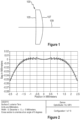
- Figure 1 illustrates a meniscus IOL 100 that is configured to be implanted in the eye of a patient.
- the IOL 100 has an anterior surface 105 and a posterior surface 107 opposite the anterior surface.
- the anterior and the posterior surface are intersected by an optical axis 109.
- the thickness of the IOL 100 along the optical axis 109 can be between about 0.7 mm and about 1.4 mm.
- the thickness of the IOL 100 along the optical axis 109 can be between about 0.8 mm and about 1.3 mm. between about 0.9 mm and about 1.2 mm, between about 1.0 mm and about 1.1 mm, or any value in between these values.
- the IOL 100 can be configured to improve image quality at one or more locations of the peripheral retinal through the use of shape factor, displacement of the principal plane and correction of higher order aberrations.
- the anterior surface 105 of the IOL 100 is nearly flat. Furthermore, the anterior surface 105 has a curvature (or slope) that is less than a curvature (or slope) of the posterior surface 107.
- An IOL having an anterior surface 105 that is nearly flat can have several benefits. For example, an anterior surface that is nearly flat can be less sensitive to eccentricity between anterior and posterior surfaces. As another example, a nearly flat anterior surface can make the addition of an achromatic element or surface to function more effectively.
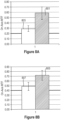
- FIG. 2 illustrates a portion of an achromatic element integrated with an anterior surface of the meniscus lens depicted in Figure 1 according to an embodiment of the invention.
- an achromatic element having a surface profile as depicted in Figure 2 is combined with an IOL similar to the IOL 100 depicted in Figure 1 to improve image quality in one or more peripheral retinal locations.
- the achromatic element having a surface profile as depicted in Figure 2 is disposed on the nearly flat anterior surface 105 of the IOL 100 depicted in Figure 1 .
- Figure 3 illustrates the percentage modulus of the optical transfer function (MTF) improvement over the a standard intraocular lens (ZCB) at half the neural limit spatial frequency as a function of the angle of the peripheral retinal location with respect to the optical axis for a meniscus lens comprising an achromatic element and a meniscus lens without an achromatic element.
- the peripheral retinal location can have an eccentricity between -60 degrees and 60 degrees with respect to the optical axis.
- the peripheral retinal location can have an eccentricity between about -45 degrees and 45 degrees, between about -30 degrees and 30 degrees, between about -25 degrees and 25 degrees, or values therebetween.
- the angular ranges for eccentricity of the peripheral retinal location refer to the visual field angle in object space between an object with a corresponding retinal image on the fovea and an object with a corresponding retinal image on a peripheral retinal location. It can be seen that adding the achromat substantially improves the contrast in the central region, which is beneficial for patients maintaining some residues of central visual performance, while simultaneously keeping the good peripheral performance for the meniscus lens design with an achromat.
- the achromatic optical element or achromatic surface is disposed on the less curved side.
- an advantage of introducing the achromatic optical element or achromatic surface comes from improved central visual performance, while still maintaining the good peripheral vision.
- the advantage of disposing the achromatic optical element or the achromatic surface on the less curved surface is observed from the figures below.
- Figure 4A illustrates polychromatic MTF for a meniscus lens without an achromatic element at the fovea.
- Figure 4B illustrates polychromatic MTF for a meniscus lens having an achromatic element integrated with the anterior surface of the meniscus lens at the fovea.
- Figure 5 A illustrates on-axis MTF versus spatial frequency for a 5mm pupil in polychromatic light for a double aspheric lens (e.g, both the posterior and anterior surfaces are aspheric) having an achromatic element integrated with its anterior surface (curve 501) and a double aspheric lens without an achromatic element (curve 503).
- a double aspheric lens e.g, both the posterior and anterior surfaces are aspheric
- curve 503 a double aspheric lens without an achromatic element
- the on-axis MTF for double aspheric lens with an achromatic optical element disposed on the anterior surface is greater than the corresponding on-axis MTF for double aspheric lens without an achromatic optical element for spattial frequency greater than 20 cycles/mm indicating improved foveal vision for the double aspheric lens with an achromatic optical element disposed on the anterior surface as compared to the double aspheric lens without an achromatic optical element.
- Figure 5B illustrates on-axis MTF versus spatial frequency for a 3mm pupil in polychromatic light a double aspheric lens having an achromatic element integrated with its anterior surface (curve 505) and a double aspheric lens without an achromatic element (curve 507).
- the on-axis MTF for double aspheric lens with an achromatic optical element disposed on the anterior surface is greater than the corresponding on-axis MTF for double aspheric lens without an achromatic optical element for spatial frequency greater than 20 cycles/mm indicating improved foveal vision for the double aspheric lens with an achromatic optical element disposed on the anterior surface as compared to the double aspheric lens without an achromatic optical element.
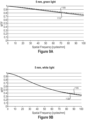
- Similar measurements are performed with a biconvex design (BOSS) in which the anterior and posterior surfaces have approximate similar curvatures, which are shown below in Figures 6 A and 6B .
- curves 601 and 605 on-axis MTF versus spatial frequency for a 5mm pupil and 3mm pupil respectively in polychromatic light for a biconvex lens having an achromatic element integrated with its anterior surface curves 603 and 607 on-axis MTF versus spatial frequency for a 5mm pupil and 3mm pupil respectively in polychromatic light for a biconvex lens without an achromatic element.
- on-axis MTF for a biconvex lens with an achromatic optical element disposed on the anterior surface is greater than the corresponding on-axis MTF for a biconvex lens without an achromatic optical element for spatial frequency greater than 20 cycles/mm for both 5mm and 3mm pupil indicating improved foveal vision for the biconvex lens with an achromatic optical element disposed on the anterior surface as compared to the biconvex lens without an achromatic optical element.
- the achromat optical element enhances optical performance for spatial frequencies above 50 cycles per mm, which is often used to illustrate on-axis performance.
- the on-axis best focus MTF for a spatial frequency of 50 cycles/mm for the meniscus lens with and without achromat optical element for 5mm pupil condition and 3 mm pupil condition is shown in Figures 7 A and 7B respectively.
- block 701 illustrates the on-axis best focus MTF for a spatial frequency of 50 cycles/mm for the meniscus lens with an achromat optical element for the 5mm pupil condition and block 703 illustrates the on-axis best focus MTF for a spatial frequency of 50 cycles/mm for the meniscus lens without an achromat optical element for the 5mm pupil condition.
- block 705 illustrates the on-axis best focus MTF for a spatial frequency of 50 cycles/mm for the meniscus lens with an achromat optical element for the 3mm pupil condition and block 707 illustrates the on-axis best focus MTF for a spatial frequency of 50 cycles/mm for the meniscus lens without an achromat optical element for the 3mm pupil condition. It is noted that for both pupil conditions, the optical performance for the meniscus lens with achromatic optical element is better than the optical performance for the meniscus lens without achromatic optical element.
- Figure 8A illustrates on-axis MTF for a spatial frequency of 50 cycles/mm for a 5mm pupil in polychromatic light for a biconvex lens comprising an achromatic element (block 801) and a biconvex lens without an achromatic element (block 803).
- Figure 8B illustrates on-axis MTF for a spatial frequency of 50 cycles/mm for a 3mm pupil in polychromatic light for a biconvex lens comprising an achromatic element (block 805) and a biconvex lens without an achromatic element (block 807). It is noted that for both pupil conditions, the optical performance for the biconvex lens with achromatic optical element is better than the optical performance for the biconvex lens without achromatic optical element.
- the surface geometries of the anterior and posteriors surfaces of the Double Aspheric Design (DAD) IOL can be configured to maintain on-axis image quality similar to existing monofocal IOLs that are configured to provide foveal vision.
- IOLs e.g., DAD IOLs
- IOLs described herein can have a central axial thickness that is greater than the central axial thickness of existing monofocal IOLs that are configured to provide foveal vision.
- IOLs described herein can have a central thickness of about 1.2 mm.
- IOLs described herein can have a central thickness greater than 0.5 mm and less than 2.0 mm, greater than or equal to about 0.6 mm and less than or equal to about 1.9 mm, greater than or equal to about 0.7 mm and less than or equal to about 1.8 mm, greater than or equal to about 0.9 mm and less than or equal to about 1.7 mm, greater than or equal to about 1.0 mm and less than or equal to about 1.6 mm, greater than or equal to about 1.1 mm and less than or equal to about 1.5 mm, greater than or equal to about 1.2 mm and less than or equal to about 1.4 mm, or any value in these ranges/sub-ranges.
- IOLs discussed herein can be vaulted when placed in the eye of the patient.
- IOLs described herein can be vaulted by about 0.2 mm towards the retina as compared to existing monofocal IOLs that are configured to provide foveal vision.
- IOLs described herein can be vaulted towards the retina by a distance between about 0 mm and about 1.5 mm as compared to existing monofocal IOLs that are configured to provide foveal vision.
- the vault distance can be greater than or equal to about 0.05 mm and less than or equal to about 1.5 mm, greater than or equal to about 0.1 mm and less than or equal to about 1.4 mm, greater than or equal to about 0.2 mm and less than or equal to about 1.3 mm, greater than or equal to about 0.5 mm and less than or equal to about 1.2 mm, greater than or equal to about 0.75 mm and less than or equal to about 1.0 mm, or any value in these ranges/sub-ranges.
- DAD IOLs that can be used for cataract patients with or at risk for Age-related Macular Degeneration (AMD) and/or Glaucoma can comprise aspheric anterior and posterior surfaces.
- DAD IOLs contemplated herein can be configured to provide good optical quality at the fovea as well at a location of the peripheral retina. Good optical quality at the location of the peripheral retina can be achieved by optimizing the surface geometries of the anterior and posterior surfaces of the IOL, by adjusting the central axial thickness of the IOL and/or by optimizing the distance of the anterior surface of the IOL from the iris.
- AMD Age-related Macular Degeneration
- Glaucoma can comprise aspheric anterior and posterior surfaces.
- DAD IOLs contemplated herein can be configured to provide good optical quality at the fovea as well at a location of the peripheral retina. Good optical quality at the location of the peripheral retina can be achieved by optimizing the surface geometries of the anterior and posterior surfaces of the IOL, by adjusting the central axial thickness of the
- IOLs configured to provide high image quality in the peripheral visual field, while simultaneously maintaining sufficient contrast ratio for central vision (also referred to herein as foveal vision), so that any remaining central vision can be used as long as possible are desirable.
- central vision also referred to herein as foveal vision
- IOLs available commercially can exacerbate peripheral optical errors. Since patients with AMD can have their vision improved by correction of optical errors in the periphery, correction of peripheral optical errors represent an area of potentially improved visual quality of life.
- the values of the central thickness and vault height for DAD IOLs can be selected keeping in view the following factors: (i) optical performance - IOLs with increased central thickness and higher vault height have increased optical performance; (ii) mechanical stability - which places an upper limit on vault height; (iii) ease of insertion in a human eye - smaller incision size (e.g., about 2.8 mm) is desirable which places a condition on central thickness; and (iv) functional optical zone size - increased central thickness of the IOL can provide an increase functional optical zone, which can desirable for AMD patients, many of who exhibit enlarged pupils.
- An example of a DAD IOL optimized based on the factors discussed above can have a vault height of about 0.45 mm, a central thickness of 1.2 mm and a functional optic zone of about 6 mm.
- Another example of a DAD IOL optimized to provide good foveal as well as peripheral visual quality can have a vault height between about 0.05 mm and about 1.5 mm, a central thickness between about 0.7 mm and about 1.5 mm and a functional optic zone having a size between about 4.5 mm and about 6.5 mm (e.g., a functional optic zone having a size of about 5 mm, or a functional optic zone having a size of about 6 mm).
- Table 1 below provides the values of the coefficients that define the anterior and posterior surface of various DAD IOLs having optical power from about 18 D to about 30 D.
- column A is the optical power in Diopters for various DAD IOLs
- column B indicates one of an anterior (Ant.) or a posterior (Post.) surface for various DAD IOLs
- column C is the central thickness in mm for various DAD IOLs
- column D is the vault height (towards the retina) in mm for various DAD IOLs
- column E is the radius of curvature of the respective surface (Ant. Or Post.) for various DAD IOLs
- column F is the conic constant k used to design the respective surface (Ant.
- columns G, H and I are the higher order aspheric terms a4, a6, a8 and a10 used to design the respective surface (Ant. Or Post.) for various DAD IOLs.
- specific IOLS include variations in any value in columns C through J of up to about 15%, or preferably up to about 10%, or up to about 5%.
- the range of optical powers can be between 5D and 40D, or preferably between from about 18D to about 30D, or between about 21D and about 27D.
- Table 1 Coefficients for Various Embodiments of DAD IOLs A B C D E F G H I J 18 Ant.
- the performance of a DAD IOL is compared with an existing monofocal IOL that is configured to provide good on-axis image quality.
- the comparison of the performance of the DAD IOL and the existing monofocal IOL was based on the following three metrics: on-axis MTF, off-axis astigmatism and simulated peripheral VA.
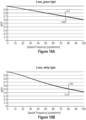
- FIGs 9A and 9B illustrate the comparison of on-axis modulus transfer function (MTF) for a DAD IOL and an existing monofocal IOL (referred to herein as ZCB) that is configured to provide good on-axis image quality.
- the on-axis MTF was obtained with a 5 mm entrance pupil for green and white light respectively.
- curve 1105 illustrates the on-axis MTF for the ZCB lens and curve 1110 illustrates the on-axis MTF for the DAD IOL.
- curve 1115 illustrates the on-axis MTF for the ZCB lens and curve 1120 illustrates the on-axis MTF for the redesigned DAD IOL.
- the on- axis MTF performance of the DAD IOL is comparable (e.g., substantially identical) to the on-axis MTF performance of the ZCB lens.
- Figures 10A and 10B illustrate the comparison of on-axis modulus transfer function (MTF) for a DAD IOL and the ZCB lens.
- the on-axis MTF was obtained with a 3 mm entrance pupil for green and white light respectively.
- curve 1205 illustrates the on-axis MTF for the ZCB lens and curve 1210 illustrates the on-axis MTF for the DAD IOL.
- curve 1215 illustrates the on-axis MTF for the ZCB lens and curve 1220 illustrates the on-axis MTF for the DAD IOL.
- the on-axis MTF performance of the DAD IOL is comparable (e.g., substantially identical) to the on-axis MTF performance of the ZCB lens.
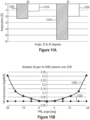
- Figure 11 A is a graph depicting the simulated off-axis astigmatism for two different lOLs at visual field angles of 20 degrees and 30 degrees.
- bar 1305 is the off-axis astigmatic power of the ZCB lens at a visual field angle of about 20 degrees
- bar 1310 is the off-axis astigmatic power of the DAD IOL at a visual field angle of about 20 degrees
- bar 1315 is the off-axis astigmatic power of the ZCB lens at a visual field angle of about 30 degrees
- bar 1320 is the off-axis astigmatic power of the DAD IOL at a visual field angle of about 30 degrees.
- the DAD IOL in conjunction with the human visual system provides a residual peripheral astigmatism less than about 2.0 Diopter at visual field angles of 20 degrees and 30 degrees. It is further noted is that the residual peripheral astigmatism provided by the combination of the DAD IOL along with the human visual system (including the optics of the cornea of an average eye) is about half the residual peripheral astigmatism provided by the combination of the ZCB lens along with the human visual system (including the optics of the cornea of an average eye). Without subscribing to any particular theory, the residual peripheral astigmatism is a difference in diopters between tangential and sagittal peaks which is referred to optometrists as 'C.
- peripheral astigmatism is one of the sources of off-axis aberration, it does not fully describe peripheral off-axis image quality.
- Other peripheral aberrations such as peripheral defocus, coma, and other higher order aberrations can also degrade image quality. Therefore, a metric that relies on the area under the MTF for spatial frequencies up to the neurally relevant cutoff is used to characterize peripheral visual quality.
- the area under the MTF can be correlated with on-axis visual acuity. The area is then converted to an equivalent diopter value, which is converted to a VA loss score in logMAR with a factor of 0.15.
- Figure 1 IB is a graph depicting the visual acuity gain for the ZCB IOL (represented by curve 1325) and a DAD IOL (represented by curve 1330) for different visual field angles. It is observed that the DAD IOL (represented by curve 1330) has a visual acuity gain of about 0.3 over the ZCB IOL at a visual field angle of about 25 degrees and a visual acuity gain of about 0.1 over the ZCB IOL at a visual field angle of about 20 degrees. Accordingly, an AMD patient can have considerable improvement in visual image quality at a peripheral retinal location when implanted with the DAD IOL as compared to when implanted with the ZCB lens. Additionally, the DAD IOL can have reduced anterior surface reflectivity.
- FIGS 12A-12D show a comparison of the mean sphere, cylinder, spherical aberration and total higher order root mean square errors for the ZCB lens (represented by solid blocks) and a DAD IOL (represented by hatched blocks) as a function of visual angle. It is noted from Figures 12A and 12B that the DAD IOL (represented by hatched blocks) has reduced values of mean sphere and the cylinder at visual angles corresponding to 10, 20 and 30 degrees as compared to the ZCBIOL (represented by solid blocks).
- the DAD IOL can give superior off-axis performance, while maintaining equal on-axis performance.
- the DAD IOLs discussed herein can be configured to have increased tolerance to a large number of surgery dependent variables as well as population variables.
- the design principles discussed herein can also be used to design and manufacture an intraocular lens that provides visual acuity for foveal vision (or central vision) as well as peripheral vision (e.g., for visual field angles upto 30 degrees) similar to the lOLs described in U.S. Provisional Application No. 62/385702 filed on September 9, 2016 titled "Intraocular Lenses with Improved Central and Peripheral Vision".
- Figure 13 illustrates an IOL 1350 that is configured to provide good foveal vision as well as good peripheral vision.
- IOLs can be used for patients suffering from Glaucoma and/or AMD.
- the IOL 1350 has an anterior surface 1351 and a posterior surface 1353. The anterior and posterior surfaces 1351 and 1353 are intersected by an optical axis 1355.
- the IOL 1350 has a meniscus- biconvex design.
- the IOL 1350 can be configured to have a double aspheric design (DAD). Accordingly, various characteristics/parameters of the IOL 1350 can be similar to the DAD IOLs discussed above. Additionally, the DAD IOLs discussed above can have characteristics/parameters similar to the IOL 1350 discussed below.
- DAD double aspheric design
- the IOL 1350 can be configured such that the posterior surface 1353 is configured to provide most of the refractive power and the anterior surface 1351 is configured to correct for the spherical aberration introduced by the posterior surface 1353.
- the anterior surface 1351 and/or the posterior surface 1353 can be aspheric.
- the asphericity of the posterior surface 1353 can be configured to introduce a significant amount of spherical aberration in the posterior surface.
- the posterior surface 1353 can be configured to have spherical aberration in the range between about 0.5 ⁇ m and 1.3 ⁇ m (e.g., 1.11 ⁇ m).
- the anterior surface 1351 can be configured to have a negative spherical aberration in the range between about -0.5 ⁇ m and -1.3 ⁇ m ⁇ to correct for the spherical aberration introduced by the posterior surface 1353 such that the total residual spherical aberration introduced by the IOL 1350 for a normal population of eyes is in the range between 0.1 ⁇ m and -0.05 ⁇ m for a 5 mm pupil.
- the apshericity of the anterior surface 1351 that corrects the spherical aberration introduced by the posterior surface 1353 can have a great impact on peripheral image quality.
- the asphericity of the positive surface 1353 and the anterior surface 1351 can be adjusted such that the average value for the total residual spherical aberration introduced by the IOL 1350 for a normal population of eyes can be less than about 0.05 ⁇ m for a 5 mm pupil.
- the IOL 1350 can be configured to have a shape factor between -2 and - 0.9.
- the shape factor of the IOL 1350 can be less than or equal to -0.9 and greater than -1.0; less than or equal to -1.0 and greater than -1.1; less than or equal to -1.1 and greater than -1.2; less than or equal to -1.3 and greater than -1.4; less than or equal to -1.5 and greater than -1.6; less than or equal to -1.7 and greater than -1.8; less than or equal to -1.8 and greater than -1.9; less than or equal to -1.9 and greater than -2.0.
- the shape factor of the IOL 100 can be adjusted by adjusting a variety of parameters including but not limited to vault height of the IOL 1350, placement of the IOL 1350 in the eye, thickness of the IOL 1350 along the optical axis 1355, curvature of the posterior and anterior surfaces of the IOL 1350 and/or asphericity of the posterior and anterior surfaces of the IOL 1350.
- the vault height of the IOL 1350 can be increased by an amount between 0 and about 1.5 mm as compared to standard IOLs.
- the IOL 1350 can be vaulted posteriorly towards the retina by a distance between about 0 mm and about 1.5 mm as compared to standard IOLs.
- the IOL 1350 can be implanted such that the principal plane of the IOL 1350 is displaced by an amount such as, for example about 0.01 mm and about 0.6 mm posteriorly from the iris as compared to the position where a standard intraocular lens (e.g., a meniscus IOL) is implanted.
- a standard intraocular lens e.g., a meniscus IOL
- the IOL 1350 can be implanted such that the principal plane of the IOL 1350 is displaced by a distance of about 0.2 mm posteriorly from the iris as compared to the position where a standard intraocular lens is implanted. Vaulting the IOL 1350 posteriorly towards the retina can result in a shift of the principal plane of the IOL 1350 posteriorly.
- the shift of the principal plane for the IOL 1350 can be achieved by a variety of methods including but not limited to distributing the refractive power such that a majority of the refractive power is provided by the posterior surface, physically shifting the position of the IOL 1350 and/or increase in thickness of the IOL 1350.
- the IOL 1350 can have a thickness that is about 0.1 mm to about 0.5 mm thicker than thickness of standard IOLs.
- the central thickness of the IOL 1350 can be in the range between about 0.7 mm and about 1.5 mm.
- the curvature of the posterior surface 1353 of the IOL 1350 is configured such that the posterior surface 1353 contributes more to the total refractive optical power provided by the IOL 1350 than the anterior surface 1351.
- the curvature of the posterior surface 1353 can be configured to provide an optical power between about -20 Diopter and +20 Diopter.
- the curvature of the posterior surface 1353 and the anterior surface 1351 of the IOL 1350 can be configured such that the IOL 1350 has a shape factor between -2 and -0.9.
- the IOL 1350 when implanted in a normal human eye can provide a residual peripheral astigmatism less than about 1.5 Diopter at a visual field angle of about 30 degrees as compared to a residual peripheral astigmatism of about 3.0 Diopter at a visual field angle of about 30 degrees provided by a standard IOL currently available in the market when implanted in the normal human eye.
- the residual peripheral astigmatism is a difference in diopters between tangential and sagittal peaks which is referred to optometrists as 'C.
- the IOL 1350 when implanted in a normal human eye can provide a residual peripheral defocus less than about 1.0 Diopter at a visual field angle of about 30 degrees as compared to a residual peripheral defocus of about 1.5 Diopter at a visual field angle of about 30 degrees provided by a standard IOL currently available in the market when implanted in the normal human eye.
- Figures 14A-14E illustrate various figures of merit for a standard intraocular lens and an IOL 1350 (such as, for example an IOL having a shape factor between -2 and - 0.9) configured to provide improved peripheral vision as well as improved foveal vision.
- the figures of merit were obtained by performing ray tracing simulations using eye models (e.g., 11 realistic eye models) implanted with either lenses representing a standard IOL (e.g., an aspheric standard IOL having a shape factor of about 1.0 and implanted such that the principal plane is about 1.3 mm behind the iris) and with an IOL 1350 (e.g., a meniscus lens having a shape factor of about -1.2 and implanted such that the principal plane is about 2.4 mm behind the iris).
- a standard IOL e.g., an aspheric standard IOL having a shape factor of about 1.0 and implanted such that the principal plane is about 1.3 mm behind the iris
- an IOL 1350
- Figure 14A illustrates the peripheral defocus (M) for an IOL 1350 and a standard IOL as a function of eccentricity.
- Figure 14B illustrates the residual peripheral astigmatism provided by an IOL 1350 in combination with a human visual system (including the optics of the cornea of an average eye) and a standard IOL in combination with a human visual system (including the optics of the cornea of an average eye) as a function of eccentricity.
- Figure 14C illustrates the spherical aberration (SA) for an IOL 1350 and a standard IOL as a function of eccentricity.
- Figure 14D illustrates the horizontal coma for an IOL 1350 and a standard IOL as a function of eccentricity.
- Figure 14E illustrates the total root mean square (RMS) for an IOL 1350 and a standard IOL as a function of eccentricity.
- RMS total root mean square
- the IOL 1350 has spherical aberration, and overall foveal image quality, similar to the standard IOL.
- the magnitude of peripheral coma of the IOL 1350 is approximately similar to the standard IOL, but has the opposite sign.
- peripheral defocus and residual peripheral astigmatism for visual field angles up to +30-degrees is significantly reduced for the IOL 1350 as compared to the standard IOL.
- the IOL 1350 can have optical characteristics similar to optical characteristic of other lens designs that are configured to improve peripheral image quality described in U.S. Application No. 14/692,609 filed on April 21, 2015 published as U.S. Publication No. 2015/0320547 .
- the Glaucoma IOL can be configured as a dual-optic IOL or a piggyback IOL.
- the IOL 1350 can be configured as a meniscus lens, a biconvex lens, a plano-convex lens or any other possible shape.
- the IOL 1350 described herein can be combined with or replace one or more IOL designs configured to improve peripheral image quality for patients with AMD that are described in U.S. Application Nos. 14/644101 (filed on March 10, 2015 , Published as U.S.
- the method 1500 includes receiving ocular measurements for a patient as shown in block 1501.
- the ocular measurements can be obtained by an ophthalmologist using instruments such as a COAS or a biometer which are currently available in ophthalmology practice.
- the ocular measurements can include axial length of the eye, corneal power, refractive power that provides visual acuity for central vision, intraocular pressure, peripheral refractive errors measured by a visual fields test and any other measurements that can be used to characterize a patient's visual acuity for field angles upto +30- degrees.
- the ocular measurements can include obtaining the variation of the peripheral astigmatism, horizontal coma and spherical optical power as a function of visual field angle.
- An initial shape factor of an IOL that provides good visual acuity for central vision is determined as shown in block 1503.
- the initial shape factor can be similar to the shape factor of an appropriate standard IOL currently available that would provide good foveal vision for the patient.
- the initial shape factor can be iteratively adjusted to optimize peripheral refractive errors for visual field angles upto +30- degrees without significantly decreasing visual acuity for central vision to determine a final shape factor as shown in block 1505.
- Adjusting the initial shape factor can include adjusting a curvature of the surfaces of the IOL, adjusting the asphericity of the surfaces of the IOL, adjusting a central thickness of the IOL, adjusting a placement of the IOL in the eye.
- the final shape factor can be determined by placing a model of the IOL having the initial shape factor in a model eye and adjusting one or more parameters (e.g., thickness, curvature and/or asphericity of the surfaces, shape, etc.) of the model IOL till residual peripheral errors (e.g., defocus and astigmatism) for visual field angles upto +30- degrees are below a threshold value.
- the determined final shape factor of the IOL can provide a residual peripheral astigmatism less than 1.5 Diopter at a visual field angle of about 30 degrees as compared to a residual peripheral astigmatism of about 3.0 Diopter at a visual field angle of about 30 degrees provided by a lens having the initial shape factor.
- the determined final shape factor of the IOL can provide a residual peripheral defocus less than 1.0 Diopter at a visual field angle of about 30 degrees as compared to a residual peripheral defocus of about 1.5 Diopter at a visual field angle of about 30 degrees provided by a lens having the initial shape factor.
- Peripheral astigmatism can be independent of the patient's biometric inputs. Accordingly, the determination of the final shape factor of the IOL that results in an optical power distribution that corrects for peripheral astigmatism can be independent of the patient's biometric inputs.
- the final shape factor of the IOL can be configured to correct peripheral astigmatism by providing additional cylinder power that compensates for peripheral astigmatism only at certain specific visual field angles (e.g., +15 degrees, +20 degrees, +25 degrees, +30 degrees).
- the final shape factor of the IOL can be configured to correct peripheral astigmatism by providing additional cylinder power that compensates for peripheral astigmatism at all visual field angles in an angular range (e.g., between +15 degrees, between +20 degrees, between +25 degrees, between +30 degrees).
- the final shape factor of the IOL can be configured to correct defocus only at certain specific visual field angles (e.g., +15 degrees, +20 degrees, +25 degrees, +30 degrees).
- the final shape factor of the IOL can be configured to correct defocus at all visual field angles in an angular range (e.g., between +15 degrees, between +20 degrees, between +25 degrees, between +30 degrees).
- the method of designing an IOL to correct for peripheral refractive errors can be implemented by a computer system 1600 illustrated in Figure 16 .
- the system includes a processor 1602 and a computer readable memory 1604 coupled to the processor 1602.
- the computer readable memory 1604 has stored therein an array of ordered values 1608 and sequences of instructions 1610 which, when executed by the processor 1602, cause the processor 1602 to perform certain functions or execute certain modules.
- a module can be executed that is configured to selecting an ophthalmic lens or an optical power thereof that would provide visual acuity for central vision and iteratively adjust various parameters of the lens that would reduce peripheral refractive errors including but not limited to defocus and astigmatism.
- the array of ordered values 1608 may comprise, for example, one or more ocular dimensions of an eye or plurality of eyes from a database, a desired refractive outcome, parameters of an eye model based on one or more characteristics of at least one eye, and data related to an IOL or set of IOLs such as a power, an aspheric profile, and/or a lens plane.
- the sequence of instructions 1610 includes determining a position of an IOL, performing one or more calculations to determine a predicted refractive outcome based on an eye model and a ray tracing algorithm, comparing a predicted refractive outcome to a desired refractive outcome, and based on the comparison, repeating the calculation with an IOL having at least one of a different power, different design, and/or a different IOL location.
- the computer system 1600 may be a general purpose desktop or laptop computer or may comprise hardware specifically configured performing the desired calculations.
- the computer system 1600 is configured to be electronically coupled to another device such as a phacoemulsification console or one or more instruments for obtaining measurements of an eye or a plurality of eyes.
- the computer system 1600 is a handheld device that may be adapted to be electronically coupled to one of the devices just listed.
- the computer system 1600 is, or is part of, refractive planner configured to provide one or more suitable intraocular lenses for implantation based on physical, structural, and/or geometric characteristics of an eye, and based on other characteristics of a patient or patient history, such as the age of a patient, medical history, history of ocular procedures, life preferences, and the like.
- the system 1600 can include or is part of a phacoemulsification system, laser treatment system, optical diagnostic instrument (e.g, autorefractor, aberrometer, and/or corneal topographer, or the like).
- the computer readable memory 1604 may additionally contain instructions for controlling the handpiece of a phacoemulsification system or similar surgical system. Additionally or alternatively, the computer readable memory 1604 may additionally contain instructions for controlling or exchanging data with an autorefractor, aberrometer, tomographer, and/or topographer, or the like.
- the system 1600 can include or is part of a refractive planner.
- the refractive planner may be a system for determining one or more treatment options for a subject based on such parameters as patient age, family history, vision preferences (e.g., near, intermediate, distant vision), activity type/level, past surgical procedures.
- An achromatic optical element or an achromatic surface as described herein can be integrated with other IOLs that improve peripheral vision that are described in U.S. Application No. 14/692,609 filed on April 21, 2015 published as U.S. Publication No. 2015/0320547 .
- An achromatic optical element or an achromatic surface as described herein can be integrated with the various IOL designs configured to that improve peripheral image quality for patients with AMD that are described in U.S. Application Nos. 14/644101 (filed on March 10, 2015 , Published as U.S. Publication No. 2015/0265399 ); 14/644110 (filed on March 10, 2015 , Published as U.S. Publication No.
- 2015/0297342 14/644107 (filed on March 10, 2015 , Published as U.S. Publication No. 2015/0297342 ); 14/849369 (filed on September 9, 2015 ) and 14/644082 (filed on March 10, 2015 , Published as U.S. Publication No. 2015/0250583 ).
- the achromatic profile step height can be adjusted to optimize performance for the peripheral region of interest to aid patients with AMD.
- the step height can be reduced by a factor of cosine of the angle of the preferred retinal locus, to account for the oblique incidence.
- the achromatic zone size can be limited to portions of the pupil while leaving some portions of the pupil free of the achromatic optical element to provide clear region to view or inspect the retina.
- the achromatic optical element can be configured such that the central parts of the achromat contribute to on- axis performance and peripheral parts of the achromat contribute to off-axis performance.
- Various lenses and achromats can comprise a material that can block specific parts of the spectrum.
- the lenses and achromats can comprise a material that can block potentially AMD-inducing blue light.
- the peak wavelength selected to design various lenses and achromats can be based on the material used to manufacture the lenses and achromats. For example, if the lenses and achromats comprise a material that can block potentially AMD-inducing blue light, the design wavelength can be selected to be greater than 550 nm, in order to optimize the amount of light in the first order focus.
- the term "processor” refers broadly to any suitable device, logical block, module, circuit, or combination of elements for executing instructions.
- the processor 1602 can include any conventional general purpose single- or multichip microprocessor such as a Pentium ® processor, a MIPS ® processor, a Power PC ® processor, AMD ® processor, ARM processor, or an ALPHA ® processor.
- the processor 302 can include any conventional special purpose microprocessor such as a digital signal processor.
- Processor 1602 can be implemented as a combination of computing devices, e.g., a combination of a DSP and a microprocessor, a plurality of microprocessors, one or more microprocessors in conjunction with a DSP core, or any other such configuration.
- Computer readable memory 1604 can refer to electronic circuitry that allows information, typically computer or digital data, to be stored and retrieved.
- Computer readable memory 1604 can refer to external devices or systems, for example, disk drives or solid state drives.
- Computer readable memory 1604 can also refer to fast semiconductor storage (chips), for example, Random Access Memory (RAM) or various forms of Read Only Memory (ROM), which are directly connected to the communication bus or the processor 1602.
- RAM Random Access Memory
- ROM Read Only Memory
- Other types of memory include bubble memory and core memory.
- Computer readable memory 1604 can be physical hardware configured to store information in a non-transitory medium.
- modules can refer to logic embodied in hardware and/or firmware, or to a collection of software instructions, possibly having entry and exit points, written in a programming language, such as, for example, C or C++.
- a software module may be compiled and linked into an executable program, installed in a dynamically linked library, or may be written in an interpreted programming language such as, for example, BASIC, Perl, or Python. It will be appreciated that software modules may be callable from other modules or from themselves, and/or may be invoked in response to detected events or interrupts.
- firmware such as an erasable programmable read-only memory (EPROM).
- hardware modules may comprise connected logic units, such as gates and flip-flops, and/or may comprised programmable units, such as programmable gate arrays, application specific integrated circuits, and/or processors.
- the modules described herein can be implemented as software modules, but also may be represented in hardware and/or firmware.
- a module may be separately compiled, a module may alternatively represent a subset of instructions of a separately compiled program, and may not have an interface available to other logical program units.
- Code modules may be implemented and/or stored in any type of computer-readable medium or other computer storage device.
- data (and/or metadata) input to the system, data generated by the system, and/or data used by the system can be stored in any type of computer data repository, such as a relational database and/or flat file system.
- Any of the systems, methods, and processes described herein may include an interface configured to permit interaction with users, operators, other systems, components, programs, and so forth.
Landscapes
- Health & Medical Sciences (AREA)
- Ophthalmology & Optometry (AREA)
- Cardiology (AREA)
- Oral & Maxillofacial Surgery (AREA)
- Transplantation (AREA)
- Engineering & Computer Science (AREA)
- Biomedical Technology (AREA)
- Heart & Thoracic Surgery (AREA)
- Vascular Medicine (AREA)
- Life Sciences & Earth Sciences (AREA)
- Animal Behavior & Ethology (AREA)
- General Health & Medical Sciences (AREA)
- Public Health (AREA)
- Veterinary Medicine (AREA)
- Prostheses (AREA)
Claims (8)
- Intraokulare Linse, die eingerichtet ist, um eine Sehkraft eines Auges eines Patienten zu verbessern, wobei die intraokulare Linse Folgendes umfasst:
eine Optik (100), Folgendes umfassend:eine erste Oberfläche (105) mit einer ersten Krümmung; undeine zweite Oberfläche (107) gegenüber der ersten Oberfläche (105), wobei die zweite Oberfläche (107) eine zweite Krümmung aufweist, die größer ist als die erste Krümmung, wobei die erste Oberfläche (105) und die zweite Oberfläche (107) von einer optischen Achse (109) geschnitten werden;wobei die Optik (100) eingerichtet ist, um Licht zu fokussieren, das entlang einer Richtung parallel zur optischen Achse auf die Fovea auftrifft, um ein funktionelles Foveabild zu erzeugen,wobei die Optik (100) eingerichtet ist, um Licht, das in einem schrägen Winkel in Bezug auf die optische Achse auf das Auge des Patienten auftrifft, an einer peripheren Netzhautstelle zu fokussieren, die in einem Abstand von der Fovea angeordnet ist, wobei die periphere Netzhautstelle eine Exzentrizität zwischen 1 und 30 Grad bezüglich der optischen Achse aufweist,wobei die Optik eine Meniskuslinse mit einem Scheitelpunkt ist, der von Rändern der Optik nach innen gekrümmt ist;wobei die Bildqualität an der peripheren Netzhautstelle verbessert wird, indem mindestens eine optische Aberration an der peripheren Netzhautstelle reduziert wird;und gekennzeichnet durch ein achromatisches Profil, das auf der ersten Oberfläche angeordnet ist. - Intraokulare Linse nach Anspruch 1, wobei der schräge Winkel zwischen ungefähr 1 Grad und ungefähr 30 Grad liegt.
- Intraokulare Linse nach Anspruch 1, wobei die mindestens eine optische Aberration aus der Gruppe ausgewählt ist, bestehend aus Defokus, peripherem Astigmatismus und Koma.
- Intraokulare Linse nach Anspruch 1, wobei die erste oder die zweite Oberfläche mehrere optische Merkmale umfasst, die eingerichtet sind, um die mindestens eine optische Aberration zu reduzieren.
- Intraokulare Linse nach Anspruch 1, wobei die Optik eine Dicke zwischen ungefähr 0,3 mm und ungefähr 2,0 mm aufweist.
- Intraokulare Linse nach Anspruch 1, wobei die Optik eingerichtet ist, um die Bildqualität an der peripheren Netzhautstelle zu verbessern, indem ein Formfaktor der Optik eingestellt wird, der die mindestens eine optische Aberration reduziert.
- Intraokulare Linse nach Anspruch 7, wobei der Formfaktor der Optik durch Einstellen eines Parameters der Optik eingestellt wird, wobei der Parameter aus der Gruppe ausgewählt ist, bestehend aus einer Krümmung der ersten oder der zweiten Oberfläche, einer axialen Position der Optik in Bezug auf die Netzhaut und einer Dicke der Optik.
- Intraokulare Linse nach Anspruch 5 oder 7, wobei der Formfaktor der Optik zwischen -1 und -3 liegt.
Priority Applications (1)
| Application Number | Priority Date | Filing Date | Title |
|---|---|---|---|
| EP24196173.9A EP4470500A3 (de) | 2016-03-11 | 2017-03-10 | Intraokularlinsen zur verbesserung des peripheren sehvermögens |
Applications Claiming Priority (3)
| Application Number | Priority Date | Filing Date | Title |
|---|---|---|---|
| US201662307241P | 2016-03-11 | 2016-03-11 | |
| US201662385702P | 2016-09-09 | 2016-09-09 | |
| PCT/IB2017/000318 WO2017153843A1 (en) | 2016-03-11 | 2017-03-10 | Intraocular lenses that improve peripheral vision |
Related Child Applications (1)
| Application Number | Title | Priority Date | Filing Date |
|---|---|---|---|
| EP24196173.9A Division EP4470500A3 (de) | 2016-03-11 | 2017-03-10 | Intraokularlinsen zur verbesserung des peripheren sehvermögens |
Publications (3)
| Publication Number | Publication Date |
|---|---|
| EP3426191A1 EP3426191A1 (de) | 2019-01-16 |
| EP3426191B1 true EP3426191B1 (de) | 2024-09-11 |
| EP3426191C0 EP3426191C0 (de) | 2024-09-11 |
Family
ID=58672628
Family Applications (2)
| Application Number | Title | Priority Date | Filing Date |
|---|---|---|---|
| EP17722144.7A Active EP3426191B1 (de) | 2016-03-11 | 2017-03-10 | Intraokulare linsen zur verbesserung der peripheren sicht |
| EP24196173.9A Pending EP4470500A3 (de) | 2016-03-11 | 2017-03-10 | Intraokularlinsen zur verbesserung des peripheren sehvermögens |
Family Applications After (1)
| Application Number | Title | Priority Date | Filing Date |
|---|---|---|---|
| EP24196173.9A Pending EP4470500A3 (de) | 2016-03-11 | 2017-03-10 | Intraokularlinsen zur verbesserung des peripheren sehvermögens |
Country Status (6)
| Country | Link |
|---|---|
| US (4) | US10588738B2 (de) |
| EP (2) | EP3426191B1 (de) |
| AU (1) | AU2017230971B2 (de) |
| CA (1) | CA3017293A1 (de) |
| ES (1) | ES2986393T3 (de) |
| WO (1) | WO2017153843A1 (de) |
Families Citing this family (16)
| Publication number | Priority date | Publication date | Assignee | Title |
|---|---|---|---|---|
| WO2016038470A2 (en) | 2014-03-10 | 2016-03-17 | Amo Groningen B.V. | Dual-optic intraocular lens that improves overall vision where there is a local loss of retinal function |
| WO2015177651A1 (en) * | 2014-04-21 | 2015-11-26 | Amo Groningen B.V. | Ophthalmic devices, system and methods that improve peripheral vision |
| EP3426191B1 (de) | 2016-03-11 | 2024-09-11 | Amo Groningen B.V. | Intraokulare linsen zur verbesserung der peripheren sicht |
| US11096778B2 (en) | 2016-04-19 | 2021-08-24 | Amo Groningen B.V. | Ophthalmic devices, system and methods that improve peripheral vision |
| WO2020083828A1 (en) | 2018-10-24 | 2020-04-30 | Amo Groningen B.V. | Intraocular lenses for reducing the risk of posterior capsule opacification |
| EP3870108B1 (de) | 2018-10-24 | 2024-06-26 | AMO Groningen B.V. | Intraokularlinsen zur verringerung von negativer dysphotopsie |
| CN120053147A (zh) * | 2018-11-23 | 2025-05-30 | 锐视眼科有限公司 | 用于黄斑变性患者的扩展黄斑视觉的新式单焦点型人工晶状体 |
| US20200383775A1 (en) * | 2019-06-07 | 2020-12-10 | Voptica, S.L | Intraocular lens and methods for optimization of depth of focus and the image quality in the periphery of the visual field |
| CN114902120A (zh) | 2019-12-30 | 2022-08-12 | 阿莫格罗宁根私营有限公司 | 用于视力治疗的具有区域级混合的消色差镜片 |
| CN114902121B (zh) | 2019-12-30 | 2025-08-12 | 阿莫格罗宁根私营有限公司 | 用于视力治疗的消色差镜片 |
| CA3250176A1 (en) | 2022-02-01 | 2023-08-10 | Amo Groningen B.V. | DIFFRACTIVE LENSES WITH DIFFRACTIVE ORDER SHIFT |
| EP4595040A1 (de) | 2022-09-29 | 2025-08-06 | Amo Groningen B.V. | Fahrsimulatorprüfung zur bestimmung der funktionswirkung von peripheren optischen fehlern |
| CA3268991A1 (en) | 2022-09-29 | 2024-04-04 | Amo Groningen B.V. | SYSTEM AND METHOD FOR DETERMINING THE IMPACT OF PERIPHERAL OPTICAL ERRORS ON A PATIENT'S LOCOMOTION |
| CN116035762A (zh) * | 2023-02-22 | 2023-05-02 | 南开大学 | 一种矫正周边视场像差的人工晶状体 |
| US20240374375A1 (en) * | 2023-03-31 | 2024-11-14 | Amo Groningen B.V. | Intraocular Lens with Power Factor and Structure for Improved Peripheral Vision |
| ES3018020B2 (es) * | 2023-11-14 | 2026-01-29 | Voptica S L | Lente intraocular para cirugía de cataratas |
Citations (2)
| Publication number | Priority date | Publication date | Assignee | Title |
|---|---|---|---|---|
| US5715091A (en) * | 1993-12-29 | 1998-02-03 | Eastman Kodak Company | Hybrid refractive/diffractive achromatic camera lens |
| US20080147185A1 (en) * | 2006-05-31 | 2008-06-19 | Xin Hong | Correction of chromatic aberrations in intraocular lenses |
Family Cites Families (243)
| Publication number | Priority date | Publication date | Assignee | Title |
|---|---|---|---|---|
| GB1054972A (de) | 1963-02-22 | |||
| US4206969A (en) | 1979-04-11 | 1980-06-10 | Minnesota Mining And Manufacturing Company | Directional front projection screen |
| JPS5942286B2 (ja) | 1979-08-24 | 1984-10-13 | セイコーエプソン株式会社 | 眼鏡レンズ |
| DE3265356D1 (en) | 1981-04-29 | 1985-09-19 | Pilkington Perkin Elmer Ltd | Artificial eye lenses |
| DE3377535D1 (en) | 1982-10-27 | 1988-09-01 | Pilkington Plc | Bifocal contact lens comprising a plurality of concentric zones |
| GB8404817D0 (en) | 1984-02-23 | 1984-03-28 | Pilkington Perkin Elmer Ltd | Ophthalmic lenses |
| US4581031A (en) | 1984-06-22 | 1986-04-08 | Koziol Jeffrey E | Prismatic intraocular lens |
| US4624538A (en) | 1985-05-28 | 1986-11-25 | The Perkin-Elmer Corporation | Coma-compensation telescope |
| US4648878A (en) | 1985-12-23 | 1987-03-10 | Kelman Charles D | Posterior chamber lens implant |
| US4666446A (en) | 1986-05-06 | 1987-05-19 | Koziol Jeffrey E | Intraocular lens with converging and diverging optical portions |
| US5121979A (en) | 1986-05-14 | 1992-06-16 | Cohen Allen L | Diffractive multifocal optical device |
| US5144483A (en) | 1986-05-14 | 1992-09-01 | Cohen Allen L | Diffractive multifocal optical device |
| US5225858A (en) | 1987-06-01 | 1993-07-06 | Valdemar Portney | Multifocal ophthalmic lens |
| US5270744A (en) | 1987-06-01 | 1993-12-14 | Valdemar Portney | Multifocal ophthalmic lens |
| US4828558A (en) | 1987-07-28 | 1989-05-09 | Kelman Charles D | Laminate optic with interior Fresnel lens |
| US4798608A (en) | 1987-08-24 | 1989-01-17 | Grendahl Dennis T | Laminated zone of focus artificial lens |
| US4795462A (en) | 1987-08-24 | 1989-01-03 | Grendahl Dennis T | Cylindrically segmented zone of focus artificial lens |
| US4798609A (en) | 1987-08-24 | 1989-01-17 | Grendahl Dennis T | Radially segmented zone of focus artificial lens |
| US4778462A (en) | 1987-08-24 | 1988-10-18 | Grendahl Dennis T | Multiple element zone of focus artificial lens |
| US5056908A (en) | 1987-11-12 | 1991-10-15 | Cohen Allen L | Optic zone phase channels |
| US4932970A (en) | 1988-05-17 | 1990-06-12 | Allergan, Inc. | Ophthalmic lens |
| FR2631713B1 (fr) | 1988-05-19 | 1990-08-31 | Essilor Int | Lentille diffractive a profil mixte |
| ATE133796T1 (de) | 1988-07-20 | 1996-02-15 | Allen L Dr Cohen | Multifokale, diffraktive optische vorrichtung |
| US4995714A (en) | 1988-08-26 | 1991-02-26 | Cohen Allen L | Multifocal optical device with novel phase zone plate and method for making |
| FR2642855B1 (fr) | 1989-02-06 | 1991-05-17 | Essilor Int | Lentille optique pour la correction de l'astigmatisme |
| US5121980A (en) | 1989-04-19 | 1992-06-16 | Cohen Allen L | Small aperture multifocal |
| US5089023A (en) | 1990-03-22 | 1992-02-18 | Massachusetts Institute Of Technology | Diffractive/refractive lens implant |
| US5096285A (en) | 1990-05-14 | 1992-03-17 | Iolab Corporation | Multifocal multizone diffractive ophthalmic lenses |
| US5178636A (en) | 1990-05-14 | 1993-01-12 | Iolab Corporation | Tuned fresnel lens for multifocal intraocular applications including small incision surgeries |
| US5117306A (en) | 1990-07-17 | 1992-05-26 | Cohen Allen L | Diffraction bifocal with adjusted chromaticity |
| US5120120A (en) | 1990-07-27 | 1992-06-09 | Cohen Allen L | Multifocal optical device with spurious order suppression and method for manufacture of same |
| US5229797A (en) | 1990-08-08 | 1993-07-20 | Minnesota Mining And Manufacturing Company | Multifocal diffractive ophthalmic lenses |
| US5066301A (en) | 1990-10-09 | 1991-11-19 | Wiley Robert G | Variable focus lens |
| US5570143A (en) | 1991-08-09 | 1996-10-29 | Capricornia Contact Lens Pty. Ltd. | Toric lens with axis mislocation latitude |
| RU2058762C1 (ru) | 1992-06-29 | 1996-04-27 | Межотраслевой научно-технический комплекс "Микрохирургия глаза" | Искусственный хрусталик глаза |
| US5760871A (en) | 1993-01-06 | 1998-06-02 | Holo-Or Ltd. | Diffractive multi-focal lens |
| US5748282A (en) | 1993-01-27 | 1998-05-05 | Pilkington Barnes Hind, Inc. | Multifocal contact lens |
| US5376115A (en) | 1993-08-02 | 1994-12-27 | Pharmacia Ab | Intraocular lens with vaulting haptic |
| US5699142A (en) | 1994-09-01 | 1997-12-16 | Alcon Laboratories, Inc. | Diffractive multifocal ophthalmic lens |
| US6357875B1 (en) | 1994-12-08 | 2002-03-19 | Herrick Family Limited Partnership | Artificial lens including a lens system having eccentric axes for use in an eye having an enlarged pupil and method |
| ATE272990T1 (de) | 1995-02-15 | 2004-08-15 | Medevec Licensing Bv | Anpassbare intraokulare linse mit t-förmigen haltebügeln |
| IL118065A0 (en) | 1995-05-04 | 1996-08-04 | Johnson & Johnson Vision Prod | Aspheric toric lens designs |
| US5652638A (en) | 1995-05-04 | 1997-07-29 | Johnson & Johnson Vision Products, Inc. | Concentric annular ring lens designs for astigmatism |
| US5968094A (en) | 1995-09-18 | 1999-10-19 | Emmetropia, Inc. | Compound intraocular lens |
| CA2249584C (en) | 1996-03-21 | 2007-03-27 | Sola International Holdings Ltd. | Improved single vision lenses |
| US5683457A (en) | 1996-05-09 | 1997-11-04 | Prism Opthalmics, L.L.C. | Prismatic intraocular lenses and related method of using such lenses to restore vision in patients with central field loss |
| US5864378A (en) | 1996-05-21 | 1999-01-26 | Allergan | Enhanced monofocal IOL or contact lens |
| US5728156A (en) | 1996-08-06 | 1998-03-17 | Prism Opthalmics, L.L.C. | Prismatic intraocular lenses and related methods of in situ alteration of their optical characteristics |
| US5969790A (en) | 1996-12-20 | 1999-10-19 | Onufryk; Michael | Multi prism image enhancing lens system and method of making same |
| US5777719A (en) | 1996-12-23 | 1998-07-07 | University Of Rochester | Method and apparatus for improving vision and the resolution of retinal images |
| AU752447B2 (en) | 1997-09-02 | 2002-09-19 | Gil Thieberger | Ophthalmic lens synthesized from its specifications |
| FR2772489B1 (fr) | 1997-12-16 | 2000-03-10 | Essilor Int | Lentilles ophtalmiques multifocales a aberration spherique variable suivant l'addition et l'ametropie |
| JP4023902B2 (ja) | 1998-04-10 | 2007-12-19 | 株式会社メニコン | トーリック・マルチフォーカルレンズ |
| US6491721B2 (en) | 1998-04-15 | 2002-12-10 | Alcon Manufacturing, Ltd. | Toric intraocular lens material |
| SE9801573D0 (sv) | 1998-05-05 | 1998-05-05 | Pharmacia & Upjohn Bv | New IOL |
| ATE311927T1 (de) | 1998-06-03 | 2005-12-15 | Neurocontrol Corp | Perkutanes intramuskuläres stimulationssystem |
| US6183084B1 (en) | 1998-07-30 | 2001-02-06 | Johnson & Johnson Vision Care, Inc. | Progressive addition lenses |
| CA2339776C (en) | 1998-08-06 | 2005-10-25 | John B. W. Lett | Multifocal aspheric lens |
| US6203499B1 (en) | 1998-10-05 | 2001-03-20 | Atl Ultrasound Inc. | Multiple angle needle guide |
| US6197057B1 (en) | 1998-10-27 | 2001-03-06 | Gholam A. Peyman | Lens conversion system for teledioptic or difractive configurations |
| US6126283A (en) | 1998-10-29 | 2000-10-03 | Eastman Kodak Company | Format flexible ink jet printing |
| US6139145A (en) | 1998-11-13 | 2000-10-31 | Israel; Henry M. | Ophthalmic optical element incorporating a holographic element and use of same in cases of central field loss |
| CA2351435A1 (en) | 1998-12-16 | 2000-06-22 | William Rovani | Multifocal contact lens with aspheric surface |
| US6210005B1 (en) | 1999-02-04 | 2001-04-03 | Valdemar Portney | Multifocal ophthalmic lens with reduced halo size |
| US6488708B2 (en) | 1999-04-09 | 2002-12-03 | Faezeh Sarfarazi | Open chamber, elliptical, accommodative intraocular lens system |
| US20060238702A1 (en) | 1999-04-30 | 2006-10-26 | Advanced Medical Optics, Inc. | Ophthalmic lens combinations |
| US7775660B2 (en) | 1999-07-02 | 2010-08-17 | E-Vision Llc | Electro-active ophthalmic lens having an optical power blending region |
| US6536899B1 (en) | 1999-07-14 | 2003-03-25 | Bifocon Optics Gmbh | Multifocal lens exhibiting diffractive and refractive powers |
| US6364483B1 (en) | 2000-02-22 | 2002-04-02 | Holo Or Ltd. | Simultaneous multifocal contact lens and method of utilizing same for treating visual disorders |
| US6551354B1 (en) | 2000-03-09 | 2003-04-22 | Advanced Medical Optics, Inc. | Accommodating intraocular lens |
| US6338559B1 (en) | 2000-04-28 | 2002-01-15 | University Of Rochester | Apparatus and method for improving vision and retinal imaging |
| US6554859B1 (en) | 2000-05-03 | 2003-04-29 | Advanced Medical Optics, Inc. | Accommodating, reduced ADD power multifocal intraocular lenses |
| US6537317B1 (en) | 2000-05-03 | 2003-03-25 | Advanced Medical Optics, Inc. | Binocular lens systems |
| US6547822B1 (en) | 2000-05-03 | 2003-04-15 | Advanced Medical Optics, Inc. | Opthalmic lens systems |
| US6849091B1 (en) | 2000-05-19 | 2005-02-01 | Eyeonics, Inc. | Lens assembly for depth of focus |
| IL152772A0 (en) | 2000-05-23 | 2003-06-24 | Pharmacia Groningen Bv | Methods of obtaining ophthalmic lenses providing the eye with reduced aberrations |
| US6609793B2 (en) | 2000-05-23 | 2003-08-26 | Pharmacia Groningen Bv | Methods of obtaining ophthalmic lenses providing the eye with reduced aberrations |
| US20060116765A1 (en) | 2000-08-04 | 2006-06-01 | Blake Larry W | Refractive corrective lens (RCL) |
| US6695449B2 (en) | 2000-08-17 | 2004-02-24 | Novartis Ag | Lens design to enhance vision quality |
| US6474814B1 (en) | 2000-09-08 | 2002-11-05 | Florida Optical Engineering, Inc | Multifocal ophthalmic lens with induced aperture |
| SE0004829D0 (sv) | 2000-12-22 | 2000-12-22 | Pharmacia Groningen Bv | Methods of obtaining ophthalmic lenses providing the eye with reduced aberrations |
| US6464725B2 (en) | 2001-01-23 | 2002-10-15 | Bernt Christian Skotton | Two-lens adjustable intraocular lens system |
| US8062361B2 (en) | 2001-01-25 | 2011-11-22 | Visiogen, Inc. | Accommodating intraocular lens system with aberration-enhanced performance |
| US20030078657A1 (en) | 2001-01-25 | 2003-04-24 | Gholam-Reza Zadno-Azizi | Materials for use in accommodating intraocular lens system |
| US7087080B2 (en) | 2001-01-25 | 2006-08-08 | Visiogen, Inc. | Materials for use in intraocular lens system |
| US7198640B2 (en) | 2001-01-25 | 2007-04-03 | Visiogen, Inc. | Accommodating intraocular lens system with separation member |
| SE0101293D0 (sv) | 2001-04-11 | 2001-04-11 | Pharmacia Groningen Bv | Technical field of the invention |
| JP2002350785A (ja) | 2001-05-28 | 2002-12-04 | Menicon Co Ltd | 眼用レンズの設計方法 |
| EP1399097A4 (de) | 2001-06-22 | 2005-04-27 | David Miller | Verbesserte akkommodierende intraokularlinse |
| US6533416B1 (en) | 2001-07-20 | 2003-03-18 | Ocular Sciences, Inc. | Contact or intraocular lens and method for its preparation |
| US6634751B2 (en) | 2001-09-10 | 2003-10-21 | Bausch & Lomb Incorporated | Intraocular lens derivation system |
| DE60230173D1 (de) | 2001-10-19 | 2009-01-15 | Bausch & Lomb | Presbyopiekorrektur |
| US6557992B1 (en) | 2001-10-26 | 2003-05-06 | Hewlett-Packard Development Company, L.P. | Method and apparatus for decorating an imaging device |
| ITRM20010669A1 (it) | 2001-11-09 | 2003-05-09 | Optikon 2000 Spa | Cassetta infusione aspirazione (i/a) con sistema di aspirazione sia mediante pompa peristaltica o comunque volumetrica che mediante pompa pr |
| GB0128762D0 (en) | 2001-11-30 | 2002-01-23 | Rayner Intraocular Lenses Ltd | Introcular lens |
| US6755524B2 (en) | 2001-12-12 | 2004-06-29 | Inray Ltd. | Ophthalmic optical elements and methods for the design thereof |
| US7037338B2 (en) | 2001-12-14 | 2006-05-02 | Toshiyuki Nagamoto | Intraocular ring assembly and artificial lens kit |
| US20030171808A1 (en) | 2002-03-05 | 2003-09-11 | Phillips Andrew F. | Accommodating intraocular lens |
| US6913620B2 (en) | 2002-03-29 | 2005-07-05 | Isaac Lipshitz | Intraocular lens implant with mirror |
| US20030214629A1 (en) | 2002-05-15 | 2003-11-20 | Luloh K. Peter | Wide field of view lens |
| GB0213638D0 (en) | 2002-06-13 | 2002-07-24 | Syngenta Ltd | Composition |
| US6923540B2 (en) | 2002-07-31 | 2005-08-02 | Novartis Ag | Toric multifocal contact lenses |
| US6972033B2 (en) | 2002-08-26 | 2005-12-06 | Advanced Medical Optics, Inc. | Accommodating intraocular lens assembly with multi-functional capsular bag ring |
| AU2003263080A1 (en) | 2002-09-04 | 2004-03-29 | The Schepens Eye Research Institute, Inc. | Double bifocal intraocular lens-spectacle telescopic device |
| US7556381B2 (en) | 2002-10-04 | 2009-07-07 | Gerhard Kelch | Method for producing a lens and a lens produced thereby |
| US6851803B2 (en) | 2002-10-24 | 2005-02-08 | C. Benjamin Wooley | Ophthalmic lenses with reduced chromatic blur |
| US20040082993A1 (en) | 2002-10-25 | 2004-04-29 | Randall Woods | Capsular intraocular lens implant having a refractive liquid therein |
| US7370962B2 (en) | 2002-10-31 | 2008-05-13 | Johnson & Johnson Vision Care, Inc. | Pupil regulated multifocal contact lenses |
| US7381221B2 (en) | 2002-11-08 | 2008-06-03 | Advanced Medical Optics, Inc. | Multi-zonal monofocal intraocular lens for correcting optical aberrations |
| SE0203564D0 (sv) | 2002-11-29 | 2002-11-29 | Pharmacia Groningen Bv | Multifocal opthalmic lens |
| US7896916B2 (en) | 2002-11-29 | 2011-03-01 | Amo Groningen B.V. | Multifocal ophthalmic lens |
| CA2505845C (en) | 2002-12-06 | 2014-03-18 | Visx, Incorporated | Presbyopia correction using patient data |
| US7320517B2 (en) | 2002-12-06 | 2008-01-22 | Visx, Incorporated | Compound modulation transfer function for laser surgery and other optical applications |
| US7036931B2 (en) | 2003-01-29 | 2006-05-02 | Novartis Ag | Ophthalmic lenses |
| US6986578B2 (en) | 2003-01-30 | 2006-01-17 | Johnson & Johnson Vision Care, Inc. | Multifocal ophthalmic lenses |
| US7238201B2 (en) | 2003-02-13 | 2007-07-03 | Visiogen, Inc. | Accommodating intraocular lens system with enhanced range of motion |
| US20050043794A1 (en) | 2003-03-31 | 2005-02-24 | Edward Geraghty | Aspheric intraocular lens |
| WO2004090611A2 (en) | 2003-03-31 | 2004-10-21 | Bausch & Lomb Incorporated | Intraocular lens and method for reducing aberrations in an ocular system |
| US7905917B2 (en) | 2003-03-31 | 2011-03-15 | Bausch & Lomb Incorporated | Aspheric lenses and lens family |
| US7357509B2 (en) | 2003-04-28 | 2008-04-15 | University Of Rochester | Metrics to predict subjective impact of eye's wave aberration |
| US6923539B2 (en) | 2003-05-12 | 2005-08-02 | Alcon, Inc. | Aspheric lenses |
| US20040237971A1 (en) | 2003-06-02 | 2004-12-02 | Hema Radhakrishnan | Methods and apparatuses for controlling optical aberrations to alter modulation transfer functions |
| US7186266B2 (en) | 2003-06-06 | 2007-03-06 | Teledioptic Lens System, Llc | Bifocal intraocular telescope for low vision correction |
| CA2530304A1 (en) | 2003-06-26 | 2005-01-13 | Metapontum Agrobios S.R.L. | Method for the isolation of expressed sequence tags in plants |
| EP1639398B9 (de) | 2003-06-30 | 2012-02-22 | Werner Fiala | Intraokularlinse oder kontaktlinsen mit grosser tiefenschärfe |
| US20050041203A1 (en) | 2003-08-20 | 2005-02-24 | Lindacher Joseph Michael | Ophthalmic lens with optimal power profile |
| US7217289B2 (en) | 2003-09-12 | 2007-05-15 | Minas Theodore Coronco | Treatment of photic disturbances in the eye |
| FR2860706B1 (fr) | 2003-10-14 | 2010-10-15 | Essilor Int | Systeme de grandissement d'image retinienne |
| DE10349254A1 (de) | 2003-10-20 | 2005-05-12 | Transmit Technologietransfer | Intraokulare Linseneinrichtung zur Verbesserung des Sehvermögens bei Netzhauterkrankungen |
| CN1909860B (zh) | 2003-11-19 | 2012-03-21 | 视力Crc有限公司 | 用于改变相对场曲和外围离轴焦点位置的方法和设备 |
| US7503655B2 (en) | 2003-11-19 | 2009-03-17 | Vision Crc Limited | Methods and apparatuses for altering relative curvature of field and positions of peripheral, off-axis focal positions |
| US7621949B2 (en) | 2003-12-09 | 2009-11-24 | Advanced Medical Optics, Inc. | Foldable intraocular lens and method of making |
| US7615073B2 (en) | 2003-12-09 | 2009-11-10 | Advanced Medical Optics, Inc. | Foldable intraocular lens and method of making |
| US7044597B2 (en) | 2003-12-16 | 2006-05-16 | Bausch & Lomb Incorporated | Multifocal contact lens and method of manufacture thereof |
| US7150760B2 (en) | 2004-03-22 | 2006-12-19 | Alcon, Inc. | Accommodative intraocular lens system |
| IL161706A0 (en) | 2004-04-29 | 2004-09-27 | Nulens Ltd | Intraocular lens fixation device |
| US7365917B2 (en) | 2004-08-16 | 2008-04-29 | Xceed Imaging Ltd. | Optical method and system for extended depth of focus |
| US7061693B2 (en) | 2004-08-16 | 2006-06-13 | Xceed Imaging Ltd. | Optical method and system for extended depth of focus |
| US7156516B2 (en) | 2004-08-20 | 2007-01-02 | Apollo Optical Systems Llc | Diffractive lenses for vision correction |
| US7025456B2 (en) | 2004-08-20 | 2006-04-11 | Apollo Optical Systems, Llc | Diffractive lenses for vision correction |
| WO2006025726A1 (en) | 2004-09-02 | 2006-03-09 | Vu Medisch Centrum | Artificial intraocular lens |
| US20060066808A1 (en) | 2004-09-27 | 2006-03-30 | Blum Ronald D | Ophthalmic lenses incorporating a diffractive element |
| US7188949B2 (en) | 2004-10-25 | 2007-03-13 | Advanced Medical Optics, Inc. | Ophthalmic lens with multiple phase plates |
| WO2006047698A1 (en) | 2004-10-25 | 2006-05-04 | Advanced Medical Optics, Inc. | Ophthalmic lens with multiple phase plates |
| CN100570436C (zh) | 2004-11-22 | 2009-12-16 | 诺瓦提斯公司 | 一系列的非球面接触透镜 |
| US20060116764A1 (en) | 2004-12-01 | 2006-06-01 | Simpson Michael J | Apodized aspheric diffractive lenses |
| US20070171362A1 (en) | 2004-12-01 | 2007-07-26 | Simpson Michael J | Truncated diffractive intraocular lenses |
| US20060116763A1 (en) | 2004-12-01 | 2006-06-01 | Simpson Michael J | Contrast-enhancing aspheric intraocular lens |
| ES2272143B1 (es) * | 2004-12-22 | 2008-03-01 | Instituto Oftalmologico De Alicante, S.L. | Lente intraocular para acromatizar el ojo y reducir sus aberraciones. |
| US7488069B2 (en) | 2005-02-22 | 2009-02-10 | Science & Technology Corporation @ Unm | Vision enhancing device |
| MXPA06014056A (es) | 2005-04-05 | 2007-03-07 | Alcon Inc | Factores de forma de lente intraocular optima para ojos humanos. |
| US8137399B2 (en) | 2005-04-11 | 2012-03-20 | Vision Solutions Technologies, Inc. | Implantable prismatic device, and related methods and systems |
| US7073906B1 (en) | 2005-05-12 | 2006-07-11 | Valdemar Portney | Aspherical diffractive ophthalmic lens |
| NL1029403C2 (nl) | 2005-07-01 | 2007-01-04 | Medical Device Production B V | Multifocale IOL. |
| US8801781B2 (en) | 2005-10-26 | 2014-08-12 | Abbott Medical Optics Inc. | Intraocular lens for correcting corneal coma |
| US20070129803A1 (en) | 2005-12-06 | 2007-06-07 | C&C Vision International Limited | Accommodative Intraocular Lens |
| CA2637053C (en) | 2006-01-12 | 2014-02-25 | Institute For Eye Research | Method and apparatus for controlling peripheral image position for reducing progression of myopia |
| US20070168027A1 (en) | 2006-01-13 | 2007-07-19 | Brady Daniel G | Accommodating diffractive intraocular lens |
| US20070182917A1 (en) | 2006-02-09 | 2007-08-09 | Alcon Manufacturing, Ltd. | Intra-ocular device with multiple focusing powers/optics |
| US7441894B2 (en) | 2006-02-09 | 2008-10-28 | Alcon Manufacturing, Ltd. | Pseudo-accommodative IOL having diffractive zones with varying areas |
| US7481532B2 (en) | 2006-02-09 | 2009-01-27 | Alcon, Inc. | Pseudo-accommodative IOL having multiple diffractive patterns |
| US7695136B2 (en) | 2007-08-01 | 2010-04-13 | Amo Development, Llc. | Wavefront refractions and high order aberration correction when wavefront maps involve geometrical transformations |
| US20070258143A1 (en) | 2006-05-08 | 2007-11-08 | Valdemar Portney | Aspheric multifocal diffractive ophthalmic lens |
| US7879089B2 (en) | 2006-05-17 | 2011-02-01 | Alcon, Inc. | Correction of higher order aberrations in intraocular lenses |
| US7918886B2 (en) | 2006-05-25 | 2011-04-05 | Visioncare Ophthalmic Technologies Inc. | Double insertion intraocular implant |
| US7572007B2 (en) | 2006-08-02 | 2009-08-11 | Alcon, Inc. | Apodized diffractive IOL with frustrated diffractive region |
| US20080212024A1 (en) | 2006-09-18 | 2008-09-04 | Lai Shui T | Customized contact lenses for reducing aberrations of the eye |
| KR20150015046A (ko) | 2006-10-10 | 2015-02-09 | 노파르티스 아게 | 광학적으로 조절되는 주변 부분을 갖는 렌즈 및 상기 렌즈의 설계 및 제조 방법 |
| GB0623657D0 (en) | 2006-11-27 | 2007-01-03 | Rayner Intraocular Lenses Ltd | Intraocular lens |
| AU2007338100B2 (en) | 2006-12-22 | 2014-01-30 | Amo Groningen Bv | Accommodating intraocular lens, lens system and frame therefor |
| US7713299B2 (en) | 2006-12-29 | 2010-05-11 | Abbott Medical Optics Inc. | Haptic for accommodating intraocular lens |
| US20080161914A1 (en) | 2006-12-29 | 2008-07-03 | Advanced Medical Optics, Inc. | Pre-stressed haptic for accommodating intraocular lens |
| WO2008107882A2 (en) | 2007-03-05 | 2008-09-12 | Nulens Ltd | Unitary accommodating intraocular lenses (aiols) and discrete base members for use therewith |
| US20080269885A1 (en) | 2007-04-30 | 2008-10-30 | Simpson Michael J | IOL Peripheral Surface Designs to Reduce Negative Dysphotopsia |
| US20080269882A1 (en) | 2007-04-30 | 2008-10-30 | Alcon Universal Ltd. | Intraocular lens with asymmetric optics |
| US20080269886A1 (en) | 2007-04-30 | 2008-10-30 | Simpson Michael J | IOL Peripheral Surface Designs to Reduce Negative Dysphotopsia |
| US20080269883A1 (en) | 2007-04-30 | 2008-10-30 | Alcon, Inc. | Ocular implant to correct dysphotopsia, glare, halos and dark shadow type phenomena |
| US20080269890A1 (en) | 2007-04-30 | 2008-10-30 | Alcon Universal Ltd. | Intraocular lens with peripheral region designed to reduce negative dysphotopsia |
| US20080269884A1 (en) | 2007-04-30 | 2008-10-30 | Alcon, Inc. | Graduated blue filtering intraocular lens |
| US8740978B2 (en) | 2007-08-27 | 2014-06-03 | Amo Regional Holdings | Intraocular lens having extended depth of focus |
| US20090062911A1 (en) | 2007-08-27 | 2009-03-05 | Amo Groningen Bv | Multizonal lens with extended depth of focus |
| US8747466B2 (en) | 2007-08-27 | 2014-06-10 | Amo Groningen, B.V. | Intraocular lens having extended depth of focus |
| TWI467266B (zh) | 2007-10-23 | 2015-01-01 | 視覺Crc有限公司 | 眼科鏡片元件 |
| US8057034B2 (en) | 2007-10-26 | 2011-11-15 | Brien Holden Vision Institute | Methods and apparatuses for enhancing peripheral vision |
| CA2709105C (en) | 2007-12-13 | 2016-06-07 | Advanced Medical Optics, Inc. | Customized multifocal ophthalmic lens |
| US20090164008A1 (en) | 2007-12-21 | 2009-06-25 | Xin Hong | Lens surface with combined diffractive, toric, and aspheric components |
| US8723756B2 (en) | 2008-01-15 | 2014-05-13 | Synaptics Incorporated | System having capability for daisy-chained serial distribution of video display data |
| US20090198326A1 (en) | 2008-01-31 | 2009-08-06 | Medennium Inc. | Accommodative intraocular lens system |
| US7998198B2 (en) | 2008-02-07 | 2011-08-16 | Novartis Ag | Accommodative IOL with dynamic spherical aberration |
| CA2715537C (en) | 2008-02-15 | 2016-09-06 | Amo Regional Holdings | System, ophthalmic lens, and method for extending depth of focus |
| US8439498B2 (en) | 2008-02-21 | 2013-05-14 | Abbott Medical Optics Inc. | Toric intraocular lens with modified power characteristics |
| US8231219B2 (en) | 2008-04-24 | 2012-07-31 | Amo Groningen B.V. | Diffractive lens exhibiting enhanced optical performance |
| US7871162B2 (en) | 2008-04-24 | 2011-01-18 | Amo Groningen B.V. | Diffractive multifocal lens having radially varying light distribution |
| US8862447B2 (en) | 2010-04-30 | 2014-10-14 | Amo Groningen B.V. | Apparatus, system and method for predictive modeling to design, evaluate and optimize ophthalmic lenses |
| US20090292354A1 (en) | 2008-05-21 | 2009-11-26 | Staar Surgical Company | Optimized intraocular lens |
| US8018164B2 (en) | 2008-05-29 | 2011-09-13 | Applied Materials, Inc. | Plasma reactor with high speed plasma load impedance tuning by modulation of different unmatched frequency sources |
| EP2307923A1 (de) | 2008-07-15 | 2011-04-13 | Alcon, Inc. | Linse mit erweiterter fokustiefe für erhöhte pseudoakkomodation mittels pupillendynamik |
| WO2010011577A1 (en) | 2008-07-19 | 2010-01-28 | Volk Donald A | Real image forming eye examination lens utilizing two reflecting surfaces with non-mirrored central viewing area |
| US20100188636A1 (en) | 2008-07-30 | 2010-07-29 | Pinto Candido D | Multifocal ophthalmic lens having reduced ghosting |
| US20100079723A1 (en) | 2008-10-01 | 2010-04-01 | Kingston Amanda C | Toric Ophthalimc Lenses Having Selected Spherical Aberration Characteristics |
| US8771348B2 (en) | 2008-10-20 | 2014-07-08 | Abbott Medical Optics Inc. | Multifocal intraocular lens |
| US8734511B2 (en) | 2008-10-20 | 2014-05-27 | Amo Groningen, B.V. | Multifocal intraocular lens |
| WO2010054255A1 (en) | 2008-11-07 | 2010-05-14 | Visiogen, Inc. | Accommodating intraocular lens with multiple viewing elements and enhanced depth of focus |
| US8216307B2 (en) | 2008-12-19 | 2012-07-10 | Novartis Ag | Radially segmented apodized diffractive multifocal design for ocular implant |
| RU2540228C2 (ru) | 2008-12-19 | 2015-02-10 | Новартис Аг | Коррекция периферической дефокусировки глаза и предотвращение дальнейшего развития рефракционных ошибок |
| US8201943B2 (en) | 2009-01-15 | 2012-06-19 | Physical Sciences, Inc. | Adaptive optics line scanning ophthalmoscope |
| AT507873B1 (de) | 2009-01-21 | 2014-05-15 | Fiala Werner Dr | Linse mit zirkulärem brechkraftprofil |
| US9078744B2 (en) | 2009-02-11 | 2015-07-14 | Novartis Ag | Single optic accommodative intraocular lens system |
| CN104777628B (zh) | 2009-09-01 | 2018-04-17 | 阿瑟·布拉德利 | 提供改进的视觉质量的多焦点矫正 |
| GB2507465A (en) | 2009-11-23 | 2014-05-07 | Rayner Intraocular Lenses Ltd | Intraocular lens with a Fresnel prism |
| KR20120117800A (ko) | 2009-12-01 | 2012-10-24 | 알콘 리서치, 리미티드 | 후낭 혼탁을 감소시키도록 구성된 에지를 지니는 안구내 렌즈 |
| ES2559178T3 (es) | 2009-12-18 | 2016-02-10 | Novartis Ag | Dispositivos intraoculares y procedimientos asociados |
| CA2784782C (en) | 2009-12-18 | 2018-02-27 | Hendrik A. Weeber | Limited echelette lens, systems and methods |
| WO2011163559A1 (en) | 2010-06-25 | 2011-12-29 | Elenza, Inc. | Implantable ophthalmic devices with circularly asymmetric optic and methods |
| US20130204364A1 (en) | 2010-10-18 | 2013-08-08 | University Of Utah Research Foundation | Vision correction system |
| WO2012074742A1 (en) | 2010-11-30 | 2012-06-07 | Amo Groningen Bv | Method for designing, evaluating and optimizing ophthalmic lenses and laser vision correction |
| US9817246B2 (en) | 2010-12-01 | 2017-11-14 | Amo Groningen B.V. | Multifocal lens having an optical add power progression, and a system and method of providing same |
| EP2651334B1 (de) | 2010-12-17 | 2018-06-20 | Abbott Medical Optics Inc. | Ophthalmische linse und herstellungsverfahren mit mindestens einer rotationsasymmetrischen diffraktiven struktur |
| US9931200B2 (en) | 2010-12-17 | 2018-04-03 | Amo Groningen B.V. | Ophthalmic devices, systems, and methods for optimizing peripheral vision |
| EP3799834A1 (de) | 2011-08-24 | 2021-04-07 | Amo Groningen B.V. | Intraokulare linse mit einer optik, die eine meniskuslinse umfasst |
| US8556421B2 (en) | 2011-10-19 | 2013-10-15 | Novartis Ag | Calculating an intraocular lens (IOL) power according to a directly determined IOL location |
| HK1204367A1 (en) | 2012-01-09 | 2015-11-13 | 眼见360股份有限公司 | Panoramic optical systems |
| NL2008105C2 (en) | 2012-01-11 | 2013-07-15 | Procornea Holding Bv | Intraocular lens. |
| GB201210660D0 (en) | 2012-06-15 | 2012-08-01 | Qatar Foundation | Interactive assignment of topic labels of microblogs |
| DE102012106653A1 (de) | 2012-07-23 | 2014-01-23 | Karlsruher Institut für Technologie | Weitwinkeloptik für ophthalmologische Implantate |
| BR112015004617A2 (pt) * | 2012-08-31 | 2017-07-04 | Amo Groningen Bv | sistemas e métodos para profundidade de foco estendida de lente de múltiplos áneis |
| ES2472121B1 (es) | 2012-12-27 | 2015-04-13 | Consejo Superior De Investigaciones Científicas (Csic) | Lente intraocular multifocal refractiva con calidad óptica optimizada en un rango de foco y procedimiento para obtenerla |
| AU2014228357B2 (en) | 2013-03-11 | 2018-08-23 | Johnson & Johnson Surgical Vision, Inc. | Intraocular lens that matches an image surface to a retinal shape, and method of designing same |
| JP6206949B2 (ja) | 2013-07-05 | 2017-10-04 | 国立大学法人 千葉大学 | 視野制限画像データ作成プログラム及びこれを用いた視野制限装置 |
| GB201314428D0 (en) * | 2013-08-12 | 2013-09-25 | Qureshi M A | Intraocular lens system and method |
| US20150187224A1 (en) | 2013-10-15 | 2015-07-02 | Mbfarr, Llc | Driving assessment and training method and apparatus |
| WO2016038470A2 (en) | 2014-03-10 | 2016-03-17 | Amo Groningen B.V. | Dual-optic intraocular lens that improves overall vision where there is a local loss of retinal function |
| WO2015177651A1 (en) | 2014-04-21 | 2015-11-26 | Amo Groningen B.V. | Ophthalmic devices, system and methods that improve peripheral vision |
| US9823163B2 (en) | 2014-12-04 | 2017-11-21 | Amo Groningen B.V. | Apparatus, systems and methods for improving visual outcomes for pseudophakic patients |
| EP3426191B1 (de) | 2016-03-11 | 2024-09-11 | Amo Groningen B.V. | Intraokulare linsen zur verbesserung der peripheren sicht |
| US10568502B2 (en) | 2016-03-23 | 2020-02-25 | The Chinese University Of Hong Kong | Visual disability detection system using virtual reality |
| US11096778B2 (en) | 2016-04-19 | 2021-08-24 | Amo Groningen B.V. | Ophthalmic devices, system and methods that improve peripheral vision |
| FR3077722B1 (fr) | 2018-02-13 | 2020-03-06 | Streetlab | Dispositif de test de champ visuel |
| WO2019210087A1 (en) | 2018-04-25 | 2019-10-31 | The Trustees Of The University Of Pennsylvania | Methods, systems, and computer readable media for testing visual function using virtual mobility tests |
| KR102317196B1 (ko) | 2019-11-19 | 2021-10-25 | 대한민국 | 가상현실 기반 지면 보행 훈련 시스템 및 방법 |
| EP4595040A1 (de) | 2022-09-29 | 2025-08-06 | Amo Groningen B.V. | Fahrsimulatorprüfung zur bestimmung der funktionswirkung von peripheren optischen fehlern |
| CA3268991A1 (en) | 2022-09-29 | 2024-04-04 | Amo Groningen B.V. | SYSTEM AND METHOD FOR DETERMINING THE IMPACT OF PERIPHERAL OPTICAL ERRORS ON A PATIENT'S LOCOMOTION |
| US20240374375A1 (en) | 2023-03-31 | 2024-11-14 | Amo Groningen B.V. | Intraocular Lens with Power Factor and Structure for Improved Peripheral Vision |
-
2017
- 2017-03-10 EP EP17722144.7A patent/EP3426191B1/de active Active
- 2017-03-10 AU AU2017230971A patent/AU2017230971B2/en active Active
- 2017-03-10 ES ES17722144T patent/ES2986393T3/es active Active
- 2017-03-10 WO PCT/IB2017/000318 patent/WO2017153843A1/en not_active Ceased
- 2017-03-10 CA CA3017293A patent/CA3017293A1/en active Pending
- 2017-03-10 EP EP24196173.9A patent/EP4470500A3/de active Pending
- 2017-03-10 US US15/456,356 patent/US10588738B2/en active Active
-
2020
- 2020-03-13 US US16/818,942 patent/US11160651B2/en active Active
-
2021
- 2021-10-29 US US17/452,986 patent/US11793626B2/en active Active
-
2023
- 2023-10-20 US US18/491,736 patent/US12521233B2/en active Active
Patent Citations (2)
| Publication number | Priority date | Publication date | Assignee | Title |
|---|---|---|---|---|
| US5715091A (en) * | 1993-12-29 | 1998-02-03 | Eastman Kodak Company | Hybrid refractive/diffractive achromatic camera lens |
| US20080147185A1 (en) * | 2006-05-31 | 2008-06-19 | Xin Hong | Correction of chromatic aberrations in intraocular lenses |
Also Published As
| Publication number | Publication date |
|---|---|
| US20170258578A1 (en) | 2017-09-14 |
| EP4470500A3 (de) | 2025-02-26 |
| EP3426191A1 (de) | 2019-01-16 |
| US20200214829A1 (en) | 2020-07-09 |
| US20240050223A1 (en) | 2024-02-15 |
| CA3017293A1 (en) | 2017-09-14 |
| US12521233B2 (en) | 2026-01-13 |
| EP4470500A2 (de) | 2024-12-04 |
| US20220047382A1 (en) | 2022-02-17 |
| US11160651B2 (en) | 2021-11-02 |
| US11793626B2 (en) | 2023-10-24 |
| US10588738B2 (en) | 2020-03-17 |
| ES2986393T3 (es) | 2024-11-11 |
| WO2017153843A1 (en) | 2017-09-14 |
| EP3426191C0 (de) | 2024-09-11 |
| AU2017230971B2 (en) | 2021-11-11 |
| AU2017230971A1 (en) | 2018-09-27 |
Similar Documents
| Publication | Publication Date | Title |
|---|---|---|
| US12521233B2 (en) | Intraocular lenses that improve peripheral vision | |
| US12478465B2 (en) | Intraocular lens that improves overall vision where there is a local loss of retinal function | |
| EP3134031B1 (de) | Intraokularlinse |
Legal Events
| Date | Code | Title | Description |
|---|---|---|---|
| STAA | Information on the status of an ep patent application or granted ep patent |
Free format text: STATUS: UNKNOWN |
|
| STAA | Information on the status of an ep patent application or granted ep patent |
Free format text: STATUS: THE INTERNATIONAL PUBLICATION HAS BEEN MADE |
|
| PUAI | Public reference made under article 153(3) epc to a published international application that has entered the european phase |
Free format text: ORIGINAL CODE: 0009012 |
|
| STAA | Information on the status of an ep patent application or granted ep patent |
Free format text: STATUS: REQUEST FOR EXAMINATION WAS MADE |
|
| 17P | Request for examination filed |
Effective date: 20181005 |
|
| AK | Designated contracting states |
Kind code of ref document: A1 Designated state(s): AL AT BE BG CH CY CZ DE DK EE ES FI FR GB GR HR HU IE IS IT LI LT LU LV MC MK MT NL NO PL PT RO RS SE SI SK SM TR |
|
| AX | Request for extension of the european patent |
Extension state: BA ME |
|
| DAV | Request for validation of the european patent (deleted) | ||
| DAX | Request for extension of the european patent (deleted) | ||
| STAA | Information on the status of an ep patent application or granted ep patent |
Free format text: STATUS: EXAMINATION IS IN PROGRESS |
|
| 17Q | First examination report despatched |
Effective date: 20200729 |
|
| GRAP | Despatch of communication of intention to grant a patent |
Free format text: ORIGINAL CODE: EPIDOSNIGR1 |
|
| STAA | Information on the status of an ep patent application or granted ep patent |
Free format text: STATUS: GRANT OF PATENT IS INTENDED |
|
| INTG | Intention to grant announced |
Effective date: 20240412 |
|
| GRAS | Grant fee paid |
Free format text: ORIGINAL CODE: EPIDOSNIGR3 |
|
| GRAA | (expected) grant |
Free format text: ORIGINAL CODE: 0009210 |
|
| STAA | Information on the status of an ep patent application or granted ep patent |
Free format text: STATUS: THE PATENT HAS BEEN GRANTED |
|
| AK | Designated contracting states |
Kind code of ref document: B1 Designated state(s): AL AT BE BG CH CY CZ DE DK EE ES FI FR GB GR HR HU IE IS IT LI LT LU LV MC MK MT NL NO PL PT RO RS SE SI SK SM TR |
|
| REG | Reference to a national code |
Ref country code: GB Ref legal event code: FG4D |
|
| REG | Reference to a national code |
Ref country code: CH Ref legal event code: EP |
|
| REG | Reference to a national code |
Ref country code: DE Ref legal event code: R096 Ref document number: 602017084777 Country of ref document: DE |
|
| REG | Reference to a national code |
Ref country code: IE Ref legal event code: FG4D |
|
| REG | Reference to a national code |
Ref country code: ES Ref legal event code: FG2A Ref document number: 2986393 Country of ref document: ES Kind code of ref document: T3 Effective date: 20241111 |
|
| U01 | Request for unitary effect filed |
Effective date: 20241011 |
|
| U07 | Unitary effect registered |
Designated state(s): AT BE BG DE DK EE FI FR IT LT LU LV MT NL PT RO SE SI Effective date: 20241029 |
|
| PG25 | Lapsed in a contracting state [announced via postgrant information from national office to epo] |
Ref country code: NO Free format text: LAPSE BECAUSE OF FAILURE TO SUBMIT A TRANSLATION OF THE DESCRIPTION OR TO PAY THE FEE WITHIN THE PRESCRIBED TIME-LIMIT Effective date: 20241211 |
|
| PG25 | Lapsed in a contracting state [announced via postgrant information from national office to epo] |
Ref country code: GR Free format text: LAPSE BECAUSE OF FAILURE TO SUBMIT A TRANSLATION OF THE DESCRIPTION OR TO PAY THE FEE WITHIN THE PRESCRIBED TIME-LIMIT Effective date: 20241212 |
|
| PG25 | Lapsed in a contracting state [announced via postgrant information from national office to epo] |
Ref country code: HR Free format text: LAPSE BECAUSE OF FAILURE TO SUBMIT A TRANSLATION OF THE DESCRIPTION OR TO PAY THE FEE WITHIN THE PRESCRIBED TIME-LIMIT Effective date: 20240911 |
|
| PG25 | Lapsed in a contracting state [announced via postgrant information from national office to epo] |
Ref country code: RS Free format text: LAPSE BECAUSE OF FAILURE TO SUBMIT A TRANSLATION OF THE DESCRIPTION OR TO PAY THE FEE WITHIN THE PRESCRIBED TIME-LIMIT Effective date: 20241211 |
|
| PG25 | Lapsed in a contracting state [announced via postgrant information from national office to epo] |
Ref country code: RS Free format text: LAPSE BECAUSE OF FAILURE TO SUBMIT A TRANSLATION OF THE DESCRIPTION OR TO PAY THE FEE WITHIN THE PRESCRIBED TIME-LIMIT Effective date: 20241211 Ref country code: NO Free format text: LAPSE BECAUSE OF FAILURE TO SUBMIT A TRANSLATION OF THE DESCRIPTION OR TO PAY THE FEE WITHIN THE PRESCRIBED TIME-LIMIT Effective date: 20241211 Ref country code: HR Free format text: LAPSE BECAUSE OF FAILURE TO SUBMIT A TRANSLATION OF THE DESCRIPTION OR TO PAY THE FEE WITHIN THE PRESCRIBED TIME-LIMIT Effective date: 20240911 Ref country code: GR Free format text: LAPSE BECAUSE OF FAILURE TO SUBMIT A TRANSLATION OF THE DESCRIPTION OR TO PAY THE FEE WITHIN THE PRESCRIBED TIME-LIMIT Effective date: 20241212 |
|
| U20 | Renewal fee for the european patent with unitary effect paid |
Year of fee payment: 9 Effective date: 20250205 |
|
| PG25 | Lapsed in a contracting state [announced via postgrant information from national office to epo] |
Ref country code: IS Free format text: LAPSE BECAUSE OF FAILURE TO SUBMIT A TRANSLATION OF THE DESCRIPTION OR TO PAY THE FEE WITHIN THE PRESCRIBED TIME-LIMIT Effective date: 20250111 |
|
| PG25 | Lapsed in a contracting state [announced via postgrant information from national office to epo] |
Ref country code: SM Free format text: LAPSE BECAUSE OF FAILURE TO SUBMIT A TRANSLATION OF THE DESCRIPTION OR TO PAY THE FEE WITHIN THE PRESCRIBED TIME-LIMIT Effective date: 20240911 |
|
| PG25 | Lapsed in a contracting state [announced via postgrant information from national office to epo] |
Ref country code: CZ Free format text: LAPSE BECAUSE OF FAILURE TO SUBMIT A TRANSLATION OF THE DESCRIPTION OR TO PAY THE FEE WITHIN THE PRESCRIBED TIME-LIMIT Effective date: 20240911 Ref country code: PL Free format text: LAPSE BECAUSE OF FAILURE TO SUBMIT A TRANSLATION OF THE DESCRIPTION OR TO PAY THE FEE WITHIN THE PRESCRIBED TIME-LIMIT Effective date: 20240911 |
|
| PG25 | Lapsed in a contracting state [announced via postgrant information from national office to epo] |
Ref country code: SK Free format text: LAPSE BECAUSE OF FAILURE TO SUBMIT A TRANSLATION OF THE DESCRIPTION OR TO PAY THE FEE WITHIN THE PRESCRIBED TIME-LIMIT Effective date: 20240911 |
|
| PGFP | Annual fee paid to national office [announced via postgrant information from national office to epo] |
Ref country code: ES Payment date: 20250414 Year of fee payment: 9 |
|
| PLBE | No opposition filed within time limit |
Free format text: ORIGINAL CODE: 0009261 |
|
| STAA | Information on the status of an ep patent application or granted ep patent |
Free format text: STATUS: NO OPPOSITION FILED WITHIN TIME LIMIT |
|
| PGFP | Annual fee paid to national office [announced via postgrant information from national office to epo] |
Ref country code: CH Payment date: 20250401 Year of fee payment: 9 |
|
| 26N | No opposition filed |
Effective date: 20250612 |
|
| PG25 | Lapsed in a contracting state [announced via postgrant information from national office to epo] |
Ref country code: MC Free format text: LAPSE BECAUSE OF FAILURE TO SUBMIT A TRANSLATION OF THE DESCRIPTION OR TO PAY THE FEE WITHIN THE PRESCRIBED TIME-LIMIT Effective date: 20240911 |
|
| PG25 | Lapsed in a contracting state [announced via postgrant information from national office to epo] |
Ref country code: IE Free format text: LAPSE BECAUSE OF NON-PAYMENT OF DUE FEES Effective date: 20250310 |
|
| U20 | Renewal fee for the european patent with unitary effect paid |
Year of fee payment: 10 Effective date: 20260209 |
|
| REG | Reference to a national code |
Ref country code: CH Ref legal event code: U11 Free format text: ST27 STATUS EVENT CODE: U-0-0-U10-U11 (AS PROVIDED BY THE NATIONAL OFFICE) Effective date: 20260401 |
|
| PGFP | Annual fee paid to national office [announced via postgrant information from national office to epo] |
Ref country code: GB Payment date: 20260202 Year of fee payment: 10 |