EP1653805B2 - Verwendung von acylcyclohexandion-derivaten zusammen mit ethephon zur behandlung von kernobst - Google Patents
Verwendung von acylcyclohexandion-derivaten zusammen mit ethephon zur behandlung von kernobst Download PDFInfo
- Publication number
- EP1653805B2 EP1653805B2 EP04763867A EP04763867A EP1653805B2 EP 1653805 B2 EP1653805 B2 EP 1653805B2 EP 04763867 A EP04763867 A EP 04763867A EP 04763867 A EP04763867 A EP 04763867A EP 1653805 B2 EP1653805 B2 EP 1653805B2
- Authority
- EP
- European Patent Office
- Prior art keywords
- formula
- treatment
- ethephon
- compound
- alkyl
- Prior art date
- Legal status (The legal status is an assumption and is not a legal conclusion. Google has not performed a legal analysis and makes no representation as to the accuracy of the status listed.)
- Expired - Lifetime
Links
- UDPGUMQDCGORJQ-UHFFFAOYSA-N (2-chloroethyl)phosphonic acid Chemical compound OP(O)(=O)CCCl UDPGUMQDCGORJQ-UHFFFAOYSA-N 0.000 title claims abstract description 44
- 239000005976 Ethephon Substances 0.000 title claims abstract description 34
- 235000013399 edible fruits Nutrition 0.000 title claims abstract description 32
- -1 acyl cyclohexandione derivatives Chemical class 0.000 title abstract description 26
- 238000011282 treatment Methods 0.000 claims description 42
- 150000001875 compounds Chemical class 0.000 claims description 39
- 239000000203 mixture Substances 0.000 claims description 25
- 241000196324 Embryophyta Species 0.000 claims description 23
- 150000003839 salts Chemical class 0.000 claims description 10
- 125000001495 ethyl group Chemical group [H]C([H])([H])C([H])([H])* 0.000 claims description 8
- 239000007921 spray Substances 0.000 claims description 8
- 125000001559 cyclopropyl group Chemical group [H]C1([H])C([H])([H])C1([H])* 0.000 claims description 6
- KYARBIJYVGJZLB-UHFFFAOYSA-N 7-amino-4-hydroxy-2-naphthalenesulfonic acid Chemical compound OC1=CC(S(O)(=O)=O)=CC2=CC(N)=CC=C21 KYARBIJYVGJZLB-UHFFFAOYSA-N 0.000 claims description 5
- 125000000008 (C1-C10) alkyl group Chemical group 0.000 claims description 4
- 159000000007 calcium salts Chemical class 0.000 claims description 3
- 235000021016 apples Nutrition 0.000 claims description 2
- 238000000034 method Methods 0.000 claims description 2
- 230000008124 floral development Effects 0.000 claims 2
- 244000141359 Malus pumila Species 0.000 claims 1
- 241000220324 Pyrus Species 0.000 claims 1
- 235000021017 pears Nutrition 0.000 claims 1
- NLKUPINTOLSSLD-UHFFFAOYSA-L calcium;4-(1-oxidopropylidene)-3,5-dioxocyclohexane-1-carboxylate Chemical compound [Ca+2].CCC([O-])=C1C(=O)CC(C([O-])=O)CC1=O NLKUPINTOLSSLD-UHFFFAOYSA-L 0.000 description 18
- 230000017260 vegetative to reproductive phase transition of meristem Effects 0.000 description 10
- 240000001987 Pyrus communis Species 0.000 description 8
- 235000014443 Pyrus communis Nutrition 0.000 description 8
- 239000013543 active substance Substances 0.000 description 7
- 238000009472 formulation Methods 0.000 description 7
- 239000003630 growth substance Substances 0.000 description 7
- 241000220225 Malus Species 0.000 description 6
- 125000000217 alkyl group Chemical group 0.000 description 6
- 230000004883 flower formation Effects 0.000 description 6
- 235000011430 Malus pumila Nutrition 0.000 description 5
- 235000015103 Malus silvestris Nutrition 0.000 description 5
- 241001208007 Procas Species 0.000 description 5
- XLYOFNOQVPJJNP-UHFFFAOYSA-N water Substances O XLYOFNOQVPJJNP-UHFFFAOYSA-N 0.000 description 5
- UFWIBTONFRDIAS-UHFFFAOYSA-N Naphthalene Chemical compound C1=CC=CC2=CC=CC=C21 UFWIBTONFRDIAS-UHFFFAOYSA-N 0.000 description 4
- 239000003921 oil Substances 0.000 description 4
- QGZKDVFQNNGYKY-UHFFFAOYSA-O Ammonium Chemical compound [NH4+] QGZKDVFQNNGYKY-UHFFFAOYSA-O 0.000 description 3
- 235000017788 Cydonia oblonga Nutrition 0.000 description 3
- OKKJLVBELUTLKV-UHFFFAOYSA-N Methanol Chemical compound OC OKKJLVBELUTLKV-UHFFFAOYSA-N 0.000 description 3
- 239000004480 active ingredient Substances 0.000 description 3
- 125000001797 benzyl group Chemical group [H]C1=C([H])C([H])=C(C([H])=C1[H])C([H])([H])* 0.000 description 3
- 150000001768 cations Chemical class 0.000 description 3
- 229940042400 direct acting antivirals phosphonic acid derivative Drugs 0.000 description 3
- 239000000839 emulsion Substances 0.000 description 3
- 229910052739 hydrogen Inorganic materials 0.000 description 3
- 125000001997 phenyl group Chemical group [H]C1=C([H])C([H])=C(*)C([H])=C1[H] 0.000 description 3
- 150000003007 phosphonic acid derivatives Chemical class 0.000 description 3
- 230000002265 prevention Effects 0.000 description 3
- RVKCCVTVZORVGD-UHFFFAOYSA-N trinexapac-ethyl Chemical group O=C1CC(C(=O)OCC)CC(=O)C1=C(O)C1CC1 RVKCCVTVZORVGD-UHFFFAOYSA-N 0.000 description 3
- 230000009105 vegetative growth Effects 0.000 description 3
- 125000005913 (C3-C6) cycloalkyl group Chemical group 0.000 description 2
- HIXDQWDOVZUNNA-UHFFFAOYSA-N 2-(3,4-dimethoxyphenyl)-5-hydroxy-7-methoxychromen-4-one Chemical compound C=1C(OC)=CC(O)=C(C(C=2)=O)C=1OC=2C1=CC=C(OC)C(OC)=C1 HIXDQWDOVZUNNA-UHFFFAOYSA-N 0.000 description 2
- UDPGUMQDCGORJQ-UHFFFAOYSA-M 2-chloroethyl(hydroxy)phosphinate Chemical compound OP([O-])(=O)CCCl UDPGUMQDCGORJQ-UHFFFAOYSA-M 0.000 description 2
- 125000000094 2-phenylethyl group Chemical group [H]C1=C([H])C([H])=C(C([H])=C1[H])C([H])([H])C([H])([H])* 0.000 description 2
- ROSDSFDQCJNGOL-UHFFFAOYSA-N Dimethylamine Chemical compound CNC ROSDSFDQCJNGOL-UHFFFAOYSA-N 0.000 description 2
- LFQSCWFLJHTTHZ-UHFFFAOYSA-N Ethanol Chemical compound CCO LFQSCWFLJHTTHZ-UHFFFAOYSA-N 0.000 description 2
- XEEYBQQBJWHFJM-UHFFFAOYSA-N Iron Chemical compound [Fe] XEEYBQQBJWHFJM-UHFFFAOYSA-N 0.000 description 2
- LRHPLDYGYMQRHN-UHFFFAOYSA-N N-Butanol Chemical compound CCCCO LRHPLDYGYMQRHN-UHFFFAOYSA-N 0.000 description 2
- ISWSIDIOOBJBQZ-UHFFFAOYSA-N Phenol Chemical compound OC1=CC=CC=C1 ISWSIDIOOBJBQZ-UHFFFAOYSA-N 0.000 description 2
- 239000005986 Prohexadione Substances 0.000 description 2
- 239000005994 Trinexapac Substances 0.000 description 2
- 150000001298 alcohols Chemical class 0.000 description 2
- 229910052783 alkali metal Inorganic materials 0.000 description 2
- 229910052784 alkaline earth metal Inorganic materials 0.000 description 2
- 125000004849 alkoxymethyl group Chemical group 0.000 description 2
- 125000006350 alkyl thio alkyl group Chemical group 0.000 description 2
- 150000003863 ammonium salts Chemical class 0.000 description 2
- JUZXDNPBRPUIOR-UHFFFAOYSA-N chlormequat Chemical compound C[N+](C)(C)CCCl JUZXDNPBRPUIOR-UHFFFAOYSA-N 0.000 description 2
- 239000007859 condensation product Substances 0.000 description 2
- JHIVVAPYMSGYDF-UHFFFAOYSA-N cyclohexanone Chemical compound O=C1CCCCC1 JHIVVAPYMSGYDF-UHFFFAOYSA-N 0.000 description 2
- 125000000113 cyclohexyl group Chemical group [H]C1([H])C([H])([H])C([H])([H])C([H])(*)C([H])([H])C1([H])[H] 0.000 description 2
- 125000001511 cyclopentyl group Chemical group [H]C1([H])C([H])([H])C([H])([H])C([H])(*)C1([H])[H] 0.000 description 2
- NNBZCPXTIHJBJL-UHFFFAOYSA-N decalin Chemical compound C1CCCC2CCCCC21 NNBZCPXTIHJBJL-UHFFFAOYSA-N 0.000 description 2
- 239000002270 dispersing agent Substances 0.000 description 2
- 239000003995 emulsifying agent Substances 0.000 description 2
- RTZKZFJDLAIYFH-UHFFFAOYSA-N ether Substances CCOCC RTZKZFJDLAIYFH-UHFFFAOYSA-N 0.000 description 2
- 230000012010 growth Effects 0.000 description 2
- 125000000959 isobutyl group Chemical group [H]C([H])([H])C([H])(C([H])([H])[H])C([H])([H])* 0.000 description 2
- 125000001449 isopropyl group Chemical group [H]C([H])([H])C([H])(*)C([H])([H])[H] 0.000 description 2
- NNCAWEWCFVZOGF-UHFFFAOYSA-N mepiquat Chemical compound C[N+]1(C)CCCCC1 NNCAWEWCFVZOGF-UHFFFAOYSA-N 0.000 description 2
- WSFSSNUMVMOOMR-NJFSPNSNSA-N methanone Chemical compound O=[14CH2] WSFSSNUMVMOOMR-NJFSPNSNSA-N 0.000 description 2
- HRDXJKGNWSUIBT-UHFFFAOYSA-N methoxybenzene Chemical group [CH2]OC1=CC=CC=C1 HRDXJKGNWSUIBT-UHFFFAOYSA-N 0.000 description 2
- 125000002496 methyl group Chemical group [H]C([H])([H])* 0.000 description 2
- 125000004108 n-butyl group Chemical group [H]C([H])([H])C([H])([H])C([H])([H])C([H])([H])* 0.000 description 2
- 150000002790 naphthalenes Chemical class 0.000 description 2
- 125000002347 octyl group Chemical group [H]C([*])([H])C([H])([H])C([H])([H])C([H])([H])C([H])([H])C([H])([H])C([H])([H])C([H])([H])[H] 0.000 description 2
- 239000006072 paste Substances 0.000 description 2
- 229920000151 polyglycol Polymers 0.000 description 2
- 239000010695 polyglycol Substances 0.000 description 2
- BUCOQPHDYUOJSI-UHFFFAOYSA-N prohexadione Chemical compound CCC(=O)C1C(=O)CC(C(O)=O)CC1=O BUCOQPHDYUOJSI-UHFFFAOYSA-N 0.000 description 2
- 125000001436 propyl group Chemical group [H]C([*])([H])C([H])([H])C([H])([H])[H] 0.000 description 2
- 230000026267 regulation of growth Effects 0.000 description 2
- 230000001932 seasonal effect Effects 0.000 description 2
- 125000002914 sec-butyl group Chemical group [H]C([H])([H])C([H])([H])C([H])(*)C([H])([H])[H] 0.000 description 2
- 239000000243 solution Substances 0.000 description 2
- 238000005507 spraying Methods 0.000 description 2
- 238000003860 storage Methods 0.000 description 2
- 239000000725 suspension Substances 0.000 description 2
- 125000000999 tert-butyl group Chemical group [H]C([H])([H])C(*)(C([H])([H])[H])C([H])([H])[H] 0.000 description 2
- DFFWZNDCNBOKDI-UHFFFAOYSA-N trinexapac Chemical compound O=C1CC(C(=O)O)CC(=O)C1=C(O)C1CC1 DFFWZNDCNBOKDI-UHFFFAOYSA-N 0.000 description 2
- 239000000080 wetting agent Substances 0.000 description 2
- CMCBDXRRFKYBDG-UHFFFAOYSA-N 1-dodecoxydodecane Chemical compound CCCCCCCCCCCCOCCCCCCCCCCCC CMCBDXRRFKYBDG-UHFFFAOYSA-N 0.000 description 1
- XUJLWPFSUCHPQL-UHFFFAOYSA-N 11-methyldodecan-1-ol Chemical compound CC(C)CCCCCCCCCCO XUJLWPFSUCHPQL-UHFFFAOYSA-N 0.000 description 1
- GIAFURWZWWWBQT-UHFFFAOYSA-N 2-(2-aminoethoxy)ethanol Chemical compound NCCOCCO GIAFURWZWWWBQT-UHFFFAOYSA-N 0.000 description 1
- HZAXFHJVJLSVMW-UHFFFAOYSA-N 2-Aminoethan-1-ol Chemical compound NCCO HZAXFHJVJLSVMW-UHFFFAOYSA-N 0.000 description 1
- VAJZCFLYJRMBFN-UHFFFAOYSA-N 4,4-dimethylmorpholin-4-ium Chemical compound C[N+]1(C)CCOCC1 VAJZCFLYJRMBFN-UHFFFAOYSA-N 0.000 description 1
- QTBSBXVTEAMEQO-UHFFFAOYSA-M Acetate Chemical compound CC([O-])=O QTBSBXVTEAMEQO-UHFFFAOYSA-M 0.000 description 1
- 235000009434 Actinidia chinensis Nutrition 0.000 description 1
- 244000298697 Actinidia deliciosa Species 0.000 description 1
- 235000009436 Actinidia deliciosa Nutrition 0.000 description 1
- 244000144725 Amygdalus communis Species 0.000 description 1
- 235000011437 Amygdalus communis Nutrition 0.000 description 1
- 244000144730 Amygdalus persica Species 0.000 description 1
- 235000004936 Bromus mango Nutrition 0.000 description 1
- OYPRJOBELJOOCE-UHFFFAOYSA-N Calcium Chemical compound [Ca] OYPRJOBELJOOCE-UHFFFAOYSA-N 0.000 description 1
- 235000009025 Carya illinoensis Nutrition 0.000 description 1
- 244000068645 Carya illinoensis Species 0.000 description 1
- 239000005974 Chlormequat Substances 0.000 description 1
- 241000207199 Citrus Species 0.000 description 1
- 235000005979 Citrus limon Nutrition 0.000 description 1
- 244000131522 Citrus pyriformis Species 0.000 description 1
- 241000675108 Citrus tangerina Species 0.000 description 1
- 240000000560 Citrus x paradisi Species 0.000 description 1
- RYGMFSIKBFXOCR-UHFFFAOYSA-N Copper Chemical compound [Cu] RYGMFSIKBFXOCR-UHFFFAOYSA-N 0.000 description 1
- 235000001543 Corylus americana Nutrition 0.000 description 1
- 240000007582 Corylus avellana Species 0.000 description 1
- 235000007466 Corylus avellana Nutrition 0.000 description 1
- FBPFZTCFMRRESA-JGWLITMVSA-N D-glucitol Chemical class OC[C@H](O)[C@@H](O)[C@H](O)[C@H](O)CO FBPFZTCFMRRESA-JGWLITMVSA-N 0.000 description 1
- 235000008597 Diospyros kaki Nutrition 0.000 description 1
- 244000236655 Diospyros kaki Species 0.000 description 1
- UFHFLCQGNIYNRP-UHFFFAOYSA-N Hydrogen Chemical compound [H][H] UFHFLCQGNIYNRP-UHFFFAOYSA-N 0.000 description 1
- DGAQECJNVWCQMB-PUAWFVPOSA-M Ilexoside XXIX Chemical compound C[C@@H]1CC[C@@]2(CC[C@@]3(C(=CC[C@H]4[C@]3(CC[C@@H]5[C@@]4(CC[C@@H](C5(C)C)OS(=O)(=O)[O-])C)C)[C@@H]2[C@]1(C)O)C)C(=O)O[C@H]6[C@@H]([C@H]([C@@H]([C@H](O6)CO)O)O)O.[Na+] DGAQECJNVWCQMB-PUAWFVPOSA-M 0.000 description 1
- 240000007049 Juglans regia Species 0.000 description 1
- 235000009496 Juglans regia Nutrition 0.000 description 1
- WHXSMMKQMYFTQS-UHFFFAOYSA-N Lithium Chemical compound [Li] WHXSMMKQMYFTQS-UHFFFAOYSA-N 0.000 description 1
- FYYHWMGAXLPEAU-UHFFFAOYSA-N Magnesium Chemical compound [Mg] FYYHWMGAXLPEAU-UHFFFAOYSA-N 0.000 description 1
- 235000014826 Mangifera indica Nutrition 0.000 description 1
- 240000007228 Mangifera indica Species 0.000 description 1
- 239000005984 Mepiquat Substances 0.000 description 1
- 241001465754 Metazoa Species 0.000 description 1
- BAVYZALUXZFZLV-UHFFFAOYSA-O Methylammonium ion Chemical compound [NH3+]C BAVYZALUXZFZLV-UHFFFAOYSA-O 0.000 description 1
- SECXISVLQFMRJM-UHFFFAOYSA-N N-Methylpyrrolidone Chemical compound CN1CCCC1=O SECXISVLQFMRJM-UHFFFAOYSA-N 0.000 description 1
- 244000183278 Nephelium litchi Species 0.000 description 1
- 235000015742 Nephelium litchi Nutrition 0.000 description 1
- IGFHQQFPSIBGKE-UHFFFAOYSA-N Nonylphenol Natural products CCCCCCCCCC1=CC=C(O)C=C1 IGFHQQFPSIBGKE-UHFFFAOYSA-N 0.000 description 1
- 244000025272 Persea americana Species 0.000 description 1
- 235000008673 Persea americana Nutrition 0.000 description 1
- 235000003447 Pistacia vera Nutrition 0.000 description 1
- 240000006711 Pistacia vera Species 0.000 description 1
- 229920003171 Poly (ethylene oxide) Polymers 0.000 description 1
- 241000201976 Polycarpon Species 0.000 description 1
- ZLMJMSJWJFRBEC-UHFFFAOYSA-N Potassium Chemical compound [K] ZLMJMSJWJFRBEC-UHFFFAOYSA-N 0.000 description 1
- 235000009827 Prunus armeniaca Nutrition 0.000 description 1
- 244000018633 Prunus armeniaca Species 0.000 description 1
- 235000010401 Prunus avium Nutrition 0.000 description 1
- 244000007021 Prunus avium Species 0.000 description 1
- 241001290151 Prunus avium subsp. avium Species 0.000 description 1
- 235000005805 Prunus cerasus Nutrition 0.000 description 1
- 235000006029 Prunus persica var nucipersica Nutrition 0.000 description 1
- 235000006040 Prunus persica var persica Nutrition 0.000 description 1
- 244000017714 Prunus persica var. nucipersica Species 0.000 description 1
- 244000207449 Prunus puddum Species 0.000 description 1
- 235000009226 Prunus puddum Nutrition 0.000 description 1
- 235000001537 Ribes X gardonianum Nutrition 0.000 description 1
- 235000001535 Ribes X utile Nutrition 0.000 description 1
- 235000002357 Ribes grossularia Nutrition 0.000 description 1
- 244000171263 Ribes grossularia Species 0.000 description 1
- 235000016919 Ribes petraeum Nutrition 0.000 description 1
- 244000281247 Ribes rubrum Species 0.000 description 1
- 235000002355 Ribes spicatum Nutrition 0.000 description 1
- 235000017848 Rubus fruticosus Nutrition 0.000 description 1
- 240000007651 Rubus glaucus Species 0.000 description 1
- 235000011034 Rubus glaucus Nutrition 0.000 description 1
- 235000009122 Rubus idaeus Nutrition 0.000 description 1
- 235000009184 Spondias indica Nutrition 0.000 description 1
- 244000299461 Theobroma cacao Species 0.000 description 1
- 235000009470 Theobroma cacao Nutrition 0.000 description 1
- 244000078534 Vaccinium myrtillus Species 0.000 description 1
- 235000014787 Vitis vinifera Nutrition 0.000 description 1
- 240000006365 Vitis vinifera Species 0.000 description 1
- HCHKCACWOHOZIP-UHFFFAOYSA-N Zinc Chemical compound [Zn] HCHKCACWOHOZIP-UHFFFAOYSA-N 0.000 description 1
- 239000002253 acid Substances 0.000 description 1
- 239000000853 adhesive Substances 0.000 description 1
- 230000001070 adhesive effect Effects 0.000 description 1
- 125000001931 aliphatic group Chemical group 0.000 description 1
- 239000003513 alkali Substances 0.000 description 1
- 150000001340 alkali metals Chemical class 0.000 description 1
- 150000001342 alkaline earth metals Chemical class 0.000 description 1
- 150000008055 alkyl aryl sulfonates Chemical class 0.000 description 1
- 150000005215 alkyl ethers Chemical class 0.000 description 1
- 125000005037 alkyl phenyl group Chemical group 0.000 description 1
- 235000020224 almond Nutrition 0.000 description 1
- 150000001412 amines Chemical class 0.000 description 1
- 150000001450 anions Chemical class 0.000 description 1
- 150000004945 aromatic hydrocarbons Chemical class 0.000 description 1
- 239000002585 base Substances 0.000 description 1
- 150000001555 benzenes Chemical class 0.000 description 1
- VBQDSLGFSUGBBE-UHFFFAOYSA-N benzyl(triethyl)azanium Chemical compound CC[N+](CC)(CC)CC1=CC=CC=C1 VBQDSLGFSUGBBE-UHFFFAOYSA-N 0.000 description 1
- YOUGRGFIHBUKRS-UHFFFAOYSA-N benzyl(trimethyl)azanium Chemical compound C[N+](C)(C)CC1=CC=CC=C1 YOUGRGFIHBUKRS-UHFFFAOYSA-N 0.000 description 1
- 235000021028 berry Nutrition 0.000 description 1
- 230000015572 biosynthetic process Effects 0.000 description 1
- 235000021029 blackberry Nutrition 0.000 description 1
- 238000009835 boiling Methods 0.000 description 1
- 229910052791 calcium Inorganic materials 0.000 description 1
- 239000011575 calcium Substances 0.000 description 1
- 150000007942 carboxylates Chemical class 0.000 description 1
- 239000004359 castor oil Substances 0.000 description 1
- 235000019438 castor oil Nutrition 0.000 description 1
- 235000019693 cherries Nutrition 0.000 description 1
- 235000020971 citrus fruits Nutrition 0.000 description 1
- 239000011280 coal tar Substances 0.000 description 1
- 229940125904 compound 1 Drugs 0.000 description 1
- 239000012141 concentrate Substances 0.000 description 1
- 229920001577 copolymer Polymers 0.000 description 1
- 229910052802 copper Inorganic materials 0.000 description 1
- 239000010949 copper Substances 0.000 description 1
- 244000038559 crop plants Species 0.000 description 1
- 238000005520 cutting process Methods 0.000 description 1
- 125000004122 cyclic group Chemical group 0.000 description 1
- 125000000582 cycloheptyl group Chemical group [H]C1([H])C([H])([H])C([H])([H])C([H])([H])C([H])(*)C([H])([H])C1([H])[H] 0.000 description 1
- HPXRVTGHNJAIIH-UHFFFAOYSA-N cyclohexanol Chemical compound OC1CCCCC1 HPXRVTGHNJAIIH-UHFFFAOYSA-N 0.000 description 1
- 125000000640 cyclooctyl group Chemical group [H]C1([H])C([H])([H])C([H])([H])C([H])([H])C([H])(*)C([H])([H])C([H])([H])C1([H])[H] 0.000 description 1
- 125000002704 decyl group Chemical group [H]C([H])([H])C([H])([H])C([H])([H])C([H])([H])C([H])([H])C([H])([H])C([H])([H])C([H])([H])C([H])([H])C([H])([H])* 0.000 description 1
- 230000018109 developmental process Effects 0.000 description 1
- CEJLBZWIKQJOAT-UHFFFAOYSA-N dichloroisocyanuric acid Chemical group ClN1C(=O)NC(=O)N(Cl)C1=O CEJLBZWIKQJOAT-UHFFFAOYSA-N 0.000 description 1
- 239000002283 diesel fuel Substances 0.000 description 1
- 235000014113 dietary fatty acids Nutrition 0.000 description 1
- ZBCBWPMODOFKDW-UHFFFAOYSA-N diethanolamine Chemical compound OCCNCCO ZBCBWPMODOFKDW-UHFFFAOYSA-N 0.000 description 1
- 239000006185 dispersion Substances 0.000 description 1
- 238000009826 distribution Methods 0.000 description 1
- LQZZUXJYWNFBMV-UHFFFAOYSA-N dodecan-1-ol Chemical compound CCCCCCCCCCCCO LQZZUXJYWNFBMV-UHFFFAOYSA-N 0.000 description 1
- 230000000694 effects Effects 0.000 description 1
- 150000002170 ethers Chemical class 0.000 description 1
- LYCAIKOWRPUZTN-UHFFFAOYSA-N ethylene glycol Natural products OCCO LYCAIKOWRPUZTN-UHFFFAOYSA-N 0.000 description 1
- 238000002474 experimental method Methods 0.000 description 1
- 239000000194 fatty acid Substances 0.000 description 1
- 229930195729 fatty acid Natural products 0.000 description 1
- 150000004665 fatty acids Chemical class 0.000 description 1
- ZEMPKEQAKRGZGQ-XOQCFJPHSA-N glycerol triricinoleate Natural products CCCCCC[C@@H](O)CC=CCCCCCCCC(=O)OC[C@@H](COC(=O)CCCCCCCC=CC[C@@H](O)CCCCCC)OC(=O)CCCCCCCC=CC[C@H](O)CCCCCC ZEMPKEQAKRGZGQ-XOQCFJPHSA-N 0.000 description 1
- 125000003187 heptyl group Chemical group [H]C([*])([H])C([H])([H])C([H])([H])C([H])([H])C([H])([H])C([H])([H])C([H])([H])[H] 0.000 description 1
- 125000004051 hexyl group Chemical group [H]C([H])([H])C([H])([H])C([H])([H])C([H])([H])C([H])([H])C([H])([H])* 0.000 description 1
- 150000002431 hydrogen Chemical group 0.000 description 1
- 239000001257 hydrogen Substances 0.000 description 1
- 125000004435 hydrogen atom Chemical group [H]* 0.000 description 1
- 125000002887 hydroxy group Chemical group [H]O* 0.000 description 1
- WGCNASOHLSPBMP-UHFFFAOYSA-N hydroxyacetaldehyde Natural products OCC=O WGCNASOHLSPBMP-UHFFFAOYSA-N 0.000 description 1
- 230000005764 inhibitory process Effects 0.000 description 1
- 150000002500 ions Chemical class 0.000 description 1
- 229910052742 iron Inorganic materials 0.000 description 1
- JJWLVOIRVHMVIS-UHFFFAOYSA-O isopropylaminium Chemical compound CC(C)[NH3+] JJWLVOIRVHMVIS-UHFFFAOYSA-O 0.000 description 1
- 239000003350 kerosene Substances 0.000 description 1
- 150000002576 ketones Chemical class 0.000 description 1
- 229920005610 lignin Polymers 0.000 description 1
- 229910052744 lithium Inorganic materials 0.000 description 1
- 229910052749 magnesium Inorganic materials 0.000 description 1
- 239000011777 magnesium Substances 0.000 description 1
- WPBNNNQJVZRUHP-UHFFFAOYSA-L manganese(2+);methyl n-[[2-(methoxycarbonylcarbamothioylamino)phenyl]carbamothioyl]carbamate;n-[2-(sulfidocarbothioylamino)ethyl]carbamodithioate Chemical compound [Mn+2].[S-]C(=S)NCCNC([S-])=S.COC(=O)NC(=S)NC1=CC=CC=C1NC(=S)NC(=O)OC WPBNNNQJVZRUHP-UHFFFAOYSA-L 0.000 description 1
- 229920000609 methyl cellulose Polymers 0.000 description 1
- 239000001923 methylcellulose Substances 0.000 description 1
- 235000010981 methylcellulose Nutrition 0.000 description 1
- 239000002480 mineral oil Substances 0.000 description 1
- 235000010446 mineral oil Nutrition 0.000 description 1
- PSZYNBSKGUBXEH-UHFFFAOYSA-N naphthalene-1-sulfonic acid Chemical class C1=CC=C2C(S(=O)(=O)O)=CC=CC2=C1 PSZYNBSKGUBXEH-UHFFFAOYSA-N 0.000 description 1
- 125000001971 neopentyl group Chemical group [H]C([*])([H])C(C([H])([H])[H])(C([H])([H])[H])C([H])([H])[H] 0.000 description 1
- 230000007935 neutral effect Effects 0.000 description 1
- 125000001400 nonyl group Chemical group [H]C([*])([H])C([H])([H])C([H])([H])C([H])([H])C([H])([H])C([H])([H])C([H])([H])C([H])([H])C([H])([H])[H] 0.000 description 1
- SNQQPOLDUKLAAF-UHFFFAOYSA-N nonylphenol Chemical compound CCCCCCCCCC1=CC=CC=C1O SNQQPOLDUKLAAF-UHFFFAOYSA-N 0.000 description 1
- 235000015097 nutrients Nutrition 0.000 description 1
- 239000002420 orchard Substances 0.000 description 1
- 125000001147 pentyl group Chemical group C(CCCC)* 0.000 description 1
- 239000000575 pesticide Substances 0.000 description 1
- 239000000546 pharmaceutical excipient Substances 0.000 description 1
- 235000020233 pistachio Nutrition 0.000 description 1
- 239000002798 polar solvent Substances 0.000 description 1
- 229920001451 polypropylene glycol Polymers 0.000 description 1
- 229910052700 potassium Inorganic materials 0.000 description 1
- 239000011591 potassium Substances 0.000 description 1
- 239000000843 powder Substances 0.000 description 1
- 238000002360 preparation method Methods 0.000 description 1
- 239000000047 product Substances 0.000 description 1
- BDERNNFJNOPAEC-UHFFFAOYSA-N propan-1-ol Chemical compound CCCO BDERNNFJNOPAEC-UHFFFAOYSA-N 0.000 description 1
- 150000003254 radicals Chemical class 0.000 description 1
- 229910052708 sodium Inorganic materials 0.000 description 1
- 239000011734 sodium Substances 0.000 description 1
- 239000002904 solvent Substances 0.000 description 1
- 239000004575 stone Substances 0.000 description 1
- 239000000126 substance Substances 0.000 description 1
- RWSOTUBLDIXVET-UHFFFAOYSA-O sulfonium Chemical compound [SH3+] RWSOTUBLDIXVET-UHFFFAOYSA-O 0.000 description 1
- 125000005537 sulfoxonium group Chemical group 0.000 description 1
- 239000004094 surface-active agent Substances 0.000 description 1
- DZLFLBLQUQXARW-UHFFFAOYSA-N tetrabutylammonium Chemical compound CCCC[N+](CCCC)(CCCC)CCCC DZLFLBLQUQXARW-UHFFFAOYSA-N 0.000 description 1
- CBXCPBUEXACCNR-UHFFFAOYSA-N tetraethylammonium Chemical compound CC[N+](CC)(CC)CC CBXCPBUEXACCNR-UHFFFAOYSA-N 0.000 description 1
- CXWXQJXEFPUFDZ-UHFFFAOYSA-N tetralin Chemical compound C1=CC=C2CCCCC2=C1 CXWXQJXEFPUFDZ-UHFFFAOYSA-N 0.000 description 1
- QEMXHQIAXOOASZ-UHFFFAOYSA-N tetramethylammonium Chemical compound C[N+](C)(C)C QEMXHQIAXOOASZ-UHFFFAOYSA-N 0.000 description 1
- 229910052723 transition metal Inorganic materials 0.000 description 1
- 150000003624 transition metals Chemical class 0.000 description 1
- GETQZCLCWQTVFV-UHFFFAOYSA-N trimethylamine Chemical compound CN(C)C GETQZCLCWQTVFV-UHFFFAOYSA-N 0.000 description 1
- NRZWQKGABZFFKE-UHFFFAOYSA-N trimethylsulfonium Chemical compound C[S+](C)C NRZWQKGABZFFKE-UHFFFAOYSA-N 0.000 description 1
- 235000013311 vegetables Nutrition 0.000 description 1
- PXXNTAGJWPJAGM-UHFFFAOYSA-N vertaline Natural products C1C2C=3C=C(OC)C(OC)=CC=3OC(C=C3)=CC=C3CCC(=O)OC1CC1N2CCCC1 PXXNTAGJWPJAGM-UHFFFAOYSA-N 0.000 description 1
- 235000020234 walnut Nutrition 0.000 description 1
- 239000004562 water dispersible granule Substances 0.000 description 1
- 239000011701 zinc Substances 0.000 description 1
- 229910052725 zinc Inorganic materials 0.000 description 1
Classifications
-
- A—HUMAN NECESSITIES
- A01—AGRICULTURE; FORESTRY; ANIMAL HUSBANDRY; HUNTING; TRAPPING; FISHING
- A01N—PRESERVATION OF BODIES OF HUMANS OR ANIMALS OR PLANTS OR PARTS THEREOF; BIOCIDES, e.g. AS DISINFECTANTS, AS PESTICIDES OR AS HERBICIDES; PEST REPELLANTS OR ATTRACTANTS; PLANT GROWTH REGULATORS
- A01N57/00—Biocides, pest repellants or attractants, or plant growth regulators containing organic phosphorus compounds
- A01N57/18—Biocides, pest repellants or attractants, or plant growth regulators containing organic phosphorus compounds having phosphorus-to-carbon bonds
- A01N57/20—Biocides, pest repellants or attractants, or plant growth regulators containing organic phosphorus compounds having phosphorus-to-carbon bonds containing acyclic or cycloaliphatic radicals
-
- A—HUMAN NECESSITIES
- A01—AGRICULTURE; FORESTRY; ANIMAL HUSBANDRY; HUNTING; TRAPPING; FISHING
- A01N—PRESERVATION OF BODIES OF HUMANS OR ANIMALS OR PLANTS OR PARTS THEREOF; BIOCIDES, e.g. AS DISINFECTANTS, AS PESTICIDES OR AS HERBICIDES; PEST REPELLANTS OR ATTRACTANTS; PLANT GROWTH REGULATORS
- A01N37/00—Biocides, pest repellants or attractants, or plant growth regulators containing organic compounds containing a carbon atom having three bonds to hetero atoms with at the most two bonds to halogen, e.g. carboxylic acids
- A01N37/42—Biocides, pest repellants or attractants, or plant growth regulators containing organic compounds containing a carbon atom having three bonds to hetero atoms with at the most two bonds to halogen, e.g. carboxylic acids containing within the same carbon skeleton a carboxylic group or a thio analogue, or a derivative thereof, and a carbon atom having only two bonds to hetero atoms with at the most one bond to halogen, e.g. keto-carboxylic acids
Definitions
- the present invention relates to the use of acylcyclohexanedione derivatives together with ethephon for the treatment of pome fruit.
- the DE-A-1667968 describes the use of phosphonic acid derivatives, such as ethephon, as growth regulators. It is also described that the phosphonic acid derivatives can trigger or enhance the flowering of plants treated therewith; however, the examples show that in some plants treatment with phosphonic acid derivatives results in a reduction or prevention of flower formation or even damage to already formed flowers.
- the treatment not only leads to a reduction of the follow-up flow and often associated with the yield reduction in that year, but can also trigger an alternance. Alternate means that a year with too little income is followed by a year of too high yields of mostly low quality.
- fruit permanent crops such as pome fruit (apple, pear, quince), stone fruit (sweet and sour cherry, plum, plum, peach, nectarine, apricot, almond), berry fruit (gooseberry, currant, raspberry, blackberry), peel fruit (walnut, Hazelnut, pecan, pistachio), citrus (orange, grapefruit, tangerine, lemon), grapevine, fig, kaki, kiwi, avocado, mango, lychee, date, and even with coffee and cocoa, constant yield is an essential economic factor so that fluctuations in the quantity and quality of the products must be avoided as far as possible. Consequently, alternation induced by chemical growth regulators is not economically acceptable.
- the object of the present invention was to provide a growth-regulating composition for the treatment of pome fruit, which reduces the vegetative growth and at the same time does not substantially reduce the flower formation after the treatment.
- pome fruit understood in the context of the present invention, apple, pear or quince, especially apple or pear.
- the term pome fruit or specified as apple, pear or quince, the fruit trees or parts of plants are meant, however, not the fruit in harvested form.
- the treatment is for the complete or at least partial prevention of the floral reduction attributable to treatment with acylcyclohexanedione derivatives.
- the treatment should lead to a reduction in vegetative growth.
- “Whole or partial inhibition of bloom reduction” means that plants treated according to the invention preferably contain at least 40%, more preferably at least 60% and especially at least 80% of the number of flowers or alternatively the number of inflorescences of untreated plants at a particular time or throughout the seasonal flowering period ie have control plants not treated with growth regulators but otherwise exposed to the same conditions.
- the inflorescence is part of the shoot system of many seed plants, such as pome fruit, which usually carries several flowers and later yields one or more fruits.
- a partial or complete prevention of flower reduction is also present when the plants treated according to the invention have significantly more flowers or alternatively inflorescences at a specific time or in the entire seasonal flowering time than plants which were otherwise exposed to the same conditions but which were exclusively treated with acylcyclohexanedione. Derivatives, d. H. without ethephon, were treated.
- Acylcyclohexanedione compounds of the formula I are known from the EP-A 0 123 001 and from the EP-A 126 713 known.
- the compounds of the formula I can be present both in the trion form (triketo form) Ia and in the tautomeric keto-enol forms Ib or Ic:
- R 1 is preferably H or C 1 -C 4 -alkyl.
- R 2 is preferably C 1 -C 4 -alkyl or C 3 -C 6 -cycloalkyl and in particular ethyl or cyclopropyl.
- C 1 -C 10 -alkyl is a linear or branched alkyl radical, such as methyl, ethyl, propyl, isopropyl, n-butyl, sec-butyl, isobutyl, tert-butyl, pentyl, Neopentyl, hexyl, heptyl, octyl, 2-ethylhexyl, nonyl or decyl.
- C 1 -C 4 -alkyl is, for example, methyl, ethyl, propyl, isopropyl, n-butyl, sec-butyl, isobutyl or tert-butyl.
- the alkyl radical is linear.
- C 3 -C 10 -cycloalkyl is, for example, cyclopropyl, cyclopentyl, cyclohexyl, cycloheptyl, cyclooctyl, cyclodecyl or decalin.
- C 3 -C 6 -cycloalkyl is, for example, cyclopropyl, cyclopentyl or cyclohexyl.
- the monoanions can be present both as carboxylate anions Id and as enolate anions Ie or If: In dianion, the carboxylate and enolate groups are present side by side.
- Preferred cations in the salts of the compounds of formula 1 are the ions of the alkali metals, preferably of lithium, sodium and potassium, the alkaline earth metals, preferably of calcium and magnesium, and the transition metals, preferably of manganese, copper, zinc and iron, furthermore ammonium ( NH 4 + ) and substituted ammonium, in which one to four hydrogen atoms are represented by C 1 -C 4 -alkyl, hydroxy-C 1 -C 4 -alkyl, C 1 -C 4 -alkoxy-C 1 -C 4 -alkyl, hydroxyl C 1 -C 4 -alkoxy-C 1 -C 4 -alkyl, phenyl or benzyl are replaced, preferably ammonium, methylammonium, isopropylammonium, dimethylammonium, Düsopropylammonium, trimethylammonium, tetramethylammonium, tetraethylammoni
- Preferred cations are also chlormequat [(2-chloroethyl) trimethylammonium], mepiquat (N, N-dimethylpiperidinium) and N, N-dimethylmorpholinium.
- Particularly preferred cations are the alkali metal cations, the alkaline earth metal cations and the ammonium cation (NH 4 + ). In particular, it is the calcium salt.
- the treatment of pome fruit is preferably carried out so that the pome fruit tree or plant parts thereof are brought into contact with at least one acylcyclohexanedione compound I and ethephon.
- the compounds of the formula I and ethephon can be administered in a mixture or separately.
- the application of the individual active substances can take place simultaneously or successively, and they are used in the successive application preferably takes place at a time interval of a few hours to several weeks.
- the compounds 1 and ethephon are used in a weight ratio of preferably from 10: 1 to 1: 5, particularly preferably from 5: 1 to 1: 3, in particular from 3: 1 to 1: 2.
- the compounds of the formula I or their salts are used per season preferably at a rate of from 25 to 1500 g / ha, more preferably from 50 to 1000 g / ha.
- Prohexadione calcium is used in particular at a rate of 100 to 500 g / ha per season.
- Trinexapac-ethyl is used per season at an application rate of in particular 200 to 800 g / ha.
- Ethephone is preferably used at a rate of from 25 to 1500 g / ha, more preferably from 50 to 750 g / ha, and especially from 100 to 500 g / ha per season.
- the active substances are preferably applied 1 to 5 times, more preferably 1 to 4 times and especially 2 to 3 times.
- the application dates, the number of applications and the specific application rates depend on the particular fruit culture and other parameters, such as fruit type and variety, pad, age, weather conditions, availability of water and nutrients, and must be determined in each case by the expert ,
- the application is carried out in the northern hemisphere in the spring to early summer (about early March to late July) and in the southern hemisphere from early September to late January.
- treatment is given at the beginning of new shoot growth, an appointment that usually correlates with the end of flowering, or soon after that date, ie. H. within ⁇ 4 weeks. Further treatments may then be performed in a period of up to 10 weeks, e.g. Within 1 to 10 weeks after the first application.
- the treatment appointments are based on the respective requirements of the crop plants, which may vary from season to season depending on the weather and site conditions. However, the treatment appointments can be determined by a person skilled in the art in a customary manner, whereby treatment appointments outside of the periods indicated here generally also lead to success and can be useful depending on the requirement of the crop.
- the compounds of formula I, ethephon or their mixture are typically used as formulations, as are customary in the field of crop protection.
- they may be diluted with water in the form of concentrated solutions, suspensions or emulsions and applied by spraying.
- the application forms depend on the kernel start and variety or the plant part to be applied to; they should in any case allow the finest possible distribution of the active ingredients and excipients.
- the formulations may, in addition to the compounds of formula I and / or ethephon for the formulation of pesticides customary formulation auxiliaries, eg. As inert auxiliaries and / or surface-active substances such as emulsifiers, dispersants, wetting agents and the like.
- the alkali, alkaline earth, ammonium salts of aromatic sulfonic acids e.g. Lignin, phenol, naphthalene and dibutylnaphthalenesulfonic acid, as well as fatty acids, alkyl and alkylarylsulfonates, alkyl, lauryl ether and fatty alcohol sulfates, and salts of sulfated hexa-, hepta- and octadecanols and of fatty alcohol glycol ethers, condensation products of sulfonated naphthalene and its derivatives with Formaldehyde, condensation products of naphthalene or naphthalenesulfonic acids with phenol and formaldehyde, polyoxyethyleneoctylphenol ether, ethoxylated isooctyl, octyl or nonylphenol, alkylphenyl, tributylpheny
- Substantially suitable as inert formulation auxiliaries are: mineral oil fractions of medium to high boiling point such as kerosene and diesel oil, coal tar oils and oils of vegetable or animal origin, aliphatic, cyclic and aromatic hydrocarbons, e.g. Paraffins, tetrahydronaphthalene, alkylated naphthalenes and their derivatives, alkylated benzenes and their derivatives, alcohols such as methanol, ethanol, propanol, butanol and cyclohexanol, ketones such as cyclohexanone, strong polar solvents, e.g. Amines such as N-methylpyrrolidone and water.
- mineral oil fractions of medium to high boiling point such as kerosene and diesel oil, coal tar oils and oils of vegetable or animal origin, aliphatic, cyclic and aromatic hydrocarbons, e.g. Paraffins, tetrahydronaphthalene, alkylated
- Aqueous use forms of the compounds 1, of ethephon or of their mixture can be prepared from storage formulations, such as emulsion concentrates, suspensions, pastes, wettable powders or water-dispersible granules, by addition of water.
- storage formulations such as emulsion concentrates, suspensions, pastes, wettable powders or water-dispersible granules, by addition of water.
- the compounds of formula 1 or ethephon or their mixture as such or dissolved in an oil or solvent and homogenized by means of wetting agents, adhesives, dispersants or emulsifiers in water.
- the use forms contain the auxiliaries used in the storage formulations.
- the compounds of the formula 1, ethephon or they are used Mixture in the form of an aqueous spray mixture.
- This contains the compounds of the formula I or ethephon in an amount of preferably in each case from 25 to 500 ppm. If the compounds of the formula I and ethephon are used as a mixture, the spray mixture contains the active substances in a total amount of preferably 50 to 1000 ppm.
- the active ingredient combination of acylcyclohexanediones I and ethephon used according to the invention can be used for administration in all of the abovementioned core fruit types, but also in different plant species thereof. Depending on the plant part to which it is to be applied, it can be applied by means of devices known per se and customary in agricultural practice, the application in the form of an aqueous spray solution or spray mixture being preferred.
- the application is preferably by spraying to dripping wet. It is applied either to the entire aboveground plant part or only to individual plant parts, such as flowers, leaves or individual shoots.
- the choice of the individual plant parts to be applied depends on the plant species and its stage of development. Preference is given to applying to the entire aboveground plant part.
- Another object of the present invention is a process for the treatment of pome fruit to prevent the observed by the treatment with compounds of the formula I in the year after the treatment flower reduction and a possibly induced by the treatment alternance, characterized in that at least one compound of the formula I and 2-chloroethylphosphonic acid in a mixture or separately, applied simultaneously or successively in the form of an aqueous spray mixture to pome fruit plants or plant parts.
- acylcyclohexanedione compounds I together with ethephon substantially prevents the reduction in flower formation due to the treatment with certain acylcyclohexanedione derivatives. At the same time, the desired growth regulation takes place in the treated plants.
- 12-year-old pear trees of the "Conference" variety on base BA were treated on two different sites with prohexadione calcium alone and with a combination of prohexadione calcium and ethephon.
- 4 groups each of 5 trees, which were evenly distributed in an orchard, were sprayed to drip point with a spray mixture containing active ingredient (about 1000 l / ha).
- active ingredient about 1000 l / ha.
- three applications were made every one month or so.
- prohexadione calcium was administered four times in one part of the tree groups and three times in a different part, the application interval being about two weeks each.
- the combination of prohexadione-calcium and ethephon was administered twice, with each application with prohexadione-calcium alone before and after the combined application. About one year after the first application, the numbers of inflorescences of untreated trees, those treated with prohexadione calcium alone, and trees treated with a combination of prohexadione calcium and ethephon were counted and compared , The results are listed in Tables 1 and 2 below.
- Table 1 Location 1 treatment Application dates 2002 and application rates of active substance [g / ha] Total dose [g / ha] Flowering in the following year [number of inflorescences / tree] April 2003 April 15th May 14th June 16th untreated - - - - 183 proca * 150 150 150 450 137 ProCa * + 150 150 150 450 185 ethephon 120 120 120 360 treatment Application dates 2002 and application rates of active substance [g / ha] Total dose [g / ha] Flowering in the following year [number of inflorescences / tree] April 2003 12. April 03.
- prohexadione calcium leads to a reduced flowering in the following year of treatment.
- prohexadione calcium is used in combination with ethephon, this flower reduction will be absent or significantly alleviated.
Landscapes
- Life Sciences & Earth Sciences (AREA)
- Wood Science & Technology (AREA)
- Agronomy & Crop Science (AREA)
- Plant Pathology (AREA)
- Health & Medical Sciences (AREA)
- Engineering & Computer Science (AREA)
- Dentistry (AREA)
- Pest Control & Pesticides (AREA)
- Zoology (AREA)
- General Health & Medical Sciences (AREA)
- Environmental Sciences (AREA)
- Agricultural Chemicals And Associated Chemicals (AREA)
- Cultivation Of Plants (AREA)
- Fertilizers (AREA)
- Detergent Compositions (AREA)
- Pharmaceuticals Containing Other Organic And Inorganic Compounds (AREA)
Abstract
Description
- Die vorliegende Erfindung betrifft die Verwendung von Acylcyclohexandion-Derivaten zusammen mit Ethephon zur Behandlung von Kernobst.
- Das Reduzieren eines übermäßigen Triebwachstums auf chemischem Wege, d. h. der Einsatz von Wachstumsregulatoren, ist bei Obst-Dauerkulturen erwünscht, da Schnittkosten gespart und Pflanzenschutzmaßnahmen erleichtert werden können und außerdem die Belichtung im Inneren des Bestands verbessert werden kann.
- Sowohl Acylcyclohexandion-Derivate als auch Ethephon (2-Chlorethylphosphonsäure) sind bekannte Wachstumsregulatoren. So beschreiben sowohl die
EP-A-123001 EP-A-126713 
- R für Wasserstoff, Alkyl, Alkylthioalkyl oder gegebenenfalls substituiertes Phenyl steht und
- R' für Alkyl, gegebenenfalls substituiertes Benzyl, Phenethyl, Phenoxymethyl, 2-Thienylmethyl, Alkoxymethyl oder Alkylthiomethyl steht,
- L.J. Edgerton und W.J. Greenhalgh beschreiben in J. Amer. Soc. Hort. Sci. 94, S. 11-14 (1969) die wachstumsregulierende Wirkung von Ethephon auf Äpfel.
- Die
DE-A-1667968 beschreibt die Verwendung von Phosphonsäurederivaten, wie Ethephon, als Wachstumsregulatoren. Es wird ferner auch beschrieben, dass die Phosphonsäurederivate die Blütenbildung von damit behandelten Pflanzen auslösen oder verstärken können; allerdings zeigen die Beispiele, dass bei einigen Pflanzen die Behandlung mit Phosphonsäurederivaten zu einer Verringerung oder Verhinderung der Blütenbildung oder sogar zu einer Schädigung der bereits gebildeten Blüten führt. - Als nachteilig bei der Verwendung von Acylcyclohexandion-Derivaten zur Wachstumsregulierung hat sich erwiesen, dass bei bestimmten Pflanzen die Blütenbildung im Jahr nach der Behandlung und folglich auch die Fruchtbildung deutlich reduziert ist. So berichten D. Sugar, D.C. Elfving und E.A. Mielke in Acta Hort. 596, S. 757-760 (2002), dass die Behandlung von Birnbäumen mit Prohexadion-Calcium zu einer Verringerung der Folgeblüte führt. Versuche der Anmelderin haben diese Ergebnisse bestätigt und gezeigt, dass Wachstumsregulatoren auf Basis von Acylcyclohexandionen, insbesondere Prohexadion-Calcium und besonders stark Trinexapac bzw. Trinexapac-Ethyl, bei Kernobst und speziell bei Apfel und Birne zu einer deutlichen Reduktion der Blütenbildung im Jahr nach der Behandlung führt. Im Extremfall kann die Blütenbildung im Jahr nach der Behandlung sogar vollständig ausbleiben.
- Die Behandlung führt nicht nur zu einer Reduktion der Folgeblüte und häufig damit verbunden zur Ertragsminderung im betreffenden Jahr, sondern kann auch Auslöser einer Alternanz sein. Alternanz bedeutet, dass auf ein Jahr mit zu geringen Erträgen ein Jahr mit zu hohen Erträgen meist niedriger Qualität folgt. Bei Obst-Dauerkulturen, wie Kernobst (Apfel, Birne, Quitte), Steinobst (Süß- und Sauerkirsche, Pflaume, Zwetschge, Pfirsisch, Nektarine, Aprikose, Mandel), Beerenobst (Stachelbeere, Johannisbeere, Himbeere, Brombeere), Schalenobst (Walnuss, Haselnuss, Pekannuss, Pistazie), Zitrus (Orange, Pampelmuse, Mandarine, Zitrone), Weinrebe, Feige, Kakipflaume, Kiwifrucht, Avocado, Mango, Litschi, Dattel und auch bei Kaffee und Kakao ist jedoch ein auf Dauer konstanter Ertrag ein wesentlicher wirtschaftlicher Faktor, so dass Schwankungen in Quantität und Qualität der Erzeugnisse möglichst vermieden werden müssen. Folglich ist eine durch chemische Wachstumsregulatoren induzierte Alternanz wirtschaftlich nicht hinnehmbar.
- D.C. Elfving, G.A. Lang und D.B. Visser beschreiben in HortScience 38 (2), S. 293-298 (2003), dass bei bestimmten Kirschsorten die Behandlung der Bäume mit einer Kombination aus Prohexadion-Calcium und Ethephon zu einer erhöhten Blütendichte und gleichzeitig zu einer vegetativen Wachstumsverringerung führt. Eine Blütenreduktion im Folgejahr nach der Behandlung mit Prohexadion-Calcium alleine wird hingegen nicht berichtet.
- Aufgabe der vorliegenden Erfindung war es, eine wachstumsregulierende Zusammensetzung zur Behandlung von Kernobst bereitzustellen, welche das vegetative Wachstum verringert und gleichzeitig die Blütenbildung nach der Behandlung nicht wesentlich reduziert.
- Überraschenderweise wurde gefunden, dass Ethephon die Reduktion der Blütenbildung, die bei Kernobst nach der Behandlung mit bestimmten Acylcyclohexandion-Derivaten auftritt, verhindert. Die Aufgabe wurde daher durch die gemeinsame Verwendung von Acylcyclohexandion-Derivaten und Ethephon gelöst.
- Gegenstand der vorliegenden Erfindung ist folglich die Verwendung wenigstens einer Verbindung der Formel I
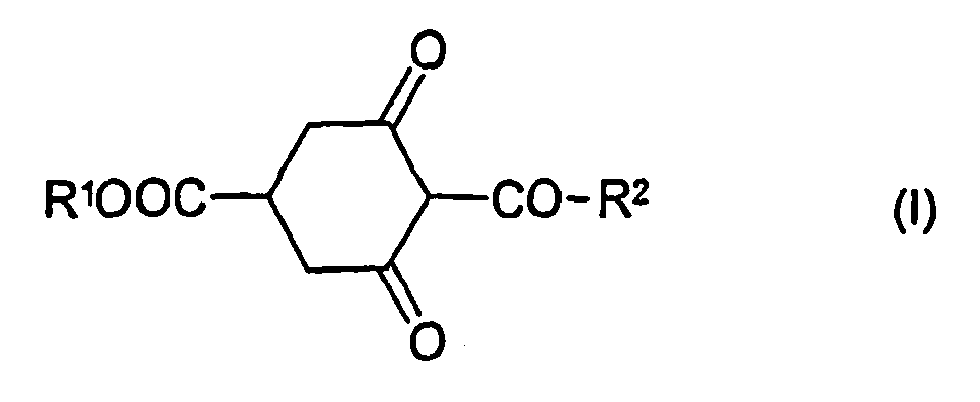
- R1
- für H oder C1-C10-Alkyl steht und
- R2
- für C1-C10-Alkyl oder C3-C10-Cycloalkyl steht,
- Unter Kernobst versteht man im Rahmen der vorliegenden Erfindung Apfel, Birne oder Quitte, insbesondere Apfel oder Birne. Mit der Bezeichnung Kernobst bzw. spezifiziert als Apfel, Birne oder Quitte sind die Obstbäume oder Pflanzenteile davon, hingegen nicht das Obst in geernteter Form gemeint.
- Die Behandlung erfolgt zur vollständigen oder zumindest teilweisen Verhinderung derjenigen Blütenverringerung, die auf die Behandlung mit Acylcyclohexandion-Derivaten zurückzuführen ist. Gleichzeitig soll die Behandlung selbstverständlich zu einer Verringerung des vegetativen Wachstums führen. "Ganz oder teilweise verhinderte Blütenverringerung" bedeutet, dass erfindungsgemäß behandelte Pflanzen zu einem bestimmten Zeitpunkt oder in der gesamten saisonalen Blühzeit vorzugsweise wenigstens 40 %, besonders bevorzugt wenigstens 60 % und insbesondere wenigstens 80 % der Anzahl an Blüten oder alternativ der Anzahl der Blütenstände von unbehandelten, d.h. nicht mit Wachstumsregulatoren behandelten, aber ansonsten gleichen Bedingungen ausgesetzten Kontrollpflanzen aufweisen. Der Blütenstand (Infloreszenz) ist Teil des Sprosssytems vieler Samenpflanzen, wie Kernobst, welcher in der Regel mehrere Blüten trägt und später eine oder mehrere Früchte ergibt.
- Eine teilweise oder vollständige Verhinderung der Blütenverringerung ist auch dann gegeben, wenn die erfindungsgemäß behandelten Pflanzen signifikant mehr Blüten oder alternativ Blütenstände zu einem bestimmten Zeitpunkt oder in der gesamten saisonalen Blühzeit aufweisen als Pflanzen, die ansonsten gleichen Bedingungen ausgesetzt waren, die jedoch ausschließlich mit Acyclcyclohexandion-Derivaten, d. h. ohne Ethephon, behandelt wurden.
- Acylcyclohexandionverbindungen der Formel I sind aus der
EP-A 0 123 001 und aus derEP-A 126 713 - Die Verbindungen der Formel I können sowohl in der Trionform (Triketo-Form) I.a als auch in den tautomeren Keto-Enol-Formen I.b bzw. I.c vorliegen:

- In den Verbindungen der Formel I steht R1 vorzugsweise für H oder C1-C4-Alkyl.
- R2 steht vorzugsweise für C1-C4-Alkyl oder C3-C6-Cycloalkyl und insbesondere für Ethyl oder Cyclopropyl.
- In der Definition der Reste R1 und R2 steht C1-C10-Alkyl für einen linearen oder verzweigten Alkylrest, wie Methyl, Ethyl, Propyl, Isopropyl, n-Butyl, sec-Butyl, Isobutyl, tert-Butyl, Pentyl, Neopentyl, Hexyl, Heptyl, Octyl, 2-Ethylhexyl, Nonyl oder Decyl. C1-C4-Alkyl steht beispielsweise für Methyl, Ethyl, Propyl, Isopropyl, n-Butyl, sec-Butyl, Isobutyl oder tert-Butyl. Vorzugsweise ist der Alkylrest linear.
- In der Definition von R2 steht C3-C10-Cycloalkyl beispielsweise für Cyclopropyl, Cyclopentyl, Cyclohexyl, Cycloheptyl, Cyclooctyl, Cyclodecyl oder Decalin. C3-C6-Cycloalkyl steht beispielsweise für Cyclopropyl, Cyclopentyl oder Cyclohexyl.
- Bei den Salzen der Acylcyclohexandionverbindungen 1 mit R1 ≠H handelt es sich um die Salze von Monoanionen, während es sich im Falle von R1 = H sowohl um die Salze der Mono- als auch der Dianionen dieser Verbindungen handeln kann. Die Monoanionen können sowohl als Carboxylatanionen I.d als auch als Enolatanionen I.e bzw. I.f vorliegen:

- Bevorzugte Kationen in den Salzen der Verbindungen der Formel 1 sind die lonen der Alkalimetalle, vorzugsweise des Lithiums, Natriums und Kaliums, der Erdalkalimetalle, vorzugsweise des Calciums und Magnesiums, und der Übergangsmetalle, vorzugsweise des Mangans, Kupfers, Zinks und Eisens, weiterhin Ammonium (NH4 +) und substituiertes Ammonium, worin ein bis vier Wasserstoffatome durch C1-C4-Alkyl, Hydroxy-C1-C4-alkyl, C1-C4-Alkoxy-C1-C4-alkyl, Hydroxy-C1-C4-alkoxy-C1-C4-alkyl, Phenyl oder Benzyl ersetzt sind, vorzugsweise Ammonium, Methylammonium, Isopropylammonium, Dimethylammonium, Düsopropylammonium, Trimethylammonium, Tetrame-thylammonium, Tetraethylammonium, Tetrabutylammonium, 2-Hydroxyethylammonium, 2-(2-Hydroxyeth-1-oxy)eth-1-ylammonium, Di(2-hydroxyeth-1-yl)ammonium, Benzyltrimethylammonium, Benzyltriethylammonium, des weiteren Phosphoniumionen, Sulfoniumionen, vorzugsweise Tri(C1-C4-alkyl)sulfonium wie Trimethylsulfonium und Sulfoxoniumionen, vorzugsweise Tri(C1-C4-alkyl)sulfoxonium. Bevorzugte Kationen sind außerdem Chlormequat [(2-Chlorethyl)trimethylammonium], Mepiquat (N,N-Dimethylpiperidinium) und N,N-Dimethylmorpholinium. Besonders bevorzugte Kationen sind die Alkalimetallkationen, die Erdalkalimetallkationen und das Ammoniumkation (NH4 +). Insbesondere handelt es sich um das Calciumsalz.
- Im Rahmen der vorliegenden Erfindung bezieht sich die Bezeichnung "Verbindungen der Formel I" bzw: "Acylcyclohexandion der Formel I" sowohl auf die neutralen Verbindungen I als auch auf deren Salze.
- Besonders bevorzugt erfindungsgemäß verwendete Verbindungen I sind Prohexadion (R1 = H, R2 = Ethyl), Prohexadion-Calcium (Calcium-Salz von Prohexadion), Trinexapac (R1 = H, R2 = Cyclopropyl) und Trinexapac-Ethyl (R1 = Ethyl, R2 = Cyclopropyl).
- Die Behandlung von Kernobst erfolgt vorzugsweise so, dass der Kernobst-Baum bzw. Pflanzenteile davon mit wenigstens einer Acylcyclohexandion-Verbindung I und Ethephon in Kontakt gebracht werden. Die Verbindungen der Formel I und Ethephon können im Gemisch oder getrennt appliziert werden. Bei der getrennten Anwendung kann die Applikation der einzelnen Wirksubstanzen gleichzeitig oder nacheinander erfolgen, wobei sie bei der sukzessiven Applikation vorzugsweise in einem zeitlichen Abstand von wenigen Stunden bis mehreren Wochen erfolgt.
- Die Verbindungen 1 und Ethephon werden in einem Gewichtsverhältnis von vorzugsweise 10:1 bis 1:5, besonders bevorzugt von 5:1 bis 1:3, insbesondere von 3:1 bis 1:2, eingesetzt.
- Die Verbindungen der Formel I bzw. ihre Salze werden pro Saison vorzugsweise in einer Aufwandmenge von 25 bis 1.500 g/ha, besonders bevorzugt von 50 bis 1.000 g/ha eingesetzt. Prohexadion-Calcium wird insbesondere in einer Aufwandmenge von 100 bis 500 g/ha pro Saison eingesetzt. Trinexapac-Ethyl wird pro Saison in einer Aufwandmenge von insbesondere 200 bis 800 g/ha eingesetzt. Ethephon wird vorzugsweise in einer Aufwandmenge von 25 bis 1.500 g/ha, besonders bevorzugt von 50 bis 750 g/ha und insbesondere von 100 bis 500 g/ha pro Saison eingesetzt.
- Pro Saison werden die Wirksubstanzen vorzugsweise 1 bis 5 mal, besonders bevorzugt 1 bis 4 mal und insbesondere 2 bis 3 mal appliziert.
- Es ist möglich, bei nur einem Teil der Applikationen die Verbindung der Formel 1 zusammen mit Ethephon einzusetzen und bei den restlichen Applikationen nur eine der Wirksubstanzen, insbesondere die Verbindung 1, zu verwenden. Vorzugsweise verwendet man bei wenigstens der Hälfte der Applikationen pro Saison, besonders bevorzugt bei der Hälfte der Applikationen pro Saison und insbesondere bei wenigstens einer Applikation sowohl Verbindung I als auch Ethephon.
- Die Anwendungstermine, die Anzahl der Applikationen und die speziell eingesetzten Aufwandmengen hängen dabei von der jeweiligen Obstkultur und von weiteren Parametern, wie Obstart und -sorte, Unterlage, Alter, Witterungsverlauf, Verfügbarkeit von Wasser und Nährstoffen, ab und müssen im Einzelfall vom Fachmann festgelegt werden.
- Vorzugsweise erfolgt die Applikation auf der nördlichen Erdhalbkugel im Frühjahr bis in den Frühsommer (ca. Anfang März bis Ende Juli) und auf der südlichen Hemisphäre entsprechend von Anfang September bis Ende Januar. Die Behandlung erfolgt insbesondere zum Beginn des neuen Triebwachstums, ein Termin, der in der Regel mit dem Ende der Blüte korreliert, oder zeitnah zu diesem Termin, d. h. innerhalb von ± 4. Wochen. Weitere Behandlungen können dann in einem Zeitraum bis 10 Wochen, z. B. innerhalb 1 bis 10 Wochen nach der ersten Anwendung, folgen. Die Behandlungstermine richten sich nach den jeweiligen Erfordernissen der Kulturpflanzen, die je nach Witterung und Standortbedingungen von Saison zu Saison verschieden sein können. Die Behandlungstermine kann ein Fachmann jedoch in üblicher Weise ermitteln, wobei auch Behandlungstermine außerhalb der hier angegebenen Zeiträume in der Regel zum Erfolg führen und je nach Erfordernis der Kulturpflanze sinnvoll sein können.
- Die Verbindungen der Formel I, Ethephon bzw. ihr Gemisch werden typischerweise als Formulierungen eingesetzt, wie sie im Bereich des Pflanzenschutzes üblich sind.
- Sie können beispielsweise in Form von konzentrierten Lösungen, Suspensionen oder Emulsionen mit Wasser verdünnt werden und durch Versprühen angewendet werden. Die Anwendungsformen richten sich nach der Kernobstart und -sorte bzw. dem Pflanzenteil, auf den appliziert werden soll; sie sollten in jedem Fall eine möglichst feine Verteilung der Wirk- und Hilfsstoffe erlauben.
- Die Formulierungen können neben den Verbindungen der Formel I und/oder Ethephon für die Formulierung von Pflanzenschutzmitteln übliche Formulierungshilfsstoffe, z. B. inerte Hilfsstoffe und/oder oberflächenaktive Substanzen, wie Emulgatoren, Dispergiermittel, Netzmittel und dergleichen, enthalten.
- Als oberflächenaktive Stoffe kommen die Alkali-, Erdalkali-, Ammoniumsalze von aromatischen Sulfonsäuren, z.B. Lignin-, Phenol-, Naphthalin- und Dibutylnaphthalinsulfonsäure, sowie von Fettsäuren, Alkyl- und Alkylarylsulfonaten, Alkyl-, Laurylether- und Fettalkoholsulfaten, sowie Salze sulfatierter Hexa-, Hepta- und Octadecanole sowie von Fettalkoholglykolethern, Kondensationsprodukte von sulfoniertem Naphthalin und seiner Derivate mit Formaldehyd, Kondensationsprodukte des Naphthalins bzw. der Naphthalinsulfonsäuren mit Phenol und Formaldehyd, Polyoxyethylenoctylphenolether, ethoxyliertes Isooctyl-, Octyl- oder Nonylphenol, Alkylphenyl-, Tributylphenylpolyglykolether, Alkylarylpolyetheralkohole, Isotridecylalkohol, Fettalkoholethylenoxid-Kondensate, ethoxyliertes Rizinusöl, Polyoxyethylen- oder Polyoxypropylenalkylether, Laurylalkoholpolyglykoletheracetat, Sorbitester, Lignin-Sulfitablaugen, Methylcellulose oder Siloxane in Betracht. Geeignete Siloxane sind beipsielsweise Polyetherpolymethylsiloxan-Copolymere, die auch als "Spreader" oder "Penetratoren" bezeichnet werden.
- Als inerte Formulierungshilfsstoffe kommen im Wesentlichen in Betracht: Mineralölfraktionen von mittlerem bis hohem Siedepunkt wie Kerosin und Dieselöl, ferner Kohlenteeröle sowie Öle pflanzlichen oder tierischen Ursprungs, aliphatische, cyclische und aromatische Kohlenwasserstoffe, z.B. Paraffine, Tetrahydronaphthalin, alkylierte Naphthaline und deren Derivate, alkylierte Benzole und deren Derivate, Alkohole wie Methanol, Ethanol, Propanol, Butanol und Cyclohexanol, Ketone wie Cyclohexanon, stark polare Lösungsmittel, z.B. Amine wie N-Methylpyrrolidon und Wasser.
- Wässrige Anwendungsformen der Verbindungen 1, von Ethephon bzw. ihres Gemischs können aus Lagerformulierungen, wie Emulsionskonzentraten, Suspensionen, Pasten, netzbaren Pulvern oder wasserdispergierbaren Granulaten, durch Zusatz von Wasser bereitet werden. Zur Herstellung von Emulsionen, Pasten oder Öldispersionen können die Verbindungen der Formel 1 bzw. Ethephon bzw. ihr Gemisch, als solche oder in einem Öl oder Lösungsmittel gelöst und mittels Netz-, Haft-, Dispergier- oder Emulgiermittel in Wasser homogenisiert werden. Es versteht sich von selbst, dass die Anwendungsformen die in den Lagerformulierungen verwendeten Hilfsstoffe enthalten.
- In einer bevorzugten Ausführungsform verwendet man die Verbindungen der Formel 1, Ethephon bzw. ihr Gemisch in Form einer wässrigen Spritzbrühe. Diese enthält die Verbindungen der Formel I bzw. Ethephon in einer Menge von vorzugsweise jeweils 25 bis 500 ppm. Werden die Verbindungen der Formel I und Ethephon als Gemisch eingesetzt, so enthält die Spritzbrühe die Wirksubstanzen in einer Gesamtmenge von vorzugsweise 50 bis 1000 ppm.
- Die erfindungsgemäß verwendete Wirkstoffkombination aus Acylcyclohexandionen I und Ethephon ist für eine Applikation bei allen der vorstehend genannten Kernobstarten, aber auch bei davon verschiedenen Pflanzenarten anwendbar. Sie kann in Abhängigkeit vom Pflanzenteil, auf den appliziert werden soll, mit an sich bekannten und in der landwirtschaftlichen Praxis üblichen Geräten appliziert werden, wobei die Applikation in Form einer wässrigen Spritzlösung oder Spritzbrühe bevorzugt ist.
- Die Applikation erfolgt vorzugsweise durch Spritzen bis zur Tropfnässe. Dabei wird entweder auf den gesamten oberirdischen Pflanzenteil oder aber nur auf einzelne Pflanzenteile, wie Blüten, Blätter oder einzelne Triebe, appliziert. Die Wahl der einzelnen Pflanzenteile, auf die appliziert werden soll, hängt von der Pflanzenart und ihrem Entwicklungsstadium ab. Bevorzugt wird auf den gesamten oberirdischen Pflanzenteil appliziert.
- Ein weiterer Gegenstand der vorliegenden Erfindung ist ein Verfahren zur Behandlung von Kernobst zur Verhinderung der durch die Behandlung mit Verbindungen der Formel I im Jahr nach der Behandlung beobachteten Blütenreduktion und einer durch die Behandlung eventuell induzierten Alternanz, dadurch gekennzeichnet, dass man wenigstens eine Verbindung der Formel I und 2-Chlorethylphosphonsäure im Gemisch oder getrennt, gleichzeitig oder nacheinander in Form einer wässrigen Spritzbrühe auf Kernobst-Pflanzen oder -Pflanzenteile aufbringt.
- Die vorstehend gemachten Ausführungen bezüglich der Verbindungen der Formel 1 und Ethephon, der wässrigen Zusammensetzung sowie der Applikation gelten hier entsprechend.
- Durch die erfindungsgemäße Verwendung von Acylcyclohexandion-Verbindungen I zusammen mit Ethephon wird die auf die Behandlung mit bestimmten Acylcyclohexandion-Derivaten zurückzuführende Verringerung der Blütenbildung im Wesentlichen verhindert. Gleichzeitig erfolgt bei den behandelten Pflanzen die gewünschte Wachstumsregulierung.
- Die nachfolgenden Beispiele sollen die Erfindung veranschaulichen, ohne sie jedoch einzuschränken.
- 12 Jahre alte Birnbäume der Sorte "Conference" auf Unterlage BA wurden an zwei unterschiedlichen Standorten zum einen mit Prohexadion-Calcium alleine und zum anderen mit einer Kombination aus Prohexadion-Calcium und Ethephon behandelt. Hierfür wurden jeweils 4 Gruppen von 5 Bäumen, die in einer Obstanlage gleichmäßig verteilt waren, mit einer wirkstoffhaltigen Spritzbrühe bis zur Tropfnässe besprüht (ca. 1000 I/ha). Am ersten Standort wurden drei Applikationen im Abstand von ungefähr einem Monat vorgenommen. Am zweiten Standort wurde Prohexadion-Calcium bei einem Teil der Baumgruppen viermal und bei einem davon verschiedenen Teil dreimal appliziert, wobei das Applikationsintervall etwa je zwei Wochen betrug. Die Kombination aus Prohexadion-Calcium und Ethephon wurde zweimal appliziert, wobei vor und nach der kombinierten Applikation jeweils eine Applikation mit Prohexadion-Calcium alleine erfolgte. Etwa ein Jahr nach der ersten Applikation wurde die Anzahl der Blütenstände von unbehandelten Bäumen, von solchen, die ausschließlich mit Prohexadion-Calcium behandelt worden waren und von Bäumen, die mit einer Kombination aus Prohexadion-Calcium und Ethephon behandelt worden waren, gezählt und miteinander verglichen. Die Ergebnisse sind in nachfolgenden Tabellen 1 und 2 aufgeführt.
Tabelle 1: Standort 1 Behandlung Applikationszeitpunkte 2002 und Aufwandmengen an aktiver Substanz [g/ha] Gesamtdosis [g/ha] Blüte im Folgejahr [Anzahl der Blütenstände/Baum] April 2003 15. April 14. Mai 16. Juni Unbehandelt - - - - 183 ProCa* 150 150 150 450 137 ProCa* + 150 150 150 450 185 Ethephon 120 120 120 360 Tabelle 2: Standort 2 Behandlung Applikationszeitpunkte 2002 und Aufwandmengen an aktiver Substanz [g/ha] Gesamtdosis [g/ha] Blüte im Folgejahr [Anzahl der Blütenstände/Baum] April 2003 12. April 03. Mai 15. Mai 30. Mai Unbehandelt - - - - - 250 ProCa* 120 87 87 95 389 157 ProCa* 120 87 87 - 294 152 ProCa*+ 120 110 92 95 417 217 Ethephon - 395 315 - 710 * Prohexadion-Calcium - Wie die obigen Versuchsergebnisse zeigen, führt die Anwendung von Prohexadion-Calcium zu einer verringerten Blütenbildung im Folgejahr der Behandlung. Wird hingegen Prohexadion-Calcium in Kombination mit Ethephon appliziert, so bleibt diese Blütenreduktion aus oder wird deutlich abgemildert.
zusammen mit 2-Chlorethylphosphonsäure (Ethephon) der Formel II

Claims (8)
- Verwendung wenigstens einer Verbindung der Formel I
 R1 für H oder C1-C10-Alkyl steht undR2 für C1-C10-Alkyl oder C3-C10-Cycloalkyl steht,oder Salzen davon zusammen mit 2-Chlorethylphosphonsäure (Ethephon) zur Behandlung von Kernobst zur Verhinderung der durch die Behandlung mit Verbindungen der Formel I im Jahr nach der Behandlung beobachteten Blütenreduktion und einer durch die Behandlung eventuell induzierten Alternanz.
- Verwendung nach Anspruch 1 zur Behandlung von Apfel oder Birne.
- Verwendung nach einem der vorhergehenden Ansprüche, wobei in der Verbindung der Formel I R1 für H und R2 für Ethyl steht oder wobei die Verbindung der Formel I, in der R2 für Ethyl steht, in Form des Calciumsalzes vorliegt.
- Verwendung nach einem der Ansprüche 1 oder 2, wobei in der Verbindung der Formel I R1 für Ethyl und R2 für Cyclopropyl steht.
- Verwendung nach einem der vorhergehenden Ansprüche, wobei die Verbindung der Formel I und 2-Chlorethylphosphonsäure in einem Gewichtsverhältnis von 10:1 bis 1:5 eingesetzt werden.
- Verwendung nach einem der vorhergehenden Ansprüche, wobei die Verbindung der Formel I und 2-Chlorethylphosphonsäure im Gemisch in Form einer wässrigen Spritzbrühe eingesetzt werden, in welcher die Verbindung der Formel I und 2-Chlorethylphosphonsäure in einer Gesamtmenge von 50 bis 1000 ppm enthalten sind.
- Verwendung nach einem der vorhergehenden Ansprüche, wobei die Aufwandmenge der Verbindung der Formel I und von 2-Chlorethylphosphonsäure im Bereich von jeweils 25 bis 1500 g/ha pro Saison liegt.
- Verfahren zur Behandlung von Kernobst zur Verhinderung der durch die Behandlung mit Verbindungen der Formel I im Jahr nach der Behandlung beobachteten Blütenreduktion und einer durch die Behandlung eventuell induzierten Alternanz, dadurch gekennzeichnet, dass man wenigstens eine Verbindung der Formel I und 2-Chlorethylphosphonsäure im Gemisch oder getrennt, gleichzeitig oder nacheinander in Form einer wässrigen Spritzbrühe auf Kernobst-Pflanzen oder -Pflanzenteile aufbringt.
Priority Applications (1)
| Application Number | Priority Date | Filing Date | Title |
|---|---|---|---|
| PL04763867T PL1653805T5 (pl) | 2003-08-08 | 2004-08-06 | Zastosowanie pochodnych acylocykloheksanodionu wraz z etefonem do traktowania drzew ziarnkowych |
Applications Claiming Priority (2)
| Application Number | Priority Date | Filing Date | Title |
|---|---|---|---|
| DE10336612 | 2003-08-08 | ||
| PCT/EP2004/008832 WO2005015997A1 (de) | 2003-08-08 | 2004-08-06 | Verwendung von acylcyclohexandion-derivaten zusammen mit ethephon zur behandlung von kernobst |
Publications (3)
| Publication Number | Publication Date |
|---|---|
| EP1653805A1 EP1653805A1 (de) | 2006-05-10 |
| EP1653805B1 EP1653805B1 (de) | 2006-12-27 |
| EP1653805B2 true EP1653805B2 (de) | 2011-08-17 |
Family
ID=34177401
Family Applications (1)
| Application Number | Title | Priority Date | Filing Date |
|---|---|---|---|
| EP04763867A Expired - Lifetime EP1653805B2 (de) | 2003-08-08 | 2004-08-06 | Verwendung von acylcyclohexandion-derivaten zusammen mit ethephon zur behandlung von kernobst |
Country Status (17)
| Country | Link |
|---|---|
| US (1) | US20060229208A1 (de) |
| EP (1) | EP1653805B2 (de) |
| JP (1) | JP4606412B2 (de) |
| KR (1) | KR20060063936A (de) |
| AR (1) | AR045346A1 (de) |
| AT (1) | ATE349160T1 (de) |
| AU (1) | AU2004264668B2 (de) |
| BR (1) | BRPI0413262A (de) |
| CA (1) | CA2534853A1 (de) |
| DE (1) | DE502004002479D1 (de) |
| ES (1) | ES2280044T5 (de) |
| MX (1) | MXPA06000935A (de) |
| NZ (1) | NZ544960A (de) |
| PL (1) | PL1653805T5 (de) |
| PT (1) | PT1653805E (de) |
| WO (1) | WO2005015997A1 (de) |
| ZA (1) | ZA200601925B (de) |
Families Citing this family (2)
| Publication number | Priority date | Publication date | Assignee | Title |
|---|---|---|---|---|
| US8580709B2 (en) * | 2009-11-27 | 2013-11-12 | Syngenta Crop Protection, Llc | Plant growth regulation |
| EP3578047B1 (de) * | 2018-06-07 | 2022-09-28 | Fine Agrochemicals Limited | Pflanzenwachstumsregulatorsystem |
Citations (3)
| Publication number | Priority date | Publication date | Assignee | Title |
|---|---|---|---|---|
| GB1597686A (en) † | 1977-12-15 | 1981-09-09 | Basf Ag | Compositions for regulating plant growth |
| US4361436A (en) † | 1977-09-16 | 1982-11-30 | Gaf Corporation | Composition for plant growth regulation |
| EP0434613A2 (de) † | 1989-12-13 | 1991-06-26 | Ciba-Geigy Ag | Synergistisch wirkendes Mittel und Verfahren zur Regulierung des Pflanzenwuchses |
Family Cites Families (5)
| Publication number | Priority date | Publication date | Assignee | Title |
|---|---|---|---|---|
| IL29492A (en) * | 1967-02-23 | 1974-05-16 | Amchem Prod | Processes and compositions for the regulation of plant growth |
| US4374661A (en) * | 1967-12-27 | 1983-02-22 | Union Carbide Corporation | Growth regulation process |
| JPS59196840A (ja) * | 1983-04-22 | 1984-11-08 | Kumiai Chem Ind Co Ltd | シクロヘキサン誘導体および植物生長調節剤 |
| US4584013A (en) * | 1983-05-18 | 1986-04-22 | Ciba-Geigy Corporation | Cyclohexanedionecarboxylic acid derivatives with herbicidal and plant growth regulating properties |
| JP2673211B2 (ja) * | 1988-05-19 | 1997-11-05 | クミアイ化学工業株式会社 | 植物生長調節組成物 |
-
2004
- 2004-08-06 PL PL04763867T patent/PL1653805T5/pl unknown
- 2004-08-06 KR KR1020067002655A patent/KR20060063936A/ko not_active Abandoned
- 2004-08-06 DE DE502004002479T patent/DE502004002479D1/de not_active Expired - Lifetime
- 2004-08-06 US US10/567,467 patent/US20060229208A1/en not_active Abandoned
- 2004-08-06 WO PCT/EP2004/008832 patent/WO2005015997A1/de not_active Ceased
- 2004-08-06 BR BRPI0413262-9A patent/BRPI0413262A/pt not_active Application Discontinuation
- 2004-08-06 EP EP04763867A patent/EP1653805B2/de not_active Expired - Lifetime
- 2004-08-06 AR ARP040102819A patent/AR045346A1/es unknown
- 2004-08-06 CA CA002534853A patent/CA2534853A1/en not_active Abandoned
- 2004-08-06 MX MXPA06000935A patent/MXPA06000935A/es active IP Right Grant
- 2004-08-06 AT AT04763867T patent/ATE349160T1/de active
- 2004-08-06 NZ NZ544960A patent/NZ544960A/en not_active IP Right Cessation
- 2004-08-06 JP JP2006522325A patent/JP4606412B2/ja not_active Expired - Fee Related
- 2004-08-06 PT PT04763867T patent/PT1653805E/pt unknown
- 2004-08-06 AU AU2004264668A patent/AU2004264668B2/en not_active Ceased
- 2004-08-06 ES ES04763867T patent/ES2280044T5/es not_active Expired - Lifetime
-
2006
- 2006-03-07 ZA ZA200601925A patent/ZA200601925B/en unknown
Patent Citations (3)
| Publication number | Priority date | Publication date | Assignee | Title |
|---|---|---|---|---|
| US4361436A (en) † | 1977-09-16 | 1982-11-30 | Gaf Corporation | Composition for plant growth regulation |
| GB1597686A (en) † | 1977-12-15 | 1981-09-09 | Basf Ag | Compositions for regulating plant growth |
| EP0434613A2 (de) † | 1989-12-13 | 1991-06-26 | Ciba-Geigy Ag | Synergistisch wirkendes Mittel und Verfahren zur Regulierung des Pflanzenwuchses |
Non-Patent Citations (6)
| Title |
|---|
| BYERS ET AL.: "Controlling growth of bearing apple trees with ethephon", HORTSCIENCE, vol. 28, no. 11, November 1993 (1993-11-01), pages 1103 - 1105 † |
| BYERS ET AL.: "The influence of Apogee and its combinations with ethephon,chemical thinners, cations, and/or adjuvants for apple tree growth control and return bloom", PROCEEDINGS-PLANT GROWTH REGULATION SOCIETY OF AMERICA, vol. 27TH, 2000, pages 187 - 192 † |
| ELFVING ET AL.: "Prohexadine - Ca and ethephon reduce shoot growth and increase flowering in young, vigorous sweet cherry trees", HORTSCIENCE, vol. 38, no. 2, April 2003 (2003-04-01), pages 293 - 298 † |
| KENDER: "Ethephon - induced flowering in apple seedlings", HORTSCIENCE, vol. 9, no. 5, October 1974 (1974-10-01), pages 444 - 445 † |
| SUGAR ET AL.: "Effects of prohexadione - calcium (Apogee) on blossoming,production, and fruit quality in pear", ACTA HORT 596, 31 December 2002 (2002-12-31), pages 757 - 760 † |
| TROMP: "Flower - bud formation in pome fruits as affected by fruit thinning", PLANT GROWTH REGULATION, vol. 31, 2000, pages 27 - 34 † |
Also Published As
| Publication number | Publication date |
|---|---|
| DE502004002479D1 (de) | 2007-02-08 |
| ATE349160T1 (de) | 2007-01-15 |
| WO2005015997A1 (de) | 2005-02-24 |
| JP2007501772A (ja) | 2007-02-01 |
| EP1653805B1 (de) | 2006-12-27 |
| NZ544960A (en) | 2009-04-30 |
| AU2004264668A1 (en) | 2005-02-24 |
| ZA200601925B (en) | 2007-05-30 |
| CA2534853A1 (en) | 2005-02-24 |
| ES2280044T3 (es) | 2007-09-01 |
| AR045346A1 (es) | 2005-10-26 |
| PL1653805T3 (pl) | 2007-05-31 |
| US20060229208A1 (en) | 2006-10-12 |
| EP1653805A1 (de) | 2006-05-10 |
| KR20060063936A (ko) | 2006-06-12 |
| JP4606412B2 (ja) | 2011-01-05 |
| ES2280044T5 (es) | 2012-01-11 |
| AU2004264668B2 (en) | 2010-02-25 |
| PT1653805E (pt) | 2007-02-28 |
| BRPI0413262A (pt) | 2006-10-10 |
| MXPA06000935A (es) | 2006-05-04 |
| PL1653805T5 (pl) | 2012-01-31 |
Similar Documents
| Publication | Publication Date | Title |
|---|---|---|
| DD209721A5 (de) | Mittel zur bekaempfung von pflanzenkrankheiten | |
| DE69720030T2 (de) | Synergistische Pflanzenschutzmittelmischungen | |
| DE69630451T2 (de) | Eine strobilurinanalogverbindung enthaltende synergistischefungizide zusammensetzung | |
| DE3686978T2 (de) | Foerderung der bluete von obstbaeumen. | |
| EP2337453B1 (de) | Verwendung von acylcyclohexandioncarbonsäuren oder deren salzen in kombination mit acylcyclohexandioncarbonsäureestern zur verbesserung der entwicklung von gramineen | |
| DE2330597A1 (de) | Verfahren zur bekaempfung von pilzen auf pflanzen | |
| EP1423007B1 (de) | Bioregulatorische wirkstoffkombination | |
| WO2014136029A1 (en) | Method for fruit thinning at late growth stages of fruit plants | |
| EP1653805B1 (de) | Verwendung von acylcyclohexandion-derivaten zusammen mit ethephon zur behandlung von kernobst | |
| WO2006018266A1 (de) | Verwendung von s-abscisinsäure zur verbesserung des fruchtansatzes, zur erzeugung parthenokarper früchte, und als wachstumshemmer | |
| EP1605751B1 (de) | Verwendung von acylcyclohexandion-derivaten zur verbesserung der frosttoleranz bei kern-, steinobst und zitruspflanzen | |
| DD254877A5 (de) | Zusammensetzung und verfahren zur regulierung des pflanzenwachstums | |
| DE2520122A1 (de) | Wirkstoffe fuer landwirtschaft und gartenbau und ihre anwendung | |
| DE1146693B (de) | Verfahren zur Umwandlung zweijaehrig fruchttragender Obstbaeume, insbesondere Apfelbaeume, in einjaehrig fruchttragende | |
| WO2008043405A2 (de) | Verfahren, formulierung und verwendung von indol-derivaten zur verbesserung der fruchtqualität von obst- oder gemüsefrüchten | |
| DE2432790A1 (de) | Verfahren zur bekaempfung von durch ueberwinternde pilze verursachten krankheiten an holzpflanzen | |
| DE948652C (de) | Mittel zur Beeinflussung des Pflanzenwachstums | |
| DE941396C (de) | Verfahren zur Erhoehung des Fruchtertrages | |
| DE2332429A1 (de) | Regulatoren fuer das pflanzenwachstum | |
| DE4039017A1 (de) | Mittel zur qualitaetsverbesserung von kernobst | |
| DE2741343A1 (de) | Mittel zur regulierung des pflanzenwachstums | |
| EP1421851A1 (de) | Verfahren, Formulierung und Verwendung von Indol-Derivaten zur Verringerung des Aufplatzens von Obst- oder Gemüsefrüchten | |
| DEM0013819MA (de) | ||
| DE1044501B (de) | Verfahren zur Herstellung stabiler Loesungen von Griseofulvin in organischen Loesungsmitteln fuer fungicide Zwecke | |
| DE3116010A1 (de) | Mittel insbesondere zur entblaetterung von pflanzen |
Legal Events
| Date | Code | Title | Description |
|---|---|---|---|
| PUAI | Public reference made under article 153(3) epc to a published international application that has entered the european phase |
Free format text: ORIGINAL CODE: 0009012 |
|
| 17P | Request for examination filed |
Effective date: 20060308 |
|
| AK | Designated contracting states |
Kind code of ref document: A1 Designated state(s): AT BE BG CH CY CZ DE DK EE ES FI FR GB GR HU IE IT LI LU MC NL PL PT RO SE SI SK TR |
|
| GRAP | Despatch of communication of intention to grant a patent |
Free format text: ORIGINAL CODE: EPIDOSNIGR1 |
|
| RIC1 | Information provided on ipc code assigned before grant |
Ipc: A01N 57/20 20060101ALI20060515BHEP Ipc: A01N 25/32 20060101ALI20060515BHEP Ipc: A01N 37/42 20060101AFI20060515BHEP |
|
| DAX | Request for extension of the european patent (deleted) | ||
| GRAS | Grant fee paid |
Free format text: ORIGINAL CODE: EPIDOSNIGR3 |
|
| GRAA | (expected) grant |
Free format text: ORIGINAL CODE: 0009210 |
|
| AK | Designated contracting states |
Kind code of ref document: B1 Designated state(s): AT BE BG CH CY CZ DE DK EE ES FI FR GB GR HU IE IT LI LU MC NL PL PT RO SE SI SK TR |
|
| PG25 | Lapsed in a contracting state [announced via postgrant information from national office to epo] |
Ref country code: RO Free format text: LAPSE BECAUSE OF FAILURE TO SUBMIT A TRANSLATION OF THE DESCRIPTION OR TO PAY THE FEE WITHIN THE PRESCRIBED TIME-LIMIT Effective date: 20061227 Ref country code: DK Free format text: LAPSE BECAUSE OF FAILURE TO SUBMIT A TRANSLATION OF THE DESCRIPTION OR TO PAY THE FEE WITHIN THE PRESCRIBED TIME-LIMIT Effective date: 20061227 Ref country code: FI Free format text: LAPSE BECAUSE OF FAILURE TO SUBMIT A TRANSLATION OF THE DESCRIPTION OR TO PAY THE FEE WITHIN THE PRESCRIBED TIME-LIMIT Effective date: 20061227 Ref country code: SI Free format text: LAPSE BECAUSE OF FAILURE TO SUBMIT A TRANSLATION OF THE DESCRIPTION OR TO PAY THE FEE WITHIN THE PRESCRIBED TIME-LIMIT Effective date: 20061227 Ref country code: IE Free format text: LAPSE BECAUSE OF FAILURE TO SUBMIT A TRANSLATION OF THE DESCRIPTION OR TO PAY THE FEE WITHIN THE PRESCRIBED TIME-LIMIT Effective date: 20061227 Ref country code: SK Free format text: LAPSE BECAUSE OF FAILURE TO SUBMIT A TRANSLATION OF THE DESCRIPTION OR TO PAY THE FEE WITHIN THE PRESCRIBED TIME-LIMIT Effective date: 20061227 |
|
| REG | Reference to a national code |
Ref country code: GB Ref legal event code: FG4D Free format text: NOT ENGLISH |
|
| REG | Reference to a national code |
Ref country code: IE Ref legal event code: FG4D Free format text: LANGUAGE OF EP DOCUMENT: GERMAN |
|
| REF | Corresponds to: |
Ref document number: 502004002479 Country of ref document: DE Date of ref document: 20070208 Kind code of ref document: P |
|
| REG | Reference to a national code |
Ref country code: PT Ref legal event code: SC4A Free format text: AVAILABILITY OF NATIONAL TRANSLATION Effective date: 20070129 |
|
| REG | Reference to a national code |
Ref country code: GR Ref legal event code: EP Ref document number: 20070400534 Country of ref document: GR |
|
| PG25 | Lapsed in a contracting state [announced via postgrant information from national office to epo] |
Ref country code: BG Free format text: LAPSE BECAUSE OF FAILURE TO SUBMIT A TRANSLATION OF THE DESCRIPTION OR TO PAY THE FEE WITHIN THE PRESCRIBED TIME-LIMIT Effective date: 20070327 Ref country code: SE Free format text: LAPSE BECAUSE OF FAILURE TO SUBMIT A TRANSLATION OF THE DESCRIPTION OR TO PAY THE FEE WITHIN THE PRESCRIBED TIME-LIMIT Effective date: 20070327 |
|
| REG | Reference to a national code |
Ref country code: HU Ref legal event code: AG4A Ref document number: E001345 Country of ref document: HU |
|
| REG | Reference to a national code |
Ref country code: PL Ref legal event code: T3 |
|
| ET | Fr: translation filed | ||
| REG | Reference to a national code |
Ref country code: ES Ref legal event code: FG2A Ref document number: 2280044 Country of ref document: ES Kind code of ref document: T3 |
|
| PLBI | Opposition filed |
Free format text: ORIGINAL CODE: 0009260 |
|
| 26 | Opposition filed |
Opponent name: SYNGENTA LIMITED, EUROPEAN REGIONAL CENTRE, Effective date: 20070920 |
|
| PLAX | Notice of opposition and request to file observation + time limit sent |
Free format text: ORIGINAL CODE: EPIDOSNOBS2 |
|
| NLR1 | Nl: opposition has been filed with the epo |
Opponent name: SYNGENTA LIMITED, EUROPEAN REGIONAL CENTRE, |
|
| RAP2 | Party data changed (patent owner data changed or rights of a patent transferred) |
Owner name: BASF SE |
|
| PLAF | Information modified related to communication of a notice of opposition and request to file observations + time limit |
Free format text: ORIGINAL CODE: EPIDOSCOBS2 |
|
| PG25 | Lapsed in a contracting state [announced via postgrant information from national office to epo] |
Ref country code: MC Free format text: LAPSE BECAUSE OF NON-PAYMENT OF DUE FEES Effective date: 20070831 |
|
| NLT2 | Nl: modifications (of names), taken from the european patent patent bulletin |
Owner name: BASF SE Effective date: 20080305 |
|
| PLAF | Information modified related to communication of a notice of opposition and request to file observations + time limit |
Free format text: ORIGINAL CODE: EPIDOSCOBS2 |
|
| PLAF | Information modified related to communication of a notice of opposition and request to file observations + time limit |
Free format text: ORIGINAL CODE: EPIDOSCOBS2 |
|
| PLBB | Reply of patent proprietor to notice(s) of opposition received |
Free format text: ORIGINAL CODE: EPIDOSNOBS3 |
|
| PG25 | Lapsed in a contracting state [announced via postgrant information from national office to epo] |
Ref country code: EE Free format text: LAPSE BECAUSE OF FAILURE TO SUBMIT A TRANSLATION OF THE DESCRIPTION OR TO PAY THE FEE WITHIN THE PRESCRIBED TIME-LIMIT Effective date: 20061227 |
|
| PG25 | Lapsed in a contracting state [announced via postgrant information from national office to epo] |
Ref country code: CY Free format text: LAPSE BECAUSE OF FAILURE TO SUBMIT A TRANSLATION OF THE DESCRIPTION OR TO PAY THE FEE WITHIN THE PRESCRIBED TIME-LIMIT Effective date: 20061227 Ref country code: LU Free format text: LAPSE BECAUSE OF NON-PAYMENT OF DUE FEES Effective date: 20070806 |
|
| PG25 | Lapsed in a contracting state [announced via postgrant information from national office to epo] |
Ref country code: TR Free format text: LAPSE BECAUSE OF FAILURE TO SUBMIT A TRANSLATION OF THE DESCRIPTION OR TO PAY THE FEE WITHIN THE PRESCRIBED TIME-LIMIT Effective date: 20061227 |
|
| APBM | Appeal reference recorded |
Free format text: ORIGINAL CODE: EPIDOSNREFNO |
|
| APBP | Date of receipt of notice of appeal recorded |
Free format text: ORIGINAL CODE: EPIDOSNNOA2O |
|
| APAH | Appeal reference modified |
Free format text: ORIGINAL CODE: EPIDOSCREFNO |
|
| APBU | Appeal procedure closed |
Free format text: ORIGINAL CODE: EPIDOSNNOA9O |
|
| PGFP | Annual fee paid to national office [announced via postgrant information from national office to epo] |
Ref country code: DE Payment date: 20101029 Year of fee payment: 7 |
|
| PUAH | Patent maintained in amended form |
Free format text: ORIGINAL CODE: 0009272 |
|
| STAA | Information on the status of an ep patent application or granted ep patent |
Free format text: STATUS: PATENT MAINTAINED AS AMENDED |
|
| 27A | Patent maintained in amended form |
Effective date: 20110817 |
|
| AK | Designated contracting states |
Kind code of ref document: B2 Designated state(s): AT BE BG CH CY CZ DE DK EE ES FI FR GB GR HU IE IT LI LU MC NL PL PT RO SE SI SK TR |
|
| REG | Reference to a national code |
Ref country code: CH Ref legal event code: AEN Free format text: AUFRECHTERHALTUNG DES PATENTES IN GEAENDERTER FORM |
|
| REG | Reference to a national code |
Ref country code: DE Ref legal event code: R102 Ref document number: 502004002479 Country of ref document: DE Effective date: 20110817 |
|
| PGFP | Annual fee paid to national office [announced via postgrant information from national office to epo] |
Ref country code: CH Payment date: 20110829 Year of fee payment: 8 |
|
| REG | Reference to a national code |
Ref country code: NL Ref legal event code: T3 |
|
| REG | Reference to a national code |
Ref country code: GR Ref legal event code: EP Ref document number: 20110402090 Country of ref document: GR Effective date: 20111013 |
|
| PGFP | Annual fee paid to national office [announced via postgrant information from national office to epo] |
Ref country code: HU Payment date: 20110906 Year of fee payment: 8 Ref country code: GR Payment date: 20110829 Year of fee payment: 8 Ref country code: PL Payment date: 20110802 Year of fee payment: 8 Ref country code: FR Payment date: 20110905 Year of fee payment: 8 Ref country code: GB Payment date: 20110831 Year of fee payment: 8 Ref country code: PT Payment date: 20110720 Year of fee payment: 8 Ref country code: CZ Payment date: 20110727 Year of fee payment: 8 Ref country code: AT Payment date: 20110825 Year of fee payment: 8 |
|
| PGFP | Annual fee paid to national office [announced via postgrant information from national office to epo] |
Ref country code: NL Payment date: 20110829 Year of fee payment: 8 Ref country code: IT Payment date: 20110822 Year of fee payment: 8 |
|
| REG | Reference to a national code |
Ref country code: ES Ref legal event code: DC2A Ref document number: 2280044 Country of ref document: ES Kind code of ref document: T5 Effective date: 20120111 |
|
| PGFP | Annual fee paid to national office [announced via postgrant information from national office to epo] |
Ref country code: ES Payment date: 20110930 Year of fee payment: 8 Ref country code: BE Payment date: 20110923 Year of fee payment: 8 |
|
| REG | Reference to a national code |
Ref country code: PL Ref legal event code: T5 |
|
| REG | Reference to a national code |
Ref country code: PT Ref legal event code: MM4A Free format text: LAPSE DUE TO NON-PAYMENT OF FEES Effective date: 20130206 |
|
| BERE | Be: lapsed |
Owner name: BASF A.G. Effective date: 20120831 |
|
| REG | Reference to a national code |
Ref country code: NL Ref legal event code: V1 Effective date: 20130301 |
|
| REG | Reference to a national code |
Ref country code: CH Ref legal event code: PL |
|
| REG | Reference to a national code |
Ref country code: AT Ref legal event code: MM01 Ref document number: 349160 Country of ref document: AT Kind code of ref document: T Effective date: 20120806 |
|
| GBPC | Gb: european patent ceased through non-payment of renewal fee |
Effective date: 20120806 |
|
| PG25 | Lapsed in a contracting state [announced via postgrant information from national office to epo] |
Ref country code: HU Free format text: LAPSE BECAUSE OF NON-PAYMENT OF DUE FEES Effective date: 20120807 Ref country code: CZ Free format text: LAPSE BECAUSE OF NON-PAYMENT OF DUE FEES Effective date: 20120806 Ref country code: NL Free format text: LAPSE BECAUSE OF NON-PAYMENT OF DUE FEES Effective date: 20130301 Ref country code: CH Free format text: LAPSE BECAUSE OF NON-PAYMENT OF DUE FEES Effective date: 20120831 Ref country code: LI Free format text: LAPSE BECAUSE OF NON-PAYMENT OF DUE FEES Effective date: 20120831 |
|
| REG | Reference to a national code |
Ref country code: GR Ref legal event code: ML Ref document number: 20110402090 Country of ref document: GR Effective date: 20130304 |
|
| REG | Reference to a national code |
Ref country code: FR Ref legal event code: ST Effective date: 20130430 |
|
| PG25 | Lapsed in a contracting state [announced via postgrant information from national office to epo] |
Ref country code: IT Free format text: LAPSE BECAUSE OF NON-PAYMENT OF DUE FEES Effective date: 20120806 Ref country code: BE Free format text: LAPSE BECAUSE OF NON-PAYMENT OF DUE FEES Effective date: 20120831 Ref country code: PT Free format text: LAPSE BECAUSE OF NON-PAYMENT OF DUE FEES Effective date: 20130206 Ref country code: GR Free format text: LAPSE BECAUSE OF NON-PAYMENT OF DUE FEES Effective date: 20130304 |
|
| PG25 | Lapsed in a contracting state [announced via postgrant information from national office to epo] |
Ref country code: AT Free format text: LAPSE BECAUSE OF NON-PAYMENT OF DUE FEES Effective date: 20120806 |
|
| PG25 | Lapsed in a contracting state [announced via postgrant information from national office to epo] |
Ref country code: GB Free format text: LAPSE BECAUSE OF NON-PAYMENT OF DUE FEES Effective date: 20120806 Ref country code: DE Free format text: LAPSE BECAUSE OF NON-PAYMENT OF DUE FEES Effective date: 20130301 |
|
| PG25 | Lapsed in a contracting state [announced via postgrant information from national office to epo] |
Ref country code: FR Free format text: LAPSE BECAUSE OF NON-PAYMENT OF DUE FEES Effective date: 20120831 |
|
| REG | Reference to a national code |
Ref country code: DE Ref legal event code: R119 Ref document number: 502004002479 Country of ref document: DE Effective date: 20130301 |
|
| REG | Reference to a national code |
Ref country code: ES Ref legal event code: FD2A Effective date: 20131022 |
|
| PG25 | Lapsed in a contracting state [announced via postgrant information from national office to epo] |
Ref country code: PL Free format text: LAPSE BECAUSE OF NON-PAYMENT OF DUE FEES Effective date: 20120806 |
|
| REG | Reference to a national code |
Ref country code: PL Ref legal event code: LAPE |
|
| PG25 | Lapsed in a contracting state [announced via postgrant information from national office to epo] |
Ref country code: ES Free format text: LAPSE BECAUSE OF NON-PAYMENT OF DUE FEES Effective date: 20120807 |