EP1657544B1 - Methode zum Herausfiltern farbloser und fast farbloser Diamanten und Vorrichtung dafür. - Google Patents
Methode zum Herausfiltern farbloser und fast farbloser Diamanten und Vorrichtung dafür. Download PDFInfo
- Publication number
- EP1657544B1 EP1657544B1 EP05101539A EP05101539A EP1657544B1 EP 1657544 B1 EP1657544 B1 EP 1657544B1 EP 05101539 A EP05101539 A EP 05101539A EP 05101539 A EP05101539 A EP 05101539A EP 1657544 B1 EP1657544 B1 EP 1657544B1
- Authority
- EP
- European Patent Office
- Prior art keywords
- diamond
- light
- centres
- colourless
- light source
- Prior art date
- Legal status (The legal status is an assumption and is not a legal conclusion. Google has not performed a legal analysis and makes no representation as to the accuracy of the status listed.)
- Expired - Lifetime
Links
Images
Classifications
-
- G—PHYSICS
- G01—MEASURING; TESTING
- G01N—INVESTIGATING OR ANALYSING MATERIALS BY DETERMINING THEIR CHEMICAL OR PHYSICAL PROPERTIES
- G01N21/00—Investigating or analysing materials by the use of optical means, i.e. using sub-millimetre waves, infrared, visible or ultraviolet light
- G01N21/17—Systems in which incident light is modified in accordance with the properties of the material investigated
- G01N21/25—Colour; Spectral properties, i.e. comparison of effect of material on the light at two or more different wavelengths or wavelength bands
- G01N21/31—Investigating relative effect of material at wavelengths characteristic of specific elements or molecules, e.g. atomic absorption spectrometry
- G01N21/33—Investigating relative effect of material at wavelengths characteristic of specific elements or molecules, e.g. atomic absorption spectrometry using ultraviolet light
-
- G—PHYSICS
- G01—MEASURING; TESTING
- G01N—INVESTIGATING OR ANALYSING MATERIALS BY DETERMINING THEIR CHEMICAL OR PHYSICAL PROPERTIES
- G01N21/00—Investigating or analysing materials by the use of optical means, i.e. using sub-millimetre waves, infrared, visible or ultraviolet light
- G01N21/84—Systems specially adapted for particular applications
- G01N21/87—Investigating jewels
Definitions
- the invention concerns a method and arrangement for qualifying a diamond on the basis of a measured light transmission through the diamond, whereby the diamond is irradiated by a light source which emits light having a certain wavelength, and the transmission of this light through the diamond is measured and compared to a reference transmission through a reference diamond.
- Gem diamonds are in demand for their unique qualities, such as brilliance, fire and scintillation. Natural diamond is so valuable that considerable research is being carried out in order to offer synthetic alternatives. Moreover, more and more treatments are used to increase the market value of low-quality diamonds.
- Natural diamonds can be discerned from imitations, synthetic diamonds and treated diamonds on the basis of their physical properties. Laboratories always use several tests on specific characteristics to discern natural diamonds from others.
- Diamonds are made up of a lattice of carbon atoms which may be substituted by nitrogen atoms in certain places.
- the majority of natural diamonds comprise nitrogen in a state of aggregation. They are classified as type Ia. In exceptional cases, nitrogen predominantly occurs as an isolated impurity, what is called type Ib. Rare are natural diamonds having nitrogen concentrations smaller than approximately 30 ppm, those are called type II.
- type Ia the form of aggregation is usually mentioned as well, i.e. "A" for a substitution in groups of two nitrogen atoms, called A centres, and "B" for a substitution in groups of four nitrogen atoms with a vacancy, called B centres.
- Type Ia is further divided in IaA, IaB and IaAB as a function of the aggregation forms which can be detected by means of Fourier transformation infrared spectroscopy (FTIR).
- FTIR Fourier transformation infrared spectroscopy
- the A and B centres hardly contribute to the colour of the diamond in the visible part of the spectrum. However, they provide for a specific absorption in the infrared part of the spectrum, on the basis of which the concentrations can be determined.
- C centres Isolated nitrogens, called C centres, strongly contribute to the absorption in the visible part of the spectrum and bring about the typical yellow colour of synthetic diamonds.
- Natural diamonds usually have a very low content of C centres, i.e. less than 1 ppm, since the nitrogen was able to aggregate during the time these diamonds were situated in the crust of the earth under high pressure and at a high temperature.
- the temperature however, is limited, namely between 900 °C and 1350 °C, so that aggregated nitrogen does not, or hardly split up to isolated nitrogen.
- Patent US 6,650,489 describes a viewer for discerning natural, synthetic and treated gem stones. Differences in transmission between various gem stones are visually observed. An adjustable iris must prevent that the user can observe any light which did not go through the gem stone. As the absorption is not standardised to the intensity of the light source, the position of the iris, the size of the stone and other absorbing colour centres, this arrangement is not suitable to accurately discern natural from synthetic or treated diamonds. Moreover, the limit value for the discernment is left to the interpretation of the user and it can only be done in the visible part of the spectrum.
- Patent US 6,650,489 also mentions the use of a "phosphorescope” for observing transmission differences in short wave UV.
- the "SSEF Type II spotter and illuminator” is such an appliance.
- the diamond to be examined is hereby sealed with clay towards the holder, which is placed above a short wave UV source.
- a phosphor screen makes it possible to visually observe the transmitted UV light.
- patent US 5,835,200 describes a method and device to positively identify natural diamonds by detecting what is called the zero phonon line at 415.5 nm, caused by what are called N3 centres, which are typically found in strongly aggregated nitrogen forms, such as in type IaAB diamonds.
- the transmission at about 415.5 nm is scanned in the range of approximately 410 nm to 418.5 nm , by tilting a narrow-band filter.
- Several registrations and analyses are necessary to detect said narrow absorption peak with sufficient accuracy.
- the complexity of the arrangement and the wavelength range make this arrangement not suitable to be implemented in a cheap manner, in pocket size and/or fed by means of a battery.
- patent EP 0 641 432 describes a method and appliance to positively identify natural diamonds by means of the registration of the transmission at two different central wavelengths, for example 254 nm and 365 nm.
- This method comprises the registration of the source intensity at said two wavelengths, and subsequently the registration of the transmission through the diamond at said wavelengths.
- a diamond is considered to be of the IaA or IaAB type, and consequently as being natural, if the transmission, related to the source intensity, the ratio at 365 nm/254 nm is considerably large, namely from 20:1 to 100:1, , whereas for type IaB and type II, the ratio is about 2:1 1 to 1:1.
- the transmission ratios related to the source intensity of 20:1 to 100:1 are linked to high concentrations of A centres, larger than 50 ppm, and thus clearly type IaA or IaAB diamonds. As the concentration of A centres is lower, said ratio will be reduced as well.
- the ratio 1:1 or 2:1 requires very low concentrations of A centres and no colour centres causing any additional absorption towards the deep UV, such as the yellow or brown colour, and thus the most clear crystals. It can be determined, by means of a UV-vis spectrometer, that this ratio may amount to 8:1 in a stone treated by General Electric, marketed under the name GE-POL.
- the invention aims to remedy these disadvantages by providing a method which, taking into account the actual commercial diamond synthesises and colour treatments, can classify colourless or almost colourless diamonds as being natural and not colour-treated with great accuracy and discernment, by means of an arrangement which can be made in a technically highly efficient, cheap and compact manner and which can be fed with a small battery.
- a light source which emits light having a wavelength in the range of 225 nm to 300 nm on the one hand
- a reference diamond which is a cut colourless or almost colourless diamond with a concentration of A centres between 7 ppm and 22 ppm on the other hand, whereby the diamond is classified as being natural and not colour-treated if the transmission through the diamond is smaller than or equal to the transmission through the reference diamond.
- a cut, near colourless diamond with a concentration of A centres of almost 15 ppm is used as a reference diamond, and a light source emitting light having a wavelength of almost 254 nm is used.
- a light transmission through a part of the surface of the diamond is measured, and the other part thereof is almost entirely irradiated by the light source which emits the light having said wavelength.
- the invention also concerns a device to apply this method, which device mainly comprises the following parts: a detection chamber in which the diamond can be placed, a light source which can emit the light having a certain wavelength in a range of 225 nm to 300 nm in the detection chamber which has an opening through which light can leave the latter, a detector to detect the light intensity of light coming from the detection chamber, a filter which is positioned between the detector and the detection chamber in order to only let through light having certain wavelengths, a processing unit generating a signal as a function of the measured light intensity of the detector, and a user interface representing said signal.
- This device is characterised in that the opening is smaller than the surface of the flat side of the diamond, such that this side can cover the opening entirely and the light which penetrates the diamond can leave the detection chamber through this opening.
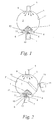
- Figure 1 is a schematic drawing which illustrates the working of the device according to a first embodiment of the invention.
- Figure 2 is a schematic drawing which illustrates the working of the device according to a second embodiment of the invention.
- the invention in general concerns a device and a method which make it possible to classify colourless diamonds, the so-called colours D to F, and near colourless diamonds, the so-called colours G to J, with great accuracy and discernment, as natural and not colour-treated.
- the light transmission through the diamond to be examined is hereby determined and compared to a reference transmission of a reference material.
- the light transmission through the diamond is determined by measuring the light intensity of the light having a certain wavelength which goes through the diamond.
- Figure 1 illustrates a first embodiment of the method according to the invention and of the device used hereby.
- a diamond 1 is hereby placed in a detection chamber 2 on a supporting surface 4 between a light source 5 and a light detector 7.
- the supporting surface 4 may consist of a flat plate.
- the distance between the light source 5 and the supporting surface 4 is preferably kept as small as possible, taking into account the dimensions of the largest diamond to be examined.
- a screened optical guide is provided between the detector 7 and the diamond 1, formed of a calibrated opening 6 in the supporting surface 4 and which guides light coming from a part 10 of the diamond 1 towards the detector 7.
- the cut diamond 1 to be examined is placed with one of the facets, preferably the table facet 11, on the calibrated opening 6 in the supporting surface 4, whereby this opening 6 has the function of an optical guide, as mentioned above.
- the supporting surface 4 is hereby not translucent, as a result of which it has a protective function.
- the supporting surface 4 on the side of the diamond is preferably reflective, such that the light is efficiently coupled through the crown side 12 as well.
- the diameter of the opening 6 is selected such that it is entirely covered by the facet 11 of the smallest cut diamond one wishes to identify on the one hand, and such that it is sufficiently large to be able to carry out a reliable measurement on the other hand, such that the measuring signal is less sensitive to possible inclusions or zoning of for example nitrogen, which may be found in the diamond.
- the diameter of the opening preferably amounts to 1 to 2 mm, such that it is possible to carry out an almost bulk measurement.
- the light source 5 preferably has a non-directed homogenous radiation at the height of the area where the diamond 1 is being positioned, such that the coupling of light in the diamond is practically independent of its cut and size.
- the detection chamber 2 consists of a housing with walls 3 whose inner side 3' is reflective, such that the effect of a pseudo-integrating sphere is obtained and the measured transmission is practically independent of the size and shape of the diamond 1.
- the light of the light source 5 shining in the detection chamber 2 is efficiently coupled into the diamond 1 via almost the entire surface of the diamond 1. Only at the height of the part 10 of the surface thereof, via which the optical guide 6 guides the light penetrating the diamond 1 to the detector 7, no light 9 coming from the light source 5 is coupled into the diamond 1.
- the light source 5 homogenously emits ultra violet light 9 having one or several wavelengths, in the range of 225 nm to 300 nm.
- Diamond has an absolute absorption at a wavelength of 225 nm and a "cut-off" wavelength at 300 nm, which is caused by the presence of A centres in the diamond.
- a narrow-band pass filter 8 which lets light through having a central wavelength selected in the range of 225 nm to 300 nm.
- This filter 8 preferably passes a strong emission wavelength from the light source 5.
- the filter 8 is preferably an interference filter having a band width which is smaller than 10 nm.
- Some diamonds produce fluorescence and phosphorescence when being radiated with UV light.
- the filter 8 obstructs the light caused by the fluorescence and phosphorescence of the diamond, such that the detector signal is caused almost exclusively by ultra violet light which has penetrated the diamond.
- the filter 8 is provided on the window 13 of the housing of the detector 7, it is possible to obtain a very compact arrangement.
- the central wavelength of the filter 8 is not set at specific absorption wavelengths.
- wavelengths having a strong absorption which are typical for diamonds which may be synthetic and/or colour-treated, are avoided.
- the following typical absorption wavelengths are preferably avoided:
- An example of a suitable wavelength is 254 nm, which is the major emission line of a mercury lamp.
- a range of ⁇ 5 nm, namely from 249 nm to 259 nm there is no typical absorption wavelength whereby a specific absorption occurs which is typical for a synthetic and/or colour-treated diamond.
- a low-pressure mercury lamp is cheap to implement and, when using cold cathode fluorescent lamps (CCFL), can be miniaturised at low cost.
- the device according to the invention is calibrated by means of a reference material, such as a cut colourless or near colourless diamond with concentrations of A centres which are about equal to 15 ppm or a calibre which generates an identical measured transmission value in the arrangement. Consequently, a reference transmission is determined by determining the transmission of the reference material in an analogous manner as for the diamond to be examined.
- a reference material such as a cut colourless or near colourless diamond with concentrations of A centres which are about equal to 15 ppm or a calibre which generates an identical measured transmission value in the arrangement. Consequently, a reference transmission is determined by determining the transmission of the reference material in an analogous manner as for the diamond to be examined.
- the reference transmission is stored in a processing unit which is not represented in the drawing.
- This processing unit is connected to the detector 7 and allows to compare the measured value of the transmission of the diamond to be measured with a reference value, namely the measured value of the stored reference transmission.
- the diamond will be considered to be "natural and not colour-treated". If the measured transmission value is larger than the reference transmission, the diamond will be considered as "to be further examined” so that additional examination is necessary to determine the identity of the diamond.
- Figure 2 refers to a second embodiment of the method and device according to the invention which mainly differs from the first embodiment in that the intensity of the light source 5 is also measured via a second detector 14 which receives the light 9 from the light source 5 directly, without said light being coupled to the diamond 1 first.
- a partition 16 By means of a partition 16, the light path of the light source to the second detector 14 is screened off from the diamond to be examined 1.
- the detector 14 is provided, in the same manner as for the detector 7, a screened optical guide which is formed of an inspection opening 15.
- a filter 17 is provided in front of the detector 14, between the latter and the opening 15.
- C centres may cause a yellow colour, although there may be other causes.
- a concentration of C centres of about 0.12 ppm results in a colour J. Consequently, colourless or near colourless synthetic or colour-treated diamonds have a concentration of C centres which is smaller than or equal to 0.12 ppm.
- Synthetic diamonds predominantly have simgle nitrogen, i.e. C centres.
- C centres In the case of high nitrogen contents, such as for type Ib diamonds, the concentration of C centres is larger than 20 ppm, which causes a typical deep yellow colour which is characteristic for the majority of the synthetic diamonds that are used for industrial purposes.
- the total nitrogen concentration In order to produce colourless to near colourless synthetic diamonds, the total nitrogen concentration must be kept low, such as with type II diamonds, since a far advanced aggregation of C centres to A centres, at the synthesis temperature, is not possible on a laboratory time scale. Post-treatments at higher temperatures may accelerate the aggregation of C centres to A centres. However, at temperatures above 1960 °C, the A centres split up again, and a thermal equilibrium is created between the A centres and the C centres.
- Natural diamonds can be treated in HPHT presses known as such.
- the reason why a diamond has a brown undertone is not known at present, but it is being connected to slip planes in the diamond crystal, and not to the presence of nitrogen.
- the brown undertone starts to disappear at temperatures equal to some 2100 °C and it can be efficiently removed within 3 to 10 minutes at temperatures of some 2300 °C.
- H3 centres are colour centres formed of two nitrogens around a vacancy. This creates a deep green to yellow fluorescence, such that the colour of the diamond is turned into a fancy colour.
- the reference transmission for the basis of which it is decided that the diamond is natural and not colour-treated, is determined with a reference diamond which is a cut diamond having a concentration of A centres which is equal to about 15 ppm.
- This concentration of A centres can be determined via the specific absorption in the infrared by means of FTIR measurement. Since the measurement is carried out on any cut whatsoever, and not on a plate with a known thickness and light path, we have to take into account an error margin of ⁇ 50 % when determining an absolute concentration. Consequently, the actual concentration of A centres can be situated between 7 ppm and 22 ppm.
- the supporting surface which serves as a holder for the diamond and optical guide can be replaced by a separate holder and optical guide.
- Use can hereby be made of one or several optical fibres which are screened off from the detection chamber and which are provided against a facet of the diamond.
- the optical guide is screened off from the detection chamber, such that only light can be coupled into the guide which leaves the diamond via the surface of the facet of the latter when it is placed in the detection chamber.
- the transmission can be measured at a certain wavelength by selectively radiating the diamond with light having this wavelength whereby, next, the intensity of said light going through the diamond is measured.
- the diamond can also be radiated with light having a large spectrum of wavelengths, after which the intensity of the light transmitted by the diamond is measured at certain wavelengths by means of a filter placed in front of the detector.
- the detector can also be situated entirely in the detection chamber, and the supporting surface, instead of being a separate plate as represented in the figures, can be part of the inside of the detection chamber. Since no diamond is placed opposite the second detector, as represented in figure 2 , it goes without saying that no bearing surface must be provided in this place.
Landscapes
- Physics & Mathematics (AREA)
- General Physics & Mathematics (AREA)
- Pathology (AREA)
- Life Sciences & Earth Sciences (AREA)
- Chemical & Material Sciences (AREA)
- Analytical Chemistry (AREA)
- Biochemistry (AREA)
- Health & Medical Sciences (AREA)
- General Health & Medical Sciences (AREA)
- Immunology (AREA)
- Spectroscopy & Molecular Physics (AREA)
- Investigating Materials By The Use Of Optical Means Adapted For Particular Applications (AREA)
- Investigating Or Analysing Materials By Optical Means (AREA)
- Polishing Bodies And Polishing Tools (AREA)
- Disintegrating Or Milling (AREA)
- Coloring (AREA)
- Crystals, And After-Treatments Of Crystals (AREA)
Claims (15)
- Verfahren zum Bestimmen eines farblosen oder nahezu farblosen Diamanten auf der Grundlage einer gemessenen Lichtübertragung durch den Diamanten, wobei der Diamant von einer Lichtquelle bestrahlt wird, die Licht mit einer bestimmten Wellenlänge im Bereich von 225 nm bis 300 nm abstrahlt, und die Übertragung des Lichts durch den Diamanten gemessen und mit einem Referenzwert verglichen wird, der der Übertragung des Lichts durch einen Referenzdiamanten entspricht, dadurch gekennzeichnet, dass ein geschliffener farbloser oder nahezu farbloser Diamant mit einer A-Zentren-Konzentration zwischen 7 ppm und 22 ppm als Referenzdiamant ausgewählt wird, und wobei der Diamant als natürlich und nicht farbbehandelt klassifiziert wird, wenn die Übertragung durch den Diamanten kleiner oder gleich dem Referenzwert ist, insbesondere die Übertragung durch den Referenzdiamanten.
- Verfahren gemäß Anspruch 1, wobei ein geschliffener farbloser oder nahezu farbloser Diamant mit einer A-Zentren-Konzentration von etwa 15 ppm als Referenzdiamant verwendet wird.
- Verfahren gemäß Anspruch 1 oder 2, wobei die Lichtquelle Licht mit einer Wellenlänge von 254 nm abgibt.
- Verfahren gemäß einem der Ansprüche 1 bis 3, wobei die Lichtübertragung durch den Diamanten gemessen wird, indem das Licht gemessen wird, das von einem Teil der Diamantenoberfläche abgegeben wird, wenn die restliche Oberfläche des Diamanten beinahe vollständig von der Lichtquelle bestrahlt wird, die Licht mit der genannten Wellenlänge abgibt.
- Verfahren gemäß einem der Ansprüche 1 bis 4, wobei ein Diamant mit einer flachen Seite derart in eine Detektionskammer gelegt wird, dass die flache Seite auf einer Öffnung in der Detektionskammer aufliegt, so dass die Öffnung vom Diamanten völlig bedeckt ist, wobei in der Detektionskammer von der Lichtquelle Licht abgestrahlt wird und wobei die Intensität des Lichts von dieser Lichtquelle, das den Diamanten und die Öffnung durchdringt, gemessen wird, um die Übertragung durch den Diamanten zu bestimmen.
- Verfahren gemäß Anspruch 5, wobei das Licht von der Lichtquelle an den Wänden der Detektionskammer reflektiert wird.
- Verfahren gemäß einem der Ansprüche 1 bis 6, wobei das Licht von der Lichtquelle, das den Diamanten durchdringt, vor der Messung auf eine bestimmte Wellenlänge gefiltert wird.
- Verfahren gemäß Anspruch 7, wobei das Licht von der Lichtquelle, das den Diamanten durchdringt, auf eine Wellenlänge in einem Bereich von 225 nm bis 300 nm gefiltert wird, so dass nur Licht mit einer Wellenlänge in diesem Bereich durchgelassen wird.
- Verfahren gemäß einem der Ansprüche 1 bis 8, wobei das Licht aus der Lichtquelle, das den Diamanten nicht durchdringt, gemessen wird.
- Vorrichtung zum Bestimmen eines Diamanten (1) mit mindestens einer flachen Seite (11), die geeignet ist, das Verfahren gemäß einem der vorangehenden Ansprüche auszuführen, mit einer Detektionskammer (2), in die der Diamant (1) eingebracht werden kann, einer Lichtquelle (5), die Licht mit einer bestimmten Wellenlänge im Bereich von 225 nm bis 300 nm in der Detektionskammer (2) abstrahlen kann, die eine Öffnung (6, 15) aufweist, durch die das Licht sie verlassen kann, einem Detektor (7) zur Feststellung der Lichtintensität des von der Detektionskammer (2) kommenden Lichts, einem Filter (8, 17), der zwischen dem Detektor (7, 14) und dem Diamanten (1) positioniert ist, so dass nur Licht mit bestimmten Wellenlängen durchgelassen wird, mit einer Verarbeitungseinheit, die geeignet ist, einen Referenzwert zu enthalten, und die ein Signal abgibt, wenn die vom Detektor (7) gemessene Lichtintensität größer oder kleiner als der Referenzwert ist, und mit einer Benutzerschnittstelle, die das Signal darstellt, dadurch gekennzeichnet, dass die Öffnung (6) kleiner ist als die Oberfläche der flachen Seite (11) des Diamanten (1 ), so dass diese Seite (11) die Öffnung (6) vollständig bedecken kann und das Licht, das den Diamanten (1) durchdringt, die Detektionskammer (2) über die Öffnung (6) verlassen kann, wobei der Referenzwert einer Übertragung durch einen geschliffenen, farblosen oder nahezu farblosen Diamanten mit einer A-Zentren-Konzentration zwischen 7 ppm und 22 ppm entspricht.
- Vorrichtung gemäß Anspruch 10, wobei die Detektionskammer (2) eine Auflagefläche (4) aufweist, auf die der Diamant (1) gelegt werden kann und in der die Öffnung (6) vorgesehen ist.
- Vorrichtung gemäß Anspruch 11, wobei die Auflagefläche (4) auf der Seite, auf der der Diamant (1) abgelegt ist, reflektierend ist.
- Vorrichtung gemäß einem der Ansprüche 10 bis 12, wobei die Detektionskammer (2) eine reflektierende Innenseite (3') aufweist.
- Vorrichtung gemäß einem der Ansprüche 10 bis 13, wobei die Lichtquelle (5) eine Niederdruck-Quecksilberlampe ist.
- Vorrichtung gemäß einem der Ansprüche 10 bis 14, wobei die Detektionskammer (2) eine Pseudo-Ulbrichtkugel ist, in der sich mindestens die Lichtquelle (5) befindet.
Applications Claiming Priority (1)
| Application Number | Priority Date | Filing Date | Title |
|---|---|---|---|
| BE2004/0559A BE1016537A3 (nl) | 2004-11-10 | 2004-11-10 | Werkwijze voor het onderscheiden van kleurloze en bijna kleurloze diamanten en opstelling voor het uitvoeren van deze werkwijze. |
Publications (2)
| Publication Number | Publication Date |
|---|---|
| EP1657544A1 EP1657544A1 (de) | 2006-05-17 |
| EP1657544B1 true EP1657544B1 (de) | 2008-12-03 |
Family
ID=34938847
Family Applications (1)
| Application Number | Title | Priority Date | Filing Date |
|---|---|---|---|
| EP05101539A Expired - Lifetime EP1657544B1 (de) | 2004-11-10 | 2005-03-01 | Methode zum Herausfiltern farbloser und fast farbloser Diamanten und Vorrichtung dafür. |
Country Status (7)
| Country | Link |
|---|---|
| US (1) | US7277161B2 (de) |
| EP (1) | EP1657544B1 (de) |
| AT (1) | ATE416374T1 (de) |
| BE (1) | BE1016537A3 (de) |
| DE (1) | DE602005011385D1 (de) |
| IL (1) | IL167372A (de) |
| ZA (1) | ZA200509049B (de) |
Families Citing this family (59)
| Publication number | Priority date | Publication date | Assignee | Title |
|---|---|---|---|---|
| US6786733B2 (en) * | 2002-10-15 | 2004-09-07 | Overseas Diamonds Inc. | Computer-implemented method of and system for teaching an untrained observer to evaluate a gemstone |
| US20120268728A1 (en) * | 2011-04-20 | 2012-10-25 | GemEx Systems, Inc., a Wisconsin corporation | Gem positioning and analysis system |
| CN103293158A (zh) * | 2012-03-05 | 2013-09-11 | 江苏天瑞仪器股份有限公司 | 翡翠检定装置及具有该装置的翡翠检定仪 |
| CN102680103B (zh) * | 2012-05-16 | 2015-01-28 | 南京宝光检测技术有限公司 | 一种消除尺寸因素影响钻石颜色准确度的测量仪器 |
| EP2840384B1 (de) * | 2013-08-20 | 2020-06-17 | SATT Gems AG | Vorrichtung zur Klassifizierung von farblosen Diamanten |
| US9853837B2 (en) | 2014-04-07 | 2017-12-26 | Lockheed Martin Corporation | High bit-rate magnetic communication |
| US10088336B2 (en) | 2016-01-21 | 2018-10-02 | Lockheed Martin Corporation | Diamond nitrogen vacancy sensed ferro-fluid hydrophone |
| US9590601B2 (en) | 2014-04-07 | 2017-03-07 | Lockheed Martin Corporation | Energy efficient controlled magnetic field generator circuit |
| US9541610B2 (en) | 2015-02-04 | 2017-01-10 | Lockheed Martin Corporation | Apparatus and method for recovery of three dimensional magnetic field from a magnetic detection system |
| US10088452B2 (en) | 2016-01-12 | 2018-10-02 | Lockheed Martin Corporation | Method for detecting defects in conductive materials based on differences in magnetic field characteristics measured along the conductive materials |
| US9557391B2 (en) | 2015-01-23 | 2017-01-31 | Lockheed Martin Corporation | Apparatus and method for high sensitivity magnetometry measurement and signal processing in a magnetic detection system |
| US9638821B2 (en) | 2014-03-20 | 2017-05-02 | Lockheed Martin Corporation | Mapping and monitoring of hydraulic fractures using vector magnetometers |
| US10168393B2 (en) | 2014-09-25 | 2019-01-01 | Lockheed Martin Corporation | Micro-vacancy center device |
| US9910105B2 (en) | 2014-03-20 | 2018-03-06 | Lockheed Martin Corporation | DNV magnetic field detector |
| US9829545B2 (en) | 2015-11-20 | 2017-11-28 | Lockheed Martin Corporation | Apparatus and method for hypersensitivity detection of magnetic field |
| US9551763B1 (en) | 2016-01-21 | 2017-01-24 | Lockheed Martin Corporation | Diamond nitrogen vacancy sensor with common RF and magnetic fields generator |
| US9910104B2 (en) | 2015-01-23 | 2018-03-06 | Lockheed Martin Corporation | DNV magnetic field detector |
| US10241158B2 (en) | 2015-02-04 | 2019-03-26 | Lockheed Martin Corporation | Apparatus and method for estimating absolute axes' orientations for a magnetic detection system |
| WO2016190909A2 (en) | 2015-01-28 | 2016-12-01 | Lockheed Martin Corporation | Magnetic navigation methods and systems utilizing power grid and communication network |
| EP3251193A4 (de) | 2015-01-28 | 2018-08-08 | Lockheed Martin Corporation | In-situ-stromaufladung |
| SG10201506282WA (en) | 2015-08-12 | 2017-03-30 | Jubilee Diamond Instr S Pte Ltd | Diamond Identification Apparatus |
| WO2017078766A1 (en) | 2015-11-04 | 2017-05-11 | Lockheed Martin Corporation | Magnetic band-pass filter |
| GB2560283A (en) | 2015-11-20 | 2018-09-05 | Lockheed Corp | Apparatus and method for closed loop processing for a magnetic detection system |
| WO2017095454A1 (en) | 2015-12-01 | 2017-06-08 | Lockheed Martin Corporation | Communication via a magnio |
| WO2017127097A1 (en) | 2016-01-21 | 2017-07-27 | Lockheed Martin Corporation | Magnetometer with a light emitting diode |
| WO2017127094A1 (en) | 2016-01-21 | 2017-07-27 | Lockheed Martin Corporation | Magnetometer with light pipe |
| WO2017127096A1 (en) | 2016-01-21 | 2017-07-27 | Lockheed Martin Corporation | Diamond nitrogen vacancy sensor with dual rf sources |
| WO2017127090A1 (en) | 2016-01-21 | 2017-07-27 | Lockheed Martin Corporation | Higher magnetic sensitivity through fluorescence manipulation by phonon spectrum control |
| WO2017127079A1 (en) | 2016-01-21 | 2017-07-27 | Lockheed Martin Corporation | Ac vector magnetic anomaly detection with diamond nitrogen vacancies |
| EP3405603A4 (de) | 2016-01-21 | 2019-10-16 | Lockheed Martin Corporation | Diamantstickstoffleerstellensensor mit schaltung auf diamant |
| US10408890B2 (en) | 2017-03-24 | 2019-09-10 | Lockheed Martin Corporation | Pulsed RF methods for optimization of CW measurements |
| US10228429B2 (en) | 2017-03-24 | 2019-03-12 | Lockheed Martin Corporation | Apparatus and method for resonance magneto-optical defect center material pulsed mode referencing |
| US10345395B2 (en) | 2016-12-12 | 2019-07-09 | Lockheed Martin Corporation | Vector magnetometry localization of subsurface liquids |
| US10145910B2 (en) | 2017-03-24 | 2018-12-04 | Lockheed Martin Corporation | Photodetector circuit saturation mitigation for magneto-optical high intensity pulses |
| US10274550B2 (en) | 2017-03-24 | 2019-04-30 | Lockheed Martin Corporation | High speed sequential cancellation for pulsed mode |
| US10330744B2 (en) | 2017-03-24 | 2019-06-25 | Lockheed Martin Corporation | Magnetometer with a waveguide |
| US10359479B2 (en) | 2017-02-20 | 2019-07-23 | Lockheed Martin Corporation | Efficient thermal drift compensation in DNV vector magnetometry |
| US10677953B2 (en) | 2016-05-31 | 2020-06-09 | Lockheed Martin Corporation | Magneto-optical detecting apparatus and methods |
| US10571530B2 (en) | 2016-05-31 | 2020-02-25 | Lockheed Martin Corporation | Buoy array of magnetometers |
| US10345396B2 (en) | 2016-05-31 | 2019-07-09 | Lockheed Martin Corporation | Selected volume continuous illumination magnetometer |
| US10281550B2 (en) | 2016-11-14 | 2019-05-07 | Lockheed Martin Corporation | Spin relaxometry based molecular sequencing |
| US10317279B2 (en) | 2016-05-31 | 2019-06-11 | Lockheed Martin Corporation | Optical filtration system for diamond material with nitrogen vacancy centers |
| US20170343621A1 (en) | 2016-05-31 | 2017-11-30 | Lockheed Martin Corporation | Magneto-optical defect center magnetometer |
| US10338163B2 (en) | 2016-07-11 | 2019-07-02 | Lockheed Martin Corporation | Multi-frequency excitation schemes for high sensitivity magnetometry measurement with drift error compensation |
| US10527746B2 (en) | 2016-05-31 | 2020-01-07 | Lockheed Martin Corporation | Array of UAVS with magnetometers |
| US10371765B2 (en) | 2016-07-11 | 2019-08-06 | Lockheed Martin Corporation | Geolocation of magnetic sources using vector magnetometer sensors |
| WO2017208053A1 (en) | 2016-06-01 | 2017-12-07 | Jubilee Diamond Instrument (S) Pte.Ltd. | Precious stone testing device |
| US10379174B2 (en) | 2017-03-24 | 2019-08-13 | Lockheed Martin Corporation | Bias magnet array for magnetometer |
| US10459041B2 (en) | 2017-03-24 | 2019-10-29 | Lockheed Martin Corporation | Magnetic detection system with highly integrated diamond nitrogen vacancy sensor |
| US10338164B2 (en) | 2017-03-24 | 2019-07-02 | Lockheed Martin Corporation | Vacancy center material with highly efficient RF excitation |
| US10371760B2 (en) | 2017-03-24 | 2019-08-06 | Lockheed Martin Corporation | Standing-wave radio frequency exciter |
| US10989667B2 (en) | 2017-06-01 | 2021-04-27 | Jubilee Diamond Instrument (S) Pte. Ltd. | UV reflection tester |
| CN107808017A (zh) * | 2017-11-29 | 2018-03-16 | 周大生珠宝股份有限公司 | 钻石明亮度分级方法 |
| CN112492886A (zh) | 2017-12-19 | 2021-03-12 | 钻禧仪器(新加坡)有限公司 | 宝石检测装置 |
| US10837915B2 (en) | 2017-12-19 | 2020-11-17 | Jubilee Diamond Instrument (s) PTE. LTD | Gemstone testing apparatus |
| CA3086268A1 (en) | 2017-12-21 | 2019-06-27 | Universita Degli Studi Di Milano - Bicocca | System and method for spectroscopy analysis of diamonds |
| GB2584876A (en) | 2019-06-19 | 2020-12-23 | Jubilee Diamond Instr S Pte Ltd | Gemstone testing apparatus |
| US11326952B2 (en) * | 2019-07-29 | 2022-05-10 | Goldway Technology Limited | Process and system for colour grading for diamonds |
| WO2022230107A1 (ja) * | 2021-04-28 | 2022-11-03 | 住友電工ハードメタル株式会社 | ダイヤモンドの窒素濃度の測定方法およびダイヤモンドの窒素濃度の測定装置 |
Family Cites Families (11)
| Publication number | Priority date | Publication date | Assignee | Title |
|---|---|---|---|---|
| JPS57204440A (en) * | 1981-06-12 | 1982-12-15 | Kazumi Okuda | Measuring method of diamond and its measuring device |
| FR2528580A1 (fr) * | 1982-06-14 | 1983-12-16 | Frediani Jean | Appareil mesurant la transparence aux ultraviolets courts pour tester des pierres |
| FR2528680A1 (fr) | 1982-06-22 | 1983-12-23 | Sedac | Dispositif d'attache des lattes de bois d'un sommier au cadre metallique de celui-ci |
| US5835200A (en) | 1990-04-24 | 1998-11-10 | Gersan Establishment | Method and apparatus for examining an object |
| DE9005845U1 (de) * | 1990-05-23 | 1990-07-26 | Fa. Carl Zeiss, 7920 Heidenheim | Vorrichtung zur Messung der Absorption von transparenten Proben mit ungünstiger Außenform |
| GB2295227B (en) * | 1992-05-19 | 1996-07-17 | Gersan Ets | Method and apparatus for classifying diamonds |
| GB9210674D0 (en) | 1992-05-19 | 1992-07-01 | Gersan Ets | Method and apparatus for examining an object |
| GB2286251B (en) * | 1994-01-25 | 1997-07-09 | Gersan Ets | Examining a diamond for synthetic diamond |
| DE19610393A1 (de) * | 1996-03-16 | 1997-09-18 | J & M Analytische Mess & Regeltechnik Gmbh | Verfahren und Vorrichtung zum Identifizieren und/oder Klassifizieren von Edelsteinen mit einem Spektrometer |
| US20020008925A1 (en) | 1999-03-04 | 2002-01-24 | Gemological Institute Of America, Inc. | Gem identification viewer |
| BE1015022A3 (nl) * | 2002-07-05 | 2004-08-03 | Wetenschappelijk En Tech Onder | Werkwijze en inrichting voor het onderscheiden van edelstenen. |
-
2004
- 2004-11-10 BE BE2004/0559A patent/BE1016537A3/nl not_active IP Right Cessation
-
2005
- 2005-03-01 DE DE602005011385T patent/DE602005011385D1/de not_active Expired - Lifetime
- 2005-03-01 EP EP05101539A patent/EP1657544B1/de not_active Expired - Lifetime
- 2005-03-01 AT AT05101539T patent/ATE416374T1/de not_active IP Right Cessation
- 2005-03-09 US US11/074,941 patent/US7277161B2/en not_active Expired - Lifetime
- 2005-03-10 IL IL167372A patent/IL167372A/en active IP Right Grant
- 2005-11-09 ZA ZA200509049A patent/ZA200509049B/xx unknown
Also Published As
| Publication number | Publication date |
|---|---|
| DE602005011385D1 (de) | 2009-01-15 |
| US7277161B2 (en) | 2007-10-02 |
| US20060098187A1 (en) | 2006-05-11 |
| ATE416374T1 (de) | 2008-12-15 |
| BE1016537A3 (nl) | 2007-01-09 |
| EP1657544A1 (de) | 2006-05-17 |
| IL167372A (en) | 2010-04-29 |
| ZA200509049B (en) | 2006-10-25 |
Similar Documents
| Publication | Publication Date | Title |
|---|---|---|
| US7277161B2 (en) | Method for discerning colorless and near colorless diamonds and arrangement for carrying out this method | |
| US10684230B2 (en) | Device and method for screening gemstones | |
| US4734584A (en) | Quantitative near-infrared measurement instrument for multiple measurements in both reflectance and transmission modes | |
| US5883389A (en) | Distinguishing natural from synthetic diamonds | |
| Würth et al. | Evaluation of a commercial integrating sphere setup for the determination of absolute photoluminescence quantum yields of dilute dye solutions | |
| US10823680B2 (en) | Device for identifying a diamond | |
| CA2416507C (en) | Instrument for examining a gemstone | |
| AU660413B2 (en) | Method and apparatus for examining an object | |
| AU2001270842A1 (en) | Examining a Gemstone | |
| US5835200A (en) | Method and apparatus for examining an object | |
| RU2679928C1 (ru) | Устройство для идентификации алмаза | |
| EP3729063B1 (de) | System und verfahren zur spektroskopieanalyse von diamanten | |
| Tsai et al. | Rapid gemstone mineral identification using portable Raman spectroscopy | |
| RU2372607C1 (ru) | Устройство для сортировки алмазов | |
| Tsai et al. | Gemstone screening and identification using fluorescence spectroscopy | |
| RU2215285C1 (ru) | Рентгенолюминесцентный способ определения концентрации азотных дефектов в алмазах | |
| GB2274165A (en) | Method and apparatus for examining an object | |
| Sosnin et al. | Application of a KrCl-excilamp (222 nm) for identification of natural and synthetic diamonds | |
| HK40016457A (en) | Device and method for screening gemstones | |
| GB2273559A (en) | Method and apparatus for examining an object | |
| GB2295227A (en) | Classifying diamonds |
Legal Events
| Date | Code | Title | Description |
|---|---|---|---|
| PUAI | Public reference made under article 153(3) epc to a published international application that has entered the european phase |
Free format text: ORIGINAL CODE: 0009012 |
|
| AK | Designated contracting states |
Kind code of ref document: A1 Designated state(s): AT BE BG CH CY CZ DE DK EE ES FI FR GB GR HU IE IS IT LI LT LU MC NL PL PT RO SE SI SK TR |
|
| AX | Request for extension of the european patent |
Extension state: AL BA HR LV MK YU |
|
| 17P | Request for examination filed |
Effective date: 20060714 |
|
| 17Q | First examination report despatched |
Effective date: 20060908 |
|
| AKX | Designation fees paid |
Designated state(s): AT BE BG CH CY CZ DE DK EE ES FI FR GB GR HU IE IS IT LI LT LU MC NL PL PT RO SE SI SK TR |
|
| AXX | Extension fees paid |
Extension state: MK Payment date: 20060714 Extension state: HR Payment date: 20060714 Extension state: BA Payment date: 20060714 Extension state: YU Payment date: 20060714 Extension state: AL Payment date: 20060714 Extension state: LV Payment date: 20060714 |
|
| GRAP | Despatch of communication of intention to grant a patent |
Free format text: ORIGINAL CODE: EPIDOSNIGR1 |
|
| GRAS | Grant fee paid |
Free format text: ORIGINAL CODE: EPIDOSNIGR3 |
|
| GRAA | (expected) grant |
Free format text: ORIGINAL CODE: 0009210 |
|
| AK | Designated contracting states |
Kind code of ref document: B1 Designated state(s): AT BE BG CH CY CZ DE DK EE ES FI FR GB GR HU IE IS IT LI LT LU MC NL PL PT RO SE SI SK TR |
|
| AX | Request for extension of the european patent |
Extension state: AL BA HR LV MK YU |
|
| REG | Reference to a national code |
Ref country code: GB Ref legal event code: FG4D |
|
| REG | Reference to a national code |
Ref country code: CH Ref legal event code: EP |
|
| REG | Reference to a national code |
Ref country code: IE Ref legal event code: FG4D |
|
| REF | Corresponds to: |
Ref document number: 602005011385 Country of ref document: DE Date of ref document: 20090115 Kind code of ref document: P |
|
| REG | Reference to a national code |
Ref country code: CH Ref legal event code: NV Representative=s name: ISLER & PEDRAZZINI AG |
|
| PG25 | Lapsed in a contracting state [announced via postgrant information from national office to epo] |
Ref country code: LT Free format text: LAPSE BECAUSE OF FAILURE TO SUBMIT A TRANSLATION OF THE DESCRIPTION OR TO PAY THE FEE WITHIN THE PRESCRIBED TIME-LIMIT Effective date: 20081203 Ref country code: ES Free format text: LAPSE BECAUSE OF FAILURE TO SUBMIT A TRANSLATION OF THE DESCRIPTION OR TO PAY THE FEE WITHIN THE PRESCRIBED TIME-LIMIT Effective date: 20090314 |
|
| NLV1 | Nl: lapsed or annulled due to failure to fulfill the requirements of art. 29p and 29m of the patents act | ||
| PG25 | Lapsed in a contracting state [announced via postgrant information from national office to epo] |
Ref country code: SI Free format text: LAPSE BECAUSE OF FAILURE TO SUBMIT A TRANSLATION OF THE DESCRIPTION OR TO PAY THE FEE WITHIN THE PRESCRIBED TIME-LIMIT Effective date: 20081203 Ref country code: FI Free format text: LAPSE BECAUSE OF FAILURE TO SUBMIT A TRANSLATION OF THE DESCRIPTION OR TO PAY THE FEE WITHIN THE PRESCRIBED TIME-LIMIT Effective date: 20081203 Ref country code: NL Free format text: LAPSE BECAUSE OF FAILURE TO SUBMIT A TRANSLATION OF THE DESCRIPTION OR TO PAY THE FEE WITHIN THE PRESCRIBED TIME-LIMIT Effective date: 20081203 Ref country code: PL Free format text: LAPSE BECAUSE OF FAILURE TO SUBMIT A TRANSLATION OF THE DESCRIPTION OR TO PAY THE FEE WITHIN THE PRESCRIBED TIME-LIMIT Effective date: 20081203 |
|
| PG25 | Lapsed in a contracting state [announced via postgrant information from national office to epo] |
Ref country code: RO Free format text: LAPSE BECAUSE OF FAILURE TO SUBMIT A TRANSLATION OF THE DESCRIPTION OR TO PAY THE FEE WITHIN THE PRESCRIBED TIME-LIMIT Effective date: 20081203 Ref country code: EE Free format text: LAPSE BECAUSE OF FAILURE TO SUBMIT A TRANSLATION OF THE DESCRIPTION OR TO PAY THE FEE WITHIN THE PRESCRIBED TIME-LIMIT Effective date: 20081203 Ref country code: BG Free format text: LAPSE BECAUSE OF FAILURE TO SUBMIT A TRANSLATION OF THE DESCRIPTION OR TO PAY THE FEE WITHIN THE PRESCRIBED TIME-LIMIT Effective date: 20090303 |
|
| PG25 | Lapsed in a contracting state [announced via postgrant information from national office to epo] |
Ref country code: SE Free format text: LAPSE BECAUSE OF FAILURE TO SUBMIT A TRANSLATION OF THE DESCRIPTION OR TO PAY THE FEE WITHIN THE PRESCRIBED TIME-LIMIT Effective date: 20090303 Ref country code: AT Free format text: LAPSE BECAUSE OF FAILURE TO SUBMIT A TRANSLATION OF THE DESCRIPTION OR TO PAY THE FEE WITHIN THE PRESCRIBED TIME-LIMIT Effective date: 20081203 Ref country code: CZ Free format text: LAPSE BECAUSE OF FAILURE TO SUBMIT A TRANSLATION OF THE DESCRIPTION OR TO PAY THE FEE WITHIN THE PRESCRIBED TIME-LIMIT Effective date: 20081203 Ref country code: IS Free format text: LAPSE BECAUSE OF FAILURE TO SUBMIT A TRANSLATION OF THE DESCRIPTION OR TO PAY THE FEE WITHIN THE PRESCRIBED TIME-LIMIT Effective date: 20090403 Ref country code: PT Free format text: LAPSE BECAUSE OF FAILURE TO SUBMIT A TRANSLATION OF THE DESCRIPTION OR TO PAY THE FEE WITHIN THE PRESCRIBED TIME-LIMIT Effective date: 20090504 |
|
| PG25 | Lapsed in a contracting state [announced via postgrant information from national office to epo] |
Ref country code: SK Free format text: LAPSE BECAUSE OF FAILURE TO SUBMIT A TRANSLATION OF THE DESCRIPTION OR TO PAY THE FEE WITHIN THE PRESCRIBED TIME-LIMIT Effective date: 20081203 |
|
| PLBE | No opposition filed within time limit |
Free format text: ORIGINAL CODE: 0009261 |
|
| STAA | Information on the status of an ep patent application or granted ep patent |
Free format text: STATUS: NO OPPOSITION FILED WITHIN TIME LIMIT |
|
| PG25 | Lapsed in a contracting state [announced via postgrant information from national office to epo] |
Ref country code: MC Free format text: LAPSE BECAUSE OF NON-PAYMENT OF DUE FEES Effective date: 20090331 Ref country code: DK Free format text: LAPSE BECAUSE OF FAILURE TO SUBMIT A TRANSLATION OF THE DESCRIPTION OR TO PAY THE FEE WITHIN THE PRESCRIBED TIME-LIMIT Effective date: 20081203 |
|
| 26N | No opposition filed |
Effective date: 20090904 |
|
| REG | Reference to a national code |
Ref country code: FR Ref legal event code: ST Effective date: 20091130 |
|
| PG25 | Lapsed in a contracting state [announced via postgrant information from national office to epo] |
Ref country code: IE Free format text: LAPSE BECAUSE OF NON-PAYMENT OF DUE FEES Effective date: 20090301 |
|
| PG25 | Lapsed in a contracting state [announced via postgrant information from national office to epo] |
Ref country code: FR Free format text: LAPSE BECAUSE OF NON-PAYMENT OF DUE FEES Effective date: 20091123 |
|
| PG25 | Lapsed in a contracting state [announced via postgrant information from national office to epo] |
Ref country code: GR Free format text: LAPSE BECAUSE OF FAILURE TO SUBMIT A TRANSLATION OF THE DESCRIPTION OR TO PAY THE FEE WITHIN THE PRESCRIBED TIME-LIMIT Effective date: 20090304 |
|
| PG25 | Lapsed in a contracting state [announced via postgrant information from national office to epo] |
Ref country code: IT Free format text: LAPSE BECAUSE OF FAILURE TO SUBMIT A TRANSLATION OF THE DESCRIPTION OR TO PAY THE FEE WITHIN THE PRESCRIBED TIME-LIMIT Effective date: 20081203 |
|
| PG25 | Lapsed in a contracting state [announced via postgrant information from national office to epo] |
Ref country code: LU Free format text: LAPSE BECAUSE OF NON-PAYMENT OF DUE FEES Effective date: 20090301 |
|
| PG25 | Lapsed in a contracting state [announced via postgrant information from national office to epo] |
Ref country code: HU Free format text: LAPSE BECAUSE OF FAILURE TO SUBMIT A TRANSLATION OF THE DESCRIPTION OR TO PAY THE FEE WITHIN THE PRESCRIBED TIME-LIMIT Effective date: 20090604 |
|
| PG25 | Lapsed in a contracting state [announced via postgrant information from national office to epo] |
Ref country code: TR Free format text: LAPSE BECAUSE OF FAILURE TO SUBMIT A TRANSLATION OF THE DESCRIPTION OR TO PAY THE FEE WITHIN THE PRESCRIBED TIME-LIMIT Effective date: 20081203 |
|
| PG25 | Lapsed in a contracting state [announced via postgrant information from national office to epo] |
Ref country code: CY Free format text: LAPSE BECAUSE OF FAILURE TO SUBMIT A TRANSLATION OF THE DESCRIPTION OR TO PAY THE FEE WITHIN THE PRESCRIBED TIME-LIMIT Effective date: 20081203 |
|
| REG | Reference to a national code |
Ref country code: CH Ref legal event code: PUE Owner name: HS TECHNOLOGY N.V., BE Free format text: FORMER OWNER: WETENSCHAPPELIJK EN TECHNISCH ONDERZOEKSCENTRUM VOOR DIAMANT, BE |
|
| REG | Reference to a national code |
Ref country code: DE Ref legal event code: R081 Ref document number: 602005011385 Country of ref document: DE Owner name: HS TECHNOLOGY N.V., BE Free format text: FORMER OWNER: WETENSCHAPPELIJK EN TECHNISCH ONDERZOEKSCENTRUM VOOR DIAMANT, LIER, BE |
|
| REG | Reference to a national code |
Ref country code: GB Ref legal event code: 732E Free format text: REGISTERED BETWEEN 20200227 AND 20200304 |
|
| REG | Reference to a national code |
Ref country code: BE Ref legal event code: PD Owner name: HS TECHNOLOGY N.V.; BE Free format text: DETAILS ASSIGNMENT: CHANGE OF OWNER(S), CESSION; FORMER OWNER NAME: WETENSCHAPPELIJK EN TECHNISCH ONDERZOEKSCENTRUM VOOR DIAMANT Effective date: 20200205 |
|
| PGFP | Annual fee paid to national office [announced via postgrant information from national office to epo] |
Ref country code: DE Payment date: 20240327 Year of fee payment: 20 Ref country code: GB Payment date: 20240327 Year of fee payment: 20 |
|
| PGFP | Annual fee paid to national office [announced via postgrant information from national office to epo] |
Ref country code: BE Payment date: 20240329 Year of fee payment: 20 |
|
| PGFP | Annual fee paid to national office [announced via postgrant information from national office to epo] |
Ref country code: CH Payment date: 20240402 Year of fee payment: 20 |
|
| REG | Reference to a national code |
Ref country code: DE Ref legal event code: R071 Ref document number: 602005011385 Country of ref document: DE |
|
| REG | Reference to a national code |
Ref country code: CH Ref legal event code: PL |
|
| REG | Reference to a national code |
Ref country code: GB Ref legal event code: PE20 Expiry date: 20250228 |
|
| PG25 | Lapsed in a contracting state [announced via postgrant information from national office to epo] |
Ref country code: GB Free format text: LAPSE BECAUSE OF EXPIRATION OF PROTECTION Effective date: 20250228 |
|
| REG | Reference to a national code |
Ref country code: BE Ref legal event code: MK Effective date: 20250301 |