EP1660123B1 - Rotavirus-vakzine - Google Patents
Rotavirus-vakzine Download PDFInfo
- Publication number
- EP1660123B1 EP1660123B1 EP04764688A EP04764688A EP1660123B1 EP 1660123 B1 EP1660123 B1 EP 1660123B1 EP 04764688 A EP04764688 A EP 04764688A EP 04764688 A EP04764688 A EP 04764688A EP 1660123 B1 EP1660123 B1 EP 1660123B1
- Authority
- EP
- European Patent Office
- Prior art keywords
- rotavirus
- serotypes
- vaccine
- use according
- composition
- Prior art date
- Legal status (The legal status is an assumption and is not a legal conclusion. Google has not performed a legal analysis and makes no representation as to the accuracy of the status listed.)
- Expired - Lifetime
Links
Images

Classifications
-
- A—HUMAN NECESSITIES
- A61—MEDICAL OR VETERINARY SCIENCE; HYGIENE
- A61K—PREPARATIONS FOR MEDICAL, DENTAL OR TOILETRY PURPOSES
- A61K39/00—Medicinal preparations containing antigens or antibodies
- A61K39/12—Viral antigens
-
- A—HUMAN NECESSITIES
- A61—MEDICAL OR VETERINARY SCIENCE; HYGIENE
- A61K—PREPARATIONS FOR MEDICAL, DENTAL OR TOILETRY PURPOSES
- A61K39/00—Medicinal preparations containing antigens or antibodies
- A61K39/12—Viral antigens
- A61K39/15—Reoviridae, e.g. calf diarrhea virus
-
- A—HUMAN NECESSITIES
- A61—MEDICAL OR VETERINARY SCIENCE; HYGIENE
- A61P—SPECIFIC THERAPEUTIC ACTIVITY OF CHEMICAL COMPOUNDS OR MEDICINAL PREPARATIONS
- A61P1/00—Drugs for disorders of the alimentary tract or the digestive system
- A61P1/04—Drugs for disorders of the alimentary tract or the digestive system for ulcers, gastritis or reflux esophagitis, e.g. antacids, inhibitors of acid secretion, mucosal protectants
-
- A—HUMAN NECESSITIES
- A61—MEDICAL OR VETERINARY SCIENCE; HYGIENE
- A61P—SPECIFIC THERAPEUTIC ACTIVITY OF CHEMICAL COMPOUNDS OR MEDICINAL PREPARATIONS
- A61P1/00—Drugs for disorders of the alimentary tract or the digestive system
- A61P1/12—Antidiarrhoeals
-
- A—HUMAN NECESSITIES
- A61—MEDICAL OR VETERINARY SCIENCE; HYGIENE
- A61P—SPECIFIC THERAPEUTIC ACTIVITY OF CHEMICAL COMPOUNDS OR MEDICINAL PREPARATIONS
- A61P31/00—Antiinfectives, i.e. antibiotics, antiseptics, chemotherapeutics
- A61P31/12—Antivirals
-
- A—HUMAN NECESSITIES
- A61—MEDICAL OR VETERINARY SCIENCE; HYGIENE
- A61P—SPECIFIC THERAPEUTIC ACTIVITY OF CHEMICAL COMPOUNDS OR MEDICINAL PREPARATIONS
- A61P37/00—Drugs for immunological or allergic disorders
- A61P37/02—Immunomodulators
- A61P37/04—Immunostimulants
-
- A—HUMAN NECESSITIES
- A61—MEDICAL OR VETERINARY SCIENCE; HYGIENE
- A61K—PREPARATIONS FOR MEDICAL, DENTAL OR TOILETRY PURPOSES
- A61K39/00—Medicinal preparations containing antigens or antibodies
- A61K2039/51—Medicinal preparations containing antigens or antibodies comprising whole cells, viruses or DNA/RNA
- A61K2039/525—Virus
- A61K2039/5254—Virus avirulent or attenuated
-
- A—HUMAN NECESSITIES
- A61—MEDICAL OR VETERINARY SCIENCE; HYGIENE
- A61K—PREPARATIONS FOR MEDICAL, DENTAL OR TOILETRY PURPOSES
- A61K39/00—Medicinal preparations containing antigens or antibodies
- A61K2039/54—Medicinal preparations containing antigens or antibodies characterised by the route of administration
- A61K2039/541—Mucosal route
- A61K2039/542—Mucosal route oral/gastrointestinal
-
- A—HUMAN NECESSITIES
- A61—MEDICAL OR VETERINARY SCIENCE; HYGIENE
- A61K—PREPARATIONS FOR MEDICAL, DENTAL OR TOILETRY PURPOSES
- A61K39/00—Medicinal preparations containing antigens or antibodies
- A61K2039/545—Medicinal preparations containing antigens or antibodies characterised by the dose, timing or administration schedule
-
- A—HUMAN NECESSITIES
- A61—MEDICAL OR VETERINARY SCIENCE; HYGIENE
- A61K—PREPARATIONS FOR MEDICAL, DENTAL OR TOILETRY PURPOSES
- A61K39/00—Medicinal preparations containing antigens or antibodies
- A61K2039/555—Medicinal preparations containing antigens or antibodies characterised by a specific combination antigen/adjuvant
- A61K2039/55505—Inorganic adjuvants
-
- C—CHEMISTRY; METALLURGY
- C12—BIOCHEMISTRY; BEER; SPIRITS; WINE; VINEGAR; MICROBIOLOGY; ENZYMOLOGY; MUTATION OR GENETIC ENGINEERING
- C12N—MICROORGANISMS OR ENZYMES; COMPOSITIONS THEREOF; PROPAGATING, PRESERVING, OR MAINTAINING MICROORGANISMS; MUTATION OR GENETIC ENGINEERING; CULTURE MEDIA
- C12N2720/00—MICROORGANISMS OR ENZYMES; COMPOSITIONS THEREOF; PROPAGATING, PRESERVING, OR MAINTAINING MICROORGANISMS; MUTATION OR GENETIC ENGINEERING; CULTURE MEDIA dsRNA viruses
- C12N2720/00011—Details
- C12N2720/12011—Reoviridae
- C12N2720/12311—Rotavirus, e.g. rotavirus A
- C12N2720/12334—Use of virus or viral component as vaccine, e.g. live-attenuated or inactivated virus, VLP, viral protein
Definitions
- the invention relates to the use of an attenuated rotavirus population from one rotavirus serotype in the prevention of disease associated with rotavirus infection from another rotavirus serotype.
- the invention relates to the use of an attenuated rotavirus population from G1 serotype in the prevention of disease associated with rotavirus infection from non-G1 serotypes.
- Acute, infectious diarrhoea is a leading cause of disease and death in many areas of the world. In developing countries, the impact of diarrhoeal disease is staggering. For Asia, Africa and Latin America, it has been estimated that there are between 3-4 billion cases of diarrhoea each year and of those cases about 5-10 million result in death ( Walsh, J.A. et al.: N. Engl. J. Med., :301:967-974 (1979 )).
- Rotaviruses have been recognised as one of the most important causes of severe diarrhoea in infants and young children ( Estes, M.K. Rotaviruses and Their Replication in Fields Virology, Third Edition, edited by Fields et al., Raven Publishers, Philadelphia, 1996 ). It is estimated that rotavirus disease is responsible for over one million deaths annually. Rotavirus-induced illness most commonly affects children between 6 and 24 months of age, and the peak prevalence of the disease generally occurs during the cooler months in temperate climates, and year-round in tropical areas. Rotaviruses are typically transmitted from person to person by the faecal-oral route with an incubation period of from about 1 to about 3 days.
- neonates are generally asymptomatic or have only mild disease. In contrast to the severe disease normally encountered in young children, most adults are protected as a result of previous rotavirus infection so most adult infections are mild or asymptomatic ( Offit, P.A. et al. Comp. Ther., 8(8):21-26, 1982 ).
- Rotaviruses are generally spherical, and their name is derived from their distinctive outer and inner or double-shelled capsid structure.
- the double-shelled capsid structure of a rotavirus surrounds an inner protein shell or core that contains the genome.
- the genome of a rotavirus is composed of 11 segments of double-stranded RNA which encode at least 11 distinct viral proteins.
- Two of these viral proteins designated as VP4 and VP7 are arranged on the exterior of the double-shelled capsid structure.
- the inner capsid of the rotavirus presents one protein, which is the rotavirus protein designated VP6.
- the relative importance of these three particular rotaviral proteins in eliciting the immune response that follows rotavirus infection is not yet clear. Nevertheless, the VP6 protein determines the group and subgroup antigen, and VP4 and VP7 proteins are the determinants of serotype specificity.
- VP7 protein is a 38,000 MW glycoprotein (34,000 MW when non-glycosylated) which is the translational.product of genomic segment 7, 8 or 9, depending on the strain. This protein stimulates formation of the neutralising antibody following rotavirus infection.
- VP4 protein is a non-glycosylated protein of approximately 88,000 MW which is the translational product of genomic segment 4. This protein also stimulates neutralising antibody following rotavirus infection.
- VP4 and VP7 proteins are the viral proteins against which neutralising antibodies are directed, they are believed to be prime candidates for development of rotavirus vaccines, affording protection against rotavirus illness.
- Natural rotavirus infection during early childhood is known to elicit protective immunity.
- a live attenuated rotavirus vaccine is thus highly desirable.
- this should be an oral vaccine, as this is the natural route of infection of the virus.
- a rotavirus strain known as 89-12 has been described by Ward; see US 5474773 and Bernstein, D.L. et al, Vaccine, 16 (4), 381-387, 1998 .
- the 89-12 strain was isolated from a stool specimen collected from a 14 month-old child with natural rotavirus illness in 1988.
- the HRV 89-12 human rotavirus was then culture-adapted by 2 passages in primary African Green Monkey Kidney (AGMK) cells and 4 passages in MA-104 cells as described by Ward in J. Clin. Microbiol., 19, 748-753, 1984 . It was then plaque purified 3 times in MA-104 cells (to passage 9) and grown after 2 additional passages in these cells.
- One additional passage was made (passage 12) for deposition with the ATCC under the accession number ATCC VR 2272.
- the deposited strain is known as 89-12C2.
- the 1998 paper in Vaccine by Bernstein et al is referred to below as the Vaccine (1998) paper.
- the paper describes the safety and immunogenicity of an orally administered live human rotavirus vaccine candidate. This vaccine was obtained from strain 89-12, attenuated by passaging without plaque purification 26 times in primary AGMK cells and then another 7 times in an established AGMK cell line (33 passages in total).
- P26 rotavirus derived by passaging 89-12 n times
- P33 rotavirus derived by passaging 89-12 n times
- P26 population described in the literature comprises a mixture of variants. This has been established by genetic characterisation as described hereinbelow (see examples). P26 is therefore not a reliably consistent population for further passages, in particular for the production of vaccine lots. Similarly, P33 comprises a mixture of variants and is not reliably consistent for the production of vaccine lots.
- the P26 material is a mixture of at least three VP4 gene variants.
- P33 and P38 are similarly a mixture of two variants. These variants appear to be antigenically different, in terms of neutralising epitopes, to the 89-12C2 strain deposited at the ATCC when evaluating the neutralizing antibody titers of sera from infants vaccinated with P33 against these variants.
- WO 0112797 discloses a method of separating rotavirus variants and an improved live attenuated rotavirus vaccine derived from a cloned (homogeneous) human rotavirus. strain. Also disclosed is an attenuated rotavirus population (isolate), characterised in that it comprises a single variant or substantially a single variant, said variant defined by the nucleotide sequence encoding at least one of the major viral proteins designated as VP4 and VP7. Protective efficacy of such an oral attenuated human rotavirus vaccine against G9 heterologous strain has been reported in Latin American infants (Perez et al. 42nd Interscience Conference on Antimicrobial Agents and Chemotherapy (ICAAC 2002) 27-30 September 2002, San Diego ).
- an attenuated human rotavirus strain from a G1 serotype in the preparation of a composition for inducing an immune response against rotavirus infection from the G1 and at least two of the non-G1 rotavirus serotypes selected from the group consisting of: G2, G3, G4 and G9 serotypes
- the attenuated rotavirus strain is a single rotavirus variant, or substantially a single rotavirus variant, having a VP4 gene comprising, in the nucleotide sequence, an adenine (A) at positions 788 and 802 and a thymine (T) at position 501 from the start codon; and wherein the VP7 gene comprises, in the nucleotide sequence, a thymine (T) at position 605 and an adenine (A) at position 897 from the start codon.
- an attenuated rotavirus strain from a G1 serotype in the preparation of a composition for inducing an immune response against rotavirus infection from the G1 and at least two of the non-G1 rotavirus serotypes selected from the group consisting of: G2, G3, G4 and G9 serotypes
- the attenuated rotavirus strain is ECACC deposit 99081301, or a single rotavirus variant, or substantially a single rotavirus variant, obtainable or derivable from ECACC deposit 99081301 and having a VP4 gene comprising, in the nucleotide sequence, an adenine (A) at positions 788 and 802 and a thymine (T) at position 501 from the start codon, and wherein the VP7 gene comprises, in the nucleotide sequence, a thymine (T) at position 605 and an adenine (A) at position 897 from
- an attenuated rotavirus population characterised in that it comprises a single variant or substantially a single variant, said variant defined by a nucleotide sequence encoding at least one of the major viral proteins designated as VP4 and VP7, can be used as a vaccine to provide cross protection against disease caused by rotavirus infection of a different serotype to that used in the vaccine.
- G1 rotavirus population [for example as deposited at the European Collection of Animal Cell Cultures (ECACC), Vaccine Research and Production Laboratory, Public Health Laboratory Service, Centre for Applied Microbiology and Research, Porton Down, Salisbury, Wiltshire, SP4 0JG, United Kingdom on 13 August 1999 under the deposition number 99081301, under the terms of the Budapest Treaty], can be used to prevent disease caused by both G1 and at least one non-G1 rotavirus serotype, such as the G2, G3, G4 and G9 rotavirus serotypes.
- the present disclosure relates to use of an attenuated rotavirus population from one rotavirus serotype in the prevention of disease associated with rotavirus infection from another rotavirus serotype, wherein the serotype is defined by reference to the sequence of the rotavirus G protein.
- the disclosure describes a rotavirus population characterised in that it comprises a single variant or substantially a single variant, said variant defined by a nucleotide sequence encoding at least one of the major viral proteins designated as VP4 and VP7.
- the disclosure describes a rotavirus population for use to provide a cross protective effect comprising VP4 and/or VP7 viral proteins from ECACC deposit 99081301.
- a G1 attenuated rotavirus population made of a single rotavirus variant, or substantially a single rotavirus variant, having a VP4 gene comprising, in the nucleotide sequence, an adenine (A) at positions 788 and 802 and a thymine (T) at position 501 from the start codon; and a VP7 gene comprises, in the nucleotide sequence, a thymine (T) at position 605 and an adenine (A) at position 897 from the start codon [for example as deposited at the European Collection of Animal Cell Cultures (ECACC), Vaccine Research and Production Laboratory, Public Health Laboratory Service, Centre for Applied Microbiology and Research, Porton Down, Salisbury, Wiltshire, SP4 0JG, United Kingdom on 13 August 1999 under the deposition number 99081301, under the terms of the Budapest Treaty], can be used to prevent disease caused by G1 and at least two, more preferably at least three, most preferably at least four
- an attenuated rotavirus strain from a G1 serotype in the manufacture of a vaccine composite for the induction of an immune response against a rotavirus which is not G1 or G9.
- an immune response additionally induced against. rotavirus infection by a G9 serotype and/or G1 serotype is further disclosed.
- any serotype other than G1 or G9 are selected from the list consisting of: G2, G3, G4, G5, G6, G7, G8, G10, G11, G12, G13 and G14.
- the disclosure also relates to a method of inducing an immune response against rotavirus infection from a rotavirus serotype, the method comprising administering to a subject a composition comprising an attenuated rotavirus vaccine from a different serotype.
- the disclosure describes a method of inducing an immune response against rotavirus non- G9 serotype, the method comprising administering to a subject a composition comprising a rotavirus G1 serotype vaccine comprising a single variant or substantially a single variant as defined herein.
- the rotavirus population within the vaccine composition for use according to the invention may be of G1P1A P[8] specificity. Disclosure therein is a rotavirus population comprising VP4 and/or VP7 viral proteins from ECACC deposit 99081301 which is suitable to elicit an immune response and typically, provide a cross protective effect. According to one embodiment of the invention, the rotavirus vaccine, for use is the ECACC deposit 99081301, or is as defined in the claims and derived from that deposit.
- the disclosure excludes the use of the rotavirus strain corresponding to ECACC 99081301, in a method or use as indicated above for inducing an immune response to the G9 serotype alone, although use of such a G1 strain for the induction of immune responses to G9 in combination with induction of immune responses to other G serotypes is generally not excluded.
- the disclosure relates to G1P8 rotavirus strains in methods or uses as described above.
- the vaccine is for administration in a 2 dose regime.
- the vaccine for use according to the invention provides cross protection against gastro-enteritis. Accordingly, in another aspect there is provided a use according to the invention wherein the composition is up to 60% protective, in a population of vaccinated individuals, against diarrhoea caused by infection of rotaviruses of at least two non-G1 serotypes. In another aspect, there is provided a use according to the invention wherein the composition is up to 81% protective against gastro-enteritis. In a still further aspect, there is provided a use according to the invention wherein the composition comprises a G1 rotavirus strain which is up to 83% protective in a population of vaccinated individuals against severe gastro-enteritis.
- the protection rate against diarrhoea and/or gastro-enteritis and/or severe gastro-enteritis achieved in a population of vaccinated individuals infected by a rotavirus of a different type to that of the attenuated rotavirus present in the composition is between 10 to 90%, more preferably between 20 to 80%, most preferably at least 50%.
- the rotavirus vaccine for use according to the invention to give cross-protection has the following preferred features:
- the rotavirus population for use according to the invention is a cloned variant as defined in the claims.
- a population comprising a single variant, or substantially a single variant is meant a rotavirus population which does not contain more than 10%, and preferably less than 5% and most preferably less than 1% of a different variant or variants.
- Virus populations can be purified to homogeneity or substantial homogeneity by passaging on suitable cell types or by performing a series of one or more cloning steps.
- An advantage of the invention is that a population comprising a single variant is more suitable for the formulation of a consistent vaccine lot.
- Particular variants defined by nucleotide sequences encoding the major viral proteins may also be associated with enhanced efficacy in the prevention of rotavirus infection.
- the single or substantial single variant in the rotavirus population for use according to the invention is a variant in which the VP4 gene comprises a nucleotide sequence comprising the following: an adenine base (A) at position 788, an adenine base (A) at position 802 and a thymine base (T) at position 501 from the start codon, and in which the VP7 gene comprises a nucleotide sequence comprising a thymine (T) at position 605 and an adenine (A) at position 897.
- the VP4 gene comprises a nucleotide sequence comprising the following: an adenine base (A) at position 788, an adenine base (A) at position 802 and a thymine base (T) at position 501 from the start codon
- the VP7 gene comprises a nucleotide sequence comprising a thymine (T) at position 605 and an adenine (A) at position 897.
- the disclosure describes a single variant comprising a nucleotide sequence encoding a VP4 protein wherein the nucleotide sequence is as shown in Figure 1 , and/or a nucleotide sequence encoding a VP7 protein wherein the nucleotide sequence is as shown in Figure 2 .
- Rotavirus populations for use in the present invention may be obtained by a method comprising:
- the population is derived from the P33 or P26 strains as described above.
- sequence determination may suitably be carried out by a quantitative or semiquantitative hybridisation technique such as slot blot hybridisation or plaque hybridisation.
- the selected variant is a variant which is replicated and excreted when the starting rotavirus preparation is administered to a human subject, in particular a child.
- the resulting cloned virus population resulting from the method described above may be amplified by further passaging on a suitable cell line.
- Suitable cell types for passaging the rotavirus population in the above method include African green monkey kidney (AGMK) cells, which may be established cell lines or primary AGMK cells.
- AGMK cell lines include for example Vero (ATCC CCL-81), DBS-FRhL-2 (ATCC CL-160), BSC-1 (ECACC 85011422) and CV-1 (ATCC CCL-70).
- MA-104 rhesus monkey
- MRC-5 human - ATCC CCL-171
- the disclosure describes a method for preparing a rotavirus population suitable for use according to the invention, using a rotavirus having the characteristics of the 89-12 strain or of a passaged derivative thereof.
- a single variant population for use according to the invention is P43, which was obtained from P33 (an isolated human rotavirus passages 33 times in culture on appropriate cell types) by a series of end dilution cloning steps followed by passaging the cloned material on Vero cells for amplification.
- the disclosure encompasses materials derived from the deposited P43 ECACC 99081301 by subjecting it to further processing such as by propagating it by further passaging, cloning, or other procedures using the live virus or by modifying P43 in any way including by genetic engineering techniques or reassortant techniques. Such steps and techniques are well known in the art.
- reassortant rotaviruses which comprise at least one antigen or at least one segment of P43, for example reassortants which comprise a virulent strain of rotavirus in which one or part of one of the 11 genome segments has been replaced by the genome segment or part thereof of P43.
- a rotavirus reassortant in which the segment or partial segment coding for NSP4 is a P43 segment or partial segment may have useful properties.
- Reassortant rotaviruses and techniques for preparing them are well known ( Foster, R. H. and Wagstaff, A. J. Tetravalent Rotavirus Vaccine, a review. ADIS drug evaluation, BioDrugs, Gev, 9 (2),155-178, 1998 ).
- Immunologically active derivatives means materials obtained from or with the P43 virus, particularly antigens of the virus, which are capable of eliciting an immune response that is reactive against Rotavirus when injected into a host animal.
- ether-sensitive adventitious viruses In the case of ether-sensitive adventitious viruses, this may be done by ether treatment as described hereinbelow.
- the present disclosure also relates to inclusion of such ether treatment as an optional step in the overall procedure for obtaining an attenuated live rotavirus or vaccine formulated therewith.
- the cross protective rotavirus strain for use according to the present invention may be combined with other rotavirus strains to provide additional protection or cross-protection against rotavirus infection or disease.
- the present disclosure also describes live attenuated rotavirus vaccine capable of providing cross protection, which comprises a substantially single variant population, admixed with a suitable adjuvant or a pharmaceutical carrier.
- a rotavirus vaccine being a monovalent rotavirus vaccine containing a single rotavirus strain.
- the present disclosure describes a particularly advantageous live rotavirus vaccine in which the live attenuated rotavirus is a human rotavirus and does not cause intussusception.
- Suitable pharmaceutical carriers for use with the attenuated rotavirus strain used according to the invention include those known in the art as being suitable for oral administration, especially to infants.
- Such carriers include and are not limited to carbohydrates, polyalcohols, amino acids, aluminium hydroxide, magnesium hydroxide, hydroxyapatite, talc, titanium oxide, iron hydroxide, magnesium stearate, carboxymethylcellulose, hydroxypropylmethylcellulose, microcrystalline cellulose, gelatin, vegetal peptone, xanthane, caraghenane, arabic gum; ß-cyclodextrin.
- the invention also discloses a process for preparing a rotavirus vaccine, for example by freeze drying the virus in the presence of suitable stabilisers or admixing the virus with a suitable adjuvant or pharmaceutical carrier.
- lipid-based vehicles such as virosomes or liposomes
- immunostimulants such as those known in the art for oral vaccines may be included in the formulation.
- immunostimulants include bacterial toxins, particularly cholera toxin (CT) in the form of the holotoxin (entire molecule) or the B chain only (CTB) and the heat labile enterotoxin of E . coli (LT).
- CT cholera toxin
- LT heat labile enterotoxin of E . coli
- mLTs Mutated LTs which are less likely to convert to their active form than the native LT are described in WO 96/06627 , WO 93/13202 and US 5,182,109 .
- saponin derivatives such as QS21 and monophosphoryl lipid A, in particular 3-de-O-acylated monophosphoryl lipid A (3D-MPL).
- Purified saponins as oral adjuvants are described in WO 98/56415 .
- Saponins and monophosphoryl lipid A may be employed separately or in combination (e.g. WO 94/00153 ) and may be formulated in adjuvant systems together with other agents.
- 3D-MPL is a well-known adjuvant manufactured by Ribi Immunochem, Montana and its manufacture is described in GB 2122204 .
- the invention also discloses a method for vaccinating human subjects, especially infants, by administering to a subject in need thereof an effective amount of a vaccine composition for use according to the invention.
- a vaccine composition for use according to the invention.
- the live attenuated vaccine is formulated for oral administration.
- the disclosure describes an attenuated rotavirus strain for use according to the invention formulated with an antacid to minimise inactivation of the vaccine by acid in the stomach.
- Suitable antacid components include inorganic antacids for example aluminium hydroxide AI(OH) 3 and magnesium hydroxide Mg(OH) 2 .
- Commercially available antacids which are suitable for use in the invention include Mylanta (trade mark) which contains aluminium hydroxide and magnesium hydroxide. These are insoluble in water and are given in suspension.
- Aluminium hydroxide is a particularly preferred component of a vaccine composition for use according to the invention as it can provide not only an antacid effect but also an adjuvantation effect.
- organic antacids such as organic acid carboxylate salts.
- a preferred antacid in the vaccine composition for use according to the invention contains an organic acid carboxylate salt, preferably a salt of citric acid such as sodium citrate or potassium citrate.
- a particularly preferred antacid that may be used in the vaccine composition for use according to the present invention is the insoluble inorganic salt, calcium carbonate (CaCO 3 )
- the calcium carbonate is able to associate with the rotavirus and the rotavirus activity is maintained during the association with the calcium carbonate.
- viscous agents are preferably present in the formulation.
- pseudoplastic excipients Possible viscous agents that may be used include pseudoplastic excipients.
- a pseudoplastic solution is defined as a solution having higher viscosity on standing compared to its viscosity under agitation.
- Excipients of this type are natural polymers such as arabic gum, adragante gum, agar-agar, alginates, pectines or semi-synthetic polymers for example: carboxymethylcellulose (Tyloses C®), methylcellulose (Methocels A®, Viscotrans MC®, Tylose MH® and MB®), hydroxypropylcellulose (Klucels®), and hydroxypropylmethylcellulose (Methocels E® and K®, Viscontrans MPHC®).
- pseudoplastic excipients are used together with thixotropic agents.
- Alternative viscous agents that may be used are pseudoplastic excipients with low flowing capacity.
- Those polymers at a sufficient concentration, give rise to a structural fluid arrangement resulting in a high viscosity solution having low flowing capacity on standing. A certain quantity of energy needs to be given to the system to allow flowing and transfer. External energies (agitation) are needed to destroy temporarily the structural fluid arrangement in order to obtain a fluid solution. Examples of such polymers are Carbopols® and xanthane gum.
- Thixotropic excipents become a gel structure on standing whilst under agitation they form a fluid solution.
- thixotropic excipients are: Veegum ®(Magnesium-aluminium silicate) and Avicel RC® (about 89% microcrystalline cellulose and 11 % Carboxymethylcellulose Na).
- the vaccine composition for use according to the present invention preferably comprises a viscous agent selected from xanthane gum or starch.
- the vaccine composition for use according to the present invention may be formulated with a combination of calcium carbonate and xanthane gum.
- compositions for use according to the invention suitably include sugars for example sucrose and/or lactose.
- the vaccine composition for use according to the invention may contain additional components including for example flavourings (particularly for an oral vaccine) and bacteriostatic agents.
- the disclosure describes a vaccine for use according to the invention which is administered as a liquid formulation.
- the liquid formulation is reconstituted prior to administration from at least the following two components:
- the virus component and the liquid component are normally present in separate containers, which may conveniently be separate compartments of a single vessel, or separate vessels which can be connected in such a way that the final vaccine composition is reconstituted without exposing it to the air.
- the virus Prior to reconstitution, the virus may be in a dry form or a liquid form.
- the virus component is lyophilised. Lyophilised virus is more stable than virus in an aqueous solution.
- the lyophilised virus may be suitably reconstituted using a liquid antacid composition to produce a liquid vaccine formulation.
- the lyophilised virus may be reconstituted with water or aqueous solution, in which case the lyophilised virus composition preferably contains an antacid component.
- the vaccine formulation for use according to the invention may comprise a virus component formulated with calcium carbonate and xanthane gum in one compartment or vessel and this is reconstituted with water or aqueous solution present in the second compartment or vessel.
- a vaccine composition for use according to the is a solid formulation, preferably a lyophilised cake which is suitable for immediate when placed in the mouth.
- Lyophilised formulations may conveniently be provided in the form of tablets in a pharmaceutical blister pack.
- the disclosure describes a rotavirus vaccine for use according to the invention in the form of a quick dissolving tablet for oral administration.
- compositions for use according to the invention comprising a live attenuated rotavirus strain, in particular a human rotavirus strain, wherein the composition is a lyophilised solid capable of immediate dissolution when placed in the mouth.
- the quick dissolving tablet for use according to the invention may be dissolved in the mouth of the subject sufficiently quickly to prevent swallowing of the undissolved tablet. This approach is particularly advantageous for paediatric rotavirus vaccines.
- the virus for use according to the invention is a live attenuated human rotavirus which may be formulated with an inorganic antacid such as calcium carbonate and a viscous agent such as xanthane gum.
- the present disclosure describes a lyophilised formulation wherein the virus component is any rotavirus strain which is formulated with calcium carbonate and xanthane gum.
- Vaccines for use according to the invention may be formulated and administered by known techniques, using a suitable amount of live virus to provide effective protection against rotavirus infection without significant adverse side effects in typical vaccinees.
- a suitable amount of live virus will normally be between 10 4 and 10 7 focus forming units (ffu) per dose.
- a typical dose of vaccine may comprise 10 5 -10 6 ffu per dose and may be given in several doses over a period of time, for example in two doses given with a two-month interval. Benefits may however be obtained by having more than 2 doses, for example a 3 or 4 dose regimen, particularly in developing countries. The interval between doses may be more or less than two months long.
- An optimal amount of live virus for a single dose or for a multiple dose regimen, and optimal timing for the doses can be ascertained by standard studies involving observation of antibody titres and other responses in subjects.
- the vaccine for use according to the invention may also comprise other suitable live viruses for protection against other diseases, for example poliovirus.
- suitable live virus vaccines for oral administration may be given in a separate dose but on the same occasion as the rotavirus vaccine composition for the use according to the invention.
- the present disclosure also describes:
- Example 1 Demonstration that strain 89-12 at passage 26 (P26) is a mixture of variants
- RNA extraction was reverse transcribed and amplified through PCR in one tube/one step.
- the passage P26 sequence differed from the passage P33 sequence by 3 bases (at positions 501, 788 and 802 bp from the start codon) in VP4 and by three bases in VP7 (108, 605 and 897 bp from the start codon).
- passage P26 sequence scans of VP4 and VP7 show at mutated positions the presence of the passage P33 sequence as a background.
- passage P26 is a mixture of at least 2 variants.
- the VP7 897 bp position nucleotide is G, rather than A as in the P43 selected clone. This results in a methionine in place of an isoleucine in the amino acid sequence. Variants corresponding to both the selected P43 clone and the clone in which there is a G in VP7 at 897 bp from the start codon, were excreted in the stools of infants who had been vaccinated with the P33 material.
- Table 3.2 shows the amino acid changes resulting from the nucleotide differences between the variants.
- Positive wells were selected using two criteria: growth demonstrated by the largest number of foci detected in the wells and the most isolated positive wells on the plates, as is done classically. After 3 end dilution passages in 96 well microtiter plates, 10 positive wells were amplified successively on Vero cells and evaluated for their yield.
- the selected clone was amplified by successive passages on Vero cells to generate a Master seed, a Working seed and finally production lots.
- the selected clone was genetically characterized at different passage levels by sequencing of VP4 and VP7 (identity) and by specific slot blot hybridization of the VP4 and VP7 (homogeneity) of the PCR amplified materials.
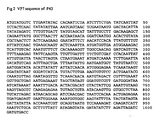
- the sequence of the VP4 and VP7 genes of the P43 material are given in Figures 1 and 2 respectively and are identical to P41.
- Homogeneity of the selected clone was assessed by a selective hybridization using oligonucleotide probes discriminating nucleotide changes in VP4 and/or VP7 regions for each variant identified during sequencing of P26/primary AGMK (see Table 4).
- the VP4 fragment hybridized with Rota 16 and not with Rota 15, Rota 35 or Rota 36.
- the VP7 fragment hybridized with Rota 41 and not with Rota 42.
- Ether was added to P33 (AGMK grown) to a final concentration of 20% for 1 hr. Ether was then bubbled out with N 2 for 35 min. No impact on the titre of P33 seed was observed.
- Example 4 Formulation of a live attenuated vaccine
- the production lots described above are formulated for oral adminstration to infants by the following method.
- Standard techniques are used for preparing virus doses. Frozen purified viral bulk is thawed and diluted with appropriate medium composition, in this case Dulbecco's modified eagle Medium, up to a desired standard viral concentration, in this case 10 6.2 ffu/ml. The diluted virus is then further diluted with lyophilisation stabiliser (sucrose 4%, dextran 8%, sorbitol 6%, amino-acid 4%) up to the target viral titre, in this case 10 5.6 ffu/dose. 0.5 ml aliquots of stabilised virus composition are aseptically transferred to 3 ml vials. Each vial is then partially closed with a rubber stopper, the sample is freeze dried under a vacuum, the vial is then fully closed and an aluminium cap is crimped in place around the vial to keep the stopper in place.
- appropriate medium composition in this case Dulbecco's modified eagle Medium
- lyophilisation stabiliser sucrose 4%, dex
- the virus is reconstituted using one of the following antacid reconstituents:
- Sodium citrate is dissolved in water, sterilized by filtration and aseptically transferred into reconstituent containers in 1.5 ml amounts at a concentration of 544 mg Na 3 Citrate.2H 2 O per 1.5ml dose.
- the reconstituent containers may be for example 3 ml vials, or 4 ml vials, or 2 ml syringes, or soft plastic squeezable capsules for oral administration.
- the final container can be autoclaved.
- An aseptic aluminium hydroxide suspension (Mylanta -trademark) is aseptically diluted in sterile water, aseptically transferred to reconstituent containers (for example 2 ml syringes, or soft plastic squeezable capsules) in 2 ml amounts each containing 48 mg Al(OH) 3 .
- An alternative to using sterile components under sterile conditions is to ⁇ irradiate the aluminium hydroxide suspension (preferably at a diluted stage).
- Standard ingredients are included to prevent the suspension from settling.
- Such standard ingredients include for example magnesium stearate, carboxymethylcellulose, hydroxypropylmethylcellulose, microcrystalline cellulose, and silicone polymers.
- Bacteriostatic agents for example butylparaben, propylparaben or other standard bacteriostatic agents used in food, and flavourings, may also be included.
- Standard techniques are used for preparing virus doses. Frozen purified viral bulk is thawed and diluted with appropriate medium composition, in this case Dulbecco's modified eagle Medium, up to a desired standard viral concentration, in this case 10 6.2 ffu/ml. Aluminium hydroxide suspension is added to reach a final quantity of 48 mg/dose and the virus composition is diluted with lyophilisation stabiliser (sucrose 4%, dextran 8%, sorbitol 6%, amino-acid 4%) up to the target viral titre, in this case 10 5.6 ffu/dose. 0.5 ml aliquots of stabilised virus composition are aseptically transferred to 3 ml vials. Lyophilisation and closing of the vials is then carried out as described in part 1.
- appropriate medium composition in this case Dulbecco's modified eagle Medium
- Aluminium hydroxide suspension is added to reach a final quantity of 48 mg/dose and the virus composition is diluted with lyophilisation stabiliser
- Standard techniques are used for preparing virus doses.
- Frozen purified viral bulk is thawed and diluted with appropriate medium composition, in this case Dulbecco's modified eagle Medium, up to a desired standard viral concentration, in this case 10 6.2 ffu/ml.
- Aluminium hydroxide suspension is added to reach a final quantity of 48 mg/dose and the virus composition is diluted with lyophilisation stabiliser which may be sucrose, dextran or amino-acid 4%, or gelatin, or vegetal peptone, or xanthane up to the target viral titre of 10 5.6 ffu/dose.
- An aseptic filling operation is employed to transfer doses of 0.5 ml or preferably less to blister cavities.
- the composition is lyophilised, and the blister cavities are sealed by thermic sealing.
- Standard ingredients are included to prevent the aluminium hydroxide suspension from settling.
- standard ingredients include for example magnesium stearate, carboxymethylcellulose, hydroxypropylmethylcellulose, microcrystalline cellulose, and silicone polymers.
- Flavourings may also be included.
- P43 rotavirus was formulated either with sucrose or with lactose as shown in the table above. Viral titration before lyophilisation is the viral titre in the completed formulated liquid (containing sucrose dextran sorbitol aminoacids) and without the lyophilisation step.
- Good results are those in which a ⁇ 0.5 log decrease at the lyophilisation step and ⁇ 0.5 log decrease during the "1 week at 37°C" (accelerated stability test) are achieved.
- the precision of the viral titration is around + or - 0.2 log.
- sucrose may be used instead of lactose.
- Sorbitol tends to decrease the glass transition temperature of the lyophilised cake by too great a degree. This can be overcome by using maltitol instead of sorbitol as shown above and the viral titer is still maintained.
- Al(OH) 3 is used as an antacid. This shows that Rotavirus is associated with the insoluble inorganic salt (Al(OH) 3 ) since it centrifuged together with the Al(OH) 3 (decrease of viral activity in the supernatant).
- Rotavirus When Rotavirus is associated with the Al(OH) 3 , it is possible to lyophilise everything (including the Al(OH) 3 ). After lyophilisation, it is possible to recover the Rotavirus by dissolving Al(OH) 3 in SodiumCitrate. This step does not damage the Rotavirus and retains its activity after this dissolution step.
- Rotavirus may be liberated from the Rotavirus - Al(OH) 3 association and the liberated Rotavirus remains active. This liberation can be done either by dissolving Al(OH) 3 (by HCl in the stomach, or by Na 3 Citrate in vitro) or by displacing Rotavirus by a basic amino acid (lysine). 5.7: Infectivity of the Al(OH) 3 -Rotavirus association
- a single dose of lyophilised Rotavirus was reconstituted with water and divided into two parts.
- the first part considered as the reference, received an additional volume of water.
- the second part received 24mg of Al(OH) 3 suspended in 0.240 ml of water (Preclinical viral titrations).
- the reference sample was the one reconstituted with a Citrate-Bicarbonate buffer.
- the viral titer is again higher in the presence of Al(OH) 3 .
- DRVC003A46 + 1.5 ml WL buffer DRVC003A46 + 12 mg Al(OH)3 in 0.120ml + 1.380ml H2O
- Rotavirus associates with the Al(OH) 3 particles, since the virus can be discarded by centrifugation.
- DRVC003A46 is a lyophilised formulated Rotavirus (Sucrose:2%; Dextran: 4%,Sorbitol:3%; Amino-acids:2%).
- SDSAA Sucrose 2%, Dextran 4%, Sorbitol 3%, Amino-Acid 2%.
- lyophilised Rotavirus (viral titer 5.7) was reconstituted with a suspension of CaCO 3 in water (50mg in 1.5ml); and then centrifuged, and the viral titer of the supernatant compared to the pellet.
- Example 6 Use of Calcium Carbonate as the antacid for the Rotavirus vaccine composition
- a pseudoplastic solution is defined as a solution having higher viscosity on standing compared to its viscosity under agitation.
- Usual excipients of this type are:
- thixotropic excipients examples include: Veegum ®(Magnesium-aluminium silicate) and Avicel RC® (about 89% microcrystalline cellulose and 11% Caboxymethylcellulose Na).
- a reduction in the CaCO 3 particle size resulted in a decrease in the antacid capacity of the compound.
- the antacid can be placed in the reconstituent liquid contained in the syringe.
- sedimentation of CaCO 3 must be under control not only during the filling steps, but also during the complete shelf-live of the product (at least 2 years).
- Rotavirus, CaCO 3 and Xanthane gum are lyophilised together directly in the blister.
- strains DS-1, P and VA70 are described as Human rotavirus reference strains for serotype G2, G3 and G4 respectively at page 1361 of "Fields" Raven press 1990, second editi on.
- Example 9 Phase I safety study in adults of one oral administration of the Rotavirus vaccine.
- P43 vaccine Clinical lots of P43 vaccine were produced, purified, formulated and lyophilized according to Good Manufacturing Practices. The lots were released by Quality Control and Quality Assurance.
- Each vial of vaccine contained the following components: Active ingredient: P43 strain Min. 10 5.8 ffu Excipients, stabilizers: Sucrose 9 mg Dextran 18 mg Sorbitol 13.5 mg Amino acids 9 mg
- Water for injection was used as diluent to reconstitute vaccine and placebo.
- Mylanta® is a registered antacid.
- the antacid increases the pH of the stomach and prevents inactivation of the rotavirus during its passage through the stomach.
- placebo two vials of lyophilized placebo were reconstituted with 1.5 ml water for injection and administered orally as a single dose.
- SB Biologicals P43 vaccine was safe relative to the placebo when administered orally in a double-blind fashion as a single dose at the dose of 10 6.1 ffu to healthy adult volunteers aged 18 to 44.
- Example 10 Efficacy of two doses of a human monovalent Rotavirus vaccine, RotarixTM in preventing Gastro-enteritis due to G1 and non-G1 (G9) Rotavirus
- a randomised, double-blind, placebo-controlled phase II trial was conducted to evaluate the protective efficacy of a vaccine derived from the G1P human strain 89-12 for infant immunisation.
- the vaccine used was named RotarixTM and comprises as the rotavirus component the attenuated G1 human strain deposited as ECACC deposit 99081301.
- Example 11 Efficacy of two doses of a human monovalent Rotavirus vaccine: RotarixTM administered at three different virus concentrations in preventing Gastro-enteritis due to G1 and non-G1 (G2, G3, G4, G9) Rotavirus
- a randomised, double-blind, placebo-controlled phase II trial was conducted to evaluate the protective efficacy and efficacy against hospitalization of a vaccine derived from the G1P human strain 89-12 for infant immunisation.
- the vaccine used was named RotarixTM and comprises as the rotavirus component the attenuated G1 human strain deposited as ECACC deposit 99081301.
- Results are illustrated in the tables below. Infants in the vaccine groups had significantly fewer rotavirus gastroenteritis episodes than children in the placebo group (p ⁇ 0.001, two-sided Fisher's exact test). Depending on the dosage, protective efficacy against severe rotavirus gastroenteritis reached 86% (95%Cl: 63%-96%), and 70% (95%Cl, 46%-84%) against any rotavirus gastroenteritis. For each of these efficacy endpoints, there was a statistically significant decrease in diarrhoea episodes in the HRV group as compared to the placebo group (p ⁇ 0.001, two-sided Fisher's exact test).
Landscapes
- Health & Medical Sciences (AREA)
- Life Sciences & Earth Sciences (AREA)
- Veterinary Medicine (AREA)
- Chemical & Material Sciences (AREA)
- Medicinal Chemistry (AREA)
- Virology (AREA)
- Public Health (AREA)
- Pharmacology & Pharmacy (AREA)
- Animal Behavior & Ethology (AREA)
- General Health & Medical Sciences (AREA)
- Immunology (AREA)
- Mycology (AREA)
- Microbiology (AREA)
- Epidemiology (AREA)
- General Chemical & Material Sciences (AREA)
- Organic Chemistry (AREA)
- Nuclear Medicine, Radiotherapy & Molecular Imaging (AREA)
- Chemical Kinetics & Catalysis (AREA)
- Bioinformatics & Cheminformatics (AREA)
- Engineering & Computer Science (AREA)
- Communicable Diseases (AREA)
- Oncology (AREA)
- Medicines Containing Antibodies Or Antigens For Use As Internal Diagnostic Agents (AREA)
- Medicinal Preparation (AREA)
- Pharmaceuticals Containing Other Organic And Inorganic Compounds (AREA)
Claims (12)
- Verwendung eines attenuierten humanen Rotavirus-Stammes vom G1-Serotyp in der Herstellung einer Zusammensetzung zur Induktion einer Immunantwort gegen Rotavirus-Infektion durch den G1- und mindestens zwei der Nicht-G1-Rotavirus-Serotypen, die ausgewählt sind aus der Gruppe bestehend aus: G2-, G3-, G4- und G9-Serotypen, wobei der attenuierte Rotavirus-Stamm eine einzelne Rotavirus-Variante oder im wesentlichen eine einzelne Rotavirus-Variante mit einem VP4-Gen ist, das in der Nukleotidsequenz ein Adenin (A) an den Positionen 788 und 802 und ein Thymin (T) an Position 501 ab dem Start-Kodon umfasst; und wobei das VP7-Gen in der Nukleotidsequenz ein Thymin (T) an Position 605 und ein Adenin (A) an Position 897 ab dem Start-Kodon umfasst.
- Verwendung eines attenuierten Rotavirus-Stammes vom G1-Serotyp in der Herstellung einer Zusammensetzung zur Induktion einer Immunantwort gegen Rotavirus-Infektion durch den G1- und mindestens zwei der Nicht-G1-Rotavirus-Serotypen, die ausgewählt sind aus der Gruppe bestehend aus: G2-, G3-, G4- und G9-Serotypen, wobei der attenuierte Rotavirus-Stamm die ECACC-Hinterlegung 99081301 oder eine einzelne Rotavirus-Variante oder im wesentlichen eine einzelne Rotavirus-Variante ist, erhältlich oder ableitbar von der ECACC-Hinterlegung 99081301 und mit einem VP4-Gen, das in der Nukleotidsequenz ein Adenin (A) an den Positionen 788 und 802 und ein Thymin (T) an Position 501 ab dem Start-Kodon umfasst; und wobei das VP7-Gen in der Nukleotidsequenz ein Thymin (T) an Position 605 und ein Adenin (A) an Position 897 ab dem Start-Kodon umfasst.
- Verwendung gemäß Anspruch 1 oder Anspruch 2, wobei die Zusammensetzung imstande ist, eine Immunantwort gegen Rotavirus-Infektion durch mindestens drei der Nicht-G1-Rotavirus-Serotypen zu induzieren, die ausgewählt sind aus der Gruppe bestehend aus: G2-, G3-, G4- und G9-Serotypen.
- Verwendung gemäß Anspruch 1 bis 3, wobei die Zusammensetzung imstande ist, eine Immunantwort gegen den G1- und gegen die G2-, G3-, G4- und G9-Serotypen zu induzieren.
- Verwendung gemäß den Ansprüchen 1 bis 4, wobei die Zusammensetzung in einer Population geimpfter Individuen zu mindestens 50 % Schutz bietet gegen Durchfall und/oder Gastroenteritis und/oder schwere Gastroenteritis, verursacht durch Infektion eines Rotavirus von mindestens zwei Nicht-G1-Serotypen.
- Verwendung gemäß den Ansprüchen 1 bis 4, wobei die Zusammensetzung in einer Population geimpfter Individuen bis zu 60 % Schutz bietet gegen Durchfall, verursacht durch Infektion eines Rotavirus von mindestens zwei Nicht-G1-Serotypen.
- Verwendung gemäß den Ansprüchen 1 bis 4, wobei die Zusammensetzung bis zu 81 % Schutz bietet gegen Gastroenteritis, verursacht durch Infektion eines Rotavirus von mindestens zwei Nicht-G1-Serotypen.
- Verwendung gemäß den Ansprüchen 1 bis 4, wobei die Zusammensetzung in einer Population geimpfter Individuen bis zu 83 % Schutz bietet gegen schwere Gastroenteritis, verursacht durch Infektion von Rotaviren von mindestens zwei Nicht-G1-Serotypen.
- Verwendung gemäß Anspruch 5, 7 und 8, wobei die Gastroenteritis durch Infektion eines Rotavirus von mindestens drei Nicht-G1-Serotypen verursacht wird, die ausgewählt sind aus der Gruppe bestehend aus G2, G3, G4 und G9.
- Verwendung gemäß Anspruch 9, wobei die Gastroenteritis durch Infektion mit G2-, G3-, G4- und G9-Serotypen verursacht wird.
- Verwendung gemäß den Ansprüchen 1 bis 10, wobei die Zusammensetzung für die Verabreichung in einem 2-Dosis-Schema bestimmt ist.
- Verwendung gemäß den Ansprüchen 1 bis 11, wobei der attenuierte Rotavirus-Stamm mit einem geeigneten pharmazeutischen Träger oder mit einem antaziden Puffer oder beidem formuliert ist.
Priority Applications (6)
| Application Number | Priority Date | Filing Date | Title |
|---|---|---|---|
| PL10176849T PL2272532T3 (pl) | 2003-09-02 | 2004-08-31 | Szczepionka rotawirusowa |
| EP10176849.7A EP2272532B1 (de) | 2003-09-02 | 2004-08-31 | Impfstoff gegen das Rotavirus |
| PL04764688T PL1660123T3 (pl) | 2003-09-02 | 2004-08-31 | Szczepionka rotawirusowa |
| SI200432030T SI1660123T1 (sl) | 2003-09-02 | 2004-08-31 | Cepivo proti rotavirusom |
| DK10176849.7T DK2272532T3 (en) | 2003-09-02 | 2004-08-31 | Rotavirus vaccine. |
| CY20131100429T CY1114309T1 (el) | 2003-09-02 | 2013-05-29 | Εμβολιο ροταϊου |
Applications Claiming Priority (3)
| Application Number | Priority Date | Filing Date | Title |
|---|---|---|---|
| US49943003P | 2003-09-02 | 2003-09-02 | |
| GBGB0414787.2A GB0414787D0 (en) | 2004-07-01 | 2004-07-01 | Method |
| PCT/EP2004/009725 WO2005021033A2 (en) | 2003-09-02 | 2004-08-31 | Vaccine |
Related Child Applications (2)
| Application Number | Title | Priority Date | Filing Date |
|---|---|---|---|
| EP10176849.7A Division EP2272532B1 (de) | 2003-09-02 | 2004-08-31 | Impfstoff gegen das Rotavirus |
| EP10176849.7 Division-Into | 2010-09-15 |
Publications (2)
| Publication Number | Publication Date |
|---|---|
| EP1660123A2 EP1660123A2 (de) | 2006-05-31 |
| EP1660123B1 true EP1660123B1 (de) | 2013-03-13 |
Family
ID=34276843
Family Applications (2)
| Application Number | Title | Priority Date | Filing Date |
|---|---|---|---|
| EP04764688A Expired - Lifetime EP1660123B1 (de) | 2003-09-02 | 2004-08-31 | Rotavirus-vakzine |
| EP10176849.7A Expired - Lifetime EP2272532B1 (de) | 2003-09-02 | 2004-08-31 | Impfstoff gegen das Rotavirus |
Family Applications After (1)
| Application Number | Title | Priority Date | Filing Date |
|---|---|---|---|
| EP10176849.7A Expired - Lifetime EP2272532B1 (de) | 2003-09-02 | 2004-08-31 | Impfstoff gegen das Rotavirus |
Country Status (17)
| Country | Link |
|---|---|
| EP (2) | EP1660123B1 (de) |
| JP (1) | JP5588586B2 (de) |
| KR (1) | KR20060126917A (de) |
| AU (1) | AU2004268375B2 (de) |
| BR (1) | BRPI0414073A (de) |
| CA (1) | CA2536734C (de) |
| HR (2) | HRP20130407T1 (de) |
| IL (1) | IL173921A0 (de) |
| IS (1) | IS2922B (de) |
| MA (1) | MA28035A1 (de) |
| MX (1) | MXPA06002459A (de) |
| NO (1) | NO342397B1 (de) |
| NZ (1) | NZ545639A (de) |
| PL (2) | PL1660123T3 (de) |
| RU (1) | RU2368392C2 (de) |
| SG (1) | SG147465A1 (de) |
| WO (1) | WO2005021033A2 (de) |
Families Citing this family (8)
| Publication number | Priority date | Publication date | Assignee | Title |
|---|---|---|---|---|
| WO2007020078A2 (en) * | 2005-08-17 | 2007-02-22 | Glaxosmithkline Biologicals S.A. | Rotavirus vaccine inducing heterotypic cross protection |
| ES2514316T3 (es) | 2005-11-22 | 2014-10-28 | Novartis Vaccines And Diagnostics, Inc. | Partículas similares a virus (VLPs) de Norovirus y Sapovirus |
| CA2797059A1 (en) * | 2010-05-03 | 2011-11-10 | Glaxosmithkline Biologicals S.A. | Novel method |
| EP2646051A4 (de) | 2010-12-02 | 2014-05-28 | Oncolytics Biotech Inc | Flüssige virale formulierungen |
| MX349294B (es) * | 2010-12-02 | 2017-07-21 | Oncolytics Biotech Inc | Formulaciones virales liofilizadas. |
| EP3359651A1 (de) | 2015-10-05 | 2018-08-15 | THE UNITED STATES OF AMERICA, represented by the S | Stamm des menschlichen rota-virus g9p[6] und verwendung als impfstoff |
| US10550405B2 (en) | 2017-03-15 | 2020-02-04 | The University Of North Carolina At Chapel Hill | Rational polyploid adeno-associated virus vectors and methods of making and using the same |
| AU2018422759B2 (en) * | 2018-05-07 | 2026-01-22 | The University Of North Carolina At Chapel Hill | Rational polyploid adeno-associated virus vectors and methods of making and using the same |
Family Cites Families (8)
| Publication number | Priority date | Publication date | Assignee | Title |
|---|---|---|---|---|
| US4436727A (en) | 1982-05-26 | 1984-03-13 | Ribi Immunochem Research, Inc. | Refined detoxified endotoxin product |
| JP2849632B2 (ja) | 1988-04-08 | 1999-01-20 | 社団法人北里研究所 | ワクチン製剤 |
| KR0171434B1 (ko) * | 1990-11-16 | 1999-02-01 | 윌리엄 케이. 슈버트 | 인체 로타바이러스, 백신 및 방법 |
| IT1253009B (it) | 1991-12-31 | 1995-07-10 | Sclavo Ricerca S R L | Mutanti immunogenici detossificati della tossina colerica e della tossina lt, loro preparazione ed uso per la preparazione di vaccini |
| CA2138997C (en) | 1992-06-25 | 2003-06-03 | Jean-Paul Prieels | Vaccine composition containing adjuvants |
| US6019982A (en) | 1994-08-26 | 2000-02-01 | The Administrators Of The Tulane Educational Fund | Mutant enterotoxin effective as a non-toxic oral adjuvant |
| WO1998056415A1 (en) | 1997-06-11 | 1998-12-17 | Aquila Biopharmaceuticals, Inc. | Purified saponins as oral adjuvants |
| TR200200420T2 (tr) * | 1999-08-17 | 2002-05-21 | Smithkline Beecham Biologicals S.A. | Aşı |
-
2004
- 2004-08-31 WO PCT/EP2004/009725 patent/WO2005021033A2/en not_active Ceased
- 2004-08-31 KR KR1020067004369A patent/KR20060126917A/ko not_active Ceased
- 2004-08-31 BR BRPI0414073-7A patent/BRPI0414073A/pt not_active Application Discontinuation
- 2004-08-31 SG SG200807883-4A patent/SG147465A1/en unknown
- 2004-08-31 AU AU2004268375A patent/AU2004268375B2/en not_active Ceased
- 2004-08-31 HR HRP20130407TT patent/HRP20130407T1/hr unknown
- 2004-08-31 EP EP04764688A patent/EP1660123B1/de not_active Expired - Lifetime
- 2004-08-31 EP EP10176849.7A patent/EP2272532B1/de not_active Expired - Lifetime
- 2004-08-31 PL PL04764688T patent/PL1660123T3/pl unknown
- 2004-08-31 MX MXPA06002459A patent/MXPA06002459A/es active IP Right Grant
- 2004-08-31 PL PL10176849T patent/PL2272532T3/pl unknown
- 2004-08-31 JP JP2006525097A patent/JP5588586B2/ja not_active Expired - Lifetime
- 2004-08-31 NZ NZ545639A patent/NZ545639A/en unknown
- 2004-08-31 RU RU2006106427/13A patent/RU2368392C2/ru not_active IP Right Cessation
- 2004-08-31 CA CA2536734A patent/CA2536734C/en not_active Expired - Lifetime
-
2006
- 2006-02-23 IL IL173921A patent/IL173921A0/en unknown
- 2006-02-23 IS IS8325A patent/IS2922B/is unknown
- 2006-02-28 NO NO20060976A patent/NO342397B1/no unknown
- 2006-03-10 MA MA28868A patent/MA28035A1/fr unknown
-
2016
- 2016-03-23 HR HRP20160299TT patent/HRP20160299T1/hr unknown
Non-Patent Citations (1)
| Title |
|---|
| BERNSTEIN D I ET AL: "Safety and immunogenicity of live, attenuated human rotavirus vaccine 89-12", VACCINE, ELSEVIER LTD, GB, vol. 16, no. 4, 1 February 1998 (1998-02-01), pages 381 - 387, XP004099298, ISSN: 0264-410X, DOI: 10.1016/S0264-410X(97)00210-7 * |
Also Published As
| Publication number | Publication date |
|---|---|
| EP2272532A2 (de) | 2011-01-12 |
| IL173921A0 (en) | 2006-07-05 |
| KR20060126917A (ko) | 2006-12-11 |
| PL1660123T3 (pl) | 2013-08-30 |
| CA2536734A1 (en) | 2005-03-10 |
| HRP20130407T1 (en) | 2013-06-30 |
| NZ545639A (en) | 2009-04-30 |
| CA2536734C (en) | 2014-07-08 |
| JP5588586B2 (ja) | 2014-09-10 |
| MA28035A1 (fr) | 2006-07-03 |
| MXPA06002459A (es) | 2006-06-20 |
| NO342397B1 (no) | 2018-05-14 |
| EP2272532B1 (de) | 2016-02-10 |
| NO20060976L (no) | 2006-03-31 |
| BRPI0414073A (pt) | 2006-10-24 |
| AU2004268375B2 (en) | 2010-01-28 |
| SG147465A1 (en) | 2008-11-28 |
| IS2922B (is) | 2015-04-15 |
| JP2007516215A (ja) | 2007-06-21 |
| RU2006106427A (ru) | 2007-10-10 |
| AU2004268375A1 (en) | 2005-03-10 |
| WO2005021033A3 (en) | 2005-05-06 |
| WO2005021033A2 (en) | 2005-03-10 |
| HRP20160299T1 (hr) | 2016-04-22 |
| RU2368392C2 (ru) | 2009-09-27 |
| EP1660123A2 (de) | 2006-05-31 |
| IS8325A (is) | 2006-02-23 |
| EP2272532A3 (de) | 2012-08-01 |
| PL2272532T3 (pl) | 2016-07-29 |
Similar Documents
| Publication | Publication Date | Title |
|---|---|---|
| US7790179B2 (en) | Homogeneous attenuated human rotavirus population | |
| EP1660123B1 (de) | Rotavirus-vakzine | |
| US7579008B2 (en) | Immunization with an attenuated human rotavirus | |
| EP2233153B1 (de) | Heterotypischen Kreuzschutz auslösende Rotavirus-Vakzine | |
| EP1676586B1 (de) | Methoden um Rotavirusvarianten zu Trennen und lebender attenuierter Rotavirus Impfstoff | |
| ZA200601771B (en) | Vaccine |
Legal Events
| Date | Code | Title | Description |
|---|---|---|---|
| PUAI | Public reference made under article 153(3) epc to a published international application that has entered the european phase |
Free format text: ORIGINAL CODE: 0009012 |
|
| 17P | Request for examination filed |
Effective date: 20060303 |
|
| AK | Designated contracting states |
Kind code of ref document: A2 Designated state(s): AT BE BG CH CY CZ DE DK EE ES FI FR GB GR HU IE IT LI LU MC NL PL PT RO SE SI SK TR |
|
| AX | Request for extension of the european patent |
Extension state: HR LT LV |
|
| 17Q | First examination report despatched |
Effective date: 20060926 |
|
| RAX | Requested extension states of the european patent have changed |
Extension state: LV Payment date: 20060303 Extension state: LT Payment date: 20060303 Extension state: HR Payment date: 20060303 |
|
| REG | Reference to a national code |
Ref country code: HK Ref legal event code: DE Ref document number: 1090555 Country of ref document: HK |
|
| GRAP | Despatch of communication of intention to grant a patent |
Free format text: ORIGINAL CODE: EPIDOSNIGR1 |
|
| GRAS | Grant fee paid |
Free format text: ORIGINAL CODE: EPIDOSNIGR3 |
|
| GRAA | (expected) grant |
Free format text: ORIGINAL CODE: 0009210 |
|
| AK | Designated contracting states |
Kind code of ref document: B1 Designated state(s): AT BE BG CH CY CZ DE DK EE ES FI FR GB GR HU IE IT LI LU MC NL PL PT RO SE SI SK TR |
|
| AX | Request for extension of the european patent |
Extension state: HR LT LV |
|
| REG | Reference to a national code |
Ref country code: GB Ref legal event code: FG4D |
|
| REG | Reference to a national code |
Ref country code: AT Ref legal event code: REF Ref document number: 600393 Country of ref document: AT Kind code of ref document: T Effective date: 20130315 Ref country code: CH Ref legal event code: EP |
|
| REG | Reference to a national code |
Ref country code: HK Ref legal event code: WD Ref document number: 1090555 Country of ref document: HK |
|
| REG | Reference to a national code |
Ref country code: IE Ref legal event code: FG4D |
|
| REG | Reference to a national code |
Ref country code: CH Ref legal event code: NV Representative=s name: ISLER AND PEDRAZZINI AG, CH |
|
| REG | Reference to a national code |
Ref country code: HR Ref legal event code: TUEP Ref document number: P20130407 Country of ref document: HR Ref country code: DE Ref legal event code: R096 Ref document number: 602004041349 Country of ref document: DE Effective date: 20130508 |
|
| REG | Reference to a national code |
Ref country code: PT Ref legal event code: SC4A Free format text: AVAILABILITY OF NATIONAL TRANSLATION Effective date: 20130522 |
|
| REG | Reference to a national code |
Ref country code: RO Ref legal event code: EPE |
|
| REG | Reference to a national code |
Ref country code: DK Ref legal event code: T3 |
|
| REG | Reference to a national code |
Ref country code: ES Ref legal event code: FG2A Ref document number: 2407840 Country of ref document: ES Kind code of ref document: T3 Effective date: 20130614 |
|
| REG | Reference to a national code |
Ref country code: SE Ref legal event code: TRGR |
|
| REG | Reference to a national code |
Ref country code: HR Ref legal event code: T1PR Ref document number: P20130407 Country of ref document: HR |
|
| REG | Reference to a national code |
Ref country code: NL Ref legal event code: T3 |
|
| REG | Reference to a national code |
Ref country code: SK Ref legal event code: T3 Ref document number: E 14154 Country of ref document: SK |
|
| REG | Reference to a national code |
Ref country code: EE Ref legal event code: FG4A Ref document number: E007987 Country of ref document: EE Effective date: 20130523 |
|
| REG | Reference to a national code |
Ref country code: HU Ref legal event code: AG4A Ref document number: E016462 Country of ref document: HU |
|
| REG | Reference to a national code |
Ref country code: PL Ref legal event code: T3 Ref country code: GR Ref legal event code: EP Ref document number: 20130401055 Country of ref document: GR Effective date: 20130614 |
|
| PLBE | No opposition filed within time limit |
Free format text: ORIGINAL CODE: 0009261 |
|
| STAA | Information on the status of an ep patent application or granted ep patent |
Free format text: STATUS: NO OPPOSITION FILED WITHIN TIME LIMIT |
|
| 26N | No opposition filed |
Effective date: 20131216 |
|
| REG | Reference to a national code |
Ref country code: DE Ref legal event code: R097 Ref document number: 602004041349 Country of ref document: DE Effective date: 20131216 |
|
| REG | Reference to a national code |
Ref country code: FR Ref legal event code: PLFP Year of fee payment: 12 |
|
| REG | Reference to a national code |
Ref country code: FR Ref legal event code: PLFP Year of fee payment: 13 |
|
| REG | Reference to a national code |
Ref country code: FR Ref legal event code: PLFP Year of fee payment: 14 |
|
| REG | Reference to a national code |
Ref country code: FR Ref legal event code: PLFP Year of fee payment: 15 |
|
| PG25 | Lapsed in a contracting state [announced via postgrant information from national office to epo] |
Ref country code: MC Free format text: LAPSE BECAUSE OF NON-PAYMENT OF DUE FEES Effective date: 20180831 |
|
| REG | Reference to a national code |
Ref country code: HR Ref legal event code: ODRP Ref document number: P20130407 Country of ref document: HR Payment date: 20190807 Year of fee payment: 16 |
|
| REG | Reference to a national code |
Ref country code: HR Ref legal event code: ODRP Ref document number: P20130407 Country of ref document: HR Payment date: 20200806 Year of fee payment: 17 |
|
| REG | Reference to a national code |
Ref country code: HR Ref legal event code: ODRP Ref document number: P20130407 Country of ref document: HR Payment date: 20210825 Year of fee payment: 18 |
|
| REG | Reference to a national code |
Ref country code: HR Ref legal event code: ODRP Ref document number: P20130407 Country of ref document: HR Payment date: 20220824 Year of fee payment: 19 |
|
| P01 | Opt-out of the competence of the unified patent court (upc) registered |
Effective date: 20230331 |
|
| PGFP | Annual fee paid to national office [announced via postgrant information from national office to epo] |
Ref country code: NL Payment date: 20230721 Year of fee payment: 20 Ref country code: LU Payment date: 20230720 Year of fee payment: 20 |
|
| REG | Reference to a national code |
Ref country code: HR Ref legal event code: ODRP Ref document number: P20130407 Country of ref document: HR Payment date: 20230727 Year of fee payment: 20 |
|
| PGFP | Annual fee paid to national office [announced via postgrant information from national office to epo] |
Ref country code: TR Payment date: 20230728 Year of fee payment: 20 Ref country code: RO Payment date: 20230816 Year of fee payment: 20 Ref country code: IT Payment date: 20230720 Year of fee payment: 20 Ref country code: IE Payment date: 20230724 Year of fee payment: 20 Ref country code: GB Payment date: 20230720 Year of fee payment: 20 Ref country code: FI Payment date: 20230720 Year of fee payment: 20 Ref country code: ES Payment date: 20230901 Year of fee payment: 20 Ref country code: EE Payment date: 20230721 Year of fee payment: 20 Ref country code: CZ Payment date: 20230725 Year of fee payment: 20 Ref country code: CY Payment date: 20230721 Year of fee payment: 20 Ref country code: CH Payment date: 20230902 Year of fee payment: 20 Ref country code: BG Payment date: 20230803 Year of fee payment: 20 Ref country code: AT Payment date: 20230721 Year of fee payment: 20 |
|
| PGFP | Annual fee paid to national office [announced via postgrant information from national office to epo] |
Ref country code: SK Payment date: 20230727 Year of fee payment: 20 Ref country code: SI Payment date: 20230726 Year of fee payment: 20 Ref country code: SE Payment date: 20230720 Year of fee payment: 20 Ref country code: PT Payment date: 20230724 Year of fee payment: 20 Ref country code: PL Payment date: 20230724 Year of fee payment: 20 Ref country code: HU Payment date: 20230803 Year of fee payment: 20 Ref country code: GR Payment date: 20230721 Year of fee payment: 20 Ref country code: FR Payment date: 20230720 Year of fee payment: 20 Ref country code: DK Payment date: 20230725 Year of fee payment: 20 Ref country code: DE Payment date: 20230720 Year of fee payment: 20 Ref country code: BE Payment date: 20230720 Year of fee payment: 20 |
|
| REG | Reference to a national code |
Ref country code: CH Ref legal event code: PL |
|
| REG | Reference to a national code |
Ref country code: DE Ref legal event code: R071 Ref document number: 602004041349 Country of ref document: DE |
|
| REG | Reference to a national code |
Ref country code: BE Ref legal event code: MK Effective date: 20240831 Ref country code: DK Ref legal event code: EUP Expiry date: 20240831 |
|
| REG | Reference to a national code |
Ref country code: NL Ref legal event code: MK Effective date: 20240830 |
|
| REG | Reference to a national code |
Ref country code: LT Ref legal event code: MM9A Effective date: 20240831 |
|
| REG | Reference to a national code |
Ref country code: SK Ref legal event code: MK4A Ref document number: E 14154 Country of ref document: SK Expiry date: 20240831 |
|
| REG | Reference to a national code |
Ref country code: IE Ref legal event code: MK9A Ref country code: GB Ref legal event code: PE20 Expiry date: 20240830 |
|
| REG | Reference to a national code |
Ref country code: ES Ref legal event code: FD2A Effective date: 20240927 |
|
| REG | Reference to a national code |
Ref country code: SE Ref legal event code: EUG |
|
| PG25 | Lapsed in a contracting state [announced via postgrant information from national office to epo] |
Ref country code: IE Free format text: LAPSE BECAUSE OF EXPIRATION OF PROTECTION Effective date: 20240831 |
|
| PG25 | Lapsed in a contracting state [announced via postgrant information from national office to epo] |
Ref country code: PT Free format text: LAPSE BECAUSE OF EXPIRATION OF PROTECTION Effective date: 20240911 Ref country code: GB Free format text: LAPSE BECAUSE OF EXPIRATION OF PROTECTION Effective date: 20240830 |
|
| REG | Reference to a national code |
Ref country code: AT Ref legal event code: MK07 Ref document number: 600393 Country of ref document: AT Kind code of ref document: T Effective date: 20240831 |
|
| PG25 | Lapsed in a contracting state [announced via postgrant information from national office to epo] |
Ref country code: ES Free format text: LAPSE BECAUSE OF EXPIRATION OF PROTECTION Effective date: 20240901 |
|
| PG25 | Lapsed in a contracting state [announced via postgrant information from national office to epo] |
Ref country code: CZ Free format text: LAPSE BECAUSE OF EXPIRATION OF PROTECTION Effective date: 20240831 |
|
| PG25 | Lapsed in a contracting state [announced via postgrant information from national office to epo] |
Ref country code: SK Free format text: LAPSE BECAUSE OF EXPIRATION OF PROTECTION Effective date: 20240831 Ref country code: SI Free format text: LAPSE BECAUSE OF EXPIRATION OF PROTECTION Effective date: 20240901 |
|
| PG25 | Lapsed in a contracting state [announced via postgrant information from national office to epo] |
Ref country code: SK Free format text: LAPSE BECAUSE OF EXPIRATION OF PROTECTION Effective date: 20240831 Ref country code: SI Free format text: LAPSE BECAUSE OF EXPIRATION OF PROTECTION Effective date: 20240901 Ref country code: PT Free format text: LAPSE BECAUSE OF EXPIRATION OF PROTECTION Effective date: 20240911 Ref country code: IE Free format text: LAPSE BECAUSE OF EXPIRATION OF PROTECTION Effective date: 20240831 Ref country code: GB Free format text: LAPSE BECAUSE OF EXPIRATION OF PROTECTION Effective date: 20240830 Ref country code: ES Free format text: LAPSE BECAUSE OF EXPIRATION OF PROTECTION Effective date: 20240901 Ref country code: CZ Free format text: LAPSE BECAUSE OF EXPIRATION OF PROTECTION Effective date: 20240831 |
|
| REG | Reference to a national code |
Ref country code: HR Ref legal event code: PB20 Ref document number: P20130407 Country of ref document: HR Effective date: 20240831 |